
Archive
-
Meditation Rocks
Comments Off on Meditation Rocks“Okay, move back to your seats. You have to stay at your desk for this from now on.” I sounded disappointed and a bit defeated, because I was.
It was my first day trying meditation out on my students.
Do you try meditation out on somebody?
No, I suppose you do it with them.
But for me it felt like a try out. One that was going very wrong.
I had tried meditation for myself about ten years previous. My vice-principal at the time did it regularly, and had begun a meditation group after school. Although we only managed to have three sessions before it disbanded – after school being a prime time for other meetings, interviews, extra-curriculars – the peace and stillness I remember experiencing during that last session, when for a few minutes my mind had actually become blank and I felt in its blankness that it had expanded in some way – was motivation enough to try meditation with my class when a colleague gave me these CDs she had bought at a workshop.
“You might like these. Probably better for older kids.”
My colleague taught Grade 3 and it was my first year teaching Grade 8.
“Sure. Thanks.”
The CDs – Open Our Hearts, Christian Meditation for Children – were a set of four meditations, five minutes, seven minutes, nine minutes, and eleven minutes.
They sat on my desk for four weeks before Joshua said, “Hey Mrs. Ranby. Are we ever gonna use those?”
“Of course we are Joshua. I was just waiting for the new month to begin.”
“Sweet.”
So I had felt pressure by the turning of the calendar to March 1st, and there we were, me telling the kids to get back to their seats, and all of us feeling not at all relaxed and calm.
It had all started so optimistically.
Innocently.
“So class, you’ve heard a bit about meditation in health class, but now we’re actually going to practice it. Remember, it’s about calming your mind. You get to actually think of nothing. You can go home and answer “we did nothing at school” and you’d be right!”
I grinned at my joke.
You could hear the sound of crickets. The 25 fourteen year olds just looked at me.

Well, one gave me a pity laugh.
“Good one, Mrs. Ranby.”
“Thank you Ben.”
I carried on.
“So you can go anywhere in the class where you will be comfortable. It’s important that you’re comfortable. If you want to lay down, sit against a wall, whatever. Just be sure you can be quiet and still…”
What was I thinking?
Except for a couple of kids who laid completely down on the floor, every other one sat around the periphery of the room. Against the brick walls, looking nice and comfortable.
I sat up in my chair, feet on the floor, feeling pumped and competent and pressed “play.”
I didn’t realize they were all going to do that as well.
More on that later.
The CD begins with a song and a short scripture reading, and then the mantra: Ma-ra-na-tha, which means Come our Lord. The mantra fades out and then there is silence, for five minutes.
And I closed my eyes, trying to say the mantra silently, trying to clear my mind, but mostly thinking – meditation rocks. They are all quiet! No, not quiet…silent. Perfectly and completely silent. How good am I? Why didn’t I do this before? Even Ben is silent! And he’s never silent. They’ve longed for this. They practically begged me to do this. Meditation…who knew? Can’t hear a single thing…
And then I made my mistake.
By this time we were probably three minutes in. Doesn’t seem long, but three minutes of silence when you’re just waiting for a kid to start laughing, or worse, can seem like an eternity.
But they were killing it! And I just had to open my eyes, to see them all concentrating, trying to clear their minds, to see them relaxed, in states of total calmness, not moving a muscle, totally concentrating…
On their cell phones.
Yep. Every student was on their cell phone.

They had seized the opportunity to relax and when they knew I’d have my eyes closed for a full five minutes, well…
Let’s just say they relaxed the old-fashioned way.
With technology.
That’s why they were so silent.
I was aghast surveying the scene.
Even Lydia, sprawled out on the floor, was texting someone!
It was Ben who looked up first and saw me, eyes open.
“Uh guys…”
Everyone else looked up at Ben, and then at me.
Busted.
They put their phones away.
“Move back to your seats.”
The remaining 70 seconds of the meditation was spent with all the students at their seats, heads on their desks, being silent.
I took a few deep breaths to try to get back to relaxation land, but that ship had sailed.
Still…when the gong sounded at the end of the five minutes, there was a sense of calmness in the room.
Lydia spoke first.
“Sorry Mrs. Ranby,” she said.
The other students nodded.
“So…will we do it again?” Joshua asked.
“Would you like to?” I asked. I tried to be angry, but deep breathing and mantras and silence and anger just don’t go together.
“Yes,” they all said, as one voice.
“Ok..no cell phones, no moving places, just at your desk, eyes closed.”
They nodded.
“Let’s try the seven minute one!” Joshua suggested.
“Whoa whoa whoa…don’t think we’re quite there. Let’s do the five minute one again.”
“Fair enough.”
So I pressed play, the only pressing of play in the classroom, and we meditated together as best we could.
Lydia fell asleep, Preston started drumming a pen on his desk, Alyssa began giggling, joined by Maddy and Sophie R., but Ben stayed quiet. And so did Joshua.
And so did I.
And for five minutes we all tried to concentrate on nothing. On being still. On letting our cares float away.
And when the gong sounded at the end of the five minutes, I felt relaxed and recharged, all at the same time.
And when Joshua looked at me and nodded, I agreed with him.
“You’re right Joshua…we could have handled the seven minute one.”
And with cell phones firmly out of sight, I made my way to the front of the room, ready to teach algebra, and thinking, while writing the first equation, “Meditation rocks!”

Photos: Adobe Stock
-
WEBINAR: A Taste of SMART: An introduction to mindfulness, self-care, and resiliency for educators
Comments Off on WEBINAR: A Taste of SMART: An introduction to mindfulness, self-care, and resiliency for educatorsCofounded by Heidi Bornstein and Stephen Chadwick in 2009, Mindfulness everyday is a diverse team of experienced professionals dedicated to educator well-being. Mindfulness Everyday offers various mindfulness programs and practices for educators to provide them with the skills and coping strategies required to support their own mental and physical health.
This webinar first broadcasted on April 15th, provided an experiential introduction to mindfulness research and practices that benefit educators personally and professionally.
Watch the full webinar below:
About Mindfulness Everyday
At Mindfulness Everyday, we envision a society in which we relate to others, the environment, and ourselves with clarity and compassion. We promote mindfulness practices to enhance positive mental and physical health, compassionate action and resilience by providing stress reduction training and life skills for young people, educators, professional support staff and parents in the schools, and for organizations and members of the community.
-
COVID-19: The Demoralization of Educators
Comments Off on COVID-19: The Demoralization of Educators -
Teaching and Learning from home
Comments Off on Teaching and Learning from home -
WEBINAR: Strengthening Resilience, Leadership, and Well-Being During and After COVID-19
Comments Off on WEBINAR: Strengthening Resilience, Leadership, and Well-Being During and After COVID-19This webinar first broadcasted on May 12th discussed individual and organizational resilience in the context of the COVID-19 pandemic. In this hour-long webinar, Dr. Graham Lowe explained:
-
The features of a healthy organization, especially its culture and inclusive approach to leadership, that can support your workforce now and prepare it for the recovery
-
How resilience is one of the defining characteristics of a healthy organization
-
How resilience is a psychological health and safety skill that can be cultivated within school and school district teams.
-
How resilience is part of a broader set of capabilities called Psychological Capital (PsyCap)
-
The ways that Psychological Capital (PsyCap) supports a transformational leadership style and contributes to K-12 workplace well-being.
Watch the full webinar below:
Want to watch upcoming webinars as they are released? Visit our webinar series to sign up today!
-
-
How does teacher stress and burnout impact student achievement?
Comments Off on How does teacher stress and burnout impact student achievement?The mental health and well-being of students in Canadian schools has become a growing concern – but it’s not just children’s well-being that’s concerning. Recent research demonstrates that the well-being of both students and teachers go hand-in-hand. In particular, increased teacher well-being leads to more supportive teacher-student relationships. Despite this evidence, a Canadian Teachers’ Federation survey shows that 85% of teachers find that poor work-life balance is affecting their ability to teach the way they would like to teach.
THE IMPACTS OF TEACHER STRESS AND BURNOUT INCLUDE:
IMPACT ON TEACHERS
- Poorer health outcomes: High blood pressure, cardiovascular disease, anxiety, and depression.
- Increased absenteeism: In Canada, the average work days lost per educator (i.e. in schools, colleges, universities and training centres) jumped from 8.9 in 2014 to 11.9 in 2018.
- Lower job satisfaction: There’s a close relationship between high levels of teacher burnout and low job satisfaction and commitment.
IMPACT ON STUDENTS
- Reduced motivation and achievement: Teacher burnout and depersonalization (i.e. feelings of disinterest towards one’s job) negatively impacts teaching quality and student motivation (e.g. disruptive behaviour, low sense of belonging, weak belief in ability to succeed, lower grades).
- Higher stress levels: Higher levels of teacher burnout is linked to higher cortisol levels in children, which is a biological indicator of stress.
ON THE FLIPSIDE, HERE ARE THREE WAYS THAT LEADERS CAN CREATE A SUPPORTIVE SCHOOL CLIMATE THAT PROMOTES TEACHERS’ WELL-BEING:
Promote mental fitness:
Teachers who have a positive sense of how they feel, think, and act generally have a sense of relatedness (i.e. connectedness) with fellow staff, believe their strengths and skills are valued, and have autonomy to collaborate and provide feedback.
DEVELOP TEAM RESILIENCY:
School staff who persist, bounce forward, and thrive in the face of adversity usually demonstrate strong relationship practices and professionalism, positive attitudes, emotional intelligence, and adaptation skills.
EMBODY POSITIVE LEADERSHIP:
Administrators who are committed to helping teachers achieve their highest potential and succeed show compassion and gratitude, know the strengths/interests of their staff, clarify roles and expectations, and provide opportunities for growth.
The factors that promote student well-being are, in many ways, the same as the factors that promote teacher well-being. A positive school climate leads to reduced teacher absenteeism, fewer teachers leaving the profession, stronger teacher-student relationships, and improved student achievement. Targeted training for school teams and leaders on mental fitness and resiliency practices that foster teachers’ sense of relatedness, competency, and autonomy represent an important first step in improving school climate, reducing teacher stress, and enhancing student achievement.
ADDITIONAL INFORMATION RESOURCES
Work-Life Balance and the Canadian Teaching Profession by Bernie Froese-Germain via Canadian Teachers’ Federation
Three key conditions to create a healthy workplace by Bill Morrison via The Globe and Mail
Infographic: The Positive Workplace Framework (PWF) via Well at Work by EdCan
REFERENCES AND FURTHER READING
Burke, R., Greenglass, E., & Schwarzer, R. (1996). Predicting teacher burnout over time: Effects of work stress, social support, and self-doubts on burnout and its consequences. Anxiety, Stress & Coping: An International Journal, 9(3), 261-275. doi: https://doi.org/10.1080/10615809608249406
Briner, R., & Dewberry, C. (2007). Staff well-being is key to school success. London: Worklife Support Ltd/Hamilton House.
Darr, W., and Johns, G., (2008). Work strain, health, and absenteeism: A meta-analysis. Journal of Occupational Health Psychology,13(4), 293-318. doi: https://doi.org/10.1037/a0012639
Hoglund, W. L., Klingle, K. E., & Hosan, N. E. (2015). Classroom risks and resources: Teacher burnout, classroom quality and children’s adjustment in high needs elementary schools. Journal of School Psychology, 53(5), 337-357. doi: 10.1016/j.jsp.2015.06.002
Jennings, P.A., Brown, J. L., Frank, J. L., Doyle, S., Oh, Y., Davis, R., DeMauro, A. A. & Greenberg, M. T. (2017). Impacts of the CARE for teachers program on teachers’ social and emotional competence and classroom interactions. Journal of Educational Psychology, 109(7), 1010–1028. doi: http://dx.doi.org/10.1037/edu0000187
Laurie, R. (2019, December). Measuring school well-being: The mental fitness and resiliency inventory and the School Happiness Index (SHI). Education Canada Magazine, 59(4). Retrieved from: https://www.edcan.ca/articles/measuring-school-well-being
Laurie, R., Morrison, B. & Peterson, P. (2019, December). The Positive Workplace Framework (PWF): A strengths-based approach for thriving schools. Education Canada Magazine, 59(4). Retrieved from: https://www.edcan.ca/articles/the-positive-workplace-framework/
McLean, L., & Connor, C. M. (2015). Depressive symptoms in third‐grade teachers: Relations to classroom quality and student achievement. Child Development, 86(3), 945-954. doi: 10.1111/cdev.12344
Miller, R. (2012). Teacher absence as a leading indicator of student achievement: New national data offer opportunity to examine cost of teacher absence relative to learning loss. Washington, DC: Center for American Progress.
Miller, R., Murnane, R., & Willett, J. (2008). Do teacher absences impact student achievement? Longitudinal evidence from one urban school district. Educational Evaluation and Policy Analysis, 30(2), 181-200. doi: https://doi.org/10.3102/0162373708318019
Molero Jurado, M. D. M., Pérez-Fuentes, M. D. C., Atria, L., Oropesa Ruiz, N. F., & Gázquez Linares, J. J. (2019). Burnout, perceived efficacy, and job satisfaction: Perception of the educational context in high school teachers. BioMed research international, 2019. doi: 10.1155/2019/1021408
Núñez, J. L., Fernández, C., León, J., & Grijalvo, F. (2015). The relationship between teacher’s autonomy support and students’ autonomy and vitality. Teachers and Teaching: Theory and Practice, 21(2), 191-202. doi: https://doi.org/10.1080/13540602.2014.928127
Oberle, E., & Schonert-Reichl, K. A. (2016). Stress contagion in the classroom? The link between classroom teacher burnout and morning cortisol in elementary school students. Social Science & Medicine, 159, 30-37. doi: 10.1016/j.socscimed.2016.04.031
Roffey, S. (2012). Pupil Wellbeing – Teacher Wellbeing: Two sides of the same coin. Educational & Child Psychology, 29(4), 8-17. Retrieved from: https://www.sueroffey.com/wp-content/uploads/import/32-Roffey%20ECP29-4.pdf
Ronfeldt, M., Loeb, S., & Wyckoff, J. (2013). How teacher turnover harms student achievement. American Educational Research Journal, 50(1), 4-36. doi: https://doi.org/10.3102%2F0002831212463813
Statistics Canada. (2020). Work absence of full-time employees by industry, annual. Retrieved from: https://www150.statcan.gc.ca/t1/tbl1/en/tv.action?pid=1410019101
WITH THE GENEROUS FINANCIAL SUPPORT OF:


-
WEBINAR: Testing and Adapting Innovative Approaches to Workplace Well-Being in K-12 Education During COVID-19
Comments Off on WEBINAR: Testing and Adapting Innovative Approaches to Workplace Well-Being in K-12 Education During COVID-19While a breadth of empirical evidence has been published on ways to increase student well-being, there has been little empirical research on how to address whole school well-being.
Based on this gap in the literature, The Behavioural Insights Team (BIT) has created two organizational approaches to school well-being in Canada that are currently being tested in numerous K-12 schools.
In this hour-long webinar first broadcasted on April 30th, Emily Larson explains the two approaches including tips for leveraging them during COVID-19, which include:
- A weekly well-being program where staff are sent supportive text messages.
- An email template for principals to use to communicate the value they place on staff well-being.
Watch the full webinar below:
Want to watch upcoming webinars as they are released? Visit our webinar series to sign up today!
MESSAGE FROM BIT – SHARE YOUR STORY!
As part of our efforts to support school wellbeing during these times of uncertainty, we would love to hear from you on how you are coping. While you cannot be together, sharing stories with other teachers in Canada is a powerful way to connect and support one another. We are collecting stories, which we may use in some of our messages to teachers, principals, and support staff over the next few weeks. If you are willing to share your story (which will be used anonymously) please email wellbeing@bi.team. These stories may be on the struggles you are facing right now, how you have managed to find meaning while working from home or how you are trying to maintain a work-life balance – there are no right answers! We thank you for everything you are doing to support your students – and remember to take care of yourself!
-
Mental health: A private affair?
Comments Off on Mental health: A private affair? -
How to “drum away” stress and burnout
Comments Off on How to “drum away” stress and burnout -
COVID-19 and Workplace Well-Being in K-12 Education: Leaning into Connection, Belonging, and Opportunity in a Time of Crisis
Comments Off on COVID-19 and Workplace Well-Being in K-12 Education: Leaning into Connection, Belonging, and Opportunity in a Time of CrisisOne of the things that I’ve learned from research is how important belonging and connection are to almost every measure of success in life. Without doubt, this pandemic is transporting our ability to connect into a wild spin. In some ways, we’re more apart now than we’ve ever been before as we practice physical distancing while remaining unable to connect in-person with our students, family members, and colleagues. It feels utterly strange that we can’t hang out with those closest to us as we put a halt on all of the normal, social things that we typically do instinctively.

Educators are missing their students, and students are likewise missing their friends and their educators, too. But both educators and students are a creative bunch who are finding ways to connect in spite of the current pandemic. We’re connecting online, we’re making videos, and entire staff teams are driving parade-like through neighbourhoods. Students are making signs at their window sills to greet passer-bys, and we’re gathering on balconies to make noise in praise of frontline healthcare workers every evening at 7:00 pm.
Through it all, we’re finding creative ways to show that we care. Whether that be through handwritten letters, telephone calls, or various online platforms, teachers and students are continuing to connect with those around them, and this ongoing care and connection has been heart-warming. One teacher had told me how nervous she was about experimenting with new ways of teaching as a result of the times that we’re in, but also of the empathetic words she received from parents who asked how she was doing and how they could support her. I can’t help but be immensely proud of each and every educator, including our education leaders, for prioritizing connection and belonging in this era of physical distancing.
COVID-19 IS FORCING US TO UP OUR GAME IN THE AREA OF K-12 WORKPLACE WELL-BEING.
Before COVID-19, society in general and education systems in particular were on paths towards acknowledging the importance of social emotional health in schools. K-12 staff were busily working on reducing stigma around mental illness, teaching about mental health, and acknowledging that schools have a big part to play in this area. Staff were also spreading the message that investing in K-12 workplace well-being is tremendously important in light of increasing levels of employee stress and burnout. If anything, this pandemic is forcing us to up our game. COVID-19 will continue to bring out people’s emotions in ways that encourage everyone to start talking more openly about – rather than masking – their true feelings. Open lines of communication are vital to healthy workplaces, and there’s nothing like a pandemic and being at home 24/7 to set the stage for people to embrace self-awareness and self-regulation.
Of course, there are people who will continue to avoid their feelings while pretending that they’re “fine” or “doing great” all the time, but here’s a tip for you: those people are either lying about their feelings or numbing, pretending, and protecting their pain in ways that are bound to break down sooner or later. We’re emotional beings and it’s okay to feel negative emotions. Remember that feelings are completely natural, so let’s stop fighting them and instead meet them with curiosity, courage, and compassion when they surface. Right now, educators are feeling nervous and overwhelmed as they think things like “I don’t know what I’m doing” and “What if I’m not good at this?” But here’s the thing – we aren’t alone. Parents are thinking and feeling these things right now, too. Sorry if it freaks you out, but our leaders are also thinking and feeling these things. We’re all human, imperfect, and in this together.

So many educators are trying to figure out how to get work done and be a parent at the same time. There are so many questions without easy answers, such as:
- “How can I teach a class with a toddler running in and out of the room or crying in the background?”
- “What about my own school-age children – how can I support their learning while simultaneously teaching my students online?”
- “What about my elderly parents?”
- “What about getting groceries?”
- “What about my spouse who is busily working?”
- “What about my spouse who has just been laid off?”
The fact is that these times can be messy and imperfect – and that’s okay.
LET’S CHOOSE TO SEE COVID-19 NOT ONLY FOR ITS CHALLENGES BUT ALSO THE OPPORTUNITIES IT PRESENTS FOR EDUCATORS.
If we notice, name, and are curious about these feelings, then we’ll be much better positioned to regulate our feelings and choose how we react. Although our brains and bodies are designed to see danger in the midst of worry and stress, we must also recognize the good that has transpired through the COVID-19 pandemic. Right now, we might be feeling fearful (it really is okay to admit this), but we might also be feeling inspired, compassionate and, heck, even brave and resilient. These positive feelings are so good to talk about, too.
New methods of learning are forcing us and perhaps even inspiring us to transition slowly and gently into the most important parts of teaching and learning. For some time now, educators have been wanting to prioritize core skills like communication, thinking, creativity, and social connection over classroom content. Educators have wanted to emphasize flexible and creative project learning over textbooks and worksheets. Indeed, the current situation we find ourselves in presents opportunity to do exactly these things!
THE TAKEAWAY: IN THE CHAOS OF OUR EMOTIONS, LET’S LEAN INTO COMMUNITY AND OUR RELATIONSHIPS.
I know it’s probably too soon to be envisioning a post-COVID-19 world, but we’re already seeing more connection, relationship, and compassion grow from this situation. Organizations are collaborating like never before, and hierarchies and silos are slowly opening up and dissipating. We’re seeing the world slow down and focus more on what matters most.

Surely there will be challenges in the upcoming days, weeks, and even months, inevitably leading to all kinds of emotions, thoughts, and behaviours. But I know that we’ll get through this because, like we tell our kids at home and in the classroom, “We can do hard things.” We will also experience positive emotions, thoughts, and behaviours. When that happens, lean into those moments and enjoy them for as long as you can. Remember that the roller coaster ride may go on for a while, but you’re not riding alone. Physically apart, maybe, but certainly not alone. We got this!
Photos: Adobe Stock
-
Healthy organizational responses to the coronavirus pandemic
Comments Off on Healthy organizational responses to the coronavirus pandemicI begin the revised and expanded edition of my book, Creating Healthy Organizations: Taking Action to Improve Employee Well-Being with a basic question: how can we make organizations humanly sustainable so they can succeed in the future? This question takes on new urgency now that we’ve been blind-sided by a global pandemic. Human resources, workplace wellness, and occupational health and safety professionals are confronting what surely will be the greatest test of their career. Following the principles of a healthy organization can be helpful.
PERVASIVE PUBLIC PESSIMISM
First, here’s the backdrop to what’s happening to workers and employers. Unlike the 2008-2009 financial crisis and Great Recession, which resulted from weaknesses in the financial system, the coronavirus pandemic generates anxiety and fear on two fronts: health and economic.

Evidence of this comes from EKOS Research Associates’ latest polling of Canadians (March 17-24, n=1,710, MOE +/- 2.4%, 19 times out of 20). Three-quarters of those surveyed believe the economy is already in recession and expect it to get worse in the next 6 months. Just over half think they will be worse off financially in 6 months. The typical respondent sees a 50% chance of them personally being infected by the coronavirus. Most (80%) are experiencing stress due to the pandemic. On an optimistic note, Canadians do grasp the severity of the crisis and understand what they need to do to stay safe. And they endorse governments’ responses so far.
SHIFTING HEALTHY PRACTICES INTO HIGH GEAR
Pre-pandemic, organizations in all industries operated in an environment rife with ever-greater risks and uncertainties, and sweeping transformations. More employers recognize that survival depends on getting the fullest commitment and energy from each and every employee. The goal of making the entire organization healthier moved into the mainstream of corporate wellness. Companies are striving to make workplaces psychologically healthier and safer. Expanded corporate sustainability frameworks have opened up discussions about the sustainability of a company’s human resource practices.
This solid progress – coupled with strong economies in Canada and the US leading up to the pandemic – will enable many of us to weather the storm.
CULTIVATING RESILIENCE
Healthy organizations cultivate workforce resilience. Resilient people don’t bounce back; they bounce forward, finding new strength and equilibrium. They move to a new normal that enables them to keep progressing toward a better future. Resilient people don’t just adapt to change, they find opportunities and renewed strength as they confront it. In the language of positive psychology, the goal is to help organizations and their members flourish and thrive.
Workers need a supportive environment to be resilient. To do this, leaders must develop their own resilience. Resilient leaders skillfully and proactively respond to stressors, practice self-care, learn from failure, develop renewed strengths, and show others how it is possible to thrive when the going gets tough. In this way, they foster a resilient workforce that is prepared to deal with the unexpected.
Individual and team resilience is a hallmark of a psychologically healthy and safe workplace. The National Standard of Canada for Psychological Health and Safety in the Workplace highlights the key workplace features that contribute to resilience:
1. Supportive managers and coworkers
2. A culture that values individuals’ well-being
3. Skilled people leadership
4. Respectful working relationships
5. Support for employees’ personal growth and development
6. The resources needed to manage workloads and job demands
7. Employee involvement in decisions
8. Recognition for contributions
9. The flexibility needed to achieve work-life balance
Maintaining, and even strengthening, the above workplace features must be a priority. Building a healthy organization is a shared responsibility. While demonstrated support from senior leaders is a key enabling condition for change, equally important is the active participation of all the organization’s members, right down to the front lines. Ideally, all employees should feel motivated and encouraged to find ways to make their jobs and work environment healthier and safer. Now the bar is raised, because this has to happen virtually.
 LESSONS FROM RECESSIONS PAST
 The change process can be designed to be healthy. We can derive lessons from research on corporate downsizing and restructuring during the recessions of the ‘80s, 90s, and 2000s. Here’s what’s well documented: 1) downsizing increases stress and diminishes the health of those laid off and the ‘survivors’ (who suffer from what’s called ‘survivor syndrome’); 2) poorly executed downsizing or restructuring reduces organizational capabilities, ranging from learning, reduced tacit knowledge, social capital (relationships), collaboration, and innovation.
Survivor syndrome (the negative psychological and physical impact of remaining in a downsized organization, including guilt) can be avoided by empowering workers to redesign work tasks and processes to fit the renewed mission, responding to issues and concerns raised by employees, and supporting employees to individually and as teams actively manage the changes.
During the 2008-2009 Great Recession, some companies came out stronger because they used the downturn as an opportunity to engage all employees to reinvent the business strategy and find better ways of working. Leaders in these organizations built trust by openly communicating with employees, involving them in the changes, and supporting them at every step of the way. The big take-away for employees: this company cares about me so I am committed to its future success.
SIGNS OF MUTUAL SUPPORT
As the Economist recently observed: “Downturns are capitalism’s sorting mechanism, revealing weak business models and stretched balance-sheets.” But there’s more to the survival story. Beyond balance sheets and the type of business (pity the cruise lines), it comes down to people practices, reinforced by shared corporate values. Values are the essential guideposts when the going gets tough. And rarely has it been tougher.
Small businesses face more acute challenges. But from what I’ve seen locally, owners may be more inclined to treat their workers like family, knowing they will need them back as the pandemic threat recedes.
I see signs of this today in my own community. A restaurant quickly shifted to a reduced take out menu, turning waiters into delivery drivers, and offering customers the option of buying an inexpensive meal for a family in need. Gyms offer free daily on-line workouts. Musicians stream live performances. A craft distillery now is producing hand sanitizer. My friend Todd Ramsay and his wife Ashley, who run Kelowna-based Yeti Farm Creative, an animation studio, proactively set up their employees to work at home in early March. Their team feels virtually connected (Todd’s accompanying graphic captures this) and are committed to coming out of this ordeal even stronger. The common theme here is people pulling together and helping each other. And just as with fires, floods and other natural disasters, people are engaging in acts of kindness. Local TV news images of empty foodbank hampers quickly resulted in a $10,000 donation, plus lots of smaller ones.

Work and social life have been transformed in a matter of weeks into virtual experiences. Video chat service Zoom has, well, zoomed into widespread use. The lines between work and home and family life have dissolved. What about those workers faced with school closures and kids at home needing constructive activities? It’s time for your team to talk about what adaptations are needed to support these members.
LET’S NOT FORGET…
There are other groups of workers who desperately need help. Foremost are front-line healthcare workers. We’ve seen shocking videos of doctors and nurses working around the clock in Spain and Italy, risking their safety, tending to patients lying in hallway floors without proper equipment. How can we prevent that scenario from happening here? And as a New York Times editorial put it: “In this hour of crisis, those at the bottom of the economic pyramid are in the greatest need of help.” This includes low-paid workers and those in the gig economy. There’s an essential role for governments here.
Yes, the coronavirus pandemic will end. The Chinese city of Wuhan, the original epicenter of the coronavirus, has reduced the number of new infections to the point that people are returning to work and some semblance of normal daily life. All the more important to ensure that today’s responses to the pandemic will ready us to resume our social and economic lives. So think of where you want to be one year from now.
-
The Ups and Downs of Co-Teaching
Comments Off on The Ups and Downs of Co-Teaching -
Making a Drastic Change in my Teaching Career
Comments Off on Making a Drastic Change in my Teaching Career -
I’ve Never Looked Back
Comments Off on I’ve Never Looked Back“Tell me one thing you wish you knew when you were a beginning teacher,” Jodie asks, pen in hand, marking a math test, while also searching something on her laptop.

I swallow my urge to say “That multi-tasking really, really doesn’t work”, and instead say something that wasn’t even on my radar 6 months ago…and this is after 25 years of teaching.
“That doing circle with your class will help you as much as them.”
Jodie crinkles her face.
“Really! Circles aren’t just for kindergarteners anymore. My grade ⅞ class loves them!”
For the first time I have her attention.
“They wouldn’t work with my grade 5’s. Too chatty,” Jodie says.
As a teacher, we both know that “too chatty” really means “the students are on the verge of taking over” so I nod. I’ve had classes that were too chatty as well.
And I really wish I had done circle with them.
“Try it Jodie. Really. You’ll like it as much as they do.”
She sighs, and I know what that sigh means. I’ve had many a sigh like that after a workshop, or after realizing how little time I have to cover the ever-lengthening list of curriculum expectations.
It means – great…one more thing I should be doing.
I type out the template I use for circle and e-mail it to her.
I love that silence in the teacher workroom can mean that just as much communication is being done as when everyone is talking at once.
She gets the e-mail and I watch her face as she reads it.
The widening-eyed, nodding, “now I get it” reaction does not come.
Instead she looks over at me, head cocked to one side, eyes narrowed, brows furrowed.

“What don’t you get?” I asked, really interested.
I follow a simple circle itinerary.
“What do newts and asses have to do with circle?”
I look back at her, head cocked to one side, eyes narrowed, brows furrowed.
We look like mirror images of every teacher half-way through a staff meeting.
Then I look at my screen. Oh.
“It should read news and issues.”
“Uh-huh,” she says slowly, and I know from having three millenial-aged children that I need to get on with this or her attention will go elsewhere.
And probably for good reason. Newts and asses, while having quite amazing adaptations (thank you grade six science) do not belong in circle.
Well maybe newts. Anything that can regenerate an eye and limb has a place in any circle.
“Okay – so get them to sit in a circle and then do a check-in. They have to say a number between 1 and 5 that reflects how they’re feeling. 1 is low – sad, tired, stressed. 5 is high – happy, energized, calm. You say how you’re feeling too. It’s good for the students to realize that every so often you’re not feeling the best, but you can power through, or ask for support, or do things during the day to help you.”
“Mmmm,” Jodie says, picking up her pen again. I speak quickly now.
“And then we share news. What’s going on in the world, what’s going on in our community, what’s going on with us. This is the magic Jodie. They love to share what’s going on in their lives.”
“Too much sometimes,” she adds.
“Yeah, but in circle, you give them the permission to. The idea is that they talk. That’s what you want. You want them to feel safe enough to tell you about how they’re worrying about the environment, or their cat being sick or the fight they had with their best friend. And the other kids can relate with each other. They’ll ask each other questions, they’ll laugh when it’s funny, they’ll say “that sucks” when it does. And they will feel lighter for it. Really.”
Jodie is looking at me, her pen has been set down, she leans forward.
“But don’t they just get carried away? Talking all at once?”
“No. And you lay down the ground rules. No private conversations. And if they continue talking to a neighbour, you tell them to leave the circle, and they’ll have a chance to rejoin during the next section.”
“Okay…I guess that sounds good…”
“In circle is when I learn the important stuff… whose father is sick, who’s looking forward to seeing their favourite Youtuber perform, who has a hockey tournament on the weekend…the stuff of their lives. The stuff I can bring up later in the day, or the week, one-on-one, to deepen the connection with each student.”

“What else?”
“Next we do issues. I have these conversation cards that discuss various issues that affect Canada and the world, like violence, lack of water, discrimination. I give them facts and statistics and then we discuss any questions they have, observations, experiences.”
“Can I borrow those?”
“Of course. And then we do a mindfulness activity. Again, I have cards with various activities. I have a student choose a card and we do whatever is on it. I never have any idea what activity we’ll be doing.”
“Mindfulness? They won’t sit still long enough…”
“Maybe at first some of them will find it difficult, but I’m telling you, they are longing for this information. For how to destress, get their anxiety under control, relax. The activities are short and focus on breathing, on noticing things, on being mindful…”
“That sounds nice…” Jodie is smiling, and I know she’s decided to finish marking her math tests another time.
“It is nice…really nice. The last activity we did was pretending we were blowing into a balloon. We had to take deep breaths and release them…by the end of four breaths, my shoulders were no longer hunched around my ears and my mind was relaxed.”
A quiet second passes.
“And the final activity we do is prayer intentions. I begin by praying for every child in the circle, and any classmates that are absent. And then they raise their hands and offer up their prayer intentions. And while praying for their sick aunt, or grandfather, or neighbour I’m learning more about what is on their minds. What they need to take off their shoulders for a while. And we pray, and that’s how we finish our circle.”
Jodie takes a deep breath. “I guess I could try…”
“Try it. You’ll be amazed at what you learn. At how much more deeply you can connect with them. At how much more supported they will feel.”
“Okay…I’m going to do it.”
“They’ll learn a lot from doing circle…but Jodie, you will learn more. Promise.”
“Ok,” Jodie gathers her math tests and gets ready to carry her marking and laptop back to her class.
“And Jodie?”

She turns. She is a hard-working, 26 year-old teacher. She is caring and committed and wonderful.
“By giving them the chance to chat…you’ll find they become less chatty.”
We laugh. She’s not quite convinced, but is going to give circle a go.
And just like me, she’ll never look back.

Photo: Adobe Stock
-
The Action-Driven Change Framework
Comments Off on The Action-Driven Change Framework -
Dealing with a negative school environment as a new teacher
Comments Off on Dealing with a negative school environment as a new teacherIN BEGINNING MY JOURNEY AS A TEACHER, I LEARNED THAT I HAD TO BETTER UNDERSTAND TEACHER WELL-BEING IN TODAY’S K-12 EDUCATION SYSTEMS.
When I began teaching, I decided to enroll in the Master’s of Professional Education program (M.P.Ed.) at Western University, with a focus on Curriculum and Pedagogy. To me, this was an easy decision given that the practicum placements I undertook during my pre-service teaching program had ultimately left me with more questions than answers about current policies and initiatives to support teacher well-being. From my experience, the majority of education policies and initiatives that are publicly available remain largely focused on student well-being and on how teachers can make various changes to their professional practice to inspire student success. I began to wonder, “Why are there such limited documents and resources available that focus on the value of teacher well-being and that show how teachers’ levels of well-being directly influence their professional practice? How are teachers supposed to support student well-being and success, if their own well-being isn’t supported by K-12 education systems?”
It’s these types of questions that led me to conduct research during my M.P.Ed. program specifically on the value of teachers in today’s classrooms. As I began to scan the available research on K-12 teacher well-being in schools across Canada, I was able to confirm that there indeed wasn’t much research available that actually looked at the well-being of teachers. As a full-time student simultaneously teaching full-time, what I was finding through my research was backed not only by my personal experiences but by many of the conversations I had with fellow colleagues at the very first school I was teaching at. Ultimately, I began to notice that many of the stories I was hearing all had an underlying commonality — that teachers’ well-being was almost always linked to the quality of relationship teachers have with their school principals.

TEACHERS AND PRINCIPALS: WHY BUILDING UP THIS RELATIONSHIP IS SO IMPORTANT.
Emotional exhaustion including low energy and consistent fatigue caused by workload or time pressure, fear of speaking honestly, and other professional frustrations are warning signs that teachers may be trailing along a path towards burnout. Much of the research that’s been offered in the past 5-to-10 years hints that negative school climate and classroom environments can take a toll on a person’s ability to teach effectively. Part of what can help create a healthier school climate is the quality of teacher-principal relationships, and we know that negative relationships between professionals can negatively affect the quality of instructional leadership and learning taking place within a school.
After graduating from my pre-service program, I landed a full-time French Immersion teaching position in a school where I soon realized there was a consistent lack of open and positive communication between the staff team and administrative team. When trying to learn about how things worked in my school, as well as navigate what was expected of me, I often received different answers depending on who I asked. If I posed questions to other staff members, I’d get responses like, “I’m not sure…”, “I don’t know…”, “I think so and so knows that answer…”, and, “I think the admin said this, but I would go and ask them to make sure…” I began to find myself constantly questioning my own confidence and purpose as a teacher because of the lack of trust and clarity I was often experiencing in my interactions with administrative staff. This isn’t at all what I’d envisioned for my first two years of teaching.

As someone who had learned, while training as a teacher in university, the importance of maintaining open lines of communication between myself and school administration, I began to realize that this simply wasn’t a case of me being unprepared as a new teacher. More importantly, I knew I wasn’t alone in experiencing these communication problems. Over time, as much I would try to remind myself that my mental, emotional, and physical well-being were important to maintain in my profession, I became more and more discouraged each morning I returned to school. It became clear to me that the lack of clear communication between staff and administration, among other things, weren’t conducive to building a healthy, supportive school culture. It was also clear that this was taking a toll on everyone’s well-being. If I was dreading going to work, I’m sure both other staff and administration were, too. I knew for the sake of my own well-being, and that of my colleagues and administrators, that none of us could continue working in an environment like this. I was left wondering, “What steps could we all be taking to improve workplace satisfaction and the overall well-being of all K-12 staff?”
THE TAKEAWAY: NOT ALL HOPE IS LOST WHEN IT COMES TO ENSURING HIGH QUALITY TEACHER-PRINCIPAL RELATIONSHIPS AND RESTORING THE VALUE OF ALL TEACHERS.
My experiences during my first two years as a teacher were very eye-opening and served as a great learning experience in how relationships are so key to well-being in the workplace. A teacher, or any K-12 staff member (e.g. Educational Assistant, Principal, etc.) who’s treated as a valued member of the team not only by their administration – but by everyone – will feel supported and more engaged in their work, which benefits the entire school community and students especially.
Through experience and further research, I hope to be able to find some answers and solutions to the problems associated with strained teacher-principal relationships. Far too many teachers and principals today are experiencing unnecessary levels of anxiety, confusion, uncertainty, and a low sense of well-being. My best advice for those who are also in their beginning years of the profession is to find strategies to build up your resilience at work and, most especially, to trust yourself. By reminding ourselves to follow our instincts on both personal and professional levels, we as teachers can build and maintain a sense of value and purpose in our important roles.

Photos: Adobe Stock
check out the following resources to learn more about:
1. Empowering Modern Educators
This resource has been created to encourage and empower all educators. Much of the information presented in this resource is solely meant to highlight some of the major, and ongoing challenges that are experienced daily by educators. This resource is also meant to give educators the confidence to maintain the difficult, but necessary, dialogue about the added responsibilities and stresses which this profession, at times, places on us.
Learn more here
2. Restoring the Value of Teachers: A Perspective on Quality Teacher-Principal Relationships
A compilation of research that examines what makes a quality teacher-principal relationship.
learn more here
-
Racism and K-12 Workplace Well-Being
Comments Off on Racism and K-12 Workplace Well-BeingAlso available on:


-
Well at Work Professional Development Discussion Kit for K-12 Staff
Comments Off on Well at Work Professional Development Discussion Kit for K-12 StaffEducation Canada Discussion Kits are an EdCan Member Exclusive Benefit for Organizations (School Districts, Faculties of Education, Corporations, Non-Profits), transforming evidence-based literature from our critically-acclaimed Education Canada magazine into practical group discussion and self-reflection guides that can be used by K-12 staff to question, strengthen, and improve their professional practice across a variety of current and emerging trends in education.
Whether you’re an educational assistant, teacher, school leader, or superintendent, we encourage you to invest in your continuous learning and that of your team through these easy-to-use and affordable professional development resources that encourage critical thinking and actionable strategies for unique school contexts.
About the Well at Work Discussion Kit
This special Well at Work Discussion Kit complements our Winter 2019 edition of Education Canada magazine – available both in-print and online – and puts the spotlight on how we can (and why we must) strengthen the social and emotional wellbeing of K-12 staff, in turn enabling them to achieve healthier schools and better learning experiences for students.
This discussion kit contains a total of eight group discussion and self-reflection guides – four in English and four in French – covering topics ranging from creating organizational cultures that foster workplace well-being; the well-being of education leaders and front-line staff; and identifying and challenging the mindsets, assumptions and public perceptions towards the well-being of K-12 educators that hinder change.
How to use Education Canada Discussion Kits
Each group discussion or self-reflection guide contains three key components:
- A Cheat Sheet providing a brief summary of the literature, which is intended to facilitate and support the uptake of group discussion within your school community.
- A Reflect section with 2-4 thought provoking questions prompting participants to self-reflect in conjunction with their own thoughts and opinions in response to the article.
- A Do It section that provides participants with the opportunity to engage with the content in a more interactive way. By completing this interactive activity, participants are encouraged to think about how they can apply their newfound learnings to their professional practice.
Education Canada Discussion Kits have two-fold usage:
- Group discussions: School leaders can use discussion kits for staff Professional Development (PD) by facilitating discussion during a staff meeting or other designated PD time. Principals can lead sessions by selecting a group discussion guide according to their preference, introducing the theme of the guide, providing a summary of the literature, and finally proceeding to facilitate and participate in discussion by asking the suggested questions and interactive activity provided. Discussion kits can also be used during more informal group discussions (i.e. among colleagues) without the presence of an administrator to facilitate.
- Self-reflections: Discussion kits can also be used alone by individual K-12 staff members who are looking to improve their professional practice on their own time. Additionally, newfound knowledge can help individual staff members to later spark and inform conversations with their colleagues.
Ready? Request the full copy now!
FOR EDCAN MEMBERS
If you’re an EdCan member, you’ll be able to access the full-version of the Well at Work Discussion Kit, including all of our other archived and upcoming discussion kits! Simply fill out the form below!
Not sure if you’re a member? Check out our list of members here. If you’re an employee of one of the organizations listed, or a student or faculty member of a university listed, then you’re already a member! Click here to create your employee, student, or faculty account.
Note: To access this discussion kit, you must have an organizational membership, meaning that you are an employee, student, or faculty member of the following:
- School District;
- Faculty of Education;
- Not-for-Profit (national and provincial organizations, federations, colleges, schools); or
- Corporation.
Not a member yet? That’s okay! To gain unlimited access to the Well at Work Discussion Kit and all other discussion kits, we encourage you to explore our membership options here.
If you require any assistance or have any questions with regards to becoming a member please contact membership@edcan.ca.
Full Copy Request Form – Well at Work Discussion Kit
-
Infographic: The Positive Workplace Framework (PWF)
Comments Off on Infographic: The Positive Workplace Framework (PWF)This infographic is based on the Positive Workplace Framework (PWF), which is a made-in-Canada strengths-based approach to optimizing staff and student well-being, engagement and performance, with a focus on the three key conditions to creating a healthy workplace in K-12 education: Mental Fitness, Resilience, and Positive Leadership. The PWF can also be applied to other settings beyond the K-12 context (e.g. colleges, universities, day cares, etc.).
This infographic was inspired by an article by Robert Laurie, Dr. Bill Morrison, and
Dr. Patricia Peterson that appeared in Education Canada Magazine. -
Workplace Well-Being in K-12 Schools: What does it mean to “flourish” at work?
Comments Off on Workplace Well-Being in K-12 Schools: What does it mean to “flourish” at work?Facing growing levels of stress and burnout, K-12 staff require a supportive workplace that encourages them to find ways to “flourish” within their school community. While flourishing may look different to staff members depending on what makes them personally feel most valued and connected to their work, a flourishing school environment generally has three main components:
1. Subjective Well-Being: positive emotions, positive relationships, and a sense of making a difference are all aspects that contribute to a staff member’s sense of flourishing.
2. Adaptive Community: an environment where staff are encouraged to communicate openly with colleagues, be creative, and resolve team conflicts when they arise.
3. Leaderful Mindsets: staff are able to identify ways that their work contributes to the larger, shared goals of the school community, which provides a greater sense of ownership, engagement, and shared leadership.
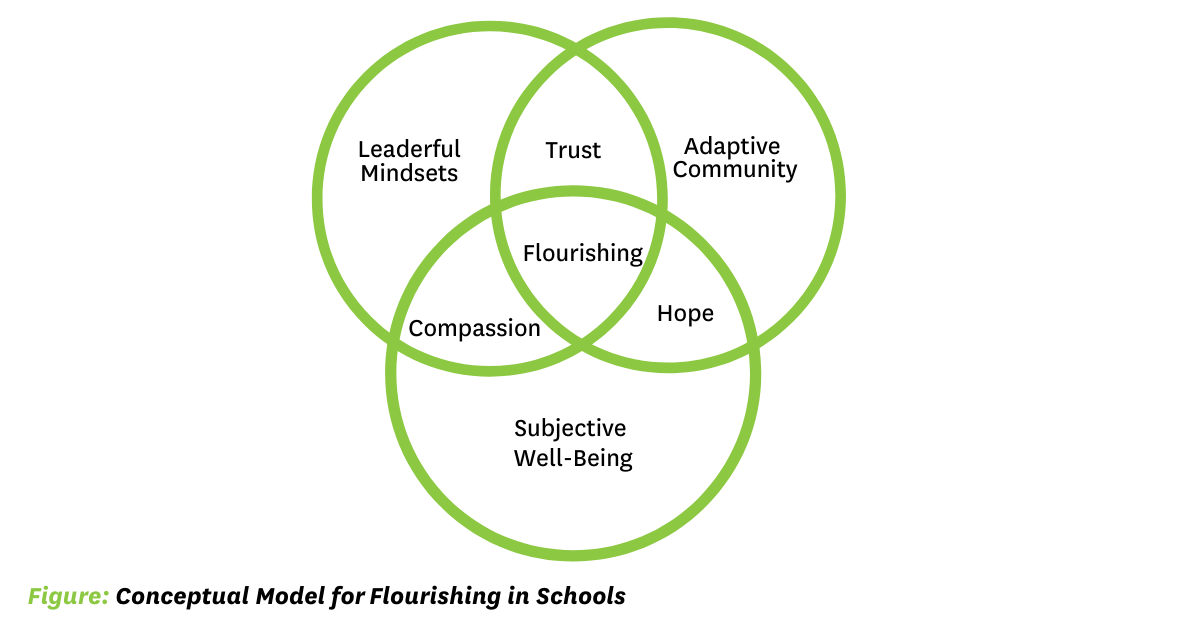
Along with these components, staff in flourishing school communities generally demonstrate key “professional characteristics,” including:
1. Compassion: noticing and wanting to help ease the stress of others, and are aware of how their thoughts and actions impact their colleagues.
2. Trust: having the support and autonomy to take creative risks and innovate, which is reflective of having positive relationships with colleagues.
3. Hope: striving to improve the school environment as a whole-school community by recognizing both strengths and challenges, while building a shared vision for improvement.While schools come in all shapes and sizes, a flourishing school community is supportive and provides staff members with a sense of purpose and belonging where they feel seen, valued, and ultimately find meaning in their work.

This research was funded by the Social Sciences and Humanities Research Council of Canada
Additional Resource Information
Katz, J. (2019). Ensouling our schools. Winnipeg, MB: Portage and Main Press.
SEL BC: http://www.selbc.ca/
Growing Great Schools Worldwide: https://growinggreatschoolsworldwide.com/canada-effective-approaches-to-promote-teacher-wellbeing/
SMART (Stress Management and Resiliency Techniques) https://education.ok.ubc.ca/research-partnerships/smarteducation/
References
Cherkowski, Sabre, and Keith Walker. (2018). Teacher wellbeing: Noticing, nurturing and sustaining flourishing in schools. Burlington, ON: Word and Deed Press.
Cherkowski, Sabre, Kelly Hanson, and Keith Walker (2018). Mindful alignment: Foundations of educator flourishing. Lanham, MD: Lexington.
Cherkowski, Sabre and Walker, Keith (Eds.). Perspectives on Flourishing. Lanham, MD: Lexington.
Cherkowski. S. and Walker, K. (2019). Mentorship for flourishing in schools: An explicit shifttoward appreciative action International Journal of Mentoring and Coaching in Education, 8 (4), 345-360.
Cherkowski, Sabre, and Keith Walker. (2018). Teacher wellbeing: Noticing, nurturing and sustaining
flourishing in schools. Burlington, ON: Word and Deed Press.
Cherkowski, Sabre, and Keith Walker(2014) Flourishing communities: Re-storying educational leadership using a positive research lens International Journal of Leadership in Education 17.2 (2014): 200-216.
Cherkowski, Sabre, and Keith Walker (2016) Purpose, passion and play: Exploring the construct of flourishing from the perspective of school principals." Journal of Educational Administration 54.4 (2016): 378-392.
Cherkowski, Sabre, Kelly Hanson, and Keith Walker (2018)Flourishing in adaptive community: balancing
structures and flexibilities." Journal of Professional Capital and Community 3.2 (2018): 123-136.


IDEAS TO SUPPORT EDUCATORS : Subscribe to the EdCan e-Newsletter
Quality research, reports, and professional learning opportunities.