
Archive
-
Pan-Canadian Summit on K-12 Workplace Well-Being
Comments Off on Pan-Canadian Summit on K-12 Workplace Well-BeingFollowing government COVID-19 guidelines concerning large in-person events, we unfortunately have had no choice but to further postpone our Pan-Canadian Summit on K-12 Workplace Well-Being, which had originally been postponed to November 2-4, 2020.
Registrations will be fully refunded for all registrants by July 15, 2020.
We are still currently working on a new potential event date and venue in 2021 and we apologize for any inconvenience this may cause, and remain committed to hosting a safe event when a better time will permit us to do so. We sincerely hope that you will be able to join us next year!
Since March, we’ve temporarily rebranded our Well at Work initiative to Well at Home to share our original evidence-based content and carefully curated external resources to support K-12 staff who are navigating working from home and preparing to return to school in September. We invite you to continue exploring our growing collection of podcasts, blog posts and magazine articles as well as the latest research resources, and a webinar series centred on elevating staff well-being and workplace morale. Stay tuned for more webinars to come!
If you have any recommendations for future webinar topics/presenters, feel free to reach out to Bineta Diallo at bdiallo@edcan.ca
Thank you for all of your support during this challenging time. We look forward to seeing you in 2021!
-
Principal SEL: What’s it look like?
Comments Off on Principal SEL: What’s it look like? -
Are education systems designed to care for teachers?
Comments Off on Are education systems designed to care for teachers? -
Empowering Staff to Drive Well-Being Forward
Comments Off on Empowering Staff to Drive Well-Being Forward -
Teach Resiliency
Comments Off on Teach ResiliencyIn every classroom in Canada, students are grappling with mental health issues.
And at the front of these classes are teachers are grappling with their own issues – contending with the heavy demands of their day to day responsibilities and the stress of helping students who are struggling.
Teach Resiliency is an online portal and community of practice offering teachers simple-to-use strategies and tools to assess resilience needs and provide resources to promote and enhance teacher and student mental health. Teach Resiliency is designed to:
- Develop, enhance and support teacher competencies
- Enhance and support mental health literacy for teachers
- Offer effective and practical strategies to support child and youth resiliency and mental health
- Offer effective and practical strategies to support teacher resiliency and wellness
The Teach Resiliency site was created in partnership with a team of teachers, administrators, mental health professionals, researchers and students. This team developed tools and resources, created curated resource collections and collaborated with a team from the Centre for Addiction and Mental Health to design and build the website.
-
Principals’ Social and Emotional Competence
Comments Off on Principals’ Social and Emotional CompetenceThis brief reviews the research on principal stress, coping, and positive school leadership. However, the research is currently thin, especially on how principals’ professional development, preparation programs, and certification standards can be strengthened to improve principal well-being and school outcomes. We review various strategies to enhance effective leadership by supporting principals to deepen their social and emotional competencies, all of which set the foundation for student success. A conceptual model of the Prosocial School Leader is also included. We conclude with a series of recommendations on research, programs, and policies to build this field and improve the lives of principals for effective prosocial leadership.
This issue brief, created by The Pennsylvania State University, is one of a series of briefs that addresses the future needs and challenges for research, practice, and policy on social and emotional learning (SEL). SEL is defined as the process through which children and adults acquire and effectively apply the knowledge, attitudes, and skills necessary to understand and manage emotions, set and achieve positive goals, feel and show empathy for others, establish and maintain positive relationships, and make responsible decisions. This is the second series of briefs that address SEL, made possible through support from the Robert Wood Johnson Foundation. The first set synthesized current SEL research on early support for parent engagement and its effects on child outcomes; SEL in infancy/toddlerhood, the preschool years, the elementary school period, and middle-high school timeframes; and how SEL influences teacher well-being, health equity, and school climate.
-
Research Brief: Promoting the Wellbeing of Teachers and School Staff
Comments Off on Research Brief: Promoting the Wellbeing of Teachers and School StaffConducted by Dr. Nancy Heath’s team at McGill University, this research provides a summary of a literature review on effective approaches highlighting some of the key do’s and don’ts when it comes to promoting the well-being of teachers and school staff.
References
Reviews
Emerson, L., et al (2017). Teaching mindfulness to teachers: A systematic review and narrative synthesis. Mindfulness, 8(5), 1136-1149.
Hwang, Y. et al (2017). A systematic review of mindfulness interventions for in-service teachers: A tool to enhance teacher wellbeing and performance. Teaching And Teacher
Education, 6426-42.Mccallum, F. et al (2017). Teacher wellbeing: a review of the literature. The Association of Independent Schools of New South Wales Limited, Australia.
Roeser, R. W. et al (2012). Mindfulness training and teachers’ professional development: An emerging area of research and practice. Child Development Perspectives, 6(2),
167-173.Whitley, J et al (2013). Promoting mental health literacy among educators: Critical in school-based prevention and intervention. Canadian Journal Of School Psychology, 28(1), 56-70.
Articles
Au, D. W. et al. (2016). Psychosomatic and physical responses to a multi-component stress management program among teaching professionals: A randomized study of
cognitive behavioral intervention (CB) with complementary and alternative medicine (CAM) approach. Behaviour research and therapy, 80, 10-16.Benn, R. et al. (2012). Mindfulness training effects for parents and educators of children with special needs. Developmental psychology, 48(5), 1476.
Beshai, S., McAlpine, L., Weare, K., & Kuyken, W. (2016). A non-randomised feasibility trial assessing the efficacy of a mindfulness-based intervention for teachers to reduce stress and improve well-being. Mindfulness, 7(1), 198-208.Chan, D. W. (2010). Gratitude, gratitude intervention and subjective well-being among Chinese school teachers in Hong Kong. Educational Psychology, 30(2), 139-153.
Chan, D. W. (2013). Counting blessings versus misfortunes: positive interventions and subjective well-being of Chinese school teachers in Hong Kong. Educational Psychology, 33(4), 504-519.
Cheek, J. R. et al. (2003). Using music therapy techniques to treat teacher burnout. Journal of Mental Health Counseling, 25(3), 204-217.
Cook, C. R. et al (2017). Promoting secondary teachers’ well-being and intentions to implement evidence-based practices: Randomized evaluation of the ACHIEVER resilience curriculum. Psychology in the Schools, 54(1), 13-28.
Critchley, H., & Gibbs, S. (2012). The effects of positive psychology on the efficacy beliefs of school staff. Educational and Child psychology, 29(4), 64.
Ebert, D. D. et al (2014). Efficacy of an internet-based problem-solving training for teachers: results of a randomized controlled trial. Scandinavian journal of work, environment & health, 582-596.
Frank, J. L. et al (2015). The effectiveness of mindfulness-based stress reduction on educator stress and well-being: Results from a pilot study. Mindfulness, 6(2), 208-216.
Gold, E. et al (2010). Mindfulness-based stress reduction (MBSR) for primary school teachers. Journal of child and family studies, 19(2), 184-189. Doi: 10.1007/s10826-009-9344-0Gouda, S. et al (2016). Students and teachers benefit from mindfulness-based stress reduction in a school-embedded pilot study. Frontiers in psychology, 7, 590.
Harris, A. R. et al (2016). Promoting stress management and wellbeing in educators: Feasibility and efficacy of a school-based yoga and mindfulness intervention. Mindfulness, 7(1), 143-154.
Jeffcoat, T., & Hayes, S. C. (2012). A randomized trial of ACT bibliotherapy on the mental health of K-12 teachers and staff. Behaviour Research and Therapy, 50(9), 571-579. Doi:10.1016/j.brat.2012.05.008
Jennings, P. A., Frank, J. L., Snowberg, K. E., Coccia, M. A., & Greenberg, M. T. (2013). Improving classroom learning environments by Cultivating Awareness and Resilience in Education (CARE): Results of a randomized controlled trial. School Psychology Quarterly, 28(4), 374.
Larson, M. et al. (2010). Stressed Teachers Don’t Make Good Implementers: Examining the Interplay Between Stress Reduction and Intervention Fidelity. School Mental
Health, 10(1), 61-76.LeCheminant, J., et al. (2017). Changes in Behaviors and Outcomes Among School-Based Employees in a Wellness Program. Health promotion practice, 18(6), 895-901.
Nosaka, M., & Okamura, H. (2015). A single session of an integrated yoga program as a stress management tool for school employees: Comparison of daily practice and
nondaily practice of a yoga therapy program. The Journal of Alternative and Complementary Medicine, 21(7), 444-449.Sharrocks, L. (2014). School staff perceptions of well-being and experience of an intervention to promote well-being. Educational Psychology in Practice, 30(1), 19-36.
Schnaider-Levi, L et al (2017). Inquiry-Based Stress Reduction Meditation Technique for Teacher Burnout: A Qualitative Study. Mind, Brain, and Education, 11(2), 75-84.
Schussler, D. L. et al (2016). Improving teacher awareness and well-being through CARE: A qualitative analysis of the underlying mechanisms. Mindfulness, 7(1), 130-142.
Siu, O. L., et al (2014). Intervention studies on enhancing work well-being, reducing burnout, and improving recovery experiences among Hong Kong health care workers and teachers. International Journal of Stress Management, 21(1), 69.
Unterbrink, T. et al (2010). Improvement in school teachers’ mental health by a manual-based psychological group program. Psychotherapy and psychosomatics, 79(4), 262-
264.Vesely, A. K., Saklofske, D. H., & Nordstokke, D. W. (2014). EI training and pre-service teacher wellbeing. Personality and Individual Differences, 65, 81-85.
Wolf, S. et al (2015). Preliminary impacts of the “Learning to Read in a Healing Classroom” intervention on teacher well-being in the Democratic Republic of the Congo.
Teaching and Teacher Education, 52, 24-36.Woynarowska-Soldan, M. (2015). Project on school staff health promotion in Poland: the first experiences. Health Education, 115(3/4), 405-419.
-
Webinar: Teacher and School Staff Wellbeing 101
Comments Off on Webinar: Teacher and School Staff Wellbeing 101
Co-presenters: Dr. Kim Schonert-Reichl and Dr. Mark Greenberg
In this webinar, Dr. Kim Schonert-Reichl and Dr. Mark Greenberg review the latest research on how teacher stress impacts student wellbeing, contributing factors to teacher/staff stress and burnout, and what we know (and don’t know) about how to address this issue.
-
Infographic: Why Focus on Teacher and School Staff Wellbeing?
Comments Off on Infographic: Why Focus on Teacher and School Staff Wellbeing?
This infographic provides an overview of key research and references from Canada and beyond that outlines the case for investing in teacher and school staff wellbeing.
-
Losing My Voice
Comments Off on Losing My Voice -
Losing your most powerful tool in the classroom – your voice
Comments Off on Losing your most powerful tool in the classroom – your voiceAs an educator, you never know what your day is going to look like as you try to balance the different learning styles and needs that your students bring to the classroom. We far too often are tasked to consider – in addition to these diverse learning needs – that many students have experienced trauma and/or stress, which they innately bring with them to school. As such, we sometimes find ourselves in a position where we’re unable to discuss these experiences due to their sensitive nature, which can lead us as educators to self-internalize these traumas and negative emotions that our students are experiencing.

Still, we push through and continue to put a smile on our faces while keeping the day moving along as smoothly as possible for our students’ sake. Why? Because we care for our students and want to protect them, which is part of the trust-based relationship that we work hard to build with each of them. However, when we suppress our natural and innate responses by merely “pushing through,” we aren’t allowing our bodies to feel and respond naturally. For me personally, in continuing this pattern of putting on a smiling face for my students, my body eventually found a way to let me know that I wasn’t okay – voice loss.
WHAT MY BODY WAS TRYING TO TELL ME
I was experiencing voice loss almost monthly. I was unable to socialize with friends and unable to be a vocal part of my family. It became overwhelmingly clear to me just how much my voice loss was affecting my ability to participate in day-to-day events. At my son’s soccer game, all I could do was sit – which meant no cheering and no conversations with other parents whom I normally spoke with. I quickly learned that voice loss is a very isolating experience.

As a Special Education Resource Teacher (SERT) my voice is an important part of my job. As I was losing my voice so often, I also had to miss days off work. It was at this point that I decided that I needed to seek medical help. I wasn’t sure what to expect and nothing could have prepared me for the verdict on what would be the true cause of my voice loss. After consulting with my family doctor, an Ear-Nose-throat Specialist (ENT), a Speech and Language Pathologist (SLP), and a counsellor, the verdict was that I had experienced voice loss due to Vicarious Trauma (VT) and Stress. I remember thinking, “That can’t be right!” I always knew there was stress in teaching, but I wasn’t aware of the toll it could end up having on my own physical health.
I had no idea just how much time, energy, and vulnerability it took to become well again. To begin my healing journey, I reduced my workload to half-time. Part of me felt ashamed for missing work for something that didn’t seem to be a common problem among my colleagues. Why weren’t they losing their voices, too? I was scared to tell my coworkers the truth about my voice loss, and so I lied to everyone by instead saying that I had “voice strain.” Above all, what I truly wasn’t ready to share was that my voice loss had really meant that I was stressed out and traumatized.
Throughout my journey, I’ve realized that listening to my body and taking a break to look after myself does not make me weak. This realization, along with the wonderful support I’ve received from my family, my counsellor, my SLP, and my friends, gave me the confidence to be more open and equipped to share my story. While I was initially terrified of what my colleagues would think, I soon learned how fortunate I was to work with an amazing group of people. As I continued to share my story, I realized just how many of my coworkers have had similar experiences of stress in the workplace – that I wasn’t alone.
HOW I’M REGAINING CONTROL OF MY WELLNESS
In an effort to build a work culture that promotes wellness, I’ve taken part in creating a ‘Wellness Committee’ at our school. The Committee has done several things including providing a snack bowl for staff, putting plants in the staffroom, celebrating staff members’ birthdays, sharing daily uplifting quotes, organizing team-building activities, and creating a space known as the ‘Rejuvenation Room’ for staff and students.

As I look back at the journey that has brought me to where I am today, I at times debate the future of my career. After yet another visit to the clinic due to voice loss, my family doctor had straight-up asked me, “You’re not giving it up yet?” What’s more, after I had disclosed that I’ve always wanted to be a teacher, even my counsellor had challenged my belief that I am “living my dream.” To be honest, I do debate my future in education. I never would have thought I’d receive a diagnosis for Vicarious Trauma and Stress in direct relation to my work as a SERT.
So many things are out of our control in education, but what we do have control over is our wellness and ourselves. Voice loss has shown me that I was giving too much without adequately looking after myself. At this point, I’m able to better listen to my body and identify when my stress level is getting too high. I feel more in control of my wellness than I used to. I’ve been able to find joy and happiness throughout this experience and I’m thankful for what I’ve learned and continue to learn, and how I feel right now in this very moment as I continue to teach.

-
Sommet pancanadien sur le bien-être au travail des intervenants scolaires d’écoles primaires et secondaires
Comments Off on Sommet pancanadien sur le bien-être au travail des intervenants scolaires d’écoles primaires et secondairesStratégies pratiques pour améliorer le bien-être du personnel dans les écoles et les commissions scolaires au Canada.
Le bien-être du personnel d’écoles primaires et secondaires est une priorité dans les écoles et les conseils et commissions scolaires du Canada, et pourtant, le stress et l’épuisement professionnel ne cessent d’augmenter chez les surintendants*, directeurs d’école, enseignants et autres membres du personnel scolaire. Êtes-vous prêt à changer ce scénario et à découvrir COMMENT promouvoir un milieu de travail plus positif qui favorise le bien-être de l’ensemble du personnel?
Inscrivez-vous dès maintenant!
À noter que l’événement se déroulera principalement en anglais. Certains ateliers seront bilingues.
Veuillez nous contacter si vous souhaitez ovtenir de l’aide pour vous inscrire au sommet.En savoir plus sur l’événement
↓
Aperçu du sommet

APERÇU DES FRAIS D’INSCRIPTION
Prix de pré-inscription (jusqu’au 13 mars 2020)
MEMBRE ÉDCAN NON-MEMBRE Conférence seulement (12 et 13 mai) 350 $ 400 $ Pré-conférence (11 mai) + conférence (12 et 13 mai) 425 $ 500 $ Prix régulier (après le 13 mars 2020)
MEMBRE ÉDCAN NON-MEMBRE Conference Only (May 12-13) 400 $ 450 $ Pré-conférence (11 mai) + conférence (12 et 13 mai) 500 $ 575 $ TEAM DISCOUNT ON CONFERENCE FEES: -$50.00/PERSON FOR TEAMS OF 3 OR MORE FROM THE SAME ORGANIZATION OR SCHOOL DISTRICT
RÉDUCTION SUR LES FRAIS DE CONFÉRENCE : – 50 $ / PERSONNE POUR LES ÉQUIPES DE 3 OU PLUS DE LA MÊME ORGANISATION OU DU MÊME SECTEUR SCOLAIRE
Vous ne savez pas si vous êtes membre? Consultez la liste de tous nos membres, ou contacter la responsable des adhésions au membership@edcan.ca OU 866-803-9549, poste 223.
Tarif de l’hôtel : 229 $ / nuit + taxes
Voici nos conférenciers principaux!

Mark T. Greenberg
Auteur, spécialiste international renommé de l’apprentissage socio-émotionnel et directeur-fondateur du Bennett Prevention Research Center for the Promotion of Human Development.

Kimberly Schonert-Reichl
Éminente spécialiste de l’apprentissage socio-émotionnel et de l’éducation des enfants et des enseignants fondée sur l’empathie, la résilience et la pleine conscience.

Sue Roffey
Auteure et conférencière de renommée internationale, elle travaille sur une approche globale du bien-être du personnel d’écoles primaires et secondaires en Australie et au Royaume-Uni.

Susan Rodger
La plus éminente spécialiste au Canada en matière de stress, d’épuisement professionnel, de travail émotionnel, de fatigue de compassion et de résilience.

Katina Pollock
La plus éminente spécialiste au Canada en matière d’intensification du travail et de bien-être des directeurs et directeurs adjoints d’écoles.
Consultez la liste complète de nos conférenciers au www.edcansummit.ca/agenda
Un sommet PLUS trois expériences novatrices
Cette expérience d’apprentissage sans précédent ne se termine pas avec les remarques de clôture. En plus d’allocutions et d’ateliers de qualité, ce sommet vous offre trois expériences novatrices visant à solidifier votre réseau et à faire profiter votre école, commission scolaire ou organisme de stratégies pratiques qui vous permettront d’entreprendre l’amélioration à long terme de votre milieu de travail.
Séances de coaching en petits groupes
Les bonnes idées ne resteront pas sur le papier. Apprenez à mettre en œuvre des stratégies efficaces de bien-être adaptées à votre milieu de travail grâce à des séances de coaching en petits groupes dirigés par des spécialistes en la matière.

Salon des ressources en bien-être au travail
Rien ne sert de réinventer la roue. Inspirez-vous de programmes novateurs qui font déjà du bien-être en milieu de travail une priorité absolue dans certaines écoles et commissions scolaires. Explorez à votre rythme ce salon des ressources et discutez avec des champions du bien-être au Canada.

Sorties pédagogiques
Les idées ne sont bonnes que si elles sont adaptées aux réalités quotidiennes du personnel des écoles primaires et secondaires. Des sorties pédagogiques favoriseront l’apprentissage au-delà des murs du colloque en vous faisant connaître des écoles, commissions scolaires et collectivités de la région.

Photos : SquareSpace
Pour tout savoir sur notre Sommet, consultez les sections
ci-dessous en cliquant sur les flèches. -
EVENT RECAP: The Case for Investing in K-12 Staff Well-being
Comments Off on EVENT RECAP: The Case for Investing in K-12 Staff Well-being
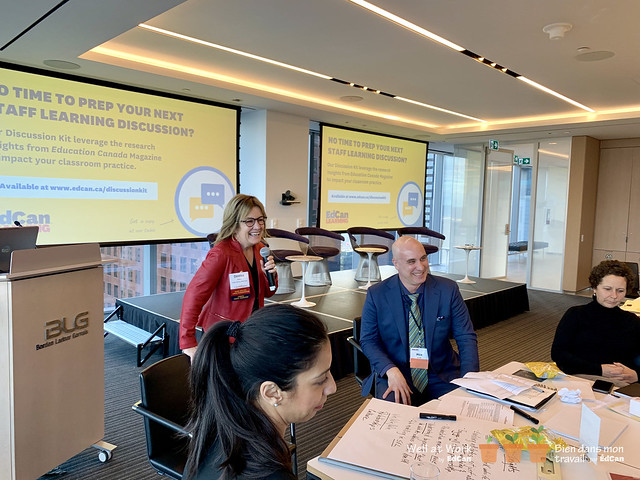
On November 22, 2019, ministry and faculty of education representatives, Directors of Education/CEOs, and other K-12 leaders from across Canada attended our EXCLUSIVE professional learning session, where they:
-
Learned the fundamental principles and evidence behind workplace well-being in K-12 education
-
Found out how investing in educator well-being can heighten student achievement and save precious resources
-
Discussed ways to go beyond one-off unsustainable programs to a long-term, system-wide approach
Click on the album to see more photos from our event.
ALL-STAR PROGRAMME AND PRESENTATIONS
Led by Edcan Network and the McConnell Foundation
CLICK HERE TO DOWNLOAD THE PRESENTATION
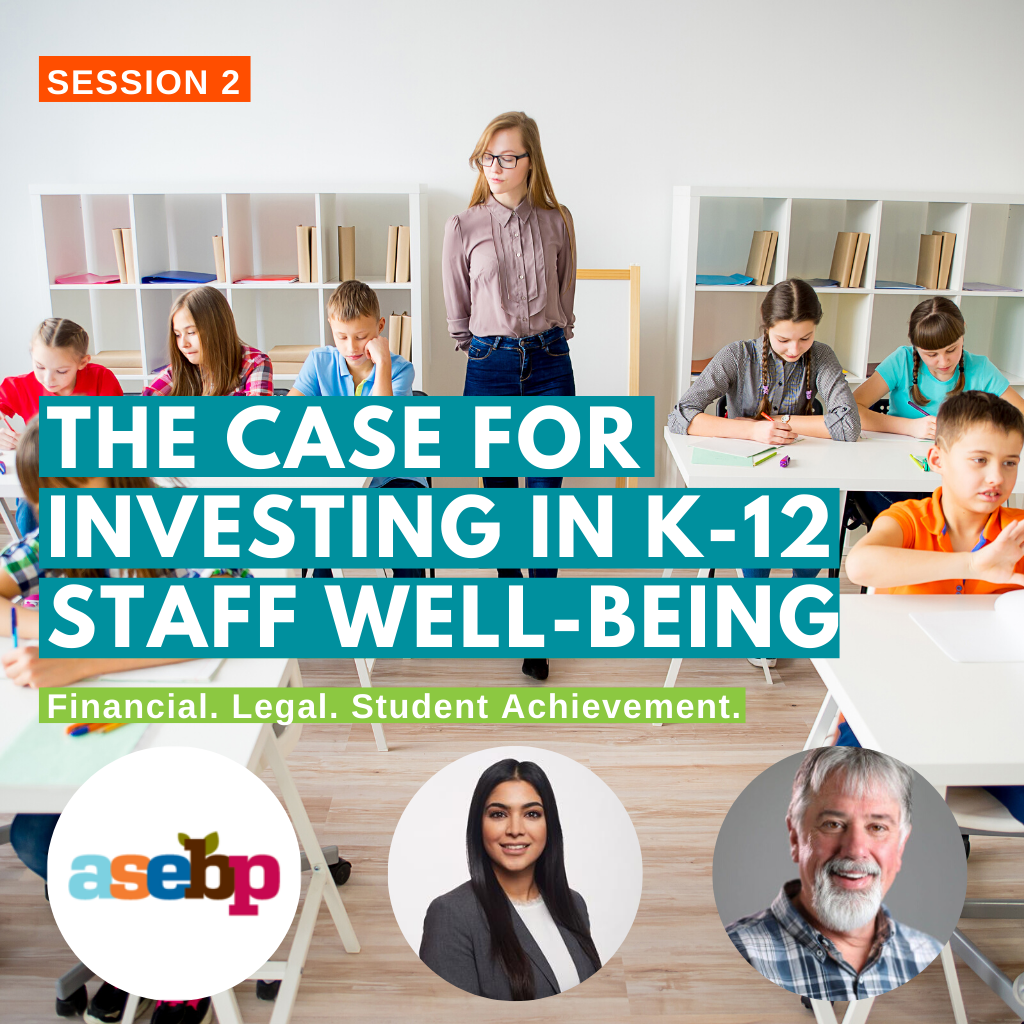
PRESENTATIONS LINEUP:
1. The Business Case for Workplace Well-Being: Rationale for an Upstream Approach
Led by Leanne Keyko, Health Strategies Liaison & Trudy Lakusta, School Jurisdiction Liaison, Alberta School Employee Benefit Plan (ASEBP)
CLICK HERE TO DOWNLOAD THE PRESENTATION
2. The Legal Case for Workplace Well-Being: How Health and Safety Legislation Can Help You Achieve the Best Return-on-Investment
Led by Anna V. Karimian, Associate – Labour and Employment Group, Borden Ladner Gervais (BLG) LLP
CLICK HERE TO DOWNLOAD THE PRESENTATION
3. The Student Achievement Case for Workplace Well-Being: Raising Student Outcomes through a Whole-System Approach to Well-Being
Led by Dr. Bill Morrison, Professor of Educational Psychology & Co-Executive Director, Health and Education Research Group (HERG), University of New Brunswick; President, WMA Wellness
CLICK HERE TO DOWNLOAD THE PRESENTATION
Led by Dr. Charlie Naylor, Affiliated Scholar – Simon Fraser University; District Well-Being Coach; former Senior Researcher – British Columbia Teachers’ Federation (BCTF)
CLICK HERE TO DOWNLOAD THE PRESENTATION

Small group facilitated discussions supported participants to consider and share “Where they’re at,” “What they learned,” and “What they need to do to move forward” to lead greater investments into workplace well-being in their own school communities.
Couldn’t make it?
Stay tuned for our Pan-Canadian Summit on K-12 Workplace Well-Being!
Learn more about the summit here
Thank you to our partners

Special thank you to

Toronto’s preeminent meditation studio for providing free class passes
Gift raffle prize sponsored by:




-
-
2019 EdCan Network Whitworth Award Co-Winners Announced:
Comments Off on 2019 EdCan Network Whitworth Award Co-Winners Announced:
Dr. Shirley R. Steinberg recognized for empowering educators and students to challenge media bias and misrepresentation
The EdCan Network is pleased to honour Dr. Shirley Steinberg—Professor of Critical Youth Studies at the University of Calgary’s Werklund School of Education—as co-winner of the 2019 Whitworth Award for Career Education Research Excellence. This prestigious award recognizes Dr. Steinberg’s influential career as one of Canada’s leading scholars who have expanded media literacy into the field of critical pedagogy. Her work supports teachers and students to use and explore a wide variety of art forms, culture, and media—including hip-hop, commercial broadcasting, and new digital technologies—as a way to understand and question biases in the media and everyday life.
Dr. Shirley Steinberg has applied her critical approach to media studies, literacy, and drama to the global refugee crisis, which was used to explore how Islamic and Middle Eastern cultures are represented across the media, in advertising, and in schools. Most recently, Dr. Steinberg wrote and directed the award-winning documentary Elders’ Room, a collaborative project with Kainai First Nations High School students and counsellors. By bringing light to media bias and misrepresentation, Dr. Steinberg’s research encourages students to become agents of support, understanding, and change who challenge prejudices faced by ethnic minorities in Canada and beyond.
Understanding power dynamics, “how power works,” is also central to Dr. Steinberg’s work as a critical theorist, in understanding how and why inequality exists across people of different genders, races, classes, and other factors. She has a keen interest in conducting research and creating course curricula in which teachers engage television, theatre, art, music, and popular culture to guide students in questioning bias in the world around them. This contextual way of teaching simultaneously prompts educators to consider the impacts of their work beyond the classroom in ways that inspire students to confront economic, political, and social challenges in today’s world. This has redefined the teaching profession by repositioning educators as sources of large-scale change, and further drove her to the creation of The Freire International Project for Critical Cultural Community, Youth and Media Activism, The International Institute for Critical Pedagogy and Transformative Leadership, and previously, The Werklund Foundation Centre for Youth Leadership. These research-based projects offer educators a variety of research publications, films, and networking resources to help educators and community members to critically examine inequalities in society.
The Whitworth Award Selection Committee appreciated Dr. Steinberg’s lifelong dedication to expanding research in the field of critical pedagogy and media literacy studies, notably her mentorship of numerous emerging scholars and editing of over 600 books in the past 20 years. The Committee also lauded her unique approach to a form of research, “bricolage,” which tasks researchers to use a multi-layered, thick methodological approach which takes into account their own biases, different ways of interpretation, and leads to a more complex and socially-just understanding of the histories, cultures, and contexts of the communities, schools, and venues they research.
Dr. Shirley R. Steinberg shares the 2019 Whitworth Award with co-winner Dr. André P. Grace, recognized for his pioneering research and lifelong commitment to addressing the educational needs of sexual and gender minority youth in Canada.
FOR MORE INFORMATION ABOUT DR. SHIRLEY STEINBERG’S RESEARCH

Dr. André P. Grace recognized for profound impact in improving the lives of sexual and gender minority youth in Canada
The EdCan Network is pleased to honour Dr. André P. Grace—Professor and Tier 1 Canada Research Chair in Sexual and Gender Minority Studies at the University of Alberta’s Faculty of Education—as co-winner of the 2019 Whitworth Award for Career Education Research Excellence. This prestigious award recognizes Dr. Grace’s pioneering research and lifelong commitment to addressing the educational needs of sexual and gender minority (SGM) youth.
Advocacy and transforming practice are central to Dr. Grace’s work, grounded in the vision that SGM students in our schools and communities are a vulnerable population whose safety, security, well-being, and accommodation are still not fully guaranteed. In 2016, Dr. Grace’s extensive portfolio and years of research culminated in a milestone publication entitled Sexual and Gender Minorities in Canadian Education and Society (1969–2013): A National Handbook for K-12 Educators, which recognizes the powerful role of educators in advancing the inclusion of sexual and gender minorities in Canadian society. This publication includes a comprehensive overview of how we can further advance recognition and respectful accommodation of SGMs in education and beyond through policy and practice perspectives. Since 2002, Dr. Grace’s research as principal investigator studying sexual and gender minority students and teachers has been consistently funded by the Social Science and Humanities Research Council of Canada. The primary focus of this research is helping SGM youth grow into resilience with the support of teachers and other caring professionals such as counsellors and social workers.
Building on this momentum, Dr. Grace’s current ambitious portfolio includes studying how greater collaboration across research, policy, and practice can spark collective action across sectors including education, healthcare, social services, and justice in supporting sexual and gender minority youth to build resilience in the face of adversity. Dr. Grace has already conducted extensive prior research in this area, which can be found in the book Growing into Resilience: Sexual and Gender Minority Youth in Canada, for professionals working with SGM youth and can be used in training courses for those working with vulnerable youth populations.
The Whitworth Award Selection Committee lauded Dr. Grace’s lifelong dedication to improving synergies among research, practice, and policy to improve the educational outcomes and life chances of sexual and gender minority youth in Canada – including his focus on equipping educators with practical tools and training resources to foster positive school cultures. The Committee was also impressed by Dr. Grace’s extensive on-the-ground work with SGM youth, which includes cofounding the Camp fYrefly summer leadership camp in 2004 and establishing the Community-Hope-Empowerment-Wellness or CHEW Project in 2014 to support homeless and street-involved SGM youth.
Dr. André P. Grace shares the 2019 Whitworth Award with co-winner Dr. Shirley R. Steinberg, recognized for an influential career as one of Canada’s leading scholars in critical literacy and media studies.
FOR MORE INFORMATION ABOUT DR. ANDRÉ P. GRACE’S RESEARCH
About the Whitworth Award for Career Education Research Excellence
The Whitworth Award for Career Education Research Excellence was first presented in 1967, and was made possible through a generous financial donation by Dr. Fred Whitworth, a former Director of the Canadian Council for Research in Education. It has, since then, recognized individuals who have made a sustained and substantial contribution to educational research over a period of time.
-
Recess for Everyone
Comments Off on Recess for Everyone -
How you can start taking more effective breaks – and inspire your students and colleagues to do the same
Comments Off on How you can start taking more effective breaks – and inspire your students and colleagues to do the sameAs teachers, we often grumble amongst ourselves during break time as we walk briskly through the halls and come across students who are either glued to their smartphones or sitting or leaning on lockers. “No social skills,” we confidently diagnose. “No one talks to each other anymore,” we lament. Our lost suggestion of “they should go outside and run around” is as empty as the playground itself. As we make our way to the staff room to check our mailboxes, we then promptly head back to our classrooms to frantically check items off our to-do list – emails, assignments that need grading, or spaces that need tidying up. After the break, everyone returns to class just a little bit less focused and certainly more fatigued, and it’s clear that we haven’t effectively used our break time.

THE DIFFERENCE BETWEEN A ‘BREAK’ AND AN ‘EFFECTIVE BREAK’
Everyone can benefit from taking a step back and reconsidering how they spend their breaks throughout the school day. Sure, our students can benefit from “going outside and running around,” but so can adults! There are three things we need to remind ourselves when it comes to taking an effective break during our workdays, which can literally restore our brains and rest our minds if we put these into practice:
- It’s NEVER unproductive or ‘time lost’ to spend our breaks getting a bit of physical activity.
- Spending our breaks in the outdoors allows us to return to work refreshed and rested.
- Leaving our smartphones and devices behind every now and then may actually allow us to reconnect with others – or at least give our brains a rest.

Integrating these reminders into our daily work lives represents an attempt at reorienting our minds to the idea that taking time out isn’t just about ‘being productive’; rather, it’s about ‘enabling productivity.’ While ‘being productive’ might imply merely “being busy” and checking things off our to-do list, ‘enabling productivity’ means investing in healthy practices – like taking an effective break – that allow our brains to perform better and for longer, thereby allowing us to do our best work instead of simply getting work done.
We also know that sedentary behaviours and physical inactivity are directly linked to all kinds of chronic health issues. This is true for all age groups from the younger years to the older years. We also know that sleep, nutrition, and screen time are variables in our personal wellness equation. So how do we put these all together and ensure that we’re getting enough of each of these variables? The good news is that the Canadian Society for Exercise Physiology has created a very articulate set of evidence-based infographics that allow the general public to make sense of all of the health recommendations that often get thrown at us. Fundamentally, what you need to know is that all types of movement are important: slow, moderate, and vigorous. And remember that there isn’t anything wrong with sitting down, but it’s also important to limit how long we remain sedentary while making sure that we’re not inactive for extended periods of time.
Sweat, Step, Sleep, and Sit are the so-called Four S’s of a healthy day. While the nuts and bolts of these four components differ depending on how old you are, the core recommendation is that we all need to pay attention to how long we:
1. Sweat through moderate to vigorous physical activity on the playground, during physical education, while leading extracurricular activities, or during our own workout routines.

2. Step through light physical activity during unstructured play, walking, or practicing ‘body movement breaks’ throughout the day.

3. Sleep without interruption and with consistent bedtime and wake-up times.

4. Sit and limit sedentary behaviour through the day.

Never forget – as a school community, we have the ability to encourage each other to be more physically active. Although a 7-minute walk around the block with colleagues during lunch hour may not work up a sweat, it’s nevertheless valuable in improving our overall mood. Creating opportunities for students and staff to move together during breaks is also a great way for us to sustain our collective well-being as a school community.
WHY RECESS ISN’T JUST FOR KIDS
There’s a clear connection between our well-being and being outdoors. Throughout the day, our brains get tired and our cognitive functions decrease. Some of the more obvious symptoms of cognitive fatigue include reduced performance and productivity, decreased effectiveness in completing tasks, and reduced competency. But some of the less obvious symptoms, which may manifest in students and staff, include impulsiveness and increased risk taking, irritability and negative emotions, insensitivity to interpersonal cues, and impatience. Do any of these symptoms sound like you or your students after a morning of indoor recess?

Research on cognitive restoration has found that exposure to natural environments helps aid recovery from physiological stress and mental fatigue. In fact, Kaplan’s ‘Attention Restoration Theory’ (ART) has been around for decades and is still used by researchers to this day. ART tells us that being in nature gives us a sense of ‘being away’ by shifting our attention from whatever demands we may be experiencing in our workplace, which helps restore our cognitive functions. Plus, we don’t need to go far – the schoolyard, neighbourhood park, or even our backyards provide this healthy sense of ‘being away.’ We also don’t need to spend lengthy amounts of time outdoors, either – brief contact with nature can boost our mood, with research recommending 20 minutes as the optimal amount of time to reap the benefits of spending time outdoors. Above all, even making small efforts to take deep breaths or look around at the trees can leave our brains feeling a bit more rested and a bit more restored.
WHY YOU NEED TO PUT DOWN YOUR PHONE
Addiction to technology and excessive use of online communications is directly related to psychological factors such as stress, anxiety, and depression. Although we may not personally consider ourselves technology addicts, we know that taking an effective break during the day doesn’t entail using our devices or other technology. In fact, walking around, sitting, and looking at our devices while spending time outdoors actually counteracts the benefits that nature provides. Unsurprisingly, overuse of our devices is a growing issue that’s most prevalent in people under the age of 30. That said, I’m sure we can all agree that time away from our screens is refreshing. Promoting social activities on the playground, inviting colleagues to take a ‘walking meeting’ outside instead of a typical ‘sit down meeting’ in a classroom, or even just taking a ‘time out’ from our devices are all great ways that we can role model taking effective breaks throughout the day.

THE TAKEAWAY: WE NEED TO RETHINK ‘PRODUCTIVITY’
I’m just as guilty as the next person for feeling a strong desire to be productive during my breaks by working through my to-do list. At times, I’m guilty of not taking a break at all – I hate being cold in the middle of winter and I cringe at the thought of stepping out in the rain. However, when we begin reorienting our minds towards the importance of taking effective breaks that entail (A) moving around more during the day, (B) getting outside, and (C) leaving our devices behind, we may actually begin to see some changes in our behaviour, concentration, and ability to learn new skills at work. It’s easy to tell our students that “they should go outside and run around” but, as adults and role models, we’d be better off actually taking a piece of our own advice.
LISTEN TO THE PODCAST WITH DR. SHANNON KELL ON TAKING EFFECTIVE BREAKS:
Listen to “Recess for Everyone ft. Dr. Shannon Kell” on Spreaker.
References and Further Reading
Atchley, R. A., Dtrayer, D. L. & Atchley, P. (2012). Creativity in the wild: Improving creative reasoning through immersion in natural settings. PloS one, 7(12), e51474. https://doi.org/10.1371/journal.pone.0051474
Berto, R. (2014). The role of nature in coping with psycho-physiological stress: A literature review on restorativeness. Behavioral Sciences, 4, 394-409. https://doi.org/10.3390/bs4040394
Capaldi, C. A., Passmore, H., Nisbet, E. K., Zelenski, J. M., & Dopko, R. L. (2015). Flourishing in nature: A review of the benefits of connecting with nature and its application as a wellbeing intervention. International Journal of Wellbeing, (5)4. https://doi.org/10.5502/ijw.v5i4.449
Hartig, T., Evans, G., Jamner, L. D., Davis, D. S., & Garling, T. (2003). Tracking restoration in natural and urban field settings. Journal of Environmental Psychology, 23, 109-123. https://doi.org/10.1016/S0272-4944(02)00109-3
Hunter, M. R., Gillespie, B. W., & Chen, S. Y-P. (2019). Urban nature experiences reduce stress in the context of daily life based on salivary biomarkers. Frontiers in Psychology, (2)722, 1-16. https://doi.org/10.3389/fpsyg.2019.00722
Jiang, B., Schmillen, R., & Sullivan, W. C. (2018). How to waste a break: Using portable electronic devices substantially counteracts attention enhancement effects of green spaces. Environment and Behavior,1-28. https://doi.org/10.1177/0013916518788603
Kaplan, S. (1995). The restorative benefits of nature: Toward an integrative framework. Journal of Environmental Psychology, 15, 169-182. https://doi.org/10.1016/0272-4944(95)90001-2
Lee, U., Lee, J., Ko, M., Lee, C., Kim, Y., Yang, S. & Song, J. (2014). Hooked on smartphones: An exploratory study on smartphone overuse among college students. In Proceedings of the SIGCHI Conference on Human Factors in Computing Systems (pp. 2327-2336). https://doi.org/10.1145/2556288.2557366
Pearson, D. G., & Craig, T. (2014). The great outdoors? Exploring the mental health benefits of natural environments. Frontiers in Psychology, 5(1178). https://doi.org/10.3389/fpsyg.2014.01178
- It’s NEVER unproductive or ‘time lost’ to spend our breaks getting a bit of physical activity.
-
We All Have a Stake in Workplace Wellness
Comments Off on We All Have a Stake in Workplace WellnessYou don’t need a pile of research studies to make an educated assumption that healthy employees who feel positive about their jobs will do more effective, productive work. (But the studies exist and some are cited in the pages to come.) And it shouldn’t take much convincing that an enthusiastic and emotionally healthy teacher will have a better impact on students than one that is stressed, exhausted, and/or overwhelmed. As a parent, you can bet I wanted the first teacher for my kids, not the second! Yet when competing priorities jostle for limited resources, staff well-being can get pushed so far to the back that it drops right out of sight.
We have a tendency to see well-being as solely a personal responsibility. If employees are struggling, they should go to the gym, get better organized, become more resilient or adaptable. But several of our authors dispute this assumption. Self-care, while important, only goes so far. Instead, our authors argue that occupational mental health, like physical health and safety, is a shared responsibility.
I’d love to think that all employers would try to protect their employees from toxic levels of occupational stress simply because they care about their staff. But let’s be realistic: staff well-being can too often be shrugged off as a “frill” or a strictly personal problem. That’s why we have to recognize that chronically overstressed educators come with a cost to the system. Sick days, stress leave, even leaving the profession are just the most visible impacts of employees who are unwell. An investment in employee well-being is an investment that pays off in reduced HR costs, increased performance, and ultimately increased student achievement.
All human service professions entail a certain amount of stress. But for those who are passionate about their calling, the work should also be deeply rewarding. That’s what Astrid Kendrick calls the “heartwork” of teaching. It’s what leads teachers and school leaders to go above and beyond, to bring the very best they have to their students (or staff), year after year. When that passion is crushed by relentless stress, she calls the resulting burnout “occupational heartbreak.” The articles in this special issue show some of the ways we can protect our educators’ heartwork, so they can be the committed, energetic, enthusiastic professionals our children need and deserve.
The EdCan Network has recently launched “Well at Work,” a research and public awareness campaign that calls on education leaders to make teacher and staff well-being a top priority. Check out Network Voices to find out more about this exciting initiative.
Photo: Dave Donald
First published in Education Canada, December 2019
-
Well at Work
Comments Off on Well at Work
Despite the fact that stress and burnout are on the rise among staff in Canadian K-12 education systems, investment to support their well-being isn’t keeping pace. As the leading independent national voice in Canadian K-12 education, EdCan is pleased to officially launch “Well at Work” – a new research and public awareness campaign that calls on education leaders to make teacher and staff well-being a top priority.
“The well-being of K-12 staff is a high priority for school districts across Canada. As Director of Education, I look forward to the learning from Well at Work to inform our Board’s focus on staff well-being,” says Denise Andre, Director of Education for the Ottawa Catholic School Board and EdCan Chair.
With 128 years of experience convening stakeholders from across the entire spectrum of Canadian K-12 public education, EdCan is hosting a series of national events to build a common vision for workplace well-being, including:
Webinar: Making the Case for Workplace Well-Being in K-12.
This free one-hour webinar presented insights gathered through a large-scale survey of educators and the general public on how to better frame the issue of teachers’ and principals’ well-being. Replay the webinar here: www.edcan.ca/workplacewebinar
The Case for Investing in K-12 Staff Well-Being: Financial. Legal. Student Achievement.
This exclusive professional learning session brought together ministry and faculty of education representatives, directors of Education/CEOs, and other K-12 leaders from across Canada.
National Summit on Teacher and Staff Well-Being (May 2020)
This gathering will bring together champions, changemakers, and key stakeholders from across the country to learn more about ways to advance workplace well-being in K-12 education.
Well at Work is all about giving schools and school districts the tools they need to improve working conditions for the long term, through amplifying educators’ stories and lived experiences that get to the heart of what well-being actually means and looks like at work.
For educators, schools, school districts, and ministries of education looking to take their first steps towards creating a healthier workplace, a growing collection of free resources are available for download at: www.edcan.ca/wellatwork.
First published in Education Canada, December 2019
-
Francophone Principals: What unique challenges do they face?
Comments Off on Francophone Principals: What unique challenges do they face?Francophone principals in linguistic minority schools encounter unique challenges because of the cultural and linguistic significance of francophone public school systems to their communities. Although francophone principals in Ontario report high job satisfaction (79.2%), there is an urgent need to promote a highly qualified teacher workforce, enhance cultural and linguistic security, and create safe workplaces.
HERE ARE 4 CHALLENGES FACED BY FRANCOPHONE PRINCIPALS
1. Substitute teacher shortage:
- Francophone principals report often or always (88.3%) having difficulty finding qualified French-language substitute teachers. This also means that teacher absenteeism is a significant challenge, with principals having to fill-in for classes.
2. Pressure from PAL:
- 54.9% of francophone principals report that their work often or always reflects the direction of Ontario’s Aménagement Linguistique Policy (PAL), which aims to improve how francophone language and culture are being lived out by young people.
- While essential, francophone principals find that this policy creates pressure to recruit and retain francophone students, including additional tasks (that English-language schools don’t have), coupled with not enough time or resources to implement it.
3. Work safety:
- Francophone principals report being harassed (e.g. verbally, psychologically) by various stakeholders including parents or guardians, students, teachers, senior officials, other school staff, substitute teachers, other principals, vice-principals, and trustees.
- Principals indicate that if they were harassed, it would most likely be by a parent or guardian (60.1%), and if physically assaulted it would most likely be by a student (34.6%).
4. Emotionally draining situations:
- Francophone principals report spending more time on student well-being than any other activity (e.g. staff well-being, French-language services, professional learning). Student mental health, discipline, and cyberbullying often or always place principals in emotionally draining situations.
- Francophone principals also report spending more time working with parents than other activities (e.g. attending to staff, managing student discipline, participating in student activities).
Professional associations, school districts, and policymakers can play a powerful role in addressing the challenges faced by francophone principals. To ease recruitment pressures on principals, professional associations can work more closely with regulatory bodies and initial teacher education programs to increase the number of qualified French-language teachers. School districts can also lead continued professional support on the PAL that better recognizes the importance of principals in implementation. To address harassment and assault, the education sector can work more intentionally to promote principals’ health and safety. Above all, acknowledging the unique challenges of francophone school leaders can allow them to lead more effectively as key drivers of language and culture.
Additional Resource Information
Read the full survey report here:
Pollock, K., & Wang, F. (2019). Principals’ work in Ontario’s French-language education systems. Retrieved from: https://www.edu.uwo.ca/faculty-profiles/docs/other/pollock/pollock-ADFO-EnglishReport-Final-V10.pdf
References
Alberta Teachers’ Association [ATA]. (2014). The future of the principalship in Canada. Retrieved from: https://www.teachers.ab.ca/SiteCollectionDocuments/ATA/Publications/Research/
The%20Future%20of%20the%20Principalship%20in%20Canada.pdfAlberta Teachers’ Association [ATA]. (2017a). The Canadian school leader: Global forces and future prospects. Retrieved from: https://www.teachers.ab.ca/SiteCollectionDocuments/ATA/Publications/Research/COOR-101-13%20Canadian%20School%20Leader.pdf
Alberta Teachers’ Association [ATA]. (2017b). A national study on the impact of electronic communication on Canadian school leaders. Retrieved from: https://www.teachers.ab.ca/SiteCollectionDocuments/ATA/Publications/Research/COOR-104%20A%20National%20Study%20of%20the%20Impact%20of%20
Electronic%20Communication%20on%20Canadian%20School%20Leaders.pdfBerger, M. J. (2017). French-language education in Ontario: A fresh perspective on leadership practices: Final report. Toronto, ON: The Ontario Institute for Education leadership & The Ontario Ministry of Education.
Langlois, L., & Lapointe, C. (2007). Ethical leadership in Canadian school organizations: Tensions and possibilities. Educational Management Administration & Leadership, 35(2), 247–260.
Photo: Adobe Stock
-
Work Intensification: How the Role of School Leaders is Changing
Comments Off on Work Intensification: How the Role of School Leaders is ChangingThe majority of principals (91.8%) and vice-principals (83.4%) in Ontario believe their job makes a meaningful difference in their school community, and they overwhelmingly find their school a good place to work. However, school leaders are grappling with longer hours, increasing demands, and higher workloads than ever before, which is threatening principal recruitment, retention, and job performance.
Here are 5 ways the role of principals and vice-principals is changing
1. Longer hours:
- Like school leaders across the globe, Ontario principals work long hours and often feel pressured to do so.
- Work often extends beyond the school office due to advances in technology through email, social media, and mobile devices, with principals regularly bringing work home and working late evenings to meet higher workloads. On average, principals spend 11 hours and vice-principals spend 9 hours reading and writing emails per week.
- On average, principals work 59 hours per week and vice-principals work 54.5 hours per week.
2. Work pace increasing:
- 60.3% of principals and 44.4% of vice-principals in Ontario agree that the pace of their work is too fast.
3. Fewer resources:
- Only 38.3% of Ontario principals feel they have the resources they need to do their job effectively (e.g. HR, training to address student or staff mental health concerns, PD on effective relationship building, other colleagues to go to for support).
4. Same day-to-day work– only more:
- Both principals and vice-principals continue to engage in the same kinds of tasks as they did in the past, but the volume of this work has increased (e.g. increased paperwork).
5. Additional work:
- In addition to their usual work of leading a school, both principals and vice-principals are taking on additional kinds of work.
- For example, in addition to leadership and management tasks, school leaders are now also responsible for attending to and supporting students’ and teachers’ well-being, which involves increased program development and delivery, additional meetings, and additional pressures to best manage already limited time and funding.
When these five factors are continually present and school leaders have no downtime to catch up on work or to recover both physically and emotionally from daily work stress, this is called “work intensification.” Work intensification involves managing condensed timelines and a simultaneous increase in the volume and complexity of tasks, activities, and other work demands. As effective school leaders are key to high-performing schools and healthy school environments, work intensification not only threatens school leader recruitment and retention, but also the well-being and performance of both staff and students.
Additional Resource Information
Pollock, K. (with Wang, F. & Hauseman, D. C.). (2017). The changing nature of vice-principals’ work: Final report. Retrieved from: http://www.edu.uwo.ca/faculty-profiles/docs/other/pollock/pollock-opc-vp-report-final.pdf
Pollock, K. (with Hauseman, D. C.). (2015). Principals’ work in contemporary times: Final report. Retrieved from: https://www.edu.uwo.ca/faculty-profiles/docs/other/pollock/OME-Report-Principals-Work-Contemporary-Times.pdf
Pollock, K. (with Wang, F. & Hauseman, D. C.). (2014). The changing nature of principals’ work: Final report. Retrieved from: https://www.edu.uwo.ca/faculty-profiles/docs/other/pollock/OPC-Principals-Work-Report.pdf
Pollock, K., & Wang, F. (2019, March). Le travail des directions d’école au sein des systèmes d’éducation de langue française en Ontario. Récupéré de: https://www.edu.uwo.ca/faculty-profiles/docs/other/pollock/pollock-ADFO-Report-Revised-Final.pdf
Pollock, K., & Wang, F. (2019 March). Principals’ work in Ontario’s French-language education systems. Retrieved from: https://www.edu.uwo.ca/faculty-profiles/docs/other/pollock/pollock-ADFO-EnglishReport-Final-V10.pdf
References
Alberta Teachers’ Association [ATA]. (2014). The future of the principalship in Canada. Retrieved from: https://www.teachers.ab.ca/SiteCollectionDocuments/ATA/Publications/Research/The%20Future
%20of%20the%20Principalship%20in%20Canada.pdfAlberta Teachers’ Association [ATA]. (2017a). The Canadian school leader: Global forces and future prospects. Retrieved from:https://www.teachers.ab.ca/SiteCollectionDocuments/ATA/Publications/Research/COOR-101-13%20Canadian%20School%20Leader.pdf
Alberta Teachers’ Association [ATA]. (2017b). A national study on the impact of electronic communication on Canadian school leaders. Retrieved from: https://www.teachers.ab.ca/SiteCollectionDocuments/ATA/Publications/Research/COOR-104%20A%20National%20Study%20of%20the%20Impact%20of%20Electronic%20Communication%
20on%20Canadian%20School%20Leaders.pdfLim, L., & Pollock, K. (2018). Secondary principal perspectives: How work intensification impacts their vice-principals. OPC Register, 20(3) 22–26.
Ontario Principals’ Council. (2017). International Symposium White Paper: Principal work–life balance and well-being matters. Retrieved from: https://www.edu.uwo.ca/faculty-profiles/docs/other/pollock/PrincipalWellBeing-17-FINAL-with-Acknowledgement-1.pdf
Pollock, K. (2017, September). Healthy principals, healthy schools: Supporting principals’ well-being. EdCan Magazine. Retrieved from: https://www.edcan.ca/articles/healthy-principals-healthy-schools/
Pollock, K., Wang, F., & Hauseman, C. (2017). Vice-principals’ work: More than being an instructional leader. OPC Register, 19(3), 20–24.
Pollock, K., & Hauseman, D. C. (2018). The use of e-mail and principals’ work: A double-edged sword. Leadership and Policy in Schools, 1–12 .
Pollock, K. (2016). Principals’ work in Ontario, Canada: Changing demographics, advancements in informational communication technology and health and well-being. Journal of the Commonwealth Council for Educational Administration & Management, 44(3), 55–74.
Riley, P. (2016). The Australian principal occupational health, safety and wellbeing survey. Strathfield, Australia: Institute for Positive Psychology & Education. Retrieved from: http://www.principalhealth.org/au/2016_Report_AU_FINAL.pdf
Wang, F., Pollock, K., & Hauseman, C. (2018). School principals’ job satisfaction: The effects of work intensification. Canadian Journal of Educational Administration and Policy, 185, 73–90.
Photo: Adobe Stock


IDEAS TO SUPPORT EDUCATORS : Subscribe to the EdCan e-Newsletter
Quality research, reports, and professional learning opportunities.