
Archive
-
Pandemic Pendulum
Comments Off on Pandemic PendulumThis is a new world we are existing in right now.
As an educator, counsellor, and parent, nothing about living day-to-day in a pandemic feels normal, nor is anything that I’m feeling, or thinking, or doing. My daily routines are being put to the test and I’m regularly feeling overwhelmed, discouraged, and unmotivated. But then I also have moments of gratitude, joy, and calm.
ALL of this is okay.
I have come to terms with this back-and-forth feeling and thinking through what I call the “pandemic pendulum.” Like a pendulum swinging back and forth, I’m never sure which side I need to be on and never quite sure what to feel, what to think, what to do, and how to proceed. This is exactly how I feel.

My feelings, my thoughts, and even my motivation seem to be swinging back and forth. I’m joyful and hopeful then so quickly feeling impending doom. I’m thinking about planning classes and have ideas about growing my mindful self-compassion community, and then I’m also just wanting to curl up in a ball and watch Netflix.
I want to give and then I want to do nothing at all – just like a pendulum.
Are you feeling this way, too? I’m beginning to believe that it’s completely normal to feel like this right now.
Some of the significant feelings I’ve been having lately are worry and grief. My brain goes to worst-case scenarios and I start to worry: What if we don’t go back to school for months on end? What if my kids don’t continue to build healthy relationships with their friends? What if my students aren’t learning what they need to learn? What happens if I get sick and I can’t help those who need me?
I spiral so quickly sometimes.
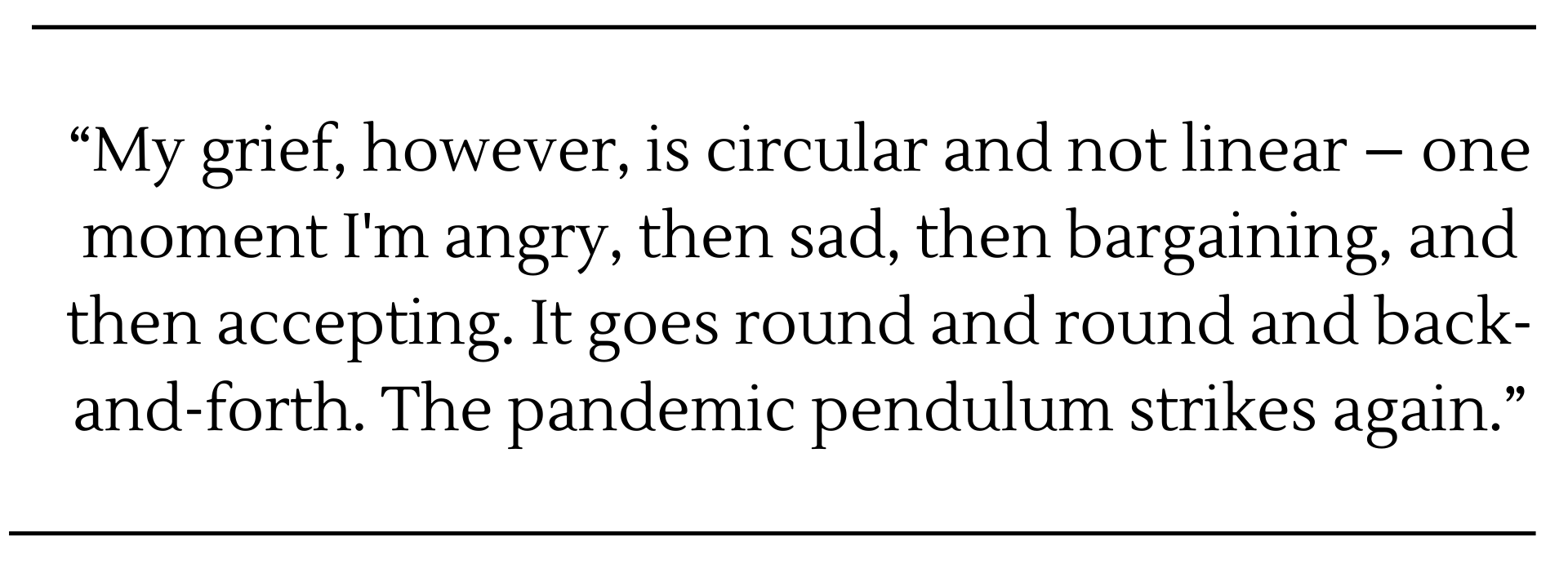
The good news, however, is that I have the skills and practices to manage my spectrum of reactions. When I go to these scary worse-case scenarios, I support myself by practicing a self-compassion break with three key components that slow down my pendulum of thoughts, feelings, and suffering:
1. Mindfulness. I recognize and name the feelings that I’m experiencing: fear, overwhelm, anger, etc. Doing this means practicing mindfulness, where I acknowledge for myself that “This is a moment of overwhelm.”
2. Common humanity. I remember that so many of us are going through this together and this helps me to not feel so alone. I remind myself that “I know I’m not alone in these feelings – other people have them, too, right now.”
3. Self-kindness. Lastly, I offer myself messages of kindness and love, or practice some form of gratitude. I offer myself the message: “May I be gentle with myself during these difficult times.”
I’m also feeling a lot of grief. There is a collective sentiment of loss in our world for all the things we are missing out on like hugs from our colleagues and students, laughter in our classrooms, school events like graduation, and many more. This huge loss feels heavy for many of us.
My grief, however, is circular and not linear – one moment I’m angry, then sad, then bargaining, and then accepting. It goes round and round and back-and-forth. The pandemic pendulum strikes again.

I’ve found that the most powerful thing I can do is just allow whatever feeling is there to emerge and to just let it “be” in the moment. By being present with whatever difficult feeling I’m having and softening into it with some tenderness, it begins to dissipate on its own.
So, if you’re like me and are also feeling much worry and grief, then how do we cultivate some resilience and strength during these difficult times? And how do we make the practice of cultivating resilience feel easy and not like yet another thing for our already overwhelmed educators to do?
Self-care practices are strongly associated with building emotional resilience – the ability to bounce back or react appropriately when life gets tough. These practices have never been more relevant in this world. As educators, it’s essential that we fill up our own cup first to be able to care for those around us.
No self-care practice is going to be the same for everyone. However, the following practices are all core pieces that will allow you to build up your resiliency in your own way.
Here are a few of my “Cs” of strengthening resiliency:
1. Be courageous. Have the courage to slow down, ask for what you need, and be brave enough to know when you’re not okay. This is all about giving ourselves permission to prioritize our own well-being. Think about what it is that you really need right now and don’t be afraid to ask for it.
2. Build community. We can’t do it alone – so let’s learn to ask for help and grow our community. There has never been a time when the idea of common humanity has resonated so much. You may be “socially distancing” but you can also be “distance socializing,” so find a way to connect.

3. Cultivate care. Get down to the task of cultivating the care you need. What are the components of well-being that you need to attend to? Do you need more exercise? Should you eat something healthy? Do you need to call a friend? Is it time for a meditation practice? Do you need to improve your sleep habits? This is the time to truly care for your personal well-being.
4. Have compassion. Lastly, let’s hold all of this – the world, our students, our colleagues and, most of all, ourselves, in compassion. Find ways to offer yourself kind and tender words.

So, what do we do about all that comes with these difficult and challenging times? Well, nothing. We let it ride.
We allow ourselves to feel whatever we’re feeling.
We recognize that this is a time of pandemic pendulum and know that we aren’t alone in it all.
We meet our moments of joy, inspiration, and motivation with gratitude, and we meet our suffering, our worry and our grief with compassion, kindness, and love.
Because in the end, worry and grief can exist alongside love all on the same pendulum.
Photos: Adobe Stock
-
Healthy organizational responses to the coronavirus pandemic
Comments Off on Healthy organizational responses to the coronavirus pandemicI begin the revised and expanded edition of my book, Creating Healthy Organizations: Taking Action to Improve Employee Well-Being with a basic question: how can we make organizations humanly sustainable so they can succeed in the future? This question takes on new urgency now that we’ve been blind-sided by a global pandemic. Human resources, workplace wellness, and occupational health and safety professionals are confronting what surely will be the greatest test of their career. Following the principles of a healthy organization can be helpful.
PERVASIVE PUBLIC PESSIMISM
First, here’s the backdrop to what’s happening to workers and employers. Unlike the 2008-2009 financial crisis and Great Recession, which resulted from weaknesses in the financial system, the coronavirus pandemic generates anxiety and fear on two fronts: health and economic.

Evidence of this comes from EKOS Research Associates’ latest polling of Canadians (March 17-24, n=1,710, MOE +/- 2.4%, 19 times out of 20). Three-quarters of those surveyed believe the economy is already in recession and expect it to get worse in the next 6 months. Just over half think they will be worse off financially in 6 months. The typical respondent sees a 50% chance of them personally being infected by the coronavirus. Most (80%) are experiencing stress due to the pandemic. On an optimistic note, Canadians do grasp the severity of the crisis and understand what they need to do to stay safe. And they endorse governments’ responses so far.
SHIFTING HEALTHY PRACTICES INTO HIGH GEAR
Pre-pandemic, organizations in all industries operated in an environment rife with ever-greater risks and uncertainties, and sweeping transformations. More employers recognize that survival depends on getting the fullest commitment and energy from each and every employee. The goal of making the entire organization healthier moved into the mainstream of corporate wellness. Companies are striving to make workplaces psychologically healthier and safer. Expanded corporate sustainability frameworks have opened up discussions about the sustainability of a company’s human resource practices.
This solid progress – coupled with strong economies in Canada and the US leading up to the pandemic – will enable many of us to weather the storm.
CULTIVATING RESILIENCE
Healthy organizations cultivate workforce resilience. Resilient people don’t bounce back; they bounce forward, finding new strength and equilibrium. They move to a new normal that enables them to keep progressing toward a better future. Resilient people don’t just adapt to change, they find opportunities and renewed strength as they confront it. In the language of positive psychology, the goal is to help organizations and their members flourish and thrive.
Workers need a supportive environment to be resilient. To do this, leaders must develop their own resilience. Resilient leaders skillfully and proactively respond to stressors, practice self-care, learn from failure, develop renewed strengths, and show others how it is possible to thrive when the going gets tough. In this way, they foster a resilient workforce that is prepared to deal with the unexpected.
Individual and team resilience is a hallmark of a psychologically healthy and safe workplace. The National Standard of Canada for Psychological Health and Safety in the Workplace highlights the key workplace features that contribute to resilience:
1. Supportive managers and coworkers
2. A culture that values individuals’ well-being
3. Skilled people leadership
4. Respectful working relationships
5. Support for employees’ personal growth and development
6. The resources needed to manage workloads and job demands
7. Employee involvement in decisions
8. Recognition for contributions
9. The flexibility needed to achieve work-life balance
Maintaining, and even strengthening, the above workplace features must be a priority. Building a healthy organization is a shared responsibility. While demonstrated support from senior leaders is a key enabling condition for change, equally important is the active participation of all the organization’s members, right down to the front lines. Ideally, all employees should feel motivated and encouraged to find ways to make their jobs and work environment healthier and safer. Now the bar is raised, because this has to happen virtually.
 LESSONS FROM RECESSIONS PAST
The change process can be designed to be healthy. We can derive lessons from research on corporate downsizing and restructuring during the recessions of the ‘80s, 90s, and 2000s. Here’s what’s well documented: 1) downsizing increases stress and diminishes the health of those laid off and the ‘survivors’ (who suffer from what’s called ‘survivor syndrome’); 2) poorly executed downsizing or restructuring reduces organizational capabilities, ranging from learning, reduced tacit knowledge, social capital (relationships), collaboration, and innovation.
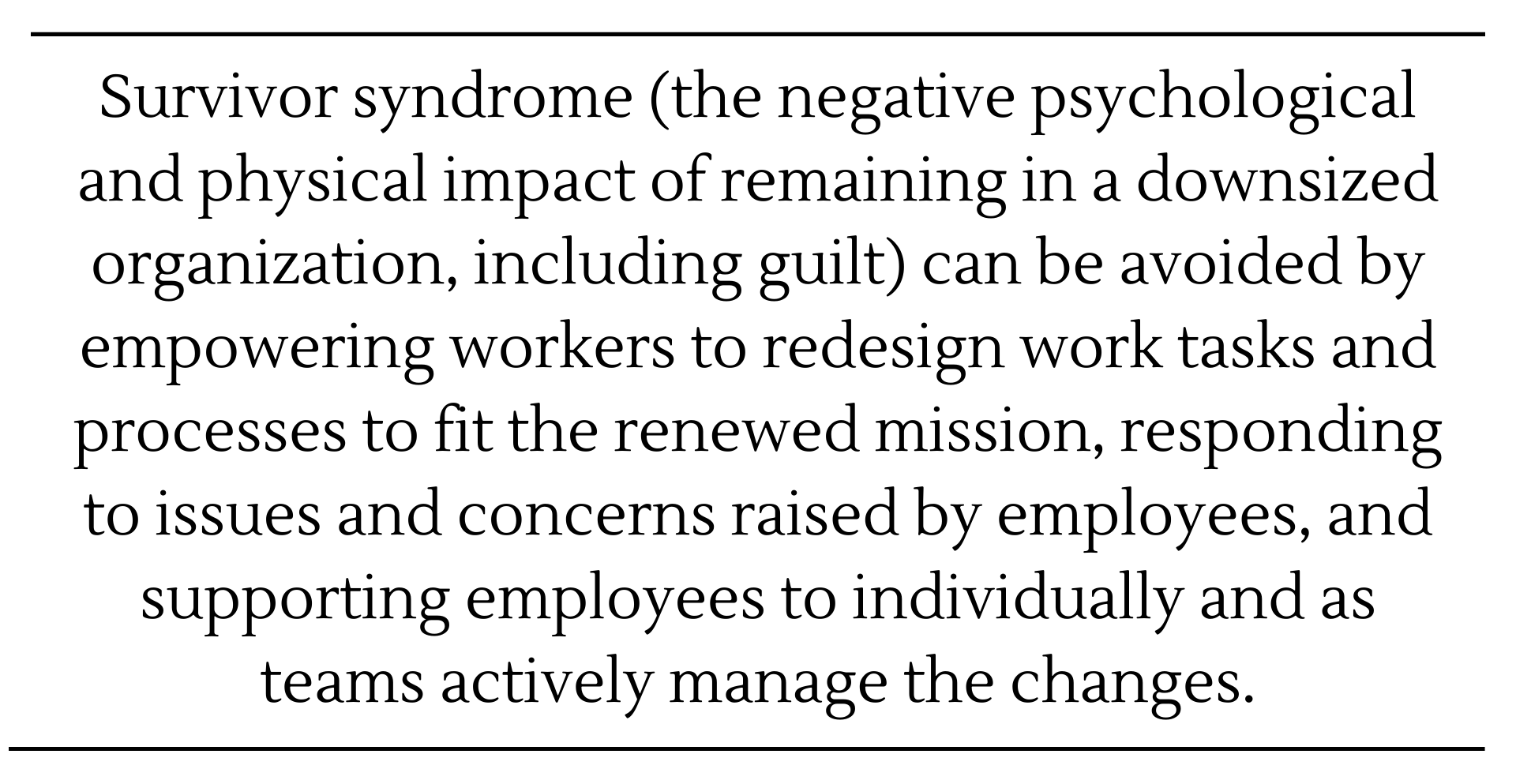
Survivor syndrome (the negative psychological and physical impact of remaining in a downsized organization, including guilt) can be avoided by empowering workers to redesign work tasks and processes to fit the renewed mission, responding to issues and concerns raised by employees, and supporting employees to individually and as teams actively manage the changes.
During the 2008-2009 Great Recession, some companies came out stronger because they used the downturn as an opportunity to engage all employees to reinvent the business strategy and find better ways of working. Leaders in these organizations built trust by openly communicating with employees, involving them in the changes, and supporting them at every step of the way. The big take-away for employees: this company cares about me so I am committed to its future success.
SIGNS OF MUTUAL SUPPORT
As the Economist recently observed: “Downturns are capitalism’s sorting mechanism, revealing weak business models and stretched balance-sheets.” But there’s more to the survival story. Beyond balance sheets and the type of business (pity the cruise lines), it comes down to people practices, reinforced by shared corporate values. Values are the essential guideposts when the going gets tough. And rarely has it been tougher.
Small businesses face more acute challenges. But from what I’ve seen locally, owners may be more inclined to treat their workers like family, knowing they will need them back as the pandemic threat recedes.
I see signs of this today in my own community. A restaurant quickly shifted to a reduced take out menu, turning waiters into delivery drivers, and offering customers the option of buying an inexpensive meal for a family in need. Gyms offer free daily on-line workouts. Musicians stream live performances. A craft distillery now is producing hand sanitizer. My friend Todd Ramsay and his wife Ashley, who run Kelowna-based Yeti Farm Creative, an animation studio, proactively set up their employees to work at home in early March. Their team feels virtually connected (Todd’s accompanying graphic captures this) and are committed to coming out of this ordeal even stronger. The common theme here is people pulling together and helping each other. And just as with fires, floods and other natural disasters, people are engaging in acts of kindness. Local TV news images of empty foodbank hampers quickly resulted in a $10,000 donation, plus lots of smaller ones.

Work and social life have been transformed in a matter of weeks into virtual experiences. Video chat service Zoom has, well, zoomed into widespread use. The lines between work and home and family life have dissolved. What about those workers faced with school closures and kids at home needing constructive activities? It’s time for your team to talk about what adaptations are needed to support these members.
LET’S NOT FORGET…
There are other groups of workers who desperately need help. Foremost are front-line healthcare workers. We’ve seen shocking videos of doctors and nurses working around the clock in Spain and Italy, risking their safety, tending to patients lying in hallway floors without proper equipment. How can we prevent that scenario from happening here? And as a New York Times editorial put it: “In this hour of crisis, those at the bottom of the economic pyramid are in the greatest need of help.” This includes low-paid workers and those in the gig economy. There’s an essential role for governments here.
Yes, the coronavirus pandemic will end. The Chinese city of Wuhan, the original epicenter of the coronavirus, has reduced the number of new infections to the point that people are returning to work and some semblance of normal daily life. All the more important to ensure that today’s responses to the pandemic will ready us to resume our social and economic lives. So think of where you want to be one year from now.
-
Staying Well at Home
Comments Off on Staying Well at HomeOn behalf of the EdCan Board and Advisory Council, we wish our network members across the country continued safety and wellness during this challenging time. We would like to express our heartfelt gratitude to the healthcare professionals and other essential workers who can’t stay home and are keeping the rest of us healthy, safe and well supplied with what we need to get through this. EdCan staff have been fortunate to be able to continue working virtually without missing a beat and have been strategizing how best to leverage our high-quality learning content to support your well-being through this overwhelming experience.
Your Membership Benefits – Shifting from Well at Work to Well at Home
We know that you’re not only focused on ensuring the safety of your loved ones, but also care a great deal about how your colleagues and students are dealing with this crisis. Many of you are also being asked to deliver distance learning during extremely distracting circumstances. This is a lot for you to deal with. As you may already know, one of EdCan’s core initiatives is Well at Work, which aims to shift mindsets by showcasing research, policy and practice that results in healthier, happier, and more resilient K-12 staff. We’ve temporarily pivoted our focus to Well at Home, because there’s no better time for you to explore our current collection of podcasts, blog posts and magazine articles as well as the latest research resources that we will continue to update to help you focus on your own well-being to maintain your strength for those who need you the most right now.
Although our Pan-Canadian Summit on K-12 Staff Well-Being is postponed until November 2-4, we remain dedicated to continue providing you with relevant learning opportunities featuring the foremost experts on this topic. As such, we’re excited to announce that we will be hosting a series of free webinars over the next few months with the goal of maintaining momentum on this crucial issue. Our first webinar will take place on Wednesday, April 15th at 1:00 PM (EST) presented by Mindfulness Everyday. Heidi Bornstein and Stephen Chadwick will be in their homes and we will be in ours and hope you will join us for some virtual “me time” to recharge and refocus during this difficult period. They will be presenting a live public webinar and four small group community meet-ups for EdCan members. The second webinar, on Tuesday, April 30th at 1:00 PM (EST), will be hosted by The Behavioural Insights Team. Information detailing registration and other future webinars will be coming soon!
Well at Work Professional Development Discussion Kit
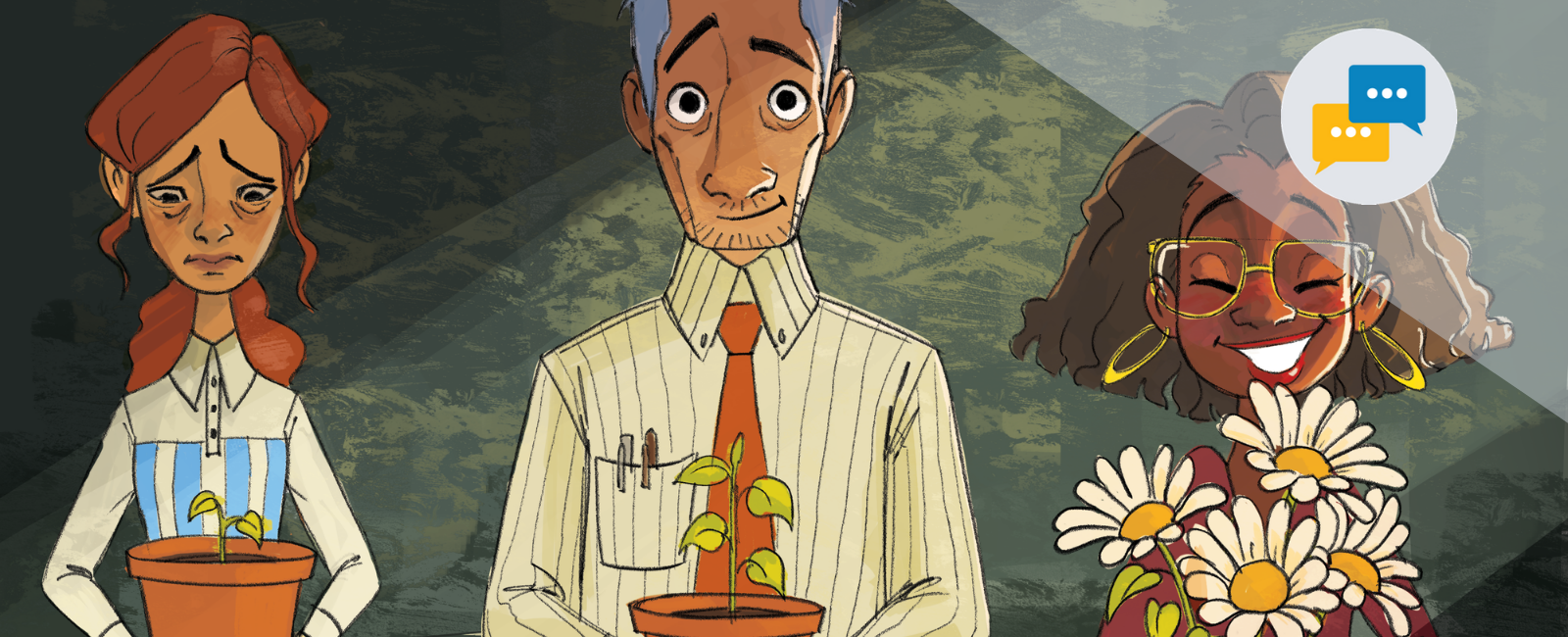
For those of you taking advantage of your PLNs to stay connected, I encourage you to use our newly-released Well at Work Professional Development Discussion Kit, which complements our Winter 2019 edition of Education Canada Magazine and offers group discussion and self-reflection guides that unpack how we can (and why we must) strengthen our social and emotional wellbeing to achieve healthier schools and better learning experiences for students.
Additional Relevant Magazine Topics to Explore
Beyond the topic of well-being, we just released our latest Education Canada Magazine focus on The Greening of Schools where we take a closer look at environmental education and leadership around greener schools design and practice. 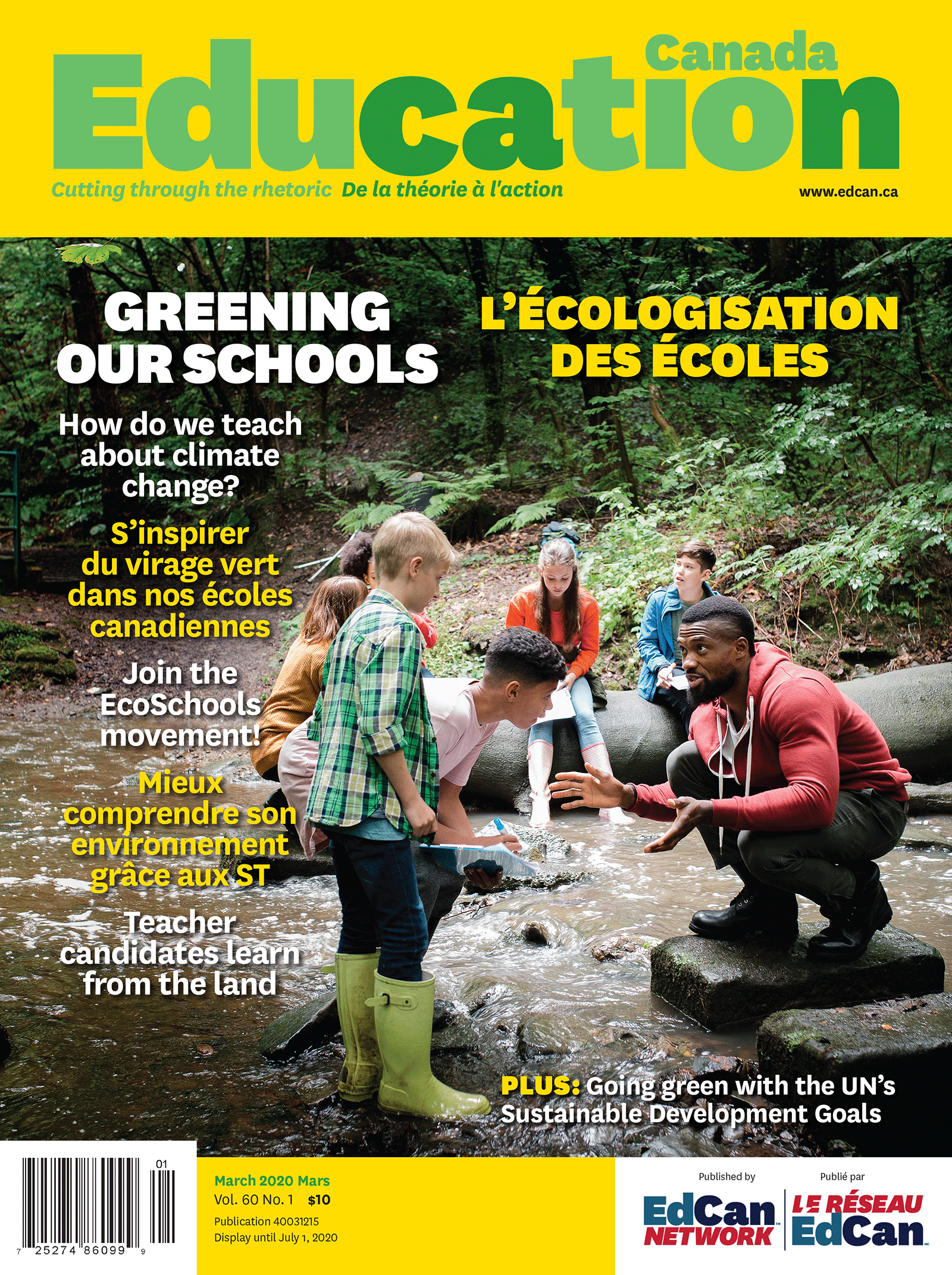
We look forward to releasing a special web-exclusive edition of our May issue focusing on Education and the Skilled Trades to help counter the stigma and articulate the value of skilled trades and how our education system is fostering the skills and knowledge students require to meet the workforce needs of tomorrow.
Tell Us What You Need
Of course, as you probably know, your EdCan membership provides not only our latest magazine articles, but also grants you unlimited access to our vast archive of evidence-based content to help you explore what the research says on some of the most complex issues facing educators today. If you haven’t already logged into our website using your institutional email address to take full advantage of the high-quality professional learning content that EdCan has to offer, we encourage you to do so. Please follow us on our Facebook, LinkedIn, Twitter, Instagram accounts and subscribe to our e-newsletters for the latest updates, and let us know how we can continue to support you and your colleagues.
Please stay home, stay safe and know that better times are ahead for all of us.
Max Cooke
EdCan CEO
mcooke@edcan.ca
@max_cooke -
Managing Stress and Anxiety from COVID-19
Comments Off on Managing Stress and Anxiety from COVID-19With the COVID-19 pandemic, we find ourselves in a time of change and uncertainty. Worry and anxiety about financial insecurity, job loss, and social isolation, along with our physical and mental health are natural reactions to this stressful situation. Left unaddressed, these feelings can be harmful when they get out of control.
Continue to resource here
-
COVID-19: We are here to help
Comments Off on COVID-19: We are here to helpIn response to the COVID-19 Pandemic, Morneau Shepell’s Workplace Learning Solutions team has developed a number of resources to help organizations and employees understand and work through the challenges we are all facing.
Continue to resource here
-
Resource Hub: Mental health and wellness during the COVID-19 pandemic
Comments Off on Resource Hub: Mental health and wellness during the COVID-19 pandemicThe Mental Health Commission of Canada is committed to sharing credible information and resources about maintaining mental health during this time of crisis, and supporting people managing a mental illness in this new context.
Also, be sure to check out The Working Mind: COVID-19 Self-Care & Resilience Guide.
Continue to resource here
-
CASEL Cares Initiative
Comments Off on CASEL Cares InitiativeAs the country and the world respond to the coronavirus (COVID-19), we are all feeling a range of emotions. CASEL understands how important it is to attend to the social and emotional needs that arise during times like these. SEL offers a powerful means to explore and express our emotions, build relationships, and support each other – children and adults alike – during this challenging time.
CASEL CARES is a new initiative that connects the SEL community with experts to address how SEL can be most helpful in response to today’s circumstances.
Also, be sure to check out CASEL’s webinar series Strategies for Being Your Best ‘SEL’f.
Continue to resource here
-
COVID-19: Implications for Canada and the economic impact
Comments Off on COVID-19: Implications for Canada and the economic impactThis site is a go-to resource for insights and analysis on COVID-19. Here, The Conference Board of Canada brings you quick-read articles based on our multidisciplinary research. Each article gives you a fact-based understanding of the complex issues impacting you and your organization.
Also, be sure to check out The Conference Board of Canada’s Mental Health and COVID-19 Video Series.
Continue to resource here
-
Teach from Home
Comments Off on Teach from HomeA temporary hub of information and tools to help teachers during the coronavirus (COVID-19) crisis.
Also, be sure to check out the Teach from Home toolkit.
Continue to resource here
-
Mental Health and the COVID-19 Pandemic
Comments Off on Mental Health and the COVID-19 PandemicThe effort to address COVID-19 is both extremely important for us all and poses a range of challenges for individuals and families as they respond to the demands of the situation. The situation is stressful for everyone and it is normal to be anxious and worried. This site is designed to provide information and suggestions about how best to cope in this difficult time.
Continue to resource here
-
Global Education Coalition
Comments Off on Global Education CoalitionThe Global Education Coalition launched by UNESCO seeks to facilitate inclusive learning opportunities for children and youth during this period of sudden and unprecedented educational disruption.
Investment in remote learning should both mitigate the immediate disruption caused by COVID-19 and establish approaches to develop more open and flexible education systems for the future.
Continue to resource here
-
COVID-19: Practical workforce strategies that put your people first
Comments Off on COVID-19: Practical workforce strategies that put your people firstIn moments of uncertainty and concern, it’s not only about what leaders of organizations do but equally how they do it that matters.
In January 2020, ahead of the Lunar New Year and as health concerns were still growing, Deloitte conducted a survey in China of human capital policies and practices. The survey drew over 1,000 responses from enterprises operating in China, including a cross-section of private, foreign, and state-owned enterprises as well as not-for-profit organizations.The survey shows that from the beginning of the COVID-19 outbreak, the immediate focus of employers has been on ensuring the health and safety of their employees
Drawing on lessons learned in prior crises, such as SARS, Deloitte offers practices and strategies for consideration.
Continue to resource here
-
How to support student mental health during the COVID-19 pandemic
Comments Off on How to support student mental health during the COVID-19 pandemicStudents may experience a range of emotions during the COVID-19 situation. As well, changes in routine, including time away from school, may create challenges for some students. We also understand that young people with pre-existing mental health problems may find their symptoms increasing in light of the current uncertainties.
School Mental Health Ontario compiled tips and resources to help answer questions you may have about how to support students during this time.
Continue to resource here
-
Guidance for COVID-19 Prevention and Control in Schools
Comments Off on Guidance for COVID-19 Prevention and Control in SchoolsThe purpose of this document, published by UNICEF, is to provide clear and actionable guidelines that will allow schools and other educational establishments to operate safely through prevention, early detection, and combating COVID-19. While these guidelines are specific to countries that have already confirmed the transmission of COVID-19, they are still relevant in all other contexts. Education can encourage students to become advocates for disease prevention and control at home, at school, and in their communities by enabling them to educate those around them on how to prevent the spread of virus. Maintaining safe school operations or reopening schools after a closure requires many considerations but, if done well, can promote public health.
Continue to resource here
-
The Action-Driven Change Framework
Comments Off on The Action-Driven Change Framework -
Coronavirus (COVID-19) information for K-12 educators and Faculties of Education
Comments Off on Coronavirus (COVID-19) information for K-12 educators and Faculties of EducationWith the unsettling disruptions of school closures and social distancing requirements, we will continue to update useful links to help you access the latest information from your provincial/territorial ministry of education.
Outbreak update from the Public Health Agency of Canada
Outbreak update from the World Health Organization
Alberta
What is the current situation? Click here.
British Columbia
What is the current situation? Click here.
Guidance for COVID-19 prevention and control in childcare and schools.
Manitoba
What is the current situation? Click here.
New Brunswick
What is the current situation? Click here.
Newfoundland and Labrador
What is the current situation? Click here.
Nova Scotia
What is the current situation? Click here.
Northwest Territories
What is the current situation? Click here.
Nunavut
What is the current situation? Click here.
Ontario
What is the current situation? Click here.
Prince-Edward Island
What is the current situation? Click here.
Quebec
What is the current situation? Click here.
Saskatchewan
What is the current situation? Click here.
Yukon
What is the current situation? Click here.
-
Racism and K-12 Workplace Well-Being
Comments Off on Racism and K-12 Workplace Well-BeingAlso available on:


-
Infographic: The Positive Workplace Framework (PWF)
Comments Off on Infographic: The Positive Workplace Framework (PWF)This infographic is based on the Positive Workplace Framework (PWF), which is a made-in-Canada strengths-based approach to optimizing staff and student well-being, engagement and performance, with a focus on the three key conditions to creating a healthy workplace in K-12 education: Mental Fitness, Resilience, and Positive Leadership. The PWF can also be applied to other settings beyond the K-12 context (e.g. colleges, universities, day cares, etc.).
This infographic was inspired by an article by Robert Laurie, Dr. Bill Morrison, and
Dr. Patricia Peterson that appeared in Education Canada Magazine. -
Schools Take Action
Comments Off on Schools Take ActionAre we finally waking up to the critical need for climate change action? Is it too late? As we finalized the articles for this issue, Australia was literally on fire, suffering devastating and possibly irreversible losses to habitat and wildlife, not to mention loss of human life and thousands of homes. And this is only one of several ecological debts that are coming past due.
If young people are worried and angry about the crisis that lies ahead for them, they have every right to be. They’ve been left holding the bag, and they know it. So how do we equip them to address these challenges in a positive way that doesn’t just create more anxiety and fear?
Environmental educators know that real action that has a real impact is the strongest antidote to feelings of helplessness and despair. That’s why, in this issue on environmental education, we wanted to stress approaches that involve students in action projects to mitigate environmental damage, and schools that “walk the walk” by reducing their own carbon footprint. We were interested in how schools are “greening up” through both education andaction.
There is plenty in this issue to inspire educators to take up the green torch. But what has stayed with me is a finding from the survey conducted by Lakehead University and Learning for a Sustainable Future, reported on in “Climate Change Education and the Canadian Classroom: Nearly half of Canadian students do not believe that human action will be effective in mitigating climate change. That’s a heavy weight for kids to carry. The authors say, “It is critically important, therefore, to target this group with climate change education that is action- and solutions-oriented to combat eco-anxiety and hopelessness.”
The articles in this issue show just what can be done when students are energized to act and school and board administrations are willing to step up and support them. From the EcoSchools Program that began in Toronto and is spreading across the country, to the eco-projects initiated and led by the students profiled by Alex Mlynek (web exclusive), to the work done by Brilliant Labs in Atlantic Canada to facilitate students’ innovative tech solutions supporting the UN Sustainable Development Goals, there is no shortage of green ideas in our schools. It is not such a big stretch to imagine that Canadian schools could join the ranks of those leading the way in sustainable living and environmental stewardship.
Photo: courtesy Laryssa Gorecki
First published in Education Canada, March 2020
Write to us!
We want to know what you think. Send your comments and article proposals to editor@edcan.ca – or join the conversation by using #EdCan on Twitter and Facebook.
-
Stress and burnout are on the rise among Canadian principals and vice-principals
Comments Off on Stress and burnout are on the rise among Canadian principals and vice-principalsPrincipals and vice-principals are facing increased pressure, workload, and stress.1 But considering how pervasive stress and burnout seem to be across many professions in modern society, why should we care specifically about school leaders? The answer is actually so very clear: health, happiness, and success for everyone! Of course, work-related stress is normal and inevitable; however, excessive physical and emotional stress can interfere with school leaders’ well-being which can carry over to ultimately impact education systems as a whole.

WHEN LOOKING AT SCHOOL LEADERS’ WELL-BEING, THERE ARE THREE INTERCONNECTED COMPONENTS TO CONSIDER:
1. The Individual: Stress inhibits school leaders from effectively improving school performance
Principals and vice-principals (VPs) are some of our most dedicated and passionate educators who have chosen to take on a role with significant responsibility and impact, which means that we need them to be at their best. One might say that handling difficult tasks and juggling many needs is simply the role of school principals and VPs. That is absolutely correct! This is exactly what our best leaders are good at and often thrive on. However, our bodies are not designed for the levels of constant and excessive stress that many of our school leaders are currently experiencing.

Chronic stress lowers levels of health, happiness, and success – and leaders aren’t immune from these innately human factors.2 If principals and VPs are working days, nights, and weekends (and they often are), then they are indeed experiencing chronic stress, which will take a toll on their social, emotional, and cognitive well-being,3 just like anyone else. Work-related stress can have damaging effects that inhibit school leaders’ ability to function effectively while lowering their job enthusiasm and motivation to perform well.4 Stress not only affects the ability of school leaders to improve their schools but also makes it difficult to retain and recruit new principals and VPs.
Research shows that most principals burn out and leave the profession in four years or less, although it takes five-to-seven years for a principal to have a significant impact on a school community.5 Yes, we need principals to do their job now, but we also need them to stick around long enough to yield the greatest results possible for students. What’s more, despite the fact that we’re increasingly more aware of the importance of social emotional skills like self-awareness and the need to practice self-care, many school leaders have not been taught these essential skills. More importantly, leaders often assume that they can’t possibly worry about themselves since they’re tasked with taking care of everyone else. However, it’s good to be reminded of the simple truth that we’ve learned from air travel, which is that it’s not only important – but essential – to put on your own oxygen mask before helping others.
2. The Group: Education is a collective endeavour – not one person’s job
If you are a parent, student, or school staff member, then this is one of the most compelling arguments for why you should care about your principals’ or vice-principals’ stress levels. It takes a community – if not a village – to raise a child. The most productive and successful work teams are made up of people who care about each other. People on successful and productive teams use the words family, support, and trust to describe their work together. It isn’t enough to have great individuals. Principals and VPs aren’t superheroes, nor should they be the sole go-to people who are expected to triumph against all odds. They are regular people whose health and well-being should be of equal concern, not an afterthought. For schools to function well, all staff need to work as a team towards a common goal. To do our best work, we need to have strong, connected teams built on relationships and trust.

What we know about workplace well-being is that the best teams are those that understand the importance of social connection and creating a workplace where people feel safe and valued. If school leaders don’t feel connected or supported by their team, then they’re not only less effective but so is everyone else. If leaders are connected and have strong, authentic relationships then the people that work for them will go out of their way to make their leaders’ and the organization’s vision come true.6 When we work for someone who we care about and who we feel cares about us as employees, then we will work with passion, dedication, and creativity. What’s more, when we hold this sense of care as a group, the results are amazing!

Fundamentally, work and life aren’t things we can ever do alone – nor are we meant to.7 We’re at our best when we work together and, just as we know that stress can actually spread and be contagious towards those around us,8 we also know that the “good stuff” is contagious, too. For instance, it has been scientifically proven that when we show gratitude and compassion towards other people, they feel better, perform better, and are more likely to reciprocate acts of compassion and belonging.9 So, no matter who we are and what role we may find ourselves in, we can always make the choice to act first by showing compassion, assuming good intention, and being kind. It’s important for leaders to both show and receive these positive actions. Above all, we need leaders who feel safe, valued, and connected in order for them to do their best work and to inspire and support their staff – and ultimately their students – to do the same.
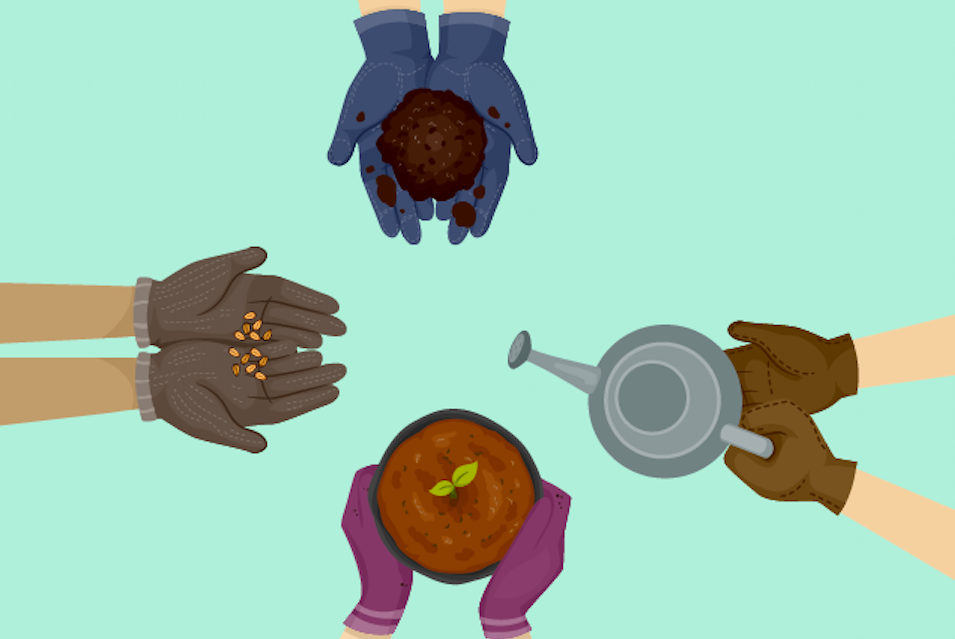
3. The System: School leaders are running systems that aren’t designed to support their well-being
Surveys of principals demonstrate that education systems are overloading our leaders.10 A rapid flow of policies, initiatives, and programs leads to loss of focus, overwork, frustration, and demotivation11 – and these are impacting school leaders’ health and well-being while increasing their levels of stress. As this makes it more difficult to recruit and retain the best school leaders, school districts are faced with high costs in terms of both time and money, which further inject stress into the system.

It’s important to name this tension while also being very clear that this isn’t a criticism towards – or the responsibility of – any one person or group of people. Rather, this tension indicates that education systems as a whole need to look at practices through the lens of workplace well-being. As such, looking at practices through a well-being lens can lead to large-scale change that, as the First Peoples’ Principles of Learning remind us, will take time and patience. However, rethinking system-level practices can also involve small changes that simply require a willingness to try – and we need both large and small changes.
THE TAKEAWAY
While it’s encouraging that many associations, ministries of education, and partner groups are beginning to focus on the issue of workplace well-being in K-12 education, we still have a ways to go in acknowledging the importance of principals and vice-principals’ well-being – leaders of learning who have huge impacts on the health, happiness, and success of our schools. For school leaders reading this, remember that well-being has three interconnected components: you, your team, and the system as a whole. You were never meant to do this job alone.
References and Further Reading
1Alberta Teachers Association (ATA). (2017). The Canadian school leaders: Global forces and future prospects. A research report. Edmonton, AB.
Canadian Association of Principals (CAP). (2014). The future of the principalship in Canada: A national research study. Kanata, ON.
Pollock, K., Wang, F., & Hauseman, D. C. (2014). The changing nature of principals’ work: Final Report. Ontario Principals’ Council, Toronto, ON.
Pollock, K., Wang, F., & Hauseman, D. C. (2015). Complexity and volume: An inquiry into factors that drive principals’ work. Societies, 5(2), 537–565.
Pollock, K., Wang, F., & Hauseman, D. C. (2017). The changing nature of vice-principals’ work: Final report. Ontario Principals’ Council, Toronto, ON.
Poirel, E., & Yvon, F. (2014). School principals’ emotional coping process. Canadian Journal of Education/Revue Canadienne de L’éducation, 37(3), 1–23.
Riley, P. (2016). The Australian principal occupational health, safety and well-being survey. Institute for Positive Psychology & Education. Retrieved from: http://www.principalhealth.org/au/2016_Report_AU_FINAL.pdf
U.S. Bureau of Labor Statistics. (2016). Occupational outlook handbook: Elementary, middle, and high school principals. U.S. Department of Labour. Retrieved from: https://www.bls.gov/ooh/management/elementary-middle-and-high-school-principals.htm
2Hallinger, P., & Murphy, J. F. (2013). Running on empty? finding the time and capacity to lead learning. NASSP Bulletin, 97(1), 5-21. doi:10.1177/0192636512469288
Nthebe, K., Barkhuizen, N., & Schutte, N. (2016). Rewards: A predictor of well-being and service quality of school principals in the north-west province. SA Journal of Human Resource Management, 14(1), 1-e11. doi:10.4102/sajhrm.v14i1.71
Poirel, E., & Yvon, F. (2014). School principals’ emotional coping process. Canadian Journal of Education/Revue Canadienne de L’éducation, 37(3), 1–23.
3Wang, F., Pollock, K., & Hauseman, D. C. (2018b). Ontario principals’ and vice-principals’ well-being and coping strategies in the context of work intensification. In S. Cherkowski, & K. D. Walker (Eds.), Perspectives on flourishing in schools (pp. 287-303). Lanham, Maryland: Lexington Books, an imprint of The Rowman & Littlefield Publishing Group, Inc.
4Devos, G., Bouckenooghe, D., Engels, N., Hotton, G., & Aelterman, A. (2007). An assessment of well-being of principals in flemish primary schools. Journal of Educational Administration, 45(1), 33-61. doi:10.1108/09578230710722449
5Leithwood, K. A., Louis, K. S., & Anderson, S. E. (2012). Linking leadership to student learning (1st ed.). San Francisco: Jossey-Bass.
6Sinek, S. (2014). Leaders eat last: Why some teams pull together and others don’t. New York: Portfolio/Penguin.
Sinek, S. (2011). Start with why: How great leaders inspire everyone to take action. New York: Portfolio / Penguin.
7Walton, G. M., Cohen, G. L., Cwir, D., & Spencer, S. J. (2012). Mere belonging: The power of social connections. Journal of Personality and Social Psychology, 102(3), 513-532. doi:10.1037/a0025731
8Sterley, T., Baimoukhametova, D., Füzesi, T., Zurek, A. A., Daviu, N., Rasiah, N. P., & Bains, J. S. (2018). Social transmission and buffering of synaptic changes after stress. Nature Neuroscience, 21(3), 393-403. doi:10.1038/s41593-017-0044-6
9Coyle, D. (2018). The culture code: The secrets of highly successful groups (1st ed.). New York: Bantam Books.
10Wang, F., Pollock, K., & Hauseman, C. (2018a). School principals’ job satisfaction: The effect of work intensification in Ontario. Canadian Journal of Educational Administration and Policy, 185, 73-90.
Wang, F., Pollock, K., & Hauseman, D. C. (2018b). Ontario principals’ and vice-principals’ well-being and coping strategies in the context of work intensification. In S. Cherkowski, & K. D. Walker (Eds.), Perspectives on flourishing in schools (pp. 287-303). Lanham, Maryland: Lexington Books, an imprint of The Rowman & Littlefield Publishing Group, Inc.
11Fullan, M. (2008). What’s worth fighting for in the principalship? (2nd Ed.). New York: Teachers College Press.


IDEAS TO SUPPORT EDUCATORS : Subscribe to the EdCan e-Newsletter
Quality research, reports, and professional learning opportunities.