Archive
-
How can parents and teachers support elementary students as they learn from home during COVID-19?
Comments Off on How can parents and teachers support elementary students as they learn from home during COVID-19?Schools across Canada have had to adapt amid the global pandemic, resulting in many students learning remotely. Teachers are being asked to lead learning virtually in the family home while families are being asked to support students in ways that may be unfamiliar and potentially overwhelming. While schools are important for a child’s learning outcomes, research has demonstrated that positive family involvement can have a significant impact on student achievement. This doesn’t mean that schools cannot make a difference, but rather these unprecedented circumstances are calling on schools and families to work in partnership to support student learning. Here are some questions that teachers and families can ask when developing and implementing home-based learning activities, including tips to support student participation:
QUESTIONS TO ASK YOURSELF:
1. Can the activity be easily done in a home setting, and is curriculum being used in a flexible way that fits with family activities/interests or things that families might already be doing?
TIPS:
• Developing online activities is difficult. Don’t try to recreate the school classroom at the family dinner table. Just having worksheets and powerpoint slides online is not the answer.
• Find teachable moments in everyday activities including cooking/baking, board games, reading a storybook, etc.
• It’s important to keep an open line of communication between teachers and families to identify the diverse needs of students and their households (e.g. level of expertise, interests, access to resources, culture, language).
2. Is there a focus on literacy and math?
TIPS:
• Literacy and math are fundamental skills required for daily life. Learning how to read and write and do mental math occurs gradually over time.
• Try finding little ways that prompt children to practice mental math. For example, when playing the card game ‘go fish’ you can’t ask for a card directly, but make up arithmetic questions (e.g. you can’t ask for 10 but can ask for a card whose face value is equal to 8+2).
3. Are the activities taking up a major portion of the day?
TIPS:
• Think quality over quantity. We should never underestimate the learning that can happen through talking. Some parents are still working and at best have only gained commute time.
• Ministries/Departments of education are recommending 5 hours a week doing school work – that’s it. This means just 1 hour per day of school work (e.g. 20 minutes of reading a book, 10 minutes of math exercises, and 30 minutes of teacher-led time a day).
If families are deciding not to complete teacher-assigned activities, this might mean that families are finding it challenging to play school in the home. A partnership between school and home is one where each partner has something to gain and shouldn’t feel exhausting to either teachers or families. This can be achieved by integrating curriculum expectations within everyday family activities in ways that consider their interests and unique needs. Creating learning experiences that are family-centered can help to better support student learning – and most importantly– student well-being during this time.
At-Home Activity Ideas and Resources
Baking/cooking with a twist: Students can make family treasured dishes/treats with a family member but teachers can put in the challenge that only the student can read the recipe. This can allow targeting of specific language and mathematics curriculum expectations yet monopolize on family activities.
Researching with a twist: Students can invite family members and friends to share experiences about topics (e.g., earthquakes, geographical regions, historical events, gardening) from their own work, home, travel, and festivities. Students can capture what they learned from the interview in a video or written report.
Family challenges: Families can be challenged to make safety devices that protect an egg during a drop or build stable towers/structures/forts. Students can reflect on all family members devices/structures and make a video to report which strategies worked best (using teacher requested terminology).
Card games with a twist: Families can play card games like ‘go fish’ where you cannot ask for a card directly but make up arithmetic questions. (e.g., you cannot ask for 10 but can ask for a card whose face value is equal to 8+2).
Family math: Family members (even high school students) can share their strategies in solving a mental math problem a couple days a week for 10 mins or less.
Family reading/writing: The student reads one page and a family member reads the next. Families can demonstrate what they learned in the reading by completing a comic jam to the prompt “what happens next (in a follow up book or in the next pages)?”. Families fold a paper into quarters (to make comic frames). The student and family member take turns filling out the comic frames. For example, the student completes the first comic frame and a family member has to pick up on ideas within the first comic frame to complete the next comic frame. They take turns until all frames are complete.
TDSB mathematics for families website: This website contains weekly age related family mental math challenges with videos that represent the strategies families submitted to solve the mental math challenge. https://sites.google.com/tdsb.on.ca/tdsb-mathematics-for-families/home
References
Bray, A., & Tangney, B. (2017). Technology usage in mathematics education research–A systematic review of recent trends. Computers & Education, 114, 255-273.
Campbell, M., & Boyland, J. (2018). Why students need more ‘math talk’. The Conversation. https://theconversation.com/why-students-need-more-math-talk-104034
Cook-Sather, A., Bovill, C., & Felten, P. (2014). Engaging students as partners in learning and teaching: A guide for faculty. San Francisco: Jossey-Bass.
Civil, M., & Bernier, E. (2006). Exploring images of parental participation in mathematics education: Challenges and possibilities. Mathematical Thinking and Learning, 8(3), 309-330.
Fenstermacher, G. (1986). Philosophy of research on teaching: Three aspects. In M.C. Whittrock (Ed.), Handbook of Research on Teaching (3rd ed.) (pp. 37-49). New York, NY: Macmillan.
Fenstermacher, G. (1994, revised 1997). On the distinction between being a student and being a learner. Paper presented at the annual meeting of the American Educational Research Association, New Orleans, LA.
González, N., Moll, L., Amanti, C. (Eds.). (2005). Funds of knowledge: Theorizing practices in households, communities, and classrooms. Mahwah, NJ: Lawrence Erlbaum.
Healey, M., Flint, A., & Harrington, K. (2014). Engagement through partnership: Students as partners in learning and teaching in higher education. York: HE Academy.
Kehler, A., Verwoord, R., & Smith, H. (2017). We are the Process: Reflections on the Underestimation of Power in Students as Partners in Practice. International Journal for Students as Partners, 1(1).
Kraft, M. A., & Monti-Nussbaum, M. (2017). Can schools enable parents to prevent summer learning loss? A text-messaging field experiment to promote literacy skills. The ANNALS of the American Academy of Political and Social Science, 674(1), 85-112.
Koralek, D., & Collins, R. (2020). How most children learn to read. Reading Rockets. https://www.readingrockets.org/article/how-most-children-learn-read
National Association for the Education of Young Children. (2020). Learning to read and write: What research reveals. Reading Rockets. https://www.readingrockets.org/article/learning-read-and-write-what-research-reveals
Olsen, J. R. (2015). Five keys for teaching mental math. Mathematics Teacher, 108(7), 543-548.
Rapke, T., & De Simone, C. (2020). 4 things about maths success that might surprise parents. The Conversation.
https://theconversation.com/4-things-weve-learned-about-math-success-that-might-surprise-parents-135114Rapke, T., & Norquay, N. (2018). MATH JAMS: Students analysing, comparing, and
building on one another’s work. OAME Gazette, 56, 25-30.Silinskas, G., & Kikas, E. (2019). Math homework: Parental help and children’s academic outcomes. Contemporary Educational Psychology, 59, 101784.
WITH THE GENEROUS FINANCIAL SUPPORT OF:


-
How can mindfulness support K-12 teaching and learning?
Comments Off on How can mindfulness support K-12 teaching and learning?The benefits of mindfulness for both students and teachers have led to a growing interest in mindfulness practice within school settings over the last decade. Mindfulness is our ability to bring full attention to our experience in the present moment. However, a Harvard study found that our minds wander 47% of the time, disrupting our ability to remain focused on the present moment. This study also found that a wandering mind tends to be an unhappy mind (i.e. fewer experiences of positive emotions and a reduced sense that life is meaningful, worthwhile, and has purpose). Over time, this can have a negative impact on our resilience, learning, and overall well-being. Yet, recent research has demonstrated that daily mindfulness practice (e.g. focusing on the breath or mindful movement) can change the structure and function of the brain in highly beneficial ways.
THE IMPACTS OF MINDFULNESS FOR TEACHERS AND STUDENTS INCLUDE:
IMPACT ON TEACHERS
- Increased levels of caring, enhanced relationships with students, and strengthened resilience
- Decreased levels of stress, anxiety, depression, and teacher burnout
IMPACT ON STUDENTS
- Improved attention, executive functioning (e.g. planning, problem-solving, self-regulation, etc.), kindness, compassion, empathy, and perspective-taking
- Increased academic achievement and Social Emotional Learning (SEL)
- Decreased levels of stress, anxiety, and depression
HERE ARE FOUR KEY TIPS FOR TEACHERS LOOKING TO INCLUDE MINDFULNESS IN THE CLASSROOM:
1. Begin with yourself. When teachers commit to a personal mindfulness practice and apply it to their teaching, there is often a positive ripple effect in the classroom. Practicing also provides the embodied experience necessary to teach and lead mindfulness in ways that are sensitive to students’ experiences.
2. Ensure mindfulness practices are introduced in secular ways. By introducing research-based mindfulness practices, teaching will be consistent with current scientific understanding and inclusive for all students.
3. Offer mindfulness practices that are trauma-sensitive. Mindfulness practices should be designed to support the safety and stability of students – particularly for students who are experiencing high levels of stress and/or who have a history of trauma.
4. Integrate mindfulness into a culturally responsive and inclusive approach to teaching. With equity at the centre, teachers are more likely to be responsive to the identities, contexts, backgrounds, histories, abilities, and needs of students as they develop their own mindfulness practices.
Cultivating mindfulness is beneficial for both teachers and students. When mindfulness is intentionally embedded in teaching and learning, entire school communities can experience improved well-being including lower levels of teacher stress and burnout, more positive teacher-student relationships, and improved student learning outcomes.
Additional Information Resources
Murphy, S. (2019). Fostering Mindfulness: Building skills that students need to manage their attention, emotions, and behavior in classrooms and beyond. Markham, ON: Pembroke Publishers.
Greater Good in Education (GGIE) of the University of California, Berkeley offers free research-based and informed strategies and practices for the social, emotional, and ethical development of students, for the well-being of the adults who work with them, and for cultivating positive school cultures.
Edutopia is a website and online community dedicated to sharing evidence and practitioner-based learning strategies for educating the whole child in K-12 classrooms.
UCLA Mindfulness Awareness Research Centre (MARC) is a centre devoted to fostering mindful awareness across the lifespan through education and research. There are a number of free guided mindfulness practices on this page.
Trauma-Sensitive Mindfulness is a website (created by Trauma-Sensitive Mindfulness expert David Treleaven, PhD) devoted to resources for learning how to teach and lead mindfulness with an understanding of trauma.
Collaborative for Academic, Social, and Emotional Learning (CASEL) is a source for knowledge about high-quality, evidence-based social and emotional learning (SEL).
The Handbook of Mindfulness in Education is a publication that addresses the science and educational uses of mindfulness in schools.
Mindfulness Journal is a peer-reviewed journal that publishes papers that examine the latest research findings and best practices in mindfulness.
The Best Meditation Apps of 2019 is a list of 12 Mindfulness Apps rated the best of 2019 based on quality, reliability, and reviews. (All but one have a free version).
References
American Mindfulness Research Association (2020). “Figure 1. Mindfulness journal publications by year, 1980-2019”. Retrieved from American Mindfulness Research Association website. https://goamra.org/resources/
Abenavoli, Rachel & Jennings, Patricia & Harris, Alexis & Greenberg, Mark & Katz, Deirdre. (2013). The protective effects of mindfulness against burnout among educators. The Psychology of Education Review. ISSN 0262-4087.
Black, D. S., & Fernando, R. (2014). Mindfulness Training and Classroom Behaviour among Lower Income and Ethnic Minority Elementary School Children. Journal of Child and Family Studies, 23(7), 1242-1246.
Braun, S.S., Roeser, R.W., Mashburn, A.J. et al. (2019). Middle School Teachers’ Mindfulness, Occupational Health and Well-Being, and the Quality of Teacher-Student Interactions. Mindfulness 10, 245–255.
Brown, K. W. & Ryan, R. M. (2003). The Benefits of Being Present: Mindfulness and Its Role in Psychological Well-Being. Journal of Personality and Social Psychology, 84(4), 822– 848.
Caballero, C. Scherer, E., West, M.R, Mrazek, M.D., Gabrieli, C.F.O., & Gabrieli, J.D.E. (2019). Greater Mindfulness is Associated With better Academic achievement in Middle School. Mind, Brain, and Education. 13(3): 157-166.
Cannon, J. (2016). Education as the Practice of Freedom: A Social Justice Proposal for Mindfulness Educators. Purser, R.E., et al (Eds.). In Handbook of Mindfulness. Switzerland: Springer International Publishing. pp. 397-409.
DeMauro, A.A., Jennings, P.A., Cunningham, T. et al. (2019). Mindfulness and Caring in Professional Practice: an Interdisciplinary Review of Qualitative Research. Mindfulness 10, 1969–1984.
Eva, A. & Thayer, N. (2017). The Mindful Teacher: Translating Research into Daily Well-Being. The Clearing House. Vol .90, No. 1, pp. 18-25.
Feuerborn, L.L., Gueldner, B. (2019). Mindfulness and Social-Emotional Competencies: Proposing Connections through a Review of the Research. Mindfulness, 10, 1707–1720.
Flook, L., Goldberg, S. B., Pinger, L., & Davidson, R. J. (2015). Promoting prosocial behavior and self-regulatory skills in preschool children through a mindfulness-based kindness curriculum. Developmental Psychology, 51(1), 44–51.
Flook, L., Goldberg, S., Pinger, L., Bonus, K., & Davidson, R. (2013). Mindfulness for Teachers: A Pilot Study to Assess Effects on Stress, Burnout, and Teaching Efficacy. International Mind, Brain, and Education. 7(3): 182-195.
Flook, L., Susan L. Smalley, M. Jennifer Kitil, Brian M. Galla, Susan Kaiser-Greenland, Jill Locke, Eric Ishijima, and Connie Kasari. (2010). “Effects of Mindful Awareness Practices on Executive Functions in Elementary School Children.” Journal of Applied School Psychology, 26: 70–95.
Fritz M.M., Walsh L.C., Lyubomirsky S. (2017) Staying Happier. In: Robinson M., Eid M. (eds) The Happy Mind: Cognitive Contributions to Well-Being. Springer, Cham.
Greenberg M., Brown J, & Abenavoli R. (2016). Teacher Stress and Health: Effects on Teachers, Students, and Schools. Social emotional learning. The Pennsylvania State University, Issue Brief, 1-12.
John Meiklejohn, Catherine Phillips, M. Lee Freedman, Mary Lee Griffin, Gina Biegel, Andy Roach, Jenny Frank, Christine Burke, Laura Pinger, et al. (2012). Integrating Mindfulness Training into K-12 Education: Fostering the Resilience of Teachers and Students. Mindfulness, 3, 291-307.
Killingsworth, M. A., & Gilbert, D. T. (2010). A Wandering Mind Is an Unhappy Mind. Science, 330(6006): 932.
Leyland, A., Rowse, G., & Emerson, L. (2018). Experimental Effects of Mindfulness Inductions on Self-Regulation: Systematic Review and Meta-Analysis. Emotion, 1-15.
MacDonald, H.Z. & Price, J.L. (2017) Emotional Understanding: Examining Alexithymia as a Mediator of the Relationship Between Mindfulness and Empathy. Mindfulness, 8(6): 1644-1652.
Magee, R. V. (2019). The Inner Work of Racial Justice: Healing Ourselves and Transforming Our Communities Through Mindfulness. New York, NY: Penguin Random House.
Murphy, S. (2019). Fostering Mindfulness: Building skills that students need to manage their attention, emotions, and behavior in classrooms and beyond. Markham, ON: Pembroke Publishers.
Murphy, S. (2018). Preparing Teachers for the Classroom: Mindful Awareness Practice in Preservice Education Curriculum. In Byrnes, K., Dalton, J. & Dorman, B. (Eds.), Impacting Teaching and Learning: Contemplative Practices, Pedagogy, and Research in Education (pp. 41-51). Lanham, Maryland: Rowman and Littlefield.
Ryan, S. V., von der Embse, N. P., Pendergast, L. L., Saeki, E., Segool, N., & Schwing, S. (2017). Leaving the teaching profession: The role of teacher stress and educational accountability policies on turnover intent. Teaching and Teacher Education, 66, 1–11.
Sibinga, E. M. S., Webb, L., Ghazarian, S. R., & Ellen, J. M. (2016). School-Based Mindfulness Instruction: An RCT. Pediatrics, 137(1), 1-8.
Schonert-Reichl, K. A., Oberle, E., Lawlor, M. S., Abbott, D., Thomson, K., Oberlander, T. F., & Diamond, A. (2015). Enhancing cognitive and social–emotional development through a simple-to-administer mindfulness-based school program for elementary school children: A randomized controlled trial. Developmental Psychology, 51(1), 52-66.
Treleaven, D.A. (2018). Trauma-Sensitive Mindfulness: Practices for safe and transformative healing. New York, NY: W. W. Norton & Company, Inc.
Zarate, K. Maggin, D.M., & Passmore, A. (2018). Meta-analysis of mindfulness training on teacher well-being. Journal of Child Psychology and Psychiatry. 56(10): 1700-1715.
WITH THE GENEROUS FINANCIAL SUPPORT OF:
-
WEBINAR: Moving Forward in the COVID-19 Era: Reflections for Canadian Education
Comments Off on WEBINAR: Moving Forward in the COVID-19 Era: Reflections for Canadian EducationWatch the full webinar below:
This webinar is primarily for governments, education professional organizations, school and school district leaders, teachers and education support workers, and anyone interested in understanding current issues for changes to K-12 schooling for the education sector across Canada in the COVID-19 era.
In March of 2020, Canadian education systems first began to close schools in response to the COVID-19 pandemic. As well as the emergency response shift to remote learning from home, we must also begin to turn our attention to the inevitable task of planning for the future of schooling over the short and medium term. As school reopenings internationally are showing, this is not simply a return to schooling as normal. Moreover, since education in Canada is a provincial responsibility, responses to COVID-19 have been diverse and we would expect plans for the future to be appropriately varied. Fundamentally, what we will need to ask ourselves is: “What conditions need to be in place for students to learn and for teachers to teach, and how will leaders across the system adapt to support these conditions?”
This one-hour webinar panel discussion originally broadcasted on June 11th, 2020 explored how we will understand effective leadership across the education sector for the coming months and years by considering implications for governments, teacher organizations, and school leaders.
Don’t forget to read THIS ARTICLE by DR. pamela OSMOND-JOHNSON, DR. carol CAMPBELL, AND DR. katina POLLOCK:
Read the full article
-
Promoting Equity, Inclusion, and Respect
Comments Off on Promoting Equity, Inclusion, and RespectWith recent events in the U.S., the EdCan Network expresses our solidarity with the Black community and racialized individuals and acknowledges the damaging impacts of systemic racism and violence. As a national not-for-profit education organization, our mission is to ensure that each and every student thrives in our schools based on the values of equity, inclusion, and respect. As such, we remain committed to learning, listening, and knowledge sharing in support of the well-being of staff and students in our schools and education workplaces.

Here are some articles that you can read to learn about systemic racism and its impacts on Black students and educators:
- The 3 R’s of Diversifying Your Classroom Booklist
- by: Kim Snider
- Racism and K-12 Workplace Well-Being (Podcast)
- Isn’t it about time we admit that race matters?
- by: Carl E. James
- The Foundations of Transformative Anti-Racism
Additional articles on culturally relevant teaching:
- The 3 R’s of Diversifying Your Classroom Booklist
-
How can parents and teachers support elementary students as they learn from home during COVID-19?
Comments Off on How can parents and teachers support elementary students as they learn from home during COVID-19?Schools across Canada have had to adapt amid the global pandemic, resulting in many students learning remotely. Teachers are being asked to lead learning virtually in the family home while families are being asked to support students in ways that may be unfamiliar and potentially overwhelming. While schools are important for a child’s learning outcomes, research has demonstrated that positive family involvement can have a significant impact on student achievement. This doesn’t mean that schools cannot make a difference, but rather these unprecedented circumstances are calling on schools and families to work in partnership to support student learning. Here are some questions that teachers and families can ask when developing and implementing home-based learning activities, including tips to support student participation:
QUESTIONS TO ASK YOURSELF:
1. Can the activity be easily done in a home setting, and is curriculum being used in a flexible way that fits with family activities/interests or things that families might already be doing?
TIPS:
• Developing online activities is difficult. Don’t try to recreate the school classroom at the family dinner table. Just having worksheets and powerpoint slides online is not the answer.
• Find teachable moments in everyday activities including cooking/baking, board games, reading a storybook, etc.
• It’s important to keep an open line of communication between teachers and families to identify the diverse needs of students and their households (e.g. level of expertise, interests, access to resources, culture, language).
2. Is there a focus on literacy and math?
TIPS:
• Literacy and math are fundamental skills required for daily life. Learning how to read and write and do mental math occurs gradually over time.
• Try finding little ways that prompt children to practice mental math. For example, when playing the card game ‘go fish’ you can’t ask for a card directly, but make up arithmetic questions (e.g. you can’t ask for 10 but can ask for a card whose face value is equal to 8+2).
3. Are the activities taking up a major portion of the day?
TIPS:
• Think quality over quantity. We should never underestimate the learning that can happen through talking. Some parents are still working and at best have only gained commute time.
• Ministries/Departments of education are recommending 5 hours a week doing school work – that’s it. This means just 1 hour per day of school work (e.g. 20 minutes of reading a book, 10 minutes of math exercises, and 30 minutes of teacher-led time a day).
If families are deciding not to complete teacher-assigned activities, this might mean that families are finding it challenging to play school in the home. A partnership between school and home is one where each partner has something to gain and shouldn’t feel exhausting to either teachers or families. This can be achieved by integrating curriculum expectations within everyday family activities in ways that consider their interests and unique needs. Creating learning experiences that are family-centered can help to better support student learning – and most importantly– student well-being during this time.
At-Home Activity Ideas and Resources
Baking/cooking with a twist: Students can make family treasured dishes/treats with a family member but teachers can put in the challenge that only the student can read the recipe. This can allow targeting of specific language and mathematics curriculum expectations yet monopolize on family activities.
Researching with a twist: Students can invite family members and friends to share experiences about topics (e.g., earthquakes, geographical regions, historical events, gardening) from their own work, home, travel, and festivities. Students can capture what they learned from the interview in a video or written report.
Family challenges: Families can be challenged to make safety devices that protect an egg during a drop or build stable towers/structures/forts. Students can reflect on all family members devices/structures and make a video to report which strategies worked best (using teacher requested terminology).
Card games with a twist: Families can play card games like ‘go fish’ where you cannot ask for a card directly but make up arithmetic questions. (e.g., you cannot ask for 10 but can ask for a card whose face value is equal to 8+2).
Family math: Family members (even high school students) can share their strategies in solving a mental math problem a couple days a week for 10 mins or less.
Family reading/writing: The student reads one page and a family member reads the next. Families can demonstrate what they learned in the reading by completing a comic jam to the prompt “what happens next (in a follow up book or in the next pages)?”. Families fold a paper into quarters (to make comic frames). The student and family member take turns filling out the comic frames. For example, the student completes the first comic frame and a family member has to pick up on ideas within the first comic frame to complete the next comic frame. They take turns until all frames are complete.
TDSB mathematics for families website: This website contains weekly age related family mental math challenges with videos that represent the strategies families submitted to solve the mental math challenge. https://sites.google.com/tdsb.on.ca/tdsb-mathematics-for-families/home
References
Bray, A., & Tangney, B. (2017). Technology usage in mathematics education research–A systematic review of recent trends. Computers & Education, 114, 255-273.
Campbell, M., & Boyland, J. (2018). Why students need more ‘math talk’. The Conversation. https://theconversation.com/why-students-need-more-math-talk-104034
Cook-Sather, A., Bovill, C., & Felten, P. (2014). Engaging students as partners in learning and teaching: A guide for faculty. San Francisco: Jossey-Bass.
Civil, M., & Bernier, E. (2006). Exploring images of parental participation in mathematics education: Challenges and possibilities. Mathematical Thinking and Learning, 8(3), 309-330.
Fenstermacher, G. (1986). Philosophy of research on teaching: Three aspects. In M.C. Whittrock (Ed.), Handbook of Research on Teaching (3rd ed.) (pp. 37-49). New York, NY: Macmillan.
Fenstermacher, G. (1994, revised 1997). On the distinction between being a student and being a learner. Paper presented at the annual meeting of the American Educational Research Association, New Orleans, LA.
González, N., Moll, L., Amanti, C. (Eds.). (2005). Funds of knowledge: Theorizing practices in households, communities, and classrooms. Mahwah, NJ: Lawrence Erlbaum.
Healey, M., Flint, A., & Harrington, K. (2014). Engagement through partnership: Students as partners in learning and teaching in higher education. York: HE Academy.
Kehler, A., Verwoord, R., & Smith, H. (2017). We are the Process: Reflections on the Underestimation of Power in Students as Partners in Practice. International Journal for Students as Partners, 1(1).
Kraft, M. A., & Monti-Nussbaum, M. (2017). Can schools enable parents to prevent summer learning loss? A text-messaging field experiment to promote literacy skills. The ANNALS of the American Academy of Political and Social Science, 674(1), 85-112.
Koralek, D., & Collins, R. (2020). How most children learn to read. Reading Rockets. https://www.readingrockets.org/article/how-most-children-learn-read
National Association for the Education of Young Children. (2020). Learning to read and write: What research reveals. Reading Rockets. https://www.readingrockets.org/article/learning-read-and-write-what-research-reveals
Olsen, J. R. (2015). Five keys for teaching mental math. Mathematics Teacher, 108(7), 543-548.
Rapke, T., & De Simone, C. (2020). 4 things about maths success that might surprise parents. The Conversation.
https://theconversation.com/4-things-weve-learned-about-math-success-that-might-surprise-parents-135114Rapke, T., & Norquay, N. (2018). MATH JAMS: Students analysing, comparing, and
building on one another’s work. OAME Gazette, 56, 25-30.Silinskas, G., & Kikas, E. (2019). Math homework: Parental help and children’s academic outcomes. Contemporary Educational Psychology, 59, 101784.
WITH THE GENEROUS FINANCIAL SUPPORT OF:
-
WEBINAR: Work Intensification: How the role of Canadian principals and vice-principals is changing
Comments Off on WEBINAR: Work Intensification: How the role of Canadian principals and vice-principals is changingThis webinar is primarily for school district leadership, principals, vice-principals, professional associations, policymakers, aspiring school leaders, and anyone interested in the well-being of school leaders.
Canadian school leaders are grappling with longer hours, increasing demands, and higher workloads than ever before, which is threatening principal recruitment, retention, and job performance. Work intensification involves managing condensed timelines and a simultaneous increase in the volume and complexity of tasks, activities, and other work demands. As effective school leaders are key to high-performing schools and healthy school environments, work intensification not only threatens school leader recruitment and retention, but also the well-being and performance of both staff and students.
This one-hour webinar originally broadcasted on June 8th, 2020 explored the results of recent studies conducted in Ontario and British Columbia on how principal wellness and the role of school leaders is changing, including strategies that professional associations, school districts, policymakers, and school leaders themselves can take to improve principals’ and vice-principals’ well-being.
Watch the webinar below:
-
WEBINAR: Happy Teacher Revolution: Supporting the Mental Health and Wellness of Educators
Comments Off on WEBINAR: Happy Teacher Revolution: Supporting the Mental Health and Wellness of EducatorsHappy Teacher Revolution is a Baltimore-born, international movement with the mission to organize and conduct support groups for teachers in the field of mental health and wellness to increase teacher happiness, retention, and professional sustainability.
This one-hour experiential learning webinar originally broadcasted on May 28th, 2020 explored burnout, vicarious trauma, and self-care as a global professional development movement.
Watch the full webinar below:
ABOUT DANNA THOMAS
Danna Thomas is a former Baltimore City Public School teacher turned founder of a global initiative to support the mental health and wellness of educators. Her organization, Happy Teacher Revolution, is on a mission to increase teacher happiness, retention, and professional sustainability by providing educators with the time and space to heal, deal, and be real about the social-emotional demands they face on the job. Danna served as the national spokeswoman for the National Alliance of Mental Illness (NAMI) Maryland and the “Music for Mental Health” campaign. She is the recipient of the 2019 Johns Hopkins Community Hero Award and the 2019 Winner of the Johns Hopkins Social Innovation Lab. Danna’s favourite forms of self-care include playing backgammon, community hot yoga, and rocking out on the saxophone.
-
How can mindfulness support K-12 teaching and learning?
Comments Off on How can mindfulness support K-12 teaching and learning?The benefits of mindfulness for both students and teachers have led to a growing interest in mindfulness practice within school settings over the last decade. Mindfulness is our ability to bring full attention to our experience in the present moment. However, a Harvard study found that our minds wander 47% of the time, disrupting our ability to remain focused on the present moment. This study also found that a wandering mind tends to be an unhappy mind (i.e. fewer experiences of positive emotions and a reduced sense that life is meaningful, worthwhile, and has purpose). Over time, this can have a negative impact on our resilience, learning, and overall well-being. Yet, recent research has demonstrated that daily mindfulness practice (e.g. focusing on the breath or mindful movement) can change the structure and function of the brain in highly beneficial ways.
THE IMPACTS OF MINDFULNESS FOR TEACHERS AND STUDENTS INCLUDE:
IMPACT ON TEACHERS
- Increased levels of caring, enhanced relationships with students, and strengthened resilience
- Decreased levels of stress, anxiety, depression, and teacher burnout
IMPACT ON STUDENTS
- Improved attention, executive functioning (e.g. planning, problem-solving, self-regulation, etc.), kindness, compassion, empathy, and perspective-taking
- Increased academic achievement and Social Emotional Learning (SEL)
- Decreased levels of stress, anxiety, and depression
HERE ARE FOUR KEY TIPS FOR TEACHERS LOOKING TO INCLUDE MINDFULNESS IN THE CLASSROOM:
1. Begin with yourself. When teachers commit to a personal mindfulness practice and apply it to their teaching, there is often a positive ripple effect in the classroom. Practicing also provides the embodied experience necessary to teach and lead mindfulness in ways that are sensitive to students’ experiences.
2. Ensure mindfulness practices are introduced in secular ways. By introducing research-based mindfulness practices, teaching will be consistent with current scientific understanding and inclusive for all students.
3. Offer mindfulness practices that are trauma-sensitive. Mindfulness practices should be designed to support the safety and stability of students – particularly for students who are experiencing high levels of stress and/or who have a history of trauma.
4. Integrate mindfulness into a culturally responsive and inclusive approach to teaching. With equity at the centre, teachers are more likely to be responsive to the identities, contexts, backgrounds, histories, abilities, and needs of students as they develop their own mindfulness practices.
Cultivating mindfulness is beneficial for both teachers and students. When mindfulness is intentionally embedded in teaching and learning, entire school communities can experience improved well-being including lower levels of teacher stress and burnout, more positive teacher-student relationships, and improved student learning outcomes.
Additional Information Resources
Murphy, S. (2019). Fostering Mindfulness: Building skills that students need to manage their attention, emotions, and behavior in classrooms and beyond. Markham, ON: Pembroke Publishers.
Greater Good in Education (GGIE) of the University of California, Berkeley offers free research-based and informed strategies and practices for the social, emotional, and ethical development of students, for the well-being of the adults who work with them, and for cultivating positive school cultures.
Edutopia is a website and online community dedicated to sharing evidence and practitioner-based learning strategies for educating the whole child in K-12 classrooms.
UCLA Mindfulness Awareness Research Centre (MARC) is a centre devoted to fostering mindful awareness across the lifespan through education and research. There are a number of free guided mindfulness practices on this page.
Trauma-Sensitive Mindfulness is a website (created by Trauma-Sensitive Mindfulness expert David Treleaven, PhD) devoted to resources for learning how to teach and lead mindfulness with an understanding of trauma.
Collaborative for Academic, Social, and Emotional Learning (CASEL) is a source for knowledge about high-quality, evidence-based social and emotional learning (SEL).
The Handbook of Mindfulness in Education is a publication that addresses the science and educational uses of mindfulness in schools.
Mindfulness Journal is a peer-reviewed journal that publishes papers that examine the latest research findings and best practices in mindfulness.
The Best Meditation Apps of 2019 is a list of 12 Mindfulness Apps rated the best of 2019 based on quality, reliability, and reviews. (All but one have a free version).
References
American Mindfulness Research Association (2020). “Figure 1. Mindfulness journal publications by year, 1980-2019”. Retrieved from American Mindfulness Research Association website. https://goamra.org/resources/
Abenavoli, Rachel & Jennings, Patricia & Harris, Alexis & Greenberg, Mark & Katz, Deirdre. (2013). The protective effects of mindfulness against burnout among educators. The Psychology of Education Review. ISSN 0262-4087.
Black, D. S., & Fernando, R. (2014). Mindfulness Training and Classroom Behaviour among Lower Income and Ethnic Minority Elementary School Children. Journal of Child and Family Studies, 23(7), 1242-1246.
Braun, S.S., Roeser, R.W., Mashburn, A.J. et al. (2019). Middle School Teachers’ Mindfulness, Occupational Health and Well-Being, and the Quality of Teacher-Student Interactions. Mindfulness 10, 245–255.
Brown, K. W. & Ryan, R. M. (2003). The Benefits of Being Present: Mindfulness and Its Role in Psychological Well-Being. Journal of Personality and Social Psychology, 84(4), 822– 848.
Caballero, C. Scherer, E., West, M.R, Mrazek, M.D., Gabrieli, C.F.O., & Gabrieli, J.D.E. (2019). Greater Mindfulness is Associated With better Academic achievement in Middle School. Mind, Brain, and Education. 13(3): 157-166.
Cannon, J. (2016). Education as the Practice of Freedom: A Social Justice Proposal for Mindfulness Educators. Purser, R.E., et al (Eds.). In Handbook of Mindfulness. Switzerland: Springer International Publishing. pp. 397-409.
DeMauro, A.A., Jennings, P.A., Cunningham, T. et al. (2019). Mindfulness and Caring in Professional Practice: an Interdisciplinary Review of Qualitative Research. Mindfulness 10, 1969–1984.
Eva, A. & Thayer, N. (2017). The Mindful Teacher: Translating Research into Daily Well-Being. The Clearing House. Vol .90, No. 1, pp. 18-25.
Feuerborn, L.L., Gueldner, B. (2019). Mindfulness and Social-Emotional Competencies: Proposing Connections through a Review of the Research. Mindfulness, 10, 1707–1720.
Flook, L., Goldberg, S. B., Pinger, L., & Davidson, R. J. (2015). Promoting prosocial behavior and self-regulatory skills in preschool children through a mindfulness-based kindness curriculum. Developmental Psychology, 51(1), 44–51.
Flook, L., Goldberg, S., Pinger, L., Bonus, K., & Davidson, R. (2013). Mindfulness for Teachers: A Pilot Study to Assess Effects on Stress, Burnout, and Teaching Efficacy. International Mind, Brain, and Education. 7(3): 182-195.
Flook, L., Susan L. Smalley, M. Jennifer Kitil, Brian M. Galla, Susan Kaiser-Greenland, Jill Locke, Eric Ishijima, and Connie Kasari. (2010). “Effects of Mindful Awareness Practices on Executive Functions in Elementary School Children.” Journal of Applied School Psychology, 26: 70–95.
Fritz M.M., Walsh L.C., Lyubomirsky S. (2017) Staying Happier. In: Robinson M., Eid M. (eds) The Happy Mind: Cognitive Contributions to Well-Being. Springer, Cham.
Greenberg M., Brown J, & Abenavoli R. (2016). Teacher Stress and Health: Effects on Teachers, Students, and Schools. Social emotional learning. The Pennsylvania State University, Issue Brief, 1-12.
John Meiklejohn, Catherine Phillips, M. Lee Freedman, Mary Lee Griffin, Gina Biegel, Andy Roach, Jenny Frank, Christine Burke, Laura Pinger, et al. (2012). Integrating Mindfulness Training into K-12 Education: Fostering the Resilience of Teachers and Students. Mindfulness, 3, 291-307.
Killingsworth, M. A., & Gilbert, D. T. (2010). A Wandering Mind Is an Unhappy Mind. Science, 330(6006): 932.
Leyland, A., Rowse, G., & Emerson, L. (2018). Experimental Effects of Mindfulness Inductions on Self-Regulation: Systematic Review and Meta-Analysis. Emotion, 1-15.
MacDonald, H.Z. & Price, J.L. (2017) Emotional Understanding: Examining Alexithymia as a Mediator of the Relationship Between Mindfulness and Empathy. Mindfulness, 8(6): 1644-1652.
Magee, R. V. (2019). The Inner Work of Racial Justice: Healing Ourselves and Transforming Our Communities Through Mindfulness. New York, NY: Penguin Random House.
Murphy, S. (2019). Fostering Mindfulness: Building skills that students need to manage their attention, emotions, and behavior in classrooms and beyond. Markham, ON: Pembroke Publishers.
Murphy, S. (2018). Preparing Teachers for the Classroom: Mindful Awareness Practice in Preservice Education Curriculum. In Byrnes, K., Dalton, J. & Dorman, B. (Eds.), Impacting Teaching and Learning: Contemplative Practices, Pedagogy, and Research in Education (pp. 41-51). Lanham, Maryland: Rowman and Littlefield.
Ryan, S. V., von der Embse, N. P., Pendergast, L. L., Saeki, E., Segool, N., & Schwing, S. (2017). Leaving the teaching profession: The role of teacher stress and educational accountability policies on turnover intent. Teaching and Teacher Education, 66, 1–11.
Sibinga, E. M. S., Webb, L., Ghazarian, S. R., & Ellen, J. M. (2016). School-Based Mindfulness Instruction: An RCT. Pediatrics, 137(1), 1-8.
Schonert-Reichl, K. A., Oberle, E., Lawlor, M. S., Abbott, D., Thomson, K., Oberlander, T. F., & Diamond, A. (2015). Enhancing cognitive and social–emotional development through a simple-to-administer mindfulness-based school program for elementary school children: A randomized controlled trial. Developmental Psychology, 51(1), 52-66.
Treleaven, D.A. (2018). Trauma-Sensitive Mindfulness: Practices for safe and transformative healing. New York, NY: W. W. Norton & Company, Inc.
Zarate, K. Maggin, D.M., & Passmore, A. (2018). Meta-analysis of mindfulness training on teacher well-being. Journal of Child Psychology and Psychiatry. 56(10): 1700-1715.
WITH THE GENEROUS FINANCIAL SUPPORT OF:
-
Education Canada, June 2020 – Flipbook Edition
Comments Off on Education Canada, June 2020 – Flipbook EditionThe Skilled Trades
In this issue, Education Canada looks at the role our public schools do, could, and/or should play in exposing students to these career pathways, preparing them for future labour market needs, and facilitating their transition to trades training. Are students given adequate experiential learning opportunities to consider trades, adequate opportunity to learn about them, and adequate support in negotiating entry to post-secondary programs and apprenticeships that will take them there? How can we shift the narrative, counter the stigma and articulate the value of skilled trades to youth and their parents? How does our education system embrace the multiple roles of fostering the skills and knowledge students require to become informed, active, citizens of the world, and also preparing them to meet the workforce needs of tomorrow?
WEB EXCLUSIVES:
Related EdCan Fact Sheets:
-
The Creativity Question
Comments Off on The Creativity QuestionWhy do children’s scores on creativity tests decline steeply through their schooling years? Schools have been blamed for stifling creativity, but Gerber argues there are other factors: in particular, the development of the capacity for logic and reason.
Have you ever had one of those moments where, in what seems to present itself as a sudden flash of insight, you recognize that something you had previously considered to be an unequivocal truth might not hold up quite so strongly? I have, and I’m still thinking about it, so I’d like to invite you on my journey up to this point.
Schools should foster creativity, and there are very few people who would assert otherwise. Education reform speakers call for increased focus on creativity development, and the B.C. curriculum places creative thinking as an essential target for core competency development. Yet in the last two decades it has often been suggested that schools, unfortunately, have precisely the opposite effect – that schools kill creativity.
Sir Ken Robinson made this idea popular in his viral Ted talk, “Do Schools Kill Creativity?”1 Citing research that sought to measure creativity in populations of people, Robinson projects a wonderfully impactful chart which illustrates the percentage of people who score at the genius level by age group. The trend is staggeringly clear; a straight down-angled line connects the data points between five-year-olds who score in the genius range for divergent thinking (at 95 percent), ten-year-olds (32 percent), and 15-year-olds (10 percent). “There is something happening to our children,” Sir Ken remarks. “School kills creativity, and that has to change.”
The polemical nature of the “school kills creativity” proclamation is effective for instilling a passion for change and better serving students, but it also causes me to wonder: are schools, in fact, the raison d’être for the decline of students’ creativity as they proceed through the education system?
Or is it possible that we are not considering the larger picture?
Think back to when you were young, as far back as your memory allows. I recall running about the house with a towel adorning my shoulders – convinced, unequivocally, that human flight was in my immediate future. One more push, a more forceful thrust of my arms, or jumping a little higher… I knew it was only a matter of when and not if I would fly like Superman. I’m guessing that you can also recall examples that showcase your childhood creative genius and belief in possibility. I can’t imagine that our God-given abilities are so easily lost as a result of our education system.
There are some things other than schooling that take place during those years of growth that, I believe, may have more to do with explaining our diminishing creativity – something less sinister, and something more sinister. Let’s consider these in turn.
The dawn of reason
First, as we age we grow in our ability to think, or to ratiocinate, which literally means to process and consider rationally and logically. When I was a child, I believed that a hero-esque endowment of flight was possible, and I acted according to that belief. I jumped. I leapt. I bounded into the air off flights of stairs, couches, and bookshelves. Over time – thankfully not too much time – the bruises and sprained ankles taught me that my belief might not reign within reasonable expectation. And as I think of this, I recognize something profound: reason tempers creative expression. I wonder, is it possible that Sir Ken’s measurement of creativity, exemplified by how many uses an individual can think of for a paper clip, favours quantity and not the quality of divergent thinking?
As one’s ability to think and reason increases, we should expect that many creative inclinations are filtered. I have bad, yet innovative ideas frequently, but I don’t act on or share them because I recognize that they don’t merit an audience. Older people will presumably not think of as many uses for a paper clip because they know what a paperclip can (and can’t) do, and thus discard possibilities that seem to lack value. The expression of creative ideation is reduced as a natural consequence of growth, development, and the maturation of logical thinking – not necessarily by being choked out by the hands of schooling. In fact, Kyung Hee Kim’s research shows that although a student’s creative Fluency score decreases as he progresses through the grade levels, his ability to elaborate on ideas, diversify areas of consideration, and stick with and develop ideas increase over the same timeframes.2 (For graphs of every measure tracked in this study, see below:)
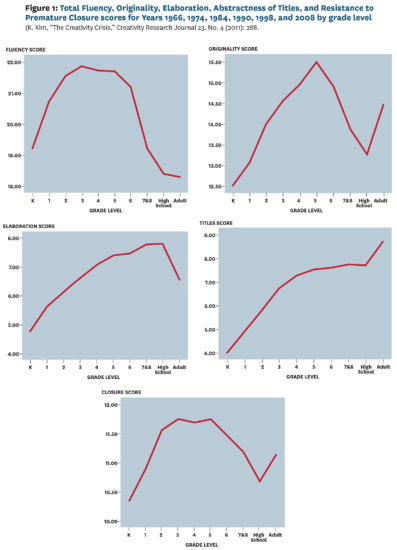
Embracing possibility
But there is also something more sinister which comes into play – something that begins as a small weed and often grows over the years, potentially muting our willingness to engage our innate creativity. As many of us age, we stop believing in possibility, an essential ingredient fueling curiosity, the desire to explore,3 and one’s investment in creativity. Schooling, as Sir Ken Robinson points out, plays a significant role in shaping the thinking habits of children. Many teachers focus on the attainment of specific knowledge and thereby perpetuate a foundational ideological alignment with the idea that there always exists a “right” answer. Being “right” is rewarded. Being “wrong” is stigmatized and often penalized. Too often, content-focused teaching fails to recognize that a student’s ability to be “wrong” is an essential ingredient for seeing and pursuing possibility.
Creativity empowered breeds revision. It is fostered through a willingness to try, recognizing that there is always more we can learn through experiencing failure.
Failure left uncelebrated feeds into new conceptualizations of limitation. My dream of human flight died with my final plop to the floor, accompanied by the laughter and ridicule of siblings. What might have become of my passion if I had been encouraged to rework the idea, to trade in the towel-cape and seek out increasingly reasoned approaches? (Perhaps the Wright brothers had similar beginnings.) Creativity empowered breeds revision. It is fostered through a willingness to try, recognizing that an idea only dies when we accept our last failure as final.4 There is always more we can learn through experiencing failure.
It is, then, the role of the teacher to foster seeing possibility by reframing failure, to take time to consider whimsy, and to teach students how what might first be regarded as a bad or weak idea can often be reworked into a good one. Focus on asking questions over providing answers – on exploration over giving directives. Provide students with time to reason through the merit of their ideas. Facilitate and coach students to think by considering the answers to the questions, “What if?” or “How might?” or “What’s next?”5
I have never met a teacher who entered the profession with a vision of producing die-cut student minions. Instead, they became teachers because of a deep desire to help students live into and reach their potential. We learn (and teach) so that we might expose new potential solutions, insights, or abilities and then press into, or live into, those possibilities. Teachers strive to recognize possibility within the landscape of every student’s individual giftedness, then work to nurture their unique complement of talents.
How do we do this?
Spend time dreaming, on your own and with your students. Acknowledge that sometimes the dreams that seem crazy may just be the seed of the next idea that changes the world, then empower an attitude to try. Shakespeare said it well in Measure for Measure: “Our doubts are traitors and make us lose the good we oft might win by fearing to attempt.” If we give up on something, it is finished. Where we continue to believe in possibility, creativity knows very few limits.
Photo: iStock
First published in Education Canada, June 2020
NOTES
1 TEDTalks: Sir Ken Robinson, “Do Schools Kill Creativity?” (New York, N.Y: Films Media Group, 2009).
2 K. Kim, “The Creativity Crisis: The decrease in creative thinking scores on the Torrance Tests of Creative Thinking,” Creativity Research Journal 23, no. 4 (2011): 285-295.
3 National Academies of Sciences, Engineering, and Medicine, How People Learn II: Learners, contexts, and cultures (Washington, DC: The National Academies Press, 2018), 149.
4 R. Beghetto, “Taking Beautiful Risks in Education,” The Arts and Creativity in Schools 76, no. 4 (2018): 18-24.
5 Kolb, David & Kolb, Alice. (2017). The Experiential Educator: Principles and Practices of Experiential Learning.
-
Growing Well-Being Across a System
Comments Off on Growing Well-Being Across a SystemFive B.C. educators with different roles and a shared interest in supporting well-being, came together in a collaborative project to grow well-being across the Langley school district. Here’s how they did it, and what they learned from the process.
What started out as four individuals from different work roles, each of us having a shared goal of supporting well-being in schools, has become a collaborative passion project to grow and sustain well-being across our district. Through this article, we look back on our journey of learning and collaborating, reflecting on some of the insights we have gained about supporting staff well-being in school districts.
Thanks to an assistant superintendent who saw an unusual, but natural, alignment in our work, we formed our district wellness team in the fall of 2017. We each had different but complementary roles – a district principal for student services, a district teacher/counsellor and a human resources manager. We also brought a health authority partner onto our team, providing a valuable broader view of the communities within which the students and educators work and live.
We started our plans with a district-wide learning series on social emotional learning and well-being, to help staff understand the importance of this learning in schools and the amazing outcomes these skills and practices provide around student health, happiness and success. It became apparent that these were the same skills and practices that we needed to build as adults, both so we could model and teach them to students and for our own health and happiness. We were starting to see the importance of adult well-being to positive outcomes for both the adults and the students.
We decided to make teacher and staff well-being our project focus. One of our first objectives was to gain an awareness of how our staff were doing, and to understand their sense of well-being at work. We wanted to gather people together to start a discussion and generate some ideas to support well-being in our district. As with many exciting and challenging tasks, this project became much more complex than we anticipated, and also very rich and rewarding. We are now at the stage of reflecting on all that we have learned, to inform our plans for how to continue the work of supporting teacher and staff well-being in our district. We’d like to share some of the themes that have emerged for us so far as we analyze and reflect on our experiences and data.
Three interconnected parts
Our work to date has underscored that well-being is holistic, encompassing interconnecting aspects. In particular, we have become aware of three important facets of staff well-being.
1. Well-being is individual. An important part of increasing well-being lies with the individual person. This assumption was our starting point, and it has remained an important aspect of how we understand well-being as holistic and interconnected. Focusing on growing staff well-being had us thinking about how to support practices of self-awareness and self-care. Much of the first year of our project was learning about social emotional skills and bringing that back to the district as learning conversations in the workplace. We found that sometimes just acknowledging that self-care matters and sharing what that looks like can go a long way in supporting people to take care of themselves, especially in helping professions where we are so used to caring for others.
2. Well-being is relational. The second interconnected part that became very clear is that well-being is relational and that we are better together, both in terms of productivity/success and in terms of health, happiness and overall well-being. The main focus of our second year was on the relational aspects in our well-being work. This led us to connect with Dr. Sabre Cherkowski. She was completing a multi-year research project on teacher well-being, where she and her colleague, Dr. Keith Walker, had built a theoretical and practical understanding of what it means for educators to flourish in their work.1 Her research was framed within a positive organizational perspective that highlighted how focusing on and supporting positive human capacities at work, such as compassion, humility, kindness, and forgiveness, had a positive and generative affect that often led to increases in other aspects of work such as creativity, productivity, innovation, and commitment to the organization.
We were interested in Dr. Cherkowski’s research approach of using a strength-based, appreciative perspective to notice and nurture what was already working well and what already gives staff a sense of well-being in their work. We were also interested in learning more about an appreciative approach to positive change, focusing on what happens when the whole system is invited into the conversation to reflect on how we might promote and support well-being across our district. With Dr. Cherkowski and the consent of our district, we designed a continuation of our learning series, inviting staff across the district to join us for three dinner events that offered an opportunity to:
- learn about research on well-being in educational workplaces
- engage in conversations designed to gain a better sense of what well-being means to different individuals and teams across the district
- learn how to design a collaborative, appreciative inquiry project to further build on what is already working well
- ensure opportunities to analyze, tweak and share progress of the inquiries
- provide a model for how staff might create conditions in their work contexts for appreciative conversations at and about work.
At each event, Dr. Cherkowski guided some 150 attendees through a sequence of reflections and activities focused on:
- Purpose (what makes us feel alive, engaged, connected and well in our work?)
- Passion (what are our strengths, gifts, talents that we can draw on to help live out our purpose at work?)
- Play (how might we innovate, create, design environments that enliven our passions and purpose?)
- Plan (what resources, materials, supports and knowledge do we need to build and grow our flourishing?)
The conversations that emerged created a safe, caring, uplifted environment where colleagues shared their dreams and desires in their work, as well as their challenges and struggles. The evenings became a space for building the relational processes necessary for the work of nurturing well-being for self and others in our own work contexts.
We observed that teams and individuals were now working on plans to connect what they were learning about flourishing to things they might try out in their context. One example was a principal who designed a “tree of flourishing” that she took to her teachers and staff. She suggested they fill out all the ways that they, their students, and their school community were experiencing well-being. As they filled out the tree over a course of a few weeks and posted it around the school, this gave them a sense of pride and ownership for all that was working well. It also provided a touchpoint for conversations around struggles and challenges, as there was a sense of being cared for by a larger community that was working together to tend to the entire tree. Within the challenging and seemingly never-ending work of meeting school goals for all students, this principal developed a tool that evoked a sense of hope, of joy, and of agency about being well together at work.
While participants in our dinner series were working on their inquiries, we were planning to find out more about how teachers and staff were doing with their well-being. We decided to conduct focus groups with teachers and staff in different roles. Our deeper learning from these focus groups is still to come as we work with this valuable data, but we have already learned some things from this process. The first is to bring your district leadership and your union groups into the process early. This was such a helpful process and a good reminder that everyone wants well-being. We are all working toward a common goal. The second one is that health and well-being is something people want to talk about. People want to tell their stories and they want to be heard. If you are going to ask the questions, you have to be prepared to listen to the answers and be willing to co-create a plan that moves discussion into action.
3. Well-being is system-wide. Reminding ourselves to engage in our change work from the level of the system is an especially important piece, even though it often proves difficult to navigate and implement. Our commitment to growing staff well-being across the district meant that we needed to think about the system in all its interrelated parts to embed well-being for the long term. Looking back at our approach through a systems-lens, we:
- interviewed as many staff as possible to get a sense of their experiences and what change might be necessary
- established a structure for improving the quality of our communication about well-being through the dinner learning series
- are now analyzing the data we’ve collected to see how we can continue to grow well-being across the system.
We have learned that systems are relational entities, and that we need to take care to avoid assigning blame to any part of the system as a separate actor. At the same time, we need to avoid always looking outside the system for our solutions. We have come to understand that “we” are also the system – individuals and groups carrying out our work together toward shared goals, influencing and impacting all other parts of the system. There can be a feeling of empowerment in knowing that we are the ones who inform, create and follow (or not) the policies and practices of “the system.” Many of these practices are helpful to keep things moving. They create a sense of order and common understanding that help define and support our work. It can also be frustrating to realize that our implication in the system also means that many of our practices and our ways of doing things come from a historical context that is no longer applicable or helpful to us. As we learn more about systems change we are building the courage to look at our ways of working compassionately and to be open to the possibilities that follow.
As we begin to understand the interconnectedness of the system, we are also reminded that the feeling of efficacy around systems change is also very important. There is a balance between knowing that some larger changes take time and will require patience, and that other small actions can happen quickly. Focusing our attention on the ways these small changes can impact the larger system over time and contribute to well-being is at the heart of Cherkowski and Walker’s work on flourishing in schools. We are developing a sense of agency, a power to be able co-create an emerging future where decisions and practices around well-being become a primary component of our culture: the way we do things.
Multiple voices and ways of knowing
One of our most important learnings so far, and what may turn out to be the “secret sauce” for the work of growing well-being for all in schools, is the importance of bringing in multiple voices and ways of knowing. We also need time, space and resources for this work to become sustainable. A few passionate people cannot do this alone or in their “spare time” without it impacting their own health and well-being. In the next part of our journey we will expand our team and look at ways to make this work sustainable and impactful for the long term.
Illustration: iStock
First published in Education Canada, June 2020
NOTES
1 S. Cherkowski and K. Walker, K. Teacher Wellbeing: Noticing, nurturing, and sustaining flourishing in schools (Burlington, ON: Word and Deed Press, 2018).
-
Supporting Educators through the Post-COVID-19 Recovery Phase
Comments Off on Supporting Educators through the Post-COVID-19 Recovery PhaseOn behalf of the EdCan Board and Advisory Council, I would like to wish our network members across the country continued safety and well-being during this challenging time. If you’re feeling over-Zoomed, over-burdened and isolated, you are not alone.
We recognize that the stressful uncertainties associated with the “new normal” back-to-school awaiting teachers, staff and students will place even more strain on their mental health and well-being.
When the pandemic arrived in Canada, EdCan temporarily pivoted our Well at Work initiative – which aims to shift mindsets by showcasing research, policy and practice that results in healthier, happier, and more resilient K-12 staff – to Well at Home. We continue to offer our original, and carefully curated, tools and tips to help you (the front-line first-responders and system leader heroes) to take care of yourselves.
We unfortunately have had no choice but to postpone our Pan-Canadian Summit on K-12 Staff Well-Being that had been scheduled for November 2-4, 2020, but we continue to feature the foremost experts on this topic in an ongoing series of free webinars over the next few months with the goal of maintaining momentum on this crucial issue. I also encourage you to consider using our Well at Work Professional Development Discussion Kit, which offers group discussion and self-reflection guides that can help you and your colleagues unpack how you can strengthen social and emotional well-being together to achieve healthier schools.
Please continue to follow our social media accounts and subscribe to our e-newsletters for our latest blog posts and podcasts with a pan-Canadian perspective, from some of our country’s leading education thinkers, about how we move forward together. We encourage you to add your voice to this ongoing dialogue and please let us know how we can continue to support you and your colleagues to be at your best. Most importantly, please continue to be mindful and kind to yourselves by acknowledging how quickly this situation was cast upon us and how well we’ve all done to ensure that all children continue to learn.
Find Us Online
https://edcansummit.ca/webinar-series
-
Trading Up
Comments Off on Trading UpAs we finalized the articles for this issue of Education Canada, schools and campuses across the country had been closed for about a month to reduce the spread of COVID-19. It looked like students would not be back in class anytime soon. And we were wondering how much sense it made to ship boxes of magazines to empty buildings.
Those closed schools are the reason we are not printing our May issue. Like the teachers and profs who have turned to online technology to connect with their students, we have created an online-only magazine. We invite you to enjoy the PDF version as you “shelter in place.”
In this issue of Education Canada we focus on the skilled trades, and specifically on the K-12 system’s role in connecting students to trades training.
So here’s the dilemma. While I still devoutly believe in the value of a liberal arts education, our world is full of highly educated young adults working precarious minimum-wage service jobs because that’s all they could find. Many of them never even considered skilled trades. Probably nobody ever suggested that they were worth looking into. Some students may have even been steered away from trades when they expressed interest.
Meanwhile, well paying, challenging, steady jobs are going unfilled in many trades sectors. While it’s not up to K-12 schools to qualify students for a trade, we think we could be doing a better job of introducing them to the trades as a desirable career path. We also need more options that allow secondary students to “try before they buy” (and ideally earn credits at the same time), and more fluid pathways that allow students to combine academic and skills-based training.
In our theme section, two innovative Canadian programs that give high schools students a great head start in trades (“TAP into Trades, p. 14, and “Youth Train in Trades,” p. 22) share how they fill that gap. And looking at the bigger picture, David Livingstone and Milosh Raykov (p. 18) discuss the need for expanded apprenticeship programs and better linkages between our education and apprenticeship systems. Paul Stastny (p. 25) examines our other big labour need – digital technology skills – and how the digitizing of many trades creates new opportunities, while Alison Taylor (on our website) argues for experiential and work-integrated learning programs as a means of breaking down “the binary between vocational and professional education.”
Perhaps it comes down to that old ideal of a “well-rounded education.” Shouldn’t an education include learning how to do things as well as how to know things? And can’t we, as Taylor suggests, educate students in a way that prepares them for both democratic citizenship and employability?
Photo: Dave Donald
First published in Education Canada, June 2020
-
Effective Collaborative Practices in ESL Education
Comments Off on Effective Collaborative Practices in ESL EducationEnglish as a Second Language (ESL) teachers need to work with classroom teachers and other colleagues to ensure optimal learning for English Language Learners. This qualitative study looked at the barriers and facilitators to effective collaboration.
Contemporary English language learners (ELLs) have language learning needs that are often supported through a complement of in-school professionals, including English as a Second Language (ESL) teachers, classroom teachers, educational resource teachers, coaches, ESL consultants, and administrators. Integrating content-based teaching with appropriate skill-level tasks for ELLs requires a collaborative effort between classroom teachers and ESL teachers.
To understand the factors that facilitate collaboration in ESL education, we interviewed and observed the teaching practices of four ESL teachers in Southern Ontario. Based on the findings of these qualitative data, which complement and are supported by existing research, we provide some conditions that truly nurture innovation between ESL teachers and classroom teachers.
When ESL teachers and classroom teachers collaborate, each educator brings a unique perspective and repertoire of knowledge and experience, and it often takes time to negotiate ways of combining these lenses to create an educational plan. Thus, one condition of collaboration is for educators to feel supported in contributing their specialization area within a collaborative relationship. Administrative support is also essential. When collaboration is prioritized by school administrators, resources and allocated time for collaborative practice are designated with an ESL focus, facilitating more authentic collaboration.
Our research revealed that ESL teachers negotiated collaboration based on a desire to work together and a belief that a cohesive educator team is important in ESL education. However, these ESL teachers encountered barriers such as a lack of training, technology and tools to facilitate collaboration and lack of time to do so. This resulted in limited and informal, surface-level collaboration.
Teaching approach
ESL educators often work with several different students at several different schools, so collaboration with the classroom teachers is essential. When ESL teachers and classroom teachers collaborate, there is potential for consistency and efficiency in pedagogical planning of targeted learning strategies for ELLs. Caroline, an ESL teacher, told us, “I love collaborating with teachers because I feel like it’s taking a little bit of stress off of them, initially, but it’s also giving them a toolkit so they’re prepared the next time around.”
Echoing this sentiment, other ESL teacher participants talked about successful collaborative relationships with classroom teachers that develop over time. Professional relationships among ESL teachers and classroom teachers that were described as authentic extended beyond situational conversations about particular events in the classroom. These relationships were rooted in a sense of reduced role differentiation between the ESL teachers and classroom teachers.
The time crunch
To collaborate effectively, educators working with ELLs need to have dedicated time in order to meet and co-plan, co-teach to some extent, and co-evaluate curriculum planning for ELLs. This need for devoted time for teachers to meet is a pervasive issue cited by others as well.1 Grant, an ESL teacher, talks about the challenge of finding meeting time:
“The challenge I think in terms of collaboration is sometimes finding that time to meet with the teacher… Because classroom teachers have so many things going on, so it’s tough…”
Caroline spoke of the difficulty of carving out time for ESL among competing priorities:
“I try to invite myself to those collaboration meetings [laughs], because then you can put an ESL perspective on the table. We have a half day each term that we’re allowed to use… to meet with teachers, but a lot of us find that’s just not enough time to meet with all the teachers we need to meet with… I do a lot of my meetings unofficially… And I’m always apologetic for using their time, because I know that prep time for them is so precious. But… in the end, it’s beneficial for both of us, because I can do a lot to help support them. I might co-teach a lesson, or I might, you know, plan a lesson based around something that they’re working on so that they don’t have to plan that lesson, and now they have time to do something else.”
This is a testament to the struggle experienced by all ESL teachers to liaise and support classroom teachers’ practice as well as meet Ministry of Education mandates to complete required documentations for ELLs.
Central to this collaboration is a shared desire to approach curriculum mapping with an ESL-specific focus, to set goals for as well as with ELLs, and to evaluate and modify plans along the way. ESL teacher Nicole talks about collaboration to build on ELLs’ strengths: “It’s like optimizing the support, but seeing that all the kids are capable and competent. [Focusing on] what do they know, and how can we move them forward, instead of looking at them as having a deficit.”
When educators took the time to co-plan in preparation for an upcoming unit, observations showed that they used instructional strategies such as small groups or one-on-one conferencing with ELLs, and as a result, provide differentiated instruction. There are recent examples of ESL teachers and content-area teachers co-planning using the principles of differentiated instruction in cooperative learning-centered approaches.2 This is beneficial to ELLs, as each of these students has unique learning and language needs.
When ESL teachers and classroom teachers collaborate, there is potential for consistency and efficiency in pedagogical planning for English language learners.
The crucial follow-up to this teaching approach is creating opportunities for teachers to discuss their observations and review effective teaching strategies. Thus, in addition to planning and teaching systems, it is crucial to also incorporate assessment systems in order to adjust pedagogy to meet ELLs’ needs. Collaboration among educators on assessment that informs ESL instruction (and not just program placement)3 is also an area for professional growth.
Technology as a collaborative tool
We asked how ESL teachers collaborate with in-school teams of educators to use instructional resources (digital and/or non-digital) to promote language instruction with ELLs.
We found that ESL teachers supplemented non-digital resources with resources created by classroom teachers. Collaboration was focused on the goals of educational plans for ELLs, and resources to support ELLs in achieving these goals. In terms of non-digital resources, an emergent theme was that ESL teachers had over time created a repository of tools that could be adapted to fit individual ELLs’ learning needs. One aspect of collaboration that teachers considered valuable was how the ESL teachers shared these resources with other educational professionals (such as resource teachers) as a way of optimizing the time of all educators.
A second important finding was that, although ESL teacher participants saw the benefits of using technology to aid ELLs, collaboration in relation to the use of technological platforms in ESL education tended to remain at the surface level. For example, imparting technological resources was limited to sharing websites and pass codes for English translation or leveled texts.
Google Drive is one technology that is being used as a dynamic tool to support sharing and collaboration in literacy pedagogy and language instruction in the Canadian ESL classroom.4 Caroline, for example, had developed a bank of resources that she was willing to share with any teacher that could use them: “The beautiful thing about Google Drive is, once you kind of get it organized, it’s there for you. So next year, I don’t necessarily have to do that again, I can just pull it out and add or adapt what I need to do.”
To improve the use of technological platforms in ESL education, it is imperative that the technological tools chosen by educators provide students with immediate feedback, to prevent students from making schematic integrations of incorrect responses. In this way, students gain an awareness of where errors are made, and can apply this new learning in the future. Platforms such as chatrooms in educational apps are being used with great success.5 Educators need opportunities to collaborate on integrating technology in instruction in ways that promote critical thinking and problem solving to guide students to meaningful learning.
Expanding collaboration
Our research reveals that ESL teachers value shared professional development as a way of enhancing collaboration with classroom teachers.
ESL teacher participants in this research project recognized that collaborating with educators within as well as across other school boards, may introduce them to innovative practices that they had otherwise not considered. Lauren recalled her involvement in an ESL symposium during the summer hosted by the local school board. The symposium was focused on ESL instruction and included ESL educators from various boards. Lauren found it beneficial to share experiences with different ESL teachers. Her recommendation was for more ESL teachers to be aware of such initiatives and become involved in large-scale events to interact and collaborate with various educators. Both Caroline and Lauren talked about the benefits of partnering up with other school boards to collaborate and share strategies. These ESL teachers recognized that collaboration is required to improve and incorporate strategies that have been successful for other educators.
Facilitating connections among educators working with ELLs across the province to share successful approaches and develop tools that can be adapted and utilized in ESL education is a way to hasten the spread and uptake of innovative practice.
A collaborative approach in ESL education creates more supportive and nurturing environments for ELLs to thrive in. When ESL education is prioritized and approached as an inclusive practice aimed at blending the professional knowledge of several educators and backed by administrative support,6 ELLs as well as ESL teachers are not marginalized, and the success of students with various literacy requirements are considered as part of an inclusive practice.
Photo: iStock
First published in Education Canada, June 2020
NOTES
1 A. Honigsfeld and M. Dove, “When Do Teachers and ESL Specialists Collaborate and Co-teach?” in Collaboration and Co-Teaching: Strategies for English Learners (SAGE: 2010).
2 G. M. Awada and K. H. Faour, “Effect of Glogster and Cooperative Learning Differentiated Instruction on Teachers’ Perceptions,” Teaching English with Technology 18, No. 2 (2018): 93-114.
3 B. A. Green, and M. Andrade, “Guiding Principles for Language Assessment Reform: A model for collaboration,” Journal of English for Academic Purposes 9, No. 4 (2010): 322-334.
4 N. Slavkov, “Sociocultural Theory, the L2 Writing Process, and Google Drive: Strange bedfellows?” TESL Canada Journal 32. No. 2 (2015): 80-94.
5 A. Sari, “EFL Peer Feedback Through the Chatroom in Padlet,” LLT Journal: A Journal on Language and Language Teaching 22, No. 1 (2019): 46-57.
6 Honigsfeld and Dove, “When Do Teachers and ESK Specialists Collaborate and Co-teach?”
-
TAP into Trades
Comments Off on TAP into TradesThe Trades Awareness Program (TAP) brings high school students from the outlying communities of the South Slave Division in the NWT to Aurora College for a hands-on introduction to the trades. Through TAP, students who would not otherwise have exposure to qualified instructors, accredited shops or equipment may be motivated to complete high school, enroll in the College, and pursue careers in the trades, with benefit to both themselves and their communities.
The skilled trades gap continues to widen as more tradespersons retire than join the Red Seal ranks each year. Such is the case in the Northwest Territories, where the largely Indigenous population is located in 33 communities distributed across more than 1.3 million square kilometres of land between the Alberta border and the High Arctic. With the high cost of living and lack of skilled tradespeople in most communities, it may be impossible to find a plumber or an electrician – and the pipes freeze quickly at 40 below.
The trades shortage is exacerbated by the prevalence of oil, natural gas and mining activities in the North that have generated a large demand for skilled workers. Compounding the issue is the fact that schools in the North are small and often lack shop facilities and qualified instructors. As a result, finding ways to raise awareness and expose Northern students to careers in the trades is problematic.
In 2005, the South Slave Divisional Education Council (SSDEC), Aurora College and the Fort Smith Career Centre formed a partnership called the South Slave Communities’ Learning Network (SSCLN). The SSCLN’s first task was to brainstorm initiatives of mutual interest and potential benefit to the South Slave region and the predominantly Indigenous communities (75% Dene and Métis) of Fort Smith (Chipewyan, Cree, English and French), Hay River (Slavey, English and French), Fort Resolution (Chipewyan), K’atlodeeche First Nation (Slavey), and the fly-in-only community of Lutsel K’e (Chipewyan).
The SSCLN identified career development as a key area of mutual interest, which then led to the creation of the Trades Awareness Program (TAP). TAP began with the intent of providing a hands-on trades experience for students in the South Slave who did not otherwise have exposure to qualified instructors, accredited shops or equipment. The hope is that, through TAP, more and more students will be motivated to complete high school, enrol in the College, and pursue careers in the trades, with potential benefit to both themselves and their communities.
Program description
The Trades Awareness Program (TAP) brings interested Grade 8-12 students from the outlying communities to the Thebacha Campus of Aurora College in Fort Smith to experience a series of short courses in several different trades. For each week of sessions, the partnership organizes transportation, meals and accommodation in the student residences, and instruction for 30-50 students.
After its inception in 2005, TAP quickly expanded from a one-week pilot into a three-part program in which students can earn up to three credits toward high school graduation. The TAP program now includes two on-site options for students: TAP Introductory and TAP Intensive.
First-time participants attend TAP Introductory, which provides students with experiences in a variety of trades. Students spend one full day in each of four different trades. Depending on the availability of instructors and facilities, students have had the opportunity to choose one-day workshops in carpentry, plumbing, cooking, electrical, welding, computer diagnosis and repair, heavy equipment technology, and environment and natural resources technology. In most years, local businesses have also partnered and generously provided more options for students in mechanics, aviation, and hairdressing.
The TAP Introductory schedule keeps students busy and authentically engaged. Each day they are fitted with proper attire, be it steel-toed boots, hard hats, chef uniforms, welding leathers, hair nets, or safety goggles. They learn about such things as basic pipe fitting, extension cord composition and assembly, meal planning and preparation, toilet installation, and how to use tools like hand saws, measuring tapes, band saws and welders. The flight simulator at the flight training centre of the local airline has been a highlight for many. The students who rotate through the cooking option prepare lunch for the entire group of students in the Introductory program for that day. Most students also return to their communities having completed a project or two they can take home – wooden birdhouses, extension cords and metal wind chimes, to name a few.
The Introductory program also includes workplace safety and career development sessions, and an extremely popular Trades Olympics event where students compete against each other in a race that has included tasks such as hammering a nail, sawing a piece of wood, assembling a pipe fitting design, and installing a light switch cover.
Completion of the Introductory program is a prerequisite for students who are interested in returning to attend one or more TAP Intensive sessions. In the Intensive program, students complete a week in one trade of their choice, providing students with more in-depth exposure to that trade. Some students have returned for a third and fourth Intensive session, when space is available, to gain further exposure in a different trade than they did in previous years.
In both programs, students are required to participate in all activities and behave respectfully at all times. They are informed that they are ambassadors for their people, their schools and their communities, and reminded that their behaviour and effort should make their respective families and communities proud. Thankfully, it is a rare case in which a student breaks the rules and must be sent home early.
Students are evaluated by instructors in both the Introductory and Intensive modules by means of an evaluation rubric. The rubric addresses six areas: safety, student effort, punctuality, participation, use of equipment, and task completion/workmanship. Students are able to earn one credit upon successful completion of the Introductory Program and another credit in the Intensive Program. A third credit is also available for work completed by participating students in their home community in preparation for TAP Intensive, and follow-up reporting and personal career planning upon their return.
The delivery of TAP over its 15-year history is attributable to those involved in the SSCLN partnership. Each plays a critical role. The regional school council provides the students and chaperones, organizes transportation (taxis, buses and a chartered flight for Lutsel K’e students) and hires the program coordinator to plan, promote and oversee both TAP modules each year. The Career Centre has access to labour market funding and provides student access to career counsellors during the TAP modules. Aurora College provides the facilities, accommodations and trades instructors for the modules. Other important partners are local businesses that also provide instruction and facilities. The efforts of the SSCLN ensure there is no cost to students who wish to attend TAP.
Measuring success
When TAP rolled out as a pilot in 2005, the SSCLN identified several objectives, including:
- generating more awareness of trades occupations
- providing access to accredited shops and instructors
- offering work-related experience and skills development
- promoting college programs and residence life
- networking and building friendships between youth from various communities and cultures
- encouraging students to be ambassadors and proud representatives of their people, their schools and their communities.
Clearly, the program has provided awareness and access, having introduced hundreds of students to the trades over the past 15 years, but how do we know if it’s making a difference and worth continuing?
Student interest and participation in the program is one measure. Approximately 80-100 students attend TAP each year (in a region of only 1,300 JK-12 students overall). The program set a new participation record this past fall when Aurora College was able to accommodate 53 students in the Introductory program. Most Introductory students return for TAP Intensive.
TAP has proven popular as further evidenced by consistently positive ratings from students, chaperones, and instructors on feedback forms completed and submitted on the last day of each program. The feedback forms encourage facilitators of the program to ensure a quality program every year. The initiative stays fresh and is constantly improving because the feedback is also used to prepare a report with conclusions, commendations, and recommendations for further improvements the following year. An analysis of this historical data found that over 96 percent of students and chaperones who attended over the years indicated the value of the program to be either “very good” or “good.”
The partnership also contracted out a longitudinal review of the program that sought feedback from both past and present students, including those who were in post-secondary school and/or in the workforce. The review’ has garnered further feedback on the long-term value of the program and helped to determine what further improvements might be considered. The study concluded that TAP was both memorable and valuable. TAP helped 81 percent of participants to decide on their future careers. Thirty-nine percent indicated TAP helped them decide to pursue a career in one particular trade. Feedback also confirmed that some students discovered the trades were not for them, which can also be considered a positive outcome from the program.
Due mostly to the Trades Awareness Program and its success, the SSCLN partnership was presented with the Premier’s Award of Excellence for Collaboration.
Both students and their parents have expressed surprise and excitement about how much they learn and the skills they can employ in such a short period of time. The fact that most of the instructors and chaperones are enthusiastic and Indigenous themselves has provided important modelling for students to consider and set similar career goals, especially for our students from the smaller and more remote communities.
We give others the last word on the success of TAP. These quotes were obtained as part of the longitudinal review:
“It was very good, in fact, it was better than I expected,” wrote one student. “I met new people, learned new things and most importantly I had fun. The instructors and chaperones were amazing and I learned a lot. It was useful to me because it opened me up to new opportunities and it gave me ideas of what I want to be in the future.”
“I have always had a fascination with mechanics, and how things work together to make an effective machine. Seeing the shop and tools, meeting the instructors, I realized that I wanted to become a mechanic,” wrote another student.
“The students are told, on the very first day, that they are in a college setting and that they are expected to behave as college students. And, they do!” wrote one instructor. “The reason I take part in and support this program is just this: the students who participate are being given a valuable opportunity to experience a trade and what they can expect while attending a post-secondary institution. While many may not go into a trade, I hope that all of them will attend college or university at some point, and what better way to get a feel for it than in this safe and nurturing environment. As long as this program runs, I will continue to participate and support it.”
“My daughter has learned a lot from the TAP program,” responded one parent. “She cooks a lot at home now and likes to try new things. When she got back from the program she told me she had lots of fun and enjoyed the instructors. I hope she gets to go one last time this coming year. Thanks again.”
Overcoming challenges
The program has been a tremendous success, but it has not been without its challenges.
The North may be small in population, but it’s large in land size. With South Slave communities and schools separated by hundreds of kilometres of highway, and one community accessible only by air, the logistics are nothing short of complicated.
Scheduling both the Introductory and Intensive modules also requires a delicate balance. TAP must be scheduled during appropriate times in the calendars of five schools, when regular Aurora College programs are not in session and students not in the dormitory, when the college instructors are available, and when a suitable coordinator can be contracted. TAP also relies on the ability of local businesses to fit students into their busy schedules. The available dates vary from year to year but have most often occurred in September and June, with at least one Introductory and one Intensive week per calendar year. In the end, it still means taking students out of their normal classroom routines for an entire week, which means catch-up on their return. Students tend not to enrol in their final Grade 12 year, when success on the diploma exams takes precedence.
Maintaining relations and commitment to the initiative in the face of staff turnover has also been a priority. Only one of the three original CEOs remains. Yet the program has been able to continue each year because of its evident value and because of the partnership, commitment, and generous contributions of the South Slave Divisional Education Council, Aurora College, and the Fort Smith Career Centre (Government of the NWT Department of Education, Culture and Employment).
TAP-ping into the future
The SSCLN partnership and its Trades Awareness Program was designed to provide students with greater information and exposure to the trades and college life. TAP gives opportunities for students from across the South Slave to “try out” several trades. TAP has also been instrumental in getting students thinking about the trades as viable career options after high school. But TAP has proven to be more than that.
Justice Murray Sinclair has said, in reference to the legacy of Residential Schools, “Reconciliation is about forging and maintaining respectful relationships,” and, “Education is what got us here, and education is what will get us out.” TAP appears to be doing its part in responding to these calls to action. Since students have been scheduled according to their preferred trades, the makeup of each group changes daily, which provides opportunities to socialize with youth from other communities. The meals and social activities further integrate students with food and laughter. The quiet silos of students, clustered by community and language group on day one, completely transform by the end of the week into large group banter and laughter, hugs, exchanges of contact information, and sometimes tears upon departure. In addition to increasing career opportunities for youth, TAP is also helping to break down cultural barriers, strengthen relations, expand comfort zones, and encourage student aspirations.
The skilled trades gap isn’t going away. However, by providing students with an organized gateway to the trades that is both fun and educational, TAP is strengthening relations and creating futures.
Photo: courtesy South Slave Divisional Education Council
First published in Education Canada, June 2020
-
Vocational Education in Canadian Schools
Comments Off on Vocational Education in Canadian Schools“A rich and deep vocational education involves helping students explore linkages and possibilities as they crisscross the boundaries between school and work. To better help students find their way in our complex world, such a vision of expansive experiential learning holds much promise.”
Vocational education in Canadian schools has a checkered history. On one hand, it was given a boost in the 1960s with the Technical and Vocational Training Assistance Act when federal government resources were provided to build new schools and facilities across the country. On the other hand, vocational education has long been seen as a second-best choice for less able students, gaining attention mainly in times of labour shortage in key industries.
The under-valuation of vocational education reflects historical struggles. Recall the well-known debate in the early 20th century between social efficiency proponent David Sneddon and progressive educator John Dewey, who held very different visions for vocational education. Dewey opposed the separation between general education and trade education: he believed that vocational education should be liberal and liberal education should be vocational. Sneddon, in contrast, believed vocational education was largely about training working-class kids to meet industry needs. The distinction between education seen as “academic” and education seen as “vocational,” which persists to this day, supports the hierarchy that values academic knowledge and the professional occupations associated with it over practical vocational knowledge.
Currently, however, experiential learning, and especially work-integrated learning (WIL), is a hot topic in higher education policy discussions. Universities in Canada and elsewhere are encouraging all students to get a taste of the work world through internship, practicum, and cooperative education opportunities. The WIL movement is driven by a number of factors, including the concerns of employers about the “employability skills”1 of graduates, and the predominance of human capital discourse.2 In response, a burgeoning literature about how to foster effective experiential learning in higher education has emerged.
Another tendency in North American higher education is growing concern about students’ civic engagement as well as employability skills. As writers from the National Task Force on Civic Learning and Democratic Engagement in the U.S. argue in their 2012 report “A Crucible Moment,” higher education should be an incubator for fostering democratic voice, thought, and action rather than simply an engine of economic development.3 This report, coupled with the rapid growth of community service-learning in higher education, challenges the seemingly contradictory aims of educating for employability and educating for citizenship.
What does all this mean for education systems across Canada? This article argues that K-12 educators can learn from higher education approaches that:
- break down the binary between vocational and professional education
- consider how experiential learning can be structured most effectively, and
- see education as more than simply training for work.
In what follows, I elaborate on these points using examples.
Breaking down vocational-academic binaries
Although the historical legacy of devaluing vocational education still haunts current descriptions of course streams and attitudes of educators and career counselors, steps have been taken in Canada and elsewhere to better integrate “vocational” and “general” qualifications, and to increase student access to higher education programs. In Europe, the term “hybrid qualifications” has been used to describe qualifications resulting from education and training pathways that provide access to both employment and higher education. For instance, in countries like Germany, with its highly institutionalized dual system of apprenticeship training, there is greater policy interest in encouraging young people to extend their technical training into university studies. In the Canadian context, university aspirants are also considering technical training. Toward this end, dual credit and joint degree programs are becoming more common.
Dual credit programs are being used in B.C., for example, to “enable high achieving, career oriented, and at-risk students to gain credit towards post-secondary credentials.”4 The description suggests that these programs are mainly targeting students who need encouragement to pursue education beyond high school. Dual credit courses, which involve a college credit course team-taught by a secondary school teacher and a college teacher or certified journeyperson, can be used toward a college certificate, diploma program, or apprenticeship as well as towards a high school diploma. Exposing students to the college environment is seen as a good way to expand their educational and career horizons and better prepare them to succeed in higher education. While this initiative requires greater collaboration between secondary and post-secondary systems, it is a promising way of expanding access to higher education.
Joint degree programs between colleges/technical institutes and universities represent another partnership that erodes the vocational-academic binary within the post-secondary education system. I’ve found it striking that a desire for “hands on” learning has been expressed by very different groups of students – by those participating in my earlier research into high school apprenticeship and by participants in my more recent research on university community service-learning programs (programs where students work, often in non-profit organizations, as part of an academic course). The “massification” of higher education and increasing labour market uncertainty has meant greater diversity in the student population, and an increased proportion of students who value practice-based learning.
Dual credit programs require secondary schools to collaborate with post-secondary institutions in their municipalities on partnerships that will benefit students – ideally, partnerships in areas of student interest where institutional supports can be provided. Sustainable provincial funding is a prerequisite for these initiatives. Joint degree programs encourage high schools to think differently about how they advise and stream students. We know that there is a great deal of mobility within the post-secondary system, with students taking transfer programs as well as moving back and forth between technical and academic programs and institutions to acquire additional qualifications. The idea of a “linear pathway” has not been the norm for some time. Therefore, high school course streams said to destine students for the Workplace or College or University/College (U/C) or University make less and less sense.5 Students need flexible systems that respond to their non-linear development and shifting identities, but there is much institutional work to do, starting in the K-12 system. There is also room for more dialogue across different kinds of research on experiential learning.
Learning from research on Professional Vocational Work Learning
As a university faculty member, I have observed a growing interest in WIL across campus. Not only are university students encouraged to enroll in the wide range of cooperative education programs that are available, but they are also encouraged to seek part-time jobs at the university related to their studies (e.g. Work Learn program at UBC) or take on internships to gain experience. While high schools can learn a great deal from research on vocational education and training, the literature on Professional Vocational Work Learning (PVWL) also yields important insights.6 For example, the literature finds that the effectiveness of WIL depends on how those experiences are organized and integrated with other student learning.
WIL tends to rely on the ideal of the student as a learner who is able to engage independently and direct and manage their own learning; however, to support them, attention must be given to how experiential learning is integrated with formal classroom learning before, during, and after such experiences.7 Planning effective WIL involves: preparing students for what they will be expected to do; providing opportunities to engage with both peers and experts to extend their learning; helping students develop the capacity to think, question and critically reflect on workplace practices; and helping them develop “work process knowledge” and recognize the social relations they’re participating in and creating through their work.8 Since it’s infeasible that high schools or universities can provide WIL for every student, educators might consider drawing on students’ part-time work experiences in classroom discussions about working life in general as well as specific kinds of issues at work. Voluntary as well as paid work can provide excellent opportunities for students to develop boundary-crossing skills. This observation leads to my final point about expanding the discourse of “learning for earning.”
Expansive experiential learning
In higher education today, there is considerable emphasis on graduates’ employability. However, as noted, another trend in higher education (that complicates this economic focus) calls on higher education to develop ethical and engaged citizens through programs like community service-learning. It seems to me that the aims of employability and citizenship are more easily reconciled when service-learning programs, like cooperative education, is valued as a way of helping students make transitions after graduation. My research on the impact of service learning on university graduates’ pathways found that such learning opportunities were often instrumental in helping them find their vocation, and more broadly, their place in the world. Unlike some other WIL, service learning encouraged creative, multi-disciplinary approaches to thinking about societal problems while developing substantial work process knowledge. In fact, because of its relative lack of formal expectations, coupled with a deep commitment to fostering reflective practice, service learning has great potential to foster socially critical vocationalism.9
Based on my research and experiences as an instructor, I am arguing for experiential learning as a way of preparing ethical, socially aware, and capable graduates. This vision for education draws inspiration from Dewey and his followers in the U.S., who envision a collaborative, and I would add, seamless system of K-12 and higher education engaged in real world community problem-solving. Founded in the tradition of community schools, these educational institutions work collectively across age levels and function as a hub for broadly based community partnerships that create knowledge “made in the world and for the world.”10
The suggestions I’ve made here are not “pie in the sky,” so to speak. Rather, volunteer work has been encouraged, even mandated, as part of most high school programs. Nonprofit organizations like Habitat for Humanity already have programs for youth aimed at providing them with trade and life skills while strengthening communities.11 What is lacking is more collaboration across K-12 and higher education systems in coordinating opportunities for students and in recognizing their role in achieving aims related to democratic citizenship as well as employability.
Further, many committed educators in K-12 and higher education systems are seeking ways to help students combine workplace and formal learning in ways that help them integrate their understanding. What is needed, in my opinion, is more dialogue across vocational education and training and professional education research literatures about promising practices. Despite the legacy of devaluing vocational education in Canadian schools,12 initiatives like dual credit and joint programs encourage access to higher education for more students and erode the distinctions between academic and vocational knowledge.
A variety of forms of experiential learning in K-12 and in higher education can be combined to create meaningful and pedagogically appropriate experiences for students – experiences that build on one another and that encourage exploration and learning from mistakes. A rich and deep vocational education involves helping students explore linkages and possibilities as they crisscross the boundaries between school and work. To better help students find their way in our complex world, such a vision of expansive experiential learning holds much promise.
NOTES
1. For many policy makers and employers, the term “employability skills” refers to individuals’ credentialed knowledge; a more nuanced understanding attends to the interactions between individuals’ knowledge and circumstances and labour market policies and conditions (supply and demand).
2. Regarding human capital discourse, see Malcolm Harris, Kids These Days: Human capital and the making of millenials (New York: Little Brown and Company, 2017).
3. The National Task Force on Civic Learning and Democratic Engagement, A Crucible Moment: College learning and democracy’s future (Washington: Association of American Colleges and Universities, 2012).
4. British Columbia Council on Admissions and Transfers, Dual Credit Forum. www.bccat.ca/about/dual
5. For example, see Toronto District School board description of Ontario course streams in grade 11 and 12: www.tdsb.on.ca/High-School/Guidance/Course-Types
6. For a discussion of Professional Vocational Work Learning, see David Guile, The Learning Challenge of the Knowledge Economy (Rotterdam: Sense Publishers, 2010).
7. Stephen Billett, “Key Findings About Integrating Experiences,” in Practice-Based Learning in Higher Education: Jostling cultures, Eds. by Monica Kennedy et al. (Dordrecht: Springer, 2015).
8. Nicholas Boreham, “Work Process Knowledge in Technological and Organizational Development,” in Work Process Knowledge, Eds. Nicholas Boreham et al., (London: Routledge, 2002).
9. Sam Peach, “A Curriculum Philosophy for Higher Education: Socially critical vocationalism,” Teaching in Higher Education 15, no. 4 (2010): 449–460.
10. Lee Benson, Ira Richard Harkavy, and John L. Puckett. Dewey’s Dream: Universities and Democracies in an Age of Education Reform: Civil society, public schools, and democratic citizenship (Philadelphia: Temple University Press, 2007), 99.
11. For example, see information about Habitat for Humanity’s Every Youth Initiative: https://habitat.ca/en/ways-to-partner/partner-with-us/every-youth-initiative
12. Alison Taylor, Vocational Education in Canada (Toronto: Oxford University Press, 2016).
Photo: courtesy of Kawartha Pine Ridge District School Board
-
Doing is Believing
Comments Off on Doing is BelievingOne school board is giving students a hands-on taste of trades as early as Grade 7, in the belief that early awareness of the value of the trades will help them make more informed career choices when they graduate.
Six Grade 7 students cluster around the car as the Auto Mechanics instructor explains and traces the flow of electricity from the power supply in the vehicle. Next they will complete a hands-on activity where they build their own circuits on two separate lighting boards. Meanwhile, the students visiting the Vocational Health program are taking part in a state-of-the-art simulated medical intervention – one that they might experience as professionals in a hospital.
“Lester’s shaking! I think he’s having a seizure!”
“Justin! Call for help! Put the bed down!”
In the Electro-technology department, students have the opportunity to test circuits, and Electricity teachers provide a visual interactive display using a Google app voice activation to control lights.
The students are naturally curious and these hands-on introductions to various skilled trades, experienced as part of the Lester B. Pearson School Board’s inaugural “Doing is Believing” tour, fascinated them. They walked away from the experience realizing that vocational careers are combining the use of the highest technology and equipment with a hands-on approach. “Super cool” and “I love this” are expressions we heard often from students during the tour.
Why introduce trades?
Introducing and exposing all students to the many skilled trade options as early as Grade 7 is embedded in the culture of the Lester B. Pearson School Board in Dorval, Quebec. It is a core belief that every student should understand the value of the trades and what programs are offered to ensure our students will be highly skilled and ready for the many challenges in their future careers.
For many years there has been a stigma that went along with the trades that only the “non-academic” or those that did not have the grades to enter university would consider the trades. In fact, there is a true shift occurring in the thinking about vocational programs; students in our schools who are the highest academic achievers are realizing the trades can offer “skills for life” and steady, well compensated, technical, creative and intellectually challenging and satisfying careers.
Partnering youth and vocational sectors
What better way to build curiosity and esteem for the trades than through action? The LBPSB Continuing Education department (Vocational Education) in partnership with the LBPSB Youth Sector, hosted its second annual Doing is Believing vocational centre tour in March 2020. The program offers every Grade 7 student in our school board (1,700 total) an opportunity to experience an insight into a variety of skilled trades in the following sectors: Beauty, Food Services, Health, Administration, Commerce and Computer Technology, Building and Public Works, Electro technology, Motorized Equipment Maintenance, and Arts. A unique aspect of the tour is that the Grade 7 teachers and administrators, many of whom have never visited a vocational centre, accompany the students. Pedagogical consultants and guidance counselors from the Youth Sector also lend a hand at the event and have their own opportunity to learn even more about the skilled trades offered.
It’s an important shift in post-secondary education planning for students, and very often parents. There can be a resistance or skepticism from parents about their children pursuing a vocational career instead of what they feel is a more valuable university education. We are working to inform parents and all stakeholders of the value of these valuable vocational careers through programs such as our Doing is Believing tour.
The Doing is Believing tour came about through partnerships built among trade schools, school boards, guidance counselors, teachers, administrators, and parents. It requires a huge commitment and planning on the part of our vocational centres to gear the program to a Grade 7 audience. All centres create a fun-filled hands-on learning experience for the younger students. The goal is that these students have a unique opportunity to experience a day in the life of a vocational centre. It is all about encouraging students to find their passion, work hard in school, and recognize the many educational choices they will have for careers in their future, whether that be skilled trades training, a technical program or university (see sidebar, “Quebec’s post-secondary system”). How can a student know what they want to be if they are not shown what they can be? One student, after visiting a mechanic on his tour, asked, “Why is a mechanic not a doctor? They have to fix a car or airplane to make it safe for passengers… and that’s a big responsibility.”
Maggie Soldano, Director of Continuing Education at LBPSB, and her team were very pleased with the success of the first annual Doing is Believing tour. “When I saw the faces of the Grade 7 students light up during the tours, I knew our goal was achieved. Not only did students take pictures to later share with their families, they also left the tour with knowledge of the many career opportunities offered through vocational education,” said Soldano.
Start small; keep growing
The Doing is Believing tour is a large event; however, the key is to start small. Building partnerships between early high school and nearby vocational trade schools is the way to start. Schools can begin by inviting teachers and students from the trade schools to speak in their schools and to begin building those relationships. If there are several high schools in proximity to a trade school, perhaps a career fair can be planned where trade schools can showcase their programs. Students registered in trade schools can have a very powerful message to younger students about the value of a career in a skilled trade. In fact, many students currently in trade schools have already gained a university degree but have returned to further their skills by enrolling in a trade. Spending the time to cement these partnerships will help to ensure buy-in and success for future more complex initiatives.
Quebec’s post-secondary system
Vocational education (skilled trades) are an integral part of education in Quebec. Many of the programs are a part of our public school system, with a DVS (Diploma of Vocational Studies) being attained in 6 to 18 months, depending on the program. Students may also pursue a technical three-year program in the Quebec Cégep system for programs such as Graphic Design, Medical Laboratory Technology, Police Technology, Business Administration, Youth and Adult Correction programs, and more. Alternatively, they may enter a two-year Cégep pre-university program leading on to a university degree.
Photo: Joan Zachariou, LBPSB
-
Meditation Rocks
Comments Off on Meditation Rocks“Okay, move back to your seats. You have to stay at your desk for this from now on.” I sounded disappointed and a bit defeated, because I was.
It was my first day trying meditation out on my students.
Do you try meditation out on somebody?
No, I suppose you do it with them.
But for me it felt like a try out. One that was going very wrong.
I had tried meditation for myself about ten years previous. My vice-principal at the time did it regularly, and had begun a meditation group after school. Although we only managed to have three sessions before it disbanded – after school being a prime time for other meetings, interviews, extra-curriculars – the peace and stillness I remember experiencing during that last session, when for a few minutes my mind had actually become blank and I felt in its blankness that it had expanded in some way – was motivation enough to try meditation with my class when a colleague gave me these CDs she had bought at a workshop.
“You might like these. Probably better for older kids.”
My colleague taught Grade 3 and it was my first year teaching Grade 8.
“Sure. Thanks.”
The CDs – Open Our Hearts, Christian Meditation for Children – were a set of four meditations, five minutes, seven minutes, nine minutes, and eleven minutes.
They sat on my desk for four weeks before Joshua said, “Hey Mrs. Ranby. Are we ever gonna use those?”
“Of course we are Joshua. I was just waiting for the new month to begin.”
“Sweet.”
So I had felt pressure by the turning of the calendar to March 1st, and there we were, me telling the kids to get back to their seats, and all of us feeling not at all relaxed and calm.
It had all started so optimistically.
Innocently.
“So class, you’ve heard a bit about meditation in health class, but now we’re actually going to practice it. Remember, it’s about calming your mind. You get to actually think of nothing. You can go home and answer “we did nothing at school” and you’d be right!”
I grinned at my joke.
You could hear the sound of crickets. The 25 fourteen year olds just looked at me.

Well, one gave me a pity laugh.
“Good one, Mrs. Ranby.”
“Thank you Ben.”
I carried on.
“So you can go anywhere in the class where you will be comfortable. It’s important that you’re comfortable. If you want to lay down, sit against a wall, whatever. Just be sure you can be quiet and still…”
What was I thinking?
Except for a couple of kids who laid completely down on the floor, every other one sat around the periphery of the room. Against the brick walls, looking nice and comfortable.
I sat up in my chair, feet on the floor, feeling pumped and competent and pressed “play.”
I didn’t realize they were all going to do that as well.
More on that later.
The CD begins with a song and a short scripture reading, and then the mantra: Ma-ra-na-tha, which means Come our Lord. The mantra fades out and then there is silence, for five minutes.
And I closed my eyes, trying to say the mantra silently, trying to clear my mind, but mostly thinking – meditation rocks. They are all quiet! No, not quiet…silent. Perfectly and completely silent. How good am I? Why didn’t I do this before? Even Ben is silent! And he’s never silent. They’ve longed for this. They practically begged me to do this. Meditation…who knew? Can’t hear a single thing…
And then I made my mistake.
By this time we were probably three minutes in. Doesn’t seem long, but three minutes of silence when you’re just waiting for a kid to start laughing, or worse, can seem like an eternity.
But they were killing it! And I just had to open my eyes, to see them all concentrating, trying to clear their minds, to see them relaxed, in states of total calmness, not moving a muscle, totally concentrating…
On their cell phones.
Yep. Every student was on their cell phone.

They had seized the opportunity to relax and when they knew I’d have my eyes closed for a full five minutes, well…
Let’s just say they relaxed the old-fashioned way.
With technology.
That’s why they were so silent.
I was aghast surveying the scene.
Even Lydia, sprawled out on the floor, was texting someone!
It was Ben who looked up first and saw me, eyes open.
“Uh guys…”
Everyone else looked up at Ben, and then at me.
Busted.
They put their phones away.
“Move back to your seats.”
The remaining 70 seconds of the meditation was spent with all the students at their seats, heads on their desks, being silent.
I took a few deep breaths to try to get back to relaxation land, but that ship had sailed.
Still…when the gong sounded at the end of the five minutes, there was a sense of calmness in the room.
Lydia spoke first.
“Sorry Mrs. Ranby,” she said.
The other students nodded.
“So…will we do it again?” Joshua asked.
“Would you like to?” I asked. I tried to be angry, but deep breathing and mantras and silence and anger just don’t go together.
“Yes,” they all said, as one voice.
“Ok..no cell phones, no moving places, just at your desk, eyes closed.”
They nodded.
“Let’s try the seven minute one!” Joshua suggested.
“Whoa whoa whoa…don’t think we’re quite there. Let’s do the five minute one again.”
“Fair enough.”
So I pressed play, the only pressing of play in the classroom, and we meditated together as best we could.
Lydia fell asleep, Preston started drumming a pen on his desk, Alyssa began giggling, joined by Maddy and Sophie R., but Ben stayed quiet. And so did Joshua.
And so did I.
And for five minutes we all tried to concentrate on nothing. On being still. On letting our cares float away.
And when the gong sounded at the end of the five minutes, I felt relaxed and recharged, all at the same time.
And when Joshua looked at me and nodded, I agreed with him.
“You’re right Joshua…we could have handled the seven minute one.”
And with cell phones firmly out of sight, I made my way to the front of the room, ready to teach algebra, and thinking, while writing the first equation, “Meditation rocks!”

Photos: Adobe Stock
-
WEBINAR PANEL DISCUSSION: June 11, 2020
Comments Off on WEBINAR PANEL DISCUSSION: June 11, 2020WHEN: Thursday, June 11 at 1:00-2:00 pm (EST)
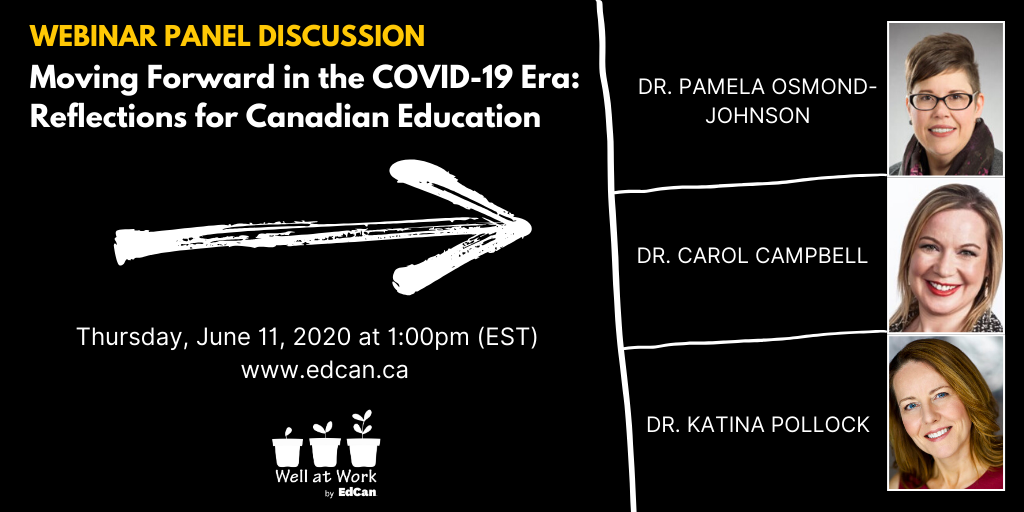
This webinar is primarily for governments, education professional organizations, school and school district leaders, teachers and education support workers, and anyone interested in understanding current issues for changes to K-12 schooling for the education sector across Canada in the COVID-19 era.
In March of 2020, Canadian education systems first began to close schools in response to the COVID-19 pandemic. As well as the emergency response shift to remote learning from home, we must also begin to turn our attention to the inevitable task of planning for the future of schooling over the short and medium term. As school reopenings internationally are showing, this is not simply a return to schooling as normal. Moreover, since education in Canada is a provincial responsibility, responses to COVID-19 have been diverse and we would expect plans for the future to be appropriately varied. Fundamentally, what we will need to ask ourselves is: “What conditions need to be in place for students to learn and for teachers to teach, and how will leaders across the system adapt to support these conditions?”
This one-hour webinar panel discussion will explore how we will understand effective leadership across the education sector for the coming months and years by considering implications for governments, teacher organizations, and school leaders.
Register Here
IN THE MEANTIME, CHECK OUT THIS ARTICLE by DR. pamela OSMOND-JOHNSON, DR. carol CAMPBELL, AND DR. katina POLLOCK:
Read the full article
-
Global Recess Alliance Statement on Recess
Comments Off on Global Recess Alliance Statement on RecessThe Global Recess Alliance, a newly formed group of scholars, health professionals, and education leaders, argues that attention to recess during school reopening is essential. Recess is the only unstructured time in the school day that provides space for children’s physical, social and emotional development, which are essential for well-being and learning. When schools reopen, children will need space to heal from their collective trauma.
The Global Recess Alliance have combined their expertise to provide answers and concrete strategies for a recess that not only works under the current circumstances but paves the way for a fundamental shift in the ways schools approach recess.
Learn more here


IDEAS TO SUPPORT EDUCATORS : Subscribe to the EdCan e-Newsletter
Quality research, reports, and professional learning opportunities.