Archive
-
What’s in a Name?
Comments Off on What’s in a Name?What happens when students research the roots, meaning and stories behind their own names? Identity is at the heart of the names inquiry, encouraging students to tackle the existential questions “Who am I?” “Who are they?” and “Who are we?”
It was a cold March morning. Desks began to shuffle as 28 Grade 5 and 6 students gradually entered the classroom. Standing at the front of the room, I heard a soft whisper: “Who is she?”
“Shh! Quiet, I want to find out who she is,” responded another student.
Silence suddenly filled the room. Twenty-eight sets of eyes now stared at me, anticipating an elaborate introduction, begging me to disclose some much-needed and expected information: my name. This is the moment I had been waiting for, the moment when I was going to try something highly unusual.
“Welcome to Social Studies! I would like to begin with a story and the request that you do not tell anyone your name for the next three days.” Noticing that every student seemed to be nodding in agreement, I flicked off the main light, turned on a small lamp and began reading the story I had so carefully selected.
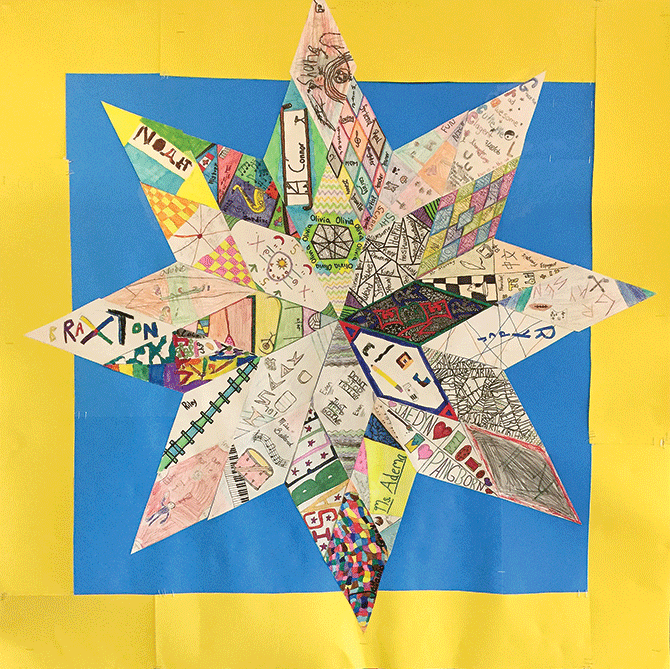
The paper star quilt created by our classroom community. One by one the students became immersed in the story of two parents struggling to bestow a name upon their child. Once the story was finished, a student near the front of the classroom asked, “What do you think the world would look like without names?”
Intrigued by his question, I encouraged him to start exploring possible answers. Slowly, other students began contributing to the conversation, posing questions and brainstorming possible answers. A classroom once quiet was now an animated commons inviting all students to engage in the discussion.
“Can I be a Canadian citizen without a name?”
“What would happen if we were all named the same thing?”
“Why do we need different names?”
“If I didn’t have a name then there would be no point in being a good person, because no one would know who I was,” stated a Grade 5 student with tear-filled eyes.
Immediately struck by the depth of her observation, I pondered her statement. Although it seemed simple, it revealed something deeper: the desire every human being has to be known and to know others, to feel valued as an individual, to belong.
The wonder of names
The verb wonder can be thought of in two ways: the first is to experience curiosity or doubt – often expressed as the phrase, “I wonder what would happen if…” The second is to be fixated or fascinated with or by something.1 Wonder can also be a noun, which is the emotion of amazement and admiration provoked by an encounter with a person, place or thing. In the coming weeks, the ordinary topic of names began filling the classroom with wonder as students embraced it as their topic of study. Students talked with family members, learning more about their heritage, and enthusiastically shared their discoveries. “Did you know I wasn’t named until I was one year old? My parents followed an ancient African name-giving tradition.” As discussions unfolded, it became clear that names embodied “… a living topography, a living, interrelated place full of its own diversity, relations, multiplicity, history, ancestry, and character.”2
Inquiring into names was challenging, requiring students to reconstruct existing understandings of themselves and others. At times, some students became upset by the meaning of their name, thinking it was not as cool as their peers’. “Why does my name mean olive? It is not nearly as cool as a name meaning one with a gentle spirit.” Facing these situations required careful responses that encouraged students to immerse themselves in further historical investigations. Students worked collaboratively as research groups, supporting one another to discover the hidden history of each other’s names rooted in ancient societies: “Did you know that Olivia means olive, which symbolized peace and friendship in Ancient Greece?” Whatever challenges or triumphs presented themselves, the class learned to be in it together.
But do I belong?
Inquiring into names was challenging, requiring students to reconstruct existing understandings of themselves and others.
For young students, finding a community and establishing a sense of genuine belonging can be both challenging and scary. During recess or lunch breaks, students’ sense of belonging would regularly come under question due to various social encounters. To address this problem, the class created a paper star quilt to serve as a visual representation of belonging, a constant reminder that we are one community full of unique individuals with different names and histories. A group of students suggested reaching out to administration, option teachers, and school counselors, inviting them to create a piece of the quilt so as to embrace the full breadth of their community. One student explained that “although certain people may not appear to belong, every community can have and create space for difference. Everyone can belong.” Learning that Indigenous traditions require star quilts to be gifted, the class decided to give their paper quilt to the school, hanging it in the hallway outside of their classroom.
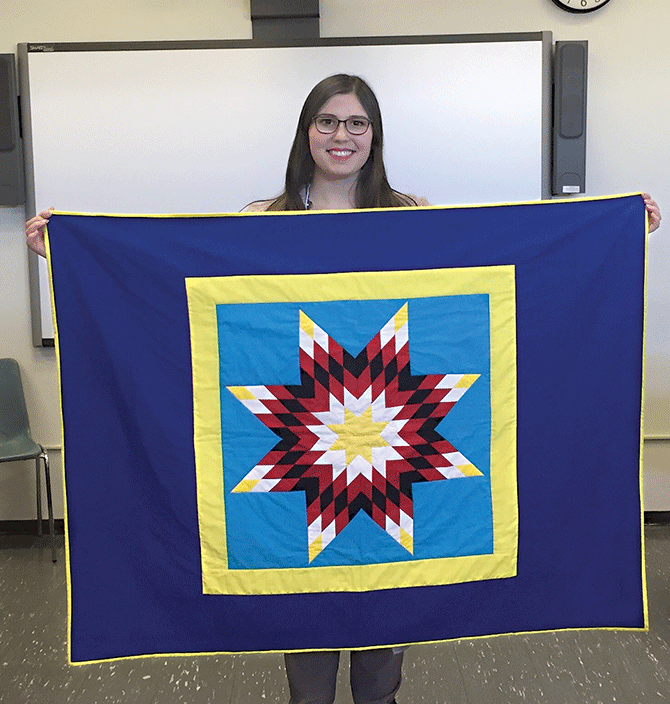
The star quilt that inspired our paper star quilt. This quilt was a collaborative research project during my teacher education program at Brandon University. Our fabric star quilt now hangs in the Education Building at Brandon University. Curricular implications
Across Canada, identity is one of the foundational building blocks of most social studies programs, providing opportunities for topics such as diversity, race and gender to be explored as living experiences. Identity is at the heart of the names inquiry, tackling the existential questions “Who am I?” “Who are they?” and “Who are we?” in ways that encourage and require autobiographical investigation. With every student having a name, it yielded a starting point to uncover and grasp identity as fluid and complex, a collection of living experiences that brings into question what it means to share a Canadian identity that is multi-faceted, yet uniquely individual.
Having students grasp the fluidity of identity and accept who they are as more than their names required encouraging them to inquire into notions of identity and citizenship as they apply to their world. Through the learning process, social studies became enriched as students and teachers realized that names are a doorway into who a unique individual is and is becoming; that names are stories full of endless possibilities, best discovered in community with others.
Photos: Courtesy Katelyn Jardine
First published in Education Canada, March 2019
1 Dwayne E. Huebner, “The Capacity for Wonder and Education,” in The Lure of the Transcendent: Collected essays, by Dwayne E. Hubner (Mahwah, NJ: Lawrence Erlbaum Associates Publishing, 1999).
2 D. Jardine, On the Nature of Inquiry: The individual student (Galileo Education Network, 2002).
http://galileo.org/teachers/designing-learning/articles/the-individual-student -
Protecting Pollinators Through Experiential Learning
Comments Off on Protecting Pollinators Through Experiential LearningIt started when one teacher saw a TV ad about saving the bees – and grew into a national program, Bee City Schools, integrating outdoor education and technology into school-wide projects focused on saving pollinators.
We would like to introduce educators to the Bee City Canada/Bee City School Program, an important initiative that is quickly making its way through elementary and secondary schools across the country. The original objective of the Bee City School Program was to encourage an inquiry about the bee crisis and the role that pollinators play in our food cycle. Currently, Bee City Schools are expanding this inquiry by integrating outdoor education and technology into school-wide projects while encouraging parents and communities to join students in their learning.
In 2017, the Bee City School Program became a recognized certification from Bee City Canada. The origins of this initiative are modest and began in 2015 as we, two teachers in Scarborough, Ontario, were working on a partnering plan for an upcoming Science unit. It started when Ashleigh White, a Grade 4 French Immersion teacher, saw a CheeriosTM commercial that encouraged consumers to “bring back the bees” and decided to use the ad as an introduction to character education in her classroom. Thinking that this might also be an opportunity to begin working with a colleague on a Science Buddies project, Ashleigh approached Grade 8 teacher Doug Whiteside.
Together, we felt a call to action and were immediately motivated to open an inquiry project that began by asking, “What is happening with the bees?” A true inquiry often requires teachers and students to connect with resources and people outside of the school. Ashleigh began to reach out to organizations in Toronto, and with a little research, she found Bee City Canada, a charitable organization that was in the final stages of becoming officially recognized by Toronto City Council. She thought she might be overreaching, but Ashleigh took a chance and made a call to Bee City Canada. Director Shelly Candel responded within one day and graciously offered to visit the school and help answer some of the students’ questions. This was the first workshop that Bee City presented to students, and the response from both classes was beyond expectations. The seed had been planted and so came the idea to offer more workshops based on new questions stemming from the Bee City Canada classroom visit. The roots of the Bee City School Program sprouted that day.
Our aim with the Bee City Canada Schools initiative is to cultivate a climate that encourages students to ask questions and to be critical thinkers and problem solvers by examining real-world contexts. We strongly believe that our growing network of Bee City Schools has come to realize that through inquiry, experiential learning and “getting our hands dirty,” we can begin to make positive change in our communities. Our program is unique in that it can implement a broad range of current teaching practices into one school-wide initiative that welcomes all learning entry points. We also generate support from parent councils, local government officials, and businesses who are inspired by the team building that is now so evident throughout the hallways of our member schools and in the vibrant pollinator gardens that were established and are now diligently maintained by students ranging from Kindergarten to Grade 8. Our network has come to realize the severity and the implications of the declining bee population in Canada and around the world. We also know, however, that it’s not too late to do something about this problem. By taking action and planting bee-friendly flowers, as well as educating our communities on the dangers of pesticide contamination, we believe that we are helping to create a new culture of students as global citizens of character. We hope they will become the future leaders of collaborative inquiry devoted to reversing the decline of pollinators in Canada.
Bee City Canada, a federally recognized charitable organization, welcomed Toronto as the first Bee City in 2016. In the Spring of 2016, Tredway Woodsworth Public School in Toronto was declared Canada’s First Bee City School. We revamped our STEM program with a project that would offer students a lens into real-world, large-scale problems. This endeavour commanded collaboration among students and teachers in order to achieve our learning objectives.
Students were very eager to develop a strategy that would answer the call to action for citizens to reverse the decline of pollinators. Jeremiah, a Grade 3 student, stated,
“I really want to help the bees because they are important to our world. They spread the pollen that our fruit and vegetables need in order to flower. If the pollen isn’t spread to the flowers, then a lot of our food sources will disappear. Bees are helping our ecosystem to survive.”
This testimonial was one that came about through the exploratory stage of the problem-solving model that is typically used in math, but can and should be applied to early stages of inquiry work in science as well. Through brainstorming and communication, students were able to better understand the problem even if possible solutions were not yet conceptualized.
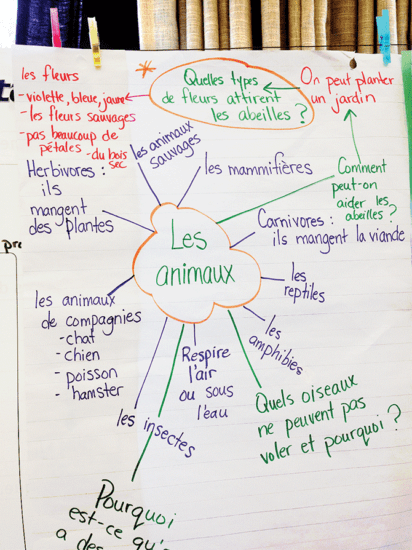
Ashleigh White’s Grade 4 French Immersion class began with a brainstorm chart highlighting some key inquiry questions into the condition and decline of bees and other pollinators. Following the exploratory stage, the inquiry captured the attention of Grade 7 and 8 classes. The older students created an action plan by designating a space for a small pollinator garden that would host indigenous plants, as well as some very creative and visually stimulating bee hotel structures. They discovered that pollinators respond well to colourful and stimulating artifacts and structures that are situated in close proximity to the plants. Vaidehi, a Grade 8 student, captured the class discoveries perfectly, stating,
“When we placed our bee hotels and sowed the seeds for the indigenous plants, we made sure that the hotels were colourful and that the seeds were pesticide free, as this is one of the leading factors causing the decrease in the bee population.”
Students took pride and ownership in preserving and protecting their pollinator garden space. The curiosity spread throughout the school, with questions such as, “What plants attract the bees the most?” and “Do bees communicate with each other?” Discussion and discovery became commonplace as evidence of inspired inquiry work.
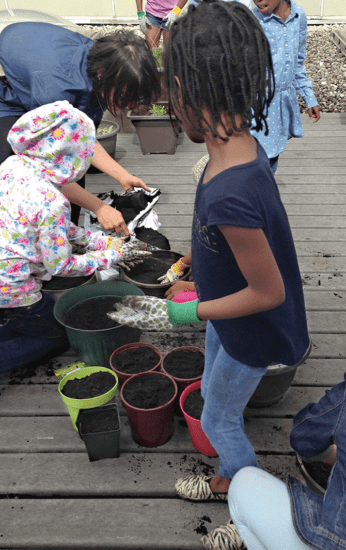
Ashleigh White’s Grade 4 students pot pollinator-friendly plants and flowers for the school’s Pollinator Garden 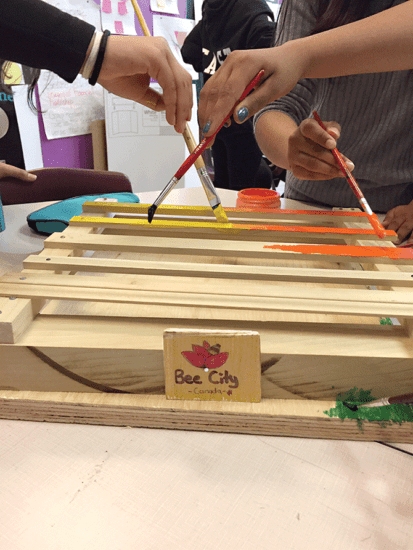
Doug Whiteside’s Grade 7 science students construct and decorate “bee hotels” that offer a temporary rest or pit stop for pollinating native bees and butterflies. Eventually, Bee City Canada invited us to help them develop an application process whereby schools throughout Canada could work on similar initiatives and inquiry. Realizing that our inquiry project could guide other schools to educate students about pollinators and the bee crisis, Bee City Canada relied on our experience to establish this new program. The Bee City School Program was created when Bee City Canada saw the work that was taking place in our school. This rich learning opportunity could not be contained to one school, and our school became the model for Bee City Schools to emulate. Subsequently, Bee City Canada has invited both of us to sit on the board of directors as representatives for the Bee City School Program. In June of 2018, Doug was given the title of Bee Schools Director and he now acts as the liaison for existing and future Bee Schools.
Small classroom projects may grow into school-wide initiatives once the school community becomes more aware of the issues that their inquiry addresses. The thriving pollinator and vegetable garden that was entirely established by students at our school, with support and funding from Bee City Canada, is just one example of the positive work that we are doing to support the community as a whole. Before embarking upon this project, we developed a solid connection with our local city councillor, Glenn De Bearemaeker. He is just one of our great supporters and he was thrilled to join our students at the “2017 Tredway Woodsworth Pollinator Fair.” Mr. De Bearemaeker connected the local community and our school by creating awareness amongst his constituents and engaging in the important conversations necessary to effect change.
Following a cycle of inquiry allowed us to let go of some of the rigidity of conventional teaching and, three years later, students have become independent learners, innovative knowledge builders and creative thinkers. By focusing on the authentic problem of the declining bee population, students are continually empowered to explore the potential of their own school community. Creating and tending to a pollinator-friendly garden has encouraged students to connect with nature as they learn about native plant species and how pollinators help to sustain natural environments. Researching and building structurally sound and visually stimulating bee hotels offers experiential learning and opportunities for students to solve problems using real-world contexts.
As recipients of the EdCan Network’s 2017-2018 Ken Spencer Award for Innovation in Teaching and Learning, we are dedicated to realizing the change that school communities can make by embracing the environment as an authentic outdoor learning space. Ultimately, an initial brainstorming session that was designed to involve students in their Science lesson has grown into a widely successful project that has become an ever-expanding network of shared learning and practice. We have developed a website – www.pollinatorcentral.com – where teachers and communities can blog with us about our experiences and understanding of the world of pollinators. We also launched an e-learning curriculum resource site with the introduction of our first course, called “Pollinator Protector Course,” in partnership with Bee City Canada. On our site, edu.pollinatorcentral.com, we will continue to develop and launch courses about healthy soils and sustainable planting practices.
Through this site, our shared practice continues to develop and offer support to fellow educators, students and communities. We are learning together about the role of pollinators, especially native bees, in our environment and the effect that a continuing decline in their population will have on future generations if action is not taken. Our students are answering the call to make a change, and we are eager to provide them with the tools that they need to successfully implement and expand this project for years to come.
Learn More
All Photos: courtesy Doug Whiteside
First published in Education Canada, December 2018
-
Plus Ça Change…
Comments Off on Plus Ça Change…Does our current digital citizenship education really prepare students for effective citizenship? Digital communications technology offers powerful tools for civic engagement, but too often civic educators focus on “teaching good online behaviour” instead of teaching the skills and knowledge needed to safeguard and strengthen democratic institutions. And these skills are more critical than ever.
This changes everything. In scholarly journals, professional magazines, and popular media, there seems to be widespread agreement that digital media has radically transformed the way youth engage with one another and with the broader society, both socially and civically. Educators and researchers in civic education have understandably sought to adapt. There is little doubt that certain kinds of adaptations are necessary, and potentially transformative if they can harness the capacity for youth and young adults to be connected, to reach large audiences, and to organize others using the right combination of online and brick-and-mortar tools. But I am also concerned that an all-consuming focus on these powerful new tools for civic engagement may distract attention from serious shortcomings that have been widespread for decades. Are there basic principles of citizenship education that are important to maintain, even as we embrace and adapt to the digital era? Or do the bits and bytes of online social, political, and economic life obviate the need to focus on a more timeless set of fundamentals – habits of the heart and mind – that make democratic societies robust and enduring?
A personal story
These questions were on my mind recently, when I stood in the Frankfurt Hauptbahnhof (train station) waiting for my train to Prague. Both of my parents were born in Germany, my father in Karlsruhe in 1927, and my mother in Frankfurt in 1928. My father was displaced by WWII (he moved to Lisbon with his parents and then to Louisville, Kentucky); my mother was less fortunate. Like my father, she left Germany before being sent to a work camp or concentration camp. Unlike my father, she left her hometown without her parents on a kindertransport to Heiden, Switzerland.
As I waited for my train, I realized that 80 years before my mother had stood in this same train station and waved goodbye to her mother and grandmother, who ran next to the train as it left the station. She remembers smiling so that her mother would not be sad. She also remembers giving her favourite doll to the girl seated opposite her, who was disconsolate. They were two of 100 children on the train headed to relative safety in Switzerland. It was the last time my mother would see her family. She was ten years old.
Although my parents – both German Jewish refugees – spoke little about their experiences during the war, I suspect that the profound injustices that informed their childhoods have had an indelible impact on my views about education and citizenship in democratic societies. What went wrong in German society that led to such unthinkable events as those that define the Holocaust? How could such a highly educated, mature democracy descend into such unimaginable cruelty and darkness? Historians have suggested a great number of causes, including Germany’s punishing defeat in World War I, the suffering German economy after the worldwide Great Depression, and the populist appeal of a leader who promised to fix it all.
As an educator, however, I can’t help but wonder what German schools might have done differently. What can we learn from what schools did or didn’t do in Weimar Germany (which was a democracy too)? What, if anything, should schools today teach children about civic participation, courage, and dissent? How can schools help young people acquire the essential knowledge, dispositions, and skills for effective democratic citizenship to flourish?
If we care about robustly democratic societies, we will have to be explicit about the kinds of knowledge, skills and dispositions required of democratic citizens.
Where are we vulnerable?
Tools for engagement have changed, but our social, political and economic vulnerabilities have not. Educators imagine focusing on a kind of teaching and learning that puts democratic community life front and centre at the same time that it uses changes in digital technology to their advantage. These are both worthwhile goals, but they are not one and the same. If we care about robustly democratic societies, we will have to be explicit about the kinds of knowledge, skills, and dispositions required of democratic citizens.
Digital technologies, as the other articles in this special section demonstrate, have tremendous potential to help build a kind of participatory politics that strengthens democratic societies.1Teachers, researchers, and policymakers alike attest to the benefits of these powerful technologies and what they allow students to do, including:
- use the Internet to access information that would otherwise be unreachable or require enormous effort to attain
- develop narratives, both alone and with others, about events and actions
- share opinions and perspectives with a potentially large audience
- provide and receive feedback from others, irrespective of their physical location, age, or social position
- exchange information and ideas directly with other youth without institutional gatekeepers.
These are powerful tools. These same features of digital civic engagement and exchange, however, can be put to use in the service of facile educational goals. As I detail in my recent book, What Kind of Citizen? Educating our children for the common good, when schools across Canada and the U.S. set out to teach democratic citizenship, a vast majority of them end up teaching good behaviour instead: follow the rules; listen to teachers and other authority figures; be respectful and responsible; and manifest a sense of patriotism and loyalty. These can all be admirable traits. But none of them are uniquely essential to democratic citizens. And none of them would have been the kinds of traits needed by German citizens in 1933 in order to alter the course of history. “Good character” is insufficient for safeguarding and strengthening democratic institutions and traditions.
What about today?
I do not mean to imply that another holocaust is imminent or that there is some kind of equivalency between anti-democratic leaders today and Adolf Hitler. I use this example both because it has personal resonance given my family history and also because extreme examples have a way of making visible concerning developments and trends. Currently, in the U.S. notably but also in many other countries, a toxic mix of rising economic inequality and ideological polarization is increasing, leading to waning trust in democratic governance.
Eighty-five years after Germany’s democracy was replaced by a totalitarian Nazi regime, popular support for democratic governance is the lowest it has been in decades. In a widely circulated 2017 report, the Pew Research Center raised considerable alarm among those who had assumed that western democracies enjoy relative stability within an entrenched culture of democratic governance. Although the report was titled “Globally, Broad Support for Representative and Direct Democracy,” commentators, civic educators, and political scientists highlighted a number of findings that challenged the rosier title. In the U.S., for example, 22 percent of respondents thought that a political system in which a strong leader could make decisions without interference from Congress or the courts would be a good way of governing. Close to one in three respondents who identified as Republican and almost half of U.S. millennials thought the same (globally, that figure was 26 percent).2
In another study, Harvard lecturer Yascha Mounk and Australian political scientist Roberto Stefan Foa examined longitudinal data from the World Values Survey and found considerable cause for concern. Between 1995 and 2014, the number of citizens who reported a preference for a government leader who was “strong” and who did not need to bother with elections has increased in almost every developed and developing democracy and, again, the growth has been greatest among youth and young adults.3 Neither Canada nor the U.S. are exceptions. Democracy, it seems, is not self-winding.
Concrete examples now abound of leaders stoking the flames of populist nationalism – the rallying of “the people” against both “foreigners” and a constructed “elite” in the service of right-wing nationalism. Worldwide, politicians can now openly express disdain for hallmarks of democratic society, including the free press, civil liberties, and the courts, while fostering resentment against foreigners and ethnic “others.” These kinds of anti-democratic rhetoric and policies can drive individuals and groups to withdraw from the broader civil society altogether, preferring sub-group identity – what James Banks aptly calls “failed citizenship.”4Recent rhetoric during election campaigns in Canada reveals similarly concerning trends.
A rise in xenophobia and nationalism has resulted in incidents of hate speech, antagonism, and assaults on both newly arrived immigrants and native-born visible minorities in a growing number of western democracies. In the U.S., the Southern Poverty Law Center (SPLC) has documented a precipitous rise in hatred, fear, and alienation among students; and teachers have similarly reported a dramatic increase in hate speech.5 Social media echo chambers further entrench anti-democratic tendencies and pollute genuine social and political discourse.6 Yoichi Funabashi, chairman of the Rebuild Japan Initiative (dedicated to strengthening democratic ideals in Japan) summarizes the risks succinctly: “If society becomes characterized by intolerant divisions, in which people immediately select their allies and dismiss others as foes based on such criteria as race, ethnicity, religion or lifestyle, then democracy’s foundational principles, rooted in careful deliberation and compromise, will be rendered inoperable.”7
What kind of civic education do we need?
Online and offline, we need citizens who can think and act in ethically thoughtful ways. A well-functioning democratic society benefits from classroom practices that teach students to recognize ambiguity and conflict in factual content, to see human conditions and aspirations as complex and contested, and to embrace debate and deliberation as a cornerstone of democratic societies. Here are three strategies that can help shape educational practices in an era of both increasingly powerful digital tools and decreasing support for social democracy:
1. Teach students to ask questions
One hallmark of a totalitarian society is the notion of one single “truth” handed down from a leader or small group of leaders to everyone else. Questioning that truth is not only discouraged, but also often illegal. By contrast, schools in democratic societies must teach students how to ask challenging questions – the kind of uncomfortable queries that challenge tradition. Although most of us would agree that traditions are important, without questioning there can be no progress. Dissent – feared and suppressed in nondemocratic societies – is the engine of progress in free ones. Education reformers, school leaders, and parents should do everything possible to ensure that teachers and students have opportunities to ask these kinds of questions.
2. Expose students to multiple perspectives
Much as Darwin’s theory of natural selection depends on genetic variation, any theory of teaching in a democratic society depends on encouraging a multiplicity of ideas, perspectives, and approaches to exploring solutions to issues of widespread concern. Students need practice in entertaining multiple viewpoints on issues that affect their lives. These issues might be controversial. But improving society requires embracing that kind of controversy so citizens can engage in democratic dialogue and work together toward understanding and enacting sensible policies.
Why would we expect adults, even members of Parliament, to be able to intelligently and compassionately discuss different viewpoints if schoolchildren never or rarely get that opportunity? In schools that further democratic aims, teachers engage young people in deep historical, political, social, economic, and even scientific analysis. They also challenge children to imagine how their lived experiences are not universal and how issues that may seem trivial to them could matter deeply to others. They have students use online tools to examine multiple perspectives not only to know that their (or their parents’) views may not be shared by everyone, but also to engender a kind of critical empathy for those with competing needs. This is the kind of teaching in a digital era that encourages future citizens to leverage their civic skills for the greater social good, rather than their own particular interests, thus working to challenge social inequities.
How should we do this? For example, teachers might present newspaper articles from around the world (easily accessed through the Internet) that examine the same event. Which facts and narratives are consistent? Which are different? Why? Textbooks from several different countries could provide another trove of lessons on multiple viewpoints and the role of argument and evidence in democratic deliberation. Many of these textbooks are now accessible online, allowing the kinds of comparisons that would have been difficult before the advent of communications technology. If textbooks are not available online, teachers can use the power of social media to connect with classes in other countries who are reading different textbooks. Even within English-language textbooks there are many opportunities. Schools in Canada, the U.K., and the U.S., for instance, present strikingly different perspectives on the War of 1812.
Why not ask students to use online and offline sources to research who wrote their textbook? Why were those people chosen? What kind of author was not invited to participate? The idea that a person or group actually wrote a textbook reminds us that the words are not sacrosanct but represent the views of a particular time, place, and group of authors. These approaches help demonstrate to students that “facts” are less stable than is often thought.
Students should also examine controversial contemporary issues. Students are frequently exposed to past historical controversies – such as slavery, Nazism, or laws denying voting rights to women. But those same students are too often shielded from today’s competing ideas (for example, the #MeToo movement, women’s reproductive rights, misinformation campaigns that employ social media as a dangerous and powerful tool, controversies over what should be taught in the school curriculum and how). Engagement with contemporary controversies using a range of perspectives and multiple sources of information – something online tools are uniquely well-suited to promote – is exactly what democratic participation requires.
3. Focus on the local
It is not possible to teach democratic forms of thinking without providing an environment to think about. Schools should encourage students to consider their specific surroundings and circumstances. Here too, social media and other digital tools can be an asset.
One way to provide experiences with democratic participation in civic and political life is to engage students in community-based projects that encourage the development of personal responsibility, participation, and critical analysis. Action civics is a particularly powerful and thoughtful way to foster civic participation that transcends community service to also include a focus on government, policy, and dissent.8 We saw this with the students of Stoneman Douglas High School in Parkland Florida, who, in response to the February 2018 mass shooting in their school, leveraged the power of social media and other digital tools to become key figures in a national dialogue on gun culture in the U.S., while also mobilizing both locally and nationally to agitate for gun control legislation, organize demonstrations, support electoral candidates, and register voters. Their ability to connect a very personal experience with the ways in which government, policy, and social and economic forces shape their lives has allowed them to participate on a national scale, and no doubt prepared them for a life of effective civic engagement. When students have the opportunity to engage with civics education through direct action in their own local context, the impacts of their work are integrated with their lived experience and can teach fundamental lessons about the power of citizen engagement both on and off-line.
Of course, choosing to be explicitly political in the classroom can cause friction for teachers – with students, parents, and administrators – even when teachers avoid expressing their own political views. Encouraging discussion, controversy, and action in the classroom can be daunting. Students may express views that make classmates uncomfortable; they may engage in political acts that concern their parents; or they may choose to challenge their own school’s policies. Democracy can be messy. Rather than let fear of sanction and censorship dictate pedagogical choices, however, teachers should be supported and protected, encouraged to use debates and controversy as “teachable moments” in civic discourse.
Another obstacle to focusing locally is the obsession with provincial (and national and international) standardized testing. The resulting emphasis on memorization and regurgitation of generalized knowledge prevents deeper critical analysis and runs counter to almost everything we know from education research about how to make teaching and learning meaningful and about how to foster engagement and participation in civic life.9
Education in a digital era
The communication technologies of the digital era have enormous potential to bring people together in collective pursuits. Those pursuits, however, must be consistent with democratic values. History demonstrates that just because schools teach children about citizenship and character does not necessarily mean they do it well, or even toward admirable aims. In fact, schools have sometimes engaged in some of the worst forms of citizenship indoctrination. Counted among the many examples of organized “citizenship” education are the hateful lessons learned by members of the Hitler Youth brigades such as racism, antisemitism, the glorification of Nordic and other “Aryan” citizens, and blind obedience to authority; or the Young Pioneers of the USSR who were taught to report any religious activity in their own homes to authorities so their parents could be prosecuted. Had these same youth had access to YouTube, Snapchat, Facebook, Twitter, and Pinterest, would they have been more or less likely to teach one another about democratic ideals and the dangers of authoritarian rule?
Similarly, when we use digital technologies in schools, do we use them to teach children to unquestioningly preserve our social, political, and economic norms and behaviours, or do we use them to imagine and pursue new and better ones? Do we teach them only the importance of following the rules or also to question when the rules are not worth following? Do we teach students to mobilize in support of policies that promote only their own self-interest, or to think more broadly about their ethical obligations to others? I wonder what might have been different in 1941, the year my mother received her last letter from her parents, had children been taught not only compliance but also doubt and the obligation to imagine a better society for all. I think about what civic educators can do now – whether focused on new technologies or on the kinds of critical thinking skills necessary to sustain democratic norms and behaviours – to convey to students the power of community, as well as the pitfalls of blind allegiance to it.
Long before computers or the Internet, John Dewey described schools as miniature communities and noted that the school is not only a preparation for something that comes later, but also a community with values and norms embedded in daily experiences.10 In many ways the question of how to teach citizenship in a digital era is a much broader question about the purpose of schooling writ large. Transforming the way we teaching citizenship is not only the purview of the civics and social studies classroom, but a journey into all classrooms, all subjects, the hallways, and the relationships of the entire school experience. Citizenship education – indeed education of all sorts – is, ultimately, a proxy for the kind of society we seek to create.
Photos: Bundesarchiv_Bild_183-S69279,_London,_Ankunft_jüdische_Flüchtlinge and iStock
First published in Education Canada, December 2018
1 Also see the work of Erica Hodgin, Joseph Kahne, Ellen Middaugh, Ben Bowyer and others at the Civic Engagement Research Group in Riverside, California. www.civicsurvey.org
2 Pew Research Center (PEW), Globally, Broad Support for Representative and Direct Democracy (Washington, D.C.: PEW, 2017).
3 R. Stefan Foa and Y. Mounk, “The Danger of Deconsolidation: The democratic disconnect,” Journal of Democracy 27, no. 3 (2016): 5-17.
4 J. A. Banks, “Failed Citizenship and Transformative Civic Education,” Educational Researcher 46, no. 7 (2017): 366–377.
5 United Nations (UN), Racism, Xenophobia Increasing Globally (New York, UN, 2016), www.un.org/press/en/2016/gashc4182.doc.htm; M. Costello, The Trump Effect: The impact of the presidential campaign on our nation’s schools (Montgomery, AL: The Southern Poverty Law Center, 2016); W. Au, “When Multicultural Education Is not Enough,” Multicultural Perspectives 19, no. 3 (2017): 147–150; J. Rogers, M. Franke, J.E. Yun, et.al, Teaching and Learning in the Age of Trump: Increasing stress and hostility in America’s high schools (Los Angeles, CA: UCLA’s Institute for Democracy, Education, and Access, 2017).
6 For research about media echo chambers, see, for example: J. Kahne & B. Bowyer, “Educating for Democracy in a Partisan Age: Confronting the challenges of motivated reasoning and misinformation,” American Educational Research Journal 54, no. 1 (2017): 3–34.
7 Y. Funabashi, “Trump’s Populist Nationalism,” The Japan Times (2017, January 17). www.japantimes.co.jp/opinion/2017/01/17/commentary/japan-commentary/trumps-populist-nationalism
8 See, for example: B. Blevins, K. LeCompte, and S. Wells, “Innovations in Civic Education: Developing civic agency through action civics,” Theory & Research in Social Education 44, no. 3 (2016): 344-384; M. Levinson, No Citizen Left Behind (Cambridge, MA: Harvard University Press, 2014).
9 D. Koretz, The Testing Charade: Pretending to make schools better (Chicago, IL: University of Chicago Press, 2017); J. Westheimer, “No Child Left Thinking,” Colleagues 12, no. 1 (2015). http://scholarworks.gvsu.edu/colleagues/vol12/iss1/14
10 J. Dewey, Moral Principles in Education (Carbondale, IL: Southern Illinois University Press, 1909/1975).
-
Making Room for Student Voice
Comments Off on Making Room for Student VoiceOver the past two years, I have had the chance to become a student leader and advocate for improvement in the education system. I have also had the opportunity, as a student trustee, to attend school board meetings and professional development opportunities for students.
These experiences have opened my eyes to the work that is being done in the Ontario education system to improve students’ education. I have learned that student voice can be heard on many different levels. Whether it be at a Ministry of Education consultation or a math class, each level is just as important as the others.
I remember in Grade 8, my teacher spoke about the value of getting involved in extra-curricular activities in high school. Grade 9 was a transition year for me. Like many others students, I was learning the ins and outs of high school and how to succeed. Because of this, I did not join many extra-curricular activities. In Grade 10, my journey into student voice began. A teacher who saw my potential invited me to take part in a school-level focus group about increasing student voice in my school board. I felt positively impacted by this opportunity because it made me feel that my voice was valued and that there is need for improvements.
In Grade 11, the same teacher (who had since moved on) came to my school and asked me to be a student representative at the planning level for student voice in my school board. This led to me being able to be a co-facilitator at a two-day student summit that brought together approximately 150 participants, ranging from students to the director of education, to discuss how to improve student voice in their schools. This event gave me insight into some of the issues that are experienced by students.
The two biggest issues that I saw were tokenism and lack of opportunity. By tokenism I mean, students who are lucky enough to be given an opportunity to share their input, often feel that they are simply listened to but no action is taken. I feel that this stems from the attitude we have developed in our society, that sees youth as disengaged, not willing to participate or not having valuable ideas. From my experiences, this is not the case. Youth are one of the groups that are being affected by problems in education; why not involve them in the process of identifying specific issues and coming up with a plan to solve them?
The second issue is connected to the first issue. Youth are often not given an opportunity to voice their opinion at higher levels of discussions. They are often left out from the meaningful conversations that occur at school boards, ministries of education, community stakeholder groups and many more. Because of this, the power of youth to influence change does not reach its full potential due to the lack of opportunities.
The opportunities that I have had in the last two years have greatly influenced my future career choices and the way that I view life. Being able to help facilitate growth in the education system has allowed me to realign my moral compass and realize that I have been blessed with a life of service to others in which I must find a way to improve others’ lives in the most positive way that I can. Expressing my views and others’ views has allowed me to see that there is good in this world and that youth are very powerful. All we must do is, empower possibility.
To conclude, to any educator reading this, come up with ways to meaningfully engage your students in the decision-making process. If you’re not sure how, reach out to others; there are many great people who are paving the way to improve the education system.
To any parent reading this: have a conversation with your child(ren) about what they can do to improve their voice. Help them find the power inside themselves to change the world.
And finally, to any youth reading this: your voice is powerful and can change the world in many ways. Help your friends find their voices and together, you will have even more impact in spreading your hard work for change.
Photo: courtesy Evan Rogers
First published in Education Canada, December 2018
-
Community-Based Teacher Education
Comments Off on Community-Based Teacher EducationRural and remote communities struggle to attract and keep teachers. A new program at the Werklund School of Education aims to fill that gap by allowing students from these communities to earn their teaching credentials without leaving home.
The geographical area of Canada is vast and expansive, with much of the population residing along the Canada/U.S. border. And yet, rural Canadians comprise approximately 25 percent of all Canadians, and many live in the far-reaching northern and remote areas of Canada. This is unsurprising and longstanding, yet it presents particular challenges for serving these areas well, particularly related to teaching.
Various financial incentives are commonly provided to attract more certified teachers to rural and remote areas. These may include financial student bursaries so long as they commit to a designated period of time teaching in the rural school district, subsidized accommodation, or travel to and from urban and rural areas. In other cases, urban teacher education programs create satellite campuses to have a more far-reaching applicant pool of individuals interested in pursuing an education degree. Both strategies have been met with limited and mediocre success. In the first instance, financial incentives to draw individuals into the community commonly result in a high turnover of teachers once the contract and financial commitment has been met. Satellite campuses struggle to maintain these programs as a financially viable and sustainable model. Given the financial costs associated with keeping programs open in satellite campuses and further ensuring that there is sufficient faculty expertise to teach in them, individuals in satellite campuses are normally required to attend two years at the urban campus (creating a 2 +2 model).
There are increasing calls for post-secondary teacher education programs to consider how to attract individuals who already live in rural areas and who are committed to the long-term vitality of the community. For instance, the Northern Alberta Development Report (2010) spoke to the need for “home grown teachers”: teachers who come from and will stay in the rural community to which they belong.
Yet, this task is not as easy as first perceived. Generally, it is difficult to attract individuals from the rural community to attend an on-campus program or even satellite campus, given the financial and logistical strain that this may place on students. Students may find the costs of moving to a city, or driving to a satellite campus on a regular basis, too much strain to bear. If students do decide to move to an urban-based teacher education program, the trend is that the vast majority of them never return to their rural community. In this way, the very intent to attract these individuals to university may further undermine the vitality of the rural community.
Given this dilemma, alternative models are being explored and implemented to attract individuals to become rural teachers who will become long-standing professionals in their own communities. This article considers a new program offered in Alberta since 2015 that has seen some optimistic initial results.
Community-Based Bachelor of Education
In July 2015, the Werklund School of Education, University of Calgary welcomed the first cohort of students into a newly designed Community-Based Bachelor of Education program. This program allows students to complete their entire Bachelor of Education degree in a model that blends face-to-face, on-campus instruction in the summer with online courses in the fall and winter. This is combined with field experience placements in their rural communities, working alongside mentor partner teachers and principals in these areas. This allows students to remain in their local rural communities for the vast majority of the duration of their studies.
The Community-Based Bachelor of Education at Werklund allows students the best of both worlds. Each summer, students come to the University of Calgary for two weeks in July to meet their instructors and the other students in their cohort in person. During these two weeks, students not only begin their courses but they have access to academic, career and student supports provided by a dedicated team of faculty and support staff. Most importantly, however, students in these two weeks are offered the opportunity to develop collaborative relationships with those in their cohort and with their instructors, ensuring they feel connected to one another and to the Werklund School of Education.
The intensive two weeks of on-campus instruction creates a bond among students, who work together throughout the day in their courses and experience the residency component as a cohort. The timing of the courses (July) is purposeful, as many students have children. The summer holidays allow for more flexibility to find childcare for those two weeks, and yet the time away from their children is not overwhelming.
When students return home at the end of their two-week summer residency, they begin the online component of their program. The Education courses students take online are designed to be interactive and collaborative, allowing students the same kind of experience they would receive in an on-campus course. The courses are not self-directed and do not follow an online correspondence model; instead, the courses have a balance between asynchronous learning and synchronous online instruction, along with purposeful pedagogical and curricular relevance to teaching in rural areas.
Field experiences in their local communities provide the contextual experiential learning and students are mentored by educators in those communities. The students have real and meaningful rural teaching experiences that are attentive to the local and cultural norms and values of the community. This provides more student teachers with an opportunity to gain experience in rural schools, opportunities that have traditionally been scarce within urban-based teacher education programs. It provides mentorship opportunities for exemplary rural teachers and principals who have a nuanced understanding of the needs and opportunities for rural students, and empowers those rural communities to support their own continued professional learning in their communities.
Who are the students?
Over the last three years, the program has been tracking the nature of the students who are enrolling in the program to see whether the program is attracting students from rural and remote areas of the province. Thus far, the indicators prove promising. The overwhelming majority of students who have enrolled in the program to date are women between the ages of 35 and 50. The places where these students reside have truly hit the most northern and remote regions of the province: near the border between Alberta and Northwest Territories, the boreal forests in northern Alberta, the mountainous regions to the west of the province, the rural valleys in the eastern and southern regions, and Indigenous Treaty 7 and 8 territories. Over 90 percent of these students have worked in schools in some capacity, with the majority working as educational assistants or occupational therapists. This is noteworthy. One Indigenous Elder commented that educational assistants are often the life blood of the school. Teachers and principals come and go, but it is the educational assistants who tend to remain in the same rural schools, providing the institutional memory of the school, and the continuity and stability for the children.
The life stories of students who enrol in this program are telling. It is clear that they have a strong desire to become a certified teacher, but given their personal circumstances, would not have been able to drive to a satellite or urban campus. Almost all have children and most work to support the family. A full-time residency-based teacher education program was simply not an option.
Given the mature demographic of the students, who lead complex lives supporting their children and their families in these rural communities, attentiveness to when the courses were offered was of paramount importance. Unlike most programs that offer on-campus instruction during the day, fall and winter courses are offered in early evening time slots of 4:30 or 6:30 p.m. This allows individuals to work during the day, pick up their children from school, drop them off to their after-school activities should they require, or make supper. The timing of the courses also allows students to ensure that they have adequate Internet connectivity by staying at a school, library, or other institution, should their own house not have consistent Internet service – as is commonly the case in the mountains, valleys, and remote areas of the province.
Students create strong bonds during the summer, and feel a strong sense of communal belonging and commitment to each other.
Feedback from students indicates that initial concerns about potential isolation when doing the program “remotely” has thus far been a non-issue. Students create strong bonds during the summer, and given their overlapping stories, they feel a strong sense of communal belonging and commitment to each other. As many students note, when they take the leap of faith to enrol in the program, they feel the weight of their success on their shoulders. It is not just a personal journey to become a certified teacher; they tell us that they feel their children, families and communities are rooting for them to accomplish this goal. This creates a double-edged sword. In one way, they feel supported by their community to undertake this degree, but they also feel pressure to not let the community down should they struggle in their studies.
Given that this is a common theme among students who are desperate to succeed in becoming certified teachers, it is not uncommon for students to call up their fellow classmates to find out how their sick child is doing, how the harvest went, or how they have been juggling their family and work life with the program. In this way, students who had previously attempted to attend university in the city feel an incredible attachment to other students that they had not felt attending large lectures on campus. In many respects, there is a true sense of family, of getting through the program with the support of their classmates and their local community.
Cautious optimism
The nature of the blended program does present challenges. Despite advances to ensure secure Internet provision, the valleys, mountains and remote areas of the province make it difficult for some students to have a consistent online connection. This impedes the kinds of online activities that might otherwise be incorporated, restricting us to more limited activities that are less taxing. For instance, having all the students with their thumbprint pictures to be “seen” while holding an online class would bounce many students off-line. In this case, instructors are limited to audio, which lessens the ability to watch for body language among the students.
The traditional university structure also creates unintended barriers for students who learn from a distance and online. Students’ tuition often covers access to gyms, dental plans, or other student supports. Yet, commonly, those services are limited to those who are within proximity to the campus. Students may not opt out of the costs associated with these university fees, and yet derive little benefit.
Similarly, bursaries and awards are generally structured for students who have full-time status on one campus. Those students who may take courses from more than one institution, as in the case of this program, may be excluded from these financial supports as they do not meet the criteria that has been set for taking courses from one institution.
These difficulties point to a lag in the institutional structures of the universities in terms of student supports that can be provided online, or by phone, rather than having to walk into a particular office or centre. This not only hinders the students in this blended program, but it calls attention to the need for more flexible supports to increase access for students who lead complex lives beyond the campus.
Despite these challenges, there is a cautious optimism that this model may create more access to students in remote areas to foster qualified certified teachers who are committed to teaching in their local rural schools. Rural school superintendents and Indigenous communities are hopeful that they can encourage individuals who have already demonstrated a passion for supporting their schools and communities, to take the step in becoming certified teachers. At the time of this article, the first graduating class from this Community-Based Bachelor of Education will enter the teaching profession, and most have received teaching contracts in these rural areas.
It is not known whether these teachers will become the long-standing educational professionals in the community. Time will show whether the program makes a significant change to the perennial turnover and shortage of teachers in rural areas. However, we are cautiously optimistic that this may provide a tipping point in redressing this challenge.
Photo: iStock
First published in Education Canada, September 2018
-
New guidebook on early school leaving
Comments Off on New guidebook on early school leavingNew EdCan Network case study research report entitled The Rural Advantage: Rallying Communities Around Our Students calls on school-community leaders to consider a made-in-Canada approach that raises literacy rates, prevents early school leaving and breathes life back into small towns.
It’s an all-too-common scenario in Canada’s rural communities. Parents who struggle to read and write. Household incomes and unemployment rates that fall below the national average. Students with special needs who require a speech pathologist or a teaching assistant, but don’t get one. Schools at risk for closure and dwindling community services as young people dropout of school or opt for brighter opportunities in the big city. But these trends can be reversed with a “community ecosystem approach”: a Canadian-developed, step-by-step process for developing school-community partnerships that can reduce student dropout rates in rural and disadvantaged schools and municipalities.
“Our grade-four French-language success scores have risen from 50% to 98% in only five years,” says Sylvain Tremblay, principal of both an elementary school and a high school in Saint-Paul-de-Montminy, Quebec. “Instead of working in silos, we engaged parents, kids, teachers and community partners to collectively lead activities that increase the language skills of toddlers and encourage the academic and social success of our children and young adults.”
This guidebook was originally developed with the support of CTREQ – a Quebec-based research and knowledge mobilization centre – and provides a practical toolkit and worksheets for school and community leaders to create their own unique program, including guidance on how to engage hard-to-reach families, classrooms, schools, and whole communities.
“Schools can’t afford to work in isolation from the families and communities where their students live and grow up,” says Darren Googoo, Chair of the EdCan Network, a pan-Canadian collective of education leaders. “This approach isn’t about overloading busy educators; rather, it’s about community leaders rallying around a literacy action plan that leverages existing resources and strengthens existing efforts.”
Download the full report for free, including how-to videos and a practical toolkit, at: www.edcan.ca/ecoreussite-report.
SUPPORTED BY

This initiative is generously sponsored by State Farm Canada, which shares EdCan Network’s commitment to supporting leaders who are transforming Canada’s public education system.
-
A guide for leading dropout prevention in your small town
Comments Off on A guide for leading dropout prevention in your small townThis case study report calls on school-community leaders to consider a made-in-Canada approach that raises literacy rates, prevents early school leaving and breathes life back into small towns.
This step-by-step guidebook provides a practical toolkit and worksheets based on the concrete experiences of the “L’ÉcoRéussite” program, which has developed a “community ecosystem” action plan in collaboration with the CTREQ: a Quebec-based research and knowledge mobilization centre. This “community ecosystem” approach provides guidance on how to engage hard-to-reach families, classrooms, schools, and whole communities in order to collectively create and lead activities that increase the language skills of toddlers and encourage the academic and social success of children and young adults ages 0-24 years-old.
Schools, school districts and community organizations can leverage this guidebook to create their own unique programs adapted to their particular needs and situation.
The Ecosystem Toolkit
This toolkit contains worksheet templates, sample community surveys and model action plans that have been carefully developed by the “L’ÉcoRéussite” program. These hands-on tools can be used as exemplars for filling-in the blank templates below, which were developed by the CTREQ.
Phase 1: Explore
This phase consists in collecting qualitative and quantitative data to develop a community portrait, engaging community stakeholders and hosting your first community consultation meeting. (Refer to Phase 1 of the report).
PHASE 2: INITIATE THE PROCESS
understanding the protective factors of student retention and success, versus the risk factors of dropping out of school
Survey to evaluate current initiatives and gaps in community service offerings
developing a community portrait
determining community needs and objectives based on Key findings and Protective factors
PHASE 3: THE PLANNING STAGE – CREATING AN ECOSYSTEM ACTION PLAN
developing a community Action Plan
PHASE 4: IMPLEMENT AND EVALUATE
survey to ASSESS PARTNER SATISFACTION
Widening the scope to target individuals ages 0–24 years-old
survey to ASSESS COMMUNITY PRIORITy issues
sample results from the survey to ASSESS community PRIORITY ISSUES
Practical how-to videos for community organizations, schools, school districts and parents’ associations (in French only)
This video series on the “L’ÉcoRéussite” program will allow you to dive deeper into the winning conditions, challenges and key steps undertaken by this school-community team in creating a “community ecosystem” action plan.
How to Create a Community Action Plan in Support of Student Retention (in French only)
Building Upon Student success to Spur Parent Engagement (in French only)
The “L’ÉcoRéussite” Program: Supporting Student Success in Disadvantaged Rural Communities (in French only)
SUPPORTED BY
This initiative is generously sponsored by State Farm Canada, which shares EdCan Network’s commitment to supporting leaders who are transforming Canada’s public education system.
-
Sackville Schools 2020
Comments Off on Sackville Schools 2020“We usually do not hear from or include the actual community members in planning our schools,” stated the superintendent of our school district. It was a watershed moment for the members of our small rural community group as we sat around a dining room table here in Sackville, New Brunswick. We were stunned by the statement that parents and local citizens were not really part of the design of what we believed to be the very heart of our community – our schools. We simply didn’t count.
Still reeling from the announced closure of a neighbouring community’s school and their bitter fight to keep it open, our small group worried that our community might be next to come under the so-called “sustainability study”: a provincially driven formula for determining school closures. It was at that table that we vowed to take our community’s precarious situation of shrinking demographics, aging schools and a feeling of isolation here on the margins of the school district in an entirely new direction. That commitment, now two years old, signaled that Sackville needed a new conversation and a new vision for transforming the community into a model for integrated, community-driven education. We believed that we had to have a clear vision for the education system in our community within the next five years, so Sackville Schools 2020 (or 20/20) was born.
Getting started
Sackville Schools 2020 was born out of a desire to anticipate a highly uncertain future for our children, our teachers and our schools, and the lack of connection we felt with the centralized and isolated education system that had developed in our province over the past many years. The working group held several collaboration cafés and community visioning sessions that invited community members to share their ideas, frustrations, hopes and fears about our schools and our role in the care and feeding of our learning community.
Committee members also interviewed hundreds of students to ask them about their current experiences and what they imagined in their ideal school of the future. We were shocked to find that students had very little in the way of hopes and dreams about their ideal learning environments: perhaps a classroom with a window, or maybe proper heating so that they didn’t need to wear their coats to class. They seemed unable to even imagine features like a learning commons, outdoor gardens and greenhouses, or a climbing wall – environments where they could truly flourish. Such low expectations revealed a sense of hopelessness and isolation, as opposed to what the committee was finding in our national and international research on 21st century schools, such as deep learning, project-based and individualized programming, and experiential and outdoor learning beyond the walls of the school.
While there were certainly reports of some great teaching and learning, it seemed to be the exception, rather than the norm. Teachers reported a sense of feeling isolated in their work, with many new curriculum ideas and government programs, yet a school district that seemed to be preoccupied with the larger urban schools located down the highway. We seemed to be overlooking the power of ideas and the amazing wealth of talent and commitment in our own town, as seen over and over again in the creation of school beautification committees, outdoor education and wetlands centres, and the thousands of bright minds coming to the community to attend university and volunteering in our schools.
Our town is incredibly fortunate, in that education is the driving economic and social force of the community, with a range of preschools, elementary, middle and secondary schools, a vibrant seniors’ college, and one of Canada’s top undergraduate liberal arts universities – all within a town of just over 5,000 people. After two years of conversations and research on leading practices in school design from around the globe, we can now feel the energy and excitement of the children, parents, and teachers, as well as educational and political leaders across the region, in their hope of moving away from the traditional top-down, prescriptive, cookie-cutter approach to school design towards making learning a shared community effort. We have worked with the Mayor and Council to adopt the model as part of their strategic plan, with the Mayor stating that “education is the driving force of our community and it is simply too important to be left to others in far-off places. We have to take an integrated approach to learning and the Town supports this approach.”
Although our community meetings and consultations now attract 60 to 80 attendees, our start was slow and sometimes discouraging. While we certainly have gifted educators and highly involved and caring parents and civic leaders, it’s not easy for already overworked and stressed members of our education system to envision a new way of thinking about how we educate our children and where we do that type of teaching and learning. Although many have little faith in the existing school planning system, which is controlled from the larger school district office and the Department of Education in Fredericton, it has still been challenging to engage teachers, principals and our elected district education council members in thinking and acting from this grassroots level. Often our wonderful dessert parties and cafés resulted in committee members looking at each other and wondering why educational change did not seem to be important to the wider community. Many told us that you simply can’t take on the government and change the system. Even that same district superintendent commented that he was surprised that we were still trying, after two long years!
In spite of the lack of enthusiasm we encountered for taking on the system, our group was encouraged by what we saw as the alignment of the political and educational stars and planets within the province. We recognized that Sackville was already a wonderful learning environment for so many different stages in life, from pre-school to post-secondary and even in the retirement years. We wanted to change the way in which we approached the formal and informal aspects of education by purposefully planning and integrating the efforts of the individuals and groups across the community. We proposed an integrated educational model that could be developed by us and for us, with the potential to spread across the school district, the province and beyond. Our group members have now presented this model to groups in Ontario, Nova Scotia, P.E.I. and Oregon.
Alignment of the political stars and planets
In January of 2016, the recently elected government of Brian Gallant announced the Education and New Economy Fund, and the Premier stated that the best way to give students the chance to succeed in whatever they would like to do with their lives was to invest in education, in training, in research and development, and in innovation. This was a profound commitment to education and the key to our economic and cultural future in this province. It also matched closely with what we wanted here in our community. The Premier wanted N.B. to be the educational leader in Canada, and we wanted to embrace this aspirational plan by being the first community to join with him in meeting this important goal. In view of this significant commitment to education, the members of Sackville Schools 2020 invited our newly elected Mayor and Council and the new Minister of Education to meet with us and to work with our community in being the first project to be developed through the Education and New Economy program.
The Government of New Brunswick also announced a new approach to education through a ten-year Education Plan, Everyone at their Best. Sackville was the only community to request that the educational reform commission come to meet with us. We presented a proposal out of the plan to develop Sackville as a pilot project to implement the major new programs and approaches to education through an innovative approach that includes all of the partners in the community. Since the release of the new ten-year plan in September of 2016, we have worked with the Minister and the Department of Education, the Mayor and Council of Sackville, our local schools, parents and students, as well as Mount Allison University, in achieving our goal of developing Sackville as an innovative, education-based place where students can thrive. Beyond the critical changes in teaching and learning, we also put forth a model where this learning can be supported in a modern, state-of-the-art, environmentally healthy system of educational facilities with a community-wide focus on the creation of 21st century learning. The early signal of community-based education is now evolving to include formal and informal learning, community outreach and recreation, social gathering and performance spaces, as well as shared facility agreements for the entire community, from young to old. The community is driving the process of change.
An integrated vision
One amazing fact about the Sackville Schools 2020 movement is that it has all been accomplished by community volunteers, with no outside funding. Over two years, we have had world-class architects and educational design experts assist us in our work, as well as educational change leaders from across North America. Community schools and school change agents from across the province, the Maritimes, and the country, as well as the U.S. and Australia, have welcomed us to their schools, simply because they recognized that we were trying to engage our entire community in supporting an integrated approach to education. The Minister of Education for N.B., Brian Kenny, has certainly noticed these signals, stating that “education is not just bricks and mortar… it is about our community and I think that your group there in Sackville are doing some wonderful things. You have some very innovative thinkers there and to get the community together is a very positive thing. I commend you for trying to put the pieces together between your elementary, middle and high schools and for advancing education across the province.”
The shift we propose will require major changes to the existing educational facilities in Sackville, as they are old, disconnected and poorly designed for 21st century learning. We envision a centralized learning campus that connects all levels of teaching and learning to new and existing facilities within the community. This will allow for older structures to be phased out and a new learning campus to be developed within the heart of the town. The facilities will be designed to grow and shrink with the overall demographic changes in the community, saving the province millions of dollars.
Part of our work has been researching a number of innovative methods for building and financing this new educational model. Rather than the boiler-plate model that exists now, where schools are actually designed and built by the Department of Transportation and Infrastructure, we have recommended a new approach: a community-based project management process, with a designated project management team at the local level, to lead the school design and development.
Mount Allison University, located in the centre of our town, will be a major feature in this unique learning complex, with new teaching, research and learning facilities developed on and near the campus. Local facilities, such as the Sackville and Mount Allison libraries, outdoor fields, arts and recreation facilities/parks, and athletics facilities, will become part of the complex, making Sackville the only community in Canada with an integrated, highly walkable and accessible education system in the center of the community. We believe that such a highly integrated education system will attract and retain students, faculty and new residents to the province and become the economic and social engine of the region. We have also been in discussion with educational researchers at a number of North American universities who are developing community-based action research on educational innovations such as ours.
This model will give students the opportunity to get out of the classroom and lecture halls and apply what they are learning as part of their everyday, lived experience, addressing real-world issues and problems at the local and regional level. It will allow younger students to engage with students and educators at the secondary and post-secondary levels, as well as direct engagement and experiences for students and faculty at the university, or retired teachers and faculty, to work with students and teachers in the local schools. Such a model affords everyone involved with a new and creative approach to teaching and mentoring students and creating an advanced and sophisticated learning community.
As the Assistant Deputy Minister of Education recently stated, “Sackville Schools 2020 is clearly a unique and compelling vision of how a town can impact the quality of education of its children… in 2017, we can’t still be using approaches to education that are, in some cases, hundreds of years old.”
This model would be unique within Canada, representing a true partnership between students and educators across all educational levels, as well as a range of community partners and citizens, local and provincial governments, businesses and nonprofit groups.
So now, two years after we started our conversation, we have signaled our intention to move away from the traditional top-down system of school planning and design. Our civic leaders, Department of Education officials, Minister of Education and business leaders have recommended the Sackville Schools 2020 vision to the Premier. It is on his desk and we wait for him to respond to this strong signal for change on the educational stage of New Brunswick. The “education premier” has been invited to the stage for the performance of his lifetime.
Learn more
One of our central tools for consultation has been our committee-driven website, with resources, blog space and an interactive web documentary on our movement. You can see it at www.sackvilleschools2020.com
We want to know what you think. Join the conversation @EdCanPub #EdCan!
Photo: courtesy Michael Fox
First published in Education Canada, March 2018
-
Boys Do Cry
Comments Off on Boys Do CryAs a young boy, I never quite fit the mould for masculinity placed before me. Singing the latest Spice Girls songs and playing with my Furby came naturally to me, as did exuberantly expressing my various emotions. As a result, I was sometimes deemed “too sensitive” or “soft.”

While I never questioned my gender identity, I still felt that my own way of expressing my masculinity was unique and different. Due to this, I faced ostracism and shame for my interests and emotional expressivity, and experienced continual gender policing and surveillance from both teachers and other students throughout my years at school.
The effects of various instances of gender policing still haunt my subconscious to this day. Experiences of being told, “Boys don’t sing and dance,” “Boys don’t cry,” and “Boys don’t run like that” repeated themselves throughout my formative years. I frequently flung my wrists around – this still hasn’t changed – but this form of effeminate behaviour received much criticism and commentary from my classmates. Other students often told me that I was “girly,” that the way I walked was for sissies; even my musical and artistic tastes were denigrated. Moreover, I was continually told to not be quite so “sensitive” by my teachers as I fought to rationalize my feelings. In short, I was deemed, to use the words of writers Ivan Coyote and Rae Spoon, a gender failure.1
When I decided to come out as gay at age 20, I thought I’d be entering a queer community that would embrace my effeminate and effervescent nature. Instead, I encountered a community that has elements of heavy hyper-masculinization in both embodiment and emotional detachment.2 While I eventually made wonderful gay male friends and learned to manoeuver through the ins and outs of gay male culture, it appeared to me that even in the community where I anticipated acceptance, I often found pressures to conform to masculinized expectations that did not match my own personality and sense of self.
Theorists have attributed these pressures to growing up in a society that invalidates visible gender nonconformity in childhood while upholding heterosexual masculinity as the ideal.3 Thus, cultural lessons about gender expression begin in early childhood, and conversations about gender at a young age are key to creating safer spaces for children to develop their gendered selves naturally and authentically.
Why talk about gender?
From a very early age, the gender expression of students is commonly policed by peers, teachers, and even parents.
As an educator who has worked with children and youth of all ages throughout my career, I see how gender is a foundational piece of a child’s identity and sense of self. Children experience a tremendous amount of societal pressure to conform to gendered ideologies. Whether inhibiting which articles of clothing are worn, refraining from crying or expressing emotions, or choosing not to engage in certain sporting and/or extracurricular activities, gendered behaviour is embedded within the social fabrics of the lives of children.
Within my own writings on gender and sexuality in schooling, I have tried to explore the ways in which we police and regulate genders and sexualities in school climates4 and argued that schools can and should be more gender transformative spaces for students. Why is this important?
We need more nuanced analyses of boys’ achievement in schooling that take into consideration factors of race, socioeconomic status and sexuality, along with the ability to comprehend which specific boys struggle in schools and how to engage in culturally relevant teaching.5
Boys who present themselves as effeminate are often (and often mistakenly) presumed to be gay. The stigma around gender nonconformity is often related to homophobia, while homophobia perpetuates the policing of students who are presumed to be gay.6
A school focus on gender as a social construct and fluid spectrum (rather than dichotomized sex) can break the binary that is often instilled between male and female, and foster understanding of the ways in which students have their gender expression policed and regulated.7
Children are frequently heterosexualized and subjected to rigid gender norms based on the desire to ensure heterosexuality as an “outcome” and norm. Moreover, products and media marketed towards children, such as Disney films, often propagate heterosexualized love storylines with idealized forms of masculinities and femininities embodied in the main characters.8
What to do?
Based on my own experiences as an effeminate boy in the school system, teachers need to take better notice of incidents of gender policing in schools and actively engage with their students in open and critical conversations about gender to question preconceived notions.
From a very early age, the gender expression of students is commonly policed by peers, teachers, and even parents. It is important that teachers create safer classroom climates by affirming students’ gender expression and identities (including checking students’ preferred pronouns on a regular basis and using gender neutral phrases to refer to groups of students). Dialogue about how gender is embedded within our social relations in schools and educator self-reflection are essential starting points for creating safer school climates for students to express themselves.
We want to know what you think. Join the conversation @EdCanPub #EdCan!
Photos: courtesy Adam William John Davies
First published in Education Canada, March 2018
1 Ivan E. Coyote and Rae Spoon, Gender Failure (Arsenal Pulp Press, 2014).
2 Francisco J. Sánchez, J. S. Westefeld, W. M. Liu, and E. Vilain, “Masculine Gender Role Conflict and Negative Feelings About Being Gay,” Professional Psychology: Research and Practice 41, no. 2 (2010): 104-111; Jeremy Alexander, “Fellow Gay Men, Stop Glorifying Toxic Ideals of Masculinity,” Huffington Post (November 22, 2016), www.huffingtonpost.ca/jeremy-alexander93/lgbtq-bro-%20culture_b_13154426.html
3 Alan Downs, The Velvet Rage: Overcoming the pain of growing up gay in a straight man’s world (Da Capo Lifelong Books, 2012).
4 Adam W. J. Davies, Evan Vipond, and Ariana King. “Gender Binary Washrooms as a Means of Gender Policing in Schools: a Canadian perspective,” Gender and Education (2017): 1-20.
5 Wayne Martino, “Boys’ Underachievement: Which boys are we talking about?” Ontario Ministry of Education (April 2008). www.edu.gov.on.ca/eng/literacynumeracy/inspire/research/Martino.pdf
6 Elizabeth J. Meyer, “Lessons from Jubran: Reducing school board liability in cases of student harassment” (British Columbia Teachers’ Federation, 2006). https://bctf.ca/uploadedFiles/Social_Justice/Issues/Homophobia/JubranCAPSLEPaper.pdf.
7 Lee Airton, “From Sexuality (Gender) to Gender (Sexuality): The aims of anti-homophobia education,” Sex Education 9, no. 2 (2009): 129-139.
8 Karin A. Martin and Emily Kazyak, “Hetero-romantic Love and Heterosexiness in Children’s G-rated Films,” Gender & Society 23, no. 3 (2009): 315-336.
-
Parents and School Choice: What are the implications?
Comments Off on Parents and School Choice: What are the implications?School choice allows parents to decide where to send their children to school, regardless of their location of residence. Research reveals that families – across ethnicities, income levels and socioeconomic statuses – consider common factors when choosing schools. These factors include high academic results, curriculum offerings, teacher quality, small class sizes, and the availability of day care and extracurricular activities. However, parents of lower socioeconomic status tend to rank safe environment as their primary concern, while parents of higher socioeconomic status prioritize the values that schools embrace. Although public schools are often assigned to children based on where they live, this difference in priorities reflects the diverse needs, interests and expectations of both students and parents when choosing a school.
Allowing parents to select which schools their children will attend has several implications, including:
- Increasing parents’ choice over how and where their children are educated. This gives parents a sense of ownership and enthusiasm, which contributes to improvements in student performance.
- Recognizing that learners are individuals with unique talents and specialized needs. Choice gives parents the freedom to find a school that will design curricula to accommodate their children’s needs. This is especially advantageous for children with learning differences, allowing schools to focus specifically on supporting students with special needs.
- Forcing schools to compete for student enrollment. If schools are to survive in a competitive education market and continuously attract students, they must adapt their programming to reflect parental wishes. While this may bring new approaches into schools and support greater accountability, constant adaptation can take attention away from building durable initiatives that enhance student learning in the long-term.
- Increasing student turnover. More desirable schools may receive greater enrolment, leading to decreased enrolment in less desirable schools and an inability of these schools to offer quality programming.
Evidence suggests that increased choice can lead to greater inequality across schools, reduce diversity and further negatively impact students from lower socioeconomic backgrounds. As disadvantaged parents are more likely to have limited access to information and resources, they may experience difficulty in making informed school choice decisions. Therefore, ensuring equity must be considered in school choice initiatives to offset any barriers related to income and other resources.
Additional Information Resources
Burke, L. (2014). “The value of parental choice in education: A look at the research.”
Retrieved from http://www.heritage.org/education/report/the-value-parental-choice-education-look-the-research
Lubienski, C. (2008). “The politics of parental choice: Theory and evidence on quality information.” In W. Feinberg & C. Lubienski (Eds.), School choice policies and outcomes: Empirical and philosophical perspectives (pp. 99–119). New York, NY: State University of New York Press.
Raty, H., Kasanen, K., & Laine, N. (2009). “Parents’ participation in their child’s schooling.” Scandinavian Journal of Education Research, 53(3), pp. 277–293.
References
OECD (2012). Equity and Quality in Education: Supporting Disadvantaged Students and Schools (pp. 64-72), OECD Publishing.
Bell, C. A. (2008). “Social class differences in school choice: The role of preferences.” In W. Feinberg & C. Lubienski (Eds.), School choice policies and outcomes: Empirical and philosophical perspectives (pp. 121–148). New York, NY: State University of New York Press.
Brighouse, H. (2008). “Educational equality and varieties of school choice.” In W. Feinberg & C. Lubienski (Eds.), School choice policies and outcomes: Empirical and philosophical perspectives (pp. 41–59). New York, NY: State University of New York Press.Gibbons, S., Stephen, M., & Silva, O. (2006/7). “The educational impact of parental choice and school competition.” Retrieved from http://cep.lse.ac.uk/pubs/download/CP216.pdf
Glatter, R., Woods, P. A., & Bagley, C. (1997). “Diversity, differentiation and hierarchy: School choice and parental preferences.” In R. Glatter, P. A. Woods, & C. Bagley (Eds.), Choice and diversity of schooling: Perspectives and prospects (pp. 7–28). London, UK: Routledge.
Gordon, L. (2008). “Where does the power lie now? Devolution, choice and democracy in schooling.” In W. Feinberg & C. Lubienski (Eds.), School choice policies and outcomes: Empirical and philosophical perspectives (pp. 177–196). New York, NY: State University of New York Press.
Paulu, N. (1995). “Improving schools and empowering parents: Choice in American education: Benefits of choice.” In M. D. Tannenbaum (Ed.), Concepts and issues in school choice (pp. 452 470). New York, NY: The Edwin Mellen Press.
Reich, R. (2008). “Common schooling and educational choice as a response to pluralism.” In W. Feinberg & C. Lubienski (Eds.), School choice policies and outcomes: Empirical and philosophical perspectives (pp. 21–40). New York, NY: State University of New York Press.
Tannenbaum, M. D. (1995). “Vouchers.” In M. D. Tannenbaum (Ed.), Concepts and issues in school choice (pp. 7–15). New York, NY: The Edwin Mellen Press.
Teske, P., Fitzpatrick, J., & Kaplan, G. (2007). Opening doors: How low-income parents search for the right school. Washington, DC: Daniel J. Evans.
Willms, J. D., & Echols, F. H. (1993). “The Scottish experience of parental school choice.” In E. Rasell & R. Rothstein, R. (Eds.), School choice: Examining the evidence (pp. 49–68). Washington, DC: Economic Policy Institute.
-
A Different Kind of School Re-Entry
Comments Off on A Different Kind of School Re-Entry“It’s a pleasure having your son in my class; he is a positive influence in the classroom.”
The high school teacher who sent this email probably had no idea what a relief it was to read these few kind words.
Before landing in that teacher’s classroom, my son had been on a learning journey that was as unique as he is. With his twice-exceptional profile (he is gifted and has Asperger’s Syndrome and ADHD), Calum has never been a typical student. His first four years of public school were challenging, ending in a tough decision to try an online learning program, hoping that it would be flexible enough to meet the needs of my quirky son.
I questioned my decision constantly during the first three years of online learning – during which he flatly refused to do almost any schoolwork.
At some point in Grade 7, though, something changed. Calum’s interest in learning was ignited, and he discovered a passion and talent for math and science. With the help of tutors, Calum moved up three grade levels in math, then in science. But alongside his clear academic strengths, he struggled with many things a typical student might do without a second thought. Calum needed help to break down large projects into manageable tasks, or he would find himself unable to get started. He refused to watch the videos for his online pre-calculus course, citing frustration with the slow pace of the material, but would then struggle to complete assignments because he didn’t know how else to learn the concepts. He seemed incapable of keeping track of textbooks or the schedules he and his study skills tutor created to track what he should work on each day. If he didn’t understand the expectations for an assignment, he had a tendency not to ask for help, and to fall further and further behind. I wasn’t sure whether he knew what resources were available to help with his assignments, or how to make use of them. And yet when he could overcome these obstacles and get his work done, he got excellent grades.
No, Calum was not your typical student, but with university clearly in his future, it was time to develop some non-academic skills that he would need. If he was going to get used to the routines and expectations of a classroom, better that he do so in high school than struggle with these demands during his first year at university.
By Grade 10, Calum felt ready to try school “in a building” again – I just wasn’t sure that I was ready for the stress of making that transition! How would my outside-the-box learner, with his uneven set of learning skills, taking courses at three different grade levels, fit back into a school system that is designed for more typical learners?
My hands were shaking as I picked up the phone to call the local high school and ask if we could visit. But the secretary who answered couldn’t have been kinder. In fact, from the day of our first visit to the school, every person we talked to helped to make the transition smoother, from the secretary who kindly answered my first hesitant questions, to the vice-principal, resource teacher and counsellor who made time in their busy schedules to meet with us when we came to tour the school, to the classroom teachers who took a couple of minutes to check in with my son and ensure he was settling in well after classes started. Every single person in that building communicated that my son was welcome there and that they were genuinely pleased to have my quirky teen as part of their school community. Our distance learning teacher was equally kind and supportive – she made it clear that Calum would be welcome to come back if our school experiment didn’t work out, and even called a few weeks into his first semester at his new high school to find out if things were going well.
Educators are busy people, with many students to support. But the willingness of this school’s staff to make time for me and my son made his transition smoother; it made us feel cared for. The time they took to reach out, ask what we needed, and give us reassurance made all the difference for one teenager and his anxious mom.
We want to know what you think. Join the conversation @EdCanPub #EdCan!
Photo: Kati York
First published in Education Canada, December 2017
-
Opening the Doors
Comments Off on Opening the DoorsI’ve had three kids go through the public school system. That’s a lot of school. And looking back over all those encounters, here’s the incident that stands out – among many very positive experiences – as the thing that made me feel devalued as a parent:
It was the night of the annual fun fair, an event that, incidentally, depended on parents to both help organize and attend with their kids. It was late fall, so it was dark and cold by dinnertime. And as we dutifully arrived at the school a few minutes before the official event time of 7 p.m., the heavens opened and it began to pour rain.
And the doors were all locked. There was a new principal that year who had decreed that no one would be let inside the school until the stroke of seven. We huddled outside, soaked and cold, locked out of our own school. To this day I clearly recall the resentment I felt towards the principal who treated his students’ parents like a bunch of potential shoplifters who couldn’t be trusted to wander in unsupervised.
In her article, Debbie Pushor observes there are less obvious, and more damaging, ways that schools can make parents feel locked out. But she also describes schools that are making real efforts to welcome all parents – even those who “don’t have the right words” – into the school community.
For children with special needs, a strong parent-teacher partnership takes on extra importance, and Jeffrey MacCormack offers an insider’s view on working with these parents. Gail Prasad shares how welcoming and incorporating home languages into the classroom recasts parents and students whose first language is not the language of instruction as valuable experts. And on a bigger scale, David Price reminds us that parent support is often the overlooked missing link in effecting educational change.
Partnering with parents is a messy, complex undertaking. Parents may have language barriers or a personal history that makes communication challenging. Some may be difficult, demanding or indifferent. But they all play a crucially important role in their children’s lives,and are therefore key players in their children’s education. In this issue, we rethink educators’ relationships with parents and parents’ role in education. How can we build better communication, understanding, trust and teamwork with our students’ parents – and work together for positive change?
Write to us!
We want to know what you think. Join the conversation @EdCanPub #EdCan!
Send your letters or article proposals to editor@edcan.ca, or post your comments about individual articles on the online version of Education Canada at: www.edcan.ca/magazine
Photo: Dave Donald
First published in Education Canada, December 2017
-
The Missing Link
Comments Off on The Missing LinkThere’s a vintage piece of market research about how we make our choices as consumers. Stop a bunch of people in the street and ask them how they like their coffee, and the overwhelming majority will say the same thing: strong, black with a powerful aroma. Follow those same people home and watch how they make their coffee. The chances are that it’ll be weak and milky. It wasn’t until the 1990s that the coffee shops in Seattle made it cool to ask for a weak, milky coffee by calling it a latté.
This disjuncture, between our stated wishes and our actions, doesn’t just apply to coffee preferences. As an observer of “parent evenings” in the U.K., I see one parent after another speak the language of black coffee. The talk is of grades, targets, revision strategies, or homework compliance. Talk to those same parents outside the intimidating atmosphere of what many Australian parents call “the five-minute speed dating exercise” and the conversations have a very different, latté-like tone: Are their kids happy? Do they make friends easily? Are they speaking much in class? Have they experienced bullying?
Beyond the “sausage sizzle”
I’m lucky enough to work in schools around the world, and it was this universal dissatisfaction with these encounters between parents, teachers and students – often amounting to little more than a performance review of a disgruntled employee – that convinced me there had to be a better way.
In most countries, it seems that the input of parents into the culture-building of schools too often fails to rise above what Australians call the “sausage sizzle”: primarily, organizing or participating in occasional fundraising social events. This seems to be a great opportunity missed. I have long maintained that the biggest underutilized resource, that schools ignore at their peril, is the skillset within its parent body. Here you’ll find senior executives, skilled craftsmen and women, artists, community lynchpins – yet how often are those skills woven into student’s learning experiences?
In an attempt to recast the concept of parental engagement, I put together a series of workshops that would bring teachers and parents together to get beyond speed-dating and black-coffee conversations, so that deep learning conversations could take place. In the first parent workshop I led, in Canberra, as part of a national tour sponsored by the Australian Parents Council, I asked discrete groups of teachers and parents to brainstorm ways that stronger partnerships could be built. The teacher group suggested weekly newsletters and social media tools to update parents on their child’s progress – strategies to inform, not involve. The parents had other ideas: they saw themselves as potential reading coaches, classroom assistants, assessors of student presentations of learning, field trip organizers. There was no denying their desire to be in the thick of all things learning.
I’ve observed this divergence – not to say gulf – in ideas for deepening parental engagement in several countries. From hypercities like New Delhi to rural communities in England and Ireland, I’ve felt the same urgency from parents, no longer content to be supporting from the sidelines, asking instead to be active players.
How should the teaching profession respond? I’d suggest a number of ways forward.
First, we should see this call for greater parent participation as an opportunity, not a threat. I’m not being naive here. We’ve all encountered parents who seem to view schools as little more than child-minding provision, the salve for all of society’s ills, or the reason why their child missed out on that Nobel Prize. But the majority of parents well understand the pressures schools operate under, and – here’s the kicker – really want to better understand this thing we call learning. Get a bunch of parents in a room, ask them to identify the design principles of their “dream school” or show them videos of direct instruction/inquiry-based learning in action, and two things inevitably happen: they realize how complex the task of teaching 25 kids with widely differing needs actually is; and second, they become immersed in deep learning conversations.
I once spoke with an inspiring school principal who voiced a frustration commonly shared by school leaders: “The biggest obstacle we face, when trying to innovate, is parental perceptions of what ‘school’ is supposed to look like. They have a mental model from when they attended, and they find it hard to see it any other way.” I spoke to a highly successful parent in Gurgaon, in India, who appeared to confirm the problem: “I know the traditional model of an Indian school classroom is not going to survive the 21st century, but I came from a small village, and now I work for a multinational corporation – it must have worked for me!”
So, resistance to change is often greater in schools serving wealthier populations. But when I ask school principals what they’ve done to involve parents in discussions around the imperative to change, the response is almost always “not much.” And here’s the rub: if we want to redesign schools for the unique challenges that our kids will face, we can’t do it without getting parents involved in the conversations.
Does it count?
Part of those discussions, I would suggest, needs to be around what is meant by “parental involvement.” Most parents feel that the best way they can support their child’s attainment in school is through interventions associated with being a good parent: reading to them, helping with homework, attending PTA meetings, monitoring their test prep, and so forth. The confusing reality is that there is no clear evidence to show that any of these things work.
The seminal work on parental involvement, The Broken Compass: Parental Involvement With Children’s, [1] concluded that what seems to improve test scores in one context (say, parents discussing school experiences with Hispanic children) had a negative effect in another (parents of Black kids doing exactly the same thing). Authors Harris and Robinson also demolished the homework myth (helping kids do their homework usually has a negative effect on test scores) and the “Tiger Mom” illusion (there’s no evidence to show that Asian parents value education any more than other ethnic groups). The researchers did find evidence to support some parenting strategies: regularly talking about post-school aspirations appears to have a positive correlation with better attendance and attainment, and regularly reading to children before they start going to school has an obvious impact upon language development. Other than that though? Not so much.
It’s hard to overestimate how counter-intuitive the evidence appears. Having parents engaged in their child’s learning must be a good thing, right? Not if you equate success with academic scores. However, there are many other reasons for advocating greater parental involvement – and many other forms it can take.
Despite the confusing and even discouraging evidence they uncovered, even the Broken Compass authors wanted to see greater parental participation.
Speaking in an interview for Maclean’s in 2013, Keith Robinson argued that:
“Effective parental involvement might, in fact, be in reach, but we are stuck in conventional ways of thinking about parents’ roles. What we need in this country is the next step – explaining to educators and parents that parents matter on a much more intangible, abstract level. That has to do with their effectiveness in communicating to their children how essential education is to the kids’ lives.”[2]
Perhaps part of the problem was hinted at in another study. In a qualitative study of school-parent relationships in the U.K., Alma Harris and Janet Goodall concluded:
“It is clear that powerful social and economic factors still prevent many parents from fully participating in schooling. The research showed that schools rather than parents are often ‘hard to reach.’ The research also found that while parents, teachers and pupils tend to agree that parental engagement is a ‘good thing,’ they also hold very different views about the purpose of engaging parents.”[3]
The Broken Compass conclusion was that parents shouldn’t worry about volunteering or observing in a classroom, but should focus instead on “stage setting”: a theatrical term meaning to create the right environment for the actors (teachers) to perform. But I would argue that parents want to, and should, be on the stage, not passively supporting from the wings.
It may not boost test scores but it could have a number of other, vital, benefits:
- Our children will need to be learning throughout their lives – the coming economic models of employment demand it. In What’s The Point Of School?[4] Guy Claxton writes, “In a complicated, fast-changing world the intelligent path is to let go of being a Knower and embrace being a Learner… We must all, adults as much as young people, stay open and flexible, ‘expect the unexpected’ and keep learning.” Seeing their parents deeply engaged in learning conversations and helping to set the educational direction of their school, will reinforce this notion for students.
- Community building is an essential responsibility for schools, and this goes far beyond encouraging parents to organize fundraising events. It could be about putting on courses in community leadership for single mothers, or having parents work the school garden or teach cycling or swimming – as happens at Hilltop Public School in Sydney, Australia. Or it could be about advisory teachers at High Tech High Schools in San Diego having dinner with their students’ parents. Or it could be the involvement of parents and community members as panel members at XP School in Doncaster, England, when students reflect as metacognitive learners during “Passage Presentations” marking significant milestones. Or it could be the kinds of workshops that I, and others like me, facilitate to engage parents in deep conversations about the kind of learning they want to see for their kids. The focus of these encounters is perhaps less important than their symbolism. They say, “We see you, and you belong here – let’s figure this out together.” Almost all schools speak of parents as primary educators. Comparatively, few of them practice it.
- Involving parents helps to re-cast them in the eyes of their children. Seeing one’s parent as a valued member of a school community, bringing their professional expertise or physical labour to support other children’s learning, can be a formative experience. For too many children, the only time they see their parent guardian talking to teachers and principals is when they’re in trouble.
Power to the people?
There is, however, an even bigger potential gain to be had from an equal, and genuine, partnership between schools and parents, and I sincerely believe its time has come. For those of us who believe that politically-driven education “reform” is a poor substitute for educator-led system transformation, who preach the urgency to re-think schooling so that it can be future-facing, we must ruefully accept that there isn’t a secretary of state for education anywhere in the developed world who will listen and act purely upon the guidance of professional educators. As the U.K.’s former education boss, Michael Gove, observed during the divisive Brexit campaign, “I think the people of this country have had enough of experts with organisations with acronyms saying that they know what is best and getting it consistently wrong.”
But they will listen to parents, because parents vote, in large numbers. And parents really care about their children’s education. What’s more, parents are becoming more vocal, more autonomous about ensuring that their children get an education worth having. In growing numbers, they are withdrawing their children from anxiety-inducing, relentless testing regimes; more of them are even taking the difficult decision to homeschool their kids. In many countries parents are demanding more from their politicians, and from their schools. If we’re being honest, most educators would have to accept that they’ve not done a great job in getting parents onside and tapping into parent power. But that’s beginning to shift. We’re realizing that if we want to see an education revolution, we need to work more closely alongside parents.
One leading voice in education, Sir Ken Robinson, is aiming his next book squarely at the parent readership. I was lucky enough to meet with Ken recently and asked why he felt the time is now right to mobilize parents:
“The people we have to engage with are parents. When I started working on the book, I asked parents on Twitter and Facebook what their biggest concerns were about education. I had literally hundreds of responses within half an hour. It was just like lancing a boil. The narrative is changing in education, because the world around it is changing so much. And it’s been happening for a long time: the falling value of university degrees, the costs of getting them; the whole political economy of education is shifting, and parents are sensing it… There are forces for change that we’re not inventing, we’re just trying to account for them. (Parents are) the audience that we haven’t been able to get through to yet. We need to get better at getting the message across.”
We do, indeed.
There may be scant evidence to support greater parental engagement as a means to improving test scores. There is, however, a social and, I would suggest, a moral imperative for us to re-visit our perceptions of parents as partners in learning. Put bluntly, we need them much more than they need us. By thinking beyond their role as mere “stage setters,” we can not only significantly enhance the learning experiences of our students, we can tap into their enormous political influence and power to help bring about the transformation of schooling, and future-ready students.
We want to know what you think. Join the conversation @EdCanPub #EdCan!
Photo: Anne-Sophie Hudon-Bienvenue
First published in Education Canada, December 2017
[1] The Broken Compass: Parental involvement with children’s education, K. Robinson and A. Harris (Harvard University Press, 2014).
[2] www.macleans.ca/general/helping-with-homework-isnt-important-but-talking-about-kids-post-high-school-plans-is/
[3] Alma Harris and Janet Goodall, “Do Parents Know They Matter? Engaging all parents in learning,” Educational Research 50, no. 3 (2008).
[4] G. Claxton, What’s The Point Of School? (OneWorld Publications, 2008).
-
The Value of Parent Councils and Home and School Associations
Comments Off on The Value of Parent Councils and Home and School AssociationsHome and school associations or parent councils form an important part of the school team. These associations/councils are composed of an Executive and parents and/or community members who volunteer within the school. These groups support programs such as breakfast and hot lunch programs, fundraisers, construction of playgrounds, libraries and physical education activities and the procurement of technology for classrooms and offer parental educational sessions.
Research has proven that children whose parents are active in the school environment are better achievers. Parents are a child’s first teacher; they know their child better than anyone. Partnering with the school gives parents and educators a better insight into changes in the education system, and allows parents to actively support these changes as well as discuss their concerns and the effect of these changes on their children. The teamwork of the students, parents and educators leads to the success of program changes in education.
Being a member of a provincial organization brings parents together with Department of Education committees and offers the opportunity to consult on issues and attend educational workshops, which would not be available to individual parents. Parents are a vital asset to success in education and need to be seen and respected as collaborators.
At the national level, the Canadian Home and School Federation (CHSF), parent volunteers meet with educational associates to discuss issues that are shared across the country. Parents and educators alike are examining best practices in the fields of mental health, physical health, stress in both our educators and children, use of technology, and inclusion – to mention a few topics. CHSF is a member of the Education Coalition (Copyright), continuing to support the current copyright legislation. The opportunity to speak with Senators and Members of Parliament on the bills coming before them for consideration and the ability to bring their messages back to provincial parents and to share parental concerns is invaluable.
Home and School Associations and Parent Councils support excellence in public education and advocate for the social well-being of children and youth.
We want to know what you think. Join the conversation @EdCanPub #EdCan!
Photo: Anne-Sophie Hudon-Bienvenue
First published in Education Canada, December 2017
-
Familycentric Schools
Comments Off on Familycentric SchoolsRecently I read a viewpoint about parent engagement stating that it is critical for parents to speak the language of education if their children are to succeed and, thus, it is a responsibility of educators to build parents’ capacity in this regard. When I read this comment, I was immediately drawn backward in time to a poignant moment I experienced with an Indigenous parent. An attendee at a workshop I was facilitating on parent engagement, this mom approached me during the nutrition break and said to me, “I want to be engaged but I can’t go to my kids’ school. I don’t have the right clothes and I don’t have the right words.” Looking into the mom’s face and hearing the painful emotion in her words, it was heartbreakingly apparent that the place for change did not rest with the mom, but instead with the structures and practices being lived out on the school landscape.
The statement about parents troubles me for two foundational reasons. First, it reflects a “schoolcentric”[1] way of thinking, one in which the current structure of school is accepted as is and left unquestioned. The focus of conversation, then, centres on how parents can serve and support that taken-for-granted school structure, rather than on the changes that are needed in the school structure in order to realize the strengths, needs, and desires of parents. Second, when educators assume the need to build the capacity of parents, they are placing themselves in a hierarchical position above parents, as both more knowing and more capable. In both instances, parents such as the mom I mentioned are left to feel lesser and excluded by the school. As I share practices that I feel are familycentric[2] rather than schoolcentric, I make central my belief that embracing a philosophy and pedagogy of “walking alongside” is at the heart of working with all families.
Walking alongside
To walk alongside parents means to be with them – whoever they are, whatever the context in which they live. It means to recognize them as individuals who began their children’s education at birth and who are continuing to educate their children throughout their lives, as they strive to realize their hopes and dreams for their children. It means to see them as individuals with capacity, with parent knowledge of their children, and of teaching and learning.[3] It means, as a teacher, to see oneself in relationship, as someone who accompanies[4] parents on this journey, supporting them by providing schooling for their children. It means, as a teacher, to “care for” and to “care about” parents,[5] to be concerned with creating a rightful place and voice for all parents in their children’s learning – whether or not they have the “right” words and clothes. It means acknowledging that the teacher cannot achieve alone what it is possible to achieve when parent knowledge and teacher knowledge of children are used together.
Go into the community
So, how might one walk alongside? A new school year often begins with a “Meet the Teacher Night,” a historical and deeply ingrained schoolcentric practice that places the focus on the teacher and the curriculum to be covered in each grade level or course that year. How do we interrupt such a practice for parents with a residential school history and a resulting distrust of schools? For newcomer parents who do not yet speak the dominant language or understand the school system in Canada? For parents who do not have the right words or the right clothes? For parents who do not have childcare, transportation, or a work schedule that enables their attendance? We can discard this practice and replace it with a familycentric approach in which teachers go to homes and communities to meet families and to learn with and from them. This creates an opportunity to build trust and relationships early, for teachers to learn of parents’ hopes and dreams for their children, and to become awake to the capacity parents possess.
Whether going into the community takes the form of a community walk or canvas to say hello and make introductions, brief purposeful drop-by visits, or scheduled home visits, it lets parents know, “You matter to us. You have something to offer your children’s schooling. We have much to learn from you.” Heidi Hale, an educator working in a core neighbourhood in Saskatoon, made home visits to meet the parents of her Kindergarten students. At the end of one visit, an Indigenous grandmother, with tears in her eyes, said to Heidi, “No teacher has ever come to our home before.” Katelynn Moldenhauer, a Pre-Kindergarten teacher working in a culturally diverse neighbourhood, jokes that she has to be careful not to schedule too many home visits in one day, as she is not able to eat and drink all of the beautiful cultural food and beverages that are specially made for her visit. In a community canvas to share information about Howard Coad School’s summer programming for children, parents, and families, four of us visited approximately 30 homes. The very next afternoon, 65 children and parents took part in programming, an increase of about 40 individuals over typical attendance to that point. When teachers visit in homes and in community, a one-way relationship becomes two-way and reciprocal. Teachers shift from solely expecting parents to learn from them and the school to being open, also, to learn from parents and from their rich knowledge and experiences.
Extend a warm and genuine greeting
Once parents are comfortable to enter the school landscape, how do school personnel welcome them in order to ensure they feel “good” or “right” enough about being there and to keep them coming back? I believe we can learn some lessons from Princess Alexandra Community School in Saskatoon. School staff recognized that when they required children to go to the office for a late slip, they were defeating their own desire to increase children’s instructional time and their sense of inclusion in the school community. Upon reflection, they dropped this practice and, instead, welcomed children warmly into the classroom, at whatever time they arrived, saying something like, “We are so glad you are here. Have you eaten?” Caring for and caring about the children, the staff enacted a strength-based approach in which they expressed appreciation for the children’s presence and ensured the children were well positioned to learn.
Seeing the results of this change, the staff extended their welcoming practice to parents as well. Upon entering the school, parents too were greeted, perhaps offered a cup of coffee or asked if they had had breakfast, perhaps asked how they were doing, whether they needed assistance, or perhaps offered a place to sit, a computer to use, or a newspaper to read. Initially, the school’s elder, known as Kokum Ina, often did the greeting as did Ted Amendt, a Métis man who served as the community school coordinator. Both individuals were well known in the community and presented a “mirror” to parents, reflecting back to them their own Indigenous identity. Soon school leadership realized that if greeting was important, it had to become the work of the entire school community and not be left to one or two individuals. At school assemblies, all staff and students were taught and were given time to practice extending a warm greeting to parents, family members, and visitors entering the school. As the wave of greetings became the daily norm at the school, the landscape shifted. Instead of harbouring reservations such as, “I can’t go to my kids’ school. I don’t have the right clothes and I don’t have the right words,” the parents at Princess Alexandra felt a part of the school.
Golden Greeters are retirees who visit Archbishop M.C. O’Neill High School in Regina on a regular weekly basis, greeting students as they enter the school. The mission statement of the Golden Greeters reflects their belief that “no child should go to school without their name called in love.”[6] I believe that neither should parents enter a school without their name called in love. A warm and genuine greeting, which reflects both caring for and caring about, creates a feeling of safety and belonging for parents and honours who they are and what they bring to the school landscape.
Work in culturally responsive ways
Once parents are present on the school landscape, how are school structures created or adapted to give them an authentic and meaningful voice? I frequently hear parents say such things as, “Oh, I didn’t know I could attend the School Community Council meeting” or “I thought that notice was for other parents but not for me.” Further, the governance structures and practices of parent bodies – official and prescribed roles, voting processes, formalized meeting procedures such as Robert’s Rules – are often threatening or intimidating to those who are unaccustomed to them and serve to marginalize or silence many parents, or to keep them away all together.
Schoolcentric practices, typically reflective of a Eurocentric worldview, are often at odds with the communal and collective approach characteristic of Indigenous ways of thinking, being, and doing. When Vernon Linklater was “chair” of the School Community Council at his sons’ elementary school in Saskatoon, a school with a student population which was about 95 percent Indigenous at the time, he chose to organize their meetings in a circle, with school leadership, staff, and parents intermingled, all visible and present to one another. As Vernon explained, a circle, in First Nations culture, has always held significance and deep meaning because it is a prominent symbol in nature. With no beginning and no end and all members positioned equitably, Vernon found that a talking circle was a richer and more inclusive way to give everyone voice, to make decisions, to discuss issues, or to solve problems. When schools and school bodies work in culturally responsive ways, parents do not have to have the words of the school or of unfamiliar governance structures to participate. They are able to join the circle, to speak from their own knowing, to share their own wisdom and insights, and to positively influence outcomes for their children and their families.
Closing thoughts
As a core neighbourhood principal in Saskatoon, Yves Bousquet put a great deal of time and thought into issues such as attendance, retention, and transiency. His belief was, “We can teach students successfully when they are here. Our challenge is to get them to school and keep them engaged with us over time.” This is true for parents as well. I believe strongly that all parents want to be engaged in their children’s teaching and learning and to do whatever they can to support and facilitate their children’s success. To get them to school, we need to first extend ourselves to them, get to know who they are, see their capacity, and learn from them about their children, their families, their cultures, and their hopes and dreams. It is then, when we are walking alongside, connected through trust and relationship and equitably positioned on the school landscape, that we can share with them the language of education, of why and how it is used and what it means, of how it can become part of their repertoire too. We can support them in realizing their capacity so that when it is important for them to know and use the language of education, they have the right words and are confident to use them.
We want to know what you think. Join the conversation @EdCanPub #EdCan!
Notes
[1] M. A. Lawson, “School-family Relations in Context: Parent and teacher perceptions of parent involvement,” Urban Education 38, no. 1 (2003): 77-133; D. Pushor, “Bringing into Being a Curriculum of Parents,” in D. Pushor and the Parent Engagement Collaborative, Portals of Promise: Transforming beliefs and practices through a curriculum of parents (Rotterdam, NL: Sense Publishers, 2013), pp. 5-19.
[2] D. Pushor, “Walking Alongside: A pedagogy of working with parents and families in Canada,” in L. Orland-Barak and C. Craig (eds.), International Teacher Education: Promising pedagogies (part B) (Bingley, UK: Emerald Group Publishing Ltd., 2015), pp. 233-251.
[3] D. Pushor, “Conceptualizing Parent Knowledge,” in D. Pushor and the Parent Engagement Collaborative II, Living as Mapmakers: Charting a course with children guided by parent knowledge (Bingley, UK: Emerald Group Publishing Ltd., 2015), pp. 7-20.
[4] M. Green and C. Christian, Accompanying Young People on their Spiritual Quest (London,
UK: National Society/Church House Publishing, 1998).
[4] N. Noddings, Starting at Home: Caring and social policy (Berkeley, CA: University of California Press, 2001).
[6] Dr. Jerry Goebel, Communities of Trust, personal communication.
-
This Is Not a Simulation!
Comments Off on This Is Not a Simulation!An engaging buzz begins to move throughout the building as the narrow hallways fill with people. Familiar music played over the public address system signals a change of energy and the smell of homemade grilled cheese sandwiches and popcorn begins to waft through the air. Strategically placed members of the local constabulary ensure a sense of order and safety, while elected officials seize the opportunity to connect with their constituents. The local bank opens for the day as merchants make final preparations before opening their doors to eagerly waiting customers.
A scene from the local shopping mall? You might think so. In this case, however, as surprising as it might sound, it’s Market Day at Aspen Heights Elementary School in Red Deer, Alberta. It’s the day of the week when student-run enterprises, not-for-profits and services open their doors to the public. And it’s the day when members of the community – students, staff, parents and sponsors – come to support and participate in Canada’s only MicroSociety school.
Nearly ten years ago, two Aspen Heights teachers, Milt Williams and Allan Baile, were concerned about the level of apathy that seemed to be building among students, as well as a sense that more could be done to engage the parent community. After researching programs that might help address these challenges, they landed on MicroSociety, a U.S-based not-for-profit founded on the belief that, if we want to educate today’s children to be able to run the world, we have to give them a world to run. And that’s exactly what the Aspen Heights MicroSociety does.
A MicroSociety is a living, breathing, fully-functioning community, facilitated by adults but organized and run by young people. An annually-elected government allows students to create the laws and ordinances that will govern the community, while the Royal Aspen Mounted Police have the authority to issue tickets and fines and, in more serious cases, move grievances through an internal court system.
At Aspen Heights, students are free to develop their own ideas for new initiatives, learning how to create the business models, not-for-profits and social services to bring those ideas to life. In the context of their enterprises, they develop new products, hire staff, learn to maintain financial records, pay taxes and even buy and sell stocks.
At the start of each year, all students are required to attend MicroUniversity, where they learn the business skills that they will need to carry on their work throughout the year. Business and service owners hold job fairs, accept resumes and conduct interviews with prospective workers.
For students, half of the six hours per week dedicated to MicroSociety is spent developing products, meeting with their employees and taking care of any enterprise-related issues. The other half is spent participating in Market Day, either as shoppers or business operators.
A look down the main corridor of Aspen Heights reveals that these students have considered much of what is needed to ensure that their community is thriving. The bank converts Canadian dollars to Stingers, the official currency of Aspen Heights. The smoothie bar is always busy, as is the Penguin Ave. Café. The Ace Theatre offers students a chance to relax, enjoy some popcorn and take in an episode of their favourite TV program. There’s a wellness centre, a bottle recycling depot and Helping Hands – a charitable outreach program. On the sustainability side, some students spend their time learning about hydroponic gardening, while others raise the urban chickens that provide fresh eggs for the school’s breakfast program.
Some may look at what is happening at Aspen Heights as an impressive and engaging simulation, while others may wonder how it’s possible to find time in a busy schedule to make this work.
For the students, staff and parents at Aspen Heights, it is clear that this is not preparation for some life beyond graduation. This is life – very real life! It’s what draws them to this place every morning and it’s what captures their imagination when away from school. Business owners think about how to improve their products and services. Employees consider how they might strengthen their skillset.
And teachers look at what is happening in the MicroSociety to help inform their curriculum. Amanda Williams, a Grade 2 teacher at Aspen Heights, appreciates how the model connects the entire school, regardless of age, grade and ability. But, like her colleagues, she also watches for opportunities to ensure that her classroom program resonates with what students are doing in the MicroSociety community. “You work with it, you plan with it, you get involved,” says Williams as she warns against seeing MicroSociety as an extra-curricular initiative. Instead, it becomes a powerful context for learning both inside and outside the classroom.
Current coordinator Allan Baille passionately underlines the point that this is not a simulation. For Baille, MicroSociety begins with a very engaging invitation and challenge: “Let’s bring the community to us and not have these walls be the limit of the education of our students.” And that invitation has become a game changer for Aspen Heights. Students who, in the past, may have been apathetic about coming to school are voting with their feet, leading to some of the highest attendance numbers in the entire division. Parents, once reluctant to come into the school, are now seeing Aspen Heights as part of their identity and their life.
A parent satisfaction rating of 97 percent speaks volumes about how MicroSociety has transformed this community. And the willingness of outside businesses and organizations to support what is happening at the school brings the idea of partnership to a whole new level.
There is no doubt that students graduating from Aspen Heights after six years of life in this MicroSociety will have an enviable array of business skills and competencies. They will have a keen sense of what it means to live in the world as creative thinkers, risk takers and problem solvers. They will have the capacity to communicate their ideas more effectively and with greater confidence. But they will also have experienced the learning that begins when you get out from behind your desk and get involved in something that really matters.
We want to know what you think. Join the conversation @EdCanPub #EdCan!
Photo: EdCan Network
First published in Education Canada, December 2017
-
Aspen Heights Microsociety
Comments Off on Aspen Heights MicrosocietyStudent Voice and Choice Shapes School Culture
Aspen Heights Elementary School (Red Deer Public Schools)
Red Deer, Alta.Imagine a school where children experience math by having jobs, paying taxes and running businesses that sell everything from smoothies to clothing to dreamcatchers; a place where students study logic and law by taking their peers to court and fining them in the school’s currency; a place where kids come to understand politics by drawing up their own constitution, and drafting their own bills and laws; a place where these laws are enforced by the Royal Aspen Micro Police (RAMP). Imagine a school where citizenship is not just a character pillar that is talked about, but a continuous experience in playing with the building blocks of modern society. The Aspen Heights MicroSociety is just such a place. MicroSociety is embedded into the daily program of this K-5 school and is learning-by-doing at its finest. It’s a thriving, modern-day, mini-country – complete with an elected government, entrepreneurial hub, non-profit organizations, consumer marketplace, courts, police, university/college and community gathering spaces – created and managed by students and facilitated by teachers and community mentors. By making informed decisions in a safe and caring environment, students gain insight into what to expect in the real world of business and finance while honing their financial literacy, service learning, environmental awareness, community involvement, cultural appreciation and their health and wellness.
Read the article about the Aspen Heights MicroSociety
-
Mindful Teacher, Mindful School
Comments Off on Mindful Teacher, Mindful SchoolMindfulness and well-being have become critical topics in the education landscape, as students, teachers and, indeed, society face increasing struggles in their quest for balance. In response, Kevin Hawkins, in his book Mindful Teacher, Mindful School: Improving wellbeing in teaching and learning, puts the focus on teacher well-being as the starting place for addressing this critical issue.
This book presents itself as part workbook, part textbook and succeeds in providing a theoretically rich, experientially grounded look at the topic. Through the extensive use of stories, exercises and recommendations for further reading, Hawkins leads his audience through various opportunities to both understand and participate in the work. The book is organized from the personal to the institutional, beginning with a clear and compelling look at the shift in focus that is currently needed, moving to a definition of mindfulness and what it means to the individual, to teaching, and to school culture. Central to this examination is the call to “consciously cultivate our skills of attention, self-awareness, [and] emotional regulation” (p. 7) as a function of 21st century schools.
In my opinion, this book has a great deal to offer anyone with even the slightest curiosity as to what mindfulness entails and what it can offer. The book does not ask the reader to commit wholeheartedly and, in fact, asks that a healthy skepticism be employed. My only wish is that the book were presented in a more concise manner, as its length and tendency toward repetition of similar ideas may discourage busy teachers from reading it – and I firmly believe this book should be read by as many busy school staff as possible. The opportunities it provides for increased skill development in the areas of mindfulness and well-being for students, school staffs and those in teacher education make this an important resource.
Photo: Dave Donald
First published in Education Canada, September 2017
SAGE, 2017 ISBN: 1526402858
-
Crossing Borders
Comments Off on Crossing BordersThere’s the usual chatter and giggling as the students in this rural Ontario high school fill the bleachers on a Friday morning. They quiet down quickly when another high school student walks to the centre of the gym, lit by a spotlight. With her golden-brown skin and white hijab, 15-year-old Noura Alshaher looks very different from most of the students in the audience. She’s joined by 15-year-old Assem Esmail. Noura is small for her age, and she smiles shyly as she picks up the microphone. As she talks, telling the story of her journey to Canada, the screen behind her flashes photos of the city she and Assem once called home: Damascus, Syria. The first images are of a lush and beautiful city, bright with flowers. Then they change to shots of homes damaged by bombs, walls reduced to rubble, streets clogged with the remnants of people’s lives.
“I want to show people how Syria used to look,” she says later. “They see only the photos of the demolished buildings and they don’t know how beautiful it used to be.” You can hear the grief in her voice.
There are ten students who have come to share their stories through spoken word, song, dance and video presentations on this spring morning. They are part of the Crossing Borders program organized and facilitated by ESL teacher Lynn Schulze, of Waterloo Collegiate Institute in Waterloo, Ontario.
Noura has been in Canada just four months, and she struggles a bit with English. She talks about the day that she went to school and found the building surrounded by buses. The students were sent home: no more school. “Nowhere was safe,” she recalls.
Indicating the photo of students in a war-ravaged classroom, Assem says, “This is not what schools are for.” Then he tells how his family fled to Egypt, but found life there to be violent and hopeless.
Later, Abdulrahman Mohammed sings about his love of his homeland, and even though few in the audience will understand the words, the emotions are clear. Ahmad Al Mahmood, also 15 and from Syria, is accompanying him on the tabla (a drum). When he smiles, deep dimples appear in his cheeks. The audience smiles back.
Mona Alatia, 14, describes how relaxing at home with her family turned to sudden terror when a helicopter began dropping bombs on their street. “We moved the next day,” she says. “We eventually got to Jordan, but the people there didn’t want us. It took four years, but eventually we were accepted to go to Canada. Being a refugee in some places is almost worse than living in the middle of the war. But in Canada, we are accepted.”
This is her very first time telling her story to a Crossing Borders audience. As the group enjoys bagels and drinks at Tim Horton’s after the presentation, she says: “When people clapped for me, it was amazing.”
Lynn Schulze has been teaching English as a Second Language at Waterloo Collegiate Institute (WCI) for 14 years, and is now head of the department. The Crossing Borders program, she says, started almost by accident. A Canadian student had the experience of volunteering with some newcomers and was so moved that she wanted to shine a light on them to help other students understand them a little better. She created a documentary featuring newcomers telling their stories in their own words. When that was a success, Schulze encouraged some of her other students to find creative ways to reach out, share their stories and express themselves, and shared them with fellow WCI pupils. “Right from the beginning, it made a difference in our school,” she says.
Schulze recognized that other schools and other groups such as school boards, teachers and community organizations would also benefit from having the opportunity to hear the stories of these newcomers.
Some of the first performers were refugees from Burma and Rwanda; those graduated a few years ago. Next came refugees from Iraq. Huda Al-Obaidi is one of the Child and Youth workers working with Schulze, and also a Crossing Borders alumna. (The other is Canadian-born Katia Myers; both are supported through a partnership with the Mennonite Coalition for Refugee Support.) Huda was born in Iraq and was just eight years old when the U.S. began bombing her city, Baghdad. Her family fled to Syria. “We wanted to go home but it was all rockets, guns, bombs and dead bodies.” Her gratitude for Canada’s welcome and acceptance is heartfelt.
Over the years Schulze has built a team of about 30 students, plus the two child and youth workers who assist with the presentation and help calm the nerves of the more anxious performers.
“It’s hardest to present to teens,” confides Noura. “I used to be afraid they would laugh at us.” They don’t. In fact, on this particular morning the audience is quiet and focused, and their applause after each song or recitation is enthusiastic. They may have read about the war in Syria or seen it on TV, but hearing the on-the-ground experiences of kids their own age hits home.
Schulze puts together one to three presentations each week, and will select from her team so that no one student misses too much class time. Each year some of the star performers will graduate and move on, and Schulze will coax and cajole new arrivals to take part. As she says: “I have a reputation for pushing people to do things they don’t think they can do. Most people wouldn’t think of putting newcomers on stage, but we do. And they do well.”
Crossing Borders is more than just a performance. Schulze and her students see the impact Crossing Borders has on everyone involved. Close to home, Noura says the teachers treat her differently since seeing her share her experiences on stage, and that kids who never talked to her before now come up and say hi.
Abdul says: “Sometimes we are invisible in school, but after we show our talents and tell our stories, people come and talk to us and we make new friends.”
The student performers are changed, too. Ahmed says Schulze “helped me discover my talent.” Others speak of feeling more confident when they do presentations in class or when other kids ask them about their pasts.
And for the people in the audience, as well as a deeper understanding of the experiences of Canada’s newcomers, there’s a new appreciation for living in Canada. Hearing how much Canada’s welcome means to these refugees, and how grateful they are to live in a peaceful country, creates a sense of gratitude – not just to the country’s commitment to acceptance but to Lynn Schulze, who created the route for these teens to tell their stories.

For more information about the EdCan Network’s Educator Well-Being: A Key To Success Students Symposium
Photo: no credit for this photo
First published in Education Canada, September 2017
-
The Foundations of Transformative Anti-Racism
Comments Off on The Foundations of Transformative Anti-RacismDr. George Sefa Dei is the co-winner of the EdCan Network’s 2016 Whitworth Award for Career Education Research Excellence, awarded in recognition of his profound impact on the development of equitable and inclusive schooling in Canada. For this article, he spoke with his student and colleague Andrea Vásquez Jiménez about the fundamental understandings that are required in order to move forward with transformative anti-racism work.

Andrea Vásquez Jiménez: I’d like to start off with something that you say in class, and that I find to be imperative for all who are pursuing anti-racist work. Can you expand on, “Racism is what makes race real” and “It’s the material consequences on people’s bodies and lived experiences that matters.”
George J. Sefa Dei: What you have brought up is very important. I think the whole idea of, “It’s racism that makes race real” is to counter the argument that somehow race is meaningless, it lacks scientific status, and therefore we have to move away from it. We need to recognize that the only reason we are talking about race, is because racism is the problem – so we need to look to solve it, we need to address it. Racism works the hierarchy of race, so it is very hypocritical to argue to move away from race, when we haven’t dealt with the problem of racism. I think it also speaks to the fact that we cannot simply spend all our time theorizing race. We need to address the problem of racism, and we only address the problem of racism if we understand how race continues to be of material and political significance in our societies. I think it also speaks to the question of theory and practice. It is one thing to talk rhetorically about, “This is a problem and we don’t know what it means.” Well if you don’t know what race means, you know racism when you see it, so let’s work on that, let’s address it.
Andrea Vásquez Jiménez: You have stated that first and foremost there must be a sincere recognition and acknowledgement that racism and also, as an extension, anti-Black racism, exists in our everyday lives and that it permeates all spaces, including our classrooms, schools and school boards. We must not get caught up in being colour-evasive, and must recognize how racism, including anti-Black racism, impacts our students, teachers, administrators, caretakers, trustees, etc. It appears in multiple ways, such as the eurocentric curriculum and the mainly eurocentric faces on the pictures of the walls of our classrooms and schools. It is seen when mostly students who are Black, Indigenous and people of colour (BIPOC) are streamed into courses that are not academic, when students are disproportionately receiving detentions, suspensions, and expulsions, and when they are disproportionately negatively impacted by police presence in schools (School Resource Officers) – yet their voices are often ignored, dismissed and even silenced. Even if you have the luxury to never have experienced racism yourself, believe those who state they have, and understand that this is a systemic issue. Schools and classrooms must be committed to address these issues. We must not only have courageous and bold conversations, but also link that talk to calls-to-action.
Moving forward with fundamentals to create, support and sustain transformative anti-racist work and change, can you explain what you call the “integrative anti-racism lens” and the “saliency of Blackness”? How can these concepts inform policies and practices at the school board level and the everyday classroom?
George J. Sefa Dei: The term integrative anti-racism comes from the argument and fact that no one is one thing. Our identities are not just all about race, just as we are not all about class, gender, sexuality, (dis)ability, etc. In order to understand the full effects of race, we have to see how race intersects with other forms of differences. Talking about intersections is necessary. This is the integrative lens and that’s where the integrative anti-racism is coming from. In the discourse of anti-racism it is important to talk about the integrativeness, but also to recognize the saliency of Blackness. It speaks to the fact that there’s a hypervisibility of Blackness, and that Blackness is consequential. That Blackness, when it is seen as transgressive, is punished, and that Blackness is coded for punishment, just as whiteness is for privilege and power. While we talk about the intersections, let us know that there are aspects of race and racism that also speak about the saliency.
Regarding the relevance of this for school board policy and classroom practice, it signifies that school boards need policies that take up these intersections and look at the integrative nature of oppressions. For example, homophobia, transphobia, sexism, ableism, racism, heteropatriarchy, etc. are all integrated in powerful ways, so we need to have a policy that deals with the integrative aspect of that. Just as important, school board policies need to target these specific sites. School board policies shouldn’t address just one or the other. Policies and practices need to work with the integrative nature or dimensions of oppressions but at the same time target the specificity of oppressions, so racism, anti-Black racism, sexism, homophobia, transphobia, Islamophobia and so forth can be addressed. Just as board policies should deal with both the integrative nature and specificities of oppressions, classroom practitioners also need to teach about how our oppressions intersect, and the simultaneity of those oppressions. They need to be aware that although oppression comes in many forms, they are not equal in their consequences, and we must address this in the classrooms.
Andrea Vásquez Jiménez: So this is another fundamental for anti-racist work to flourish: acknowledging that all of us are not just one identity as you mentioned. Being aware that we have different identities that intersect, while acknowledging the importance of skin colour and that not all identities are fluid. For instance, Blackness is a permanent marker and this creates a distinction in how anti-Black racism impacts people. Therefore, the act of naming and differentiating racism and anti-Black racism is vital to this work.
In your recent book, Reframing Blackness and Black Solidarities through Anti-Colonial and Decolonial Prisms [Springer Publishing, New York, 2017] you make a distinction between a “Black-white binary” and a “Black-white paradigm.” Can you elaborate a bit on these, and explain why this is a useful distinction?
George J. Sefa Dei: It builds on some of the works of people like Andrea Smith, Sexton, Johnson, and there are other people who have talked about the question of the Black-white prism and binaries. I don’t think we can get into this simplified reading of our world in strictly Black and white terms. It is important to move away from dichotomous thinking, which is itself a part of eurocentric thinking, but how do we move away from that? When considering the fluidity of identity, we must not lose sight of the saliency of Blackness. The Black-white prism allows us to grasp that; it signifies how different gradations of skin colour have meaning. So while I want to move away from the Black-white binary or Black-white dualism, I want to hang onto the Black-white prism, because it allows us to talk about the hypervisibility, permanence, and saliency of Blackness.
The Black-white prism is very important because it is a recognition and lens into how our society is organized, and acknowledges, as people like Da Silva have said, that close proximity to whiteness is rewarded in our society. As such, it is given privileges and currency. It speaks to how certain bodies are read, and based on that reading are accorded privileges and/or punishments. Sometimes, even Black bodies are seduced, and there are critical white scholars who speak about this, they can be seduced by whiteness, seduced by the attraction of whiteness. While keeping in mind that multiple sites of oppression and multiple sites of privilege exist, we need to recognize and acknowledge the position of the colonial dominant, the position of privilege and power and how it’s accorded on different bodies.
Andrea Vásquez Jiménez: As a light skinned Afro-Latina, I definitely can attest to this. My experiences are not the same, and won’t ever be the same as any other person from the African diaspora, including Afro-Latinxs* whose skin marker is Black. In a white supremacist society, my skin colour being closer to white brings me automatic rewards and privileges and we must be conscious of this. We must be aware that because of white supremacy, BIPOC folks can also internalize racism and invest into whiteness in multiple forms. As you mentioned though, we must never disregard the reality of white privilege and the colonial dominant. For anti-racism work we all must be aware of our own privileges, and not only how we are implicated in, but also how we are complicit into a system that we reap benefits from – and then consciously and continuously divest from it.
Lastly, now that we have these few fundamentals as a primer – definitely not an exhaustive list – can you speak about the dangers when people within the educational system do not recognize the importance of anti-racist work or dilute it by merely giving it lip service?
George J. Sefa Dei: Some of the lip service around anti-racism is where people: 1) don’t work with the notion of the saliency, 2) don’t work with the variations and intensities of oppressions for different groups, and 3) don’t address the severity of issues for certain bodies. Anti-racism needs to work with, and address, the above three. I think to me, anti-racism has to move from rhetoric to action. Anti-racism is about critiquing the state, colonialism, structures, power and privilege, and how they play out in society. When anti-racism practice fails to centre these questions, it becomes a problem, and people become cynical of anti-racism.
* The “x” in Latinx makes it inclusive to gender nonconforming, gender non-binary, and gender fluid peoples, instead of the gender-binary Latino, Latina and Latin@ (Scharron-Del Rio & Aja, 2015).
Photos: courtesy OISE
First published in Education Canada, September 2017
For more information about the EdCan Network’s Educator Well-Being: A Key To Success Students Symposium


IDEAS TO SUPPORT EDUCATORS : Subscribe to the EdCan e-Newsletter
Quality research, reports, and professional learning opportunities.