Archive
-
Capturing Canadians’ Views on Change in Education
Comments Off on Capturing Canadians’ Views on Change in EducationOver the years, the Canadian Education Association (CEA) has explored many different questions with Canadians through our national surveys. This year, we wanted to examine Canadians’ views on innovation in education, and get a sense of your appetite for change in public education.
An online survey was conducted in March 2012 and 493 people responded from across the country. This pan-Canadian sampling shares what our educators think about the need for change, how they would grade our public education system, and what their top priorities are for public education in Canada.
Click here for detailed survey results, including respondent and provincial breakdowns.
1. 73% of respondents felt that there was a need for change
CEA and a contracted research firm asked respondents what they felt the degree of need for change was in Canadian public education. The need for change is greatest in B.C. (96%), the Atlantic Region (88%), Alberta (85%). The need for change appears to be less intense in Ontario.2. Grading Canadian public schools with a “B”
We asked respondents to grade their public schools (junior KD to Grade 12) in their community/province with an A,B,C,D, or Fail. Just under half of all respondents gave a grade of “B” to the public schools in their community (47%) and province (42%). In general, communities received slightly higher grades than provinces. Respondents from Ontario and B.C. were more likely to assign grades of A or B, compared to respondents from the other provinces.3. On the need for new ways of doing things
When asked how much need there was, if any, to find new ways of doing things with respect to a variety of ongoing challenges in education, nearly all respondents agreed that “handling differences in student abilities”, “linking schools to outside learning”, and “helping students learn in high school classrooms” were considered to be the top priorities.Interestingly, “Using technology in the classroom” was the most polarizing item (with relatively larger proportions on both sides of the scale), indicating that while many strongly believe that this must be an area of focus, others are not as convinced (or not as comfortable with the idea).
4. Prioritizing the biggest challenges in public education
When respondents were asked to rate their level of agreement or disagreement on the challenges facing public education today, B.C. and Alberta (where appetite for change is strongest) were most likely to agree with a variety of statements such as “Student engagement and keeping pace with rapid world change” are key challenges in education today.”Share your thoughts by leaving a comment on this blog:
- What’s your take on these results?
- What innovative practice and programs are working in your schools?
- What is the biggest challenge facing your schools in 2012-2013?
-
Results from the 2012 CEA Attitudes Towards Public Education Survey
Comments Off on Results from the 2012 CEA Attitudes Towards Public Education SurveyAn online survey was conducted in March 2012 and 493 people responded from across the country. This pan-Canadian sampling shares what our educators think about the need for change, how they would grade our public education system, and what their top priorities are for public education in Canada.
-
Schools as A Place of Relationship
Comments Off on Schools as A Place of RelationshipIf you were to ask young people preparing to return to school over the next couple of weeks what they were looking forward to the most about “going back”, I suspect that the number one answer would be, “I’m looking forward to seeing my friends.” A close second might be, “I’m anxious to see my teachers”. There is no more energetic place to be than on a schoolyard or in a cafeteria on that first day back to school! And you know something? It’s not only the students that anticipate this time of reconnection. It didn’t take long for me to realize that those first days where teachers wandered back into school in order to prepare for the coming year were not very productive from a “getting things done” perspective. Instead, they were filled with hallway conversations, sharing of summer stories and photos and general catching up on things. A time of connection and reconnection.
Schools are many things to many people but I think that it’s important to remind ourselves (frequently) that schools are primarily a place of relationship. I know that might sound odd to the 21st century ear, but it’s something that I have come to believe.
Relationship is at the heart of the teaching/learning dynamic; it’s at the heart of the engagement puzzle and it is situated right at the heart of most of the other issues that schools are called upon to address. Acknowledging the importance of relationship is the first step; actively nurturing it is another.
One of the threads that was woven through the recently released CEA/CTF study, Teaching the Way We Aspire to Teach: Now and in the Future, was, in fact, relationship and just how important it was to the visions that teachers had for the work that they do. Relationship was seen to cut across many of the other dimensions addressed in the study’s findings including the way that teachers worked with colleagues, parents, school leadership, the students within their class and the wider community.
And when we asked teachers to tell stories of when they felt they were at their best, almost all of what we heard was grounded in a sense of strong, positive relationship. One teacher talked about getting down on his hands and knees, crawling under a desk and sitting with a student who tended to spend a good deal of his day in that position. Another spoke of how making a phone call to each parent at the beginning of the school year set such a positive tone, not only among the parent community, but among the students as well. Yet another recalled how students would return to her classroom at the end of the day, “just to talk”.
At the same time, teachers told us of the things that they believed would help them to be able to teach the way that they aspire to teach more often, many of which could be seen through the relationship lens: being able to have time and space to develop strong and positive relationships with colleagues, time to plan together, freedom to develop learning environments that were more responsive to the needs of students, flexibility to craft schedules and timetables that allowed for richer and more robust learning experiences, the ability to take the time to “be” with students and colleagues without feeling that something is “not being covered”!
Schools are places designed for learning; there is no disputing that. But I sense that we may be losing sight of one of the prime mediators of learning: relationship.
As we move back into our schools over the next couple of weeks, and as labour negotiations take a more central place in the conversations around board room, staff room and family dinner tables in many Canadian jurisdictions, I’m hoping that the very positive stories that we encountered in the Teaching the Way We Aspire work might serve to both temper and inspire the conversations—and the relationships!
-
Cdn EdWire – Threat to Recruit Strippers from High School has Legs
Comments Off on Cdn EdWire – Threat to Recruit Strippers from High School has Legs
Adult entertainment lobby group threatens to recruit strippers at Vancouver schools – Vancouver Province
Calgary advocates slam plan to recruit strippers in city high schools – Metro Calgary
-
Cdn EdWire – Short Term Labour Peace for Long Term Labour Strife?
Comments Off on Cdn EdWire – Short Term Labour Peace for Long Term Labour Strife?
Ontario Catholic teachers reach deal with province; agree to wage freeze – Toronto Star
-
Cdn EdWire – The Impact of Funding Shortfalls Felt in Saskatchewan Schools
Comments Off on Cdn EdWire – The Impact of Funding Shortfalls Felt in Saskatchewan Schools
Full-day kindergarten not on provincial agenda – Saskatoon Star-Phoenix
-
Improving School Climate to Reduce Bullying
Comments Off on Improving School Climate to Reduce BullyingThere seems to be no shortage of bad news about bullying in Canada these days. In the fall of 2011, for example, two suicides – one in Montreal and the other in Ottawa – were attributed to incessant bullying endured by the two high school students.[1] These extreme effects of bullying are only the tip of a very large iceberg. We know, for example, that nearly all children and youth witness bullying at one time or another, and many – about half– are directly involved in bullying sometime during a given school year. Most worrisome, however, are the children and youth who are involved in bullying – as a bully, a victim, or both – regularly and frequently, meaning once or more times a week. This group includes nearly 20 percent of students – one in every five kids in nearly every school. This means that many kids’ lives are being disrupted and scarred by bullying.
Bullying harms kids in nearly every way imaginable. Minimally, it disrupts their learning, as kids who are victimized tend to avoid school through absence in order to avoid the bullying. The stress of bullying causes them to suffer anxiety and depression, and it undermines their feelings of safety and connection to school, both of which are foundational to the learning process. Because many kids who bully other children are also victimized themselves, these effects are often found in all of the children involved, victimized and bullying alike. Additionally, some recent research indicates that children who witness bullying are also at risk for serious negative effects, including school disengagement, school avoidance, and, consequently, lower academic achievement.
While this portrait seems bleak, and bullying remains a serious and intractable problem in our schools, there are nonetheless reasons to be optimistic for the future. Many educators now feel a strong professional obligation to stop bullying, and schools, school boards, and education ministries are using resources and policy to begin to address the problem.
We are fortunate in Canada to have PREVNet (Promoting Relationships and Preventing Violence Network; see www.prevnet.ca), an organization that brings together leading bullying researchers with community and professional organizations devoted to the cause of bullying prevention. One of PREVNet’s goals is to change the way Canadians think about bullying. When the idea of bullying as a social problem first started to seep into the public consciousness in the 1980s, there was considerable focus on questions like, “What makes a bully or victim, and what do we need to do to change them?” Consequently, responses often were aimed at the kids directly involved, typically in the form of support for victims and punishment for bullies. PREVNet has pushed our thinking forward by arguing that bullying “is a relationship problem that requires relationship solutions.”[2] This new way of thinking about bullying highlights the complex and powerful relationship dynamics that underpin bullying. It also helps explain why children and youth can get trapped into relationship roles (as a victim and/or bully) from which they have much difficulty extricating themselves. And it provides a compelling rationale for the important role that adults – educators, parents, and community leaders – have in intervening in bullying situations and helping all of the children involved to learn better ways of relating to each other.
A relational understanding of bullying also connects directly to the growing appreciation of the role of the social climate within schools and its connection to bullying. School climate is a complex concept that has been researched for many decades but still remains widely misunderstood. Jonathan Cohen and his colleagues (2009) provide a comprehensive review of the school climate concept, defining it at the most general level as the “quality and character of school life”.[3] They break the concept down into four broad dimensions:
- Safety: physical, social, and emotional safety
- Teaching and learning: quality instruction; social, ethical, and academic learning; leadership; professional development
- Relationships: positive relationships across the school community; respect for diversity; open communication and collaboration; engagement in and connectedness to school
- Environment: clean, well-maintained school; adequate space and resources
Research over many decades has confirmed that these aspects of school climate exert a strong influence on the experiences of students, teachers, and staff within the school. For example, positive school climate promotes positive self-esteem and self-concept in students. It is also vital to their academic learning. Students in schools with positive climates are absent less frequently, feel a strong connection to their school, and consequently get better grades. Not surprisingly, teachers also benefit from a positive climate. The collaborative and engaging intellectual environment that is part of a positive climate improves teachers’ practice. Teachers in positive schools are more satisfied with their careers and likely to remain longer in the same schools than teachers in schools with negative climates.
Researchers have examined the link between school climate and bullying, and the trend in the findings is quite clear. Schools with negative climates tend to have more bullying problems than schools with positive climates.
In recent years, researchers have examined the link between school climate and bullying, and the trend in the findings is quite clear. Schools with negative climates tend to have more bullying problems than schools with positive climates. Researchers have not yet determined exactly why this occurs, but it is safe to say that some sequences of events ultimately leading to bullying originate in the school climate. For example, studies suggest that positive climate fosters in children an attachment to their school. Children who are strongly attached to their school feel, essentially, that their teachers help, support, and protect them as needed. When these students get messages that discourage bullying and promote positive values from the staff, they are inclined to listen and accept them. Students with a weak attachment to their school, on the other hand, are inclined to reject these messages. Ultimately this trickles down to the kids’ behaviour in the playground, corridor, and school bus; those who have internalized the school’s messages are less likely to bully and more likely to do something constructive to stop bullying when they see it happening.
A recent study from the U.S. points to another explanation for the link between climate and bullying.[4] This study discovered that students in schools with poor climates were less likely to tell a teacher or principal if they knew a peer was planning something dangerous that would hurt others because they feared that telling would get them into trouble. In short, they did not trust their teachers to effectively resolve the situation while looking out for them at the same time. These findings have important implications for schools wanting to improve their climates and reduce bullying. Students who lack trust in their teachers and principals will not confide in them and not report bullying incidents to them. Consequently, the bullying will grow and fester beneath a cloak of silence, and the adults and many bystanders who should be acting to end bullying will never be mobilized to do so. (It must be said that there are likely more explanations for the link between climate and bullying than I cover here.)
How to avert this downward spiral? I have argued elsewhere about the value of using the principles of restorative justice to inform teachers’ responses to bullying incidents, and I will summarize them here.[5] I believe this approach is not only effective in dealing with specific incidents when they arise, but can go a long way in fostering the development of a positive climate within a classroom and a school. A restorative approach is based on the premise that social order (i.e., good behaviour) is an important goal. But unlike punitive approaches, restorative practices achieve this goal by supporting children who act out, bully, and otherwise harm their peers. In a restorative approach, relationships – more than individuals’ behaviours – are the main foci of concern, and discussions revolve around how relationships are harmed through bullying rather than who broke what rules. Ultimately, restorative practices aim to hold children who hurt others accountable for their actions through meaningful consequences that restore damaged relationships, repair hurt feelings, and re-integrate these children into the social group. There are formal procedures in the restorative approach that I do not cover here; these require training, and many schools and school boards across Canada have sought or are seeking this training. Instead, I provide an informal procedure – a list of questions – that can guide educators in the process of working through incidents with students.
Restorative practices aim to hold children who hurt others accountable for their actions through meaningful consequences that restore damaged relationships, repair hurt feelings, and re-integrate these children into the social group.
1. What has happened? The teacher should ask those involved what happened, fleshing out the details of the events and seeking clarification when necessary with each of the students. Differing perspectives lead children (and teachers, as well) to perceive the same events in different ways, so teachers should not be put off or unduly suspicious when they get different stories from the children involved. When all accounts have been offered, the teacher can negotiate with the children a reasonable account of the events. It is critical that the teacher listen with curiosity to all sides of the story and work hard to understand what the students are telling her.
2. What were you thinking and feeling when this occurred? This question is useful in exploring the circumstances surrounding the bullying. While we are often (and correctly) compelled to focus on the bullying child’s behaviour and the victimized child’s feelings, it is important to also explore the bullying child’s feelings and the victimized child’s behaviour in the incident. This can create opportunities for promoting personal accountability and responsibility, so that children learn that others do not “make them do it.” This line of dialogue will also illuminate more appropriate ways for children to express the feelings that may be played out in the bullying behaviour.
3. Who has been affected and how has it affected them? This question encourages teachers to consider the impacts of the bullying on other children and even the teacher herself. Direct effects of bullying are relatively easy to observe or to uncover with appropriate questioning: who was involved and how were they hurt? There may also be indirect effects of bullying on witnesses. For example, some may become uncomfortable in the classroom with the bullying child present or nearby. These effects are usually less obvious and only emerge with additional probing. A complete understanding of these impacts is essential for deciding the most effective ways for the bullying child to make amends. Additionally, by exploring these effects, the teacher helps bullying children learn the true impact of their hurtful behaviour.
4. How can the harm be rectified? One of the key elements of restorative justice is the necessity to set right the wrongs that have been committed. This is a critical step to restoring relationships and re-integrating bullying children into the social group of the class. This necessarily requires input from those hurt in the incident. Amends can be made in any number of ways, and the key consideration is that the perpetrator and victims concur that the consequences will facilitate healing. These could involve writing a letter of apology to the victimized children, replacing stolen or broken possessions, providing a service to the classroom or school community, among many other possible options. The key considerations are that the consequences be meaningful to the children and that they have their intended effect: to promote accountability without further marginalizing any of the children involved.
There is little doubt that the public’s expectations of teachers and school officials regarding bullying have increased substantially in recent years, a fact reflected in recent legislative and regulatory changes across Canada. Today’s schools are undoubtedly complex systems to navigate. I would submit, though, that underneath these changes the bedrock on which great teaching is founded has not changed. That bedrock is relationships. Great teachers build trusting, warm, and caring relationships with all of their students, notwithstanding the challenges this can sometimes pose, and lead them toward academic and social success. And if there is a world without bullying in our future, it will mostly likely reflect those kinds of relationships.
EN BREF – L’intimidation fait du tort aux enfants de presque toutes les façons imaginables, perturbant leur apprentissage, causant de l’anxiété et des dépressions et minant leur sentiment de sécurité et leur rapport à l’école. Fondées sur les relations, les nouvelles connaissances à propos de l’intimidation découlent directement d’une conscience croissante du rôle du climat social à l’école et de ses liens avec l’intimidation. Lorsque les réactions du personnel enseignant aux incidents d’intimidation sont guidées par des principes de justice réparatrice, elles sont non seulement efficaces pour les régler, mais elles peuvent faire beaucoup pour engendrer un climat positif dans une classe et dans une école. Contrairement aux approches punitives, les pratiques réparatrices réalisent l’objectif de soutenir les enfants qui se comportent mal, qui intimident ou qui font du tort à leurs pairs. Elles visent à responsabiliser les enfants qui font du mal à d’autres en leur donnant des conséquences signifiantes qui restaurent des liens endommagés, réparent les blessures morales, tout en favorisant la réintégration des élèves au groupe social.
[1] CBC News, Bullying Blamed for Quebec Teen’s Suicide (2011). Retrieved on April 5, 2012 from http://www.cbc.ca/news/canada/montreal/story/2011/11/30/teen-suicide-bullying.html; CBC News, Gay Ottawa Teen who Killed Himself was Bullied (2011). Retrieved on April 5, 2012 from http://www.cbc.ca/news/canada/ottawa/story/2011/10/18/ottawa-teen-suicide-father.html
[2] PREVNet, Bullying: Definitions (2011). Retrieved on April 5, 2012 from http://www. prevnet.ca/BullyingResources/ResourcesForEveryone/tabid/392/Default.aspx
[3] J. Cohen, E. M. McCabe, N. M. Michelli, and T. Pickeral, “School Climate: Research, Policy, Practice, and Education,” Teachers College Record 111 (2009): 180-213.
[4] A. K. Syvertsen, C. A. Flanagan, and M. D. Stout, “Code of Silence: Students’ Perceptions of School Climate and Willingness to Intervene in a Peer’s Dangerous Plan,” Journal of Educational Psychology 101 (2009): 219–232.
[5] J. D. Smith, “Promoting a Positive School Climate: Restorative Practices for the Classroom,” in An International Perspective on Understanding and Addressing Bullying (PREVNet Series, Vol. 1), eds. D. Pepler, and W. Craig (Toronto: PREVNet, 2008).
-
What Happened to the “Public” in Public Education?
Comments Off on What Happened to the “Public” in Public Education?Canadians share a civic culture that includes both individual and communitarian values as well as political institutions, such as democracy, the rule of law, and protection of human rights. We transmit this shared civic culture from one generation to the next through education, and we do this most successfully by means of public education.
Alas, many Canadians seem to have lost track of the role that public education plays in the nurturing of our civic culture. We have allowed consumerist thinking – the more choice, the better – to infect public policy around education. A moment’s reflection reminds us that the corollary of consumerism is fragmentation, which is very problematic for the transmission of shared civic culture. Education is, in any event, a generative and productive activity, not one of consumption.
It is time to re-examine our thinking around choice in public education. In this article, we argue the need for that re-examination and propose a decision-making tool – a public impact assessment – that could be useful to policymakers.
We begin with two preliminary observations.
First, so as to avoid confusion, we make clear from the outset our view that choice in public education is good – sometimes even necessary – but providing ever more choice does not necessarily make a school system better and may ultimately destroy it. In the context of good education, citizenship, and community building, it is important that choice in public education be conducive to the attainment of both public policy objectives and the needs of the student. In our view, public school systems should not facilitate choice that is simply a market response to consumer demand for different “packaging”, elite accommodation, or any other factor irrelevant to those two primary objectives.
Second, we acknowledge that the province we know best, Alberta, has taken the mantra – the more choice, the better – to unique extremes. For example, private schools in Alberta receive 70 percent of the per student grant awarded to public schools. Ontario and four other provinces provide no government financial support at all for attendance at private schools. But some of the other problematic choices have become embedded in the public school system itself, both in Alberta and elsewhere, through the offering of publicly-funded alternative programs – choices – keyed to such factors as religion, language, gender, or place of origin.
What is Public Education?
In our view, public education has the following characteristics:
- Public education is a deliberate model of the best that a civil democratic society can be. This is not accidental, or occasional, or a matter of convenience. Public schools look and function like the democratic, civil, pluralist society of which they are an integral part.
- All children have a right to be included in public education, and the community has a responsibility to be inclusive: every adult in a community has both a right and a responsibility to be involved in the education of all children, not just their own or their grandchildren’s.
- Parents play a unique and vital role in the raising of their children, but children are not mere chattels of their parents. The broader community has good reason to be involved in the upbringing and education of children.
- Public education educates children together unless there is a good reason, justified by evidence and consistent with the goals of nurturing a strong civil democratic society, for educating particular groups of students in segregated settings. When children are educated in segregated settings, the limitations of the setting are explicitly acknowledged and compensated for.
- Public education celebrates diversity. Children should be educated together, not in order to try to make them all the same, but so they may come to value everyone’s unique individuality.
- Public education supports social mobility because a democratic society will fail if it does not constantly strive for greater fairness, ensuring that every child has the opportunity to benefit from its public education system, regardless of economic status.
Education should be broadly understood. We are not thinking of public education primarily in terms of programs of studies, courses, curriculum, or pedagogy. What happens on the playground, in the hallways and cafeterias, and in purposeful one-to-one exchanges between students and between student and teacher may be more important to public schooling success than is the “formal” learning. What students absorb by implication can be as important as what they absorb by explicit teaching.
As we see it, public education serves four purposes. It develops students 1) for their own sake, but also 2) as creative and contributing members of society, 3) as effective citizens who exercise personal responsibility in the community, and 4) as members of a public with shared responsibilities to one another. This last objective seems to us increasingly difficult to achieve, in part because the student population is being increasingly fragmented – and isolated – by an ever proliferating number of alternate programs and schools. In our view, public education’s role in sustaining the very idea of “a public” may be imperiled by this increasing fragmentation and the segregation that accompanies it.
In our view, public education’s role in sustaining the very idea of “a public” may be imperiled by this increasing fragmentation and the segregation that accompanies it.
The predominant current approach to publicly-funded education is basically this: Education is a solely personal or family matter, so the more choice, the better. As a result, parents are increasingly channelling students into special-interest types of education – schools for elite athletes or artists, or schools that promote a particular pedagogical approach or a similar outlook on life, such as a common religion. These special-interest, alternate programs are exclusive in the sense that they are not accessible to all. Thus they challenge fundamental precepts of public education and ignore – and therefore contribute nothing or very little – to the achievement of our societal aspirations for public education as a community builder.
These trends flow from ill-considered public policy, which can, of course, be changed if the necessary political will can be mustered.
Inclusivity: The Default Setting
Canada is the envy of much of the world in that our highly diverse population lives for the most part in peace and mutual respect. Canadians accomplish this by embracing diversity, all the while keeping front-and-centre Canadian civic values, which include democracy, the rule of law, and protection of human rights. All of these have a solid notion of equality at their core. In our view it is important to begin with an inclusive perspective and to segregate children only for reasons that demonstrably improve educational outcomes and enhance public education, community, and democracy.
We acknowledge that there may be circumstances where our society’s goals for public education are best served by segregating certain groups of children. For example, the resources available in mainstream schools may not be adequate to handle the educational needs of some children with serious learning disabilities, especially during particularly difficult periods of their development such as their teenage years.
Not all choice-based schools threaten Canadian democracy and civic values, but some do – particularly those that segregate children along lines such as race, ethnicity, gender, religion, or economic status.
Not all choice-based schools threaten Canadian democracy and civic values, but some do – particularly those that segregate children along lines such as race, ethnicity, gender, religion, or economic status. History teaches us that segregation promotes elitism and militates against the development of a fair-minded, inclusive democracy. What, then, justifies dividing children along these lines for their education? For example, we have a long, painful history of girls’ exclusion from education, or their relegation to much inferior education. Why is it now thought that gender segregation in education is a good idea? Even if girls were not disadvantaged as a result of gender segregation, might boys be disadvantaged by an education that does not include the presence of girls?
Religion seems to us a particularly troublesome basis for the segregation of children. In Fall 2011, the Edmonton Public School Board (EPSB) was considering a policy responding to the unique needs of gay and gender minority (GLBT) students. There was pushback from a number of supporters of some of the religious schools that operate under the aegis of EPSB. According to them, homosexuality, trans-sexuality, and other sexual and gender minority orientations are religiously unacceptable. The Board unanimously adopted the GLBT policy – which is perfectly consistent with Canadian human rights law – but will face difficulty implementing it in those schools that profess incompatible values.
In this context, the special benefit given Catholics – through the separate school systems in Alberta, Ontario, and Saskatchewan – flies in the face of what we understand Canada to be in the 21st century. How can this unique privilege, based on an historical anomaly, continue to be justified in a liberal democracy committed to serving the interests of all citizens equally? This matter calls out for honest, full, and open debate, which – we recommend – should be followed by plebiscites in Alberta, Ontario, and Saskatchewan on whether separate boards should be disbanded.
Time Out to Reconsider and Assess
To the best of our knowledge, the concerns we raise here are not being adequately addressed in many parts of the country. In order to create opportunities to have that conversation, we recommend that both school boards and departments of education take a “time-out” from approving further alternate programs and schools. During such a break, Canadians could assess whether we have our priorities right on public education.
Choosing a school or program is not like choosing a product – toothpaste, for example – from the store shelf. We can afford to be indifferent to the choice of toothpaste other citizens make. But taken cumulatively, parents’ decisions on schools or programs have a huge impact on the continued well-being of a crucial public institution – public education. Much of that impact may be unintended, so all involved need to be more aware of the consequences of their decisions.
We recommend that – in order to minimize fragmentation and segregation – every proposal for a new alternate program or school be subjected to a public assessment of its impact on our civic values.
We suggest consideration of a tool that would require both proponents of alternate programs, and schools and officials with the power to approve those alternates, to take those impacts into account. We recommend that – in order to minimize fragmentation and segregation – every proposal for a new alternate program or school be subjected to a public assessment of its impact on our civic values. These assessments would address the potential impact on availability of resources to existing schools, and other such administrative issues, but would also take into account the impact on the education of the student, broadly understood, on the well-being of the community, and on the integrity of the public.
As with environmental impact assessment processes, proponents of new alternate programs and schools would bear the responsibility to prepare a “public impact report” which would be subject to a careful, independent review by both the public-at-large and decision-makers. With the imposition of such a requirement, both proponents and decision-makers would have to turn their minds to the very issues we believe are currently being either ignored or given insufficient weight. They would have to address whether the proposed new program or school is consistent with the vision of creating a strong and dynamic public that shares the civic values necessary to keeping Canada a healthy, pluralist democracy.
Conclusion
We know that we should not take our democracy for granted. As Thomas Jefferson, the great American statesman, said, “The price of freedom is eternal vigilance.” To retain democracy, the idea of the public must be preserved, and keeping public education alive and well, we believe, is necessary to that goal.
EN BREF – De nombreux Canadiens semblent avoir oublié le rôle joué par le système public d’éducation dans l’acquisition d’une culture civique. Notre mentalité de consommateur qui nous porte à croire que « plus on a de choix, mieux c’est » a corrompu les politiques éducatives. Une saine réflexion nous rappelle toutefois que le corollaire du consumérisme est la fragmentation. Les choix doivent favoriser autant l’atteinte des objectifs des politiques éducatives que les besoins des élèves. Nous croyons que le système d’éducation ne devrait pas se plier automatiquement aux demandes d’une société de consommation qui souhaite des « formules toutes faites », ni accommoder indûment une élite ou tout autre besoin ne relevant pas de ces deux objectifs de base. Certes, les écoles axées sur les choix ne menacent pas toute la démocratie et toutes les valeurs civiques canadiennes. Mais certaines le font – particulièrement celles qui regroupent les enfants selon des critères comme la race, l’ethnie, le sexe, la religion ou le statut socioéconomique. L’histoire nous apprend que la ségrégation favorise l’élitisme et nuit au développement d’une démocratie juste et inclusive.
-
Just What the Doctor Ordered
Comments Off on Just What the Doctor OrderedA review of Keeping the Public in Public Education by Rick Salutin, Linda Leith Publishing, 2012. ISBN 0987831720
This series of short essays should be required reading for educators and education advocates everywhere. In saying this, I have to confess a certain bias – and one caused not only by my strong belief in public education. Rick Salutin is a personal friend. He’s also a well-respected journalist and social critic whose ideas strike a chord with thoughtful readers of various opinions.
Teachers will find this little book (it’s just 64 pages) heartening, administrators will feel their problems are recognized, and those of us who believe that public education is one of Canada’s greatest gifts to its citizenry will now have new tools to back up our claims.
At a time when many of our public institutions are being dismissed as unnecessary, inefficient, or the product of outdated lefty beliefs, Salutin comes out swinging in favour of public education and against the trends toward privatization, corporatization, the free market, and deregulation that he sees threatening it. In this series of articles (originally published in the Toronto Star in 2011), he looks at testing and accountability, school choice, equity, teaching, and what defines the “public” in public education. He argues that society’s current love-in with the free market is based more on faith than on evidence, and he urges us to protect public education from the ever-encroaching “religion” of privatization.
In the opening chapter Salutin examines the intangible qualities that go into making a great teacher. It’s all about the magic that happens “after the door closes.” What do we remember about the great teachers from our childhood? “Was it some info they passed on, or was it something they ignited in you? Probably the latter…ignition is the ticket…And since it’s a relationship, almost anything can and does work.”
Education reformers, he says, speak out of both sides of their mouths. “They say ‘there is no one best way.’ Then they list dozens, or more, of specifics…” In making the case for teacher autonomy, he points out that Finnish teachers have a sense of professional control and responsibility, and Finnish students consistently come out on top in international comparisons.
In the belief system of the free market reformers, school choice looms large. Salutin argues that, while choice might be good for some students, specialty and alternative schools threaten to “drain the life out of the public system.” He worries that middle or upper class families, looking for a form of private schooling within the public system, are “cannibalizing and undermining the mainstream schools.” Alternative, specialty, and even French Immersion schools break down cohesion, take the pressure off the system to improve for all kids, and fragment rather than integrate. Salutin uses the integration of students with special needs to support his arguments against fragmentation. He says we have come to assume that students with special needs should be educated together with all other students, and he questions what may be a double standard for specialty schools.
In the section on testing, Salutin examines the current fixation on accountability. He warns against the danger that the measurable outcomes we have placed on our public systems – shorter waiting lists, better scores, higher rankings – end up defining what we do.
- In a way, once the tests exist, it’s hard not to fix on them. They’re so concrete; they tend to take over from other forms of assessment. Education officials are very good at verbalizing lofty “show goals” like teaching civics or creativity; it helps give all the testing a more human face. But they tend to put their fervor into hailing the latest scores.
Salutin’s conclusions focus on equity and on the “new public” – a public vastly changed since the beginnings of Canadian public education. In examining the needs of that new public, he describes SchoolPlus – the Saskatchewan policy to support community schools – each one developed to serve its own unique community – where “tectonic shifts” are changing the way schools do business. He also looks at Pathways to Education, a program started in Toronto’s Regent Park and slowly moving to communities across the country, because it’s an example of how kids are served by supports outside the system.
Of the many important messages in this book, none is more important than its call for pride in the accomplishment that is Canada’s public education system.
- Canadians have tended to define ourselves as a society in terms of public health care… But public education is an accomplishment on a different level. Health care is biological; it’s about survival on a physical level, and it’s similar for people everywhere. Education is more specific and more social. It’s how we define the way we are, not simply that we are.
Salutin wants to make sure we recognize both the reasons to be proud and the imperative to maintain a system we can be proud of.
-
Democratic Deliberation – A Basic Skill for the Future
Comments Off on Democratic Deliberation – A Basic Skill for the FutureIn 1651 Thomas Hobbes famously asserted in Leviathan that without a “commonwealth” based on a “social contract” the world is a jungle “where every man is Enemy to every man … wherein men live without other security than what their own strength, and their own invention, shall furnish them.” He argued for a strong central government to counteract man’s fundamental nature—I presume he meant hu-man nature—and contended that without it life would be “solitary, poor, nasty, brutish, and short.”
Was Hobbes right? Can a society thrive only if its members’ basic instincts are constrained by external forces so that their higher ideals and collective potential can be realized? If so, what scaffolding is required? Which of our basic human rights are inalienable and what constraint on the others is justifiable, if any? In a more positive vein, what about our interdependence? Clearly, as Hobbes’ contemporary John Donne commented in his Devotions,[1] “no man is an island” and connection only increases as numbers crowd Spaceship Earth, but does this mean that we must be “our brother’s keeper”? What is our responsibility to others? Do we see collective “peace, order and good government” as the ideal, as stated in the Canadian Constitution, or is it individual “life, liberty and the pursuit of happiness,” as stated in the American Declaration of Independence? Does an excessive focus on our personal liberty lead us towards the Tragedy of the Commons?[2]
These are examples of fundamental, recurrent questions that underlie our response to critical social issues such as public safety, healthcare, education and environmental protection. Such starkly phrased choices are, of course, more properly expressed as complexly nuanced dilemmas, but at the heart of things there are some foundational decisions to be made about what we believe and value, and those decisions determine who we become. But the issue is not merely personal, it is also political, and the collective answers inevitably and inexorably shape the society we create. If one abstains from the public discussion of this issue then the ability to decide it is ceded to the most fervent and their answers will be the ones that determine the sort of world in which we will live. This would not be wise!
In order for students to be prepared not only for the future but also to forge that future, they must have opportunity to engage with such foundational questions in age appropriate ways so that they, first, realize that they are questions and that multiple responses are possible, and, second, develop a conscious personal point of view on them. Then they have to learn how to deliberate respectively with those who hold a different point of view.
This is a critical aspect of becoming “educated,” not simply absorbing answers that extinguish perplexing questions but developing the ability to engage continuously with them and to deliberate with others in order to understand their perspectives and thus develop the “commonwealth,” or “social contract,” that enables society to flourish in a diverse and finite world. This is essential for democracy.
Unfortunately, this democratic inclination and deliberative ability seems to be in decline. Increasingly we see polarization of views and vilification of those who disagree. More and more people seem to hold the fundamentalist perspective that those who disagree with them about taxation or education or drug abuse or climate change are not only mistaken but evil.
It’s not “this is a complex issue upon which we disagree and about which neither of us has total insight so we need to learn from each and work together to resolve it,” but “I’m right and you’re wrong so I need to vanquish you in order for the right to triumph.” American politics has fallen deeply into this dysfunctional pit of arrogant, implacable advocacy in which compromise is seen as weakness and Canadian politicians seem to be increasingly adopting the approach. It seems to win elections but it is a selfish, short-sighted strategy that also creates a great danger for our country and for the world at large.
What we need is just the opposite—a democratic hospitality to difference. The knowledge, skills and attitudes that enable respectful democratic deliberation are arguably even more basic and essential than the traditional 3R’s. What good is powerful literacy and numeracy in a self-absorbed bigot?
Some would say that it is not the job of schools to teach values but surely nobody would argue that it is not the job of schools to teach democratic ideals, skills and behaviours. This is not a matter of indoctrinating students with any particular viewpoint or belief, but it is a matter of developing their skills and dispositions, and it is a matter of inculcating the value of respectful engagement with differing or unfamiliar viewpoints and beliefs. It requires the humility to know that you may be wrong and yet the courage to be appropriately assertive in support of what you believe. It is a matter of developing a deep keel rather than an anchor.
As we add “new basics” to the list of 21st Century Skills, this is one not to be forgotten. We allow democratic deliberation to continue to decline at our peril.
[1] “No man is an Iland, intire of itselfe; every man is a peece of the Continent, a part of the maine; if a Clod bee washed away by the Sea, Europe is the lesse, as well as if a Promontorie were, as well as if a Mannor of thy friends or of thine owne were; any mans death diminishes me, because I am involved in Mankinde; And therefore never send to know for whom the bell tolls; It tolls for thee.” Cited from http://en.wikipedia.org/wiki/Meditation_XVII
-
Being LGBTQ In Today’s High School
Comments Off on Being LGBTQ In Today’s High SchoolInterview excerpts with Deirdre Pike, author of The Gift of Positive Space Groups: A Transformation for LGBTQ Students.
-
Cdn EdWire – School Closures Dilemma in Hamilton
Comments Off on Cdn EdWire – School Closures Dilemma in HamiltonCC Photo by: That Canadian Grrl
Board decides new high school will replace three in lower city – Hamilton Spectator
Costs, empty seats behind plan to build new high school in lower city to replace aging buildings -
Looking for Magic
Comments Off on Looking for MagicOver the last months, I have read a variety of books and articles indicating that the “traffic patterns” of our family life are evolving. Scientists have mapped the location of family members in homes and have discovered that modern families use space in different ways than families one or two generations ago. In the past, families spent time together (working, eating, studying, watching television, hanging-out). Houses were smaller, there was one television in the home, and children had fewer structured activities. Ethnologists suggest that family space was used collaboratively and verbal interactions (greetings and conversations) accompanied this collaborative use of space.
Today, ethnologists tell us, family traffic patterns in the home have evolved. Today’s family members orbit one another, without pausing to interact. They are seldom in the same room, and when they do come together, they pass one another with little verbal, visual, or physical interaction. Children have televisions in their bedrooms, parents are attached permanently to work through cell phones, and young children are absorbed with video and computer games. Family members slip by one another, entertaining themselves, educating themselves, meeting others, and working in virtual worlds.
I accompanied a group of educators on a learning tour where we visited a variety of innovative educational programs. Before our expedition, a colleague emailed the group to let people know that he had set up a blog to collect our thoughts and ideas as we examined these programs. As we travelled from site to site, a portion of the group focused on their Blackberry and iPhone devices as they uploaded their impressions and ideas to this website. It became apparent that the opportunity for real-time conversation and dialogue had been co-opted by a virtual world and a virtual reality. Like the traffic patterns in our homes, our conversations orbited one another. It appeared that our ideas and collective inspirations slipped past one another to meet somewhere in another world.
It has become obvious that who we are as families, educators, and citizens is evolving in the 21st century. It becomes equally obvious that who students are, and the skills they will need to thrive, are also evolving. The drive to define and refine what these skills are is important work. A variety of educators define them as the competencies students must have to move forward into the future, including technology use, problem-solving skills, a capacity for teamwork, and the development of well-rounded life skills. Others focus on the orientations students need to operate effectively as citizens. These orientations include the earlier list, but also include wider capacities such as imagination, adaptability, and entrepreneurialism. Still other educators define 21st century skills as social, media, and web literacies, focusing on the technological connective capacities of process, data analysis, and social media use.
Many years ago I had a conversation with an elder of the Bluebird clan on the Hopi Reservation in Arizona. He was the last descendant of the Bluebird clan and the last “keeper” of his people’s memory. He shared with me his struggle over the death of this knowledge. When I asked why he didn’t make records, manuscripts, or documents of his knowledge, he told me about his conception of story and personhood, suggesting that stories are created at moments of intersection. Without collaborative communication (interjection, imagination) the “magic” of story was lost.
Educators within Aboriginal, new immigrant, and other traditionally marginalized groups offer alternative conceptions of what 21st century skills look like. In Reclaiming Youth at Risk, Brentro, Brokenleg and Van Bockern outline an Aboriginal model of child development, student resiliency, and 21st century skills.[1] They describe the importance of belonging, mastery, independence, and generosity as a framework for preparing students for life. The Canadian Council on Learning’s exploration of Aboriginal success similarly outlines a framework that emphasizes connective capacities, including community context, experience, story, culture, and communal activity.[2]
It can be argued that the skills we define as important for our students describe our conception of personhood. An emphasis on technological, individual, or connective capacities each describes different futures for our children. Increasingly – in family, in life, in schools – we slip past one another. We orbit one another, plugged into virtual and singular worlds. When schools talk about 21st century skills, they highlight individual capacities with a cursory nod to teamwork and collaboration. I wonder if pursuing the connective capacities highlighted by alternative voices will bring us to richer places as schools and society – and help us recapture the magic of lives in which collaborative communication defines peoples and knowledge.
[1] L. Brendtro, M. Brokenleg and S. Van Bockern, Reclaiming Youth at Risk (Bloomington, IN: The Solution Tree, 2002).
[2] Redefining How Success is Measured in First Nations, Inuit and Métis Learning (Canadian Council on Learning, 2007).
-
The Importance of Followership in Schools: First, Teacher Awareness
Comments Off on The Importance of Followership in Schools: First, Teacher AwarenessMany books have been written about various leadership characteristics, styles, outcomes, and purposes in schools. Much less has been written about followership. But, in order to have leaders, we must have followers. Leadership is the act of motivating a group of people to move towards achieving a common goal. Followership is the act or condition of following a leader. As a former long-time school and district administrator, I would like to draw attention to the issue of followership.
Robert Kelly is an early pioneer of followership and the author of The Power of Followership; his thoughts provide a framework for this brief discussion.[1] A healthy, effective school environment involves a dynamic between teachers, students, school administrators, parents, and support staff. I suggest that, as central players in this dynamic, teachers are both leaders and followers in their classrooms, schools, and learning communities.[2] Greenleaf, who coined the term servant-leadership (a moral, service-first approach to leadership), wrote about the importance of effective followers.
They express in different ways my wish that leaders will bend their efforts to serve with skill, understanding, and spirit, and that followers will be responsive only to able servants who would lead them – but they will respond. Discriminating and determined servants as followers are as important as servant leaders, and everyone, from time to time, may be in both roles.[3]
We must understand the functions of both leadership and followership in our schools and realize that the motivation of followers will have an impact on the effectiveness of the school and specifically on the organizational leadership.
Followership Styles in Schools
Although schools are about learning, development, values, and ethos, I suggest all of these components are really about relationships. Authentic relationships require work to build, strengthen, and maintain. This is an ongoing and constant issue that must be a priority if a sense of inclusivity, respect, collaboration, transparency, and caring is to be developed and valued in schools.
Kelly describes seven follower paths that help us understand the role each member of the school team plays in the leadership-followership relationship: apprentice, disciple, mentee, comrade, loyalist, dreamer, and lifeway.[4] With the move toward democratization in our schools and the use of school teams to develop policy, curriculum, school plans, and school celebrations, the relationship between team leaders and followers has become critical in achieving planned goals and outcomes.
With the move toward democratization in our schools … the relationship between team leaders and followers has become critical in achieving planned goals and outcomes.
If we relate Kelly’s seven followership paths to the internal school personnel groupings, we see that in most schools, the principal is the master-leader, and often a first-time vice-principal is his or her follower or apprentice, learning how to be a strong leader by following the principal’s example. Today, many vice-principals choose to remain in their role. They, like many of their teacher-colleagues, are comfortable with themselves and in their roles, and just want to contribute to the school goals. These disciples can carry the message of a particular school culture and represent the ideas of the formal leader (principal). There are certain rules that all school staff follow – for example, related to issues of safety. I suggest that, in these situations, all staff act as disciples.
There are other teachers who want to change themselves through personal growth (mentees). Each year teachers develop a personal growth plan, and study or develop a new skill to strengthen their teaching in the classroom. New teachers often are assigned a mentor to guide them and act as a resource, especially during their first year in a classroom; others use a mentorship model to achieve interpersonal and intrapersonal goals; some aspire to lead. Mentorship is closely related to apprenticeship, which is directed toward mastery of specific skills – as in the case of the vice-principal.
Comrades are happiest expressing their followership by bonding with others in situations where many talents are needed to accomplish a goal, such as in a curriculum development committee.
Loyalists can have a particularly powerful impact on the success of a leader. A school principal may have a broad following that contributes to his or her success – or vice versa. Loss of loyalty can contribute to an unpopular or ineffective principal’s demise.
Dreamers follow their own ideas, their guiding force, not necessarily those of the leader. Such staff are “outside the box” and may “do their own thing”.
The last of Kelly’s followership paths is that of the lifeway; this person is convinced that the chosen path of service or helping others provides the best or most satisfying way of living.
Lifeways and Servant-Leadership
Kelly directly links the lifeways path to Robert K. Greenleaf’s philosophy of servant-leadership, an ethical-moral, transformational form of leadership-followership-service:
The servant-leader is servant first. It begins with the natural feeling that one wants to serve. Then conscious choice brings one to aspire to lead. The best test is: do those served grow as persons; do they, while being served, become healthier, wiser, freer, more autonomous, more likely themselves to become servants?[5]
Greenleaf suggests that we are actually on a continuum during our lifetime.[6] At one end of the continuum is leadership and at the other end is followership. We move back and forth along this continuum and neither one nor the other is better. It is only when we stop moving along the continuum that we stop growing and learning, and become stagnant. Thus, if a school is truly developing and growing, and if learning is collaborative, each person is leader and follower at various times. “Even the ablest leaders will do well to be aware that there are times and places in which they should follow.”[7]
If a school is truly developing and growing, and if learning is collaborative, each person is leader and follower at various times.
Let me share this example. Many years ago, when I was principal in a K-5 school, the computers went down across the school on a Monday morning. The technical support teacher was absent. No one else on staff was able to help. Out of complete desperation, I went to the Grade 5 classroom and asked who knew a lot about computers and three boys stood up. I then asked which one of them knew the most. Two of the boys turned and looked at the same boy. I then explained the situation. This student then went room to room, and by morning recess all the computers in the school were up and running. I was the follower and this student was definitely the leader in that situation.
Perhaps by understanding the motivation of the various follower paths, administrators, team leaders, and general school personnel could develop greater understanding and improved interpersonal connections within a school community.
Where are you now?
A simple dialogue between colleagues can reveal personal preferences for circumstances that encourage either leadership or followership and an appreciation for individual and group strengths and weaknesses. The question is, “Where are you now?”
In response to school administrator and school superintendent requests, I initiated a journey of self-discovery within an individual school staff of 35, and later with a school district of 410 teachers and principals, with the following questions:
- What is your greatest strength?
- How have you used this strength in your daily life?
- What is your greatest area of weakness?
- How has the weakness caused you problems in the past?
- Describe a situation where you were leader.
- Describe a situation where you were follower.
- Have you a preference? Leadership or followership? Explain your choice.
- Describe a situation where you relied upon your moral and/or ethical leadership to deal with a difficult decision?
- How do you prepare to make a decision?
- How do you react if the decision turns out to be wrong?
This process provided participants with early steps to learning about each other; to building stronger teams; to understanding the strengths within the group; and to understanding themselves and their values. It is useful for all school staff to become aware of the various ages and stages, strengths, challenges, and values of the members of their group, and working with school staff in this way may provide occasion for the identification of the seven types of follower paths and related motivations. Such opportunities can strengthen the connections that bind a school together. The opportunities for school members to participate in the ebb and flow of shared information, and to develop greater understanding and appreciation for each other as leaders and followers, will reinforce an atmosphere of transparency, trust, and authenticity. A small sample of the feedback from the previous self-discovery questions included:
- A good leader must be a good follower and a good listener.
- Use your strengths to help rectify your weaknesses.
- Introduce students to leadership-followership roles in the classroom. Talk about them. How do they feel as a leader? How do they feel as a follower?
- Leaders and followers are both part of the whole puzzle that makes up our school.
- I can be myself and I have lots to offer my school community.
- The roles of leaders and followers constantly change.
- I must continually remind myself of students being on a continuum at the same time as I am.
Such responses seem to support the investment of time in such activities.
Followership Questionnaires
Kelly has developed a Followership Questionnaire to help people determine the kind of follower they are and to identify their strengths and areas that need improvement.[8] Independent thinking and actively carrying out one’s role were identified as critical to followership. Briefly, Kelly identified five categories of followership, and assigned each a score for independence and active engagement.
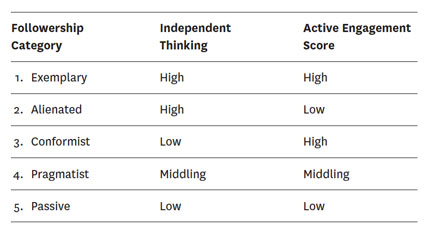
It seems to me that understanding the leadership-followership dynamic that exists in the school may promote inclusivity, transparent interaction, and authenticity for all members of the school community. Such clarity helps to develop trust and loyalty. If the relationships within the school are authentic, then the school community will also be authentic, there will be honesty and openness, and a sense of trust and safety will prevail. Wheatley compares these relationships to a spider’s web:
Most of us have had the experience of touching a spider web, feeling its resiliency, noticing how slight pressure in one area jiggles the entire web. If a web breaks and needs repair, the spider doesn‘t cut out a piece, terminate it, or tear the entire web apart and reorganize it. She reweaves it, using the silken relationships that are already there, creating stronger connections across the weakened spaces.[9]
Conclusion
Kelly emphasizes the importance a leadership-followership balance in healthy, democratic schools, where webs of relationships are developed by reaching out to each other; by trying to understand and be true to ourselves (authentic); and by trying to understand and appreciate one another. These same understandings can be applied to children in the classroom. Educators must become students of their students.
Effective leaders, says Kelly, are people who “have the vision to set corporate goals and strategies, the interpersonal skills to deliver consensus, the verbal capacity to communicate enthusiasm to large and diverse groups, the organizational talent to coordinate disparate efforts, and above all, the desire to lead.”
Effective followers “have the vision to see the forest and the trees, the social capacity to work well with others, the strength of character to flourish without heroic status, the moral and psychological balance to pursue personal and corporate goals, and above all, the desire to participate in team effort for the accomplishment of some greater common purpose.”[10]
We need both in our schools.
EN BREF – De nombreux livres traitent des différents styles, caractéristiques, résultats et finalités du leadership dans les écoles. On a beaucoup moins écrit sur le suivisme. Or, pour qu’il y ait des leaders, il doit y avoir des suiveurs. Comprendre la dynamique leadership-suivisme d’une école peut donc promouvoir l’inclusivité, l’interaction transparente et l’authenticité pour tous les membres de la communauté scolaire. Cette clarté contribue à développer la confiance et la loyauté. Robert Kelly décrit sept voies de suivisme qui contribuent à comprendre le rôle que joue chaque membre de l’équipe-école dans les rapports leadership-suivisme : apprenti, disciple, protégé, camarade, loyaliste, rêveur et mode de vie. Compte tenu du virage vers la démocratisation des écoles et du recours aux équipes-écoles pour développer des politiques, des curriculums, des plans d’écoles et des célébrations scolaires, les rapports entre les leaders et les suiveurs d’une équipe sont devenus critiques pour réaliser les objectifs et les résultats visés.
[1] Robert Kelly, The Power of Followership: How to Create Leaders People Want to Follow and Followers who Lead Themselves (New York: Doubleday Currency, 1992).
[2] Carolyn Crippen, “Serve, Teach, and Lead: It’s all about Relationships,” Insight: A Journal of Scholarly Teaching 5 (2010): 27-36.
[3] Robert K. Greenleaf, Servant Leadership: A Journey into the Nature of Legitimate Power and Greatness (Mahwah: Paulist Press, 1977): 3-4.
[4] Robert Kelly, “In Praise of Followers,” Harvard Business Review (November, 1988): 51.
[5] Robert K Greenleaf, The Servant as Leader (Indianapolis: The Robert K. Greenleaf Center, 1970), 7.
[6] Greenleaf, 1977.
[7] Larry Spears, ed., The Power of Servant-leadership: Essays by Robert K. Greenleaf (San Francisco, CA: Berrett-Koehler Publishers, Inc., 1998): 114.
[8] Kelly, 90-97.
[9] Margaret Wheatley, Leadership and the New Science: Discovering Order in a Chaotic World (San Francisco: Berrett-Koehler Publishers, Inc., 2006), 145.
[10] Kelly, 1998, 142.
-
Reading with Junior: A Project in Family Literacy
Comments Off on Reading with Junior: A Project in Family LiteracyFor several years now, the media have been calling attention to the fact that boys don’t read well, or that they don’t like to read. Multiple reasons are called upon to explain this phenomenon, most notably the absence of a male role model in the school environment. However, when examining the situation more closely, it is clear that boys do read, just not necessarily what the school environment prefers them to read. Indeed, they often prefer to read game books such as Dungeons and Dragons, newspapers, documentaries, magazines, practical books, or even recipe books! They rarely read – and even more rarely appreciate – novels. Yet, schools place more importance on novels, based on the faulty belief that they represent “real reading”.
In 2007, we proposed a project designed to motivate male pupils with reading difficulties by taking into account their particular interests. The project was initiated in Estrie, at Notre-Dame-du-Sacré-Cœur school, in Quebec’s Commission Scolaire des Hauts-Cantons.
Setting up the project
Our idea was to team up a Grade 3 male elementary school pupil with reading difficulties – or with no motivation to read – with a parent (preferably a father) and a male student in a preschool and elementary school teaching program. The initial goal was to train three such trios.
A number of factors contributed to the development of this project. First, several researchers have turned their attention to the family-school-community relationship and have shown that parents’ involvement in the school progress of their child has an impact on building self-esteem, lowering the rate of absenteeism, and increasing appropriate school behaviours.1 Hoover-Dempsey specifies that the response of parents is greater when the invitation to participate in an activity comes from children.2 In addition, various studies on family literacy projects show that these programs enable parent and child to develop a special bond.3 A few researchers, who have turned their attention more specifically to fathers’ involvement in such projects, note that fathers become involved when given the opportunity, and that their reading strategies – although sometimes different from those proposed by the program – are effective.4
In the Reading with Junior project, each member of the trio was given a well-defined role. The pupil’s role was simply to participate in the project; the university student’s role was not to teach reading, but to present different types of readings to the pupil, to follow him in his choices of reading, and to read with the him and his parent – to become, as it were, a “Big Brother” of reading. The parent’s role was to participate in the reading activity and to guide the university student to a better understanding of his child’s interests.
The Unfolding of the Project
This project, which has been ongoing since 2008, takes place during the winter because, by that point in the school year, teachers of both the participating elementary students and the participating university students have a chance to determine who would benefit most or be the most appropriate participant in the program.
So as not to overwork the participants, the project unfolds over four months, with six meetings for each trio. The pupil can decide to end the project at any time, but neither the university student nor the parent can make this choice. Meetings are held at the place and time chosen in advance by the trio. It is important to mention – and to impress upon all participants – that there are no expectations with regard to results. It is not possible to “fail” in this project.
It is important to mention – and to impress upon all participants – that there are no expectations with regard to results. It is not possible to “fail” in this project.
The selection process begins at the university, where professors introduce the project to male students and invite them to participate. Once the number of number of participants is determined, the professor, a specialist in family-school-community relationships, contacts the school principal, who becomes the link between the school, the families, and the university. If, at any point during the program, any member of the trio has a problem, it is the principal who contacts the professor-coordinator to find a solution.
The task of the classroom teacher, in cooperation with the special education teacher, is to target a number of boy-pupils who have reading difficulties or who are not motivated to read, and to match the number of university students available.
At an initial organizational meeting, the professors and students meet with the school principal, the classroom teacher, and the special education teacher. The purpose of this meeting is to give the university student members of the trios an opportunity to learn about the school environment, the participating pupils (strengths, weaknesses, what they like or dislike, etc.), and the pupils’ families. Following this introductory portion of the meeting, the parents and children join the university and school personnel. During this part of the meeting, professors and students question the pupils on their reading interests – and learn, invariably, that boys detest princess novels! The professors explain the project to the parents, and the trios are established.
Professors and students question the pupils on their reading interests – and learn, invariably, that boys detest princess novels!
Meetings of Trios
Trios meet a total of four times on their own, every two or three weeks. Meetings held at closer intervals are burdensome for participants, whereas meetings scheduled farther apart can lead to disinterest. The length of these meetings varies, depending on the trio (often from one to two hours). Trio members decide among themselves what will be accomplished and also determine how long it will take.
At the request of school professionals, we added a meeting in mid-course for all participants except the children to report on where the trios are situated in the project.
The final meeting involves all participants in the Reading with Junior project: the trios, school principal, classroom teacher, special education teacher, and two professors. It is the occasion to gather impressions from everyone on the project, changes noticed in pupils, strong points, weak points, as well as possible improvements. During this evening, the university students hand out books to the pupils, based on their personal interests, along with a certificate showing their participation in the project.
Outcomes
This innovative project involving family, school, and university has been fruitful on many levels. All participants have made positive comments about the project and wish to see it repeated every year. The parents (father, grandfather, stepfather) have all noticed a new openness to reading on the part of the child. Some younger brothers even asked to participate in reading with their fathers, turning the trio into a foursome. Some families learned that reading a magazine on hunting and fishing was as relevant as reading a novel, or that a parlour game required as much reading as a book. And several parents were surprised by their children’s depth of knowledge.
School personnel observed that pupils were less opposed to reading in class, that they developed more positive attitudes towards reading, and that, in some instances, behaviour problems were reduced.
School personnel observed that pupils were less opposed to reading in class, that they developed more positive attitudes towards reading, and that, in some instances, behaviour problems were reduced. The teacher in special education even remarked that the project enabled some pupils to obtain better results more effectively than did her own interventions. The project has also had a positive impact on the family-school relationship. Some families stressed that they felt honoured that the school had thought of them for this project and wished it could be realized on a grander scale. The principal has noted a new openness with parents – commenting that it is no longer unusual to be greeted by parents when they meet on the street.
It is important to note that pupils who participated in Reading with Junior during the first years have maintained improvements in attitude and behaviour.
As for the university students in the preschool and elementary teaching program, Reading with Junior enabled them to live a unique experience that cannot be experienced during periods of internship or during the daily life of a teacher. They also discovered that pupils have their own interests in reading. For example, one boy had more of an appreciation for documentary books, while another noticed that it was more difficult for him to read a book with illustrations in colour, because the colours distracted him.
In addition, this project allowed pre-service students to get a better handle on certain family realities and understand that circumstances, rather than a lack of willingness, may explain why some parents are not more involved in their children’s education (for example, a family with four children or parents who work at night).
Conclusion
This project has been repeated by other schools, with adjustments to meet the particular environment or resources at hand. For example, one school chose to conduct the project with male retired teachers, whereas another uses students at college level. Regardless of where the mentor is from, Reading with Junior works for a variety of reasons.
- The fact that no results are expected removes an enormous burden from the shoulders of participants. Pupils are not obliged to read, as they are in school, since the objective is really to develop the motivation to read. Also, mentors do not teach, they accompany the child on his reading journey by presenting different types of books to him (newspapers, comic strips, magazines, etc.), by allowing him to reject a book, to not finish reading it, to find some books boring, and to read anywhere he feels like.
- The professor-coordinator’s knowledge of students or the school principal’s knowledge of retired teachers makes recruiting easy, since the relationships are already present.
- The autonomy of the trios in setting their own schedule and agenda contributes to the project’s success.
- Finally, the project owes part of its success to the recognition of each one’s expertise; this project could not have taken place without the presence of all partners.
The Reading with Junior project is a simple project that pays significant dividends on several levels.
EN BREF – Le programme Lire avec fiston consiste à jumeler un garçon de troisième année qui éprouve des difficultés en lecture – ou qui n’aime pas lire – avec un parent (de préférence le père) et avec un étudiant masculin au baccalauréat en enseignement au préscolaire et au primaire. Le rôle de l’élève consiste tout simplement à participer au projet et celui de l’étudiant universitaire, à présenter à l’élève différents types de lectures et à lire avec l’enfant et son parent. Le parent a pour rôle de participer à l’activité de lecture et de guider l’étudiant pour qu’il saisisse mieux les intérêts de son enfant. Le personnel enseignant a observé que les élèves participants étaient moins rébarbatifs à la lecture en classe, qu’ils avaient développé des attitudes plus positives envers la lecture et que, dans certains cas, les problèmes comportementaux avaient diminué. Certains parents ont souligné l’amélioration des relations à la maison.
1 K. V. Hoover-Dempsey, J. Walker, H. M. Sandler, D. Whetsel, C. Green, A. Wilkins, and K. Closson, “Why do Parents Become Involved? Research Findings and Implications,” Elementary School Journal 106, no. 2 (2005): 105-131; J. Epstein, School, Family and Community Partnerships (Boulder: Westview Press, 2001).
2 Hoover-Dempsey.
3 J. Anderson, A. Anderson, N. Friedrich, and K. J. Eun, “Taking Stock of Family Literacy: Some Contemporary Perspectives,” Journal of Early Childhood Literacy 10, no. 1 (2010): 33-53; L. Baker, “The Role of Parents in Motivating Struggling Readers,” Reading and Writing Quarterly 19 (2003): 87-106.
4 A. Morgan, C. Nutbrown, and P. Hannon, “Fathers’ Involvements in Young Children’s Literacy Development: Implications for Family Literacy Programs,” British Educational Research Journal 35, no. 2 (2009):176-185; O. N. Saraho, “A Literacy Program for Fathers: A Case Study,” Early Childhood Educational Journal 35 (2008): 351-356.
-
Cdn EdWire – It’s all about the B.C. Teachers
Comments Off on Cdn EdWire – It’s all about the B.C. TeachersB.C. teachers’ contract bill set to become law – CBC
Opinion: B.C. Liberals want nothing less than a makeover of the education system – Vancouver SunB.C. teachers begin pulling out of extracurricular activities – Globe and Mail
School Dispute: Just the Facts, Please – The Tyee
Ministry of Education and teachers’ union debate whose facts are more factual.B.C. teachers to strike Monday to protest ‘arrogance’ and ‘cynicism’ of government – Vancouver Province
Special-needs, low-income kids hardest hit: advocate – Vancouver Sun
Parents may have to take time off work, often without payCrosscheck: How B.C. teachers rank in Canada – Globe and Mail
OTHER NEWS
Want to buy into a ‘top’ school? Real estate company ranks areas by test scores – Toronto Star
Across Canada, cash-strapped governments target education – Globe and Mail
‘Weekend Warriors’ battle for higher EQAO test scores – Toronto StarPeterborough doctors, psychologists say closing high school will affect student health, and mental health – Toronto Star
Gay parents take issue with how Catholic schools handle homophobia – Toronto Star
Home-schoolers force amendment to Bill 2 – Calgary HeraldTeach all kids about residential schools: report – Vancouver Province
Ignorance of harrowing history hampers solutions to First Nations’ current problems, says TRCParents fight for Arabic program – Calgary Herald
Board says no teachers availableCoalition vows to ‘continue the fight’ – Montreal Gazette
More pressure on province’s politicians and school boards needed, group saysMandatory religion course doesn’t infringe on freedoms, top court rules – Globe and Mail
INTERNATIONALTelling students it’s okay to fail helps them succeed — study – Washington Post
EDUBLOG HIGHLIGHTSEmotional Labour – at the Heart of Teaching – Shannon in Ottawa
This labour of digging deep with students holds in it the most robust potential for realizing true change in education. Engaging with individual students and relentlessly seeking the learning opportunities and connections that will bring their passions, curiosity and motivation to the surface creates learning spaces where tomorrow’s leaders are born….Read MoreEvery Education System Gets the Union It Deserves! – Teaching Out Loud
At the recent Ontario Education Research Symposium, OECD’s education front man, Andreas Schleicher surprised the audience by his response to Michael Fullan’s question about union efficacy around the world: ”In one way, I think that every education system gets union they deserve.”Schleicher went on to suggest, ”If you have an education system…twentieth century…an industrial environment… where basically you have a big production factory, you tell teachers what to do, you put them into the classroom, you tell to them to work in a standardized way, then what you’re going to get is an industrial union that is very good at defending the rights of those kind of people.”...Read more
-
Sir Ken Robinson: How You Can Change Education in Canada
Comments Off on Sir Ken Robinson: How You Can Change Education in CanadaSir Ken Robinson, International Education Leader, shares his thoughts on transforming public education.
-
Please take the CEA/Ipsos Attitudes Toward Public Education Survey
Comments Off on Please take the CEA/Ipsos Attitudes Toward Public Education SurveyIt’s my pleasure to launch the 2012 CEA/Ipsos Public Attitudes Towards Public Education Survey. Over the years, CEA has explored different questions with Canadians through our national surveys. This year, we want to examine your views on innovation and change in public education.

-
Cdn EdWire – Drummond Report Dominates Canada’s Education Discourse
Comments Off on Cdn EdWire – Drummond Report Dominates Canada’s Education DiscourseEducation cuts ‘misguided’ and ‘shocking,’ say experts – Toronto Star
Drummond report: Sweeping education reforms recommended – Toronto Star
Drummond Report: School boards fear loss of independence – Toronto Star
An argument against $$ for smaller classrooms – Vancouver Sun
Blunt Drummond report urges tough cuts to eliminate Ontario’s deficit – Postmedia
OTHER NEWS
Quebec law targets bullying – Postmedia
Schools required to establish partnerships with police, social agencies in their areaComputers in classrooms don’t guarantee better education: report – Canadian Press
Reconsider Wi-Fi in schools, Ontario’s Catholic teachers warn boards – TO Star
Using technology in the classroom requires experience and guidance, report finds – Globe and Mail
Planning a school for the future – Regina Leader Post
Girls more likely than boys to feel depressed, survey finds – Postmedia
Female adolescents struggling with loneliness and isolationChildren ask Harper to ‘Have a Heart’ and improve education on reserves – Postmedia
Ottawa expected to argue it’s not responsible for services deliveredAlberta’s proposed Education Act targets schoolyard bullies – CBC
Aboriginal struggles at elite school reveal stark realities in Canadian education – Globe and Mail
N.S. to import Alberta’s math program – Halifax Chronicle Herald
EDUBLOG HIGHLIGHTSDifferent Perceptions – Doug — Off the record
It was perfect timing, I suppose. It’s the day that the Report “Commission on the Reform of Ontario’s Public Services” on cost savings ideas in Ontario. The Huffington Post posted this article about how students see budget cuts affecting them. It’s not directly comparable as the survey data is from the US but it is interesting to see perceptions. The article is an interesting read – take the time – and at the end, a survey from students asked them where they thought that cost savings could be made in education…Read moreDriving Innovation in K-12 – The Culture of Yes
Some assumptions for the next 5 years:• Teachers and schools are status quo (sense of community/social-emotional learning)• Learning, not technology, is the driver• Good writing (and what we often call “the core” curriculum) still matters• Complex problems often have a simple solution• External inventions (like the iPad) will continue to impact what we do, and we have no control over this!• Teachers need to know where to begin: “personalization” and “digital literacy” are broad and ambiguous terms, so we need to narrow the framework• We can’t wait for the decisions of others. It is ”go” time…Read moreWhat Your Rules Say About You – At the Principal’s Office
Rules, rules, rules, everyone knows the key to success in school is to follow the rules.Unfortunately, this belief persists in many of todays classrooms and schools. Next time you are in a classroom take a look at the posted rules. Are they rules such as “no talking while the teacher is talking, stay in your desk during work time, raise your hand if you need help?” If so, I think these rules say a lot about the teacher, the work environment and the level of meaningful engaging tasks. They imply that the teacher is the only one who holds the knowledge, the teacher will give you great wisdom and knowledge if only you will listen and the work you undertake will be solitary and designed to measure how well you listen..Read More -
Cdn EdWire: “Respecting Differences Clubs” = Gay-Straight Alliances
Comments Off on Cdn EdWire: “Respecting Differences Clubs” = Gay-Straight AlliancesGay-straight alliances become Respecting Differences clubs – Toronto Star
Catholic schools fail to support gay students with their new club policy – Toronto Star


IDEAS TO SUPPORT EDUCATORS : Subscribe to the EdCan e-Newsletter
Quality research, reports, and professional learning opportunities.