Archive
-
Reflections on My BEd Program
Comments Off on Reflections on My BEd ProgramOne year into his teaching career, a recent graduate reflects on the value – and limitations – of his BEd program.
It’s the spring of 2013 and I’m sitting down with my supervisor in my co-operating teacher’s office. On the last day of my first field experience, I’m incredibly anxious to receive my evaluation. My supervisor starts with something like, “How do you think you’ve done this week?” I begin by explaining how professionalism is one of my core values but she immediately cuts me off. “And that’s the key: professionalism. And you haven’t acted very professional thus far.” Due to a misunderstanding on my part (more on that later), I was absent from first period and had not notified the school. In an instant, all my accomplishments from my placement are disregarded and reduced to this single incident.
I believe my supervisor’s reaction is a fair example of how many, not necessarily most, student teachers are treated during their teacher training program. While my perspective is that of only one person, I believe it is valuable to share as it can be very difficult to obtain a forthright account of student-teacher placements. After five years in the education department, and a year as a classroom teacher, my assessment of teacher preparation programs is that there are a number of areas that may be improved in the course work and practicum components.
A course on how to teach a course
A number of teachers will proclaim that the classes in teacher training programs are useless. In truth, like any class at any level of education, you get what you put in; if you have a genuine interest in the subject and bring passion to your projects, then you will learn much from the course. However, even the most riveting topics may seem a waste of time if the course format is the traditional lecture/note-taking session. It is unfortunate that professors are choosing to transmit content in this way, when they should be acting as models for the latest, and most effective, practices in teaching. Unfortunately, this is still the case, in part or whole, for many of the undergraduate courses in education departments.
For instance, one of my first methods courses was on Canadian history. This was a course offered by the Education Department and the instructor was a professor of Education. As such, one might expect a model for high quality social sciences teaching. This was not the case; the professor literally read slides to the class while we took notes. That’s all it was: no skill building, no pedagogical practice, just learn this stuff and repeat it back on a test. Since I could read on my laptop in 30 minutes what the instructor covered in 60, and since the syllabus specified that attendance was not marked, I simply stopped attending, coming only for the three required exams.
Of course, actions have consequences, and I was prepared to face them. The professor asked to meet with me regarding my attendance and he explained to me how, as a teacher, I’ll often have to do things I don’t like and attend meetings which I would rather not attend. I’m not sure that this was meant to encourage me to go into the teaching profession.
Why can’t we be constructivists?
To my professor, I posed the question, “May I speak to something constructive? What if, in future years, the course would have more class discussions, team projects, or interactive segments?” The response was that students would probably just fool around or have side conversations during any non-lecture time. Of course, this is precisely what our professors of education must coach us on: how we may engage our students in a fun and interactive way, while holding their attention and keeping them on task. It is unfortunate that the professor did not feel comfortable modeling these strategies with the next generation of teachers.
Is it fair to take my experience from a single class and generalize it across all education courses? Of course not. However, the experience made me think of three takeaways. I would hope that, even if viewed in a vacuum, the recommendations seem reasonable and proactive as a way of enhancing teacher preparation:
- Education professors should embrace pedagogical practices grounded in the research of their peers.
- Professors should be open to feedback from their students and allow them to have more control over their course (in keeping with constructivist frameworks).
- Teacher training courses should be challenging and used to develop pedagogical skills.
The fly in the ointment
A field experience should be the best part of every teacher training program; it’s a chance to be in the classroom and practice doing the job that you’ve been training for. I remember being incredibly excited for my first placement; every morning I would get up early, choose a stellar tie, and have breakfast at the café near my host school. It was a cool experience because all the science teachers were doing their practicum at the same time, at the same school. This meant we could go out for lunch together and talk about our experiences.
While the first placement is meant to be strictly observation, my co-operating teacher (CT) let me teach a couple of lessons. At this point, I was learning super basic teacher stuff (wait time after asking a question, choosing high-quality photos for lessons, etc.). I felt quite accomplished by the end of the week.
On the last day, the schedule worked out that I did not have a class to observe. I thought this would be a perfect opportunity to get some planning done as I had volunteered to teach another lesson that day. At this point in my training, it never even occurred to me that I should be in the school even if I didn’t have a class; I thought nothing of taking time to plan my lesson from home.
I arrived at school for second period and went to my CT’s class. She asked me where I had been during first period. From her tone, I knew that something was wrong. I offered the truth: that I was planning today’s lesson from home. She scolded me and I was a bit down for the rest of the day – particularly because my supervisor would be there that afternoon for my evaluation.
Unfortunately, my lesson didn’t count in my evaluation as this was an observation placement. Essentially, the entire meeting for my evaluation was criticism of the non-constructive variety. Without hyperbole, not a single positive aspect of my field experience was mentioned. Nevertheless, I was moving on to the next practicum.
Why was my placement considered a success rather than a failure? After comparing notes with my colleagues, it became apparent to me that the evaluation was scored arbitrarily. The numbers didn’t seem to match what was said in the meeting nor the comments written in the report; this seemed to be the case with my colleagues’ evaluations as well.
Professors… should be acting as models for the latest, and most effective, practices in teaching.
Unlimited power
A field experience is extremely challenging to judge because it is so personal to the student teacher. It is even more complicated to judge the student-teaching system as a whole because each supervisor and CT are as unique as their own personality. I have had wonderful supervisors and CTs, but I chose the story of my first placement to showcase the incredible power that the supervisor has in the system. Unlike in coursework, where a student is judged on strict criteria, my university allows supervisors and CTs near-absolute discretion to pass or fail a student teacher. I was fortunate that my supervisor decided on a pass. However, I know many of my former colleagues were not so fortunate. In one incident, a supervisor wanted the student teacher to pass their practicum but the CT refused.
Why is the evaluation of the student teacher so reliant on the discretion of the supervisor and CT? As a current teacher, I wouldn’t be able to use my discretion to decide whether a student passes a class or not; I would be obliged to consider that student’s marks and the criteria for a pass.
Having said this, the expectations held by the CTs are not their fault because no one has trained them how to be CTs. Program coordinators may assume that, because CTs are teachers, they do not need any training to train others. Unfortunately, all they are provided with is a piece of paper with what to look for in a good student teacher. This means that there are often hidden expectations which may not come to light until your CT has already written your evaluation. Sometimes, those expectations are quite unreasonable. For instance, the experience of a number of my colleagues has been that, by the final placement, some CTs consider that a student teacher’s role as a learner is essentially over. Instead, they expect that the student teacher is there to show what they can do as an independent teacher; requests for guidance or advice may be met with scorn or the idea that, if you have to ask, maybe you’re not ready to be a teacher.
Lessons from Year One
On my first day as a full-time teacher in a small, rural high school, I stood in front of about 20 twelve-year-olds, ready to introduce myself as their Math and Science teacher. I thought about what I’d learned during four years of preparation, and there was no doubt in my mind that the most important place to start was by building a relationship with my students. We did talk a bit about what we would learn that year and classroom expectations. Yet most of the time was spent discussing what students did over the summer, what books they read, what video games they played. As I was new to the school, I let them ask questions about me on a personal level (with discretion).
As the weeks and months went on, I realized that I was fairly competent with the soft skills required of teaching: relationship building, classroom management, lesson planning, etc. The greatest learning curve seemed to be keeping up with the course itself, and those nitty-gritty things like pacing a chapter, the best way to engage students in certain topics, the amount of time explaining concepts compared to the time when students are working independently or in teams.
There were several instances in the Math and Science courses where I felt that I was learning the material the day before I was meant to teach it. This was not because the subjects were overly complicated; they were simply facets which I had not explored when I was in secondary school myself. This made lesson planning, particularly, more challenging and stressful at times.
Moreover, at university, it was understood that the provincial curriculum documents were the bible for teachers. In fact, the end-of-year exam tends to line up more with the textbooks, and workbooks, which are chosen by the school board. In many ways, this makes sense; students’ class work should prepare them for what to expect on the exam. For instance, the curriculum may say that a student must be able to construct a histogram by the end of Grade 8, but it is actually evaluated at the end of Grade 7; the only way to know this is if a teacher is familiar with the workbook being used for that course. This may be a critical piece missing from teacher training programs: to provide future teachers with the opportunity to work with authentic classroom tools that their students are expected to use. This is a practice which should extend beyond field placements.
A new direction for teacher induction
Having been a full-time teacher for a year, I am a big fan of the Western Quebec School Board (WQSB)’s Teacher Induction Program (TIP). The program is provided to all teachers who are new to the school board, regardless of how many years of experience each teacher comes with. This is a great opportunity for teachers of varying levels of experience to learn from each other while reinforcing the mantra that teachers are lifelong learners.
Part of what makes this program worthwhile for me is that I am able to develop professional skills of my choosing with the aid of a mentor-coach who helps me synthesize SMART goals (specific, measurable, attainable, relevant, timely). In addition, I don’t have to worry about being a burden on my mentor-coach, because they are given additional compensation for their time.
Drawing on the experience from my placements and from my school board’s TIP:
- Student teachers should be able to set their own goals and define what success will look like for themselves. This will allow student-teachers to target what they personally believe will make them better as professionals and feel that their training is valuable.
- Universities must prioritize the student aspect of the student-teacher role by emphasizing growth over achievement. By doing this, student-teachers won’t be afraid to ask questions and seek support from others. As a result, they will emerge from a much richer training experience and continue their profession as life-long learners.
- Provide training to CTs so that they may better support their student teachers, and provide compensation to CTs in consideration of their efforts. This would be a fundamental shift in how people view teacher training; if the training is important it is worth an investment of quality trainers. Teaching teachers is not the same as teaching children; by giving CTs training, their best practices are more readily passed down to the student teacher. As well, paying them would reinforce the premise that what they are doing is important and not simply an extra task tacked on to their existing job.
Every future teacher deserves a meaningful preparation program – one that allows those who are new to the profession to feel empowered and ready to lead a classroom of students on an adventure of discovery. Ultimately, as research-focused institutions, universities are well aware of what the best practices in education are. Now, the key is to implement those best practices in creating the teachers of the future.
Photo: iStock
First published in Education Canada, September 2018
-
2019 National Reading Recovery and Early Literacy Conference
Comments Off on 2019 National Reading Recovery and Early Literacy ConferenceThis Conference offers an outstanding professional development experience for K-3 teachers, literacy coaches, spec ed teachers interested in expanding common understandings and effective literacy practices to maximize young student achievements. The Conference is widely recognized as the country’s premier professional development experience for teachers of early literacy. Sessions are designed to present sound learning theory together with instructional best practices. Over two days, there will be keynote speakers, in depth workshops and a trade show of publishers with classroom materials.
-
Living by Design with Stress Resilience
Comments Off on Living by Design with Stress ResilienceAn extraordinary day with a line-up of Experts in the field of Integrative Health. Learn from Margaret Boersma, OCT how to increase your energy, access to happiness and how to lower the emotional temperature in a relationship. Marise Foster, Integrative Healing Practitioner and Trainer will support you in discovering how food effects our well-being and provide physical solutions for lowering stress. Carrie Rubel, Wellness Expert will give you ways to recognize a stress response and shift it. Then teach your students practical strategies to increase their stress resilience. Sign up today!
-
Young Child Expo
Comments Off on Young Child ExpoWe invite you to our 16th Annual Highly Rated Conference on April 30th – May 3rd 2019, join us for 4 days of early childhood conference presentations. Over 80 presentations. Continuing Education Credits Offered. Over 1,000 attendees expected. Topics for Typically Developing Children topics on Special Needs, Autism, Speech and other conditions
Target Audience
Teachers, Special Education Teachers, Principals, Directors, Speech, OT, PT Therapists, Psychologists, & Social Workers. -
A raw discussion about truth and reconciliation in Canadian schools
Comments Off on A raw discussion about truth and reconciliation in Canadian schoolsFour young Indigenous leaders shared with us their thoughts about what Truth and Reconciliation means to them and how that should be reflected in our schools…
Take in this powerful discussion…
This conversation inspired an article published in the Summer 2018 issue of Education Canada Magazine. Read Carrying the Fire.
Illustration: Don McIntyre
Music: “Perfect” by Ketsa Music/UTK Publishing (www.ketsamusic.com)
-
Learning and Teaching Together
Comments Off on Learning and Teaching TogetherA school culture of collaborative learning and teaching is key to the successful induction of new teachers, and grows the capacity of all teachers.
It’s time to ensure a paradigm shift for beginning teachers from “it feels like I am on my own” to “it feels like I am working with you and we are learning together.”
Recently, we witnessed first-hand how a new teacher’s confidence can be strengthened through collaboration with her more experienced colleagues. A team of primary teachers were engaged in a professional learning community with the goal of strengthening teaching and learning in mathematics. The teachers engaged in a variety of learning activities, including crafting learning intentions and success criteria that were in turn shared with their students. They also co-created lessons and volunteered to take turns teaching and observing. During one of their debriefing meetings, a first-year teacher revealed the following to her colleagues:
Our common planning and then observations have made me feel more confident in challenging my students. At the beginning of the year, when you all shared what you had your students doing – in my head I thought ‘my kids can’t do that’ but through our work together, I’ve seen otherwise.
This beginning teacher’s mathematics instruction was informed and adjusted based on classroom observation of her colleagues. Her increased knowledge about their practice helped to create a shift in her expectations for her students. She attributed successes (indicated by increases in students’ understanding) to the fact that “we had the opportunity to talk and eat lunch together” and that their collaboration and classroom observations “made us explain and question what we do.” In relation to an outcome resulting from the team’s collaborative efforts, she commented:
I am confident now that I have a role and that I can come in and contribute to the ‘build and explore’ (an aspect of the 3-part lesson plan) rather than just listen to you guys do it.
Understanding the lived experiences of beginning teachers is important if we are to provide appropriate supports which lay the groundwork for a thriving career.
Beginning teacher challenges
With a first contract in their hands, new teachers no doubt look forward to the responsibility and autonomy of having their own class and spend countless hours preparing their rooms, bulletin boards, and unit plans. However, as with any new challenge, and especially in environments where teachers tend to work in isolation, anxieties surface. Training and pre-service experiences, while valuable, are not the same as being totally responsible for a classroom of one’s own students. Research has confirmed that significant numbers of beginning teachers do not feel properly prepared in terms of classroom practice. A recent OECD report indicated that many new teachers felt more comfortable with their subject content than with actual practice and issues of implementation.2 When confidence wanes, it impacts our sense of well-being, our resilience, and our ability to take risks.
Beginning teachers, as Bryan Goodwin1 points out and practice substantiates, often have several foundational areas that shake their confidence, including classroom management and behavioural issues, assessment practices, and instructional planning. Assessment and instructional issues are intertwined, as a young teacher recently pointed out, because assessment “is not clear cut.” Assessment includes tracking student progress and understanding how to use anecdotal information for reporting and planning purposes. Purposefully selecting impactful instructional strategies and knowing how and when to provide modifications and accommodations come with experience and are not necessarily part of a new teachers’ repertoire.
If not addressed and supported, these areas also become reasons why teachers leave the profession. In particular, as our conversations with new teachers have illuminated, classroom management difficulties can greatly impact a teacher’s sense of competence and prompt some to quickly abandon dreams of being innovative in their delivery of daily lessons. Instead, they fall back on more traditional methods to simply cope on a day-to-day basis. It becomes an issue of feeling in control and is compounded if a teacher feels they must mask or hide their feelings or if they feel they are alone in trying to solve classroom issues.
It is important to add to the discussion the current shift in pedagogy for all teachers: the importance of incorporating an inquiry stance that utilizes key learning questions or ideas as the basis for student collaboration and learning. A 2016 mixed-methods study on the struggle of first-year teachers to implement inquiry instruction was telling. The study’s major finding was a consistent pattern among the first-year teachers’ perceptions of self-efficacy for inquiry instruction, and how they understood inquiry as a concept and actual classroom practice. Teachers with a high sense of self-efficacy were more likely to try to new strategies, adjust current ones, and persevere in the face of challenges.3 Teachers with a low sense of self-efficacy were unlikely to plan activities beyond their perceived capabilities or to scaffold for students who were having difficulties. This latter group of teachers identified a lack of time, materials, and the negative reactions of students as barriers to more innovative approaches and, not surprisingly, found it difficult to persevere in using an inquiry approach.
We must recognize that experiencing the inquiry process is a key underpinning to being able to effectively use inquiry as a learning design for students. Teacher inquiry as a collaborative learning design has become an increasingly powerful vehicle for professional learning, through its opportunities for reflective conversation, co-work and supported practice. However, it’s not common place to see this professional learning approach as part of a new teacher induction program. Collective efficacy can be a powerful outcome of this kind of learning when teachers have the structural supports to engage in co-learning efforts.4
The good news is that teacher confidence, feelings of preparedness, and skills can be increased through a variety of supports. A coach, mentor, peer as a co-learner, or principal who will not judge inexperience can be a pivotal person in making a difference for a beginning teacher who is feeling somewhat overwhelmed. Following, we highlight three strategic supports to teachers that go beyond initial induction training to professional learning through collaboration: mentoring, co-learning through collaborative inquiry, and coaching.
Mentoring
New teacher induction or support programs are a tangible key to success for many teachers. As a 2017 longitudinal study on the New Teacher Induction Program (NTIP) by Christine Frank & Associates for the Ontario Ministry of Education recently highlighted,5 teachers who were new to the profession identified a key support that was particularly helpful: mentoring from colleagues. To be clear, mentorship experiences appear to be on a continuum of effectiveness as highlighted in this report, but when teachers and mentors were a good match, the impact was significant. The report outlined important conditions for a successful mentoring relationship for new teachers such as:
- Having a mentor or colleague willing to share information, advice and resources that were relevant and helpful
- Co-creating new ideas for classroom program delivery
- Receiving support and encouragement
- Feeling safe to make mistakes and ask questions
- Collaborative work and problem solving.
As one fortunate participant in the study was reported to say: “Having a mentor in the same subject area, we work a lot together, co-planning and co-teaching, she helps me go further in my planning and teaching. I feel very lucky.”6
Personal support from the principal is also vitally important. Ongoing feedback and encouragement from the principal was seen as integral to growth in the NTIP program during its recent year one report in Ontario. The principals’ ability to be present, to listen attentively, to be intuitive to the needs of new staff and to provide tangible support such as an appropriate mentor and/or coach speaks to core administrative and leadership knowledge.
Collaborative inquiry
In a parallel process to inquiry teaching and co-learning with students, developing a co-learning culture where novice and experienced teachers take on supporting each other and where the principal is him- or herself a co-learner now represents the next level of leadership behaviour needed.7 Realistically, structural and organizational issues such as time to co-reflect have to be addressed to grow co-learning efforts. In recent research,8 the following views on how school leaders can build a collaborative learning culture were expressed:
- Creating a culture of safety and risk-taking
- Maintaining a clear focus
- Modelling co-learning
- Empowering others to lead and share decision making
- Demonstrating strong facilitation skills.
In a highly developed co-learning environment, beginning teachers have the opportunity to co-assess, co-plan, co-teach and co-debrief lesson impact with a variety of other educators. These could be teaching peers, a coach and/or a cross-school network. Admittedly, time constraints restrict co-learning opportunities, but according to longitudinal research from 2012-2015 completed for the Ontario Ministry of Education, there is a strong correlation between classroom observation and peer debriefing as part of a lesson design, and growth in instructional practice. Learning together is a powerful construct for adults as well as students.
At its core, a co-learning culture models what we know about high-quality professional development. It should be focused around challenges of practice and learning in the classroom. In co-learning, student work can be the impetus for collaborative conversations about what students understand and what next steps for instruction might be. Co-assessment of student learning, co-planning of subsequent lessons, co-analysis of student work and co-reflection on student learning fuels deeper learning and builds a sense of individual and collective efficacy. We know that a scaffolded approach is beneficial for students. Why would it not be beneficial for new professionals as well?
Using an inquiry approach to co-learning allows experienced and new teachers to contribute to problem solving with equitable voice while relationships, trust, and safety are nurtured and reinforced. Leaders (administrators and teacher leaders) who take the time to be co-learners with others build learning relationships in their schools more easily. Leaders who model their own vulnerabilities as learners encourage others to take risks and share learning experiences. Co-learning benefits from the underpinning of skillful facilitation,9 which can be taught as a leadership skill.
Until policy allows, not all teachers are in a position to co-assess, co-plan, co-teach and co-reflect, even though many express this is what they would really like to experience. In small schools without common preparation times, timetabling is a barrier that often stands in the way of the development of a co-learning culture. System leaders need to advocate for professional co-learning time to allow collaborative learning designs to take root.
Coaching
Taking the time to provide some purposeful coaching to staff who need specific assistance also helps to build cultures where professionalism is perceived as highly valued. Coaches may be teachers or school leaders and can provide feedback, ask questions to probe further thinking, and model practices that may be new to some. Acting in the role of a knowledgeable other or instructional resource as well as a partner in learning, coaches bring a depth of understanding about appropriate assessment and instructional responses to the interaction with beginning teachers. Jim Knight10 describes a coach as a thinking partner for teachers, and coaching as a meeting of the minds.
WORKING TOGETHER, these three areas of support – mentoring, co-learning through inquiry and coaching – move the notion of “collaborative professionalism” forward. This term, as used by Fullan and Hargreaves,11 is premised on the understanding that teaching has become an interdependent profession that requires structural adaptations, like time-table flexibility and opportunities for sustainable professional learning, to be integrated into system thinking.
Co-learning using an inquiry design is a process that recognizes and values teachers as drivers of school improvement, as opposed to being targets for improvement. System and school leaders must be the cultivators of vibrant co-learning cultures. System thinking about teacher induction must evolve from being a support during a defined time frame to induction into a collaborative community of learners where growing one’s capacity is encouraged at all stages of a teaching career.
Notes
1 OECD, “Do New Teachers Feel Prepared for Teaching?” Teaching in Focus 17 (Paris: OECD Publishing, 2017). http://dx.doi.org/10.1787/980bf07d-en
2 B. Goodwin, “Research Says/New teachers face three common challenges,” Educational Leadership 69, no. 8 (May 2012): 84-85.
3 T. Chichekian, B. M. Shore, and D. Tabatabai, “First-year Teachers’ Uphill Struggle to Implement Inquiry Instruction: Exploring the interplay among self-efficacy, conceptualizations, and classroom observations of inquiry enactment,” SAGE Open (April/May 2016): 1-19. http://journals.sagepub.com/doi/pdf/10.1177/2158244016649011
4 R. Goddard, Y. Goddard, E. Kim and R. Miller, “A Theoretical and Empirical Analysis of the Roles of Instructional Leadership, Teacher Collaboration, and Collective Efficacy Beliefs in Support of Student Learning,” American Journal of Education 121 (2015): 501-530; J. Donohoo, Collective Efficacy: How educator beliefs impact student learning (Thousand Oaks, CA: Corwin Press, 2017).
5 Christine Frank & Associates/Cathexis Consulting Inc., BTLJ Longitudinal Study: Year 1 (Ontario Ministry of Education, April 2017).
6 Ibid., 6.
7 L. Sharratt and B. Planche, Leading Collaborative Learning: Empowering excellence (Thousand Oaks, CA: Corwin Press, 2016); J. Donohoo and M. Velasco,(2016). The Transformative Power of Collaborative Inquiry: Realizing change in schools and classrooms (Thousand Oaks, CA: Corwin Press, 2016).
8 Sharratt and Planche, Leading Collaborative Learning.
9 B. Planche, Blog Posting: Deepening your Leadership Skills by Refining your Leadership Skills (April 17, 2017). https://thelearningexchange.ca/deepen-classroom-collaboration-refining-leadership-skills
10 J. Knight, “What Good Coaches Do,” Educational Leadership (ASCD, October 2011): 18-22.
11 M. Fullan and A. Hargreaves, Bringing the Professional Back In: A call to action (Oxford, OH: Learning Forward, 2016). https://learningforward.org/docs/default-source/pdf/bringing-the-profession-back-in.pdf
-
Self-Reg and Inclusive Schooling Face-to-Face Seminar
Comments Off on Self-Reg and Inclusive Schooling Face-to-Face SeminarDr. Susan Hopkins, executive director of The MEHRIT Centre, will engage participants, using an inquiry-based design, to explore the relationship between stress, is one of the key unaddressed issues in inclusive special education, and how Shanker Self-Reg can help educators to better understand and support students with special needs.
-
Self-Reg: A Great Tool for Early Kindergarten Educators – Face-to-Face Seminar
Comments Off on Self-Reg: A Great Tool for Early Kindergarten Educators – Face-to-Face SeminarSelf-regulation is now an important concept in Kindergarten education, one of the four frames of early learning in Ontario’s Full-Day Early-Learning Kindergarten curriculum. In this Institute Dr. Susan Hopkins, executive director of The MEHRIT Centre, will present and unpack the concept of self-regulation developed by Dr. Stuart Shanker.
-
Desjardins Coopérathon 2018
Comments Off on Desjardins Coopérathon 2018The 2018 Cooperathon will revolve around the tracks of finance, education, healthcare and energy.
The Cooperathon is both a platform and a movement. The platform is a place for learning and co-creating where projects with a big social impact take shape. The movement is a community of people and organizations who believe cooperation, innovation and entrepreneurship can make a positive difference in the world.
-
Your Top 10 Summer Reading List
Comments Off on Your Top 10 Summer Reading ListAre you seeking promising practices and the latest research and ideas from like-minded educator-leaders to challenge your thinking? Add these hand-picked articles from our Editor Holly Bennett to your summer reading list and boost your knowledge before the next school year begins!
EDUCATOR WELL-BEING
In this issue, we examine what can be done to support the well-being of all educators and reduce their levels of stress, role overload, and exhaustion. Many of our contributors make the very good point that the mental health of educators has a direct impact on the well-being of the students in their care; and that therefore we should support teachers’ well-being in order to ensure they are able to bring their best to their students.
- Creative Caring for Teachers: How a whole-school well-being approach can support everyone’s mental health
by Sue Roffey
- Healthy Principals, Healthy Schools: Supporting principals’ well-being
by Dr. Katina Pollock - Teach Resiliency: A resource for teacher and student wellness
by Susan Rodger, Kathryn Hibbert and Alan Leschied
WORKING WITH PARENTS
Parental engagement is a complex, double-edged issue that affects every level of education, from the student at home to provincial policy. From the importance of parent support to a child’s progress at school, to the tensions around parent advocacy for their children’s individual needs, to the political clout groups of parents can wield (for good or ill), this theme has many potential facets.
- The Missing Link: Parents are key players in sustainable educational change
by David Price - Bear With Me: Teaming up with parents of students with special needs
by Jeffrey MacCormack and Dr. Ian Matheson
SIGNALS OF CHANGE
In this issue, a cross-section of our network contributors – teachers, principals, superintendents, academics and students – explore how emerging big ideas could be creatively applied to education, why it may be important to do so, and the drawbacks or risks that need to be guarded against. From the aging population to micro-credentialing and artificial intelligence, what lies ahead for education?
- A Virtual Education: Artificial intelligence and virtual reality are changing the way we learn
by Lora Appel, PhD - Micro-credentially: Giving credit where credit is due
by Chris Cluff and Stephen Hurley
TRUTH AND RECONCILIATION IN THE SCHOOLS
How can teachers, who may know little themselves about Indigenous cultures and issues, authentically incorporate respectful, accurate information and experiences about Indigenous history, worldview, ways of teaching and learning, and contemporary issues into their classrooms? In this issue, we invite explorations of good practice examples, researchers’ insights on how we can “scale up” Indigenized learning, and other articles aimed toward helping schools move forward towards education for reconciliation.
- “First, We’re a School”: Teachers and school leaders play a key role in reconciliation, but policy makers must resource schools for equity of opportunity and success
by Dr. Gordon A. Martell - Truth and Reconciliation in YOUR Classroom: How to get started, and who can help
by Dr. Kate Freeman, Shawn McDonald and Dr. Lindsay Morcom
- Carrying the Fire: A youth talking circle on truth and reconciliation in our schools
by Dr. Michelle Hogue and Holly Bennett
Enjoy your summer!
- Creative Caring for Teachers: How a whole-school well-being approach can support everyone’s mental health
-
What is the impact of physical education on students’ well-being and academic success?
Comments Off on What is the impact of physical education on students’ well-being and academic success?Research confirms that healthier students make better learners. The term quality physical education is used to describe programs that are catered to a student’s age, skill level, culture and unique needs. They include 90 minutes of physical activity per week, fostering students’ well-being and improving their academic success. However, instructional time for quality phys-ed programs around the world are being decreased to prioritize other subject areas (especially math, science, social studies and English) in hopes to achieve higher academic achievement. However, several studies have identified a significant relationship between physical activity and academic achievement. Research also demonstrates that phys-ed does not have negative impacts on student success and that it offers the following physical, social, emotional and cognitive benefits:
Physical
Quality phys-ed helps students understand how exercise helps them to develop a healthy lifestyle, gain a variety of skills that help them to participate in a variety of physical activities and enjoy an active lifestyle.
Social
Quality phys-ed provides students with the opportunity to socialize with others and learn different skills such as communication, tolerance, trust, empathy and respect for others. They also learn positive team skills including cooperation, leadership, cohesion and responsibility. Students who play sports or participate in other physical activities experience a variety of emotions and learn how to better cope in stressful, challenging or painful situations.
Emotional
Quality phys-ed can be associated with improved mental health, since increased activity provides psychological benefits including reduced stress, anxiety and depression. It also helps students develop strategies to manage their emotions and increases their self-esteem.
Cognitive
Research tends to show that increased blood flow produced by physical activity may stimulate the brain and boost mental performance. Avoiding inactivity may also increase energy and concentration in the classroom.
Therefore, decreasing time for quality phys-ed to allow more instructional time for core curricular subjects – including math, science, social studies and English – is counterproductive, given its positive benefits on health outcomes and school achievement.
Additional Information Resources
PHE Canada (2018). Quality daily physical education. Retrieved from https://phecanada.ca/activate/qdpe
Ontario Ministry of Education. (2005). Healthy schools daily physical activity in schools grades 1‐3. Retrieved from http://www.edu.gov.on.ca/eng/teachers/dpa1-3.pdf
References
Ardoy, D. N., Fernández‐Rodríguez, J. M., Jiménez‐Pavón, D., Castillo, R., Ruiz, J. R., & Ortega, F. B. (2014). A Physical Education trial improves adolescents’ cognitive performance and academic achievement: The EDUFIT study. Scandinavian journal of medicine & science in sports, 24(1).
Bailey, R., Armour, K., Kirk, D., Jess, M., Pickup, I., Sandford, R., & Education, B. P. (2009). The educational benefits claimed for physical education and school sport: An academic review. Research papers in education, 24(1), 1-27.
Beane, J.A. (1990). Affect in the curriculum: Toward democracy, dignity, and diversity. Columbia: Teachers College Press.
Bedard, C., Bremer, E., Campbell, W., & Cairney, J. (2017). Evaluation of a direct-instruction intervention to improve movement and pre-literacy skills among young children: A within-subject repeated measures design. Frontiers in pediatrics, 5, 298.
Hellison, D.R., N. Cutforth, J. Kallusky, T. Martinek, M. Parker, and J. Stiel. (2000). Youth development and physical activity: Linking universities and communities. Champaign, IL: Human Kinetics.
Ho, F. K. W., Louie, L. H. T., Wong, W. H. S., Chan, K. L., Tiwari, A., Chow, C. B., & Cheung, Y. F. (2017). A sports-based youth development program, teen mental health, and physical fitness: An RCT. Pediatrics, e20171543.
Keeley, T. J., & Fox, K. R. (2009). The impact of physical activity and fitness on academic achievement and cognitive performance in children. International Review of Sport and Exercise Psychology, 2(2), 198-214.
Kohl III, H. W., & Cook, H. D. (Eds.). (2013). Educating the student body: Taking physical activity and physical education to school. National Academies Press.
Rasberry, C. N., Lee, S. M., Robin, L., Laris, B. A., Russell, L. A., Coyle, K. K., & Nihiser, A. J. (2011). The association between school-based physical activity, including physical education, and academic performance: a systematic review of the literature. Preventive medicine, 52, S10-S20.
Sallis, J. F., McKenzie, T. L., Kolody, B., Lewis, M., Marshall, S., & Rosengard, P. (1999). Effects of health-related physical education on academic achievement: Project SPARK. Research quarterly for exercise and sport, 70(2), 127-134.
Strong WB, Malina RM, Blimkie CJ, Daniels SR, Dishman RK, Gutin B, Hergenroeder AC, Must A, Nixon PA, Pivarnik JM, Rowland T, Trost S, & Trudeau F (2005). Evidence based physical activity for school-age youth. Journal of Pediatrics. 146(6):732–737.
Trudeau, F., & Shephard, R. J. (2008). Physical education, school physical activity, school sports and academic performance. International Journal of Behavioral Nutrition and Physical Activity, 5(1), 10.
Beane, J. A. (1990). Affect in the curriculum: Toward democracy, dignity, and diversity. Columbia University, New York, NY: Teachers College Press.
-
Celebrate National Indigenous Peoples Day
Comments Off on Celebrate National Indigenous Peoples DayOn June 21st, celebrate the heritage, diverse cultures and outstanding achievements of First Nations, Inuit and Métis!
The EdCan Network invites you to discover good practices, exemplary school programs and practical ideas for educators seeking to work towards truth and reconciliation in their schools and classrooms.
Add these books and magazine articles to your summer reading list and boost your knowledge before the next school year!
Articles for Educators
Carrying the Fire
A youth talking circle on truth and reconciliation in our schools
The Red Worn Runners
Intentional conversations with Indigenous youth
“First, We’re a School”
Teachers and school leaders play a key role in reconciliation, but policy makers must resource schools for equity of opportunity and success
Articles for Teachers, Teachers candidates and Principals
Truth and Reconciliation in YOUR Classroom
How to get started, and who can help
Our Journey Into Reconciliation
A Project of Heart at Stavely Elementary School
Books and Resources
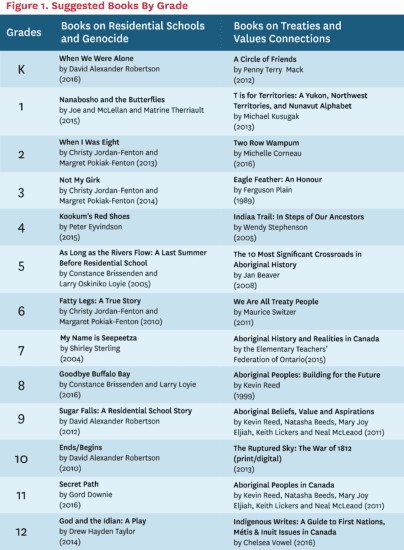
Download and Print the Figure
from Truth and Reconciliation, K-12: Becoming a teacher allyReport for non-indigenous educators in urban high schools
A guide on how urban high schools can raise Indigenous graduation rates
Reconciliation in Action: Creating a Learning Community for Indigenous Student Success
This step-by-step report can be used to create your own unique program in consultation and collaboration with local Indigenous communities.
Read the report
PRACTICAL HOW-TO VIDEOS FOR TEACHERS AND PRINCIPALS
We’ve also put together a series of student and educator video testimonials demonstrating how “culture is medicine” that gives students a sense of pride and a will to succeed.
TACKLING SCHOOL DROPOUT, PURSUING RECONCILIATION: WHY WE SHOULD TEACH AND CELEBRATE INDIGENOUS CULTURES AND KNOWLEDGE IN SCHOOLS
RECONCILING BROKEN PROMISES: ADVICE ON BUILDING PARTNERSHIPS WITH INDIGENOUS COMMUNITIES
CULTURE IS MEDICINE: CONFRONTING STEREOTYPES ON FIRST NATIONS PEOPLES
Articles for Faculty researchers, ministries of education and Superintendents
Reconciliation and Education
Where are we at in Nunavik?
The Best of Both Worlds
Bringing Mi’kmaw Knowledge and Western curriculum together
Join the conversation #IndigenousPeoplesDay, #NIPDCanada, #NationalIndigenousPeoplesDay
Are you celebrating the National Indigenous Peoples Day in your school?
-
Reconciliation and Education
Comments Off on Reconciliation and EducationThe theme selected for this issue of Education Canada resonates with Kativik Ilisarniliriniq,1 the school board of Nunavik. Weaved into our current activities, the goal of delivering Indigenized educational services and programs to Inuit learners animates our organization at all levels, from its elected representatives to pedagogical experts, teachers and school administrators.
Kativik Ilisarniliriniq was created in 1975, under a land claims settlement known as the James Bay and Northern Quebec Agreement (JBNQA). Negotiated after a major hydroelectric project in the James Bay received opposition from the Inuit of Nunavik, the James Bay Cree, and other Aboriginal groups, the agreement is a protected treaty under the Constitution of Canada.
The school board embodies Inuit-controlled education. Indeed, under the JBNQA, Kativik Ilisarniliriniq can exercise unique powers to develop programs and curriculum aimed at enabling Inuit students to preserve their language, culture and identity. Providing students with access to learning based on Inuit values, culture, language, history, worldview, and approaches to pedagogy is therefore at the core of our mission and vision.
As an organization, we approach education from a holistic perspective. The services we deliver – as well as the curriculum and programs we develop – are rooted in the Inuit definition of Inuguiniq, an education process that seeks to develop the human being as a whole through direct engagement with the environment and the community. This is clearly reflected in the school board’s 2016-2023 Strategic Plan.
Applied to curriculum development work, these fundamental principles have led the school board to innovate and rethink its curriculum development framework. Rather than looking for areas where Indigenous content could be inserted into existing provincial programs, we used an Inuit perspective to incorporate the Quebec Education Plan (and other global or Euro-centric approaches to education), into a framework driven by Inuit worldview, Inuit pedagogy, and Inuit values.
The resulting curricular framework builds on Inuit heritage: thousands of years of environmental and architectural knowledge, sustainable communities, and a sophisticated language and culture. Recently presented at the Inuit Education Summit, a conference organized by the International Circumpolar Council (ICC), this approach was validated by the strong support it received from the Inuit representatives of ICC member countries.
A curricular framework built on Inuit heritage truly aligns to the recommendations of the Truth and Reconciliation Commission (TRC). I believe it also presents the Quebec government, through its Ministry of Education, with a unique opportunity to demonstrate leadership in working alongside Kativik Ilisarniliriniq to implement the TRC recommendations that relate to education.
Concretely, when applied to Science and Technology, using a curricular framework built on Inuit heritage has paved the way to the development of programs such as Inuit Environmental Science. Grounded in Inuit culture and land knowledge, the program aims to teach the conceptual and skills-based competencies that will allow Nunavik youth to meet and even exceed the requirements for the Quebec Ministry of Education Science and Technology Cycle One and Two and Environmental Science and Technology Progressions of Learning.
The program structures learning around seasons, with units tying lessons to the Arctic fauna, flora and environment, as illustrated in Figure 1. The program is currently being introduced for review for accreditation by the Ministry of Education.
As the school board pursues its effort to “Indigenize/Inuitize” the education services, programs and curriculum it offers, support from the Quebec Ministry of Education is essential. The Idle No More movement, the work of the TRC and its recommendations, as well as the increased media attention that Indigenous issues have attracted since the last federal elections all contribute to an environment in which there is a more acute awareness of the necessity to do things differently for reconciliation to become a reality.
As it currently stands, the Canadian public education system does not provide learners, Indigenous and non-Indigenous, with much in terms of knowledge related to “the history and legacy of residential schools, Treaties, and Aboriginal rights, as well as the historical and contemporary contributions of Aboriginal peoples to Canadian society.”2
While the situation varies from province to province, Quebec is not exempt of what the Director General of the First Nations Education Council Lise Bastien describes as “systemic ignorance.”3 This ignorance also reinforces the profound colonialization that we still have to extricate from our education system and mentality.
This point is important as it has a direct impact on the school board, and on the challenges we face as we seek the accreditation of programs and curricula built on Inuit heritage. Indeed, within the non-Aboriginal population, there is little awareness and understanding of Inuit rights enshrined in the JBNQA, and of who we are as Inuit; the government officials and ministry employees we work with are no exception to that. In this regard, it should be noted that the dialogue recently re-established between Kativik Ilisarniliriniq and the Quebec Ministry of Education also contributes to awareness-raising about Indigenous education, and is in itself a process conducive to reconciliation.
In terms of curriculum development, the Nunavik population is small and Inuit expert resources are scarce. In the case of non-Inuit expert resources in Canada, few are familiar with Inuit and Indigenous worldview and pedagogical approaches. This poses challenges that should be acknowledged; as an employer, we must be able to offer competitive work conditions to these experts who are in demand.
As mentioned above, the Quebec education system does not provide learners with much in terms of knowledge related to the historical and contemporary contributions of Indigenous peoples. As the school board caters to Inuit students and learners, filling this gap has been a priority for us.
In this regard, the following initiatives should be mentioned as best practices: 1) a new Nunavik History Program; 2) the launch of Nunavik Sivunitsavut (Nunavik Our Future, in Inuktitut); 3) the teacher training program implemented in partnership with McGill University.
Nunavik History Program
Currently in progress, the development of a Nunavik History Program was undertaken in collaboration with the Avataq Cultural Institute. The program bridges the school board’s regular and adult education sectors. It consists of 12 modules and will cover the period of 1600 to 2016.
The launch of the new Quebec history program in 2017 only reinforced the school board’s determination to pursue the development of its own program. While a step in the right direction, the new program contains little content related to the Inuit in Quebec. In no way does it respond adequately to Nunavik youth’s desire for knowledge about their history and identity as Inuit.
In addition, it is also important to recognize that the Indigenous educational content offered to non-Indigenous Canadians through the public education system (as well as the lack of such content) will continue to have tremendous repercussions on the Inuit of Nunavik. The school board (and other Nunavik organizations) would benefit from provincial education systems that offer more Indigenous and Inuit educational content. This would have a positive impact on our workforce if, in the future, the professionals we recruit outside Nunavik were to arrive with knowledge about Indigenous peoples in Canada, and a better understanding of the Arctic context and communities in which they are working.
Nunavik Sivunitsavut
Nunavik Sivunitsavut is inspired by the successful Ottawa-based Nunavut Sivuniksavut, that has been around for 30 years. Hosted at the Avataq Cultural Institute in Montreal, the initiative offers a one-year college-level experience to adults who hold a Secondary Studies Diploma. The courses, the knowledge and the skills student acquire are rooted in the Inuit culture, language and identity.
For each course completed, students obtain college credit from John Abbott College (our accreditation partner). The credit accumulated can count towards any college or CEGEP program in Quebec. The Nunavik Sivunitsavut team is currently formed of six teachers, two of whom are Inuit from Nunavik. Nunavik and Inuit experts are frequent guests in our classrooms and we are grateful to all those who have generously shared their knowledge with students.
Nunavik Sivunitsavut enriches the options available to Nunavik youth at the college level in Quebec. As our first cohort indicates, the initiative is well positioned to have a positive impact on student perseverance at the post-secondary level. Our hope is that it will contribute to increase the number of Nunavimmiut4 holding college and university level education, so that more Inuit can benefit from professional and economic opportunities in Nunavik.
Nunavik is a huge territory and there are not many opportunities for youth from different communities to meet and exchange with one another. At Nunavik Sivunitsavut, students share a strong learning experience through which a common sense of Inuit identity emerges. Students from the same cohort will very likely meet again in future roles or professional positions. From that perspective, Nunavik Sivunitsavut can also foster future partnerships and collaborations in the region.
Teacher training and certification
Ensuring the transmission of Inuit values, culture, and language through an education system where Inuit employees form only 51.49 percent of the workforce is challenging. At the moment, the school board employs 462 teachers, of which 36.4 percent are Inuit (168 Inuit teachers) and 40 percent of them hold a teaching certification issued by the Quebec Ministry of Education.
To increase access to the profession of educator, Kativik Ilisarniliriniq offers a Teacher Certification program and professional development programs to its Inuit teachers, Inuit teacher trainees and Inuit school administrators.
The program is implemented in partnership with McGill University. All courses are taught in Inuktitut, by Inuit instructors working alongside with McGill consultants. Since 1978, a total of 182 Inuit teachers have graduated from this program. As such, it has contributed to and continues to play an important role in building pedagogical expertise in Nunavik.
Looking forward
The recommendations of the Truth and Reconciliation Commission are valuable in many ways. In fact, they support Kativik Ilisarniliriniq in the exercise of the unique powers conferred to it by the James Bay and Northern Quebec Agreement. They also validate the approach that characterizes our program development work. Most importantly, they highlight the opportunities currently available to us (as well as our interlocutors within the Ministry of Education) that can be seized to refocus the conversation on the educational needs of our communities. In this regard, and as discussed here, many initiatives are already well underway!
We want to know what you think. Join the conversation @EdCanPub #EdCan!
Photo: Marie-Andrée Delisle-Alaku/Kativik Ilisarniliriniq
First published in Education Canada, June 2018
1 Kativik Ilisarniliriniq means Kativik School Board in Inuktitut.
2 Guiding principle number 10. See: Truth and Reconciliation Commission, Truth and Reconciliation Commission of Canada: Calls to Action, 2015.
3 Coined by Lise Bastien, Director General of the First Nations Education Council, the term “systemic ignorance” has since been widely used to describe the general lack of knowledge non-Indigenous Canadians display about Indigenous people in Canada, their language, culture, current realities and identity. Bastien first used the term when advocating for inclusion of content on Indigenous people in the province’s pedagogical material and curriculum as well as for the inclusion of content developed from an indigenous perspective. See: Jessica Nadeau, Plaidoyer pour une présence accrue de la culture autochtone, Le Devoir, November 29, 2016.
4 The term Nunavimmiut is an Inuktitut word. It is used to designate “the residents of Nunavik.” Currently, the Inuit represent approximately 85 percent of the Nunavik population (Statistics Canada, Fact Sheet for Nunavik, March 29, 2016).
-
Truth and Reconciliation, K-12
Comments Off on Truth and Reconciliation, K-12My grandmother, Madonna Rose Toulouse, attended St. Joseph’s Residential School for Girls in Spanish, Ontario. She contracted pneumonia during her time there, nearly died and was sent home to Wikwemikong First Nation on Manitoulin Island. For the rest of her life she had chronic lung issues because of this illness. Madonna has been in the Spirit World for almost five years now. It is important to know that my grandmother was one of the strongest and funniest people I have ever known. She was a storyteller; known for her humour, conveying of genealogy and sometimes harsh (but true) advice. Madonna continues to have a profound and deep impact on me and this is why Truth and Reconciliation in our schools hits close to home. I am so glad that this complex part of our Canadian story is going to be remembered, retold and hopefully learned from.
So what is at the core of Truth and Reconciliation in K to 12? What does it actually look like in the day-to-day classroom activities of our children, youth and young adults? This article offers a glimpse of the possibilities for relationship building, curriculum connections and personal growth.
Learning together
Residential school impacts, Indigenous peoples’ contributions, understanding treaties and cultural teachings are themes that provide a foundation for all students.1 Each of these topics first and foremost has to be centred around the Indigenous communities where your school is located. For the educator, it means taking that step to reach out and connect with the First Nations, Métis and/or Inuit peoples in the area. This may begin with contacting the person responsible for Indigenous education at your school board. Or it may start with attending Indigenous events in your area (e.g. Walking With Our Sisters installation, Red Dress campaign, Louis Riel Day, Arctic Winter Games, powwows). Either way, this process will require your time and the ability to keep an open mind.
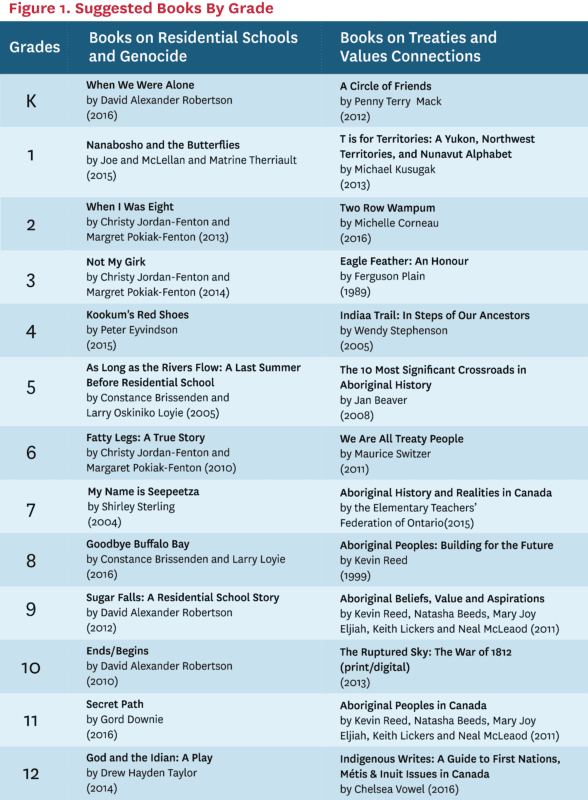
Having the ability to say “I don’t know” and learning together is what educators and students do in classrooms that honour Indigenous ways of knowing.2 Many educators in K to 12 fear getting Indigenous content wrong or misrepresenting the information. This is why it is important to include a variety of resources that are authentic, and why I am a strong advocate for Indigenous voices speaking for themselves and integrating them across the curriculum. I suggest having traditional and contemporary knowledge keepers about residential schools, treaties and the teachings be valued guests in K to 12. These meaningful visits need to be supported by lessons (pre and/or post) that are interactive, hands-on and have real-life applications.3 The content of these lessons can come from these suggested books on residential schools and treaties for elementary and secondary classrooms (see Figure 1). Please note that this is not meant to be an exhaustive list, as each province and territory may have its own suggested resources on these topics.
Reconciliation in action
I am very lucky to work with some amazing people at my university who have innovative ways of approaching reconciliation with action at the centre of it. Shelly Moore-Frappier is the Director of our Indigenous Sharing Learning Centre (ISLC). She comes from the elementary/secondary system and taught for a number of years at that level. Shelly and her team at the ISLC have designed and continue to deliver a program called “One Dish, One Spoon.” This program bridges elementary students (Indigenous and non-Indigenous) to the university with Truth and Reconciliation as the main driver. Grade 6 students from our region come to the university to hear from Indigenous youth who are making a difference in social change. Thirteen-year-old Autumn Peltier, known for her advocacy for water, is one of the key speakers, as well as other Indigenous role models. The Grade 6 students spend the day immersed in workshops and activities centred on their interests and ways to implement reconciliation in our schools and communities. Each school leaves with a commitment to a project that they will engage to implement Truth and Reconciliation (such as a community garden commemorating survivors and inviting residential school survivors to guest speak at their schools).
Project of Heart and their lived philosophy of students leading change is truly reconciliation in action. This national initiative honours the voices of survivors and provides a space for youth (and their mentors) to communicate their learning journeys. One can’t help but feel inspired by the multitude of stories where our young people share what they have learned (and are doing) about the residential schools legacy. Another project that touches my spirit is the 2016 Science Camp at Algoma University, where 40 Indigenous students from local First Nations participate in a week of focused activities. These 12- to 15-year-olds toured Shingwauk Residential School, listened to the stories of survivors and created wooden tiles (installation pieces) with personal reflections. When you take a closer look at the tiles, the message “forever loved, never forgotten” stands out. These words underpin the work of our youth and their brave mentors across this country.
I have had the honour of knowing Troy Maracle (Hastings Prince Edward District School Board), Jody Alexander (Ottawa-Carleton District School Board), Kathy Dokis-Ranney (Rainbow District School Board) and many other Indigenous Leads for years. I’ve seen their collective work in action and their tireless advocacy for Indigenous inclusion across K to 12. These individuals and their network of supports have implemented reconciliation activities like Orange Shirt Day, Shannen’s Dream, KAIROS Blanket Exercises, Treaties Week and National Indigenous Peoples’ Day on June 21 (for URLs and more activities, see box: “Reconciliation Activities for Schools and Allies”).
These folks, their students and their communities’ commitment to Truth and Reconciliation are making the difference. Their leadership and community connection is the promise of reconciliation in action.
The ally role
I am Anishinabe. My mother was Odawa and my father is Ojibwe. I also consider myself an ally for human and other-than-human rights (the earth and her children). Being an ally is a role that we all must occupy if we wish to see a better future for our children and the next seven generations. Allies from all walks of life are critical to implementing the Calls to Action from the 2015 Truth and Reconciliation Commission of Canada (TRC) Report.4 Defining oneself as an ally requires understanding who you are, why you are involved and how you can make a difference.
For myself, I see advancing the TRC calls as directly connected to my role as a teacher and a learner. I have spent a good part of 25 years focused on Indigenous education, with a specific emphasis on pedagogy. This has led me to some interesting and ever-evolving observations, the most prominent being that what works for Indigenous students often works for most others. Classrooms that build from a holistic model and/or consideration for the whole child tend to work for all students5 (see Figure 2). This means that allies need to commit to reconceptualizing their classrooms and how they teach all students. It further requires planning our school year with the spiritual, physical, emotional and intellectual aspects of education in mind.
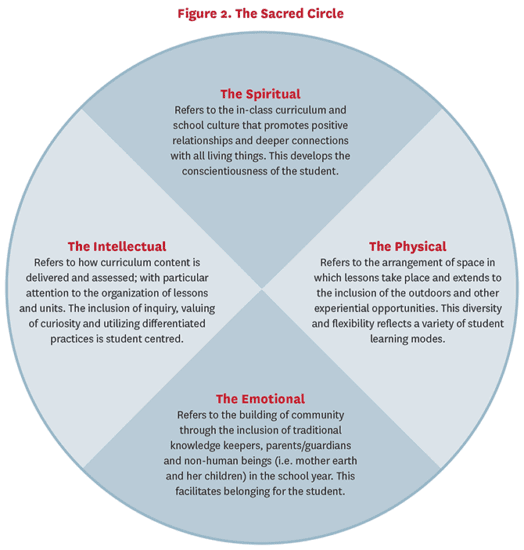
This model and teachings come from the Anishinabek of my area. Each Indigenous Nation has their own understanding of holistic education.
- The spiritual invites the educator to examine all the opportunities that their lessons, field trips and experiential learning activities offer to link students to each other, their communities and the globe. This aspect of holism in teaching/learning places emphasis on activities that develop deep and meaningful connections with a purpose “greater than the self.”
- The physical refers to the classroom space/s where learning takes place and encourages differentiated practices outdoors and in the community. This aspect of holism encourages teaching/learning at sites that make connections to local events, people, places and movements.
- The emotional concerns the inclusion of Elders, Métis Senators, Cultural Resource People, families and non-human experiences as foundational to the classroom and school year. This aspect of holism values the knowledge that “other teachers” bring to the shared world of education.
- The intellectual refers to the provincial/territorial mandated curriculum that the educator is entrusted with delivering to the students. This aspect of holism calls upon the educator to factor in inquiry, curiosity and differentiated evaluation as critical to meaningful student experiences in school.
The sacred circle is a place where we all belong and have a role to play in this journey towards Truth and Reconciliation. Being and becoming an ally for each other (human and non-human) is the only way to bring those Calls to Action forward in K to 12. Professional in-service, curriculum inclusion, policy development and engaging with each other is only part of the solution. Developing real relationships, acknowledging our failures and finding new ways to support the TRC in our classrooms will be the real challenge.6 I’ve accepted this call. I am reminded of it every time I drive past a school, stop behind a school bus, or talk to one of my students. I hope that you too accept this call as we move forward, together, in a space of respect, truth and transformative change.
Reconciliation Activities for Schools and Allies
You can support the TRC by becoming an ally and participating in these select initiatives:
- Jordan’s Principle
- I am a witness
- Our Dreams Matter Too
- Shannen’s Dream
- Orange Shirt Day
- Have a Heart Day
- Walking With Our Sisters
- Kairos Blanket Exercise
We want to know what you think. Join the conversation @EdCanPub #EdCan!
Photo: Shutterstock
First published in Education Canada, June 2018
1 Margaret Kovach, “Treaties, Truths and Transgressive Pedagogies: Re-imagining Indigenous presence in the classroom,” Socialist Studies/Études Socialistes 9, no. 1 (2013).
2 C. Savage, R.i Hindle, L. H. Meyer, et al., “Culturally Responsive Pedagogies in the Classroom: Indigenous student experiences across the curriculum,” Asia-Pacific Journal of Teacher Education 39, no. 3 (2011): 183-198.
3 G. Ladson-Billings, G., 2014. “Culturally Relevant Pedagogy 2.0: Aka the remix,” Harvard Educational Review 84, no. 1 (2014: 74-84.
4 Karina Czyzewski, “The Truth and Reconciliation Commission of Canada: Insights into the goal of transformative education,” International Indigenous Policy Journal 2, no. 3 (2011).
5 Jan Hare, and Michelle Pidgeon, “The Way of the Warrior: Indigenous youth navigating the challenges of schooling,” Canadian Journal of Education 34, no. 2 (2011): 93.
6 Rosemary Nagy, “The Truth and Reconciliation Commission of Canada: Genesis and design,” Canadian Journal of Law & Society/La Revue Canadienne Droit et Société 29, no. 2 (2014): 199-217.
-
Carrying the Fire
Comments Off on Carrying the Fire(A discussion moderated by Michelle Hogue and Holly Bennett)
When planning this special edition of Education Canada, one thing we knew for sure is that we did not want to overlook the insights and ideas of the people at the heart of the issue: Indigenous students. On January 19, 2018, four young adults joined us in a phone discussion to share their thoughts about what Truth and Reconciliation means to them and how that should be reflected in our schools…
Meet the Participants
- Gregory Francis is from Kingsclear First Nation in New Brunswick and is a 4th year student at the University of New Brunswick studying chemical engineering. Currently a member of the Prime Minister’s Youth Council, Greg acts as a positive role model through his actions to support youth. He has been a tutor for First Nation students in his community and has served as a facilitator for First Nation youth engagement.
- Talia Natowcappo is from Lestock, Saskatchewan and is registered to Fishing Lake First Nations Band. A proud Saulteaux-Anishinaabe woman, she is currently studying at Concordia University majoring in First Peoples Studies. She says, “My spirit name is Migiiziikwe; I am part of the Bear Clan family and I am also a pipe carrier. Discovering my culture saved my life, made me proud of something I was once ashamed of.”
- Tarene Thomas is from Enoch Cree Nation and the North West Coast of B.C. She is a writer, poet, and activist in the fourth year of her English major at the University of Alberta. Tarene also works with the transition year program at the University of Alberta, and is an Indigenous peer mentor for the faculty of arts.
- Hunter Martin is from Black Lake Denesuline First Nation in Saskatchewan and is a Grade 12 student at Bethlehem Catholic High School in Saskatoon. He has recently developed an interest in his people’s culture and hopes to contribute to the advancement of Truth and Reconciliation.
We want to know what you, as youth and young adults of today, think needs to happen as we move forward in this TRC era? Where do you think things should go?
I know these are big, open-ended tough questions, but really you are the next generation and are going to be the game changers, and ones who open up doors in a lot of different ways, so we’re very interested in what you have to say.
HUNTER: Moving into the 21st century, I do believe that we need to take action. Some of the reserves have been taking action. The chief for Whitecap, outside of Saskatoon here, really puts emphasis on supporting the youth in the community. There’s more funding going toward the school, and it’s creating a great environment for the young people of that community. I think we do need to put emphasis on the younger generation in order to move forward. There are other issues, such as domestic violence, sexual abuse, drug addictions and suicide, but if we teach the younger generation that this is not the way, that it doesn’t have to be like this, then they will strive to actually make things better once they graduate and go out into the world. That’s my take on reconciliation and youth.
I go to school in the city now. I transferred down south coming out of Grade 9, for the betterment of my education. My mom really didn’t want me to stay up north in my reserve because the education there is poor, the school system is underfunded.
TARENE: That’s what I think we should talk about a little bit, how Indigenous education systems are funded a lot less than mainstream education. It was the same with me, I grew up on a reserve and I did graduate from the high school on my reserve, but from Grade 1 to 9/10, I went to school in the city. It was for the same reason; I wanted a better education so I registered myself and my siblings in the public school system.
But that’s a huge problem, that we have to outsource ourselves to other places away from our community, where we can be involved in our culture and kinship. Those ties are sort of lost, and we have to make that leap just to have the same level of education that non-Indigenous people are having. That’s something that really needs to be addressed.
TALIA: I moved away from my territory, from the prairies, because it was really hard being there as an Indigenous person, with the negative stereotypes that come along with this heritage. It’s really frustrating. But for the years I’ve been travelling, I’ve always carried this big sense of guilt for leaving home, like I’m leaving my family or my siblings or somebody there that would need me. It was just going back this Christmas that I realized that I no longer have to feel guilty or selfish for leaving home, for wanting to better myself – and that came with giving up alcohol and trying to be more traditional and smudging more and trying to be more active in any type of discussion that involves Indigenous people. But I’m still contemplating whether, when I’m done with my academia, if I want to go back and try to create a positive space for the Indigenous people there.
HUNTER: I also have stresses from my family, knowing the problems that they are going through. It really hinders me sometimes from concentrating on what needs to be done. Like my cousin commited suicide, just a year and two days ago, and after that I did abuse alcohol for awhile. It was hard, really hard, getting over that. It took about a month before I realized, what can I do so this doesn’t happen again? So that’s when I decided to take an interest and learn about my culture and my people.
We should teach the true history of Canada. I think that if we start to teach those histories and the effects of colonialism, then we’ll start to clear the air a little bit because I feel like that’s where a lot of the racism and ignorance comes from.
TARENE: Another issue is Indigenizing education. We need to be starting in early elementary and right through to Grade 12, because a lot of the gaps between Indigenous and non-Indigenous people come from the ignorance and not knowing the history, not understanding colonialism and the effects it has on Indigenous people. So in social studies in Grades 4-7, you’re learning about settlers coming into Canada, and you have that small little paragraph that says First Nations People wilfully moved so settlers could live there. We should teach the true history of Canada. I think that if we start to teach those histories and the effects of colonialism, then we’ll start to clear the air a little bit because I feel like that’s where a lot of the racism and ignorance comes from.
I also think it’s really important to create spaces for Indigenous students wherever it may be, in communities, in the school system, in the city. And there needs to be relationship building between Indigenous and non-Indigenous students so we can start to break down the barriers that keep people focused on the negativity.
GREG: One thing that I wanted to talk about was creating that dialogue between Indigenous and non-Indigenous people. I spent my entire schooling in the public system. There was an elementary school on my reserve, but I was always put into the city school 15 minutes away. But as I transitioned from elementary to middle to high school, I noticed that people’s conceptions about Indigenous people had drastically changed, to the point that going into high school I felt uncomfortable and alienated. I think that trying to promote that dialogue and trying to have those conversations between Indigenous and non-Indigenous people will help us understand each other’s differences and find a common place to be able to agree on something that allows us to move forward. Too many times I feel that people focus on each other’s weaknesses when we should really be focused on what makes them strong, and on using those strengths to better our nation as a whole.
TARENE: Those are really good points. There need to be spaces made for those types of conversations, facilitated by people who are comfortable and trained, and they should be happening in school systems in all different levels and age groups. I think when people have these conversations in a… I don’t really want to say safe space, because no one can guarantee a safe space, but in a relatively safe space, I think a lot of times people come through with a better understanding, as opposed to learning something through a book.
HUNTER: I do agree with this. In Native Studies, we were reading about sweat lodges and smudging, but learning about it from a book is very different from actually doing it. You get a deeper understanding, you actually get a connection, when you actually do something that’s related to the topic. That’s true about anything, really, I think it’s one of the major problems with education as a whole. It emphasizes the memory of things and doesn’t really emphasize doing it. That also has to do with getting the students interested. They’ll have a deeper understanding of the subject and in turn will be interested in learning more.
If you could make one big change, what would it be?
TALIA: I want to help plan curriculum, I want to help change the way we teach our kids. And I think the first thing that needs to be instilled is that sense of cultural pride, getting those little kids into a sweat lodge, teaching them that our identity is valuable. Then they’ll be able to carry the fire, and then they’ll be able to be more prepared for the life we send them off into.
They’ve tried for the last 500 years to assimilate us, and it’s not going to happen. They say it takes two to three generations to lose your culture, but we’ve been fighting for it for the last seven. Yeah, it’s nice to teach it here at the university level, but before we even start sharing it with our European neighbours or our other minorities, who are really beautiful too, we have to instill it in our kids. We have to take it back before we can try to explain to anyone else how beautiful it is.
You know, I look at my friends who come from, I guess, a privileged lifestyle where their parents were successful, they had jobs, health care, health insurance… So they didn’t have to go through Indian Affairs, cause it sucks, you know? There’s such a huge stigma around it, that when people bring it up, I’m actually kind of still ashamed that I need help from Indian Affairs. And my non-Indigenous friends who are younger than me are getting their Masters degrees, while I… I’ve worked amazing jobs, travelled to the most Northern remote places, but I pretty much failed my first semester of university here in Montreal and I was scared – scared to go home, scared to tell anybody. I’m in therapy for this, and it’s help me realize that growing up I pretty much raised my siblings and I developed this sense of “I have to do it on my own, no one can help me.” And that I had to overcome all of the shitty things I went through as a kid and in my teens and what I’ve done to myself because I was really incredibly hurt, from being a residential school survivor survivor. I didn’t have to actually go to residential school to have the exact same effects happen to me – being taken away from my parents, being in foster care, the molestation and abuse. It was all there.
TARENE: If I could change one thing? It would be kind of adding on to what Talia was saying, teaching our youth that we are not vessels for white settler colonial shame. We’ve been talking a lot about barriers, and I think one of the reasons why there are so many barriers in front of our people is because it’s kind of the narrative we’ve been told. That’s what society teaches us – that our families are broken so they can’t teach us anything about who we are. So it’s important for our generation and for us when we have children, to instill that in our kids, to be proud of who we are. And then we need to start peeling back these layers, that colonial narrative that’s all over Canada that kind of fits Indigenous people into one box, you know, like the dumb drunk Indian. To do that we need to start within the school systems.
GREG: I know personally when I was younger I wasn’t really connected to my culture, and I did face a lot of mental health issues and alcohol abuse. I was a lost soul for a while. I was able to rediscover myself when I got more involved in my culture and learned a lot more about my traditions. It gave me a more holistic approach and allowed me to feel a lot more like who I am. I just really want that for every other Indigenous youth out there.
TALIA: I just hope they find it a lot sooner than we did. That’s one of the biggest issues right now that we’re facing as a generation: we are really fighting for who we are. I’m fighting to take back my language. I’m fighting to feel comfortable in my own skin for being brown. I have to fight to learn my name in my language and figure out what Bear Clan actually means, and what Eagle Woman means and Migiiziikwe, to find out where my people come from and why I carry a peace pipe.
I’m incredibly proud and happy now about who I am as an individual and what small accomplishments I’ve actually made. And it’s learning to be humble and to have humility, and to share and to laugh, and to just exude love all the time.
When you picture your kids or your grandchildren, what would you hope their school experience would be like?
TARENE: I would want it to be challenging, but also a space where they feel respected and where people know their histories.
HUNTER: I would like my children or grandchildren to find more fulfilment in life through their schooling. When they enter it, they are still on their journey of finding who they are, and when they leave I want them to have a stronger sense of who they are as a person and go off in the world from that place of knowing who they are. That’s my big thing with school: it’s very hard to find yourself in it.
I want to add, I want all kids to go to school feeling like they are not less human for who they are, their background, their people. I want them to feel fully human. I went to school feeling left out because of the colour of my skin.
TALIA: I just hope that, ten years from now, there’s a school on every fucking reserve! A properly funded school, with running water, that isn’t in trailers, that can give them a place to actually flourish and realize who they are and be proud of who they are – and also give them the life tools to be successful.
And I really want them to have a safe home. That truly depends on me and us as parents to not make the same mistakes.
GREG: Everyone pretty much covered it. I want my grandchildren to have that identity, and not to be at a disadvantage because of their ethnicity or because of who they are. That’s something that a lot of Indigenous people are facing today – we have had more struggles compared to other people. I don’t want our kids having to face those kinds of struggles.
HUNTER: I have just one thing to add I guess. I was told that it’s been seven generations before ours that have had a time of pain and suffering, and that it will take seven generations more until that pain has fully healed. I was told it is our generation, the Millenials, that is the start of that seven-generation healing process. When I was told this, I felt compelled and motivated to start doing things to better myself and my people. It is us who will rekindle the flame of hope. And through that hope, will inspire others to actually go on that journey.
We want to know what you think. Join the conversation @EdCanPub #EdCan!
First published in Education Canada, May 2018
-
Of Orcas and Learning on the Land
Comments Off on Of Orcas and Learning on the LandA THIN FOG hung above the restless water of Alaska’s Alexander Archipelago, veiling the mountains as they stood rooted in the ocean’s deep fjords. I had driven this route since the beginning of the school year nearly two months before. Timing the drive perfectly, I would arrive at the first bus stop, far up the finger-like inlet, at just the right moment to meet the two children who lived there at the end of their scamper from their front door, greeting them with my best bus-driver’s smile.
That morning, I noticed that I had arrived early at the widened shoulder a mile or two before that first, daily rendezvous. Wheeling the 11 ½-meter behemoth off of the highway, I chose to wait out my ten extra minutes here, where I could meditate on the rising sun and the scattering of the morning mists. Throughout Southeast Alaska the highways are chipped from the mountainsides along the water’s edge, and it was here, next to the perpetually rolling waves, that I now paused.
A sudden motion just off shore caught my eye. A deep, churning whirlpool pierced the surface of the waters. In a moment I was out of the bus and had hopped to a large boulder that rose above the rolling waves. No sooner had I landed than the black and white form of a killer whale drove three meters into the air beside me. Four meters out, the surface crashed with the fall of the returning whale. Immediately, I was aware of the pod, skimming, slicing and surfacing before me, to my right, to my left. Across the channel a second pod chased salmon in ritual feasting.
“Five minutes since I stopped…” I thought. “Perhaps I could collect the children early and return.” The engine fired; yes, the boy and his little sister (seven and five) headed out the door early as they saw the bus approaching.
As I was also completing a practicum in their school, I had seen these two children, who greeted me early each morning with such warmth, later in the day, dissolving into the social fabric of the school, silently disappearing. Conversations with the students themselves, their teachers and their parents revealed the deeper challenges they felt as they struggled to accommodate both traditional Tlingit values and the foreign expectations of formal academia. Their father was a world-renowned carver of Tlingit totems, some of which stood in European museums. Now his children, as well, were attempting to stand strong in their school.
“Why are we stopping here?”
“You’ll see. Look out there!”
“What is it?”
“It’s the orca. They have come here to eat.”
“Can we get out? What do they eat? Where are they going? How fast can an orca swim…?”
As the bus filled that day, I saw the two children melting again into silence, but as I glanced in my mirror from time to time, I saw a sparkle in their eyes, and I knew orcas played there.1 Over the course of the intervening 30 years, my work both in Alaska and on the Canadian prairies has taught me much about the value of land-based education. I have had the great privilege of sitting with many Elders, gaining insight into land-based learning as traditionally practiced and understood by the Tsimshian, Tlingit, Haida, Dene, Anishinaabe, Dakota, and Cree nations.
Institutionalized education and colonization
Settler societies around the world create educational institutions that function to perpetuate the philosophical understandings of the dominant culture. Consequently, they do a disservice to learners who are thereby deprived of broader understandings of the world. In the Canadian context, for example, children (Indigenous and non-Indigenous alike) might learn facts pertaining to the biology and habitat of killer whales, but they would not gain an understanding of the intricacies of relationship within the circle of creation.
The colonial, pedagogical structures within which educators are obliged to operate, both in terms of curriculum and instructional practice, consistently stand in stark contrast to understandings of the world that are rooted in diverse, Indigenous, philosophical perspectives. Teachers are required to hold forth in classrooms that are far removed from lessons that can be learned on the land. They are to teach classes of 25 or more with limited time for students and still less for those who are the silent ones. The inculcation of outcomes often supersedes real learning, and these outcomes reflect perspectives that have not been reconciled with philosophical truths found in Indigenous worldviews. Furthermore, learning on the land from the teachers one finds there is, all too often, discredited and deemed to be irrelevant and unquantifiable. Indigenous Elders, however, tell us that profound lessons can be learned from all whom we find on the land, including those of the winged, finned, plant, four and six-legged nations.
The educational machinery established by dominant, colonial culture exists to continue the larger societal systems. The enfranchised will remain enfranchised, and the marginalized will not escape marginalization in successive generations without a genuine process of reconciliation where alternative world-views are not only appreciated but embraced.
Of key concern, then, are questions of validation: are there not invaluable lessons being missed by all students when the lessons of the land, so familiar to traditional Indigenous individuals, are ignored? Stemming from this central philosophical concern arise other, practical considerations. For example, in what ways can the accomplishments and learning that take place on the land be validated, and how do we teach students to listen to the many teachers within the circle of creation?
Traditional land-based learning
Traditional land-based learning presents in two distinct categories: learning that is imparted by Elders and/or traditional knowledge keepers in the community, and learning that derives from the land itself. Teachings received on and from the land fashion both conceptualizations of the world and moral understandings pertaining to self-conduct in the world. In support of this dynamic form of education, the Coalition for the Advancement of Indigenous, Land-Based Education (CAILBE) was originated in Canada and is now an international coalition built around the revitalization of traditional, Indigenous ways of learning on and from the land. With adherents from around the world and members in seven nations (Australia, Brazil, Canada, New Zealand, Nigeria, Sweden and the U.S.), CAILBE is dedicated to promoting governmental and institutional changes that result in the acknowledgement of Indigenous understandings regarding LBE and to assisting individual teachers in the development and inclusion of traditional LBE experiences for their students. This work is accomplished not through direct political action but through the empowerment of educators to take part in engineering real and lasting change. CAILBE has grown rapidly since its inception in June of 2016. CAILBE members have made a commitment to infuse the work that they are already doing with promotion of LBE and the philosophical perspectives that underlie it. Members with initiatives, questions or academic presentations are guided and supported by this international association.
Dr. Richard Manning, CAILBE member from the University of Canterbury, Christchurch, NZ, has observed, “The last century of compulsory schooling has rendered young people disconnected from their… local ecologies of place.”2 If it is to be intuitive, land-based education (LBE) must begin early in life, frequently in the context of family structures and activities. Teachers seeking to implement Indigenous, land-based learning strategies have found that many students from almost every environment (not just “city kids”) lack these early, land-based learning experiences and must be given guidance in their first encounters with learning on the land.
Certainly, many teachers attempt to incorporate fieldtrips into the delivery of curricular outcomes. Although this is laudable, it does not reflect the realities of those who have learned deeply from the land. To pass through the natural environment on an excursion related to, for example, a science class, does not equate to this type of Indigenous, land-based learning. By contrast, in progressive models, students are taught the basic foundations of traditional LBE. (See Gakina Awiya Biindigeg below.)
Those who learn on the land must first develop a sense of respect for all the teachings that may be found there. Cree Elder Gerald Morgan frequently asks the students he teaches on the land if they have seen anything as they travelled to meet him in the bush. Very often they give a negative response, meaning that they have seen nothing that they consider noteworthy (e.g. moose, eagles, bears). Morgan then asks if they saw no trees, no sparrows, no rocks. He goes on to explain that the greatest lessons are often brought by the smallest of teachers. We are so schooled in hierarchical thinking of European origin that we fail to appreciate the smallest of these teachers.
Students who seek to learn on the land must also know how to wait long there. Lessons do not become a part of who we are until we consider deeply the implications for the way we walk in this world. In the same way that students must listen and observe closely to comprehend that which is being conveyed by a teacher in a classroom, so, too, learning on the land requires that keen attention be given in order to understand the lessons imparted there.
The goal of LBE within a great many Indigenous communities around the world is that each student learns to take his or her place in the circles of creation and community in a good way. This is the essence of the Anishinaabe/Cree teaching of pimatisiwin (walking in a good manner).3 To take our place well in the circle involves being in harmonious relationship with all others in the circle and with the Great Mystery (i.e. Creator) at the circle’s centre. We come to understand that all our relations in the circle can show what they have learned about these things, and, as respected teachers, they can guide us into better ways of being in the world as we learn from them on the land.
Dr. Maggie Walter, CAILBE member and University of Tasmania professor, describes Indigenous connection to the land in personal terms: “I am a descendant of the Trawlwoolway in Tasmania. The nation takes up the north east corner of Tasmania and is distinguished by wonderful white beaches, open wooded country and plentiful plant and animal resource around which our traditional people’s lifestyles were based. Not many of us live in the area these days – it is a relatively sparsely populated part of Tasmania – but if you travel there you can see the signs of our people’s occupation everywhere – in the midden lines in the sands and the shells along the beaches. You don’t have to be Aboriginal to understand our connection to country or to feel the continued presence of our ancestors in this place.”4
The future of land-based education
Clearly a significant paradigm shift must take place for land-based learning to be given weight in the schooling systems of settler societies. Some, such as Leanne Betasamosake Simpson, question whether this can be done at all.5 The argument here is that land-based learning and colonial educational practices are too disparate to be reconciled and that, should an individual seek to be educated on the land, the better course of action is to jettison any hope of incorporating this into the accredited procedures of education in mainstream schooling.
On the other hand, recent trends in pedagogy in Canada and elsewhere have begun to explore differentiated ways of learning. These efforts represent positive steps toward recognizing, validating and normalizing the learning of students in traditional ways on the land. A groundswell of support for change, of which CAILBE is merely one manifestation, is seeking to alter the direction of current practices in education. As with most philosophical shifts, one must think in terms of generations rather than in terms of years. For this reason CAILBE members recognize that the greatest need is to present educational experiences to coming generations that reflect Indigenous understandings and values. The central aims are that Indigenous ideals become valued at a level that is at least on par with those of the larger settler-societies and that, as part of this shift, time be allotted for Indigenous land-based learning. As this becomes a reality, LBE could potentially become a transformative force in the development of all students.
The revitalization of Indigenous, land-based education may, in some jurisdictions, involve the creation of alternate, accredited tracks toward graduation in which Indigenous philosophy and LBE are central. At the very least, a greater openness to the involvement of traditional knowledge keepers in the imparting of understanding to students must be forthcoming. Legislative enactment of policy and law governing education most often supports and finances those systems deemed to be efficient in confirming the status quo; nevertheless, it is at this legislative level that change must, eventually, come. Therefore, those who understand the importance of traditional LBE must raise a collective voice, both by joining organizations such as CAILBE and by infusing their current practices in education with an appreciation for Indigenous values and world-views, including ways of knowing and learning on the land.
Gakina Awiya Biindigeg
The Gakina Awiya Biindigeg student group at Springfield Collegiate Institute in Oakbank, Manitoba, is one example of a progressive land-based learning program. For over a decade students who participated in this optional programming were regularly taken onto the land to learn from Elders and traditional people. The scope of this learning was extremely broad and included traditional values and teachings derived from the experiences encountered while in a variety of remote locations. Students were shown how to relate to the various teachers that are encountered on the land (e.g. the four-legged, many-legged, finned, winged), enabling them to learn directly from these teachers during independent ventures onto the land. When Elders felt that a student was ready s/he would be put out onto the land for a vision quest or other ceremony. Through the avenue of Manitoba’s cultural exploration credit, students were enabled to use this traditional learning towards graduation.
We want to know what you think. Join the conversation @EdCanPub #EdCan!
Photo: iStock
First published in Education Canada, June 2018
1 The young boy mentioned in this story has now grown and has followed in his father’s footsteps as a carver. The young girl is a library assistant who has, among other things, initiated a children’s garden at the local public library where she works.
2 Richard Manning, Place, Power and Pedagogy: A Critical Analysis of the Status of Te Ātiawa Histories of Place in Port Nicholson Block Secondary Schools and the Possible Application of Place-Based Education Models ((PhD thesis, 2009): 56.
3 The late Dr. Mary Young elaborates on this concept in her book Pimatisiwin: Walking in a Good Way: A Narrative Inquiry into Language as Identity, (Winnipeg: Pemmican Publications, Inc., 2009).
4 Maggie Walter, “Meet the Presenter: Maggie Walter, Indigenous Studies,” Open 2 Study (August, 2014). https://blog.open2study.com/post/meet-presenter-maggie-walter-indigenous-studies
5 Leanne Betasamosake Simpson, “Land as Pedagogy: Nishnaabeg intelligence and rebellious transformation,” Decolonization: Indigeneity, Education & Society. 3, no. 3 (2014). http://decolonization.org/index.php/des/article/view/22170
-
Our Journey Into Reconciliation
Comments Off on Our Journey Into ReconciliationOn the morning of September 30, 2016 I wore an orange shirt to school. I had received an e-mail about Orange Shirt Day, including a short video, and I decided to wear orange and talk to my students about residential schools and reconciliation during our Social Studies time. I showed them the video, and the looks on their faces told me that they had questions. They asked me things like, “Is this for real?” and “Did this really happen in Canada?” They had legitimate questions and the desire to learn and pursue them was evident in our classroom conversation.
Watch the video montage documenting this Truth and Reconciliation project
I teach at Stavely Elementary School, a very small rural school in Southern Alberta. There are less than 100 students in our K-6 school and we teach multiage classrooms. I teach a Grade 5/6 split. We are about a 40-minute drive from the nearest First Nation reserve.
I had been looking to do some problem-based learning within our Social Studies that year and I decided that this would be our topic. We listed our questions, and ultimately defined our guiding question as, “How do we find out the truth about residential schools in Canada and make reconciliation with this part of our history?” This was a big question with lots to unpack for a class of Grade 5’s and 6’s. We began by doing research, using books and the Internet, but found that we were struggling to find appropriate resources. I then approached
our Livingstone Range FNMI (First Nations, Métis and Inuit) Success Coordinator, Georgina Henderson, who became an integral part of our work. She helped connect our class to residential school survivors and the Project of Heart.1 It was clear to me early on that this was a big project, with a lot of important thinking. It was not going to be done in one day or even a week. It became a thread that ran through our entire school year. I think this allowed us to begin to engage in some real reconciliation – you see, I don’t think reconciliation is something to be checked off a list as completed; it is a continual work in progress.For me, the story of reconciliation starts a long time ago. I grew up on a ranch on the Milk River Ridge that has been in my family for generations. I know places by the names that have been passed down through my family, and I appreciate the necessity of stewardship of the land. I also know that my family were not the first ones there. I remember being a very little girl and riding with my dad. We stopped to close a gate, and when I looked down from my saddle, I saw a rock that looked to be a hammerhead. From where we sat on our horses that day we could see the tipi rings in the grass and the river close by. Someone had clearly lost that rock long before I walked there.
I love the land, and I am a treaty person. It starts there for me. Home is a special and sacred place; I would hate to lose it. I know that it became my home through homesteading, which was made possible because of treaties signed with First Nations. Because of my presence on the land today I, too, am a treaty person. This story resonated for many of my students, many of whom come from farms and ranches and have strong a connection to the land in our area. I think in some ways this provided a point of connection for our investigation and project. We discussed what it would feel like to have special and important pieces of our land taken from us. Students could identify with this; they responded with anger and sadness. Then we started to talk about what it would be like to be taken away from our families, separated from our brothers and sisters, and placed in a school where everything was different. The students truly felt empathy for the students who attended residential schools. They questioned how it was even possible. We looked at the point of view of the government of the time. This angered and saddened my students. We learned a lot about how and why residential schools were used in Canada.
Our Project of Heart
Project of Heart is a collaborative journey of learning about residential schools in Canada from those who survived them. It includes general research about residential schools in Canada, then a more narrowed research journey into a specific residential school, including meeting with a residential school survivor, and then finally an artistic act of reconciliation. We had already done general research when I learned about this opportunity, and were ready to begin a more detailed look at a residential school that was near to us. Mrs. Henderson connected us with Ira Provost and the Piikani Traditional Knowledge Services centre in Brocket, and we felt that St. Cyprian’s Indian Residential School would be a good place for the class to focus our attention. Mrs. Henderson set out to find a survivor who would be able to work with our class. We found this in Mrs. Betty-Anne Little Wolf. I was thrilleto have her join our journey, as we had worked together previously at F. P. Walshe School, where she had been the Native Liaison Worker prior to her retirement.
As we were moving into Project of Heart, we had a launch in our classroom. Each student wrote about their thoughts, feelings, and the things they had learned through our research so far. We then shared them with our audience, which included residential school survivors, members of the Piikani Nation, parents, our superintendent, and our school principal. It was a big day; the sincerity of the students was palpable in the room. Some of the words that students shared that day were:
“Our learning is important because it has touched our hearts.”
“This project made me think how sad it must have been for parents that had to let go of their children… and how awful it must have been to go to residential schools.”
“I was saddened to learn about residential schools and the grief that they brought First Nations, but I also saw hope when I learned more about Orange Shirt Day.”
“Why would Canadians think of taking other families’ kids without their permission and trying to change their culture?”
At the end of our launch day I recorded the following reflection:
I was overwhelmed by the power of the student voices, their sincerity and true heart. I am thankful that I have the opportunity to work with such amazing students each day. I am reminded of the gravity of my job and position on days such as these; I have the chance to impact children in real ways. The lessons I choose, the areas we focus on, they matter – like really matter. I am not sure that five or ten years from now students will remember all of the geographic regions of Canada, but I do hope, with some confidence, that they have become better, more engaged, more knowledgeable, thoughtful, kind human beings because of this project. I can tell that they have really connected and I am honoured that I get to go along their learning and growing journey, for just as they are learning and growing, so am I.
Betty-Anne came to visit our class and speak of her experiences, which was a very powerful day for my students. They listened with so much respect and interest that I know that they will remember this experience for a long time. They innately seemed to understand the sacredness of the sharing they were part of. In addition they were able to take the information that we learned from her first-hand experiences and integrate it with the research that we had done. It also brought us opportunities to look at historical perspectives: after our visit, one of my students reflectively commented, “I learned a lot about what it was like to attend a residential school, but wouldn’t it be neat if we could also hear from a boy, because I bet that boys had a different experience from girls?” In that single comment I knew that my students were connecting the skills set out in the curriculum with the journey we were on. I also knew that they were coming to understand the depth and diversity of this area of history.
We defined reconciliation as the restoration of friendly relationships. As a class we worked with Mrs. Henderson, and survivors of St. Cyprian Indian Residential School, to try to learn more and really understand the residential school experience. We also worked through the Blanket Exercise2 as a way to deepen our knowledge and understanding. These were powerful experiences for the students, and everyone involved.
Throughout the process I always encouraged students to be honest with their questions and I promised to be honest with my answers. In the beginning some of the students talked a bit about being scared when they went to play hockey on local First Nations Reserves. I appreciated their honesty but I also wanted them to learn and appreciate that the teams they played there were just kids like them – this is where I think reconciliation really can grow. The more that we can all see that people are just people, regardless of where we live, the better off we will all be.
Our community is very small; most of the students have known each other their entire lives and spent all of their school years in the same class. This year, for the first time, a few of them openly spoke of their First Nations heritage, and even of their grandparents being residential school students. As a teacher, this change felt like a big deal for me.
It was amazing for me to see students really own what they were learning and apply it in new contexts. One day one of my students came and said, “I heard something about a bridge in Calgary being renamed because of residential schools.” As a class we researched, based on the information that we had, and learned about the renaming of the Langevin Bridge to Reconciliation Bridge. We had a great discussion about how we name things and then the way that the passing of time may change our views on those names. Another student asked if our work on residential schools was related to the National Inquiry into Missing and Murdered Indigenous Women and Girls. Students were taking the learning and our conversations in the classroom and extending them beyond our walls.
The impact of the project
While there are many areas that we did not explore in great depth in our classroom work and Project of Heart, I did acknowledge them as places that students may look into further as they get older. I acknowledged that sexual abuse also took place within the residential school system, but we did not delve deeply into this area. The same held true when I was asked about the missing and murdered Indigenous women. I did say that I believe that there may be connections through history to the things that we were learning about, but we did not explore it in depth. Students get this. This was made most clear to me this past September when I asked my Grade 6’s, the Grade 5’s from last year, to go talk to each of our other elementary classes about Orange Shirt Day. As we planned our presentations, they were thoughtful of the age of people they were presenting to. They were determined to be honest, to teach them about the impact of residential schools, but also to do it in an age-appropriate way. I believe that this can be done. Kids are more capable that we often give them credit for.
Our concluding act of reconciliation was visiting the St. Cyprian Indian Residential School site near Brocket, Alta. Surrounded by the physical context of where the school once stood, we were guided through the site by Albert Prairie Chicken, a former student who explained more about what it was like to attend St. Cyprian’s Indian Residential School. This was a powerful day for many students. Perhaps one of the most striking things that resonated with me was when he showed us a picture of himself and eight other boys, at about the same age as my students, and then told us that only two of them are still alive. This really struck me and caused me to reflect even further on the depth of the impact of the residential school system. As a part of Project of Heart, students need to make and present an item to represent the reconciliation to the survivor who has worked along with them in the process, in this case Betty-Anne Little Wolf. Given our connection to the land, our class opted to paint a large rock from a local field, and place our fingerprints upon it to show that we are forever changed by this experience, that we are people committed to the process of reconciliation. We decided to take this one step further and each student chose a small rock from our community to paint and leave at the St. Cyprian Residential School site. It was our personal marking of reconciliation.
While there were many heavy parts as we worked through our Project of Heart, we also found ways to have fun. As we concluded our school year we celebrated with some of the people who had helped us along they way by having Mrs. Lorraine Morning Bull and Mrs. Georgina Henderson make fry bread with us, and sharing a meal together. We also held a closing activity where we invited all of the guests from the launch back again. We sat together in a circle on National Indigenous Peoples Day and talked about what we had learned and how it had changed us. It was during this time we presented our rock of reconciliation to Mrs. Betty-Anne Little Wolf. Here are some of the things that my students had to share that day:
“This has changed the way I see First Nations, I now see them as heartbroken people from our past, I see them now as people who have been through so much. It also made me a different person, because since I learned so much I feel their sadness inside.”
“I have changed because I felt like our classroom changed the world in a way.”
“This project has changed me in so many ways. It has shown me the truth about residential schools and the harsh treatment of our Canadian government. Residential schools have brought sorrow, hardship, and a deep wound that might not recover for many generations.”
“Even though I am going to a different school next year I will bring all that I have learned with me.”
As a teacher, I always hope that my students learn but, more than that, I hope that my students leave my classroom better people. I know that they will not remember each of my lessons, but I do hope that this project has imprinted upon their hearts and has changed the way that they look at First Nations people. I hope that it has cracked the door to reconciliation for them. I hope that one day, when they are parents, they will raise a more aware and reconciled generation of children.
We want to know what you think. Join the conversation @EdCanPub #EdCan!
Photo: Courtesy Julaine Guitton
First published in Education Canada, June 2018
-
Learning Together by Learning to Listen to Each Other
Comments Off on Learning Together by Learning to Listen to Each OtherWithout question, we need discussions about Truth and Reconciliation in all classrooms in every community and every educational institution across Canada. From my traditional Mi’kmaw way of understanding the world, I firmly believe these discussions must begin with exchanges of stories because such is the foundational basis of all relationship. I also passionately believe these exchanges must be ongoing and that they must take place within an acknowledged journey of co-learning wherein we – Indigenous peoples and the newcomers in our Indigenous lands – seek to learn together, to learn from each other, and to learn to draw upon the strengths, indeed the best, in our different ways of knowing, doing, and being.
Many years ago, I brought forward the guiding principle of Etuaptmumk or Two-Eyed Seeing for co-learning. It encourages the realization that beneficial outcomes are much more likely in any given situation when we are willing to bring two or more perspectives into play. As such, Etuaptmumk / Two-Eyed Seeing can be understood as the gift of multiple perspective, which is treasured by the Mi’kmaw people and probably most Indigenous peoples. Our world today has many arenas where this principle, this gift, is exceedingly relevant including, especially, education, health, and the environment. I’ve often described Etuaptmumk / Two-Eyed Seeing this way:
“I, you, and we need to learn to see from one eye with the best or the strengths in the Indigenous knowledges and ways of knowing… and learn to see from the other eye with the best or the strengths in the mainstream (Western or Eurocentric) knowledges and ways of knowing… but most importantly, I, you, and we need to learn to see with both these eyes together, for the benefit of all.”
In my experience, many people across Canada and in different locations have a desire to bring together the ways of knowing of Indigenous peoples and newcomers. Different approaches and different names are in use for this type of work and Etuaptmumk / Two-Eyed Seeing is but one. Regardless, the work is not easy. I always emphasize that the ongoing journey of co-learning is essential in order to develop and nurture collective and collaborative understandings and capabilities. Otherwise, the work can all too easily slip into a lazy, tokenistic approach in which Etuaptmumk / Two-Eyed Seeing and similar efforts quickly become mere jargon, trivialized, romanticized, co-opted, or used as a “mechanism” where pieces of knowledge are merely assembled in a way that lacks the S/spirit of co-learning. And thus, we need ongoing co-learning in our classrooms. But we need also to act upon the recognition that informal learning environments exist in abundance throughout our communities and within the whole of society… and co-learning needs to occur in them as well as in the formal classroom setting. So I believe this educational need is both deep and broad.
I look forward to this special issue of Education Canada: We must share our stories and we must learn to listen to stories other than our own… our knowledges live in our stories.
Apoqnmatultl’k Jiksktuali’lk
L’pa ma’ pun tluow ta’n tettuji nuta’q sku’tminenow Ketlewo’qn aq Apiksiktuaqn msit wutaniminal aq msit ta’n te’sikl kina’matnuo’kuo’ml ta’n telki’k u’t Kanata. Ta’n ni’n tel nestm koqoey, amujpa tela’sik wlu wsitqamu’kminu. Amujpa etlewistu’ti’k aq wesku’tmu’k ta’n wejitaik mita ta’n tujiw etlewistu’ti’kw melkiknowatu’k ta’n teli-mawqatmu’ti’k u’t wsitaqmu. Paqsipki-tlamsitm ta’n tettuji nuta’q u’t tla’siktn ke’sk pemitaikl msit wutawtiminal. Nutaik toqi- kina’masultinew mawi kwilmu’kl ikjijitaqnminal aq kinu’tmasultinew ta’n koqoey maw-kelu’kl e’tasiw ala’tu’kl, muskajewe’l. Mu ajkine’nuk ta’n tettuji pilui-kina’masulti’k, ta’n tel-lukuti’k aq ta’n telo’lti’k – mawikwaik amujpa nike’ – l’nu’k aq ak’lasie’wk.
Sa’qiji’jk na nike’wesku’tm aq kekkina’muey ta’n ni’n telo’tm wela’sik tel-kina’masultimk kiskuk. Telui’tmap “Etuaptmumk.” Akklasie’wiktuk telui’tasik – “Two-Eyed Seeing.” Etuaptmin na koqoey, toqa’tu’nl ikjijitaqnn. Mnaqij akkaptmin u’t tel kina’masimk, nmitisk aq wetuo’tisk me’aji wl’a’sik toqa’tumk ikjijitaqnn l’nue’l aq aklasie’we’l. Na nekmowey wjit Etuaptmumk teliksua’tasik kutey iknmakumkl ta’n tujiw tel-kina’masimk l’nuimk. Nestmu’k, mita sa’q ki’s tel’ukuti’k aq kesite’tmu’k.
Kiskuk u’t eymu’ti’k u’t wsitqamu pukwelkl etekl koqoe’l ta’n kisi we’wmu’k Etuaptmumk. Kisi we’wmu’k wjit kinamasuti, t’an teli-tajiko’lti’k, aq ta’n te’li klo’tmu’k u’t wsitqamu. Kaqisk teluey amujpa ewe’wmin newte’jk pukik meknimin ta’n mawi-knaql lnueye’l ikjijitaqnn ta’n nenminn aq ta’n mawi-wla’sital wjit ki’l, ni’n, aq kinuk, tujiw kekknu’tmasin ewe’wmin piluey pukik ta’n te’sik nenmin ikjijitaqn akla’siewey koqoey kelu’k ta’n tel-nmitu’tij. Tujiw weswa’tu’nl ikjijitaqnn aq toqwa’tu’nl – Etuaptmumk msit kowey, mawa’tu’nl aq aji wlaptikemk kwilimimk mawi-kelu’k wjit msit wen. Ta’n ni’n telaptm koqoey aq ta’n tel nenm, pukwelk wen ewe’wk Etuaptmumk msit Kanata aq se’k u’t wsitqamu. Pukwelk wen wetnu’kwalsit kisi toqa’tun l’nuey aq akklasie’wey klaman wla’sitow aq klu’ktitow. Jel ap pilu’wi’tmi’tij ta’n tujiw wejitu’tij, katu newte’jk na pasik ni’n telo’tm etek – Etuaptmumk. Katu ap mu-ajjkine’nuk mita l’pa ma’ pun tluow ta’n tel nuta’q mawa’tunew aq toqa’tnow ikjijitaqnminal pemitaik kekknamasutimk klaman ml’kiknowatisnuk mawa’tu’kl ta’n te’sikl iknmatimkewe’l ala’tukl aq ta’n te’sikl me’ kisi kina’masultitesnuk.
Mu ml’kuktmuk u’t nike’, aq attikineta’wk toqa’tunew, aq e’tasiw kepmite’mukl kjijitaqnn lnu’eyl aq akklasie’we’l, na mnaqnatew aq ewliksu’a’tasiktitew koqoey maliaptmu’k. Na ni’n nekmowey ketlamsitm aq kejitu nuta’q u’t toqa’tasin kkjijitaqnn kina’matmuo’kuo’ml, katu elt nuta’q kepmite’tminow te’sik kisi kina’masimk wutaniminal aq msit u’t wsitqamu. Nuta’q elt tuwa’lanew kwijimuk ta’nik kekknamu’kik mita asa newte’ te’sik kisi kina’masultitaq kwijimuk aq malikwuo’mk. Ta’n tel-nemutu ni’n, kenek me’ eltaik kekkna’masulti’kl toqwa’tumk u’t kkjijitaqnn, pukwelk me’nuta’q pana’tunew. Nenaqite’tm u’t wi’katikn: Kina’masuti Kanata: Nuta’q kin’ua’tatultinew a’tukwaqniminal aq kina’masultinew ejiksitmu’kl atukwaqnn se’k wejiaql – kkjijitaqnminu mimajik atukwaqnnminal.
(Elder Albert’s voiced thoughts, written in Mi’kmaw by Carol Anne Johnson)
We want to know what you think. Join the conversation @EdCanPub #EdCan!
First published in Education Canada, June 2018
-
New report details how urban high schools can raise Indigenous graduation rates
Comments Off on New report details how urban high schools can raise Indigenous graduation ratesReconciliation in Action: Creating a Learning Community for Indigenous Student Success, praises B.C. education policies and demonstrates how non-Indigenous educators can implement reconciliation initiatives immediately.
In an effort to implement the recommendations for education contained in the final report of the Truth and Reconciliation Commission of Canada, provincial school systems are developing curricula that incorporates Indigenous perspectives respectfully and accurately for all students. But non-Indigenous educators, who’ve had limited learning experiences in their own schooling about Indigenous cultures, histories and issues, are now grappling with the fear of “getting it wrong” for their students. But a B.C.-based learning community model in Kelowna demonstrates how non-Indigenous educators can envelop students in a network of Indigenous teachers, adult advocates and the wider community to curtail Indigenous student dropout rates while immersing non-Indigenous students in Traditional Knowledge.
The Indigenous graduation rate has risen from 66% to 77% in six years at Mount Boucherie Secondary in West Kelowna, B.C, which has a high percentage of students with Indigenous ancestry. Educators have attested that culture is medicine, and that immersing students in land-based activities, First Nations-centred courses, the local Okanagan language and traditional drumming and talking circles has given them a sense of pride and a will to succeed.
This report provides practical examples complete with video testimonials from students and teachers on how the Academy of Indigenous Studies has built lasting relationships with local First Nations communities – demonstrating how existing provincial course offerings can be leveraged to create a for-credit learning track that allows Indigenous and non-Indigenous students to learn about Indigenous cultures throughout their entire high school journeys.
“We have well-intentioned, non-Indigenous educators across the country who are afraid of not teaching this material respectfully and authentically,” says Darren Googoo, Chair of the EdCan Network, a pan-Canadian collective of education leaders. “But doing nothing is also wrong, and this approach allows educators to effectively mobilize reconciliation in their schools right now.”
To access the full report and videos, please visit: www.edcan.ca/academy-report
-
A guide on how urban high schools can raise Indigenous graduation rates
Comments Off on A guide on how urban high schools can raise Indigenous graduation ratesA case study report on how one B.C. high school is mobilizing a whole-community approach to raise Indigenous graduation rates
This case study report provides practical examples on how the Academy of Indigenous Studies has built lasting relationships with local First Nations communities – demonstrating how existing provincial course offerings can be leveraged to create a for-credit learning track that allows Indigenous and non-Indigenous students to learn about Indigenous cultures throughout their entire high school journeys.
This B.C.-based learning community model in Kelowna demonstrates how non-Indigenous educators can envelop students in a network of Indigenous teachers, adult advocates and the wider community to curtail Indigenous student dropout rates while immersing non-Indigenous students in Traditional Knowledge.
Non-Indigenous educators in urban high schools can leverage this step-by-step report to create their own unique programs in consultation and collaboration with local Indigenous communities.
Practical how-to videos for teachers and principals
We’ve also put together a series of student and educator video testimonials demonstrating how “culture is medicine” that gives students a sense of pride and a will to succeed.
Tackling School Dropout, Pursuing Reconciliation: Why we should teach and celebrate Indigenous cultures and knowledge in schools
Reconciling Broken Promises: Advice on building partnerships with Indigenous communities
Culture Is Medicine: Confronting stereotypes on First Nations peoples


IDEAS TO SUPPORT EDUCATORS : Subscribe to the EdCan e-Newsletter
Quality research, reports, and professional learning opportunities.