
Archive
-
The Magic Button
Comments Off on The Magic ButtonThe kids with moms and dads were all in preschool that day – the day his torso and head were replaced with a dense rack of coats. Below the coats stood baggy-kneed khakis and knobby ankles emerging from Toy Story runners (Velcroed, so that his inability to tie laces would not be another source of shame). They were positioned in the far corner of the closet for greater invisibility, toes pointed toward the bank of cubbies stuffed with crayon cases, toys, and lunch boxes.
Except for the bright yellow cubby marked “Marshall.” It contained only a printed cardboard lunch box.
Eventually, he was discovered by a lady voice that said, “Oh, hello there.” Followed by, “That is a really cool hiding place.” The voice was not going to go away, and he surprised himself because he didn’t mind.
“I’m feeling like it is kind of loud in the other room, so is it okay if I stay for a few minutes?”
“Okay,” said the rack of coats.
“I’m Mrs. Rundle,” said the voice. “But you can call me Sillypants if you want to.”
He parted two jackets just enough to see pants in a cross-legged position on the floor. They did not look silly at all, but the hems rose just enough so that he could see socks with cartoon, wink-faced butterflies. He wanted to say, “You mean Sillysocks!” but he wasn’t completely ready to stop being invisible.
The small shoes were the first to grow impatient with hiding. They shuffled from toes that pigeoned slightly forward, as if ready to jump. The curtain parted as his arms became hungry to be brave.
“I think you’re Marshall, is that right?” she asked him, with a soft emphasis on Marshall in a way he had never heard before. A way that told him she felt that it was important to be Marshall.
He looked at her socks as an affirmation.
“Yes,” she said, “they are certainly happy butterflies, but they do want to escape from my socks and start flying around the classroom and cause all kinds of mischief.” That was the moment his eyes connected with hers, because the little boy with the adult-level circumstances realized that this teacher could see the amazing playground outside of the literal world. Grownups weren’t supposed to be able to see it.
Her eyes reflected the ceiling lights in a way that made them appear extra sparkly. They looked at him like he was wonderful and he didn’t understand. As if she sensed his awkwardness she said, “I put on this shirt this morning and then realized it has a magic button!”
Marshall’s eyes followed where her finger pointed. They looked into her eyes again for confirmation. Then back to the finger pressing on the round button. When he heard a squeak his eyebrows floated uncontrolled towards his hairline, like the rise of helium balloons coming untethered.
“Want to try it?”
His index finger extended from the curled fingers as if they gave it permission to venture forward. For that moment he was allowed to be three years old; the only weight on him whether or not the button would be magic for him, too.
And it was.
He pushed the magic button several times, each time rising higher on his toes as he reached out, and each time, as self-consciousness gave way to innocence, reacting more gleefully. Until he almost couldn’t hear the squeak above his own laughter.
Sillysocks laughed, too. Her eyes became rimmed in the moisture that sometimes happens when someone laughs so hard that they’d better pee their eyes or they will pee their pants. If there was sadness in her tears, it was the adult fear that this boy might never know how perfect he was because his circumstances were so unfair and so unlucky.
She would never know that this deposit of worth survived more than two decades and is sometimes the only thing that separates him from free fall. When a child feels that his mommy left because he did something wrong, he can sequester himself in a closet; but a man knows that even nonsensical shame can be inescapable. Yet he remembers the feeling of those soft arms of value and belonging, and he still believes in their magic.
Illustration: Dave Donald
First published in Education Canada, March 2017
-
In-school Health Clinics
Comments Off on In-school Health Clinics“I had a child at one of my schools this year who was a refugee who didn’t have an OHIP card and the teacher came and said to me that the child had a terrible earache and was really suffering. She had taken him to the hospital and the hospital said it was $500 upfront or ‘We won’t see your child.’ The teacher then got hold of me and said, ‘Isn’t there somewhere we could send this kid where he could get his ear looked at?’ And that is exactly what we did. We did an emergency connection to the Sprucecourt [in-school] clinic and he was seen.” – TDSB Social Worker
Newcomers are integral fibres woven into the fabric that makes up Canada. As the largest school system in Canada and one of the most multiracial, multicultural, and multilingual school boards in the world, the Toronto District School Board (TDSB) serves a sizable proportion of students from immigrant and newcomer backgrounds.
According to TDSB’s 2011-12 Census, at least two-thirds of its students had both of their parents born outside of Canada. These families, especially the more recently arrived, face many migration- and settlement-related challenges that may hamper their children’s well-being and educational outcomes.
The Organisation for Economic Co-operation and Development (OECD) has reported that students from disadvantaged socio-economic backgrounds, including newcomers, are half as likely to achieve either their educational potential or a basic minimum level of skills (e.g. literacy, numeracy, communication). Societies have a shared responsibility to prevent such educational defeat, and public schools provide an ideal hub to partner with pertinent institutions or agencies to help mitigate these inequitable circumstances for marginalized students.
In 2006, the TDSB launched its system-wide initiative, called Model Schools for Inner Cities (MSIC), to address the needs of students who are disadvantaged by family poverty, unemployment and insecure housing. One hundred and fifty schools were identified as having the most external challenges and designated MSIC schools. Extra funding, resources, programming and community partnerships are granted to these schools as a systemic approach to narrowing the opportunity and achievement gaps for their disadvantaged students. One MSIC program is the Model Schools for Paediatric Health Initiative (MSPHI).
A health-education partnership
The MSPHI grew out of research revealing that, despite the existence of a universal health system in Canada, inequities and accessibility barriers related to health care do occur among disadvantaged families for a number of reasons. For example, the lack of health insurance (uninsured) in the case of newcomers or refugees, the lack of associated family doctors (unattached), as well as financial, language and cultural barriers, make accessing or navigating the health care system difficult.To address this difficulty, the MSPHI was launched in 2010 with the opening of two in-school health clinics. Based on the success of these two pilot sites, a number of MSPHI clinics were subsequently added in different high-needs neighbourhoods. By 2015-16, a total of seven MSPHI clinics were established.
A cost-effective model
This integrated health and education model has proven to be highly cost-efficient and replicable. Its operational costs are minimized, as it leverages already existing resources:- A shared/spare space (e.g. a vacant classroom) in an inner-city school converted, with some initial setup costs, to a simple health clinic
- A local health agency (such as a hospital or a community health centre) that is committed to health equity. These agencies provide the MSPHI clinics with medical equipment and supplies, as well as part-time health care professionals paid through the Ontario Ministry of Health and Long-term Care. For uninsured students, these health agencies will seek other avenues of funding through, for example, the Local Health Integration Network’s allocated budget for newcomers or hospital grants.
Even though these clinics are open only one to three times per week, together the seven MSPHI clinics served over a thousand appointments in the 2015-2016 school year, from not only the host schools but also students from neighbouring schools. Hundreds of their student patients were either uninsured or unattached.
By bringing health and education together under one roof, the in-school health clinics not only remove many accessibility barriers faced by these marginalized students, but also afford them more timely, comprehensive, and socially/culturally sensitive health care than they could normally access through regular channels.
For instance, wait times for developmental assessments, which would typically take two to three years, are notably expedited owing to the intra- and inter-sectoral partnerships between MSPHI clinic staff, their health agencies, and school staff – all of which allow for early identification, developmental assessment, diagnosis, and appropriate educational modifications within the same academic year.
Impact on students
According to MSPHI’s tracking records, the clinics diagnose and treat a wide range of acute and chronic physical health issues. Over time, these in-school health clinics also witnessed a steady shift from addressing mainly physical health issues to mental health concerns related to developmental, behavioural, and psychological health. As one secondary student put it:“[The MSPHI clinic] basically helped me overcome the depression and gave me many options to heal… I’m feeling good… I feel like a totally different person.”
Aside from improving the health and well-being of student patients, a four-year study1 also shows reduced absenteeism, greater attentiveness to learning, and improved school performance for these students. They became more informed of their health status and learned how to navigate health services available to them. In fact, these in-school health clinics serve as an information hub and gateway to promoting health advocacy skills and medical autonomy, especially for secondary school students.
Ripple effects on schools and families
“Ripple effects” of the program are also positive. Educators testified that the in-school health clinics build capacity among school staff to better understand, recognize, and handle students’ well-being concerns. Some teachers have adapted their teaching strategies and learning environments accordingly. MSPHI health care professionals also support educators and students through their participation at school Support Team meetings, by identifying, triaging, and referring students to their MSPHI clinic.As well, the MSPHI supplements the roles of TDSB Professional Support Services (school psychologists, social workers, counsellors, etc.) by helping to bridge the gap for timely mental health support for students in need. As explained by a school guidance counsellor:
“There’s medical support for us because a lot of it is beyond our training and ability… I can only do so much for the students and so this gives us the reassurance that we’re doing everything we possibly can to support them.”
Families, too, benefit from the in-school health clinics. The research shows that the MSPHI helps raise parents and caregivers’ awareness, knowledge, and understanding of their children’s health concerns. Interviews revealed that they are more engaged in learning about and leveraging support services in the community, and are eager to share their knowledge with other parents in their community.
Different stakeholder groups also observed that the in-school health clinics reduce the burden placed on families by making health care accessible and comprehensive – and not just for families who are uninsured. A school guidance counsellor observed,
“In a lot of cases too, the parents appreciate the fact that we have the clinic here because they’re working two jobs or they’re working night shifts… They don’t have time to take time off work or they don’t have a job that allows them that flexibility to take their child to the doctor.”
The in-school health clinics remove many accessibility barriers faced by these marginalized students.
Improved family dynamics is an additional benefit. For instance, MSPHI staff foster positive parenting skills among parents and caregivers, who reported being better able to support and engage their children at home. One new mother to Canada shared the impact of the in-school health clinic on her interactions at home:
“I am treating [my son] differently now. I am controlling my anger. I am talking to him more. I am praising him more. So I did see changes at home when I started to act differently, after I got to know what’s going on with him and that he has ADHD.”
The MSPHI Program has demonstrated many benefits, not just to students’ physical health, but to their overall well-being and learning. This is particularly the case for inner-city students who often face adverse determinants of health along with accessibility barriers to medical services. These in-school clinics offer more accessible, timely, thorough and holistic health care support for students from underserved communities, and also provide valuable support to students’ parents and to school staff. As starkly remarked by a newcomer high school student who came to Canada without her parents and experienced physical health and emotional difficulties due to her settlement issues:
“The clinic has saved my life; otherwise, I would be dead by now!”
En Bref : Les élèves des quartiers urbains défavorisés et les élèves nouveaux arrivants font souvent face à des déterminants négatifs de santé ainsi qu’à des obstacles d’accessibilité aux services médicaux. Cet article traite de l’initiative de santé pédiatrique dans des écoles modèles (Model Schools for Paediatric Health Initiative) de la Commission scolaire de Toronto, qui a ouvert un certain nombre de cliniques médicales dans des écoles de quartiers défavorisés. Ce programme innovateur intégratif offre du soutien médical plus accessible, opportun, complet et holistique aux élèves de collectivités mal desservies, que les mailles du filet des services médicaux existants auraient sinon pu laisser échapper, nuisant à leur parcours éducatif.
Photo: Courtesy Stefanie De Jesus
First published in Education Canada, March 2017
[1] M. Yau, S. De Jesus, G. Tam, and L. Rosolen, “Model Schools Paediatric Health Initiative: In-school health clinics, phase IV: Summative evaluation,” Research Report No. 15 (Toronto: Toronto District School Board, 2015), 16-14.
-
A Culture of Care and Compassion for Refugee Students
Comments Off on A Culture of Care and Compassion for Refugee StudentsWe have to be connected together as human beings. We have to spend time working side-by-side with each other, talking to each other, having connections that link the head to the heart… once you have that, then you can reveal a good space to receive the learning. – Tam Dui
We are living in a time of unprecedented mass displacement due to conflict, persecution, and natural disasters. As the UN Refugee Agency (UNHCR) reports on its website, there are 65.3 million displaced people worldwide – the highest number since World War II – and 21.3 million of them are refugees who are fleeing conflict, violence or persecution. Most alarming, however, is that more than half of the world’s refugees are children.
The experiences of refugees are diverse and complex and the situations they have left may be riddled with violence, fear, loss, and extremely stressful living conditions. The desperate search for safety can have perilous consequences, as families risk everything to flee danger. Children are frequently separated from their families, denied access to education and health care and targeted with violence and human rights violations. Literature documenting the refugee experience records loss, trauma, violence and an overwhelming sense of uncertainty. Studies relating to refugees and mental health indicate a prevalence rate of 30 percent for post-traumatic stress disorder. While not all refugees have a traumatic past, it is generally assumed that there is a degree of adversity simply as a result of forced displacement. Relocation into a host country such as Canada represents hope for a better future, but the challenges and obstacles persist and the trajectory for some refugee children and their families is punctuated with feelings of hopelessness and uncertainty about the future. Barriers such as discrimination, limited employment opportunities, poverty, lack of appropriate housing and low educational achievement are just a few of the issues complicating adjustment.
Adjusting to schools in Canada
From 2005-2014, Canada settled a total of 233,861 refugees,[1] making it one of the top countries of resettlement. The demographics of Canadian classrooms are changing and becoming increasingly more diverse, but diversity itself is not a guarantee that different cultural groups are included in a system. While some schools and school districts in Canada have implemented exemplary programs to encourage social inclusion and intercultural understanding, there are others that offer little in the way of practical or pedagogical accommodations for some of Canada’s most recent citizens.While some refugee students excel and thrive in their new host country, others experience great difficulty with adjusting into a new school system. Academic difficulties may be a result of language barriers, disrupted schooling, distress from forced migration, or financial difficulties (e.g. food insecurity or having to work long hours while also attending school).
Research has also identified significant gaps in both teacher preparation and school readiness to support successful integration for newcomers, particularly children who have come from conflict-affected countries.[2] Teachers may even inadvertently contribute to the continuing struggles of students or their re-traumatization, simply by not knowing about their pre-migration or trans-migration experiences. For students who have experienced trauma, something as simple as displaying a poster that triggers past memories may result in distress. Although identifying all of the potential triggers would be difficult, there are certain precautions teachers and school leaders can take to create trauma-sensitive classrooms and schools.
Nhân đạo: Trauma-sensitive schools and safe classrooms
The Vietnamese term nhân đạo – used as an overarching phrase to capture “the state of being humane in caring for and loving others” – is an axiom guiding the practice of inner-city middle school principal, Tam Dui. In a three-year research program carried out in Manitoba, Alberta and Newfoundland, we explored best practices for supporting the integration of refugee students. During phase one, our participants frequently told us to go and talk to Tam Dui* and to see what his school, Anthony Graham Middle School* in Winnipeg, was doing to support refugee students. [*NOTE: The names of both the principal and the school in this article have been changed, in accordance with the ethical requirements of Dr. Stewart’s research.] We decided to take a more in-depth look at how Tam and the staff have created a culture where all students feel connected to the school community and where families feel welcome to come into the building to share and collaborate with school staff. The school, and Tam’s unique leadership style, provide an exemplar model on which to guide future practice and inform school improvement to better meet the needs of refugee youth.If a student is feeling threatened in your classroom, there will be little learning.
Tam was himself a Vietnamese refugee who arrived in Winnipeg as a child in 1979, and he knows first-hand the reality of what it means to be relocated to another country. Referring to himself as an “old newcomer,” Tam reflects that 35 years ago, when he first arrived in Canada, his family stayed at the Memorial Hotel just two blocks down the street from where he now serves as the principal. He states, “So the route is really circular, it’s the cycle of life in some way, it’s a series of opportunities. Just as I received a lot of service and a lot of opportunities, this is now part of that circle that I give back to the next generation of people.” Guiding his practice is a desire to build a solid connection with students, their families and the community. That’s why each morning, staff and students know where to find Mr. Dui: at the bus drop-off at the front door of the school as he personally greets each student, staff member and visitor, even in -40 degree temperatures.
Tam and the Anthony Graham staff have created a culture of care and compassion that informs their day-to-day interactions. They aim to provide a welcoming and safe space where refugee youth and their families come together to learn, interact and engage with each other and their new culture. When Tam learned that many of his newcomer families missed eating certain vegetables from their homeland and that many were in need of activities to keep them busy, Tam’s family donated farmland and there is now a robust gardening club where students and parents farm together and learn about growing food from around the world. Each weekend a school bus transports parents and students to a farm south of the city to work together looking after the crops and while doing this, the newcomers practice speaking English and learn about local farming practices. Through Tam’s connections in the city, local organizations and businesses have donated seeds, equipment and start-up funds to help assist the gardeners.
Within the school, staff and students are uniquely divided into four teams: Team Humility, Team Wisdom, Team Courage and Team Truth. Each team has three homeroom teachers and specific core teachers who teach the same students from Grades 7 to 9. Tam believes this organization allows the teachers to form more meaningful relationships with the students and to monitor more closely students who are dealing with adverse situations or challenges. With carefully chosen staff and school leaders, Tam stresses the need to have teachers try a term or two at his school before he is convinced they have what it takes. Tam notes, “When it comes to inviting staff into our community, they have to have compassion, the heart has to be there and there needs to be a trusting relationship that creates a safe place where conversations can occur – and you cannot always see this in an interview.”
Tam believes that providing a safe place where students feel respected and honoured is essential for learning to take place. “We know the trauma is there, we recognize that students have had horrific experiences and it is our job to create a space where they can be safe, feel cared for, and be open to learning,” he says.
Guiding principles for supporting refugee students
A trauma-sensitive school is not intended to be therapy-focused; rather, it is an environment that acknowledges the potential for traumatic experiences in the lives of students and creates universal supports that are sensitive to the unique needs of each student, while being attentive to avoiding the possibility of re-traumatization. When we took a closer look at the activities, support programs and teaching strategies offered at Anthony Graham, and combined these with the literature on supporting refugee students, we uncovered some unique approaches and best practices that we believe are necessary for creating safe, trauma-sensitive schools.Know your students: Take the time to learn about where your students come from and acknowledge their past. Be open to hearing their personal story, but remember that behind the trauma story is the story of survival. See students with an “asset perspective” instead of a “deficit perspective.” Help reorient students to focus on the skills, resources and power that they have to get through difficult times. View each student who comes to school as having unique experiences and backgrounds that are worthy of celebrating.
Know and build your community: Teachers, school staff, students, and the community need to collaborate with each other, have a willingness to hear different perspectives, and a readiness to take risks to try new approaches. Invite community members in to organize after-school clubs or a lunch-hour activities. Have a designated “community room” where staff, students, and the community can come together to discuss current issues and plan future events.
Know the signs: Students who are coping with distressing events and experiences might display hyper-arousal, avoidance, withdrawal or disassociation. They might be easily over-stimulated and lack a readiness to learn. Communicating and self-expression may be difficult and problem-solving and decision-making may be compromised. Students who have experienced trauma may have difficulty regulating emotions; you might see a state of calmness one moment and anxiety or anger the next. Fear and concern for their own safety or the safety of their family members may occupy their thoughts. If a student is feeling threatened in your classroom, there will be little learning. As a colleague once said, “You can’t teach away trauma.” A sense of security and trust are the foundation for providing support to students; once safety has been established, the process of healing can begin. Healing takes time and the process of settling and adjustment can take years. Listen to what students and parents tell you they need, and know that some will talk and others will not. Be open to listening and providing comfort and support.
Know who can help: If you have concerns about the safety of the student or the safety of others, refer to the next level of care. If you have a “gut feeling” that something is wrong, trust your instincts and get additional support. A counsellor or therapist may need to be involved when you see serious changes in behaviour, or when the student talks or writes about death, dying or suicide. Significant substance abuse and heightened aggression or protectiveness are also signs that the student needs more support. Work with the student’s family or caregivers and ensure that you are working together to support the student.When there are cultural issues that you may not fully understand, seek out the help of a cultural broker or support worker. Settlement agencies and community groups can be a tremendous support to school staff and when the various systems work together, a more holistic and supportive environment is created. Link to mental health professionals in your community and know who you can go to for help or guidance. Welcome assistance into your school and classroom – there are many support people in the community who are ready and willing to help out.
Know yourself: Working with refugee students can be rewarding and also extremely difficult. There is a personal impact from hearing about the trauma, torture, violence and persecution inflicted on others. It is common to feel helpless and overwhelmed. It can be extremely distressing to hear about violations to children and the impact this has had on a child’s life. For many teachers, it can seem like an overwhelming task to support the increasing numbers of students coming who are dealing with various forms of trauma. In some cases, you may be the only support in a student’s life and this can be a tremendous feeling of responsibility. Know your personal signs of stress and distress and know when, and how, to look after your own mental health.
Supporting children from refugee backgrounds can be a challenging journey and it can also be a process of renewed hope and opportunity. According to Tam Dui, you need three things to do this kind of work: “Competence, character, and chemistry. Can you do the work? Do you have the character and compassion to do the work? Do you have the chemistry to get along and trust each other to get the work done?” A new start offers refugee students hope and promise for a better future. If we do the work, schools can provide an environment of care and compassion that fosters acceptance and supports the successful integration of Canada’s newest citizens.
Dr. Stewart’s research was supported by the Social Sciences and Humanities Research Council of Canada, Mitacs, and the Canadian Education and Research Institute for Counselling.
En Bref : Tenant compte des défis relevés par de nombreux réfugiés et des difficultés liées à une réinstallation forcée, cet article examine ce que peuvent faire les écoles et les éducateurs canadiens pour répondre aux besoins des élèves réfugiés. Parmi les constatations d’un programme de recherche de trois ans examinant les pratiques exemplaires de soutien d’élèves réfugiés, se démarquent un directeur d’école de quartier urbain défavorisé et son personnel, qui s’efforcent de créer un environnement sûr favorisant les liens interculturels, un sentiment d’appartenance et un engagement à faire preuve d’attention et de compassion.
Photo: Joel Carillet (istock)
First published in Education Canada, March 2017
[1] “Facts and Figures,” Citizenship and Immigration Canada (2015). http://open.canada.ca/data/en/dataset/052642bb-3fd9-4828-b608-c81dff7e539c?_ga=1.36645155.2008133524.1243358834
[2] Jan Stewart, Supporting Refugee Children: Strategies for educators (Toronto: University of Toronto Press, 2011), 131-150.
-
Testopoly and Social-Emotional Learning: Testing, Pearson Education, and the ‘Soft SEL’
Comments Off on Testopoly and Social-Emotional Learning: Testing, Pearson Education, and the ‘Soft SEL’“Learning isn’t a destination, starting and stopping at the classroom door. It’s a never-ending road of discovery and wonder that has the power to transform lives. Each learning moment builds character, shapes dreams, guides futures, and strengthens communities.” Those inspiring words and the accompanying video, Learning makes us, left me tingling like the ubiquitous ‘universal values’ Coke commercials.
Eventually, I snapped out of it – and realized that I’d been transported into the global world of British-based Pearson Education, the world’s largest learning and testing corporation, and drawn into its latest stratagem- the allure of 21st century creativity and social-emotional learning. The age of Personalized (or Pearsonalized) learning “at a distance” was upon us.
Globalization has completely reshaped education policy and practice, for better or worse. Whatever your natural ideological persuasion, it is now clear in early 2017 that the focus of K-12 education is on aligning state and provincial school systems with the high-technology economy and the instilling of workplace skills dressed-up as New Age ’21st century skills’ – disruptive innovation, creative thinking, competencies, and networked and co-operative forms of work.

The rise to dominance of “testopoly” from No Child Left Behind (NCLB) to the Common Core Standards assessment regime, and its Canadian variations, has made virtually everyone nervous, including legions of teachers and parents. Even those, like myself, who campaigned for student achievement testing in the 1990s, are deeply disappointed with the meagre results in terms of improved teaching and student learning.
The biggest winner has been the learning corporation giants, led by Pearson PLC, who now control vast territories in the North American education sector. After building empires through business deals to digitalize textbooks and develop standardized tests with American and Canadian education authorities, and the Organization for Economic Cooperation and Development (OECD), the company was again reinventing itself in response to the growing backlash against traditional testing and accountability.
Critics on the education left, most notably American education historian Diane Ravitch and BCTF research director Larry Kuehn, were among the first to flag and document the rise of Pearson Education, aptly dubbed “the many headed corporate hydra of education.” A June 2012 research report for the BCTF by Donald Gutstein succeeded in unmasking the hidden hand of Pearson in Canadian K-12 education, especially after its acquisition, in 2007, of PowerSchool and Chancery Software, the two leading computerized student information tracking systems.
More recently, New York journalist Owen Davis has amply demonstrated how Pearson “made a killing” on the whole American testing craze, including the Common Core Standards assessment program. It culminated in 2013, when Pearson won the U.S. contract to develop tests for the Partnership for Assessment of Readiness for College and Careers, or PARCC, as the only bidder.
When the pendulum started swinging back against testing from 2011 to 2013, Pearson PLC was on the firing line in the United States but remained relatively sheltered in Canada. Standardized testing programs associated with Pearson were targeted in the popular media, most notably in one stinging HBO TV segment on Last Week Tonight with John Oliver attracting over 8,600,000 views. From Texas to New York to California, state policy makers scaled back on standardized assessment programs, sparked by parent and student protests. Pearson bore the brunt of parent outrage over testing and lost several key state contracts, including the biggest in Texas, the birthplace of NCLB.
Beginning in 2012, Pearson PLC started to polish up its public image and to reinvent its core education services. Testing only represented 10 per cent of Pearson’s overall U.S. profits, but the federal policy shift represented by the 2015 Every Student Succeeds Act (ESSA) tilted in the direction of reducing “unnecessary testing.” The company responded with a plan to shift from multiple-choice tests to “broader measures of school performance,” such as school climate, a survey-based SEL metric of students’ social and emotional well-being.

Measuring student “grit” and determination has been a key focus for American public school system ventures. Some schools are seeking to teach grit, and some districts are attempting to measure children’s grit, with the outcome contributing to assessments of school effectiveness. Angela Duckworth’s 2016 book, Grit: The Power of Passion and Perseverance, was one of the hottest North American non-fiction titles of the year. In spite of the flurry of public interest, it has yet to register in the Canadian educational domain.

“For the past four years, Pearson’s Research & Innovation Network has been developing, implementing, and testing its own assessment innovations,” Vice President Kimberly O’Malley recently reported. This new Pearson PLC Plan not only embraces SEL and is closely aligned with ESSA. It also looks mighty similar to an Ontario initiative — initially aimed at re-engineering the Ontario Education Quality and Accountability Office (EQAO) provincial testing program– and gaining traction in Canadian student assessment circles.
While the Pearson testing division was busy re-inventing itself, the Ontario-based People for Education (P4ED) advocacy organization has also been pursuing the goal of broadening the existing measures of student success to embrace “social-emotional skills” or competencies. With a clear commitment to “move beyond the ‘3R’s” and redefine the established testing/accountability framework, P4ED founder Annie Kidder and the Toronto-centric research team have been creating a “broad set of foundational skills” and developing a method of “measuring schools’ progress toward those goals.”
The Ontario initiative, billed as “Measuring What Matters “(MWM), proposes a draft set of “Competencies and Skills” identified as Creativity, Citizenship, Social-Emotional Learning, and Health — all to be embedded in what is termed “quality learning environments” both in schools and the community. The proposed Ontario model makes no reference whatsoever to cognitive learning and subject knowledge or to the social-emotional aspects of grit, perseverance or work ethic.
The P4ED project mirrors the Pearson Education venture, driven by a team of Canadian education researchers with their own well-known hobby horses. Co-Chair of the MWM initiative, former BC Deputy Minister of Education Charles Ungerleider, has assembled a group of academics with “progressive education” (anti-testing) credentials, including OISE teacher workload researcher Nina Bascia and York University self-regulation expert Stuart Shanker.
A 2015 MWM project progress report claimed that the initiative was moving from theory to practice with “field trials” in Ontario public schools. It simply reaffirmed the proposed social-emotional domains and made no mention of Duckworth’s research or her “Grit Scale” for assessing student performance on that benchmark. While Duckworth is cited in the report, it is for a point unrelated to her key research findings. The paper also assumes that Ontario is a “medium stakes” testing environment in need of softer, non-cognitive measures of student progress, an implicit criticism of the highly-regarded EQAO system of provincial achievement testing.
Whether “grit” or any other social-emotional skills can be taught — or reliably measured — is very much in question. Leading American cognitive learning researcher Daniel T. Willingham’s latest American Educator essay (Summer 2016) addresses the whole matter squarely and punches holes in the argument that “grit” can be easily taught, let alone assessed in schools. Although Willingham is a well-known critic of “pseudoscience” in education, he does favour utilizing “personality characteristics” for the purpose of “cultivating” in students such attributes as conscientiousness, self-control, kindness, honesty, optimism, courage and empathy, among others.
The movement to assess students for social-emotional skills has also raised alarms, even among the biggest proponents of teaching them. American education researchers, including Angela Duckworth, are leery that the terms used are unclear and the first battery of tests faulty as assessment measures. She recently resigned from the advisory board of a California project, claiming the proposed social-emotional tests were not suitable for measuring school performance. “I don’t think we should be doing this; it is a bad idea,” she told The New York Times.
Whether standardized testing recedes or not, it’s abundantly clear that “testopoly” made Pearson and the dominance of the learning corporations is just entering a new phase. Developing sound, reliable measures to assess social-emotional learning are already beginning to look problematic. It’s also an open question as to whether the recent gains in mathematics and literacy, however modest, will fade away under the emerging broader measures assessment regime.
-
How can we best support student mental well-being?
Comments Off on How can we best support student mental well-being?Anxiety and depression are among the most common mental health issues experienced by young people today. Experts overwhelmingly agree that daily stress management and physical activity can reduce these issues, including for students with autism, ADHD, eating and psychotic disorders, and schizophrenia. This combination of coping skills and exercise can be a reliable alternative to the exclusive use of antidepressants and other medications, and should be included in the mental health services offered to students in schools.
Maintaining positive mental health can prevent the onset of anxiety and depression While there’s no single cause linked to anxiety and depression, educators can focus on promoting the following factors of positive youth mental health that we know will strengthen students’ coping skills when faced with stressful situations:
- Positive self-esteem
- Lifestyles that include physical activity, healthy eating habits and quality sleep
- Harmonious family relations • Supportive school environments that are conducive to learning
- Positive student-teacher relations
Developing a sense of self-efficacy maintains positive mental health
The most crucial component for students to maintain mental wellness is their perceived ability to accomplish challenging goals and tasks. This sense of self-efficacy goes hand-in-hand with self-regulation, which is our ability to deal with and recover from stressful situations using the following steps:
- Identifying undesirable feelings, whether they be physical, mental and/or emotional
- Identifying the root cause of the stress
- Determining what changes can be made to prevent or reduce the stressors
- Proposing strategies to cope or adapt to the stressful situation or issue
- Monitoring improvements in the situation
When a young person learns to reframe their thoughts in a more positive light, their actions and emotions will follow suit. For students facing more severe mental health issues, providing them with techniques to heighten their own sense of accomplishment and ability to cope with stressful situations is a more comprehensive approach than drug-based treatments alone. Therefore, providing more well-rounded mental health and wellness support in schools will benefit students well beyond adolescence into adulthood.
ADDITIONAL INFORMATION RESOURCES
- teenmentalhealth.org
- Mental Health First Aid CANADA
- Portail santé mieux-être of the Ministry of Health and Social Services, Quebec. Gouvernement du Québec
- Mental Health Resources of the Mental Illness Foundation
- Think, Feel, Act: Lessons from Research about Young Children. Self-Regulation. Ontario Ministry of Education.
- Self-Regulation: Calm, Alert and Learning (Education Canada magazine)
- Calm, Alert and Happy – an article written by Stuart Shanker. “Calm, Alert and Happy.” What Is Self-Regulation? Ontario Ministry of Education, 2013. Web.
- The Five Domains of Self-Reg with Stuart Shanker. Shanker Self-Reg. The Mehrit Centre.
- Talking to Teens about Mental Health – Canadian Mental Health Association
- Youth and Self-Injury – Canadian Mental Health Association
REFERENCES
Abela, J. R. Z. and Hankin, B. L. (2008). Depression in children and adolescents: Causes, treatment, and prevention. In J. R. Z. Abela, B. L. Hankin (eds.), Handbook of depression in children and adolescents (pp. 3-5). New York, NY: Guildford Press.
Alloy, L. B. and Abramson, L. Y. (2007). The adolescent surge in depression and emergence of gender differences: A biocognitive vulnerability-stress model in developmental context. In D. Romer, E. F. Walker (eds.), Adolescent psychopathology and the developing brain: Integrating brain and prevention science (pp. 284-312). Oxford: Oxford University Press.
Barlow, D. H., Sauer-Zavala, S., Carl, J. R., Bullis, J. R. and Ellard, K. K. (2014). The nature, diagnosis, and treatment of neuroticism: Back to the future. Clinical Psychological Sciences, 2, 344-365.
Blanchet, L., Laurendeau, M. C., Paul D. and Saucier, J. F. (1993). La prévention et la promotion en santé mentale : Préparer l’avenir. Boucherville: Gaëtan Morin.
Barrett, P. M., Farrell, L. J., Ollendick, T. H. and Dadds, M. (2006). Long-term outcomes of an Australian universal prevention trial of anxiety and depression symptoms in children and youth: An evaluation of the Friends program. Journal of Clinical Child and Adolescent Psychology, 35(3), 403-411.
Barrett, P. M. and Ollendick, T. H. (eds.) (2004). Handbook of interventions that work with children and adolescents: Prevention and treatment. Chichester, West Sussex, England: John Wiley.
Barrett, P. and Turner, C. (2001). Prevention of anxiety symptoms in primary school children: Preliminary results from a universal school-based trial. British Journal of Clinical Psychology, 40, 399-410.
Barret, P. M. and Turner, C. M. (2004). Prevention of childhood anxiety and depression. In P. M. Barrett, T. H. Ollendick (eds.). Handbook of interventions that work with children and adolescents: Prevention and treatment (pp. 429-474). Chichester, West Sussex, England: John Wiley.
Chambless, D. L. and Ollendick. T. H. (2001). Empirically supported psychological intervention: Controversies and evidence. Annual Review of Psychology, 52, 685-716.
Krueger, R. F. and DeYong, C. G. (2016). The RDoC initiative and the structure of psychopathology. Psychophysiology, 53(3), 351-354.
Krueger, R. F. and Eaton, N. R. (2015). Transdiagnostic factors of mental disorders. World Psychiatry, 14, 27-29.
Kutcher, S. and Wei, Y. (2012). Mental health and the school environment: Secondary schools, promotions and pathways to care. Current Opinion in Psychiatry, 25(4), 311-316.
Leclerc, C., Lesage, A. and Ricard, N. (1997). Pertinence du paradigme stress-coping pour l’élaboration d’un modèle de la gestion du stress des personnes atteintes de schizophrénie. Santé mentale au Québec, 22 (2), 68-91.
Lecomte, T. and Leclerc, C. (2006). Manuel de réadaptation psychiatrique. Sainte-Foy: Presses de l’Université du Québec.
Ministère de la Santé et des Services Sociaux (2005). Plan d’action en santé mentale 2005-2010. La force des liens. Santé et Services Sociaux, Québec.
Shanker, S. G. (2012). Calm, Alert and Learning: Classroom Strategies for Self-Regulation. Toronto: Pearson.
Vitaro, F. (2000). Évaluation des programmes de prévention : Principes et procédures. In F. Vitaro and C. Gagnon (eds). Prévention des problèmes d’adaptation chez les enfants et les adolescents. Tome 1 : Les problèmes internalisés. Sainte-Foy: Presses de l’Université du Québec.
-
A Different Kind of CHAT Room
Comments Off on A Different Kind of CHAT RoomHigh school can be challenging for any student. For some, the stress is unmanageable; just entering the crowded hallways each day causes enough anxiety to avoid school altogether. Imagine having a space within a traditional school setting, where students can walk in at their own choosing, hear peaceful music, smell the aroma of essential oils, and find a calm, safe and caring place to work. At Cochrane High School (CHS) in Cochrane, Alta., this is an option for students like Christy.
-
Failing Joey
Comments Off on Failing JoeyJoey* storms over to the art table in his Kindergarten classroom and sweeps his arm across it, knocking markers and crayons all over the floor. “Joey, please stop that,” his teacher asks, but he proceeds to knock over bins of Lego and beads. As she has been directed, she turns away and feigns attention to other children in the class, but when Joey moves toward the computer all 26 of his classmates are ushered out of the room by the class’s Early Childhood Educator (ECE). This is the third time this week that Joey’s tantrums have resulted in the classroom being turned upside down. Yesterday he ran out of his class and then right out of the schoolyard, into the community. The principal and vice-principal followed Joey for half an hour as he wandered, watching to ensure that he did not get too close to the busy street – but they did not stop him.
How and why have we reached the point where responsible adults are stepping back from their duty to care for young children? Is it simply a fear of litigation that has brought this about? Has this hands-off approach evolved due to directives at the Ministry level, the Board of Education level, or from individual principals? Is it based on some pedagogy which suggests that children need to learn to set their own limits? In Ontario (and presumably elsewhere), this is a problem that needs to be discussed, because Joey needs help.
Joey cannot regulate his behaviour. And what is happening at school is not helping him; instead his needs are worsening and multiplying.
Joey is out of control. He is unable to regulate the storm of emotions that he experiences at school. Although Joey is three years old and legally old enough to be in an Ontario Kindergarten program, emotionally and developmentally he is even younger. His needs are those of a two-year-old – a language deprived, poorly nourished, overtired, and emotionally disturbed two-year-old. He needs a treatment program and a daycare-style setting. Instead he is in a Kindergarten program that is too demanding for him and drastically ill-equipped to meet his needs. Joey has a right to be in the Ontario school system, but his teachers do not have the right to provide him with the treatment that he needs. There are people with the expertise to meet Joey’s needs, but Board of Education policies, union directives and the fear of litigation do not allow these educators to do the right thing to help this struggling child.
Parents know what the “terrible twos” are like: toddlers, at the mercy of their own emotions, lie on the floor pounding their arms and legs, scream “No, I want it!” or hit and throw things in frustration and anger. Upset two-year-olds are not able to control themselves or follow verbal directions; physically (but gently) preventing them from dangerous or destructive behaviour is part of the toddler-care territory. For many reasons, Joey is still in the terrible twos. Guiding and consoling such a young child requires hands-on care. Joey has not had comforting reassurances after a tantrum, such as “It’s okay to be angry, everyone gets angry,” nor has he internalized important early childhood messages like: “Adults will keep you safe.” He hasn’t experienced the security of routines and limits to live within. Most of all, Joey has not been cuddled, hugged and loved.
Dr. Stuart Shanker, a Professor of Psychology at York University who has done extensive work in the area of self-regulating behaviour, writes:
“The tactile stimulation that the baby receives when you hold or stroke her release neurohormones that are highly calming; through your voice, your shining eyes, your smiling face, or gently rocking or bouncing your baby when she is fussy, you are laying the foundation for good self-regulation.”[1]
Joey doesn’t have this foundation to control his impulses or emotions. As a result, he cannot regulate his behaviour. And what is happening at school is not helping him acquire this foundation; instead his needs are worsening and multiplying.
There is a large and growing number of “Joeys” in Ontario who are in need of special care. They are becoming social pariahs among their classmates, learning that destruction of property is permitted and internalizing the belief that their behaviour is uncontrollable.
In many if not most boards across the province, teachers are not allowed to physically stop children if they resist being touched in any way. These “hands off” restrictions prevent teachers from doing what their common sense and parenting instincts tell them to do for an upset young child: to hold him and help him through his tantrum, to prevent him from causing serious damage, and to cuddle and reassure him when the storm subsides. This inability of professional adults charged with caring for young disturbed children to do what is so obviously needed is now a crisis in Ontario.
The root of the problem appears to be the fear of litigation. Yet Section 43 of the Canadian Criminal Code would lead one to believe that teachers and parents are protected by law for the basic restraint of a child such as Joey. Section 43 says:
“Every schoolteacher, parent or person standing in the place of a parent is justified in using force by way of correction toward a pupil or child, as the case may be, who is under his care, if the force does not exceed what is reasonable under the circumstances.”[2]
Certainly holding Joey to prevent him from destroying his classroom would be deemed “reasonable under the circumstances”; not only for the sake of safety but also to teach Joey and his classmates about rules and limits. The question then is: Is there additional legal documentation needed to protect teachers should they need to restrain a young student?
What can we do for Joey?
Typically, a boy like Joey is given an Individual Educational Plan (IEP) in which specific learning and behavioural goals are set out for each term of the school year. These plans are agreed upon and signed by teachers, principal and parents in order to ensure that all parties understand the goals and approaches toward a student’s learning. These days, school principals in Joey’s community will not allow an IEP to include words like “restrain” – it’s far too legally risky in the Board’s opinion. They also tend not to do IEP’s for JK students. Could the IEP, if signed by all parties, be the legal document needed for Joey’s teacher to take care of him? Is a new legal document needed for quick processing in September when disturbed children enter Junior Kindergarten? Regardless of these possibilities, the fact remains that if Joey’s parents do not wish to sign such a document, they are still entitled to send Joey to school.
There are Special Education departments that provide a wide range of services for special needs children. Fortunately for Joey, his school is in a jurisdiction where Special Education programs are more extensive than in many. Unfortunately for Joey, these programs are not available to JK students. Once in Senior Kindergarten, the long process of admitting him into a special-needs program might begin. The reams of paperwork and process that are required – behaviour reports, special interventions, psychological assessing – will mean that, if there is an appropriate program for him, he will not get access to it for a year or two. Consequently, those vitally important first five years of his life will have slipped away before his needs are met. Had Joey’s teachers been able to establish reasonable limits using calm, caring restraint when Joey started school, he would have had a chance to learn and adapt to the routines of the classroom and work through the “terrible twos” stage of development.
The interventions that can be implemented during Joey’s long wait are spelled out in a Board-approved document entitled “Behavior Management Systems” (BMS).[3] This program is clearly designed to approach children with behavioural difficulties without using physical contact. Numerous reasonable approaches to avoid and redirect violent behaviours and set appropriate limits are suggested. There is also extensive coverage of legislation, consultation, confidentiality and required paperwork. The overriding message is: do not engage in physical contact with children. Between the lines teachers read: cover yourself legally at all costs. The program appears to be tailor-made to suit the legal parameters that Ontario teachers are working within. It does not appear to be designed for a three-year-old such as Joey.
The BMS course does instruct how to safely restrain children who are demonstrating violent behaviour. The procedure is remarkably basic and logical in its approach to ensuring that upset children do not hurt themselves or others. For example, “when being attacked (punched etc.), educator blocks and takes hold of the student’s arm, passing the arm in front of the student. Wrap your arms around the student, passing the contained hand to your other hand. Take hold of the remaining arm…”[4]
Experienced Kindergarten teachers who take the BMS course tend to find it to be elementary. The redirecting, the safe classroom set-ups and the limit setting are all part of any good Kindergarten teacher’s repertoire. Joey’s teacher is a superlative, experienced, knowledgeable professional who has used techniques such as these for years. But despite their training and experience, Joey’s teachers, educational assistants and ECEs are being told by their Board and by their unions not to restrain children in any way unless personal injury is imminent.
So Joey’s tantrums are “managed” without physical intervention, despite behaviour that destroys property, puts himself, other students and teachers in danger, and is very likely frightening to Joey himself. Instead, and in all seriousness, the BMS course advises little Joey’s teacher to consider personal protective equipment such as helmets, shin guards, hairnets and emergency communication devices.
If this seems absurd in the context of such a young child, it is because one of the major faults in the BMS training is that there is no recognition of the differing stages of child development (beyond a distinction between “small” and “larger” students). Yet there is a world of difference, developmentally, between even a well-adjusted three-year-old and the Grade 1+ students this program is designed for.
How can we help Joey to join in to a mainstream socialization process and, eventually, succeed in school? In an integrated, full-day Kindergarten program, professional teachers – like mental health workers and police officers – need the legal protection and tools to do their jobs. They need unencumbered permission to use their professional judgment and their expertise to help children. They may also need the expectation re-established that dealing with temper tantrums, even violent ones, is a part of the Kindergarten team’s job.
There are numerous related issues to be added to this discussion, and the need to begin is urgent. Joey’s classmates are being impacted and Joey’s needs are being neglected – and increasing – while we wait.
* Author’s name changed by request. “Joey” is a composite, fictional student based on real cases in the author’s experience.
En Bref : Les écoles fournissent-elles aux jeunes élèves de maternelle bouleversés ou immatures les interventions dont ils ont besoin? D’après l’auteur, les politiques administratives et syndicales répandues qui défendent aux enseignants d’arrêter ou de retenir physiquement les enfants vexés ne tiennent pas compte des besoins fondamentaux de développement des plus petits élèves. L’interdiction de contact physique empêche les enseignants de faire preuve de bon sens et des compétences parentales de base nécessaires à un jeune enfant bouleversé : le prendre dans leurs bras et l’aider à traverser la crise, l’empêcher de causer des dommages graves ainsi que le cajoler et le rassurer jusqu’à ce que la tempête passe. Ainsi, ces enfants perturbés qui sortent à peine de la petite enfance ne profitent pas du soutien adulte qui leur permettrait d’apprendre à mieux se maîtriser. L’auteur conclut en préconisant « la protection juridique et les outils nécessaires au travail » des enseignants de maternelle.
Photo: Oksana Alex (istock)
First published in Education Canada, June 2016
1 Calm, Alert and Happy,” by Dr. Stuart Shanker (Toronto: Queen’s Printer for Ontario, 2013). www.edu.gov.on.ca/childcare/Shanker.pdf
2 Because it has been used as justification for corporal punishment, the current government has committed to repealing Section 43. But the Repeal 43 Committee (www.repeal43.org) cites other existing legal provisions in the criminal code and common law that allow for sensible restraint of children.
3 Behavior Management Systems: Ensuring Respectful Learning Environments, Practitioner Workbook (Ontario Education Services Corporation, 2006). The Ontario Education Services Corporation (OESC-CSEO) is a non-profit corporation jointly owned by all school boards in Ontario.
4 “Behavior Management Systems, Practitioner Workbook, p. 53.
-
What is Effective School Design?
Comments Off on What is Effective School Design?The physical design of a school communicates messages about the purpose and nature of education. In the past, schools were designed to support the delivery of rote, standardized instruction. Today, however, the goal is for students to become critical thinkers, problem solvers, and meaning makers. Effective school designs reflect this change in educational philosophies and goals. For example, they include flexible, learner-centred spaces that encourage active, cooperative, and community-based approaches to teaching and learning.
Research on school design increasingly shows that students’ learning environments can have both positive and negative effects on their social behaviours, engagement, well-being, and academic achievement. The following specific school design elements are correlated with positive student behaviours and attitudes, as well as enhanced achievement:
Positive social behaviours
- small school size
- wide, clearly defined “pathways” (rather than locker-lined corridors) connecting learning spaces and facilitating the movement of all students, including those with special visual or physical needs
Engagement
- inviting outdoor spaces, including trees, gardens, learning and gathering spaces, and connecting walkways
- a welcoming entry, signaling the school’s function as a community space and reflecting the local culture
- aesthetically appealing interiors, with inviting colours and textures • dedicated spaces for displaying student work and storing materials
- inviting public areas and meeting areas of various sizes that support collaboration and informal learning
Well-being
- a quiet location away from busy streets and traffic noise
- natural lighting from windows and skylights, complemented by artificial (glare-free, adjustable, full-spectrum) lighting
- good indoor air quality, with adequate ventilation and a comfortable temperature
- good acoustics, with sound buffering between classrooms
Academic achievement
- small but uncrowded classrooms that can be easily reconfigured for different teaching methods and learning experiences
- private study spaces, both in and out of the classroom
- an integrated technological infrastructure that includes a wireless network, support for mobile devices, and shared (and preferably also mobile) projection screens
- teacher workspaces for research, meetings, and collaborative work
Effective school designs create safe, innovative learning environments that motivate students, support teaching and learning, and provide a centre for community activities. Experts agree that the most effective and innovative school designs emerge from a careful consideration of both educational goals and local needs. They also concur that effective school design is participatory and inclusive, involving a collaboration among architects, engineers, school administrators, teachers, learners, and the larger community.
ADDITIONAL INFORMATION RESOURCES
Architectural Design Guidelines for Schools. (2012). http://www.infrastructure.alberta.ca/Content/docType486/Production/ArchitecturalGuidelines.pdf
Bransford, J.D., Brown, A.L., & Cocking, R.R. (1999). The design of learning environments. In J.D. Bransford, A.L. Brown, & R.R. Cocking (Eds.), How people learn: Brain, mind, experience, and school. National Academy of Sciences. http://cet.usc.edu/
Oblinger, D.G. (Ed.). (2006). Learning spaces. EDUCAUSE. http://www.educause.edu/research-and-publications/books/learning-spaces
The Commission for Architecture and the Built Environment (2010). Creating excellent primary schools: A guide for clients. http://webarchive.nationalarchives.gov.uk/20110118095356/http:/www.cabe.org.uk/files/creating-excellent-primary-schools.pdf
REFERENCES
Brkovic, M., Pons Valladares, O., & Parnell, R. (2015). Where sustainable school meets the “third teacher”: Primary school case study from Barcelona, Spain. ArchNet-IJAR: International Journal of Architectural Research, 9(2), 77-97.
Harrison, A., & Hutton, L. (2014). Design for the changing educational landscape: Space, place and the future of learning. London: Routledge.
Moore, G.T., & Lackney, J.A. (1993). School design: Crisis, educational performance, and design applications. Children’s Environments, 10(2), 99-112.
Tanner, C.K. (2009). Effects of school design on student outcomes. Journal of Educational Administration, 47(3), 381-399.
Taylor, A. (2009). Linking architecture and education: Sustainable design of learning environments. Albuquerque: University of New Mexico Press.
Upitis, R. (2004). School architecture and complexity. Complicity: An International Journal of Complexity and Education, 1(1), 19-38.
Van Note Chism, N., & Bickford, D.J. (Eds.) (2002). The importance of physical space in creating supportive learning environments. New Directions for Teaching and Learning No. 92. San Francisco: Jossey-Bass.
Woolner, P. (2010). The design of learning spaces. London: Continuum.
Woolner, P., Hall, E., Higgins, S., McCaughey, C., & Wall, K. (2007). A sound foundation? What we know about the impact of environments on learning and the implications for building schools of the future. Oxford Review of Education, 33(1), 47-70.
-
Accommodating Students with Behavioural Concerns
Comments Off on Accommodating Students with Behavioural ConcernsADDITIONAL INFORMATION RESOURCES
Positive Mental Health Toolkit
The Pan-Canadian Joint Consortium for School Health’s Positive Mental Health Toolkit is designed to promote positive practices and perspectives within the school environment, and to provide a proactive approach to enhancing student engagement and positive behaviour supports.
Positive Behavioural Intervention and Supports (PBIS)
PBIS describes school-based systems of support that provide strategies for supporting positive student behaviours to create healthy school environments.
Response to Intervention
The three-tiered Response to Intervention (RTI) model adapts intervention strategies according to students’ level of need:
- Tier 1 involves instructional approaches and interventions that are universal and accessible to all students in the classroom.
- Tier 2 interventions are provided for small groups of students in need of additional support, and can be provided in collaboration with support staff.
- Tier 3 provides longer, more intense interventions for individual students, supported by strong family and student engagement.
References
Howell, J. C. (2003). Preventing and reducing juvenile delinquency. Thousand Oaks, CA: Sage Publications.
Morrison, W., Kirby, P., Losier, G. & Allain, M. (2009). Conceptualizing psychological wellness: Addressing mental fitness needs. Journal of the Canadian Association of Principals, 17(2), 19-21.
Morrison, W. & Peterson, P. (2013). Schools as a setting for positive mental health: Better practices and perspectives. 2nd Edition. Pan-Canadian Joint Consortium for School Health.
Morrison, W. & Peterson, P. (2013). Schools as a setting for positive mental health: Better practices and perspectives. 2nd Edition. Pan-Canadian Joint Consortium for School Health.
National Center for Mental Health Promotion and Youth Violence Prevention (NCMHPYV). (2009). Connecting Social and Emotional Learning with Mental Health. University of Illinois at Chicago.
NB Department of Education and Early Childhood Development. (2014). School-based education support services teams to support inclusive education. Province of New Brunswick.
Whitley, J., Smith, J.D., & Vaillancourt, T. (2012). Promoting mental health literacy among educators: Critical in school-based prevention and intervention. Canadian Journal of School Psychology, 28(1) 56-70.
-
Self-Regulation Update
Comments Off on Self-Regulation UpdateDr. Stuart Shanker is best known as Canada’s leading expert on the science of self-regulation. Dr. Shanker is a Distinguished Research Professor of Psychology and Philosophy at York University and CEO of The MEHRIT Centre, an educational network that focuses on translating current knowledge about self-regulation into practice. He is the author of Calm, Alert, and Learning: Classroom strategies for self-regulation and Self-Reg: How to help your child (and you) break the stress cycle and successfully engage with life. His 2010 Education Canada article, “Self-Regulation: Calm, alert and learning,” remains one of the most widely read articles on the CEA website.
John Hoffman met with Dr. Shanker during a week-long Self-Regulation Symposium at Trent University last year to discuss how his understanding of self-regulation has evolved and to explore his vision for self-regulation-based practice in schools.
What has changed in your thinking since you wrote “Self-Regulation: Calm, alert and learning” for Education Canada in 2010?
At that time I was still training under Stanley Greenspan, and his whole approach was about a child’s emotional functioning. So I saw emotional regulation – which essentially means learning how to regulate your strong negative emotions and enhance your strong positive emotions – as the key to self-regulation. When I talked about things like hyperarousal, I saw that mainly in emotional terms. Now I see the root of self-regulation more in physiological terms.
I had been familiar for quite some time with Steve Porges’ Polyvagal Theory, which provides a lot of insight into what we call the biological (or physiological) domain of self-regulation. As I developed a deeper understanding of Steve’s ideas, I began to see that there were deeper physiological mechanisms involved in emotional regulation. Now I have a much stronger conviction that we really have to understand what is happening in the biological domain of self-regulation, because that drives what is happening in the other domains: emotional, cognitive, social and prosocial.
I also came to see how all five domains in the Self-Reg model can get bound up in a stress cycle, resulting in a sort of “multiplier effect.” So invariably when we do Self-Reg we have to look at several domains, and not just work on the most glaring issue.
We don’t believe there is one single right way to do Self-Reg. We want to see Self-Reg evolve in ways that we can’t possibly predict or try to control.
The way you define self-regulation has changed. Before it was about managing one’s state of arousal – the ability to stay calmly focused and alert in learning situations. Now you define self-regulation as the ability to manage stress: to be able to deal with a stressor and then recover. Why the emphasis on stress?
I used to talk to people about hyper- and hypoarousal, which I still think is very important. But I found that model wasn’t very effective because teachers and parents weren’t familiar with the terms. So instead of having a truly experiential understanding, it seemed like they were often just memorizing the terms. They knew the definition of self-regulation was to recognize when you are hyper- or hypoaroused and get back to calm – but in some ways these were just words. But when I talked about self-regulation in terms of the energy it takes to deal with stress, I could see that it had a more intuitive meaning for people. So now I’m trying to help people understand the effect stress has on our functioning in all of these five domains. The key idea is that dealing with stress burns energy and therefore reduces the amount of energy children have available to help them concentrate, take in information, handle social interaction, control their behaviour and emotions, experience empathy, and, ultimately, to learn.
It is important for teachers to approach their job with the conviction that if a child is having trouble learning, then there is some stress going on, and that is changeable. So a key part of a teacher’s job becomes tuning into what is stressing the child – not only major or “toxic” stress, but also everyday stressors and hidden sensory, social and cognitive stressors – and reducing the stress so the child can get into “learning brain.”
Are there any other changes in your thinking that you’d like to highlight?
I’ve done a lot of thinking about what the hidden stressors might be for children in the different domains. Here’s an example. For children, pattern recognition is a hugely important factor in reducing the stress of engaging with their world. Some children have trouble seeing different kinds of patterns, often because of a deficit in one of the sensory modalities. This is particularly important in the cognitive domain, because the roots of cognition are the ability to take in and process information from the senses and to recognize patterns. When the child doesn’t see the patterns, he doesn’t know what to expect. School becomes very stressful for a child who has problems in these areas. The learning brain shuts down to avoid the stress. Poor pattern recognition is often at the root of inattention. So if we can help children improve their pattern recognition, we can do amazing things for their higher cognitive skills.
What are some aspects of self-regulation practice that educators have been able to experience success with fairly quickly?
Our experience is that teachers who have developed a certain level of understanding about biological self-regulation are often fairly quick to learn ways to adjust the classroom environment to reduce subtle stressors. This includes strategies like noise reduction (carpets on the floor, tennis balls on the feet of chairs etc.), reducing visual clutter (less artwork, posters and student work on classroom walls, use of curtains to hide items stored on shelves) and creating micro-environments – alternative spaces for children such as standing desks or tents designated as a quiet place where students can go to withdraw. This often makes a noticeable difference fairly quickly.
Teachers are also finding ways to build activities that support self-regulation into classroom routines. One of the most important ones is physical activity, which increases the heart rate, decreases tension in the body and supports optimal brain function.
Another thing we hear a lot from teachers is that when they learn to make the shift from seeing children’s behaviour as willful non-compliance to looking for the stressors behind the child’s behaviour, it’s like having a weight lifted from their shoulders. There are various reasons why this might be the case, but I suspect a reduction in the teachers’ stress is part of it. If you can improve children’s behaviour by lowering their stress levels, that reduces the energy you have burn battling to get kids to comply.
What developments have taken place in Canadian education around self-regulation practice that you are excited about?
The biggest thing is the way interest is building. When we come into a district we might start out working with 25 or 30 teachers. Then we’ll go back the next year to work with the same group and go deeper. But we often have to change the venue because so many more people want to attend. That happens to us everywhere. For me this is the most important aspect. We did nothing to solicit work or advertise it, until we launched the MEHRIT Centre (TMC) website last year. Before that it was entirely word of mouth.
What is your current thinking about the best or ideal way to incorporate knowledge about self-regulation into educational practice?
I have really agonized about this. The obvious model was to develop a program and then persuade provincial ministries to adopt it. And we had profound interest from ministries across the country. But I began to feel that this was the wrong model.
First of all, a program is too compartmentalized. It’s just an add-on to what you’re already doing. What we’re trying to accomplish is more of a paradigm revolution. We want to fundamentally change the way people think about children’s development, behaviour and learning, to spark a new set of questions about the impact of stress on children.
The other thing I don’t like about the program model is that in a program model you tell people exactly what to do and how to do it. We’re looking for something broader and more interdisciplinary than that. We have developed a method for understanding and enhancing self-regulation that we call “Self-Reg,” but we don’t believe there is one single right way to do Self-Reg. We want to see Self-Reg evolve in ways that we can’t possibly predict or try to control. So teachers are going to have a huge influence on how Self-Reg practice unfolds, but so will parents and elders and so on. And I’m seeing it happening. Now that we have more people involved contributing ideas and experiences, one of the things that excites me is that I’m starting to lose track of how much of this is me and how much is what I’m absorbing from other people.
The MEHRIT Centre should not play the role of oracle. We want to be more a sort of voice or medium, where we try to synthesize and share what we’re learning from a number of sources.
Have you encountered any pushback or opposition to the idea that self-regulation can transform educational practice?
I haven’t, but I know it’s out there. It comes from people who think what kids need is discipline and what schools need is zero tolerance policies. My answer to them is, “How’s that working for you?”
Want to learn more about how to incorporate self-regulation strategies in schools and classrooms?
The MEHRIT Centre (TMC) website (www.self-reg.ca) has lots information and learning resources about self-regulation and the Shanker Self-Reg Method, including:
- a Knowledge Series (short printable articles that can be used as hand-outs)
- online courses and webinars
- an online Self-Reg community called Peersite
TMC’s annual Self-Reg Summer Symposium is held at Trent University, Peterborough, Ont., where TMC is based.
Dr. Shanker’s new book (June 2016), Self-Reg: How to help your child (and you) break the stress cycle and successfully engage with life, reflects his current thinking on self-regulation.
En bref: Stuart Shanker est le plus grand expert canadien en science d’autorégulation et le chef de la direction de The MEHRIT Centre, un réseau éducatif mettant l’accent sur la conversion en pratiques des connaissances actuelles en matière d’autorégulation. John Hoffman s’est entretenu l’an dernier avec le professeur Shanker lors d’un symposium d’une semaine sur l’autorégulation à l’Université Trent, discutant de l’évolution de sa compréhension de l’autorégulation et explorant sa vision des pratiques fondées sur l’autorégulation à l’école.
L’interview du professeur Shanker aborde sa nouvelle compréhension du fondement biologique de l’autorégulation, le travail réalisé pour découvrir les « stresseurs cachés » susceptibles d’affecter la capacité d’apprentissage d’un enfant, ainsi que sa vision d’un grand changement interdisciplinaire du paradigme de notre conception du développement, du comportement et de l’apprentissage des enfants.
Photo: courtesy Stuart Shanker
First published in Education Canada, March 2016
-
Myths & Facts about ADHD in Children
Comments Off on Myths & Facts about ADHD in ChildrenFrom time to time, all children are inattentive, hyperactive, and impulsive. In fact, it is normal and expected at various developmental stages to exhibit more or less inattention, hyperactivity, and impulsivity. At mild to moderate levels, these characteristics and behaviours tend to be transient and do not significantly interfere with normal functioning. However, when inattention, hyperactivity, and impulsivity become severe and persist across different settings, they can have detrimental effects on many aspects of a child’s functioning. Children who meet diagnostic criteria for Attention-Deficit Hyperactivity Disorder (ADHD) experience more severe symptoms of inattention, hyperactivity, and impulsivity and consequently tend to experience significant challenges in various domains (psychological, behavioural, social, etc.) and across multiple settings. Figure 1 provides some examples of various outcomes associated with ADHD in relation to different areas of functioning.
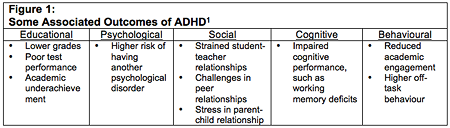
With regards to school functioning, children with ADHD experience significant impairments with far-reaching and lifelong implications. At the preschool level, children with high levels of inattention, hyperactivity, and impulsivity face challenges in their relationships with their teachers and peers, as well as difficulties building basic literacy, math, and language skills. At the elementary school level, these difficulties often persist and can even become more severe, resulting in continued academic struggles for these children. Not only do they experience lower grades, poor test performance, and academic underachievement, they are also more likely to be placed in special education and to be suspended or expelled for behavioural problems. This trajectory often continues at the high school level, where teenagers with ADHD continue to struggle. They tend to have lower academic attainment, as well as more behavioural and academic problems. In adulthood, those whose difficulties persist face challenges in developing and implementing the skills necessary to succeed in postsecondary education and stable employment.2
Myth #1: Hyperactivity and impulsivity are the main causes of academic problems for children with ADHD.
Hyperactivity and impulsivity can be very challenging to deal with in the classroom, and one might assume that these symptoms are the key cause of the school-based difficulties faced by children with ADHD. This is not the case. Rather, research consistently shows that inattention is the most significant factor associated with the academic problems faced by children with ADHD.3 This has important implications for how ADHD is addressed in the school setting. This is not to say that these behaviours should be ignored, but rather that interventions targeting problematic behaviours should go hand in hand with interventions designed to target inattentive symptoms.
Myth #2: ADHD is a behavioural disorder
Another misconception about ADHD surrounds its classification. Given the behavioural manifestations of inattention, hyperactivity, and impulsivity, one might conclude that ADHD is a behavioural disorder and until recently it was classified as such. However, an abundance of neuroscience research now unequivocally demonstrates that ADHD originates in the brain. As such, ADHD is now classified in the fifth edition of the Diagnostic and Statistical Manual of Mental Disorders as a neurodevelopmental disorder,4 emphasizing its neurological and biological origins in the childhood period.
Myth #3: ADHD symptoms are localized to a single brain region
ADHD does not involve just one part of the brain, but rather is related to dysfunction in several areas. Previous understandings of the neurobiology of ADHD suggested that only the frontal-striatal circuits were dysfunctional; however, new research suggests that several other areas of the brain contribute to ADHD symptomatology,5 specifically, the cortical regions, subcortical regions, and the cerebellum. Specific areas within each of these regions are related to different symptoms and behaviour.
These diverse brain areas are associated with an array of behaviours and functions. We can understand how these areas of functioning relate to ADHD by examining what is happening in each of these areas in individuals with ADHD. This is done by using magnetic resonance imaging (MRI) to look at the activation patterns in the brains of individuals with ADHD, and comparing the patterns to those without ADHD. It is also important to note that individuals with ADHD often have co-occurring problems that may also impact the structures and functions of other brain regions.
Myth #4: ADHD only involves over-activation of associated neural areas
There is a popular misconception that brain areas are over-activated for individuals with ADHD, likely because many overt behaviours associated with ADHD involve overactivity and hyperactivity. In fact, it has been established that ADHD actually involves both hypoactivation (underactivation) and hyperactivation (overactivation) of brain regions.6 Different patterns of activation are seen in different areas of the brain.
For instance, the prefrontal cortex has been found to be hypoactivated (less activated) when required to engage in inhibitory responses in individuals with ADHD compared to those without ADHD.7 Hypoactivation of the prefrontal cortex causes executive function and working memory impairments. Further, the anterior cingulate cortex has also been identified as being hypoactivated in individuals with ADHD.8 The anterior cingulate cortex is involved in anticipation, impulse control, empathy, decision-making, and emotion. Therefore, hypoactivation in this area results in impulsivity, poor/risky decision-making, difficulty anticipating rewards/consequences and right/wrong, as well as problems with regulating emotion.
By contrast, the visual systems and motor systems within the brains of individuals with ADHD appear to be hyperactivated. Hyperactivation of these areas results in increased distractibility, and increased motor movements and behaviours, such as fidgeting, moving around, and appearing as if the child is being run by a motor. Figure 2 summarizes the various areas of the brain that have been identified as being hypoactivated or hyperactivated in individuals with ADHD and provides some strategies that educators can use to address these difficulties.
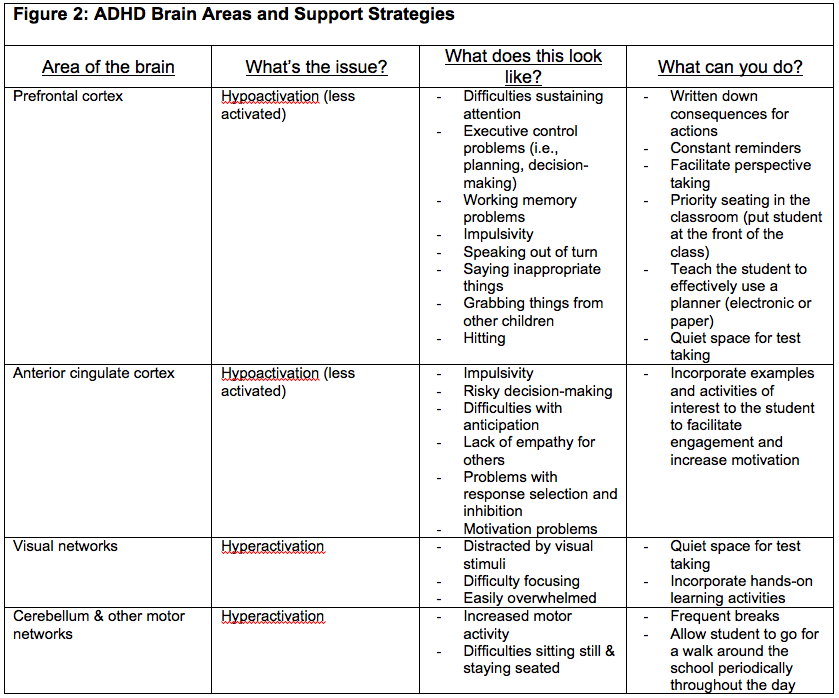
Myth #5: The neurological correlates of ADHD are completely understood
There is still much to be discovered about the neurobiological origins of ADHD. Although many brain regions have been implicated in the development and presentation of ADHD, there has been some disagreement on which areas are most influential. Furthermore, ADHD often co-occurs with other disorders, meaning that when a child is diagnosed with ADHD, it is very likely that they have another diagnosis, such as a learning disorder or a behavioural disorder.9 Co-occurring disorders make it difficult to distinguish which brain areas are involved with each disorder.
Myth #6: Biological treatments are the only option for children with ADHD
Indeed, there are many things that parents and educators can do to help their students with ADHD. The research has shown that behavioural and psychosocial interventions can be effective for treating ADHD symptoms.10 While medications also have their place in treating ADHD, the message here is that there are school-based options available that can be implemented by educators themselves. Figure 3 provides a summary of some evidence-based interventions for ADHD, as well as tips on how they can be implemented.
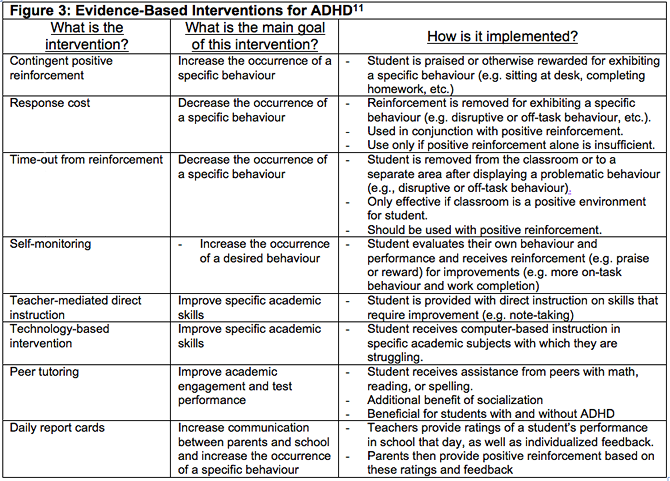
THOUGH MUCH REMAINS to be learned about the neurological correlates of ADHD, it is clear that ADHD is a complex disorder that affects many aspects of functioning, both in and out of the school setting. Educators have a critical role to play in the life of a child with ADHD and are ideally situated to implement helpful strategies to improve academic performance and behaviour, consequently benefitting the well-being and learning experiences of children with ADHD.
Special thanks to Stacey Kosmerly, Julia Boggia, and Natt Dugan at the University of Ottawa’s ADHD & Development Lab for their invaluable contributions and assistance in the preparation of this article.
The Importance of Positive Relationships
Emerging research suggests that strained or negative relationships with parents and teachers can adversely affect the learning outcomes for children with ADHD.11 In the school context, new research suggests that educators can enhance immediate and long-term success in their students with ADHD by improving their relationship with these students. Strategies for strengthening the teacher/student relationship can include:
- Make an effort to connect with students on an emotional level.
- Show interest in your students’ progress.
- Offer encouragement and support.
- Support your students’ autonomy to make their own choices and take ownership of their education.
- Avoid controlling language.
- Avoid using coercion and punishment, when positive alternatives can be used instead.
- Reach out for support for yourself in your role as an educator.
- Work on building a positive parent-teacher relationship.
1 Maria Rogers, Julia Boggia, Julia Ogg, and Robert Volpe, “The Ecology of ADHD in the Schools,” Curent Developmental Disorders Reports 2, no. 1 (2015): 23-29.
2 D. Daley and J. Birchwood, “ADHD and Academic Performance: Why does ADHD impact on academic performance and what can be done to support ADHD children in the classroom?” Child: Care, Health and Development 36, no. 4 (2010): 455-464.
3 A. Garner, B. Connor, M. Narad, L. Tamm, J. Simon, & J. N. Epstein, “The Relationship between ADHD Symptom Dimensions, Clinical Correlates and Functional Impairments,” Journal of Developmental and Behavioral Pediatrics 34, no. 7 (2014): 469–477.
4 American Psychiatric Association and American Psychiatric Association DSM-5 Task Force, Diagnostic and Statistical Manual of Mental Disorders: DSM-5, 5th ed. (Arlington, VA: American Psychiatric Association, 2013).
5 E. M.Valera, S. V. Faraone, K. E. Murray, and L. J. Seidman, “Meta-Analysis of Structural Imaging Findings in Attention-Deficit/Hyperactivity Disorder,” Biological Psychiatry 61, no. 12 (2007): 1361-1369.
6 H. McCarthy, N. Skokauskas, and T. Frodl, “Identifying a Consistent Pattern of Neural Function in Attention Deficit Hyperactivity Disorder: A meta-analysis,” Psychological Medicine 44, no. 4 (2014): 869-880.
7 McCarthy et al., “Identifying a Consistent Pattern of Neural Function in Attention Deficit Hyperactivity Disorder.”
8 George Bush, “Cingulate, Frontal, and Parietal Cortical Dysfunction in Attention-Deficit/Hyperactivity Disorder,” Biological Psychiatry 69, no. 12 (2011): 1160-1167.
9 Diagnostic and Statistical Manual of Mental Disorders: DSM-5.
10 G. A. Fabiano, W. E. Pelham, E. K. Coles, E. M. Gnagy, A. Chronis-Tuscano, and B. C. O’Connor, “A Meta-Analysis of Behavioral Treatments for Attention-deficit/hyperactivity Disorder,” Clinical Psychology Review 29, no. 2 (2009): 129-140.
11 George J. DuPaul, Lisa L. Weyandt, and Grace M. Janusis. “ADHD in the Classroom: Effective intervention strategies,” Theory into Practice 50, no. 1 (2011): 35-42.
12 Maria Rogers and Fiona Meek, “Relationships Matter: Motivating students with ADHD through the teacher-student relationship,” Perspectives on Language and Literacy (2015): 21-24
-
“Homeschool It Is”
Comments Off on “Homeschool It Is”The sun is low in Calgary and winter has set in. Despite frigid temperatures and snow-piled streets, the school buses are running. My eight-year-old daughter is rushing around trying to find the “right” pair of pants to wear. She needs to get dressed quickly and to be out at the bus stop before 8:35 a.m.
Rubbing her eyes, Mara takes a deep breath to calm herself down. She didn’t get enough sleep last night – again. Mara has always had trouble sleeping. These days, she can’t sleep without the television on and sometimes it takes too long to drift off. She feels lonely without the comfort and stimulation of the television to help her through the night, when it’s dark and the air is deathly quiet.
Never happy with her clothes, Mara is continually distressed with the feeling of all but her most comfortable favourites. She wants to wear the same pair of shorts all winter; too short for the season, but just the right fit and feel for her. Although we are hesitant to define her as abnormal and have not yet confirmed the label for Mara’s concerns, sensory issues and emotional sensitivity have made it difficult for us to get Mara to school on time, willingly. After discussing and exhausting all of the options with two different elementary schools, we have – reluctantly and at the same time enthusiastically – decided to exercise the homeschooling option.
“Mara is her own person, with her own mind,” we say, reinforcing ourselves. The truth is, the options are not available to us within the traditional educational system to meet Mara’s individual needs and wants. I would love to be working on my work instead of teaching her, but at the same time I want to do the best for my daughter and make her life as happy as possible. We are motivated to resolve the troubling distress Mara experienced at school, and in order to accomplish both work and learning, I have undertaken to provide education to my Grade 3 student, while focusing on my writing in the evenings and on weekends. It isn’t perfect, but we get to spend time with each other, no longer distanced by the two kilometres to the neighbourhood school.
Mara’s brother George, on the other hand, is asking to start school now. George is a different child than Mara. He is happy with structure and less bothered by his sensations. The next few years are going to be an experiment with George. He will see his sister learning at home, but he may crave the company of others and enjoy the routine of the day-to day in a typical elementary school. Not wanting to apply a template to George, we as parents need to give him his own chance with elementary school. Ultimately, we will support what he chooses for himself and what is best for him.
Given our experience, if someone were to ask what we would want as a family from the educational system for our children, I would say flexibility and funding. We need the flexibility to participate when we can without being hampered by the threat of legal measures to enforce attendance. On the other hand, funding for tutoring would help us at the homeschool to bridge the financial hardship that comes with meeting educational expectations when we can’t meet regular attendance requirements, despite our best efforts.
Like all parents, we want the best for our children. Our approach with Mara is based on this, so “homeschool it is” for us, and that’s the way it’s going to be.
We will wait for an education system that can better adapt to the individual needs of students and that offers students more choices and opportunities for independence – and maybe by high school we can find a happy medium for Mara in the school system.
Perhaps someday the school system will become more accepting and supportive of parents who need the flexibility to fulfill their parental roles, while attempting to meet their family’s needs as a whole. We can work together when parents, students and teachers are all included in developing and encouraging student achievement and growth, and families are recognized as central to academic success.
Photo: Scott Dunlop (istock)
First published in Education Canada, May 2015
-
Why School Was Not for Me
Comments Off on Why School Was Not for MeThe most important voices in a discussion on reducing the dropout rate are those of the people most affected: the students who leave school early.
The three youth who shared their stories with us range in age from 18 to 25. They have all, since dropping out, returned to some form of schooling and are working hard at it. The special programs they’ve taken advantage of have been crucial to their academic success. While their paths and challenges were all different, what they have in common is that the regular high school program did not work for them.
PAUL-ÉMILE HÉBERT, Montreal, QC
Paul-Émile is fluent and articulate in his second language, English. High school for him seems to have involved a series of setbacks, complications and discouragements, all reinforcing the message: “School is not my thing.”
How did you come to leave high school early?
Things started to go wrong when I left the private school I had attended through Grade 7 and followed my older brother into public school. There, based I guess on reports from my old school that I was inattentive and had ADD, they placed me in a “chemin particulier de formation”– a class of about a dozen students, all different ages and learning needs. I found it weird that I was put in this group and although I got myself out of it a year later, I didn’t get the proper depth for the regular program.
In Grade 9 I failed French and Math. Then in Grade 10, repeating French, I failed it again. It was an extremely difficult class; there were a lot of bright students in that class yet the average grade was maybe 65. Still, I couldn’t understand why my grades were so low. I would show my texts to other students and they couldn’t see what was wrong with them. At that point I started losing hope, though I did still have some pride in my other classes.
Going into Grade 10 I had a lot of anxiety, about my academic path and in general. There was a lot of pressure at school and from my father. I had broken up with my first girlfriend, and hooked up with a different group of people who did a lot of partying. That year I failed a bunch of classes and went to summer school.
In Grade 11 I switched to an alternative school and at first it went well. The semester system they used was better for me: I could do fewer classes at a time for a shorter period. I did well in the first semester. In the second semester, I sort of impulsively moved in with my girlfriend, an hour’s bus ride from the school. She was going through a difficult situation and I felt I had to help her out, so I skipped a lot of classes. I failed that semester.
In the third session (Sept.), the school suddenly adopted a hard-line policy about lateness and absence. I wasn’t able to adapt, and I ended up getting kicked out.
What have you been doing since?
Right after leaving school I was living back at home and working at McDonald’s. It was a sad winter – I was depressed about my life, and only getting a few hours when I really wanted full-time work. But with all that free time, I started developing an interest I’d been dabbling in through high school, which is DJ’ing events. I started doing a lot more gigs and working on my own music.
In April I got a full-time job in a better restaurant, and had enough money to go out and connect with people I wanted to work with in the music industry. It gave me a new perspective, in that a lot of people in music don’t have big academic backgrounds.
What’s going on in your life now?
I’m attending an adult centre to complete my high school. It’s not the standard “here’s a huge textbook; go home and come back when you’re ready to write the exam” kind of program. I attend class, with a teacher, every afternoon. We do one course at a time and complete it in six weeks and this is way better for me. I passed my first English course with flying colours and am almost done my next course. I’m still working part-time and doing some DJ sets, so right now things are going pretty well. I should be ready to graduate around the time of my 19th birthday.
What would have helped make school work for you?
I would have liked clearer criteria: Tell me what, exactly, am I being graded on? And there was so much weight placed on the final exam, but what was on the exam didn’t seem to reflect what we did in class – as if nothing you did in class mattered. So I guess for exams to match the content of the class better.
For me, and I would guess for many kids with ADD or ADHD, a ten-month course can seem excruciatingly long. Fewer courses at a time for shorter periods of time works so much better for me.
I don’t feel I really got any support or accommodation at all with my ADD issues.
Any future goals?
I want to work full time for a while to support the costs of my music, which I plan to continue with, and so I can afford to move into my own place. But longer-term, I’d like to qualify for a trade, and I’ve started looking into various options, like pharmacy assistant or cooking.
I’ve come to a place where I feel my personal goals and talents matter more than my grades. A degree is not the most important thing about a person.
NATALIE GERMAN, Toronto, Ont.
Natalie has returned to an alternative program after taking a year off school. Though she sounds confident and energetic in our interview, this is not how she felt through her teen years. Her story shows how vulnerabilities in mental health and a poor fit with the standard academic program impede school success.
How did you come to leave school before graduating?
School was pretty much OK for me until high school. Then I started really having a hard time showing up, arriving on time, or getting motivated to do my assignments.
I wasn’t skipping school to party or anything. Really I guess it was part of a larger teenage depression. It was more than not wanting to go to school; I often didn’t even want to leave the house. I had really low self-esteem and school was just more than I could deal with.
My mom tried putting me in therapy, and I went to one or two sessions, but I didn’t like them and I stopped going.
Even with all that, I was on track to graduate going into Grade 12, but then I failed that year and didn’t go back.
What have you been doing since?
I took a year off and worked as a fitness instructor for kids. That year helped me in lots of ways. I took on a more adult role and was working with adults. I had to come out of my shell, talk to my co-workers, talk to the kids’ parents. That was good for my self-confidence; I can talk to people now. And it’s a really direct reward system: you show up for work, you get paid. Miss work, you don’t. It makes you grow up.
I enjoyed the job, but it also motivated me to return to school. I realized I don’t want to work at minimum wage forever, you know?
I tried to finish high school doing online courses, but I didn’t succeed. It was way too self-directed for me at that time. I couldn’t even manage to show up for classes, let alone read chapters upon chapters of material and write essays all on my own time.
Looking back, is there anything that could have been different at your school that would have worked better for you?
I did have some teachers who were involved and really cared and who tried to help, but with others, it was like if you fell off the radar they just cut you loose. Like they had other things to worry about. So you just get moved through the system – it’s too institutional.
I also think schools need to be able to approach things differently, for kids like me who learn creatively and are more hands-on. The academic approach – read this, write this essay – doesn’t work for them. There could be more options for students to learn the same concepts in a different way. They don’t even really have vocational schools any more.
What’s going on in your life now?
I started at the Oasis Skateboard Factory in September,1 and just started my second semester. I heard about it from some friends who went, and so far it’s going really well. It’s more arts- and reality-based; less like high school, more like a studio. I think also because of the time I took away from school, I’m ready to take advantage of this.
The environment in this program is more relaxed; we do have assignments and deadlines but we can work at our own pace. And the relationship with our teachers is more personal; it’s like we have one teacher and one boss. I’ve been OK this year, but there are students who are struggling with personal issues and the teachers give them a lot of support.
Any future goals?
I’m actually in the process of applying to university right now. I’ve applied to OCAD, but my number one choice is Ryerson for Interior Design. The only thing I know for certain is that I want to work in an art-related field, but I’m willing to change what that is specifically, depending on how these next few months pan out for me. In the meantime, I’m working towards building an online presence so that I can work as a commission artist.
MORRIS CROW SPREADING WINGS, Lethbridge, Alberta
From a young age, experiences of racism, addiction and personal loss turned schooling into a struggle for Morris Crow Spreading Wings. His story is tough to hear, yet it also speaks to hope and resilience.
How was your early school experience?
I started school on the Blood Reserve, but we moved to Lethbridge (Alta.) after my parents divorced. I was only in Grade 2 when a little girl asked my why I had braids and brown skin, and when I told her I was Aboriginal she said, “Aren’t they the bad people?” That was the start of the racism I encountered throughout my life. Teachers and students would question whether I was a girl because of my braids. I was blamed for fights, accused of stealing when things went missing, and received punishments more severe than those given to White students.
Junior high was not much different, except the racism from other students became more vicious and hurtful. I was routinely called abusive names in front of teachers, with no repercussions. Once a kid lost his saxophone reed in band. I wasn’t sitting anywhere near him at the time and didn’t even play a reed instrument, but he decided that I stole it. The teacher brought me into the office and accused me relentlessly. I was so shocked and upset I couldn’t speak up for myself for fear of breaking out in tears.
When I was 12 my father broke my arm. There was no one I could trust enough to tell, so I said I fell down the stairs. They wouldn’t let me take my pain pills at school, assuming I would likely abuse them.
How about high school?
Soon after this I began experimenting with drugs and alcohol, and by high school I was pretty deep into the drug culture. I became the stereotypical “bad kid,” I guess.
I had a social studies teacher who would put me on the spot as the only First Nations student, asking things like, “Do you think it’s right that First Nations people get all this stuff for free?” I didn’t know how to respond and the rest of the class fed off that.
When I was 14, my mom kicked me out of her house and moved to Ontario, so I went back to my dad’s. He was terminally ill and I tried to look after him. He died the next year, and then I was on my own. The school was aware of this, but nobody made any attempt to offer me support or make any accommodations.
I felt threatened by my step-brothers, who wanted my father’s property. I got in trouble for sleeping at school, but it was because I stayed awake all night, on guard against them with my father’s loaded rifle.
By Grade 12 I was really only going to school to sell drugs and make money. I was just focused on survival. I quit in my second year of Grade 12.
What happened with your life after you quit school?
I got a job and worked for the same employers for seven years. Through that time I was constantly the butt of racist comments from my bosses, my colleagues and the customers. I believe that led me further into hard drugs and addiction. I made a number of attempts to get clean over the years, but always fell back.
What made you decide to return to school?
It was in the sweat lodge at the Young Offenders’ Centre, in 2011, that I made the decision. A career counselor hooked me up with the Red Crow Community College upgrading program. I took it seriously and excelled, even while I was working full time and still struggling with addiction. In two years I completed my upgrading and got into the University of Lethbridge First Nations Transition Program, in the Health Science stream.
I was successful in the program, but still couldn’t shake the addiction and the codependent relationship I was in that supplied it. Finally in March 2014 I started on a methadone program and got clean. I had a relapse in August but recovered and have been clean since then.
Where do things stand for you now?
I’ve found my goal – to be an addictions counselor – and am in my second semester of the program. In my first semester I had a GPA of 3.4 and this semester I’ve won a TA position.
School is going great. But I am still struggling with many areas of my life. I’m overcoming the challenges though. I have positive feelings about what the future holds for me.
En Bref – Lorsqu’on parle de réduire le taux de décrochage, les voix les plus importantes à écouter sont celles des personnes les plus concernées : les élèves qui quittent l’école prématurément. Trois jeunesâgés de 18 à 25 ans partagent leur expérience scolaire avec Éducation Canada. Tous trois ont décidé de décrocher avant d’obtenir leur diplôme d’études secondaires. Depuis, ils sont tous retournés aux études sous une forme ou une autre, et les programmes spéciaux dont ils ont profité ont été déterminants pour leur réussite scolaire. Quoique leur parcours et leurs enjeux diffèrent, ils ont quelque chose en commun : le programme régulier d’études secondaires n’a pas fonctionné pour eux.
Photo: M. Evans (istock)
First published in Education Canada, May 2015
1 OSF is an alternative program offered by the Toronto District School Board, previously profiled in the Theme 2012 issue of Education Canada: www.cea-ace.ca/osf
-
Moment to Moment: A positive approach to managing classroom behaviour By Joey Mandel
Comments Off on Moment to Moment: A positive approach to managing classroom behaviour By Joey MandelA review of Moment to Moment: A positive approach to managing classroom behaviour by Joey Mandel, Pembroke Publishers, 2013 ISBN: 978-1551382876.
As budget cutbacks result in fewer supports for children who struggle with self-regulation, many classroom teachers are searching desperately for resources to help them manage classroom behaviour. Disruptive behaviour stemming from such issues as Autism Spectrum Disorder, Fetal Alcohol Syndrome, and Attention Deficit Disorder are presenting elementary teachers with challenges that were not present in regular classrooms of 20 years ago.
According to Joey Mandel, teachers need to uncover the social skills deficits that are causing disruptive behaviours. She maintains that some children need more help than others to develop the social skills that allow them to participate more effectively in class. Her book does an excellent job of explaining the behaviours caused by social skill deficits and provides many examples of how these deficits affect a child’s ability to function. There is a very extensive checklist of “Signs of Skill Deficits” but, at over 100 items per student, it just makes me want to lie down. For certain children it would be worth the time investment to complete the survey, but to do it for all 20+ students in an elementary classroom, as Mandel suggests, would be an unrealistic time commitment.
For each of the deficits she identifies on the survey, Mandel provides activities and games that can be used with the whole class or small groups. I found that many of the activities, which were offered as appropriate for K-3, were actually beyond many of my JK/SK students, resulting in frustration. However, if you take the grade recommendations with a grain of salt, the activities are useful for the teacher and fun for the students. They do take up precious time that, with the pressure to cover ever more curriculum expectations, may deter some teachers. However, these activities can often be integrated into physical education or arts programs, making them more feasible to include in a busy schedule.
This book is a worthwhile addition to a teacher’s classroom management and provides valuable insight into the issues that lie behind difficult student behaviour.
Photo: Dave Donald
First published in Education Canada, March 2015
-
Youth, Education and Marginality: Local and Global Expressions; Edited by Kate Tilleczek and Bruce Ferguson
Comments Off on Youth, Education and Marginality: Local and Global Expressions; Edited by Kate Tilleczek and Bruce FergusonI THINK MOST OF US would agree that today’s youth are experiencing a society that is very different from that of generations before – a society with much uncertainty and instability fueled by: burgeoning urbanization, rapid technological changes, rising economic inequities, growing concentration of economic capital (wealth) in the hands of a few; skepticism about the efficacy of our democratic and meritocratic systems; growing numbers of females and ethnoracial minorities graduating from postsecondary institutions who remain over-represented among the unemployed; heightened surveillance of those deemed to be problem citizens; and the growing discontent with globalization. What are the consequences of these concerns for today’s youth? What are their readings of the conditions with which they are confronted? And how are they navigating and negotiating the structures that produce and maintain these conditions?
In Youth, Education, and Marginality: Local and global expressions, editors Kate Tilleczek and Bruce Ferguson and their contributors provide useful insights into the experiences, perspectives, and aspirations of youth who have been marginalized by the systems of education and schooling to which they are exposed. As Tilleczek and Ferguson write: “The social complexity of [the youth’s] experiences and life stories, and the ways in which schools respond to them, is the focus of this book” (p. 2). The significance of exploring the role of schooling and education in the lives of the young people who are casualties of inequity is well articulated by Jean Mitchell in her essay, “Marginalization Spaces, Disparate Places: Educational and youth practices in a globalizing world.” She writes: “Education as an institution and as a long-standing instrument of modernity in both colonial and post-colonial contexts shapes the lives of youth in particular ways to fit the shifting contours of global economies and government agendas” (p. 79).
Furthermore, in the current neoliberal context the ethos of individualism, hard work, merit, “right” choices, personal responsibility, and delayed gratification are the values and norms by which youth are encouraged to live their lives, approach their learning, and construct their aspirations. There are youth for whom this ethos – structured by Eurocentic, middle class, heterosexual, adult norms – are proving to be inadequate or limited in enabling them to take advantage of the opportunities promised through education and schooling. If indeed we are to develop a healthy democracy in which all Canadians are able to fully participate, then they must gain equitable access to education that builds on their abilities and skills – giving consideration to the different and varied social and cultural capital they bring to the teaching/learning process. And to ensure that their needs are addressed, rather than simply “give voice,” we need to hear often from these Canadians, and read about them from scholars and other adults who will provide spaces for them to tell their own stories or counter-stories. This is what Tilleczek and Ferguson set out to do in their book.
The stories of the youth are illustrated through empirical research, theoretical considerations, and policy discussions by scholars, youth workers (or practitioners), and policymakers. As well, youth have contributed poetry, prose, drawings, paintings, and photographs. The multi-genre texts featured in the “Youth Art” sections of almost every chapter capture in their own voices, the lived experiences, cultural nuances, aesthetic expressions, and inspiring images of the youth. This rich and diverse pedagogical presentation is a compelling aspect of the book, for it communicates insights into the “Changing World” of the youth (see Selima Jacqueline Peters’ poem, p. 10), giving readers access to the lived experiences of youth both in their voices and through the re-constructed narratives represented in scholarly research.
The essays and research reports of contributors reveal the nuances, shifts and complexities of the marginalization of the youth in relation to their identities, relationships, negotiations and responsibilities, and noting the role of gender, class (poverty), ethnicity, race, sexuality, aboriginality, and health (mental) in the marginalization processes. But contributors did not all consistently reference the inter-relationship of these factors on the social and educational situation of the youth. Race was sometimes confused or conflated with ethnicity. For example, in taking up Jalisha’s reference to her “Black, dark” skin, Tilleczek refers to “her ethnicity” when in fact race is what is being identified. The conflation of race with ethnicity means neither the issues of racialization and racism, nor the problems that contribute to the marginalization of racialized youth, will be adequately identified and addressed.
The international comparisons by Jean Mitchell, Chapter 4, and Andy Furlong, Chapter 7, were valuable to our understandings of the experiences of today’s youth beyond Canadian borders. I wonder what a comparison with youth in the United States might have added. Not only did contributors highlight the social, economic, educational, cultural, and political conditions that these societal and world conditions have spawned for today’s youth, they offered ways in which educators, practitioners and policymakers might work to address their situation (see in particular Chapters 4, 6, 8, 11 and 12). Contributors – including the youth – reason that it is important for educators and all who work with youth to pay attention to their lived experiences within their diverse networks and communities to which they belong and/or from which they gain their sense of belonging and identity. Doing so will help to foster healthy social and emotional development and well-being among youth.
Rummens and Dei (Chapter 6) suggest that a “critical inclusive approach” to the education of youth would help to “facilitate and enhance” their learning (p. 126). Such an approach necessarily involves “close relationships, mutual understanding and social bonding” between school personnel, parents and communities. I concur, for as I argued elsewhere, in working with marginalized students or students from marginalized communities, educators need “to have a knowledge of the community and the culture if they are to effectively facilitate a teaching and learning process in which students are able to see the relevance of their learning to their lives.”[1] When youth witness the validation of their experiences, and “the validation of their culture within the educational process, they concatenate their identities as family members and students.”[2] Probably, Melissa (age 22) speaks for many of today’s students, and more generally the youth, when she says: “It’s not that I want the whole world to cater to me or anything, I just see it catering to everyone else… and don’t get me wrong, I don’t need charity or anything, all I want is an equal shot” (p. 22).
Photo: Dave Donald
First published in Education Canada, September 2014
[1] C. E. James, Life at the Intersection: Community, class and schooling (Halifax: Fernwood Publishing, 2012), 124.
[2] J. Cammarota, “Participatory Action Research in the Public School Curriculum: Toward a pedagogy of dialogical authoring,” in Revolutionizing Education: Youth participatory action research in motion, J. Cammarota & M. Fine (eds) (New York: Routledge, 2008), 135.
-
When is the best time for students to learn about the importance of mental health?
Comments Off on When is the best time for students to learn about the importance of mental health?“It’s so frustrating when people tell me they know how I feel.” – Read by Lynda Monahan during the first Let’s Talk Mental Health National Video Conference. She was reading a writing submission from a member of the Writing for Your Life program at the Canadian Mental Health Association.
-
What Can Teachers Do for students who Have More specific Anxiety Needs?
Comments Off on What Can Teachers Do for students who Have More specific Anxiety Needs?Some students excel and thrive on challenges related to performance, evaluation and social interaction. Others experience distress under such conditions. Students who experience significant stress at school are at risk of developing anxiety related symptoms.
-
We’re All Different
Comments Off on We’re All DifferentI’m not a student but I would like to be one.
A few weeks ago I asked my friend Christine if she would show me one of the libraries on the University of Western Ontario’s campus. Christine has a busy work schedule on top of her duties as a student; taking a trip with her to campus was a rare privilege.
I can only describe stepping into the Waldon Library as heaven. A well-lit building full of art, thousands of books, seats and desks everywhere felt too good to be true but I knew it was real. As I stood in wonder at the potential around me I felt completely at home.
Yet I haven’t returned to the Waldon Library because the city bus to campus is too crowded for me to handle. I get so anxious when people stand close to me that I feel like I’m going to die. I have social anxiety, major depression, and post-traumatic stress disorder. I live off of the Ontario Disability Support Program (ODSP) and so I can’t afford a taxi, let alone a car. And if I could afford to take a taxi, I wouldn’t, because that too requires me to be in close proximity to a stranger.
If I could share my experience with educators to teach them about how to support youth with mental illness, I’d like to say that mental illness interferes with everything. It doesn’t matter if you know you need to get out of bed, if you have to go to class, if you need a degree for a stable job in the future; if your illness is interfering with your performance, you can’t reason your way out of it.
And so, instead of returning to the UWO Weldon Library daily, I’m literally counting the days until exam season is over so that the busses are less crowded and I can return to the place that feels like home.
I’m twenty-nine years old. I completed high school at the top of the honour roll but never went to university because of my anxiety. I barely made it out of high school alive.
I love to learn more than anything on the planet. I try to be content with teaching myself all that I want to know, but the older I get the more I realize what a handicap it is not being able to go to university.
If I could share my experience with educators to teach them about how to support youth with mental illness, I’d like to say that mental illness interferes with everything. It doesn’t matter if you know you need to get out of bed, if you have to go to class, if you need a degree for a stable job in the future; if your illness is interfering with your performance, you can’t reason your way out of it.
I spent the first half of my twenties hating myself for having mental illnesses. I told myself that I had no reason to be unhappy, that I should be performing better, that I should be working or in school, but none of that helped. Only facing the reality of my illnesses and treating myself with respect got me to a place where I could function better.
Sometimes it’s the best students who are having difficulties. Perfectionism is one way of coping with the stresses of life.
If a student is missing class, is late on assignments, or has a mental illness interfering with other aspects of school, being hard on them about it is just going to make the problem worse. Also, poor performance at school isn’t the only indicator of problems. Sometimes it’s the best students who are having difficulties. Perfectionism is one way of coping with the stresses of life.
Mental illnesses affect everyone differently. If you know of a student with a mental health issue, ask them what they need. Keep communication open.
Keep educating yourself on mental illnesses, reading a wide range of material. Open your mind and your heart.
Not all of us learn in the same way, but we can all learn and better ourselves no matter the difficulty.
This blog post is part of CEA’s focus on student mental health, which is also connected to Education Canada Magazine’s student mental health theme issue and a Facts on Education fact sheet on what the research says about effective approaches to improving students’ mental well-being. Please contact info@cea-ace.ca if you would like to contribute a blog post to this series.
-
What does Student Mental Health have to do with Teaching in the Classroom?
Comments Off on What does Student Mental Health have to do with Teaching in the Classroom?Student mental health problems are becoming one of the main concerns for teachers in schools. In fact, many teachers would say that a significant portion of their time is spent managing student behaviours, many of which are the result of mental health problems.
Impossible as it may seem, a teacher friend who has a Grade 4 classroom of 22 students indicated that 6 of her students have an IEP (Individual Education Plan) with significant modifications and accommodations. One student is identified as ‘Gifted with severe ADHD’; another student, identified with Autism, has significant behavioural and social difficulties. The other 4 students have a combination of various learning issues that also cause them to be at considerable risk for mental health problems. In fact, this teacher is concerned about 2 of these students because she has observed them to isolate themselves from their peers and they appear sad and apathetic in the classroom.
Given the complicated mental health and learning needs of these students together with the needs of the other students in her classroom, my friend is often overwhelmed and daunted by her task of teaching. What does she do to help all of her students grow and learn? What is her role as a classroom teacher?
What is a Tiered Approach to Mental Health?
Of course, the central role for teachers has to do with instruction and learning; however, without healthy minds, learning is a difficult task. Using a tiered approach when thinking about and working with students can be useful.
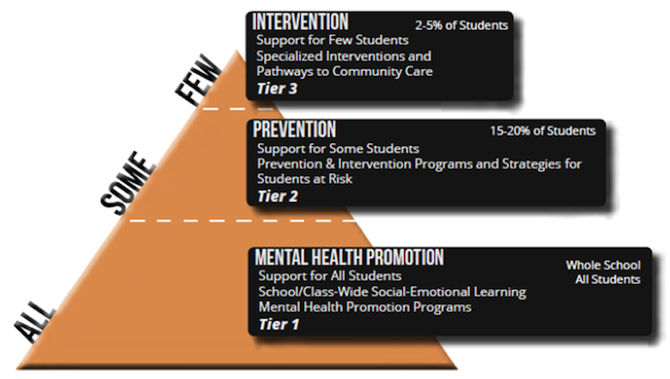
How can Teachers Promote Mental Health for ALL Students (Tier 1)?
- Teachers are able to provide support through universal mental health promotion and prevention programming.
- Teachers can support positive mental health for all students in the way that they go about their day-to-day work. Because teachers are significant in the lives of their students, how they behave towards students has huge impact on individual students and on the classroom in general. Their consistent support and overt compassion and patience with students are often of critical importance in the daily lives of their students.
- Teachers can use research-based strategies that are shown to promote positive mental health across schools and classrooms.
- Teachers can also incorporate school-wide programming to address areas of concern (e.g., peer mediation to help with student conflicts).
- Most significantly, teachers can integrate social emotional learning (SEL) into classroom activities so that students learn skills related to self-awareness, social awareness, self-regulation, relationship building, and decision-making. In fact, research has shown a link between social emotional learning skills and academic performance. For more information about the critical role of social emotional learning, visit the Collaborative for Academic, Social and Emotional Learning (CASEL) http://casel.org/
How can Teachers Help SOME Students with Mental Health Problems (Tier 2)?
Teachers are often the first to notice changes in student performance or behaviour. As such, teachers are in a unique position to identify students in need of more intensive services. In elementary and secondary schools teachers can provide targeted skill-building for students at higher risk for developing problems. This may be formalized in an Individual Education Plan (IEP) or can occur through group delivery of special programs for students who experience similar struggles (e.g., anxiety management sessions, temper taming groups). Some students are at risk for developing mental health problems and teachers can help with referrals to mental health support teams who may be internal or external to the board.
How Can Teachers Support the FEW Students Who Need Intensive Intervention Due to Mental Health Problems (Tier 3)?
Teachers and school personnel need to work seamlessly with community partners who have expertise in working with students requiring clinical intervention. Many communities across Ontario have set the foundations for the seamless delivery of mental health services through the Student Support Leadership Initiative and Working Together for Kids’ Mental Health. This collaborative work will deepen in coming years as communities further define and support the local pathways that fit their context. Pathways to support need to be locally determined, but more importantly pathways need to be clear and articulated so that students receive the right help at the right time.
Adapted from: Leading Mentally Healthy Schools: A Resource for School Administrators (School Mental Health – ASSIST, 2013) and Supporting Minds (Ontario Ministry of Education, 2013)
This blog post is part of CEA’s focus on student mental health, which is also connected to Education Canada Magazine’s student mental health theme issue and a Facts on Education fact sheet on what the research says about effective approaches to improving students’ mental well-being. Please contact info@cea-ace.ca if you would like to contribute a blog post to this series.
-
Student Anxiety – What Can Teachers Do?
Comments Off on Student Anxiety – What Can Teachers Do?Universal supports involve all students and teachers and have an impact on the whole-school environment. Educators are well positioned to provide these as part of the classroom experience.
Specifically in relation to student anxiety, universal (Tier 1) strategies provide foundational elements by:


IDEAS TO SUPPORT EDUCATORS : Subscribe to the EdCan e-Newsletter
Quality research, reports, and professional learning opportunities.