Archive
-
Learning as Becoming in a Digital Environment
Comments Off on Learning as Becoming in a Digital EnvironmentStarting with the idea of the Internet as a metaphor for the mind and the construction of identity, Dr. Sam Oh Neill explores how, in the digital age, “schooling must reach beyond its old purposes and… become education.”
THE DAY WE went to Marshall McLuhan’s house, I felt the respect my father had for his professor as they talked in front of the television. At age seven, I was oblivious to how well McLuhan foresaw the impact of media and technology on social development and citizenship. Even years later, writing an article about McLuhan in 1985 under an assumed identity,1 I was yet unaware of how meaningful McLuhan’s message would become with the rise of the internet.
McLuhan recognized that “the new electronic interdependence recreates the world in the image of a global village.”2 He would be fascinated with how social media validates this statement. McLuhan saw any form of media as an extension or enhancement of our biological selves; as an expression of our being. The interconnectedness the Internet allows is a metaphor for the flow of information transmitted through neurons via synapses in the brain. Artificial intelligence, learning machines and the Internet of things intensify this metaphor, linking the extended mind to the extensions of the body that media represent. In this digital environment the information of the mind is given expression within the world of things. The mind, though, is often unreliable, resulting in “fake news,” conspiracy theories, the making of meaningless “memes,” and people “trolling” others. McLuhan admitted that the global village was not necessarily the best place to be.
There is more information on the web than a textbook could ever contain. We can even watch talks with Marshall McLuhan. Along with useful information, there is the stuff of nightmares – things most humans keep locked deep in our psyches. There are also believable lies.
What is the role of educators in this brave new world? How do educators respond to a digital environment that chips away at their viability as the providers of liberal education? How do they respond to an understanding of 21st century learning, defined as our interactions with and through the digital environment?
The standard response of schooling: embrace the new media and bring it into the classroom. Students develop websites, create blogs instead of essays, or create YouTube videos of Shakespeare with mashups of popular songs. We log in to Bill Nye for a lecture on science, David Suzuki on the environment, and provide online assignments with Internet links. School boards provide e-learning, making school buildings seem obsolete. Some schools provide Chromebooks and teachers use Google classrooms to recreate the world in which students live, better monitor progress, more readily comment on work and potentially teach 24/7. When you embrace this media extension it also embraces you, but it has longer, more powerful arms.
Deconstructing the metaphor
To understand the path through digital influence we must deconstruct the metaphor of mind to media. Our brains are primed and ready for learning. The learning process begins with perception: our senses drawing signals from the outside world into our brains. These signals move through the brain via neurons and synapses: inanimate, unintelligent bio-mechanisms. Connections in the brain are made stronger through association, via perception, interaction and reflection. Through this process we create meaning, and through meaning the mind emerges and forms identity. This biological process of learning has existed unchanged since our evolution.
We humans are the nervous system of the World Wide Web. Each user of a computer screen and keyboard, every thumb tap on a smartphone, is a synapse in the global brain. Synapses make the connections. We send the neural signals through the network. It has only just begun and we have much to learn, but the learning process has not changed. We make meaning through connections, change the world through action and then make new connections. If the medium is the message, then the message is this process of connection and its place as a metaphor for the brain revealing mind. We must understand the process that develops mind and that forms – or deforms – identity.
But we are caught up in the content of the web. We see this in the fear of missing out (FOMO) which has people checking devices every second. The brain is always on. We have little time to make connections as we struggle to keep up.
This fixation on the message and not the metaphor is typical of schooling. In the curriculum, content is everything. Teaching in schools is primarily focused on the acquisition of course content that must be covered to achieve a credit. We fund technology in order to get access to the content on the web. When we give students Google, they search and cut and paste. Schooling prepares them for this process by providing them with answers, or leading them to conclusions needed to pass a course. There is seldom emotional connection to the process of schooling, so meaning evolves in environments outside of school.
Metaphors make meaning through relationship. The physical process of perception takes information from outside the brain and, through meaningful connections, constructs knowledge. We are able to create meaning by connecting disparate content in unique ways. This is the essence of metaphor. Through metaphor, one thing becomes the other, and learning expands beyond the confines of rote experience. The metaphor of the World Wide Web as human mind reminds us that the web is an expression of the mind. The mind is the maker of identity. The digital environment is an electrical extension of the biological process of becoming.
As a metaphor for the mind, the digital environment finds identity through our interaction as we express our identity through it. Identity is how we author ourselves in the world; we are defined by our actions in society with others: people, places, things and ideas. The issue of identity resonates in the realization that gender and sexuality are socially constructed. It resounds in every issue of racial experience. It reverberates in how we understand nature: as an endless resource to be exploited, or a living system of which we are one interdependent organism. And identity – who we are and how we develop – is deeply influenced by this new medium which pervades the environments in which we live. It is through the meaning of the digital environment as metaphor that we find the direction for schools.
Authors of existence
There is more to 21st century learning than working with kids in the cloud. Students need learning experiences that develop a critical awareness of social influences on how they create meaning in the world, so that their identities are not misted by cloud and cuteness. Magolda3 informs us that 21st century learning outcomes require the development of “internal values that shape our identities and relations with others.” She refers to this as self-authorship. Self-authorship requires reflection on experience and a critical evaluation of thoughts and feelings about what and why we are learning within a community of inquiry. This communal reflection is essential in a world dominated by technology and social connections that do not require physical proximity. Self-authorship involves a shift from meaning-making structures dominated by the uncritical acceptance of an outside authority, socialized via schooling, to meaning-making developed through encounters with divergent ideas. When students realize their ability to develop their own systems of knowledge acquisition, and to define their own beliefs and construct their own identities, they become independent learners.
Learning is no longer viewed as a process of knowledge accumulation. It is a biological process through which we discover how to author ourselves. This is essential for the coming century because it develops flexible minds able to adapt to the changes we cannot predict. Technology provides a means for greater connection in a larger community of minds. Those minds are still emotionally motivated organisms trying to discover their way in the world. New teachers must know how to lead them through that miraculous process. They must understand human connection and the need for autonomous being, especially as mediated through the World Wide Web.
Educators must be involved in social-emotional learning (SEL) and understand their role in the process of becoming. They must do this to bring their students to a place where they can adapt to their environments. The content of learning cannot be the focus of education if we are to adapt to the changes technology brings. We must focus on why and how people learn and develop the process so that learners can learn anything when needed.
The move toward this way of thinking is already occurring in our schools. This focus on meta-learning is embedded in the foundational philosophy of differentiated instruction and assessment (DIA). DIA focuses the attention of educators and students on how the individual processes information from the world. The educator then assesses from the perspective of the student and the developmental process, not the acquisition of content. Meta-learning is also inherent in learning communities, especially those that focus on method rather than numeric results, and in the recognition of the importance of social-emotional development to learning development. Viewing learning as a biological process through which we form identity, and learning how we learn, is essential in the digital environment. It is essential because it demands a critical stance from the perspective of self and social analysis. It demands that we understand ourselves in interaction with others, which is at the heart of civic involvement.
Teaching from this perspective challenges teachers to challenge themselves. They must not only understand what motivates students to learn but also what motivates their own desire to teach. They must understand the purpose of schooling and make changes when it does not meet the learning required to adapt to environmental change. They must be able to teach students how to express who they are and what they know without being massaged into complacency by content distractions. Finally, teachers must engage in the process of authoring identity, both for themselves and with their students. A self-authored identity defines who we are by how we act in society with others.
We are at a critical impasse and the curve ahead might end with a cliff. The issue of identity engendered with self-authorship is central to the solutions that will bridge the gap between being and technology. New teachers must be able to teach to this issue and expand beyond the context of schools. Technology is already taking us away from the school context and into a global society that requires individuals able to create the world they desire. New teachers need the capacity to work within a more personal developmental paradigm for education, rather than the old socially reconstructive paradigm of schooling.
We are citizens in a shifting global environment. The digital environment brings us into close proximity with others, extending our lived experience in a media village full of disparate thought. Schooling, the reconstructor of acceptable social behaviour, must reach beyond its old purpose and grasp the metaphor of becoming that the digital environment represents. In so doing schooling becomes education, forming a society whose citizens embrace diversity and engage in critical conversations, even those mediated through small glowing screens.
First published in Education Canada, September 2018
1 S. Zero, “Misunderstanding Media: Towards a critique of high-tech culture,” Cinema Canada, February 1 (1985).
2 M. McLuhan, The Gutenberg Galaxy: The making of typographic man (Toronto, ON: University of Toronto Press, 1962).
3 M. B. Magolda, “Self-authorship: The foundation for twenty-first-century education,” New Directions for Teaching and Learning, no. 109 (Wiley Periodicals, 2007).
-
Reaching and Teaching Them All
Comments Off on Reaching and Teaching Them AllAmanda Yuill’s writing has authenticity that can only come from classroom experience. Her ideas for connecting with the varied students in our classrooms are blended in this book with anecdotes and vignettes from her professional experience. With insight and humour, she describes how teachers can use a range of tools to help students feel connected to their teacher. Reaching and Teaching Them All is organized into three sections that explain how to connect with students who:
- would benefit from specific teaching strategies
- are in some kind of trouble
- have diverse learning needs.
While the publishers suggest that this book has strategies for every grade, it is most useful for teachers working with students from Kindergarten to Grade 8. The publishers also suggest that the book is valuable for both new and experienced teachers, but because Amanada Yuill models professional reflection, this book is especially well-suited for teachers in the early stages of their careers.
Yuill’s suggestions are diverse. She offers ideas for how to begin the school year, manage conflict, and maintain boundaries with students. She provides tips for connecting with students who are new to the country and tips for connecting with students with behavioural challenges. She suggests how teachers can support students who are experiencing sickness, death, poverty, or abuse at home. She offers advice for how teachers can work with the range of students in our classroom who experience ADHD, anxiety, autism, and various common forms of mental illness.
Underlying the practical suggestions in this book is Yuill’s belief that students should be involved in classroom decisions as much as possible, and that teachers have a responsibility to teach students the behavioural skills that they lack in order for them to be successful. Put another way, Yuill understands that students need a teacher to help them figure out what they could do differently, and this is most effectively done when students feel connected to their teacher. Yuill’s classroom-savvy ideas will help teachers make that valuable connection.
Pembroke, 2018
ISBN: 978-1551383309
First published in Education Canada, September 2018
-
BrainReach/Mission Cerveau
Comments Off on BrainReach/Mission CerveauBrainReach, a volunteer program based in McGill University, sends graduate neuroscience students into classrooms across Montreal to lead hands-on science lessons about the brain.
When you ask a child to draw a picture of a scientist, what is the result? Many might think of an Einstein look-alike with wild hair, dressed in a while lab coat and mixing colourful, bubbling chemicals. But those perceptions can change dramatically when someone who doesn’t fit that image comes into a classroom, identifies herself as a researcher, and begins to make science tangible and accessible to young thinkers. Personal connection can break the traditional barriers that separate academia from the general public and circumvent the media-as-gatekeeper pattern that we see so often. It transforms science from “something that other people do” into “something I can interact with.” Here is the story of one graduate program in Montreal that is making just such a connection with kids throughout their province.
Beginnings
BrainReach was spearheaded in 2011 by Dr. Josephine Nalbantoglu, then-director of the Integrated Program in Neuroscience at McGill University. (See “Resources” for links to this and other programs mentioned in the text.) Ian Mahar, a graduate student presenter and coordinator at the program’s inception, remembers: “Josephine called a meeting and asked if anyone wanted to help build this initiative known as BrainReach, and a number of us raised our hands to get involved. We had no idea how it would build from there, though I’m sure we would have been surprised to know.”
BrainReach sends graduate student volunteer educators into classrooms across Montreal to lead hands-on science lessons about the brain. The key to BrainReach was having the same presenters come back to one classroom multiple times, to build a rapport with the students and field their questions as they grew in curiosity and comfort. According to Jenea Bin, another of the first BrainReach coordinators: “We decided to target underserved schools in Montreal, as these students do not always have the same access to science learning materials. At the high school level, these schools also tend to have higher dropout rates.”
Another approach that has distinguished BrainReach since the beginning is its emphasis on developing a curriculum that is coherent with the current research about learning – we are a neuroscience program, after all! Each presentation has to have a few interactive activities to help kids experience the material (not just hear it). We help the students observe brain cells through microscopes, touch a real brain, record electrical signals from their muscles, and learn about perception with prism goggles. Reviews are built in at the end of each session, as well as the beginning of the next one, to help with learning retention. The initial curriculum was developed over the course of a year, and from then on we have been updating it constantly, since neuroscience is a field under rapid development.
The BrainReach North branch was developed in 2013-14 to serve kids in the north of Quebec. “I have a family branch in a small community on Baffin Island called Cape Dorset,” explains Emily Coffey, who laid the groundwork for the new branch. “In those small communities up north, many children have even less access to science. They can’t be taken to museum trips, and may never meet a scientist.” This required a re-imagining of BrainReach, leading to online guides for teachers and videos to explain concepts and take advantage of the same hands-on activities in places we couldn’t send graduate students in person.
Responses to the program
“I enjoyed it immensely from the first presentation, and was hooked; I remember wanting to work with as many classrooms as I could,” recalls Ian. He and many volunteers after him were motivated to bring in the newest research, cultivate a hunger for learning in their students, and challenge neuroscience myths (Do you really use only ten percent of your brain? No!).
Nowadays, we also hear from parents asking for the BrainReach program to come to their son or daughter’s school. This is heartening, and we are thrilled that parents are willing to act as liaisons for us – but it is imperative that the teacher is also on board. Teachers have limited classroom time, and even in elementary school they have a curriculum to get through. In order for a teacher to feel that it is worthwhile for them to give us hours of classroom time, we have to address the ways in which BrainReach covers parts of Quebec’s standardized curriculum; we also have to adequately communicate the benefits of the program to their students. For example, students need to learn about the scientific method and its associated terminology. So, in our session about brain cells, we ask students to make a hypothesis (or “educated guess”) about what a neuron will look like before they take a look in the microscope, recording their predictions in the form of a drawing. Then, we have the children look and draw what they see, just like the great scientists who first observed these amazing cells.
BrainReach sessions are also used to inform students about the neuroscience behind relevant social issues. In the high school curriculum, a full session is devoted to mechanisms of drugs and addiction, and in elementary school, we talk about how sleep affects our attention, mood, and memory.
Once a solid contact is made, it is a “win-win-win” situation – teachers get help preparing their science class, the kids get to develop relationships with people currently involved in neuroscience research, and the graduate volunteers gain crucial presentation skills and a connection to the world outside academia. “The children are always excited to know that the BrainReach presenters are coming,” one teacher commented. Ben Gold, who has been a presenter with the program for four years straight, remarked that he has also learned a lot about neuroscience by returning to the basics, thinking about things from the students’ perspectives, and working with teaching partners who have different areas of expertise. Another volunteer, Cindy Hovington, was so inspired by her experience that she went on to found Curious Neuron, an organization dedicated to translating research into accessible content for the public.
Challenges
As the organization became bigger, we had to systematize and structure the program. This is a challenge for neuroscience graduate students, who are used to more solitary work in their own labs, and are contributing to BrainReach entirely on a volunteer basis. In fact, it was (and continues to be) a crash course in project management.
We formed subcommittees for Elementary, High School, and North, each with about ten people. While some recruited and matched volunteers with schools, others focused on refining the curriculum and translating it into French. Still others inventoried and distributed supplies for our interactive activities on a weekly basis. We streamlined our work using online tools such as Google Drive, Wikispaces, and Slack.
At each turn, we were supported by the boundless enthusiasm and energy of our program’s graduate students, but we also depended upon the consistent backing of program administrators. In addition to the Integrated Program in Neuroscience’s structural support, we partnered with Montreal’s Centre for Research in Brain, Language and Music for extra funding, an extended pool of potential volunteers, and the ability to give one-time workshops as a part of the 24 Hours of Science initiative. We even began taking on interns from Concordia University’s John Molson School of Business to help us develop a more professional presence and seek funding.
Kelly Smart, BrainReach North’s current president, has the additional task of communicating cross-culturally and establishing working relationships at a distance. “We approach this by collaborating whenever we can. We seek out people and groups who already have the connections and expertise we need, and we try to work with them and learn from them. It takes a lot of persistence and a willingness to listen and adapt constantly,” says Kelly.
Finally, as with any volunteer-based organization, resources are an issue. BrainReach does not have a fully sustainable funding model, and for the most part we have worked with donated equipment and temporary office spaces. However, the program has received some important boosts, including a Telus grant, as well as a recent crowdfunding campaign that brought in over $12,000! These funds will help us to plan better for the future, and invest in key infrastructure elements such as a website, as well as allowing us to send volunteers into Indigenous communities to give science camps as part of BrainReach North.
School engagement
We are still developing and refining the program based on feedback from volunteers and teachers, but the most reliable measure of success is whether schools continue to sign up. And they do! This year, we have sent 100 volunteers to over 30 schools in the Montreal area, and have sent volunteers on teaching trips to three remote northern communities. Under the leadership of Marisa Cressati as high school coordinator, we saw a spike in the number of registered high schools and non-traditional classes (like homeschool co-ops and classes for kids with special needs). We hope to see other university groups learn from our experience and establish similar programs, especially in an age where media trends can obscure the difference between good and bad science. Giving science a “face” can change the way people interact with it, at any age.
Resources
Brainreach: Come say hi to us on social media!
Facebook @BrainReachMissionCerveau
or follow the BrainReach North Blog
Integrated Program in Neuroscience
Photo: courtesy Anastasia Sares
First published in Education Canada, September 2018
-
Makey Makey as an Assistive Resource
Comments Off on Makey Makey as an Assistive ResourceMakey Makey is an invention kit that can be used as an assistive technology that overcomes barriers and increases motivation because of its playful and user-friendly possibilities.
A number of years ago, I was teaching a class to enthusiastic certified teachers who were working on obtaining specialist qualifications in special education. One of my students had quadriplegia, and he insisted that I must look into a product called Makey Makey. I did look it up online, but did not feel motivated to investigate further – until I did. While teaching a series on iPads to group home support workers caring for, and teaching, adults with complex physical and developmental disabilities, his words came to mind. I looked more – and purchased it, and learned how to use it.
21st century teaching and learning highlights the constructivist value of Science, Technology, Engineering and Math (STEM) inquiry: makerspaces, coding apps (like Scratch) and invention kits such as Makey Makey, which has garnered a steady stream of rave reviews in the STEM educational market as one the best tech toys.
What is Makey Makey? It is a deceivingly simple, hands-on tech tool created in 2012 by MIT graduates Jay Silver and Eric Rosenbaum. It’s an invention kit that “convert[s] physical touch to a digital signal, which is interpreted by a computer as a keyboard message.”1 Makey Makey Original, Classic, and Go all have the same design premise: teachers, parents and students can construct interfaces that turn conductive objects into computer keys and buttons. Alphabet soup becomes a drum kit, bananas transform into piano keys, and measuring cups turn into game controllers. “It’s a different way of connecting the physical world with the computer,”2 says learning expert Mitchel Resnick. Using Makey Makey as a standalone STEM or invention activity presents endless possibilities for student learning – and more! As it enters the mainstream, possibilities appear not just for curriculum and instruction, and but for accessibility.
How can Makey Makey change and improve the world of accessibility? Picture a student who has difficulty with pressing and clicking traditional keys. Or perhaps an adult with a hand tremor or visual disability finds it difficult to manipulate the tiny keys on a laptop keyboard.
Stephens, Chalaye, and Parkhouse (2014) used Makey Makey in a segregated school for students with complex needs.3 They saw improvement in areas such as cause-and-effect, trial-and-error problem-solving, interpersonal contact, and person-to-person contact. Lin and Chang’s (2014) study in a self-contained Kindergarten environment showed that Makey Makey could overcome barriers created by the students’ physical disabilities, such as waning interest in using traditional switches, and that the novel interface motivated children to increase their physical activity – both important attributes for this type of resource.4 Rogers, Paay, Brereton, et al. introduced Makey Makey to a group of retired individuals to empower and enable them in the world of technology.5 Their project focused on the power of interactive learning, playfulness, and exploration – experiences that learners of all ages can appreciate.
How it works
Makey Makey has few parts: a specialized circuit board, colourful cables, and small alligator clips. Users connect the circuit board and cables with clips. Then, the circuit board plugs into a computers’ USB port. Next, the other ends of the clips are fastened to items with a small electrical charge. You will be amazed at what you can use! Try chocolate, bananas, gelatin, tape, aluminum foil or:
- metal materials such as coins, cutlery, jewelry, tools, door handles, wheelchairs
- pencil lead (write or draw thick, dark lines on paper)
- plants, teachers, or friends!
These objects take on the role of “up” and “down” computer keys or other inputs, such as touchpads or mouse clicks, allowing navigation of the online world using almost anything in the “in real life” world that has even mild conductivity.
Possibilities
While accessibility applications are an “off-label” use of the invention kit, the Makey Makey website includes an assistive resource guide that offers many possibilities.
For example, a wheelchair can be used as the interface by its movement over two inputs. First, connect tin foil to a coat hanger hung on the back of a wheelchair and connect it as the ground on the Makey Makey device. Next, place two large tin foil squares on the floor and indicate what the function of each square is (e.g. up/down arrow keys, W A S D keys, or other inputs). Then, connect each square with the alligator clips to the inputs on the Makey Makey device. Now as the wheelchair is moved over each of the squares, the keys are controlled. Another example is found in Silver and Rosenbaum’s demonstration video. Makey Makey Classic is clipped to large chunks of play clay. Essentially, this clay makes large, pliable buttons for children or adults with fine motor difficulties or other motor challenges. From directional head movements, head tilts, shoulder shrugs, forearm or hand movements, or torso leans, using Makey Makey as an assistive device can open up a new way of interacting with technology so that new, exciting, experiences can be enjoyed. Another possibility: If a child is not motivated by or is unable to access traditional augmentative communication devices, MakeyMakey could be set up to widen communicative opportunities, by linking spoken words or short phrases to specific items.6
Accessibility tips
Always keep the voice and interests of the Makey Makey user in mind! Some further considerations include:
- Use larger objects for individuals with fine motor difficulties.
- Use objects that will specifically capture the interests of the individual you are working with.
- When supporting reluctant learners, encourage those learners by including their favourite things.
Makey Makey is a lower-cost alternative to other custom assistive technologies presently on the market. It has built-in novelty for the user since the input material can be changed easily and it is compatible with many web games and apps. This invention kit is hands-on, intuitive, creative, and encourages innovation. To learn more, check out the Makey Makey website, the vast number of demonstration videos on YouTube, or follow on Twitter at @makeymakey.
Photo: Makey Makey
First published in Education Canada, September 2018
1 Chien-Yu Lin and Yu-Ming Chang, “Increase in Physical Activity in Kindergarten Children with Cerebral Palsy using MaKey-MaKey-Based Task Systems,” Research in Developmental Disabilities 35 (2014): 1963.
2 Tom Cheshire, “MaKey MaKey: Who wants to use bananas as a computer keyboard?” Wired (blog), November 12, 2012. http://www.wired.co.uk/article/the-magic-fruit
3 Liz Stephens, Clare Chalaye, and Charlotte Parkhouse, “Exploring the Use of a ‘MaKey MaKey’ Invention Kit with Pupils in a Special School,” SLD Experience 20, no. 1 (2014): 10-14.
4 Lin and Chang, “Increase in Physical Activity in Kindergarten Children.”
5 Y. Rogers, J. Paay, M. Brereton, et al., “Never Too Old: Engaging retired people inventing the future with MaKey MaKey,” Proceedings of the SIGCHI Conference on Human Factors in Computing Systems (2014): 3913-3922.
6 Stephens, Chalaye, and Parkhouse, “Exploring the Use of a ‘MaKey MaKey’ Invention Kit,” 13.
-
CALL FOR APPLICATIONS: 2018 Ken Spencer Award
Comments Off on CALL FOR APPLICATIONS: 2018 Ken Spencer AwardHas your learning program made a positive impact on previously disengaged and disadvantaged students so that they connect with local and global cultural and environmental issues to develop a strong sense of ownership in their learning?
For ten years, the Ken Spencer Award has discovered and profiled courageous classroom innovators who have made learning relevant and exciting by providing students with the autonomy and flexibility to think critically and solve real-world problems.
Seven cash awards totalling $15,000 are available to be won for your school.
Check out our award-winning programs from last year for inspiration and apply today!
TELL US ABOUT YOUR PROGRAM IN 250 WORDS OR LESS
This could be your year to receive the recognition and validation that you and your colleagues deserve to honour your courage and perseverance.
Winning entries will be profiled nationally – to encourage peer-to-peer learning – in Education Canada Magazine (articles, Podcast interviews and opinion pieces). For ten years, we’ve seen the lasting positive impact that this award can bring to educators and their schools.
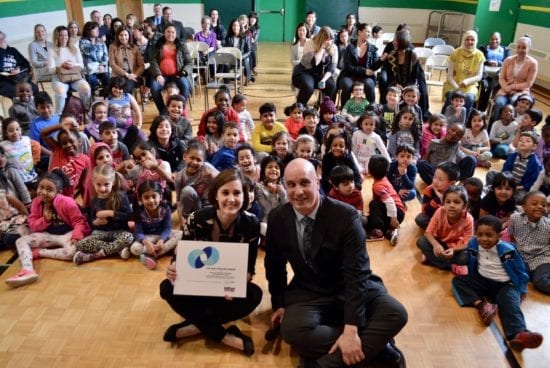
2017 Ken Spencer Award ceremony for Wexford Public School’s Deaf/Hard of Hearing Co-Enrollment Program, Toronto District School Board, Toronto, Ont. The deadline to submit your Stage 1 online application form – which will include a summary of your program in 250 words or less – is 5pm (Pacific Time) November 5, 2018.
For details on how you can apply, please visit: www.edcan.ca/kenspenceraward
-
Changemaker Education Summit
Comments Off on Changemaker Education SummitThis experiential K-Post-Secondary changemaker education day will give participants the opportunity learn from youth and the ingenuity of our Canadian youth-focused Ashoka Fellows. By providing an immersive experience in living a changemaker education, Ashoka Canada and Rideau Hall Foundation aim to further our goal of helping all young people see themselves as Canada’s future innovators who create change for the good of all.
In this unique un-conference, educators will learn from and alongside young changemakers with some of the most creative minds in the country.
-
From a focus on teaching to a focus on learning
Comments Off on From a focus on teaching to a focus on learningDr. Sharon Friesen is a professor and the President of the Galileo Educational Network at the University of Calgary’s Werklund School of Education. Stephen Hurley sat down with the renowned scholar to discuss nationwide revisions and redesigns to teacher education programs, including where we’re headed next. For new and future teachers – including all you history buffs out there – this one’s for you!
Read the article that inspired this conversation.
A Future Wanting to Emerge: Challenging assumptions about teacher education
-
2019 National Reading Recovery and Early Literacy Conference
Comments Off on 2019 National Reading Recovery and Early Literacy ConferenceThis Conference offers an outstanding professional development experience for K-3 teachers, literacy coaches, spec ed teachers interested in expanding common understandings and effective literacy practices to maximize young student achievements. The Conference is widely recognized as the country’s premier professional development experience for teachers of early literacy. Sessions are designed to present sound learning theory together with instructional best practices. Over two days, there will be keynote speakers, in depth workshops and a trade show of publishers with classroom materials.
-
Living by Design with Stress Resilience
Comments Off on Living by Design with Stress ResilienceAn extraordinary day with a line-up of Experts in the field of Integrative Health. Learn from Margaret Boersma, OCT how to increase your energy, access to happiness and how to lower the emotional temperature in a relationship. Marise Foster, Integrative Healing Practitioner and Trainer will support you in discovering how food effects our well-being and provide physical solutions for lowering stress. Carrie Rubel, Wellness Expert will give you ways to recognize a stress response and shift it. Then teach your students practical strategies to increase their stress resilience. Sign up today!
-
Young Child Expo
Comments Off on Young Child ExpoWe invite you to our 16th Annual Highly Rated Conference on April 30th – May 3rd 2019, join us for 4 days of early childhood conference presentations. Over 80 presentations. Continuing Education Credits Offered. Over 1,000 attendees expected. Topics for Typically Developing Children topics on Special Needs, Autism, Speech and other conditions
Target Audience
Teachers, Special Education Teachers, Principals, Directors, Speech, OT, PT Therapists, Psychologists, & Social Workers. -
An Exclusive Conversation with Sandra Becker: 2018 Master’s-Level Pat Clifford Award Winner
Comments Off on An Exclusive Conversation with Sandra Becker: 2018 Master’s-Level Pat Clifford Award WinnerSandra Becker is a third-year Ph.D. candidate at the University of Calgary’s Werklund School of Education and the first-ever Master’s-level category recipient of the Pat Clifford Award for Early Career Research in Education. Stephen Hurley caught up with Sandra to speak about her latest work, “How can I build a model if I don’t know the answer to the question?: Developing student and teacher sky scientist ontologies through making.”to Learn more about Sandra Becker’s research, click here.
-
A raw discussion about truth and reconciliation in Canadian schools
Comments Off on A raw discussion about truth and reconciliation in Canadian schoolsFour young Indigenous leaders shared with us their thoughts about what Truth and Reconciliation means to them and how that should be reflected in our schools…
Take in this powerful discussion…
This conversation inspired an article published in the Summer 2018 issue of Education Canada Magazine. Read Carrying the Fire.
Illustration: Don McIntyre
Music: “Perfect” by Ketsa Music/UTK Publishing (www.ketsamusic.com)
-
Learning and Teaching Together
Comments Off on Learning and Teaching TogetherA school culture of collaborative learning and teaching is key to the successful induction of new teachers, and grows the capacity of all teachers.
It’s time to ensure a paradigm shift for beginning teachers from “it feels like I am on my own” to “it feels like I am working with you and we are learning together.”
Recently, we witnessed first-hand how a new teacher’s confidence can be strengthened through collaboration with her more experienced colleagues. A team of primary teachers were engaged in a professional learning community with the goal of strengthening teaching and learning in mathematics. The teachers engaged in a variety of learning activities, including crafting learning intentions and success criteria that were in turn shared with their students. They also co-created lessons and volunteered to take turns teaching and observing. During one of their debriefing meetings, a first-year teacher revealed the following to her colleagues:
Our common planning and then observations have made me feel more confident in challenging my students. At the beginning of the year, when you all shared what you had your students doing – in my head I thought ‘my kids can’t do that’ but through our work together, I’ve seen otherwise.
This beginning teacher’s mathematics instruction was informed and adjusted based on classroom observation of her colleagues. Her increased knowledge about their practice helped to create a shift in her expectations for her students. She attributed successes (indicated by increases in students’ understanding) to the fact that “we had the opportunity to talk and eat lunch together” and that their collaboration and classroom observations “made us explain and question what we do.” In relation to an outcome resulting from the team’s collaborative efforts, she commented:
I am confident now that I have a role and that I can come in and contribute to the ‘build and explore’ (an aspect of the 3-part lesson plan) rather than just listen to you guys do it.
Understanding the lived experiences of beginning teachers is important if we are to provide appropriate supports which lay the groundwork for a thriving career.
Beginning teacher challenges
With a first contract in their hands, new teachers no doubt look forward to the responsibility and autonomy of having their own class and spend countless hours preparing their rooms, bulletin boards, and unit plans. However, as with any new challenge, and especially in environments where teachers tend to work in isolation, anxieties surface. Training and pre-service experiences, while valuable, are not the same as being totally responsible for a classroom of one’s own students. Research has confirmed that significant numbers of beginning teachers do not feel properly prepared in terms of classroom practice. A recent OECD report indicated that many new teachers felt more comfortable with their subject content than with actual practice and issues of implementation.2 When confidence wanes, it impacts our sense of well-being, our resilience, and our ability to take risks.
Beginning teachers, as Bryan Goodwin1 points out and practice substantiates, often have several foundational areas that shake their confidence, including classroom management and behavioural issues, assessment practices, and instructional planning. Assessment and instructional issues are intertwined, as a young teacher recently pointed out, because assessment “is not clear cut.” Assessment includes tracking student progress and understanding how to use anecdotal information for reporting and planning purposes. Purposefully selecting impactful instructional strategies and knowing how and when to provide modifications and accommodations come with experience and are not necessarily part of a new teachers’ repertoire.
If not addressed and supported, these areas also become reasons why teachers leave the profession. In particular, as our conversations with new teachers have illuminated, classroom management difficulties can greatly impact a teacher’s sense of competence and prompt some to quickly abandon dreams of being innovative in their delivery of daily lessons. Instead, they fall back on more traditional methods to simply cope on a day-to-day basis. It becomes an issue of feeling in control and is compounded if a teacher feels they must mask or hide their feelings or if they feel they are alone in trying to solve classroom issues.
It is important to add to the discussion the current shift in pedagogy for all teachers: the importance of incorporating an inquiry stance that utilizes key learning questions or ideas as the basis for student collaboration and learning. A 2016 mixed-methods study on the struggle of first-year teachers to implement inquiry instruction was telling. The study’s major finding was a consistent pattern among the first-year teachers’ perceptions of self-efficacy for inquiry instruction, and how they understood inquiry as a concept and actual classroom practice. Teachers with a high sense of self-efficacy were more likely to try to new strategies, adjust current ones, and persevere in the face of challenges.3 Teachers with a low sense of self-efficacy were unlikely to plan activities beyond their perceived capabilities or to scaffold for students who were having difficulties. This latter group of teachers identified a lack of time, materials, and the negative reactions of students as barriers to more innovative approaches and, not surprisingly, found it difficult to persevere in using an inquiry approach.
We must recognize that experiencing the inquiry process is a key underpinning to being able to effectively use inquiry as a learning design for students. Teacher inquiry as a collaborative learning design has become an increasingly powerful vehicle for professional learning, through its opportunities for reflective conversation, co-work and supported practice. However, it’s not common place to see this professional learning approach as part of a new teacher induction program. Collective efficacy can be a powerful outcome of this kind of learning when teachers have the structural supports to engage in co-learning efforts.4
The good news is that teacher confidence, feelings of preparedness, and skills can be increased through a variety of supports. A coach, mentor, peer as a co-learner, or principal who will not judge inexperience can be a pivotal person in making a difference for a beginning teacher who is feeling somewhat overwhelmed. Following, we highlight three strategic supports to teachers that go beyond initial induction training to professional learning through collaboration: mentoring, co-learning through collaborative inquiry, and coaching.
Mentoring
New teacher induction or support programs are a tangible key to success for many teachers. As a 2017 longitudinal study on the New Teacher Induction Program (NTIP) by Christine Frank & Associates for the Ontario Ministry of Education recently highlighted,5 teachers who were new to the profession identified a key support that was particularly helpful: mentoring from colleagues. To be clear, mentorship experiences appear to be on a continuum of effectiveness as highlighted in this report, but when teachers and mentors were a good match, the impact was significant. The report outlined important conditions for a successful mentoring relationship for new teachers such as:
- Having a mentor or colleague willing to share information, advice and resources that were relevant and helpful
- Co-creating new ideas for classroom program delivery
- Receiving support and encouragement
- Feeling safe to make mistakes and ask questions
- Collaborative work and problem solving.
As one fortunate participant in the study was reported to say: “Having a mentor in the same subject area, we work a lot together, co-planning and co-teaching, she helps me go further in my planning and teaching. I feel very lucky.”6
Personal support from the principal is also vitally important. Ongoing feedback and encouragement from the principal was seen as integral to growth in the NTIP program during its recent year one report in Ontario. The principals’ ability to be present, to listen attentively, to be intuitive to the needs of new staff and to provide tangible support such as an appropriate mentor and/or coach speaks to core administrative and leadership knowledge.
Collaborative inquiry
In a parallel process to inquiry teaching and co-learning with students, developing a co-learning culture where novice and experienced teachers take on supporting each other and where the principal is him- or herself a co-learner now represents the next level of leadership behaviour needed.7 Realistically, structural and organizational issues such as time to co-reflect have to be addressed to grow co-learning efforts. In recent research,8 the following views on how school leaders can build a collaborative learning culture were expressed:
- Creating a culture of safety and risk-taking
- Maintaining a clear focus
- Modelling co-learning
- Empowering others to lead and share decision making
- Demonstrating strong facilitation skills.
In a highly developed co-learning environment, beginning teachers have the opportunity to co-assess, co-plan, co-teach and co-debrief lesson impact with a variety of other educators. These could be teaching peers, a coach and/or a cross-school network. Admittedly, time constraints restrict co-learning opportunities, but according to longitudinal research from 2012-2015 completed for the Ontario Ministry of Education, there is a strong correlation between classroom observation and peer debriefing as part of a lesson design, and growth in instructional practice. Learning together is a powerful construct for adults as well as students.
At its core, a co-learning culture models what we know about high-quality professional development. It should be focused around challenges of practice and learning in the classroom. In co-learning, student work can be the impetus for collaborative conversations about what students understand and what next steps for instruction might be. Co-assessment of student learning, co-planning of subsequent lessons, co-analysis of student work and co-reflection on student learning fuels deeper learning and builds a sense of individual and collective efficacy. We know that a scaffolded approach is beneficial for students. Why would it not be beneficial for new professionals as well?
Using an inquiry approach to co-learning allows experienced and new teachers to contribute to problem solving with equitable voice while relationships, trust, and safety are nurtured and reinforced. Leaders (administrators and teacher leaders) who take the time to be co-learners with others build learning relationships in their schools more easily. Leaders who model their own vulnerabilities as learners encourage others to take risks and share learning experiences. Co-learning benefits from the underpinning of skillful facilitation,9 which can be taught as a leadership skill.
Until policy allows, not all teachers are in a position to co-assess, co-plan, co-teach and co-reflect, even though many express this is what they would really like to experience. In small schools without common preparation times, timetabling is a barrier that often stands in the way of the development of a co-learning culture. System leaders need to advocate for professional co-learning time to allow collaborative learning designs to take root.
Coaching
Taking the time to provide some purposeful coaching to staff who need specific assistance also helps to build cultures where professionalism is perceived as highly valued. Coaches may be teachers or school leaders and can provide feedback, ask questions to probe further thinking, and model practices that may be new to some. Acting in the role of a knowledgeable other or instructional resource as well as a partner in learning, coaches bring a depth of understanding about appropriate assessment and instructional responses to the interaction with beginning teachers. Jim Knight10 describes a coach as a thinking partner for teachers, and coaching as a meeting of the minds.
WORKING TOGETHER, these three areas of support – mentoring, co-learning through inquiry and coaching – move the notion of “collaborative professionalism” forward. This term, as used by Fullan and Hargreaves,11 is premised on the understanding that teaching has become an interdependent profession that requires structural adaptations, like time-table flexibility and opportunities for sustainable professional learning, to be integrated into system thinking.
Co-learning using an inquiry design is a process that recognizes and values teachers as drivers of school improvement, as opposed to being targets for improvement. System and school leaders must be the cultivators of vibrant co-learning cultures. System thinking about teacher induction must evolve from being a support during a defined time frame to induction into a collaborative community of learners where growing one’s capacity is encouraged at all stages of a teaching career.
Notes
1 OECD, “Do New Teachers Feel Prepared for Teaching?” Teaching in Focus 17 (Paris: OECD Publishing, 2017). http://dx.doi.org/10.1787/980bf07d-en
2 B. Goodwin, “Research Says/New teachers face three common challenges,” Educational Leadership 69, no. 8 (May 2012): 84-85.
3 T. Chichekian, B. M. Shore, and D. Tabatabai, “First-year Teachers’ Uphill Struggle to Implement Inquiry Instruction: Exploring the interplay among self-efficacy, conceptualizations, and classroom observations of inquiry enactment,” SAGE Open (April/May 2016): 1-19. http://journals.sagepub.com/doi/pdf/10.1177/2158244016649011
4 R. Goddard, Y. Goddard, E. Kim and R. Miller, “A Theoretical and Empirical Analysis of the Roles of Instructional Leadership, Teacher Collaboration, and Collective Efficacy Beliefs in Support of Student Learning,” American Journal of Education 121 (2015): 501-530; J. Donohoo, Collective Efficacy: How educator beliefs impact student learning (Thousand Oaks, CA: Corwin Press, 2017).
5 Christine Frank & Associates/Cathexis Consulting Inc., BTLJ Longitudinal Study: Year 1 (Ontario Ministry of Education, April 2017).
6 Ibid., 6.
7 L. Sharratt and B. Planche, Leading Collaborative Learning: Empowering excellence (Thousand Oaks, CA: Corwin Press, 2016); J. Donohoo and M. Velasco,(2016). The Transformative Power of Collaborative Inquiry: Realizing change in schools and classrooms (Thousand Oaks, CA: Corwin Press, 2016).
8 Sharratt and Planche, Leading Collaborative Learning.
9 B. Planche, Blog Posting: Deepening your Leadership Skills by Refining your Leadership Skills (April 17, 2017). https://thelearningexchange.ca/deepen-classroom-collaboration-refining-leadership-skills
10 J. Knight, “What Good Coaches Do,” Educational Leadership (ASCD, October 2011): 18-22.
11 M. Fullan and A. Hargreaves, Bringing the Professional Back In: A call to action (Oxford, OH: Learning Forward, 2016). https://learningforward.org/docs/default-source/pdf/bringing-the-profession-back-in.pdf
-
Self-Reg and Inclusive Schooling Face-to-Face Seminar
Comments Off on Self-Reg and Inclusive Schooling Face-to-Face SeminarDr. Susan Hopkins, executive director of The MEHRIT Centre, will engage participants, using an inquiry-based design, to explore the relationship between stress, is one of the key unaddressed issues in inclusive special education, and how Shanker Self-Reg can help educators to better understand and support students with special needs.
-
Self-Reg: A Great Tool for Early Kindergarten Educators – Face-to-Face Seminar
Comments Off on Self-Reg: A Great Tool for Early Kindergarten Educators – Face-to-Face SeminarSelf-regulation is now an important concept in Kindergarten education, one of the four frames of early learning in Ontario’s Full-Day Early-Learning Kindergarten curriculum. In this Institute Dr. Susan Hopkins, executive director of The MEHRIT Centre, will present and unpack the concept of self-regulation developed by Dr. Stuart Shanker.
-
Desjardins Coopérathon 2018
Comments Off on Desjardins Coopérathon 2018The 2018 Cooperathon will revolve around the tracks of finance, education, healthcare and energy.
The Cooperathon is both a platform and a movement. The platform is a place for learning and co-creating where projects with a big social impact take shape. The movement is a community of people and organizations who believe cooperation, innovation and entrepreneurship can make a positive difference in the world.
-
Your Top 10 Summer Reading List
Comments Off on Your Top 10 Summer Reading ListAre you seeking promising practices and the latest research and ideas from like-minded educator-leaders to challenge your thinking? Add these hand-picked articles from our Editor Holly Bennett to your summer reading list and boost your knowledge before the next school year begins!
EDUCATOR WELL-BEING
In this issue, we examine what can be done to support the well-being of all educators and reduce their levels of stress, role overload, and exhaustion. Many of our contributors make the very good point that the mental health of educators has a direct impact on the well-being of the students in their care; and that therefore we should support teachers’ well-being in order to ensure they are able to bring their best to their students.
- Creative Caring for Teachers: How a whole-school well-being approach can support everyone’s mental health
by Sue Roffey
- Healthy Principals, Healthy Schools: Supporting principals’ well-being
by Dr. Katina Pollock - Teach Resiliency: A resource for teacher and student wellness
by Susan Rodger, Kathryn Hibbert and Alan Leschied
WORKING WITH PARENTS
Parental engagement is a complex, double-edged issue that affects every level of education, from the student at home to provincial policy. From the importance of parent support to a child’s progress at school, to the tensions around parent advocacy for their children’s individual needs, to the political clout groups of parents can wield (for good or ill), this theme has many potential facets.
- The Missing Link: Parents are key players in sustainable educational change
by David Price - Bear With Me: Teaming up with parents of students with special needs
by Jeffrey MacCormack and Dr. Ian Matheson
SIGNALS OF CHANGE
In this issue, a cross-section of our network contributors – teachers, principals, superintendents, academics and students – explore how emerging big ideas could be creatively applied to education, why it may be important to do so, and the drawbacks or risks that need to be guarded against. From the aging population to micro-credentialing and artificial intelligence, what lies ahead for education?
- A Virtual Education: Artificial intelligence and virtual reality are changing the way we learn
by Lora Appel, PhD - Micro-credentially: Giving credit where credit is due
by Chris Cluff and Stephen Hurley
TRUTH AND RECONCILIATION IN THE SCHOOLS
How can teachers, who may know little themselves about Indigenous cultures and issues, authentically incorporate respectful, accurate information and experiences about Indigenous history, worldview, ways of teaching and learning, and contemporary issues into their classrooms? In this issue, we invite explorations of good practice examples, researchers’ insights on how we can “scale up” Indigenized learning, and other articles aimed toward helping schools move forward towards education for reconciliation.
- “First, We’re a School”: Teachers and school leaders play a key role in reconciliation, but policy makers must resource schools for equity of opportunity and success
by Dr. Gordon A. Martell - Truth and Reconciliation in YOUR Classroom: How to get started, and who can help
by Dr. Kate Freeman, Shawn McDonald and Dr. Lindsay Morcom
- Carrying the Fire: A youth talking circle on truth and reconciliation in our schools
by Dr. Michelle Hogue and Holly Bennett
Enjoy your summer!
- Creative Caring for Teachers: How a whole-school well-being approach can support everyone’s mental health
-
What is the impact of physical education on students’ well-being and academic success?
Comments Off on What is the impact of physical education on students’ well-being and academic success?Research confirms that healthier students make better learners. The term quality physical education is used to describe programs that are catered to a student’s age, skill level, culture and unique needs. They include 90 minutes of physical activity per week, fostering students’ well-being and improving their academic success. However, instructional time for quality phys-ed programs around the world are being decreased to prioritize other subject areas (especially math, science, social studies and English) in hopes to achieve higher academic achievement. However, several studies have identified a significant relationship between physical activity and academic achievement. Research also demonstrates that phys-ed does not have negative impacts on student success and that it offers the following physical, social, emotional and cognitive benefits:
Physical
Quality phys-ed helps students understand how exercise helps them to develop a healthy lifestyle, gain a variety of skills that help them to participate in a variety of physical activities and enjoy an active lifestyle.
Social
Quality phys-ed provides students with the opportunity to socialize with others and learn different skills such as communication, tolerance, trust, empathy and respect for others. They also learn positive team skills including cooperation, leadership, cohesion and responsibility. Students who play sports or participate in other physical activities experience a variety of emotions and learn how to better cope in stressful, challenging or painful situations.
Emotional
Quality phys-ed can be associated with improved mental health, since increased activity provides psychological benefits including reduced stress, anxiety and depression. It also helps students develop strategies to manage their emotions and increases their self-esteem.
Cognitive
Research tends to show that increased blood flow produced by physical activity may stimulate the brain and boost mental performance. Avoiding inactivity may also increase energy and concentration in the classroom.
Therefore, decreasing time for quality phys-ed to allow more instructional time for core curricular subjects – including math, science, social studies and English – is counterproductive, given its positive benefits on health outcomes and school achievement.
Additional Information Resources
PHE Canada (2018). Quality daily physical education. Retrieved from https://phecanada.ca/activate/qdpe
Ontario Ministry of Education. (2005). Healthy schools daily physical activity in schools grades 1‐3. Retrieved from http://www.edu.gov.on.ca/eng/teachers/dpa1-3.pdf
References
Ardoy, D. N., Fernández‐Rodríguez, J. M., Jiménez‐Pavón, D., Castillo, R., Ruiz, J. R., & Ortega, F. B. (2014). A Physical Education trial improves adolescents’ cognitive performance and academic achievement: The EDUFIT study. Scandinavian journal of medicine & science in sports, 24(1).
Bailey, R., Armour, K., Kirk, D., Jess, M., Pickup, I., Sandford, R., & Education, B. P. (2009). The educational benefits claimed for physical education and school sport: An academic review. Research papers in education, 24(1), 1-27.
Beane, J.A. (1990). Affect in the curriculum: Toward democracy, dignity, and diversity. Columbia: Teachers College Press.
Bedard, C., Bremer, E., Campbell, W., & Cairney, J. (2017). Evaluation of a direct-instruction intervention to improve movement and pre-literacy skills among young children: A within-subject repeated measures design. Frontiers in pediatrics, 5, 298.
Hellison, D.R., N. Cutforth, J. Kallusky, T. Martinek, M. Parker, and J. Stiel. (2000). Youth development and physical activity: Linking universities and communities. Champaign, IL: Human Kinetics.
Ho, F. K. W., Louie, L. H. T., Wong, W. H. S., Chan, K. L., Tiwari, A., Chow, C. B., & Cheung, Y. F. (2017). A sports-based youth development program, teen mental health, and physical fitness: An RCT. Pediatrics, e20171543.
Keeley, T. J., & Fox, K. R. (2009). The impact of physical activity and fitness on academic achievement and cognitive performance in children. International Review of Sport and Exercise Psychology, 2(2), 198-214.
Kohl III, H. W., & Cook, H. D. (Eds.). (2013). Educating the student body: Taking physical activity and physical education to school. National Academies Press.
Rasberry, C. N., Lee, S. M., Robin, L., Laris, B. A., Russell, L. A., Coyle, K. K., & Nihiser, A. J. (2011). The association between school-based physical activity, including physical education, and academic performance: a systematic review of the literature. Preventive medicine, 52, S10-S20.
Sallis, J. F., McKenzie, T. L., Kolody, B., Lewis, M., Marshall, S., & Rosengard, P. (1999). Effects of health-related physical education on academic achievement: Project SPARK. Research quarterly for exercise and sport, 70(2), 127-134.
Strong WB, Malina RM, Blimkie CJ, Daniels SR, Dishman RK, Gutin B, Hergenroeder AC, Must A, Nixon PA, Pivarnik JM, Rowland T, Trost S, & Trudeau F (2005). Evidence based physical activity for school-age youth. Journal of Pediatrics. 146(6):732–737.
Trudeau, F., & Shephard, R. J. (2008). Physical education, school physical activity, school sports and academic performance. International Journal of Behavioral Nutrition and Physical Activity, 5(1), 10.
Beane, J. A. (1990). Affect in the curriculum: Toward democracy, dignity, and diversity. Columbia University, New York, NY: Teachers College Press.
-
Celebrate National Indigenous Peoples Day
Comments Off on Celebrate National Indigenous Peoples DayOn June 21st, celebrate the heritage, diverse cultures and outstanding achievements of First Nations, Inuit and Métis!
The EdCan Network invites you to discover good practices, exemplary school programs and practical ideas for educators seeking to work towards truth and reconciliation in their schools and classrooms.
Add these books and magazine articles to your summer reading list and boost your knowledge before the next school year!
Articles for Educators
Carrying the Fire
A youth talking circle on truth and reconciliation in our schools
The Red Worn Runners
Intentional conversations with Indigenous youth
“First, We’re a School”
Teachers and school leaders play a key role in reconciliation, but policy makers must resource schools for equity of opportunity and success
Articles for Teachers, Teachers candidates and Principals
Truth and Reconciliation in YOUR Classroom
How to get started, and who can help
Our Journey Into Reconciliation
A Project of Heart at Stavely Elementary School
Books and Resources

Download and Print the Figure
from Truth and Reconciliation, K-12: Becoming a teacher allyReport for non-indigenous educators in urban high schools
A guide on how urban high schools can raise Indigenous graduation rates
Reconciliation in Action: Creating a Learning Community for Indigenous Student Success
This step-by-step report can be used to create your own unique program in consultation and collaboration with local Indigenous communities.
Read the report
PRACTICAL HOW-TO VIDEOS FOR TEACHERS AND PRINCIPALS
We’ve also put together a series of student and educator video testimonials demonstrating how “culture is medicine” that gives students a sense of pride and a will to succeed.
TACKLING SCHOOL DROPOUT, PURSUING RECONCILIATION: WHY WE SHOULD TEACH AND CELEBRATE INDIGENOUS CULTURES AND KNOWLEDGE IN SCHOOLS
RECONCILING BROKEN PROMISES: ADVICE ON BUILDING PARTNERSHIPS WITH INDIGENOUS COMMUNITIES
CULTURE IS MEDICINE: CONFRONTING STEREOTYPES ON FIRST NATIONS PEOPLES
Articles for Faculty researchers, ministries of education and Superintendents
Reconciliation and Education
Where are we at in Nunavik?
The Best of Both Worlds
Bringing Mi’kmaw Knowledge and Western curriculum together
Join the conversation #IndigenousPeoplesDay, #NIPDCanada, #NationalIndigenousPeoplesDay
Are you celebrating the National Indigenous Peoples Day in your school?
-
Reconciliation and Education
Comments Off on Reconciliation and EducationThe theme selected for this issue of Education Canada resonates with Kativik Ilisarniliriniq,1 the school board of Nunavik. Weaved into our current activities, the goal of delivering Indigenized educational services and programs to Inuit learners animates our organization at all levels, from its elected representatives to pedagogical experts, teachers and school administrators.
Kativik Ilisarniliriniq was created in 1975, under a land claims settlement known as the James Bay and Northern Quebec Agreement (JBNQA). Negotiated after a major hydroelectric project in the James Bay received opposition from the Inuit of Nunavik, the James Bay Cree, and other Aboriginal groups, the agreement is a protected treaty under the Constitution of Canada.
The school board embodies Inuit-controlled education. Indeed, under the JBNQA, Kativik Ilisarniliriniq can exercise unique powers to develop programs and curriculum aimed at enabling Inuit students to preserve their language, culture and identity. Providing students with access to learning based on Inuit values, culture, language, history, worldview, and approaches to pedagogy is therefore at the core of our mission and vision.
As an organization, we approach education from a holistic perspective. The services we deliver – as well as the curriculum and programs we develop – are rooted in the Inuit definition of Inuguiniq, an education process that seeks to develop the human being as a whole through direct engagement with the environment and the community. This is clearly reflected in the school board’s 2016-2023 Strategic Plan.
Applied to curriculum development work, these fundamental principles have led the school board to innovate and rethink its curriculum development framework. Rather than looking for areas where Indigenous content could be inserted into existing provincial programs, we used an Inuit perspective to incorporate the Quebec Education Plan (and other global or Euro-centric approaches to education), into a framework driven by Inuit worldview, Inuit pedagogy, and Inuit values.
The resulting curricular framework builds on Inuit heritage: thousands of years of environmental and architectural knowledge, sustainable communities, and a sophisticated language and culture. Recently presented at the Inuit Education Summit, a conference organized by the International Circumpolar Council (ICC), this approach was validated by the strong support it received from the Inuit representatives of ICC member countries.
A curricular framework built on Inuit heritage truly aligns to the recommendations of the Truth and Reconciliation Commission (TRC). I believe it also presents the Quebec government, through its Ministry of Education, with a unique opportunity to demonstrate leadership in working alongside Kativik Ilisarniliriniq to implement the TRC recommendations that relate to education.
Concretely, when applied to Science and Technology, using a curricular framework built on Inuit heritage has paved the way to the development of programs such as Inuit Environmental Science. Grounded in Inuit culture and land knowledge, the program aims to teach the conceptual and skills-based competencies that will allow Nunavik youth to meet and even exceed the requirements for the Quebec Ministry of Education Science and Technology Cycle One and Two and Environmental Science and Technology Progressions of Learning.
The program structures learning around seasons, with units tying lessons to the Arctic fauna, flora and environment, as illustrated in Figure 1. The program is currently being introduced for review for accreditation by the Ministry of Education.
As the school board pursues its effort to “Indigenize/Inuitize” the education services, programs and curriculum it offers, support from the Quebec Ministry of Education is essential. The Idle No More movement, the work of the TRC and its recommendations, as well as the increased media attention that Indigenous issues have attracted since the last federal elections all contribute to an environment in which there is a more acute awareness of the necessity to do things differently for reconciliation to become a reality.
As it currently stands, the Canadian public education system does not provide learners, Indigenous and non-Indigenous, with much in terms of knowledge related to “the history and legacy of residential schools, Treaties, and Aboriginal rights, as well as the historical and contemporary contributions of Aboriginal peoples to Canadian society.”2
While the situation varies from province to province, Quebec is not exempt of what the Director General of the First Nations Education Council Lise Bastien describes as “systemic ignorance.”3 This ignorance also reinforces the profound colonialization that we still have to extricate from our education system and mentality.
This point is important as it has a direct impact on the school board, and on the challenges we face as we seek the accreditation of programs and curricula built on Inuit heritage. Indeed, within the non-Aboriginal population, there is little awareness and understanding of Inuit rights enshrined in the JBNQA, and of who we are as Inuit; the government officials and ministry employees we work with are no exception to that. In this regard, it should be noted that the dialogue recently re-established between Kativik Ilisarniliriniq and the Quebec Ministry of Education also contributes to awareness-raising about Indigenous education, and is in itself a process conducive to reconciliation.
In terms of curriculum development, the Nunavik population is small and Inuit expert resources are scarce. In the case of non-Inuit expert resources in Canada, few are familiar with Inuit and Indigenous worldview and pedagogical approaches. This poses challenges that should be acknowledged; as an employer, we must be able to offer competitive work conditions to these experts who are in demand.
As mentioned above, the Quebec education system does not provide learners with much in terms of knowledge related to the historical and contemporary contributions of Indigenous peoples. As the school board caters to Inuit students and learners, filling this gap has been a priority for us.
In this regard, the following initiatives should be mentioned as best practices: 1) a new Nunavik History Program; 2) the launch of Nunavik Sivunitsavut (Nunavik Our Future, in Inuktitut); 3) the teacher training program implemented in partnership with McGill University.
Nunavik History Program
Currently in progress, the development of a Nunavik History Program was undertaken in collaboration with the Avataq Cultural Institute. The program bridges the school board’s regular and adult education sectors. It consists of 12 modules and will cover the period of 1600 to 2016.
The launch of the new Quebec history program in 2017 only reinforced the school board’s determination to pursue the development of its own program. While a step in the right direction, the new program contains little content related to the Inuit in Quebec. In no way does it respond adequately to Nunavik youth’s desire for knowledge about their history and identity as Inuit.
In addition, it is also important to recognize that the Indigenous educational content offered to non-Indigenous Canadians through the public education system (as well as the lack of such content) will continue to have tremendous repercussions on the Inuit of Nunavik. The school board (and other Nunavik organizations) would benefit from provincial education systems that offer more Indigenous and Inuit educational content. This would have a positive impact on our workforce if, in the future, the professionals we recruit outside Nunavik were to arrive with knowledge about Indigenous peoples in Canada, and a better understanding of the Arctic context and communities in which they are working.
Nunavik Sivunitsavut
Nunavik Sivunitsavut is inspired by the successful Ottawa-based Nunavut Sivuniksavut, that has been around for 30 years. Hosted at the Avataq Cultural Institute in Montreal, the initiative offers a one-year college-level experience to adults who hold a Secondary Studies Diploma. The courses, the knowledge and the skills student acquire are rooted in the Inuit culture, language and identity.
For each course completed, students obtain college credit from John Abbott College (our accreditation partner). The credit accumulated can count towards any college or CEGEP program in Quebec. The Nunavik Sivunitsavut team is currently formed of six teachers, two of whom are Inuit from Nunavik. Nunavik and Inuit experts are frequent guests in our classrooms and we are grateful to all those who have generously shared their knowledge with students.
Nunavik Sivunitsavut enriches the options available to Nunavik youth at the college level in Quebec. As our first cohort indicates, the initiative is well positioned to have a positive impact on student perseverance at the post-secondary level. Our hope is that it will contribute to increase the number of Nunavimmiut4 holding college and university level education, so that more Inuit can benefit from professional and economic opportunities in Nunavik.
Nunavik is a huge territory and there are not many opportunities for youth from different communities to meet and exchange with one another. At Nunavik Sivunitsavut, students share a strong learning experience through which a common sense of Inuit identity emerges. Students from the same cohort will very likely meet again in future roles or professional positions. From that perspective, Nunavik Sivunitsavut can also foster future partnerships and collaborations in the region.
Teacher training and certification
Ensuring the transmission of Inuit values, culture, and language through an education system where Inuit employees form only 51.49 percent of the workforce is challenging. At the moment, the school board employs 462 teachers, of which 36.4 percent are Inuit (168 Inuit teachers) and 40 percent of them hold a teaching certification issued by the Quebec Ministry of Education.
To increase access to the profession of educator, Kativik Ilisarniliriniq offers a Teacher Certification program and professional development programs to its Inuit teachers, Inuit teacher trainees and Inuit school administrators.
The program is implemented in partnership with McGill University. All courses are taught in Inuktitut, by Inuit instructors working alongside with McGill consultants. Since 1978, a total of 182 Inuit teachers have graduated from this program. As such, it has contributed to and continues to play an important role in building pedagogical expertise in Nunavik.
Looking forward
The recommendations of the Truth and Reconciliation Commission are valuable in many ways. In fact, they support Kativik Ilisarniliriniq in the exercise of the unique powers conferred to it by the James Bay and Northern Quebec Agreement. They also validate the approach that characterizes our program development work. Most importantly, they highlight the opportunities currently available to us (as well as our interlocutors within the Ministry of Education) that can be seized to refocus the conversation on the educational needs of our communities. In this regard, and as discussed here, many initiatives are already well underway!
We want to know what you think. Join the conversation @EdCanPub #EdCan!
Photo: Marie-Andrée Delisle-Alaku/Kativik Ilisarniliriniq
First published in Education Canada, June 2018
1 Kativik Ilisarniliriniq means Kativik School Board in Inuktitut.
2 Guiding principle number 10. See: Truth and Reconciliation Commission, Truth and Reconciliation Commission of Canada: Calls to Action, 2015.
3 Coined by Lise Bastien, Director General of the First Nations Education Council, the term “systemic ignorance” has since been widely used to describe the general lack of knowledge non-Indigenous Canadians display about Indigenous people in Canada, their language, culture, current realities and identity. Bastien first used the term when advocating for inclusion of content on Indigenous people in the province’s pedagogical material and curriculum as well as for the inclusion of content developed from an indigenous perspective. See: Jessica Nadeau, Plaidoyer pour une présence accrue de la culture autochtone, Le Devoir, November 29, 2016.
4 The term Nunavimmiut is an Inuktitut word. It is used to designate “the residents of Nunavik.” Currently, the Inuit represent approximately 85 percent of the Nunavik population (Statistics Canada, Fact Sheet for Nunavik, March 29, 2016).


IDEAS TO SUPPORT EDUCATORS : Subscribe to the EdCan e-Newsletter
Quality research, reports, and professional learning opportunities.