
Archive
-
Suicide Prevention: 6 Questions School Leaders Should Ask
Comments Off on Suicide Prevention: 6 Questions School Leaders Should AskSuicide prevention is a highly emotional topic and pressure may come from parents, communities, and the media to “do something” when such a tragic incident occurs. Suicide prevention programs are not a part of usual pedagogy and when a suicide event occurs it is important that school leaders, policy makers and politicians:
- Understand the lack of available evidence on suicide prevention strategies;
- Recognize the importance for districts/schools not to rush into purchasing and applying the latest shiny new suicide prevention program;
- Support students and teachers to develop good mental health literacy while ensuring an inviting, welcoming, and suitably challenging environment for all students;
- Continue to develop school staff’s capacities to identify, triage, refer, and support students who have a mental illness, as most youth who die by suicide have a mental illness.
These four approaches have stronger potential to prevent student suicide than those currently offered by slickly marketed suicide prevention programs.
Important questions to ask when implementing a school-based suicide prevention program include:
- Is the program being sold? Are there training costs, licence fees, or renewals? If so – buyer beware. If not – user be careful.
- Is there independent evidence (not evidence created or funded by the program developer or purveyor) that the program decreases suicide rates in young people? Do not accept “evidence-based” self-reported measures of knowledge about suicide, confidence in talking about suicide, intent to seek help, confidence in supporting those who may be having suicidal thoughts, willingness to talk to someone if suicidal, suicidal ideation, and suicide attempts – none of these are valid measures of suicide prevention. Because a program is listed on a “mental health registry” does not mean that it is effective or safe.
- Does the school have a well-established and clearly defined protocol for identification and in-school assessment of students who are exhibiting suicide-related behaviours/cognition?
- Is there a well-established link to local expert mental healthcare providers who are willing and able to immediately assess a student that the intervention has identified as needing follow-up?
- What are other available programs in the marketplace? Are they better, safer or less expensive than the one under consideration? (See item #1 above)
- What will implementation of the program cost – direct, indirect and opportunity cost? What will you not be able to deliver if you choose to apply this program?
School leaders need to do things that they know can prevent suicide, while avoiding those that we know do not prevent suicide, are unsure of, or could even cause more harm than good. “Doing something” and “doing the right thing” are not always the same thing.
Additional Information Resources
EdCan Network: School Mental Health Literacy: A national curriculum guide shows promising results
TeenMentalHealth.org:
References
Knightsmith P. Youth suicide prevention research needs a shake-up: lives depend on it. 2018. Accessible from https://www.nationalelfservice.net/mental-health/suicide/youth-suicide-prevention-research-needs-a-shake-up-lives-depend-on-it/
Kutcher S., Wei Y. The vexing challenge of suicide prevention: a research informed perspective on a recent systematic review. 2016. Accessible from https://www.nationalelfservice.net/mental-health/suicide/vexing-challenge-suicide-prevention-research-informed-perspective-recent-systematic-review/
King CA., Arango A., Kramer A., et., al. Association of the Youth-Nominated Support Team Intervention for Suicidal Adolescents With 11- to 14-Year Mortality Outcomes. Secondary Analysis of a Randomized Clinical Trial. JAMA Psychiatry. 2019. doi:10.1001/jamapsychiatry.2018.4358
Schilling EA, Lawless M, Buchanan L, et al. Signs of Suicide shows promise as a middle school suicide prevention program. Suicide Life Threat Behav. 2014; 44(6): 653-67.
Bailey E, et al. Universal Suicide Prevention in Young People: An evaluation of the safeTALK Program in Australian High Schools. Crisis. 2017; 38(5), 300-308.
Kutcher S., et al. School-and Community-Based Youth Suicide Prevention Interventions: Hot Idea, Hot Air, or Sham? The Canadian Journal of Psychiatry. (2016): 1-7.
-
Education Staff and Stakeholders in B.C., Alberta and Ontario
Comments Off on Education Staff and Stakeholders in B.C., Alberta and OntarioDiscussion about the importance of social and emotional wellness on the job has increased substantially in recent years. As the leading national voice on education issues, we want to understand how you view teacher and principal workplace wellbeing to help us understand perceptions on this important issue.
This survey only takes 10 minutes to complete! Take the survey now!
As a thank-you for taking the time to share your valuable insights with us, you are eligible to be entered into a draw to win a $50 Amazon gift card! Participation in this draw is strictly voluntary.
Once you’ve completed the survey, fill-up this form for a chance to win!For any additional clarifications or information, please contact André Rebeiz at arebeiz@edcan.ca
-
3 little-known myths about youth suicide prevention
Comments Off on 3 little-known myths about youth suicide preventionOur resources
Three fact sheets by the national EdCan Network of educators and TeenMentalHealth.org assert that school-based suicide prevention products and programs – many of which have become a significant source of revenue for many companies and organizations – are often ineffective and can cause more harm than good.
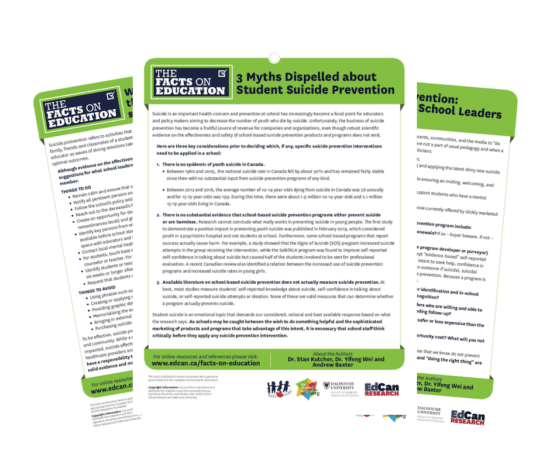
3 Myths Dispelled about Student Suicide Prevention
Key considerations prior to deciding which, if any, specific suicide prevention interventions need to be applied in a school [Download this fact sheet]
Suicide Prevention: 6 Questions School Leaders Should Ask
Important questions to ask when implementing a school-based suicide prevention program [Download this fact sheet]
What can school leaders do in the aftermath of student and staff suicide?
Suggestions for what school leaders should and should not do following the suicide of a student or staff member [Download this fact sheet]
Authored by mental health literacy experts Dr. Stan Kutcher, Dr. Yifeng Wei, and Andrew Baxter, these timely resources further reveal that there is no epidemic of youth suicide in Canada and that available studies often do not actually measure suicide prevention.
As the authors contend, “As schools may be caught between the wish to do something helpful and the sophisticated marketing of products and programs that take advantage of this intent, it is necessary that school staff think critically before they apply any suicide prevention strategy.”
“Youth suicide is an emotional and challenging topic that impacts entire school communities,” says Max Cooke, EdCan Network CEO. “These facts sheets will provide some much-needed clarity to school leaders who are looking for proven ways to decrease student death by suicide.”
Free copies of these fact sheets can be downloaded at www.edcan.ca/facts-on-education.
-
Canada’s Top Innovative K-12 Programs Break the Mould of Traditional Schooling
Comments Off on Canada’s Top Innovative K-12 Programs Break the Mould of Traditional Schooling
The 2019 Ken Spencer Awards for Innovation in Teaching and Learning showcase how teachers’ willingness to step beyond their comfort zones to honour student choice can create exceedingly relevant learning experiences while solving some of the most complex societal issues that we face. From developing successful small businesses and sellable products, to harnessing the learning potential of museum artifacts and virtual reality alongside Indigenous cultural practices, these award-winning programs engage students into discovering their passions, histories and cultures in ways that equip them to effect meaningful change now and throughout their lifetime.
“Whether it’s by adjusting timetables or rethinking student evaluation practices, these programs challenge the traditional structures of schooling as we know them,” says EdCan Network Director and Awards Jury Chair Chris Kennedy. “We’re confident that these awards will validate this courageous desire to innovate despite the system and encourage other early adopters to embrace these unique learning models.”
Ken Spencer Awards recognition ceremonies will take place in each of the school communities of the seven winners. This is the 10th anniversary edition of these prestigious awards and the EdCan Network would like to thank all 96 schools and school district staff candidates for their time and effort in submitting an award application.
For a snapshot and detailed profiles showcasing the work of all seven of the following Ken Spencer Awards winners: www.edcan.ca/ks-award-2019
FIRST PLACE – $7,000
Met Innovation Centre for Entrepreneurship (MICE)
Maples Met School (Seven Oaks School Division)
Winnipeg, Man.SECOND PLACE – $3,000
Gwich’in Land-based Education
Chief Paul Niditchie School (CPNS)
Tsiigehtchic, N.W.T.HONOURABLE MENTIONS – $1,000
3D Virtual and Augmented Reality Class Museum
École L’Odyssée (Commission scolaire de la Capitale)
Quebec City, Que.SPLICE Projects
St. Jerome Catholic Elementary School (York Catholic District School Board)
Aurora, Ont.The Hopedale, Nunatsiavut Virtual Reality Class
Amos Comenius Memorial School (Newfoundland and Labrador English School District)
Hopedale, N.L.Personalization at Max Aitken Academy!
Max Aitken Academy (Anglophone North School Division)
Miramichi, N.B.i-Think about Science
Milton District High School (Halton District School Board)
Milton, Ont.About the Ken Spencer Awards
The Ken Spencer Awards for Innovation in Teaching and Learning was established with the generous contributions of Dr. Ken Spencer to recognize and publicize innovative work that is sustainable and has the potential of being taken up by others; to encourage a focus on transformative change in schools; and to provide profile for classroom innovation within school districts, schools, and the media. www.edcan.ca/kenspenceraward
-
Ottawa Visible Learning plus Institute
Comments Off on Ottawa Visible Learning plus InstituteThis two-day event is the first step that will help educators create Visible Learning Schools that systematically examine effective instructional practice and equip them with practical solutions and proper tools to transform their practice and focus on influences that have the greatest impact on student learning. The Institute features workshops and sessions focused on Visible Learning, Collaborative Leadership, and Visible Learning for Mathematics led by John Hattie, Jenni Donohoo, and Connie Hamilton.
-
Assessing Students’ Work Habits
Comments Off on Assessing Students’ Work HabitsIn reference to the article Straight to the Source: Student self-assessment of learning skills and work habits
ASK OUR EXPERTS (5 minutes)
AIM: TO ENCOURAGE INTERACTION WITH RESEARCHERS
Does your group still have burning questions or comments? Encourage them to send their questions to Stefan Merchant, lead author for this article.
Email: stefan.merchant@queensu.ca
Or, send us your message and we’ll make sure one of our experts gets in touch.
-
Straight to the Source
Comments Off on Straight to the Source
Work habits or learning skills, a section on virtually all Canadian report cards, are well suited to student self-assessment. Not only does self-assessment give teachers access to students’ thought processes about their work, but it is also positively associated with better self-regulation, motivation, and achievement.
I started my teaching career in British Columbia. As a novice teacher, I was especially concerned that my grades be accurate and defensible. When it came time to complete my first set of report cards, I had a spreadsheet containing student scores on every test, quiz, and assignment they had completed that semester. Using a weighting formula that had been communicated to students and parents, I calculated everyone’s grade. I knew some kids would be disappointed, and others elated, but in either case, I could defend my grading decision with rigorously collected evidence. However, there were other assessment criteria I had to report on for which I had collected no evidence. This section of the report card was called “Work Habits” and was supposed to reflect… Now that I think about it, I am not sure what it was supposed to reflect. I considered student effort, and the number of missing or late assignments when rating students’ work habits, but I had no idea if this is what I was supposed to be doing, or if my colleagues considered the same things when they assigned work habits grades. My experience is a common one.
Classroom assessment of work habits
Teachers in all Canadian provinces assess and report aspects of student performance beyond academic achievement. This portion of the report card has different titles in different provinces such as “Learning Skills and Work Habits” in Ontario and “Cross-curricular Competencies” in Quebec, but it is always there. My own research shows that teachers often struggle to complete these assessments and frequently have little evidence on which to base their ratings of students’ work habits. As a result, teachers rely upon their holistic judgment of the student. As an assessment researcher, I should be appalled by this practice, but instead I am sympathetic. For one, I did the same thing when I taught. For another, assessing constructs like collaboration, responsibility, and organization is hard to do.
Assessing work habits is so difficult because they are not easy to observe. When a teacher assesses writing quality, they have a concrete student product in front of them to evaluate. If they want a second opinion, they can show the writing to a colleague, or leave the work and reread it later. But how can a teacher make a reliable judgment of the effort put into the work? Teachers must observe 20 or 30 students at the same time, making it impossible to determine how much time a student puts into a task. Even if a teacher were to focus on a single student for an entire lesson, how can she discern daydreaming from deep thought? The problem is further compounded if the student worked on a task outside of the classroom. Does completed homework reflect an engaged, conscientious student or a helicopter parent?
Effective student self-assessment practices
When trying to assess skills such as self-regulation, researchers most often rely on self-report instruments. These are typically questionnaires completed by the student. Self-report instruments are useful measurement tools because they access respondents’ internal thought processes. This characteristic makes them ideal for classroom assessment of work habits. Many teachers recognize that students have important things to say about their learning and ask students to self-assess their work habits. For example, research conducted in Ontario suggests that about half of high school teachers ask students to complete self-assessments of their work habits. Teachers use these self-assessments to prompt student’ reflection on their learning and improve their metacognition. However, they do not consider the results of the self-assessment when assigning the work habits ratings on report cards – despite believing their students complete their self-assessment honestly.
Student self-assessment of work habits is an encouraging trend, but this practice could be even more widespread. Not only does self-assessment give teachers access to students’ latent thought processes about their work, but it is also positively associated with better self-regulation, motivation, and achievement. However, for student self-assessments of work habits to be effective, it is necessary to implement practices such as co-constructing definitions and expectations. How can a student give a reasonable self-assessment of their collaborative skills if they do not have a firm grasp of what collaboration means? Co-creating definitions of the skills being assessed not only improves students’ self-assessments, but also ensures the teacher and students share a common understanding of that skill. One way of achieving a shared understanding is to create a rubric for each skill with students. The rubric breaks down components of the skill and describes differences in skill levels. When students are able to use the rubric, they develop an understanding of what separates different ratings. For instance, how is excellent collaboration different from good collaboration?
Another tactic known to improve the effectiveness of self-assessments is to have teachers give students guidance on how to complete the self-assessments. Researchers have consistently found that when students are given training on how to self-assess, not only are their assessments more accurate, but the learning benefits are greater. The benefits are even greater when teachers provide their own assessment of the work habits and discuss their assessment, and the self-assessment, with the student. These discussions are critical to helping students become better assessors of their own skills. Students (especially younger ones) are often not accurate reporters of their own skills. Most students tend to overestimate their abilities, and this is especially true for weaker students. Paradoxically, the strongest students are the ones most likely to give themselves low ratings. If we want students to develop an accurate self-concept, they need to be privy not only to the teacher’s ratings, but also the rationale behind them. As a former teacher, I recognize finding time to have these discussions is difficult, but doing so will improve not only students’ ability to self-assess but also their work habits.
Lastly, the students’ self-assessments should appear on the report card. Not only does doing so give them meaningful input into the report card, but it also allows the parents to see the student’s self-assessment. This has the potential to lead to fruitful discussions between parents and children about their work habits.
What does this mean for educators?
If you are a teacher, I encourage you to start implementing student self-assessment of work habits now. The information you gain about your students and their self-concept will lead to rich discussions about their learning and work habits and will also enhance your relationship with them. School administrators can highlight teachers who use self-assessment of the work habits as role models and support teacher development in this area through training and professional learning communities. I urge superintendents to consider what assessment policies, procedures, and training can help improve teachers’ assessment of work habits. The types of skills that fall under work habits (e.g. responsibility, organization, collaboration, initiative, perseverance) lead not only to better learning, but also to better jobs, relationships, and health. Further, these skills are closely aligned with the broader aims of education espoused by school districts and ministries of education. Given the critical importance of these skills for our students as individuals, and for our society as a whole, it is vital that we help teachers develop the capacity to improve students’ work habits. Helping them understand how to effectively implement student self-assessment of work habits would be an excellent first step.
NEW! Discussion Kit
Download the pro-learning session 1.2 – Assessing Students’ Work Habits
Illustration: Dave Donald
First published in Education Canada, March 2019
-
Rethinking How You Grade
Comments Off on Rethinking How You GradeIn reference to the article Grading across Canada: Policies, practices, and perils
By Christopher DeLuca, Liying Cheng, and Louis Volante
ASK OUR EXPERTS (5 minutes)
AIM: TO ENCOURAGE INTERACTION WITH RESEARCHERS
Does your group still have burning questions or comments? Encourage them to send their questions to Dr. Christopher DeLuca, lead author for this article.
Email: cdeluca@queensu.ca
Or, send us your message and we’ll make sure one of our experts gets in touch.
ADDITIONAL RESOURCES
-
Comparative Judgment
Comments Off on Comparative JudgmentComparative judgment (CJ) is an assessment methodology based on the ranking of two pieces of work at a time. CJ can be used both as a professional development tool to sharpen assessment skills and develop shared standards, and as a way of identifying exemplars of quality that allow students to better understand learning goals and expectations.
Learning is unpredictable, and students do not learn everything they are taught; therefore simply providing learning opportunities in school is not by itself sufficient. Assessment must be embedded within educational settings to bridge teaching and learning. Teachers who fail to assess what pupils do cannot determine whether they are contributing to or impeding pupils’ progress. Assessment data must be elicited, inferred from and used to adapt classroom practice to better meet students’ needs.
We know that teachers make inferences based on what happens in the classroom activities. My colleague, Professor Inga-Britt Skogh, and I were curious to find out what teachers are focusing on while assessing student progress in the context of Swedish technology education. Our study involved six teachers and a class of 11-year-old students who were undertaking an open-ended design scenario. The students designed a model robot to help them complete various tasks they needed help with at home. They identified problems such as recording NHL games, walking the dog, completing homework, scanning and submitting homework, and baking cupcakes. During classroom activities, the students built Web-based synchronous e-portfolios of their learning and the product development, using text, photos, moving pictures and sketches on their iPads. In order to unpack what teachers emphasized as criteria for success, we decided to use a methodology called comparative judgment.1
Comparative judgment is an assessment methodology where the judgers compare two pieces of student work and identify which one of them is better, without saying how much better it is. Their decision is based on quality of the work.
To identify the motives behind teachers’ choices, the research team asked them to describe the reasons for their choices by speaking into an MP3 recorder while doing the pairwise comparisons. These think-aloud protocols were recorded and transcribed. They provided valuable insights on the rationale for each choice. Results generated a judge consistency above .9 and the qualitative data revealed what the assessors agreed upon: the importance of seeing the narrative of the portfolio/design process. The teachers – our judgers – were also invited to a session where we interviewed them.
Comparative judgment
Comparative judgment has been used in different settings, such as psychology and perfume making, and also quite recently (last 10–15 years) in educational settings. Comparative judgment stems from the work of Luis Thurstone who, in the 1920s, tried to find methods for measuring things that are difficult to measure – such as attitudes and opinions, for example how serious a crime is considered to be. Thurstone argued that while people find it hard to say how serious a crime is, they can compare one crime to another relatively easily and reliably in terms of which crime they think is more serious. He explained that when two phenomena are placed in comparison with one another, individuals can use their knowledge to compare and identify which qualities are superior with high fidelity. He showed that by repeatedly comparing pairs of items, a ranking could be made of all items assessed with very high reliability. Based on his studies, he formulated the Law of Comparative Judgment, which in short means that people are more reliable when comparing two stimuli, such as two crimes, than when giving an absolute value to a stimulus.2 Laming built on Thurstone’s work and said that all assessment is a comparison of one thing to something else.3
How does comparative judgment work?
Comparative judgment is an iterative process, where assessors are presented with a series of two objects and select the better of the two. They assign an instinctive ranking to each object based on their expertise, previous experience and the object quality, instead of awarding an absolute score.
This iterative process may be undertaken manually, where you, for example, pick two random essays from your pile of student work, compare them, and pick one as a winner; you then repeat the process iteratively until every essay has been compared to each other, like the Swiss tournament. This manual process is a bit complicated, especially when you want to work with others. It can be facilitated with comparative judgment software, where student work is presented two at a time and then from a mathematical formula compared to each other. This software for comparative judgment generates quantitative data of high reliability, usually above 80 percent, and also facilitates the inclusion of multiple assessors.
Research studies have been conducted with comparative judgment, both regarding validity and reliability, in Ireland, England, Belgium, Sweden and the U.S. In the studies, comparative assessment has been used primarily to assess creative work in, for example, technology education and essay writing. The high reliability achieved reflects a professional consensus in the group of assessors. The software system allows assessors to leave comments and explain why they judged one example to be better than other. These comments can be used to identify criteria that describe what teachers consider to be important competencies in the subject and can also be given as feedback to both teachers and students while learning.
The comparative judgment process can be undertaken wherever is convenient, something that I and my American friends Dr. Scott Bartholomew and Dr. Greg Strimel, from Purdue University, took advantage of when we wanted to investigate differences and commonalities among teachers’ assessment practices in open-ended design scenarios across nations.
Teachers and educational researchers from the U.S., U.K. and Sweden were invited to assess an open-ended design scenario in engineering/ technology education (a pill dispenser for a fictional forgetful client) made by 760 high school students. The judgers assessed 175 portfolios and 175 products with comparative judgment via the cloud-based software Compare Assess. We undertook the whole study via the Internet and the judgers did their assessment from their home couches or wherever they liked.4
Clarifying criteria for success
I strongly believe that teachers do everything in their power to move their pupils forward in their learning journeys. However, the direction of forward movement is not always obvious! Still, it is crucial for teachers to be clear about what they expect of their students. Such clarity benefits all students, and especially low achievers, and thus it may dramatically reduce the gap between low and high achievers.
Clarifying the learning intentions, consequences, and results of an assessment increases validity and reliability. But this clarity can be hard to achieve without spoiling the joy of learning. Furthermore, students’ perceptions of learning intentions may not match teachers’ expectations. Addressing this discrepancy is crucial to reducing the gap between low and high achievers, since low achievers generally find it more difficult to interpret what their teachers consider as criteria for success.
How do we overcome the discrepancy between teachers’ intention and students’ comprehension, and at the same time promote thinking by encouraging pupils to express themselves, reflect upon their own and others’ ideas, and expand their horizons? The Irish Technology Education Research Group (TERG) approached this challenge in the technology teacher education program at the University of Limerick by letting students peer assess one another’s work using comparative judgment. Specifically, students were asked to compare two pieces of work, choose which one was better and provide peer feedback comments in an iterative process. Feedback was matched to each exemplar and given back to the students, who were then given time to consider the feedback and develop their work before handing it in to the teacher for final assessment. The research team was overwhelmed by the students’ positive response to this intervention, reporting that the iterative process of comparative judgment was valuable for improving their understanding of the nature of technology – much better than with rubrics, according to the students themselves.
The TERG study5 also reported how valuable students found providing and receiving peer feedback via comparative judgment. Follow-up of student’s progress suggested that low-achieving students benefitted more than high-achieving students from seeing exemplars of other students’ work, as the low-achieving students made the greatest leap.
Rubrics vs exemplars to convey learning intentions
There are different ways to share learning intentions. Using comparative judgment to identify exemplars of quality work is one example. More traditionally, a teacher can post learning intentions on the blackboard and then have the pupils copy them into their workbooks, where they will likely never be reviewed again.
One popular approach involves the use of rubrics. However rubrics are often written in teacher-friendly language, such that students and teachers may interpret them in different ways. Furthermore, I wonder why rubrics are so often divided into three columns? Is learning always a three-step process? Therefore I prefer the use of exemplars to rubrics. However, this preference is not just based on what I like – the advantage with exemplars is considerable as they articulate learning intentions in a richer way.
Using exemplars is like wine tasting, where you actually taste and discuss the wine. Rubrics, by comparison, are like reading a review of a wine without smelling or tasting it. By sharing exemplars from different contexts, educators can help students explore the true construct more deeply. Annotated exemplars give students an understanding of what quality looks like, especially when exemplars of different quality can be contrasted. Exemplars of student work may also promote discussion among learners. Using exemplars to explicate expectations and criteria for success for students is not cheating; instead, it is a way to invite students into a discussion of quality. Exemplars are valuable for learning, especially when used as part of instruction and in open-ended and problem-solving tasks, and have been found to reduce cognitive load.6 They have the greatest impact on learners at a lower level of mastery, and the effect on learning decreases as expertise grows. Therefore, evidence suggests that students gain the most when exemplars are presented at the beginning of the learning journey.
Working with exemplars
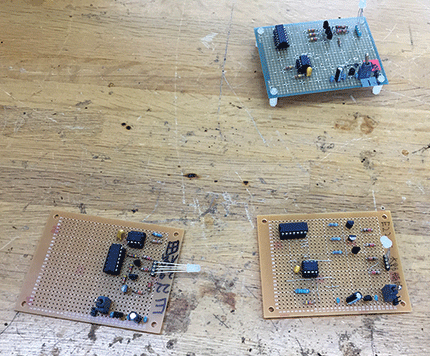
Figure 1. Exemplars in electronics, Japan Photos: courtesy Eva Hartell Using comparative judgment software systems is one way of working with exemplars. However, the software system is not required. Figure 1 is from a Japanese secondary classroom. Technology teachers used these exemplars in a dialogue with their pupils to articulate different quality work in electronics by comparing the three different exemplars to each other and with the students’ own work as well.
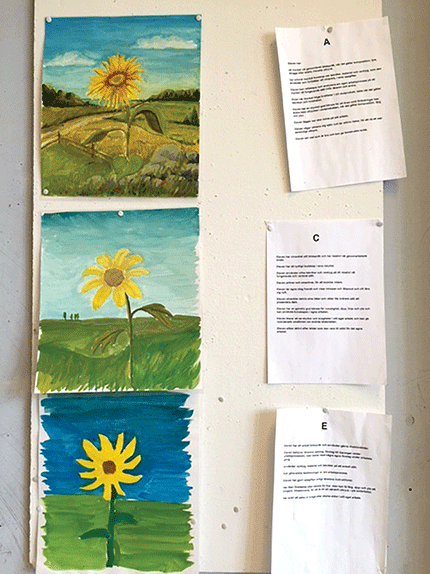
Figure 2. Exemplars of arts, Sweden
Original illustrations: iStockFigure 2 is from an arts classroom in Sweden. The teacher has illustrated the national criteria for grading with sunflowers of different quality. I showed these exemplars at a workshop on formative assessment and at first the participating teachers all agreed – but then suddenly a man raised his hand and objected to the shared consensus that the sunflower at the top was of highest quality. He informed us that he was more into abstract art, and therefore thought the sunflower at the bottom should be rated highest. Then the discussion about quality in artwork really took off; I wish I could have recorded it. The discussion ended in an agreement that is summed up by Winnie the Pooh when he says, “It’s best to know what you’re looking for before you look for it.” With this particular exemplar, the purpose of the task should be clarified. The sad part of this story is that this was the first time these teachers had had the opportunity to discuss this in depth with their peers.
Knowing where they are going makes it easier for students to get there, especially when they know what next step to take and in which direction. Conversely, when pupils are often left on their own, trying to decode the mystery path of learning themselves without guidance and opportunities for reflection, they may lose interest and opportunities. When students are able to consider exemplars in dialogue with their peers, they may gain a richer understanding of what quality work looks like – just as teachers do when discussing exemplars with their professional peers.
Comparative judgment for professional learning
I believe that teachers can develop their assessment literacy and their nose for quality by being exposed to exemplars via the comparative judgment process and by being “forced” to justify their choices and discuss them with others within the profession. And why not start this journey during their teacher education program by reviewing authentic exemplars and practicing how to provide feedback, while they are taking their teacher training courses? How often did you get a chance to see student work during your teacher training, and how often have you had the opportunity to share exemplars with peers? My experience tells me it is not a frequent experience.
Comparative judgment via digital software is also a fairly easy way to invite others within the profession to your classroom practices. The teachers that I have worked with in Sweden were particularly fond of seeing other than their own students’ work, as it expanded their horizon. The interviews in the Hartell and Skogh study7 showed that teachers felt that the comparative judgment method answered the need to collaborate with other teachers in the assessment process. Comparative judgment is useful for both training and on-going refining of teachers’ assessment practices. For example, you can investigate if your standards have changed by blending last year’s students’ essays with the ones you have now, and then checking your comparative judgment outcomes against how you have graded the work. To discover how your standards compare to your peers’, you can invite others to participate, then share and discuss your results together. A school in Oxford used this model to share consensus in terms of quality of student work. The project was initiated by the school head, not for accountability purposes but instead with the aim of strengthening teachers’ assessment practices to enhance equity for their pupils.
It is easy to get carried away with new approaches, and even though there are multiple applications of comparative judgment, appropriate use should always be kept in mind. What decisions are to be made? Then choose what data to collect and present. Depending on what a teacher wants his or her students to learn, the teacher must choose appropriate tasks and exemplars.
The foremost value I see with comparative judgment and exemplars are to serve as a catalyst for discussion. Similar to how wine connoisseurs taste and discuss wine, I see the potential of comparative judgment to foster teachers’ assessment literacy and self-efficacy. Comparative judgment is a useful tool to unpack teachers’ assessment practices, to uncover epistemological values and constructs, and to explicate criteria for success in a much deeper way. Above all, I see great potential as a way to invite learners into the mystery of learning.
Original illustrations: iStock
First published in Education Canada, March 2019
1 A. Pollitt, “The Method of Adaptive Comparative Judgment,” Assessment in Education: Principles, Policy & Practice19, no. 3 (2012): 281–300.
2 L. L. Thurstone, “A Law of Comparative Judgment,” Psychological Review 34 (1927).
3 D. Laming, Human Judgment: The eye of the beholder (London: Thomson Learning, 2004).
4 See e.g. S. R. Bartholomew, E. Yoshikawa-Ruesch, E. Hartell, and G. J. Strimel, “Design Values, Preferences, Similarities, and Differences across Three Global Regions,” in PATT 36. Research and Practice in Technology Education: Perspectives on human capacity and development, eds. Seery, Buckley, Canty and Phelan (Athlone, Ireland: TERG, 2018), 432–440.
5 N. Seery, J. Buckley, T. Delahunty, and D. Canty, “Integrating Learners into the Assessment Process Using Adaptive Comparative Judgment with an Ipsative Approach to Identifying Competence Based Gains Relative to Student Ability Levels,” International Journal of Technology and Design Education (2018); N. Seery, D. Canty, and P. Phelan, “The Validity and Value of Peer Assessment Using Adaptive Comparative Judgment in Design Driven Practical Education,” International Journal of Technology and Design Education 22, no. 2 (2012): 205–226.
6 J. Sweller, (1988). “Cognitive Load During Problem Solving: Effects on learning,” Cognitive Science 12, no. 2 (2988): 257–285.
7 E. Hartell, and I. -B. Skogh, (2015). “Criteria for Success: A study of primary technology teachers’ assessment of digital portfolios,” Australasian Journal of Technology Education, 2, no. 1 (2015).
-
The Unsung Heroes of the School System
Comments Off on The Unsung Heroes of the School SystemAs I write this, I am on my prep period and lunch, a rather nice two-hour break. However, the Educational Assistants (EAs) I’m working with aren’t so lucky: yes, they get a lunch too, but they rarely seem to get a moment to relax.
EAs work closely with students identified as having special needs. These needs can be physical (e.g. mobility), learning-based (e.g. speech and language) or behavioural (anger or developmental issues), and of course they range in severity. Being an EA is a rewarding and challenging job, but, depending on the day, one adjective might overshadow the other.
My primary interaction with EAs has been in developmental education (DE) classes while working as an occasional teacher (OT). Let’s be frank: working with higher-needs kids isn’t for everyone. It takes patience, humility, and emotional strength. However, my stints in the higher-needs DE classes have been some of my most enriching, inspiring, and humbling experiences in teaching. And in each of the DE classes I’ve taught in, I see the same thing: the EAs love their students (yes, I said “love” and mean it), and regularly sacrifice their lunch hours and breaks to work with their kids.
One of the first things I’m given when I supply for a DE class is each student’s “Safety Plan”– a binder detailing the student’s diagnosed condition, his/her triggers, ways to deal with said triggers, and his/her medical requirements and emergency contact info. If this sounds more akin to language you’d associate with a hospital than a classroom, well, I agree. What’s not noted in the Safety Plan, however, is how adorable and fun some of these students can be. Some are incredibly social and affectionate – and they develop a very strong bond with their EAs.
As an occasional teacher, I rely heavily on the expertise of the EAs, and, thankfully, they never fail to make me feel at home and to maintain peace in the classroom. I am in their hands and am happy to let them direct me. Some DE students rely on consistent routines, and my presence really throws a kink into their day. It’s the EAs who smooth out any wrinkles, while I have the luxury of just helping out the best I can.
I’ve met many amazing students in DE programs: there was “David,” the boy with fetal alcohol syndrome who, I was told, played piano beautifully and would vigorously play air piano on his desk each morning along to “O Canada.” There was “Justin,” a wheelchair-bound student with severe speech issues who loved to tell jokes; and there was “Joseph,” who loved to play tennis. Joseph and I played a few times (really, just whacking the ball to each other without a net), and one incident has stuck with me.
Joseph and I had finished our game and were about to go in; however, one of his balls had rolled under the chain-link fence into the school’s garden. I opened the gate so Joseph could retrieve it, but as he walked in, the back of his T-shirt caught on the latch and ripped – badly.
Joseph said he didn’t care about his ripped shirt, but once in the classroom he became increasingly agitated and distraught, tugging on the rip, making it worse. I spoke calmly to him, telling him it would be okay. I put my hand on his shoulder, but Joseph snapped, “don’t f#@king touch me.” From there the situation escalated, with me watching the heartbreaking sight of a 15-year-old boy bursting into tears because he “wouldn’t look nice for his doctor’s appointment” later that day. Of course, the EAs took control, working to calm him down, but I felt I had failed Joseph. My negligence had ruined his day.
But the day wasn’t ruined, not really. Joseph eventually did cheer up. Our class dismissed earlier than regular classes, so at 2:00 p.m. the kids headed out. With a half-hour until the official end of our day, I read a magazine; the EAs spent their time differently. They talked about their “kids”: They shared accomplishments, funny anecdotes, and surprising behaviour; and offered each other encouragement for the next day. There was no bitterness, no expressions of fatigue, defeat, or frustration. Needless to say, I was impressed and humbled.
I don’t often utter the overused word “hero” – but here I wish to unequivocally state for the ages: EAs are heroes, at least to me. I am eternally grateful for their presence and wisdom and wish to thank them for the guidance and patience they bring to their jobs every single day.
Photo: iStock
First published in Education Canada, March 2019
-
Making Sense of Grades
Comments Off on Making Sense of GradesIn this edition of Education Canada we look at our assessment practices, with a special focus on the thorny issue of grading. What are grades for and what do they actually tell us? How accurate are they, really? What are the alternatives? And what is the effect of grading on student learning?
Having a bright son with ADHD opened my eyes to some of the real difficulties with grading. He was admittedly tough to assess because of the inconsistencies in his performance. But what were we to make, for example, of the fact that he scored just shy of 80 percent on a Macbeth essay, yet failed the essay assignment? How was that even possible? Well, the assignment included a lot of preparatory and presentation requirements (the bane of any student with ADHD), and the value given to these materials actually outweighed the essay itself. His attention to these details was sketchy. According to the grading scheme, the fail was legit. But it did not reflect either his understanding of the play or his writing ability.
So what a grade should actually measure is one of the first big questions in grading – and the more complex the learning task, the more grading becomes a tricky exercise in judgment. Ken Draayer recounts his struggle to define and measure quality in composition, and to encourage students to strive for improvement. Swedish researcher Eva Hartel discusses the value of comparative judgment and exemplars in helping to arrive at a shared understanding of quality work. Chris DeLuca and his colleagues examine grading practices across Canada, including the complex factors that go into assigning a grade. Another sticky wicket is the fact that grade-based college/university admission requirements make it difficult to change traditional grading practices at the secondary school level. David Burns and his colleagues share their learning from a pilot project in Burnaby, B.C., using portfolio-based university admission as an alternative to grades. Our web exclusive articles consider the use of student self-assessment of “work habits” (Stefan Merchant) and the relevance of knowledge acquisition in the internet age (Myron Dueck).
Whether used as a learning tool or as admission criteria to an elite program of study, assessment and grading practices have a significant impact on our students and on our education systems. This issue challenges us to rethink how we can evaluate learning in a fair and equitable way for all students.
Photo: Dave Donald
First published in Education Canada, March 2019
-
Grading Across Canada
Comments Off on Grading Across CanadaGrades are a powerful gatekeeper within our educational system, yet little is known about the consistency of grades across classes, schools, and districts or how grades are constructed, interpreted, and used. In this article, the authors examine grading policies and practices across Canada, looking specifically at current grading policies, what drives teachers’ grading decisions, and the influence of provincial large-scale testing.
There is no denying that grades have a significant impact on the lives of students. From boosting self-confidence, admittance to university and college programs, and gaining access to funding, to potential negative outcomes including bullying, lowered self-esteem, and limited career choices, grades not only represent learning but are connected to important social consequences. For some students, the difference between 84 percent and 85 percent on a final grade could mean getting into their desired university and chosen career path; for another, grades could mean the chance to immigrate to Canada, or not. Grades have been, and continue to be, a powerful gatekeeper within our educational system, and across educational systems globally. And yet, little is known about the consistency of grades across classes, schools, and districts or how grades are constructed, interpreted, and used.
Experts point to the inherent subjectivity in grades, and the ample room for error and difference across teachers. In efforts to reduce this subjectivity, provinces, school districts, and schools implement grading policies to promote more consistent grading practices. Policy-based grading encourages alignment between what is taught (i.e. curriculum expectations) and what is assessed. Policy-based grading also provides teachers with explicit criteria to help them distinguish an A from a B or a Level 3 from a Level 2. In this article, we explore grading policies and practices, and their potential perils, across Canada. Drawing on recently published research, we look specifically at what current grading policies are signalling to teachers, what drives teachers’ grading decisions, and how provincial large-scale testing influences students’ grades.
Grading practices across Canada
Grading is a longstanding tradition in education, dating back to the imperial exams administered in ancient China. These methods became more formalized for students in 1792, when grading was established by William Farish, a tutor at Cambridge University, as a quantitative method for efficiently teaching and tracking students. Grades have become the primary method for summarizing and communicating student achievement.
Grading is the process of collecting and evaluating evidence of student achievement, performance, and learning skills. As any teacher knows, grading is a complex practice that often requires negotiating evidence in relation to curriculum expectations and students’ unique learning progressions. As grades are used to make public statements to students, parents, and principals about achievement, and often used for higher-stakes consequences including access to specialized programs and learning supports or admission to university or college programs, grading is an important professional practice with significant implications. Teachers across Canada are expected to follow provincial policies when determining student grades, a practice known as “policy-based grading.”1 However, due to the decentralized nature of educational policies in Canada, research suggests that significant variability in grading practices exist from one jurisdiction to the next.2 This variability is in part due to different priorities within policies across regions and in how policies are interpreted and used by teachers and administrators at classroom and school levels. In examining policies across Canada, we found several important similarities and differences in grading policies:3
- Grading policies consistently emphasize that the primary purpose of grading is to monitor, report, and communicate student achievement.
- Grading scales are similar across Canada, with percentages being used in secondary classrooms and letter grades in elementary classrooms.
- Grades consistently report on achievement evidence (evidence on learning of curricular standards), with non-achievement evidence (learning skills and habits) reported separately.
- Reporting practices tend to be fairly consistent with the general guidelines and templates generated from ministries of education.
- Large-scale assessments contribute variable amounts to secondary students’ final grades across the country, with contributions ranging from 10-50 percent in calculations for the final grade.
- Significant variation in terminology is evident in grading policies across Canada related to the terms: formative, summative, Assessment of Learning (AOL), Assessment for Learning (AFL), and Assessment as Learning (AAL),4 5which could contribute to different cultures of assessment within schools.
What goes into a grade?
Measurement experts suggest that grades should only reflect student achievement of learning expectations. However, when assigning grades, teachers typically include both achievement (e.g. exams, quizzes, class presentations) and non-achievement factors (e.g. attendance, effort, independence), or what is often called “learning skills.” For example, a study by Resh6 found that teachers weighed effort nearly as much (17 percent) as student performance (18 percent). Other researchers have shown that teachers sometimes assign greater weight to non-achievement evidence in their grade construction.7 The effect of including both achievement and non-achievement factors in a single score is that you cannot distinguish what the student knows about the content from the student’s learning skills and behaviour. The result is that grades then provide less valid information for remediation, acceptance for programs, or accurate self-perceptions. Further, research has demonstrated that teachers adopt different weightings of achievement and non-achievement factors based on the contexts and use of grades. For example, teachers’ consideration of student effort appears to be correlated with student ability and behaviour, particularly for low-ability students: teachers give better grades to low-ability students and borderline cases (i.e. students at risk of failing) if they are well-behaved and put effort into their work.
In deciding what to prioritize when determining grades and when faced with grading dilemmas, teachers tend to return to the question, “What would be most fair for the individual student and for the class as a whole?” In one of our recent studies that involved talking with Ontario teachers about their grading practices and challenges, we found that teachers consistently aim to provide “fair” grades to their students; however, “fairness” held different meanings depending upon the teacher and the grading context. What might be fair in one situation might not be fair in another, or to different stakeholders. Often, fairness meant balancing what was best for an individual student in relation to what was consistent and fair for all students in the class.
Through our analysis, fairness was viewed as the overarching value that helps teachers navigate grading tensions that arise in relation to four common themes: 1) context and classroom management, 2) learning values: grades as academic enablers, 3) policy and external pressures, and 4) consequences of grade use. For example, teachers reported that “bumping up” a grade to allow a student to be admitted into their desired university or college program was fairer than increasing a grade if there were no immediate consequences.
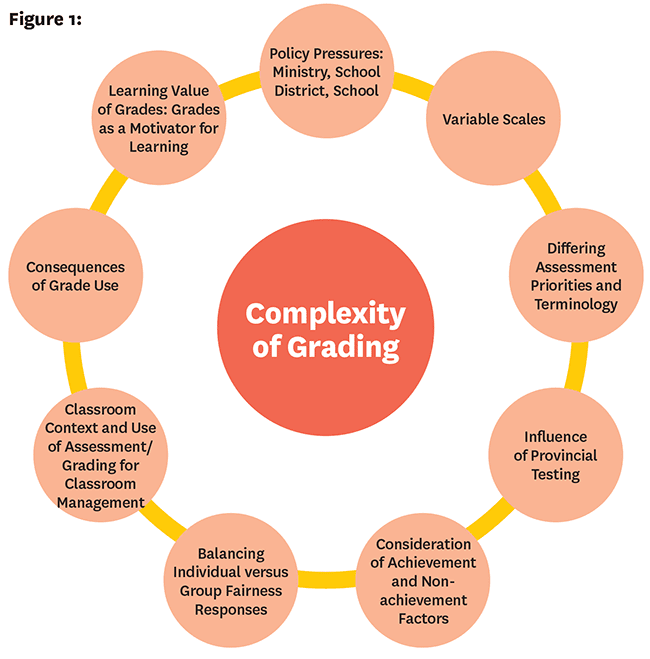
The influence of large-scale testing
Provincial and territorial large-scale assessment programs tend to have “high-stakes” consequences for students, but not teachers or administrators across Canada.8 For example, a quick scan of these programs suggests they account for a significant percentage of a secondary students’ final grade. Indeed, between 10 and 50 percent of a students’ final grade in certain provinces is based on student performance on provincial large-scale assessment programs in the form of exit examinations.9 In some cases, a passing grade on these large-scale assessments also serves as a requirement for graduation or admittance to post-secondary institutions, as is the case in Ontario, Quebec, and New Brunswick. Thus, it is fair to assert that large-scale assessments exert a pronounced influence on teachers’ own grading practices in that educators across Canada – particularly those in secondary schools – will want to have general alignment between their classroom grades and students’ achievement on large-scale assessments. In some respects, the relationship between large-scale assessments and classroom grades may be used as a proxy for concurrent validity. In this way, a high correspondence between the results of a particular test (in this case provincial large-scale assessment program) and an established measurement for the same or similar learning expectations (in this case teachers’ grades in the same tested subject domain) strengthens the perceived accuracy of both. The agreement or lack thereof between large-scale and classroom assessment is bound to create tensions and discussion on the utility and rigour of each method of assessment.
The results of large-scale assessments also provide an important accountability and/or gatekeeping function across Canadian school systems. Given that these measures are routinely given priority status as more “reliable” and “valid” indicators of student achievement, teachers and administrators may adopt and promote inappropriate test preparation practices, such as teaching to the test, in order to have more favourable student, classroom, and school results. The latter presents an interesting dichotomy with respect to the previous point related to concurrent validity, in that teaching to the test artificially inflates students’ large-scale assessment scores and inadvertently may present teachers’ grading practices as less accurate or rigorous. Perhaps more disconcerting is that teaching to the test inflates student performance at the expense of authentic forms of learning that allow for transfer of knowledge and skills.
Ultimately, large-scale assessment programs across Canada present opportunities and challenges for existing grading policies and practices, leading to intended and unintended consequences. Understanding the evolving nature and impact of these large-scale assessment programs on teacher’s pedagogical approaches and grading practices requires sustained longitudinal studies. Certainly, the literature abounds with international jurisdictions that have largely succumbed to a testing-focused education model that has undermined teachers’ classroom assessment literacy. Ironically, those systems tend to fare quite poorly on international measures of student achievement such as the Programme in International Student Assessment (PISA), which assesses reading, mathematics, and science literacy every three years across more than 70 educational jurisdictions around the world.
What all this means is that grades – despite their influence, power and potential consequences – are complex indicators of student learning (both achievement and non-achievement) with variability in policies and practices across Canada. While such variability is not necessarily a negative quality, as it could enable more fair treatment and valid reporting in relation to unique student learning progressions and classroom contexts, it does challenge our ability to consistently compare students when making selection, admission, and ranking decisions. Grading is one of the most high-stakes classroom assessment practices, sitting at the critical intersection of teaching, learning, and assessment and representing the most public professional statement made by teachers about student learning. The more aware teachers are of the complexity of grades, the more likely grading can be ensured to be a valid, reliable and, most importantly, fair practice beneficial to student learning.
NEW! Discussion Kit
Download the pro-learning session 1.1 – Rethinking How You Grade
Original Illustration and Photo: iStock
First published in Education Canada, March 2019
1 B. Noonan,“Interpretation Panels and Collaborative Research,” Brock University 12 (2002): 89-100.
2 M. Simon, S. Chitpin, and R. Yahya, “Pre-service Teachers’ Thinking About Student Assessment Issues,” International Journal of Education 2. no. 2 (2010): 1-20.
3 C. DeLuca, H. Braund, A. Valiquette, and L. Cheng, “Grading Policies and Practices in Canada: A landscape study,” Canadian Journal of Educational Administration and Policy 184 (2017): 4-22.
4 AOL refers to Asessment of Learning, AFL Asessment for Learning, and AAL Assessment as Learning.
5 B. Noonan,“Interpretation Panels.”
6 N. Resh, “Justice in Grades Allocation: Teachers’ perspective,” Social Psychology of Education 12 (2009): 315–325.
7 Y. Sun and L. Cheng, “Teachers’ Grading Practices: Meanings and values assigned,” Assessment in Education: Principles, Policy & Practice 21, no. 3 (2014): 326–343.
8 L. Volante and S. Ben Jaafar, “Educational Assessment in Canada,” Assessment in Education: Principles, Policy & Practice 15, no. 2 (2008): 201-210.
9 D. Klinger, C. DeLuca, and T. Miller, (2008). “The Evolving Culture of Large-scale Assessments in Canadian Education,” Canadian Journal of Educational Administration and Policy 76 (2008): 1-34.
-
Grading for Equity
Comments Off on Grading for EquityJoe Feldman provides a vision for equitable grading with a focus on coherence and mastery learning. Drawing on research and interweaving voices of teachers, researchers, school administrators and students, the author defines grading for equity using three pillars: equitable grading is accurate, bias-resistant, and motivational. Linking theory and practice, the author provides a practical guide using research-informed examples to convince readers that commonly used assessment practices are ineffective and should be replaced with equitable grading practices to improve learning for all students, particularly those who are underserved or vulnerable.
The author provides a historical account of traditional grading practices and challenges readers to consider how shifting to equitable grading practices leads to an improved representation of student learning. Some recommendations for equitable grading practices discussed in the book include: use a 4-point grading scale, weight more recent performances, promote productive group work and high-quality work without a group grade, exclude behaviours from the grade (e.g., lateness, effort, participation), provide non-grade consequences for cheating, use alternatives for late work, reframe homework, allow retakes and opportunities to improve grades, use rubrics to calibrate learning intentions, promote students’ self-regulation and agency through student trackers and goal setting, and more. Zero-grades, averaging, and extra credit, by contrast, are practices Feldman argues should be dropped. Using mathematical comparisons, as well as sample gradebooks, the author dispels myths and demonstrates how formative and summative assessment divisions are not fixed and that arriving at a final grade requires coherent and equitable grading practices, including a teachers’ professional judgment.
Each chapter builds on the next and provides teachers with a valuable guide book and arguments for changing practice and moving towards a standards-based grading model. Using approaches that are mathematically sound, prioritizing knowledge and understanding, supporting hope and a growth mindset, and providing students with clarity for how to succeed, can motivate students to improve their learning. Each chapter concludes with a summary of key concepts and thought-provoking questions, making this a perfect book to discuss with a group of colleagues. The book also has a supporting website with additional resources and examples of equitable grading practices: https://gradingforequity.org
Corwin, 2019.
ISBN: 9781506391571
-
Building bridges, not walls: Leveraging student diversity in the classroom
Comments Off on Building bridges, not walls: Leveraging student diversity in the classroomA new fact sheet by the national EdCan Network of educators entitled How Can Teachers Maximize Engagement among Multilingual Students? outlines practical ways that Canadian teachers can implement inclusive learning strategies and programs that heighten engagement among students from immigrant backgrounds.
Authored by Dr. Jim Cummins, professor emeritus at the University of Toronto’s Ontario Institute for Studies in Education (OISE/UT), this timely resource reveals that students who are encouraged to use their home languages alongside the language of the classroom will come to view themselves as talented and accomplished speakers of multiple languages who are more likely to engage academically.
“With ever-increasing racial, linguistic and religious student diversity, we’d like to provide concrete support to educators and education leaders who are grappling with how they should create more culturally and linguistically inclusive spaces despite having limited knowledge of students’ home languages or experiences,” says Max Cooke, EdCan Network Interim CEO.
In addition to the downloadable copy of the fact sheet, available at www.edcan.ca/multilingual, also included are several examples of teacher-driven projects that leverage students’ multiple languages as enrichment opportunities for all students.
This fact sheet was made possible with the generous financial support of the Desjardins Foundation and the Canadian Schools Boards’ Association.


-
How Can Teachers Maximize Engagement among Multilingual Students?
Comments Off on How Can Teachers Maximize Engagement among Multilingual Students?The term “multilingual” is increasingly used by educators to describe students from immigrant backgrounds who are in the process of learning the language of instruction at school. This is a positive affirmation that identifies multilingual students as “haves” (speakers of many languages) rather than “have-nots” (lacking proficiency in the school language). Researchers have discovered that by encouraging multilingual students to use their home languages alongside the language of the classroom, they come to view themselves as talented and accomplished speakers of multiple languages who are more likely to engage academically, rather than feeling limited by their current abilities in the school language. In recent years, Canadian teachers have been exploring a wide variety of inclusive learning strategies and programs that leverage students’ multiple languages as enrichment opportunities for all students.
Here are some effective ways to integrate multilingual instructional strategies into classrooms:
- Each day, teachers invite one or two students to share a word from their home languages with their classmates and explain why they chose that word and what it means. Over time, students and teachers learn a new collection of words in different languages.
- Examples of students’ work in their home languages and in the school language are prominently displayed in school corridors and at the school entrance. This reinforces the message that students’ diverse languages are both personal and educational assets.
- School library collections have multilingual books for both students and parents to read at school and at home. School policies can ensure that libraries maintain a diverse and well-stocked selection.
- Students write and publish online dual language or multilingual stories or projects.
- Teachers invite parents and community members to the classroom to read and tell stories in community languages.
- Across subject areas, teachers encourage students to conduct research online in their home languages for class projects.
- Students collaborate with partner classes across the world or across the city to create a variety of projects involving two or more languages.
The vast majority of Canadian teachers agree that we should connect instruction to students’ lives, build on their background knowledge, and maximize their intellectual and aesthetic talents in an emotionally safe learning environment. When we acknowledge the role of students’ home languages in their lives and explore options that build on their multilingual skills, all students learn how to work across their differences and gain appreciation for different languages and cultures – skills that are highly valuable in our increasingly multicultural and interconnected world.
ADDITIONAL INFORMATION RESOURCES
Examples of Multilingual Projects
The ÉLODiL project (Éveil au Langage et Ouverture à la Diversité Linguistique—Awakening to Language and Opening up to Linguistic Diversity) has developed a variety of classroom activities to promote students’ awareness of language and appreciation of linguistic diversity. This project has been undertaken both in Montreal (Dr. Françoise Armand, Université de Montréal) and Vancouver (Dr. Diane Dagenais, Simon Fraser University) (e.g., Armand & Dagenais, 2012).
The Dual Language Showcase was created by educators at Thornwood Public School in the Peel District School Board to demonstrate the feasibility of enabling elementary grades students who were learning English as an additional language to write stories in both English and their home languages (Chow & Cummins, 2003; Schecter & Cummins, 2003).
The Multiliteracies project involved a series of collaborations between educators and university researchers Dr. Margaret Early at the University of British Columbia in Vancouver and Dr. Jim Cummins at the University of Toronto. Drawing on the construct of multiliteracies, the projects focused on broadening conceptions of literacy within schools both with respect to modality and language.
The Multiliteracies Pedagogy project initiated in 2003 by Dr. Heather Lotherington of York University in Toronto involved a range of collaborations between educators in Joyce Public School and researchers at York University to explore how the concept of plurilingualism could be translated into pedagogical design. The professional learning community at Joyce Public School worked with students on a variety of multilingual and multimodal projects including rewriting traditional stories from a critical perspective using their multilingual linguistic repertoires (Lotherington, 2011; Lotherington & Paige, 2017).
I am plurilingual! Je suis plurilingue!
This resource was created by Dr. Gail Prasad as a companion to her 2015 doctoral dissertation on children’s plurilingualism in English and French schools. In addition to a description of the research and its outcomes, the site showcases an extensive sampling of the plurilingual multimodal texts created by students and teachers in schools in Toronto (Canada), Montpellier (France) and Sète (France).
Linguistically Appropriate Practice (LAP) is an approach to working with immigrant-background children in preschool and primary grades. Pioneered by Dr. Roma Chumak-Horbatsch (2012) at Ryerson University in Toronto, LAP consists of both an educational philosophy and a set of concrete instructional activities that build on children’s home language and literacy experiences in order to encourage them to use their home languages in the classroom, take pride in their bilingualism, and continue to develop their home language as they are acquiring fluency and literacy in the dominant language of instruction.
The Dual Language Reading Project was initiated by Dr. Rahat Naqvi of the University of Calgary and colleagues in the Calgary Board of Education. It documented the impact of teachers and community members reading dual language books to students both in linguistically diverse schools and in the Calgary Board of Education’s Spanish-English bilingual program (see www.rahatnaqvi.ca and Naqvi et al., 2012).
The Family Treasures and Grandma’s Soup dual language book project was initiated by Dr. Hetty Roessingh at the University of Calgary in collaboration the Almadina Language Charter Academy. Its goal was to enable Kindergarten and grade 1 students to create dual language books to enhance their early literacy progress (see www.duallanguageproject.com and Roessingh, 2011).
ScribJab is a website and iPad application for children (ages 10 – 13) to read and create digital stories (text, illustrations and audio recordings) in multiple languages (English, French and other non-official languages). The site was created by Dr. Diane Dagenais and Dr. Kelleen Toohey who have collaborated for many years with British Colombia educators in the implementation of projects focused on developing students’ awareness of language and promoting their multilingual and multiliteracy skills (see, for example, Marshall and Toohey, 2012). The website describes ScribJab as “a space for children to communicate about their stories, and come to an enhanced appreciation of their own multilingual resources.” Dagenais et al. (2017) provide a detailed account of the origins and impact of ScribJab.
The Storybooks Canada project is described as follows on its website:
Storybooks Canada is a website for teachers, parents, and community members that aims to promote bilingualism and multilingualism in Canada. It makes 40 stories [derived from Africa] available in the major immigrant and refugee languages of Canada, in addition to the official languages of English and French. A story that is read in English or French at school can be read in the mother tongue by parents and children at home. In this way, Storybooks Canada helps children to maintain the mother tongue in both oral and print form, while learning one of Canada’s official languages. Similarly, the audio versions of the stories can help beginning readers and language learners make the important connection between speech and text. Students can also compose stories using the images on the Storybooks Canada site.
Examples of Multilingual Projects Implemented in France
Comparons nos langues. This project directed by Professor Nathalie Auger of Université Paul Valéry in Montpellier focused on how teachers encouraged recently arrived immigrant students to compare their languages with French.
A video describing the project is available at: https://www.youtube.com/watch?v=_ZlBiAoMTBo
A pedagogical guide written by Professor Auger can be downloaded from: http://asl.univ-montp3.fr/masterFLE/n.auer/Livret_Comparons.pdf.
The impact of this approach to building students’ awareness of language is described as follows by Michèle Verdelhan in the Preface to the pedagogical guide:
L’attitude de comparaison des langues et des habitudes culturelles en matière de communication prend appui sur cette situation intermédiaire de la langue seconde et sur la connaissance de la langue maternelle, rend l’enfant plus actif dans son apprentissage et aiguise ses facultés d’observation, d’analyse, de mise en relation. Le plaisir que prennent les élèves à cette démarche, qui reconnaît leur personnalité, est déjà à lui seul un gage de progrès rapide.
The Didenheim School Project was a language awareness and parental involvement project implemented in an elementary school in Alsace France. The project was initiated by teachers as a way of legitimizing regional and immigrant languages, and also to sensitize students to the variety of languages and cultures spoken by students and their teachers in the school.
A documentary film (in French with English subtitles) on the project produced by Mariette Feltin is available at: https://www.youtube.com/watch?v=gP5o0fk34jk
Descriptions of the project can be found in Hélot and Young (2003, 2006).
WITH THE GENEROUS FINANCIAL SUPPORT OF:
REFERENCES
Armand, F., & Dagenais, D. (2012). S’ouvrir à la langue de l’autre et à la diversité linguistique [Becoming aware of others’ languages and of linguistic diversity]. Education Canada, 52(1).
Accessible from www.edcan.ca/articles/souvrir-a-la-langue-de-lautre-et-a-la-diversite-linguistique/?lang=fr
Auger, N. (2003). Comparons nos langues. Démarche d’apprentissage du français auprès d’Enfants Nouvellement Arrivés (ENA). Ressources formation vidéo/multimédia
Série Démarches et Pédagogie. Accessible from http://asl.univ-montp3.fr/masterFLE/n.auer/Livret_Comparons.pdf
Chumak-Horbatsch, R. (2012). Linguistically appropriate practice: A guidebook for Early Childhood practitioners working with immigrant children. Toronto: University of Toronto Press.
Cummins, J., & Early, M. (2011). Identity texts: The collaborative creation of power in multilingual schools. Stoke-on-Trent, England: Trentham Books.
Cummins, J., & Early, M. (2015). Big ideas for expanding minds: Teaching English language learners across the curriculum. Toronto: Rubicon Press/Pearson Canada.
Cummins, J., & Persad, R. (2014). Teaching through a multilingual lens: The evolution of EAL policy and practice in Canada. Education Matters, 2(1). Accessible from http://em.synergiesprairies.ca/index.php/em/issue/view/7
Dagenais, D., Toohey, K., Bennett Fox, A., & Singh, A. (2017). Multilingual and multimodal composition at school: ScribJab in action. Language and Education, 31(3), 263-282.
Giampapa, F. (2010). Multiliteracies, pedagogy and identities: teacher and student voices from a Toronto Elementary School. Canadian Journal of Education, 33(2), 407-431.
Hélot, C., & Young, A. (2003). Education à la diversité linguistique et culturelle: le rôle des parents dans un projet d’éveil aux langues en cycle 2. In D.L. Simon et C. Sabatier (dir.) Le plurilinguisme en construction dans le système éducatif, contextes, dispositifs, acteurs. Revue de linguistique et de didactique des langues, Université Stendhal de Grenoble, Hors série, Sept 2003, 187-200. Accessible from www.researchgate.net/profile/Andrea_Young5/publication/260020101_Education_a_la_diversite_linguistique_et_culturelle_le_role_des_parents_dans_un_projet_d’eveil_aux_langues_en_cycle_2/links/57176d7008ae09ceb2649d09.pdf
Hélot, C., & Young, A. (2006). Imagining multilingual education in France: A language and cultural awareness project at primary level. In O. García, T. Skutnabb-Kangas, and M. E. Torres Guzman (Eds.), Imagining multilingual schools: Languages in education and glocalization. (pp. 69-91). Clevedon, England: Multilingual Matters. Accessible from http://christinehelot.u-strasbg.fr/wp-content/uploads/2013/02/2006-Imagining-Mult-educ-in-France.pdf
Lotherington, H. (2011). Pedagogy of multiliteracies: Rewriting Goldilocks. New York: Routledge.
Lotherington, H., & Paige, C. (Eds.) (2017). Teaching young learners in a superdiverse world: Multimodal approaches and perspectives. New York: Routledge.
Naqvi R., Thorne K., Pfitscher C., Nordstokke D., and McKeough A. (2012). Reading dual language books: Improving early literacy skills in linguistically diverse classrooms. Journal of Early Childhood Research. doi: 0.1177/1476718X12449453.
Ntelioglou, B. Y., Fannin, J., Montanera, M., & Cummins, J. (2014). A multilingual and multimodal approach to literacy teaching and learning in urban education: a collaborative inquiry project in an inner city elementary school. Frontiers in Psychology, 5, 1-10. Article 533. Accessible from www.frontiersin.org. (doi: 10.3389/fpsyg.2014.00533).
Prasad, G. (2016). Beyond the mirror towards a plurilingual prism: Exploring the creation of plurilingual “identity texts” in English and French classrooms in Toronto and Montpellier. Intercultural Education, 26(6), 497-514. Special Issue ed. A. Gagné & C. Schmidt. Accessible from http://dx.doi.org/10.1080/14675986.2015.1109775
Prasad, G. (2017, December 6). Parents as multilingual experts: Leveraging families’ cultural and linguistic assets in the classroom. EdCan Network Magazine. Accessible from www.edcan.ca/articles/parents-multilingual-experts/
Stille, S., & Prasad, G. (2015). “Imaginings”: Reflections on plurilingual students’ creative multimodal works. TESOL Quarterly, 49(3), 608-621.
Roessingh, H. (2011). Family Treasures: A dual language book project for negotiating language, literacy culture and identity. Canadian Modern Language Review, 67(1), 123-148.
Schecter, S., & Cummins, J. (2003). Multilingual education in practice: Using diversity as a resource. Portsmouth, NH: Heinemann.
-
School suicide: What principals should do when students and staff disappear
Comments Off on School suicide: What principals should do when students and staff disappearA new fact sheet by the national EdCan Network of educators and TeenMentalHealth.org entitled What can school leaders do in the aftermath of student and staff suicide? aims to heighten awareness among K-12 principals and school communities on what they should and should not do following the suicide of a student or staff member.
Authored by Dr. Stan Kutcher, professor in the Department of Psychiatry at Dalhousie University and recently-appointed member of the Senate of Canada, this timely resource reveals how some conventional suicide postvention programs can cause more harm than good for the family, friends and classmates of a student or teacher who dies from suicide.
As Dr. Kutcher asserts, things to avoid include memorializing, using phrases such as “committed suicide,” and purchasing suicide prevention programs.
“With recent and recurring reports of youth suicide nationally, globally and in Indigenous communities – especially those in the Arctic North – we’d like to provide concrete support to principals, teachers and parents who are grappling with tragic losses that impact entire school communities,” says Max Cooke, EdCan Network Interim CEO.
In addition to the downloadable copy of the fact sheet, available at www.edcan.ca/suicide-postvention, also included are several practical resources to support school leaders in taking up evidence-based strategies.
This fact sheet was made possible with the generous financial support of the Desjardins Foundation and the Canadian Schools Boards’ Association.
-
What can school leaders do in the aftermath of student and staff suicide?
Comments Off on What can school leaders do in the aftermath of student and staff suicide?Suicide postvention refers to activities that support the grieving process and may help prevent suicide contagion among family, friends and classmates of a student or teacher who dies from suicide. While this is a challenging topic for any educator as waves of strong emotions take grip on a school community, acting primarily on emotions is not likely to bring optimal outcomes.
Although evidence on the effectiveness of suicide postvention strategies is still limited, here are some suggestions for what school leaders should and should not do following the suicide of a student or staff member:
THINGS TO DO
- Remain calm and ensure that usual school activities continue.
- Notify all pertinent persons and provide them with simple, clear and factual information.
- Follow the school’s policy and crisis implementation plan.
- Reach out to the deceased’s family to offer condolences.
- Create an opportunity for students and teachers to send condolences to the family (e.g. through a remembrances book) and give permission to attend funeral services.
- Identify key persons from within the school and a site (e.g. a classroom or school health clinic) to be made available before school starts until a reasonable time after school ends for students who wish to talk. Staff the space with educators and student service providers whom the students already know.
- Contact local mental health services providers to let them know and seek their input.
- For students, touch base with the deceased’s closest friends and invite them to chat with a guidance counselor or teacher. For staff, invite them to chat with a trusted colleague or administrator if they wish to do so.
- Identify students or teachers who are still struggling emotionally (including increased absences/sick days) six weeks or longer after the event and suggest referral to mental health services.
- Request that students and teachers use social media responsibly.
THINGS TO AVOID
- Using phrases such as “committed suicide.” Instead, use “died by suicide.”
- Creating or applying school-wide suicide or depression screening programs.
- Providing graphic details as to what happened.
- Memorializing the event (e.g. student assemblies, memorial sites, speakers, etc.)
- Bringing in external “grief counselors” or applying Critical Incident Stress Debriefing.
- Purchasing suicide prevention programs since there is no good evidence that such programs prevent suicide.
To be effective, suicide postvention must be adapted to the unique needs, situations and realities of the affected school and community. While a conservative estimate counts six people connected to the deceased who will be most personally impacted, suicide affects a web of individuals including parents, siblings, friends and acquaintances, classmates, healthcare providers and others.
Although numerous suicide postvention programs are available, school leaders have a responsibility to select evidence-based strategies that are likely to be effective – and avoid those that lack solid evidence and may do more harm than good – in preventing suicide and supporting those who are grieving.
ADDITIONAL INFORMATION RESOURCES
- TeenMentalHealth.org: Suicide
- Ontario Center of Excellence for Child and Youth Mental Health. (2015). Evidence in-sight: suicide postvention programming.
- Media Guidelines for Reporting on Suicide
- Ashraf Kagee. (2002). Concerns about the effectiveness of critical incident stress debriefing in ameliorating stress reactions. Critical Care.
- Francesco Pia and co-authors (2011). ACFASP Review: Critical Incident Stress Debriefing.
- Samaratins UK: Suicide Postvention in the Workplace
REFERENCES
Kutcher, S. (2018). Suicide Postvention in Schools: Addressing an emotional issue using best available information and critical thought. CAP Journal.
Szumilas, M. & Kutcher, S. (2011). Post-suicide Intervention Programs: A Systematic Review. Can J Public Health, 102 (1), 18-29.
WITH THE GENEROUS FINANCIAL SUPPORT OF:
-
Three little-known risks of adolescent cannabis use
Comments Off on Three little-known risks of adolescent cannabis useIn this era of legalization for Canadian adults, a newly released fact sheet by the national EdCan Network of educators entitled Cannabis: What are the risks for students? aims to heighten awareness among K-12 educators, parents and students on three major risks associated with adolescent cannabis use – lower school performance, psychosis, and cannabis use disorder (CUD). Recent scientific studies pinpoint specific areas of the developing adolescent brain that are vulnerable to cannabis.
Authored by Dr. Christina Grant, McMaster University’s Associate Chair for Education with the Department of Pediatrics, this timely resource provides clarity in view of the limited research that currently exists on the consequences of youth cannabis use over long-term periods.
As Dr. Grant asserts in this fact sheet, “As our understanding of the development of the human brain has increased, so too has the potency of THC – the main psychoactive component in cannabis – which has increased by up to 400% over the past fifty years.” This increase in potency could potentially impact brain development, which continues until students’ mid-twenties.
“Educators want to know if and to what extent legalization will impact teaching practice,” says Max Cooke, EdCan Network Interim CEO. “While it’s too early to say how cannabislegalization for adults in Canada will impact youth consumption, what we do know is that adolescents who use cannabis daily or weekly are at risk of lower school performance.”
In addition to the downloadable copy of the fact sheet, available at www.edcan.ca/cannabis, also included are several practical resources to support parents and teachers in beginning important conversations with students on these serious risks.
This fact sheet was made possible with the generous financial support of the Desjardins Foundation and the Canadian Schools Boards Association.
-
How Can I Use Self-Reg to Help the Child I’m Concerned About?
Comments Off on How Can I Use Self-Reg to Help the Child I’m Concerned About?This six hour workshop, open to educators, parents and specialists, will help participants consider how they could begin to map out some strategies using the tools of Shanker Self-Reg to help a child in their care. It will discuss what participants can do to address their own self-regulation in ways that will enhance their ability to work effectively with the child. Open to everyone! Whether you are a parent, educator, or specialist, whether you are new to Self-Reg or already familiar with it, we’d love to see you there!
-
Cannabis: What are the risks for students?
Comments Off on Cannabis: What are the risks for students?There are several unique risks that have emerged over the past few years associated with cannabis use among adolescents. As our understanding of the development of the human brain has increased, so too has the potency of THC – the main psychoactive component in cannabis – which has increased by up to 400% over the past fifty years. Science has explored how this increase in potency could potentially impact brain development among our student-aged population, which continues until their mid-twenties. Although rates of cannabis use among youth ages 15-24 in Canada continue to decrease, approximately 25% reported having used cannabis with the average age of initiation being 14 years-old. We cannot yet conclude how cannabis legalization for adults in Canada will impact youth consumption, but data from Washington and Colorado have not shown a significant increase in cannabis use among those under the U.S. legal age of 21.
Here are three major risks associated with adolescent cannabis use:
1. LOWER SCHOOL PERFORMANCE
Studies have shown that an individual’s working memory is impacted by cannabis use, with the effects potentially lasting for several days. This could impact a student’s academic performance and cause them to fall behind. As well, unlike alcohol, there is evidence that the effects of cannabis can persist over years of regular and continued use. These include the potential for a lowering of inhibition and reasoning skills, and a reduction in memory performance. Research has also shown that regular cannabis use could result in lower levels of educational attainment, including lowering high school graduation rates.
2. PSYCHOSIS
Cannabis use can result in psychotic episodes, where some youth lose touch with reality. These effects can last anywhere from a few hours to a few days, but do eventually resolve. However, in instances where heavy or frequent use is combined with beginning cannabis use at a younger age, there can be as much as a twofold increased risk of developing a chronic psychotic disorder, especially where there is a family history of schizophrenia.
3. CANNABIS USE DISORDER (CUD)
One-in-six youth who experiment with cannabis will go on to develop Cannabis Use Disorder (CUD). This can result in a reduction in grades, increased conflict at home, and changes within the student’s social circle of friends – with these changes often occurring over the course of a single year’s time. According to research, approximately 3% of older male high school students have CUD.
While cannabis has a long history of human use, recent scientific findings have discovered more about the developing adolescent brain and specific areas that are vulnerable to cannabis. For adolescents who use cannabis daily or weekly, studies have pinpointed functional brain deficits that require them to compensate by working harder than those who are not regular users. Fostering an open-door policy and being non-judgemental can help begin important conversations with students on these serious risks.
Additional Information Resources
Resources to talk to teens
- Drug Free Canada: The Cannabis Talk Kit
- TeenMentalHealth.Org: Cannabis
- Canadian Centre on Substance Use and Addiction: Cannabis Communication Guide
- University of Waterloo, School of Pharmacy: Cannabis use and youth resources
General information resources on adolescent cannabis use in Canada
- Health Canada: Canadian Cannabis Survey 2018 Summary
- Canadian Paediatric Society: Cannabis and Canada’s children and youth
- Canadian Centre on Substance Abuse: Substance Abuse in Canada: The Effects of Cannabis Use During Adolescence (2015)
- Centre for Addiction and Mental Health: Drug Use Among Ontario Students, 1977–2015
References
Morin JF, Afzali MH, Bourque J, Stewart SH, Sequin JR, O’Leary-Barrett MA, Conrod PJ. Population-Based Analysis of the Relationship Between Substance Use and Adolescent Cognitive Development. Am J of Psych 2018, e-published.
Morean ME, Kong G, Camenga DR, Cavallo DA, Krishnan-Sarin S. High school students’ use of electronic cigarettes to vaporize cannabis. Pediatrics 2015;136(4):611–6.
Friese B, Slater MD, Annechino R, Battle RS. Teen use of marijuana edibles: A focus group study of an emerging issue. J Prim Prev 2016;37(3):303–9.
Morgan CJ, Noronha LA, Muetzelfeldt M, Feilding A, Fielding A, Curran HV. Harms and benefits associated with psychoactive drugs: Findings of an international survey of active drug users. J Psychopharmacol 2013;27(6):497–506.
Rieder MJ; Canadian Paediatric Society, Drug Therapy and Hazardous Substances Committee. Is the medical use of cannabis a therapeutic option for children? Paediatr Child Health 2016;21(1):31–4.
WHO. Social Determinants of Health and Well-being Among Young People. Health Behaviour in School-Aged Children (HBSC) Study: International Report From the 2009/2010 Survey. Copenhagen: WHO Regional Office for Europe, 2012.
Health Canada. Canadian Alcohol and Drug Use Monitoring Survey (CADUMS): Canadians Aged 15 Years and Older. 2012. www.hc-sc.gc.ca/hc-ps/drugsdrogues/stat/_2012/summary-sommaire-eng.php (Accessed September 19, 2016).
Brunelle N, Plourde C, Landry M, et al. Patterns of psychoactive substance use among youths in Nunavik. Indittera 2010;2:1–12.
Colorado Department of Public Safety. Marijuana Legalization in Colorado: Early Findings; A Report Pursuant to Senate Bill 13–283. March 2016. http://cdpsdocs.state.co.us/ors/docs/reports/2016-SB13-283-Rpt.pdf (Accessed September 19, 2016).
Roffman R . Legalization of cannabis in Washington state: How is it going? Addiction 2016;111(7):1139–40.
Giedd JN, Blumenthal J, Jeffries NO, et al. Brain development during childhood and adolescence: A longitudinal MRI study. Nat Neurosci 1999;2(10):861–3.
Lenroot RK, Giedd JN. Brain development in children and adolescents: Insights from anatomical magnetic resonance imaging. Neurosci Biobehav Rev 2006;30(6):718–29.
Hurd YL, Michaelides M, Miller ML, Jutras-Aswad D. Trajectory of adolescent cannabis use on addiction vulnerability. Neuropharmacology 2014;76(Pt B):416–24.
George T, Vaccarino F, eds. Substance Abuse in Canada: The Effects of Cannabis Use During Adolescence. Ottawa: Canadian Centre on Substance Abuse, 2015.
Blakemore SJ. Teenage kicks: Cannabis and the adolescent brain. Lancet 2013;381(9870):888–9.
Anderson VA, Anderson P, Northam E, Jacobs R, Catroppa C. Development of executive functions through late childhood and adolescence in an Australian sample. Dev Neuropsychol 2001;20(1):385–406.
Bossong MG, Niesink RJ. Adolescent brain maturation, the endogenous cannabinoid system and the neurobiology of cannabis-induced schizophrenia. Prog Neurobiol 2010;92(3):370–85.
Lisdahl KM, Wright NE, Kirchner-Medina C, Maple KE, Shollenbarger S. Considering cannabis: The effects of regular cannabis use on neurocognition in adolescents and young adults. Curr Addict Rep 2014;1(2):144–56.
Jager G, Block RI, Luijten M, Ramsey NF. Cannabis use and memory brain function in adolescent boys: A cross-sectional multicenter functional magnetic resonance imaging study. J Am Acad Child Adolesc Psychiatry 2010;49(6):561–72.e3.
Cascini F, Aiello C, Di Tanna G. Increasing delta-9-tetrahydrocannabinol (?-9-THC) content in herbal cannabis over time: Systematic review and meta-analysis. Curr Drug Abuse Rev 2012;5(1):32–40.
Karila L, Roux P, Rolland B, et al. Acute and long-term effects of cannabis use: A review. Curr Pharm Des 2014;20(25):4112–8.
Li MC, Brady JE, DiMaggio CJ, Lusardi AR, Tzong KY, Li G. Marijuana use and motor vehicle crashes. Epidemiol Rev 2012;34:65–72.
Papafotiou K, Carter JD, Stough C. The relationship between performance on the standardised field sobriety tests, driving performance and the level of delta9tetrahydrocannabinol (THC) in blood. Forensic Sci Int 2005;155(2–3):172–8.
Ramaekers JG, Robbe HW, O’Hanlon JF. Marijuana, alcohol and actual driving performance. Hum Psychopharmacol 2000;15(7):551–8.
Hartman RL, Brown TL, Milavetz G, et al. Cannabis effects on driving lateral control with and without alcohol. Drug Alcohol Depend 2015;154:25–37.
Canadian Council of Motor Transport Administrators. Public Opinion Survey on Drugs and Driving – Summary Report. http://ccmta.ca/images/publications/pdf//CCMTA_Public_Opinion_Survey_of_Drugs_and _Driving_in_Canada_revised_2014_04_14_FINAL_ENGLISH.pdf (Accessed September 26, 2016).
Smith-Kielland A, Skuterud B, Mørland J. Urinary excretion of 11-nor-9-carboxy-delta9tetrahydrocannabinol and cannabinoids in frequent and infrequent drug users. J Anal Toxicol 1999;23(9):323–32.
Wang GS, Le Lait MC, Deakyne SJ, Bronstein AC, Bajaj L, Roosevelt G. Unintentional pediatric exposures to marijuana in Colorado, 2009–2015. JAMA Pediatr 2016;170(9):e160971.
Turner SD, Spithoff S, Kahan M. Approach to cannabis use disorder in primary care: Focus on youth and other high-risk users. Can Fam Physician 2014;60(9):801–8, e423–32.
Volkow ND, Baler RD, Compton WM, Weiss SR. Adverse health effects of marijuana use. N Engl J Med 2014;370(23):2219–27.
American Psychiatric Association. Diagnostic and Statistical Manual of Mental Disorders, 5th edn. Arlington: APA, 2013.
Budney AJ, Hughes JR. The cannabis withdrawal syndrome. Curr Opin Psychiatry 2006;19(3):233–8.
Georgiades K, Boyle MH. Adolescent tobacco and cannabis use: Young adult outcomes from the Ontario child health study. J Child Psychol Psychiatry 2007;48(7):724–31.
Merline A, Jager J, Schulenberg JE. Adolescent risk factors for adult alcohol use and abuse: Stability and change of predictive value across early and middle adulthood. Addiction 2008;103(Suppl 1):84–99.
Suris JC, Akre C, Berchtold A, Jeannin A, Michaud PA. Some go without a cigarette: Characteristics of cannabis users who have never smoked tobacco. Arch Pediatr Adolesc Med 2007;161(11):1042–7.
Degenhardt L, Coffey C, Carlin JB, Swift W, Moore E, Patton GC. Outcomes of occasional cannabis use in adolescence: 10-year follow-up study in Victoria, Australia. Br J Psychiatry 2010;196(4):290–5.
Bélanger RE, Akre C, Kuntsche E, Gmel G, Suris JC. Adding tobacco to cannabis–its frequency and likely implications. Nicotine Tob Res 2011;13(8):746–50.
Bélanger RE, Marclay F, Berchtold A, Saugy M, Cornuz J, Suris JC. To what extent does adding tobacco to cannabis expose young users to nicotine? Nicotine Tob Res 2013;15(11):1832–8.
Vandrey RG, Budney AJ, Hughes JR, Liguori A. A within-subject comparison of withdrawal symptoms during abstinence from cannabis, tobacco, and both substances. Drug Alcohol Depend 2008;92(1–3):48–54.
Zimmermann P, Wittchen HU, Waszak F, Nocon A, Höfler M, Lieb R . Pathways into ecstasy use: The role of prior cannabis use and ecstasy availability. Drug Alcohol Depend 2005;79(3):331–41.
Beck F, Legleye S, Spilka S. Multiple psychoactive substance use (alcohol, tobacco and cannabis) in the French general population in 2005. Presse Med 2008;37(2 Pt 1):207–15.
Bebarta VS, Ramirez S, Varney SM. Spice: a new “legal” herbal mixture abused by young active duty military personnel. Subst Abus 2012;33(2):191–4.
National Conference of State Legislatures. Synthetic Cannabinoids (Aka “K2”/“Spice”) Enactments. Washington, 2012.
Patton GC, Coffey C, Carlin JB, Degenhardt L, Lynskey M, Hall W. Cannabis use and mental health in young people: Cohort study. BMJ 2002;325(7374):1195–8.
Rubino T, Zamberletti E, Parolaro D. Adolescent exposure to cannabis as a risk factor for psychiatric disorders. J Psychopharmacol 2012;26(1):177–88.
Rey JM, Sawyer MG, Raphael B, Patton GC, Lynskey M. Mental health of teenagers who use cannabis. Results of an Australian survey. Br J Psychiatry 2002;180:216–21.
Meier MH, Hall W, Caspi A, et al. Which adolescents develop persistent substance dependence in adulthood? Using population-representative longitudinal data to inform universal risk assessment. Psychol Med 2016;46(4):877–89.
Buckner JD, Schmidt NB, Lang AR, Small JW, Schlauch RC, Lewinsohn PM. Specificity of social anxiety disorder as a risk factor for alcohol and cannabis dependence. J Psychiatr Res 2008;42(3):230–9.
Cornelius JR, Kirisci L, Reynolds M, Clark DB, Hayes J, Tarter R . PTSD contributes to teen and young adult cannabis use disorders. Addict Behav 2010;35(2):91–4.
Johns A. Psychiatric effects of cannabis. Br J Psychiatry 2001;178:116–22.
D’Souza DC, Perry E, MacDougall L, et al. The psychotomimetic effects of intravenous delta-9-tetrahydrocannabinol in healthy individuals: Implications for psychosis. Neuropsychopharmacology 2004;29(8):1558–72.
Arendt M, Rosenberg R, Foldager L, Perto G, Munk-Jørgensen P. Cannabis-induced psychosis and subsequent schizophrenia-spectrum disorders: Follow-up study of 535 incident cases. Br J Psychiatry 2005;187(6):510–5.
Moore TH, Zammit S, Lingford-Hughes A et al. Cannabis use and risk of psychotic or affective mental health outcomes: A systematic review. Lancet 2007;370(9584):319–28.
Radhakrishnan R, Wilkinson ST, D’Souza DC. Gone to pot—a review of the association between cannabis and psychosis. Front Psychiatry 2014;5:54.
Large M, Sharma S, Compton MT, Slade T, Nielssen O. Cannabis use and earlier onset of psychosis: A systematic meta-analysis. Arch Gen Psychiatry 2011;68(6):555–61.
Di Forti M, Sallis H, Allegri F, et al. Daily use, especially of high-potency cannabis, drives the earlier onset of psychosis in cannabis users. Schizophr Bull 2014;40(6):1509–17.
Lynskey MT, Coffey C, Degenhardt L, Carlin JB, Patton G. A longitudinal study of the effects of adolescent cannabis use on high school completion. Addiction 2003;98(5):685–92.
Brook JS, Stimmel MA, Zhang C, Brook DW. The association between earlier marijuana use and subsequent academic achievement and health problems: A longitudinal study. Am J Addict 2008;17(2):155–60.
Fergusson DM, Horwood LJ, Beautrais AL. Cannabis and educational achievement. Addiction 2003;98(12):1681–92.
Jackson NJ, Isen JD, Khoddam R, et al. Impact of adolescent marijuana use on intelligence: Results from two longitudinal twin studies. Proc Natl Acad Sci USA 2016;113(5):E500–8.
Meier MH, Caspi A, Ambler A, et al. Persistent cannabis users show neuropsychological decline from childhood to midlife. Proc Natl Acad Sci USA 2012;109(40):E2657–64.
Fergusson DM, Boden JM. Cannabis use and later life outcomes. Addiction 2008;103(6):969–76; discussion 977–8.
Schweinsburg AD, Brown SA, Tapert SF. The influence of marijuana use on neurocognitive functioning in adolescents. Curr Drug Abuse Rev 2008;1(1):99–111.
WITH THE GENEROUS FINANCIAL SUPPORT OF:


IDEAS TO SUPPORT EDUCATORS : Subscribe to the EdCan e-Newsletter
Quality research, reports, and professional learning opportunities.