
Archive
-
How Do We Move Reconciliation in Schools Forward?
Comments Off on How Do We Move Reconciliation in Schools Forward?The authors’ qualitative survey asked teachers to explore what supported their commitment to reconciliation education and what stood in their way. Here’s what they found out.
Inspired by our graduate work in the Call to Action Program at the University of Calgary, we set out to determine what factors either support or limit teachers from implementing reconciliatory practices in their classrooms.
Our research uncovered commitment, collaboration and self-reflection as key factors in supporting education through reconciliation.
“84 percent of these teachers believe Indigenous education should receive greater attention in schools.”
Recognizing that Canadian teachers are poised at the forefront of responding to the Truth and Reconciliation Commission’s (TRC) Calls to Action (2015) and encouraged by strategies mandated by their school boards, in 2018 we conducted a survey of 90 teachers in our urban area.
Our survey revealed that 66 percent of these teachers are aware of the TRC’s Calls to Action, and 84 percent believe Indigenous education should receive great er attention in schools.
Teacher respondents also reported that they regularly engage in learning opportunities surrounding reconciliatory practices and Indigenous perspectives; however, these preparatory activities have not yet led to considerable shifts in their everyday classroom practices.
We followed up by interviewing self-selected teachers in order to gain a more thorough understanding of the specific conditions that support their efforts in engaging in reconciliatory pedagogy, along with an identification of barriers to this work.
“One-half of interviewees also reported a fear of making mistakes and of culturally appropriating.”
The Challenge Teachers Face
During interviews, teacher participants shared the challenges that they face in this work. One challenge was not having enough time to digest complex ideas. “There are a lot of resources out there but it takes time to think about them,” reported one interview participant.
Approximately one-half of interviewees also reported a fear of making mistakes and of culturally appropriating.
Other challenges identified by our peers were recognition of the emotional labour associated with taking up this work, along with resistance from either administration, students, parents, or teachers.
Still, fueled by their own ethical positioning and sense of moral obligation, these teachers were able to find a way forward by focusing on supportive relationships and maintaining a self-reflective stance in their pedagogical decisions.
If your organization, school district or faculty of education is an EdCan member (see the list here), you can enjoy unlimited access to our online content! Click here to create your online account.
Personal Commitment to Reconciliation
Findings from our study signal that it is a sense of personal responsibility from individual teachers that indicate a greater likelihood of their future and ongoing engagement with reconciliatory practices.
Not too surprisingly, teachers who volunteered for the follow-up interview identified themselves as having a strong commitment to reconciliation; in all cases, they were actively engaged in reconciliatory pedagogy motivated and driven by their own initiative.
Being already strongly committed to reconciliation meant that they were in constant pursuit of deepening their personal knowledge of Indigenous topics and perspectives, as well as ways to infuse them within their own classrooms. For example, interviewees shared that they are now taking a far more critical look at Canadian history, and asking their students to do the same by questioning how Indigenous peoples are portrayed in the media. They are also checking themselves against any tokenistic approaches to teaching.
Self-Reflection as a Basis for Reconciliatory Pedagogy
Teachers in the survey who described themselves as self-reflective were far more likely to engage in reconciliatory pedagogy. This heightened sense of self-awareness forms a cornerstone of all good teaching, and is crucial to the ethical integration of Indigenous perspectives across the curriculum.
Teachers who described themselves as highly reflective were considerably more likely to reach out to Elders, and to incorporate Indigenous arts, literature, and cultural practices (such as sharing circles) into their classrooms.
Collaborative Relationships Help Spread Reconciliatory Aims
All interview participants relayed the importance of having supportive administration, colleagues, and parents as essential to the continuation of their efforts in incorporating reconciliatory practices into their teaching.
In fact, both the survey and interviews found a strong correlation between supportive personal relationships within the broader school community and individual teachers’ attempts to integrate reconciliation through education. Collaboration with colleagues was one of the primary factors that increased the likelihood of engagement in a wide variety of reconciliatory practices, such as incorporating Indigenous arts and literature in their classroom. So while teachers can start this type of work on their own, they require a community to sustain their efforts.
Teachers who indicated that they formed and nurtured relationships with Elders also reported that they engaged in all reconciliatory practices that we researched: incorporating Indigenous literature and arts, cultural practices (such as circle protocols), professional development related to reconciliation, and land-based learning.
Interestingly, the teachers who collaborated with Elders were the only participants in the study who engaged in land or place-based education. In these cases, learning from an Elder went hand-in-hand with learning from the land, which is central to understanding Indigneous perspectives as a connection to Mother Earth is often given a prominent place in Elder teachings.
Pre-Service Indigenous Education
Survey results indicate teachers are receiving pre-service teacher training in the area of Indigenous cultures and contemporary Indigenous issues.
The vast majority of teachers with less than five years of experience have had these learning opportunities incorporated into their teacher education training.
This demonstrates that some post-secondary institutions are making good on their calls to action and creating change within their institutions.
Through anecdotal evidence, we know that these teachers are moving into classrooms and schools armed with knowledge to further education for reconciliation. However, we found that even though seeds are being planted at the university level, it takes personal commitment, self-reflection, and collaboration to nurture and maintain the growth of these commitments in the face of challenges inherent in all complex school environments.
Pre-service teacher training and professional development learning opportunities need to focus on the development of a teacher’s own commitment to reconciliation, self-reflective practice, and a desire to collaborate with others in implementing reconciliatory practices in their classrooms.
Furthermore, these learning opportunities need to be followed up with a culture of collaboration and trust within school settings.
Implications for Classroom Practice
We encourage teachers to step onto the path of reconciliation by embarking on their own journey of self-reflection around their responsibility to this important work. Then, to transform their emerging beliefs into action, teachers can share ideas with their colleagues and administrators, support each other, and collaborate.
First steps to take include:
- creating space for Indigenous voices and experiences by incorporating Indigenous authors and media elements
- providing/considering contemporary and historical experiences from a local perspective
- leading discussions through circle protocols, where the source of the practice is acknowledged and taught
- inviting in Elders and local knowledge-keepers as part of the tapestry of learning experiences in the classroom.
There are many different points of entry into reconciliation, and there is no one way to work on it. What is important to remember is that it takes personal commitment, self-reflection, and collaboration to initiate and sustain reconciliatory efforts.
Illustration: EdCan
First published in Education Canada, March 2020
-
Student Power
Comments Off on Student PowerStudent leaders are found in every province and at every grade level. Meet some of the youth who are leading their schools to take positive action.
As the consensus among scientists who suggest urgent action on the climate crisis grows, it is often students who are leading the way to making our schools – and our world – more sustainable. How can educators help kids and youth pursue their interest in sustainability and implement their creative ideas? We spoke with students from three different schools to see what works where they learn.
Nina Tran, Lee Frketich, Konrad Jasman and Summer Thomas
Westmount Secondary School, Hamilton, Ont.
Lesson: Stand back and let them lead
The members of Westmount Secondary School’s Eco Ninjas environmental activism team have done a lot to make their school a greener and more sustainable place.
They’ve created pollinator and rain gardens, grown fruit and vegetables on campus, and facilitated and expanded recycling and composting in their school. And a big reason that they’ve been able to accomplish all of this – aside from their own ideas and initiative – is thanks to supportive advisory staff like Mr. Holmes, says Grade 13 student Nina Tran, one of the team’s members.
“Mr. Holmes has been brilliant in understanding the perfect balance between pushing students and allowing them to stumble, to fall and to learn,” she explains. “He allows the Westmount Eco Ninjas to be almost completely a student-led, student-built and student-charged team. This is a key role in our success as a club, and our success as individuals.”
Tran’s fellow team member, Lee Frketich, age 17, echoes this: “We’d come to him with these crazy ideas and half of a plan, and rather than shutting us down, he’d just be like, ‘If you think you’re able to do that, go for it.’ Or he’d look at our plan and if he saw major issues with it, rather than telling us no, he’d sit down with us and say, ‘Well, have you considered this?’ And get us to go back and make sure that our plans had the best chance of succeeding while letting us lead.”
Eco Ninjas member Summer Thomas, 18, says this willingness to let students find their own way with support is key to empowering them. “One thing that we have actually noticed, which is a bit surprising, is that the more a teacher steps back and lets the students do their own thing, the better,” she says. “Obviously, guidance is great, and when a student is getting started on their project or if they request guidance then that’s a good time to step in, but teachers should largely step back and let the students kind of figure things out and learn through experience.”
One area that the Eco Ninjas needed help with was in navigating some of the bureaucracy that comes with making changes.
“We had some wonderful advisors in our club who really helped us push the limitations of what could happen,” says Tran. “If we didn’t have an advisor who was willing to explore how we could jump through those hoops, or if we didn’t have administration that was willing to help us in certain methods, then we wouldn’t have been able to grow in the way we have.”
But even with this support, the Eco Ninjas haven’t been able to overcome all of their obstacles. Two projects that haven’t been completed yet because of various policy roadblocks are the installation of solar panels at the school and an update of their school board’s waste management policy. And so, in an effort to make these changes happen and also to be taken more seriously by people, increase their resources and capacity, bypass the limitations of what they can do as a school club, and be able to work with other groups in their community and share ideas to support other schools’ environmental clubs, Tran and Frketich created a non-profit.
If your organization, school district or faculty of education is an EdCan member (see the list here), you can enjoy unlimited access to our online content! Click here to create your online account.
Incorporated in January 2019, the Environmental Community of Hamilton Students – or ECHS, as they prefer to be called – has about 15 official members. Tran and Frketich are its executive directors, as are Thomas and fellow Westmount student Konrad Jasman, who both became a part of ECHS soon after it was founded.
“We were finding a large void where the voice of youth should be,” explains Thomas. “And we wanted to make sure that there was space in the environmental community in Hamilton where the youth voice is listened to and seriously considered,” adds Frketich.
So, the bottom line, whether it’s in a school environment or in the community, is that the way to support students who are motivated to be part of changing the world is to offer space for them to thrive, they explain. “Kids are already inspired and they have ideas and things that they want to do, so give them a place at the table and somewhere where they know they can share those crazy ideas or come up with a proposal and actually see that happen,” says Frketich.
Jason Pang
Richmond Secondary School, Richmond, B.C.
Photo: courtesy of Jason Pang Lesson: Share your passion
Jason Pang, 17, is a veteran of student environmental work. Pang spent three years as president of his high school’s Green Team, the environmental sustainability club at Richmond Secondary School, and was also a green ambassador for the city of Richmond. He is currently in his first year at the University of British Columbia, where he’s doing a Bachelor of Science in Global Resource Systems, which focuses on the world’s resources and how we can properly manage them sustainably.
When Pang first joined a school green team in Grade 8, it was one that was well-established with lots of support from enthusiastic and knowledgeable staff who students could turn to for help and feedback. But when he transferred schools to Richmond Secondary in Grade 10, he found there was lot of work to do on this front. “When I joined I pretty much had to start everything from scratch,” he recalls. But Richmond’s Green Team got a boost when Eugene Harrison began teaching at the school when Pang was in Grade 11. “She really changed the club,” explains Pang. “Because she was so passionate about the issue I was really inspired by her and she really took time to listen to me. Although I had the ideas, Ms. Harrison really brought those ideas together.”
Pang says this teacher helped Green Team members navigate policy and guided them as they ran events (the team did a lot of fundraising and teaching events). But she also brought learning into the equation. “She taught us a lot about scientific approaches toward environmental sustainability and how we can calculate our change, and that was really impactful,” he says.
Two standout projects organized by the Green Team were an electronic waste campaign where the class that collected the most waste won a pizza party, and a spirit week they hosted called Waste Reduction Week. The latter had three goals: improve the school’s waste diversion rate, educate students and staff on the impacts of waste and how that it affects us, and involve students as much as possible. One way they met that last goal was by meeting students where their passions were. For instance, they roped in the school’s business students to run zero waste pop-up shops on campus. “My school drinks a lot of bubble tea, and we wanted to tackle that issue by selling reusable bubble tea cups. That was a really big hit!” he says.
Both efforts won grants at the B.C. Green Games, a competition run by Science World.
While these events and others were successful, Ms. Harrison inspired Pang to go even bigger before he graduated. That project? Getting solar panels for the school. That involved a ton of fundraising, presentations to the school district, being part of an advisory committee, and learning about the engineering behind the panels.
While the initial plan was to have the Green Team pay for the solar panels by fundraising and applying for community grants, after many meetings with school district officials the district surprisingly decided to cover the cost.
“Seeing that I was able to make this impact was the brightest moment I had in high school,” says Pang.
The money they had already raised for the solar panels was used to create a pollinator garden and outdoor learning space at their school that they partnered with the David Suzuki Foundation to build this past summer.
What advice does Pang have for staff who want to support students who do this work? Listen to them and guide them through potential issues, but also model environmentally sustainable approaches and try to work this concept into all lessons. “There are a lot of ways that teachers have the opportunity make environmental sustainability part of the school curriculum,” he notes.
Mackenzie Klinker
Park Street Elementary, Fredericton, N.B.
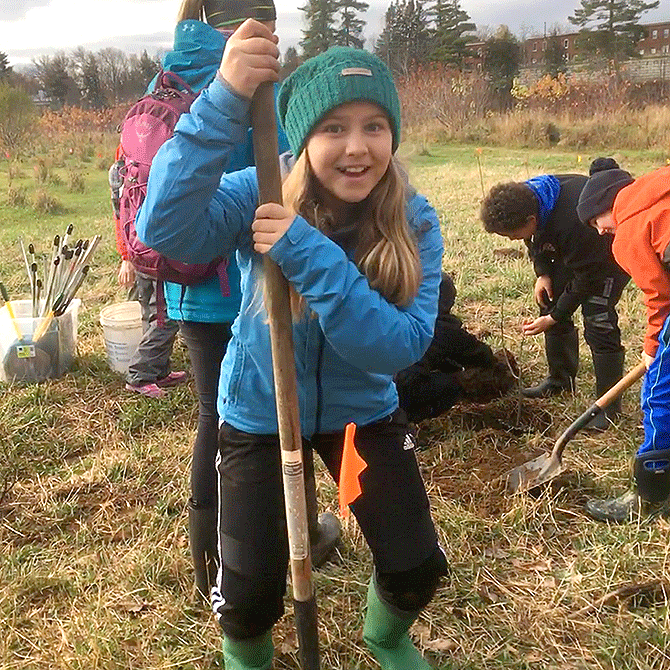
Photo credit: Olwyn Klinker Lesson: Be nimble and jump when you see a spark of interest
A thousand trees will be planted in New Brunswick, thanks to ten-year-old Mackenzie Klinker.
“Our school motto is ‘The best possible place to grow’.”
In late September, Klinker’s mom showed her a short film about student climate activist Greta Thunberg and then took her to the Fredericton climate strike the following day, which spurred the Grade 5 student at Park Street Elementary to launch her first environmental campaign. “I watched a video with my mom on climate change and it said that 200 species of animals go extinct every day. I didn’t know that and I really didn’t like that,” she recalls. “Our school motto is ‘The best possible place to grow,’ so I thought, ‘Then we should grow something.’ That’s why I decided I want to plant a thousand trees and help fight climate change.”
Klinker first took action by writing a letter to her school’s principal, Rien Meesters, vice principal, Mme. Gauvin, and teacher, Mme. Howlett, asking for their support.
Mme. Howlett helped find a solution. She suggested reaching out to the Nashwaak Watershed Association. They selected the types of trees to plant and the location: the bank of the Nashwaak River.
And so, just a few weeks later, Klinker and her whole class headed out to the river and planted 29 trees. They also got a science lesson in the outing, too, in that they learned about seeds and got to go critter dipping, where they used a net to find creatures, like backswimmers, in a nearby pond.
Now that the first batch of trees has been planted, they have 971 to go. And the whole school plans to help her meet that goal when the weather is warmer. “The rest of the staff are planning for each classroom to do something in the spring,” explains Meesters.
And Klinker wants to keep it going even longer: “I’d like it to continue every single year here at Park Street,” she says.
This whole project came together in a lightning-quick fashion, in part due to the responsiveness of the staff at Park Street and their willingness to act on Klinker’s suggestions.
Her advice for teachers?
“Kids can help think of ideas and what they would like to do. Then the teachers can support them for their projects and help make them possible,” she suggests. She also wants teachers to bring climate change education into the classroom when kids are younger. And she’s got a message for all adults about listening to kids on climate action: “It’s our future, so we want them to do stuff so we can have a good future.”
Photos: courtesy of Nina Tran, Olwyn Klinker and Jason Pang
First published in Education Canada, March 2020
-
Mind the Gap
Comments Off on Mind the GapQuiet classroom. No kids. It’s officially the end of the work day. She sits at her desk and revisits all of the things she would have liked to get done today. There’s a new activity she recently found online that sparked her interest, but she questions whether it’s something that could actually apply to her classroom: “Is it outdated? Authentic? Could it actually work?” But before she can answer those questions, she realizes she has a Math lesson to plan for the next day and that some of her students who are having a tough time are in need of extra support. She sighs and thinks to herself, “Maybe tomorrow.”
Educators are juggling multiple demands, leaving very little time for them to put the most recent educational research into daily classroom practice. Despite advances in research over the years that have shown which teaching and learning strategies are most effective, school leaders and front-line teaching staff continuously face challenges in implementing evidence-based research due to a lack of time, the complexity of research that’s available, and the overload of information in our digital world. Yet much of this research, if implemented, would actually yield greater student outcomes, and especially so for our most vulnerable and disadvantaged children.1
That’s where The Facts on Education comes in. Thanks to the continued support of the Desjardins Foundation and the Canadian School Boards Association, our one-page fact sheets unpack complex research into easily-understandable answers and concrete strategies towards some of today’s most pressing questions in K-12 education, including:
- How should climate change be taught in schools?
- How can we best teach students empathy?
- How can parents contribute to their children’s career development?
- How can mindfulness support teaching and learning?
Keep an eye out for these new fact sheets – and many more – throughout the year. EdCan members will receive copies in upcoming issues of Education Canada magazine, including online access at edcan.ca/facts-on-ed. Be sure to download, print, and share with your colleagues – we all play an important role in bridging the gap between research and practice.
Photo: Adobe Stock
First published in Education Canada, March 2020
Note
1 Canadian Education Association – Association canadienne d’éducation, Research Use and Its Impact in Secondary Schools: Exploring knowledge mobilization in education –L’utilisation de la recherche et son incidence dans les écoles secondaires : une étude examinant la mobilisation des connaissances en éducation (2011).
-
The Power of Paperless
Comments Off on The Power of PaperlessOrganization. Time Management. Executive Functioning. Fine motor skills.
These are common areas of need listed in Individual Education Plans. Yet figuring out how to address them is often a source of frustration for students, parents, and teachers alike. I leverage Google apps to support those areas of need and empower students with disabilities.
Facilitating collaboration and communication
Many students with special needs struggle to articulate or even recall what they did in class. For parents, logging in to my Google Classroom from their child’s account allows them to help because they can see exactly what is happening in class.
A parent of one of my students explained to me, “It is the only way I can track what he has or hasn’t done. I can ensure assignments are handed in, rather than putting the work in his binder and hoping he remembers to hand it in the next day.”
Adding the Resource teacher or Educational Assistant to the Classroom further enhances collaboration and student success.
If your organization, school district or faculty of education is an EdCan member (see the list here), you can enjoy unlimited access to our online content! Click here to create your online account.
Differentiating instruction
Inclusive education requires teachers to differentiate instruction based on student readiness, ability, and interest. With Classroom, I assign different versions of an assignment or quiz to certain students in the same class. Only the version that is assigned to a particular student will show up in their Classroom Stream.
Supporting fine motor skill and attention deficits
Most students can write and listen, but struggle to do both simultaneously. For many students, such as those with dysgraphia, taking notes during class is a fruitless exercise. I reduce cognitive load for everyone in my class by uploading all course materials into Classroom so that students have digital copies of all notes. Students can refer to the notes during class, and again afterwards for repetition and review.
“It is fun and it reduces my stress.”
Students with language-based learning disabilities or poor fine motor skills have brilliant ideas that they have difficulty recording.
I use a simple yet empowering tool called Voice Typing to unlock the potential in those students.
This assistive technology can be found in the Tools drop-down menu in Google Docs and Slides. Students simply press the microphone icon and then speak into a headset to dictate their ideas. When I receive their work, I’m confident that I’m actually evaluating their true understanding of a concept, not just their ability to write about it.
Self-esteem, motivation, engagement, and achievement all increase dramatically as students dictate a page of text in the time it would take them to write or type a couple of sentences.
When I asked about the impact that Voice Typing has had on her written output, one of my students smiled and proudly said, “It helps me get my work completed faster,” while her classmate added that “it is fun and it reduces my stress.”
Improving organization
In my paperless classroom, assignments do not end up in the black hole at the bottom of a backpack. All course materials are accessible online on any device, at school and at home.
I do still provide the option of paper handouts for some things.
I do this because not every student has access to technology or Internet at home. Providing multiple means of representation addresses this equity issue and is a principle of Universal Design for Learning.
In Google Classroom, content is organized by topic and tasks are automatically added to a to-do list arranged by course and due date. This adds structure and routine, which decreases student anxiety. When students finish a task, they can turn in their work through my Classroom anytime, anywhere. This reduces barriers for students with executive functioning disabilities and allows me to provide timely descriptive feedback.
Google Drive has become the new binder. But an unorganized Drive is the electronic equivalent of a pile of crumpled papers at the bottom of a backpack.

So I take a little time to coach my students to effectively organize their digital binder:
1. Create folders for each subject
- The equivalent of dividers in a physical binder
- Every file should be inside a folder
2. Colour code each subject
- Visual learners will associate a subject with its colour
- Use different shades of that colour for different strands or units
3. Name files accurately
- File name should be short yet tell you exactly what the file contains
- Descriptive names help when searching for files
One of my students succinctly described the benefits of his digital binder, saying “I know where all my work is, and it is saved there automatically.” No more lost work.
Illustration: iStock
First published in Education Canada, March 2020
-
Connecting Through Cultural Exchange
Comments Off on Connecting Through Cultural ExchangeIn April 2019, I boarded an airplane with 21 teenagers from Toronto to travel to Thunderchild First Nation in northern Saskatchewan, where we would stay for one week as part of a YMCA youth exchange program.
This experience changed all our lives.
These students had all taken the English: Understanding Contemporary First Nations, Métis and Inuit Voices course I teach at James Cardinal McGuigan (JCM) high school – a course designed to honour Indigenous voices.
But I wanted to push that education further by having my students participate in authentic experiential learning: being immersed in a First Nations community; engaging in rich discussion with the youth and Elders; and forming relationships that would bridge the gap between our cultures.
This YMCA program offered the perfect opportunity.
The project required an enormous amount of preparation – both logistically and emotionally. We explored stereotypes and learned about how to respectfully enter into an Indigenous community.
We participated in a workshop led by Dr. Angela Nardoz called “Build a Community” – an embodied experience that teaches about the impacts of colonialism and connects participants to the historical facts in a heart-based way.
I was in frequent communication with the coordinators at Thunderchild, Lydia Sunchild and Leah Arcand, to ensure that the experience would go smoothly and that their students would feel respected and welcomed when it was their turn to visit us in Toronto a few weeks later.
If your organization, school district or faculty of education is an EdCan member (see the list here), you can enjoy unlimited access to our online content! Click here to create your online account.
When we arrived at Piyesiw Awasis school, we were graciously greeted in a welcoming ceremony by all 250 students and teachers, who shook each of our hands, saying, “Tansi” (welcome).
Over the course of the week, my students engaged in land-based learning activities including teepee-building, hide-stretching, fire-building, and hiking. They visited historic sites and museums in neighbouring communities. A lucky few were even able to participate in a Sweat Lodge ceremony. Thunderchild shared their teachings, traditions, languages, artwork, and dance. Students met with Elders, watched a traditional powwow demonstration, and participated in a round dance.
“I was so impressed with how trusting and receptive both groups of students were.”
My students formed immediate relationships with the host students.
They played co-operative games and volleyball (with Thunderchild’s regional championship team), listened to music, and watched movies together. They talked about social media, family, traditions, and hobbies.
They were so alike and so eager to learn about one another.
At the end, the students participated in a sharing circle where they were able to openly and honestly express their thoughts and feelings regarding their newfound relationships.
It was moving for me to see such a wonderful example of trauma-informed and anti-colonial relationship-building.
“It was a truly special celebration of inclusion and unity.”
Two weeks later, we welcomed our new friends to Toronto. Our JCM students and the Thunderchild youth were so excited to be reunited, and they emanated a joy-filled energy all week. The days were jam-packed with activities: we did beading; we took them to the CN Tower, a Blue Jays game, the waterfront, the Royal Ontario Museum, and the CBC for a tour where we met award-winning Cree journalist Connie Walker. We even met the famous Ojibway author Drew Hayden Taylor!
A highlight was a downtown mural walk to discover the beautiful Indigenous artwork that is hidden all around our city, led by First Nations artists Chief Lady Bird and Aura, whom we had met earlier that year.
We concluded the week with a multicultural festival where JCM and Thunderchild students showcased their traditional music and dance. It was a truly special celebration of inclusion and unity. The week’s end brought emotional good-byes, and the students are still keeping in touch with each other months later.
I was so impressed with how trusting and receptive both groups of students were.
They came to the experience with open minds and a genuine interest in one another.
My students returned from Thunderchild changed in various ways: some came out of their shells, others now have more direction in their lives. They’ve grown: they have more friends, they’ve traveled, they understand what community is, what pride is. They have a broader worldview. Parents noticed this change immediately and thanked us for giving their children this experience.
I’m proud of us for rising to this challenge.
We hear about the realities on certain reserves and we know about the resounding impacts of colonization. Colonialism has created a divide between people who live on reserves and settler-people – yet the students managed to overcome those obstacles together.
That’s how relationships are formed; that’s how foundations are built; and that’s how change is made.
Photo: Dave Donald
First published in Education Canada, March 2020
-
Schools Take Action
Comments Off on Schools Take ActionAre we finally waking up to the critical need for climate change action? Is it too late? As we finalized the articles for this issue, Australia was literally on fire, suffering devastating and possibly irreversible losses to habitat and wildlife, not to mention loss of human life and thousands of homes. And this is only one of several ecological debts that are coming past due.
If young people are worried and angry about the crisis that lies ahead for them, they have every right to be. They’ve been left holding the bag, and they know it. So how do we equip them to address these challenges in a positive way that doesn’t just create more anxiety and fear?
Environmental educators know that real action that has a real impact is the strongest antidote to feelings of helplessness and despair. That’s why, in this issue on environmental education, we wanted to stress approaches that involve students in action projects to mitigate environmental damage, and schools that “walk the walk” by reducing their own carbon footprint. We were interested in how schools are “greening up” through both education andaction.
There is plenty in this issue to inspire educators to take up the green torch. But what has stayed with me is a finding from the survey conducted by Lakehead University and Learning for a Sustainable Future, reported on in “Climate Change Education and the Canadian Classroom: Nearly half of Canadian students do not believe that human action will be effective in mitigating climate change. That’s a heavy weight for kids to carry. The authors say, “It is critically important, therefore, to target this group with climate change education that is action- and solutions-oriented to combat eco-anxiety and hopelessness.”
The articles in this issue show just what can be done when students are energized to act and school and board administrations are willing to step up and support them. From the EcoSchools Program that began in Toronto and is spreading across the country, to the eco-projects initiated and led by the students profiled by Alex Mlynek (web exclusive), to the work done by Brilliant Labs in Atlantic Canada to facilitate students’ innovative tech solutions supporting the UN Sustainable Development Goals, there is no shortage of green ideas in our schools. It is not such a big stretch to imagine that Canadian schools could join the ranks of those leading the way in sustainable living and environmental stewardship.
Photo: courtesy Laryssa Gorecki
First published in Education Canada, March 2020
Write to us!
We want to know what you think. Send your comments and article proposals to editor@edcan.ca – or join the conversation by using #EdCan on Twitter and Facebook.
-
Role Models and Hands-On Work
Comments Off on Role Models and Hands-On WorkMany of our students are passionate about environmental protection – but do they know what jobs are available in this field? Bringing professionals into the classroom gives students a window into the real work being done and inspires them to get more involved.
“How do you become a conservation biologist?”
This is the question ecologist Philippe Fernandez-Fournier hears most often when he visits high schools in British Columbia. Fernandez-Fournier is a PhD student at Simon Fraser University and the co-founder of local conservation NGO, Wide Open Projects, based in Vancouver.
“Students want to know what’s available to them career-wise if they take the path of ecological studies and unfortunately, sometimes it seems to them like there just aren’t that many opportunities,” says Fernandez-Fournier. “But that isn’t true. It can be difficult, but it’s not impossible.”
“How do we, as educators and parents, channel this passion into creating practical higher education and career opportunities for them?”
For students in Canada today and around the globe, there’s no shortage of passion and ambition when it comes to finding creative solutions to environmental issues.
These are the children and teens coming of age in a more enlightened culture, eyes open to the realities of destructive human activities on the planet.
More than any other group of young people in history, today’s students are keenly aware of the challenges we face due to climate change.
More importantly, these young people know that they will bear the brunt of the consequences if we fail to make big changes soon.
We have young, enthusiastic students ready to become green ambassadors of change in the work force. The question is: How do we, as educators and parents, channel this passion into creating practical higher education and career opportunities for them?
Fernandez-Fournier and others like him are stepping up to help, hoping to show high school students interested in ecology that there are indeed pathways to success. “When I was an undergrad in biology,” says Fernandez-Fournier, “the only opportunities shown to me at the time were lab work, which I didn’t find that interesting. But as I got to know and connect with hands-on field ecologists, I became sure of the career path I’m on now. I want to share that excitement with other young students.”
If your organization, school district or faculty of education is an EdCan member (see the list here), you can enjoy unlimited access to our online content! Click here to create your online account.
Fernandez-Fournier started as an undergraduate student in a lab at McGill University in Montreal, and got his first taste of ecological field work volunteering with an organization called Operation Wallacea in Honduras. He never stopped after that; his master’s research at the University of British Columbia led him to study spiders in the jungles of Ecuador. His discovery of a parasitoid wasp that controls the minds of social spiders in the Amazon was recently profiled in Scientific American.
“All of these experiences made me want to contribute more, and with like-minded people, which is why I started Wide Open Projects with my friends. We focus on conservation awareness, coral reef restoration, and community development,” says Fernandez-Fournier.
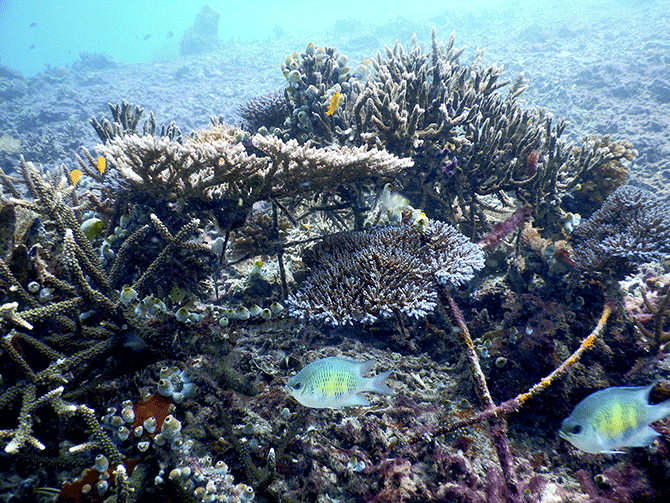
The coral reef restoration project uses an innovative method of hand-bending metal rebar into dome-like structures and then skillfully attaching bits of coral to it – which, when done correctly, flourishes into a healthy and multi-species coral community.
Wide Open Projects and community partners have created two successful pilot projects, and this past summer built and placed 66 more structures on the ocean floor.
Students in Canada and Indonesia, as well as biology colleagues around the world, are closely following the progress of Fernandez-Fournier and his team via social media.
But Fernandez-Fournier urges students not to feel compelled to follow his path exactly. Instead, he asks them to seek out opportunities that appeal to their own unique interests, whether that be lab work, field ecology, or green policy development. He encourages students to be proactive in seeking out any and all opportunities to volunteer and work with local university professors, NGOs, or other outdoor organizations. “Don’t be afraid to contact people and ask how you can help. Much of what’s needed now is just people willing to show up and do the work.”
He encourages educators to do the same. “Ask grad students and professionals in your community to visit your classroom and talk about their work. Most people, if they have the time, are more than willing to talk about their passion projects.”
“We all need to be bold and face the future proactively.”
Reaching out to potential role models, admittedly, is not always the easiest route and isn’t guaranteed to yield results, which is why many shy away from the idea.
The same is true for students, who worry about being rejected and therefore don’t put in the ask to join field research or volunteer opportunities abroad. They may even withdraw from ecology pursuits entirely, seeking out the road more travelled instead.
But if we learn anything from scientists such as Fernandez-Fournier working on the frontline of environmental challenges, it’s that we all need to be bold and face the future proactively, before allowing these challenges to come to us.
Photos: Philippe Fernandez-Fournier
First published in Education Canada, March 2020
-
Certified Green
Comments Off on Certified GreenThe EcoSchools Program started over 20 years ago, with 11 Toronto schools. EcoSchools Canada is now a national program that offers a range of classroom resources, runs an annual student conference, and certifies schools at three levels.
Inspired by the activism of Greta Thunberg, youth around the world have been taking to the streets to voice their growing fears and anxiety about the climate crisis. Instigated in part by the looming deadline to limit greenhouse gas emissions set by the International Panel on Climate Change’s recent report, students are cutting classes to provoke government action on climate change. In some school boards, educators are incorporating these protests through discussion or attendance as a valuable part of their students’ education, supporting their calls for climate action and justice.
While school strikes are a recent phenomenon, educators and students across Canada have been working on better understanding human impacts on climate change over the past three decades through experiential education, community-based learning, and EcoSchools programming. Integrated into curricula, aligned with local issues, and implemented inside and outside of classrooms, environmental learning is rapidly becoming one of the best ways to keep students engaged in school and simultaneously address the climate crisis. This is evidenced by the continued growth of the EcoSchools Program at the Toronto District School Board (TDSB), which engages thousands of children, youth and educators across the city in rich learning about all aspects of the environment. From growing their own food and monitoring energy use, to conducting waste audits and assessing the health of their watersheds, students are leading the way in learning how to address climate change, and moving Canada’s largest school board toward environmental sustainability. At the same time, they are putting the competencies of 21st education – critical thinking, communication, collaboration, creativity and innovation – into play as they prepare for one of the most significant challenges of their adult lives.
“Our emerging leaders often share a vision of schools as sustainability hubs, helping community members from all walks of life learn about living in more environmentally friendly ways.”
Motivated by the development of sustainable schools in Europe, the EcoSchools Program was begun in 1998 by forward-thinking program leaders Richard Christie and Eleanor Dudar, well before the Ontario Ministry of Education established its policy framework in Environmental Education in 2009. By focusing on achievable, practical actions such as turning off lights and sorting waste into recycling streams, students and educators were able to demonstrate the environmental and economic benefits associated with this type of learning. The program grew rapidly, from 11 schools in the first year to over 427 schools at its peak; it is currently the largest program of its kind in the country, and one of the biggest in North America.
If your organization, school district or faculty of education is an EdCan member (see the list here), you can enjoy unlimited access to our online content! Click here to create your online account.
In 2005, its certification structure and resources were used to establish the Ontario EcoSchools program, which has flourished over the last decade. Not only are there are now 1,800+ certified EcoSchools across the province, but this non-profit organization has recently become EcoSchools Canada, aiming to nurture the next generation of environmentally attuned citizens and leaders in school communities across the country.
Over the years, the TDSB’s EcoSchools program has grown to support six major goals:
- fostering leadership and teamwork
- conserving energy
- minimizing waste
- creating and caring for vibrant school grounds
- improving student achievement through ecological literacy
- contributing to healthy, active, safe and sustainable school communities.
An energetic staff of three run the program, which includes supporting and certifying EcoSchools at the bronze, silver, gold and platinum levels; designing and delivering learning for school EcoTeams; implementing annual student conferences; creating print and online resources; and supporting a range of partnerships with local NGOs.
As the program has expanded, the TDSB has also established a Sustainability Office, which has aligned with a wider range of physical infrastructure measures being put in place to address climate change across the school board, such as establishing outdoor classrooms, mapping and planting trees on school properties, and building high-performance green buildings, like the one at North Toronto Collegiate Institute. The board has been incorporating sustainable energy sources, such as the geothermal energy installed at Highfield Junior School, and the installation of solar panels on over 300 schools. Other boards should take note: the solar panels have generated significant funding for the TDSB’s Environmental Legacy Fund through the sale of carbon credits. This underwrites other sustainability initiatives such as cycling education programs, bike racks, and water bottle refill stations. All of these initiatives have a measurable environmental impact: since 2001, there has been a 22 percent decrease in overall greenhouse gas emissions at the TDSB.
Growing environmental learning
The benefits of the TDSB’s EcoSchools program are manifested in multiple ways, some of which are seen in improved learning experiences for students and their communities. An example of this is found in the rapidly increasing number of schools that have dug deep into environmental learning by creating their own school gardens.
“This natural area has also become a favourite part of the community for students and neighbours alike.”
Supported by a fertile partnership with Evergreen – a nonprofit dedicated to creating healthy urban environments – as well as the expertise of board staff, schools across the board are finding ways to use educational gardening to support the provincial curriculum.
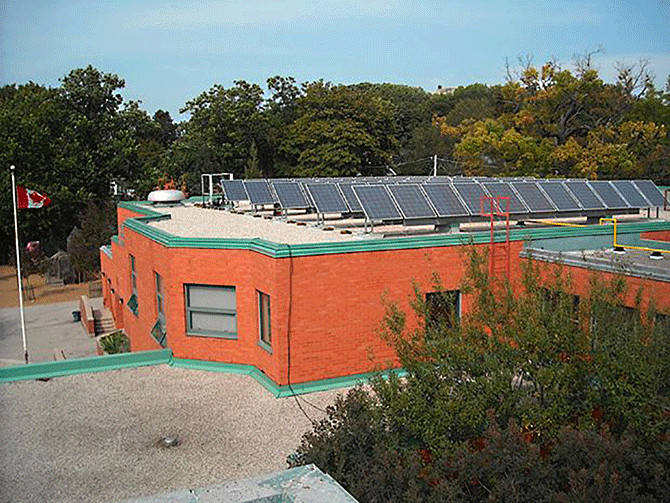
Rooftop solar panels at Hillcrest Community School, Toronto Elementary students at Runnymede Public School planted native shrubs and trees on a hillside behind their urban school as a way to improve the biodiversity of their schoolyard. Twenty years later, they have a lush forest of walnut, maple and oak trees that support a wide variety of insect and wildlife, perfect for enhancing learning activities in science, art, math, and literacy. Not surprisingly, this natural area has also become a favourite part of the community for students and neighbours alike. In contrast, the Grade 6 students at Ryerson Community School have turned their classroom into an indoor garden with the addition of a hydroponic growing tower called a Good Food Machine. As they seed, nurture and harvest the kale, bok choy, tomato and cucumber plants, they learn about their life cycles, as well as how to prepare them as part of a healthy diet. And at Eastdale Collegiate, staff from the TDSB and FoodShare – an organization that works to make fresh, healthy food accessible to all – worked with students to turn a defunct tennis court on the roof into a 16,000 square foot farm. This huge rooftop garden provides hands-on, interdisciplinary learning experiences throughout the school year, connecting with science, business, hospitality and culinary courses. In the summer months, these secondary students are hired to gain important work experience through marketing and selling the fruits and vegetables that they grow on their school roof to nearby restaurants.
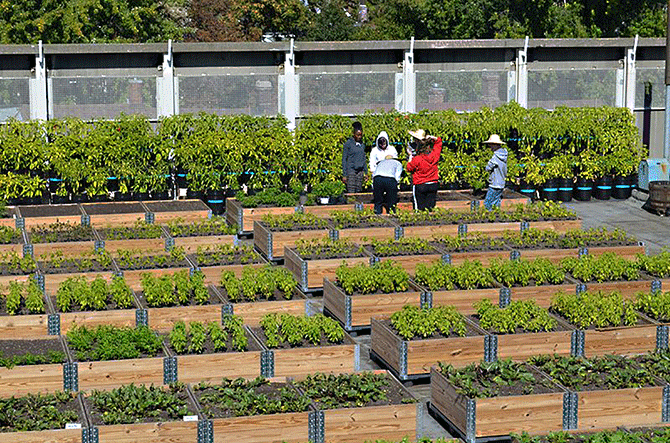
Eastdale Collegitate’s 16,000 square foot rooftop garden, Toronto The EcoClub at Earl Haig Secondary School takes a very different approach to learning about climate change through its focus on garbage. While many are involved in the school’s waste audit, from the principal to teachers and caretakers, it is the students who lead the process by collecting and sorting the garbage, and then measuring and interpreting the audit results. This sticky, smelly form of learning brings with it groans, laughter, and disgust at the amount and type of waste created, but it also builds comradery and integrates learning in math, literacy and critical thinking to inform the goals for the EcoClub for the year. This immersive investigation could result in helping the school community to better separate out compostable and recyclable items from its garbage heading to landfill; reducing the amount of single-use plastics in the school cafeteria; or increasing understanding of the problems of micro-plastics in the lake. The results of this learning are quantifiable; research has demonstrated that certified EcoSchools generate half as much waste per student per year as do non-certified schools.
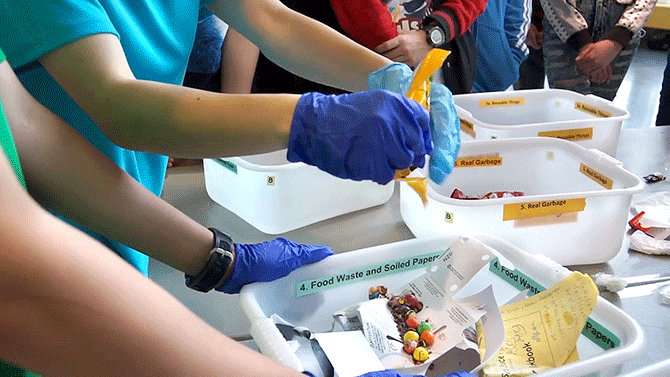
EcoClub students sort and audit garbage at Earl Haig Secondary School, Toronto Students aren’t the only ones wanting to learn more about the climate crisis; their educators are growing knowledge, skills and expertise as they dedicate evenings, weekends and summer vacations to undertaking professional development to support their students in the EcoSchools program. Through an innovative collaboration with faculty at the Ontario Institute for Studies in Education (OISE), over 200 TDSB educators have taken Additional Qualification courses in Environmental Education over the last six years. These courses model the same experiential, inquiry-based approach that educators are encouraged to use in their classrooms: they learn from and in nature at TDSB outdoor education centres, learn on and from the Land with an Indigenous knowledge-keeper along the banks of the Humber River, and meet with environmental experts like Maude Barlow to study the impact of pollution on Lake Ontario. Most importantly, these educators share their promising practices in environmental learning with each other through discussions, presentations, and digital resources that are also shared with other educators across the school board. Those who finish this set of courses become members of the TDSB’s Action Research Team, which supports educators to conduct research into Environmental Education in their classrooms, alongside their students. This team also works with teacher candidates from OISE’s teacher education programs to ensure that the next generation of teachers comes into classrooms prepared to lead learning about climate change from the start of their careers.
Facing the challenges
Many positive steps have been taken by students and staff alike in addressing climate change and environmental issues over the last two decades at the TDSB, but the EcoSchools Program continues to encounter challenges as it does this important work. For program staff, getting thousands of educators, staff and parents from 575 schools on the same page about the importance of environmental learning is a work in progress, and makes for an intensive workload. It is still common for some educators to find themselves identified as the “ecochampions” of their school, not only modelling this work for their students, but also taking full responsibility for the EcoClub and the paperwork associated with the EcoSchools certification process. If this educator or principal moves to another school, it can take time to find another prepared to champion this work. Maintaining supports, both administrative and financial, are always an ongoing concern, as seen with the recent cutbacks by the Ontario Ministry of Education; cutting budgets has a direct impact on educators’ time and energy in leading this critical work.
Yet those involved in the TDSB’s EcoSchools Program are finding ways to make it happen. One way is by establishing and maintaining networks of professional learning, such as the one established with OISE; this provides ongoing support and development by those who understand the problems and solutions inherent to the EcoSchools program. Another is by nurturing “green leadership,” bringing together students, educators, administrators and parents who prioritize environmental learning and climate action in schools to ensure that the curriculum in the 21st century is rooted in real-world experiences. These emerging leaders often share a vision of schools as sustainability hubs, helping community members from all walks of life learn about living in more environmentally friendly ways.
School strikes are certainly one way to advocate for climate action, and perhaps a necessary one for capturing government attention. But the EcoSchools Program at the TDSB provides an alternative and successful model that keeps students in school, builds 21st learning competencies, and shows them how to become effective champions for sustainability in their own communities.
EcoSchools Canada
Join a network of over 50,000 schools around the world working to create a sustainable future.
EcoSchools Canada’s curriculum-linked certification framework supports student-led action that leads to tangible impacts throughout the school community.
Visit ecoschools.ca to learn about how you can get involved and become a certified EcoSchool.
Original photos: courtesy of the TDSB Sustainability Office
First published in Education Canada, March 2020
-
Making Green Solutions
Comments Off on Making Green SolutionsWhen maker-centered, community-based learning meets the UN Sustainable Development Goals, the resulting projects can be deeply meaningful to the students who created them. See how Brilliant Labs in New Brunswick supports students’ “hopeful action to build a better world.”
Young people can have tremendous agency and voice in influencing solutions to community problems if we ignite their creativity with a socially responsible mindset, and equip them with the entrepreneurial and digital skills necessary to leverage tomorrow’s technology.
With young people today becoming increasingly troubled and anxious with climate change, environmental degradation, social inequality, and other challenges impacting our world, it is important that we support student-driven projects that engage with these issues.
In doing so, we also acknowledge their personal autonomy and identity.
What if we approached this by challenging our students to take a good look at their world and have them ask: What does my world look like? Is my world missing anything? How can I be a changemaker, innovator and leader? What can I do now that will lead to meaningful changes tomorrow? We can inspire bold new thinking by students and give them a time and place to exercise their creative problem-solving, with innovative use of materials and digital technology-related skills.
Over the past five years, Brilliant Labs has engaged youth in more than 401,862 learning experiences that inspire and empower them to make an impact by addressing the urgent needs in their school and community. This impact has been, literally, made by applying the instructional philosophy of maker-centred learning, in which students are invited to create meaningful artifacts of their own knowledge, interests, and passions.
We provide students with agency and a supportive learning environment where they are encouraged to integrate new techniques and technologies with familiar materials, all while constructing authentic solutions to problems they identified in their own communities. The prototypes they develop often become incredibly viable solutions to addressing our society’s most intimidating problems.
In partnership with the Department of Education and Early Childhood Development in all four Atlantic Canadian provinces, Brilliant Labs has worked with tens of thousands of teachers and hundreds of thousands of students in support of a maker-centered learning approach that fosters hands-on, experiential, and inquiry- and project-based learning in classrooms throughout Atlantic Canada.
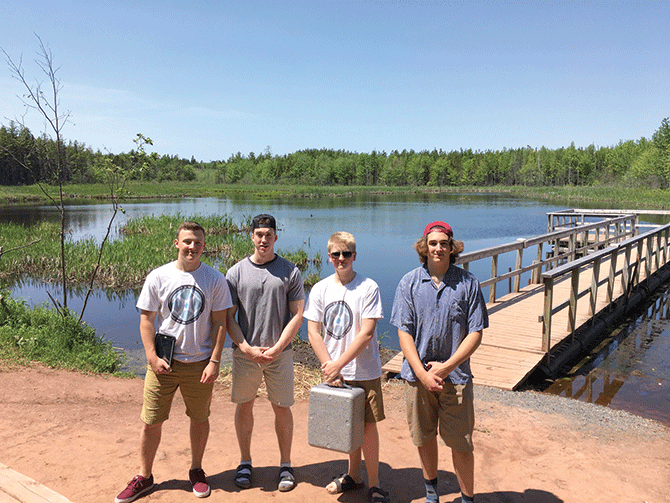
Fredericton, N.B. students used drones, microcontrollers, 3D design and printing, robotics, and coding to collect water samples without disturbing sensitive wetlands. The UN Sustainable Development Goals
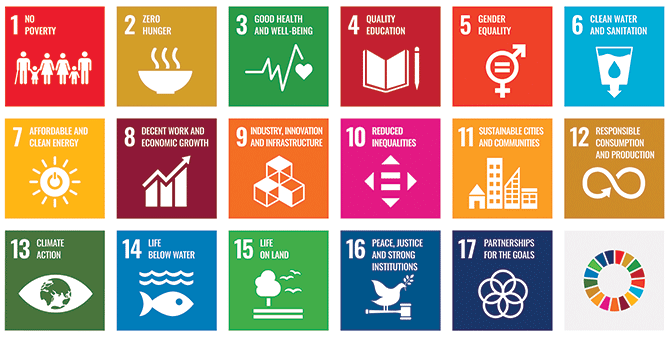
The United Nations’ 17 Sustainable Development Goals – also referred to as the SDGs or the Global Goals – were adopted by Canada and 192 other members states of the UN in 2015.
The SDGs universally apply to all countries, and cover a wide range of sustainability issues intended to build a better world for people everywhere and the planet. All the countries agreed to implement the SDGs within their own country in order to achieve the 2030 Agenda for Sustainable Development.
By highlighting local, national and international priority areas, the SDGs strive to end all forms of poverty, improve health and education, fight inequalities, make cities more sustainable, and tackle climate change, while ensuring that no one is left at a disadvantage.
Converging student-driven projects with the SDGs not only educates and engages them to support the Global Goals in real and meaningful ways, it also empowers them to transform that support into hopeful action to build a better world and contribute to Canada achieving its 2030 Agenda.
Bringing Design Thinking to the UN SDGs
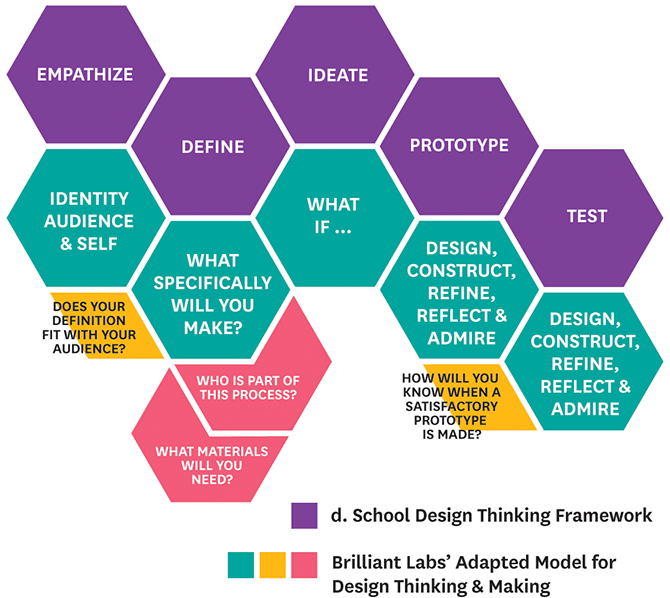
Figure 1: Design Thinking One framework that is particularly helpful when encouraging projects that address environmental sustainability is design thinking (see Figure 1). Popularized by the Stanford School of Design, design thinking can be used by students and teachers as an instructional methodology that brings some order to what can become a chaotic cycle of multiple iterations of their project throughout their design process. While Brilliant Labs provides support for students as they work through each component of the design and making process, it has been the empathize component of design thinking that has been most helpful in creating a culture of localized environmental literacy.
If your organization, school district or faculty of education is an EdCan member (see the list here), you can enjoy unlimited access to our online content! Click here to create your online account.
There are many interpretations of the design process, and it is important to remember that conforming your instructional practice to any framework that is not your own may constrain the creative actions makers take as they move through the iterative process and construct a prototype.
For this reason, we have developed our own interpretation of the Design Thinking Process entitled “The [blank] process of making brilliant things.” We hope that inserting a personalized name into the title will inspire a sense of personal agency in whatever process teachers and their students choose to bring their constructions to life.
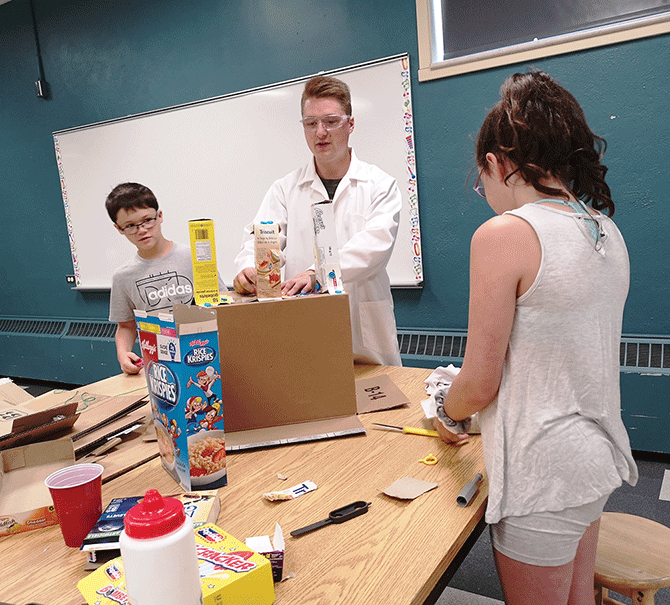
Inexpensive and plentiful materials like cardboard can often be used for early prototypes. We use these descriptions when presenting our adapted model for Design Thinking and Making:
Empathize
It is enormously meaningful to understand the culture of your community, your own identity and the identity of your audience prior to jumping into any prototyping. This way your process will be refined to the needs of your end-users in your target community.
Define
Specifically, what is it that you will make?
It is important to know how your desire to make relates to the empathy you express for your community.
The definition of what you wish to make should be specific so that you can clearly communicate your intent with those same community members, for whom your project is intended.
Ideate
This component of the process is where your imagination will run wild.
To ideate means to imagine all of the possible implications and functions of your project.
Brainstorming outside of the definition of your project or the time you have allotted for your project during the ideate phase will ultimately lead you to an exciting project design that leads you to keep asking. “What if…?” We encourage this unbridled ideation!
However, it can be valuable to have one group member recognize when the ideas fall too far outside your definition to keep you on track.
Prototype
This is where you begin to make your ideas come to life.
Turn sketches into diagrams, with multiple views and precise measurements.
Discuss your ideas and design decisions with your intended community of end-users.
Live within the ambiguous constraints of low-cost construction materials like cardboard.
Embrace each prototype for the reflective opportunity its disposable nature provides.
Finally, never underestimate the value of any prototype. Time has a way of getting away from the best of us. Be proud of each of your prototypes.
Test
This phase may be at the end of the diagram, but in the design thinking and making process there is never an end – it is recursive, iterative, and ever-changing.
The testing phase is similar to deployment. Take your current prototype, demonstrate it to multiple groups of end-users, take notes, discuss the user experience and decide whether you want to cycle back to an earlier phase of your process (the answer is often yes).
Atlantic Canadian youth are truly empathetic to their local community’s sustainability challenges and their resulting projects inevitably become projected onto the larger challenges framed by the SDGs and Canada’s 2030 Agenda. For instance, a middle-school classroom decided to join a local campaign to solve their city’s hunger and nutrition issues. This group of students were not only interested in positively contributing to the food available to the hungry but to ensuring that this vulnerable group had access to healthy, locally grown produce. After days of brainstorming, these Grade 8 students decided to build a series of hydroponic flood tables to grow as much lettuce as possible in their school.
The students continually refined their design to maximize the growth as well as their contribution. Brilliant Labs became involved in this project when one student who was particularly interested in chemistry, gardening and coding, requested our assistance in developing an autonomous, electronic system that adjusted the pH of the nutrient-rich solution that became the essential component to maximizing their lettuce growth.
Integrating students’ projects with the SDGs localizes them in their community to make them real. This framework also provides engaging and creative opportunities to further cement student learning about how their local position can relate to one much larger: both globally and for their own learning.
When constructing projects that consider sustainability, students often authentically express a number of SDGs, as well as global competencies that are critical to establishing themselves as life-long learners.
The pan-Canadian global competencies outlined by Council of Ministers of Education, Canada are:
- critical thinking and problem solving
- innovation, creativity and entrepreneurship
- learning to learn/self-awareness and self-direction
- collaboration
- communication
- global citizenship and sustainability.
Examples of this in Atlantic Canada include students at all levels:
- Elementary school students: prototyped, then created a micro business for edible spoons to reduce fast food waste; challenged their schools to reduce waste by prototyping microcontroller-powered garbage cans.
- Middle school students: developed ecofriendly water filtration systems; prototyped new and innovative solutions to harnessing tidal power.
- High school students: designed and soldered circuit boards and created 3D printed housings for solar-powered high-efficiency lights (Engineering Brightness program); worked out of the Idea Centre in Saint John, N.B. to prototype car exhaust refinements in collaboration with NASA.
Students in an Environmental Studies class at Fredericton High School developed a project in support of SDG Goals 15 (Life on Land), 14 (Life Under Water), and 6 (Clean Water and Sanitation). While learning about wetland ecosystems at Corbett Brook Marsh (a 3.64-hectare forested wetland), they combined drones, microcontrollers, 3D design and printing, robotics, and coding to collect water samples in a hard-to-reach wetland without further damaging the local ecosystem. The student-created prototype featured two detachable platforms that carried four test tubes and a sensor. When the drone came within 10 cm of the water surface, it automatically triggered a robotic mechanism that filled the test tubes with water.
The project was a success, tying for first place at the Regional Science Fair at the University of New Brunswick and also catching the attention of local conservation and technology communities. Ducks Unlimited Canada purchased a new drone for the school, with funding from the New Brunswick Environmental Trust Fund. The project not only far exceeded everyone’s expectations, it provided a creative, problem-solving opportunity for students to learn how to apply their unique interests, skills and talents in a meaningful way.
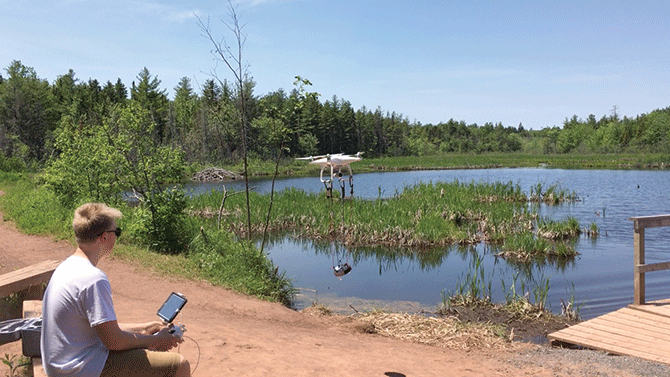
Fredericton, N.B. students used drones, microcontrollers, 3D design and printing, robotics, and coding to collect water samples without disturbing sensitive wetlands. Taking action
As students work to provide sustainable and environmentally responsible solutions within their schools and communities, we have a tremendous opportunity to engage them with the UN SDGs to develop their global competencies and support Canada’s 2030 Agenda for Sustainable Development.
Connecting students with projects and purposeful technology in an authentic and impactful context not only sparks learning through action, but will go along way to creating innovative solutions to complex and urgent problems, and develop a growth mindset.
Brilliant Labs is looking forward to continuing to support students, teachers and educators along this journey as we engage our young people to boldly solve real problems with innovative technologies. Our youth are the biggest and brightest hope to improve the lives of people everywhere and transform the world by learning about the SDGs and mobilizing Canada’s 2030 Agenda.
About Brilliant Labs
Formed in 2014, Brilliant Labs is a not-for-profit, hands-on technology and experiential learning platform based in Atlantic Canada.
In converging student-driven projects with the SDGs, our vision is to provide every child in Atlantic Canada, and beyond, with the opportunities to access, learn, and leverage new technologies and programming to create, innovate and inspire solutions for a sustainable and environmentally, socially, and entrepreneurially responsible future.
Resources
The following resources will help you engage your students with the UN Sustainable Development Goals:
- See the SDG targets and inspiring videos on Global Goals. www.globalgoals.org
www.youtube.com/channel/UCRfuAYy7MesZmgOi1Ezy0ng
- Watch a free one-hour #TeachSDGs course from Microsoft Education. https://education.microsoft.com/courses-and-resources/courses/SD
- Visit Brilliant Labs’ website to see SDG-focused projects to get ideas for potential projects in your classroom. www.brilliantlabs.ca
- Find helpful lesson plans for all ages in multiple languages. http://worldslargestlesson.globalgoals.org/
- Build a network – join “Alliance 2030” and share the work of your students “to build a better Canada and a better world with no one left behind.” https://alliance2030.ca/
- Pledge to teach SDGs and amplify the work of your students globally by joining the #TeachSDGs movement, featuring over 250 global ambassadors and tens of thousands of engaged educators. www.teachsdgs.org
- Engage with the UNESCO Associated Schools Network and the Canadian Commission for UNESCO. https://aspnet.unesco.org/en-us
https://en.ccunesco.ca/networks/associated-schools-network
- Encourage global competencies in your students – critical to achieving SDGs. www.un.org/youthenvoy/2015/07/global-competence-amongst-youth-critical-achieve-sustainable-development-goals
Photo: Courtesy Brilliant Labs
First published in Education Canada, March 2020
-
Nature Calls
Comments Off on Nature CallsGetting kids inspired by the natural world is good for their well-being – and critical to the fate of our threatened species. And it can start with school.
When I visited a high school recently as a guest speaker, I was surprised by how quiet I found the crowd of students in the entrance foyer.
There must have been a hundred students, but rather than the noisy, chatty hallway I was expecting, they barely seemed to speak at all.
Instead they were looking down, apparently completely absorbed, at the phones in their hands.
When I remarked to the principal who greeted me how odd I found it that the students didn’t talk with each other, she explained I was mistaken. They were talking. On their phones. They were texting. Or Snapchatting. Or WhatsApping – or some variation of these.
“Convincing students to unplug and get outside? That can be challenging.”
I’d been invited as a speaker to motivate kids to “unplug” and get excited about nature. I could see I had my work cut out for me. I’m a professional adventurer, the Explorer-in-Residence of the Royal Canadian Geographical Society.
Normally, I’m out in the wild, hundreds of kilometres from the nearest other person, in some of the most isolated places on Earth. I get to spend months out of the year unplugged. If that’s your idea of paradise, then we think alike.
My days are pretty simple: ploughing through arctic ice floes in a canoe, sleeping alone with polar bears, paddling across lakes that stretch beyond the horizon, trekking in places where there are no trails, coming face-to-face with wolves and muskox, and wandering across ancient lava flows. Pretty relaxing stuff. But convincing students to unplug and get outside? That can be challenging.

A closer look at nature reveals four wellcamouflaged Hudsonian Godwit eggs on the tundra. According to a recent report, “Kids and teens age eight to 18 spend an average of more than seven hours a day looking at screens.”1
That data was from a study in the U.S., but there is little reason to think the numbers are any different here in Canada. Researchers have linked excessive screen time to increased anxiety, stress, difficulty concentrating, unhappiness, and other unhealthy outcomes.
The American author Richard Louv has even coined the term “Nature Deficit Disorder” to refer to the growing trend of kids (and adults) spending too much time indoors.
It turns out that a steady stream of social media, emails, online content, video games, and binge-watching shows, does not lead to a well-balanced, healthy life. (Which is not to say any of these things are bad in moderation.)
If your organization, school district or faculty of education is an EdCan member (see the list here), you can enjoy unlimited access to our online content! Click here to create your online account.
But how do we encourage kids to get passionate about nature? Maybe there is an app for that? Probably, although I think there’s a better way.
When I cast a glance back at my own childhood and education, I count myself lucky. I happened to grow up with a forest on my doorstep. We lived on a country road without streetlights or sidewalks. My playground was the woods that surrounded our home on all sides. Out there, among the oaks and sycamores, the birch and basswoods, I learned about plants, tracks, birds and other animals. I developed a deep love for forests, nature, and the wild that has never left me.
But I was also lucky that my interest and enthusiasm for the natural world was nurtured and encouraged by the Ontario public school curriculum and the teachers I had.
In elementary school, we gathered leaves from our schoolyard and made rubbings of them, identifying the different species. Nearby was a conservation area where we learned orienteering and played predator-prey games about the food chain and web of life.
I vividly recall learning about environmental issues in my Grade 3 class from Mr. Sibley, and how alarmed I was at the thought of forests disappearing.
In Grade 4, our class did projects on endangered species (I chose the wolverine).
In Grade 6, my teacher, Mrs. Stock, had our class do projects on an individual tree species. I did mine on tulip trees – towering giants found in the Carolinian forests of southernmost Ontario.
I still have my Grade 7 project on “Canadian woodlands,” where I studied different types of forests in Canada and what makes each unique. For that project, I was able to do research in my own backyard.
We had many other projects involving nature and field trips to nearby nature parks. All of this helped encourage my appetite for the outdoors.
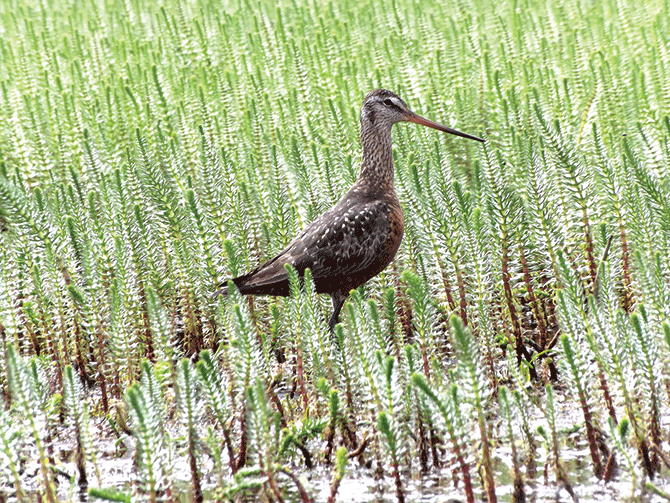
A Hudsonian Godwit stalks across a marsh near Hudson Bay. These birds may be seen in southern Canada as they migrate to South America. Now when I write about my expeditions in my books, I try to re-awaken people’s dormant sense of awe and delight at the mysteries and magic of the natural world, in the belief that doing so will inspire people to want to know more about the outdoors and then get active in working to preserve and restore natural habitats.
That’s why I write about trekking alone through ancient forests of spruces and tamaracks, or meeting arctic wolves that look you in the eye, or wandering over weathered rocks that were already a billion years old before the first dinosaur ever walked the earth.
At schools, I entertain students with tales of adventures in the wild, of sleeping under stars, of mapping northern rivers that snake across the land like giant anacondas, and of meeting bears and wolverines.
Once I’ve stirred up a suitable sense of awe at the wild and eagerness to experience the great outdoors among screen-addicted students through adventure stories, my next step is to give them the mental tools they need to experience nature for themselves in an exciting way, in their own backyard or local conservation area.
I think there’s a two-pronged approach that can do wonders to accomplish this in schools.
The first is teaching more nature in the classroom – things like leaf rubbings and tree identification, and plant and animal ecology.
The second is getting students outside more in the woods or wetlands. The crucial part is that these things need to be combined.
A common mistake is only emphasizing one element, instead of both together. But just sending people out into the woods without any knowledge of how to interpret them is like assigning Shakespeare without first learning to read. On the flip side, learning about nature only indoors is like studying music theory without the music.
So I place a lot of emphasis on both classroom learning and getting outdoors.
For students, I like to begin with a focus on things that are immediately at hand and almost always visible – trees and birds.
These are nature’s ABCs – the fundamental building blocks that will let anyone begin to “read” the woods. But then we go beyond just tree identification, to figuring out more about the character of each tree. How old is it? What are its traditional uses? How does the wood compare? Soft basswood is a wonder for carving, while hop-hornbeam is rock-hard. Why did that tree grow in a particular way? We compare the big spreading branches of the white oaks to the wiry understory witch hazels. Why do silver maples grow in swamps? Hemlocks in shady ravines?
Then, suddenly, those generic trees around the schoolyard aren’t just “trees” anymore – they’re red oaks, white pines, and sugar maples. They begin to tell a story – the story of the natural world.
“It’s not only that we need nature. Nature needs us. Now more than ever, the natural world is under tremendous pressure.”
The other thing I like to focus on at first are birds. Birds, like trees, are almost always around – even in urban settings – and since many are migratory, they connect us immediately to faraway places, from the warblers that spend their winters in the Amazon to the snow geese that in summer migrate to the Arctic.
Like the trees, each bird has a story to tell. As we learn about them, gradually the birds flying by or singing in the cedars aren’t just catch-all “birds” anymore.
To borrow a digital metaphor, now the picture starts to come into High Definition, and we can make out white-breasted nuthatches, downy woodpeckers, gray jays, tufted titmice or black-capped chickadees.
The more we learn, the sharper the focus gets as the natural world becomes more and more intelligible, and ever more fascinating.
Long after I left school, I’m still learning about nature. My expeditions for the Royal Canadian Geographical Society have taken me everywhere from exploring caves in the Arctic, to gathering marine fossils along isolated rivers, to tracking down and photographing Canada’s most elusive snake, the endangered blue racer. Currently I’m preparing for a new four-month solo canoe journey, in part to be based on following bird migration routes. When I return, I’ll have new material to share with the schools I visit.
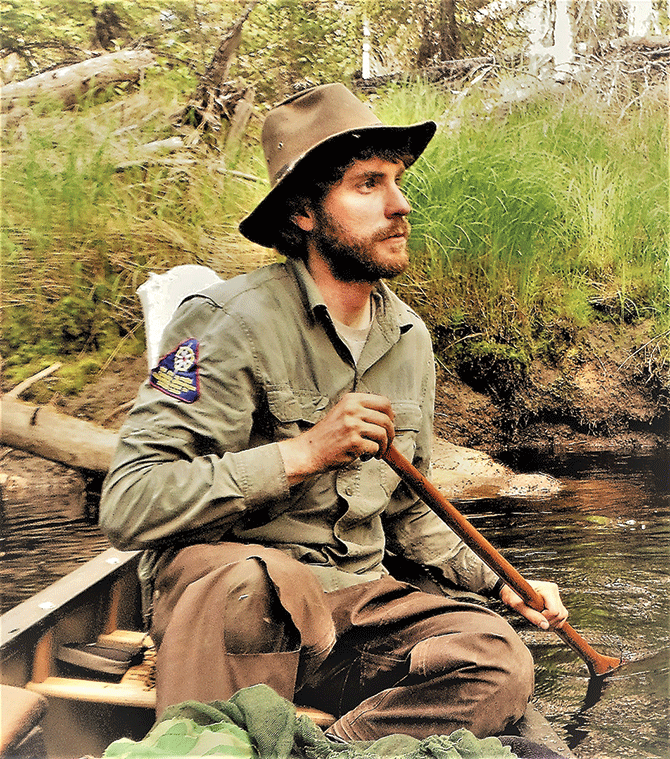
Adam Shoalts explores some of Canada’s most remote places. There’s another reason why I think it’s critical we re-awaken our sense of awe for the wild.
It’s not only that we need nature. Nature needs us.
Now more than ever, the natural world is under tremendous pressure.
A landmark UN report last year laid out in stark detail the grave loss of biodiversity directly from human actions – chief among them habitat loss. The UN report’s key conclusion was that humans now threaten over one million species with extinction. The report found that over 100 million hectares of tropical forest were lost between 1980 and 2000 alone. Even more severe was the disappearance of wetlands: an estimated 87 percent of the world’s wetlands are already gone. All of this habitat destruction is driving sky-rocketing rates of extinction.
That’s why I think it is so critical we reconnect with nature – not only for our own well-being, to live healthy, balanced lives, but for the fate of the plants and animals we share our world with.
The first step is learning to care more about the wild all around us. In doing so, we’re not only helping students lead healthier, more balanced lives; we’re planting the seeds for a greener tomorrow.
Photo: Adam Shoalts
First published in Education Canada, March 2020
Note
1 Victoria Rideout and Michael B. Robb, The Common Sense Census: Media use by tweens and teens (San Francisco, CA: Common Sense Media, 2019).
-
A Climate Action Plan for Canadian School Boards
Comments Off on A Climate Action Plan for Canadian School BoardsConcrete, effective action is required to effectively address the climate change emergency. How can the education sector reduce our ecological footprint? The author offers a plan with strategic actions for schools and school districts.
The problem of climate change is a collective challenge of immeasurable scope.
To respond effectively, each and every organization will have to formulate and implement a concrete action plan in order to significantly reduce its ecological footprint within a very short timeframe.
In this context, the sector of public education, whose primary mission is to support and prepare youth for the future, must lead the way and become a model of sustainable practice.
This pressing issue is already under discussion in several school districts across the country, some having already declared a climate emergency (e.g. Vancouver, Victoria, etc.), and others likely to join them shortly.
That said, such declarations are only useful when followed by an effective and realistic action plan.
Therefore, this article aims to provide organizations such as schools and school boards with a simple plan that includes a list of strategic actions in order to significantly reduce their ecological footprint in a timely manner.
“We must take action as quickly and as effectively as possible.”
The primary goal of the proposed plan – reducing a school district’s ecological footprint by at least 50 percent by 2030 – sets a clear target and definite timeline that aligns with the most recent Intergovernmental Panel of Climate Change recommendations (2018).
As for possible sectors for action, the situation may vary from school to school and from community to community, but in the majority of cases, food, transport, land use and waste management are likely to be the most important sources of pollution and greenhouse gas emissions (GHG).
Some of these actions may require extra funding (e.g. transitioning to electric school buses), some can be implemented with current resources (e.g. reviewing cafeteria menus to decrease animal product use by at least 50 percent).
Again, the necessary logistic and financial details may vary from district to district, but the key factor to make this plan reality is to create the necessary mobilization from within. Only then will the so-called climate emergency be prioritized as a true emergency.
Indeed, according to Michael Fullan’s research, successful organizational change implies an evolution of an organization’s culture and not just the restructuring of activities.
If your organization, school district or faculty of education is an EdCan member (see the list here), you can enjoy unlimited access to our online content! Click here to create your online account.
In this case, it seems that our students have already taken the lead, creating momentum with the movement Fridays for Future.
At this point, schools must not fail them – we must take action as quickly and as effectively as possible. Everyone involved – principals, teachers, support staff, parents, school and school board administrators – can all do their share to bring these ideas forward and endorse this simple yet concrete plan to help create the necessary changes.
Figure 1: Climate Action Plan for Schools and School Districts
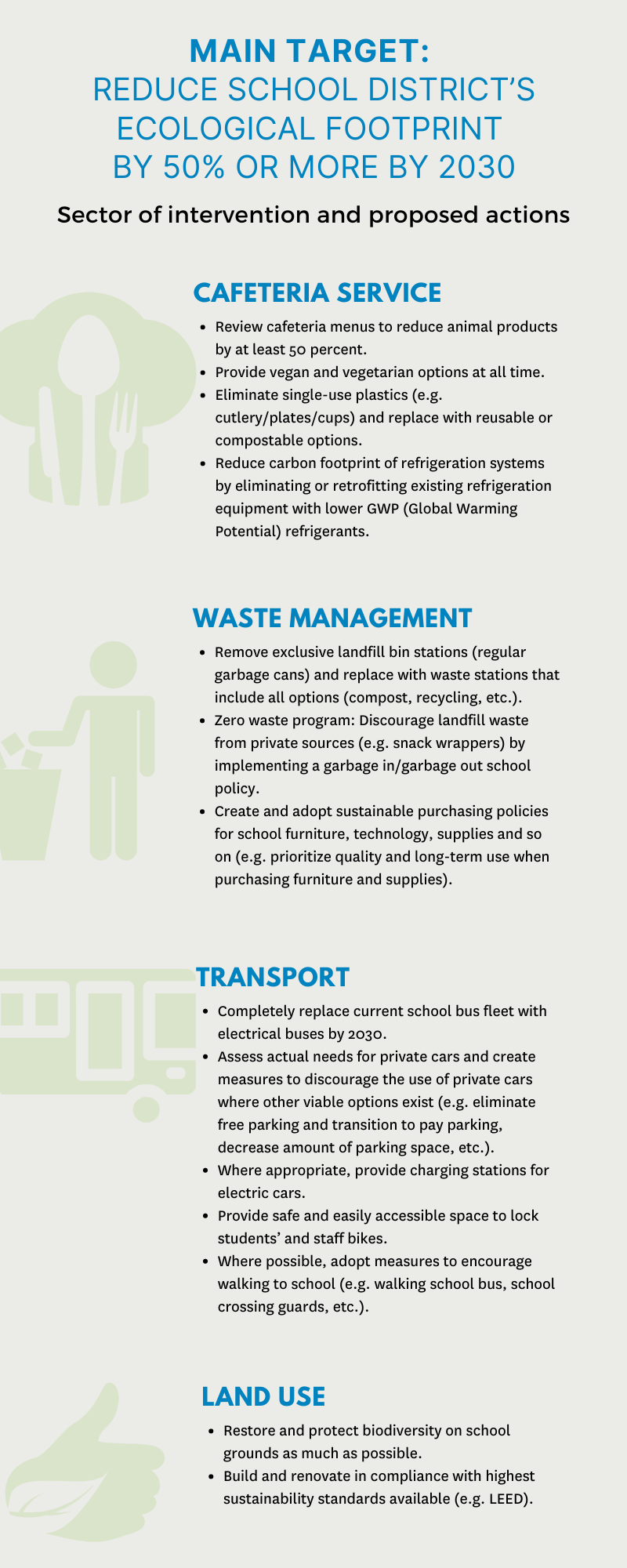
Photos: iStock
First published in Education Canada, March 2020
-
What Does Teacher Well-Being Look Like?
Comments Off on What Does Teacher Well-Being Look Like?As a researcher and teacher, I’ve often wondered “How do schools and the people in them look after their well-being?” It’s this particular question that sparked my interest in researching well-being in K-12 education. Together with my colleague, Dr. Keith Walker, we’ve collaborated with teachers and school administrators across Canada to get to the bottom of what teacher well-being looks like and why it matters.

There’s often a widely held assumption that well-being means you’re either mentally healthy or not. However, when we start to consider what well-being means and looks like, we begin to realize that it not only means more than just an “absence of illness,” but that the term itself is complex. Well-being is an elaborate term that includes attending to our mental, physical, emotional, and spiritual health.
Throughout our research, we’ve heard from teachers the stress they’ve often experienced within their role and how that’s put a strain on their ability to feel well at work. For teachers, well-being at work far too often means merely surviving the challenges and hardships that this work, at times, can bring. To address some of the concerns we were hearing, our research led us to write the book Teacher Wellbeing: Noticing, Nurturing, Sustaining, and Flourishing in Schools. We wrote this book because we know that teachers want and need practices and strategies for attaining and growing their well-being, and it serves as a starting point to provide staff with small opportunities for shifting how they nurture their well-being as a priority in their work. To give you a taste of what it means to truly be well at work, let’s go over WHY teacher well-being matters and what that actually looks like at school.

TEACHER WELL-BEING AND ENGAGED TEACHING AND LEARNING GO HAND IN HAND
Teachers who feel heard and valued for their ideas, have opportunities to collaborate, and feel supported by colleagues feel a greater sense of well-being within the workplace. What’s more, staff need to be able to trust they have the space to be creative and are able to take risks in learning something new – just as their students need to be able to do.

Creating opportunities for teachers to engage with their colleagues to reflect on and build meaningful teaching practices lead to teachers who are passionate and committed to the work they do, improving the overall learning experience for their students.
Teachers are well when there is a sense of community. Schools are more than just buildings — schools are communities where there are trusting, supportive, and caring relationships between every member (e.g. teachers, students, parents/guardians), which creates a shared sense of belonging. Most importantly, members of the school community work towards the shared common goal of supporting the academic, social, and emotional development of children and youth who are entrusted to them.
WHY DOES TEACHER WELL-BEING MATTER?
Teachers are increasingly faced with the pressure to provide educational experiences that prepare students to succeed in a rapidly changing society. In addition to meeting curriculum requirements, teachers are almost always expected to lead and implement numerous initiatives to better equip students and increase educational outcomes.
While these initiatives are well-intentioned and provide moments for both personal and professional impact, they can leave teachers feeling stressed and overwhelmed. Heroically — and typically alone — teachers try to handle increasingly complex and challenging working conditions, all while trying to look after their own well-being and that of their students.

WHEN TEACHER WELL-BEING IS LOOKED AFTER IT:
→Creates a supportive working environment
A supportive environment leads to teachers feeling safe to openly discuss and share their ideas, give and receive constructive feedback, and collaborate with each other to solve any perceived challenges in the workplace.
Supportive school communities recognize the stresses associated with juggling the multiple demands that teachers often experience, while striving to encourage work-life balance by establishing clear boundaries between work and home life, coupled with supporting those who are experiencing stress and/or burnout.
→Builds resilience
Focusing on well-being can help teachers shift beyond a sense of merely surviving the challenges and difficulties in their work to seeing the ways they can thrive in their workplaces. Teachers who are well are equipped with skills and coping strategies to better manage and respond to stress.
→Encourages innovative practice
Teachers who feel secure to explore innovative teaching practices are able to provide students with deeper learning experiences in ways that promote their curiosity and creativity. What’s more, when teachers have the flexibility to try new things and adapt promising practices into their classrooms, they themselves are more engaged and excited about their work, which contributes to their own sense of well-being.
HOW TO ENHANCE TEACHER WELL-BEING IN YOUR SCHOOL
To support students’ learning and well-being, we need teachers who are engaged, innovative, collaborative, resilient and, most importantly, well. But how exactly do we accomplish this?
Invite your school community to start developing a common vision about what well-being looks like for them. Ask each other, “What’s already working well? Where is there opportunity for growth and change?”
SO, WHAT NOW?

Try this activity:
Get your team together and ask each of them to individually write down their observations of:
- Moments when they and/or their colleagues are engaged and having fun at work.
- Things that they’re often grateful for at the end of each work day.
After time for reflection, share observations and discuss commonalities – these represent your school’s strengths.

As teachers begin to shift their focus towards what makes them feel well at work, they can then begin to identify what aspects contribute to their well-being — physically, emotionally, mentally, and spiritually — which can allow them to identify what’s going well and what can be improved in their school community.
are you looking for a resource to learn more about teacher well-being?
Look no further! Known as the “purple book,” this rare find helps teachers reignite their passion for the profession and take charge of their own well-being.
Continue here to read the Book preview for Teacher Wellbeing: Noticing, Nurturing, Sustaining, and Flourishing in Schools
-
Stress and burnout are on the rise among Canadian principals and vice-principals
Comments Off on Stress and burnout are on the rise among Canadian principals and vice-principalsPrincipals and vice-principals are facing increased pressure, workload, and stress.1 But considering how pervasive stress and burnout seem to be across many professions in modern society, why should we care specifically about school leaders? The answer is actually so very clear: health, happiness, and success for everyone! Of course, work-related stress is normal and inevitable; however, excessive physical and emotional stress can interfere with school leaders’ well-being which can carry over to ultimately impact education systems as a whole.

WHEN LOOKING AT SCHOOL LEADERS’ WELL-BEING, THERE ARE THREE INTERCONNECTED COMPONENTS TO CONSIDER:
1. The Individual: Stress inhibits school leaders from effectively improving school performance
Principals and vice-principals (VPs) are some of our most dedicated and passionate educators who have chosen to take on a role with significant responsibility and impact, which means that we need them to be at their best. One might say that handling difficult tasks and juggling many needs is simply the role of school principals and VPs. That is absolutely correct! This is exactly what our best leaders are good at and often thrive on. However, our bodies are not designed for the levels of constant and excessive stress that many of our school leaders are currently experiencing.

Chronic stress lowers levels of health, happiness, and success – and leaders aren’t immune from these innately human factors.2 If principals and VPs are working days, nights, and weekends (and they often are), then they are indeed experiencing chronic stress, which will take a toll on their social, emotional, and cognitive well-being,3 just like anyone else. Work-related stress can have damaging effects that inhibit school leaders’ ability to function effectively while lowering their job enthusiasm and motivation to perform well.4 Stress not only affects the ability of school leaders to improve their schools but also makes it difficult to retain and recruit new principals and VPs.
Research shows that most principals burn out and leave the profession in four years or less, although it takes five-to-seven years for a principal to have a significant impact on a school community.5 Yes, we need principals to do their job now, but we also need them to stick around long enough to yield the greatest results possible for students. What’s more, despite the fact that we’re increasingly more aware of the importance of social emotional skills like self-awareness and the need to practice self-care, many school leaders have not been taught these essential skills. More importantly, leaders often assume that they can’t possibly worry about themselves since they’re tasked with taking care of everyone else. However, it’s good to be reminded of the simple truth that we’ve learned from air travel, which is that it’s not only important – but essential – to put on your own oxygen mask before helping others.
2. The Group: Education is a collective endeavour – not one person’s job
If you are a parent, student, or school staff member, then this is one of the most compelling arguments for why you should care about your principals’ or vice-principals’ stress levels. It takes a community – if not a village – to raise a child. The most productive and successful work teams are made up of people who care about each other. People on successful and productive teams use the words family, support, and trust to describe their work together. It isn’t enough to have great individuals. Principals and VPs aren’t superheroes, nor should they be the sole go-to people who are expected to triumph against all odds. They are regular people whose health and well-being should be of equal concern, not an afterthought. For schools to function well, all staff need to work as a team towards a common goal. To do our best work, we need to have strong, connected teams built on relationships and trust.

What we know about workplace well-being is that the best teams are those that understand the importance of social connection and creating a workplace where people feel safe and valued. If school leaders don’t feel connected or supported by their team, then they’re not only less effective but so is everyone else. If leaders are connected and have strong, authentic relationships then the people that work for them will go out of their way to make their leaders’ and the organization’s vision come true.6 When we work for someone who we care about and who we feel cares about us as employees, then we will work with passion, dedication, and creativity. What’s more, when we hold this sense of care as a group, the results are amazing!

Fundamentally, work and life aren’t things we can ever do alone – nor are we meant to.7 We’re at our best when we work together and, just as we know that stress can actually spread and be contagious towards those around us,8 we also know that the “good stuff” is contagious, too. For instance, it has been scientifically proven that when we show gratitude and compassion towards other people, they feel better, perform better, and are more likely to reciprocate acts of compassion and belonging.9 So, no matter who we are and what role we may find ourselves in, we can always make the choice to act first by showing compassion, assuming good intention, and being kind. It’s important for leaders to both show and receive these positive actions. Above all, we need leaders who feel safe, valued, and connected in order for them to do their best work and to inspire and support their staff – and ultimately their students – to do the same.
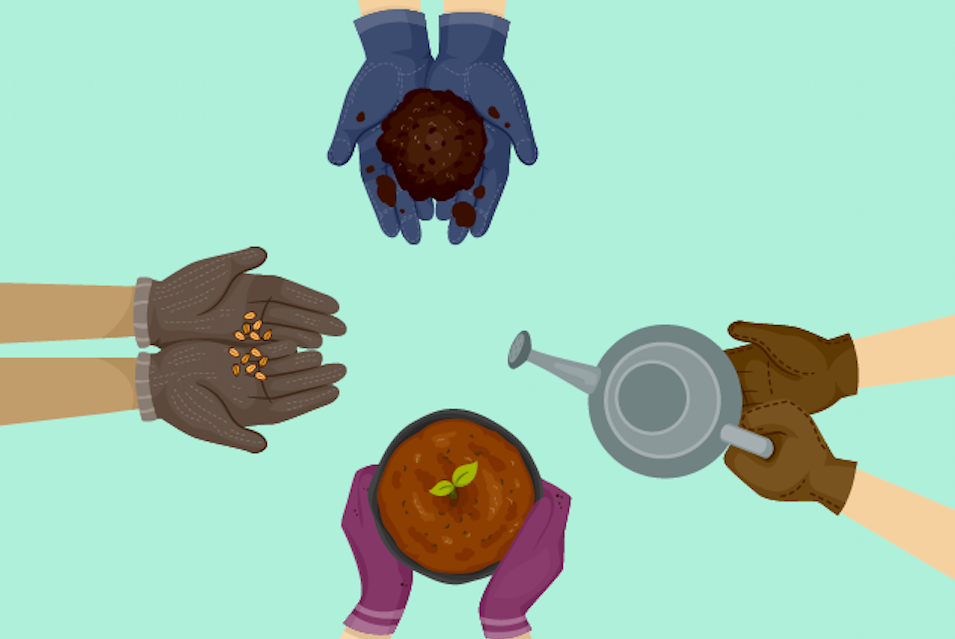
3. The System: School leaders are running systems that aren’t designed to support their well-being
Surveys of principals demonstrate that education systems are overloading our leaders.10 A rapid flow of policies, initiatives, and programs leads to loss of focus, overwork, frustration, and demotivation11 – and these are impacting school leaders’ health and well-being while increasing their levels of stress. As this makes it more difficult to recruit and retain the best school leaders, school districts are faced with high costs in terms of both time and money, which further inject stress into the system.

It’s important to name this tension while also being very clear that this isn’t a criticism towards – or the responsibility of – any one person or group of people. Rather, this tension indicates that education systems as a whole need to look at practices through the lens of workplace well-being. As such, looking at practices through a well-being lens can lead to large-scale change that, as the First Peoples’ Principles of Learning remind us, will take time and patience. However, rethinking system-level practices can also involve small changes that simply require a willingness to try – and we need both large and small changes.
THE TAKEAWAY
While it’s encouraging that many associations, ministries of education, and partner groups are beginning to focus on the issue of workplace well-being in K-12 education, we still have a ways to go in acknowledging the importance of principals and vice-principals’ well-being – leaders of learning who have huge impacts on the health, happiness, and success of our schools. For school leaders reading this, remember that well-being has three interconnected components: you, your team, and the system as a whole. You were never meant to do this job alone.
References and Further Reading
1Alberta Teachers Association (ATA). (2017). The Canadian school leaders: Global forces and future prospects. A research report. Edmonton, AB.
Canadian Association of Principals (CAP). (2014). The future of the principalship in Canada: A national research study. Kanata, ON.
Pollock, K., Wang, F., & Hauseman, D. C. (2014). The changing nature of principals’ work: Final Report. Ontario Principals’ Council, Toronto, ON.
Pollock, K., Wang, F., & Hauseman, D. C. (2015). Complexity and volume: An inquiry into factors that drive principals’ work. Societies, 5(2), 537–565.
Pollock, K., Wang, F., & Hauseman, D. C. (2017). The changing nature of vice-principals’ work: Final report. Ontario Principals’ Council, Toronto, ON.
Poirel, E., & Yvon, F. (2014). School principals’ emotional coping process. Canadian Journal of Education/Revue Canadienne de L’éducation, 37(3), 1–23.
Riley, P. (2016). The Australian principal occupational health, safety and well-being survey. Institute for Positive Psychology & Education. Retrieved from: http://www.principalhealth.org/au/2016_Report_AU_FINAL.pdf
U.S. Bureau of Labor Statistics. (2016). Occupational outlook handbook: Elementary, middle, and high school principals. U.S. Department of Labour. Retrieved from: https://www.bls.gov/ooh/management/elementary-middle-and-high-school-principals.htm
2Hallinger, P., & Murphy, J. F. (2013). Running on empty? finding the time and capacity to lead learning. NASSP Bulletin, 97(1), 5-21. doi:10.1177/0192636512469288
Nthebe, K., Barkhuizen, N., & Schutte, N. (2016). Rewards: A predictor of well-being and service quality of school principals in the north-west province. SA Journal of Human Resource Management, 14(1), 1-e11. doi:10.4102/sajhrm.v14i1.71
Poirel, E., & Yvon, F. (2014). School principals’ emotional coping process. Canadian Journal of Education/Revue Canadienne de L’éducation, 37(3), 1–23.
3Wang, F., Pollock, K., & Hauseman, D. C. (2018b). Ontario principals’ and vice-principals’ well-being and coping strategies in the context of work intensification. In S. Cherkowski, & K. D. Walker (Eds.), Perspectives on flourishing in schools (pp. 287-303). Lanham, Maryland: Lexington Books, an imprint of The Rowman & Littlefield Publishing Group, Inc.
4Devos, G., Bouckenooghe, D., Engels, N., Hotton, G., & Aelterman, A. (2007). An assessment of well-being of principals in flemish primary schools. Journal of Educational Administration, 45(1), 33-61. doi:10.1108/09578230710722449
5Leithwood, K. A., Louis, K. S., & Anderson, S. E. (2012). Linking leadership to student learning (1st ed.). San Francisco: Jossey-Bass.
6Sinek, S. (2014). Leaders eat last: Why some teams pull together and others don’t. New York: Portfolio/Penguin.
Sinek, S. (2011). Start with why: How great leaders inspire everyone to take action. New York: Portfolio / Penguin.
7Walton, G. M., Cohen, G. L., Cwir, D., & Spencer, S. J. (2012). Mere belonging: The power of social connections. Journal of Personality and Social Psychology, 102(3), 513-532. doi:10.1037/a0025731
8Sterley, T., Baimoukhametova, D., Füzesi, T., Zurek, A. A., Daviu, N., Rasiah, N. P., & Bains, J. S. (2018). Social transmission and buffering of synaptic changes after stress. Nature Neuroscience, 21(3), 393-403. doi:10.1038/s41593-017-0044-6
9Coyle, D. (2018). The culture code: The secrets of highly successful groups (1st ed.). New York: Bantam Books.
10Wang, F., Pollock, K., & Hauseman, C. (2018a). School principals’ job satisfaction: The effect of work intensification in Ontario. Canadian Journal of Educational Administration and Policy, 185, 73-90.
Wang, F., Pollock, K., & Hauseman, D. C. (2018b). Ontario principals’ and vice-principals’ well-being and coping strategies in the context of work intensification. In S. Cherkowski, & K. D. Walker (Eds.), Perspectives on flourishing in schools (pp. 287-303). Lanham, Maryland: Lexington Books, an imprint of The Rowman & Littlefield Publishing Group, Inc.
11Fullan, M. (2008). What’s worth fighting for in the principalship? (2nd Ed.). New York: Teachers College Press.
-
Extended Cut: What does it mean to flourish in your work?
Comments Off on Extended Cut: What does it mean to flourish in your work? -
What does it mean to flourish in your work?
Comments Off on What does it mean to flourish in your work?Looking for more?
Check out our Part 2 Extended Cut here
also available on:


-
Climate Change Education in the Canadian Classroom
Comments Off on Climate Change Education in the Canadian ClassroomHow – and what – are we doing with climate change education? Lakehead University and Learning for a Sustainable Future (LSF) surveyed over 1,000 teachers to understand current climate change education teaching practice in Canada.
Climate change is the most complex and wide-reaching challenge facing humankind today. Reducing the impacts of climate change and moving Canada toward resilience and adaptability for climate impacts will require substantial changes at all levels of Canadian society. It is critical that Canadians understand climate change causes, impacts and risks. An educated public, including youth, is essential to driving the required transformation.
Lakehead University and Learning for a Sustainable Future (LSF) completed a comprehensive survey of 3,196 Canadians to establish Canada-wide baseline data reflecting Canadians’ knowledge and understanding of climate change, perspectives on risks, and views on the role of schools and climate change education. The survey also provides a nationally unprecedented report of climate change education teaching practice.
The survey collected responses from 1,231 teachers (from across K-12 grades), 571 parents, 486 students in Grades 7-12, and the general public (908).1 The final report, Canada, Climate Change and Education: Opportunities for public and formal education, is publicly available.
KEY FINDINGS
Perspectives of Canadians
The majority of Canadians are certain that climate change is happening (85%), are concerned about the impacts of climate change (79%), and believe there are risks to people in Canada (78%).
While there is a high level of concern, only 51% of Canadians feel well-informed about climate change, and 86% indicated that they need more information about it. Further, a basic knowledge test on general climate science, causes, and impacts in Canada, revealed a gap between Canadians’ understanding of climate change and their perceptions of their knowledge. Many did poorly on the test questions, but thought they did well. Close to half (43%) of Canadians failed this basic knowledge test, and only 14% correctly answered at least eight of its ten questions.
This gap between Canadians’ high level of concern about climate change and their level of knowledge signifies a critical learning moment for both public and formal education.
The role of schools
The majority (68%) of all respondents agreed that it is the role of schools to educate students about climate change. Two-thirds of Canadians and three-quarters of teachers believe schools should be doing more to educate students about climate change.
Opinions on the priority that climate change education should have in schools differ across the country. Quebec (69%) and British Columbia (66%) had the highest percentage of respondents who saw climate change as a high priority for schooling, while in Saskatchewan only about one-third of respondents agree that it is a high priority.
When respondents were asked what the school system should do more of, the most common answers were to increase focus on climate change impacts and to explore more ways to take collective action.
Teachers’ perspectives
Within the survey, teachers were asked a series of questions to develop a baseline of climate change education practices in Canada.
Little time for climate change: Between 35% and 59%2 of teachers reported teaching climate change in the classroom. For teachers who do include climate change content, most teach 1-10 hours per year or semester.
Support for integrated climate change education: When it is taught, climate change content is predominantly taught in Science followed by Social Studies, but over 75% of teachers believe that climate change education is the role of all teachers.
Best practice for teaching climate change: The majority of teachers believe that climate change education provides opportunities to discuss social justice and world issues with students (87%), that it should encourage students to think about their own beliefs and values (82%), and that it should focus on developing students’ capacity to be critical thinkers and problem-solvers (83%). Most teachers also showed support for climate change education to focus on behavioural change (76%). These findings suggest that the majority of Canadian teachers’ professional views on climate change education support best practice,focused on critical thinking and action-oriented learning.
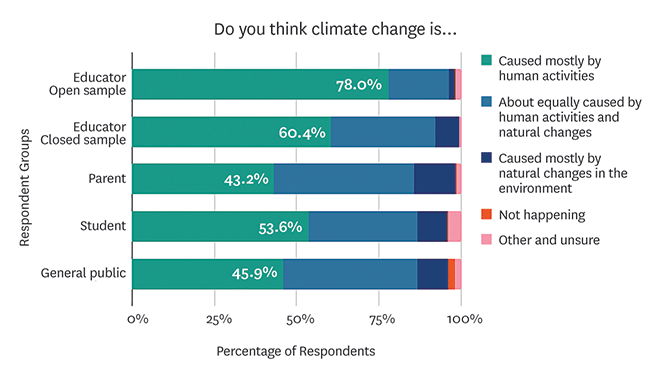
However, some teachers are out of step with best practices when it comes to debating the cause of climate change: About one-third (31-38%) of educators reported that they encourage, or would encourage, students to debate the likely causes of climate change or to come to their own conclusions. There is a strong scientific consensus that climate change is human-caused. This consensus should be taught.
Challenges: Only one-third to one-half (32 -55%) of teachers indicated that they feel they have the knowledge and skills to teach about climate change. According to teachers, the top barriers for integrating climate change education into classrooms (see Figure 2) are:
- lack of time to include during class
- lack of classroom resources
- lack of professional knowledge.
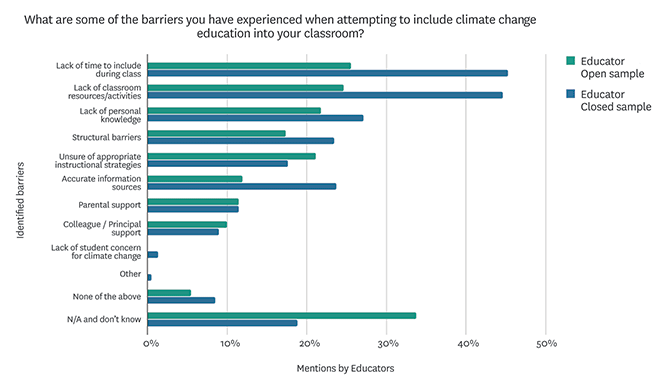
Teachers said they need classroom resources, professional development, current information on climate science, enhanced curriculum policy, information on the economics and politics of climate change, and national/provincial climate data.
Students’ perspectives
Almost half of students (46%) understand that climate change is human caused, but don’t believe that human actions in mitigation will be effective. This mindset is concerning when considering how it may affect youth in terms of how they frame their future quality of life, opportunities, or possibilities. It is critically important, therefore, to target this group with climate change education that is action- and solutions-oriented to combat eco-anxiety and hopelessness.
Children and youth under 18 will bear the impacts of climate disruption in the 21st century. The climate strike movement started by Greta Thunberg3 is a symbol of the concern that young people have for their futures and a clarion call to adults to remember the moral obligation they have to children and youth. Youth need to be engaged in climate change education during schooling and need to see adults acting collectively to tackle the climate crisis.
RECOMMENDATIONS
Canada’s commitment as a signatory to the Paris Climate Change Agreement includes a call “to enhance climate change education.”4
All Canadians need more information about climate change from trusted sources, including scientists and academics. The focus should be on correcting misconceptions about climate change and improving public understanding of its primary causes, as well as enabling citizens to understand the need for, and the need to advocate for, mitigation strategies such as greenhouse gas reduction policies. Lastly, public education should provide Canadians with information on high-impact personal climate actions that they can integrate into their daily lives.
While some of this needs to come from informal education, the formal education system has a major role to play, and there is evidence that education has a pass-through-effect to parents when students are educated about climate change.5
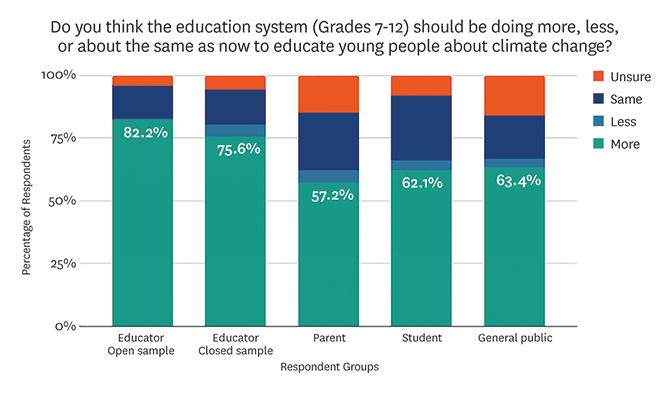
Provincial policy: Without clear policies at the provincial level, climate change education is left to the competence, dedication and enthusiasm of individual teachers. A more comprehensive approach is needed. Ministries of Education should embed core climate change expectations across subjects and release policy statements guiding climate change education for each regional jurisdiction.
Professional development: School boards should provide opportunities for teachers to enhance their knowledge, tools, and strategies for teaching about climate change, and provide teachers with current provincial/national data and resources. Faculties of Education should also include climate change education across subjects in initial teacher education to help prepare teachers entering the field.
Teachers can start now: Teachers don’t have to wait for ministries or school boards to enact these changes to start integrating climate change education into their classrooms.
“Youth need to be engaged in climate change education during schooling and need to see adults acting collectively to tackle the climate crisis.”
The climate emergency is a critical learning opportunity. The nature of this complex problem requires deep learning that not only expands people’s knowledge and understanding about climate change, but also touches their values, sense of place and feelings of responsibility. Information alone may have limited impact; 40 years of climate science and public education has not resulted in the required societal changes.
Climate change education demands a multi-pronged approach that directly addresses predominant misconceptions and also facilitates critical questioning of societal norms and cultural drivers, such as: the definition of progress; the idea of perpetual growth on a finite planet; the roles of science and technology; the viability of capitalism, consumerism, and the exploitation of nature; and values such as “freedom,” “independence,” “success,” and “comfort.” Climate change, therefore, requires an integrated and transdisciplinary approach that includes systems perspectives, spans from local to global, cultivates respectful ways of approaching contested positions (such as deliberative dialogue), and develops capacity and collective action – all approaches that are transferable to supporting students’ development in other areas.
The emotional dimension of climate change and student well-being must be directly addressed, given the dire nature of current and predicted consequences of inaction. Discussion of climate change can lead to feelings of fear and anxiety and cause students and adults to distance themselves from the problem or disengage from, doubt or dismiss it. Climate change learning in the classroom needs to attend, and respond, to the psychological fallout that occurs as one learns about the severity and urgency of the issue.
A first step in mitigating fear responses is to create a culture of trust in the classroom where emotions are honoured and students are supported through knowledge-building processes. An inquiry-learning framework honours students’ past experiences and perspectives and puts students at the centre of their own learning. By framing students’ learning processes as solutionary and action-oriented, students can feel empowered to work toward a goal rather than feeling overwhelmed or hopeless.
If your organization, school district or faculty of education is an EdCan member (see the list here), you can enjoy unlimited access to our online content! Click here to create your online account.
For many teachers, “having hope” is a complicated discussion, a balance between remaining credible and honest with students and being transparent about the latest scientific reports and what our collective inaction in the face of these reports suggests. Understanding developmental readiness and a learning progression for climate change education is necessary for teachers to gauge student readiness. A powerful starting point at any age is active-hope, where having hope is framed as an intention rather than tied to chances of an outcome.6 It is from a position of active-hope that ideas and projects are created that push forward the prospect of a hopeful future.
Schools Take Up the Challenge
Green action projects that make a difference
By Pamela Schwartzberg and Samantha Gawron, Learning for a Sustainable Future
Learning for a Sustainable Future (LSF) has had the privilege over the years of working alongside some outstanding educators as they tackled climate change issues with their students through action projects that provide invaluable learning opportunities while creating positive impacts. These are just some of their stories.
Chelmsford Valley District Composite Schools – Chelmsford, Ont.
Students were asked to research the 100 solutions to climate change on the Drawdown website (www.drawdown.org), which identifies the most viable solutions to climate change, and then they chose one that they thought was viable at the family level that they could encourage others to adopt. They researched the cost required to implement, and then concluded if the solution was/was not viable for them and/or the average family. Students created a video, slideshow, infographic, or newspaper article outlining the actual costs and challenges of implementing the solution. They were quite excited to learn that there are things that can be done by individuals to create change.
Corner Brook Intermediate School – Corner Brook, N.L.
After observing how their local forests, green spaces and wildlife are impacted by the waste generated by their community, student leaders at Corner Brook Intermediate School were inspired to implement their school’s first recycling program. This allowed them to properly collect and sort items like paper and plastic from their school and divert them from landfill. To spread awareness of the new program and the reasons behind it, the students developed virtual reality (VR) lessons in both English and French. They applied for an EcoLeague grant from LSF to purchase a class set of VR headsets, and they delivered their lesson plans to over 600 students in Grades 7-9! The lessons guided students through learning more about climate change and waste and understanding how their actions can have a big impact.
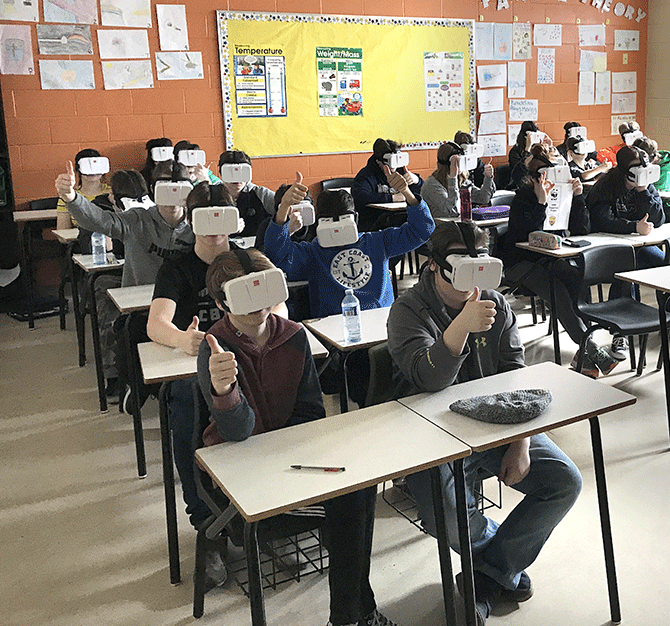
St. Mary’s Academy – Edmundston, N.B.
The high school Eco-Committee at St. Mary’s Academy is committed to educating their entire K-12 school about solar energy. They have a long-term goal of converting St. Mary’s into a clean-energy school. This year, they began by educating their peers (and themselves) about solar energy and the function of solar panels. They visited other schools that had already installed solar panels, interviewed their local power generation company, and toured local solar panel providers. They also partnered with “3% Project” to learn about cost-efficiency and cost-impact analysis to strengthen their case. To start their project on a small scale, they purchased and installed solar panels in their school greenhouse and designed a self-watering system using a rain barrel and a timer. With their research, learning, educating and experimenting this year, they’re now ready to take on their whole-school solar vision!
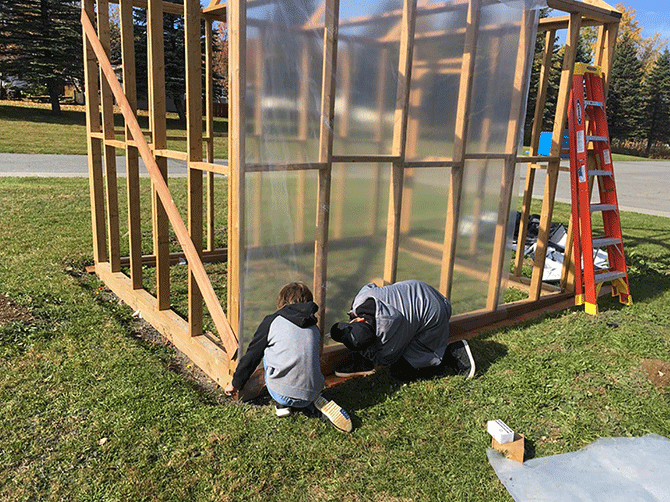
Seven Oaks Met School – Winnipeg, Man.
Students at Seven Oaks Met School have engaged in many sustainability Action Projects over the years, including their hugely successful Strut for Shoal event that raised over $7,000 for the Shoal Lake 40 First Nation community’s water treatment fund. More recently, the students are spearheading a campaign to convince the Seven Oaks School Division to be the first in Manitoba to declare a climate emergency. In meetings with the Division, students brought up the issues that matter most to them, including climate change and emissions reduction, Indigenous rights, school waste management, biodiversity preservation, and more. They say the Division must declare a climate emergency in order to effectively put these recommendations into action in schools. Seven Oaks Met School students have rallied peers from six other schools to their cause, urging their division to follow the lead of boards in north Vancouver, Victoria and Sudbury that have already made climate emergency declarations. After the school division makes their decision, students have plans to meet with the mayor of Winnipeg and the Premier of Manitoba to expand the declaration and awareness of the climate emergency.
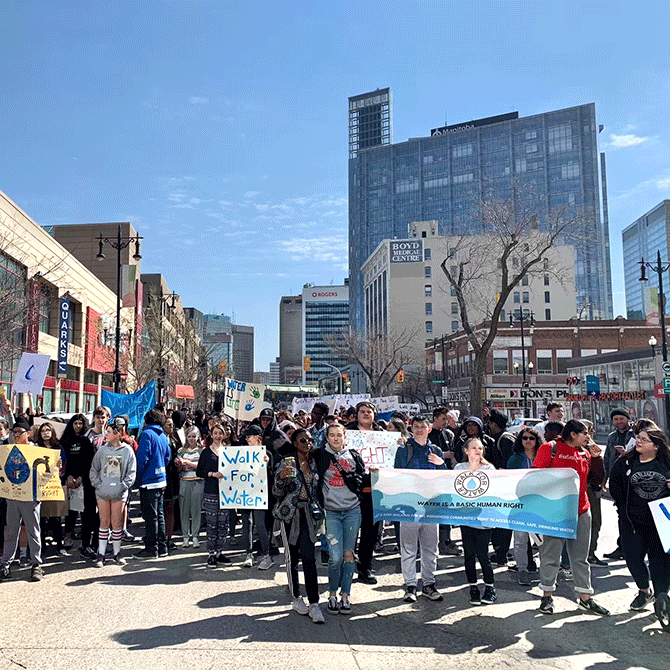
E.L. Crossley Secondary School – Pelham, Ont.
E.A.R.T.H. club members at E.L. Crossley hoped to inform their fellow students about the positive impacts a plant-based diet can have on the future of our planet. Students organized a week of veggie-friendly events organized and run entirely by youth, for youth, with the support of various local community partners. Their inaugural VegFest took place in the spring of 2016. The week’s events included a vegan cooking class with a local chef, a screening of the documentary Cowspiracy, a smoothie day, vegan salad bar extravaganza, cafeteria games, and a vendor day. VegFest received an overwhelmingly positive response and high levels of student participation each day. The students have run a successful VegFest every year since, and hope the project will continue in the future!
Morinville Public School – Morinville, Alta.
Grade 7-9 students began their garden initiative with three hydroponic gardens that allow them to garden all year long. In order to inspire other students to grow their own food and have access to healthy produce, the students designed and planted an outdoor garden accessible to the entire community. Students planted corn, tomatoes, peppers and cucumbers. They did taste tests to see the difference between locally grown produce and what is sold in the stores. They got their peers excited about local and healthy eating and working together as a community for a common purpose. In the fall the produce will be donated to the local food bank. They hope that their outdoor garden will inspire other families to grow their own gardens with their children in the future.
About LSF
Learning for a Sustainable Future, a national charity whose mission is to integrate sustainability education into the Canadian school system, has worked for over two decades to support teachers with professional development and high-quality resources. http://lsf-lst.ca
All Photos: courtesy Learning for a Sustainable Future
First published in Education Canada, March 2020
1 Refer to report for full methodology: Ellen Field, Pamela Schwartzberg, and Paul Berger, Canada, Climate Change, and Education: Opportunities for public and formal education (2019). http://lsf-lst.ca/en/cc-survey
2 Reported ranges in this section are due to use of two sampling methods for teachers. Refer to full report (Fig. 73 and Fig. 75) for explanation and details.
3 Greta Thunberg’s “Fridays for Future” strike movement mobilized an estimated 1.4 million students in 112 countries in March 2019 and an estimated 7 million citizens between September 20th and 27th, 2019.
4 United Nations Framework Convention on Climate Change, Paris Climate Change Agreement, Article 12, pg. 10. Report of the Conference of the Parties on its Twenty-First Session (December 13th, 2015).
5 Lydia Denworth, “Children Change their Parents’ Minds about Climate Change,” Scientific American (May 6, 2019). www.scientificamerican.com/article/children-change-their-parents-minds-about-climate-change
6 Joanna Macy and Chris Johnstone, Active Hope: How to face the mess we’re in without going crazy (Novato, California: New World Library, 2012).
-
Book Preview – Teacher Wellbeing: Noticing, Nurturing, Sustaining, and Flourishing in Schools
Comments Off on Book Preview – Teacher Wellbeing: Noticing, Nurturing, Sustaining, and Flourishing in SchoolsEvery person’s wellbeing is important in and of itself. Teacher wellbeing isn’t just about making school systems more economically efficient, or enhancing students’ performance on standardized assessments. Whether you are a student, a teacher, a principal, or an administrator, you have the right to be well and to live well simply because of your inherent worth as a person.
Yet teachers do play a shaping role in the lives of their students. Learning happens best when teachers and their students are well – happy, healthy teachers who feel well and whole in their work provide strong support for happy, healthy children and youth. This book acknowledges that we need to consciously attend to and support teacher wellbeing.
Too many of our teacher colleagues across the world suffer from sources of stress that put an enormous strain on their ability to feel well in their work. This situation also invades their personal and family lives in ways that can be devastating.
Too often, teachers are pushed to account for merely the academic achievement of their students, leaving aside the many social, emotional, and spiritual aspects of learning and development that are essential to students’ wellbeing. However, teaching and learning are fully human endeavours, and learning well cannot be separated from living well.
This research-informed, theoretically grounded book will coach you — alone, or with a group of your colleagues — to determine what wellbeing looks like in your classroom, in your school, and for yourself. The aim is to offer you new perspectives, research insights, reflection moments, and activities for gaining a sense of ‘flourishing’ wherever you can in your work. We achieve this by helping you notice what makes you feel whole, engaged, and connected, while encouraging you to pay attention to ways you can grow more of these feelings in your work.
WHAT THIS BOOK CAN OFFER YOU.
Teacher Wellbeing affirms the agency that teachers have in reimagining a new way forward. This book supports you as you shift your mindset towards thinking about the work of teaching as including a strong sense of wholeness and aliveness. Teacher Wellbeing is an interactive book that will guide you as you notice, nurture, and sustain holistic flourishing in your work and in your life.
In addition to providing a theoretical framework for promoting evidence-based practices that foster wellbeing, this book also enables you to create a Living Map of Flourishing — that is, an artistic representation of a path that you can follow to enable you to thrive in your teaching. By creating your own map, you’ll become an expert in building your own knowledge on how to be the teacher you’re meant to be.
We call this a ‘Living Map’ because it isn’t static, just as schools aren’t static systems, but rather are living ecosystems of people and their experiences. Your ‘Living Map’ will become a place for recording your learning, generating knowledge, and tuning into new understandings that you’ll form as you work through the activities in the book. By the time you’re finished reading, you’ll have a custom-built plan that’s unique to you, yet influenced by nuanced theoretical approaches, stories, and practices derived from research.
Teacher Wellbeing also provides interactive activities to prompt reflection and collaboration, including:
1. Heart Prints.
You know about footprints and handprints, which are the impressions we leave as we pass through various spaces in our life. Similar but different, ‘Heart Prints’ are strong emotional impressions that are left on us, and that we leave on others, when we engage from a place of authenticity, wholeness, vulnerability, love, and compassion. ‘Heart Print’ reflections are opportunities to help you tap into experiencing a sense of gratitude and appreciation through noticing moments of your own goodness. Essentially, these are moments of pause that allow you to rest, reflect, and make sense of what you’re reading in ways that affirm the essence of who you are as a teacher, and that encourage and inspire you to stretch towards a greater sense of wholeness and wellbeing in both your work and in life.
2. Shifting Ground.
Feeling the ground shift beneath your feet can feel scary and can cause you to be thrown a bit off kilter. But it’s in these times – times when you’re a little disturbed or placed in unease – that you might actually find opportunities for new learning and renewal. ‘Shifting Ground’ moments are creative activities that serve to shift the ground a little and perhaps even shake things up or provoke you. These moments are designed as reflective, creative, and re-creative experiences.
OUR APPROACH TO FOSTERING WELL-BEING.
Our book is designed to encourage and coach you towards giving greater attention to what’s working well, since we know that the things we pay attention to are destined for growth. Our research shows that educators work best when they focus on and build up their strengths —their passions, purposes, and sources of vitality. Teacher Wellbeing thus draws from a strengths-based model of thinking and reflecting on action-oriented change. This model is called Appreciative Inquiry (AI). Drawing on AI, we coach you as you shift towards an abundance mindset rather than a deficit-based way of thinking.
Appreciative Inquiry isn’t about denying real-life experiences of struggle and suffering. Rather, it’s about placing a more intentional focus on wellbeing as an essential aspect of your work as a teacher, and then paying attention to how you perceive your work as a means to promote and encourage self-care, positive growth, and a sense of thriving for yourself and others in particular situations you may experience.
Systems and pressures may shape what we are and aren’t able to do. Yet we are nonetheless in charge of interpreting the many different stories we hear ourselves telling about ourselves and about the world around us. How we author our own reality reflects what is most important to us. By focusing on what’s working well, we can strengthen what’s working well; by focusing on a flourishing future, we can indeed move forward towards a flourishing future.
Our theory on ‘flourishing’ emerged from research in the fields of positive psychology, positive organizational scholarship, and school improvement. As we reflected on the potential of these findings for the work of teachers, we connected our ongoing research on ‘flourishing’ with our knowledge about learning communities. This approach resonated with the teachers we spoke with on the ground, and even so with our own teaching practices.
As you begin to uncover your beliefs and actions, you’ll see which aspects of your life and work are authentically aligned with who you’re intended to be. You’ll find yourself setting up opportunities to use your strengths throughout the day, and will come to carry out activities that allow you to better understand your strengths alongside your colleagues, all while advancing along a journey towards ‘flourishing.’
Teacher Wellbeing is organized into a sequence of steps:
1. Noticing
Paying attention to how we use language to describe our experiences is an important step towards developing your agency in shaping your own wellbeing. When we can take notice of how we talk to ourselves and to other people about our experiences, we can then take small steps towards more compassionate approaches to relating to ourselves and to those we work and live with.
We provide ‘Heart Print’ and ‘Shifting Ground’ activities that prompt you to engage in storytelling — that is, noticing your role in shaping your own experiences and those of your community. As you look into your own beliefs and assumptions about how and why things work (or don’t work), you’ll need courage. Some find this courage in community — in engaging with others in the process of reimagining teaching as a whole, appreciative, and positive experience. Your community may be your colleagues, your educator friends, or an imagined community of fellow readers of this book.
2. Nurturing
As you begin to take stock of moments of laughter, compassion, hope-building, and other indicators of wellbeing in your work and in your life — and as you reflect on these through guided activities while documenting your thoughts on your ‘Living Map’ — you’ll begin to develop your own theory of ‘flourishing’ that is unique to your circumstances.
To support you as you build your own individual approach, we share research results and stories from a range of academic disciplines including philosophy, psychology, and education, among others. Your research-informed knowledge base will enable you to both grow and nuance your pursuit of wellbeing.
3. Sustaining
Your wellbeing has a relational component. Developing your capacity to grow is a collective phenomenon that involves the whole educational community. We offer research-based stories, theories, practices, and activities that you can use to reflect on what it means for you to grow and thrive within a ‘flourishing’ learning community.
We don’t think teachers need to wait for others to set the conditions necessary for their wellbeing. No one should wait! But as you pursue ‘flourishing,’ we encourage you to strive to find collaborators with whom you can share your journey. Collaboration provides an opportunity to create meaningful relationships and a sense of both individual and collective achievement — and let’s not forget that meaning-making and achievement are both central to ‘flourishing’ as a teacher. We provide practices to cultivate and sustain relationships built on trust, care, connection, purpose, and enjoyment.
4. Flourishing
‘Flourishing’ is a fluid and aspirational destination – not a fixed point. Your challenge is to learn to be well in the moment, and to learn how to recognize and ask for more supports as you move towards achieving a greater sense of wellbeing.
We offer a two-fold conclusion to Teacher Wellbeing. First, we offer practices for self-care and for showing greater empathy towards others. In sharing these practices, we call for all educators to overcome inertia and to foster healthy educational leadership.
Second, we note that the formal school leader — the principal — plays an essential role in making room for a climate that values and honours the building of collaborations, relationships, and capacities. Our epilogue offers strategies for principals and administrators that support the wellbeing of teachers, and that in turn support the wellbeing of all staff and students within the ‘flourishing’ learning community.
HOW TO GET YOUR HANDS ON A COPY OF TEACHER WELLBEING: NOTICING, NURTURING, SUSTAINING, AND FLOURISHING IN SCHOOLS.
Teacher Wellbeing can be found at most places books are sold.
Keep an eye out for further resources from Dr. Sabre Cherkowski and Dr. Keith Walker that dive into how principals and vice-principals can create the right conditions for school communities to flourish.
-
Pan-Canadian Summit on K-12 Workplace Well-Being
Comments Off on Pan-Canadian Summit on K-12 Workplace Well-BeingFollowing government COVID-19 guidelines concerning large in-person events, we unfortunately have had no choice but to further postpone our Pan-Canadian Summit on K-12 Workplace Well-Being, which had originally been postponed to November 2-4, 2020.
Registrations will be fully refunded for all registrants by July 15, 2020.
We are still currently working on a new potential event date and venue in 2021 and we apologize for any inconvenience this may cause, and remain committed to hosting a safe event when a better time will permit us to do so. We sincerely hope that you will be able to join us next year!
Since March, we’ve temporarily rebranded our Well at Work initiative to Well at Home to share our original evidence-based content and carefully curated external resources to support K-12 staff who are navigating working from home and preparing to return to school in September. We invite you to continue exploring our growing collection of podcasts, blog posts and magazine articles as well as the latest research resources, and a webinar series centred on elevating staff well-being and workplace morale. Stay tuned for more webinars to come!
If you have any recommendations for future webinar topics/presenters, feel free to reach out to Bineta Diallo at bdiallo@edcan.ca
Thank you for all of your support during this challenging time. We look forward to seeing you in 2021!
-
Principal SEL: What’s it look like?
Comments Off on Principal SEL: What’s it look like? -
Are education systems designed to care for teachers?
Comments Off on Are education systems designed to care for teachers?


IDEAS TO SUPPORT EDUCATORS : Subscribe to the EdCan e-Newsletter
Quality research, reports, and professional learning opportunities.