
Archive
-
Well-Being at School: What does it look like?
Comments Off on Well-Being at School: What does it look like?A national symposium on educator and student well-being has shifted the conversation from ‘fixing symptoms’ to transforming entire school cultures.

This multimedia follow-up report from the EdCan Network’s Educator Well-Being: A Key to Student Success Symposium, which took place last October in Toronto, includes presentation recaps and videos of the latest research and good practices for ensuring the well-being of students, teachers, principals, and education leaders.
Two days of engaging keynotes, panel discussions and workshops inspired attendees to answer the following questions:
- What is well-being?
- What does student success look like?
- And how can school districts lead systemic change to meet unique learner needs?
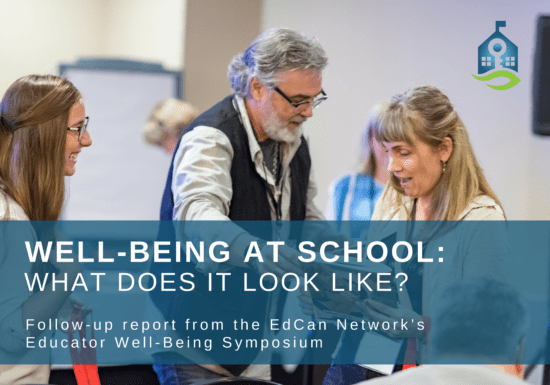
ACCESS THE FULL ELECTRONIC REPORT
(INCLUDING VIDEOS AND PODCASTS)Looking to get up-to-speed? Here are 5 articles to read on youth mental health:
- Fact Sheet: How could students’ use of social media be affecting their mental health?
- Fact Sheet: How can we best support student mental well-being?
- Fact Sheet: What are effective approaches to improving students’ mental well-being?
- Expert article: School Mental Health Literacy
- Expert article: What is Child and Youth Mental Health?
Looking for more?

Check out our special edition of Education Canada magazine on ‘Educator Well-Being.’ -
Learn Self-Reg K-12 Institute: Towards Thriving Students
Comments Off on Learn Self-Reg K-12 Institute: Towards Thriving StudentsWe now understand that the better children can self-regulate, the better they can rise to the challenge of mastering ever-more complex skills and concepts. But what exactly is self-regulation, how does it develop, why do some children and teens struggle with it more than others, and what can we do to enhance its development? This event will explore the answers with Dr. Stuart Shanker.
-
Learn Self-Reg Face-to-Face Seminar: Stress Management vs. Breaking a Stress Cycle
Comments Off on Learn Self-Reg Face-to-Face Seminar: Stress Management vs. Breaking a Stress CycleStress management is often discussed in terms of adaptive coping. We are taught that stress is a normal part of life and we must learn to cope with it. Yet Self-Reg tells us that stress management is not just a question of coping but also a question of managing energy flow and recovering the energy expended in dealing with stressors. We will explore these topics with Dr. Stuart Shanker.
-
Self-Reg Summer Symposium 2018
Comments Off on Self-Reg Summer Symposium 2018This year’s Self-Reg Summer Symposium will focus on reframing resilience, perseverance and motivation through the lens of Self-Reg. How do stressors affect children’s ability to develop and make the most of these key qualities and how can adults support them? Keynote speakers include Dr. Stuart Shanker and Dr. Jean Clinton.
-
Walk Alongside: A Parent Engagement Forum
Comments Off on Walk Alongside: A Parent Engagement ForumWalk Alongside: A Parent Engagement Forum will offer participants the opportunity to deepen their understanding of what parent engagement is, why it matters, and how to embed it in practice. Teams of parents and educators will work together to build a plan for systematic parent and family engagement in their school or organization.
-
A Different Kind of School Re-Entry
Comments Off on A Different Kind of School Re-Entry“It’s a pleasure having your son in my class; he is a positive influence in the classroom.”
The high school teacher who sent this email probably had no idea what a relief it was to read these few kind words.
Before landing in that teacher’s classroom, my son had been on a learning journey that was as unique as he is. With his twice-exceptional profile (he is gifted and has Asperger’s Syndrome and ADHD), Calum has never been a typical student. His first four years of public school were challenging, ending in a tough decision to try an online learning program, hoping that it would be flexible enough to meet the needs of my quirky son.
I questioned my decision constantly during the first three years of online learning – during which he flatly refused to do almost any schoolwork.
At some point in Grade 7, though, something changed. Calum’s interest in learning was ignited, and he discovered a passion and talent for math and science. With the help of tutors, Calum moved up three grade levels in math, then in science. But alongside his clear academic strengths, he struggled with many things a typical student might do without a second thought. Calum needed help to break down large projects into manageable tasks, or he would find himself unable to get started. He refused to watch the videos for his online pre-calculus course, citing frustration with the slow pace of the material, but would then struggle to complete assignments because he didn’t know how else to learn the concepts. He seemed incapable of keeping track of textbooks or the schedules he and his study skills tutor created to track what he should work on each day. If he didn’t understand the expectations for an assignment, he had a tendency not to ask for help, and to fall further and further behind. I wasn’t sure whether he knew what resources were available to help with his assignments, or how to make use of them. And yet when he could overcome these obstacles and get his work done, he got excellent grades.
No, Calum was not your typical student, but with university clearly in his future, it was time to develop some non-academic skills that he would need. If he was going to get used to the routines and expectations of a classroom, better that he do so in high school than struggle with these demands during his first year at university.
By Grade 10, Calum felt ready to try school “in a building” again – I just wasn’t sure that I was ready for the stress of making that transition! How would my outside-the-box learner, with his uneven set of learning skills, taking courses at three different grade levels, fit back into a school system that is designed for more typical learners?
My hands were shaking as I picked up the phone to call the local high school and ask if we could visit. But the secretary who answered couldn’t have been kinder. In fact, from the day of our first visit to the school, every person we talked to helped to make the transition smoother, from the secretary who kindly answered my first hesitant questions, to the vice-principal, resource teacher and counsellor who made time in their busy schedules to meet with us when we came to tour the school, to the classroom teachers who took a couple of minutes to check in with my son and ensure he was settling in well after classes started. Every single person in that building communicated that my son was welcome there and that they were genuinely pleased to have my quirky teen as part of their school community. Our distance learning teacher was equally kind and supportive – she made it clear that Calum would be welcome to come back if our school experiment didn’t work out, and even called a few weeks into his first semester at his new high school to find out if things were going well.
Educators are busy people, with many students to support. But the willingness of this school’s staff to make time for me and my son made his transition smoother; it made us feel cared for. The time they took to reach out, ask what we needed, and give us reassurance made all the difference for one teenager and his anxious mom.
We want to know what you think. Join the conversation @EdCanPub #EdCan!
Photo: Kati York
First published in Education Canada, December 2017
-
Opening the Doors
Comments Off on Opening the DoorsI’ve had three kids go through the public school system. That’s a lot of school. And looking back over all those encounters, here’s the incident that stands out – among many very positive experiences – as the thing that made me feel devalued as a parent:
It was the night of the annual fun fair, an event that, incidentally, depended on parents to both help organize and attend with their kids. It was late fall, so it was dark and cold by dinnertime. And as we dutifully arrived at the school a few minutes before the official event time of 7 p.m., the heavens opened and it began to pour rain.
And the doors were all locked. There was a new principal that year who had decreed that no one would be let inside the school until the stroke of seven. We huddled outside, soaked and cold, locked out of our own school. To this day I clearly recall the resentment I felt towards the principal who treated his students’ parents like a bunch of potential shoplifters who couldn’t be trusted to wander in unsupervised.
In her article, Debbie Pushor observes there are less obvious, and more damaging, ways that schools can make parents feel locked out. But she also describes schools that are making real efforts to welcome all parents – even those who “don’t have the right words” – into the school community.
For children with special needs, a strong parent-teacher partnership takes on extra importance, and Jeffrey MacCormack offers an insider’s view on working with these parents. Gail Prasad shares how welcoming and incorporating home languages into the classroom recasts parents and students whose first language is not the language of instruction as valuable experts. And on a bigger scale, David Price reminds us that parent support is often the overlooked missing link in effecting educational change.
Partnering with parents is a messy, complex undertaking. Parents may have language barriers or a personal history that makes communication challenging. Some may be difficult, demanding or indifferent. But they all play a crucially important role in their children’s lives,and are therefore key players in their children’s education. In this issue, we rethink educators’ relationships with parents and parents’ role in education. How can we build better communication, understanding, trust and teamwork with our students’ parents – and work together for positive change?
Write to us!
We want to know what you think. Join the conversation @EdCanPub #EdCan!
Send your letters or article proposals to editor@edcan.ca, or post your comments about individual articles on the online version of Education Canada at: www.edcan.ca/magazine
Photo: Dave Donald
First published in Education Canada, December 2017
-
First Indigenous Chair Elected in the Canadian Education Association’s 126-Year History
Comments Off on First Indigenous Chair Elected in the Canadian Education Association’s 126-Year HistoryTORONTO – November 3, 2017 – As the leading independent national voice in Canadian K-12 education, the CEA/EdCan Network is pleased to announce that Darren Googoo has been elected Chair of the Board of Directors. Darren has been the Director of Education for Membertou – a Mi’kmaw First Nation community – for 19 years. He also serves as Chair of the Council on Mi’kmaw Education, and Chair of the Cape Breton Victoria Regional School Board.

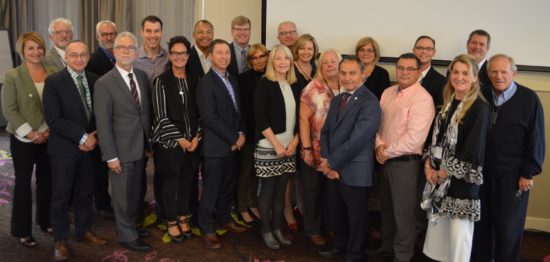
The 2017-2018 CEA/EdCan Network Board of Directors (from left to right) Dr. Alexander (Sandy McDonald, Yves Saint-Maurice, Dean Shareski, Roger Paul, Anne MacPhee, Darren Googoo, Rob Adley and Peter L. McCreath
The following leaders from the K-12, post-secondary, and corporate sectors – who share a commitment to supporting the thousands of courageous educators working tirelessly to ensure that all students discover their place, purpose and path – were also elected to serve on the CEA/EdCan Network’s 2017-2018 Board of Directors:
2017-2018 CEA/EdCan Network Board of Directors Darren Googoo, Chair
Director of Education, Membertou First Nation, Membertou, NSYves Saint-Maurice, Vice-Chair
Lecturer, Université Laval
Président sortant, Association canadienne d’éducation de langue française (ACELF), Quebec City, QCAnne MacPhee, Treasurer, Toronto, ON Roger Paul, Past Chair
Directeur général, Fédération nationale des conseils francophones, Ottawa, ONRob Adley
Vice President, Pre-Sales & Solutions Architecture, HP Enterprise Group, Hewlett-Packard (Canada) Co., Mississauga, ONDenise Andre
Director of Education, Ottawa Catholic District School Board, Ottawa, ONDr. Michele Jacobsen
Professor and Associate Dean, Graduate Programs in Education Werklund School of Education, University of Calgary, Calgary, ABChris Kennedy
Superintendent, West Vancouver School District, West Vancouver, BCDr. Alexander (Sandy) MacDonald
Vice-president and Chief Learning Officer, Holland College, Charlottetown, PEIPeter L. McCreath
Executive Chairman and Managing Director, PLMC, Hubbards, NSDean Shareski
Community Manager, Discovery Education Canada, Moose Jaw, SKThe EdCan Network Advisory Council provides a forum for expression of countrywide issues and trends in education and advises the Board on the direction and priorities for the Network. Council members provide visibility and act as advocates for the EdCan Network within their respective professional communities. They are drawn from all regions of the country and serve a three-year term, which may be renewable for a second three-year term.
The following individuals will serve on the CEA/EdCan Network’s 2017-2018 Advisory Council:
2017-2018 CEA/EdCan Network Advisory Council
Rob Adley*
Vice President, Pre-Sales and Solutions Architecture, HP Enterprise Group, Hewlett-Packard (Canada) Co., Mississauga, ON
Denise Andre*
Director of Education, Ottawa Catholic District School Board, Ottawa, ON
Michel Bernard
Secrétaire général, Association des directions générales des commissions scolaires (ADIGECS), Sherbrooke, QC
Lyne Chantal Boudreau
Professeure en administration de l’éducation et chercheure, Université de Moncton (campus de Shippagan) Shippigan, NB
Dr. Monique Brodeur
Doyenne, Faculté des sciences de l’éducation, Université du Québec à Montréal, Montréal, QC
Duane Brothers
Superintendent of Schools, Louis Riel School Division, Winnipeg, MB
Dr. Steve Cardwell
Associate Vice President – Academic, Kwantlen Polytechnic University, Delta, BC
Michael Chechile
Director General, Lester B Pearson School Board, Dorval, QC
Janice Ciavaglia
Acting Director of Education, Assembly of First Nations, Ottawa, ON
Curtis Clarke
Deputy Minister, Alberta Education, Edmonton, AB
Paul Cuthbert
Education Leadership Consultant, Cuthbert Consulting, Gimli, MB
Michael Furdyk
Director of Technology, Taking IT Global, Toronto, ON
Darren Googoo*, Chair
Director of Education, Membertou First Nation, Membertou, NS
Cassandra Hallett DaSilva
Secretary General, Canadian Teachers’ Federation, Ottawa, ON
Dr. Michele Jacobsen*
Associate Professor, Associate Dean, Faculty of Education, University of Calgary, Calgary, AB
Kevin Kaardal
Superintendent of Schools/CEO, Central Okanagan Public Schools (School District 23), Kelowna, BC
Dr. Heather Kanuka
Full Professor, Faculty of Education, University of Alberta, Edmonton, AB
Chris Kennedy*
Superintendent, West Vancouver School District, West Vancouver, BC
Marie-France Kenny
Owner/Consultant, MFK Solutions and Management Consulting, Regina, SK
Normand Lessard
Directeur général, Commission scolaire Beauce-Etchemin (CSBE), Saint-Georges, QC
Anne MacPhee*, Treasurer, Toronto, ON
Dr. Alexander Sandy MacDonald*
Vice-president and Chief Learning Officer, Holland College, Charlottetown, PEI
Peter L. McCreath*
Executive Chairman and Managing Director, PLMC, Hubbards, NS
Catherine McCullough
President, CMC Leadership, Orillia, ON
Darren McKee
Executive Director, Saskatchewan School Boards Association, Regina, SK
Sandra McKenzie
Deputy Minister, Nova Scotia Department of Education and Early Childhood Development, Halifax, NS
John McLaughlin
Deputy Minister, New Brunswick Department of Education and Early Childhood Development, Fredericton, NB
Donna Miller Fry
Assistant Director of Education (Programs/Western Region), Newfoundland and Labrador English School District, Corner Brook, Newfoundland and Labrador
Brian O’Leary
Superintendent, Seven Oaks School Division, Winnipeg, MB
Roger Paul*, Past Chair
Directeur général, Fédération nationale des conseils scolaires francophones, Ottawa, ON
Darrin G. Pike
Administrative Officer, Programs and Services, Newfoundland and Labrador Teachers’ Association, St. John’s, NL
Gérald Richard
Sous-ministre, Ministère de l’éducation et développement de la petite enfance, Fredericton, NB
Cynthia Richards
President, Canadian Home and School Federation, Chipman, NB
Bruce Rodrigues
Deputy Minister, Ontario Ministry of Education, Toronto, ON
Christian Rousseau
Sous-ministre adjoint par intérim, Relations extérieures et services aux anglophones et aux autochtones
Ministère de l’Éducation et de l’Enseignement supérieur du Québec, Québec, QC
Bernard Roy
Retired Directeur de l’éducation, Conseil des écoles catholiques du Centre-Est, Ottawa, ON
Yves Saint-Maurice*, Vice-Chair
Lecturer, Université Laval
Président sortant, Association canadienne d’éducation de langue française (ACELF), Quebec City, QC
Dean Shareski
Community Manager, Discovery Education Canada, Moose Jaw, SK
Dr. Kate Tilleczek
Professor, Faculty of Education, University of Prince Edward Island, Charlottetown, PEI
Dianne Turner
Official Trustee, Vancouver School Board, Vancouver, BC
Susan Willis
Deputy Minister, PEI Department of Education, Early Learning and Culture, Charlottetown, PEI
James Wilson
Deputy Minister, Manitoba Education and Advanced Learning, Winnipeg, MB
Rob Wood
Deputy Minister, Yukon Department of Education, Whitehorse, YT*CEA/EdCan Network Director
For more information about these Advisory Council Members, please visit: www.edcan.ca/council
Pour en savoir davantage sur les membres de notre Conseil consultatif, veuillez visiter le site : www.edcan.ca/council
About the EdCan Network

Brought to you by the Canadian Education Association, the EdCan Network is the independent national organization with over 75,000 members working tirelessly to ensure that all students discover their place, purpose and path.
To learn more about the work of EdCan Network, please visit www.edcan.ca and follow our Twitter feed at @EdCanNet
Contact: Max Cooke, CEA Director of Communications (bilingual)
Tel: 416-427-6454 E-mail: mcooke@edcan.ca Twitter: @max_cooke
-
“Schools aren’t mental health treatment facilities – Educators need more support”
Comments Off on “Schools aren’t mental health treatment facilities – Educators need more support”
Toronto – September 19, 2017 – Education leaders from across Canada will gather in Toronto for the Educator Well-Being: A Key to Student Success symposium from October 5-6 to discuss how they can create a climate that supports well-being for all.
The EdCan Network is concerned that the steep hike in reported cases of student anxiety[1] and suicidal ideation[2] is creating stress and emotional exhaustion among teachers.[3] Schools aren’t mental health treatment facilities – principals and teachers cannot be expected to shoulder the entire burden.They can, however, be an important part of the solution.[4]
Registration spaces are still open. This is an essential opportunity for School Board Mental Health Leads and Administrators, Guidance Counsellors, Principals and Community Health and Social Workers to shift the conversation from ‘fixing symptoms’ to addressing how we can proactively support our educators to develop wellness within entire school community cultures.
“In today’s world, classrooms don’t turn off at the 3:00 p.m. bell,” says Darren Googoo, Incoming Chair of the EdCan Network. “Education leaders have roles to play in providing safe zones for teachers and principals to navigate their own journey to well-being and continue a long career.”
Through this symposium’s hands-on group discussions and case study presentations, leading experts will explore what it means to embed well-being in diverse school and community contexts. Participants will return with new ideas for building resiliency in themselves, their colleagues and their students.
For more information about the Educator Well-Being: A Key to Student Success symposium, please visit: www.edcan.ca/well-being and follow #EdCan on Twitter @EdCanNet.
With over 125 years of experience as the leading independent national voice in Canadian K-12 education, the Canadian Education Association is proud to launch the EdCan Network to support the thousands of courageous educators working tirelessly to ensure that all students discover their place, purpose and path.
[1] R.C. Kessler, P. Berglund, O. Demler et al, “Lifetime Prevalence and Age-of-Onset Distributions of DSM-IV Disorders in the National Comorbidity Survey Replication,” Archives of General Psychiatry 62, no. 6 (2005): 593-602. See also: Health Behaviours in School Aged Children, Ontario 2014 data, and The Mental Health and Well-Being of Ontario Students, Centre for Addiction and Mental Health, 2016.
[2] Findlay, L.,“Health Reports: Depression and suicidal ideation among Canadians aged 15 to 24,” Statistics Canada (2017).
[3] D.M. Rothi, G. Leavey, and R. Best, “On the Front-Line: Teachers as active observers of pupils’ mental health,” Teaching and Teacher Education 24 (2008).
[4] Kenneth Leithwood et al., “School Leaders’ Influences on Student Learning: The four paths,” in The Principles of Educational Leadership and Management, eds. T. Bush, L. Bell, and D. Middlewood (London: Sage, 2012), p.1.
– 30 –
For more information:
Max Cooke
EdCan Network Director of Communications
416-427-6454 mcooke@edcan.ca @max_cooke
-
Inspiring Public Confidence Conference
Comments Off on Inspiring Public Confidence ConferenceThe Ontario College of Teachers is pleased to announce that our next Inspiring Public Confidence conference is being held May 31 – June 1, 2018 at the Toronto Marriott Downtown Eaton Centre Hotel.
2018 keynote speakers include:

Additionally, industry thought-leaders will provide their insights on the latest trends in:
- professional regulation
- protecting the public interest
- topics of interest to employers of Ontario Certified Teachers
Who should attend: regulators, school board administrators, senior school leaders, school trustees, government officials, providers of teacher education, employers of Ontario Certified teachers, education advocates and parents.
Sign up to receive news and updates about the conference.
Learn more at: oct-oeeo.ca/conference2018
-
Educator Well-Being
Comments Off on Educator Well-BeingA symposium for education leaders tasked with embedding wellness throughout their school communities
Read our event report
It’s time for education leaders to shift the conversation from ‘fixing symptoms’ to addressing how we can proactively develop wellness within entire school cultures because this issue concerns us all.
Check out or re-experience our presentations
Achieving Excellence for the Whole Child
by Denise Dwyer, Patrick CaseMaking the Connection Between Youths’ Social Media Use and Their Well-being
by Dr. Valerie SteevesEmbedding Well-being as a Core Role for K-12 Education
Playing the Long Game to Embed Well-Being in all our Classrooms
by Dr. Kathy Short, Dr. Katina Pollock and Vani Jainand many more…
Find All Of Our Presentations
Why this event
The EdCan Network is concerned that the steep hike in reported cases of student anxiety[1] and suicidal ideation[2] is creating stress and emotional exhaustion among teachers.[3] Schools aren’t mental health treatment facilities – principals and teachers cannot be expected to shoulder the entire burden.They can, however, be an important part of the solution.[4]
How can education leaders create a climate that supports well-being for all?
Discover our Schedule
Day 1 – Day 2Our symposium will help you:
- Understand the nuances of emotional, mental, physical, cognitive and workplace well-being perspectives from diverse school and classroom contexts.
- Learn the ‘how-tos’ from leading experts, and successful school- and community-based wellness programs from across Canada.
- Strategize success indicators for measuring impact when developing a culture of educator wellness in your schools.
Who should attend:
- School Board Mental Health Leads and Administrators
- Guidance and Pastoral Counsellors
- Principals
- Community Health and Social Workers
Exclusive access to experts
With our hands-on group discussions and case study presentations, you will return with new ideas for building resiliency in yourself, your colleagues and your students.
Meet our Speakers
Complementary event with our keynote speaker Dean Shareski
Ignite Your Passion for Discovery EdCan Network 2017
Proudly supported by:
Premier +


INNOVATOR



leader










supporter


FRIEND




IN-KIND



IDEAS TO SUPPORT EDUCATORS : Subscribe to the EdCan e-Newsletter
Quality research, reports, and professional learning opportunities.