
Archive
-
Belonging in the Education Workplace
Comments Off on Belonging in the Education WorkplaceDid you know that something as simple as feeling like you belong can impact your health, happiness, and success? The science is clear – if we feel valued by and connected with our colleagues, then we work harder and more effectively while experiencing more fun and more success at work. What’s more, belonging is contagious – when we’re happy at work, then our colleagues are likely to be happy at work, too.

This is important in any workplace, but it’s of absolute importance in schools where educators have the privilege and responsibility of impacting children’s development. Educators know the power of belonging within the classroom, and they’ll often tell you about the impact small gestures can have on students’ engagement and well-being – things like greeting students at the door and connecting class activities with students’ individual, unique passions. Inversely, educators can also tell heartbreaking stories of students who are rejected or excluded, and the impacts this can have on their engagement and self-esteem.
The same is true in the adult world. Think about the best teams and the best workplaces you’ve ever been a part of. What made these teams and workplaces stand out? My guess is that your first thoughts don’t revolve around comfortable furniture or an environment where you can get a whole lot of paperwork done. You’re probably thinking about PEOPLE, and – if you were to tell me about these people – you’d probably use words related to ‘belonging’ and ‘connection’ such as “family,” “friendship,” and “trust.”
BELONGING IS BASIC HUMAN BIOLOGY
Our need for belonging is wired into our biology. Human beings aren’t the strongest nor the fastest animals on the planet and we could’ve never survived as a species if we didn’t find a way to get along and work together. To survive, we’ve evolved over millions of years to eventually become a deeply social species. Social psychologist Matthew Lieberman, for instance, tells us that our need to belong is so powerful to the point that it’s one of the primary drivers of human behaviour. If you think about the early days of evolution, then this makes total sense. If we didn’t cooperate with each other and form communities instead of hunting each other down, then we wouldn’t have survived. Period.
The Secret to Health, Happiness and Success Together | Gail Markin | TEDxLangleyED
Earlier this year, I did a TEDx presentation about the power of belonging and connection. In preparation, I explored simple gestures that can promote belonging and impact workplaces in powerful ways. For example, did you know that when you perform an act of kindness towards another person, ‘feelgood’ chemicals are released in YOUR brain, in the OTHER PERSON’s brain, and in the brains of ANYONE ELSE who just so happened to witness the interaction? Essentially, we have the power to impact each other’s brain chemistry through our words and actions.
Try this short experiment:

Turn towards someone near you, look directly at them, and give off a big smile. You’ve literally just messed with their brain chemicals!
STRESS IS CONTAGIOUS – BUT BELONGING AND HUMAN CONNECTION ARE ALSO CONTAGIOUS
Just as smiling and acts of kindness release ‘feelgood’ chemicals, stressful circumstances can have quite the opposite effect. An interesting study on stress contagion in the classroom was conducted by UBC researchers Dr. Eva Oberle and Dr. Kimberly Schonert-Reichl, who measured teachers’ stress levels and the cortisol levels (i.e. stress hormones) of their students taken from saliva samples. Unsurprisingly, there was a significant correlation between the two – as teachers’ stress went up, so did students’ stress levels, and vice versa. Instinctively, teachers know that if they’ve had a stressful morning at home (or if one of their students has had a rough start to the day), then stressful energy is likely to spread throughout the classroom.

But there’s also good news. If you lower your cortisol levels – through, for example, feeling a sense of belonging and connection with other people around you – then you can actually boost your immune system. Most people already know that when our stress levels go up, then we’re also more susceptible to illness and long-term stress, which can have a huge impact on both our physical and mental health. Yet, belonging and social connection are actually more powerful predictors of life expectancy than other important health measures like levels of smoking and obesity. So, if you want to stay healthy and live longer, cultivate belonging!

SUCCESSFUL TEAMS LEVERAGE “BELONGING CUES” TO CREATE A WORKPLACE THAT ENCOURAGES CREATIVITY AND RISK-TAKING
Belonging and social connection are also powerful predictors of team success. When we feel valued and cared for by our colleagues, then we also feel safe. When we feel safe at work, then we feel empowered to be creative, to take risks, to ask questions, and to share ideas. To be truly successful, we need to know that our teams have our backs and will not embarrass, reject, or punish us for speaking up, trying new things, or doing things differently.

Let’s go back to the classroom again for a moment. Educators want students to know that it’s okay to ask questions, to be curious, to take risks, and to make mistakes. They work tirelessly to setup structures and conditions that create a safe environment for students to do their best work. Once again, we need to apply this wisdom from the classroom within our workplaces.
In his book The Culture Code, Daniel Coyle tells us about certain behaviours which he calls “belonging cues.” These are powerful cues that allow people to know that they matter while having big impacts on how they feel and perform in group settings. Daniel had the opportunity to study some of the world’s highest performing teams, and found that simple things like working in close proximity to your colleagues, eye contact, taking turns, and other small gestures communicate three key messages:
- That your INTERACTIONS matter. You show your colleagues that you’re invested in them and that your interactions are valuable.
- That THEY matter. You show your colleagues that they are unique and valued.
- That the RELATIONSHIP will continue. You show your colleagues that your interactions aren’t one-off and that you’re committed to developing strong relationships with them in the long-term.

This research is compelling and, once again, it fits with what we already know instinctively as human beings – that we crave positive social interaction and connection with other people. Think back again to the best workplaces and the best teams you’ve ever been a part of, and I bet you can remember laughing with your colleagues and having a lot of fun throwing out creative ideas. You can probably also remember times when you struggled through something or messed something up, and how your team was there to support you. These are the types of workplaces that are needed more than ever in our schools and school districts. If we want to engage, retain, and inspire people in the education profession, then – just like students in the classroom – educators need to feel safe in their workplaces and on their teams in order to be happier, healthier, and more successful.
Photo: Adobe Stock
References and Further Reading
Oberle & Schonert-Reichl, 2016, Stress contagion in the classroom? The link between classroom teachers’ burnout and morning cortisol in elementary school students, Social Science & Medicine.
Daniel Coyle, 2018 The Culture Code. Random House Books.
Matthew Leiberman, 2013, Social: Why our Brains are Wired to Connect. Crown Publishing Company.
-
Infographic: 5 Ways to Support Principals’ Well-being
Comments Off on Infographic: 5 Ways to Support Principals’ Well-being
This infographic aims to provide strategies and practices specific to the role of the principal that school leaders can use to promote and manage their own well-being.
This infographic was inspired by an editors’ pick article by Dr. Katina Pollock that appeared in Education Canada Magazine.
-
Infographic: 4 Tips to Create a Culture of Staff Well-Being in Schools
Comments Off on Infographic: 4 Tips to Create a Culture of Staff Well-Being in Schools
This infographic provides tips for schools on how to better support staff well-being by taking a whole-school approach and putting well-being at the centre of a schools’ values and priorities.
This infographic was inspired by an editors’ pick article by Dr. Sue Roffey that appeared in Education Canada Magazine.
-
Staff Well-Being in Schools
Comments Off on Staff Well-Being in SchoolsA plethora of research demonstrates a strong rationale for addressing school staff well-being. The author shares initial learnings from an initiative in three B.C. school districts, where he is a Coach with newly created district well-being teams.
This article launches a long-term focus on workplace well-being in K-12 education. Watch for our Workplace Well-Being theme issue in December 2019. For more information on the EdCan Network’s workplace well-being initiative, visit www.edcan.ca/wellatwork
“When services and schools support staff well-being, it has a positive impact on staff retention, job satisfaction and productivity as well as on children and young people’s outcomes. The responsibility for staff well-being, like the benefits it brings, is shared between the learning community and individual staff.
No matter what your role – student, educator, sports coach, maintenance servicing, or administration – everyone needs to look after their own mental health. That means everyone is responsible for doing what they can to manage their own stress and build their own sense of positive well-being. A culture of good mental health for everyone starts with the individual.
The responsibility for staff well-being also rests with leadership – when the whole learning community is aligned in its understanding and practice of mental health promotion, real change is possible. When there’s a shared language around well-being, and structures and processes to minimise work-related stressors, then individual staff feel supported and part of positive community.
Staff need to work together to create an environment and culture where all members of the learning community feel supported and have the opportunity to flourish.”1
While many school districts support addressing students’ social-emotional learning (SEL) and mental health initiatives for students, far fewer districts have a significant focus on the mental health of their staff. Yet a plethora of research shows that there exists a strong rationale for addressing staff well-being. Poor staff mental health may impact students’ well-being and ability to learn, so supporting staff well-being benefits students. In addition, the human and financial costs incurred from treating staff psychological disorders in Canada are significant. Sisak et al argued:
“If teachers’ own mental health needs are neglected, they may be unable or unwilling to consider mental health problems of the young people they teach. When teachers’ emotional health is in jeopardy, it reduces their ability to support and respond to pupils appropriately, which creates further difficulties within the classroom and more emotional distress for pupils and teachers alike.”2
So why the focus on all staff?
A school district is a highly interactive community. All staff members should be a focus of well-being approaches, because each person is one part of the whole and each can impact or be impacted by other staff, students and parents at different times. Whether a teacher, an administrator, a special education assistant, a bus driver, a janitor, or a secretary, each person interacts to varying degrees with students, other staff and parents. We need the whole community to be healthy.
Educators and others working in K-12 systems are not health-care professionals. We do not diagnose or treat physical or mental health issues. But what we can do is to maximize the well-being of staff by creating supportive and caring communities in which we work, thereby reducing the possibility of negative mental health issues arising. It’s possible to build on the positive and address some issues that may be problematic in a variety of ways in order to improve staff well-being.
The B.C. experience
British Columbia has multiple government, union, and employer well-being/mental health initiatives, and what I will share is a very small piece of that overall picture. What follows are some initial learnings from three B.C. school districts where I have worked as a Coach with district well-being teams. These teams, consisting of one senior administrator, one district-wide staff person, and one health authority representative, are part of an initiative funded by the McConnell Foundation, and led by DASH Dedicated Action for School Health, to support B.C. school districts in their approach to promoting mental well-being for students and staff.
This infrastructure of external funding and support has been crucial, and a major factor supporting staff wellness approaches.
- The Coach is a “critical friend” to the district team, aiming to support and enhance staff well-being by providing a neutral perspective, asking critical questions, and ideally engaging in dialogue with management, unions, Professional Development Chairs, and a range of committees.
- Funding for Coaches’ time and travel, at no cost to the districts involved, has created tangible supports for several school districts.
Key findings and early action steps
Figure 1 summarizes priorities for action based on data from four focus groups in one B.C. coastal school district.
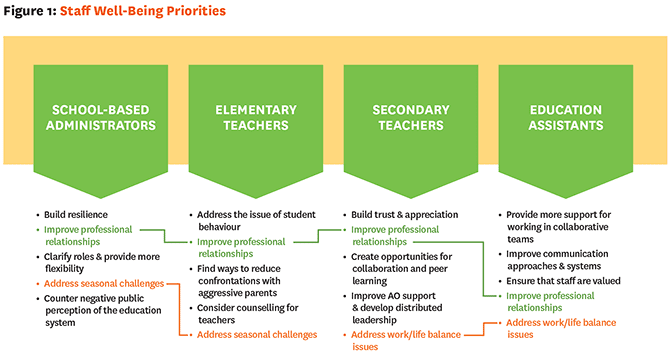
While a range of staff identified what might be considered traditional well-being approaches like resilience, addressing seasonal challenges and work-life balance, we were surprised by the focus on improving professional relationships across all four focus groups. This suggests that with the high levels of staff interaction, staff felt that communications and dialogue could be significantly improved, and that such improvement would promote well-being. From elementary teachers there was a strong focus on the need for greater support in addressing student behaviour.
While the focus group data and staff’s recommendations for priorities provided a foundation for action, we also had to consider how to proceed.
How to move forward?
If you have ever been surveyed or participated in a focus group, you may have felt that once you had provided your input, some action might reasonably follow. You may have been frustrated that action did not happen as you’d expect. So having asked close to a hundred staff what helps or hinders their well-being, and what they would like to see happen, we as a district team were keen to avoid the “We told them but nothing happened” scenario. What we came up with emerged in part from the early, wide-ranging discussions about approaches to well-being with unions and management. It’s simply this: It’s not just up to the individual teacher, administrator or support staff worker to become more resilient. Neither is it up to the district to “fix” everything. It’s a combination, with individuals, groups and the district playing different roles but all having the potential to take some action. So we have proposed:
Individual approaches: what each person might consider
One example of this was a teacher who read the Educational Assistants’ (EAs) Focus Group report, outlining some data showing that EAs often did not feel included in their school. He added the EA’s name alongside his name on a label on his classroom door. It’s a simple step that takes no time and costs nothing, but addresses the issue and potentially supports EA well-being.
Collaborative approaches: what a group may choose to explore
One small elementary school group started an inquiry group to address well-being. Other options could be a group starting an exercise program or having more social events in their school, like lunches where all staff are invited.
Collective approaches: what might be supported by a district
In one district, where professional interactions were stated as problematic in all focus groups, the district provided some funding for participation in a university Symposia series3 offered by Simon Fraser University, which aims to improve dialogue in public education, and to enable any staff to engage more productively in conversations and dialogue with peers.
What may evolve from these approaches is that all staff could be encouraged to consider what actions they can take as individuals or in groups. School districts might enable actions of their staff through funding and support. Everyone can play a role, and there is no expectation that someone else will fix everything. Participation in any actions to address staff well-being would be voluntary. Stress-inducing issues such as student behaviour and professional interactions would be addressed with district financial support, but with staff leading the changes taking place.
Because of district budget cycles and timelines, there was a priority focus on collective approaches (district actions) in one district, with the focus on individual and collaborative steps coming later. However, in the two other districts where I work, there are significant steps to create collaborative actions in schools, with a wide range of learning groups in one district and the creation of “wellness champions” in each school who act as conduits for information and catalysts for action in a second district.
By sharing the learning across all three districts, we hope to avoid reinventing wheels already created and working effectively. By sharing our ideas with other interested parties across Canada we hope to learn from the work and experiences of others while sharing what we have learned. As a staff member in one of the school districts stated, in order to address staff well-being in Canadian schools and education systems, “we are better together.”
Getting Started with Workplace Well-Being: What we have learned
- Start slow. Listen to teachers, administrators, educational assistants and other staff to build a foundation of understanding about issues and perspectives.
- Engage with both management and unions to gauge perspectives, interests and concerns so that both become allies in addressing staff well-being.
- Collect data. In two school districts, we conducted a total of nine focus groups with elementary and secondary teachers, school administrators, and other staff. I think the focus groups were a better way to collect data in these projects than surveys, as they not only provided rich data but started multiple and widening conversations in schools about staff well-being.
- Think through how you move from data to action. What do the data tell you? What to do as a result? One school district has formed a Data Action Group to access a wide range of data to support district decision-making.
- School, district and community context and culture are crucial to understand. While context is relatively straightforward, culture is less easily defined or agreed on. One school or district may have a very positive and supportive culture, while another may have deep differences and divisions. Asking five people to describe a school or district’s culture may result in five different answers, yet in some case we have found genuine levels of consensus in describing cultures less than ideal and which could be improved.
- Build safe spaces where staff can speak freely and be respected for their views, but build in critical challenges if needed once those safe spaces are created, so that everyone in meetings feels able to challenge ideas while also maintaining respect and civility.
- Communication is important. As well as the Focus Group Reports (5-9 pages) we produced one-page graphics to summarize both process and data in one district, so that anyone could quickly access the key information while also having access to the full reports should they wish to read them. After the focus groups in this district, any participant from the focus group, and any interested teachers, administrators or support staff workers, were invited to a follow-up dinner meeting to identify priorities for action. This kept more people involved and talking about actions to support well-being.
- Consider partnerships and collaborations with external agencies such as health authorities, municipal governments, and/or community organizations.
Free Discussion Kit
Download the pro-learning session, Your Role in Promoting Staff Well-Being in Your School: Reflecting on lessons learned from three B.C. school districts at www.edcan.ca/discussionkit
Illustration: iStock
First published in Education Canada, September 2019
Notes
1 https://beyou.edu.au/fact-sheets/your-wellbeing/staff-wellbeing
2 M. Sisask, P. Varnik, et al., “Teacher Satisfaction with School and Psychological Well-Being Affects their Readiness to Help Children with Mental Health Problems,” Health Education Journal 73, no. 4 (January, 2013): 1-12.
3 http://www.sfu.ca/education/cselp/past-events/RPED-symposium.html#main_content_text
-
Creative Caring for Teachers
Comments Off on Creative Caring for Teachers
The wellness of teachers is critical to the education, behaviour and mental health of young people. Teachers who are doing well are able to establish and maintain positive relationships, have an engaging curriculum delivery and contribute to a supportive culture. Wise school leaders who want all students to flourish will find ways to cherish their teachers within a whole-school, well-being framework. When well-being is at the heart of school values and practice, then other things follow in a virtuous cycle – better mental health and resilience, student engagement, academic outcomes and pro-social behaviour.1
The impact of stress
A limited amount of stress can be energizing, stimulate creative responses and improve focus. Chronic ongoing stress, on the other hand, is literally toxic. It can weaken the immune system and cause high blood pressure, fatigue, depression, anxiety and even heart disease. Over time it leads to degradation of the hippocampus – the part of the brain most active in memory.
Students whose behaviour is challenging are often struggling with adversity. These young people at risk need adults in their lives who are able to maintain the relational quality that builds resilience.2 Educators are usually caring individuals, keen to make such a difference, but when they are over-stretched their responses may become self-protective, with little understanding or empathy. School life for vulnerable pupils then becomes a mirror of what is happening for them elsewhere, undermining both learning and mental health.
Teaching can be a stressful occupation but also a meaningful, stimulating and rewarding one. In aiming for the latter, we need to either reduce demands or increase resources. Rather than devote precious energy to things we cannot change, such as student backgrounds or government directives, let’s be creative about what is possible.
Looking after each other
So what does it mean to be doing well and what can schools put in place to make sure this happens? Whole school well-being is not a set of programs, but “how things happen around here.” A culture with high levels of social capital and creativity benefits everyone. So, rather than just remind teachers to look after themselves, here we explore whole-school values, priorities and innovations that put well-being centre stage.
Physical well-being
Most teachers say there isn’t enough time to do everything. For teachers under stress, the first thing to go may be behaviours that maintain good health such as sufficient sleep, regular exercise and healthy eating. Schools can help teachers stay well by ensuring that expectations are manageable and by thinking outside the box to create opportunities within the school day.
Both teachers and students need to keep active – brains slow down when the body stops moving! Having students get out of their seats and move around during lessons makes sense, but how about taking this one step further? Many teachers see lunchtime as an opportunity to finalize lesson planning, mark work or have meetings. But perhaps once or twice a week it could be a space for doing something physical alongside students? Not just traditional sports but aikido, dance, Zumba, kick-boxing or tai chi. Sharing the learning, making mistakes and laughing together also increases connectedness and stimulates positive relationships.
Overworked teachers can be up half the night planning lessons, marking and doing admin. When this happens routinely rather than occasionally, it impacts on all aspects of psycho-social functioning. No one can do everything to the best of their ability all the time and stay sane, especially when they are exhausted. Something has to give. Working “smarter” rather than harder requires school management to be clear about priorities, what constitutes “good enough” and how best to share resources so individuals do not spend time re-inventing the wheel. Encouraging staff to set limits on after-hours emailing can be helpful and school leaders who model good practice give staff permission to also switch off. Another time-saving strategy is to tighten up on meetings. What is a meeting for, who actually needs to be there, is there a more time-efficient way of getting things done?
Most teachers are highly conscientious. They often go to work when unwell and then take much longer to recover. A whole-school agreement about when to call in sick and stay at home can be valuable. One principal actively promoted positivity across his school and his budget for sick cover was always underspent, leaving more funds for other things. He was convinced that his staff stayed well because they were working in a happy school. The evidence suggests he was probably right.
Social well-being
Michie and Cockcroft3 found that more serious dangers to health from toxic stress were moderated by strong social networks and support. How we relate to each other matters a great deal.
I have asked teachers in various educational jurisdictions around the world to identify what others do and say that makes them feel they belong at school – and overwhelmingly they report that it is the simple things that make the difference: “People greet me with a smile, remember my name, show an interest in me as a person and ask follow-up questions. They check how things are going, invite my opinion, show appreciation for my efforts.” They also talk about how good it is to be with people they can share a joke with. If you ask students what they value in teachers, they come up with a very similar list.4
When teachers have opportunities to get to know each other out of role, this facilitates more relational interaction and mutual support. In one large all-age school in Melbourne, a member of staff has been designated “social secretary” and organizes an event once a term where everyone is invited, sometimes including families. This has resulted in fewer cliques, less judgment, more mutual interest, increased cross-departmental support, more willingness to sort out differences and a warmer atmosphere all round. One teacher commented, “I can’t always attend, but what is important is that everyone gets invited, not just a select few – it has made a real impact on the feeling of collegiality in the school.” This teacher had been at home with young children for five years and talked about how everyone was much happier and kinder than before. She put this down to the active development of a more supportive culture throughout the school and said that now “everyone is on the same side, looking out for each other.”
There are schools operating a buddy system, not just for new teachers but for everyone. A large special school in Victoria (Australia) has “secret angels.” Everyone who wants to participate puts their name in a hat and takes another out. They are that person’s secret angel for the term. They keep an eye on their colleague, make the occasional cup of tea, perhaps take a duty for them or organize a small birthday celebration.
The quality of the teacher-student relationship is not only the most critical factor in effective education,5 it also links to feelings of teacher efficacy and well-being. One way to develop stronger relationships is to get to know students as people with ideas, feelings and experiences. Circle Solutions6 is a strengths- and solution-focused framework for social and emotional learning (and whole-school well-being) based on the ASPIRE principles of Agency, Safety, Positivity, Inclusion, Respect and Equity. Teachers join in as equal participants and take part in all the activities. Over the course of the term, everyone interacts with everyone else. This breaks down barriers and changes perspectives. Teachers have been very positive about the difference Circles has made to the atmosphere in their classes. One teacher said, “It will totally change your relationship with your students and their relationships with each other.”
Emotional well-being
Positive emotions underpin creativity, problem-solving and cooperation.7 These include feeling comfortable, safe, interested, joyful, excited, valued, engaged, thankful and loved. By contrast, feelings of fear, anxiety or anger shut down learning and impair relationships, so what can schools do to promote positivity?
Simple recognition goes a long way. In a conference on teacher well-being in Darwin, some educators talked about going over and above for their students, often to the detriment of time spent with their own family. Yet it was only when they stopped working so hard that school leaders noticed and then commented negatively. The teachers’ frustration, despair and fury were palpable. There is no need for fulsome praise, but when efforts are noticed and openly valued this feels good, strengthens motivation and increases well-being. A card or note saying “thank you for…” or “I noticed that… ” takes little time but reaps great benefits, fitting with three of the five ways to well-being8 (Connect, Notice and Give; the others are Stay Active and Keep Learning) that the National Economics Foundation have developed.
In a primary school just outside Sydney, the front page of the weekly newsletter is a thank you – not just for orchestrating major events but for everyday good work. The recipient could be an admin person, support staff or school custodian as well as educators. Teachers told me it was the first thing they looked for every Friday – who had been recognized that week.
Feelings of trust and safety develop when people speak positively about each other, share fairly, demonstrate reliability by only offering what they can deliver, and communicate openly. One primary school in New South Wales has “This is a No Put Down Zone” posters everywhere – classrooms, offices and staffroom. This has proved to be surprisingly powerful. Everyone could tell me what it meant and how it impacted on school climate. One student said, “We don’t have any bullying here because of this no put down thing!” It made overt what is often hidden and brought good practice to the foreground.
A positive school environment is not a Pollyanna place where there is a denial of real-life struggles. Grief, depression and anxiety can be overwhelming at times. Where there is high social capital, teachers are able to have supportive conversations with each other. They will also be better able to respond effectively to students in crisis.
Cognitive well-being
Conversations create culture and culture determines how people think and feel about things. Teacher perspectives on their job, the students and their families are influenced at least to some extent by how people talk about these things in the staffroom.
Culture is best addressed as part of a wider well-being framework for the whole school. A first step is to identify a vision for the school, how far this had already been realized and agree on next steps. Although it is invariably the school executive that initiates whole-school well-being, it needs to be owned by all stakeholders. Once everyone has the bigger picture in mind it is easier to keep the small stuff in perspective.
Focusing on what is going well and how to get more of it also raises appreciation of how much there is to be thankful for. One large independent school in Sydney introduced a “random acts of kindness” board in the staffroom where staff placed post-it notes thanking colleagues for small acts of support. This got people talking – and initiated a different staffroom conversation!
Psychological well-being
Dan Pink summarises the three things that motivate people to do their best. These are autonomy, mastery and purpose. For many educators, psychological well-being is maintained by being able to teach according to their values, having some autonomy and being creative in responding to student interest and need. If they can do this they increase the personal and professional integrity that makes coming to work a joy.
Educating the next generation is a meaningful occupation, but the benefits can evaporate when life gets out of balance and teachers struggle with innovation overload or having to meet endless targets. A leader who is focusing on whole-school well-being will involve staff in developing a clear direction for the school, but will trust teachers to get on with the job and not micro-manage.
A last word about the importance of having fun. Oxytocin is the neurotransmitter critical in reproductive processes, but there is evidence for its involvement in connectedness, trust and cooperation throughout life. Oxytocin can be produced in the body by events taking place in the environment. One head teacher in England organizes head and shoulder massages for staff once a month on a Friday afternoon. This not only raises their oxytocin levels but makes them feel valued. Laughing together does the same thing. Where and when in your school are there opportunities to raise resilience by having fun?
Teachers have a responsibility to do what they can to look after their own well-being, of course, but for every school leader wanting the best for their school, students and staff, making whole-school well-being a core priority is a no-brainer!
For more information about the EdCan Network’s Educator Well-Being: A Key To Student Success Symposium
Photo: Rob Newell, courtesy West Vancouver Schools
First published in Education Canada, September 2017
Notes
1 T. Noble, H. McGrath, S. Roffey, and L. Rowling, A Scoping Study on Student Well-being (Canberra, ACT: Department of Education, Employment & Workplace Relations, 2008).
2 S. Roffey, “Ordinary Magic Needs Ordinary Magicians: The power and practice of positive relationships for building youth resilience and well-being,” Kognition & Paedagogik 103 (2017): 38-57.
3 S. Michie and A. Cockcroft, “Overwork Can Kill,” British Journal of Medicine 312 (1996): 921- 922.
4 B. Johnson, “Teacher-Student Relationships that Enhance Resilience at School: A micro-level analysis of students’ views,” British Journal of Guidance and Counselling 36, No. 4 (2008): 385-398.
5 J. Hattie, Making Learning Visible: A synthesis of over 800 meta-analyses relating to achievement (London: Routledge, 2009).
6 www.circlesolutionsnetwork.com
7 B. Fredrickson, Positivity: Ground-breaking research to release your inner optimist and thrive (Oxford: OneWorld Publications, 2009).
8 www.rcpch.ac.uk/system/files/protected/page/Five_ways_to_well-being-postcards.pdf
-
Supported at School
Comments Off on Supported at SchoolA transgender, non-binary student shares the power of a teacher’s support.
My name is Kile. My pronouns are they/them, and I am transgender non-binary. My gender identity can sometimes be difficult for people to understand, but so far I have been very lucky as practically everyone around me has been supportive.
One of the preeminent sources of support has been my school. I remember my heart pounding hard in my chest, my hands shaking as I typed up an email that simply introduced myself and explained my preferred name and pronouns. I took a deep breath before sending it to my teachers. However, all of my worries about my teachers’ reactions were effectively calmed as I received emails back almost right away, all saying that they understood and were glad I let them know. I was beyond lucky to have that happen to me. To immediately be accepted and cared for as any other student is the best situation for any transgender student. So far, every experience I’ve had with my school has been very supportive and exceptional.
But that’s not always the case. I was extremely lucky to be accepted and met with love, but other trans students aren’t so lucky and face discrimination and mistreatment. School can be a huge factor that helps a trans student access support, but it can also be a factor that contributes to the high rates of transgender youth committing suicide. Statistics don’t have to be that way. Schools are the perfect place for a trans child to get the assistance they need, especially if that child is not receiving any at home.
If a school is trying to support a trans student, this is the way to go about it – working with the student to ensure they are comfortable and, more importantly, safe. It might not be the teachers that a student might worry about, but other students. If a trans student is being harassed or bullied, then school staff should be working with the students involved, because it’s important to make sure that all students are safe.
Of course, there is also the question of washrooms. I really believe that trust needs to be given to students to know which washroom is right for them and which washroom they feel most safe and comfortable using. Using the washrooms can be very stressful for some trans people, so if the school can ensure that the washrooms are a safe place for everyone, and maybe even introduce an “all gender” washroom, then that will contribute to protecting young trans students.
Many other things could help to assist trans and questioning students, from educating staff and students to just letting students know that they are valid. I remember the day after I sent that email to my teachers about my name and pronouns, one of my teachers came up to me and told me that she was proud of me, that she would always be supportive, and that if I ever needed anything she would always be there for me. That small, one-minute interaction with a woman I had not really spoken with before literally gave me a much-needed boost. She absolutely warmed my heart and made me genuinely feel like I was loved and I did matter to others.
There was also a point when my teacher was talking about me to the class and she started to say incorrect pronouns, but then she stopped, and corrected herself with the right pronouns. I’m not sure if she is aware of the fact that I will remember that moment for the rest of my life, because it was the first time I had ever heard my pronouns being respected at school.
These minor gestures are so harmless, but make such a difference for a transgender student because it’s more than just accepting them, it’s letting them know that you are there for them, that you are making that effort to show them that they matter. Supporting a trans student doesn’t need to be a big thing. In my experience, my school supporting me has been made up of essentially little actions and the simplest of efforts. I hope for the day to come where all transgender students receive the same support I did. Ultimately, school is just a place for students to learn and transgender students are just like other students, in the sense that we attend school for our education. Being able to have both education and support would be the ideal situation for every trans student. When trans students feel safe and accepted at school, they can be their best – both as students and as themselves.
Photo: courtesy Kile George
First published in Education Canada, June 2019
-
It’s Time to Invest in Staff Well-being
Comments Off on It’s Time to Invest in Staff Well-beingShe’d been in the profession for over a year by then. It had been her dream to teach her passion for the language arts since her first Shakespeare class in the ninth grade. She’d devoted her heart and mind to the years of her training, set on inspiring young minds to pursue their own passions and dpk persevere through the challenges of growing up. Until one day she realized that she was over it all – that her passion had been gradually dulled into something else. And though her awareness of this was filled with fond memories of what was supposed to be, up to then, her life’s calling, she now didn’t know how to grapple with how she was feeling.
Stress and burnout syndrome are one of the most frequent negative experiences in the helping professions, and staff within the education sector – including superintendents, principals, teachers, and other teaching and non-teaching staff – are not immune. And while many school districts have invested in stress reduction programs and policies to help staff cope with daily systemic pressures beyond their control, these positive innovations remain a patchwork of success. The influence of working conditions on staff well-being – and the ramifications this can have on student outcomes – is often overlooked, leading to one-off interventions focused on individual cases rather than the systemic approaches that transform entire education systems for the better. It’s a common case of tackling the symptoms rather than the disease.
Evidence demonstrates that healthy workplaces that promote social and mental health are productive, attract and retain top talent, and get the best out of highly engaged employees – which means better outcomes for the organization’s bottom line, whether that be profits, social impact, or student outcomes. But to get there, we’ll need to challenge the persistent mindsets and assumptions that are holding us back – whether that be clarifying the importance of education professionals or boosting awareness that the science of “happiness” is integral to staff engagement and not merely a fluffy concept. One thing’s for sure: a healthy, motivated education workforce means healthy, motivated students – and that’s an investment we can’t compromise on.
That’s why we’re launching a special, year-long focus on workplace well-being. Starting next issue, you’ll see a new regular column on the topic, and Workplace Well-being will be our theme in December. It’s time to make serious investments in the well-being of our K-12 education staff.
The EdCan Network is leading national work mobilizing evidence on workplace well-being in K-12 education. For more information, visit www.edcan.ca/wellatwork
First published in Education Canada, June 2019
Photo: Canva
-
3 Myths Dispelled about Student Suicide Prevention
Comments Off on 3 Myths Dispelled about Student Suicide PreventionSuicide is an important health concern and prevention at school has increasingly become a focal point for educators and policy makers aiming to decrease the number of youth who die by suicide. Unfortunately, the business of suicide prevention has become a fruitful source of revenue for companies and organizations, even though robust scientific evidence on the effectiveness and safety of school-based suicide prevention products and programs does not exist.
Here are three key considerations prior to deciding which, if any, specific suicide prevention interventions need to be applied in a school:
1. There is no epidemic of youth suicide in Canada.
- Between 1980 and 2005, the national suicide rate in Canada fell by about 30% and has remained fairly stable since then with no substantial input from suicide prevention programs of any kind.
- Between 2012 and 2016, the average number of 10-14-year-olds dying from suicide in Canada was 36 annually and for 15-19-year-olds was 199. During this time, there were about 1.9 million 10-14-year-olds and 2.1 million 15-19-year-olds living in Canada.
2. There is no substantial evidence that school-based suicide prevention programs either prevent suicide or are harmless.
Research cannot conclude what really works in preventing suicide in young people. The first study to demonstrate a positive impact in preventing youth suicide was published in February 2019, which considered youth in a psychiatric hospital and not students at school. Furthermore, some school-based programs that report success actually cause harm. For example, a study showed that the Signs of Suicide (SOS) program increased suicide attempts in the group receiving the intervention, while the SafeTALK program was found to improve self-reported self-confidence in talking about suicide but caused half of the students involved to be sent for professional evaluation. A recent Canadian review also identified a relation between the increased use of suicide prevention programs and increased suicide rates in young girls.
3. Available literature on school-based suicide prevention does not actually measure suicide prevention.
At best, most studies measure students’ self-reported knowledge about suicide, self-confidence in talking about suicide, or self-reported suicide attempts or ideation. None of these are valid measures that can determine whether a program actually prevents suicide.
Student suicide is an emotional topic that demands our considered, rational and best available response based on what the research says.
As schools may be caught between the wish to do something helpful and the sophisticated marketing of products and programs that take advantage of this intent, it is necessary that school staff think critically before they apply any suicide prevention intervention.
Additional Information Resources
Statistics Canada: Suicide rates: An overview
TeenMentalHealth.org:
References
Knightsmith P. Youth suicide prevention research needs a shake-up: lives depend on it. 2018. Accessible from https://www.nationalelfservice.net/mental-health/suicide/youth-suicide-prevention-research-needs-a-shake-up-lives-depend-on-it/
Kutcher S., Wei Y. The vexing challenge of suicide prevention: a research informed perspective on a recent systematic review. 2016. Accessible from https://www.nationalelfservice.net/mental-health/suicide/vexing-challenge-suicide-prevention-research-informed-perspective-recent-systematic-review/
King CA., Arango A., Kramer A., et., al. Association of the Youth-Nominated Support Team Intervention for Suicidal Adolescents With 11- to 14-Year Mortality Outcomes. Secondary Analysis of a Randomized Clinical Trial. JAMA Psychiatry. 2019. doi:10.1001/jamapsychiatry.2018.4358
Schilling EA, Lawless M, Buchanan L, et al. Signs of Suicide shows promise as a middle school suicide prevention program. Suicide Life Threat Behav. 2014; 44(6): 653-67.
Bailey E, et al. Universal Suicide Prevention in Young People: An evaluation of the safeTALK Program in Australian High Schools. Crisis. 2017; 38(5), 300-308.
Kutcher S., et al. School-and Community-Based Youth Suicide Prevention Interventions: Hot Idea, Hot Air, or Sham? The Canadian Journal of Psychiatry. (2016): 1-7.
-
Suicide Prevention: 6 Questions School Leaders Should Ask
Comments Off on Suicide Prevention: 6 Questions School Leaders Should AskSuicide prevention is a highly emotional topic and pressure may come from parents, communities, and the media to “do something” when such a tragic incident occurs. Suicide prevention programs are not a part of usual pedagogy and when a suicide event occurs it is important that school leaders, policy makers and politicians:
- Understand the lack of available evidence on suicide prevention strategies;
- Recognize the importance for districts/schools not to rush into purchasing and applying the latest shiny new suicide prevention program;
- Support students and teachers to develop good mental health literacy while ensuring an inviting, welcoming, and suitably challenging environment for all students;
- Continue to develop school staff’s capacities to identify, triage, refer, and support students who have a mental illness, as most youth who die by suicide have a mental illness.
These four approaches have stronger potential to prevent student suicide than those currently offered by slickly marketed suicide prevention programs.
Important questions to ask when implementing a school-based suicide prevention program include:
- Is the program being sold? Are there training costs, licence fees, or renewals? If so – buyer beware. If not – user be careful.
- Is there independent evidence (not evidence created or funded by the program developer or purveyor) that the program decreases suicide rates in young people? Do not accept “evidence-based” self-reported measures of knowledge about suicide, confidence in talking about suicide, intent to seek help, confidence in supporting those who may be having suicidal thoughts, willingness to talk to someone if suicidal, suicidal ideation, and suicide attempts – none of these are valid measures of suicide prevention. Because a program is listed on a “mental health registry” does not mean that it is effective or safe.
- Does the school have a well-established and clearly defined protocol for identification and in-school assessment of students who are exhibiting suicide-related behaviours/cognition?
- Is there a well-established link to local expert mental healthcare providers who are willing and able to immediately assess a student that the intervention has identified as needing follow-up?
- What are other available programs in the marketplace? Are they better, safer or less expensive than the one under consideration? (See item #1 above)
- What will implementation of the program cost – direct, indirect and opportunity cost? What will you not be able to deliver if you choose to apply this program?
School leaders need to do things that they know can prevent suicide, while avoiding those that we know do not prevent suicide, are unsure of, or could even cause more harm than good. “Doing something” and “doing the right thing” are not always the same thing.
Additional Information Resources
EdCan Network: School Mental Health Literacy: A national curriculum guide shows promising results
TeenMentalHealth.org:
References
Knightsmith P. Youth suicide prevention research needs a shake-up: lives depend on it. 2018. Accessible from https://www.nationalelfservice.net/mental-health/suicide/youth-suicide-prevention-research-needs-a-shake-up-lives-depend-on-it/
Kutcher S., Wei Y. The vexing challenge of suicide prevention: a research informed perspective on a recent systematic review. 2016. Accessible from https://www.nationalelfservice.net/mental-health/suicide/vexing-challenge-suicide-prevention-research-informed-perspective-recent-systematic-review/
King CA., Arango A., Kramer A., et., al. Association of the Youth-Nominated Support Team Intervention for Suicidal Adolescents With 11- to 14-Year Mortality Outcomes. Secondary Analysis of a Randomized Clinical Trial. JAMA Psychiatry. 2019. doi:10.1001/jamapsychiatry.2018.4358
Schilling EA, Lawless M, Buchanan L, et al. Signs of Suicide shows promise as a middle school suicide prevention program. Suicide Life Threat Behav. 2014; 44(6): 653-67.
Bailey E, et al. Universal Suicide Prevention in Young People: An evaluation of the safeTALK Program in Australian High Schools. Crisis. 2017; 38(5), 300-308.
Kutcher S., et al. School-and Community-Based Youth Suicide Prevention Interventions: Hot Idea, Hot Air, or Sham? The Canadian Journal of Psychiatry. (2016): 1-7.
-
3 little-known myths about youth suicide prevention
Comments Off on 3 little-known myths about youth suicide preventionOur resources
Three fact sheets by the national EdCan Network of educators and TeenMentalHealth.org assert that school-based suicide prevention products and programs – many of which have become a significant source of revenue for many companies and organizations – are often ineffective and can cause more harm than good.
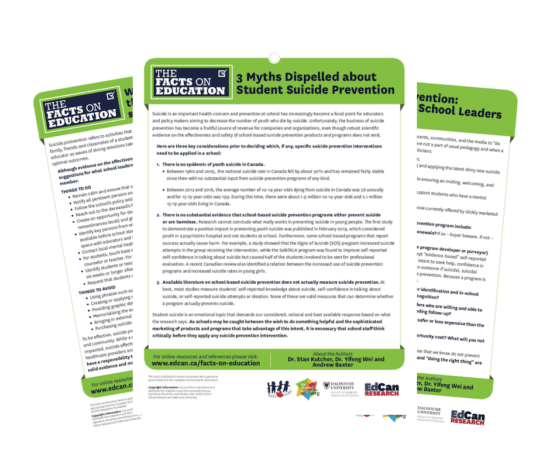
3 Myths Dispelled about Student Suicide Prevention
Key considerations prior to deciding which, if any, specific suicide prevention interventions need to be applied in a school [Download this fact sheet]
Suicide Prevention: 6 Questions School Leaders Should Ask
Important questions to ask when implementing a school-based suicide prevention program [Download this fact sheet]
What can school leaders do in the aftermath of student and staff suicide?
Suggestions for what school leaders should and should not do following the suicide of a student or staff member [Download this fact sheet]
Authored by mental health literacy experts Dr. Stan Kutcher, Dr. Yifeng Wei, and Andrew Baxter, these timely resources further reveal that there is no epidemic of youth suicide in Canada and that available studies often do not actually measure suicide prevention.
As the authors contend, “As schools may be caught between the wish to do something helpful and the sophisticated marketing of products and programs that take advantage of this intent, it is necessary that school staff think critically before they apply any suicide prevention strategy.”
“Youth suicide is an emotional and challenging topic that impacts entire school communities,” says Max Cooke, EdCan Network CEO. “These facts sheets will provide some much-needed clarity to school leaders who are looking for proven ways to decrease student death by suicide.”
Free copies of these fact sheets can be downloaded at www.edcan.ca/facts-on-education.
-
School suicide: What principals should do when students and staff disappear
Comments Off on School suicide: What principals should do when students and staff disappearA new fact sheet by the national EdCan Network of educators and TeenMentalHealth.org entitled What can school leaders do in the aftermath of student and staff suicide? aims to heighten awareness among K-12 principals and school communities on what they should and should not do following the suicide of a student or staff member.
Authored by Dr. Stan Kutcher, professor in the Department of Psychiatry at Dalhousie University and recently-appointed member of the Senate of Canada, this timely resource reveals how some conventional suicide postvention programs can cause more harm than good for the family, friends and classmates of a student or teacher who dies from suicide.
As Dr. Kutcher asserts, things to avoid include memorializing, using phrases such as “committed suicide,” and purchasing suicide prevention programs.
“With recent and recurring reports of youth suicide nationally, globally and in Indigenous communities – especially those in the Arctic North – we’d like to provide concrete support to principals, teachers and parents who are grappling with tragic losses that impact entire school communities,” says Max Cooke, EdCan Network Interim CEO.
In addition to the downloadable copy of the fact sheet, available at www.edcan.ca/suicide-postvention, also included are several practical resources to support school leaders in taking up evidence-based strategies.
This fact sheet was made possible with the generous financial support of the Desjardins Foundation and the Canadian Schools Boards’ Association.


-
What can school leaders do in the aftermath of student and staff suicide?
Comments Off on What can school leaders do in the aftermath of student and staff suicide?Suicide postvention refers to activities that support the grieving process and may help prevent suicide contagion among family, friends and classmates of a student or teacher who dies from suicide. While this is a challenging topic for any educator as waves of strong emotions take grip on a school community, acting primarily on emotions is not likely to bring optimal outcomes.
Although evidence on the effectiveness of suicide postvention strategies is still limited, here are some suggestions for what school leaders should and should not do following the suicide of a student or staff member:
THINGS TO DO
- Remain calm and ensure that usual school activities continue.
- Notify all pertinent persons and provide them with simple, clear and factual information.
- Follow the school’s policy and crisis implementation plan.
- Reach out to the deceased’s family to offer condolences.
- Create an opportunity for students and teachers to send condolences to the family (e.g. through a remembrances book) and give permission to attend funeral services.
- Identify key persons from within the school and a site (e.g. a classroom or school health clinic) to be made available before school starts until a reasonable time after school ends for students who wish to talk. Staff the space with educators and student service providers whom the students already know.
- Contact local mental health services providers to let them know and seek their input.
- For students, touch base with the deceased’s closest friends and invite them to chat with a guidance counselor or teacher. For staff, invite them to chat with a trusted colleague or administrator if they wish to do so.
- Identify students or teachers who are still struggling emotionally (including increased absences/sick days) six weeks or longer after the event and suggest referral to mental health services.
- Request that students and teachers use social media responsibly.
THINGS TO AVOID
- Using phrases such as “committed suicide.” Instead, use “died by suicide.”
- Creating or applying school-wide suicide or depression screening programs.
- Providing graphic details as to what happened.
- Memorializing the event (e.g. student assemblies, memorial sites, speakers, etc.)
- Bringing in external “grief counselors” or applying Critical Incident Stress Debriefing.
- Purchasing suicide prevention programs since there is no good evidence that such programs prevent suicide.
To be effective, suicide postvention must be adapted to the unique needs, situations and realities of the affected school and community. While a conservative estimate counts six people connected to the deceased who will be most personally impacted, suicide affects a web of individuals including parents, siblings, friends and acquaintances, classmates, healthcare providers and others.
Although numerous suicide postvention programs are available, school leaders have a responsibility to select evidence-based strategies that are likely to be effective – and avoid those that lack solid evidence and may do more harm than good – in preventing suicide and supporting those who are grieving.
ADDITIONAL INFORMATION RESOURCES
- TeenMentalHealth.org: Suicide
- Ontario Center of Excellence for Child and Youth Mental Health. (2015). Evidence in-sight: suicide postvention programming.
- Media Guidelines for Reporting on Suicide
- Ashraf Kagee. (2002). Concerns about the effectiveness of critical incident stress debriefing in ameliorating stress reactions. Critical Care.
- Francesco Pia and co-authors (2011). ACFASP Review: Critical Incident Stress Debriefing.
- Samaratins UK: Suicide Postvention in the Workplace
REFERENCES
Kutcher, S. (2018). Suicide Postvention in Schools: Addressing an emotional issue using best available information and critical thought. CAP Journal.
Szumilas, M. & Kutcher, S. (2011). Post-suicide Intervention Programs: A Systematic Review. Can J Public Health, 102 (1), 18-29.
WITH THE GENEROUS FINANCIAL SUPPORT OF:
-
Three little-known risks of adolescent cannabis use
Comments Off on Three little-known risks of adolescent cannabis useIn this era of legalization for Canadian adults, a newly released fact sheet by the national EdCan Network of educators entitled Cannabis: What are the risks for students? aims to heighten awareness among K-12 educators, parents and students on three major risks associated with adolescent cannabis use – lower school performance, psychosis, and cannabis use disorder (CUD). Recent scientific studies pinpoint specific areas of the developing adolescent brain that are vulnerable to cannabis.
Authored by Dr. Christina Grant, McMaster University’s Associate Chair for Education with the Department of Pediatrics, this timely resource provides clarity in view of the limited research that currently exists on the consequences of youth cannabis use over long-term periods.
As Dr. Grant asserts in this fact sheet, “As our understanding of the development of the human brain has increased, so too has the potency of THC – the main psychoactive component in cannabis – which has increased by up to 400% over the past fifty years.” This increase in potency could potentially impact brain development, which continues until students’ mid-twenties.
“Educators want to know if and to what extent legalization will impact teaching practice,” says Max Cooke, EdCan Network Interim CEO. “While it’s too early to say how cannabislegalization for adults in Canada will impact youth consumption, what we do know is that adolescents who use cannabis daily or weekly are at risk of lower school performance.”
In addition to the downloadable copy of the fact sheet, available at www.edcan.ca/cannabis, also included are several practical resources to support parents and teachers in beginning important conversations with students on these serious risks.
This fact sheet was made possible with the generous financial support of the Desjardins Foundation and the Canadian Schools Boards Association.
-
Cannabis: What are the risks for students?
Comments Off on Cannabis: What are the risks for students?There are several unique risks that have emerged over the past few years associated with cannabis use among adolescents. As our understanding of the development of the human brain has increased, so too has the potency of THC – the main psychoactive component in cannabis – which has increased by up to 400% over the past fifty years. Science has explored how this increase in potency could potentially impact brain development among our student-aged population, which continues until their mid-twenties. Although rates of cannabis use among youth ages 15-24 in Canada continue to decrease, approximately 25% reported having used cannabis with the average age of initiation being 14 years-old. We cannot yet conclude how cannabis legalization for adults in Canada will impact youth consumption, but data from Washington and Colorado have not shown a significant increase in cannabis use among those under the U.S. legal age of 21.
Here are three major risks associated with adolescent cannabis use:
1. LOWER SCHOOL PERFORMANCE
Studies have shown that an individual’s working memory is impacted by cannabis use, with the effects potentially lasting for several days. This could impact a student’s academic performance and cause them to fall behind. As well, unlike alcohol, there is evidence that the effects of cannabis can persist over years of regular and continued use. These include the potential for a lowering of inhibition and reasoning skills, and a reduction in memory performance. Research has also shown that regular cannabis use could result in lower levels of educational attainment, including lowering high school graduation rates.
2. PSYCHOSIS
Cannabis use can result in psychotic episodes, where some youth lose touch with reality. These effects can last anywhere from a few hours to a few days, but do eventually resolve. However, in instances where heavy or frequent use is combined with beginning cannabis use at a younger age, there can be as much as a twofold increased risk of developing a chronic psychotic disorder, especially where there is a family history of schizophrenia.
3. CANNABIS USE DISORDER (CUD)
One-in-six youth who experiment with cannabis will go on to develop Cannabis Use Disorder (CUD). This can result in a reduction in grades, increased conflict at home, and changes within the student’s social circle of friends – with these changes often occurring over the course of a single year’s time. According to research, approximately 3% of older male high school students have CUD.
While cannabis has a long history of human use, recent scientific findings have discovered more about the developing adolescent brain and specific areas that are vulnerable to cannabis. For adolescents who use cannabis daily or weekly, studies have pinpointed functional brain deficits that require them to compensate by working harder than those who are not regular users. Fostering an open-door policy and being non-judgemental can help begin important conversations with students on these serious risks.
Additional Information Resources
Resources to talk to teens
- Drug Free Canada: The Cannabis Talk Kit
- TeenMentalHealth.Org: Cannabis
- Canadian Centre on Substance Use and Addiction: Cannabis Communication Guide
- University of Waterloo, School of Pharmacy: Cannabis use and youth resources
General information resources on adolescent cannabis use in Canada
- Health Canada: Canadian Cannabis Survey 2018 Summary
- Canadian Paediatric Society: Cannabis and Canada’s children and youth
- Canadian Centre on Substance Abuse: Substance Abuse in Canada: The Effects of Cannabis Use During Adolescence (2015)
- Centre for Addiction and Mental Health: Drug Use Among Ontario Students, 1977–2015
References
Morin JF, Afzali MH, Bourque J, Stewart SH, Sequin JR, O’Leary-Barrett MA, Conrod PJ. Population-Based Analysis of the Relationship Between Substance Use and Adolescent Cognitive Development. Am J of Psych 2018, e-published.
Morean ME, Kong G, Camenga DR, Cavallo DA, Krishnan-Sarin S. High school students’ use of electronic cigarettes to vaporize cannabis. Pediatrics 2015;136(4):611–6.
Friese B, Slater MD, Annechino R, Battle RS. Teen use of marijuana edibles: A focus group study of an emerging issue. J Prim Prev 2016;37(3):303–9.
Morgan CJ, Noronha LA, Muetzelfeldt M, Feilding A, Fielding A, Curran HV. Harms and benefits associated with psychoactive drugs: Findings of an international survey of active drug users. J Psychopharmacol 2013;27(6):497–506.
Rieder MJ; Canadian Paediatric Society, Drug Therapy and Hazardous Substances Committee. Is the medical use of cannabis a therapeutic option for children? Paediatr Child Health 2016;21(1):31–4.
WHO. Social Determinants of Health and Well-being Among Young People. Health Behaviour in School-Aged Children (HBSC) Study: International Report From the 2009/2010 Survey. Copenhagen: WHO Regional Office for Europe, 2012.
Health Canada. Canadian Alcohol and Drug Use Monitoring Survey (CADUMS): Canadians Aged 15 Years and Older. 2012. www.hc-sc.gc.ca/hc-ps/drugsdrogues/stat/_2012/summary-sommaire-eng.php (Accessed September 19, 2016).
Brunelle N, Plourde C, Landry M, et al. Patterns of psychoactive substance use among youths in Nunavik. Indittera 2010;2:1–12.
Colorado Department of Public Safety. Marijuana Legalization in Colorado: Early Findings; A Report Pursuant to Senate Bill 13–283. March 2016. http://cdpsdocs.state.co.us/ors/docs/reports/2016-SB13-283-Rpt.pdf (Accessed September 19, 2016).
Roffman R . Legalization of cannabis in Washington state: How is it going? Addiction 2016;111(7):1139–40.
Giedd JN, Blumenthal J, Jeffries NO, et al. Brain development during childhood and adolescence: A longitudinal MRI study. Nat Neurosci 1999;2(10):861–3.
Lenroot RK, Giedd JN. Brain development in children and adolescents: Insights from anatomical magnetic resonance imaging. Neurosci Biobehav Rev 2006;30(6):718–29.
Hurd YL, Michaelides M, Miller ML, Jutras-Aswad D. Trajectory of adolescent cannabis use on addiction vulnerability. Neuropharmacology 2014;76(Pt B):416–24.
George T, Vaccarino F, eds. Substance Abuse in Canada: The Effects of Cannabis Use During Adolescence. Ottawa: Canadian Centre on Substance Abuse, 2015.
Blakemore SJ. Teenage kicks: Cannabis and the adolescent brain. Lancet 2013;381(9870):888–9.
Anderson VA, Anderson P, Northam E, Jacobs R, Catroppa C. Development of executive functions through late childhood and adolescence in an Australian sample. Dev Neuropsychol 2001;20(1):385–406.
Bossong MG, Niesink RJ. Adolescent brain maturation, the endogenous cannabinoid system and the neurobiology of cannabis-induced schizophrenia. Prog Neurobiol 2010;92(3):370–85.
Lisdahl KM, Wright NE, Kirchner-Medina C, Maple KE, Shollenbarger S. Considering cannabis: The effects of regular cannabis use on neurocognition in adolescents and young adults. Curr Addict Rep 2014;1(2):144–56.
Jager G, Block RI, Luijten M, Ramsey NF. Cannabis use and memory brain function in adolescent boys: A cross-sectional multicenter functional magnetic resonance imaging study. J Am Acad Child Adolesc Psychiatry 2010;49(6):561–72.e3.
Cascini F, Aiello C, Di Tanna G. Increasing delta-9-tetrahydrocannabinol (?-9-THC) content in herbal cannabis over time: Systematic review and meta-analysis. Curr Drug Abuse Rev 2012;5(1):32–40.
Karila L, Roux P, Rolland B, et al. Acute and long-term effects of cannabis use: A review. Curr Pharm Des 2014;20(25):4112–8.
Li MC, Brady JE, DiMaggio CJ, Lusardi AR, Tzong KY, Li G. Marijuana use and motor vehicle crashes. Epidemiol Rev 2012;34:65–72.
Papafotiou K, Carter JD, Stough C. The relationship between performance on the standardised field sobriety tests, driving performance and the level of delta9tetrahydrocannabinol (THC) in blood. Forensic Sci Int 2005;155(2–3):172–8.
Ramaekers JG, Robbe HW, O’Hanlon JF. Marijuana, alcohol and actual driving performance. Hum Psychopharmacol 2000;15(7):551–8.
Hartman RL, Brown TL, Milavetz G, et al. Cannabis effects on driving lateral control with and without alcohol. Drug Alcohol Depend 2015;154:25–37.
Canadian Council of Motor Transport Administrators. Public Opinion Survey on Drugs and Driving – Summary Report. http://ccmta.ca/images/publications/pdf//CCMTA_Public_Opinion_Survey_of_Drugs_and _Driving_in_Canada_revised_2014_04_14_FINAL_ENGLISH.pdf (Accessed September 26, 2016).
Smith-Kielland A, Skuterud B, Mørland J. Urinary excretion of 11-nor-9-carboxy-delta9tetrahydrocannabinol and cannabinoids in frequent and infrequent drug users. J Anal Toxicol 1999;23(9):323–32.
Wang GS, Le Lait MC, Deakyne SJ, Bronstein AC, Bajaj L, Roosevelt G. Unintentional pediatric exposures to marijuana in Colorado, 2009–2015. JAMA Pediatr 2016;170(9):e160971.
Turner SD, Spithoff S, Kahan M. Approach to cannabis use disorder in primary care: Focus on youth and other high-risk users. Can Fam Physician 2014;60(9):801–8, e423–32.
Volkow ND, Baler RD, Compton WM, Weiss SR. Adverse health effects of marijuana use. N Engl J Med 2014;370(23):2219–27.
American Psychiatric Association. Diagnostic and Statistical Manual of Mental Disorders, 5th edn. Arlington: APA, 2013.
Budney AJ, Hughes JR. The cannabis withdrawal syndrome. Curr Opin Psychiatry 2006;19(3):233–8.
Georgiades K, Boyle MH. Adolescent tobacco and cannabis use: Young adult outcomes from the Ontario child health study. J Child Psychol Psychiatry 2007;48(7):724–31.
Merline A, Jager J, Schulenberg JE. Adolescent risk factors for adult alcohol use and abuse: Stability and change of predictive value across early and middle adulthood. Addiction 2008;103(Suppl 1):84–99.
Suris JC, Akre C, Berchtold A, Jeannin A, Michaud PA. Some go without a cigarette: Characteristics of cannabis users who have never smoked tobacco. Arch Pediatr Adolesc Med 2007;161(11):1042–7.
Degenhardt L, Coffey C, Carlin JB, Swift W, Moore E, Patton GC. Outcomes of occasional cannabis use in adolescence: 10-year follow-up study in Victoria, Australia. Br J Psychiatry 2010;196(4):290–5.
Bélanger RE, Akre C, Kuntsche E, Gmel G, Suris JC. Adding tobacco to cannabis–its frequency and likely implications. Nicotine Tob Res 2011;13(8):746–50.
Bélanger RE, Marclay F, Berchtold A, Saugy M, Cornuz J, Suris JC. To what extent does adding tobacco to cannabis expose young users to nicotine? Nicotine Tob Res 2013;15(11):1832–8.
Vandrey RG, Budney AJ, Hughes JR, Liguori A. A within-subject comparison of withdrawal symptoms during abstinence from cannabis, tobacco, and both substances. Drug Alcohol Depend 2008;92(1–3):48–54.
Zimmermann P, Wittchen HU, Waszak F, Nocon A, Höfler M, Lieb R . Pathways into ecstasy use: The role of prior cannabis use and ecstasy availability. Drug Alcohol Depend 2005;79(3):331–41.
Beck F, Legleye S, Spilka S. Multiple psychoactive substance use (alcohol, tobacco and cannabis) in the French general population in 2005. Presse Med 2008;37(2 Pt 1):207–15.
Bebarta VS, Ramirez S, Varney SM. Spice: a new “legal” herbal mixture abused by young active duty military personnel. Subst Abus 2012;33(2):191–4.
National Conference of State Legislatures. Synthetic Cannabinoids (Aka “K2”/“Spice”) Enactments. Washington, 2012.
Patton GC, Coffey C, Carlin JB, Degenhardt L, Lynskey M, Hall W. Cannabis use and mental health in young people: Cohort study. BMJ 2002;325(7374):1195–8.
Rubino T, Zamberletti E, Parolaro D. Adolescent exposure to cannabis as a risk factor for psychiatric disorders. J Psychopharmacol 2012;26(1):177–88.
Rey JM, Sawyer MG, Raphael B, Patton GC, Lynskey M. Mental health of teenagers who use cannabis. Results of an Australian survey. Br J Psychiatry 2002;180:216–21.
Meier MH, Hall W, Caspi A, et al. Which adolescents develop persistent substance dependence in adulthood? Using population-representative longitudinal data to inform universal risk assessment. Psychol Med 2016;46(4):877–89.
Buckner JD, Schmidt NB, Lang AR, Small JW, Schlauch RC, Lewinsohn PM. Specificity of social anxiety disorder as a risk factor for alcohol and cannabis dependence. J Psychiatr Res 2008;42(3):230–9.
Cornelius JR, Kirisci L, Reynolds M, Clark DB, Hayes J, Tarter R . PTSD contributes to teen and young adult cannabis use disorders. Addict Behav 2010;35(2):91–4.
Johns A. Psychiatric effects of cannabis. Br J Psychiatry 2001;178:116–22.
D’Souza DC, Perry E, MacDougall L, et al. The psychotomimetic effects of intravenous delta-9-tetrahydrocannabinol in healthy individuals: Implications for psychosis. Neuropsychopharmacology 2004;29(8):1558–72.
Arendt M, Rosenberg R, Foldager L, Perto G, Munk-Jørgensen P. Cannabis-induced psychosis and subsequent schizophrenia-spectrum disorders: Follow-up study of 535 incident cases. Br J Psychiatry 2005;187(6):510–5.
Moore TH, Zammit S, Lingford-Hughes A et al. Cannabis use and risk of psychotic or affective mental health outcomes: A systematic review. Lancet 2007;370(9584):319–28.
Radhakrishnan R, Wilkinson ST, D’Souza DC. Gone to pot—a review of the association between cannabis and psychosis. Front Psychiatry 2014;5:54.
Large M, Sharma S, Compton MT, Slade T, Nielssen O. Cannabis use and earlier onset of psychosis: A systematic meta-analysis. Arch Gen Psychiatry 2011;68(6):555–61.
Di Forti M, Sallis H, Allegri F, et al. Daily use, especially of high-potency cannabis, drives the earlier onset of psychosis in cannabis users. Schizophr Bull 2014;40(6):1509–17.
Lynskey MT, Coffey C, Degenhardt L, Carlin JB, Patton G. A longitudinal study of the effects of adolescent cannabis use on high school completion. Addiction 2003;98(5):685–92.
Brook JS, Stimmel MA, Zhang C, Brook DW. The association between earlier marijuana use and subsequent academic achievement and health problems: A longitudinal study. Am J Addict 2008;17(2):155–60.
Fergusson DM, Horwood LJ, Beautrais AL. Cannabis and educational achievement. Addiction 2003;98(12):1681–92.
Jackson NJ, Isen JD, Khoddam R, et al. Impact of adolescent marijuana use on intelligence: Results from two longitudinal twin studies. Proc Natl Acad Sci USA 2016;113(5):E500–8.
Meier MH, Caspi A, Ambler A, et al. Persistent cannabis users show neuropsychological decline from childhood to midlife. Proc Natl Acad Sci USA 2012;109(40):E2657–64.
Fergusson DM, Boden JM. Cannabis use and later life outcomes. Addiction 2008;103(6):969–76; discussion 977–8.
Schweinsburg AD, Brown SA, Tapert SF. The influence of marijuana use on neurocognitive functioning in adolescents. Curr Drug Abuse Rev 2008;1(1):99–111.
WITH THE GENEROUS FINANCIAL SUPPORT OF:
-
Well-being and Success
Comments Off on Well-being and SuccessWhy should student well-being be part of the education agenda? Reporting on a four-year-study conducted in Ontario, the authors argue, “Get the well-being agenda right, and it will support and be supported by effective learning, so that all our students can be successful and well.”
Canada is a global leader in educational change. It has widely-acclaimed results on student achievement and equity on international assessments.1 Only Finland exceeds Canada in terms of equal opportunity combined with positive outcomes for low-income students. Canada also has stronger democratic self-governance and greater multicultural inclusion than many other high performing systems.
But Canada’s record on student well-being is less impressive. UNICEF places Canada 26th out of 35 nations on a table measuring well-being across four indicators of life satisfaction, health, education, and income.2 On OECD indicators of life satisfaction, Canada’s students are “not significantly different from the OECD average.”3 Like a number of countries in East Asia, its record on student achievement is not matched by its performance in student well-being.
In response, Ontario made well-being one of its four policy priorities in 2014. As anxiety and depression among the young skyrocketed, its educators began giving greater attention to their students’ emotional, physical, and spiritual development. Our new research from interviews with educators in ten Ontario school boards over the past four years shows that educators started teaching students a range of ways to improve their well-being.4 Students are now learning meditation, practicing yoga, and serving on school-based mental health committees. Teachers are providing programs of emotional self-regulation that help students calm down when they are angry or anxious, and they are showing students how to use apps to report to counselors when they are worried about their own or others’ well-being. Educators have also been changing the curriculum to be more inclusive of the identities of all young Canadians (though this is now a point of contention with the province’s new government).
But is well-being just a self-indulgent distraction from the basics of real learning? Conversely, is it being used to compensate for the ill-being that is created by standardized testing and out-of-date approaches to teaching and learning? Do achievement and well-being occupy separate silos that have no connection with each other? Or is there a relationship between well-being and success – and if so, what do Ontario’s educators believe that it is?
Get the well-being agenda wrong and opponents will easily portray it as emotional self-indulgence or trendy identity politics that are distractions from academic basics. Get the well-being agenda right, and it will support and be supported by effective learning, so that all our students can be successful and well. In their 2017 report on student achievement and well-being, the OECD argued that “most educators and parents would agree that a successful student not only performs well academically but is also happy at school. Indeed, schools are not only places where students acquire academic skills; they are also social environments where children can develop the social and emotional competencies they need to thrive.”5 This is the educational policy challenge for Canadians now.
From 2014 to 2018, our research team from Boston College worked collaboratively with a representative sample of 10 of Ontario’s 72 school boards to understand what work they were doing on the ground to implement the province’s four pillars of educational reform at the time. These were: achieving broadly defined excellence; securing equity for all students that also involved how included they felt in their learning and their schools; promoting well-being; and establishing public confidence. Part of this research involved interviewing 222 educators about this implementation and asking them questions concerning their beliefs and reported practices about well-being and achievement.
Our interviews with Ontario’s educators revealed that they find three different kinds of relationships between well-being and achievement.
- Well-being is a crucial prerequisite for achievement.
- Achievement is essential for well-being; failure leads to ill-being.
- Well-being has its own value: it complements academic achievement.
Let’s look at each of these in turn.
1. Improved well-being increases achievement
There are multiple sources of ill-being in many of Ontario’s communities. An assistant principal of one rural school stated, “We have a lot of kids that are high-anxiety, with a lot of developmental trauma. A lot of kids are in [foster] care.”
“We look at our role as addressing the whole student,” a fellow principal said. One of the teachers in this board asked, “How did they sleep? Are they hungry? Are they feeling OK? Are they happy? You are starting bare bones and you work your way up until you they are ready to learn.”
Many educators agreed that before real learning could begin, a minimum threshold of well-being had to be attained. They did everything they could to address issues like poverty or social exclusion to prepare their students for academic achievement. A board in a working-class city with a 24.2 percent youth poverty rate (compared to a provincial rate of 17.3 percent) was grateful for the commitment of trades unions and philanthropy. “It’s a part of the culture here,” one said. “There’s huge care around mental health, huge care around the partnerships, huge care around poverty,” a colleague observed. “There’s this belief in helping others.”
Educators in another board reported that ill-being can affect the affluent as well as the poor. “Some of their anxiety is related to parental pressure,” a teacher commented. One way that schools supported students in this community was by providing a calming space that helped them to settle down and “just go and relax” when they were stressed or upset.
A superintendent summed up the relationship between well-being and achievement when he said, “Take care of people; take care of everything.” But caring for students at risk of ill-being is not sufficient to ensure well-being. Learning requires discipline and zest, the ability to focus, the capacity to empathize with different points of view, the social skills to interact with others, and the stamina to persevere through difficulties and bounce back from disappointment. These dispositions call for positive well-being to support the dynamic learning that leads to widespread success.
2. Academic achievement is crucial for well-being
In a second point of view, well-being is supported by academic success, while failure perpetrates ill-being. Some administrators expressed this idea when they said that they wanted to raise students’ mathematics results “to boost their confidence” and to “make them feel good about being learners.” Here well-being was regarded as an outcome of deliberate efforts by students and their teachers to secure earned achievement.
Clarity of purpose and direction around improving achievement was also important for both students and their teachers. One school board director stated, “I think it’s stressful to waste time and not know where you’re going. In the absence of direction, people do what they want. It isn’t always the most purposeful thing.”
Almost half the boards in our study described projects that put a priority on developing “growth mindsets” among students and their teachers.6 Compared to fixed mindsets where people believe things cannot change, in growth mindsets, people believe that difficulties, including ones that involve their own learning and development, can be overcome.
A growth mindset orientation was used in one board to promote mathematics achievement in the belief that it would, in turn, contribute to students’ self-regulation and resiliency. A special education consultant in this board spoke about “building in mindset activities in every single session” of her coaching with teachers. A teacher in another board gave students the URLs of video clips on growth mindsets to encourage them to work harder to develop a greater sense of accomplishment. By promoting the belief that everyone can achieve, educators treated well-being as a result of hard-won effort, including the effort to achieve academic success.
Having a sense of achievement isn’t or shouldn’t be all about getting good test scores, though. Having meaning and purpose is integral to people’s sense of well-being. Well-being involves far more than happiness, and accomplishments go far beyond test success.
A sense of purpose and accomplishment in this broader sense was behind many learning innovations across the ten boards. These included comparing water quality on First Nations Reserves with that in neighbouring communities, and learning about and raising funds to adopt and accommodate Syrian refugee families, for instance. In cases like these, students deepened their own learning and sense of accomplishment by addressing the well-being of others.
3. Well-being has its own value: It complements academic achievement
Getting back to basics shouldn’t mean moving away from well-being. Many East Asian parents and their governments in Hong Kong, Singapore and South Korea, for example, now realize that excessive emphasis on tested academic achievement has led to anxiety, depression and even suicide among young people. They are easing up on testing requirements now and putting greater emphasis on quality of life.
Almost every board we studied addressed students’ ability to self-regulate when they became angry, anxious or depressed. One widely used program was called Zones of Regulation.7 Here, students learn to identify their emotions with reference to four categories or colours: red, where children are angry or overly exuberant; yellow where they are anxious, nervous or silly; blue where they are sad or depressed; and green when they are calm, alert, and ready to learn.
Educators everywhere were enthusiastic about this program. According to one principal, they were “seeing some gains” because of this approach. Suspension numbers had dropped. “Kids are able to take responsibility for behaviour a little more easily than they used to,” the principal said. “They’re able to articulate what went wrong.” It took less time to calm students down before they could rejoin a class. It was better to give students the time and space they needed to get in the right frame of mind to focus on learning, teachers believed, than to punish them when their minds were racing or their bodies were restless.
Another strategy to support well-being was resiliency. “You build resiliency. You’re not born with it,” one principal said. One elementary school took the idea of “building” resiliency literally. They developed “toolkits” for students and “built a resiliency wall. Every student had a brick and they could [write] on, ‘Who supports me when I’m feeling down?’” Students sometimes searched through these toolkits when they needed help in dealing with a worrying or frustrating issue – from a blockage in their learning to coping with the death of a fellow student.
In Ontario, students have become increasingly engaged in the well-being agenda themselves. For example, one board created student-led well-being groups called Sources of Strength. The group consisted of student “leaders from every part of the school. You get kids who aren’t the jocks, and they are not the artsy kids. You want it to be representative of everybody.” The students received training from mentors at the school. They organized events such as a Walk for Depression awareness day, so that students and community members wouldn’t ignore any student who was struggling. A student mental health committee in another board consisted of students who were acquainted with problems such as experiencing a friend committing suicide, or being treated for a speech impediment. Elsewhere, in a student-designed poster on “50 Ways to Take a Break,” students were encouraged to “sit in nature,” “read a book,” or “pet a furry creature,” for example. In these ways, boards encouraged students to reach out to others with kindness, and make sure that no one was left to suffer alone.
Putting it all together
In testing times, let’s be wary of the cheap shots that are easily made against well-being or achievement. On the one hand, we don’t want a school system that is obsessed with well-being to the point where young people live in a superficial and self-indulgent world of undemanding happiness. That path leads to a nation of narcissistic adults who feel that success and earned expertise are unimportant, and that all that matters is the needs and opinions of themselves and of others who happen to agree with them.
True well-being doesn’t come without sacrifice and struggle, perseverance, and empathy for others.
Equally, achievement shouldn’t be reduced to grades and test scores where students are expected to apply themselves with grim determination even in the face of poor teaching, irrelevant tests, or a curriculum that is so boring that students cannot see what value it has for them. Achievement should be about accomplishing things of purpose and value for oneself and for others. It should bring a sense of lasting fulfillment, not just test-score completion or evanescent fun.
Well-being is needed to support achievement, especially where children come from backgrounds that present them with great challenges. Achievement and accomplishment are also sources of well-being. It’s hard for young people to maintain dignity and self-respect if they feel like they’re failing all the time.
But well-being and achievement shouldn’t exist in two different worlds, with different specialists populating them – mathematics and literacy people on one side; counselors and mental health specialists on the other. Canada could do better at mathematics. But it is also not doing well at being well. We don’t want Canada’s schools to produce a nation of happy, stupid people. But we don’t want Canada to be a land of smart, sick people either.
Well-being is a long-overlooked policy agenda for schools that is now working its way into education around the world. Our work in Ontario points to many different ways in which educators have eagerly seized the opportunities to develop their students’ well-being. But when budget cuts loom, initiatives in yoga or meditation, or support roles in counseling and similar areas, can seem like the easiest options for making economies, compared to literacy or math. To sustain its importance and focus, the emphasis on well-being therefore has to find its proper relationship to the learning mission of schools. Whether we work in times of plenty or in an era of austerity, we shouldn’t have to choose between success on the one hand or well-being on the other. Instead, let’s turn out young adults who are successful and fulfilled at the same time.
Photo: iStock
First published in Education Canada, December 2018
1 C. Campbell, K. Zeichner, A. Lieberman, and P. Osmond-Johnson, Empowered Educators in Canada: How high-performing systems shape teaching quality (Marblehead, MA: John Wiley & Sons, 2017).
2 UNICEF, Fairness for Children: A league table of inequality in well-being in rich countries (Florence, Italy: 2016).
3 OECD, PISA 2015 Results: Students’ well-being (Paris, France: 2017), 39.
4 A. Hargreaves, D. Shirley, S. Wangia, C. Bacon, and M. D’Angelo, Leading from the Middle: Spreading learning, well-being, and identity across Ontario (Toronto: Council of Ontario Directors of Education, 2018).
5 OECD, PISA 2015 results, 232.
6 C. Dweck, Mindset: The new psychology of success (New York: Ballantine, 2007).
7 L. M. Kuypers, The Zones of Regulation: A curriculum designed to foster self-regulation and emotional control. (San Jose, CA: Think Social Publishing, Incorporated, 2011).


IDEAS TO SUPPORT EDUCATORS : Subscribe to the EdCan e-Newsletter
Quality research, reports, and professional learning opportunities.