Archive
-
Aspen Heights Microsociety
Comments Off on Aspen Heights MicrosocietyStudent Voice and Choice Shapes School Culture
Aspen Heights Elementary School (Red Deer Public Schools)
Red Deer, Alta.Imagine a school where children experience math by having jobs, paying taxes and running businesses that sell everything from smoothies to clothing to dreamcatchers; a place where students study logic and law by taking their peers to court and fining them in the school’s currency; a place where kids come to understand politics by drawing up their own constitution, and drafting their own bills and laws; a place where these laws are enforced by the Royal Aspen Micro Police (RAMP). Imagine a school where citizenship is not just a character pillar that is talked about, but a continuous experience in playing with the building blocks of modern society. The Aspen Heights MicroSociety is just such a place. MicroSociety is embedded into the daily program of this K-5 school and is learning-by-doing at its finest. It’s a thriving, modern-day, mini-country – complete with an elected government, entrepreneurial hub, non-profit organizations, consumer marketplace, courts, police, university/college and community gathering spaces – created and managed by students and facilitated by teachers and community mentors. By making informed decisions in a safe and caring environment, students gain insight into what to expect in the real world of business and finance while honing their financial literacy, service learning, environmental awareness, community involvement, cultural appreciation and their health and wellness.
Read the article about the Aspen Heights MicroSociety
-
Personalized Learning for All
Comments Off on Personalized Learning for All
It started with a conversation about a couple of highly vulnerable learners whom we felt we could do better by. It led to a year of exploration that has not only sustained itself, but propelled us into another year of learning and celebration as we see the impact it has had, not only on the students, but also on the participating teachers.
In the 2015-2016 school year, I facilitated a Case Study Inquiry project for teacher teams (consisting of one learning services teacher and one classroom teacher) from each of our district’s eight schools. Supporting the project was myself, as District Principal of Learning Services, our SET-BC (Special Education Technology – British Columbia) District Partner (a learning services teacher who helps coordinate referrals and services from SET-BC), and our Technology Education Resource Teacher. A SET-BC Consultant also helped us to facilitate some of the training sessions.
The Case Study project had two goals:
• To put an extra lens of care toward highly vulnerable kids to increase their success with academic learning and improve their overall social-emotional well-being
• To engage the teachers in developing strategies that would benefit all of the learners they support.
Over the course of the year, teachers participated in ongoing collaboration, anchored by four structured sessions, where they explored whole-class instructional approaches as well as ways to personalize learning for individual learning tasks. We began in late October with an information session where we outlined the goals of the project and the expectations of participants. Four additional half-days were scheduled for November, February, April and May.
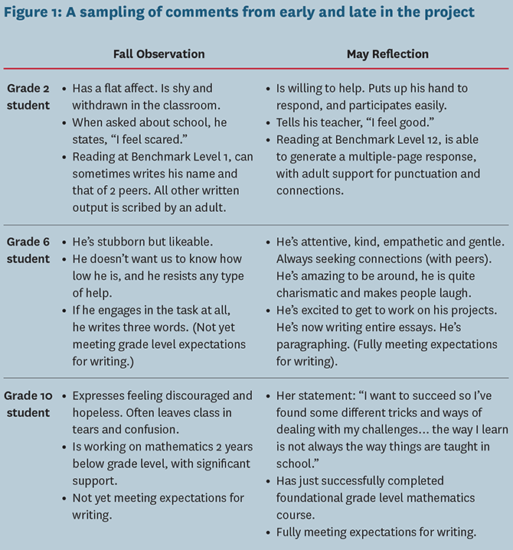
The evolution of the individual teams was really interesting to watch. Over the course of the year, the emphasis of the conversation shifted from a focus on what the students couldn’t do, to a celebration of their strengths and knowledge of themselves as learners. (See Figure 1.) There was never a moment where we “decided” to change our lens. A strength-based approach just grew.
What was responsible for this shift? How did these teams grow to know their learners so deeply, and move them so far, over the course of a single school year?
Charting a course
The conversation in our initial gathering was challenging. The planning team noticed that most of the data focused on poor student engagement and the challenges the teachers were having to adapt the curriculum in a way that met their students’ needs. We had very little data describing areas of strength that we could use as a springboard for further work. At the same time, it was clear that the teachers had chosen their focus students because they were actively seeking new ideas and strategies. These were hard kids to figure out, and their teachers were concerned about them. Helping the teams find a way to engage these vulnerable learners and include them in the classroom community became the most important place to start.
Teaching to ALL
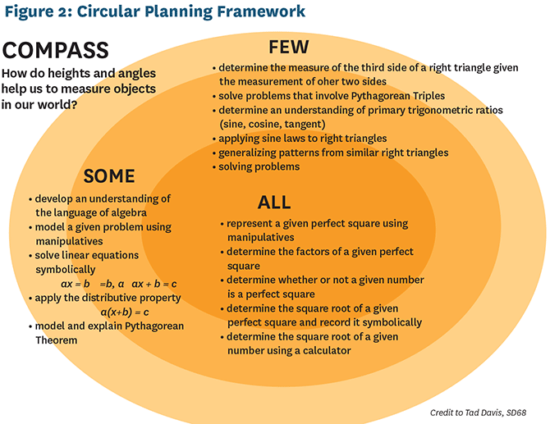
For our first full afternoon together, the Case Study team explored the ideas of Universal Design for Learning (UDL) and differentiated instruction. Our district had been working with Shelley Moore,1 a consultant who is passionate about inclusion. Shelley talks about beginning at a place where everyone can access the learning, rather than teaching to the middle and adapting from there.
Using some of Shelley’s templates, as well as our own model, we introduced the concept of “all, most and some” in developing unit and lesson plans. Jolin Olson, Case Study participant and classroom teacher in a multi-age (8-10) program, explains:
“Planning in a multi-age classroom was almost overwhelming in the beginning, however if I structure my lessons according to Shelly Moore’s idea of “all, some and few,” the teaching becomes very fluid and all of the students feel involved and successful.”
Our goal was to provide whole-class instruction in a way that included all students, not in an adapted or “sit-with-an-education-assistant-at-the-back” kind of way, but in a “we-picked-a-starting-point-everyone-can-launch-from” kind of way. (See Figure 2.)
When we checked in with teachers a few weeks after our initial planning meeting, they reported that they were more aware of ways to include all students in lessons, but that they needed some tools to be able to do this in a seamless and sustained way. When we met in January, we split into three groups, and each facilitator modelled a whole-class lesson using the differentiated planning templates in combination with instructional strategies and technology tools. Our goal was to demonstrate how whole-class lessons could be moved into individual student work in an inclusive way. Strategies and resources were selected based on the feedback and questions we’d received after the first session. One group focused on reading response, a second on intermediate mathematics, and a third on secondary mathematics.
Three weeks later, the teams completed a survey to identify which tools were being used successfully and which needed more support or adjustment. The facilitators then joined planning conversations and visited the classrooms of the individual teams, to provide additional coaching.
The mid-year blues
Like most long-term projects, we hit a bump in the road. As we approached our April session, several teams were concerned they would have little good news to share. Some of the students had started off well, but had not sustained their high levels of engagement or success. The teams had jumped in enthusiastically with their initial changes, but we were working with structures and strategies that were new, and lessons hadn’t always worked as successfully as they’d envisioned.
Fortunately, these dedicated, empathetic educators weren’t stepping away from a challenge. We offered additional training and support, and the teachers tweaked and adjusted their approaches.
Our conversations continued through the spring, and for our final session in May, the facilitators moved from a focus on whole-class lessons to a focus on personalizing the tools for individual students. Participants were looking for ways to add additional layers and options for their classes. They were once again excited to share the progress made by their focus students. We had come through the period of frustration and worry, and now had much to celebrate.
Participant Janis Proctor, a Grade 6/7 teacher, describes how things shifted for her:
“I have seen students become more in charge of their own learning… We introduced new tools to ALL of the students without suggesting which students should use which tool. We let them decide what would help them the most. There were so many ways that students accessed these tools, and this changed depending on what the assignment/task was. This is such an important step in them becoming more reflective about their own learning. It put them in the driver’s seat!”
Reflections
Each session was designed to address the questions or concerns raised by the participating teams. At each gathering, we engaged in reflection and problem solving, and prompted participants to consider specific questions in terms of identifying students’ strengths and lagging skills. We explored teaching strategies and resources to support their focus students, and encouraged teams to work together.
Learning Services Teacher Julie Whynacht summarized her experience this way:
“There were many students that this case study project benefitted in our school. In fact, students who were not even on our “radar” use the tools that we introduced on a daily basis. These tools have supported both their academic growth and their overall self-confidence in their own learning. It helped to create a voice for each student – as each student learned something about themselves as learners.”
Personalizing learning for the adults allowed them to personalize it for their students. For me, this is the true benefit of this project. We began with a conversation about meeting the needs of a highly vulnerable group of individual students. Today, we continue to celebrate and deepen our capacity to provide personalized, differentiated learning for all.
For more information about the EdCan Network’s Educator Well-Being: A Key To Student Success Symposium
Photo: iStock
First published in Education Canada, September 2017
1Shelley Moore, Blogsomemoore: Teaching and Empowering all students. https://blogsomemoore.com
-
Strengthening Teacher Instructional Practices in the N.W.T.
Comments Off on Strengthening Teacher Instructional Practices in the N.W.T.When we compare instructional hours, students in the Northwest Territories (N.W.T.) receive about four more years of schooling than their peers in Finland – and yet Finnish students’ achievement consistently ranks among the highest in the world,1 while N.W.T. students, the majority of whom are of Indigenous descent, continue to lag behind their Canadian counterparts.
So why are Finnish students starting at age seven, in school for just 632 hours (elementary) and 844 hours (secondary) per year,2 and excelling in their core subjects, while N.W.T. students are starting a year or two earlier, in school for 997 hours (elementary) and 1,045 hours (secondary) per year,3 and not doing as well or better?
It turns out that the quality of instruction is more important than the quantity of instruction. Research does not support a relationship between instructional hours and student achievement, but it clearly shows that well-prepared, quality teachers have a strong impact on student outcomes.4 “The amount of time spent in school is much less important than how the available time is spent, what methods of teaching and learning are used, how strong the curriculum is, and how good the teachers are,” states the OECD Educational Indicators in Focus Report (2014).5
While Finnish teachers spend fewer hours at the front of the classroom, they are able to devote more time to designing instruction and interventions that maximize achievement. They have time to ensure success, which strengthens their sense of efficacy and worth, and reduces the exhaustion and burnout.
Overwhelming expectations
The professional expectations on teachers have expanded rapidly in the last few decades, with the change from a focus on teaching to a focus on ensuring student learning. Now, teachers must find time to work collaboratively to determine the Essential Learning Outcomes (ELOs) in the otherwise bloated curriculum guides for each and every grade and subject, and to ensure that all students, even those who do not attend regularly, are making the best possible progress. To that end, teachers complete frequent pre- and post-assessments to know each student’s strengths and stretches in relation to the ELOs. With that information, teachers prepare evidence-based lessons that differentiate and maximize growth for each student. Further, the best teachers engage students and their parents in setting short-term goals for improvement.6
Education in the 21st century, and in Indigenous cultures, must take into account the whole person – teachers are expected to impart not only academic teachings, but also the values and skills that help a child grow into a competent adult. Teachers in the N.W.T. also build their programs on the foundation of Aboriginal culture, and deliver them in a more Indigenized way. And these skills, attitudes and world views – incorporating concepts like truth and reconciliation, self-regulation, resilience, and a positive sense of identity – take time to learn and understand.
Quality teaching and learning, as described above, is a monumental and insurmountable task in a 40-hour work week, considering that for the majority of that time (up to 30 hours) teachers are in front of the class (compared to 18 hours a week for Finland’s teachers).7 Teachers also prepare report cards, supervise children on their breaks, and are extensively involved in student extra-curricular activities. The list goes on.
With so much to accomplish, N.W.T. teachers report working over 52 hours a week on average. If we take a moment to do the math, some teachers are working 2,028 hours per year, compared to other government employees who average 1,725 hours yearly. And that’s after their respective vacation times have been subtracted.8 It’s no wonder teachers feel increasingly stressed by their job demands. This phenomena is not isolated to the North – across the country, teachers are doing more while having less time to recharge. Teacher workload studies, conducted by teachers’ associations across Canada, consistently report that teachers work 50-55 hours each week.9
The N.W.T. STIP Initiative
Starting in the 2017-18 school year, as a result of negotiations between the N.W.T. Teachers’ Association (NWTTA) and the Government of the N.W.T., schools were permitted to submit proposals to redirect up to 100 hours of instructional time divided evenly between teacher professional duties and collaborative professional learning. This Strengthening Teacher Instructional Practices (STIP) time still ensures that students in all grades are in class for a minimum of 945 hours per year – a number more in line with the majority of Canadian provinces, though still much higher than Finland.
The STIP proposals require majority agreement of the school’s teachers, and further approval of the superintendent, the assistant deputy minister, and the president of the NWTTA. It is the locally elected District Education Authority (DEA) that approves the school year calendar, so the principal must ensure the calendar meets legislative requirements and receives the DEA’s approval.
How schools are responding
Principals, teachers, and their local DEAs worked together to determine what would work best for the parents, students, and staff of each community. They analyzed past school attendance records and considered the implications that schedule changes could have on things like busing and childcare. While schools were given the autonomy to determine how to redistribute the time, they were all required to approach the task with the same priority: to improve staff and student wellness and achievement.
For some schools, this means Friday afternoons free of student contact time, giving students an early start to their weekend and staff a chance to decompress as well as plan for the next week. For others, Monday mornings have the poorest attendance, making that the logical STIP time. And a few chose to attach full STIP days to holidays and other breaks through the year.
At Paul W. Kaeser High School in Fort Smith, classes used to begin at 8:30 a.m. sharp. But student attendance and tardiness is an issue in the mornings. So in 2017-18, students will begin their lessons at 9:10 a.m. as their teachers take the first 40 minutes to analyze student assessments, share strategies, and prepare more effective lessons. Principal Al Karasiuk, one of Canda’s Outstanding Principals in 2012 (The Learning Partnership), says, “We are going to work towards very specific data analysis – understanding the data, setting short-term goals to target learning outcomes, and ensuring that the kids are ‘getting it.’”
While the teachers are hard at work, students will be invited – and bused – to arrive early to school and enjoy a free hot breakfast and a slow start to their day in the foyer. Educational assistants will be available to supervise, tutor, and facilitate morning extra-curricular activities.
Karasiuk sees his proposal as a win-win for both staff and students. Teachers will have time to orient themselves for the day and collaborate with their colleagues, while the teens will be able to snag an extra half an hour of sleep or fill up on the oft-touted “most important meal of the day.” By the time the instructional part of the day officially starts, they are more likely to be rested, well-fed, and prepared to learn.
Deninu School in Fort Resolution, a small community of 500 Chipewyan people, kept the importance of teamwork at the forefront when redirecting 74 hours. The school has had success hiring educators who have been teaching internationally, in places as far away as China or South Korea, before deciding to return to Canada. But Beijing and Seoul are very different from the N.W.T., and when asked for their feedback on how the hours might be redistributed, the current teachers reported that a few extra days near the beginning of the year to help ease them back into the Canadian curriculum, and to get support with the development of integrated year plans, would be helpful.
The other STIP days are dispersed throughout the year, in line with Deninu School’s planning cycle. Every four to six weeks, the staff will have time to meet and prepare for the upcoming units they will be teaching. “We chose to schedule full days of STIP time,” explains Principal Kate Powell, a co-recipient of a Premier’s Award for Excellence and a Ministerial Literacy Award. “To have meaningful conversations and collaboration, teachers suggested that we needed long periods of time. We plan to use the mornings of these days for collaborative planning, marking, assessing, and goal setting; and then the afternoons for teachers to work independently incorporating the morning’s learnings in the preparation of their units and lessons.”
The value of Professional Learning Communities
Professional Learning Communities, or PLCs, have long been proven as one of the best strategies for ensuring all students learn at high levels. In what is touted as the largest ever evidence-based research in education, Hattie synthesized those factors that the research shows to have the greatest impact on student achievement, with Collective Teacher Efficacy ranking the highest.10
Frequent PLC meetings provide opportunities for teachers in similar grade or subject areas to work together to address challenges and share best practices, driven by actual classroom evidence. The result is stronger, more confident teachers who no longer feel isolated in their concerns about students or the curriculum. By sharing and learning together, teacher wellness and effectiveness is supported and enhanced.
Expected results
A quick search of the Internet shows that teaching is often rated in the top ten most stressful professions, and our educators are facing increasingly high expectations in regard to unique student needs, cultural relevance, truth and reconciliation, accountability, testing, and student achievement.
As counter-intuitive as it may appear, the evidence suggests that reducing instructional time can result in more effective instruction and in more students achieving their potential, provided the “found” time is used for teacher professional duties and collaborative planning.
By giving teachers up to 100 hours of collaborative professional learning and working time throughout the school year to be more effective, we are hopeful that we can offset the high number of hours they work each year, while increasing their job satisfaction and well-being.
If the expected results occur, more teachers will be energized to come to work every day instead of feeling emotionally exhausted. Improved wellness should lead to less sick time and less money spent on substitute teachers (who are in extremely short supply or unavailable in most small outlying communities), resulting in a more stable, supportive environment for our students to grow. We are hopeful that the domino effect will include students being motivated to come to school, attending regularly, performing well on tests, and graduating in larger numbers.
The evolution of education demands a culture of both wellness and success in order for both staff and students to thrive. Along with the partners involved in this pilot project, we are keen to monitor and evaluate its effects on staff and student well-being and achievement.
Photo: courtesy Curtis Brown and Sarah Pruys
First published in Education Canada, September 2017
1 Programme for International Student Assessment, “PISA 2015 Results in Focus,” Organisation for Economic Co-operation and Development (2016). https://goo.gl/TsLeC3
2 European Commission/EACEA/Eurydice, “Recommended Annual Instruction Time in Full-time Compulsory Education in Europe 2015/16,” Eurydice – Facts and Figures (Luxembourg: Publications Office of the European Union, May 2016).https://goo.gl/0T4tpm
3 Canadian Education Statistics Council, “Education Indicators in Canada: An international perspective,” Statistics Canada (February 13, 2015). https://goo.gl/GRcpUU
4 J. Hattie, Visible Learning: A synthesis of over 800 meta-analyses relating to achievement, 1st edition (London, New York: Routledge, 2009).
5 Organisation for Economic Co-operation and Development, “Education Indicators in Focus,” OECD (April 2014). https://goo.gl/SLE2gv
6 Adapted from the work of the DuFours in Learning by Doing: A handbook for professional learning communities at work, 3rd Ed. (Bloomington, Indiana: Solution Tree Press, 2016).
7 Kristen Lewis, “Lessons From Finland,” Scholastic. http://bit.ly/2qBQg1c
8 Government of the Northwest Territories, NWT Teacher Time and Workload Study (GNWT, January 2017). https://goo.gl/9XT24A
9 Compiled by C. Naylor, E. O’Neill, and K. Rojem, Teacher Worklife Research (BC Teachers’ Federation). https://goo.gl/HJxsYq
10 The larger the effect size, the more powerful the influence. Hattie concludes that an effect size of 0.4 is medium and 0.6 is large. His research shows an effect size of 1.57 for Collective Teacher Efficacy.
-
Distance Education that Works
Comments Off on Distance Education that WorksOne of the perennial challenges confronting small, rural and remote high schools is the provision of a curriculum program comparable in breadth and quality to that available to students in larger schools.1 Traditionally, the programs and courses that a school can provide are dependent on the number of teachers employed in the school and their professional qualifications, experience, and expertise. The low enrolment of smaller schools means there are fewer teachers on staff, and this limits the number of courses that can be offered to students.
In the smallest schools, the curriculum may be the bare minimum required for students to graduate, with few if any specialized courses in the arts, foreign languages, or skilled trades. In such schools, teachers will often have an increased workload and be teaching outside their areas of expertise – a math teacher, for example, may take on an English course or vice versa. In the smallest schools, teachers may have to teach two or more courses in a single instructional period. And although rural teachers are dedicated and work exceedingly hard to provide the best they can for their students, it is hardly an ideal educational situation.
The curriculum challenge is exacerbated for small, rural high schools situated in remote and isolated places. Living and working in a remote community is not for everyone. These schools have always had difficulty recruiting and especially retaining teachers in the areas of math, science and foreign languages. New math and science teachers are generally in high demand, and most prefer not to go to small, isolated places. When they do, they often stay only for a year; they see the remote school merely as a “stepping stone” to a more urban appointment. The high teacher turnover in such schools and the resulting lack of continuity is not good for the school, the community or (and especially) the students.

The Newfoundland and Labrador context
Newfoundland and Labrador is a province of small rural schools. In the 2016/17 school year there are only 262 schools, with an average enrolment of 255. The 165 schools classified as rural have an average enrolment of 144. Forty of these rural schools have less than 50 students, and half of them are all-grade schools providing instruction for students from K-12. The senior high school cohort of these all-grade schools is commonly less than 12 students per grade.
Student enrolment has declined dramatically in the last 25 years, from 130,109 in 1990 to 66,800 in 2016. During that same time period, the government has pursued a persistent program of school closure and consolidation. Despite strong community opposition and heartfelt resistance, 281 schools have been closed – the vast majority of which were small rural community schools. The rationale used for these closures was the purported enhanced educational opportunities available at larger schools – opportunities which, the government claimed, were worth the long and often dangerous bus rides students might have to endure.
These recent school closures simply continue a trend that dates back to the publication of the Warren Royal Commission Report in 1967.2 Clinging to the questionable belief that “bigger is better” when it comes to schooling, various governments have closed almost a thousand schools, mostly rural, since 1965.
However, one group of schools has frustrated education officials’ quest to totally eliminate small schools. These are schools situated in such remote and isolated rural places that busing students to a larger school in another community has not been possible. Some of these schools exist on islands with limited ferry service. Others are simply too far from the next nearest school.
Warren despaired that high school students in these remote communities would ever have access to a quality education. He suggested that the government consider creating residential boarding schools for them – an idea, thankfully, that was never acted on. Subsequent government reports3 recommended that a program of distance learning be developed as a way of delivering an enhanced curriculum to rural and remote schools.
Distance education, eLearning and virtual schools
By the late 1990s, the government had come to the realization that there were few small rural schools remaining that could be reasonably targeted for closure. A significant number (93) of “small necessarily existent” (SNE) schools would continue to remain open because it was not feasible to close them, given their remote locations. These schools had to be provided for as long as people continued to live in these communities. It was also clear that enrolment would continue to decline for the foreseeable future and that rural schools would continue to lose teachers.
In August 1999, the government of Newfoundland and Labrador announced the formation of a Ministerial Panel mandated to examine the current education delivery model and to investigate and recommend “alternative delivery strategies.” The premier of the day, Brian Tobin, stated his government’s commitment to “doing everything possible to ensure that all children in this province, regardless of where they live, have access to a balanced and high quality education.”
“Most alternatives,” the Panel would determine, “involve a form of distance learning… delivered by various forms of electronic media via what has come to be known as the “virtual classroom.”4
The Ministerial Panel report, Supporting Learning, was published in March 2000. It recommended that the government create the Centre of Distance Learning and Innovation (CDLI). CDLI would function as a virtual school and would be responsible for the development and delivery of high school courses via the Internet to rural, remote and isolated schools. These web-based or eLearning courses would offer programs and courses that small rural schools were not able to offer on site because of insufficient teachers or teacher expertise.
Previous to this, the province had offered a very limited distance education program using an audiographics delivery system. The vision for CDLI was to be much more inclusive and eventually make available the complete high school program via the Internet. Any student who did not have access to a course in their brick and mortar school on site would be able to take it online in the province’s virtual school.
The Centre for Distance Learning and Innovation (CDLI) piloted its first ten web-based courses in the 2001/02 school year. By 2004/05, CDLI was offering 35 courses with 1,500 student enrolments from 95 different schools.5
CDLI Today6
Since its beginnings, CDLI has developed its technology, eLearning pedagogy and course offerings. Today, it has a staff of 46, including program and IT specialists, a guidance counselor, and 29 e-teachers.
Currently there are 1,105 students registered in one or more of 42 senior high school courses that cover advanced and academic mathematics, sciences, English and French languages, technology education, social studies, skilled trades, French first language, and fine arts (both music and visual art). CDLI courses are delivered to 110 schools in the province.
CDLI has been judged to be successful by students, parents and educators. Students in rural and remote schools now have access to all courses offered by the Department of Education. The online courses are identical in terms of content, outcomes, and assessment to those offered in the province’s face-to-face schools, and the academic achievement of online students is generally on a par with those in the province’s traditional brick and mortar schools. Thousands of students have successfully completed online high school courses and qualified for post-secondary education.
Why CDLI is successful
There are a number of reasons for this success.
CDLI, as a small virtual school, enjoys the advantages that all small schools and organizations have. Most virtual schools, especially those in the U.S., are fairly large organizations. CDLI is focused exclusively on rural students in Newfoundland and Labrador; only students who are enrolled in a provincial high school can access the eLearning courses.
CDLI’s eTeachers are first and foremost subject matter specialists, many with Master’s degrees. They also have extensive training in eLearning pedagogy. Equally important, they are experienced teachers who are familiar with rural students and rural schools. They are in constant contact with their students and are able to develop an intimate knowledge of their needs and abilities. This kind of personal relationship is not possible in larger virtual schools, whose students may be anywhere in the world.
One of the most important and distinguishing features of CDLI is its substantial use of synchronous interaction between eTeachers and online students. CDLI’s virtual classrooms are delivered in two formats: synchronous (sometimes referred to as “online”) and asynchronous (sometimes referred to as “offline”). During the synchronous classes, students and teachers interact in real time.
One way this is done is through web conferencing. Blackboard Collaborate™ (sometimes abbreviated as eLive) is the web conferencing tool used by CDLI. It is the students’ online classroom, where direct instruction/interaction takes place between the e-Teacher and students. CDLI teachers deliver the curriculum mainly through this method and monitor student interaction, participation and progress in real time.
Depending on the course, students can expect to spend anywhere from 40 to 70 percent of their class time using this tool. Synchronous interaction makes an enormous difference to online pedagogy and closely emulates face-to-face instruction.
The asynchronous features of CDLI also contribute to student success. A class can, for example, break from the large-group session for independent or small-group work. Work on written assignments can be scheduled independently by individuals or teams. Thus the students enjoy a degree of flexibility in their activities. Students use CDLI’s learning management system, Desire2Learn, to coordinate group work, as well as to:
• email their classmates and instructors
• post comments and opinions to the discussion forum for the course
• access and submit written assignments
• interact with learning content, both in the form of web pages and multimedia
• view grades.
Finally, rural schools that are part of the CDLI family are required to have a team or teacher to provide support and assistance to students taking online courses. They work closely with the eTeachers to help students in any way they can. CDLI also provides its students with both synchronous and asynchronous academic tutoring.
For more than 30 years, researchers have claimed that technology-based distance education has the potential to make the size and location of a school irrelevant in terms of access to a broad, high-quality curriculum. The Centre for Distance Learning and Innovation (CDLI) has made that promise a reality by providing rural students in remote schools online access to any course they need or desire.
Quality education, however, is not just a matter of access or delivery. The success of CDLI is tied to the pedagogical support provided to students, the quality and commitment of its eTeachers, and the appropriate mix of synchronous and asynchronous communication and interactions. With these features, it serves as a model of how a virtual school should function.
En Bref : Grâce au développement de la formation à distance en ligne de qualité, la taille et le lieu d’une école n’importent plus pour déterminer sa capacité d’offrir aux élèves ruraux des programmes et des cours essentiels. Cet article décrit comment, par le cyberapprentissage (E-learning), l’école secondaire virtuelle de Terre-Neuve-et-Labrador (CDLI) donne accès au curriculum du secondaire de la province aux écoles rurales et éloignées.
Photo: iStock
First published in Education Canada, June 2017
1 This is a universal issue for small rural and remote schools.
2 P. J. Warren, The Report of the Royal Commission on Education and Youth (Government of Newfoundland and Labrador, 1967).
3 F. Riggs, Report of the Small Schools Study Project (Government
of Newfoundland and Labrador, 1987); L. Williams,Our Children Our Future (Government of Newfoundland and Labrador, 1992); R. Sparkes and L. Williams,Supporting Learning (Government of Newfoundland and Labrador, 2000).4 R. Sparkes and L. Williams, Supporting Learning, 9.
5 M. K. Barbour, “Portrait of Virtual Schooling,” Canadian Journal of Educational Administration and Policy 59 (February 11, 2007).
6 Two main sources for information about CDLI used for this article are: www.cdli.ca (the CDLI website); and Michael Barbour, State of the Nation: K-12 E Learning in Canada (2004-2016). http://canelearn.net/research/state
-
Stop Asking Them to Turn Off Their Devices!
Comments Off on Stop Asking Them to Turn Off Their Devices!Today’s youth face challenges in navigating a digitally infused world. Yet we often leave young people to make their own decisions about ethical, safe and responsible use of digital technologies, with minimal guidance. In schools, students encounter inconsistent expectations for using technology from one teacher to the next, while different rules again may apply during breaks between classes. They also have to contend with peer pressure to use the latest and greatest apps for communications.
It’s common for students to arrive at school tethered to a personal device, and then enter a classroom where the device needs to be turned off or turned in to the teacher. But when we ask students to disengage with their devices, we lose a critical opportunity to help them learn how to ethically, safely and responsibly use digital technologies, and to promote active and informed digital citizenship. Students are carrying powerful learning devices; they already search online for information, use videos for learning, take photos of assignments, access digital texts, spend time on content creation sites, and use devices to communicate and collaborate with each other and connect with teachers to ask questions about school work.1 However, learning opportunities for youth to develop a critical 21st century skill – the safe and responsible use of digital technologies – are often limited and overly structured, at the discretion of the classroom teacher or school leader.
We’ve all heard of cyberbullying cases where students repeatedly use technology to broadly share content intended to hurt others. With a single click, a text message with a mean comment about someone else can spread throughout an entire student body. A sexually explicit image or message can become publicly accessible within seconds. How, then, can we ensure we are providing opportunities for young people in school to learn how to ethically and safely use powerful learning and communications devices?
1. Teach students how to practice “safe sharing” of their information.
Make safe information sharing a part of everyday learning, and design lessons where learners can demonstrate their understanding. Invite students to explain what they do to protect themselves and others in online spaces. For example, discuss how personal information can be inadvertently shared through hidden identifiers (background images, location, etc.). Talk about ways to protect information that can be shared through images, video, text posts and tags. Focus on how to practice “safe sharing” of one’s own information.
2. Keep online safety conversations current and relevant.
Teachers and school leaders need to stay up to date on how technology is changing. Years ago, it was important to teach students to keep passwords secure, change them regularly and not share passwords with friends. Today, students also need to learn about fingerprint security and the risks in storing friends’ fingerprints on their personal devices.
3. Move beyond a one-week blitz.
Learning about citizenship in a digital age needs to be part of the daily learning environment at school. Inviting a guest speaker to talk to staff, students and parents once each school year is not enough, nor is discussing online safety only during Digital Citizenship Week. Collective and ongoing efforts are needed to make digital citizenship a part of daily learning outcomes in schools.
4. Share examples of youth service and leadership.
Share how students are using technologies for social justice and to help others. There are daily news posts about youth who are providing service and helping others locally and globally that can be used to foster conversations about student leadership and action campaigns.2
5. Don’t reinvent the wheel.
Look at guiding documents developed in your local context. For example, guiding documents from provincial ministries in Canada3 can be used as a starting point to help students develop responsibility in safely and ethically navigating online spaces. Educators may also find such guides helpful for ideas about how to protect students as they work in open, collaborative online environments.
En Bref : En cette ère numérique participative, nous devons donner aux jeunes les moyens d’être des citoyens numériques actifs, informés et éthiques.
Illustration: iStock
First published in Education Canada, March 2017
1 Project Tomorrow, Speak Up Research Project for Digital Learning (2015). www.tomorrow.org/speakup/index.html
2 For example, see the campaigns sponsored by the WE Movement. www.we.org/we-at-school/we-schools/campaigns
3 For example, Alberta Education, “Digital Citizenship Policy Development Guide” (2012), https://education.alberta.ca/media/3227621/digital-citizenship-policy-development-guide.pdf ; Government of Saskatchewan, “Digital Citizenship Education in Saskatchewan Schools” (2015), http://publications.gov.sk.ca/documents/11/83322-DC%20Guide%20-%20ENGLISH%202.pdf
-
The Magic Button
Comments Off on The Magic ButtonThe kids with moms and dads were all in preschool that day – the day his torso and head were replaced with a dense rack of coats. Below the coats stood baggy-kneed khakis and knobby ankles emerging from Toy Story runners (Velcroed, so that his inability to tie laces would not be another source of shame). They were positioned in the far corner of the closet for greater invisibility, toes pointed toward the bank of cubbies stuffed with crayon cases, toys, and lunch boxes.
Except for the bright yellow cubby marked “Marshall.” It contained only a printed cardboard lunch box.
Eventually, he was discovered by a lady voice that said, “Oh, hello there.” Followed by, “That is a really cool hiding place.” The voice was not going to go away, and he surprised himself because he didn’t mind.
“I’m feeling like it is kind of loud in the other room, so is it okay if I stay for a few minutes?”
“Okay,” said the rack of coats.
“I’m Mrs. Rundle,” said the voice. “But you can call me Sillypants if you want to.”
He parted two jackets just enough to see pants in a cross-legged position on the floor. They did not look silly at all, but the hems rose just enough so that he could see socks with cartoon, wink-faced butterflies. He wanted to say, “You mean Sillysocks!” but he wasn’t completely ready to stop being invisible.
The small shoes were the first to grow impatient with hiding. They shuffled from toes that pigeoned slightly forward, as if ready to jump. The curtain parted as his arms became hungry to be brave.
“I think you’re Marshall, is that right?” she asked him, with a soft emphasis on Marshall in a way he had never heard before. A way that told him she felt that it was important to be Marshall.
He looked at her socks as an affirmation.
“Yes,” she said, “they are certainly happy butterflies, but they do want to escape from my socks and start flying around the classroom and cause all kinds of mischief.” That was the moment his eyes connected with hers, because the little boy with the adult-level circumstances realized that this teacher could see the amazing playground outside of the literal world. Grownups weren’t supposed to be able to see it.
Her eyes reflected the ceiling lights in a way that made them appear extra sparkly. They looked at him like he was wonderful and he didn’t understand. As if she sensed his awkwardness she said, “I put on this shirt this morning and then realized it has a magic button!”
Marshall’s eyes followed where her finger pointed. They looked into her eyes again for confirmation. Then back to the finger pressing on the round button. When he heard a squeak his eyebrows floated uncontrolled towards his hairline, like the rise of helium balloons coming untethered.
“Want to try it?”
His index finger extended from the curled fingers as if they gave it permission to venture forward. For that moment he was allowed to be three years old; the only weight on him whether or not the button would be magic for him, too.
And it was.
He pushed the magic button several times, each time rising higher on his toes as he reached out, and each time, as self-consciousness gave way to innocence, reacting more gleefully. Until he almost couldn’t hear the squeak above his own laughter.
Sillysocks laughed, too. Her eyes became rimmed in the moisture that sometimes happens when someone laughs so hard that they’d better pee their eyes or they will pee their pants. If there was sadness in her tears, it was the adult fear that this boy might never know how perfect he was because his circumstances were so unfair and so unlucky.
She would never know that this deposit of worth survived more than two decades and is sometimes the only thing that separates him from free fall. When a child feels that his mommy left because he did something wrong, he can sequester himself in a closet; but a man knows that even nonsensical shame can be inescapable. Yet he remembers the feeling of those soft arms of value and belonging, and he still believes in their magic.
Illustration: Dave Donald
First published in Education Canada, March 2017
-
Hurry Up and Wait
Comments Off on Hurry Up and Wait“At one communty meeting, we ran into a high-conflict issue. We ran out of time and agreed to postpone this issue until the following week. All week, emotions ran high and opposing views intensified. We eagerly assembled at the next meeting, impatient to get this issue resolved. This was a Quaker community—each meeting began with 5 minutes of silence. On this day, the clerk announced that, due to the intensity of this issue, we would not begin with our usual 5 minutes of silence. We all breathed a sigh of relief, only to hear her announce: “Today, we’ll begin with 20 minutes of silence.” —as told by Parker Palmer, Educator and Writer
This is the story that begins a brief essay on urgency by Margaret Wheatley from her 2010 book, Perseverance. It’s the story that captured my imagination as my thoughts moved across the threshold into another year.
To many, the turning point in Palmer’s story will seem more than a little counter-intuitive, especially when placed in the context of a reflection on urgency. After all, isn’t urgency a call to immediate action—a push to drop everything and respond?
As Wheatley points out, a sense of urgency pushes us into a crisis mode and our behaviour changes as a result. We are often fueled by anger and we lose our sense of foresight as well as our ability to think with clarity. The world becomes increasingly polarized and divided into those who “get it” and those who don’t:
“And we get angry. Anyone who doesn’t respond immediately becomes our enemy. They may actually be wise people who caution patience, who have a longer-term perspective. But we can’t hear their wisdome or experience; we’re too anxiously engaged in our cause. We hastily udge them as being in denial or just looking for an excuse not to get involved.” (from Urgency Urgency by Margaret Wheatley)
It has been my experience, in both my personal and professional life, that a sense of urgency can quickly transmute into a state of emergency!
Urgency is a bit of a double-edged sword, isn’t it? On the one hand, a sense of urgency can help to create the impetus for action. It can wake us out of our acceptance of the status quo and inspire us to action. In this way, there are many who believe that the change in education we want to see would benefit from a greater sense of urgency. At the same time, we don’t have to look very far to find evidence that the urgency trap has caused us to rush to respond to reports, test scores, public opinion and political ideology before we take enough time to allow us to move along the trajectory from data to information and through to knowledge and wisdom.
But what do we take from Palmer’s story as it appears within Wheatley’s context of urgency? What might emerge if our responses to educational indicators and datasets began with a type of no immediate action policy, allowing for the time to rest in the kind of “organizational silence” that, far from ignoring the need to respond, opened up a space for inquiry, insight and wisdom? And what if the results of that silence were allowed to influence the decisions we make and the actions we take? And what might happen if the length of that period of silence was directly related to just how urgent we perceive the situation to be?
Some opening thoughts at the beginning of another year.
-
“Rapping” Up a Unit
Comments Off on “Rapping” Up a UnitAs a fun formative activity, I once asked the students in my two Grade 12 Physics classes, who had just finished a unit on relativity, to write a poem on topic(s) from the unit. More than a year later, as a PhD student in a Curriculum Theory class, I wrote the following piece describing what transpired.
You can perform the following rap song with this accompanying backbeat: www.youtube.com/watch?v=5DtgXdOYbq8
They started writing, for homework writing,
A relavistic poem ain’t that so exciting?
But when the day came, for show-and-tell fame,
My solid class – the “straight up” class, they hung their heads in shame.Most didn’t do it, just wouldn’t try it,
And with each smiling shaking head I felt infuriated.
No marks, just for fun? They thought, “Prioritize!”
Extrinsic motivation, hard for me to sympathize.My head grew warm, thought “do no harm,”
tried to stay calm, cause no alarm.
I let it go, told them to go,
but just to write a Haiku would it have hurt you so?Yeah, I should have had some moral agency,
So now in retrospective hermeneutic philosophy,
I look for messages, uncover baggages,
Unwrap the words that hold the vessels of my consciousness.And I realized that they were tired,
high marks they did desire.
The schooling ethos had a faster than the fastest pace.
Writing a poem might just bump you from scholarship race.Slowing down the school curriculum…
How do you do it when the smartest brain is going numb?
With tests, reports, and academics?
With writing essays on things like moral ethics?And here comes the generative lesson,
It goes deeper than I think I have you guessin’
Because, my friends, I have a quick surprise
Something that happened after – you don’t realize.You see, I had another Physics bunch.
Goofier, but they were going through the same crunch.
I wasn’t hopeful, of this I was aware.
“Anyone with a poem that they would like to share?”Yes! Most did! The best ones were long.
And two wrote it as a genuine rap song.It goes to show, given same opportunities
Some fly, some sink – depends on personalities
Of the kids, of the class,
of the school, of the entire world mass
That weighs down on each and every one of them.
Makes it hard to pin the reason or just to blame.Perhaps the lesson is one of fun.
To enjoy the work, not to “just to get ’er done.”
To share a poem, or any creative craft
It’s something special, it’s a virtuous act.
For it is done with the unselfish intent
To bring joy and rhythmic attention to the moment.And so with that poetic reconstitution
I’d like to leave you with two considerations:
Has this process increased my durability?
Do I feel lighter and poised with self-assurety?
I don’t know but as this poem’s been heard,
I’ve had a lot of fun and that’s my last key “word.”Note: This poem plays with concepts from two texts used in my course. The phrases moral agency, hermeneutic philosophy, generative lesson, and ideas like having a lighter and durable teaching self are taken from L. Fowler’s “Narrative Plains of Pedagogy: A curriculum of difficulty,” found in E. Hasebe-Ludt & W. Hurren (Eds.), Curriculum Intertext (NY: Peter Lang, 2003), 159-72. Vessels of my consciousness, slow schooling, rhythmic attention to the moment, and ideas like virtue and unselfishness connected to the aesthetics of curriculum are from R. Luce Kapler’s article, “Orality of Poetics of Curriculum,” in the Journal of the Canadian Association for Curriculum Studies 1, no. 2 (2003): 79-93.
Collage: Dave Donald
First published in Education Canada, December 2016
-
The Red Worn Runners
Comments Off on The Red Worn RunnersSometimes five, sometimes 18, one time 30, but every day through August the Red Worn Runners have been inspiring me as we shuffle, sprint, and navigate our way down the dusty roads of Enoch Cree Nation, always wearing red – red T-shirts that is. It is a beautiful thing to experience. We always start at the local school in the town site, stretching, slowly getting ready for a run. Sometimes I love this daily ritual, other times I loathe it; it depends how my body is feeling. But we stick together through this, one day at a time. Girls, boys, young people, and older people like myself make this trek daily throughout July and August. Sometimes we run four kilometers in a day and we make sure to always jog by the community health centre and the band office.
It is interesting because now people wave at us when we jog. They used to look at us with mistrust. There was doubt in their glances. They quietly shook their heads as they saw youth move in a different way. I like visiting with the youth about the run and how it feels. They say they love it and now I am starting to believe it, as they log their kilometers and check the poster we’ve made to see how far they are going, to see how far they have been. Did I tell you… you should see these kids run. It is beautiful – no training, no fancy gyms – just the town site, bumpy dirt roads with truck imprints embedded in the earth… then the sandy gravel of the back roads towards the potato plantation, our target turnaround always.
Wheat fields and canola fields are on each side. They seem to be our only fans some days and they seem to wave us on when we move. No judgments there. We run and the youth tell me they have never done this before, never seen the fields as I describe them, never seen the beauty in them like I describe. I am hoping and thinking they see it now. I am hoping they see something different within themselves.
We are all in a line, a long red line, staying as close together as possible. And when the Red Worn Runners take off into the distance, it is magical. It takes me home every time we run; home to the gravel roads and the farms of my youth, to the wheat fields and barley fields, and the beautiful sounds and smells that I cannot imagine in the city. We talk about treaties, families, relationships, and the beauty of creation on the morning jogs. We are simply moving knowledge, as Basso[1] might say. This is the living curriculum[2] they talk about, the familial curriculum[3] acknowledged. I did not think that the kids would continue but it goes to show you how much I don’t know. They showed up every day and even run on their own these days.
The Red Worn Runners will continue to be on my mind as the leaves get ready to turn and the farmer swaths down the majesty to the left and the flowering yellow to the right. It is indeed a beautiful thing, one I won’t soon forget. I hope we keep running. Sometimes five, sometimes 18, one time 30, today just me. The Red Worn Runners inspired me to shuffle, sprint, and navigate my way down the dusty roads of Enoch Cree Nation, always wearing red – a red T-shirt, that is.
Many years later I continue to go back to this opening narrative, at times reading it, at times sharing it with different audiences, but always pausing somewhere in the middle and thinking with these earlier moments of teaching. I reread this narrative today, letting my words call those youth back to mind. Letting the words take me back to their words, their stories, their voices and the images of moving in a different way alongside one another. Letting the words take me back to the dreams of what might be possible if we listen carefully and attend to the voices of Indigenous youth. These words stay with me as I think of who I am and who I am becoming as an Indigenous writer and educator. They remind me to always return to the early experiences, sometimes physically, sometimes metaphorically, for it is in that return home that I am sustained.
Creating conversational spaces[4]
Seven years ago I was teaching Social Studies at a large urban high school in a prairie city. I was given an opportunity by school leadership, particularly the principal, to create and lead an initiative aimed at meeting district and provincial goals of increasing high school completion and retention for Indigenous students. Through this process I was given one spare period to start meeting individually with the 250 self-identified First Nation, Métis and Inuit (FMNI) students who were enrolled in this school.
“I want to graduate.”
“The fact that I am Aboriginal tells me that most people won’t think I will make it, but I know I will.”
“I want to be as highly respected as my late grandfather someday.”
“We want to make our grandmother proud.”
Their words reverberate in my thoughts, even now, as I sift through vision statements we created many years ago. Through those intentional conversations, the youth and I co-created spaces within a high school in which I came to better understand, and respond to, what mattered in the lives of Indigenous youth attending this school.
Moving with intention
The youth taught me, through this work and through this in-between space of intentional conversation on a school landscape, to move with intention, both metaphorically and physically. To move with intention in this way means to be responsive in the ways in which I am trying to understand the experiences of youth within the context of school. It is expressed through my actions and responses to the voices of youth and the calls that they were making – both directly and indirectly – to engage in something different. More broadly, it is a call to move beyond rhetoric in student voice, and in particular Indigenous student voice within the institution of school.
The title of the opening narrative, “The Red Worn Runners,” was a name the youth chose for themselves. These young Indigenous people wanted to engage in education differently. They were determined to graduate from high school with their classmates. However, they were unable to participate in summer school courses in the high school due to transportation and jurisdictional issues between federal and provincial school systems.
As I created a conversational space and invited each of those 250 students, one by one, into conversation with me, they began to feel that their voices were being heard and honoured with a response. In these conversations the youth shared their hopes and dreams for their futures. They shared their hopes of graduating with their peers, which required taking specific summer courses to fulfill their dreams. As I heard their voices and recalled my own experiences as a youth, I began to imagine how this might be possible. As I talked with the students, initially there were four or five students interested in summer school studies. By the time summer school started that July, there were over 30. “We are all in a line, a long red line, staying as close together as possible.”
Embracing uncertainty
I quickly recruited teacher colleagues who were open, flexible, and willing to try something different. We proposed to teach Math, Social Studies, Aboriginal Studies and Career and Life Management during the summer months. No longer would we as teachers be living within the comfort of classroom subjects and the familiarity of our classroom and school environment in the city. The classroom would be located in the youths’ home-place of Enoch Cree Nation, a community with distinct protocols and teachings that are layered in the history of the land and people. This summer school experience would be markedly different for the teachers and for the students, their families and their community. The students would be our guides and in many ways our teachers. Their voices would lead the way and their everyday actions and movements would shape daily programming.
All along they were teaching us, as teachers, new steps, new rhythms to our knowing of teaching.
As teachers we had to learn to let go of the certainty of what we knew from teaching within school. We would learn through this experience to improvise and let go of what we could no longer guarantee as certain or comfortable.
As we began to plan with the students and to travel to the community, we, students and teachers, were learning and imagining school differently. We were learning and imagining alongside one another in this work. Time looked different in the company of trees and through “the wheat fields and barley fields, and the beautiful sounds and smells that I(we) cannot imagine in the city.”
Looking backwards and forward
Our school colour was red, and as we met each morning during the summer months, the youth wanted to begin each day with a run. They chose the colour red as it was a noticeable colour when we were running on the gravel roads of Enoch Cree Nation. The youth spoke of the importance of being visible through their actions. All along they were teaching us, as teachers, new steps, new rhythms to our knowing of teaching.
Now, many years later, I reflect on how time has moved quickly and now the Red Worn Runners have moved on in different directions and trajectories in their lives. Many of the youth have now graduated from college and university. Some are teachers while others are excelling in various professions and careers. I too have moved on to a different position at a university, but those days of learning alongside the Red Worn Runners stay with me in the present. They taught me. They took me home to what it means to be a youth, an Indigenous youth, in high school and what might happen if teachers and others listened carefully to students and together imagined what might be possible within schools.
I chose to highlight various threads in this article – creating conversational spaces, moving with intention and embracing uncertainty – as examples of what stood out to me as I reflected on the experience and what I have learned about the importance of student voice and response to student voice. I recognize that it would not be appropriate or realistic that every classroom and school participate in a similar way to the one I shared; that would be a misreading of my intentions. However, to me the sharing of this narrative was never about the specific programming details of a summer school experience alongside Indigenous youth.
I tell this story now to show how much the young people within the Red Worn Runners pushed me as well as my colleagues to move differently, to think differently, and to embrace what might happen when youth lead, not only with their voices but through their actions… through their movements.
Sometimes five (youth), sometimes 18 (youth), one time 30 (youth), today just me. The Red Worn Runners inspired me to shuffle, sprint, and navigate my way down the dusty roads of Enoch Cree Nation, always wearing red – a red T-shirt, that is.
En Bref: Sean Lessard examine comment son travail antérieur auprès de jeunes dans des collectivités (les Red Worn Runners) continue de modeler sa façon de percevoir le curriculum comme un processus fluide, transactionnel et truffé de possibilités. Lessard tire parti de ces expériences narratives, sur les plans philosophiques et pragmatiques, dans le cadre de ses recherches explorant l’identité, la voix des jeunes et la conception du curriculum à l’intérieur comme à l’extérieur des lieux scolaires; ces lieux comprennent les collectivités dans l’Ouest canadien où les jeunes et leurs familles continuent de guider ses travaux.
Illustration: Melanie Luther
First published in Education Canada, December 2016
1 Keith Basso, Wisdom Sits in Places: Landscape and language among the Western Apache (New Mexico: University of New Mexico Press, 1996).
2 Jean D. Clandinin and Michael F. Connelly, Teacher as Curriculum Maker (New York: Macmillan, 1992).
3 Janice Huber, Shaun M. Murphy, and Jean D. Clandinin, Places of Curriculum Making: Narrative inquiries into children’s lives in motion (London: Emerald, 2011).
4 Jean D. Clandinin and Michael F. Connelly, Shaping a Professional Identity: Stories of educational practice (New York, NY: Teachers College Press, 1990).
-
A Different Kind of CHAT Room
Comments Off on A Different Kind of CHAT RoomHigh school can be challenging for any student. For some, the stress is unmanageable; just entering the crowded hallways each day causes enough anxiety to avoid school altogether. Imagine having a space within a traditional school setting, where students can walk in at their own choosing, hear peaceful music, smell the aroma of essential oils, and find a calm, safe and caring place to work. At Cochrane High School (CHS) in Cochrane, Alta., this is an option for students like Christy.
-
Language “By Hand”
Comments Off on Language “By Hand”THE END OF GRADE 2 and early Grade 3 are recognized as important milestones in young learners’ written literacy development. At this juncture, children are expected to have “language by hand” under sufficient control to participate in an array of literacy demands, increasingly for school-related work and the transition to academic literacy.
(more…) -
The Happy Creek Learning Center
Comments Off on The Happy Creek Learning CenterFairy Tale month is being celebrated at St. Gregory Catholic School and at its Happy Creek Learning Center, a large castle constructed from cardboard serves as a focal point to inspire and engage the 65 students, aged four to six, in their education.
Dressed up in their armour, three princes discuss how they are going to slay the dragon and save the princess from her impending doom. Nearby, adventurous mountain climbers find safe passage to the top of the mountain and place their flag on its peak. Imagination soars, creativity abounds and friendships are forged!
Following the principles of an emergent curriculum, where students drive their own learning based on their interests and passions, the Happy Creek Learning Center is a unique program existing in contrast to the more traditional junior and senior Kindergarten programs currently offered in Alberta.

A multi-aged approach to Kindergarten is only part of the uniqueness of the Happy Creek Learning Center program. It was created out of a desire to provide students at St. Gregory Catholic School in Hinton, Alberta (a pre-K to Grade 4 school) with the best possible learning environment, based on current research regarding early childhood learning. Sharing the vision that guided this change, we wanted to provide an environment that inspires our students and provides flexibility to their learning, that impacts a broader range of social skills, and that allows teachers to create and adapt both individual learning opportunities and small group instruction. The goal of quality learning based on research that reflects best practices is what inspired us to move in this direction.

Three years in the making, the Happy Creek Learning Center is a play-based, multi-aged, team-teaching, hands-on learning program. A play-based pedagogy, infused with a Reggio Emilia philosophy, is at the core of the student learning. This new approach presented the administration with their greatest challenges. We needed to help parents understand the importance of play and why it is such a vital piece of the puzzle. Parents often view education through the lens of their own past experiences and many of them had difficulty believing in the benefits of play for their children. To overcome this, we started a campaign of sharing research-based literature with parents at every opportunity in all aspects of the program. We had parent meetings to discuss concerns and fears, we had many one-on-one meetings, and we conducted multiple walk-throughs and allowed parents a voice to share their concerns. In the end, we asked that they give us their trust to create this type of learning environment for their children, one that we knew would be based on best practices. Ultimately, the parents trusted us.
In a multi-aged setting, the interaction between the older students and the younger students allows opportunities for positive role modeling, which in turn builds self-confidence and leads to a more positive school experience. Lee-Ann Cross, a key teacher with the program, also sees the benefits of having the same teachers work with students for two years in a row: “Since they have already formed a positive relationship with us, the September transition in their second year is that much easier, for them and for us as well.”

The program’s team-teaching model is a key difference from the traditional style of teaching Kindergarten: with two full-time teachers and three educational assistants, this model relies on finding each member’s strengths through an intimately collaborative process.
Nicole Woloszyn, a relatively new member to the teaching profession with three years of teaching experience, shares her experience with the team-teaching approach: “My professional growth has been exponential since we have started the team-teaching, and I have learned so much in such a short time. The opportunity to talk to each other, both informally and formally, about what’s happening in the classroom, about student growth, the opportunity to take on new responsibilities – and having the support of everyone – is unbelievable. I’m not sure that I would be the teacher I am today had it not been for the team-teaching approach.”
Lindsey Braucht, an educational assistant, appreciates the collaboration that happens amongst all of the team members. “I didn’t realize the amount of detail and specifics that go into planning for student success. We discuss each students’ individual needs as well each member’s roles and responsibilities for the program. I like the idea that we are not specifically assigned to an individual student, but rather we learn best strategies that work with each student while we are in a specific center or learning area during the day. This way we are better prepared for any type of situation that may happen. Having this weekly meeting really makes me feel valued and that I am a part of the team.”

Designing the space
The physical layout of the Happy Creek Learning Center is perhaps the most obvious difference apparent to visitors. The challenge stemmed from how to take inflexible teaching spaces (boxed classrooms) and convert them to flexible learning areas where students can move seamlessly around and direct part of their own learning. Ultimately, this required knocking down a wall between two classrooms and joining another one with an access door. There are three major rooms: the Main Lodge, the Mountain Room and the Butterfly Room. Each room is designed to serve different educational needs: the Main Lodge (previously two separate classrooms) is set up for the morning meetings, thematic centres, literacy and numeracy centres and the morning provocations. The Mountain Room (joined by an access door) facilitates gross motor skills, construction building, and music exploration, and is the noisiest of all the rooms. Lastly there is the Butterfly Room (directly across the hall), which houses creative and sensory experiences such as arts, crafts, cooking, light sensory, sculpting and discovery-based projects.

A huge concern for parents was the fact that there would be 65 students in at one time. How was the school going to be able to maintain order and provide quality learning? Nicole Fellows, a parent of a Kindergarten student, shares her initial reaction with the new programming: “I have to admit, I was one of the skeptical parents who did not believe that this type of environment would work for my child. I was worried that having 65 kids running around in the classroom would be overwhelming and had no idea how learning would happen. I thought my child would suffer and be left behind. I’ve changed my mind! It [the Happy Creek program] is an amazing program! At home, my five-year-old son said to his older brother, ‘I have two consonants and two vowels in my name.’ His older brother had to ask him what a consonant was!”

Caroline McDonald, the assistant principal, observes, “We recognized that with this many students we had to create an environment that minimized distractions, established routines and traffic flow, and was proactive with transition times to generate more learning opportunities for our students.” She adds that building “flexibility and fluidity” into the program has been important to its success. “A great example of this is when students enter the classroom following recess breaks. We run a slide show that rotates through photos of all of our students. Students come in and sit in front of the slide show, watching themselves. Without any prompting, they have gathered collectively at the carpet and are ready to learn. This effectively reduces behaviour problems before they get started during the transition back into the classroom.”

This new approach has been worth all the effort. There have been so many positives from the introduction of this program. We know that student learning has increased, based on early indications from our Grade 1 teachers and the timeframe for learning new concepts in comparison to previous years. Prosocial behaviours have increased, which allows for a more positive learning climate; the workload for staff members is less and is also better defined; and enrollment has gone up.
All of these indicators support our desire for changing how we deliver our programming for our younger students.
En Bref: Élaboré sur trois ans, le Happy Creek Learning Center offre un programme préscolaire d’apprentissage pratique d’âges multiples axé sur le jeu et caractérisé par le coenseignement. Pour convertir les salles de classes fermées existantes en aires polyvalentes d’apprentissage où les enfants peuvent circuler aisément et déterminer une partie de leur propre apprentissage, l’école a abattu le mur entre deux classes et ajouté une porte d’accès à une troisième salle. Il y a donc trois pièces communicantes : la salle principale, la salle de la montagne et la salle du papillon, chacune conçue pour répondre à des besoins éducatifs différents. L’article présente un nouveau mode d’organisation pour un programme d’apprentissage en bas âge permettant l’enseignement collaboratif, un espace d’apprentissage plus imaginatif et fonctionnel et des liens sociaux plus naturels.
Photo: Jenn Bardarson Photography
First published in Education Canada, September 2016
-
The Conservation and Engineering Corps
Comments Off on The Conservation and Engineering CorpsYou never know when or where a good idea will present itself. But many such ideas never materialize. They get jotted down on a piece of scrap paper or in the margin of our lesson planners, and that’s where they stay, left to wither away as we deal with the myriad routines that make up the teaching day.
In late 2013, one of these ideas happened across our path, but this time it would actually bear fruit. We had the opportunity to present at the International 1:1 Computing Conference held in Atlanta, Georgia in December. Of the many interesting sessions, one stood out to both of us. During Dr. Alicia Banuelos’ keynote address, she mentioned a smaller project within her bigger constitutional free Wi-Fi program in San Luis, Argentina that caught our imagination.
For this project, students collected data about their carbon footprint and calculated the number of trees needed to reduce it. After they had completed the work, and with the help of various partners, they started to plant trees in their community. The idea was intriguing, and we added another note to the margin of our conference agenda. While many of the ideas we gathered during those two days did indeed wither away, the embers of this one continued to smolder in our minds as we returned to our intermediate school, Amalgamated Academy.
Several months later, circumstance allowed the ember of this idea to be rekindled into a full-blown fervour. Each spring, the Newfoundland and Labrador department of Business, Tourism, Culture and Rural Development requests proposals for Youth Innovation Grants. These grants are for projects that put the youth of our province in control of creative and innovative initiatives. With the support of our school administration and community partners, we submitted a proposal in May 2014 that had at its core that seed of an idea planted in our minds by Dr. Banuelos.
Amalgamated Academy’s proposal focused on energy conservation, climate change, and the application of science, technology, engineering and math to solve practical problems that affect the daily lives of our students. We were successful in our grant application, and in September 2014, a group of about 15 curious and energetic students in Grades 8 and 9 came together to create Amalgamated Academy’s Conservation and Engineering Corps.
The work commenced that new school year with weekly extracurricular meetings. From the beginning this was a student-driven project. We challenged the group to become informed on their environmental impact through research, and more importantly experimentation, design, and the development of a plan to reduce their impact. The group’s work would end up including the design and development of multiple experiments, a community garden, and a personal solar mobile device charger – all attempts to take some personal and local proactive action regarding the bigger problem of climate change.
The value of partnerships
In order for students to have a genuine real-world learning experience, we had to allow them to engage with partners beyond the school. Amalgamated Academy has a great school community that extends beyond the walls of the building, and support for the project was easy to find. Partnership agreements were secured from the Town of Bay Roberts, O’Neill’s Gardenland, Memorial University’s Faculty of Engineering and Applied Science, and the Electrical Engineering department of the College of the North Atlantic. Each group’s contribution was essential, supporting the students’ efforts with community space, equipment and resources, horticultural expertise, scientific and engineering knowledge, and a practical electronics workshop. Each of these partnerships not only broadened the scope of the project, but allowed our students to experience the interconnectedness of the world around them. We wanted to give our students the opportunity to understand that the subjects they learn in school are not simply isolated knowledge domains, and that complex real-world problems require multiple perspectives and expertise for the development and application of successful solutions.
Conservation science
As we started the year-long project, students quickly recognized a connection between their energy consumption and the creation of carbon dioxide at our local oil-burning power generation facility, and how this is linked to climate change. To solidify this connection, the group devised a data collection method whereby they used a plug-in power meter to observe the electricity consumption of a number of household appliances and devices over time. The data collected by multiple students was analyzed and extrapolated to assess their impact on a larger scale. The next natural step in the project was to formulate a plan to reduce this impact. From their prior science background, our students recognized that plants utilize carbon dioxide during photosynthesis and would be part of a viable solution. They undertook extensive experimenting to determine the amount of carbon dioxide and oxygen present during photosynthesis. During the experimental design process, students used a variety of plants, materials, and apparatus before successfully collecting valid data. This part of the project allowed for growth in their ability to problem solve, work collaboratively, innovate, and gain an understanding of the work of scientists and engineers.
Once confident in their results, the group discussed multiple courses of action that could help on a local level. As this lively discussion unfolded over several sessions, the group decided on two courses of action. For the first part of their project they would undertake the design and creation of a community garden, with the support of the Town of Bay Roberts and O’Neill’s Gardenland. The second part of the project would focus on an avenue to reduce the use of fossil fuels for energy consumption. The exploration of alternative energy sources eventually led to a consensus on developing a device that would harness enough solar energy to charge a smartphone. This endeavour would be supported by the College of the North Atlantic.
Research into action
As spring approached, we were making good progress on the garden design. Students consulted with a local horticulturist from O’Neill’s Gardenland to design a low-maintenance diverse ecosystem. They created both computerized and physical 3D models that they presented to municipal officials for approval – a very proud moment for all students involved. As the snow receded, the group made multiple trips to the designated garden site to select the best location, make measurements, stake out their garden’s boundaries, and mark the location of their trees and shrubs. With the garden laid out, municipal workers moved in to clear the small plot of land and dig the bigger holes for the trees and shrubs – a gesture that was greatly appreciated by the group. Then the group returned with our local horticulturist for a lesson on proper planting techniques, and they spent the rest of the day carefully placing the trees, shrubs, and perennials into their new homes. But the work didn’t stop that day. The continued development of this garden has become one of the cornerstones of the group and extended into the next school year.
The students also had the opportunity to delve into the world of engineering. Almost everyone has a mobile device and no matter the brand, make or model, they all have a single common flaw. They all run out of energy. From this premise and the idea of alternative energy as a means of reducing their individual carbon footprints, the students decided to create a solar charger. We researched many different kits and components and in the end decided on a kit from Adafruit that would give the students a good balance of hands-on making and success. With the help of two instructors in the Electrical Engineering department of the College of the North Atlantic, our students participated in a beginner’s electronics workshop before tackling their own chargers. This process allowed for the development of many skills. The group became versed in basic circuit construction, soldering, troubleshooting, problem solving, and creating and printing 3D models – all within a collaborative and cooperative environment. In the end, everyone had a working charger that didn’t just come off the shelf and that met their goal of reducing their reliance on carbon-emitting energy.
While you can plan and have a rough idea of where you’ll end up with this type of experiential learning project, you never know exactly what will happen when you share a leadership role with your students. In our case, working on the garden extended into the next school year but students did not lose their motivation. This is a clear demonstration of how students respond when engaged in learning opportunities that connect them to their world. From a teacher’s perspective it has been, and continues to be, very satisfying to watch our students lead and learn, and to see the boundaries between the classroom and outside world blur into something more – something meaningful.
So it might be worth your while to take a minute and thumb through some of those old idea notes scribbled on the margins of your planner. You never know where they may lead!
En Bref: L’établissement de liens entre l’apprentissage des élèves et leur expérience vécue peut poser tout un défi. Les enseignants doivent parfois aller au-delà de l’enseignement en classe traditionnelle pour vraiment éveiller l’intérêt de leurs élèves. Cet article traite d’un projet d’un an réalisé par un groupe d’élèves et d’enseignants de l’Amalgamated Academy à Bay Roberts, parrainé par le ministère des Affaires, du Tourisme, de la Culture et du Développement rural de Terre-Neuve-et-Labrador. Ce projet visait à guider les élèves dans un processus d’enquête qui les a amenés à élaborer des solutions personnelles et locales à de vrais problèmes mondiaux liés au changement climatique. La participation au projet a permis aux élèves d’acquérir une foule de compétences en sciences, en génie, en technologies et en mathématiques.
Photo: David Gill
First published in Education Canada, September 2016
-
21st Century Learning, 20th Century Classroom
Comments Off on 21st Century Learning, 20th Century ClassroomThere is a clear disconnect between the new approaches to teaching and learning that are considered “best practices” for 21st century learning, promoted in PD and supported by research, and the old classroom or school design that in many ways works against them.
In almost every country that values literacy for all its citizens, recognition has grown that students learn in different ways and at different paces, and as information and tools have become more accessible and equitable, we welcome and support a variety of media and strategies. Our professional development teaches us how to differentiate learning and teaching and why Universal Design is essential – that what is good for one learner may be good for others. Learning communities and PD focus on the need to allow students to experience learning themselves through inquiry and guided projects. We are bringing back the “Maker Movement” (I say “bringing back” because as a student myself I experienced a great deal of “making” in my Shop and Home Economics classes) because we understand that our future generations need to experience hands-on learning focused on the principles of STEM (science, technology, engineering and math). Our schools and districts are also recognizing that health and nutrition play a vital role in students’ ability to learn.
But are we connecting these practices with how we design the space for learning? More often than not, our school infrastructure and classroom design is similar to 20th-century schools. Rarely does the physical space and classroom make-up (e.g. how we group students) connect to the pedagogies encouraged during professional development sessions. It’s time we thought about how our physical space, schedules and classroom make-up support or constrain the type of learning taking place.
As an itinerant teacher and faculty member at Brock University, I have toured hundreds of classrooms and schools, and can, with confidence, make the following generalizations:
- Students (and teachers) generally sit in chairs and at desks – regardless of research that indicates that this is not healthy for the body. Shouldn’t there be more opportunity to stand while working?
- Classrooms are generally isolated from one another and learning occurs primarily in the classroom, away from hallways and other common areas. Couldn’t hallways provide an incredible area to post historical timelines, maps and data for students to analyze, dissect and share, not to mention a space away from the larger group for students who need to think or take a break from the classroom?
- Students continue to be clumped into age-specific groups and curriculum continues to be grade-specific (in Grade 5 students learn about government, In Grade 6, flight and space, etc.). There is generally one teacher in the classroom and the learning criteria for each lesson or activity is usually based on the entire class, rather than the individual learner.
What if students could attend learning sessions based on their individual interests or needs, similar to the EdCamp model or MOOCs (massive open online courses) that allow choice and interest-based learning?
Shouldn’t the classroom and school design match our changing philosophies of education and the evolution of 21st-century learning and teaching practices? How do we, as a system, begin to rethink school and classroom design in a way that meets the learning needs of all students and that allows for more exploration, more freedom of learning, more opportunity for self-driven inquiry?
In this article, I want to share how, despite some systemic barriers, teachers and schools can make small changes to their classroom set-up and routine. I also want to use these examples to encourage system leaders to honour a variety of physical spaces within their schools and consider thinking outside the box when it comes to school schedules.
What does a 21st century classroom look like?
In my blog, I once asked, “What is the Ultimate Learning Space?”1 I shared some key learnings from my job as Faculty Advisor at Brock University, where I visited many classrooms. I saw many cases where the learning environment directly impacted the students’ level of engagement, their focus, their interest and how much or little they contributed. What I noticed most was that when spaces were designed with explicit thought about inquiry, creativity and opportunity for hands-on learning, the students seemed happy. Content. While most classrooms that I visited were quite traditional, the following examples were those that made me think differently about school design:
- In a Grade 2/3 class, Smartboards were set up in the corner of the room (instead of the front) and were not affixed, but could easily be moved and used anywhere in the class for explicit instruction (e.g. with students sitting on the carpet) and for small group, individual and guided lessons. There was no “front” of the room.
- In a Grade 7 class, I saw students working on couches, on the floor, or using the counter for a stand-up workstation. (One student even used the old sink as a desk).
- In a secondary Math class, the walls were covered in “Idea Paint.” Students worked collaboratively, displaying and sharing problems. There were no desks.
What I found frustrating was that these were all individual classroom examples rather than district-led initiatives. One shining exception was Talbot Trail School in the Greater Essex County District School Board. This theme-based school encouraged learning in every space of the school. The hallways had interactive maps, 3D cityscapes, and flexible learning spaces (including laptop carts and movable interactive whiteboards). Learning was encouraged in the stairwell (where models of aircraft hung) and landings (equipped with hanging globes). The library was more of a learning commons; its inviting open-concept design featured natural light, beanbag chairs, carpeted areas, laptop carts and interactive whiteboards, and a book display that was out of this world.
The Enrichment and Innovation Centre
Throughout the 2014/15 School Year, my team had the opportunity to gather examples from a variety of schools and create a learning space – the Enrichment and Innovation Centre – that models these changing teaching and learning pedagogies. We used the school year to document and research the outcomes, successes and big learnings from this project.
While we were touring schools and districts searching for ideas for the Centre, the best examples that we found were Kindergarten classrooms. In almost every case, these classrooms were designed in a way that allowed students to explore. The rooms had hubs or centres that were based on context themes (that related to the interest of the students). The tools and activities allowed students to build and design. And since abilities vary so dramatically in this age group, the activities were always differentiated and open-ended, so that regardless of the developmental stage of the child, the student felt success and could use feedback and support to improve or go to the next “level.” The learning looked like play: at a given moment, some students were on the carpet with blocks, some used hammer and nails to build, some were painting, while others explored sand or solved math problems.
Our challenge was to design a space for students of all ages and abilities that followed the Kindergarten model. When our first visitor – a secondary school principal – commented, “I hope you don’t take offence to this, but your room resembles, sort of, a Kindergarten room,” our faces beamed with smiles.
A space for today’s learning
For the Enrichment and Innovation Centre, we designed a room without rows, groups or even an explicit “front.” Instead, there are areas or hubs differentiated by topic, skill or interest:
- MakerSpace:
A large part of the room is dedicated to a MakerSpace where students can build, engineer robots, take apart machines and co-create their own computers or devices. - Laptops:
One side of the room is reserved for group laptops, iPads and an Apple TV for sharing. - Design and Engineering:
There is a 3D Makerbot printer along with tablets and computers allocated specifically for design and engineering. - Math and Science:
There are two hubs – one for Science and one for Math exploration – with a shared Interactive Smartboard for small group activities. - Health and Fitness:
Here you will find a small herb garden and literature dedicated to healthy living, as well as a worm composter. - Social Justice and Critical Literacy:
There is a strong emphasis on Critical Literacy. Inquiry questions and Big Ideas provide the focus for exploration of Millennium Goals/United Nations Sustainable Goals and for both guided and self-directed learning. - Literacy:
A writing centre provides resources such as Livescribe Pens, Journals (for co-written topics) and a variety of choices for students to write and share at their level and interest. - Arts:
There is a ceiling-to-floor Green Screen for filming, along with a puppet display for drama. The piano and guitar are rarely quiet. Even during group inquiry time, students use self-directed breaks to paint or draw or listen to music. - Quiet Space:
The room design recognizes the need for quiet when learning. There is a small and separated space for reading that resembles a cozy living room, with lamp, curtains, carpet, couch and books. - Gathering Spot:
In the centre of the room, there is a small gathering table we call the “Kitchen Table” with a teapot and teacups. This is the conversation space that connects the students’ learning back to the family, to heritage, to self.
The Enrichment and Innovation Centre can be used as a demonstration for educators seeking ways to enrich their own program through inquiry and project-based learning spaces. The Centre connects the ideologies that are being advocated (inquiry, design thinking, integrative thinking) to the learning environment itself. Admittedly, the opportunities, resources and tools available to us here are atypical of a regular classroom. However, a committed educator with a growth mindset can adapt and change a “standard” learning space to allow modern learners to fully engage in self-directed, choice-driven and personal endeavor activities. For example, when I taught a self-contained gifted class a few years ago, I put my entire photocopy budget toward laptop purchases.
Over the past year, we have had over 500 students, some parents, and many volunteers visit the Enrichment Centre. We invite you in, too.
Learning and Enrichment Centre FAQ
Visiting educators often ask us two questions:
Q: How do you teach curriculum or facilitate student inquiry when students are working in so many different areas of the classroom, engaged in such a variety of tasks?
A: Students are not always working at the different hubs or centres without explicit guidance. Further, the theme for each centre/hub, whether it be Design/Engineering, Literacy or Arts, is usually facilitated with a Big Idea Question that provides a common ground to the work.
Q: How do you assess student learning in this type of learning environment?”
A: There is a lot of self and peer assessment. When students set, edit and evaluate their own learning goals they also become fluent at reflecting on their successes and failures. Students have become familiar with sharing their goals and their questions at the start of the day, using a shared online document, and they also record their results/conclusions at the end of the day.
1 http://pipedreams-education.ca/2011/04/30/618/
For more blog entries on school design:
http://pipedreams-education.ca/2012/09/04/my-top-10-learning-spaces-a-universal-design-in-a-gifted-classroom/#.VfGAeJ3BzGc ; http://pipedreams-education.ca/2011/02/02/educon-conversation-learning-spaces-of-tomorrow/
-
The Alberta Public Charter School System
Comments Off on The Alberta Public Charter School SystemIn 1994, Alberta Education established Alberta Public Charter Schools as the first of their kind in Canada. The rationale for the establishment of charter schools was to enhance choice and innovation across the province. Alberta Education described the nature of the schools as:
“autonomous non-profit public schools designed to provide innovative or enhanced education programs that improve the acquisition of student skills, attitudes, and knowledge in some measurable way… [They] have characteristics that set them apart from other public schools in meeting the needs of a particular group of students through a specific program or teaching/learning approach while following Alberta Education’s Program of Studies.”[1]
Alberta Public Charter Schools operate under agreements or “charters” with the Minister of Education for the establishment, administration, and renewal of the charter school. The charter describes the unique educational service the school will provide, how the school will operate, and the intended student outcomes. Charter schools are given more autonomy in governance and program delivery than other public school jurisdictions in the province, so long as the school can demonstrate: (1) innovation in education and (2) improved student learning. Their governance also differs from public or separate school jurisdictions. Unlike most public school jurisdictions, each charter school has its own principal, board and superintendent. Initially, charter schools received a five-year agreement from the Minister of Education. More recently, charter schools have been permitted to apply for a 15-year charter agreement. To support each charter school, the Association of Alberta Public Charter Schools (TAAPCS) was established to promote public charter school education in Alberta, play an advocacy role, and promote continued innovation and choice within public education.[2]
In this article, we provide an overview of the nature of Alberta Public Charter Schools, and offer a sampling of findings from a comprehensive study of the TAAPCS system to address two “myths”:
- Alberta Public Charter Schools have more freedom to do what they want to do, and
- Alberta Public Charter Schools are unfairly competing with the public system.
Why parents choose charter schools
Charter schools have proved a popular option in Alberta; for each of the nearly 8,000 students enrolled in 13 Alberta Public Charter School jurisdictions, another student’s name rests on a lengthening enrolment waitlist. Parents are attracted to charter schools for a variety of reasons:
- the desire for greater input and control in determining the education for their children
- a greater chance to find like-minded parents and staff with a common educational goal
- the sense that the mainstream schools cannot meet their child’s specific learning and/or developmental needs
- the belief that charter schools can be more responsive and flexible to changes within the school, with fewer bureaucratic constraints than are found in larger school districts
- they agree with the educational vision and mission of the school
- they feel a greater sense of belonging and community.[3]
Parents who wish to send their children to charter schools have also identified some challenges:
- long wait lists
- few charter schools exist in rural areas
- potential transportation constraints
- limited resources to attend to all diverse needs of children.
Controversial aspects of Alberta Public Charter Schools
Early debates about the implementation of Alberta Public Charter Schools were, and in some respects remain, politically contentious. Critics of charter schools framed it as a form of publically funded private education. This is not surprising, given that in the mid-1990s, strong market-driven educational reforms were prevalent in Alberta and internationally.[4]
More controversially, charter school teachers – unlike public school teachers – are associate rather than full members of the Alberta Teachers’ Association (ATA). This designation was of particular concern to the ATA regarding the full protection of teachers within schools and the potential weakening of their position across the province.
There was further scepticism regarding the inclusivity and equitability of students and families who chose charter schools. Critics felt that the educational mandate would target students perceived to be preferable, due either to their talents or to socio-economic factors. Concerns arose around admissions processes, and the parameters of the educational mandates that could potentially exclude certain children from being considered.
Some of these early debates have been resolved with greater understanding, although discussions still emerge regarding the schools’ legitimacy, innovation, and impact on the larger educational landscape.
Alberta Public Charter Schools
Most Alberta charter schools are located in Calgary and Edmonton. Currently, thirteen charter schools serve different student populations and diverse needs in the Province of Alberta (see Figure 1).
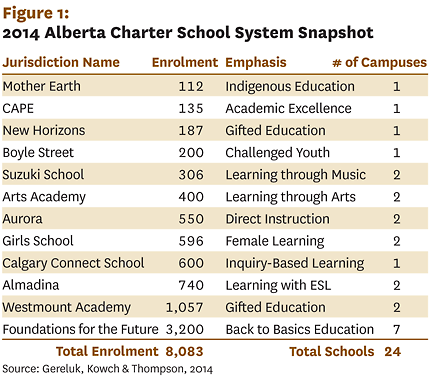
The schools are not restricted to students perceived as “easy to teach,” as may be charged by critics. They incorporate a distinct range of students. However, unlike public schools, charter schools do not receive additional funding for students who may have an Individual Program Plan (IPP) identifying diverse cognitive, emotional, social or behavioural needs. This may limit the range of students accepted into charter schools beyond their educational mandate.
New research about the Alberta Public Charter School system
Numerous studies have been conducted at the micro-level within particular charter schools,[5] but little research has been conducted at the macro-level considering the entire TAAPCS association. In a recent study,[6] we examined Alberta Public Charter Schools on a macro-level. We focused particularly on their ability to adapt and change education, by asking stakeholders to indicate the most influential issues consuming their interests and to identify the people and organizations important in solving their most pressing challenges. We also considered TAAPCS’ internal and external impacts to the broader educational jurisdictions. The resulting snapshot of the Alberta Public Charter School system illustrated a complex mix of the most pressing issues and networks of relationships found within, across and beyond Alberta Public Charter Schools. In this article, we unpack two dominating misunderstandings or “myths” and offer evidence from our research to reconsider the nature of Canada’s only public charter school system.
Myth #1: Alberta Public Charter Schools have more freedom to do what they want to do.
Freedom and autonomy: Alberta Public Charter Schools have the freedom to: 1) provide a specific education focus, and 2) govern through their own administrative and teaching processes. However, when we looked at the entire charter school system network of self-identified influential superintendents, teachers, board leaders, community members and government leaders, we identified several severe constraints on freedom and autonomy of leadership across this school system. We found that system leader networks invest 37 percent of their energy in administration and 29 percent in facilities issues, while spending only 16 percent on planning, 16 percent on equity and 2 percent on instruction issues. While individual schools have freedom to “do what they want” with regards to diverse program emphases and innovation, nearly half (44 percent) of their efforts are disproportionately focused on administration and facility issues, because external student access and space pressures (waitlists) have become primary leadership issues (see Figure 2).
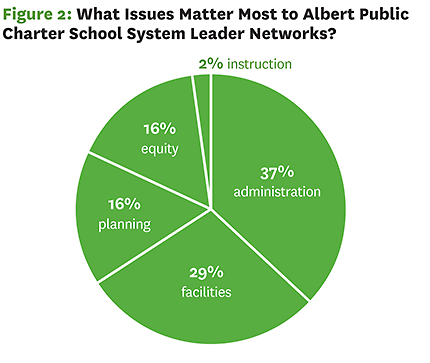
Government agents in charge of facilities form the few critical links between leaders among the schools, limiting the power of the overall leadership network to invest their considerable resources in other issues. As one leader said:
“We don’t have facilities; you can’t grow without facilities. We don’t really create a choice for families in Alberta to go to charter schools because there is no available space there to come into.”[7]
Alberta Public Charter School leaders face limited facility availability (space), so they invest a vast proportion of their time in infrastructure issues. Provincial government education regulations require each school to negotiate for additional space with nearby public boards before they can: 1) acquire old public system spaces or 2) build new spaces. TAAPCS leaders must also negotiate with provincial government infrastructure agents for building capital in an intensely competitive provincial population growth picture. As a system, TAAPCS demonstrates a relatively low level of freedom to organize its interests in the face of change.
Doing the things they want to do: Research by Goldstein, Hazy, and Lichenstein revealed that certain patterns of relations among school community members (teachers, leaders, parents, students, and government) increase the potential for one part of the system to positively impact all other parts so that a system can “do” what it wants. A lot of good relationships form flexible networks on the basis of shared common values, social supports and trust. When those features trump technical, power and even knowledge-based relationships, a school system becomes more adaptable.[8] By contrast, hierarchical, vertical power-based relationships shown in classic “org charts” are the most brittle forms of organization. Figure 3 demonstrates a majority of bureaucratic and technical relationships among charter school system leaders.
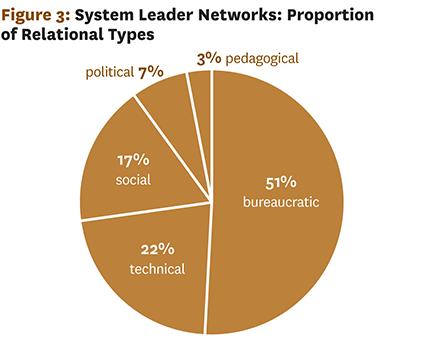
In our study, we analyzed all relational networks and discovered a diffuse, fragmented pattern of leader connections between charter schools and tighter, closed clusters of relations within each school. These clusters indicate a system leader network with dominantly hierarchical, bureaucratic relation types. These types of systems generally lack flexibility or “freedom to do what they want.”
For the Alberta Public Charter School system to “do what it wants,” it needs to connect more among schools, across schools and beyond charter schools, similar to the enduring, deep relationships currently developed between some charter schools and community and business members. Students, nearby school systems (boards), government agents outside the charter administrative group, national and international organizations, professional teacher associations (the ATA) and leader associations (College of Alberta School Superintendents) are generally missing from the current networks.
Myth #2: Alberta Public Charter Schools are competing with the public school system
Currently, Alberta Public Charter School enrollment stands at less than one percent of the total school-aged population in Alberta. The public charter school concept has neither “taken off” as a disruptive innovation in Canada, nor has it threatened public schools more broadly.
Defining competition: Zimmer and Budin[9] defined competition in education as a dynamic in a closed market system where tensions exist among education providers because resources (students) can migrate among school institutions. Given that any school outside a catchment-based, policy-mandated attendance rule is potentially “in competition” with others, Myth #2 could be true on a surface level. To a certain extent, all public schools are in competition with each other.
Competing with the public system: For the Alberta Public Charter School system to make a competitive impact on the larger public education systems, the organization would require a long-term plan and concerted action to attract students from outside its system.[10] Our research revealed that TAAPCS leaders lack a collective connection to the world outside the TAAPCS, and we found no evidence that they are actively competing with other school systems. This could be because TAAPCS leaders are turning over quite quickly – while they are very experienced as a group, over 75 percent of them have practiced in the charter system for less than six years (See Figure 4). Long-term marketing/competition plans would be difficult to actualize across the system with high turnover. Furthermore, we found that less than 20 percent of the leadership network efforts were concentrated on system-level change or impacts. Further, 76 percent of the leaders identified the target of their “impact work” to be impacts within charter schools, and not impacts external to the charter schools.
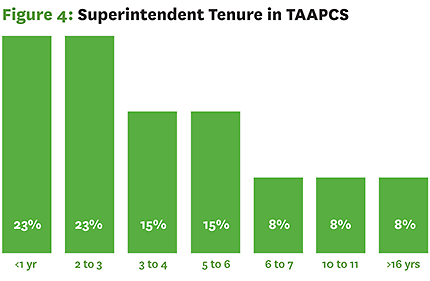
Although Alberta Public Charter Schools are successful as a collection of diverse and innovative schools, they are not as free or agile as many think when pursuing what they want to do as a collective of schools.[11] These schools have evolved over two decades into something of a set of “secret gardens” with an inward focus. Schools have strong internal impact within the boundaries of their schools, but show less external impact across the province. Further, charter school stakeholders describe a difficulty in sharing their educational practices with other school jurisdictions, given some animosity, tension and misperceptions of TAAPCS. They remain fairly disconnected from other education systems or professional educational bodies.
With limited connectivity between and beyond each charter school, no overall strategic plan for marketing, high leader turnover rates, and leader-targeted change programs impacting only other charter schools, the Alberta Public Charter School system is not a major competitor with the public system. TAAPCS does, however, offer important experience, governance, community engagement, structural and pedagogical innovation examples that could improve provincial education system adaptability.
The impact of Alberta Public Charter Schools on the education system as a competitive force is far less than many believe. That said, with the development of more open policy environments and collaboration across education systems in Alberta, this alternative system may offer promise for increasing the capacity of all education organizations in a changing Alberta.
En Bref : L’environnement éducatif albertain change. Le seul système d’écoles publiques à charte du Canada compte maintenant près de 8 000 élèves inscrits et beaucoup d’autres sur des listes d’attente. Cet article présente une vue d’ensemble de la nature des écoles publiques à charte de l’Alberta et certains des constats d’une étude exhaustive du système réalisée par l’Association of Alberta Public Charter School (TAAPCS) pour dissiper deux « mythes » : 1) les écoles publiques à charte de l’Alberta sont plus libres de faire ce qu’elles veulent; 2) les écoles publiques à charte de l’Alberta concurrencent inéquitablement le système public. En raison des cadres de politiques, des malentendus concernant les écoles à charte et des liens limités entre la TAAPCS et le reste du réseau public, ses innovations demeurent une sorte de « jardin secret » enclavé, tourné vers l’intérieur. Ces écoles ont un fort impact interne dans leurs établissements mêmes, mais un faible impact externe dans la province.
Collage: Dave Donald
First published in Education Canada, June 2016
1 Alberta Education, Charter School Handbook (Edmonton: Alberta Education, 2011), pg. 1. https://archive.education.alberta.ca/media/434258/charter-schools-handbook-september-2015.pdf
2 For a full explanation of the role of the Association of Alberta Public Charter Schools, see www.taapcs.ca
3 Lynn Bosetti and Dianne Gereluk, Understanding School Choice in Canada (Toronto: Toronto University Press, 2016).
4 Lynn Bosetti, “The Dark Promise of Charter Schools,” Policy Options 29, no. 6 (2014): 63-67.
5 For a complete list of the internal research projects that have been conducted in Alberta’s Public Charter Schools, please see: www.taapcs.ca
6 Dianne Gereluk, Eugene Kowch, and Merlin Thompson, The Impact, Capacity and Adaptability of the Alberta Public Charter School System (University of Calgary, 2014).
7 Arnold, cited in Gereluk, Kowch, and Thompson, 2014, p. 155.
8 J. Goldstein, J. Hazy and B. Lichtenstein, Complexity and the Nexus of Leadership: Leveraging nonlinear science to create ecologies of innovation (Palgrave MacMillan, 2010).
9 R. Zimmer and R. Budin, “Is Charter School Competition in California Improving the Performance of Traditional Public Schools?” Public Administration Review 69 (2009): 831-845.
10 T. M. Davis, “Charter School Competition, Organization and Achievement in Traditional Public Schools,” Education Policy Analysis Archives 21, no. 88 (2013). http://epaa.asu.edu/ojs/article/view/1279
11 M. Uhl-bein, R. Marion, and B. McElvey, “Complexity Leadership Theory: Shifting leadership from the industrial age to the knowledge era,” The Leadership Quarterly 18, no. 4 (2007): 298-318.
-
International Organizations and Educational Reform
Comments Off on International Organizations and Educational ReformInternational organizations are ideally positioned to influence education policies and large-scale reforms on a global scale. This article discusses the impact of the Organisation for Economic Cooperation and Development (OECD), United Nations’ Educational, Scientific, and Cultural Organization (UNESCO), the World Bank, and the European Union (EU) on transnational and global education policy. Although the previously noted organizations have been in existence for decades,[1] these prominent international bodies are increasingly influencing the global education discourse through their research and policy activities.
The OECD primarily exerts influence in the education sector through its Programme for International Student Assessment (PISA), which is recognized as the largest survey of student achievement in the world. According to the OECD, the PISA triennial survey “assesses the extent to which students near the end of compulsory schooling have acquired key knowledge and skills that are essential for full participation in modern societies.”[2] More specifically, PISA assesses 15-year-old student performance in the areas of mathematics, science, and reading in OECD member states and in a growing number of non-OECD countries and economies. The most recent administration of this international assessment took place in 2015 and included 70 countries and/or economies from around the world. Given its global status, it is not surprising that the popular media in Canada and abroad have likened PISA to the “Olympics of education.”[3]
The current director of PISA, Dr. Andreas Schleicher, has indicated that PISA provides “policy makers and practitioners with helpful tools to improve quality, equity and efficiency in education, by revealing some common characteristics of students, schools and education systems that do well.”[4] In order to support and provide this type of guidance, the OECD provides resource documents within their online library. Policy brief series such as PISA in Focus, Teaching in Focus, and Education Indicators in Focus, help governments identify features and characteristics of the best-performing education systems around the world. Although the OECD is quick to point out they do not tell participating countries how to run their education system, their publications are designed to focus policymakers’ efforts in formulating and implementing specific policies that they contend will improve equity and educational achievement across schools.
UNESCO is also dedicated to supporting national policymakers in the development and implementation of education policies and strategies. This organization provides technical assistance in policy analysis, education sector development plans, and donor mobilization in support of national education priorities. UNESCO also provides easy access to its various publications, which include profiles of various education systems around the world. The United Nations’ international financial institution, the World Bank, also influences education policy and implementation through various programs. One particularly high-profile World Bank program, Education for All (EFA), is repeatedly cited for its laudable goals – namely, to bring the benefits of education to “every citizen in every society” by 2015. (UNESCO is currently formulating a post-2015 agenda through a consultative process that includes governments, civil society, the private sector, and academic and research institutions.) The EFA seeks to improve outcomes at various levels: early childhood education, primary education, secondary education, and adult education. In 2000, 189 countries adopted two key EFA goals: universal primary education and gender parity.
The EU is comprised of 28 member states that possess individual sovereignty in the formation and implementation of education policy. Nevertheless, the EU has developed research and communication strategies to facilitate the exchange of best practices, the gathering and dissemination of educational performance measures, and perhaps most importantly, advice and support for national policy reform. Additionally, shared programs have been implemented across EU nations, which have essentially led to the formation of one of the largest transnational policy networks in the world. The Education and Training 2010 program, for instance, led to the formulation of common targets and initiatives that encompass all types of education and training. The more recent and comprehensive Education and Training 2020 outlines four common objectives identified as priorities for EU member states’ reform efforts: making lifelong learning and mobility a reality; improving quality and efficiency of education and training; promoting equity, social cohesion, and active citizenship; and enhancing creativity and innovation, including entrepreneurship, at all levels of education and training. Collectively, these objectives have important implications for education governance and policy within national education systems.
In education, as in other sectors such as health, economics, or the environment, the uptake of recommended policies and reforms that are suggested by international bodies is influenced by geo- and socio-political forces. Thus, large-scale reforms, including those in compulsory education, must be juxtaposed against contextual issues that are dominant during particular historical periods. Why countries like Germany and Japan have embarked on a series of PISA-initiated reforms while other nation states have remained largely unaffected exemplifies the previous point. In the case of Germany, their mediocre performance on the initial administration of PISA in 2000 provoked “PISA-shock,” which is credited with initiating a sweeping set of reforms that have been characterized as the greatest shift in national educational policies to occur since the fall of the Soviet Union.[5] In both Germany and Japan, scholars have noted how the national context was ripe for large-scale educational change.[6]
Critical concerns
Despite the previously noted context issues, a growing number of academics, particularly those focused on education, have expressed concern with the expanding role of international organizations on national education policymaking. In the case of PISA, a significant number of academics have disputed the “system improvement” claim that the OECD has touted. Academic condemnation of PISA is evidenced by an open letter to Dr. Andreas Schleicher, the director of the OECD program, from a group of more than 80 high-profile academics from around the world. The open letter essentially argued that PISA was damaging education worldwide by escalating testing, emphasizing a narrow range of measureable aspects of education, and shifting education policies to find “short-term fixes” designed to help a country climb in the rankings.[7] Originally published in the British national newspaper The Guardian, the points raised in the open letter were reiterated in a special edition of the academic journal Policy Futures in Education.[8] It is worth noting that the list of signatories grew from the initial 80 to more than 130 (as of May 6, 2014) in the most recent letter.
Critics of the World Bank have also voiced their concerns with the growing, and some would argue skewed, influence of this international organization in the education sector. Although the EFA is a global priority, some have suggested that the World Bank has focused too heavily on developing countries, and not held the U.S., Europe, and industrial democracies to the same level of scrutiny.[9] Similarly, agencies with specific educational mandates such as UNESCO have been criticized for not emphasizing the interdependence and importance of various education sub-sectors. Thus, it is fair to say that both the scope and the selective nature of large-scale education reforms promoted by the World Bank and UNESCO have not been immune to academic scrutiny.
The EU has also drawn criticism for the structure of education governance that is facilitated by their open method of coordination (OMC). Although OMC has never been given a formal legal definition, it is widely regarded as the principal means of spreading best practice to achieve greater convergence towards the main EU goals, including those in the education sector. OMC achieves these transnational goals through the establishment of indicators and benchmarks and their corresponding translation into national and regional policies. Critics have referred to OMC as “soft law” that seeks to undermine traditional constitutional doctrines and values that support a limited view of Social Europe.[10] In the education sector, the previously noted critics suggest that OMC impinges on education policies and that policy learning across member states is susceptible to highly politicised interests. The latter underscores how influential groups may skew priorities and large-scale reforms in the education sector.
Collectively, the previous critics raise important points to consider, particularly when a nation or regional government is put in the unenviable position of negotiating competing demands that impact their education system. However, the more general and overarching criticism that international organizations have eroded the power of nation states and now possess a hegemonic grip on education policymaking is overstated and simplifies important cross-cultural differences. Certainly, we need to guard against reductionist approaches to education that may distill a child’s educational experience to a test score. We also need to guard against policy networks that may set unrealistic targets and benchmarks that could strip schools and teachers of their professional autonomy. However, there is little evidence to suggest this has systematically occurred across a continent or the globe.
Certainly, we need to guard against reductionist approaches that may distill a child’s educational experiences to a test score.
Not all countries respond in a predictable or consistent fashion to the policy suggestions of international organizations – a finding supported by a large number of researchers. Similarly, one should acknowledge that regardless of important contextual issues, some policies promoted by international organizations, namely basic education and equity in educational opportunities for all children, should be non-negotiable. There is definitely merit in trying to ensure that these are truly global priorities, irrespective of a nation’s economic and/or political standing on the world stage. Rather, it is the implementation of these laudable goals that is often a source of contention and one that should be closely monitored. For their part, the academic community can play an important checks and balance function by conducting programs of research that evaluate the impact, intended and unintended, of policy reforms on national education systems.
From my perspective, the global community needs to be open to the opportunities and vigilant to the constraints that may be associated with the work of international organizations that facilitate large-scale education reforms. The contemporary forces of globalization suggest this challenge will have to be navigated by public policymakers and school systems for generations to come – and Canada is no exception. Interestingly, since education is a provincial/territorial responsibility under the Canadian constitution, we provide the rest of the world with a unique context to study the intersection of international organizations, education policy, and large-scale reform. In many respects, our provincial autonomy is an important characteristic in helping our vast nation successfully address external international pressures in a manner that is respectful of and consistent with our regional culture, history, and geography. Canada seems well positioned to meet the challenges of large-scale educational change that may be precipitated by international organizations.
En Bref : Les organisations internationales telles que l’Organisation de coopération et de développement économiques (OCDE), l’Organisation des Nations Unies pour l’éducation, la science et la culture (UNESCO), la Banque mondiale et l’Union européenne (UE) influent de plus en plus sur la nature et l’envergure des politiques nationales d’éducation dans le monde entier. Cet article indique certaines des influences les plus marquées sur les politiques d’éducation mondiales qu’ont engendrées ces organisations transnationales. L’auteur conclut que la communauté mondiale doit faire preuve tant d’ouverture aux possibilités que de vigilance à l’égard des contraintes susceptibles d’être associées au travail d’organisations internationales favorisant des réformes à grande échelle en éducation. Compte tenu des forces contemporaines de mondialisation, il s’agit d’un défi que devront relever les décideurs publics et systèmes scolaires pour les générations à venir.
Photo: Tuomas Kujansuu (iStock)
First published in Education Canada, June 2016
1 The OECD was formed in 1961, based on its predecessor the Organisation for European Economic Cooperation (OEEC), founded in 1948. The World Bank and UNESCO were formed in 1944 and 1945, respectively, and the EU, which presently comprises 28 member states, was established by the Maastricht Treaty in 1993.
2 Organisation for Economic Cooperation and Development, About PISA (2014), 1. www.oecd.org/pisa/aboutpisa/PISA-trifold-brochure-2014.pdf
3 C. Alphonso, “Stakes high in OECD student testing,” The Globe and Mail (November 29, 2013), www.theglobeandmail.com/news/national/education/stakes-high-in-oecd-student-testing/article15699429/; M. Scardino, “The Olympics of education,” The Guardian (December 11, 2008), www.theguardian.com/education/2008/dec/11/primary-maths-science-politics
4 A. Schleicher, “Can Competencies Assessed by PISA Be Considered the Fundamental School Knowledge 15-Year-Olds Should Possess?” Journal of Educational Change 8 (2007): 356.
5 V. Bank, “On OECD Policies and the Pitfalls in Economy-Driven Education: The case of Germany,” Journal of Curriculum Studies 44, no. 2 (2013): 193-210.
6 D. Niemann, Changing Patterns in German Policymaking: The impact of international organizations – TranState Working Papers No. 99 (Bremen, Germany: Transformations of the State Collaborative Research Center 597, 2009); K. Takayama, “The Politics of International League Tables: PISA in Japan’s achievement crisis debate,” Comparative Education 44, no. 4 (2008): 387-407.
7 P. Andrews et al., “OECD and PISA tests are damaging education worldwide – academics,” The Guardian (May 6, 2014). www.theguardian.com/education/2014/may/06/oecd-pisa-tests-damaging-education-academics
8 H. D. Meyer et al., “Open Letter to Andreas Schleicher, OECD, Paris,” Policy Futures in Education 12, no. 7 (2014): 872-877.
9 S. P. Heyneman, “The Failure of Education for All as Political Strategy,” Prospects 39, no. 1 (2009): 5-10.
10 B. Lange and N. Alexiandou, “New Forms of European Union Governance in the Education Sector? A preliminary analysis of the Open Method of Coordination,” European Educational Research Journal6, no. 4 (2007): 321-335.
-
Failing Joey
Comments Off on Failing JoeyJoey* storms over to the art table in his Kindergarten classroom and sweeps his arm across it, knocking markers and crayons all over the floor. “Joey, please stop that,” his teacher asks, but he proceeds to knock over bins of Lego and beads. As she has been directed, she turns away and feigns attention to other children in the class, but when Joey moves toward the computer all 26 of his classmates are ushered out of the room by the class’s Early Childhood Educator (ECE). This is the third time this week that Joey’s tantrums have resulted in the classroom being turned upside down. Yesterday he ran out of his class and then right out of the schoolyard, into the community. The principal and vice-principal followed Joey for half an hour as he wandered, watching to ensure that he did not get too close to the busy street – but they did not stop him.
How and why have we reached the point where responsible adults are stepping back from their duty to care for young children? Is it simply a fear of litigation that has brought this about? Has this hands-off approach evolved due to directives at the Ministry level, the Board of Education level, or from individual principals? Is it based on some pedagogy which suggests that children need to learn to set their own limits? In Ontario (and presumably elsewhere), this is a problem that needs to be discussed, because Joey needs help.
Joey cannot regulate his behaviour. And what is happening at school is not helping him; instead his needs are worsening and multiplying.
Joey is out of control. He is unable to regulate the storm of emotions that he experiences at school. Although Joey is three years old and legally old enough to be in an Ontario Kindergarten program, emotionally and developmentally he is even younger. His needs are those of a two-year-old – a language deprived, poorly nourished, overtired, and emotionally disturbed two-year-old. He needs a treatment program and a daycare-style setting. Instead he is in a Kindergarten program that is too demanding for him and drastically ill-equipped to meet his needs. Joey has a right to be in the Ontario school system, but his teachers do not have the right to provide him with the treatment that he needs. There are people with the expertise to meet Joey’s needs, but Board of Education policies, union directives and the fear of litigation do not allow these educators to do the right thing to help this struggling child.
Parents know what the “terrible twos” are like: toddlers, at the mercy of their own emotions, lie on the floor pounding their arms and legs, scream “No, I want it!” or hit and throw things in frustration and anger. Upset two-year-olds are not able to control themselves or follow verbal directions; physically (but gently) preventing them from dangerous or destructive behaviour is part of the toddler-care territory. For many reasons, Joey is still in the terrible twos. Guiding and consoling such a young child requires hands-on care. Joey has not had comforting reassurances after a tantrum, such as “It’s okay to be angry, everyone gets angry,” nor has he internalized important early childhood messages like: “Adults will keep you safe.” He hasn’t experienced the security of routines and limits to live within. Most of all, Joey has not been cuddled, hugged and loved.
Dr. Stuart Shanker, a Professor of Psychology at York University who has done extensive work in the area of self-regulating behaviour, writes:
“The tactile stimulation that the baby receives when you hold or stroke her release neurohormones that are highly calming; through your voice, your shining eyes, your smiling face, or gently rocking or bouncing your baby when she is fussy, you are laying the foundation for good self-regulation.”[1]
Joey doesn’t have this foundation to control his impulses or emotions. As a result, he cannot regulate his behaviour. And what is happening at school is not helping him acquire this foundation; instead his needs are worsening and multiplying.
There is a large and growing number of “Joeys” in Ontario who are in need of special care. They are becoming social pariahs among their classmates, learning that destruction of property is permitted and internalizing the belief that their behaviour is uncontrollable.
In many if not most boards across the province, teachers are not allowed to physically stop children if they resist being touched in any way. These “hands off” restrictions prevent teachers from doing what their common sense and parenting instincts tell them to do for an upset young child: to hold him and help him through his tantrum, to prevent him from causing serious damage, and to cuddle and reassure him when the storm subsides. This inability of professional adults charged with caring for young disturbed children to do what is so obviously needed is now a crisis in Ontario.
The root of the problem appears to be the fear of litigation. Yet Section 43 of the Canadian Criminal Code would lead one to believe that teachers and parents are protected by law for the basic restraint of a child such as Joey. Section 43 says:
“Every schoolteacher, parent or person standing in the place of a parent is justified in using force by way of correction toward a pupil or child, as the case may be, who is under his care, if the force does not exceed what is reasonable under the circumstances.”[2]
Certainly holding Joey to prevent him from destroying his classroom would be deemed “reasonable under the circumstances”; not only for the sake of safety but also to teach Joey and his classmates about rules and limits. The question then is: Is there additional legal documentation needed to protect teachers should they need to restrain a young student?
What can we do for Joey?
Typically, a boy like Joey is given an Individual Educational Plan (IEP) in which specific learning and behavioural goals are set out for each term of the school year. These plans are agreed upon and signed by teachers, principal and parents in order to ensure that all parties understand the goals and approaches toward a student’s learning. These days, school principals in Joey’s community will not allow an IEP to include words like “restrain” – it’s far too legally risky in the Board’s opinion. They also tend not to do IEP’s for JK students. Could the IEP, if signed by all parties, be the legal document needed for Joey’s teacher to take care of him? Is a new legal document needed for quick processing in September when disturbed children enter Junior Kindergarten? Regardless of these possibilities, the fact remains that if Joey’s parents do not wish to sign such a document, they are still entitled to send Joey to school.
There are Special Education departments that provide a wide range of services for special needs children. Fortunately for Joey, his school is in a jurisdiction where Special Education programs are more extensive than in many. Unfortunately for Joey, these programs are not available to JK students. Once in Senior Kindergarten, the long process of admitting him into a special-needs program might begin. The reams of paperwork and process that are required – behaviour reports, special interventions, psychological assessing – will mean that, if there is an appropriate program for him, he will not get access to it for a year or two. Consequently, those vitally important first five years of his life will have slipped away before his needs are met. Had Joey’s teachers been able to establish reasonable limits using calm, caring restraint when Joey started school, he would have had a chance to learn and adapt to the routines of the classroom and work through the “terrible twos” stage of development.
The interventions that can be implemented during Joey’s long wait are spelled out in a Board-approved document entitled “Behavior Management Systems” (BMS).[3] This program is clearly designed to approach children with behavioural difficulties without using physical contact. Numerous reasonable approaches to avoid and redirect violent behaviours and set appropriate limits are suggested. There is also extensive coverage of legislation, consultation, confidentiality and required paperwork. The overriding message is: do not engage in physical contact with children. Between the lines teachers read: cover yourself legally at all costs. The program appears to be tailor-made to suit the legal parameters that Ontario teachers are working within. It does not appear to be designed for a three-year-old such as Joey.
The BMS course does instruct how to safely restrain children who are demonstrating violent behaviour. The procedure is remarkably basic and logical in its approach to ensuring that upset children do not hurt themselves or others. For example, “when being attacked (punched etc.), educator blocks and takes hold of the student’s arm, passing the arm in front of the student. Wrap your arms around the student, passing the contained hand to your other hand. Take hold of the remaining arm…”[4]
Experienced Kindergarten teachers who take the BMS course tend to find it to be elementary. The redirecting, the safe classroom set-ups and the limit setting are all part of any good Kindergarten teacher’s repertoire. Joey’s teacher is a superlative, experienced, knowledgeable professional who has used techniques such as these for years. But despite their training and experience, Joey’s teachers, educational assistants and ECEs are being told by their Board and by their unions not to restrain children in any way unless personal injury is imminent.
So Joey’s tantrums are “managed” without physical intervention, despite behaviour that destroys property, puts himself, other students and teachers in danger, and is very likely frightening to Joey himself. Instead, and in all seriousness, the BMS course advises little Joey’s teacher to consider personal protective equipment such as helmets, shin guards, hairnets and emergency communication devices.
If this seems absurd in the context of such a young child, it is because one of the major faults in the BMS training is that there is no recognition of the differing stages of child development (beyond a distinction between “small” and “larger” students). Yet there is a world of difference, developmentally, between even a well-adjusted three-year-old and the Grade 1+ students this program is designed for.
How can we help Joey to join in to a mainstream socialization process and, eventually, succeed in school? In an integrated, full-day Kindergarten program, professional teachers – like mental health workers and police officers – need the legal protection and tools to do their jobs. They need unencumbered permission to use their professional judgment and their expertise to help children. They may also need the expectation re-established that dealing with temper tantrums, even violent ones, is a part of the Kindergarten team’s job.
There are numerous related issues to be added to this discussion, and the need to begin is urgent. Joey’s classmates are being impacted and Joey’s needs are being neglected – and increasing – while we wait.
* Author’s name changed by request. “Joey” is a composite, fictional student based on real cases in the author’s experience.
En Bref : Les écoles fournissent-elles aux jeunes élèves de maternelle bouleversés ou immatures les interventions dont ils ont besoin? D’après l’auteur, les politiques administratives et syndicales répandues qui défendent aux enseignants d’arrêter ou de retenir physiquement les enfants vexés ne tiennent pas compte des besoins fondamentaux de développement des plus petits élèves. L’interdiction de contact physique empêche les enseignants de faire preuve de bon sens et des compétences parentales de base nécessaires à un jeune enfant bouleversé : le prendre dans leurs bras et l’aider à traverser la crise, l’empêcher de causer des dommages graves ainsi que le cajoler et le rassurer jusqu’à ce que la tempête passe. Ainsi, ces enfants perturbés qui sortent à peine de la petite enfance ne profitent pas du soutien adulte qui leur permettrait d’apprendre à mieux se maîtriser. L’auteur conclut en préconisant « la protection juridique et les outils nécessaires au travail » des enseignants de maternelle.
Photo: Oksana Alex (istock)
First published in Education Canada, June 2016
1 Calm, Alert and Happy,” by Dr. Stuart Shanker (Toronto: Queen’s Printer for Ontario, 2013). www.edu.gov.on.ca/childcare/Shanker.pdf
2 Because it has been used as justification for corporal punishment, the current government has committed to repealing Section 43. But the Repeal 43 Committee (www.repeal43.org) cites other existing legal provisions in the criminal code and common law that allow for sensible restraint of children.
3 Behavior Management Systems: Ensuring Respectful Learning Environments, Practitioner Workbook (Ontario Education Services Corporation, 2006). The Ontario Education Services Corporation (OESC-CSEO) is a non-profit corporation jointly owned by all school boards in Ontario.
4 “Behavior Management Systems, Practitioner Workbook, p. 53.
-
Innovation That Sticks Case Study Report: Ottawa Catholic School Board
Comments Off on Innovation That Sticks Case Study Report: Ottawa Catholic School BoardYou can access a multimedia version of the Executive Summary, which includes several interview videos.
A CEA Selection Jury chose the Ottawa Catholic School Board (OCSB) out of 35 School District applicants from across Canada to participate in the 2015 ‘Innovation that Sticks’ Case Study Program. From September to December 2015 – through an Appreciative Inquiry interview process – the CEA researched how the OCSB has transformed its classrooms into 21st century environments that meet the needs of all learners.
The OCSB currently serves approximately 40,000 students in 83 schools across the City of Ottawa; a staff of more than 2,400 teachers and administrators, and 1,500 support staff, guide quality Catholic education.
With the conversion of libraries to Learning Commons, increasing broadband, universal Wi-Fi availability and equitable Bring-Your-Own-Device (BYOD) policies, the OCSB has created a digital learning ecosystem focusing on collaboration, creativity and critical thinking among all of its 83 schools.
The CEA Selection Jury of Canadian innovation leaders was most impressed with how the OCSB leads with a focus on learning and teacher support first, followed by the technology. This School Board has been implementing their innovative strategy over a number of years, incorporated all partners – including teacher unions and support staff – and built a budget in support of this collective vision, with ongoing parent and student voice that continue to inform these changes.
The OCSB’s comprehensive Blueprint for Change — Towards 2020, Connecting with our Students provides a laptop to every teacher and principal. This 1:1 technology investment is complemented by a major professional learning focus that represents an important cultural shift across the Board to enable teachers to shift their practice to differentiated instruction, which has resulted in increased student achievement. Restrictive policies were removed to allow teachers to model digital citizenship by actively participating in social media. Every student in the Board receives yearly instruction on digital citizenship, integrated into the curriculum.
The OCSB’s leadership is very proud of how their staff has embraced technology to support student learning. They use social media and a variety of apps to share effective practice professionally and are connecting learning to students’ real lives, ensuring relevance to their interests and needs.
The OCSB received a $10,000 contribution courtesy of initiative sponsors State Farm Canada to grow its promising programs and practice. Board representatives shared “lessons learned” with CEA researchers about the conditions and processes that led to the beginning of this expandable innovation throughout their classrooms and schools.
This case study report provides concrete guidance and information resources to support other School District leaders faced with the challenge of determining how they can get their own ‘innovations to stick’ and achieve their goals.
-
Drawing our Rubrics with Dotted Lines
Comments Off on Drawing our Rubrics with Dotted LinesI don’t think that I would be revealing any secrets if I told you that my mother has always been a better baker than a cook. Even to this day, she will call me when it comes to cooking the Sunday roast, but no one in the family—and I mean no one—can hold a candle to her butter tarts or rhubarb pie.
As a child, my ears were keenly-tuned to all sounds associated with baking: mixing bowls being stealthily removed from cupboards, the special flour sifter with the red wooden handle, the electric mixer—these were all cues to drop what I was doing and head to the kitchen to investigate. Sometimes, my curiosity would be rewarded with the chance to act as “batter taster”. But mostly it was all about the opportunity to watch Mom effortlessly (and without a recipe in front of her) mix, blend and knead to perfection!
I was always amazed at how efficiently she was able to work. She didn’t like wasting anything. In fact, some of my favourite treats were the ones that were created with the extra dough, filling and icing sugar that Mom collected prior to clean-up. These would be molded into no particular shape, tossed in the oven and put on a plate to cool. For Mom this, no doubt, resonated with the way that she was brought up, born as she was in post-depression/pre-WWII Hamilton. For me, however, there was something creative about her ability to see the potential in what wasn’t used as part of the main recipe.
These images came back to me last weekend, inspired by a couple of seemingly unrelated experiences. First, this past Sunday was Mother’s Day, and I always enjoy sharing these “growing up” stories with my own children. But these memories enabled a second type of connection.
There were two occasions in the past week where I was asked to make use of an assessement/evaluation rubric to, on the one hand, evaluate performances at a Battle of the Bands competition and, on the other, to help my seven year-old son prepare for an upcoming culminating task at school. (I realize how far apart these strands of thought might seem!)
In both “rubric” cases, I experienced a certain level of frustration, not because of what I was being asked to look at in terms of student performance. As rubrics go, both were clear, concise and well-constructed.
My frustration came from what might be missed if I focused only on the descriptions in the rubric categories. What subtleties or nuances in a particular musical performance might be filtered out? What do I do with the fact that the drummer had a unique way of holding the band together? What might my son’s teacher miss about his enthusiasm for a particular part of the assignment? What happens with the connections that he was able to make with other elements of his life? How do we account for the “spaces” that exist in between levels on the rubric?
I realize that these are not new questions. People have been asking them ever since the use of rubrics came into vogue in the mid-90’s. And, hopefully, we won’t stop asking them. To be sure, the idea of clearly defining for students, educators and parents what quality performance looks and sounds like has pushed the conversation on assessment forward a great deal.
At the same time, howevever, I’ve allowed these questions to bump up against my reading of Stuart Kauffman and, in particular, his work on emergence. The wonderful quote with which I ended my last entry resonates:
Not only do we not know what will happen, we often don’t even know what can happen.
Granted, Kauffman is talking about much larger systems than our classrooms and schools. But I think that there are some parallels that might be helpful in pushing our thinking a little. Just as we are, slowly but surely, being forced to admit that classical physics doesn’t hold all of the answers (or questions) when we start talking about the universe in terms of complexity, I also wonder whether we need to start attending to the fact that there is a lot more than can happen in the learning lives of our students when we loosen up the boundaries set by our curriculum expectations, our success criteria and, yes, our rubrics.
How do we hold true to the importance and value of establishing performance standards and criteria for our students while, at the same time, being aware of the wonderful things may be filtered out of our assessment and evaluation processes? How do we ensure that our efforts to inspire and guide our students do not become a type of cookie cutter template that leaves lots of good stuff on the baker’s table? How can we use more dotted lines to draw our rubrics, opening our assessment processes up to what can happen?
Are we ready for that? Are you already doing that? I would love to hear your stories!
-
Do School Boards Matter?
Comments Off on Do School Boards Matter?This blog post is part of our series on leadership and governance.
Over the last three decades, we have seen a trend toward the centralization of decision-making in public education and the erosion of power of democratically elected local school boards across Canada. In some jurisdictions, their continued existence has been called into question. My personal experience as a superintendent has demonstrated that school boards can be strong and effective institutions of leadership in public education and are central to community voice and the local democratic process.
For those of us who currently serve or have served as superintendents, we understand that governance issues are paramount to our work as education leaders. We collaborate with school trustees to meaningfully engage members of the community in understanding and supporting their school division/district’s mission, vision, values and priorities in support of the learning and well-being of all students.
In my previous career as a superintendent in rural Manitoba, I served four different school boards and observed that even though the dynamics of these boards differed, the trustees were highly committed people who genuinely cared about the learning and well-being of our youth and the sustainability of our communities. For most trustees, they came into their role with little or no governance experience. When I assumed the superintendency, our board had over three hundred policies (which they did not know) and our meetings focused primarily on administrative and management issues. My role was to help them understand how they could be more effective in fulfilling their mandate and serve the best interests of the youth and communities that they represented through changes in their governance.
Our work involved changing their governance philosophy to a more strategic focus with committees restructured to reflect where they needed to spend more of their time (i.e. policy, community connections, board development, fiduciary oversight). Our board, while skeptical at the outset, came to the understanding that they could be more effective in fulfilling their role through a change in their policy and practice. After two years of preliminary work with the board on effective governance, they made the decision to change to a strategic governance model underpinned by high-level policies. The policy manual was revised to include a total of twenty policies focused in three areas – their role as a board, goals and standards for the school division and the relationship between board and CEO.
This change was transformational for our school board, which now focuses their time and efforts on planning, policy development and connecting with our communities. We worked collaboratively with our students, staff and communities to establish a new vision, mission, values, beliefs and priorities for our school division. To embrace student voice as a key strategy in our change efforts, we were the first board in Manitoba to designate a student representative. We engaged in open and transparent dialogue with our stakeholders and moved our school division forward with focus and deep commitment, placing us on the leading edge of initiatives that have now become commonplace in public education in Manitoba.
Over the past decade, we introduced many new programs and initiatives focused on student achievement, engagement and well-being. Some examples include the establishment of a band program, career and mentorship programming, early childhood programming, a fiber optic network and a focus on education for sustainable development. These new initiatives would not have been possible without the vision and commitment of trustees who were clearly supporting what their communities prioritized for the youth that we served in our school division.
It should be mentioned that in Manitoba, school boards have retained the ability to levy local taxes to support public education. Without this authority, the programs and initiatives that I have cited above would not have been possible under provincial funding frameworks. It should also be noted that this did not mean that our trustees overlooked their fiduciary responsibilities. Our school division had one of the lowest mill rates in the province during this time frame. This required good planning, a commitment to priorities, aligning resources to priorities and collecting evidence to support positive outcomes for our students.
Externally driven or imposed change runs a risk of resentment, passive resistance and cursory compliance. The public education system cannot succeed to its highest level through compliant behaviour. It also requires commitment that must be earned through respect for people’s viewpoints who are united to a compelling moral purpose. This involves an inclusive approach that invites staff, students and community into a mission-driven dialogue about the desired change, involves them in defining it, and supports it’s ongoing implementation. This approach takes longer and is far more complex, but is the only way to effect genuine, lasting change.
School boards constitute one of the oldest and most enduring forms of elected representation in Canada and in my opinion, continue to serve a vital role in sustaining the success of Canada’s education system.


IDEAS TO SUPPORT EDUCATORS : Subscribe to the EdCan e-Newsletter
Quality research, reports, and professional learning opportunities.