
Archive
-
How can schools support LGBTQ2+ teachers and students?
Comments Off on How can schools support LGBTQ2+ teachers and students?Despite recent progress towards supporting LGBTQ2+-inclusive education, ensuring that both teachers and students who identify as sexual and gender minorities (SGMs) experience belonging, safety, and security in their schools and communities remains an ongoing challenge. A national survey of Canadian high school students found that 64% of LGBTQ2+ students reported feeling unsafe at school. Similarly, research has shown that LGBTQ2+ teachers are less likely to come out to their administration and 33% had been warned to not come out at school by family, friends, and other educators.
HERE’S HOW SCHOOLS CAN TAKE A MORE INCLUSIVE APPROACH TO SUPPORT LGBTQ2+ TEACHERS AND STUDENTS:
LGBTQ2+ TEACHERs:
- Show support: strong support from school leaders can create a more open dialogue and space whereby LGBTQ2+ teachers feel safe to deliver and engage in SGM-inclusive education.
- Develop inclusive workplace policies: at the school district level, standalone anti-homophobia and anti-transphobia policies covering SGM staff and students – rather than generic equity policy – should be alongside workplace harassment policies and implemented to protect and support LGBTQ2+ staff.
- Create a professional and/or informal network: LGBTQ2+ teachers within the district can form Gender-Sexuality (or Gay-Straight) Alliance (GSA) groups that meet to share their experiences, learn from one another, and develop trusting and supportive professional relationships.
LGBTQ2+ STUDENTS:
- Provide staff professional development: ensure introductory and ongoing training for teachers, principals, and school staff members regarding SGM policies, implementation practices, and any changes to them.
- Have designated safe contact teachers: have trained teachers volunteer to be go-to adults for LGBTQ2+ students and those who may be questioning their sexual or gender identities.
- Ensure LGBTQ2+ students are treated respectfully and consistently: provide supply/substitute teachers with guidelines and information packages for accommodating these students.
- Explore various school district and teacher association websites: find information and learn more about important issues including:
- students wanting to come out to their parents and peers;
- mental health concerns;
- washroom accessibility for transgender and other gender minorities;
- accommodating participation in physical education, athletics, field trips, etc.;
- accessing community supports for LGBTQ2+ students (e.g. counselling, connecting to community organizations, events, etc.); and
- accessing crosscultural and Two-Spirit information for LGBTQ2+ and questioning Indigenous students.
- Develop/offer resources: help students, staff, and parents better understand when a student is expressing their gender in unique or creative ways, or when students want to form a GSA Alliance (i.e. a student-led organization that provides a safe, inclusive space for students).
“What do I do at my school? Certainly, we have our safe-contact teachers identified. We also have the safe and caring rainbow stickers. There’s one right as you enter the school, and there’s one on my office door, my assistant principal’s door, and on the classroom doors of the safe contact teachers and other supportive teachers. I’ve had many conversations with my parent council around the work we’re doing in order to have their support for the SOGI work in our school. Our library collection is also growing as we find more and more stories that depict the LGBTQ+ youth and their families and same-sex families. I also have conversations with my staff about heteronormativity, the gender spectrum, and the language we use with students. So, is it working? I certainly know that my staff is very aware. Also, my sexuality is not hidden from my staff, so my staff know who I am. I also let them know that my partner is male and he’s a grade one teacher. I do it because I want them to know that I believe in the normalization of sexuality and gender in our schools, that it is no big deal. It is just who we are.”
-(Elementary school principal)
Although many school districts have SGM-specific policies in place, research points to the ongoing need for school districts to invest the time into building a genuinely accepting and accommodating LGBTQ2+-inclusive school culture that supports and promotes the well-being of LGBTQ2+ teachers and students. Taking a LGBTQ2+-inclusive approach to education is a shared responsibility and school leaders, colleagues, and parents all play an important role in understanding how to best support and learn from the experiences and perspectives of LGBTQ2+ teachers and students.
References
Grace, A. P. (2015). Part II with K. Wells. Growing into resilience: Sexual and gender minority youth in Canada. Toronto: University of Toronto Press.
Grace, A. P., & Wells, K. (2016). Sexual and gender minorities in Canadian education and society (1969-2013): A national handbook for K-12 educators. Ottawa, ON: Canadian Teachers’ Federation. (Published in English & French.)
Taylor, C., & Peter, T., with McMinn, T. L., Elliott, T., Beldom, S., Ferry, A., Gross, Z., Paquin, S., & Schacter, K. (2011). Every class in every school: The first national climate survey on homophobia, biphobia, and transphobia in Canadian schools. Final report. Toronto, ON: Egale Canada Human Rights Trust.
Tompkins, J., Kearns, L., & Mitton-Kükner, J. (2019). Queer educators in schools: The experiences of four beginning teachers. Canadian Journal of Education, 42(2), 385-414. Retrieved from: https://journals.sfu.ca/cje/index.php/cje-rce/article/view/3448/2727
WITH THE GENEROUS FINANCIAL SUPPORT OF:


-
How should we be talking about weight in schools?
Comments Off on How should we be talking about weight in schools? -
It takes a village: A Comprehensive School Health approach to well-being
Comments Off on It takes a village: A Comprehensive School Health approach to well-being -
ANCHOR Learning: What is it and why is it important post-COVID?
Comments Off on ANCHOR Learning: What is it and why is it important post-COVID? -
Positive Reframing: How to find the good in a stressful situation
Comments Off on Positive Reframing: How to find the good in a stressful situation -
What is the value of Game-Based Learning?
Comments Off on What is the value of Game-Based Learning?Playing and designing games have been of interest to K-12 educators as ways to support student learning. Parents are also increasingly accepting of video and board games as their choice of family activity, based on a 2018 survey by the Entertainment Software Association of Canada finding that 71% of Canadian parents play video games with their children. Game-Based Learning involves learning situations where children play or design games – whether digital, physical, or table-top games – in which they solve problems and gradually develop new knowledge and skills. Games have been found to improve students’ motivation and cognitive development, such as memory and reasoning.
Key elements of Game-Based Learning include:
- Students working towards a goal, making decisions, and experiencing the consequences of those decisions. For example, the primary objective of the game ‘Monopoly’ is to own as much property and to have the most money by the end of the game, make financial-related decisions including managing money and deciding to sell/purchase property, and experience the consequences of paying rent when landing on other player’s properties, paying loans/taxes to the bank, losing your property if unable to make payments;
- Different approaches such as playing games, modifying games, and designing games; and
- Games being easy to learn and interesting to the learner (e.g. ‘Inversé’ is a game with only a few rules and colourful wooden pieces, yet can be highly interesting while supporting spatial thinking: volume, estimation, mental rotation).
HERE ARE 3 KEY TIPS FOR TEACHERS AND PARENTS LOOKING TO USE GAMES TO SUPPORT LEARNING:
- You don’t have to be an expert at playing games: Students may have better gaming skills. However, it’s important to remember that as a teacher and/or parent, it’s not essential for you to master the game, but rather to play it for yourself (or with your child) so that you can understand how it might align with targeted learning goals.
- Make connections to other subjects: While students learn many things through playing games (i.e. rules, strategies), they can also learn about a variety of subject areas through the social interactions involved (e.g. how shifting allies or enemies changes political and economic relationships, in the videogame ‘Civilization’).
- Facilitate a redesign project to encourage creativity and critical thinking by:
-
- Encouraging students to change specific game elements (e.g. game rules, number of players, the dimensions or shapes of the game board or pieces)
- Reimagining the game by changing the storyline (e.g. creating new characters, changing setting, and creating new challenges for players)
- Changing the game structure (e.g. changing the game goal, making the game based on strategy instead of chance)
- Making a new game by integrating two different existing games (e.g. combining the games ‘Inversé’ and ‘Connect 4’)
Research demonstrates that Game-Based Learning enhances essential life skills that are foundational to a child’s development. In particular, Game-Based Learning provides students with an interactive learning experience where they have the opportunity to use and develop many different cognitive, social, and physical skills. Problem solving, critical thinking, strategy development, decision making, and teamwork are some of the many skills that games can provide.
Additional Information and Resources
- Game for Change (Games for making real-world impacts): http://www.gamesforchange.org
- Math Pickle (Puzzles and Board Games for Problem-Solving): http://mathpickle.com
- MIT developed educational games (integrating science and math curricula): https://education.mit.edu/project-type/games/
- Edutopia (Tips for Game-Based Learning): https://www.edutopia.org/topic/game-based-learning
References
Clark, D. B., Tanner-Smith, E. E., & Killingsworth, S. S. (2016). Digital games, design, and learning: A Systematic review and meta-analysis. Review of Educational Research, 86(1), 79–122. https://doi.org/10.3102/0034654315582065
Entertainment Software Association of Canada. (2018). Essential facts about the Canadian video game industry 2018. http://theesa.ca/wp-content/uploads/2018/10/ESAC18_BookletEN.pdf
Gee, J. P. (2008). Learning and Games. In K. Salen (Ed.), The ecology of games: Connecting youth, games, and learning(pp. 21–40). MIT Press. https://mitpress.mit.edu/books/ecology-games
Jaques, S., Kim, B., Shyleyko-Kostas, A., & Takeuchi, M. A. (2019). “I Just won against myself!”: Fostering early numeracy through board game play and redesign. Early Childhood Education, 26(1), 22–29. http://hdl.handle.net/1880/111252
Kim, B., & Bastani, R. (2017). Students as game designers: Transdisciplinary approach to STEAM Education. Special Issue of the Alberta Science Education Journal, 45(1), 45–52. https://sc.teachers.ab.ca/SiteCollectionDocuments/ASEJVol45No1November2017.pdf
Kim, B. & Bastani, R. (2018). How Inversé merged with Go: (re)designing games as mathematical and cultural practices. In Proceedings of the 5thInternational STEM in Education Conference (pp.166-172). Brisbane, Australia: Queensland University of Technology. https://stem-in-ed2018.com.au/proceedings-2/
Koabel, G. (2017). Simulating the ages of man: Periodization in Civilization V and Europa Universalis IV. The Journal of the Canadian Game Studies Association, 10(17), 60-76. https://journals.sfu.ca/loading/index.php/loading/article/view/192
Sardone, N. B., & Devlin-Scherer, R. (2016). Let the (Board) Games Begin: Creative Ways to Enhance Teaching and Learning. The Clearing House: A Journal of Educational Strategies, Issues and Ideas, 89(6), 215–222. https://doi.org/10.1080/00098655.2016.1214473
Squire, K. (2006). From content to context: Videogames as designed experience. Educational Researcher, 35(8), 19–29. https://doi.org/10.3102/0013189X035008019
Qian, M., & Clark, K. R. (2016). Game-based learning and 21st century skills: A review of recent research. Computers in Human Behavior, 63, 50–58. https://doi.org/10.1016/j.chb.2016.05.023
Zimmerman, E. (2009). Gaming literacy: Game design as a model for literacy in the twenty-first century. The video game theory reader, 2(23-32). http://www.neliufpe.com.br/wp-content/uploads/2014/02/08.pdf
WITH THE GENEROUS FINANCIAL SUPPORT OF:
-
WEBINAR: Responding Mindfully to Stress
Comments Off on WEBINAR: Responding Mindfully to StressThis small-group online mindfulness workshop will take place via Zoom and is primarily for school-based K-12 educators and anyone interested in educator mental health and well-being. 20 participants maximum per session.
This small-group experiential workshop will provide a variety of mindfulness/attention practices that promote stress management. We will examine how understanding the physiology of stress, through the lens of mindfulness, can support educators and helping professionals in responding to situations with greater resilience.
Mindfulness promotes self-regulation, resilience, stress management, and improved relationships, thereby supporting positive mental health and well-being in students, staff and parents, leading to transformations in school culture.
The workshop will include one of the foundational mindfulness practices called the “body scan,” which is usually done lying down on a yoga mat or other comfortable surface. This practice can also be done seated in a chair. Please have ready a yoga mat, cushion and blanket for your own self care and comfort.
During these 90-minute INTERACTIVE presentations, participants are encouraged to have their camera and microphone turned on as the intention of the workshop is to build community and provide a space for educators to feel supported and learn some simple, yet effective mindfulness techniques that can be used daily to support their well-being.
About Mindfulness Everyday
At Mindfulness Everyday, we envision a society in which we relate to others, the environment, and ourselves with clarity and compassion. We promote mindfulness practices to enhance positive mental and physical health, compassionate action and resilience by providing stress reduction training and life skills for young people, educators, professional support staff and parents in the schools, and for organizations and members of the community.
-
Positive Psychology in the K-12 Workplace
Comments Off on Positive Psychology in the K-12 Workplace -
Family Ties: Connecting Food and Learning at Home
Comments Off on Family Ties: Connecting Food and Learning at HomeSince COVID-19 began, people’s relationship with food has been upended. Before, people may have had some meals provided at work, school, or at social functions, but in isolation many have taken it upon themselves to become self-sufficient in their daily meal prep. How many of us have seen videos on social media of a friend’s first attempt at baking bread or a triumphant picture of a successful attempt at a gourmet dinner? There has been a massive increase in the public’s interest in food, & the kitchen has once again become the hearth around which people gather to share, to learn, & to connect.
Register now at: https://www.alumni.ubc.ca/event/family-ties-connecting-food-and-learning-at-home/
-
How can parents and teachers support elementary students as they learn from home during COVID-19?
Comments Off on How can parents and teachers support elementary students as they learn from home during COVID-19?Schools across Canada have had to adapt amid the global pandemic, resulting in many students learning remotely. Teachers are being asked to lead learning virtually in the family home while families are being asked to support students in ways that may be unfamiliar and potentially overwhelming. While schools are important for a child’s learning outcomes, research has demonstrated that positive family involvement can have a significant impact on student achievement. This doesn’t mean that schools cannot make a difference, but rather these unprecedented circumstances are calling on schools and families to work in partnership to support student learning. Here are some questions that teachers and families can ask when developing and implementing home-based learning activities, including tips to support student participation:
QUESTIONS TO ASK YOURSELF:
1. Can the activity be easily done in a home setting, and is curriculum being used in a flexible way that fits with family activities/interests or things that families might already be doing?
TIPS:
• Developing online activities is difficult. Don’t try to recreate the school classroom at the family dinner table. Just having worksheets and powerpoint slides online is not the answer.
• Find teachable moments in everyday activities including cooking/baking, board games, reading a storybook, etc.
• It’s important to keep an open line of communication between teachers and families to identify the diverse needs of students and their households (e.g. level of expertise, interests, access to resources, culture, language).
2. Is there a focus on literacy and math?
TIPS:
• Literacy and math are fundamental skills required for daily life. Learning how to read and write and do mental math occurs gradually over time.
• Try finding little ways that prompt children to practice mental math. For example, when playing the card game ‘go fish’ you can’t ask for a card directly, but make up arithmetic questions (e.g. you can’t ask for 10 but can ask for a card whose face value is equal to 8+2).
3. Are the activities taking up a major portion of the day?
TIPS:
• Think quality over quantity. We should never underestimate the learning that can happen through talking. Some parents are still working and at best have only gained commute time.
• Ministries/Departments of education are recommending 5 hours a week doing school work – that’s it. This means just 1 hour per day of school work (e.g. 20 minutes of reading a book, 10 minutes of math exercises, and 30 minutes of teacher-led time a day).
If families are deciding not to complete teacher-assigned activities, this might mean that families are finding it challenging to play school in the home. A partnership between school and home is one where each partner has something to gain and shouldn’t feel exhausting to either teachers or families. This can be achieved by integrating curriculum expectations within everyday family activities in ways that consider their interests and unique needs. Creating learning experiences that are family-centered can help to better support student learning – and most importantly– student well-being during this time.
At-Home Activity Ideas and Resources
Baking/cooking with a twist: Students can make family treasured dishes/treats with a family member but teachers can put in the challenge that only the student can read the recipe. This can allow targeting of specific language and mathematics curriculum expectations yet monopolize on family activities.
Researching with a twist: Students can invite family members and friends to share experiences about topics (e.g., earthquakes, geographical regions, historical events, gardening) from their own work, home, travel, and festivities. Students can capture what they learned from the interview in a video or written report.
Family challenges: Families can be challenged to make safety devices that protect an egg during a drop or build stable towers/structures/forts. Students can reflect on all family members devices/structures and make a video to report which strategies worked best (using teacher requested terminology).
Card games with a twist: Families can play card games like ‘go fish’ where you cannot ask for a card directly but make up arithmetic questions. (e.g., you cannot ask for 10 but can ask for a card whose face value is equal to 8+2).
Family math: Family members (even high school students) can share their strategies in solving a mental math problem a couple days a week for 10 mins or less.
Family reading/writing: The student reads one page and a family member reads the next. Families can demonstrate what they learned in the reading by completing a comic jam to the prompt “what happens next (in a follow up book or in the next pages)?”. Families fold a paper into quarters (to make comic frames). The student and family member take turns filling out the comic frames. For example, the student completes the first comic frame and a family member has to pick up on ideas within the first comic frame to complete the next comic frame. They take turns until all frames are complete.
TDSB mathematics for families website: This website contains weekly age related family mental math challenges with videos that represent the strategies families submitted to solve the mental math challenge. https://sites.google.com/tdsb.on.ca/tdsb-mathematics-for-families/home
References
Bray, A., & Tangney, B. (2017). Technology usage in mathematics education research–A systematic review of recent trends. Computers & Education, 114, 255-273.
Campbell, M., & Boyland, J. (2018). Why students need more ‘math talk’. The Conversation. https://theconversation.com/why-students-need-more-math-talk-104034
Cook-Sather, A., Bovill, C., & Felten, P. (2014). Engaging students as partners in learning and teaching: A guide for faculty. San Francisco: Jossey-Bass.
Civil, M., & Bernier, E. (2006). Exploring images of parental participation in mathematics education: Challenges and possibilities. Mathematical Thinking and Learning, 8(3), 309-330.
Fenstermacher, G. (1986). Philosophy of research on teaching: Three aspects. In M.C. Whittrock (Ed.), Handbook of Research on Teaching (3rd ed.) (pp. 37-49). New York, NY: Macmillan.
Fenstermacher, G. (1994, revised 1997). On the distinction between being a student and being a learner. Paper presented at the annual meeting of the American Educational Research Association, New Orleans, LA.
González, N., Moll, L., Amanti, C. (Eds.). (2005). Funds of knowledge: Theorizing practices in households, communities, and classrooms. Mahwah, NJ: Lawrence Erlbaum.
Healey, M., Flint, A., & Harrington, K. (2014). Engagement through partnership: Students as partners in learning and teaching in higher education. York: HE Academy.
Kehler, A., Verwoord, R., & Smith, H. (2017). We are the Process: Reflections on the Underestimation of Power in Students as Partners in Practice. International Journal for Students as Partners, 1(1).
Kraft, M. A., & Monti-Nussbaum, M. (2017). Can schools enable parents to prevent summer learning loss? A text-messaging field experiment to promote literacy skills. The ANNALS of the American Academy of Political and Social Science, 674(1), 85-112.
Koralek, D., & Collins, R. (2020). How most children learn to read. Reading Rockets. https://www.readingrockets.org/article/how-most-children-learn-read
National Association for the Education of Young Children. (2020). Learning to read and write: What research reveals. Reading Rockets. https://www.readingrockets.org/article/learning-read-and-write-what-research-reveals
Olsen, J. R. (2015). Five keys for teaching mental math. Mathematics Teacher, 108(7), 543-548.
Rapke, T., & De Simone, C. (2020). 4 things about maths success that might surprise parents. The Conversation.
https://theconversation.com/4-things-weve-learned-about-math-success-that-might-surprise-parents-135114Rapke, T., & Norquay, N. (2018). MATH JAMS: Students analysing, comparing, and
building on one another’s work. OAME Gazette, 56, 25-30.Silinskas, G., & Kikas, E. (2019). Math homework: Parental help and children’s academic outcomes. Contemporary Educational Psychology, 59, 101784.
WITH THE GENEROUS FINANCIAL SUPPORT OF:
-
How can mindfulness support K-12 teaching and learning?
Comments Off on How can mindfulness support K-12 teaching and learning?The benefits of mindfulness for both students and teachers have led to a growing interest in mindfulness practice within school settings over the last decade. Mindfulness is our ability to bring full attention to our experience in the present moment. However, a Harvard study found that our minds wander 47% of the time, disrupting our ability to remain focused on the present moment. This study also found that a wandering mind tends to be an unhappy mind (i.e. fewer experiences of positive emotions and a reduced sense that life is meaningful, worthwhile, and has purpose). Over time, this can have a negative impact on our resilience, learning, and overall well-being. Yet, recent research has demonstrated that daily mindfulness practice (e.g. focusing on the breath or mindful movement) can change the structure and function of the brain in highly beneficial ways.
THE IMPACTS OF MINDFULNESS FOR TEACHERS AND STUDENTS INCLUDE:
IMPACT ON TEACHERS
- Increased levels of caring, enhanced relationships with students, and strengthened resilience
- Decreased levels of stress, anxiety, depression, and teacher burnout
IMPACT ON STUDENTS
- Improved attention, executive functioning (e.g. planning, problem-solving, self-regulation, etc.), kindness, compassion, empathy, and perspective-taking
- Increased academic achievement and Social Emotional Learning (SEL)
- Decreased levels of stress, anxiety, and depression
HERE ARE FOUR KEY TIPS FOR TEACHERS LOOKING TO INCLUDE MINDFULNESS IN THE CLASSROOM:
1. Begin with yourself. When teachers commit to a personal mindfulness practice and apply it to their teaching, there is often a positive ripple effect in the classroom. Practicing also provides the embodied experience necessary to teach and lead mindfulness in ways that are sensitive to students’ experiences.
2. Ensure mindfulness practices are introduced in secular ways. By introducing research-based mindfulness practices, teaching will be consistent with current scientific understanding and inclusive for all students.
3. Offer mindfulness practices that are trauma-sensitive. Mindfulness practices should be designed to support the safety and stability of students – particularly for students who are experiencing high levels of stress and/or who have a history of trauma.
4. Integrate mindfulness into a culturally responsive and inclusive approach to teaching. With equity at the centre, teachers are more likely to be responsive to the identities, contexts, backgrounds, histories, abilities, and needs of students as they develop their own mindfulness practices.
Cultivating mindfulness is beneficial for both teachers and students. When mindfulness is intentionally embedded in teaching and learning, entire school communities can experience improved well-being including lower levels of teacher stress and burnout, more positive teacher-student relationships, and improved student learning outcomes.
Additional Information Resources
Murphy, S. (2019). Fostering Mindfulness: Building skills that students need to manage their attention, emotions, and behavior in classrooms and beyond. Markham, ON: Pembroke Publishers.
Greater Good in Education (GGIE) of the University of California, Berkeley offers free research-based and informed strategies and practices for the social, emotional, and ethical development of students, for the well-being of the adults who work with them, and for cultivating positive school cultures.
Edutopia is a website and online community dedicated to sharing evidence and practitioner-based learning strategies for educating the whole child in K-12 classrooms.
UCLA Mindfulness Awareness Research Centre (MARC) is a centre devoted to fostering mindful awareness across the lifespan through education and research. There are a number of free guided mindfulness practices on this page.
Trauma-Sensitive Mindfulness is a website (created by Trauma-Sensitive Mindfulness expert David Treleaven, PhD) devoted to resources for learning how to teach and lead mindfulness with an understanding of trauma.
Collaborative for Academic, Social, and Emotional Learning (CASEL) is a source for knowledge about high-quality, evidence-based social and emotional learning (SEL).
The Handbook of Mindfulness in Education is a publication that addresses the science and educational uses of mindfulness in schools.
Mindfulness Journal is a peer-reviewed journal that publishes papers that examine the latest research findings and best practices in mindfulness.
The Best Meditation Apps of 2019 is a list of 12 Mindfulness Apps rated the best of 2019 based on quality, reliability, and reviews. (All but one have a free version).
References
American Mindfulness Research Association (2020). “Figure 1. Mindfulness journal publications by year, 1980-2019”. Retrieved from American Mindfulness Research Association website. https://goamra.org/resources/
Abenavoli, Rachel & Jennings, Patricia & Harris, Alexis & Greenberg, Mark & Katz, Deirdre. (2013). The protective effects of mindfulness against burnout among educators. The Psychology of Education Review. ISSN 0262-4087.
Black, D. S., & Fernando, R. (2014). Mindfulness Training and Classroom Behaviour among Lower Income and Ethnic Minority Elementary School Children. Journal of Child and Family Studies, 23(7), 1242-1246.
Braun, S.S., Roeser, R.W., Mashburn, A.J. et al. (2019). Middle School Teachers’ Mindfulness, Occupational Health and Well-Being, and the Quality of Teacher-Student Interactions. Mindfulness 10, 245–255.
Brown, K. W. & Ryan, R. M. (2003). The Benefits of Being Present: Mindfulness and Its Role in Psychological Well-Being. Journal of Personality and Social Psychology, 84(4), 822– 848.
Caballero, C. Scherer, E., West, M.R, Mrazek, M.D., Gabrieli, C.F.O., & Gabrieli, J.D.E. (2019). Greater Mindfulness is Associated With better Academic achievement in Middle School. Mind, Brain, and Education. 13(3): 157-166.
Cannon, J. (2016). Education as the Practice of Freedom: A Social Justice Proposal for Mindfulness Educators. Purser, R.E., et al (Eds.). In Handbook of Mindfulness. Switzerland: Springer International Publishing. pp. 397-409.
DeMauro, A.A., Jennings, P.A., Cunningham, T. et al. (2019). Mindfulness and Caring in Professional Practice: an Interdisciplinary Review of Qualitative Research. Mindfulness 10, 1969–1984.
Eva, A. & Thayer, N. (2017). The Mindful Teacher: Translating Research into Daily Well-Being. The Clearing House. Vol .90, No. 1, pp. 18-25.
Feuerborn, L.L., Gueldner, B. (2019). Mindfulness and Social-Emotional Competencies: Proposing Connections through a Review of the Research. Mindfulness, 10, 1707–1720.
Flook, L., Goldberg, S. B., Pinger, L., & Davidson, R. J. (2015). Promoting prosocial behavior and self-regulatory skills in preschool children through a mindfulness-based kindness curriculum. Developmental Psychology, 51(1), 44–51.
Flook, L., Goldberg, S., Pinger, L., Bonus, K., & Davidson, R. (2013). Mindfulness for Teachers: A Pilot Study to Assess Effects on Stress, Burnout, and Teaching Efficacy. International Mind, Brain, and Education. 7(3): 182-195.
Flook, L., Susan L. Smalley, M. Jennifer Kitil, Brian M. Galla, Susan Kaiser-Greenland, Jill Locke, Eric Ishijima, and Connie Kasari. (2010). “Effects of Mindful Awareness Practices on Executive Functions in Elementary School Children.” Journal of Applied School Psychology, 26: 70–95.
Fritz M.M., Walsh L.C., Lyubomirsky S. (2017) Staying Happier. In: Robinson M., Eid M. (eds) The Happy Mind: Cognitive Contributions to Well-Being. Springer, Cham.
Greenberg M., Brown J, & Abenavoli R. (2016). Teacher Stress and Health: Effects on Teachers, Students, and Schools. Social emotional learning. The Pennsylvania State University, Issue Brief, 1-12.
John Meiklejohn, Catherine Phillips, M. Lee Freedman, Mary Lee Griffin, Gina Biegel, Andy Roach, Jenny Frank, Christine Burke, Laura Pinger, et al. (2012). Integrating Mindfulness Training into K-12 Education: Fostering the Resilience of Teachers and Students. Mindfulness, 3, 291-307.
Killingsworth, M. A., & Gilbert, D. T. (2010). A Wandering Mind Is an Unhappy Mind. Science, 330(6006): 932.
Leyland, A., Rowse, G., & Emerson, L. (2018). Experimental Effects of Mindfulness Inductions on Self-Regulation: Systematic Review and Meta-Analysis. Emotion, 1-15.
MacDonald, H.Z. & Price, J.L. (2017) Emotional Understanding: Examining Alexithymia as a Mediator of the Relationship Between Mindfulness and Empathy. Mindfulness, 8(6): 1644-1652.
Magee, R. V. (2019). The Inner Work of Racial Justice: Healing Ourselves and Transforming Our Communities Through Mindfulness. New York, NY: Penguin Random House.
Murphy, S. (2019). Fostering Mindfulness: Building skills that students need to manage their attention, emotions, and behavior in classrooms and beyond. Markham, ON: Pembroke Publishers.
Murphy, S. (2018). Preparing Teachers for the Classroom: Mindful Awareness Practice in Preservice Education Curriculum. In Byrnes, K., Dalton, J. & Dorman, B. (Eds.), Impacting Teaching and Learning: Contemplative Practices, Pedagogy, and Research in Education (pp. 41-51). Lanham, Maryland: Rowman and Littlefield.
Ryan, S. V., von der Embse, N. P., Pendergast, L. L., Saeki, E., Segool, N., & Schwing, S. (2017). Leaving the teaching profession: The role of teacher stress and educational accountability policies on turnover intent. Teaching and Teacher Education, 66, 1–11.
Sibinga, E. M. S., Webb, L., Ghazarian, S. R., & Ellen, J. M. (2016). School-Based Mindfulness Instruction: An RCT. Pediatrics, 137(1), 1-8.
Schonert-Reichl, K. A., Oberle, E., Lawlor, M. S., Abbott, D., Thomson, K., Oberlander, T. F., & Diamond, A. (2015). Enhancing cognitive and social–emotional development through a simple-to-administer mindfulness-based school program for elementary school children: A randomized controlled trial. Developmental Psychology, 51(1), 52-66.
Treleaven, D.A. (2018). Trauma-Sensitive Mindfulness: Practices for safe and transformative healing. New York, NY: W. W. Norton & Company, Inc.
Zarate, K. Maggin, D.M., & Passmore, A. (2018). Meta-analysis of mindfulness training on teacher well-being. Journal of Child Psychology and Psychiatry. 56(10): 1700-1715.
WITH THE GENEROUS FINANCIAL SUPPORT OF:
-
WEBINAR: Moving Forward in the COVID-19 Era: Reflections for Canadian Education
Comments Off on WEBINAR: Moving Forward in the COVID-19 Era: Reflections for Canadian EducationWatch the full webinar below:
This webinar is primarily for governments, education professional organizations, school and school district leaders, teachers and education support workers, and anyone interested in understanding current issues for changes to K-12 schooling for the education sector across Canada in the COVID-19 era.
In March of 2020, Canadian education systems first began to close schools in response to the COVID-19 pandemic. As well as the emergency response shift to remote learning from home, we must also begin to turn our attention to the inevitable task of planning for the future of schooling over the short and medium term. As school reopenings internationally are showing, this is not simply a return to schooling as normal. Moreover, since education in Canada is a provincial responsibility, responses to COVID-19 have been diverse and we would expect plans for the future to be appropriately varied. Fundamentally, what we will need to ask ourselves is: “What conditions need to be in place for students to learn and for teachers to teach, and how will leaders across the system adapt to support these conditions?”
This one-hour webinar panel discussion originally broadcasted on June 11th, 2020 explored how we will understand effective leadership across the education sector for the coming months and years by considering implications for governments, teacher organizations, and school leaders.
Don’t forget to read THIS ARTICLE by DR. pamela OSMOND-JOHNSON, DR. carol CAMPBELL, AND DR. katina POLLOCK:
Read the full article
-
Promoting Equity, Inclusion, and Respect
Comments Off on Promoting Equity, Inclusion, and RespectWith recent events in the U.S., the EdCan Network expresses our solidarity with the Black community and racialized individuals and acknowledges the damaging impacts of systemic racism and violence. As a national not-for-profit education organization, our mission is to ensure that each and every student thrives in our schools based on the values of equity, inclusion, and respect. As such, we remain committed to learning, listening, and knowledge sharing in support of the well-being of staff and students in our schools and education workplaces.
Here are some articles that you can read to learn about systemic racism and its impacts on Black students and educators:
- The 3 R’s of Diversifying Your Classroom Booklist
- by: Kim Snider
- Racism and K-12 Workplace Well-Being (Podcast)
- Isn’t it about time we admit that race matters?
- by: Carl E. James
- The Foundations of Transformative Anti-Racism
Additional articles on culturally relevant teaching:
- The 3 R’s of Diversifying Your Classroom Booklist
-
How can parents and teachers support elementary students as they learn from home during COVID-19?
Comments Off on How can parents and teachers support elementary students as they learn from home during COVID-19?Schools across Canada have had to adapt amid the global pandemic, resulting in many students learning remotely. Teachers are being asked to lead learning virtually in the family home while families are being asked to support students in ways that may be unfamiliar and potentially overwhelming. While schools are important for a child’s learning outcomes, research has demonstrated that positive family involvement can have a significant impact on student achievement. This doesn’t mean that schools cannot make a difference, but rather these unprecedented circumstances are calling on schools and families to work in partnership to support student learning. Here are some questions that teachers and families can ask when developing and implementing home-based learning activities, including tips to support student participation:
QUESTIONS TO ASK YOURSELF:
1. Can the activity be easily done in a home setting, and is curriculum being used in a flexible way that fits with family activities/interests or things that families might already be doing?
TIPS:
• Developing online activities is difficult. Don’t try to recreate the school classroom at the family dinner table. Just having worksheets and powerpoint slides online is not the answer.
• Find teachable moments in everyday activities including cooking/baking, board games, reading a storybook, etc.
• It’s important to keep an open line of communication between teachers and families to identify the diverse needs of students and their households (e.g. level of expertise, interests, access to resources, culture, language).
2. Is there a focus on literacy and math?
TIPS:
• Literacy and math are fundamental skills required for daily life. Learning how to read and write and do mental math occurs gradually over time.
• Try finding little ways that prompt children to practice mental math. For example, when playing the card game ‘go fish’ you can’t ask for a card directly, but make up arithmetic questions (e.g. you can’t ask for 10 but can ask for a card whose face value is equal to 8+2).
3. Are the activities taking up a major portion of the day?
TIPS:
• Think quality over quantity. We should never underestimate the learning that can happen through talking. Some parents are still working and at best have only gained commute time.
• Ministries/Departments of education are recommending 5 hours a week doing school work – that’s it. This means just 1 hour per day of school work (e.g. 20 minutes of reading a book, 10 minutes of math exercises, and 30 minutes of teacher-led time a day).
If families are deciding not to complete teacher-assigned activities, this might mean that families are finding it challenging to play school in the home. A partnership between school and home is one where each partner has something to gain and shouldn’t feel exhausting to either teachers or families. This can be achieved by integrating curriculum expectations within everyday family activities in ways that consider their interests and unique needs. Creating learning experiences that are family-centered can help to better support student learning – and most importantly– student well-being during this time.
At-Home Activity Ideas and Resources
Baking/cooking with a twist: Students can make family treasured dishes/treats with a family member but teachers can put in the challenge that only the student can read the recipe. This can allow targeting of specific language and mathematics curriculum expectations yet monopolize on family activities.
Researching with a twist: Students can invite family members and friends to share experiences about topics (e.g., earthquakes, geographical regions, historical events, gardening) from their own work, home, travel, and festivities. Students can capture what they learned from the interview in a video or written report.
Family challenges: Families can be challenged to make safety devices that protect an egg during a drop or build stable towers/structures/forts. Students can reflect on all family members devices/structures and make a video to report which strategies worked best (using teacher requested terminology).
Card games with a twist: Families can play card games like ‘go fish’ where you cannot ask for a card directly but make up arithmetic questions. (e.g., you cannot ask for 10 but can ask for a card whose face value is equal to 8+2).
Family math: Family members (even high school students) can share their strategies in solving a mental math problem a couple days a week for 10 mins or less.
Family reading/writing: The student reads one page and a family member reads the next. Families can demonstrate what they learned in the reading by completing a comic jam to the prompt “what happens next (in a follow up book or in the next pages)?”. Families fold a paper into quarters (to make comic frames). The student and family member take turns filling out the comic frames. For example, the student completes the first comic frame and a family member has to pick up on ideas within the first comic frame to complete the next comic frame. They take turns until all frames are complete.
TDSB mathematics for families website: This website contains weekly age related family mental math challenges with videos that represent the strategies families submitted to solve the mental math challenge. https://sites.google.com/tdsb.on.ca/tdsb-mathematics-for-families/home
References
Bray, A., & Tangney, B. (2017). Technology usage in mathematics education research–A systematic review of recent trends. Computers & Education, 114, 255-273.
Campbell, M., & Boyland, J. (2018). Why students need more ‘math talk’. The Conversation. https://theconversation.com/why-students-need-more-math-talk-104034
Cook-Sather, A., Bovill, C., & Felten, P. (2014). Engaging students as partners in learning and teaching: A guide for faculty. San Francisco: Jossey-Bass.
Civil, M., & Bernier, E. (2006). Exploring images of parental participation in mathematics education: Challenges and possibilities. Mathematical Thinking and Learning, 8(3), 309-330.
Fenstermacher, G. (1986). Philosophy of research on teaching: Three aspects. In M.C. Whittrock (Ed.), Handbook of Research on Teaching (3rd ed.) (pp. 37-49). New York, NY: Macmillan.
Fenstermacher, G. (1994, revised 1997). On the distinction between being a student and being a learner. Paper presented at the annual meeting of the American Educational Research Association, New Orleans, LA.
González, N., Moll, L., Amanti, C. (Eds.). (2005). Funds of knowledge: Theorizing practices in households, communities, and classrooms. Mahwah, NJ: Lawrence Erlbaum.
Healey, M., Flint, A., & Harrington, K. (2014). Engagement through partnership: Students as partners in learning and teaching in higher education. York: HE Academy.
Kehler, A., Verwoord, R., & Smith, H. (2017). We are the Process: Reflections on the Underestimation of Power in Students as Partners in Practice. International Journal for Students as Partners, 1(1).
Kraft, M. A., & Monti-Nussbaum, M. (2017). Can schools enable parents to prevent summer learning loss? A text-messaging field experiment to promote literacy skills. The ANNALS of the American Academy of Political and Social Science, 674(1), 85-112.
Koralek, D., & Collins, R. (2020). How most children learn to read. Reading Rockets. https://www.readingrockets.org/article/how-most-children-learn-read
National Association for the Education of Young Children. (2020). Learning to read and write: What research reveals. Reading Rockets. https://www.readingrockets.org/article/learning-read-and-write-what-research-reveals
Olsen, J. R. (2015). Five keys for teaching mental math. Mathematics Teacher, 108(7), 543-548.
Rapke, T., & De Simone, C. (2020). 4 things about maths success that might surprise parents. The Conversation.
https://theconversation.com/4-things-weve-learned-about-math-success-that-might-surprise-parents-135114Rapke, T., & Norquay, N. (2018). MATH JAMS: Students analysing, comparing, and
building on one another’s work. OAME Gazette, 56, 25-30.Silinskas, G., & Kikas, E. (2019). Math homework: Parental help and children’s academic outcomes. Contemporary Educational Psychology, 59, 101784.
WITH THE GENEROUS FINANCIAL SUPPORT OF:
-
WEBINAR: Work Intensification: How the role of Canadian principals and vice-principals is changing
Comments Off on WEBINAR: Work Intensification: How the role of Canadian principals and vice-principals is changingThis webinar is primarily for school district leadership, principals, vice-principals, professional associations, policymakers, aspiring school leaders, and anyone interested in the well-being of school leaders.
Canadian school leaders are grappling with longer hours, increasing demands, and higher workloads than ever before, which is threatening principal recruitment, retention, and job performance. Work intensification involves managing condensed timelines and a simultaneous increase in the volume and complexity of tasks, activities, and other work demands. As effective school leaders are key to high-performing schools and healthy school environments, work intensification not only threatens school leader recruitment and retention, but also the well-being and performance of both staff and students.
This one-hour webinar originally broadcasted on June 8th, 2020 explored the results of recent studies conducted in Ontario and British Columbia on how principal wellness and the role of school leaders is changing, including strategies that professional associations, school districts, policymakers, and school leaders themselves can take to improve principals’ and vice-principals’ well-being.
Watch the webinar below:
-
WEBINAR: Happy Teacher Revolution: Supporting the Mental Health and Wellness of Educators
Comments Off on WEBINAR: Happy Teacher Revolution: Supporting the Mental Health and Wellness of EducatorsHappy Teacher Revolution is a Baltimore-born, international movement with the mission to organize and conduct support groups for teachers in the field of mental health and wellness to increase teacher happiness, retention, and professional sustainability.
This one-hour experiential learning webinar originally broadcasted on May 28th, 2020 explored burnout, vicarious trauma, and self-care as a global professional development movement.
Watch the full webinar below:
ABOUT DANNA THOMAS
Danna Thomas is a former Baltimore City Public School teacher turned founder of a global initiative to support the mental health and wellness of educators. Her organization, Happy Teacher Revolution, is on a mission to increase teacher happiness, retention, and professional sustainability by providing educators with the time and space to heal, deal, and be real about the social-emotional demands they face on the job. Danna served as the national spokeswoman for the National Alliance of Mental Illness (NAMI) Maryland and the “Music for Mental Health” campaign. She is the recipient of the 2019 Johns Hopkins Community Hero Award and the 2019 Winner of the Johns Hopkins Social Innovation Lab. Danna’s favourite forms of self-care include playing backgammon, community hot yoga, and rocking out on the saxophone.
-
How can mindfulness support K-12 teaching and learning?
Comments Off on How can mindfulness support K-12 teaching and learning?The benefits of mindfulness for both students and teachers have led to a growing interest in mindfulness practice within school settings over the last decade. Mindfulness is our ability to bring full attention to our experience in the present moment. However, a Harvard study found that our minds wander 47% of the time, disrupting our ability to remain focused on the present moment. This study also found that a wandering mind tends to be an unhappy mind (i.e. fewer experiences of positive emotions and a reduced sense that life is meaningful, worthwhile, and has purpose). Over time, this can have a negative impact on our resilience, learning, and overall well-being. Yet, recent research has demonstrated that daily mindfulness practice (e.g. focusing on the breath or mindful movement) can change the structure and function of the brain in highly beneficial ways.
THE IMPACTS OF MINDFULNESS FOR TEACHERS AND STUDENTS INCLUDE:
IMPACT ON TEACHERS
- Increased levels of caring, enhanced relationships with students, and strengthened resilience
- Decreased levels of stress, anxiety, depression, and teacher burnout
IMPACT ON STUDENTS
- Improved attention, executive functioning (e.g. planning, problem-solving, self-regulation, etc.), kindness, compassion, empathy, and perspective-taking
- Increased academic achievement and Social Emotional Learning (SEL)
- Decreased levels of stress, anxiety, and depression
HERE ARE FOUR KEY TIPS FOR TEACHERS LOOKING TO INCLUDE MINDFULNESS IN THE CLASSROOM:
1. Begin with yourself. When teachers commit to a personal mindfulness practice and apply it to their teaching, there is often a positive ripple effect in the classroom. Practicing also provides the embodied experience necessary to teach and lead mindfulness in ways that are sensitive to students’ experiences.
2. Ensure mindfulness practices are introduced in secular ways. By introducing research-based mindfulness practices, teaching will be consistent with current scientific understanding and inclusive for all students.
3. Offer mindfulness practices that are trauma-sensitive. Mindfulness practices should be designed to support the safety and stability of students – particularly for students who are experiencing high levels of stress and/or who have a history of trauma.
4. Integrate mindfulness into a culturally responsive and inclusive approach to teaching. With equity at the centre, teachers are more likely to be responsive to the identities, contexts, backgrounds, histories, abilities, and needs of students as they develop their own mindfulness practices.
Cultivating mindfulness is beneficial for both teachers and students. When mindfulness is intentionally embedded in teaching and learning, entire school communities can experience improved well-being including lower levels of teacher stress and burnout, more positive teacher-student relationships, and improved student learning outcomes.
Additional Information Resources
Murphy, S. (2019). Fostering Mindfulness: Building skills that students need to manage their attention, emotions, and behavior in classrooms and beyond. Markham, ON: Pembroke Publishers.
Greater Good in Education (GGIE) of the University of California, Berkeley offers free research-based and informed strategies and practices for the social, emotional, and ethical development of students, for the well-being of the adults who work with them, and for cultivating positive school cultures.
Edutopia is a website and online community dedicated to sharing evidence and practitioner-based learning strategies for educating the whole child in K-12 classrooms.
UCLA Mindfulness Awareness Research Centre (MARC) is a centre devoted to fostering mindful awareness across the lifespan through education and research. There are a number of free guided mindfulness practices on this page.
Trauma-Sensitive Mindfulness is a website (created by Trauma-Sensitive Mindfulness expert David Treleaven, PhD) devoted to resources for learning how to teach and lead mindfulness with an understanding of trauma.
Collaborative for Academic, Social, and Emotional Learning (CASEL) is a source for knowledge about high-quality, evidence-based social and emotional learning (SEL).
The Handbook of Mindfulness in Education is a publication that addresses the science and educational uses of mindfulness in schools.
Mindfulness Journal is a peer-reviewed journal that publishes papers that examine the latest research findings and best practices in mindfulness.
The Best Meditation Apps of 2019 is a list of 12 Mindfulness Apps rated the best of 2019 based on quality, reliability, and reviews. (All but one have a free version).
References
American Mindfulness Research Association (2020). “Figure 1. Mindfulness journal publications by year, 1980-2019”. Retrieved from American Mindfulness Research Association website. https://goamra.org/resources/
Abenavoli, Rachel & Jennings, Patricia & Harris, Alexis & Greenberg, Mark & Katz, Deirdre. (2013). The protective effects of mindfulness against burnout among educators. The Psychology of Education Review. ISSN 0262-4087.
Black, D. S., & Fernando, R. (2014). Mindfulness Training and Classroom Behaviour among Lower Income and Ethnic Minority Elementary School Children. Journal of Child and Family Studies, 23(7), 1242-1246.
Braun, S.S., Roeser, R.W., Mashburn, A.J. et al. (2019). Middle School Teachers’ Mindfulness, Occupational Health and Well-Being, and the Quality of Teacher-Student Interactions. Mindfulness 10, 245–255.
Brown, K. W. & Ryan, R. M. (2003). The Benefits of Being Present: Mindfulness and Its Role in Psychological Well-Being. Journal of Personality and Social Psychology, 84(4), 822– 848.
Caballero, C. Scherer, E., West, M.R, Mrazek, M.D., Gabrieli, C.F.O., & Gabrieli, J.D.E. (2019). Greater Mindfulness is Associated With better Academic achievement in Middle School. Mind, Brain, and Education. 13(3): 157-166.
Cannon, J. (2016). Education as the Practice of Freedom: A Social Justice Proposal for Mindfulness Educators. Purser, R.E., et al (Eds.). In Handbook of Mindfulness. Switzerland: Springer International Publishing. pp. 397-409.
DeMauro, A.A., Jennings, P.A., Cunningham, T. et al. (2019). Mindfulness and Caring in Professional Practice: an Interdisciplinary Review of Qualitative Research. Mindfulness 10, 1969–1984.
Eva, A. & Thayer, N. (2017). The Mindful Teacher: Translating Research into Daily Well-Being. The Clearing House. Vol .90, No. 1, pp. 18-25.
Feuerborn, L.L., Gueldner, B. (2019). Mindfulness and Social-Emotional Competencies: Proposing Connections through a Review of the Research. Mindfulness, 10, 1707–1720.
Flook, L., Goldberg, S. B., Pinger, L., & Davidson, R. J. (2015). Promoting prosocial behavior and self-regulatory skills in preschool children through a mindfulness-based kindness curriculum. Developmental Psychology, 51(1), 44–51.
Flook, L., Goldberg, S., Pinger, L., Bonus, K., & Davidson, R. (2013). Mindfulness for Teachers: A Pilot Study to Assess Effects on Stress, Burnout, and Teaching Efficacy. International Mind, Brain, and Education. 7(3): 182-195.
Flook, L., Susan L. Smalley, M. Jennifer Kitil, Brian M. Galla, Susan Kaiser-Greenland, Jill Locke, Eric Ishijima, and Connie Kasari. (2010). “Effects of Mindful Awareness Practices on Executive Functions in Elementary School Children.” Journal of Applied School Psychology, 26: 70–95.
Fritz M.M., Walsh L.C., Lyubomirsky S. (2017) Staying Happier. In: Robinson M., Eid M. (eds) The Happy Mind: Cognitive Contributions to Well-Being. Springer, Cham.
Greenberg M., Brown J, & Abenavoli R. (2016). Teacher Stress and Health: Effects on Teachers, Students, and Schools. Social emotional learning. The Pennsylvania State University, Issue Brief, 1-12.
John Meiklejohn, Catherine Phillips, M. Lee Freedman, Mary Lee Griffin, Gina Biegel, Andy Roach, Jenny Frank, Christine Burke, Laura Pinger, et al. (2012). Integrating Mindfulness Training into K-12 Education: Fostering the Resilience of Teachers and Students. Mindfulness, 3, 291-307.
Killingsworth, M. A., & Gilbert, D. T. (2010). A Wandering Mind Is an Unhappy Mind. Science, 330(6006): 932.
Leyland, A., Rowse, G., & Emerson, L. (2018). Experimental Effects of Mindfulness Inductions on Self-Regulation: Systematic Review and Meta-Analysis. Emotion, 1-15.
MacDonald, H.Z. & Price, J.L. (2017) Emotional Understanding: Examining Alexithymia as a Mediator of the Relationship Between Mindfulness and Empathy. Mindfulness, 8(6): 1644-1652.
Magee, R. V. (2019). The Inner Work of Racial Justice: Healing Ourselves and Transforming Our Communities Through Mindfulness. New York, NY: Penguin Random House.
Murphy, S. (2019). Fostering Mindfulness: Building skills that students need to manage their attention, emotions, and behavior in classrooms and beyond. Markham, ON: Pembroke Publishers.
Murphy, S. (2018). Preparing Teachers for the Classroom: Mindful Awareness Practice in Preservice Education Curriculum. In Byrnes, K., Dalton, J. & Dorman, B. (Eds.), Impacting Teaching and Learning: Contemplative Practices, Pedagogy, and Research in Education (pp. 41-51). Lanham, Maryland: Rowman and Littlefield.
Ryan, S. V., von der Embse, N. P., Pendergast, L. L., Saeki, E., Segool, N., & Schwing, S. (2017). Leaving the teaching profession: The role of teacher stress and educational accountability policies on turnover intent. Teaching and Teacher Education, 66, 1–11.
Sibinga, E. M. S., Webb, L., Ghazarian, S. R., & Ellen, J. M. (2016). School-Based Mindfulness Instruction: An RCT. Pediatrics, 137(1), 1-8.
Schonert-Reichl, K. A., Oberle, E., Lawlor, M. S., Abbott, D., Thomson, K., Oberlander, T. F., & Diamond, A. (2015). Enhancing cognitive and social–emotional development through a simple-to-administer mindfulness-based school program for elementary school children: A randomized controlled trial. Developmental Psychology, 51(1), 52-66.
Treleaven, D.A. (2018). Trauma-Sensitive Mindfulness: Practices for safe and transformative healing. New York, NY: W. W. Norton & Company, Inc.
Zarate, K. Maggin, D.M., & Passmore, A. (2018). Meta-analysis of mindfulness training on teacher well-being. Journal of Child Psychology and Psychiatry. 56(10): 1700-1715.
WITH THE GENEROUS FINANCIAL SUPPORT OF:
-
Education Canada, June 2020 – Flipbook Edition
Comments Off on Education Canada, June 2020 – Flipbook EditionThe Skilled Trades
In this issue, Education Canada looks at the role our public schools do, could, and/or should play in exposing students to these career pathways, preparing them for future labour market needs, and facilitating their transition to trades training. Are students given adequate experiential learning opportunities to consider trades, adequate opportunity to learn about them, and adequate support in negotiating entry to post-secondary programs and apprenticeships that will take them there? How can we shift the narrative, counter the stigma and articulate the value of skilled trades to youth and their parents? How does our education system embrace the multiple roles of fostering the skills and knowledge students require to become informed, active, citizens of the world, and also preparing them to meet the workforce needs of tomorrow?
WEB EXCLUSIVES:
Related EdCan Fact Sheets:
-
The Creativity Question
Comments Off on The Creativity QuestionWhy do children’s scores on creativity tests decline steeply through their schooling years? Schools have been blamed for stifling creativity, but Gerber argues there are other factors: in particular, the development of the capacity for logic and reason.
Have you ever had one of those moments where, in what seems to present itself as a sudden flash of insight, you recognize that something you had previously considered to be an unequivocal truth might not hold up quite so strongly? I have, and I’m still thinking about it, so I’d like to invite you on my journey up to this point.
Schools should foster creativity, and there are very few people who would assert otherwise. Education reform speakers call for increased focus on creativity development, and the B.C. curriculum places creative thinking as an essential target for core competency development. Yet in the last two decades it has often been suggested that schools, unfortunately, have precisely the opposite effect – that schools kill creativity.
Sir Ken Robinson made this idea popular in his viral Ted talk, “Do Schools Kill Creativity?”1 Citing research that sought to measure creativity in populations of people, Robinson projects a wonderfully impactful chart which illustrates the percentage of people who score at the genius level by age group. The trend is staggeringly clear; a straight down-angled line connects the data points between five-year-olds who score in the genius range for divergent thinking (at 95 percent), ten-year-olds (32 percent), and 15-year-olds (10 percent). “There is something happening to our children,” Sir Ken remarks. “School kills creativity, and that has to change.”
The polemical nature of the “school kills creativity” proclamation is effective for instilling a passion for change and better serving students, but it also causes me to wonder: are schools, in fact, the raison d’être for the decline of students’ creativity as they proceed through the education system?
Or is it possible that we are not considering the larger picture?
Think back to when you were young, as far back as your memory allows. I recall running about the house with a towel adorning my shoulders – convinced, unequivocally, that human flight was in my immediate future. One more push, a more forceful thrust of my arms, or jumping a little higher… I knew it was only a matter of when and not if I would fly like Superman. I’m guessing that you can also recall examples that showcase your childhood creative genius and belief in possibility. I can’t imagine that our God-given abilities are so easily lost as a result of our education system.
There are some things other than schooling that take place during those years of growth that, I believe, may have more to do with explaining our diminishing creativity – something less sinister, and something more sinister. Let’s consider these in turn.
The dawn of reason
First, as we age we grow in our ability to think, or to ratiocinate, which literally means to process and consider rationally and logically. When I was a child, I believed that a hero-esque endowment of flight was possible, and I acted according to that belief. I jumped. I leapt. I bounded into the air off flights of stairs, couches, and bookshelves. Over time – thankfully not too much time – the bruises and sprained ankles taught me that my belief might not reign within reasonable expectation. And as I think of this, I recognize something profound: reason tempers creative expression. I wonder, is it possible that Sir Ken’s measurement of creativity, exemplified by how many uses an individual can think of for a paper clip, favours quantity and not the quality of divergent thinking?
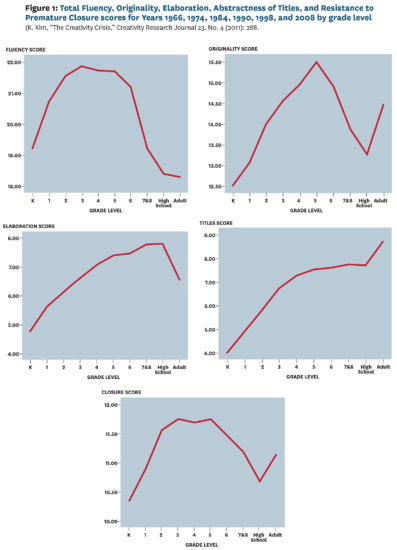
As one’s ability to think and reason increases, we should expect that many creative inclinations are filtered. I have bad, yet innovative ideas frequently, but I don’t act on or share them because I recognize that they don’t merit an audience. Older people will presumably not think of as many uses for a paper clip because they know what a paperclip can (and can’t) do, and thus discard possibilities that seem to lack value. The expression of creative ideation is reduced as a natural consequence of growth, development, and the maturation of logical thinking – not necessarily by being choked out by the hands of schooling. In fact, Kyung Hee Kim’s research shows that although a student’s creative Fluency score decreases as he progresses through the grade levels, his ability to elaborate on ideas, diversify areas of consideration, and stick with and develop ideas increase over the same timeframes.2 (For graphs of every measure tracked in this study, see below:)
Embracing possibility
But there is also something more sinister which comes into play – something that begins as a small weed and often grows over the years, potentially muting our willingness to engage our innate creativity. As many of us age, we stop believing in possibility, an essential ingredient fueling curiosity, the desire to explore,3 and one’s investment in creativity. Schooling, as Sir Ken Robinson points out, plays a significant role in shaping the thinking habits of children. Many teachers focus on the attainment of specific knowledge and thereby perpetuate a foundational ideological alignment with the idea that there always exists a “right” answer. Being “right” is rewarded. Being “wrong” is stigmatized and often penalized. Too often, content-focused teaching fails to recognize that a student’s ability to be “wrong” is an essential ingredient for seeing and pursuing possibility.
Creativity empowered breeds revision. It is fostered through a willingness to try, recognizing that there is always more we can learn through experiencing failure.
Failure left uncelebrated feeds into new conceptualizations of limitation. My dream of human flight died with my final plop to the floor, accompanied by the laughter and ridicule of siblings. What might have become of my passion if I had been encouraged to rework the idea, to trade in the towel-cape and seek out increasingly reasoned approaches? (Perhaps the Wright brothers had similar beginnings.) Creativity empowered breeds revision. It is fostered through a willingness to try, recognizing that an idea only dies when we accept our last failure as final.4 There is always more we can learn through experiencing failure.
It is, then, the role of the teacher to foster seeing possibility by reframing failure, to take time to consider whimsy, and to teach students how what might first be regarded as a bad or weak idea can often be reworked into a good one. Focus on asking questions over providing answers – on exploration over giving directives. Provide students with time to reason through the merit of their ideas. Facilitate and coach students to think by considering the answers to the questions, “What if?” or “How might?” or “What’s next?”5
I have never met a teacher who entered the profession with a vision of producing die-cut student minions. Instead, they became teachers because of a deep desire to help students live into and reach their potential. We learn (and teach) so that we might expose new potential solutions, insights, or abilities and then press into, or live into, those possibilities. Teachers strive to recognize possibility within the landscape of every student’s individual giftedness, then work to nurture their unique complement of talents.
How do we do this?
Spend time dreaming, on your own and with your students. Acknowledge that sometimes the dreams that seem crazy may just be the seed of the next idea that changes the world, then empower an attitude to try. Shakespeare said it well in Measure for Measure: “Our doubts are traitors and make us lose the good we oft might win by fearing to attempt.” If we give up on something, it is finished. Where we continue to believe in possibility, creativity knows very few limits.
Photo: iStock
First published in Education Canada, June 2020
NOTES
1 TEDTalks: Sir Ken Robinson, “Do Schools Kill Creativity?” (New York, N.Y: Films Media Group, 2009).
2 K. Kim, “The Creativity Crisis: The decrease in creative thinking scores on the Torrance Tests of Creative Thinking,” Creativity Research Journal 23, no. 4 (2011): 285-295.
3 National Academies of Sciences, Engineering, and Medicine, How People Learn II: Learners, contexts, and cultures (Washington, DC: The National Academies Press, 2018), 149.
4 R. Beghetto, “Taking Beautiful Risks in Education,” The Arts and Creativity in Schools 76, no. 4 (2018): 18-24.
5 Kolb, David & Kolb, Alice. (2017). The Experiential Educator: Principles and Practices of Experiential Learning.
-
A Walking Curriculum
Comments Off on A Walking CurriculumWant to take student learning outside the school walls? Focused walks can be used in any context to develop students’ Sense of Place and to enrich their understanding of curricular topics.
“Two Grade 4 students suddenly stop. Crouching down, unzipped coats hastily pushed behind them, they look closely at the base of a tree in the schoolyard. “Here,” one points eagerly. “This would be a great hiding place for an ant.”
“Yeah,” says the other, “but what about a mouse or a rat? That’s too small! There’s more hiding places over here – come on!” They both take off running. Mr. Reynold’s students have been told to find evidence of the great game of “hide and seek” going on all around them. The students learned that “hiders” may be prey and “seekers” predators. They look carefully, eyes opened to the largely invisible “game” that is played out everywhere in nature.
Yesterday, these same students paired up with their Kindergarten buddies to consider the life in the schoolyard. Wandering out in pairs, they searched for evidence of growth and, afterwards, shared the “breaking news” of what was “growing on.” (See “Two Sample Walks.”)
The Walking Curriculum
The Walking Curriculum1 is a teaching resource for K-12 educators who want to take student learning outside school walls. The 60 easy-to-use walk-focused activities are designed to engage students’ emotions and imaginations with their local natural and cultural communities, to broaden their awareness of the particular places where they go to school, and to evoke their sense of wonder in learning. Walking Curriculum activities can be used in any context to develop students’ sense of Place and to enrich their understanding of curricular topics.
The Walking Curriculum is designed for the educator who is passionate about supporting student learning and dedicated to growing in their practice, but who may not have considered moving outside the school walls to do so. All educators can afford their students the opportunity to connect with the wildness in the world – whether in urban, suburban, or rural settings.
Teachers often have few imagination-focused resources that can develop students’ sense of ecological understanding and at the same time can contribute to their understanding of the mandated curriculum. The Walking Curriculum resource is designed to fill that gap. The proposed walking activities address a wide variety of themes, perspectives, and motivations. For example, students may be asked to find different things (such as shapes, spaces or lines, evidence of growth or change, “the best” hiding places), to change perspectives (imagine being a beetle, a detective, or a visitor from outer space), to encounter the world differently (emphasizing one sense over another or moving through space differently), to seek evidence of human-nature relationships, to identify patterns, or to locate natural or human systems in action. In all cases, the activities are designed to connect Place-based learning activities with cross-curricular goals and to serve as examples to inspire other Place-inspired teaching ideas.
It’s an overcast day when Ms. Rai’s Grade 9 students move their Social Studies learning outdoors. The students are seeking examples of different land uses—in particular how the community caters to cars. Their observations fuel an interesting discussion in class about cultural priorities and values. Their teacher plans for their next walking-based activity to look at walkability in their neighbourhoods. They will be considering how useable, safe, comfortable and appealing different footpaths are for pedestrians and will ultimately suggest improvements. Some of the same students spend time later that day walking with breath – they are taking a mindfulness walk and considering how their bodies move, how the rhythm of their moving bodies and their own in- and exhalations offer them a focus for their attention. They are learning about mental wellness and practicing through outdoor walking.
Schoolyards are often underused resources for learning the curriculum and for developing students’ connections with nature and community. The message within the Walking Curriculum is simple: All educators (not just those who identify as “outdoor educators”) can help students re-imagine their relationship with the natural world wherever they go to school.
Engaging with nature ignites the imagination and fuels human curiosity.2 There is an openness and a complexity in nature that engages our sense of wonder, and a sensuousness that engages the body in learning. I believe outdoor, imagination-focused learning is one way to ensure that our students leave school more curious than when they arrived. This may address a troubling trend of disengagement and boredom for many students as they proceed through school.
Educators’ observations
Educators using the Walking Curriculum say they appreciate how the approach creates a new space for their teaching – they are experimenting, collaborating and discussing these ideas in ways that can support their professional growth. Educators find the Walking Curriculum to be a powerful bridge connecting traditional, “placeless” ways of teaching with an Indigenous worldview that acknowledges human beings learn from the relationships they experience within their human, other-than-human, and more-than-human communities. They are noticing the positive impact that the walks have on students’ mental well-being and their ability to regulate their emotions. And they report that their students’ observational skills are improving and their curiosity increasing – the walks take longer as students more deeply engage and as students are asking more questions, more often. The Walking Curriculum encourages interdisciplinary learning, as educators connect the ideas/learning generated through the walking-based activities to other curricular topics.
Every walk in the Walking Curriculum can bring some aspect of the natural world and related curricular knowledge into focus. With increasing clarity students begin to see the wonder in the “ordinary” world around them.
Re-imagining where students learn
Walking has been called the “magic pill” for wellness as it can positively impact so many aspects of our physical and mental health. Engaging with nature more routinely is also important for saving the planet. Research shows that undergoing meaningful experiences in nature as children can foster the development of a conservation ethic. This is, of course, one of the ultimate goals of Green Schools: students who care about the Earth.
The Walking Curriculum challenges teachers to re-imagine how they teach and it encourages teachers to personally re-connect to Place and community. The Walking Curriculum encourages teachers to “get outside” (physically outside and, figuratively, “outside” by rethinking how they engage their students). Engaging learners in their local natural and cultural contexts may – in part – be as simple as taking imaginatively engaging, inquiry-focused walks.
Two Sample Walks
1. The Hiding Place Walk: What good hiding places can you find? First think about a hiding place for yourself. Next, identify the best hiding places for a raccoon, a mouse, or a spider. Dramatic Tension: A giant life and death drama of “hide and go seek” is going on right now, all around us. Identify things that you think always try to hide. Why? It may be that the “hiders” are “prey” to other animals – they are likely to get eaten! Identify “prey” and “predators” – hiders and seekers.
2. The Growth Walk: What is growing on your walk? How do you know? What are the different ways in which growth appears to you? Role Play: What’s “growing on” in your schoolyard? Like a reporter, give a “breaking news” report about an example of things growing that you observed on your walk.
Photo: Amelia Dare
First published in Education Canada, June 2020
NOTES
1 G. Judson, A Walking Curriculum: Evoking wonder and developing sense of place (K-12) (KDP, 2018). Also available in French and Spanish. Learn more on imaginED www.educationthatinspires.ca
2 To learn more about imagination’s role in ecological understanding, read G. Judson, Engaging Imagination in Ecological Education: Practical strategies for teaching (Vancouver, B.C.: UBC Press, 2015); and G. Judson, A New Approach to Ecological Education: Engaging students’ imaginations in their world (New York: Peter Lang, 2010).


IDEAS TO SUPPORT EDUCATORS : Subscribe to the EdCan e-Newsletter
Quality research, reports, and professional learning opportunities.