Archive
-
Making Sense of Grades
Comments Off on Making Sense of GradesIn this edition of Education Canada we look at our assessment practices, with a special focus on the thorny issue of grading. What are grades for and what do they actually tell us? How accurate are they, really? What are the alternatives? And what is the effect of grading on student learning?
Having a bright son with ADHD opened my eyes to some of the real difficulties with grading. He was admittedly tough to assess because of the inconsistencies in his performance. But what were we to make, for example, of the fact that he scored just shy of 80 percent on a Macbeth essay, yet failed the essay assignment? How was that even possible? Well, the assignment included a lot of preparatory and presentation requirements (the bane of any student with ADHD), and the value given to these materials actually outweighed the essay itself. His attention to these details was sketchy. According to the grading scheme, the fail was legit. But it did not reflect either his understanding of the play or his writing ability.
So what a grade should actually measure is one of the first big questions in grading – and the more complex the learning task, the more grading becomes a tricky exercise in judgment. Ken Draayer recounts his struggle to define and measure quality in composition, and to encourage students to strive for improvement. Swedish researcher Eva Hartel discusses the value of comparative judgment and exemplars in helping to arrive at a shared understanding of quality work. Chris DeLuca and his colleagues examine grading practices across Canada, including the complex factors that go into assigning a grade. Another sticky wicket is the fact that grade-based college/university admission requirements make it difficult to change traditional grading practices at the secondary school level. David Burns and his colleagues share their learning from a pilot project in Burnaby, B.C., using portfolio-based university admission as an alternative to grades. Our web exclusive articles consider the use of student self-assessment of “work habits” (Stefan Merchant) and the relevance of knowledge acquisition in the internet age (Myron Dueck).
Whether used as a learning tool or as admission criteria to an elite program of study, assessment and grading practices have a significant impact on our students and on our education systems. This issue challenges us to rethink how we can evaluate learning in a fair and equitable way for all students.
Photo: Dave Donald
First published in Education Canada, March 2019
-
Indigenous Counter-Stories in Truth and Reconciliation Education
Comments Off on Indigenous Counter-Stories in Truth and Reconciliation EducationWhat stories are educators drawing on as they engage truth and reconciliation education? Madden argues that T&R education should not centre solely around stories of the residential school experience and portrayals of Indigenous people as victims. “Counter-stories” of refusal, resistance, resilience, and restorying resurgence are also needed, to shine “light on community processes that challenge historical and contemporary colonial relationships with Canada.”
In my position as an assistant professor of Indigenous teacher education at the University of Alberta, I serve two main teaching roles. The first is contributing to an initial teacher qualification program designed specifically to prepare Indigenous teacher candidates from both urban and reserve communities to centre Indigenous knowledges, pedagogies, and priorities. The second is developing and implementing coursework for all pre-service and in-service teachers that explores how colonial beliefs (e.g. terra nullius), systems (e.g. formal schooling), and strategies (e.g. legislation like The Indian Act) continue to differently impact those who live in the place we now know as Canada. Across both of these teaching contexts, I have noted general confidence among educators that truth and reconciliation education offers a new framework to heal Indigenous-non-Indigenous relationships, and to pursue school improvement for Indigenous students and communities. My observations suggest the most common starting place recommended to, and taken up by, educators is classroom inclusion of non-fiction and fiction books that introduce Canada’s Indian residential school system and related topics (such as Spirit Bear and Children Make History, by Dr. Cindy Blackstock and Eddy Robinson, and the accompanying learning guide that outlines the Canadian Human Rights Tribunal on First Nations Child Welfare for an elementary-level readership).
In response to the popularity of this approach, I have found myself asking: What stories are educators drawing on as they engage truth and reconciliation education? Why are some resources more widely used than others? And how are Indian residential school narratives shaping popular images of Indigenous peoples, educators, and Canadians? In this article, I delve deeper into these questions and present a framework for educational leaders and teachers to evaluate and enhance the types of Indian residential school accounts they include in the education for reconciliation curricula they design.
Perhaps it is useful to take a step back and consider why the questions I pose in the previous paragraph are significant. In her 2009 TED talk, The Danger of A Single Story, the award-winning Nigerian author and feminist activist Chimamanda Ngozi Adichie makes the case that single stories – those that show a people as one thing and are told over and over again, typically by outsiders – create stereotypes and result in one story becoming the only story. She argues that single stories have both symbolic and real-world consequences. They flatten experience, obscure humanity, exploit difference, establish deficit views, and negatively define and constrain who those at the centre can become.
Prior to what is being called the “era of reconciliation,” Potawatomi-Lenapé scholar of education Dr. Susan Dion explored the danger of a single story in the context of school-based teaching about Indian residential schools. Her research showed that the single story of hopeless Indigenous victims shaped how non-Indigenous teachers and students taught and learned about Canada’s Indian residential school system. She noted an overreliance on teaching methods intended to foster empathy, such as letter writing to former residential school students. Dr. Dion demonstrates that pedagogies of empathy ensured that the single story, as well as associated images and outcomes, went unchallenged. Students remained preoccupied with feeling sorry for the “pitiful” Indigenous victim at the expense of exploring numerous examples of Indigenous strength and agency that were also present in the stories used. By contrast, they learned to see themselves as compassionate and honourable, in that they were able to demonstrate understanding of the “right” rules of moral behaviour, develop “appropriate” attitudes regarding the suffering of Indigenous peoples, and arrive at “fair” judgments about “historic” wrongdoings. Further, this approach cultivated the conditions wherein students were able to view settler colonialism – the ongoing physical occupation of Indigenous land by a colonial state and non-Indigenous settlers and violent and legislative dispossession of Indigenous peoples through established structures and everyday actions – as a thing of the past. Overemphasis on developing empathy for residential school victims overshadowed fostering students’ understanding of how they were impacted by and participated in ongoing colonial logics and effects. Engagement with difficult knowledge and unpleasant but necessary conflict was hindered.
Both Adiche and Dion suggest that while stories can be used to dispossess and change, they can also be used to humanize, empower, and heal. Counter-storytelling is proposed as a method for exposing, analyzing, and challenging narrow accounts. Counter-stories make space for multiple, nuanced stories of under- and misrepresented peoples and experiences. Counter-stories and -storytelling also provide a platform to interrogate privilege and views of Indigenous peoples and groups, to illuminate how we are all are produced within interconnected systems of oppression.
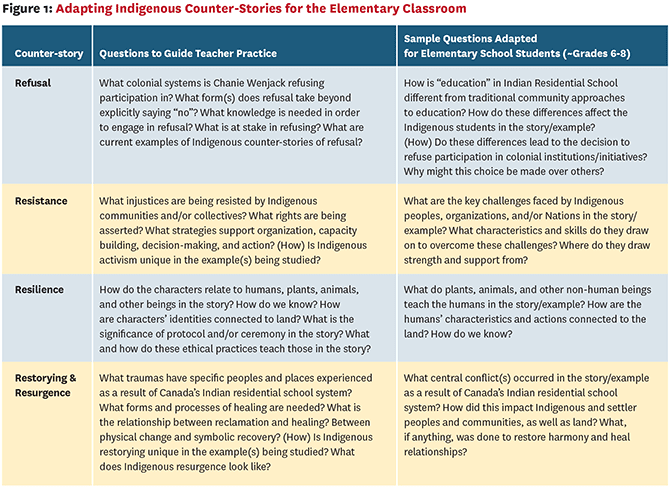
I organize Indian residential school counter-stories according to narratives of: refusal, resistance, resilience, and restorying and resurgence. To appeal to a wide range of learners and tailor to current and local contexts, I suggest including young adult and children’s literature, as well as additional texts such as primary documents, newspaper articles, film, and museum exhibits. Below I offer examples of each type of counter-story, as well as questions to guide teachers’ practices; educators are encouraged to adapt questions for their education context (e.g. level, discipline) and based on the unique gifts they possess, their geographical location, and local Indigenous priorities and guidance. Figure 1 offers examples of ways to adapt questions for younger students.
Refusal
Counter-stories of refusal reveal the ways in which Indigenous peoples have been refusing participation in colonial systems since contact, despite ongoing threat to their safety and wellness as a result. For example, the Truth and Reconciliation Commission of Canada’s final report details a variety of strategies that include parents’ refusal to enrol their children in Indian residential schools, as well as refusal to return escapees or children at the end of summer “holidays.” Numerous accounts of students who escaped from an institution to return to their community despite the risk of death, injury, or being caught, returned, and punished are available for inclusion across grade levels. For example, Secret Path is a multi-media text that combines ten songs by Gord Downie with the graphic and animated illustrations of Jeff Lemire to tell the story of 12-year-old Anishinaabe boy Chanie Wenjack. Wenjack died on October 22, 1966 while fleeing the Cecilia Jeffrey Indian Residential School near Kenora, Ontario, with the intention to return to his home on the Marten Falls Reservation over 400 miles away.
When preparing to use these print and video resources, teachers might draw inspiration from the following questions: What colonial systems is Chanie Wenjack refusing participation in? What form(s) does refusal take beyond explicitly saying “no”? What knowledge is needed in order to engage in refusal? What is at stake in refusing? What are current examples of Indigenous counter-stories of refusal?
Resistance
Counter-stories of resistance demonstrate how Indigenous communities and collectives organize and act to resist dispossession, disenfranchisement, and dismissal by the colonial state and demand recognition of human, Indigenous, and treaty rights. For example, in 1970 a sit-in at the Blue Quills Residential School in Alberta resulted in the operation of the school being turned over to the newly formed Blue Quills Native Education Council. The sit-in was led by Stanley Redcrow, a former Blue Quills student and maintenance worker at the school, and Alice Makokis, a school counsellor who worked for the Department of Indian Affairs. It involved over 300 school staff and parents and lasted 17 days, culminating in the Department of Indian Affairs flying 20 Blue Quills community members to Ottawa to meet with the Minister of Indian Affairs (and future Prime Minister) Jean Chrétien. Founded in Nēhiyaw centred curriculum, Blue Quills reopened as an elementary school and junior high in 1971 and expanded to include high school in 1976. The building now houses University nuhelot’įne thaiyots’į nistameyimâkanak Blue Quills, the first Indigenous-controlled university in Canada.
The legal campaigns initiated by former residential school students that led to the Indian Residential Schools Settlement Agreement – the largest class action settlement in Canadian history – is an additional example of a narrative of resistance that I suggest deserves space in truth and reconciliation education. In creating classroom space for counter-stories of resistance, teachers could consider how they will invite students to explore: What injustices are being resisted by Indigenous communities and/or collectives? What rights are being asserted? What strategies support organization, capacity building, decision-making, and action? (How) Is Indigenous activism unique in the example(s) being studied?
Resilience
Counter-stories of resilience highlight the incredible ability of Indigenous peoples and Nations to overcome systematic assault on ways-of-knowing and ways-of-being. Resilience is often nurtured through drawing on the strength of communities and traditional teachings, both of which are comprised of human, other-than-human (e.g. plants, animals) and more-than-human (e.g. ancestors in the spirit world) relations rooted in land and honoured through protocol, ethical practice, and ceremony. The testimony of former residential school survivors who went on to work as residential school staff because they felt their presence made an important difference in the lives of students stood out in the final report of the Truth and Reconciliation Commission of Canada as a particularly moving example of resilience.
Children’s and young adult literature, as well as graphic novels, often illuminate processes and possibilities of resilience. For example, Shi-shi-etko, written by Nicola I. Campbell and illustrated by Kim Lafave, chronicles the four days a young girl spends learning with her family in her community before leaving to attend residential school. Shi-shi-etko bathes in the creek with her mother, canoes on the lake with her father, collects medicines on the land with her grandmother, and privately offers tobacco to Grandfather Tree to keep her memories and family safe until she returns home in the spring. The reader infers that she will draw strength from the ways of her people and the land she is from during her time at residential school. A video adaptation was also directed by Kate Kroll and produced by Marilyn Thomas in collaboration with the author.
Prompts that can be adapted to encourage classroom connections through literature may include: How do the characters relate to humans, plants, animals, and other beings in the story? How do we know? How are characters’ identities connected to land? What is the significance of protocol and/or ceremony in the story? What and how do these ethical practices teach those in the story?
Restorying and resurgence
Counter-stories of restorying and resurgence emphasize the healing and reclamation of Indigenous peoples and places who have experienced trauma as a result of Canada’s Indian residential school system. In many cases, restorying is marked by physical change that mirrors symbolic recovery. For example, survivors, their families, and community members participated in an organized demolition of Peake Hall, the dormitory of the Alberni Indian Residential School that was located on the traditional territory of the Tseshaht First Nation in Port Alberni, B.C. The demolition was conducted in a ceremonial way and included sacred burning, smudging, and a feast, offering participants the chance to heal and free the spirits of their relatives from the former school. In addition to the demolition, the community constructed a traditional-style long house on the site and raised a pole and installed a sculpture made by local artists.
The exhibit Speaking to Memory: Images and Voices from St. Michael’s Indian Residential School is an additional example of restorying and resurgence. It hung on the exterior of the school building at Alert Bay, B.C. transforming the space; a representation of the project was also exhibited at the Museum of Anthropology in Vancouver.
Guiding questions to activate analysis of counter-stories of restorying and resurgence include: What traumas have specific peoples and places experienced as a result of Canada’s Indian residential school system? What forms and processes of healing are needed? What is the relationship between reclamation and healing? Between physical change and symbolic recovery? (How) Is Indigenous restorying unique in the example(s) being studied? What does Indigenous resurgence look like?
To be clear, I do support the Truth and Reconciliation Commission of Canada’s view that truth telling in the form of survivors’ testimony about the abuses they suffered is an integral aspect of education for reconciliation. I do not intend to suggest that stories that shine light on former students’ lived experiences of being abused by priests, nuns, residential school staff, and/or other students should be excluded because they risk positioning Indigenous peoples as victims. Following the Commission, I hold that without truth there is no possibility of reconciliation. I recognize the potential of truth telling to restore dignity, aid in healing for victims, and pursue justice through calling perpetrators, governments, and citizens to account.
Indigenous counter-stories of refusal, resistance, resilience, and restorying and resurgence enhance this oral history by shining light on community processes that challenge historical and contemporary colonial relationships with Canada. They also make it more difficult to take up colonial positions and ways of being in relationship (e.g. rescuer/victim) that reduce Indigenous agency. As educators, the inclusion of Indigenous counter-stories in truth and reconciliation education allows us to imagine reconciliation between settler Canadians and Indigenous peoples, where the latter are not characterized by the singularizing image of victimhood.
Recommended Resources
National Centre for Truth and Reconciliation Teaching Resources.
“The Danger of a Single Story,” by Chimamanda Ngozi Adiche (TED talk, 2009).
Shi shi etko (video directed by Kate Kroll and produced by Marilyn Thomas, 2011).
Photo: John Lehmann/The Globe and Mail
First published in Education Canada, March 2019
-
Grading Across Canada
Comments Off on Grading Across CanadaGrades are a powerful gatekeeper within our educational system, yet little is known about the consistency of grades across classes, schools, and districts or how grades are constructed, interpreted, and used. In this article, the authors examine grading policies and practices across Canada, looking specifically at current grading policies, what drives teachers’ grading decisions, and the influence of provincial large-scale testing.
There is no denying that grades have a significant impact on the lives of students. From boosting self-confidence, admittance to university and college programs, and gaining access to funding, to potential negative outcomes including bullying, lowered self-esteem, and limited career choices, grades not only represent learning but are connected to important social consequences. For some students, the difference between 84 percent and 85 percent on a final grade could mean getting into their desired university and chosen career path; for another, grades could mean the chance to immigrate to Canada, or not. Grades have been, and continue to be, a powerful gatekeeper within our educational system, and across educational systems globally. And yet, little is known about the consistency of grades across classes, schools, and districts or how grades are constructed, interpreted, and used.
Experts point to the inherent subjectivity in grades, and the ample room for error and difference across teachers. In efforts to reduce this subjectivity, provinces, school districts, and schools implement grading policies to promote more consistent grading practices. Policy-based grading encourages alignment between what is taught (i.e. curriculum expectations) and what is assessed. Policy-based grading also provides teachers with explicit criteria to help them distinguish an A from a B or a Level 3 from a Level 2. In this article, we explore grading policies and practices, and their potential perils, across Canada. Drawing on recently published research, we look specifically at what current grading policies are signalling to teachers, what drives teachers’ grading decisions, and how provincial large-scale testing influences students’ grades.
Grading practices across Canada
Grading is a longstanding tradition in education, dating back to the imperial exams administered in ancient China. These methods became more formalized for students in 1792, when grading was established by William Farish, a tutor at Cambridge University, as a quantitative method for efficiently teaching and tracking students. Grades have become the primary method for summarizing and communicating student achievement.
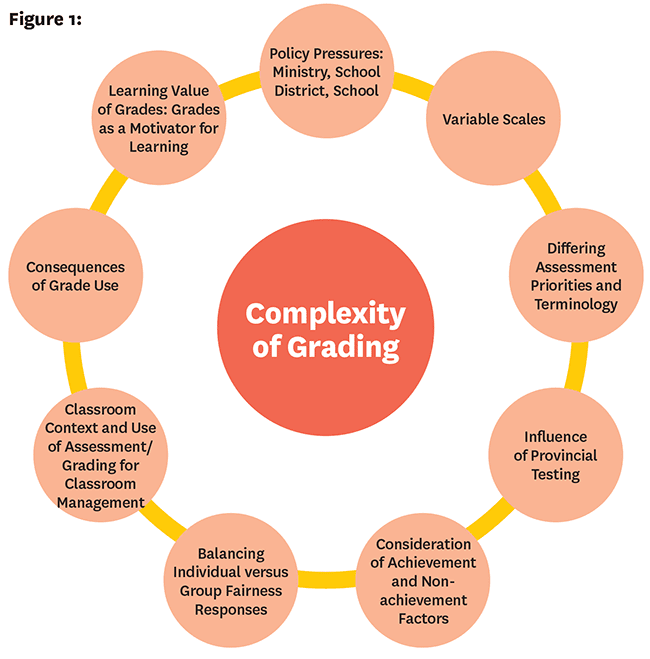
Grading is the process of collecting and evaluating evidence of student achievement, performance, and learning skills. As any teacher knows, grading is a complex practice that often requires negotiating evidence in relation to curriculum expectations and students’ unique learning progressions. As grades are used to make public statements to students, parents, and principals about achievement, and often used for higher-stakes consequences including access to specialized programs and learning supports or admission to university or college programs, grading is an important professional practice with significant implications. Teachers across Canada are expected to follow provincial policies when determining student grades, a practice known as “policy-based grading.”1 However, due to the decentralized nature of educational policies in Canada, research suggests that significant variability in grading practices exist from one jurisdiction to the next.2 This variability is in part due to different priorities within policies across regions and in how policies are interpreted and used by teachers and administrators at classroom and school levels. In examining policies across Canada, we found several important similarities and differences in grading policies:3
- Grading policies consistently emphasize that the primary purpose of grading is to monitor, report, and communicate student achievement.
- Grading scales are similar across Canada, with percentages being used in secondary classrooms and letter grades in elementary classrooms.
- Grades consistently report on achievement evidence (evidence on learning of curricular standards), with non-achievement evidence (learning skills and habits) reported separately.
- Reporting practices tend to be fairly consistent with the general guidelines and templates generated from ministries of education.
- Large-scale assessments contribute variable amounts to secondary students’ final grades across the country, with contributions ranging from 10-50 percent in calculations for the final grade.
- Significant variation in terminology is evident in grading policies across Canada related to the terms: formative, summative, Assessment of Learning (AOL), Assessment for Learning (AFL), and Assessment as Learning (AAL),4 5which could contribute to different cultures of assessment within schools.
What goes into a grade?
Measurement experts suggest that grades should only reflect student achievement of learning expectations. However, when assigning grades, teachers typically include both achievement (e.g. exams, quizzes, class presentations) and non-achievement factors (e.g. attendance, effort, independence), or what is often called “learning skills.” For example, a study by Resh6 found that teachers weighed effort nearly as much (17 percent) as student performance (18 percent). Other researchers have shown that teachers sometimes assign greater weight to non-achievement evidence in their grade construction.7 The effect of including both achievement and non-achievement factors in a single score is that you cannot distinguish what the student knows about the content from the student’s learning skills and behaviour. The result is that grades then provide less valid information for remediation, acceptance for programs, or accurate self-perceptions. Further, research has demonstrated that teachers adopt different weightings of achievement and non-achievement factors based on the contexts and use of grades. For example, teachers’ consideration of student effort appears to be correlated with student ability and behaviour, particularly for low-ability students: teachers give better grades to low-ability students and borderline cases (i.e. students at risk of failing) if they are well-behaved and put effort into their work.
In deciding what to prioritize when determining grades and when faced with grading dilemmas, teachers tend to return to the question, “What would be most fair for the individual student and for the class as a whole?” In one of our recent studies that involved talking with Ontario teachers about their grading practices and challenges, we found that teachers consistently aim to provide “fair” grades to their students; however, “fairness” held different meanings depending upon the teacher and the grading context. What might be fair in one situation might not be fair in another, or to different stakeholders. Often, fairness meant balancing what was best for an individual student in relation to what was consistent and fair for all students in the class.
Through our analysis, fairness was viewed as the overarching value that helps teachers navigate grading tensions that arise in relation to four common themes: 1) context and classroom management, 2) learning values: grades as academic enablers, 3) policy and external pressures, and 4) consequences of grade use. For example, teachers reported that “bumping up” a grade to allow a student to be admitted into their desired university or college program was fairer than increasing a grade if there were no immediate consequences.
The influence of large-scale testing
Provincial and territorial large-scale assessment programs tend to have “high-stakes” consequences for students, but not teachers or administrators across Canada.8 For example, a quick scan of these programs suggests they account for a significant percentage of a secondary students’ final grade. Indeed, between 10 and 50 percent of a students’ final grade in certain provinces is based on student performance on provincial large-scale assessment programs in the form of exit examinations.9 In some cases, a passing grade on these large-scale assessments also serves as a requirement for graduation or admittance to post-secondary institutions, as is the case in Ontario, Quebec, and New Brunswick. Thus, it is fair to assert that large-scale assessments exert a pronounced influence on teachers’ own grading practices in that educators across Canada – particularly those in secondary schools – will want to have general alignment between their classroom grades and students’ achievement on large-scale assessments. In some respects, the relationship between large-scale assessments and classroom grades may be used as a proxy for concurrent validity. In this way, a high correspondence between the results of a particular test (in this case provincial large-scale assessment program) and an established measurement for the same or similar learning expectations (in this case teachers’ grades in the same tested subject domain) strengthens the perceived accuracy of both. The agreement or lack thereof between large-scale and classroom assessment is bound to create tensions and discussion on the utility and rigour of each method of assessment.
The results of large-scale assessments also provide an important accountability and/or gatekeeping function across Canadian school systems. Given that these measures are routinely given priority status as more “reliable” and “valid” indicators of student achievement, teachers and administrators may adopt and promote inappropriate test preparation practices, such as teaching to the test, in order to have more favourable student, classroom, and school results. The latter presents an interesting dichotomy with respect to the previous point related to concurrent validity, in that teaching to the test artificially inflates students’ large-scale assessment scores and inadvertently may present teachers’ grading practices as less accurate or rigorous. Perhaps more disconcerting is that teaching to the test inflates student performance at the expense of authentic forms of learning that allow for transfer of knowledge and skills.
Ultimately, large-scale assessment programs across Canada present opportunities and challenges for existing grading policies and practices, leading to intended and unintended consequences. Understanding the evolving nature and impact of these large-scale assessment programs on teacher’s pedagogical approaches and grading practices requires sustained longitudinal studies. Certainly, the literature abounds with international jurisdictions that have largely succumbed to a testing-focused education model that has undermined teachers’ classroom assessment literacy. Ironically, those systems tend to fare quite poorly on international measures of student achievement such as the Programme in International Student Assessment (PISA), which assesses reading, mathematics, and science literacy every three years across more than 70 educational jurisdictions around the world.
What all this means is that grades – despite their influence, power and potential consequences – are complex indicators of student learning (both achievement and non-achievement) with variability in policies and practices across Canada. While such variability is not necessarily a negative quality, as it could enable more fair treatment and valid reporting in relation to unique student learning progressions and classroom contexts, it does challenge our ability to consistently compare students when making selection, admission, and ranking decisions. Grading is one of the most high-stakes classroom assessment practices, sitting at the critical intersection of teaching, learning, and assessment and representing the most public professional statement made by teachers about student learning. The more aware teachers are of the complexity of grades, the more likely grading can be ensured to be a valid, reliable and, most importantly, fair practice beneficial to student learning.
NEW! Discussion Kit
Download the pro-learning session 1.1 – Rethinking How You Grade
Original Illustration and Photo: iStock
First published in Education Canada, March 2019
1 B. Noonan,“Interpretation Panels and Collaborative Research,” Brock University 12 (2002): 89-100.
2 M. Simon, S. Chitpin, and R. Yahya, “Pre-service Teachers’ Thinking About Student Assessment Issues,” International Journal of Education 2. no. 2 (2010): 1-20.
3 C. DeLuca, H. Braund, A. Valiquette, and L. Cheng, “Grading Policies and Practices in Canada: A landscape study,” Canadian Journal of Educational Administration and Policy 184 (2017): 4-22.
4 AOL refers to Asessment of Learning, AFL Asessment for Learning, and AAL Assessment as Learning.
5 B. Noonan,“Interpretation Panels.”
6 N. Resh, “Justice in Grades Allocation: Teachers’ perspective,” Social Psychology of Education 12 (2009): 315–325.
7 Y. Sun and L. Cheng, “Teachers’ Grading Practices: Meanings and values assigned,” Assessment in Education: Principles, Policy & Practice 21, no. 3 (2014): 326–343.
8 L. Volante and S. Ben Jaafar, “Educational Assessment in Canada,” Assessment in Education: Principles, Policy & Practice 15, no. 2 (2008): 201-210.
9 D. Klinger, C. DeLuca, and T. Miller, (2008). “The Evolving Culture of Large-scale Assessments in Canadian Education,” Canadian Journal of Educational Administration and Policy 76 (2008): 1-34.
-
Grading for Equity
Comments Off on Grading for EquityJoe Feldman provides a vision for equitable grading with a focus on coherence and mastery learning. Drawing on research and interweaving voices of teachers, researchers, school administrators and students, the author defines grading for equity using three pillars: equitable grading is accurate, bias-resistant, and motivational. Linking theory and practice, the author provides a practical guide using research-informed examples to convince readers that commonly used assessment practices are ineffective and should be replaced with equitable grading practices to improve learning for all students, particularly those who are underserved or vulnerable.
The author provides a historical account of traditional grading practices and challenges readers to consider how shifting to equitable grading practices leads to an improved representation of student learning. Some recommendations for equitable grading practices discussed in the book include: use a 4-point grading scale, weight more recent performances, promote productive group work and high-quality work without a group grade, exclude behaviours from the grade (e.g., lateness, effort, participation), provide non-grade consequences for cheating, use alternatives for late work, reframe homework, allow retakes and opportunities to improve grades, use rubrics to calibrate learning intentions, promote students’ self-regulation and agency through student trackers and goal setting, and more. Zero-grades, averaging, and extra credit, by contrast, are practices Feldman argues should be dropped. Using mathematical comparisons, as well as sample gradebooks, the author dispels myths and demonstrates how formative and summative assessment divisions are not fixed and that arriving at a final grade requires coherent and equitable grading practices, including a teachers’ professional judgment.
Each chapter builds on the next and provides teachers with a valuable guide book and arguments for changing practice and moving towards a standards-based grading model. Using approaches that are mathematically sound, prioritizing knowledge and understanding, supporting hope and a growth mindset, and providing students with clarity for how to succeed, can motivate students to improve their learning. Each chapter concludes with a summary of key concepts and thought-provoking questions, making this a perfect book to discuss with a group of colleagues. The book also has a supporting website with additional resources and examples of equitable grading practices: https://gradingforequity.org
Corwin, 2019.
ISBN: 9781506391571
-
The Surrey Portfolio Pathway Partnership
Comments Off on The Surrey Portfolio Pathway PartnershipCompetency-based assessment runs into a roadblock when university admission is driven by traditional grades. This article describes a project at Kwantlen Polytechnic University experimenting with basing university admissions on student portfolios that demonstrate competencies.
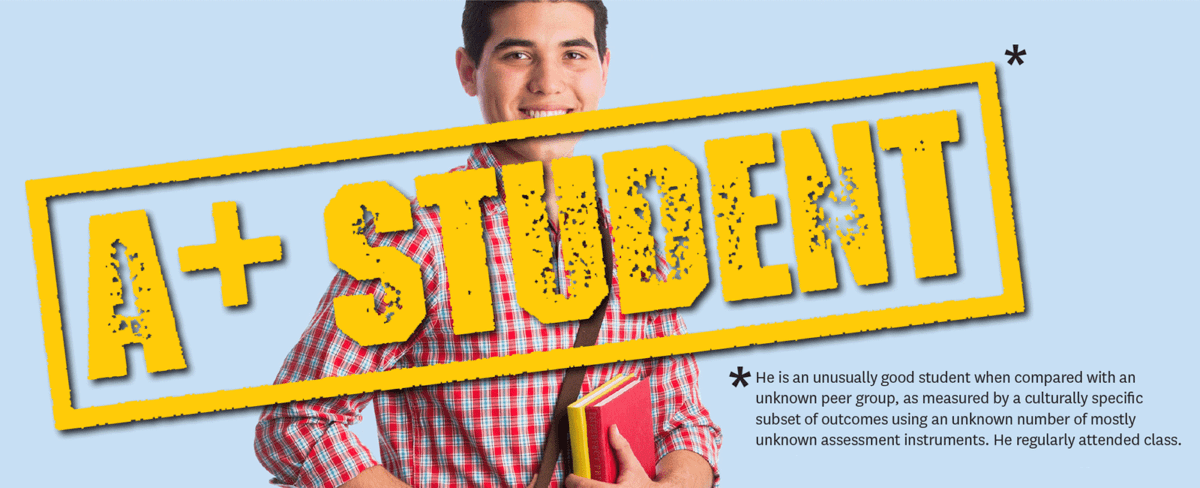
If I had to summarize the problem with conventional grading systems (letter or percentage grades derived from classroom-based and standardized testing), it would be that educators tend to overstate their significance. When we say that “she got an A in English,” we usually mean to say “she is a good or excellent student” in that area. That is, of course, not something that letters are able to tell us.
In most grading systems I have encountered, grades in the A range represent unusually good achievement. In other words, if everyone gets an A, people start asking questions about how you mark. Letter grades rarely come, however, with data about the population to which that student has been compared (either explicitly or implicitly). We are making a relative claim without a frame of reference. Since high school English teachers are typically free to set their own assignments, it is also fair to say that this grade comes from an unknown number of unknown assessments. One of those assessments, depending on one’s province, might be a standardized exam, but that is not the only data point.
Grade 12 English, in any given provincial iteration, furthermore represents only one set of outcomes that one might associate with competency in spoken and written English, rhetoric, literature, and so forth. It obviously does not assess one’s ability to articulate an idea in any other language, nor does it typically include a robust non-European focus.
Even more confusingly, many teachers persist in assigning marks to non-curricular performances like attendance, participation and the like. A student who knows literally everything she needs to know about English literature might still, by dint of her poor attendance, score badly in her English course.
So, much like the warning labels on cigarette boxes or the side effects listed in advertisements for medication, conventional letter grades should come with a warning reminding us of their limitations.
This is why I, as a university teacher of primarily first-year students, am excited to see British Columbia’s next generation of Grade 12 graduates. A new, competency-based system will supplement existing letter and number grades, and will offer more ambitious opportunities to build portfolios, demonstrate competencies, and solve problems. Fortunately, Surrey Schools (one of our local districts) has already begun to incorporate many of these practices.
We wanted a viable blueprint for competency-based admission… to carry the K-12 changes into the post-secondary sector.
This is also why, a few years ago, it became clear to my research team (myself and a rotating cast of rising undergraduate stars) that we needed to do something. University admission policies – as any parent, student or high school teacher will tell you – drive a great deal of behaviour. Traditional admission policy incentivizes attention to conventional letter grading assessments, rather than the more authentic, but qualitative, demonstrations of achievement to which people naturally gravitate. So Surrey Schools could bravely press forward with the new curriculum, but if they were left to do so without their post-secondary partners, the results would be sadly predictable. As supportive of the new curriculum as I am, if my child came home and told me she was doing extensive extracurricular work on her portfolio, I would tell her to study for her exams first. She isn’t getting into university with her portfolio (outside of a few disciplines, such as design).
Why, though, isn’t she getting into university with her portfolio? Well, insofar as I could tell, no one had tried. After a few emails to my academic leaders, and a healthy dose of literature review, the Surrey Portfolio Pathway Partnership got started. We wanted a way to build an admission system that used authentic student assignments to carry the K-12 changes into the post-secondary sector. We wanted a viable blueprint for competency-based admission. We didn’t need a huge group of students; we just needed enough diversity of achievement to see what a portfolio might look like in a few different academic contexts. We began with the collection of about two dozen portfolios created in the existing curriculum’s career planning course. What we saw in that analysis was that, in order to be useful in university admission, student portfolios would need to be structured and supported to a much greater extent.
Knowing this, we formed a closer partnership with Surrey Schools and asked them for the names of 5-10 students who had interesting and creative ideas – irrespective of their formal grades. By special permission of our university’s senate, we were able to offer these students admission to the university on the basis of their competencies, rather than their grades (to this day, I have not seen their grades). What competencies? Well, that was up to them.
My research team split the group up so that each student would have an undergraduate mentor to help them build a competency-based portfolio over the course of their final months in high school. Pretend, we said, that we did not offer you admission. What would you show us to prove you are ready for university?
Over the next six months we guided the group through the collection and editing of the work they thought would show us their preparedness for university. The interests of the group were diverse – including nursing, criminology, poetry, and science teaching. The assignments they chose were similarly eclectic. We received hand-drawn geographical diagrams, speeches posted on YouTube, essays, standardized test results, worksheets and more.
We then mapped two layers of learning outcome information onto those assignments: the Grade 12 curricular competencies (learning outcomes), and the outcomes of a group of popular first-year undergraduate courses in our university. We listed every instance we could wherein a connection could be made between the assignment and these outcomes. The result was a web of about 1,400 connections. That is, there were 1,400 instances in which we saw an assignment and judged that it at least partially demonstrated a given outcome. This does not mean that every portfolio will be so richly interwoven, or even that we are correct in asserting the connections we did. What it does mean is that, for each of these students, the single letter grade we would usually see misses potentially hundreds of meaningful data points that their high school teachers had already seen.
One student – let’s call her Olivia – is looking to study in the liberal arts. She submitted English essay writing, creative writing, a written speech, a reflection on her work experience at a part-time job, a package of math assignments, and hand-drawn diagrams of environmental phenomena. When we compared this work to a sampling of our first-year undergraduate objectives, we found they partially demonstrated achievement in the expected areas of English, creative writing and math. We also found connections to the mental health topics in first-year health courses, the portfolio work in first year interdisciplinary courses, and other connections to global education, geography, education, and earth science.
Can it be scaled up?
I don’t know Olivia’s Grade 12 grades – but let us pretend for the purposes of argument that I do know those grades. Under conventional admissions policy, she would be admitted to my university on the basis of either her English grade, or an average of that grade and a few others. The institution gains or loses all those interesting ideas, and Olivia gains or loses all those life opportunities, while a package of broader and more meaningful assessment data sits literally down the street.
It is as if we had said, “I know you have achieved quite a bit in English, creative writing, mathematics, geography, interdisciplinary studies, global education, geography and earth science… but I only need to see your English 12 grade, please.”
The reason we do this has always been twofold, though. First, it has historically been difficult to collect assignments like these into a portfolio that can be sent with ease around the country. A single-page transcript, however, is easily sent anywhere. Second, whatever institution receives a portfolio needs to engage in a costly and time-consuming review of the material.
The first justification is simply no longer relevant. The age of the paper transcript was once characterized by very high costs for both computing and data transfer. Neither is the case today. Many individual high school students carry the computing and data transfer technology they need with them to school every day, and the industrial-scale servers used for cloud computing work far harder to provide us all with up-to-date photo and video libraries than they would to collect even a large proportion of a student’s high school work.
The second justification for conventional grading and admissions is far more pertinent. If we send portfolios from high schools to post-secondary institutions, we are seemingly saddling those institutions with an enormous new responsibility – reading and assessing all those portfolios. I was in a meeting a few years ago in which we discussed how much that would cost. It wasn’t comforting, and we couldn’t imagine a way to make it all work.
But this project has led me to conclude I had entered that meeting with a false premise. Post-secondary institutions will never know as much about student achievement as high school teachers do. Even with unrealistic budget increases, including seconding professors to admissions offices, secondary educators will still have a better longitudinal look at student achievement, and will have a wider and deeper range of performances to draw on. The question, then, isn’t how a university could read all those portfolios, but rather how we can build a better way to communicate what is in them.
Since secondary teachers are already evaluating student outcomes (in B.C., curricular competencies), it would be relatively unproblematic to shift the recording of that achievement to a new mode. Rather than taking assessments on a range of outcomes and then aggregating all that assessment into a single letter, why not leave the assessment at the level of assignments and outcomes? Why not say that Olivia has met the following Grade 12 competencies? She could then attach her portfolio work as evidence of those competencies should she wish to share it. Her future university could then examine which Grade 12 competencies its students should achieve in order to be strong candidates for undergraduate study and could receive those competency certifications (as assessed by her Grade 12 teachers), much like grades are received today.
Such a system of competency certification would enable students to use an incredibly wide range of possible assignments to prove their achievement. Anything, in principle, would be fair game if it could demonstrate to the teachers who know a student best that the competencies have been demonstrated. This would also sidestep the need to have post-secondary institutions review each and every portfolio. The portfolios could be linked to the competencies, but the competencies would be certified as a layer above the work itself. (See Figure 1.) Everyone would, in other words, get the more detailed analysis Olivia received.
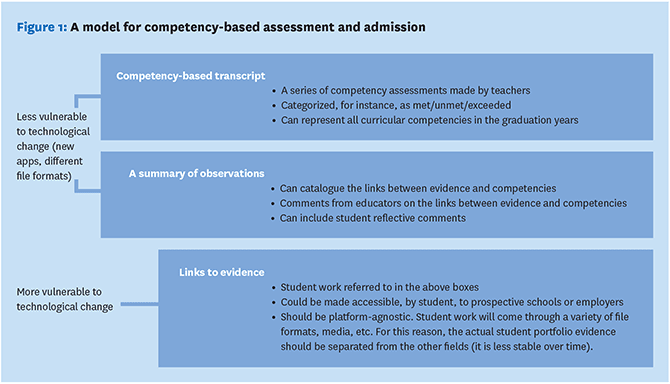
While we are working on a series of more technical explanations and proposals, the arguments I have offered here hint at what I think the future of assessment looks like. I can say with more clarity that a person can do X and not Y than I can say that a person achieved A and not A-. It is more practically meaningful to say that a person can do X, than it is to say that a person is an A student. A system that allows students to carry their portfolios, but that does not result in the creation of massive administrative overhead, seems possible.
If we are going to close or open the door to future opportunity, we owe it to students like Olivia that we see the full range of her competencies as assessed by the teachers who work with her most closely. The Surrey Portfolio Pathway Partnership provides a small glimpse through a doorway to one possible future for assessment and admission. We intend to push it.
Original photos: iStock
First published in Education Canada, March 2019
-
Building bridges, not walls: Leveraging student diversity in the classroom
Comments Off on Building bridges, not walls: Leveraging student diversity in the classroomA new fact sheet by the national EdCan Network of educators entitled How Can Teachers Maximize Engagement among Multilingual Students? outlines practical ways that Canadian teachers can implement inclusive learning strategies and programs that heighten engagement among students from immigrant backgrounds.
Authored by Dr. Jim Cummins, professor emeritus at the University of Toronto’s Ontario Institute for Studies in Education (OISE/UT), this timely resource reveals that students who are encouraged to use their home languages alongside the language of the classroom will come to view themselves as talented and accomplished speakers of multiple languages who are more likely to engage academically.
“With ever-increasing racial, linguistic and religious student diversity, we’d like to provide concrete support to educators and education leaders who are grappling with how they should create more culturally and linguistically inclusive spaces despite having limited knowledge of students’ home languages or experiences,” says Max Cooke, EdCan Network Interim CEO.
In addition to the downloadable copy of the fact sheet, available at www.edcan.ca/multilingual, also included are several examples of teacher-driven projects that leverage students’ multiple languages as enrichment opportunities for all students.
This fact sheet was made possible with the generous financial support of the Desjardins Foundation and the Canadian Schools Boards’ Association.


-
How Can Teachers Maximize Engagement among Multilingual Students?
Comments Off on How Can Teachers Maximize Engagement among Multilingual Students?The term “multilingual” is increasingly used by educators to describe students from immigrant backgrounds who are in the process of learning the language of instruction at school. This is a positive affirmation that identifies multilingual students as “haves” (speakers of many languages) rather than “have-nots” (lacking proficiency in the school language). Researchers have discovered that by encouraging multilingual students to use their home languages alongside the language of the classroom, they come to view themselves as talented and accomplished speakers of multiple languages who are more likely to engage academically, rather than feeling limited by their current abilities in the school language. In recent years, Canadian teachers have been exploring a wide variety of inclusive learning strategies and programs that leverage students’ multiple languages as enrichment opportunities for all students.
Here are some effective ways to integrate multilingual instructional strategies into classrooms:
- Each day, teachers invite one or two students to share a word from their home languages with their classmates and explain why they chose that word and what it means. Over time, students and teachers learn a new collection of words in different languages.
- Examples of students’ work in their home languages and in the school language are prominently displayed in school corridors and at the school entrance. This reinforces the message that students’ diverse languages are both personal and educational assets.
- School library collections have multilingual books for both students and parents to read at school and at home. School policies can ensure that libraries maintain a diverse and well-stocked selection.
- Students write and publish online dual language or multilingual stories or projects.
- Teachers invite parents and community members to the classroom to read and tell stories in community languages.
- Across subject areas, teachers encourage students to conduct research online in their home languages for class projects.
- Students collaborate with partner classes across the world or across the city to create a variety of projects involving two or more languages.
The vast majority of Canadian teachers agree that we should connect instruction to students’ lives, build on their background knowledge, and maximize their intellectual and aesthetic talents in an emotionally safe learning environment. When we acknowledge the role of students’ home languages in their lives and explore options that build on their multilingual skills, all students learn how to work across their differences and gain appreciation for different languages and cultures – skills that are highly valuable in our increasingly multicultural and interconnected world.
ADDITIONAL INFORMATION RESOURCES
Examples of Multilingual Projects
The ÉLODiL project (Éveil au Langage et Ouverture à la Diversité Linguistique—Awakening to Language and Opening up to Linguistic Diversity) has developed a variety of classroom activities to promote students’ awareness of language and appreciation of linguistic diversity. This project has been undertaken both in Montreal (Dr. Françoise Armand, Université de Montréal) and Vancouver (Dr. Diane Dagenais, Simon Fraser University) (e.g., Armand & Dagenais, 2012).
The Dual Language Showcase was created by educators at Thornwood Public School in the Peel District School Board to demonstrate the feasibility of enabling elementary grades students who were learning English as an additional language to write stories in both English and their home languages (Chow & Cummins, 2003; Schecter & Cummins, 2003).
The Multiliteracies project involved a series of collaborations between educators and university researchers Dr. Margaret Early at the University of British Columbia in Vancouver and Dr. Jim Cummins at the University of Toronto. Drawing on the construct of multiliteracies, the projects focused on broadening conceptions of literacy within schools both with respect to modality and language.
The Multiliteracies Pedagogy project initiated in 2003 by Dr. Heather Lotherington of York University in Toronto involved a range of collaborations between educators in Joyce Public School and researchers at York University to explore how the concept of plurilingualism could be translated into pedagogical design. The professional learning community at Joyce Public School worked with students on a variety of multilingual and multimodal projects including rewriting traditional stories from a critical perspective using their multilingual linguistic repertoires (Lotherington, 2011; Lotherington & Paige, 2017).
I am plurilingual! Je suis plurilingue!
This resource was created by Dr. Gail Prasad as a companion to her 2015 doctoral dissertation on children’s plurilingualism in English and French schools. In addition to a description of the research and its outcomes, the site showcases an extensive sampling of the plurilingual multimodal texts created by students and teachers in schools in Toronto (Canada), Montpellier (France) and Sète (France).
Linguistically Appropriate Practice (LAP) is an approach to working with immigrant-background children in preschool and primary grades. Pioneered by Dr. Roma Chumak-Horbatsch (2012) at Ryerson University in Toronto, LAP consists of both an educational philosophy and a set of concrete instructional activities that build on children’s home language and literacy experiences in order to encourage them to use their home languages in the classroom, take pride in their bilingualism, and continue to develop their home language as they are acquiring fluency and literacy in the dominant language of instruction.
The Dual Language Reading Project was initiated by Dr. Rahat Naqvi of the University of Calgary and colleagues in the Calgary Board of Education. It documented the impact of teachers and community members reading dual language books to students both in linguistically diverse schools and in the Calgary Board of Education’s Spanish-English bilingual program (see www.rahatnaqvi.ca and Naqvi et al., 2012).
The Family Treasures and Grandma’s Soup dual language book project was initiated by Dr. Hetty Roessingh at the University of Calgary in collaboration the Almadina Language Charter Academy. Its goal was to enable Kindergarten and grade 1 students to create dual language books to enhance their early literacy progress (see www.duallanguageproject.com and Roessingh, 2011).
ScribJab is a website and iPad application for children (ages 10 – 13) to read and create digital stories (text, illustrations and audio recordings) in multiple languages (English, French and other non-official languages). The site was created by Dr. Diane Dagenais and Dr. Kelleen Toohey who have collaborated for many years with British Colombia educators in the implementation of projects focused on developing students’ awareness of language and promoting their multilingual and multiliteracy skills (see, for example, Marshall and Toohey, 2012). The website describes ScribJab as “a space for children to communicate about their stories, and come to an enhanced appreciation of their own multilingual resources.” Dagenais et al. (2017) provide a detailed account of the origins and impact of ScribJab.
The Storybooks Canada project is described as follows on its website:
Storybooks Canada is a website for teachers, parents, and community members that aims to promote bilingualism and multilingualism in Canada. It makes 40 stories [derived from Africa] available in the major immigrant and refugee languages of Canada, in addition to the official languages of English and French. A story that is read in English or French at school can be read in the mother tongue by parents and children at home. In this way, Storybooks Canada helps children to maintain the mother tongue in both oral and print form, while learning one of Canada’s official languages. Similarly, the audio versions of the stories can help beginning readers and language learners make the important connection between speech and text. Students can also compose stories using the images on the Storybooks Canada site.
Examples of Multilingual Projects Implemented in France
Comparons nos langues. This project directed by Professor Nathalie Auger of Université Paul Valéry in Montpellier focused on how teachers encouraged recently arrived immigrant students to compare their languages with French.
A video describing the project is available at: https://www.youtube.com/watch?v=_ZlBiAoMTBo
A pedagogical guide written by Professor Auger can be downloaded from: http://asl.univ-montp3.fr/masterFLE/n.auer/Livret_Comparons.pdf.
The impact of this approach to building students’ awareness of language is described as follows by Michèle Verdelhan in the Preface to the pedagogical guide:
L’attitude de comparaison des langues et des habitudes culturelles en matière de communication prend appui sur cette situation intermédiaire de la langue seconde et sur la connaissance de la langue maternelle, rend l’enfant plus actif dans son apprentissage et aiguise ses facultés d’observation, d’analyse, de mise en relation. Le plaisir que prennent les élèves à cette démarche, qui reconnaît leur personnalité, est déjà à lui seul un gage de progrès rapide.
The Didenheim School Project was a language awareness and parental involvement project implemented in an elementary school in Alsace France. The project was initiated by teachers as a way of legitimizing regional and immigrant languages, and also to sensitize students to the variety of languages and cultures spoken by students and their teachers in the school.
A documentary film (in French with English subtitles) on the project produced by Mariette Feltin is available at: https://www.youtube.com/watch?v=gP5o0fk34jk
Descriptions of the project can be found in Hélot and Young (2003, 2006).
WITH THE GENEROUS FINANCIAL SUPPORT OF:
REFERENCES
Armand, F., & Dagenais, D. (2012). S’ouvrir à la langue de l’autre et à la diversité linguistique [Becoming aware of others’ languages and of linguistic diversity]. Education Canada, 52(1).
Accessible from www.edcan.ca/articles/souvrir-a-la-langue-de-lautre-et-a-la-diversite-linguistique/?lang=fr
Auger, N. (2003). Comparons nos langues. Démarche d’apprentissage du français auprès d’Enfants Nouvellement Arrivés (ENA). Ressources formation vidéo/multimédia
Série Démarches et Pédagogie. Accessible from http://asl.univ-montp3.fr/masterFLE/n.auer/Livret_Comparons.pdf
Chumak-Horbatsch, R. (2012). Linguistically appropriate practice: A guidebook for Early Childhood practitioners working with immigrant children. Toronto: University of Toronto Press.
Cummins, J., & Early, M. (2011). Identity texts: The collaborative creation of power in multilingual schools. Stoke-on-Trent, England: Trentham Books.
Cummins, J., & Early, M. (2015). Big ideas for expanding minds: Teaching English language learners across the curriculum. Toronto: Rubicon Press/Pearson Canada.
Cummins, J., & Persad, R. (2014). Teaching through a multilingual lens: The evolution of EAL policy and practice in Canada. Education Matters, 2(1). Accessible from http://em.synergiesprairies.ca/index.php/em/issue/view/7
Dagenais, D., Toohey, K., Bennett Fox, A., & Singh, A. (2017). Multilingual and multimodal composition at school: ScribJab in action. Language and Education, 31(3), 263-282.
Giampapa, F. (2010). Multiliteracies, pedagogy and identities: teacher and student voices from a Toronto Elementary School. Canadian Journal of Education, 33(2), 407-431.
Hélot, C., & Young, A. (2003). Education à la diversité linguistique et culturelle: le rôle des parents dans un projet d’éveil aux langues en cycle 2. In D.L. Simon et C. Sabatier (dir.) Le plurilinguisme en construction dans le système éducatif, contextes, dispositifs, acteurs. Revue de linguistique et de didactique des langues, Université Stendhal de Grenoble, Hors série, Sept 2003, 187-200. Accessible from www.researchgate.net/profile/Andrea_Young5/publication/260020101_Education_a_la_diversite_linguistique_et_culturelle_le_role_des_parents_dans_un_projet_d’eveil_aux_langues_en_cycle_2/links/57176d7008ae09ceb2649d09.pdf
Hélot, C., & Young, A. (2006). Imagining multilingual education in France: A language and cultural awareness project at primary level. In O. García, T. Skutnabb-Kangas, and M. E. Torres Guzman (Eds.), Imagining multilingual schools: Languages in education and glocalization. (pp. 69-91). Clevedon, England: Multilingual Matters. Accessible from http://christinehelot.u-strasbg.fr/wp-content/uploads/2013/02/2006-Imagining-Mult-educ-in-France.pdf
Lotherington, H. (2011). Pedagogy of multiliteracies: Rewriting Goldilocks. New York: Routledge.
Lotherington, H., & Paige, C. (Eds.) (2017). Teaching young learners in a superdiverse world: Multimodal approaches and perspectives. New York: Routledge.
Naqvi R., Thorne K., Pfitscher C., Nordstokke D., and McKeough A. (2012). Reading dual language books: Improving early literacy skills in linguistically diverse classrooms. Journal of Early Childhood Research. doi: 0.1177/1476718X12449453.
Ntelioglou, B. Y., Fannin, J., Montanera, M., & Cummins, J. (2014). A multilingual and multimodal approach to literacy teaching and learning in urban education: a collaborative inquiry project in an inner city elementary school. Frontiers in Psychology, 5, 1-10. Article 533. Accessible from www.frontiersin.org. (doi: 10.3389/fpsyg.2014.00533).
Prasad, G. (2016). Beyond the mirror towards a plurilingual prism: Exploring the creation of plurilingual “identity texts” in English and French classrooms in Toronto and Montpellier. Intercultural Education, 26(6), 497-514. Special Issue ed. A. Gagné & C. Schmidt. Accessible from http://dx.doi.org/10.1080/14675986.2015.1109775
Prasad, G. (2017, December 6). Parents as multilingual experts: Leveraging families’ cultural and linguistic assets in the classroom. EdCan Network Magazine. Accessible from www.edcan.ca/articles/parents-multilingual-experts/
Stille, S., & Prasad, G. (2015). “Imaginings”: Reflections on plurilingual students’ creative multimodal works. TESOL Quarterly, 49(3), 608-621.
Roessingh, H. (2011). Family Treasures: A dual language book project for negotiating language, literacy culture and identity. Canadian Modern Language Review, 67(1), 123-148.
Schecter, S., & Cummins, J. (2003). Multilingual education in practice: Using diversity as a resource. Portsmouth, NH: Heinemann.
-
School suicide: What principals should do when students and staff disappear
Comments Off on School suicide: What principals should do when students and staff disappearA new fact sheet by the national EdCan Network of educators and TeenMentalHealth.org entitled What can school leaders do in the aftermath of student and staff suicide? aims to heighten awareness among K-12 principals and school communities on what they should and should not do following the suicide of a student or staff member.
Authored by Dr. Stan Kutcher, professor in the Department of Psychiatry at Dalhousie University and recently-appointed member of the Senate of Canada, this timely resource reveals how some conventional suicide postvention programs can cause more harm than good for the family, friends and classmates of a student or teacher who dies from suicide.
As Dr. Kutcher asserts, things to avoid include memorializing, using phrases such as “committed suicide,” and purchasing suicide prevention programs.
“With recent and recurring reports of youth suicide nationally, globally and in Indigenous communities – especially those in the Arctic North – we’d like to provide concrete support to principals, teachers and parents who are grappling with tragic losses that impact entire school communities,” says Max Cooke, EdCan Network Interim CEO.
In addition to the downloadable copy of the fact sheet, available at www.edcan.ca/suicide-postvention, also included are several practical resources to support school leaders in taking up evidence-based strategies.
This fact sheet was made possible with the generous financial support of the Desjardins Foundation and the Canadian Schools Boards’ Association.
-
Three little-known risks of adolescent cannabis use
Comments Off on Three little-known risks of adolescent cannabis useIn this era of legalization for Canadian adults, a newly released fact sheet by the national EdCan Network of educators entitled Cannabis: What are the risks for students? aims to heighten awareness among K-12 educators, parents and students on three major risks associated with adolescent cannabis use – lower school performance, psychosis, and cannabis use disorder (CUD). Recent scientific studies pinpoint specific areas of the developing adolescent brain that are vulnerable to cannabis.
Authored by Dr. Christina Grant, McMaster University’s Associate Chair for Education with the Department of Pediatrics, this timely resource provides clarity in view of the limited research that currently exists on the consequences of youth cannabis use over long-term periods.
As Dr. Grant asserts in this fact sheet, “As our understanding of the development of the human brain has increased, so too has the potency of THC – the main psychoactive component in cannabis – which has increased by up to 400% over the past fifty years.” This increase in potency could potentially impact brain development, which continues until students’ mid-twenties.
“Educators want to know if and to what extent legalization will impact teaching practice,” says Max Cooke, EdCan Network Interim CEO. “While it’s too early to say how cannabislegalization for adults in Canada will impact youth consumption, what we do know is that adolescents who use cannabis daily or weekly are at risk of lower school performance.”
In addition to the downloadable copy of the fact sheet, available at www.edcan.ca/cannabis, also included are several practical resources to support parents and teachers in beginning important conversations with students on these serious risks.
This fact sheet was made possible with the generous financial support of the Desjardins Foundation and the Canadian Schools Boards Association.
-
How Can I Use Self-Reg to Help the Child I’m Concerned About?
Comments Off on How Can I Use Self-Reg to Help the Child I’m Concerned About?This six hour workshop, open to educators, parents and specialists, will help participants consider how they could begin to map out some strategies using the tools of Shanker Self-Reg to help a child in their care. It will discuss what participants can do to address their own self-regulation in ways that will enhance their ability to work effectively with the child. Open to everyone! Whether you are a parent, educator, or specialist, whether you are new to Self-Reg or already familiar with it, we’d love to see you there!
-
Cannabis: What are the risks for students?
Comments Off on Cannabis: What are the risks for students?There are several unique risks that have emerged over the past few years associated with cannabis use among adolescents. As our understanding of the development of the human brain has increased, so too has the potency of THC – the main psychoactive component in cannabis – which has increased by up to 400% over the past fifty years. Science has explored how this increase in potency could potentially impact brain development among our student-aged population, which continues until their mid-twenties. Although rates of cannabis use among youth ages 15-24 in Canada continue to decrease, approximately 25% reported having used cannabis with the average age of initiation being 14 years-old. We cannot yet conclude how cannabis legalization for adults in Canada will impact youth consumption, but data from Washington and Colorado have not shown a significant increase in cannabis use among those under the U.S. legal age of 21.
Here are three major risks associated with adolescent cannabis use:
1. LOWER SCHOOL PERFORMANCE
Studies have shown that an individual’s working memory is impacted by cannabis use, with the effects potentially lasting for several days. This could impact a student’s academic performance and cause them to fall behind. As well, unlike alcohol, there is evidence that the effects of cannabis can persist over years of regular and continued use. These include the potential for a lowering of inhibition and reasoning skills, and a reduction in memory performance. Research has also shown that regular cannabis use could result in lower levels of educational attainment, including lowering high school graduation rates.
2. PSYCHOSIS
Cannabis use can result in psychotic episodes, where some youth lose touch with reality. These effects can last anywhere from a few hours to a few days, but do eventually resolve. However, in instances where heavy or frequent use is combined with beginning cannabis use at a younger age, there can be as much as a twofold increased risk of developing a chronic psychotic disorder, especially where there is a family history of schizophrenia.
3. CANNABIS USE DISORDER (CUD)
One-in-six youth who experiment with cannabis will go on to develop Cannabis Use Disorder (CUD). This can result in a reduction in grades, increased conflict at home, and changes within the student’s social circle of friends – with these changes often occurring over the course of a single year’s time. According to research, approximately 3% of older male high school students have CUD.
While cannabis has a long history of human use, recent scientific findings have discovered more about the developing adolescent brain and specific areas that are vulnerable to cannabis. For adolescents who use cannabis daily or weekly, studies have pinpointed functional brain deficits that require them to compensate by working harder than those who are not regular users. Fostering an open-door policy and being non-judgemental can help begin important conversations with students on these serious risks.
Additional Information Resources
Resources to talk to teens
- Drug Free Canada: The Cannabis Talk Kit
- TeenMentalHealth.Org: Cannabis
- Canadian Centre on Substance Use and Addiction: Cannabis Communication Guide
- University of Waterloo, School of Pharmacy: Cannabis use and youth resources
General information resources on adolescent cannabis use in Canada
- Health Canada: Canadian Cannabis Survey 2018 Summary
- Canadian Paediatric Society: Cannabis and Canada’s children and youth
- Canadian Centre on Substance Abuse: Substance Abuse in Canada: The Effects of Cannabis Use During Adolescence (2015)
- Centre for Addiction and Mental Health: Drug Use Among Ontario Students, 1977–2015
References
Morin JF, Afzali MH, Bourque J, Stewart SH, Sequin JR, O’Leary-Barrett MA, Conrod PJ. Population-Based Analysis of the Relationship Between Substance Use and Adolescent Cognitive Development. Am J of Psych 2018, e-published.
Morean ME, Kong G, Camenga DR, Cavallo DA, Krishnan-Sarin S. High school students’ use of electronic cigarettes to vaporize cannabis. Pediatrics 2015;136(4):611–6.
Friese B, Slater MD, Annechino R, Battle RS. Teen use of marijuana edibles: A focus group study of an emerging issue. J Prim Prev 2016;37(3):303–9.
Morgan CJ, Noronha LA, Muetzelfeldt M, Feilding A, Fielding A, Curran HV. Harms and benefits associated with psychoactive drugs: Findings of an international survey of active drug users. J Psychopharmacol 2013;27(6):497–506.
Rieder MJ; Canadian Paediatric Society, Drug Therapy and Hazardous Substances Committee. Is the medical use of cannabis a therapeutic option for children? Paediatr Child Health 2016;21(1):31–4.
WHO. Social Determinants of Health and Well-being Among Young People. Health Behaviour in School-Aged Children (HBSC) Study: International Report From the 2009/2010 Survey. Copenhagen: WHO Regional Office for Europe, 2012.
Health Canada. Canadian Alcohol and Drug Use Monitoring Survey (CADUMS): Canadians Aged 15 Years and Older. 2012. www.hc-sc.gc.ca/hc-ps/drugsdrogues/stat/_2012/summary-sommaire-eng.php (Accessed September 19, 2016).
Brunelle N, Plourde C, Landry M, et al. Patterns of psychoactive substance use among youths in Nunavik. Indittera 2010;2:1–12.
Colorado Department of Public Safety. Marijuana Legalization in Colorado: Early Findings; A Report Pursuant to Senate Bill 13–283. March 2016. http://cdpsdocs.state.co.us/ors/docs/reports/2016-SB13-283-Rpt.pdf (Accessed September 19, 2016).
Roffman R . Legalization of cannabis in Washington state: How is it going? Addiction 2016;111(7):1139–40.
Giedd JN, Blumenthal J, Jeffries NO, et al. Brain development during childhood and adolescence: A longitudinal MRI study. Nat Neurosci 1999;2(10):861–3.
Lenroot RK, Giedd JN. Brain development in children and adolescents: Insights from anatomical magnetic resonance imaging. Neurosci Biobehav Rev 2006;30(6):718–29.
Hurd YL, Michaelides M, Miller ML, Jutras-Aswad D. Trajectory of adolescent cannabis use on addiction vulnerability. Neuropharmacology 2014;76(Pt B):416–24.
George T, Vaccarino F, eds. Substance Abuse in Canada: The Effects of Cannabis Use During Adolescence. Ottawa: Canadian Centre on Substance Abuse, 2015.
Blakemore SJ. Teenage kicks: Cannabis and the adolescent brain. Lancet 2013;381(9870):888–9.
Anderson VA, Anderson P, Northam E, Jacobs R, Catroppa C. Development of executive functions through late childhood and adolescence in an Australian sample. Dev Neuropsychol 2001;20(1):385–406.
Bossong MG, Niesink RJ. Adolescent brain maturation, the endogenous cannabinoid system and the neurobiology of cannabis-induced schizophrenia. Prog Neurobiol 2010;92(3):370–85.
Lisdahl KM, Wright NE, Kirchner-Medina C, Maple KE, Shollenbarger S. Considering cannabis: The effects of regular cannabis use on neurocognition in adolescents and young adults. Curr Addict Rep 2014;1(2):144–56.
Jager G, Block RI, Luijten M, Ramsey NF. Cannabis use and memory brain function in adolescent boys: A cross-sectional multicenter functional magnetic resonance imaging study. J Am Acad Child Adolesc Psychiatry 2010;49(6):561–72.e3.
Cascini F, Aiello C, Di Tanna G. Increasing delta-9-tetrahydrocannabinol (?-9-THC) content in herbal cannabis over time: Systematic review and meta-analysis. Curr Drug Abuse Rev 2012;5(1):32–40.
Karila L, Roux P, Rolland B, et al. Acute and long-term effects of cannabis use: A review. Curr Pharm Des 2014;20(25):4112–8.
Li MC, Brady JE, DiMaggio CJ, Lusardi AR, Tzong KY, Li G. Marijuana use and motor vehicle crashes. Epidemiol Rev 2012;34:65–72.
Papafotiou K, Carter JD, Stough C. The relationship between performance on the standardised field sobriety tests, driving performance and the level of delta9tetrahydrocannabinol (THC) in blood. Forensic Sci Int 2005;155(2–3):172–8.
Ramaekers JG, Robbe HW, O’Hanlon JF. Marijuana, alcohol and actual driving performance. Hum Psychopharmacol 2000;15(7):551–8.
Hartman RL, Brown TL, Milavetz G, et al. Cannabis effects on driving lateral control with and without alcohol. Drug Alcohol Depend 2015;154:25–37.
Canadian Council of Motor Transport Administrators. Public Opinion Survey on Drugs and Driving – Summary Report. http://ccmta.ca/images/publications/pdf//CCMTA_Public_Opinion_Survey_of_Drugs_and _Driving_in_Canada_revised_2014_04_14_FINAL_ENGLISH.pdf (Accessed September 26, 2016).
Smith-Kielland A, Skuterud B, Mørland J. Urinary excretion of 11-nor-9-carboxy-delta9tetrahydrocannabinol and cannabinoids in frequent and infrequent drug users. J Anal Toxicol 1999;23(9):323–32.
Wang GS, Le Lait MC, Deakyne SJ, Bronstein AC, Bajaj L, Roosevelt G. Unintentional pediatric exposures to marijuana in Colorado, 2009–2015. JAMA Pediatr 2016;170(9):e160971.
Turner SD, Spithoff S, Kahan M. Approach to cannabis use disorder in primary care: Focus on youth and other high-risk users. Can Fam Physician 2014;60(9):801–8, e423–32.
Volkow ND, Baler RD, Compton WM, Weiss SR. Adverse health effects of marijuana use. N Engl J Med 2014;370(23):2219–27.
American Psychiatric Association. Diagnostic and Statistical Manual of Mental Disorders, 5th edn. Arlington: APA, 2013.
Budney AJ, Hughes JR. The cannabis withdrawal syndrome. Curr Opin Psychiatry 2006;19(3):233–8.
Georgiades K, Boyle MH. Adolescent tobacco and cannabis use: Young adult outcomes from the Ontario child health study. J Child Psychol Psychiatry 2007;48(7):724–31.
Merline A, Jager J, Schulenberg JE. Adolescent risk factors for adult alcohol use and abuse: Stability and change of predictive value across early and middle adulthood. Addiction 2008;103(Suppl 1):84–99.
Suris JC, Akre C, Berchtold A, Jeannin A, Michaud PA. Some go without a cigarette: Characteristics of cannabis users who have never smoked tobacco. Arch Pediatr Adolesc Med 2007;161(11):1042–7.
Degenhardt L, Coffey C, Carlin JB, Swift W, Moore E, Patton GC. Outcomes of occasional cannabis use in adolescence: 10-year follow-up study in Victoria, Australia. Br J Psychiatry 2010;196(4):290–5.
Bélanger RE, Akre C, Kuntsche E, Gmel G, Suris JC. Adding tobacco to cannabis–its frequency and likely implications. Nicotine Tob Res 2011;13(8):746–50.
Bélanger RE, Marclay F, Berchtold A, Saugy M, Cornuz J, Suris JC. To what extent does adding tobacco to cannabis expose young users to nicotine? Nicotine Tob Res 2013;15(11):1832–8.
Vandrey RG, Budney AJ, Hughes JR, Liguori A. A within-subject comparison of withdrawal symptoms during abstinence from cannabis, tobacco, and both substances. Drug Alcohol Depend 2008;92(1–3):48–54.
Zimmermann P, Wittchen HU, Waszak F, Nocon A, Höfler M, Lieb R . Pathways into ecstasy use: The role of prior cannabis use and ecstasy availability. Drug Alcohol Depend 2005;79(3):331–41.
Beck F, Legleye S, Spilka S. Multiple psychoactive substance use (alcohol, tobacco and cannabis) in the French general population in 2005. Presse Med 2008;37(2 Pt 1):207–15.
Bebarta VS, Ramirez S, Varney SM. Spice: a new “legal” herbal mixture abused by young active duty military personnel. Subst Abus 2012;33(2):191–4.
National Conference of State Legislatures. Synthetic Cannabinoids (Aka “K2”/“Spice”) Enactments. Washington, 2012.
Patton GC, Coffey C, Carlin JB, Degenhardt L, Lynskey M, Hall W. Cannabis use and mental health in young people: Cohort study. BMJ 2002;325(7374):1195–8.
Rubino T, Zamberletti E, Parolaro D. Adolescent exposure to cannabis as a risk factor for psychiatric disorders. J Psychopharmacol 2012;26(1):177–88.
Rey JM, Sawyer MG, Raphael B, Patton GC, Lynskey M. Mental health of teenagers who use cannabis. Results of an Australian survey. Br J Psychiatry 2002;180:216–21.
Meier MH, Hall W, Caspi A, et al. Which adolescents develop persistent substance dependence in adulthood? Using population-representative longitudinal data to inform universal risk assessment. Psychol Med 2016;46(4):877–89.
Buckner JD, Schmidt NB, Lang AR, Small JW, Schlauch RC, Lewinsohn PM. Specificity of social anxiety disorder as a risk factor for alcohol and cannabis dependence. J Psychiatr Res 2008;42(3):230–9.
Cornelius JR, Kirisci L, Reynolds M, Clark DB, Hayes J, Tarter R . PTSD contributes to teen and young adult cannabis use disorders. Addict Behav 2010;35(2):91–4.
Johns A. Psychiatric effects of cannabis. Br J Psychiatry 2001;178:116–22.
D’Souza DC, Perry E, MacDougall L, et al. The psychotomimetic effects of intravenous delta-9-tetrahydrocannabinol in healthy individuals: Implications for psychosis. Neuropsychopharmacology 2004;29(8):1558–72.
Arendt M, Rosenberg R, Foldager L, Perto G, Munk-Jørgensen P. Cannabis-induced psychosis and subsequent schizophrenia-spectrum disorders: Follow-up study of 535 incident cases. Br J Psychiatry 2005;187(6):510–5.
Moore TH, Zammit S, Lingford-Hughes A et al. Cannabis use and risk of psychotic or affective mental health outcomes: A systematic review. Lancet 2007;370(9584):319–28.
Radhakrishnan R, Wilkinson ST, D’Souza DC. Gone to pot—a review of the association between cannabis and psychosis. Front Psychiatry 2014;5:54.
Large M, Sharma S, Compton MT, Slade T, Nielssen O. Cannabis use and earlier onset of psychosis: A systematic meta-analysis. Arch Gen Psychiatry 2011;68(6):555–61.
Di Forti M, Sallis H, Allegri F, et al. Daily use, especially of high-potency cannabis, drives the earlier onset of psychosis in cannabis users. Schizophr Bull 2014;40(6):1509–17.
Lynskey MT, Coffey C, Degenhardt L, Carlin JB, Patton G. A longitudinal study of the effects of adolescent cannabis use on high school completion. Addiction 2003;98(5):685–92.
Brook JS, Stimmel MA, Zhang C, Brook DW. The association between earlier marijuana use and subsequent academic achievement and health problems: A longitudinal study. Am J Addict 2008;17(2):155–60.
Fergusson DM, Horwood LJ, Beautrais AL. Cannabis and educational achievement. Addiction 2003;98(12):1681–92.
Jackson NJ, Isen JD, Khoddam R, et al. Impact of adolescent marijuana use on intelligence: Results from two longitudinal twin studies. Proc Natl Acad Sci USA 2016;113(5):E500–8.
Meier MH, Caspi A, Ambler A, et al. Persistent cannabis users show neuropsychological decline from childhood to midlife. Proc Natl Acad Sci USA 2012;109(40):E2657–64.
Fergusson DM, Boden JM. Cannabis use and later life outcomes. Addiction 2008;103(6):969–76; discussion 977–8.
Schweinsburg AD, Brown SA, Tapert SF. The influence of marijuana use on neurocognitive functioning in adolescents. Curr Drug Abuse Rev 2008;1(1):99–111.
WITH THE GENEROUS FINANCIAL SUPPORT OF:
-
National gathering reframes barriers to reconciliation in schools
Comments Off on National gathering reframes barriers to reconciliation in schoolsSince the release of the Final Report of the Truth and Reconciliation Commission in 2015, school systems across Canada have been grappling with how best to embed Indigenous perspectives into all grade levels and aspects of schooling, including lessons on the history and legacy of residential schools. This has included diverse approaches to curricular reform and staff professional development plans, which have revealed that schools are progressing at varying paces along their journey towards reconciliation as they work to implement the Commission’s education-related calls to action.
While many educators find themselves at the how-to stage and fearful of committing cultural appropriation in their teaching, numerous more are still asking, “Why should I do this?”, “Why is this my concern?” and “Even if I’m now obligated by curriculum, where would I begin since I know little to nothing about Indigenous histories and cultures?”
On October 12th, in an effort to address this tension, the national EdCan Network organized a professional learning event for over 200 teachers at the University of Lethbridge called “Truth and Reconciliation in Every School: What we know, what we don’t know, and what we need to do to move forward respectfully” – an acknowledgment that the road to reconciliation is not only an ongoing process that everyone is called to take up, but also a challenging personal investment that will unfold differently for each educator. The event catered directly to teachers and teacher candidates – regardless of where they might be along their journeys – and convened authors who had written for the recently-published Education Canada magazine special focus on Truth and Reconciliation in the Schools, which maps the progress Canadian public schools are making on this front.
“It’s not so much about the individual teacher,” explained Dr. Leroy Little Bear, the University of Lethbridge’s Special Assistant to the President. “Rather, it’s about the institutional aspect that teachers are a part of, which has played a large part in history in educating those superintendents, those Indian Agents and those ministers who brought about policies that led to residential schools.”
How can you respectfully incorporate Indigenous perspectives into your classroom? Advice from Dr. Leroy Little Bear and Dr. Michelle HogueDuring the event’s main panel discussion, speakers affirmed the need for educators to assess their intentions and work towards navigating from a place of heart, in lieu of “walking on eggshells” and remaining stagnant out of fear of asking a silly question that could offend someone.
Grounded in the view that not doing anything is likewise wrong, speakers accentuated how no one will ever feel 100 percent ready to take up this challenge – that teachers need to be brave enough to say “I don’t know,” which is critical when working with Indigenous peoples and marginalized communities, according to panellist Dr. Pamela Rose Toulouse.
Beyond those three words follows a willingness to reach out to valuable human resources – school district Indigenous consultants, Elders, Knowledge Keepers and those with authentic expertise – so that teachers can advance their own knowledge, build trust-based relationships, and work collaboratively with Indigenous peoples to teach all students about treaties, residential schools and long-standing issues facing Indigenous communities.
“Our biggest obstacle to reconciliation is ourselves,” emphasized Dr. Pamela Rose Toulouse, Associate Professor at Laurentian University and author of Truth and Reconciliation in Canadian Schools. “On the one hand, educators have their fears, misunderstandings and pride, while on the flipside it could be a question of indifference.”
Dr. Pamela Rose Toulouse “But I don’t have Indigenous students in my school” is but one of the common excuses Dr. Toulouse has encountered from educators. Her suggestion is to liken reconciliation as a collective endeavour as are other large-scale challenges such as food security, climate change and equity, which touch anyone who has children, grandchildren, nephews and nieces, family and friends who comprise today’s generation and those to come. Confronting indifference and excuses also entails illuminating the contemporary contributions of Indigenous peoples – giving credit where credit is due for Indigenous inventions and inspirations for the “sport of hockey, medicines, potato chips and Dr. Pepper,” as Dr. Toulouse listed. Whereas curriculum will speak about residential schools and treaties, educators are charged with filling-in gaps by leading conversations about positive Indigenous role models and contributions that have been made by Indigenous peoples.
Julaine Guitton Panellist Julaine Guitton is a novel example of a non-Indigenous teacher who has prioritized the resiliency of Indigenous peoples within her classroom over topics of cultural genocide and residential schools. This approach, entrenched in the viewpoint that Indigenous peoples are not victims first, has proven effective among her fifth and sixth-grade students as project lead for Stavely Elementary School’s “Project of Heart.” The project entails general research about residential schools in Canada, followed by more narrowed research into a particular residential school, meeting with a residential school survivor and a culminating artistic act of reconciliation. In a rural township where many students live on farms and ranches, understanding Indigenous peoples’ connection to land and place was cornerstone to these discussions which, as Elder-in-Residence Francis First Charger illustrated, allows students to understand different people, different worldviews and interrelations.
Francis First Charger “I remember where I was when the final report of the Truth and Reconciliation Commission was finally released, and I felt especially compelled as a teacher being in a position where I knew that I could help other people,” Guitton recalled. “I didn’t know how I would accomplish that, so I decided to just wear an orange t-shirt to school one day and begin a discussion with my students about what that meant.”
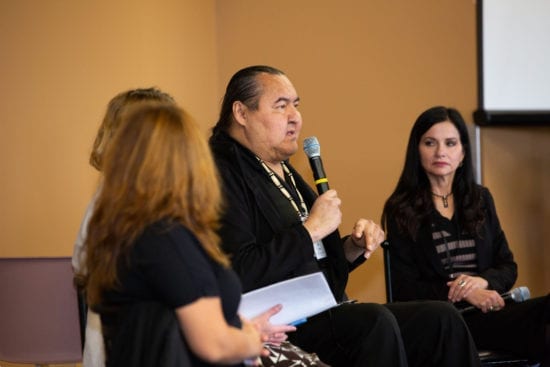
Ira Provost Ira Provost, Manager of the Piikani Nation Consultation, was Ms. Guitton’s community resource person throughout the project. With a career as an Indigenous liaison and cross-cultural educator, Provost found himself astounded by the depth and breadth of learning that had taken place, which transpired through speeches that the students had presented to school board trustees, the superintendent, Stavely’s school principal, FNMI support personnel and Elders from the Indigenous community during a class-organized community event.
All Indigenous peoples want, as Provost highlighted, is meaningful engagement, which forms the derivative of an ongoing commitment to starting early and moving beyond one-off endeavours.
“Reconciliation is about a thousand cups of coffee,” stated panel moderator Dr. Michelle Hogue, Associate Professor and Coordinator of the University of Lethbridge’s First Nations Transition Program, in her recap of the conversation. “It’s about sitting, listening, being present and building relationships.”
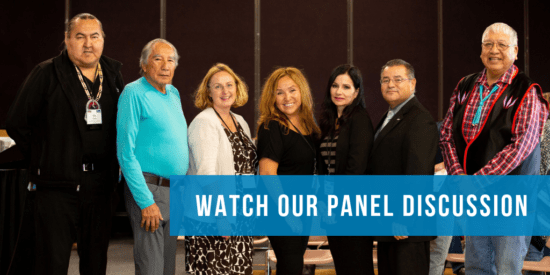
more ideas and resources on how to lead reconciliation initiatives with your students
- Education Canada Magazine: Truth and Reconciliation in the Schools
- Infographic for your classrooms and staffrooms: How teachers can integrate Truth and Reconciliation in their classrooms
- Fact Sheet: How can we embed Truth and Reconciliation in every school?
- Report and Research Reports
This event was made possible by the support of our generous partner and sponsors

-
Beyond Rules of Engagement
Comments Off on Beyond Rules of EngagementTo effectively teach with technology, educators have been expected to set boundaries for appropriate use, help establish guidelines for inappropriate content, and guide students in how to take responsibility for their actions in networked environments. If we look at how education has traditionally supported the ability to form, communicate and exchange ideas, we know that opening and engaging in dialogue about sensitive topics is an ideal first step. But in digital citizenship education, we still find headlines, community advocates, school districts and parent groups who are continually sourcing evidence of misuse of emerging technologies to argue for a “ban and limitation” approach when crafting policies for digital citizenship and the online participation of students.
Limitations of our past approach
After almost two decades of evolving Internet and social media education, educators have to recognize that a fear-mongering approach to aspects of digital citizenship is not beneficial for students who are already fully engrossed online. Instead, a practical approach, rooted in classroom experiences with the realities and concerns of Internet communications, can foster students’ understanding of healthy Internet uses.
Ask young adults if their student experiences between 2000 to 2012 included digital citizenship lessons and whether they were invited to have their voices heard, or if they had an educator who was willing to meet them on their level with tech use in the classroom. More often than not, young adults will say that the majority of their digital citizenship lessons involved being told rules of proper use and how to be safe online, with a primary focus on being aware of predators and threats. Few will report discussing consent or the production of online content.
One difficulty with this primary focus on appropriate use is that the Internet does not acknowledge boundaries structured on guidelines for appropriate or inappropriate; it is a free-for-all that students will explore online despite attempts to block content or websites. The norms of technology and Internet use are incredibly malleable. Being open to the online interests of students helps educators identify where students have found their voice through the Internet, and what they have been exposed to. Students bring their online experiences into the classroom. In a paradoxical conflict of “too much, too soon,” educators today are often addressing themes of the Internet with students as they arise. While the themes can range from video gaming, online interactions, accessing pornography, or peer conflict, the experiences of youth online become conversations because of current and emerging Internet trends.
Rewrite the narrative and hear the students’ voice
Educators have an unenviable task of addressing the Internet experiences that their students bring to their attention. An educator who recognizes that in a networked society, controlling the Internet is not about blocking content but about being prepared to address the content experienced and disclosed by students, will be better prepared than the educator who dismisses these experiences as “bad use of the Internet.”
We do need to establish norms of behaviour concerning technology use and Internet participation, and this definition has to work within the evolving classroom. Using technology skills in a social studies class must be approached differently than in a science class, but a similar foundation of participation and responsible sourcing of information is vital for student success. For teachers, the goal of digital citizenship education should be establishing a culture of appropriate use, as defined by the student voice and expanding outward to the networked online communities that students share.
For primary teachers, this means potentially introducing expectations of use of tech that may conflict with what students have experienced at home. In intermediate education, the challenge becomes one of providing learning opportunities that engage students in a different way from the communication app, video game, or meme that is currently popular. We know that students in middle-school experience a variety of Internet content that would make most parents at the parent council meeting cringe. Guidance in class may be the oversight desperately needed and discussing the media themes and content accessed can help guide students towards more appropriate Internet usage as students progress to secondary school.
In secondary education, how can educators support students’ understanding of how appropriate versus inappropriate use of the Internet is defined – especially when the measuring stick continues to move in each micro-generation of use? Secondary students live in a world where they see any number of examples of “inappropriate use”: mainstream celebrities display their excesses online while YouTubers and streamers on Twitch push boundaries. Perhaps most importantly, the world of social media politics is now on the radar of students, who see that elections have become littered with allegations of fake news without context, voters cast votes solely based on information sourced from social media, and even an elected President ignores the barriers of so-called “appropriate use” of social media with total disregard for traditional decorum or consequences.
Preparing students for the realities of the connected world is critically important. The 21st century learner needs educators who are aware of the importance of providing digital citizenship support to students at all grade levels and within all subjects. This includes dialogues on how the Internet influences learning and community participation, and a recognition that the Internet allows us to see one another and connect around the planet. It is imperative that learners think critically about not only how the technology helps to bring us together, but how much it can separate us.
Find positive examples
It is vital to help students recognize the positive opportunities that exist as they demonstrate their online participation as networked citizens, and to see how their online interests fit into their educational experiences. Examples of digital citizenship can be incorporated into many lesson plans.
For an example of positive video game use, check out students in British Columbia who play online video games in an eSports tour. These students, competing professionally playing video games, earn more than a teenager could ever make working at a fast food restaurant. Where health and wellness dialogues may support kids who feel isolated, share the story of a student in Texas who inspires others daily by sharing photographs of their skin without makeup, to increase positive support for those coping with debilitating cystic acne. Imagine a student who wakes in the morning feeling like they are the only person in the world with a skin problem; they only have to turn to their smartphone for an emotional, visual, and community-driven support system that lets them know they are not alone and things are going to be okay.
With hundreds of positive and negative examples of how the Internet and technology use impacts children, digital citizenship lessons have to not only support learners in their online endeavours from classroom to classroom, but expand to the family home, to extra-curricular activities, and everywhere the Internet takes them along their education and communication path. Digital citizenship education should not be just an introductory concept or policy delivered at the beginning of the school year to establish expectations for learning; it should be a continual classroom pedagogy that extends to the home, with students leading the charge.
First published in Education Canada, December 2018
-
Protecting Pollinators Through Experiential Learning
Comments Off on Protecting Pollinators Through Experiential LearningIt started when one teacher saw a TV ad about saving the bees – and grew into a national program, Bee City Schools, integrating outdoor education and technology into school-wide projects focused on saving pollinators.
We would like to introduce educators to the Bee City Canada/Bee City School Program, an important initiative that is quickly making its way through elementary and secondary schools across the country. The original objective of the Bee City School Program was to encourage an inquiry about the bee crisis and the role that pollinators play in our food cycle. Currently, Bee City Schools are expanding this inquiry by integrating outdoor education and technology into school-wide projects while encouraging parents and communities to join students in their learning.
In 2017, the Bee City School Program became a recognized certification from Bee City Canada. The origins of this initiative are modest and began in 2015 as we, two teachers in Scarborough, Ontario, were working on a partnering plan for an upcoming Science unit. It started when Ashleigh White, a Grade 4 French Immersion teacher, saw a CheeriosTM commercial that encouraged consumers to “bring back the bees” and decided to use the ad as an introduction to character education in her classroom. Thinking that this might also be an opportunity to begin working with a colleague on a Science Buddies project, Ashleigh approached Grade 8 teacher Doug Whiteside.
Together, we felt a call to action and were immediately motivated to open an inquiry project that began by asking, “What is happening with the bees?” A true inquiry often requires teachers and students to connect with resources and people outside of the school. Ashleigh began to reach out to organizations in Toronto, and with a little research, she found Bee City Canada, a charitable organization that was in the final stages of becoming officially recognized by Toronto City Council. She thought she might be overreaching, but Ashleigh took a chance and made a call to Bee City Canada. Director Shelly Candel responded within one day and graciously offered to visit the school and help answer some of the students’ questions. This was the first workshop that Bee City presented to students, and the response from both classes was beyond expectations. The seed had been planted and so came the idea to offer more workshops based on new questions stemming from the Bee City Canada classroom visit. The roots of the Bee City School Program sprouted that day.
Our aim with the Bee City Canada Schools initiative is to cultivate a climate that encourages students to ask questions and to be critical thinkers and problem solvers by examining real-world contexts. We strongly believe that our growing network of Bee City Schools has come to realize that through inquiry, experiential learning and “getting our hands dirty,” we can begin to make positive change in our communities. Our program is unique in that it can implement a broad range of current teaching practices into one school-wide initiative that welcomes all learning entry points. We also generate support from parent councils, local government officials, and businesses who are inspired by the team building that is now so evident throughout the hallways of our member schools and in the vibrant pollinator gardens that were established and are now diligently maintained by students ranging from Kindergarten to Grade 8. Our network has come to realize the severity and the implications of the declining bee population in Canada and around the world. We also know, however, that it’s not too late to do something about this problem. By taking action and planting bee-friendly flowers, as well as educating our communities on the dangers of pesticide contamination, we believe that we are helping to create a new culture of students as global citizens of character. We hope they will become the future leaders of collaborative inquiry devoted to reversing the decline of pollinators in Canada.
Bee City Canada, a federally recognized charitable organization, welcomed Toronto as the first Bee City in 2016. In the Spring of 2016, Tredway Woodsworth Public School in Toronto was declared Canada’s First Bee City School. We revamped our STEM program with a project that would offer students a lens into real-world, large-scale problems. This endeavour commanded collaboration among students and teachers in order to achieve our learning objectives.
Students were very eager to develop a strategy that would answer the call to action for citizens to reverse the decline of pollinators. Jeremiah, a Grade 3 student, stated,
“I really want to help the bees because they are important to our world. They spread the pollen that our fruit and vegetables need in order to flower. If the pollen isn’t spread to the flowers, then a lot of our food sources will disappear. Bees are helping our ecosystem to survive.”
This testimonial was one that came about through the exploratory stage of the problem-solving model that is typically used in math, but can and should be applied to early stages of inquiry work in science as well. Through brainstorming and communication, students were able to better understand the problem even if possible solutions were not yet conceptualized.
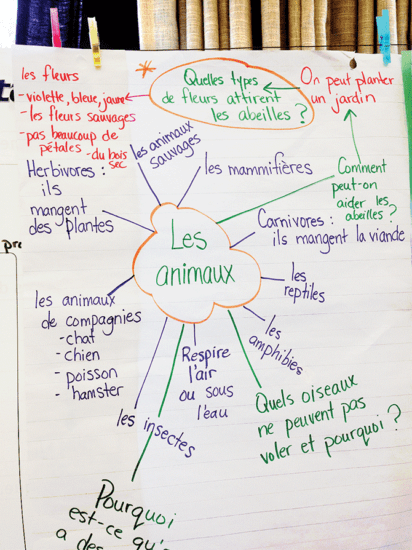
Ashleigh White’s Grade 4 French Immersion class began with a brainstorm chart highlighting some key inquiry questions into the condition and decline of bees and other pollinators. Following the exploratory stage, the inquiry captured the attention of Grade 7 and 8 classes. The older students created an action plan by designating a space for a small pollinator garden that would host indigenous plants, as well as some very creative and visually stimulating bee hotel structures. They discovered that pollinators respond well to colourful and stimulating artifacts and structures that are situated in close proximity to the plants. Vaidehi, a Grade 8 student, captured the class discoveries perfectly, stating,
“When we placed our bee hotels and sowed the seeds for the indigenous plants, we made sure that the hotels were colourful and that the seeds were pesticide free, as this is one of the leading factors causing the decrease in the bee population.”
Students took pride and ownership in preserving and protecting their pollinator garden space. The curiosity spread throughout the school, with questions such as, “What plants attract the bees the most?” and “Do bees communicate with each other?” Discussion and discovery became commonplace as evidence of inspired inquiry work.
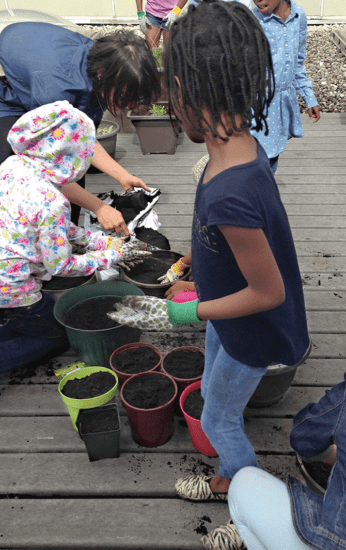
Ashleigh White’s Grade 4 students pot pollinator-friendly plants and flowers for the school’s Pollinator Garden 
Doug Whiteside’s Grade 7 science students construct and decorate “bee hotels” that offer a temporary rest or pit stop for pollinating native bees and butterflies. Eventually, Bee City Canada invited us to help them develop an application process whereby schools throughout Canada could work on similar initiatives and inquiry. Realizing that our inquiry project could guide other schools to educate students about pollinators and the bee crisis, Bee City Canada relied on our experience to establish this new program. The Bee City School Program was created when Bee City Canada saw the work that was taking place in our school. This rich learning opportunity could not be contained to one school, and our school became the model for Bee City Schools to emulate. Subsequently, Bee City Canada has invited both of us to sit on the board of directors as representatives for the Bee City School Program. In June of 2018, Doug was given the title of Bee Schools Director and he now acts as the liaison for existing and future Bee Schools.
Small classroom projects may grow into school-wide initiatives once the school community becomes more aware of the issues that their inquiry addresses. The thriving pollinator and vegetable garden that was entirely established by students at our school, with support and funding from Bee City Canada, is just one example of the positive work that we are doing to support the community as a whole. Before embarking upon this project, we developed a solid connection with our local city councillor, Glenn De Bearemaeker. He is just one of our great supporters and he was thrilled to join our students at the “2017 Tredway Woodsworth Pollinator Fair.” Mr. De Bearemaeker connected the local community and our school by creating awareness amongst his constituents and engaging in the important conversations necessary to effect change.
Following a cycle of inquiry allowed us to let go of some of the rigidity of conventional teaching and, three years later, students have become independent learners, innovative knowledge builders and creative thinkers. By focusing on the authentic problem of the declining bee population, students are continually empowered to explore the potential of their own school community. Creating and tending to a pollinator-friendly garden has encouraged students to connect with nature as they learn about native plant species and how pollinators help to sustain natural environments. Researching and building structurally sound and visually stimulating bee hotels offers experiential learning and opportunities for students to solve problems using real-world contexts.
As recipients of the EdCan Network’s 2017-2018 Ken Spencer Award for Innovation in Teaching and Learning, we are dedicated to realizing the change that school communities can make by embracing the environment as an authentic outdoor learning space. Ultimately, an initial brainstorming session that was designed to involve students in their Science lesson has grown into a widely successful project that has become an ever-expanding network of shared learning and practice. We have developed a website – www.pollinatorcentral.com – where teachers and communities can blog with us about our experiences and understanding of the world of pollinators. We also launched an e-learning curriculum resource site with the introduction of our first course, called “Pollinator Protector Course,” in partnership with Bee City Canada. On our site, edu.pollinatorcentral.com, we will continue to develop and launch courses about healthy soils and sustainable planting practices.
Through this site, our shared practice continues to develop and offer support to fellow educators, students and communities. We are learning together about the role of pollinators, especially native bees, in our environment and the effect that a continuing decline in their population will have on future generations if action is not taken. Our students are answering the call to make a change, and we are eager to provide them with the tools that they need to successfully implement and expand this project for years to come.
Learn More
All Photos: courtesy Doug Whiteside
First published in Education Canada, December 2018
-
Plus Ça Change…
Comments Off on Plus Ça Change…Does our current digital citizenship education really prepare students for effective citizenship? Digital communications technology offers powerful tools for civic engagement, but too often civic educators focus on “teaching good online behaviour” instead of teaching the skills and knowledge needed to safeguard and strengthen democratic institutions. And these skills are more critical than ever.
This changes everything. In scholarly journals, professional magazines, and popular media, there seems to be widespread agreement that digital media has radically transformed the way youth engage with one another and with the broader society, both socially and civically. Educators and researchers in civic education have understandably sought to adapt. There is little doubt that certain kinds of adaptations are necessary, and potentially transformative if they can harness the capacity for youth and young adults to be connected, to reach large audiences, and to organize others using the right combination of online and brick-and-mortar tools. But I am also concerned that an all-consuming focus on these powerful new tools for civic engagement may distract attention from serious shortcomings that have been widespread for decades. Are there basic principles of citizenship education that are important to maintain, even as we embrace and adapt to the digital era? Or do the bits and bytes of online social, political, and economic life obviate the need to focus on a more timeless set of fundamentals – habits of the heart and mind – that make democratic societies robust and enduring?
A personal story
These questions were on my mind recently, when I stood in the Frankfurt Hauptbahnhof (train station) waiting for my train to Prague. Both of my parents were born in Germany, my father in Karlsruhe in 1927, and my mother in Frankfurt in 1928. My father was displaced by WWII (he moved to Lisbon with his parents and then to Louisville, Kentucky); my mother was less fortunate. Like my father, she left Germany before being sent to a work camp or concentration camp. Unlike my father, she left her hometown without her parents on a kindertransport to Heiden, Switzerland.
As I waited for my train, I realized that 80 years before my mother had stood in this same train station and waved goodbye to her mother and grandmother, who ran next to the train as it left the station. She remembers smiling so that her mother would not be sad. She also remembers giving her favourite doll to the girl seated opposite her, who was disconsolate. They were two of 100 children on the train headed to relative safety in Switzerland. It was the last time my mother would see her family. She was ten years old.
Although my parents – both German Jewish refugees – spoke little about their experiences during the war, I suspect that the profound injustices that informed their childhoods have had an indelible impact on my views about education and citizenship in democratic societies. What went wrong in German society that led to such unthinkable events as those that define the Holocaust? How could such a highly educated, mature democracy descend into such unimaginable cruelty and darkness? Historians have suggested a great number of causes, including Germany’s punishing defeat in World War I, the suffering German economy after the worldwide Great Depression, and the populist appeal of a leader who promised to fix it all.
As an educator, however, I can’t help but wonder what German schools might have done differently. What can we learn from what schools did or didn’t do in Weimar Germany (which was a democracy too)? What, if anything, should schools today teach children about civic participation, courage, and dissent? How can schools help young people acquire the essential knowledge, dispositions, and skills for effective democratic citizenship to flourish?
If we care about robustly democratic societies, we will have to be explicit about the kinds of knowledge, skills and dispositions required of democratic citizens.
Where are we vulnerable?
Tools for engagement have changed, but our social, political and economic vulnerabilities have not. Educators imagine focusing on a kind of teaching and learning that puts democratic community life front and centre at the same time that it uses changes in digital technology to their advantage. These are both worthwhile goals, but they are not one and the same. If we care about robustly democratic societies, we will have to be explicit about the kinds of knowledge, skills, and dispositions required of democratic citizens.
Digital technologies, as the other articles in this special section demonstrate, have tremendous potential to help build a kind of participatory politics that strengthens democratic societies.1Teachers, researchers, and policymakers alike attest to the benefits of these powerful technologies and what they allow students to do, including:
- use the Internet to access information that would otherwise be unreachable or require enormous effort to attain
- develop narratives, both alone and with others, about events and actions
- share opinions and perspectives with a potentially large audience
- provide and receive feedback from others, irrespective of their physical location, age, or social position
- exchange information and ideas directly with other youth without institutional gatekeepers.
These are powerful tools. These same features of digital civic engagement and exchange, however, can be put to use in the service of facile educational goals. As I detail in my recent book, What Kind of Citizen? Educating our children for the common good, when schools across Canada and the U.S. set out to teach democratic citizenship, a vast majority of them end up teaching good behaviour instead: follow the rules; listen to teachers and other authority figures; be respectful and responsible; and manifest a sense of patriotism and loyalty. These can all be admirable traits. But none of them are uniquely essential to democratic citizens. And none of them would have been the kinds of traits needed by German citizens in 1933 in order to alter the course of history. “Good character” is insufficient for safeguarding and strengthening democratic institutions and traditions.
What about today?
I do not mean to imply that another holocaust is imminent or that there is some kind of equivalency between anti-democratic leaders today and Adolf Hitler. I use this example both because it has personal resonance given my family history and also because extreme examples have a way of making visible concerning developments and trends. Currently, in the U.S. notably but also in many other countries, a toxic mix of rising economic inequality and ideological polarization is increasing, leading to waning trust in democratic governance.
Eighty-five years after Germany’s democracy was replaced by a totalitarian Nazi regime, popular support for democratic governance is the lowest it has been in decades. In a widely circulated 2017 report, the Pew Research Center raised considerable alarm among those who had assumed that western democracies enjoy relative stability within an entrenched culture of democratic governance. Although the report was titled “Globally, Broad Support for Representative and Direct Democracy,” commentators, civic educators, and political scientists highlighted a number of findings that challenged the rosier title. In the U.S., for example, 22 percent of respondents thought that a political system in which a strong leader could make decisions without interference from Congress or the courts would be a good way of governing. Close to one in three respondents who identified as Republican and almost half of U.S. millennials thought the same (globally, that figure was 26 percent).2
In another study, Harvard lecturer Yascha Mounk and Australian political scientist Roberto Stefan Foa examined longitudinal data from the World Values Survey and found considerable cause for concern. Between 1995 and 2014, the number of citizens who reported a preference for a government leader who was “strong” and who did not need to bother with elections has increased in almost every developed and developing democracy and, again, the growth has been greatest among youth and young adults.3 Neither Canada nor the U.S. are exceptions. Democracy, it seems, is not self-winding.
Concrete examples now abound of leaders stoking the flames of populist nationalism – the rallying of “the people” against both “foreigners” and a constructed “elite” in the service of right-wing nationalism. Worldwide, politicians can now openly express disdain for hallmarks of democratic society, including the free press, civil liberties, and the courts, while fostering resentment against foreigners and ethnic “others.” These kinds of anti-democratic rhetoric and policies can drive individuals and groups to withdraw from the broader civil society altogether, preferring sub-group identity – what James Banks aptly calls “failed citizenship.”4Recent rhetoric during election campaigns in Canada reveals similarly concerning trends.
A rise in xenophobia and nationalism has resulted in incidents of hate speech, antagonism, and assaults on both newly arrived immigrants and native-born visible minorities in a growing number of western democracies. In the U.S., the Southern Poverty Law Center (SPLC) has documented a precipitous rise in hatred, fear, and alienation among students; and teachers have similarly reported a dramatic increase in hate speech.5 Social media echo chambers further entrench anti-democratic tendencies and pollute genuine social and political discourse.6 Yoichi Funabashi, chairman of the Rebuild Japan Initiative (dedicated to strengthening democratic ideals in Japan) summarizes the risks succinctly: “If society becomes characterized by intolerant divisions, in which people immediately select their allies and dismiss others as foes based on such criteria as race, ethnicity, religion or lifestyle, then democracy’s foundational principles, rooted in careful deliberation and compromise, will be rendered inoperable.”7
What kind of civic education do we need?
Online and offline, we need citizens who can think and act in ethically thoughtful ways. A well-functioning democratic society benefits from classroom practices that teach students to recognize ambiguity and conflict in factual content, to see human conditions and aspirations as complex and contested, and to embrace debate and deliberation as a cornerstone of democratic societies. Here are three strategies that can help shape educational practices in an era of both increasingly powerful digital tools and decreasing support for social democracy:
1. Teach students to ask questions
One hallmark of a totalitarian society is the notion of one single “truth” handed down from a leader or small group of leaders to everyone else. Questioning that truth is not only discouraged, but also often illegal. By contrast, schools in democratic societies must teach students how to ask challenging questions – the kind of uncomfortable queries that challenge tradition. Although most of us would agree that traditions are important, without questioning there can be no progress. Dissent – feared and suppressed in nondemocratic societies – is the engine of progress in free ones. Education reformers, school leaders, and parents should do everything possible to ensure that teachers and students have opportunities to ask these kinds of questions.
2. Expose students to multiple perspectives
Much as Darwin’s theory of natural selection depends on genetic variation, any theory of teaching in a democratic society depends on encouraging a multiplicity of ideas, perspectives, and approaches to exploring solutions to issues of widespread concern. Students need practice in entertaining multiple viewpoints on issues that affect their lives. These issues might be controversial. But improving society requires embracing that kind of controversy so citizens can engage in democratic dialogue and work together toward understanding and enacting sensible policies.
Why would we expect adults, even members of Parliament, to be able to intelligently and compassionately discuss different viewpoints if schoolchildren never or rarely get that opportunity? In schools that further democratic aims, teachers engage young people in deep historical, political, social, economic, and even scientific analysis. They also challenge children to imagine how their lived experiences are not universal and how issues that may seem trivial to them could matter deeply to others. They have students use online tools to examine multiple perspectives not only to know that their (or their parents’) views may not be shared by everyone, but also to engender a kind of critical empathy for those with competing needs. This is the kind of teaching in a digital era that encourages future citizens to leverage their civic skills for the greater social good, rather than their own particular interests, thus working to challenge social inequities.
How should we do this? For example, teachers might present newspaper articles from around the world (easily accessed through the Internet) that examine the same event. Which facts and narratives are consistent? Which are different? Why? Textbooks from several different countries could provide another trove of lessons on multiple viewpoints and the role of argument and evidence in democratic deliberation. Many of these textbooks are now accessible online, allowing the kinds of comparisons that would have been difficult before the advent of communications technology. If textbooks are not available online, teachers can use the power of social media to connect with classes in other countries who are reading different textbooks. Even within English-language textbooks there are many opportunities. Schools in Canada, the U.K., and the U.S., for instance, present strikingly different perspectives on the War of 1812.
Why not ask students to use online and offline sources to research who wrote their textbook? Why were those people chosen? What kind of author was not invited to participate? The idea that a person or group actually wrote a textbook reminds us that the words are not sacrosanct but represent the views of a particular time, place, and group of authors. These approaches help demonstrate to students that “facts” are less stable than is often thought.
Students should also examine controversial contemporary issues. Students are frequently exposed to past historical controversies – such as slavery, Nazism, or laws denying voting rights to women. But those same students are too often shielded from today’s competing ideas (for example, the #MeToo movement, women’s reproductive rights, misinformation campaigns that employ social media as a dangerous and powerful tool, controversies over what should be taught in the school curriculum and how). Engagement with contemporary controversies using a range of perspectives and multiple sources of information – something online tools are uniquely well-suited to promote – is exactly what democratic participation requires.
3. Focus on the local
It is not possible to teach democratic forms of thinking without providing an environment to think about. Schools should encourage students to consider their specific surroundings and circumstances. Here too, social media and other digital tools can be an asset.
One way to provide experiences with democratic participation in civic and political life is to engage students in community-based projects that encourage the development of personal responsibility, participation, and critical analysis. Action civics is a particularly powerful and thoughtful way to foster civic participation that transcends community service to also include a focus on government, policy, and dissent.8 We saw this with the students of Stoneman Douglas High School in Parkland Florida, who, in response to the February 2018 mass shooting in their school, leveraged the power of social media and other digital tools to become key figures in a national dialogue on gun culture in the U.S., while also mobilizing both locally and nationally to agitate for gun control legislation, organize demonstrations, support electoral candidates, and register voters. Their ability to connect a very personal experience with the ways in which government, policy, and social and economic forces shape their lives has allowed them to participate on a national scale, and no doubt prepared them for a life of effective civic engagement. When students have the opportunity to engage with civics education through direct action in their own local context, the impacts of their work are integrated with their lived experience and can teach fundamental lessons about the power of citizen engagement both on and off-line.
Of course, choosing to be explicitly political in the classroom can cause friction for teachers – with students, parents, and administrators – even when teachers avoid expressing their own political views. Encouraging discussion, controversy, and action in the classroom can be daunting. Students may express views that make classmates uncomfortable; they may engage in political acts that concern their parents; or they may choose to challenge their own school’s policies. Democracy can be messy. Rather than let fear of sanction and censorship dictate pedagogical choices, however, teachers should be supported and protected, encouraged to use debates and controversy as “teachable moments” in civic discourse.
Another obstacle to focusing locally is the obsession with provincial (and national and international) standardized testing. The resulting emphasis on memorization and regurgitation of generalized knowledge prevents deeper critical analysis and runs counter to almost everything we know from education research about how to make teaching and learning meaningful and about how to foster engagement and participation in civic life.9
Education in a digital era
The communication technologies of the digital era have enormous potential to bring people together in collective pursuits. Those pursuits, however, must be consistent with democratic values. History demonstrates that just because schools teach children about citizenship and character does not necessarily mean they do it well, or even toward admirable aims. In fact, schools have sometimes engaged in some of the worst forms of citizenship indoctrination. Counted among the many examples of organized “citizenship” education are the hateful lessons learned by members of the Hitler Youth brigades such as racism, antisemitism, the glorification of Nordic and other “Aryan” citizens, and blind obedience to authority; or the Young Pioneers of the USSR who were taught to report any religious activity in their own homes to authorities so their parents could be prosecuted. Had these same youth had access to YouTube, Snapchat, Facebook, Twitter, and Pinterest, would they have been more or less likely to teach one another about democratic ideals and the dangers of authoritarian rule?
Similarly, when we use digital technologies in schools, do we use them to teach children to unquestioningly preserve our social, political, and economic norms and behaviours, or do we use them to imagine and pursue new and better ones? Do we teach them only the importance of following the rules or also to question when the rules are not worth following? Do we teach students to mobilize in support of policies that promote only their own self-interest, or to think more broadly about their ethical obligations to others? I wonder what might have been different in 1941, the year my mother received her last letter from her parents, had children been taught not only compliance but also doubt and the obligation to imagine a better society for all. I think about what civic educators can do now – whether focused on new technologies or on the kinds of critical thinking skills necessary to sustain democratic norms and behaviours – to convey to students the power of community, as well as the pitfalls of blind allegiance to it.
Long before computers or the Internet, John Dewey described schools as miniature communities and noted that the school is not only a preparation for something that comes later, but also a community with values and norms embedded in daily experiences.10 In many ways the question of how to teach citizenship in a digital era is a much broader question about the purpose of schooling writ large. Transforming the way we teaching citizenship is not only the purview of the civics and social studies classroom, but a journey into all classrooms, all subjects, the hallways, and the relationships of the entire school experience. Citizenship education – indeed education of all sorts – is, ultimately, a proxy for the kind of society we seek to create.
Photos: Bundesarchiv_Bild_183-S69279,_London,_Ankunft_jüdische_Flüchtlinge and iStock
First published in Education Canada, December 2018
1 Also see the work of Erica Hodgin, Joseph Kahne, Ellen Middaugh, Ben Bowyer and others at the Civic Engagement Research Group in Riverside, California. www.civicsurvey.org
2 Pew Research Center (PEW), Globally, Broad Support for Representative and Direct Democracy (Washington, D.C.: PEW, 2017).
3 R. Stefan Foa and Y. Mounk, “The Danger of Deconsolidation: The democratic disconnect,” Journal of Democracy 27, no. 3 (2016): 5-17.
4 J. A. Banks, “Failed Citizenship and Transformative Civic Education,” Educational Researcher 46, no. 7 (2017): 366–377.
5 United Nations (UN), Racism, Xenophobia Increasing Globally (New York, UN, 2016), www.un.org/press/en/2016/gashc4182.doc.htm; M. Costello, The Trump Effect: The impact of the presidential campaign on our nation’s schools (Montgomery, AL: The Southern Poverty Law Center, 2016); W. Au, “When Multicultural Education Is not Enough,” Multicultural Perspectives 19, no. 3 (2017): 147–150; J. Rogers, M. Franke, J.E. Yun, et.al, Teaching and Learning in the Age of Trump: Increasing stress and hostility in America’s high schools (Los Angeles, CA: UCLA’s Institute for Democracy, Education, and Access, 2017).
6 For research about media echo chambers, see, for example: J. Kahne & B. Bowyer, “Educating for Democracy in a Partisan Age: Confronting the challenges of motivated reasoning and misinformation,” American Educational Research Journal 54, no. 1 (2017): 3–34.
7 Y. Funabashi, “Trump’s Populist Nationalism,” The Japan Times (2017, January 17). www.japantimes.co.jp/opinion/2017/01/17/commentary/japan-commentary/trumps-populist-nationalism
8 See, for example: B. Blevins, K. LeCompte, and S. Wells, “Innovations in Civic Education: Developing civic agency through action civics,” Theory & Research in Social Education 44, no. 3 (2016): 344-384; M. Levinson, No Citizen Left Behind (Cambridge, MA: Harvard University Press, 2014).
9 D. Koretz, The Testing Charade: Pretending to make schools better (Chicago, IL: University of Chicago Press, 2017); J. Westheimer, “No Child Left Thinking,” Colleagues 12, no. 1 (2015). http://scholarworks.gvsu.edu/colleagues/vol12/iss1/14
10 J. Dewey, Moral Principles in Education (Carbondale, IL: Southern Illinois University Press, 1909/1975).
-
The Kids Are Alright
Comments Off on The Kids Are AlrightHow do young people use their cellphones to “speak back to political structures that were previously out of reach?” Casey Burkholder’s work with youth and cellphilming reveals how “young people are engaging in politics constantly, on and offline.”
A few weeks ago, I was having coffee with a colleague who was complaining about his niece. “She never looks up from her phone,” he said. “When I was her age, I knew things about the world. I could fix things. I talked to people. I made eye contact with adults. I listened to adults when they spoke. Kids today don’t do anything. They just take selfies and make videos and text.”
I paused a moment and then said, “When I was her age, adults were lamenting that kids wore too much black, played with gender in disruptive ways, sulked too much, were generally depressed and didn’t work hard or appreciate what they were given.”
He laughed, and said, “Maybe…” in a condescending way.
I continued, “Look, young people are engaging in politics constantly, on and offline. If anything, researchers are acknowledging the vast stores of knowledge and ways of being in the world that youth communicate. In my own work, young people use their cellphones to speak back to political structures that were previously out of reach. I promise you, the kids are alright.”
“Yeah, but what are they actually DOING?” he responded.
I let this comment sit a moment, sighed, and changed the subject.
This interaction stuck with me for the weeks that followed. What is it, I wondered, about young people that previous generations find so threatening or impenetrable? Maybe it’s just that their ways of seeing, engaging with, speaking back and responding to the world is unfamiliar. And all that unfamiliarity is distressing.
Academics like danah boyd,1 David Buckingham and Rebecca Willett,2 Eve Tuck and K. Wayne Yang3 have been writing about young people and the ways they engage and resist politically for some time now. Buckingham and Willett, for example, suggest that young people constantly make political decisions in their daily lives, from the things that they eat and the music they listen to, to the things that they wear. danah boyd explored the ways that young people create agentic communities and networks online. Tuck and Yang argue that the ways that young people resist can both uphold and confront inequities in society. Within this work on young people’s activism, political engagement, and media-making practices, I see opportunities to work with young people’s ways of knowing and documenting the world in order to speak back to these prescriptive and homogenizing discourses about youth. An example of these prescriptive and homogenizing discourses? Kids don’t do anything. Kids are always on their phones. Kids don’t. Kids just. And so on.
In my research, teaching, and activist practices, I work with cellphilming as a research methodology – where participants create short cellphone videos responding to particular prompts or community concerns in order to share (in my work, primarily) young people’s ways of knowing. In my doctoral research undertaken at McGill, I worked with my former junior high school students from 2008-2010 – ethnic minority young people who were living, studying, and working in Hong Kong. We created cellphilms about their sense of identity, belonging, and civic engagement practices in 2015, directly following Hong Kong’s youth-led Umbrella Revolution.4 For example, Katrina and Ann’s cellphilm, “Who Am I in Hong Kong?” makes visual the ways that they identify as Filipina-Hong Kongers, who were born and have grown up in the city, and who also experience feelings of otherness in the larger community. Sabi and Yuna’s “Ethnic Minorities in Hong Kong” depict the ways in which ethnic minorities interact with Chinese people in public spaces, and the ways these interactions influence their sense of belonging as Nepali-Hong Kongers. Through these youth-produced cellphilms, I learned to see the ways that formalized, segregated schooling structures made students feel isolated in the larger community, but also that school served as a space where these ethnic minority young people created agentic communities that resisted feelings of isolation. We have shared these cellphilms through YouTube, on a group-controlled channel called We Are Hong Kong Too. Our Google+ description reads, “This is a sharing space for a cellphone video-making project exploring space, self, belonging and civic engagement with ethnic minority young people in Hong Kong. We hope to foster dialogue and encourage reflection about what it means to live, work, study, and grow in Hong Kong.”
Even three years after we had originally produced and uploaded the videos, new audiences are continuing to engage with the ideas and the cellphilms. This online space is an important example of civic engagement – demonstrating one way that young people can get together to speak back to the things that are written and said about them in their community. The We Are HK Too project continues on YouTube, through Facebook and other social media spaces, and its lessons have continued to inspire my own research practices.
Right now, I’m working on a project with young people in Wolastoqiyik territory – Fredericton, New Brunswick – called Think/Film/Screen/Change. This project is multidisciplinary, and looks to understand more about gender, identity, youth civic engagement and do-it-yourself (DIY) media-making in the context of Atlantic Canada. I’m working with young people aged 12-17. We’re going to make cellphilms to address community issues that matter to young people across the gender spectrum, committed to creating safer spaces for queer, trans, and gender non-binary young people.
The main focus of the Think/Film/Screen/Change project is to research with young people in Atlantic Canada by refocusing their everyday media-making practices – those selfies and videos and texts my colleague was so worked up about – to address youth-identified pressing social issues in this territory, including gender-based violence, poverty, water and food security, among other issues. These are the issues that these young people are talking about and these are some ways that they are engaging with activism and political engagement in their on and offline lives already.
The Think/Film/Screen/Change project seeks to understand a couple of key questions: 1) How might cellphilming deliver complex understandings of social issues and centre community experiences from participants’ perspectives? 2) How might these young people engage the public in community issues that matter to them through participatory exhibiting (e.g. organizing cellphilm screenings in community centres) and archiving practices (e.g. sharing and saving the cellphilms in online spaces, like social media sites)? Through the creation of cellphilms and an archive of these visual texts, the project will include the participants in media production and dissemination over time.
With the creation of cellphilms and sharing these texts in a participatory digital archive on YouTube, the research aims to create spaces for youth to “screen truth to power,”5 in response to traditional media that tends to exclude, other, or commercialize youth perspectives. The study is also innovative in that it aims to develop a participatory approach to the archiving of research participants’ cellphilms through YouTube, where each participant will have the password to a shared public channel. This practice will advance the development of participatory archiving practices in visual research, and deepen an understanding of what sustained and ongoing informed consent means in research. In particular, the study aims to highlight the rights of participants themselves to have control over their visual productions. Through the nuanced example of the participatory archive of cellphilms that will be co-managed by participants on YouTube, the project will provide a critical understanding of gendered and dissenting acts of citizenship through the example of youth media production as participatory political engagement. The results of the research will reach audiences both within and beyond the academy, and in so doing influence methods and practice with implications for youth-led policy-making.
The Think/Film/Screen/Change research aims to provide a critical understanding of gendered acts of civic engagement in Atlantic Canada through the example of youth media production as participatory political engagement,6 aided by the creation of a participatory archive of cellphilms on YouTube and girl-led public screening events. Speaking to the field of civic engagement, the study aims to provide a complex example of the ways in which young people’s civic engagement is affected by their intersectional realities. I envision the youth-produced cellphilms as an opportunity to speak back to structural inequalities and homogeneous discourses that seek to smother youth civic engagement. At the same time, as Tuck and Yang have argued, the findings from the study may also illuminate the ways in which young people assert themselves as civic actors, including ways that uphold structural inequalities and dominant discourses.
Each of these civic acts – even those that uphold structural inequalities and dominant discourses – in the process of the Think/Film/Screen/Change research will be examples of youth political engagement. It is political to get together to talk about pressing issues for youth in this territory. It is political to identify challenges and potential solutions to these issues by and for youth. It is political to create short cellphilm texts to share with other community members. It is political to organize community screenings. It is political to think about what should happen to these cellphilms over time, and to identify future audiences to share the cellphilms with. In each step of the research process, young people will be enacting civic engagement.
I would also argue that in their existing media making practices – those selfies and videos and texts and the things they like and they share (their own set of citation practices) – young people are being and enacting political engagement. To echo what Carol Hanisch7 said so powerfully in 1969, “the personal is political.” The personal remains political in 2018.
And so, I am writing this piece to speak not only to my colleague, but to others who work, live and interact with young people, and also to those who engage with youth only peripherally. When young people are homogenized through statements like, “Kids today don’t do anything. They just take selfies and make videos and text,” we deny them their intersectional, heterogeneous lived experiences. We refuse to acknowledge their ways of seeing, documenting, representing, and speaking back to the world. We suggest that our ways are inherently more valuable and appropriate. But I think, in making these assertions, we are making a big mistake and missing so much of what young people are thinking, saying, responding to and doing. All of this leads me to one sincere conclusion: the kids are alright.
Watch the cellphilms
Cellphilms from the Hong Kong project can be viewed on You Tube: “We Are Hong Kong Too.”
Photo: Courtesy “We Are Hong Kong Too”
First published in Education Canada, December 2018
1 danah boyd, It’s Complicated: The social lives of networked teens (New Haven, CT: Yale University Press, 2014).
2 David Buckingham and Rebecca Willet, Digital Generations: Children, young people, and the new media (New York, NY: Routledge, 2013).
3 Eve Tuck and K. Wayne Yang, Youth Resistance Research and Theories of Change (New York, NY: Routledge, 2014).
4 The youth-led Umbrella Revolution occurred between September and December 2014, when citizens of Hong Kong occupied key commercial districts to protest the lack of democratic freedoms in relation to the 2017 Chief Executive Election. The movement’s name emerged from protestors’ use of umbrellas to block police-deployed tear gas. It is important to note that conversations about Hong Kong, democracy, and political autonomy from Mainland China continue to be expressed in the public realm, both online and offline, four years following the beginning of the Occupy Central movement – which blossomed into the Umbrella Revolution.
5 Svetla Turnin and Ezra Winton, Screening Truth to Power: A reader on documentary activism (Montreal, QC: Cinema Politica, 2014).
6 Henry Jenkins, S. Shresthova, et al., By Any Media Necessary: The new youth activism (New York, NY: New York University Press, 2016).
7 Carol Hanisch, “The Personal is Political,” in Radical Feminism: A documentary reader,edited by Barbara A. Crow (New York: New York University Press, 2000).
-
Digital Civics
Comments Off on Digital CivicsThe potential of digital media to bring about a more equitable democracy won’t be fully realized unless we ensure that all young people have access to high quality digital civic learning opportunities. Teachers can, and should, play a pivotal role in supporting all youth to develop the sense of agency, motivation, and skills to use digital media to participate in democratic life.
In October 2017, Quebec’s National Assembly passed Bill 62, “which bans Muslim women who wear a niqab or burqa from obtaining government services — including [using] public transportation — without showing their faces.”1 In short order, various legal challenges were posed by the Canadian Civil Liberties Union and the National Council of Canadian Muslims. At the same time, Québecois residents who opposed the measure turned to other strategies to demonstrate their solidarity with those affected by the ban – marching in the streets and riding the Metro2 wearing niqabs and face coverings. Another facet of the protest and solidarity movement involved posting selfies3 on Twitter, Instagram, and Facebook with faces fully or partially covered, either with traditional head scarves or with other coverings including motorcycle helmets, sunglasses and winter scarves, and surgical masks. These kinds of online expression show how traditional forms of civic action (like rallies) may be enriched by social media. They also show the potential power that digital tools and platforms have to circulate photos and other content with a civic or political message to a wide audience. Importantly, the potential here doesn’t end with expressing one’s voice; tweets with catchy photos, hashtags or memes can potentially change the conversation. Educators need to pay attention to this landscape as they consider what and how to teach for civic agency in today’s world.
Youth civic participation in the digital age
Online tools and social media platforms have become a central part of civic and political life. A recent study found that eight in ten social media users reported that they feel social media platforms “help users get involved with issues that matter to them” and “helped bring new voices into the political discussion.”4 The digital age has opened up new ways to learn about issues, engage in dialogue, circulate ideas to a wide audience, and mobilize others to get involved. Yet, there are also unique challenges: assessing the credibility of online information, recognizing echo chambers and filter bubbles, learning to handle contentious online exchanges, determining potential risks of online content, reaching unexpected audiences, and considering the digital afterlife of one’s tweets, status updates, or snaps.
This digital landscape creates distinct pathways for youth to participate. Young people use social media as the primary way to communicate about politics.5 Despite perceptions that digital media distract youth from civic and political matters, 48 percent reported social media made them more aware of political issues and over 85 percent disagreed with the idea that social media lessened their awareness and commitments. In fact, one study found that 90 percent of youth who engaged in online civic and political activities report that they also vote or participate in institutional activities like letter writing and volunteering for a campaign.6
Digital media expand opportunities for a set of practices we call participatory politics. These practices differ from institutional politics in that they are peer-based and interactive; they tap into youths’ social networks; and they often draw on popular culture. In digital spaces, youth can participate without deference to adult-led institutions and bureaucratic structures that dictate the what, when, and how of civic and political action. For example, youth are blogging, engaging in online discussions, and creating and circulating clever memes and pointed hashtags. They are also using online petition sites like Change.org in order to influence the conversation and, in some cases, legislation around issues such as immigration, racist policing practices, gun control and climate change.
The changing nature of civic learning
Just as democratic participation is changing in the digital age, so should our approaches to civic education. New knowledge, skills, and dispositions are needed to navigate this changing landscape. And just because young people know how to text or tweet, doesn’t mean they know how to use these tools for civic and political purposes. Data from a 2015 survey suggests that only 10 percent of youth engage at least weekly in such online political activities – meaning that 90 percent are not engaged or only occasionally engaged online.7
Therefore, bringing digital civics into classrooms and schools is essential. While this is already happening in some places, research points to an equity gap: youth who are White, from upper-income families, and high achieving academically receive far more of these learning opportunities than others.8 In addition, exposure to digital learning opportunities appears to be both inequitable and low overall. In a 2013 survey, 33 percent of U.S. high-school-age youth did not report having a single class session focused on how to tell if online information was trustworthy, and only 16 percent reported more than a few sessions.9 Therefore, it is critical to integrate digital civic learning opportunities for all youth across grade levels and content areas.
The core practices of digital civics
As educators consider teaching digital civics, we suggest the following framework that parses online civic engagement into four core practices. We also think it is essential to acknowledge the double-edged nature of digital life – the positive opportunities and genuine challenges connected to each practice.
Investigation
At a time when information flows freely and rapidly from a diverse array of online sources – some credible, some not – it is vital to support youth to be thoughtful and savvy investigators.
Dialogue
Social media provide ample opportunities for youth to share their perspectives on public issues, learn about the views of others, and perhaps even engage in debate. Yet, the risk that conversations will turn toxic may deter youth. Providing youth with strategies and tools for engaging in online dialogue can help them feel prepared.
Voice
Online contexts offer nearly boundless opportunities to express and amplify one’s ideas and perspectives on important issues. As with dialogue, these positive potentials bring risks – including surveillance and backlash. Helping youth make thoughtful decisions about where, when, how, and to what ends to express their voices in networked spaces is essential.
Action
The role of social media in supporting civic action is contested. Some describe e-petitions and mobilization via Twitter as “slacktivism” while others see great promise (if not clear evidence) of positive impact. In our networked age, we must help youth understand the potentials and limitations of tweets, likes, and hashtag activism in social change efforts, as well as the enduring role of face-to-face civic practices.
A classroom example of teaching digital civics
In order to attend to these opportunities and challenges, Nina Portugal and other educators in Oakland Unified School District (OUSD) in Oakland, California integrate civic and digital civic learning experiences into their core curriculum. In one project, Nina engaged her Grade 9 students in learning about various tactics of social change, both face-to-face and online. Students worked in small groups to identify an issue affecting their community and theninvestigate the history, root causes, and effects of that issue. Students then wrote a proposal outlining what they learned, what audience they wanted to reach, and what tactics they would utilize to respond to the issue. Next, students put their plan into action over the course of a week, posting media online using a common hashtag to document their actions. For example, one group of students focused on the negative effects of gentrification on communities of colour in Oakland. They mobilized people to write letters to the mayor and tweeted information about the effects of gentrification at the mayor every day during the action week.
After the week of action, students reflected on the effectiveness of their tactics, what they learned, and what they would do differently in the future. This reflection, along with their proposal and documentation of their action steps, were all posted to their class blog. This enabled students to voice their perspectives and raise awareness about their issues. It also gave other students the chance to read and comment on their classmates’ projects, opening up a dialogue amongst the various groups.
While the project undoubtedly provided students with exciting opportunities to learn about issues they care about, express their perspectives on a public platform, and take action, there is a lot to consider to facilitate such a project. For example, teachers have to navigate a number of concerns – such as juggling all the topics students choose, ensuring students’ work is ready for online publication and circulation, helping students reach an authentic audience, and monitoring the depth and academic tone of students’ comments. However, as Nina describes in a recent blog post, it is all worth it when students have opportunities to express their civic and political views in authentic contexts and to reach an expansive audience.10
Five ways to bring digital civics into the classroom
The Digital Civics Toolkit (DCT) is a new resource that offers educators tools they can implement in the classroom to support their students as they engage with practices linked to participatory politics (see Figure 1). Created by members of the MacArthur Research Network on Youth and Participatory Politics, the DCT contains modules and activities that explore opportunities and tensions associated with participatory politics. It offers five ways to integrate digital civic learning into your classroom.
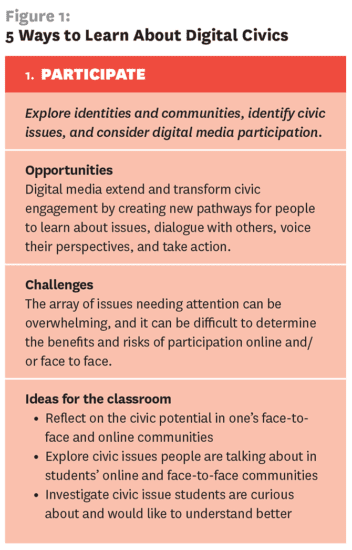
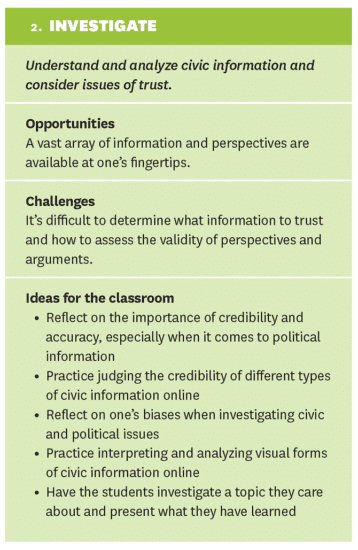
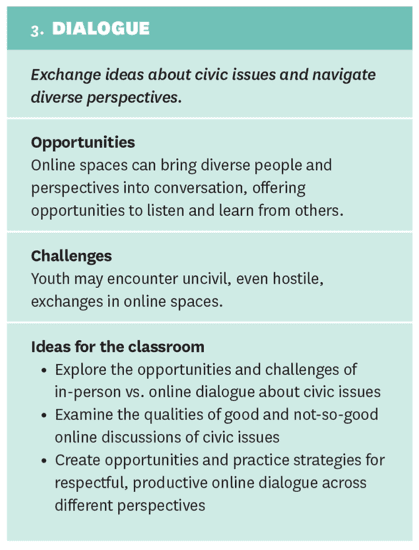
Teaching digital civics: A necessity today
Youth today are growing up in a world in which digital media is not just about socializing with friends. Public issues and social change agendas can be – and are – raised, explored, discussed, and responded to on the Internet. While there are inevitable challenges and tensions, there are also positive opportunities, especially for youth. Further, the networked nature of civic and political life isn’t likely to go away. The potential of digital media to bring about a more equitable democracy won’t be fully realized unless we ensure that all young people have access to high quality digital civic learning opportunities.
Teachers can, and should, play a pivotal role in supporting all youth to develop the sense of agency, motivation, and skills to use digital media to participate in democratic life. And all educators have a role to play regardless of discipline, grade level, and learning context. By teaching digital civics, educators can enable more youth to recognize and, hopefully, seize new opportunities for civic and political engagement that are empowering, equitable, and impactful.
Suggested Resources
Original Illustration: istock
First published in Education Canada, December 2018
1 https://www.huffingtonpost.ca/2017/10/19/women-scarf-selfies-bill-62_a_23249363/?ncid=tweetlnkcahpmg00000002
2 https://www.cbc.ca/news/canada/montreal/bill-62-metro-protest-1.4366483
3 https://www.ctvnews.ca/canada/face-covered-selfies-social-media-protests-over-quebec-s-bill-62-1.3641563
4 M. Duggan and A. Smith, The Political Environment on Social Media (Pew Research Center, 2016). www.pewinternet.org/2016/10/25/the-political-environment-on-social-media
5 P. Mihailidis, Media Literacy and the Emerging Citizen: Youth, engagement and participation in digital culture (New York, NY: Peter Lang Publishing, 2014).
6 C. Cohen, J. Kahne, B. Bowyer et al., Participatory Politics: New media and youth political action (YPPSP Research Report, 2012). http://ypp.dmlcentral.net/publications/107
7 J. Kahne and B. Bowyer, Can Media Literacy Education Impact Digital Engagement in Politics? Manuscript submitted for publication (2018).
8 J. Kahne and E. Middaugh, Democracy for Some: The civic opportunity gap in high school (CIRCLE Working Paper 59, 2008). www.civicyouth.org/PopUps/WorkingPapers/WP59Kahne.pdf
9 J. Kahne, E. Hodgin, and E. Eidman-Aadahl, “Redesigning Civic Education for the Digital Age: Participatory politics and the pursuit of democratic engagement,” Theory and Research in Social Education, no. 1 (2016): 1-35.
10 N. Portugal, “Confronting the Monster Under the Bed: Integrating blogging into the classroom,” Teaching Channel (May 14, 2018). www.teachingchannel.org/blog/2018/05/14/integrating-blogging
-
It’s Time to Walk the (Digital) Talk
Comments Off on It’s Time to Walk the (Digital) TalkIt’s commonly understood that children acquire many behaviours, both good and bad, by watching the adults around them. In this vein, we aim to create school environments where young people are exposed to positive and caring adult role models. Unfortunately, this emphasis on positive modeling appears to fly out the window when implementing digital citizenship programs and curricula.
Take, for instance, the idea that young people should be critical readers online. Certainly, we know that young people struggle to identify fake vs. factual news, but a showed that they are a great deal better at it than older generations.1 We see this deficit playing out in schools when educators continue to use inauthentic examples and outdated checklists when teaching about how to determine the truthfulness of a digital site or article. And outside of school settings, young people need only glance online to see countless examples of adults sharing fake or photoshopped images without stopping to check the source or verify the content.
Another oft-touted digital citizenship narrative is the necessity to keep one’s online presence squeaky clean; this is frequently framed in alarming ways, with adults telling young people that a single digital mistake can cost them future careers or even the chance of a university education. Of course, most of those same adults who warn about the dire consequences of online errors grew up in a pre-Internet world, one in which typical teen behaviours and “missteps” were not constantly being permanently documented, shared, and even glorified online. It seems unfair to hold today’s youth to standards that most of us (if we are being honest) could never have lived up to ourselves. Even the simplest, most basic directive to “be kind” online is problematic when adults regularly criticize, harass, and even threaten each other on social media and in the comments section of articles.
If there is any hope of helping young people to become positive digital citizens, we will first need to step up and model the behaviours we want to see. Our current practices are often hypocritical, and at worst downright counterproductive. As educators, parents, and adults generally, we must begin to practice what we preach and to follow our own instructions to be wise, kind, and positive citizens in the (digital) world.
First published in Education Canada, December 2018
1 https://bit.ly/2Ar4XLQ
-
Educating Kids About Digital Privacy
Comments Off on Educating Kids About Digital PrivacyWith the advent of social media, none of us can take our privacy for granted. The Privacy Commission of Canada says it’s critically important to teach students how to protect their privacy, exercise control over their personal information and respect the privacy of others.
By the time children start school, most have already figured out how to turn on the tablet, find apps on Dad’s smartphone and search the favourites tab for their preferred websites. But they still have a lot to learn about staying safe online.
The risks associated with connecting to the Internet have grown exponentially in recent years. From cyberbullying, sexting and child luring, to tracking, hacking and email scams, the threats can be daunting for many adults, let alone children and teens. At the same time, personal information has become a hot commodity as businesses seek to monetize our data. It has become difficult to discern who is processing our information and for what purposes and everyone, regardless of age, must weigh the benefits and risks of each product and service they use, each time they use it.
This is why it’s important that students become savvy digital citizens who are able to both enjoy the benefits of being online and avoid potential pitfalls. Young people need to be equipped with the knowledge necessary to navigate the online world and participate in the digital domain in a privacy protective manner.
“It’s one thing to know how to use the Internet, it’s quite another to know how to use it safely, securely and appropriately,” says Daniel Therrien, Privacy Commissioner of Canada. “It’s critically important that kids know how to protect their privacy, exercise control over their personal information and have respect for the privacy of others.”
Indeed, the importance of privacy education is something that was recognized internationally in 2016, when participants at the 38th International Conference of Data Protection and Privacy Commissioners passed a Resolution for the Adoption of an International Competency Framework on Privacy Education. The resolution encourages governments, and especially authorities responsible for education and other stakeholders in the education sector, to champion the inclusion of privacy education in schools and to advocate for and develop training opportunities for educators in this area. In addition to the Office of the Privacy Commissioner of Canada (OPC), Canadian provincial and territorial privacy oversight offices attending the conference signed on to the resolution. The framework adopted at the conference, the Personal Data Protection Competency Framework for School Students, serves as a roadmap for teachers around the world, outlining nine foundational privacy principles students ought to know and understand.
Prior to the conference, the OPC, along with provincial and territorial privacy oversight offices across the country, formed a working group aimed at increasing youth awareness of privacy issues and risks, as well as the need to boost privacy education in schools.
“While there is a role for regulators, legislators, the business community and parents to play in protecting kids online, education is fundamental,” says Commissioner Daniel Therrien. “Teachers can help provide children with the tools and confidence they need to operate in the online environment safely and respectfully.”
To that end, the OPC, along with provincial and territorial information and privacy oversight offices, has produced a number of resources to help teachers spark a classroom discussion about online privacy and explore some of the issues and risks Internet users encounter every day. These resources include:
- a graphic novel and classroom discussion guide aimed at tweens and younger teens
- three lesson plans developed by MediaSmarts designed to help educators teach their students about their privacy rights, and to navigate the complex digital environment safely and responsibly
- privacy presentation packages with speaking notes and colourful slide decks that teachers can use in the classroom
- age-appropriate short videos to teach youth about reputation and online privacy
- a colourful poster to teach students about protecting their privacy online
- activity sheets for younger children that explore basic privacy issues through mazes, colouring, connect-the-dots and other fun hands-on activities.
Understanding privacy protection has become an essential life skill. “By better understanding privacy communications, children will be able to make more informed choices about the websites they visit and the apps they use – skills that will benefit them well into adulthood,” says Commissioner Therrien.

Privacy Resources for Teachers
To access and download the Privacy Commissioner of Canada’s privacy resources for classroom use, including the graphic novel, lesson plans, videos, activity sheets and poster, visit www.youthprivacy.ca and click on “Educational resources for teachers.”
Find the Personal Data Protection Competency Framework for School Students (click on Documents, then Adopted Resolutions – 2016).
First published in Education Canada, December 2018
-
21st Century Citizens
Comments Off on 21st Century CitizensRemember when the Internet was so full of promise? There was so much information – on everything! – available at our fingertips. So much more connection possible – with long-lost friends, with people from around the globe who shared our challenges, interests or concerns. Important news, causes, and initiatives could reach so many more people. The world took a giant step closer to becoming a true global village.
That promise is still there, but the dark side of this instant connectivity has become starkly apparent. If we have more information than ever before, we also have more disinformation. If we can recruit more people to save the whales, we can also recruit them to join the neo-Nazis. We can connect with people, and we can also inundate them with brutal hate mail. Extreme polarization seems as likely an outcome as a common understanding.
In this context, democratic countries have never had a greater need for informed, active citizens who can see beyond narrow self-interest and grandiose claims and set their sights on positive change. We need savvy users who can engage online, yet protect their privacy and well-being. We need critical citizens who are able to assess both the value and flaws in our institutions and policies. In this issue, we explore how educators can engage students in civic issues within the shifting landscape of the digital age.
And yes, this is a charge that our schools must take on, alongside so many other requirements. Joel Westheimer points to disturbing signs that globally, democracies are weakening, and warns that civic education is more than teaching good behaviour online or off: “ ‘Good character’ is insufficient for safeguarding and strengthening democratic institutions and traditions.” Erica Hodgin and her colleagues write, “Teachers can, and should, play a pivotal role in supporting all youth to develop the sense of agency, motivation, and skills to use digital media to participate in democratic life.” For one inspiring example of how it can be done, check out Casey Burkholder’s account of how students use cellphilming to engage with and communicate issues that are meaningful to them.
I hope you will find lots to think and talk about in this issue, and in our web-exclusive articles. There’s been a lot of attention paid to the education students need to participate in the workforce of the future. Surely it’s at least as important to prepare students to be effective citizens in a world filled with critical challenges.
Photo: Dave Donald
First published in Education Canada, December 2018


IDEAS TO SUPPORT EDUCATORS : Subscribe to the EdCan e-Newsletter
Quality research, reports, and professional learning opportunities.