Archive
-
The Signal: The average is nobody
Comments Off on The Signal: The average is nobodyWhat?
We are leaving out the majority when we design and implement curricula to meet the needs of the average student and the average teacher. This is the opposite of what most people believe about being average. We use the phrase “average Joe” to mean just about anybody but it actually describes virtually nobody. As Lori Hough wrote,
Schools were designed during the industrial age by people who were ‘absolutely obsessed’ with averages because averages worked so well in managing factories. The goal wasn’t to nurture creativity and develop individuality. The system mostly accomplished what it set out to do: prepare students for standardized jobs in an industrial economy. Since then, we have continued to think that the average — a human invention — represents everyone or that any deviation from the average is what defines you.2
So what?
If we are truly going to design education to meet the needs of all students, we need to start thinking about individuals. Who is our audience? Who are the primary benefactors of teachers’ work? In answering this question, we need to consider a paradigm shift in our thinking about what we are teaching and how we teach it. This is important to our work in developing an education system to support universal design for learning. The word “universal” might make some of us leery, thinking that it’s just another way of describing average. But it really means recognizing and celebrating diversity in our schools and in our curricula.
Now what?
To quote Bernie Sanders, “Change happens from the bottom up.” So it starts in the classroom with teachers and students. We need to ask: Is the way I’m teaching in the best interests of the students or in my own best interests? The answer to this question may lead us to advocate for more flexibility and autonomy. And this means we need to be prepared to be flexible, which is much easier said than done. It is much easier to keep doing things the way we have always done them. Change is hard but once there is evidence of a few individuals engaged in open, safe, collaborative dialogue about what we are doing in the classroom, momentum will grow. We can prepare for the challenges of change by inviting these classroom leaders to share their experiences at school board and government levels. Check out Shelley Moore’s bowling analogy3 about teaching for a great perspective: “We have to change our aim.”
Participant reflections on signals of change
Participants at the 2016 EdCan Network Regional Exchanges discussed more signals of change than we could possibly cover — but we wanted to share a sense of their range and significance. We invited a number of participants to write a short piece reflecting on one of the signals they brought to the Exchange.
Discover more signals at: www.edcan.ca/RegExReport
We want to know what you think. Join the conversation @EdCanPub #EdCan!
Photos: Max Cooke and Yolande Nantel
First published in Education Canada, March 2018
2 L. Hough, “Beyond Average” (2015). www.gse.harvard.edu/news/ed/15/08/beyond-average
3 S. Moore, “Transforming Inclusive Education” (2014). www.youtube.com/watch?v=RYtUlU8MjlY
-
The Signal: Understanding neuroplasticity
Comments Off on The Signal: Understanding neuroplasticityWhat?
Neuroscience evidence now proves that our brains are malleable, constantly creating new neural pathways and disrupting others. This means, in essence, that the pathways to create the patterns that we use to make decisions, which affect our learning behaviours, can be influenced by our teaching strategies.
So what?
This signal has the potential to be a serious game changer in education. The growing understanding of the neuroplasticity of the brain will have a tremendous impact on our ability to teach students and ultimately on student learning.
In my 27 years in education, it has been my observation that previous initiatives aimed at optimizing student learning, although well intended, were rarely successful. Until recently, the neurological science to support why a learning directive should be effective has not been available. With MRI diagnostic information, we are now able to have a clearer and more accurate understanding of how we learn, both physiologically and psychologically, and neuroscience is at the forefront of this revolution.
It is critically important for educators to understand the concept and implications of neuroplasticity, and how it can influence our teaching and the learning environment we provide for our students. We, and our students, need to view our brains as a muscle – one that, when exposed to the right environment, gets stronger. A growth mindset is our belief that intelligence can be developed, and that we, as educators, need to adopt the right strategies, effort and modeling to effectively assist students to learn and adapt.
Now what?
As school leaders, we need to ask ourselves, “What would the outcome be for our students if we developed a growth mindset with our staff?”
Research indicates a number of ways to promote a growth mindset:
• Model a growth mindset via professional development opportunities.
• Create a culture where failure is viewed as a learning opportunity, and where people feel safe to challenge themselves.
• Advance the importance of self-reflection and provide consistent opportunities to do so.
• Design a feedback system that is formative and responsive for staff, in which staff are active participants.
Developing a growth mindset is a long journey that requires sustained attention and focus. The desired outcome for our students – that they become more resilient, more intelligent and more prepared for effort – is a goal worth caring about.
Participant reflections on signals of change
Participants at the 2016 EdCan Network Regional Exchanges discussed more signals of change than we could possibly cover — but we wanted to share a sense of their range and significance. We invited a number of participants to write a short piece reflecting on one of the signals they brought to the Exchange.
Discover more signals at: www.edcan.ca/RegExReport
We want to know what you think. Join the conversation @EdCanPub #EdCan!
Photos: Max Cooke and Yolande Nantel
First published in Education Canada, March 2018
-
The Signal: Mapping language acquisition
Comments Off on The Signal: Mapping language acquisitionWhat?
MIT professor Deb Roy1 wanted to understand how his infant son learned language, so he wired his house with video cameras and parsed 90,000 hours of video to interpret how his son turned the sound “gaaa” into “water.” Roy used visual manipulations of data to create space and time “hotspots” that provided clues around language acquisition. These “hotspots” or data worms led to insights around how language develops in the very young.
So what?
Observing the work of academics, statisticians, program evaluators and data specialists clues us in to how our world is evolving and changing. These professionals are modeling new ways to combine perspectives, methods, information and technologies. Researcher Deb Roy maps data across the space and time continuum. Big data parses data for causality and evidence. Social network mapping organizes complex data into relational maps. New mapping technologies combine population data with geospatial innovation across disciplinary data sets. A data revolution is underway.
Now what?
Educators need to respond to this signal of change through evolving practice and a nimble interaction with information and technology. New data approaches offer incredible opportunities to leverage data to address important social issues. Amplifying innovative thought and preparing students to respond to multiple ways of thinking becomes a 21st century imperative.
Participant reflections on signals of change
Participants at the 2016 EdCan Network Regional Exchanges discussed more signals of change than we could possibly cover — but we wanted to share a sense of their range and significance. We invited a number of participants to write a short piece reflecting on one of the signals they brought to the Exchange.
Discover more signals at: www.edcan.ca/RegExReport
We want to know what you think. Join the conversation @EdCanPub #EdCan!
Photos: Max Cooke and Yolande Nantel
First published in Education Canada, March 2018
1 www.ted.com/talks/deb_roy_the_birth_of_a_word
-
The Signal: Questioning pedagogy
Comments Off on The Signal: Questioning pedagogyWhat?
Traditionally, students would “take blame” or ownership for what they know and don’t know. This mindset is shifting. The tables have turned. Students are starting to ask good questions about assessment practices and pedagogy, and to look critically at the teacher’s professional practice with a good sense of what’s fair and reasonable. However, schools are not a safe place for students to express their questions about how they’re being taught and assessed. They remain silent. They find their voice, however, on social media. With photos and quick comments, students express their concerns and feelings of injustice online with peers and possibly the world.
So what?
Students want to be active participants in their learning. They want a voice and have a strong desire for student agency and autonomy. The school system needs to respond. Students feel powerless and disengaged when they are expected to be complacent and compliant. Why should students wait for high school to end before figuring out what they want and love to do? K-12 is the time to play, experiment, and explore oneself and one’s strengths. The teacher or school leader should not be a barrier to this learning process. Fear-based learning comes from fear-based leadership. Students should feel safe providing formative feedback to teachers as advocates of their learning to enhance their learning experience in K-12 schools.
Now what?
Listen to students. Be responsive. Take action. This goes beyond the annual student forum or student council meeting. It’s about taking appropriate pedagogical action based on student feedback. This is an opportunity for teachers and school leaders to reflect on practice, policy, and doing what’s best for students and student learning. Ask, “Would you want to buy a ticket to attend your class or school?” Self-reflection, student feedback, and taking action must be visible, restorative, and responsive.
We need to pay attention to what students are saying and not get burdened or blinded by the grind or rigour of our work. Going beyond the ego and into a place that’s vulnerable, kind, and receptive, will help us become true partners in our students’ learning.
Participant reflections on signals of change
Participants at the 2016 EdCan Network Regional Exchanges discussed more signals of change than we could possibly cover — but we wanted to share a sense of their range and significance. We invited a number of participants to write a short piece reflecting on one of the signals they brought to the Exchange.
Discover more signals at: www.edcan.ca/RegExReport
We want to know what you think. Join the conversation @EdCanPub #EdCan!
Photos: Max Cooke and Yolande Nantel
First published in Education Canada, March 2018
-
Signs of the Times (to Come)
Comments Off on Signs of the Times (to Come)When talking about change in education, we often begin by looking inward to the strategies and approaches that are already a part of the way we do things. Not surprisingly, using present-oriented practice as a starting point for our change conversations doesn’t get us very far. Oh, there may be some tweaking and tinkering that happens, but nothing close to the level of change that so many believe is necessary if we are going to move beyond the status quo.
So when the EdCan Network proposed a series of Regional Exchanges across the country, in order to listen carefully to what educators, students, parents and community members saw as the top education-related priorities for the next decade, we knew that we needed to activate our thinking in a substantially different way.
The five EdCan Network Regional Exchanges were formed in the Autumn of 2016 as a way to recognize the challenges and opportunities in different parts of the country, but also to identify the priorities that need to be set now if we want to be able to respond to what the future holds for us – five, ten, and even 20 years down the road. The teachers, administrators, parents, students and government representatives that formed each of our five Regional Exchanges helped us put our ear to the ground, but they also helped us fix our eyes on the horizon.
Inspired by the work of futurists, we challenged Regional Exchange participants to look for at least three signals of change that they observed when they looked around their world. According to the California-based Institute for the Future, a signal is a small local innovation that has the potential to disrupt the status quo and/or scale in size or geography. On their own, these signals may appear as weak or distant possibilities. When combined with other signals, however, they can become powerful ways of imagining new possibilities for organizations preparing to lean more intentionally into the future.
Instead of looking inward with an eye to improving what we were already doing, we asked Regional Exchange participants (educators representing the entire spectrum of K-12 education) to look to other contexts not always directly associated with education. What was happening in the world of business, manufacturing, and technology that might have an impact on the work we do in schools? What signals were developing at the levels of politics and economics? What did they see when they cast their eyes to the world of social enterprise, science and medicine?
Participants were then asked to apply three lenses to the signals they were finding:
- What title or name would they give to the signal?
- Why could this signal be important for the education context? What assumptions about our current way of doing things does this signal challenge?
- What might we need to do now in order to prepare for the amplification of this signal?
The signals that Regional Exchange participants brought forward were rich, varied, and quite often a little “out-there.” We heard about advances in artificial intelligence and virtual reality. We heard about innovations in environmental sustainability. We worked with signals related to wearable technology, food sciences and brain research. We heard about new initiatives related to community engagement and cooperation. We explored the impact of automation, a move towards a “gig economy” and the increasing presence of fake news.
We considered how the amplification of these signals might impact the work we do in education, and what might happen if we were to combine some of these seemingly unrelated ideas. The resulting conversations were lively, informative and often sobering.
In the pages that follow, you will read about some of the specific signals of change identified by our Regional Exchange participants. You’ll encounter insights into what those signals could mean for the way we think about education change. And you’ll read stories of people, both inside and outside of education, who are working on powerful prototypes that show where these ideas could take us.
To learn more about what we heard from our pan-Canadian network during this unique consultation, please download Identifying the Signals of Change for the Future of our Public Education Systems at: www.edcan.ca/RegExReport.
But in dedicating an entire issue to Signals of Change, we are also presenting you with a call to action. What signals do you see emerging? What importance could they hold for the way we think about education? Consider this an invitation to continue the conversation, both in your local contexts and on the EdCan Network.
More Signals
The Signal: Questioning pedagogy
The Signal: Mapping language acquisition
The Signal: Understanding neuroplasticity
The Signal: The average is nobody
The Signal: New media, new literacies
Web exclusive
The Signal: Increased focus on closing the gaps for students with learning disabilities
The Signal: A curriculum shift from content to connections
The Signal: The demand to build adaptive expertise
The Signal: Multi-Grading iGen-ers and Alpha Geners
We want to know what you think. Join the conversation @EdCanPub #EdCan!
Photos: Max Cooke and Yolande Nantel
First published in Education Canada, March 2018
-
Deep Learning
Comments Off on Deep LearningHow do we create the needed change to move from a system focus on content acquisition to a mindset that helps develop and grow this content knowledge in a deeper, more meaningful manner and helps all students to excel? Michael Fullan, Joanne Quinn and Joanne McEachen share some strategies and answers in their new book, Deep Learning: Engage the world change the world.
This book does not attempt to sell a pre-packaged program, nor does it encourage teachers to make subtle shifts in practice. Deep Learning shares an effective mix of the why and the how of Deep Learning through theory, strategies, and successful examples to create a cultural shift to “attack inequity with excellence.” Educators can tap into the strengths and talents of teachers and learners to better engage, make learning more meaningful, and “help all young people to flourish.” The authors describe a “fusion of the most effective pedagogical practices with emerging innovative practices that together foster the creation and application of new ideas and knowledge in real life.”
The authors do not simply share what is wrong with education; rather, they choose a strengths-based model by identifying effective pedagogies that occur in pockets within schools. They build on these examples to create system-wide change. By focusing on their 6 C’s (character, citizenship, communication, collaboration, creativity, and critical thinking – which align very well with the focus on Core Competencies in the redesigned curriculum here in British Columbia), conditions are created for deep learning and students gain the knowledge and skills they need to flourish in school and beyond.
As a principal, I thoroughly enjoyed the balance of research, examples, and ideas to move learning deeper in schools. The book is a fantastic entry point to deep learning and educators can go on to use the New Pedagogies for Deep Learning website (http://npdl.global) to watch videos, read additional resources, and connect with other educators from around the world who are working to shift their mindset and create this change. Educators can use this book as a resource to start the conversation or continue the dialogue to help create the needed shift in pedagogies and culture to move to deeper learning in schools.
We want to know what you think. Join the conversation @EdCanPub #EdCan!
Corwin, 2017 ISBN: 978-1506368580
Photo: Dave Donald
First published in Education Canada, March 2018
-
Sackville Schools 2020
Comments Off on Sackville Schools 2020“We usually do not hear from or include the actual community members in planning our schools,” stated the superintendent of our school district. It was a watershed moment for the members of our small rural community group as we sat around a dining room table here in Sackville, New Brunswick. We were stunned by the statement that parents and local citizens were not really part of the design of what we believed to be the very heart of our community – our schools. We simply didn’t count.
Still reeling from the announced closure of a neighbouring community’s school and their bitter fight to keep it open, our small group worried that our community might be next to come under the so-called “sustainability study”: a provincially driven formula for determining school closures. It was at that table that we vowed to take our community’s precarious situation of shrinking demographics, aging schools and a feeling of isolation here on the margins of the school district in an entirely new direction. That commitment, now two years old, signaled that Sackville needed a new conversation and a new vision for transforming the community into a model for integrated, community-driven education. We believed that we had to have a clear vision for the education system in our community within the next five years, so Sackville Schools 2020 (or 20/20) was born.
Getting started
Sackville Schools 2020 was born out of a desire to anticipate a highly uncertain future for our children, our teachers and our schools, and the lack of connection we felt with the centralized and isolated education system that had developed in our province over the past many years. The working group held several collaboration cafés and community visioning sessions that invited community members to share their ideas, frustrations, hopes and fears about our schools and our role in the care and feeding of our learning community.
Committee members also interviewed hundreds of students to ask them about their current experiences and what they imagined in their ideal school of the future. We were shocked to find that students had very little in the way of hopes and dreams about their ideal learning environments: perhaps a classroom with a window, or maybe proper heating so that they didn’t need to wear their coats to class. They seemed unable to even imagine features like a learning commons, outdoor gardens and greenhouses, or a climbing wall – environments where they could truly flourish. Such low expectations revealed a sense of hopelessness and isolation, as opposed to what the committee was finding in our national and international research on 21st century schools, such as deep learning, project-based and individualized programming, and experiential and outdoor learning beyond the walls of the school.
While there were certainly reports of some great teaching and learning, it seemed to be the exception, rather than the norm. Teachers reported a sense of feeling isolated in their work, with many new curriculum ideas and government programs, yet a school district that seemed to be preoccupied with the larger urban schools located down the highway. We seemed to be overlooking the power of ideas and the amazing wealth of talent and commitment in our own town, as seen over and over again in the creation of school beautification committees, outdoor education and wetlands centres, and the thousands of bright minds coming to the community to attend university and volunteering in our schools.
Our town is incredibly fortunate, in that education is the driving economic and social force of the community, with a range of preschools, elementary, middle and secondary schools, a vibrant seniors’ college, and one of Canada’s top undergraduate liberal arts universities – all within a town of just over 5,000 people. After two years of conversations and research on leading practices in school design from around the globe, we can now feel the energy and excitement of the children, parents, and teachers, as well as educational and political leaders across the region, in their hope of moving away from the traditional top-down, prescriptive, cookie-cutter approach to school design towards making learning a shared community effort. We have worked with the Mayor and Council to adopt the model as part of their strategic plan, with the Mayor stating that “education is the driving force of our community and it is simply too important to be left to others in far-off places. We have to take an integrated approach to learning and the Town supports this approach.”
Although our community meetings and consultations now attract 60 to 80 attendees, our start was slow and sometimes discouraging. While we certainly have gifted educators and highly involved and caring parents and civic leaders, it’s not easy for already overworked and stressed members of our education system to envision a new way of thinking about how we educate our children and where we do that type of teaching and learning. Although many have little faith in the existing school planning system, which is controlled from the larger school district office and the Department of Education in Fredericton, it has still been challenging to engage teachers, principals and our elected district education council members in thinking and acting from this grassroots level. Often our wonderful dessert parties and cafés resulted in committee members looking at each other and wondering why educational change did not seem to be important to the wider community. Many told us that you simply can’t take on the government and change the system. Even that same district superintendent commented that he was surprised that we were still trying, after two long years!
In spite of the lack of enthusiasm we encountered for taking on the system, our group was encouraged by what we saw as the alignment of the political and educational stars and planets within the province. We recognized that Sackville was already a wonderful learning environment for so many different stages in life, from pre-school to post-secondary and even in the retirement years. We wanted to change the way in which we approached the formal and informal aspects of education by purposefully planning and integrating the efforts of the individuals and groups across the community. We proposed an integrated educational model that could be developed by us and for us, with the potential to spread across the school district, the province and beyond. Our group members have now presented this model to groups in Ontario, Nova Scotia, P.E.I. and Oregon.
Alignment of the political stars and planets
In January of 2016, the recently elected government of Brian Gallant announced the Education and New Economy Fund, and the Premier stated that the best way to give students the chance to succeed in whatever they would like to do with their lives was to invest in education, in training, in research and development, and in innovation. This was a profound commitment to education and the key to our economic and cultural future in this province. It also matched closely with what we wanted here in our community. The Premier wanted N.B. to be the educational leader in Canada, and we wanted to embrace this aspirational plan by being the first community to join with him in meeting this important goal. In view of this significant commitment to education, the members of Sackville Schools 2020 invited our newly elected Mayor and Council and the new Minister of Education to meet with us and to work with our community in being the first project to be developed through the Education and New Economy program.
The Government of New Brunswick also announced a new approach to education through a ten-year Education Plan, Everyone at their Best. Sackville was the only community to request that the educational reform commission come to meet with us. We presented a proposal out of the plan to develop Sackville as a pilot project to implement the major new programs and approaches to education through an innovative approach that includes all of the partners in the community. Since the release of the new ten-year plan in September of 2016, we have worked with the Minister and the Department of Education, the Mayor and Council of Sackville, our local schools, parents and students, as well as Mount Allison University, in achieving our goal of developing Sackville as an innovative, education-based place where students can thrive. Beyond the critical changes in teaching and learning, we also put forth a model where this learning can be supported in a modern, state-of-the-art, environmentally healthy system of educational facilities with a community-wide focus on the creation of 21st century learning. The early signal of community-based education is now evolving to include formal and informal learning, community outreach and recreation, social gathering and performance spaces, as well as shared facility agreements for the entire community, from young to old. The community is driving the process of change.
An integrated vision
One amazing fact about the Sackville Schools 2020 movement is that it has all been accomplished by community volunteers, with no outside funding. Over two years, we have had world-class architects and educational design experts assist us in our work, as well as educational change leaders from across North America. Community schools and school change agents from across the province, the Maritimes, and the country, as well as the U.S. and Australia, have welcomed us to their schools, simply because they recognized that we were trying to engage our entire community in supporting an integrated approach to education. The Minister of Education for N.B., Brian Kenny, has certainly noticed these signals, stating that “education is not just bricks and mortar… it is about our community and I think that your group there in Sackville are doing some wonderful things. You have some very innovative thinkers there and to get the community together is a very positive thing. I commend you for trying to put the pieces together between your elementary, middle and high schools and for advancing education across the province.”
The shift we propose will require major changes to the existing educational facilities in Sackville, as they are old, disconnected and poorly designed for 21st century learning. We envision a centralized learning campus that connects all levels of teaching and learning to new and existing facilities within the community. This will allow for older structures to be phased out and a new learning campus to be developed within the heart of the town. The facilities will be designed to grow and shrink with the overall demographic changes in the community, saving the province millions of dollars.
Part of our work has been researching a number of innovative methods for building and financing this new educational model. Rather than the boiler-plate model that exists now, where schools are actually designed and built by the Department of Transportation and Infrastructure, we have recommended a new approach: a community-based project management process, with a designated project management team at the local level, to lead the school design and development.
Mount Allison University, located in the centre of our town, will be a major feature in this unique learning complex, with new teaching, research and learning facilities developed on and near the campus. Local facilities, such as the Sackville and Mount Allison libraries, outdoor fields, arts and recreation facilities/parks, and athletics facilities, will become part of the complex, making Sackville the only community in Canada with an integrated, highly walkable and accessible education system in the center of the community. We believe that such a highly integrated education system will attract and retain students, faculty and new residents to the province and become the economic and social engine of the region. We have also been in discussion with educational researchers at a number of North American universities who are developing community-based action research on educational innovations such as ours.
This model will give students the opportunity to get out of the classroom and lecture halls and apply what they are learning as part of their everyday, lived experience, addressing real-world issues and problems at the local and regional level. It will allow younger students to engage with students and educators at the secondary and post-secondary levels, as well as direct engagement and experiences for students and faculty at the university, or retired teachers and faculty, to work with students and teachers in the local schools. Such a model affords everyone involved with a new and creative approach to teaching and mentoring students and creating an advanced and sophisticated learning community.
As the Assistant Deputy Minister of Education recently stated, “Sackville Schools 2020 is clearly a unique and compelling vision of how a town can impact the quality of education of its children… in 2017, we can’t still be using approaches to education that are, in some cases, hundreds of years old.”
This model would be unique within Canada, representing a true partnership between students and educators across all educational levels, as well as a range of community partners and citizens, local and provincial governments, businesses and nonprofit groups.
So now, two years after we started our conversation, we have signaled our intention to move away from the traditional top-down system of school planning and design. Our civic leaders, Department of Education officials, Minister of Education and business leaders have recommended the Sackville Schools 2020 vision to the Premier. It is on his desk and we wait for him to respond to this strong signal for change on the educational stage of New Brunswick. The “education premier” has been invited to the stage for the performance of his lifetime.
Learn more
One of our central tools for consultation has been our committee-driven website, with resources, blog space and an interactive web documentary on our movement. You can see it at www.sackvilleschools2020.com
We want to know what you think. Join the conversation @EdCanPub #EdCan!
Photo: courtesy Michael Fox
First published in Education Canada, March 2018
-
Seize the Future
Comments Off on Seize the FutureIt’s late February as we go to press, and already a few brave shoots are showing in the more sheltered corners of my garden. What will thrive and spread? What will get killed off by the next blast of winter? What will survive, but never really take hold? I love this stage of early spring promise, which is all about possibility.
This issue of Education Canada considers signals of change: developments and trends, within and without our sector, that may not be a big force in education right now but have the potential to change how we teach and learn. The idea grew out of last year’s EdCan Network Regional Exchanges; read Stephen Hurley’s column for some background on those Exchanges and the articles that they inspired.
These signals of change are varied indeed. Chris Cluff proposes that micro-credentialing, now common in business settings, could open the door to a more personalized, flexible education system that allows students to earn credit for a wider variety of learning activities. Michael Fox discusses how one small rural community developed a vision for their own education; could this signal a shift to community-based education planning? And in the category of sci-fi turned real, Lora Appel shows how Virtual Reality and Artificial Intelligence is already being applied to personalized training for health professionals, and imagines how further development could transform our education possibilities.
There were so many more ideas that we invited some Regional Exchange participants to briefly discuss a signal of their choice. More of these signals will be featured in our online version.
You won’t find a lot of how-to recipes or best practice recommendations in our theme articles this issue. For most of these emerging signals, the how-to hasn’t been figured out yet. Instead, we invite you to imagine, to get inspired, to prepare the ground. That’s what the spring is for, after all.
P.S. With this issue we say goodbye to Yolande Nantel, who has been the outstanding editor of our French articles for seven years. It has been a great pleasure to work with Yolande, and I am very sorry to see her go. But our francophone readers are in great hands with Yolande’s replacement, Jean-Claude Bergeron. Jean-Claude brings a wealth of experience in both education and editing, and I look forward to working with him to make Education Canada an inspiring, relevant, and useful bilingual resource.
Write to us!
We want to know what you think. Send your comments and article proposals to editor@edcan.ca – or share your own Signals of Change on social media using #EdCan.
Photo: Dave Donald
First published in Education Canada, March 2018
-
A Virtual Education
Comments Off on A Virtual EducationPicture this: Eva, six years old and just starting Grade 1, is fascinated with the human body and how it works. Why, she wonders, do some people have a different eye colour from their parents? Why do the tiny hairs on her arm stand up when it gets cold, and why does skin swell and itch after a tiny mosquito bite? Why do her parents love the taste of seafood, when she hates it?
What is Eva’s teacher to do with all these questions? Many are simply too complicated to explain to a young child at a level she can comprehend (like recessive genes resulting in different eye colours). And as a recent immigrant to Canada, Eva still finds explanations in English tricky to understand. This makes personalized learning even more of a challenge for her teacher.
We, as formal or informal educators, have all faced obstacles in our teaching, from having the knowledge to accurately explain a wide range of topics, to having the patience required to continuously respond to those “yes, but why?” questions, and perhaps most challenging, to creatively illustrate meaning at an individual’s level of understanding.
Technologies – such as artificial intelligence and virtual reality – that have for decades been described in science fiction are now emerging in a way that may soon make this kind of individualized and infinite learning possible at any grade level and indeed throughout life.
Definitions
Artificial Intelligence (AI) / Machine Learning (ML) and Virtual Reality (VR) / Augmented Reality (AR) are two sets of buzzwords that often seem to be used interchangeably. However, AI is not the same as ML, and similarly, VR is not the same AR; it is worth clarifying their differences before we imagine their possible impact on the future of learning.
Artificial Intelligence (AI) is the broader concept of machines being able to carry out tasks in a way that we would consider “smart.” An example is the way your smartphone keyboard predicts the word you are typing based on the first letter and from the average frequency and proximity this word has to the other words you previously typed.
Machine Learning (ML) is an application of AI based around the idea that rather than teaching computers everything they need to know about the world and how to carry out tasks, it might be possible to teach them to learn for themselves, by giving them access to large data sets and letting them identify patterns on their own. So rather than creating a rule that tells the computer that the letter “t” in a word at the end of a message is most commonly used for “thank you,” you tell the computer to find patterns in an individual’s typing habits. This might indicate the person is actually more likely to write “thanx.” With the advent of the internet and the vast increase in digital information being generated and stored, computers are now able to delve into, extract and analyze (aka “mine”) this data and come up with structures and patterns that we, “smart humans,” may not even see.
Both AI and ML are methodologies that computers use to analyze data.
Augmented Reality (AR) and Virtual Reality (VR), by contrast, are means by which we can convey information represented by a digital reality (a sensory experience that mimics physical reality).
Mixed reality is the blending of the physical and digital worlds. Mixed reality is a spectrum; on one side, which we currently refer to as Augmented Reality, visualizations are overlaid on top of the physical world – think Pokémon Go. At the opposite side, Virtual Reality presents a digital environment that completely occludes your vision of the real (physical) world and transports you to a different virtual (digital) world.
In their most recent incarnation, AR/VR are presented on head-mounted displays: wearable devices that make users feel as though they are truly present in the virtual world. Head-mounted displays seamlessly replace the surrounding real environment with the rich sights and sounds of a simulated three-dimensional world. Coupled with auditory stimuli and haptic feedback, VR experiences are truly immersive and elicit perceptions and behaviours similar to those one would observe in real life. Users view and engage with content that has been created using software and special cameras to create a graphically rendered virtual world.
In its infancy, AR/VR were used primarily for military training (flight simulators), entertainment and gaming, and more recently in the media sector. As VR equipment has become increasingly affordable and available, there has been an incredible explosion of interest around the development of VR technologies and content, and now these are being implemented across various sectors, including healthcare (for things like phobia treatments), and also in education.
Virtual Reality in clinical education
Imagine that as Eva grows older, she excels in biology, takes an interest in the health sciences, and decides to pursue a degree in Nursing. In order to graduate, Eva must complete a clinical placement – but local opportunities are limited and highly competitive. Travel is difficult as she also works part-time and provides care for her elderly grandmother. In the past it would have been very hard for Eva (and many others like her) to balance her responsibilities and complete her degree. In response to these growing challenges, and to give emerging healthcare professionals the opportunity to “practice before they practice,” post-secondary healthcare programs have started to invest in simulation as a part of their curricula.
Professors from the School of Nursing at York University have applied for funds to develop a Virtual Reality simulated Intensive Care Unit (ICU) environment, to enable health-care professionals to practice and gain in-situ experience. VR technologies are of special interest to clinical education as they can effectively simulate experiences and afford controlled manipulation, which allows users to engage realistically yet under safe conditions. VR also overcomes some limitations of more traditional simulation methods (such as live actors), which are more costly and time consuming. With VR, one can create a wider range of clinical scenarios (e.g. hospital ICU, out-patient clinic, long-term care setting) that can be exposed simultaneously to a greater number of students. Furthermore, VR simulations can be repeated as many times as required to create the desired level of familiarity and appreciation of the different roles, skills and scenarios.
In another simulation project, the professors are working on a VR training simulation platform called “ScrubXchange” that helps build empathy and understanding for the different clinical roles and responsibilities in healthcare. It’s intended to help nursing students “live a day in the scrubs” of another professional or in another setting – perhaps in Eva’s case as a nurse practicing in a clinic in Botswana.
Imagine now that Eva dreams of working for Doctors Without Borders. It would good for her to have the opportunity to understand how her education in Toronto may differ from her future work environment; how the tools at her disposal may be different and how to best use them, and how the cultural and professional norms in another country may impact how she works and interacts with others. Through VR, she can be transported into a virtual but realistic clinical setting in Botswana. She will be immersed in a clinic, staff and equipment on the other side of her world.
The potential of virtual learning
In the last ten years, education has benefited from a real revolution – most schools and universities now have a functioning virtual learning environment like Moodle, Sakai, WebCT or Blackboard, and their benefits have already been well documented. In short, in addition to helping students (and educators) develop a skill set that is needed in the current marketplace, virtual learning environments can improve equity of access by providing greater curriculum choice, flexibility, breadth of experiences, and opportunities for every student to excel, including the geographically isolated, the disengaged and vulnerable, the gifted and talented and those with special needs.
Machine learning brings additional benefits and furthers those already afforded by virtual learning environments. However, the greatest impact ML would bring to education is one-on-one personalization: the ability to customize and adapt curriculum to the current knowledge, learning abilities and preferred pedagogical style of individual students, and do so time and time again so that students have continuity.
At York University, educators are looking to combine an existing e-learning platform, Daagu, with the power of machine learning. In its current form, one of the aspects that makes Daagu unique is that it encourages students to tag moments, elements, emotions, or conversations that have created a shift in their understanding, leading to an “aha” moment. With a large enough data pool, machine learning could build off Daagu’s embedded tags and pair up students who have similar or complimentary learning styles. The long-term goal of the initiative is to better understand how, and in what order, content and experiences should be presented for optimal learning, and to do so on an individual level. In other words, to begin to customize and deliver content to students in a way that provokes personal reflection and pushes them towards their own “aha” moments.
For example, let’s suppose Eva is learning about stitches. To help her learn which types of sutures and seams are ideal for different types of wounds, the program could first present Eva with a visualization of a quilt she made with her grandmother when she was a child. Showing how different thread and patterns are ideal for different materials, depending on their elasticity and the desired strength or flexibility, the program could then draw parallels to different surgery incisions and wounds, and which areas of the body need greater flexibility to account for increased movement. Finally, if it appeares that Eva has understood the basic idea, but is best able to cement a concept through emotional experience, the program would generate an interactive movie in which her grandmother trips in the kitchen and requires stitching around her knee. Eva is challenged to describe the motion of the knee, the type and size of wound and to suggest the most appropriate suture and seam pattern. For Eva, this approach is meaningful and memorable. Another student might be better taught in an entirely different way. This ability to learn from the users and provide personalized curriculum is the true power of AI.
Risks of AI education
For all its potential benefits, AI also creates opportunities for new kinds of misuse, and so we should proceed with caution. Where there is ubiquitous technology and a captive, perhaps naïve, audience, there is the threat of abuse. One obvious risk is the potential for privacy and security breaches, and of user data being mined and mishandled.
A big risk is for any country, system, organization or company to wield too much control over people’s education and learning techniques. Even subtle ways in which history is taught, what is included or omitted, can have grave impacts on society and politics. The fact that virtual education is easily scalable allows for more scalable misinforming. With machine learning computers, only a handful of content creators can have immense impact over many people. The more we learn about how the brain works and understand how people form biases, the more we realize how vulnerable we are to targeted presentations of inaccurate or biased views.
Finally, there is a valid concern that individuals will no longer know how to effectively communicate in person, or be empathetic towards the needs of other (real) people. Some argue that society is changing, the need for in-person interactions is decreasing and therefore the ability to foster what we traditionally recognized as deep relationships is no longer as important. However, if we collectively believe that there is something valuable in building face-to-face connections, then we have full control to design future tools to help improve the skills that are on a downward spiral. Much like the shift to improve the bedside manner of physicians, we need to make the teaching of communication skills a priority, alongside programming, math and sciences. We should thoughtfully design the next set of technology-based teaching tools so that they encourage rather than dilute our abilities to have meaningful conversations in person. If we focus on building AI and AR tools that encourage longer and more complex communication, incorporate visual, auditory, and sensory interaction (what AR/VR actually contribute), and provoke self-driven exploration and experimentation (what AI is able to generate), we have the ability to reverse the current trend.
Despite the risks, it is undeniable that we are entering an age of revolutionized education. With little imagination, one can easily see a future similar to that described in Neal Stephenson’s science fiction novel, The Diamond Age. The story features a young protagonist, Nell, who at the age of four acquires an interactive AI “book” whose sole purpose is to steer its reader (with whom it bonds) intellectually towards a more interesting life and to become an effective member of society. The AI book is designed to react to its reader/owner’s environment and teach them everything they need to know to survive and develop, personalizing every interaction to reflect their life, preferred interests, and learning style, and it does so without bias and with infinite patience and support.
We can look forward to the day when students have a truly personalized education experience that helps to drive both their professional education and personal development.
We want to know what you think. Join the conversation @EdCanPub #EdCan!
Photo: Valentin Russanov (iStock)
First published in Education Canada, March 2018
-
From Signals to Seas of Change
Comments Off on From Signals to Seas of ChangeA signal is a ping that connotes that something interesting and unknown is in the vicinity. Chances are it is deep and will require some uncovering. Maybe it will lead to new discoveries and even new systems—a sea change if you will. This is how I feel about technology and learning. In this article I want to report on recent developments in both Ontario and Quebec. I hasten to add that these are only a few examples from a much larger array in our own deep learning initiative, New Pedagogies for Deep Learning, which involves over 1,000 schools in seven countries, and that of many others across the country – multiple pings at work. The point is that there are deeper changes underway, that these represent the beginnings of a sea change, and that many of these changes will be led by those within the public education system (although forces external to the system will also be required for transformation). In any case deep system change in public education is inevitable over the next decade, and Canada is in a position to help lead the way.
The twin pings that have different sounds – although both can be rambunctious – are boredom and excitement. Conventional schooling is unequivocally disengaging as you move up the grade levels. To put it most dramatically, let’s ask the rhetorical question: Is it possible for a student to get good grades at school and at graduation, and still not be good at life? Not to mention all those who drop out or tune out? The other ping – the one with most potential – is the sound of deep learning when technology, pedagogy and new cultures interact to produce individual and collective learning that goes beyond the limits of anything we have ever seen on scale. This is the sea change that I write about here.
This change is at the early stage but predictably will take off at rate never before seen. It changes outcomes (namely toward global competencies); it changes pedagogy (by focusing on personally and collectively meaningful matters); and it alters context (where people pursue learning, and with whom). In fact, it changes the very foundation and epistemology of learning. The sea change in question is making Brazilian educator Paulo Freire look like a prophet: the role of education, he proposed some 50 years ago, “is to act upon and transform the world [in order] to move towards ever new possibilities of a fuller and richer life individually and collectively.”
This potentially radical change in education can be characterized as a “social movement of grand proportions.” We have captured the early stages (the first three years) of this movement in a book just published: Deep Learning: Engage the world change the world. In a more informal sense I want to talk about these developments using four quick vignettes: three from different districts in Ottawa, and then a province-wide example from Quebec. Not all of these examples are highly advanced, but they are on the way. One reminder: deep learning is quality learning that “sticks” much beyond the time it was learned.
ONTARIO
Ottawa Catholic School Board (OCSB)
The OCSB has 84 schools and about 41,000 students. They joined our Deep Learning initiative three years ago, immediately developing a plan for system-wide change. They moved from seven schools to 21 to all 83 schools. I don’t have the space to describe the multiple strands of communication and involvement that characterized the change, but let’s just say it was systematic and two-way within the district in its deliberations. The essence of the model is displayed in Figure 1, which is essentially our model from Deep Learning, but I use OCSB’s version here.
Figure 1
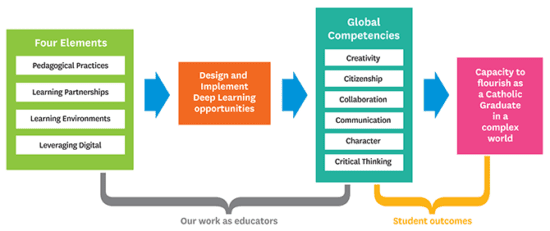
Here is an example of the strategy: “Each month the board has a common focus that is shared across all 83 schools at the monthly staff meetings. Over the ten-month school year, all four learning elements and all six global competencies will be explored in every school” (interview with district leaders). Multiple overlapping ideas are used and reinforced through interaction and digital devices. The district continues to perform above provincial levels (although it should be noted that good outcome measures of the global competencies are not yet available).
Conseil des écoles catholiques du Centre-Est (CECCE)
The CECCE has 55 schools and has been a highly performing district in Ontario for several years. The district has used multiple reinforcing elements to move deep learning forward, including the development of teacher leaders, renewal of vision and mission to engage students and transform learning, and student exit outcomes that integrate the six global competencies. In one subset, the CECCE has focused on developing and measuring critical thinking and its ramifications. Notably through the growth mindset of leaders and teachers, CECCE shared the following:
What we’ve learned along the way:
- increased evidence of students thinking critically and of transformed instructional practice
- teams are more aligned and mobilized when the principal is on board and champions the initiative
- increase in students creating knowledge (e.g. Grade 2 student inquiring about pollution levels in the winter because there are no leaves on trees without being prompted by their teacher)
- increased student ability in problem solving when collaborating with peers
- increased collaboration and communication skills amongst students
- shared planning and problem solving amongst teachers
- improvement of teaching quality at scale
- increased creativity levels for students with learning disabilities (peer problem solving)
- easier implementation of technological shifts: critical thinking is the basis for change, thus avoiding superficial implementation of technology.
In its efforts to create deep learning contexts, the CECCE also supports professional practice that transforms learning through peer coaching strategies of well defined “look fors” in the fields of new emerging pedagogies, technology, learning spaces and environments, student leadership and well-being.
Ottawa Carleton District School Board (Glashan Public School)
Glashan is a Grade 7-8 senior public school. Starting in 2014, the school began to explore the 6Cs and quickly embraced the idea of calling themselves a 6C school. Jim Tayler, school principal, talked about early developments in the following way:
“As the project progressed in the first two years, many teachers began to look at the 6Cs as a framework that could be incorporated into their instructional practice. But it became more than that. A number of teachers believed in the importance of their role in modelling the 6Cs to their students. The 6Cs came to be seen by some teachers as a powerful lens in which to consider curriculum and content. For example, students and teachers alike explored ideas around how certain characters in a novel or a short story demonstrated (or didn’t demonstrate) the 6Cs. Teachers also began to ask questions such as how did historical figures demonstrate the 6CS. Many also began to make reference to the 6Cs in the provincial report card Learning Skills section.
The use of the 6Cs took a giant leap when they were used as the basis of the submission requirements for Glashan’s first international Grade 8 student trip to China. Using a format of their choice, the students were asked to provide evidence of how they use the 6Cs in school, at home, and in the community. With student creativity unleashed, remarkable submissions have been received for each of the subsequent international trips.”
QUEBEC
Francophone school boards and boards in other provinces have not worked much together in the past due to cultural language differences. Apparently the ping of sea change travels well these days, as the General Directorate of school boards, with support from the Chagnon Foundation, approached me in 2014 to help them develop the role of what we call “leadership from the middle.” This approach essentially places school districts at the center of a system change strategy. The idea is that they develop individually and together as agents of system-wide improvement. This represents a big change and so far 56 of the 70 or so boards have joined.
The CAR “Collaborer Apprendre Réussir” project is founded on the following principles:
- Pedagogical leadership by districts
- Collaborative practices
- Reflective practices in action
- Network learning
- Monitoring success on three levels (province, district, school)
- Utilization of effective and emergent practices.
The Chagnon Foundation has committed to funding the initiative at least until 2022. Some school boards are now moving into the 6Cs and related deep learning. CAR is a very strong system-wide movement that will only get deeper in the next four years. With the support of the Foundation they have translated our books Motion Leadership and Coherence into French, and are about to start translating Deep Learning.
SOMEWHERE BEYOND THE SEA
There is much, much more happening across Canada than I am able to capture in this brief article. There are also indicators that First Nations, Métis, and Inuit values and cultures are especially congruent with understanding learning as a seamless interaction with the universe and the people who inhabit it.
The “push forces” – the weak attraction of traditional schooling—are no longer the main point. Now that the new movement is underway it is the “pull factors” – ever younger, immersed change agents; relentless technology; radically different pedagogy, ubiquitous kindred spirits – that will represent the sea change. The promising point is that the examples I portrayed are coming from within the system. For me this represents a golden opportunity to help lead transformation of public schools from within!
It is best to join in as a learner and creator, than to be swept away by the good and bad of sea change. Mind the ping!
We want to know what you think. Join the conversation @EdCanPub #EdCan!
Photo: Max Pixel
First published in Education Canada, March 2018
-
National Reading Recovery and Early Literacy Learning Conference
Comments Off on National Reading Recovery and Early Literacy Learning ConferenceThis conference is widely recognized as Canada’s premier professional development experience for teachers of early literacy. Sessions are designed to present sound learning theory together with instructional best practices for K–3 teachers, Reading Recovery Teachers, Literacy Consultants and Coaches, Resource, Special Education teachers and Early Childhood Educators.
-
Well-Being at School: What does it look like?
Comments Off on Well-Being at School: What does it look like?A national symposium on educator and student well-being has shifted the conversation from ‘fixing symptoms’ to transforming entire school cultures.
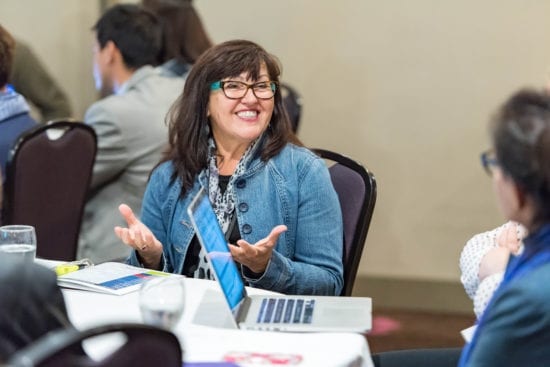
This multimedia follow-up report from the EdCan Network’s Educator Well-Being: A Key to Student Success Symposium, which took place last October in Toronto, includes presentation recaps and videos of the latest research and good practices for ensuring the well-being of students, teachers, principals, and education leaders.
Two days of engaging keynotes, panel discussions and workshops inspired attendees to answer the following questions:
- What is well-being?
- What does student success look like?
- And how can school districts lead systemic change to meet unique learner needs?
ACCESS THE FULL ELECTRONIC REPORT
(INCLUDING VIDEOS AND PODCASTS)Looking to get up-to-speed? Here are 5 articles to read on youth mental health:
- Fact Sheet: How could students’ use of social media be affecting their mental health?
- Fact Sheet: How can we best support student mental well-being?
- Fact Sheet: What are effective approaches to improving students’ mental well-being?
- Expert article: School Mental Health Literacy
- Expert article: What is Child and Youth Mental Health?
Looking for more?
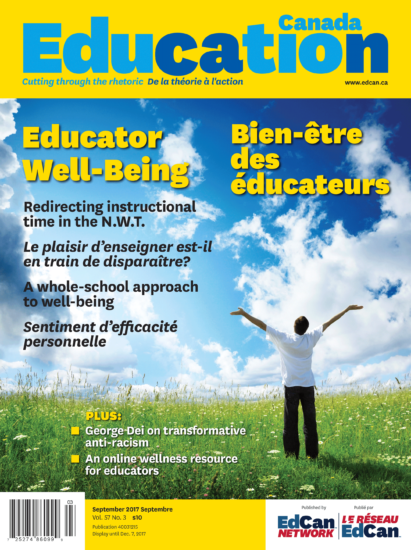
Check out our special edition of Education Canada magazine on ‘Educator Well-Being.’ -
54th CEOs’ Network Forum
Comments Off on 54th CEOs’ Network ForumOn behalf of the EdCan Network and event host Michael Chechile (Director General of the Lester B. Pearson School Board), we invite you to join us at this year’s CEOs’ Network Forum, which will take place at the Le Saint-Sulpice Hôtel Montréal – located in the heart of Montreal’s beautiful historic district near the world-famous Notre-Dame Basilica and charming cobblestone streets, unique stores and restaurants – from May 30th – June 1st, 2018.
With relevant insiders’ discussions and case study presentations produced by District leaders for District leaders, this small private collegial gathering will provide you with a first-hand pan-Canadian vantage point of the challenges and opportunities that your peers are facing across the nation.
PROGRAM UPDATES

Meeting the challenge of embedding Truth & Reconciliation Calls to Action in all our classrooms
Darren Googoo, Director of Education, Membertou Mi’kmaq First Nation

Synergies and tensions between provincial and international testing
Dr. Louis Volante, Professor of Education at Brock University

Unlocking the Closet Door in Rural Saskatchewan
Student sexual orientation support and good practices to reduce incidents of self-harm and suicideBen Grebinski, Director of Education/CEO, Prairie Valley School Division
Plus our annual CEOs’ ‘Cross Country Checkup’ and more!
With such rewarding dialogue that’s a hallmark of this gathering, we hope that you’ll consider joining us for this worthwhile professional support, networking and friendships.
ONLY A FEW SPACES LEFT! Please contact Mia San Jose at events@edcan.ca to obtain registration information.
We hope to see you in Vieux Montréal!
-
Learn Self-Reg K-12 Institute: Towards Thriving Students
Comments Off on Learn Self-Reg K-12 Institute: Towards Thriving StudentsWe now understand that the better children can self-regulate, the better they can rise to the challenge of mastering ever-more complex skills and concepts. But what exactly is self-regulation, how does it develop, why do some children and teens struggle with it more than others, and what can we do to enhance its development? This event will explore the answers with Dr. Stuart Shanker.
-
Learn Self-Reg Face-to-Face Seminar: Stress Management vs. Breaking a Stress Cycle
Comments Off on Learn Self-Reg Face-to-Face Seminar: Stress Management vs. Breaking a Stress CycleStress management is often discussed in terms of adaptive coping. We are taught that stress is a normal part of life and we must learn to cope with it. Yet Self-Reg tells us that stress management is not just a question of coping but also a question of managing energy flow and recovering the energy expended in dealing with stressors. We will explore these topics with Dr. Stuart Shanker.
-
Self-Reg Summer Symposium 2018
Comments Off on Self-Reg Summer Symposium 2018This year’s Self-Reg Summer Symposium will focus on reframing resilience, perseverance and motivation through the lens of Self-Reg. How do stressors affect children’s ability to develop and make the most of these key qualities and how can adults support them? Keynote speakers include Dr. Stuart Shanker and Dr. Jean Clinton.
-
Walk Alongside: A Parent Engagement Forum
Comments Off on Walk Alongside: A Parent Engagement ForumWalk Alongside: A Parent Engagement Forum will offer participants the opportunity to deepen their understanding of what parent engagement is, why it matters, and how to embed it in practice. Teams of parents and educators will work together to build a plan for systematic parent and family engagement in their school or organization.
-
A Different Kind of School Re-Entry
Comments Off on A Different Kind of School Re-Entry“It’s a pleasure having your son in my class; he is a positive influence in the classroom.”
The high school teacher who sent this email probably had no idea what a relief it was to read these few kind words.
Before landing in that teacher’s classroom, my son had been on a learning journey that was as unique as he is. With his twice-exceptional profile (he is gifted and has Asperger’s Syndrome and ADHD), Calum has never been a typical student. His first four years of public school were challenging, ending in a tough decision to try an online learning program, hoping that it would be flexible enough to meet the needs of my quirky son.
I questioned my decision constantly during the first three years of online learning – during which he flatly refused to do almost any schoolwork.
At some point in Grade 7, though, something changed. Calum’s interest in learning was ignited, and he discovered a passion and talent for math and science. With the help of tutors, Calum moved up three grade levels in math, then in science. But alongside his clear academic strengths, he struggled with many things a typical student might do without a second thought. Calum needed help to break down large projects into manageable tasks, or he would find himself unable to get started. He refused to watch the videos for his online pre-calculus course, citing frustration with the slow pace of the material, but would then struggle to complete assignments because he didn’t know how else to learn the concepts. He seemed incapable of keeping track of textbooks or the schedules he and his study skills tutor created to track what he should work on each day. If he didn’t understand the expectations for an assignment, he had a tendency not to ask for help, and to fall further and further behind. I wasn’t sure whether he knew what resources were available to help with his assignments, or how to make use of them. And yet when he could overcome these obstacles and get his work done, he got excellent grades.
No, Calum was not your typical student, but with university clearly in his future, it was time to develop some non-academic skills that he would need. If he was going to get used to the routines and expectations of a classroom, better that he do so in high school than struggle with these demands during his first year at university.
By Grade 10, Calum felt ready to try school “in a building” again – I just wasn’t sure that I was ready for the stress of making that transition! How would my outside-the-box learner, with his uneven set of learning skills, taking courses at three different grade levels, fit back into a school system that is designed for more typical learners?
My hands were shaking as I picked up the phone to call the local high school and ask if we could visit. But the secretary who answered couldn’t have been kinder. In fact, from the day of our first visit to the school, every person we talked to helped to make the transition smoother, from the secretary who kindly answered my first hesitant questions, to the vice-principal, resource teacher and counsellor who made time in their busy schedules to meet with us when we came to tour the school, to the classroom teachers who took a couple of minutes to check in with my son and ensure he was settling in well after classes started. Every single person in that building communicated that my son was welcome there and that they were genuinely pleased to have my quirky teen as part of their school community. Our distance learning teacher was equally kind and supportive – she made it clear that Calum would be welcome to come back if our school experiment didn’t work out, and even called a few weeks into his first semester at his new high school to find out if things were going well.
Educators are busy people, with many students to support. But the willingness of this school’s staff to make time for me and my son made his transition smoother; it made us feel cared for. The time they took to reach out, ask what we needed, and give us reassurance made all the difference for one teenager and his anxious mom.
We want to know what you think. Join the conversation @EdCanPub #EdCan!
Photo: Kati York
First published in Education Canada, December 2017
-
Opening the Doors
Comments Off on Opening the DoorsI’ve had three kids go through the public school system. That’s a lot of school. And looking back over all those encounters, here’s the incident that stands out – among many very positive experiences – as the thing that made me feel devalued as a parent:
It was the night of the annual fun fair, an event that, incidentally, depended on parents to both help organize and attend with their kids. It was late fall, so it was dark and cold by dinnertime. And as we dutifully arrived at the school a few minutes before the official event time of 7 p.m., the heavens opened and it began to pour rain.
And the doors were all locked. There was a new principal that year who had decreed that no one would be let inside the school until the stroke of seven. We huddled outside, soaked and cold, locked out of our own school. To this day I clearly recall the resentment I felt towards the principal who treated his students’ parents like a bunch of potential shoplifters who couldn’t be trusted to wander in unsupervised.
In her article, Debbie Pushor observes there are less obvious, and more damaging, ways that schools can make parents feel locked out. But she also describes schools that are making real efforts to welcome all parents – even those who “don’t have the right words” – into the school community.
For children with special needs, a strong parent-teacher partnership takes on extra importance, and Jeffrey MacCormack offers an insider’s view on working with these parents. Gail Prasad shares how welcoming and incorporating home languages into the classroom recasts parents and students whose first language is not the language of instruction as valuable experts. And on a bigger scale, David Price reminds us that parent support is often the overlooked missing link in effecting educational change.
Partnering with parents is a messy, complex undertaking. Parents may have language barriers or a personal history that makes communication challenging. Some may be difficult, demanding or indifferent. But they all play a crucially important role in their children’s lives,and are therefore key players in their children’s education. In this issue, we rethink educators’ relationships with parents and parents’ role in education. How can we build better communication, understanding, trust and teamwork with our students’ parents – and work together for positive change?
Write to us!
We want to know what you think. Join the conversation @EdCanPub #EdCan!
Send your letters or article proposals to editor@edcan.ca, or post your comments about individual articles on the online version of Education Canada at: www.edcan.ca/magazine
Photo: Dave Donald
First published in Education Canada, December 2017
-
Pushing The Limits
Comments Off on Pushing The LimitsThis is a book of educational anecdotes from successfully innovative Canadian schools, with an interwoven thread of commentary about the importance, and the viability, of educational programs that foster not only academic understanding but also the personal skills that prepare all students to thrive in a turbulent, complex and pluralistic world.
Those who accept the authors’ premises will find affirmation, encouragement and perhaps inspiration in the stories and helpful comments on the motivation for, and the logic of, the student-centered constructivist educational programs they describe. Those who do not are liable to remain unconvinced, because the pedagogical commentary is too sporadic to convert traditionalists. But that is not the purpose of this book.
A brief introduction is followed by a rich, eclectic collection of stories about schools and individuals that is sorted into chapters focused on math, creativity, social-emotional learning, technology, choice, parental/community involvement, and creating school systems that both push and support teachers to learn continuously. The stories are the strong focus of the book and the commentary, while insightful, is secondary. In the authors’ words, “Schools of the future exist in the here and now, and in this book we go out and find them.” (p. 8) This they do to good effect. However, the implication in the title that the book may explain (as opposed to illustrating) how schools can prepare our children today for the challenge of tomorrow is not fulfilled by the interspersed pedagogical discussion. I only wish there were a more clearly structured and conceptually sufficient discussion of theory and practice to make the most of the powerful anecdotal substance of the book.
Nonetheless, the stories themselves are engaging and illuminating. The book would be ideal for a study group of educators who wonder if the sort of innovation that they are expected to pursue is actually possible, and it could provoke very productive discussions in which participants might clarify and refine their own beliefs and intentions. Parents who wonder about the motivation for current educational reforms might also find this very accessible book to be an engaging introduction that whets their appetite for more extensive inquiry and gives them productive direction.
We want to know what you think. Join the conversation @EdCanPub #EdCan!
Photo: Dave Donald
First published in Education Canada, December 2017
Doubleday Canada, 2017 ISBN: 978-0385685382


IDEAS TO SUPPORT EDUCATORS : Subscribe to the EdCan e-Newsletter
Quality research, reports, and professional learning opportunities.