Archive
-
A raw discussion about truth and reconciliation in Canadian schools
Comments Off on A raw discussion about truth and reconciliation in Canadian schoolsFour young Indigenous leaders shared with us their thoughts about what Truth and Reconciliation means to them and how that should be reflected in our schools…
Take in this powerful discussion…
This conversation inspired an article published in the Summer 2018 issue of Education Canada Magazine. Read Carrying the Fire.
Illustration: Don McIntyre
Music: “Perfect” by Ketsa Music/UTK Publishing (www.ketsamusic.com)
-
Self-Reg and Inclusive Schooling Face-to-Face Seminar
Comments Off on Self-Reg and Inclusive Schooling Face-to-Face SeminarDr. Susan Hopkins, executive director of The MEHRIT Centre, will engage participants, using an inquiry-based design, to explore the relationship between stress, is one of the key unaddressed issues in inclusive special education, and how Shanker Self-Reg can help educators to better understand and support students with special needs.
-
Self-Reg: A Great Tool for Early Kindergarten Educators – Face-to-Face Seminar
Comments Off on Self-Reg: A Great Tool for Early Kindergarten Educators – Face-to-Face SeminarSelf-regulation is now an important concept in Kindergarten education, one of the four frames of early learning in Ontario’s Full-Day Early-Learning Kindergarten curriculum. In this Institute Dr. Susan Hopkins, executive director of The MEHRIT Centre, will present and unpack the concept of self-regulation developed by Dr. Stuart Shanker.
-
Desjardins Coopérathon 2018
Comments Off on Desjardins Coopérathon 2018The 2018 Cooperathon will revolve around the tracks of finance, education, healthcare and energy.
The Cooperathon is both a platform and a movement. The platform is a place for learning and co-creating where projects with a big social impact take shape. The movement is a community of people and organizations who believe cooperation, innovation and entrepreneurship can make a positive difference in the world.
-
Your Top 10 Summer Reading List
Comments Off on Your Top 10 Summer Reading ListAre you seeking promising practices and the latest research and ideas from like-minded educator-leaders to challenge your thinking? Add these hand-picked articles from our Editor Holly Bennett to your summer reading list and boost your knowledge before the next school year begins!
EDUCATOR WELL-BEING
In this issue, we examine what can be done to support the well-being of all educators and reduce their levels of stress, role overload, and exhaustion. Many of our contributors make the very good point that the mental health of educators has a direct impact on the well-being of the students in their care; and that therefore we should support teachers’ well-being in order to ensure they are able to bring their best to their students.
- Creative Caring for Teachers: How a whole-school well-being approach can support everyone’s mental health
by Sue Roffey
- Healthy Principals, Healthy Schools: Supporting principals’ well-being
by Dr. Katina Pollock - Teach Resiliency: A resource for teacher and student wellness
by Susan Rodger, Kathryn Hibbert and Alan Leschied
WORKING WITH PARENTS
Parental engagement is a complex, double-edged issue that affects every level of education, from the student at home to provincial policy. From the importance of parent support to a child’s progress at school, to the tensions around parent advocacy for their children’s individual needs, to the political clout groups of parents can wield (for good or ill), this theme has many potential facets.
- The Missing Link: Parents are key players in sustainable educational change
by David Price - Bear With Me: Teaming up with parents of students with special needs
by Jeffrey MacCormack and Dr. Ian Matheson
SIGNALS OF CHANGE
In this issue, a cross-section of our network contributors – teachers, principals, superintendents, academics and students – explore how emerging big ideas could be creatively applied to education, why it may be important to do so, and the drawbacks or risks that need to be guarded against. From the aging population to micro-credentialing and artificial intelligence, what lies ahead for education?
- A Virtual Education: Artificial intelligence and virtual reality are changing the way we learn
by Lora Appel, PhD - Micro-credentially: Giving credit where credit is due
by Chris Cluff and Stephen Hurley
TRUTH AND RECONCILIATION IN THE SCHOOLS
How can teachers, who may know little themselves about Indigenous cultures and issues, authentically incorporate respectful, accurate information and experiences about Indigenous history, worldview, ways of teaching and learning, and contemporary issues into their classrooms? In this issue, we invite explorations of good practice examples, researchers’ insights on how we can “scale up” Indigenized learning, and other articles aimed toward helping schools move forward towards education for reconciliation.
- “First, We’re a School”: Teachers and school leaders play a key role in reconciliation, but policy makers must resource schools for equity of opportunity and success
by Dr. Gordon A. Martell - Truth and Reconciliation in YOUR Classroom: How to get started, and who can help
by Dr. Kate Freeman, Shawn McDonald and Dr. Lindsay Morcom
- Carrying the Fire: A youth talking circle on truth and reconciliation in our schools
by Dr. Michelle Hogue and Holly Bennett
Enjoy your summer!
- Creative Caring for Teachers: How a whole-school well-being approach can support everyone’s mental health
-
Celebrate National Indigenous Peoples Day
Comments Off on Celebrate National Indigenous Peoples DayOn June 21st, celebrate the heritage, diverse cultures and outstanding achievements of First Nations, Inuit and Métis!
The EdCan Network invites you to discover good practices, exemplary school programs and practical ideas for educators seeking to work towards truth and reconciliation in their schools and classrooms.
Add these books and magazine articles to your summer reading list and boost your knowledge before the next school year!
Articles for Educators
Carrying the Fire
A youth talking circle on truth and reconciliation in our schools
The Red Worn Runners
Intentional conversations with Indigenous youth
“First, We’re a School”
Teachers and school leaders play a key role in reconciliation, but policy makers must resource schools for equity of opportunity and success
Articles for Teachers, Teachers candidates and Principals
Truth and Reconciliation in YOUR Classroom
How to get started, and who can help
Our Journey Into Reconciliation
A Project of Heart at Stavely Elementary School
Books and Resources
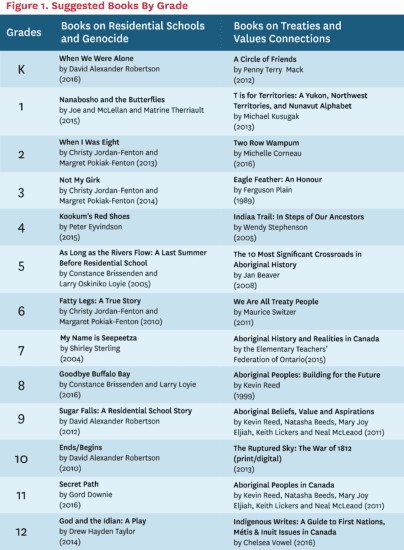
Download and Print the Figure
from Truth and Reconciliation, K-12: Becoming a teacher allyReport for non-indigenous educators in urban high schools
A guide on how urban high schools can raise Indigenous graduation rates
Reconciliation in Action: Creating a Learning Community for Indigenous Student Success
This step-by-step report can be used to create your own unique program in consultation and collaboration with local Indigenous communities.
Read the report
PRACTICAL HOW-TO VIDEOS FOR TEACHERS AND PRINCIPALS
We’ve also put together a series of student and educator video testimonials demonstrating how “culture is medicine” that gives students a sense of pride and a will to succeed.
TACKLING SCHOOL DROPOUT, PURSUING RECONCILIATION: WHY WE SHOULD TEACH AND CELEBRATE INDIGENOUS CULTURES AND KNOWLEDGE IN SCHOOLS
RECONCILING BROKEN PROMISES: ADVICE ON BUILDING PARTNERSHIPS WITH INDIGENOUS COMMUNITIES
CULTURE IS MEDICINE: CONFRONTING STEREOTYPES ON FIRST NATIONS PEOPLES
Articles for Faculty researchers, ministries of education and Superintendents
Reconciliation and Education
Where are we at in Nunavik?
The Best of Both Worlds
Bringing Mi’kmaw Knowledge and Western curriculum together
Join the conversation #IndigenousPeoplesDay, #NIPDCanada, #NationalIndigenousPeoplesDay
Are you celebrating the National Indigenous Peoples Day in your school?
-
Carrying the Fire
Comments Off on Carrying the Fire(A discussion moderated by Michelle Hogue and Holly Bennett)
When planning this special edition of Education Canada, one thing we knew for sure is that we did not want to overlook the insights and ideas of the people at the heart of the issue: Indigenous students. On January 19, 2018, four young adults joined us in a phone discussion to share their thoughts about what Truth and Reconciliation means to them and how that should be reflected in our schools…
Meet the Participants
- Gregory Francis is from Kingsclear First Nation in New Brunswick and is a 4th year student at the University of New Brunswick studying chemical engineering. Currently a member of the Prime Minister’s Youth Council, Greg acts as a positive role model through his actions to support youth. He has been a tutor for First Nation students in his community and has served as a facilitator for First Nation youth engagement.
- Talia Natowcappo is from Lestock, Saskatchewan and is registered to Fishing Lake First Nations Band. A proud Saulteaux-Anishinaabe woman, she is currently studying at Concordia University majoring in First Peoples Studies. She says, “My spirit name is Migiiziikwe; I am part of the Bear Clan family and I am also a pipe carrier. Discovering my culture saved my life, made me proud of something I was once ashamed of.”
- Tarene Thomas is from Enoch Cree Nation and the North West Coast of B.C. She is a writer, poet, and activist in the fourth year of her English major at the University of Alberta. Tarene also works with the transition year program at the University of Alberta, and is an Indigenous peer mentor for the faculty of arts.
- Hunter Martin is from Black Lake Denesuline First Nation in Saskatchewan and is a Grade 12 student at Bethlehem Catholic High School in Saskatoon. He has recently developed an interest in his people’s culture and hopes to contribute to the advancement of Truth and Reconciliation.
We want to know what you, as youth and young adults of today, think needs to happen as we move forward in this TRC era? Where do you think things should go?
I know these are big, open-ended tough questions, but really you are the next generation and are going to be the game changers, and ones who open up doors in a lot of different ways, so we’re very interested in what you have to say.
HUNTER: Moving into the 21st century, I do believe that we need to take action. Some of the reserves have been taking action. The chief for Whitecap, outside of Saskatoon here, really puts emphasis on supporting the youth in the community. There’s more funding going toward the school, and it’s creating a great environment for the young people of that community. I think we do need to put emphasis on the younger generation in order to move forward. There are other issues, such as domestic violence, sexual abuse, drug addictions and suicide, but if we teach the younger generation that this is not the way, that it doesn’t have to be like this, then they will strive to actually make things better once they graduate and go out into the world. That’s my take on reconciliation and youth.
I go to school in the city now. I transferred down south coming out of Grade 9, for the betterment of my education. My mom really didn’t want me to stay up north in my reserve because the education there is poor, the school system is underfunded.
TARENE: That’s what I think we should talk about a little bit, how Indigenous education systems are funded a lot less than mainstream education. It was the same with me, I grew up on a reserve and I did graduate from the high school on my reserve, but from Grade 1 to 9/10, I went to school in the city. It was for the same reason; I wanted a better education so I registered myself and my siblings in the public school system.
But that’s a huge problem, that we have to outsource ourselves to other places away from our community, where we can be involved in our culture and kinship. Those ties are sort of lost, and we have to make that leap just to have the same level of education that non-Indigenous people are having. That’s something that really needs to be addressed.
TALIA: I moved away from my territory, from the prairies, because it was really hard being there as an Indigenous person, with the negative stereotypes that come along with this heritage. It’s really frustrating. But for the years I’ve been travelling, I’ve always carried this big sense of guilt for leaving home, like I’m leaving my family or my siblings or somebody there that would need me. It was just going back this Christmas that I realized that I no longer have to feel guilty or selfish for leaving home, for wanting to better myself – and that came with giving up alcohol and trying to be more traditional and smudging more and trying to be more active in any type of discussion that involves Indigenous people. But I’m still contemplating whether, when I’m done with my academia, if I want to go back and try to create a positive space for the Indigenous people there.
HUNTER: I also have stresses from my family, knowing the problems that they are going through. It really hinders me sometimes from concentrating on what needs to be done. Like my cousin commited suicide, just a year and two days ago, and after that I did abuse alcohol for awhile. It was hard, really hard, getting over that. It took about a month before I realized, what can I do so this doesn’t happen again? So that’s when I decided to take an interest and learn about my culture and my people.
We should teach the true history of Canada. I think that if we start to teach those histories and the effects of colonialism, then we’ll start to clear the air a little bit because I feel like that’s where a lot of the racism and ignorance comes from.
TARENE: Another issue is Indigenizing education. We need to be starting in early elementary and right through to Grade 12, because a lot of the gaps between Indigenous and non-Indigenous people come from the ignorance and not knowing the history, not understanding colonialism and the effects it has on Indigenous people. So in social studies in Grades 4-7, you’re learning about settlers coming into Canada, and you have that small little paragraph that says First Nations People wilfully moved so settlers could live there. We should teach the true history of Canada. I think that if we start to teach those histories and the effects of colonialism, then we’ll start to clear the air a little bit because I feel like that’s where a lot of the racism and ignorance comes from.
I also think it’s really important to create spaces for Indigenous students wherever it may be, in communities, in the school system, in the city. And there needs to be relationship building between Indigenous and non-Indigenous students so we can start to break down the barriers that keep people focused on the negativity.
GREG: One thing that I wanted to talk about was creating that dialogue between Indigenous and non-Indigenous people. I spent my entire schooling in the public system. There was an elementary school on my reserve, but I was always put into the city school 15 minutes away. But as I transitioned from elementary to middle to high school, I noticed that people’s conceptions about Indigenous people had drastically changed, to the point that going into high school I felt uncomfortable and alienated. I think that trying to promote that dialogue and trying to have those conversations between Indigenous and non-Indigenous people will help us understand each other’s differences and find a common place to be able to agree on something that allows us to move forward. Too many times I feel that people focus on each other’s weaknesses when we should really be focused on what makes them strong, and on using those strengths to better our nation as a whole.
TARENE: Those are really good points. There need to be spaces made for those types of conversations, facilitated by people who are comfortable and trained, and they should be happening in school systems in all different levels and age groups. I think when people have these conversations in a… I don’t really want to say safe space, because no one can guarantee a safe space, but in a relatively safe space, I think a lot of times people come through with a better understanding, as opposed to learning something through a book.
HUNTER: I do agree with this. In Native Studies, we were reading about sweat lodges and smudging, but learning about it from a book is very different from actually doing it. You get a deeper understanding, you actually get a connection, when you actually do something that’s related to the topic. That’s true about anything, really, I think it’s one of the major problems with education as a whole. It emphasizes the memory of things and doesn’t really emphasize doing it. That also has to do with getting the students interested. They’ll have a deeper understanding of the subject and in turn will be interested in learning more.
If you could make one big change, what would it be?
TALIA: I want to help plan curriculum, I want to help change the way we teach our kids. And I think the first thing that needs to be instilled is that sense of cultural pride, getting those little kids into a sweat lodge, teaching them that our identity is valuable. Then they’ll be able to carry the fire, and then they’ll be able to be more prepared for the life we send them off into.
They’ve tried for the last 500 years to assimilate us, and it’s not going to happen. They say it takes two to three generations to lose your culture, but we’ve been fighting for it for the last seven. Yeah, it’s nice to teach it here at the university level, but before we even start sharing it with our European neighbours or our other minorities, who are really beautiful too, we have to instill it in our kids. We have to take it back before we can try to explain to anyone else how beautiful it is.
You know, I look at my friends who come from, I guess, a privileged lifestyle where their parents were successful, they had jobs, health care, health insurance… So they didn’t have to go through Indian Affairs, cause it sucks, you know? There’s such a huge stigma around it, that when people bring it up, I’m actually kind of still ashamed that I need help from Indian Affairs. And my non-Indigenous friends who are younger than me are getting their Masters degrees, while I… I’ve worked amazing jobs, travelled to the most Northern remote places, but I pretty much failed my first semester of university here in Montreal and I was scared – scared to go home, scared to tell anybody. I’m in therapy for this, and it’s help me realize that growing up I pretty much raised my siblings and I developed this sense of “I have to do it on my own, no one can help me.” And that I had to overcome all of the shitty things I went through as a kid and in my teens and what I’ve done to myself because I was really incredibly hurt, from being a residential school survivor survivor. I didn’t have to actually go to residential school to have the exact same effects happen to me – being taken away from my parents, being in foster care, the molestation and abuse. It was all there.
TARENE: If I could change one thing? It would be kind of adding on to what Talia was saying, teaching our youth that we are not vessels for white settler colonial shame. We’ve been talking a lot about barriers, and I think one of the reasons why there are so many barriers in front of our people is because it’s kind of the narrative we’ve been told. That’s what society teaches us – that our families are broken so they can’t teach us anything about who we are. So it’s important for our generation and for us when we have children, to instill that in our kids, to be proud of who we are. And then we need to start peeling back these layers, that colonial narrative that’s all over Canada that kind of fits Indigenous people into one box, you know, like the dumb drunk Indian. To do that we need to start within the school systems.
GREG: I know personally when I was younger I wasn’t really connected to my culture, and I did face a lot of mental health issues and alcohol abuse. I was a lost soul for a while. I was able to rediscover myself when I got more involved in my culture and learned a lot more about my traditions. It gave me a more holistic approach and allowed me to feel a lot more like who I am. I just really want that for every other Indigenous youth out there.
TALIA: I just hope they find it a lot sooner than we did. That’s one of the biggest issues right now that we’re facing as a generation: we are really fighting for who we are. I’m fighting to take back my language. I’m fighting to feel comfortable in my own skin for being brown. I have to fight to learn my name in my language and figure out what Bear Clan actually means, and what Eagle Woman means and Migiiziikwe, to find out where my people come from and why I carry a peace pipe.
I’m incredibly proud and happy now about who I am as an individual and what small accomplishments I’ve actually made. And it’s learning to be humble and to have humility, and to share and to laugh, and to just exude love all the time.
When you picture your kids or your grandchildren, what would you hope their school experience would be like?
TARENE: I would want it to be challenging, but also a space where they feel respected and where people know their histories.
HUNTER: I would like my children or grandchildren to find more fulfilment in life through their schooling. When they enter it, they are still on their journey of finding who they are, and when they leave I want them to have a stronger sense of who they are as a person and go off in the world from that place of knowing who they are. That’s my big thing with school: it’s very hard to find yourself in it.
I want to add, I want all kids to go to school feeling like they are not less human for who they are, their background, their people. I want them to feel fully human. I went to school feeling left out because of the colour of my skin.
TALIA: I just hope that, ten years from now, there’s a school on every fucking reserve! A properly funded school, with running water, that isn’t in trailers, that can give them a place to actually flourish and realize who they are and be proud of who they are – and also give them the life tools to be successful.
And I really want them to have a safe home. That truly depends on me and us as parents to not make the same mistakes.
GREG: Everyone pretty much covered it. I want my grandchildren to have that identity, and not to be at a disadvantage because of their ethnicity or because of who they are. That’s something that a lot of Indigenous people are facing today – we have had more struggles compared to other people. I don’t want our kids having to face those kinds of struggles.
HUNTER: I have just one thing to add I guess. I was told that it’s been seven generations before ours that have had a time of pain and suffering, and that it will take seven generations more until that pain has fully healed. I was told it is our generation, the Millenials, that is the start of that seven-generation healing process. When I was told this, I felt compelled and motivated to start doing things to better myself and my people. It is us who will rekindle the flame of hope. And through that hope, will inspire others to actually go on that journey.
We want to know what you think. Join the conversation @EdCanPub #EdCan!
First published in Education Canada, May 2018
-
Of Orcas and Learning on the Land
Comments Off on Of Orcas and Learning on the LandA THIN FOG hung above the restless water of Alaska’s Alexander Archipelago, veiling the mountains as they stood rooted in the ocean’s deep fjords. I had driven this route since the beginning of the school year nearly two months before. Timing the drive perfectly, I would arrive at the first bus stop, far up the finger-like inlet, at just the right moment to meet the two children who lived there at the end of their scamper from their front door, greeting them with my best bus-driver’s smile.
That morning, I noticed that I had arrived early at the widened shoulder a mile or two before that first, daily rendezvous. Wheeling the 11 ½-meter behemoth off of the highway, I chose to wait out my ten extra minutes here, where I could meditate on the rising sun and the scattering of the morning mists. Throughout Southeast Alaska the highways are chipped from the mountainsides along the water’s edge, and it was here, next to the perpetually rolling waves, that I now paused.
A sudden motion just off shore caught my eye. A deep, churning whirlpool pierced the surface of the waters. In a moment I was out of the bus and had hopped to a large boulder that rose above the rolling waves. No sooner had I landed than the black and white form of a killer whale drove three meters into the air beside me. Four meters out, the surface crashed with the fall of the returning whale. Immediately, I was aware of the pod, skimming, slicing and surfacing before me, to my right, to my left. Across the channel a second pod chased salmon in ritual feasting.
“Five minutes since I stopped…” I thought. “Perhaps I could collect the children early and return.” The engine fired; yes, the boy and his little sister (seven and five) headed out the door early as they saw the bus approaching.
As I was also completing a practicum in their school, I had seen these two children, who greeted me early each morning with such warmth, later in the day, dissolving into the social fabric of the school, silently disappearing. Conversations with the students themselves, their teachers and their parents revealed the deeper challenges they felt as they struggled to accommodate both traditional Tlingit values and the foreign expectations of formal academia. Their father was a world-renowned carver of Tlingit totems, some of which stood in European museums. Now his children, as well, were attempting to stand strong in their school.
“Why are we stopping here?”
“You’ll see. Look out there!”
“What is it?”
“It’s the orca. They have come here to eat.”
“Can we get out? What do they eat? Where are they going? How fast can an orca swim…?”
As the bus filled that day, I saw the two children melting again into silence, but as I glanced in my mirror from time to time, I saw a sparkle in their eyes, and I knew orcas played there.1 Over the course of the intervening 30 years, my work both in Alaska and on the Canadian prairies has taught me much about the value of land-based education. I have had the great privilege of sitting with many Elders, gaining insight into land-based learning as traditionally practiced and understood by the Tsimshian, Tlingit, Haida, Dene, Anishinaabe, Dakota, and Cree nations.
Institutionalized education and colonization
Settler societies around the world create educational institutions that function to perpetuate the philosophical understandings of the dominant culture. Consequently, they do a disservice to learners who are thereby deprived of broader understandings of the world. In the Canadian context, for example, children (Indigenous and non-Indigenous alike) might learn facts pertaining to the biology and habitat of killer whales, but they would not gain an understanding of the intricacies of relationship within the circle of creation.
The colonial, pedagogical structures within which educators are obliged to operate, both in terms of curriculum and instructional practice, consistently stand in stark contrast to understandings of the world that are rooted in diverse, Indigenous, philosophical perspectives. Teachers are required to hold forth in classrooms that are far removed from lessons that can be learned on the land. They are to teach classes of 25 or more with limited time for students and still less for those who are the silent ones. The inculcation of outcomes often supersedes real learning, and these outcomes reflect perspectives that have not been reconciled with philosophical truths found in Indigenous worldviews. Furthermore, learning on the land from the teachers one finds there is, all too often, discredited and deemed to be irrelevant and unquantifiable. Indigenous Elders, however, tell us that profound lessons can be learned from all whom we find on the land, including those of the winged, finned, plant, four and six-legged nations.
The educational machinery established by dominant, colonial culture exists to continue the larger societal systems. The enfranchised will remain enfranchised, and the marginalized will not escape marginalization in successive generations without a genuine process of reconciliation where alternative world-views are not only appreciated but embraced.
Of key concern, then, are questions of validation: are there not invaluable lessons being missed by all students when the lessons of the land, so familiar to traditional Indigenous individuals, are ignored? Stemming from this central philosophical concern arise other, practical considerations. For example, in what ways can the accomplishments and learning that take place on the land be validated, and how do we teach students to listen to the many teachers within the circle of creation?
Traditional land-based learning
Traditional land-based learning presents in two distinct categories: learning that is imparted by Elders and/or traditional knowledge keepers in the community, and learning that derives from the land itself. Teachings received on and from the land fashion both conceptualizations of the world and moral understandings pertaining to self-conduct in the world. In support of this dynamic form of education, the Coalition for the Advancement of Indigenous, Land-Based Education (CAILBE) was originated in Canada and is now an international coalition built around the revitalization of traditional, Indigenous ways of learning on and from the land. With adherents from around the world and members in seven nations (Australia, Brazil, Canada, New Zealand, Nigeria, Sweden and the U.S.), CAILBE is dedicated to promoting governmental and institutional changes that result in the acknowledgement of Indigenous understandings regarding LBE and to assisting individual teachers in the development and inclusion of traditional LBE experiences for their students. This work is accomplished not through direct political action but through the empowerment of educators to take part in engineering real and lasting change. CAILBE has grown rapidly since its inception in June of 2016. CAILBE members have made a commitment to infuse the work that they are already doing with promotion of LBE and the philosophical perspectives that underlie it. Members with initiatives, questions or academic presentations are guided and supported by this international association.
Dr. Richard Manning, CAILBE member from the University of Canterbury, Christchurch, NZ, has observed, “The last century of compulsory schooling has rendered young people disconnected from their… local ecologies of place.”2 If it is to be intuitive, land-based education (LBE) must begin early in life, frequently in the context of family structures and activities. Teachers seeking to implement Indigenous, land-based learning strategies have found that many students from almost every environment (not just “city kids”) lack these early, land-based learning experiences and must be given guidance in their first encounters with learning on the land.
Certainly, many teachers attempt to incorporate fieldtrips into the delivery of curricular outcomes. Although this is laudable, it does not reflect the realities of those who have learned deeply from the land. To pass through the natural environment on an excursion related to, for example, a science class, does not equate to this type of Indigenous, land-based learning. By contrast, in progressive models, students are taught the basic foundations of traditional LBE. (See Gakina Awiya Biindigeg below.)
Those who learn on the land must first develop a sense of respect for all the teachings that may be found there. Cree Elder Gerald Morgan frequently asks the students he teaches on the land if they have seen anything as they travelled to meet him in the bush. Very often they give a negative response, meaning that they have seen nothing that they consider noteworthy (e.g. moose, eagles, bears). Morgan then asks if they saw no trees, no sparrows, no rocks. He goes on to explain that the greatest lessons are often brought by the smallest of teachers. We are so schooled in hierarchical thinking of European origin that we fail to appreciate the smallest of these teachers.
Students who seek to learn on the land must also know how to wait long there. Lessons do not become a part of who we are until we consider deeply the implications for the way we walk in this world. In the same way that students must listen and observe closely to comprehend that which is being conveyed by a teacher in a classroom, so, too, learning on the land requires that keen attention be given in order to understand the lessons imparted there.
The goal of LBE within a great many Indigenous communities around the world is that each student learns to take his or her place in the circles of creation and community in a good way. This is the essence of the Anishinaabe/Cree teaching of pimatisiwin (walking in a good manner).3 To take our place well in the circle involves being in harmonious relationship with all others in the circle and with the Great Mystery (i.e. Creator) at the circle’s centre. We come to understand that all our relations in the circle can show what they have learned about these things, and, as respected teachers, they can guide us into better ways of being in the world as we learn from them on the land.
Dr. Maggie Walter, CAILBE member and University of Tasmania professor, describes Indigenous connection to the land in personal terms: “I am a descendant of the Trawlwoolway in Tasmania. The nation takes up the north east corner of Tasmania and is distinguished by wonderful white beaches, open wooded country and plentiful plant and animal resource around which our traditional people’s lifestyles were based. Not many of us live in the area these days – it is a relatively sparsely populated part of Tasmania – but if you travel there you can see the signs of our people’s occupation everywhere – in the midden lines in the sands and the shells along the beaches. You don’t have to be Aboriginal to understand our connection to country or to feel the continued presence of our ancestors in this place.”4
The future of land-based education
Clearly a significant paradigm shift must take place for land-based learning to be given weight in the schooling systems of settler societies. Some, such as Leanne Betasamosake Simpson, question whether this can be done at all.5 The argument here is that land-based learning and colonial educational practices are too disparate to be reconciled and that, should an individual seek to be educated on the land, the better course of action is to jettison any hope of incorporating this into the accredited procedures of education in mainstream schooling.
On the other hand, recent trends in pedagogy in Canada and elsewhere have begun to explore differentiated ways of learning. These efforts represent positive steps toward recognizing, validating and normalizing the learning of students in traditional ways on the land. A groundswell of support for change, of which CAILBE is merely one manifestation, is seeking to alter the direction of current practices in education. As with most philosophical shifts, one must think in terms of generations rather than in terms of years. For this reason CAILBE members recognize that the greatest need is to present educational experiences to coming generations that reflect Indigenous understandings and values. The central aims are that Indigenous ideals become valued at a level that is at least on par with those of the larger settler-societies and that, as part of this shift, time be allotted for Indigenous land-based learning. As this becomes a reality, LBE could potentially become a transformative force in the development of all students.
The revitalization of Indigenous, land-based education may, in some jurisdictions, involve the creation of alternate, accredited tracks toward graduation in which Indigenous philosophy and LBE are central. At the very least, a greater openness to the involvement of traditional knowledge keepers in the imparting of understanding to students must be forthcoming. Legislative enactment of policy and law governing education most often supports and finances those systems deemed to be efficient in confirming the status quo; nevertheless, it is at this legislative level that change must, eventually, come. Therefore, those who understand the importance of traditional LBE must raise a collective voice, both by joining organizations such as CAILBE and by infusing their current practices in education with an appreciation for Indigenous values and world-views, including ways of knowing and learning on the land.
Gakina Awiya Biindigeg
The Gakina Awiya Biindigeg student group at Springfield Collegiate Institute in Oakbank, Manitoba, is one example of a progressive land-based learning program. For over a decade students who participated in this optional programming were regularly taken onto the land to learn from Elders and traditional people. The scope of this learning was extremely broad and included traditional values and teachings derived from the experiences encountered while in a variety of remote locations. Students were shown how to relate to the various teachers that are encountered on the land (e.g. the four-legged, many-legged, finned, winged), enabling them to learn directly from these teachers during independent ventures onto the land. When Elders felt that a student was ready s/he would be put out onto the land for a vision quest or other ceremony. Through the avenue of Manitoba’s cultural exploration credit, students were enabled to use this traditional learning towards graduation.
We want to know what you think. Join the conversation @EdCanPub #EdCan!
Photo: iStock
First published in Education Canada, June 2018
1 The young boy mentioned in this story has now grown and has followed in his father’s footsteps as a carver. The young girl is a library assistant who has, among other things, initiated a children’s garden at the local public library where she works.
2 Richard Manning, Place, Power and Pedagogy: A Critical Analysis of the Status of Te Ātiawa Histories of Place in Port Nicholson Block Secondary Schools and the Possible Application of Place-Based Education Models ((PhD thesis, 2009): 56.
3 The late Dr. Mary Young elaborates on this concept in her book Pimatisiwin: Walking in a Good Way: A Narrative Inquiry into Language as Identity, (Winnipeg: Pemmican Publications, Inc., 2009).
4 Maggie Walter, “Meet the Presenter: Maggie Walter, Indigenous Studies,” Open 2 Study (August, 2014). https://blog.open2study.com/post/meet-presenter-maggie-walter-indigenous-studies
5 Leanne Betasamosake Simpson, “Land as Pedagogy: Nishnaabeg intelligence and rebellious transformation,” Decolonization: Indigeneity, Education & Society. 3, no. 3 (2014). http://decolonization.org/index.php/des/article/view/22170
-
Learning Together by Learning to Listen to Each Other
Comments Off on Learning Together by Learning to Listen to Each OtherWithout question, we need discussions about Truth and Reconciliation in all classrooms in every community and every educational institution across Canada. From my traditional Mi’kmaw way of understanding the world, I firmly believe these discussions must begin with exchanges of stories because such is the foundational basis of all relationship. I also passionately believe these exchanges must be ongoing and that they must take place within an acknowledged journey of co-learning wherein we – Indigenous peoples and the newcomers in our Indigenous lands – seek to learn together, to learn from each other, and to learn to draw upon the strengths, indeed the best, in our different ways of knowing, doing, and being.
Many years ago, I brought forward the guiding principle of Etuaptmumk or Two-Eyed Seeing for co-learning. It encourages the realization that beneficial outcomes are much more likely in any given situation when we are willing to bring two or more perspectives into play. As such, Etuaptmumk / Two-Eyed Seeing can be understood as the gift of multiple perspective, which is treasured by the Mi’kmaw people and probably most Indigenous peoples. Our world today has many arenas where this principle, this gift, is exceedingly relevant including, especially, education, health, and the environment. I’ve often described Etuaptmumk / Two-Eyed Seeing this way:
“I, you, and we need to learn to see from one eye with the best or the strengths in the Indigenous knowledges and ways of knowing… and learn to see from the other eye with the best or the strengths in the mainstream (Western or Eurocentric) knowledges and ways of knowing… but most importantly, I, you, and we need to learn to see with both these eyes together, for the benefit of all.”
In my experience, many people across Canada and in different locations have a desire to bring together the ways of knowing of Indigenous peoples and newcomers. Different approaches and different names are in use for this type of work and Etuaptmumk / Two-Eyed Seeing is but one. Regardless, the work is not easy. I always emphasize that the ongoing journey of co-learning is essential in order to develop and nurture collective and collaborative understandings and capabilities. Otherwise, the work can all too easily slip into a lazy, tokenistic approach in which Etuaptmumk / Two-Eyed Seeing and similar efforts quickly become mere jargon, trivialized, romanticized, co-opted, or used as a “mechanism” where pieces of knowledge are merely assembled in a way that lacks the S/spirit of co-learning. And thus, we need ongoing co-learning in our classrooms. But we need also to act upon the recognition that informal learning environments exist in abundance throughout our communities and within the whole of society… and co-learning needs to occur in them as well as in the formal classroom setting. So I believe this educational need is both deep and broad.
I look forward to this special issue of Education Canada: We must share our stories and we must learn to listen to stories other than our own… our knowledges live in our stories.
Apoqnmatultl’k Jiksktuali’lk
L’pa ma’ pun tluow ta’n tettuji nuta’q sku’tminenow Ketlewo’qn aq Apiksiktuaqn msit wutaniminal aq msit ta’n te’sikl kina’matnuo’kuo’ml ta’n telki’k u’t Kanata. Ta’n ni’n tel nestm koqoey, amujpa tela’sik wlu wsitqamu’kminu. Amujpa etlewistu’ti’k aq wesku’tmu’k ta’n wejitaik mita ta’n tujiw etlewistu’ti’kw melkiknowatu’k ta’n teli-mawqatmu’ti’k u’t wsitaqmu. Paqsipki-tlamsitm ta’n tettuji nuta’q u’t tla’siktn ke’sk pemitaikl msit wutawtiminal. Nutaik toqi- kina’masultinew mawi kwilmu’kl ikjijitaqnminal aq kinu’tmasultinew ta’n koqoey maw-kelu’kl e’tasiw ala’tu’kl, muskajewe’l. Mu ajkine’nuk ta’n tettuji pilui-kina’masulti’k, ta’n tel-lukuti’k aq ta’n telo’lti’k – mawikwaik amujpa nike’ – l’nu’k aq ak’lasie’wk.
Sa’qiji’jk na nike’wesku’tm aq kekkina’muey ta’n ni’n telo’tm wela’sik tel-kina’masultimk kiskuk. Telui’tmap “Etuaptmumk.” Akklasie’wiktuk telui’tasik – “Two-Eyed Seeing.” Etuaptmin na koqoey, toqa’tu’nl ikjijitaqnn. Mnaqij akkaptmin u’t tel kina’masimk, nmitisk aq wetuo’tisk me’aji wl’a’sik toqa’tumk ikjijitaqnn l’nue’l aq aklasie’we’l. Na nekmowey wjit Etuaptmumk teliksua’tasik kutey iknmakumkl ta’n tujiw tel-kina’masimk l’nuimk. Nestmu’k, mita sa’q ki’s tel’ukuti’k aq kesite’tmu’k.
Kiskuk u’t eymu’ti’k u’t wsitqamu pukwelkl etekl koqoe’l ta’n kisi we’wmu’k Etuaptmumk. Kisi we’wmu’k wjit kinamasuti, t’an teli-tajiko’lti’k, aq ta’n te’li klo’tmu’k u’t wsitqamu. Kaqisk teluey amujpa ewe’wmin newte’jk pukik meknimin ta’n mawi-knaql lnueye’l ikjijitaqnn ta’n nenminn aq ta’n mawi-wla’sital wjit ki’l, ni’n, aq kinuk, tujiw kekknu’tmasin ewe’wmin piluey pukik ta’n te’sik nenmin ikjijitaqn akla’siewey koqoey kelu’k ta’n tel-nmitu’tij. Tujiw weswa’tu’nl ikjijitaqnn aq toqwa’tu’nl – Etuaptmumk msit kowey, mawa’tu’nl aq aji wlaptikemk kwilimimk mawi-kelu’k wjit msit wen. Ta’n ni’n telaptm koqoey aq ta’n tel nenm, pukwelk wen ewe’wk Etuaptmumk msit Kanata aq se’k u’t wsitqamu. Pukwelk wen wetnu’kwalsit kisi toqa’tun l’nuey aq akklasie’wey klaman wla’sitow aq klu’ktitow. Jel ap pilu’wi’tmi’tij ta’n tujiw wejitu’tij, katu newte’jk na pasik ni’n telo’tm etek – Etuaptmumk. Katu ap mu-ajjkine’nuk mita l’pa ma’ pun tluow ta’n tel nuta’q mawa’tunew aq toqa’tnow ikjijitaqnminal pemitaik kekknamasutimk klaman ml’kiknowatisnuk mawa’tu’kl ta’n te’sikl iknmatimkewe’l ala’tukl aq ta’n te’sikl me’ kisi kina’masultitesnuk.
Mu ml’kuktmuk u’t nike’, aq attikineta’wk toqa’tunew, aq e’tasiw kepmite’mukl kjijitaqnn lnu’eyl aq akklasie’we’l, na mnaqnatew aq ewliksu’a’tasiktitew koqoey maliaptmu’k. Na ni’n nekmowey ketlamsitm aq kejitu nuta’q u’t toqa’tasin kkjijitaqnn kina’matmuo’kuo’ml, katu elt nuta’q kepmite’tminow te’sik kisi kina’masimk wutaniminal aq msit u’t wsitqamu. Nuta’q elt tuwa’lanew kwijimuk ta’nik kekknamu’kik mita asa newte’ te’sik kisi kina’masultitaq kwijimuk aq malikwuo’mk. Ta’n tel-nemutu ni’n, kenek me’ eltaik kekkna’masulti’kl toqwa’tumk u’t kkjijitaqnn, pukwelk me’nuta’q pana’tunew. Nenaqite’tm u’t wi’katikn: Kina’masuti Kanata: Nuta’q kin’ua’tatultinew a’tukwaqniminal aq kina’masultinew ejiksitmu’kl atukwaqnn se’k wejiaql – kkjijitaqnminu mimajik atukwaqnnminal.
(Elder Albert’s voiced thoughts, written in Mi’kmaw by Carol Anne Johnson)
We want to know what you think. Join the conversation @EdCanPub #EdCan!
First published in Education Canada, June 2018
-
New report details how urban high schools can raise Indigenous graduation rates
Comments Off on New report details how urban high schools can raise Indigenous graduation ratesReconciliation in Action: Creating a Learning Community for Indigenous Student Success, praises B.C. education policies and demonstrates how non-Indigenous educators can implement reconciliation initiatives immediately.
In an effort to implement the recommendations for education contained in the final report of the Truth and Reconciliation Commission of Canada, provincial school systems are developing curricula that incorporates Indigenous perspectives respectfully and accurately for all students. But non-Indigenous educators, who’ve had limited learning experiences in their own schooling about Indigenous cultures, histories and issues, are now grappling with the fear of “getting it wrong” for their students. But a B.C.-based learning community model in Kelowna demonstrates how non-Indigenous educators can envelop students in a network of Indigenous teachers, adult advocates and the wider community to curtail Indigenous student dropout rates while immersing non-Indigenous students in Traditional Knowledge.
The Indigenous graduation rate has risen from 66% to 77% in six years at Mount Boucherie Secondary in West Kelowna, B.C, which has a high percentage of students with Indigenous ancestry. Educators have attested that culture is medicine, and that immersing students in land-based activities, First Nations-centred courses, the local Okanagan language and traditional drumming and talking circles has given them a sense of pride and a will to succeed.
This report provides practical examples complete with video testimonials from students and teachers on how the Academy of Indigenous Studies has built lasting relationships with local First Nations communities – demonstrating how existing provincial course offerings can be leveraged to create a for-credit learning track that allows Indigenous and non-Indigenous students to learn about Indigenous cultures throughout their entire high school journeys.
“We have well-intentioned, non-Indigenous educators across the country who are afraid of not teaching this material respectfully and authentically,” says Darren Googoo, Chair of the EdCan Network, a pan-Canadian collective of education leaders. “But doing nothing is also wrong, and this approach allows educators to effectively mobilize reconciliation in their schools right now.”
To access the full report and videos, please visit: www.edcan.ca/academy-report
-
A guide on how urban high schools can raise Indigenous graduation rates
Comments Off on A guide on how urban high schools can raise Indigenous graduation ratesA case study report on how one B.C. high school is mobilizing a whole-community approach to raise Indigenous graduation rates
This case study report provides practical examples on how the Academy of Indigenous Studies has built lasting relationships with local First Nations communities – demonstrating how existing provincial course offerings can be leveraged to create a for-credit learning track that allows Indigenous and non-Indigenous students to learn about Indigenous cultures throughout their entire high school journeys.
This B.C.-based learning community model in Kelowna demonstrates how non-Indigenous educators can envelop students in a network of Indigenous teachers, adult advocates and the wider community to curtail Indigenous student dropout rates while immersing non-Indigenous students in Traditional Knowledge.
Non-Indigenous educators in urban high schools can leverage this step-by-step report to create their own unique programs in consultation and collaboration with local Indigenous communities.
Practical how-to videos for teachers and principals
We’ve also put together a series of student and educator video testimonials demonstrating how “culture is medicine” that gives students a sense of pride and a will to succeed.
Tackling School Dropout, Pursuing Reconciliation: Why we should teach and celebrate Indigenous cultures and knowledge in schools
Reconciling Broken Promises: Advice on building partnerships with Indigenous communities
Culture Is Medicine: Confronting stereotypes on First Nations peoples
-
Education’s Call to Action
Comments Off on Education’s Call to Action“Education is the key to reconciliation.” – Justice Murray Sinclair, Chair, Truth and Reconciliation Commission
Canada’s Truth and Reconciliation Commission illuminated a history that has been ignored or glossed over for far too long: the suffering and damage caused to Indigenous children and their families by residential schools, and the ongoing impact and legacy of colonialism.
The challenge before us is to acknowledge these truths and work toward a just and respectful relationship with this land’s Original Peoples. It remains to be seen how well we as a country will meet this challenge, but one thing is clear: educators have a critical role to play. Through the education system, we can ensure that the next generation of Canadians grows up with some understanding of the histories and cultures of First Nations, Métis and Inuit (FNMI) peoples, and that FNMI students receive an equitable and culturally relevant education.
But how to begin? We know that many teachers feel daunted by their own lack of knowledge and fear of “getting it wrong.” There is great work being done, however, that can inspire and guide us – addressing both the specific needs of Indigenous students and the need to better educate all students.
I’m very excited that this special issue is entirely devoted to Truth and Reconciliation in education. It showcases inspiring models and practical ideas for educators who wish to take steps towards reconciliation in their schools. The articles we received were truly outstanding, and I am very grateful for the generosity and enthusiasm of our contributors.
I’d specifically like to thank two people. Michelle Hogue, our Guest Editor, sits on Education Canada’s Editorial Board and is a Métis scholar teaching at the University of Lethbridge. She was not only an invaluable guide and advisor but also took on nitty-gritty work like moderating our Youth Talking Circle (and please do read what these extraordinary young adults have to say – they blew us away with their openness, wisdom, and determination to contribute to a better world). I also want to thank Mi’kmaw Elder Albert Marshall, who set us on the right path with his introduction to this issue on.
Elder Albert says we are on “an ongoing journey of co-learning” from and with each other. Educators don’t need to know it all. We simply need to be ready to seek out the knowledge of those who do know, and to learn alongside our students.
We want to know what you think. Join the conversation @EdCanPub #EdCan!
Send your comments and article proposals to editor@edcan.ca
Photo: Dave Donald
First published in Education Canada, June 2018
-
New guidebook on early school leaving
Comments Off on New guidebook on early school leavingNew EdCan Network case study research report entitled The Rural Advantage: Rallying Communities Around Our Students calls on school-community leaders to consider a made-in-Canada approach that raises literacy rates, prevents early school leaving and breathes life back into small towns.
It’s an all-too-common scenario in Canada’s rural communities. Parents who struggle to read and write. Household incomes and unemployment rates that fall below the national average. Students with special needs who require a speech pathologist or a teaching assistant, but don’t get one. Schools at risk for closure and dwindling community services as young people dropout of school or opt for brighter opportunities in the big city. But these trends can be reversed with a “community ecosystem approach”: a Canadian-developed, step-by-step process for developing school-community partnerships that can reduce student dropout rates in rural and disadvantaged schools and municipalities.
“Our grade-four French-language success scores have risen from 50% to 98% in only five years,” says Sylvain Tremblay, principal of both an elementary school and a high school in Saint-Paul-de-Montminy, Quebec. “Instead of working in silos, we engaged parents, kids, teachers and community partners to collectively lead activities that increase the language skills of toddlers and encourage the academic and social success of our children and young adults.”
This guidebook was originally developed with the support of CTREQ – a Quebec-based research and knowledge mobilization centre – and provides a practical toolkit and worksheets for school and community leaders to create their own unique program, including guidance on how to engage hard-to-reach families, classrooms, schools, and whole communities.
“Schools can’t afford to work in isolation from the families and communities where their students live and grow up,” says Darren Googoo, Chair of the EdCan Network, a pan-Canadian collective of education leaders. “This approach isn’t about overloading busy educators; rather, it’s about community leaders rallying around a literacy action plan that leverages existing resources and strengthens existing efforts.”
Download the full report for free, including how-to videos and a practical toolkit, at: www.edcan.ca/ecoreussite-report.
SUPPORTED BY

This initiative is generously sponsored by State Farm Canada, which shares EdCan Network’s commitment to supporting leaders who are transforming Canada’s public education system.
-
CEOs’ Network Forum Registration Form
Comments Off on CEOs’ Network Forum Registration FormLe Saint-Sulpice Hôtel Montréal
414 Saint-Sulpice,
Montréal, Québec
H2Y 2V5Le Saint-Sulpice Hôtel Montréal will provide rooms at $279 per night, excluding taxes. To make your reservation, call (514) 350-1177 or (866) 811-1345 and refer to the group name: Canadian Education Association or EdCan Network. To ensure availability please book your room by April 27, 2018 (5pm PDT). Space is limited!
Participants are responsible for their own transportation to and from Montreal, Quebec. Prior to May 9th, refunds will be given minus a $75 administration fee. No refunds will be processed after May 9th.
If you have any questions, please call 416-591-6300, ext. 223 or 1-866-803-9549, or email us at events@edcan.ca.
Download a registration form here: 2018 CEOs’ Network Forum Registration Form OR register online below (pay by cheque or credit card).
-
5th Canadian Assessment for Learning Network (CAfLN) Conference and Symposium
Comments Off on 5th Canadian Assessment for Learning Network (CAfLN) Conference and SymposiumThe conference is an opportunity to share, learn and network with educators from K-12 and post secondary settings. It will include presentations and break-out sessions with leaders in assessment and opportunities to connect your learning with your own teaching context. Guest speakers will include CAfLN’s founding members – Ken O’Connor, Lorna Earl and Damian Cooper.
-
The Signal: Multi-Grading iGen-ers and Alpha Geners
Comments Off on The Signal: Multi-Grading iGen-ers and Alpha GenersWhat?
Multi-grading – combining two grade levels in one classroom – may not appear to be a signal of change at first glance. After all, it’s been around for generations; some might say since one-room schools. However, in Canada more than 20 percent of students were registered in multi-grade classes in 2015, with the number continuing to grow – an educational trend being experienced worldwide.1 And yet, what do we know about our current students’ (iGen-ers) and future students’ (Alpha Geners) experiences with multi-grading? Do we know how to meet their multi-grading needs?
So what?
This worldwide educational trend is based on research that shows students in combined classes performing as well and better than peers in single grade classes.2 Greg has seen first-hand how students benefit from some aspects of multi-grading, especially in the context of smaller class sizes. He has found that pedagogical practices such as differentiated instruction and heterogeneous groupings are proving (anecdotally) more effective in supporting student growth, development, and learning in a multi-grading context.
However, there is a gap in our knowledge about how best to educate iGen-ers and Alpha Geners in multi-grading classrooms. In a time when multi-grading is showing unprecedented growth, we need current research supporting best practice. And although teachers like Greg, relatively new to multi-grading, have been provided professional learning on multi-grading, it has not always been best suited to the needs of the multi-grade teacher. To compensate for this, Greg has had to create his own online/email groups and set up meetings and opportunities to connect with his multi-grade peers on the weekends and evenings. Since research on current best practice can be difficult to locate, there is an overreliance on teacher trial and error to determine what will best serve these new generations of learners, the increased diversity of student learning and developmental needs within one classroom, and also departmental/ministry expectations.
What next?
Supporting student success is the ultimate goal of quality teachers and quality educational programming. With multi-grading gaining momentum in Canada and internationally, we need to capitalize on its strengths. This requires systematic implementation and investigation of multi-grading in today’s educational contexts, with and for current iGen’ers and future Alpha Gen’ers, as well as a community within which to share this information with and between practitioners.
Participant reflections on signals of change
Participants at the 2016 EdCan Network Regional Exchanges discussed more signals of change than we could possibly cover — but we wanted to share a sense of their range and significance. We invited a number of participants to write a short piece reflecting on one of the signals they brought to the Exchange.
Discover more signals at: www.edcan.ca/RegExReport
We want to know what you think. Join the conversation @EdCanPub #EdCan!
Photos: Max Cooke and Yolande Nantel
First published in Education Canada, March 2018
1 Globe and Mail (September 17, 2015). https://beta.theglobeandmail.com/news/national/education/are-split-grades-something-to-worry-about/article26390439/?ref=http://www.theglobeandmail.com&
2 E.g. Gajadharsingh, 1991; Goodland, 1987; Veenman, 1995.
-
The Signal: The demand to build adaptive expertise
Comments Off on The Signal: The demand to build adaptive expertiseWhat?
The demand to build adaptive expertise in educators is a powerful signal of change. Recently, I sat in on several sessions at an educational technology conference, where seven local school districts collaborated to share knowledge. As I watched teachers at all stages of their careers gather in classrooms to learn and exchange ideas in areas ranging from apps for teaching math to online portfolios for student assessment, it reminded me that the goals we share go beyond simply keeping pace with the latest tech tools. The premise of a peer-led conference is illustrative of how we must approach education’s most profound shift in a century.
So what?
The demand to develop adaptive expertise matters because educators must prepare learners for a world that few can imagine: a world where technology often outpaces our understanding of its implications, where the global village demands collaborative solutions, and where critical thinking is our only life vest in a swelling tide of information. Educators and learners alike need to build their skill set for adaptive expertise: critical and creative thinking, collaboration, and the willingness to engage with others.
Now what?
Teachers need to model the change in practice that allows these skills to become habits or attributes in the lives of learners. This is how we develop resilient learning communities. As Stephen Downes of Canada’s National Research Council wrote, “We need to move beyond the idea that an education is something that is provided for us, and toward the idea that an education is something that we create for us.” We demonstrate a willingness to adapt as we create space and opportunities for personalized learning, build understanding of shared histories, and use technology for deeper learning. Even learning spaces must transform – rows of desks and the hierarchies they underline are often incongruous with the collaboration required to propel real innovation. As educators, if we can recognize our own inter-dependence, we can build resilient, lifelong learners who understand their power to both adapt to and shape the world around them.
Participant reflections on signals of change
Participants at the 2016 EdCan Network Regional Exchanges discussed more signals of change than we could possibly cover — but we wanted to share a sense of their range and significance. We invited a number of participants to write a short piece reflecting on one of the signals they brought to the Exchange.
Discover more signals at: www.edcan.ca/RegExReport
We want to know what you think. Join the conversation @EdCanPub #EdCan!
Photos: Max Cooke and Yolande Nantel
First published in Education Canada, March 2018
-
The Signal: A curriculum shift from content to connections
Comments Off on The Signal: A curriculum shift from content to connectionsWhat?
In response to an evolving global landscape, and to better equip students with the skills and abilities needed for the future, British Columbia is in the process of integrating a new curriculum for Grades K-12.
So What?
B.C.’s new curriculum provides greater flexibility to teachers, focusing on depth of understanding rather than simply recalling and regurgitating “Google-able” facts. This increased flexibility allows students to explore the curriculum through the lens of their individual passions and interests. By extension, the relevancy of curriculum is increased for both teachers and students. Exploring curriculum through the lens of a student’s interests allows for a more strength-based approach to education, providing increased opportunities for students to succeed based on their unique skills and abilities. Ultimately, it should result in greater engagement and ownership, creating a framework for meaningful learning experiences.
As well, by encouraging the development of a broader and more diverse range of skills, students will be better equipped for the challenges and opportunities that they will face in the future.
Now What?
This shift from content to connections necessitates a renewed focus on relationships between teachers and students. A culture in which relationships are valued as an essential component for student success requires an investment of time. In the midst of busy days, teachers must be provided with the time to learn the stories and context of their students, allowing them to facilitate meaningful connections between the curriculum and individual student interests. As such, districts and schools much invest in both informal and formal structures, providing a necessary framework in which to grow and sustain meaningful relationships.
The Advisory Model is one such example of a formal structure. This model provides a sustained, intentional and focused block of time, built into the school day, that allows teachers to connect with their students without the pressure to deliver specific content or curriculum. In an Advisory Model, connections are privileged over content. Research clearly indicates that students who feel like they belong, who are understood and supported by the adults in their school community, are more likely to achieve social and academic success.
Participant reflections on signals of change
Participants at the 2016 EdCan Network Regional Exchanges discussed more signals of change than we could possibly cover — but we wanted to share a sense of their range and significance. We invited a number of participants to write a short piece reflecting on one of the signals they brought to the Exchange.
Discover more signals at: www.edcan.ca/RegExReport
We want to know what you think. Join the conversation @EdCanPub #EdCan!
Photos: Max Cooke and Yolande Nantel
First published in Education Canada, March 2018
-
The Signal: Increased focus on closing the gaps for students with learning disabilities
Comments Off on The Signal: Increased focus on closing the gaps for students with learning disabilitiesParticipant reflections on signals of change
Participants at the 2016 EdCan Network Regional Exchanges discussed more signals of change than we could possibly cover — but we wanted to share a sense of their range and significance. We invited a number of participants to write a short piece reflecting on one of the signals they brought to the Exchange. Some appear below; others are published on the EdCan Network website.
What?
In 2016, the Ontario Ministry of Education launched the Learning Disabilities Pilot Projects. The goal of these projects is to provide better support for students with Learning Disabilities. Working with eight publicly funded school boards, the Ministry is running three-year intensive reading pilot projects. All eight school boards are using the Empower Reading Program, an evidence-based reading remediation program developed by the Hospital for Sick Children. In addition to addressing reading, school boards are also tasked with looking at ways to support the social-emotional functioning of students with learning disabilities and access to assistive technology.
So what?
Focused reading instruction takes place in the primary grades. As the system moves from “learn to read” to “read to learn,” students who struggle with reading after Grade 3 often receive little support or remediation to improve their skills. While some reading remediation programming does exist for older students, it is not widely available across the province, and varies greatly from school board to school board. As students get older, and fall farther behind their peers, positive academic and social-emotional outcomes become harder to achieve.
During the 2015-2016 school year, the Ontario Ministry of Education conducted a Consultation into the Provincial and Demonstration Schools, which are run by the Ministry and support students who are Deaf or hard of hearing, blind, Deaf/blind or have severe learning disabilities. At the time of the Consultation, many feared that the government was looking to close these schools. As a result of the findings, these schools remain open, and this pilot project was created to take some of the best practices of the demonstration schools, and reach more students through implementation at the school board level. As an educator who was working at a Demonstration School at the time of the Consultations, and who believes ardently that we must do what we can to find a way to support all students, the pilot projects represent a recognition that change is needed if we are to truly commit to teaching all students.
What now?
Moving forward, school boards can build upon the proven success of research-based reading remediation programs, such as Empower, and begin to implement them widely. We can recognize the emotional toll that learning challenges can place on a student, and develop social-emotional supports. All educators can refuse to accept the premise that a student with a learning disability may never learn to read well, and seek out ways to support all students to achieve success.
Discover more signals at: www.edcan.ca/RegExReport
We want to know what you think. Join the conversation @EdCanPub #EdCan!
Photos: Max Cooke and Yolande Nantel
First published in Education Canada, March 2018
-
The Signal: New media, new literacies
Comments Off on The Signal: New media, new literaciesWhat?
Whether it’s news, social media or classroom learning resources, images and video are gaining primacy over print. Many teens use Snapchat to share spontaneous images and video and many use it as their news source. Most classrooms have a projector connected to a computer, making it easy for teachers to use many kinds of media to teach.
If you want to learn how to repair something, learn a computer program, play the piano, or even how to write, search YouTube. You can share what you know, what you can do or the strange thing your cat did, on Youtube, Vimeo, Daily Motion, Twitter, Instagram or Imgur. If you’re interested in ideas or stories, you can listen to or create a podcast. Gamers can live stream their own game play or watch others play on Twitch. Audience size? Try 100,000,000 visitors a month. There are also many sites where you can take a course or create a course for free or a fee.
So what?
We need to prepare students to make sense and meaning with these new media texts that are increasingly a huge part of what we consume and create. And that means we will have to give up some old practices and attitudes.
As schools have been print-based, many in education continue to privilege print texts and to narrowly define literacy as the ability to read and write print texts. Rarely are we even teaching how print texts are written, presented and read differently online.
We talk about multiple intelligences in education, yet how prevalent are tests or exams that use multiple intelligences and multiple literacies?
Now what?
We need to invest our resources into teaching students how to critically analyze images and video and other new media. We need to teach our students the persuasive and expository techniques used in images and video and how to use them effectively. We can have students create video essays and post them online.
Traditional reading and writing texts are still important and won’t be going away. It is now a necessity, though, that schools teach students how to “read” and “write” with new media with the same urgency for creating literate students as before.
Rather than dragging past literacy definitions into the present, we need to bring present literacies into the future.
Participant reflections on signals of change
Participants at the 2016 EdCan Network Regional Exchanges discussed more signals of change than we could possibly cover — but we wanted to share a sense of their range and significance. We invited a number of participants to write a short piece reflecting on one of the signals they brought to the Exchange.
Discover more signals at: www.edcan.ca/RegExReport
We want to know what you think. Join the conversation @EdCanPub #EdCan!
Photos: Max Cooke and Yolande Nantel
First published in Education Canada, March 2018


IDEAS TO SUPPORT EDUCATORS : Subscribe to the EdCan e-Newsletter
Quality research, reports, and professional learning opportunities.