
Archive
-
Book Preview – Teacher Wellbeing: Noticing, Nurturing, Sustaining, and Flourishing in Schools
Comments Off on Book Preview – Teacher Wellbeing: Noticing, Nurturing, Sustaining, and Flourishing in SchoolsEvery person’s wellbeing is important in and of itself. Teacher wellbeing isn’t just about making school systems more economically efficient, or enhancing students’ performance on standardized assessments. Whether you are a student, a teacher, a principal, or an administrator, you have the right to be well and to live well simply because of your inherent worth as a person.
Yet teachers do play a shaping role in the lives of their students. Learning happens best when teachers and their students are well – happy, healthy teachers who feel well and whole in their work provide strong support for happy, healthy children and youth. This book acknowledges that we need to consciously attend to and support teacher wellbeing.
Too many of our teacher colleagues across the world suffer from sources of stress that put an enormous strain on their ability to feel well in their work. This situation also invades their personal and family lives in ways that can be devastating.
Too often, teachers are pushed to account for merely the academic achievement of their students, leaving aside the many social, emotional, and spiritual aspects of learning and development that are essential to students’ wellbeing. However, teaching and learning are fully human endeavours, and learning well cannot be separated from living well.
This research-informed, theoretically grounded book will coach you — alone, or with a group of your colleagues — to determine what wellbeing looks like in your classroom, in your school, and for yourself. The aim is to offer you new perspectives, research insights, reflection moments, and activities for gaining a sense of ‘flourishing’ wherever you can in your work. We achieve this by helping you notice what makes you feel whole, engaged, and connected, while encouraging you to pay attention to ways you can grow more of these feelings in your work.
WHAT THIS BOOK CAN OFFER YOU.
Teacher Wellbeing affirms the agency that teachers have in reimagining a new way forward. This book supports you as you shift your mindset towards thinking about the work of teaching as including a strong sense of wholeness and aliveness. Teacher Wellbeing is an interactive book that will guide you as you notice, nurture, and sustain holistic flourishing in your work and in your life.
In addition to providing a theoretical framework for promoting evidence-based practices that foster wellbeing, this book also enables you to create a Living Map of Flourishing — that is, an artistic representation of a path that you can follow to enable you to thrive in your teaching. By creating your own map, you’ll become an expert in building your own knowledge on how to be the teacher you’re meant to be.
We call this a ‘Living Map’ because it isn’t static, just as schools aren’t static systems, but rather are living ecosystems of people and their experiences. Your ‘Living Map’ will become a place for recording your learning, generating knowledge, and tuning into new understandings that you’ll form as you work through the activities in the book. By the time you’re finished reading, you’ll have a custom-built plan that’s unique to you, yet influenced by nuanced theoretical approaches, stories, and practices derived from research.
Teacher Wellbeing also provides interactive activities to prompt reflection and collaboration, including:
1. Heart Prints.
You know about footprints and handprints, which are the impressions we leave as we pass through various spaces in our life. Similar but different, ‘Heart Prints’ are strong emotional impressions that are left on us, and that we leave on others, when we engage from a place of authenticity, wholeness, vulnerability, love, and compassion. ‘Heart Print’ reflections are opportunities to help you tap into experiencing a sense of gratitude and appreciation through noticing moments of your own goodness. Essentially, these are moments of pause that allow you to rest, reflect, and make sense of what you’re reading in ways that affirm the essence of who you are as a teacher, and that encourage and inspire you to stretch towards a greater sense of wholeness and wellbeing in both your work and in life.
2. Shifting Ground.
Feeling the ground shift beneath your feet can feel scary and can cause you to be thrown a bit off kilter. But it’s in these times – times when you’re a little disturbed or placed in unease – that you might actually find opportunities for new learning and renewal. ‘Shifting Ground’ moments are creative activities that serve to shift the ground a little and perhaps even shake things up or provoke you. These moments are designed as reflective, creative, and re-creative experiences.
OUR APPROACH TO FOSTERING WELL-BEING.
Our book is designed to encourage and coach you towards giving greater attention to what’s working well, since we know that the things we pay attention to are destined for growth. Our research shows that educators work best when they focus on and build up their strengths —their passions, purposes, and sources of vitality. Teacher Wellbeing thus draws from a strengths-based model of thinking and reflecting on action-oriented change. This model is called Appreciative Inquiry (AI). Drawing on AI, we coach you as you shift towards an abundance mindset rather than a deficit-based way of thinking.
Appreciative Inquiry isn’t about denying real-life experiences of struggle and suffering. Rather, it’s about placing a more intentional focus on wellbeing as an essential aspect of your work as a teacher, and then paying attention to how you perceive your work as a means to promote and encourage self-care, positive growth, and a sense of thriving for yourself and others in particular situations you may experience.
Systems and pressures may shape what we are and aren’t able to do. Yet we are nonetheless in charge of interpreting the many different stories we hear ourselves telling about ourselves and about the world around us. How we author our own reality reflects what is most important to us. By focusing on what’s working well, we can strengthen what’s working well; by focusing on a flourishing future, we can indeed move forward towards a flourishing future.
Our theory on ‘flourishing’ emerged from research in the fields of positive psychology, positive organizational scholarship, and school improvement. As we reflected on the potential of these findings for the work of teachers, we connected our ongoing research on ‘flourishing’ with our knowledge about learning communities. This approach resonated with the teachers we spoke with on the ground, and even so with our own teaching practices.
As you begin to uncover your beliefs and actions, you’ll see which aspects of your life and work are authentically aligned with who you’re intended to be. You’ll find yourself setting up opportunities to use your strengths throughout the day, and will come to carry out activities that allow you to better understand your strengths alongside your colleagues, all while advancing along a journey towards ‘flourishing.’
Teacher Wellbeing is organized into a sequence of steps:
1. Noticing
Paying attention to how we use language to describe our experiences is an important step towards developing your agency in shaping your own wellbeing. When we can take notice of how we talk to ourselves and to other people about our experiences, we can then take small steps towards more compassionate approaches to relating to ourselves and to those we work and live with.
We provide ‘Heart Print’ and ‘Shifting Ground’ activities that prompt you to engage in storytelling — that is, noticing your role in shaping your own experiences and those of your community. As you look into your own beliefs and assumptions about how and why things work (or don’t work), you’ll need courage. Some find this courage in community — in engaging with others in the process of reimagining teaching as a whole, appreciative, and positive experience. Your community may be your colleagues, your educator friends, or an imagined community of fellow readers of this book.
2. Nurturing
As you begin to take stock of moments of laughter, compassion, hope-building, and other indicators of wellbeing in your work and in your life — and as you reflect on these through guided activities while documenting your thoughts on your ‘Living Map’ — you’ll begin to develop your own theory of ‘flourishing’ that is unique to your circumstances.
To support you as you build your own individual approach, we share research results and stories from a range of academic disciplines including philosophy, psychology, and education, among others. Your research-informed knowledge base will enable you to both grow and nuance your pursuit of wellbeing.
3. Sustaining
Your wellbeing has a relational component. Developing your capacity to grow is a collective phenomenon that involves the whole educational community. We offer research-based stories, theories, practices, and activities that you can use to reflect on what it means for you to grow and thrive within a ‘flourishing’ learning community.
We don’t think teachers need to wait for others to set the conditions necessary for their wellbeing. No one should wait! But as you pursue ‘flourishing,’ we encourage you to strive to find collaborators with whom you can share your journey. Collaboration provides an opportunity to create meaningful relationships and a sense of both individual and collective achievement — and let’s not forget that meaning-making and achievement are both central to ‘flourishing’ as a teacher. We provide practices to cultivate and sustain relationships built on trust, care, connection, purpose, and enjoyment.
4. Flourishing
‘Flourishing’ is a fluid and aspirational destination – not a fixed point. Your challenge is to learn to be well in the moment, and to learn how to recognize and ask for more supports as you move towards achieving a greater sense of wellbeing.
We offer a two-fold conclusion to Teacher Wellbeing. First, we offer practices for self-care and for showing greater empathy towards others. In sharing these practices, we call for all educators to overcome inertia and to foster healthy educational leadership.
Second, we note that the formal school leader — the principal — plays an essential role in making room for a climate that values and honours the building of collaborations, relationships, and capacities. Our epilogue offers strategies for principals and administrators that support the wellbeing of teachers, and that in turn support the wellbeing of all staff and students within the ‘flourishing’ learning community.
HOW TO GET YOUR HANDS ON A COPY OF TEACHER WELLBEING: NOTICING, NURTURING, SUSTAINING, AND FLOURISHING IN SCHOOLS.
Teacher Wellbeing can be found at most places books are sold.
Keep an eye out for further resources from Dr. Sabre Cherkowski and Dr. Keith Walker that dive into how principals and vice-principals can create the right conditions for school communities to flourish.
-
Are education systems designed to care for teachers?
Comments Off on Are education systems designed to care for teachers? -
Teach Resiliency
Comments Off on Teach ResiliencyIn every classroom in Canada, students are grappling with mental health issues.
And at the front of these classes are teachers are grappling with their own issues – contending with the heavy demands of their day to day responsibilities and the stress of helping students who are struggling.
Teach Resiliency is an online portal and community of practice offering teachers simple-to-use strategies and tools to assess resilience needs and provide resources to promote and enhance teacher and student mental health. Teach Resiliency is designed to:
- Develop, enhance and support teacher competencies
- Enhance and support mental health literacy for teachers
- Offer effective and practical strategies to support child and youth resiliency and mental health
- Offer effective and practical strategies to support teacher resiliency and wellness
The Teach Resiliency site was created in partnership with a team of teachers, administrators, mental health professionals, researchers and students. This team developed tools and resources, created curated resource collections and collaborated with a team from the Centre for Addiction and Mental Health to design and build the website.
-
Research Brief: Promoting the Wellbeing of Teachers and School Staff
Comments Off on Research Brief: Promoting the Wellbeing of Teachers and School StaffConducted by Dr. Nancy Heath’s team at McGill University, this research provides a summary of a literature review on effective approaches highlighting some of the key do’s and don’ts when it comes to promoting the well-being of teachers and school staff.
References
Reviews
Emerson, L., et al (2017). Teaching mindfulness to teachers: A systematic review and narrative synthesis. Mindfulness, 8(5), 1136-1149.
Hwang, Y. et al (2017). A systematic review of mindfulness interventions for in-service teachers: A tool to enhance teacher wellbeing and performance. Teaching And Teacher
Education, 6426-42.Mccallum, F. et al (2017). Teacher wellbeing: a review of the literature. The Association of Independent Schools of New South Wales Limited, Australia.
Roeser, R. W. et al (2012). Mindfulness training and teachers’ professional development: An emerging area of research and practice. Child Development Perspectives, 6(2),
167-173.Whitley, J et al (2013). Promoting mental health literacy among educators: Critical in school-based prevention and intervention. Canadian Journal Of School Psychology, 28(1), 56-70.
Articles
Au, D. W. et al. (2016). Psychosomatic and physical responses to a multi-component stress management program among teaching professionals: A randomized study of
cognitive behavioral intervention (CB) with complementary and alternative medicine (CAM) approach. Behaviour research and therapy, 80, 10-16.Benn, R. et al. (2012). Mindfulness training effects for parents and educators of children with special needs. Developmental psychology, 48(5), 1476.
Beshai, S., McAlpine, L., Weare, K., & Kuyken, W. (2016). A non-randomised feasibility trial assessing the efficacy of a mindfulness-based intervention for teachers to reduce stress and improve well-being. Mindfulness, 7(1), 198-208.Chan, D. W. (2010). Gratitude, gratitude intervention and subjective well-being among Chinese school teachers in Hong Kong. Educational Psychology, 30(2), 139-153.
Chan, D. W. (2013). Counting blessings versus misfortunes: positive interventions and subjective well-being of Chinese school teachers in Hong Kong. Educational Psychology, 33(4), 504-519.
Cheek, J. R. et al. (2003). Using music therapy techniques to treat teacher burnout. Journal of Mental Health Counseling, 25(3), 204-217.
Cook, C. R. et al (2017). Promoting secondary teachers’ well-being and intentions to implement evidence-based practices: Randomized evaluation of the ACHIEVER resilience curriculum. Psychology in the Schools, 54(1), 13-28.
Critchley, H., & Gibbs, S. (2012). The effects of positive psychology on the efficacy beliefs of school staff. Educational and Child psychology, 29(4), 64.
Ebert, D. D. et al (2014). Efficacy of an internet-based problem-solving training for teachers: results of a randomized controlled trial. Scandinavian journal of work, environment & health, 582-596.
Frank, J. L. et al (2015). The effectiveness of mindfulness-based stress reduction on educator stress and well-being: Results from a pilot study. Mindfulness, 6(2), 208-216.
Gold, E. et al (2010). Mindfulness-based stress reduction (MBSR) for primary school teachers. Journal of child and family studies, 19(2), 184-189. Doi: 10.1007/s10826-009-9344-0Gouda, S. et al (2016). Students and teachers benefit from mindfulness-based stress reduction in a school-embedded pilot study. Frontiers in psychology, 7, 590.
Harris, A. R. et al (2016). Promoting stress management and wellbeing in educators: Feasibility and efficacy of a school-based yoga and mindfulness intervention. Mindfulness, 7(1), 143-154.
Jeffcoat, T., & Hayes, S. C. (2012). A randomized trial of ACT bibliotherapy on the mental health of K-12 teachers and staff. Behaviour Research and Therapy, 50(9), 571-579. Doi:10.1016/j.brat.2012.05.008
Jennings, P. A., Frank, J. L., Snowberg, K. E., Coccia, M. A., & Greenberg, M. T. (2013). Improving classroom learning environments by Cultivating Awareness and Resilience in Education (CARE): Results of a randomized controlled trial. School Psychology Quarterly, 28(4), 374.
Larson, M. et al. (2010). Stressed Teachers Don’t Make Good Implementers: Examining the Interplay Between Stress Reduction and Intervention Fidelity. School Mental
Health, 10(1), 61-76.LeCheminant, J., et al. (2017). Changes in Behaviors and Outcomes Among School-Based Employees in a Wellness Program. Health promotion practice, 18(6), 895-901.
Nosaka, M., & Okamura, H. (2015). A single session of an integrated yoga program as a stress management tool for school employees: Comparison of daily practice and
nondaily practice of a yoga therapy program. The Journal of Alternative and Complementary Medicine, 21(7), 444-449.Sharrocks, L. (2014). School staff perceptions of well-being and experience of an intervention to promote well-being. Educational Psychology in Practice, 30(1), 19-36.
Schnaider-Levi, L et al (2017). Inquiry-Based Stress Reduction Meditation Technique for Teacher Burnout: A Qualitative Study. Mind, Brain, and Education, 11(2), 75-84.
Schussler, D. L. et al (2016). Improving teacher awareness and well-being through CARE: A qualitative analysis of the underlying mechanisms. Mindfulness, 7(1), 130-142.
Siu, O. L., et al (2014). Intervention studies on enhancing work well-being, reducing burnout, and improving recovery experiences among Hong Kong health care workers and teachers. International Journal of Stress Management, 21(1), 69.
Unterbrink, T. et al (2010). Improvement in school teachers’ mental health by a manual-based psychological group program. Psychotherapy and psychosomatics, 79(4), 262-
264.Vesely, A. K., Saklofske, D. H., & Nordstokke, D. W. (2014). EI training and pre-service teacher wellbeing. Personality and Individual Differences, 65, 81-85.
Wolf, S. et al (2015). Preliminary impacts of the “Learning to Read in a Healing Classroom” intervention on teacher well-being in the Democratic Republic of the Congo.
Teaching and Teacher Education, 52, 24-36.Woynarowska-Soldan, M. (2015). Project on school staff health promotion in Poland: the first experiences. Health Education, 115(3/4), 405-419.
-
Webinar: Teacher and School Staff Wellbeing 101
Comments Off on Webinar: Teacher and School Staff Wellbeing 101
Co-presenters: Dr. Kim Schonert-Reichl and Dr. Mark Greenberg
In this webinar, Dr. Kim Schonert-Reichl and Dr. Mark Greenberg review the latest research on how teacher stress impacts student wellbeing, contributing factors to teacher/staff stress and burnout, and what we know (and don’t know) about how to address this issue.
-
Infographic: Why Focus on Teacher and School Staff Wellbeing?
Comments Off on Infographic: Why Focus on Teacher and School Staff Wellbeing?
This infographic provides an overview of key research and references from Canada and beyond that outlines the case for investing in teacher and school staff wellbeing.
-
Losing My Voice
Comments Off on Losing My Voice -
Losing your most powerful tool in the classroom – your voice
Comments Off on Losing your most powerful tool in the classroom – your voiceAs an educator, you never know what your day is going to look like as you try to balance the different learning styles and needs that your students bring to the classroom. We far too often are tasked to consider – in addition to these diverse learning needs – that many students have experienced trauma and/or stress, which they innately bring with them to school. As such, we sometimes find ourselves in a position where we’re unable to discuss these experiences due to their sensitive nature, which can lead us as educators to self-internalize these traumas and negative emotions that our students are experiencing.

Still, we push through and continue to put a smile on our faces while keeping the day moving along as smoothly as possible for our students’ sake. Why? Because we care for our students and want to protect them, which is part of the trust-based relationship that we work hard to build with each of them. However, when we suppress our natural and innate responses by merely “pushing through,” we aren’t allowing our bodies to feel and respond naturally. For me personally, in continuing this pattern of putting on a smiling face for my students, my body eventually found a way to let me know that I wasn’t okay – voice loss.
WHAT MY BODY WAS TRYING TO TELL ME
I was experiencing voice loss almost monthly. I was unable to socialize with friends and unable to be a vocal part of my family. It became overwhelmingly clear to me just how much my voice loss was affecting my ability to participate in day-to-day events. At my son’s soccer game, all I could do was sit – which meant no cheering and no conversations with other parents whom I normally spoke with. I quickly learned that voice loss is a very isolating experience.

As a Special Education Resource Teacher (SERT) my voice is an important part of my job. As I was losing my voice so often, I also had to miss days off work. It was at this point that I decided that I needed to seek medical help. I wasn’t sure what to expect and nothing could have prepared me for the verdict on what would be the true cause of my voice loss. After consulting with my family doctor, an Ear-Nose-throat Specialist (ENT), a Speech and Language Pathologist (SLP), and a counsellor, the verdict was that I had experienced voice loss due to Vicarious Trauma (VT) and Stress. I remember thinking, “That can’t be right!” I always knew there was stress in teaching, but I wasn’t aware of the toll it could end up having on my own physical health.
I had no idea just how much time, energy, and vulnerability it took to become well again. To begin my healing journey, I reduced my workload to half-time. Part of me felt ashamed for missing work for something that didn’t seem to be a common problem among my colleagues. Why weren’t they losing their voices, too? I was scared to tell my coworkers the truth about my voice loss, and so I lied to everyone by instead saying that I had “voice strain.” Above all, what I truly wasn’t ready to share was that my voice loss had really meant that I was stressed out and traumatized.
Throughout my journey, I’ve realized that listening to my body and taking a break to look after myself does not make me weak. This realization, along with the wonderful support I’ve received from my family, my counsellor, my SLP, and my friends, gave me the confidence to be more open and equipped to share my story. While I was initially terrified of what my colleagues would think, I soon learned how fortunate I was to work with an amazing group of people. As I continued to share my story, I realized just how many of my coworkers have had similar experiences of stress in the workplace – that I wasn’t alone.
HOW I’M REGAINING CONTROL OF MY WELLNESS
In an effort to build a work culture that promotes wellness, I’ve taken part in creating a ‘Wellness Committee’ at our school. The Committee has done several things including providing a snack bowl for staff, putting plants in the staffroom, celebrating staff members’ birthdays, sharing daily uplifting quotes, organizing team-building activities, and creating a space known as the ‘Rejuvenation Room’ for staff and students.

As I look back at the journey that has brought me to where I am today, I at times debate the future of my career. After yet another visit to the clinic due to voice loss, my family doctor had straight-up asked me, “You’re not giving it up yet?” What’s more, after I had disclosed that I’ve always wanted to be a teacher, even my counsellor had challenged my belief that I am “living my dream.” To be honest, I do debate my future in education. I never would have thought I’d receive a diagnosis for Vicarious Trauma and Stress in direct relation to my work as a SERT.
So many things are out of our control in education, but what we do have control over is our wellness and ourselves. Voice loss has shown me that I was giving too much without adequately looking after myself. At this point, I’m able to better listen to my body and identify when my stress level is getting too high. I feel more in control of my wellness than I used to. I’ve been able to find joy and happiness throughout this experience and I’m thankful for what I’ve learned and continue to learn, and how I feel right now in this very moment as I continue to teach.

-
Recess for Everyone
Comments Off on Recess for Everyone -
How you can start taking more effective breaks – and inspire your students and colleagues to do the same
Comments Off on How you can start taking more effective breaks – and inspire your students and colleagues to do the sameAs teachers, we often grumble amongst ourselves during break time as we walk briskly through the halls and come across students who are either glued to their smartphones or sitting or leaning on lockers. “No social skills,” we confidently diagnose. “No one talks to each other anymore,” we lament. Our lost suggestion of “they should go outside and run around” is as empty as the playground itself. As we make our way to the staff room to check our mailboxes, we then promptly head back to our classrooms to frantically check items off our to-do list – emails, assignments that need grading, or spaces that need tidying up. After the break, everyone returns to class just a little bit less focused and certainly more fatigued, and it’s clear that we haven’t effectively used our break time.

THE DIFFERENCE BETWEEN A ‘BREAK’ AND AN ‘EFFECTIVE BREAK’
Everyone can benefit from taking a step back and reconsidering how they spend their breaks throughout the school day. Sure, our students can benefit from “going outside and running around,” but so can adults! There are three things we need to remind ourselves when it comes to taking an effective break during our workdays, which can literally restore our brains and rest our minds if we put these into practice:
- It’s NEVER unproductive or ‘time lost’ to spend our breaks getting a bit of physical activity.
- Spending our breaks in the outdoors allows us to return to work refreshed and rested.
- Leaving our smartphones and devices behind every now and then may actually allow us to reconnect with others – or at least give our brains a rest.

Integrating these reminders into our daily work lives represents an attempt at reorienting our minds to the idea that taking time out isn’t just about ‘being productive’; rather, it’s about ‘enabling productivity.’ While ‘being productive’ might imply merely “being busy” and checking things off our to-do list, ‘enabling productivity’ means investing in healthy practices – like taking an effective break – that allow our brains to perform better and for longer, thereby allowing us to do our best work instead of simply getting work done.
We also know that sedentary behaviours and physical inactivity are directly linked to all kinds of chronic health issues. This is true for all age groups from the younger years to the older years. We also know that sleep, nutrition, and screen time are variables in our personal wellness equation. So how do we put these all together and ensure that we’re getting enough of each of these variables? The good news is that the Canadian Society for Exercise Physiology has created a very articulate set of evidence-based infographics that allow the general public to make sense of all of the health recommendations that often get thrown at us. Fundamentally, what you need to know is that all types of movement are important: slow, moderate, and vigorous. And remember that there isn’t anything wrong with sitting down, but it’s also important to limit how long we remain sedentary while making sure that we’re not inactive for extended periods of time.
Sweat, Step, Sleep, and Sit are the so-called Four S’s of a healthy day. While the nuts and bolts of these four components differ depending on how old you are, the core recommendation is that we all need to pay attention to how long we:
1. Sweat through moderate to vigorous physical activity on the playground, during physical education, while leading extracurricular activities, or during our own workout routines.

2. Step through light physical activity during unstructured play, walking, or practicing ‘body movement breaks’ throughout the day.

3. Sleep without interruption and with consistent bedtime and wake-up times.

4. Sit and limit sedentary behaviour through the day.

Never forget – as a school community, we have the ability to encourage each other to be more physically active. Although a 7-minute walk around the block with colleagues during lunch hour may not work up a sweat, it’s nevertheless valuable in improving our overall mood. Creating opportunities for students and staff to move together during breaks is also a great way for us to sustain our collective well-being as a school community.
WHY RECESS ISN’T JUST FOR KIDS
There’s a clear connection between our well-being and being outdoors. Throughout the day, our brains get tired and our cognitive functions decrease. Some of the more obvious symptoms of cognitive fatigue include reduced performance and productivity, decreased effectiveness in completing tasks, and reduced competency. But some of the less obvious symptoms, which may manifest in students and staff, include impulsiveness and increased risk taking, irritability and negative emotions, insensitivity to interpersonal cues, and impatience. Do any of these symptoms sound like you or your students after a morning of indoor recess?

Research on cognitive restoration has found that exposure to natural environments helps aid recovery from physiological stress and mental fatigue. In fact, Kaplan’s ‘Attention Restoration Theory’ (ART) has been around for decades and is still used by researchers to this day. ART tells us that being in nature gives us a sense of ‘being away’ by shifting our attention from whatever demands we may be experiencing in our workplace, which helps restore our cognitive functions. Plus, we don’t need to go far – the schoolyard, neighbourhood park, or even our backyards provide this healthy sense of ‘being away.’ We also don’t need to spend lengthy amounts of time outdoors, either – brief contact with nature can boost our mood, with research recommending 20 minutes as the optimal amount of time to reap the benefits of spending time outdoors. Above all, even making small efforts to take deep breaths or look around at the trees can leave our brains feeling a bit more rested and a bit more restored.
WHY YOU NEED TO PUT DOWN YOUR PHONE
Addiction to technology and excessive use of online communications is directly related to psychological factors such as stress, anxiety, and depression. Although we may not personally consider ourselves technology addicts, we know that taking an effective break during the day doesn’t entail using our devices or other technology. In fact, walking around, sitting, and looking at our devices while spending time outdoors actually counteracts the benefits that nature provides. Unsurprisingly, overuse of our devices is a growing issue that’s most prevalent in people under the age of 30. That said, I’m sure we can all agree that time away from our screens is refreshing. Promoting social activities on the playground, inviting colleagues to take a ‘walking meeting’ outside instead of a typical ‘sit down meeting’ in a classroom, or even just taking a ‘time out’ from our devices are all great ways that we can role model taking effective breaks throughout the day.

THE TAKEAWAY: WE NEED TO RETHINK ‘PRODUCTIVITY’
I’m just as guilty as the next person for feeling a strong desire to be productive during my breaks by working through my to-do list. At times, I’m guilty of not taking a break at all – I hate being cold in the middle of winter and I cringe at the thought of stepping out in the rain. However, when we begin reorienting our minds towards the importance of taking effective breaks that entail (A) moving around more during the day, (B) getting outside, and (C) leaving our devices behind, we may actually begin to see some changes in our behaviour, concentration, and ability to learn new skills at work. It’s easy to tell our students that “they should go outside and run around” but, as adults and role models, we’d be better off actually taking a piece of our own advice.
LISTEN TO THE PODCAST WITH DR. SHANNON KELL ON TAKING EFFECTIVE BREAKS:
Listen to “Recess for Everyone ft. Dr. Shannon Kell” on Spreaker.
References and Further Reading
Atchley, R. A., Dtrayer, D. L. & Atchley, P. (2012). Creativity in the wild: Improving creative reasoning through immersion in natural settings. PloS one, 7(12), e51474. https://doi.org/10.1371/journal.pone.0051474
Berto, R. (2014). The role of nature in coping with psycho-physiological stress: A literature review on restorativeness. Behavioral Sciences, 4, 394-409. https://doi.org/10.3390/bs4040394
Capaldi, C. A., Passmore, H., Nisbet, E. K., Zelenski, J. M., & Dopko, R. L. (2015). Flourishing in nature: A review of the benefits of connecting with nature and its application as a wellbeing intervention. International Journal of Wellbeing, (5)4. https://doi.org/10.5502/ijw.v5i4.449
Hartig, T., Evans, G., Jamner, L. D., Davis, D. S., & Garling, T. (2003). Tracking restoration in natural and urban field settings. Journal of Environmental Psychology, 23, 109-123. https://doi.org/10.1016/S0272-4944(02)00109-3
Hunter, M. R., Gillespie, B. W., & Chen, S. Y-P. (2019). Urban nature experiences reduce stress in the context of daily life based on salivary biomarkers. Frontiers in Psychology, (2)722, 1-16. https://doi.org/10.3389/fpsyg.2019.00722
Jiang, B., Schmillen, R., & Sullivan, W. C. (2018). How to waste a break: Using portable electronic devices substantially counteracts attention enhancement effects of green spaces. Environment and Behavior,1-28. https://doi.org/10.1177/0013916518788603
Kaplan, S. (1995). The restorative benefits of nature: Toward an integrative framework. Journal of Environmental Psychology, 15, 169-182. https://doi.org/10.1016/0272-4944(95)90001-2
Lee, U., Lee, J., Ko, M., Lee, C., Kim, Y., Yang, S. & Song, J. (2014). Hooked on smartphones: An exploratory study on smartphone overuse among college students. In Proceedings of the SIGCHI Conference on Human Factors in Computing Systems (pp. 2327-2336). https://doi.org/10.1145/2556288.2557366
Pearson, D. G., & Craig, T. (2014). The great outdoors? Exploring the mental health benefits of natural environments. Frontiers in Psychology, 5(1178). https://doi.org/10.3389/fpsyg.2014.01178
- It’s NEVER unproductive or ‘time lost’ to spend our breaks getting a bit of physical activity.
-
Resilience and Beyond
Comments Off on Resilience and Beyond
Resilience is a basic psychological health and safety skill that can be developed by individuals and teams. Resilience is a person’s capacity to bounce back from adversity and to find a new and healthy “normal.” Positively oriented psychological strengths and capacities, including resilience, can be developed and measured in a workforce. Doing so will help organizations and their members to flourish and thrive.
Team Resilience
Team resilience is more than the combined personal resilience of individual team members. A resilient team performs well when faced with adversity, perhaps undergoing a small decline in performance, and then becomes stronger in the process. A resilient team takes stock of workplace pressures, assesses the risks of stress and burnout, and identifies actions to proactively address these. In resilient teams, members are mutually supportive, have a clear sense of purpose, and collectively adapt to changing circumstances. And taking a cue from positive psychology, teams also need to identify sources of positive energy and do what they can to strengthen and cultivate these.

Team resilience can be developed and strengthened. Research has identified unique team-based features of resilience that contribute to higher team performance. Practically, this emphasizes the need to focus on group – as well as individual – resilience. Psychologist Monique Crane offers advice for managers on how they can support their employees – and teams – to be more resilient.
This boils down to four actions managers can take:
- reducing unnecessary drains on their resilience
- promoting adaptive workplace behaviours and thinking when faced with difficulties
- supporting the development of personal and social resources
- enabling employees to access these resources.
This advice focuses on developing individuals’ psychological resilience. However, it also is clear that drains on resilience include many organizational features, such as unnecessary bureaucracy or administrative requirements, that in themselves are a source of stress for employees.
Connecting resilience and leadership
With this background on resilience, I would now like to share relevant insights from an action-research project that examined how resilience, leadership and well-being are interconnected. I was the research consultant on the Resilience in Leadership Project, which the Alberta School Employee Benefit Plan (ASEBP) conducted in collaboration with educational system leaders across the province. ASEBP administers a province-wide group insurance program offering a variety of health benefits, employee and family assistance, and loss of life and disability insurance to employees and their dependents in the educational sector.
The project’s starting point was the recognition that educational leaders face heightened risks to their well-being, given the demands of their role in an educational system defined by rapid change, rising expectations and resource constraints.
Leaders are expected to support school system improvements, most notably aimed at making education more inclusive and promoting healthy school communities. Indeed, the project’s survey of educational leaders confirmed that resilience and leadership are interrelated, and in turn influence both educational leaders’ well-being and school system performance.
Beyond resilience
The study concluded that today’s educational leaders need more than just resilience. That’s why psychologists have developed the broader concept of “psychological capital” (PsyCap) to encompass not only a person’s capacity to be resilient, but also to be hopeful, confident and optimistic. When combined, these positive psychological traits are better predictors of well-being and performance than each attribute on its own.
PsyCap is similar to what educational experts Andy Hargreaves and Michael Fullan call “professional capital,” which combines individual talent, collaboration and sound educational decision-making. Studies link PsyCap to a range of individual well-being and workplace performance outcomes, such as absenteeism, intentions to quit, job satisfaction, commitment, and organizational citizenship behaviours. The latter attribute is central to inclusive leadership (i.e. encouraging everyone to be a leader), because it refers to employees going beyond their job descriptions to help co-workers or benefit the organization and all of its stakeholders.

An effective way to develop resilience in a workforce is through leadership styles that promote the capacities captured in PsyCap. This requires managers to connect on a personal level with the employees who report to them. Leaders who are positive and authentic, thoughtful and transparent, and who build confidence and commitment among their staff will be actively cultivating PsyCap in others. PsyCap is positively contagious; as described by experts, it “trickles down and ripples out,”1 leading to positive behaviours by others in the organization.
Among the educational leaders we studied, PsyCap had a significant and positive relationship with their health, well-being and stress. Respondents with greater PsyCap – in other words, who feel optimistic, confident, resilient and hopeful – were far more likely than their colleagues with low PsyCap to report very good or excellent general and mental health and high life satisfaction. They also experienced less stress and reported fewer symptoms of burnout.
Connecting leadership, well-being and resilience
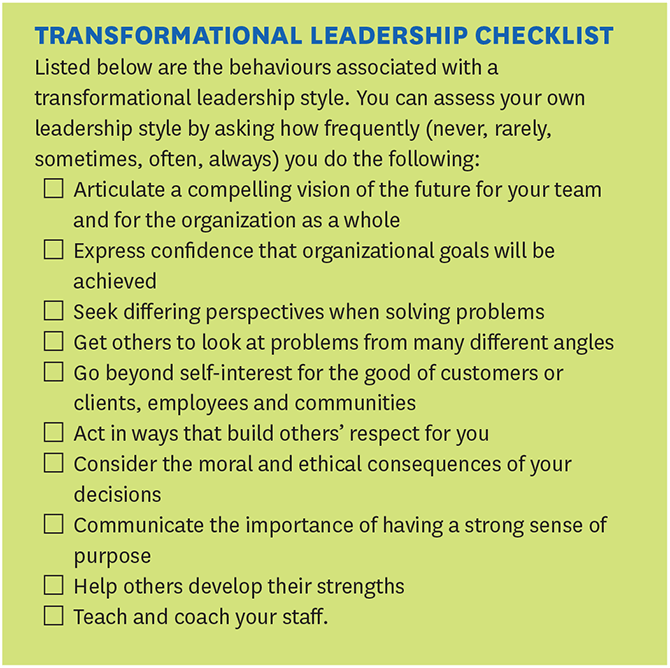
One of the project’s objectives was to illuminate the relationship between educational leadership, well-being and resilience. So the survey also measured transformational leadership (TL) behaviours based on a widely used and validated leadership assessment tool, the Multifactor Leadership Questionnaire.
Transformational leaders contribute to the future success of their organization by encouraging their colleagues to see opportunities and challenges in new ways. They also motivate others to strive for higher levels of performance, are admired and trusted, stimulate creative thinking, and are attuned to individuals’ growth needs by acting as a coach or mentor. In short, transformational leaders go far beyond a “transactional” or goal-oriented management style by enabling individuals to achieve their potential, find innovative solutions to challenges, and embrace change.
The practical implication is that psychological capital contributes to school system performance by supporting a transformational style of leadership and higher engagement among senior administrators.
Assessing your psychological capital and leadership style
The study and follow-up consultations were a catalyst for reflection and action. The results helped to raise awareness about the importance of connecting psychological skills, leadership style and well-being. The professional association representing educational leaders used the findings in its leadership development program, succession planning, and supporting its members’ health and wellness. Leaders themselves were better informed, having evidence-based insights to guide how they could involve other staff in promoting workplace well-being.
Teachers and educational leaders who possess strong psychological capital are transformational leaders.
If you and your organization are interested in developing the psychological capital and leadership skills just described, see Figures 1 and 2 for the key behaviours that must be your focus.
Figure 1:
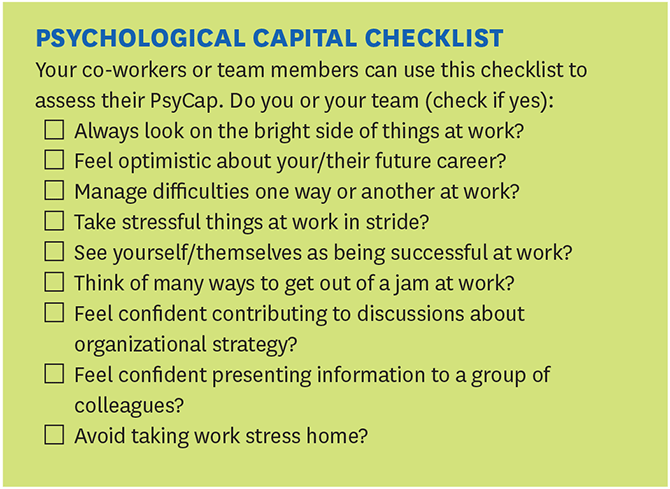
Figure 2:
Above all, teachers and educational leaders who possess strong psychological capital are transformational leaders. We’ve now seen how strong psychological capital and a transformational leadership style set the stage for inclusive leadership, by inviting employees to take responsibility for making the workplace better. It certainly helps in this regard if senior managers signal to others in the organization that through dedicated collective effort, specific improvement goals will be achieved. Senior managers must regularly and consistently communicate the importance of employee well-being to the organization’s success, using language that resonates for all staff.

Training for managers is a vital component of a comprehensive strategy to promote overall well-being. That’s why the U.S. Centers for Disease Control recommends training supervisors on what they can do to reduce stressful working conditions for direct reports and enhancing workers’ stress reduction skills. Furthermore, pooled results from numerous studies show that training can improve managers’ mental health knowledge, promote non-stigmatizing attitudes towards mental health, and enable them to support employees experiencing mental health problems. These are all prerequisites for achieving higher levels of workforce well-being.
Borrowing successful practices from occupational health and safety (OHS), we know that mandatory safety training increases workers’ awareness of safety issues and reinforces safe work practices. The same no doubt would apply to basic workplace well-being training. Researchers are now recommending providing apprentices and students with broadly-based OHS education, which would include the promotion and protection of psychological as well as physical health. This surely is a worthy mission for schools.
Illustration: Diana Pham and Adobe Stock
First published in Education Canada, December 2019
1 C. M. Youssef-Morgan and J. L. Stratman, J. L. (2017). “Psychological Capital: Developing resilience by leveraging the HERO within leaders,” in M. F. Crane (Ed.), Managing for Resilience: A practical guide for employee wellbeing and organizational performance (New York: Routledge, 2017), 60.
-
Love, Heartbreak, and Teacher Emotional Well-being
Comments Off on Love, Heartbreak, and Teacher Emotional Well-being
Losing your passion for a calling you once loved is a kind of heartbreak, says Astrick Kendrick: occupational heartbreak. She explores the emotional labour of teaching and its role in teacher burnout and exhaustion. She also suggests steps that can be taken to “to ensure that rather than experiencing occupational heartbreak, educators stay committed to their heart’s work.”
I don’t remember a time when I didn’t want to be a teacher. From the first day of primary school, I looked at my teacher and decided that was what I wanted to be when I grew up. I didn’t explore any other career options, and when it came time to apply for post-secondary education, I applied to one university and one faculty. The only time I dealt with any uncertainty was in deciding between primary or secondary specialization. Thanks to a love for reading and a respect for my high school English teacher, I chose secondary English/Language Arts.
Twenty-four years later, I feel no regrets for following my “calling” even though my understanding of the profession has changed dramatically. Teaching is still my passion, and I have a deep love for engaging with students and connecting them to the language arts. Experiences with teaching a subject area that I didn’t explore in my undergraduate degree (Physical Education) in seven different schools with complex students has sorely tested that passion over time. And on one particularly difficult day, it almost extinguished that fire completely. Nearly losing my love for teaching was devastating and drove me to understand what had happened. Instead of giving up my life’s work, I decided to pursue graduate studies to understand more about teacher emotional well-being.
“Just as a carpenter is expected to provide manual labour as a part of their job description, educators are expected to provide emotional labour to maintain a calm and engaging school culture.”
Emotional labour and education
When I began my research for my Doctor of Education in 2015, I discovered the concept of emotional labour. This organizational construct, first described in The Managed Heart by Arlie Hochschild in 1984, describes the influence of organizational feeling rules on the expression of emotions by individual people as they go about their daily work. Just as a carpenter is expected to provide manual labour as a part of their job description, educators are expected to provide emotional labour to maintain a calm and engaging school culture. Unlike the carpenter who uses their physical body to perform job tasks, a teacher provides their positive emotions – enthusiasm, positivity, and joy – to perform their work. Even in times when a teacher might not feel calm and confident, she will act that way with her students.
Hochschild used the metaphor of acting to describe the portrayal of expected emotions while engaged in paid work. She described two types of organizational performance related to providing emotional labour: superficial and deep acting.
To understand these concepts, first consider the following hypothetical situation:
The date is June 17, and many of the students in a school are writing their Provincial Achievement Exams. Freda, a Physical Education teacher, has been assigned to supervise a group of students as they finish up this two-hour exam. She has spent the school year building positive relationships with these students, but she has struggled to connect with Joshua. All term, Joshua has displayed inattention, interrupted her when she was explaining games in class, and actively distracted other students in inappropriate ways. Her everyday interactions with Joshua are often difficult, but she is committed to building a strong relationship with each student.
The allocated exam time is nearly complete, with about half of the students waiting patiently for the rest to hand in their work. Rather than drawing or reading quietly like his peers, Joshua alternates between hopping onto the class couch, tapping his pencil repeatedly on his desk, and loudly whispering to anyone who is nearby. Freda repeatedly asks him to respect his classmates who are trying to focus on their exam.
Superficial acting would be used to mask the inappropriate emotions felt by the individual. Ongoing superficial acting in a workplace has been associated with emotional burnout and exhaustion. In this scenario, Freda might use superficial acting to cover up her mounting frustration with Joshua. While she might feel like screaming and yelling at him to quiet down, Freda would strive to speak politely and firmly to him. At the end of the exam supervision, Freda might feel fatigue from managing her frustration and might be irritable when interacting with another person.

Deep acting, on the other hand, reflects an alignment between the person’s actual emotions and the expected display of emotions. If Freda, understanding that Joshua’s parents could not afford his medication, felt compassionate rather than frustrated by the displayed behaviour, her emotional display would line up with her actual feelings. This deep acting has been shown to be a protective factor against emotional burnout. In this case, Freda would feel fine after the supervision and would complete her day without any further concern.
Providing emotional labour is an expected part of being a teaching professional, as it should be. Teachers are normally the only adults with impressionable students at any given time, and if they appear frazzled, angry, or frustrated, it will be difficult to create effective pedagogic relationships with their students. Portraying organizationally expected emotions is a necessary part of maintaining professionalism, but if this emotional labour is primarily accomplished through superficial acting, the educator will eventually experience emotional burnout or unexpected outbursts.
Love, heartbreak, and educational turbulence
In my doctoral research, love stood out as an emotion associated with deep acting and was a protective factor for educators dealing with difficult times or situations. Teachers expressed love for students and love for subject area as reasons that they came to, and stayed in, the education field.
One of my participants described this love as “heartwork,” a pun on hard work. As a system level leader, she was responsible for assisting other educators with promoting the health and well-being of students. She poured her heart into the work because she was passionate about the positive academic outcomes associated with improving the health of children and youth. She was devastated when, due to financial cutbacks and restructuring, her job disappeared and all the work she had done along with it.
The change in financial priorities created educational turbulence for my participant. The other participants identified changes to curriculum without corresponding professional development; teaching in subject areas outside of the teacher’s expertise; and unmanageably complex classes of students as all causing educational turbulence leading to their occupational heartbreak. Unlike the sustaining effect of engaging in heartwork, heartbreak resulted in a devastating emotional exhaustion that forced the participants to question staying in the profession that they loved.
What can schools and leadership do?
Since completing my study in 2018, I have been presenting my findings to other teachers to determine if the experience of providing emotional labour is consistent and relatable to other teachers. I have spoken to over 100 teachers about this idea, and they have resoundingly agreed that providing ongoing emotional labour has contributed to their exhaustion and burnout at work.
“Simply recognizing that providing emotional labour is a part of educator professionalism is a first step.”
At the end of my workshop, I ask the question, “What do you need in order to release organizationally inappropriate emotions so that you can effectively work with students?”
The educators had several suggestions that could be implemented in school settings, many of which involve small, cheap tweaks to the work day:
- More breaks, less emails, less demanding extracurriculars: we are spread too thin. We are getting away from actually being present and focused on our students.
- Reduce the workload, increase opportunities for teachers to have calm in their day.
- Class sizes (especially given the increasing diversity of our population) need to be reduced. Special needs students need to be supported.
- Respect teacher transition time… Allow the teacher a few minutes before the next class comes in.
- Ensure each staff member has a defined break period each day. Reduce expectations during break times so that breaks are actually breaks. Don’t organize so many meetings; give teachers the time they need to prep and decompress.
- Offer activity and sport opportunities for staff during the work day and/or on non-instructional days. Create a staff work-out space.
- Increase supports for teachers who are struggling mentally.
- Carefully team up teachers to create support systems.
- Create a Zen room that teachers can go to.
- Say thank you and recognize successes.
- We need a strong champion for teachers in the media.
Stakeholders, such as parents, educational assistants, teachers, school administrators, and system leaders, can all play a role in promoting emotional health within the school system. Simply recognizing that providing emotional labour is a part of educator professionalism is a first step. The ethical next step is to find ways to ensure that when educators have provided intense emotional labour, they are provided with a safe place during their work day – through uninterrupted time, in a physical location, or with a trusted friend – to release their emotions in a healthy manner.

Ultimately, determining what to do in the aftermath of providing emotional labour needs to be addressed by educators and supported by school and system leadership. Having a frank conversation with staff teams about what they need, and then following through with the requested supports and resources, is the best way to ensure that rather than experiencing occupational heartbreak, educators stay committed to their heart’s work.
Study Description
My doctoral research study explored the lived experience with emotional labour of five female Health Champions as they navigated through systemic instability while implementing Comprehensive School Health projects. I aimed to discover the immediate emotional and embodied experiences identified by five change agents in leadership roles who have served as a pre-service student teacher, educational assistant, teacher, school leader, and system leader while undertaking educational reforms introduced between 2009 and 2016 in Alberta. Framed by complex adaptive systems theory, this study uncovered insights into their common understanding of the phenomenon of emotional labour for educators, both in their daily work and while acting in leadership roles. The findings of this study included: insight into the unique nature of the emotional work of educators and the intensification of emotional labour for change agents in educational settings; a phenomenological example of a possible lived experience with emotional labour; and suggestions for areas of future study on emotional labour, implementing Comprehensive School Health reforms, and improving the wellbeing of educators.
Illustration: Diana Pham and Adobe Stock
First published in Education Canada, December 2019
-
Measuring School Well-being
Comments Off on Measuring School Well-beingThe concept of happiness in a society is far from novel. The New Economics Foundation has been publishing its Happy Planet Index (HPI) since 2006. The HPI is calculated using a number of well-being and environmental impact indicators available from over 140 countries.
Since 2012, the United Nations has published an annual World Happiness Report based on “available global data on national happiness and related evidence from the emerging science of happiness, showing that the quality of people’s lives can be coherently, reliably, and validly assessed by a variety of subjective well-being measures, collectively referred to then and in subsequent reports as ‘happiness.’” Results from the World Happiness Report align closely with the Gross National Happiness (GNH) Index developed by Bhutan to provide data for the development of its national policies.

So, the concepts of well-being and happiness are not restricted to individuals but also apply to countries. The same can be said for schools. Although the concept of happiness at the school level is relatively recent, it is quickly becoming accepted across Canada and elsewhere. More than ever, schools strive to provide a “well-rounded education” by finding an equilibrium between a global, holistic education and the more traditional content-focused curricula and also by providing psychologically safe environments where staff and students are engaged, can thrive and be at their best.
The question therefore is not to debate the importance of school happiness but rather how to measure it so we can then focus on increasing it by building on existing strengths.
The Mental Fitness and Resiliency Inventory (MFRI©)
Questionnaires designed to measure constructs such as well-being or happiness commonly focus on self-assessments, often using multiple choice items or a small number of open-ended subjective questions. Despite the popularity of these approaches – mostly because of their simplicity and low cost – the general public often has little faith in their results because of the overwhelming emphasis on subjective approaches which impact reliability.
In some cases, individual respondents’ data are used to calculate a group average which is then reported as being the group’s well-being or happiness. Such an approach should be dismissed because it is ill conceived. To demonstrate this, let’s imagine a mathematics test for which all students in the same class received a mark of 50%. Now let’s assume that in a different class, half the students received a mark of 100% and the other half 0 % on the same test. Of course, the class average in both classes is 50 % but no educator would dare claim that these two classes are similar.
The Positive Workplace Framework used the Mental Fitness and Resiliency Inventory (MFRI) to measure overall well-being and happiness in schools. In contrast to subjective questionnaires, the MFRI contains short, clear descriptions of 32 distinct practices that can be expected to be observed in positive school environments. The online questionnaire is completed by all staff and takes them less than ten minutes. All answers are anonymous and confidential.

The MFRI provides schools with quantitative results on their strengths across three mental fitness sub-domains (relatedness needs, competency needs, and autonomy/support needs) and five resiliency subdomains (relationship assets, professional assets, attitudinal assets, emotional intelligence assets, and adaptation assets). Respondents are asked to indicate how well each described practice is reflective of their school environment using a 5-point Likert scale where 1 = Least like my workplace, 3 = Somewhat like my workplace, and 5 = Most like my workplace. Results of the MFRI’s rigorous psychometric validation study are available.2
The MFRI report provides a profile of organizational strengths (those practices that are embedded in the school environment) and areas for development (those requiring more promotion and capacity building) related to mental fitness and resiliency.
The School Happiness Index (SHI)
Responses to the MFRI are also used to obtain the School Happiness Index (SHI), which is reported on a nine-point scale where 9 indicates a very high level of school happiness. The SHI complements the detailed school-level report by providing a holistic view of the integration of practices known to have a positive impact on the school environment and staff and student happiness in general.
Studies in francophone schools across New Brunswick show a statistically significant correlation between the SHI and student achievement on provincial assessments. Preliminary results also suggest decreased teacher absenteeism in schools with a higher SHI. This is not surprising.
Increasing levels of school happiness is not obtained at the expense of student learning. In fact, the research is clear that a happy school environment is a precursor to student success.3 If schools are to provide a well-balanced education, they must first strive to improve their overall school happiness. By administering the MFRI and obtaining their school happiness index, schools now have empirical evidence on which they can act.
Photo: Adobe Stock
First published in Education Canada, December 2019
Notes
3 S. Lyubomirsky, S. King, and L. Diener, “The Benefits of Frequent Positive Affect: Does happiness lead to success? Psychological Bulletin 131, No. 6 (2005): 803-855.
-
Social Emotional Learning for Principals
Comments Off on Social Emotional Learning for Principals
Social emotional learning (SEL) is increasingly recognized as an integral component of education for students, but what about teachers, support staff, and principal? Here the focus is on principals: their own social and emotional well-being as well as their leadership for SEL in their schools.
“So much of our job as administrators is ensuring that we are showing care for our staff, our students, and our parent community. We do so much to put the social and emotional well-being of our primary stakeholders first, that we forget that first and foremost we need to care for ourselves.” – Canadian Principal
Social emotional learning (SEL) is increasingly recognized as an integral component of education (www.casel.org). Canadian educators have recognized the importance of promoting SEL in K-12 schools, and evidence-based SEL programs are used in schools throughout Canada. While these efforts demonstrate significant progress, there is a need for greater attention to supporting the social and emotional well-being of teachers, support staff, and principals. Here we focus on principals: their own social and emotional well-being as well as their leadership for SEL in their schools, with examples from an innovative British Columbia school district.
The problem
“87 percent of principals feel like they never have enough time to complete their tasks, and more than 72 percent feel pressured to work long hours.”
Canadian principals have numerous leadership roles within a complex system that has experienced inconsistent changes in policy, the introduction of new technologies, and a growing emphasis on both accountability and on meeting the unique needs of students, including recent immigrants. All of these changes have compounded the stress experienced by Canadian principals, who are already overworked and overloaded. For example, Ontario principals spend approximately 59 hours per week at work, 14 hours more than managers in other occupations, professionals in the public sector, and corporate executives.1 According to a survey by Statistics Canada, despite the long hours spent at work, 87 percent of principals feel like they never have enough time to complete their tasks, and more than 72 percent feel pressured to work long hours.
Principals’ health and well-being have suffered as their jobs have become more demanding. Research has shown that principals’ work intensification can lead to excessive work-related stress, burnout, and mental health issues.2 As stress intensifies, principals’ self-efficacy can decrease; as burnout intensifies, principals may begin to doubt their ability to fulfill their duties and eventually leave their jobs. To be successful, principals must acquire effective skills and strategies to deal with stress and support their mental health and well-being. This can be accomplished by implementing programs designed to foster SEL and to help principals develop social emotional competencies (SECs).
Benefits of principals’ SEL
We assert that by developing the ability to regulate their emotions and behaviour, increasing their social awareness, cultivating healthy relationships, and improving their decision-making skills, principals can increase their effectiveness and better develop the skills to lead the implementation of SEL programs, policies, and practices in their buildings.
While many have promoted the principal’s role as instructional leader, we believe it is most important that principals become prosocial leaders whose responsibility is to ensure that all staff, students, parents, and community members feel safe, cared for, respected and challenged. Principals’ well-being and leadership form the foundation that influences school climate, teacher functioning and well-being, family and community partnerships, and downstream student outcomes.
Extensive research evidence shows that fostering principals’ social and emotional competencies (SEC) is likely to yield benefits not only for school leaders themselves, but for all school stakeholders, including students. Principals’ social and emotional competencies should be an important component in systemic schoolwide SEL as it leads to the following four outcomes:
1. Effective leadership
Principals with strong SECs tend to be effective leaders who manage their schools by adopting a positive, proactive style. Their self-awareness enables them to recognize inequities that may limit students’ potential and opportunities.
2. Healthy relationships
Principals who are more self-aware and reflective develop positive, caring school climates that support social, emotional, and academic outcomes for students. By learning how to listen with full attention and an open and accepting attitude, principals can support teachers to exhibit these same qualities with students.
3. Effective family and community partnerships
Principals who develop strong SECs create a more welcoming atmosphere for parents and community agencies. They see parents as essential to children’s competence, thereby making families feel respected and valued. They also build stronger connections with out-of-school programs that serve families and youth.
4. Effective SEL implementation
Principals who develop strong SECs are better equipped to lead the implementation of SEL programs, policies, and practices in their schools. Such principals are more likely to naturally become SEL leaders.
Planning for SEL in Maple Ridge-Pitt Meadows School District
For the past five years, the Maple Ridge-Pitt Meadows (MR-PM) School District (B.C.) has been exploring and developing an SEL Framework that embeds SEL in the teaching and learning communities. This framework was developed to include five areas of focus:
-
- Evidence-based practice
- Teaching students SEL
- School culture and climate
- Informing and involving parents
- Social emotional well-being of the adult educators
The following inquiry question is the guiding focus: “How might we collaboratively create a community that reflects care and belonging so that SEL is evident, explicitly taught, and practiced in the everyday interactions among all members of the community?”
The District SEL Planning Committee identified that SEL does not occur in isolation but is embedded and intertwined with all aspects of learning. With the redesign of the B.C. curriculum, teaching of the core and curricular competencies is directly linked to teaching SEL skills.
Action steps to support principals’ SEL
The benefits of principal engagement in SEL are clear, not only for school leaders themselves, but for all school stakeholders. What may be less clear is how to promote principals’ SEL. The following action steps can be taken to support principals.
CARE: Mindfulness-based intervention for principals
Training in mindfulness practices may help principals develop SECs. We have been evaluating a mindfulness-based professional development program originally designed to support teachers that was modified to support principals. CARE (Cultivating Awareness and Resilience in Education) is designed to nurture educators’ self-awareness and reflectivity, and to help them understand and regulate their emotions with the goal of improving health and well-being (www.createforeducation.org). Our evaluation of CARE with principals in rural Pennsylvania showed that principals reported improvements in leadership skills, relationships, and self-care, and increased self-awareness, ability to regulate emotions, self-management and self-compassion.3 Although these findings are promising, experimental research is needed to further investigate the effects of mindfulness programs for principals.
Example: Maple Ridge-Pitt Meadows CARE Training for Principals
As a result of this school district’s commitment to nurturing SEC in administrators, in the summer of 2016, they all received CARE Program training. One vice-principal commented, “It was awesome! I will be using these strategies moving forward.” Another vice-principal said that they appreciated having the time to practice the CARE skills, while another found “the training to be an excellent reminder of practices I need to incorporate.”

In November 2017, Michelle Davis (author) was trained as a trainer and in 2019, she facilitated the Maple Ridge-Pitt Meadows (MR-PM) School District CARE training for new administrators. She reflects, “One of the things I’ve learned about being a lone administrator in a school is balance and role modeling. I cannot ask staff to take care of themselves, if I’m not modeling the same. It’s important to have a work-life balance. This job can consume all of you. When we take the time to care for ourselves, it opens us up to being reflective learners. It opens us up to growing as leaders and educators. Some of my quietest moments are when self-reflecting. It helps me see the big picture and where I can have the most impact. If I don’t find those moments, I get caught up in the quick fixes and stay on that loop without making meaningful change. Implementing the CARE practices has helped my leadership skills in that I am more self-aware and can manage my emotions in high-stress situations, which then has a direct impact on the emotions of the staff and students.”
Effective professional development for school administrators
Almost all professional development programs for principals focus on improving school performance (i.e. curricula, initiatives, pedagogical strategies) rather than developing skills to support their own well-being or promote effective prosocial leadership. Just as in other industries, professional development programs are needed to: (a) cultivate principals’ own social emotional well-being, and (b) provide principals with the skills to lead SEL implementation effectively.
“Being ‘burned out’ and ‘busy’ seems to be equated with ‘productivity,’ when in fact principals who are stressed and overworked are less effective.”
Systems thinking and SEL
Recently, Goleman and Senge proposed a Triple Focus Model for schools.4 This model focuses on emotional intelligence and developing compassion for self and others, with an added focus on systems-level thinking. Such an approach focuses not only on the mindful awareness of the individual, but also on using systems thinking and tools to understand the larger social field. In education, the larger social field is a school’s organizational culture, which includes its system of beliefs and values and the rituals and routines by which they are communicated. The great news is that B.C. has already begun an innovative program for supporting schools to use systems thinking.
Focus on self-care and work-life balance
In the current culture of education, being “burned out” and “busy” seems to be equated with “productivity,” when in fact principals who are stressed and overworked are less effective. Provincial governments, divisions, school boards, and professional associations must prioritize promoting a culture of self-care that does not make principals and staff feel guilty for taking time to attend to their own personal well-being.
As a Canadian principal noted: “We need to be OK with letting some things stay on the to-do list and accept that it will get done another day. Our staff is involved in many district initiatives and projects and as a school leader, I tell staff that we will concentrate on doing a few things well, rather than stretching ourselves and doing everything without deepening our learning.”

Cultivating coaching or mentoring models
While shorter-term professional development programs may help principals learn how to cultivate their social and emotional well-being, the learning-application process requires sustained support over time. Creating local networks for school leaders could be a useful way to connect principals with other school leaders who face similar tasks and issues. Schools should provide principals with ongoing professional development opportunities and establish mentoring programs to cultivate SECs.
Example: Maple Ridge-Pitt Meadows Mentorship Support for Principals
MR-PM realized that principals often feel isolated and are unable to find opportunities to reflect and to deconstruct events happening in their buildings with others. Principalship can be a very lonely job! So, MR-PM created a mentorship program for new and nearly new administrators to help them navigate their complex jobs and emotionally challenging days. It has proven to be welcomed by the administrators and considered as a great support for them.
Longer-term principal assignments
Research clearly indicates that lower mobility among administrators, teachers and students promotes relational conditions that are conducive to caring. Turnover among principals is a great concern, given their critical role in leading long-term school improvement efforts. Moreover, principal turnover leads to teacher turnover, which increases dissatisfaction and “burnout,” and decreases the potential for satisfying, caring relationships. Principal stability is especially important in schools in impoverished communities where students have greater mobility. Overall, creating greater stability for principals through longer-term assignments would support the development of school environments that foster SEL for all school stakeholders.
Principals in Canada encounter highly stressful emotional situations on a daily basis. Unfortunately, many school leaders are still learning the skills necessary to respond effectively. Principals who develop their own SECs are better able to establish and sustain healthy relationships, exhibit effective leadership, build strong community partnerships, and implement SEL programs in schools. Based on this evidence, we have recommended several actions that can be taken by school boards, principal training programs, and professional associations to support school leaders’ well-being and the quality implementation of SEL programs in Canadian schools.
Illustration: Diana Pham and Adobe Stock
First published in Education Canada, December 2019
1 Pollock et al., Statistics Canada (2015).
2 J. Mahfouz, M. T. Greenberg, and A. Rodriquez, (2019) Principal’s Social and Emotional Competence: A key factor for creating caring schools (Edna Bennet Pierce Prevention Research Center, Pennsylvania State University: 2019).
3 J. Mahfouz, “Mindfulness Training for School Administrators: Effects on well-being and leadership,” Journal of Educational Administration 56, no. 6 (2018): 602-619.
4 D. Goleman and P. Senge, The Triple Focus: A new approach to education (Florence, MA: More Than Sound: 2014).
-
-
The Positive Leadership Inventory (PLI)
Comments Off on The Positive Leadership Inventory (PLI)What makes a positive leader?
There is a wealth of research that supports the claim that positive leaders have a positive impact on their organisations’ growth and improvement. Schools are no different.
In addition to confirming our intuitive beliefs about the impact a leader has on their group, research also suggests that positive leadership practices lead to individual benefits on one’s psychological health, emotional well-being, optimal brain function, improved interpersonal relationships, and learning. It goes without saying that schools gain by ensuring that their leaders are positive leaders.
Regardless of our perception of what makes a “good” leader, there is no doubt that such a leader must demonstrate competencies in several domains. But what are the competencies and practices demonstrated by leaders who are not only good but excellent?

Leaders capable of creating a positive school climate where everyone can be at their best share the characteristic of being able to establish strong interpersonal relationships.1 These leaders communicate sincerely, whether the message is positive or negative. They are respectful of others and their feedback is communicated in a constructive way without negative emotions. They have confidence in their staff and all school employees and support them during difficult times. Strong positive leaders don’t hesitate to recognize quality work and to value and promote such work in private and in public. They value long-term goals and have the ability to strategize in order to reach their goals. Their charisma gives confidence to their staff and allows them to mobilise and engage the school community. All this, plus they are open to everyone, exude enthusiasm, and have a good sense of humour. Wow, what a tall order!
Thankfully, what is common to these competencies and practices is that they are observable and therefore can be learned. The work of Cameron2 and the synthesis done by WMA Wellness3 show that positive leaders demonstrate competencies across five domains: leadership virtues, positive communication, energizing skills, motivational and knowledge skills, and operational tasks.
Measuring positive leadership practices
A key element of the Positive Workplace Framework is a questionnaire designed to evaluate the level of embeddedness of practices from each of the five aforementioned positive leadership domains.
Although positive leadership practices can apply to everyone in a school setting, the Positive Leadership Inventory (PLI) questionnaire describes practices that school leaders such as principals and vice-principals should demonstrate on a regular basis. The PLI assesses the presence of positive leadership practices associated with healthy and effective school environments. It provides school leaders with quantitative results on their strengths across the five positive leadership sub-domains. The PLI contains short, clear descriptions of 30 distinct leadership practices that can be expected to be observed in positive school environments. Each practice relates to one of the sub-domains described above. All school employees are asked to indicate how well each practice is reflective of their school environment using a 5-point Likert scale where 1 = Not at all, 3 = Sometimes, and 5 = Very often. It takes less than ten minutes to complete the PLI questionnaire online. All answers are anonymous and confidential.
The PLI report provides a profile of strong leadership practices (those practices that are very frequently demonstrated by leaders) and areas for development (those leadership practices requiring more promotion and capacity building). The report gives leaders empirical evidence which helps them prioritise the areas they wish to continue developing. To facilitate this development, the Positive Workplace Framework offers a suite of targeted resources for each of the leadership domains.
Results of the PLI’s rigorous psychometric validation study show that the PLI can be trusted to identify existing positive leadership practices. The results of the validation study are available.4
Schools that have the reputation of being “good schools” have leaders who excel in many areas. Implementing the Positive Workplace Framework (PWF) and its practices in daily routines allows leaders to create school environments where mental fitness and resiliency practices can be fully integrated. By integrating positive leadership practices guided by the results of the PLI, leaders can pursue their evidence-based professional development which benefits not only themselves but also their school.
Photo: Adobe Stock
First published in Education Canada, December 2019
Photo:
First published in Education Canada, December
1 J. P. Rolland, L’évaluation de la personnalité. Le modèle à cinq facteurs (Sprimont, Belgium: Mardaga, 2004).
2 K. Cameron, Positive Leadership: Tools and techniques that create extraordinary results (San Francisco, CA: Berrett-Koehler, 2013).
3 WMA Wellness (2019). www.wmawellness.com
-
So What About Leadership Wellness?
Comments Off on So What About Leadership Wellness?Work being done by the College of Alberta School Superintendents (CASS), in partnership with WellAhead, aims to increase awareness of the importance of well-being at the highest leadership levels, and to bring systems-wide, comprehensive, collaborative practices for improved levels of wellness in an increasingly stressful job.
The old cliché, “It’s lonely at the top!” can be very true for school principals, superintendent/directors and other educational leaders. And while not all leadership personalities may present themselves as caregivers, in interviews that my colleague, Jim McLellan, and I conducted with more than 45 Superintendents and their teams in Alberta, they made it clear that they care much more about the wellness of their staff, students and communities than about their own personal wellness.
It’s common sense that leaders must be well in order for the organizations they lead to be well, whether that be schools or school systems. The metaphor of putting on the oxygen mask on oneself before others applies! Much work related to student wellness and mental well-being is underway in most Alberta school authorities (boards). What will it take to convince education leaders, school boards, politicians and society in general that education leader and staff wellness is worth making a priority?
As our many baby-boomer leaders near retirement, the supply of quality superintendents is decreasing, while the demand for such leaders, at a time when our schools are facing the highest levels of accountability and greatest standards, is increasing. The reality is that few education leaders are aspiring to principalship and superintendent/director positions. The work is too hard and too stressful. There are so many pressure points that the application pools for education leadership positions are now often very thin. So, what will it take to turn this around?
This is exactly what the College of Alberta School Superintendents (CASS) are hoping to learn. The three main goals of this initiative include:
- To increase the number of school authorities that reflect mental well-being, in the context of wellness, as a key priority.
- To increase the understanding among decision-makers at the system, school and policy-maker levels of key elements to school authority integration of mental well-being.
- To increase understanding among decision-makers at the system, school and policy-maker levels of the importance of workplace wellness in K-12 education.
What is the motivation to be involved in this work?
I was indeed fortunate to be involved in school leadership early in my teaching experience. I certainly did not aspire to such leadership as I considered my career options, while dreaming of making a difference to kids. I suppose leadership came more naturally before I made a decision to learn more about it.
As I moved to division office in Superintendent–type roles, it became clear that leadership was more challenging than ever. Teaching as a noble profession seemed to be on the decline with our society in general. The explosion of the Internet and social media complicated the work rather than simplifying it. Increasing expectations of what services schools should provide further complicated leadership roles at school and at the school authority levels. And more recently, the polarization of perspectives has increasingly added to the stress in educational environments. I have found this to be true in conversations about all kinds of issues, including priorities, budgets, transportation, buildings and education programs.
It can be difficult, for many reasons, to seek help when you need it. There is 360-degree pressure and role overload. You can never keep everyone happy.
In short, while we strive for child-centered and solution-based conversations, high emotions can hijack the agenda. As I also saw friends and family struggle with their own mental health, I wanted to learn more about mental health and wellness, have the autonomy to learn and apply what I learned and to be clear in my purpose to make a positive difference in even a broader way than I could as Superintendent of Schools. Managing key leadership positions, including principals and superintendents, is by its very nature lonely work. It can be difficult, for many reasons, to seek help when you need it. There is 360-degree pressure and role overload. You can never keep everyone happy.
What’s the good news?
The good news is that we know lots about what works and does not work in improving and sustaining mental well-being. There are a number of well-researched frameworks that clearly indicate there is no silver bullet. Rather, systems-wide, comprehensive, collaborative practices are required in order to make a positive difference over time. Knowing this, where does one get started? Personal wellness? Student wellness? Staff wellness? Leadership wellness? Workplace wellness? Organizational wellness? YIKES! Leadership theory 101 makes it clear that those with the issues are in the best position to solve those issues. Thus the importance of systems-wide, comprehensive, collaborative practices, including those partners who can add to the research knowledge and skills-based practices that will lead to improved wellness within any organization.
What are the key practices of the CASS mental well-being initiative?
Some of the strategies of our work include:
- Focus on understanding system and school leaders’ needs for professional learning, peer-to-peer connection and resources on the topic of mental well-being.
- Initiate conversations with all school authorities (boards) across the province of Alberta to learn more about context, successes and challenges to date.
- Embed and align mental well-being strategies in the Professional Practice Standards for Superintendents and School System Education Leaders.
- Connect school system leaders and wellness-related partners and initiatives across Alberta.
Alberta is ripe for such work. There are already many resources available to contribute to such practices. The issue is that these resources and supports are not so well aligned to the perceived needs of the members of the College of Alberta Superintendents. The volume of research and strategies related to student mental well-being can be overwhelming, and there is very little in the research literature related to specific mental well-being practice for leaders. Some very strong support material is not that well known. Another important context is the work related to the fairly new Professional Practice Standards for Superintendents and School System Education Leaders in Alberta. Where the standards come to life for education leaders in the province is in the Leadership Quality Standard Practice Profiles. This is where we hope to embed exemplars of how leaders might best weld wellness and mental well-being with the leadership standards that make up our professional practice.

What can leaders do to ensure their mental well-being?
There are so many storms that leaders and educators in general face in their work each day. In The Dark Side of Educational Leadership,1 Polka and Litchka speak about the storm metaphor as it relates to the Superintendent role. Many of the case studies presented could also be very true for any educational leadership position. Their storm survival guide includes:
- Maintain personal and professional composure.
- Maintain optimism.
- Seek out formal and informal mentorship.
- Stick to one’s principles.
- Be aware – see the storm coming as much as possible.
- Seek support.
As a result of their interviews of 25 education leaders in Canada and the U.S. related to dealing with adversity, Patterson and Kelleher advocate for six practices that their interview data suggest make a significant difference in the mental well-being of leaders.2 There is a good deal of congruency between their findings and Polka and Litchka’s:
- Accurately assess past and current reality.
- Remain realistically optimistic and hopeful.
- Be clear and remain true to personal and professional values.
- Continue to learn and have confidence in one’s abilities and maintain strong networks. Resilient leaders maintain considerable efficacy.
- Invest personal energy wisely.
- Act on the courage of personal convictions.
Granted, these steps sound easy, but are actually more challenging to achieve. I remain very hopeful and optimistic that the pathway to mental well-being lies in the elements of positive psychology. We are well aware of the importance of social, economic and human capital. Although psychological capital3 may be less known, there is much potential in learning and applying practices related to the fairly simple concepts of hope, efficacy, resiliency and optimism.
We generally know what works in improving mental well-being in a context of wellness. Working Together to Support Mental Health in Alberta Schools4 is an important resource that includes a multiple-partner, well-researched framework complete with background information, an assessment tool, six essential conditions of sustainable implementation practices and a basic planning guide to support the work. We also know it takes a minimum of 28 days and a concentrated effort to change practices and habits. Although the issues creating the landscape in which we work each day may be very complex, the practices to improved mental well-being within a culture of wellness can start very simply. If nothing else, start with drinking more water!
The Stresses of Superintendency
In their research with education leaders across North America, Polka and Litchka identified many trends related to decreased wellness, including:
- Compensation not aligned with responsibilities
- The politics of the role
- The role has become more complex with more complex issues
- Too many insignificant demands that detract from purpose and/or student learning
- Legislative reform
- Change of governments
- Loneliness of the position
- It’s difficult to ask for help, for fear of looking incapable
- Role overload leads to a sense of loss of professional identity
photo: iStock and Adobe Stock
First published in Education Canada, December 2019
Notes:
- Walter S. Polka and Peter R. Litchka. The Dark Side of Educational Leadership. (Lanham, MD: Rowman and Littlefield Education Publishers, Inc., 2008).
- Jerry Patterson and P. Kelleher. Resilient School Leaders: Strategies for turning adversity into achievement. (Alexandria, VA: Association for Supervision and Curriculum Development, 2005).
- Luthans, Fred, C. Youssef-Morgan and B. Avolio. Psychological Capital and Beyond (New York, NY: Oxford University Press, 2015).
- Working Together to Support Mental Health in Alberta Schools (Alberta Government: 2017).
-
We All Have a Stake in Workplace Wellness
Comments Off on We All Have a Stake in Workplace WellnessYou don’t need a pile of research studies to make an educated assumption that healthy employees who feel positive about their jobs will do more effective, productive work. (But the studies exist and some are cited in the pages to come.) And it shouldn’t take much convincing that an enthusiastic and emotionally healthy teacher will have a better impact on students than one that is stressed, exhausted, and/or overwhelmed. As a parent, you can bet I wanted the first teacher for my kids, not the second! Yet when competing priorities jostle for limited resources, staff well-being can get pushed so far to the back that it drops right out of sight.
We have a tendency to see well-being as solely a personal responsibility. If employees are struggling, they should go to the gym, get better organized, become more resilient or adaptable. But several of our authors dispute this assumption. Self-care, while important, only goes so far. Instead, our authors argue that occupational mental health, like physical health and safety, is a shared responsibility.
I’d love to think that all employers would try to protect their employees from toxic levels of occupational stress simply because they care about their staff. But let’s be realistic: staff well-being can too often be shrugged off as a “frill” or a strictly personal problem. That’s why we have to recognize that chronically overstressed educators come with a cost to the system. Sick days, stress leave, even leaving the profession are just the most visible impacts of employees who are unwell. An investment in employee well-being is an investment that pays off in reduced HR costs, increased performance, and ultimately increased student achievement.
All human service professions entail a certain amount of stress. But for those who are passionate about their calling, the work should also be deeply rewarding. That’s what Astrid Kendrick calls the “heartwork” of teaching. It’s what leads teachers and school leaders to go above and beyond, to bring the very best they have to their students (or staff), year after year. When that passion is crushed by relentless stress, she calls the resulting burnout “occupational heartbreak.” The articles in this special issue show some of the ways we can protect our educators’ heartwork, so they can be the committed, energetic, enthusiastic professionals our children need and deserve.
The EdCan Network has recently launched “Well at Work,” a research and public awareness campaign that calls on education leaders to make teacher and staff well-being a top priority. Check out Network Voices to find out more about this exciting initiative.
Photo: Dave Donald
First published in Education Canada, December 2019
-
Well at Work
Comments Off on Well at Work
Despite the fact that stress and burnout are on the rise among staff in Canadian K-12 education systems, investment to support their well-being isn’t keeping pace. As the leading independent national voice in Canadian K-12 education, EdCan is pleased to officially launch “Well at Work” – a new research and public awareness campaign that calls on education leaders to make teacher and staff well-being a top priority.
“The well-being of K-12 staff is a high priority for school districts across Canada. As Director of Education, I look forward to the learning from Well at Work to inform our Board’s focus on staff well-being,” says Denise Andre, Director of Education for the Ottawa Catholic School Board and EdCan Chair.
With 128 years of experience convening stakeholders from across the entire spectrum of Canadian K-12 public education, EdCan is hosting a series of national events to build a common vision for workplace well-being, including:
Webinar: Making the Case for Workplace Well-Being in K-12.
This free one-hour webinar presented insights gathered through a large-scale survey of educators and the general public on how to better frame the issue of teachers’ and principals’ well-being. Replay the webinar here: www.edcan.ca/workplacewebinar
The Case for Investing in K-12 Staff Well-Being: Financial. Legal. Student Achievement.
This exclusive professional learning session brought together ministry and faculty of education representatives, directors of Education/CEOs, and other K-12 leaders from across Canada.
National Summit on Teacher and Staff Well-Being (May 2020)
This gathering will bring together champions, changemakers, and key stakeholders from across the country to learn more about ways to advance workplace well-being in K-12 education.
Well at Work is all about giving schools and school districts the tools they need to improve working conditions for the long term, through amplifying educators’ stories and lived experiences that get to the heart of what well-being actually means and looks like at work.
For educators, schools, school districts, and ministries of education looking to take their first steps towards creating a healthier workplace, a growing collection of free resources are available for download at: www.edcan.ca/wellatwork.
First published in Education Canada, December 2019
-
Teaching Well
Comments Off on Teaching WellFind a quiet place, take a few relaxing breaths, and read Lisa Bush’s new book on how to find balance in your hectic life as a classroom teacher, and get better results from your students.
In our increasingly complex world, we find increasingly complex classrooms. Teachers spend countless hours creating and assessing content, completing paperwork, and organizing extracurricular activities. This is added to their own home life responsibilities as parents, spouses, and children of aging parents. Many teachers, often those in the early part of their career, find the workload (especially the marking) overwhelming.
In Teaching Well, Lisa Bush sets out logical steps to help teachers move from surviving in the classroom to thriving in their career. Bush argues that as workload increases, it is often the things that recharge us that are the first to go: exercising, eating right and enjoying a hobby are dropped because a test needs to be graded or emails have to be answered. Bush offers clear, practical ideas to help teachers find the balance between work and life. Next, she asks the reader to critically look around. Look for teacher allies to collaborate with. Look to change assignments from seatwork to tasks that will empower students to become experts. Finally, look at how preparation and after-school time could be organized and optimized more effectively so that there is less to take home, and a chance to refresh and recharge after the workday.
Teaching Well asks busy teachers to slow down and examine what they are doing. We know that students do better when allowed to reflect. Teachers, too, do better when they can free up time and allow creativity to flourish.
In the end, one question confounded this reviewer. Who will read this book? The teachers who should read it are drowning in their workload and may not recognize the need, and the teachers who have found the secret to teaching well already know many of Bush’s tips. My conclusion is that teacher leaders, such as a principals, should read this book to help them recognize those on staff who need support – then work with Bush’s ideas to help empower them.
Photo: Dave Donald
First published in Education Canada, December 2019
Pembroke Publishers. 2019 ISBN: 978-1-55138-337-8
-
The Positive Workplace Framework (PWF)
Comments Off on The Positive Workplace Framework (PWF)
The Positive Workplace Framework (PWF) is a made-in-Canada strengths-based approach to optimizing staff and student well-being, engagement and performance, with a focus on Mental Fitness, Resilience, and Positive Leadership.
Who hasn’t been asked to do more with less? “Doing more and more with less and less until eventually you can do everything with nothing” is a notion introduced by R. Buckminster Fuller in 1938 to describe situations where technology could be used. Today, the expression of doing more with less is commonly used when organizations, including schools, strive to lower operational costs and increase productivity in the context of cutting back on human and financial resources without an equivalent reduction in workload and expectations.
Obviously, this logic has its limits. Teachers are not robots and the extra pressure placed on them to do more with less can lead to unhealthy practices and interpersonal relationships, which increases everyone’s stress. Toxic school environments result, along with increased absenteeism, turnover, mental health problems, and burnout.

In response, many deficit-based programs designed to improve school environments have been developed. First, they identify existing problems and then intervene to solve them. But a person’s psychological well-being is not only influenced by the presence or absence of problems but also by the existence of strength-focused factors present within individuals and their social settings that contribute to positive growth and development.1
Few initiatives focus on improving existing strengths in school environments. The Positive Workplace Framework (PWF),2 a made-in-Canada strengths-based approach that optimizes staff and student well-being, engagement and performance, is an excellent example of such an initiative.
The Positive Workplace Framework (PWF)
The PWF is composed of three distinct but inter-related domains: mental fitness, resiliency, and positive leadership (see Figure 1). In each domain, research-based individual and collective practices known to create positive school environments characterized by high levels of staff well-being, engagement and performance are promoted.
Figure 1: The Positive Workplace Framework (PWF)
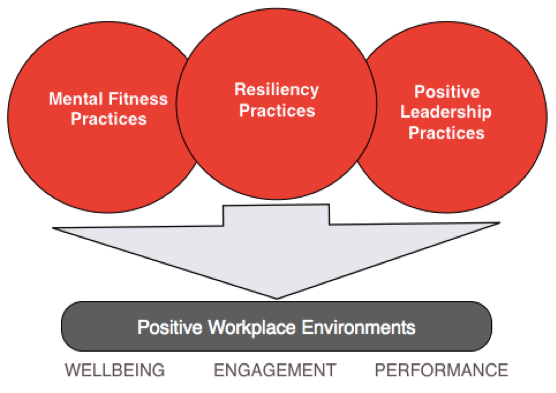
Mental Fitness
The mental fitness domain is composed of three sub-domains – relatedness, competency, and autonomy/support – that are referred to as “needs.” Seen as the PWF’s foundation, this domain aligns itself with the elements of self-determination theory.3
Relatedness involves the development of our sense of connectedness with our co-workers. Evidence of relatedness practices being used include welcoming, exchanging with and checking in on our colleagues.
Competency focuses on our collective sense of worth, to ourselves and to the school. This mental fitness need is met when we recognize and use our strengths and build confidence in others.
Meeting our autonomy/support need is also important in building psychologically healthy and effective school environments. This can be done by ensuring everyone has a voice and choice and opportunities to collaborate with their colleagues.

Creating psychologically safe and healthy school cultures where everyone can thrive, be happy and be at their best involves being intentional about fostering relatedness, competency and autonomy/support practices within team relationships and daily routines. When this happens, we experience a greater sense of personal well-being, demonstrate higher levels of motivation, and perform optimally. Targeted training for school staff on practices that promote these conditions is an important initial step in optimizing a school’s culture.
Resiliency
Resiliency has been defined as the capacity to adapt and realize positive outcomes in daily living despite challenging circumstances4 and as the ability to persist in the face of adversity, to bounce back when challenges are encountered, to effectively navigate support systems and to apply resources that sustain well-being.5 The American Psychological Association specifies that resiliency is not a trait that people either have or do not have but that it involves behaviours, thoughts and actions that anyone can learn and develop.
The PWF builds on this latter point and extends the concept of resiliency from the individual to the group. The PWF’s second domain, resiliency, is comprised of five sub-domains (relationship, professional, attitudinal, emotional intelligence, and adaptation) referred to as assets that teams can learn and develop.
Relationship assets involve practices that build social networks of support and community. Teams displaying strong relationship assets have caring attitudes toward co-workers and ensure social support in difficult or challenging times.
Professional assets involve practices that build professional confidence, capacity, and problem-solving skills. Identifying and counting on the staff’s collective knowledge and skills, and ensuring the availability and use of appropriate and targeted professional learning opportunities are evidence of a team with strong professional assets.
Teams that apply attitudinal asset practices show increased optimism and positive dispositions even in the face of difficult situations or challenges. The theory supporting this resiliency asset has its base in positive psychology.6
Emotional intelligence involves the ability to understand and manage emotions, and to communicate in positive and respectful ways with others. Key actions associated with group emotional intelligence assets are understanding our own emotions and those of others, and ensuring positive communication with others in stressful times.
Adaptation assets involve practices that facilitate adjustment to changing situations through positive coping and thriving strategies. Strong adaptation assets are characterized by implementing plans proactively and solving problems as a team.
Teams that implement practices aligned with each resiliency sub-domain are better able to cope, learn, and thrive during challenging and stressful times and are better able to move beyond challenges and engage in new opportunities.

Positive leadership
The PWF’s third domain pertains to positive leadership and consists of five sub-domains (leadership virtues, positive communication, motivational knowledge and skills, energizing skills, operational tasks) consistent with the work of Kim Cameron.7
Leaders with strong leadership virtues foster compassionate behaviour among staff, accept and forgive honest errors and encourage expressions of gratitude. They regularly demonstrate gratitude, compassion, and forgiveness.
Positive communication occurs when supportive and affirmative language replaces negative and critical language. Supportive communication is honest, congruent, descriptive, specific and reflective. Strong leaders emphasize positive observations and prioritize solution-building approaches.
Motivational knowledge and skills refer to a leader’s awareness of employee strengths and interests and their capacity to engage everyone in using these strengths in school routines and activities. Motivational knowledge and skills are evident when leaders promote a shared vision and encourage a personal investment on the part of everyone involved in the school’s success.
Energizing skills are demonstrated when leaders keep staff feeling energized with their enthusiasm, vitality, openness, and optimism. They make time to listen to and understand people, are fully engaged in conversations, value and promote people’s contributions and accomplishments, and follow through on their commitments.
Operational tasks refer to the ability of leaders to keep staff engaged by clarifying roles and expectations and providing opportunities for teachers to grow professionally.
Overall, applying positive leadership practices improves organizational effectiveness and enables the implementation of mental fitness and resiliency practices, which lead to psychologically safe and positive school environments where everyone can thrive and be at their best.

Does the PWF apply to my school?
The Positive Workplace Framework is used successfully across Canada in both official languages. Its implementation follows a train-the-trainer approach supported by numerous online resources and validated measures. This approach has the advantage of building capacity at the school level instead of creating a dependency on external consultants. A small team of “PWF champions” are provided with the knowledge, resources and strategic individualized plans for facilitating, modeling and promoting evidence-informed positive psychology practices that contribute to healthy and effective schools.
Practices related to mental fitness needs are introduced first, in order to establish a solid foundation for the resiliency and positive leadership practices. The PWF features two validated questionnaires, the Mental Fitness and Resiliency Inventory (MFRI) and the Positive Leadership Inventory (PLI), which provide an objective profile of school environments for each of the 13 PWF sub-domains. Reports are accompanied by over 150 strategies that can be tailored to specific schools based on their respective results and realities. (See our companion articles on the MFRI and PLI). There are also validated versions of the MFRI for students (MFRI-S) and their parents (MFRI-P) available for schools who wish to have these populations contribute to the overall “picture” of the school environment.
Schools can access the Positive Workplace Framework online learning platform, where a wealth of resources such as short awareness and capacity building activities, e-books, targeted instructional videos, presentation resources for trainers, and adaptable implementation plans that provide rollout strategies, are found.
Finally, several schools also use the PWF and its resources for more specific applications: for new employee orientation, leadership development programs, professional development activities, and to support individual growth plans and professional reviews.
In an era when we are asked to do more with less, why not ensure we can thrive and be at our best at school by implementing the Positive Workplace Framework?
Photo: Diana Pham and Adobe Stock
First published in Education Canada, December 2019
Notes
1 W. Morrison and P. Peterson, Pan Canadian Joint Consortium for School Health Positive Mental Health Toolkit, 2nd Edition (WMA Products, 2016). http://wmaproducts.com/JCSH
2 WMA Wellness, Positive Workplace Framework (2019). www.wmawellness.com
3 E. L. Deci and R. M. Ryan, “Self-determination Theory: A macrotheory of human motivation, development, and health,” Canadian Psychology/Psychologie Canadienne 49, No. 3, (2008): 182-185.
4 W. Morrison and P. Peterson, Schools as a Setting for Positive Mental Health, 2 nd Edition (Pan-Canadian Joint Consortium of School Health: 2013).
www.jcsh-cces.ca/upload/JCSH%20Best%20Practice_Eng_Jan21.pdf5 W. Morrison and P. Peterson, A Review of School-based Approaches and Practices for Promoting Student Wellbeing (J.W. McConnell Family Foundation, 2015).
6 M. Seligman, Learned Optimism (New York, NY: Pocket Books, 1998).
7 K. Cameron, Positive Leadership: Tools and Techniques that Create Extraordinary Results (San Francisco: Berrett-Koehler, 2013).


IDEAS TO SUPPORT EDUCATORS : Subscribe to the EdCan e-Newsletter
Quality research, reports, and professional learning opportunities.