
Archive
-
District Leadership for Democratic Governance
Comments Off on District Leadership for Democratic GovernanceDESPITE CLAIMS to the contrary, effective educational governance flourishes in many Canadian school districts. Such democratically oriented jurisdictions are typically well served by elected school trustees, who work closely with their superintendents1 to focus the lion’s share of their political efforts on supporting student success locally and provincially. District leadership teams in these settings invest in the capacity of principals to meaningfully engage parents and teachers in effective governance at both the school and district levels. In their provincial relations, proactive trustees and district administrators actively take part in the larger policy discourse, realistically advocate for local needs, and regularly convey their ideas and feedback to the Ministry of Education on important policy matters. District leadership plays a key role in effective governance at all three levels of the Canadian education system.
Leadership of this kind is a vital component of vibrant educational governance focused on ensuring high levels of learning and well-being for all Canadian students. In the words of a respected veteran superintendent of a large urban school district:
“I have a strong belief in democracy, the important role of citizens, and the abilities of trustees to represent their communities. Though our processes of purposeful, collective inquiry are sometimes messy, we almost always come to a decision that is good for our kids. My role is to guide conversations and to help bring the views of the entire community – including under-represented minorities – to bear on matters of importance to student learning.”
Framing educational governance in Canada
In Canada, responsibility for public education governance is assigned to the provinces; yet, with few exceptions, public schools have historically been established as local institutions. Tensions have long existed between the provinces’ constitutional educational authority on the one hand, and claims for local autonomy on the other. The more centralized theoretical takes on this relationship view school districts as both representative and subordinate administrative agents of the state. In these conceptions, basic policy is developed at the provincial level, but implemented and administered locally. At the opposite end of the theoretical spectrum, communal autonomy views local governments as the primary public authorities with greater legitimacy.
Policy interdependence theory conceives of central and local governments as separated institutions sharing powers.
Understanding educational governance in a rapidly changing, pluralist, and globalized context involves more than conceptualizing central-local relations. However, policy interdependence theory does shed light on several aspects of what works in the current environment, wherein administration, policy, and politics are often intertwined.2 Governance and policy-making at the ministry, the district, and – increasingly – the school level now involves continuous engagement in complex, interdependent webs of policy and influence bargaining with interest groups as well as intergovernmental and cross-ministry agents. The terms reciprocal, collaborative, and interactive begin to capture the types of governance relationships that have the best chances of supporting student success within these dynamic realities of contemporary Canadian education. Within districts, high levels of interaction among school and district leaders are best driven by a shared sense of responsibility for student learning and well-being; similarly, student success is also better served through district-ministry relationships which feature high levels of reciprocity and parallel attention to both provincial and district goals.
Effective school board governance
Recent studies of educational governance in Canada3 remind us that governance by an elected board is not corporate governance. This literature informs us of the importance of adopting a policy governance model well suited to the local context. Ongoing education for both elected board members and district leaders can foster collaboration, reciprocity, and interdependency among professionals, trustees, and the wider community. Effective governance models call for trustee participation in assessing community values and interests and incorporating these into the school district’s beliefs and vision for student learning and well-being. In effective board governance systems, trustees play a vital role in mobilizing parents and the wider community in supporting the vision and helping to create a culture of excellence that makes achieving the vision possible.
The following six principles have been synthesized from the research literature on effective school board governance. Effective school boards:
- Use the district’s beliefs and vision for student learning and well-being as the foundation for strategic planning and ongoing evaluation of board governance.
- Focus most policy making on the improvement of student learning and well-being, consistent with the beliefs and vision.
- Support and monitor progress on the district’s multi-year strategic plan for the improvement of student learning and well-being.
- Identify and fund policies and programs that provide rich curricula and engaging forms of instruction for all students.
- Maintain productive relationships with senior staff, school staffs, community stakeholders, and provincial education officials.
- Support and act, individually, in accordance with decisions made by the board of trustees as a whole.
Community engagement is a core governance function of school boards. The importance of ongoing public participation in educational processes is critical to a healthy public school system. As stewards of the community conversation about schools, effective school boards employ a proactive stance that seeks multiple voices to inform well-reasoned and carefully articulated policy choices. It is through these processes that trustees demonstrate their integrity and their commitment to the educational well-being of the community’s children, and cultivate the support needed to make difficult decisions that invariably go with the role.
Mutual benefits at the province–district nexus
Operating from a policy interdependence perspective benefits educational governance at the provincial level in at least two ways. First, legislative agendas and policy ideas can be strengthened through ongoing engagement with trustees and administrators who bring forward perspectives from the broader geographic, demographic, social, and economic spectrum. When the combined and more fully articulated views of the organizations representing teachers, school boards, superintendents, school councils and other members of the educational policy community are factored into this ongoing dialogue, greater policy interdependence and enhanced student success can accrue. Second, implementation tends to go more smoothly when the voices of those who are impacted have been solicited, heard, acknowledged, and acted upon through the design and adoption phases. Even more success is achieved when attention continues to be paid to these perspectives throughout the implementation phase.
Governing from a policy interdependence perspective also benefits school districts. A growing body of research indicates that savvy district leaders often see provincial policies as mechanisms for achieving local goals.4 Their strategic engagement with the Ministry of Education can take a number of forms, including active interpretation of provincial initiatives in light of local needs, mobilization of local resources, and actively participating in provincial decision-making processes. Three distinct approaches to working with the government’s agenda have been identified in this literature: (a) complying with the government’s initiatives and implementing them well; (b) supplementing the province’s initiatives in order to increase local impact; (c) leveraging the initiatives in the interests of the district’s priorities.
Successful districts actively engage with government initiatives and resources in order to strengthen support for their own strategic directions. Successful ministries of education focus on student success, encourage collaboration across the system, and encourage multiple pathways to student success. Policy interdependence can provide the theoretical foundations for effective governance and student success in our complex and evolving educational realities.
Nurturing effective school governance
Recent research on effective governance at the school level has yielded at least two important findings. The first is that highly effective school councils are now frequently participating as members of the collective leadership teams in schools and school districts. Collective leadership is total amount of influence attributable to all the participants in a given educational system: teachers, parents, principals, district office staff, and community members. This is good news for students in view of the evidence that in schools “with more democratic collective leadership practices that include parents in influential positions, student achievement is higher.”5 District leadership support of schools in their parent engagement initiatives has greater effects on student success than system efforts to engage parents.
The importance of the organizations frequently known as councils of school councils in strengthening system-level planning, deepening community engagement, and assuring public confidence is another important research finding.6 Ongoing connections among school council representatives across a school system can be of tremendous help to leaders navigating transformative change. Sustained community dialogue on important educational initiatives can build support and/or guide course adjustments.
Studies and annual provincial surveys indicate a general state of comfort with and appreciation of school councils’ involvement in schools and have put to rest past concerns that that school councils would evolve into de facto school boards. To the credit of provincial governments in Alberta and Ontario, a more evidence-based policy course has been steered since the introduction of school councils in the 1990s. In contrast to policy directions in places like New Zealand and England, school councils in Canada have not wavered from the path of serving schools and districts as collective associations who work together to effectively support student learning.
ENLIGHTENED district leadership plays a key role in strengthening governance at all three levels of the Canadian education system. At the school board level, effective superintendents work with trustees to meaningfully engage members of the wider community in understanding and supporting their district’s strategic plans for the learning, engagement, and well-being of all students. At the school level, district leadership teams foster the collective leadership capacity of principals so that the voices of teachers, students, and parents have greater influence in shaping direction. And at the provincial level, proactive trustees and district administrators actively participate in policy interdependence, advocate for local needs, and convey important and timely feedback to the Ministry. These notions of policy interdependence and tri-level engagement offer guidance to superintendency leadership teams in their efforts to positively contribute to democratic educational governance in Canada.
Photo: courtesy des commissaires de la Commission scolaire de Montréal
1 The term superintendent is used throughout this article to refer to the chief educational leader in school districts, including those in provincial jurisdictions where the official title is director of education.
2 R. Manzer, Public Schools and Political Ideas: Canadian educational policy in historical perspective (Toronto: University of Toronto Press, 1994).
3 G. Galway, B. Sheppard, J. Wiens and J. Brown, “The Impact of Centralization on Local School District Governance in Canada,” Canadian Journal of Educational Administration and Policy 145 (September 18, 2013); K. Leithwood, “Characteristics of School Districts that Are Exceptionally Effective in Closing the Achievement Gap,” Leadership and Policy in Schools 9, No. 3 (2010): 245–291; K. Seel and J. Gibbons, Interviews with School Board Chairs: Perspectives on governance (Edmonton: Alberta School Boards Association, 2011); B. Sheppard, J. Brown, J. and D. Dibbon, School District Leadership Matters (New York: Springer, 2009).
4 K. Leithwood, “Characteristics of School Districts that Are Exceptionally Effective”; K. Leithwood, K. S. Louis, S. Anderson, and, K. Wahlstrom, Learning from Leadership: Investigating the links to improved student learning (New York: The Wallace Foundation, 2010).
5 M. Gordon and K.S. Louis, “Linking Parent and Community Involvement with Student Achievement,” in K. Leithwood & K.S. Louis, Linking Leadership to Student Learning (San Francisco: John Wiley & Sons, Inc., 2012).
6 J. Brandon and P. Hanna, Inspired Partnerships: School council contributions to student success in Alberta. (Edmonton, AB: Alberta School Councils’ Association, 2014).
-
The Art of Conversation
Comments Off on The Art of ConversationI have developed a practice in my own life that, as it turns out, is good for both my body and my mind. I head off to the gym each morning at about 5:00 with a bottle of water, my iPhone and two or three TEDTalks loaded into my playlist. I’ve tried the music thing but it just doesn’t keep me going in the same way that fresh, provocative ideas do. TEDTalks are perfectly keyed to my workout routine—a twenty minute session on the weight machines, followed by twenty minutes on the treadmill. And none of this “every-other-day” thing for me. Unless I make my journey to the gym a daily routine, I find excuses! That means I listen to quite a few Talks over the course of a year!
This morning, I listened to two inspiring pieces. The first was by singer/songwriter, Meklit Hadero who encouraged us to be attentive to the music around us: in nature, language and even in silence. But it was the talk by NPR Host, Celeste Headlee that had me thinking well beyond my 20 minutes on the treadmill. In 10 Ways To Have A Better Conversation, Ms. Headlee reminds us of that, while many of us are great talkers and some of us are great speakers, not many of us are great conversationalists. She points out that, when properly combined, the elements of honesty, brevity, clarity—and a generous scoop of listening will invariably result in good conversation.
Living in a connected world does not automatically mean that the quality of communication has gone up. Some would argue that it has actually gone down or, at least, flatlined. Sure, Twitter might force us into brevity and clarity. Blog writing may encourage a certain level of honesty and a culture of “listening in” to what others are thinking, but it’s the combination of Headlee’s elements in a personal and personalized context that makes for good conversation. As a seasoned NPR broadcaster, Celeste Headlee has interviewed a whole lot of people and she uses what she has learned to give us some sobering insights into conversational practices in our 21st century world.
In my own household, mornings are usually a hectic time. As I prepare breakfast for the family, Zoe gets lunches ready. We’re often working in the same space and, although we share words with each other, we have rarely engaged in conversation that has really connected us. In fact, we normally begin our days rather disconnected—never a great way to begin the day!
This morning, however, was different. I made a point of sitting down with Zoe and, applying some of what I learned from Celeste, attempted to engage in conversation. But it wasn’t until Zoe was heading out the door for the day, that I realized the power of the experience—for both of us. I felt a little more connected and I knew that she did as well. Her last words to me: “By the way, thanks for the conversation!”
I can’t help but wonder about how some of this might apply to our work as people dedicated to nurturing the health and well-being of our young people. You know, Communication appears as one of the “C’s” in whatever list of 21st Century Competencies you encounter. Most often, however, the focus is on the “push” of communication—getting your message out there in a coherent, compelling way. Rarely do we hear about Conversation as a type of “push-pull” process. So, in listening to Celeste Headlee’s TEDTalk I’m left with some questions of possibility:
What might happen if we spent time in our schools exploring the art of the conversation? What might happen to our online conversations—many of which can become polarized very quickly—if we tried to apply Ms. Headlee’s 10 principles for good conversation? How might our family lives be enhanced and enlivened if quality conversation became something around which we gathered? What would it look like if conversation found its way into our approaches to assessment?
I realize that some of you are likely already playing with some of these ideas. I would love to hear about what you are doing! I would also like to hear what ideas others have for engaging in the powerful conversations that could result in our spouses, our colleagues and our children declaring at the end of the day, “Thanks for the conversation!”
-
The Manitoba Education Research Network
Comments Off on The Manitoba Education Research NetworkIn his work on curriculum theory, William Pinar 1 encourages us to think about what it means to be educated and what is worth knowing. These are big questions to struggle with, particularly when referenced by local context. Every day, teachers in Manitoba work out practical answers to these questions using inquiry methods grounded by their academic knowledge and classroom experiences. There are benefits all around.
For over a decade, the Manitoba Education Research Network (MERN) has established a range of mechanisms to support local research that is really “an extension of good teaching, of observing and responding to students and adjusting curriculum to fit the learning needs of all.”2 This inter-organizational approach creates bridges between faculty, field and the department for easier crossings. Going beyond dissemination activities such as regular forums, seminars and publishing opportunities, MERN has initiated teacher research projects that engage teacher and education partner participation at classroom, school, community and province-wide levels.
Multiple perspectives are brought to bear on local education issues, and “local ways of knowing” result from curriculum conversations about inquiry practices and literacy and numeracy processes in the Manitoba context. These local research projects depend on MERN for several things:
- Help to identify common research ground;
- Coordination for classroom teacher release time;
- Provision of space and/or technology applications for meetings;
- Opportunities for dissemination events and publishing; and
- Networked leadership to coordinate and sustain momentum.
The informality of the MERN network serves it well. Finding easy, honest and open ways to work together is vital. MERN regularly holds forums and seminars as face-to-face events for sharing locally produced research. These presentations reflect a variety of methodologies – case study, narrative inquiry, mixed method design – showing meaningful connections between research and practice. These dissemination events have produced opportunities to create collaborative discipline-based teacher research groups, to date, in the areas of Indigenous education, mathematics and social studies education.
The Indigenous Education Group
The MERN Indigenous Education Research Group emerged from the lived experiences of faculty who met with challenges when teaching a newly mandated Aboriginal Education course to pre-service teachers. Their questions about how to do this for pre-service, in-service and classroom teaching were supported by the Manitoba Treaty Relations Commission of Manitoba, Manitoba First Nations Education Resource Centre and the Manitoba Métis Federation. A series of education research seminars on treaties and reconciliation engaged education partners in ongoing critical dialogue. Writing projects on Indigenous education perspectives in Manitoba are in process for MERN publications.
The Mathematics Group
The MERN Mathematics Education Research Group started from a suggestion made by faculty that featuring mathematics education at a MERN forum would provide a useful space for teachers, faculty and the department to share their work and that this could improve our understanding of mathematics education in Manitoba. The group took shape while planning a MERN special forum on mathematics education. Articles generated from forum presentations are compiled in a special issue of The MERN Journal on mathematics education (Volume 7, 2013).3 The Mathematics Teacher Inquiry Project (MTIP) continues, with education faculty, consultants and classroom teachers from rural and urban areas, and will highlight their work at a MERN forum in May 2015.
The Social Studies Group
The MERN Grade Twelve Inquiry Project (GTIP) came together in response to the challenges of implementing the new Grade 12 Social Studies course, “Global Issues: Citizenship and Sustainability.” Initially focused on social studies education, the group evolved to work more broadly on the theory and practice of inquiry-based learning. This collaborative teacher research initiative presented its findings at a MERN forum on social studies education held in March 2014. Participants contributed articles published in The MERN Journal, Volume 9, 2014, Special Issue: Social Studies Education.4
A GTIP facilitator described his experience this way:
“The GTIP research project asked a group of nine teachers over a period of eight months to reflect on their Global Issues teaching experiences, and to collectively share their impressions, observations and insights with a view to making recommendations for curriculum, curriculum implementation, and teaching practice. Through discussions held, stories told, and revelations shared, important aspects of teaching social studies, teacher research, the GI curriculum and about the GTIP itself were revealed. [I] took special note of three. First, one of the most valued aspects of the research project for participants, was the occasion for them to get together to talk about their teaching lives, to participate in a professional community of fellow GI teachers – sharing stories, discussing philosophy, debating pedagogy, and feeling supported. Second, there was much discussion about the pedagogical dilemma at the core of inquiry-based learning, an issue that has been around since Plato introduced Meno. In the end all participants assertively, but eloquently, and with one voice embraced inquiry over instructor-based teaching. And finally, to do action reseach well and for practitioners to access, recall and represent their understandings, the research facilitator needs to be open, attentive, and adaptive to the chaotic fluidity of the research group.”5
Teachers are researchers. “Any educator who has explored new curriculum, evaluated teaching practice, chosen one new idea over another, or re-evaluated a daily teaching choice based on evidence and a guiding question, has engaged in research.”6 When teachers recount stories of faculty and classroom experiences, they share ways of knowing that illuminate the complexities of their work and support their professionalism. They bring voice to policy decisions, especially regarding school organization, classroom practices and subject-based curriculum questions contained within the broader issues of social justice, equity and sustainability.
MERN builds capacity for education partners to repoint teacher development and school improvement efforts in order to tackle questions of education policy and practice at the local level. In the same way that students engage in deeper learning through inquiry processes, teacher research invigorates Manitoba’s education community, helping to develop and advance the thinking within that community.
For more information about the Manitoba Education Research Network, visit www.mern.ca
En Bref – Au Manitoba, des recherches d’enseignants fondées sur les programmes d’études ont cours dans un contexte provincial. Toutes un peu différentes, les initiatives du Réseau des recherches en éducation au Manitoba (RREM) adoptent une approche similaire d’engagement d’enseignants des cinq facultés d’éducation du Manitoba, en exercice et du ministère de l’Éducation, afin de travailler sur le perfectionnement des enseignants, l’apprentissage des élèves et l’amélioration des écoles. Tenant compte de l’important apport de la recherche locale au domaine de l’éducation, particulièrement à la base, le RREM a accru les efforts visant à consolider cette capacité. L’article présente trois projets en cours réalisés grâce au soutien des recherches locales assuré par des partenaires en éducation reliés par ce réseau provincial.
Photo: Gerald Neufeld
First published in Education Canada, March 2015
1 W. F. Pinar, What is Curriculum Theory? Second edition (New York: Routledge, 2012).
2 P. McRae and J. Parsons, “Teachers as Researchers: (Re)searching within Alberta’s schools,” ATA Magazine 87 (2006-07). www.teachers.ab.ca/Publications/ATA%20Magazine/Volume%2087/Number%203/Articles/Pages/Teachers%20as%20Researchers.aspx
3 www.mern.ca/journal/Journal-V7.pdf
4 www.mern.ca/journal/Journal-V9.pdf
5 L. Kornelsen, “The Grade 12 Inquiry Project: A facilitator’s impressions,” MERN Journal 9 (2014).
6 McRae and Parsons, “Teachers as Researchers.”
-
Learning Together
Comments Off on Learning TogetherTechnology integration and inclusionary teaching practices have been important educational priorities in Newfoundland and Labrador for some years now. These issues have saturated the educational agendas of many jurisdictions for decades. Effective and efficient technology integration that leads to increased student achievement, in particular, is one goal that seems elusive to implement on a wide scale.
One school has met this challenge by developing and implementing a professional learning community based on a sustained, supported and systematic approach.Amalgamated Academy is a Grade 4-9 school in rural Bay Roberts, N.L. With a student population of approximately 720 and 50 staff members, it is one of the largest schools outside of the capital city of St. John’s. This unique mix of elementary and intermediate has many challenges, but also presents many opportunities for developing cross-grade level interactions between our students and staff.
For most of its history, Amalgamated Academy has relied on isolated professional learning sessions that had no sustained connection through the school year. Over the last three years, however, we have developed a professional learning community based on small staff cohorts with common interests. With concerted effort and the support of our administration, our cohort initiative has been the catalyst for significant cultural change regarding technology integration and inclusionary practice.
The cohort structure
The cohort structure is the backbone of professional learning at the school. Just as teachers want to create engaging student-centred learning opportunities, we wanted the cohorts to be engaging and centred on teacher professional learning. This is achieved through the voluntary nature of the cohorts. Participation is optional; however teachers do commit to the cohort for the duration of the school year to ensure a sustained effort.
At the beginning of the year, during our first school-based professional development (PD) day, cohort members meet and determine their first goal. Within the one-year time frame teachers aim to complete multiple goals that they set for themselves. We ensure that the goals are focused and attainable, so that teachers experience success. Goal selection is, however, teacher driven and this choice is imperative. Allowing teachers to choose goals most relevant to them gives them ownership. The nature of group participation and the formal recording of goals lends accountability to participants. Each subsequent school PD day acts as a check-in for members. During these check-ins, teachers share triumphs and tribulations as they reflect on their progress. Members complete formal reflections and use them as a springboard for professional discussions. These check-ins act as deadlines for the completion of one goal and the initiation of the next, building on the first.
Most important is what happens in between these check-ins. The lead teachers and cohort mentors regularly assist members with goal completion. This can involve providing in-class support with the implementation of a new strategy or use of technology, gathering resources or searching out answers. Mentors also help teachers stay focused to ensure a sustained effort. Most importantly, the mentors and other cohort members support each other and remove the sense of isolation often experienced by teachers in the classroom.
Administrative support
The success experienced at Amalgamated Academy would not have occurred without support and encouragement from the administration. Our administrators recognize the value of informal leaders as a link that helps connect teachers and school-based professional learning sessions. They are comfortable placing the responsibility of professional learning in the hands of teachers. Teachers are not told what they need for PD, but rather are given the opportunity to pursue areas of interest within the school’s growth and development plan, which in turn supports the larger district level strategic plan. Our administrators also advocate for time and resources with district personnel. Like most schools, ours is a busy place and time is a valued commodity. By utilizing existing professional learning structures, such as our three school-based days and two district days, we have been able to virtually eliminate the need for extra time.
The technology cohort in action
But how does this structure work in real life? Why would teachers buy in to this program of professional learning? As many of us know, just developing policies and structures without providing authentic supports can be counterproductive.
Intrinsic motivation, choice, relevance to daily practice and a strong framework of support are all important for increasing staff engagement in Amalgamated Academy’s cohort initiative. A closer look at our first cohort – the technology cohort – is used to offer an example of how this works in real life and why teachers buy in at the school level.
There is no lack of technology infrastructure at Amalgamated Academy; however, equitable integration of technology across the entire staff has been difficult to achieve, and sustained professional learning around the effective integration of technology was missing. During the 2010-2011 school year, we approached the administration with the idea of utilizing the open source Moodle (www.moodle.org) Learning Management System as the focus for a teacher collaboration initiative on meaningful technology integration. The school had been using this resource off and on for a number of years with a handful of teachers, but our hope was to increase the proficiency and develop a capacity among our staff to utilize the Moodle framework in a constructive way. Moodle offered us the ability to connect with students, parents and the community through a current technological channel. Its integrated platform for developing electronic learning environments can be tailored to the individual school or teacher, and many common Web 2.0 technologies, such as wikis, forums and blogs, are available in this system without having to worry about the headaches associated with managing multiple user accounts across a plethora of sites and services. If a teacher can learn how to effectively use this interface, we argued, they would also gain valuable general technology skills that would transfer to many other areas outside of their Moodle use. The administration agreed with our idea and we began to organize for the next year.
Without a strong framework and cohort structure, the chances of our entire staff buying in and utilizing this resource in a meaningful way was low. We’ve seen this with other technological initiatives over the years, as early adopters push forward and the rest follow slowly in their wake or paddle in the opposite direction. One of the reasons for our high success rate in teacher engagement during the first year of our Moodle cohort was the voluntary nature of the engagement. We explained the expectations and structure to our staff during the latter part of the 2010-2011 school year, and were delighted when the majority of our staff decided to join. The next factor was the role of individual choice during participation.
As a member of our Moodle cohort, there were no limitations on the goals that a teacher could set, but we did have expectations. Their goals had to be meaningful, achievable and specific to their individual situation. Superfluous language was discouraged in favour of clear, concise statements that were grounded in the practical application of integrating technology into a lesson to meet course organization or curriculum outcomes. Within the framework of trying to increase the role of technology integration into their daily lessons, teachers actively linked their goals to everyday challenges. As the completion of each goal built on and supported their next goal, they were able to increase their technological and pedagogical skill set through the year.
Changing your pedagogical approach is not an easy task. Most of us already have an underlying approach to our teaching practice that has become almost as ingrained as a religious belief. Participating in our Moodle cohort gave teachers a way to examine their pedagogy in a safe and supported environment. The final factor in our success would be that support. No one was alone; we all had a group of colleagues and friends to rely on.
Perhaps the greatest measure of success of that first year of the Moodle cohort was the launch of a second cohort the following year with a focus on inclusionary teaching practices. Teachers had expressed that they wanted to create more inclusive classrooms but had not been able to do so as they felt foundational supports were lacking. They recognized that the support and accountability that they saw as a Moodle cohort member was what they needed to implement teaching strategies to create inclusive learning environments for their students.
Since the 2012-2013 school year, we’ve continued to run both cohorts with much success, and the participation rate by teachers in the cohorts has increased by close to 75 percent. When we meet and share during the year, a great sense of community is captured by our forum posts as individuals identify similar difficulties and encourage one another to carry forward with the assurance that someone will be there to help them through. We have built a positive group identity of being part of a cohort, all working individually, but together, toward the greater common goal of improving our school. This sense of belonging, community and common purpose is the greatest key to our success. It has changed our school culture and positively impacted student learning.
What teachers tell us about professional learning cohorts
“The goals I set were things I wanted to do so it wasn’t another thing I had to do.”
“I find the cohort structure good because the support is motivational and makes you more accountable.”
“Yes, I do feel more confident in my ability with Moodle. After experimenting and developing with different interactive lessons through Moodle, I have gained a greater understanding and appreciation of its use.”
“One major challenge was convincing myself of its benefit and taking the time to start the first lesson. One major triumph was experiencing how well students responded to the activities.”
En Bref – L’effet de l’apprentissage professionnel réalisé isolément sur l’évolution des pratiques pédagogiques peut être minime, mais c’est le principal mode accessible aux enseignants. Grâce à une démarche systématique, persistante et soutenue de l’apprentissage professionnel, le personnel enseignant de l’Amalgamated Academy à Bay Roberts, Terre-Neuve-et-Labrador, a surmonté plusieurs des problèmes liés à l’isolement de l’apprentissage professionnel. En composant des regroupements de cohortes multi-années axés sur l’intégration technologique et les pratiques pédagogiques inclusives, le personnel de l’Amalgamated Academy a obtenu un grand succès en relativement peu de temps, sans grever les ressources de l’école et du conseil scolaire. Ce succès découle d’un cadre simple de collaboration et de soutien entre pairs.
-
What is Effective Teacher Professional Development?
Comments Off on What is Effective Teacher Professional Development?Professional development (PD or ProD) can be defined as teachers’ ongoing learning to improve the way they teach, and it occurs in both formal and informal ways. PD days are the most familiar formal structure of professional development and usually feature a combination of presentations, hands-on workshops, and collaborative teamwork that are often organized in advance by school and school district leadership. Teachers also routinely set their own, informal, ongoing PD agendas, such as taking additional courses, pursuing graduate study, personal study of their subject matter or teaching approaches, sharing resources and ideas with colleagues, and building learning networks through social media.
According to research, effective teacher professional development:
- Recognizes that teachers are professionals who should be given an opportunity to select what they would like to learn from a variety of research-based ideas about improving students’ learning.
- Provides long-term, ongoing opportunities for teachers to reflect upon both their chosen and mandatory PD experiences.
- Provides opportunities for teachers to coach one another and work together to analyze new teaching techniques, which often connects new teachers with experienced colleagues.
- Provides opportunities for teachers to study and gather data on the effects of changes in their teaching approach, particularly in response to new ideas or initiatives in education.
One of the clearest findings from modern research is that “one-time” workshops have little long-term impact on how someone teaches. Research also confirms that all forms of PD require a sustained commitment of time and resources; that teachers need to have the chance to put what they learned into practice and to reflect on how new ideas and teaching approaches work within their classrooms; and that students are more successful when teachers have meaningful, ongoing, PD opportunities.
Additional Information Resources
- Collaborative Inquiry: Empowering teachers in their professional development – By Leyton Schnellert
- Teacher Learning That Supports Student Learning – By Linda Darling-Hammond
- Historical Thinking and Teacher Professional Development: The Poor Cousin of Curriculum Reform – By Carla Peck
- Self-guided Professional Development resources (BC Ministry of Education)
References
Bullock, S. M. (2014). Exploring the impact of prior experiences in non-formal education on my pedagogy of teacher education. Studying Teacher Education, 10(2), 103-116.
Charner-Laird, M. (2007, April). Ready and willing: Second-stage teachers and professional collaboration. Paper presented at the annual meeting of the American Educational Research Association, Chicago, IL.
Chou, C. (2011). Teachers’ professional development: Investigating teachers’ learning to do action research in a professional learning community. Asia-Pacific Education Researcher, 20(3), 421-437.
Hunzicker, J. (2011). Effective professional development for teachers: A checklist. Professional Development in Education, 37(2), 177-179.
Kim, J. (2013). Teacher action research as Bildung: An application of Gadamer’s philosophical hermeneutics to teacher professional development. Journal of Curriculum Studies, 45(3), 379-393.
Liu, K. Y. (2012). A design framework for online teacher professional development communities. Asia Pacific Education Review, 13(4), 701-711.
McConnell, T. J., Parker, J. M., Eberhardt, J., Koehler, M. J., & Lundeberg, M. A. (2013). Virtual professional learning communities: Teachers’ perceptions of virtual versus face-to-face professional development. Journal of Science Education and Technology, 22(3), 267-277.
Marsh, B., & Mitchell, N. (2014). The role of video in teacher professional development. Teacher Development, 18(3), 403-417.
Mor, Y., & Mogilevsky, O. (2013). The learning design studio: Collaborative design inquiry as teachers’ professional development. Research in Learning Technology, 21(2), 1-15.
Opfer, V. D., & Pedder, D. (2011). Conceptualizing teacher professional learning. Review of Educational Research, 81(3), 376-407.
Russell, M., Masters, J., Magidin de Kramer, R., O’Dwyer, L., & Dash, S. (2012). Relationship of online teacher professional development to seventh-grade teachers’ and students’ knowledge and practices in English language arts. The Teacher Educator, 47(3), 236.
Roseler, K. & Dentzau, M. (2013).Teacher professional development: a different perspective. Cultural Studies of Science Education, 8(3), 619-622.
Saka, Y. (2013). Who are the science teachers that seek professional development in research experience for teachers (RET’s)? implications for teacher professional development. Journal of Science Education and Technology, 22(6), 934-951.
Tack, H., & Vanderlinde, R. (2014). Teacher educators’ professional development: Towards a typology of teacher educators’ researcherly disposition. British Journal of Educational Studies, 62(3), 297-315.
Taylor, M., Yates, A., Meyer, L., Kinsella, P. (2011) Teacher professional leadership in support of teacher professional development. Teaching and Teacher Education, 27(1), 85-94.
Wenger, E. (1998). Communities of practice: Learning, meaning, and identity. Cambridge, U.K.: Cambridge University Press.
-
In the Beginning Was the Ballroom…
Comments Off on In the Beginning Was the Ballroom…“What links all learning moments is there is a change in understanding, a shift in awareness, a movement of the soul.” – Coral Mitchell and Larry Sackney1
There was a time not that long ago, before downloadable books and online libraries, before email and Google hangouts, before Facebook, Twitter and LinkedIn, before PLN’s and PLC’s, when the most familiar face of professional learning was the large convention centre, hotel ballroom or high school auditorium. It was a time when big-event professional development was the norm, when large groups of teachers would be gathered together to hear the latest wisdom from the latest experts on a topic usually chosen by someone not directly connected with their classroom context. There would likely be a keynote speaker, breakout sessions led by more outside experts, an opportunity to purchase resources from the large publishers’ display, and coffee – plenty of coffee.
At the end of the day, evaluation usually took the form of a brief survey requesting feedback on the sessions, the facility and the food. And then people headed back to their schools, their classrooms and their teaching lives.
It was a time before we spoke about professional learning, per se. Instead, the emphasis was on development, on training or simply on professional activity. Usually, the focus was on the delivery of information – a chance to add to what teachers already knew about their work or announce new policy directions – with little emphasis on how the message might be received, implemented or developed back in the classroom.
While there was talk of new approaches to classroom practice, there was not a great deal of emphasis on large-scale change, school improvement or even student achievement.
From the perspective of those in attendance, professional development days were “sit and git” experiences. From the perspective of those presenting and leading the events it was, to a large degree, “spray and pray,” the hope being that some of the seeds planted would fall on good soil and take root.
While you’ll still find evidence of this traditional approach in many school districts, the past decade has witnessed substantial changes in the learning dynamic experienced by educators. Large-scale events like the ones described here have become much less frequent, as “professional development,” or “PD,” has given way to a more intentional focus on “professional learning.”
Today, the primary site for most professional learning experiences is not the ballroom, but the classroom. Today, the implementation is less future-oriented (what I might try someday) and more focused on the “here and now” of our local contexts (what I need to try today). And most important, today a very direct line has been drawn between the learning of educators and the learning of their students.
This shift has opened up the professional learning landscape in interesting and exciting ways. The single-source PD experience has given way to formal professional learning communities and networks, regularly scheduled Twitter chats, personal blogging and podcasting projects, grassroots gatherings like EdCamps and Ignite events, as well as LinkedIn and Facebook discussion groups. Some of these approaches and initiatives have been given the stamp of approval by school districts, ministries of education and the research community. Others, while still operating under the radar of what is considered official practice, are beginning to gain momentum and are affecting the way that many educators around the world are thinking and talking about their professional learning lives.
The challenge
Yet this important opportunity comes wrapped in a challenge. In our efforts to ensure that our vision for professional learning is more finely tuned to the learning needs of our students, how might we avoid replacing the traditional one-size-fits-all form of PD with a one-size-fits-all approach to professional learning? Stated differently, how might we begin to see and create connections between the growing number of ways in which education professionals are able to engage in experiences that result in powerful learning for themselves, for their colleagues and for their students?
Just as the early astronomers mapped the night sky by observing patterns, is it possible for us to map out constellations that will guide and enrich our professional learning, allowing us to critically reflect on the value of the many burgeoning stars in this expanding system?
While many of the existing criteria for effective professional learning are helpful in assessing the value of individual experiences, they may be less useful in helping us to draw the important connections between our traditional approaches and some of the powerful models that are on the rise. Yet three strong themes emerging from the research base on professional learning hold particular promise in this quest for greater connectivity:
- the need for learning experiences to challenge existing assumptions and draw in other perspectives;
- a focus on the student;
- the value of accessing outside expertise.
Challenging assumptions
An important factor in ensuring that learning events and experiences don’t simply allow us to reinforce common, yet quite possibly ineffective, practice is the introduction of provocations, information or input that forces us to challenge our assumptions.2 By actively recruiting evidence that counters our perspectives or the prevailing status quo,3 we come face to face with our values, beliefs, biases and dispositions. Welcoming this diversity of opinion is an essential part of the type of learning needed to substantially shift traditional practices; it is an important element in our professional learning.4
Many researchers and authors also point out the fact that we are not naturally predisposed to having our perspectives challenged. In fact, as Katz and Dack suggest, quite the opposite is true. We are wired to prefer that our view of the world remain largely undisturbed and unchallenged. For this reason, real, transformative learning is difficult and somewhat contentious.
Traditional PD events have been rather poor at providing this type of challenge. By contrast, collaborative, school-based Inquiry Teams, in theory, seem an ideal context for these challenging conversations. But depending on the size of a school team, the degree of trust and the presence of strong and courageous leadership, attempts to disturb thinking meet with varying levels of success.
The good news is that educators are actively and independently reaching out and engaging in this type of provocative behaviour in several contexts beyond the walls of the schoolhouse. Twitter conversations, particularly those that are organized around questions of practice, can often put participants in touch with alternative perspectives, research links that supply a selection of contradictory evidence and the space to enter into lively discussions.
The expanding blogosphere has become a place where the daily practice of educators – both the challenges and the successes – is often discussed rather explicitly, allowing for a unique type of normalization of learning struggles and opportunities that might otherwise remain hidden or secret in one’s own school. While comments are generally supportive, a growing trust and respect among participants is allowing for the type of diversity of perspective and challenge that can make learning come alive in a virtual setting.
This is a rich opportunity for provocative thinking, making contradictory evidence and ideas more accessible – an opportunity that can, at the very least, support and enhance conversations already taking place in the school setting. At its best, the conversations taking place outside of the local context have the potential to raise the bar on those that are happening at the school level.
Focus on the learner
One of the hallmarks of the school-based learning team is the ability to gather thinking and resources around a particular set of students and a particular set of challenges. In her work on professional learning, Helen Timperley presents a context for learning that conjures up the image of a set of Russian nesting dolls. Teachers are asked to consider what specific things these students need to learn to achieve greater success. Principals and school leaders are asked to consider what specific things these teachers need to learn in order to meet their student’s needs. In the same way, district leaders are asked to consider what specific things these school leaders need to learn in order to meet the needs of their teachers. Everyone has a class of learners to consider and the ability to hold these considerations in a local context is vital to being able to respond effectively.5
We are wired to prefer that our view of the world remain undisturbed and unchallenged. For this reason, real, transformative learning is difficult and somewhat contentious.
Gary Hoban offers a slightly different perspective by encouraging us to look at schools as a complex fabric, with many interrelated threads woven in and out, back and forth to create a rich context. Hoban warns us that in trying to affect just one thread in the fabric, other parts of the context also become involved.6 An important point to be made here is that our professional learning needs to be grounded in the unique setting in which the problem of practice occurs. Actions must be imagined, developed and tested in that same context. Teaching practice is not something to be mastered, but something to be continually examined in light of this environment at this time.
To be sure, initiatives that establish and nurture reflective school-based conversations and inquiry teams represent an important development but, again, other modes of interaction are presenting themselves as promising models for how professional learning conversations might be deepened and enlivened in school contexts.
One of the bright stars making its way above the horizon is the EdCamp model. Often referred to as an unconference, EdCamps are participant-driven events that recognize and leverage the fact that some of the best learning conversations at traditional PD events occur in between formal sessions, over coffee and on the way to the parking lot at the end of the day. By enabling participants to bring their own questions for conversation and by acknowledging the expertise of those gathered, the EdCamp model places the learning experience in the hands of the participants. EdCamp participants come to learn; they also come to share their knowledge and experience.
“Anyone who has taken part in an EdCamp or any other type of education-related unconference format will attest to the fact that the conversations almost always circle back to students: their learning, their well-being and their engagement.”7
There are at least two promising results of the proliferation of EdCamps across the country. First, participants new to the process are seeing value in using the model in their own districts and in their own schools. Voices are being gathered in promising ways to engage in learning conversations that matter to them and to their communities. Second, in the desire to keep conversations alive after the events, new professional relationships and networks are being forged, strengthened and expanded.
Bring in the experts
A final theme that holds some connective power has to do with accessing outside expertise to inform our conversations, our perspectives and our professional learning. Without attention to the inclusion of informed experts, our most valiant attempts to centre learning initiatives in our local contexts will likely suffer from a lack of fresh insights or knowledge. Expertise is one of the ways that we can seek that contradictory evidence that will help us to challenge our assumptions. This is not to diminish the knowledge and skills already available in our own learning communities. Instead, it recognizes the fact that learning often requires external input to help us approach challenges from new perspectives.
Earlier models of PD were very good at presenting important expert knowledge but, quite often, it has been both delivered and received out of context, leaving participants with the challenging task of bringing it to life in their own schools and classrooms. With new models of site-based professional learning, the challenge is flipped, with a need for ready access to relevant expertise that addresses learning needs in situ.
Fortunately, there are several very powerful ways to bridge the expertise gap in a way that is both cost effective and sustainable. Beyond the increased availability of online research libraries and databases, more and more traditional “keynote” addresses are available through services like YouTube and Vimeo. In addition, some of the most sought-after experts have already had important ideas published as TED Talks. Some school districts are investing in simple video conferencing software that allows for virtual interaction with researchers, university professors and authors. Closer to home, and perhaps one of the most under-utilized sources of expertise, are the educators among us who are enrolled in advanced qualifications courses and graduate studies programs. They represent an exciting link between current research and school-based practice.
Never before has expertise been more readily available and easily accessible!
Keeping our eyes on the skies
The transition from large-scale PD to more responsive, site-based systems of professional learning will, no doubt, continue. While it might be tempting to raise up one or two single models as best practice, a mindset that encourages us to intentionally look for ways to connect the rich and diverse ways in which modern educators are approaching their learning will likely serve us better.
We know that learning teams rooted in local contexts are essential to meeting the needs of specific groups of students. Yet, we also know that it is often challenging for local school teams to engage in the provocative conversations and access the outside expertise that will effectively disrupt their own assumptions and ways of thinking.
By remaining attentive and open to the many ways that educators are embracing their learning, drawing in a world of expertise and feedback and eagerly engaging in new ways of thinking about their practice, the professional learning happening in more local contexts stands to become more enriched and enlivened.
Developing a type of astronomical mindset could very well help us to make the important connections, highlight the effective patterns and open up powerful possibilities for both professional and student learning.
The right kind of learning
In their book, Intentional Interruptions: Breaking down barriers to transform professional practice, Stephen Katz and Lisa Dack8 insist that not all of what’s being done in the name of professional learning holds value in our mandate to focus on student learning. In fact, much of it may not count as learning at all.
Their definition may seem rather stark: Real learning always results in a permanent change in thinking or behaviour. It is not something that sees us trying something for a short time, only to fall back into our old ways of doing things. Instead, it truly changes the way we think about the work we do, or the way that work is conducted.
Somewhat more poetically, Coral Mitchell and Larry Sackney make a similar point about the results of learning: “What links all learning moments is there is a change in understanding, a shift in awareness, a movement of the soul.”
En Bref – De plus en plus d’attention est accordée au lien étroit existant entre la réussite des élèves et la qualité des pratiques du personnel enseignant, amenant un passage marqué de la formation et du perfectionnement professionnels à l’apprentissage professionnel. Dans cet article, l’auteur prévient qu’il faut éviter de remplacer le perfectionnement professionnel uniformisé par un seul modèle d’apprentissage professionnel. Il soutient plutôt que la métaphore d’une constellation peut nous aider à reconnaître la valeur intrinsèque du vaste éventail d’approches dont disposent maintenant les éducateurs. En constatant les types de liens entre les équipes d’apprentissage d’école, les activités émanant des conseils et commissions scolaires, les événements locaux et les réseaux de médias sociaux, nous pouvons engendrer des possibilités diversifiées et riches d’apprentissage professionnel approfondi.
Photo: iStock
First published in Education Canada, March 2015
1 Coral Mitchell and Larry Sackney, “Extending the Learning Community: A broader perspective embedded in policy,” in Professional Learning Communities: Divergence, depth and dilemmas, eds. Louise Stoll and Karen Seashore Louis (Maidenhead, UK: McGraw-Hill/Open UP, 2007), p. 31.
2 Helen Timperley, Realizing the Power of Professional Learning (Maidenhead, UK: Open UP, 2011).
3 Steven Katz and Lisa A. Dack, Intentional Interruption: Breaking down learning barriers to transform professional practice (Thousand Oaks, CA: Corwin, 2013).
4 Mitchell and Sackney, “Extending the Learning Community.”
5 Timperley, Realizing the Power of Professional Learning.
6 Garry F. Hoban, Learning for Educational Change: A systems thinking approach (Buckingham, UK: Open UP, 2002).
7 Timperley, Realizing the Power of Professional Learning.
8 Katz and Dack, Intentional Interruption.
-
Mentoring Pre Service Teachers – Everybody wins
Comments Off on Mentoring Pre Service Teachers – Everybody winsThis article introduces preliminary research exploring associate teachers’ visions of their learning within the mentorship experience.
DO YOU REMEMBER the first time you rode a two-wheeler?
After months or years of watching others do it, the magical moment finally arrives when you actually pedal on your own! For pre-service teachers, this moment usually occurs during their practicum placement. Many teacher candidates view this time when they first put theory into practice as the most important component of their teacher education program.1 An essential feature of the practicum experience is the guidance and support provided by the associate teacher. Associate teachers (also known as mentor teachers, host teachers or cooperating teachers) are experienced teachers who model effective teaching practices and provide feedback to advance the development of teacher candidates.2 This guidance steadies teacher candidates as they test and apply their developing knowledge, allowing them to actively advance their praxis.3
Teaching, of course, is far more complex than riding a bicycle. However, the two are similar in that neither can be learned through mere observation or passive reception of instructions. The learning is both in the doing and in the analysis of what was done. The core of an effective practicum experience is the process of gaining an understanding of what works and what doesn’t work, first by doing and then by altering what was done based on observation and collaborative reflection.
But it is not only the pre-service teacher who learns from this experience. Anyone who has ever taught another person a skill can attest that the act of breaking down a concept in order to explain it requires the explainer to carefully examine his or her own understanding. This also holds true for guiding and examining practice with someone who is learning to teach.
Research on learning through mentoring
The voices of associate teachers heard through research speak of playing a variety of roles, including coach, model, confidante and critical friend. Increasingly, teachers and researchers are recognizing that associate teachers also play the role of co-learner. In fact, reciprocal learning was ranked as the “most beneficial aspect” of being an associate teacher in a survey of 134 teachers working with teacher candidates in an Ontario faculty of education.4 Several researchers have established that learning during the mentoring relationship is a two-way street; both mentee and mentor learn from the collaborative relationship.5 Much of this work examines associate teaching in general, identifying reciprocal learning as an incidental benefit of the mentoring experience. The potential of these two-way learning relationships has yet to be fully explored.
In my work as a practicum facilitator for a Bachelor of Education program that specializes in developing French as a Second Language (FSL) teachers, I regularly ask associate teachers if they are interested in continuing their work with teacher candidates. The responses below are typical:
« J’aimerais bien participer encore l’année prochaine dans votre programme de formation. Les TCs avec lesquels j’ai travaillé ces derniers jours m’ont donné beaucoup de bonnes idées et ils ont invigoré [sic] mon programme. »
Author’s translation:
I would like to continue next year with the teacher education program. The teacher candidates with whom I have worked recently have given me many good ideas and have invigorated my program.
« J’aimerais bien continuer à accueillir des stagiaires dans ma classe. J’adore la collaboration. J’ai un “growth mindset” et chaque expérience . . . est une ouverture pour m’améliorer. »
Author’s translation:
I would like to continue welcoming teacher candidates into my classroom. I have a growth mindset and each experience . . . is an opportunity for self-improvement.
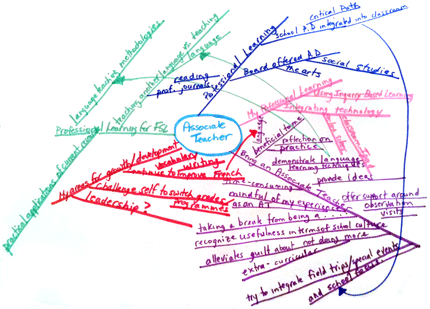
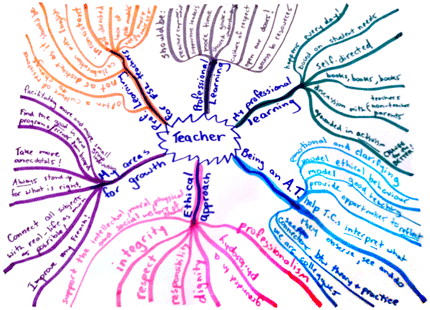
The enthusiasm of these associate teachers inspired me to explore the more intentional application of mentorship experiences within the context of professional learning. Teachers who contributed to the pilot of an ongoing research project created the mind maps that accompany this article. The maps show the teachers’ vision of their associate teaching experience as it relates to own professional learning.
“Mind Map A” shows that the teacher has identified integrating “school PD into classroom practice” as part of her continued professional learning. She links this to her work with teacher candidates, with an arrow from the top to the bottom of the map, noting that as an associate teacher, she has and will “try to integrate… school focus” into her work with the teacher candidate. This associate teacher also highlights her professional learning experiences specific to teaching FSL, and links this learning to areas she will reinforce with the teacher candidate. She identifies continued improvement of her use of French as an area for growth and links her pursuit of this goal to her work with the teacher candidate.
“Mind Map B” shows that the second associate teacher has also identified a need to improve upon her use of the target language. Like the creator of Mind Map A, this teacher connects addressing the language-related learning goal to her work as an associate teacher. Language teachers who teach a language that is not widely used in the local community frequently find it challenging to maintain or advance their language skills. Working with a teacher candidate provides the opportunity to use the target language with another fluent adult speaker. The creator of Mind Map B also identifies the fact that her work as an associate teacher calls upon her to “model good teaching” and “ethical behaviour.” Associate teachers who have participated in other research studies have identified this heightened sense of responsibility due to being observed by the teacher candidate as a source of professional learning.6 Such modeling of “good teaching” may also advance this teacher towards growth in her self-identified area of need: “recording more anecdotal observations.”
Enhancing professional learning
How might you access the reciprocal learning that associate teaching can bring to your teaching practice? A first step would be simply to recognize the potential of mentoring as a professional learning experience. You can then enhance the experience through documentation and reflection. Identify areas of your own practice that you would like to advance, and then think about the links between these goals and your work as an associate teacher. From there, you can develop a plan that may include:
- consciously modeling effective practice for the teacher candidate and highlighting self-identified areas for growth;
- including the teacher candidate in your implementation of school/board/ministry initiatives;
- exploring new resources and practices through co-planning and co-teaching with the teacher candidate;
- purposefully reflecting on challenges and “aha moments” during the practicum experience and linking them to present and future practice.
Continued professional learning is a widely held standard of practice for the teaching profession, with provinces and territories across Canada requiring teachers to complete some form of professional learning plan. Alberta is one province that underscores the role of associate teaching in this context, noting that the annual teacher professional growth plan “may consist of a planned program of supervising a student teacher or mentoring a teacher.”7 Other jurisdictions provide frameworks for teachers to develop professional learning in which they may include associate teaching.8
ONE OF THE MANY benefits of situated professional learning within the practicum is the advancement of experienced teachers’ practice through reflection, modeling and inquiry. Identification of these growth opportunities enables associate teachers to set measurable goals for themselves within the mentorship experience and gain formal recognition for their learning. Increased awareness of the reciprocal learning that takes place within mentoring relationships builds the teaching and learning capacity of teachers at every stage of their career.
First published in Education Canada, March 2015
[i] Clive Beck and Clare Kosnick, “Components of a good practicum placement: Student teacher perceptions,” Teacher Education Quarterly 29, no. 2 (2002): 81-98.
[ii] Ontario College of Teachers, Additional Qualification Course Guideline: Associate teaching, Schedule C teachers’ qualifications regulation (Toronto: Ontario College of Teachers Standards of Practice and Accreditation Department, 2011).
[iii] Praxis: the synthesis of theory and practice.
[iv] Karen Roland, Associate Teacher Feedback: Anonymous & confidential questionnaire (research report, Windsor, ON: University of Windsor, 2009).
[v] Melody Russell and Jared Russell, “Mentoring Relationships: Cooperating teachers’ perspectives on mentoring student interns,” The Professional Educator 35, no. 1 (2011): 6.
[vi] Daniel McCloy, “Learning Teaching: Reciprocal learning,” (PhD diss., Arizona State University, 2011); Andrew Hobson, P. Ashby, A. Malderez and P. Tomlinson, “Mentoring Beginning Teachers: What we know and what we don’t,” Teaching and Teacher Education 25, no. 1 (2009): 207-216.
[vii] http://education.alberta.ca/department/policy/otherpolicy/teacher.aspx
[viii] Ontario, Alberta and Yukon are among the jurisdictions that explicitly acknowledge mentoring as a PD activity.
-
Teachers as Leaders of Professional Learning
Comments Off on Teachers as Leaders of Professional LearningIF EXPERIENCED TEACHERS were supported to become leaders of learning – their own learning, the professional learning of other teachers and partners, and their students’ learning – what would these teacher leaders do and with what success and challenges? These questions have been central to our research[i] investigating the Teacher Learning and Leadership Program (TLLP) in Ontario, Canada.
The Teacher Learning and Leadership Program (TLLP)
In a partnership between the Ontario Ministry of Education and the Ontario Teachers’ Federation (OTF), the TLLP was launched in 2007 with goals to:
- Support experienced teachers to undertake self-directed, advanced professional development;
- Develop teachers’ leadership skills for sharing their professional learning and exemplary practices; and
- Facilitate knowledge exchange to help spread and sustain practices.
Each year, experienced teachers – individually or more commonly in teams – can apply to conduct a TLLP project. School board committees review applications and submit their priority choices to a provincial committee, comprised of teacher union and government representatives, who select projects for funding. From 2007 to 2014, over 600 projects have been funded. The projects cover a wide range of topics. The most prevalent topics include: differentiated instruction, technology, literacy, professional learning community, student assessment, and mathematics.
Prior to embarking on their TLLP projects, teachers attend a Leadership Skills for Classroom Teachers training to prepare them to take on the professional learning, project management and leadership expectations of a TLLP. Throughout their TLLP project, participants become part of Mentoring Moments, an online community to share resources, learning and discussion. At the end of their TLLP project, TLLP teams attend the Sharing the Learning Summit to showcase completed projects and to advance further spread of practices.
Teachers’ professional learning
In my research with colleagues Ann Lieberman and Anna Yashkina, we analyzed a sample of TLLP projects’ Final Reports. The three most commonly reported “improvements” for TLLP teachers were in their knowledge and skills (94 percent), instructional and assessment practices (76 percent), and leadership skills (55 percent). The fact that the TLLP is led and developed “by, with and for experienced teachers” was considered to be tremendously valuable. Teachers appreciated the opportunity to identify a project of interest to them and to lead the development of their own professional learning. As a provincial interviewee commented:
“ strongly encourage mid-career teachers to participate in a TLLP project. The opportunity to think deeply and intentionally about your teaching practice through self-directed learning as an experienced teacher is an excellent way to update your pedagogy to meet the needs of today’s learners while enriching your own passion for teaching.
The experience of leading a project focused on teacher learning as well as student learning involves considerable professional development, as one TLLP teacher interviewee explained:
… participating in TLLP, having to write the proposal, I think shifted my perception or my understanding… of what professional development is… the biggest shift that I would not have engaged in thinking about are issues related to teacher learning – other teachers’ learning.
The majority (85 percent) of TLLP projects in recent cohorts have developed and utilized teacher collaborative professional learning activities. While opening up teachers’ individual practices to other colleagues could initially be perceived as risky, enabling teachers’ voices and increasing transparency of practices to inform collaborative learning can become empowering. A TLLP teacher leader commented:
I think it was very empowering for them [TLLP teacher team members] and I think that they started having more confidence… part of the TLLP was to teach people how to network and how to be transparent; how to add what they’re doing in a more public sense, instead of just hiding behind their classroom walls.
Teacher leadership
Developing teacher leadership through TLLP involves recognizing and developing teachers’ expertise and supporting their capacity to initiate and spread improvements in practices locally and provincially.
Indeed, TLLP teachers spoke of being motivated, recognized and inspired as leaders. As one TLLP teacher leader commented:
Professionally, I don’t have a leadership position within my school community. I’m not a chairperson; I’m not a vice principal; I’m a teacher. I felt that it was a way for me to become a specialist in a particular area in a short period of time… It was rewarding, enriching, inspiring, invigorating, captivating… [the TLLP team could] dream big thoughts that normally we would never have the time to do, nor be offered the opportunity.
And in the words of another teacher, TLLP provided the opportunity for “grass roots leadership at its finest.”
Teachers explained that participating in TLLP developed their leadership skills through “learning by doing”:
TLLP allowed me to develop professionally. I learned leadership skills like: team building, developing trust, collaborating with others, presentation skills, co-teaching, debriefing, and reflecting. I learned and lived the experience of organizing collaboration.
I feel that I have gained valuable experience dealing with keeping my colleagues moving forward on a project with time and budget restraints, while maintaining a strong working relationship based on respect, trust, and acknowledgements of each other’s contributions.
TLLP teacher leaders indicated that the experience of leading a project, of developing and sharing their expertise, of presenting within their school and community, of dealing with change processes, and of negotiating interpersonal dynamics involved in successfully developing and delivering a TLLP project could be challenging. However, the TLLP teachers mostly found a way to overcome challenges and in the process developed considerably in their professional confidence, knowledge and skills.
Sharing knowledge and spreading practices
A priority goal of TLLP is to support teachers to develop and share their professional learning. TLLP teachers shared their learning through school and district-wide professional development sessions, staff meetings, and learning communities. They also engaged in modeling their practices (by opening their classes for other teachers and administration, demonstrating lessons during workshop or school visits), and/or developing professional relationships to support interested teachers from their own or other schools (for example through mentoring).
Another major area of sharing learning involves a larger community, including nationally and internationally. Increasingly, the majority of TLLP teachers are using online media, for example posting information and resources on school/district and other educational organization websites, developing project-dedicated websites, engaging in discussions on online forums, tweeting, blogging, and creating project-related groups on social networks.
To support the sharing and spread of new and effective practices, the majority of TLLP projects involve the development of practical materials that can be used in classrooms or schools, such as sample lesson plans, assessment tasks, and teaching strategies. Overall the twin strategies of developing professional collaboration and of developing practical resources for use by other teachers appear to be the most prevalent and impactful approaches to sharing learning through TLLPs.
Lessons learned from TLLP
Teacher-led professional learning is critical for supporting teachers to innovate, own, share and spread their professional knowledge and practices. Such learning is a powerful addition to – rather than a full replacement of – approaches to provincial, district and school professional development. The following lessons emerge from TLLP.
For national, provincial or district systems seeking to develop teachers’ leadership:
- Cultivate respectful partnerships with teachers and teacher unions to support professional learning.
- Provide enabling conditions including: funding for professional learning and teacher leadership activities; training to develop teacher-led professional learning and leadership; and infrastructure and support to facilitate developing capacity, professional dialogue and sharing of resources (such as online and in person networks); and research to monitor and inform existing and future practices.
- Resist being overly directive about a “teacher leadership program”; rather a culture of developing professional responsibility for inquiry and innovation to enable teachers’ learning and leadership to flourish is critical.
For teachers seeking to develop their leadership to support other teachers’ professional learning and practices:
- Identify a priority area of professional practice that you are passionate about improving.
- Consider how you are going to learn to improve your own practice and how you are going to collaborate with others to co-learn and share professional learning.
- Be intentional about how you will develop your leadership practices to engage other teachers in collaborative professional learning and sharing of practices.
- Contribute to collaborative professional learning activities and seek to connect with and expand your networks (in person and online).
- Utilize practical resources to support sharing, spread and implementation of new practices.
While the above lists may appear challenging, TLLP has demonstrated that the learning involved in addressing these challenges can be rewarding for individual teachers’ professional learning and leadership and for collaborative learning by, with and for teachers. Moreover, sharing the resulting new practices can contribute to wider school and system improvements beyond that feasible through traditional professional development or policy directives alone.
Photo: Chris Schmidt (iStock)
First published in Education Canada, March 2015
[i] C. Campbell, A. Lieberman and A. Yashkina, (2013a). The Teacher Learning and Leadership Program: A research report (Toronto, Canada: Ontario Teachers’ Federation. http://www.otffeo.on.ca/en/wp-content/uploads/sites/2/2013/09/tllp_full_report-.pdf;
C. Campbell, A. Lieberman and A. Yashkina, The Teacher Learning and Leadership Program: Executive summary (Toronto: Ontario Teachers’ Federation: 2013).
http://www.otffeo.on.ca/en/wp-content/uploads/sites/2/2013/09/tllp_summary.pdf;
C. Campbell, A. Lieberman and A. Yashkina, with N. Carrier, S. Malik and J. Sohn, The Teacher Learning and Leadership Program: Research report 2013-14 (Toronto: Ontario Teachers’ Federation, 2014).
http://www.otffeo.on.ca/en/wp-content/uploads/sites/2/2014/08/TLLP-Final-Report-April-2014.pdf;
C. Campbell, A. Lieberman and A.Yashkina, with N. Carrier, S. Malik and J. Sohn, The Teacher Learning and Leadership Program: Executive summary: Research report 2013-14 (Toronto: Ontario Teachers’ Federation, 2014).
http://www.otffeo.on.ca/en/wp-content/uploads/sites/2/2014/08/TLLP-Executive-Summary-April-2014.pdf
-
The Salmon Forest of Education
Comments Off on The Salmon Forest of EducationEarly on in my career in education, I had one of those transformative, paradigm-shifting, change-the-way-I-view the world moments while reading David Suzuki and Holly Dressel’s book From Naked Ape to Superspecies. What really stuck out for me was their explanation of how scientists had discovered that the health of many forests in British Columbia was directly dependent upon the health of salmon populations, and vice versa.

The salmon depend upon the trees to shade the streams and control water temperature, to provide nutrients, and to prevent soil erosion into the spawning beds. At the same time, the nitrogen from salmon remnants scattered across the forest floor by bears, wolves, eagles and ravens is an important source of fertilizer to help the trees’ growth. As trees disappeared, so too did the salmon. And as salmon disappeared, the health of the trees diminished. I was surprised and humbled to realize how interdependent these two seemingly unrelated and very different things, salmon and trees, were upon each other’s well-being.
While the Salmon Forest is a story of major ecological import, I think it is also a story of great social import, and a reminder that the ecological and social can’t be so easily separated. I share this story here in the context of education because it helped me realize that the health of a community is so dependent upon the health of all of its members. Each individual’s well-being is so deeply interwoven with the well-being of the community that it is impossible to create clear divisions.
The importance of biodiversity to the health of an ecosystem is now widely accepted, but I don’t think we’ve quite reached the point where social diversity is considered as essential to the health of communities. We hear much about the importance of “tolerance” or “accommodation” of differences, or about the “problems” posed by increasing diversity, but less about how integral social diversity is to fostering the growth of strong, resilient, supportive communities.
We can’t have healthy, safe communities if students continue to fear bullying and harassment based on parts of their identity, or if they lack access to the same resources that others enjoy. Or if teachers feel unsafe at work or parents and caregivers feel unwelcomed or judged at school.
We know that social, political and economic inequities continue to exist on many levels. We know that racialized groups, especially immigrants and First Nations, Métis and Inuit communities, continue to experience poverty and underemployment at much higher rates than others. We know that students with disabilities, mental health challenges, English as an additional language, or who identify as racialized, a religious minority, or LGBTQ are at greater risk of early school leaving. While males no longer excel at a higher rate than females within the education system, we know that income disparities continue to disadvantage women disproportionately. Knowing this, how do we build communities that are vibrant, strong and poised to succeed in a rapidly changing world?
If the Salmon Forest provides any indication, our success lies in recognizing our interdependency and nurturing the diversity of our communities. While some groups temporarily thrive on inequity at the expense of others, at the end of the day, we all lose, though some certainly experience greater harm than others. We can’t have healthy, safe communities if students continue to fear bullying and harassment based on parts of their identity, or if they lack access to the same resources that others enjoy. Or if teachers feel unsafe at work or parents and caregivers feel unwelcomed or judged at school.
Building vibrant communities requires fostering equity and inclusion, and not just accepting but leveraging the benefits of diverse abilities, ethnicities, cultures, faiths, sizes, genders, sexual orientations, languages and family structures, while working to reduce socioeconomic disparities. It means cultivating in all students and staff a sense of pride in their identity. It means drawing upon the knowledge, skills and resources that all students, parents and community members have to contribute to education. And it means fostering a sense of power to succeed and effect change.
Realizing these goals begins with the self. It begins with examining our own identities and the filters through which we interpret the world. What assumptions might we be making about particular students, staff, or caregivers? How do our own experiences shape our perceptions? How can we challenge ourselves to see things from a different perspective? What other possibilities might exist? Focusing our equity lens enables us to perceive the world in a different way, to notice the ways in which stereotypes and power imbalances might negatively impact some individuals and groups while advantaging others.
A supportive, inclusive and equitable school works together with students, staff, parents/caregivers and community members to create a space in which all participants are provided meaningful opportunities to contribute to and shape the educational experience. It is a place where everyone feels that their identity is not just represented but normalized, where they feel a sense of belonging and are valued as an integral member of the community. A school that fosters the health and well-being of all students anticipates and integrates diversity into the curriculum, instructional and assessment practices, the physical environment, extracurricular activities, outreach to parents and caregivers, resource materials and support services. Healthy schools mean equitable schools, where all students feel set up to succeed to the same extent as their peers.
-
Teaching and Learning Beyond the Classroom
Comments Off on Teaching and Learning Beyond the ClassroomBreaking the mould of K-12 classroom-based teaching and learning is what the University of British Columbia’s Teacher Education Community Field Experience is all about. Increasingly, educators are pursuing opportunities that take them beyond familiar school contexts into alternative, rural, international and non-school-based contexts. The focus on beginning a teaching career in a classroom similar to the one in which one was educated has expanded to a much broader view of where teaching and learning take place and also where a Bachelor of Education can lead.
In UBC’s recently reimagined BEd program, teacher candidates spend more time than ever in schools, with three practica (weekly day-long visits, two-week fall practicum, ten-week spring practicum). They also undertake a three-week community field experience (CFE) to broaden their concept of educational spaces and opportunities. In most cases, the CFE occurs outside of schools in placements hosted by community partners, while some take place in a school context that is very different from the practicum site (e.g. a secondary level candidate might spend three weeks in a Grade 1 classroom, library or resource room), in rural locations, or internationally.
The K-12 classroom is a crucially important educational context that provides the backbone of experience for preparing to teach, but there are other sites where education also takes place. The purpose of the community field experience is to expand and enrich the notion of where and how education occurs. Teacher candidates:
- spend time observing and working in a variety of educational settings;
- imagine aspects of non-formal, alternative or international education that might inform their classroom practice;
- recognize and articulate educational community and/or international links to local schools;
- develop questions to frame an inquiry into places of learning outside schools;
- collaborate with peers to share observations and develop questions;
- demonstrate their inquiry and learning through a blog, journal or brief presentation.
Mwebi and Brigham posit that “preservice teachers, teachers, and others in schools, teacher education programs, and elsewhere have a collective responsibility to ensure that knowledge systems in teacher education are expanded.”1 Teacher candidates who have practicum experiences in alternative settings are likely to broaden their understanding of formal education and enhance their educational competencies and philosophies. Anderson, Lawson, and Mayer-Smith2 conducted a study of teacher candidates in a pilot community field experience in an aquarium setting. The researchers’ intent was to equip the candidates with skills that could be easily transferred across a variety of educational contexts. They concluded that teaching in unfamiliar or non-traditional environments can help educators develop a more holistic view of education. Benefits to the new teachers were both pragmatic – in developing new teaching skills as a consequence of adapting to the new context – and philosophical – in coming to know how individual and collective understandings are constructed.
Community-based contexts
UBC’s community partners welcome teacher candidates who have completed their final practicum to assist in co-creating and delivering educational programs and curriculum resources for school-age students, pre-school children, seniors, community members or others. The skills and dispositions that teacher candidates bring to these activities are appreciated by community partners, and the benefits to candidates include expanding their vision of learning and teaching in the wider world. Some examples of UBC/community partnerships include:
- Arts-based settings, such as galleries, arts and music programs in schools, film study;
- Community service organizations, such as neighbourhood houses, animal shelters, youth detention centres;
- Early childhood education sites, such as daycare centres, pre-schools;
- Health and wellness centres, such as Dalai Lama Centre, health authority, kids’ cooking programs;
- Indigenous education centres, such as Aboriginal health initiative, First Nations band schools;
- Independent, private and faith-based schools, learning centres and academies;
- Museums and cultural centres, archives, halls of fame, historical sites;
- Recreation and outdoor education sites, such as parks, gardens, camps;
- Science education sites, such as science or ecological centres, space centre, aquarium, marine centre;
- Special education programs and centres;
- Sustainability and environmental education sites, schools, and projects, wilderness programs.
“I learned that I have a passion for teaching students in an outdoor setting and I gained several valuable hard skills that will hopefully assist me in one day constructing an outdoor classroom for future students… I felt reinvigorated as an educator by my CFE experiences.” – Teacher Candidate, Abbotsford Outdoor Education Program
“Your students are shining stars! They are a great addition to our team. They have jumped right into the program and have already created resources and materials to support our English Language learners! I feel so fortunate to be working with them and learning from them.” – Coordinator, Engaged Immigrant Youth Program
Rural contexts
Rural teacher education is an important focus of UBC’s BEd program. Our program in the West Kootenays stresses place-based learning, a connection to community, and sustainability. Rural placements for the CFE are selected by 40 percent of UBC’s teacher candidates. As McMurdo emphasizes when explaining his commitment to teaching in remote communities, it is important to prepare students “who can advocate for their communities and the planet, are capable of critical thinking, understand the social and economic contexts around them, and have the skills and creativity to help their communities grow.”3
While the rural CFEs are largely school-based experiences, the connections to community organizations are strong, meaning that candidates have opportunities that extend well beyond the classroom walls for their own and their students’ learning. Placements are situated in eight rural school districts, from northern BC to western Vancouver Island to Haida Gwaii. As well, there are three camp locations associated with urban districts that provide place-based learning paralleling a rural context.
“My rural field experience was terrific for many different reasons. One reason is that it gave me the ability to compare and contrast two different educational systems. It wasn’t that one school or district was better than another but, rather, that the new experience allowed me to reflect on education in much more complex and useful ways.” – Teacher candidate, rural school
Alternative school programs
Teacher candidates may spend three weeks in school settings that are different from the regular practicum context, such as a learning resource room, school library, adult basic education program or online distance-learning centre. These CFE placements provide a glimpse into contexts outside the regular classroom where students receive support and where different teacher-mentors can share their wisdom. Candidates who speak French may choose placements in Montreal or Quebec City, or in French immersion or Francophone schools in B.C. or Yukon.
“Participating in UBC’s community field experience was an extremely rewarding experience for me as a teacher candidate. To branch out and learn about different areas of education dramatically changed some of the ways I view pedagogy.” – Teacher candidate, alternative school
International contexts
Opportunities abound for teacher candidates able and willing to travel to Australia, Cuba, France, Germany, Hong Kong, Kenya, Mexico, Philippines, Singapore, Sri Lanka, Swaziland, Uganda, the United Kingdom or Switzerland. Research indicates that for teacher candidates, international experiences “increase their self-awareness, and enhance their personal efficacy and understanding of cross-cultural, diversity, and globalization issues, which informs their subsequent teaching practice.”4
“The Ugandan people taught me the power of teaching in a local community with limited resources but the heart to persevere and overcome obstacles with undeniable faith and commitment! It was truly one of the best experiences that I have participated in.” – Teacher candidate, international vocational centre
Finally, UBC’s International Baccalaureate (IB) Educator5 stream within the Teacher Education Program opens up even more possibilities, in Canada and internationally, both during and after the BEd program. Teacher candidates in the IB stream engage with an international view of education in which the world serves as a broad context for inquiry, for learning and for action.
“It was amazing to see how dedicated these kids were to their craft. I taught band and found that they were really excited to be there. They were so interested in the material. They got a chance to inquire about the things they were curious about. ” – Teacher candidate in an IB school
UBC’S Teacher Education program’s mission is to prepare local and global educators for a future where flexible educational programming and varied contexts will likely become more and more commonplace. As CFE coordinator Keith McPherson points out, the CFE provides a flexible learning model that encourages teacher candidates to take a leadership role by collaborating with their community partner to design engaging learning experiences for themselves and their students.
With the opportunities afforded by the community field experience, preservice teachers can increase their conception of how and where children, youth and others learn within and beyond the classroom as they develop their capacity to be responsive, adaptable educators.
More information: www.cfe.educ.ubc.ca
Photo: courtesy Wendy Carr
First published in Education Canada, September 2014
EN BREF – Pendant le programme de trois semaines intitulé Community Field Experience (CFE) de l’Université de la Colombie-Britannique, des candidats à l’enseignement découvrent de nouveaux lieux d’enseignement et d’apprentissage qui sont très différents de leurs stages. Ces contextes comprennent des écoles alternatives, des galeries, des musées, des centres de la petite enfance, des centres d’éducation autochtone, des écoles indépendantes, des centres culturels, des centres de loisirs et de plein air, des centres de détention pour jeunes, des organismes de santé et de bien-être, etc. Le CFE est particulièrement axé sur les sites ruraux en Colombie-Britannique et sur des endroits à l’étranger. Il procure aux candidats à l’enseignement des possibilités d’élargir leur conception des lieux pédagogiques potentiels et indique comment ils peuvent s’engager à titre d’éducateurs dans différents contextes.
[1] B. M. Mwebi and S. Brigham, “Preparing North American Preservice Teachers for Global Perspectives: An international teaching practicum experience in Africa,” Alberta Journal of Educational Research 55, no. 3 (2009): 416.
[2] D. Anderson, B. Lawson and J. Mayer-Smith, “Investigating the Impact of a Practicum Experience in an Aquarium on Pre-Service Teachers,” Teaching Education 17, no. 4 (2006): 341-353.
[3] S. McMurdo, “A Guide for New Teachers and Teacher Candidates in Rural Communities (Vancouver, BC: Office of the Eleanor Rix Professor of Rural Teacher Education, 2012), 3.
[4] Mwebi and Brigham, “Preparing North American Preservice Teachers for Global Perspectives,” 414.
[5] UBC offers Canada’s only International Baccalaureate Organization-recognized teacher education program.
-
What does Student Mental Health have to do with Teaching in the Classroom?
Comments Off on What does Student Mental Health have to do with Teaching in the Classroom?Student mental health problems are becoming one of the main concerns for teachers in schools. In fact, many teachers would say that a significant portion of their time is spent managing student behaviours, many of which are the result of mental health problems.
Impossible as it may seem, a teacher friend who has a Grade 4 classroom of 22 students indicated that 6 of her students have an IEP (Individual Education Plan) with significant modifications and accommodations. One student is identified as ‘Gifted with severe ADHD’; another student, identified with Autism, has significant behavioural and social difficulties. The other 4 students have a combination of various learning issues that also cause them to be at considerable risk for mental health problems. In fact, this teacher is concerned about 2 of these students because she has observed them to isolate themselves from their peers and they appear sad and apathetic in the classroom.
Given the complicated mental health and learning needs of these students together with the needs of the other students in her classroom, my friend is often overwhelmed and daunted by her task of teaching. What does she do to help all of her students grow and learn? What is her role as a classroom teacher?
What is a Tiered Approach to Mental Health?
Of course, the central role for teachers has to do with instruction and learning; however, without healthy minds, learning is a difficult task. Using a tiered approach when thinking about and working with students can be useful.
How can Teachers Promote Mental Health for ALL Students (Tier 1)?
- Teachers are able to provide support through universal mental health promotion and prevention programming.
- Teachers can support positive mental health for all students in the way that they go about their day-to-day work. Because teachers are significant in the lives of their students, how they behave towards students has huge impact on individual students and on the classroom in general. Their consistent support and overt compassion and patience with students are often of critical importance in the daily lives of their students.
- Teachers can use research-based strategies that are shown to promote positive mental health across schools and classrooms.
- Teachers can also incorporate school-wide programming to address areas of concern (e.g., peer mediation to help with student conflicts).
- Most significantly, teachers can integrate social emotional learning (SEL) into classroom activities so that students learn skills related to self-awareness, social awareness, self-regulation, relationship building, and decision-making. In fact, research has shown a link between social emotional learning skills and academic performance. For more information about the critical role of social emotional learning, visit the Collaborative for Academic, Social and Emotional Learning (CASEL) http://casel.org/
How can Teachers Help SOME Students with Mental Health Problems (Tier 2)?
Teachers are often the first to notice changes in student performance or behaviour. As such, teachers are in a unique position to identify students in need of more intensive services. In elementary and secondary schools teachers can provide targeted skill-building for students at higher risk for developing problems. This may be formalized in an Individual Education Plan (IEP) or can occur through group delivery of special programs for students who experience similar struggles (e.g., anxiety management sessions, temper taming groups). Some students are at risk for developing mental health problems and teachers can help with referrals to mental health support teams who may be internal or external to the board.
How Can Teachers Support the FEW Students Who Need Intensive Intervention Due to Mental Health Problems (Tier 3)?
Teachers and school personnel need to work seamlessly with community partners who have expertise in working with students requiring clinical intervention. Many communities across Ontario have set the foundations for the seamless delivery of mental health services through the Student Support Leadership Initiative and Working Together for Kids’ Mental Health. This collaborative work will deepen in coming years as communities further define and support the local pathways that fit their context. Pathways to support need to be locally determined, but more importantly pathways need to be clear and articulated so that students receive the right help at the right time.
Adapted from: Leading Mentally Healthy Schools: A Resource for School Administrators (School Mental Health – ASSIST, 2013) and Supporting Minds (Ontario Ministry of Education, 2013)
This blog post is part of CEA’s focus on student mental health, which is also connected to Education Canada Magazine’s student mental health theme issue and a Facts on Education fact sheet on what the research says about effective approaches to improving students’ mental well-being. Please contact info@cea-ace.ca if you would like to contribute a blog post to this series.


IDEAS TO SUPPORT EDUCATORS : Subscribe to the EdCan e-Newsletter
Quality research, reports, and professional learning opportunities.