
Archive
-
Joel Westheimer: Testing, ‘Accountability’, and the Threat to Canadian Democracy
Comments Off on Joel Westheimer: Testing, ‘Accountability’, and the Threat to Canadian Democracy2009 CEA Whitworth Award for Research and Education winner Dr. Joel Westheimer delivers a provocative lecture.
-
George Pearson: What makes school programs innovative?
Comments Off on George Pearson: What makes school programs innovative?George Pearson discusses the latest issue of Education Canada.
-
A Student’s Role in Teacher Engagement
Comments Off on A Student’s Role in Teacher EngagementStudents present their thoughts on engagement, learning, and teachers.
-
Penny Milton & Jodene Dunleavy: What did you do in school today? Report Launch
Comments Off on Penny Milton & Jodene Dunleavy: What did you do in school today? Report LaunchPenny Milton and Jodene Dunleavy discuss findings from the What did you do in school today? Report.
-
Questionning the Message
Comments Off on Questionning the MessageTwelve years after the most horrific night I can remember, I teach kids who are the age now that I was then – on New Year’s Day, 1998. Occasionally, I tell my students the story of Bob to illustrate a point – to capitalize on a teachable moment. It’s an effective story. The details will quiet a room of distractible teenagers almost instantly. The first time I shared this bit of my past was during a review of Golding’s Lord of the Flies. Does evil exist in all of us? I asked.
My students looked at me, some out of interest, others out of obligation.
“Come on,” I urge them, “Golding said that he wrote this story to illustrate what he learned about humanity from his experience in Second World War. The worst of us, that’s what he put into these pages. Do you agree with him? Do we have a penchant for destruction?”
My voice caught and the students could see that this was not a question from a review section in a textbook – this was a life question. I took a breath and told them about the moment that enables me to question Golding’s Lord of the Flies message.
“Ryan was a normal guy. There was nothing unusual about him; he drank on the weekends, like most kids did. He experimented with drugs, as most kids did. He sometimes felt angry at the world, as many kids did. And yet, despite all his normalcy, Ryan left the imprint of his boot on a man’s skull.”
At this point, each student is still, quiet, looking at me. Everyone wants the story. So I give it to them.
The most horrific event I can remember wasn’t really an event at all, but a moment in the snow, standing at the end of my family’s driveway, watching individual snowflakes drift down from blackness and waiting for my dad to pick me up. While I was standing there with my bare feet shoved into my snow boots and a jacket pulled tight around my pajamas I wasn’t thinking about bad things or violence; I was recalling my first New Year’s Eve spent with friends. So I felt warm and happy as I stood there in the pre-dawn hours. The sound of my dad’s truck engine, however, triggered my curiosity: why was he coming to pick me up and where was he planning to take me?
My dad rolled to a stop, and I got in. We turned out of the cul-de-sac and over the crest of the hill leading towards town. He hadn’t said a word yet, but I was aware that something was different: his eyes were half shut and he hadn’t looked at me.
“Brooke,” he said. “Something happened. Bob’s dead. I need you to pick up the kids and bring them home, put them to bed. Your mom and I will come home in a bit. There’s uh, there’s some things we, uh, we need to…do.”
“What?” I turned in my seat to look at him, my right shoulder pushing against the seat belt. Bob and his family had been spending New Year’s Eve celebrating with my family and a few others. They lived just a few blocks away. They were part of our everyday lives.
“Bob and I went to check on the party at the Cudmore’s house and uh, well, someone, well, Bob was killed. Some kid at the party killed him.”
Numb. Like numb pressure, like invisible walls, like I am in a cube with invisible walls and the walls are moving in on me, pressing down on me, blocking out sound and air and I can’t breathe and I’m just staring out the windshield and my dad is driving. My throat closes in on itself, but I’m not crying; I’m just looking at the snowflakes slam into our headlights and I’m numb.
It is almost seven in the morning but I am not asleep yet. The house is quiet, buried in snow and sorrow. I hear a sound in the living room. It’s a quiet sound, a soft whisper and then the squeak of my father’s chair. He is sitting there in the almost dark. When I turn on the light I see his face is red and shining with his crying. I have never seen my father cry, so I curl up in the chair opposite him, and we are silent together. Eventually he looks at me, and the emptiness is gone, replaced with a brokenness, a bewilderment.
I don’t remember what he said. It was something that expressed his helplessness, something like how could this happen, or why – just why? But I do remember his face, crumpling in on itself. The grimace of pain contorting his face. The quick movement of his body contracting, like he’d been punched in the stomach. The sound, that animal sound of suffering.
Bob and my dad had gone to that “unsupervised, teenager party” to make sure it was under control. Clearly, it wasn’t. They got split up in the masses of drunk youth. Unfortunately for Bob, he ran into a heavily intoxicated Ryan, the boy who beat him to death.
“Is it despite his normalcy or because of it that Ryan was able to kill?” I ask. “This is the question that Golding asks us in his story of marooned school boys.”
Literature – when it’s good, changes us.
At one point during the years it took me to attain my literature degree, I asked one of my professors about the importance of literature. I had been feeling disillusioned. Why spend all these years studying stories, I wondered. It’s not like we’re doing something worthwhile, like curing cancer. I wanted to know the point of it all – as many students often do during our lessons.
“We don’t analyze the great works,” he said. “They analyze us.” He stood in a professorly way, by his bookshelf, in his cramped campus office, his glasses slipping to the tip of his nose. “That’s why it’s important.
Golding had something to say. Every author does. Learning occurs when students question that message.
-
Exploring Ethical Leadership: A Superintendents’ Professionnal Learning Project
Comments Off on Exploring Ethical Leadership: A Superintendents’ Professionnal Learning ProjectIncreased accountability for student achievement and the implementation of provincial priorities, changing demographics due to growing immigrant and Aboriginal populations, and the necessity for ever greater fiscal restraint – all contribute to the growing complexity of the school superintendency. In Manitoba the challenge and opportunity for leadership at the local level remains strong compared to many other jurisdictions, with superintendents and boards still able to exert significant influence over the quality of education. There is, however, no formal provincial preparation for this role; individuals seek out academic post-graduate programs or depend on the Manitoba Association of School Superintendents (MASS) or conferences outside Manitoba for much of their professional learning. The Association saw the need for a new kind of sustained professional learning for its members and elected to launch a study of ethical leadership, modeled somewhat on a similar program run by the Superintendents Association of Iowa (SAI).
Why ethics? The answer lies in part in MASS’s commitment to public education, its stated sense that “the challenge for educators is to define what we believe about education in a manner that encompasses the values of a democratic society, respects the inherent uniqueness of the individual student, and at the same time provides equity of opportunity for all.” The Association’s Statement of Beliefs in Public Education has codified the values that have grounded its work for the past 15 years (see www.mass.mb.ca) and reflect Robert Starratt’s “ethic of justice” and “ethic of care”, as well as the “ethic of critique”, which is crucial for the constant renewal and change required to create and maintain a strong democracy.
If individuals hope to provide the leadership necessary for such change and renewal, and to establish cultures where justice and care are at work, they require clarity around values, the ability to articulate those values to others, and the ability to make judgments based on them as they encounter ethical dilemmas. A sustained dialogue on the centrality of those values formed the base of our work on ethical leadership begun in 2008. As we said at that time, “ethical leadership gets at the heart of the superintendent’s work – not only to provide a moral compass for individual decision-making and relationships but to lead in establishing an ethical culture where children and learning, equity and justice, are central.”
The purpose of the experience was to “provide a forum for participants to engage collectively in an ongoing inquiry into their practice; to provide the opportunity for reflection on the moral imperative of leadership; and to positively affect the culture of leadership in schools and divisions across the province.” A cohort of 20 superintendents and assistant superintendents, and a “critical friend” from the University of Manitoba’s Faculty of Education, met four times through the year for two half-days and an evening. Part of each session was spent with a resource person (Jerry Starratt, Chris Kelly, Nel Noddings, Margaret Wheatley, to name a few over the past two years), and each session was planned and facilitated by members of the cohort. Jerry Starratt remarked: “I was enormously impressed by the sense of teamwork, candour, and transparency…The group moved very quickly into analysing the ethical implications of systemic issues and challenged themselves to lead the necessary changes.”
Themes that emerged from the written reflections, focus groups, and survey revealed that the experience led to a deeper understanding of the ethical implications of the superintendent’s work, sharpened tools of analysis, changes in practice, and increased comfort, confidence, and courage with their roles. As one participant said, “The biggest single plus of the cohort model has been the opportunity for sustained dialogue and interaction with a group of people trying to do this job in the Manitoba context.”
Personal comments reveal how the study of and dialogue around ethics relate to practice: “I am now much more conscious of the need to situate decisions within an ethical context in a purposeful and systematic way”; “I am looking for the ethical and moral aspects of the issues, trying to peel back the layers to get at the deeper meaning of the issues”; and “For every decision I make, I reflect on what is ethically right. I try to view it through the various lenses – the ethic of caring, ethic of justice, and the ethic of critique”.
The dialogue around ethical leadership was ultimately less about a personal style than about the wider system: “The discussions and questions posed at our sessions have more deeply instilled in me the importance of creating a ‘shared ethics’ within our school division in order to positively promote change.”
That dialogue centred around questions such as: How do we make education more successful for aboriginal and immigrant kids? How can we change the system to be more inclusive of all learners? Do immersion programs challenge our ability to provide a strong education for all? Do we target groups or schools based on socio-economic status with extra resources as the most caring and just solution? How can we give voice to marginalized groups within the system? and even, How can we build schools that are structurally more caring of their inhabitants and more environmentally friendly?
The cohort continued to meet a second year on its own, and a second cohort was launched this past fall. By enabling superintendents to extend their thinking in rich ways around ethical issues, these dialogues have helped to create a coherent value system within the association and among the province’s school districts, resulting in a common language that has deepened commitment to public education and to the provision of a fair and equitable educational experience for all of our students.
-
Sorting Students Into Learning
Comments Off on Sorting Students Into LearningGoals for improved student learning and achievement are widely shared among school districts in Canada. Within these goals, the idea of transforming learning environments for adolescent learners to address persistent gaps in student achievement and student disengagement in and from school is taking hold. At the same time, concerns about the ability of current models of schooling to equip all young people for success in contemporary society are also growing.
As school systems work at issues inherent in a model of schooling designed for the past, the 21st century learning agenda also challenges them to advance new processes and outcomes for learning. The qualities and outcomes advanced as the hallmarks of 21st century learning have been part of the fabric of conversations about public education for decades. In the context of economic, social, political, and cultural changes inherent in the transition from an industrial to post-industrial world, educators have been called upon to consider ideas about teaching and learning that once tended to exist on the margins as central to their practices in classrooms and schools.
In the context of the transition from an industrial to post-industrial world, educators have been called upon to consider ideas about teaching and learning that once tended to exist on the margins.
Increased calls for secondary school redesign may signal a readiness for considering how schooling might be (radically) different. The Cisco-Intel-Microsoft Working Group on Classroom Environments and Formative Evaluation, chaired by Marlene Scardamalia, argues, “… anything that deserves the name of education for the 21st century needs new kinds of objectives, not simply higher standards for existing ones.”[1] These calls, in turn, inspire compelling questions about secondary schools for the future: What objectives will anchor an education for 21st century learning? Can newer ideas about what all students need to know and be able to do become a starting point for rethinking what students learn, how learning occurs, and who the learning is for? Can education systems create learning environments that engage all students in the kind and quality of learning that was once reserved for only the few?
What did you do in school today?
The challenges faced by young people as they navigate their day-to-day lives in secondary schools have been central to the Canadian Education Association’s (CEA) Agenda for Youth since 2005. Beginning with Imagine a School and Design for Learning, students have played a significant role in shaping our perspectives on prevailing ideas about youth and their learning. Their narratives provided the impetus for the development of What did you do in school today? – a three-year research and development initiative designed to capture, assess, and mobilize new ideas for enhancing the learning experiences of students in classrooms and schools.
Since 2007, What did you do in school today? has grown from a network of ten to seventeen Canadian school districts. Administrators, teachers, and students in more than 150 schools are now working with a multidimensional framework for understanding student engagement that builds on the established concepts of social and academic (or institutional) engagement and advances the newer concept of intellectual engagement (see Figure 1).[2] A set of measures that capture all three dimensions provides a foundation for understanding what students are doing in classrooms, how they feel about their learning experiences, and how the work they do contributes to learning.
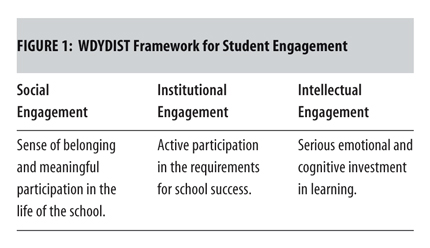
The systematic collection of data about students’ experiences continues to provide a foundation for inquiries into creating more effective and engaging learning environments.[3] First year results revealed generally low levels of student engagement. While almost 70 percent of the 32,322 students reported positive experiences of social and institutional engagement, only 37 percent felt intellectually engaged in learning. Not only are levels of intellectual engagement significantly lower overall, but a large majority of students begin to disengage from learning in Grade 7 and continue to do so until Grade 9, where levels remain fairly constant at just above 30 percent through to Grade 12. [4]
A new measure – instructional challenge – developed from Csikszentmilhalyi’s theory of flow, offers further insights into students’ experiences of learning by tapping into the balance between the challenge inherent in the work they are asked to do in classrooms and their skills to do that work (see Figure 2).[5] Across Canada less than half (between 42 and 47 percent) of middle and secondary students experience flow in their math and language arts classes. The remaining students find their schoolwork either too difficult or too easy, while a small percentage (less than 8 percent) felt apathetic toward their learning (“I can’t do it and I don’t care.”). The odds of students in the top left quadrant (low skills/high challenge) being intellectually engaged in learning are only 27 percent, with these odds falling even lower for students in the bottom left quadrant (low skills/low challenge).
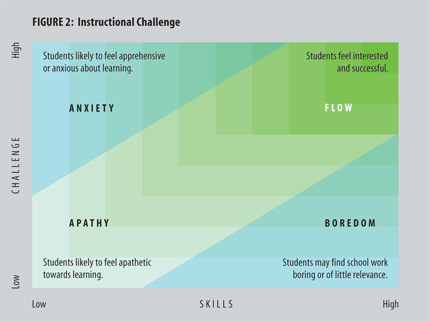
These ideas about intellectual engagement and instructional challenge that blend theory with insights about teaching practices and learning experiences, have resonated strongly with many educators and students because they reflect the kinds of learning they both aspire to.
Grounded in reliable data, the core concepts of What did you do in school today? have also become an important source of new local, regional, and national conversations about teaching and learning, the most expansive of which are seeking to understand what is required to achieve higher levels of intellectual engagement across grades, curriculum domains, and the range of abilities and aspirations students bring to their learning in the 21st century.
Learning in the 21st Century
One of the most promising debates to be revived by the ongoing evolution of the 21st century learning agenda draws attention to past, present, and future purposes of education. Though many continue to value secondary education primarily as preparation for the future (workforce or post-secondary studies), there is growing acceptance that this narrow focus (even though it reflects more contemporary notions of work) has been insufficient for some time now. If they are to have genuine personal choices about social, political, and economic opportunities in their futures, all young people need to be equally capable of mobilizing a wide range of “cognitive and practical skills, creative abilities and other psychosocial resources.”[6]
In acknowledging schools as important places for young people to gain an expanded set of competencies, the 21st century learning agenda creates room for understanding learning as a resource for “a successful life.”[7] Many educators will find this idea evocative because it reflects the beliefs about the purposes of schooling that they bring to their work. For school systems, however, the idea presents two significant challenges: not only does it suggest new objectives for learning – from the accumulation of discrete skills and facts to deeper levels of understanding required for the development of 21st century competencies – but it does so for all students, in all classrooms, and in all schools.
The journey towards a fully equitable public education system has been long and remains unfinished. Even with new evidence, a belief that all students can transition to adult roles (e.g. civic and cultural participation, earning a living, caring for self and family) with confidence and competence can feel like an uneasy fit with traditional beliefs about students: that some are “academically inclined” and others are not; that those who are apparently not “academically inclined” are best served in vocational or “applied” streams; and, that the competencies required for learning and thriving in the 21st century can be sorted according to pathways that students choose, or are encouraged and sometimes required to follow.
Students differ in their aspirations, interests, and aptitudes. But it is worth considering how distinct pathways, trajectories, or streams that too often limit opportunities for students could become permeable spaces for learning. What if the curriculum anchors their learning, but ceases to anchor the students themselves because its aim is the development of important competencies through diverse learning experiences that value and extend young peoples’ knowledge, interests, and capacities across all curriculum domains? Surely it is time to recognize that it is through “doing things” that students come to conceptual understanding.
Harnessing Head, Heart, and Hands in Learning
Perhaps the most challenging aspect of thinking about formal education grounded in the development of competencies for life is the way it calls upon school systems to contemplate new ways of learning, and therefore teaching and all that goes with it – curriculum, assessment, certification, selection, etc. Compared to mastering and measuring skills and facts, becoming a competent learner across a variety of human dimensions is complex. Competencies can be acquired, but it is not clear that they can be directly taught; they result from experiences that engage young people in thinking, doing, and feeling as pathways to “understanding the deeper things” about what they are learning.
All people, no matter what their age or what they are learning, become confident and competent by thinking about and doing things with ideas, practices, and tools. Personal interests and aspirations are both a source of inspiration and an outcome of these experiences. Essential relationships contribute to the social processes of learning. When any of these elements are missing or some receive greater attention than others, learning can take place, but it may be on a superficial level or quickly forgotten. To know something deeply is to feel it through the heart, hands, and mind.
The most accomplished educators, mathematicians, welders, athletes, computer technicians, chefs, community leaders, scientists, communicators, artists, mechanics will tell us that they became experts and developed a passion for their work through a deep conceptual and practical understanding of their fields. The constant interaction of “thinking” and “doing” – problem solving, experimenting, thinking critically and creatively, modelling and building, collaborating, reflecting – contributes to their learning and contributes to their field of endeavour as well as to the development of social and cultural competencies that are resources to positive ways of being and living in the world together.
To harness young peoples’ hearts in learning, the work they are asked to do needs to be interesting, challenging, and designed to allow students to experience agency in their classrooms. Elsewhere, we have also argued that the nature of the relationships students experience in schools and classrooms is a significant factor in their experience of engagement. Without the help of caring adults who are able to help students navigate (and negotiate) the institutional rules of engagement in school and to discover a passion for what they are learning, young people can easily conclude that school and success are not for them.
Adolescent learners want the work they are asked to do to mean something. They frequently ask for more “hands on” learning in classrooms. Today, more than ever, classrooms are hives of activity; but experience and activity are not the same things. Experiences that harness students’ hearts, hands, and minds for learning – from the shop class to the science lab – invite students into the curriculum in ways that allow them to experience it as something real, something they can “nudge about and look at from different sides, take apart, try out, become fascinated with … try to reinvent”[8] and become passionate about. Engaging students in the curriculum in this way is the foundation for what Carl Bereiter calls “intelligent action”[9] and what CEA has advanced as the concept of intellectual engagement.
With all that is known about how students learn and the significant difference that schools can make, there ought to be a way to sort all students into learning rather than sorting some of them out.
Schools and School Systems for Learning
In the past it was often assumed that disengaged students were easy to identify: they were the young people at the back of the class, the ones making their way to shop or special classes, or those lingering down the street well after the bell had rung. Data from What did you do in school today? suggest that disengagement is not – and may never have been – limited to small groups of students or as visible as we once thought. Over half of the students in our sample (n=32,300) – many of whom go to class each day, complete their work on time, and can demonstrate that they are meeting expected learning outcomes – are experiencing low levels of intellectual engagement.
Despite the prevalence of low levels of engagement among large numbers of students, many school systems continue to create special programs to re-engage students who are struggling to navigate institutional norms and/or achieve traditional academic programs. Such programs are “designed in ways that genuinely attempt to better meet the needs of all students,”[10] but there is also sufficient evidence that they continue to reinforce beliefs that school success is within reach only for some students. With all that is known about how students learn and the significant difference that schools can make, there ought to be a way to sort all students into learning rather than sorting some of them out.
In the context of the still emerging 21st century learning agenda, the concept of intellectual engagement provides a way into considering the kinds of learning experiences young people require to develop important competencies for learning and life. Perhaps, however, its greatest potential lies in bringing current aspirations for equity and excellence in education together through the hearts, hands, and minds of all students.
Strategies focused on improving the existing structures and processes of secondary schools have proven useful in creating important but incremental improvements. If we aspire to create learning environments where all students are engaged in using and developing 21st century competencies, however, a much deeper approach may be required; one that provides for inclusive and sustained work with ideas and practices that disrupt prevailing assumptions about teaching, learning, and educational outcomes.
The research is solid. Among all school factors that influence outcomes for students, teaching effectiveness makes the most difference. The idea of 21st century competencies for students is widely acknowledged, but what are the concomitant 21st century teaching competencies? What changes in educational practices do we need? What strategies at the school and district level are most likely to result in changes in classroom practices? How might we enhance instructional leadership of our schools? Will our students, teachers, and communities support new directions for teaching and learning? What is the role of the CEO in advancing ideas about teaching and learning in the 21st century?
These are not matters for educators alone. Ideas about schooling run deep in the collective psyche of society. We need to engage Canadians in deliberating about what they expect from their schools today. If we expect schools to assume responsibilities for the development of health and well-being; creativity and innovation; sustainability both local and global; ethical and cultural competence; and now it seems financial literacy as well, then clearly the redesign question is large. Adding further components to a model designed to do a different set of things simply won’t do.
EN BREF – Les qualités et les résultats désignés comme caractéristiques de l’apprentissage au 21e siècle font partie des débats sur l’éducation publique depuis des décennies. Depuis 2007, l’initiative Qu’as-tu fait à l’école aujourd’hui? mise sur les concepts établis d’engagement social et éducatif (ou institutionnel) et promeut le concept plus récent d’engagement intellectuel, en utilisant une série de mesures servant de fondement pour comprendre ce que font les élèves dans les classes, comment ils considèrent leurs expériences d’apprentissage et comment le travail qu’ils font contribue à leur apprentissage. Dans le contexte du programme d’apprentissage émergent du 21e siècle, le concept de l’engagement intellectuel fournit un moyen de considérer les types d’expériences d’apprentissage qu’il faut aux jeunes pour développer d’importantes compétences pour apprendre et pour vivre. Toutefois, son plus fort potentiel consiste à réaliser les aspirations d’équité et d’excellence en éducation dans les cœurs, les mains et les esprits de tous les élèves.
[1] M. Scardamalia, J. Bransford, B. Kozma, and E. Quellmalz, Draft White Paper 4: New Assessments and Environments for Knowledge Building. Assessment and Teaching of 21st Century Skills (Melbourne: University of Melbourne, 2010), 12. Available at www.atc21s.org/GetAssets.axd?FilePath=/Assets/Files/9112628e-0e9f-43f1-aa08-cc610fb4cdb3.pdf
[2] J. D. Willms, S. Friesen, and P. Milton, (2009). What did you do in school today? Transforming Classrooms Through Social, Academic, and Intellectual Engagement, First National Report (Toronto: Canadian Education Association, 2009). Available at cea-ace.ca/media/en/WDYDIST_National_Report_EN.pdf
[3] Students at schools participating in What did you do in school today? complete the Learning Bar’s Tell Them From Me 2.0 survey, which measures different aspects of social, institutional, and intellectual engagement; school and classroom climate; students’ self reported “achievement” in math, language arts and science classes; and a variety of demographic data relating to socio-economic status, ethnicity, gender etc.
[4] Willms, Friesen, and Milton, 16 – 29.
[6] Organization for Economic Co-operation and Development, The Definition and Selection of Key Competencies: Executive Summary, Paris, France, 2005), 8. Available at www.oecd.org/dataoecd/47/61/35070367.pdf
[8] C. Bereiter, Education and Mind in the Knowledge Age, (n.d.), 139. Available at www.ibw.uni-hamburg.de/KF/intern/bereiter/education_and_mind_(ohne_chapter_10).pdf
[10] R. Bolstad, (March 25, 2009) Disciplining and Drafting, or 21st Century Learning? Shifting to 21st Century Thinking (New Zealand Council for Education Research). Available at www.shiftingthinking.org/?p=546.
-
High School Graduation: An Alternative
Comments Off on High School Graduation: An AlternativeSteven Covey urges us to “begin with the end in mind.” Covey asserts that we build everything twice. First we build a mental image of the future, and then we build that future for real. As we educate our children then, what end should we have in mind? Is it the image of the typical high school grad with greetings from school board members and politicians and award presentations? Is it scholarship presentations where the assembled crowd gasps in awe when they hear the winning student’s average? Is it a ceremony where most of the students wait for hours before crossing the stage to collect their diploma without a word being said about them? Or is it something more reflective of the educational purposes we espouse?
There isn’t a school or district that doesn’t publicly state its belief that all children can learn, that doesn’t claim to have high expectations for all learners. If this is the end we have in mind, then we are striving for a life of rich possibility for all; we want every grad to have the capacity to contribute to the common good. So, how might our graduation ceremonies reflect these goals?
This was a question I struggled with as a principal and as a superintendent. I knew that we should shift the emphasis away from speeches and awards and do more to honour the achievement of each and every graduating student. The traditional high school graduation is one of those aspects of schooling that is so fixed in our minds that we can’t really conceive of a different way of doing it.
As I write this, President Obama is challenging American schools to raise their graduation rates, and in his speech to the U.S. Chamber of Commerce, he cited the example of the MET school (Metropolitan Regional Career and Technical Center) in Providence, Rhode Island. He praised the MET’s “individual attention” and “real world, hands on” curriculum. He might also have drawn attention to how they approach the ritual of graduation.
At the MET every student has his or her own graduation ceremony. As Eliot Levine details in his account of the MET, One Kid at A Time, “These events have four parts: the senior project overview, the valedictory address, the advisor address and the diploma signing . . . . Standing at a podium before 20 or 30 students, staff, parents, and invited guests, each graduate reflects publicly on her growth, her plans and the people who have nurtured her development. Following the valedictory address the advisor offers an extended reflection on the student’s years at the MET.”
In Seven Oaks School Division, we had been borrowing ideas from MET School founders, Dennis Littky and Elliot Washor, for a few years. All of our 3,000 plus high school students have a teacher advisor who spends an hour a week with them throughout their four years in high school, knows them as individuals, knows their families, and acts as an academic and life coach. At Maples Collegiate, with more than 1,300 students in Grades 9-12, teacher advisors meet students while they are still in middle school. They help them complete their first high school course registration and they hand them their diplomas when they cross the stage at graduation, usually with a hearty handshake and a hug. So to make our graduation ceremonies more reflective of our aspirations for all of our students, we just went one step further. We asked our three high schools to read a citation for each and every student. In order to keep the length of the grad ceremony reasonable, this meant almost no awards and almost no speeches.
But it also meant that all students were acknowledged in a meaningful way, in a way that celebrated their unique experiences and contributions through their years of public school. It also meant that our grad ceremonies were turned upside down. In years gone by, the ceremonies routinely ran almost three hours with two or more of those hours taken up by speeches and awards and the final 45 minutes or so being a procession of grads receiving diplomas. The ceremonies aren’t any longer now, but a full two hours of the ceremony is devoted to reading a citation for each graduating student.
Some of the citations are similar to the award citations of past graduations, but now Teacher Advisors write about students they know really well. For example:
A student who strives for academic excellence, Keeley has demonstrated outstanding leadership and citizenship in school and community events. She has been a peer tutor, an instructor with the Lighthouse Program at Victory School, and dance assistant teacher. Co-founding an endowment fund to support school projects in Seven Oaks School Division, Keeley has also been actively involved with the Reach for the Top Team, graduation committee and Performing Arts Program. She has especially appreciated all of her experiences with the drama productions and is looking forward to more travel experiences. Keeley has received an entrance scholarship to the University of Manitoba where she will study this fall.
Jarred would like to thank his family and friends for their support throughout his high school career, without them he wouldn’t be here today. The highlight of his high school career would be winning two provincial basketball championships. In the future he would like to be a professional basketball player or enter the fields of law or criminology. Jarred will be attending the University of Calgary next year. Jarred is the recipient of: the High Performance Achievement Award, the Garden City Collegiate Parent Council Award, the Seven Oaks School Division Special Award, Male Athlete of the Year, and the University of Calgary Athletic Scholarship.
While those citations may echo the award citations of the past, they and many other citations also thanked family members and teachers for their support.
Excited to be graduating, Melanie will always remember Mr. Hanson’s accounting class. She is considering further education at Red River College and working in a bank or credit union. She is appreciative of everything Mrs. Haworth and Ms Ward have done for her, and she is also looking forward to raising and enjoying her son, Trent.
Trevor would like to thank his mom for encouraging and supporting him throughout his high school years. We wish him luck in his future endeavours. Way to go Trevor, you did it!
In four years at Maples I learned a lot – even if it didn’t have anything to do with school. In the last two years, if it wasn’t for Mrs. Tabor, Mr. Campbell, and Mr. Huminski, I don’t think I’d be here.
I would like to thank all of the teachers that helped me, and also my family for always supporting me. Finally, I accomplished my goal.
Citations commonly spoke of grads future plans.
With strengths and interests in English and information technology classes, Thomas has appreciated Mr. Burr’s expertise and sense of humour. This summer he will work full-time in a sales and customer service job and hopes to pursue an apprenticeship in refrigeration. In the future, Thomas will also consider university education with the idea of becoming a police officer.
Bryan is a French Immersion student. Bryan plans to become a paramedic in the near future and will be attending the highly recognized paramedic program at the Saskatchewan Institute of Applied Science and Technology. The highlight of Bryan’s year was attending Red River College, working to obtain his Emergency Medical Responder certificate while at the same time completing his Grade 12 diploma.
Other citations appreciated students’ unique personalities and perspectives, their own take on the world.
This quotation holds significant meaning to Kevin: The reasonable man adapts himself to the world. The unreasonable man persists, trying to adapt the world to him. Therefore, all progress depends on the unreasonable man. Kevin has appreciated his friendships and plans to learn and experience more of life while attending the University of Manitoba.
Mikey is going to be a starving artist. He likes to write and make films. He’s already got the character for it; a constant 5 o’clock shadow, secretive personality, and his thinking is beyond the rest of us. Spielberg move over.
Kayla is a French Immersion student. Kayla wants to thank Steph Chan for running down the up escalators with her, Mr. Meirs for letting her use his fountain pen, and Ms. Preteau for her insight on naturally modified foods. Look dad… one foot!!! Kayla is the recipient of The University of Winnipeg Entrance Scholarship.
Length of time it takes to get through Kindergarten to Grade 12 in dog years? 84 years…Thank God I am not a dog. Graduating with honours. Entrance Scholarship to University of Manitoba, Seven Oaks Education Foundation Plaque for Academic Achievement and Citizenship, Seven Oaks Optimists Club Scholarship, Manitoba Youth Leadership Scholarship.
“I’m sick of following my dreams. I’m just going to ask them where they’re going and hook up with them later.” Graduating with honours.
We both hate and love change at the same time, but what we really want is for things to stay the same, but get better. Courtney has been accepted into the University of Brandon and plans to pursue a career in music. Graduating with honours. Special Performance Scholarship Brandon University, Mae Mendoza Memorial Scholarship.
Many reflected on the highlight of their high school years. As you might expect, friends, athletic achievement, and arts involvement were frequently mentioned. Striking, however, was the highlighting of “real world” experiences.
Hilary has had volunteer opportunities with Darcy’s Arc, the Manitoba Brain Injury Association, and Kildonan Park’s public works week. With interests in singing as well as writing songs and poetry, Hilary is grateful to teachers for their influence and her positive learning experiences.
An experienced traveller, Dorota is eager to plan a back-packing adventure through Europe, revisiting Greece and Italy. She has volunteer experience at Seven Oaks Hospital and the Earth Movie Premier at the MTS Centre. She has especially enjoyed her experience with the graduation fashion show. An honour roll student, Dorota has received an entrance scholarship and plans to study politics and law at the University of Winnipeg.
Sindhu has enjoyed being involved in the graduation committee and volunteering at the Health Sciences Centre. She also appreciated being part of an internship project at the University of Manitoba and plans to work towards a Bachelor of Science Degree at the University of Manitoba. An honour roll student during her high school years, Sindhu is considering a career in medicine.
Each of our three high schools organizes its graduation ceremony and writes its grad citations its own way. At one, the students write them, and the teacher advisor simply edits. At another, the teacher advisor writes the citation based on knowledge of the student developed through a four-year advising relationship. And sometimes the citation is co-written. None of this would work without our teacher advisor program, which ensures that every one of our students is known personally by a caring adult and that this is not left to chance. It is intentional. In the words of Maples Collegiate Principal Kirk Baldwin:
“All students deserve at least one adult who is hopelessly caring about them and their success.”
To return to Covey’s point about beginning with the end in mind, these grad citations are a worthy end to keep in mind. After four years of high school and 13 years of public school, our students deserve this acknowledgement. We should be able to celebrate their achievements, speak with optimism of their future, appreciate them as unique individuals, and allow them to thank their families and their teachers. We should be able to say that all of our graduating students are learners and that they have all achieved something of worth and meaning. Isn’t that what we set out to do?
EN BREF – Dans la Division scolaire Seven Oaks du Manitoba, tous les 3 000 élèves du secondaire ont un enseignant tuteur qui passe une heure par semaine avec eux pendant leurs quatre années d’études secondaires : il les connaît individuellement, connaît leur famille et joue un rôle de guide pour l’école et la vie. Ces tuteurs aident les élèves à faire leur première inscription aux cours en première année du secondaire et ils leur remettent leur diplôme lors de la remise des diplômes, généralement avec une solide poignée de main et une étreinte bien sentie. Afin que cette cérémonie témoigne mieux des aspirations de la division pour tous ses élèves, elle a été revue pour se concentrer sur les élèves individuellement, y compris une mention portant sur chacun et chacune. Pour ne pas prolonger la cérémonie, il y a peu de récompenses et de discours. Les élèves sont salués d’une façon qui reconnaît leurs expériences uniques et leurs contributions au cours de leurs années d’école publique.
-
Youth Confidence in Learning and the Future: A Concept Paper
Comments Off on Youth Confidence in Learning and the Future: A Concept PaperThe Canadian Education Association (CEA) is developing a research and mobilization project to examine young people’s confidence in their learning and how it influences their aspirations, expectations, and engagement with the world, in particular, their belief that they can act on the world to have a positive impact. The Youth Confidence in Learning and the Future (YCLF) initiative will address the gaps in our knowledge and help to kick-start conversations in communities across Canada about enhancing learning environments for young people. The project will profile youth’s perceptions and attitudes and identify implications for education and other areas of policy and practice.
-
Reducing Class Size: What do we know?
Comments Off on Reducing Class Size: What do we know?Reducing Class Size: What do we Know? provides insights into how to maximize the positive impact of class size reduction policies directed at elementary schools. Written by Dr. Nina Bascia, the report concludes that reducing class size can make a positive difference to teaching and learning particularly when combined with other policies that support effective classroom practice. But, primary class size reduction is no a “magic bullet” and how it is implemented may be as important as the policy itself.
-
Reducing Class Size: What do we Know?
Comments Off on Reducing Class Size: What do we Know?CEA has released two reports on reducing class size: a formative evaluation of Ontario’s primary class size initiative; and a more ‘popular’ report for a broad national audience that includes what has been learned from the Ontario evaluation, a review of the literature and other jurisdictions.
CEA commissioned a research team from the Ontario Institute on Studies in Education (OISE), headed by Dr. Nina Bascia (OISE), to undertake a study that included data analysis, site visits, interviews with educators in eight school districts, and an on-line survey completed by over 3,000 parents. The 140-page evaluation report, Ontario’s Primary Class Size Reduction Initiative: Report on Early Implementation is available in English and French on CEA’s website. Although the study focused on Ontario, it has relevance and value across the country.
Reducing Class Size: What do we Know? provides insights into how to maximize the positive impact of class size reduction policies directed at elementary schools. Written by Dr. Nina Bascia, the report concludes that reducing class size can make a positive difference to teaching and learning particularly when combined with other policies that support effective classroom practice. But, primary class size reduction is no a “magic bullet” and how it is implemented may be as important as the policy itself.?
-
Ontario’s Primary Class Size Reduction Initiative: Report on Early Implementation
Comments Off on Ontario’s Primary Class Size Reduction Initiative: Report on Early ImplementationCEA commissioned a research team from the Ontario Institute on Studies in Education (OISE), headed by Dr. Nina Bascia (OISE), to undertake a study that included data analysis, site visits, interviews with educators in eight school districts, and an on-line survey completed by over 3,000 parents. The 140-page evaluation report, Ontario’s Primary Class Size Reduction Initiative: Report on Early Implementation is available in English and French on CEA’s website. Although the study focused on Ontario, it has relevance and value across the country.
-
2009-2010 School Calendar
Comments Off on 2009-2010 School CalendarThe School Calendar provides all opening and closing dates, statutory holidays, and spring breaks for elementary and secondary schools across Canada. This free resource, compiled annually, is an essential tool for conference, event and vacation planners. The School Calendar is published in mid-August.
-
Learning About Leadership from School Turnaround Efforts in Ontario
Comments Off on Learning About Leadership from School Turnaround Efforts in OntarioThis report details the results of research undertaken by Dr. Kenneth Leithwood (Associate Dean of Research at the Ontario Institute for Studies in Education), which examined the context and contribution of principals in effecting school change in schools where student performance was significantly below provincial standards. This report will be of value to those who seek to turn around other low-performing schools.
-
Turnaround Schools and the Leadership they Require
Comments Off on Turnaround Schools and the Leadership they RequireThis report details the results of research undertaken by Dr. Kenneth Leithwood (Associate Dean of Research at the Ontario Institute for Studies in Education), which examined the context and contribution of principals in effecting school change in schools where student performance was significantly below provincial standards. This report will be of value to those who seek to turn around other low-performing schools.
-
CEA’s 2009 Education Research Review
Comments Off on CEA’s 2009 Education Research ReviewThis is the second annual year-end review of education research that has been featured on the CEA website and in the Bulletin, our monthly newsletter. It summarizes, by theme, notable reports, briefs and studies, identifying trends and highlighting areas of consensus, tension, and discrepancy. Also included are recommendations to related articles from Education Canada, CEA’s flagship magazine. We trust you will find it useful for your work, and encourage you to share it with colleagues.
-
Education Research Roundup
Comments Off on Education Research RoundupThis first annual Education Research Roundup presents a year-end review of education research that has been featured on the CEA website and in Bulletin. It summarizes, by theme, notable reports, briefs, and studies, identifying trends and highlighting areas of consensus, tension, and discrepancy. We trust you will find it useful for your work, and encourage you to share it with colleagues.
-
2008-2009 School Calendar
Comments Off on 2008-2009 School CalendarThe School Calendar provides all opening and closing dates, statutory holidays, and spring breaks for elementary and secondary schools across Canada. This free resource, compiled annually, is an essential tool for conference, event and vacation planners. The School Calendar is published in mid-August.
-
2007-2008 School Calendar
Comments Off on 2007-2008 School CalendarThe School Calendar provides all opening and closing dates, statutory holidays, and spring breaks for elementary and secondary schools across Canada. This free resource, compiled annually, is an essential tool for conference, event and vacation planners. The School Calendar is published in mid-August.
-
2006-2007 School Calendar
Comments Off on 2006-2007 School CalendarThe School Calendar provides all opening and closing dates, statutory holidays, and spring breaks for elementary and secondary schools across Canada. This free resource, compiled annually, is an essential tool for conference, event and vacation planners. The School Calendar is published in mid-August.


IDEAS TO SUPPORT EDUCATORS : Subscribe to the EdCan e-Newsletter
Quality research, reports, and professional learning opportunities.