Archive
-
School Mental Health Literacy
Comments Off on School Mental Health LiteracyThe increasing global awareness of the need to address youth mental health in the school setting is now spreading across Canada. Numerous initiatives at the school, school board and policy (provincial and territorial) levels have begun to develop. Evergreen, the national child and youth mental health framework created under the direction of the Mental Health Commission of Canada,1 identified the importance of developing school mental health initiatives as part of a comprehensive approach to addressing the complex mental health needs of young people. The recent national report by the School-Based Mental Health and Substance Abuse Consortium2 and national child and youth mental health policy development documents, such as the Canadian Institutes of Health Research white paper on access and wait times in child and youth mental health,3 have further highlighted the importance of this issue nationwide.
Many approaches to addressing the complexities of school mental health have been applied and studied. While the results have been mixed and hopes for universal interventions leading to significant and substantial positive mental health results have not yet been achieved,4 much has been learned and these lessons can help us here in Canada bring a more thoughtful and informed approach to addressing school mental health. Two important lessons have to do with:
- the need for research-based interventions that achieve sustainable positive results by building on the existing ecological strengths of schools; and
- the importance of creating integration across the many separate systems traditionally involved in providing human services to young people (education, health, child welfare, etc.).
Such approaches can avoid the high-cost and often less-than-effective “program in a box” applications so commonly being applied to address mental health in school settings and can be designed to meet specific mental health needs of young people within the context of local realities.
Foundational to all school mental health domains is the need to effectively address the mental health literacy of students, educators and administrators alike. Like any form of literacy, mental health literacy is a foundational component upon which additional structures – such as mental health promotion, validated and effective prevention, enhanced access to the most appropriate mental health care, etc. – can be built.
Early approaches to addressing mental health literacy were often one-dimensional, focusing mostly on addressing one mental disorder, such as depression. They were not contextualized to the school setting, not designed to fit into students’ usual class/course-based educational experiences, and not related to existing school ecologies. Moreover, they were often applied in isolation from existing health and human services organizations that needed to be included to meet student’s mental health care needs. As a result, according to a recent systematic review of school-based mental health literacy interventions,5 the positive results of these early applications were difficult to determine. A more recent Canadian approach has been informed by the need to widen the concept of mental health literacy and to create interventions that are student-, teacher- and administration-friendly, easily integrated into the school curriculum, sustainable and inexpensive to apply. Further, this approach facilitates horizontal integration across existing human services systems and builds upon the professional capabilities of teachers, as described in the School-Based Integrated Pathway to Care Model for Canadian Secondary Schools.6
Mental health literacy in the junior high and high school setting can be defined as having four unique but integrated components:
- understanding how to foster and maintain good mental health;
- understanding mental disorders and their treatments;
- decreasing stigma; and
- seeking help effectively.
In order to help address mental health literacy in the Canadian school setting, the Canadian Mental Health Association, in collaboration with Dr. Kutcher, created and field tested the Mental Health & High School Curriculum Guide (hereafter the Guide), a resource for teachers designed for classroom use primarily in Grades 9 and 10. This target point was chosen because of the data that demonstrates a rapid increase in the onset of mental disorders beginning around the onset of puberty and lasting until about age 25.7
Written in collaboration between educators and mental health professionals, the Guide underwent extensive field tests and multiple modifications based on those tests. It addresses mental health literacy in the classroom through six teacher-ready, online-available modules (http://teenmentalhealth.org/curriculum) covering:
- the stigma of mental illness;
- understanding mental health and mental illness;
- information on specific mental illnesses;
- first-person experiences of mental illness;
- seeking help and finding support;
- the importance of positive mental health.
Teacher self-study and face-to-face training programs to support the classroom application of the Guide were created, and extensively evaluated with highly positive outcomes.[8] Both the teacher training programs and classroom application were implemented in the Province of Nova Scotia. There, the Guide was applied by teachers trained in its use by school board-based training teams and used to meet the provincial curriculum standards in the Healthy Living course taken by all Grade 9 students. This has been followed by widespread school- and board-level applications in various jurisdictions across Canada.
Evaluation results for seven English school boards in N.S.9 demonstrate that the teacher training program on the classroom use of this resource significantly and substantially increased teachers’ knowledge about mental health (Figure 1). In addition, the training program significantly and substantially decreased participants’ mental health related stigma (Figure 2). It is noticeable that participants’ attitudes towards mental illness were highly positive before the training, yet even so, their attitudes were substantially enhanced after the training.
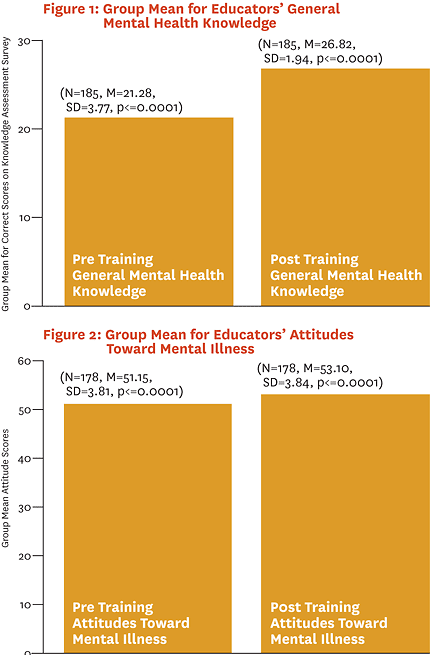
In other words, the data demonstrate that simply providing training to teachers on how to use the Mental Health Curriculum Guide resource and helping them integrate this resource into their existing professional competencies has significant and substantial positive impacts on their own mental health literacy. This occurs without creating and delivering a stand-alone teachers’ mental health program or exposing teachers to non-contextualized, expensive and less impactful universal approaches. Participants further provided overwhelmingly positive comments on this training program. Some examples from teachers include:
Thank you for a curriculum that includes mental health! This guide and in-service is are great resources.
I truly appreciate all of the resources. I feel I wasn’t simply told to be better, but shown how to teach mental health better. I wish all outcomes were addressed in this manner. Thank you. Very interesting information and useful resources.
In addition, two large independent research studies conducted in Ontario have demonstrated similar significant and substantial impacts of the classroom curriculum approach using the Mental Health Curriculum Guide on students. A study using a case-controlled cohort design conducted in a number of school boards demonstrated that students exposed to the curriculum in the classroom substantively improved their mental health literacy, showing increased knowledge and decreased stigma from pre-test to post-test.[10] These positive impacts in knowledge and attitudes were maintained over a two-month follow-up. Further, a randomized, controlled trial in 25 Ottawa schools demonstrated similar outcomes, as well as significant improvement in student-reported help-seeking efficacy.11 Qualitative feedback from teachers was positive and identified ease in classroom application and no demonstrated negative outcomes. Quotes from teachers and students include:
Before this mental health unit, I thought that people with a mental illness couldn’t have a normal life and couldn’t have any friends. I also thought that people with a mental illness could get better if they wanted to but I know that they can’t do it by themselves and they need help from family, friends, counselors etc. – an Ontario student
Thank you for a very meaningful and informative session. Very valuable and important information for all teachers. – an Ontario teacher
Similar studies in other locations, including globally in countries as different as Malawi and Brazil, have been implemented and are awaiting completion.
How to Access the Mental Health Curriculum Guide
- The Mental Health Curriculum Guide resource is now available online: http://teenmentalhealth.org/curriculum
- The Guide includes lesson plans, classroom resources (e.g. first-person and animated videos), teaching resources (e.g. handouts and web-based directions for information retrieval), student evaluations, etc. Further enhancement of this material for use by teachers is underway with the development of an enhanced pre-screened and validated resource kit that will be posted soon.
- Information about training programs for use of the Mental Health Curriculum Guide is also available through: www.teenmentalhealth.org
- For more information, email inquiries to: info@teenmentalhealth.org
Overall, this approach to addressing mental health literacy as the foundation for mental health promotion, prevention and care in teachers and students is based on utilizing the existing ecological strengths of schools and the professional competencies of teachers instead of parachuting costly stand-alone programs into schools. It provides a relatively simple, economical and effective method to improve knowledge, decrease stigma and enhance help-seeking efficacy in both teachers and students. This approach mirrors the method by which teachers usually learn and prepare for their teaching, and by integrating student learning about mental health into existing curriculum, it avoids isolating mental health from everyday school activities. The creation of school board-based training teams that can meet training needs in-house enhances the probability of sustainable integration at minimal cost. Positive results have been found in every school in Canada where the resource has been applied and evaluated, thus making it feasible for use across the diverse Canadian mosaic.
Photo: iStock
First published in Education Canada, March 2014
EN BREF – La sensibilisation mondiale croissante à l’égard de la nécessité de porter attention à la santé mentale des jeunes dans un cadre scolaire s’étend actuellement au Canada.
L’article décrit La santé mentale et l’école secondaire – Guide de formation, une ressource nationale en matière de formation en santé mentale à l’école qui a été instaurée et a fait l’objet d’études dans des écoles secondaires (9e et 10e années / 3e et 4e secondaire) partout au Canada. Il est question du contenu du guide et de ses processus d’instauration qui peuvent être contextualisés pour répondre aux besoins des élèves, quelle que soit l’école fréquentée. L’article présente également les plus récents résultats de recherche et d’évaluation de l’application du guide, lesquels font état de connaissances considérablement enrichies, d’une stigmatisation moindre et d’une efficacité accrue de la recherche d’aide chez les élèves et les éducateurs qui l’ont utilisé dans le cadre du curriculum scolaire habituel.
[1] S. Kutcher and A. McLuckie for the Child and Youth Advisory Committee, Evergreen: A child and youth mental health framework for Canada(Calgary, AB: Mental Health Commission of Canada, 2010).
[2] School-Based Mental Health and Substance Abuse Consortium (supported by the Mental Health Commission of Canada), Survey on School-Based Mental Health and Addictions Services in Canada (April 2012).
[3] The Canadian Association of Paediatric Health Centres, The National Infant, Child, and Youth Mental Health Consortium Advisory, and The Provincial Centre of Excellence for Child and Youth Mental Health at CHEO, Access and Wait Times in Child and Youth Mental Health: A background paper, for the Institute of Human Development, Child and Youth Health (Oct. 2010).www.excellenceforchildandyouth.ca/sites/default/files/policy_access_and_wait_times.pdf
[4] K. Weare and M. Nind, “Mental Health Promotion and Problem Prevention in Schools: What does the evidence say?” Health Promotion International 26, Suppl. 1 (Dec. 2011): i29-69.
[5] Y. Wei, J. Hayden, S. Kutcher, A. Zygmunt, and P. McGrath, “The Effectiveness of School Mental Health Literacy Programs to Address Knowledge, Attitudes, and Help-Seeking among Youth,” Early Intervention Psychiatry 7, no. 2 (May 2013): 109-21.
[6] Y. Wei, S. Kutcher, and M. Szumilas, “Comprehensive School Mental Health: An integrated ‘School-Based Pathway to Care’ model for Canadian secondary schools,” McGill Journal of Education 46, no. 2 (2012): 213-229.
[7] R. C. Kessler, P. Berglund, O. Demier, R. Jin, K. R. Merikangas, and E. E. Walters, “Lifetime Prevalence and Age-of-Onset Distributions of DSM-IV Disorders in the National Comorbidity Survey Replication,” Archives of General Psychiatry 62, no. 6 (June 2005): 593-602.
[8] S. Kutcher, Y. Wei, A. McLuckie, and L. Bullock, “Educator Mental Health Literacy: A program evaluation of the teacher training training education on the mental health & high school curriculum guide,” Advances in School Mental Health Promotion (2013); A. McLuckie, S. Kutcher, Y. Wei and C. Weaver, “Sustained Improvements in Students’ and Teachers’ Mental Health Literacy with Use of a Mental Health Curriculum in Canadian Schools,” unpublished manuscript (Sun Life Financial Chair in Adolescent Mental Health, 2013).
[9] Sun Life Financial Chair in Adolescent Mental Health, “Mental Health & High School Curriculum Guide Training Report for Nova Scotia,” (2013).http://teenmentalhealth.org/images/uploads/mental_health_curriculum_guide_training_NS_final_July_25_2013.pdf
[10] McLuckie et al., “Sustained Improvements in Students’ and Teachers’ Mental Health Literacy.”
[11] R. Milin, S. Kutcher, S. Lewis, S. Walker, and N. Ferrill, “Randomized Controlled Trial of a School-Based Mental Health Literacy Intervention for Youth: Impact on knowledge, attitudes, and help-seeking efficacy” (poster presentation at American Academy of Child and Adolescent Psychiatry 60th Annual Meeting, 2013).
-
Teen Stress in Our Schools
Comments Off on Teen Stress in Our SchoolsFor the average high school student, life is full of potential stressors. In a recent survey, our research team asked over 900 Grade 7 students what they identified as the biggest stressors in their lives. “Academic difficulties” was reported as the greatest stressor by 33.2 percent of students, followed by “conflict with parents/family” (31.4 percent), “conflict with peers” (20.7 percent), and “conflict between parents” (13.9 percent). Of particular concern is how these students are coping with their stress.[1]
-
Journeys in Youth Mental Health
Comments Off on Journeys in Youth Mental HealthYoung people with mental health challenges are among our most vulnerable students in Canada. They are also among our most interesting and courageous. Their lives can be difficult and are too often stigmatized, even though so many are working hard to change this. Many of these young people are navigating a sea of additional troubles such as poverty, loneliness, marginalization, fear and frustration that lead to the spirals of decline[1] and cultures of silence[2] that they have so eloquently detailed for us.
We know a lot about the alarming trends in mental illness in the lives of modern Canadian youth. The Canadian Mental Health Association[3] now estimates that 10-20 percent of Canadian youth are affected by a mental illness, with 3.2 million (12-19 years) at risk for developing depression. Others estimate that 30 percent of students suffer from psychological distress[4] with only a minority (1 in 5) receiving formal supports, which suggests why Canada’s youth suicide rate is now the third highest in the industrial world.[5] We also know that the growth in social inequality and poverty are closely related to mental health for youth.[6] In fact, youth from impoverished backgrounds are three times more likely than their wealthier peers to experience mental health challenges. The most pressing factors in poor mental health include poverty, learning difficulties, abuse/neglect, isolation, lack of support, and lack of access to quality health care and education.[7] However, we know far less about the journeys that these young people are taking toward better mental health.
Journeys: knowing young lives
I knew that it wasn’t just being depressed for a few days, but for a long period of time being depressed… everyone says that getting help is easy, but it really isn’t, like when you get help, you have to wait so many months to actually get the help. So I just feel like nobody does anything for those few months while you’re waiting, and that’s what people really need to do.
And when I went to my cousin, because I could trust her, and tell her I was depressed, she said, ‘What do you have to be depressed about?’ and that’s so depressing, because it’s like, do you not realize that being 16 is hard?
Few researchers and educators have yet had the opportunity to focus on the journeys and experiences of these remarkable young people. Most research illustrates the important, if paradoxical, processes of diagnosis and treatment. But too few young people receive either, and diagnoses can also lead to labeling and further stigmatization. Moreover, what awaits too many kids and families is a heartbreaking experience with a youth mental health system that is fractured and ruptured.
Where have these kids been and where are they going? As educators and parents, this is our shared concern. How do we best assist in the life journeys of these young people? Mapping the journeys of young people into and out of mental health care is one good way of seeing the complexity of these young lives and the best ways to help. Journey mapping is a newer approach to research that gathers stories from youth relating to their experiences and provides visual maps of how they have navigated the system. This strategy is now used by international researchers to identify barriers and facilitators in access and care for mental health.
Our systematic review of this international research literature on journeys in youth mental health yielded 25 recently published English-language journal articles from Canada, Italy, Eastern Europe, New Zealand, the U.S., the U.K., India and China. Three themes arose in our synthesis of this literature:
1. youth journeys in mental health are non-linear in character;
2. barriers and facilitators exist at personal and systemic levels and often in paradoxical fashion; and
3. schools and teachers are crucial in this journey.
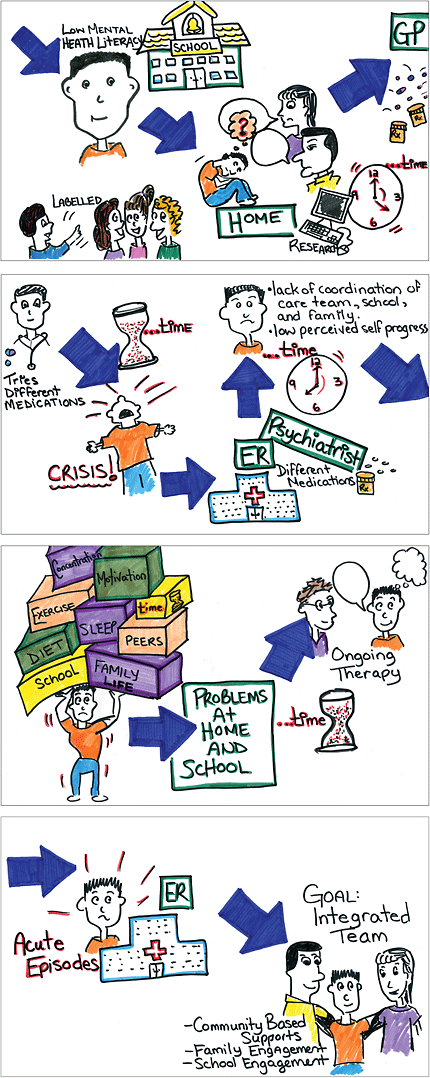
Young people take individualized and dynamic journeys to seeking mental health supports.[8] These journeys often start long before they receive formal care from a primary health care provider and with their own early experiences and interactions at home and in school.[9] The non-linear character of these journeys shows us where we could best intervene in a too-often fractured system. We can see in the visual maps how the elements of the system become tied together in a back-and-forth motion as youth and families move in and out of primary health care, school supports, acute health care, and so forth. The recent work in patient journey mapping from Kamloops, B.C.[10] offers an excellent illustration of the journey, with long-term wait times and breaks in the continuity of care. We have further developed this model to assemble a journey map that represents lessons and themes found in our review of literature (see illustrations 1 to 4).
Our image shows the paradoxical journey model that we have detected and demonstrates how personal relationships and systemic structures encountered by youth can exacerbate or alleviate problems that accompany mental health challenges. For example, while there is a shortage of skilled mental health professionals in some areas, most work very hard on a daily basis to go above and beyond their job descriptions in providing excellent care despite the heavy loads. Another example of the paradox is that while poverty stretches the resources and time of these families, many parents are going to extraordinary lengths to advocate for their children in the face of great adversity. Thus, mirror-image supports exist for each barrier, as evidenced in a surprising range of facilitators from which we must launch meaningful change for these young people. Teachers, parents, friends and mental health professionals could form a core community of helpers.
Notably, young people also identify their schools as significant in their journey. In some cases, the school is not seen as a safe or supportive place to be and/or to seek advice or information. School peers are identified as “silent actors” in the journey, with a role that remains both unclear and complex. The role of school peers in inciting stigmatization is clear; however there are also signs of school peers acting in supportive and assistive roles. There is a need for schools to do better in providing these safe spaces for knowledge about mental health.[11]
“Taking mental health to school”
With the complexity and nonlinearity of the youth journeys in mental health, we must ask if and how the school can best provide a reasonable space for prevention and assistance. When youth arrive at school each day, they enter the halls and classrooms with the lives they are immersed in. These lives collide with the range of human and structural relationships that make up the everyday spaces of school. We know that these students are asking for early and local access to mental health supports, a place where they belong without stigma, and a school environment that will both increase mental health awareness and decrease stigma.
An important Canadian study was recently released from the Centre of Excellence of Child and Youth Mental Health in Ontario in which the authors provide an overview of the best ways we can “take mental health to school.” The evidence shows how schools are both necessary and helpful in addressing youth mental health. Not surprisingly, the report finds that “student mental health needs exceed the current capacity of school systems to respond adequately. Education leaders are looking for: leadership and coordination, professional development, and guidance in selecting programs and models of cross-sectoral service delivery…”[12] Programs found to be of use in schools relate to stress or anger management, reducing violence and substance abuse, and modifying the school environment to promote self-awareness and positive relationships. School boards were directed to implement such programs with fidelity and in collaboration with local mental health agencies and parents.
In our recent project on mental health in schools, the investigative team from the Hospital for Sick Children and University of Prince Edward Island took the pulse of students and educators regarding mental health literacy.[13] Working with a mural created by eight young people who experienced mental illness, we installed their original image in six secondary schools in Ontario and four in P.E.I., to invoke a conversation about mental health literacy (see photo on page 4). The image has now been viewed by approximately 7,000 students and teachers in Canada who have shared with us a meaningful conversation about mental health and stigma. The installation of the mural was somewhat different in each school, with many young people and teachers assisting us in finding a prominent place for it to hang and acting as ambassadors for the mural during the two weeks of installation in each school. The installation was followed by a large group “talk back” session in the form of an assembly in which the Canadian Mental Health Association joined us in leading a session about the mural and about youth mental health. This was followed by focus group conversations with students and educators (separately) and by analysis of the writings and comments they provided on large sheets of paper and comment cards left for this purpose.
Early analysis of the data from P.E.I. schools suggests that the majority of students and educators were grateful for the opportunity to have a mental health conversation. To many, it seemed long overdue. They also commended the young artists for their demonstration of great courage in sharing their mental health journeys in artistic form. In fact, some of these schools have now taken on similar art-inspired projects with their own students for Mental Health Awareness Week. The students appreciated the use of art in depicting the complex experiences of young people in mental health, as they felt that it allows for deeper understanding and interpretation of the experiences they are facing. Many students also expressed that the mural and conversation in the school provided reassurance that they were not alone in their mental health experiences. They reported a clear desire to learn more about youth mental health and illness. Students wanted the opportunity to have further discussions, learn about the clinical aspects of mental health and illness, and better understand what services are available to them in school and community. They expressed a strong need to better address and eliminate stigma in their schools and communities.
I think the mural spoke of issues that people struggle with. I think the best ways to get knowledge are by having small meetings and discussing it to give everyone the chance to speak in a small group. I think art is a beautiful and approachable way to discuss and get knowledge on mental health. – student
The thing for me is that, I am not trained in that [mental health support]. We are talking about kids, but let’s face it, there are teachers and adults in the community who have all these issues… And my curriculum doesn’t really allow for a broad conversation, right? So I see the mural as a stimulator of mental health discussion and it shows the point of having the conversation, and how we keep that going.” – educator
Our review of the literature and our interviews with students and teachers in the mural project uphold important messages about youth journeys in mental health. We contend that Canada is moving along a good path in addressing the alarming trends in youth mental health. We offer youth journeys as a tremendous jumping-off point in examining the complexity of these young lives and in pointing to promising ways to support them. There is need to better coordinate services, reduce wait times, meaningfully address stigma and open up new spaces for families, schools, and mental health professionals to assist youth in their journeys to mental health. Their experiences call us to action in breaking the spirals of decline and cultures of silence that society has left them to negotiate.
Next Steps
We are pleased to announce ACCESS-MH,[14] a five-year project in Atlantic Canada, funded by the Canadian Institutes of Health Research. Our study applies youth mental health journeys with related statistical information from Prince Edward Island, Newfoundland, New Brunswick and Nova Scotia. Building upon the knowledge and methods now emerging in youth mental health journeys, this project includes conversations with parents, teachers, primary health care providers, and community members. We also invoke arts-based methods of understanding experiences and mapping journeys. The variety of participants will further identify complex problems youth face in seeking mental health care. Our work aims to better assist in the creation of a more coherent network of support and programming for our vulnerable and courageous Canadian youth.
Photo: Katherine Boydell
First published in Education Canada, March 2014
EN BREF – La santé mentale des jeunes est une préoccupation de taille de la société et des écoles canadiennes. En fait, il s’agit d’une question dont on parle de plus en plus dans le monde entier. Ce texte présente une nouvelle façon prometteuse de comprendre le problème en plaçant les parcours de vie des jeunes au centre de notre attention. Nous ouvrons ainsi de nouveaux espaces où les écoles peuvent collaborer avec des partenaires de la collectivité et du domaine médical de la santé mentale pour constituer un système plus cohérent destiné à entourer la vie complexe et courageuse de nos élèves.
[1] K. Tilleczek and V. Campbell, “Barriers to Youth Literacy: Sociological and Canadian insights,” Language and Literacy 15, no. 2 (2013): 77-100.
[2] S. Kutcher and A. McLuckie, Evergreen: A child and youth mental health framework for Canada, for the Child and Youth Advisory Committee, Mental Health Commission of Canada (Calgary: 2010).
[3] Canadian Mental Health Association, Fast Facts About Mental Illness. www.cmha.ca/media/fast-facts-about-mental-illness/#.Us1uj7SmYk8
[4] A. Paglia-Boak, R. E. Mann, E. M. Adlaf, J. H. Beitchman, D. Wolfe, and J. Rehm, The Mental Health and Well-being of Ontario Students 1991–2009: Detailed OSDUHS findings (Toronto: Centre for Addiction and Mental Health, 2010).
[5] E. J. Costello, H. Egger, and A. Angold, “10-year Research Update Review: The epidemiology of child and adolescent psychiatric disorders: Methods and public health burden,” Journal of the American Academy of Child and Adolescent Psychiatry 44, no. 10 (2005): 972–986; CMHA, Fast Facts, www.cmha.ca/media/fast-facts-about-mental-illness/#.Us1uj7SmYk8
[6] For a current review of literature linking social inequality, poverty and mental health see Tilleczek, Ferguson, Campbell and Lezeu (in press), “Mental Health and Poverty in Young Lives: Intersections and directions,” Canadian Journal of Community Mental Health.
[7] E. L. Lipman and M. Boyle, Linking Poverty and Mental Health: A lifespan view (Ottawa: The Provincial Centre of Excellence for Child and Youth Mental Health at CHEO, 2008).
[8] K. Boydell, R. Pong, T. Volpe, K. Tilleczek, E. Wilson, and S. Lemieux, “Family Perspectives on Pathways to Mental Health Care for Children and Youth in Rural Communities,” Journal of Rural Health 21, no. 2 (2006): 182-188.
[9] S. De la Rie, G. Noordendos, M. Donker, and E. van Furth, “Evaluating the Treatment of Eating Disorders from the Patient’s Perspectives,” International Journal of Eating Disorders 39, no. 8 (2006): 667-676.
[10] S. Scott, S. Sze, K. Weatherman, and R. Gorospe, “Kamloops Patient Journey Mapping Report, Child and Youth Mental Health” (unpublished manuscript, 2013).
[11] K. M. Boydell, T. Volpe, B. M. Gladstone, E. Stasiulis, and J. Addington, “Youth at Ultra High Risk for Psychosis: Using the Revised Network Episode Model to examine pathways to mental health care,” Early Intervention In Psychiatry 7, no. 2 (2013): 170-186.
[12] D. Santor, K. Short, and B. Ferguson, Taking Mental Health to School: A policy-oriented paper on school-based mental health for Ontario (Ottawa: The Provincial Centre of Excellence for Child and Youth Mental Health at CHEO, 2009), 6.
[13] K. Boydell, “Using Visual Arts to Enhance Mental Health Literacy in Schools,” in Youth, Education and Marginality: Local and global expressions, eds. K. Tilleczek and B. Ferguson (Waterloo: Wilfrid Laurier University Press, 2013).
[14] Atlantic Canada Children’s Effective Service Strategies in Mental Health is a CIHR-funded project lead by Dr. Rick Audus (MUN), Dr. Kate Tilleczek (UPEI), Dr. Scott Ronis (UNB) and Dr. Micheal Zhang (SMU).
-
World Traveler
Comments Off on World TravelerI love maps! In my filing cabinet at home I have multiple maps from places I have been and places I would love to see. I dream of traveling around the world, and in my classroom I try to inspire my students’ curiosity about the world.
Three years ago, I began the World Traveler project, which is based on the Flat Stanley books by Jeff Brown, with my Grade 6 students. This is a project that is part tourist and part chain letter. Here’s how it works:
My students’ first task is to find someone they know, or someone their parents know, outside of their hometown – the further away the better. Once the students locate an initial contact, they start making a paper character to act as their traveler. Much like the old custom of travelers in days past presenting a letter of introduction, my students write a letter introducing their paper traveler to all the people their character might encounter. Each traveler is enclosed in a school notebook with the student’s introductory letter and a note from me. In my letter, I ask each person who receives this journal to take the traveler around their location, documenting the visit with a written account and pictures and/or tourism pamphlets of their locations in the notebook. I then encourage whoever receives the journal to pass it on to someone else they know. The notebook acts as the passport chronicling the journey of our travelers. Each participant is asked to send a postcard with a small update of our travelers’ progress around the world to the class. I also ask whoever has the traveler on June 1st of that year to return it to our school.
I wanted my students to see multiple adventures through the eyes of their paper stand-ins. The students and parents of my first group embraced the idea, and we started making our travel buddies. At the front of my classroom waited an empty world map, begging to be filled with pins marking the path of our travelers.
By the end of that first year of “traveling,” our characters had seen the depths of the Grand Canyon and the heights of the Himalayas. That first year was a fantastic success. I knew I had to do it again.
This past year when I moved schools and grades, I wondered how my project would succeed. My Grade 3/4 students were curious, the parents were receptive, and so we made our travelers, packed their books, and sent them into the world.
Just as before, postcards started coming in the mail and the world map began filling with pins.
The first postcards came from North America and Europe. Pictures of the London Eye, Venetian gondolas, and the faces of Queen Elizabeth II and Pope Francis were among the early arrivals. Halfway through the year, images of Egypt and Machu Pichu in South America arrived. By the end of the year, some of our travelers had made it to the pyramids of Egypt, Jerusalem, Australia, the Great Wall of China, and the mythical lands of Middle Earth in New Zealand. Some lucky travelers had lounged on the beach in Cuba and Jamaica, and caught a parade at Walt Disney World. One traveler ventured to Cape Agulhas, the southernmost point in Africa, to see where the Atlantic Ocean met the Indian Ocean.
The kids were thrilled to hear about the latest adventures of their world travelers, and we started learning about the countries where our travelers were sightseeing. The students were making connections to the world beyond the classroom.
The last weeks of school were filled with wonder as the travel journals and the paper travelers started to return home. Their journeys were detailed for the students in writing and with accompanying photos by the willing participants.
This current school year I am back teaching Grade 5/6 in a new town, with a chance to try my project on a new group of students. This year I plan to create a website for our travelers and their friends to upload pictures and blog about their adventures. My Grade 3/4 students had travelers that made it to six continents; I wonder if this time we could make it to Antarctica?
Getting started
To start your own World Traveler project, begin by reading Flat Stanley by Jeff Brown to your students. Then send a letter home to your parents explaining your project and asking them to locate someone they know, either family or friends, who can help be a part of this project.
At school, have the students create a paper character. I have always provided the students with the outline of a paper character; they colour and decorate it, then I laminate it for travel. After the character is created, I have the students write an introductory letter about their character, describing the unique characteristics of their paper friend. This allows for a couple of assessment opportunities in Language and Visual Arts. When that is done, the letter is stapled to the first page of each student’s travel journal, usually a classroom notebook. On the cover I paste my letter explaining the project and the goal of continual travel for our friends until the first of June, which requires the initial participant to find someone else to forward the traveler to. The students take the journals home, and with their parents they mail them off.
This is a fun project, but it requires faith in others. Though all students send out a journal, sometimes we lose some world travelers in the mail. It is important to stress at the beginning that this can happen, but that we as a class experience the world through all our travelers.
Photo: courtesy Bill Gowsell
First published in Education Canada, March 2014
EN BREF – J’adore voyager, et pour aider mes élèves à s’ouvrir sur le monde, j’ai lancé un projet appelé World Traveler (voyageur du monde). Les élèves créent une voyageuse ou un voyageur de papier et amorcent son voyage en l’envoyant à une connaissance qui apporte ensuite le personnage de papier dans ses déplacements dans la ville où elle vit (et lors de tout autre voyage effectué), puis rend compte à la classe au moyen de cartes postales traitant des progrès du personnage voyageur. Les élèves rédigent une lettre de présentation décrivant leur personnage et, à la fin de septembre, ils postent à leur destinataire un paquet contenant la lettre, le personnage voyageur, un cahier et une lettre que j’ai rédigée. La classe attend ensuite des nouvelles des aventures.
Au début de juin, le trajet prend fin, les cahiers de voyage commencent à revenir à la classe et les élèves peuvent constater la grande distance parcourue par leur petite création.
-
Minding Your Mind
Comments Off on Minding Your MindRecently, in Canada and indeed globally, the unmet emotional and mental health needs of young people stand squarely in the spotlight. Many young people navigate the changes of adolescence well, yet some experience serious difficulty. Mental health problems such as anxiety and mood disorders, psychosis, eating disorders, personality disorders and substance abuse begin in childhood, during peaks in brain development and impacted by complex social contexts.[1] One in five Canadian youth is at risk for a mental illness,[2] while only 25 percent of youth get the help they need, in the way they need it.[3]
Stigma is a massive barrier for youth experiencing mental health challenges. It contributes to feelings of shame for being different and perpetuates silence. A young adult describes the burden of stigma during her extended high school experience: “You don’t know how to tell them (peers) and it’s not something they can visibly see is wrong with you… I wish I could go back now, stand in front of my class and just say, Hi I’m Paige and I have an anxiety disorder and that’s that.” Instead of finding support from her peers, she tackled completing high school – something that felt impossible – alone.
Removing the barriers of stigma requires increased understanding and improved recognition of mental health problems, and this can begin in the classroom by incorporating mental health content. A recent Canadian study found that older teens and young adults are most inclined to self-manage or seek support from friends or family before accessing more formal, traditional interventions for mental health care.[4] To support self-care, it is essential for adults and youth to be equipped with knowledge and resources to draw upon in their daily lives.
mindyourmind
Building this knowledge base early is one of the goals of mindyourmind, a not-for-profit program funded in part by the Ontario Ministry of Health and Long Term Care. The program recognizes that young people want credible information and provides a 24-hour-a day space – through a website and social media platforms – where youth can seek out resources about mental health that appeal to them. Resources on the website, designed to reduce the stigma associated with mental illness and increase access and use of both professional and peer-based support, are created in collaboration with youth. This partnership ensures that resources resonate with the user. By engaging youth in mental health promotion online and in person, mindyourmind promotes relevant mental health awareness and inspires youth to act, to “reach out, get help and give help” during difficult times.
Community partnerships
Responding to the need for resources, Learning Coordinators in the Thames Valley District School Board (TVDSB) in Southwestern Ontario approached mindyourmind to develop resources for Grade 11 Physical Health Education and Grade 9/10 Guidance and Learning Strategies. Over several brainstorming sessions, mindyourmind’s clinical and educational staff and TVDSB Learning Coordinators collaborated on the outlines of the “Minding Your Mind” lessons. The lessons are based on Ministry expectations and the unique needs of the TVDSB’s populations, and reflect a comprehensive view of mental health rather than solely a bio-medical model. A teacher’s guide is included in the lessons, which offers class discussion primers and activity extension suggestions.
The team decided on digital formats because it allowed for student-directed units and for information to be presented using multiple delivery methods, appealing to a variety of learning styles and differentiated learning. Existing interactive digital tools, previously created by mindyourmind’s youth-adult teams during intensive “charette” or design workshops, were integrated into the outlines of written content to provide different representations of facts about mental health. These tools and other resources find a permanent home on the mindyourmind website in addition to being used in other resources. One of the interactive tools in the Grade 11 lessons, “The Anatomy of a Panic Attack,” was co-developed earlier by a group of 10 youth aged 15-24 from across Canada and describes what a panic attack looks and feels like while offering suggestions on coping.
Existing and custom-created videos of youth discussing mental health issues provide concise information, and personal stories written by young people convey an authenticity that learners can identify with and learn from, allowing for reflection and a transfer of knowledge between youth.
Once the technical and graphic design team added their expertise, field-testing began. As part of testing, Learning Coordinators facilitated meetings between mindyourmind and TVDSB department heads, where lesson delivery was demonstrated. Questions were addressed and then feedback from classroom surveys was collected. During this phase, the Mental Health Commission of Canada[5] put out an offer to evaluate existing programs that aimed to reduce stigma in youth, and an evaluation of the Grade 11 Minding Your Mind lessons was accepted.
Evaluation of the Grade 11 lessons on stigma reduction
As part of the MHCC evaluation, Dr. Heather Stuart’s research team at Queen’s University found that the students’ attitudes moved toward understanding that the course of a mental illness is not entirely in one’s control. One student responded, “… it (having a mental illness) doesn’t make them any less than you.” Beliefs about the potential for recovery from a mental illness were shifted positively. The most positive shift for students occurred in a category focusing on unpredictability and social distance. Questions about unpredictability addressed the myth that all people with mental illnesses are unreliable or unpredictable. Questions about social distance asked about a person’s comfort with being a classmate with or even dating someone with a mental illness. A student responded, “They are normal people too and deserve respect.” Attitudes also changed around valuing socially responsible actions such as volunteering with a program that benefits people with a mental illness.
The changes in stigma and the increased social tolerance in student responses as a result of the Minding Your Minds lessons showed that this digital approach was effective. Together with the TVDSB Research Manager, mindyourmind co-presented preliminary evaluation results to the TVDSB Mental Health and Wellness Committee and then participated as Youth Team Advisors in the five-year School-Based Strategic Mental Health Plan.
In the classroom
Many positive responses indicated that the students enjoyed the delivery of the lessons. In a computer lab, students access and use the modules in either a self-directed or guided way, depending on teacher preference, to learn about and practice increased self-awareness through goal-setting, decision-making, and interpersonal skill building. Students explore the positive and negative effects of stress, describe the influence of mental health on overall well-being, and encounter personal stories about young people dealing with mental health issues ranging from everyday stress all the way to specific illnesses such as anxiety and schizophrenia.
The digital format is designed to meet youth “where they are,” in terms of readiness and learning preferences. Students determine the speed of learning and return to previously viewed materials, encouraging self-regulation and responsibility. Assessment for and as learning are dispersed throughout units, prompting learners to reflect and to review where necessary. Evaluations are differentiated based on learning preferences, allowing students to work to their strengths to demonstrate learning.
Students taking next steps
Using a format that builds on the pillars of youth culture (e.g. music, fashion, technology, art, sports), the modules scaffold learning about mental health in relatable, relevant and practical ways using materials co-created by their peers. Students are better informed about mental health issues and know where to go later if and when information is needed for themselves or for friends. Lessons introduce students to resources in the community as well as mindyourmind’s website. Through the lessons, students see the positive results of their peers’ volunteering in the community. At the end of the lessons, students are invited to initiate activities and get involved in their own personal networks, schools or wider communities to make change.
The most effective change happens when youth, educational teams and community partners work together. In order to engage youth in the discussion, we need to start where they are, using ever-changing youth culture as an entry point for partnerships and in the classroom to participate in dialogues that concern their health, and to build the capacity to reach out, get help give help.
Photo: Ethan Myerson (iStock)
First published in Education Canada, March 2014
EN BREF – L’amélioration des connaissances en santé mentale constitue une façon essentielle de répondre aux besoins non comblés des jeunes en matière de santé mentale. Les jeunes, les équipes pédagogiques et les partenaires communautaires peuvent travailler ensemble pour réduire la stigmatisation et habiliter les enseignants et les jeunes. Grâce à un partenariat entre mindyourmind, un organisme communautaire axé sur l’engagement des jeunes, et le conseil scolaire local, des leçons numériques ont été instaurées en 9e, 10e et 11e années. Une évaluation réalisée par l’initiative « Changer les mentalités » de la Commission de la santé mentale du Canada a constaté des changements en matière de stigmatisation et une tolérance sociale accrue dans les réactions des jeunes par suite des leçons, indiquant que l’approche fonctionne.
[1] T. Paus, M. Keshavan and J. N. Giedd, “Why do many psychiatric disorders emerge during adolescence?” Nature Reviews Neuroscience 9, No. 12 (2008): 947-957.
[2] Canadian Psychiatric Association, Youth and Mental Illness (2013). http://publications.cpa-apc.org/browse/documents/20
[3] Statistics Canada, Canadian Community Health Survey: Mental health and well being (2002). www.statcan.gc.ca/daily-quotidien/030903/dq030903a-eng.htm
[4] M. Marcus and H. Westra, H., “Mental Health Literacy in Canadian Young Adults: Results of a national survey,” Canadian Journal of Community Mental Health 31, no. 1 (2012): 1-15.
[5] Mental Health Commission of Canada, Opening Minds. www.mentalhealthcommission.ca/English/initiatives-and-projects/opening-minds?routetoken=4e7e3879325d7eb9d62c51a03176d8ac&terminitial=39
-
Let’s Continue to ‘Rock the Boat’
Comments Off on Let’s Continue to ‘Rock the Boat’As you can see by the barriers to change identified at our Calgary workshop, they’re not new, and they certainly weren’t that hard to identify, so how is it that we still struggle to find ways to overcome them?
-
CBE Students Identify Barriers to Change in Education
Comments Off on CBE Students Identify Barriers to Change in EducationCBE Students Identify Barriers to Change in Education, from CEA’s Calgary Workshop, October 21-22, 2013.
https://vimeo.com/88086425
-
The Corporate Mentality: Why the CCCE Will Probably Never Understand Why I Teach.
Comments Off on The Corporate Mentality: Why the CCCE Will Probably Never Understand Why I Teach.On January 23rd, the Canadian Council of Chief Executives (CCCE), spurred into action by recent PISA results, released a report on how teachers should be paid. The author, Sachin Maharaj, held to a fairly basic premise. Students do well when taught by effective teachers, but all teachers receive pay raises in the same manner.
(more…) -
Outside the Box
Comments Off on Outside the BoxCan you remember what it felt like to be a kid exploring the natural world? What if that feeling could be brought to school? If children had an opportunity to learn in a natural setting, what could that mean for their academic performance?
A recent Ipsos Reid poll shows that 97 percent of adult Canadians agree that nature is important to their family’s well-being, and 87 percent felt that given the choice, they would prefer to spend family time outdoors in nature, as opposed to indoors. Overall, most of these adults agreed that the more connected they feel to nature, the happier they are. If Canadians – young and old – are indeed happier while in nature, an outdoor classroom initiative could be exactly what’s needed for a generation that often struggles to find a connection to, or even opportunities to explore, nature.
Today, work life and hectic schedules often take precedence over making time for outdoor unstructured play. Moreover, what was once considered safe for youngsters (like heading out on your bike with a buddy for the day) is often now seen as requiring adult supervision. Modern urban life has drastically diminished children’s opportunities to explore nature on their own or with the family, at a time when children need it more than ever.
Author Richard Louv writes of his concern for children, drawing links between lack of exposure to nature and adolescent hardships like obesity, attention disorders and depression. Louv, author of Last Child in the Woods: Saving our children from Nature-Deficit Disorder, advocates early contact with nature and says that it’s our job to pass an appreciation of nature on to our children. He writes, “These are the moments when the world is made whole. In my children’s memories, the adventures we’ve had together in nature will always exist.”[1]
Louv also explores the idea of a nature-based education and what trading classroom walls for shrubbery and sunshine could do for a child’s ability or desire to learn. “An environment-based education movement – at all levels of education – will help students realize that school isn’t supposed to be a polite form of incarceration, but a portal to the wider world,” he notes in his book.[2]
The benefits of spending more time in nature go beyond enjoyment. Major physical and mental health benefits can be attributed to time spent outdoors. Jules Pretty and her colleagues, authors of Nature, Childhood, Health and Life Pathways, found that time in nature can lead to reduced amounts of anxiety and stress and improved self-esteem. Their report looks at three stages of childhood and explores the implications of nature-based experiences within them. The authors found that enhanced experiences in nature can lead to positive behavioural changes, a better connection with the natural world, and an improved ability to learn.[3]
Bringing nature to school
Educators across Canada are taking note of these findings and are taking advantage of local parks and conservation areas to give their students a direct learning experience with nature.
Melissa Anema, from Lord Strathcona Elementary School in Vancouver’s Downtown Eastside, took part in nature-based programming for her Grade 4/5 class. She says her students have few opportunities to experience these natural connections because of their own concerns at home.
“For my students – most of whom struggle with basic issues like having a safe home to go to, having caregivers who are solid and dependable, having enough to eat throughout the day, etc. – learning about and connecting with nature is often very far from their inner-city reality,” Anema says.
Last fall, Anema and her class visited the North Vancouver Outdoor School through the HSBC Bank Canada Nature Days program outside of Squamish, B.C. She and her students waded among salmon in a nearby stream and learned about the species’ life cycle and the integral role it plays in Canadian ecosystems and businesses. “It was so incredible to see students who are so often withdrawn or just opting out of learning jump into learning like never before,” says Anema. “They were really left to think about human impacts on the fish, and why our interventions with the hatchery were necessary. It inspired a lot of thinking and discussion both during and afterwards.”
Time in nature can lead to reduced amounts of anxiety and stress and improved self-esteem.
In Toronto, the Toronto District School Board (TDSB) offers a “beyond the classroom” learning experience through an innovative outdoor enterprise known as Toronto Outdoor Education Schools (TOES). Offered for 11 different school subjects, TOES is available in day and overnight school program centres across the Greater Toronto Area. Both daytime and overnight offerings aim to connect children to the natural world, through a variety of outdoor, curriculum-based activities. One of these TDSB programs, Hillside Outdoor Education School, is located in Rouge Park, Canada’s largest urban park and an ideal setting for this kind of program.
But not all schools or school boards have the on-site resources or capacity to facilitate this kind of program. Some education- and nature-centred organizations have developed programming to help with this. Nature Days, an education initiative created by the Nature Conservancy of Canada (NCC) and Earth Rangers, provides adventures in conservation for school children at sites across the country. This youth-focused program brings Canadian students into nature to work among conservation biologists and learn first-hand how to care for some of the country’s most vulnerable natural areas.
Erica Thompson, Conservation Engagement Coordinator for NCC, highlights the important role that direct observation plays in learning, and notes that actually seeing, smelling and feeling the subjects under study allows children to learn on a whole different level. “Bringing children to nature reserves brings the classroom into the natural world. So learning about forests within a forest habitat, learning about wetlands by standing on the edge of one, and seeing a salamander under a log for the first time – these are the kinds of experiences that we hope inspire lifelong learning and curiosity about the natural world.”
Raymond Martynowski, a teacher at Chine Drive Public School in Scarborough, Ontario, recently attended a Nature Days event with his Grade 3 class and noticed a refreshing thirst for knowledge among his students.
“Our kids are going to be the stewards for our environment, for the future. And if they don’t have a personal connection to it – if they haven’t been out in nature – they don’t really know what they’re preserving and what they’re saving, or why it’s so important,” he says. “It really is amazing to see how excited the kids are just to see a spider in the grass, to touch a millipede, to pick up a leaf and look at the kinds of edges it has – you’d be surprised, you wouldn’t think they would be that excited, but when we’re here, out of the city, walking together, it’s just a different side of the student. It’s really nice to be able to see that.”
Engagement, participation, innovation, inspiration – these “extra-curricular” expectations could arguably be tackled by bringing more nature-based activities and programs to education. We have the tools; we just need to use them… outside.
Find a nature education program near you
Nature and outdoor education programs are offered by a variety of organizations. Here are a few national programs available across the country; you can also check for local programs which may be offered by camps, ecology groups, and conservation areas.
Outward Bound Canada
At OBC the wilderness is the classroom. OBC offers specialized school programs focusing on leadership, technical skills, teamwork and personal development. Each course is designed to teach students about their potential and instil a can-do approach to everything they do.
To learn more, visit outwardbound.ca
The Nature Conservancy of Canada
The NCC, in partnership with Earth Rangers and HSBC Bank Canada, brings classrooms to natural areas to learn about species and habitat conservation work. Led by conservation professionals, children are able to see, firsthand, what it means to preserve natural habitat. The program is available in Vancouver, Calgary, Toronto and Montreal and is generally offered to Grade 4 and 5 classes.
To learn more visit natureconservancy.ca
Forest School Canada
FSC works to connect youth with nature in an academic setting. FSC emphasizes outdoor learning at early, primary and secondary levels of education, and provides a natural setting for engaging, youth-focused learning activities. FSC is currently developing a full-fledged Canadian Forest School, and in the meantime is providing schools across Canada with the outdoor resources and curriculum materials needed to carry its lessons out independently.
To learn more visit forestschoolcanada.ca
Photo: iStock
First published in Education Canada, January 2014
EN BREF – Il existe d’abondantes indications selon lesquelles les enfants d’aujourd’hui sont privés de contact avec la nature et que le temps passé dans un milieu naturel procure une foule d’avantages émotionnels et cognitifs. Bien que l’enseignement en plein air soit souvent éclipsé par la multitude des autres exigences du curriculum, les enseignants qui réussissent à sortir leurs élèves du confinement de leur salle de classe soulignent avec enthousiasme la valeur de l’apprentissage de première main de la nature et de la conservation. À l’aide d’exemples donnés par l’auteur et amateur de nature Richard Louv et d’autres éducateurs canadiens, les auteurs incitent les éducateurs à profiter des ressources et de la programmation liées à la nature qu’offre leur collectivité et à aider leurs élèves à découvrir le milieu naturel.
[1] Richard Louv, Last Child in the Woods: Saving our children from Nature Deficit Disorder (New York: Algonquin Books, 2005), 316.
[2] Richard Louv, Last Child in the Woods, 226.
[3] J. Pretty, C. Angus, M. Bain, et al., Nature, Childhood, Health and Life Pathways (United Kingdom: University of Essex, 2009).
-
Finding My Voice
Comments Off on Finding My VoiceGrowing up, my parents would always say to me, “The education system is Canada is one of the best in the world.” Having moved to Toronto from Pakistan when I was only three years old, I remember little from my motherland, but have always had its cultural norms to adapt to in Western society. In my household, the stereotypical pressures of South Asian parents were always present. The highest level of academic achievement, long hours spent studying, and an interest in going to university were a just a few of the things my parents expected to see. My mother, who had been a teacher in Pakistan, always had high hopes of me becoming a doctor.
As for me, I had little interest in school until around the 11th grade. As a younger teenager growing up in the suburbs of Toronto, I became heavily influenced by hip hop music and culture. Everybody in my circle of friends was either rapping the lyrics of mainstream hip hop artists, playing basketball, or both. As time went on, I got into conflicts and arguments with my parents more and more frequently. At the peak of our conflicts, I completely rebelled against what they expected. Skipping classes, hanging out with the wrong crowd, making wrong life choices and burning bridges with students and teachers got me nothing but a bad reputation and two disappointed parents. I was that one classmate people did NOT want to be in a group project with. “Wali? Oh no, he won’t even show up, don’t bother asking him to be a part of our group,” they’d say. I was that kid with the baggy jeans, Kobe Bryant jersey and backwards baseball cap. I did it all because it was cool, to fit in, because the love and affection I wanted from my parents had drowned in a never-ending list of expectations. I remember hearing, “We sacrificed everything for you to have a better education, so that you could do whatever you wanted, and live a happy life.” I thought about that a lot. But things only got worse, and I genuinely felt like I was a letdown to my parents and younger siblings.
Then I got arrested in front of my mom. I was 15 years old. I’ll never forget the sound of the click of the handcuffs, or the tiny space in the back of the cruiser that made me feel like I couldn’t breathe, as I looked out of the window to see tears rolling down Mom’s cheeks. I admit, I cried that night in that cell. I thought about how fortunate I was, and how I was not nearly as thankful as I should be for all the blessings in my life. That summer, I chose to make rock bottom the foundation I would build my life upon. I made a genuine effort to be more open-minded, positive and proactive, to take charge of my life; but it was not something I could do alone.
In my Grade 11 year at Cawthra Park Secondary School in Mississauga, Ontario, I had two amazing teachers. It was my Law teacher, Ms. Kirby-McIntosh, who would spend her lunch hour talking to me in room 207 whenever I was having a bad day, mentoring me on how to better myself. It was my English teacher, Ms. Riley, who would stay and talk to me after classes about poetry and positive hip hop and tell me that I had the potential to share my story with my peers. Slowly but surely, the mentorship and guidance I received from these two teachers helped me grow and be successful, both inside and outside the classroom.
It takes just one adult to keep a kid off the streets. Be that one adult. When I enter the teaching profession, I know I will be. We can all do our part; it is about having a conversation with the students, not about them. Kids in positions similar to mine need it.
Photos: Courtesy Wali Shah
First published in Education Canada, January 2014
-
The Foundational “R”
Comments Off on The Foundational “R”“School days, school days
Dear old golden rule days
Readin’ and ’ritin’ and ’rithmetic
Taught to the tune of the hickory stick…” -
The Peaceful Village
Comments Off on The Peaceful Village“If I can hear the Djembe drum heartbeats, I know that I am close to The Peaceful Village. This is a place where I am loved even though I am so new to this place. Here I will become someone who will make my new community stronger.”
– Peaceful Village high school student
When you visit The Peaceful Village after-school program, you will find physics tutors who make high-level math sound beautiful and soccer players who defy those same laws of physics. Around every corner a symphony of languages erupts, because a microcosm of the world gathers in this remarkable place each day after school. The cultural commons in Canada is enriched each time a new family arrives, and although many former refugee youth face daunting barriers when they enter the public school system in Canada, many of their settlement stories are filled with powerful lessons about survival, love and resilience.
The Peaceful Village after-school program offers academic, social/emotional, arts, and sports programming across three sites to over 300 former refugee families who live in Winnipeg’s inner city. Since the program’s inception in 2009, every learning activity, conversation, meal, artwork, game, and musical note has been an attempt to contribute to the development of a more critically conscious, healthy, and joyful community. All Peaceful Village community members are strongly encouraged to bring their knowledge and talents to bear in order to enrich Manitoba’s extraordinary cultural mosaic. Program director Daniel Swaka describes this commitment in relation to his own story:
“As a former refugee and a newcomer myself, I easily identify myself with the youth and families and with all the challenges they are going through in their new communities. The diversity in The Peaceful Village speaks volumes. Everyone has a sense of belonging and all voices are heard. Despite enormous challenges, we believe in developing our program from the ‘roots up,’ meaning we build and evaluate our program with students and parents. It is not a top-down approach. And we stay connected with our families after their children leave the program. Once in the Village, always in the Village.”
This article examines a few of the lessons The Peaceful Village staff and partners have learned about making space for newcomer youth to thrive in their new school communities. The four essential tenets that frame our work are: start with questions; open multiple artistic learning opportunities; see the power in intergenerational learning; and challenge youth to drive program direction and evaluation.
Start with questions
The Peaceful Village program was born out of a participatory action research project conducted in 2009 by the Manitoba School Improvement Program (MSIP) to identify the barriers that were impacting former refugee families in two school communities. As MSIP consultant, I spoke with parents, youth, settlement service providers, community leaders, teachers, administrators, and representatives from Manitoba Labour and Immigration. The action research process yielded profound results. The program’s mission, key activities, and evaluations are directly connected to the testimonials given by the families and community leaders during the action research phase. We learned that inquiry processes can build coalitions of committed and passionate community and school advocates who are able to work in solidarity to reduce the “push-out” rates of former refugee youth in high schools.
One of my former Grade 10 students once told me that “the world would be a lot better if people asked questions before they started giving answers. We need to get curious.” Her profound comment continues to influence my work as a teacher, educational consultant, and researcher. All of our partners are continuously asked to critique the program in relation to their own understandings about the gaps in services for newcomer youth. These cyclical “problem posing” conversations ensure a higher degree of resonance between our mission and our practices, and have spread beyond the program itself. As one of our school partners, a high school teacher, stated, “Because of The Peaceful Village in our school, I have become a better informed and conscientious teacher who seeks out others’ viewpoints and experiences and attempts to include them in designing the curricula of my students. It has also caused me to be more aware of various communities in Winnipeg, whose populations are continually changing.”
Offer multiple artistic learning opportunities
Arts-based learning helps us to think more deeply about who we are in the world and the ways in which we are sometimes marginalized by other people or systems. In fact, powerful artworks can compel us to see the world as it is, and then incite us to work towards a more just and joyful future. We invite all Peaceful Village participants to use their wisdom, deeds, beats, and words to make their lives and their communities works of art. For example, The Peaceful Village Drummers use djembe drumbeats to make space for youth empowerment at various community meetings and celebrations. Our hip-hop dancers use movement and their music to disrupt negative social constructions of youth and resistance.
In The Peaceful Village program we also use the language of the theatre to address challenges that cause some of the difficulties in our lives. The students play theatre games, put on plays in the wider community, and invite audience members to wrestle with shared dilemmas. After a recent Forum Theatre performance that focused on the program participants’ struggles with language barriers, one of the youth actors discussed the impact of the work on her personal development:
“I learned a lot about myself and about a lot of other people. And kind of like I’m more to who I am going to become when I grow up. Like I said before, don’t be afraid to stick up for yourself, you know? And I think that really stuck to me. So I think that’s going to be one of the parts that’s going to make me who I am.”
See the power in intergenerational learning
We are committed to building assets across families. Each of The Peaceful Village sites operates a “Learning Centre,” which students and parents both attend to access tutoring and mentoring supports. Over 84 percent of the youth participants receive an additional 15 instructional hours per week. On Saturdays, parents and grandparents can gather together for three hours to work on their own literacy development goals. Children often learn new languages more quickly than their parents, so many newcomer children act as interpreters and liaisons for the family. This gives too much power to the children and undermines the leadership capacity of the parents. Therefore Peaceful Village staff members work hard to ensure the parents are able to access the settlement and literacy supports they need in order to be successful. As one of our parent participants noted,
“The multicultural parenting classes organized by Peaceful Village are really important for us to learn about many positive things. It helps me a lot to improve my language and it promotes my ability to deal with several school challenges that might come up in my family.”
Each month we host Village Kitchens to provide parents with another opportunity to advocate for their children’s education and to build relationships with other families in their school community. Interpreters are available to break down communication barriers. On average, there are over 150 parents and children who attend each community feast. According to one of our high school participants,
“The Village Kitchens are the best moments to be in The Peaceful Village. Every Village Kitchen is unique, different guest speakers motivate us, seeing my family present, the fun games, and different cultural displays from the villagers. The food is always great. I love the Village Kitchens.”
These events build bridges within the community and have fostered the development of several informal parent support networks. According to one of the parents in the program,
“The Village Kitchens give me an opportunity to visit the school of my daughter, and see her drumming. It gives me joy and smiles. Through the Village Kitchens, I get a chance to meet other newcomers and to make new friends.”
Youth-driven program development and evaluation
The Peaceful Village program is committed to youth empowerment and mentorship. A number of our junior community development tutors are graduates of the program. Just like our senior staff, all of our junior staff are multilingual and understand the unique challenges facing former refugee youth in Canadian public schools. One of our junior community development tutors eloquently explains the importance of mentorship and her commitment to the ethos of the program:
“In 2010 I started going to Peaceful Village as a student in order to get help with my studies. I loved Peaceful Village since it was the only place where I felt equal and I could fit in. There were many different students from very different countries and cultures. As a student in Peaceful Village I had some expectations such as having healthy snacks, and being tutored individually which I always got from PV. In 2011 I finished high school; before graduating high school I did some volunteering during my second year in PV helping other students. A few months after graduating, I wanted to be part of PV. It was easy for me to get to know other kids and give them the attention they deserve. My role in PV has changed. My past experiences as a new student taught me how to take care of these kids. I know what they are going through as new students and as people who are new to the country. I know what kind of help they need because I’ve just been through it and I’m also a student myself at university.”
Each Peaceful Village site has a youth leadership team that is responsible for ensuring students’ voices legitimately inform program planning and evaluation. Students collaborate with staff to assess the effectiveness of their tutoring supports in relation to their successes and challenges in their school subjects. Another example of student voice in the program is that all summer and spring break activities are determined by the youth participants. Students are able to provide their feedback in numerous ways. Program staff use image theatre, forum theatre, interviews, focus groups and photo-voice to gather information. Recently, several of the students used poetry to share their thoughts and feelings on the program (See Sidebar).
In Canada, public schools are one of the few social institutions where children, adolescents, and adults have the potential to gather together to become living expressions of the codified dreams and judgments about what constitutes the “good life.” They are places where students and families share a myriad of experiences that promote both community renewal and the individual questioning of the status quo. It is imperative that former refugee families are given the opportunity to influence the method and matter of education in their new communities.
The Peaceful Village
Very calming and silent
Until we arrived…
I’ve learned much
Quizzes were given
We got ice cream treatsThe village helped me
Solve many of my problems
Keeping me more calmI am not perfect
The people in the village,
No one is perfectIn my lonely room
Or in the peaceful village
I am not aloneMy experience here
Was a long learning pathway
It wasn’t easy
But totally worth it all
I love The Peaceful Village
– a Grade 7 Peaceful Village student
For more information about The Peaceful Village Program, contact Program Director Daniel Swaka at dswaka@msip.ca or 204-949-1858.
Photos: Courtesy The Peaceful Village
First published in Education Canada, January 2014
EN BREF – Le patrimoine culturel canadien s’enrichit chaque fois qu’arrive une nouvelle famille. Bien que de nombreux jeunes qui étaient des réfugiés soient confrontés à d’importants obstacles lorsqu’ils intègrent le réseau d’écoles publiques du Canada, de puissantes leçons de survie, d’amour et de résilience caractérisent souvent leurs récits d’adaptation. Cet article examine certaines des leçons apprises par le personnel et les partenaires du programme parascolaire The Peaceful Village au sujet de la façon d’encadrer les jeunes arrivants afin qu’ils s’épanouissent dans leurs nouveaux milieux scolaires.
-
A Parent’s P.O.V. on Inquiry-based Learning – Exploring Big Questions
Comments Off on A Parent’s P.O.V. on Inquiry-based Learning – Exploring Big QuestionsIn 2013, Saint Anne School (Saskatoon, SK) was recognized with a CEA Ken Spencer Award.
https://vimeo.com/84994741
-
More Students Share Reflections on What’s Standing in the Way of Change in Education
Comments Off on More Students Share Reflections on What’s Standing in the Way of Change in EducationThe following student reflections are based on their experiences as participants in CEA’s Calgary Conference, which was held in October 2013. Both students are part of Alberta’s Speak Out student engagement initiative and are current members of the Minister’s Student Advisory Council. The original blogs are posted on the Speak Out website.
-
Students Ask: Why So Few of Us at CEA’s Calgary Conference?
Comments Off on Students Ask: Why So Few of Us at CEA’s Calgary Conference?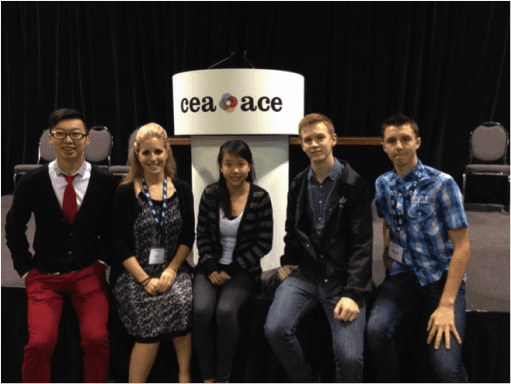
(from left to right) Student George W., CBE Learning Leader Deborah Bradbury and students Cynthia H, Matt N and Wyatt C at the CEA Conference in Calgary.
-
Game Changers
Comments Off on Game ChangersIn my first year as a high-school teacher I was des-perate for ways to hook the kids. I was tasked with teaching science and math to students who had failed multiple times in a credit recovery program. My meticulously crafted lesson plans were no match for an easily distracted 16-year-old.
I soon realized that one of the only things that would keep them engaged was a game. From memorizing Jeopardy clues to calculating probability in the throw of dice, these games added an element of frivolity around achievement, one that decoupled accomplishment from grades and peer judgment, but focused on score bars and points.
The games I used were pretty lightweight: they were engaging but not innovative. One of their favorites, Periodic Table Bingo, consisted of a bingo card filled out with symbols of elements. With games like these, there is no direct connection between the content of the game and the design of the game mechanics. The bingo cards could have been filled out with French vocab or math questions.
Contrast this with The History of Biology, a game from Toronto’s Spongelab Interactive with over 64,000 players worldwide. “Devices we use to advance the storyline are actually teaching them things about biology,” says game creator and Spongelab CEO Jeremy Friedberg. In the game, users are led on a DaVinci Code-like scavenger hunt around the web, decoding clues.
“One of the characters has hidden a secret message in a genetic sequence,” says Friedberg, “and the player has to translate it to get the message.” The game sends kids to “real websites, fake websites, and real websites hosting fake content, which teaches students digital literacy and research skills.” So not only are they learning about biology, but they are learning 21st century learning skills of use in any course.
This is the kind of innovative game that could not have existed in past generations. Digital technologies have allowed game design to reach beyond mere memorization and into the complex, multi-layered world of digital story-telling.
In 2011, game designer Jane McGonigal published Reality is Broken, where she outlined four simple rules that define a game: a goal, rules, a feedback system, and voluntary participation. Both Jeopardy and The History of Biology fit this definition, but clearly there is a difference between games that teach the recall of facts and those that teach higher-order thinking skills.
The Joan Ganz Cooney Center, based at children’s media powerhouse Sesame Workshop, published a paper in 2011 called “Games for a Digital Age.” They distinguish between short-form games, “which provide tools for practice and focused concepts,” and long-form games, “which are focused on higher order thinking skills.” This is a useful first distinction teachers can use when evaluating games for use in the classroom.
Other taxonomies apply, which can be used to filter games based on the learning goals of each lesson. Massive multi-player games like World of Warcraft are great at encouraging cooperation, whereas strategy games like Civilization emphasize decision making in the face of complexity. So-called “sandbox games” like Minecraft encourage creativity, curiosity and experimentation.
A theme that comes up with teachers who use long-form video games is teaching empathy. “When I first started teaching natural disasters in Grade 7, there were case studies in the textbook, or videos,” says Mike Farley, a high-school teacher at the University of Toronto Schools (UTS). “When we invite students to play a simulation like Stop Disasters or Inside the Haiti Earthquake, they are more immersed; there’s more of an emotional learning.”
When playing Inside the Haiti Earthquake, students can experience the event from the point of view of a journalist, a survivor, or an aid worker. They are given choices based on their character, which increases their level of engagement. “They start to understand the complexities of planning for a disaster or planning for the after-effects,” says Farley.
This effect was multiplied when the students worked in small groups, he adds, because they needed to justify their choices to the group members. “They couldn’t just click through the game to see what happened. There was a certain creative friction in the groups.”
The innovation here is not the high-quality digital interface, nor the idea of using games to represent experiences in the classroom. The innovation is in combining the two into a new pedagogical reality. Scenarios, set up so kids can experience different perspectives, are “played out” in a highly realistic, immersive environment, which serves to increase their feeling of connection to the topic.
A unique learning experience
UTS Principal Rosemary Evans sees these as “unique learning experiences,” different for each student with each session of play. “What excites me is the experiential component,” she says. “The simulations lead to an authentic experience, where the game environment represents different points of view.”
Justin Medved , the Director of Instructional Innovation at The York School, likes to talk about “layers of learning” taking place in the best games. “To what extent does the game offer an experience that offers some critical thinking, decision making, complexity, or opportunity for discussion and debate?” says Medved. The content is the first layer the students interact with, but meta-content skills can take longer to teach. Medved looks for “any opportunity for players to go out and do some research and thinking before coming back to the game.” Many games, says Medved, are super-fast and he tries to intentionally slow them down to allow for deeper thinking. “We want some level of learning to be slow, to discuss bias or different perspectives. Over time you can see a narrative unfolding.”
Reflection after game play is crucial to develop meta-cognitive skills related to regulation and understanding consequences: key skills that are just emerging in the teenage years. “The game can’t do it all for you,” says Medved. “We need to teach out the best bits of the game and know when to stop, when to take a break.” Innovative teachers like Medved have gone beyond the knee-jerk reaction against “kids staring at screens” and have developed rich curricula by using new and powerful game engines.
Music teachers around the world have been trying to strike a balance between hooking kids to games like Guitar Hero and picking up real instruments. Rock Band 3 has been the source of academic study on whether its use increases learning of music. One study from 2011 looked at 26 students in an after-school program structured around Rock Band. The study found a “a significant correlation between the number of Rock Band sessions and the overall scores on the traditional music assessments.”
The researchers found that it was not the mechanics of game play that allowed for musical learning (the instruments themselves are not “real” instruments but game controllers that look like the real thing). Rather, the development of the skills of listening to musical phrases was the key variable. This combined with a mechanism for immediate formative assessment by the game allowed for rapid improvement.
Kids are naturally pulled in by this emphasis on “play.” In New York City, the Institute of Play has created an entire school based on game mechanics called Quest to Learn. The school “mimics the design principles of games by framing every piece of the curriculum as a mission that involves game strategies like collaboration, role-playing and simulation.” Teachers send kids on “missions” to dig up content, much like The History of Biology treats knowledge discovery as a giant scavenger hunt.
This complex game-world is a long way from some of the first simulations, such as Where in the World is Carmen Sandiego?(1985) and Oregon Trail (1971). Educational games have since grown to a 2-billion dollar industry. Friedberg sees this market being fueled by the promise of differentiating instruction for students. “Games are the most sophisticated data collection tool we have ever found,” he says.
Properly constructed game engines, like Spongelab, can tell exactly when and where a student gets stuck on a concept, or how they find their way through game. “For the first time we have the ability to use data to understand how you learn, and what you need,” he says.
Game developers can collect millions of data points from the way a student plays a game and give pointed, personalized feedback, or direct students through content in a certain way. The innovative component is not the game itself, but the way the game is used to guide the child’s learning.
Friedberg points out the strong connection between in-game performance and real-life performance. Flight simulators, for example, can learn a pilot’s weaknesses and test those to a breaking point. “The simulator allows players to think critically in stressful situations, to be creative when things go wrong.” These critical failure scenarios cannot be tried out in real life. “Exploring, trying and failure are incredibly valuable,” he says. “Games allow us to train and assess those abilities.”
Games like this provide a safe place for students to grapple with complex topics and fail. In games, failure is expected. The consequence of failure in a game is that you hit restart and begin again. There are no grades inside games, no letters home to parents.
The question of whether to game or not game in class is not one of technology. It is one of pedagogy that starts and ends with the teacher. It is our job to provide a framework for deciding which games can be used in which contexts, and to use the best of the game world to inspire our students to higher-order thinking.
Illustration: Dave Donald
First published in Education Canada, November 2013
EN BREF – L’utilisation de jeux pour enseigner des sujets précis en classe n’a rien de nouveau. Les jeux peuvent toutefois servir, également, à développer des capacités de raisonnement d’ordre supérieur comme la pensée critique, la prise de décision, la créativité et la communication. L’enseignant doit contextualiser les jeux dits « de longue durée » et les incorporer à un robuste programme d’activités complémentaires. Des sociétés innovatrices produisant des jeux éducatifs développent du contenu numérique de grande qualité, en tenant compte des implications pédagogiques de l’intégration d’un jeu dans un programme éducatif existant. Les données recueillies de ces jeux numériques peuvent servir à personnaliser l’enseignement donné aux élèves qui bloquent sur certains concepts ou qui apprennent d’une façon particulière. Au fur et à mesure que les jeux se raffinent, l’enseignant doit approfondir sa connaissance de la façon dont les élèves les utilisent en classe.
-
Making Sense of Math
Comments Off on Making Sense of MathWhen I meet new people they often ask what I do for a living. When I tell them I am a high school math teacher they often either change the subject, looking at me like I must be a genius from a foreign planet, or they launch into a story about how horrible their high school math courses were. Both scenarios put me on edge. I am tired of both reactions. It’s time we all got over how bad math was then and instead focus on how great it can be now.
-
Cultivating an Opposable Mind
Comments Off on Cultivating an Opposable Mind“I learned I don’t have to sacrifice one option for another. I don’t have to settle. I can just create something new.”
– Salah A., Student at John Polanyi Collegiate Institute
The teachers at John Polanyi Collegiate Institute (JPCI) in Toronto were facing a not uncommon problem. Despite an established campaign of posters, assemblies and workshops promoting tolerance, homophobia remained a recurring issue at their school and students seemed largely indifferent to efforts to address it. Rethinking their approach, the teachers decided to engage an unusual group of consultants: Grade 12 students in the school’s Business Leadership class.
This flagship course, first taught in 2010, was developed through a partnership between the Toronto District School Board (TDSB) and the I-Think Initiative at the Rotman School of Management at the University of Toronto.[1] Students in the I-Think program learn concrete metacognitive tools, based on Rotman’s Integrative Thinking curriculum for executives and MBA students. It is an approach that focuses on constructing powerful new solutions to complex problems.
In response to their teachers’ challenge, the leadership students recommended a new framework for tackling prejudice at the school – one based on the recognition of their own values, experiences, and challenges. They did so by engaging in a profound reconsideration of their own points of view and by embracing a new way to think.
An Integrative Thinking process
Integrative Thinking began as an attempt to understand how successful leaders – in business and elsewhere – face their own critical challenges. Roger Martin, then Dean of the Rotman School of Management, set out to identify and teach a new set of reflective skills to business students hoping to solve their own tough problems. The successful leaders Roger met challenged conventional wisdom that tried to box them into unpalatable either/or choices. Instead, they found innovative ways to obtain the benefits of multiple, often seemingly incompatible, solutions.
Engaging in an Integrative Thinking process helps students to reconsider and combine opposing choices without having to choose one at the expense of the other. At its core, it challenges the mindset that innovation is an innate capacity and therefore not teachable – a belief that, according to Sir Michael Barber and his colleagues in their 2012 report, is one of the core obstacles currently facing education.[2] Integrative Thinking teaches that the seeds of innovation lie in cultivating an “opposable” mind – one that seeks to find creative resolutions inside competing ideas.[3]
That’s what the leadership students at JPCI were challenged to do. Over the course of six weeks, the business leadership students struggled to solve their teachers’ dilemma. The Integrative Thinking process helped them redefine their choices and reframe their problem from a constraining either/or choice into a creative design challenge. The following four steps capture the heart of the students’ process.
1. Construct a two-sided dilemma
The students were presented with a relatively unstructured problem: “How do we eliminate homophobia at our school?” Their teachers explained that they had previously launched an awareness campaign (in the form of anti-homophobia posters) and held assemblies to create more school cohesiveness, but that these approaches didn’t seem to have much effect. The teachers wondered if bringing anti-homophobia content into class would have more impact. Fundamentally, they were asking the students to choose how they should spend their time and energy to combat homophobia: in class or out of class?
Integrative solutions emerge from exploring the tension between opposing ideas. So, the first step in the students’ process was to clearly define the opposing tensions that they would explore. At first, the choice seemed to be between fun assemblies focused on the community at large and in-class sessions aimed at individual learning. The students extended this tension, pitting “focus exclusively on the school community” against “focus exclusively on the individual.” By constructing a two-sided dilemma using extreme and opposing ideas, the students created a clear and manageable structure for their thinking and gave themselves two interesting choices to explore.
2. Articulate the benefits of the models
Once the students had two clearly defined models to consider, they spent time understanding and exploring those models deeply. In order to think from multiple perspectives, the group chose three “stakeholders” or groups of people they felt were the most invested in their answer: students, teachers and the school administration. The students then posed a key question: For each of the options we’ve defined, how does each stakeholder benefit? What might cause each group to love the idea of exclusively focusing on individual students or on the entire school community? Why?
The students looked only at the benefits of each option, not the drawbacks, aiming to “fall in love” with each model in turn. This allowed them to explore each possibility with an open (as opposed to a critical) mind. Rather than evaluating the viability of each option (“Is this the best possible idea?”), they simply sought to understand its value better (“What specifically makes this an interesting option to explore?”). Students were then able to develop a rich catalogue of benefits that would ultimately serve as the raw material for a new solution. At the same time, they avoided the unproductive sense of deflation that often accompanies the “con” side of a pro/con list.
After conducting some interviews and surveys of their classmates and teachers, the students determined that community events are typically fun and unifying for the school as a whole. They can cause people to think of themselves in a broader context which can, in turn, lead them to see others (and themselves) in a new light. An individual focus, however, had the potential to spark better dialogue (because students would be more informed and thoughtful) and could lead to deeper understanding of social issues. More importantly, the students felt this model would create better relationships between students and teachers.
It is worth noting that it wasn’t easy for students to turn off their inner critic when examining options. In fact, this is where students often struggle most, wanting to engage their analytical judgement and be “realistic.” As one student from Lakeshore Collegiate, another partner school, summed up the challenge:
“In school you’re trained to think yes/no, what’s the answer? But through integrative thinking, you’re opening up your mind… to take in a million options that you wouldn’t have considered before. It can be frustrating because you don’t necessarily know how to do that. You try to teach yourself but it takes a while… so learning to think through integrative thinking was a challenge for me.”
Through the challenge, students often change their perspective on what it means to be “realistic.”
3. Examine the models and reframe the problem
The next step in the process asks students to take a step back and examine the opposing models side by side. What similarities and differences stand out now that the benefits of each model have been made explicit? What, if anything, do they love about each of the models that they wouldn’t want to lose when building a new answer?
When the leadership students examined their models, they noticed interesting things that they hadn’t seen before: The community model and the individual model both highlighted relationships, but in different ways. The community model was about strengthening student relationships to the school while the individual model was about strengthening relationships individual students (or students and teachers). This caused the group to pause and think about the problem they were solving in a new way. What if the core problem wasn’t really about homophobia at all? What if the problem instead had more to do with the relationships in the school in general?
It occurred to the students that homophobia might be a symptom of a larger problem in the school – they saw that students who identified as “different” (due to cultural, economic or social identities) rarely mixed. In discussions with classmates, they found a pattern that fascinated them: Each social group saw themselves as ostracized and another group as having power. No group self-identified as being powerful. The students interpreted this as a signal that their classmates were feeling isolated and were not communicating with one another. Here is how the group described this reframe in their project summary:
“Our first challenge was finding out what was causing homophobia in the school. We boiled it down to people being ignorant of each other’s cultures and expressing that lack of knowledge as fear and anger towards each other. But once again this found us wondering, why didn’t they know about each other? We found it was the lack of sharing between the [social and cultural] groups and that they weren’t learning enough about each other because they weren’t sharing enough about themselves. So that led us to our ultimate question: why aren’t students comfortable with sharing information about their cultures and lifestyles with each other? We decided that this was the problem that we would need to solve.”
In isolation, this shift might look like a sudden burst of insight. But it was made possible by rigorous exploration of the competing models. The students’ analysis was not one of judging each model critically, but rather of considering what value they might find in each.
4. Explore the possibilities
Armed with their new insights, the students now had a brand new design challenge on their hands – how might they help break down the barriers between the different social groups to enable shared learning?
The students brainstormed a variety of options and settled on a set of activities to get students to mix and mingle, rather than educate about homophobia. They recommended a set of assemblies that would highlight the richness of different cultural heritages, followed by small breakout sessions where students of different backgrounds could learn about each other through facilitated activities. They also suggested a series of one-on-one discussions under the guise of student pot-luck lunches, to encourage informal conversation among students who otherwise would not connect. Each piece of their solution aimed at increasing awareness and dialogue to break down communication barriers throughout the student body. The recommendations met with surprise and delight from their teachers, who began to investigate how to implement them. The students came away with a new sense of agency in tackling the “wicked” problems in their own lives. As one student wrote,
“This class has made me realize how powerful my thoughts are. Personally, I’ve always been impatient and… I try to get things done as soon as possible. Now I definitely take a lot of time to think more about my actions as well as other people’s actions. It’s definitely not easy, but it has helped me become less judgmental than I was before and has helped me make better decisions.”
The limits of evaluate and choose
Traditionally, students have been offered techniques for evaluating and choosing between competing options when they are trying to solve a problem. It is common to conduct in-class debates, ask students to research how “experts” resolve the problem or ask them to write position papers. Using the iconic “pro/con” list, students are told to carefully analyze the various benefits and drawbacks of a particular solution or point of view, pick a side and then defend their choice. (“Research the climate change debate between proponents of environmental protection and those who support industrial progress. Which side compels you the most and why? Write a two-page summary explaining your position.”) Students learn tools to compare and contrast, form inferences and apply various criteria for judgment.
At their best, these tools aid what philosopher and educator John Dewey called “reflective thought,” where we work to apply an open-minded and scientific rigour to our analyses in order to learn deeply from our experiences.[4] At their worst, they create an implicit assumption that there is a single right answer. What these tools miss are processes that lead students to create unseen possibilities and form new connections when no answer exists at the back of the book. Howard Gardner touches on the importance of this skill in writing of the “synthesizing mind”:
“The ability to knit together information from disparate sources into a coherent whole is vital today. The amount of accumulated knowledge is reportedly doubling every two or three years… Sources of information are vast and disparate, and individuals crave coherence and integration.”[5]
While it is important to teach students specific domains of knowledge like math, science and literacy, it is even more important to teach them to think about how different domains work together. Above all, we must provide students with tools and opportunities to reflect on their thinking. These students, after all, will one day be tasked with solving some of the world’s most pressing problems.
Illustration: Dave Donald
First published in Education Canada, November 2013
EN BREF – La pensée intégrative désigne la capacité d’innover dans la création de solutions à des problèmes complexes en explorant des idées qui semblent contradictoires. Au John Polanyi Collegiate Institute du Toronto District School Board, les élèves suivant un cours exceptionnel de leadership en affaires emploient la pensée intégrative pour relever des défis auxquels ils font face dans leur propre vie. En refusant d’évaluer les options et de choisir entre elles, en cherchant plutôt à établir de nouveaux rapports entre elles, un groupe d’élèves a redéfini l’approche mise de l’avant par leur école pour éliminer l’homophobie, engendrant une nouvelle façon de percevoir la tolérance dans leur communauté scolaire.
[1] This partnership, originally a small pilot program with one class, has grown to include several pilot schools, including Lakeshore Collegiate Institute and Ledbury Park Elementary and Middle School, along with leadership training for more than 150 TDSB teachers and administrators.
[2] Michael Barber, Katelyn Donnelly and Saad Rizvi, (Institute for Public Policy Research, 2012), 25.
[3] Roger L. Martin, (Boston: Harvard Business School Press, 2007), 15.
[4] John Dewey, (New York: D.C. Heath & Co., 1910), 10-13.
[5] Howard Gardner, (Boston: Harvard Business School Press, 2007), 46.
-
Summer School Gets R.E.A.L.
Comments Off on Summer School Gets R.E.A.L.As an elementary school principal, Bruce Grady knew students in Grades 4, 5, 6 and 7 identified as academically at-risk by his School District 42 in Maple Ridge/Pitt Meadows, B.C.
Later, as district principal with the same district and responsible for its summer school program, he saw the same students, now in Grades 8, 9 and 10, show up in July for the remedial instruction they required to return to class in the fall.
“There was no success for those students, who every year were being identified as at-risk,” he says.
In 2012, school district officials decided to break the cycle. They reinvented summer school, introducing inquiry-based learning and various strategies to reconnect students with school. First-year results were positive: high student attendance at summer school, improved academic performance in the fall semester and increased awareness by teachers of the value of bonding with students.
To set up the new program, the district recruited eight teachers from its six high schools to design and teach a 20-day summer program for Grade 8 and 9 students from across the district who had failed one or more core academic courses. Six teachers worked directly with “pods” of students, while another acted as counselor and field trip coordinator and the eighth oversaw 12 high school and post-secondary students hired as extra-curricular activity assistants and mentors.
Of the 149 participants, 23 had identified learning disabilities but were able to function independently.
Known as “Get R.E.A.L.” – for resilient, engaged, active learning – the project aimed to put the fun back in school and equip students with skills to give them staying power for their return to class in the fall.
On the first day, students took part in team-building exercises with each other and their teachers. Over the course of the three-week program, teachers took students on three field trips – one a rain-soaked canoe trip – designed to promote inquiry-based learning and build confidence.
By the second week, teachers heard an unexpected complaint: students wanted more time for their academic work. “It blew us away that they said, ‘We want to cut down on fun activities to do more work’,” says Math and Science teacher Tom Levesque. “The work they were doing was not typical of the work they had done all year. They were doing the curriculum in a different manner and they were buying into it.”
The core of the students’ studies was a project inspired by a National Geographic video on world population growth. Students were to explore what they would need to survive as members of a new civilization on another planet, an exercise that required they apply math and science, research and writing skills to learn about past civilizations and imagine those of the future.
There were no textbooks – a negative symbol of rote learning and past academic failure for some students.
Instead, armed with apps on iPads and laptops, students examined the survival theme from the perspective of their subject disciplines and kept a portfolio (print or digital) to document what they had learned, and reflect on their own progress. Discovery-based inquiry allowed students to pursue their own ideas about a post-Earth civilization while meeting the requirements of the provincial curriculum.
“We were working with kids so they could see that learning can be fun, not just rote work, reading, writing and textbooks, and that learning can be physical,” says Mr. Grady.
Every day, students selected from a menu of extra-curricular activities.
When teacher Trevor Takasaki noticed that a lot of students rode bicycles without functioning brakes, he set up a workshop on bike repairs. This informal setting helped him get to know the students as individuals as they acquired expertise of interest to them. “They learned to be more confident on a broad range of things,” says Takasaki, an English teacher in Maple Ridge for the past decade. “Doing sports activities, bicycle repair and cooking, they started to realize they could have success in the school environment.”
For 16-year-old Dusty Cooper, Get R.E.A.L was a stark contrast to his two previous summer school experiences, “where you just had work.” He enjoyed the extra-curricular activities and not having to make notes from a textbook. “It was pretty cool to get to work with electronic equipment other than a textbook,” says Dusty, who had never used an iPad.
At the summer school, adapted life-skills and behaviour support teacher Erin Talbot did not have Dusty as a student. But they still developed an informal relationship over the summer that carried over into the next school year, when she was one of his advisors at Thomas Haney Secondary School.
A Grade 10 student who previously skipped school, Dusty completed most of his assignments over the past academic year, says Talbot. “He has been really successful with his courses and has a wonderful rapport with all his teachers,” she adds. “Summer school gave him that opportunity to build resiliency and build that confidence in himself.”
A self-described shy student, Dusty went on all the field trips, including a challenging tree-climbing course that took him 60 feet up into the trees. “I am sort of afraid of heights,” he says. “I discovered I could push the limits a little bit.”
Ray Cooper, Dusty’s father, says he sees a big change in his son since his summer school experience. “He is happier and not anxious about going to school.”
The teachers made their own discoveries.
The absence of textbooks “forced me not to rely on the old normal,” says Tom Levesque. “I had to think of new ways I could get across the same concepts without saying, ‘turn to page whatever.’” No longer in the role of information disseminator, Levesque became a facilitator, helping students use their iPads and laptops to study the solar system, a unit in the Science course. “I had so much more one-on-one contact with students,” he says.
Trevor Takasaki says teaching summer school was “a huge boost for all of us teachers, myself included, in the excitement we have in teaching.” He says the experience reinforced his belief in engaging with students to help them succeed. “It has definitely pushed us to recognize the need for the same sort of relationships [during the school year],” he says.
In 2012, a district analysis found that 137 of 145 students (four opted out) earned one or more course credits, a higher ratio than for traditional summer school. In the fall 2012 semester, 57 percent of summer school students now in either Grade 9 or 10 were doing well enough not to need further remedial help.
In summer 2013, the school district expanded the program to include 17 students from Grade 7 and 81 from Grade 10, along with 139 from Grades 8 and 9.
“It says to me that some of our kids are re-engaged,” says Grady. “They have the potential and the intelligence and the tools to be successful.”
Photo: Sue Beyer
First published in Education Canada, November 2013
EN BREF – En 2012, un conseil scolaire de la Colombie-Britannique a réinventé les cours d’été des élèves en 8e et en 9e année, offrant des activités en classe et parascolaires pour rehausser leur résilience à titre d’apprenants actifs engagés. Le programme « Get R.E.A.L. » du School District 42 à Maple Ridge/Pitt Meadows a utilisé l’apprentissage par investigation et d’autres stratégies afin que les élèves renouent avec l’école. Au lieu de cahiers d’exercices, les élèves se sont servis d’iPads et d’ordinateurs portables pour effectuer leurs recherches et bâtir un portefeuille de réalisations au cours du programme de trois semaines.
Les résultats de la première année ont été positifs : taux de fréquentation élevé des cours d’été, résultats scolaires améliorés au semestre d’automne et sensibilisation accrue des enseignants à la valeur de l’établissement de liens avec les élèves.
-
Leading the Way
Comments Off on Leading the WayOnce again this November we are dedicating an entire issue of Education Canada to educational innovation. In its pages, you will read about some truly exciting and creative new initiatives, and also grapple with how and why successful innovations do (or more often, don’t) become widely adopted, and the fears that hold us back from meaningful change.
But why is innovation and change needed in the first place? After all, Canada does very well on international measures of educational achievement. And there are certainly educators and policymakers who believe we need more standardization and traditional instruction, not “experiments” and “fads.”
There are many cogent and compelling big-picture arguments about why we need to change our game when it comes to educating children and youth. You’ll find many of them in this issue. But for me, a friend’s September Facebook post spoke just as eloquently about the need for innovation in our schools:
“My grandson, Logan’s, first day of school today: Junior Kindergarten. I asked him what he wants to be when he grows up and he told me, ‘A tiger.’ I hope formal education doesn’t beat the creativity out of him.”
No teacher aspires to “beat the creativity” out of children. As educators, we all want to nurture students’ curiosity and love of learning, to open young minds, not shut them down. But not all students blossom at school. For too many children, school is an experience in disempowerment and frustration that actually deters them from learning. Let’s be honest: we’ve all seen it happen.
On an individual level, it’s simply heartbreaking to see a child enter the system wide-eyed and eager to learn, and leave it discouraged, disinterested or having completely given up. On a sociological level, it’s a waste of human potential that we can’t afford. In a world that’s changing as fast as ours is, with challenges threatening our very survival, we need every creative, outside-the-box thinker we can get. We need citizens who know how to keep learning throughout their lives and can confidently create their own learning paths. We need problem-solvers who can cross disciplines and cultures with ease. We need some of the very people our education system is failing.
On p. 24, CEA President Ron Canuel points out that our current educational system has its roots in the Industrial Age, when consistent standards and uniform approaches – not innovation – were the priorities. As we transition into the Information Age, will education struggle to keep up – or lead the way?
Write to us!
Send your letters or article proposals to editor@cea-ace.ca, or post your comments on the online version of Education Canada at www.cea-ace.ca/educationcanada
First published in Education Canada, November 2013


IDEAS TO SUPPORT EDUCATORS : Subscribe to the EdCan e-Newsletter
Quality research, reports, and professional learning opportunities.