Archive
-
Viewpoint: Why Intellectual Engagement Matters
Comments Off on Viewpoint: Why Intellectual Engagement MattersToo many of our children are physically present in school but psychologically absent, their minds drifting to whatever might be more interesting than the lesson unfolding in front of them on the whiteboard. How many of us have stared out of the window longingly, prepared to believe almost anything could be more interesting than sitting in class?
The danger, even for successful school systems, is that they hit the targets but somehow contrive to miss the point. They produce great “results” and find themselves favoured by parents and politicians, as they climb up the all-important league tables and PISA rankings. Yet amidst all this success something vital goes missing.
Schools with excellent results can train children to pass the test, to play the game of reproducing what the examiner – and in some cases that is an automated examiner – is looking for, and yet they fail to excite the imagination. More importantly, they fail to provide the deeper knowledge of the underlying principles behind a subject that would allow children to reassemble and reapply what they know in novel contexts. They cover the ground, sometimes over and over again, without delving any deeper.
That ability to make and remake knowledge in different combinations to address new problems is perhaps the true test of learning. Too often, successful schooling seems to be teaching children to do the opposite: rather than teaching them to think critically and creatively, good schooling, as measured by exams, teaches them that success comes from correctly predicting and then regurgitating the answer that is expected. Veering away from the prescribed answer is unlikely to be rewarded and likely to be punished.
This is a troubling development, given how much of our economic and social lives will depend on our ability to collaborate and innovate in order to find new and more effective solutions to pressing challenges. From how we earn our livings and look after an elderly population to saving the planet from climate change, the challenges of the future will require novel solutions rather than trotting out the standard answer. Children schooled in passing tests are not being well prepared for living in a society that needs a capacity for collaborative creativity.
Innovation involves creating new recipes: the ingredients are rarely new, but the way they are blended together is. That requires people who are able to combine their own ideas with those of others, to spot how different bits of knowledge might fit together. Innovation rarely comes from taking a straight route from problem to answer. Instead, it depends on opening up problems and trying out different solutions. Often that requires taking a bit of a detour or adopting a different vantage point to attack a problem sideways. Successful innovators like Pixar and Apple have very high standards; they do not practice “anything goes” relativism. But neither do they prescribe answers in advance. They trust their skilled and able staff to find answers to open questions.
Moreover, deep learning is not a straight function of how well children do in tests. Learning is often a highly charged activity: it involves challenges and failures, setbacks and triumphs, as children overcome obstacles and solve problems. Those challenges excite emotions ranging from elation to humiliation and depression. Learning how to cope with those feelings is vital so children build the persistence and grit they will need in the wider world.
Monique Boekaerts, from Leiden University in the Netherlands, is an expert in the emotional aspects of learning. She has found that children feel positive about learning when they feel competent and in control, when they are self-regulating and yet also working well with their peers. Children are more likely to feel positive about a challenge if they feel they have the resources to complete it successfully. That makes them open to new ideas and feedback; they become more playful and energized. By contrast, if students fear they will lose face and be shown up by their lack of knowledge, they become more closed and defensive, unwilling to accept feedback and averse to taking risks.
To be motivating, learning has to be meaningful for students. They have to see where what they have learned fits into what they already know and what the point might be.
Large, anonymous, impersonal, system-driven secondary schools which pass students in batches along an educational conveyor belt seem designed to deny children the excitement they need to pull them into meaningful learning. We push lessons at children and push them through these systems. Yet the most effective kind of learning experience pulls them, because it captures their interest. It stretches and challenges them, but also provides them with the support they need to succeed.
Engaging students in this way matters if we expect schools to encourage young people to want to carry on learning, regardless of how well they did in their tests. The most important factor that draws people back to learning is that it can be a rewarding and enjoyable experience: it is intrinsically rather than socially or economically rewarding. Too often, education teaches children that learning is just instrumental: a means to a good grade rather than a pleasure in itself.
This approach is creating what Tony Wagner, Professor of Education at Harvard University, calls the global achievement gap: “The gap between what even our best suburban, urban and rural public schools are teaching and testing versus what all students will need to succeed as learners, workers and citizens in today’s global knowledge economy.” In The Global Achievement Gap, Wagner argues that modern education should be organized around interesting questions children should explore, rather than the answers they should memorize to get top marks in exams. The whole idea of a curriculum that specifies the body of knowledge that children should be tested on, he says, is outdated.
Yet skills, including the skills of intellectual inquiry and critical thinking, need building up through diligent practice. They also need to be applied to some content; they cannot be learned in the abstract. It is difficult for children to learn how to interpret history without learning some basic facts, dates and events.
The specifics of curriculum content, argues cognitive scientist Daniel Willingham in Why Don’t Students Like School?, is far less important than how pupils are invited to engage with it and what they can make of it. To be motivating, learning has to be meaningful for students. They have to see where what they have learned fits into what they already know and what the point might be. The truly effective school excites students’ curiosity and stretches their imaginations, but then helps them safely navigate their way across the unfamiliar terrain.
The new mission of schools should be to prepare children to work in jobs that do not exist, to solve problems that are not yet apparent, using technologies that are still to be invented, according to Professor Linda Darling-Hammond of Stanford University. That means equipping them with the ability to apply and reapply knowledge in inventive ways. In a nutshell: collaborative creativity should be at the heart of modern education, rather than the culture of compliance of schools in the industrial era.
Making the case for learning to be intellectually engaging is like arguing the food industry should provide fresh, tasty and healthy food. But somehow schooling has become a self-interested system, setting targets and exams that it then strives to meet as a measure of its success.
Learning without intellectual curiosity and engagement is like curry without spices. Take the spices away and it becomes a dull stew.
First published in Education Canada, January 2013
EN BREF – La nouvelle mission des écoles devrait consister à préparer les enfants à travailler à des postes qui n’existent pas encore et à résoudre des problèmes qui ne sont pas encore apparents à l’aide de technologies qui restent à inventer. Cela signifie les habiliter à utiliser leur savoir et le réutiliser de façons inventives. Or, les écoles contemporaines, même celles qui obtiennent d’excellents « résultats », n’arrivent pas à inculquer une connaissance approfondie des principes sous-jacents d’un sujet qui permettrait aux enfants de reconstituer et de réutiliser leurs savoirs dans de nouveaux contextes. Dans son essai, l’auteur soutient que l’éducation moderne devrait être axée sur la créativité coopérative, plutôt que sur la culture de conformité des écoles de l’ère industrielle.
-
Intellectual Engagement, Good Grades and “Doing School”
Comments Off on Intellectual Engagement, Good Grades and “Doing School”Are students just “doing school” or are they engaged with their studies? How does student engagement influence learning, achievement, and teaching? Since 2007, the Canadian Education Association’s (CEA) initiative on student engagement, What did you do in school today?, has shed light on such questions through survey results from over 60,000 students in 18 school districts across Canada.
-
Strategies for Engagement
Comments Off on Strategies for EngagementResearch on how, where, and when people learn has expanded greatly in the past 15 years. Learning is a cultural, social, and ongoing process of inquiry, engagement, and participation in the world around us. People learn best when trying to do things that are challenging and of deep interest to them – activities that reflect a close interplay of emotion and cognition in the development of capacity. Willms, Friesen and Milton have termed this interplay “intellectual engagement.”1
In contrast to academic engagement, which describes on-task behaviours such as attentiveness, enthusiasm and questioning, intellectual engagement is an absorbing, creatively energized focus resulting in a deep personal commitment to exploration, investigation, problem-solving, and inquiry, maintained over a sustained period of time.
In this article, we argue that participatory learning environments with a focus on knowledge building offer clear learning benefits to students and teachers. We describe three inquiry projects that were designed to promote intellectual engagement through knowledge building in participatory learning environments. In each of these projects, socially and digitally connected learners sought out complex issues and problems, worked hard to understand and solve them while collaborating with peers, and engaged with audiences and expertise beyond the classroom. Finally, we observe that strong task design and ongoing, continual assessment of the learning taking place were essential to ensuring a rich learner experience.
Why is knowledge building a killer app?
In marketing terms, a killer app is a new game or application that is so desirable or necessary that people will buy the entire hardware system or device just to run it. In education, knowledge building is the killer app for idea improvement and knowledge in community. Knowledge building emphasizes a continual process of building, and extending upon, what is known in the social creation, sharing and improvement of new knowledge.2 Elsewhere, Friesen has argued that 21st century learning “is better conceived of as ensuring students have the competencies required to fully participate in and make meaningful contributions locally, provincially, nationally, and/or globally, not for someday in the future, but now.”3 A focus on building and sharing knowledge globally represents a major shift in how we approach teaching and learning.
A focus on knowledge building means that teachers design or co-design tasks that require students to intentionally build upon existing knowledge and to contribute their ideas and original findings to the community. Intentionality means that students who are engaged in knowledge building know they are doing it and that advances in knowledge are purposeful. The idea of community knowledge asserts that while learning is a personal matter, knowledge building is a socially mediated process that is done to improve knowledge itself and to benefit the community. Learners need to work together to build their own and their peers’ knowledge, rather than just mining and memorizing existing information and ideas by themselves.
When learners are given opportunities to build knowledge, the teacher’s role changes from a conveyor of information to a designer who is intentional about the work he or she asks students to do. Teaching changes from preparing one message for a whole class to being mobile and responsive to individual and group learning needs, and to providing ongoing feedback to help all learners continually improve their work.
World as One: knowledge building in action
In the World As One inquiry project, Grade 7 learners worked collaboratively to build knowledge of ecosystems. Learners actively explored whether local light, soil and temperature conditions would support the propagation of fruit seeds harvested from their lunch kits. Collaborative design of science experiments involved identifying growing conditions, manipulating variables, collecting data over time, organizing and analyzing data in spreadsheets, discussing and evaluating findings, documenting results and publishing the outcomes of their research to the community.
Short, teacher-led whole-class lessons were followed by long periods of group work. In 11 small groups, learners carried out experiments, discussed findings, added photos, measurements and observations to an online science journal, and shared strategies, results, and ideas with other classmates. The teacher moved from group to group to provide feedback on the work, to answer questions, to observe and interact with students and to push their thinking further. From time to time, the teacher did mini-lessons based on questions about how to best document plant growth, how to write observations and measure outcomes, or how to form conclusions based on data. Google Docs was the collaborative learning space students used to document and share outcomes of their plant experiments and build upon each other’s ideas.
Each day, the teacher gathered students together as a class to review and discuss outcomes and achievements. During this time, the teacher shared resources, asked groups to share a problem to get feedback and advice, invited student observations, explored next steps, polled the group for ideas, or provided overall feedback on the learning thus far. All instructional materials were posted online so that each group could access the other groups’ work. Each student built knowledge from their own group’s experiment, gained knowledge from the other groups’ experiments, helped to improve and strengthen ideas through peer review and discussion, and contributed to community knowledge by making their learning visible.
What are participatory learning environments?
Digital and social technologies have changed how people of all ages learn, collaborate, play, socialize, access resources and services, and connect. A participatory classroom is one in which students make choices about what they learn and negotiate how they learn. In a digitally connected environment, they seek out, choose, and play with rich online resources, build ideas, work on projects, and design solutions with local and global peers, and publish creations in local and online spaces. Knowledge sharing and knowledge building is expected, and learners know their contributions matter as they interact and connect online with experts and learners beyond the school, who comment and provide feedback as the students improve their work.
Participatory learning designs require teachers to balance both structure and openness, to offer flexible boundaries that support and guide learners as they undertake meaningful, challenging and complex collaborative inquiries into enduring ideas and complex questions, problems and issues in a discipline. Teachers communicate standards and expectations to structure the work, brainstorm questions and ideas with students, and provide ample space for student voice, creativity and self-direction in choosing, negotiating and managing their collaborative work. Teachers intentionally design and cultivate learning experiences that engage students’ creativity, imaginations and prior knowledge, and also lead students in appropriate digital citizenship practices and strategies.
Millarville Archeology Dig Preparation: amplifying participatory learning
In this student-inspired inquiry project, curious Grade 4 and 5 students wondered about the origin of the rusty nails and shards of pottery their teacher dug up in her garden every spring. How did they get there? Who left them there and why? Along with the students, the classroom teachers designed a project to study the local history of the people and the area, interview long-time residents and historians, do archival research, and map out an area of the schoolyard in which to conduct an authentic archeological dig.
Online and on-site connections were made with experts, including researchers from the University of Calgary, the Archaeological Society of Alberta, and the provincial government. Students learned that a permit is required to run an archaeology site in Alberta and that the Alberta Historical Resources Act serves to protect and preserve archaeological sites and ensure that people excavating these sites have the necessary background to make relevant interpretations of their findings. From a variety of experts, students learned how to use appropriate technologies, tools, and methods for planning the dig and for excavating, documenting, and preserving historical artifacts. Teaching and expertise was distributed so that the most experienced and knowledgeable learners mentored new learners on data collection methods, strategies for digging and screening, and cataloguing artifacts. Students mentored adults who visited to learn more about the students’ work, and received feedback on the quality and importance of their work from peers, teachers, parents, community members, and discipline experts.
Students were involved right from the start in shaping and directing the work and making it their own. Drawing upon diverse interests and skills in the class, learners took on a variety of tasks and served in different roles that moved the project forward, such as marking the site, digging, documenting and interpreting findings, interacting with experts, and taking pictures and making videos. An extensive website was created to document and share this inquiry project beyond the school (www.galileo.org/schools/millarville/archaeology/index.html).
In this Governor General’s Award-winning history project, teachers designed and facilitated intellectually engaging learning experiences in which students explored, created, represented, and re-represented their knowledge as part of a participatory learning collective. Teachers designed a learning experience that developed from the students’ need to know. Learners had a personal stake and interest in the topic and were socially connected to each other and to the world.
The power of play
Play is a critical element in a participatory learning environment. To engage cognition and emotion – two key elements of intellectual engagement – teachers need to explore what is playful about learning, and why play is important to learning. To build knowledge and to be functional in a knowledge society, students and teachers need to explore to the “edges” of ideas, instead of focusing on finding one right answer. Learners need to be able to play with diverse possibilities, play with designs and revisions, and play with different materials and media as they build and invent new ideas/artifacts. Learners need opportunities to be playful in local and global relationships, to role-play and think creatively as regular parts of school experiences. It is through participatory and playful approaches to learning that deep understanding can emerge.
The Science, Intellectual Complexity and Collaboration Project: playful discovery
In this project, junior high students in three science classes collaboratively built, programmed, and tested a working robot that would meet given specifications.4The teacher gave groups a LEGO® MINDSTORMS® robotics kit and the following three jobs: planning, construction and programming, and videotaping. In each group, students volunteered for one of the jobs. Students were intellectually engaged as they worked collaboratively, played with ideas, explored different plans, and constructed and tested a robot. Student videographers shared a movie to convey what had occurred with regard to construction, problems, and the current stage of development of the robot. Knowledge sharing occurred between groups by making public the building processes, achievements and goals. Videos were posted online so the next group of students who were assigned to that particular robot could review and build upon the work started by the previous group of students.
In this robotics inquiry, a number of cognitive and emotional skills were demonstrated, including creativity, innovation, critical thinking, planning, negotiation, problem solving, communication, and collaboration. Knowledge building and participatory learning was key as each class was responsible for sharing the current state of construction with the next group so they could continue the building process.
Assessment for learning
Our research demonstrates that engaged teaching and great task design, accompanied by strong assessment practices, result in engaged learning. 5 Learners need ongoing, formative feedback in order to continually improve their work as it is taking place, and they also need summative feedback on the final result.
In the design of inquiry tasks, teachers need to consider how learners will get continuous feedback on depth of understanding, the quality of their work, and the strength of their ideas. Teachers need to set clear expectations so that learners know the outcomes to aim for and what they need to do or change in order to get there. How will students share their work with peers? Online? With experts? Teachers use feedback to assess if lessons and activities are hitting the mark for each student. Feedback on learning guides both the teacher and the learner on next steps.
In each of the three inquiry projects, the teachers communicated clear expectations, made visible the curricular connections and discipline standards, and provided structure for student work. Each teacher either designed, or co-designed with students, the assessment rubrics that served as an authentic and academically rigorous basis for conversations about the quality and standards expected in the work, progress and status, individual and team responsibilities, and deadlines and deliverables.
Levels of student achievement and the quality of learning are strongly linked to the amount and type of ongoing assessment feedback that students receive while they are learning.6 As students engage in knowledge-building inquiry, they need access to quality information and evidence that guides them to continually refine, improve and progress in their work. In participatory learning projects, both teachers and students need to decide how they will gather data throughout the learning process and how it will be used.
A passion for learning
Very little cognitive and emotional investment is required for listening to a lecture or watching a demonstration, versus designing and conducting an experiment or digging up artifacts for analysis. In our research, we analyze learning tasks on a scale from “passive” – such as those that require the recall of existing information – to more challenging “flow zone” types of personally absorbing and creatively energizing work. Intellectual investment in the flow zone requires critical and creative thinking and feeling processes, such as teamwork, planning, negotiation, decision making, diagnosis, synthesis, peer review, conjecture, reasoned judgment, creation, and innovation.
Young people learn best when engaged in worthwhile work that interests them, when they have opportunities to share ideas beyond school and when they receive regular feedback on what and how they are learning. Given the opportunity to intellectually engage in work that is personally meaningful and relevant beyond school, students show up early and stay late – they lose track of time while working, instead of watching the clock. As demonstrated in the three inquiry projects, teaching for intellectual engagement involves the design of authentic tasks that tap students’ critical thinking and their feelings, preferences and social nature.
Great Inquiry Projects: Design tips for teachers
What makes a great inquiry project or learning task that leads to intellectual engagement?
• The tasks involve active learning, choice, and expression.
• The tasks require deep thinking and result in deep understanding.
• The tasks immerse students in authentic, discipline-rich inquiry.
• The tasks connect learners socially and to the world outside the classroom.
• The tasks involve substantive conversation, collaboration, and idea creation.
• The tasks involve expertise and teaching to be distributed among the learners.
• The tasks involve the appropriate and pervasive use of educational technology.
• Formative feedback and summative assessment reflects academically rigorous discipline and industry standards.
Good task design must be accompanied by engaged teaching strategies, such as modeling, coaching, scaffolding, and providing ongoing formative feedback on the learning.
First published in Education Canada, January 2013
EN BREF – L’engagement intellectuel implique un intérêt captivant et motivant sur le plan créatif donnant lieu à un ferme engagement personnel à explorer, à approfondir, à résoudre des problèmes et à poser des questions sur une période prolongée. Les auteures de l’article soutiennent que les environnements d’apprentissage participatif mettant l’accent sur la construction de savoirs confèrent des avantages marqués sur le plan de l’apprentissage, tant par les élèves que par les enseignants. Ils décrivent trois projets de recherche élaborés pour promouvoir l’engagement intellectuel par la construction de savoirs dans des environnements d’apprentissage participatif. Dans chacun d’eux, des apprenants ayant des liens sociaux et dotés d’outils numériques ont examiné des sujets et des problèmes complexes, ont travaillé résolument pour les comprendre et les résoudre en collaboration avec leurs pairs, et ont eu recours à des publics et des experts à l’extérieur de l’école. Enfin, les auteures observent qu’une expérience riche pour l’apprenant dépend d’une solide conception des tâches et d’une évaluation continue de l’apprentissage en cours.
1 J. Doug Willms, Sharon Friesen, and Penny Milton, “What did you do in school today? Transforming classrooms through social, academic and intellectual engagement,” Final National Report, (Canadian Education Association, May 2009). Retrieved from http://www.ccl-cca.ca/pdfs/otherreports/WDYDIST_National_Report_EN.pdf
2 Marlene Scardamalia and Carl Bereiter. “Knowledge Building: Theory, Pedagogy, and Technology,” in The Cambridge Handbook of the Learning Sciences, ed. Keith Sawyer (New York: Cambridge University Press, 2006) 97 – 119.
3 Sharon Friesen, “Galileo Educational Network: Creating, research, and supporting 21st century learning,” Education Canada 49, no. 5 (2009): 7.
4Alberta Education, “Emerge One-to-one Laptop Learning Initiative: Final Report,” prepared by The Metiri Group and the University of Calgary for Alberta Education, School Technology Sector (2010). Retrieved from http://education.alberta.ca/media/6343889/emerge%20final%20report%202010-10-17.pdf
5 Alberta Education, “Emerge One-to-one Laptop Learning Initiative: Final Report.” and Michele Jacobsen and Sharon Friesen, “A Three-Year Design-Based Research Initiative That Influenced Educational Practices In A One-To-One Laptop School,” presented at AERA 2011: Inciting the Social Imagination: Education Research for the Public Good (Annual Meeting of the American Educational Research Association, New Orleans, LA, Apr 8 – 12, 2011).
6 Linda Darling-Hammond, Performance Counts: Assessment systems that support high-quality learning (Washington, DC: Council of Chief State School Officers, 2010). and John Hattie and Helen Timperely, “The power of feedback,” Review of Educational Research 77 (2007): 81-112.
-
Engaging with Drama
Comments Off on Engaging with DramaUrban School Performances: The interplay, through live and digital drama, of local-global knowledge about student engagement is a mixed methods, multi-sited ethnographic study spanning four sites: Toronto, Canada; Boston, U.S.; Taipei, Taiwan; and Lucknow, India.
(more…) -
Lighting the Learning Spark
Comments Off on Lighting the Learning SparkLast autumn, during my first weeks as editor of Education Canada, there were many discussions – with staff and with our Editorial Board – about what this magazine should be. One goal that stood out was to involve all educators, from researchers and academics to teachers and school administrators, in the all-important discussion of what education can and should be. To do that, we felt we needed to broaden the magazine’s appeal, and the redesign you see here, with more readable print and a less formal design, is one step in that direction. We also decided to devote the bulk of each issue to a specific theme, so that we can address important issues with greater variety and depth.
This year’s first theme, student engagement, gets at the heart of education’s goal, and CEA’s mission.
Over dinner one night, I mentioned one of the disturbing findings of CEA’s What did you do at school today? research: that many successful students who appear to be engaged in school say they are not engaged intellectually. Rather, they say they’ve learned how to “do school” in order to get good grades.
“That’s exactly what it is!” my son Aaron (now 20, and a highly engaged college jazz student) exclaimed. “There was hardly anything in high school I was actually interested in or cared about. I just learned to figure out the minimum I would have to do to get 80 percent, and that’s all I did.”
What a waste, if so many of our kids are just “going through the motions” at school. As a parent, I think making education a more compelling, passionate and enjoyable learning experience for kids is a worthy goal in itself. But innovation experts like Charles Leadbeater (p. 11) argue that it’s also a necessary goal, if we are to equip today’s students to solve the global challenges they will face as adults.
Of course, with any learning task there are tedious parts and stages where frustration rules. But if we want today’s students to be the curious, creative, lifelong learners our world needs, we have to figure out how to light that intellectual spark more often. In this issue, we grapple with how to do just that.
First published in Education Canada, January 2013
WRITE TO US! We want to know what you think. Send your letters or article proposals to editor@cea-ace.ca, or post your comments about individual articles on the online version of Education Canada at www.cea-ace.ca/educationcanada. Letters may be printed in a future issue of Education Canada.
-
Is school actually meeting the current and future needs of our learners?
Comments Off on Is school actually meeting the current and future needs of our learners?I walk the hallways at breaks and lunchtime and I overhear many students’ conversations. ‘… is so boring’, ‘I don’t see the point in …’, ‘I don’t want to go to …’. I observe students desperately asking their friends for answers to worksheets and textbook questions. Are they interested in learning or motivated by the threat of losing marks? I see tired and stressed faces. Did they stay up late at night engrossed in their learning? Or were they going through the drudgery of homework and cramming for a test?
I walk into classrooms and see students quietly gazing out the window, secretly glancing at their phones and mindlessly doodling on paper. Are they distracted or disengaged? I bump into regular ‘hall wandering’ students while classes are in session. Some tell me they are ‘going to the bathroom’; while others say they’re ‘getting supplies from their locker’. Are they being truthful or do they simply require a break from class where they can get up and move around? I meet with students in my office. Some of them display such lifeless, apathetic expressions. Why are their spirits so defeated? Why are they simply going through the motions of school? Others demonstrate frustration and negativity towards school. Why has school become a source of their frustration? Why are they so ‘anti-school’?
Our schools must equip learners with the skills necessary to not only adapt to but also influence this rapidly changing world they are growing up in. We need to move away from a system where subjects are taught in isolation of each of other, where content delivery is the focus, and where the teacher is seen as the expert and is the one who asks most of the questions.
Now don’t get me wrong. I know these examples don’t describe all students. But it does describe the norm for some of the students whom I work closely with. It’s clear that school just isn’t meeting the needs of ‘these’ kids.
Which brings me to a larger question. Is school actually meeting the current and future needs of our learners?
When I look at today’s high schools, I still recognize them as the same basic model as the one I went through over 20 years ago. And then I consider the world in which we live in. It’s a faster and more automated world, where knowledge is at our fingertips and information can travel across the globe at the push of a button. We are blessed with luxuries all around us. Smartphones, sports cars, online shopping and banking just to name a few. But this rapid progress and advancement have created changes in the workplace and society that demand new skills and competencies. Routine, assembly line type work that requires learning simple repetitive skills and memorizing basic information has become a thing of the past. The application of knowledge, critical thinking and creative problem solving is now more important as the world of work shifts to non-routine tasks.
This places new demands on education. Our schools must equip learners with the skills necessary to not only adapt to but also influence this rapidly changing world they are growing up in. We need to move away from a system where subjects are taught in isolation of each of other, where content delivery is the focus, and where the teacher is seen as the expert and is the one who asks most of the questions.
Rather than asking learners to work towards one ‘right’ answer, we must grow comfortable with there being many answers to students’ questions. And, our practices must support the idea that learning is a process, often one that is messy, non-linear, and will likely include unlearning and relearning.
We need to create a system that encourages students to pursue personally meaningful challenges and initiatives that are relevant to their lives, values students asking big questions to which the teacher doesn’t have the answer, provides students some autonomy to follow their own inquiries and enables students to amplify and share their learning through the use of technology. Similar to real life, learning at school should integrate the many traditional disciplines, allowing students to shift naturally and apply knowledge and skills from different disciplines in order to answer their questions. Rather than asking learners to work towards one ‘right’ answer, we must grow comfortable with there being many answers to students’ questions. And, our practices must support the idea that learning is a process, often one that is messy, non-linear, and will likely include unlearning and relearning.
To put it bluntly, the pressure is now on us to collaborate on new designs for learning that will engage both students and teachers!
We need to stop worrying about what others think school should look like and start imagining what it could look like. We mustn’t shy away from big steps or our bold vision. Now, more than ever, we need innovation in education!
-
The Classroom Might Remain Relevant
Comments Off on The Classroom Might Remain RelevantAs an early career teacher in a tight job market, I’ve struggled to find consistent job opportunities. I‘ve had to be enterprising in the five years since I received my teaching certificate, moving from a fringe private school to an outdoor leadership camp, from a foreign language school to daily substituting, and to my current role as a long term occasional. I’ve worked in three school districts, dozens of high schools, and shared face-time with thousands of teenagers.
Walk around any public high school. You’ll see kids in class, thumbs tapping out texts, heads down on desks, raising their hands when they have the answer right.
While every classroom is its own unique space, I’ve noticed three recurring trends:
- Kids are either bored or institutionalized
- Teachers are either tired or ambivalent
- Administrative incentives maintain the status quo
Meanwhile, there’s a lot of talk about engagement. Engaged students. Engaged teachers. Engaged classrooms. Daniel Pink does a terrific job explaining why top-down management systems are ineffective at fostering engagement. In short, it’s useful when there are clear destinations to target. People will chase the carrot and avoid the stick. Engagement, however, is most likely when efforts are autonomous, relevant, and allow for mastery. These are dynamic circumstances with unclear destinations. Public schools are entrenched in prescriptive models of success, offering little chance to embrace the process of discovery.
None of this is new. So why is this the time for innovation? I can think of two reasons:
- Future generations require different skills sets
- Barriers to entry are falling
School has maintained its authority because diplomas have remained a gateway to prosperous adulthood. That’s becoming less and less the case. Capacity to follow directions and maintain responsibility remains useful, but it’s a less likely path to success. Instead, the requisite capacity is being able to manage complexity and make decisions in the face of uncertainty. Thriving adulthood has more to do with soft skills and autonomous living than it does with getting the gold star.
Of course, parents look to school because they want to keep their kids safe, put them in position to succeed as adults, offer them a chance to socialize, and assure their personal development. And there are things that kids want from school, including to have fun with friends and to experience success.
The barriers to satisfy these interests are falling. Increases in online curriculum, pathways to diploma certification, legitimacy of distance education, and illegitimacy of institutional authority are resulting in innovations that threaten to disrupt the status quo.
Can you imagine earning your high school diploma from the local karate club? Or an urban explorers’ club? Or a flexible network of edupreneurs? It’s become less and less costly to develop alternatives that serve more localized needs. While the institution incentivizes control and predictability, the irony is that relevant skills result from autonomy and self-direction.
School has maintained its authority because diplomas have remained a gateway to prosperous adulthood. That’s becoming less and less the case. Capacity to follow directions and maintain responsibility remains useful, but it’s a less likely path to success. Instead, the requisite capacity is being able to manage complexity and make decisions in the face of uncertainty. Thriving adulthood has more to do with soft skills and autonomous living than it does with getting the gold star.
My view is that the classroom can remain relevant. Many organizations have already transitioned away from prescriptive success towards intrinsic success because those are the qualities that the future requires. For me, that means supporting students to commit to goals of their own choosing, document their efforts as they go, and make connections between what they’re doing and the requirements of their course credits. As their teacher, I thrive in transitioning away from the role of director and administrator towards that of auditor and mentor.
The question to be asked is not ‘is innovation is required’, but ‘to what extent are you participating’?
-
Innovation is the Beautiful Chaos that 28 Young Learners Create
Comments Off on Innovation is the Beautiful Chaos that 28 Young Learners Create“When we are no longer to change a situation; we are challenged to change ourselves.” Victor Frankl
Imagine the beautiful chaos that a class full of 4- and 5-year-old learners can create as they hypothesize, inquire and explore their way through a full day of learning. In early October, I was talking about that very thing with the teacher and early childhood educator from one of our Full Day Kindergarten teams. They articulated the challenges of capturing this learning and expressed how the tools that they had believed they would be using in their classrooms were not quite up to the task. Together we wondered how to document, share and connect this rich, varied and deep learning?
That’s the thing about learning when it happens in an authentic context that is driven by the learner; it’s difficult to capture, synthesize and share the magic – so difficult that we tend to manage the chaos by regulating the learning and confining it to tasks and tools that are easier for us to control and measure. It’s not done with malice; after all, how many of us were trained to lead classrooms where individual learners are asking their own questions and engaging in their own inquiries? Or, how many schools or systems are designed to provide the resources and support for teachers use their own questions to guide their professional inquiries?
That’s the thing about learning when it happens in an authentic context that is driven by the learner; it’s difficult to capture, synthesize and share the magic – so difficult that we tend to manage the chaos by regulating the learning and confining it to tasks and tools that are easier for us to control and measure.
Innovation involves assessing the current reality and changing aspects of that reality so improvement and efficiency can occur. That is why, for me, innovation in education is so important. Our children are challenging us to think and act differently about learning; the ways we design learning spaces, the tools we use and how we mobilize our professional knowledge. They are inviting us to join them and shift our beliefs on how we plan for learning, how we document learning and how we connect this learning with the world of ‘school’ and beyond.
Let’s return to the classroom. The beautiful chaos of our 28 young learners has opened an inquiry for the two young educators who posed the problem of practice back in the fall. They are exploring the ways they can use iPads to document the learning process in the classroom; through video, photos and audio they share this learning with each other, the students and their families. They are watching more and talking less, asking more questions and giving fewer directions; there is less whole group teaching time on the carpet and more small-group and one-on-one instruction at the learning centres – still beautiful, but with less chaos.
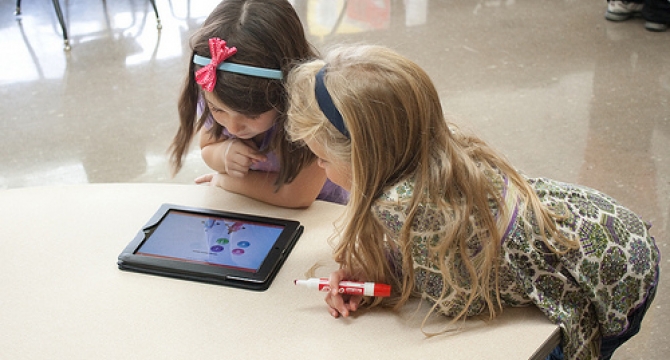
CC photo courtesy of: MikeOliveri
Public schools must be places of inclusion where each child’s talents and assets are known and acted upon and where the questions of the learner are the starting point for inquiry. These are ideas that challenge each of us involved in public education to change and innovate. It is the most important work we need to do and many of us have already begun – have you?
-
Classroom Innovation Means Giving Up Control
Comments Off on Classroom Innovation Means Giving Up ControlNewton’s First Law of Motion:
An object at rest will remain at rest unless acted on by an unbalanced force. An object in motion continues in motion with the same speed and in the same direction unless acted upon by an unbalanced force.
This law is often called “the law of inertia”.
-
Caution: Children Playing
Comments Off on Caution: Children PlayingA great deal of the impetus and inspiration for conversations about transformational change in our modern school systems (in most cases, we are still at the conversational level) comes from the new realities presented to us by advances in digital technology. Exciting new possibilities for engagement with content, with context, as well as with new forms of role and relationship are all part of the suite of possibilities now being presented to us. And in framing these new frontiers, there are many who would have us believe that children growing up in these initial decades of the 21st century bring dispositions, attitudes and skills to the schoolhouse that should force us to seriously reconsider the structures, strategies and even the learning theories that have been at the heart of public schooling for the past century and a half.
I don’t disagree with many aspects of the conversation. I do, however, begin to raise my eyebrows a little when claims are made that today’s young learners are substantially different than when I was a child. A chill runs down my spine when those claims are pushed to the limit, suggesting that young people are somehow wired differently than they used to be. While I understand the metaphorical nature of these assertions I, nevertheless, cringe when I hear them.
Recently, I’ve been very aware of the way my two young boys move through the world, especially as they approach the beginning of their own formal schooling. What excites them? What gets them asking questions about the world: patterns, relationships, how things work, and why things are the way they are. What inspires their sense of discovery?
I’ve come to the strong (but not unshakeable) conclusion that things really haven’t changed that much in terms of the how, why, when and where of learning.
Some examples:
Luke and Liam have both loved “reading” for years. When Liam was 2, he could always be seen with a book in his hand. For both children, the foundations of their reading lives have been built on the family couch, in the chaise lounge upstairs and in those very special pre-bedtime moments. Word games have been a part of our dinner time and road trip conversations for the past few years, many times initiated by the boys themselves. We have learned to love playing with language, both in its discrete and granular forms and recently we have started to play with language as a gateway to humour.
We spend a great deal of time in the many conservation areas surrounding our town. More often than not, the boys will come home with souvenirs from our walks: coloured leaves, pieces of birch bark and even the occasional bug bite or two.
Both boys revel in being able to be outside on their bikes, racing up and down the street, saving the neighbourhood from fires and the bad guys (never bad girls) that started them.
Treehouse TV is a popular Saturday morning activity and now that they are old enough to control television remote themselves, its a ritual that affords Mom and Dad a little sleep-in time on the weekends.
Toy train sets, electric race cars, Lego and Tinker Toys have outlasted the electronic games in terms of engagement power and, I would argue, learning potential. As I write this Luke is now working on a 70-piece puzzle, while Liam plays with his farm set. All three of us are wearing fire helmets!
I love big picture, system-level conversations–I really do! I’m hoping, however, that as our discussions here and elsewhere turn to the topic of change through innovation, we don’t lose sight of the essential things that we have known for years about our children—the way that they come to the world with what appears to be an innate sense of curiosity, discovery and adventure. Perhaps the lives of our youngest pre-school children can provide the keys to unlocking some of the most confounding problems that we face on today’s education landscape.
-
Performance Anxiety: A Personal Story
Comments Off on Performance Anxiety: A Personal StoryI clearly recall beginning to feel very uneasy at school soon after starting Grade Seven. A year earlier, in 1969, our school district had decided that it would be a good idea to congregate all of the 12-14 year olds in the region in one building. I was too young to know about any of the community conversations that went on in advance of the decision or what the philosophical underpinnings of the project would have been, but I do know that September 8, 1970 was the first day in my life that I ever stayed at school for lunch!
Beyond the social adjustments to my new learning environment–adjustments that I never did fully make–I recall that my biggest challenges in heading to Junior High were academic in nature. Despite my desire to bring home the same high marks that my older brother seemed to effortlessly garner, I remember struggling in most aspects of the program. In particular, math and science presented the highest hurdles.
Although my parents noticed that their normally happy-go-lucky, cooperative child was quickly becoming more serious, and somewhat more anxious, I think they just chalked it up the natural movement from childhood to adolescence. Actually, I think that I was the one who was most concerned about the change. I secretly made an appointment with our school guidance counsellor and let him know that I was worrying about everything: strange sounds in the night, doing well in school, traveling on the school bus. His remedy was to have me go to the library every lunch hour, put on a set of headphones, and listen to a series of records outlining the facts of life. That’s right, it was obvious to him that I needed to know about Sex! Although this daily ritual drew a growing crowd of other student-listeners, I recall that the information only served to make me more anxious!
In Grade Eight, I began to dread going to school, not for fear of being teased or bullied (though that was not an uncommon experience for me) but for fear of not being able to do the work. I had fallen so far behind that I felt completely lost in many of my courses. Although my teachers tried to help, I could tell that they were getting frustrated by my lack of understanding of some of the basic, foundational ideas that would have helped me in handling the more advanced work.
In February of 1972, I stayed home from school for three whole weeks. During that time, I was poked and prodded by doctors, nurses and other adults who couldn’t seem to get to the bottom of the illness that mysteriously emerged during the Wonderful World of Disney each Sunday night and seemed to, just as mysteriously, disappear in time for the Brady Bunch on Friday evening. Save for my grandmother who inuitively understood everything, not one adult in my life seemed to be able to connect the change to a type of performance anxiety!
The second of three reports on the the What Did You Do In School Today focuses on the gap between intellectual challenge and the skill sets that students call upon in order to meet those challenges. While the report offers another lens through which to examine the complex issues related to student engagement, it also offers adults like me a way of understanding their own school experience. The enormous impact created by not attending to the gap between what we demand of students, and the skills that they bring to meet those demands cannot be overlooked.
For me, the system provided a way to mitigate the emotional and social impact by allowing me to gradually “drop out” of various programs. In looking back, however, I’m not sure whether this approach served me that well.
WDYDIST Research Series Report Two: The Relationship Between Instructional Challenge and Student Engagement is worth a good look, and then worth a good conversation. If the what of our transformation agenda is still looking for a compelling why, I sense that this report might hold some important clues.
-
Cdn EdWire – Making the Link Between Bullying and Boredom
Comments Off on Cdn EdWire – Making the Link Between Bullying and Boredom
Opinion: Improving education system to end bullying – Montreal Gazette
-
Oasis Skateboard Factory – Curriculum by Design
Comments Off on Oasis Skateboard Factory – Curriculum by DesignThe teacher and students explain how the skateboard becomes a catalyst for hard-to-engage youth.
-
Mentor eases teachers into expanded technology deployment
Comments Off on Mentor eases teachers into expanded technology deploymentMargie Trovao has taught at Lord Nelson Elementary School in east Vancouver for the past 15 years, but this fall she is also a student in her own classroom.
Under an initiative by the Vancouver School Board, Ms. Trovao is being mentored by a tech-savvy teacher from another school on how to use iPads and other devices in her split Grade 6-7 classroom.
“It’s wonderful,” says Ms. Trovao of working with mentor Zhi Su, a teacher for the past 11 years who runs a mini-school program for students from Grades 8-10 at John Oliver Secondary School. He was selected as one of four teacher-mentors for the district and, this fall, is spending half his time at John Oliver and the other half as a coach-advisor to Ms. Trovao and four other instructors at other Vancouver schools.
In Ms. Trovao’s case, she rates her proficiency with computers as “medium.” She was unfamiliar with the iPad until the board gave her one to practice on last Christmas. She says she only discovered the potential of the mobile device for the kind of project-based learning she encourages in her classroom after working with Mr. Su.
“If someone said ‘here is an iPad, use it in your classroom and figure it out,’ that would be very overwhelming for most people and would be overwhelming for me, even though I sort of knew what I wanted to accomplish,” she says. “Having someone there and teaching it with me and showing how it can be used has made it easier for me. I have not been uncomfortable learning how to use it.”
At 101-year-old Lord Nelson, the school has a computer lab but no wireless access to the Internet yet. For the mentoring project, the board loaned an iPad cart to Ms. Trovao and two other teachers at the school for the fall semester. Mr. Su will be embedded in Ms. Trovao’s classroom over the course of a month or so, in two-hour blocks of time.
In his mentor role, Mr. Su first visited Ms. Trovao’s classroom to learn about her teaching style and the projects she planned for her students. Then, with her curriculum goals in mind, he suggested ways to use the iPads to enhance the learning experience for students. He also taught Ms. Trovao and her 27 students (who share 15 iPads) the basics of the device for capturing images, note-taking and research.
“I am offering the curriculum just the same [as before] but there are different pieces – engagement, multi-media and a digital citizenship [on the appropriate use of the Internet] piece that they otherwise would not receive,” he says.
For example, one class project is a biography of someone who has made a difference in the world. In the past, students would collect information from a book, at school or at home, write out the information by hand and present the findings on a poster board. This year, students work in pairs on the iPad to search for images and information from the Internet that, when complete, will be a printed booklet.
The speed with which students now can gather information holds their attention for the project, says Ms. Trovao. “Because it is done on a computer, there is so much more they can do” she says. “They are engaged in it, take more pride in it and they want to learn more.” Since students now spend less time copying information from books, Ms. Trovao find they talk more to each other, and to her, during the project to explain what they are doing – and why.
For another project, Mr. Su plans to teach the Lord Nelson students how to create a comic strip-like graphic novel on the iPad. “They will take on the characters and act out the scenes, using apps,” he says. “They will upload photos and embed them into the comic strip layout and enter the dialogue boxes to tell the story.” In the process, he says, the students will develop skills in arts, communication and technology as they create a digital artifact for themselves, their classmates or their parents. He says the process encourages students to feel more ownership of their work. “They know at the end it is not just something they are handing to the teacher and the teacher is the only one who sees it,” he says. “Everybody sees it.”
As a teacher who is also a student this fall, Ms. Trovao says she is showing her students that “it is okay to say you don’t know something and to have struggles with something.”
From working with her mentor, Ms. Trovao says she has learned that she doesn’t have to change much of what she does to integrate technology into her lesson plans. “People are afraid it might be time consuming to learn these things,” she says. “All you really have to do is have somebody show you one or two things to help you do what you are already doing. That is why Zhi [Su] is so important.”
For Mr. Su, the mentoring initiative is a way to reach fellow teachers who are curious but not experienced about technology. “If they have the desire to learn you are able to go in and work with them,” he says. “The idea is to build capacity and build a community that is built on reciprocity.”
-
Guiding high school students through applied internship projects in college environments: A Met School story
Comments Off on Guiding high school students through applied internship projects in college environments: A Met School storyCaption: Said Hassan, an instructor in pharmaceutical manufacturing at Red River College in Winnipeg, is a mentor to students in the Seven Oaks Met School internship program.
Credit: Photo courtesy of Red River CollegeMany high school students are faced with the dilemma of “what next?” as they go through their final years at school. With new-economy jobs becoming more complex and career paths increasingly convoluted, the decision-making process is no simple task. What do these jobs and careers entail? How does what they are studying in school relate to them? A few students with good scores do end up in their profession of choice, normally a well-known career such as medicine, engineering or law, but many others face the challenge of picking something that is within their reach, interests them and possibly has some career prospects.
Resources within and outside school systems are increasingly being invested to tackle this problem and there are some successes but they are few and far between. There is no single solution to this problem. All parties involved – school boards, postsecondary institutions and public and private enterprises – need to work together to make an impact. Out-of-the-box thinking is needed and new approaches need to be tried and effective models developed.
As a teacher of an applied technology program at a college, I experience the effect of this problem first-hand. Year after year we see students become disillusioned with their educational/career choices, resulting in high failure and dropout rates. In the last couple of years I have talked to high school teachers and guidance counsellors, made presentations and participated in educational events to provide information on the program I teach (pharmaceutical and biotechnology manufacturing) and the industry. The idea is that some dots will connect and some students will be informed about an area that they would not know otherwise.
In 2009 I met a science teacher from Seven Oaks Met School, a school with a unique vision and model of teaching and learning. It didn’t take long for me and my colleague at Red River College, Philip Cheng, to be all ears, listening to and imbibing the concept of Met School. We learned that, as part of their educational model, Met School students spend time twice a week in a work environment of their choice. They then share their learning and experiences with their schoolmates and teachers through project presentations and other activities. At that time a Grade 9 student was interested in an internship in pharmacy and medicine, a close match with the field my colleague and I teach and we decided to give it a try. When we explained our program to the student she became very excited about the prospect of doing her project in our labs. In the next few months she participated in my labs where I was teaching the process of tablet manufacturing. I then engaged her in another project involving chemical analysis of a marketed product to determine its quality. She went on to work with Mr. Cheng on a microbiology project that she subsequently presented in a major science competition (Sanofi Aventis Biotalent Challenge).

Caption: Met School Grade 11 broadcasting student, Adam, with his internship mentor from Breakfast Television, and his teacher, Nancy Janelle. Adam started with Breakfast Television in Grade 9 and worked behind the scenes and on-camera, even producing his own item on distracted driving.)
Credit: Photo courtesy of Seven Oaks School DivisionStudent motivation and commitment affect me directly and it is not something I could simply wish away. I am also getting an opportunity to learn about high school student mentality, the system they go through and what makes them tick. This provides invaluable insight in how to help them when they arrive in my class.
Through these projects, she not only learned a variety of scientific techniques but also developed insights into many different careers in pharmaceuticals and biotechnology. Her work apparently generated some interest among her classmates and we ended up doing a presentation on biotechnology and biotech industry to her class. I learned that last year she chose to spend time in a pharmacy environment furthering her knowledge and experience of the field. Irrespective of what she is going to opt for in her future education and career, I think the experiences she is taking away from being out in the field are invaluable in helping her make the right decision. Last year, as a result of her presentations at her school, another student showed interest in the field and spent a full term in my lab learning different aspects of pharmaceutical technology. We are hoping to have more students from Met School and expand the scope of the projects.

Caption: Grade 11 student, Candace, at her internship with Mondragon Bookstore and Coffeehouse. Candace immersed herself in all aspects of the cooperative business from the restaurant to the bookstore.)
Credit: Photo courtesy of Seven Oaks School DivisionAs I reflect on my experiences with Met School students and other mentorships I have taken on, I can’t help thinking that this model could certainly be part of the answer to the “what next?” question, a small part but a crucial one nevertheless. College environments present some advantages as incubators for such projects. College programs tend to be a closer simulation of actual work environments while maintaining academic components. Besides, the emphasis on direct application of learning to solving industrial problems, in my opinion, is a strong motivator to high school students who are disillusioned with the value of what they learn at school.
The big question is: can we replicate the Met School model on a larger scale? College teachers may wonder how to find the time on top of teaching and everything else. I have to say that some investment in terms of time and energy is inevitable. In my case, I had the participating students attend my regular labs, for most part, while giving them some extra coaching. I also had help from an educational assistant and a research assistant in my program area. As I mentioned, more than one instructor was involved with the same student, which further divided the responsibility.

Caption: Met School Grade 11 student, Madison, at her internship with 10,000 Villages. Madison has a strong interest in social justice and organized a fair trade challenge in her larger school community.
Credit: Photo courtesy of Seven Oaks School DivisionI personally think that the rewards of getting involved in this type of work are well worth the effort. Student motivation and commitment affect me directly and it is not something I could simply wish away. I am also getting an opportunity to learn about high school student mentality, the system they go through and what makes them tick. This provides invaluable insight in how to help them when they arrive in my class. When I finished high school, computers weren’t around so a few things have changed as you might agree! This year I am looking forward to interacting more with Met School staff and students and participating in more ways than just mentorship projects. I am also hoping that other programs at the College will take part in the process. Perhaps together we will have a few more of the “what next?” questions answered.
-
Superintendent’s frustration: There Should be more takers for an alternative school that really works
Comments Off on Superintendent’s frustration: There Should be more takers for an alternative school that really worksI found my locker and I found my classes
Lost my lunch and I broke my glasses
That guy is huge! That girl is wailin’!
First day of school and I’m already failing.This Is Me in Grade 9
By the Barenaked LadiesToo much of our students’ high school experience is impersonal. It leaves them feeling alone, vulnerable, and alienated. Evidence from The Learning Bar’s “Tell Them From Me,” the widely subscribed Canadian student survey, tells us that only half of the students in Canadian high schools find their learning interesting, enjoyable, and relevant and only a third report that they are interested and motivated in their learning. For too many kids, high school is more of a gauntlet than a sanctuary. Witness the “It Gets Better” campaign encouraging LGBTTQ youth to hang in, handle the homophobic bullying, and believe that life will be better after high school.
Three years ago our school division initiated the first Canadian high school modeled on the highly successful Met School, founded by Dennis Littky and Elliot Washor, believing that high school could be both fundamentally different and much better, that learning in high school could be built around students’ interest and passion. We’ve been successful, but probably less so than we had thought and with much more effort and greater challenges than we could have imagined.

Caption: Brian O’Leary
Credit: Photo courtesy of Seven Oaks School DivisionVirtually every teacher I know became a teacher in order “to make a difference.” In high school the structure gets in the way. Too often the strong teacher/student relationships and motivation we prize are found more in extracurricular involvements than in class. We need to work to see that all of our schools are organized in ways that help us realize our ideals.
We started the Met School full of optimism. We assumed that there was a substantial demand for doing high school differently and better, and that in the space of three years the Met School would be at capacity. Three years later our enrolment is half what we expected. The students and parents who’ve enrolled love the school and its approach. They credit it with altering their lives for the better. But many other students who might well benefit from an education that fosters their passion and self-knowledge opt for a more conventional high school education for what James Herndon termed, “the way it spozed to be.”
This unanticipated challenge underlines for me the need for us to persist in building the Met School as a credible alternative to the conventional high school. Virtually every teacher I know became a teacher in order “to make a difference.” In high school the structure gets in the way. Too often the strong teacher/student relationships and motivation we prize are found more in extracurricular involvements than in class. We need to work to see that all of our schools are organized in ways that help us realize our ideals.
Thanks to Adair Warren and the Met School teachers we have developed a wonderfully different kind of high school, one that has changed the course of students’ lives in profound ways.
When we initiated the Met School we hoped that our three high schools would see and adopt some of the Met’s approaches: advising, internships, long-term relationships, clear pathways to post-secondary entrance, learning in depth, true family partnerships. In our other high schools we have implemented a universal teacher-advisor system and are working to make it as effective as the Met’s (Met students are twice as likely to say they have a real advocate at school as other high school students). We’ve implemented effective internship and mentorship programs and are working to make them universal like the Met’s. We are working to ensure that every high school student in our system has at least one real-world internship experience.
The first students graduated from the Met this past June. Each gave a valedictory address. Attending the grad was a wonderful experience. Students spoke of their passion for learning, the relationships and experiences of their high school years and of their confidence and optimism for their futures. In a large high school it’s not possible for every student to give a valedictory address, but we’ve discovered that it is possible to recognize every grad with a personal citation touching on their best memory of high school, thanking someone who made a difference in their life, and commenting on their plans for the future.
Our goal here is not so much to innovate, to restructure or to reform high school; our goal is to improve the school experience and life prospects for our students and with the example of the Met we are doing so.
-
Students tackle academics in practical context at Skateboard Factory
Comments Off on Students tackle academics in practical context at Skateboard FactoryHigh school student Nick Robertson came to Oasis Skateboard Factory (OSF) from a suburban Toronto district where, he says, “I was being spoon fed the exact same education as parents and grandparents, and that did not fit with me. They tried to diagnose me as ADD, ADHD.” He says his average grade was about 60. He “squeaked by” in Grade 9 and finished Grade 10 “in bits and pieces.”
He was surfing the web when he spotted a reference to Oasis Skateboard Factory, an alternative program in the Toronto District School Board. He says his first reaction was “Skateboards in school? It didn’t seem possible.” He applied, was accepted and took up residence with a relative in Toronto. He started in September 2011 as a Grade 11 student.
He became immersed in OSF and adopted the brand “Kid Sqwid” for his boards and other artwork. In his previous school experiences, he tried to avoid writing but not now. Nor are there any issues about meeting deadlines. “There is a lot more pressure on us [than in previous school experience] – not negative, but you have deadlines to meet. We have done writing in magazines; there’s a sense of pride that goes with that.”
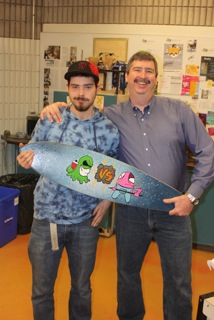
Caption: Oasis Skateboard Factory student Jacob Skinner and his dad, John
Credit: Photo courtesy of Jennifer LewingtonHe now expects to return to his suburban Toronto high school in January, a move he sees as a “lot easier” after his OSF experience. “I can get a lot of work done. I have learned to cope with deadlines; it’s been really good practice.”
“One of the main things about this place is that I can actually draw and not feel like I am doodling away and being yelled at for drawing on the side of my notes,” he says. “[Drawing] is an actual talent I have that can be used.”
Jake Skinner, 19, attended a high school in a suburb east of Toronto. By Grade 12, he was still six credits short of graduating and unhappy at a school he felt was too impersonal. “They are not trying to teach you; they are talking at you like a wall,” he says. He discovered OSF through an aunt who lived within the Toronto District School Board catchment area and now stays with her while attending OSF.
He is thrilled about his school experience at OSF. “One of the main things about this place is that I can actually draw and not feel like I am doodling away and being yelled at for drawing on the side of my notes,” he says. “[Drawing] is an actual talent I have that can be used.” Having learned the business side of art at OSF, he now plans to apprentice at a tattoo shop and start his own business.

Caption: Oasis Skateboard Factory student Carly Bond and her toy creation
Credit: Photo courtesy of Jennifer LewingtonHis parents, John and Kimberly Skinner, were “thrilled” to discover a school where their son could pursue art. When she attended an open house early in the school year, Kimberly Skinner says, “Craig couldn’t say enough good things about Jacob, [including] his maturity level and his leadership skills. I thought, ‘are we talking about the same boy?’” John Skinner adds, “[In the past] a teacher meeting would start with an apology. This was different.”
Jake received a scholarship to attend a course at the Ontario College of Art and Design (OCAD). After that, says Ms. Skinner, “who knows? We got through high school and that was a big step.”
At her previous school, Carly Bond, 17, often skipped school and finally got kicked out. She credits her then-school guidance counselor for recognizing her preference for hands-on learning and recommending she attend Oasis Alternative Secondary School. Then a friend suggested OSF, one of three Oasis alternative schools. Carly says she “fell in love with everything” at OSF, including “how all the projects are not fake.” Moreover, she says, “now that I know my project is going somewhere and being sold, I am going to work really, really, really hard on it because of that.”
“I go to school because it is giving me experiences of what I want to do with the rest of my life.”
She stayed at OSF for three semesters. In her final semester last spring, she did a job shadow with street artist Slurg, who makes model toys. Carly has made her first toy, Snapper, a “man-eating ice cream cone.” She eschews “sexist” toys such as Barbie and says she will create “more playful and creative toys, not just a girl with clothes.”
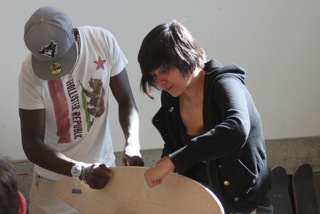
Caption: Oasis student leads workshop at Art Gallery of Ontario
Credit: Photo courtesy of Jennifer LewingtonShe still needs more credits to graduate but doesn’t want to go to school just to get credits. “I go to school because it is giving me experiences of what I want to do with the rest of my life.” Her parents, she says, “are really happy. I used to be a bad kid when it came to school. Now I get better grades than my sister or brother.”
At the Toronto District School Board, Karen Grose is Central Coordinating Superintendent of Strategy and Program Planning and has oversight responsibility for the system’s alternative schools. She is clearly impressed with OSF. “The anecdotal comments from parents and from students and from staff around the Skateboard Factory [show] they’re positive, they’re passionate,” she says. “It’s just inspiring.”
Does the TDSB intend to replicate it? “It’s only just three years old, she reflects, “but I think we have enough data and enough understanding of the success of this program, the passion that the students have for this type of learning to know that these are the types of things that we need to move forward with. We’ll explore possibilities for where Skateboard will go next. I think there are a number of possibilities.”
OSF teacher Craig Morrison gives much credit to Ted Hunter and Norah Jackson, co-owners of Roarockit Skateboard Company, for their close participation in the work of the alternative program. Mr. Hunter is a fulltime professor at OCAD specializing in furniture design. His wife, Ms. Jackson, comes from a graphic arts background. Mr. Hunter has a special feeling for the OSF students whose learning styles often don’t fit well in mainstream schools. “That’s exactly how I went through school,” he says. “Finally for me it was one teacher at the end of high school who said ‘boy, you’ve got to go down to the Ontario College of Art and take some courses.’ That one teacher totally changed my life. That’s the way Craig is.”
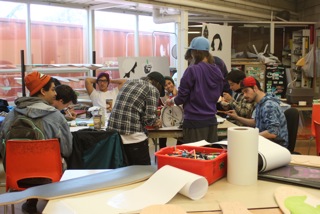
Caption: Students at work in Oasis Skateboard Factory
Credit: Photo courtesy of Jennifer LewingtonFor their business, the couple invented a kit that enables youths – or anyone – to build a professional-quality skateboard, a key starting point for activities at OSF. As well, the two have worked side-by-side with Mr. Morrison during the school year to sponsor social events (part of the program’s student engagement strategy), mentor OSF students engaged in higher-level skateboard builds and coach advanced students to become instructors for Roarockit workshops.
EN BREF – Renseignements additionnels au sujet de l’Oasis Skateboard Factory
-
Students, parents give thumbs-up to Flipped Classroom
Comments Off on Students, parents give thumbs-up to Flipped ClassroomAs Graham Johnson noted in his personal account of his first year using the Flipped Classroom approach to learning, the feedback he has received from students and parents has been “overwhelmingly positive.” Carolyn Durley, OKM Biology teacher, says she has had no negative feedback from parents. Both teachers experienced student pushback in the early days of introducing the Flipped Classroom approach, which puts students largely in command of their day-to-day learning.
Cameron McDermid, a Grade 10 student who took Grade 11 Math last year, says Math is probably his strongest subject. He appreciated the fact that the video lesson, usually about 15 minutes long, consumed much less time than presentation of the same material in class, which would typically be accompanied by time-consuming questions from students. Now, he says, “If they have a question, they can just pause or rewind the video. If you understand each part of the video you can just fly right through it without pausing.”
Erin Gamble, a Grade 11 student who took Grade 11 Math last year, was ecstatic about the Flipped Classroom. Because she had often struggled with Math in the past, she said she appreciated the opportunity to watch the video lessons multiple times if necessary, make notations about things she did not understand, and pose those questions to her teacher the next day. She said she and her tablemates in the class talked about the fact that the Flipped Classroom “was always a good environment and we knew that [the teacher] could help us out a lot and we could probably leave understanding what we were having troubles with.”
Her mother, Leslie Gamble, was equally ecstatic. “It’s just unbelievable, from a parent perspective, just watching my daughter just totally gain confidence,” she says. “It was just amazing to see her actually go from being frustrated to coming through and actually teaching her friends that were going to a different high school Math by watching his tutorial and then she would go through it with them.”
Scott Mclean was principal at OKM (he moved this year to another high school in the district) when three teachers, including Mr. Johnson and Ms. Durley, asked him if the school would sponsor their attendance at a Flipped Classroom conference in Colorado late spring of 2011. “They were so excited about it that you knew something good was going to come out of it,” recalls Mr. Mclean. When they returned after the conference, he helped them get ready to introduce the Flipped Classroom that fall by finding a handful of laptop computers for each classroom for use by students who didn’t have their own devices.
Mr. Mclean said he views the Flipped Classroom as “a potential game-changer” because learning takes place before the student enters the classroom, allowing the teacher “to broaden and deepen” the learning. “It’s the way learning should be for kids. They take control of their learning and they can work at their own pace.”
This past June, OKM sponsored a Flipped Classroom conference much like the one in Colorado that inspired Mr. Johnson and Ms. Durley. They expected a turnout of 40 to 50 people; more than 100 attended, many of them from School District No. 23, home to OKM. A number of those teachers have introduced the Flipped Classroom to some or all of their classes this year.
EN BREF – La classe inversée ne convient pas à tout le monde, mais elle a été bien reçue par les élèves de biologie et de mathématiques et leurs parents de l’école Okanagan Mission Secondary School (OKM) à Kelowna, en Colombie-Britannique, et est fermement appuyée par le directeur d’OKM, Scott Mclean.
-
Biology teacher’s Flipped Classroom: ‘A simple thing, but it’s so powerful’
Comments Off on Biology teacher’s Flipped Classroom: ‘A simple thing, but it’s so powerful’What is your teaching background?
I’ve taught for 20 years. I’ve taught sciences, math and now all I teach is Senior Biology. In B.C. that’s Grade 12 – Biology 12 is what it’s called. I teach as AP (advanced placement) Biology as well. It is the biology course set by the College Board. They’re the same body that does the SAT and that’s taught internationally; it’s not a provincial curriculum. The students write the AP exam in May. My class size varies from 24 to 32.
What caused you to change your style of teaching?
I had been successful with what I was doing. I had amazing provincial exam results. I had positive feedback. I had great relationships with students. But three or four years ago students began changing in subtle but significant ways. They didn’t have to get the biology from me anymore. They could sit there and look it up on their phone. They could go home and watch a lecture on YouTube. They weren’t buying into me spouting off – you know, the fountain of knowledge – anymore.
To me the cornerstone of my practice was that I had strong connections with students, and I didn’t want to disconnect.
It wasn’t like all 30 kids, but one or two kids would say “I watched this video last night on YouTube” or… “I read somewhere on the Internet that . . .” and it started to be this slow trickle into the classroom that kids were shopping around. So I thought hmmm, they’re watching a lecture on biology on YouTube and so when they show up here maybe they’re not hearing it for the first time. It was a very subtle change, and also kids were more interested in texting and Facebook; they wanted to interact in different ways. I admittedly was very unfamiliar with that. I was like whoa, what are you doing? What do you mean you want to spend an hour texting? I really did not get it. But I realized I had to change if I was going to connect with them in the way that I had really enjoyed. To me the cornerstone of my practice was that I had strong connections with students, and I didn’t want to disconnect.
I had tried many changes in my classroom but I found that nothing was transformative; nothing really shifted or changed the setup. It was more like layering more on top of what I was already doing. I spent 20 years trying to reinvent the wheel and it didn’t happen, and then I stumbled upon an idea that was so simple and all of a sudden it all fell into place. It’s such a simple thing, but it’s so powerful. And it’s what I had been searching for.
How did the Flipped Classroom change how you organized and conducted your class?
The flipped classroom starts with making the videos, using the lecturing and organizing tools I already had. Having made and archived the videos, I’m now free from repeating the lecture that I’ve done for 20 years. My time has been repurposed. Wear and tear on me is diminished, because I’m not lecturing, not dealing with so many behaviour problems in class. My time is now focused on trying to differentiate the classroom and the learning experience, trying to work with students where they’re at in a timely manner, and remediate when they need that remediation.
My design for the Flipped Classroom evolved over the year. For the first semester I thought, oh, I’ll just give them all these choices and I’ll be free and oh, this will be great. That did not work at all! Students are not ready for a leap into a whole class of self-directed time. They didn’t know how to do that. They’re used to being controlled by teachers.
So the second semester I structured it differently. I started with 10 minutes of what I call “flex time” (where students are invited to make choices) and we grew that time to 20 minutes to 30 minutes to 40 minutes until at the end of the semester students could self-regulate and get engaged in the learning all on their own for the entire class.
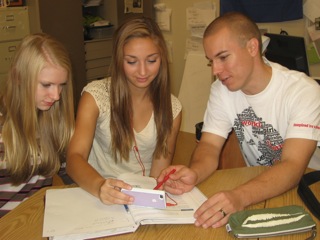
Caption: Math teacher Graham Johnson with two students in his Grade 12 Flipped Classroom
Credit: Photo courtesy of Jennifer LewingtonI also did a little bit of “stand and deliver” because I found that some students were angry at me when they showed up in Grade 12 and said, “What do you mean you’re not going to teach me. That’s what you do. Come on.” They needed proof that I was still their teacher, that I do know the content, I still can entertain. I think that’s still a big part of what students like about being direct-taught, and that’s part of what makes you a good direct-instruction teacher: you’re very good at entertaining kids, and I was good at that. So it was a bit of a loss, a grieving process for me to let go of that persona. It was a change that I had to work with them to buy into and demonstrate to them that I was still their teacher, and then slowly let go of the old role. Students didn’t notice that by the end of the year I wasn’t doing any direct instruction, that they were in charge, that the classroom was run by them and that I was really just a facilitator.
You have to be ready to change and you have to be ready to embrace failure.
But it took time to develop those self-management skills. So at the beginning of each unit I provided a packet with a list of the possible activities, with the lectures, the screencasts, that should be watched for that unit. Some things are optional activities. Some things we’ll do as a group, like a lab. They get the packet of choices at the beginning of each unit. The students during the flex time can decide what they should or want to do next. I tried to decrease the time in class that I organized, and increased the time in class that they organized. I weaned them off of me and weaned them onto themselves.
You have to be ready to change and you have to be ready to embrace failure. It’s really hard. And as I tell other teachers, as a 20-year teacher I was used to my class running perfectly, I had everything “tickety-boo-lovely.” To go from that to not-so-lovely was very uncomfortable. I was very stressed because it was not perfect; it was rather messy and discombobulated. So I had to embrace failure and learn from it and change to make it better.
How do students respond to the Flipped Classroom style of learning?
It’s funny. A lot of people say the flipped classroom is probably only good for high-end students, and not good for struggling learners. I find the reverse is true. Students that are most angry or frustrated with this change at first are high-end students, the ones best at “playing school,” regurgitating exactly what you said yesterday back to you. They are really good at playing school but they are not necessarily connected to their own learning. They have the most to lose, because they’ve always done really well at the old system. They don’t want to take risks because they’re the perfectionists – girls, a lot of them. They want the 96, the 97 and if they don’t get it, it really upsets them. So you have to spend time appeasing their anxieties.
But I think they are recognizing that learning is not about regurgitating the notes the teacher gave you, that learning is messy, that learning can be risk-taking and it takes time. Regurgitating is not really a satisfying activity nor is it really meaningful to the bigger picture in moving ahead in life and moving on to university or whatever their next challenge is.
If you point these students in the right direction, they will do the extension activities you have provided them. You can kind of light the fire within them and then set them on their way. They’re also the ones that you can leverage to help – and when I say that, I don’t mean carry or be burdened by, but to have conversations with – people that are perhaps struggling a bit on another unit. They just need that freedom to know that it’s not for points, it’s not going to affect their GPA, and rightly so, because they’re going to get into university based on their marks.
I found running the classroom this way created, initially, more of a separation, almost like the middle group has disappeared a little bit. Kids now are much more motivated because there are opportunities for retesting and more than one opportunity to show what they know. I saw a whole bunch of kids who might have been traditionally B’s want to work harder and go back and relearn things and understand them more and move into the A range. As well, my students who would be low A’s (88-90) want to work harder to push their learning into the high 90s because they can.
Another thing I noticed was that students don’t necessarily learn in a linear fashion. It looks like nothing’s going on and then all of a sudden they have this huge breakthrough. I think they realize they have to do something. It’s different data from what I’ve experienced in the past. In the past I was very data-driven and now the data that I’m trying to collect is not just based on points and numbers. I’m trying to have conversations and I’m trying to have students offer their input into their learning and I’m trying to focus more on learning rather than on achieving “7 out of 10.” I’m trying to focus on what did you understand, what did you not understand. So I’m having very different conversations; in the past I was collecting data but it was more like data extraction.
How has the Flipped Classroom shifted the classroom dynamic?
The basic idea of the flip, of me archiving my lectures permanently somewhere where students can access them when they need to or when it’s appropriate for them, fundamentally shifted the dynamic in the classroom like no other thing that I’ve tried in my career.
The dynamic had always been that I was the driving force in the classroom. I decided what we’re doing, when we’re doing it, and how we’re doing it. When kids have to sit, be quiet and listen for 40 minutes, you’re always trying to redirect their attention and a lot of my energy went into getting their attention back when I want them to do the learning because they all supposedly had to do the learning at the same time and in the same way. So my energies in the classroom have been repurposed.
Archiving my lectures means the students now have choice as to when they access the video or the lecture or if they want to access it at all. They now own the learning.
The most fundamentally transformative thing I’m doing is having meaningful conversations. When I was standing and delivering, I felt obligated to cover the curriculum because students are getting prepared for university, so I never had that time to have deep, meaningful conversations and connect with the students where they were at. Now in class I have time to talk to students in a meaningful manner. I also have time to do more involved projects and more inquiry-based labs. More peer-to-peer interaction goes on, and there is more time to reflect on the learning process.
So are students now taking responsibility for their own learning?
The whole power of the flip is that that students grow into becoming responsible, self-regulating learners, but that doesn’t happen over night. It’s definitely scarier than me controlling their learning, because if I control it, then I feel that they are going to learn it. So it’s that release of control and trying to offer them many entry points along the way so they can connect to learning in a way that’s meaningful for them. For some kids this takes a week and some kids are very stubborn; they don’t want to take responsibility. Some kids take two months. We use the term: “supported failure.” They have to experience the failure of not doing something for themselves and then they have to make the decision: “Oh! I don’t want to fail. I want to succeed and this is what I have to do.”
Kids have been trained to “play school.” They fill in worksheets, they do labs, they hand in assignments and they get points. But they don’t really know how to play learning. You have to keep offering quality activities to students, and sooner or later they will see the light: “Wow! This lab IS exciting!” Some kids take right to the end of the course for the light to go on. The lights go on for them in the last two weeks of the course, and then they pull it all together. Some students realize that their efforts are too little too late and have selected to do the course again, because they realize that they want to do better. But this was their decision.
What about the depth of their learning?
I think I’m getting more understanding, whereas before I think I was getting a lot of memorization. For example, in a unit like The Cell, students would memorize the parts of the cell, but if you talk to them about what a cell is, they really wouldn’t understand that a cell is a building block of life. To me, the enduring understanding that all life is made of cells is much more important than memorizing the ten parts of a cell. If you understand how it’s connected to your life and life beyond the classroom, it’s going to deepen your understanding about the world, about biology, and about science.
Learning becomes more authentic because students are now honest: “I don’t understand that, Ms. Durley.” They can say that without fear, because it’s not a point-driven game. I won’t take away points if they admit they don’t understand something; so we can have an honest conversation: “Well, let’s talk about that, or let’s do this or let’s do a lab.” We have to have time and opportunity to look at what they don’t understand in many different ways.
We’re doing interactive labs now. We’ve also done some inquiry-based labs where the student is trying to design or come up with a question. Then they design a lab to try to answer that question, and they run the experiment to collect the data and make sense of it for themselves. I give them time to reflect on what they’re doing using learning journals. Some students aren’t used to that habit.
My passion is teaching, but I’m also passionate about biology. For kids going off into life, you hope they have some understanding of life and their own bodies. I think it’s important, just for that scientific literacy, that they have an interest in how science affects their life and keep them over the course of their lives open to that.
How do you deploy technology in your Flipped Classroom?
I invite students to bring their technology to class and we use things like Facebook and Twitter in an effort to communicating in ways that are authentic to them. Facebook was controversial but now I think it’s becoming less so. I have a Facebook group. I don’t have to “friend” students but they can join the group. Students take pictures about what’s going on in class and post them to our Facebook page and then students will interact around those pictures. That’s really authentic to students. That’s how they live their lives. I think of it like a living bulletin board.
I do tutorials on our class Facebook page. I tell students I’ll be online Wednesday night between 8 and 9, so it’s kind of a modern version of the tutorial. I don’t stay after class; instead, I’m online for an hour at night answering questions. It’s been really effective. That’s what I mean by many entry points. It’s like having different invitations. Something will catalyze the reason why they want to buy in, and for some students it’s: “Oh, the teacher is on Facebook.” For some it’s they can do a hands-on lab. For some it’s that they are writing in a journal. And so it’s just trying to provide many different rich, authentic activities for them.
The Facebook page is a private group. At the end of the course I dissolve the group. It’s not for personal interactions. I want to be very clear about that. It’s for what is going on in the classroom. But it does have a fun feeling to it and it is light. But it is interactive and I think for students it’s very, very authentic. That’s what education or learning has to be. It has to be authentic.
Most of the Grade 12 students in front of me have smartphones; why not leverage that? That’s what they’re doing. They’re talking to each other. I have a Twitter account just for my classroom. I use it as a daybook, how I used to write on the board – and I still do write on the board – “next day we’re going to do the lab on such-and-such; remember to bring this to class.” So instead of writing it on the board, I tweet it out. I tweet out reminders, I tweet out little hints, so if students – and parents – want to follow me to get those reminders; again an easy way to keep in touch with them.
I learned how to screencast (making the digital recording for the YouTube-based lesson) on my own. I didn’t take a course. I learned by watching videos on how to screencast myself. I’m middle-aged, so if I can learn it, I say to anyone who wants to try: you can learn it too. I really wanted to change. I knew that things were not working and I really, really wanted to make something happen. It’s doable, but there’s definitely a learning curve there.
How do you measure academic progress?
What has been the impact academically of the Flipped Classroom? It would be premature [to draw conclusions] after one year of flipping my classroom. In general we traditionally have wanted empirical data in terms of testing results. For myself, it is important to have test data. But I think it is more important that when I interact with students it is meaningful; that is an important piece of data for me. My relationships with students have improved, the time for making relationships has increased, and my stress and student stress has reduced. From students that’s what I hear consistently. We did feedback sheets at the end of the year and that was one of the big ones that students say: “I have less homework; I am much less stressed because the teacher is available to talk to me and help me when I need help.” That speaks to me more as a teacher than standardized test results. I used to have really good test results but it came at a cost of a lot of stress on me and a lot of stress on students. My goals have changed.
I think they find their learning more authentic. I think they feel more connected to the process of learning; they are aware of what they’re supposed to be learning whereas before I was aware of what they were supposed to be learning. And some kids say: “oh it’s much harder when I (as the student) have to do the learning.” Yes, I agree, it is harder when you have to do the learning. For the most part they speak of the experience in a positive way. For many it is not until the course is coming to an end that they are able to explain the advantages.
What are the must-haves in developing a Flipped Classroom?
You have to be willing to fail and that’s what we want for students. I have to be willing to model to students that it’s not going to be perfect for me or for them. It’s also critical to have a collaborative person or team in your school; that was my lifeline. I don’t think I would have made it otherwise. We worked closely together and he [Graham Johnson, Math teacher] was my support network. When things went badly, we would debrief it and find a better way. I think that really accelerated our growth in developing the Flipped Classroom because he’s a very different person and teacher than I am, and so we have different ideas. Also, I think it’s beneficial to work with someone who’s in a different discipline from your own, because they see things differently. They often know how to fix the problem because they can see it in a different way.
I have a community of support – people doing flipped classroom around the world – out on the Internet via Twitter, so when I’m looking for solutions to problems, I can tap into hundreds of different people if I’m challenged by something in particular and I can do it really quickly. Technology has allowed me to be connected beyond the walls of my own classroom, so to be connected is essential. And then there’s the support of your admin. That was fundamental. Our principal supported us 110 percent. He said go for it. He bought into us taking that big risk and he was there all the way. He listened to our problems and our challenges. I think that support is fundamental.
How does Flipped Classroom accommodate student self assessment?
We move as a class through the course. But I found that students, regardless of where you’re moving, move at their own pace. If they are still stuck on the first unit or they’re still stuck on the second unit, and they are very aware about what they do and do not understand. If we have an assessment [test] covering units A, B and C, and the student’s learning for unit A was not in place when that assessment was written, they have the opportunity to apply for a re-assessment, they show up again and do a different assessment to show the learning that they now have in place for that unit A. Students really want to show what they know and figure out what they don’t understand.
They can rewrite that unit A any time throughout the year. They have to fill out an application and show that they have done some work (we call it evidence for learning) and have done some growth in that area. They can’t just show up and hope that they do better. They have to have a conversation with me. That’s been very powerful. Students are trained in the idea that they only get one chance to show what they know. For some of them it took three months. Finally three months in they would say: “You mean I can redo that test?” and I would respond: “Yes, you can redo that first test.” At first, they really couldn’t understand that idea, on an intuitive level because it was so fundamentally different to them. So some of them, when they realized they can show you what they know because now they understand it, were willing to do that. That was a fundamental shift for them in terms of how we operate in the school.
How do other teachers view the Flipped Classroom?
There are a lot of misconceptions about what the Flipped Classroom is. I think a lot of people get hung up on the idea that it’s like the Khan Academy, that it’s just kids watching videos and that it’s all about homework. It would be good for teachers to visit a Flipped Classroom. I have an open-door policy. If teachers want to see it, I think that’s the best way.
This movement for us was really from the bottom up, and all the other ProDs [professional development activities] that I have been to were top down. Anything else that I’ve been involved with has been kind of directed from the principal or other administrators, so the buy-in was not as great. Our development of the Flipped Classroom was completely self-initiated and self-directed. To me it parallels exactly what I’m wanting for my students in my class. I don’t want them to feel that they have to try something because I said it’s good. You have to want it for yourself and you have to choose it for yourself. I think it’s word of mouth a lot of times and I think it is beginning to grow by word of mouth.
At the Flipped Classroom conference we sponsored at our high school in June 2012, 40 of the 100 teachers who attended were from our district. For some, they had bought in and were ready to go. Some, I think, were intimidated by the use of technology. Some older teachers look at it and feel overwhelmed. You have to give teachers some time, space and a sense of safety to learn something new, because it is really scary to learn something new. But I definitely saw a lot of teachers who were ready, willing and wanting to change.
A reality about real, sustainable long-term change is that the teacher has to own it; it has to be authentic to the teacher. It is slow but I think a lot of teachers are ripe for change. They feel the same change is afoot in their classroom and they’re looking for a way.
The Flipped Classroom is not a silver bullet. You’re still working with kids and they’re still teenagers. They still have struggles and challenges along the way. It won’t fix all the problems, but it fixes a lot of problems that I could not fix with any other method that I had tried.
Any feedback from parents?
We haven’t had any bad feedback, so in teaching it’s a good thing, because sometimes that’s the only kind of feedback, especially for Grade 12. All the feedback that we’ve had has been really positive. For high-flying kids who are really into athletics and are on the road a lot – I had some skaters and skiers, some hockey players – they wouldn’t have been able to do the Biology 12 course at this level and do as well in a regular setting.
EN BREF – Carolyn Durley est une enseignante de biologie chevronnée qui a opté pour la classe inversée pour l’année scolaire 2011-2012, la même année que Graham Johnson l’a adoptée en mathématiques. Ils enseignent tous deux à l’école Okanagan Mission Secondary School à Kelowna, en Colombie-Britannique. Voici ses observations sous forme de questions et de réponses.



IDEAS TO SUPPORT EDUCATORS : Subscribe to the EdCan e-Newsletter
Quality research, reports, and professional learning opportunities.