Archive
-
Learning People Skills
Comments Off on Learning People SkillsWhen we think about the idea of social literacy, what comes to mind? Thinking specifically about what is happening in schools, social literacy can be thought of as good citizenship, character development, communication skills, interaction skills, and more. Its development is necessary in the growth of the whole child – beyond the academics – and has an impact on how students can learn and do well, in school and in the world.
Now let’s think of that one child who sits on the side of the school playground, alone, while the others in Grade 3 engage in an enthusiastic debate about the rules of the game they have just invented. The “rules” seem foreign to this student and despite trying, the student does not understand the game, what to say, or what to do. For students who have trouble with social skills, including those with Autism Spectrum Disorder (ASD), engaging in such activities with same-aged peers is difficult. Their social skills may not develop naturally just by watching others and, instead, individualized teaching is often needed.
Autism Spectrum Disorder and the Canadian context
Awareness of ASD has come into the public eye in the last 20 years, attracting attention due to its seemingly rapid growth rate in North America. In the U.S. alone, about one in 88 children are diagnosed with ASD. This is an increase of 78 percent in the last five years, and current research indicates that the numbers are similar in Canada.[1]
Research has demonstrated that social responsibility and personal independence are both important predictors of long-term success for children with ASD, the same as for any other student.[2] But because children with ASD do have built-in difficulties in social skills, ignoring this area of instruction can leave them with a great disadvantage over time. Ideally, social skills teaching should be assessment-based, individualized, and intensive.[3] Even better: social skills teaching should happen in the inclusive classroom for authentic practice with their peers. For example, an adult might teach a child to say, “Hello. My name is Kaleb.” But the truth of the matter is that children rarely use these formal greetings, and might say, “Whuzzup?” or just glance at one another and share a smile. Which is the more “real” social skill? Teaching children to offer a formal greeting may, in fact, isolate them more from their peers.
Depending on the practices and policies in each province or territory, a need for social skills will often be discussed in the Identification, Placement and Review Committee (IPRC), and/or recorded on a student’s Individual Education Plan (IEP). The school team supporting that student works together to develop goals, objectives, and strategies to meet these needs. Finding a starting place, though, is often difficult. We may know that Jasmine has trouble with social skills. But her teacher might wonder what kind of social teaching and learning is most important. Does she know how to enter a play situation? Does she know what it means when someone rolls their eyes at her? Knowing exactly which social skill to target first can be a challenge, and finding the next developmental social skill can be equally difficult!
Social literacy & assessment tools
Using assessment helps us not only with teaching academics in classrooms, but also with knowing what social skills to teach in the school, the home, and the community. Teachers are aware of the importance of using assessment for individual planning when writing IEPs for students with exceptional needs. However, they may be unfamiliar with the tools available to develop social literacy goals. There are a number of social skills assessment tools available, ranging in price from quite inexpensive to more costly. Although many of these books and manuals may refer specifically to ASD, it is important to remember that these assessment tools are often helpful for students who just struggle socially and may not have a diagnosis or a “label.”
Building Social Relationships,[4] by Scott Bellini, is a complete look at social skills for ages six to 17. It is usually used as a planning tool and also to track the development of new skills. Built into this book is the Autism Social Skills Profile, which can be completed by educators or parents. It includes 49 questions that parents or teachers are asked to rate on a scale of one to four, and it can be completed quite quickly, usually in ten to 20 minutes. It is easily available through online booksellers for approximately $30.
A second potential assessment choice is Social Skills Solutions,[5] by McKinnon and Krempa. This is also easily accessible online for about $20. It is organized by the use of three checklists: one for each of three developmental levels, which become more detailed and complex. Level 1 assesses basic responding skills, Level 2 examines the “when” and “why” of social responses, and Level 3 looks at the generalization of social skills. Three different settings are also examined, assessing the student’s ability to demonstrate the skill in a one-on-one situation, a group setting, or a natural, inclusive setting. Users can begin by scanning to find a starting spot which appears to be at the student’s level, and begin ranking the student, adjusting the levels as appropriate.
From assessment to social literacy support
Social skill assessments, like the ones above, provide two major ways to help build programs for social literacy. First, they provide a social skill baseline for an individual child or adolescent. Second, they will help to formulate the next steps towards social literacy. Often the skills the student has not acquired, as identified in the assessment, will be the teaching focus to meet individual needs. Each of these next steps can be recorded as an individual course in social skills for an IEP, keeping in mind that most of these alternative-type courses focus on three to five expectations for what can realistically be accomplished in one term of instruction.
Let’s say that based on a social skills assessment, we now know that Tony needs to start with learning to stop when his peer says, “Stop.” But how do we write this down into a plan on Tony’s IEP so that we can later see if his skills have changed?
One way to write effective goals is to use a SMART acronym. The SMART acronym may differ slightly from source to source, but typically S is specific, M is measurable, A is attainable, R is reasonable, and T is time-limited, that is, with an identified time-frame.[6] SMART goals make objectives easier to measure when it comes to updating the IEP.
Examples of SMART goals that work towards social literacy for an individual student, based on the results of a social skills assessment, might be:
- Noah will accept losing a game 50 percent of the time by saying socially acceptable phrases like “Nice game,” or “Good job,” when he plays board games with his peers in the school environment in the first term of school.
- Caitlin will respond to another student when she is greeted by him or her during a class-wide activity in 80 percent of instances during the first term of Grade 5.
- When approaching a peer to interact during centre time, Jamie will get the attention of this classmate (e.g. “Excuse me,” “Hey,” or tap on the shoulder) before starting the conversation at least 80 percent of the time.
Social literacy and teaching tools
Beyond developing appropriate SMART goals, it is often helpful to have lists which provide parents and teachers with the types of social literacy that are commonly expected of children. For example, these may include knowing how to initiate or maintain a conversation or how to show an interest in what is being said by another person. Further examples can be accessed through the Assessing Achievement in Alternate Areas: A Place for Ideas, Resources, and Sharing site, found online at www.thea4ideaplace.com/social-skills-overview. This site also provides informal assessment tools related not only to social skills, but to other areas of the alternative curriculum, such as community skills, personal care, and more.
Many social skills teaching opportunities can be incorporated into pre-existing activities in the classroom with peers.
There are many activities and resources available to teachers and parents to develop social literacy. For example, listening activities can include playing games such as “Simon Says” or “I Spy.” Communication activities such as “Twenty Questions,” in which children develop 20 questions (or less, depending on the child’s interest and ability) to identify a hidden object in a classroom, are helpful for learning appropriate turn-taking and question development. Board games can develop cooperation skills and generalized commenting, a skill that is often difficult for individuals with ASD. Making cards for sick classmates or teachers can help with developing social empathy. Having a “Give Me a Break” card, which can be used by a student to have a break in an activity, can support emotional development. Many more ideas are easily accessible for teachers at resource-sharing sites.
Many social skills teaching opportunities can be incorporated into pre-existing activities in the classroom with peers. Opportunities for naturally-occurring social interaction can be built in while lining up or working in groups, during physical education, at recess, when eating lunch, and more. Consider introducing a peer-mediated program: using other students as “social experts” in the classroom by teaching them effective strategies to interact, model, and provide age-appropriate coaching towards students with ASD. For example, when your student doesn’t respond to the bell, you can ask a peer to remind the student to get his or her lunch bag. This is called prompting a peer to demonstrate what the student needs to do. This prompting could also include specific social interaction skills. For example, during a conversation, ask a peer to prompt your student with social difficulties to share, when asked, what he did last night after school. An overview and resources for this approach can be found at: www.asatonline.org/treatment/procedures/peer.
Children with an ASD, just like other students, need to develop social literacy. Finding and using a published assessment tool for social skills development is an essential first step in developing an individualized program to develop social literacy. While this assessment helps to formalize the baseline of current functioning for an individual student and the next steps of that student’s social development, further information-gathering must be done to find resources and strategies for effective social skills instruction. These include developing SMART goals, being aware of social skill competencies, and accessing resources available to teach these skills. The development of social literacy is essential in the growth and development of the whole person, underlying future and continued student learning and achievement for all.
First published in Education Canada, March 2013
Resources
Parents and teachers may find the following resources helpful:
• Autism Support Network
www.autismsupportnetwork.com
• Assessing Achievement in Alternate Areas
www.thea4ideasplace.com
• Canadian Autism Intervention Research Network
www.cairn-site.com
• Geneva Centre for Autism
www.autism.net
• Offord Centre for Child Studies
www.offordcentre.com
• Social Literacy Today (blog)
www.socialliteracytoday.com
EN BREF – La responsabilité sociale et l’autonomie personnelle sont des priorités en matière d’éducation pour les enfants atteints de troubles du spectre autistique (TSA). Comme les élèves autistes manifestent des difficultés marquées sur le plan des relations interpersonnelles et requièrent souvent l’enseignement direct de comportements sociaux appropriés, les programmes de développement d’aptitudes sociales se multiplient dans les milieux éducatifs. L’acquisition de la littératie sociale est essentielle à une croissance et à un développement menant à l’apprentissage et à la réussite des élèves. Cet article souligne l’importance de la littératie sociale et examine différents outils d’évaluation destinés aux élèves manifestant des difficultés d’ordre social. L’article présente des stratégies, des ressources et des exemples utiles pour développer la littératie sociale.
[1] Centers for Disease Control. “Why are Autism Spectrum Disorders Increasing?” (April 16, 2012), www.cdc.gov/features/autismprevalence
[2] Division of Behavioral and Social Sciences and Education of the National Research Council, Educating Children with Autism (Washington, DC: National Academy Press, 2001).
[3] S. Bellini, J. K. Peters, L. Benner & A. Hopf, “A Meta-analysis of School-based Social Skills Interventions for Children with Autism Spectrum Disorders,” Remedial and Special Education 28 (2007): 153-162.
[4] S. Bellini, Building Social Relationships: A systematic approach to teaching social interaction skills to children and adolescents with Autism Spectrum Disorder or other social difficulties (Overland Park, KS: Autism Asperger Publishing Company, 2006).
[5] K. McKinnon and J. L. Krempa, Social Skills Solutions: A hands-on manual for teaching social skills to children with autism (New York: DRL Books, 2002).
[6] L. Jung, “Writing SMART Objectives and Strategies that Fit the ROUTINE,” Teaching Exceptional Children 39 no. 4 (2007): 54-58.
-
Mixed Martial Arts and Life-Long-Learning
Comments Off on Mixed Martial Arts and Life-Long-Learning
Henry is training to fight in a cage for a living. This new piece of knowledge sits in front of me disconnected from everything I know.
“Don’t you get hurt?” I ask in total incomprehension. What I want to ask is, how can you take pleasure in hurting others? How can you feel the crunch of bone on bone and feel anything but horrified?
“Yeah, you get hurt,” he answers. Obviously, he and I feel differently about pain.
-
One One Condition: Time is of the Essence
Comments Off on One One Condition: Time is of the EssenceI entered school as one of the youngest kids in my class. Born at the beginning of October, I began my kindergarten year standing a little shorter, arriving a little less seasoned in the ways of the world, and a little less able to do some of the basic things that many others in my class seemed to do rather effortlessly. Although I eventually caught up with my grade level peers (I can now tie my own shoe laces!), it was clear from reading some of my early report cards that I was being measured against an external standard of what children at various ages should be able to do by the end of the school year. Unfortunately, when you talk about catching up, I really didn’t start to excel at school until it was almost time to leave the system. My high school marks were barely high enough to gain acceptance into the Ontario university system, and my first year results at the University of Toronto were really nothing to write home about.
Something happened, however, in my second and third years of post-secondary schooling. First, I found the campus pub and I started to have a good time, fitting into a social scene that was more determined by interest than it was by age. Second, I started to earn consistently higher marks and this encouraged me to take a deeper look at what I was studying, spend more time in the library and consider extending my educational journey.
Interestingly enough, other people appeared to have more confidence in my intellectual abilities than I did, myself. In fact, when I asked one of my philosphy professors for a letter of reference in support of my application to theology school, he took the opportunity to express his disappointment that I wasn’t considering grad school in his particular discipline. He felt that I was selling myself short and that I could definitely handle the greater intellectual demands involved in being a philosopher, as opposed to a priest. I remember leaving his office on a late winter afternoon thinking to myself, “Wow, after all these years of being in school, this is the first time that I heard someone say that I could actually do more than I had learned to assume.”
As Sir Ken Robinson points out, one of the beliefs around which our current systems of education are organized is that kids enter school stamped with a best before date. Parents and teachers are made keenly aware of how children are doing in relation to others in the class, even though a student born in January may differ in “real development age” by an entire year when compared to the student born at the end of December. Convenient for registration and processing purposes, but questionable for many aspects of learning and development.
Notwithstanding my personal story, it wasn’t until many years later that I became aware of the advantage afforded to children who are born earlier in the calendar year. From school admission to registration in a hockey program, birth date matters a whole lot, and according to folks like Malcolm Gladwell, creates a playing field that is, from the very beginning, uneven.
To be sure, schools can have a mitigating effect on many of the factors that are at play in the life of a child as they enter formal schooling. The seemingly universal movement of students based primarily on date of birth, however, is a factor that is almost completely within our locus of control.
Although I have some ideas regarding how we might re-imagine our current approach to student progress, I would first like to hear about your stories and ideas.
How was your own experience of school affected by your birthdate? Are you aware of being advantaged/disadvantaged by your age? Has your school district found creative ways to rethink the way that schools move through the system? As a parent, teacher or administrator, do you think about birthdate as a factor in school success? Are there other questions or thoughts you have about the issue of the age-grade dimension of our current schooling practices?
-
Voice of Experience: Little Square Pegs
Comments Off on Voice of Experience: Little Square PegsThe other day, I got a bucket of water and a cloth, and called my youngest daughter. Admittedly, it was a rather pathetic attempt to appease some “mommy-guilt.” Struggling to find the tenuous balance between my need to get stuff done, while still spending quality time with the kids, sometimes leads me to combine those binaries and try to sell it as fun.
I don’t know how this plays out in the classroom. I can see value in enabling our students to dunk their soapy hands in their learning. The imaginative possibilities encompassed by a flexible curricula appeal to me; I believe these very things will teach students to think critically and adequately prepare them for a changing world.
But there is practicality to consider. Nobody wants a free-for-all! Outcomes-based curricula and assessment provide helpful structure, equity between students, and general organization. But are specific outcomes the best way to encourage authentic learning? Certainly they create destinations we are driving toward; but they also, by definition, limit the journey. In the process, do we limit our children?
Do we create and implement curriculum outcomes because we truly believe they are best for our students – or because we haven’t imagined how to do it differently? Are we ready to transform?
I have few workable answers to the practical challenges this educational transformation would present. However, I do think we are tumbling in a world that is a shifting kaleidoscope, unable to predict what picture will appear tomorrow. I am not confident the structure of schools and our current practices encourage the flexibility, creativity, and healthy curiosity our children will need as they navigate the ever-changing landscape of the future.
There is one thing I am sure of: that the weighty responsibility of preparing children for a world of possibilities, and the challenges that come with change, face educators and parents alike.
First published in Education Canada, January 2013
-
Intellectual Engagement, Good Grades and “Doing School”
Comments Off on Intellectual Engagement, Good Grades and “Doing School”Are students just “doing school” or are they engaged with their studies? How does student engagement influence learning, achievement, and teaching? Since 2007, the Canadian Education Association’s (CEA) initiative on student engagement, What did you do in school today?, has shed light on such questions through survey results from over 60,000 students in 18 school districts across Canada.
-
The Path to Bilingualism
Comments Off on The Path to BilingualismAn objective of the federal government’s action plan for official languages is to double the number of high school graduates who have functional knowledge of the second official language. This goal is generally shared by stakeholders at all levels of language education, and for good reason: There are many advantages to being bilingual. Bilingualism enhances divergent thinking, memory, reasoning and problem-solving abilities; awareness and appreciation of different cultures; as well as flexibility, adaptability and openness in attitudes.
(more…) -
Evidence of Teaching, Evidence of Learning
Comments Off on Evidence of Teaching, Evidence of LearningAs the school year began, I ordered two books with the intent of learning and implementing practices designed to Enhance Professional Practice. Charlotte Danielson has written a couple of editions of The Handbook for Enhancing Professional Practice and these were the books I would guide my learning with.

As I started into the the first book, it began with Evidence of Teaching. Danielson believes three sources of information comprise evidence of teaching: observation, conversation, and artifacts. She goes on to describe each of these sources and how they contribute to evidence of teaching,
As I read the chapter, I could not help but think about using this framework in a different way;
… as Evidence of Learning
Over the past year, as a school staff we have worked to understand Formative Assessment. We have looked at the components and values and worked on ways to use Formative Assessment in the classroom.
Using the framework created by Danielson, it was clear that evidence of teaching, could also be used to describe evidence of learning through formative assessment.
That is,
Evidence of Learning is comprised of Observation, Conversation, and Artifacts.
Together with the amazing staff at Erin Woods School and AISI Learning Leader Angie F., we then worked to understand each of these sources. We sat together as a staff and talked about each of these sources of evidence and what they looked like in the elementary classroom.
OBSERVATION – while observing students engaged in meaningful tasks, look for:
- Are they staying on topic?
- Is re-teaching required?
- Do you often re-direct?
- Can they extend further? Or in a different way?
- Should you provide resources?
- Are they using prev. learned skills? Or personal connections?
- Do they demonstrate understanding?
CONVERSATION – as you talk to students about there learning, listen for:
- Do they use specific content vocabulary?
- Are the students asking relevant questions?
- Can they explain why?
- Expressions/language demonstrates understanding.
- Can they express connections to previous or personal knowledge?
- Are they expressing additional interests or viewpoints about the topic?
ARTIFACTS – as you collect documents or student work, look for:
- Compare to rubrics.
- Did they know and meet criteria?
- Demonstrate understanding
- Is re-teaching required? for who? for what?
- Did they edit/fix up based on feedback?
To support our thinking, a visual was created with the above information.

As we developed our understanding of the three sources of data, it became evident that in order to make a thorough, well-rounded assessment of a students progress all three sources or data are required. Simply using one or two of the sources is not truly sufficient to fully understand the learner and assess progress.
As we move along in our professional development in this area remains:
What will we do with all of this data we have collected?
What do you do with all the data you collect?
-
Physical reactions to “no marks” announcement
Comments Off on Physical reactions to “no marks” announcementLast week, as I was about to launch into a lesson that introduces assessment for learning structures into my classroom, I noticed a flash drive camera sitting at the corner of my desk.
As I moved to address my English 8 learners, I noticed my hand move to the camera. While I spoke to my class, my thumb pressed record – the result is a teacher’s eye-view of Grade 8 students figuring out how to build clear and specific criteria, peer coach, self assess and peer assess.
The video also captures their expressions in response to the big announcement mid-way through: “I won’t be giving you marks this year.” Although I announce this fact every year, I have never recorded it. I was delighted to find that the video captured many expressions I didn’t notice while giving the lesson.
For example, on the actual day, I did not see Joanne’s reaction: her face retained a careful blankness for a beat after the announcement, then she jerked back as if she had just been (gently) slapped in the face, her eyes bugging out before regaining her careful composure.
I also hadn’t noticed Mike’s face until I watched the film and saw his quiet reaction. Prior to the announcement he had been standing at the back of the room, picking at his hands, wearing his ball cap on backwards, looking around every once in awhile. After the announcement, he looked straight at me – his expression suggesting that he was trying to gauge how much he can trust me – and his hands fell, relaxed, to his sides.
A couple seconds later, one boy whooped in appreciation, breaking the tension. A few students looked stressed. These, I am told from last year’s records, are the “strong” students. These students’ hands shot up: “What about report cards?”
Well, what about them? The authors of the Canadian Education Association’s report on intellectual engagement ask this question too: “many students do well (i.e., get high marks) in their courses without being intellectually engaged, leaving us to wonder instead: What do marks and current classroom-level assessments actually measure?”
Answer? Often, institutional engagement: a desire to attend classes, complete homework, participate in class, and have a good attitude about the whole arrangement. Measurements of actual learning are included as well, but a lot less so than many of us would like to believe.
For the typical “A” student, removing marks forces them to look beyond their familiar 93% – or whatever it may be. Feedback in place of marks forces the high performing students to find a steady confidence in an understanding of their strengths and weaknesses rather than a confidence that they can play the game of school (institutional engagement).
For traditionally lower performing students, removing marks from the learning situation, as the expression on Mike’s face in the video shows, lifts a burdensome expectation of failure or underperformance and results in quiet expressions of hope. Now that’s an environment for learning.
NOTE: This post was inspired by the recent CEA What did you do in school today? Report.
-
Undoing School
Comments Off on Undoing SchoolIt was a chilly and very windy day in May, 1994 when I first began to become aware of the difference between schooling and education. I had taken my grade 6/7 class to the Canada’s Wonderland amusement park for their annual “Math and Physics” Day, hoping to somehow get them excited about something more than just being at Canada’s Wonderland! My friend, Roger Kenyon, and I were huddled in one of the very busy eateries on site, trying to warm ourselves with a morning cup of coffee. We had settled down at a table with a group of Grade 12 math students who were busy manipulating numbers on one of the many pages in the official Math and Physics Day student guide. I was fascinated by the intensity and speed at which they were performing their calculations. Being someone that was never very successful in my high school math and science courses, I’ve always held in awe those that demonstrate a sense of ease with formulae, number-crunching and abstract proofs.
“You guys are good pretty good at that,” I commented.
“We’re all “A” students,” one of the students offered.
“Oh, so you really know what you’re doing.”
“No,” another student said, “We’ve just learned the formulas (sic)!”
Well, that began a brief but powerful conversation with the students about their math classes and how, after being shown the formulae, they simply had to figure out how to “fill in the blanks.”
Now, I’m not naive enough to believe that you can get an A in an upper level math class without some level of understanding—likely more understanding than these particular students were willing to admit—but perhaps this was my first encounter with the idea of doing school.
A new series of reports has just been released by the CEA, based on their widely recognized initiative, What Did you Do In School Today?. The first of these, which examines the relationship between various dimensions of student engagement and academic success, poses some sobering questions about the connection between institutional engagement and school marks.
The research indicates that, despite best efforts of many jurisdictions to recognize that behaviours like attendance, effort and homework (p.7) don’t actually reveal a whole lot about understanding or depth of knowledge, review of actual practice indicates that use of these to determine academic success (at least in terms of marks) is still quite common. Although effort is a strong indicator of intellectual engagement, it seems to be overshadowed by evidence that institutional compliance trumps a whole lot of other things when it comes to school success.
Despite the rallying cries that have emerged over the past decade—cries for more authentic assessment and more focus on depth of understanding—it appears that the practice of following the rules of school may still be the most effective way to get good marks.
In my opening story, the students I met had learned that they could do well in math if they learned how to plug in the numbers. Doing math was different than understanding math. And, although my Canada’s Wonderland experience took place nearly 20 years ago, the WDYDIST research suggests to me that things may not be changing at the pace that we would want.
Traditional thinking and the actions that go along with that thinking are both very stubborn things, requiring critical examination of current practice and the sometimes invisible assumptions that hold them in place. That said, we know that there are efforts being made across the country to challenge and change both policy and practice, allowing us to move from doing school to, in a sense, undoing school.
So, in your experience, how are traditional ways of getting marks being supplemented, if not replaced, by other measures of success? How are the marks that we’re assigning to students becoming more authentic reflections of what they know and are able to do?
Is the idea of marks too closely attached to the idea of doing school to affect any sort of realistic change?
Will our desire to have students go beyond merely doing school require that, as educators, parents and policy-makers we first undo school, taking it apart in ways that allow us to examine, challenge, critique and rebuild?
The new reports from the WDYDIST project are important explorations of one of the key dimensions of school transformation. I look forward to further conversation and perspectives!
-
The International Quest for Educational Excellence: Understanding Canada’s High Performance
Comments Off on The International Quest for Educational Excellence: Understanding Canada’s High PerformanceIn 2010, when the Organisation for Economic Co-Operation and Development (OECD) released its 2009 PISA results, the big story was that eight of the top ten performing systems were Asian. Almost everyone overlooked the strong performance of Canada: sixth overall and the highest English-speaking and French-speaking nation in the world.[1]
The oversight didn’t persist for long. Canada is now a “go-to” country for educational inspiration and policy learning. Despite the tendency of international policy organizations to highlight the success of only one province – Ontario – and to equate it with the whole of Canada, no province can or should stand for the country in general.
Canada is now a “go-to” country for educational inspiration and policy learning.
Looking at PISA results province-by-province, four Canadian provinces performed particularly well, often within just a few points of each other. On reading literacy, Alberta led, followed by Ontario and British Columbia. On mathematics, Quebec came first, followed by Alberta and Ontario. On science, Alberta was ahead, followed by B.C. and Ontario. In these four top-performing provinces, educational policies and strategies, the parties of political control, and the relationships between governments and teacher unions are often quite different. How, then, should we understand consistently high results in very different provincial contexts?
In these four top-performing provinces, educational policies and strategies … are often quite different. How, then, should we understand consistently high results in very different provincial contexts?
In large and complex policy systems, it is difficult – if not impossible – to attribute achievement gains to one particular policy or another. Many policies and their interaction, not just those that are most prominently emphasized or preferred, explain a system’s success. If four provinces perform very similarly on PISA, it is therefore important not only to look at the recent policies and strategies that seem to differentiate them, such as Ontario’s Literacy and Numeracy strategy, or the Alberta Initiative for School Improvement (AISI), but also to examine the policies, strategies, and professional histories these provinces share in common over longer periods of time within the general context of Canadian culture and society.
Twin Peaks
Our book, The Global Fourth Way, reports on our research into six examples of high performance internationally.[2] Two are Canadian: Alberta and Ontario. Both jurisdictions illustrate the interaction of recent policies and longer-term trends.
In 2009, we were asked to evaluate AISI.[3] Alberta Education has allocated 2 percent of the education budget, for 95 percent of the province’s schools, to support school-designed innovations over three yearly cycles through a partnership with the Alberta Teachers’ Association and other stakeholders. The schools report on these innovations, measure their impact, and communicate them to other project participants. And yet, our team was unable to determine the independent effect of AISI on student achievement on Provincial Achievement Tests, in part because AISI had become so embedded in how schools and districts operated over ten years that it was impossible to disentangle its influence from other features of the system.
From 2009-2012, one of us (Hargreaves) also co-directed a collaborative study in Ontario, with ten school districts and the Council of Directors of Education (CODE), into the design and implementation of the province’s special education strategy.[4] This strategy promoted differentiated instruction, universal design for learning, use of assistive technologies, and the development of collaborative professional relationships and responsibility in schools and school districts. The idea was that what was essential for students with special educational needs would be good for all students.
Although a spike in achievement results among students with special educational needs coincided with the first year in which these students had been allowed accommodations that included assistive technologies, we could not establish a causal relationship. Indeed, as senior Ministry of Education staff in Ontario pointed out, “You won’t be able to isolate variables. You have to put it in context of the school effectiveness planning process, the board effectiveness planning process, aligning all of those with the use of data.”
So where does that leave us in learning from international and inter-provincial comparisons? First, according to the OECD, factors to be considered – in addition to specific policies – include the quality of teachers and teaching, the importance of professional collaboration, the public’s investment in the education and health of the nation’s children, and the emphasis on providing strong, system-level support.[5] Second, specific policies may be examined or justified on grounds other than their immediate impact on tested student achievement. In The Global Fourth Way, we identify common factors that are associated with long-term high performance (rather than short-term policy implementation), and that contribute to a broader educational and social good. Here, we look at seven of these and how they play out in the two Canadian provinces we studied in particular.
Seven Principles of High Performance
1. An inspiring dream. This moves a system forward and places educators in the forefront of shaping that system’s future. It is a questionable truism in the educational change literature that people’s practice has to change before their beliefs. In business and in educational systems, this mainly applies to externally imposed change. In the collaborative Canadian Way, changes in beliefs often precede changes in practice. In Alberta, for example, the widely shared commitment to innovation galvanized the Ministry of Education and the province’s teachers, leading to more than ten years of continuous government funding for innovation and to increases in teachers’ satisfaction levels. In Ontario, the province’s policy statement on Education for All was so inspiring that the leaders of the ensuing strategy for inclusion couldn’t “imagine a teacher worth their salt who couldn’t buy into that philosophy.”[6]
2. Local authority. In Finland, Singapore, and Canada, within broad central parameters, the local school district currently secures public engagement and democratic involvement, responds to diverse communities, and forges collective professional responsibility for curriculum or pedagogical development and school-to-school assistance. In Ontario, the special education initiative offers flexibility to school districts in designing projects that serve very different needs depending on whether their communities consist of high numbers of new immigrants, Old Order Mennonites, First Nations students, or Franco-Ontarian populations. In Alberta, many school-designed innovations are clustered together at the district level where they are networked with each other in processes of mutual learning. It is therefore worrying that currently, in Canada, local influence is being imperiled as districts are being merged into large administrative units that may become little more than conduits for delivering centralized Ministry policies.
3. Innovation with improvement. High performing systems like Finland and Singapore successfully combine improvement and innovation. They improve existing practice and pioneer new practice at the same time. Innovation is not regarded as a luxury to follow basic improvement, but as something that must accompany improvement in a disciplined way if incipient decline is to be averted. Ontario has gained a global reputation for its improvements in literacy and numeracy, yet under the official radar, it has also put 5,000 teachers through its union-sponsored program of teacher-designed innovation and committed all its districts to multiple and locally-developed ways of increasing inclusion.[7] Equally, while Alberta has made a prominent commitment to school-designed innovation, it has also persisted with its long-standing achievement tests. As Finland demonstrates, standardized achievement tests are not necessary for high performance, but it is time to grasp that the two processes of innovation and improvement are not mutually exclusive, but should go hand-in-hand.
4. Platforms for change. Pipelines that deliver reforms from the centre to the schools build teachers’ capacity by training them in government-decided priorities; platforms for change enable and empower people to develop the capacities to help themselves. AISI is a platform for schools and districts to design their own innovations and to build teacher capacity in curriculum and pedagogical development through that process. Ontario’s special education initiative expected all 72 provincial districts to develop their own initiatives within broad guidelines and to build their own capacity for change, with outside support from a team of former superintendents and directors.
5. Professional capital. Highly successful systems select teachers from the upper reaches of the achievement range, engage them together in curriculum development and shared inquiry, and retain them until they reach the years of experience where they will be at their best. They invest in, develop, and circulate teachers’ professional capital.[8] Teachers in 95 percent of Alberta’s schools are, through AISI, involved in continuous inquiry as a routine part of their professional practice. “We are becoming true professionals,” one of the province’s mid-career teachers said. “We are reading and we are talking about what is promising in the field and really trying to implement it.” Meanwhile, instead of being subjected to drive-by workshops and big “ballroom” professional development sessions, most teachers in Ontario’s special education reform have been involved in job-embedded professional learning processes, including “coaching-at-the-elbow”, that improve their effectiveness in practices such as differentiated instruction and analysis of student data to pinpoint effective interventions for struggling students.
6. Collective responsibility. In high performing systems, everyone experiences and exercises shared responsibility for all students and for the improvement of teaching. Ontario’s special education reform was designed to get district office staff out of their “silos” and to encourage special education and curriculum staff to work together for the benefit of all students. In schools, classroom teachers shared responsibility with special education support staff for students identified with special education needs, and these support staff helped all students who struggled, not just those who had been formally identified. Teachers said things like “There’s a change from my students to our students,” and “It’s not all on the classroom teacher. They never feel like they’re responsible for this one child.” In Alberta, meanwhile, the inclusion of principals within the Alberta Teachers’ Association means that principals and teachers work together very closely on change initiatives, and AISI builds collaborative and networking principles into the basic criteria for approving its projects.
7. Intensive communication. High performing systems do not create system coherence through rigidly aligned bureaucratic structures, but by developing their system’s culture. The key mechanism here is intense communication. AISI’s educators network regularly with each other. Educators move back and forth between the teachers’ association, the Ministry, and the university, and university faculty undertake research projects collaboratively with school and district colleagues. In Ontario, the districts involved in the special education reform were interconnected by a small steering team of former superintendents who cross-pollinated the projects with each other, and by a team of over 30 project monitors who visited the districts to help them and their schools reflect on their progress and their goals.
Conclusion
The Canadian Way to educational excellence is not a silver bullet or short-term miracle. It cannot be attributed to this or that recent short term policy, but to constellations of policies that run across provinces and systems.
The Canadian Way to educational excellence is not a silver bullet or short-term miracle. It cannot be attributed to this or that recent short term policy, but to constellations of policies that run across provinces and systems, accumulate over time, and are consistent with a longstanding culture of high regard for public education, strong support for the teaching profession, and broadly collaborative and inclusive processes of educational change management, inspired by sets of commonly shared beliefs. This embedded and inclusive Canadian Way – that is being threatened by the global trend to weaken district involvement and control in favour of more and more centralized direction – says more about Canada as a society than it does about the relative value of any specific provincial policy. Perhaps U2’s Bono put it best when he said, “I believe the world needs more Canada.”
EN BREF – En 2010, quand l’Organisation de coopération et de développement économiques (OCDE) a publié les résultats du PISA 2009, on a beaucoup parlé du fait que huit des dix systèmes les plus performants étaient asiatiques. Presque personne n’a souligné l’excellent résultat du Canada : au sixième rang général et en tête de file des pays anglophones et francophones. La performance au PISA des quatre provinces ayant obtenu les meilleurs résultats – l’Alberta, la Colombie-Britannique, le Québec et l’Ontario – était similaire, malgré les différences marquées entre leurs politiques et stratégies éducatives, les partis politiques au pouvoir et les relations entre les gouvernements et les syndicats d’enseignement. Comment l’expliquer? Leur performance ne peut être attribuée à des politiques spécifiques à court terme, mais à une constellation de politiques communes à ces provinces et systèmes dont les effets s’accumulent. Leur résultat découle d’une culture historique tenant l’éducation publique en haute estime, d’un solide appui de la profession d’enseignant et de processus généralement collaboratifs et inclusifs de gestion du changement en éducation, inspirés par des convictions communes.
[1] Organisation for Economic Co-operation and Development (OECD). (2011). PISA 2009 at a Glance. Paris: OECD.
[2] A. Hargreaves and D. Shirley, The Global Fourth Way: The Quest for Educational Excellence (Thousand Oaks, CA: Corwin, 2012).
[3] A. Hargreaves, R. Crocker, B. Davis, L. McEwen, P. Sahlberg, D. Shirley and D. Sumara, The Learning Mosaic: A Multiple Perspectives Review of the Alberta Initiative for School Improvement AISI (Edmonton, AB: Alberta Education, 2009).
[4] A. Hargreaves and H. Braun, Leading For All: Final Report of the Review of the Development of Essential for Some, Good for All—Ontario’s Strategy for Special Education Reform Devised by the Council of Directors of Education (Toronto: Council of Directors of Education, 2012).
[5] OECD, Strong Performers and Successful Reformers in Education: Lessons from PISA for the United States (Paris: OECD, 2011).
[6] Ontario Ministry of Education, Education for All: The Report of the Expert Panel of Literacy and Numeracy Instruction for Students with Special Education Needs, Kindergarten to Grade 6 (Toronto, Ontario: Queen’s Printer, 2005).
[7] A. Lieberman, “Teachers, Learners, Leaders,” Educational Leadership 67 (2010).
[8] A. Hargreaves and M. Fullan, Professional Capital: Transforming Teaching in Every School, New York, NY: Teachers College Press, 2012).
-
Two Heads are Better Than One – Except in School
Comments Off on Two Heads are Better Than One – Except in SchoolFifty years ago – even twenty years ago – it was not so abundantly clear that the Earth and its resources were finite and that the biosphere and the ethnosphere[1] were both richly interconnected systems. Now this reality is undeniable and the implications are legion in every aspect of our existence.

-
Reporting in Rectangles
Comments Off on Reporting in RectanglesAs a child walking home from school, I remember feeling anxious on those days when I was accompanied by a sealed manila envelope meant only for my parents’ eyes. Folded inside, a report card listed a range of subjects and learning skills along the left margin. Along the right side, was a list of handwritten letters that twice each year would announce my scholastic achievements.
Made up of rectangular boxes aligned on rectangular sheets of paper, the hallmark of the report card is that list of grades. Numbers or letters are intended to represent the achievement of a young person, who too often sits at a rectangular desk in a rectangular room, and provides evidence of learning by making pencil scrapings upon rectangular pieces of paper.
Today, I have in my possession a range of historic and very rectangular artifacts of my own learning. On my Kindergarten report, there are three levels of achievement neatly written into the squares. My report included thirteen satisfactory ‘S’s; and one limited ‘L’ for “expresses himself well in creative activities”. The only comment provided by the teacher on the report card is “Sometimes, Rodd gets into mischief.”
My Grade 1 report card, was the first to officially include grades. I had three As, nine Bs and three Cs. As proof that I was egocentric as a six-year-old, my takeaway comment was “Rodd is quite confident now in expressing his ideas. He could develop more interest in the ideas of others.”
By the time my Grade 6 report card arrived, my grades had become a straight VG student on a scale that ranged from ‘needs improvement’ to ‘very good’. I was “A very conscientious boy. A joy to teach.” But the squares on my report card failed to capture the fact that I truly loved to learn; or to recognize that my teachers so fully engaged me that I couldn’t imagine doing anything but stay in school forever.
In later years, I joined my classmates in tearing open our report cards on the way home for summer. We ritually counted our VGs and Gs as the most efficient way to compare our reports with those of our classmates. But such feedback only confirmed what we already knew, that some of us did school well, and others did not.
This ranking and scoring of learning has been with us for many years. In “Technopoly”, Neil Postman credits William Farish, a tutor at Cambridge University in 1792, for being the first to suggest assigning numerical values to student work. Since that time, the concept of grading has been widely adopted, and most accept it as normal and completely logical. I think it’s time we begin to at least question the practice.
Though much of the daily work of the teacher is focused on finding ways to assess learning and to justify grades, these marks are commonly an end point to learning, rather than a directional tool that might suggest individualized learning goals and apt teaching strategies. Whether using letters or numbers to assign grades, I think that the very measurement of something as abstract as “learning” is worth a rethink.
Academic assessment has brought us to a place where teachers routinely watch children cry their way through high stakes tests, where the only feedback the learner might receive is a one-digit number. Learning should be a lifelong human experience, not a snapshot-in-time statistical experience. Surely we can value and celebrate learning without attaching a score.
Would you ever consider digitally assessing your love of a new compact disk? Would you grade the degree to which you’re a fan of a haircut or ball gown? Can a score accurately reflect your ability to repair a dripping faucet or your skill at re-introducing yourself to an acquaintance? Or is it even possible to calculate the percentage grade you’d receive for being an informed and engaged citizen?
The most memorable moments of learning are those when we break free from the rectangles, where it becomes impossible for any variable to truly capture an experience or achievement. How does one assess the day a Grade 8 student brought her horse to school to share her observations about the intelligence of her pets; the day my students figured out for themselves what dirt was made of; the day we hiked through the amazingly ice cold waterfall on the edge of Quebec City; the day our first classroom constitution was drafted and ratified; the night we hosted a ‘Council of all Beings’ campfire summit on the edge of Lake Erie?
Former students regularly give me the most meaningful feedback on my classroom work, and they do it in the form of words spoken face to face. Not one has ever thanked me for introducing them to rectangular pieces of paper, or for filling in a box on a report card. Let’s give students more of the qualitative learning experiences that don’t fit so tidily into rectangles. That’s what they’ll remember.
-
What About the Girls?
Comments Off on What About the Girls?In the midst of the current debates that produce the narrative of the “failing boys” and their literacy difficulties, it is not surprising that concern for the education of girls has fallen off the policy agenda. In fact, the positioning of boys as “the problem” by implication delivers the message that the girls are doing fine and enjoying remarkable success in school and in life. Some commentary even suggests young women’s achievements have been won at the expense of opportunities for young men – which only exacerbates the rigid gender duality at play here. It also serves to demonize female teachers and the “feminized education” they are accused of delivering. Does this “battle of the sexes” analysis hide more than it reveals? Undoubtedly it does, and as a result, the ability of educators to think and act carefully about how to improve the learning experiences of all students is impaired.
As Bob Gidney and Wyn Millar point out in their new, meticulously researched book, How Schools Worked, “hand-wringing” about the boys is not a new phenomenon. Educators in the first half of the twentieth-century were well aware that, in general, boys tended to do more poorly than girls in elementary school and were more likely to leave school at an earlier age. But Gidney and Millar also emphasise that there was a “girl problem”, too, as the retention rate for female students in the senior grades of secondary schools was lower than for males. Girls tended not to complete matriculation requirements, largely because “social expectations and restricted opportunities encouraged them to lower their sights and settle for something less.”[1] With this last statement Gidney and Millar remind us that understanding gender in relation to schooling is a much bigger and more complex question than simply looking at aggregated test results and drawing generalizations from them about boys or girls as categories of students.
Which girls? Which boys? and Other Important Questions
The thoughtful research literature that examines gaps in academic performance consistently emphasises that the fundamental issues lie not with simple gender differences but with differences among various ethnic and racialized groups and, most significantly, with social class and the effects of poverty. Analyses of test results – whether in Canada, the U.S., Australia, the UK, or elsewhere – support these conclusions. Anyone who has followed the story about Shannen’s Dream and the need for a new school in Attawapiskat (http://www.fncaringsociety.com/shannensdream) cannot seriously imagine that the First Nation students from that community, whether male or female, are provided with the resources and support that would enable them to have a fair chance at educational success, let alone on provincial, national, or international tests.[2] The 2011 Report of the Auditor-General of Canada reveals that “the proportion of high school graduates over the age of 15 is 41 percent among First Nations members living on reserves, compared with 77 percent for Canadians as a whole.”[3] Report upon report and study upon study reiterate the centrality of socio-economic circumstances to success rates in education, regardless of gender. Furthermore, the widening gap between the rich and the poor we are now experiencing can be expected to exacerbate the cleavages between educational haves and have-nots.
Report upon report and study upon study reiterate the centrality of socio-economic circumstances to success rates in education, regardless of gender.
At the same time, gender remains a salient factor in education, as in social life more generally. This point is made by Jo Ailwood, who argues that because the discourse about the failing boys centres on literacy achievement, it camouflages economic and social disadvantage. When the literacy failure of some boys is read as a disadvantage for all boys, and then used to pit boys against girls, it becomes a strategy that “serves to erase the literacy needs of many groups of girls who are ‘at-risk’ in terms of literacy [and] it also smokescreens the many boys who are succeeding at literacy.”[4] Ailwood goes on to argue that this focused attention on literacy effectively marginalizes all other discussion about the gendered nature of schooling more generally. Concurrently, a number of other scholars demonstrate that the failing boys/successful girls binary creates a whole new dynamic of tension and stress for girls and young women who are supposed to “have it all” and are seen as the perfect subjects of “a neoliberal program of individualization, autonomous self-hood and self-responsibilization for either success or failure in globalizing contexts of marketization, insecurity and risk.”[5]
A number of other scholars demonstrate that the failing boys/successful girls binary creates a whole new dynamic of tension and stress for girls and young women who are supposed to “have it all”
Successful “Have It All” Girls?
In 2010, Brescia University College in London, Ontario – which self-identifies as Canada’s only women’s university – developed a marketing campaign designed to recruit female high school graduates and update its image. As part of that effort, a back-lit advertising sign was placed in a highly visible location at one of the campus gates. It featured an enthusiastic young woman along with the slogan, “Her mind is as sharp as her heels.” This advertisement proved to be a flashpoint with regard to the visual representation of women and both current and former Brescia students, as well as other women in the university and wider community, weighed in on the issue. The ensuing controversy revealed a great deal about the contradictions of being an academically successful young woman in the new, highly competitive, market-oriented, and individualized world of late modernity.
While some alumni thought the ad played up stereotypes and reinforced traditional attitudes towards women, Sheila Blagrave, Director of Communications, Marketing and External Relations at Brescia, claimed, “It is meant to be a little light-hearted, it’s meant to show that there are people here who are strong academics and still may be in touch with their feminine side.”[6] In a nutshell, this comment captures what girls and young women face now that they are labeled the success stories of education – the “can do” or “have it all” girls. They must be both smart and feminine (as well as light-hearted). But as they “just do it,” Peggy Orenstein notes, girls report “a paralyzing pressure to be ‘perfect’.” They must get top marks, provide leadership in their school, be athletic, be thin, dress in the latest fashions, act in a caring and nurturing way and “please everyone.” Orenstein concludes that girls “now feel they must not only ‘have it all’ but be it all: Cinderella and Supergirl. Aggressive and agreeable. Smart and stunning.”[7]
Even girls in primary school feel the pressure to be “bright and beautiful.” For them, achieving academic excellence and performing femininity is a “precarious balancing act” made more difficult when teachers deny the actual intelligence of girls and attribute academic success only to uninspired, plodding, hard work, or characterize as “pushy” those girls with ambition and drive. Overall, on the basis of literature reviews and their own research, Renold and Allan conclude that “girls continue to hide, downplay, or deny rather than celebrate and improve upon their successes and feel the pressure to conform to normative cultural representations of (hetero)femininity.”[8] This pressure to offset success in school (and career) by being beautifully feminine makes young women a perfect target market for consumer products including cosmetics, designer brand clothing, shoes, accessories, and everything pink.
A recent full-page ad for Jimmy Choo stiletto heels asks, “How to let them know you mean business?” and answers “Say it with serious heels.” This is a telling example of how the faux feminism of “girl power” is adopted for marketing purposes while simultaneously playing on socially created insecurities about appearance and femininity. It illustrates the bargain that Susan Douglas argues women must make if they want to be successful in school, sports, and career. In return, she says, “we must obsess about our faces, weight, breast size, clothing brands…” and so forth, a lesson little girls learn through fashion dolls and all girls learn through the media and wider culture.[9] The hyper-sexualization and pornification of increasingly younger and younger girls is an extension of this dynamic as girls come to learn that female bodies must be sexually attractive while, at the same time, they are led to believe that in a post-feminist world, if you don’t choose to participate in a “girls gone wild” ethos, there is something wrong with you.
Gendered Challenges in Education
Aggregated results from a small number of testing programs, which identify the literacy problems of boys as the only or the most salient gender issue in schools, distort the reality that girls experience significant gender-based challenges as well.
Aggregated results from a small number of testing programs, which identify the literacy problems of boys as the only or the most salient gender issue in schools, distort the reality that girls experience significant gender-based challenges as well.
Some young women, usually those who grow up in relative privilege, do achieve the academic and career success that now has become generalized to all girls as a result of the “boy crisis”. However, while there can be differences from jurisdiction to jurisdiction, evidence suggests that between three and four girls out of 10 experience real difficulties in school. In addition to the fact that no female can yet see herself or the history and experiences of women fully reflected in curriculum or textbooks, the emphasis on boys’ difficulties has moved educational resources in that direction, to the detriment of those girls who need additional support. Furthermore, a number of researchers also have suggested that school professionals often fail to identify girls who require additional help because they do not act out in classrooms; instead, they sit quietly in a corner, become truant, and then just drop out and disappear.
Gender is also a factor in school success in other, less conspicuous ways. Families rely more heavily on daughters to provide care for siblings or the elderly when it is needed at home, and this demand ensures that some girls miss more school than their brothers. Similarly, traditional beliefs about the lack of importance of girls’ education can create dilemmas and tensions for young women or can have the effect of forcing them into educational pathways not of their own choosing. And teen pregnancy, while declining in Canada, has particular academic, social, and health consequences for young women who continue to face daunting challenges if they seek to complete their schooling while raising a child or children.
A growing body of research also identifies the negative impact of violence in the lives of students, both male and female. However, there is a specifically gendered nature to much of the violence experienced by girls and young women because it is perpetrated through sexual rating, sexual harassment, date rapes, or beatings. Even when female peers are the perpetrators and engage in verbal taunting, shunning, psychological bullying, or physical punishment, the genesis of their violence is often found in a desire to protect hetero-normative relationships or to police standards of femininity. Data on “cutting” and other forms of violence against self, as well as the recent news that suicide rates are increasing in Canada for young females while decreasing for their male peers, are also indicators that literacy testing should not be the only measure we use to identify gender-specific concerns in our schools.
Conclusion
Lest I leave the wrong impression, I want to emphasise that I do not think that the evidence from test results is irrelevant and unimportant. We ought to raise questions about which girls and which boys struggle in school, which ones do well and which ones excel academically. Expanding the range of questions about who succeeds and who fails and, more importantly, asking why and how this happens, will allow parents, educators, and policymakers to construct more nuanced, sophisticated, and useful responses to the gaps in learning that have been uncovered. It might even lead to informed debates about the purpose of the educational endeavour and some necessary reflection on how an obsession with testing regimes has established an increasingly narrow definition of school success while hiding from view the ways in which the inequitable distribution of wealth, and dominant power relationships, produce patterns of educational outcome that are far from fair and just – for either girls or boys.
EN BREF – La conclusion, fondée sur l’analyse des résultats globaux d’épreuves normalisées, selon laquelle les problèmes de littératie des garçons sont le principal enjeu scolaire lié aux différences entre les deux sexes déforme la réalité que les filles aussi connaissent d’importants problèmes, quoique leurs difficultés ressortent parfois moins dans les tests uniformes. L’emphase mise sur les difficultés des garçons a accaparé des ressources éducatives au détriment des 30 à 40 pour cent de filles ayant également besoin d’aide. Des chercheurs ont démontré que l’opposition binaire « échec des garçons/réussite des filles » engendre une dynamique de tension et de stress pour les filles et les jeunes femmes censées « tout avoir ». Notre obsession de l’évaluation a entraîné une définition toujours plus pointue de la réussite scolaire. Elle a aussi occulté comment la répartition inéquitable de l’argent et du pouvoir crée des profils de résultats éducationnels injustes et inéquitables – pour les deux sexes.
[1] R.D. Gidney and W. P. J. Millar, How Schools Worked: Public Education in English Canada, 1900-1940 (Montreal & Kingston: McGill-Queen’s University Press, 2012), 41-42.
[2] K. Reimer, “What Other Canadian Kids Have: The Fight for a New School in Attawapiskat,” Native Studies Review 19, no. 1 (2010): 119 – 136.
[3] Auditor-General of Canada, Status Report, June 2011, s. 4.17. Retrieved from http://www.oag-bvg.gc.ca/internet/English/parl_oag_201106_04_e_35372.html#hd5e
[4] J. Ailwood, “A National Approach to Gender Equity Policy in Australia: Another Ending, Another Opening?” International Journal of Inclusive Education 7, no. 1(2003): 29.
[5] J. Ringrose, “Successful Girls? Complicating Post-feminist, Neoliberal Discourses of Educational Achievement and Gender Equality,” Gender and Education 19, no. 4 (July 2007): 480.
[6] “Brescia pulls ad over controversy,” The Gazette, 29 September 2010, http://www.westerngazette.ca/2010/09/29/brescia-pulls-ad-over-controversy/
[7] P. Orenstein, Cinderella Ate My Daughter: Dispatches from the Front Lines of the New Girlie-Girl Culture (New York: HarperCollins, 2011), 17.
[8] E. Renold and A. Allan, “Bright and Beautiful: High Achieving Girls, Ambivalent Femininities, and the Feminization of Success in the Primary School,” Discourse: Studies in the Cultural Politics of Education 27, no. 4 (December 2006): 459.
[9] S. J. Douglas, Enlightened Sexism: The Seductive Message that Feminism’s Work is Done (New York: Times Books, 2010), 16.
-
Cdn EdWire – Edmonton ‘Zeros’ In On Grading and Assessment Practices
Comments Off on Cdn EdWire – Edmonton ‘Zeros’ In On Grading and Assessment PracticesZeros for missed work unfairly skew grades: education experts – Edmonton Journal
-
Professionals Don’t Use Marks to Motivate
Comments Off on Professionals Don’t Use Marks to MotivateRecently a teacher in Alberta was suspended for giving a student a zero. There followed a lot of weak analysis by the media and emotional commentary by the public, including other teachers. Lots of heat was created but not a lot of light. So far I have found it, for the most part, to be a depressing example of our inability to hold a thoughtful discussion in the public sphere.
So, what is the issue here? The teacher’s suspension is irrelevant. That was for insubordination—failing to abide by the duly created policies of his employer—not for giving a zero per se. One could inquire as to whether due process was observed but that’s not an educational issue, it’s a matter for the HR department and it’s not really an appropriate topic for public debate.
The educational issue, which really is a good topic for public discussion, is whether giving a student a mark of zero for work that is late or not completed is something a competent professional teacher would do. The answer to that question is clearly No. A teacher who understands assessment and who is committed to the best interests of students would not do that. You can contend that its “tough love” or that you are preparing the student for the “real world” but these arguments are red herrings. Its not that students should not be prepared for the real world or that they should not learn that their actions have consequences, but misusing marks is not the way to go about it.
Assessment is intended to provide students with feedback about what they know and what they do not yet know. Assessment is not about reward and punishment. It is not a motivational tool. You shouldn’t get marks for trying hard, or being a great person, or complying fully with your teacher’s expectations and you shouldn’t lose them for being offensive or absent or even lazy. You get marks for what you know, pure and simple. If a student knows absolutely nothing at all about the required content, then give him or her a zero. Otherwise don’t.
Now if a student does not hand in his or her work, what should a teacher do? Well, the logical thing is to say, “I can’t tell what you know or don’t know so I won’t give you a grade.” (Actually, the policy in most schools is to give a grade of “Incomplete,” which means just what it says and gives you something to put on the report that is informative.) Without a grade, of course, the student cannot complete the course so now he or she has a choice. Do the work and demonstrate what you know or take the consequence of not getting a grade—which is the same as failing, but if that happens it will now be clear why it happened and what it would take to change that.
Giving a zero for any other reason than having evidence that the students knows nothing at all is foolish and confusing. It mixes up motivation, which is important, and consequences, which are also important, with assessment, which is about determining what a student does and does not know. Marks should not be used to either reward or punish. They are not a sort of currency that students earn for their efforts.
Of course, there is a long history of teachers using marks in this way. The twisted and antiquated logic of that practice is deeply entrenched in habit for some people, but that doesn’t make it either right or reasonable. Full disclosure; forty years ago when I started teaching I thought this was logical and fair too. But the educational world has learned a lot since then and so have I. Now we know that there is a much better way. The fact that this has been common in the past is no reason to carry on making the same mistake forever. It’s the educational equivalent of snake oil.
Changing this bad old habit is not a matter of pandering to a student’s self-esteem or lowering standards to make sure they don’t fail, its just a matter of thinking straight and of learning from the best practices of others. There is abundant research and classroom experience to show that intelligent assessment practices are extremely effective in helping students learn,[1] and there is no research, only folklore, to suggest that using marks to motivate or control is educationally effective.
Of course, this approach is more work than just writing kids off, but is that a good reason to keep doing it? It means that those teachers who have been using marks to control student behaviour will have to figure out a better way to go about it, and its about time they did. It also means that teachers will need to explain themselves to parents, which is what many educators have doing for the past decade while assessment practice has been one of the primary topics of professional learning in education. Hopefully, when the smoke clears on the melodrama in Alberta, there will be even more of that.
[1] See, for example, http://weaeducation.typepad.co.uk/files/blackbox-1.pdf
-
Motivation and Mastery – Listening to Student Voices
Comments Off on Motivation and Mastery – Listening to Student VoicesA sense of emerging mastery of the craft of teaching—and consequently of making a positive difference for students—is one of the primary motivating factors for teachers, but with a process as complex as teaching and learning the definition of “mastery” is necessarily convoluted. Moreover, the impact of teaching on students is often delayed so evidence in the form of student development is seen best—and sometimes only— in hindsight. With important aspects of the evidence of impact being subtle, hard to define and slow to emerge, teachers often use immediate student response as their real time feedback.
This is natural and appropriate, but also laden with pitfalls. Student experience is subjective and as dependent on the student’s personal perceptions as it is on the teacher’s actions. Moreover, student expectations and preferences may not coincide with the teacher’s mandated role in relation to the curriculum or the operational requirements of the classroom. Similarly, what teachers hear and see is inescapably selective and their subjective interpretation of it may be either defensive or rosy.
Nonetheless, listening to the “student voice” is a logical and potentially insightful way to monitor the teaching and learning process and to determine how the students’ experienced curriculum relates to the teacher’s intended one. In fact, since students’ perception is their reality, the student’s own voice is the only way to tap into it; all else is projection. So how does one listen for the student voice? This may seem obvious, but it is not, and there is nothing automatic about it. Just as astronomers have to construct the right kinds of telescopes to detect the types of electromagnetic radiation that contains the information they seek about the universe, so teachers need to be very intentional and strategic in their listening.
Exams are one legitimate form of student voice but they are circumscribed by what we ask and the student voice that comes through them is suppressed and/or distorted by the anxiety they create. In any event, exams occur after the fact. While exams are both necessary and useful, what teachers really need is ongoing feedback.
This feedback should relate to both the teaching-learning process and its consequences. Process feedback is a critical supplement to formative assessment, which tells us about outcomes but not about experiences. It is important to understand not only what students are thinking but also what they are feeling and how engaged they are in their learning since this is the source of the outcomes upon which formative assessment is focused.
Understanding what students are doing, experiencing, thinking and learning requires that the teacher reach out actively to create an interactive classroom dynamic that may not only be unfamiliar to students but directly contrary to their previous experience. Reconstructing the student-teacher relationship as a partnership within which there is such a dialogue may not be easy for either party since it involves unlearning some deeply rooted assumptions and habits.
A partnership with students does not make life easier for a teacher. Indeed, it may complicate things, particularly if what students have to say is not what is anticipated. Some may mistake the invitation as a request for praise while others may take it as an opportunity to vent. Some may be so externally focused that they find it difficult to monitor and/or express their own thoughts and feelings. It will take time for students to find their authentic voice, and for the teacher to learn how to listen objectively, interpret wisely and respond constructively to it.
One way to start is with end-of-lesson or end-of-day responses. Of course, this is only a transition towards more ongoing and embedded feedback, but it is a good place to begin and a useful practice to sustain even when the student voice becomes more ubiquitous. This could be done in many different ways, but some generic steps towards a “closing thoughts” mechanism might be:
- Share Your Intentions: Tell students what you are trying to do and why. Share with them some of the complexities and acknowledge that this may be unfamiliar for them, as it is for you. Invite them to be co-conspirators in the project.
- Provide A Scaffold: Use a variety of strategies to enable students to participate anonymously. This might include such things as exit slips, one-minute essays, 3-2-1 responses and so on. Include invitations to comment on big ideas, lingering questions, surprises, satisfaction and disappointment, hopes and fears, suggestions etc.—but only one or two of these on any particular occasion. The exact method is not as important as it being simple, short and open-ended so that neither student nor teacher experiences it as a burden.
- Report: Every time you do this, close the loop by sharing a brief informal synthesis of the input you receive, your reflections on it and what, if anything, it has suggested you might continue, enhance, change or eliminate. Include individual comments and suggestions illustratively if appropriate but sparingly. Honour and respect everyone’s input, don’t slight some by highlighting others.
- Repeat: It will take time for students to understand, trust and become proficient at this process. Do this regularly so that it becomes a natural part of the classroom process and not a special event, but vary the format so that it does not become perfunctory. Manage your expectations. Look at it from the studemts’ point of view. Modify the process as you learn about it. Celebrate emergent success. Stick with it.
The purpose of such a process for activating the student voice is to obtain useful feedback to assist the teacher in knowing that what s/he does is experienced as helpful by students and thus in developing a sense of emergent mastery that motivates and sustains. Professionalism is defined not by the perfection of generic techniques but by a constant focus on specific individual student experience, a commitment to optimize it and the willingness to engage in continuous self-critique and growth for that purpose. Thoughtfully enabled student voice may be the most meaningful source to inform the teacher in this quest.
Previous Post in This Series: Motivation and Mastery – The Problem with Deferred Data
-
Setting the End of the Year Awards Table
Comments Off on Setting the End of the Year Awards TableThe piece below was written back in 2009 for Education Canada. It represented an attempt to open up conversation about the gap between what we say we value in education and what we actually seem to hold in highest regard. As annual awards assemblies appear on the horizon in schools and districts across the country, I wonder if we’ve made any changes to the guest list at the annual awards table. I would love to hear your stories about change in this regard. S.H.
“I have a confession to make.” I stood at the podium at our recent Grade 8 Commencement Ceremony, preparing to announce the recipients of the Academic Achievement Award in Mathematics. “I’ve never won an award in my life.” The reaction from both the students and the audience was mixed. Some smiled empathetically, others looked at each other, wondering where I might be going with my comments. I think I even heard a couple of gasps, but that may have been just my imagination. I continued, “In fact, the real irony of this moment lies in the fact that I did very poorly in mathematics as a student.” I went on to share that I had failed most of my high school math courses and didn’t really develop an understanding of numbers and their relationships until I began teaching.
“Today, I love the study of mathematics. In fact, I am currently reading a book on the history of mathematics and another on the study of algebra.” And with that personal introduction, I proceeded to announce the names of the student in each of the three Grade 8 classes who had achieved the highest academic standing.
Now, before you jump to the conclusion that I’m pushing an anti-academic agenda, let me reassure you: I believe that success should be recognized and celebrated. I also believe, however, that we are at a point in our educational reform conversation where we are going to have to start taking a serious look at some of the practices and traditions that have been dragged down through the history of schooling – practices and traditions that have been long accepted as a natural part of this place we call school but may, in fact, be working against what we want to be achieving and celebrating in the 21st century.
If we wish our schools to be places where civic literacy, creative collaboration, critical thinking, and a passion for learning are developed and nurtured, then one of the areas that might need our attention is the part of our system where awards, rewards, and incentives are introduced and framed. Awards assemblies, honour rolls, and commencement exercises still have as their main focus academic achievement, with the most prestigious awards going to those students who score the highest, not necessarily to those who have developed the deepest understanding or those who have diligently struggled with concepts and ideas. I haven’t been part of many awards ceremonies that have recognized risk-taking, mistake-making, or bright ideas. I haven’t seen many students walk across the stage as teams of creative collaborators. And, although I am witnessing some promising practices in areas related to civic engagement and recognition of world issues, I think that more time will pass before serious awards for this type of awareness become part of mainstream graduation ceremonies.
So, in an effort to engage my own school community in a conversation about how we might begin to make some change in this area, I have been thinking about some new awards that reflect some of the things that we say are important to us as a system. There is room for fine-tuning, but these suggestions may get our conversation going:
- The Cutting Edge Award: Presented to the student or group of students presenting the most innovative solution to a curriculum-based problem.
- The WOW Award: Presented to the student(s) who consistently demonstrated and communicated a fascination with the wonder and beauty of the world around them.
- The Connections Award: Presented to the student or team that was able to make deep connections between two or more concepts studied.
- The Outreach Award: Presented to the team of students responsible for independent design and implementation of an effective community service project.
- The DOT Award: Inspired by Peter H. Reynolds picture book, by the same name, presented to the student(s) who have been successful in recognizing and nurturing potential and growth in another student.
A few challenges become apparent when you start to play with tradition. In looking back at my proposed list, the big questions that emerge have to do with the development and communication of suitable criteria, as well as the appropriate application of those criteria. Clearly, the list of awards described calls for some new thinking on the part of educators, parents, and students. Each of the suggested awards calls for approaches to teaching and learning that deeply embed and honour habits of mind, attitudes, and skills that have generally been given only superficial attention in our curriculum design. We will have to build plenty of opportunity for what we are honouring to become part of the day-to-day activities of our classrooms and our schools.
In the beginning, we will need to be very explicit about the new additions to the awards agenda and what really counts in each category. In the end, I’m hoping that innovation, collaboration, and a sense of awe will hold as much status and prestige as achievement in mathematics, science, and history.
-
Increasing Student Learning
Comments Off on Increasing Student LearningFor many years now, the research around teacher quality and student achievement has been unequivocal. In fact, we now know that teacher quality and effectiveness is the single most important determinant in student learning. It is no secret that what a teacher knows and does matters.
While observing teacher practice over the past 8 years as a school administrator, what is coming clear to me is that one of the differences in teaching practice that defines quality teaching and student learning is the nature of lesson design. In fact, I have observed two distinct types of lessons; those that effectively promote interaction and understanding of new information and those that follow the “tell and do” method. In my observation, one method leads to a deeper and more thorough understanding, and one leads to listening and task completion. In thinking about your own practice, or classes you observe, what do you see?
Teaching for Understanding
When teaching for understanding, lesson design is critical. We know that certain types of learning tasks lead to student engagement, but it is also critical to incorporate these tasks into well designed lessons.1. The first part of a well designed lesson is the Introduction. This is often short, orients the student to the purpose and is a chance for the teacher to find out what the student already knows. Tasks often associated with the introduction are questioning designed to link to prior knowledge, KWL charts, viewing pictures, charts, or video clips.
2. Following the introduction, students are given the opportunity to talk and discuss. Usually this would happen with a partner or a group of 3. This is the students opportunity to talk about the new information and often find out more information. This could be an assignment of sorts; perhaps students would work with a partner to find information, answer questions, or analyze information. This is the where the teacher roves the classroom, gathering evidence of what students are learning.
3. Following the partner work, the teacher would call the students back to the whole group to provide more information. This part of the lesson provides the learners with further opportunity to extend knowledge. Learning tasks may include opportunities to predict, summarize, clarify, compare and describe new information. During this part of the lessons, teachers observe their learners closely to determine levels of understanding.
4. Feedback or Feedforward is now used to enhance learning. Teachers most likely will ask students inferential questions designed to move their learning forward.
5. Following all of the above learning tasks, finally, students are ready to show what they know. Teachers who practice differentiated learning know that this is the step where students can show their learning in a number of ways. The list of ways is endless and extends far beyond paper pencil tasks. To really show their learning, students must be involved in authentic tasks. It would be impossible for every student to demonstrate their knowledge in the same way as every other student in the class. It would be even more impossible to discern a students level of understanding through some sort of teacher or pre-made worksheet type of a task. The learning students are asked to demonstrate here must be directly linked back to the purpose that was identified in step one. For example, if the purpose of this lesson was to learn that that sun is the center of the solar system and planets rotate around the sun, here is where students demonstrate what they know.
6. The final part of the lesson is student reflection. Students are taught to self evaluate on questions such as; What did I learn?, How did I show what I know?, What do I still want to learn.
By following the steps of strong task design, students are learning and teachers are teaching for understanding. Students are thinking about, talking about and interacting with new information. This type of task design is quite different from Tell and Do.
Tell and Do
Tell and Do Lesson Design is often designed to tell students new information and then have them complete an assignment, It usually involves the following steps:1. You Sit While I Tell: The first part of the lesson often includes students sitting and listening while the teacher tells them all of the important information they require to complete the task. It is often referred to as a lecture. Depending on the complexity of the information, this telling can often last an hour or more. Students are expected to sit and listen during this part of the lesson, sometimes they are encouraged to jot down important bits of information. Sometimes students are given the opportunity to ask questions.
2. The second part of the lesson includes the student doing the task. Often each student has the same task and it is most often a teacher or publisher created task. Usually it is a pencil paper task and it is very difficult to modify except to make it shorter for those students who find the workload too heavy. I have observed teachers working at their desks during this part of the lesson. I have an occasion heard teachers tell students that if they had listened better to the Sit and Tell lecture, they would find this part of the lesson easier.
3. The final part of this lesson includes students handing their work in for teachers to mark. Usually students leave their papers in some sort of “in-box” and are dismissed to recess, or their next class. Often times students who did not finish in class are asked to take their work home to finish it.
What I have observed with this type of lesson design is a significant reduction in student learning. I have blogged more about this in my post “Just Because You Said It, Doesn’t Mean They Learned It” but the basic premise being that unless students can link to prior knowledge, generate, create, discuss, find purpose, incorporate their learning styles, work with peers, reflect, think critically, infer and reflect, they are not truly learning and the teachers is not teaching for understanding.
* Robert Marzano and his book The Art and Style of Teaching have had a significant influence on my information and understanding in student learning.
For more great reading visit my personal blog at: www.attheprincipalsoffice.com
-
Appreciative Assessment: Inquire!
Comments Off on Appreciative Assessment: Inquire!Who dares to teach must never cease to learn.
– John Cotton Dana (1856 – 1929)Ask the average North American teenager, “What are you good at?” and the answer is often, “Huh?” or “Nothing.” Repeated requests can result in annoyed or blank looks. Many young people find it difficult to identify their strengths, or maybe they just find it easier to let someone else do the thinking for them. Of course, some lucky individuals find their talent and run with it at an early age. But many teens that I have taught are unable or unwilling to identify their competencies, their aptitudes and their unique talents. Can teachers change this mindset? Let’s think about it by looking at a couple of examples.
During a conversation with a student of aboriginal descent, I mentioned that my 10-year-old son liked whales. While we were talking, Brandon picked up a pencil and began to draw a stylized whale. In less than five minutes he had created a West Coast work of art that took my breath away. When I praised his artistic talent, Brandon shrugged and said, “Anyone can do it if they try.” Try as I might, I could not convince him that his talent is rare and precious. Although he struggled with other school subjects and left school without graduating, he ultimately found his voice and honoured his ancestry though art. His paintings now command high prices in art galleries around the world.
I’ve observed a similar tendency to under-estimate one’s skills in my own family. When my oldest son Geoffrey was growing up, I was amazed by his aptitude for mathematics. Beginning in his early teens, he delighted in all aspects of mathematics, a subject that I, an English teacher, have always struggled with. On his own time in Grade 10, he developed a website and posted mathematical challenges in what looked (to me) like hieroglyphics. Then he watched as other budding mathematicians, often from far-off countries, solved the problems in different ways. I marveled at the way these neophyte mathematicians communicated fluently through numbers and symbols.
Still, Geoffrey did not think his love of mathematics was anything to distinguish him from his friends in a positive manner. Instead, his peers in public school often labelled him a “geek” or a “nerd.” Until he studied math at university where he met like-minded individuals, his mathematical prowess was not a source of pride, but something to hide from others. If, at age 15, Geoff had been asked what he was good at, he might have mentioned his part-time job in a restaurant, but he would not have identified mathematics as a strength.
From observing Geoffrey’s behaviour, I realized that educators, parents, and friends need to show their appreciation of young people’s talents and validate their successes. I don’t mean insincere praise simply for the sake of raising self-esteem – quite the contrary. People with unique skills and abilities (and, by the way, I believe that includes the entire human race) often don’t know they are talented unless we tell them so. They sometimes feel that anyone else can do what they are doing. Maybe teenagers don’t realize that their aptitude is unusual because they have grown up with it.
People with unique skills and abilities … often don’t know they are talented unless we tell them so.
So what do these stories have to do with assessment practices and sound pedagogy? I’m coming to that. In both examples, a young person found satisfaction by focusing on his strengths. How can educators assess learning in ways that promote success? Let’s discuss what I call “appreciative assessment”[1] to find the answer.
Appreciative Assessment
Appreciative assessment reflects some of the principles of an organizational development theory known as “Appreciative Inquiry.”[2] Appreciative Inquiry is a generative process that works in many contexts and is especially effective for improving productivity in the workplace. The Appreciative Inquiry approach uncovers what is working well in a system and creates more of the same. By crafting positive questions and revealing best practices, Appreciative Inquiry builds on the strengths of the system, unleashes innovation, and imagination and begins an energizing cycle of discovery, dreams, and design. By honouring the expertise resident in an organization, Appreciative Inquiry builds on positive experiences to spark positive change. This sounds a lot like what I want to see in my classroom.
Appreciative assessment, then, is all about helping students find and build on their unique abilities and aptitudes by providing positive, supportive feedback with a focus on capabilities and possibilities. Focusing on an individual’s abilities enables that person to move ahead in a positive manner. True Appreciative Inquiry employs narrative discourse around good experiences to solicit data. Thus, positive stories and anecdotes about best learning practices are the order of the day when implementing appreciative assessment principles in the classroom. When this practice is applied to teaching, educators feel upbeat about the power of their work to effect positive change. This feeling, in turn, reaffirms their commitment to the profession. When it is applied to learning, students feel good about their accomplishments and are motivated to work on their challenges.
A fundamental principal of Appreciative Inquiry is that asking positive questions leads to constructive change. The momentum for such change comes about through communication that creates positive affect and social bonding. The following kinds of questions can initiate discourse and validate the student learning experience:
- What did you learn from this process?
- What made sense? What didn’t?
- What do you know now that you wish you had known when you started this course?
- How can you apply what you have learned?
- What do you need now to continue your learning?
- How can I provide the support you need?
- What do you hope to accomplish as a result of your learning?
- What will you remember about today’s class?
- What is still not clear to you?
Such questions can provide the impetus for students to adopt new, previously unconsidered challenges by encouraging them to reflect on their learning.
Catch Them Doing Something Right
In an effort to implement the first principle of appreciative assessment (in the language of Appreciative Inquiry, to discover what is done well) in my own home, I decided to identify something positive about my 13-year-old daughter. The ‘tween’ years were a trying time for both of us. It was hard for me to think of a sincere compliment I could pay her. Then I remembered that Tia has super-sensitive hearing. Even when she is another room, she can overhear someone whispering. I could honestly tell her that she can hear better than anyone I know. Would telling her that she has excellent hearing help our relationship? It was worth a try. When I cautiously told my daughter, “Tia, your hearing is amazing. You can clearly hear and understand conversations the average person cannot pick up,” she was genuinely thrilled. My sincere, appreciative feedback meant the world to her, and our relationship improved, at least for a short time.
I tried this approach again in an office setting. I was not getting along well with a rather obstreperous supervisor, and I wondered how he would respond if I could find something praiseworthy. Although I didn’t like his approach to a recent task we had been working on, I realized he had put in long hours; I truly appreciated the effort he had put in. When I told him so, he first looked surprised and then a smile lit up his face as if it were Christmas morning. I couldn’t help but smile back.
I also saw the power of appreciative assessment in the life of my high school buddy. Brian never earned good grades in school, but he went on to a successful career in Hollywood as a music composer and video producer. When I asked him what led him to Hollywood, he grinned and said, “Actually, it was your dad.” Brian had learned to play guitar when we were attending high school together, and he liked nothing better than strumming out a tune for friends. At lunchtime, after school, and around campfires, we sang along while Brian accompanied us on his guitar. Whenever we had some spare time, we could count on Brian to pull out his guitar and start plucking the strings. Even my father had noticed his passion for guitar playing. One day, Dad said to Brian, “You have a real talent for music. You should make use of that talent.” That comment – a form of appreciative assessment – was a major factor in Brian’s decision to head off on a tour of Europe with a rock band after graduating from high school. Touring with the band was the foundation for what became his chosen profession.
When I first began using the principles of Appreciative Inquiry to guide classroom assessment, I was often surprised at the students’ receptivity. Focusing on the positive empowers people and can create lasting change. The last thing adolescent learners need is empty praise, but a heartfelt compliment can touch even the toughest student.
The last thing adolescent learners need is empty praise, but a heartfelt compliment can touch even the toughest student.
For some ways to change a negative comment to a positive one, see page 8. You will think of other phrasing that is more appropriate for your own teaching style.
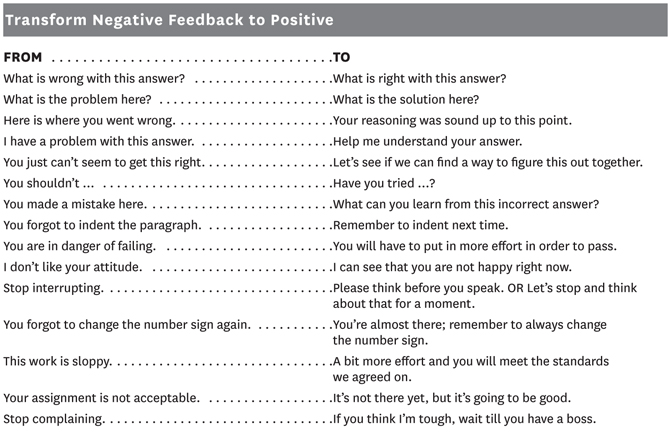
Students benefit from ongoing feedback about their learning, so appreciative assessment utilizes a menu of assessment techniques such as:
- homework checks
- projects
- portfolios
- observation
- self- and peer-assessment
- practice assignments
- samples of student work
- holistic rating scales
- student-composed questions
Though they can be graded, these forms of assessment do not require a grade; instead, they offer positive, supportive learning experiences for students as well as opportunities to create a dialogue with each other, the teacher, their parents/caregivers, and perhaps members of the community outside the school. We know that learning improves when learners have a sense of what they are setting out to learn, an explicit statement of standards they must meet, and a way of seeing to what extent they have met the learning outcomes. Appreciative assessment adds the social dimension, so learners construct understanding through many different kinds of feedback.
One last example of teenagers having fun with their learning: When our son, Geoffrey, was in Grade 11, he invited his girlfriend over for a family dinner to celebrate her sixteenth birthday. As I stirred the gravy, Geoffrey sat at the kitchen table, poring over sheets of graph paper, intently working on mathematical equations. “Whatcha doing, Geoff?” I asked. “Homework?”
“Naaaaa,” responded my teenage son. “I’m creating Cara’s birthday card.” “Huh?” I wasn’t sure what he meant by that remark, but after dinner I discovered what he had been doing. Amid giggles, Cara solved and graphed four equations. The first line graph was in the shape of a “C.” The second one formed an “A.” Next came one that resembled an “R.” The final equation resulted in another “A.” Geoffrey had created equations that Cara then solved and graphed to form her name – a novel birthday card that reflected their mutual delight in numbers. Cara went on to earn a Ph.D. in chemistry, while Geoff is now in charge of acquisitions for a large corporation. Their early, shared passion for numeracy never left them. Focusing on that strength was the secret to success.
Appreciative assessment reaffirms the power of relationships to motivate, inspire, and ignite passion for learning. It facilitates authentic dialogue between teacher and learner, thus engaging the student, strengthening the learning experience, and perhaps illuminating otherwise overlooked aptitudes. Teachers can readily implement appreciative assessment in classrooms because it is a student-centred approach to teaching, learning, and developing human potential. And isn’t that what our learning communities are all about?
EN BREF – L’interrogation appréciative mise sur les expériences positives pour amorcer un changement positif; l’évaluation appréciative consiste à aider les élèves à trouver et à tirer parti de leurs habiletés et aptitudes en leur donnant une rétroaction significative d’appui soulignant leurs capacités et leurs possibilités. Des anecdotes et des récits positifs à propos des meilleures façons d’apprendre servent à mettre en place les principes d’évaluation appréciative en classe. Quand cette pratique est appliquée à l’enseignement, les éducateurs sont optimistes quant à l’efficacité du travail qu’ils font pour apporter un changement positif. Lorsqu’elle est appliquée à l’apprentissage, les élèves sont fiers de leurs réalisations et sont motivés à travailler sur leurs défis. L’évaluation appréciative confirme le pouvoir qu’ont les relations interpersonnelles de motiver, d’inspirer et d’enflammer la passion d’apprendre. Elle favorise un dialogue authentique entre l’enseignant et l’apprenant, engageant ainsi l’élève, renforçant l’expérience d’apprentissage et, peut-être, faisant ressortir des aptitudes qui seraient autrement négligées.
[1] I have not found this term used as I do by other educators, in the context of classroom assessment; however, my research is not exhaustive.
[2] I believe the concept of Appreciative Inquiry was originally developed by David L. Cooperrider and Suresh Srivastva. See their article, “Appreciative Inquiry in Organizational Life,” Research in Organizational Change and Development, vol.1 (JAI Press Inc., 1987): 129-169.
-
Motivation and Mastery – The Problem with Deferred Data
Comments Off on Motivation and Mastery – The Problem with Deferred DataA sense of emerging mastery is one of the factors that motivate, and thus engage, teachers but the only hard data they have to gauge their success is both inadequate to fully represent their goals and deferred until after the end of the unit, term or year.
Summative data is necessary for credentialing and accountability, and it does provide useful information for improving curriculum and for policy development, which are part of mastering the craft of teaching, so it is an important part of a balanced assessment program that can help a teacher, or a school system, to learn from experience. However, because it comes “after the fact” of learning, it has little value for supporting student learning and also little value for supporting teacher engagement.
Moreover, because most summative data is used in aggregated form, information about individual students is lost. There may be some minor disaggregation (e.g., by gender or school), but summative data is generally useful only in revealing overall trends. If it is broken down into groups that are too small (e.g., individual classes) the standard error of measurement tends to become so great that although the data remains “valid’ it is no longer “reliable.” Thus, in addition to being deferred, summative data just doesn’t relate strongly to any individual. It is a conceptual abstraction with little emotional or motivational impact.
Unfortunately, summative data is what gets the most attention. Somehow it has gained an unwarranted reputation for objectivity and certainty. This is perhaps the biggest problem with it; we treat it with too much naive respect, forgetting that it comes from instruments that may or may not be well designed and that it has no meaning until it is interpreted, which may or may not be done well. As Mark Twain remarked, “There are three kinds of lies: lies, damned lies and statistics” so lets not forget that all those precise numbers are a house built on sand.
What students need, and what teachers would find most informative, is an ongoing dashboard of information about learning as it is occurring. That’s why there is so much emphasis on formative assessment these days. Feedback (aka formative assessment) trumps evaluation (aka summative assessment) if your interest is in supporting learning rather than merely sorting students.
The strength of formative assessment is its immediacy, but its weakness is a lack of precision and the complex task of understanding what it means. The evidence drawn from ongoing observation of student behaviour is best viewed not “scientifically” but through what Eliot Eisner has called “connoisseurship” or “the enlightened eye;” that is, through professional wisdom. Of course, simply being certified as a teacher does not automatically impart the enlightened eye necessary to divine the meaning within the evidence of classroom life. One has to develop this professional capacity through experience and earn the trust of students and parents in one’s ability to “see” what is going on for students and to use this “insight” to support learning. Many—probably most —teachers do, but some do not.
Formative assessment is complex, but no more so than summative assessment and it is of far more importance in the teaching and learning nexus, not only for students but also for teachers. Perhaps the best source of feedback for teachers themselves is students. The student voice, as subjectively biased as it must necessarily be, may offer the greatest hope for monitoring one’s emergent mastery as a teacher and thus for providing motivation that carries one through the exuberantly arduous turmoil of teaching. In terms of teacher engagement, this is the data that counts.
Previous Post in This Series: Motivation and Mastery – The Problem with Grand GoalsNext Post in This Series: Motivation and Mastery – Listening to Student Voices


IDEAS TO SUPPORT EDUCATORS : Subscribe to the EdCan e-Newsletter
Quality research, reports, and professional learning opportunities.