
Archive
-
Sexual and Gender Minorities in Canadian Schools
Comments Off on Sexual and Gender Minorities in Canadian Schools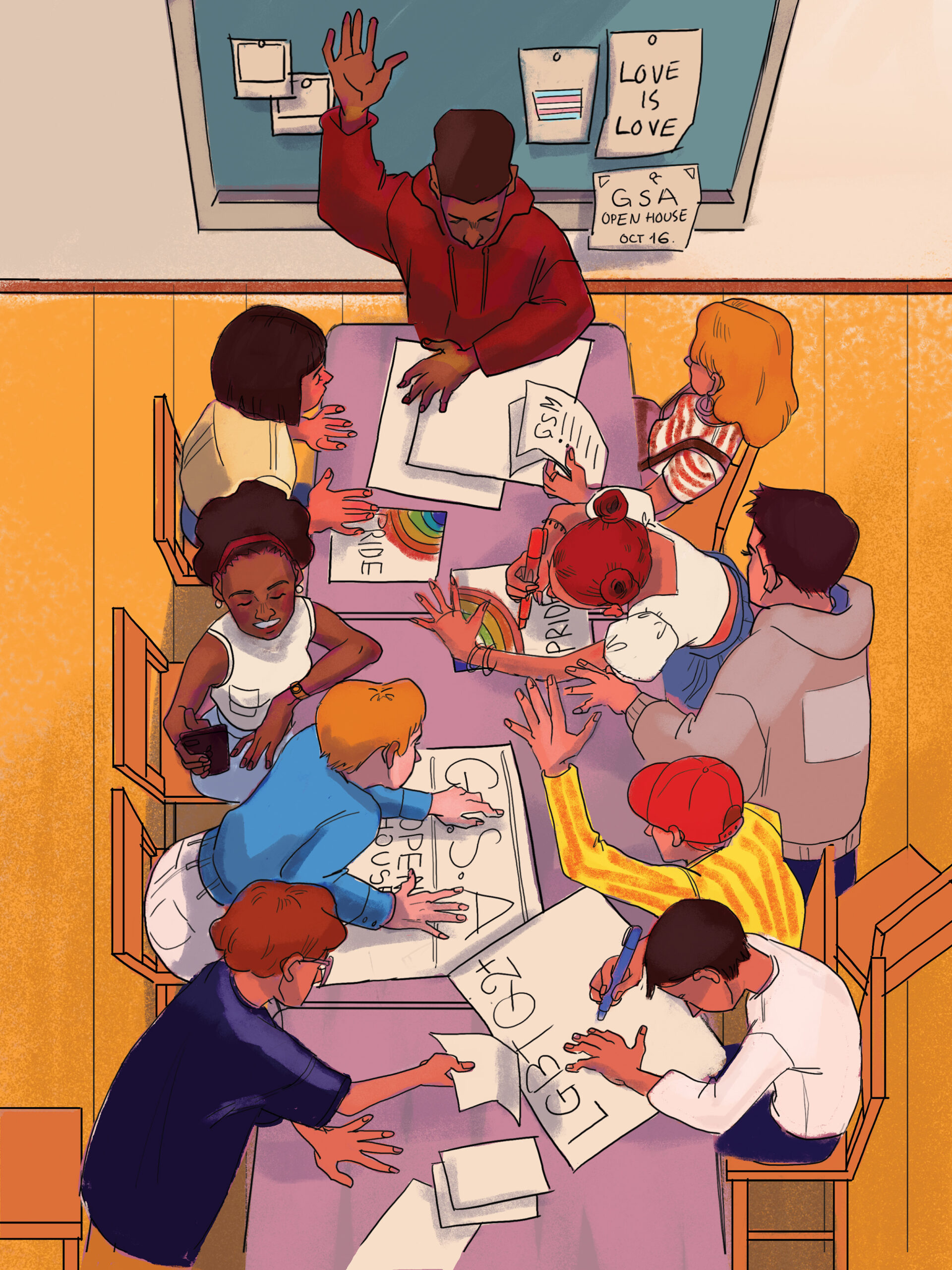
I still live with hurtful memories of being a timid and apprehensive gay boy who was bullied mercilessly and suffered immense mental anguish during junior and senior high school. I was subjected to incessant name calling and targeted by packs of boys on school buses and school grounds. Later, as a teacher, I was perpetually in fear of being outed as gay and losing my job. I dealt with unrelenting stressors, like finding pictures of naked men left under wiper blades on my car windshield in the school parking lot. These indelible memories are my impetus for wanting to make life better now for sexual and gender minorities (SGMs or LGBTQ2+ persons) in our schools. In Canada today, there is an established basis for doing this, bolstered by the Canadian Charter of Rights and Freedoms. Since the Supreme Court of Canada decision in Vriend v. Alberta in 1998, which granted equality rights to sexual minority Canadians, there have been continuous changes in law, legislation, and educational policy that have abetted recognizing and accommodating SGMs in school culture and curriculum. More recently, Bill C-16, An Act to Amend the Canadian Human Rights Act and the Criminal Code, which became law in 2017, provided gender minorities with protection against discrimination on the grounds of gender identity and expression.
With such movement forward, what is it like for SGMs to have SGM-specific policy in place in our schools as social spaces where students learn and teachers work? I took up this question in research1 I conducted in a large urban school district in western Canada that had had a standalone SGM policy, rather than merely an umbrella or general equity policy, in place for five years. Having SGM-specific policy is far from the norm in school districts in our country, so I interviewed key interest groups that included students and teachers to learn about their experiences. Students were asked to discuss everyday stressors and supports as they talked about school culture, climate, curriculum, principals, and teachers. Teachers were asked to discuss the importance of having SGM policy and practice that impact the recognition, accommodation, and well-being of SGMs. Here, I share some of their perspectives.
Students’ perspectives: What teachers do matters
The high-school students I interviewed commonly spoke about the need to educate others about SGMs and our issues and concerns. One student who was president of his high-school GSA (Gay-Straight Alliance or Gender-Sexuality Alliance) spoke pragmatically about this:
“I think having more education would be helpful because when people are uneducated, they don’t like what they don’t understand or what they don’t perceive to be normal. I think having education is a really big aspect. Incorporating LGBTQ+ case studies into courses would be really helpful.”
Another high-school student spoke about her former faith-based school where sexual orientation was still a taboo topic. She related, “It was never spoken about. There were no comments on it, and anything you did to try to bring it up, they’d put you down.” She spoke positively about the SGM-inclusive culture in her current school, stating, “I find it very welcoming. You see same-sex couples in the hallway, and there’s nothing – nobody blinks an eye.” She spoke about the teachers, saying, “One of my friends had a teacher who used their preferred pronouns and names. So that’s one teacher I know who’s very accepting. I’m pretty sure there are multiple other teachers who would as well. On the first day, they read off the attendance list and, of course, that’s your legal name. But if you ask, there are multiple teachers who will use the student’s preferred name and pronouns.” Another high school student also spoke about the naming issue, using an example to indicate how students can be negatively impacted in a public way: “One thing that sucks is for Valentine’s Day, they do the hearts. They write everyone’s name on a heart and put them in the lunchroom downstairs. But because they use the attendance list to do it, it’s birth names and legal names. So that can cause anxiety.” One trans-identified student who uses he/him pronouns provided this particular concern regarding naming and roll call. He recounted, “A big issue that you need to work with is substitute teachers. My legal name and the name that I go by are not the same, so I always need to talk to the substitutes ahead of time. That’s a bit stressful. Sometimes they forget. They always try, but you can’t remember everything.” Regarding his teachers in general, this student pondered, “I wish there was some way for the teachers to understand how significant it is to respect pronouns and labels and titles because I feel like some of them don’t understand some of the consequences. The first few times don’t bother you that much, but the more it happens, the more it bothers you. Most of my teachers don’t seem to understand how much it affects me. It makes me feel crappy.” Like other students I interviewed, this student spoke about the need to educate teachers:
“I feel because teachers are directly interacting with and impacting queer youth, it should be part of training them on a PD day or something, just to take a crash course on understanding. I don’t know if those things do happen or what the situation is with that. I just wish in general that people knew more about us and just the facts and less of the perceptions. I don’t know specifically what would be available to them, though. I do wish there was more information that was commonly known. Overall, I think our teachers are pretty supportive – some more than others – just because they’re more educated on everything. And some really try to learn with you, which is helpful. They want you to tell them stuff that they don’t know. There’s still a lot of improvements that can be made, a lot more information that can be shared. With more knowledge, there’s less misunderstanding, there’s less judgment, and everybody can just live together more peacefully and not be angry at each other or confused.”
Teachers’ perspectives: Knowing school culture, being an advocate
Supportive teachers I interviewed saw schools as social spaces where they engaged in strategic actions to advance SGM inclusion. One high-school teacher provided this perspective on what constituted an SGM-inclusive culture in her school:
“The school is very welcoming and comprehensive in terms of how staff accept students and how students themselves are perceived around the school. There isn’t a lot of discussion that we have to do because the SGM policy dictates behaviour. It’s more about creating a culture: We’ll do it because that’s what people do. This results in fewer students seeking out the GSA on a regular basis because the culture of the school itself is so open and accepting that everywhere is a safe place. The school encounters zero parent resistance to pink shirt day and other GSA events. The administration is very vocally supportive of the students wherever they are in their identity journey. They want to put those students first, ahead of any reservations of parents or complaints from community members. Everyone realizes that comfort is not covered under our provincial human rights legislation, but lack of discrimination and the ability to exist in your identity are covered.”
Of course, creating a genuinely accepting SGM-inclusive school culture takes time. Another high school teacher spoke about his GSA work to help non-heterosexual boys become more comfortable with their sexual identities: “In the GSA, it’s always more girls than guys – substantially. It’s probably 80 percent girls and 20 percent boys, if not lower. I’ve talked to other GSA teachers, and they’ve seen the same thing. Many times, I’ve heard girls say that they felt safe. I haven’t really heard a boy commenting either way. Maybe that’s why fewer boys come to the GSA meeting. There generally is more of a stigma for them, especially in high schools.” Paralleling this perspective on non-heterosexual boys’ discomfort, another high school teacher provided this observation: “I don’t think I’ve ever seen any boys holding hands, but I’ve seen lots more girls holding hands – girlfriends. That’s now just as okay as heterosexual couples walking down the hallway.” A junior high school teacher offered a similar perspective, indicating it is not just a high-school issue: “The girls seem to be far more comfortable at the junior high age for sure compared to the boys. Absolutely, I don’t think boys are quite there yet at this stage, which is sad. It’s unfortunate.”
Many teachers spoke to the importance of having a standalone school district policy on sexual orientation and gender identity to fortify the work to create an SGM-inclusive school culture. In this regard, one teacher working in an all-grades setting provided her perspective on living out this policy in word and action:
“It’s about a district level of support that starts with leadership. It’s about letting all staff know that it’s about not having prejudice and discrimination based on a student’s perceived or actual sexual orientation or gender identity. It’s about being appropriate with our responses as a staff if we encounter that, whether it’s in behaviours, comments, or the actions of other students. But it goes so much deeper. It’s in the way you would group students, in washroom use and locker use, in language use in the classroom, and in resources and approaches. So, it’s really helpful in building on safe and caring schools. It gives us something to work toward so we’re all consistent. We have a policy and we have the support of our district to continue to do that.”
In sum, teachers provided an array of reasons why a standalone SGM policy is a good thing. One high-school teacher saw it as assurance enabling SGM inclusion when teachers couldn’t rely on the school principal. He concluded, “Putting a policy on this was a good thing because you’re not always going to have an understanding administrator, a forward-thinking administrator.” A junior high school teacher felt the policy enabled him to start a GSA, which subsequently contributed to more SGM inclusion in his school. He said, “I’ve had students say how much better it is in the school since we started the GSA. I used to hear students say, ‘That’s so gay’ – constantly. I can’t even remember the last time I had to say something to a student about that. It’s just known that that’s not acceptable to do anymore. Those sorts of things to do with language and what’s acceptable in schools – I think a lot of that has to do with the policy.”
A standalone SGM policy that is consistently implemented… is a clear indicator that a school district has the backs of SGM teachers and allied teachers.
Considering whether the standalone policy made a difference for teachers in her district, a teacher working in a K-12 school responded, “I think by our surety that we’ve got our backs covered, that makes us stronger in what we’re trying to achieve.” She also saw the policy as effective in assisting SGM students who require basic accommodation that includes having their physical needs met: “I know last year, one student would go home to go to the bathroom. Of course, they wouldn’t come back. Washroom access is something so simple and so painful at the same time.”
Supporting SGM teachers, creating an SGM-inclusive school
Increasingly today, young SGM teachers choose to be vocal and visible at work, which is enabled when there is policy in place to protect them. However, many SGM teachers in our country still navigate homophobia and transphobia in their schools. Their challenges and concerns are well documented in The Every Teacher Project on LGBTQ Inclusive Education in Canada’s K-12 Schools.2
Importantly, a gay junior high school teacher spoke about the significance of having the policy in terms of SGM teacher welfare:
“I think it’s fantastic. I think it’s awesome. When it got put in place in our school district, it just seemed quite far advanced from where the rest of the province was. Just being able to know you’ve got the backing of the board is huge. Knowing that you can go in and ask these questions and do these things and not be petrified is massive. Not that it ever felt like there was a lot of homophobia in my district. I know people have encountered pockets of it here and there. I know of some horror stories, but I came out in my second year as a teacher. It was never a big deal, but it’s still nice to know that the board has your back.”
Indeed, having a standalone SGM policy that is consistently implemented and periodically reviewed is a clear indicator that a school district has the backs of SGM teachers and allied teachers engaged in SGM-inclusive work. Such specific policy can nurture an SGM-positive school culture and encourage principals to lead the way in being there for SGM students and teachers. In the end, policy is protection and its purposeful implementation is true recognition and accommodation of SGM students and teachers.
In terms of being there for SGM teachers, here are three constructive ways to be accommodative: First, show support. Notably, having strong support from school leaders can create a more open dialogue and space whereby SGM teachers feel safe to deliver and engage in SGM-inclusive education. Second, develop inclusive workplace policies. At the school district level, standalone anti-homophobia and anti-transphobia policies covering SGM staff and students – rather than generic equity policy – should stand alongside workplace harassment policies and be implemented to protect and support SGM staff. Third, create a professional and/or informal network. SGM teachers within the district can form a professional GSA where they meet to share their experiences, learn from one another, and develop trusting and supportive professional relationships.
As well, teachers – including SGM teachers needing mentors – students, principals, and parents can learn from the good work that openly LGBTQ+ educators do. Here is an excerpt from an interview I conducted with an openly gay elementary school principal in the school district who spoke about his work to be a change agent and advocate in his school:
“What do I do at my school? Certainly, we have our safe-contact teachers identified. We also have the safe and caring rainbow stickers. There’s one right as you enter the school, and there’s one on my office door, my assistant principal’s door, and on the classroom doors of the safe contact teachers and other supportive teachers. I’ve had many conversations with my parent council around the work we’re doing in order to have their support for the SOGI [sexual orientation and gender identity] work in our school. Our library collection is also growing as we find more and more stories that depict the LGBTQ+ youth and their families and same-sex families. I also have conversations with my staff about heteronormativity, the gender spectrum, and the language we use with students. So, is it working? I certainly know that my staff is very aware. Also, my sexuality is not hidden from my staff, so my staff know who I am. I also let them know that my partner is male and he’s a grade one teacher. I do it because I want them to know that I believe in the normalization of sexuality and gender in our schools, that it is no big deal. It is just who we are.”
Illustration: Diana Pham
First published in Education Canada, September 2020
Notes
1 The Social Sciences and Humanities Research Council of Canada funded this research.
2 C. Taylor, T. Peter, C. Campbell, et al., The Every Teacher Project on LGBTQ-inclusive Education in Canada’s K-12 Schools: Final report (Winnipeg, MB: Manitoba Teachers’ Society, 2015). http://egale.ca/wp-content/uploads/2016/01/Every-Teacher-Project-Final-Report-WEB.pdf
-
The Dirty Little Secret
Comments Off on The Dirty Little Secret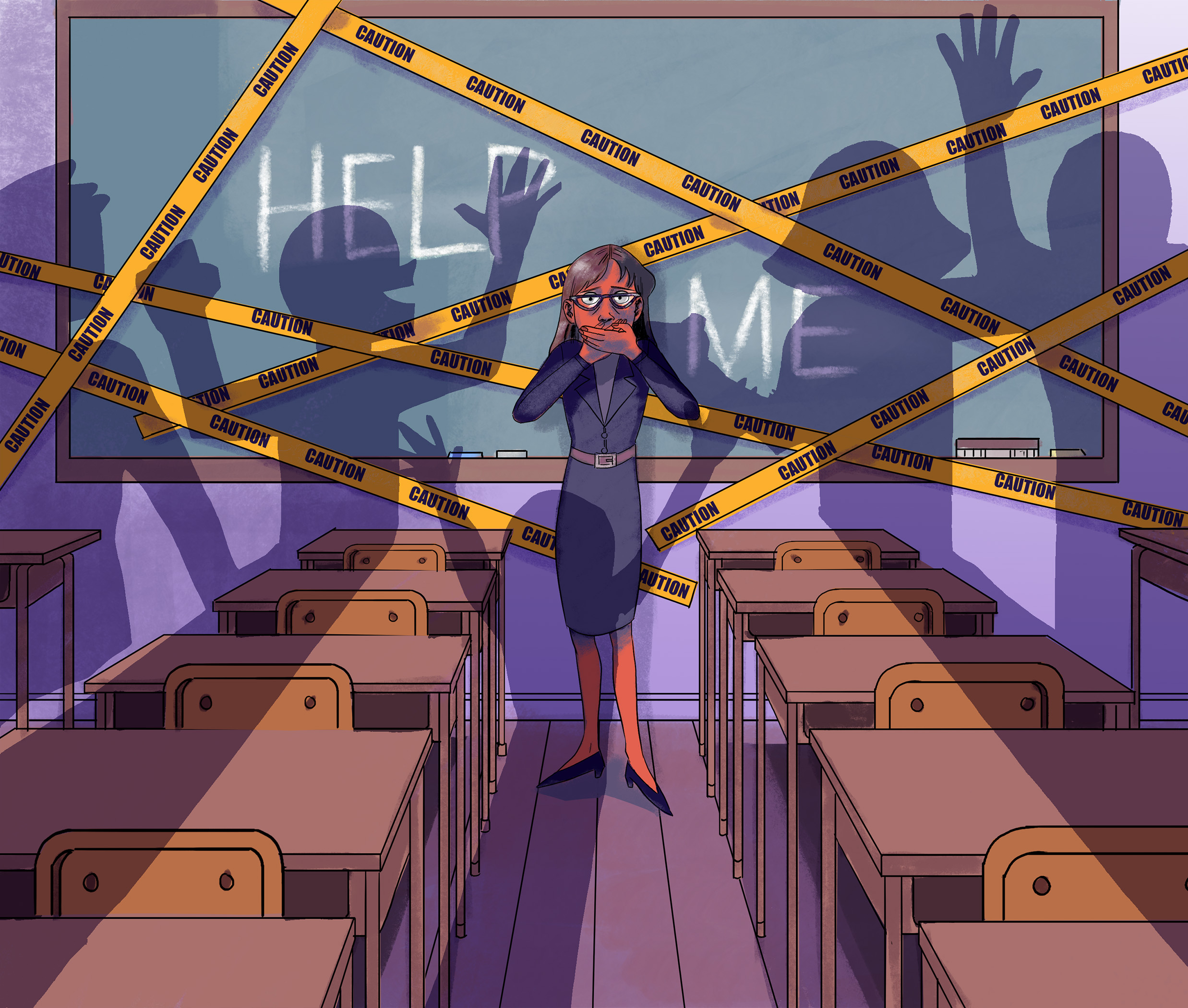
“Teachers should not feel that it’s normal to feel unsafe at school.”
– Special education resource teacher
Violence in schools is usually framed in relation to student-on-student bullying, but schools are also workplaces for (predominantly women) teachers and educational assistants: workers who are entitled to – but do not always experience – a safe and violence-free workplace. Over the last decade, unions representing education workers have mobilized to shed light on the “dirty little secret” of educator-directed violence, and the issue has received a measure of media attention. Surprisingly, however, while there are numerous studies examining peer-on-peer violence among students, the harassment and violence experienced by educators has received limited scholarly attention. Indeed, while research on bullying, harassment, and violence against students number in the thousands, we were able to locate less than ten studies on educator-directed harassment and violence in Canada.
To start to address this gap in the scholarly literature, we surveyed 1,688 Ontario English public elementary school educators (contract and occasional teachers, PSP/ESPs, ECEs/DECEs, and other educational professionals) in December 2018 about their experiences of workplace harassment (e.g. slurs, insults, and put-downs) and violence (i.e. acts, attempts, and threats of physical aggression) in the 2017-2018 school year. The Harassment and Violence against Educators (Ontario) Survey endeavoured to assess the frequency, impact, and response to harassment and violence against educators as well as to determine how experiences of, and the response to, harassment and violence are impacted by intersecting factors such as gender, dis/ability, and racialization.
Our full report, Facing the Facts: The escalating crisis of violence against educators, can be downloaded at www.educatorviolence.net. Below, we have summarized select key findings.
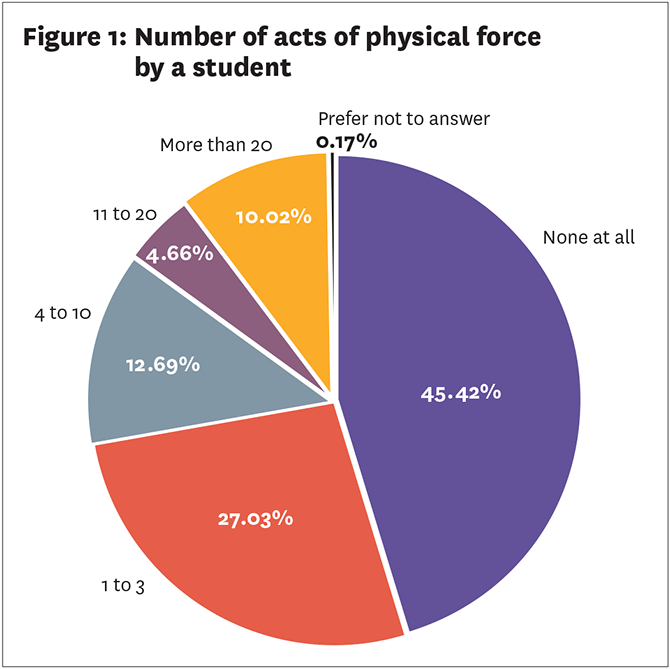
- Most harassment and violence experienced by educators in Ontario’s public elementary schools is student-initiated and rates are alarmingly high. Fifty-four percent of educators reported experiencing one or more acts of student-initiated physical violence during the 2017-2018 school year; 60% reported one or more attempts to use physical force, and 49% experienced one or more threats. (See Figure 1.) In terms of harassment, 72% of educators reported experiencing explicit verbal insults, put-downs, and/or obscene gestures from a student in the 2017-2018 school year.
- Results of the study suggest that there has been an almost ten-fold increase in the experience of violence against educators since the first Canadian surveys were conducted some two decades ago. Results from a 1999 study on behalf of the British Columbia Teachers Federation1 showed that fewer than 5% of educators experienced some form of physical violence during the 1997–98 school year – approximately one-tenth of the rate indicated in the current study.
- Harassment and violence against elementary school educators is gendered violence. Not only are upwards of 85% of elementary school educators women, but gender is evident in the nature of the violence (language deployed, the mobilization of gendered tropes, microaggressions, and sexual harassment) and in the institutional response, including the routine responsibilizing and blaming of educators for the harassment and violence they experience.
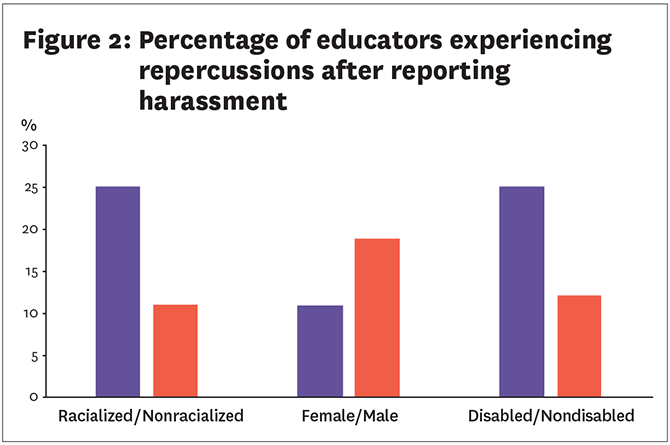
- Vulnerability to harassment and violence is conditioned by intersecting factors. For example, rates of harassment and violence from students are statistically higher among educators identifying as racialized, disabled, women, or LGBTQ2+; they also experience elevated levels of reprisals from their administrators. (See Figure 2.) Women with disabilities experience the highest levels of harassment and violence.
- Harassment and violence are often repetitive, frequent, and ongoing occurrences. Educators who experience harassment report an average of 8.5 occasions of insults, put-downs, or obscene gestures from students, 2.77 from parents, 3.98 from colleagues, and 4.21 from administrators in the 2017-2018 school year.
- Qualitative data reveals that educators often feel unsupported by administrators, that common strategies such as requiring educators to wear personal protective equipment (e.g. spit shields, concussion caps, or Kevlar arm and shin guards) are addressing symptoms rather than root causes, and that there is a disturbing normalization of violence in Ontario’s elementary schools.
- The impact of harassment and violence is long lasting. Higher levels of harassment and violence are associated with decreased physical and mental health as well as job performance, even when assessed some six months after the school year in which the harassment and violence occurred.
- Almost half of educators (47%) did not report their worst incident of workplace violence in the past year. Reasons for not reporting included a lack of time, being dissuaded from doing so, and concern about repercussions.
- Only 36% of educators were confident in their ability to deal with an incident of physical violence; the majority would welcome social-emotional learning programs (68%) and non-physical intervention training (55%).
- The financial impact associated with harassment and violence is considerable. Educators reported taking an average of 6.84 days off work following their worst instance of harassment in the 2017-2018 school year and an average of 5.18 days off work following their worst instance of physical violence. The costs associated with lost time due to harassment and violence against public school educators in Ontario are conservatively estimated to be in excess of 3 million dollars annually.2
- Educators overwhelmingly identified the need for more and better allocation of physical and human resources (e.g. educational assistants, mental health specialists) and earlier identification of student needs. They also noted the importance of additional educational resources, clear policies that are followed, consistently applied consequences for violent and harassing behaviour, and better trained, more responsive and supportive administrators.
The escalating crisis
“I love teaching… However, the emotional and mental abuse that I have been subjected to on a daily basis, and the physical toll it has been taking on my body is unbelievable… I took a medical leave from work due to the stress and abuse. I learned that [my health issues] are due to a prolonged exposure to these conditions.” – Grade 2 French Immersion teacher
The 2017-2018 Harassment and Violence against Educators (Ontario) Survey provides stark evidence that educator-directed harassment and violence is escalating and quickly becoming a crisis. Indeed, rates of harassment and violence are critically high. In a single year, as many as one in two educators will experience violence and as many as 70% will experience harassment, whether from a student, parent, colleague, or administrator. Moreover, harassment and violence are increasing dramatically. Rates of harassment have at least doubled, and rates of physical violence have increased seven- to ten-fold over the last two decades. At the same time, we see a disturbing normalization of violence against educators by administrators, educators, and students operating in tandem with the widespread minimization and/or denial of its multifaceted impacts by administrators, school boards, and politicians. In addition, findings from the Harassment and Violence against Educators (Ontario) Survey indicate that workplace violence is being underreported, and when reported, is all too often accompanied by blame and reprisal. This suggests that official rates underestimate the true prevalence and speaks to an organizational culture that is ill-equipped to address the issue. In real terms, while school boards have embraced the language of progressive discipline mandated under the provincial Education Act, educators told us that, in practice, there are few consequences for students’ harassing and violent behaviour. Finally, findings from the current study suggest that many educators feel neither adequately supported nor prepared and trained to deal with the student-initiated harassment and violence that they are experiencing.
Rates of harassment have at least doubled and rates of physical violence have increased seven- to ten-fold over the last two decades.
The escalating crisis of educator-directed harassment and violence speaks to the compounding impact of structural, fiscal, and social factors. The past 20 years have seen significant changes in society, including growing income disparity, social inequality, and economic stress, a rise in both moderate and severe mental health difficulties among children,3 and the ubiquity of electronic devices, all of which have increased the needs of students. At the same time, we have seen significant shifts in provincial education policies, including a commitment to mainstreaming (placing students with complex needs in regular classrooms with correspondingly decreased use of segregated classrooms) institutionally structured “corrective and supportive” progressive discipline policies,4 and ministry-mandated “Learning for all”5 approaches based on the recognition that “all students learn best when instruction, resources, and the learning environment are well suited to their particular strengths, interests, needs, and stage of readiness.”6 To be successful, these evidence-based practices require significant investment in infrastructure, materials, professional development, and human resources. Unfortunately, as needs and expectations increase, funding formulas have not been recalibrated. Indeed, in Ontario, the impact of deep funding cuts introduced under the Mike Harris government (1995 to 2002) continues to echo.7 In classrooms across Canada, educators are scrambling to meet ever-expanding expectations – from more Individual Education Plans to increased class size to standardized testing requirements – with decreasing levels of support and resources. The result is entirely predictable – frustrated, struggling children whose needs are not being met are “lashing out.”
Harassment and violence, coupled with inadequate (and potentially declining) resources to meet the needs of students, the normalization of harassment and violence against educators, a fear of reprisal for reporting, low levels of support, increasing levels of incivility, the uncertainty about how to effectively respond to harassment and violence, and an unwillingness on the part of administrators to consequence aggressive behaviour is having detrimental impacts on the classroom learning environment, students, and the health and well-being of educators. Indeed, in light of the high rates of harassment and violence experienced by educators in the performance of their duties, it is reasonable to expect that most educators will suffer a mental injury (e.g. PTSD, burnout) at some point in their careers. Accordingly, in addition to strategies to reduce harassment and violence in schools, it is essential that adequate resources (such as access to mental health professionals) are available to ensure that educators who experience harassment and violence have the opportunity to address any mental or physical injuries they sustain, as well as to learn the skills needed to cope with ongoing exposure to harassment and violence.
Action is needed
Addressing this significant problem will require a commitment to immediate action, including:
- Increased resources to ensure that the most vulnerable students are getting the help they need and that all students have access to the supports they require to flourish and learn. This will require, among other things, augmented health services (e.g. early diagnosis and interventions), more educational assistants and other educational supports, and smaller classes to facilitate the individualized attention mandated by provincial education legislation.
- Support for teachers to enable them to manage the increasing breadth and intensity of needs in their classrooms, and resources to address educators’ mental and physical health needs in the context of the escalating harassment and violence they are experiencing.
- Training for administrators to ensure that they have the skills to adequately address harassment and violence in schools and provide meaningful support to educators who experience harassment and/or violence.
- Ensuring that policies and protocols concerning harassment and violence are understood and consistently applied, including the implementation of student consequences that are appropriate and effective.
- Ongoing monitoring of workplace harassment and violence and the development of strategies to address the heightened vulnerability of designated groups, such as racialized, Indigenous, disabled, women, and LGBTQ2+.
- Adoption of a population health approach that examines and addresses the broad range of factors influencing harassment and violence against educators.
The workplace violence educators experience has significant and far-reaching costs. It impacts educators’ health, well-being, careers, ability to do their jobs, and relationships. In real terms, the violence reverberates through their personal and professional lives and in turn though the lives of their families, their colleagues, and the students they teach – creating ever more ripples that impact other families and indeed the broader community and society. The impacts also ripple over time – we can only imagine how the casual normalization of violence against (predominantly women) educators is shaping the perceptions and expectations of a generation of students.
Illustration: Diana Pham
First published in Education Canada, September 2020
Notes
1 David R. Lyon and Kevin S. Douglas, Violence Against B.C. Teachers: Report of the Simon Fraser University/British Columbia Teachers’ Federation violence against teachers survey (Burnaby, B.C.: SFU Mental Health, Law and Policy Institute, 1999).
2 The financial costs associated with days of work following an incident of harassment and violence were calculated in the following manner. Assuming a conservative rate of violence or harassment that would require time off work, of say just 10% (which is less than one fifth of the rate reported in this survey), then it can be expected that some 8,000 educators would have taken time off work at the time that the survey was conducted. If 25% of those 8,000 educators took the average number of 6.84 days off work, the average cost of replacing these educators in the classroom would be $1,652.31 each, amounting to over 3 million dollars annually. It is important to keep in mind that this estimates a very low rate of exposure to harassment and violence and estimates only the replacement costs associated with a single incident of harassment (and not violence) in any given year. It is important to keep in mind that educators in this survey reported multiple instances of violence and harassment in a single year.
3 A. Boak, H. A Hamilton, et al., The Mental Health and Well-being of Ontario Students, 1991-2017: Detailed findings from the Ontario Student Drug Use and Health Survey – CAMH Research Document Series No. 47 (Toronto, ON: Centre for Addiction and Mental Health, 2018).
4 Ontario Ministry of Education, Supporting Bias-Free Progressive Discipline in Schools (2013). www.edu.gov.on.ca/eng/policyfunding/SupportResGuide.pdf
5 Ontario Ministry of Education, Learning for All: A guide to effective assessment and instruction for all students, Kindergarten to Grade 12 (2013). www.edu.gov.on.ca/eng/general/elemsec/speced/LearningforAll2013.pdf
6 Ontario Ministry of Education, Learning for All: 8.
7 H. Mackenzie, Course Correction: A blueprint to fix Ontario’s education funding formula (Canadian Center for Policy Alternatives, 2018). www.policyalternatives.ca/sites/default/files/uploads/publications/Ontario%20Office/2018/03/Course%20Correction.pdf
-
Scylla and Charybdis
Comments Off on Scylla and CharybdisIn the Odyssey, Homer writes of the fear that Greek mariners felt as they attempted to cross the narrow channel of water flanked by Scylla, the six-headed monster on one side, and Charybdis, the violent whirlpool, on the other. My circumstances were not as dire, but I can empathize with the pressure these ancient sailors felt. My dilemma between the proverbial “rock and a hard place” occurred during the heated 2014 contractual dispute between the B.C. Ministry of Education and the B.C. Teachers’ Federation, during which I walked an ethical tightrope between my responsibilities as teacher to my inner-city school, and as a representative of the Federation.
The educational landscape of British Columbia in 2014 was marked by extreme tension, with heated contract negotiations that escalated into a full-scale strike and lockout. The union ordered members to discontinue participation in extracurricular programs. At the time, I had taken on many extracurricular duties at my school, which was situated within one of the poorest socio-economic pockets of the Lower Mainland. Many of our families found themselves in a constant state of crisis as a result of chronic poverty. Many of our children were in and out of the revolving doors of foster care. Some families were refugees who had fled civil and political strife in their home countries. Opportunities were sparse for the children of this community. This is not to say that the parents did not care for their children – some worked two or even three low-paying jobs to provide as many opportunities as were accessible to them. As a professional, I found it gut-wrenching to balance my response to these competing claims on my loyalty.
On the one hand, I had a legal and professional responsibility to my union. Issues of key importance to me, such as benefits, working conditions, salary, student funding, and the overall integrity of public education had all been secured as a result of the tireless effort of the union. At a critical time when the union was engaged in negotiations, I recognized the importance of teachers presenting a united front. If the union needed us to withdraw extra-curricular activities and strike to pressure the government, I felt compelled to support their decisions. It was also clear to me that to maintain productive relationships with my colleagues, I needed to show the same level of commitment to the union as they did.
On the other hand, I also felt a strong sense of obligation to my students and the community. I was acutely aware that many of the children at my school were already marginalized. I thought their extracurricular opportunities helped to address the lack in their lives and provided these children, who were at constant risk of becoming statistics themselves, with rare opportunities to engage in enriching and constructive activities. My conscience told me that I needed to exercise compassion for those less fortunate. The care of one’s fellow humans is a responsibility that I feel we are born with and should not abdicate, and this lay at the heart of my dilemma.
I wrestled with finding a balance between the opposing claims. I believed in both! Was it possible to serve two masters when they were locked in conflict? This situation led me to a paralytic state of inaction. I was unable to make a move in either direction. The more I tried to find a way forward, the more paralyzed I became. Was it even possible to reconcile this ethical duality when the solutions were so mutually exclusive? How could I choose one side over the other, and how could I look at myself in the mirror after doing so? To choose one side would betray the other side and my ethical principles as well. These were unanswerable questions that preyed on my mind and put me in conflict with myself.
But ultimately my story had a happier ending. Like the mariners who found the narrow channel between Scylla and Charybdis, I finally found a middle path through my dilemma. I was able to connect our underprivileged students with a non-profit agency that would provide extracurricular activities during the strike, which allowed me to withdraw my own extracurricular services in better conscience.
Looking back, this dilemma did more good than harm for my practice, because it enabled me to clarify why I choose to teach and how I choose to do so.
Illustration: iStock
First published in Education Canada, September 2020
-
Battling Bad Feelings
Comments Off on Battling Bad FeelingsTeachers often describe feeling anxious, exhausted, and unwell, and the sense of “being pulled in too many directions.” What is it about teaching that can feel so depleting, that induces what University of Toronto Distinguished Professor Mari Ruti calls “bad” feelings: those feelings that arise from the sense of not doing enough, not doing it well enough, and not being better at it? Stacey, a young and enthusiastic teacher from our research study,1 described teaching as feeling like, “physically and mentally you have nothing left to give.” While Stacey avowed that she loved her job, she also described being overwhelmed – exhausted by the demands of others and the needs of children, and torn by the expectations of the public, parents, principals and colleagues. Through Stacey and the other teachers we interviewed, we see how teachers are inundated with bad feelings.
Unsurprisingly, teachers, teachers’ organizations, and school districts have been seeking ways to help teachers cope with such bad feelings. Efforts to help teachers cope are often constructed through various discourses of self-help and manifest in the language and practices of wellness, well-being, and mindfulness. However, as educators and as researchers, we are concerned with the ways in which these self-help narratives might actually be unhelpful – a tempting snake oil aimed at “treating” the ailments of the teacher. Dr. Ruti explains that bad feelings often result from society’s increased demands for heightened performance, greater productivity, incessant self-improvement, and constant cheerfulness. Like Ruti, we understand these demands as effects of neoliberalism. In education, neoliberalism often manifests as a business model approach to education where costs and efficiencies override moral concerns and in which teacher success is defined in terms of student performance outcomes. Meanwhile, teachers’ professional development is based on expectations of relentless self-improvement.
Here, we want to critically consider teacher self-help narratives and their potential to magnify and misunderstand the bad feelings that teachers experience. We want to consider these feelings from a different perspective; that is, to consider bad feelings as important and intrinsic to the experience of teaching. We do this not in order to dismiss teachers’ feelings, but in a way that might make these feelings more bearable, allowing teachers to deflect the associated sense of inadequacy. We hope to illustrate how a different understanding of these bad feelings might enable us to appreciate the emotional toll of teaching and the ways in which they reflect living an ethical life in teaching.
Curing the ailing teacher
Through the increased societal demands of performance, productivity and self-improvement, self-help discourses become a method of blaming and responsibilizing the teacher for her protest. In other words, not meeting these expectations of improvement is projected as an individual problem – the fault of the teacher. Attempts to cure the ailing teacher have subsequently spawned endless numbers of products and services. For example, a Google search of the terms teachers and self-help elicits over 1,700,000,000 hits; literally, over a billion websites that offer tips, strategies, books, and lists that make suggestions such as, “choosing to live joyfully.” Indeed, as Stacey explained, “I always thought happiness was a choice and that, oh, ‘you can be positive.’” These expectations of self-improvement and incessant cheerfulness feed a lucrative well-being industry, which according to the Global Wellness Institute is worth over four trillion dollars. Thus, the requirement of constant self-improvement makes teachers the target of often-costly self-help products that include books, herbal remedies, medication, therapy, mindfulness training, and yoga. Dr. Ron Purser, an ordained Zen Dharma Teacher in the Korean Zen Taego order for Buddhism and a Professor of Management, likens these individualistic and hip pursuits of self-help as a form of McMindfulness, a corporatized and marketable product that promises self-fulfillment and self-improvement. Although these products might offer some benefits to individuals, the point here is that the increased expectations and scrutiny of teachers’ performance and productivity, makes teachers like Stacey feel as though they must work harder and longer, self-improve, and avail of costly treatments or programs in the process. Teachers must not only shoulder increasing pressures, they are expected to “stay calm and carry on” without protest!
We understand education as a public good and teaching as an ethical endeavour, wherein teachers seek to cultivate students’ understandings of and relationships with themselves, with others and with the world around them, in an effort to lead good and worthwhile lives. Yet, in education, neoliberalism has incited increased managerialism, fewer resources, more standardized testing, greater focus on individualism, and amplified competition. Stacey described feeling “quite conflicted, when admin are talking about a certain initiative or when they are saying ‘This is what you need to focus on,’ but that’s not necessarily what I feel is important for my kids.” These neoliberal ideologies create what Wendy Brown calls “miserable conditions,” in which the task of teaching is constructed as a technical means of knowledge transfer in the name of higher test scores. This creates a tension between teachers’ everyday obligations to engage ethically with students and the often-inhumane expectations of increasing performance indicators.
From this perspective, the self-help discourses serve to redirect the problems of the changing education system to those of problems of (or within) the teacher. In other words, self-help discourses consider teacher stress as the teacher’s fault, and subsequently directs teachers to choose happiness, to declutter, and to breathe. These simplistic “fixes” to teachers’ bad feelings distract us from considering – and critiquing – the conditions in which teachers are situated. Understood in this way, self-help discourses become the means to the neoliberal ends. Instead of cultivating ethical explorations of the self and one’s relationship with the world, self-help operates as another mechanism to control and manage the teacher. The message is, if Stacey could just fix her bad feelings, she could improve both productivity and performance.
Responsibilization of teachers
As education professor Julie McLeod explains, a teacher’s sense of responsibility – to her students, the profession, and the greater good of society – is different from responsibilization. Responsibilization is the requirement on teachers to take greater responsibility for the management of schooling and of children as a technical and regulatory event rather than as an ethical one. Stacey stated, “I feel responsible all the time” and gave examples of feeling responsible for educational assistants, the decisions of her principal, and “carrying her weight.” Responsibilization increases pressures on the teacher, reinforces regulation (of the teacher and of the student) and increases individualism, and thereby recasts teachers’ work from relationships with students to better management of others – and also better management of herself. Consider Stacey’s comment: “I learned a lot of great strategies to stay well. And I’m still working on that balance of like how do I take care of myself and what can I just say no to, so that I can actually feel well.” We see in Stacey’s response her internalized sense of responsibilization; wherein she feels responsible for finding better strategies in order to “feel well.” This internalized sense of responsibilization places the onus on Stacey to “fix” her bad feelings through self-improvement, individualizing and regulating her feelings and her being. Responsibilization recasts what is difficult about teaching as something that should be – and can be – better managed by the teacher.
Teachers’ bad feelings are not a sign of weakness or deficiency, but are symptoms of their sensitivity to students’ needs.
Moreover, the responsibilization of teaching is premised on gendered stereotypes of the teacher. As scholars Alison Prentice, Marjorie Theobald and Madeline Grumet have helped us to understand, teaching has long been considered women’s work, constructed as emotional labour, and relegated to the domestic, private sphere, like the home. Thus, teachers’ protestations about the conditions of their work are dismissed as “complaints,” fueled by gendered stereotypes of teachers as emotional, irrational, and even hysterical. The “complaining” teacher is ignored in political arenas and the teacher’s complaint is seen a symptom of her being unwell – and perhaps even irresponsible.
The emotional toll of obligation in teaching
As we discussed in the opening, self-help narratives make the teacher feel as though she needs to constantly improve her performance, productivity, and cheerfulness in order to be a “good,” or perhaps an even “better,” teacher. Yet, these discourses target and responsibilize the teacher, ultimately serving neoliberal agendas of improved performance, productivity and consumerism – privileging economic goals over ethical engagements. The alluring promises of such a productive and cheerful teaching life are what professor Lauren Berlant would call a “cruel optimism,” or the promise of something that is ultimately impossible to attain. Moreover, even striving to attain it might not be good for us. The constant pressure to improve one’s performance, productivity and cheerfulness is like a greyhound dog race; the unwitting dog is tricked into chasing the lure – but it is never meant to actually catch it.
In our research, we explored the emotional toll of obligation, considering bad feelings as intrinsic to the experience of teaching – not in order to fix or dismiss these feelings or to construct the teacher as hopeless or woeful, but rather to understand these feelings in a way that might make them more bearable. We are interested in shifting discourses about teachers and their feelings away from the faults and flaws of the teacher, and toward understanding teaching as a profoundly relational endeavour, replete with emotional experiences. Perhaps if teachers understood these feelings from a different perspective, they might fend off self-blame and deflect demands for self-improvement.
In exploring the emotional toll of teachers’ obligations, we are guided by the philosopher John Caputo, who describes obligation as a visceral sensation that compels teachers to act. Obligation is that force that teachers experience when they are compelled to respond to the student who is hungry, crying, lonely, failing, joyful, or angry. Obligation in these moments fixes the teacher to a sense of urgency and responsibility while necessitating judgement. When Stacey discovered that one of her students had been writing about suicide and self-harm in her notebook, Stacey described being “worried about her and trying to figure out my next steps.” In Stacey’s story, the anxiety of obligation was animated by bad feelings: she worried about the uncertainty of her decision (what to do?), wondered if she responded appropriately, feared that she might not meet the demands of others, and agonized about being harshly judged. It is in the midst of such bad feelings that we see the teacher’s ethical response – sensitive to the student, no script to follow, and yet, required to act. What we see in Stacey’s stories, and what is emblematic of the teachers we interviewed, is that teachers’ bad feelings represent the visceral responsiveness that characterizes educational relations: teachers feel their obligation to students, and those feelings can become burdensome. These feelings are, however, distinct from the feelings of frustration associated with the increased managerial demands of neoliberalism and its focus on student achievement and teacher accountability.
Put simply, teachers’ bad feelings are not a sign of weakness or deficiency but are a symptom of their sensitivity to students’ needs. With that in mind, teachers deserve the support of the larger society in shouldering education’s obligation to the young. As a starting point, governments, school districts, families, and communities need to engage in substantive conversations about what matters educationally; to consider collectively: What is education for? What is it we want for our children – and our world? How do we know that what we want is “good”? These are the questions that confront teachers in the everyday moments of classroom life. These are the questions that both guide and overwhelm the teacher. These are the questions that constitute an ethical life in teaching.
Photo: iStock
First published in Education Canada, September 2020
Notes
1 This article draws on research supported by the Social Sciences and Humanities Research Council. Our research team conducted qualitative interviews in two Canadian provinces with teachers who left, or who had considered leaving the profession due to its emotional toll. More about this research can be found at: Melanie D. Janzen and Anne M. Phelan, “‘Tugging at Our Sleeves: Understanding experiences of obligation in teaching,” Teaching Education (2018): 1-15. https://doi.org/10.1080/10476210.2017.1420157
-
Live Well
Comments Off on Live WellA rural school division in Northwest Saskatchewan is not immune to the rising trend of burnout and mental health issues in educators. In response to this growing concern, Northwest School Division (NWSD) administration created a team to support and promote staff wellness that included teachers and school support staff, as well as a division councillor and members of the senior administration. Understanding that wellness can mean different things to different people, the team took a holistic approach in encouraging staff members to be well. While we recognized that many of the systemic issues that lead to burnout would not be solved through individual efforts, there was an opportunity to support the personal wellness of staff and build a sense of community around well-being.
The Live Well campaign was launched in December 2018, with a mission of “promoting and supporting physical, mental and spiritual wellness for all members of #teamNWSD.”
First steps
A symbol: To kickstart the program, each staff member was given a blue NWSD Live Well bracelet: a symbolic reminder of both their goals and the support within the division to accomplish those goals. Our belief structure established that “to Live Well can mean something different to each person, as we are all on different wellness journeys.” The bracelet highlighted the fact that, in a variety of ways, individuals are making wellness a priority in their lives.
Live Well Journal: In addition to the bracelets, each staff member was provided with a Live Well journal to chart their progress, collect their thoughts and highlight their successes. The journal served as a concrete tool to share information about the challenges and help staff to plan their personal journeys. The outline of the year for the Live Well campaign was colourfully articulated and information about each monthly theme was presented. Having a vibrant journal that employees could have in their hands and easily take with them underscored the idea that wellness is something that you can personally interact with on a daily basis. Our Live Well team knew we were on the right track with this concept when we could spot the dog-eared journals on staff desks in buildings all across our division.
My Wellness Goals: The first Live Well activity was titled “My Wellness Goals.” Each employee was encouraged create three personal wellness goals for the year. The goals did not need to be shared publicly and staff could consider physical, emotional and spiritual dimensions. Participants, with the aim of further committing to Live Well, had the opportunity to share with the team that they did create three personal wellness goals. The goals served as the foundation of a personal journey throughout the year.
The challenges
As the year unfolded, staff members had the opportunity to be involved in a number of challenges that coincided with monthly themes. Each month of the school year had a designated theme and challenge, and a fitting prize as an extra incentive for individuals and staffs to join in the fun. The month of September, for example, started with the theme of “Get Moving” and included a step challenge as well as a virtual run. There was a buzz in the air as people set their own goal and guessed at what the winning step total might be. Mini staff competitions cropped up, and groups started coordinating their lunch hours around getting in their daily steps. We started to see staff connections and camaraderie building around the Live Well program.
December’s theme was “Stress Management,” and in addition to encouraging employees to reflect on how they planned to manage stress, we held three wellness fairs throughout the division at which employees could enjoy massage, yoga, meditation and healthy snacks. The fairs were a welcome reprieve at a stressful time when there were many school events to wrap up before the holiday break. They also served as an opportunity to both support and thank staff members for their commitment to students. In January, the “Active Living” theme was highlighted with the Wellness BINGO. The challenge was done on an individual and staff level, with participants having the opportunity to complete tasks in the squares to fill in their BINGO card. This contest was the ultimate team challenge and created an exciting energy as people encouraged their colleagues to fill in squares and worked to stay ahead of schools and offices down the road.
Our team purposefully tried to keep the barrier to entry low and create challenges that focused on different areas of wellness to engage a variety of different staff members. Staff that may not have connected with the virtual run might have a good book or healthy recipe to recommend, or a hobby they found stress relief in. Each month we have been able to engage different groups of people.
Energy and connection
A critical goal of the Live Well campaign was to bring staff members together. In our rural Saskatchewan context, togetherness is accomplished in creative ways. As such, each challenge included a requirement or encouragement to share individual or team accomplishments on social media. The school division’s Twitter feed was filled throughout the year with examples of people being well. In addition to the entertainment that comes with seeing what colleagues were up to, the presence on social media also reinforced the idea that “If my friends and colleagues can be well, I can too.” Our communities started to take notice and it was clear they saw the value in promoting staff wellness. Many local organizations and businesses reached out and asked how they could support us. A surprise benefit for the leadership team was the stories from staff who felt inspired by the activities we were doing and used that as the impetus for creating their own staff and school challenges. The small seed we planted grew far beyond what we ever could have expected.
Well together
We recognize the diversity and complexity of individual wellness for staff members in the field of education, and the reality that a challenge-based approach to staff wellness is only one of a multitude of factors that contribute to individual wellness. Still, we are encouraged that the Live Well campaign has allowed us to make some difference. Through the Live Well campaign, the school division has had the opportunity to communicate clearly that staff wellness matters. Live Well allows people to try new things that they may not have otherwise chosen to do. Perhaps most of all, the Live Well campaign supports the feeling that if we are going to be truly well, we will do it by being well together.
All Photos: courtesy of the authors
First published in Education Canada, September 2020
-
Thriving in Stressful Times
Comments Off on Thriving in Stressful TimesLong before the new school year started, teachers, school and district leaders and Ministry staff were trying to plan for a safe and productive return to school. Or perhaps a partial return to school, supplemented with online learning. Or perhaps some other model. From wrestling with the logistics of keeping students physically distanced from each other in buildings designed and staffed for large groups, to seeking kid-friendly online learning approaches, it’s been an uncertain path toward a moving target. Parents and students, of course, also have new worries and challenges.
So everyone in the education system is feeling an additional layer of stress. We are also finding new ways to connect with and support each other, experiencing satisfaction when we find effective ways to meet new challenges and taking pride in the successes that have been achieved so far.
This issue of Education Canada is focused on you and your well-being at work, regardless of your role in the education system. Before we’d even heard of COVID-19, staff stress and burn-out was already a significant problem in education. Staff well-being is an issue that all school boards should be concerned about – and now more than ever.
The authors in this issue offer thoughtful, evidence-based analysis of the stress educators experience and how this impacts the whole school community. Rohan Thompson and André Grace address the burden of stress that BIPOC and LGBTQ2+ staff and students endure due to systemic and explicit racism and homo/transphobia. Darcy Santor and Chris Bruckert report on the worrying increase in violence and harassment teachers are experiencing. Melanie Janzen and Anne Phelan examine how over-emphasizing self-help as the “cure” for teachers’ stress can actually increase anxiety and feelings of inadequacy, while overlooking both the systemic factors that create relentless stress and the inherent nature of the job for teachers who care.
There is plenty of good news, too. Our authors also share initiatives, programs and policies that have strengthened educator well-being in their districts, and new ways of thinking about and addressing stress among teachers and students alike.
I hope you find validation, useful information, and inspiring ideas in this issue to support you and help you stay well – both as we find our way through the pandemic, and in the future.
First published in Education Canada, September 2020
Write to us!
We want to know what you think. Send your comments and article proposals to editor@edcan.ca – or join the conversation by using #EdCan on Twitter and Facebook.
-
Educators’ SEL, Relationships, and Learning
Comments Off on Educators’ SEL, Relationships, and LearningJoanne was a Grade 3 teacher in a high-need rural school. She was an incredibly conscientious person and she worried a lot. She worried about how good a teacher she was, how her colleagues perceived her, and what her principal was thinking, as well as being concerned about each student and how she could help them progress. This worry led to her doubting herself and working even harder, and over time she became emotionally exhausted. This, in turn, affected her family life and her health. Then a new principal arrived and set social and emotional learning as a central goal of their school.
Joanne was mentored in the use of an evidence-based Social emotional learning (SEL) curriculum and the staff created a reading group on SEL. They then began to work on their own social and emotional awareness, which included some short and practical mindfulness practices. The staff also worked to create a more compassionate, caring culture for their school, children, and parents. Joanne found a new reserve of inner strength, loosened the grip of her worry, and celebrated the new sense of partnership with teachers and other staff. She developed closer relationships with her students and parents and she slowly gained back the joy of teaching.
This story illustrates the power of community, leadership, and self-inquiry in supporting a teacher’s own journey as a professional. All three components supported Joanne and nurtured her abilities as a teacher. Over the past few decades, research has shown that teachers who develop and compassionately nurture their own social and emotional competencies are those who create caring classrooms and support their students’ SEL. Further, when children’s social and emotional competence is facilitated and the school nurtures healthy relationships with colleagues, students, and families, students become more engaged as learners and increase their school success.
In the time of COVID-19, there are important lessons for us to remember. First, we need to nurture ourselves and make realistic plans for self-care. Second, we need to nurture our relationships with our colleagues, and especially reach out to our students and families. Third, secure and caring relationships are the base for learning and success and the more secure and confident we all feel, the more learning and growth will happen.
First published in Education Canada, September 2020
-
COVID-19: Supporting Teachers in Times of Change
Comments Off on COVID-19: Supporting Teachers in Times of Change COVID-19 is here to stay, at least for the foreseeable future. Researchers from the University of Winnipeg surveyed over 1,600 teachers across the country to explore which conditions, in terms of resources and job demands, allow teachers to remain resilient when teaching during times of disruption and change such as the COVID-19 pandemic.
Note: These findings are part of a survey series on supporting teachers during the COVID-19 pandemic. Survey responses were first collected in April/May 2020, when teachers had just begun to teach remotely. The survey was administered a second time in mid-June 2020. It will be administered once more in September 2020, when students (in most provinces) are physically back in school practicing safety protocols related to COVID-19. Stay tuned for updates on this survey series.
Continue to survey results here
-
Infographic | K-12 Staff Stress and Burnout: An issue worthy of investment
Comments Off on Infographic | K-12 Staff Stress and Burnout: An issue worthy of investmentThis infographic builds the case for why K-12 workplace wellbeing in Canada is an issue worthy of investment – from financial, legal, and student achievement perspectives.References and further reading
Koenig, A., Rodger, S., & Specht, J. (2018). Educator Burnout and Compassion Fatigue: A Pilot Study. Canadian Journal of School Psychology, 33(4), 259–278. See also: McCallum, F., Price, D., Graham, A. & Morrison, A. (2017). Teacher Wellbeing: A review of the literature . Association of Independent Schools of NSW.Froese-Germain, B. (2014). Work-Life Balance and the Canadian Teaching Profession. Canadian Teachers’ Federation.
Santor, D. A., Bruckert, C. & McBride, K. (2019). Facing the Facts: the escalating crisis of violence against elementary school educators in Ontario. Ottawa ON: University of Ottawa.
Ontario Alliance of Black School Educators (2015). Voices of Ontario Black Educators: An Experiential Report.
Grace, A. P., & Wells, K. (2016). Sexual and gender minorities in Canadian education and society (1969-2013): A national handbook for K-12 educators. Ottawa, ON: Canadian Teachers’ Federation.
Ontario Principals’ Council. (2017). Ontario Principals’ Council International Symposium White Paper: Principal Work-life Balance and Well-being Matters. International School Leadership Symposium, Toronto, Canada.
Pollock, K. (with Wang, F. & Hauseman, D. C.). (2014). The changing nature of principals’ work: Final report.
Wang, F. & Pollock, K. (2020). School Principals’ Work and Well-Being in British Columbia: What They Say and Why It Matters.
Alphonso, C. (2020, January 16). Ontario’s teachers, education workers using more sick days now than almost a decade ago: Report. The Globe and Mail.
Naylor, C., & White, M. (2010). The Worklife of BC Teachers in 2009: A BCTF study of working and learning conditions [Research Report]. BC Teachers’ Federation. See also: Deloitte Development LLC. (2019). The ROI in workplace mental health programs: Good for people, good for business—A blueprint for workplace mental health programs (Deloitte Insights, p. 36) [Research and analysis]. Deloitte Development LLC.
Deloitte Development LLC. (2019). The ROI in workplace mental health programs: Good for people, good for business—A blueprint for workplace mental health programs (Deloitte Insights, p. 36) [Research and analysis]. Deloitte Development LLC.
Morrison, B. (2019, November 22). The Student Achievement Case For Workplace Being. The Case for Investing in K-12 Staff Well-being, Toronto, Canada.
Shain, M. (2019). Getting Ahead of the Perfect Legal Storm: Toward a basic legal standard of care for workers’ psychological safety (p. 27). Workplace Strategies for Mental Health.
Oberle, E., & Schonert-Reichl, K. A. (2016). Stress contagion in the classroom? The link between classroom teacher burnout and morning cortisol in elementary school students. Social Science & Medicine, 159, 30-37.
Núñez, J. L., Fernández, C., León, J., & Grijalvo, F. (2015). The relationship between teacher’s autonomy support and students’ autonomy and vitality. Teachers and Teaching, 21(2), 191-202. See also: Oberle, E., & Schonert-Reichl, K. A. (2016). Stress contagion in the classroom? The link between classroom teacher burnout and morning cortisol in elementary school students. Social Science & Medicine, 159, 30-37.
Jennings, P.A., Brown, J. L., Frank, J. L., Doyle, S., Oh, Y., Davis, R., DeMauro, A. A. & Greenberg, M. T. (2017). Impacts of the CARE for Teachers Program on Teachers’ Social and Emotional Competence and Classroom Interactions. American Psychological Association. See also: Quin, D. (2016). Longitudinal and Contextual Associations Between Teacher–Student Relationships and Student Engagement: A Systematic Review. Review of Educational Research. Vol 87. Issue 2.
Morrison, B. (2019, November 22). The Student Achievement Case For Workplace Being. The Case for Investing in K-12 Staff Well-being, Toronto, Canada.
Photos: Adobe Stock (Illustrator: iracosma)
-
The K-12 Workplace Well-Being Webinar Series, Welcome Back!
Comments Off on The K-12 Workplace Well-Being Webinar Series, Welcome Back!Our free webinar series is available again to continue to provide Canadian K-12 staff with actionable strategies to improve workplace well-being during this unique back-to-school.
Register now
-
Desjardins supports Canadian youth as they prepare for a challenge-filled school year
Comments Off on Desjardins supports Canadian youth as they prepare for a challenge-filled school yearMONTREAL, September 2, 2020 – Students, teachers, parents and guardians across Canada have had to make major adjustments to their daily lives in the midst of a global pandemic. To support our youth and to help them thrive in their educational journey, Desjardins is proud to announce new investments and programs with Kids Help Phone and the EdCan Network. Additionally, Desjardins is expanding its Desjardins Foundation Prizes to further support our youth.
All told, over $1.4M will be invested to provide much-needed support to students as they prepare to go back to school.
“Supporting education is important to Desjardins. For 120 years, Desjardins has been supporting our communities and working alongside them”, said Guy Cormier, President and CEO of Desjardins Group. “As students, teachers, parents and guardians across Canada prepare for a year unlike any other we wanted to reaffirm our commitment to our youth’s academic success, which is so vital to our nation’s future.”
Working with partners
Kids Help Phone’s Back-to-School Program
As some young people prepare to return to school and others continue to learn virtually, Kids Help Phone and Desjardins are working together to ensure they have the resources and support they need during this transitional time. Kids Help Phone expects to make 3 million connections in 2020 compared to 1.9 million in 2019 and a 200% increase in web sessions.
In addition to providing resources for youth, adults and educators, Desjardins is supporting programs such as:
- Counsellor in the Classroom: A program to facilitate the discussion of mental health and well-being for those in Grades 6 through 8.
- Good2Talk: A free, confidential service for post-secondary students in Ontario and Nova Scotia available 24/7.
“Young people across Canada, and the adults who support them, are experiencing a wide-range of emotions going back-to-school during this global pandemic. Kids Help Phone has been there every day and night throughout these uncertain times” said Katherine Hay, President and CEO, Kids Help Phone. “On behalf of the youth in every province and territory, thank you Desjardins, you have helped to ensure our e-mental health services will continue to meet young people wherever they are, for whatever reason they need, however they need to reach us – it could not be more important, now more than ever! No problem is too small and no problem is too big, Kids Help Phone is here for young people 24/7.”
Investing in Technology with the EdCan Network
As many students continue to learn virtually, equitable access to technology is crucial to their academic success. Desjardins and EdCan are working together to help students and schools that may need support in obtaining computers and other tech-based learning tools. A new three-year partnership will support students to help close the gap caused by the lack of access to technology.
“The ongoing pandemic has heightened the challenges of too many students who were already more at risk for marginalization,” says EdCan CEO Max Cooke. “Our network is pleased to collaborate with Desjardins to provide technology to as many of these students as possible so that they can thrive.”
Expanding Desjardins Foundation Prizes
In addition to new partnerships, Desjardins continues to support students and the community through Desjardins Foundation Prizes. These prizes are awarded to schools and non-profit organizations who need financial assistance to carry out projects that help elementary and high school students. Since 2016, over 1,000 projects have been supported with more than 150,000 youth positively impacted. In addition to Ontario and Quebec, the 2020 program has been expanded to also include Alberta and New Brunswick. The application window will be open from October 5th to 26th.
“Desjardins is taking concrete action and working with various partners and the community to stimulate the academic success of our youth. It’s crucial to our socio-economic future and we will continue to help students achieve their goals and dreams during these uncertain times,” said Guy Cormier.
About Kids Help Phone
Kids Help Phone is Canada’s only 24/7 e-mental health service offering free, confidential support in English and French to young people. As the country’s virtual care expert, we give millions of youth a safe, trusted space to talk over phone and through text in any moment of crisis or need. Through our digital transformation, we envision a future where every person in Canada is able to get the support they need, when they need it most, however they need it. Kids Help Phone gratefully relies on the generosity of donors, volunteers, stakeholder partners, corporate partners and governments to fuel and fund our programs. Learn more at www.KidsHelpPhone.ca or @KidsHelpPhone.
About the EdCan Network
The EdCan Network has maintained its 129-year tradition as the only national, nonpartisan, bilingual organization representing 110,000 educators across Canada. Our role as an intermediary connects K-12 education systems across the country by producing and disseminating authoritative and evidence-based, yet accessible content that is trusted by educators, parents, and policymakers alike. EdCan aims to improve education policies that heighten equity and support deeper learning (i.e. a combination of the fundamental knowledge and practical basic skills all students need to succeed), and expanding the reach of educational resources in an effort to bridge the research-implementation gap.
-
Leaning In/Leaning Out with Spirit Bear
Comments Off on Leaning In/Leaning Out with Spirit BearAs Truth and Reconciliation educators, we recognize that one of our key tasks is to root the abundance of quality classroom resources in the places where we teach and learn. Papaschase Cree scholar Dwayne Donald characterizes North American societies and systems of education as “forgetful.” He traces how they are founded on the dual practice of forgetting that Western curriculum is “placed” – telling of a particular time, place, and ideal human transplanted from elsewhere – as well as omitting the ancient wisdoms and placed teachings that exist to instruct humans how to live well in our respective here-nows.
In response, we have developed a critical questioning framework that guides a place-based reconciliatory journey through children’s literature. It invites students to pivot between “leaning in” questions that consider the conditions of a text and related “leaning out” questions that focus on readers’ particular geographical location and the priorities articulated by local Indigenous Nations and collectives. We italicize the terms leaning in and leaning out throughout to emphasize the process of activating this framework within a teaching context. In this article, we model our leaning in/leaning out framework using the book Spirit Bear: Fishing for knowledge, catching dreams (see “Recommended Resources”). This text follows Spirit Bear as he learns about the history of First Nations children’s education and the activism that challenges ongoing underfunding of First Nations education by the Canadian government. We address five interconnected components of truth and reconciliation education (TRE): positionality, Indigenous land-based traditions, Canada’s Indian Residential School system, injustice that acts as a barrier to reconciliation, and counterstories.
Positionality
nēhiyaw Elder and scholar Willie Ermine teaches that to enter into – or reconcile – any relationship in a good way, we need to know who we are. He explains that positionality is the act of identifying ourselves within all our relations. It involves knowing about our ancestors’ land, language, kinships, and knowledge systems. These parts of identity tell about our attachment to the universe.
Teachers can draw on Spirit Bear: Fishing for knowledge, catching dreams to scaffold relational positioning. Leaning in facilitates connections between one’s identity and actions: What does Spirit Bear learn about his family, land, language, and culture? How does he learn about these parts of his identity? How do these discoveries help Spirit Bear understand who he is and his responsibilities?
The book opens with Spirit Bear sharing his positionality with readers. Spirit Bear states that he is a “membear” of the Carrier Sekani Tribal Council who currently spends most of his time on the lands of the Algonquin People in Ottawa. Spirit Bear links his work as a “Bearrister” to a teaching received from his mother, Mary the Bear; he has a responsibility to learn about injustices and help make things better. Through spending time with Uncle Huckleberry on their traditional Carrier Sekani territory, located near what is known today as Prince George, British Columbia, Spirit Bear gains a deeper understanding of his family history, culture, and knowledge systems. Specifically, Spirit Bear learns about traditional fishing methods utilized by the Carrier Sekani, and about pollution to the water of Lake Bearbine and disruption to the land caused by silver and gold miners on Carrier Sekani territory. When Spirit Bear asks about ways to help, Uncle Huckleberry offers some specific actions, such as supporting fish hatcheries, preventing forest fires, and learning how to care for plants and animals. Spirit Bear listens closely with the intention of passing this knowledge on to young cubs in his family, confirming responsibility to the relational teachings beyond the time and place of the exchange.
Leaning out invites students to draw on their communities to develop their own positionality: Where does my family come from? What are some of the teachings that teach us how to live well on our traditional land and in traditional kinship? What is the language of these relationships? (Where applicable) How did we come to call the place we now live “home”?
Indigenous land-based traditions
The goal of TRE is to establish respectful relationships characterized by concurrent and comparable valuing of both Western and Indigenous knowledge systems. Therefore, teachers must hold classroom space for Indigenous land-based traditions used to maintain good relations, restore harmony, heal conflict and harm, and practice justice.
Spirit Bear learns about traditional education from Uncle Huckleberry. Leaning in questions illuminate traditional education as a practice of maintaining good relations: What did education used to look like for First Nations kids? How was knowledge shared? Where did learning take place? What do you think the purpose of traditional education is?
Uncle Huckleberry teaches Spirit Bear that traditional education took place on the land, with Elders teaching children “all kinds of important things, like how to care for the animals, themselves, and others with kindness and respect.” In this traditional educational model where “the world was their school,” relationships and responsibility to kin were central to purpose, alongside the learning of skills and knowledge for survival and living a good life in that particular place. Uncle Huckleberry explains that Elders taught through storytelling, cooking, and other hands-on activities in their language that made learning so fun that recess was unnecessary.
Leaning out questions embed learning in students’ geographical context: Who are the local Indigenous Peoples and Nations? What does their traditional education look like? How is our schooling today similar to and different from the local Indigenous ways of teaching and learning? What are some examples from my own life where Elders were teachers? Where the world was my school?
Canada’s Indian Residential School system
Following the recommendation of The Truth and Reconciliation Commission of Canada (TRC), a central component of TRE is comprehensive education about the history and legacy of Canada’s Indian Residential School system.
Leaning in to Spirit Bear, teachers can facilitate a critical analysis of the logics that undergird settler colonialism and paved the way for the creation of residential schools: How did the Canadian government feel about Indigenous Peoples’ traditional education in the story? Why did they create residential schools? What do the government’s actions tell us about their beliefs about Indigenous Peoples and Nations?
Spirit Bear learns from Uncle Huckleberry’s friend, Lak‘insxw, that the government created residential schools because “they wanted First Nations children to be like them, like non-Indigenous peoples.” With the intent to disrupt relationships, which are embedded in land and foundational to passing on knowledge, “people in the government decided they should take First Nations children away from their families.” Residential schools mandated the separation of families, inhibiting the transfer of knowledge and culture, and prohibiting the speaking of Indigenous languages. Inherent in the government’s actions is the belief that the government’s way of educating – learning in schools, instruction by priests and nuns, and reading English books that centre European stories – was more sophisticated than the traditional education Indigenous children were receiving from their Elders. The government’s belief in their cultural and spiritual superiority over Indigenous Peoples and Nations, along with disdain for difference and the desire to assimilate, were driving factors behind the Canadian government’s Indian Residential School system.
Leaning out connects Canada’s Indian Residential School system to local and contemporary contexts: Where was the closest residential school to my home located? When was it closed? What have authors, including the TRC, written about this school? How do residential school logics persist in schools today?
Injustice that acts as a barrier to reconciliation
Part of TRE is investigating ongoing injustice that acts as a barrier to reconciliation. This component is essential because it can reveal how colonial relations of power are an underlying network that shape all systems and actions, including those deemed reconciliatory. Reconciliation is always multifaceted, complex, and ongoing.
Leaning in reveals how the Government of Canada continues to generate a gap in funding between First Nations schools and provincial schools in the era of reconciliation: What challenges were the students from Attawapiskat First Nation facing? How did these challenges impact students’ education and how they felt about themselves? What was the Government’s response? What work remains?
In the book, Spirit Bear learns that students in Attawapiskat First Nation were facing threats to their health because of a pipeline leaking diesel fuel underneath their school. The school closed in 2000, and the government set up trailers as a “temporary” fix, with the promise to build a new school. However, the government “didn’t keep their promise and the trailers started falling apart.” The students at Attawapiskat First Nation school faced intolerable conditions, such as ice on the inside of their classroom, mice eating kids’ lunches, and not enough books and gym and science equipment. These material realities impacted their ability to learn and desire to be at school, as well as shaped their sense of self; “it is hard for kids to… feel proud of who they are when their school is falling apart.” Shannen Koostachin, a student in Attawapiskat, recognized this injustice and started a campaign for a new school. As a result of Shannen’s activism, the government finally opened a new elementary school in Attawapiskat in 2014, but there are still many other Indigenous communities without safe and comfortable schools. Further, Indigenous students living on reserve still receive 30-50 percent less education funding than other students.1 On average, this works out to $4,000 less per student on reserve, compared to those who attend provincially funded schools – inequity that remains unaddressed.
Leaning out invites students to question and challenge injustice that acts as a barrier to reconciliation in the place they call home: What injustices generally and/or Indigenous education injustices specifically continue to exist in the place we call home? How do they endanger reconciliation? What actions are local Indigenous Peoples and groups calling on the government to take?
Counterstories
Truth telling in the form of survivors’ testimony of being abused by priests, nuns, residential school staff, and/or other students is an integral aspect of TRE. Counter-storytelling2 also plays an important role in moving beyond a single story of Indigenous victimhood. Counter-stories demonstrate how Indigenous individuals and collectives draw on strength from community and traditional teachings to resist settler colonialism and demand recognition of human, Indigenous, and treaty rights.
Leaning in examines Shannen’s activism as an extension of community resilience: What strategies did Shannen and her friends use to shine light on injustice in their community? Shannen said, “School is a time for dreams, and every kid deserves this!” What action was Shannon urging the government to take? How is Shannen’s advocacy connected to her ancestors’ vision of good schools where students could be proud of their cultures and speak their languages?
Shannen and her friends began by creating a video to illuminate the injustice in their community. In May 2008, Shannen met with government officials in Ottawa to appeal for a new school. She used her voice to not only advocate for a safe and comfortable school within Attawapiskat, but asserted that this should be the right of every First Nation community. This activism is connected to her ancestors’ vision for Indigenous education following the closure of the residential schools. The Elders knew it was finally time for official learning that centred traditional teachings that had been carefully protected by communities for decades. They visioned self-determined land- and place-based education where students could be proud of their cultures and speak their languages. Shannen demonstrated resilience by drawing on the strength and strategies of her community to extend this vision.
Leaning out inspires relational and creative action in place: What are important local Indigenous counter-stories? What do they teach us about the challenges the First Peoples of this place face? What unique strategies do they use to confront settler colonialism? Where do they draw strength and support from?
We have offered educators an approach for tailoring the education for reconciliation curricula they design to their specific geographical, historical, cultural, and political Indigenous education context. We encourage educators to learn from our curriculum development that braids the leaning in/leaning out framework, the children’s book Spirit Bear: Fishing for Knowledge, Catching Dreams, and five central components of TRE. This approach can be adapted or extended according to the education level, discipline, and the unique gifts and experiences of teachers and students in relation. Beyond contributing to an emerging conversation about what school-based truth and reconciliation education might look like in practice, we suggest that the timeliness and necessity of teaching about Shannen’s Dream and the struggle for equitable education funding for First Nations children cannot be overstated.
Image credit: First Nations Child & Family Caring Society
First published in Education Canada, August 2020
NOTES
1 End the Gap: Fair funding for First Nations schools (2015). www.endthegap.org
2 B. Madden, “Indigenous Counter-stories in Truth and Reconciliation Education: Moving beyond the single story of victimhood,” Education Canada 59, vol. 1: 40-44.
Recommended Resources
Spirit Bear: Fishing for knowledge, catching dreams, by Cindy Blackstock (First Nations Child & Family Caring Society of Canada, 2018). https://fncaringsociety.com

CBC News, “Did you live near a residential school?” (2017). www.cbc.ca/news2/interactives/beyond-94-residential-school-map
End the Gap: Fair funding for First Nations schools (2015). www.endthegap.org
First Nations Child and Family Caring Society, Various educational resources (2020). https://fncaringsociety.com/educational-resources
B. Madden, “Indigenous Counter-stories in Truth and Reconciliation Education: Moving beyond the single story of victimhood,” Education Canada 59, vol. 1: 40-44.
-
Fashion Forward Learning
Comments Off on Fashion Forward LearningAs a Grade 6 generalist teacher I struggled this past year with teaching visual arts to my class of 28 students. This surprised me, as I had taught visual arts at a high school for the past 18 years. It was not due to a lack of ideas, knowledge of the arts, materials, or resources. It simply boiled down to the realities of teaching the curriculum of the core subjects along with preparing my students for mandatory provincial exams. There was no time to engage in meaningful and authentic art learning in the designated 50-minute weekly period. A month would pass and the students would still be working on a drawing. Their enthusiasm would dwindle and it showed in their projects. To counter this, I began to trim lessons: fewer discussions about works of art, less time to explore a new medium. I even reduced the size of paper that students worked on. Teaching art became a frustrating chore to maximize the minutes before the bell.
To solve this problem, I was advised to skim ideas off Pinterest and find a quick 50-minute project with step-by-step instructions. Chapman, Wright and Pascoe researched elementary teachers who routinely used Pinterest as a resource to build their lessons. They found that while Pinterest allowed teachers to easily access art-making ideas, the “activities on Pinterest provided things to do, but do not necessarily improve arts learning.”1 As I swiped over colourful images, it reminded me of what arts educator Arthur Efland l#_edn1abelled “the school art style.”2 Forty years ago, Efland proclaimed that a particular style of art was generated in elementary classrooms across North America. While art is habitually associated with self-expression, Efland observed that art making at the elementary level was tightly controlled and limited the child’s creative and expressive selves. Due to the children following the teacher’s step-by-step instructions, art projects contained a certain aesthetic that lacked imagination – thus the school art style. As I considered the step-by-step art lesson plans on Pinterest, I realized that my teaching was going in reverse. I abandoned Pinterest and instead reflected upon the ways the other subjects that I taught were interconnected with art.
What is Arts Integration?
Arts Integration may appear similar to cross-curricular learning, yet there are distinct differences. In cross-curricular learning, a teacher merges two subjects into a project with the goal of showcasing the content of both. Cross-curricular learning can bring about new knowledge for students concerning how the two subjects intersect. However, a significant critique of cross-curricular learning is that more often one subject becomes an add-on to the project.3 For example, educational researchers Clapp and Jimenez4 observed that in STEAM projects, the arts were mainly used to beautify projects. While there are intentions to utilize art as a creative force. the reality may be just a quick application of paint or glitter.
Arts Integration is “an approach to teaching in which students construct and demonstrate understanding through an art form.”5 Duma and Silverstein assert that Arts Integration is not just an activity. It engages students to think critically and imaginatively through the process of exploration and creation. The teacher’s role is to assist students in their creative explorations and allow for students to build their own knowledge. One central benefit of Arts Integration is that the learning is naturally diversified as students uncover their own approaches to completing a project. Furthermore, Smilan suggests that the goal of Arts Integration is to not simply design a project; it is to focus on the process and the act of inquiry.6 Experimenting, collaboration, creation, and reflection are a few of the principles of Arts Integration.7
Learning to let go
To embrace an Arts Integration approach, I had to address several obstacles. First, the timetable that divided up the subjects into neat 50-minute blocks would be abolished. I explained to my students that we would be “shutting down the classroom” to work on a project several times during the next three weeks. To my surprise, they cheered and were intrigued by this new approach to the daily schedule. Secondly, I had to expand upon what materials could be used in an art project. Having the pressure to display art projects on a bulletin board does not lend itself to unconventional materials. In addition, I wondered whether it was important that each student brought home a project. For some students, there is a sense of pride and a need to show family or friends. Other students are indifferent and the recycling bin becomes the drawing or painting’s final destination. Since I was leaning towards a group project, I would embrace photography to capture the process and provide the students with the photographs to show their families and friends. Finally, I had to redefine my role from a teacher who instructs to one who works alongside her students to support their learning.
Usually when designing a project, I consider projects that have worked in previous years. Instead, I invited my students to create a list of ideas. What struck me most was that the students wished to produce art that looked more “high school.” They were tired of cute art-making projects. Letting go of what elementary art should look like was the last step.
Recycling and sewing needles
Our Arts Integrated project centred on the students recycling an article of clothing and giving it a new function. For inspiration, we explored the work of Dutch fashion designer Iris van Herpen, who views fashion as “a dialogue between our insides and our outsides.” The 3D printed dresses of Danit Peleg provided insight into digital technologies. And the Sound Shirt, designed by fashion-tech company Cute Circuit, revealed how individuals can experience music through sensors placed within the clothing, allowing those who are deaf to “internalize(ing) something they cannot hear.”8 To ground the fashion project, three paths of exploration were selected: fashion for fun, fashion and technology, and fashion with a social message. The end goal was to present the finished clothing at a fashion show to be held in the classroom.
In Arts Integration, the process is as important as the product. Therefore, I used various types of formative evaluations throughout the exploration and experimentation phases: planning sheets, written reflections, and peer evaluations. For the summative evaluation, I created a rubric based upon the Quebec curricular competencies: to use information, to solve problems, to exercise critical judgment, and to use creativity. A few students declared that their own evaluation was based upon whether the item of clothing item fell apart during the fashion show.
While the goal was to encourage creative exploration and work alongside the students, I recognized that the students needed specific skills, particularly sewing skills. I devoted one afternoon to showing basic stitches, how to create a hem, and a few embroidery techniques (Fig. 1). Once the students had figured out how to thread a needle, several began embroidering their names into the bits of fabric. I was amazed that the following morning several students came to my desk to show off purses and cellphone cases that they had sewed that night.
For the next task, students worked in teams to select the type of clothing they wanted to alter. Before deconstructing the old clothing, students conducted research and created sketches. This process invited students to further develop their research skills, experiment with design elements, use mathematical concepts of scale and measurement, and develop their communication skills. During the fabrication, students quickly discovered that proper measurement was important before cutting a piece of fabric. In regards to Arts Integration, the students discussed and debated ideas, worked creatively, and reflected on artistic choices throughout the project. One team imagined creating a hoodie that would express the emotions of the wearer. To achieve this, they embedded different coloured lights into the fabric that the wearer could alter depending upon his/her feelings (Fig. 2). Another team experimented with methods to sew cut-up cans onto a jean skirt. Within each project, the students were solving artistic problems and applying knowledge and skills from other subjects, particularly math and language arts.
Fashion is our passion
To showcase this project, an afternoon fashion show was held in the classroom. Strings of lights formed a runway on the floor and House music played in the background. Each team wrote a text describing the inspiration behind their design. One student would read the text aloud while another student modelled the clothing. After rehearsing, the classroom was filled with excitement and nervous energy as students reworked their texts and other students practised walking with more swag. The students were more than pleased with their clothing projects. As for the teachers and parents who watched the final Fashion is Our Passion show – they were simply amazed.
Final thoughts
The obstacle of limited time to teach authentic and engaging art required me to re-evaluate what art making at the elementary level could be. Arts Integration provided a new approach to the art curriculum that enabled students to develop communication skills, draw upon mathematical knowledge, and address their needs for self-expression. Furthermore, this Arts Integration project revealed that art at the elementary level does not need to be a step-by-step instructional process. It can be a more truly creative undertaking that allows students to learn new skills, solve problems and express themselves through art.
Photos courtesy J. Etheridge
First published in Education Canada, August 2020
NOTES
1 S. Chapman, P. Wright, and R. Pascoe, “Criticality and Connoisseurship in Arts Education: Pedagogy, practice and ‘Pinterest©’, Education 3, no.13 (2018): 10.
2 A. Efland, “The School Art Style: A functional analysis,” Studies in Art Education 17, no. 2 (1976): 37-44.
3 H. H. Jacobs, “The Growing Need for Interdisciplinary Curriculum Content,” in (Heidi Hayes Jacobs, Ed.), Interdisciplinary Curriculum: Design and implementation, ed. Heidi Hayes Jacobs (ASCD Books, 1989), 1–11.
4 E. P. Clapp and R. L. Jimenez, “Implementing STEAM in Maker-Centered Learning,” Psychology of Aesthetics, Creativity, and the Arts 10, no. 4 (2016): 481.
5 A. L. Duma and L. B. Silverstein, “Arts Integration: A creative pathway for teaching,” Educational Leadership 76, no. 4 (2018): 57.
6 Smilan, C. (2016). Developing visual creative literacies through integrating art-based inquiry. The Clearing House: A Journal of Educational Strategies, Issues and Ideas, 89(4-5), 167-178.
7 L. B. Silverstein and S. Layne, Defining Arts Integration (The John F. Kennedy Center for the Performing Arts, 2010).
8 Billboard (2019). www.billboard.com/articles/news/7378153/sound-shirt-deaf-people-feel-music-cutecircuit-video
-
Beyond the Binder
Comments Off on Beyond the BinderIn Canada, K-12 education systems have a key role in developing strategies to support the mental health and wellbeing of students and staff. While stand alone programs have provided useful content for educators in addressing mental health and wellbeing, it is increasingly recognized that more systemic and sustainable solutions are required to address these issues over the long-term.
Grounded in discussions that took place at two National Roundtable events, this paper outlines why and how K-12 system leaders and their partners must move beyond one-off interventions, programs, and professional development towards an approach where mental health and wellbeing is integrated in the core mandate of public education.
-
Beyond the Binder
Comments Off on Beyond the BinderIn Canada, K-12 education systems have a key role in developing strategies to support the mental health and wellbeing of students and staff. While stand alone programs have provided useful content for educators in addressing mental health and wellbeing, it is increasingly recognized that more systemic and sustainable solutions are required to address these issues over the long-term.
Grounded in discussions that took place at two National Roundtable events, this paper outlines why and how K-12 system leaders and their partners must move beyond one-off interventions, programs, and professional development towards an approach where mental health and wellbeing is integrated in the core mandate of public education.
-
How can Compassionate Systems Leadership embed SEL and well-being across an entire school district?
Comments Off on How can Compassionate Systems Leadership embed SEL and well-being across an entire school district?Well-being and Social Emotional Learning (SEL) have become increasingly top priorities in Canadian schools as concerns rise about the mental health and well-being of both staff and students. However, the vast majority of education leaders have not been trained to lead efforts that would integrate well-being and SEL across entire school districts through programs, policies, and practices that transform school cultures for the long term. This means that SEL initiatives are often one-off and unsustainable, and are restrained from becoming a reality across schools in every province and territory. On the flipside, emerging practice demonstrates that a Compassionate Systems Leadership approach – which combines mindfulness, compassion system-wide thinking and action – can strengthen the capacity of education leaders to effectively embed well-being at all levels of the education system.
THE THREE MAIN COMPONENTS OF COMPASSIONATE SYSTEMS LEADERSHIP INCLUDE:
1. Personal mastery
Developing self-awareness, mindfulness, and compassion for self and others.
2. INTERPERSONAL SKILLS
Building one’s awareness through intentional listening as well as clear and respectful communication, which can lead to more effective problem-solving among teams.
3. SYSTEMS THINKING
Understanding the underlying elements that shape a school’s organizational culture (i.e. its system of beliefs, values, behaviours, ways of communicating, etc.) as a way to determine levers for change.
IN ADDITION, HERE ARE THREE KEY PRINCIPLES TO REMEMBER WHEN PRACTICING COMPASSIONATE SYSTEMS LEADERSHIP
1. INNER CHANGE CREATES OUTER CHANGE
The first step in building leadership capacity is to increase awareness of yourself – your own values and biases.
2. EVERYONE IS A LEADER
Everyone has the potential to create or support change regardless of their position within the school and district. More impact can be achieved when school leaders and staff learn and act together.
3. LEARNING IS CONTINUOUS
Developing skills and knowledge is an ongoing effort of practicing what you’ve learned, reflecting on what’s working and not working, and being open to adapting.
A Compassionate Systems Leadership approach guides education leaders in developing their own SEL skills as they grow in their ability to implement system-wide change in support of staff and student well-being. When education leaders cultivate compassion through SEL skills including empathy, sound decision-making, and self-regulation, they are better able to create educational cultures that emphasize well-being, understand barriers to change, and encourage other staff to contribute towards the change process.
References
Schroeder, J. & Rowcliffe, P. (2019). Growing Compassionate Systems Leadership: A toolkit. Retrieved from: http://earlylearning.ubc.ca/media/systems_toolkit_2019_final.pdf
WITH THE GENEROUS FINANCIAL SUPPORT OF:


-
School is a workplace
Comments Off on School is a workplace -
How can Compassionate Systems Leadership embed SEL and well-being across an entire school district?
Comments Off on How can Compassionate Systems Leadership embed SEL and well-being across an entire school district?Well-being and Social Emotional Learning (SEL) have become increasingly top priorities in Canadian schools as concerns rise about the mental health and well-being of both staff and students. However, the vast majority of education leaders have not been trained to lead efforts that would integrate well-being and SEL across entire school districts through programs, policies, and practices that transform school cultures for the long term. This means that SEL initiatives are often one-off and unsustainable, and are restrained from becoming a reality across schools in every province and territory. On the flipside, emerging practice demonstrates that a Compassionate Systems Leadership approach – which combines mindfulness, compassion system-wide thinking and action – can strengthen the capacity of education leaders to effectively embed well-being at all levels of the education system.
THE THREE MAIN COMPONENTS OF COMPASSIONATE SYSTEMS LEADERSHIP INCLUDE:
1. Personal mastery
Developing self-awareness, mindfulness, and compassion for self and others.
2. INTERPERSONAL SKILLS
Building one’s awareness through intentional listening as well as clear and respectful communication, which can lead to more effective problem-solving among teams.
3. SYSTEMS THINKING
Understanding the underlying elements that shape a school’s organizational culture (i.e. its system of beliefs, values, behaviours, ways of communicating, etc.) as a way to determine levers for change.
IN ADDITION, HERE ARE THREE KEY PRINCIPLES TO REMEMBER WHEN PRACTICING COMPASSIONATE SYSTEMS LEADERSHIP
1. INNER CHANGE CREATES OUTER CHANGE
The first step in building leadership capacity is to increase awareness of yourself – your own values and biases.
2. EVERYONE IS A LEADER
Everyone has the potential to create or support change regardless of their position within the school and district. More impact can be achieved when school leaders and staff learn and act together.
3. LEARNING IS CONTINUOUS
Developing skills and knowledge is an ongoing effort of practicing what you’ve learned, reflecting on what’s working and not working, and being open to adapting.
A Compassionate Systems Leadership approach guides education leaders in developing their own SEL skills as they grow in their ability to implement system-wide change in support of staff and student well-being. When education leaders cultivate compassion through SEL skills including empathy, sound decision-making, and self-regulation, they are better able to create educational cultures that emphasize well-being, understand barriers to change, and encourage other staff to contribute towards the change process.
References
Schroeder, J. & Rowcliffe, P. (2019). Growing Compassionate Systems Leadership: A toolkit. Retrieved from: http://earlylearning.ubc.ca/media/systems_toolkit_2019_final.pdf
WITH THE GENEROUS FINANCIAL SUPPORT OF:
-
Tobacco and cannabis vaping among youth: What are the risks?
Comments Off on Tobacco and cannabis vaping among youth: What are the risks?First introduced as a less harmful alternative to cigarette smoking, vaping has now become increasingly popular among youth for a variety of reasons including low perceptions of risk, youth-friendly flavours and designs, easy access, low cost, and aggressive youth-directed marketing. Results from the 2018-2019 Canadian Student Tobacco, Alcohol and Drugs Survey found that 34% of students in grades 7-12 had tried a vaping product. – and this percentage is likely even higher today. Most adolescents who vape report using liquids containing nicotine and approximately one-third of adolescents who vape report using their vaping device to consume cannabis. Although only some students who try vaping will develop an addiction, many will move on to using vaping devices on a regular basis. The long-term effects of frequent vaping remain largely unknown, however vaping is far from harmless – especially for youth, who are more vulnerable to experiencing the negative health impacts vaping can have.
HERE ARE 5 MAJOR HEALTH RISKS ASSOCIATED WITH YOUTH VAPING:
RESPIRATORY EFFECTS
The aerosol produced by vaping devices contains several toxic and potentially toxic chemicals and fine particles that can be harmful to the lungs such as flavouring agents (e.g. diacetyl), volatile compounds (e.g. benzene), and heavy metals (e.g. nickel, tin, lead). These chemicals can lead to increased coughing, reduced exercise capacity, and increased risk for severe lung disease such as Vaping-Associated Lung Injury (VALI).
ADDICTION
The high concentrations of nicotine and cannabis found in many vaping liquids can increase the likelihood of addiction. Youth who are addicted to nicotine and cannabis through vaping can quickly develop tolerance, dependence, as well as experience withdrawal symptoms if they’re unable to vape for a period of time (e.g. as short as a few hours), which can interfere with sleep, school, and extracurricular activities.
EFFECTS ON THE BRAIN
Regular use of nicotine or cannabis through vaping can lead to short and long-term changes in brain development including negative impacts on key brain functions such as learning, memory formation, and impulse and emotional control. Vaping is also associated with increased risk of anxiety, depression, and other mental health problems.
BEHAVIOURAL EFFECTS
The use of vaping devices is strongly associated with the use of cigarettes and other tobacco products, even among teens who have never smoked before. Additionally, vaping is highly associated with the use of alcohol, cannabis, and other drugs. Sharing vaping devices with friends could also increase the risk of catching transmissible infections (e.g. cold, flu, and other viruses).
BURNS AND OTHER INJURIES
Vaping products that are defective can potentially cause severe burns and other types of injuries. Youth who try vaping or drink large quantities of nicotine-containing vaping liquids can also develop what’s known as nicotine toxicity, which can cause severe headaches, vomiting, tremors, and difficulty concentrating.
Research shows that vaping devices aren’t an effective way for youth to quit smoking and shouldn’t be recommended as a smoking cessation strategy. There are several ways to help youth quit vaping (e.g. individual/group counselling, speaking with a healthcare provider), and an important first step requires parents, teachers, and school counselors to stay informed about the risks of vaping and have open, non-judgemental conversations with students about these risks.
ADDITIONAL INFORMATION RESOURCES
Talking with your teen about vaping (Caring for Kids by Canadian Paediatric Society)
About Vaping (Government of Canada)
Youth and Vaping (Drug Free Kids Canada)
References
Chadi, N., Minato, C., & Stanwick, R. (2020). Cannabis vaping: Understanding the health risks of a rapidly emerging trend. Paediatrics & Child Health, 25. doi: 10.1093/pch/pxaa016. Retrieved from: https://academic.oup.com/pch/article/25/Supplement_1/S16/5857591
Chadi N., Hadland, S., & Harris, S.K.(2019). Understanding the implications of the “vaping epidemic” among youth.Substance Abuse Journal. Retrieved from: https://www.tandfonline.com/doi/abs/10.1080/08897077.2019.1580241?journalCode=wsub20
Chadi, N., Schroeder, R., Jensen, J.W., & Levy, S. (2019). Association Between Electronic Cigarette Use and Marijuana Use Among Adolescents and Young Adults: A Systematic Review and Meta-analysis. JAMA Pediatrics. Retrieved from: https://jamanetwork.com/journals/jamapediatrics/article-abstract/2748383
Chadi N, Bélanger RB. (2019). Teen vaping: There is no vapour without fire, Paediatrics & Child Health. Retrieved from: https://academic.oup.com/pch/article-abstract/doi/10.1093/pch/pxz137/5601210
Chadi N, Camenga DR, Harris, SK and colleagues. (2020). Protecting Youth From the Risks of E-Cigarettes: a Position statement from the Society for Adolescent Health and Medicine, Journal of Adolescent Health. Retrieved from: https://www.sciencedirect.com/science/article/pii/S1054139X19305063?via%3Dihub
WITH THE GENEROUS FINANCIAL SUPPORT OF:
-
How can schools support LGBTQ2+ teachers and students?
Comments Off on How can schools support LGBTQ2+ teachers and students?Despite recent progress towards supporting LGBTQ2+-inclusive education, ensuring that both teachers and students who identify as sexual and gender minorities (SGMs) experience belonging, safety, and security in their schools and communities remains an ongoing challenge. A national survey of Canadian high school students found that 64% of LGBTQ2+ students reported feeling unsafe at school. Similarly, research has shown that LGBTQ2+ teachers are less likely to come out to their administration and 33% had been warned to not come out at school by family, friends, and other educators.
HERE’S HOW SCHOOLS CAN TAKE A MORE INCLUSIVE APPROACH TO SUPPORT LGBTQ2+ TEACHERS AND STUDENTS:
LGBTQ2+ TEACHERS:
- Show support: strong support from school leaders can create a more open dialogue and space whereby LGBTQ2+ teachers feel safe to deliver and engage in SGM-inclusive education.
- Develop inclusive workplace policies: at the school district level, standalone anti-homophobia and anti-transphobia policies covering SGM staff and students – rather than generic equity policy – should be alongside workplace harassment policies and implemented to protect and support LGBTQ2+ staff.
- Create a professional and/or informal network: LGBTQ2+ teachers within the district can form Gender-Sexuality (or Gay-Straight) Alliance (GSA) groups that meet to share their experiences, learn from one another, and develop trusting and supportive professional relationships.
LGBTQ2+ STUDENTS:
- Provide staff professional development: ensure introductory and ongoing training for teachers, principals, and school staff members regarding SGM policies, implementation practices, and any changes to them.
- Have designated safe contact teachers: have trained teachers volunteer to be go-to adults for LGBTQ2+ students and those who may be questioning their sexual or gender identities.
- Ensure LGBTQ2+ students are treated respectfully and consistently: provide supply/substitute teachers with guidelines and information packages for accommodating these students.
- Explore various school district and teacher association websites: find information and learn more about important issues including:
- students wanting to come out to their parents and peers;
- mental health concerns;
- washroom accessibility for transgender and other gender minorities;
- accommodating participation in physical education, athletics, field trips, etc.;
- accessing community supports for LGBTQ2+ students (e.g. counselling, connecting to community organizations, events, etc.); and
- accessing crosscultural and Two-Spirit information for LGBTQ2+ and questioning Indigenous students.
- Develop/offer resources: help students, staff, and parents better understand when a student is expressing their gender in unique or creative ways, or when students want to form a GSA Alliance (i.e. a student-led organization that provides a safe, inclusive space for students).
“What do I do at my school? Certainly, we have our safe-contact teachers identified. We also have the safe and caring rainbow stickers. There’s one right as you enter the school, and there’s one on my office door, my assistant principal’s door, and on the classroom doors of the safe contact teachers and other supportive teachers. I’ve had many conversations with my parent council around the work we’re doing in order to have their support for the SOGI work in our school. Our library collection is also growing as we find more and more stories that depict the LGBTQ+ youth and their families and same-sex families. I also have conversations with my staff about heteronormativity, the gender spectrum, and the language we use with students. So, is it working? I certainly know that my staff is very aware. Also, my sexuality is not hidden from my staff, so my staff know who I am. I also let them know that my partner is male and he’s a grade one teacher. I do it because I want them to know that I believe in the normalization of sexuality and gender in our schools, that it is no big deal. It is just who we are.”
-(Elementary school principal)
Although many school districts have SGM-specific policies in place, research points to the ongoing need for school districts to invest the time into building a genuinely accepting and accommodating LGBTQ2+-inclusive school culture that supports and promotes the well-being of LGBTQ2+ teachers and students. Taking a LGBTQ2+-inclusive approach to education is a shared responsibility and school leaders, colleagues, and parents all play an important role in understanding how to best support and learn from the experiences and perspectives of LGBTQ2+ teachers and students.
References
Grace, A. P. (2015). Part II with K. Wells. Growing into resilience: Sexual and gender minority youth in Canada. Toronto: University of Toronto Press.
Grace, A. P., & Wells, K. (2016). Sexual and gender minorities in Canadian education and society (1969-2013): A national handbook for K-12 educators. Ottawa, ON: Canadian Teachers’ Federation. (Published in English & French.)
Taylor, C., & Peter, T., with McMinn, T. L., Elliott, T., Beldom, S., Ferry, A., Gross, Z., Paquin, S., & Schacter, K. (2011). Every class in every school: The first national climate survey on homophobia, biphobia, and transphobia in Canadian schools. Final report. Toronto, ON: Egale Canada Human Rights Trust.
Tompkins, J., Kearns, L., & Mitton-Kükner, J. (2019). Queer educators in schools: The experiences of four beginning teachers. Canadian Journal of Education, 42(2), 385-414. Retrieved from: https://journals.sfu.ca/cje/index.php/cje-rce/article/view/3448/2727
WITH THE GENEROUS FINANCIAL SUPPORT OF:


IDEAS TO SUPPORT EDUCATORS : Subscribe to the EdCan e-Newsletter
Quality research, reports, and professional learning opportunities.