
Archive
-
Systemic Supports and Small Acts of Kindness
Comments Off on Systemic Supports and Small Acts of KindnessWhen we set out to plan this issue on Gender Identity and Sexual Orientation, I wondered if it might be difficult to find enough authors. Far from it! The people I approached about contributing accepted with enthusiasm, and we had the strongest response to our call for queries I have seen since I began editing this magazine. Clearly, the time is right for us to focus on this important topic.
It’s no secret that updating “sex ed” curricula to include SOGI (sexual orientation and gender identity) has proved controversial in Canada. Significant numbers of parents don’t want their children exposed to these concepts. (Many others do, as a recent poll by the Ontario Ministry of Education survey revealed.) But as Bryan Gidinski points out, children already are exposed. They have classmates with same-sex parents, they see trans people on the street and wonder about them, and they hear the slurs. More crucially, we have students in every school who will be at physical and/or emotional risk if they are not met with understanding and inclusion. And we are not there yet. I recently heard a very upset parent describe how her 11-year-old daughter spoke out against some taunting she observed at school, saying “There’s nothing wrong with being gay.” She has been harassed and bullied ever since, just for voicing her support.
So let’s get down to the how. How do we build a school culture where all students, across the gender and sexuality spectrums, feel (and are) safe, accepted, and free to be themselves?
Our contributors have a wealth of ideas to move us toward that goal. They tackle many of the uncertainties educators face: How to talk about SOGI to very young students; how to handle concerns based on religious and cultural beliefs; how to create gender-friendly classrooms; and the facts to counter common myths about LGTBQ2+ students. In our Voice of Experience column, trans student Kyle George shares how personal gestures of support from teachers made a world of difference to them. Systemic supports are important, but so are the small acts of kindness that tell a student, “I’m on your side.”
For better or worse, school plays a huge role in children’s development. It is not just where they learn; it is their social hub – or crucible. It is where they start to “try on” their adult identities. As Kristopher Wells writes, “Every child should have the right to be themselves fully and completely.” If we can make this the reality in our public schools, that is a big step towards a future where it simply is the reality, and we hope that this issue serves as an important resource to help educators get there.
Photo: Dave Donald
First published in Education Canada, June 2019
-
Supported at School
Comments Off on Supported at SchoolA transgender, non-binary student shares the power of a teacher’s support.
My name is Kile. My pronouns are they/them, and I am transgender non-binary. My gender identity can sometimes be difficult for people to understand, but so far I have been very lucky as practically everyone around me has been supportive.
One of the preeminent sources of support has been my school. I remember my heart pounding hard in my chest, my hands shaking as I typed up an email that simply introduced myself and explained my preferred name and pronouns. I took a deep breath before sending it to my teachers. However, all of my worries about my teachers’ reactions were effectively calmed as I received emails back almost right away, all saying that they understood and were glad I let them know. I was beyond lucky to have that happen to me. To immediately be accepted and cared for as any other student is the best situation for any transgender student. So far, every experience I’ve had with my school has been very supportive and exceptional.
But that’s not always the case. I was extremely lucky to be accepted and met with love, but other trans students aren’t so lucky and face discrimination and mistreatment. School can be a huge factor that helps a trans student access support, but it can also be a factor that contributes to the high rates of transgender youth committing suicide. Statistics don’t have to be that way. Schools are the perfect place for a trans child to get the assistance they need, especially if that child is not receiving any at home.
If a school is trying to support a trans student, this is the way to go about it – working with the student to ensure they are comfortable and, more importantly, safe. It might not be the teachers that a student might worry about, but other students. If a trans student is being harassed or bullied, then school staff should be working with the students involved, because it’s important to make sure that all students are safe.
Of course, there is also the question of washrooms. I really believe that trust needs to be given to students to know which washroom is right for them and which washroom they feel most safe and comfortable using. Using the washrooms can be very stressful for some trans people, so if the school can ensure that the washrooms are a safe place for everyone, and maybe even introduce an “all gender” washroom, then that will contribute to protecting young trans students.
Many other things could help to assist trans and questioning students, from educating staff and students to just letting students know that they are valid. I remember the day after I sent that email to my teachers about my name and pronouns, one of my teachers came up to me and told me that she was proud of me, that she would always be supportive, and that if I ever needed anything she would always be there for me. That small, one-minute interaction with a woman I had not really spoken with before literally gave me a much-needed boost. She absolutely warmed my heart and made me genuinely feel like I was loved and I did matter to others.
There was also a point when my teacher was talking about me to the class and she started to say incorrect pronouns, but then she stopped, and corrected herself with the right pronouns. I’m not sure if she is aware of the fact that I will remember that moment for the rest of my life, because it was the first time I had ever heard my pronouns being respected at school.
These minor gestures are so harmless, but make such a difference for a transgender student because it’s more than just accepting them, it’s letting them know that you are there for them, that you are making that effort to show them that they matter. Supporting a trans student doesn’t need to be a big thing. In my experience, my school supporting me has been made up of essentially little actions and the simplest of efforts. I hope for the day to come where all transgender students receive the same support I did. Ultimately, school is just a place for students to learn and transgender students are just like other students, in the sense that we attend school for our education. Being able to have both education and support would be the ideal situation for every trans student. When trans students feel safe and accepted at school, they can be their best – both as students and as themselves.
Photo: courtesy Kile George
First published in Education Canada, June 2019
-
Make to Learn
Comments Off on Make to LearnAs educators, we are continuously inundated with ideas, approaches, and technologies that will save the day. From the interactive white board to discovery learning, innovations and innovative approaches to teaching and learning often arrive on a wave of hype, only to be supplanted by the next big new hope. So it goes with the maker movement.
The idea of makerspaces originated in informal community hubs including libraries, museums, and community centres, where participants could prototype and test innovative ideas using high-tech digital tools such as 3D printers. Educators saw promise and possibilities for this type of learning environment within formal school settings for developing competencies such as creativity, innovative thinking, and risk-taking that are needed to be contributing members of society.1
As an experienced elementary teacher and teacher librarian, I saw learning possibilities within a makerspace environment, but wondered if the stated benefits could truly happen within the realities of Canadian classrooms today. These realities include classes with complex student learning needs, a focus on summative assessment, and lack of access to technology and teacher support. I believed that in order for teachers to embrace making for learning, it could not be seen as an add-on to their already overflowing plates. In my opinion, teachers would have to envision possibilities for making within the stated curriculum.
A few years ago, I dipped my toe in the makerspace waters and tested some ideas with teachers in a K-4 school setting. These first attempts provided an opportunity for significant learning for students, teachers, and myself. What struck me most profoundly was how the makerspace offered teachers a chance to observe their students as different kinds of learners, leading me to question ideas about how we interact with our students in different spaces in the school. Eager to find out more, I searched the research literature to determine what scholars were saying about learning in formal school makerspace environments. There was considerable connection to the work of Seymour Papert and his theory of constructionism, but up to that point, much of the original research on makerspaces had taken place in informal learning environments as opposed to schools. The link to Papert’s work2 is important, however. As the originator of the computer language LOGO, he noted that when students programmed with digital objects they learned to reason. Calling digital turtles “objects-to-think-with,” Papert observed that children “developed powerful concrete ways to think about problems.”
But for me, questions of a practical nature still remained. Could “making” invite powerful work with discipline knowledge and, more particularly, support student learning outcomes? Were there students who would not engage with making for learning? How could teachers be supported in learning not only about maker pedagogy but maker technologies and tools?
These questions led me to pursue my doctorate. In particular, I wanted to follow what happened to a teacher over the course of a year when she explored making with her students in multiple curriculum areas. I was fortunate to be partnered up with a highly skilled early career Grade 6 teacher, who was interested in learning more about making and makerspaces as an approach to learning. With her class of 27 students, a third of whom were ESL students, we co-designed, co-enacted, and co-reflected on three making activities in three curriculum areas: sky science, mathematical transformations, and democracy in social studies. The school was not highly equipped, technologically speaking. Students had access to Chromebooks, though not all the time, and ten older iPads were also available. A space off the library had been designated for making, and it was stocked with low-tech and found materials that were already in the school.
Neither the teacher nor I come from a STEM background. She has a degree in psychology and a Bachelor of Education. I have a Graduate Diploma in school libraries and an Interdisciplinary MEd. For us, this made our work both challenging and risky. Though we both enjoy trying out new technologies for learning, we are not particularly “techie.” Another added pressure was that in Alberta, Grade 6 students complete provincial achievement testing in the four core subject areas of Science, Mathematics, Language Arts, and Social Studies. Though the government’s stated objective of the testing is to improve programs, the teacher keenly felt the pressures of external standardized testing, and this became a running theme throughout the research.
It was important for me that the study be conducted within these complex parameters. I was interested in seeing what would happen in a regular elementary school setting, with limited technology and a teacher whose background was not science, mathematics or technology. Could a makerspace learning environment work not only for her students, but also for her? I also wanted to see what happened to her and her students over time. How did they come to see making for learning?
The first making session took place in January/February and involved the students modelling an aspect of sky science they were interested in. In our initial planning, we considered having all students use one computer modelling program to model a solar system. Partly due to the inaccessibility of the necessary technology and skills, we abandoned this idea and instead decided to ask the children to create a model that would serve to answer questions they wondered about. We felt this allowed us to remain true to maker pedagogy, where students explored topics of interest, using tools and materials of their choice. Questions ranged from what happens when two stars collide to why does it get so cold in Canada and stay so warm in the Philippines? Some students modelled digitally, using Minecraft and 2D drawing programs, but others used low-tech materials such as cardboard, modelling clay, and Styrofoam.
What was most significant for the teacher and me was that in giving students the choice to answer their own questions and build their own models, they became sky scientists. They came to see that engaging in scientific inquiry was a creative endeavour that involved seeking answers to complex questions. The makerspace provided an environment where everyone worked collaboratively, but also challenged our thinking about current theories and ideas held about the night sky. This study is described in more detail in an article in the International Journal of Science and Mathematics Education: “‘How Can I Build a Model if I Don’t Know the Answer to the Question?’: Developing student and teacher sky scientist ontologies through making.”
Teachers must exemplify risk-taking. They must be willing to enter the makerspace in a state of not knowing. This is easier said than done.
Next, we undertook a study of mathematical transformations over a two-week period in April. We asked the students to create an interdisciplinary stop animation that would tell a story and incorporate motion (translations, rotations, and reflections) on a Cartesian plane. Students chose a wide variety of materials for this work and created both low-tech flipbooks and digital animations. Though we did not feel that this making activity overall was as successful in promoting deep learning of curriculum outcomes, we did see a developing confidence in students’ abilities as makers and in their expertise in giving and receiving critical feedback.
Finally in May, and with provincial achievement tests looming, we designed a making activity focused on social studies that was to take place over the course of four days. This time we explored the use of digital technologies, in which we lacked expertise. We invited the students to design and make a metaphor that would exemplify a key concept of democracy. Students were offered the choice of designing with Tinkercad in order to 3D print their metaphor, or Easel, a design program that could be used with a 3D carving machine. Some students also chose to use physical materials such as paint, beads, and drawing tools. We were amazed at what the children accomplished given the limited amount of time.
Three key insights arose for the teacher and myself during this phase:
1. Our limited know-how of the digital technologies did not prove to be a problem. In fact, the teacher felt it added to the culture of risk-taking and creativity in that it created a collaborative environment where knowledge was distributed. It should be mentioned however, that support for 3D printing and carving was provided by the University of Calgary makerspace and was a necessary component in completing the project.
2. We noticed that over time, the students’ ability to engage in making tasks became more skilled, particularly in terms of their ability to create, problem solve, and risk-take. The teacher did not feel her students could have done as well had this making activity been our first.
3. Even given the short time for the project, it was through making that students came to understand terms such as equity, equality, and freedom, in ways they had not been able to in the past.
Lessons learned
Overall, some key results emerged from the study:
- Engaging in making as a way of approaching curriculum topics can be a powerful form of learning for both students and their teachers. We found that many students took their makerspace work outside of school by conducting research and building prototypes at home. However, it must be said that careful task design to scaffold making for students and the teacher is necessary for success. Given support, teachers can gain a deeper understanding of discipline knowledge, as well as building their expertise with digital technologies.
- Designing for making is key. If that part is done well, once the students get to the makerspace they can approach tasks thoughtfully and with confidence. That being said, teachers need to be supported when envisioning how the curriculum can be translated into making, while accepting that there is challenge in integrating the curriculum outcomes in this work.
- Teachers must exemplify risk-taking. They must be willing to enter the makerspace in a state of not knowing. This is easier said than done, and often requires peer support, gentle nudging, and metaphorical hand-holding.
- Some students will have difficulty working in the uncertainty of the makerspace. Shifting from the classroom, where the knowledge appears to be fixed and held by the teacher, to a space where knowledge is distributed and constructed by all participants, can be unnerving. Students need time to adapt to a setting where authentic feedback comes not just from the teacher, but also from other students and from oneself.
- Working with digital tools enables students to rapidly prototype design ideas and build on feedback they receive from multiple sources in a short amount of time. However, making is about ideas and iterative problem solving, not about technology. Teachers have to resist allowing the technology to drive pedagogy. They also need to guard against a tendency to revert to traditional ways of teaching when using new technologies and call it making. Teachers must stay reflectively vigilant that maker pedagogy remains at the forefront when constructing designs for making, and that technology provides a supportive role.
- While students are working in the makerspace, formative feedback takes place in iterative cycles between the teacher, the students and their peers. Teachers must accept that reporting summatively on progress will be more of a challenge, because often the competencies that students demonstrate are more challenging to document. As much as possible, teachers should engage students in summative reporting.
As a result of this study, the teacher participant has adopted making into her practice. She is continually thinking about ways her students might engage in making to learn about curriculum topics. She is seeking out new technologies and introducing them to her students, knowing that she does not have to be the only expert in the room. Can makerspaces be more than a fad in education? With sustained professional learning and in-class support for teachers, in this case in a design-based research project, making for learning can help teachers in shifting their practice to a more collaborative, student-centred learning environment.
Photo: Sandra Becker
First published in Education Canada, June 2019
-
Let’s Talk about Sex (and Faith)
Comments Off on Let’s Talk about Sex (and Faith)When sexual health education conflicts with socially conservative faiths and worldviews, educators can find themselves caught in the middle. Is there a way for public schools to provide an inclusive, comprehensive, and consent-based sexuality and health curriculum while remaining sensitive to the diverse beliefs and values of families?
When I was a child, my knowledge of health and sex came from my peers, parents, school teachers and faith leaders. Perhaps, like me, you adopted health behaviours from multiple supports in your life. This article invites you to consider the role of sexuality and health education in your classroom and the lives of your students, with strategies to support families and students of faith along the way.
The sexuality and health education of Canadian youth is currently a flashpoint of controversy in public educational systems across Canada. In Ontario this past fall, Progressive Conservative Premier Doug Ford, citing Evangelical Christian leaders’ objections, withdrew the 2015 Health and Physical Education Curriculum for Grades 1-8 (HPE), vowing to prioritize the rights of Ontario parents first.1 Around the same time, nearly 200 pastors from Evangelical Christian communities in British Columbia signed a statement denouncing the province’s Sexual Orientation and Gender Identity curriculum, SOGI 123. On January 10th 2019, Montreal’s Catholic archdiocese faced resistance from Quebec’s Education Minister, after the religious authority endorsed a proposal that Catholic parents who oppose Quebec’s sexual health curriculum receive permission to teach the content at home. At a time of unprecedented visibility and human rights protections for gender and sexual minorities in all provinces and territories, it is clear that public education systems across Canada are encountering the same objection: that an inclusive, comprehensive, and consent-based sexuality and health curriculum may contradict socially conservative faiths and worldviews, and is therefore inappropriate for elementary-aged children being raised in observant families.
Consistent in media coverage on the trans-Canada curriculum controversy is the claim that comprehensive sexuality and health education in public schools usurps the rights of parents to educate their children about sexuality and health. Socially conservative parents and religious communities in Canada have expressed concerns about the age appropriateness of sex education, and the absence of any mentions of love and monogamy in public school curricula. Public school administrators and teachers are pulled in different directions by competing interests, begging the question: how should public schools provide equal access to information and education that is conscious of the needs of today’s youth, while remaining sensitive to the diverse beliefs and values of families, both within and outside of different faiths?
Conversations and strategies
Children and youth, regardless of age, ethnicity or religious background, enter the classroom with knowledge and skills learned from the world around them, and small “e” education about sexuality and health occurs daily in families. This education contributes to how students construct identity, create meaningful relationships, and engage in social interactions where gender identity, gender expression and sexuality are significant. The Public Health Agency of Canada2 maintains that public schools are uniquely positioned to provide children and youth with accessible knowledge they need to make positive health decisions for an improved quality of life. Educators must be prepared to participate in this work in a manner that anticipates the needs and pre-existing awareness of their audience.
Although Canada may be struggling to navigate the controversy within public educational systems, our priority must still be to support the personal health and well-being of all students. While public sexuality and health education has sparked division, a common denominator all can agree on is student health and wellness. Parents across religious and political lines acknowledge the importance of Canadian youth’s sense of health and personal well-being. However, opposition from parents arises from differences in beliefs about the applicability of sexual health education for their children. Effective sexual health education requires educators to understand these social and religious differences and possess the skills to provide inclusive and effective education in spite of them. In what follows, I talk about three strategies for maintaining a healthy and accessible school community that supports students from socially and religiously diverse backgrounds within a sexuality and health program.
1. KNOWLEDGE & UNDERSTANDING
At the heart of the sex-ed controversy are the 3 M’s: misinformation, misconception and myth. Teachers, parents and other stakeholders divided over the content of public sex-ed curricula must wade through claims made in the media and in everyday conversation about curriculum content, often without confirming their accuracy. As a teacher, counselor or school support worker, the first step is having accurate information on hand about what, exactly, is and is not contained in the curriculum document. Ask yourself, “Am I able to answer a question from a parent about lessons in the classroom?” For example, a potential question from a parent may be:
Is the content of the curriculum appropriate? I am worried that my child is too young to learn about gender differences.
Lessons about gender identity and gender expression need to be equitable and accessible to all students and mindful of teachings that may take place in the home. We all have our own beliefs and views— however, when appropriate, they should be presented as such. A potential response to the parent is:
Early discussions about gender identity and gender expression are about supporting your student’s self-identity. Conversations about gender identity and expression focus on a students’ feelings about themselves. Lessons are designed to support students’ personal well-being. The focus is to create an environment where all students are respected and to encourage further discussion within the home.
Note: It may be helpful to outline the specific content being addressed within the class, such as: self-identity, self-expression, how visible differences (clothing, ability, skin, hair and eye colour) and invisible differences (values and beliefs) make a student different.
By familiarizing yourself with the content of your particular curriculum, you can recognize your own comfort level with the subject matter, identify potential gaps in the resources for your students, and address parental concerns about the curriculum using factual information about the document.
As a board member or school administrator, consider what resources your educators may need to effectively deliver sexuality and health education. You may consider inviting school-approved community partners (such as public health professionals) to facilitate a sexuality and health workshop for teachers. Demographic knowledge about the population of your students and their families can help determine the resources educators may need in the classroom. Knowledge of religious and cultural differences in beliefs about sexuality and health in the specific populations served by your school can help you prepare your educators to deliver content that is inclusive and accessible. The development and implementation of a healthy school policy can help facilitate conversations in your school about positive health behaviours for students, staff and teachers.
2. VALUES
Effective, comprehensive sexuality and health education should invite students to engage with their values, beliefs and attitudes toward their own sexual health. Understanding your own values as well as those of your students and their families is an important aspect of sexuality and health education. To this end, educators should be cognizant of their own beliefs and biases about sexuality and sexual behaviour – and prepared to answer questions from parents about subject matter that may conflict with family values. For example, a common concern is that the sexuality and health curriculum could “confuse children” or influence/encourage behaviours or attitudes.
What if the curriculum confuses my child? Do these lessons encourage same-sex attraction?
Often individuals do not consider all the ways in which their children learn and what sources of information have influence, such as media, peer groups, or the family’s church/community (youth group, Sunday school lessons and sermons). Children still have the teachings of the parent/guardian who models a certain worldview. A potential response to the parent is:
-
- Discussions about sexual orientation in class focus on attraction and not behaviours.
- Discussions about sexual orientation is an important part of supporting healthy development.
- How a child self-identifies is individual to their personal development. Lessons are a mirror for all students.
- Discussions about sexual orientation can reduce homophobia, harassment and bullying. Education about diverse identities builds respect for others while encouraging positive personal health.
Many factors (including education) may influence whether or not a student discloses their attraction – but these factors do not change a child’s sexual identity. Classroom lessons offer one teachable moment, but other moments throughout the day also contribute to their knowledge about this topic.
Note: Regardless of curricular content, students are familiar with differences before they enter the classroom. Having conversations with parents about curricular content starts with recognizing what their child may already know. As an educator, you are creating a healthy space for children to learn about their personal development. Discussing diverse depictions of relationships in other subjects outside of sex-ed leaves room for children to explore and express what they know and who they are.
Before your lesson, consider what knowledge your students have about sexuality and health. Do they obtain their knowledge through conversations in the school yard or through the media they consume? Or do they talk about healthy behaviours in their home or religious community? Educators should provide opportunities for students to self-reflect and engage with the subject matter in ways that are personal and attentive to who they are and what they bring with them. Allowing students to ask questions anonymously through journaling or using a question box creates an inclusive environment that encourages children and youth to share with you what they know (or think they know), don’t know, and want to know about sexuality. This practice recognizes that a student’s health needs are personal and a broad framework may not always be the most inclusive. The wide range of student questions can also be evidence that sexual and health education is needed, if you have to speak to the importance of the content you are engaging.
Effective sexuality and health education should invite students to engage with their values, beliefs and attitudes toward their own sexual health.
3. ENGAGING PARENTS
Consider how you can encourage open communication with your students and their families. Inviting parents to ask questions about the curriculum creates the opportunity for fruitful discussion about their (religious) values and beliefs. As an educator, this can help you understand the health goals that are important to the students’ families.
Sending a notification letter to parents prior to instruction provides them with an opportunity to ask questions and review the topics discussed, and can be an effective strategy in reducing parental concern. Further, it clarifies the 3 M’s (misinformation, misconception and myth) while encouraging parents to engage with the curriculum, identify potential cultural or religious sensitivities, and be a support in their child’s learning. A letter may include the following information:
Dear Parent or Guardian,
This year your student will receive sexuality and health education. The Ministry of Education’s curriculum guidelines is designed to support your student’s individual development. The grade [#] sexuality and health curriculum provides students with information on the following topics:
-
- Include a brief summary of topics and key concepts from the curriculum.
- Consider providing a calendar to outline specific dates topics will be addressed.
- You may also provide a list of resources for parents to access to prepare for the topics ahead.
School-based sexuality and health education is one form of positive health promotion. We encourage you to continue to support and teach your student in your home. Prior discussion with your student about the contents outlined in this letter offers the opportunity to discuss your values and beliefs related to sexuality and health development.
We acknowledge that parents/guardians are the primary sexuality and health educators for their student(s). Should you have any questions about the lesson or particular subject matter, or would like additional resources, I encourage you to contact me at ______________________________.
Thank you
When we acknowledge that parents may be an important sexuality and health support for their child(ren), we are saying: together we can promote the development of sexuality and health for all children and youth.
Finally, anticipate the diversity of your students and the unique knowledge they bring into the classroom. When teaching children and youth from faith communities, be supportive of the knowledge they share about sexuality and health that may come from values and attitudes within their home and faith community. Consider the following ways you can support faith-diverse students and parents in your school community:
- Be encouraging, thank the parent for coming to you and sharing their values and beliefs.
- Share with the parent the specific learning goals for their child’s age/grade and ask how you can support their own values about sexuality and health as they continue the conversation in their home – with the proviso that lessons must be equitable and accessible to all students and you must be comfortable with the support you are offering.
- Consider ways parents or families can participate in the instructional design.
- Be open and willing to consider new suggestions and ideas.
- Remember there are multiple ways of knowing and learning for all families. When discussing curricular concerns with parents of faith, maintain an open discussion with the goal of understanding their perspective and how you can continue to be a positive support in their child’s life.
- Design instructional activities that complement the knowledge students bring from home, community, and church. Guide conversations to include students’ values and unique perspectives and help students connect and apply what they learn to their home/community.
- Collaborate with other teachers, administrators, and parents to establish faith-based resources that reflect the needs and expectations of the students and their families.
- The aim of a comprehensive sexuality and health program is to support students in their personal development. For some children and youth, their faith is a factor in their decision making.
These strategies outline a few important steps for teaching sexuality and health across religious and political lines. As educators, administrators and parents we must continue to strive toward a curriculum that leverages the needs and voices of today’s children and youth – regardless of difference.
Photo: shutterstock
First published in Education Canada, June 2019
-
-
How Young Can SOGI Go?
Comments Off on How Young Can SOGI Go?Kids today are already being exposed to information about sexual orientation and gender identity from a young age. It is time to move from the debate about whether or not we should be having these conversations, and consider how we should be having these conversations.
Some of my colleagues who teach primary grades argue that, when it comes to topics like sexual orientation or gender identity (SOGI), their kids are too young for “that.” Though perhaps well intentioned, it’s a frustrating perspective. Some students enter our Kindergarten classes already asserting their gender identity. Some students have some awareness of their own same-sex attraction. Students enrolled in our schools have same-sex parents, or other family members who identify as LGBTQ2+.
I started responding to comments like “they’re too young for that” by asking, “Out of curiosity, when I’m on recess supervision, are you going to keep your kids in your classroom?” The first time I did, I got a confused expression in response. I continued, “When I’m presenting at an assembly, are you going to keep your kids in your classroom?” More confusion prompted the question, “Bryan, what are you talking about?” I replied, “You keep, saying that your kids are too young for ‘that,’ and since I happen to be ‘that,’ I’m just curious how you’re going to ensure that they aren’t exposed to ‘that.’”
People in our families, communities, and in the media who identify as LGBTQ2+ are more visible than ever before. Isn’t it a better use of our time to move from the debate about whether or not we should be having these conversations, and consider how we should be having these conversations? Whether intentionally or not, kids are being exposed to information about sexual orientation and gender identity. So, how do we help them understand what they are seeing and hearing?
How do we have conversations with younger children about SOGI?
Answering questions
When a child poses a question, it’s a good idea to make sure we understand what it is they want to know. A simple response like, “Tell me why you are asking that question” can be really informative in determining how to answer it. As adults, our assumptions about kids’ questions can often be incorrect. Sometimes we give a much more complicated answer than is needed because the question we’ve heard isn’t exactly the question that’s been asked. It’s not that we’ve misinterpreted the words, but because we’ve misinterpreted the intent of the question. Children’s questions tend to be naïve, asked out of genuine curiosity, and for younger children, a simple answer is often satisfactory.
Below are some common questions children ask, and some thoughts on how to respond.
What does gay mean?
Even children who will never identify as LGBTQ2+ can be subjected to homophobic or transphobic harassment. In some cases, it is because of their perceived sexual orientation, and in other cases, it’s because kids use words that they know will provoke a shocked or upset reaction. The child may indicate that someone called them “gay.” Alternatively, the child might explain, “My friend said their uncle is gay.”
In either scenario, a simple statement defining that it refers to a man who is attracted to men instead of women often satisfies the curiosity. Helping students understand the definition of the word and how to use it correctly, and not as an insult, can be practical outcomes of the conversation.
Why are they holding hands?
If a child asks “Why are those two men (or two women) holding hands?” it is important to recognize that this question is not an invitation to explain the sexual behaviour of the parties. Consider how you would answer the question if a child were asking the same question about a heterosexual couple. Most of us would simply smile and respond, “Because they’re in love,” or “That’s how they show their affection for each other.” Surprisingly enough, this answer works just as well in a same-sex scenario.
Are they a boy or a girl?
Sometimes children will ask if someone they observe is a girl or a boy. In determining how to answer this, it is helpful to consider what the child’s connection is to that person is. If it’s a stranger encountered in passing, it might be helpful to start with the question, “Why are you asking that?” This helps determine what the child’s investment in the question is. If the child responds with a response like, “She looks like a girl, but she has short hair and boys’ clothes,” you can simply address the fact that “some girls like to have short hair and choose clothes that are comfortable, whether they are masculine or feminine.”
Another option is to answer, “I’m not sure. Does it matter?” If it really does matter and the child is persistent about understanding, you could elaborate on the conversation. Help students understand that we make assumptions about gender based on appearance and behaviour. Sometimes it can be confusing when we assume someone is a boy but we see them dressed in feminine clothing or engaged in activities that we might perceive as being stereotypically “girl” activities. Help young students understand that, in the same way that they might have questions about another boy or girl, that person might be exploring their gender to confirm their own understanding of whether they are a boy or a girl.
Introducing new vocabulary
One of the reasons for the shift from LGBTQ2+ to the term SOGI is that every person has a sexual orientation and a gender identity. When introducing new vocabulary, it is helpful to use inclusive language. Including the term “cisgender” in conversations to develop understandings about “transgender” is a way of affirming the identity of students. Cisgender (a term used to describe a person whose gender identity is aligned with their biological sex assigned at birth) is relatively new vocabulary in conversations about gender identity, and is regarded as the opposite of transgender. Most students would identify as cisgender, which helps them to understand the definition of transgender.
Transitioning: In some ways, they’ve always been
Currently, one of the most controversial conversations is around transgender identities. Young students are encountering peers who are actively undergoing social transition (where students are typically dressing as the gender with which they identify, despite how they may have been labelled at birth). This process may involve a name change and revised pronouns affirming their gender identity. Some students, supported by their families (and the professionals they’ve consulted), are making this transition in early stages of their school experience. Students are sharing classrooms with students who’ve undergone these adjustments, prompting teachers to facilitate lessons focused around acceptance and the respectful treatment of others. Some teachers (and parents) feel unprepared to respond to the resulting questions.
A common question students ask is, “How did he go from being a boy to being a girl?” I have found that the best way to respond is, “In some ways, she’s always been a girl.” If necessary, there could be a more extended conversation about what transgender means, but I encourage adults to focus more on aspects of gender expression than on genitalia.
From a statistical perspective
The first conversation I had in my classroom about sexual orientation involved a lot of preparation, and a lot of fear. I worried whether students would understand and make connections. I worried whether they had already learned to hate or fear gay people. I worried they would automatically make the assumption that I was gay. I worried there’d be a line-up of angry parents who wanted their child removed from my class.
I began the conversation in my Grade 5/6 classroom by commenting that, as a teacher, I had concerns about messages students might be getting from the conversations that adults were having in their communities, on their local broadcasts, and in their local papers. I explained my concern for students who identified with the gay or transgender students whose protections were being argued about in policies that school boards were considering implementing. I said that the negative messaging could be damaging to a student who was questioning their attraction or their identity. I worried that a student could be sitting in a classroom and feel that they could not talk to anyone about those feelings.
I shared with students that, statistically speaking, approximately ten percent of the population is gay or lesbian. It is difficult to determine precise numbers as the statistics rely on people self-identifying and there are situations, where, even when the measurement tools are anonymous, people do not feel comfortable or safe in revealing this aspect of their identities. It also depends on which populations are surveyed. Younger generations who’ve grown up where attitudes towards the LGBTQ2+ community have been more favourable, appear to be more comfortable claiming and declaring their identities. I settled on ten percent in part because it made for quick and easy mental math calculations.
To put it into context, in a classroom of 30 students, approximately three students might eventually identify as LGBTQ2+. In a school of 600 students, that’s approximately 60 students. I asked my class to avoid speculating as to who those individuals were, because there could be more or less: the number is based on a larger sampling of a population. To continue the conversation, I shared an article that had been in our community paper and asked students to respond.
The first hand that went up in response was a Grade 6 student who stated that she was taught that being gay was a choice and that it was a sin. I paused to reflect on how to respond to her comment, considering how to avoid undermining her faith and to maintain her dignity. Interestingly, in the time in which I paused, one of the boys on the other side of the room responded, “It’s not a choice. They’re just born that way.” He then proceeded to share the story of the son of a friend of his mother’s who had come out and been rejected by his father. He shared that he thought it was unfortunate, because the son was “pretty cool.” This was followed up by another boy stating “My uncle’s gay. It’s not that big a deal.”
Teachers I work alongside who were initially reluctant to raise the topic with their primary students have been similarly surprised by how their students handle these conversations. In a Grade 2/3 classroom, a colleague was facilitating a conversation about diverse families when a young girl volunteered that her aunt had married her girlfriend. In a Kindergarten class, an argument erupted over a kitchen play centre where two students fiercely debated who would play the role of the mother. Not wanting to invest a lot of time in problem solving, the teacher responded, “Why don’t you just have two moms?” to which one of the girls responded, “Oh, like my friend, Philip?”
Kids are already exposed to SOGI and to LGBTQ2+ identities. Skilful adults are creating environments where it’s safe to share anecdotes about families without shame or ridicule. Constructive, respectful, and informative conversations that are SOGI-inclusive expand our understandings of the diverse communities in which we exist. I’d much prefer that kids had these conversations with informed, caring adults in classrooms and in homes, than learning misconceptions about the LGBTQ2+ community from rumours and innuendo on the playground.
Photo: iStock
First published in Education Canada, June 2019
-
One-Take Productions for Student Feedback
Comments Off on One-Take Productions for Student FeedbackDoes formative feedback always have to take written form? The author’s experiment with “one take” audio/video feedback met with a very positive student response.
Providing students with clear and personalized feedback that moves student learning forward can be tricky. Last term I experimented with using technology as a medium for student feedback in an undergraduate education class. In one class assignment, I asked students to provide their reflections on learning by drawing on our class readings and responding to question prompts designed to guide and provoke thinking. I did not specify the format or medium to use for the reflection, nor did the students ask about the format. I only provided a rubric with criteria to use as a guide for the reflections. Not surprisingly, the majority of students submitted reflections using textual evidence in a standard essay-style format. I responded to each student providing formative feedback, with no grades and only using written commentary related to the criteria for the assignment.
When it came time for a second reflection of learning, I requested students use a different medium than the one used for their first submission. For most, that meant moving away from their original written format. I noticed students were a bit anxious about this request and after some class discussion and a reminder that I would provide only formative feedback (no grade), students seemed okay with accepting this challenge and creating a reflection using a different format.
I also emphasized that it was not necessary to create an edited, polished version and I encouraged “one-take” productions. Many of the students chose to use audio and video formats to submit their second reflections. I also challenged myself to prepare formative feedback in a corresponding format. So, if a student submitted a podcast reflection, then I offered my formative feedback in an audio response. If a student submitted a video reflection, then I offered formative feedback in a video response. As I was reviewing student work, I found it helpful to make some jot notes of the key points I wanted to include in my feedback. Then I recorded my feedback as a one-take production and tried to keep it brief. I didn’t worry about the background and I didn’t edit or refine the recording before returning it to the student.
Time and technical issues are always noted as challenges when using technology in the classroom. It took me a similar amount of time to prepare one-take productions for feedback in audio or video format as it did in written format. I used the built-in features in the Learning Management System (LMS) to prepare my feedback and then return it to each student. However, the students used a variety of different programs to prepare their submissions, as I did not limit them to using built-in LMS features. I encouraged students to use programs or apps easily accessible on their own devices. I will admit that in a couple of instances I had to work through some technical issues to open the files, which added some extra time to the process for both the students and myself. I also asked students if they had any issues in accessing my feedback and they indicated they were easily able to open my feedback files, regardless of the type of device they were using to access the LMS.
I found that providing feedback using one-take productions can promote personalization and improve the clarity of feedback. Students shared with me how they appreciated hearing my voice and tone with the commentary. I also noted there was less room for misunderstanding the feedback. Here’s what one of my students shared with me after submitting a podcast reflection and receiving my audio feedback:
“Thank you for your comments on my podcast. I really liked receiving your audio feedback for this reflection. Hearing your voice and tone made it feel more personal, so it was nice to hear. I know we had discussed early in the year (which feels like forever ago) that written feedback can sometimes be read mistakenly, so I really see the value in audio feedback now. I think this is something I would use in my future classroom, especially at the elementary level. Also, the quality of your audio was great. Very clear! Thank you for using a different method for feedback, it was great!”1
This reflection from a teacher candidate demonstrates an appreciation for one-take productions and an interest in using this approach with future students. I offer the following tips to anyone interested in providing students with feedback using one-take productions:
- Make jot notes of key points to include in the feedback as you are reviewing students’ work.
- Don’t worry about what’s in the background or editing out normal background sounds/visuals (e.g. phone, family, pets). As long as they are not too distracting and don’t obscure the feedback, it’s not necessary.
- Provide your feedback using a conversational style.
- Keep it brief (one to three minutes).
- Be yourself.
Photo: iStock
First published in Education Canada, June 2019
1 Personal Communication October 17, 2018 with Gabrielle Gilbert-Murray. Permission was granted to use the quote for this article.
-
The Great STEM Race
Comments Off on The Great STEM RaceAn interdisciplinary unit on robotics built conceptual understanding of math through authentic problem solving, introduced students to programming, and even encompassed Social Studies and Language Arts.
Adam Quirante and Daniel Walsh were participants in the University of Calgary mandatory STEM (Science, Technology, Engineering and Math) Education course, which focuses on building conceptual understanding of mathematics through authentic problem solving, building and programming robots, and integrating STEM approaches into classroom practice. In their first year, Adam and Daniel entered their four-week Field Experience where they were partnered with practicing teachers who were excited about exploring STEM practices and mindsets in their classrooms. Adam and Daniel took up the challenge of a STEM interdisciplinary unit of study titled “The Great Race.”
Here is their story:
Stepping into our first teaching assignment, we were both eager and motivated to teach a Grade 3 robotics unit. Similar to our expectations for the Grade 3 students, it was a chance for us to “play” with creating a STEM-based learning experience and shape STEM teacher identities.
In Week 1, we began the lesson by using the projector and the robotics software to give real-time demonstrations on identifying the programming blocks (or functions) responsible for movement, sounds, and displays. This was a guided inquiry experience where we asked students questions about how to navigate the software and adjusted certain variables pertaining to certain functions (e.g. What should we do if we want to move the robot forward, then turn? How can we adjust the speed? How would we make the robot “smile” as it turned?). These conversations were important to formatively assess where students were in their understanding of programming and robotics, while scaffolding the skills that would allow them to succeed.
As in our own learning experience with robotics, we agreed that students would benefit most by having hands-on experience, such as programming simple functions and using rulers to measure the differences in distance travelled in rotations and seconds. Once students analyzed the distance for one rotation, they discovered that they could just multiply that number by the amount of rotations to create a larger distance.
Next, students completed a checklist of functions, which required them to make turns, create sounds and displays, move in a circle, and maneuver around a group-made obstacle. The checklist was created in a way that did not dictate exactly how final programming should look. For example, students could design and define what “maneuvering” around an object looked like. Having this choice increased students’ engagement, allowed for multiple answers and encouraged them to think BIG.
With our Week 1 lesson, we were beginning to see the power that robotics has for STEM concepts such as spatial reasoning, pattern recognition and algorithm design.
In Week 2 we transitioned into learning how to program and operate sensors in conjunction with the basic operations learned in the previous week. As in Week 1, we led students through a guided inquiry about how to operate and manipulate the ultrasonic sensor and light sensor, which requires the introduction of an element of programming known as loops. Loops are sequences of programming that continuously repeat until a particular condition or criteria is met – thus stopping the loop. Therefore, a sensor can be the decisive factor that ends the programmed loop and, if programmed to do so, moves on to carry out another set of programming.
In order to ensure students truly understood the relation between loops and sensors, we provided two examples. The first was repeatedly playing a song on a personal device. When we asked students how to do this, they responded by saying “press the repeat button.” We then compared this to a loop because, just like a song on “repeat,” the chosen programming would continuously repeat itself. Secondly, we asked students “how would we stop the song, or loop, from repeating itself?” Suggestions such as pressing stop, shutting repeat off, or pressing next, were all perfect examples of conditions or criteria that ultimately ended the song or loop.
To more closely examine the role of sensors with loops, we had students volunteer to imagine themselves as robots and demonstrate a sample presented on the SmartBoard. To do this, we first explained to the students that the sensors on a robot can be compared to our human senses. In particular, the ultrasonic sensor and light sensor act similarly to our own eyes in perceiving distance and level of light, respectively. This was highly effective for students because it is a relevant, personal analogy. The success of this comparison was shown when selected students were able to effortlessly demonstrate the loop sequence projected on the software (e.g. move forward until you (or the robot) is 60 cm from the wall). Ensuring that students had various models and conceptualizations of loops and sensors was crucial to their success in the following activities.
During the first part of Week 2, students were exploring how to program the distance at which a loop would be terminated to either stop or perform any additional programming. Wanting to make the connection with programming in creating games, we had students create a game where the robot spins in a circle and all group members move together slowly towards the robot. When a group member is the first to be within a specified programmed distance, the robot would move toward them. Having students take the position of a “programmer” both motivated students and gave them an appreciation for the programming involved in the electronics they encounter in their daily lives.
In the latter half of the activity, students explored how to operate the light sensor in conjunction with programming with loops. Students were given pieces of black paper to use as the signal to stop or end a loop. Although we encouraged students to use trial and error during the activity, the light sensor activities were difficult to complete because of the nature of the sensors themselves. Light sensors operate based on a programmed sensitivity to the amount of, or lack of, light. In addition, the light sensor itself can either produce or not produce light. All these factors led to many groups’ robots not functioning properly despite having the correct programming in place. Given the discouragement that students encountered with this task, we had students come together as a class to address these factors. This discussion helped students move along because they became conscious of the factors that may affect their programming.
Exploring sensors and loops further demonstrated how integrated robotics is with mathematical concepts. Once again, there was the potential for students to learn or demonstrate measurement, estimation, and increasing and decreasing values. In addition, the group work fostered attitudes such as responsibility and willingness to work with others.
The Great Race is the hallmark of our robotics unit as it demonstrates how robotics encompasses an interdisciplinary approach. The unit included Social Studies and Language Arts. The Great Race was a challenge where students programmed their robots to “visit” Peru, Tunisia, India and Ukraine. While there, students performed a robotics obstacle/task that was associated with each given country. For example, they programmed their robot to trace the outline of the Tunisian Flag and to trace the outline of a giant psyanky egg in the Ukraine. As they completed each leg of the race, they received an “award” for completing the task: an envelope containing interesting facts about the country. Students felt accomplished and motivated to complete each activity, while learning about their world.
Following the completion of The Great Race, the students reflected on what it would be like to be a robot and the importance of robotics in our world. Students who were reluctant to engage in Social Studies and Language Arts were successful in these wrap-up activities. Most importantly, this allowed for students to reflect on their own learning, which we believe impacted their overall conceptual understanding.
To conclude the unit, we assessed students’ individual programming skills. Students had the opportunity to choose one of three assessment activities, the first of which was creating a program that included basic robotic functions that addressed the goals and objectives of the unit. Two additional options offered “intermediate” and “expert” challenges, and some students excelled at these. Every student met the expectations or went above. Having multiple entry points allowed for all students to succeed.
Our robotics unit showcased students’ innate inquisitiveness, curiosity and problem-solving ability and provided them with a rich, engaging, authentic learning experience. STEM is and will be everywhere in our world. Therefore, we strive to incorporate an interdisciplinary approach at every opportunity to prepare all students for the demands of our world.
Photo: Mary Kate MacIsaac / Werklund School of Education
First published in Education Canada, June 2019
-
When Autistic Students Are LGBTQ2+
Comments Off on When Autistic Students Are LGBTQ2+People with autism are far more likely than the general population to have non-conventional gender identities and sexual orientations. Here’s how to support them.
Note: This piece uses both person-first and identity-first language to reflect the different ways that autistic people like to be identified.
Educators are more aware than ever of the need for inclusion for students on the autism spectrum. They are also learning how to build LGBTQ2+ inclusive classrooms. But are they aware of the intersection between autism and sexual and gender diversity? Research shows that autistic people are far more likely than the general population to have non-conventional gender identities and sexual orientations.1 Yet most media representations of autistic people fail to reflect this sexual and gender diversity, leaving many service providers, professionals and family members unaware of these intersections. What do teachers need to know about autistic LGBTQ2+ teens, and what can they do?
Like other minorities, LGBTQ2+ and autistic teens face instances of marginalization and misunderstanding in various contexts, including within their own families. Both groups may struggle while negotiating common social situations such as dating and sexuality. The impacts of stereotyping, social exclusion and lack of self-acceptance place them at increased risk of mental health issues. Teens on the spectrum who do not conform to sex and gender norms have an additional set of challenges. Autistic LGBTQ2+ youth are more isolated and have fewer peer connections to discuss, share and ask questions about their sexual orientation and gender identity. They are more likely to have their gender dysphoria or same-sex attractions dismissed or challenged by people close to them. They also have more difficulties navigating systems and getting healthcare and other supports. Missed social and contextual cues can place autistic youth at high risk for victimization, bullying, sexual assault, and risky sexual behaviour. This is especially true for autistic females, who experience three times the rate of sexual victimization as their neurotypical peers.
Understanding Autistic LGBTQ2+ Teens
Autistic teens:
- Are more likely than neurotypical teens to have non-conventional sexuality and gender identities
- May not adopt the kinds of labels that are used by neurotypical heterosexual or LGBTQ2+ teens and may not be recognized or supported as LGBTQ2+
- Have fewer social opportunities to explore their sexuality and may have higher use of online material
- Are at high risk for sexual abuse and exploitation
Autistic LGBTQ2+ teens:
- Are at increased risk of anxiety, depression and suicidality
- Are at increased risk of bullying, victimization, sexual assault and risky sexual behaviour
- Often have their sexual orientation and gender experiences questioned by people close them
- May not feel supported or understood within LGBTQ2+ teen spaces
- Are unlikely to see themselves reflected in popular culture or school curriculums
What can teachers do?
Here are four practical strategies that teachers can use to support autistic LGTBQ+ students.
1. Build awareness and challenge stereotypes
The first and most important step for teachers to take is to build their own awareness of autism and sexual and gender diversity so that they can challenge stereotypes and build supportive, inclusive classrooms. Just knowing that students with autism are less likely to conform to a heterosexual sexual orientation and cissexual gender identity is the first step. The next step is to include diverse representations of autistic people in curriculum materials. Education about the sexual and gender diversity of autistic individuals can help normalize and support their experiences.
2. Teach about consent and social cues
Difficulties reading social cues can mean missed opportunities for social connection for students on the spectrum. Teach students the signs of what it might look like when someone might be attracted to them, and what are the signs that the person is not interested. Consent education is key, where autistic students are empowered to say “yes” or “no” in sexual encounters and learn to notice and respect the boundaries set by others. Proactive strategies can enhance personal safety by informing students of the risk and teaching assertiveness. Some students on the spectrum are not at the same point of readiness as their neurotypical peers to learn explicit details about sexuality. If you notice a student who is uncomfortable about the content, try to provide an adapted individualized curriculum that is focused on basic facts and personal safety.
When Sex Ed is Overwhelming
Kathy noticed that the girls around her were “boy crazy.” She had no interest in romance and wondered what was wrong with her that everyone else was boy obsessed. She was developing increasing anxiety about going to health class. They were talking about sex and other disgusting things but she didn’t want to miss class because she was a conscientious student with a perfect attendance record. She could feel her stomach hurting before health. After a few minutes in class the teacher began demonstrating how to put on a condom, using a banana. She couldn’t stand it much longer. Why were they forced to learn such private and disgusting things at school? She couldn’t bear it anymore. She ran out of the class and vomited in the bathroom.
3. Respect autistic students’ autonomy and capacity
Teachers may need to first alter their own attitudes so that they can see autistic teens as emerging sexual beings who are figuring out who they are and what they want, just like any other teen. By recognizing autistic students’ autonomy and capacity to define and express their sexual orientation and gender identity, teachers can empower autistic teens to understand their own gender and sexuality, social norms around same-sex and opposite-sex dating, sexual consent, and healthy sexual behaviour. Identities may shift and change during adolescence but it is still important to recognize and support the sexual orientation/gender identity and pronoun choices of students with autism.
When Pronouns Aren’t Respected
Stella always felt different from her peers and was bullied throughout elementary and middle school. She had her first crush on a girl in Grade 7 and immediately told the girl, who ridiculed and rejected her publicly in front of another group of girls, and on Instagram. Stella felt even more isolated and hated going to school. Things improved in Grade 9, when she met a group of peers through the LGBTQ2+ club at school and formed friendships for the first time. Many of them were questioning their gender identity. It confused her – if her friends identified as trans, maybe she was too? Although she wasn’t sure, Stella changed her name to Sly and asked her peers and teachers to use “they/them” pronouns. When a favourite English teacher refused to use Sly’s new name and pronouns, they began skipping class and engaging in risky sexual behaviour.
4. Respect autistic student’s confidentiality
Teachers must maintain confidentiality about autistic students’ sexual orientation and gender identity when interacting with family members or health professionals outside of the school. The decision to “come out” or disclose one’s sexual orientation or gender identity belongs to the individual. LGBTQ2+ students who are out at school, may not be out in other contexts. Outing them, whether accidentally or intentionally, may put them at risk.
When Teachers “Out” Their Students
Michael was diagnosed with autism at age two. In middle school, Michael became friends with Jared, who shared his love of science fiction. They watched science fiction movies together, swapped their favourite books and kept up on the latest astronomy research. Their relationship began to change in high school. Michael was ecstatic when Jared expressed feelings for him that were more than just friendship. Michael and Jared began making out every chance they could, including in the classroom and bathroom at school. Their behaviour made the other students uncomfortable and it was brought to the attention of one of Michael’s teachers. In a parent-teacher interview, the teacher told Michael’s parents about the relationship. His parents were surprised and unhappy to learn that Michael might be gay. They had always been very protective of him and questioned his ability to make good decisions about dating and sexuality. They forbade him from seeing Jared anymore and threatened to have him moved to another school. Michael thought that he would die if he couldn’t see Jared.
5. Identify students in need
Teachers are often the first to notice behaviour changes that may indicate that a student is at risk. They may notice changes in students’ hygiene and social behaviour, such as withdrawal or acting out. Reach out and talk to the student to find out if they are struggling and if they need additional support.
Strategies to Support Autistic LGBTQ2+ Teens
1. Build Awareness and Inclusion
- Build awareness and challenge stereotypes about autism, sexual orientation and gender identity.
- Promote autism understanding and acceptance in LGBTQ2+ school organizations (e.g. Gay-Straight Alliances).
- Include representations of LGBTQ2+ autistic people in course materials and specialized programs and workshops.
2. Teach Consent and Social Cues
- Teach students with autism about consent, social cues and boundaries.
- Provide individualized sex-ed curriculum at an individualized pace.
3. Respect Autonomy
- Recognize autistic students’ autonomy and capacity to define and express their sexual orientation and gender identity.
- Recognize and support the sexual orientation/gender identity and pronoun choices of autistic students, even if these shift and change.
4. Respect Confidentiality
- Maintain confidentiality about autistic students’ sexual orientation and gender identity when interacting with family members or health professionals.
5. Identify Students in Need
- Look for changes in your students’ hygiene and social behaviour, such as withdrawal or acting out.
- Tell them you’ve noticed something is different and ask them if there is something bothering them and if they want to talk about it.
Photo: shutterstock
First published in Education Canada, May 2019
Notes
1 K., Simon, “Is There a Link Between Autism and Gender Dysphoria?” Huffpost (Feb. 2, 2016), www.huffingtonpost.com/kyle-simon/is-there-a-link-between-autism-and-gender-dysphoria_b_3896317.html; J. Strang, “Why We Need to Respect Sexual Orientation, Gender Diversity in Autism,” Spectrum (Nov. 27, 2018), www.spectrumnews.org/opinion/viewpoint/need-respect-sexual-orientation-gender-diversity-autism/
-
Suicide Prevention: 6 Questions School Leaders Should Ask
Comments Off on Suicide Prevention: 6 Questions School Leaders Should AskSuicide prevention is a highly emotional topic and pressure may come from parents, communities, and the media to “do something” when such a tragic incident occurs. Suicide prevention programs are not a part of usual pedagogy and when a suicide event occurs it is important that school leaders, policy makers and politicians:
- Understand the lack of available evidence on suicide prevention strategies;
- Recognize the importance for districts/schools not to rush into purchasing and applying the latest shiny new suicide prevention program;
- Support students and teachers to develop good mental health literacy while ensuring an inviting, welcoming, and suitably challenging environment for all students;
- Continue to develop school staff’s capacities to identify, triage, refer, and support students who have a mental illness, as most youth who die by suicide have a mental illness.
These four approaches have stronger potential to prevent student suicide than those currently offered by slickly marketed suicide prevention programs.
Important questions to ask when implementing a school-based suicide prevention program include:
- Is the program being sold? Are there training costs, licence fees, or renewals? If so – buyer beware. If not – user be careful.
- Is there independent evidence (not evidence created or funded by the program developer or purveyor) that the program decreases suicide rates in young people? Do not accept “evidence-based” self-reported measures of knowledge about suicide, confidence in talking about suicide, intent to seek help, confidence in supporting those who may be having suicidal thoughts, willingness to talk to someone if suicidal, suicidal ideation, and suicide attempts – none of these are valid measures of suicide prevention. Because a program is listed on a “mental health registry” does not mean that it is effective or safe.
- Does the school have a well-established and clearly defined protocol for identification and in-school assessment of students who are exhibiting suicide-related behaviours/cognition?
- Is there a well-established link to local expert mental healthcare providers who are willing and able to immediately assess a student that the intervention has identified as needing follow-up?
- What are other available programs in the marketplace? Are they better, safer or less expensive than the one under consideration? (See item #1 above)
- What will implementation of the program cost – direct, indirect and opportunity cost? What will you not be able to deliver if you choose to apply this program?
School leaders need to do things that they know can prevent suicide, while avoiding those that we know do not prevent suicide, are unsure of, or could even cause more harm than good. “Doing something” and “doing the right thing” are not always the same thing.
Additional Information Resources
EdCan Network: School Mental Health Literacy: A national curriculum guide shows promising results
TeenMentalHealth.org:
References
Knightsmith P. Youth suicide prevention research needs a shake-up: lives depend on it. 2018. Accessible from https://www.nationalelfservice.net/mental-health/suicide/youth-suicide-prevention-research-needs-a-shake-up-lives-depend-on-it/
Kutcher S., Wei Y. The vexing challenge of suicide prevention: a research informed perspective on a recent systematic review. 2016. Accessible from https://www.nationalelfservice.net/mental-health/suicide/vexing-challenge-suicide-prevention-research-informed-perspective-recent-systematic-review/
King CA., Arango A., Kramer A., et., al. Association of the Youth-Nominated Support Team Intervention for Suicidal Adolescents With 11- to 14-Year Mortality Outcomes. Secondary Analysis of a Randomized Clinical Trial. JAMA Psychiatry. 2019. doi:10.1001/jamapsychiatry.2018.4358
Schilling EA, Lawless M, Buchanan L, et al. Signs of Suicide shows promise as a middle school suicide prevention program. Suicide Life Threat Behav. 2014; 44(6): 653-67.
Bailey E, et al. Universal Suicide Prevention in Young People: An evaluation of the safeTALK Program in Australian High Schools. Crisis. 2017; 38(5), 300-308.
Kutcher S., et al. School-and Community-Based Youth Suicide Prevention Interventions: Hot Idea, Hot Air, or Sham? The Canadian Journal of Psychiatry. (2016): 1-7.
-
Education Staff and Stakeholders in B.C., Alberta and Ontario
Comments Off on Education Staff and Stakeholders in B.C., Alberta and OntarioDiscussion about the importance of social and emotional wellness on the job has increased substantially in recent years. As the leading national voice on education issues, we want to understand how you view teacher and principal workplace wellbeing to help us understand perceptions on this important issue.
This survey only takes 10 minutes to complete! Take the survey now!
As a thank-you for taking the time to share your valuable insights with us, you are eligible to be entered into a draw to win a $50 Amazon gift card! Participation in this draw is strictly voluntary.
Once you’ve completed the survey, fill-up this form for a chance to win!For any additional clarifications or information, please contact André Rebeiz at arebeiz@edcan.ca
-
Canada’s Top Innovative K-12 Programs Break the Mould of Traditional Schooling
Comments Off on Canada’s Top Innovative K-12 Programs Break the Mould of Traditional Schooling
The 2019 Ken Spencer Awards for Innovation in Teaching and Learning showcase how teachers’ willingness to step beyond their comfort zones to honour student choice can create exceedingly relevant learning experiences while solving some of the most complex societal issues that we face. From developing successful small businesses and sellable products, to harnessing the learning potential of museum artifacts and virtual reality alongside Indigenous cultural practices, these award-winning programs engage students into discovering their passions, histories and cultures in ways that equip them to effect meaningful change now and throughout their lifetime.
“Whether it’s by adjusting timetables or rethinking student evaluation practices, these programs challenge the traditional structures of schooling as we know them,” says EdCan Network Director and Awards Jury Chair Chris Kennedy. “We’re confident that these awards will validate this courageous desire to innovate despite the system and encourage other early adopters to embrace these unique learning models.”
Ken Spencer Awards recognition ceremonies will take place in each of the school communities of the seven winners. This is the 10th anniversary edition of these prestigious awards and the EdCan Network would like to thank all 96 schools and school district staff candidates for their time and effort in submitting an award application.
For a snapshot and detailed profiles showcasing the work of all seven of the following Ken Spencer Awards winners: www.edcan.ca/ks-award-2019
FIRST PLACE – $7,000
Met Innovation Centre for Entrepreneurship (MICE)
Maples Met School (Seven Oaks School Division)
Winnipeg, Man.SECOND PLACE – $3,000
Gwich’in Land-based Education
Chief Paul Niditchie School (CPNS)
Tsiigehtchic, N.W.T.HONOURABLE MENTIONS – $1,000
3D Virtual and Augmented Reality Class Museum
École L’Odyssée (Commission scolaire de la Capitale)
Quebec City, Que.SPLICE Projects
St. Jerome Catholic Elementary School (York Catholic District School Board)
Aurora, Ont.The Hopedale, Nunatsiavut Virtual Reality Class
Amos Comenius Memorial School (Newfoundland and Labrador English School District)
Hopedale, N.L.Personalization at Max Aitken Academy!
Max Aitken Academy (Anglophone North School Division)
Miramichi, N.B.i-Think about Science
Milton District High School (Halton District School Board)
Milton, Ont.About the Ken Spencer Awards
The Ken Spencer Awards for Innovation in Teaching and Learning was established with the generous contributions of Dr. Ken Spencer to recognize and publicize innovative work that is sustainable and has the potential of being taken up by others; to encourage a focus on transformative change in schools; and to provide profile for classroom innovation within school districts, schools, and the media. www.edcan.ca/kenspenceraward
-
Ottawa Visible Learning plus Institute
Comments Off on Ottawa Visible Learning plus InstituteThis two-day event is the first step that will help educators create Visible Learning Schools that systematically examine effective instructional practice and equip them with practical solutions and proper tools to transform their practice and focus on influences that have the greatest impact on student learning. The Institute features workshops and sessions focused on Visible Learning, Collaborative Leadership, and Visible Learning for Mathematics led by John Hattie, Jenni Donohoo, and Connie Hamilton.
-
Assessing Students’ Work Habits
Comments Off on Assessing Students’ Work HabitsIn reference to the article Straight to the Source: Student self-assessment of learning skills and work habits
ASK OUR EXPERTS (5 minutes)
AIM: TO ENCOURAGE INTERACTION WITH RESEARCHERS
Does your group still have burning questions or comments? Encourage them to send their questions to Stefan Merchant, lead author for this article.
Email: stefan.merchant@queensu.ca
Or, send us your message and we’ll make sure one of our experts gets in touch.
-
Straight to the Source
Comments Off on Straight to the Source
Work habits or learning skills, a section on virtually all Canadian report cards, are well suited to student self-assessment. Not only does self-assessment give teachers access to students’ thought processes about their work, but it is also positively associated with better self-regulation, motivation, and achievement.
I started my teaching career in British Columbia. As a novice teacher, I was especially concerned that my grades be accurate and defensible. When it came time to complete my first set of report cards, I had a spreadsheet containing student scores on every test, quiz, and assignment they had completed that semester. Using a weighting formula that had been communicated to students and parents, I calculated everyone’s grade. I knew some kids would be disappointed, and others elated, but in either case, I could defend my grading decision with rigorously collected evidence. However, there were other assessment criteria I had to report on for which I had collected no evidence. This section of the report card was called “Work Habits” and was supposed to reflect… Now that I think about it, I am not sure what it was supposed to reflect. I considered student effort, and the number of missing or late assignments when rating students’ work habits, but I had no idea if this is what I was supposed to be doing, or if my colleagues considered the same things when they assigned work habits grades. My experience is a common one.
Classroom assessment of work habits
Teachers in all Canadian provinces assess and report aspects of student performance beyond academic achievement. This portion of the report card has different titles in different provinces such as “Learning Skills and Work Habits” in Ontario and “Cross-curricular Competencies” in Quebec, but it is always there. My own research shows that teachers often struggle to complete these assessments and frequently have little evidence on which to base their ratings of students’ work habits. As a result, teachers rely upon their holistic judgment of the student. As an assessment researcher, I should be appalled by this practice, but instead I am sympathetic. For one, I did the same thing when I taught. For another, assessing constructs like collaboration, responsibility, and organization is hard to do.
Assessing work habits is so difficult because they are not easy to observe. When a teacher assesses writing quality, they have a concrete student product in front of them to evaluate. If they want a second opinion, they can show the writing to a colleague, or leave the work and reread it later. But how can a teacher make a reliable judgment of the effort put into the work? Teachers must observe 20 or 30 students at the same time, making it impossible to determine how much time a student puts into a task. Even if a teacher were to focus on a single student for an entire lesson, how can she discern daydreaming from deep thought? The problem is further compounded if the student worked on a task outside of the classroom. Does completed homework reflect an engaged, conscientious student or a helicopter parent?
Effective student self-assessment practices
When trying to assess skills such as self-regulation, researchers most often rely on self-report instruments. These are typically questionnaires completed by the student. Self-report instruments are useful measurement tools because they access respondents’ internal thought processes. This characteristic makes them ideal for classroom assessment of work habits. Many teachers recognize that students have important things to say about their learning and ask students to self-assess their work habits. For example, research conducted in Ontario suggests that about half of high school teachers ask students to complete self-assessments of their work habits. Teachers use these self-assessments to prompt student’ reflection on their learning and improve their metacognition. However, they do not consider the results of the self-assessment when assigning the work habits ratings on report cards – despite believing their students complete their self-assessment honestly.
Student self-assessment of work habits is an encouraging trend, but this practice could be even more widespread. Not only does self-assessment give teachers access to students’ latent thought processes about their work, but it is also positively associated with better self-regulation, motivation, and achievement. However, for student self-assessments of work habits to be effective, it is necessary to implement practices such as co-constructing definitions and expectations. How can a student give a reasonable self-assessment of their collaborative skills if they do not have a firm grasp of what collaboration means? Co-creating definitions of the skills being assessed not only improves students’ self-assessments, but also ensures the teacher and students share a common understanding of that skill. One way of achieving a shared understanding is to create a rubric for each skill with students. The rubric breaks down components of the skill and describes differences in skill levels. When students are able to use the rubric, they develop an understanding of what separates different ratings. For instance, how is excellent collaboration different from good collaboration?
Another tactic known to improve the effectiveness of self-assessments is to have teachers give students guidance on how to complete the self-assessments. Researchers have consistently found that when students are given training on how to self-assess, not only are their assessments more accurate, but the learning benefits are greater. The benefits are even greater when teachers provide their own assessment of the work habits and discuss their assessment, and the self-assessment, with the student. These discussions are critical to helping students become better assessors of their own skills. Students (especially younger ones) are often not accurate reporters of their own skills. Most students tend to overestimate their abilities, and this is especially true for weaker students. Paradoxically, the strongest students are the ones most likely to give themselves low ratings. If we want students to develop an accurate self-concept, they need to be privy not only to the teacher’s ratings, but also the rationale behind them. As a former teacher, I recognize finding time to have these discussions is difficult, but doing so will improve not only students’ ability to self-assess but also their work habits.
Lastly, the students’ self-assessments should appear on the report card. Not only does doing so give them meaningful input into the report card, but it also allows the parents to see the student’s self-assessment. This has the potential to lead to fruitful discussions between parents and children about their work habits.
What does this mean for educators?
If you are a teacher, I encourage you to start implementing student self-assessment of work habits now. The information you gain about your students and their self-concept will lead to rich discussions about their learning and work habits and will also enhance your relationship with them. School administrators can highlight teachers who use self-assessment of the work habits as role models and support teacher development in this area through training and professional learning communities. I urge superintendents to consider what assessment policies, procedures, and training can help improve teachers’ assessment of work habits. The types of skills that fall under work habits (e.g. responsibility, organization, collaboration, initiative, perseverance) lead not only to better learning, but also to better jobs, relationships, and health. Further, these skills are closely aligned with the broader aims of education espoused by school districts and ministries of education. Given the critical importance of these skills for our students as individuals, and for our society as a whole, it is vital that we help teachers develop the capacity to improve students’ work habits. Helping them understand how to effectively implement student self-assessment of work habits would be an excellent first step.
NEW! Discussion Kit
Download the pro-learning session 1.2 – Assessing Students’ Work Habits
Illustration: Dave Donald
First published in Education Canada, March 2019
-
Don’t Dump the Baby With the Bathwater
Comments Off on Don’t Dump the Baby With the BathwaterWith so much knowledge literally at our fingertips, some argue that teaching subject knowledge is obsolete. But Dueck argues that “when it comes to understanding the world around us, exploring new topics and developing competencies, existing knowledge matters a lot.” Moreover, it is the vehicle through which students can develop “21st century competencies.”
Perhaps you’ve heard some version of this line: Knowledge is old-school…just look it up on your phone!
I’ve found this sentiment is all too often uttered in our school and community conversations. The underlying message is that with information so easily accessible through our smart phones, tablets and what’s left of our PCs, people question the value of covering “content knowledge” in the classroom. Further contributing to the downgrading of good old-fashioned knowledge is the shift in focus to “competencies” and their importance in the global economy. There’s an unmistakable emphasis being placed on students’ ability to communicate, problem-solve, think critically and demonstrate a host of other valuable skills. But emphasizing competencies to the neglect of knowledge would be unfortunate. Our choice shouldn’t be to focus on knowledge or competencies, but rather to develop an effective and healthy relationship between the two. As stated in Ontario’s 21st Century Competencies – Foundation Document for Discussion, “Research has identified the importance of developing competencies in relation to specific subjects, rather than as topics for separate teaching.”1
21st century skills a.k.a competencies
I find the term, “21st century skills,” used to denote this cluster of competencies, interesting for a few reasons. First off, in case no one noticed, we’re almost 20 percent through the 21st century. Considering this reality, we should stop talking about these skills as a future entity. Secondly, these “modern” skills are not actually all that modern. A saunter through the KVR railway tunnels in Hope, B.C., an acknowledgment that humans have likely visited the moon, and 20th-century advances in civil rights all suggest that problem-solving, critical thinking, communication and creativity are not a monopoly of our times. Recently someone told me, “Our students need to develop grit in the 21st century!” Yeah, that must’ve been absent aboard Franklin’s ships, Terror and Erebus, as they sought the route through the Northwest Passage… circa 1845!
Across Canada, and indeed the world, 21st century skills, or competencies as we will call them for the duration of this article, are being rightfully emphasized. However, I do not see them as a sort of new Holy Grail of education. Rather, I think we are finally looking at each learning target, and the medium we choose to achieve it, in the correct order. We’re realizing that we can use our course content to develop much more important, overarching competencies, rather than simply acquiring knowledge for the sake of it.
As we see different iterations of competency-based education adopted by provinces and territories across Canada, whether it’s New Brunswick’s Global Competencies, Ontario’s 21st Century Competencies or B.C.’s Core Competencies, it’s important that we not lose sight of educators’ valuable role in disseminating and filtering content knowledge. In light of some seismic shifts in our educational models, there are three critical ideas for educators to consider in how we balance knowledge acquisition and the development of competencies
1. Knowledge is power
We need to ground our quest for competencies in a knowledge-rich curriculum.
2. Verbs determine depth
The depth of cognition our students experience will largely rest upon the verbs we choose in defining our learning goals.
3. Shared responsibility
There’s evidence to suggest that it’s the responsibility of all educators to develop competent learners by applying curricular content knowledge.
Knowledge is power
At a recent World Economic Forum in Davos, Jack Ma, the creator of the Chinese marketing behemoth Alibaba, was asked for his opinion on the state of modern education. I encourage you to view the two-minute segment on YouTube. 2 I agreed with most of Ma’s arguments, especially that students must be “taught to think differently than machines.” Though my head was mostly nodding in agreement, I was vexed at how he flicked his wrist as he mentioned “knowledge,” and his apparent criticism that we’ve based our education system around it for the last 200 years. I watched the video again and again, each time agreeing with the bulk of it, but bothered by the dismissive hand gesture at the mention of knowledge.
I’m concerned that in our ever-expanding digital prowess, we will be tempted to throw the baby out with bathwater – namely to toss knowledge to the curb as being old-school. Thankfully, I don’t think this will happen, and that’s largely due to the best educators out there finding ways to use their curricular content to build competencies. They instinctively recognize that knowledge plays an important role in authentic and contextual learning. We can ramble on about creative thoughts, but if they’re not grounded in something, they’re likely useless anywhere but in a philosopher’s circle. While I agree that knowledge is at our fingertips, that it’s everywhere, free and instantly accessible, that too is part of the challenge. Our students will more effectively sift through the mountains of information out there with the mentoring, guidance and structure of our learning spaces, educators and curriculum.
Decades of research focusing on human memory are also supporting the importance of a knowledge-rich curriculum. In his book, Creating the Schools Our Children Need, Dylan Wiliam argues that a well-stocked inventory of long-term memory is thought to increase agility in our short-term memory – the space used to grapple with ideas and solve immediate problems.3 Wiliam cites the work of Anders Ericsson, William Chase and George Miller in looking at how we best remember lists, the assortment of chess pieces or phone numbers. In short, we “chunk” items in long-term memory and pull these pieces into short-term, or working memory, when we need to solve problems, comprehend text or communicate ideas. To illustrate this point, I’ve put a Canadian twist on an example used by Wiliam. Can you make sense of this:
Due to the pressure of the fore-check, our team lost control of the puck, found ourselves running around in our own zone, and we were forced into icing. The resulting face-off led to a goal and we were off to overtime!
Did you recognize this as a hockey situation? If you did, realize that I never mentioned the term “hockey” but rather a flurry of terms like zone, icing and face-off. I mention “running around,” though people were on skates. The point Wiliam illustrates is that only with background knowledge of these terms does the reading make sense. I found this argument by Wiliam, though he used a baseball example, to be very insightful. We make sense of our reading, conversations and interactions by drawing on a wealth of long-term memory chunks. Like me, you may have watched countless games on Hockey Night in Canada and acquired ample doses of CBC’s Coach’s Corner. Or perhaps your knowledge came from playing, coaching or attending minor league hockey games in your community. Some readers may recall Howie Meeker’s magic pen. Whatever the method, your knowledge of the game of hockey helps you make sense of what non-hockey literate people would hear as gibberish. For this reason, when it comes to understanding the world around us, and exploring new topics and developing competencies, existing knowledge matters a lot.
Verbs determine depth
When I was in school I hated any discussion of nouns, verbs, adjectives and adverbs. To this day I cannot tell you what a dangling participle is and I don’t care to find out. Trust me, I would only entertain the topic of verbs if I really, really thought it was important. And it is.
I recently started working with the Alberta Assessment Consortium and I’ve come to appreciate the fantastic document entitled, Assessment Conversations: Engaging colleagues to support student learning. In it Bennett and Mulgrew discuss the anatomy of a learning outcome and argue that “It is essential to focus on the verbs within the outcome in order to be clear about the skills students will need to demonstrate.”4 Simon Sinek, in his book Start with Why, argues that verbs, unlike nouns, are actionable and give us a clear idea on how to act in any situation.5 When I recently sat down with Dr. Lorin Anderson in South Carolina, he became animated over the topic. He considers the shift to the verb in defining what students should do as a “revolutionary direction in education!”6 Clearly I’ve been missing out on the importance of what my Grade 3 teacher called “action words.”
Dr. Lorin Anderson teamed up with Dr. David Krathwol in the late 1990s to design Bloom’s Revised Taxonomy. These two former students of Benjamin Bloom reconfigured the original 1950s edition of the taxonomy to achieve two things:
- It bases the levels of cognition on verbs rather than nouns: knowledge becomes remember; synthesis becomes create, and so on. (See Figure 1)
- It recognizes that knowledge moves from the simple to the complex, and adds a second dimension of the taxonomy to encompass this hierarchy.
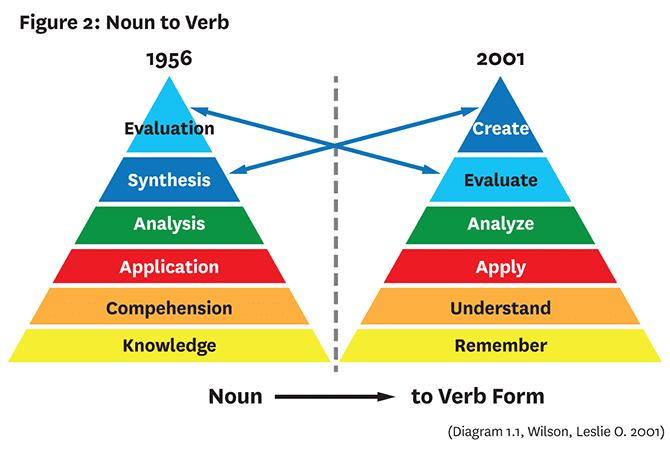
The result is a framework like the one in Figure 2. This is a fantastic tool for teachers to self-assess the extent to which a unit, activity or assessment reflects a well-rounded approach to knowledge and a variation in cognitive levels. I caution that educators not look at any cell being better than the other, but rather that we strive for a healthy balance of knowledge levels and cognitive domains. In the end, verbs are very powerful in helping us design learning opportunities that use knowledge in order to build competencies.
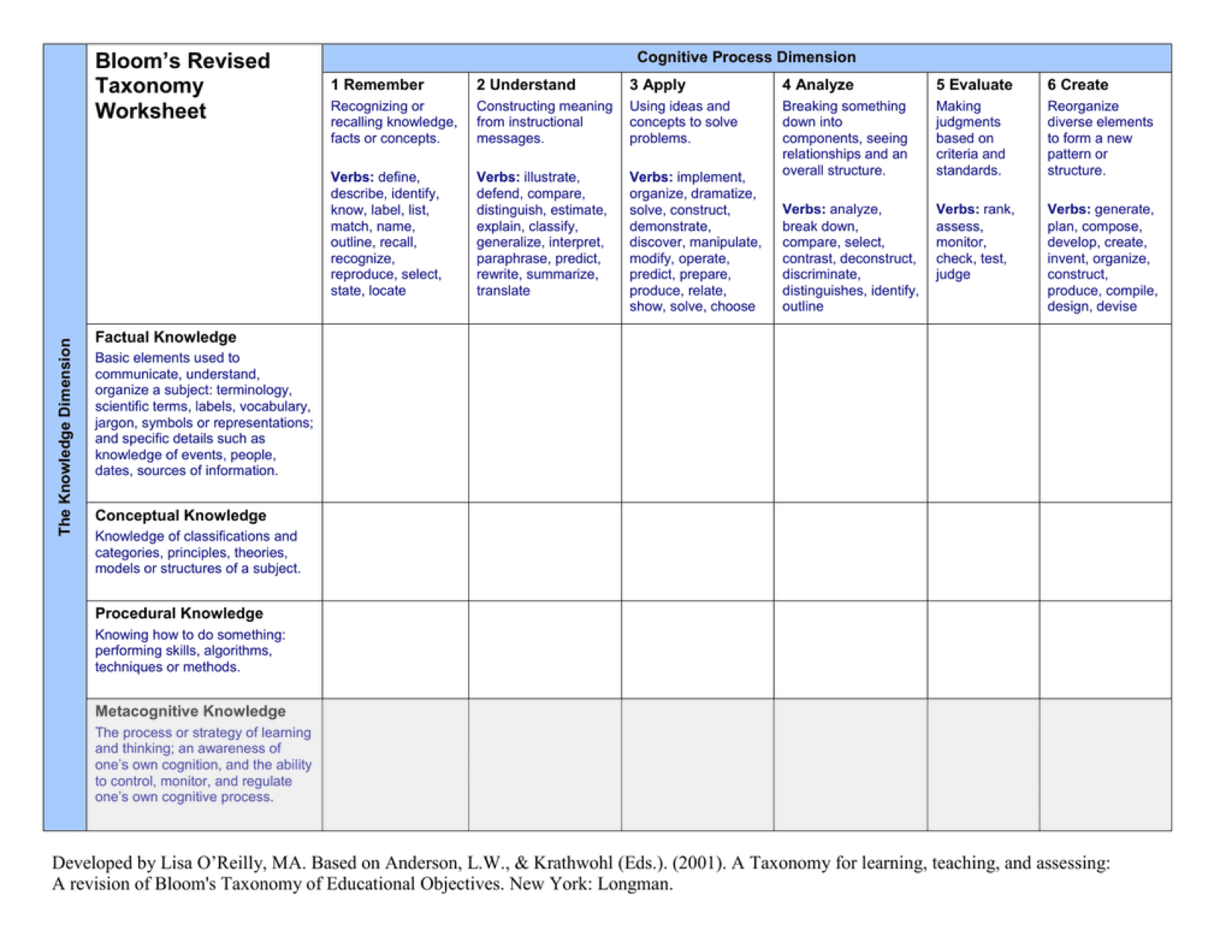
Shared responsibility
The importance of shifting to a competency-based model of education, and utilizing our content to do it, cannot be understated. In light of this shift, we need to consider that for too long we’ve tended to put the cart before the horse – namely to use competencies (say the ability to create) to cover content (math knowledge). Let me illustrate the need for a paradigm shift with a personal example. During my first years of teaching at a rural school in Morris, Manitoba, I designed a kite-building activity for a group of Grade 6 students to whom I was teaching both Math and Science. My students and I were excited to create kites of various sizes and designs. One boy built a 10-foot tall sled kite and the local paper arrived to take pictures. The Grade 6 students solved problems, thought critically and communicated in teams, but this was not the end-goal. Rather my purpose for designing an engaging activity was that they learn the content material: scale, angles, measurement, area, ratio and the basics of flight. There’s no question that back in 1996, I wanted to teach content via a creative process.
The paradigm shift that I am observing globally is that this process is being reversed. We are moving towards using content and our means of covering it (mathematical angles, story-writing, science labs, etc…) in order to develop competencies such as communication, critical thinking and problem-solving. It’s just looking at the process in a different light. Consider the shift in my goals, and the medium used to achieve them, from 1996 to present.
1996 model:
Goal: Students to learn ratio, scale, flight basics (content)
Medium: Create kites in teams (employing creativity and communication competencies)
Present model:
Goal: Develop problem solving, communication and digital literacy competencies.
Medium: A kite-building activity that builds on students’ knowledge of content: ratio, scale, flight.
What’s essential is that we all own the development of competencies in each of our curricular areas, and it turns out research supports this notion. In the past, we’ve tended to compartmentalize competencies, tasking whole departments to take the lead on certain areas. You’re after creativity? You’ll find that in Ms. Field’s Art class – room 22! Oh, and if you’re after communication, our English department is on the third floor. It seems that this approach is misguided. As human beings, we are quite context-dependent in our development of skills. With the exception of collaboration, Wiliam contends that all other competencies actually do not easily transfer from one context to another, and he cites studies to prove it. People who learn something underwater better recall that learning when they’re back underwater.7 When we learn something in a certain room, we better recall it in that room8 and, interestingly enough, when we learn something under the influence of alcohol, we test better once we are again… slightly inebriated.9
Wiliam and others argue that if we want to develop critical thinking in Math, we need to teach critical thinking in Math. If we want students to communicate in Science, we need to purposefully teach communication in Science. The development of competencies is everyone’s responsibility, and only when students develop them in separate curricular areas, while interacting with separate content, will those competencies be expressed across the curriculum.
While I once agreed that knowledge was on the way out, that technology would render it a dinosaur, I no longer believe that’s true. In our quest to develop competencies, we need to use knowledge to anchor our development of enduring skills. While tackling knowledge, we must harness the power and variety of verbs to bring depth to the learning experience. And finally, we cannot rely on some other staff member to develop competencies – that’s on all of us.
Illustration: iStock
First published in Education Canada, March 2019
Notes
1 Towards Defining 21st Century Competencies for Ontario. 21st Century Competencies: Foundation document for discussion (Queen’s Printer, 2015,) Winter 2016 Edition.
2 Jack Ma, “Jack Ma on the Future of Education (Teamwork Included)” (2018). www.youtube.com/watch?v=rHt-5-RyrJk
3 Dylan Wiliam, Creating the Schools Our Children Need (Learning Sciences International, 2018).
4 Sherry Bennett and Anne Mulgrew, Assessment Conversations: Engaging with colleagues to support student learning (Alberta Assessment Consortium), 7.
5 Simon Sinek, Start With Why: How great leaders inspire everyone to take action (Portfolio, 2011).
6 Lorin Anderson: personal communication June 19, 2018.
7 D. Godden and A. Baddeley, “Context-dependent Memory in Two Natural Environments: On land and underwater,” British Journal of Psychology 66, No. 3 (1975).
8 Steven Smith, Arthur Glenberg and Robert Bjork, “Environmental Context and Human Memory, Memory and Cognition 6, No. 4 (1978).
9 G. Lowe, “State-dependent Recall Decrements with Moderate Doses of Alcohol,” Current Psychology 1, No. 1 (1981).
-
Rethinking How You Grade
Comments Off on Rethinking How You GradeIn reference to the article Grading across Canada: Policies, practices, and perils
By Christopher DeLuca, Liying Cheng, and Louis Volante
ASK OUR EXPERTS (5 minutes)
AIM: TO ENCOURAGE INTERACTION WITH RESEARCHERS
Does your group still have burning questions or comments? Encourage them to send their questions to Dr. Christopher DeLuca, lead author for this article.
Email: cdeluca@queensu.ca
Or, send us your message and we’ll make sure one of our experts gets in touch.
ADDITIONAL RESOURCES
-
Comparative Judgment
Comments Off on Comparative JudgmentComparative judgment (CJ) is an assessment methodology based on the ranking of two pieces of work at a time. CJ can be used both as a professional development tool to sharpen assessment skills and develop shared standards, and as a way of identifying exemplars of quality that allow students to better understand learning goals and expectations.
Learning is unpredictable, and students do not learn everything they are taught; therefore simply providing learning opportunities in school is not by itself sufficient. Assessment must be embedded within educational settings to bridge teaching and learning. Teachers who fail to assess what pupils do cannot determine whether they are contributing to or impeding pupils’ progress. Assessment data must be elicited, inferred from and used to adapt classroom practice to better meet students’ needs.
We know that teachers make inferences based on what happens in the classroom activities. My colleague, Professor Inga-Britt Skogh, and I were curious to find out what teachers are focusing on while assessing student progress in the context of Swedish technology education. Our study involved six teachers and a class of 11-year-old students who were undertaking an open-ended design scenario. The students designed a model robot to help them complete various tasks they needed help with at home. They identified problems such as recording NHL games, walking the dog, completing homework, scanning and submitting homework, and baking cupcakes. During classroom activities, the students built Web-based synchronous e-portfolios of their learning and the product development, using text, photos, moving pictures and sketches on their iPads. In order to unpack what teachers emphasized as criteria for success, we decided to use a methodology called comparative judgment.1
Comparative judgment is an assessment methodology where the judgers compare two pieces of student work and identify which one of them is better, without saying how much better it is. Their decision is based on quality of the work.
To identify the motives behind teachers’ choices, the research team asked them to describe the reasons for their choices by speaking into an MP3 recorder while doing the pairwise comparisons. These think-aloud protocols were recorded and transcribed. They provided valuable insights on the rationale for each choice. Results generated a judge consistency above .9 and the qualitative data revealed what the assessors agreed upon: the importance of seeing the narrative of the portfolio/design process. The teachers – our judgers – were also invited to a session where we interviewed them.
Comparative judgment
Comparative judgment has been used in different settings, such as psychology and perfume making, and also quite recently (last 10–15 years) in educational settings. Comparative judgment stems from the work of Luis Thurstone who, in the 1920s, tried to find methods for measuring things that are difficult to measure – such as attitudes and opinions, for example how serious a crime is considered to be. Thurstone argued that while people find it hard to say how serious a crime is, they can compare one crime to another relatively easily and reliably in terms of which crime they think is more serious. He explained that when two phenomena are placed in comparison with one another, individuals can use their knowledge to compare and identify which qualities are superior with high fidelity. He showed that by repeatedly comparing pairs of items, a ranking could be made of all items assessed with very high reliability. Based on his studies, he formulated the Law of Comparative Judgment, which in short means that people are more reliable when comparing two stimuli, such as two crimes, than when giving an absolute value to a stimulus.2 Laming built on Thurstone’s work and said that all assessment is a comparison of one thing to something else.3
How does comparative judgment work?
Comparative judgment is an iterative process, where assessors are presented with a series of two objects and select the better of the two. They assign an instinctive ranking to each object based on their expertise, previous experience and the object quality, instead of awarding an absolute score.
This iterative process may be undertaken manually, where you, for example, pick two random essays from your pile of student work, compare them, and pick one as a winner; you then repeat the process iteratively until every essay has been compared to each other, like the Swiss tournament. This manual process is a bit complicated, especially when you want to work with others. It can be facilitated with comparative judgment software, where student work is presented two at a time and then from a mathematical formula compared to each other. This software for comparative judgment generates quantitative data of high reliability, usually above 80 percent, and also facilitates the inclusion of multiple assessors.
Research studies have been conducted with comparative judgment, both regarding validity and reliability, in Ireland, England, Belgium, Sweden and the U.S. In the studies, comparative assessment has been used primarily to assess creative work in, for example, technology education and essay writing. The high reliability achieved reflects a professional consensus in the group of assessors. The software system allows assessors to leave comments and explain why they judged one example to be better than other. These comments can be used to identify criteria that describe what teachers consider to be important competencies in the subject and can also be given as feedback to both teachers and students while learning.
The comparative judgment process can be undertaken wherever is convenient, something that I and my American friends Dr. Scott Bartholomew and Dr. Greg Strimel, from Purdue University, took advantage of when we wanted to investigate differences and commonalities among teachers’ assessment practices in open-ended design scenarios across nations.
Teachers and educational researchers from the U.S., U.K. and Sweden were invited to assess an open-ended design scenario in engineering/ technology education (a pill dispenser for a fictional forgetful client) made by 760 high school students. The judgers assessed 175 portfolios and 175 products with comparative judgment via the cloud-based software Compare Assess. We undertook the whole study via the Internet and the judgers did their assessment from their home couches or wherever they liked.4
Clarifying criteria for success
I strongly believe that teachers do everything in their power to move their pupils forward in their learning journeys. However, the direction of forward movement is not always obvious! Still, it is crucial for teachers to be clear about what they expect of their students. Such clarity benefits all students, and especially low achievers, and thus it may dramatically reduce the gap between low and high achievers.
Clarifying the learning intentions, consequences, and results of an assessment increases validity and reliability. But this clarity can be hard to achieve without spoiling the joy of learning. Furthermore, students’ perceptions of learning intentions may not match teachers’ expectations. Addressing this discrepancy is crucial to reducing the gap between low and high achievers, since low achievers generally find it more difficult to interpret what their teachers consider as criteria for success.
How do we overcome the discrepancy between teachers’ intention and students’ comprehension, and at the same time promote thinking by encouraging pupils to express themselves, reflect upon their own and others’ ideas, and expand their horizons? The Irish Technology Education Research Group (TERG) approached this challenge in the technology teacher education program at the University of Limerick by letting students peer assess one another’s work using comparative judgment. Specifically, students were asked to compare two pieces of work, choose which one was better and provide peer feedback comments in an iterative process. Feedback was matched to each exemplar and given back to the students, who were then given time to consider the feedback and develop their work before handing it in to the teacher for final assessment. The research team was overwhelmed by the students’ positive response to this intervention, reporting that the iterative process of comparative judgment was valuable for improving their understanding of the nature of technology – much better than with rubrics, according to the students themselves.
The TERG study5 also reported how valuable students found providing and receiving peer feedback via comparative judgment. Follow-up of student’s progress suggested that low-achieving students benefitted more than high-achieving students from seeing exemplars of other students’ work, as the low-achieving students made the greatest leap.
Rubrics vs exemplars to convey learning intentions
There are different ways to share learning intentions. Using comparative judgment to identify exemplars of quality work is one example. More traditionally, a teacher can post learning intentions on the blackboard and then have the pupils copy them into their workbooks, where they will likely never be reviewed again.
One popular approach involves the use of rubrics. However rubrics are often written in teacher-friendly language, such that students and teachers may interpret them in different ways. Furthermore, I wonder why rubrics are so often divided into three columns? Is learning always a three-step process? Therefore I prefer the use of exemplars to rubrics. However, this preference is not just based on what I like – the advantage with exemplars is considerable as they articulate learning intentions in a richer way.
Using exemplars is like wine tasting, where you actually taste and discuss the wine. Rubrics, by comparison, are like reading a review of a wine without smelling or tasting it. By sharing exemplars from different contexts, educators can help students explore the true construct more deeply. Annotated exemplars give students an understanding of what quality looks like, especially when exemplars of different quality can be contrasted. Exemplars of student work may also promote discussion among learners. Using exemplars to explicate expectations and criteria for success for students is not cheating; instead, it is a way to invite students into a discussion of quality. Exemplars are valuable for learning, especially when used as part of instruction and in open-ended and problem-solving tasks, and have been found to reduce cognitive load.6 They have the greatest impact on learners at a lower level of mastery, and the effect on learning decreases as expertise grows. Therefore, evidence suggests that students gain the most when exemplars are presented at the beginning of the learning journey.
Working with exemplars
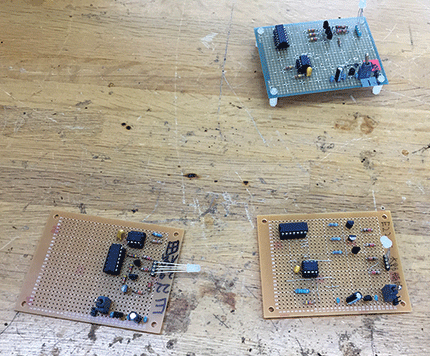
Figure 1. Exemplars in electronics, Japan Photos: courtesy Eva Hartell Using comparative judgment software systems is one way of working with exemplars. However, the software system is not required. Figure 1 is from a Japanese secondary classroom. Technology teachers used these exemplars in a dialogue with their pupils to articulate different quality work in electronics by comparing the three different exemplars to each other and with the students’ own work as well.
Figure 2. Exemplars of arts, Sweden
Original illustrations: iStockFigure 2 is from an arts classroom in Sweden. The teacher has illustrated the national criteria for grading with sunflowers of different quality. I showed these exemplars at a workshop on formative assessment and at first the participating teachers all agreed – but then suddenly a man raised his hand and objected to the shared consensus that the sunflower at the top was of highest quality. He informed us that he was more into abstract art, and therefore thought the sunflower at the bottom should be rated highest. Then the discussion about quality in artwork really took off; I wish I could have recorded it. The discussion ended in an agreement that is summed up by Winnie the Pooh when he says, “It’s best to know what you’re looking for before you look for it.” With this particular exemplar, the purpose of the task should be clarified. The sad part of this story is that this was the first time these teachers had had the opportunity to discuss this in depth with their peers.
Knowing where they are going makes it easier for students to get there, especially when they know what next step to take and in which direction. Conversely, when pupils are often left on their own, trying to decode the mystery path of learning themselves without guidance and opportunities for reflection, they may lose interest and opportunities. When students are able to consider exemplars in dialogue with their peers, they may gain a richer understanding of what quality work looks like – just as teachers do when discussing exemplars with their professional peers.
Comparative judgment for professional learning
I believe that teachers can develop their assessment literacy and their nose for quality by being exposed to exemplars via the comparative judgment process and by being “forced” to justify their choices and discuss them with others within the profession. And why not start this journey during their teacher education program by reviewing authentic exemplars and practicing how to provide feedback, while they are taking their teacher training courses? How often did you get a chance to see student work during your teacher training, and how often have you had the opportunity to share exemplars with peers? My experience tells me it is not a frequent experience.
Comparative judgment via digital software is also a fairly easy way to invite others within the profession to your classroom practices. The teachers that I have worked with in Sweden were particularly fond of seeing other than their own students’ work, as it expanded their horizon. The interviews in the Hartell and Skogh study7 showed that teachers felt that the comparative judgment method answered the need to collaborate with other teachers in the assessment process. Comparative judgment is useful for both training and on-going refining of teachers’ assessment practices. For example, you can investigate if your standards have changed by blending last year’s students’ essays with the ones you have now, and then checking your comparative judgment outcomes against how you have graded the work. To discover how your standards compare to your peers’, you can invite others to participate, then share and discuss your results together. A school in Oxford used this model to share consensus in terms of quality of student work. The project was initiated by the school head, not for accountability purposes but instead with the aim of strengthening teachers’ assessment practices to enhance equity for their pupils.
It is easy to get carried away with new approaches, and even though there are multiple applications of comparative judgment, appropriate use should always be kept in mind. What decisions are to be made? Then choose what data to collect and present. Depending on what a teacher wants his or her students to learn, the teacher must choose appropriate tasks and exemplars.
The foremost value I see with comparative judgment and exemplars are to serve as a catalyst for discussion. Similar to how wine connoisseurs taste and discuss wine, I see the potential of comparative judgment to foster teachers’ assessment literacy and self-efficacy. Comparative judgment is a useful tool to unpack teachers’ assessment practices, to uncover epistemological values and constructs, and to explicate criteria for success in a much deeper way. Above all, I see great potential as a way to invite learners into the mystery of learning.
Original illustrations: iStock
First published in Education Canada, March 2019
1 A. Pollitt, “The Method of Adaptive Comparative Judgment,” Assessment in Education: Principles, Policy & Practice19, no. 3 (2012): 281–300.
2 L. L. Thurstone, “A Law of Comparative Judgment,” Psychological Review 34 (1927).
3 D. Laming, Human Judgment: The eye of the beholder (London: Thomson Learning, 2004).
4 See e.g. S. R. Bartholomew, E. Yoshikawa-Ruesch, E. Hartell, and G. J. Strimel, “Design Values, Preferences, Similarities, and Differences across Three Global Regions,” in PATT 36. Research and Practice in Technology Education: Perspectives on human capacity and development, eds. Seery, Buckley, Canty and Phelan (Athlone, Ireland: TERG, 2018), 432–440.
5 N. Seery, J. Buckley, T. Delahunty, and D. Canty, “Integrating Learners into the Assessment Process Using Adaptive Comparative Judgment with an Ipsative Approach to Identifying Competence Based Gains Relative to Student Ability Levels,” International Journal of Technology and Design Education (2018); N. Seery, D. Canty, and P. Phelan, “The Validity and Value of Peer Assessment Using Adaptive Comparative Judgment in Design Driven Practical Education,” International Journal of Technology and Design Education 22, no. 2 (2012): 205–226.
6 J. Sweller, (1988). “Cognitive Load During Problem Solving: Effects on learning,” Cognitive Science 12, no. 2 (2988): 257–285.
7 E. Hartell, and I. -B. Skogh, (2015). “Criteria for Success: A study of primary technology teachers’ assessment of digital portfolios,” Australasian Journal of Technology Education, 2, no. 1 (2015).
-
The Unsung Heroes of the School System
Comments Off on The Unsung Heroes of the School SystemAs I write this, I am on my prep period and lunch, a rather nice two-hour break. However, the Educational Assistants (EAs) I’m working with aren’t so lucky: yes, they get a lunch too, but they rarely seem to get a moment to relax.
EAs work closely with students identified as having special needs. These needs can be physical (e.g. mobility), learning-based (e.g. speech and language) or behavioural (anger or developmental issues), and of course they range in severity. Being an EA is a rewarding and challenging job, but, depending on the day, one adjective might overshadow the other.
My primary interaction with EAs has been in developmental education (DE) classes while working as an occasional teacher (OT). Let’s be frank: working with higher-needs kids isn’t for everyone. It takes patience, humility, and emotional strength. However, my stints in the higher-needs DE classes have been some of my most enriching, inspiring, and humbling experiences in teaching. And in each of the DE classes I’ve taught in, I see the same thing: the EAs love their students (yes, I said “love” and mean it), and regularly sacrifice their lunch hours and breaks to work with their kids.
One of the first things I’m given when I supply for a DE class is each student’s “Safety Plan”– a binder detailing the student’s diagnosed condition, his/her triggers, ways to deal with said triggers, and his/her medical requirements and emergency contact info. If this sounds more akin to language you’d associate with a hospital than a classroom, well, I agree. What’s not noted in the Safety Plan, however, is how adorable and fun some of these students can be. Some are incredibly social and affectionate – and they develop a very strong bond with their EAs.
As an occasional teacher, I rely heavily on the expertise of the EAs, and, thankfully, they never fail to make me feel at home and to maintain peace in the classroom. I am in their hands and am happy to let them direct me. Some DE students rely on consistent routines, and my presence really throws a kink into their day. It’s the EAs who smooth out any wrinkles, while I have the luxury of just helping out the best I can.
I’ve met many amazing students in DE programs: there was “David,” the boy with fetal alcohol syndrome who, I was told, played piano beautifully and would vigorously play air piano on his desk each morning along to “O Canada.” There was “Justin,” a wheelchair-bound student with severe speech issues who loved to tell jokes; and there was “Joseph,” who loved to play tennis. Joseph and I played a few times (really, just whacking the ball to each other without a net), and one incident has stuck with me.
Joseph and I had finished our game and were about to go in; however, one of his balls had rolled under the chain-link fence into the school’s garden. I opened the gate so Joseph could retrieve it, but as he walked in, the back of his T-shirt caught on the latch and ripped – badly.
Joseph said he didn’t care about his ripped shirt, but once in the classroom he became increasingly agitated and distraught, tugging on the rip, making it worse. I spoke calmly to him, telling him it would be okay. I put my hand on his shoulder, but Joseph snapped, “don’t f#@king touch me.” From there the situation escalated, with me watching the heartbreaking sight of a 15-year-old boy bursting into tears because he “wouldn’t look nice for his doctor’s appointment” later that day. Of course, the EAs took control, working to calm him down, but I felt I had failed Joseph. My negligence had ruined his day.
But the day wasn’t ruined, not really. Joseph eventually did cheer up. Our class dismissed earlier than regular classes, so at 2:00 p.m. the kids headed out. With a half-hour until the official end of our day, I read a magazine; the EAs spent their time differently. They talked about their “kids”: They shared accomplishments, funny anecdotes, and surprising behaviour; and offered each other encouragement for the next day. There was no bitterness, no expressions of fatigue, defeat, or frustration. Needless to say, I was impressed and humbled.
I don’t often utter the overused word “hero” – but here I wish to unequivocally state for the ages: EAs are heroes, at least to me. I am eternally grateful for their presence and wisdom and wish to thank them for the guidance and patience they bring to their jobs every single day.
Photo: iStock
First published in Education Canada, March 2019
-
You Can’t Fatten a Hog by Weighing It
Comments Off on You Can’t Fatten a Hog by Weighing ItHow can we define and grade quality in writing? Ken Draayer has wrestled with this question for 30 years, and concludes that it cannot be captured by a rubric or a list of features. He demonstrates how checking off a series of requirements, though it might earn you 100% on the marking schema, does not add up to good prose.
From accountability reforms beginning in the 1990s in Ontario, I learned that grading is the measurement of student, school and system results to strengthen educational management. From Robert Pirsig’s Zen and the Art of Motorcycle Maintenance I learned that grading is a search for quality and how to care for it.
I had not read Pirsig when I began grading English papers at a private school in the 1970s and had to define “quality” in student work. My undergrad university training and subsequent experience in journalism suggested it was some combination of subject knowledge, coherent organization and audience appeal. On the evening of my first grading experience, however, these categories proved unhelpful as they collided with actual student writing.
I decided to grade by approximating quality-as-a-whole using the stairs leading up to the bedrooms in the house – the further up the stairs, the higher the quality. The top stair, I decided, represented 90 percent. The steps below declined by 10 percent each until I reached a personal floor for failure at 40 percent – my compassion at the bottom level countered by severity at the top. I had never scored 100 percent on an essay; why should my students?
My approximate staircase kept me on task to completion. I then introduced the common categories – content, structure, language – and fudged those more precise 68s, 76s and 83s until I was ready to hand the papers back – though perhaps not so much to respond to I don’t understand this mark (and neither will my parents), and I’ve never got less than 80 in English. Then and after, the experience of grading remained unsettling, always hedged round by doubts.
Zen and the art of grading
In Pirsig’s novel, grading is an ethical dilemma. Phaedrus, a teacher of rhetoric, strives for a shared understanding of quality with his students and confesses his doubts about grades and their actual relationship to quality. At one point, he drops grades entirely. Rules about content, structure and language, he tells his students, were imposed on writing after it was done. Teachers who prescribed, and students who wrote by prescriptions, produced writing that “had a certain syrup, as Gertrude Stein once said, but didn’t pour.” Quality was the goal, but “when you try to say what quality is, apart from the things that have it, it all goes poof.”
In my 30 years teaching in high schools and in pre-service courses at Brock University’s Faculty of Education, I would sometimes read six assignments to set my “spidey sense” about quality before marking. Other times I would read and try to maintain consistency and focus by commenting on quality, one category at a time. Like Pirsig, I wrestled with the supposed relationship between quality and my grades.
Grades and perfectibility
And what about grades in math and the sciences, where 100 percent on a test or assignment is entirely possible, and a final of 98.5 not unheard of? In the humanities, we seem to be stuck with imperfection. Why does my 72 percent always require turgid explanations, and elicit wrinkled brows and “whatever”? Why should English marks be such a dead weight on averages needed for university or college applications?
I decided to thwart this notion that quality, in English, was so infected by innumerable and inscrutable sins that perfect marks were out of the question. Writing for Indirections – a journal for English teachers in Ontario – I described my new “publishable” grading method, introducing the prospect of 100-percent essay results to my students.
I commissioned from a local trophy shop a rubber “publishable” stamp and inkpad and explained to my students that, while I would return papers with estimated marks, I would read them wearing an Editor’s visor, looking for that “something,” that quality that attracts readers to read and editors to say, “Let’s publish this!”
The “publishable” deal was this: If you agreed to one or two editorial conferences with me and – in the interests of understanding quality – to apply revisions intended to make the piece more clear and readable, I would then guarantee a final mark of 100 percent to reflect our mutual striving for quality. Real writers don’t work alone. They have editors. It’s a team thing.
Changing the teaching relationship
The first recipient of the “publishable” stamp was a piece on hacking. The writer was keen and knowledgeable about his theme, but not so much about his writing. But my “spidey sense” again said quality was there and, confident of its eventual improvement, I gave it a 40 percent and exchanged my identity as marker for editor which, if you think about it, is a significant shift in the politics of the classroom. The final product, though not a silk purse, got 100 percent. And I got my first accomplishment as editor.
Perhaps this sounds like a disingenuous game (mark inflation!). But it did produce interest and thoughtfulness about how quality comes about in writing. In some iterations I added that students could request the publishable stamp. I created student editor/writer partnerships and suggested they should share the resulting grade, both being responsible for final results. I recall adding once, for self-protection, that I would only stamp six assignments “publishable” in any one batch because of the increased time imposed on me and on the student writers. I’d like to say that the method had such appeal that I was inundated with editorial work and giving out 100s by the 100s. But I was not. Human nature saved me. The line-up to do drafts and revisions was short.
Teacher transformed
These variations on the publishable method changed my writing instruction for good. One final variation I had not entirely foreseen. I had a set of papers I’d been putting off marking. One night I put the stack beside the computer and decided, in my Pirsig-ness about Quality, to set aside my red pen and take up the Editor’s visor for every writer. As I read each paper I typed editorial responses to purpose, to the ideas, to coherence, to language – to any aspect, in fact, where I thought I might coax out more quality. I especially conveyed my enthusiasm for their enthusiasm, or suggested a little more enthusiasm, and I remember thinking, when done, what a delight this had been for me – but I had no marks!
Next day, returning the papers, I struck a bargain. Would it seem fair, I asked my students, given the extensive editorial comments and the opportunity to improve results, that they would agree to give me time management considerations and accept an unexplained mark on the final draft? No categories. Just a quality-as-a-whole mark? And they agreed. After all, what could be more fair?
Grading and accountability
Grading that supposes strict measurement by rule and precept imposes its own game (less worth playing), in which standards and rubrics presume quality and imply that teaching professionals need not search for it with their students. Under the weight of measurement, quality goes poof.
Grading practices reflect the personal knowledge, intelligence, and ethical sense of teachers. Students know this. Uniform standards and rubrics sweep aside the personal discussion and experimentation with this necessary but complex part of teaching and learning. In its place we have Ontario’s current “Achievement Chart,” the mother of all rubrics in which, over four levels, there is simply limited, some, sufficient, or thorough quantities of skill or knowledge. Bad-a-boom, bad-da-bing: quantity, not quality. The Ministry of Education could be forgiven for thinking this now defines teacher practice.
Here’s the kind of grading and teaching modeled by accountability: Early versions of the Grade 10 Test of Literacy contained instructions for an Opinion Piece. Students were given a theme (e.g. the Welland Canal) and a list of related facts. The task: write a three-paragraph response organizing selected facts – a kind of Lego approach to writing. Several facts about the canal were listed. A teacher in our board, experienced in EQAO marking, delivered a workshop revealing the Opinion Piece marking rubric and its use by trained markers in Toronto.
Uniform standards and rubrics sweep aside the personal discussion and experimentation with this necessary but complex part of teaching and learning.
On the basis of this workshop, a local teacher, so armed and busy teaching to the test to raise his school’s results, devised the following strategy to constrain the Toronto markers, using their rubric, to award his students 100 percent on the opinion piece. His instruction to them was:
- In the list of facts, find three good things, OR three bad things about the Welland Canal. Decide on your opinion. Does the Welland Canal “suck” or does it “rock”? Your decision is your main idea – your opinion.
- First paragraph (indent): One sentence: State that opinion. Either the canal sucks or it rocks.
- Second paragraph (indent): Write only three sentences. In each sentence use the word “because” with one of the facts. For example: The Welland Canal rocks because it moves boats from Lake Ontario to Lake Erie.
- Final paragraph (indent): Repeat your opinion in one sentence this way: So, as I said, the Welland Canal sucks (or rocks).
Using grading for accountability and neglecting any notion of quality, thousands of Ontario students were declared “literate” and the system of test and measure was declared a success. But a wise Curriculum Superintendent once reminded me of the old homily: “You can’t fatten a hog by weighing it.”
Photo: iStock
First published in Education Canada, March 2019
-
What’s in a Name?
Comments Off on What’s in a Name?What happens when students research the roots, meaning and stories behind their own names? Identity is at the heart of the names inquiry, encouraging students to tackle the existential questions “Who am I?” “Who are they?” and “Who are we?”
It was a cold March morning. Desks began to shuffle as 28 Grade 5 and 6 students gradually entered the classroom. Standing at the front of the room, I heard a soft whisper: “Who is she?”
“Shh! Quiet, I want to find out who she is,” responded another student.
Silence suddenly filled the room. Twenty-eight sets of eyes now stared at me, anticipating an elaborate introduction, begging me to disclose some much-needed and expected information: my name. This is the moment I had been waiting for, the moment when I was going to try something highly unusual.
“Welcome to Social Studies! I would like to begin with a story and the request that you do not tell anyone your name for the next three days.” Noticing that every student seemed to be nodding in agreement, I flicked off the main light, turned on a small lamp and began reading the story I had so carefully selected.
The paper star quilt created by our classroom community. One by one the students became immersed in the story of two parents struggling to bestow a name upon their child. Once the story was finished, a student near the front of the classroom asked, “What do you think the world would look like without names?”
Intrigued by his question, I encouraged him to start exploring possible answers. Slowly, other students began contributing to the conversation, posing questions and brainstorming possible answers. A classroom once quiet was now an animated commons inviting all students to engage in the discussion.
“Can I be a Canadian citizen without a name?”
“What would happen if we were all named the same thing?”
“Why do we need different names?”
“If I didn’t have a name then there would be no point in being a good person, because no one would know who I was,” stated a Grade 5 student with tear-filled eyes.
Immediately struck by the depth of her observation, I pondered her statement. Although it seemed simple, it revealed something deeper: the desire every human being has to be known and to know others, to feel valued as an individual, to belong.
The wonder of names
The verb wonder can be thought of in two ways: the first is to experience curiosity or doubt – often expressed as the phrase, “I wonder what would happen if…” The second is to be fixated or fascinated with or by something.1 Wonder can also be a noun, which is the emotion of amazement and admiration provoked by an encounter with a person, place or thing. In the coming weeks, the ordinary topic of names began filling the classroom with wonder as students embraced it as their topic of study. Students talked with family members, learning more about their heritage, and enthusiastically shared their discoveries. “Did you know I wasn’t named until I was one year old? My parents followed an ancient African name-giving tradition.” As discussions unfolded, it became clear that names embodied “… a living topography, a living, interrelated place full of its own diversity, relations, multiplicity, history, ancestry, and character.”2
Inquiring into names was challenging, requiring students to reconstruct existing understandings of themselves and others. At times, some students became upset by the meaning of their name, thinking it was not as cool as their peers’. “Why does my name mean olive? It is not nearly as cool as a name meaning one with a gentle spirit.” Facing these situations required careful responses that encouraged students to immerse themselves in further historical investigations. Students worked collaboratively as research groups, supporting one another to discover the hidden history of each other’s names rooted in ancient societies: “Did you know that Olivia means olive, which symbolized peace and friendship in Ancient Greece?” Whatever challenges or triumphs presented themselves, the class learned to be in it together.
But do I belong?
Inquiring into names was challenging, requiring students to reconstruct existing understandings of themselves and others.
For young students, finding a community and establishing a sense of genuine belonging can be both challenging and scary. During recess or lunch breaks, students’ sense of belonging would regularly come under question due to various social encounters. To address this problem, the class created a paper star quilt to serve as a visual representation of belonging, a constant reminder that we are one community full of unique individuals with different names and histories. A group of students suggested reaching out to administration, option teachers, and school counselors, inviting them to create a piece of the quilt so as to embrace the full breadth of their community. One student explained that “although certain people may not appear to belong, every community can have and create space for difference. Everyone can belong.” Learning that Indigenous traditions require star quilts to be gifted, the class decided to give their paper quilt to the school, hanging it in the hallway outside of their classroom.

The star quilt that inspired our paper star quilt. This quilt was a collaborative research project during my teacher education program at Brandon University. Our fabric star quilt now hangs in the Education Building at Brandon University. Curricular implications
Across Canada, identity is one of the foundational building blocks of most social studies programs, providing opportunities for topics such as diversity, race and gender to be explored as living experiences. Identity is at the heart of the names inquiry, tackling the existential questions “Who am I?” “Who are they?” and “Who are we?” in ways that encourage and require autobiographical investigation. With every student having a name, it yielded a starting point to uncover and grasp identity as fluid and complex, a collection of living experiences that brings into question what it means to share a Canadian identity that is multi-faceted, yet uniquely individual.
Having students grasp the fluidity of identity and accept who they are as more than their names required encouraging them to inquire into notions of identity and citizenship as they apply to their world. Through the learning process, social studies became enriched as students and teachers realized that names are a doorway into who a unique individual is and is becoming; that names are stories full of endless possibilities, best discovered in community with others.
Photos: Courtesy Katelyn Jardine
First published in Education Canada, March 2019
1 Dwayne E. Huebner, “The Capacity for Wonder and Education,” in The Lure of the Transcendent: Collected essays, by Dwayne E. Hubner (Mahwah, NJ: Lawrence Erlbaum Associates Publishing, 1999).
2 D. Jardine, On the Nature of Inquiry: The individual student (Galileo Education Network, 2002).
http://galileo.org/teachers/designing-learning/articles/the-individual-student


IDEAS TO SUPPORT EDUCATORS : Subscribe to the EdCan e-Newsletter
Quality research, reports, and professional learning opportunities.