
Archive
-
COVID-19: Practical workforce strategies that put your people first
Comments Off on COVID-19: Practical workforce strategies that put your people firstIn moments of uncertainty and concern, it’s not only about what leaders of organizations do but equally how they do it that matters.
In January 2020, ahead of the Lunar New Year and as health concerns were still growing, Deloitte conducted a survey in China of human capital policies and practices. The survey drew over 1,000 responses from enterprises operating in China, including a cross-section of private, foreign, and state-owned enterprises as well as not-for-profit organizations.The survey shows that from the beginning of the COVID-19 outbreak, the immediate focus of employers has been on ensuring the health and safety of their employees
Drawing on lessons learned in prior crises, such as SARS, Deloitte offers practices and strategies for consideration.
Continue to resource here
-
How to support student mental health during the COVID-19 pandemic
Comments Off on How to support student mental health during the COVID-19 pandemicStudents may experience a range of emotions during the COVID-19 situation. As well, changes in routine, including time away from school, may create challenges for some students. We also understand that young people with pre-existing mental health problems may find their symptoms increasing in light of the current uncertainties.
School Mental Health Ontario compiled tips and resources to help answer questions you may have about how to support students during this time.
Continue to resource here
-
Guidance for COVID-19 Prevention and Control in Schools
Comments Off on Guidance for COVID-19 Prevention and Control in SchoolsThe purpose of this document, published by UNICEF, is to provide clear and actionable guidelines that will allow schools and other educational establishments to operate safely through prevention, early detection, and combating COVID-19. While these guidelines are specific to countries that have already confirmed the transmission of COVID-19, they are still relevant in all other contexts. Education can encourage students to become advocates for disease prevention and control at home, at school, and in their communities by enabling them to educate those around them on how to prevent the spread of virus. Maintaining safe school operations or reopening schools after a closure requires many considerations but, if done well, can promote public health.
Continue to resource here
-
Making a Drastic Change in my Teaching Career
Comments Off on Making a Drastic Change in my Teaching Career -
I’ve Never Looked Back
Comments Off on I’ve Never Looked Back“Tell me one thing you wish you knew when you were a beginning teacher,” Jodie asks, pen in hand, marking a math test, while also searching something on her laptop.

I swallow my urge to say “That multi-tasking really, really doesn’t work”, and instead say something that wasn’t even on my radar 6 months ago…and this is after 25 years of teaching.
“That doing circle with your class will help you as much as them.”
Jodie crinkles her face.
“Really! Circles aren’t just for kindergarteners anymore. My grade ⅞ class loves them!”
For the first time I have her attention.
“They wouldn’t work with my grade 5’s. Too chatty,” Jodie says.
As a teacher, we both know that “too chatty” really means “the students are on the verge of taking over” so I nod. I’ve had classes that were too chatty as well.
And I really wish I had done circle with them.
“Try it Jodie. Really. You’ll like it as much as they do.”
She sighs, and I know what that sigh means. I’ve had many a sigh like that after a workshop, or after realizing how little time I have to cover the ever-lengthening list of curriculum expectations.
It means – great…one more thing I should be doing.
I type out the template I use for circle and e-mail it to her.
I love that silence in the teacher workroom can mean that just as much communication is being done as when everyone is talking at once.
She gets the e-mail and I watch her face as she reads it.
The widening-eyed, nodding, “now I get it” reaction does not come.
Instead she looks over at me, head cocked to one side, eyes narrowed, brows furrowed.

“What don’t you get?” I asked, really interested.
I follow a simple circle itinerary.
“What do newts and asses have to do with circle?”
I look back at her, head cocked to one side, eyes narrowed, brows furrowed.
We look like mirror images of every teacher half-way through a staff meeting.
Then I look at my screen. Oh.
“It should read news and issues.”
“Uh-huh,” she says slowly, and I know from having three millenial-aged children that I need to get on with this or her attention will go elsewhere.
And probably for good reason. Newts and asses, while having quite amazing adaptations (thank you grade six science) do not belong in circle.
Well maybe newts. Anything that can regenerate an eye and limb has a place in any circle.
“Okay – so get them to sit in a circle and then do a check-in. They have to say a number between 1 and 5 that reflects how they’re feeling. 1 is low – sad, tired, stressed. 5 is high – happy, energized, calm. You say how you’re feeling too. It’s good for the students to realize that every so often you’re not feeling the best, but you can power through, or ask for support, or do things during the day to help you.”
“Mmmm,” Jodie says, picking up her pen again. I speak quickly now.
“And then we share news. What’s going on in the world, what’s going on in our community, what’s going on with us. This is the magic Jodie. They love to share what’s going on in their lives.”
“Too much sometimes,” she adds.
“Yeah, but in circle, you give them the permission to. The idea is that they talk. That’s what you want. You want them to feel safe enough to tell you about how they’re worrying about the environment, or their cat being sick or the fight they had with their best friend. And the other kids can relate with each other. They’ll ask each other questions, they’ll laugh when it’s funny, they’ll say “that sucks” when it does. And they will feel lighter for it. Really.”
Jodie is looking at me, her pen has been set down, she leans forward.
“But don’t they just get carried away? Talking all at once?”
“No. And you lay down the ground rules. No private conversations. And if they continue talking to a neighbour, you tell them to leave the circle, and they’ll have a chance to rejoin during the next section.”
“Okay…I guess that sounds good…”
“In circle is when I learn the important stuff… whose father is sick, who’s looking forward to seeing their favourite Youtuber perform, who has a hockey tournament on the weekend…the stuff of their lives. The stuff I can bring up later in the day, or the week, one-on-one, to deepen the connection with each student.”

“What else?”
“Next we do issues. I have these conversation cards that discuss various issues that affect Canada and the world, like violence, lack of water, discrimination. I give them facts and statistics and then we discuss any questions they have, observations, experiences.”
“Can I borrow those?”
“Of course. And then we do a mindfulness activity. Again, I have cards with various activities. I have a student choose a card and we do whatever is on it. I never have any idea what activity we’ll be doing.”
“Mindfulness? They won’t sit still long enough…”
“Maybe at first some of them will find it difficult, but I’m telling you, they are longing for this information. For how to destress, get their anxiety under control, relax. The activities are short and focus on breathing, on noticing things, on being mindful…”
“That sounds nice…” Jodie is smiling, and I know she’s decided to finish marking her math tests another time.
“It is nice…really nice. The last activity we did was pretending we were blowing into a balloon. We had to take deep breaths and release them…by the end of four breaths, my shoulders were no longer hunched around my ears and my mind was relaxed.”
A quiet second passes.
“And the final activity we do is prayer intentions. I begin by praying for every child in the circle, and any classmates that are absent. And then they raise their hands and offer up their prayer intentions. And while praying for their sick aunt, or grandfather, or neighbour I’m learning more about what is on their minds. What they need to take off their shoulders for a while. And we pray, and that’s how we finish our circle.”

Jodie takes a deep breath. “I guess I could try…”
“Try it. You’ll be amazed at what you learn. At how much more deeply you can connect with them. At how much more supported they will feel.”
“Okay…I’m going to do it.”
“They’ll learn a lot from doing circle…but Jodie, you will learn more. Promise.”
“Ok,” Jodie gathers her math tests and gets ready to carry her marking and laptop back to her class.
“And Jodie?”

She turns. She is a hard-working, 26 year-old teacher. She is caring and committed and wonderful.
“By giving them the chance to chat…you’ll find they become less chatty.”
We laugh. She’s not quite convinced, but is going to give circle a go.
And just like me, she’ll never look back.

Photo: Adobe Stock
-
The Action-Driven Change Framework
Comments Off on The Action-Driven Change Framework -
Dealing with a negative school environment as a new teacher
Comments Off on Dealing with a negative school environment as a new teacherIN BEGINNING MY JOURNEY AS A TEACHER, I LEARNED THAT I HAD TO BETTER UNDERSTAND TEACHER WELL-BEING IN TODAY’S K-12 EDUCATION SYSTEMS.
When I began teaching, I decided to enroll in the Master’s of Professional Education program (M.P.Ed.) at Western University, with a focus on Curriculum and Pedagogy. To me, this was an easy decision given that the practicum placements I undertook during my pre-service teaching program had ultimately left me with more questions than answers about current policies and initiatives to support teacher well-being. From my experience, the majority of education policies and initiatives that are publicly available remain largely focused on student well-being and on how teachers can make various changes to their professional practice to inspire student success. I began to wonder, “Why are there such limited documents and resources available that focus on the value of teacher well-being and that show how teachers’ levels of well-being directly influence their professional practice? How are teachers supposed to support student well-being and success, if their own well-being isn’t supported by K-12 education systems?”
It’s these types of questions that led me to conduct research during my M.P.Ed. program specifically on the value of teachers in today’s classrooms. As I began to scan the available research on K-12 teacher well-being in schools across Canada, I was able to confirm that there indeed wasn’t much research available that actually looked at the well-being of teachers. As a full-time student simultaneously teaching full-time, what I was finding through my research was backed not only by my personal experiences but by many of the conversations I had with fellow colleagues at the very first school I was teaching at. Ultimately, I began to notice that many of the stories I was hearing all had an underlying commonality — that teachers’ well-being was almost always linked to the quality of relationship teachers have with their school principals.

TEACHERS AND PRINCIPALS: WHY BUILDING UP THIS RELATIONSHIP IS SO IMPORTANT.
Emotional exhaustion including low energy and consistent fatigue caused by workload or time pressure, fear of speaking honestly, and other professional frustrations are warning signs that teachers may be trailing along a path towards burnout. Much of the research that’s been offered in the past 5-to-10 years hints that negative school climate and classroom environments can take a toll on a person’s ability to teach effectively. Part of what can help create a healthier school climate is the quality of teacher-principal relationships, and we know that negative relationships between professionals can negatively affect the quality of instructional leadership and learning taking place within a school.
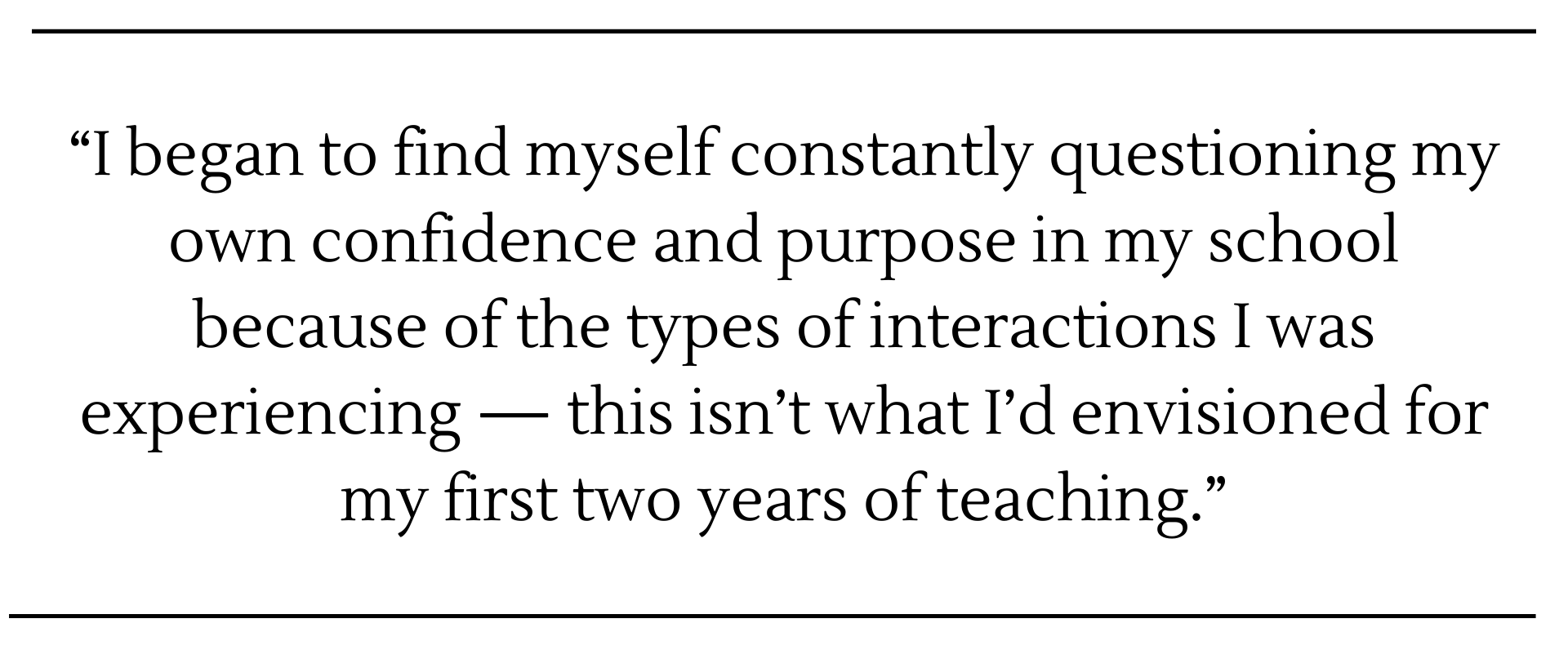
After graduating from my pre-service program, I landed a full-time French Immersion teaching position in a school where I soon realized there was a consistent lack of open and positive communication between the staff team and administrative team. When trying to learn about how things worked in my school, as well as navigate what was expected of me, I often received different answers depending on who I asked. If I posed questions to other staff members, I’d get responses like, “I’m not sure…”, “I don’t know…”, “I think so and so knows that answer…”, and, “I think the admin said this, but I would go and ask them to make sure…” I began to find myself constantly questioning my own confidence and purpose as a teacher because of the lack of trust and clarity I was often experiencing in my interactions with administrative staff. This isn’t at all what I’d envisioned for my first two years of teaching.

As someone who had learned, while training as a teacher in university, the importance of maintaining open lines of communication between myself and school administration, I began to realize that this simply wasn’t a case of me being unprepared as a new teacher. More importantly, I knew I wasn’t alone in experiencing these communication problems. Over time, as much I would try to remind myself that my mental, emotional, and physical well-being were important to maintain in my profession, I became more and more discouraged each morning I returned to school. It became clear to me that the lack of clear communication between staff and administration, among other things, weren’t conducive to building a healthy, supportive school culture. It was also clear that this was taking a toll on everyone’s well-being. If I was dreading going to work, I’m sure both other staff and administration were, too. I knew for the sake of my own well-being, and that of my colleagues and administrators, that none of us could continue working in an environment like this. I was left wondering, “What steps could we all be taking to improve workplace satisfaction and the overall well-being of all K-12 staff?”
THE TAKEAWAY: NOT ALL HOPE IS LOST WHEN IT COMES TO ENSURING HIGH QUALITY TEACHER-PRINCIPAL RELATIONSHIPS AND RESTORING THE VALUE OF ALL TEACHERS.
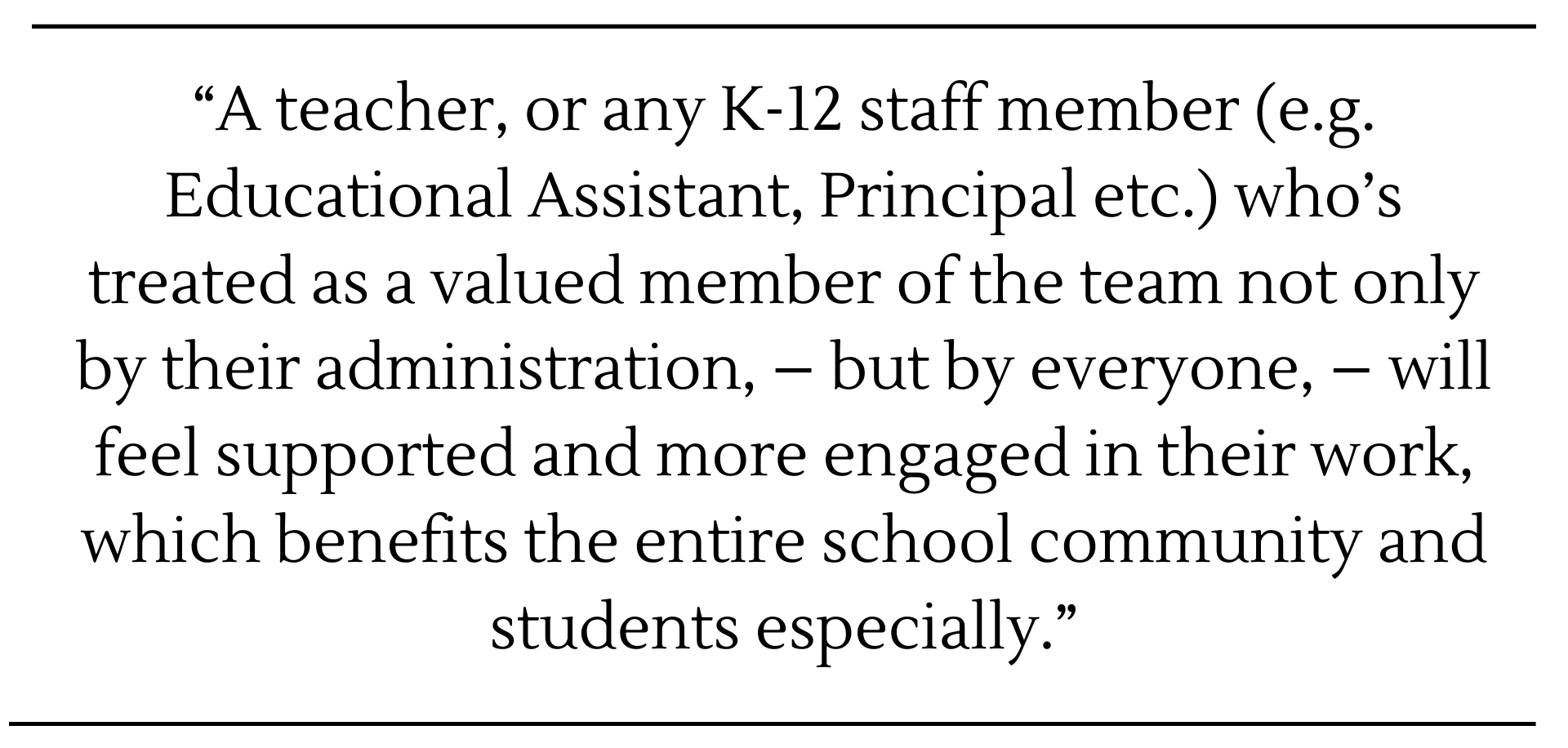
My experiences during my first two years as a teacher were very eye-opening and served as a great learning experience in how relationships are so key to well-being in the workplace. A teacher, or any K-12 staff member (e.g. Educational Assistant, Principal, etc.) who’s treated as a valued member of the team not only by their administration – but by everyone – will feel supported and more engaged in their work, which benefits the entire school community and students especially.
Through experience and further research, I hope to be able to find some answers and solutions to the problems associated with strained teacher-principal relationships. Far too many teachers and principals today are experiencing unnecessary levels of anxiety, confusion, uncertainty, and a low sense of well-being. My best advice for those who are also in their beginning years of the profession is to find strategies to build up your resilience at work and, most especially, to trust yourself. By reminding ourselves to follow our instincts on both personal and professional levels, we as teachers can build and maintain a sense of value and purpose in our important roles.

Photos: Adobe Stock
check out the following resources to learn more about:
1. Empowering Modern Educators
This resource has been created to encourage and empower all educators. Much of the information presented in this resource is solely meant to highlight some of the major, and ongoing challenges that are experienced daily by educators. This resource is also meant to give educators the confidence to maintain the difficult, but necessary, dialogue about the added responsibilities and stresses which this profession, at times, places on us.
Learn more here
2. Restoring the Value of Teachers: A Perspective on Quality Teacher-Principal Relationships
A compilation of research that examines what makes a quality teacher-principal relationship.
learn more here
-
Coronavirus (COVID-19) information for K-12 educators and Faculties of Education
Comments Off on Coronavirus (COVID-19) information for K-12 educators and Faculties of EducationWith the unsettling disruptions of school closures and social distancing requirements, we will continue to update useful links to help you access the latest information from your provincial/territorial ministry of education.
Outbreak update from the Public Health Agency of Canada
Outbreak update from the World Health Organization
Alberta
What is the current situation? Click here.
British Columbia
What is the current situation? Click here.
Guidance for COVID-19 prevention and control in childcare and schools.
Manitoba
What is the current situation? Click here.
New Brunswick
What is the current situation? Click here.
Newfoundland and Labrador
What is the current situation? Click here.
Nova Scotia
What is the current situation? Click here.
Northwest Territories
What is the current situation? Click here.
Nunavut
What is the current situation? Click here.
Ontario
What is the current situation? Click here.
Prince-Edward Island
What is the current situation? Click here.
Quebec
What is the current situation? Click here.
Saskatchewan
What is the current situation? Click here.
Yukon
What is the current situation? Click here.
-
Racism and K-12 Workplace Well-Being
Comments Off on Racism and K-12 Workplace Well-BeingAlso available on:


-
Well at Work Professional Development Discussion Kit for K-12 Staff
Comments Off on Well at Work Professional Development Discussion Kit for K-12 StaffEducation Canada Discussion Kits are an EdCan Member Exclusive Benefit for Organizations (School Districts, Faculties of Education, Corporations, Non-Profits), transforming evidence-based literature from our critically-acclaimed Education Canada magazine into practical group discussion and self-reflection guides that can be used by K-12 staff to question, strengthen, and improve their professional practice across a variety of current and emerging trends in education.
Whether you’re an educational assistant, teacher, school leader, or superintendent, we encourage you to invest in your continuous learning and that of your team through these easy-to-use and affordable professional development resources that encourage critical thinking and actionable strategies for unique school contexts.
About the Well at Work Discussion Kit
This special Well at Work Discussion Kit complements our Winter 2019 edition of Education Canada magazine – available both in-print and online – and puts the spotlight on how we can (and why we must) strengthen the social and emotional wellbeing of K-12 staff, in turn enabling them to achieve healthier schools and better learning experiences for students.
This discussion kit contains a total of eight group discussion and self-reflection guides – four in English and four in French – covering topics ranging from creating organizational cultures that foster workplace well-being; the well-being of education leaders and front-line staff; and identifying and challenging the mindsets, assumptions and public perceptions towards the well-being of K-12 educators that hinder change.
How to use Education Canada Discussion Kits
Each group discussion or self-reflection guide contains three key components:
- A Cheat Sheet providing a brief summary of the literature, which is intended to facilitate and support the uptake of group discussion within your school community.
- A Reflect section with 2-4 thought provoking questions prompting participants to self-reflect in conjunction with their own thoughts and opinions in response to the article.
- A Do It section that provides participants with the opportunity to engage with the content in a more interactive way. By completing this interactive activity, participants are encouraged to think about how they can apply their newfound learnings to their professional practice.
Education Canada Discussion Kits have two-fold usage:
- Group discussions: School leaders can use discussion kits for staff Professional Development (PD) by facilitating discussion during a staff meeting or other designated PD time. Principals can lead sessions by selecting a group discussion guide according to their preference, introducing the theme of the guide, providing a summary of the literature, and finally proceeding to facilitate and participate in discussion by asking the suggested questions and interactive activity provided. Discussion kits can also be used during more informal group discussions (i.e. among colleagues) without the presence of an administrator to facilitate.
- Self-reflections: Discussion kits can also be used alone by individual K-12 staff members who are looking to improve their professional practice on their own time. Additionally, newfound knowledge can help individual staff members to later spark and inform conversations with their colleagues.
Ready? Request the full copy now!
FOR EDCAN MEMBERS
If you’re an EdCan member, you’ll be able to access the full-version of the Well at Work Discussion Kit, including all of our other archived and upcoming discussion kits! Simply fill out the form below!
Not sure if you’re a member? Check out our list of members here. If you’re an employee of one of the organizations listed, or a student or faculty member of a university listed, then you’re already a member! Click here to create your employee, student, or faculty account.
Note: To access this discussion kit, you must have an organizational membership, meaning that you are an employee, student, or faculty member of the following:
- School District;
- Faculty of Education;
- Not-for-Profit (national and provincial organizations, federations, colleges, schools); or
- Corporation.
Not a member yet? That’s okay! To gain unlimited access to the Well at Work Discussion Kit and all other discussion kits, we encourage you to explore our membership options here.
If you require any assistance or have any questions with regards to becoming a member please contact membership@edcan.ca.
Full Copy Request Form – Well at Work Discussion Kit
-
Infographic: The Positive Workplace Framework (PWF)
Comments Off on Infographic: The Positive Workplace Framework (PWF)This infographic is based on the Positive Workplace Framework (PWF), which is a made-in-Canada strengths-based approach to optimizing staff and student well-being, engagement and performance, with a focus on the three key conditions to creating a healthy workplace in K-12 education: Mental Fitness, Resilience, and Positive Leadership. The PWF can also be applied to other settings beyond the K-12 context (e.g. colleges, universities, day cares, etc.).
This infographic was inspired by an article by Robert Laurie, Dr. Bill Morrison, and
Dr. Patricia Peterson that appeared in Education Canada Magazine. -
Workplace Well-Being in K-12 Schools: What does it mean to “flourish” at work?
Comments Off on Workplace Well-Being in K-12 Schools: What does it mean to “flourish” at work?Facing growing levels of stress and burnout, K-12 staff require a supportive workplace that encourages them to find ways to “flourish” within their school community. While flourishing may look different to staff members depending on what makes them personally feel most valued and connected to their work, a flourishing school environment generally has three main components:
1. Subjective Well-Being: positive emotions, positive relationships, and a sense of making a difference are all aspects that contribute to a staff member’s sense of flourishing.
2. Adaptive Community: an environment where staff are encouraged to communicate openly with colleagues, be creative, and resolve team conflicts when they arise.
3. Leaderful Mindsets: staff are able to identify ways that their work contributes to the larger, shared goals of the school community, which provides a greater sense of ownership, engagement, and shared leadership.
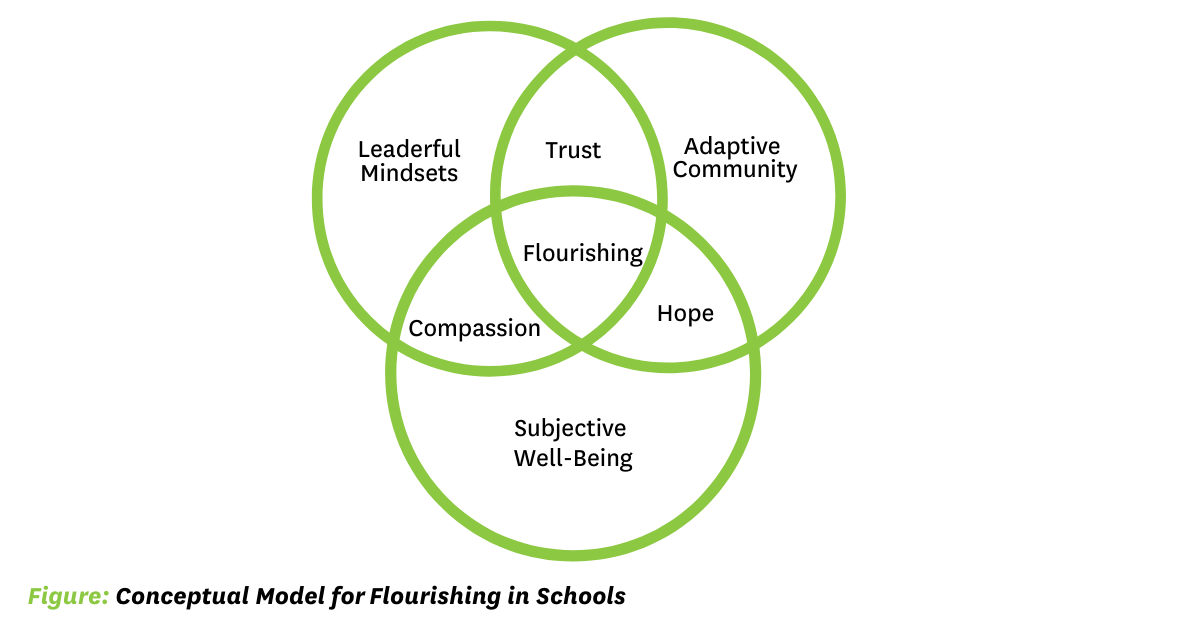
Along with these components, staff in flourishing school communities generally demonstrate key “professional characteristics,” including:
1. Compassion: noticing and wanting to help ease the stress of others, and are aware of how their thoughts and actions impact their colleagues.
2. Trust: having the support and autonomy to take creative risks and innovate, which is reflective of having positive relationships with colleagues.
3. Hope: striving to improve the school environment as a whole-school community by recognizing both strengths and challenges, while building a shared vision for improvement.While schools come in all shapes and sizes, a flourishing school community is supportive and provides staff members with a sense of purpose and belonging where they feel seen, valued, and ultimately find meaning in their work.

This research was funded by the Social Sciences and Humanities Research Council of Canada
Additional Resource Information
Katz, J. (2019). Ensouling our schools. Winnipeg, MB: Portage and Main Press.
SEL BC: http://www.selbc.ca/
Growing Great Schools Worldwide: https://growinggreatschoolsworldwide.com/canada-effective-approaches-to-promote-teacher-wellbeing/
SMART (Stress Management and Resiliency Techniques) https://education.ok.ubc.ca/research-partnerships/smarteducation/
References
Cherkowski, Sabre, and Keith Walker. (2018). Teacher wellbeing: Noticing, nurturing and sustaining flourishing in schools. Burlington, ON: Word and Deed Press.
Cherkowski, Sabre, Kelly Hanson, and Keith Walker (2018). Mindful alignment: Foundations of educator flourishing. Lanham, MD: Lexington.
Cherkowski, Sabre and Walker, Keith (Eds.). Perspectives on Flourishing. Lanham, MD: Lexington.
Cherkowski. S. and Walker, K. (2019). Mentorship for flourishing in schools: An explicit shifttoward appreciative action International Journal of Mentoring and Coaching in Education, 8 (4), 345-360.
Cherkowski, Sabre, and Keith Walker. (2018). Teacher wellbeing: Noticing, nurturing and sustaining
flourishing in schools. Burlington, ON: Word and Deed Press.
Cherkowski, Sabre, and Keith Walker(2014) Flourishing communities: Re-storying educational leadership using a positive research lens International Journal of Leadership in Education 17.2 (2014): 200-216.
Cherkowski, Sabre, and Keith Walker (2016) Purpose, passion and play: Exploring the construct of flourishing from the perspective of school principals." Journal of Educational Administration 54.4 (2016): 378-392.
Cherkowski, Sabre, Kelly Hanson, and Keith Walker (2018)Flourishing in adaptive community: balancing
structures and flexibilities." Journal of Professional Capital and Community 3.2 (2018): 123-136.
-
Going Green
Comments Off on Going GreenSchools can meet the challenge of climate change in different ways. Here are two outstanding – but very different – examples.
This federal election saw a not-so-subtle shift, as climate change and the environment became key priorities for Canadians. Faced with increasingly unpredictable weather, fears Canada will not meet its global commitments on carbon reduction, and a strong youth movement, public awareness and concern for climate has never been more palpable.
Youth have been at the centre of this shift, driven in part by Greta Thunberg’s climate strikes which have galvanized young and old around the world.
In Canada, schools are also part of the discussion. From curriculum and programming that explore climate change and human impact on the environment, to physical changes that promote energy efficiency, waste reduction and student health, Canadian schools are meeting the challenge of a changing climate in unique ways.
École Curé-Paquin: Leading the way to zero carbon
École Curé-Paquin elementary school in Saint-Eustache, Quebec will open its doors to more than 350 students this winter. The new facility was the first project in the province to receive the Zero Carbon Building – Design certification from the Canada Green Building Council (CaGBC).
“Creative and bold initiatives are needed to counter the effects of climate change.”
The certification means that École Curé-Paquin is designed to achieve zero greenhouse gas (GHG) emissions associated with building operations. The school was part of a pilot project for the Zero Carbon Building Standard, which puts significant focus on carbon emissions in building design and performance.
For the Commission scolaire de la Seigneurie-des-Mille-Îles (CSSMI), the pursuit of the Zero Carbon Building Standard1 aligns with its belief in investing in sustainable buildings and contributing to the reduction of GHGs. The school board saw the pilot project as a flagship initiative that will potentially inspire other schools across the province. “Creative and bold initiatives are needed to counter the effects of climate change,” said Paule Fortier, President of CSSMI. “I am happy that our organization is making this environmentally responsible gesture through the construction of this school for the generations of tomorrow.”
Several decisions were made to improve energy efficiency and the school environment. For example, École Curé-Paquin uses geothermal exchange using heat generated from the earth for 100 percent of its heating and cooling needs. The school also installed photovoltaic or solar panels on the gym roof with a capacity of 27 kilowatts and sensor-controlled LED lighting, which helps reduce total energy use and daytime energy demand.
If your organization, school district or faculty of education is an EdCan member (see the list here), you can enjoy unlimited access to our online content! Click here to create your online account.
An enhanced building envelope limits hot or cool air loss, while the design optimizes natural daylight and ventilation for healthier (and more alert) students.
Research compiled by the U.S.-based Center for Green Schools has found that poor ventilation can result in more missed school days due to respiratory infections, increased incidence of sick building syndrome,2 and increased school nurse visits for respiratory problems. Further, a 2013 study found a direct link between classrooms that have more daylight and improved test scores.
The school board’s goal was to create a comfortable learning environment and to provide an exemplary building for students that could also be used as a learning tool. A screen in the school broadcasts the school’s daily energy consumption and production, including the energy produced via solar panels. In Science class, students learn how GHGs can be reduced using technologies found in the school.
W.D. Ferris Elementary embraces green curriculum
While École Curé-Paquin’s zero-carbon design is a focus for their sustainability efforts, other schools are focusing on curriculum and programming to help students understand the importance of climate change, the environment, and their role in helping to protect the natural world.
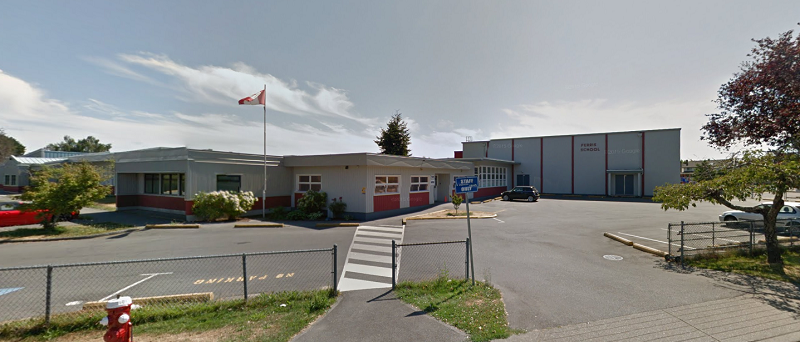
W.D. Ferris Elementary is one such school. Through the curriculum, the 500 students of this Richmond B.C. K-7 school are exposed to environmentalism, with programs designed to help them save energy, decrease waste and water use, and improve transportation and indoor air quality.
Teacher and environmental steward Kevin Lyseng credits the students for many of the program ideas that form the basis for the school’s environmental focus. “Caring about self, others and the environment is what we do,” he explained. “We also benefit from the continued support of the Richmond School District.”
“To reduce food waste, the school reversed the lunch schedule, so students can play before eating, resulting in a 95 percent reduction in food waste.”
Depending on the class, students participate in various programs, from raising Coho salmon, growing grapes or participating in regular audits of energy use and waste levels. These audits help shape activities that have had a significant impact on the school. Switching to six-bin waste collection has helped divert waste by 80 percent since 2007 by separating general waste from organics, plastics, paper, glass and metals. Their seasonal energy-saving informational programs have also helped to reduce electricity use by two percent – despite adding to the school’s plug load.
To reduce food waste, the school reversed the lunch schedule, so students can play before eating. This made the students more likely to eat their lunch, contributing to a 95 percent reduction in food waste. They’ve even piloted a flexible packaging project for the city of Richmond and are working with their hot lunch provider to address single-use plastics.
The school encourages active transportation to and from the school with walk-to-school and learn-to-bike programs. These programs help with student fitness, reduce air pollution, and limit traffic around the school – resulting in improved safety.
In the school, they minimize carpet and chalk use and use Ph-neutral cleaners which are less likely to cause eye or skin irritation. Classrooms are scent-free, with low-VOC (low-odour) paints and furnishings to keep the air quality high. Classroom air filters are replaced monthly and for classes with students that have severe allergies, HEPA filters are used because they remove common allergens like dust or pet dander.
This small school’s big success in pursuing a path of sustainability in its programming and approach to learning was recognized with the title of “Greenest School in Canada 2019” by the CaGBC. Principal Diane Steele said the school was honoured to be have been chosen for this award, but was quick to highlight the efforts of all schools committing to sustainability.
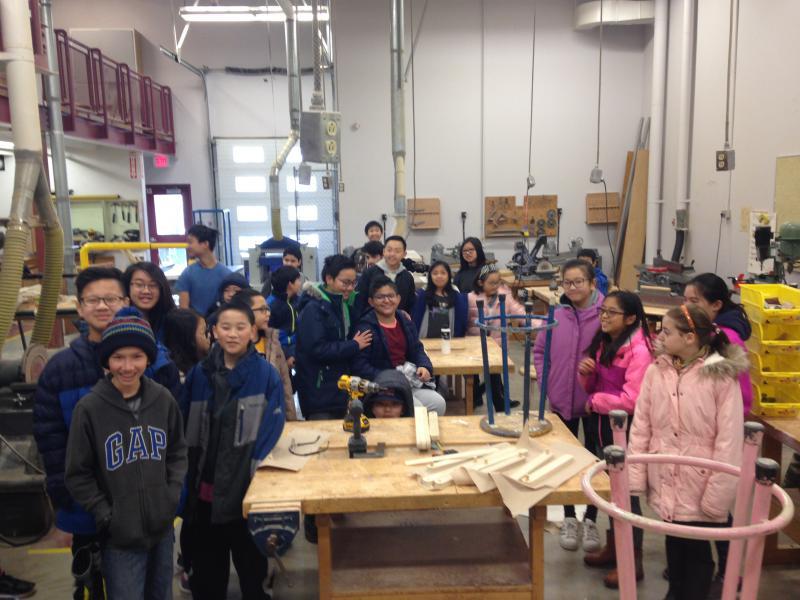
“We also want to acknowledge the hard work done by students and staff daily in schools across Canada to educate their communities about environmental stewardship,” she said. “We encourage all schools to inspire green-minded change in their communities.”
W.D. Ferris continues to spread its message to its broader community. Students and teachers have been involved in the Great Canadian Shoreline cleanup since 2007 and they regularly host district-wide ECO-Cafés, where green leaders meet to share successes and challenges. In this way, Ferris Elementary gives back to the community by encouraging others to reduce their ecological footprint.
Canada Green Building Council
The Canada Green Building Council is a not-for-profit, national organization that has been working since 2002 to advance green building and sustainable community development practices in Canada.
CaGBC and the Canada Coalition for Green Schools host the “Greenest School in Canada” competition, which recognizes schools that are weaving sustainability education into their curriculum and bringing programs and activities to students that encourage awareness about the environment.
Learn more at www.cagbc.org/greenestschool
Photos : from Mark Hutchinson
First published in Education Canada, March 2020
Notes
1 The Zero Carbon Building Standard is a Canadian-made standard and certification that assesses the carbon balance of a building – when there are no carbon emissions associated with operations, it has achieved zero carbon.
2 Sick Building Syndrome is used to describe cases in which building occupants experience adverse health effects potentially linked to the time they spend in the building.
-
How Do We Move Reconciliation in Schools Forward?
Comments Off on How Do We Move Reconciliation in Schools Forward?The authors’ qualitative survey asked teachers to explore what supported their commitment to reconciliation education and what stood in their way. Here’s what they found out.
Inspired by our graduate work in the Call to Action Program at the University of Calgary, we set out to determine what factors either support or limit teachers from implementing reconciliatory practices in their classrooms.
Our research uncovered commitment, collaboration and self-reflection as key factors in supporting education through reconciliation.
“84 percent of these teachers believe Indigenous education should receive greater attention in schools.”
Recognizing that Canadian teachers are poised at the forefront of responding to the Truth and Reconciliation Commission’s (TRC) Calls to Action (2015) and encouraged by strategies mandated by their school boards, in 2018 we conducted a survey of 90 teachers in our urban area.
Our survey revealed that 66 percent of these teachers are aware of the TRC’s Calls to Action, and 84 percent believe Indigenous education should receive great er attention in schools.
Teacher respondents also reported that they regularly engage in learning opportunities surrounding reconciliatory practices and Indigenous perspectives; however, these preparatory activities have not yet led to considerable shifts in their everyday classroom practices.
We followed up by interviewing self-selected teachers in order to gain a more thorough understanding of the specific conditions that support their efforts in engaging in reconciliatory pedagogy, along with an identification of barriers to this work.
“One-half of interviewees also reported a fear of making mistakes and of culturally appropriating.”
The Challenge Teachers Face
During interviews, teacher participants shared the challenges that they face in this work. One challenge was not having enough time to digest complex ideas. “There are a lot of resources out there but it takes time to think about them,” reported one interview participant.
Approximately one-half of interviewees also reported a fear of making mistakes and of culturally appropriating.
Other challenges identified by our peers were recognition of the emotional labour associated with taking up this work, along with resistance from either administration, students, parents, or teachers.
Still, fueled by their own ethical positioning and sense of moral obligation, these teachers were able to find a way forward by focusing on supportive relationships and maintaining a self-reflective stance in their pedagogical decisions.
If your organization, school district or faculty of education is an EdCan member (see the list here), you can enjoy unlimited access to our online content! Click here to create your online account.
Personal Commitment to Reconciliation
Findings from our study signal that it is a sense of personal responsibility from individual teachers that indicate a greater likelihood of their future and ongoing engagement with reconciliatory practices.
Not too surprisingly, teachers who volunteered for the follow-up interview identified themselves as having a strong commitment to reconciliation; in all cases, they were actively engaged in reconciliatory pedagogy motivated and driven by their own initiative.
Being already strongly committed to reconciliation meant that they were in constant pursuit of deepening their personal knowledge of Indigenous topics and perspectives, as well as ways to infuse them within their own classrooms. For example, interviewees shared that they are now taking a far more critical look at Canadian history, and asking their students to do the same by questioning how Indigenous peoples are portrayed in the media. They are also checking themselves against any tokenistic approaches to teaching.
Self-Reflection as a Basis for Reconciliatory Pedagogy
Teachers in the survey who described themselves as self-reflective were far more likely to engage in reconciliatory pedagogy. This heightened sense of self-awareness forms a cornerstone of all good teaching, and is crucial to the ethical integration of Indigenous perspectives across the curriculum.
Teachers who described themselves as highly reflective were considerably more likely to reach out to Elders, and to incorporate Indigenous arts, literature, and cultural practices (such as sharing circles) into their classrooms.
Collaborative Relationships Help Spread Reconciliatory Aims
All interview participants relayed the importance of having supportive administration, colleagues, and parents as essential to the continuation of their efforts in incorporating reconciliatory practices into their teaching.
In fact, both the survey and interviews found a strong correlation between supportive personal relationships within the broader school community and individual teachers’ attempts to integrate reconciliation through education. Collaboration with colleagues was one of the primary factors that increased the likelihood of engagement in a wide variety of reconciliatory practices, such as incorporating Indigenous arts and literature in their classroom. So while teachers can start this type of work on their own, they require a community to sustain their efforts.
Teachers who indicated that they formed and nurtured relationships with Elders also reported that they engaged in all reconciliatory practices that we researched: incorporating Indigenous literature and arts, cultural practices (such as circle protocols), professional development related to reconciliation, and land-based learning.
Interestingly, the teachers who collaborated with Elders were the only participants in the study who engaged in land or place-based education. In these cases, learning from an Elder went hand-in-hand with learning from the land, which is central to understanding Indigneous perspectives as a connection to Mother Earth is often given a prominent place in Elder teachings.
Pre-Service Indigenous Education
Survey results indicate teachers are receiving pre-service teacher training in the area of Indigenous cultures and contemporary Indigenous issues.
The vast majority of teachers with less than five years of experience have had these learning opportunities incorporated into their teacher education training.
This demonstrates that some post-secondary institutions are making good on their calls to action and creating change within their institutions.
Through anecdotal evidence, we know that these teachers are moving into classrooms and schools armed with knowledge to further education for reconciliation. However, we found that even though seeds are being planted at the university level, it takes personal commitment, self-reflection, and collaboration to nurture and maintain the growth of these commitments in the face of challenges inherent in all complex school environments.
Pre-service teacher training and professional development learning opportunities need to focus on the development of a teacher’s own commitment to reconciliation, self-reflective practice, and a desire to collaborate with others in implementing reconciliatory practices in their classrooms.
Furthermore, these learning opportunities need to be followed up with a culture of collaboration and trust within school settings.
Implications for Classroom Practice
We encourage teachers to step onto the path of reconciliation by embarking on their own journey of self-reflection around their responsibility to this important work. Then, to transform their emerging beliefs into action, teachers can share ideas with their colleagues and administrators, support each other, and collaborate.
First steps to take include:
- creating space for Indigenous voices and experiences by incorporating Indigenous authors and media elements
- providing/considering contemporary and historical experiences from a local perspective
- leading discussions through circle protocols, where the source of the practice is acknowledged and taught
- inviting in Elders and local knowledge-keepers as part of the tapestry of learning experiences in the classroom.
There are many different points of entry into reconciliation, and there is no one way to work on it. What is important to remember is that it takes personal commitment, self-reflection, and collaboration to initiate and sustain reconciliatory efforts.
Illustration: EdCan
First published in Education Canada, March 2020
-
Student Power
Comments Off on Student PowerStudent leaders are found in every province and at every grade level. Meet some of the youth who are leading their schools to take positive action.
As the consensus among scientists who suggest urgent action on the climate crisis grows, it is often students who are leading the way to making our schools – and our world – more sustainable. How can educators help kids and youth pursue their interest in sustainability and implement their creative ideas? We spoke with students from three different schools to see what works where they learn.
Nina Tran, Lee Frketich, Konrad Jasman and Summer Thomas
Westmount Secondary School, Hamilton, Ont.
Lesson: Stand back and let them lead
The members of Westmount Secondary School’s Eco Ninjas environmental activism team have done a lot to make their school a greener and more sustainable place.
They’ve created pollinator and rain gardens, grown fruit and vegetables on campus, and facilitated and expanded recycling and composting in their school. And a big reason that they’ve been able to accomplish all of this – aside from their own ideas and initiative – is thanks to supportive advisory staff like Mr. Holmes, says Grade 13 student Nina Tran, one of the team’s members.
“Mr. Holmes has been brilliant in understanding the perfect balance between pushing students and allowing them to stumble, to fall and to learn,” she explains. “He allows the Westmount Eco Ninjas to be almost completely a student-led, student-built and student-charged team. This is a key role in our success as a club, and our success as individuals.”
Tran’s fellow team member, Lee Frketich, age 17, echoes this: “We’d come to him with these crazy ideas and half of a plan, and rather than shutting us down, he’d just be like, ‘If you think you’re able to do that, go for it.’ Or he’d look at our plan and if he saw major issues with it, rather than telling us no, he’d sit down with us and say, ‘Well, have you considered this?’ And get us to go back and make sure that our plans had the best chance of succeeding while letting us lead.”
Eco Ninjas member Summer Thomas, 18, says this willingness to let students find their own way with support is key to empowering them. “One thing that we have actually noticed, which is a bit surprising, is that the more a teacher steps back and lets the students do their own thing, the better,” she says. “Obviously, guidance is great, and when a student is getting started on their project or if they request guidance then that’s a good time to step in, but teachers should largely step back and let the students kind of figure things out and learn through experience.”
One area that the Eco Ninjas needed help with was in navigating some of the bureaucracy that comes with making changes.
“We had some wonderful advisors in our club who really helped us push the limitations of what could happen,” says Tran. “If we didn’t have an advisor who was willing to explore how we could jump through those hoops, or if we didn’t have administration that was willing to help us in certain methods, then we wouldn’t have been able to grow in the way we have.”
But even with this support, the Eco Ninjas haven’t been able to overcome all of their obstacles. Two projects that haven’t been completed yet because of various policy roadblocks are the installation of solar panels at the school and an update of their school board’s waste management policy. And so, in an effort to make these changes happen and also to be taken more seriously by people, increase their resources and capacity, bypass the limitations of what they can do as a school club, and be able to work with other groups in their community and share ideas to support other schools’ environmental clubs, Tran and Frketich created a non-profit.
If your organization, school district or faculty of education is an EdCan member (see the list here), you can enjoy unlimited access to our online content! Click here to create your online account.
Incorporated in January 2019, the Environmental Community of Hamilton Students – or ECHS, as they prefer to be called – has about 15 official members. Tran and Frketich are its executive directors, as are Thomas and fellow Westmount student Konrad Jasman, who both became a part of ECHS soon after it was founded.
“We were finding a large void where the voice of youth should be,” explains Thomas. “And we wanted to make sure that there was space in the environmental community in Hamilton where the youth voice is listened to and seriously considered,” adds Frketich.
So, the bottom line, whether it’s in a school environment or in the community, is that the way to support students who are motivated to be part of changing the world is to offer space for them to thrive, they explain. “Kids are already inspired and they have ideas and things that they want to do, so give them a place at the table and somewhere where they know they can share those crazy ideas or come up with a proposal and actually see that happen,” says Frketich.
Jason Pang
Richmond Secondary School, Richmond, B.C.
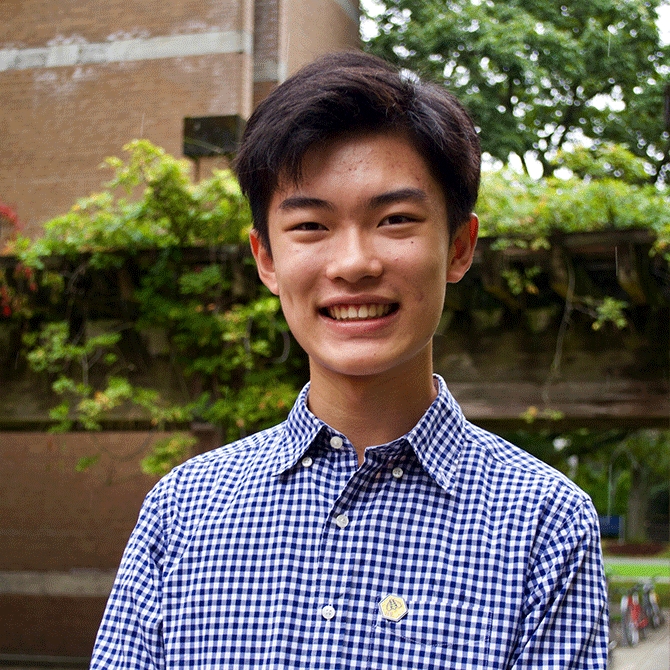
Photo: courtesy of Jason Pang Lesson: Share your passion
Jason Pang, 17, is a veteran of student environmental work. Pang spent three years as president of his high school’s Green Team, the environmental sustainability club at Richmond Secondary School, and was also a green ambassador for the city of Richmond. He is currently in his first year at the University of British Columbia, where he’s doing a Bachelor of Science in Global Resource Systems, which focuses on the world’s resources and how we can properly manage them sustainably.
When Pang first joined a school green team in Grade 8, it was one that was well-established with lots of support from enthusiastic and knowledgeable staff who students could turn to for help and feedback. But when he transferred schools to Richmond Secondary in Grade 10, he found there was lot of work to do on this front. “When I joined I pretty much had to start everything from scratch,” he recalls. But Richmond’s Green Team got a boost when Eugene Harrison began teaching at the school when Pang was in Grade 11. “She really changed the club,” explains Pang. “Because she was so passionate about the issue I was really inspired by her and she really took time to listen to me. Although I had the ideas, Ms. Harrison really brought those ideas together.”
Pang says this teacher helped Green Team members navigate policy and guided them as they ran events (the team did a lot of fundraising and teaching events). But she also brought learning into the equation. “She taught us a lot about scientific approaches toward environmental sustainability and how we can calculate our change, and that was really impactful,” he says.
Two standout projects organized by the Green Team were an electronic waste campaign where the class that collected the most waste won a pizza party, and a spirit week they hosted called Waste Reduction Week. The latter had three goals: improve the school’s waste diversion rate, educate students and staff on the impacts of waste and how that it affects us, and involve students as much as possible. One way they met that last goal was by meeting students where their passions were. For instance, they roped in the school’s business students to run zero waste pop-up shops on campus. “My school drinks a lot of bubble tea, and we wanted to tackle that issue by selling reusable bubble tea cups. That was a really big hit!” he says.
Both efforts won grants at the B.C. Green Games, a competition run by Science World.
While these events and others were successful, Ms. Harrison inspired Pang to go even bigger before he graduated. That project? Getting solar panels for the school. That involved a ton of fundraising, presentations to the school district, being part of an advisory committee, and learning about the engineering behind the panels.
While the initial plan was to have the Green Team pay for the solar panels by fundraising and applying for community grants, after many meetings with school district officials the district surprisingly decided to cover the cost.
“Seeing that I was able to make this impact was the brightest moment I had in high school,” says Pang.
The money they had already raised for the solar panels was used to create a pollinator garden and outdoor learning space at their school that they partnered with the David Suzuki Foundation to build this past summer.
What advice does Pang have for staff who want to support students who do this work? Listen to them and guide them through potential issues, but also model environmentally sustainable approaches and try to work this concept into all lessons. “There are a lot of ways that teachers have the opportunity make environmental sustainability part of the school curriculum,” he notes.
Mackenzie Klinker
Park Street Elementary, Fredericton, N.B.
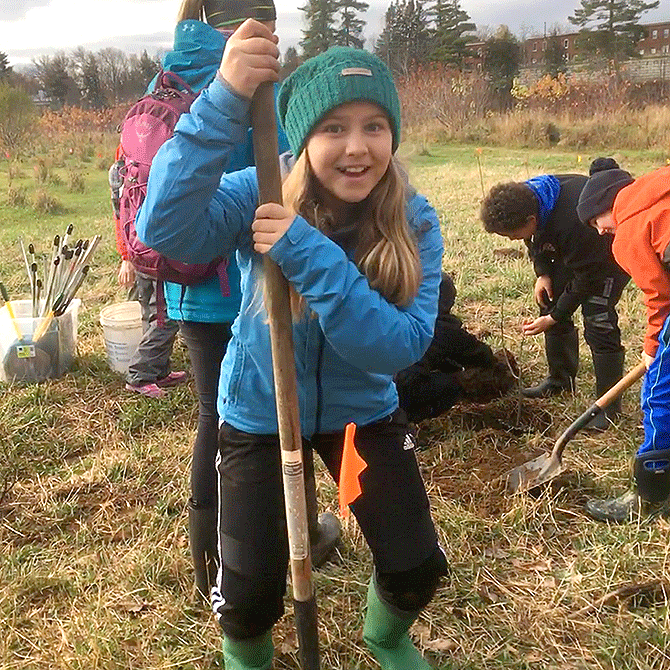
Photo credit: Olwyn Klinker Lesson: Be nimble and jump when you see a spark of interest
A thousand trees will be planted in New Brunswick, thanks to ten-year-old Mackenzie Klinker.
“Our school motto is ‘The best possible place to grow’.”
In late September, Klinker’s mom showed her a short film about student climate activist Greta Thunberg and then took her to the Fredericton climate strike the following day, which spurred the Grade 5 student at Park Street Elementary to launch her first environmental campaign. “I watched a video with my mom on climate change and it said that 200 species of animals go extinct every day. I didn’t know that and I really didn’t like that,” she recalls. “Our school motto is ‘The best possible place to grow,’ so I thought, ‘Then we should grow something.’ That’s why I decided I want to plant a thousand trees and help fight climate change.”
Klinker first took action by writing a letter to her school’s principal, Rien Meesters, vice principal, Mme. Gauvin, and teacher, Mme. Howlett, asking for their support.
Mme. Howlett helped find a solution. She suggested reaching out to the Nashwaak Watershed Association. They selected the types of trees to plant and the location: the bank of the Nashwaak River.
And so, just a few weeks later, Klinker and her whole class headed out to the river and planted 29 trees. They also got a science lesson in the outing, too, in that they learned about seeds and got to go critter dipping, where they used a net to find creatures, like backswimmers, in a nearby pond.
Now that the first batch of trees has been planted, they have 971 to go. And the whole school plans to help her meet that goal when the weather is warmer. “The rest of the staff are planning for each classroom to do something in the spring,” explains Meesters.
And Klinker wants to keep it going even longer: “I’d like it to continue every single year here at Park Street,” she says.
This whole project came together in a lightning-quick fashion, in part due to the responsiveness of the staff at Park Street and their willingness to act on Klinker’s suggestions.
Her advice for teachers?
“Kids can help think of ideas and what they would like to do. Then the teachers can support them for their projects and help make them possible,” she suggests. She also wants teachers to bring climate change education into the classroom when kids are younger. And she’s got a message for all adults about listening to kids on climate action: “It’s our future, so we want them to do stuff so we can have a good future.”
Photos: courtesy of Nina Tran, Olwyn Klinker and Jason Pang
First published in Education Canada, March 2020
-
Mind the Gap
Comments Off on Mind the GapQuiet classroom. No kids. It’s officially the end of the work day. She sits at her desk and revisits all of the things she would have liked to get done today. There’s a new activity she recently found online that sparked her interest, but she questions whether it’s something that could actually apply to her classroom: “Is it outdated? Authentic? Could it actually work?” But before she can answer those questions, she realizes she has a Math lesson to plan for the next day and that some of her students who are having a tough time are in need of extra support. She sighs and thinks to herself, “Maybe tomorrow.”
Educators are juggling multiple demands, leaving very little time for them to put the most recent educational research into daily classroom practice. Despite advances in research over the years that have shown which teaching and learning strategies are most effective, school leaders and front-line teaching staff continuously face challenges in implementing evidence-based research due to a lack of time, the complexity of research that’s available, and the overload of information in our digital world. Yet much of this research, if implemented, would actually yield greater student outcomes, and especially so for our most vulnerable and disadvantaged children.1
That’s where The Facts on Education comes in. Thanks to the continued support of the Desjardins Foundation and the Canadian School Boards Association, our one-page fact sheets unpack complex research into easily-understandable answers and concrete strategies towards some of today’s most pressing questions in K-12 education, including:
- How should climate change be taught in schools?
- How can we best teach students empathy?
- How can parents contribute to their children’s career development?
- How can mindfulness support teaching and learning?
Keep an eye out for these new fact sheets – and many more – throughout the year. EdCan members will receive copies in upcoming issues of Education Canada magazine, including online access at edcan.ca/facts-on-ed. Be sure to download, print, and share with your colleagues – we all play an important role in bridging the gap between research and practice.
Photo: Adobe Stock
First published in Education Canada, March 2020
Note
1 Canadian Education Association – Association canadienne d’éducation, Research Use and Its Impact in Secondary Schools: Exploring knowledge mobilization in education –L’utilisation de la recherche et son incidence dans les écoles secondaires : une étude examinant la mobilisation des connaissances en éducation (2011).
-
The Power of Paperless
Comments Off on The Power of PaperlessOrganization. Time Management. Executive Functioning. Fine motor skills.
These are common areas of need listed in Individual Education Plans. Yet figuring out how to address them is often a source of frustration for students, parents, and teachers alike. I leverage Google apps to support those areas of need and empower students with disabilities.
Facilitating collaboration and communication
Many students with special needs struggle to articulate or even recall what they did in class. For parents, logging in to my Google Classroom from their child’s account allows them to help because they can see exactly what is happening in class.
A parent of one of my students explained to me, “It is the only way I can track what he has or hasn’t done. I can ensure assignments are handed in, rather than putting the work in his binder and hoping he remembers to hand it in the next day.”
Adding the Resource teacher or Educational Assistant to the Classroom further enhances collaboration and student success.
If your organization, school district or faculty of education is an EdCan member (see the list here), you can enjoy unlimited access to our online content! Click here to create your online account.
Differentiating instruction
Inclusive education requires teachers to differentiate instruction based on student readiness, ability, and interest. With Classroom, I assign different versions of an assignment or quiz to certain students in the same class. Only the version that is assigned to a particular student will show up in their Classroom Stream.
Supporting fine motor skill and attention deficits
Most students can write and listen, but struggle to do both simultaneously. For many students, such as those with dysgraphia, taking notes during class is a fruitless exercise. I reduce cognitive load for everyone in my class by uploading all course materials into Classroom so that students have digital copies of all notes. Students can refer to the notes during class, and again afterwards for repetition and review.
“It is fun and it reduces my stress.”
Students with language-based learning disabilities or poor fine motor skills have brilliant ideas that they have difficulty recording.
I use a simple yet empowering tool called Voice Typing to unlock the potential in those students.
This assistive technology can be found in the Tools drop-down menu in Google Docs and Slides. Students simply press the microphone icon and then speak into a headset to dictate their ideas. When I receive their work, I’m confident that I’m actually evaluating their true understanding of a concept, not just their ability to write about it.
Self-esteem, motivation, engagement, and achievement all increase dramatically as students dictate a page of text in the time it would take them to write or type a couple of sentences.
When I asked about the impact that Voice Typing has had on her written output, one of my students smiled and proudly said, “It helps me get my work completed faster,” while her classmate added that “it is fun and it reduces my stress.”
Improving organization
In my paperless classroom, assignments do not end up in the black hole at the bottom of a backpack. All course materials are accessible online on any device, at school and at home.
I do still provide the option of paper handouts for some things.
I do this because not every student has access to technology or Internet at home. Providing multiple means of representation addresses this equity issue and is a principle of Universal Design for Learning.
In Google Classroom, content is organized by topic and tasks are automatically added to a to-do list arranged by course and due date. This adds structure and routine, which decreases student anxiety. When students finish a task, they can turn in their work through my Classroom anytime, anywhere. This reduces barriers for students with executive functioning disabilities and allows me to provide timely descriptive feedback.
Google Drive has become the new binder. But an unorganized Drive is the electronic equivalent of a pile of crumpled papers at the bottom of a backpack.

So I take a little time to coach my students to effectively organize their digital binder:
1. Create folders for each subject
- The equivalent of dividers in a physical binder
- Every file should be inside a folder
2. Colour code each subject
- Visual learners will associate a subject with its colour
- Use different shades of that colour for different strands or units
3. Name files accurately
- File name should be short yet tell you exactly what the file contains
- Descriptive names help when searching for files
One of my students succinctly described the benefits of his digital binder, saying “I know where all my work is, and it is saved there automatically.” No more lost work.
Illustration: iStock
First published in Education Canada, March 2020
-
Connecting Through Cultural Exchange
Comments Off on Connecting Through Cultural ExchangeIn April 2019, I boarded an airplane with 21 teenagers from Toronto to travel to Thunderchild First Nation in northern Saskatchewan, where we would stay for one week as part of a YMCA youth exchange program.
This experience changed all our lives.
These students had all taken the English: Understanding Contemporary First Nations, Métis and Inuit Voices course I teach at James Cardinal McGuigan (JCM) high school – a course designed to honour Indigenous voices.
But I wanted to push that education further by having my students participate in authentic experiential learning: being immersed in a First Nations community; engaging in rich discussion with the youth and Elders; and forming relationships that would bridge the gap between our cultures.
This YMCA program offered the perfect opportunity.
The project required an enormous amount of preparation – both logistically and emotionally. We explored stereotypes and learned about how to respectfully enter into an Indigenous community.
We participated in a workshop led by Dr. Angela Nardoz called “Build a Community” – an embodied experience that teaches about the impacts of colonialism and connects participants to the historical facts in a heart-based way.
I was in frequent communication with the coordinators at Thunderchild, Lydia Sunchild and Leah Arcand, to ensure that the experience would go smoothly and that their students would feel respected and welcomed when it was their turn to visit us in Toronto a few weeks later.
If your organization, school district or faculty of education is an EdCan member (see the list here), you can enjoy unlimited access to our online content! Click here to create your online account.
When we arrived at Piyesiw Awasis school, we were graciously greeted in a welcoming ceremony by all 250 students and teachers, who shook each of our hands, saying, “Tansi” (welcome).
Over the course of the week, my students engaged in land-based learning activities including teepee-building, hide-stretching, fire-building, and hiking. They visited historic sites and museums in neighbouring communities. A lucky few were even able to participate in a Sweat Lodge ceremony. Thunderchild shared their teachings, traditions, languages, artwork, and dance. Students met with Elders, watched a traditional powwow demonstration, and participated in a round dance.
“I was so impressed with how trusting and receptive both groups of students were.”
My students formed immediate relationships with the host students.
They played co-operative games and volleyball (with Thunderchild’s regional championship team), listened to music, and watched movies together. They talked about social media, family, traditions, and hobbies.
They were so alike and so eager to learn about one another.
At the end, the students participated in a sharing circle where they were able to openly and honestly express their thoughts and feelings regarding their newfound relationships.
It was moving for me to see such a wonderful example of trauma-informed and anti-colonial relationship-building.
“It was a truly special celebration of inclusion and unity.”
Two weeks later, we welcomed our new friends to Toronto. Our JCM students and the Thunderchild youth were so excited to be reunited, and they emanated a joy-filled energy all week. The days were jam-packed with activities: we did beading; we took them to the CN Tower, a Blue Jays game, the waterfront, the Royal Ontario Museum, and the CBC for a tour where we met award-winning Cree journalist Connie Walker. We even met the famous Ojibway author Drew Hayden Taylor!
A highlight was a downtown mural walk to discover the beautiful Indigenous artwork that is hidden all around our city, led by First Nations artists Chief Lady Bird and Aura, whom we had met earlier that year.
We concluded the week with a multicultural festival where JCM and Thunderchild students showcased their traditional music and dance. It was a truly special celebration of inclusion and unity. The week’s end brought emotional good-byes, and the students are still keeping in touch with each other months later.
I was so impressed with how trusting and receptive both groups of students were.
They came to the experience with open minds and a genuine interest in one another.
My students returned from Thunderchild changed in various ways: some came out of their shells, others now have more direction in their lives. They’ve grown: they have more friends, they’ve traveled, they understand what community is, what pride is. They have a broader worldview. Parents noticed this change immediately and thanked us for giving their children this experience.
I’m proud of us for rising to this challenge.
We hear about the realities on certain reserves and we know about the resounding impacts of colonization. Colonialism has created a divide between people who live on reserves and settler-people – yet the students managed to overcome those obstacles together.
That’s how relationships are formed; that’s how foundations are built; and that’s how change is made.
Photo: Dave Donald
First published in Education Canada, March 2020
-
Schools Take Action
Comments Off on Schools Take ActionAre we finally waking up to the critical need for climate change action? Is it too late? As we finalized the articles for this issue, Australia was literally on fire, suffering devastating and possibly irreversible losses to habitat and wildlife, not to mention loss of human life and thousands of homes. And this is only one of several ecological debts that are coming past due.
If young people are worried and angry about the crisis that lies ahead for them, they have every right to be. They’ve been left holding the bag, and they know it. So how do we equip them to address these challenges in a positive way that doesn’t just create more anxiety and fear?
Environmental educators know that real action that has a real impact is the strongest antidote to feelings of helplessness and despair. That’s why, in this issue on environmental education, we wanted to stress approaches that involve students in action projects to mitigate environmental damage, and schools that “walk the walk” by reducing their own carbon footprint. We were interested in how schools are “greening up” through both education andaction.
There is plenty in this issue to inspire educators to take up the green torch. But what has stayed with me is a finding from the survey conducted by Lakehead University and Learning for a Sustainable Future, reported on in “Climate Change Education and the Canadian Classroom: Nearly half of Canadian students do not believe that human action will be effective in mitigating climate change. That’s a heavy weight for kids to carry. The authors say, “It is critically important, therefore, to target this group with climate change education that is action- and solutions-oriented to combat eco-anxiety and hopelessness.”
The articles in this issue show just what can be done when students are energized to act and school and board administrations are willing to step up and support them. From the EcoSchools Program that began in Toronto and is spreading across the country, to the eco-projects initiated and led by the students profiled by Alex Mlynek (web exclusive), to the work done by Brilliant Labs in Atlantic Canada to facilitate students’ innovative tech solutions supporting the UN Sustainable Development Goals, there is no shortage of green ideas in our schools. It is not such a big stretch to imagine that Canadian schools could join the ranks of those leading the way in sustainable living and environmental stewardship.
Photo: courtesy Laryssa Gorecki
First published in Education Canada, March 2020
Write to us!
We want to know what you think. Send your comments and article proposals to editor@edcan.ca – or join the conversation by using #EdCan on Twitter and Facebook.
-
Role Models and Hands-On Work
Comments Off on Role Models and Hands-On WorkMany of our students are passionate about environmental protection – but do they know what jobs are available in this field? Bringing professionals into the classroom gives students a window into the real work being done and inspires them to get more involved.
“How do you become a conservation biologist?”
This is the question ecologist Philippe Fernandez-Fournier hears most often when he visits high schools in British Columbia. Fernandez-Fournier is a PhD student at Simon Fraser University and the co-founder of local conservation NGO, Wide Open Projects, based in Vancouver.
“Students want to know what’s available to them career-wise if they take the path of ecological studies and unfortunately, sometimes it seems to them like there just aren’t that many opportunities,” says Fernandez-Fournier. “But that isn’t true. It can be difficult, but it’s not impossible.”
“How do we, as educators and parents, channel this passion into creating practical higher education and career opportunities for them?”
For students in Canada today and around the globe, there’s no shortage of passion and ambition when it comes to finding creative solutions to environmental issues.
These are the children and teens coming of age in a more enlightened culture, eyes open to the realities of destructive human activities on the planet.
More than any other group of young people in history, today’s students are keenly aware of the challenges we face due to climate change.
More importantly, these young people know that they will bear the brunt of the consequences if we fail to make big changes soon.
We have young, enthusiastic students ready to become green ambassadors of change in the work force. The question is: How do we, as educators and parents, channel this passion into creating practical higher education and career opportunities for them?
Fernandez-Fournier and others like him are stepping up to help, hoping to show high school students interested in ecology that there are indeed pathways to success. “When I was an undergrad in biology,” says Fernandez-Fournier, “the only opportunities shown to me at the time were lab work, which I didn’t find that interesting. But as I got to know and connect with hands-on field ecologists, I became sure of the career path I’m on now. I want to share that excitement with other young students.”
If your organization, school district or faculty of education is an EdCan member (see the list here), you can enjoy unlimited access to our online content! Click here to create your online account.
Fernandez-Fournier started as an undergraduate student in a lab at McGill University in Montreal, and got his first taste of ecological field work volunteering with an organization called Operation Wallacea in Honduras. He never stopped after that; his master’s research at the University of British Columbia led him to study spiders in the jungles of Ecuador. His discovery of a parasitoid wasp that controls the minds of social spiders in the Amazon was recently profiled in Scientific American.
“All of these experiences made me want to contribute more, and with like-minded people, which is why I started Wide Open Projects with my friends. We focus on conservation awareness, coral reef restoration, and community development,” says Fernandez-Fournier.
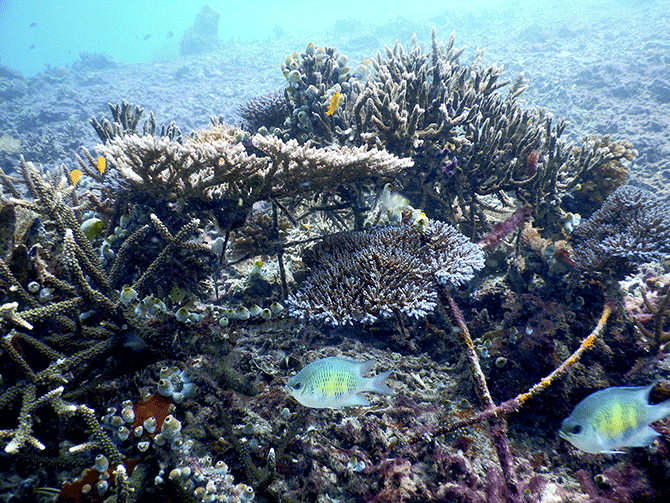
The coral reef restoration project uses an innovative method of hand-bending metal rebar into dome-like structures and then skillfully attaching bits of coral to it – which, when done correctly, flourishes into a healthy and multi-species coral community.
Wide Open Projects and community partners have created two successful pilot projects, and this past summer built and placed 66 more structures on the ocean floor.
Students in Canada and Indonesia, as well as biology colleagues around the world, are closely following the progress of Fernandez-Fournier and his team via social media.
But Fernandez-Fournier urges students not to feel compelled to follow his path exactly. Instead, he asks them to seek out opportunities that appeal to their own unique interests, whether that be lab work, field ecology, or green policy development. He encourages students to be proactive in seeking out any and all opportunities to volunteer and work with local university professors, NGOs, or other outdoor organizations. “Don’t be afraid to contact people and ask how you can help. Much of what’s needed now is just people willing to show up and do the work.”
He encourages educators to do the same. “Ask grad students and professionals in your community to visit your classroom and talk about their work. Most people, if they have the time, are more than willing to talk about their passion projects.”
“We all need to be bold and face the future proactively.”
Reaching out to potential role models, admittedly, is not always the easiest route and isn’t guaranteed to yield results, which is why many shy away from the idea.
The same is true for students, who worry about being rejected and therefore don’t put in the ask to join field research or volunteer opportunities abroad. They may even withdraw from ecology pursuits entirely, seeking out the road more travelled instead.
But if we learn anything from scientists such as Fernandez-Fournier working on the frontline of environmental challenges, it’s that we all need to be bold and face the future proactively, before allowing these challenges to come to us.
Photos: Philippe Fernandez-Fournier
First published in Education Canada, March 2020


IDEAS TO SUPPORT EDUCATORS : Subscribe to the EdCan e-Newsletter
Quality research, reports, and professional learning opportunities.