
Archive
-
So you want me to talk?
Comments Off on So you want me to talk? -
Like Being Pecked to Death by a Chicken
Comments Off on Like Being Pecked to Death by a ChickenThis blog post is part of a two-part series on teacher moms.
Missed out on part 1? Turn back here.
If you’ve ever written a major academic paper like a thesis or dissertation, you’ll know how painstaking it can be to summarize years of your life’s work into a snappy elevator pitch when all you have is mere minutes to convince people why you’re worth their time. But my PhD dissertation was a completely different story. When I think about the numerous women I’ve met over the course of my research – women who are juggling the demands of being both a mom at home and a teacher in the classroom – it’s pretty simple to sum up my 400-page dissertation in just eight words. Being a teacher mom is, quite frankly, “like being pecked to death by a chicken.”
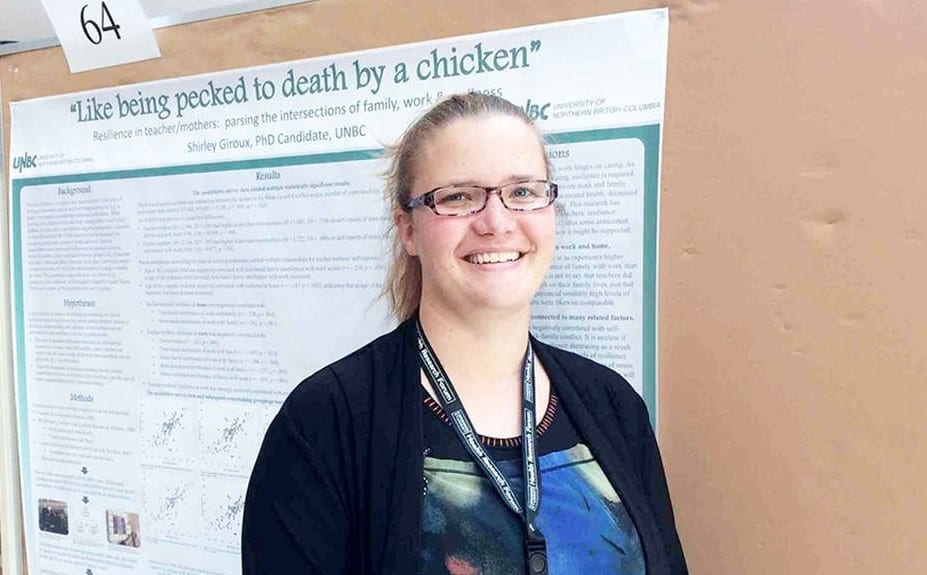
Dr. Shirley Giroux in Winnipeg presenting her PhD research at the 31st Annual Canadian Student Health Research Forum
WHAT IT’S LIKE TO BE PECKED TO DEATH BY A CHICKEN

A peck or two from a chicken is annoying but it won’t kill you. Similarly, teachers and other caregiving professionals are typically able to manage a few demands on their time and energy without losing their cool. But when demands pile up and begin shooting from left-right-and-centre, teacher moms are likely to burnout – just like how getting pecked by a chicken a thousand times over will likely leave you dead.
Teachers regularly work with children who are experiencing stress and trauma at home. Emotional pain and distress have no boundaries, and teachers – out of necessity and out of their heart for children – inevitably serve as emotional caregivers on top of the usual demands of schooling, like instruction and lesson planning. When students express their social and emotional needs through disruptive behaviour, an entire lesson – if not an entire day – can get derailed. Although teachers play a crucial role in the lives of students experiencing trauma, they’re also at high risk themselves of second-hand traumatic stress where working alongside and listening to the experiences of distressed students can actually damage their own mental health and well-being.
TEACHERS AND CAREGIVERS AGREE – WE ARE BEING PECKED TO DEATH BY CHICKENS
Let’s not forget that teachers are also held to standards of practice that dictate how they’re expected to express their emotions. While in the classroom, it’s frequently expected that teachers suppress how they truly feel – either by hiding behind a “workplace appropriate” façade, or by literally attempting to change their emotions altogether by, for instance, filtering their frustrations into acts of kindness as they work alongside a struggling student. Given the energy required to control how they feel, combined with other demands including meeting tight deadlines, strained interpersonal relationships, and other pressures from outside the workplace, it’s no wonder that teachers often feel overwhelmed and depleted.
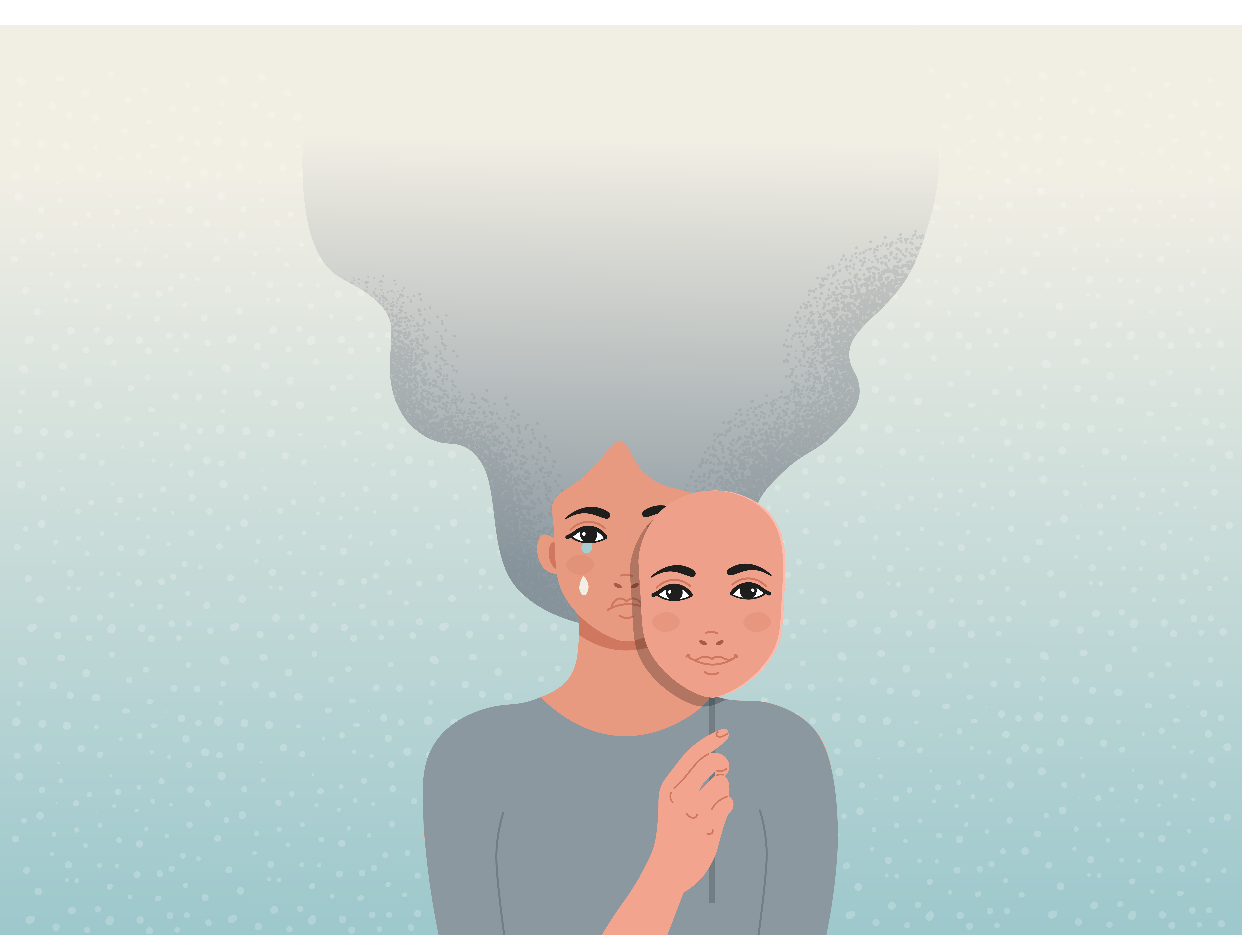
It’s also no wonder that the metaphor “a death by a thousand pecks” resonates so strongly with teacher moms and other caregiving professionals, many of whom have told me point-blank that caring for other people often leaves them drained and irritated long after they’ve left the workplace and rejoined their families. I’ve also heard stories from brilliant scientists about how they, too, return home after long days at the lab only to find that they’d much rather be left alone in solitude. Simply put, caregivers know what it’s like to be continuously pecked – and sometimes obliterated – by a chicken.
Even parents who aren’t typically considered “caregiving professionals” are required to tend to other people’s well-being while at work, where they’re expected to be cautiously considerate of other people’s feelings in their communications. Caring is almost always about “the other” – another person or even an idea – that we view as having some sort of potential or possibility for growth and development. This means that we are all caregivers in some way regardless of the job or role we may find ourselves in. Conversely, this also means that “caring” should be valued in the workplace and viewed as a demand worthy of professional development, support, and additional resources just as any other demand.
‘WORK-LIFE BALANCE’ ISN’T ENOUGH TO SUPPORT TEACHER MOMS AND OTHER CAREGIVING PROFESSIONALS
We often talk about maintaining “balance” between home and work, but I believe there’s a more appropriate term that truly encapsulates what it’s like to successfully manage our personal and professional responsibilities – and that’s “equilibrium.”
Work-life balance is like tinkering with a weighing scale where our personal life is on one side and our work life is on the other. We’re constantly striving to adjust and readjust how much weight we’re putting on either side so that one part of our lives doesn’t tip over and crash. “Balance” also implies that the different parts of our lives can be separated like different drawers of a wardrobe. The reality is that how we feel in our personal lives can impact how we feel in our professional lives, and vice-versa. For caregivers especially, we can’t expect teachers to “shut off” the care they have for their students just because they’ve left the schoolgrounds. In other words, there is no perfect balance.

Equilibrium, on the other hand, allows for some flexibility where new demands and additional stress create mere shifts in our lives rather than a total collapse. It means accepting, for example, that the amount of time, energy, and focus we dedicate to certain aspects of our lives will constantly change depending on what our priorities are or where our attention is most needed at a given point in time. In other words, teacher moms can prioritize caring for their own children without ceasing to care deeply for their students who are suffering from difficult personal circumstances – they may just accept that they can’t do it all, that they can’t do it alone, and that not every challenge or problem requires their fixing.
In brief, teacher moms and caregiving professionals who set boundaries, accept their limitations, and build up their resilience are able to absorb stress rather than take it on completely. As care is so inherent to being a teacher, schools can better support teacher moms by investing in the caring aspects of the profession and encouraging resilience training on the job.
This blog post is part of a two-part series on teacher moms.
Missed out on part 1? Turn back here.
Dr. Shirley Giroux’s Ph.D. dissertation is entitled, “Like Being Pecked to Death by a Chicken: Resilience and Work-Family Equilibrium in Teacher/Mothers.” Check out a recap on her research here.
Author note: All of the teachers who participated in my research self-identified as cisgender female. Except for limiting my sample to female teachers, this lack of diversity was not intentional.
Photos: Adobe Stock
-
Teacher moms are doing it all
Comments Off on Teacher moms are doing it allRESEARCH IN BRIEF
In news that will surprise no educators, teaching is challenging work. Besides planning for and facilitating student learning, there are a number of other demands on teachers’ time and energy, many of which — like volunteering for a staff committee, staying in at lunch to help a student, or providing students with flexible options to demonstrate their knowledge — can seem small or unnoticeable on their own. However, when demands like these begin to add up, teachers may feel that they have too many demands on their time or that their efforts are not being recognized or appreciated, which can then contribute to impaired health.
It‘s partly because of these potential negative consequences that I called my Ph.D. dissertation “Like Being Pecked to Death by a Chicken.” While a single peck (or demand) might be tolerable, an amassment could lead to impaired health, and it’s often an accumulation of relatively small things that wear down a person’s resilience.
As part of my research, I had 182 female teachers in B.C. complete a survey to see whether there are any differences between women who are both moms and teachers, in comparison to female teachers who don’t have kids. Most helpful to my research were the group discussions I led, where these teachers were able to meet and share what were often emotional stories alongside their colleagues about the ups and downs of managing family and work. I specifically wanted to find out whether an “increased burden of care” (i.e. the pressures of being a caregiver both at school and at home) was hurting the well-being of teacher moms, and what they were doing to remain resilient through it all.
WHAT WE MEAN BY “RESILIENCE”
But what exactly do we mean when we talk about “resilience,” and what seems to make the biggest difference for teachers? Resilience is well-backed by research as key to sustaining teachers’ well-being, and it mainly refers to things that enable them to continue teaching despite the challenging conditions they may find themselves in. There are typically three factors that contribute to resilience:
- Personal factors: a person’s skills, abilities, and personality
- Contextual factors: a person’s environment, such as their workplace, and how this influences their ability to stay healthy
- Interactional factors: the stress of dealing with other people
HOW FEMALE TEACHERS COPE WITH SCHOOL AND FAMILY DEMANDS
By helping teachers better understand resilience and how their emotions affect their health and their work — and by being supported to build their resilience while at school — teachers can potentially improve their well-being, health, and quality of life, while also promoting a healthy learning environment where they role model resilience strategies among their students and colleagues.
In general, I found that teachers have similar challenges regardless of whether or not they were moms, and that they seem to use similar resilience strategies to support themselves as caregivers both inside and outside of school. The majority of teachers I surveyed shared stories clearly describing the ways that so many women are able to sustain themselves while working with people all day and simultaneously raising their own children. For those women who weren’t raising children of their own, they described how they worked through challenging circumstances in their professional or personal lives. Through recounting their lived experiences, I learned six key things about how female teachers manage to stay afloat and stay resilient:
- Being aware of their emotions. By being able to stay aware of their emotions and work through them in positive ways, teachers are able to support their own resilience and help their students learn to do the same. For example, instead of suppressing their emotions (e.g. keeping a smile on when they’re angry), teachers who are able to acknowledge and deal with their emotions in appropriate ways tend to be more resilient.
- Working with people. This can actually pose a challenge to teachers’ resilience, mostly because of the emotion and care that’s required. However, it can also be an important source of resilience where teachers have healthy relationships with their colleagues and therefore find their work more meaningful and enjoyable.
- Perspective. This means being able to look at the “whole picture” and see things in appropriate proportion to other demands. Teachers talked about reframing problems to focus on things that they’re able to control or on things about their work that give them a sense of meaning or purpose.
- Staying healthy. This includes taking part in activities or behaviours that help maintain physical health (e.g. exercise, healthy eating, and avoiding substance abuse).
- Time. While this is often outside a teachers’ control, time can be a source of resilience when it allows teachers to do their work without feeling rushed or otherwise lacking the opportunity to invest deeply in their relationships and interests.
- Family. Having strong and supportive family relations was very important to those teachers who were fortunate enough to have access to them.
“Relationships” was also a keyword that teachers used — whether or not they were moms — when talking about how they’re able to sustain their work and home responsibilities. For teacher moms in particular, maintaining relationships and reaching out to other people seemed to become a more important resilience strategy as their children got older.
HOW SCHOOLS CAN HELP EASE THE PRESSURE
Research has shown that relationships are crucial to resilience, and I’ve seen this in my own observations where teachers were overwhelmingly receptive to filling-in my survey and, most notably, actively taking part in our group discussions. I’m therefore proposing that teachers be provided with more opportunities to build relationships with each other, and I’m convinced that similar group discussions that allow teachers to talk openly about their stories, express their emotions, and share strategies could be valuable in supporting teachers’ resilience.
It has often been said that teachers bear the brunt of criticism in our modern area of accountability. They receive pressure from administrators, parents, and society to increase student achievement while, in many cases, receiving fewer resources to do so. By providing even a small opportunity for teachers to meet and work through emotional stories alongside their colleagues, it’s clear that there’s potential for similar meetings to be useful in enhancing teacher well-being while creating a dedicated support network in schools.
To avoid teachers having to find ways to do this themselves, these meetings should ideally be done at a systems level so that the caring and emotional aspects of teaching can be supported just as any other aspect of teaching is covered in ongoing professional development. Alternatively, if we only focus on promoting resilience strategies for individual teachers and don’t allow for this sharing to happen in a group setting, we will potentially neglect the bigger picture of the demands that teachers face as caregivers — at home, at work, and in between.
Dr. Shirley Giroux’s Ph.D. dissertation is entitled, “Like Being Pecked to Death by a Chicken: Resilience and Work-Family Equilibrium in Teacher/Mothers.”
Author note: All of the teachers who participated in my research self-identified as cisgender female. Except for limiting my sample to female teachers, this lack of diversity was not intentional.
References and Further Reading
Brunetti, G. (2006). Resilience under fire: Perspectives on the work of experienced, inner city high school teachers in the United States. Teaching and Teacher Education, 22, 812-825. doi:10.1016/j.tate.2006.04.027
Bullogh, Jr., R. V., & Hall-Kenyon, K. M. (2011). The call to teach and teacher hopefulness. Teacher Development, 15, 127-140. doi:10.1080/13664530.2011.571488
Cinamon, R. G., & Rich, Y. (2002). Gender differences in the importance of work and family roles: Implications for work-family conflict. Sex Roles, 47, 531-541. doi:10.1177/0894845309345849
Cinamon, R. G., & Rich, Y. (2005a). Reducing teachers’ work-family conflict. Journal of Career Development, 32, 91-103. doi:10.1177/0894845305277044
Davydov, D. M., Stewart, R., Ritchie, K., & Chaudieu, I. (2010). Resilience and mental health. Clinical Psychology Review, 30, 479-495. doi:10.1016/j.cpr.2010.03.003
Day, C., & Gu, Q. (2014). Resilient teachers, resilient schools: Building and sustaining quality in testing times. London, UK: Routledge.
Day, C., & Kington, A. (2008). Identity, well-being and effectiveness: The emotional contexts of teaching. Pedagogy, Culture & Society, 16, 7-23. doi:10.1080/14681360701877743
Day, C., Kington, A., Stobart, G., & Sammons, P. (2006). The personal and professional selves of teachers: Stable and unstable identities. British Educational Research Journal, 32, 601-616. doi:10.1080/01411920600775316
Day, C., Stobart, G., Sammons, P., Kington, A., Gu, Q., Smees, R., & Mujitaba, T. (2006). Variations in teachers’ work, lives and effectiveness. Final report for the VITAE Project, DfES. Retrieved from dera.ioe.ac.uk/6405/1/rr743.pdf
Doney, P. A. (2013). Fostering resilience: A necessary skill for teacher retention. Journal of Science Teacher Education, 24, 645-664. doi:10.1007/s10972-012-9324-x
Ebersöhn, L. (2014). Teacher resilience: Theorizing resilience and poverty. Teachers and Teaching: Theory and Practice, 20, 568-594. doi:10.1080/13540602.2014.937960
Gu, Q. (2018). (Re)conceptualizing teacher resilience: A socio-ecological approach to understanding teachers’ professional worlds. In M. Wosnitza, F. Peixoto, S. Beltman, & C. F. Mansfield (Eds.), Resilience in Education (pp. 13-33). Cham, Switzerland: Springer. doi:10.1007/978-3-319-76690-4_2
Gu, Q., & Day, C. (2007). Teachers resilience: A necessary condition for effectiveness. Teaching and Teacher Education, 23, 1302-1316. doi:10.1016/j.tate.2006.06.006
Hansen, D. (1995). The call to teach. New York, NY: Teachers College Press.
Hansen, D. T. (1994). Teaching and the sense of vocation. Educational Theory, 44, 259-275. doi:10.1111/j.1741-5446.1994.00259.x
Herman, K. C., Hickmon-Rosa, J., & Reinke, W. M. (2018). Empirically derived profiles of teacher stress, burnout, self-efficacy, and coping and associated student outcomes. Journal of Positive Behavior Interventions, 20, 90-100. doi:10.1177/1098300717732066
Howard, S., & Johnson, B. (2004). Resilient teachers: Resisting stress and burnout. Social Psychology of Education, 7, 399-429. doi:10.1007/s11218-004-0975-0
Le Cornu, R. (2013). Building early career teacher resilience: The role of relationships. Australian Journal of Teacher Education, 38. Retrieved from http://ro.ecu.edu.au/ajte/vol38/iss4/1
Lindström, B., & Eriksson, M. (2011). From health education to healthy learning: Implementing salutogenesis in educational science. Scandinavian Journal of Public Health, 39(Suppl 6), 85-92. doi:10.1177/1403494810393560
Luthar, S. S., & Ciciolla, L. (2015). Who mothers mommy? Factors that contribute to mothers’ well-being. Developmental Psychology, 51, 1812-1823. doi:10.1037/dev0000051
Mansfield, C. F., Beltman, S., Price, A., & McConney, A. (2012). “Don’t sweat the small stuff:” Understanding teacher resilience at the chalkface. Teaching and Teacher Education, 28, 357-367. doi:10.1016/j.tate.2011.11.001
Palmer, P. J. (1998). The courage to teach. San Francisco, CA: Jossey-Bass.
Reivich, K., & Shatté, A. (2002). The resilience factor. New York, NY: Three Rivers Press.
Schwarze, J., & Wosnitza, M. (2018). How does apprentice resilience work? In M. Wosnitza, F. Peixoto, S. Beltman, & C. F. Mansfield (Eds.), Resilience in Education (pp. 35-51). Cham, Switzerland: Springer. doi:10.1007/97
-
Belonging in the Education Workplace
Comments Off on Belonging in the Education WorkplaceDid you know that something as simple as feeling like you belong can impact your health, happiness, and success? The science is clear – if we feel valued by and connected with our colleagues, then we work harder and more effectively while experiencing more fun and more success at work. What’s more, belonging is contagious – when we’re happy at work, then our colleagues are likely to be happy at work, too.

This is important in any workplace, but it’s of absolute importance in schools where educators have the privilege and responsibility of impacting children’s development. Educators know the power of belonging within the classroom, and they’ll often tell you about the impact small gestures can have on students’ engagement and well-being – things like greeting students at the door and connecting class activities with students’ individual, unique passions. Inversely, educators can also tell heartbreaking stories of students who are rejected or excluded, and the impacts this can have on their engagement and self-esteem.
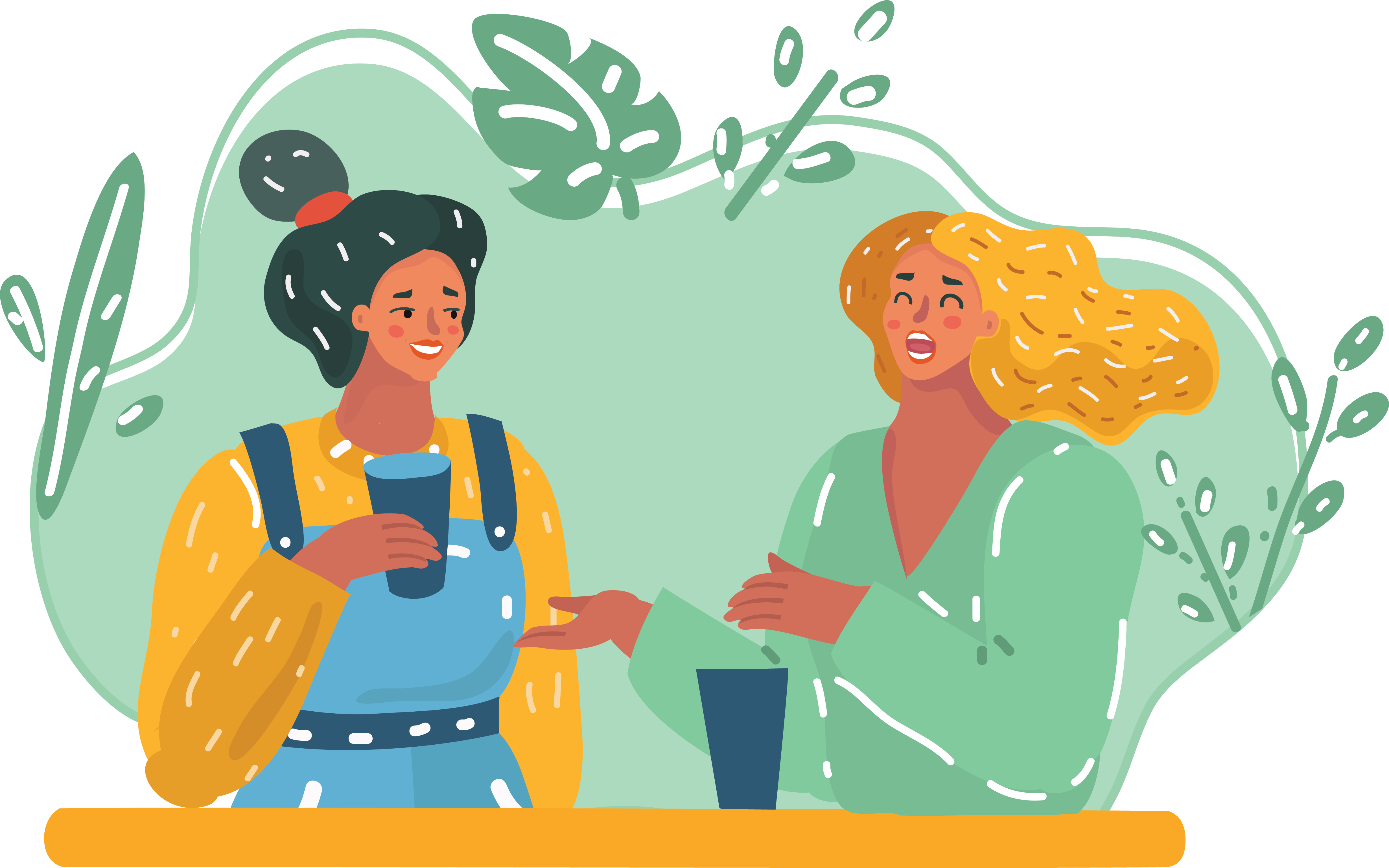
The same is true in the adult world. Think about the best teams and the best workplaces you’ve ever been a part of. What made these teams and workplaces stand out? My guess is that your first thoughts don’t revolve around comfortable furniture or an environment where you can get a whole lot of paperwork done. You’re probably thinking about PEOPLE, and – if you were to tell me about these people – you’d probably use words related to ‘belonging’ and ‘connection’ such as “family,” “friendship,” and “trust.”
BELONGING IS BASIC HUMAN BIOLOGY
Our need for belonging is wired into our biology. Human beings aren’t the strongest nor the fastest animals on the planet and we could’ve never survived as a species if we didn’t find a way to get along and work together. To survive, we’ve evolved over millions of years to eventually become a deeply social species. Social psychologist Matthew Lieberman, for instance, tells us that our need to belong is so powerful to the point that it’s one of the primary drivers of human behaviour. If you think about the early days of evolution, then this makes total sense. If we didn’t cooperate with each other and form communities instead of hunting each other down, then we wouldn’t have survived. Period.
The Secret to Health, Happiness and Success Together | Gail Markin | TEDxLangleyED
Earlier this year, I did a TEDx presentation about the power of belonging and connection. In preparation, I explored simple gestures that can promote belonging and impact workplaces in powerful ways. For example, did you know that when you perform an act of kindness towards another person, ‘feelgood’ chemicals are released in YOUR brain, in the OTHER PERSON’s brain, and in the brains of ANYONE ELSE who just so happened to witness the interaction? Essentially, we have the power to impact each other’s brain chemistry through our words and actions.
Try this short experiment:
Turn towards someone near you, look directly at them, and give off a big smile. You’ve literally just messed with their brain chemicals!
STRESS IS CONTAGIOUS – BUT BELONGING AND HUMAN CONNECTION ARE ALSO CONTAGIOUS
Just as smiling and acts of kindness release ‘feelgood’ chemicals, stressful circumstances can have quite the opposite effect. An interesting study on stress contagion in the classroom was conducted by UBC researchers Dr. Eva Oberle and Dr. Kimberly Schonert-Reichl, who measured teachers’ stress levels and the cortisol levels (i.e. stress hormones) of their students taken from saliva samples. Unsurprisingly, there was a significant correlation between the two – as teachers’ stress went up, so did students’ stress levels, and vice versa. Instinctively, teachers know that if they’ve had a stressful morning at home (or if one of their students has had a rough start to the day), then stressful energy is likely to spread throughout the classroom.

But there’s also good news. If you lower your cortisol levels – through, for example, feeling a sense of belonging and connection with other people around you – then you can actually boost your immune system. Most people already know that when our stress levels go up, then we’re also more susceptible to illness and long-term stress, which can have a huge impact on both our physical and mental health. Yet, belonging and social connection are actually more powerful predictors of life expectancy than other important health measures like levels of smoking and obesity. So, if you want to stay healthy and live longer, cultivate belonging!

SUCCESSFUL TEAMS LEVERAGE “BELONGING CUES” TO CREATE A WORKPLACE THAT ENCOURAGES CREATIVITY AND RISK-TAKING
Belonging and social connection are also powerful predictors of team success. When we feel valued and cared for by our colleagues, then we also feel safe. When we feel safe at work, then we feel empowered to be creative, to take risks, to ask questions, and to share ideas. To be truly successful, we need to know that our teams have our backs and will not embarrass, reject, or punish us for speaking up, trying new things, or doing things differently.

Let’s go back to the classroom again for a moment. Educators want students to know that it’s okay to ask questions, to be curious, to take risks, and to make mistakes. They work tirelessly to setup structures and conditions that create a safe environment for students to do their best work. Once again, we need to apply this wisdom from the classroom within our workplaces.
In his book The Culture Code, Daniel Coyle tells us about certain behaviours which he calls “belonging cues.” These are powerful cues that allow people to know that they matter while having big impacts on how they feel and perform in group settings. Daniel had the opportunity to study some of the world’s highest performing teams, and found that simple things like working in close proximity to your colleagues, eye contact, taking turns, and other small gestures communicate three key messages:
- That your INTERACTIONS matter. You show your colleagues that you’re invested in them and that your interactions are valuable.
- That THEY matter. You show your colleagues that they are unique and valued.
- That the RELATIONSHIP will continue. You show your colleagues that your interactions aren’t one-off and that you’re committed to developing strong relationships with them in the long-term.

This research is compelling and, once again, it fits with what we already know instinctively as human beings – that we crave positive social interaction and connection with other people. Think back again to the best workplaces and the best teams you’ve ever been a part of, and I bet you can remember laughing with your colleagues and having a lot of fun throwing out creative ideas. You can probably also remember times when you struggled through something or messed something up, and how your team was there to support you. These are the types of workplaces that are needed more than ever in our schools and school districts. If we want to engage, retain, and inspire people in the education profession, then – just like students in the classroom – educators need to feel safe in their workplaces and on their teams in order to be happier, healthier, and more successful.
Photo: Adobe Stock
References and Further Reading
Oberle & Schonert-Reichl, 2016, Stress contagion in the classroom? The link between classroom teachers’ burnout and morning cortisol in elementary school students, Social Science & Medicine.
Daniel Coyle, 2018 The Culture Code. Random House Books.
Matthew Leiberman, 2013, Social: Why our Brains are Wired to Connect. Crown Publishing Company.
-
Infographic: 5 Ways to Support Principals’ Well-being
Comments Off on Infographic: 5 Ways to Support Principals’ Well-being
This infographic aims to provide strategies and practices specific to the role of the principal that school leaders can use to promote and manage their own well-being.
This infographic was inspired by an editors’ pick article by Dr. Katina Pollock that appeared in Education Canada Magazine.
-
Culture Matters
Comments Off on Culture MattersCulturally responsive education goes far beyond an initial welcome. It’s about learning to identify and question our own cultural assumptions, and to not just make room for but actively invite in and learn from our students’ varied and rich cultural perspectives.
Two years ago we published an issue on Welcoming Newcomer Students, looking at how schools can provide sensitive and reassuring support to immigrant and refugee students and their families. That was an important aspect of cultural diversity to address, but it is only part of the picture.
Culturally responsive education goes far beyond an initial welcome and orientation. It involves recognizing that our entire education system was built around a culturally specific model, and that this model tends to discount and disadvantage the “cultural capital” of a large and growing number of students whose roots are not Western European. Many educators who come from similarly diverse backgrounds are all too aware of this fact. For the rest of us – those who fit comfortably within Canada’s dominant culture – it’s about learning to identify and question our own cultural assumptions, and to not just make room for but actively invite in and learn from our students’ varied and rich cultural perspectives.
As Stephen Hurley notes in his article describing one school’s committed work toward providing “culturally responsive and relevant pedagogy” to their diverse student population, this isn’t something we can accomplish in a single professional development workshop. It requires grappling with issues of privilege, marginalization and oppression – uncomfortable, challenging and sometimes very personal work.
Policy and curriculum are also important, of course. We have seen, for example, the harm caused by omitting Indigenous perspectives and realities from Canadian history (and other) courses, and most provinces and territories have or are in the process of revising curricula to include a more complete and fair accounting of our colonial history. But policy can’t substitute for awareness and sensitivity on the part of all school staff – what Joanne Mednick Miles refers to as “intercultural competence”. Latika Raisinghani has developed a comprehensive framework for what she terms “(trans-multi)culturally responsive education,” but even here the first step is personal: “an ideological and pedagogical commitment that requires a teacher to first become a (trans-multi)culturally responsive person”. We are challenged to not rely on formal policy and curriculum, but to do what can be done here and now to acknowledge, honour and include our students’ cultural identities, and to work toward a more equitable education experience for all.
P.S. With this issue, we also launch our new department, Well at Work. Watch for more EdCan Network initiatives around workplace well-being in the year to come!
Photo: Dave Donald
First published in Education Canada, September 2019
-
Religion in the classroom
Comments Off on Religion in the classroomWhile many Canadian teachers believe that religion does not belong in the classroom, the authors argue that religion already is in the classroom. Therefore, developing our own and our students’ religious literacy is an important aspect of multicultural education.
“If you ask me, religion is just a can of worms that you don’t want to open in the classroom.” This comment from a well-intentioned and well-educated colleague was met by nods of agreement by other teachers in the staff room, many offering up anecdotes about how problematic religious issues are and swapping strategies for shutting down these conversations. This seasoned teacher’s comment is a common view, one that we’ve heard repeatedly in our careers as educators: Religion just doesn’t belong in the public school classroom.
Yet, religion is in the classroom. It is in the curricular content students engage in, it is brought into the classroom through current events, and it is represented among the diverse student body. Religious diversity in Canadian classrooms is growing, and so is the potential for thoughtful, deliberate discussion and reflection about religion. Due to a range of factors that include growing Indigenous populations, increasing immigration, and rising numbers of those who identify as non-affiliated, Canada’s contemporary (and future) classrooms include a greater range of religious and non-religious worldviews than ever before. A recent study suggests that by 2036, the number of people in Canada who practice a non-Christian religion could almost double, with numbers reaching up to 16 percent of the population. This is a dramatic increase compared to 2011, where non-Christian religious practitioners represented only nine percent.1
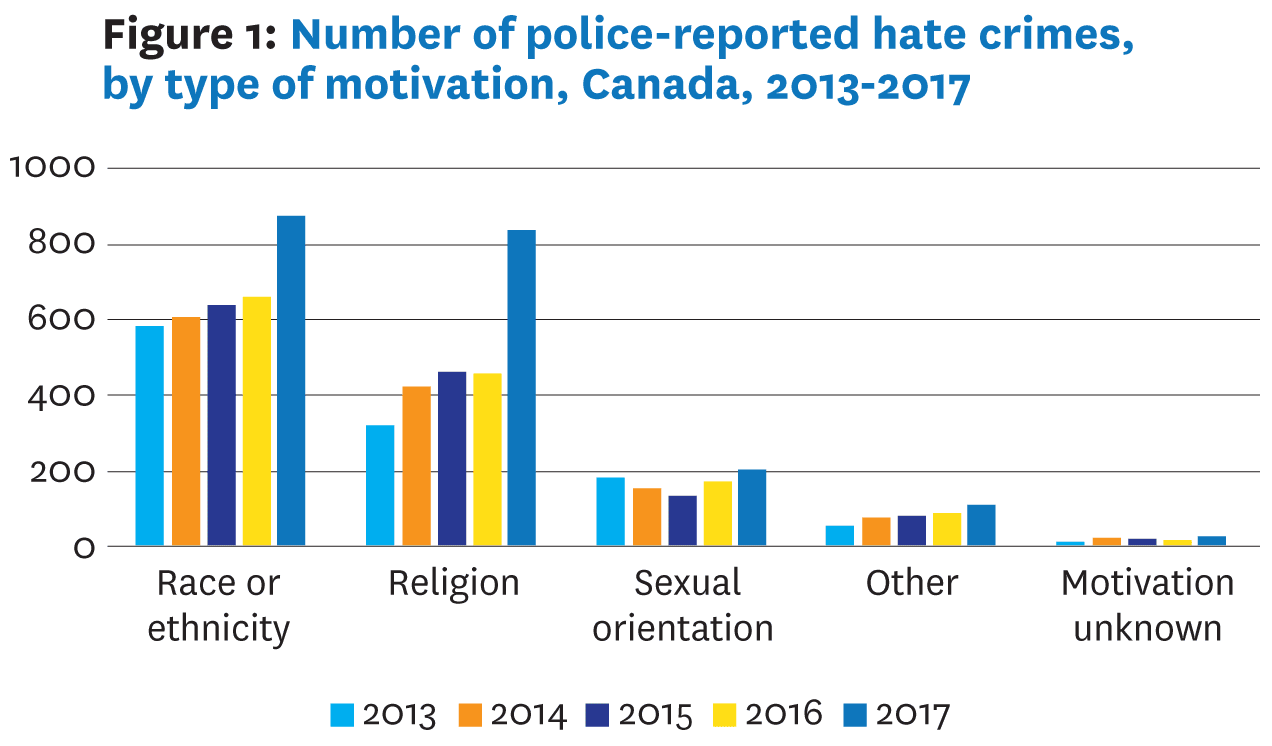
Religiously motivated hate crimes are also on the rise. Internationally, the recent religiously motivated attacks in New Zealand, Pittsburgh, and California are stark reminders of how religious minorities are increasingly targeted. Unfortunately, this trend is also apparent in Canada, where religiously motivated hate crimes have risen dramatically in the last five years alone. (See Figure 1.)
Figure 1
(A compiled graph of data from Statistics Canada)
The current popular strategy among many educators of ignoring students’ religious identities has consequences. First, the failure to acknowledge or address students’ religious identities forms part of a “hidden curriculum” and may suggest that this aspect of student identity is not valued. This risks further marginalizing religiously identified students, especially those belonging to religious minorities, and encouraging religious bullying.2 In teaching children to respect diversity, we cannot simply omit those aspects that make us uncomfortable. Doing so perpetuates a cycle of ignorance: teachers don’t understand religion well or are uncomfortable with it, so we don’t want to discuss it or acknowledge it in the classroom. Students then complete schooling with very little understanding of religious differences and/or with the perception that religious identities are unimportant. This lack of understanding can lead to greater polarization of views.
However, a wide body of research tells us that many K-12 teachers are apprehensive about addressing or acknowledging religion in the classroom. Some fear that acknowledging the religious identities of students paves the way for conflicts with parents who may have strong views, either for or against addressing religion in the classroom. Research suggests that many teachers feel ill-equipped to deal with religious issues because they themselves lack religious literacy. (As described below, religious literacy is an understanding of the diversity of religious and non-religious worldviews held by individuals and communities.) Others may believe that because their own school district is not religiously diverse, considering religious identities has little relevance in their classrooms. Still others may have their own belief systems, either atheistic or religious, that impact their views on the place of religion in the classroom. This article unpacks each of these concerns, ultimately arguing that religious identities deserve consideration, now more than ever, and offers concrete suggestions for doing so.
1. What if there is parental backlash?
This is a common and realistic concern. We suggest considering both preventive and responsive approaches to dealing with parental concerns.
At the beginning of the year or term, get to know your students’ parents.
It sounds almost impossible at some schools, but we’ve encountered many teachers who do this every term. For instance, one teacher called each parent to introduce herself and describe her teaching approach. This built rapport and gave the parents a chance to see their concerns addressed before their fears arose in class. Realistically, we all know that this is good practice for any type of teaching. It is exceptionally helpful in paving the way for controversial topics.
Listen to parents’ concerns and speak with them one-on-one, ideally in person, and in a manner appropriate to your usual school and/or district protocol.
Concerns about religious issues can be addressed like other parental concerns, but it may require a greater degree of empathy because beliefs and values are exceptionally personal to some individuals. Parental concerns may be based on personal experiences of discrimination or fears of religious influence, so the more you understand their position, the better chance you have of resolving the issue. Take a deep breath and try to understand what is driving their concern.
Protect yourself legally and understand your professional rights and boundaries under your local human rights code.
This will help you and your administration confidently create the space to discuss and teach about religion. In Canada, there are territorial and provincial terms and guidelines for teachers to follow (see “Teacher Resources,” below).
To understand the root of a concern or to empathize in the discussion, teachers need to think from a parent’s perspective first. For further support, we encourage you to contact your school district’s equity and inclusive education coordinator, who will be familiar with the culture of your district and school community.
2. What if I don’t have knowledge about (different) religions?
It’s unrealistic to expect K-12 teachers to be experts in religion. However, there are considerations that can help all educators approach religion in the classroom.
Understand that diversity exists in and between religious, spiritual, non-religious, moral, and other worldviews, and among individuals, groups, and traditions.
This helps us recognize that a worldview may be experienced differently by each person. For example, just because you have a Jewish student who believes that keeping Kosher is essential to their religious identity, you should not assume that all your Jewish students will place importance on this practice.
Develop an awareness of how we all tend to judge another’s worldview through our own worldview lens.
For example, for someone from a Judeo-Christian faith, it may be difficult to understand the eclectic nature of some Eastern traditions such as Buddhism (as practiced in some areas) or Hinduism. So, although a student may identify themselves as Buddhist, they may also engage in practices from other traditions, or even identify themselves as belonging to multiple traditions, perhaps as Shinto or Daoist – or both! Another example: while we may find it inconvenient when students are absent because of a non-Christian religious holiday, we tend to forget that our own Saturday/Sunday weekend is based on respecting the Christian holy day.
Recognize that any discussion of spirituality must include Indigenous spiritualities, and that we should work to understand the specific Indigenous communities where we live and teach.
Canada has over 600 First Nations, Métis, and Inuit communities, with great diversity in beliefs. So if you teach in Southern Alberta, for example, first learn about Blackfoot spiritual beliefs and practices.
Recognize that all individuals associate or affiliate to a tradition based on belief, belonging, or behaviour.3
This means that some students identify with their tradition mostly through belonging and behaviour, not belief. Asking them to explain their beliefs or speak on behalf of their community’s beliefs can be very uncomfortable for them. Always avoid singling out a student to serve as a representative of a particular tradition.
Recognize that individuals have multiple identities at the same time, but that some individuals face more social harm than others.
For example, a black Muslim girl who wears a hijab in your class is of a minority race and religion and has a higher probability of being discriminated against due to this intersectionality of identities and her hijab, compared to a white atheist man. She is a minority within a minority. Understanding how social inequity exists within students’ intersectional identities allows teachers to gain insight into the complex issues facing these students.
3. What if my students are not religiously diverse?
Teachers may feel that because their own classrooms are relatively homogenous, there is no need for them to be concerned about religious issues. However, there are a number of reasons why religious literacy should be a tool in all teachers’ toolkits.
Students don’t need to be personally attached to different religions to learn about difference.
Religion comes up in many places in the classroom: in stories, in contemporary and historic events, in the arts! In these instances, drawing attention to religion instead of ignoring it opens up the possibility for expanding one’s worldview, such as learning how Judeo-Christian traditions and Indigenous spiritualities inform Canadian history. Inviting this dialogue supports students’ development of religious literacy, their understanding of world events and their social development.
Learning about different religions is useful to all students because it opens up the possibility for civic dialogue and engagement.
When students are engaged in questioning and even constructively debating various philosophical and moral dilemmas connected to religious perspectives, they may reflect on their own and others’ perspectives more deeply, creating the possibility for civic dialogue.
4. How do I handle discriminatory aspects of a religion that could negatively impact another student(s)?
A more complicated issue arises when it comes to the question of discriminatory aspects of religions. Every religion has within it great internal diversity and part of this diversity may include religious beliefs or practices that do not uphold the values of a liberal-democratic society. This can be a delicate situation because of the various stakeholders involved: children, parents, community, and school.
It’s important to check our own biases before rushing to judgment about the nature of a religious belief or practice. For example, while there are those both outside and inside the Muslim community who maintain that head coverings are a sign of female oppression, there are also many from both sides who argue it is not. But what if a religious practice or belief is genuinely discriminatory and infringes on the human rights of another student? For example, a student may express the view that homosexuality is a sin, which may be very harmful to LGBTQ2+ students in your class. What should a teacher do in these difficult situations where human rights are at the heart of the issue? Each case will need a unique response, but there are some general principles that can be followed:
A. Communicate between all parties.
Teachers should discuss the situation with school administration to understand what school policies are in place and what their legal responsibilities are. Open communication with the parents to understand why a particular issue is important to that family. Finally, teachers should always discuss the incident or request with the student/s involved to understand their perspective.
B. Balance the need to create a culture of acceptance and belonging for all students with the right to freedom of expression and freedom of belief.
Creating class guidelines for a safe learning environment that respects everyone’s human rights should be done in collaboration with students at the beginning of the year to set the right tone. And if a student does express a discriminatory view, instead of just shutting down the student, a teacher might say, “Well, that may be one perspective, but that is a view that doesn’t respect the Canadian Charter of Human Rights, which tells us to value diversity and show every person the same amount of respect.” Depending on the grade level, it may be appropriate to use it as an opportunity to remind the class that there is great diversity of opinions within traditions, thus not everyone who practices that faith will hold that belief.
C. Educate yourself.
Although teachers can never be fully prepared to deal with every tension that may arise in their classes – including those related to religious views – they have a responsibility to educate themselves about their own rights and responsibilities and those of all their students. A basic level of religious literacy will go a long way in building understanding of religiously diverse students, just as understanding your legal responsibilities as an educator will give you confidence to address discriminatory views in your class. And finally, developing skills in civic dialogue and debate is a cornerstone to creating an equitable classroom that is inclusive of all forms of diversity.
As a group of scholar-educators with a keen interest in the intersection of religion and education, we are well aware that dealing with religion in the K-12 classroom can present unique challenges that may not always have simple solutions. However, we strongly believe that developing religious literacy is a first step to building teachers’ confidence to address students’ religious identities, and any subsequent conflicts that may arise related to religion in the classroom. As noted earlier, we cannot expect K-12 educators to be religious experts, but we can offer tools that will contribute to building a healthier and safer classroom community.Developing religious literacy may seem like a daunting task. Remember that as educators, we are lifelong learners, and becoming religiously literate is just one more step on our learning journey. By a) developing an awareness of the religious and non-religious perspectives and intersectional identities of our students and ourselves, b) teaching the discussion and deliberation skills needed to create openings in our classrooms for real dialogue, and c) equipping ourselves with a sound knowledge of our legal responsibilities as educators, we can begin to create classrooms that are truly welcoming of religious and non-religious diversity.
Teacher resources
Provincial guidelines:
- Yukon
- NWT
- Nunavut
- British Columbia
- Alberta
- Saskatchewan
- Manitoba
- Ontario: link 1, link 2
- Quebec
- New Brunswick
- Nova Scotia
- PEI
- Newfoundland and Labrador
Teaching about diverse religious traditions:
- The Religious Literacy Project at Harvard Divinity School has created a set of guidelines for teaching about religion in K-12 public schools. Note that these are developed for the US context.
- RLP also has a series of excellent videos for teaching about religious diversity.
- The Tannenbaum Centre has a wealth of resources including this page of websites, videos, and handouts for teaching religious diversity.
- Pluralism Project at Harvard University.
- The United Religions Initiative has created lesson plans for teaching about religious traditions.
Teaching about religion in the public sphere:
Teaching about controversial subjects/civic dialogue:
Teaching about Indigenous spirituality:
- http://www.fourdirectionsteachings.com/
- The University of Saksatchewan has an Indigenous Studies research portal with many links to resources about Indigenous spirituality.
- Provincial teacher’s federations may have excellent resources, such as Learn Alberta’s Guiding Voices.
Teaching about Humanism or other non-religious beliefs:
Professional development opportunities:
Understanding intersectionality:
Photo: iStock
First published in Education Canada, September 2019
EXPLORE THE LATEST EDITION OF EDUCATION CANADA, POWERED BY VOICED RADIO (MARCH 2022)
Notes
1 Jean-Dominique Morency, Éric Caron Malenfant and Samuel MacIsaac, “Immigration and Diversity: Population Projections for Canada and its Regions, 2011 to 2036,” Statistics Canada (2018).
2 Alice W. Y. Chan, “Educating Against Religious Bullying: Considering one root to the issue of religious extremism,” Religious Education and Security (Blog) (2016). https://blogs.mcgill.ca/religiouseducationandsecurity
3 Benjamin Marcus, “Six Guidelines for Teaching About Religion” Education Week Blog (2016). www.edweek.org
-
Culturally Responsive School Leadership
Comments Off on Culturally Responsive School LeadershipMuhammad Khalifa’s book on culturally responsive school leadership – an increasingly important expectation in Canada’s racially and ethnically diverse schools – is both a paradigm shifter and a practical tool.
His arguments are unconventional and controversial, but they provide a critically important challenge for high school principals. Based on substantial data collection, a two-year ethnographic study, and his experience as an educator, Khalifa argues that the heart of leadership must be in the community rather than just in the school. To support “minoritized,” marginalized students who have become disengaged with school, principals must reach out to students and their families, bringing the local cultural knowledge into the classroom, curricula, and policy decisions.
Khalifa does not duck talk of historical oppression and present power; he emphasizes the need for all staff to engage in ongoing critical self-reflection that goes beyond the personal to challenge the systemic structures that create an inequitable environment.
Although Khalifa’s text pertains specifically to high school principals in the U.S., it is relevant to the Canadian context, especially in schools with populations of students of colour and Indigenous peoples. One shortcoming is that despite encouraging the use of Indigenous knowledge, Khalifa does not provide many specific examples of that work.
Khalifa’s inspiration comes from “Joe,” an urban principal in an alternative high school where failing students from other schools are sent. Substantial data – including “equity audits” and an intensive study of this ground-breaking principal – reveal what anti-racist, community-honouring, and high-expectations education can look like. Joe’s strategies include everything from ignoring culturally based behavioural rules in order to honour students’ identities (e.g. wearing saggy pants, loud talk, or swearing) to expecting teachers to become involved in community issues and incorporate these concerns into their curricula. Finally, he invites community members to have a say in school affairs and policy making. As a trusted “warm demander,” Joe’s care of students, teachers, and parents lead to a blossoming of students’ self-esteem, self-advocacy, and academic success.
Khalifa’s charts, activities, and end-of-chapter discussion questions are invaluable “how to” tools. Courageous conversations about equity are essential, but this text argues that talk must be matched with brave, persistent action. This is a persuasive new perspective for all educational leaders willing to take a leap to make their schools deeply culturally responsive – well worth reading.
First published in Education Canada, September 2019
Harvard Education Press. 2018
ISBN: 978-1682532072
-
Staff Well-Being in Schools
Comments Off on Staff Well-Being in SchoolsA plethora of research demonstrates a strong rationale for addressing school staff well-being. The author shares initial learnings from an initiative in three B.C. school districts, where he is a Coach with newly created district well-being teams.
This article launches a long-term focus on workplace well-being in K-12 education. Watch for our Workplace Well-Being theme issue in December 2019. For more information on the EdCan Network’s workplace well-being initiative, visit www.edcan.ca/wellatwork
“When services and schools support staff well-being, it has a positive impact on staff retention, job satisfaction and productivity as well as on children and young people’s outcomes. The responsibility for staff well-being, like the benefits it brings, is shared between the learning community and individual staff.
No matter what your role – student, educator, sports coach, maintenance servicing, or administration – everyone needs to look after their own mental health. That means everyone is responsible for doing what they can to manage their own stress and build their own sense of positive well-being. A culture of good mental health for everyone starts with the individual.
The responsibility for staff well-being also rests with leadership – when the whole learning community is aligned in its understanding and practice of mental health promotion, real change is possible. When there’s a shared language around well-being, and structures and processes to minimise work-related stressors, then individual staff feel supported and part of positive community.
Staff need to work together to create an environment and culture where all members of the learning community feel supported and have the opportunity to flourish.”1
While many school districts support addressing students’ social-emotional learning (SEL) and mental health initiatives for students, far fewer districts have a significant focus on the mental health of their staff. Yet a plethora of research shows that there exists a strong rationale for addressing staff well-being. Poor staff mental health may impact students’ well-being and ability to learn, so supporting staff well-being benefits students. In addition, the human and financial costs incurred from treating staff psychological disorders in Canada are significant. Sisak et al argued:
“If teachers’ own mental health needs are neglected, they may be unable or unwilling to consider mental health problems of the young people they teach. When teachers’ emotional health is in jeopardy, it reduces their ability to support and respond to pupils appropriately, which creates further difficulties within the classroom and more emotional distress for pupils and teachers alike.”2
So why the focus on all staff?
A school district is a highly interactive community. All staff members should be a focus of well-being approaches, because each person is one part of the whole and each can impact or be impacted by other staff, students and parents at different times. Whether a teacher, an administrator, a special education assistant, a bus driver, a janitor, or a secretary, each person interacts to varying degrees with students, other staff and parents. We need the whole community to be healthy.
Educators and others working in K-12 systems are not health-care professionals. We do not diagnose or treat physical or mental health issues. But what we can do is to maximize the well-being of staff by creating supportive and caring communities in which we work, thereby reducing the possibility of negative mental health issues arising. It’s possible to build on the positive and address some issues that may be problematic in a variety of ways in order to improve staff well-being.
The B.C. experience
British Columbia has multiple government, union, and employer well-being/mental health initiatives, and what I will share is a very small piece of that overall picture. What follows are some initial learnings from three B.C. school districts where I have worked as a Coach with district well-being teams. These teams, consisting of one senior administrator, one district-wide staff person, and one health authority representative, are part of an initiative funded by the McConnell Foundation, and led by DASH Dedicated Action for School Health, to support B.C. school districts in their approach to promoting mental well-being for students and staff.
This infrastructure of external funding and support has been crucial, and a major factor supporting staff wellness approaches.
- The Coach is a “critical friend” to the district team, aiming to support and enhance staff well-being by providing a neutral perspective, asking critical questions, and ideally engaging in dialogue with management, unions, Professional Development Chairs, and a range of committees.
- Funding for Coaches’ time and travel, at no cost to the districts involved, has created tangible supports for several school districts.
Key findings and early action steps
Figure 1 summarizes priorities for action based on data from four focus groups in one B.C. coastal school district.
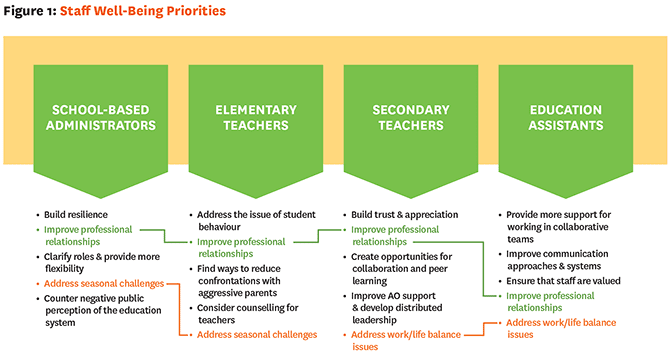
While a range of staff identified what might be considered traditional well-being approaches like resilience, addressing seasonal challenges and work-life balance, we were surprised by the focus on improving professional relationships across all four focus groups. This suggests that with the high levels of staff interaction, staff felt that communications and dialogue could be significantly improved, and that such improvement would promote well-being. From elementary teachers there was a strong focus on the need for greater support in addressing student behaviour.
While the focus group data and staff’s recommendations for priorities provided a foundation for action, we also had to consider how to proceed.
How to move forward?
If you have ever been surveyed or participated in a focus group, you may have felt that once you had provided your input, some action might reasonably follow. You may have been frustrated that action did not happen as you’d expect. So having asked close to a hundred staff what helps or hinders their well-being, and what they would like to see happen, we as a district team were keen to avoid the “We told them but nothing happened” scenario. What we came up with emerged in part from the early, wide-ranging discussions about approaches to well-being with unions and management. It’s simply this: It’s not just up to the individual teacher, administrator or support staff worker to become more resilient. Neither is it up to the district to “fix” everything. It’s a combination, with individuals, groups and the district playing different roles but all having the potential to take some action. So we have proposed:
Individual approaches: what each person might consider
One example of this was a teacher who read the Educational Assistants’ (EAs) Focus Group report, outlining some data showing that EAs often did not feel included in their school. He added the EA’s name alongside his name on a label on his classroom door. It’s a simple step that takes no time and costs nothing, but addresses the issue and potentially supports EA well-being.
Collaborative approaches: what a group may choose to explore
One small elementary school group started an inquiry group to address well-being. Other options could be a group starting an exercise program or having more social events in their school, like lunches where all staff are invited.
Collective approaches: what might be supported by a district
In one district, where professional interactions were stated as problematic in all focus groups, the district provided some funding for participation in a university Symposia series3 offered by Simon Fraser University, which aims to improve dialogue in public education, and to enable any staff to engage more productively in conversations and dialogue with peers.
What may evolve from these approaches is that all staff could be encouraged to consider what actions they can take as individuals or in groups. School districts might enable actions of their staff through funding and support. Everyone can play a role, and there is no expectation that someone else will fix everything. Participation in any actions to address staff well-being would be voluntary. Stress-inducing issues such as student behaviour and professional interactions would be addressed with district financial support, but with staff leading the changes taking place.
Because of district budget cycles and timelines, there was a priority focus on collective approaches (district actions) in one district, with the focus on individual and collaborative steps coming later. However, in the two other districts where I work, there are significant steps to create collaborative actions in schools, with a wide range of learning groups in one district and the creation of “wellness champions” in each school who act as conduits for information and catalysts for action in a second district.
By sharing the learning across all three districts, we hope to avoid reinventing wheels already created and working effectively. By sharing our ideas with other interested parties across Canada we hope to learn from the work and experiences of others while sharing what we have learned. As a staff member in one of the school districts stated, in order to address staff well-being in Canadian schools and education systems, “we are better together.”
Getting Started with Workplace Well-Being: What we have learned
- Start slow. Listen to teachers, administrators, educational assistants and other staff to build a foundation of understanding about issues and perspectives.
- Engage with both management and unions to gauge perspectives, interests and concerns so that both become allies in addressing staff well-being.
- Collect data. In two school districts, we conducted a total of nine focus groups with elementary and secondary teachers, school administrators, and other staff. I think the focus groups were a better way to collect data in these projects than surveys, as they not only provided rich data but started multiple and widening conversations in schools about staff well-being.
- Think through how you move from data to action. What do the data tell you? What to do as a result? One school district has formed a Data Action Group to access a wide range of data to support district decision-making.
- School, district and community context and culture are crucial to understand. While context is relatively straightforward, culture is less easily defined or agreed on. One school or district may have a very positive and supportive culture, while another may have deep differences and divisions. Asking five people to describe a school or district’s culture may result in five different answers, yet in some case we have found genuine levels of consensus in describing cultures less than ideal and which could be improved.
- Build safe spaces where staff can speak freely and be respected for their views, but build in critical challenges if needed once those safe spaces are created, so that everyone in meetings feels able to challenge ideas while also maintaining respect and civility.
- Communication is important. As well as the Focus Group Reports (5-9 pages) we produced one-page graphics to summarize both process and data in one district, so that anyone could quickly access the key information while also having access to the full reports should they wish to read them. After the focus groups in this district, any participant from the focus group, and any interested teachers, administrators or support staff workers, were invited to a follow-up dinner meeting to identify priorities for action. This kept more people involved and talking about actions to support well-being.
- Consider partnerships and collaborations with external agencies such as health authorities, municipal governments, and/or community organizations.
Free Discussion Kit
Download the pro-learning session, Your Role in Promoting Staff Well-Being in Your School: Reflecting on lessons learned from three B.C. school districts at www.edcan.ca/discussionkit
Illustration: iStock
First published in Education Canada, September 2019
Notes
1 https://beyou.edu.au/fact-sheets/your-wellbeing/staff-wellbeing
2 M. Sisask, P. Varnik, et al., “Teacher Satisfaction with School and Psychological Well-Being Affects their Readiness to Help Children with Mental Health Problems,” Health Education Journal 73, no. 4 (January, 2013): 1-12.
3 http://www.sfu.ca/education/cselp/past-events/RPED-symposium.html#main_content_text
-
Ozhitoon Onji Peenjiiee – Build From Within
Comments Off on Ozhitoon Onji Peenjiiee – Build From WithinThis new high school program offered through Winnipeg School Division aims to both improve access to the teaching profession for Indigenous students, and to foster and hire more Indigenous teachers in order to improve the education experience of future Indigenous students.
Indigenous student high school graduation rates are lower than the rest of the Canadian student population. In addition, the field of education continues to enroll proportionately fewer Indigenous students than non-Indigenous students. The resulting teaching workforce suffers from a lack of Indigenous teachers and role models, which perpetuates the challenges faced by Indigenous students in school. The Ozhitoon Onji Peeniee (Build From Within) program, launched in the 2018/19 school year, increases the equity in access to post-secondary opportunities in the field of Education to our current Indigenous students, and will benefit our future students by increasing the representation of Indigenous insights, expertise and experience in the teaching profession. Currently, our first cohort is entering their second year in the program.
Build From Within is an Indigenous-focused path to a career in education for Indigenous high school students in the Winnipeg School Division (WSD). The program is offered through a partnership with the University of Winnipeg (U of W) and Indspire. It supports Indigenous students to complete their education within a culturally framed program. We aim to increase students’ education achievement and life-long learning connections, and prepare them for smooth transitions from their senior high school year through the U of W to their successful teaching careers.
The primary goal of Build From Within is to build on Indigenous students’ unique strengths and experiences to create competent and motivated teachers who are passionate about their work and want to contribute back as teachers in the school division they graduated from. We believe what we as a division will contribute, the WSD community will get back ten-fold.
The program is rooted in the Circle of Courage educational framework, which grounds teaching in the development of a sense of belonging, mastery, independence, and generosity.1 Indigenous high school students are selected after a rigorous application process to embark on a journey from high school student to educational assistant to teacher with WSD. In the program, they earn their Educational Assistant Diploma (EADP) while they complete their high school credits, and will graduate from Grade 12 with both their EA and high school diplomas. Next step, the students will be enrolled at the U of W’s Integrated Bachelor of Arts and Education program and will work half-time every morning for WSD as Interns utilizing their EA training. Finally, after graduating from the U of W, the students, who now have earned their BA and BEd, will be hired as teachers with WSD.
How it works
Indigenous students are recruited from Grades 10 to 12. They complete an application and attend an information session with a parent or guardian, who will be their family support throughout the program. The program is reviewed with the student and their support person and an interview is scheduled to take place at the student’s home school. The program coordinator, along with another teacher from the WSD Indigenous Education Team, interview the students to identify a fit for the program.
On interview day, the students wait anxiously for their turn. For most, if not all the students, it is their first time experiencing an interview. They have put on their best clothes and have practiced interviewing with teachers and guidance counsellors. They openly admit they are nervous; this program could be life changing for them. While it is technically an interview, we see it as more of an opportunity to meet and build a relationship. It’s a chance for the project manager to learn more details of the student’s life and aspirations, who they are, where they come from, and where they are going.
After the candidates are selected into the program, we hold a feast to honour and start the successful students on their education journey in a traditional way. The feast last year was hosted at R. B. Russell School, whose culinary program prepared a traditional meal of stew, bannock and rice pudding. It was an intimate event with 70 attendees: just a few staff directly involved in the program, the student candidates, and their immediate families. A fire was lit in the school’s cultural area (Tipi and Sweatlodge) and after supper the students offered tobacco. This allowed the students the opportunity to make an offering for whatever reason they felt was important or needed by them personally. An interesting and emotional request came from a parent. They wanted to offer tobacco for the family member they were supporting. Other parents and caregivers lined up to make that commitment of support by offering tobacco; an event that was spontaneous and had such importance and meaning.
The next phase of the students’ journey was to create a sense of belonging amongst them. To accomplish this, students left their home schools for second semester and regrouped as a cohort at the Winnipeg Adult Education Centre (WAEC) in downtown Winnipeg. At this location, students take courses in the morning toward their diploma in the EADP (Educational Assistant Program offered by the U of W), through the U of W Professional, Applied and Continuing Education program (PACE). The courses are taught in blocks of six or 12 days by PACE instructors hired specifically for this cohort. In the afternoons, students are enrolled in high school courses.
On a cold February morning, the program began with 26 nervous and excited future teachers ready to begin their journey. The first week was spent orienting the students to their new school. Their high school courses were scheduled for the afternoon and the students started them the first week. Their EA courses were slotted in the mornings starting the second week. In their first semester, students complete the first six of 12 EA courses. This completes Part 1 of the EADP. In their second year, Semester 1 Grade 12, students complete part II of the EADP. They will finish the EA program by the end of the first semester in January, and for their final semester in high school, they will return to their home schools to complete their credits and graduate with their peers.
After graduating high school, the students will be hired as half-time EAs with WSD and attend the U of W full time from September to June. They will complete a five-year integrated Bachelor of Arts and Education degrees (Grades K to 6) in four years with a Major in English and a Minor in History. Both the major and minor will have an Indigenous focus. At the U of W, they will remain a cohort, taking the same classes and supporting each other as they complete their degrees. We often say to the students, “We are not training you to be master EAs, we’re training you to be master teachers!”
The students will gain invaluable experience working with a variety of teachers at various elementary schools and classrooms during their education journey. Once they have completed their degrees, WSD is excited to offer each graduate of the Build From Within program a teaching position. By experiencing different schools and different grade levels (K-Grade 6), the students will have a better idea where they would like to apply for those positions.
Challenges
One of our first challenges was to ensure all the students were on track not only to graduate high school but also to earn their Educational Assistant diploma. To make this work, the project manager sat down with each student and their school’s guidance counsellor to plan their high school courses for the next two years. The next challenge was to have the coursework the students completed for the EA program recognized as dual high school credits to ensure students completed the required 30 credits to graduate.
A common challenge has been the workload for the students. The rapid pace and the frequent instructor changes has presented a wonderful example of what university will be like. One student reported, “The challenge of this program is the workload of all the courses, because you have to keep up with both your university and high school work.” Another common challenge has been leaving their home school and friends. Joanna said this was her biggest challenge, but that “I now have made some really good friends that are in the same classes as me… they understand how I feel.”
The students have completed their first half of the EADP. September will bring another set of celebrations and challenges. The cohort is strong and the strength comes from within the group. Soon the group will graduate. Meanwhile, the project manager will be busy identifying schools that will best support and promote the students’ growth becoming teachers. Teacher mentors will be key, as selection of a master teacher and supportive principal are imperative to the development of student teachers. This will bring on the next set of celebrations and challenges.
Photo: Shane Bostrom
First published in Education Canada, September 2019
Notes
1 L. Brendtro, M. Brokenleg, and S. Van Bockern, Reclaiming Youth at Risk: Our hope for the future, rev. ed., (Bloomington, IN: National Educational Service, 2002).
-
Culturally Responsive and Relevant Pedagogy
Comments Off on Culturally Responsive and Relevant PedagogyA brand-new school embraces the opportunity to include culturally responsive and relevant pedagogy (CRRP) in its founding mandate. How did they do it, and what factors were essential for success? What does Culturally Relevant and Responsive Pedagogy mean and why is it important?
There was a time when Canadian students weren’t asked to leave very much at the door when they came to school each day: their collection of hockey cards, a baseball bat, an occasional slingshot. Once, if the story is accurate, a white-fleeced lamb. Like most public institutions, Canada’s schools were originally designed to reflect the cultural values and worldview of a largely white European society and, for the great majority of students, this meant a comfortable continuity between home, school and community.
Since the 1970s, we have seen a relatively rapid demographic shift and a major change in the cultural make-up of many communities. Yet in many important ways, school systems have not responded to this significant cultural shift.
Nowadays, in addition to leaving their personal belongings behind, many students are also asked to check some crucial aspects of their culture at the school door: their family stories, their language, their sense of community connection and their unique perspectives and ways of knowing the world.
It’s not you, it’s the system!
For decades, Gloria Ladson-Billings and Geneva Gay have been arguing, in separate bodies of work, that the reasons traditionally used to explain the persistent failure of black students in the United States do not suffice. Through their work, both began to insist that the answer to the thorny problem of race-related school success was not to be found by blaming the students or their family context. Instead, the mirror needed to be turned to reflect both the problem and the solution to this essential equity challenge: the systemic realities that ignored or even actively suppressed the cultural capital that students brought to school.
When Nicole West-Burns came to Canada from the U.S. to work with Jeff Kugler in the Centre for Urban Studies at University of Toronto’s Ontario Institute for Studies in Education (OISE/UT), she brought her deep knowledge and experience of this research to add to Kugler’s many years of working as an educator/administrator in Toronto’s Regent Park. Combining the theories of Ladson-Billing’s Culturally Relevant Pedadogy and Gay’s Culturally Responsive Pedagogy, they framed an approach many Canadian educators now know as Culturally Responsive and Relevant Pedagogy (CRRP).
At first their intensive work with educators was concentrated on ten “Model Schools for Inner Cities” in the Toronto District School Board, but in 2013, they were asked by the Ontario Ministry of Education’s Inclusive Education Branch to mobilize the work in a year-long pilot program, centred in two Greater Toronto Area Schools: William Burgess Public School in downtown Toronto, and Irma Coulson Public School in the town of Milton, just northwest of the city.
A framework for deep transformational work
CRRP is not a program that can be delivered to schools in a box and distributed at a staff meeting or even on a single professional development day. Instead it is a dynamic framework that provides a set of tools and lenses that, if taken seriously, can lead to thoughtful unpacking, personal reflection and honest dialogue among staff, students and communities. CRRP examines issues of power and privilege, calls participants to challenge the beliefs and assumptions about the students in their class and explores on a very deep level what is necessary to enable all students to be successful in school. It intentionally centres the cultural assets that students bring with them to the classroom and uses those assets as a way to get to know the students and their way of knowing the world, and as a way of engaging all students. But it also forces educators to consider how those assets are put to work to allow students to see themselves reflected in the curriculum and in the life of the school.
To be sure, CRRP is an approach that takes time, resources, vision and leadership. But under the right conditions, it can significantly impact the way we talk and think about race, culture, identity and equity. The story of CRRP at Irma Coulson Public School (ICPS) offers a grounded vision of how those conditions can come together in a very tangible and powerful way.
A strong vision for equity and excellence
In early 2013, Principal Merrill Mathews and Vice Principal Mary Marshall were busy preparing to open the doors of a new school in Milton, Ontario – Canada’s fastest-growing town. The neighbourhood in which Irma Coulson was to be located was also one of the most culturally diverse in the Greater Toronto Area. The ICPS catchment area drew families from seven or eight different schools in the Milton area and included a wide range of religious and ethnic groups.
It was this diversity that drew Mathews to his first assignment as principal. The belief that all students could and would excel at Irma Coulson was part of the way that Principal Mathews presented his vision for the school – to potential teachers and staff, to parents and students who would call ICPS home, to potential community partners and to district colleagues. The phrase “Equity and Excellence for All” became the official motto for the school, and appeared on the front doors of the school when they opened in the fall of 2013. On most days, members of the ICPS staff could be seen wearing school T-shirts proclaiming their belief in the work in which they were involved. At the heart of this belief was the recognition that every family enrolling at ICPS had a story richly steeped in culture, and the promise that the school would be a place where those stories were valued.
Vice-Principal Marshall recognized that Mathews’ commitment to the vision ran deep. “His own experiences as a student really played into that and his passion for equity work as an educator from the very beginning of his career. And so, when the opportunity came to be appointed as a principal for an opening school, that vision was front and centre.”
This dogged commitment to a clear and compelling vision is a necessary condition for CRRP. It was something that Kugler recognized as soon as he began to understand that Mathews’ vision would run through the entire design of the school: “The major criteria in hiring new staff to come to this brand-new building was their openness at least to working around equity issues… And to build a school upon which equity was the foundation.”
Today’s complex school context provides many challenges, not the least of which is finding the room to focus on what is important. The CRRP pilot was not an add-on, but something that supported and expressed the grounding philosophy of the school.
Intentional leadership
In many cases, educational pilot programs revolve around one or two enthusiastic teachers who are provided with the time and resources to engage in the work. By contrast, the CRRP pilots at both William Burgess and Irma Coulson demanded the involvement of all staff from the very beginning. It was a requirement for participation in the pilot.
In addition to the internal resources available at the school level, the Ministry commitment to CRRP came with extra release time for teachers to participate in monthly sessions with Kugler and West-Burns’s team, and for the “in between” work necessary to deepen the conversations among staff.
One of the most important words that emerges when Mathews and Marshall talk about their leadership role is intentionality. At Irma Coulson, monthly staff meetings were intentionally planned in advance, ensuring that the work of the CRRP pilot was maintained as a priority. School Council meetings followed a few hours later, so the admin team could intentionally involve parents in some of these same conversations. Schedules for planning time were intentionally organized to allow grade-level teams to meet together weekly. There was no doubt in anyone’s mind that this was important work and that it involved everyone in the building – not just teaching staff – and extended to the parent community.
Marshall admits that the extra resources provided by the pilot were a luxury, but insists that, if the commitment is there, the work can get done. “I believe that there’s time and space and resources in schools that make a commitment to do this work, to then undertake this work. Now, it may take longer because you haven’t got the richness of resources.” She believes, however, that strategic thinking, a strong sense of direction and the type of intentionality that instills confidence and commitment can make things happen in a very powerful way.
Support for the important conversations
Much of the transformational power of CRRP is that it requires a good deal of deep and very personal work. At the core of this identity work is understanding that most Canadian educators have grown up in and have been favoured by the system in which they are now working. It is challenging, if not contentious, to begin the process of unpacking issues of privilege, marginalization and oppression. The work can be emotionally charged and requires participants to come face-to-face with questions and realities that they may be encountering for the very first time.
ICPS teacher Shannon Morgan doesn’t remember encountering any of these ideas in her own teacher preparation program. She does remember clearly the unease on the part of many in the early days of the pilot. “It was the conversations happening, not just in the groups with Jeff and Nicole, but sidebar conversations as well,” she says. “You could really see how uncomfortable this work was, and some people not wanting to say how uncomfortable it was in a large group.”
Yet, this personal identity work is necessary if educators are going to be able to truly understand CRRP. Teacher Phil Gibson, an Afro-Canadian male, remembers the day when he realized that his experience of growing up in Burlington, Ont. was different than other staff members from the same area.
“One of our colleagues was also from Burlington. And when she talked about her experience growing up there, it was like all flowers and roses. It was a great environment. My experience growing up in Burlington was the exact opposite of that. So it kind of jump-started the conversations where people were able to say, ‘I’ve never thought of that!’”
Many leaders and participants might be tempted to back away from these types of conversations and reflection. But Nicole West-Burns insists that we need to stay with them and live through the discomfort. “We talk (to teachers) about the rumbling in your stomach or the things that stand up on your neck and that this is part of the feeling. But the discomfort sometimes is what helps us push through or figure out. And so that’s what we need.”
Moving beyond these initial feelings of discomfort is essential to the work of CRRP. The expertise and sense of confidence brought by West-Burns and Kugler helped the staff move to the next level in their conversations – a focus on the students.
“The intensity of the work built strong relationships with people and established some trust, which is always a challenge in the first year,” says West-Burns. “This wasn’t about jockeying for position, this was about coming together for the good of the kids. This project really allowed staff to establish that from the beginning: This was about the students.”
From identity to practice
The personal and group identity work formed the important groundwork for a change in the way that teachers and staff saw students and families at the school. It was noticeable in the way that parents were welcomed into the school and spoken to by office staff and administrators. It was noticeable in what was hung on the walls throughout the school. And it was noticeable in the stories of change that staff began to experience and share with each other.
Phil Gibson is a Phys-Ed teacher at Irma Coulson. He recalls what happened when, during a unit on baseball skills, he decided to bring in cricket equipment as well, placing the game in a cultural context that resonated with many of his students. Students unfamiliar with the game of baseball suddenly felt empowered and affirmed by the opportunity to teach their peers about an important part of their culture. “They were teaching them how to bowl. They were teaching the rules of cricket, talking about how to hold the bat.” Now, Gibson reports, those same students can’t wait for spring and the opportunity to get outside and play cricket again.
Shannon Morgan has many stories about the impact of CRRP but one that she remembers fondly was reported to her by a lunchroom supervisor who had listened in on a conversation among Morgan’s Grade 2 students. “They were all sharing the different creation stories from their different backgrounds and families. In a very civil manner, they were actually engaging in a rich dialogue… They were able to listen to each other and respect each others’ differences, and that was huge for me.”
Bringing it all together
It could be argued that the extra supports directed toward pilot programs makes operationalization on a larger scale difficult, if not unrealistic. It is true that lighting a pilot light may get things started more easily, but there are lessons to be learned from identifying the conditions that allowed CRRP to take root and drive equity work at ICPS.
The understanding that cultural change is reliant on focused leadership should open up important conversations about how our school leaders are chosen, trained and supported through their work. Creating the ability for principals and vice-principals to develop and maintain that energetic focus is important for everyone in the building, as is the way that we encourage school leaders to connect with each other across a district and beyond.
If a staff is going to follow a leader into uncomfortable and challenging work, there needs to be a strong sense of intentionality. One-off workshops or single-day PD events cannot replace the knowledge that this is the work that we are doing, now and throughout the year.
Finally, outside support and expertise may be necessary to guide the personal work that allows CRRP to take root. Having the resources to draw in that support, especially to facilitate the difficult but essential conversations, cannot be overlooked or taken lightly.
Culturally Relevant and Responsive Pedagogy was originally introduced in Ontario by Nicole West-Burns and Jeff Kugler as a way of addressing a specific group of racialized students proven to be marginalized by the system in Canada’s largest school district. It was soon recognized as a powerful framework that challenges all educators to see themselves and their students differently. Culturally Relevant and Responsive Pedagogy insists that we start to understand that success for all students means embracing the cultural assets that they carry with them every day, and refusing to let those assets remain at the schoolhouse door.
As the two CRRP pilot programs reveal, this is not easy work. It takes vision, time, resources and the courage to stand up to a system that is, too often, supportive of the status quo. At stake is the success of a growing number of culturally diverse students who are marginalized and often alienated by a system built for a different time and place. What’s possible is the nurturing of school communities that reflect, respect and leverage the power of the stories, experiences and ways of knowing carried by all of our students and their families.
Photo: courtesy Halton District School Board
First published in Education Canada, September 2019
EXPLORE THE LATEST EDITION OF EDUCATION CANADA, POWERED BY VOICED RADIO (MARCH 2022)
-
Inclusive Classrooms
Comments Off on Inclusive ClassroomsWe can all agree that the classroom should be a place where students feel included and equal, so how can you approach disability and inclusivity in your classroom? Read on for some useful strategies to ensure all your students feel included.
Emily, a young adult from Richmond, B.C., looks back on her high school sewing class with relief that it’s over—not because she didn’t like sewing, but because she wasn’t allowed to. Despite being ready, willing, and able, her teacher told her that she couldn’t because she was in a wheelchair. This caused confusion for Emily and her friends “My legs are disabled, not my hands,” she says. Cooking class took on a similar form. While she was perfectly capable of putting on an apron herself, her teacher insisted on doing it for her.
We can all agree that the classroom should be a place where students feel included and equal, so how do we equip ourselves to avoid situations like the above? And how should you approach disability and inclusivity in your classroom? Below are some useful strategies to ensure all your students feel included.
Don’t assume
The mistake that Emily’s home economics teachers made was that they believed they knew her abilities better than she did. It’s important to trust that your student knows their limitations, or if a younger student, their parents do. Let them gauge where they’re comfortable rather than prescribing what they can or cannot do.
Ask what their needs are
If you have a student in your class with a disability, come up with a list of questions at the beginning of the year to help you understand their specific needs. This will help determine if your lessons will be inclusive or not, and give you ample time to adapt your lessons to their requirements. And make sure it is an ongoing conversation.
“Adapting lessons day to day, and even minute to minute, is crucial to meeting the needs of all students in the inclusive classroom,” says Aja Coe, a Grade 7 Social Studies and Language Arts teacher with Rocky View Schools in Alberta. Coe is a contributor to Flexible Pathways to Success – a project that identified factors that contributed to the implementation of technology in classrooms to support students with diverse cognitive abilities. “It is important to level the playing field by removing barriers so every student has the opportunity to be successful and gain confidence at school,” she adds.
Equal treatment when possible
Emily’s woodworking teacher provided excellent support. He not only had a conversation with her after class about her abilities, he also went through each woodworking machine to see if she could use it and made sure they could adjust it to her needs.
There were many times in other classes that Emily would receive no penalty for handing something in late. While dodging late marks is the dream of many students, Emily just wanted to have the same rules and consequences as her classmates. In woodworking, Emily had to do all the assignments just like everyone else, and she would receive late marks if a project was past the due date.
Any student, regardless of physical ability, may require adjustments to their assignments, but having a disability doesn’t automatically make this so. “I do a lot of reading and writing pre-assessments at the beginning of the year so I have a clear understanding of each student’s individual strengths, as well as the areas of growth,” says Coe. “These assessments help inform my instruction so I can ensure I am teaching to each student’ individual needs, regardless of whether they are at, below, or above grade level.”
Do a resource audit
We’re all familiar with the educational videos available to warn students against unsafe work conditions or impaired driving. Many of them are comically outdated, with bad effects to boot. While an 80s soundtrack is harmless, older resources could be sending the wrong message.
Emily had to watch a video like this in one of her classes. In the main story, a victim of a driving accident was injured, leaving them to rely on a wheelchair to get around. The video portrayed using a wheelchair as the worst thing that could happen to you. Many people who use wheelchairs don’t feel this way, and messages such as this can create unwanted pity.
Whether you have a child with a disability in your class or not, it is important to take stock of your resources before the school year commences. If resources are portraying people with disabilities as the “other,” this will further alienate students who may already feel different.
Tools for teaching inclusion
While you don’t want to single out an individual student, having discussions and lessons about disability, inclusivity, and equality can help foster a more compassionate and inclusive environment.
The Rick Hansen Foundation School Program (RHFSP) is a great place to start when it comes to incorporating these conversations into your lesson plans. All resources are available for free in both French and English, with age-appropriate lesson plans for Kindergarten to grade 12. Each toolkit has a variety of lessons and activities to get your students thinking about inclusion, and each one is designed by educators and align to provincial curriculum.
It’s a learning process
An openness to tailoring lessons, changing the layout of your classroom, and ongoing conversations will ensure your classroom environment includes all students and ensures their success. And don’t forget you’re not alone: there are endless resources out there to support you as you foster compassionate behaviour and leadership among your students.
Register with RHFSP to become a part of a Canada-wide community of educators committed to inclusive teaching, and download the latest resources today.
Universal Design for Learning: Quick tips
There are many simple things you can do to ensure the physical features of your classrooms and resources support students of all abilities. Here is a sample of tips from RHFSP’s Teaching Strategies for the Inclusive Classroom Toolkit. To download the full toolkit, visit RickHansen.com/Schools
Teaching Students Who Are Deaf
- Support verbal instructions with print and/or visual aids.
- Provide lesson materials, such as vocabulary lists, in advance.
Teaching Students Who Are Blind
- During discussions practice having speakers identify themselves. Address students by name so a student who is blind knows who is speaking.
- Understand orientation and mobility needs for navigating the classroom and common rooms.
Teaching Students Who Have a Physical Disability
- Provide enough space for a wheelchair between desks and tables and ensure there is enough room for knee clearance under tables and desks.
- Ensure resources are visible and within reach. For example, books, school materials, coat hooks and cubbies should be no higher than 103.6 cm.
First published in Education Canada, September 2019
Image: iStock
-
Cultivating Community
Comments Off on Cultivating CommunityWhen two First Nations visual artists collaborated with students to design and paint three mural-sized banners, they portrayed a journey rich with history, tradition, and courage, and fostered profound story-sharing and dialoguing.
For three days in November, my classroom was transformed into an artist’s studio. Three 11′ x 3′ blank canvas banners hung from the ceiling along the back wall. Chairs and desks were arranged in a wide circle around the perimeter of the classroom, and up along the blackboard perched a rainbow of acrylic paint jars awaiting the stroke of a brush. Soon, these banners would be painted by 55 Grade 11 students and two local First Nations artists in a collaborative art project that would portray a journey rich with history, tradition, and courage, and would foster profound story-sharing and dialoguing.
In my recent years teaching the First Nations, Métis and Inuit Studies courses at James Cardinal McGuigan (JCM) high school in Toronto, I have reflected upon the question: How do I take on the responsibility of making space for Indigenous voices and get my students to engage meaningfully in a primarily non-Indigenous, Catholic, multicultural classroom? This was the challenge I set for myself as a settler-educator, recognizing the importance of my positionality and accountability in the context of Reconciliation. I wanted to develop a positive and inclusive activity that would both amplify Indigenous voices and enable my students to have an authentic, respectful, in-person dialogue with Indigenous people while contributing to a larger project.
Gathering both qualitative and quantitative data to assess students’ learning and transformation was one of the goals of this project, so they completed a survey before we started the art project and a second one afterwards. The results were encouraging: to this day, students describe this learning experience as one where they were able to “learn from two perspectives instead of one.” One eager participant attested, “We can learn from people who have a better understanding of current issues and take part in creating a better community.”
Preparation
After reading about collaborative mural painting initiatives in various school boards and universities across Ontario, I was inspired to facilitate one at my school. Research indicates that an extraordinary experience with art enables educators and participants to examine multiple, shifting meanings of culture and communities.1 I decided on a banner project because banners (more so than murals) are easy to move around and rotate between different locations in the school for students and guests to appreciate.
Acquiring funding from the Ontario Ministry of Education was essential, so I applied for a Teacher Learning and Leadership grant and received the necessary capital to commission this art project. I want to thank my school’s administration, office staff, and art department for their pivotal involvement and support throughout the project.
Inspired by an article titled “New Mural: A first step toward reconciliation for Indigenous youth,”2 I invited the artists Chief Lady Bird and Aura to come share their culture, history, and perspectives with the students, and to collaborate with them on an artistic piece that could be showcased for years to come. Chief Lady Bird is Chippewa and Potawatomi from Rama and Moose Deer Point First Nations, and her sister, Aura, is Haudenosaunee Onyota’a:ka (Oneida Nation of the Thames). I taught my students greetings in Anishinaabek and Oneida, and posted them on our classroom door to make the artists feel welcomed and acknowledged.
My students had been learning about Indigenous histories, identities and cultural ways of knowing, and I reviewed the specific themes we had examined in class with the artists beforehand so that we could connect them to the project.
In the pre-project survey, the students’ ratings of their level of knowledge about Indigenous teachings (e.g. Medicine Wheel, The Seven Grandfather Teachings) was split evenly between feeling moderately, fairly, and highly knowledgeable. Some students felt a bit daunted by the task of collaborating with Indigenous people on an art project, but most were comfortable or even looking forward to it.
Collaboration
After the land acknowledgement, the artists began by introducing themselves in their languages and sharing with the students their backgrounds, the importance of reclaiming their languages, and their work with young people of all backgrounds in communal spaces to promote mutual respect, care, and knowledge-sharing.
They explored many themes with the students through the artwork, including: Creation Stories, Ceremony & Medicines, Water is Life, Intergenerational Healing, Heart Work & Heart Berries, and the Saskatchewan Lily.
One student said, “Art helps me understand Indigenous concepts because it is where the artists share and express their rich heritage and stories.”
Over three days, I witnessed immense growth in my students. Each had a chance to contribute to the painting – either by picking up a brush, suggesting an image to add or a colour to use. They produced three beautiful banners depicting a Grandmother in traditional dress, illuminated by a full moon; a powerful, resilient female beneath a traditional fish fence, encircled by the Fish Totem; and a young, hopeful girl, looking ahead, firmly rooted to her ancestry and to her Creation story. The three figures stand connected to one another in a symbiotic relationship.
Furthermore, the inquiry that came out of this project was noteworthy. Students asked the artists questions about the symbolic images (e.g. the meaning of the red dress worn by the girl, or the significance of the water being passed on through generations). This spurred further student engagement in the form of independent research, or connecting these meanings to texts studied in class. For one lucky group, this experience inspired a cross-cultural youth exchange with Thunderchild First Nation in Saskatchewan in May 2019, to further strengthen their own cultural competence.
One of the main messages communicated through this banner is “We are here.” It is imperative for all of us to share this message, and to hold space for the often under-represented voices in our society.
When asked why she does this work, Aura stated, “For me it’s about sharing who I am, learning with the youth and creating spaces for them to share who they are too. I believe collaborating between cultures and communities builds unity.” She affirmed the importance of creating positive work in the school system, and her critical role as a facilitator who is “in these spaces sharing my own truth. It is really impactful.”
Chief Lady Bird said that her goal is to “create a safer, kinder, more loving environment that captures the spirit of people, the true spirit of our teachings.” While working with youth, she added, she is “honouring the creative process of everyone. We don’t do things in one cookie-cutter way – we just let it flow; there’s not a lot of room for that in many institutions, so we disrupt with kindness.”
Learnings
In the post-project survey, 82 percent of students rated the experience as being either highly or fairly meaningful and engaging. In terms of lessons learned, 82 percent said they had learned about relationship building and 68 percent felt more knowledgeable about Reconciliation. All students found that this activity enabled them to learn more about Indigenous stories and traditional teachings.
One student said, “The best thing about this experience was the opportunity to collaborate with the First Nations artists and share moments with them and learn about them and their backgrounds.”
Another student – who, thanks to this project, now self-identifies as part Mi’kmaq – found a sense of belonging and acquired greater knowledge of her history. She observed, “It is important for us to take part in a collaborative art project with First Nations artists because it is important for Indigenous and non-Indigenous people to show that they can work together and move forward from what happened in the past.”
This work contributes to a growing body of work on “teacher-allyship”3 and aims to inform teachers who seek respectful and relevant ways of incorporating Indigenous approaches into their pedagogies. I encourage teachers to explore the plethora of Indigenous-written and -produced resources available to them for K–post-secondary, and to be in touch with their school board liaisons; I am grateful to the Toronto Catholic District School Board’s department of Indigenous Education for their support throughout my journey.
This project also is anchored in inter-cultural understanding and respect for alternative ways of knowing. By inviting artists from marginalized groups to share their knowledge and talents with students, we give voice to often-silenced speakers, lend greater legitimacy to the curriculum, and offer students and teachers opportunities for genuine discourse and practice regarding art, creativity, and social transformation.
Conclusion
We came such a long way in just three days. The transformations and mutual sharing that we experienced in that “artist’s studio” were remarkable, equally for the students, the artists, and myself as a settler-educator. The experience invited students to become culturally conscious in an authentic, respectful and engaging way, to understand the concept of reciprocity, to celebrate unity, and to look at storytelling through an artistic medium. Not only do these banners represent Indigenous narratives, but they tell a living story: one of history, reclamation, and relationship.
We hope that all students feel invited to tell their own stories of identity, and understand how much their heritage plays a pivotal role in shaping who they are. I hope this important work will inspire, educate, and transform educational communities across Turtle Island.
Photo: courtesy Laryssa Gorecki
First published in Education Canada, September 2019
Notes
1 M. Greene, Releasing the Imagination: Essay on education, the arts, and social change (San Francisco, CA: Jossey-Bass, 1995).
2 Justin Skinner, “New Mural: A first step toward reconciliation for Indigenous youth,” Toronto.com (Aug. 28, 2017).
3 Pamela Rose Toulouse, “K-12 Truth and Reconciliation: Becoming a teacher ally,” Education Canada 58, No. 2 (2018). www.edcan.ca/articles/truth-reconciliation-k-12
-
Teaching with (and not about) students’ diverse cultures
Comments Off on Teaching with (and not about) students’ diverse culturesIn reference to the article (Trans-multi)culturally Responsive Education: A critical framework for responding to student diversity
ASK OUR EXPERTS (5 MINUTES)
AIM: TO ENCOURAGE INTERACTION WITH RESEARCHERS
Does your group still have burning questions or comments? Encourage them to send their questions to Dr. Latika Raisinghani, lead author for this article.
Or, send us your message and we’ll make sure one of our experts gets in touch.
Find more resources about well at work
-
Going Green in K-12 Education
Comments Off on Going Green in K-12 EducationSchools can play a crucial role in fostering environmental citizenship among students, but also in mitigating their own substantial carbon footprint.
Imagine a world where the highest paid job is salvaging treasures from once coastal cities now submerged beneath the expanding oceans. No, this isn’t a post-apocalyptic sci-fi movie. It’s one of many possible futures our planet faces if we don’t take serious action on climate change.
There’s simply no denying it. Poll after poll has shown that Canadians are increasingly concerned about climate change. This is especially true among young Canadians.
Inspired by passionate young activists like 16-year-old Swedish environmentalist Greta Thunberg and the #FridaysForFuture movement, our youth are eager to see substantial action on climate change in their daily lives – including at school. The average student will spend at least 15,000 hours in the classroom from Kindergarten to Grade 12. During that time, they not only want to engage in activities and initiatives that promote environmental sustainability, but they also want to be immersed in an atmosphere where they live it. Today, John Paul II Catholic Secondary School in London, Ontario seeks to become Canada’s first carbon neutral school by 2021 through reducing greenhouse gas emissions to near zero. This is just the start.
The EdCan Network acknowledges the crucial role that schools can play in fostering environmental citizenship among students, but also in mitigating their own substantial carbon footprint. Once students and teachers become engaged, their heightened environmental awareness broadens to other issues, and spreads into their family lives and communities. Already, we have seen schools and school districts make great strides as trailblazers in this area.
Consequently, the EdCan Network is excited to announce that our March 2020 issue will focus on “Greening Our Schools” to tie in with Global Recycling Day on March 18, 2020. We’ll address topics like food waste in schools, energy reduction, how climate change is taught in classrooms, environmental leadership, and Indigenous approaches to environmentalism. But that’s not all. In the coming months, we will lead a national conversation on how the key players in K-12 education – students, parents, educators and other stakeholders – can be the catalyst to real, impactful action on climate change.
Today, talk and inaction can only take us so far in addressing climate change. If we desire a future that is closer to Star Trek than Terminator 2: Judgment Day, it’s time to go green on education.
Support Our Work!
The Edcan Network is a nonprofit organization that bridges research and practice by including voices from across the entire spectrum of K-12 education.
Become a Donor: Help us expand the reach of timely educational resources to improve education policies and support “deeper learning.”
Visit www.edcan.ca/donate to make a donation today.
First published in Education Canada, September 2019
-
The Case for Investing in K-12 Staff well-being
Comments Off on The Case for Investing in K-12 Staff well-beingNovember 22, 2019 | 7:30am – 3:30PM
Borden Ladner Gervais (BLG) Conference Room
Bay Adelaide Centre, East Tower 22 Adelaide Street West Suite 3400
Toronto, Ontario M5H 4E3 Canada
Join ministry and faculty of education representatives, Directors of Education/CEOs, and other K-12 leaders from across Canada for this EXCLUSIVE professional learning session, where you will:
- Learn the fundamental principles and evidence behind workplace well-being in K-12 education
- Find out how investing in educator well-being can heighten student achievement and save precious resources
- Discuss ways to go beyond one-off unsustainable programs to a long-term, system-wide approach
Can’t make it? Stay tuned for our Spring National Summit on K-12 Workplace Well-being
All attendees will receive FREE class passes to:

Toronto’s preeminent meditation studio
Gift raffle prize sponsored by:





ALL-STAR PROGRAMME
Download and print the schedule
SESSION 1
Led by the EdCan Network and the McConnell Foundation
SESSION 2
Line up:
The Business Case for Workplace Well-Being: Rationale for an Upstream Approach
Led by Leanne Keyko, Health Strategies Liaison & Trudy Lakusta, School Jurisdiction Liaison, Alberta School Employee Benefit Plan (ASEBP)The Legal Case for Workplace Well-Being: How Health and Safety Legislation Can Help You Achieve the Best Return-on-Investment
Led by Anna V. Karimian, Associate – Labour and Employment Group, Borden Ladner Gervais (BLG) LLPThe Student Achievement Case for Workplace Well-Being: Raising Student Outcomes through a Whole-System Approach to Well-Being
Led by Dr. Bill Morrison, Professor of Educational Psychology & Co-Executive Director, Health and Education Research Group (HERG), University of New Brunswick; President, WMA WellnessFollowed by a plenary Q&A
SESSION 3
The “How” of Workplace Well-Being: Key elements of a systemic approach
Led by Dr. Charlie Naylor, Affiliated Scholar – Simon Fraser University; District Well-Being Coach; former Senior Researcher – British Columbia Teachers’ Federation (BCTF)
SESSION 4

Small group facilitated discussions will support participants to consider and share “Where they’re at,” “What they learned,” and “What they need to do to move forward” to lead greater investments into workplace well-being in their own school communities.


IDEAS TO SUPPORT EDUCATORS : Subscribe to the EdCan e-Newsletter
Quality research, reports, and professional learning opportunities.