Archive
-
Ottawa Visible Learning plus Institute
Comments Off on Ottawa Visible Learning plus InstituteThis two-day event is the first step that will help educators create Visible Learning Schools that systematically examine effective instructional practice and equip them with practical solutions and proper tools to transform their practice and focus on influences that have the greatest impact on student learning. The Institute features workshops and sessions focused on Visible Learning, Collaborative Leadership, and Visible Learning for Mathematics led by John Hattie, Jenni Donohoo, and Connie Hamilton.
-
2019 Healthy School Communities National Forum
Comments Off on 2019 Healthy School Communities National ForumThis biennial National event is a must-attend for community leaders working in health, education, research, government, and active living sectors to:
– Connect with school health champions, and district and government leaders that have made healthy schools a priority goal in their community;
– Explore best practice that supports the healthy development of all children;
– Be inspired and equipped to affect positive change in your school community.Creating a healthy school community is a shared responsibility. Join us at #HSCForum2019!
-
Trends in Canadian education 2018-2019
Comments Off on Trends in Canadian education 2018-2019Trend 1. Provinces and territories are conducting whole system reviews and reforms to their education systems
- The Ministry of Education in Saskatchewan is currently consulting with educators, teachers, and parents to collect their feedback, which will form the basis of a provincial education plan.
- The Manitoba government has commissioned a review, with lead consultant Avis Glaze, of Kindergarten-to-Grade 12 education and is currently inviting multiple stakeholders to provide their feedback on a wide range of topics including student learning, teaching, accountability for student learning, governance, and funding. The feedback provided will help develop recommendations, which will inform the creation of a reformed education system.
- The Ministry of Education in Ontario completed its largest consultation in December 2018. This consultation heard from parents, students, educators, and organizations from across Ontario. The feedback has informed the development of the Education That Works for You plan to modernize learning in the education system, starting in September 2019.
- In Nunavut, amendments to both the Education Act and the Inuit Language Protection Act have been proposed. Public consultations were held in Fall 2018 to gather feedback on how the education system can be built based on Inuit culture, knowledge, and practices. Following consultation, the Department of Education is submitting draft legislation to the Legislative Assembly in Spring 2019. A main objective of the proposal is to establish a bilingual education system where students are fluent in both Inuktut and either English or French.
- The Department of Education and Early Childhood Development in New Brunswick recently announced that a review of the education system will be conducted. The provincial government will be hosting a summit to bring together both Francophone and Anglophone educators to provide input and ideas on what needs to change.
In Focus: Nova Scotia
In 2018, the Raise the Bar report was released outlining recommendations for a coherent and responsive administrative education system. Consultations were conducted with multiple stakeholders via in-person meetings and online surveys. The report proposed six catalysts for change:
- Organize the system to focus on student learning and achievement: Seven elected English school boards were dissolved as of March 31, 2018. $2.3 million in annual board member stipends and expenses will go back into schools. Superintendents are now referred to as Regional Executive Directors.
- Concentrate needed resources into classrooms and schools: Give teachers and principals access to funding and responsibility for the selection of textbooks and learning materials to best support their teaching.
- Make the system better for teachers and principals: Remove principals and vice-principals from the Nova Scotia Teachers Union (NTSU) and redirect them into a new professional association.
- Increase trust, accountability, and transparency: Create an independent Student Progress Assessment Office (SPAO) and establish an assessment division to develop high-quality student assessments, reporting directly to the public on province-wide results, and ensuring assessments are aligned with the curriculum.
- Ensure equity and excellence in all schools across the province: The Department must create new Executive Directors or similar-level positions of influence and decision-making power for African Nova Scotian Achievement and Mi’kmaq Education.
- Streamline the Department’s administration and operations and invest the savings in the classroom: Any financial savings realized in carrying out these recommendations must be documented and shared publicly, with all savings feeding directly into schools.
Trend 2. Minority language revitalization in education has become a national priority
- Canadian Francophone communities have raised concerns due to the declining percentage of Francophones in communities outside of Quebec. In addition, Canadians of all backgrounds reported a need for greater promotion of bilingualism, including tools to learn a second language at any age. The Government of Canada released an Action Plan for Official Languages. The action plan will provide $5 million over four years for the creation of a new micro-grant program that will enable Francophone minority community organizations to partner with local minority schools to lead community school projects. Over 600 Francophone minority schools across Canada will have access to this initiative.
- In Nunavut, there is currently a shortage of qualified Inuktut-speaking teachers, impacting the delivery of education. Nunavut is committed to promoting and revitalizing Inuktut by amending the Inuit Language Protection Act through provisions that will allow the Government of Nunavut to deliver Inuktut instruction and by increasing the number of Inuit working in education, funding for teacher language development, and promoting an education leave program to provide training for Inuit administrative and professional positions.
In Focus: Northwest Territories
The N.W.T. Government released an Indigenous Languages Action Plan with the following goals:
- Language Revitalization: Aims to slow down, stop or reverse the decline of a language, as well as educate and mobilize communities. There is a need to protect and maintain the strength of Indigenous languages as a means of communication and as a connection to culture.
- Language Access: There is a need for all people to be able to use and benefit from high quality public services in all official languages (there are nine official Indigenous languages in the N.W.T.). The plan proposes to expand the availability of Indigenous language instruction and programs across N.W.T. schools and early childhood programs, provide professional development for language instructors, and recruit and retain Indigenous language instructors in schools.
Trend 3. Provinces are reviewing and revising standardized assessment
- The Ministry of Education in Ontario commissioned a report recommending changes to standardized testing across the province. Recommendations include phasing out the EQAO tests for Grade 3 and Grade 9. In addition, replacing the Grade 10 literacy test with another test that would not be a diploma requirement. However, this report is no longer publicly available and its recommendations will not be implemented under the current government, which is working with EQAO to revise assessment and evaluation models.
- In Prince Edward Island, an external review of the student assessment program was prepared for the Ministry of Education. The review recommended that student assessment should continue in its present format, and continue with provincial assessments to all students annually near the end of the school year and at the end of each semester for semester courses.
In Focus: British Columbia/Yukon
- The B.C. Ministry of Education released B.C. Graduation Program Policy Guide: Grades 10 to 12 in December 2018. Students are required to write three new mandatory graduation assessments – numeracy in Grade 10 and literacy in Grades 10 and 12, effective July 2019. The results will be reported as stand-alone items on student transcripts. These graduation assessments will replace course-based provincial exams and will instead evaluate essential numeracy and literacy abilities developed across many areas of learning and grades, rather than content knowledge from one particular course.
- In the Yukon, the new provincial numeracy and literacy assessments will be introduced starting in the 2019-20 school year. Considerations are given to Yukon’s northern context and embed Yukon First Nations Ways of knowing and doing in all grades.
Trend 4. Provinces have revised curricula in the areas of health, mathematics, Indigenous, and digital education
Health and physical education curricula are providing resources and supports to include students of all sexual orientations and gender identities, while “opt-out” or “alternative delivery” policies give parents greater control over how learning expectations are met
- In British Columbia, SOGI 1 2 3 has gained participation from all 60 school districts. B.C.’s new curriculum includes a focus on topics related to gender and self-identity. Sexual and reproductive health is specifically covered within the Physical and Health Education curriculum. An Alternative Delivery policy will be maintained to enable students and guardians to choose means other than regular classroom instruction to address learning standards in this area.
- Ontario released an interim Health and Physical Education curriculum that reflects the province’s pre-2015 curriculum. Public feedback has called for building a new age-appropriate curriculum that includes subjects such as mental health, sexual health education, and cannabis legalization. An update on these findings will be provided in Winter 2019 and will include an opt-out policy. The interim report fueled debate with numerous school boards stating their intention to maintain the status quo, while other stakeholders have stated the need for further public consultation.
- Quebec made sexuality education mandatory since September 2018 for elementary and secondary students in both private and public schools. Nearly 1,200 daycare and Kindergarten students in Quebec will be offered sexual education lessons dealing with notions of sexuality and relationship equality. Quebec also put forward recommendations to support transgender and gender non-conforming and gender non-binary students.
- Alberta’s Bill 24 mandated schools to create gay-straight alliances (GSAs) upon student request and seeks to protect students’ privacy for their involvement in such groups. The United Conservative Party threatened to reverse this bill.
Maths curricula is becoming increasingly oriented towards everyday needs and workplace skills, with financial literacy a key component of secondary education attainment
- Ontario is moving away from “Discovery Math” with its plan to “Focus on the Fundamentals of Math” by moving “back to traditional formulas and memorization techniques.” This is, in part, a response to declining EQAO math scores, while also seeking to prepare students for everyday living and entering the workplace. New teachers will be mandated to successfully complete a math content knowledge test before seeking their teaching registration. This curriculum will impact all grade levels and will be implemented across four years.
- Alberta’s Kindergarten to Grade 12 Mathematics Programs of Study plans to shift mathematics learning outcomes towards competencies as end goals, including creativity and innovation, cultural and global citizenship, and personal growth and well-being.
Education systems are moving towards integrating Indigenous perspectives and reconciliation education into all grade levels and aspects of schooling, although implementation remains a challenge
- British Columbia has maintained key policies and practices to raise Indigenous student graduation rates, such as Aboriginal Education Enhancement Agreements, District Aboriginal Principal positions, Indigenous student self-identification, and Aboriginal Advocate/Support Worker positions. The province’s revised 2017 curriculum incorporates Indigenous perspectives into all grade levels and aspects of schooling. Most recently, B.C. released a professional standard that requires teachers to commit to truth, reconciliation, and healing.
- Alberta created a First Nations, Métis and Inuit (FNMI) Education Directorate to provide leadership and strategic direction to support the education system in closing the achievement gap. This includes Education for Reconciliation (mandatory content for all Alberta students on residential schools and treaties), FNMI student self-identification, and grants to support Indigenous language revitalization and innovative education programs.
Digital skills and citizenship education is becoming increasingly commonplace as ways to support students in using digital tools to enhance learning and participation in democratic life while avoiding technology’s potential negative consequences
- In Ontario, a new digital platform will be phased in to modernize access to Ontario’s curriculum. This will help educators, parents, and students access curriculum and learning resources in a user- and mobile-friendly manner and will become increasingly interactive over time. Ontario is also updating its Provincial Code of Conduct to ban cellphone use during instructional time starting in September 2019.
- New Brunswick is developing digital literacy standards to allow students to protect themselves online and ensure that they are prepared for the opportunities available to graduates in the modern economy. This coincides with the province’s Economic Growth Plan of being a leader in cybersecurity. The Plan also includes funding for more makerspaces to be created in schools.
In Focus: Quebec
Quebec released its Cadre de référence de la compétence numérique (Digital Skills Reference Framework), which represents an investment of $1.2 billion over five years and aims to equip classrooms with the latest technologies in addition to reviewing teacher training. A digital file will also be implemented in order to track students during their education from Kindergarten to university, and the framework will address important issues such as fake news, sexting, and social media use. The Framework allows teachers and school leaders to have autonomy over the choice of digital products and pedagogies that are used in their schools and classrooms.
Trend 5. Inclusive education models to meet the needs of students with special needs are receiving greater investment, although implementation remains a challenge
- Yukon announced a new early learning plan that will make funds available to provide support for children with special needs ($900,000), including children with specific behavioural problems in licensed day cares ($210,000).
- In Alberta, on September 1, 2019, seclusion rooms – which are used for the involuntary confinement or isolation of a student – will be banned in Alberta. Seclusion rooms are sometimes used for students with special needs in cases where staff are not equipped to respond to behaviour challenges.
In Focus: Nova Scotia
Nova Scotia’s final report of the Commission on Inclusive Education consisted of public consultations and reviews into the current practice and policy of inclusive education in public schools, including implementation challenges faced by educators. A new model has emerged that is comprised of three tiers: (1) Classrooms: universal core curriculum and core instruction for all students; (2) Small groups: supplementary interventions for some students; and (3) Individuals: intensive interventions for a small percentage of students.
Trend 6. Interest and enrolment in French immersion programs are expanding, while recruitment of Francophone and French-proficient teachers remains a challenge
- Manitoba’s French Language Education Review 2016-2017 seeks to enable students to communicate in the French language and to appreciate Francophone cultures. The Review provides a way of measuring the success of French courses by collecting data and tracking progress over time. Using this data, schools and school divisions can target initiatives where challenges have been identified in order to support students in their French language learning.
- New Brunswick is expanding its French language pilot project in the 2018-19 school year to improve access to French learning in rural schools by providing students in Kindergarten to Grade 3 with 30-to-40 minutes per day of extended non-immersion instruction to help them learn to speak, read, and write in French.
- Cross-Canada, recruiting enough teachers to meet the French immersion demand is a challenge.
In Focus: British Columbia
Following a 2016 Supreme Court decision affirming the right of B.C.’s teachers’ union to determine class size and composition, there has been a teacher shortage within in-demand subject areas, especially French immersion. French immersion recruitment has taken place in Montreal, other parts of Canada, and France, Belgium and Switzerland in Europe. The Ministry has reported great strides in closing the shortage while the B.C. teachers’ union has continued to push and critique for quicker progress.
-
You Belong Here
Comments Off on You Belong HereSafe and inclusive school environments are especially important to those who have marginalized experiences, such as those who are lesbian, gay, bi-sexual, transgender, queer, 2-spirited, or other gender or sexuality minorities (LGBTQ2+). This article reports on the efforts by the Nova Scotia Department of Education and Early Childhood Development (EECD), in partnership with the LGBTQ2+ community, to transform schools into spaces where all children and youth are equitably included, validated and affirmed.
A sense of safety, acceptance, and belonging at school is essential to the academic development and well-being of children and youth. Safe and inclusive school environments are especially important to those who have marginalized experiences, such as those who are lesbian, gay, bi-sexual, transgender, queer, 2-spirited, or other gender or sexuality minorities (LGBTQ2+).
The Nova Scotia Department of Education and Early Childhood Development (EECD), in partnership with the LGBTQ2+ community, is on a journey to transform schools into spaces where all children and youth are equitably included, validated and affirmed. To allow people to authentically live and express their identities, meaningful and purposeful changes are being made to school spaces, the student information system, curriculum, policies and guidelines, and school-based resources. Although significant changes have occurred to better support the educational experiences of LGBTQ2+ learners, we remain committed to reaching every classroom in every school.
Collaborative partnerships
Queer youth are not simply waiting for us to catch up; instead they have become the force of transformation within the education system. Almost unimaginable a decade ago, the subject of gender identity, expression and sexuality has become an undeniable part of the landscape within schools today. Young people are erasing the lines created by the historical binaries of gender expression and heteronormative expectations. Youth, their allies, and parents have called upon the education system to examine how schools need to change to support the identities of all learners and to ensure they have equitable access to all aspects of school life. A report by EGALE Canada (2011), Every Class in Every School,1 stresses the importance of appropriate consultation when considering vulnerable groups, GSAs, teacher preparation, curriculum and policy development.
Over the past several years in Nova Scotia, a strong collaborative partnership has grown between EECD and the Youth Project, a non-profit organization whose mission is, “to make Nova Scotia a safer, healthier, and happier place for lesbian, gay, bisexual and transgender youth through support, education, resource expansion and community development.” The Youth Project, through first voice and leadership, has played an integral role in supporting schools and EECD with student workshops, teacher and leadership professional development, Gender and Sexuality Alliances (GSAs), curriculum and resource consultation, and facility design. Through our collaboration with the Youth Project, the education system is becoming more informed, inclusive and intentional in its design and practice.
Provincial guidelines
In December 2012, the Nova Scotia Human Rights Act was amended to disallow discrimination based on gender identity and gender expression. In 2014, the Nova Scotia Department of Education and Early Childhood Development (EECD) responded with the Guidelines to Support Transgender and Gender-nonconforming Students.2 The guidelines were prepared in consultation with youth and organizations representing the LGBTQ2+ community, and included topics such as: supporting students and their individual process, preferred name and pronouns, maintaining school records, gender expression, school-based activities, and access to washrooms and changerooms. They helped educators grow in their understanding of current issues facing transgender and gender-diverse children and youth in schools, and also brought to the surface a recognition of how gendered and non-inclusive many of the beliefsand practices are in the education system, and how they need to change.
Gender and sexuality alliances
Nova Scotia Education and Early Childhood Development data from 2016-17 indicated that approximately 65 percent of schools in the province, with Grade 7 -12 students, had a Gender Sexuality Alliance (GSA). Since this time, the number of GSAs has been growing, with a number of elementary schools now participating. Queer youth tell us that when GSAs are present in schools, they feel safer, more accepted and supported. They can identify and express their gender and/or sexuality more freely and with pride. EECD, with our partners, continues to work to increase the number of GSAs in schools and to ensure they are active and impactful school-based supports for learners. Our goal is to have a GSA in every school, that is celebrated and recognized as an important impetus in changing school culture.
Washroom and changeroom design
Included in the Guidelines to Support Transgender and Gender-Nonconforming Students, is a recommendation to provide safe access to washroom and changeroom facilities in accordance with the student’s gender identity. The guidelines state:
“All students have a right to safe washroom and change-room facilities. They have the right to use facilities that they are comfortable using and that correspond to their gender identity, regardless of their sex assigned at birth. Transgender and gender-nonconforming students have the right to supports that best meet the student’s individual needs.” (pg. 15)
In response, the team at Facilities Management began to think differently about traditional washroom and changeroom design. They began exploring ways these spaces could be changed to support transgender and gender-diverse students. As a result, a highly consultative process began which included, educators, school administrators, EECD staff, architects, engineers, Youth Project staff, and students, including local LGBTQ2+ students. Through this process, it became evident that addressing gender and gender identity rights actually addresses the universal rights of all people. As a result, new school construction and renovations include innovative washroom and changeroom designes that are non-gendered and inclusive, and respond to concerns in relation to the safety and privacy of all students. Darrell MacDonald, Director of Education Facilities Project Services for the NS Department of Transportation and Infrastructure Renewal, explains,
“Our focus on universality has been the cornerstone of the success of the initiatives. The two foundational elements of privacy and safety, which aren’t limited to any particular segment of society but are truly universal, have allowed us to overcome social stigmas.”
Early Years curriculum development
In 2017, EECD introduced the Pre-primary Program to several schools across Nova Scotia, with a commitment to have the program available in all schools by 2020. The initiative provides free and accessible early childhood education to four-year-olds. The Youth Project (YP) consulted with EECD staff in the development of Nova Scotia’s Early Learning curriculum framework. which introduces gender flexible practices and an opportunity to interrupt the traditional gendered behaviours and expectations in early learning environments. We must intentionally support gender-creative children to affirm how they feel and allow them to explore who they are.
Student information system and registration
Providing children and youth the opportunity to safely express their name, gender identity and preferred pronoun affirms who they are and enhances their sense of belonging. We are reprogramming and creating spaces in PowerSchool, our student information system, and the school registration process, where learners and/or their parents can equitably document their authentic identity. This allows us to register learners without causing undue harm and stress, or inadvertently outing individuals.
Although there was previously a process by which students could identify a preferred name that would be used by teachers and school staff, it was not visible in all areas of PowerSchool. For example, lists generated by the student information system, such as substitute roll call, honor roll, student fees and even yearbook pictures, still displayed the legal name and not the learner’s preferred name. To correct this issue, in 2018, PowerSchool was updated to display the preferred name on all school documents including report cards, and in all areas of the system. Although the legal name remains in PowerSchool, it is only presented on official documents, such as academic transcripts and provincial high school diplomas.
In 2019, the Nova Scotia Vital Statistics Act was amended to include the gender marker “X”, in addition to M (male) and F (female), similar to the change made to Canadian Passports. This has resulted in further updates to PowerSchool and the school registration process. The system will now record gender, instead of identified sex at birth, include the gender marker “X” for non-binary and other gender identities, and will no longer require a legal gender change through Vital Statistics in order to have one’s identity documented in schools. For the majority, sex assigned at birth and gender identity align, therefore no change is necessary. For learners who are transgender, gender fluid or diverse, this change will empower them to safely identify who they are without fear and unwanted stigma. These changes will continue to challenge the strictly held lines of traditional binaries and expand our understanding of diverse identities.
Moving forward
More recently, we have been focusing on the complexities of intersectionality, such as race and socio-economics, in relation to our work in gender, gender identity and sexuality. In addition, we are attempting to make connections with other initiatives, such as inclusive education, culturally responsive pedagogy, and relational approaches. There is an ongoing need to support educators, through professional learning opportunities, relevant curriculum and resources, and innovative leadership. Through all this, it is our obligation to create school cultures that acknowledge and respect all learners and their families. Our experience tells us, this cannot be done in the absence of safe, trusting and authentic partnerships with community.
To guide our future direction, we remain focused on the voices of our LGBTQ2+ learners and the affirmation of who they are in all areas of their lives. Issues of equity must remain at the core of our vision for education. From classrooms, to schools, to government, we are called to educate ourselves, challenge our biases and beliefs, and revise our processes and practices to ensure a safe and inclusive educational experience for all.
Photo:
First published in Education Canada, May 2019
Notes
1 Taylor, C. & Peter, T. (2011). Every class in every school: Final report on the first national climate survey on homophobia, biphobia, and transphobia in Canadian schools, Egale Canada Human Rights Trust. https://egale.ca/wp-content/uploads/2011/05/EgaleFinalReport-web.pdf
2 Department of Education and Early Childhood Development, (2014). Guidelines for Supporting Transgender and Gender-Nonconforming Students (Nova Scotia: 2014). http://studentservices.ednet.ns.ca
-
Systemic Supports and Small Acts of Kindness
Comments Off on Systemic Supports and Small Acts of KindnessWhen we set out to plan this issue on Gender Identity and Sexual Orientation, I wondered if it might be difficult to find enough authors. Far from it! The people I approached about contributing accepted with enthusiasm, and we had the strongest response to our call for queries I have seen since I began editing this magazine. Clearly, the time is right for us to focus on this important topic.
It’s no secret that updating “sex ed” curricula to include SOGI (sexual orientation and gender identity) has proved controversial in Canada. Significant numbers of parents don’t want their children exposed to these concepts. (Many others do, as a recent poll by the Ontario Ministry of Education survey revealed.) But as Bryan Gidinski points out, children already are exposed. They have classmates with same-sex parents, they see trans people on the street and wonder about them, and they hear the slurs. More crucially, we have students in every school who will be at physical and/or emotional risk if they are not met with understanding and inclusion. And we are not there yet. I recently heard a very upset parent describe how her 11-year-old daughter spoke out against some taunting she observed at school, saying “There’s nothing wrong with being gay.” She has been harassed and bullied ever since, just for voicing her support.
So let’s get down to the how. How do we build a school culture where all students, across the gender and sexuality spectrums, feel (and are) safe, accepted, and free to be themselves?
Our contributors have a wealth of ideas to move us toward that goal. They tackle many of the uncertainties educators face: How to talk about SOGI to very young students; how to handle concerns based on religious and cultural beliefs; how to create gender-friendly classrooms; and the facts to counter common myths about LGTBQ2+ students. In our Voice of Experience column, trans student Kyle George shares how personal gestures of support from teachers made a world of difference to them. Systemic supports are important, but so are the small acts of kindness that tell a student, “I’m on your side.”
For better or worse, school plays a huge role in children’s development. It is not just where they learn; it is their social hub – or crucible. It is where they start to “try on” their adult identities. As Kristopher Wells writes, “Every child should have the right to be themselves fully and completely.” If we can make this the reality in our public schools, that is a big step towards a future where it simply is the reality, and we hope that this issue serves as an important resource to help educators get there.
Photo: Dave Donald
First published in Education Canada, June 2019
-
Supported at School
Comments Off on Supported at SchoolA transgender, non-binary student shares the power of a teacher’s support.
My name is Kile. My pronouns are they/them, and I am transgender non-binary. My gender identity can sometimes be difficult for people to understand, but so far I have been very lucky as practically everyone around me has been supportive.
One of the preeminent sources of support has been my school. I remember my heart pounding hard in my chest, my hands shaking as I typed up an email that simply introduced myself and explained my preferred name and pronouns. I took a deep breath before sending it to my teachers. However, all of my worries about my teachers’ reactions were effectively calmed as I received emails back almost right away, all saying that they understood and were glad I let them know. I was beyond lucky to have that happen to me. To immediately be accepted and cared for as any other student is the best situation for any transgender student. So far, every experience I’ve had with my school has been very supportive and exceptional.
But that’s not always the case. I was extremely lucky to be accepted and met with love, but other trans students aren’t so lucky and face discrimination and mistreatment. School can be a huge factor that helps a trans student access support, but it can also be a factor that contributes to the high rates of transgender youth committing suicide. Statistics don’t have to be that way. Schools are the perfect place for a trans child to get the assistance they need, especially if that child is not receiving any at home.
If a school is trying to support a trans student, this is the way to go about it – working with the student to ensure they are comfortable and, more importantly, safe. It might not be the teachers that a student might worry about, but other students. If a trans student is being harassed or bullied, then school staff should be working with the students involved, because it’s important to make sure that all students are safe.
Of course, there is also the question of washrooms. I really believe that trust needs to be given to students to know which washroom is right for them and which washroom they feel most safe and comfortable using. Using the washrooms can be very stressful for some trans people, so if the school can ensure that the washrooms are a safe place for everyone, and maybe even introduce an “all gender” washroom, then that will contribute to protecting young trans students.
Many other things could help to assist trans and questioning students, from educating staff and students to just letting students know that they are valid. I remember the day after I sent that email to my teachers about my name and pronouns, one of my teachers came up to me and told me that she was proud of me, that she would always be supportive, and that if I ever needed anything she would always be there for me. That small, one-minute interaction with a woman I had not really spoken with before literally gave me a much-needed boost. She absolutely warmed my heart and made me genuinely feel like I was loved and I did matter to others.
There was also a point when my teacher was talking about me to the class and she started to say incorrect pronouns, but then she stopped, and corrected herself with the right pronouns. I’m not sure if she is aware of the fact that I will remember that moment for the rest of my life, because it was the first time I had ever heard my pronouns being respected at school.
These minor gestures are so harmless, but make such a difference for a transgender student because it’s more than just accepting them, it’s letting them know that you are there for them, that you are making that effort to show them that they matter. Supporting a trans student doesn’t need to be a big thing. In my experience, my school supporting me has been made up of essentially little actions and the simplest of efforts. I hope for the day to come where all transgender students receive the same support I did. Ultimately, school is just a place for students to learn and transgender students are just like other students, in the sense that we attend school for our education. Being able to have both education and support would be the ideal situation for every trans student. When trans students feel safe and accepted at school, they can be their best – both as students and as themselves.
Photo: courtesy Kile George
First published in Education Canada, June 2019
-
Let’s Talk about Sex (and Faith)
Comments Off on Let’s Talk about Sex (and Faith)When sexual health education conflicts with socially conservative faiths and worldviews, educators can find themselves caught in the middle. Is there a way for public schools to provide an inclusive, comprehensive, and consent-based sexuality and health curriculum while remaining sensitive to the diverse beliefs and values of families?
When I was a child, my knowledge of health and sex came from my peers, parents, school teachers and faith leaders. Perhaps, like me, you adopted health behaviours from multiple supports in your life. This article invites you to consider the role of sexuality and health education in your classroom and the lives of your students, with strategies to support families and students of faith along the way.
The sexuality and health education of Canadian youth is currently a flashpoint of controversy in public educational systems across Canada. In Ontario this past fall, Progressive Conservative Premier Doug Ford, citing Evangelical Christian leaders’ objections, withdrew the 2015 Health and Physical Education Curriculum for Grades 1-8 (HPE), vowing to prioritize the rights of Ontario parents first.1 Around the same time, nearly 200 pastors from Evangelical Christian communities in British Columbia signed a statement denouncing the province’s Sexual Orientation and Gender Identity curriculum, SOGI 123. On January 10th 2019, Montreal’s Catholic archdiocese faced resistance from Quebec’s Education Minister, after the religious authority endorsed a proposal that Catholic parents who oppose Quebec’s sexual health curriculum receive permission to teach the content at home. At a time of unprecedented visibility and human rights protections for gender and sexual minorities in all provinces and territories, it is clear that public education systems across Canada are encountering the same objection: that an inclusive, comprehensive, and consent-based sexuality and health curriculum may contradict socially conservative faiths and worldviews, and is therefore inappropriate for elementary-aged children being raised in observant families.
Consistent in media coverage on the trans-Canada curriculum controversy is the claim that comprehensive sexuality and health education in public schools usurps the rights of parents to educate their children about sexuality and health. Socially conservative parents and religious communities in Canada have expressed concerns about the age appropriateness of sex education, and the absence of any mentions of love and monogamy in public school curricula. Public school administrators and teachers are pulled in different directions by competing interests, begging the question: how should public schools provide equal access to information and education that is conscious of the needs of today’s youth, while remaining sensitive to the diverse beliefs and values of families, both within and outside of different faiths?
Conversations and strategies
Children and youth, regardless of age, ethnicity or religious background, enter the classroom with knowledge and skills learned from the world around them, and small “e” education about sexuality and health occurs daily in families. This education contributes to how students construct identity, create meaningful relationships, and engage in social interactions where gender identity, gender expression and sexuality are significant. The Public Health Agency of Canada2 maintains that public schools are uniquely positioned to provide children and youth with accessible knowledge they need to make positive health decisions for an improved quality of life. Educators must be prepared to participate in this work in a manner that anticipates the needs and pre-existing awareness of their audience.
Although Canada may be struggling to navigate the controversy within public educational systems, our priority must still be to support the personal health and well-being of all students. While public sexuality and health education has sparked division, a common denominator all can agree on is student health and wellness. Parents across religious and political lines acknowledge the importance of Canadian youth’s sense of health and personal well-being. However, opposition from parents arises from differences in beliefs about the applicability of sexual health education for their children. Effective sexual health education requires educators to understand these social and religious differences and possess the skills to provide inclusive and effective education in spite of them. In what follows, I talk about three strategies for maintaining a healthy and accessible school community that supports students from socially and religiously diverse backgrounds within a sexuality and health program.
1. KNOWLEDGE & UNDERSTANDING
At the heart of the sex-ed controversy are the 3 M’s: misinformation, misconception and myth. Teachers, parents and other stakeholders divided over the content of public sex-ed curricula must wade through claims made in the media and in everyday conversation about curriculum content, often without confirming their accuracy. As a teacher, counselor or school support worker, the first step is having accurate information on hand about what, exactly, is and is not contained in the curriculum document. Ask yourself, “Am I able to answer a question from a parent about lessons in the classroom?” For example, a potential question from a parent may be:
Is the content of the curriculum appropriate? I am worried that my child is too young to learn about gender differences.
Lessons about gender identity and gender expression need to be equitable and accessible to all students and mindful of teachings that may take place in the home. We all have our own beliefs and views— however, when appropriate, they should be presented as such. A potential response to the parent is:
Early discussions about gender identity and gender expression are about supporting your student’s self-identity. Conversations about gender identity and expression focus on a students’ feelings about themselves. Lessons are designed to support students’ personal well-being. The focus is to create an environment where all students are respected and to encourage further discussion within the home.
Note: It may be helpful to outline the specific content being addressed within the class, such as: self-identity, self-expression, how visible differences (clothing, ability, skin, hair and eye colour) and invisible differences (values and beliefs) make a student different.
By familiarizing yourself with the content of your particular curriculum, you can recognize your own comfort level with the subject matter, identify potential gaps in the resources for your students, and address parental concerns about the curriculum using factual information about the document.
As a board member or school administrator, consider what resources your educators may need to effectively deliver sexuality and health education. You may consider inviting school-approved community partners (such as public health professionals) to facilitate a sexuality and health workshop for teachers. Demographic knowledge about the population of your students and their families can help determine the resources educators may need in the classroom. Knowledge of religious and cultural differences in beliefs about sexuality and health in the specific populations served by your school can help you prepare your educators to deliver content that is inclusive and accessible. The development and implementation of a healthy school policy can help facilitate conversations in your school about positive health behaviours for students, staff and teachers.
2. VALUES
Effective, comprehensive sexuality and health education should invite students to engage with their values, beliefs and attitudes toward their own sexual health. Understanding your own values as well as those of your students and their families is an important aspect of sexuality and health education. To this end, educators should be cognizant of their own beliefs and biases about sexuality and sexual behaviour – and prepared to answer questions from parents about subject matter that may conflict with family values. For example, a common concern is that the sexuality and health curriculum could “confuse children” or influence/encourage behaviours or attitudes.
What if the curriculum confuses my child? Do these lessons encourage same-sex attraction?
Often individuals do not consider all the ways in which their children learn and what sources of information have influence, such as media, peer groups, or the family’s church/community (youth group, Sunday school lessons and sermons). Children still have the teachings of the parent/guardian who models a certain worldview. A potential response to the parent is:
-
- Discussions about sexual orientation in class focus on attraction and not behaviours.
- Discussions about sexual orientation is an important part of supporting healthy development.
- How a child self-identifies is individual to their personal development. Lessons are a mirror for all students.
- Discussions about sexual orientation can reduce homophobia, harassment and bullying. Education about diverse identities builds respect for others while encouraging positive personal health.
Many factors (including education) may influence whether or not a student discloses their attraction – but these factors do not change a child’s sexual identity. Classroom lessons offer one teachable moment, but other moments throughout the day also contribute to their knowledge about this topic.
Note: Regardless of curricular content, students are familiar with differences before they enter the classroom. Having conversations with parents about curricular content starts with recognizing what their child may already know. As an educator, you are creating a healthy space for children to learn about their personal development. Discussing diverse depictions of relationships in other subjects outside of sex-ed leaves room for children to explore and express what they know and who they are.
Before your lesson, consider what knowledge your students have about sexuality and health. Do they obtain their knowledge through conversations in the school yard or through the media they consume? Or do they talk about healthy behaviours in their home or religious community? Educators should provide opportunities for students to self-reflect and engage with the subject matter in ways that are personal and attentive to who they are and what they bring with them. Allowing students to ask questions anonymously through journaling or using a question box creates an inclusive environment that encourages children and youth to share with you what they know (or think they know), don’t know, and want to know about sexuality. This practice recognizes that a student’s health needs are personal and a broad framework may not always be the most inclusive. The wide range of student questions can also be evidence that sexual and health education is needed, if you have to speak to the importance of the content you are engaging.
Effective sexuality and health education should invite students to engage with their values, beliefs and attitudes toward their own sexual health.
3. ENGAGING PARENTS
Consider how you can encourage open communication with your students and their families. Inviting parents to ask questions about the curriculum creates the opportunity for fruitful discussion about their (religious) values and beliefs. As an educator, this can help you understand the health goals that are important to the students’ families.
Sending a notification letter to parents prior to instruction provides them with an opportunity to ask questions and review the topics discussed, and can be an effective strategy in reducing parental concern. Further, it clarifies the 3 M’s (misinformation, misconception and myth) while encouraging parents to engage with the curriculum, identify potential cultural or religious sensitivities, and be a support in their child’s learning. A letter may include the following information:
Dear Parent or Guardian,
This year your student will receive sexuality and health education. The Ministry of Education’s curriculum guidelines is designed to support your student’s individual development. The grade [#] sexuality and health curriculum provides students with information on the following topics:
-
- Include a brief summary of topics and key concepts from the curriculum.
- Consider providing a calendar to outline specific dates topics will be addressed.
- You may also provide a list of resources for parents to access to prepare for the topics ahead.
School-based sexuality and health education is one form of positive health promotion. We encourage you to continue to support and teach your student in your home. Prior discussion with your student about the contents outlined in this letter offers the opportunity to discuss your values and beliefs related to sexuality and health development.
We acknowledge that parents/guardians are the primary sexuality and health educators for their student(s). Should you have any questions about the lesson or particular subject matter, or would like additional resources, I encourage you to contact me at ______________________________.
Thank you
When we acknowledge that parents may be an important sexuality and health support for their child(ren), we are saying: together we can promote the development of sexuality and health for all children and youth.
Finally, anticipate the diversity of your students and the unique knowledge they bring into the classroom. When teaching children and youth from faith communities, be supportive of the knowledge they share about sexuality and health that may come from values and attitudes within their home and faith community. Consider the following ways you can support faith-diverse students and parents in your school community:
- Be encouraging, thank the parent for coming to you and sharing their values and beliefs.
- Share with the parent the specific learning goals for their child’s age/grade and ask how you can support their own values about sexuality and health as they continue the conversation in their home – with the proviso that lessons must be equitable and accessible to all students and you must be comfortable with the support you are offering.
- Consider ways parents or families can participate in the instructional design.
- Be open and willing to consider new suggestions and ideas.
- Remember there are multiple ways of knowing and learning for all families. When discussing curricular concerns with parents of faith, maintain an open discussion with the goal of understanding their perspective and how you can continue to be a positive support in their child’s life.
- Design instructional activities that complement the knowledge students bring from home, community, and church. Guide conversations to include students’ values and unique perspectives and help students connect and apply what they learn to their home/community.
- Collaborate with other teachers, administrators, and parents to establish faith-based resources that reflect the needs and expectations of the students and their families.
- The aim of a comprehensive sexuality and health program is to support students in their personal development. For some children and youth, their faith is a factor in their decision making.
These strategies outline a few important steps for teaching sexuality and health across religious and political lines. As educators, administrators and parents we must continue to strive toward a curriculum that leverages the needs and voices of today’s children and youth – regardless of difference.
Photo: shutterstock
First published in Education Canada, June 2019
-
-
How Young Can SOGI Go?
Comments Off on How Young Can SOGI Go?Kids today are already being exposed to information about sexual orientation and gender identity from a young age. It is time to move from the debate about whether or not we should be having these conversations, and consider how we should be having these conversations.
Some of my colleagues who teach primary grades argue that, when it comes to topics like sexual orientation or gender identity (SOGI), their kids are too young for “that.” Though perhaps well intentioned, it’s a frustrating perspective. Some students enter our Kindergarten classes already asserting their gender identity. Some students have some awareness of their own same-sex attraction. Students enrolled in our schools have same-sex parents, or other family members who identify as LGBTQ2+.
I started responding to comments like “they’re too young for that” by asking, “Out of curiosity, when I’m on recess supervision, are you going to keep your kids in your classroom?” The first time I did, I got a confused expression in response. I continued, “When I’m presenting at an assembly, are you going to keep your kids in your classroom?” More confusion prompted the question, “Bryan, what are you talking about?” I replied, “You keep, saying that your kids are too young for ‘that,’ and since I happen to be ‘that,’ I’m just curious how you’re going to ensure that they aren’t exposed to ‘that.’”
People in our families, communities, and in the media who identify as LGBTQ2+ are more visible than ever before. Isn’t it a better use of our time to move from the debate about whether or not we should be having these conversations, and consider how we should be having these conversations? Whether intentionally or not, kids are being exposed to information about sexual orientation and gender identity. So, how do we help them understand what they are seeing and hearing?
How do we have conversations with younger children about SOGI?
Answering questions
When a child poses a question, it’s a good idea to make sure we understand what it is they want to know. A simple response like, “Tell me why you are asking that question” can be really informative in determining how to answer it. As adults, our assumptions about kids’ questions can often be incorrect. Sometimes we give a much more complicated answer than is needed because the question we’ve heard isn’t exactly the question that’s been asked. It’s not that we’ve misinterpreted the words, but because we’ve misinterpreted the intent of the question. Children’s questions tend to be naïve, asked out of genuine curiosity, and for younger children, a simple answer is often satisfactory.
Below are some common questions children ask, and some thoughts on how to respond.
What does gay mean?
Even children who will never identify as LGBTQ2+ can be subjected to homophobic or transphobic harassment. In some cases, it is because of their perceived sexual orientation, and in other cases, it’s because kids use words that they know will provoke a shocked or upset reaction. The child may indicate that someone called them “gay.” Alternatively, the child might explain, “My friend said their uncle is gay.”
In either scenario, a simple statement defining that it refers to a man who is attracted to men instead of women often satisfies the curiosity. Helping students understand the definition of the word and how to use it correctly, and not as an insult, can be practical outcomes of the conversation.
Why are they holding hands?
If a child asks “Why are those two men (or two women) holding hands?” it is important to recognize that this question is not an invitation to explain the sexual behaviour of the parties. Consider how you would answer the question if a child were asking the same question about a heterosexual couple. Most of us would simply smile and respond, “Because they’re in love,” or “That’s how they show their affection for each other.” Surprisingly enough, this answer works just as well in a same-sex scenario.
Are they a boy or a girl?
Sometimes children will ask if someone they observe is a girl or a boy. In determining how to answer this, it is helpful to consider what the child’s connection is to that person is. If it’s a stranger encountered in passing, it might be helpful to start with the question, “Why are you asking that?” This helps determine what the child’s investment in the question is. If the child responds with a response like, “She looks like a girl, but she has short hair and boys’ clothes,” you can simply address the fact that “some girls like to have short hair and choose clothes that are comfortable, whether they are masculine or feminine.”
Another option is to answer, “I’m not sure. Does it matter?” If it really does matter and the child is persistent about understanding, you could elaborate on the conversation. Help students understand that we make assumptions about gender based on appearance and behaviour. Sometimes it can be confusing when we assume someone is a boy but we see them dressed in feminine clothing or engaged in activities that we might perceive as being stereotypically “girl” activities. Help young students understand that, in the same way that they might have questions about another boy or girl, that person might be exploring their gender to confirm their own understanding of whether they are a boy or a girl.
Introducing new vocabulary
One of the reasons for the shift from LGBTQ2+ to the term SOGI is that every person has a sexual orientation and a gender identity. When introducing new vocabulary, it is helpful to use inclusive language. Including the term “cisgender” in conversations to develop understandings about “transgender” is a way of affirming the identity of students. Cisgender (a term used to describe a person whose gender identity is aligned with their biological sex assigned at birth) is relatively new vocabulary in conversations about gender identity, and is regarded as the opposite of transgender. Most students would identify as cisgender, which helps them to understand the definition of transgender.
Transitioning: In some ways, they’ve always been
Currently, one of the most controversial conversations is around transgender identities. Young students are encountering peers who are actively undergoing social transition (where students are typically dressing as the gender with which they identify, despite how they may have been labelled at birth). This process may involve a name change and revised pronouns affirming their gender identity. Some students, supported by their families (and the professionals they’ve consulted), are making this transition in early stages of their school experience. Students are sharing classrooms with students who’ve undergone these adjustments, prompting teachers to facilitate lessons focused around acceptance and the respectful treatment of others. Some teachers (and parents) feel unprepared to respond to the resulting questions.
A common question students ask is, “How did he go from being a boy to being a girl?” I have found that the best way to respond is, “In some ways, she’s always been a girl.” If necessary, there could be a more extended conversation about what transgender means, but I encourage adults to focus more on aspects of gender expression than on genitalia.
From a statistical perspective
The first conversation I had in my classroom about sexual orientation involved a lot of preparation, and a lot of fear. I worried whether students would understand and make connections. I worried whether they had already learned to hate or fear gay people. I worried they would automatically make the assumption that I was gay. I worried there’d be a line-up of angry parents who wanted their child removed from my class.
I began the conversation in my Grade 5/6 classroom by commenting that, as a teacher, I had concerns about messages students might be getting from the conversations that adults were having in their communities, on their local broadcasts, and in their local papers. I explained my concern for students who identified with the gay or transgender students whose protections were being argued about in policies that school boards were considering implementing. I said that the negative messaging could be damaging to a student who was questioning their attraction or their identity. I worried that a student could be sitting in a classroom and feel that they could not talk to anyone about those feelings.
I shared with students that, statistically speaking, approximately ten percent of the population is gay or lesbian. It is difficult to determine precise numbers as the statistics rely on people self-identifying and there are situations, where, even when the measurement tools are anonymous, people do not feel comfortable or safe in revealing this aspect of their identities. It also depends on which populations are surveyed. Younger generations who’ve grown up where attitudes towards the LGBTQ2+ community have been more favourable, appear to be more comfortable claiming and declaring their identities. I settled on ten percent in part because it made for quick and easy mental math calculations.
To put it into context, in a classroom of 30 students, approximately three students might eventually identify as LGBTQ2+. In a school of 600 students, that’s approximately 60 students. I asked my class to avoid speculating as to who those individuals were, because there could be more or less: the number is based on a larger sampling of a population. To continue the conversation, I shared an article that had been in our community paper and asked students to respond.
The first hand that went up in response was a Grade 6 student who stated that she was taught that being gay was a choice and that it was a sin. I paused to reflect on how to respond to her comment, considering how to avoid undermining her faith and to maintain her dignity. Interestingly, in the time in which I paused, one of the boys on the other side of the room responded, “It’s not a choice. They’re just born that way.” He then proceeded to share the story of the son of a friend of his mother’s who had come out and been rejected by his father. He shared that he thought it was unfortunate, because the son was “pretty cool.” This was followed up by another boy stating “My uncle’s gay. It’s not that big a deal.”
Teachers I work alongside who were initially reluctant to raise the topic with their primary students have been similarly surprised by how their students handle these conversations. In a Grade 2/3 classroom, a colleague was facilitating a conversation about diverse families when a young girl volunteered that her aunt had married her girlfriend. In a Kindergarten class, an argument erupted over a kitchen play centre where two students fiercely debated who would play the role of the mother. Not wanting to invest a lot of time in problem solving, the teacher responded, “Why don’t you just have two moms?” to which one of the girls responded, “Oh, like my friend, Philip?”
Kids are already exposed to SOGI and to LGBTQ2+ identities. Skilful adults are creating environments where it’s safe to share anecdotes about families without shame or ridicule. Constructive, respectful, and informative conversations that are SOGI-inclusive expand our understandings of the diverse communities in which we exist. I’d much prefer that kids had these conversations with informed, caring adults in classrooms and in homes, than learning misconceptions about the LGBTQ2+ community from rumours and innuendo on the playground.
Photo: iStock
First published in Education Canada, June 2019
-
It’s Time to Invest in Staff Well-being
Comments Off on It’s Time to Invest in Staff Well-beingShe’d been in the profession for over a year by then. It had been her dream to teach her passion for the language arts since her first Shakespeare class in the ninth grade. She’d devoted her heart and mind to the years of her training, set on inspiring young minds to pursue their own passions and dpk persevere through the challenges of growing up. Until one day she realized that she was over it all – that her passion had been gradually dulled into something else. And though her awareness of this was filled with fond memories of what was supposed to be, up to then, her life’s calling, she now didn’t know how to grapple with how she was feeling.
Stress and burnout syndrome are one of the most frequent negative experiences in the helping professions, and staff within the education sector – including superintendents, principals, teachers, and other teaching and non-teaching staff – are not immune. And while many school districts have invested in stress reduction programs and policies to help staff cope with daily systemic pressures beyond their control, these positive innovations remain a patchwork of success. The influence of working conditions on staff well-being – and the ramifications this can have on student outcomes – is often overlooked, leading to one-off interventions focused on individual cases rather than the systemic approaches that transform entire education systems for the better. It’s a common case of tackling the symptoms rather than the disease.
Evidence demonstrates that healthy workplaces that promote social and mental health are productive, attract and retain top talent, and get the best out of highly engaged employees – which means better outcomes for the organization’s bottom line, whether that be profits, social impact, or student outcomes. But to get there, we’ll need to challenge the persistent mindsets and assumptions that are holding us back – whether that be clarifying the importance of education professionals or boosting awareness that the science of “happiness” is integral to staff engagement and not merely a fluffy concept. One thing’s for sure: a healthy, motivated education workforce means healthy, motivated students – and that’s an investment we can’t compromise on.
That’s why we’re launching a special, year-long focus on workplace well-being. Starting next issue, you’ll see a new regular column on the topic, and Workplace Well-being will be our theme in December. It’s time to make serious investments in the well-being of our K-12 education staff.
The EdCan Network is leading national work mobilizing evidence on workplace well-being in K-12 education. For more information, visit www.edcan.ca/wellatwork
First published in Education Canada, June 2019
Photo: Canva
-
3 Myths Dispelled about Student Suicide Prevention
Comments Off on 3 Myths Dispelled about Student Suicide PreventionSuicide is an important health concern and prevention at school has increasingly become a focal point for educators and policy makers aiming to decrease the number of youth who die by suicide. Unfortunately, the business of suicide prevention has become a fruitful source of revenue for companies and organizations, even though robust scientific evidence on the effectiveness and safety of school-based suicide prevention products and programs does not exist.
Here are three key considerations prior to deciding which, if any, specific suicide prevention interventions need to be applied in a school:
1. There is no epidemic of youth suicide in Canada.
- Between 1980 and 2005, the national suicide rate in Canada fell by about 30% and has remained fairly stable since then with no substantial input from suicide prevention programs of any kind.
- Between 2012 and 2016, the average number of 10-14-year-olds dying from suicide in Canada was 36 annually and for 15-19-year-olds was 199. During this time, there were about 1.9 million 10-14-year-olds and 2.1 million 15-19-year-olds living in Canada.
2. There is no substantial evidence that school-based suicide prevention programs either prevent suicide or are harmless.
Research cannot conclude what really works in preventing suicide in young people. The first study to demonstrate a positive impact in preventing youth suicide was published in February 2019, which considered youth in a psychiatric hospital and not students at school. Furthermore, some school-based programs that report success actually cause harm. For example, a study showed that the Signs of Suicide (SOS) program increased suicide attempts in the group receiving the intervention, while the SafeTALK program was found to improve self-reported self-confidence in talking about suicide but caused half of the students involved to be sent for professional evaluation. A recent Canadian review also identified a relation between the increased use of suicide prevention programs and increased suicide rates in young girls.
3. Available literature on school-based suicide prevention does not actually measure suicide prevention.
At best, most studies measure students’ self-reported knowledge about suicide, self-confidence in talking about suicide, or self-reported suicide attempts or ideation. None of these are valid measures that can determine whether a program actually prevents suicide.
Student suicide is an emotional topic that demands our considered, rational and best available response based on what the research says.
As schools may be caught between the wish to do something helpful and the sophisticated marketing of products and programs that take advantage of this intent, it is necessary that school staff think critically before they apply any suicide prevention intervention.
Additional Information Resources
Statistics Canada: Suicide rates: An overview
TeenMentalHealth.org:
References
Knightsmith P. Youth suicide prevention research needs a shake-up: lives depend on it. 2018. Accessible from https://www.nationalelfservice.net/mental-health/suicide/youth-suicide-prevention-research-needs-a-shake-up-lives-depend-on-it/
Kutcher S., Wei Y. The vexing challenge of suicide prevention: a research informed perspective on a recent systematic review. 2016. Accessible from https://www.nationalelfservice.net/mental-health/suicide/vexing-challenge-suicide-prevention-research-informed-perspective-recent-systematic-review/
King CA., Arango A., Kramer A., et., al. Association of the Youth-Nominated Support Team Intervention for Suicidal Adolescents With 11- to 14-Year Mortality Outcomes. Secondary Analysis of a Randomized Clinical Trial. JAMA Psychiatry. 2019. doi:10.1001/jamapsychiatry.2018.4358
Schilling EA, Lawless M, Buchanan L, et al. Signs of Suicide shows promise as a middle school suicide prevention program. Suicide Life Threat Behav. 2014; 44(6): 653-67.
Bailey E, et al. Universal Suicide Prevention in Young People: An evaluation of the safeTALK Program in Australian High Schools. Crisis. 2017; 38(5), 300-308.
Kutcher S., et al. School-and Community-Based Youth Suicide Prevention Interventions: Hot Idea, Hot Air, or Sham? The Canadian Journal of Psychiatry. (2016): 1-7.
-
Suicide Prevention: 6 Questions School Leaders Should Ask
Comments Off on Suicide Prevention: 6 Questions School Leaders Should AskSuicide prevention is a highly emotional topic and pressure may come from parents, communities, and the media to “do something” when such a tragic incident occurs. Suicide prevention programs are not a part of usual pedagogy and when a suicide event occurs it is important that school leaders, policy makers and politicians:
- Understand the lack of available evidence on suicide prevention strategies;
- Recognize the importance for districts/schools not to rush into purchasing and applying the latest shiny new suicide prevention program;
- Support students and teachers to develop good mental health literacy while ensuring an inviting, welcoming, and suitably challenging environment for all students;
- Continue to develop school staff’s capacities to identify, triage, refer, and support students who have a mental illness, as most youth who die by suicide have a mental illness.
These four approaches have stronger potential to prevent student suicide than those currently offered by slickly marketed suicide prevention programs.
Important questions to ask when implementing a school-based suicide prevention program include:
- Is the program being sold? Are there training costs, licence fees, or renewals? If so – buyer beware. If not – user be careful.
- Is there independent evidence (not evidence created or funded by the program developer or purveyor) that the program decreases suicide rates in young people? Do not accept “evidence-based” self-reported measures of knowledge about suicide, confidence in talking about suicide, intent to seek help, confidence in supporting those who may be having suicidal thoughts, willingness to talk to someone if suicidal, suicidal ideation, and suicide attempts – none of these are valid measures of suicide prevention. Because a program is listed on a “mental health registry” does not mean that it is effective or safe.
- Does the school have a well-established and clearly defined protocol for identification and in-school assessment of students who are exhibiting suicide-related behaviours/cognition?
- Is there a well-established link to local expert mental healthcare providers who are willing and able to immediately assess a student that the intervention has identified as needing follow-up?
- What are other available programs in the marketplace? Are they better, safer or less expensive than the one under consideration? (See item #1 above)
- What will implementation of the program cost – direct, indirect and opportunity cost? What will you not be able to deliver if you choose to apply this program?
School leaders need to do things that they know can prevent suicide, while avoiding those that we know do not prevent suicide, are unsure of, or could even cause more harm than good. “Doing something” and “doing the right thing” are not always the same thing.
Additional Information Resources
EdCan Network: School Mental Health Literacy: A national curriculum guide shows promising results
TeenMentalHealth.org:
References
Knightsmith P. Youth suicide prevention research needs a shake-up: lives depend on it. 2018. Accessible from https://www.nationalelfservice.net/mental-health/suicide/youth-suicide-prevention-research-needs-a-shake-up-lives-depend-on-it/
Kutcher S., Wei Y. The vexing challenge of suicide prevention: a research informed perspective on a recent systematic review. 2016. Accessible from https://www.nationalelfservice.net/mental-health/suicide/vexing-challenge-suicide-prevention-research-informed-perspective-recent-systematic-review/
King CA., Arango A., Kramer A., et., al. Association of the Youth-Nominated Support Team Intervention for Suicidal Adolescents With 11- to 14-Year Mortality Outcomes. Secondary Analysis of a Randomized Clinical Trial. JAMA Psychiatry. 2019. doi:10.1001/jamapsychiatry.2018.4358
Schilling EA, Lawless M, Buchanan L, et al. Signs of Suicide shows promise as a middle school suicide prevention program. Suicide Life Threat Behav. 2014; 44(6): 653-67.
Bailey E, et al. Universal Suicide Prevention in Young People: An evaluation of the safeTALK Program in Australian High Schools. Crisis. 2017; 38(5), 300-308.
Kutcher S., et al. School-and Community-Based Youth Suicide Prevention Interventions: Hot Idea, Hot Air, or Sham? The Canadian Journal of Psychiatry. (2016): 1-7.
-
Education Staff and Stakeholders in B.C., Alberta and Ontario
Comments Off on Education Staff and Stakeholders in B.C., Alberta and OntarioDiscussion about the importance of social and emotional wellness on the job has increased substantially in recent years. As the leading national voice on education issues, we want to understand how you view teacher and principal workplace wellbeing to help us understand perceptions on this important issue.
This survey only takes 10 minutes to complete! Take the survey now!
As a thank-you for taking the time to share your valuable insights with us, you are eligible to be entered into a draw to win a $50 Amazon gift card! Participation in this draw is strictly voluntary.
Once you’ve completed the survey, fill-up this form for a chance to win!For any additional clarifications or information, please contact André Rebeiz at arebeiz@edcan.ca
-
3 little-known myths about youth suicide prevention
Comments Off on 3 little-known myths about youth suicide preventionOur resources
Three fact sheets by the national EdCan Network of educators and TeenMentalHealth.org assert that school-based suicide prevention products and programs – many of which have become a significant source of revenue for many companies and organizations – are often ineffective and can cause more harm than good.
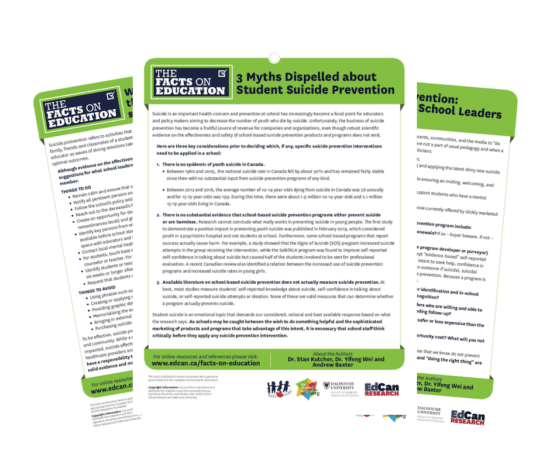
3 Myths Dispelled about Student Suicide Prevention
Key considerations prior to deciding which, if any, specific suicide prevention interventions need to be applied in a school [Download this fact sheet]
Suicide Prevention: 6 Questions School Leaders Should Ask
Important questions to ask when implementing a school-based suicide prevention program [Download this fact sheet]
What can school leaders do in the aftermath of student and staff suicide?
Suggestions for what school leaders should and should not do following the suicide of a student or staff member [Download this fact sheet]
Authored by mental health literacy experts Dr. Stan Kutcher, Dr. Yifeng Wei, and Andrew Baxter, these timely resources further reveal that there is no epidemic of youth suicide in Canada and that available studies often do not actually measure suicide prevention.
As the authors contend, “As schools may be caught between the wish to do something helpful and the sophisticated marketing of products and programs that take advantage of this intent, it is necessary that school staff think critically before they apply any suicide prevention strategy.”
“Youth suicide is an emotional and challenging topic that impacts entire school communities,” says Max Cooke, EdCan Network CEO. “These facts sheets will provide some much-needed clarity to school leaders who are looking for proven ways to decrease student death by suicide.”
Free copies of these fact sheets can be downloaded at www.edcan.ca/facts-on-education.
-
Canada’s Top Innovative K-12 Programs Break the Mould of Traditional Schooling
Comments Off on Canada’s Top Innovative K-12 Programs Break the Mould of Traditional Schooling
The 2019 Ken Spencer Awards for Innovation in Teaching and Learning showcase how teachers’ willingness to step beyond their comfort zones to honour student choice can create exceedingly relevant learning experiences while solving some of the most complex societal issues that we face. From developing successful small businesses and sellable products, to harnessing the learning potential of museum artifacts and virtual reality alongside Indigenous cultural practices, these award-winning programs engage students into discovering their passions, histories and cultures in ways that equip them to effect meaningful change now and throughout their lifetime.
“Whether it’s by adjusting timetables or rethinking student evaluation practices, these programs challenge the traditional structures of schooling as we know them,” says EdCan Network Director and Awards Jury Chair Chris Kennedy. “We’re confident that these awards will validate this courageous desire to innovate despite the system and encourage other early adopters to embrace these unique learning models.”
Ken Spencer Awards recognition ceremonies will take place in each of the school communities of the seven winners. This is the 10th anniversary edition of these prestigious awards and the EdCan Network would like to thank all 96 schools and school district staff candidates for their time and effort in submitting an award application.
For a snapshot and detailed profiles showcasing the work of all seven of the following Ken Spencer Awards winners: www.edcan.ca/ks-award-2019
FIRST PLACE – $7,000
Met Innovation Centre for Entrepreneurship (MICE)
Maples Met School (Seven Oaks School Division)
Winnipeg, Man.SECOND PLACE – $3,000
Gwich’in Land-based Education
Chief Paul Niditchie School (CPNS)
Tsiigehtchic, N.W.T.HONOURABLE MENTIONS – $1,000
3D Virtual and Augmented Reality Class Museum
École L’Odyssée (Commission scolaire de la Capitale)
Quebec City, Que.SPLICE Projects
St. Jerome Catholic Elementary School (York Catholic District School Board)
Aurora, Ont.The Hopedale, Nunatsiavut Virtual Reality Class
Amos Comenius Memorial School (Newfoundland and Labrador English School District)
Hopedale, N.L.Personalization at Max Aitken Academy!
Max Aitken Academy (Anglophone North School Division)
Miramichi, N.B.i-Think about Science
Milton District High School (Halton District School Board)
Milton, Ont.About the Ken Spencer Awards
The Ken Spencer Awards for Innovation in Teaching and Learning was established with the generous contributions of Dr. Ken Spencer to recognize and publicize innovative work that is sustainable and has the potential of being taken up by others; to encourage a focus on transformative change in schools; and to provide profile for classroom innovation within school districts, schools, and the media. www.edcan.ca/kenspenceraward
-
Ottawa Visible Learning plus Institute
Comments Off on Ottawa Visible Learning plus InstituteThis two-day event is the first step that will help educators create Visible Learning Schools that systematically examine effective instructional practice and equip them with practical solutions and proper tools to transform their practice and focus on influences that have the greatest impact on student learning. The Institute features workshops and sessions focused on Visible Learning, Collaborative Leadership, and Visible Learning for Mathematics led by John Hattie, Jenni Donohoo, and Connie Hamilton.
-
Straight to the Source
Comments Off on Straight to the Source
Work habits or learning skills, a section on virtually all Canadian report cards, are well suited to student self-assessment. Not only does self-assessment give teachers access to students’ thought processes about their work, but it is also positively associated with better self-regulation, motivation, and achievement.
I started my teaching career in British Columbia. As a novice teacher, I was especially concerned that my grades be accurate and defensible. When it came time to complete my first set of report cards, I had a spreadsheet containing student scores on every test, quiz, and assignment they had completed that semester. Using a weighting formula that had been communicated to students and parents, I calculated everyone’s grade. I knew some kids would be disappointed, and others elated, but in either case, I could defend my grading decision with rigorously collected evidence. However, there were other assessment criteria I had to report on for which I had collected no evidence. This section of the report card was called “Work Habits” and was supposed to reflect… Now that I think about it, I am not sure what it was supposed to reflect. I considered student effort, and the number of missing or late assignments when rating students’ work habits, but I had no idea if this is what I was supposed to be doing, or if my colleagues considered the same things when they assigned work habits grades. My experience is a common one.
Classroom assessment of work habits
Teachers in all Canadian provinces assess and report aspects of student performance beyond academic achievement. This portion of the report card has different titles in different provinces such as “Learning Skills and Work Habits” in Ontario and “Cross-curricular Competencies” in Quebec, but it is always there. My own research shows that teachers often struggle to complete these assessments and frequently have little evidence on which to base their ratings of students’ work habits. As a result, teachers rely upon their holistic judgment of the student. As an assessment researcher, I should be appalled by this practice, but instead I am sympathetic. For one, I did the same thing when I taught. For another, assessing constructs like collaboration, responsibility, and organization is hard to do.
Assessing work habits is so difficult because they are not easy to observe. When a teacher assesses writing quality, they have a concrete student product in front of them to evaluate. If they want a second opinion, they can show the writing to a colleague, or leave the work and reread it later. But how can a teacher make a reliable judgment of the effort put into the work? Teachers must observe 20 or 30 students at the same time, making it impossible to determine how much time a student puts into a task. Even if a teacher were to focus on a single student for an entire lesson, how can she discern daydreaming from deep thought? The problem is further compounded if the student worked on a task outside of the classroom. Does completed homework reflect an engaged, conscientious student or a helicopter parent?
Effective student self-assessment practices
When trying to assess skills such as self-regulation, researchers most often rely on self-report instruments. These are typically questionnaires completed by the student. Self-report instruments are useful measurement tools because they access respondents’ internal thought processes. This characteristic makes them ideal for classroom assessment of work habits. Many teachers recognize that students have important things to say about their learning and ask students to self-assess their work habits. For example, research conducted in Ontario suggests that about half of high school teachers ask students to complete self-assessments of their work habits. Teachers use these self-assessments to prompt student’ reflection on their learning and improve their metacognition. However, they do not consider the results of the self-assessment when assigning the work habits ratings on report cards – despite believing their students complete their self-assessment honestly.
Student self-assessment of work habits is an encouraging trend, but this practice could be even more widespread. Not only does self-assessment give teachers access to students’ latent thought processes about their work, but it is also positively associated with better self-regulation, motivation, and achievement. However, for student self-assessments of work habits to be effective, it is necessary to implement practices such as co-constructing definitions and expectations. How can a student give a reasonable self-assessment of their collaborative skills if they do not have a firm grasp of what collaboration means? Co-creating definitions of the skills being assessed not only improves students’ self-assessments, but also ensures the teacher and students share a common understanding of that skill. One way of achieving a shared understanding is to create a rubric for each skill with students. The rubric breaks down components of the skill and describes differences in skill levels. When students are able to use the rubric, they develop an understanding of what separates different ratings. For instance, how is excellent collaboration different from good collaboration?
Another tactic known to improve the effectiveness of self-assessments is to have teachers give students guidance on how to complete the self-assessments. Researchers have consistently found that when students are given training on how to self-assess, not only are their assessments more accurate, but the learning benefits are greater. The benefits are even greater when teachers provide their own assessment of the work habits and discuss their assessment, and the self-assessment, with the student. These discussions are critical to helping students become better assessors of their own skills. Students (especially younger ones) are often not accurate reporters of their own skills. Most students tend to overestimate their abilities, and this is especially true for weaker students. Paradoxically, the strongest students are the ones most likely to give themselves low ratings. If we want students to develop an accurate self-concept, they need to be privy not only to the teacher’s ratings, but also the rationale behind them. As a former teacher, I recognize finding time to have these discussions is difficult, but doing so will improve not only students’ ability to self-assess but also their work habits.
Lastly, the students’ self-assessments should appear on the report card. Not only does doing so give them meaningful input into the report card, but it also allows the parents to see the student’s self-assessment. This has the potential to lead to fruitful discussions between parents and children about their work habits.
What does this mean for educators?
If you are a teacher, I encourage you to start implementing student self-assessment of work habits now. The information you gain about your students and their self-concept will lead to rich discussions about their learning and work habits and will also enhance your relationship with them. School administrators can highlight teachers who use self-assessment of the work habits as role models and support teacher development in this area through training and professional learning communities. I urge superintendents to consider what assessment policies, procedures, and training can help improve teachers’ assessment of work habits. The types of skills that fall under work habits (e.g. responsibility, organization, collaboration, initiative, perseverance) lead not only to better learning, but also to better jobs, relationships, and health. Further, these skills are closely aligned with the broader aims of education espoused by school districts and ministries of education. Given the critical importance of these skills for our students as individuals, and for our society as a whole, it is vital that we help teachers develop the capacity to improve students’ work habits. Helping them understand how to effectively implement student self-assessment of work habits would be an excellent first step.
NEW! Discussion Kit
Download the pro-learning session 1.2 – Assessing Students’ Work Habits
Illustration: Dave Donald
First published in Education Canada, March 2019
-
The Unsung Heroes of the School System
Comments Off on The Unsung Heroes of the School SystemAs I write this, I am on my prep period and lunch, a rather nice two-hour break. However, the Educational Assistants (EAs) I’m working with aren’t so lucky: yes, they get a lunch too, but they rarely seem to get a moment to relax.
EAs work closely with students identified as having special needs. These needs can be physical (e.g. mobility), learning-based (e.g. speech and language) or behavioural (anger or developmental issues), and of course they range in severity. Being an EA is a rewarding and challenging job, but, depending on the day, one adjective might overshadow the other.
My primary interaction with EAs has been in developmental education (DE) classes while working as an occasional teacher (OT). Let’s be frank: working with higher-needs kids isn’t for everyone. It takes patience, humility, and emotional strength. However, my stints in the higher-needs DE classes have been some of my most enriching, inspiring, and humbling experiences in teaching. And in each of the DE classes I’ve taught in, I see the same thing: the EAs love their students (yes, I said “love” and mean it), and regularly sacrifice their lunch hours and breaks to work with their kids.
One of the first things I’m given when I supply for a DE class is each student’s “Safety Plan”– a binder detailing the student’s diagnosed condition, his/her triggers, ways to deal with said triggers, and his/her medical requirements and emergency contact info. If this sounds more akin to language you’d associate with a hospital than a classroom, well, I agree. What’s not noted in the Safety Plan, however, is how adorable and fun some of these students can be. Some are incredibly social and affectionate – and they develop a very strong bond with their EAs.
As an occasional teacher, I rely heavily on the expertise of the EAs, and, thankfully, they never fail to make me feel at home and to maintain peace in the classroom. I am in their hands and am happy to let them direct me. Some DE students rely on consistent routines, and my presence really throws a kink into their day. It’s the EAs who smooth out any wrinkles, while I have the luxury of just helping out the best I can.
I’ve met many amazing students in DE programs: there was “David,” the boy with fetal alcohol syndrome who, I was told, played piano beautifully and would vigorously play air piano on his desk each morning along to “O Canada.” There was “Justin,” a wheelchair-bound student with severe speech issues who loved to tell jokes; and there was “Joseph,” who loved to play tennis. Joseph and I played a few times (really, just whacking the ball to each other without a net), and one incident has stuck with me.
Joseph and I had finished our game and were about to go in; however, one of his balls had rolled under the chain-link fence into the school’s garden. I opened the gate so Joseph could retrieve it, but as he walked in, the back of his T-shirt caught on the latch and ripped – badly.
Joseph said he didn’t care about his ripped shirt, but once in the classroom he became increasingly agitated and distraught, tugging on the rip, making it worse. I spoke calmly to him, telling him it would be okay. I put my hand on his shoulder, but Joseph snapped, “don’t f#@king touch me.” From there the situation escalated, with me watching the heartbreaking sight of a 15-year-old boy bursting into tears because he “wouldn’t look nice for his doctor’s appointment” later that day. Of course, the EAs took control, working to calm him down, but I felt I had failed Joseph. My negligence had ruined his day.
But the day wasn’t ruined, not really. Joseph eventually did cheer up. Our class dismissed earlier than regular classes, so at 2:00 p.m. the kids headed out. With a half-hour until the official end of our day, I read a magazine; the EAs spent their time differently. They talked about their “kids”: They shared accomplishments, funny anecdotes, and surprising behaviour; and offered each other encouragement for the next day. There was no bitterness, no expressions of fatigue, defeat, or frustration. Needless to say, I was impressed and humbled.
I don’t often utter the overused word “hero” – but here I wish to unequivocally state for the ages: EAs are heroes, at least to me. I am eternally grateful for their presence and wisdom and wish to thank them for the guidance and patience they bring to their jobs every single day.
Photo: iStock
First published in Education Canada, March 2019
-
Wi-Fi on School Buses
Comments Off on Wi-Fi on School BusesWi-Fi on school buses is a growing trend in the US, and is starting to appear in Canada. This article takes a careful look at both the potential benefits, especially for rural and lower-income students, and drawbacks.
Wi-Fi in schools in Canada has become a top priority, with many school boards ensuring all of their schools have Wi-Fi access. Teachers are increasingly relying on Virtual Learning Environments (VLEs), where students are expected to work and collaborate within an online space. With the increase in the usage of such technologies, we are beginning to witness a “digital divide” between students with reliable Internet access at home, and students without it. Often, students living in rural areas only have access to connectivity that provides basic web browsing and email functions at best, and cannot efficiently stream a YouTube video or reliably upload an email attachment. Coupled with the fact that rural students are often bused long distances, and have to spend up to two hours a day or more sitting idle on a school bus, rural students may be at risk of falling behind peers who live close to school resources, simply because of where they live. Consequently, some school boards are now turning to Wi-Fi on school buses in an effort to make their school network mobile.
Particularly in the U.S., the buzz around Wi-Fi on school buses has increased, thanks in part to Google’s recent April announcement of their “Rolling Study Hall” program. This program is putting free Wi-Fi on buses in 11 states and providing those students with free Chromebooks. Along with this buzz, there have been a number of success stories related to school bus Wi-Fi. In Kansas, one educator commented positively on a class field trip to a creek, where the Wi-Fi that the bus provided allowed the students to collect data and submit written reports during the field trip before getting back to school. Similarly, in Coachella Valley, in the southern California Desert, solar-powered buses provided free Internet to low-income students who have no Internet access in their remote trailer park communities. Anecdotally, schools in Coachella Valley have seen their graduation rate increase from 70 to 80 percent during the years the buses offered Wi-Fi (2012 to 2015). The adoption of Wi-Fi on buses in the U.S. is about to explode.
Success stories are also being reported in Canada: In Alberta, bus drivers reported a decrease in behavioural problems on school buses with Wi-Fi, presumably because students interacted with each other less. In Guelph, Ontario, Wellington-Dufferin Student Transportation Services (STWDSTS) has implemented Wi-Fi on 12 of their school buses, serving students with both short and long bus rides; some of these students spend up to three hours a day on the school bus. STWDSTS have reported that all of their students appreciate and use the Wi-Fi extensively, and that parents are now demanding Wi-Fi on all school buses, even on shorter, primarily urban routes. This school board also highlighted that their implementation of school bus Wi-Fi has been sustained because of the collective efforts of the board, school administration, and teachers. They vigorously promoted school bus Wi-Fi, and held professional development for teachers to re-conceptualize how to design homework, or “buswork,” as it is now called. All buswork can be completed during the duration of a student’s bus ride, so as not to put rural students at a disadvantage compared to those who do not need to be bused.
In tandem with these apparent successes, some questions have yet to be answered. Cyberbullying – already an urgent issue – could increase if students in an under-supervised environment gain under-supervised Wi-Fi access. Any Internet supervision would at best be done remotely, because school bus drivers certainly cannot monitor students’ online behaviours in real time while driving a bus. This leads to another dilemma: Is it fair to expect students to complete homework on school buses, and to conceptualize school buses as a mobile classroom? Is it fair to capitalize on this part of students’ time after school? If so, what about the ergonomics of sitting crouched over the device, and the students who will surely be carsick should they stare at a screen during their whole ride home?
In an industry that has seen very little modernization in terms of the passenger experience, Wi-Fi on school buses may transform millions of students’ educational experiences. Initial indications are suggesting it is for the better, but we need more time and research to truly make a valid assessment.
Original illustration: iStock
First published in Education Canada, March 2019
-
Making Sense of Grades
Comments Off on Making Sense of GradesIn this edition of Education Canada we look at our assessment practices, with a special focus on the thorny issue of grading. What are grades for and what do they actually tell us? How accurate are they, really? What are the alternatives? And what is the effect of grading on student learning?
Having a bright son with ADHD opened my eyes to some of the real difficulties with grading. He was admittedly tough to assess because of the inconsistencies in his performance. But what were we to make, for example, of the fact that he scored just shy of 80 percent on a Macbeth essay, yet failed the essay assignment? How was that even possible? Well, the assignment included a lot of preparatory and presentation requirements (the bane of any student with ADHD), and the value given to these materials actually outweighed the essay itself. His attention to these details was sketchy. According to the grading scheme, the fail was legit. But it did not reflect either his understanding of the play or his writing ability.
So what a grade should actually measure is one of the first big questions in grading – and the more complex the learning task, the more grading becomes a tricky exercise in judgment. Ken Draayer recounts his struggle to define and measure quality in composition, and to encourage students to strive for improvement. Swedish researcher Eva Hartel discusses the value of comparative judgment and exemplars in helping to arrive at a shared understanding of quality work. Chris DeLuca and his colleagues examine grading practices across Canada, including the complex factors that go into assigning a grade. Another sticky wicket is the fact that grade-based college/university admission requirements make it difficult to change traditional grading practices at the secondary school level. David Burns and his colleagues share their learning from a pilot project in Burnaby, B.C., using portfolio-based university admission as an alternative to grades. Our web exclusive articles consider the use of student self-assessment of “work habits” (Stefan Merchant) and the relevance of knowledge acquisition in the internet age (Myron Dueck).
Whether used as a learning tool or as admission criteria to an elite program of study, assessment and grading practices have a significant impact on our students and on our education systems. This issue challenges us to rethink how we can evaluate learning in a fair and equitable way for all students.
Photo: Dave Donald
First published in Education Canada, March 2019
-
How Can Teachers Maximize Engagement among Multilingual Students?
Comments Off on How Can Teachers Maximize Engagement among Multilingual Students?The term “multilingual” is increasingly used by educators to describe students from immigrant backgrounds who are in the process of learning the language of instruction at school. This is a positive affirmation that identifies multilingual students as “haves” (speakers of many languages) rather than “have-nots” (lacking proficiency in the school language). Researchers have discovered that by encouraging multilingual students to use their home languages alongside the language of the classroom, they come to view themselves as talented and accomplished speakers of multiple languages who are more likely to engage academically, rather than feeling limited by their current abilities in the school language. In recent years, Canadian teachers have been exploring a wide variety of inclusive learning strategies and programs that leverage students’ multiple languages as enrichment opportunities for all students.
Here are some effective ways to integrate multilingual instructional strategies into classrooms:
- Each day, teachers invite one or two students to share a word from their home languages with their classmates and explain why they chose that word and what it means. Over time, students and teachers learn a new collection of words in different languages.
- Examples of students’ work in their home languages and in the school language are prominently displayed in school corridors and at the school entrance. This reinforces the message that students’ diverse languages are both personal and educational assets.
- School library collections have multilingual books for both students and parents to read at school and at home. School policies can ensure that libraries maintain a diverse and well-stocked selection.
- Students write and publish online dual language or multilingual stories or projects.
- Teachers invite parents and community members to the classroom to read and tell stories in community languages.
- Across subject areas, teachers encourage students to conduct research online in their home languages for class projects.
- Students collaborate with partner classes across the world or across the city to create a variety of projects involving two or more languages.
The vast majority of Canadian teachers agree that we should connect instruction to students’ lives, build on their background knowledge, and maximize their intellectual and aesthetic talents in an emotionally safe learning environment. When we acknowledge the role of students’ home languages in their lives and explore options that build on their multilingual skills, all students learn how to work across their differences and gain appreciation for different languages and cultures – skills that are highly valuable in our increasingly multicultural and interconnected world.
ADDITIONAL INFORMATION RESOURCES
Examples of Multilingual Projects
The ÉLODiL project (Éveil au Langage et Ouverture à la Diversité Linguistique—Awakening to Language and Opening up to Linguistic Diversity) has developed a variety of classroom activities to promote students’ awareness of language and appreciation of linguistic diversity. This project has been undertaken both in Montreal (Dr. Françoise Armand, Université de Montréal) and Vancouver (Dr. Diane Dagenais, Simon Fraser University) (e.g., Armand & Dagenais, 2012).
The Dual Language Showcase was created by educators at Thornwood Public School in the Peel District School Board to demonstrate the feasibility of enabling elementary grades students who were learning English as an additional language to write stories in both English and their home languages (Chow & Cummins, 2003; Schecter & Cummins, 2003).
The Multiliteracies project involved a series of collaborations between educators and university researchers Dr. Margaret Early at the University of British Columbia in Vancouver and Dr. Jim Cummins at the University of Toronto. Drawing on the construct of multiliteracies, the projects focused on broadening conceptions of literacy within schools both with respect to modality and language.
The Multiliteracies Pedagogy project initiated in 2003 by Dr. Heather Lotherington of York University in Toronto involved a range of collaborations between educators in Joyce Public School and researchers at York University to explore how the concept of plurilingualism could be translated into pedagogical design. The professional learning community at Joyce Public School worked with students on a variety of multilingual and multimodal projects including rewriting traditional stories from a critical perspective using their multilingual linguistic repertoires (Lotherington, 2011; Lotherington & Paige, 2017).
I am plurilingual! Je suis plurilingue!
This resource was created by Dr. Gail Prasad as a companion to her 2015 doctoral dissertation on children’s plurilingualism in English and French schools. In addition to a description of the research and its outcomes, the site showcases an extensive sampling of the plurilingual multimodal texts created by students and teachers in schools in Toronto (Canada), Montpellier (France) and Sète (France).
Linguistically Appropriate Practice (LAP) is an approach to working with immigrant-background children in preschool and primary grades. Pioneered by Dr. Roma Chumak-Horbatsch (2012) at Ryerson University in Toronto, LAP consists of both an educational philosophy and a set of concrete instructional activities that build on children’s home language and literacy experiences in order to encourage them to use their home languages in the classroom, take pride in their bilingualism, and continue to develop their home language as they are acquiring fluency and literacy in the dominant language of instruction.
The Dual Language Reading Project was initiated by Dr. Rahat Naqvi of the University of Calgary and colleagues in the Calgary Board of Education. It documented the impact of teachers and community members reading dual language books to students both in linguistically diverse schools and in the Calgary Board of Education’s Spanish-English bilingual program (see www.rahatnaqvi.ca and Naqvi et al., 2012).
The Family Treasures and Grandma’s Soup dual language book project was initiated by Dr. Hetty Roessingh at the University of Calgary in collaboration the Almadina Language Charter Academy. Its goal was to enable Kindergarten and grade 1 students to create dual language books to enhance their early literacy progress (see www.duallanguageproject.com and Roessingh, 2011).
ScribJab is a website and iPad application for children (ages 10 – 13) to read and create digital stories (text, illustrations and audio recordings) in multiple languages (English, French and other non-official languages). The site was created by Dr. Diane Dagenais and Dr. Kelleen Toohey who have collaborated for many years with British Colombia educators in the implementation of projects focused on developing students’ awareness of language and promoting their multilingual and multiliteracy skills (see, for example, Marshall and Toohey, 2012). The website describes ScribJab as “a space for children to communicate about their stories, and come to an enhanced appreciation of their own multilingual resources.” Dagenais et al. (2017) provide a detailed account of the origins and impact of ScribJab.
The Storybooks Canada project is described as follows on its website:
Storybooks Canada is a website for teachers, parents, and community members that aims to promote bilingualism and multilingualism in Canada. It makes 40 stories [derived from Africa] available in the major immigrant and refugee languages of Canada, in addition to the official languages of English and French. A story that is read in English or French at school can be read in the mother tongue by parents and children at home. In this way, Storybooks Canada helps children to maintain the mother tongue in both oral and print form, while learning one of Canada’s official languages. Similarly, the audio versions of the stories can help beginning readers and language learners make the important connection between speech and text. Students can also compose stories using the images on the Storybooks Canada site.
Examples of Multilingual Projects Implemented in France
Comparons nos langues. This project directed by Professor Nathalie Auger of Université Paul Valéry in Montpellier focused on how teachers encouraged recently arrived immigrant students to compare their languages with French.
A video describing the project is available at: https://www.youtube.com/watch?v=_ZlBiAoMTBo
A pedagogical guide written by Professor Auger can be downloaded from: http://asl.univ-montp3.fr/masterFLE/n.auer/Livret_Comparons.pdf.
The impact of this approach to building students’ awareness of language is described as follows by Michèle Verdelhan in the Preface to the pedagogical guide:
L’attitude de comparaison des langues et des habitudes culturelles en matière de communication prend appui sur cette situation intermédiaire de la langue seconde et sur la connaissance de la langue maternelle, rend l’enfant plus actif dans son apprentissage et aiguise ses facultés d’observation, d’analyse, de mise en relation. Le plaisir que prennent les élèves à cette démarche, qui reconnaît leur personnalité, est déjà à lui seul un gage de progrès rapide.
The Didenheim School Project was a language awareness and parental involvement project implemented in an elementary school in Alsace France. The project was initiated by teachers as a way of legitimizing regional and immigrant languages, and also to sensitize students to the variety of languages and cultures spoken by students and their teachers in the school.
A documentary film (in French with English subtitles) on the project produced by Mariette Feltin is available at: https://www.youtube.com/watch?v=gP5o0fk34jk
Descriptions of the project can be found in Hélot and Young (2003, 2006).
WITH THE GENEROUS FINANCIAL SUPPORT OF:
REFERENCES
Armand, F., & Dagenais, D. (2012). S’ouvrir à la langue de l’autre et à la diversité linguistique [Becoming aware of others’ languages and of linguistic diversity]. Education Canada, 52(1).
Accessible from www.edcan.ca/articles/souvrir-a-la-langue-de-lautre-et-a-la-diversite-linguistique/?lang=fr
Auger, N. (2003). Comparons nos langues. Démarche d’apprentissage du français auprès d’Enfants Nouvellement Arrivés (ENA). Ressources formation vidéo/multimédia
Série Démarches et Pédagogie. Accessible from http://asl.univ-montp3.fr/masterFLE/n.auer/Livret_Comparons.pdf
Chumak-Horbatsch, R. (2012). Linguistically appropriate practice: A guidebook for Early Childhood practitioners working with immigrant children. Toronto: University of Toronto Press.
Cummins, J., & Early, M. (2011). Identity texts: The collaborative creation of power in multilingual schools. Stoke-on-Trent, England: Trentham Books.
Cummins, J., & Early, M. (2015). Big ideas for expanding minds: Teaching English language learners across the curriculum. Toronto: Rubicon Press/Pearson Canada.
Cummins, J., & Persad, R. (2014). Teaching through a multilingual lens: The evolution of EAL policy and practice in Canada. Education Matters, 2(1). Accessible from http://em.synergiesprairies.ca/index.php/em/issue/view/7
Dagenais, D., Toohey, K., Bennett Fox, A., & Singh, A. (2017). Multilingual and multimodal composition at school: ScribJab in action. Language and Education, 31(3), 263-282.
Giampapa, F. (2010). Multiliteracies, pedagogy and identities: teacher and student voices from a Toronto Elementary School. Canadian Journal of Education, 33(2), 407-431.
Hélot, C., & Young, A. (2003). Education à la diversité linguistique et culturelle: le rôle des parents dans un projet d’éveil aux langues en cycle 2. In D.L. Simon et C. Sabatier (dir.) Le plurilinguisme en construction dans le système éducatif, contextes, dispositifs, acteurs. Revue de linguistique et de didactique des langues, Université Stendhal de Grenoble, Hors série, Sept 2003, 187-200. Accessible from www.researchgate.net/profile/Andrea_Young5/publication/260020101_Education_a_la_diversite_linguistique_et_culturelle_le_role_des_parents_dans_un_projet_d’eveil_aux_langues_en_cycle_2/links/57176d7008ae09ceb2649d09.pdf
Hélot, C., & Young, A. (2006). Imagining multilingual education in France: A language and cultural awareness project at primary level. In O. García, T. Skutnabb-Kangas, and M. E. Torres Guzman (Eds.), Imagining multilingual schools: Languages in education and glocalization. (pp. 69-91). Clevedon, England: Multilingual Matters. Accessible from http://christinehelot.u-strasbg.fr/wp-content/uploads/2013/02/2006-Imagining-Mult-educ-in-France.pdf
Lotherington, H. (2011). Pedagogy of multiliteracies: Rewriting Goldilocks. New York: Routledge.
Lotherington, H., & Paige, C. (Eds.) (2017). Teaching young learners in a superdiverse world: Multimodal approaches and perspectives. New York: Routledge.
Naqvi R., Thorne K., Pfitscher C., Nordstokke D., and McKeough A. (2012). Reading dual language books: Improving early literacy skills in linguistically diverse classrooms. Journal of Early Childhood Research. doi: 0.1177/1476718X12449453.
Ntelioglou, B. Y., Fannin, J., Montanera, M., & Cummins, J. (2014). A multilingual and multimodal approach to literacy teaching and learning in urban education: a collaborative inquiry project in an inner city elementary school. Frontiers in Psychology, 5, 1-10. Article 533. Accessible from www.frontiersin.org. (doi: 10.3389/fpsyg.2014.00533).
Prasad, G. (2016). Beyond the mirror towards a plurilingual prism: Exploring the creation of plurilingual “identity texts” in English and French classrooms in Toronto and Montpellier. Intercultural Education, 26(6), 497-514. Special Issue ed. A. Gagné & C. Schmidt. Accessible from http://dx.doi.org/10.1080/14675986.2015.1109775
Prasad, G. (2017, December 6). Parents as multilingual experts: Leveraging families’ cultural and linguistic assets in the classroom. EdCan Network Magazine. Accessible from www.edcan.ca/articles/parents-multilingual-experts/
Stille, S., & Prasad, G. (2015). “Imaginings”: Reflections on plurilingual students’ creative multimodal works. TESOL Quarterly, 49(3), 608-621.
Roessingh, H. (2011). Family Treasures: A dual language book project for negotiating language, literacy culture and identity. Canadian Modern Language Review, 67(1), 123-148.
Schecter, S., & Cummins, J. (2003). Multilingual education in practice: Using diversity as a resource. Portsmouth, NH: Heinemann.


IDEAS TO SUPPORT EDUCATORS : Subscribe to the EdCan e-Newsletter
Quality research, reports, and professional learning opportunities.