
Archive
-
How can we reduce stress and increase support for teachers?
Comments Off on How can we reduce stress and increase support for teachers?Well-being happens by making our physical, emotional, social, and mental health a priority. When this isn’t a priority in the workplace, staff can develop chronic stress that impacts their lives both at work and at home. As teaching is considered one of the most stressful professions, teachers who support the well-being and learning of students are more likely to experience the following types of chronic stress:
- Burnout: High work-related stress piled up over months or years including mental, physical, and emotional exhaustion that leads to not being able to cope with demands (e.g. from parents, students, policies, curriculum)
- Compassion fatigue: Feeling helpless when constantly exposed to students who you can’t help and who are suffering (e.g. from poverty, homelessness, racism, violence)
- Emotional labour: Feeling you must suppress your emotions daily (e.g. by keeping a smile on) when your personal values don’t match up with work expectations (e.g. wanting more time to support every student but needing to meet curriculum demands)
School communities that promote well-being are supportive, allow teachers autonomy, and promote healthy relationships. Part of achieving this means identifying the root causes of teacher stress.
Here are three sources of teacher stress and tips to cope with and reduce it:
1. Job Stress: Job demands (e.g. unrealistic deadlines) and lack of resources (e.g. time, materials to do the job)
Tips for school district leaders:
-
- Ensure long-term, well-resourced PD that allows teachers to continuously learn and be supported in their roles
- Provide autonomy in pedagogy and curriculum decisions to allow teachers to feel respected and in control
- Develop policies and plans to increase self-efficacy and reduce job stress (e.g. shared decision-making, employee benefits, mental health toolkits)
2. Personal Stress: Need for more social-emotional competencies (e.g. self-awareness) and more self-efficacy (confidence in one’s ability to succeed at tasks)
Tips for teachers:-
-
- Develop time management strategies that meet your needs
- Prioritize your own well-being and learn about healthy strategies to cope with stress
- Share with and learn from colleagues and supervisors who can help you cope
- Find ways to live out the values that brought you to teaching (e.g. taking time to get to know your students)
-
3. Workplace Stress: Unclear boundaries between personal and work life (e.g. lack of work-life balance, job insecurity)
Tips for principals:-
- Lead activities that model healthy habits at work (e.g. healthy eating, fitness challenges)
- Promote working “smart,” not working “long,” and limit after hours work
- Ask teachers what they need help with – don’t wait for them to come to you
- Create and share resources to streamline administrative tasks at busy times of the year
While stress is a normal part of everyday life, stress over a long-term period negatively impacts the health and well-being of teachers. Research demonstrates that teacher well-being has a direct impact on student learning; therefore, investing in supports and resources to prevent teachers from burning out creates a healthy and supportive environment where both teachers and students can flourish.
Additional Resource Information
Centre for School Mental Health at Western University
Teacher Stress and health (2016). Robert Wood Foundation.
Friedman, A. & Reynolds, L. (2011). Burned in: Fueling the Fire to Teach. Teachers College Press.
References
Koenig, A., Rodger, S., & Specht, J. (2018). Educator Burnout and Compassion Fatigue: A Pilot Study. Canadian Journal of School Psychology, 33(4), 259–278. https://doi.org/10.1177/0829573516685017
McCallum, F., Price, D., Graham, A. & Morrison, A. (2017). Teacher Wellbeing: A review of the literature . Association of Independent Schools of NSW. Accessed at: https://apo.org.au/node/201816
-
Creative Caring for Teachers
Comments Off on Creative Caring for Teachers
The wellness of teachers is critical to the education, behaviour and mental health of young people. Teachers who are doing well are able to establish and maintain positive relationships, have an engaging curriculum delivery and contribute to a supportive culture. Wise school leaders who want all students to flourish will find ways to cherish their teachers within a whole-school, well-being framework. When well-being is at the heart of school values and practice, then other things follow in a virtuous cycle – better mental health and resilience, student engagement, academic outcomes and pro-social behaviour.1
The impact of stress
A limited amount of stress can be energizing, stimulate creative responses and improve focus. Chronic ongoing stress, on the other hand, is literally toxic. It can weaken the immune system and cause high blood pressure, fatigue, depression, anxiety and even heart disease. Over time it leads to degradation of the hippocampus – the part of the brain most active in memory.
Students whose behaviour is challenging are often struggling with adversity. These young people at risk need adults in their lives who are able to maintain the relational quality that builds resilience.2 Educators are usually caring individuals, keen to make such a difference, but when they are over-stretched their responses may become self-protective, with little understanding or empathy. School life for vulnerable pupils then becomes a mirror of what is happening for them elsewhere, undermining both learning and mental health.
Teaching can be a stressful occupation but also a meaningful, stimulating and rewarding one. In aiming for the latter, we need to either reduce demands or increase resources. Rather than devote precious energy to things we cannot change, such as student backgrounds or government directives, let’s be creative about what is possible.
Looking after each other
So what does it mean to be doing well and what can schools put in place to make sure this happens? Whole school well-being is not a set of programs, but “how things happen around here.” A culture with high levels of social capital and creativity benefits everyone. So, rather than just remind teachers to look after themselves, here we explore whole-school values, priorities and innovations that put well-being centre stage.
Physical well-being
Most teachers say there isn’t enough time to do everything. For teachers under stress, the first thing to go may be behaviours that maintain good health such as sufficient sleep, regular exercise and healthy eating. Schools can help teachers stay well by ensuring that expectations are manageable and by thinking outside the box to create opportunities within the school day.
Both teachers and students need to keep active – brains slow down when the body stops moving! Having students get out of their seats and move around during lessons makes sense, but how about taking this one step further? Many teachers see lunchtime as an opportunity to finalize lesson planning, mark work or have meetings. But perhaps once or twice a week it could be a space for doing something physical alongside students? Not just traditional sports but aikido, dance, Zumba, kick-boxing or tai chi. Sharing the learning, making mistakes and laughing together also increases connectedness and stimulates positive relationships.
Overworked teachers can be up half the night planning lessons, marking and doing admin. When this happens routinely rather than occasionally, it impacts on all aspects of psycho-social functioning. No one can do everything to the best of their ability all the time and stay sane, especially when they are exhausted. Something has to give. Working “smarter” rather than harder requires school management to be clear about priorities, what constitutes “good enough” and how best to share resources so individuals do not spend time re-inventing the wheel. Encouraging staff to set limits on after-hours emailing can be helpful and school leaders who model good practice give staff permission to also switch off. Another time-saving strategy is to tighten up on meetings. What is a meeting for, who actually needs to be there, is there a more time-efficient way of getting things done?
Most teachers are highly conscientious. They often go to work when unwell and then take much longer to recover. A whole-school agreement about when to call in sick and stay at home can be valuable. One principal actively promoted positivity across his school and his budget for sick cover was always underspent, leaving more funds for other things. He was convinced that his staff stayed well because they were working in a happy school. The evidence suggests he was probably right.
Social well-being
Michie and Cockcroft3 found that more serious dangers to health from toxic stress were moderated by strong social networks and support. How we relate to each other matters a great deal.
I have asked teachers in various educational jurisdictions around the world to identify what others do and say that makes them feel they belong at school – and overwhelmingly they report that it is the simple things that make the difference: “People greet me with a smile, remember my name, show an interest in me as a person and ask follow-up questions. They check how things are going, invite my opinion, show appreciation for my efforts.” They also talk about how good it is to be with people they can share a joke with. If you ask students what they value in teachers, they come up with a very similar list.4
When teachers have opportunities to get to know each other out of role, this facilitates more relational interaction and mutual support. In one large all-age school in Melbourne, a member of staff has been designated “social secretary” and organizes an event once a term where everyone is invited, sometimes including families. This has resulted in fewer cliques, less judgment, more mutual interest, increased cross-departmental support, more willingness to sort out differences and a warmer atmosphere all round. One teacher commented, “I can’t always attend, but what is important is that everyone gets invited, not just a select few – it has made a real impact on the feeling of collegiality in the school.” This teacher had been at home with young children for five years and talked about how everyone was much happier and kinder than before. She put this down to the active development of a more supportive culture throughout the school and said that now “everyone is on the same side, looking out for each other.”
There are schools operating a buddy system, not just for new teachers but for everyone. A large special school in Victoria (Australia) has “secret angels.” Everyone who wants to participate puts their name in a hat and takes another out. They are that person’s secret angel for the term. They keep an eye on their colleague, make the occasional cup of tea, perhaps take a duty for them or organize a small birthday celebration.
The quality of the teacher-student relationship is not only the most critical factor in effective education,5 it also links to feelings of teacher efficacy and well-being. One way to develop stronger relationships is to get to know students as people with ideas, feelings and experiences. Circle Solutions6 is a strengths- and solution-focused framework for social and emotional learning (and whole-school well-being) based on the ASPIRE principles of Agency, Safety, Positivity, Inclusion, Respect and Equity. Teachers join in as equal participants and take part in all the activities. Over the course of the term, everyone interacts with everyone else. This breaks down barriers and changes perspectives. Teachers have been very positive about the difference Circles has made to the atmosphere in their classes. One teacher said, “It will totally change your relationship with your students and their relationships with each other.”
Emotional well-being
Positive emotions underpin creativity, problem-solving and cooperation.7 These include feeling comfortable, safe, interested, joyful, excited, valued, engaged, thankful and loved. By contrast, feelings of fear, anxiety or anger shut down learning and impair relationships, so what can schools do to promote positivity?
Simple recognition goes a long way. In a conference on teacher well-being in Darwin, some educators talked about going over and above for their students, often to the detriment of time spent with their own family. Yet it was only when they stopped working so hard that school leaders noticed and then commented negatively. The teachers’ frustration, despair and fury were palpable. There is no need for fulsome praise, but when efforts are noticed and openly valued this feels good, strengthens motivation and increases well-being. A card or note saying “thank you for…” or “I noticed that… ” takes little time but reaps great benefits, fitting with three of the five ways to well-being8 (Connect, Notice and Give; the others are Stay Active and Keep Learning) that the National Economics Foundation have developed.
In a primary school just outside Sydney, the front page of the weekly newsletter is a thank you – not just for orchestrating major events but for everyday good work. The recipient could be an admin person, support staff or school custodian as well as educators. Teachers told me it was the first thing they looked for every Friday – who had been recognized that week.
Feelings of trust and safety develop when people speak positively about each other, share fairly, demonstrate reliability by only offering what they can deliver, and communicate openly. One primary school in New South Wales has “This is a No Put Down Zone” posters everywhere – classrooms, offices and staffroom. This has proved to be surprisingly powerful. Everyone could tell me what it meant and how it impacted on school climate. One student said, “We don’t have any bullying here because of this no put down thing!” It made overt what is often hidden and brought good practice to the foreground.
A positive school environment is not a Pollyanna place where there is a denial of real-life struggles. Grief, depression and anxiety can be overwhelming at times. Where there is high social capital, teachers are able to have supportive conversations with each other. They will also be better able to respond effectively to students in crisis.
Cognitive well-being
Conversations create culture and culture determines how people think and feel about things. Teacher perspectives on their job, the students and their families are influenced at least to some extent by how people talk about these things in the staffroom.
Culture is best addressed as part of a wider well-being framework for the whole school. A first step is to identify a vision for the school, how far this had already been realized and agree on next steps. Although it is invariably the school executive that initiates whole-school well-being, it needs to be owned by all stakeholders. Once everyone has the bigger picture in mind it is easier to keep the small stuff in perspective.
Focusing on what is going well and how to get more of it also raises appreciation of how much there is to be thankful for. One large independent school in Sydney introduced a “random acts of kindness” board in the staffroom where staff placed post-it notes thanking colleagues for small acts of support. This got people talking – and initiated a different staffroom conversation!
Psychological well-being
Dan Pink summarises the three things that motivate people to do their best. These are autonomy, mastery and purpose. For many educators, psychological well-being is maintained by being able to teach according to their values, having some autonomy and being creative in responding to student interest and need. If they can do this they increase the personal and professional integrity that makes coming to work a joy.
Educating the next generation is a meaningful occupation, but the benefits can evaporate when life gets out of balance and teachers struggle with innovation overload or having to meet endless targets. A leader who is focusing on whole-school well-being will involve staff in developing a clear direction for the school, but will trust teachers to get on with the job and not micro-manage.
A last word about the importance of having fun. Oxytocin is the neurotransmitter critical in reproductive processes, but there is evidence for its involvement in connectedness, trust and cooperation throughout life. Oxytocin can be produced in the body by events taking place in the environment. One head teacher in England organizes head and shoulder massages for staff once a month on a Friday afternoon. This not only raises their oxytocin levels but makes them feel valued. Laughing together does the same thing. Where and when in your school are there opportunities to raise resilience by having fun?
Teachers have a responsibility to do what they can to look after their own well-being, of course, but for every school leader wanting the best for their school, students and staff, making whole-school well-being a core priority is a no-brainer!
For more information about the EdCan Network’s Educator Well-Being: A Key To Student Success Symposium
Photo: Rob Newell, courtesy West Vancouver Schools
First published in Education Canada, September 2017
Notes
1 T. Noble, H. McGrath, S. Roffey, and L. Rowling, A Scoping Study on Student Well-being (Canberra, ACT: Department of Education, Employment & Workplace Relations, 2008).
2 S. Roffey, “Ordinary Magic Needs Ordinary Magicians: The power and practice of positive relationships for building youth resilience and well-being,” Kognition & Paedagogik 103 (2017): 38-57.
3 S. Michie and A. Cockcroft, “Overwork Can Kill,” British Journal of Medicine 312 (1996): 921- 922.
4 B. Johnson, “Teacher-Student Relationships that Enhance Resilience at School: A micro-level analysis of students’ views,” British Journal of Guidance and Counselling 36, No. 4 (2008): 385-398.
5 J. Hattie, Making Learning Visible: A synthesis of over 800 meta-analyses relating to achievement (London: Routledge, 2009).
6 www.circlesolutionsnetwork.com
7 B. Fredrickson, Positivity: Ground-breaking research to release your inner optimist and thrive (Oxford: OneWorld Publications, 2009).
8 www.rcpch.ac.uk/system/files/protected/page/Five_ways_to_well-being-postcards.pdf
-
Ensouling our Schools
Comments Off on Ensouling our SchoolsEnsouling our Schools is the third instalment in the Teaching to Diversity series produced by Portage and Main Press. It lays out a clear framework by which its authors, Jennifer Katz and Kevin Lamoureux, believe our schools can be re-envisioned to better address the mental, spiritual and emotional well-being of both staff and students.
The book attempts, with fair success, to connect modern educational theory with a more traditional world view of Indigenous teachings, and uses the medicine wheel as a basis upon which to build. Katz and Lamoureux present what they call “an alternative vision to the traditional industrialized version of schooling.” This is the Three-Block Model of Universal Design for Learning, which combines inclusive education practices, social and emotional learning, and the promotion of healthy schools.
Ensouling our Schools hooks the reader in Part 1 with some startling statistics around the state of youth mental wellness in our country, presenting a strong case for urgency. The authors include an excellent examination of the science around mental health issues, although the terminology does get a bit heavy at times. There is also a strong recognition of the importance of teacher mental wellness in regards to the broader conversation. When it comes to the interweaving of First Nations spirituality practices, the book does tend, on occasion, to wax a bit romantic or overgeneralize.
The real meat of the book is in Part II. Here the authors present some fairly easy-to-follow and practical ways in which schools can implement their Three-Block Model. They include a series of unit plans, covering everything from diversity to brain reactivity to lessons on Indigenous treaty rights. These lessons could be easily adapted to fit local curriculum, but there are some tense moments when the authors propose that teachers give lessons specifically on student mental health. If a jurisdiction were to adopt this model, it might be advisable to provide some specialized training before sending classroom teachers too far down that road.
Though somewhat ambitious at times, Ensouling provides an enticing view of how our schools could be better designed to address the social, emotional and academic needs of our students. What really sets this text apart is the way it intertwines this issue and the broader issues of reconciliation. Although perhaps lacking some universal adoptability, the work contains enough significant and thought-provoking information to be well worth the read.
Photo: Dave Donald
First published in Education Canada, June 2019
Portage and Main, 2018 ISBN-13: 978-1553796831
-
What can school leaders do in the aftermath of student and staff suicide?
Comments Off on What can school leaders do in the aftermath of student and staff suicide?Suicide postvention refers to activities that support the grieving process and may help prevent suicide contagion among family, friends and classmates of a student or teacher who dies from suicide. While this is a challenging topic for any educator as waves of strong emotions take grip on a school community, acting primarily on emotions is not likely to bring optimal outcomes.
Although evidence on the effectiveness of suicide postvention strategies is still limited, here are some suggestions for what school leaders should and should not do following the suicide of a student or staff member:
THINGS TO DO
- Remain calm and ensure that usual school activities continue.
- Notify all pertinent persons and provide them with simple, clear and factual information.
- Follow the school’s policy and crisis implementation plan.
- Reach out to the deceased’s family to offer condolences.
- Create an opportunity for students and teachers to send condolences to the family (e.g. through a remembrances book) and give permission to attend funeral services.
- Identify key persons from within the school and a site (e.g. a classroom or school health clinic) to be made available before school starts until a reasonable time after school ends for students who wish to talk. Staff the space with educators and student service providers whom the students already know.
- Contact local mental health services providers to let them know and seek their input.
- For students, touch base with the deceased’s closest friends and invite them to chat with a guidance counselor or teacher. For staff, invite them to chat with a trusted colleague or administrator if they wish to do so.
- Identify students or teachers who are still struggling emotionally (including increased absences/sick days) six weeks or longer after the event and suggest referral to mental health services.
- Request that students and teachers use social media responsibly.
THINGS TO AVOID
- Using phrases such as “committed suicide.” Instead, use “died by suicide.”
- Creating or applying school-wide suicide or depression screening programs.
- Providing graphic details as to what happened.
- Memorializing the event (e.g. student assemblies, memorial sites, speakers, etc.)
- Bringing in external “grief counselors” or applying Critical Incident Stress Debriefing.
- Purchasing suicide prevention programs since there is no good evidence that such programs prevent suicide.
To be effective, suicide postvention must be adapted to the unique needs, situations and realities of the affected school and community. While a conservative estimate counts six people connected to the deceased who will be most personally impacted, suicide affects a web of individuals including parents, siblings, friends and acquaintances, classmates, healthcare providers and others.
Although numerous suicide postvention programs are available, school leaders have a responsibility to select evidence-based strategies that are likely to be effective – and avoid those that lack solid evidence and may do more harm than good – in preventing suicide and supporting those who are grieving.
ADDITIONAL INFORMATION RESOURCES
- TeenMentalHealth.org: Suicide
- Ontario Center of Excellence for Child and Youth Mental Health. (2015). Evidence in-sight: suicide postvention programming.
- Media Guidelines for Reporting on Suicide
- Ashraf Kagee. (2002). Concerns about the effectiveness of critical incident stress debriefing in ameliorating stress reactions. Critical Care.
- Francesco Pia and co-authors (2011). ACFASP Review: Critical Incident Stress Debriefing.
- Samaratins UK: Suicide Postvention in the Workplace
REFERENCES
Kutcher, S. (2018). Suicide Postvention in Schools: Addressing an emotional issue using best available information and critical thought. CAP Journal.
Szumilas, M. & Kutcher, S. (2011). Post-suicide Intervention Programs: A Systematic Review. Can J Public Health, 102 (1), 18-29.
WITH THE GENEROUS FINANCIAL SUPPORT OF:


-
Community-Based Teacher Education
Comments Off on Community-Based Teacher EducationRural and remote communities struggle to attract and keep teachers. A new program at the Werklund School of Education aims to fill that gap by allowing students from these communities to earn their teaching credentials without leaving home.
The geographical area of Canada is vast and expansive, with much of the population residing along the Canada/U.S. border. And yet, rural Canadians comprise approximately 25 percent of all Canadians, and many live in the far-reaching northern and remote areas of Canada. This is unsurprising and longstanding, yet it presents particular challenges for serving these areas well, particularly related to teaching.
Various financial incentives are commonly provided to attract more certified teachers to rural and remote areas. These may include financial student bursaries so long as they commit to a designated period of time teaching in the rural school district, subsidized accommodation, or travel to and from urban and rural areas. In other cases, urban teacher education programs create satellite campuses to have a more far-reaching applicant pool of individuals interested in pursuing an education degree. Both strategies have been met with limited and mediocre success. In the first instance, financial incentives to draw individuals into the community commonly result in a high turnover of teachers once the contract and financial commitment has been met. Satellite campuses struggle to maintain these programs as a financially viable and sustainable model. Given the financial costs associated with keeping programs open in satellite campuses and further ensuring that there is sufficient faculty expertise to teach in them, individuals in satellite campuses are normally required to attend two years at the urban campus (creating a 2 +2 model).
There are increasing calls for post-secondary teacher education programs to consider how to attract individuals who already live in rural areas and who are committed to the long-term vitality of the community. For instance, the Northern Alberta Development Report (2010) spoke to the need for “home grown teachers”: teachers who come from and will stay in the rural community to which they belong.
Yet, this task is not as easy as first perceived. Generally, it is difficult to attract individuals from the rural community to attend an on-campus program or even satellite campus, given the financial and logistical strain that this may place on students. Students may find the costs of moving to a city, or driving to a satellite campus on a regular basis, too much strain to bear. If students do decide to move to an urban-based teacher education program, the trend is that the vast majority of them never return to their rural community. In this way, the very intent to attract these individuals to university may further undermine the vitality of the rural community.
Given this dilemma, alternative models are being explored and implemented to attract individuals to become rural teachers who will become long-standing professionals in their own communities. This article considers a new program offered in Alberta since 2015 that has seen some optimistic initial results.
Community-Based Bachelor of Education
In July 2015, the Werklund School of Education, University of Calgary welcomed the first cohort of students into a newly designed Community-Based Bachelor of Education program. This program allows students to complete their entire Bachelor of Education degree in a model that blends face-to-face, on-campus instruction in the summer with online courses in the fall and winter. This is combined with field experience placements in their rural communities, working alongside mentor partner teachers and principals in these areas. This allows students to remain in their local rural communities for the vast majority of the duration of their studies.
The Community-Based Bachelor of Education at Werklund allows students the best of both worlds. Each summer, students come to the University of Calgary for two weeks in July to meet their instructors and the other students in their cohort in person. During these two weeks, students not only begin their courses but they have access to academic, career and student supports provided by a dedicated team of faculty and support staff. Most importantly, however, students in these two weeks are offered the opportunity to develop collaborative relationships with those in their cohort and with their instructors, ensuring they feel connected to one another and to the Werklund School of Education.
The intensive two weeks of on-campus instruction creates a bond among students, who work together throughout the day in their courses and experience the residency component as a cohort. The timing of the courses (July) is purposeful, as many students have children. The summer holidays allow for more flexibility to find childcare for those two weeks, and yet the time away from their children is not overwhelming.
When students return home at the end of their two-week summer residency, they begin the online component of their program. The Education courses students take online are designed to be interactive and collaborative, allowing students the same kind of experience they would receive in an on-campus course. The courses are not self-directed and do not follow an online correspondence model; instead, the courses have a balance between asynchronous learning and synchronous online instruction, along with purposeful pedagogical and curricular relevance to teaching in rural areas.
Field experiences in their local communities provide the contextual experiential learning and students are mentored by educators in those communities. The students have real and meaningful rural teaching experiences that are attentive to the local and cultural norms and values of the community. This provides more student teachers with an opportunity to gain experience in rural schools, opportunities that have traditionally been scarce within urban-based teacher education programs. It provides mentorship opportunities for exemplary rural teachers and principals who have a nuanced understanding of the needs and opportunities for rural students, and empowers those rural communities to support their own continued professional learning in their communities.
Who are the students?
Over the last three years, the program has been tracking the nature of the students who are enrolling in the program to see whether the program is attracting students from rural and remote areas of the province. Thus far, the indicators prove promising. The overwhelming majority of students who have enrolled in the program to date are women between the ages of 35 and 50. The places where these students reside have truly hit the most northern and remote regions of the province: near the border between Alberta and Northwest Territories, the boreal forests in northern Alberta, the mountainous regions to the west of the province, the rural valleys in the eastern and southern regions, and Indigenous Treaty 7 and 8 territories. Over 90 percent of these students have worked in schools in some capacity, with the majority working as educational assistants or occupational therapists. This is noteworthy. One Indigenous Elder commented that educational assistants are often the life blood of the school. Teachers and principals come and go, but it is the educational assistants who tend to remain in the same rural schools, providing the institutional memory of the school, and the continuity and stability for the children.
The life stories of students who enrol in this program are telling. It is clear that they have a strong desire to become a certified teacher, but given their personal circumstances, would not have been able to drive to a satellite or urban campus. Almost all have children and most work to support the family. A full-time residency-based teacher education program was simply not an option.
Given the mature demographic of the students, who lead complex lives supporting their children and their families in these rural communities, attentiveness to when the courses were offered was of paramount importance. Unlike most programs that offer on-campus instruction during the day, fall and winter courses are offered in early evening time slots of 4:30 or 6:30 p.m. This allows individuals to work during the day, pick up their children from school, drop them off to their after-school activities should they require, or make supper. The timing of the courses also allows students to ensure that they have adequate Internet connectivity by staying at a school, library, or other institution, should their own house not have consistent Internet service – as is commonly the case in the mountains, valleys, and remote areas of the province.
Students create strong bonds during the summer, and feel a strong sense of communal belonging and commitment to each other.
Feedback from students indicates that initial concerns about potential isolation when doing the program “remotely” has thus far been a non-issue. Students create strong bonds during the summer, and given their overlapping stories, they feel a strong sense of communal belonging and commitment to each other. As many students note, when they take the leap of faith to enrol in the program, they feel the weight of their success on their shoulders. It is not just a personal journey to become a certified teacher; they tell us that they feel their children, families and communities are rooting for them to accomplish this goal. This creates a double-edged sword. In one way, they feel supported by their community to undertake this degree, but they also feel pressure to not let the community down should they struggle in their studies.
Given that this is a common theme among students who are desperate to succeed in becoming certified teachers, it is not uncommon for students to call up their fellow classmates to find out how their sick child is doing, how the harvest went, or how they have been juggling their family and work life with the program. In this way, students who had previously attempted to attend university in the city feel an incredible attachment to other students that they had not felt attending large lectures on campus. In many respects, there is a true sense of family, of getting through the program with the support of their classmates and their local community.
Cautious optimism
The nature of the blended program does present challenges. Despite advances to ensure secure Internet provision, the valleys, mountains and remote areas of the province make it difficult for some students to have a consistent online connection. This impedes the kinds of online activities that might otherwise be incorporated, restricting us to more limited activities that are less taxing. For instance, having all the students with their thumbprint pictures to be “seen” while holding an online class would bounce many students off-line. In this case, instructors are limited to audio, which lessens the ability to watch for body language among the students.
The traditional university structure also creates unintended barriers for students who learn from a distance and online. Students’ tuition often covers access to gyms, dental plans, or other student supports. Yet, commonly, those services are limited to those who are within proximity to the campus. Students may not opt out of the costs associated with these university fees, and yet derive little benefit.
Similarly, bursaries and awards are generally structured for students who have full-time status on one campus. Those students who may take courses from more than one institution, as in the case of this program, may be excluded from these financial supports as they do not meet the criteria that has been set for taking courses from one institution.
These difficulties point to a lag in the institutional structures of the universities in terms of student supports that can be provided online, or by phone, rather than having to walk into a particular office or centre. This not only hinders the students in this blended program, but it calls attention to the need for more flexible supports to increase access for students who lead complex lives beyond the campus.
Despite these challenges, there is a cautious optimism that this model may create more access to students in remote areas to foster qualified certified teachers who are committed to teaching in their local rural schools. Rural school superintendents and Indigenous communities are hopeful that they can encourage individuals who have already demonstrated a passion for supporting their schools and communities, to take the step in becoming certified teachers. At the time of this article, the first graduating class from this Community-Based Bachelor of Education will enter the teaching profession, and most have received teaching contracts in these rural areas.
It is not known whether these teachers will become the long-standing educational professionals in the community. Time will show whether the program makes a significant change to the perennial turnover and shortage of teachers in rural areas. However, we are cautiously optimistic that this may provide a tipping point in redressing this challenge.
Photo: iStock
First published in Education Canada, September 2018
-
A Future Wanting to Emerge
Comments Off on A Future Wanting to EmergeThe changing demands on the teaching profession require a serious rethink to our approach to teacher preparation – perhaps most importantly, from a focus on teaching to a focus on learning.
Each year I have the opportunity to meet a new class of aspiring teachers. I ask the teacher candidates, “What is a teacher’s particular expertise?” Almost without hesitation a number of them answer, “Teaching.”
“Really,” I respond. “And physicians are expert in physicianing, and lawyers are expert in lawyering?”
The answer to the question, “What is a teacher’s particular expertise?” is not as straightforward as it might first appear. Similar to other professional disciplines, the professional landscape for initial teacher education is in a continual state of flux. Impacted by often competing forces – global, political, economic, technological, social, linguistic, and cultural – the institution of schooling in Canada has evolved and changed over the past 150 years, both regionally and nationally. And it continues to evolve.
From the mid-1840s to today, local control of teacher certification was assumed first by colonial and then provincial authorities. Normal schools were established in the late 1800s and early 1900s in Canada to “standardize both instructional content and teaching methods to ensure quality.”1 Teacher education has evolved from requiring a few months of formal education to requiring a university degree. There was a time when it was sufficient for a teacher candidate to hold a few years of high school and good moral standing to obtain a teacher certificate. Seen as agents-of-the-state, teachers were initially trained to meet the basic need for functional literacy and numeracy, create a common citizenry, and establish a suitable workforce for an emerging industrial economy.2 This teacher training was generally undertaken at a normal school requiring applicants to provide certificates of good moral standing and records to verify that the individual completed high school. Today, teacher candidates in Canada undertake four or more years of university study. Many teacher candidates hold a four-year bachelor’s degree prior to entering a Bachelor of Education degree program. Some take a five-year concurrent Bachelor of Education program alongside a bachelor’s degree in another faculty. Still others complete a four-year Bachelor of Education degree program.
In addition to an increase in the years of university education required by teacher candidates, Alcon indicates there have been common trends across teacher education programs globally.
A rise in academic standards for entry into teacher education; an expectation that teacher educators should be researchers as well as teachers; a widening scope for teacher education from early childhood to post-secondary; an assumption that teachers need professional and academic development; and changes to concepts of professionalism, accountability and standards.3
These trends have also impacted initial and ongoing teacher education in Canada. In sharp contrast to the 1950s, when only two percent of Canadians aged 15 and over had university qualifications, the expectation today is that all young people will have the qualifications to carry on to post-secondary education. Teacher education programs across Canada have increased their academic standards in various ways over the years. Some universities have increased the length of time required to obtain a bachelor’s degree in education. Others have created master’s programs for after-degree teacher candidates. Most, if not all, have increased entry requirements into teacher education. In addition to the rising expectations for teacher education, at least one provincial government has introduced new standards for teachers, leaders, and superintendents. While universities strive for teacher education programs that cohere with contemporary research in the field, they must also ensure these programs meet the provincially regulated requirements so graduating teacher candidates are eligible to apply for teacher certification. The tension created by rising provincial expectations and global trends, combined with the need for universities to also ground their teacher education programs in contemporary research in the areas of learning, curriculum, pedagogy, diversity, etc., can be daunting.
A shifting landscape
While it is important to establish the various historical, global, local, political, and economic forces that impact teacher education, it is also essential that faculties of education across Canada take a serious look to determine how these shifts are reflected within their programs. Those involved in teacher education should remember that shifts, in fact, are not a problem and are instead indicative of how education, as a living practice, is alert to the issues of what is called for in initial teacher education. Moreover, because of education’s relationship with the young and the newness of the demands they bring with them and that shape their lives, such responsiveness is itself part of the nature of education as a living, intergenerational project. Echoing a phrase from the late Dr. William Doll, “keeping knowledge alive” is therefore in the very nature of education itself. Understanding teacher education with an eye to this inevitability is the key to understanding the challenge and opportunity for those responsible for designing and redesigning teacher education programs for our contemporary society.
In the late 19th and early 20th centuries, teacher education emerged to meet the needs of an agrarian and industrial society – hierarchical, bureaucratic, and highly segmented. The shift called for in contemporary teacher education requires us to design teacher education that effectively addresses the needs of our time. The shift is from a focus on teaching, teaching strategies, and classroom management, to a focus on learning that includes:
- creating the conditions under which learning occurs
- making important concepts and content learnable
- designing for disciplinary, interdisciplinary, and transdisciplinary engagements in learning
- examining whether and to what extent learning occurs
- adapting teaching approaches to meet the learning requirements in response to the diverse learning needs of students – linguistic, cultural, social, and cognitive
- continuing to invest in strengthening and improving the practice of teaching.
For the most part, tinkering won’t work. A pattern of minor revisions and changes have created teacher education programs in which overall programmatic cohesion is lost.
Shifts from a teaching-focused program to a learning-focused program might at first appear fairly straightforward. In an attempt to respond to the pressing need to re-examine teacher education, a common approach is to tinker at the edges of existing programs by adding new courses, increasing time in field experience or moving the placement of field experience, or adjusting the credit structure in order to make room for the new courses. Such tinkering can be observed in the addition of courses such as Indigenous education, inclusion, diversity, and assessment, which are frequently added while at the same time clinging on to all the courses previously offered. As a result fewer hours (and fewer credits) are assigned to each course and students must complete more courses to meet the requirements of the degree.
While each of these changes to existing programs has met with varying degrees of success, it is also true that for the most part, tinkering won’t work. A pattern of minor revisions and changes have created teacher education programs in which overall programmatic cohesion is now lost. Instead, students take a bit of this and a bit of that, recreating an assembly-line image and its premise of fragmentation and isolation. Some teacher education programs have become incoherent combinations of old and new forms and ways, frequently pitting faculty member against faculty member, with each arguing for the value and necessity of a particular course and vying for time within an already overburdened curriculum. Alternatively, a program may try to appease everyone by creating a teacher education program with a few core courses, on which all faculty members can agree, and a series of options and electives. While giving the initial appearances of responding to the new landscape, such responses do not adequately address the shift that is needed. Against such a backdrop, teacher candidates are left with no choice but to make sense of the entire endeavour on their own – constructing their own knowledge and meaning out of a series of disconnected courses. And as strange as that might appear at first glance, there is a hint here of trying to put the initiative and involvement of individual students, which had been previously effaced, back into the educational mix. However, if the presumption of a teacher education curriculum constituted by a series of unrelated and disconnected courses is left in place, efforts at responsive changes to teacher education will eventually collapse.
Challenging assumptions
Within each of these efforts at changes to teacher education programs, there is what could be called a “future wanting to emerge.” Each of the responses is a genuine and well-intended effort to make the difference that will provide teacher candidates with a coherent teacher education program appropriate to meet the challenges and opportunities of a 21st century society. However, a serious and deliberate rethinking of the entire endeavour is needed, one that examines the underlying set of assumptions that underpin many teacher education programs. Currently many of the attempts to change curriculum, pedagogies, or time leave undisturbed the need for a more radical change to teacher education. A few of these assumptions include:
- Candidate teachers will make sense of self-contained and disconnected courses designed and taught by those in academically disconnected units.
- Learning is a rational, consciousness-mediated process.
- Cognition is an individual, mental process separate from social interactions and cultural influences.
- The way to understand teaching practice is through reflection.
More frequently than not, these unexamined assumptions silently drive reactionary responses underground. Left in place, they serve to undermine and sideline the ability to pose the question, “What might constitute a vibrant, coherent 21st century contemporary teacher education program?”
The recent rise of ideas of ecological interdependence, sustainability, living systems, learning systems, knowledge as dynamic, and the like provide an analogy for how to reimagine the enterprise of teacher education for a contemporary society. These ideas require those involved in redesign efforts to be attentive to the obligations toward dynamically evolving social, cultural, and ecological circumstances. Ecology offers a way of thinking about things and systems that does not begin with isolated bits and pieces, but with webs of relationships. These relationships are not simply contextual of individual things but constitutive of them. So a particular life form, for example, is not simply “surrounded” by other things in an “environment” but is constituted, formed and shaped by those surroundings.
In the educational context, too frequently a response to this emerging understanding of interdependence is to add courses on sustainability, diversity, and/or inclusion, which get inserted into the curriculum of teacher education as simply one more thing to be covered. However, when understood as constitutive of the environment itself, mechanical efficiencies give way to systemic complexities and open the space for new understandings and the emergence of new organizing principles on which to create teacher education programs.
The Association of Canadian Deans of Education released a revised Accord on Teacher Education in 2017. This Accord is based on a vision for teacher education in Canada “that fosters skilled professional educators who cultivate knowledge, critical thinking, and responsible action among learners, in order to foster an inclusive and equitable society.”4 The Accord is based on three principles:
- effectively and skillfully foster learning
- support collaborative approaches to teaching and learning, and
- foster social responsibility.
The Accord “asserts that effective teacher education programs demonstrate the transformative power of learning for individuals and communities.”5 I suggest that those charged with teacher education in universities attend not only to the various contexts impacting contemporary education, but also examine the assumptions about learning that underpin many teacher education programs.
Within many universities, teacher education programs are undergoing processes of revision, renewal, and redesign to adapt to ever-changing conditions. As we consider the transformations required for a contemporary teacher education program, we need to acknowledge two things: 1) As a society, we have been in this place before; and 2) no one is to blame for the current need to change. The world has once again changed, and teacher education needs to be “set right anew.”6 Within teacher education, we need to once again direct our efforts by asking, what does a teacher candidate need to know, do, and be in a diverse, inclusive, and equitable society where the demands to create highly educated youth are at the top of everyone’s agenda?
Returning to a question that I asked at the beginning of this paper, “What is a teacher’s particular expertise?” Teachers are experts in learning. As experts in learning, students in initial teacher education programs need to know how to create the conditions within which rich powerful learning emerges, flourishes, strengthens, and deepens. They need to know how to adapt their teaching in response to learning. They need to understand that learning occurs in formal and informal environments and settings. Teachers who know how to learn, are inspired to continue learning, and collaborate with each other, know that learning individually and collectively is essential in today’s world. To meet this challenge and seize this opportunity, teacher education programs need to go about the work of creating highly connected, collaborative, and intellectually robust contemporary programs that are sharply focused on learning for teacher candidates.
Photo: Mary Kate MacIsaac / Werklund School of Education
First published in Education Canada, September 2018
Notes
1 H. Raptis, “The Canadian Landscape: Provinces, territories, nations, and identities,” in The Curriculum History of Canadian Teacher Education, ed. T. Christou (Routledge, 2017), 7-22.
2 A. Sears and M. Hirschkorn, “The Controlling Hand: Canadian teacher education in a global context,” in The Curriculum History of Canadian Teacher Education, ed. T. Christou (Routledge, 2017), 241-258.
3 N. Alcorn, “Teacher Education in New Zealand 1974–2014,” Journal of Education for Teaching 40, no.5 (2014): 456.
4 Accord on Teacher Education (Association of Canadian Deans of Education, 2017, 1.
5 Ibid., 2.
6 H. Arendt, “The Crisis in Education,” in Between Past and Present: Eight exercises in political thought (New York: Penguin Books, 1969), 192-3.
-
Learning and Teaching Together
Comments Off on Learning and Teaching TogetherA school culture of collaborative learning and teaching is key to the successful induction of new teachers, and grows the capacity of all teachers.
It’s time to ensure a paradigm shift for beginning teachers from “it feels like I am on my own” to “it feels like I am working with you and we are learning together.”
Recently, we witnessed first-hand how a new teacher’s confidence can be strengthened through collaboration with her more experienced colleagues. A team of primary teachers were engaged in a professional learning community with the goal of strengthening teaching and learning in mathematics. The teachers engaged in a variety of learning activities, including crafting learning intentions and success criteria that were in turn shared with their students. They also co-created lessons and volunteered to take turns teaching and observing. During one of their debriefing meetings, a first-year teacher revealed the following to her colleagues:
Our common planning and then observations have made me feel more confident in challenging my students. At the beginning of the year, when you all shared what you had your students doing – in my head I thought ‘my kids can’t do that’ but through our work together, I’ve seen otherwise.
This beginning teacher’s mathematics instruction was informed and adjusted based on classroom observation of her colleagues. Her increased knowledge about their practice helped to create a shift in her expectations for her students. She attributed successes (indicated by increases in students’ understanding) to the fact that “we had the opportunity to talk and eat lunch together” and that their collaboration and classroom observations “made us explain and question what we do.” In relation to an outcome resulting from the team’s collaborative efforts, she commented:
I am confident now that I have a role and that I can come in and contribute to the ‘build and explore’ (an aspect of the 3-part lesson plan) rather than just listen to you guys do it.
Understanding the lived experiences of beginning teachers is important if we are to provide appropriate supports which lay the groundwork for a thriving career.
Beginning teacher challenges
With a first contract in their hands, new teachers no doubt look forward to the responsibility and autonomy of having their own class and spend countless hours preparing their rooms, bulletin boards, and unit plans. However, as with any new challenge, and especially in environments where teachers tend to work in isolation, anxieties surface. Training and pre-service experiences, while valuable, are not the same as being totally responsible for a classroom of one’s own students. Research has confirmed that significant numbers of beginning teachers do not feel properly prepared in terms of classroom practice. A recent OECD report indicated that many new teachers felt more comfortable with their subject content than with actual practice and issues of implementation.2 When confidence wanes, it impacts our sense of well-being, our resilience, and our ability to take risks.
Beginning teachers, as Bryan Goodwin1 points out and practice substantiates, often have several foundational areas that shake their confidence, including classroom management and behavioural issues, assessment practices, and instructional planning. Assessment and instructional issues are intertwined, as a young teacher recently pointed out, because assessment “is not clear cut.” Assessment includes tracking student progress and understanding how to use anecdotal information for reporting and planning purposes. Purposefully selecting impactful instructional strategies and knowing how and when to provide modifications and accommodations come with experience and are not necessarily part of a new teachers’ repertoire.
If not addressed and supported, these areas also become reasons why teachers leave the profession. In particular, as our conversations with new teachers have illuminated, classroom management difficulties can greatly impact a teacher’s sense of competence and prompt some to quickly abandon dreams of being innovative in their delivery of daily lessons. Instead, they fall back on more traditional methods to simply cope on a day-to-day basis. It becomes an issue of feeling in control and is compounded if a teacher feels they must mask or hide their feelings or if they feel they are alone in trying to solve classroom issues.
It is important to add to the discussion the current shift in pedagogy for all teachers: the importance of incorporating an inquiry stance that utilizes key learning questions or ideas as the basis for student collaboration and learning. A 2016 mixed-methods study on the struggle of first-year teachers to implement inquiry instruction was telling. The study’s major finding was a consistent pattern among the first-year teachers’ perceptions of self-efficacy for inquiry instruction, and how they understood inquiry as a concept and actual classroom practice. Teachers with a high sense of self-efficacy were more likely to try to new strategies, adjust current ones, and persevere in the face of challenges.3 Teachers with a low sense of self-efficacy were unlikely to plan activities beyond their perceived capabilities or to scaffold for students who were having difficulties. This latter group of teachers identified a lack of time, materials, and the negative reactions of students as barriers to more innovative approaches and, not surprisingly, found it difficult to persevere in using an inquiry approach.
We must recognize that experiencing the inquiry process is a key underpinning to being able to effectively use inquiry as a learning design for students. Teacher inquiry as a collaborative learning design has become an increasingly powerful vehicle for professional learning, through its opportunities for reflective conversation, co-work and supported practice. However, it’s not common place to see this professional learning approach as part of a new teacher induction program. Collective efficacy can be a powerful outcome of this kind of learning when teachers have the structural supports to engage in co-learning efforts.4
The good news is that teacher confidence, feelings of preparedness, and skills can be increased through a variety of supports. A coach, mentor, peer as a co-learner, or principal who will not judge inexperience can be a pivotal person in making a difference for a beginning teacher who is feeling somewhat overwhelmed. Following, we highlight three strategic supports to teachers that go beyond initial induction training to professional learning through collaboration: mentoring, co-learning through collaborative inquiry, and coaching.
Mentoring
New teacher induction or support programs are a tangible key to success for many teachers. As a 2017 longitudinal study on the New Teacher Induction Program (NTIP) by Christine Frank & Associates for the Ontario Ministry of Education recently highlighted,5 teachers who were new to the profession identified a key support that was particularly helpful: mentoring from colleagues. To be clear, mentorship experiences appear to be on a continuum of effectiveness as highlighted in this report, but when teachers and mentors were a good match, the impact was significant. The report outlined important conditions for a successful mentoring relationship for new teachers such as:
- Having a mentor or colleague willing to share information, advice and resources that were relevant and helpful
- Co-creating new ideas for classroom program delivery
- Receiving support and encouragement
- Feeling safe to make mistakes and ask questions
- Collaborative work and problem solving.
As one fortunate participant in the study was reported to say: “Having a mentor in the same subject area, we work a lot together, co-planning and co-teaching, she helps me go further in my planning and teaching. I feel very lucky.”6
Personal support from the principal is also vitally important. Ongoing feedback and encouragement from the principal was seen as integral to growth in the NTIP program during its recent year one report in Ontario. The principals’ ability to be present, to listen attentively, to be intuitive to the needs of new staff and to provide tangible support such as an appropriate mentor and/or coach speaks to core administrative and leadership knowledge.
Collaborative inquiry
In a parallel process to inquiry teaching and co-learning with students, developing a co-learning culture where novice and experienced teachers take on supporting each other and where the principal is him- or herself a co-learner now represents the next level of leadership behaviour needed.7 Realistically, structural and organizational issues such as time to co-reflect have to be addressed to grow co-learning efforts. In recent research,8 the following views on how school leaders can build a collaborative learning culture were expressed:
- Creating a culture of safety and risk-taking
- Maintaining a clear focus
- Modelling co-learning
- Empowering others to lead and share decision making
- Demonstrating strong facilitation skills.
In a highly developed co-learning environment, beginning teachers have the opportunity to co-assess, co-plan, co-teach and co-debrief lesson impact with a variety of other educators. These could be teaching peers, a coach and/or a cross-school network. Admittedly, time constraints restrict co-learning opportunities, but according to longitudinal research from 2012-2015 completed for the Ontario Ministry of Education, there is a strong correlation between classroom observation and peer debriefing as part of a lesson design, and growth in instructional practice. Learning together is a powerful construct for adults as well as students.
At its core, a co-learning culture models what we know about high-quality professional development. It should be focused around challenges of practice and learning in the classroom. In co-learning, student work can be the impetus for collaborative conversations about what students understand and what next steps for instruction might be. Co-assessment of student learning, co-planning of subsequent lessons, co-analysis of student work and co-reflection on student learning fuels deeper learning and builds a sense of individual and collective efficacy. We know that a scaffolded approach is beneficial for students. Why would it not be beneficial for new professionals as well?
Using an inquiry approach to co-learning allows experienced and new teachers to contribute to problem solving with equitable voice while relationships, trust, and safety are nurtured and reinforced. Leaders (administrators and teacher leaders) who take the time to be co-learners with others build learning relationships in their schools more easily. Leaders who model their own vulnerabilities as learners encourage others to take risks and share learning experiences. Co-learning benefits from the underpinning of skillful facilitation,9 which can be taught as a leadership skill.
Until policy allows, not all teachers are in a position to co-assess, co-plan, co-teach and co-reflect, even though many express this is what they would really like to experience. In small schools without common preparation times, timetabling is a barrier that often stands in the way of the development of a co-learning culture. System leaders need to advocate for professional co-learning time to allow collaborative learning designs to take root.
Coaching
Taking the time to provide some purposeful coaching to staff who need specific assistance also helps to build cultures where professionalism is perceived as highly valued. Coaches may be teachers or school leaders and can provide feedback, ask questions to probe further thinking, and model practices that may be new to some. Acting in the role of a knowledgeable other or instructional resource as well as a partner in learning, coaches bring a depth of understanding about appropriate assessment and instructional responses to the interaction with beginning teachers. Jim Knight10 describes a coach as a thinking partner for teachers, and coaching as a meeting of the minds.
WORKING TOGETHER, these three areas of support – mentoring, co-learning through inquiry and coaching – move the notion of “collaborative professionalism” forward. This term, as used by Fullan and Hargreaves,11 is premised on the understanding that teaching has become an interdependent profession that requires structural adaptations, like time-table flexibility and opportunities for sustainable professional learning, to be integrated into system thinking.
Co-learning using an inquiry design is a process that recognizes and values teachers as drivers of school improvement, as opposed to being targets for improvement. System and school leaders must be the cultivators of vibrant co-learning cultures. System thinking about teacher induction must evolve from being a support during a defined time frame to induction into a collaborative community of learners where growing one’s capacity is encouraged at all stages of a teaching career.
Notes
1 OECD, “Do New Teachers Feel Prepared for Teaching?” Teaching in Focus 17 (Paris: OECD Publishing, 2017). http://dx.doi.org/10.1787/980bf07d-en
2 B. Goodwin, “Research Says/New teachers face three common challenges,” Educational Leadership 69, no. 8 (May 2012): 84-85.
3 T. Chichekian, B. M. Shore, and D. Tabatabai, “First-year Teachers’ Uphill Struggle to Implement Inquiry Instruction: Exploring the interplay among self-efficacy, conceptualizations, and classroom observations of inquiry enactment,” SAGE Open (April/May 2016): 1-19. http://journals.sagepub.com/doi/pdf/10.1177/2158244016649011
4 R. Goddard, Y. Goddard, E. Kim and R. Miller, “A Theoretical and Empirical Analysis of the Roles of Instructional Leadership, Teacher Collaboration, and Collective Efficacy Beliefs in Support of Student Learning,” American Journal of Education 121 (2015): 501-530; J. Donohoo, Collective Efficacy: How educator beliefs impact student learning (Thousand Oaks, CA: Corwin Press, 2017).
5 Christine Frank & Associates/Cathexis Consulting Inc., BTLJ Longitudinal Study: Year 1 (Ontario Ministry of Education, April 2017).
6 Ibid., 6.
7 L. Sharratt and B. Planche, Leading Collaborative Learning: Empowering excellence (Thousand Oaks, CA: Corwin Press, 2016); J. Donohoo and M. Velasco,(2016). The Transformative Power of Collaborative Inquiry: Realizing change in schools and classrooms (Thousand Oaks, CA: Corwin Press, 2016).
8 Sharratt and Planche, Leading Collaborative Learning.
9 B. Planche, Blog Posting: Deepening your Leadership Skills by Refining your Leadership Skills (April 17, 2017). https://thelearningexchange.ca/deepen-classroom-collaboration-refining-leadership-skills
10 J. Knight, “What Good Coaches Do,” Educational Leadership (ASCD, October 2011): 18-22.
11 M. Fullan and A. Hargreaves, Bringing the Professional Back In: A call to action (Oxford, OH: Learning Forward, 2016). https://learningforward.org/docs/default-source/pdf/bringing-the-profession-back-in.pdf
-
Bear With Me
Comments Off on Bear With MeQuinten was four years old when his mother, Rina, finally “accomplished” his diagnosis of autism spectrum disorder. “Accomplished” is how she describes it. Rina called around and found three pediatricians who could give a diagnosis, but the waitlists were almost a year long. Paying for a private diagnosis was not an option; Rina had left her job to care for Quinten’s needs and money was tight. The wait was excruciating, because everything Rina read about autism told her that early intervention was crucial to long-term success. Every day she would sit with Quinten, trying to engage him in some social play. She watched the days slip by as she waited to hear back from the doctor’s office. Rina cried on the phone to her mother and tried to explain why she felt so powerless and frustrated. In fact, she found herself crying a lot during those months.
In an act of sheer desperation, she called the doctor’s office and pleaded to be moved up the waitlist. “I was not a pretty picture,” she would later tell her friends, but through the weeping and her stubbornness, the office secretary finally broke down and found a timeslot for Quinten. It worked! It actually worked! After a lifetime of being polite and waiting her turn, Rina realized that she was going to have to be ferocious for Quinten. As the relief washed over Rina, she resolved to never let Quinten lose out on something because she was too mild-mannered to demand it.
In my role at the Faculty of Education, it often falls on me to explain to new teachers how to collaborate with parents. Parent-teacher collaborations can be difficult and, as a teacher and as a parent of a child with special needs, I know first-hand how complicated and combative these relationships can be.
One of the first things I tell my student teachers about collaborating with parents is that parents of students with special needs, like Rina, are dealing with pressures beyond those faced by all parents. The research on the well-being of parents of students with special needs is very clear: the added pressure often leads to toxic stress, depression, and chronic health concerns. When parents like Rina are overloaded with those stressors, it has been my experience that they may respond in two extreme ways. I call those two extreme responses the Summer Bear and the Winter Bear.
The Summer Bear describes an active, protective parent that uses will, strength, and dedication to navigate the school system.
Summer Bear
Quinten is starting Grade 5 now, and since his diagnosis, Rina has stuck to her resolution to be a powerful advocate for her son. At first Rina found the school system to be slow to respond to Quinten’s needs but, with a little prodding, she found that it can be moved to action by passionate, informed parents like her. It may have taken some intense conversations with his resource teacher, some toe-to-toe battles with Quinten’s classroom teachers, and even threats of legal action, but Quinten has had the resources and supports that Rina knew he needed. She doesn’t even mind her reputation for being a pushy parent. She has found that Quinten’s new teachers have been less resistant to her ideas if they are somewhat intimidated by her.
You may have already crossed paths with one or two Summer Bears during your career. The Summer Bear is an unstoppable force. A Summer Bear will call you at your home to ask you about the student’s progress in geometry. Then, when you let the call go to the answering machine, the Summer Bear calls your principal to discuss the school’s failure to communicate clearly. If the principal is not available, the next call goes to the superintendent. Sound familiar? Summer Bear-type parents are so notorious that representations of them have been popping up in prime-time television shows.
In the opening sequence of the first episode of ABC’s Speechless, a sitcom about a family with a son with cerebral palsy, mom Maya DiMeo wants to treat her family to breakfast with a nearly expired 50-percent-off breakfast coupon. With three minutes until the coup-on expires, Maya loads her family in the car and drives wildly through town to the restaurant, at one point using the shoulder as a passing lane. As might be expected, the speeding van is noticed by two police officers in their cruiser. The younger police officer turns on the siren and readies himself to begin pursuit, but is stopped by the older police officer. “Not her,” the older officer says, turning off the sirens and sitting back. “Life’s too short.”
Although the representation of Maya DiMeo as a force for her children is played for laughs, the intensity and dedication of parents like Maya DiMeo can make the work of educators very difficult.
Winter Bear
Quinten is in Grade 7 and Rina has been advocating for him tirelessly for years. Recently though, Rina finds herself exhausted by the process. Her battles with the school have worn her out. Starting in January, Quinten’s educational assistant support was reduced by .25 and, rather than organizing a meeting and demanding it be returned, Rina let the issue go. Not only that, but Rina has been finding herself less able to do the small things, like pack Quinten’s lunches. She used to use Sunday afternoon to cook a week’s worth of organic lunches, but for the last couple of weekends, she has spent her Sundays recuperating. Last week, she bought some of those pre-packaged meals from the grocery store and sent those in for lunches. Every day for years, she spent an hour after supper reading with Quinten and reviewing his homework – but now she just can’t summon the energy. “What happened to me?” she wonders as she cues up Quinten’s favourite YouTube show on her iPad and passes it over to him.
Another response to the parental demands of raising a student with special needs is the Winter Bear. To understand this parent, imagine a bear, still sleepy from its winter nap. The Winter Bear parent is slow to respond and may appear to only do the minimum to support the student. The Winter Bear won’t respond to your emails and has to cancel meetings at the last minute. It can be frustrating working with Winter Bears, but do not be too quick to judge them as inadequate or selfish.
Okay, confession time: the reason I know about the Summer Bear and the Winter Bear is because I have been both types of parent. Like Rina, I worked extremely hard for several years and then – though I’m not proud of it – I had to take a step back. I was completely exhausted! As for my daughter’s teachers, I have no doubt they had a difficult time working with me in both of those phases.
Working together
So, what do I tell new teachers about working with parents of students with special needs?
When working with parents of students with special needs, we should navigate three fundamental tensions: communication, access, and power.
Communication
Communication with parents of students with special needs involves more than sending a weekly newsletter and placing an occasional phone call home. Meeting early and meeting often will help you to “recruit” parents to your vision for the classroom. And, make no mistake, you need to convince parents to join your team. In my experience, meeting your child’s new teacher in September is terrifying, like you are about to throw your child into the river. It is hard to pass over custodianship of a vulnerable child’s academic and social needs to a stranger. Parents are, quite rationally, reluctant to trust you. Communicating effectively with parents is important because they need to know that you are capable, willing, and dedicated to the cause.
Here are the types of things that you can say during the first meetings to recruit parents to your side:
“I’ve read over your child’s reports and spoken with some of his former teachers, and now I’d like to hear from you. Tell me about your child.”
“Besides academic outcomes, what are your goals for your child this school year?”
“What are some of your anxieties about this year?”
You will also need to communicate throughout the school year. Be sure to set up a two-way system of regular communication. Establishing a “best time and method” of communication gives parents and teachers optimal access to each other when communicating.
Access
Because parents of students with special needs often do their own research and come prepared with pointed and clear questions, it can be intimidating to discuss accommodations with parents. There may be no more passionate scholar of mild intellectual disorders than the mother of a student with a mild intellectual disorder. That said, it is a mistake to use edubabble as a defense tactic. Edubabble is the acronym-heavy and overly technical language we use to communicate a lot of information efficiently with other teachers. And, as you may have discovered, edubabble also has the adverse effect of shutting down parents by confusing them with unfamiliar language.
Parent: “Yes, but the new diagnostic tools have eliminated that criteria from the condition. I can’t believe you didn’t know that.”
Teacher: “Well, that issue is more of an IPP issue so it will be more relevant on the IPRC than the PAT. If you check out the TPA, you’ll see that I’m right.”
Without formal training in education, parents may be unfamiliar with the specialized terminology often used by teachers – but they will recognize and resent when it is used tactically to assert authority. Whether the discussion is about identifying a child as exceptional, developing an individualized plan, or giving more information about a project, the purpose of the conversation between the parent and teacher is about sharing information so that they can work together to better support the child. With this in mind, technical language should be avoided or defined clearly.
Power When tensions arise between parents and teachers, they tend to be about power. Who knows best? Who makes the decisions? Parents and teachers contribute different areas of expertise: teachers tend to be the experts on learning and classroom policy in a general sense (“I know how children learn”) and parents are experts on their son or daughter (“I know how this child learns”). It is important to recognize that both parents and educators offer important contributions to the discussion. Additionally, educators and parents should avoid making one-sided decisions and then forcing them on the other side. Arriving to a meeting with a list of demands may inspire resistance rather than cooperation. What is the solution? Instead of prescribing, try describing. When parents and teachers describe the situation, power is shared.
Examples of prescribing language:
“You need to use a different math technique.”
“You need to change how you get Sandeep ready for school in the morning.”
Examples of describing language:
“I’ve noticed Sandeep often becomes distracted during my lessons – have you ever noticed this type of thing at home?”
“Do you have any ideas about what the issue might be for him, or what I can do help him stay focused?”
When we use description-based statements, we are agreeing that both sides are equipped to recognize the situation and evaluate the solutions.
When parents need support
Avoiding tensions related to communication, power, and access is an important first step to working with parents of students with special needs, but we may need to do more. For example, working relationships with parents of students with Fetal Alcohol Spectrum Disorder (FASDs) may require a gentle touch. There tends to be a lot of stigma related to being the parent of a student with FASDs, particularly for mothers. Also, family breakdowns are common when children with FASDs are involved; many children with FASDs come from single-parent homes. The stigma and family pressures related to FASDs compound the difficulties we face when trying to develop positive relationships. It is important to consider the perspectives of these parents – potentially feeling guilty, judged by others, overworked, and alone – and to appreciate that in order to support students, we may also need to be a support for parents. We can do a lot to support families that are struggling, but we also have to recognize our limitations. Teachers are not therapists, and sometimes we help the most when we point parents to family services and other appropriate professional supports.
Final thoughts
The purpose of this piece was not to suggest that parents of students with special needs are only ever Summer Bears or Winter Bears. I also don’t mean to say that these parents are caught in a cycle of yo-yoing between those two archetypes. I single these two patterns out because, in my experience, these responses are widely misunderstood and can ruin home/school relationships.
Look, it can be really tough being a parent of a child with special needs. That is just the truth of it. Parents don’t need your pity, though; they need educators to be understanding and to let them have some space to not be at their best. By supporting the parents and helping when possible, educators are building teams. After all, students only have two allies: parents and educators. If educators allow power struggles and the intensity of parental responses to deteriorate working relationships, the student suffers the most.
In closing, let me leave you with this advice: don’t fight the bear. Rather than resisting parents, find ways to be supportive. When we can work together, we do a better job of protecting the cub.
The
ElephantGrizzly in the RoomEven when teachers and parents agree on what needs to be done, funding can be a confounding tension. Schools are often asked to do more with less, so allocations of educational assistant funding and school resources may be shifted suddenly. From a school perspective, triaging funding to support the greatest need may make sense, but those funding changes can feel like a catastrophe to parents. I remember how hard I worked to secure the resources and support my daughter needed and how terrible it felt to have it all taken away. “Look how well she is doing,” I was told. “She no longer needs full-time educational assistant support. It’s good news.” As a parent, I was unconvinced. Losing the supports that helped her to be successful seemed like a pretty unfair reward for her finally doing well.
We want to know what you think. Join the conversation @EdCanPub #EdCan!
Photo: iStock
First published in Education Canada, December 2017
-
Healthy Principals, Healthy Schools
Comments Off on Healthy Principals, Healthy SchoolsWhen it comes to supporting well-being in the public education sphere, principals tend to be an afterthought. Some stakeholders subscribe to the notion that principals should expect to experience some degree of stress and work complexity, and that they are rewarded for the increased responsibility and risk with higher salaries, some additional benefits, and a greater sense of social prestige. Many would also argue that, after students, teachers’ health and well-being is second most important overall, as they are widely considered the front-line workers in education. Given that there are more teachers than principals, this argument could also be based on volume. As a result, it appears that principals have become less of a priority. I would argue, however, that it is equally significant and timely to consider school leaders’ well-being.

Although there may be fewer principals in the public education system than teachers, this does not necessarily mean they have less influence on student success. As education scholar Ken Leithwood has argued for years, “There is no documented case of a school successfully turning around its pupil achievement trajectory in the absence of talented leadership.”1 Principals who are struggling with burnout or their own personal well-being are less able to support teaching and learning in their schools.
In this context, “well-being” refers not only to an absence of any kind of distress associated with our cognitive functions, emotional state, social interactions, or physical health, but also to having a feeling of joy, contentment, fulfillment, happiness, and accomplishment.2 School principals have great pride and joy in their work, even when they simultaneously experience symptoms of burnout. For example, in a study I led in 2013, 78 percent of surveyed Ontario principals indicated that they were satisfied with their job most of the time, 91 percent of principals believed their school was a good place to work, and 92 percent of principals felt their job makes a meaningful difference in the school community.3
Although most Ontario principals are satisfied with their job, this does not mean their work is easy. Despite school leaders’ positive outlook, they work long hours: Principals in Ontario work, on average, 59 hours per week, and in some other jurisdictions they work more. Principals are also completing a higher number of regular tasks associated with their position. For example, they have always been involved with discipline issues, but now these issues are becoming more complex, involving new challenges such as cyberbullying. On top of increasing traditional daily tasks, principals now have additional roles connected to student well-being.
Moreover, advances in information and communication technology mean principals work in faster paced environments with higher expectations and demands – a process known as “work intensification.” As one principal described it: “There is no job so draining.” Even more concerning, 21 percent of the surveyed principals said that, if they could relive their career, they would have remained teachers or pursued careers in another sector.
Principals are feeling these changes in their work. As one study participant explained:
It is a role that never gets smaller. Nothing ever comes off the plate. It is just more that gets added to the plate. The bottom line is the plate is only so big. You can only get so much on it.
One significant symptom of principals’ work intensification is burnout. One principal described the impact of these work demands on their physical and mental well-being:
I will ask for a move, just because I’m finding that I’m tired, personally. I mean I have high expectations for myself and what I deem [is] acceptable for me – and I don’t feel that I’m acting on all 150 cylinders. That’s, to me, a weakness… I just feel that I’m just not as effective as I was two or three years ago. It’s constant.
Specifically, our research determined that the more time principals spend on student discipline/attendance, working with parents, and district school board office committees, the more likely the work will put them in emotionally draining situations. Principals only spend, on average, five hours per week on curriculum and instruction – a number that 82 percent of the principals from the 2013 survey would like to see increased.
There are several ways principals manage their workload. Some are individual coping strategies similar to those recommended for anyone working in a stressful environment—spending time with loved ones, being physically active, and cultivating hobbies outside the workplace, for example. Based on recent studies, however, there are some strategies and practices specific to the role of the principal that school leaders can use to promote and manage their own well-being.
Cultivating informal peer networks
Some principals find it useful to connect with other school leaders to share, troubleshoot, and problem-solve in a nonthreatening context. Principals can also associate with other work colleagues, especially those in similar roles. However, only 18 percent of principals in the 2013 study indicated that they have high or very high levels of interaction with other principals. One principal told us:
Being a principal can be a lonely job, but it is only lonely if you let it be. You don’t have to make all the decisions on your own. There are 27 other principals out there that I can call on the phone, and others have called me as well that have their own strengths and weaknesses and specialties and that sort of thing. So, you can call them and say, ‘I don’t know what to do with this particular kind of situation, what do you think?’
Principals can rely on their leader colleagues for guidance and support, and prevent isolation by reaching out to their informal network of peers. These informal networks often begin with encounters at formal meetings/events/gatherings – such as district meetings and professional learning opportunities from associations and higher education institutions – but they continue on an informal basis, usually with the aid of communication technology such as phone calls, texting, Twitter, LinkedIn events, and Facebook chat.
Place boundaries around email communication
Principals described the impact email and social media as a “double-edged sword.”4 On the one hand, these tools allow principals to reach multiple stakeholders simultaneously, complete more work tasks than before, and create an accountability trail in ways not previously possible. On the other hand, they increase principals’ volume of communication, extend their workdays and workload, increase their pace of work, and blur the boundaries between work and home.
Principals can better manage email overload by setting personal boundaries around its use to delineate between their home and work lives. By choosing to only check email at certain times, or removing email access from their personal devices, principals can ensure they have time to “turn off.”
One participant described their strategy in detail:
A strategy was to not take my laptop because that’s where I get my email now. I would not take it home on weekends… And I’d show up Monday morning extra-early: 7:00 a.m. [to catch up on email]. That worked for me. I’m an early morning person anyway.
Another told us:
I don’t have email on my phone. I took it off five years ago. And it was one of the best strategies I used.
Buffering staff from initiatives
Ministries of Education and school boards regularly expect educators to implement multiple initiatives. For many teachers and principals, these initiatives can translate into additional pressure, stress, and workload.5 Principals can engage in strategies to mediate the cumulative impact on school staff.
At first, it might appear that this buffering, while protecting teachers’ well-being, is additional work for principals that would add to their job stress. However, according to the principals in the 2013 study, as a result of buffering principals deal with fewer discipline issues and more satisfied parents, are better equipped to meet students’ needs, and have more time to work toward their schools’ annual goals – all of which contribute to a more manageable workload and decrease burnout.
How principals use these strategies will depend on their personal needs and preferences. The key to success is engaging in the selected strategies intentionally and over a prolonged period, and being mindful of when the boundary between work and home begins to blur.
I do not want to solely focus on what principals themselves can do, however. Some aspects of principals’ work context are the result of policies, mandated practices or social realities that are outside of their control, and therefore it is unreasonable to think that individual school leaders merely need to be more resilient or learn different kinds of coping strategies. Principals alone cannot mitigate all of the factors that influence their well-being. They need support from school boards, professional associations, and/or provincial or territorial governments as well.
System supports
Organizations and institutions can actively support principals’ well-being. System support can come from several different sources: district school boards, professional associations, higher education institutions, and in Canada, provincial and territorial governments.
For example, ministries and departments of education can consider the current organizational structure of public schooling. School operations are growing increasingly complex as a result of increased accountability, advances in technology, changing approaches to leadership and schooling, and advances in how we understand student learning and teaching – to name a few. And yet, little has changed for principals in their work structure. If governing bodies want school leaders to be the agents of change who lead improvements in student outcomes, then consideration must be given to their role. There has always been a fragile balance in the principal role between being a manager/administrator and being the lead learner in schools. Lately, the scales have tipped toward the paperwork and policy aspects at the expense of facetime and instructional leadership. One way to reduce principals’ stress and avoid burnout is to create a dedicated school building management position. Implementing this structural change and creating this new position would distribute some of the managerial and administrative aspects of principals’ work to this new role, allowing principals to dedicate more time and energy to being lead learners in their schools.
Professional associations can also play an integral part in supporting principals. As mentioned earlier, the pool of active principals is small compared to other groups of educators in the public sector and often the voice of school leaders can be overlooked. Moreover, the general public has perceptions and assumptions about principals and their work – but many of these are unfortunately inaccurate. For there to be any level of system change, there first needs to be public and system awareness. It is essential for professional associations to intentionally devise public awareness campaigns targeting school leaders’ well-being concerns, because public awareness is one way to generate the necessary public and political will to positively allocate resources for principals. Another way professional associations can support principals’ well-being is to advocate on their behalf for access to services that might not be found within the education system – such as different forms of professional counselling and support groups, and other services within the health field such as suitable coverage for massage therapy and physiotherapy, for example.
Professional learning opportunities
Unsustainable work-life practices can lead to role overload and burnout. For this reason, district school boards need to target professional learning in two ways:
- Profesional learning that focuses on job-embedded skills and knowledge that allow school functioning to improve, thus mitigating the factors that contribute to burnout and emotional exhaustion. For example, effective leadership styles and management practices can improve school climate, reducing the number of emotionally draining incidents.
- Professional learning opportunities regarding well-being and work–life balance, with a focus on the various strategies principals can use to cope with the changing nature of their work. In these forms of professional learning, principals learn how to recognize various forms of stress (emotional, physical, cognitive, and social) and how to employ strategies to cope with these stresses, such as progressive muscle relaxation, exercise, meditation, and positive communication strategies when saying “no.”
If we want healthy, positively productive schools, then we need to consider the well-being of all those within the school environment. This means caring for the well-being of school principals as well. Most principals are resilient and resourceful and many engage in positive coping strategies that help them reduce burnout and succeed at their work, but their success also depends on support from the organizations in which they work. Principals are a part of a larger public system where existing structures and processes influence them on a daily basis, but are beyond their control. It is at this larger scale that provincial and territorial governments, district school boards and professional associations need to consider the role they must play in supporting principals’ well-being.
Illustration: Dave Donald
First published in Education Canada, September 2017
1 Kenneth Leithwood et al., “School Leaders’ Influences on Student Learning: The four paths,” in The Principles of Educational Leadership and Management, eds. T. Bush, L. Bell, and D. Middlewood (London: Sage, 2012), p. 1.
2 Nic Marks and Heten Shah, “A Well-Being Manifesto for a Flourishing Society,” Journal of Public Mental Health 4 no. 2 (2004): 9–15.
3 Katina Pollock, Fei Wang, and Cameron Hauseman, The Changing Nature of Principals’ Work: Final report (October 2014): 1–42. www.edu.uwo.ca/faculty-profiles/docs/other/pollock/OPC-Principals-Work-Report.pdf
4 Katina Pollock and D. Cameron Hauseman, “The Use of Email and Principals’ Work: A double-edged sword,” Leadership and Policy in Schools (2017).
5 Kenneth Leithwood and Vera N. Azah, Elementary Principals’ and Vice-Principals’ Workload Studies: Final report (2014): 1–100. www.edu.gov.on.ca/eng/policyfunding/memos/nov2014/FullElementaryReportOctober7_EN.pdf
-
Burgers and Beer
Comments Off on Burgers and Beer
I arrive early and sit at our table by the window, looking over the menu while I wait for the others.
John and his wife just had their first baby. He announces, “I don’t think I’ll be able to come here for a few weeks. Until you bring that baby into the house, you have no idea how this turns your life upside down!”
Todd’s babies are preschoolers and his wife has gone back to work. He tells John, “It only gets busier! Now that we’re both working, someone has to buy the groceries, pick up the kids from daycare, get supper… I’m leaving here in time to read them their bedtime story. And I’ll get to my school work after they go to sleep.”
There are about ten of us, and we range from first-year teachers to retired principals. The conversation is boisterous and there is much laughter. We call ourselves “The Men’s Group,” and we’re an informal collection of men who teach.
When I became a kindergarten teacher in 1978, I was featured on the front page of the Calgary Herald. I was excited about this coverage, but no one wrote about any of the dozens of new female kindergarten teachers. Male primary teachers are noticed.
I now teach part-time at Mount Royal University and the University of Calgary. The first thing I noticed is that the gender imbalance I experienced in elementary schools continues. In every class of 25 students, there may be two or three young men. I am increasingly concerned for those men as they move into their future work world.
Men who choose to teach elementary school are both valued and vulnerable. We are valued because we offer an image of the role of men in advancing gender equality. We are men who are good with little kids, who sing songs and read story books, who play games in the gym, who show boys they don’t have to be tough, who show boys and girls that men can treat others with respect and kindness. We are vulnerable because we are men amongst young children. We are viewed as potential predators, can be targets of suspicion and we experience complex relationships with students and colleagues.
One evening my friend Todd and I got talking about this gender imbalance, and we wondered if men would come to informal occasional dinners. We invited a few friends, and now the group meets on a semi-regular basis. This is one way to support male teachers.
What do we talk about? Like any group of teachers, mostly school stuff – on this night, the report cards and interviews coming soon. Our vacation plans. The retired teachers talk about their part-time jobs. The first-year teacher just listens, looking like the proverbial deer in the headlights. I’m wishing more beginning teachers came out and I’m wondering how we can find them.
Joshua mentions he serves in the reserves.
“Whaa? You teach Grade 3 and you’re in the military?” For some reason the juxtaposition strikes us as funny.
“The kids love it!” he says. “I wear my uniform for Remembrance Day and tell them about my other job.”
“And do they always give you the difficult boys?”
“Yeah they do, actually.” Joshua shrugs. “I don’t usually have too many problems with them.”
Brian, a Grade 4 teacher, adds, “The principal always gives me the difficult boys. And I’m not a military guy, I’m a kinda quiet guy. I want to say, why can’t the other teachers take him?”
“And the moms request me.” More laughter around the table.
After two hours, sometimes three, we pay our bills and head home. It’s that simple.
For those thinking of starting a men’s group, I have some suggestions. Start small, by calling a handful of men you know. Arrange a time and place – dinner in a pub is better than meeting in a school – and ask each man to invite a guest. Don’t worry about the size of the group; many evenings we are a group of four, and the conversations are often richer with a small number. Start an email list at the first meeting.
I like to bring an article to hand out. Start with Allan (1993, 1997), Eng (2004), Johnson (2008), Jones (2002), Kadane (2015) and Smith (2004). But don’t turn it into a study group. Let the conversation flow – and have fun!
Photo: iStock
First published in Education Canada, September 2017
For more information about the EdCan Network’s Educator Well-Being: A Key To Success Students Symposium
-
Mindful Teacher, Mindful School
Comments Off on Mindful Teacher, Mindful SchoolMindfulness and well-being have become critical topics in the education landscape, as students, teachers and, indeed, society face increasing struggles in their quest for balance. In response, Kevin Hawkins, in his book Mindful Teacher, Mindful School: Improving wellbeing in teaching and learning, puts the focus on teacher well-being as the starting place for addressing this critical issue.
This book presents itself as part workbook, part textbook and succeeds in providing a theoretically rich, experientially grounded look at the topic. Through the extensive use of stories, exercises and recommendations for further reading, Hawkins leads his audience through various opportunities to both understand and participate in the work. The book is organized from the personal to the institutional, beginning with a clear and compelling look at the shift in focus that is currently needed, moving to a definition of mindfulness and what it means to the individual, to teaching, and to school culture. Central to this examination is the call to “consciously cultivate our skills of attention, self-awareness, [and] emotional regulation” (p. 7) as a function of 21st century schools.
In my opinion, this book has a great deal to offer anyone with even the slightest curiosity as to what mindfulness entails and what it can offer. The book does not ask the reader to commit wholeheartedly and, in fact, asks that a healthy skepticism be employed. My only wish is that the book were presented in a more concise manner, as its length and tendency toward repetition of similar ideas may discourage busy teachers from reading it – and I firmly believe this book should be read by as many busy school staff as possible. The opportunities it provides for increased skill development in the areas of mindfulness and well-being for students, school staffs and those in teacher education make this an important resource.
Photo: Dave Donald
First published in Education Canada, September 2017
SAGE, 2017 ISBN: 1526402858
-
Teach Resiliency
Comments Off on Teach ResiliencyListen to podcast
Canadians are talking about mental health like never before, through newspapers, social media, radio and television. We are finally asking the critical questions as we work together to address the challenges of mental illness.
Schools are increasingly viewed as an essential part of the system of care for children and youth. Simply put, it is where most children are and where their universal needs of development in the physical, emotional, learning, and social areas are met and nurtured. The evidence is now clear, identifying:
- the 15-20 percent prevalence of mental health illness and distress among children and youth1
- the challenges in promotion, prevention and intervention in child and youth mental health2
- the ways in which mental health is connected with well-being, school success and retention. When children are experiencing mental illnesses or mental distress, there are both short- and long-term consequences: children with mental health problems are absent 40 percent more school days and underachieve, and 14 percent of school dropout cases are related to mental health disorders.3
Mental health literacy
Teacher roles are changing as they find themselves on the front line of child and youth mental health. Research has indicated that teachers are often overwhelmed by students’ mental health concerns, which pose a serious threat to their ability to work effectively. And, while most teachers report feeling inadequately prepared to take on this important role, they are unanimous in their recognition of its importance. They report being eager to learn more.4
Mental health literacy in education is broadly defined as a range of cognitive, social and professional skills that promote mental health and wellness for students, families, teachers and school communities. Teachers, in their role as caring adults, can – and do – make a positive difference in the lives of students through their professional knowledge, supportive relationships, cultural and community awareness, and inclusive attitudes and practices. It is important to be clear that their role does not stretch to being a mental health expert, but rather the caring professional who notices, understands and positions student behaviour and performance as a function of well-being (physical and mental). The expected outcomes of mental health literacy for teachers and school leaders include increased awareness of the connection between mental health and engagement in school and work, and knowledge of existing resources that support wellness and how to access them.
Teachers and mental health
Mental health is important for teachers and for students, and research has helped us better understand how each can affect the other. We know that teachers’ reports of higher levels of stress are related to higher levels of stress among primary school students, and that higher levels of teacher stress are connected to lower achievement and academic disengagement for students.5 These data, however, do not paint a complete picture.
In 2014 we investigated what teacher education programs in Canada were teaching preservice students about child and youth mental health.6 We crossed the country holding round-tables, interviews, focus groups and informal conversations with teachers and teacher educators, asking what teacher education candidates need to support their understanding of mental health. An important theme emerged: teachers need support for their own mental health before they can address the mental health needs of their students. “What about me?” said one teacher. “I’m drowning here and no one is helping me!”
Understanding how to develop and maintain mental health and resilience for teachers is critical in a profession where attrition can mean both the loss of highly qualified teachers from the profession, and the loss of experienced teachers in classrooms. High quality research on the topic of teacher attrition in Canada is lacking, but has been estimated at 30 percent for teachers in the first five years of their career.7 The vast majority of those who leave cite stress, student behavioural problems, workplace stress, or a combination of all three as the reason.8 This loss is a problem on numerous levels: the unacceptably high distress among teachers, the loss of resources that have been dedicated to their education and development, and the impact of their loss on students and the school community.
This “parallel” experience of stress and mental health challenges for both teachers and students led us to develop a resource that places educator well-being front and centre. It is based on the premise that for educators to help students, they must have their own wellness needs met.
The project
Teachers emphasized that they did not want more curriculum resources. As one educator lamented, “There’s no dearth of curriculum out there… I have boxes I could give you.” Rather, they called for resources that would help them support the needs of their students and their own wellness. They needed these resources to be accessible within the limited snippets of time they have available each day before the students arrive and after their administrative and preparatory work is done. Our task became clear: to bring critically important resources to teachers to support mental health at school and work, and do it in a way that works for teachers.
Our vision was to create an innovative website that curated resources – one that was built with teachers, not simply for teachers. It would be intuitive in its use and responsive to the needs of educators. We brought together a Working Group that included educators, school leaders, mental health professionals and researchers and used an active and iterative design process to create the website and the resources within it. Working as a team, we defined the problem as a fundamental lack of learning, exchange and support opportunities to develop mental health literacy that are accessible, relevant to teaching and teachers, and embedded in professional knowledge and practice.
We formed three working groups, to approach challenges in supporting:
- teacher mental well-being
- student mental well-being in elementary schools
- student mental well-being in secondary schools.
Each group worked to identify and fill gaps in available resources; for example, the teacher wellness group came up with a brief “tip sheet” and shared the things they wish they had known as new teachers that would have made a positive difference in their personal and professional well-being. Relevance came from their experience in the education system; accessibility was assured in that it was brief and digestible with links for deeper information. All resources were piloted with a wider audience. This co-production method for developing resources builds on strengths, good relationships, peer support networks, addressing barriers between stakeholders, and creating the conditions for giving and receiving support.
To guide all phases of this project, we also co-developed a number of guiding principles so that no matter what activities or tasks we took on, we were clear in our purpose. These goals included: enhancing teachers’ knowledge, confidence and resources to encourage resilience for their students; enhancing and supporting mental health literacy; engaging teachers in a community of practice; and offering effective and practical strategies to support their own and their students’ mental health.
We focused on the lived experience and expertise of teachers as well as the evidence-based literature. In identifying which intervention programs were evidence-based, we undertook detailed analyses of the quality of the research evidence and the strength of recommendations for universal and early intervention programs spanning resilience, anxiety, depression, and mindfulness for students and teachers, that also included occupational health and safety for teachers.9 We also developed a list of criteria for curating the external resources for mental health and deciding those that would be included on our site.
We worked closely with the Centre for Addiction and Mental Health (CAMH), who not only provided a wealth of excellent resources, but who have the technical expertise and capacity to create a new kind of web-based source for tools designed specifically for the needs of teachers, including:
- Tip Sheets that provide the quick “Top 10” list for teachers who have five minutes between tasks to find ideas for supporting themselves or their student
- Podcasts that can be played while commuting to work
- Print Media that provides a “deeper dive” for those who wish for it.
We created these tools and resources when we had a synergy of interest and expertise within our Working Group, along with the research evidence to support the tools.
The result, www.TeachResiliency.ca, was officially launched in May 2017. Teach Resiliency serves as an online access point through which educators can search and organize relevant evidence-informed mental health resources. All resources are, as directed by our Working Group, “searchable, digestible, and social.”
Plans and evaluation
There are plans to develop an online community of practice, and for an empirical evaluation of users’ experiences of Teach Resiliency. Preliminary assessment of available resources and the framework of Teach Resiliency was conducted through a mixed methods case study.10 Results suggest that participants viewed the website as effective, indicating their intention to reuse the tool and recommend it to others. In particular, participants were pleased with the accessibility of the online access. One participant shared:
I definitely would [recommend this tool] as there is so much here and it is all in one place. It saves time in trying to search various resources to solve a problem. It also presents information in a variety of formats to adapt to different situations.
This project has demonstrated that bringing together teachers, schools, mental health practitioners and researchers to develop practical, evidence-informed strategies and practices to support child and youth mental health is itself a process that supports educators. Developing longer-term and ongoing connections promises to further support resiliency and mental health wellness. We have discovered that learning together fosters knowledge, not only regarding what is available, but of who to call and how to open up dialogue. We hope that a more visible, ongoing network of activities for teachers will also help normalize mental health awareness and further reduce the stigma.
TeachResiliency is a new kind of resource – a searchable data base designed with teachers, featuring co-created resources for mental health and resilience that align with the best research evidence and respond to their needs, their lives, and their classrooms. When you ask teachers what works, what they need, and what their students need, they have terrific ideas!
The Teach Resiliency Website
www.TeachResiliency.ca is designed to support mental health and resilience for teachers and their students. The site includes quick search functions, podcasts, videos and tip sheets on topics including teacher stress, resilience, mental health, and workplace health. The site and all materials are accessible through any smart phone, mobile device or computer.
TeachResiliency.ca is a partnership with Western University, the Centre for Addiction and Mental Health (CAMH), and Physical & Health Education Canada (PHE). The project is funded by Physical & Health Education Canada with support from The Cooperators.
Photo: courtesy Susan Rodger, Kathryn Hibbert and Alan Leschied
First published in Education Canada, September 2017
1 R. C. Kessler, P. Berglund, O. Demler et al, “Lifetime Prevalence and Age-of-Onset Distributions of DSM-IV Disorders in the National Comorbidity Survey Replication,” Archives of General Psychiatry 62, no. 6 (2005): 593-602.
2 K. Grimes and G. Roberts, Return on Investment – Mental Health Promotion and Mental Illness Prevention (Ottawa: Canadian Institute for Health Information, 2011).
3 D. Santor, K. Short, and B. Ferguson, Taking Mental Health to School: A policy oriented paper on school-based mental health for Ontario (Ottawa: The Provincial Centre of Excellence for Child and Youth Mental Health at CHEO, August 2009).
4 D. M. Rothi, G. Leavey, and R. Best, “On the Front-Line: Teachers as active observers of pupils’ mental health,” Teaching and Teacher Education 24 (2008).
5 A. K. Arens and A. J. S. Morin, “Relations Between Teachers’ Emotional Exhaustion and Students’ Educational Outcomes,” Journal of Educational Psychology 108, no. 6 (2016): 800–813S.
6 S. Rodger, A. Leschied, and K. Hibbert, Mental Health Education in Canada: An analysis of teacher education and provincial/territorial curricula (Physical and Health Education Canada, 2014).
7 S. Rodger, A. Leschied, and K. Hibbert, Mental Health Education in Canada.
8 Canadian Teacher Federation, “Teacher Recruitment and Retention: Why teachers enter, stay or leave the teaching profession,” Economic and Member Services Bulletin (Ottawa: October 2004).
9 S. Rodger, R. Bourdage, K. Hancock, et al, “Supporting Students: A GRADE analysis of the research on student wellness and classroom mental health support, Canadian Journal of School Psychology (Dec. 2016).
10 R. Bourdage, “Supporting Educator Access to Evidence-Informed School-Based Mental Health Programs: An effectiveness evaluation” (2017).
-
Second-Hand Harm
Comments Off on Second-Hand Harm“What do you think Mommy would say if she saw you doing that? Do you think she would be happy?”
“Just leave him, he has been crying for no reason all day. He does this every single time he is dropped off.”
Emotional well-being. Mental health. We know these are important – but we don’t always recognize that it is as important to pay attention to educators’ mental health as to students’. In fact, student mental health, in many ways, relies on the emotional well-being of the educator. How so? The emotional well-being of the educator is critical in building a strong and positive teacher-student relationship. There is widespread agreement in the literature that teacher-student relationship quality is directly associated with increased academic achievement, social-emotional development, and decreased behavioural challenges. Researchers have even found that highly sensitive teachers may “buffer the effects of a negative family context for children who have insecure attachments with their mothers by reducing children’s risk for aggressive behavior.” 1
When teachers’ well-being is compromised, there is increased risk of misconduct towards children in their care. Educators who identify higher levels of work and personal stress report a decreased use of effective approaches towards child guidance, and reduced amount of time being spent on developing positive relationships with children with challenging behaviours. 2
Children who exhibit challenging behaviour such as disruptiveness or inattention may add an immense strain to resources, and educators may quickly become frustrated with the children and engage in power struggles, negative reactions and verbally abusive behaviour. While it seems the teacher’s actions occur in response to challenging behaviour, there must also be careful consideration given to the opposite notion. Educators must be reflective of the role their own depression, anxiety, and stress may have in influencing children’s behaviour.
Despite anecdotal concerns expressed by students and their parents, sensationalized media reports, and legislation developed to prevent and address maltreatment by educators, raw and honest discussions of classroom management strategies that may be emotionally damaging to children are often lacking among colleagues and in empirical research. But these dialogues must take place if we are to destigmatize getting support and deepen the culture of trust among peers. This is why attending to educator mental health must be a shared priority for all those working in or researching education settings.
High quality teacher-student relationships are characterized by warm and respectful bi-directional interactions, strong emotional support, high levels of closeness and low levels of conflict. Educators in high quality relationships with their students provide a supportive environment that promotes emotional security and student confidence, even when difficulties arise.
On the other hand, in environments where there are high levels of conflict or negativity such as yelling, sarcasm, irritability, or rigidity, there are often low levels of positive, individualized communication with each student. While factors such as child-to-teacher ratios and rotation among teachers for different subjects influence the quality of teacher-student relationships, the capacity to build high quality relationships is equally dependent on the educator’s own emotional well-being. Of course not all, or even most, educators who are highly stressed engage in overtly negative interactions; however, they may become less engaged with and attentive to their students, with minimal individualized interactions or indifference/unresponsiveness to the unique needs of each student. Such “average” relationships are not benign; they parallel a reduction of potential regarding the child’s development in these areas.
Discussions of abuse by educators can be emotionally charged and embedded in controversy. The Government of Canada, Department of Justice (2013) states that emotional abuse and/or psychological abuse is “when a person uses words or actions to control, frighten or isolate someone or take away their self-respect.” 3 Educators across Canada are bound by codes of ethics and standards of professional conduct that acknowledge the educator’s special position of both trust and power. Though the criteria for these standards differ slightly across the country, the common goal is to treat children with dignity and respect at all times.
The vast majority of educators establish positive relationships with children that support their development. But it is important to acknowledge that some educators may be unaware of the impact of their behaviour on children. Abusive conduct does not require an abusive intent on the part of the educator, and ignorance or good intent does not lessen its impact.
Yelling at students, disguising and promoting an imbalance of power as part of regular practice (“Because I said so”), rejection, shaming, degrading, humiliating, or singling out one student to criticize and punish, using emotional messages intended to invoke fear or guilt – these are all emotionally and psychologically damaging behaviours that should not take place in educational settings. Ignoring a student, being unavailable or unresponsive to a student’s needs, are acts of omission that can also be damaging.
Damaging behaviours such as those listed above do occur, and are often associated with depression, anxiety, or stress in the educator. Educators who are struggling with mental health and/or emotional well-being may not recognize if they are conducting themselves in an inappropriate or potentially abusive manner, or understand the influence their actions may be having on the child’s own behaviour and mental health. Candid discussion among colleagues and administrators is essential for peer support to address expectations of appropriate conduct. So is increased support to help reduce stress in teachers who are struggling, and a reduction of the stigma surrounding the admission that help is needed.
When children have an emotionally positive experience in school, this can be expected to positively influence the child’s functions at home, school, with peers and in the community. As educators, we must begin prioritizing our own mental health, and taking the time to care for ourselves, so that we never lose sight of the impact we may have on a child.
Notes
1 E. Buyse, K. Verschueren, and S. Doumen, “Preschoolers’ Attachment to Mother and Risk for Adjustment Problems in Kindergarten: Can teachers make a difference?” Social Development 20, no. 1 (Feb. 2011): 33-50.
2 C. Li Grining, C. Cybele Raver, K. Champion, et al., “Understanding and Improving Classroom Emotional Climate and Behavior Management in the ‘Real World’: The role of Head Start teachers’ psychosocial stressors,” Early Education & Development 1 (2010): 65-94.
3 Government of Canada, Department of Justice, About Family Violence (2013). www.justice.gc.ca/eng/cj-jp/fv-vf/about-apropos.html#emo
Images: Rob Newell, courtesy West Vancouver Schools
-
Strengthening Teacher Instructional Practices in the N.W.T.
Comments Off on Strengthening Teacher Instructional Practices in the N.W.T.When we compare instructional hours, students in the Northwest Territories (N.W.T.) receive about four more years of schooling than their peers in Finland – and yet Finnish students’ achievement consistently ranks among the highest in the world,1 while N.W.T. students, the majority of whom are of Indigenous descent, continue to lag behind their Canadian counterparts.
So why are Finnish students starting at age seven, in school for just 632 hours (elementary) and 844 hours (secondary) per year,2 and excelling in their core subjects, while N.W.T. students are starting a year or two earlier, in school for 997 hours (elementary) and 1,045 hours (secondary) per year,3 and not doing as well or better?
It turns out that the quality of instruction is more important than the quantity of instruction. Research does not support a relationship between instructional hours and student achievement, but it clearly shows that well-prepared, quality teachers have a strong impact on student outcomes.4 “The amount of time spent in school is much less important than how the available time is spent, what methods of teaching and learning are used, how strong the curriculum is, and how good the teachers are,” states the OECD Educational Indicators in Focus Report (2014).5
While Finnish teachers spend fewer hours at the front of the classroom, they are able to devote more time to designing instruction and interventions that maximize achievement. They have time to ensure success, which strengthens their sense of efficacy and worth, and reduces the exhaustion and burnout.
Overwhelming expectations
The professional expectations on teachers have expanded rapidly in the last few decades, with the change from a focus on teaching to a focus on ensuring student learning. Now, teachers must find time to work collaboratively to determine the Essential Learning Outcomes (ELOs) in the otherwise bloated curriculum guides for each and every grade and subject, and to ensure that all students, even those who do not attend regularly, are making the best possible progress. To that end, teachers complete frequent pre- and post-assessments to know each student’s strengths and stretches in relation to the ELOs. With that information, teachers prepare evidence-based lessons that differentiate and maximize growth for each student. Further, the best teachers engage students and their parents in setting short-term goals for improvement.6
Education in the 21st century, and in Indigenous cultures, must take into account the whole person – teachers are expected to impart not only academic teachings, but also the values and skills that help a child grow into a competent adult. Teachers in the N.W.T. also build their programs on the foundation of Aboriginal culture, and deliver them in a more Indigenized way. And these skills, attitudes and world views – incorporating concepts like truth and reconciliation, self-regulation, resilience, and a positive sense of identity – take time to learn and understand.
Quality teaching and learning, as described above, is a monumental and insurmountable task in a 40-hour work week, considering that for the majority of that time (up to 30 hours) teachers are in front of the class (compared to 18 hours a week for Finland’s teachers).7 Teachers also prepare report cards, supervise children on their breaks, and are extensively involved in student extra-curricular activities. The list goes on.
With so much to accomplish, N.W.T. teachers report working over 52 hours a week on average. If we take a moment to do the math, some teachers are working 2,028 hours per year, compared to other government employees who average 1,725 hours yearly. And that’s after their respective vacation times have been subtracted.8 It’s no wonder teachers feel increasingly stressed by their job demands. This phenomena is not isolated to the North – across the country, teachers are doing more while having less time to recharge. Teacher workload studies, conducted by teachers’ associations across Canada, consistently report that teachers work 50-55 hours each week.9
The N.W.T. STIP Initiative
Starting in the 2017-18 school year, as a result of negotiations between the N.W.T. Teachers’ Association (NWTTA) and the Government of the N.W.T., schools were permitted to submit proposals to redirect up to 100 hours of instructional time divided evenly between teacher professional duties and collaborative professional learning. This Strengthening Teacher Instructional Practices (STIP) time still ensures that students in all grades are in class for a minimum of 945 hours per year – a number more in line with the majority of Canadian provinces, though still much higher than Finland.
The STIP proposals require majority agreement of the school’s teachers, and further approval of the superintendent, the assistant deputy minister, and the president of the NWTTA. It is the locally elected District Education Authority (DEA) that approves the school year calendar, so the principal must ensure the calendar meets legislative requirements and receives the DEA’s approval.
How schools are responding
Principals, teachers, and their local DEAs worked together to determine what would work best for the parents, students, and staff of each community. They analyzed past school attendance records and considered the implications that schedule changes could have on things like busing and childcare. While schools were given the autonomy to determine how to redistribute the time, they were all required to approach the task with the same priority: to improve staff and student wellness and achievement.
For some schools, this means Friday afternoons free of student contact time, giving students an early start to their weekend and staff a chance to decompress as well as plan for the next week. For others, Monday mornings have the poorest attendance, making that the logical STIP time. And a few chose to attach full STIP days to holidays and other breaks through the year.
At Paul W. Kaeser High School in Fort Smith, classes used to begin at 8:30 a.m. sharp. But student attendance and tardiness is an issue in the mornings. So in 2017-18, students will begin their lessons at 9:10 a.m. as their teachers take the first 40 minutes to analyze student assessments, share strategies, and prepare more effective lessons. Principal Al Karasiuk, one of Canda’s Outstanding Principals in 2012 (The Learning Partnership), says, “We are going to work towards very specific data analysis – understanding the data, setting short-term goals to target learning outcomes, and ensuring that the kids are ‘getting it.’”
While the teachers are hard at work, students will be invited – and bused – to arrive early to school and enjoy a free hot breakfast and a slow start to their day in the foyer. Educational assistants will be available to supervise, tutor, and facilitate morning extra-curricular activities.
Karasiuk sees his proposal as a win-win for both staff and students. Teachers will have time to orient themselves for the day and collaborate with their colleagues, while the teens will be able to snag an extra half an hour of sleep or fill up on the oft-touted “most important meal of the day.” By the time the instructional part of the day officially starts, they are more likely to be rested, well-fed, and prepared to learn.
Deninu School in Fort Resolution, a small community of 500 Chipewyan people, kept the importance of teamwork at the forefront when redirecting 74 hours. The school has had success hiring educators who have been teaching internationally, in places as far away as China or South Korea, before deciding to return to Canada. But Beijing and Seoul are very different from the N.W.T., and when asked for their feedback on how the hours might be redistributed, the current teachers reported that a few extra days near the beginning of the year to help ease them back into the Canadian curriculum, and to get support with the development of integrated year plans, would be helpful.
The other STIP days are dispersed throughout the year, in line with Deninu School’s planning cycle. Every four to six weeks, the staff will have time to meet and prepare for the upcoming units they will be teaching. “We chose to schedule full days of STIP time,” explains Principal Kate Powell, a co-recipient of a Premier’s Award for Excellence and a Ministerial Literacy Award. “To have meaningful conversations and collaboration, teachers suggested that we needed long periods of time. We plan to use the mornings of these days for collaborative planning, marking, assessing, and goal setting; and then the afternoons for teachers to work independently incorporating the morning’s learnings in the preparation of their units and lessons.”
The value of Professional Learning Communities
Professional Learning Communities, or PLCs, have long been proven as one of the best strategies for ensuring all students learn at high levels. In what is touted as the largest ever evidence-based research in education, Hattie synthesized those factors that the research shows to have the greatest impact on student achievement, with Collective Teacher Efficacy ranking the highest.10
Frequent PLC meetings provide opportunities for teachers in similar grade or subject areas to work together to address challenges and share best practices, driven by actual classroom evidence. The result is stronger, more confident teachers who no longer feel isolated in their concerns about students or the curriculum. By sharing and learning together, teacher wellness and effectiveness is supported and enhanced.
Expected results
A quick search of the Internet shows that teaching is often rated in the top ten most stressful professions, and our educators are facing increasingly high expectations in regard to unique student needs, cultural relevance, truth and reconciliation, accountability, testing, and student achievement.
As counter-intuitive as it may appear, the evidence suggests that reducing instructional time can result in more effective instruction and in more students achieving their potential, provided the “found” time is used for teacher professional duties and collaborative planning.
By giving teachers up to 100 hours of collaborative professional learning and working time throughout the school year to be more effective, we are hopeful that we can offset the high number of hours they work each year, while increasing their job satisfaction and well-being.
If the expected results occur, more teachers will be energized to come to work every day instead of feeling emotionally exhausted. Improved wellness should lead to less sick time and less money spent on substitute teachers (who are in extremely short supply or unavailable in most small outlying communities), resulting in a more stable, supportive environment for our students to grow. We are hopeful that the domino effect will include students being motivated to come to school, attending regularly, performing well on tests, and graduating in larger numbers.
The evolution of education demands a culture of both wellness and success in order for both staff and students to thrive. Along with the partners involved in this pilot project, we are keen to monitor and evaluate its effects on staff and student well-being and achievement.
Photo: courtesy Curtis Brown and Sarah Pruys
First published in Education Canada, September 2017
1 Programme for International Student Assessment, “PISA 2015 Results in Focus,” Organisation for Economic Co-operation and Development (2016). https://goo.gl/TsLeC3
2 European Commission/EACEA/Eurydice, “Recommended Annual Instruction Time in Full-time Compulsory Education in Europe 2015/16,” Eurydice – Facts and Figures (Luxembourg: Publications Office of the European Union, May 2016).https://goo.gl/0T4tpm
3 Canadian Education Statistics Council, “Education Indicators in Canada: An international perspective,” Statistics Canada (February 13, 2015). https://goo.gl/GRcpUU
4 J. Hattie, Visible Learning: A synthesis of over 800 meta-analyses relating to achievement, 1st edition (London, New York: Routledge, 2009).
5 Organisation for Economic Co-operation and Development, “Education Indicators in Focus,” OECD (April 2014). https://goo.gl/SLE2gv
6 Adapted from the work of the DuFours in Learning by Doing: A handbook for professional learning communities at work, 3rd Ed. (Bloomington, Indiana: Solution Tree Press, 2016).
7 Kristen Lewis, “Lessons From Finland,” Scholastic. http://bit.ly/2qBQg1c
8 Government of the Northwest Territories, NWT Teacher Time and Workload Study (GNWT, January 2017). https://goo.gl/9XT24A
9 Compiled by C. Naylor, E. O’Neill, and K. Rojem, Teacher Worklife Research (BC Teachers’ Federation). https://goo.gl/HJxsYq
10 The larger the effect size, the more powerful the influence. Hattie concludes that an effect size of 0.4 is medium and 0.6 is large. His research shows an effect size of 1.57 for Collective Teacher Efficacy.
-
Building Capacity
Comments Off on Building CapacityIt was difficult for Mehley Macdonald to keep her feelings to herself during her first visit to the Seven Stones Community School construction site. Although it would be months before the new building, located in North Central Regina, would be completed, Mehley and her new colleagues were already excited by the sense of possibility that was emerging right before their eyes.
Even today, a year and a half later, there is a catch in her voice as Mehley remembers when everyone donned hard hats and walked into what would become her shared Kindergarten space.
The first thing I saw were the windows,” she recalls. “They were just so big and beautiful. It was difficult for me not to start tearing up.
But this was much more than an emotional reaction to an aesthetic feature of her new classroom. The natural world is an essential learning element in Mehley’s teaching practice. While some may wonder whether large windows might become a source of distraction, she knows that increased connection between inside and outside will result in deeper learning for her students.
She also knows that research supports her belief that the presence of natural light can calm the learning climate. In her previous schools, windows had either been very small – and sometimes barred – or covered with clouded plexiglass. The realization that, at Seven Stones, her students would be able to have continual access to the outside environment was like a dream come true.
Mehley Macdonald’s reaction would certainly not be lost on Randall Fielding, Founding Chairman of Fielding Nair International (FNI), the architectural firm responsible for the design of Seven Stones Community School. Fielding’s passion for creating spaces that resonate deeply with both personalized and community-based learning is firmly rooted in memories of his own early days at school: “Kindergarten was really hard for me. I was used to spending a lot of time outside with dogs and trees—that was my curriculum.” Fielding cringes a little as he speaks to an audience of design thinkers at the 2010 Cusp Conference. “And all of a sudden I was in an environment where I was inside all day long and someone was telling me what to do every minute.”
It was Fielding’s desire to change the school experience for future generations right around the world that eventually led him to partner with visionary architect Prakash Nair. Their radical rethink of the way new schools are planned and built has given us a whole new language of school design for the 21st Century. Each of the close to thirty “Design Patterns” that make up the FNI lexicon offers a unique way of bringing a particular, research-based learning idea to life. Most FNI designs have very recognizable features: flexible learning spaces of different shapes and sizes; plenty of glass providing visual access to the outdoor environment, and to other learning spaces; large common areas creating important gathering places for staff, students and the larger community. But they are not “all the same.” An extensive consultation process preceding each build ensures that each school will be uniquely tied to the educational vision and goals held by a particular community.
Consultation before design
In fact, it is the depth and breadth of these initial consultations that form an important pillar in building consensus, excitement and commitment for each new project. As educators, parents and community members come together to share their hopes and dreams of what they want for their children in terms of learning, well-being, and connection with the world beyond school, the seeds of building the capacity necessary to bring those visions to life are actually planted.
Karen Shannon is Superintendent of School Effectiveness for the Algonquin and Lakeshore Catholic District School Board. Her school district is just over a year away from opening St. Francis of Assisi Catholic School in Kingston, Ont., the first FNI build in Ontario. Several years ago, her District worked with FNI to develop a broad 21st century learning vision for all schools. Shannon recalls that getting agreement on a higher-level, aspirational vision was an important part of getting community support for rethinking the way the District’s physical learning spaces were designed and constituted.
“That vision of what we want for our kids resonates so well with everyone that it takes away the first and biggest cornerstone of resistance, because everyone wants higher levels of engagement, higher levels of achievement and better outcomes for students in these communities. This is something that we’re committed to achieving in all of our schools, but the St. Francis of Assisi project allowed us to take what we know and imagine how research and practice could come together to create something brand new.” And this is what lies at the heart of these new school designs. It’s no longer about creating a structure in relative isolation, hoping that teachers and students will be able to function effectively within it. Instead, the goal is to use current research to identify the specific teaching and learning practices that will support the highest aspirations we have for our children, and build a school that has the capacity to enable those practices.
Rosa Fazio speaks about it in terms of a connection between head and heart. As principal of Norma Rose Point School in Vancouver, one of four FNI-designed schools in the region, she is clear about what drives her passion for their new school.
“We don’t exist because of the building,” insists Fazio. “We exist because we believe in what research is telling us about what learners need today.”
Although Fazio was not part of the initial FNI consultations, it didn’t take her long to understand how this new building connected with her own values and beliefs, as well as the strong research base that enabled her to achieve the support of her parent community.
Designed for collaboration
The first and most fundamental Design Pattern in most FNI schools has to do with the way that learning spaces are constituted. Traditional classrooms of similar, if not identical, size are replaced with learning studios, each with different shapes and dimensions. Instead of emptying onto long narrow hallways, each group of three or four studios is part of a learning suite, and centred around a larger common area. Completing each learning suite is a collaborative meeting space for staff and one or more smaller rooms that can be used for private meetings and work with individual students.
The ability to close off individual learning studios, or open up the entire suite, enables a set of practices and opportunities that just don’t exist in traditional buildings. For many, the most compelling possibility exists in the ability to divide a rather large school population into Smaller Learning Communities of 75-100 students, three to four teachers and a number of support staff. No longer is a group of students assigned to one teacher for the entire year. Instead, all students in the community have access to the strengths, talents and interests of all of the adults in the community. In the same way, teachers get a chance to support the learning with all of the students in their community.
At Norma Rose Point, Fazio’s commitment to a sense of home is supported by the creation of several houses in groupings of one or two grade levels. Each Smaller Learning Community is comprised of about 70 students, and provides the main context for their learning work throughout the year.
The establishment of Smaller Learning Communities has not only opened up the space for collaboration among staff, but it allows for the school’s motto, “Learners at the Centre,” to come to life in some very powerful ways. Norma Rose Point teacher Karen Noel-Bentley says this re-imagined space has led teachers to change the way teaching and learning is organized. “In using the space as shared space and the rooms as breakout rooms, the students have a lot of choice not only about how they work, but where they work.”
Karen goes on to explain that, in many cases, they’re giving students a choice of which room to work in and which teacher to work with. Although challenging for some students and teachers, the goal is to underline the different types of relationships that are possible as the result of the design. No longer is this “my classroom” and “my teacher” – these are all shared resources distributed across their Learning Community.
A commitment to collaborative practices – co-planning and co-teaching – has become part of the narrative in many schools, districts and divisions across the country. In an FNI-designed school, collaboration is not just a talking point, but the foundation of everything else that occurs in the space: the inquiry-based learning, the increase in engaging project work, the development of trusting relationships among students and teachers. Yet administrators and educators understand that, despite best efforts and intentions, it is often too easy to return to a sense of isolated practice if not privacy – a default setting in many school cultures.
At Seven Stones Community School, principal Jay Fladager recognized how important it was to build the collaborative structures and dispositions among his staff in the year prior to moving into their new space. “We moved all the teacher desks into a separate room and made a collaborative space, and so built into their timetable every day was the opportunity to collaborate with each other, align their practices together, and try to reflect together on how they were trying to engage students in a different way.”
This re-imagined space has led teachers to change the way teaching and learning is organized… No longer is this “my classroom” and “my teacher.”
At Norma Rose Point, Rosa Fazio acknowledges that the amount of collaboration required by this type of design pushes many out of their comfort zone. Simply moving into what may, on the outside, seem like the “school of their dreams” does not guarantee smooth sailing every day. Her role, she says, is to provide extraordinary levels of support for her committed, passionate staff who’ve been thrown into the deep end. “Teachers want administrators to part the waters to enable them to do the job they can do.”
Teacher Suzie Polzin is honest in admitting that, although spaces like those at Norma Rose Point definitely open up possibilities and even solutions, there are newly revealed complexities that begin to emerge. One of the biggest is the sense of vulnerability that is created when personal practices suddenly become “open to the public.”
“It’s pretty easy to do what we want when we’re in our own little boxed room. But that doesn’t happen here… it can’t happen here.” She believes the key to addressing the complexities lies in the team dynamic and how much of a gap exists between where team members are on the continuum of practice. If there’s too much of a gap, then that vulnerability may become too threatening to make it work.
Flexible seating and lots of natural light are common features of new school design.It’s a journey that superintendent Karen Shannon knows doesn’t end once people move into the new building. She is very aware that the real work will begin once staff and students finally arrive in their space. Aspirations and vision aside, Shannon recognizes that people are dealing with important questions about the new ways in which they will be asked to work and that the long-term work will be “moving through those difficult aspects of cultural change.”
Building community
While the Smaller Learning Community is essential to the new language of school design and receives much of the commentary, both positive and critical, there are other practices and possibilities enabled in these spaces. At Norma Rose Point, a commitment to a culture of caring and belonging is deepened by the ability of staff and students to move more freely around the building, expanding the network of relationships normally experienced in a more traditional setting. Open learning spaces, plenty of windows and a large entry space offer a new way of “seeing” and, while it may challenge the need of some for privacy, it also makes things visible in a way that instils a sense of shared responsibility.
At Seven Stones, the idea of community is so important that it is built into the name of the school. Jay Fladager recalls the initial community consultation around the new build. Ninety-five percent of the school’s population is Indigenous and those first conversations with the parents were steeped in a sense that school needed to be a different experience for their children than it was for them. The importance of rebuilding trust between the school and its parents was clear; there was also a strong call to expand the traditional edges of the school, making it a place that was open for more than just a few hours a day. The vision was for an inter-agency community hub – a place in which the entire community could find a place, contribute and take pride.
Gardening at Norma Rose Point School. Well-designed outdoor areas offer learning, play and gathering spaces.As a result, the Seven Stones Community School has become a vibrant site for community involvement and engagement. Indigenous culture and history are not simply add-ons but have inspired a set of practices that are embedded into the daily life of the school. The space is an important part of that vision.
“There isn’t a day goes by that doesn’t have a different community engagement, family engagement or agency engagement,” explains Fladager. “Something is happening in this building all the time.”
For a significant and growing number of enthusiastic educators, the higher levels of engagement resulting from collaborative practices, personalized learning and inquiry-based approaches are exciting and resonate with their own beliefs about student success. At the same time, the barriers that are encountered when new pedagogies bump up against traditional school structures can be both frustrating and disappointing. The new school builds and renovations led by organizations like Fielding Nair International, however,¢

Tiered steps at Seven Stones Community School invite outdoor gatherings and performances.Mehley Macdonald says that coming to Seven Stones Community School in Regina has made it easier for her to get back to what she really believes about learning. That’s a powerful statement, but not nearly as poignant as the thought that went through her mind when she and her colleagues first met in the large, light-filled gathering space that spans the entire length of the school:
I was just so thankful that the children would see that they were worthy of something this beautiful.
En Bref: Les obstacles qui surviennent lorsque de nouvelles pédagogies se heurtent à des structures scolaires traditionnelles peuvent engendrer tant la frustration que la déception. Mais de nouvelles constructions et rénovations d’école comme celles qui sont orchestrées par le cabinet d’architectes Fielding Nair International peuvent rehausser la capacité de nos structures physiques d’héberger adéquatement de nouvelles visions d’éducation et de permettre aux éducateurs d’enseigner selon leurs aspirations. Il ne s’agit plus de créer une structure de façon relativement isolée, en espérant que les enseignants et les élèves pourront y fonctionner efficacement. L’objectif consiste plutôt à utiliser les dernières recherches pour cerner les pratiques spécifiques d’enseignement et d’apprentissage qui appuieront nos aspirations les plus élevées pour nos enfants et pour construire une école dotée de la capacité d’appliquer ces pratiques.
Photos: courtesy of Norma Rose Point School, Fielding Nair International, and Seven Stones Community School.
First published in Education Canada, September 2016
-
21st Century Learning, 20th Century Classroom
Comments Off on 21st Century Learning, 20th Century ClassroomThere is a clear disconnect between the new approaches to teaching and learning that are considered “best practices” for 21st century learning, promoted in PD and supported by research, and the old classroom or school design that in many ways works against them.
In almost every country that values literacy for all its citizens, recognition has grown that students learn in different ways and at different paces, and as information and tools have become more accessible and equitable, we welcome and support a variety of media and strategies. Our professional development teaches us how to differentiate learning and teaching and why Universal Design is essential – that what is good for one learner may be good for others. Learning communities and PD focus on the need to allow students to experience learning themselves through inquiry and guided projects. We are bringing back the “Maker Movement” (I say “bringing back” because as a student myself I experienced a great deal of “making” in my Shop and Home Economics classes) because we understand that our future generations need to experience hands-on learning focused on the principles of STEM (science, technology, engineering and math). Our schools and districts are also recognizing that health and nutrition play a vital role in students’ ability to learn.
But are we connecting these practices with how we design the space for learning? More often than not, our school infrastructure and classroom design is similar to 20th-century schools. Rarely does the physical space and classroom make-up (e.g. how we group students) connect to the pedagogies encouraged during professional development sessions. It’s time we thought about how our physical space, schedules and classroom make-up support or constrain the type of learning taking place.
As an itinerant teacher and faculty member at Brock University, I have toured hundreds of classrooms and schools, and can, with confidence, make the following generalizations:
- Students (and teachers) generally sit in chairs and at desks – regardless of research that indicates that this is not healthy for the body. Shouldn’t there be more opportunity to stand while working?
- Classrooms are generally isolated from one another and learning occurs primarily in the classroom, away from hallways and other common areas. Couldn’t hallways provide an incredible area to post historical timelines, maps and data for students to analyze, dissect and share, not to mention a space away from the larger group for students who need to think or take a break from the classroom?
- Students continue to be clumped into age-specific groups and curriculum continues to be grade-specific (in Grade 5 students learn about government, In Grade 6, flight and space, etc.). There is generally one teacher in the classroom and the learning criteria for each lesson or activity is usually based on the entire class, rather than the individual learner.
What if students could attend learning sessions based on their individual interests or needs, similar to the EdCamp model or MOOCs (massive open online courses) that allow choice and interest-based learning?
Shouldn’t the classroom and school design match our changing philosophies of education and the evolution of 21st-century learning and teaching practices? How do we, as a system, begin to rethink school and classroom design in a way that meets the learning needs of all students and that allows for more exploration, more freedom of learning, more opportunity for self-driven inquiry?
In this article, I want to share how, despite some systemic barriers, teachers and schools can make small changes to their classroom set-up and routine. I also want to use these examples to encourage system leaders to honour a variety of physical spaces within their schools and consider thinking outside the box when it comes to school schedules.
What does a 21st century classroom look like?
In my blog, I once asked, “What is the Ultimate Learning Space?”1 I shared some key learnings from my job as Faculty Advisor at Brock University, where I visited many classrooms. I saw many cases where the learning environment directly impacted the students’ level of engagement, their focus, their interest and how much or little they contributed. What I noticed most was that when spaces were designed with explicit thought about inquiry, creativity and opportunity for hands-on learning, the students seemed happy. Content. While most classrooms that I visited were quite traditional, the following examples were those that made me think differently about school design:
- In a Grade 2/3 class, Smartboards were set up in the corner of the room (instead of the front) and were not affixed, but could easily be moved and used anywhere in the class for explicit instruction (e.g. with students sitting on the carpet) and for small group, individual and guided lessons. There was no “front” of the room.
- In a Grade 7 class, I saw students working on couches, on the floor, or using the counter for a stand-up workstation. (One student even used the old sink as a desk).
- In a secondary Math class, the walls were covered in “Idea Paint.” Students worked collaboratively, displaying and sharing problems. There were no desks.
What I found frustrating was that these were all individual classroom examples rather than district-led initiatives. One shining exception was Talbot Trail School in the Greater Essex County District School Board. This theme-based school encouraged learning in every space of the school. The hallways had interactive maps, 3D cityscapes, and flexible learning spaces (including laptop carts and movable interactive whiteboards). Learning was encouraged in the stairwell (where models of aircraft hung) and landings (equipped with hanging globes). The library was more of a learning commons; its inviting open-concept design featured natural light, beanbag chairs, carpeted areas, laptop carts and interactive whiteboards, and a book display that was out of this world.
The Enrichment and Innovation Centre
Throughout the 2014/15 School Year, my team had the opportunity to gather examples from a variety of schools and create a learning space – the Enrichment and Innovation Centre – that models these changing teaching and learning pedagogies. We used the school year to document and research the outcomes, successes and big learnings from this project.
While we were touring schools and districts searching for ideas for the Centre, the best examples that we found were Kindergarten classrooms. In almost every case, these classrooms were designed in a way that allowed students to explore. The rooms had hubs or centres that were based on context themes (that related to the interest of the students). The tools and activities allowed students to build and design. And since abilities vary so dramatically in this age group, the activities were always differentiated and open-ended, so that regardless of the developmental stage of the child, the student felt success and could use feedback and support to improve or go to the next “level.” The learning looked like play: at a given moment, some students were on the carpet with blocks, some used hammer and nails to build, some were painting, while others explored sand or solved math problems.
Our challenge was to design a space for students of all ages and abilities that followed the Kindergarten model. When our first visitor – a secondary school principal – commented, “I hope you don’t take offence to this, but your room resembles, sort of, a Kindergarten room,” our faces beamed with smiles.
A space for today’s learning
For the Enrichment and Innovation Centre, we designed a room without rows, groups or even an explicit “front.” Instead, there are areas or hubs differentiated by topic, skill or interest:
- MakerSpace:
A large part of the room is dedicated to a MakerSpace where students can build, engineer robots, take apart machines and co-create their own computers or devices. - Laptops:
One side of the room is reserved for group laptops, iPads and an Apple TV for sharing. - Design and Engineering:
There is a 3D Makerbot printer along with tablets and computers allocated specifically for design and engineering. - Math and Science:
There are two hubs – one for Science and one for Math exploration – with a shared Interactive Smartboard for small group activities. - Health and Fitness:
Here you will find a small herb garden and literature dedicated to healthy living, as well as a worm composter. - Social Justice and Critical Literacy:
There is a strong emphasis on Critical Literacy. Inquiry questions and Big Ideas provide the focus for exploration of Millennium Goals/United Nations Sustainable Goals and for both guided and self-directed learning. - Literacy:
A writing centre provides resources such as Livescribe Pens, Journals (for co-written topics) and a variety of choices for students to write and share at their level and interest. - Arts:
There is a ceiling-to-floor Green Screen for filming, along with a puppet display for drama. The piano and guitar are rarely quiet. Even during group inquiry time, students use self-directed breaks to paint or draw or listen to music. - Quiet Space:
The room design recognizes the need for quiet when learning. There is a small and separated space for reading that resembles a cozy living room, with lamp, curtains, carpet, couch and books. - Gathering Spot:
In the centre of the room, there is a small gathering table we call the “Kitchen Table” with a teapot and teacups. This is the conversation space that connects the students’ learning back to the family, to heritage, to self.
The Enrichment and Innovation Centre can be used as a demonstration for educators seeking ways to enrich their own program through inquiry and project-based learning spaces. The Centre connects the ideologies that are being advocated (inquiry, design thinking, integrative thinking) to the learning environment itself. Admittedly, the opportunities, resources and tools available to us here are atypical of a regular classroom. However, a committed educator with a growth mindset can adapt and change a “standard” learning space to allow modern learners to fully engage in self-directed, choice-driven and personal endeavor activities. For example, when I taught a self-contained gifted class a few years ago, I put my entire photocopy budget toward laptop purchases.
Over the past year, we have had over 500 students, some parents, and many volunteers visit the Enrichment Centre. We invite you in, too.
Learning and Enrichment Centre FAQ
Visiting educators often ask us two questions:
Q: How do you teach curriculum or facilitate student inquiry when students are working in so many different areas of the classroom, engaged in such a variety of tasks?
A: Students are not always working at the different hubs or centres without explicit guidance. Further, the theme for each centre/hub, whether it be Design/Engineering, Literacy or Arts, is usually facilitated with a Big Idea Question that provides a common ground to the work.
Q: How do you assess student learning in this type of learning environment?”
A: There is a lot of self and peer assessment. When students set, edit and evaluate their own learning goals they also become fluent at reflecting on their successes and failures. Students have become familiar with sharing their goals and their questions at the start of the day, using a shared online document, and they also record their results/conclusions at the end of the day.
1 http://pipedreams-education.ca/2011/04/30/618/
For more blog entries on school design:
http://pipedreams-education.ca/2012/09/04/my-top-10-learning-spaces-a-universal-design-in-a-gifted-classroom/#.VfGAeJ3BzGc ; http://pipedreams-education.ca/2011/02/02/educon-conversation-learning-spaces-of-tomorrow/
-
9 Practices of Strong District Leaders
Comments Off on 9 Practices of Strong District LeadersPull-out poster from the Education Canada article Leading High-Performing School Districts: Nine characteristics of effective districts and the leadership practices that achieve them.
-
Leading High-Performing School Districts
Comments Off on Leading High-Performing School DistrictsSchool districts are largely invisible and of little interest to the public, except when conflicts among trustees, or between trustees and community groups, generate media attention. School closings, student busing policies and teacher professional development days are examples of issues that predictably attract such attention. While some of these high-profile issues do affect students, the primary work of district leaders to improve the learning and well-being of students is a mystery to most members of the community. The public tends to attribute what students learn exclusively to the very visible schools, teachers and principals with whom they have direct contact. Districts are just not on the public radar – and that makes them politically vulnerable organizations.
Despite their lack of public visibility and political vulnerability, high-performing districts make important contributions to the achievement and well-being of students. Evidence related to this claim, while modest in amount, is longstanding.1
What is it that distinguishes high-performing districts from the rest, and how can these distinguishing features be developed? This is the key question for leaders aiming to enhance the performance of their districts. But evidence to help answer this question is sparse, almost exclusively qualitative in nature and based on relatively weak “outlier” research designs (in which researchers locate a high-performing district and try to figure out why). This is especially troubling when, as some analysts argue,2 school districts ought to be assuming much more leadership for determining the future directions for their schools.
Some analysts argue that school districts ought to be assuming much more leadership for determining the future directions for their schools.
Over the past nine years, a series of initiatives has been undertaken in Ontario by district leaders represented by the Council of Ontario Directors of Education (CODE), in collaboration with the Ministry of Education and its Institute for Educational Leadership (IEL). These initiatives have aimed to identify the characteristics of high-performing districts, the leadership they require and how such leadership can best be developed.
The study of high-performing district characteristics
The first of these initiatives was a series of regional seminars, created with directors, that continued over a period of about three years. Prompted by deliberations during these seminars, the province then funded a large-scale study to identify and describe those characteristics of school systems and their leadership that contribute to significant growth in student achievement and well-being. The study was designed to accomplish this goal by collecting a robust body of quantitative evidence, supplemented with three detailed case studies, about high-performing districts in Ontario.
The framework guiding this study was developed from syntheses of evidence about school system conditions contributing to improved student learning,3 modified through a series of focus groups with directors of education to reflect the policy context and wider environments in which Ontario school systems found themselves. The quantitative portion of the study included survey data collected from 235 district leaders and 1,543 principals in 49 of the 72 districts in the province, along with average, district-level changes in Grades 3, 6, 9 and 10 student math and language achievement over a five-year period. Effects on student achievement4 were significant, and small to moderate in size, for these characteristics:
- broadly shared mission, vision and goals
- a coherent instructional guidance system
- job-embedded professional development provided for all members
- use of evidence to inform decision making
- learning-oriented improvement processes
- a comprehensive approach to leadership development
- a policy-oriented board of trustees
- alignment of policies and procedures with district mission, vision and goals
- productive relationships (internal system and school, parents, community groups, ministry)
In addition, estimating the effects of these district characteristics on students, the study team calculated the effects of both “Professional Leadership” (directors and superintendents) and “Elected Leadership” (trustees) on the other district characteristics. Results indicated that both sources of district leadership had moderate to strong effects on most district characteristics. Professional Leadership had consistently larger effects than Elected Leadership on all but two district characteristics.
The main product of this study, “The Characteristics of High Performing School Districts,”5 was included as the district portion of the Ontario Leadership Framework,6 intended as a guide for school district improvement.
The “Strong Districts” Initiative
While the nine district characteristics are what needs to be developed by senior leaders, how to develop those characteristics was captured in Strong Districts and Their Leadership,7 a paper commissioned by CODE. Using evidence from many sources, this paper provides a more detailed account of the nine characteristics of high-performing districts and also synthesizes existing evidence about the practices and personal leadership resources of “strong” (high-performing) district leaders.
A key finding is that each district characteristic develops in response to a handful of specific leadership practices. While the total number of practices identified is relatively large, it reflects both the extent and complexity of the work done by strong district leaders (see Figure 1).
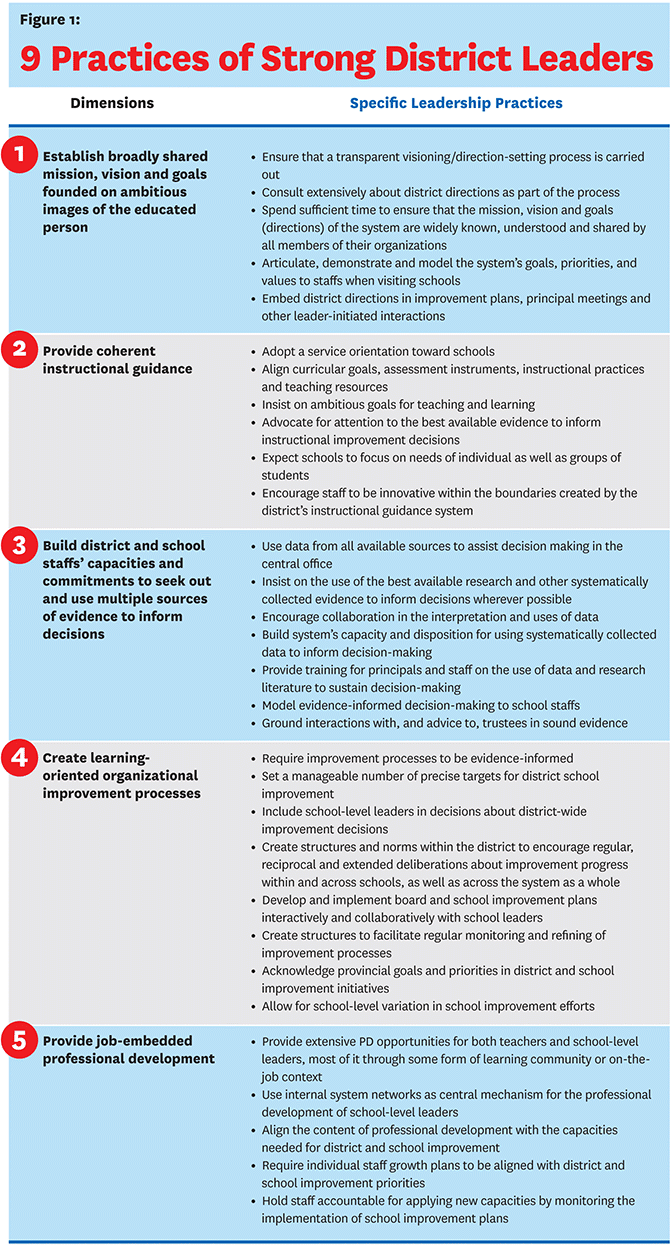
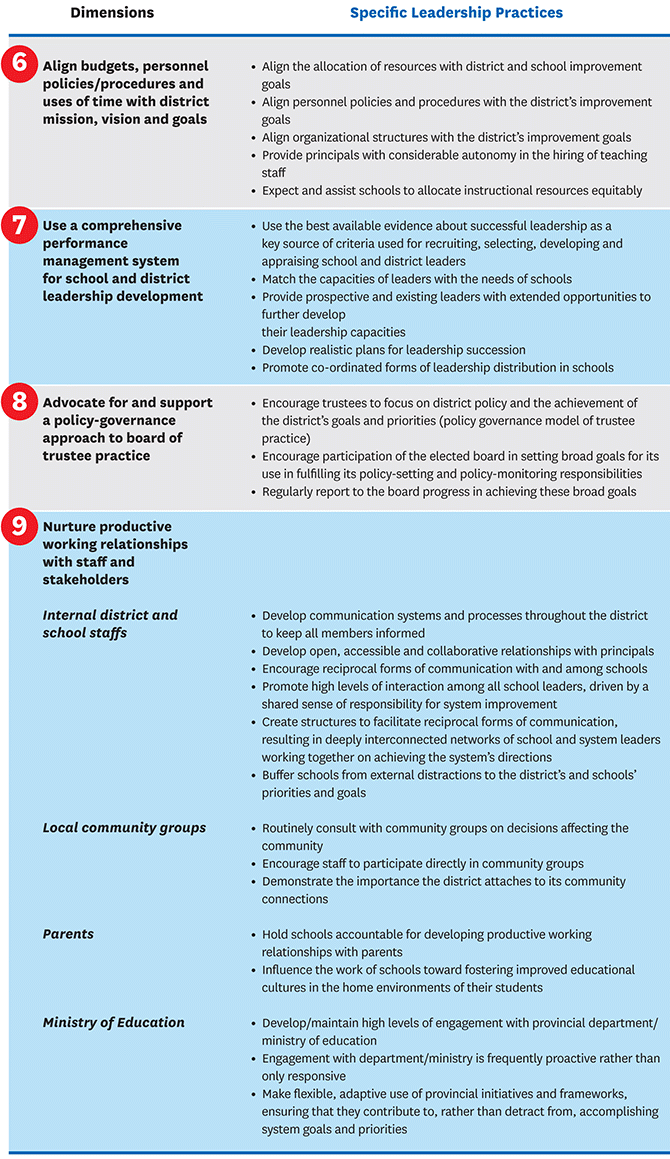
Underlying almost all strong senior leadership practices are a small number of personal leadership resources. While most are described in the Ontario Leadership Framework, Strong Districts and Their Leadership added two more practices especially relevant for senior district leaders: proactivity and systems thinking. The full paper describes these personal resources and explains why they are part of strong district leadership.
Developing district leadership capacities
After the publication of Strong Districts and Their Leadership, considerable effort was made to introduce its contents to system leaders across the province. Some of the province’s senior district leaders had already begun to use the strong districts framework as a guide for assessing their own districts’ progress and planning for future improvements. But in order to expand use of the research to a substantial majority of districts, a more programmatic opportunity was needed. So CODE, IEL and the Ministry of Education endorsed a proposal to create and field test stand-alone professional development modules aligned with each of the nine characteristics of strong districts. Completed in the spring of 2015,8 each of these modules includes an agenda, a set of slides summarizing relevant research and either two or three case studies. A total of 23 cases were prepared, many of them including video interviews with senior leaders about their cases.
Next steps
A new study, slated to begin in January 2016, is aimed at deepening our understanding of how district leaders can be as strategic as possible in their district improvement efforts. These efforts as a whole illustrate what can be accomplished in the interests of students when policymakers, senior leaders, and researchers engage in authentic and respectful collaboration aimed at a common goal.
En bref: Des dirigeants de conseils scolaires représentés par le Council of Ontario Directors of Education (CODE), en collaboration avec le ministère de l’Éducation et l’Institut de leadership en éducation (ILE) de l’Ontario, ont entrepris une série d’initiatives s’appuyant les unes sur les autres pendant les neuf dernières années. Ces initiatives visaient à dégager les caractéristiques de conseils scolaires performants, le leadership qu’ils requièrent et les façons dont ce leadership peut être développé. Les résultats comprennent l’identification et la description de neuf caractéristiques expliquant les contributions productives des conseils à la croissance des élèves, les approches de leadership favorisant le développement de chacune des neuf caractéristiques, ainsi qu’un programme de huit modules destiné à contribuer à développer ces pratiques chez les dirigeants scolaires. Cet article résume ces travaux et soutient que, dans l’ensemble, ils illustrent ce qui peut être accompli dans l’intérêt des élèves lorsque les responsables de politiques, les cadres supérieurs et les chercheurs collaborent authentiquement et respectueusement en vue d’atteindre un objectif commun.
First published in Education Canada, March 2016
1 For example, P. Coleman and L. LaRoque, “Reaching Out: Instructional leadership in school districts,” Peabody Journal of Education 65, no. 4 (1990): 60-89; K. Leithwood and K. Louis,Linking Leaership to Student Learning (San Francisco: Jossey, 2012); M. Chingos, G. Whitehurst, and M. Gallaher, School District and Student Achievement (Boston: The Brookings Institution, 2013).
2 For example, Coleman and LaRoque, “Reaching Out”; Leithwood and Louis, Linking Leadership to Student Learning; Chingos et al., School District and Student Achievement.
3 For example, Coleman and LaRoque, “Reaching Out”; Leithwood and Louis, Linking Leadership to Student Learning; Chingos et al., School District and Student Achievement.
4 An Effect Size statistic was used to report these results. Even variables with weak effect sizes may be practically consequential depending on costs; multiple variables with weak effect sizes can add up to strong effects. These results are the direct effects of districts on students even though the effects of district characteristics are mediated by many other school and classroom conditions not measured in the study.
5 K. Leithwood and V. N. Azah, “The Characteristics of High Performing School Districts,” Leadership and Policy in Schools (in press).
6 K. Leithwood, The Ontario Leadership Framework 2012 with a Discussion of its Research Foundations (Toronto: Ontario Ministry of Education and the Institute for Educational Leadership, 2012).
7 K. Leithwood, Strong Districts and Their Leadership (Toronto: Paper commissioned by the Council of Ontario Directors of Education, 2013). www.ontariodirectors.ca/projects-current.html
8 K. Leithwood and C. McCullough, Professional Development Modules in Support of Strong Districts and their Leadership (Toronto: Final report to the Institute for Educational Leadership, 2015).
-
Tech-Enabled Teacher Leaders
Comments Off on Tech-Enabled Teacher LeadersHistorically, the function of school leadership rested solely in the office of the school principal. This may have been by necessity rather than design, as this was where all the information and resources needed to lead the school resided. Student records, timetables, calendars, district forms, school improvement plans, even the ability to communicate with parents and community members was mediated by the principal’s office. Since many of the resources needed to affect the functioning of the school were only available to those with access to the principal’s office, it made sense that the responsibility for the implementation of school leadership remained there.
With the advent of web-based technologies, many of the key resources needed to support school leaders are now available online and can be accessed at any time, from any location and by any member of the school staff. Moreover, with the plethora of tech resources that are now available, individual educators can connect, collaborate and share with their colleagues throughout their school, district and beyond, which has increased the degree to which teachers can influence the practice and actions of classrooms other than their own. It is therefore important to examine the impact of technology on school leadership. Just as web-based technologies have served to disrupt and change the music and media industries, technology has already begun to disrupt the traditional notion of school leadership and will play a significant role in redefining it in the future. This disruption will cause the education community to reconsider not just how school leadership is enacted, but also the role teacher-leaders play in supporting the success of the school.
Tech-enabled teacher leaders capitalize on the collaborative and participatory nature of web-based technologies such as social media and video conferencing to engage in actions that intentionally influence the knowledge and practice of others. The Ontario Leadership Framework1 defines leadership “as the exercise of influence on organizational members and diverse stakeholders toward the identification and achievement of the organization’s vision and goals.” While this is a very broad definition of school leadership, the research of Ken Leithwood and colleagues acknowledged that there are but a few essential leadership functions that directly affect student learning and the success of a school. They are as follows:
- setting directions
- building relationships and developing people
- developing the organization to support desired practices
- improving the instructional program
Because these activities are vital to school success, it is paramount for school leaders to find ways to embed them into the life of the school. Encouraging teachers to play active leadership roles will help ensure these essential functions spread beyond the principal and are amply filled.
What follows is a look at how teachers are using technology to engage in leadership activities in each of these four areas.
Setting directions
While there is no denying that the principal fulfils the primary role of setting the directions of a school and conveying this vision to staff, students and stakeholders, teacher-leaders also play an important role. The principal and school improvement plan may state the goals for the school, but the fulfilment of these goals would not be possible without the contributions of the classroom teachers.
Classroom blogs are a tool used by tech-enabled teacher leaders to highlight what takes place in the classroom and to demonstrate how their actions are supporting the school vision. Over the course of the year, these blogs become an open and ongoing record of how their high expectations for the students translate into high quality work from their students. This sharing of student work examples demonstrates to all stakeholders what the school’s visions and goals mean in practice.
Including images and reminders like the one on the Room 308 in Action classroom blog2 (see Figure 1), provides a daily reminder to all stakeholders of what the school’s visions and goals mean with regard to student conduct and the importance of an inclusive and supportive classroom culture.

Toronto teacher Zélia Capitão-Tavares created this classroom blog (see Figure 2), to showcase student learning and provide a window for students and parents to observe what takes place in the classroom. She says that as a result, “students are able to share what they are doing at school with more confidence.” She also notes, “Parents and family members who do not have regular access to the student also appreciate the online window to peek into the learning world of the student, who is always presented as a positive contributing member in the class environment and within their own learning.” Thus, in addition to building productive relationships with families, the Room 308 blog provides a vivid example of what the school’s vision regarding student-centred learning means in practice.

Building relationships and developing people
In our rapidly changing world, it is of vital importance that school leadership supports the ongoing professional growth of educators. Teacher-librarian Alanna King, from Orangeville, Ontario, has been using Google Hangouts as a means to build relationships and stimulate growth in the professional capacities of her fellow educators. Each week she hosts an online book club, where educators can gather to deepen their knowledge and understanding of pertinent issues related to education. Hosting the session online enables educators to build professional relationships with a diverse group and to benefit from this professional development (PD) opportunity regardless of their location.
Another way to stimulate professional growth is to lead discussions about the relative merits of current and alternative practices. While a school principal may formally engage in this leadership activity during a staff meeting or PD day, these types of sessions may be too infrequent to support the ongoing professional growth many teachers desire. In an attempt to fill this leadership gap, many tech-enabled teachers have turned to Twitter as a source of weekly professional development sessions that provide them with an opportunity to discuss promising practices.
The weekly Canadian Ed Chat3 ( Figure 3) provides educators from across the country with an opportunity to connect and discuss relevant educational issues. The tech-enabled teachers who organize and moderate these sessions post a calendar of discussion topics in advance of the weekly gathering to ensure that participants are prepared to contribute to the conversation. Each session begins with the initiating question that was posted on the calendar. Once the session begins, teachers are asked to post their responses to the initial question and to subsequent questions that are raised. What then takes place is a dynamic conversation that examines the relative merits of current and alternative practices while also building a professional learning community where teachers can reach out to seek advice and assistance for specific classroom challenges.
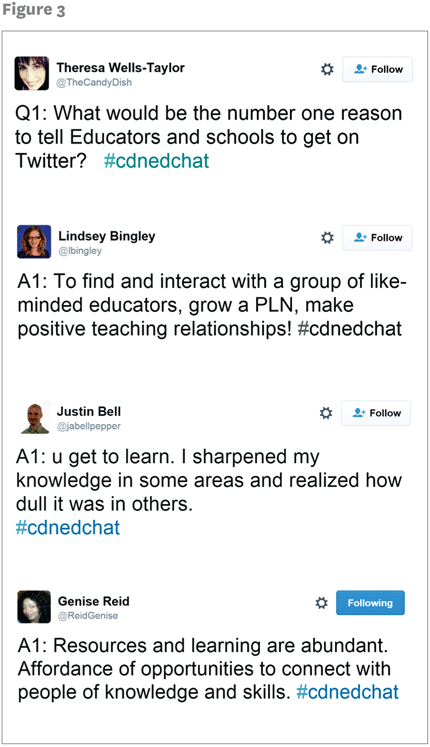
Because these tech-based activities are organized by teachers for teachers, they are, perhaps, more likely than district-initiated PD sessions to address the issues most on teachers’ minds.
Developing the organization to support desired practices
Building productive relationships with families and communities relies on having the opportunity for people to interact with each other. In the past, this was solely dependent on face-to-face contact. In today’s busy world, it can be very difficult to find time to interact directly with all of the people with whom we have relationships. Fortunately, in the Web 2.0 world, educational leaders no longer have to rely exclusively on in-person interactions to build relationships. While it is best for the initial interaction to be in person, technology makes it significantly easier to maintain the ongoing contact that is necessary for a positive relationship to develop. Facebook, Twitter, Skype, Google+ and Google Hangouts are all tools used by tech-enabled teacher-leaders to enhance their relationships with students, parents, community members and colleagues.
Ongoing communication is essential for schools to be able to build productive relationships with families. For the past six years, Hamilton, Ont., elementary teacher Aviva Dunsiger has been using Twitter to create a direct line of communication between parents and the classroom (see Figure 4). Each day Aviva’s classroom Twitter feed is filled with pictures of student work, classroom activities and posts created by students.

These types of Tweets provide parents and school community members with a window into the life of her classroom. Using Twitter in this manner also contributes to the development of trusting relationships among teachers, students, and parents, which can have a significant impact on school climate and student learning.4
Developing the organization to support desired practices also involves finding ways to connect the school to its wider environment. Kathy Cassidy’s Grade 1 classroom blog5 (Figure 5) invites the world into their classroom. This Moose Jaw, Sask., teacher successfully achieves this goal by showcasing student participation in a global read-along, posting pictures of their contribution to the community food bank, and including a link to the blog of the B.C. classroom they frequently collaborate and learn with.

Improving the instructional program
While the principal may be the formal instructional leader, it is important to acknowledge that there are many leaders within the school who provide instructional support. A day in the life of a principal is one filled with administrative imperatives, agenda juggling and organizational emergencies. Unfortunately, this can make it quite difficult to find the time to provide the support that educators require to improve the instructional program. Once again, tech-enabled teacher leaders have stepped in to address this leadership function in a manner that suits the busy schedules of classroom teachers. Using technology to facilitate the distribution of instructional leadership helps to ensure that this essential leadership function occurs frequently and throughout the building.
Blogging can be considered an asynchronous leadership opportunity to provide instructional support while also stimulating professional growth. Teacher leaders often begin blogging to support their own professional reflection, but in making these reflections public, they create an open forum for their colleagues to learn from their experience and gain insight into effective instructional practices.
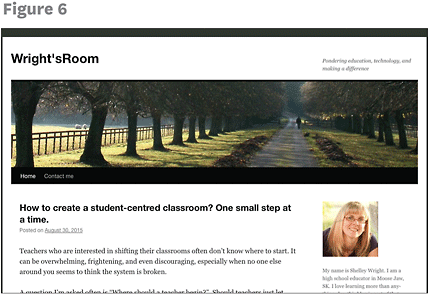
Saskatchewan secondary teacher Shelley Wright’s blog[6] (Figure 6) is a testament to professional reflection and life-long learning. The topics she blogs about reflect her commitment to using technology to create student-centred, inquiry-focused learning environments. This serves to provide instructional support for other teachers while also modelling her school’s values and practices. The comments posted to her blog, expressing appreciation for her insight and instructional support, reveal the impact Wright has had on other educators. For example, one teacher wrote:
I can’t tell you how much this article inspires me and how perfectly it articulates what I am trying to do with a new HS Social Justice course I’m teaching. I would love to take you up on your offer to help others create an inquiry classroom…
Shelley is not alone. When one considers that there are thousands of tech-enabled teachers who are actively blogging to support professional growth and reflection, it can be quite difficult to keep up with what is happening. Luckily, teacher-leaders like Doug Peterson (from Essex, Ontario) have come forward to provide assistance in monitoring these tech-enabled leaders. Peterson’s blog includes a weekly review and synopsis7 of interesting and highly relevant blog posts from educators in Ontario (Figure 7). With over 16,000 subscribers to his blog feed, Peterson is clearly a leader in the Canadian educational blogosphere. These numbers demonstrate the potential of technology to influence the practice and professional growth of a significantly greater number of educators than is possible through more traditional PD methods.

These examples are merely the tip of the “technology iceberg.” It should now be apparent that even without a formal leadership title, tech-enabled teachers are redistributing educational leadership and the role teachers play in supporting the success of their schools and their profession.
En bref: Tout comme la technologie transforme actuellement les pratiques en classe, son utilisation a commencé à bouleverser les notions conventionnelles de leadership en éducation, ce qui amènera le milieu de l’éducation à réévaluer tant la manière dont le leadership scolaire se manifeste que le rôle joué par les enseignants qui sont des leaders. Grâce à la pléthore de ressources technologiques maintenant disponibles, des éducateurs individuels peuvent se connecter, collaborer et partager avec d’autres éducateurs dans leur école, leur conseil scolaire et ailleurs. L’auteure de cet article examine comment des enseignants technologiquement outillés du pays emploient différentes ressources technologiques pour redistribuer le leadership en éducation et rehausser le rôle que jouent les enseignants pour favoriser le succès de leurs écoles et de leur profession.
Original photo: courtesy Ms. Cassidy’s Classroom Blog
First published in Education Canada, March 2016
1 Institute for Education Leadership, The Ontario Leadership Framework (Toronto: Queen’s Printer for Ontario, 2012). http://immix.ca/
2 Room 308 in Action: http://308inaction2015.blogspot.ca/2015/10/poetry-ss-use-line-2-create-stunning.html
3 www.cdnedchat.ca/home
4 K. A. Leithwood, The Ontario Leadership Framework 2012: Research foundations (The Institute for Education Leadership, 2012).http://immix.ca/
5 Ms. Cassidy’s Classroom Blog: http://mscassidysclass.edublogs.org
6 Wright’s Room: https://shelleywright.wordpress.com
7 Doug – Off the Record: https://dougpete.wordpress.com
-
Human-Centred Leadership
Comments Off on Human-Centred LeadershipImagine you have just moved into a new area, and on that first night in town, you and your wife and children are hungry for a meal. What better way to get acquainted with the new neighbourhood than to go out for a bite and a walk around? You pop open your laptop and search for restaurants in the vicinity, and find that there is only one within walking distance. You click on the link, and while the site isn’t particularly flashy or eye-catching, you notice is that there is a barbecue buffet special on Saturday! However, your perceptive 13-year-old daughter notices that the date for that special ended two years ago, and that the site hasn’t been updated. You decide to click on the “Menu” button to see some other choices, but the dreaded “404 – File Not Found” screen pops up. A bit puzzled, you decide to give the restaurant a call, but after several rings, an automated message asks you to enter the extension of the employee you would like to speak to, or to leave a message after the tone so someone can get right back to you about reservations. You hang up.
“I’m hungry!” groans your 11-year-old boy, and you make the executive decision to try the restaurant anyway. After a pleasant ten-minute walk, you arrive at an older building. There are a few weeds poking out of the sidewalk, and one of the letters on the sign has fallen off. You walk in, and a sign says “Please Wait To Be Seated,” but there is no one at the desk to greet you. After a minute or two, you peek around the corner and gently call “Hello?”– to which a voice responds, “I’ll be with you as quickly as I can.” A few moments later, a host comes around the corner and says, “Sorry, we are so short staffed. Do you have a reservation?” You inform the host that you tried to call, but there was no answer. The host says, “We ask that people leave a message so that we can put a reservation in, but I guess you didn’t do that.” He looks at a reservation book and shrugs. “We don’t have anything available for at least another hour.” You notice that there is a large set of tables that are empty, and ask if you could sit there – the family is starving! The host frowns and says, “Those people made a reservation, sorry. When you make a reservation, it’s a lot easier for us to get you in.” Frustrated and hungry, you head home so you can drive somewhere else to eat. “I don’t want to live here!” declares your daughter.
Now take this situation, and replace “local restaurant” with “local school.” Substitute the idea of your children being hungry with them being excited and nervous to start a new school year. Think about the angst involved in moving to a new area, and how you and your children would feel if you went to the website of your new neighbourhood school and the pages were out of date and filled with dead links. Or if, when you tried to call to get some information, you couldn’t get a person to help you on the other end. And then when you finally decided to just show up at the new school with your children to register because you couldn’t figure out a better way, you were made to feel that it was inconvenient for the staff for you to show up unannounced. All you wanted was to register your children!
How do you feel about your new school after such a poor initial experience?
In the business world, creating a rich and positive user experience (UX) for customers or clients is essential for a successful enterprise. Yet when it comes to considering the experiences that our students, parents, and even educators have in our schools each day, UX is often a distant afterthought. What makes this lack of attention to UX even more perplexing is the fact that we have virtually unlimited and direct access to input and feedback from our clients – they are in front of us in our classrooms, in the staff room, and in the parking lot of our schools! As a lead digital marketer of a large multi-national corporation said to me at a recent business conference, “I could only wish to have the access to our customers that schools have to theirs.”
With the hustle and bustle of the everyday lives of educators, solving problems as quickly as possible is often the order of the day. When an issue comes to us in our classrooms, schools, or districts, we want to ensure we handle it professionally and carefully, but also in a timely manner, because we know there will be another issue cropping up shortly. And by our very nature we are helpers; we want to give our learners and our school community the assistance they need when they come to us with a problem. Yet often, in the spirit of efficiency, we implement solutions without involving those who are having the problem: our students and parents, and even our teachers and principals (when we are in leadership positions). And while we might feel we are being more efficient, we can be missing out on a tremendous opportunity to collaborate with and empower the members of our school community.
Human-centred leadership
When it comes to different approaches to solving problems, I believe the field of education can learn a great deal from the design sector: leading design firms such as IDEO and the Stanford D-School use a human-centered approach to spark new and creative solutions. In IDEO’s Design Thinking method, they “consider every product touch-point as an opportunity to surprise, delight and deliver benefits to users”1 and actively collaborate with those who use that particular product or service.
Since working cooperatively with our partners in education is so vital to our success, I believe adopting a collaborative, human-centered leadership style has enormous potential to help us ensure a more positive user experience for our partner groups and concurrently build their leadership capacity at every level. I believe this can be done by following a few steps:
1. Recruit a diverse, eclectic, problem-seeking team.
For the user experience you are considering in your classroom, faculty meeting, school or district, who are the people that you might assemble to ensure that you get a wide variety of ideas and perspectives? For example, if you are considering communication from your classroom, collaborating with students and parents is key: they can provide you with authentic, personal experiences that they have had inside and outside of the class. Effective communication is important to any workplace, and parents may be able to bring new and fresh ideas from other sectors that are applicable to the school setting.
2. Start with questions that promote divergent thinking.
When approaching issues in our schools, we frequently begin by asking questions that can narrow our focus, such as “How can we make better parent-teacher conferences?” By beginning with a vision of something that we have previously done, we can inadvertently limit conversation and constrain ourselves to making minor “tweaks” to existing processes or structures. When we have a think tank of people with different experiences and skill sets, it is important to ask questions that elicit different reactions and spark new ideas: the last thing we want to do is limit the creative capacity of the group! A question that promotes divergent thinking such as, “What is the experience that we want our parents to have when they are learning about their student’s progress?” starts a different conversation, and encourages the team to think about the end user before the end product. It is vital at this stage to be an active listener and encourage each of our partners to speak – they are the true leaders in this process because they are the experts on describing their personal experiences.
By having our partners work with us in diverse “think tank” style groups, we develop their capacity as leaders in the design, feedback and iterative process.
3. Co-create your MVP (minimally-viable product).
A common approach to teaching and learning can be “know then do”: we often feel like we must preload learners with a requisite set of skills before they can be released to try them out in a more hands-on environment. However, in doing this, we are attempting to anticipate each of the skills that a learner may need to solve a particular problem. An alternative approach is to “do then know.” If we co-create prototypes with our diverse group as early as possible in the design process and observe our end users trying these “minimally viable products,” we can better understand the strengths and flaws of our models. As David Kelley, founder of IDEO, said, “If you want to improve a piece of software all you have to do is watch people using it and see when they grimace, and then you can fix that.”2 With our parent conference example, if the group chose to try a model using fifteen-minute, student-led conferences featuring a presentation of learning, we would want to test this concept with a small number of students doing presentations to a few adults before we adopted the model. By co-creating and testing prototypes of our ideas, we can not only “walk a mile” in the shoes of our students and parents, but we can also cultivate a true sense of ownership over the iteration process.
4. Be hungry for feedback.
When we encourage our end users try our prototypes, we create fertile ground for observation, and we need to harvest any feedback that we can get! Sitting and watching a small group of our students and parents go through a process of fifteen-minute, student-led conferences can tell us a multitude of things. We can determine if the physical setting is right, whether the allotted time is sufficient, if the size of the audience is appropriate, and other observable details. But we must also take advantage of having our end users there in front of us: interviewing our kids and parents for warm feedback, cool feedback, and suggestions can provide us with rich insights that only they can provide. We need to create an open and collaborative environment where they feel empowered to be specific and honest. We also must demonstrate that we value their contributions by making the changes that result from their feedback. Try having one of them carry a video camera with them when they go through the process, so you can see the experience through their eyes!
5. Put experience before product.
We can spend a great deal of time, effort and energy in creating multiple iterations of our minimally viable products. We might tweak and test our student-led conferences six or seven times as a result of numerous observations, and think we have truly “nailed it” on the final product. For example, perhaps we have created an amazing format for our student-led conferences that fits perfectly into our schedule for that particular day, but it only “works” if we keep the transition time between each conference to three minutes. However, the feedback from our test parents and students tells us that students are unable to do a proper breakdown and setup of their presentations in three minutes. Furthermore, parents with more than one child at the school would be late to their second presentation. While it can be very easy to “just go with it” and hope for the best, all of the positive work that we have done with our group can be quickly negated if clinging to a product feature (such as the time for transition) becomes more important than the experience of the user. Iterations can occur at any time during the creative process, right up until the rollout when we think we have landed on that one “perfect” solution. It is vital to ensure that we are more committed to those who are using our product than to the product itself.
6. Make debriefing a habit.
Once the experience for our users has occurred, it is not uncommon for us to simply move on to the next task: schools are busy places, and as soon as we have crossed one item off the “to do” list, we know there will be two more to replace it. But while the experience is fresh in people’s minds, get feedback, and lots of it! Chat with people, use a brief survey, and bring in a focus group so that you and your team can get a true sense of what could be altered so that the experience is even better in the future. Even if you feel the event has gone exceedingly well, there is still much to be learned from those who participated. Make sure you revisit the initial prototype: seeing the journey from the initial to the final product is a powerful reminder of the group’s responsiveness to feedback.
Taking a human-centered, collaborative approach involving end users to co-create positive user experiences in education has many benefits. Not only will we come up with solutions that better suit the needs of our students, parents, and educators, we empower them to make a difference in the areas that truly matter – the experiences they have in our schools on a daily basis. By having our partners work with us in diverse “think tank” style groups, we develop their capacity as leaders in the design, feedback and iterative process. And perhaps most importantly, we build relationships with those we serve. So whether it is parent-teacher conferences, elementary-to-secondary transition for students, implementation of new grading software for teachers, or reviewing policy for administrators, when we adopt a more collaborative, human-centered leadership style, we can transform our classrooms, schools and districts to be truly responsive to the needs and experiences of our students, parents, and educators that learn in them.
En bref: Une expérience client positive est essentielle au succès des entreprises du monde entier. Conscientes de l’importance de l’expérience d’utilisateur, les compagnies consacrent beaucoup de temps et d’énergie à des études de marché afin de cerner les besoins de leurs clients. En consultant de multiples sources d’information sur leurs utilisateurs finals et en travaillant avec eux pendant le processus de conception, les entreprises tentent continuellement de créer des produits correspondant le mieux possible aux besoins du client. Comment pourrions-nous transposer cette « approche de conception » à l’éducation? Que se produirait-il si nous entreprenions de considérer nos élèves, nos parents et nos enseignants comme nos clients – des ressources qui pourraient nous éclairer sur leurs expériences d’utilisateurs avec nos écoles? En adoptant une approche de conception avec nos partenaires pour résoudre les problèmes qui surviennent dans le système de la maternelle à la fin du secondaire, non seulement trouverons-nous des solutions mieux adaptées à leurs besoins, mais nous développerons aussi leur capacité de diriger et de résoudre des problèmes en collaboration tant à l’intérieur qu’au-delà de notre communauté scolaire.
Illustration: iStock
First published in Education Canada, March 2016
1 “Why Human-Centered Design Matters,” WIRED (2013). www.wired.com/insights/2013/12/human-centered-design-matters
2 “How to design breakthrough inventions,” CBS News (2013). www.cbsnews.com/news/how-to-design-breakthrough-inventions-07-01-2013


IDEAS TO SUPPORT EDUCATORS : Subscribe to the EdCan e-Newsletter
Quality research, reports, and professional learning opportunities.