Archive
-
Is it Change that We Want or Is it Evolution?
Comments Off on Is it Change that We Want or Is it Evolution?
So, after celebrating its 125th anniversary, the Canadian Education Association (CEA) is launching its new EdCan Network brand. When I share our organization’s lengthy history in Canadian public education, people often say to me, “I guess it’s time for change!” When I consider my 41 years of working in public education, I guess that the same could be said for me!
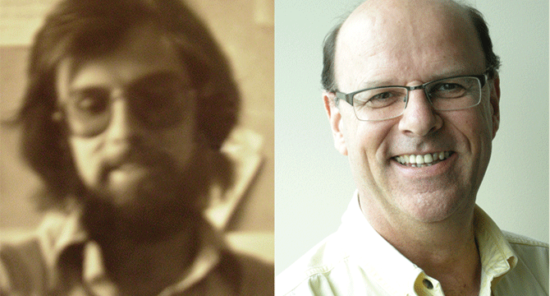
At the CEA, we’ve been actively supporting the courageous educators who are innovating in and out of schools, and we continue to present our research and perspective at provincial, national and international conferences. We’ve even dared ask: “What’s standing in the way of change in education?”, which so many people ask themselves, yet tend to shy away from speaking publicly about. At times, we have come under criticism for being too focused on systemic problems and giving too little attention to what works. My response is that we amplify what works, and we question what doesn’t.
I’m now into my seventh year as the CEO for this association – soon to become the EdCan Network. In that time, I’ve been blessed to meet such a wide range of creative and imaginative educators so firmly committed to supporting success in classrooms. Within this spectrum, I’ve interacted with three distinct groups:
1. those who believe that the current Canadian education context is perfectly fine, albeit in need of a few tweaks here and there
2. those who feel that the current system hinders innovation, change or any transformational process and propose entirely new definitions of teaching and learning
3. and finally, those who advocate for a hybrid system, mixing the best of the traditional approach with a healthy dose of innovation.
So where does the EdCan Network stand in all of this? Where do you stand in all of this?
We need to determine:
Do we want change? or Do we want evolution?
What’s the difference? Let’s look at the definition of change, as a verb: to make or become different or take or use another instead of, and as a noun: the act or instance of making or becoming different. Now let’s look at the definition of evolution: the gradual development of something, especially from a simple to a more complex form.
These two definitions present remarkably different processes while working towards remarkably similar outcomes. What research has amply demonstrated is that people are usually resistant to change. The “unknown outcome” factor – the fear that the change will be for the worse rather than the better – is a strong deterrent. This “uncertainty” factor is a significant hurdle to overcome. Add in the increasing prevalence of initiative fatigue,1 and one can readily understand why change in education has – and will be – difficult to achieve.
This should lead us to developing strategies for evolution – a slower but more “natural” shift. It’s hard to predict where this evolution will lead us in the next few decades, but I will try: Schools will continue to exist, but will be much more integrated into community structures, and learning/teaching will be a truly shared partnership between knowledge provider and knowledge recipient. It will be interesting to observe the evolution of the definition of teacher and student.
I base my prediction on my first year of teaching in 1976. At that time, the movie 2001: A Space Odyssey was only eight years old, and we believed that a landing on Jupiter within the next 25 years was doable! When I look back on my 41 years in education, I can unequivocally say that I have truly seen evolution, but little significant change of note.
Which brings me back to the new EdCan Network. It’s not just a new logo. With this magazine, our fact sheets and events, we aim to create spaces for the challenging conversations that need to happen about how research can be better used to improve learning. A great example of evolution, with exciting potential and opportunities for all of us in our quest to ensure that our children’s quality of education is second to none.
Photos: courtesy Ron Canuel
First published in Education Canada, June 2017
1 The long-term negative physical and emotional effects that educators feel due to constant changes to classroom activities and expected outcomes. Such changes have been occurring over the past twenty years and have created a deepened sense of skepticism and hesitation among educators.
-
What factors are involved in developing successful community school models?
Comments Off on What factors are involved in developing successful community school models?Community schools appeared in Britain and the U.S. in the 1970s. The expression was used in a 1982 Quebec government white paper to designate a hub where the community and the school work together for their mutual benefit. Though several models exist, they all feature this type of synergy between a school and its community. School communities involve multiple partnerships and focus their services on student learning and community health. They are distinguished by two tendencies: the partners support the school’s mission, and the school contributes to the community’s development. Community schools are therefore relatively unified hubs, depending on their partners’ needs and intentions: (1) shared schools welcome partners and services that are not tied to the school’s mission; (2) schools open to the community welcome partners whose activities are tied to the school’s mission; (3) schools rooted in the community respond to the needs of young people, and to the development of the community. Community schools can contribute to the revitalization of linguistic minority or declining communities. The following three factors are involved in developing successful community school models.
1. Plan the development.
Planning is the cornerstone of any development, even though strategic agility is starting to take the place of strategic planning: it is necessary to adapt proactively to any constraints and opportunities in the organization’s environments. A resource kit used for holistically planning action for educational and community change, based on a grounded theory, can help implement a school-community collaboration in five stages: explore, initiate, plan, implement and evaluate.
2. Provide inspiring school leadership.
There are numerous types of leadership, but research has shown that transformational leadership is more relevant than transactional leadership. In this regard, motion leadership, another theory grounded in facts and observed practices, has been successful in schools and uses mobilized stakeholders and actions that are more effective and easier to understand.
3. Have all partners rally around an educational philosophy.
Community schools offer a spirit that inspires schools in their ways of being, thinking and acting. In addition to having an education program, each school, along with its partners, rallies around an educational philosophy. For example, the International organization of conscious entrepreneurial community schools (OIECEC) proposes an inclusive, responsible and humanist path, which operates in synergy with the community, while the UNESCO Associated Schools Project Network endorses the principles of sustainable development, intercultural learning and democracy. Community schools are also hubs of shared values.
ADDITIONAL INFORMATION RESOURCES
- How to Start a Community School (Coalition for Community Schools)
- International organization of conscious entrepreneurial community schools (OIECEC, 2017)
- UNESCO Associated Schools in Quebec (UNESCO, 2017)
- Resource Kit – The Community Learning Centre. Guidebook for Implementing a Collaborative School-Community Partnership – Holistically planned action for educational and community change (MELS, 2012)
References
Bédard, J. et al. (2009). Étude des représentations et des indices d’opérationnalisation de l’école communautaire au regard des approches et programmes visant la collaboration école-famille-communauté mis en œuvre au Québec. Sherbrooke: Université de Sherbrooke.
http://www.criese.ca/Recherches/recherche_ec/Item_I-d_EC_Rapport_09.pdfChildren’s Aid Society (2011). Building Community Schools: A Guide for Action, National Center for Community Schools. New York: National Center for Community Schools. https://dl.dropboxusercontent.com/u/4473432/Building%20Community%20Schools.pdf
Commission scolaire de Montréal (2008). La vision de l’école communautaire de la Commission scolaire de Montréal. Cadre de référence. Une réflexion en évolution. Montreal: Commission scolaire de Montréal.
Deslandes, R. (2007). “L’école communautaire et la place des parents,” Diversité, No. 150, Autumn.
http://www.educ-revues.fr/DVST/AffichageDocument.aspx?iddoc=37903Epstein, J. et al. (2009). School, Family, and Community Partnerships: Your Handbook for Action, Third Edition, Thousand Oaks, CA: Corwin Press.
Fédération des commissions scolaires du Québec (2004). L’école communautaire selon le modèle américain. Quebec City: FCSQ.
Fullan, M. (2015). Le leadership moteur. Comprendre les rouages du changement en éducation. Quebec City: Presses de l’Université du Québec.
Gouvernement du Québec (2005). L’école communautaire. Un carrefour pour la réussite des jeunes et le développement de la communauté. Rapport du Groupe de travail sur le développement de l’école communautaire. Quebec City: Gouvernement du Québec. http://fcsq.qc.ca/fileadmin/medias/PDF/446909.pdf
MELS (2006). Schools in Partnership With Their Community. Quebec City: Ministère de l’Éducation, du Loisir et du Sport.
http://www.education.gouv.qc.ca/fileadmin/site_web/documents/dpse/Partnersh_MELS_AN_471113.pdfMEQ (1982). Une école communautaire et responsable. Quebec City: Ministère de l’Éducation. https://www.bibliotheque.assnat.qc.ca/DepotNumerique_v2/AffichageNotice.aspx?idn=75611
-
What is the best way to integrate newcomer students into schools and classrooms?
Comments Off on What is the best way to integrate newcomer students into schools and classrooms?ADDITIONAL INFORMATION RESOURCES
Audio-visual tools about the Quebec school system. Created by the Table de concertation des organismes au service des personnes réfugiées et immigrantes (TCRI, 2014). http://www.ecoleplurielle.ca/ressources/outil-dinformation-et-danimation-sur-le-systeme-scolaire-quebecois/
Framework to support the integration of immigrant students (Ministère de l’éducation et de l’enseignement supérieur, 2016). http://www.ecoleplurielle.ca/accueil-et-integration/cadre-de-reference/
Short video about teaching students to write in a second language (Ministère de l’éducation et de l’enseignement supérieur, 2014).
http://www.education.gouv.qc.ca/outil-de-recherche/dans-le-site/capsule-video/?tx_vibeo_pivideoplayer%5Bvideo%5D=185&tx_vibeo_pivideoplayer%5Baction%5D=detail&tx_vibeo_pivideoplayer%5Bcontroller%5D=Videoplayer&cHash=870e16e9abfe96aa366f4ddd2fbba224Website devoted to refugee students – created by the Centre-Nord school board http://www.enseignerauxrefugies.ca
Resources to help teachers with linguistic, academic and social integration – created by the Carrefour Éducation.
http://carrefour-education.qc.ca/Web documentary to promote the success of immigrant students – created by the Commission scolaire de Montréal and researchers at the Université du Québec à Montréal (2016).
http://csdm.ca/autres-services/etudes-recherches/des-racines-et-des-ailes/REFERENCES
Anisef, P., Blais, J.-G., McAndrew, M., Ungerleider, C. and Sweet. R. (2004). Academic performance and educational mobility of youth of immigrant origin in Canada: What can we learn from provincial data banks? Research paper, Immigration et métropoles/CIC.
Armand, F. and Dagenais, D. (2012). S’ouvrir à la langue de l’Autre et à la diversité linguistique. Education Canada, 52(1).
Auger, N. (2010). Élèves nouvellement arrivés en France. Réalités et perspectives pratiques en classe, Paris: Éditions des archives contemporaines. https://books.google.fr/books?hl=fr&lr=&id=jiAuGBCXke8C&oi=fnd&pg=PA1&dq=intégration+élèves+nouvellement+arrivés+au+secondaire&ots=i0do0SXqxb&sig=5aeMUOYo8SZmvkV5L8gV52rW5S4#v=onepage&q=intégration%20élèves%20nouvellement%20arrivés%20au%20secondaire&f=false
Auger, N. and Terrades, O. (2005). Quelle posture de l’enseignant pour la scolarisation des élèves nouvellement arrivés ou plurilingues ? In Dufour, M., École, langues et modes de pensée (pp. 141- 161), l’Académie de Créteil: Repères pour Agir Collection, Disciplines CRDP Series.
Duff, P. (2001). Language literacy and content and (pop) culture: Challenges for ESL students in mainstream courses. The Canadian Modern Language Review, 58 (1) [online version].
Garnett, B., Adumati-Trache, M. and Ungerleider, C. (2008). The academic mobility of students for whom English is not a first language: The roles of ethnicity, language and class. Alberta Journal of Educational Research, 54 (3).
Kanouté, F., Gosselin-Gangé, J., Guennoui Hassani, R. and Girard, C (2016). Points de vue d’élèves issus de l’immigration sur leur expérience soocioscolaire en contexte montréalais. Alterstice, International Journal of Intercultural Research, 6, (1), 13-25.
Kanouté, F. and Lafortune, G. (2014). L’intégration des familles d’origine immigrante : les enjeux sociosanitaires et scolaires. Montreal: Les Presses de Université de Montréal.
Lafortune, G. (2014). Les défis d’intégration sociale et scolaire de jeunes d’origine haïtienne immigrés au Québec après le séisme survenu en Haïti en janvier 2010. Diversité urbaine, 14(2), 51-75.
McAndrew, M., Ait-Said, R. and Ledent, J. (2009). Educational pathways and academic performance of youth of immigrant origin: Comparing Montreal, Toronto and Vancouver. Canadian Council on Learning – Citizenship and Immigration Canada.
McAndrew, M., Garnett, B., Ledent, J. and Ungerleider, C. (2008). La réussite scolaire des élèves issus de l’immigration: une question de classe sociale, de langue ou de culture. Éducation et Francophonie, XXXVI(1), 177-196.
Potvin, M. and Leclercq, J. B. (2014). Facteurs affectant la trajectoire scolaire des jeunes issus de l’immigration en formation générale des adultes. Revue des sciences de l’éducation, 40 (2), 309-349.
Seat, R. (2000). Factors affecting the settlement and adaptation process of Canadian adolescent newcomers 16-19 years of age. Toronto, ON: Family Service Association of Toronto.
TCRI- Table de concertation des organismes au service des personnes réfugiées et immigrantes (2015). Situation de grand retard scolaire et analphabétisme des élèves immigrants et de leurs familles : enjeux et pistes d’action. Research paper – Table de concertation des organismes au service des personnes réfugiées et immigrantes (TCRI).
-
In-school Health Clinics
Comments Off on In-school Health Clinics“I had a child at one of my schools this year who was a refugee who didn’t have an OHIP card and the teacher came and said to me that the child had a terrible earache and was really suffering. She had taken him to the hospital and the hospital said it was $500 upfront or ‘We won’t see your child.’ The teacher then got hold of me and said, ‘Isn’t there somewhere we could send this kid where he could get his ear looked at?’ And that is exactly what we did. We did an emergency connection to the Sprucecourt [in-school] clinic and he was seen.” – TDSB Social Worker
Newcomers are integral fibres woven into the fabric that makes up Canada. As the largest school system in Canada and one of the most multiracial, multicultural, and multilingual school boards in the world, the Toronto District School Board (TDSB) serves a sizable proportion of students from immigrant and newcomer backgrounds.
According to TDSB’s 2011-12 Census, at least two-thirds of its students had both of their parents born outside of Canada. These families, especially the more recently arrived, face many migration- and settlement-related challenges that may hamper their children’s well-being and educational outcomes.
The Organisation for Economic Co-operation and Development (OECD) has reported that students from disadvantaged socio-economic backgrounds, including newcomers, are half as likely to achieve either their educational potential or a basic minimum level of skills (e.g. literacy, numeracy, communication). Societies have a shared responsibility to prevent such educational defeat, and public schools provide an ideal hub to partner with pertinent institutions or agencies to help mitigate these inequitable circumstances for marginalized students.
In 2006, the TDSB launched its system-wide initiative, called Model Schools for Inner Cities (MSIC), to address the needs of students who are disadvantaged by family poverty, unemployment and insecure housing. One hundred and fifty schools were identified as having the most external challenges and designated MSIC schools. Extra funding, resources, programming and community partnerships are granted to these schools as a systemic approach to narrowing the opportunity and achievement gaps for their disadvantaged students. One MSIC program is the Model Schools for Paediatric Health Initiative (MSPHI).
A health-education partnership
The MSPHI grew out of research revealing that, despite the existence of a universal health system in Canada, inequities and accessibility barriers related to health care do occur among disadvantaged families for a number of reasons. For example, the lack of health insurance (uninsured) in the case of newcomers or refugees, the lack of associated family doctors (unattached), as well as financial, language and cultural barriers, make accessing or navigating the health care system difficult.To address this difficulty, the MSPHI was launched in 2010 with the opening of two in-school health clinics. Based on the success of these two pilot sites, a number of MSPHI clinics were subsequently added in different high-needs neighbourhoods. By 2015-16, a total of seven MSPHI clinics were established.
A cost-effective model
This integrated health and education model has proven to be highly cost-efficient and replicable. Its operational costs are minimized, as it leverages already existing resources:- A shared/spare space (e.g. a vacant classroom) in an inner-city school converted, with some initial setup costs, to a simple health clinic
- A local health agency (such as a hospital or a community health centre) that is committed to health equity. These agencies provide the MSPHI clinics with medical equipment and supplies, as well as part-time health care professionals paid through the Ontario Ministry of Health and Long-term Care. For uninsured students, these health agencies will seek other avenues of funding through, for example, the Local Health Integration Network’s allocated budget for newcomers or hospital grants.
Even though these clinics are open only one to three times per week, together the seven MSPHI clinics served over a thousand appointments in the 2015-2016 school year, from not only the host schools but also students from neighbouring schools. Hundreds of their student patients were either uninsured or unattached.
By bringing health and education together under one roof, the in-school health clinics not only remove many accessibility barriers faced by these marginalized students, but also afford them more timely, comprehensive, and socially/culturally sensitive health care than they could normally access through regular channels.
For instance, wait times for developmental assessments, which would typically take two to three years, are notably expedited owing to the intra- and inter-sectoral partnerships between MSPHI clinic staff, their health agencies, and school staff – all of which allow for early identification, developmental assessment, diagnosis, and appropriate educational modifications within the same academic year.
Impact on students
According to MSPHI’s tracking records, the clinics diagnose and treat a wide range of acute and chronic physical health issues. Over time, these in-school health clinics also witnessed a steady shift from addressing mainly physical health issues to mental health concerns related to developmental, behavioural, and psychological health. As one secondary student put it:“[The MSPHI clinic] basically helped me overcome the depression and gave me many options to heal… I’m feeling good… I feel like a totally different person.”
Aside from improving the health and well-being of student patients, a four-year study1 also shows reduced absenteeism, greater attentiveness to learning, and improved school performance for these students. They became more informed of their health status and learned how to navigate health services available to them. In fact, these in-school health clinics serve as an information hub and gateway to promoting health advocacy skills and medical autonomy, especially for secondary school students.
Ripple effects on schools and families
“Ripple effects” of the program are also positive. Educators testified that the in-school health clinics build capacity among school staff to better understand, recognize, and handle students’ well-being concerns. Some teachers have adapted their teaching strategies and learning environments accordingly. MSPHI health care professionals also support educators and students through their participation at school Support Team meetings, by identifying, triaging, and referring students to their MSPHI clinic.As well, the MSPHI supplements the roles of TDSB Professional Support Services (school psychologists, social workers, counsellors, etc.) by helping to bridge the gap for timely mental health support for students in need. As explained by a school guidance counsellor:
“There’s medical support for us because a lot of it is beyond our training and ability… I can only do so much for the students and so this gives us the reassurance that we’re doing everything we possibly can to support them.”
Families, too, benefit from the in-school health clinics. The research shows that the MSPHI helps raise parents and caregivers’ awareness, knowledge, and understanding of their children’s health concerns. Interviews revealed that they are more engaged in learning about and leveraging support services in the community, and are eager to share their knowledge with other parents in their community.
Different stakeholder groups also observed that the in-school health clinics reduce the burden placed on families by making health care accessible and comprehensive – and not just for families who are uninsured. A school guidance counsellor observed,
“In a lot of cases too, the parents appreciate the fact that we have the clinic here because they’re working two jobs or they’re working night shifts… They don’t have time to take time off work or they don’t have a job that allows them that flexibility to take their child to the doctor.”
The in-school health clinics remove many accessibility barriers faced by these marginalized students.
Improved family dynamics is an additional benefit. For instance, MSPHI staff foster positive parenting skills among parents and caregivers, who reported being better able to support and engage their children at home. One new mother to Canada shared the impact of the in-school health clinic on her interactions at home:
“I am treating [my son] differently now. I am controlling my anger. I am talking to him more. I am praising him more. So I did see changes at home when I started to act differently, after I got to know what’s going on with him and that he has ADHD.”
The MSPHI Program has demonstrated many benefits, not just to students’ physical health, but to their overall well-being and learning. This is particularly the case for inner-city students who often face adverse determinants of health along with accessibility barriers to medical services. These in-school clinics offer more accessible, timely, thorough and holistic health care support for students from underserved communities, and also provide valuable support to students’ parents and to school staff. As starkly remarked by a newcomer high school student who came to Canada without her parents and experienced physical health and emotional difficulties due to her settlement issues:
“The clinic has saved my life; otherwise, I would be dead by now!”
En Bref : Les élèves des quartiers urbains défavorisés et les élèves nouveaux arrivants font souvent face à des déterminants négatifs de santé ainsi qu’à des obstacles d’accessibilité aux services médicaux. Cet article traite de l’initiative de santé pédiatrique dans des écoles modèles (Model Schools for Paediatric Health Initiative) de la Commission scolaire de Toronto, qui a ouvert un certain nombre de cliniques médicales dans des écoles de quartiers défavorisés. Ce programme innovateur intégratif offre du soutien médical plus accessible, opportun, complet et holistique aux élèves de collectivités mal desservies, que les mailles du filet des services médicaux existants auraient sinon pu laisser échapper, nuisant à leur parcours éducatif.
Photo: Courtesy Stefanie De Jesus
First published in Education Canada, March 2017
[1] M. Yau, S. De Jesus, G. Tam, and L. Rosolen, “Model Schools Paediatric Health Initiative: In-school health clinics, phase IV: Summative evaluation,” Research Report No. 15 (Toronto: Toronto District School Board, 2015), 16-14.
-
A Culture of Care and Compassion for Refugee Students
Comments Off on A Culture of Care and Compassion for Refugee StudentsWe have to be connected together as human beings. We have to spend time working side-by-side with each other, talking to each other, having connections that link the head to the heart… once you have that, then you can reveal a good space to receive the learning. – Tam Dui
We are living in a time of unprecedented mass displacement due to conflict, persecution, and natural disasters. As the UN Refugee Agency (UNHCR) reports on its website, there are 65.3 million displaced people worldwide – the highest number since World War II – and 21.3 million of them are refugees who are fleeing conflict, violence or persecution. Most alarming, however, is that more than half of the world’s refugees are children.
The experiences of refugees are diverse and complex and the situations they have left may be riddled with violence, fear, loss, and extremely stressful living conditions. The desperate search for safety can have perilous consequences, as families risk everything to flee danger. Children are frequently separated from their families, denied access to education and health care and targeted with violence and human rights violations. Literature documenting the refugee experience records loss, trauma, violence and an overwhelming sense of uncertainty. Studies relating to refugees and mental health indicate a prevalence rate of 30 percent for post-traumatic stress disorder. While not all refugees have a traumatic past, it is generally assumed that there is a degree of adversity simply as a result of forced displacement. Relocation into a host country such as Canada represents hope for a better future, but the challenges and obstacles persist and the trajectory for some refugee children and their families is punctuated with feelings of hopelessness and uncertainty about the future. Barriers such as discrimination, limited employment opportunities, poverty, lack of appropriate housing and low educational achievement are just a few of the issues complicating adjustment.
Adjusting to schools in Canada
From 2005-2014, Canada settled a total of 233,861 refugees,[1] making it one of the top countries of resettlement. The demographics of Canadian classrooms are changing and becoming increasingly more diverse, but diversity itself is not a guarantee that different cultural groups are included in a system. While some schools and school districts in Canada have implemented exemplary programs to encourage social inclusion and intercultural understanding, there are others that offer little in the way of practical or pedagogical accommodations for some of Canada’s most recent citizens.While some refugee students excel and thrive in their new host country, others experience great difficulty with adjusting into a new school system. Academic difficulties may be a result of language barriers, disrupted schooling, distress from forced migration, or financial difficulties (e.g. food insecurity or having to work long hours while also attending school).
Research has also identified significant gaps in both teacher preparation and school readiness to support successful integration for newcomers, particularly children who have come from conflict-affected countries.[2] Teachers may even inadvertently contribute to the continuing struggles of students or their re-traumatization, simply by not knowing about their pre-migration or trans-migration experiences. For students who have experienced trauma, something as simple as displaying a poster that triggers past memories may result in distress. Although identifying all of the potential triggers would be difficult, there are certain precautions teachers and school leaders can take to create trauma-sensitive classrooms and schools.
Nhân đạo: Trauma-sensitive schools and safe classrooms
The Vietnamese term nhân đạo – used as an overarching phrase to capture “the state of being humane in caring for and loving others” – is an axiom guiding the practice of inner-city middle school principal, Tam Dui. In a three-year research program carried out in Manitoba, Alberta and Newfoundland, we explored best practices for supporting the integration of refugee students. During phase one, our participants frequently told us to go and talk to Tam Dui* and to see what his school, Anthony Graham Middle School* in Winnipeg, was doing to support refugee students. [*NOTE: The names of both the principal and the school in this article have been changed, in accordance with the ethical requirements of Dr. Stewart’s research.] We decided to take a more in-depth look at how Tam and the staff have created a culture where all students feel connected to the school community and where families feel welcome to come into the building to share and collaborate with school staff. The school, and Tam’s unique leadership style, provide an exemplar model on which to guide future practice and inform school improvement to better meet the needs of refugee youth.If a student is feeling threatened in your classroom, there will be little learning.
Tam was himself a Vietnamese refugee who arrived in Winnipeg as a child in 1979, and he knows first-hand the reality of what it means to be relocated to another country. Referring to himself as an “old newcomer,” Tam reflects that 35 years ago, when he first arrived in Canada, his family stayed at the Memorial Hotel just two blocks down the street from where he now serves as the principal. He states, “So the route is really circular, it’s the cycle of life in some way, it’s a series of opportunities. Just as I received a lot of service and a lot of opportunities, this is now part of that circle that I give back to the next generation of people.” Guiding his practice is a desire to build a solid connection with students, their families and the community. That’s why each morning, staff and students know where to find Mr. Dui: at the bus drop-off at the front door of the school as he personally greets each student, staff member and visitor, even in -40 degree temperatures.
Tam and the Anthony Graham staff have created a culture of care and compassion that informs their day-to-day interactions. They aim to provide a welcoming and safe space where refugee youth and their families come together to learn, interact and engage with each other and their new culture. When Tam learned that many of his newcomer families missed eating certain vegetables from their homeland and that many were in need of activities to keep them busy, Tam’s family donated farmland and there is now a robust gardening club where students and parents farm together and learn about growing food from around the world. Each weekend a school bus transports parents and students to a farm south of the city to work together looking after the crops and while doing this, the newcomers practice speaking English and learn about local farming practices. Through Tam’s connections in the city, local organizations and businesses have donated seeds, equipment and start-up funds to help assist the gardeners.
Within the school, staff and students are uniquely divided into four teams: Team Humility, Team Wisdom, Team Courage and Team Truth. Each team has three homeroom teachers and specific core teachers who teach the same students from Grades 7 to 9. Tam believes this organization allows the teachers to form more meaningful relationships with the students and to monitor more closely students who are dealing with adverse situations or challenges. With carefully chosen staff and school leaders, Tam stresses the need to have teachers try a term or two at his school before he is convinced they have what it takes. Tam notes, “When it comes to inviting staff into our community, they have to have compassion, the heart has to be there and there needs to be a trusting relationship that creates a safe place where conversations can occur – and you cannot always see this in an interview.”
Tam believes that providing a safe place where students feel respected and honoured is essential for learning to take place. “We know the trauma is there, we recognize that students have had horrific experiences and it is our job to create a space where they can be safe, feel cared for, and be open to learning,” he says.
Guiding principles for supporting refugee students
A trauma-sensitive school is not intended to be therapy-focused; rather, it is an environment that acknowledges the potential for traumatic experiences in the lives of students and creates universal supports that are sensitive to the unique needs of each student, while being attentive to avoiding the possibility of re-traumatization. When we took a closer look at the activities, support programs and teaching strategies offered at Anthony Graham, and combined these with the literature on supporting refugee students, we uncovered some unique approaches and best practices that we believe are necessary for creating safe, trauma-sensitive schools.Know your students: Take the time to learn about where your students come from and acknowledge their past. Be open to hearing their personal story, but remember that behind the trauma story is the story of survival. See students with an “asset perspective” instead of a “deficit perspective.” Help reorient students to focus on the skills, resources and power that they have to get through difficult times. View each student who comes to school as having unique experiences and backgrounds that are worthy of celebrating.
Know and build your community: Teachers, school staff, students, and the community need to collaborate with each other, have a willingness to hear different perspectives, and a readiness to take risks to try new approaches. Invite community members in to organize after-school clubs or a lunch-hour activities. Have a designated “community room” where staff, students, and the community can come together to discuss current issues and plan future events.
Know the signs: Students who are coping with distressing events and experiences might display hyper-arousal, avoidance, withdrawal or disassociation. They might be easily over-stimulated and lack a readiness to learn. Communicating and self-expression may be difficult and problem-solving and decision-making may be compromised. Students who have experienced trauma may have difficulty regulating emotions; you might see a state of calmness one moment and anxiety or anger the next. Fear and concern for their own safety or the safety of their family members may occupy their thoughts. If a student is feeling threatened in your classroom, there will be little learning. As a colleague once said, “You can’t teach away trauma.” A sense of security and trust are the foundation for providing support to students; once safety has been established, the process of healing can begin. Healing takes time and the process of settling and adjustment can take years. Listen to what students and parents tell you they need, and know that some will talk and others will not. Be open to listening and providing comfort and support.
Know who can help: If you have concerns about the safety of the student or the safety of others, refer to the next level of care. If you have a “gut feeling” that something is wrong, trust your instincts and get additional support. A counsellor or therapist may need to be involved when you see serious changes in behaviour, or when the student talks or writes about death, dying or suicide. Significant substance abuse and heightened aggression or protectiveness are also signs that the student needs more support. Work with the student’s family or caregivers and ensure that you are working together to support the student.When there are cultural issues that you may not fully understand, seek out the help of a cultural broker or support worker. Settlement agencies and community groups can be a tremendous support to school staff and when the various systems work together, a more holistic and supportive environment is created. Link to mental health professionals in your community and know who you can go to for help or guidance. Welcome assistance into your school and classroom – there are many support people in the community who are ready and willing to help out.
Know yourself: Working with refugee students can be rewarding and also extremely difficult. There is a personal impact from hearing about the trauma, torture, violence and persecution inflicted on others. It is common to feel helpless and overwhelmed. It can be extremely distressing to hear about violations to children and the impact this has had on a child’s life. For many teachers, it can seem like an overwhelming task to support the increasing numbers of students coming who are dealing with various forms of trauma. In some cases, you may be the only support in a student’s life and this can be a tremendous feeling of responsibility. Know your personal signs of stress and distress and know when, and how, to look after your own mental health.
Supporting children from refugee backgrounds can be a challenging journey and it can also be a process of renewed hope and opportunity. According to Tam Dui, you need three things to do this kind of work: “Competence, character, and chemistry. Can you do the work? Do you have the character and compassion to do the work? Do you have the chemistry to get along and trust each other to get the work done?” A new start offers refugee students hope and promise for a better future. If we do the work, schools can provide an environment of care and compassion that fosters acceptance and supports the successful integration of Canada’s newest citizens.
Dr. Stewart’s research was supported by the Social Sciences and Humanities Research Council of Canada, Mitacs, and the Canadian Education and Research Institute for Counselling.
En Bref : Tenant compte des défis relevés par de nombreux réfugiés et des difficultés liées à une réinstallation forcée, cet article examine ce que peuvent faire les écoles et les éducateurs canadiens pour répondre aux besoins des élèves réfugiés. Parmi les constatations d’un programme de recherche de trois ans examinant les pratiques exemplaires de soutien d’élèves réfugiés, se démarquent un directeur d’école de quartier urbain défavorisé et son personnel, qui s’efforcent de créer un environnement sûr favorisant les liens interculturels, un sentiment d’appartenance et un engagement à faire preuve d’attention et de compassion.
Photo: Joel Carillet (istock)
First published in Education Canada, March 2017
[1] “Facts and Figures,” Citizenship and Immigration Canada (2015). http://open.canada.ca/data/en/dataset/052642bb-3fd9-4828-b608-c81dff7e539c?_ga=1.36645155.2008133524.1243358834
[2] Jan Stewart, Supporting Refugee Children: Strategies for educators (Toronto: University of Toronto Press, 2011), 131-150.
-
New in School
Comments Off on New in SchoolIn February of 2014, Esther Izarnotegui and her family stepped off an airplane from Lima, Peru, and into the teeth of the worst Ontario winter in years. “We came from our summer, and we had never seen snow or such extreme cold,” says Esther. “It was such a shock!”
I ask her two girls, Paula (13) and Elisa (nine) what that was like. “OHHHH!” they exclaim in unison. (The youngest child, seven-year-old Nicolas, was not at the interview.) “I was only ten,” says Paula. “I didn’t know what snow felt like so I just put my hands right in and picked up a big handful — with no gloves!”
“It felt like a slushy!” Elisa chimes in.
Esther’s English is good, with just a bit of hesitation over some words, and the girls chatter confidently. But that first winter, only Esther’s husband, Fernando, spoke more than a tiny bit of English.
As she tells their story, it becomes apparent that this family’s immigration experience was about as good as it gets. Unlike the Syrian refugee families we are welcoming now, Fernando had a job waiting for him and some work contacts who helped the family make arrangements. They had one family member who could communicate in English, and their kids had had a good start in school. Perhaps more important is the kindness Esther says she and her children have been met with, and the support of the local settlement agency, the New Canadians Centre (NCC).
And even so, it was hard. This, perhaps, is what we have to understand more deeply, with our imagination and empathy, not just our intellect, if we want to provide the best possible support for newcomer families. Learning how to live in a new country is very challenging. Sending your children into the hands of a school system you know nothing about and can barely communicate with is actually frightening.
Newcomer parents need more than just information – they need to feel assured of our care for their children in order to trust us to look after them when they are so vulnerable.
Starting school
The family arrived in the middle of our school year, so there was no time to lose in getting the children registered for school.
“People from my husband’s work had been helping us, and the next day after we arrived we went to the New Canadians Centre (NCC). They were waiting for us – that was awesome!” says Esther. “To have an institution like the NCC waiting for us and ready to help, it was such a relief.” Esther thinks for a moment, remembering.
“You feel, like, safe. The first thing that you think is, you are safe. So they helped us with starting school. There was a lady at the NCC who told us where to find the school. We went to the school and she was there, waiting for us! That was incredible. She introduced us to the people we were meeting there.”
With her husband pressed into service as translator, Esther was able to understand most of what was explained to the family. And then, another nice surprise: “That first day, it was only to meet the school and the teachers, but they took us to see each of the children’s classrooms – and in each class, they were waiting for my kids with signs and letters with their names on them. I came back feeling so much better!”
I ask the girls what their first weeks at school were like. “It was good,” says Paula. “I liked it a lot. Everyone was so nice.” Elisa nods in agreement. “Better than Peru, because there’s no homework until Grade 3.” When I ask if there’s anything in particular people at the school did that made it easier for them, Paula says, “They didn’t treat me like a baby, but they didn’t treat me like I knew everything already. They would explain things, and then they would ask if I understood.”
What worried her the most, she says, was making friends. “I was scared I was going to mess up my English and embarrass myself, so that made me feel shy.” But the teacher had some kids show Paula around the school and hang out with her at recess, and that was enough to get things rolling.
Esther says she didn’t realize it at the time, but there were some teachers at the school who knew some Spanish and were helping her kids. “At the end of the year I received a package with all my kids’ work, and there were notes in Spanish to my girls. That touched my heart!”
New school nerves
Esther says that having “people in the school waiting for us like that, that was the best” and went a long way toward making her feel more comfortable about sending her kids off the next day. “But even with that,” she confesses, “that first day of school I was here, and I was waiting, watching the clock. I was – you know, I was really nervous. The weather and the bus and them going by themselves, and you think, what if they need something or have a problem and they can’t say what’s wrong?”
Her biggest worry was her youngest child, Nicolas, who was just starting Kindergarten. Nico has autism, and up until two months before the move he had been nonverbal. “He had just started to speak some Spanish, and then we came here where it’s not the right language!” Esther shakes her head, remembering. “I knew my girls could tell me if there was something wrong at school, but the little one, who didn’t speak – that was hard.”
Esther and Fernando were able to meet with the teacher and tell her a lot about Nicolas and his needs. But I picture the parents I know with autistic children, and the anxiety they experience when their child starts school – a situation that is full of stressors for people with the sensitivities autism often entails: so many children, so much noise, unfamiliar surroundings and expectations. How much more difficult must it be when your child won’t understand the language around him?
Settling in
Of course, school is only part of settling in to a new country. In those early months when her English was very limited, Esther remembers feeling unsure of her welcome: “I was scared to go out on my own, even to rake leaves or shovel snow. You feel like you are not from here, and you feel that all the time inside you.” And the effort to understand and make yourself understood is exhausting: “I had migraines every day for one month, because it was so difficult. I would go out, and when I came back home, I had to go to bed for a while, and just – breathe.”
When I ask the family if there was anything more the school could have done to support them, or if they ran into any difficulties, they hesitate, and I wonder if they are reluctant to say anything against their new country. The girls talk about school subjects they had trouble with (“subtraction was so hard!”). Esther considers, and offers two valuable observations.“
For me, it was hard to keep in touch with the teachers, because of the language. I am the kind of mom who wants to know what they are doing in school so I can help at home. In Peru they had an agenda that said all what they were doing, but here their agenda was blank. So I couldn’t speak English and the agenda was blank and I really didn’t know anything about their school day. It’s hard to have a good connection with teachers when you can’t talk to them directly.”
Her other point is that new families continue to need help even after those intense few months. “Don’t forget that for us, everything is new for the whole [school] year. Even in June, it’s still our first June. They were really kind with us, but by the middle of the year, they figured we were OK.”
But the family still needed guidance around how the system works. Case in point: snow days. Nobody thought to tell this family from a country without snow how to check if the buses were running, so one day they struggled through knee-high snow to the bus stop, where they waited, and waited, and waited. Finally they concluded that they must have missed the bus, and walked all the way to the school – only to find it practically deserted. The family laughs about it now (“Oh, man – Peruvians in Canada!”) but I can picture myself pretty close to tears at the end of that long snowy walk, tired, sweaty, trailing three kids and completely confused.
The following year, they didn’t know what the procedure was for going back to school in September. “In Peru, you have to go and register your kids for school every year, fill out lots of forms, buy uniforms,” Esther explains. “Here, we didn’t know what we should be doing. We had to call the school to ask.”
And asking becomes difficult. “You start to feel, ‘I can’t ask for everything.’ You feel like you shouldn’t ask for help too often, like you should be doing things by yourself now. It’s always a little bit embarrassing.”
What can we learn from this family’s experience? I’m glad they had such a warm welcome, but we know that newcomer students may also encounter hostility, bullying, and racial slurs. As I write this, soon after the U.S. presidential election, there has been a worrying increase in these incidents. Fostering a welcoming and safe school climate for all students needs to be an ongoing priority.
The importance of staying in contact is another important lesson. Newcomer parents will not necessarily feel free to ask for information, or find it easy to express their concerns. Teachers and school leaders can take the initiative in finding ways to communicate regularly and ensure parents understand what’s going on at school.
And finally, the personal touches that Esther and her children so appreciated – being accompanied to the school by a settlement worker, the welcome prepared in the classrooms for each child – can be difficult to scale up when a school welcomes a hundred newcomers a year rather than a handful. Yet these are the gestures that reassure parents that their children will be cared for, not just taught.
As Esther puts it, “That kind of thing gave us hope that we can be part of this community, because they were trying to make us feel part of it. These good people around us, smiling to us, they made us feel confident in this place, and now, we can call this place home… our home.”
En Bref : Comment se vit l’arrivée à l’école de ses enfants dans un pays étranger dont ils ne connaissent même pas la langue? Dans cet article, une nouvelle Canadienne, Esther Izarnotegui, présente l’entrée à l’école de sa famille au Canada.
Photo: Wayne Eardley
First published in Education Canada, March 2017
-
The Immigrant (Dis)advantage
Comments Off on The Immigrant (Dis)advantageCANADA IS WIDELY RECOGNIZED as one of the most culturally diverse countries in the developed world. Not surprisingly, it is a preferred destination for immigrants and refugees seeking to build a better life for their children. Indeed, according to the latest data published in the Migrant Integration Policy Index (MIPEX, 2015), only Luxembourg, at 46 percent, has a higher percentage of first- and second-generation immigrant students within their school system than Canada, which has 29.6 percent.1 Canada’s openness is also evidenced by the arrival of more than 30,000 Syrian refugees over the last year.2 The responsibility for educating these immigrant and refugee students rests squarely with provincial governments, as Canada does not possess a federal ministry of education.
The integration of immigrant students within provincial education systems is essential for their future academic success and economic prosperity. One of the most frequently used ways to evaluate academic integration is through comparisons of international achievement test scores, such as those reported by the Programme in International Student Assessment (PISA). This international achievement test has assumed priority status around the world and has even been likened to the “Olympics of education” in the popular media,3 attracting considerable attention across Canada. It is worth noting that the PISA triennial survey is coordinated by the Organisation for Economic Cooperation and Development (OECD). It assesses three “life skill” educational domains – reading literacy, mathematical literacy, and scientific literacy – in approximately 70 educational jurisdictions around the world. What makes PISA particularly useful for Canadian policymakers is that provincial mean scores are reported separately from the national average. This allows provinces to judge their performance against one another as well as international standards.
Over its 15-year history, one of PISA’s most consistent findings is that immigrant students typically underachieve relative to their non-migrant counterparts.4 Interestingly, this pattern does not fully characterize the Canadian context. Rather, what is aptly called the “performance disadvantage” for immigrant students is actually an advantage in some provinces, at least in mathematics – as indicated by the statistically significant higher mean PISA 2012 mathematics scores in British Columbia and the Atlantic provinces.
Furthermore, when socio-economic status is accounted for in the analysis, B.C., Ontario and the Atlantic region have higher math scores for first-generation immigrant students, as does Alberta for second-generation immigrant students. Conversely, provinces such as Quebec, Manitoba and Saskatchewan possess significantly lower levels of mathematics performance for immigrant student groups. In the case of Quebec, the difference between non-migrants and first- and second-generation immigrant students was also larger than the OECD average, when SES was controlled for in the analysis. So Canadian immigrant students may demonstrate anything from a performance advantage to an acute disadvantage, depending on the province in which they live.5
Collectively, Canada is a fairly anomalous jurisdiction in comparison to the international community. Indeed, only two out of 25 European countries (Slovakia and Hungary) had PISA 2012 mathematics results in which immigrants outperformed non-migrants after adjusting for SES,6 and these score differences were smaller than those reported in B.C. and the Atlantic region. Overall, the European Commission report noted the typical performance disadvantage for European immigrant students, noting that in some cases non-migrants outperformed immigrant students by more than 60 points, which translates to approximately 1.5 years of schooling.
Provincial variations in student achievement must also be interpreted in relation to other tested domains. For example, PISA surveys focused on reading literacy indicated that immigrant students performed at a lower level in comparison to their non-migrant peers in every province across Canada, with the exception of the Atlantic region, where the results were identical.7 In Quebec, Manitoba, and Saskatchewan, immigrant students’ reading scores were much lower, and the reported differences were statistically significant.8 Similarly, when the PISA survey focused on science literacy, the performance disadvantage was apparent in every province, with the largest differences observed in Quebec.9
Canada’s Challenge
Canada’s PISA results suggest that reducing the immigrant student performance disadvantage may be more challenging in the reading and science domains, as well as in individual provinces such as Quebec.
It is important to acknowledge that country of origin likely exerts a pronounced influence on student achievement. Hou and Zhang argue that variation by source region likely reflects cultural differences in the value placed on education and the level of effort put into the education of their children. In their Statistics Canada report, they argued that children of immigrants from East Asia (e.g. China) and South Asia (e.g. India) tend to have a higher educational attainment than those from Southeast Asia (e.g. Philippines), the Caribbean, Central and South America, and Southern Europe.
While country of origin may partially explain some of the achievement differences reported across provinces, there is a danger in making skewed assertions of the academic potential of particular cultural groups. As an open society, we should treat immigrant families as all having the potential to make an important social and economic contribution to Canada. Moreover, the available research is very clear in demonstrating the significant explanatory power of parental socioeconomic background for student achievement. Thus, the academic integration of immigrant children is invariably connected to the economic integration of their parents. This fact suggests that a comprehensive approach to the settlement of immigrant families may foster future academic success. In many respects, education policies for immigrant students cannot be separated from the influence of social and economic policies for immigrant parents.
High levels of educational achievement and educational equity are widely recognized around the world as the hallmarks of a successful public education system. Some have suggested that immigration makes it more challenging for nations to address both of these critical goals. Indeed, there are political parties across the Western world that have argued for very selective immigration measures, largely based on the country or ethnicity of applicants. The Canadian government, to date, has not taken this approach and continues to see cultural diversity as an important strength rather than a weakness. Nevertheless, the significant number of first- and second-generation immigrants, including refugees, who are making Canada their home presents a formidable challenge for provincial education systems. Proper supports, such as English- and French-language classes for arriving families, are essential for immigrant students’ academic success. At the same time, more research is needed to uncover under what conditions students with a migration background perform better and to discover the reasons why some groups of students face greater challenges than others.
It is clear that some countries and educational jurisdictions have done a better job of facilitating the transition for immigrants, which is reflected in their enhanced student achievement. Canada ranks significantly higher than the international average in the use of effective immigrant policies and has done a fairly good job of supporting the academic achievement of their immigrant student population. Nevertheless, the challenge of immigrant integration is still a pressing concern for national and provincial governments,10 as evidenced by the performance disadvantages that are present in several Canadian provinces. Ultimately, it is up to provincial governments to study and reduce these achievement gaps. To date, our PISA results suggest we have much to celebrate, but also some cause for concern.
Photo: iStock
First published in Education Canada, March 2017
1 T. Huddleston, Ö.Bilgili, A. L. Joki and Z. Vankova, MIPEX 2015 (Brussels: Migration Policy Group, 2015).
2 Government of Canada (2016). Canada Resettles Syrian Refugees. www.cic.gc.ca/english/refugees/welcome/
3 C. Alphonso, “Canadian teens ace OECD problem-solving test,” Globe and Mail (April 1, 2014).
4 Organisation for Economic Cooperation and Development, “Can the Performance Gap Between Immigrant and Non-Immigrant Students Be Closed?” PISA in Focus No. 53 (Paris, France: OECD Publishing, 2015).
5 For a more detailed breakdown, see: Council of Ministers of Education, Canada, Immigrants in Canada: Does Socio-economic background matter? (2015). www.cmec.ca/Publications/Lists/Publications/Attachments/343/AMatters_No9_EN.pdf
6 European Commission, PISA 2012: EU performance and first inferences regarding education and training policies in Europe (Brussels: 2013). http://ec.europa.eu/education/policy/strategic-framework/doc/pisa2012_en.pdf
7 Hou, F., & Zhang, Q. Regional Differences in the Educational Outcomes of Young Immigrants (Statistics Canada, 2015).
www.statcan.gc.ca/pub/75-006-x/2015001/article/14247-eng.pdf
8 Hou & Zhang, Regional Differences.
9 Hou & Zhang, Regional Differences.
10 Migrant Integration Policy Index, Education: Key findings (2015).
-
QUESTIONING THE CLASSROOM
Comments Off on QUESTIONING THE CLASSROOMThis book, co-written by four professors of Education from across Canada, asks pre-service teachers “to rationally construct and critically reflect upon the principles that inform their own conception of the nature and scope of educational practice.” (p. xiv)
It is organized around six questions:
- Why should children be educated?
- How should children be educated?
- What should children learn?
- Where should children learn?
- Who should control education?
- What are the nature and limits of teachers’ professional identity?
Each section provides an introduction to enduring issues within the domain of the organizing question, but does not present answers and, in fact, intends to provoke reflective thinking so that readers can develop their own informed and considered opinion which they can articulate and explain. Readers are encouraged to reconsider their own assumptions and to critique conventional wisdom and taken-for-granted positions in order to develop the disposition and abilities of a principled, fair and critically reflective educator.
In order to achieve these objectives, the authors believe that a problem-based approach to the philosophy of education should replace the traditional canonical approach. Thus, the text is sprinkled with case studies, problems and vignettes labelled “Pause for Thought.” Each chapter concludes with review questions that invite further reflection on key issues. The intention is not to convince the reader of anything but rather to help him or her “to see the complexity of issues that make teaching so incredibly wonderful, challenging, and at times, difficult to negotiate.” (p. xx)
This book is current, accessible and thought provoking. From a distinctly Canadian perspective, it examines such diverse issues as the commodification of knowledge, teaching controversial issues, the pros and cons of choice, place-based education, education for Canadian identity, residential schooling and traditional justice, parental rights and professional autonomy. Individual readers will find these sections informative and constructively provocative, but a class or study group format would greatly enrich the experience.
While this book was specifically written for pre-service teachers, I cannot imagine any educator, trustee, politician or parent who would not find it engaging, challenging and beneficial.
Photo: Dave Donald
First published in Education Canada, December 2016Oxford University Press, 2016 ISBN: 978-0199010035
-
Why Student Voice Matters
Comments Off on Why Student Voice MattersWhy should we be concerned about student voice? In an introduction to one of Paulo Freire’s later works, Henry Giroux argued that “all human beings perform as intellectuals by constantly interpreting and giving meaning to the world.”1 In his own conclusion to the same publication, Freire maintained that in seeking to transform society in the interests of a more habitable, democratic and liberated world, the task ahead is “not to take power but to reinvent power.”2
Young people in schools are indeed intelligent beings who live their lives in these often highly regulated spaces and constantly interpret and give meaning to their lives, but whose interpretation and meaning-making is often marginalized at best and even frequently ignored. For many it is the case that they can neither take nor make power in any reinvented form.
Pessimistic as these words may seem, there is clearly change afoot. First of all, the rights of young people to be heard and for their voices to be listened to in the context of schooling and research in education now has a host of advocates, such as the late Jean Rudduck and Michael Fielding. This wave of interest, policy and activity finds its motivation in the 1989 United Nations Convention on the Rights of the Child. The Convention is comprehensive and entitles children to a broad range of rights, including the right to have their best interests treated as a primary consideration in all actions concerning them, including decisions related to their care and protection (such as their education). In particular, Article 12 states that children have the right to say what they think in all matters affecting them, and to have their views taken seriously.
One outcome of the widespread ratification of the Convention has been that the perception of autonomy and participation rights for children has become the new norm.3 Even so, perception is one thing, actualization is another. Participation, that is the exercise of authentic agency, must address matters of power.
Power over others is never equal, even among young people themselves. However, power in schools and school systems is increasingly centralised, governed by rules and regulations as part of a competitive global scenario over which students have no control. As Taylor and Robinson have observed, there is “an uncritical view of the entrenched, hierarchical power relations in schools,”4 with the result that student voice activities are often little more than tokenistic interventions serving established power. Typically, student representative groups are enabled to run charity events or social occasions such as school assemblies, rather than have an input into the ways in which teaching and learning are conducted. There is an unfortunate tendency to reduce concepts of “voice” to nominal engagement that co-opts student voice to legitimate the entrenched interests that inform the design and enactment of schooling practices.5
There is also a growing acknowledgement that young people in schools are the “consequential stakeholders” who bear the brunt of decisions made on their behalf and thus should be participative in making those decisions. However, many of the arguments are of an instrumental kind, seeking to “improve” student learning outcomes within the existing frameworks of practice. There is an emphasis upon responsibility, accountability and a sense of autonomy, but little space granted to allow for the possibility of questioning the curriculum or the organization of schooling itself. As Prout has recognized, “Listening to children’s voices has become so ubiquitous that is has become part of the ‘rhetorical orthodoxy’.”6
The slow take-up
What is it, then, about the nature of schooling that mitigates against the possibility of a re-imagined place for young people’s learning? Is it that having evolved thus far, the bones and form of the classroom are now given? In 1969 Edward Blishen launched The School I’d Like, a book based upon the huge range of entries to The Observer newspaper’s invitation the previous year for young people to submit their thoughts in a variety of media regarding the school that they would like, but which revealed most insistently what they did not like. The exercise was repeated in 2001 and again in 2011 by The Guardian. Burke and Grosvenor reviewed the collection and reported that the students’ views reflected the most human of needs related to the social and environmental contexts for learning, rather than what is to be learned. Children perceived that they were confronted by “a closed social order.”[7] So what are the factors that constrain an engagement with student voice that is of an authentically satisfying and transforming kind?
Of the many elements and dynamics that inhibit change, there are several key factors:
- the lack of a public discourse on Children’s Rights to which children themselves have access
- the fact that children and young people are generally only informed of their rights under exceptional circumstances; it could be argued that it pays to keep them in the dark
- the fact that students from disadvantaged and challenging backgrounds (lower socio-economic status, students of colour, young people with a disability that may inhibit their engagement) have fewer opportunities and often insufficient social capital to discuss and engage in the civic learning that would enable them to be more participative in school-based decision-making
- the denial of the legitimacy of student perspectives whereby their claims and perceptions are rarely taken into account, and often dismissed as little more than fantasies
- the dominance of accountability practices that leave teachers tethered to reductive numeric measures of student performance, leaving little time for dialogue and debate.
Certainly these variables are significant, but do they constitute a complete paralysis? The burgeoning of literature on student voice advocacy and research, including young people being engaged in participatory research, argues that there is some movement of a positive kind.
What is to be done?
So, what is to be done? Is it possible to identify modest but compelling examples that demonstrate the potency of reinventing power in the relations between young people in schools and those who teach them?
A recent international conference held in Cambridge, U.K., part of a series held in honour of the contribution of the late Professor Jean Rudduck, demonstrated the extent to which a range of schools and academic communities have engaged with the notion of student voice in both celebratory and critical fashions. Sessions focused on areas such as the co-creation of learning and teaching; the ethical implications of eliciting young peoples’ voices; an exploration of conceptual and empirical ambiguities; emotional and empathic understandings; and consulting young people in the context of cultural institutions.
A notable feature of the conference was the participation of teachers and students from a range of settings well beyond the academic community, demonstrating the power of voice when groups that are normally excluded from established structures are enabled to take and express a stance both controversial and confronting. For example, Norwegian students discussed the capacity of Norway’s School Student Union, a national organization for students 13 to 18, reporting that Union members were able to attend meetings with senior policy figures such as Ministry officials to discuss issues of relevance to them.
Encouraging consultation with and participation of children and young people as a means of commenting on their circumstances has become, in some cases, the province of employing authorities themselves. For example in Ontario, student voice has been nominated as a tool to be employed in school improvement.8 Through a pedagogy of listening and inquiry, it is argued that a responsive learning environment may be co-created. A framework was constructed to develop student voice work progressing from expression, to consultation, to participation, to partnership and to, at the apex, shared leadership, where students are seen as “co-leaders of learning and accept mutual responsibility for planning, assessment of learning and responsive actions.”9 While the document aims to improve rather than critique, nonetheless it provides an example of an authority taking a positive stance in relation to interacting with young people within a framework that would permit their voices to be heard.
While there are many studies that relate to issues affecting children, there are few that directly present the young person’s point of view. In one of them, Sargent and Gillett Swan10 posed open-ended questions to participants from a range of primary and secondary schools in Australia, Sweden, New Zealand, Italy and England (mean age 11). Among them were two that they perceived to be of particular interest: “What is the question that you have for adults?” and “What is the one thing that you would like adults to learn?” Page after page of responses expressed the dissatisfaction and frustration that the young people felt:
They (adults) tell you to do stuff because they feel that’s the right way, but they never actually ask you what you think is the right way.
“The one thing that I’d like adults to know is that us children can have our own opinions and we can do things on our own but we also need a lot of help so they should support us and not make us feel small.”
”There are things that they (adults) don’t think about, coz if we do something that they tell us to do, it might affect us later in ways they don’t know and they can’t help.
There are also examples of more extended engagement with student voice to be found. In a four-year longitudinal study, conducted by Mayes11 in one of Sydney’s most challenging secondary schools, a cohort of young adolescents acted as co-researchers, investigating a series of matters, year by year. The four research areas were: The school I’d like; The teaching I’d like; The learner I would like to be; What I would like to learn.
The study was groundbreaking in its length, scope and the extent of risk-taking on the part of both the young people, as apprentice researchers, and their teachers. It is particularly noteworthy because it engaged a cohort of young people as a community in liaison with their teachers, rather than as individuals endowed with agency. Currently, there is a problematic neo-liberal ensnaring of the notion of “agency” that frames that attribute as a property of the individual, with the implication that teachers can gift agency to their students as a form of individual empowerment. Under the aegis of neo-liberalism, education becomes a commodity that benefits individuals, with little consideration for the communal and public good. In contrast, the Mayes study captured the collective of voices, rather than those of privileged individuals. In effect, it was created to permit those with the least power to speak.
Fostering student voice in schools will remain a challenge in relation to matters of power and agency. In his concluding essay published in the book cited in the introduction to this piece, Freire argues that a profound transformation of education can only take place when society itself is transformed. This can be achieved, not just by revolution, but by a series of smaller steps, one of the first being a recognition that education is both a political enterprise and a moral project. Throughout this article I have argued that education cannot be thought of as independent from the power that constitutes it, but it can be acknowledged as a springboard that allows all who participate in it to be recognized as functioning members of that power base. Reinventing education through the participation of those it most affects may take time, but measure for measure is an investment without parallel.
En Bref: Dans cet article, Susan Groundwater-Smith se penche sur le potentiel qu’ont les voix des élèves de réinventer la nature du pouvoir en classe. De nombreux obstacles se dressent sur la voie d’une nouvelle façon d’imaginer l’école en tenant compte des perspectives des enfants et des jeunes qui en sont les parties prenantes corrélatives, en tenant compte d’aspects tels que l’accès et la légitimité. L’auteure présente néanmoins plusieurs cas où les élèves ont non seulement été consultés au sujet de questions scolaires, mais ont également participé à la recherche et à l’élaboration de politiques. S’appuyant sur le cadre de la Convention de l’ONU sur les droits de l’enfant, elle soutient qu’il n’est pas que pragmatique d’encourager la voix étudiante en éducation, c’est aussi – et surtout – un projet moral.
Photo: Dean Mitchell (iStock)
First published in Education Canada, December 2016
1 H. Giroux in P. Freire, The Politics of Education: Culture, power and liberation (Hampshire: Macmillan Publishers Ltd., 1985), p. xxiii.
2 Freire, p. 179.
3 D. Reynaert, M. Bourverne-de Bie and S. Vandevelde, “A Review of Children’s Rights Literature since the Adoption of the United Nations Convention on the Rights of the Child,” Childhood 16, no.4 (2009): 518–534.
4 C. Taylor and C. Robinson, “Student Voice: Theorising power and participation,” Pedagogy, Culture and Society 17, no.2 (2009): 166.
5 N. Mockler and S. Groundwater-Smith, Engaging with Student Voice in Research, Education and the Community: Beyond legitimation and guardianship (Dordrecht: Springer, 2015).
6 A. Prout, “Participation, Policy and the Changing Conditions of Childhood. In Hearing the Voices of Children: Social policy for a new century, eds. C. Hallett and A. Prout (London: Routledge Falmer, 2003), p. 11.
7 C. Burke and I. Grosvenor, The School I’d Like Revisited (London: Routledge, 2015), p. 96.
8 Student Achievement Division, “Transforming Relationships,” Capacity Building Series (Ontario Ministry of Education, 2013). www.edu.gov.on.ca/eng/literacynumeracy/inspire/research/CBS_StudentVoice.pdf
9 Student Achievement Division, “Transforming Relationships,” p. 8.
10 J. Sargeant and J. Gillet-Swan, “Empowering the Disempowered through Voice Inclusive Practice: Children’s views on adult-centric educational provision,” European Educational Research Journal 14, No. 2 (2015): 177–191.
11 E. Mayes, “Students Researching Teachers’ Practices: Lines of flight and temporary assemblage conversions in and through a students as co-researchers event (paper presented at the Australian Association for Research in Education, Adelaide, December 2013).
-
Raising Their Voices
Comments Off on Raising Their VoicesDakota McGovern
Main Activism Focus: B.C. Student AllianceDakota McGovern, a 17-year-old graduate of Windsor House School in North Vancouver, has been involved in activism since the age of 11. His work is all about claiming a place for student voice, within schools and beyond.
McGovern credits the student-led learning environment of Windsor House School with giving him the confidence to chair the resistance group he co-founded, called the B.C. Student Alliance.
Windsor House School is the only publicly funded democratic school in Canada. The school runs on the concept that each person within the school is equal. Each week every student and teacher in the school has the opportunity to cast a ballot on school issues. For example, McGovern cast a ballot to teach a Comparative Civilizations class in his 12th year and was voted in. Responsibilities like this are encouraged at Windsor House.
McGovern entered the school in Grade 5. His parents enrolled him after noticing his learning difficulty at his previous schools. McGovern would eventually be diagnosed with dysgraphia and dyslexia.
He thrived at Windsor House, but his parents thought it was not academic enough and encouraged McGovern to switch to a more conventional high school. He did, but for his own reasons: “I didn’t want to be the kid who just went to Windsor House without knowing what other schools were like.” When he switched back to Windsor House for Grade 10, he had a new respect for himself and his disability: “I didn’t say, I go to Windsor house because I have dyslexia, dysgraphia and ADHD. I said, I go to Windsor house because I genuinely believe in what the school is trying to do.”
McGovern’s activism work started in 2010, when the North Vancouver School Board stated that they would amalgamate its five alternative schools into one. This is when the B.C. Student Alliance was born. A group of Windsor House students wrote letters to the Ministry of Education opposing the amalgamation. Luckily, the school was able to leave the North Vancouver School Board and join the Gulf Island School District – but the B.C. Student Alliance, co-founded by McGovern during the protest, remained active and has grown far beyond the boundaries of the school.
McGovern has been president of the B.C. Student Alliance since the fall of 2014. The group is no longer based in Windsor House and is truly provincial, with members from many different schools. Their focus is on educating youth about their power and influencing youth to stand up for what they believe in.
The group has been successful with their work, specifically with their education budget cut protest in May of 2016. The group presented a panel of speakers, including a student environmentalist, an Indigenous student and an elementary student. Each student gave a speech about the importance of education as well as their own thoughts on the school system. Over 100 people showed up in support of the protest. The event gained media attention and a number of politicians attended. Three days after the protest, the government announced that they would be putting $25 million into the education system. While not claiming that decision was directly influenced by the protest, McGovern notes the timing was interesting.
McGovern is now studying Environmental Biology at the University of Victoria. Though he can continue to run as acting president of the B.C. Student Alliance until he’s 19, he hopes that someone else will be inspired to take the lead.
Anna Yehia
Main Activism Focus: International AidAnna Yehia, 18, served as co-president of her school’s World Action Awareness Club (WAAC) and helped mobilize students throughout the school to raise $6,000 for Doctors Without Borders at a benefit they organized.
Yehia, a recent graduate of Mayfield Secondary School in Caledon, Ont., joined WAAC in Grade 9 and became treasurer in Grade 10, continuing in this position in Grade 11. In her final year she was elected co-president with fellow student Alexandria Wilson. She says she continued her work with WAAC all through high school because “it feels good. We are all so privileged. When you start to give back to your community you start to appreciate it so much more.”
WAAC is an extracurricular group run by students and faculty. The group raises money and awareness for charities they choose at the beginning of the year, and for the 2015/16 academic year, they decided to support Doctors Without Borders.
In September, the planning for their big benefit night began. The premise was that participants would pay for a handmade bowl and to fill it with soup. Fittingly, the benefit name became Bowls Without Borders.
Mayfield is a regional arts school and the group tapped into the talent and resources of the students. They asked the visual art students if they would be willing to make pottery bowls and create a ticket design for the event. Music students provided live entertainment. The culinary club cooked soups from countries where Doctors Without Borders work. Yehia and the group was able to engage their student body in a way that they had never seen before. In the end, over 200 guests attended the benefit. With 450 tickets sold and proceeds from a silent auction, they made a profit of $6,000.
Yehia is now studying Life Sciences at the University of Toronto. She hopes to continue working for causes she believes in: “I’m from Lebanon. Doctors Without Borders doesn’t serve there so I’m going to try to bring it over. I’m hoping that with my life sciences background I will be able to do that.”
Nik Sutherland
Main Activism Focus: Student HealthMillwood High School, located just outside of Halifax, N.S., is one lucky school to have Nik Sutherland as part of its student body. While the 17-year-old is nearing the end of his time at Millwood, he has been a large part of Millwood’s community, chairing three groups and sharing presidency of the student council.
Sutherland says that his passion for activism began in Grade 9, when he participated in Guys’ Group – a club for the male student body to talk about health problems specific to men, facilitated by faculty. “That got me talking and made me realize what you can do with the power of your voice and your opinion.” Since then the group’s discussions, which range from sex and relationships to distracted driving, have become part of the Grade 9 curriculum and is led by Sutherland and a friend.
Student health has become one of Sutherland’s main priorities for Millwood High. He joined the United for Health program in Grade 10 and chaired it the following year. This group works to educate the student population on all aspects of health. The group has collected data using a health-focused census to identify the students’ needs. They then focused their attention on these specific issues. The group has introduced de-stressing tactics such as playing music during class changes as well as providing healthy fruit snacks to hungry students. During exam time, United for Health hosts exam prep for students who may be stressing over their upcoming examinations.
Most notably, the group ran the first-ever Health Leaders Forum in 2016. The United For Health program organized a day for Millwood and other high schools in the area. The 30 students who participated listened to three reputable speakers: Dan Steez, the local CMHA representative; Sarah Dobson, former newscaster and local mental health ambassador; and journalist/entrepreneur Ross Simmonds, better known as @TheCoolestCool on Twitter. The students brainstormed how they could better their own student body’s health and finished the day with personal letters written about the goals they made during the day, to be mailed out to them as a reminder the following September.
What’s next for this passion-filled activist? Sutherland hopes to expand the program: “I want to take what we have learned in our school and spread a program like that into other schools. I feel like a United Health program in every school would be greatly beneficial for student body health, because I have seen how it has changed how health is viewed in our school.”
In the future, he hopes to become a teacher, saying, “I want to teach high school because I feel like my high school years have given the most to me. I feel like if I go in and help create that experience for other students, that would be a very positive change I could make.
Q&A with Dakota McGovern
In conversation, Dakota McGovern is confident and friendly, with much to say:
Do you believe that people are unhappy with the regular school system?
It’s a gradual feeling of discontentment, and I think the solution to the problem is to give students a larger voice. It’s the role of students to speak out on that and realize that they do have a unique platform that is not being utilized to its maximum.
What is your goal for the B.C. Student Alliance?
I want to foster a culture in which resistance against the status quo is more mainstream, and where students who don’t like certain things know how to address the issues they find as problems, and therefore actually foster youth activists to their full potential much earlier. By doing so you can have large impact on social justice issues. I think our social justice movements are lacking the youth voice. I think you can’t change the world without respecting the voice of the youth, because those are the people that you are trying to represent. You wouldn’t necessarily care too much about the earth if no one were going to inherit it. So that’s why it is so important to really foster and grow that voice right away… to pass on what you have learned to younger people so they can fulfill that role.
It’s about changing the paradigm of teaching across British Columbia. It’s about teaching people that they actually have power and that they should use it to speak out about things they view as wrong. Children are trained to be quiet; they show up at school and they are told not to be loud and to sit still and to stare at a chalkboard. After five, six or seven years of that it can be really hard to find enough self-confidence to take on initiative in your life. We want to give the maximum amount of tools possible to foster that growth.
I’m sure it wasn’t easy at first. Were there any lessons you had to learn while leading this group?
I think the first lesson you have to learn in any form of change making is the fact that it is more about people than about policy. For example, in the education system right now, we do not have a lot of restrictions – in comparison to other countries – on what students can and can’t do. Students can drop out of high school when they are 16, which is a very big tool that not a lot of people really understand. If you can choose whether or not you want to participate in the school system, you can effectively amplify your voice. I think that if students realized how much power they really had, they would understand that they could organize a rally, or host various public speaking events. It’s not about the laws that we’re trying to change, it’s about giving people that baseline experience of empowerment. Simply put, if you are going into activism in the future, as a young person, what you need to understand is that the most important thing you can do is change other people. We already have so much power that just needs to be uncapped.
What would you say to students who want to get involved but don’t know how?
You shouldn’t spend a lot of time worrying about what you should do. You should do what you can, and perhaps you will accomplish what you should. The biggest obstacle to hurdle over is to actually decide you want to start.
What would you say to teachers or faculty?
That they do need to listen a lot more; that in general students are not contented and that the school system is not going in the direction it should. A lot of that is because of government policy and solidarity, and not how teachers do their job. However, they should keep in mind that in order for humanity to reach its full potential, in order for us to become a just society that repairs people to become functional members of our culture, teaching is an important job. And the most essential key to that is respect and freedom for the students.
And is that what you would say to the government?
What I’d say to the government is that they should lower the voting age if they would actually like the youth vote.
En Bref: Certains étudiants sont tout à fait capables de se faire entendre. Les grandes manifestations étudiantes récentes au Québec en sont sans doute l’exemple canadien le plus éloquent, mais partout au pays, des activistes étudiants s’emploient à mobiliser leurs condisciples et à changer le statu quo, préconisant un rôle plus important en gouvernance scolaire, le bien-être des élèves ou la justice sociale. Dans cet article, l’étudiante en journalisme Madeleine Villa présente trois élèves du secondaire qui ont eu un impact sur leur école, leur région ou leur province.
Photos: Courtesy Madeleine Villa
First published in Education Canada, December 2016
-
Voices from the Margins
Comments Off on Voices from the Margins“There is so much we don’t know, and to write truthfully about a life, your own or your mother’s or a celebrated figure’s, an event, a crisis, another culture is to engage repeatedly with those patches of darkness, those nights of history, those places of unknowing.” – Rebecca Solnit
IN MY YOUNG LIVES Research Laboratory,1 we design research projects that place the voices of youth at the core, so as to hear and see young lives in new ways. Doing so does not provide an easy recipe for the complete story or truth. Singular and collective youth voices always defy a complete picture, but we continue to invite, hear, interpret and share them. Voiced research opens up possibilities for educative experiences as youth actively write and tell their life stories. It makes for fascinating, imaginative and deep social analysis. But youth voice alone holds no guarantee of liberation. Our hearing does not end debates about how to fix education or how to better support young people. Rather, it could simply make us care.2 It is then up to everyone to act.
Our research focus on young lives means that the experiences, joys and struggles of young people are placed into holistic frames, surrounded by families, friends, schools, communities, society, and the natural world. Authentic voice does not fracture or reduce lives into small pieces, but rather invites open-ended and imaginative ways to frame, develop and respond to research questions. It invites participation, a critical aspect of the development of citizenship, empowerment and well-being of youth.
Most of the young people we work with and for are those who have been made marginal to society, their voices never heard or carelessly erased or ignored. Many struggle in school due to poverty and/or discrimination and/or mental health issues. Our goal is to design research with them that helps to hear what these young people are up against and what they dream for themselves. We employ the research process as an educative space, so that youth can learn while making their lives more knowable to those who teach and support them.
What follows are two examples of projects that invited and activated youth voice through conversation and artistic productions. These young people have created and shared powerful voiced artifacts that have affected the way we develop research and curriculum. Equally valuable are the discussions and relationships that evolved (and continue to evolve) through these creative processes.3
“Keyboard Warriors” as Film Makers4
In 2015 we were honoured with an invitation to an after-school youth program on Lennox Island First Nation by the Mi’kmaq Confederacy of Prince Edward Island (MCPEI), which promotes and protects Mi’kmaq rights, culture, traditions and the development and well-being of P.E.I.’s Mi’kmaq people. We worked with them in designing a youth-centered participatory project about youth, wellbeing, mental health and technology.5 While the scientific literature tends to frame these concepts in terms of medical and psychological insights to develop digital applications (apps), there is a small but interesting literature on the challenges that digital media is creating for young people (e.g. Facebook depression, sexting, ringxiety).6 We wanted to know how young First Nations people would illustrate these concepts if they were given the space to do so. Was digital media helping or hindering? What does wellbeing mean?
One good way to frame a problem is to do it literally, in the frame of a photograph, video or painting. MCPEI immediately saw value in a filmmaking project as an opportunity for youth to a) have expressive outlets for cultural history storytelling, b) learn skills in filmmaking to preserve stories of Mi’kmaq elders, and c) take responsibility, rights and power in storytelling. Thus, we co-developed a decolonized and ethical project with the youth worker, Brent Chaisson, as an instrumental and supportive guide. Over one year and through six talking circles, four workshops, visual concept mapping, snacks, meals, chatter, and music, eleven young people worked with filmmakers and researchers to learn and apply digital storytelling and filmmaking.
Space does not permit the details, but suffice to say, it was a joyful, intense, creative cultural process. We considered and debated concepts, developed storyboards, learned to use GoPro and video cameras, workshopped the editing process, held critique sessions, and screened the films in the community. We worked with a talented filmmaker, Brian Sharp, who volunteered his time to workshop filmmaking and editing techniques with the youth. “Like any other artist, you are creating something and putting yourself out there; because this medium can be so difficult, [filmmakers] can receive positive feedback and accolades… for just getting it done,” he says. “Self-esteem can be boosted by just knowing you finished it, even if you’re not entirely happy with the finished product… Even if it is just a positive comment on Facebook you think: Yay, somebody liked it!”
The three digital stories provided (see box for links) are some of the final fruits; these short films speak for themselves. But the journey itself was as meaningful and rich in developing relationships, critical thinking, educative experiences, artistic skill, and contemplation of the paradoxes of digital media. Consider two of the youth voices from a talking circle:
Well, if I’ve had a horrible time and everything that can go wrong has gone wrong, I would first try to laugh it off… But if it so happens that it did get my spirits down then… jump on thegame, or jump on YouTube… it can always cheer you up. You can just, like, watch a funny video when you’re having a bad day. Get a good couple of laughs in… [or] make a video of yourself fooling around and trying to make other people laugh, brighten up their day… It brightens up my mood and helps me forget.
“Heavy use, like six to 12 hours a day… that’s like you’re pretty much ruining yourself… like that could be six to 12 hours learning how to draw, learning how to paint, to be a musician, going out and visiting an elder around your community, and being more in with the traditions of your community… instead of going on Facebook and being a keyboard warrior and just, friggin’ like, dissing someone’s life… Why not just get the hell out of the house… and be more of yourself instead of something that you’re not really?”
The young filmmakers described being in constant communication with peers via texting, instant messaging or video chatting – even when in the same room together! They described a daily routine where digital media is perpetual and ubiquitous, seamlessly intertwined with their day unless prevented or deliberately “unplugged.” Yet from within this “glass cage”7 an imaginative critical reflection was heard. The space to think, discuss, and reflect led to critical debates and developing important distinctions and concepts such as “keyboard warriors.” These insightful voices have informed the direction of our ongoing research.
Watch the Films
Three of the digital stories created by Lennox Island youth can be seen here:
http://katetilleczek.ca/youth-technology/
Young Anthropologists as School Designers
I took my first 9,900 km journey to southern Chile in 2012, to meet a group of profound Indigenous people. I was invited by the Williche Council of Chiefs (WCC), who represent many Williche people of the province of Chiloe’s islands. We met to discuss and plan our new collaborative project: a unique intercultural school and curriculum that could re-engage the most marginalized youth and open new pathways to wellbeing and livelihoods. Most of the Williche youth with whom we work live on remote islands in the archipelago of Chiloe and have no access to suitable public schools in their communities. They had been learning informally through other traditional and modern experiences. Youth and elders were ready to re-ignite the fires of a new kind of formal education. Wekimün means “new knowledge” in Mapudungun, the traditional Williche language. It refers to the integration of traditional and modern ways of knowing in a respectful, collaborative and critical dialogue about what is best for youth from each culture and perspective. Thus, Wekimün Chilkatuwe is the official name of the new school we built and designed. To date, over 350 students have been offered a unique intercultural education embedded in the holistic lives, hopes and dreams of Williche youth and communities.8
A core goal of our shared vision is to incite, animate and value the participation of youth and the cosmo-vision of the Williche people. We began our school development with a collaborative inquiry in the five communities from which most students would come. Sixteen young people volunteered to come to the main island and work together for three days in the Chafun (the traditional sacred building with central fire pit that has now become the central heart of the school buildings) to attend workshops on anthropology and educational research. They debated ideas for the school and curriculum, and they learned to interview, audiotape, observe, write field notes, invite storytelling, and engage community. They returned to their communities after these three days, armed with a new sense of purpose, friendships, packsacks, notebooks and tape recorders to inquire about how elders, families and friends viewed education, well-being and Wekimün Chilkatuwe.
When they returned to the Chafun the following month, they shared many gifts with the group: feelings of a new and valued role in their community, feeling “like a journalist and someone with a job,” experiencing the joys and challenges of research, and the powerful and thoughtful stories from over one hundred of their youth, elders, families and community members.
The curriculum for Wekimün Chilkatuwe has been carefully designed around these voices, stories, hopes and fears, melding the knowledge gained through this process with that of official statistics and trends. Three teaching areas emerged as crucial:
- traditional language (Mapudungun) through history, culture and human rights
- sustainable community and environmental development
- traditional health and medicine.
In addition to suggested courses, the stories and observations provided in our youth-led community research emphasized the importance of the lives of youth, and the insistence on vast community input, support and collaboration in education. It also gave us two more lessons for school design:
1. It matters what you teach!
Two programs of study have evolved from these voices: Intercultural Health and Sustainable Development, and Intercultural Education and Sustainable Development. Classes in each program include the three subject areas listed above. Each is based in traditional practice with integrated lessons in modern “western” knowledge. Curriculum design is supported by Canadian university faculty10 with input from Wekimun educators, students and elders, who teach and provide traditional knowledge.
2. It matters how you teach it!
Our inquiry- and project-based pedagogy holds youth and the cosmo-vision of the Williche people at its heart. Ours is a school without walls. The school operates both on-site and in the community, so that when the students go home they continue to learn through educational projects to support their livelihoods. Our classrooms are a Chafun, an old growth forest, the seashore, an ancient tribal archeological site, the UNESCO award-winning Mapu Ñuke (Mother Earth) Health Centre – all on our near the school property – and the five interconnected communities.
In classes, we strive to teach in ways that use practices of care, practices of relevance, and practices of Wekimun as described to us by the community, elders and youth. The aim is to reclaim education and school as a joyful, sacred, caring space where new and old wisdom is integrated.
Four years later we are still building upon these early teachings, finding new and better ways to engage youth and communities in what we teach and how we teach it. Manuel Munoz Millalonko, a Williche lonko, anthropologist and Academic Director who co-leads the project with me, says it best:
“Wekimün Chilkatuwe is a space in which our identity as Indigenous people is strengthened, where students are re-enchanted by life. They look again toward the territory where Williche life and culture has developed for thousands of years… It is exciting to learn from Wekimün. The construction of new kinds of knowledge comes true every day. And a significant intercultural development is happening here that helps all Indigenous people, a dynamic model where the Williche worldview harmoniously interacts with other worldviews from a place of dignity and deep honouring of our Mapu Ñuke (Mother Earth). Our elders and the Canadian faculty support our community and students in a virtuous circle of knowledge that impacts our work in very distant places on the planet.”
THE MARVEL, HONOUR AND HUMILITY of intercultural and international collaboration in youth-voiced education has changed me. I have come to hear, see and care in different ways that are difficult to articulate in text alone. Young voices remind me that hope and lament are constant companions, while naiveté is always to be tested.
Education is at a crossroads when it comes to responding to contemporary youth problems; it needs to acquire more authentic ways to hear and respond. No quantity of video, story or film can alone alter the educational and political structures that daily reproduce social inequalities for young people. That is where journey, imagination and action comes in. It is from this place that we can care to make a difference.
En Bref : Le Laboratoire de recherche sur la vie des jeunes place la voix des jeunes au cœur même de son travail. Utilisant un processus de recherche mené avec, pour et par des jeunes, le laboratoire invite des jeunes qui, souvent, ont été marginalisés et réduits au silence dans la société, à apprendre tout en aidant ceux qui leur enseignent et qui les soutiennent à mieux connaître leur vie. Cet article décrit deux projets, entrepris en collaboration avec des collectivités autochtones, qui ont invité et activé la voix des jeunes au moyen de la conversation et de productions artistiques.
Photo: Courtesy Kate Tilleczek
First published in Education Canada, December 2016
1 http://katetilleczek.ca
2 From Solnit, cited in Tilleczek and Loebach, 2015
3 I concur with Gaztambide-Fernandez in “Why the Arts Don’t Do Anything: Toward a new vision for cultural production in education,” Harvard Educational Review 83 (2013): 211-236, and hope that these examples illustrate the power of both process and product.
4 The author wishes to thank and acknowledge the young people, scholars, artists, and funding bodies who make the Young Lives Research Laboratory possible. See http://katetilleczek.ca for details.
5 I would like to acknowledge the leadership of Dr. Janet Loebach on this project. See K. Tilleczek and J. Loebach, “Research Goes to the Cinema: The veracity of videography with, for and by youth,” Journal of Research in Comparative and International Education 10, no. 3 (2015): 354-366; J. Loebach, K. Tilleczek, B. Chiasson, and B. Sharp, “Keyboard Warriors? Visualizing technology and mental health with, for and by Aboriginal youth through digital stories (submitted to Visual Methodology).
6 K. Tilleczek, and R. Srigley, “Young Cyborgs? Youth and the digital age,” in The Handbook of Youth and Young Adulthood A. Furlong (Abington, Oxon: Routledge, 2017).
7 Nicholas Carr, The Glass Cage: Automation and us (New York: Norton, 2014).
8 Wekimun School Project is funded by Global Affairs Canada and made possible by an incredible Chilean and Canadian team. See website for project details, team, video, photos, etc.:
9 http://wekimun.cl/index.php/en/
10 See above website for listing of Canadian Faculty, Project Management team and volunteers. It is a collaborative project that could not succeed without all.
-
Building a Future-Ready School
Comments Off on Building a Future-Ready SchoolThe Ottawa Catholic School Board (OCSB) was selected to participate in CEA’s Innovation that Sticks case study research program and received a $10,000 contribution courtesy of State Farm Canada to support their ongoing innovation. OCSB representatives shared lessons learned along their journey to success for a case study report, which also contains key observations and recommendations for other education leaders trying to grow their own innovations from classrooms to entire schools and school districts.
Case Study Report Executive Summary and Videos: cea-ace.ca/OCSBcasestudy
Full Case Study Report: cea-ace.ca/OCSBreport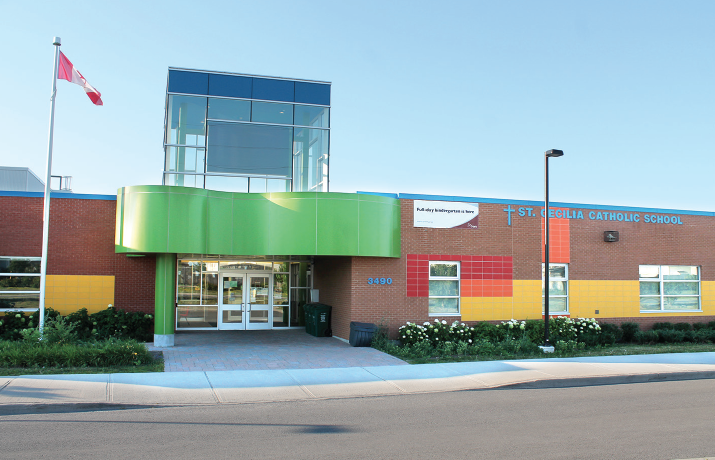
The front entrance of Ottawa’s St. Cecilia Elementary School, with its brightly coloured façade and curvilinear canopy, is designed to evoke excitement and anticipation. Soaring above the canopy, a glass tower symbolizes our love of learning and our motivation to bring “the Light of the World” into our school and community.
It is immediately apparent that this school design is based on new approaches to learning and innovation. The school is only three years old, having welcomed its first cohort of students in September 2013. According to Principal Andrea Green, “The design and concept of the school has architecture at the service of teaching and pedagogy. It lends itself to collaboration and the global competencies that are necessary for success in our ever-changing world.“
Visioning process
In 2010, the Ottawa Catholic School Board released its white paper, Towards 2020: Connecting with our students – A blueprint for change. The white paper included the following observation:
Today’s students are different from the students that our system was created to educate. The new digital learners are immersed in technology and they expect to use digital tools as part of their educational experience. Brain-based research provides evidence that today’s generation of students are “wired” differently than previous generations. Instructional strategies are evolving to reflect the needs of 21stcentury learners.
The Board was creating a digital ecosystem to reflect the changing global environment; it also happened to be planning to open a new elementary school. Board educators had a vision for a facility designed to enhance the acquisition of global competencies.
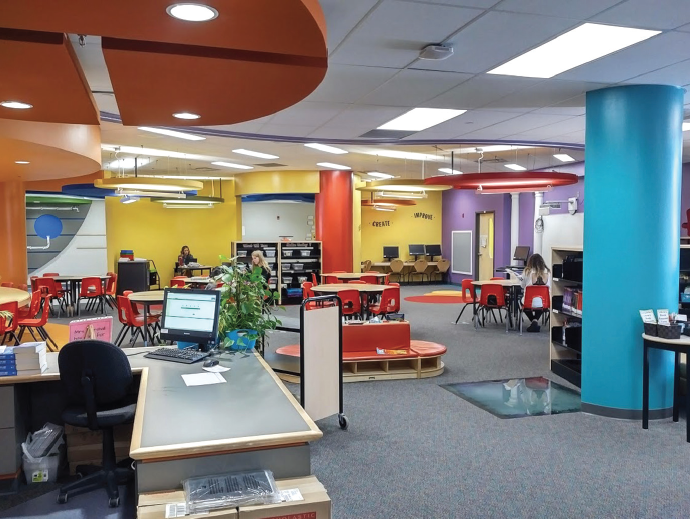
Before we could invite bids from architects, we needed to clarify our own vision and “wish list.” Board staff started the process: The design had to facilitate teaching and learning through collaboration and instructional differentiation. The design challenge was to create a model that would allow all spaces to be “places of learning.” (Today this concept has evolved into creating “agile” learning spaces.) Utilizing the talents and creativity of our own staff created opportunities for leadership and invited the risk taking necessary for innovation.
Design Committee
A Family of Schools Superintendent with responsibilities for Special Education and Student Services was assigned as the chair of the Elementary School Design Committee. The Superintendent of Planning and Facilities and the Superintendent of Learning Technologies were a resource to the committee.
In addition to the three superintendents, the committee included several elementary principals, and representation from Special Education, Learning Technology, Planning and Facilities, and Elementary Student Success, as well as teaching consultants representing Early Learning Services, Literacy and Numeracy.
The first email sent to the committee members stated, “Congratulations – you have won the lottery! And the prize is membership on the Elementary School Design Committee – to look at school design from a perspective of 21st century teaching and learning, leveraged by technology and student engagement.” Input was also solicited from student and parent focus groups and interviews with the principals from the last two elementary schools that had been opened in the previous five years.
The mandate for the committee was to:
- determine, describe and define new learning spaces based on a literature review
- recommend the educational tools and environment that connect with learning in the 21st century
- create and articulate the learning concepts and facility program to be incorporated in the new school design, down to the type of furniture to be purchased
The committee used the following as boundaries or challenges for new school design:
- Overall school space is determined by Ministry regulations where benchmark limits are established for the size and cost of the school based on the number of pupils to be accommodated.
- Any changes to total school space configuration must be made within the existing maximum square footage.
- New design may not result in cost above the benchmark funding allocation. Funding is pre-determined by Ministry formula.
- Blackboards are now replaced by interactive boards in new schools.
- Use of hallways as learning spaces must incorporate compliance with building codes to ensure access to exits.
- Additional electrical outlets in floors and walls are required to support increased use of technology in all new designs.
- Modular furniture that can be combined and recombined in a variety of modalities is required to facilitate instructional differentiation and flexibility in the structure of the classroom.
- The functionality and design of space must reflect the need for supervision and classroom management of children three to 12 years of age.
- Computer labs are no longer included in new designs as computers are now accessible for various groupings within classrooms.
- Sound amplification systems to enhance hearing and aid learning are to be available in each classroom.
Choosing and approving the school design
All recommendations from the committee went to the senior executive team, where the ideas were tested for compatibility with student engagement and learning outcome enhancement. The Associate Director of Education and the Director of Education were both very involved to ensure that pedagogy would drive the design of physical space.
Bryden Martel Architects Inc. (Ottawa) was awarded the contract for architectural services for the St. Cecilia facility, to be located in a growing suburb of Ottawa. The construction budget for the building was set at $8.4 million dollars, consistent with previous projects. The school was designed to accommodate 507 JK-6 pupils, with a footprint of approximately 50,000 sq. feet. The opening date was set for September 3, 2013.
The final design was supported and approved by the School Board of Trustees and by the Ministry of Education, who provided the funding for the new school.
Features of the school
Three years after the launch, a visitor to St. Cecilia will see students and staff engaged in inquiry learning, both inside and outside of the classroom.
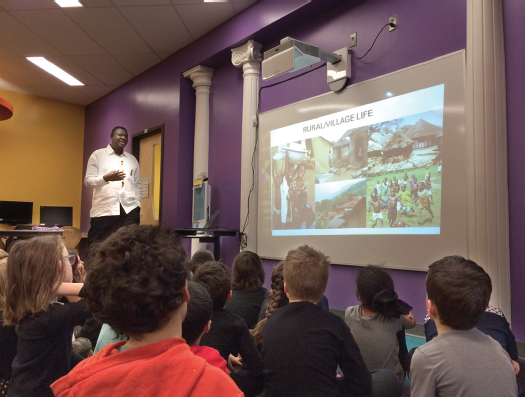
Learning Commons: The old library was turned on its head in favour of an open Learning Commons that combines traditional reading material with various technologies. While the school is generally rectilinear in form, the Learning Commons echoes the curvilinear shape of the entrance canopy. The contours in the plan are repeated in the patterning of the multi-layered ceiling to excite and delight the eye. The organic form of this space provides many areas for differentiated work. There are spaces for individual and group work as well as noisy and quiet activities. Instead of the staid world of the silent library, space is now intended for interactive, collegial and collaborative activities – including communicating and interacting with the outside world through technology.
It is not uncommon to find student “Tech Connectors” working at a Genius Bar in the Learning Commons (Tech Connectors are members of a student club who explore learning technologies and help students and staff use them; a Genius Bar is a tech support area where students and staff help each other). Others work on video projects at the green screen station, and others work with robotics in Maker Spaces. And of course, you will also find students reading high-interest books and reading on devices, taking advantage of comfortable seating in a coffee-shop atmosphere – and these students are in grades K-6!
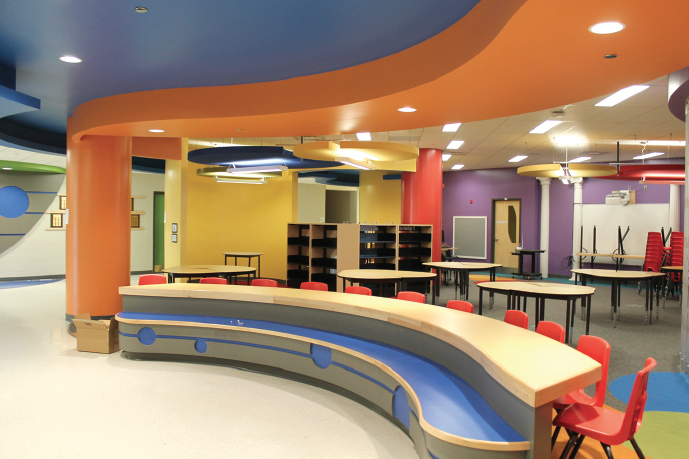
Caves and watering holes: An important contribution from student and staff input and from the literature review was the design of the school hallways. At St. Cecilia, every part of the building is intentionally designed as an opportunity for learning, not just the classroom space.
Hallways are differentiated by the use of colour and young students are adept at using colour for navigation as they move around the school. The hallways are designed with “caves and watering holes” – spaces built along the hallways where students can collaborate in small spaces or work independently. These spaces also include access to technology. Comfortable chairs, benches and tables allow for different types of learning activities.
Pods: At St. Cecilia, the classrooms are clustered in groups of three and open into a shared central pod area. These pods are extensions of the classrooms, where students from within a grade or across grades can work in collaborative groups. Supervision and observation of the pod is facilitated by large classroom windows overlooking the area. Each of the pod areas includes access to Chromebooks and iPads so that students can access technology whenever and wherever it is needed.
Principal Andrea Green explains, “Those students who work well in small groups or independently can work in the caves or in the pods. This benefits them and it also benefits the smaller number of students in the classroom, who have more direct support and supervision from the teacher.”
Building as teaching structure: Promoting the concept that learning occurs everywhere, not just in a classroom, the school building itself becomes a teaching opportunity. Exposed building systems and elements are intended to create an interactive “museum-like” feature that connects to the curriculum. Engagement is enhanced by the placement of over 20 QR codes throughout the school, explaining how the infrastructure and mechanical systems work. Examples include: a glass wall to showcase the colour-coded mechanical system, a glass-covered cut-out of a wall that shows how the under-floor terrain is constructed to support the floor, a glass-covered floor space to showcase the building foundation and column supports. A time capsule was placed by the students into the flooring at the time of construction. In other areas, drainage pipes from washrooms are displayed, as is the seismic reinforcement (for earthquake resistance). For budding architects and history buffs, classic Greek pillars are used to frame an area in the Learning Commons.
Environmental focus: The Ottawa Catholic School Board has been the top-performing school board in energy conservation in Ontario for the last three years. This focus on green energy and conservation is visible throughout the district and at St. Cecilia, where a student-led Environmental Club actively pursues conservation initiatives. Conservation, recycling and composting is thriving at St. Cecilia. The school is now at Gold level under the EcoSchool categorization.
At the outdoor classroom beside the Learning Commons, parent and community volunteers help to maintain vegetable and herb gardens on school property, while students learn about the natural environment through various components of the science curriculum.
The perimeter of the building is used to enhance energy conservation through the use of planted areas where snow is allowed to build up and insulate the facility.
Staff use the building and the curriculum to develop student responsibility for the environment and the “Care of God’s Creation.”
Connected community
Technology use at St. Cecilia is ubiquitous. The school has enterprise level WiFi and an interactive LCD projector in every class, along with iPads, Chromebooks, and other devices. Students also have the option to bring their own devices to school. As a connected community, the school and the teachers use social media channels including Twitter, class blogs, Google Sites and other platforms to share information with their community. Students share video projects produced in class and often use green screens located around the school. Students have their own radio show entitled “Bee Hive Live.”
The school is also used for a variety of community activities where children and adults benefit from the state-of-the art facilities.
To connect the life of the school with the community at large, a ten-foot LED monitor in the glass entrance tower displays all the good things that are happening at St. Cecilia, whether it’s a Pizza Day, celebration of Easter or the fundraising activities of students around social justice issues at home and abroad. Technology truly helps us communicate to the world our message of Peace and Love.
Design evolution
The Ontario Ministry of Education has funded two more new schools within our Board since opening St. Cecilia. St. Dominic opened in September 2015, and a third school, St. Benedict, will open in September 2016. The design of each new school benefits from the feedback of students and staff at predecessor schools. Under an Ontario Hydro initiative at St. Dominic, we were able to incorporate solar panels on the roof of the school. We sell the electricity they generate into the Ontario grid, thereby creating a revenue stream that goes back to classrooms across the district. Some of the other evolutionary changes include enhancements to the functionality of the Learning Commons, increased space for meeting rooms and administrative functions, and universal washrooms. To promote branding and community engagement, the facade and canopy are unique for each school.
Future directions
St. Cecilia’s is not a “one of a kind” dream school with unlimited funding; rather we used pedagogy to lead and drive our vision and design. Our thinking, our planning and ultimately the innovation created, were all incorporated using the same budget and the same overall school size as any of our traditional schools.
In September, 2018, we will open another elementary school in the area of Kanata. Our new school Design Committee is once again active as we look at how we can incorporate the principals of deep learning in our next elementary school. We will continue to review the literature, visit other sites, and consult our own staff as we collaborate and innovate to design the best learning environment possible for our students and staff.
En Bref: Cet article décrit comment le personnel d’un conseil scolaire a, par la consultation et la recherche, concrétisé une vision de nouveaux espaces d’apprentissage. Le résultat impressionne – une école conçue pour inspirer la collaboration et l’innovation, en reprenant la même superficie et le même budget que les écoles précédentes.
Chaque partie du bâtiment de l’école élémentaire St. Cecilia a été intentionnellement conçue pour offrir l’occasion d’apprendre. Les corridors comportent des alcôves et des postes d’apprentissage dotés d’outils technologiques et de mobilier polyvalent. Des systèmes et éléments de construction exposés visent à créer un contexte interactif s’assimilant à un musée qui s’intègre au curriculum. Une salle de classe extérieure favorise l’apprentissage dans un environnement naturel.
Photos: courtesy the Ottawa Catholic School Board
First published in Education Canada, September 2016
-
Building Capacity
Comments Off on Building CapacityIt was difficult for Mehley Macdonald to keep her feelings to herself during her first visit to the Seven Stones Community School construction site. Although it would be months before the new building, located in North Central Regina, would be completed, Mehley and her new colleagues were already excited by the sense of possibility that was emerging right before their eyes.
Even today, a year and a half later, there is a catch in her voice as Mehley remembers when everyone donned hard hats and walked into what would become her shared Kindergarten space.
The first thing I saw were the windows,” she recalls. “They were just so big and beautiful. It was difficult for me not to start tearing up.
But this was much more than an emotional reaction to an aesthetic feature of her new classroom. The natural world is an essential learning element in Mehley’s teaching practice. While some may wonder whether large windows might become a source of distraction, she knows that increased connection between inside and outside will result in deeper learning for her students.
She also knows that research supports her belief that the presence of natural light can calm the learning climate. In her previous schools, windows had either been very small – and sometimes barred – or covered with clouded plexiglass. The realization that, at Seven Stones, her students would be able to have continual access to the outside environment was like a dream come true.
Mehley Macdonald’s reaction would certainly not be lost on Randall Fielding, Founding Chairman of Fielding Nair International (FNI), the architectural firm responsible for the design of Seven Stones Community School. Fielding’s passion for creating spaces that resonate deeply with both personalized and community-based learning is firmly rooted in memories of his own early days at school: “Kindergarten was really hard for me. I was used to spending a lot of time outside with dogs and trees—that was my curriculum.” Fielding cringes a little as he speaks to an audience of design thinkers at the 2010 Cusp Conference. “And all of a sudden I was in an environment where I was inside all day long and someone was telling me what to do every minute.”
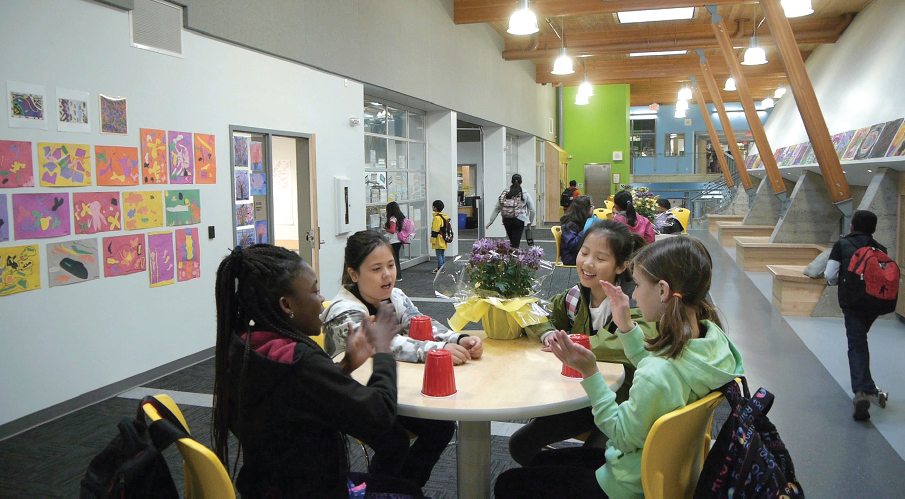
It was Fielding’s desire to change the school experience for future generations right around the world that eventually led him to partner with visionary architect Prakash Nair. Their radical rethink of the way new schools are planned and built has given us a whole new language of school design for the 21st Century. Each of the close to thirty “Design Patterns” that make up the FNI lexicon offers a unique way of bringing a particular, research-based learning idea to life. Most FNI designs have very recognizable features: flexible learning spaces of different shapes and sizes; plenty of glass providing visual access to the outdoor environment, and to other learning spaces; large common areas creating important gathering places for staff, students and the larger community. But they are not “all the same.” An extensive consultation process preceding each build ensures that each school will be uniquely tied to the educational vision and goals held by a particular community.
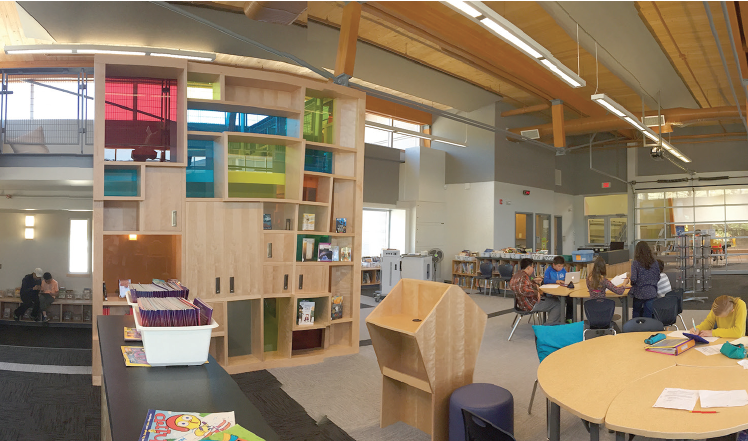
Consultation before design
In fact, it is the depth and breadth of these initial consultations that form an important pillar in building consensus, excitement and commitment for each new project. As educators, parents and community members come together to share their hopes and dreams of what they want for their children in terms of learning, well-being, and connection with the world beyond school, the seeds of building the capacity necessary to bring those visions to life are actually planted.
Karen Shannon is Superintendent of School Effectiveness for the Algonquin and Lakeshore Catholic District School Board. Her school district is just over a year away from opening St. Francis of Assisi Catholic School in Kingston, Ont., the first FNI build in Ontario. Several years ago, her District worked with FNI to develop a broad 21st century learning vision for all schools. Shannon recalls that getting agreement on a higher-level, aspirational vision was an important part of getting community support for rethinking the way the District’s physical learning spaces were designed and constituted.
“That vision of what we want for our kids resonates so well with everyone that it takes away the first and biggest cornerstone of resistance, because everyone wants higher levels of engagement, higher levels of achievement and better outcomes for students in these communities. This is something that we’re committed to achieving in all of our schools, but the St. Francis of Assisi project allowed us to take what we know and imagine how research and practice could come together to create something brand new.” And this is what lies at the heart of these new school designs. It’s no longer about creating a structure in relative isolation, hoping that teachers and students will be able to function effectively within it. Instead, the goal is to use current research to identify the specific teaching and learning practices that will support the highest aspirations we have for our children, and build a school that has the capacity to enable those practices.
Rosa Fazio speaks about it in terms of a connection between head and heart. As principal of Norma Rose Point School in Vancouver, one of four FNI-designed schools in the region, she is clear about what drives her passion for their new school.
“We don’t exist because of the building,” insists Fazio. “We exist because we believe in what research is telling us about what learners need today.”
Although Fazio was not part of the initial FNI consultations, it didn’t take her long to understand how this new building connected with her own values and beliefs, as well as the strong research base that enabled her to achieve the support of her parent community.
Designed for collaboration
The first and most fundamental Design Pattern in most FNI schools has to do with the way that learning spaces are constituted. Traditional classrooms of similar, if not identical, size are replaced with learning studios, each with different shapes and dimensions. Instead of emptying onto long narrow hallways, each group of three or four studios is part of a learning suite, and centred around a larger common area. Completing each learning suite is a collaborative meeting space for staff and one or more smaller rooms that can be used for private meetings and work with individual students.
The ability to close off individual learning studios, or open up the entire suite, enables a set of practices and opportunities that just don’t exist in traditional buildings. For many, the most compelling possibility exists in the ability to divide a rather large school population into Smaller Learning Communities of 75-100 students, three to four teachers and a number of support staff. No longer is a group of students assigned to one teacher for the entire year. Instead, all students in the community have access to the strengths, talents and interests of all of the adults in the community. In the same way, teachers get a chance to support the learning with all of the students in their community.
At Norma Rose Point, Fazio’s commitment to a sense of home is supported by the creation of several houses in groupings of one or two grade levels. Each Smaller Learning Community is comprised of about 70 students, and provides the main context for their learning work throughout the year.
The establishment of Smaller Learning Communities has not only opened up the space for collaboration among staff, but it allows for the school’s motto, “Learners at the Centre,” to come to life in some very powerful ways. Norma Rose Point teacher Karen Noel-Bentley says this re-imagined space has led teachers to change the way teaching and learning is organized. “In using the space as shared space and the rooms as breakout rooms, the students have a lot of choice not only about how they work, but where they work.”
Karen goes on to explain that, in many cases, they’re giving students a choice of which room to work in and which teacher to work with. Although challenging for some students and teachers, the goal is to underline the different types of relationships that are possible as the result of the design. No longer is this “my classroom” and “my teacher” – these are all shared resources distributed across their Learning Community.
A commitment to collaborative practices – co-planning and co-teaching – has become part of the narrative in many schools, districts and divisions across the country. In an FNI-designed school, collaboration is not just a talking point, but the foundation of everything else that occurs in the space: the inquiry-based learning, the increase in engaging project work, the development of trusting relationships among students and teachers. Yet administrators and educators understand that, despite best efforts and intentions, it is often too easy to return to a sense of isolated practice if not privacy – a default setting in many school cultures.
At Seven Stones Community School, principal Jay Fladager recognized how important it was to build the collaborative structures and dispositions among his staff in the year prior to moving into their new space. “We moved all the teacher desks into a separate room and made a collaborative space, and so built into their timetable every day was the opportunity to collaborate with each other, align their practices together, and try to reflect together on how they were trying to engage students in a different way.”
This re-imagined space has led teachers to change the way teaching and learning is organized… No longer is this “my classroom” and “my teacher.”
At Norma Rose Point, Rosa Fazio acknowledges that the amount of collaboration required by this type of design pushes many out of their comfort zone. Simply moving into what may, on the outside, seem like the “school of their dreams” does not guarantee smooth sailing every day. Her role, she says, is to provide extraordinary levels of support for her committed, passionate staff who’ve been thrown into the deep end. “Teachers want administrators to part the waters to enable them to do the job they can do.”
Teacher Suzie Polzin is honest in admitting that, although spaces like those at Norma Rose Point definitely open up possibilities and even solutions, there are newly revealed complexities that begin to emerge. One of the biggest is the sense of vulnerability that is created when personal practices suddenly become “open to the public.”
“It’s pretty easy to do what we want when we’re in our own little boxed room. But that doesn’t happen here… it can’t happen here.” She believes the key to addressing the complexities lies in the team dynamic and how much of a gap exists between where team members are on the continuum of practice. If there’s too much of a gap, then that vulnerability may become too threatening to make it work.
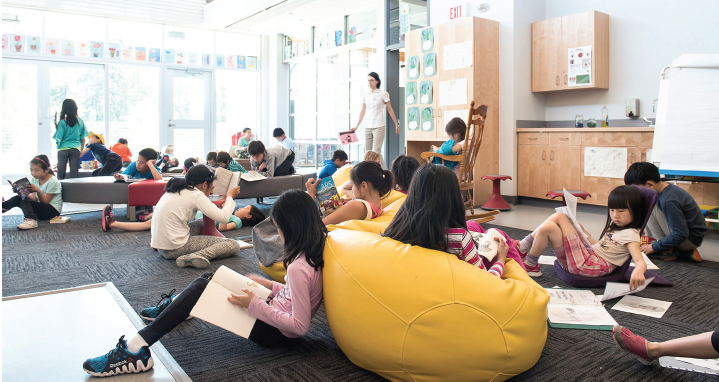
Flexible seating and lots of natural light are common features of new school design.It’s a journey that superintendent Karen Shannon knows doesn’t end once people move into the new building. She is very aware that the real work will begin once staff and students finally arrive in their space. Aspirations and vision aside, Shannon recognizes that people are dealing with important questions about the new ways in which they will be asked to work and that the long-term work will be “moving through those difficult aspects of cultural change.”
Building community
While the Smaller Learning Community is essential to the new language of school design and receives much of the commentary, both positive and critical, there are other practices and possibilities enabled in these spaces. At Norma Rose Point, a commitment to a culture of caring and belonging is deepened by the ability of staff and students to move more freely around the building, expanding the network of relationships normally experienced in a more traditional setting. Open learning spaces, plenty of windows and a large entry space offer a new way of “seeing” and, while it may challenge the need of some for privacy, it also makes things visible in a way that instils a sense of shared responsibility.
At Seven Stones, the idea of community is so important that it is built into the name of the school. Jay Fladager recalls the initial community consultation around the new build. Ninety-five percent of the school’s population is Indigenous and those first conversations with the parents were steeped in a sense that school needed to be a different experience for their children than it was for them. The importance of rebuilding trust between the school and its parents was clear; there was also a strong call to expand the traditional edges of the school, making it a place that was open for more than just a few hours a day. The vision was for an inter-agency community hub – a place in which the entire community could find a place, contribute and take pride.
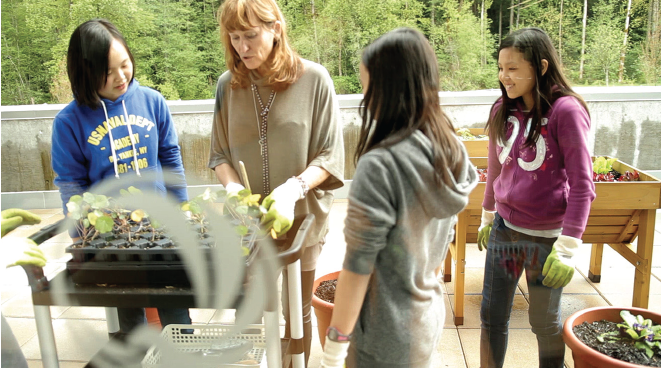
Gardening at Norma Rose Point School. Well-designed outdoor areas offer learning, play and gathering spaces.As a result, the Seven Stones Community School has become a vibrant site for community involvement and engagement. Indigenous culture and history are not simply add-ons but have inspired a set of practices that are embedded into the daily life of the school. The space is an important part of that vision.
“There isn’t a day goes by that doesn’t have a different community engagement, family engagement or agency engagement,” explains Fladager. “Something is happening in this building all the time.”
For a significant and growing number of enthusiastic educators, the higher levels of engagement resulting from collaborative practices, personalized learning and inquiry-based approaches are exciting and resonate with their own beliefs about student success. At the same time, the barriers that are encountered when new pedagogies bump up against traditional school structures can be both frustrating and disappointing. The new school builds and renovations led by organizations like Fielding Nair International, however,¢
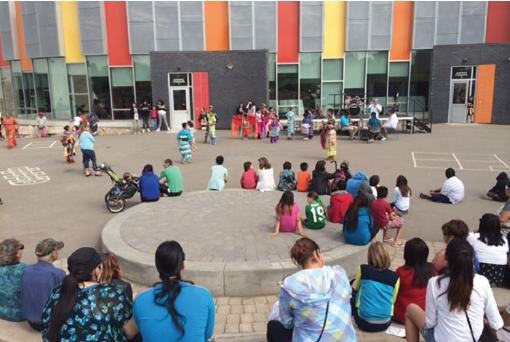
Tiered steps at Seven Stones Community School invite outdoor gatherings and performances.Mehley Macdonald says that coming to Seven Stones Community School in Regina has made it easier for her to get back to what she really believes about learning. That’s a powerful statement, but not nearly as poignant as the thought that went through her mind when she and her colleagues first met in the large, light-filled gathering space that spans the entire length of the school:
I was just so thankful that the children would see that they were worthy of something this beautiful.
En Bref: Les obstacles qui surviennent lorsque de nouvelles pédagogies se heurtent à des structures scolaires traditionnelles peuvent engendrer tant la frustration que la déception. Mais de nouvelles constructions et rénovations d’école comme celles qui sont orchestrées par le cabinet d’architectes Fielding Nair International peuvent rehausser la capacité de nos structures physiques d’héberger adéquatement de nouvelles visions d’éducation et de permettre aux éducateurs d’enseigner selon leurs aspirations. Il ne s’agit plus de créer une structure de façon relativement isolée, en espérant que les enseignants et les élèves pourront y fonctionner efficacement. L’objectif consiste plutôt à utiliser les dernières recherches pour cerner les pratiques spécifiques d’enseignement et d’apprentissage qui appuieront nos aspirations les plus élevées pour nos enfants et pour construire une école dotée de la capacité d’appliquer ces pratiques.
Photos: courtesy of Norma Rose Point School, Fielding Nair International, and Seven Stones Community School.
First published in Education Canada, September 2016
-
The Story Behind the Numbers
Comments Off on The Story Behind the NumbersAcross the developed world, there’s one seemingly intractable problem plaguing education, a problem that seems immune to the vast sums of money we continue to throw at it: I’m talking of course about attainment gap.
The issue needs no definition in this publication, or any other read by education practitioners, policymakers, researchers and commentators, but we’ll restate the case one more time. You know it’s on the collective mind of the education world when Google predicts your request before you’ve typed the first word: “attainment gap refers to the observed, persistent disparity of educational measures between the performance of groups of students, especially groups defined by socioeconomic status (SES), race/ethnicity and gender.”
It’s long been my contention – and the reason for the existence of my education consultancy firm – that our western education systems, in very broad strokes, can be said to be somewhat like western medicine: we’re great at surgery, not so much at preventive nutrition. We continue to favour the ambulance at the bottom of the cliff. We treat symptoms, rather than investigate causes.
In this article, I want to posit an idea that’s the bedrock on which my team and I stand, in all our work with schools across Europe: the assiduous collection and effective use of “soft data” is the first step in addressing the myriad factors behind attainment gap. This data invariably tells us one thing in sum: there are as many reasons for the failure to realize learning potential as there are students, but there is always something personal behind the wall of numbers. Armed with this knowledge, every school, no matter where its students fall on the socio-economic spectrum, can work with families to plug the cracks.
There are surely no longer any education leaders who would deny the importance of student wellness to achievement potential. There is of course still that die-hard group that, while grudgingly acknowledging that learning preparedness is indeed hobbled by matters beyond the school gate, insists that wellness is beyond the scope of schooling. In my experience, this is often a political or even generational argument, and is a wider debate than we can get into here. I would argue though that we should be coming at the issue from another angle: how can schools best use the time and resources they do have to give all students the best chance at an equal footing with their more privileged – economically or otherwise – peers?
Community before learning
Nathan Atkinson of Richmond Hill School stands out for me as one of the most innovative and inspiring principals I’ve had the privilege of working with. He is, I believe, a pioneer in community engagement. Richmond Hill serves a community of acute deprivation in the northern U.K. city of Leeds. Starting with the picture revealed by soft data on things like attitude, engagement and self-esteem – the “other stuff” beyond the achievement numbers – Atkinson and his team identified a number of barriers to learning shaped by life outside school.
Soft data tells the same story wherever it’s collected: simply prescribing extra tutoring for the learner who’s falling through the cracks achieves exactly zero when school is the least of their problems. Atkinson formed the view that, given a school’s responsibility for academic outcomes, doing everything the school can to support families is the only way forward.
Research revealed that many of Atkinson’s students were arriving at school undernourished, mainly due to poverty and unconscious neglect. It’s intuitively obvious that empty stomachs mean listless and disengaged learners. Armed with this knowledge, forcing hungry children into yet more schoolwork in an effort to help them catch up seems at best like wilful blindness.
Atkinson’s solution took into account the likelihood that to lecture parents on their failings amounted to no more than “poverty shaming.” Instead he used food as a means of fostering closer connections. He converted an unused area of the school into a “pay as you feel” café, built to the high standard of any other. In partnership with supermarkets, caterers, and wholesalers, who were more than happy to divert the huge quantities of edible and potable waste that would normally go to landfills, the café became a hub where parents, students, families and teachers could mingle. A food shop has been also been set up, and the option to pay ensures that the loss of dignity associated with accepting charity is alleviated.
The simple medium of coming together around food and sharing has had many positive effects. Parents chat with teachers over a coffee, they ask for help, they share their worries as well as their laughter. In many cases, these parents, because their own experience of school was less than positive, are suspicious of the education establishment. A coffee and a muffin can start to replace mistrust with the recognition of common humanity.
Focus on the individual
An article I wrote some time ago for The Guardian newspaper is an example of how heart, rather than head, is required for a nuanced and individualized response to attainment gap.
I told the story of a British school that bought a student a bicycle because he was struggling in maths. I received more than one response proudly informing me that their school had faithfully applied this winning solution, and bought 20 bikes. This is profoundly missing a point that I believe is essential to forming effective attainment gap strategy: a specific soft data problem requires a specific intervention.
Rather than simply throwing remedial tutoring at the struggling student, the school in my article made the choice to investigate. It turned out that the student was consistently late to the first lesson of the day: Mathematics. Rather than imposing a penalty, the school asked why. The student turned out to be largely responsible for the care of two young siblings; unsurprisingly, this young person missed his bus more often than not.
There is always something personal behind the wall of numbers… Your weapon of choice should be the metaphorical laser, not the shotgun.
The school understood that there are two things essential to the heartbreakingly common cause of the young caregiver: rest and self-esteem. Insisting that the overburdened student give his breaks to extra tuition would take away perhaps the only downtime he got during the day, not to mention further restricting his opportunity for social interaction – which no-one would begrudge a young person shouldering responsibilities most of us don’t need to worry about till we’re ready for them.
The school spoke to the student, his parents, and his social worker, and made no assumptions about a “proper” response to this child’s life situation.
Both the money and the bike are beside the point. What made a difference in this case was a school that was prepared to look beyond an if/then solution, and inquire into the nuance of this student’s daily reality. The results were borne out in improved achievement. Your weapon of choice should be the metaphorical laser, not the shotgun.
A formula for individuality?
It may seem as though I’m contradicting my previous assertion, but my team and I have a five-step formula, applicable to any school or collaborative group of schools, that can make a serious dent in the most stubborn attainment gap. These five tenets are:
- Start with the early years and catch the gap before it sets in.
- Make sure the school is trained and equipped to carry out detailed, nuanced assessments that accurately identify inhibiting issues.
- Ensure teaching staff are trained to deliver consistently outstanding personalized learning through differentiated learning and adapted curriculum.
- At every strata of the school, ensure that soft data is captured, tracked and demonstrated – from individual students to interventions to whole-school data.
- Finally, and this is the kicker, encourage and support lead teachers to reach out to their parents and help their school evolve into an organization that engages consistently with those hard-to-reach parents: this is where aspiration is lifted.
My team and I experience our greatest challenges in delivering the fifth principle above. Yet for me, this is the heart of the process we try to take schools through. This fifth step is the one that spurs parents and teachers alike to expect and encourage higher aspiration. For some schools, this represents a brave new frontier: it can be seen as wasteful for lead teachers to engage directly with parents beyond what might be considered normal, because they don’t see that such would make any difference to the school’s achievement data. I strongly believe that we need to think again. I contend that there is in fact a direct link between community aspiration and achievement. And when we foster preparedness for learning, whether it’s by facing up to malnourishment at school or crafting an individual response to an individual problem, nothing can be achieved without the support of the community.
Schools must, in my view, understand that their role is never ring-fenced or neatly and inflexibly defined – not, at any rate, if they wish to get beyond the cycle of ever-increasing academic intervention and subsequent head-scratching over results that won’t move in the right direction.
En Bref : L’écart de performance – la différence persistante entre les résultats scolaires des groupes d’élèves relativement privilégiés et défavorisés – semble constituer un problème insoluble en éducation. Dans cet article, l’auteur demande comment les écoles peuvent le mieux utiliser leur temps et leurs ressources pour donner à tous les élèves les meilleures chances d’être sur un pied d’égalité avec leurs pairs plus privilégiés sur les plans économiques et autres. Plutôt que d’appliquer la solution par défaut d’accroître le tutorat des élèves en difficulté, il soutient qu’il faut recueillir des données intangibles pour découvrir les histoires personnelles expliquant les faibles performances et qu’une solution nuancée, individualisée, peut abattre certains des obstacles à l’apprentissage de ces élèves. Citant quelques exemples tirés d’écoles du Royaume-Uni, il démontre que tendre la main à ces élèves et à leurs familles et les impliquer dans la recherche de solutions rehaussent les résultats scolaires et améliorent le bien-être des élèves.
Photo: istock
First published in Education Canada, June 2016
-
A Different Kind of Choice
Comments Off on A Different Kind of ChoiceWyatt sat uncomfortably in his chair, squirming as I looked over his transcript and file. Five different grade schools, two middle schools, not back to back. “What happened in the intervening year?” I thought, but deeper down, I understood. I’d seen it all too often before.
For over five years, I worked as a therapist in private practice, leaving my home office to my employees three days each week as I travelled to five separate First Nations. On the days I hadn’t scheduled myself to work in the community health centres, I would arrive at the local school, just as the tired students were filing in for another day of classes.
First, I would speak with the principal or office personnel and lay out the slate of clients I was to see that day. Frequently I would be told, “Oh, she’s not here anymore; they’ve moved to the city. John is back again, though. Things didn’t work out so well down in Toronto.”
The movement of many families from First Nations to the cities and back again is well documented. Some theorists point to the effort to find meaningful employment as the motivation for these transitions, but in my experience, many parents are also seeking to provide a strong education for their children. It’s a different kind of school choice that leads families from First Nations to move to the city in order to enrol in public provincial schools.
After moving from private practice into a public school setting, I continued to see these students. The difference was that I now encountered them as they entered public high school. I looked again at Wyatt’s file. One… two… we were the third high school that he had attended, including the one back in his home community. He had credits at the Grade 9, 10, and 11 levels, but he hadn’t fully completed the core courses in any one of these grades.
“How was it, going to school in the city?” I asked.
“Okay,” he said. He didn’t need to say more. The tone of his voice told it all. Like a fish pulled from the water, First Nations students who arrive in provincial schools from rural communities find themselves surrounded by a culture and educative process that feels unfamiliar, foreign and even threatening. To a lesser extent, but still in a very real sense, those whose families have lived away from their home communities for generations still sense this disconnection. Schools incorporate token nods to Indigenous content, but they seem to be unaware that, to those coming from Indigenous communities, this is very different from the local traditions.
Furthermore, some federally operated schools on reserves may stand decade after decade as counter-cultural institutions, chronically failing to acquire any affinity with the community around them. To be fair to those working in these schools, it should also be noted that, in many communities, acquiring an education from governmental schools is seen as “selling out,” and the pressure not to succeed can be great. At times it is this very dynamic that compels families to make the choice to move to cities and towns, where they sense a greater freedom to achieve.
“I think you’ll find things different here,” I said. Wyatt looked around my office, his eyes fixing briefly on the painting of an eagle soaring over sunlit clouds and then on the traditional cedar bough hanging above the door. His shoulders relaxed, but just a little.
It wasn’t until the bell rang that Wyatt’s eyes began to show a glint, a sparkle of hope. We hadn’t finished crafting his schedule, but one by one First Nations students began to fill my small office. They all knew that they didn’t need to knock – this was their space.
“Hey, are you the new guy from up north?” asked Tyrell.
“That’s my home community where you’re from,” Talia joined in. “But I haven’t been there since I was a baby.”
Wyatt looked at me questioningly. “Can’t keep a secret around here,” I smiled back at him.
“Wyatt, right?” Tyrell continued. “Hey, you want to come with us to the caff? I’ll show you around.”
Wyatt looked again at me. “Go ahead; I’ll be here when you get back.”
Choices weighed in the balance
Parents considering the move from their First Nation are confronted with the dilemma of weighing the benefits and trade-offs of such a move. To stay in the community will ensure a connection to the local culture, to family and to traditional values. In traditional cultures, success is defined in much broader terms than mere economic security and advancement, in that individuals are only considered to be successful when they take their places well in the circles of community and creation.
On the other hand, federal schools are, in most cases, funded far below the per capita allotments seen in off-reserve schools. School facilities are often not as desirable, a large percentage of teachers do not remain for extended periods of time, and most who are parachuted in from elsewhere bring with them an unfamiliarity with the local culture and a promotion of value systems based in non-Indigenous thought.
Those who leave, however, are not just moving away from that which they perceive to be negative; they are also attracted by certain aspects of off-reserve schooling. Students at provincial schools frequently demonstrate stronger academic achievement and better preparation for post-secondary education. Furthermore, school facilities, in many cases, demonstrate state-of-the-art innovations and technology.
In leaving, parents are aware that their children will be losing intimate contact with their home communities. Other costs are not as immediately obvious. The often-hidden realities of education off-reserve include subtle alienation, which is felt by students who don’t see themselves or their Indigenous heritage reflected in the curriculum, in the teaching staff or in the school’s physical environment. This marginalization inevitably creates a sense of isolation and disconnection that is only heightened by instances of overt racism. When families choose to access the benefits of provincial schools by sending their children to be billeted or to live with relatives, while they themselves remain in the home community, an even greater sense of isolation ensues.
Clearly, parents seek the best for their children, but the trade-offs are real, and many of the negative factors are unforeseen. At the same time, it is within the power of provincial educators to mitigate and even eliminate the factors that cause marginalization.
Countering the ghettoization of Indigenous philosophies
In June 2015, the Council of Ministers of Education, Canada (CMEC) convened a symposium in Yellowknife, NT, inviting delegates from across Canada. The concern being addressed was simple: How do the Indigenous peoples of Canada gain equitable employment as teachers in the classrooms of the nation? In Manitoba, for example, 17 percent of the population identifies as Indigenous,1 while only 10 percent of the teachers in the province do so.2 Furthermore, those teachers who are Indigenous typically gravitate to specific communities, leaving others with an even greater disproportion in representation.
Delegates to the CMEC conference sought to address the central issues, but repeatedly they were confronted with the inescapable fact that education in Canada does not reflect Indigenous values, mores and beliefs.3 Indigenous students feel alienated from the educative process. This more pressing reality underlies the reluctance of Indigenous students to enter careers in education.
Near the close of the conference, working groups were tasked with addressing one of eight key questions focused on bringing more credentialed Indigenous teachers into the system. However, of the eight working groups, fully three returned to report that their primary suggestion would, instead, confront the greater challenge of the ghettoization of Indigenous philosophies and perspectives in the public schools themselves. These three sub-committees each, in turn, made the recommendation that, across all jurisdictions in Canada, a requirement be set in place whereby completion of a minimum of one credit in Indigenous studies would be required for graduation from secondary school, regardless of school or program specializations. Thus, without exception, students graduating from high school in Canada would have some background in Indigenous thought and culture. Thus dual-diploma and technical education programs (i.e. those offering the standard diploma coupled with a second diploma in specialties such as business or the trades), university preparatory programs, and even secondary programs as diverse as those serving Hutterite colonies would all require exposure to Indigenous philosophy and thought.
Informing this recommendation, which was later affirmed by the conference as a whole, is the understanding that Indigenous thought (diverse as it is in its manifestations and nuances) is beneficial to all learners. Moreover, it was noted that simplifying Indigenous philosophical perspectives for sporadic integration into pre-existent course content creates the impression that Indigenous understandings of the world are substandard, crude and unsophisticated – none of which is accurate.
Conference delegates noted that students in the Northwest Territories are already required to complete such a credit before graduating (Northern Studies 10) and those in British Columbia are able to take an English Language Arts course with Indigenous focus at any grade level from 9 through 12. In Manitoba, students are able to select option courses such as The Consequences and Triumphs of Indigenous Philosophy and Current Topics in First Nations, Métis and Inuit Studies.
For the recommendations of the conference to take effect, each jurisdiction would be required to bring forth legislation, changing the graduation requirements. Whether or not this transpires remains to be seen, but the underlying concern should not be dismissed: Indigenous perspectives are, at best, marginalized in public schools and are often absent entirely from the curricula of specialized, secondary schooling. This leaves non-Indigenous students uninformed and intellectually impoverished and Indigenous students feeling alienated from the educative process.
What’s wrong with the status quo?
“Not again.” The teacher in the corner of the staff room was looking over the agenda for our upcoming professional development day and obviously did not notice that I had entered the room. “Why do we always have to talk about Aboriginal education, as if they are the only special interest group? Why not Dutch education or Filipino education?”
That question is not uncommon, though perhaps it is not commonly voiced so insensitively. Furthermore, it can and ought to be answered on a number of levels. First, it should be noted that the treaties of Canada provide for the education of First Nations students, and this has implications for the educative process wherever Indigenous students attend for schooling. The graduation rate for Indigenous students is significantly lower than that of others, often hovering just above 50 percent. One of the most significant reasons for this is the alienation and marginalization Indigenous students feel in Canadian schools. As long ago as 2003, Schissel and Wortherspoon conducted groundbreaking research that found that Indigenous students perform best when immersed in curricular programming that thoroughly reflects Indigenous thought and worldviews. Perhaps counterintuitively, the second-best performance for Indigenous students was found when no attempt at all was made to integrate Indigenous perspectives into the curriculum. The least conducive environment for Indigenous students was that where a sprinkling approach was taken with regard to the inclusion of Indigenous perspectives. Although there may be numerous factors that bring about this dynamic, one of the most plausible explanations would be that students in this third group are experiencing Indigenous content as that which is the other, or worse yet, that which is inferior.4 As a result, they are estranged from the institutions that are ostensibly attempting to promote their success.
A second response to the question of why Canadian educators should feel compelled to incorporate and value Indigenous worldviews in curricula has to do with an ethical obligation. This can best be stated in light of history. The displacement of Indigenous peoples in Canada transpired through the dynamics of interaction between sovereign entities. As such, the sovereign rights of Indigenous people were not extinguished by military subjugation. By contrast, immigrants to Canada come to our shores knowing that, among the many changes that they will encounter, is the need to accommodate Canadian forms of pedagogy. This is a choice that they willingly make; whereas Indigenous peoples never were given that option. Instead, the current pedagogical system has been forcibly imposed over the course of history with devastating consequences.
The third reply to questions concerning the need for Indigenous education in Canadian schools is simply the enrichment that exists when Indigenous thought and worldviews are embraced. While Indigenous philosophy around the world does manifest unique aspects from one location to another, there is a striking commonality to Indigenous thought whether it is in Northeast India, Japan, Zambia or Western Canada. Although anthropologists have been baffled by these undeniable commonalities of thought in populations around the globe that had little if any contact with one another, Indigenous people can easily provide the answer. Regardless of where one may live, common teachers among the four-footed, the finned and the winged races can teach us about the world, what exists, how things work and how we should be in the world. These lessons inform all Indigenous wisdom and understanding. Therefore, an education that includes the perspectives of, for example, the Cree of Saskatchewan will, to some degree or another, also reflect the wisdom of the Ainu of Japan, the Nenets of Russia and other Indigenous people of the world.
At present, the Canadian educational landscape demonstrates an all-too-frequent marginalization of Indigenous worldviews. Students opting into specialized schools through “schools of choice” policies quite often leave any vestige of Indigenous philosophy behind. At the same time, students from Inuit, First Nations and Métis territories who relocate in order to attend provincial and territorial schools also frequently encounter a dearth of authentic Indigenous content.
Only when a conscious effort is made to embrace and value Indigenous thought on an equal footing with those worldviews and perspectives that have their genesis in Europe do Indigenous students perform at rates on par with others. In speaking of the Waadookodaading School in Hayward, Wisconsin, Dr. Anton Treuer points out that this Anishinaabemowin immersion school consistently outperforms other schools on state standards exams, which are taken in English. Waadookodaading School has a student population that is over 95 percent Ojibwe, employs Indigenous teachers and incorporates traditional Anishinaabe understandings of the world in the educative process.
The challenge for educators in Canada is to bring this degree of success into both the mainstream of our educational institutions and the disparate corners created by schools of choice policies. This will occur only when we incorporate and thoroughly value Indigenous philosophy and perspectives. I would like to say that Wyatt found this inclusive curricula in the school where I was on staff. Perhaps he did, on some days and in some classes. The reality, however, is that this school was struggling to adjust its pedagogical practice in the same way that most are across the nation. For Wyatt, it was the support of caring instructors and the friendship of fellow students that helped him to navigate his three years with us and to graduate with honours.
En Bref : Chaque année, un grand nombre de familles autochtones optent de quitter leurs collectivités pour profiter des avantages des écoles publiques provinciales établies dans des villes et villages. Bien que les nouvelles écoles choisies par ces élèves transplantés puissent comporter des avantages d’ordre scolaire, il y a aussi lieu de tenir compte des compromis qui sont faits. La richesse de la philosophie et de la pensée autochtones est, dans une large mesure, marginalisée dans les écoles publiques, de sorte que les élèves autochtones se sentent souvent déconnectés de l’école et les autres élèves sont privés de perspectives élargies qui pourraient enrichir leur expérience éducative. D’ores et déjà, il revient aux établissements d’enseignement canadiens d’apporter les importants correctifs nécessaires pour corriger cette dynamique et établir ainsi l’équilibre que méritent tous les élèves canadiens.
Original Photo: courtesy National Reading Campaign
First published in Education Canada, June 2016
1 “National Aboriginal Populations,” Employment and Social Development Canada. http://well-being.esdc.gc.ca/misme-iowb/.3ndic.1t.4r@-eng.jsp?iid=36
2 Aboriginal Education Directorate, “Aboriginal Teachers Questionnaire Report, 2009” (Winnipeg, MB: Manitoba Education, Citizenship and Youth).www.edu.gov.mb.ca/aed/publications/pdf/teachers_questionnaire09.pdf.
3 J. Tim Goddard and Rosemary Y. Foster, “Adapting to Diversity: Where cultures collide – Education issues in Northern Alberta,” Canadian Journal of Education 27 (2002): 9.
4 Bernard Schissel and Terry Wotherspoon, The Legacy of School for Aboriginal People: Education, oppression and emancipation (Toronto: Oxford University Press, 2003), 92-95.
-
Science Learning With and In Communities
Comments Off on Science Learning With and In CommunitiesPhoto Caption: This Grade 12 student (middle) was able, through the Brock University Science Mentorship Program, to work with Professor Craig Tokuno (left) on his research into the neurophysiological and biomechanical control of human movement.
I never teach my pupils; I only attempt to provide the conditions in which they can learn.
–Albert Einstein
Most would agree that students need to become more scientifically literate. However, science-literate students are not necessarily equipped to confront the complex societal issues that they will encounter as citizens. Students require knowledge, skills, and dispositions that enable them to critically and responsibly deal with an increasingly scientific and technological society. One way forward is to engage students in authentic, relevant and meaningful learning activities nested in their communities. This important educational innovation can help students become more engaged in learning science, help them connect their science learning to other subjects, strengthen their understanding of science, and improve their capabilities for responsible citizenship in their community. Nevertheless, the role of science teachers, schools and communities in terms of developing effective partnerships along with appropriate curriculum and pedagogy is not fully understood. This commentary begins the dialogue regarding science teaching and learning in relation to school communities.
Scientific literacy and citizenship
Historically, the conceptualizing of scientific literacy has been an esoteric endeavour. Nevertheless, pundits agree that increased scientific literacy of students and citizens will have broad societal benefits.[1] While science career goals are always part of any statements for scientific literacy, democratic and responsible science citizenship goals are just as important. For instance, there is agreement that proficiency in the areas of science, technology, engineering and mathematics (STEM) is closely related to a country’s capacity in important sectors of the economy.[2] Without question, society is strengthened when all students, regardless of their career path, are equipped to learn, evaluate and respond to scientific and technological issues in their community.[3]
Community-based education
Schools are a part of their local communities. These schools interact in myriad ways with families and the general public, but also with governmental, non-profit, and business organizations, to support students and teachers. These connections can bring a wide range of resources, including additional funding and staffing, into schools.[4]
A growing number of schools and community partners are adopting programs that allow students to learn in their communities. These partnerships provide students with more authentic ways to develop necessary knowledge and skills, aiming to engage students in curricular topics that explicitly relate to where they live, and to use their own community as a source and location for learning. This is an important feature, as failing to contextualize science learning can lead to students’ alienation from science. While there are many ways to organize community-based education, advocates have focused on models that engage students in meaningful experiential learning through problem- or project-based approaches. Collectively referred to as community-based learning, these models include: academic partnerships, civic education, environmental education, place-based learning, service learning, and career-based learning.[5]
Community-based science learning
Community-based science education is an approach to teaching and learning that connects disciplinary learning to the local context. Figure 1 illustrates how schools and science can be seen as a focal point for a network of locations consisting of material and human resources for science learning within a community.
Figure 1: Community-based science education
Below are a few Canadian examples that highlight community-based science learning opportunities for students:
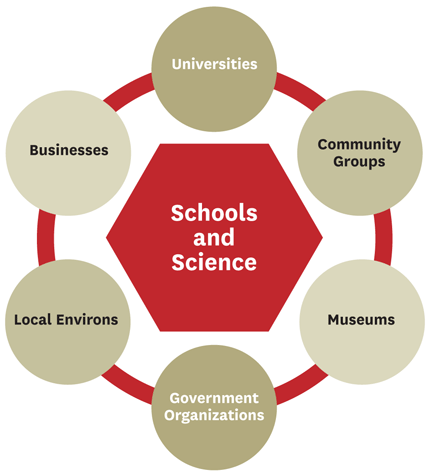
Academic science-community partnership
The Science Ambassador Program pairs senior university science, engineering and health science students with rural and remote Aboriginal community K-12 schools to support creative and culturally-relevant science teaching and learning. University students work alongside teachers to present hands-on science activities, facilitate class discussions, and mentor students.
www.artsandscience.usask.ca/scienceoutreach/ambassador
Environmental education and communities
The EcoLeague program is a youth initiative that provides resource kits for elementary and secondary students across Canada to encourage them to help the environment through community- and school-based sustainability action projects.
http://resources4rethinking.ca/en/ecoleague/about-us
Career-based science learning
The Brock University Science Mentorship Program links secondary school science students from local schools in Ontario’s Niagara Region to university faculty mentors from various disciplines including Biological Sciences, Biotechnology, Chemistry, Health Sciences, Neuroscience, and Physics. Working on site with university researchers, students are encouraged to consider a career in the sciences while engaging in science research programs carried out at the university.
www.brocku.ca/mathematics-science/outreach-to-schools/science-mentorship-program
While these initiatives are meaningful opportunities for students, student engagement in science education – particularly at the secondary school level – can be further enhanced when learning environments:
- are designed to utilize complex science topics
- give students authority to address community problems
- hold students accountable to others and disciplinary norms
- provide students with local resources that support authentic science learning[6]
One example of an initiative that incorporates some of the above characteristics is EcoSpark’s Changing Currents program. Based in the Greater Toronto Area, the program aims to allow students to identify and monitor a watershed close to their school community. Not only do students have access to community resources while engaging in authentic ecological science practices related to water quality and biodiversity; they also have the opportunity to conduct future study on issues or challenges they discover based on their data collection, as they contribute to a regional water monitoring program. Additionally, teachers are provided with resources and training to help their science students carry out the watershed science.
www.ecospark.ca/changingcurrents
Cultivating community-based science education
Community-based science education provides a way for students and teachers to become local problem-solvers who can deal with scientific and technological challenges that are of consequence. But programs such as Changing Currents are not common.
These partnerships are challenging to develop due to the need for specific science materials and equipment, along with science and educational expertise – all necessities not available in many Canadian communities. Further, partnerships can have multiple and sometimes competing goals. Outcomes for students, teachers, and community partners need to be clearly articulated, and resources and relationships need to be sufficient and workable. Overall, there has been an increase in school-community initiatives in school science, typically focused on environmental science topics (e.g. biodiversity, air, and water projects). However, these represent only a small sample of potential partnership opportunities available in many communities across Canada.
While there have been some efforts to research and develop community-based science programs with schools,7 additional efforts are required to develop science curriculum and support professional learning that emphasize school science and community partnerships. The potential benefits to science students are important.
Using a communities of practice framework8 can help address the elements required for a successful science-community partnership. These include:
- having all stakeholders share understanding of the science topic
- fostering ongoing and trustworthy relationships among the members
- identifying practices and resources required to make these endeavours successful and sustainable
Needless to say, government policies and incentives for initiating and sustaining partnerships are critical for community-based learning in science. Emergent technologies (e.g. social/collaborative online tools) can also play a critical role in facilitating the participation of science experts, educators, parents and volunteers.
We are entering an era where schools and communities are forming more and more partnerships, and cultivating these relationships is becoming ever more important. In order to establish beneficial community relationships, teachers and school administrators must be at the nexus of these relations. Thus, continued efforts are necessary to support important outcomes beneficial to all participants with/in communities across Canada.
En bref: La plupart des gens conviendraient que les élèves doivent accroître leurs connaissances scientifiques. Cependant, les élèves possédant des notions scientifiques ne sont pas nécessairement outillés pour confronter les questions sociétales complexes auxquelles ils feront face en tant que citoyens. Une solution consiste à engager les élèves dans des activités d’apprentissage authentiques, pertinentes et significatives intégrées à leur communauté scolaire. Cette importante innovation éducative peut aider les élèves à se consacrer davantage à l’apprentissage des sciences et à faire le lien entre leurs connaissances en sciences et d’autres matières, ainsi qu’accroître leur compréhension de la science et leurs capacités civiques dans leur collectivité. Néanmoins, le rôle des enseignants en sciences, des écoles et des collectivités dans l’établissement de partenariats efficaces n’est pas entièrement compris. Ce commentaire suscite un débat concernant le lien entre l’enseignement des sciences et les communautés scolaires.
Photo: courtesy Photo courtesy Brock University Science Mentorship Program
First published in Education Canada, March 2016
1 Douglas A. Roberts, “Scientific literacy/science literacy,” Handbook of Research on Science Education (NY: Routledge, 2007), 729-780.
2 Graham W. F. Orpwood, Bonnie Ann Schmidt, and Jun Hu. Competing in the 21st Century Skills Race (Canadian Council of Chief Executives, 2012).
3 Glen S. Aikenhead, “Towards Decolonizing the Pan-Canadian Science Framework,” Canadian Journal of Science, Mathematics & Technology Education 10, no. 4 (2006): 387-399.
4 Carolyn Gregoric, School-Community Involvement (UNESCO-APNIEVE Australia publications, 2013); Catherine M. Hands, “Why Collaborate? The differing reasons for secondary school educators’ establishment of school-community partnerships,” School Effectiveness and School Improvement 21, No. 2 (2010): 189-207.
5 Atelia Melaville, Amy C. Berg, and Martin J. Blank, Community-Based Learning: Engaging students for success and citizenship (Washington, DC: Coalition for Community Schools, 2006).
6 Randi A. Engle and Faith R. Conant. “Guiding Principles for Fostering Productive Disciplinary Engagement: Explaining an emergent argument in a community of learners classroom,”Cognition and Instruction 20, No. 4 (2002): 399-483.
7 Lisa M. Bouillion and Louis M. Gomez, “Connecting School and Community with Science Learning: Real world problems and school-community partnerships as contextual scaffolds,”Journal of Research in Science Teaching 38, No. 8 (2001): 878-898; Douglas D. Karrow and Xavier Fazio, “NatureWatch, Schools and Environmental Education Practice,” Canadian Journal of Science, Mathematics and Technology Education 10, No. 2 (2010): 160-172.
8 Etienne Wenger, Richard Arnold McDermott, and William Snyder, Cultivating Communities of Practice: A guide to managing knowledge (Boston: Harvard Business Press, 2002).
-
Human-Centred Leadership
Comments Off on Human-Centred LeadershipImagine you have just moved into a new area, and on that first night in town, you and your wife and children are hungry for a meal. What better way to get acquainted with the new neighbourhood than to go out for a bite and a walk around? You pop open your laptop and search for restaurants in the vicinity, and find that there is only one within walking distance. You click on the link, and while the site isn’t particularly flashy or eye-catching, you notice is that there is a barbecue buffet special on Saturday! However, your perceptive 13-year-old daughter notices that the date for that special ended two years ago, and that the site hasn’t been updated. You decide to click on the “Menu” button to see some other choices, but the dreaded “404 – File Not Found” screen pops up. A bit puzzled, you decide to give the restaurant a call, but after several rings, an automated message asks you to enter the extension of the employee you would like to speak to, or to leave a message after the tone so someone can get right back to you about reservations. You hang up.
“I’m hungry!” groans your 11-year-old boy, and you make the executive decision to try the restaurant anyway. After a pleasant ten-minute walk, you arrive at an older building. There are a few weeds poking out of the sidewalk, and one of the letters on the sign has fallen off. You walk in, and a sign says “Please Wait To Be Seated,” but there is no one at the desk to greet you. After a minute or two, you peek around the corner and gently call “Hello?”– to which a voice responds, “I’ll be with you as quickly as I can.” A few moments later, a host comes around the corner and says, “Sorry, we are so short staffed. Do you have a reservation?” You inform the host that you tried to call, but there was no answer. The host says, “We ask that people leave a message so that we can put a reservation in, but I guess you didn’t do that.” He looks at a reservation book and shrugs. “We don’t have anything available for at least another hour.” You notice that there is a large set of tables that are empty, and ask if you could sit there – the family is starving! The host frowns and says, “Those people made a reservation, sorry. When you make a reservation, it’s a lot easier for us to get you in.” Frustrated and hungry, you head home so you can drive somewhere else to eat. “I don’t want to live here!” declares your daughter.
Now take this situation, and replace “local restaurant” with “local school.” Substitute the idea of your children being hungry with them being excited and nervous to start a new school year. Think about the angst involved in moving to a new area, and how you and your children would feel if you went to the website of your new neighbourhood school and the pages were out of date and filled with dead links. Or if, when you tried to call to get some information, you couldn’t get a person to help you on the other end. And then when you finally decided to just show up at the new school with your children to register because you couldn’t figure out a better way, you were made to feel that it was inconvenient for the staff for you to show up unannounced. All you wanted was to register your children!
How do you feel about your new school after such a poor initial experience?
In the business world, creating a rich and positive user experience (UX) for customers or clients is essential for a successful enterprise. Yet when it comes to considering the experiences that our students, parents, and even educators have in our schools each day, UX is often a distant afterthought. What makes this lack of attention to UX even more perplexing is the fact that we have virtually unlimited and direct access to input and feedback from our clients – they are in front of us in our classrooms, in the staff room, and in the parking lot of our schools! As a lead digital marketer of a large multi-national corporation said to me at a recent business conference, “I could only wish to have the access to our customers that schools have to theirs.”
With the hustle and bustle of the everyday lives of educators, solving problems as quickly as possible is often the order of the day. When an issue comes to us in our classrooms, schools, or districts, we want to ensure we handle it professionally and carefully, but also in a timely manner, because we know there will be another issue cropping up shortly. And by our very nature we are helpers; we want to give our learners and our school community the assistance they need when they come to us with a problem. Yet often, in the spirit of efficiency, we implement solutions without involving those who are having the problem: our students and parents, and even our teachers and principals (when we are in leadership positions). And while we might feel we are being more efficient, we can be missing out on a tremendous opportunity to collaborate with and empower the members of our school community.
Human-centred leadership
When it comes to different approaches to solving problems, I believe the field of education can learn a great deal from the design sector: leading design firms such as IDEO and the Stanford D-School use a human-centered approach to spark new and creative solutions. In IDEO’s Design Thinking method, they “consider every product touch-point as an opportunity to surprise, delight and deliver benefits to users”1 and actively collaborate with those who use that particular product or service.
Since working cooperatively with our partners in education is so vital to our success, I believe adopting a collaborative, human-centered leadership style has enormous potential to help us ensure a more positive user experience for our partner groups and concurrently build their leadership capacity at every level. I believe this can be done by following a few steps:
1. Recruit a diverse, eclectic, problem-seeking team.
For the user experience you are considering in your classroom, faculty meeting, school or district, who are the people that you might assemble to ensure that you get a wide variety of ideas and perspectives? For example, if you are considering communication from your classroom, collaborating with students and parents is key: they can provide you with authentic, personal experiences that they have had inside and outside of the class. Effective communication is important to any workplace, and parents may be able to bring new and fresh ideas from other sectors that are applicable to the school setting.
2. Start with questions that promote divergent thinking.
When approaching issues in our schools, we frequently begin by asking questions that can narrow our focus, such as “How can we make better parent-teacher conferences?” By beginning with a vision of something that we have previously done, we can inadvertently limit conversation and constrain ourselves to making minor “tweaks” to existing processes or structures. When we have a think tank of people with different experiences and skill sets, it is important to ask questions that elicit different reactions and spark new ideas: the last thing we want to do is limit the creative capacity of the group! A question that promotes divergent thinking such as, “What is the experience that we want our parents to have when they are learning about their student’s progress?” starts a different conversation, and encourages the team to think about the end user before the end product. It is vital at this stage to be an active listener and encourage each of our partners to speak – they are the true leaders in this process because they are the experts on describing their personal experiences.
By having our partners work with us in diverse “think tank” style groups, we develop their capacity as leaders in the design, feedback and iterative process.
3. Co-create your MVP (minimally-viable product).
A common approach to teaching and learning can be “know then do”: we often feel like we must preload learners with a requisite set of skills before they can be released to try them out in a more hands-on environment. However, in doing this, we are attempting to anticipate each of the skills that a learner may need to solve a particular problem. An alternative approach is to “do then know.” If we co-create prototypes with our diverse group as early as possible in the design process and observe our end users trying these “minimally viable products,” we can better understand the strengths and flaws of our models. As David Kelley, founder of IDEO, said, “If you want to improve a piece of software all you have to do is watch people using it and see when they grimace, and then you can fix that.”2 With our parent conference example, if the group chose to try a model using fifteen-minute, student-led conferences featuring a presentation of learning, we would want to test this concept with a small number of students doing presentations to a few adults before we adopted the model. By co-creating and testing prototypes of our ideas, we can not only “walk a mile” in the shoes of our students and parents, but we can also cultivate a true sense of ownership over the iteration process.
4. Be hungry for feedback.
When we encourage our end users try our prototypes, we create fertile ground for observation, and we need to harvest any feedback that we can get! Sitting and watching a small group of our students and parents go through a process of fifteen-minute, student-led conferences can tell us a multitude of things. We can determine if the physical setting is right, whether the allotted time is sufficient, if the size of the audience is appropriate, and other observable details. But we must also take advantage of having our end users there in front of us: interviewing our kids and parents for warm feedback, cool feedback, and suggestions can provide us with rich insights that only they can provide. We need to create an open and collaborative environment where they feel empowered to be specific and honest. We also must demonstrate that we value their contributions by making the changes that result from their feedback. Try having one of them carry a video camera with them when they go through the process, so you can see the experience through their eyes!
5. Put experience before product.
We can spend a great deal of time, effort and energy in creating multiple iterations of our minimally viable products. We might tweak and test our student-led conferences six or seven times as a result of numerous observations, and think we have truly “nailed it” on the final product. For example, perhaps we have created an amazing format for our student-led conferences that fits perfectly into our schedule for that particular day, but it only “works” if we keep the transition time between each conference to three minutes. However, the feedback from our test parents and students tells us that students are unable to do a proper breakdown and setup of their presentations in three minutes. Furthermore, parents with more than one child at the school would be late to their second presentation. While it can be very easy to “just go with it” and hope for the best, all of the positive work that we have done with our group can be quickly negated if clinging to a product feature (such as the time for transition) becomes more important than the experience of the user. Iterations can occur at any time during the creative process, right up until the rollout when we think we have landed on that one “perfect” solution. It is vital to ensure that we are more committed to those who are using our product than to the product itself.
6. Make debriefing a habit.
Once the experience for our users has occurred, it is not uncommon for us to simply move on to the next task: schools are busy places, and as soon as we have crossed one item off the “to do” list, we know there will be two more to replace it. But while the experience is fresh in people’s minds, get feedback, and lots of it! Chat with people, use a brief survey, and bring in a focus group so that you and your team can get a true sense of what could be altered so that the experience is even better in the future. Even if you feel the event has gone exceedingly well, there is still much to be learned from those who participated. Make sure you revisit the initial prototype: seeing the journey from the initial to the final product is a powerful reminder of the group’s responsiveness to feedback.
Taking a human-centered, collaborative approach involving end users to co-create positive user experiences in education has many benefits. Not only will we come up with solutions that better suit the needs of our students, parents, and educators, we empower them to make a difference in the areas that truly matter – the experiences they have in our schools on a daily basis. By having our partners work with us in diverse “think tank” style groups, we develop their capacity as leaders in the design, feedback and iterative process. And perhaps most importantly, we build relationships with those we serve. So whether it is parent-teacher conferences, elementary-to-secondary transition for students, implementation of new grading software for teachers, or reviewing policy for administrators, when we adopt a more collaborative, human-centered leadership style, we can transform our classrooms, schools and districts to be truly responsive to the needs and experiences of our students, parents, and educators that learn in them.
En bref: Une expérience client positive est essentielle au succès des entreprises du monde entier. Conscientes de l’importance de l’expérience d’utilisateur, les compagnies consacrent beaucoup de temps et d’énergie à des études de marché afin de cerner les besoins de leurs clients. En consultant de multiples sources d’information sur leurs utilisateurs finals et en travaillant avec eux pendant le processus de conception, les entreprises tentent continuellement de créer des produits correspondant le mieux possible aux besoins du client. Comment pourrions-nous transposer cette « approche de conception » à l’éducation? Que se produirait-il si nous entreprenions de considérer nos élèves, nos parents et nos enseignants comme nos clients – des ressources qui pourraient nous éclairer sur leurs expériences d’utilisateurs avec nos écoles? En adoptant une approche de conception avec nos partenaires pour résoudre les problèmes qui surviennent dans le système de la maternelle à la fin du secondaire, non seulement trouverons-nous des solutions mieux adaptées à leurs besoins, mais nous développerons aussi leur capacité de diriger et de résoudre des problèmes en collaboration tant à l’intérieur qu’au-delà de notre communauté scolaire.
Illustration: iStock
First published in Education Canada, March 2016
1 “Why Human-Centered Design Matters,” WIRED (2013). www.wired.com/insights/2013/12/human-centered-design-matters
2 “How to design breakthrough inventions,” CBS News (2013). www.cbsnews.com/news/how-to-design-breakthrough-inventions-07-01-2013
-
From Good to Great
Comments Off on From Good to GreatSarah,1 the sole English-Language Arts consultant for a major school board in Eastern Canada, shares a familiar refrain: “I don’t have time to work with the teachers who are doing an ‘okay’ job – I have to go where I am most needed.” When teachers are “crashing and burning,” principals call Sarah. “I need you to fix my teachers!” they half-joke. As a result, Sarah spends the majority of her time with teachers who are having a difficult time meeting the minimum expectations of the job – preparing lessons, assessing student learning, and maintaining an orderly and safe classroom.
Educational leaders, from school principals to board directors, face an immense challenge: they must support a huge number of teachers – with widely varying degrees of skill – to such an extent that student achievement improves across the system. Further, they need to do this while managing shrinking budgets. As a result, school leaders often target the weakest teachers for additional support. Unfortunately, those teachers who struggle the most are often the teachers who grow the least, even when they have intensive support. Thus, the typical approach to instructional improvement often fails: while a handful of teachers in a school may improve with additional support, overall, not enough change is seen to warrant celebration.
In this article, I argue that as leaders in education, we need to make three key moves in order to improve instruction at scale. First, we need to make the development of expertise across the system our shared goal. Second, we need to provide significant support at the top and not just the bottom. Third, we need to develop systems of mentorship within schools for all teachers.
Developing a culture of expertise
Researchers have shown that there is a startling lack of expertise in teaching across North America.2 Because there are so few expert teachers in schools, learning teachers rarely have opportunities to examine exemplary teaching practices.3 As a result, struggling teachers often have low-hanging goals for student learning and vague visions of more successful instruction. It will come as no surprise to learn that in schools where there are higher numbers of accomplished teachers, the whole school community begins to adopt more ambitious forms of instruction because teachers have access to models of effective teaching. Thus, if we want all teachers to improve their practices, we need to cultivate expert teachers to act as models, mentors, and aspirational figures for their peers.
Support competent teachers
We need to support competent teachers so that they become models of exemplary performance we can draw upon to help support others. This mandate is exciting because it’s relatively easy: competent teachers tend to seek and embrace professional development opportunities, they are more likely to welcome feedback, and they need less support to reveal greater progress. With a little coaching from people like Sarah, strong teachers are then able to support other teachers by acting as peer coaches and mentors. Thus, Sarah’s role should shift from supporting the most struggling teachers to supporting the teachers who are next in line for a role like her own.
Most school improvement efforts are targeted at the teachers who command the most attention – the high-fliers and the low-riders. However, school leaders often ignore those competent, reliable, committed teachers who are “doing just fine.” Those teachers, though not often targeted as being “leaders,” are a key and underutilized resource for school improvement, leading not only to wasted potential for the school community, but also often leaving these effective teachers feeling unappreciated and unsupported. School leaders who are interested in systemic change need to attend to these teachers, both by providing them with more support and by expecting them to act as local leaders.
For example, rather than coaching a teacher struggling with classroom management, Sarah, our systems leader, might choose to work with Jim, an English Language Arts teacher who, though he models exceptional pedagogy in his classroom, needs support to learn how to share his expertise with his colleagues. Thus, Sarah might meet with Jim to help him articulate how he approaches a particular pedagogical task that other teachers in the school find challenging. Coaching Jim to articulate his methods in a clear way might allow him to share his work with his colleagues at an upcoming faculty meeting, while simultaneously supporting him to develop more conscious control over his work and further refine his classroom instruction. At the same time, preparing Jim to be a school leader positions him as a local expert with talent worth sharing, affirming his skills and developing a culture of professionalism in the school.
Establish systems of mentorship
When teachers like Jim have additional support from systems leaders like Sarah, they are better able to support those teachers within the school who struggle. In fact, with some support, Jim is even better positioned than Sarah to support a novice teacher in the school. For example, as a systems leader, Sarah does not have her own classroom any more and thus rarely thinks about classroom management – she figured that out so long ago that those skills have become automatic and unconscious. Teachers like Jim, on the other hand, are closer to the reality of the classroom, and they are often more readily able to share their knowledge of best classroom practices with novice teachers.
Another advantage to this approach is that it de-stigmatizes teacher support. As a systems leader, Sarah’s presence communicates authority. When she works with Jim to prepare him as a leader, she positions him as a school-level leader. However, when she works with a struggling teacher, she positions the teacher as “underperforming.” That perception makes it difficult for teachers to ask for support. On the other hand, if Jim, as a peer mentor, works with the same teacher as a way of welcoming her into the school and providing routine, “in-house” assistance, he normalizes the encounter and lowers the stakes. When all teachers in a school receive some form of support, it becomes a part of the culture of the school.
There are many forms of expertise required for teaching. Teachers need deep knowledge of their discipline, they need a varied repertoire of pedagogical strategies, and they need knowledge of students and how they learn. Teachers need to develop positive and meaningful relationships with students and they need to engage in professional conversations with parents. Competence in one area does not necessarily translate into other areas. Teachers can be mentored in one area while simultaneously acting as mentors in another. Effective school leaders invest significant time in learning about teachers’ skills and needs, and they partner teachers strategically with one another, rather than only seeking support from “outside experts.”
Supporting the development of more ambitious forms of instruction is challenging work that requires a systems perspective. In order to develop more expertise in our schools, we need more strategic deployment of our systems leaders and greater engagement with teachers who have so much to offer their colleagues.
En Bref: Un immense défi confronte les dirigeants en éducation : ils doivent soutenir un nombre considérable d’enseignants – détenant des degrés très variés de compétences – de façon à rehausser la réussite des élèves à l’échelle du système. Cet article propose des mesures clés que peuvent prendre les dirigeants en éducation pour améliorer l’instruction à grande échelle. Les dirigeants doivent viser à améliorer les compétences dans l’ensemble du système et fournir un soutien important aux enseignants performants, plutôt qu’uniquement aux enseignants en difficulté, tout en instaurant dans les écoles un système de mentorat pour tous les enseignants. Cet article comporte des implications pour le travail des dirigeants des conseils scolaires et des ministères, des directions d’école, des consultants et des dirigeants de la profession enseignante.
Photo: Chris Schmidt (iStock)
First published in Education Canada, December 2015
1 Note that names and other identifiers have been changed.
2 James Stigler and James Hiebert, The Teaching Gap: Best ideas from the world’s teachers for improving education in the classroom (New York: Simon & Schuster, 1999).
3 P. Grossman, C. Compton, D. Igra, M. Ronfeld, E. Shahan, and P. Williamson, “Teaching Practice: A cross-professional perspective,” Teachers College Record 111, no. 9 (2009): 2055–2100.
-
Our Wisdom
Comments Off on Our WisdomI have always believed that all members of the school community should exhibit strong character traits. With these beliefs held close to my heart, I attended a workshop through my school board (York Region District School Board) on First Nations, Native, Métis and Inuit (FNMI) communities. That’s when I was first introduced to the Seven Grandfather Teachings, a set of teachings on human conduct practiced by groups such as the Anishinaabe, Ojibwe and Chippewa people.
I quickly noticed similarities between the ten character traits familiar to my school board and The Seven Grandfather Teachings: wisdom, love, respect, bravery, honesty, humility and truth. I wanted to find a way to bring these teachings to my students. I realized how challenging it would be, for both my Grade 6 students and me, to try to incorporate all seven teachings simultaneously and seamlessly into our lives. So instead, our class discussed the teachings and decided to hone in on one in particular: wisdom.
We had several reasons for choosing this particular teaching. First and foremost, I personally have been moved by many stories of elder abuse during my time as a former volunteer crisis counsellor with Victim Services, Toronto Police. Secondly, our class had realized that we are exposed to too many reality television shows, which don’t exactly depict youth respecting each other, their elders, or their environment for that matter. Finally, we landed on wisdom because it just felt right. We were compelled and interested to learn more.
We decided to explore wisdom by inviting our own “elders’’ (immediate and extended family members) into our classroom for a Q&A session. Any family member who was willing and able, was welcomed into our classroom community circle. The turnout was fantastic! Most interested elders happened to be parents, who came forth to share their wisdom about their careers, hobbies and interests. Each elder gave a slightly different take and yet all shared valuable insight. I often found myself being truly inspired.
Our central theme in our inquiry process was that we all, young or old, can learn from one another’s experiences by simply asking good questions. In preparation for each elder’s visit, we used the principles of Bloom’s Taxonomy to develop open-ended questions. For example, one of my female students asked a visiting working mom: “How do you find balance between your home and work life?” while another student discovered her own interest in her father’s career when she asked: “How do you cope with difficult clients? What strategies do you use?” I acted as messenger extraordinaire, ensuring that all visiting elders received student questions prior to their Q&A session so that they could prepare appropriate responses ahead of time.
When elders shared with us their answers to our questions, we made sure to reflect after each visit, and refer back to our learnings when an opportunity to apply them arose. As a further follow-up to each elder visit, I emailed out a SurveyMonkey link, with four short multiple choice questions. The feedback from our guests revealed several things. After visiting the class, elders felt that their child was more included and part of the class, and that they themselves were also more included and part of the class. They believed that all students learned a lot from their visits, and they unanimously expressed positive feelings towards the overall experience.
My students’ reflections were very revealing as well, highlighting many realizations, including the importance of: attentive listening, selflessness, collaboration, time-management, work-play balance, on-going learning, patience, healthy relationships, producing quality over quantity, and the benefits of second- and third-language acquisition.
My students made many of their own connections and engaged in meaningful discussions with one another about developing their collaboration and leadership skills. For example, one boy emphasized his new learning: that being a leader doesn’t mean being a know-it-all.
Our school climate focus on mental health and well-being was also furthered through this experience, as students learned the importance of managing emotions effectively and taking care of their own mental and physical health by maintaining a healthy diet, exercise and sleep.
It is clear that as a collective of learners – students, elders and myself – we have learned so much from exploring wisdom on a deeper and more meaningful level. I really feel that through this process, we have grown closer and more appreciative of one another – and that, to me, is really what wisdom is all about.
Photo: iStock
First published in Education Canada, December 2015
-
Bottoms Up
Comments Off on Bottoms UpThere is a growing global consensus that learning needs to shift. We want to see school systems creating deep, engaging learning that will build students’ capacity to think critically and creatively, to cultivate the innovative minds that will be able to thrive in our digital, global, knowledge economy. Yet concrete changes in teaching and learning practice in schools have lagged behind the impassioned calls for more student engagement, creativity and innovation generally. The educational buzzwords that we have developed in visions for 21st century learning have not been enough to transform what and how we actually teach and learn. It is time for educational leadership to shift the focus of the learning innovation conversation from why we are changing to the practical question of how.
Learning innovation
The purpose of innovation in education is to create continuously better learning for the young people that we serve. Too often, the learning innovation agenda has been sidetracked by an unhealthy obsession with adding new forms of technology. While digital technologies are appropriate for solving particular learning challenges, it is useful to separate them from discussions about learning innovation. Learning innovation is not an outcome; it is a problem-solving process. I define learning innovation as a creative process used to create better learning in complex and people-filled systems.
Mobilizing educators as innovators
To enable systemic innovation, we must support educators in adopting new identities as learning designers. Innovative change can only come from frontline educators forming insights, learning, and experimenting with new ideas and methodologies – in partnership with their students. Leading innovative change in schools is thus not a question of finding the right idea to implement, but rather harnessing the creative talent of educators and students. What works for one group of students will not necessarily work for another group, whose conditions and experiences are different. In education, the most useful insights and innovations often come from the ground up, from educators who practice in a real-world environment and can experience the shifts in student needs and learning first-hand.
The creative aspects of teaching and the creative capacity of teachers are largely untapped resources for innovation and change in education. All too often any innovation that is happening in schools is happening outside of and underneath the regulatory processes in place. Instead of harnessing creativity, many school systems repress it. Most of the shared insights and creative “teaching hacks” that we find discussed by teachers are applicable in narrowly defined conditions where no higher permission is needed. Much of what they teach and how they should teach is determined at the national or regional level as policy and curriculum. This limits the creative capacity of frontline educators to change and improve through innovative efforts in the classroom.
It is time for educators to see themselves as part of what Richard Florida calls the Creative Class: creative professionals who continually work to “create meaningful new forms” of teaching and learning.1 Teachers as creative professionals are engaged in an iterative design process. As a process of creativity, design is grounded and insightful, aiming to produce new forms of practice that make learning better, not just different. As Tom Sherrington neatly sums it up, “design is a form of creativity that suggests deliberate, planned innovation built on a foundation of research-informed professional wisdom.”2 Empowered as learning designers, teachers can get creative with a purpose, using the challenges of their environment to identify opportunities, learn and improve.
Learning designers innovate because they are open to changing what they do, and how they do it, based on what they’ve learned about themselves and their environment. They are not necessarily the most technologically enabled, or the most overtly creative people. As the U.K. innovation strategist Charlie Leadbeater puts it, they are rather the ones finding and solving interesting challenges for their students and themselves.3
Give permission through conditions
Changing a system through creative talent is a different challenge, requiring a different approach, than developing and implementing pre-formed learning solutions from the top. For this kind of innovative change to start happening, we need to unleash creative educators who are willing to “create new ideas, experiment, fail, and try again.”4 Time and again we see, in various organizations and systems that rely on innovation to improve, that collaborative, creative work needs a different set of conditions in which to thrive.
As many school systems are not accustomed to cultivating and managing innovative work, there is an opportunity to learn from the best practices developed in other sectors. Many of the best practices around managing creative employees and networks are about protecting innovators from rules and procedures – effectively turning traditional leadership philosophy on its head. Organizations that evolve and get better tend to empower innovation as a human learning process.
Fledgling organizations, start-ups and innovative groups work through small, protected creative teams. Authority is flatter and more evenly distributed, meaning that there is less emphasis on permission. They are also more open and collaborative.
For Richard Florida, the first two rules for leaders of creative teams are to remove distractions and impediments, and to spark creativity (rather than compliance with the rules).5 For Google, preserving the freedom to innovate is more important to managing creative work than any of the traditional models of management and planning.6 Similarly, Netflix works under the mantra that great results from creative talent come from “setting the appropriate context, rather than trying to control people.”7 Author Dan Pink cites studies finding that creative, intellectual work thrives in a block of completely unstructured time.8
Instead of harnessing creativity, many school systems repress it… Many of our teachers may not feel safe trying new things.
No matter where we look for recent evidence and best practice, it seems like traditional targets and parameters are the opposite of what works. What does work is protecting the freedom to think and experiment. Across many organizations and industries we find that the most efficient innovative culture is set by mobilizing the people who are ready to innovate (and choose to do so), having them work under conditions that foster innovation (rather than hinder it), and empowering them (by getting out of their way). Two key strategies emerge: protect those willing to innovate from doubt, and protect them from fear.
Protection from doubt
When it comes to change in schools, it’s natural for school leaders to announce their inspiration to everyone. But they tend to try to get every staff member on board before they start moving, falling into the trap that Harvard professor and change guru John Kotter describes in his book Buy-In: Saving your good idea from getting shot down.
Even well-intentioned educators can delay a good idea by seeking answers to too many questions. An open meeting where stakeholders, including parents and students, give feedback on something that is still just an idea – not fully formed, not ready for criticism – can open the door to doubt.9
What we often don’t realize is that innovation and new ideas are fragile things – so fragile that keeping them safe from early criticism is a cornerstone of artist therapy.10 Typically we respond to new ideas by thinking either “yes, but…” or “yes, and…” Saying “yes, but…” is how we express doubt: “Yes, this learning model might work, but how can we know for sure?” “Yes, it’s a great idea, but how will we do it on budget?” This time spent in deliberation is time spent saturated by doubt.
And these doubts justify resistance, which makes us slow when we most need to be fast. We can’t realize concrete changes if we spend all of our time justifying ideas, allaying fears, and winning over the most resistant. And we especially can’t silence the skeptics by demonstrating the efficacy of a learning model that hasn’t been tried in our context yet.
When we protect those who are willing to innovate, we open the way for what Jim Collins calls the “genius of the and.” Saying “yes, and…” is how we build the momentum of innovation. It comes from a sense that just because new things are possible, this does not mean that everything established is under threat. It affirms the current system by suggesting it can become better. “Yes, and…” means there is something to add, not something to delay.11
Protection from fear
Our inherited hierarchies challenge innovation in our schools. Consider an innovative History teacher, whose students are encouraged to investigate the origins of historical narrative and critique the interests it represents (an example of several models of what we tend to refer to as 21st century pedagogy, including inquiry-based and personalized learning). He can only go so far if his colleagues teach history tradi-tionally, and want things to be kept that way. Not only is he isolated in his department, but his lone idea also has little strength against the collective weight of the set of ideas that his colleagues have believed in for years. Consider what it would be like for him to be told by school policy that innovation is encouraged, but still have to approach his department head for permission. Once parents and teachers are concerned for their own careers and children, enthusiasm dwindles and with it, any chance for success.12
Creativity hasn’t always been sanctioned by the systems within which our teachers have had to work. Nor were many of the broadly acknowledged principles of 21st century learning. Engaging students as equals, for instance, by facilitating their investigative critique of the curriculum (and whose interests it represents), can be a shining example of 21st century learning and teaching talent in any classroom. In a diverse classroom it can be exactly what students need for their learning to be meaningful and engaging.
Regardless of the needs of the students in the classroom to understand why they are learning what they are learning, it is entirely up to school leadership to decide if engaging students as equals is seen as insubordination or talent. Many of our teachers may come from a place where the repressive was the norm, and may not feel safe trying new things. Working off the record and setting a culture of experimentation and observation can be a fantastic way for school leaders to reduce the amount of bravery required to try new things.
Cultivating the roots of change
The key to leading innovative change in schools is to empower innovators within classrooms by supporting a new identity that harnesses teachers’ creative talent. Cultivating these learning designers through a culture that protects and promotes creative thinking will generate changes in the work itself. By fostering dynamic thinking and removing the inhibitions to experimentation, school leaders can create the culture and conditions needed to see tangible innovations to real-world teaching practice. Systematically empowering educators to learn and try new things can cause promising practices to proliferate and spread through the system.
The spread of promising practices
Fostering an open culture can help innovative practices spread naturally through the system. Good tactics to achieve this include instructional rounds, learning walks, and peer teaching. By just walking through the school, speaking with colleagues, observing how they teach, and seeing the results of their teaching on the walls, teachers will learn from each other. Professional learning and sharing is embedded into the everyday experience of the school.
En Bref: Pour favoriser l’innovation systémique, nous devons soutenir les éducateurs dans l’adoption de nouvelles identités en tant que concepteurs d’apprentissage. Les idées et les innovations les plus utiles proviennent souvent de la base, c’est-à-dire des personnes travaillant dans un environnement réel qui peuvent faire concrètement l’expérience de l’évolution de l’apprentissage et des besoins des élèves. Les enseignants sont des sources très sous-utilisées de talent intellectuel et créatif. Il est donc possible d’apporter le changement en transformant la culture et les conditions d’enseignement afin d’habiliter les enseignants en tant que concepteurs et innovateurs en apprentissage.
Photo: iStock
First published in Education Canada, December 2015
1 Richard Florida, The Rise of the Creative Class (New York: Basic Books, 2012), 38.
2 Tom Sherrington, “What’s the incentive? Systems and culture in a school context,” Licensed to Create (London: RSA, 2014), 56.
3 Charles Leadbeater, “Learning to Make a Difference: School as creative community,” World Innovation Summit for Education (2009). www.wise-qatar.org/sites/default/files/wise_matters_learning_to_make_a_difference.pdf
4 Eric Schmidt and Jonathan Rosenberg, “How Google Works” (Slideshare, October 12, 2014). www.slideshare.net/ericschmidt/how-google-works-final-1
5 Florida, The Rise of the Creative Class, 118.
6 Schmidt and Rosenberg, “How Google Works.”
7 Reed Hastings, “Netflix Culture: Freedom and responsibility” (Slideshare, August 1, 2009). www.slideshare.net/reed2001/culture-1798664
8 Daniel Pink, “The Puzzle of Motivation” (TED, July 2009). www.ted.com/talks/dan_pink_on_motivation?language=en
9 John Kotter, “Four Ways to Kill a Good Idea,” Harvard Business School (October 6, 2010). http://hbswk.hbs.edu/item/6471.html
10 Many therapists focus on recovering a sense of creative potential for blocked or frustrated artists.
11 Jim Collins, Built to Last: The Successful Habits of Visionary Companies (New York: Harper Collins, 2002), 43-46.
12 Kotter, “Four Ways to Kill a Good Idea.”


IDEAS TO SUPPORT EDUCATORS : Subscribe to the EdCan e-Newsletter
Quality research, reports, and professional learning opportunities.