Archive
-
Something About Charley
Comments Off on Something About CharleyI’ll never forget dropping my son off for his first day of school. He’d just been diagnosed with high-functioning autism and we were brand new to the town. I looked at the school grounds – namely at the lack of fences around the play area – and broke down in tears. I sat in the car with my kids, crying surreptitiously, and tried to gather strength.
Although Charley’s diagnosis was new, his quirks were well known to me. I knew that he was a wanderer. I would have rather seen a kindergarten “cage” than that fenceless schoolyard. I also knew that groups of children always made him really unpredictable, that people touching him unexpectedly could result in punches, kicks or bites. Even loud noises made him bolt.
Yeah, I knew school was going to be hard.
It’s now two years later and Charley is in Grade 1. He’s fully integrated in his class and manages to do most activities with his classmates, albeit in a modified way. He’s learned and grown in many amazing ways. And yet, school has been hard. The public system is not a perfect fit for his unique little brain. He’s gifted in so many ways: He notices everything. He remembers everything. He recites whole books from memory. But does he care to learn the names of his classmates? No way.
When a relative visited us recently, she asked him about his favourite part of school. He said, “Nothing.”
Undaunted, she pressed him. “Surely you like gym?”
“No.”
“How about recess?”
“Oh no!”
“Lunch time?”
“Nope.”
She sighed. “Charley, there must be one thing you like at school.”
He thought for a moment, and said, “I like going to the office. It’s quiet. There are grown-ups. And they have Lego there.” Classic Charley.
He’s had the most wonderful teachers in his three years of school. I’ve been encouraged to help come up with strategies for enabling success and dealt with the rough weeks side-by-side with his team. I’ve worked with his teachers developing his IEPs and discussing therapies needed. We’ve been really fortunate.
Yet I’d be lying if I claimed I don’t think about home-schooling him on a regular basis. I look at the potential of that little brain and wonder what he could learn in a calmer, more familiar environment. I wonder if I am missing a great opportunity to help him flourish. “Who might he be if given the right tools?” I wonder.
But every single teacher, therapist and administrator we’ve encountered has worked to convince me that the primary goal here is to give Charley the social tools needed to succeed in the future. How far can a brain take you if you can’t negotiate with your peers? Or even have a basic conversation? Talking to Charley at this point consists of him presenting a mini-lecture on whatever he’s currently obsessed with: trains, ocean zones or narwhals.
Charley’s brother, Sam, started JK this year. He’s what we call “neuro-typical.” He strutted into school the first day, knew everyone’s name by the end of week one and reports to me daily on his classmates’ adventures. I seesaw between sadness and thankfulness, watching Sam take on the world so effortlessly. His struggles will be few compared to his big brother’s.
While Sam spends the weekend counting down the hours until school starts up again, Charley plots ways to avoid it. “I think my stomach hurts.” “I’m pretty sure I have a fever.” “School is boring compared to home.” With forced cheerleader spirit and occasional bribery, I get him out the door on Monday morning.
Most days go pretty well. He really loves his teacher. He knows all the women in the front office and where they keep their stickers. The janitor is his friend. Every single kid in the school knows his name, even if he doesn’t know theirs.
One day I picked him up and asked him how his day was. He looked up at me and smiled. “Mommy,” he said, “School would be perfect if there were no other children here.”
Oh, Charley.
First published in Education Canada, March 2013
-
Is school actually meeting the current and future needs of our learners?
Comments Off on Is school actually meeting the current and future needs of our learners?I walk the hallways at breaks and lunchtime and I overhear many students’ conversations. ‘… is so boring’, ‘I don’t see the point in …’, ‘I don’t want to go to …’. I observe students desperately asking their friends for answers to worksheets and textbook questions. Are they interested in learning or motivated by the threat of losing marks? I see tired and stressed faces. Did they stay up late at night engrossed in their learning? Or were they going through the drudgery of homework and cramming for a test?
I walk into classrooms and see students quietly gazing out the window, secretly glancing at their phones and mindlessly doodling on paper. Are they distracted or disengaged? I bump into regular ‘hall wandering’ students while classes are in session. Some tell me they are ‘going to the bathroom’; while others say they’re ‘getting supplies from their locker’. Are they being truthful or do they simply require a break from class where they can get up and move around? I meet with students in my office. Some of them display such lifeless, apathetic expressions. Why are their spirits so defeated? Why are they simply going through the motions of school? Others demonstrate frustration and negativity towards school. Why has school become a source of their frustration? Why are they so ‘anti-school’?
Our schools must equip learners with the skills necessary to not only adapt to but also influence this rapidly changing world they are growing up in. We need to move away from a system where subjects are taught in isolation of each of other, where content delivery is the focus, and where the teacher is seen as the expert and is the one who asks most of the questions.
Now don’t get me wrong. I know these examples don’t describe all students. But it does describe the norm for some of the students whom I work closely with. It’s clear that school just isn’t meeting the needs of ‘these’ kids.
Which brings me to a larger question. Is school actually meeting the current and future needs of our learners?
When I look at today’s high schools, I still recognize them as the same basic model as the one I went through over 20 years ago. And then I consider the world in which we live in. It’s a faster and more automated world, where knowledge is at our fingertips and information can travel across the globe at the push of a button. We are blessed with luxuries all around us. Smartphones, sports cars, online shopping and banking just to name a few. But this rapid progress and advancement have created changes in the workplace and society that demand new skills and competencies. Routine, assembly line type work that requires learning simple repetitive skills and memorizing basic information has become a thing of the past. The application of knowledge, critical thinking and creative problem solving is now more important as the world of work shifts to non-routine tasks.
This places new demands on education. Our schools must equip learners with the skills necessary to not only adapt to but also influence this rapidly changing world they are growing up in. We need to move away from a system where subjects are taught in isolation of each of other, where content delivery is the focus, and where the teacher is seen as the expert and is the one who asks most of the questions.
Rather than asking learners to work towards one ‘right’ answer, we must grow comfortable with there being many answers to students’ questions. And, our practices must support the idea that learning is a process, often one that is messy, non-linear, and will likely include unlearning and relearning.
We need to create a system that encourages students to pursue personally meaningful challenges and initiatives that are relevant to their lives, values students asking big questions to which the teacher doesn’t have the answer, provides students some autonomy to follow their own inquiries and enables students to amplify and share their learning through the use of technology. Similar to real life, learning at school should integrate the many traditional disciplines, allowing students to shift naturally and apply knowledge and skills from different disciplines in order to answer their questions. Rather than asking learners to work towards one ‘right’ answer, we must grow comfortable with there being many answers to students’ questions. And, our practices must support the idea that learning is a process, often one that is messy, non-linear, and will likely include unlearning and relearning.
To put it bluntly, the pressure is now on us to collaborate on new designs for learning that will engage both students and teachers!
We need to stop worrying about what others think school should look like and start imagining what it could look like. We mustn’t shy away from big steps or our bold vision. Now, more than ever, we need innovation in education!
-
The Classroom Might Remain Relevant
Comments Off on The Classroom Might Remain RelevantAs an early career teacher in a tight job market, I’ve struggled to find consistent job opportunities. I‘ve had to be enterprising in the five years since I received my teaching certificate, moving from a fringe private school to an outdoor leadership camp, from a foreign language school to daily substituting, and to my current role as a long term occasional. I’ve worked in three school districts, dozens of high schools, and shared face-time with thousands of teenagers.
Walk around any public high school. You’ll see kids in class, thumbs tapping out texts, heads down on desks, raising their hands when they have the answer right.
While every classroom is its own unique space, I’ve noticed three recurring trends:
- Kids are either bored or institutionalized
- Teachers are either tired or ambivalent
- Administrative incentives maintain the status quo
Meanwhile, there’s a lot of talk about engagement. Engaged students. Engaged teachers. Engaged classrooms. Daniel Pink does a terrific job explaining why top-down management systems are ineffective at fostering engagement. In short, it’s useful when there are clear destinations to target. People will chase the carrot and avoid the stick. Engagement, however, is most likely when efforts are autonomous, relevant, and allow for mastery. These are dynamic circumstances with unclear destinations. Public schools are entrenched in prescriptive models of success, offering little chance to embrace the process of discovery.
None of this is new. So why is this the time for innovation? I can think of two reasons:
- Future generations require different skills sets
- Barriers to entry are falling
School has maintained its authority because diplomas have remained a gateway to prosperous adulthood. That’s becoming less and less the case. Capacity to follow directions and maintain responsibility remains useful, but it’s a less likely path to success. Instead, the requisite capacity is being able to manage complexity and make decisions in the face of uncertainty. Thriving adulthood has more to do with soft skills and autonomous living than it does with getting the gold star.
Of course, parents look to school because they want to keep their kids safe, put them in position to succeed as adults, offer them a chance to socialize, and assure their personal development. And there are things that kids want from school, including to have fun with friends and to experience success.
The barriers to satisfy these interests are falling. Increases in online curriculum, pathways to diploma certification, legitimacy of distance education, and illegitimacy of institutional authority are resulting in innovations that threaten to disrupt the status quo.
Can you imagine earning your high school diploma from the local karate club? Or an urban explorers’ club? Or a flexible network of edupreneurs? It’s become less and less costly to develop alternatives that serve more localized needs. While the institution incentivizes control and predictability, the irony is that relevant skills result from autonomy and self-direction.
School has maintained its authority because diplomas have remained a gateway to prosperous adulthood. That’s becoming less and less the case. Capacity to follow directions and maintain responsibility remains useful, but it’s a less likely path to success. Instead, the requisite capacity is being able to manage complexity and make decisions in the face of uncertainty. Thriving adulthood has more to do with soft skills and autonomous living than it does with getting the gold star.
My view is that the classroom can remain relevant. Many organizations have already transitioned away from prescriptive success towards intrinsic success because those are the qualities that the future requires. For me, that means supporting students to commit to goals of their own choosing, document their efforts as they go, and make connections between what they’re doing and the requirements of their course credits. As their teacher, I thrive in transitioning away from the role of director and administrator towards that of auditor and mentor.
The question to be asked is not ‘is innovation is required’, but ‘to what extent are you participating’?
-
Maybe I’m In an Innovation Echo Chamber
Comments Off on Maybe I’m In an Innovation Echo ChamberA confession: I get really excited when I read about innovation in education and innovative teachers. I get excited about things like the CEA’s What Did You Do in School Today? initiative.
Some people turn cartwheels when the latest real estate stats come out. Not me – I’m an education innovation junkie and I can stand up and shout it from the rooftops.
Ron Canuel’s question, “Why Do We Need Innovation in Education” is just the sort of thing that gets me pacing the floorboards.
When I thought about writing this post, I also thought a lot about definitions, and how mine might be different than yours. What is innovation??
MAYBE innovation is using and experimenting with new tools that can improve the education experience for students, teachers and parents. The new tools might be technologies – like blogging platforms as a way to promote literacy, communicate with the world outside the classroom, and build a digital profile in a world where that online footprint is a critical piece. The new tools might be better-designed spaces that respect learners’ physical and psychological needs, their safety, and environmental considerations. The new tools might be platforms for collaboration & self-improvement; for establishing real-time/anytime Personal Learning Networks beyond the standard monthly meeting format so that learning happens when we’re ready and when we have time, and with people beyond our usual geographical reach. These platforms are open and available whether you are a parent, teacher, or student. They are available whether you’re in rural B.C., inner city Regina, or suburban Montreal.
MAYBE innovation is putting new, good research into practice. Taking what we now know, and reflecting it in the way we perform our jobs, treat professionals, and design programming for our learners. Things like emerging neuroscience that begins to unlock the mysteries of the teenage brain, and reveals the specific needs of learners at that critical age. The impact of exercise on the brain, and how that relates to the amount of time that students spend moving vs. sitting in a day. New thinking on creativity, and how to encourage it. Language acquisition. Careers and guidance support that opens up futures rather than closing doors and building silos.
MAYBE innovation is being open to hear important new voices. I think about the student voice – the actual “user” who sits through the day of classes, uses the resources provided, and is ultimately accountable for his/her performance. The community voice – where there may be a goldmine of perspectives, skills, and services that can support schools and teachers and students when resources are scant, and when they have something important to contribute. Integrating the voice of new creators beyond the established school network of publishing giants, where board resource decisions can be cemented during yearly golf tournaments. And last but not least, the voice of the new teachers who come out of their training fresh, ready, and keen, and are then quashed by stubborn school structures and superiors who feel threatened, resistant, and unwilling to listen.
If we know that the current standardized testing methods don’t lead to student achievement and engagement, then why can’t we change it? Why can’t we knock tired, old paradigms off their lofty pillars and try something new?
MAYBE innovation is planting the seeds for the future and setting up systems that push the status quo, that force questioning, and that intend to disrupt the things that we know don’t work because they aren’t working, aren’t meeting the needs of students, and we need to do something better. If we know that the current standardized testing methods don’t lead to student achievement and engagement, then why can’t we change it? Why can’t we knock tired, old paradigms off their lofty pillars and try something new? We don’t have to accept what we have the power to change, if we think in terms of innovation and openness. Why do we feel that we are locked down? If we really take a look at the world and how our learners will make a place in it, we can’t resist change to protect our egos and our jobs and to avoid feeling uncomfortable because the change is really hard.
I like shiny things. I like change, movement, innovation, being uncomfortable and doing something about it. A good friend of mine recently changed jobs, surprisingly, because he wanted to feel that discomfort that comes with new learning, like an itch that can actually be scratched by inserting oneself in a totally new environment.
I spend a lot of time on Twitter, looking for information and connecting with people. I am in an echo chamber, but that’s how I like it, because I see such good stuff and I feel part of a movement that takes innovation in education seriously. I see my colleagues and connections wax extremely elegantly in blogs, in presentations, and in conversations.
However, it takes me away from reality and what is actually happening, and then I get frustrated when the new, the change, the movement isn’t happening where I am. As a parent I am involved, and as a child, sister, niece, and friend of teachers I feel like I have some inside information, but I have deeply invested myself in education and in dedicating my work to pushing the agenda.
We ask students to approach a math problem from a variety of positions, to explore, to estimate, to talk it out, to work together, and to use new strategies. Can we, as parents, teachers, and school leaders, tackle what needs to change in our school system in the same way?
We ask students to approach a math problem from a variety of positions, to explore, to estimate, to talk it out, to work together, and to use new strategies. Can we, as parents, teachers, and school leaders, tackle what needs to change in our school system in the same way?
So in my real life, my own kid brings home homework like writing a sentence a day. Memorizing a list of spelling words – a giant project that will require me to spend $50 in supplies from the art store and the hardware store. Things that suspiciously look like busy work.
In my digital life, I see teachers setting up Minecraft servers, or writing about their students’ digital portfolios. Connecting globally on collaboration projects.
In my real life, I have an agenda book to sign every day. In the past, I’ve been unable to email a teacher because that teacher has decided not to learn how to use email.
In my digital life, I see systems that bring together schools, students, and parents in communication portals. I see teachers who participate in weekly Twitter chats to enhance their knowledge of their subject areas.
How do I support innovation in my own backyard without being a nag, and a thorn in someone’s side? Do I have the right to push as I do? To call people out? To ask why, and why not? Why do I have to keep asking, and asking again why Alfie Kohn’s research on homework doesn’t manage to trickle down into the practices in schools, and not get an answer, and home come the worksheets?
Why can schools and teachers opt out of innovation?
When will we see an end to the disparity?
-
Research supports value of updated school facilities
Comments Off on Research supports value of updated school facilitiesResearch on Pedagogy Supports the Value of Updated School Facilities:
Two recent peer-reviewed studies support the need to update the traditional school design model that has remained fundamentally unchanged for over a century.
In a 2011 study published by the American Educational Research Journal, entitled “Problem-Based Learning in K-12 Education,” Clarice Wirkala and Deanna Kuhn document a 200-500 percent improvement in learning retention with authentically student-driven, inquiry-based learning. This is precisely the type of teaching and learning supported by the varied spaces in FNI designs, including interconnected Learning Studios, DaVinci Studios, Common Areas with wet and messy zones and small Meeting Rooms.
https://fieldingnair.box.net/shared/brrxgalyadg6t6boxvne
In a ten-year study published in 2011 in the Stanford Social Innovation Review, entitled “The Missing Link in School Reform,” Prof. Carrie Leana documents higher learning outcomes when teachers collaborate in a meaningful way. The importance of treating teachers as professionals and providing suitable spaces for their collaboration is exactly why FNI provides teacher collaboration rooms with individual teacher workstations, storage areas, and meeting space.
http://www.ssireview.org/articles/entry/the_missing_link_in_school_reform/
Obstacles to Progress:
Obstacle #1: A lack of coordinated professional development.
FNI has surveyed teachers around the world and found that the desire for additional professional development is always one of the top three out of 30 needs surveyed. When sufficient professional development is lacking, there is sometimes a poor fit between teachers and a new facility.
For example, when I visited one of our new schools shortly after it opened, there was a small percentage of teachers that were struggling with the new design. One math teacher noted that her approach involved teaching 100 percent via lecture and with a data projector. Due to greater than expected enrolment, she was teaching in a common area rather than a fully enclosed Learning Studio and was finding the nearby movement distracting at certain times of the day.
In contrast, many of the most effective math teachers today rely on direct instruction for ten or 20-minute periods, and then send their students out into breakout areas to work individually and in small groups, with excellent results. The math teacher experiencing occasional strain from distraction will benefit from professional development, allowing her to take advantage of alternate and effective methods of instruction.
Obstacle #2: Many districts will avoid innovation out of fear of repeating mistakes of the past.
Sadly, they are relegating their students to outdated facilities due to lack of understanding. During FNI’s engagement process with the International School of Brussels, one of the top performing International Baccalaureate Schools in the world, a number of teachers were nervous about changes to the organization of their environment. In response, we developed a list of 11 activities that they could perform in their new school that they could not do in their old facility, including:
- Flexibility for trans-disciplinary teaching/planning
- Quiet spaces where small tutorials can happen
- Quiet spaces for student break-out groups
- Large groupings for Advisory activities
- Space for students to relax, reflect, and socialize
- Grade level/theme meetings occurring simultaneously
- Ability to transform smaller rooms into large-to-larger rooms for lecture to combined groupings
- Naturally connect disciplines
- Spaces for large group presentations and performances
- Increased personal communication
- More space for kinesthetic learning
Obstacle #3: Pressure to focus on standardized testing and the need for short-term results getting in the way of a holistic, long term results
There has been plenty written about this subject already. What we can add is that an innovative facility design does not preclude space for traditional learning and test preparation. At a number of our schools, an intense focus on testing is still evident and sometimes prevents teachers and learners from taking full advantage of the varied spaces and fluid connections. However, the teachers are glad to have a facility that allows them to grow rather than one that inhibits growth and innovation.
Obstacle #4: Lack of funds
This obstacle is generally a misconception. FNI schools have a higher efficiency ratio than traditional schools, where more than 20 percent of the school is devoted to corridors and non-educational space. We have done many pilot projects for less than $200,00 over the summer to convert portions of schools to a more effective learning environment.
Obstacle # 5: Lack of good information
Through DesignShare.com, which I founded in 1998, and The Language of School Design, which Prakash Nair and I co-authored in 2005 and updated with a second edition in 2009, we have shared information about innovative schools with millions of people around the world.
Obstacle # 6: It takes time
As educational leader Michael Fullan writes: “It takes about three years to turn around an elementary school, six years for a high school and eight years for a district.” Douglas Park School just opened this month, and Lord Kitchener, although under fire, has yet to open. There are successful public schools by FNI that are not too far from Canada and already in place, like Jackson and Roosevelt Schools in Medford, Oregon, each with two years of success under their belts.
-
Empowered Mi’kmaw community builds a high school of its own
Comments Off on Empowered Mi’kmaw community builds a high school of its ownIn fall 2010, after several incidents of student suspensions and expulsions at a nearby provincial high school, members of Potlotek First Nation in Nova Scotia talked about having a school of their own.
Discussions came to a head several weeks later for the Mi’kmaw community on Cape Breton Island when two more students were suspended on the same day in the first week of classes in January 2011.
One month later – in response to community concerns – Potlotek set up its own high school program based on Mi’kmaw traditions and the provincial curriculum, with an initial intake of 35 students.
“We felt this was the only way we could see to save our kids.”
“They were the ones who said ‘we want a school’ and they got a school,” says Nancy MacLeod, Director of Education for Potlotek, citing pleas from students and parents in the community of 600 people.
The speedy response was possible, in part, because Potlotek is a member of the Mi’kmaw Kina’matnewey (which translates as the “whole process of learning”) education authority. In 1999, federal government legislation recognized Mi’kmaw self-governance in education, enabling members of Mi’kmaw Kina’matnewey to make local decisions about elementary and secondary schooling without seeking bureaucratic approvals under the Indian Act.
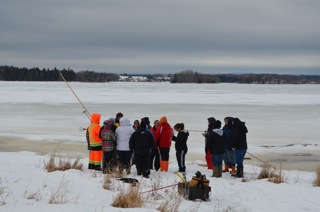
Caption: Mi’kmaw students at Potlotek High School receive an outdoor science class with a history of treaty right to fish lesson from Kerry Prosper of Paqtnkek First Nation.
Credit: Photo courtesy of Potlotek First NationPotlotek has an elementary school but, until last year, high school students had to travel off-reserve to a provincial school where they experienced low graduation rates and complained of incidents of bullying. “The community propelled us forward to be as aggressive as possible in promoting the concept of the school,” says Potlotek band manager Lindsay Marshall, a former band chief who helped negotiate the self-governance accord in the 1990s. “We felt this was the only way we could see to save our kids.”
Speedy implementation of a high school program, in barely a month, “would have been almost impossible” under the Indian Act, he adds.
Others assisted the grassroots effort too. Mi’kmaw Kina’matnewey, the education authority, and the Council on Mi’kmaq Education, worked with the Nova Scotia Minister of Education and her department’s Mi’kmaq Liaison Office to ensure the Mi’kmaw-enriched curriculum, taught by certified teachers, met the requirements of the province’s high school diploma.
With no physical building of its own yet, the high school borrows space from administration facilities (used for daytime adult education) and rooms in the elementary school to deliver classes from 3pm to 8pm. As a central support agency for member communities, Mi’kmaw Kina’matnewey also provided funding for books, materials, and teacher training.
“It has a lot to do with the community deciding and telling us what they needed,” says Eleanor Bernard, Director of Education for Mi’kmaw Kina’matnewey. “That is the biggest factor.”
In Potlotek, what community members wanted was success for a new generation of learners. In its first year, the school hired four teachers (native and non-native) as well as a Mi’kmaw social worker to help students cope with drug, alcohol, and social issues. With classes starting in mid-afternoon, five members of the community take turns preparing a hot meal at 5:30pm every school night for students. This year, enrolment climbed to 50 students and five teachers.
Students follow the provincial curriculum enriched by in-class and outdoor activities that included Mi’kmaw traditions and ceremonies. For example, elders teach students how to fish for salmon – an opportunity for them to learn about their treaty rights as well. Several times a year, the school puts on language camps to foster student awareness of their cultural identity. The band is in the process of developing land on a nearby island as a science camp for students to learn math, biology, and other subjects from a traditional perspective.

Caption: At a Potlotek Mi’kmaq language camp in June 2012, elder Frank Augustine teaches student Sonny Doucette how to skin an eel.
Credit: Photo courtesy of Potlotek First NationThe school also brings a Mi’kmaw approach to teaching and learning. Instead of issuing suspensions for unacceptable behaviour, the school gives students a choice. If a conflict erupts, students can meet with the social worker to draft a “wellness” plan and participate in a “talking circle” that gives everyone at school a voice to speak about the incident. Alternately, students of legal age (16 years) can choose to withdraw from school.
“I feel my heart is going to burst with pride,” she says. “We are a small community but every one of these kids belongs to us.”
In its first 18 months of operation, the school had only one incident that required a talking circle, says Ms. MacLeod, the Education Director. Mr. Marshall recalls an incident when a male student was caught smoking marijuana at school and sent to the office. The student was told “the good news is that you are not suspended. The bad news is that you are spending a day with the elders.” “That young man never smoked in school again,” says Mr. Marshall.
In 2011, the school had its first graduate, now in second year of university, and three more graduated last June. Margaret Poulette, a community member who works with adult learners and youth on special projects, says the graduation ceremony is an emotional moment. “I feel my heart is going to burst with pride,” she says. “We are a small community but every one of these kids belongs to us.”
Ms. MacLeod, a non-Mi’kmaw active in Nova Scotia native education for almost 30 years, makes no pretense that dropouts are among several challenges for the school. But consistent with its community-based focus, Potlotek brought together students (those doing well and struggling), parents, teachers and others this fall to discuss potential solutions. Meanwhile, the community has embarked on a fundraising campaign to build a traditional longhouse that, when completed, will include space for an actual high school.
In the meantime, Grade 10 student Gideon Doucette says he likes going to Potlotek High School because it offers small classes and regular exposure to Mi’kmaw teachings and tradition. Before school, he teaches drumming to younger students, an experience he says reinforces his Mi’kmaw identity.
The 16-year-old failed Grade 9 at the provincial school, successfully repeating the program at Potlotek last June. He now rates as “very high” his chances of graduating in a couple of years.
“I want to move forward in my life,” he declares. “I plan to be lawyer and stand up for our treaties and our rights and help more Mi’kmaw people.”
-
From Rhetoric to Reality
Comments Off on From Rhetoric to RealityDeep, meaningful change seldom comes easily.
When Alberta high school principal Tom Christensen and his teaching staff envisioned an education environment that demanded students take more responsibility for their learning, some of the teachers he most respected left because they felt the changes would take them out of their comfort zone.
“Those are pretty much tipping points,” he told Education Canada, “where you wonder are we going too much for what this community and this district can handle? … I think that’s what causes a lot of people to not make the change. They realize that friendships could be affected, you’re going to be challenged and it’s almost safer just to hide, not to change.”
That willingness to confront the status quo is a common thread that runs through this special theme issue of “From Rhetoric to Reality.” Whether it is a Mi’kmaw community in Nova Scotia fighting for its own high school or a Toronto high school teacher dreaming up an innovative alternative program, their stories are powerful reminders about the central purpose of education: to equip the next generation to play its full role in society.
For Tom Christensen, change was inevitable. “It’s just such a different world from the one we were living in even 10 years ago,” he says. “I don’t want to be that guy who 20 years from now they’re cursing … because he just created a school that looked the same as the one built in 1905.”
In Winnipeg, Seven Oaks School Division Superintendent Brian O’Leary knows that meaningful change requires patience and resolve. Three years ago, his school division opened Met School, a school-within-a- school. Progress is slower than he had hoped, but the school has opened new paths for learning. “We underestimate how much work it’s going to be and overestimate the results; if we didn’t have that capacity for self-deception, we’d never start anything.”
Toronto high school teacher Craig Morrison was convinced he could re-engage students with an alternative program that taught them to design, build, and market skateboards. Mr. Morrison and an unlikely group of supporters, including the small-business owners of a skateboard shop, shared a belief that young people, in the right academic setting, could find their feet.
In Kelowna, B.C., high school teachers Graham Johnson and Carolyn Durley had successful teaching practices. But they “flipped” their classrooms upside-down because they wanted their students to experience math and biology in a deeper way.
Elsewhere, education leaders are rethinking school design and trying to get a handle on technology to better serve a new generation of learners. These inspiring trailblazers, sensitive to the needs of today’s young learners, are quietly, steadily turning rhetoric into reality.
-
Success, but Slowly, as Met School Redefines Learning
Comments Off on Success, but Slowly, as Met School Redefines LearningThree years ago, one of the featured stories in the Education Canada Theme Issue (“Innovation: Challenging the Status Quo”) described an alternative school that had just opened in the Seven Oaks School Division in Winnipeg, Manitoba. Met School, for grades 9-12, was designed for “kids who want a rich relationship with a teacher that extends over time, real-world learning opportunities” and a program built around students’ needs and passions, Seven Oaks superintendent Brian O’Leary told Education Canada at that time.
Seven Oaks Met School was then, and still is, the only high school in Canada that is part of the Big Picture Learning network of innovative schools that started with a single Met School in Providence, Rhode Island, in 1995. Big Picture schools embody the values described by Mr. O’Leary.
This fall, Seven Oaks Met School entered its fourth year. It graduated its first class of Grade 12 students in June. This seemed a good time to ask: How well has the school fulfilled the vision described by Mr. O’Leary?
It has been a godsend for Darlene Woiden, a mother who had despaired of finding a school that would engage the interest of her son, Parker Hubley. “I love him to bits, but he’s not academically inclined,” she says. “He never was from K to 8.” She described how most days of those nine years started with a struggle to get him to go to school.

Caption: Grade 11 student, Eric, at his internship with Minute Muffler. Eric learned how to repair tires, do oil changes and kept the shop clean and orderly, including tallying and ordering stock.
Credit: Photo courtesy of Seven Oaks School DivisionFor high school, she considered enrolling Parker in a private school with smaller classes. Then she received a newsletter from Seven Oaks School Division describing its new “Met School” as an alternative approach for some students. She was attracted by the school’s emphasis on a hands-on style of learning that included internships at businesses and institutions in the community. At the time, mistakenly, she wondered if the Met school was a special education class by another name and worried “he’s not going to learn what he needs.” In fact, Met School is designed for students seeking an alternative learning environment in which to pursue their passions and develop a closer relationship with teachers and students. In the end, deciding they had nothing to lose, Parker and his parents took part in an interview – a requirement for coming to the Met school. In 2009, Parker was accepted as a Grade 9 student.
A distinguishing feature of the Met School experience is that a cohort of students stays with the same teacher (known as “advisor”) over four years of high school. The approach is an extension of a practice by all three Seven Oaks high schools to connect every graduating Grade 8 student with a teacher-advisor who introduces stu- dents to high school, helps them navigate the next four years and is the caring adult who presents them with their diploma at graduation.
Another characteristic of the Met School is small “advisory” classes with no more than 15 students, so they get to know each other and interact in a way generally not accommodated in a larger school. By sticking with the same group of students throughout high school, the teacher/advisor gets to know the student on an individual level and stays in regular communication with the parents. That familiarity, says David Zynoberg, one of four Met School teachers, helps put a student’s actions and behaviour in context and guides the advisor on what’s needed in any given situation. “We’ve had parents really highlight how much a student has grown because of having that relationship in life, that adult who cares about them and really pushes them and looks for the best in what they’re capable of,” he says.
In the early months of Parker’s first year at Met School, Ms. Woiden was concerned that the work he was bringing home seemed “vague.” But over time she watched as he became immersed in his studies, especially impressed when her son discovered that his auto mechanics internship required knowledge of the same equations he struggled with in Math. “He took off with that math and he got an 80 out of it,” she recalls.
Internships with businesses and institutions in the community are a core element of the Met School experience, with students spending two-and-a-half to three months in a workplace setting. During a school year, a student may have as many as three internships linked, or not, to career exploration. By working in a professional environment, students develop work and social skills and, as Met School Principal Adair Warren explains, “a broader understanding of the work that people have done to develop their own careers.” Placements have included a college pharmaceutical manufacturing lab, health and medical settings, media, documentary filmmaking, technology, art, animal sciences, robotics, and prosthetics and orthotics, and those are just a few.
In an experience rare for high school, Met students report quarterly on their internships, individual school projects and their academic progress in stand-up “exhibitions” for fellow classmates, parents, staff, internship mentors and anyone else they choose to invite. Typically, a student’s first presentation is a bit awkward, not well focused, and brief, says Mr. Zynoberg. But students improve with each succeeding exhibition, thanks to follow-up activities that include a feedback form for the audience and meetings between the student and staff and family after the presentation.
During the year, advisory-group workshops focus on presentation skills and techniques to help students get ready for their presentations. They need to strike a balance between style and substance, says Mr. Zynoberg. “They want to be proud of their work and look really smart [while presenting] some really complicated things, but at the same time make it accessible to everybody,” he says. “It’s a challenge that they face every presentation.”
Darlene Woiden recalls Parker’s first presentation in 2009: “He would stare at the floor, he was kicking at an imaginary spot, he was mumbling; you could barely understand him.” Then, with obvious pride and a bit of emotion, she described his most recent exhibition, delivered this past June: “He’s animated, he’s looking straight at all the students, he’s telling jokes, he’s getting them involved and he’s passing out samples of the work that the kids did at the Y for him as a present for going away.” (The family moved to Ottawa this past summer.)
Core subjects such as English and Social Studies are very much a part of the Met School program, but typically are integrated in the students’ individual projects and internships. Matt Gereta, a student of Mr. Zynoberg, studied the history of computer processors, used applied math to build a pie chart accompanying his comparative analysis of several video games and wrote an essay comparing two Internet protocols. Mr. Gereta says he “didn’t like reading at all” when he entered high school, but read 13 books in his first year in Met School. Some, but not all, were related to his avid interest in computers. He is one of the five Met School graduates this year and now attends Red River College in Winnipeg where he is studying Business Information Technology.
MASTER OF EDUCATIONAL TECHNOLOGY
Since Met School does not offer Math, Calculus, Biology, Chemistry, Physics and Band, students take those classes at Garden City Collegiate, housed in the same building as the alternative program.
Diversity describes the profile of students who elect to attend Met School, says Ms. Warren, the principal. “Whether it’s honour-roll-type kids or kids who really like to work with their hands more than the academics, we are an inclusive place for all of them,” she says. In its early phase, with little time for Met School to establish its identity, some students found it not was not a good fit for them and left. Others, also unsure, stuck it out and ultimately found the program to their liking. Some students were enthusiastic from the start about the program’s promise of a better way to learn and flourished.

Caption: Met School Grade 11 film student, Anna, working on her documentary film on refugees called “Fight for Freedom.” Anna’s film was accepted into a California film festival.
Credit: Photo courtesy of Seven Oaks School DivisionFar from the laid-back image often associated with alternative schools, Met School puts its energy into helping students develop self-knowledge, essential skills and a sense of direction – a strategy common to schools in the Big Picture education reform movement.
As a result, says Mr. O’Leary, students seeking a crack to hide in at school soon discover they won’t be overlooked by the teachers. Students are challenged to find and declare their interests and passions and then, with the help of their advisor, begin to build the pieces that will make up their learning plan. This includes courses, research, projects and internships, and is done in full view of – often with the help and cooperation of – their peers in the advisory.
When Seven Oaks established the Met School, Mr. O’Leary put two personal expectations at the top of his list. One was that it provide, as he puts it, “an alternative for kids looking for a more authentic personal experience in high school that doesn’t follow the standard and unfortunate recipe of grouping all at-risk kids together and just dumbing it down” and second, that the school would “help kids get to know themselves.”
Based on feedback from students and parents, he’s gratified that Met School is meeting those expectations. “I think lots of kids go through school on auto-pilot,” he says. “Unless we can really tap into their motivation, we won’t succeed with them. They have to be doing it for their own reasons, and ultimately just for the joy of the experience and learning.”
I think lots of kids go through school on auto-pilot. Unless we can really tap into their motivation, we won’t succeed with them. They have to be doing it for their own reasons, and ultimately just for the joy of the experience and learning.
Still, he is disappointed that Met School was not able to reach and retain everyone. Some students, he said, saw Met School “as a relief from what they’ve found to be kind of a boring routine. But people [here] know them and they’re in their face more and they really have to get engaged to deal with stuff.” When confronted with the need to face up to their challenges, some students are not ready to do so.
Met School’s enrolment of 50 students is less than half the 120 that was projected before the school opened – a disappointment but not a game-changer for Mr. O’Leary. “One of my rules in starting things is that we delude ourselves as to how much work it’s going to be: We underestimate how much work it’s going to be and over-estimate the results. If we didn’t have that capacity for self-deception, we’d never start anything.”
Looking ahead, Mr. O’Leary is encouraged that recruitment this year for Met School “is much easier than it’s been. Kids are coming forward. We have staff who come to the division and want to work there. We have huge competition to work there, and really talented people. We almost always get to the point that [new programs such as Met School are] better than we expected , but years one, two, and three are always more work than we had thought.”
Some elements of the Met School program elements can now be found in the three Seven Oaks mainstream high schools. All three schools have teacher-advisors and are adding to their roster of internships. In one case, West Kildonan Collegiate has changed its timetable, occasionally allowing a “whole-period day” that gives students the day to carry out a variety of integrated activities related to a particular course.
West Kildonan also has divided its 800 students into four learning clusters, each with its own science lab, with the same teacher for core courses in Grade 9 and Grade 10. “What that’s done is really cut down on failure rates,” says Mr. O’Leary. “Instead of teachers feeling pressured that they have limited time, they know they have two years, 240 hours with these kids over time. If the kid does not get the credit, the teacher who taught them is responsible for remediating them.”
Mr. O’Leary noted “a strong correlation between kids failing a single credit in Grade 9 and not graduating.” He adds “keeping students with teachers for a second year, keeping teachers responsible for kids who don’t meet their standards” is a way to reduce failures.
From his perspective as the top official in Seven Oaks School Division, Mr. O’Leary is convinced that Met School values and learning framework have had “a profound effect” on Seven Oaks high schools. Still, despite media attention and a constant flow of visitors interested in the work of Met School, he frets that “we’ve not challenged the thinking of people in other at-risk programs.” He says “people tend to see what [Met School is] doing and usually not dismiss it but say, ‘Oh, we’re doing that already’ – when they don’t.”
But those in the Met School family know exactly what the program is doing for their children. Susan Mitchell says her daughter, Candace Houle, entered Met School in Grade 9 when the school opened three years ago and has had the same teacher-advisor, Nancy Janelle, as a constant presence in her high school life. Ms. Mitchell says Candace needed a more flexible, active learning style after struggling in middle school. “Particularly in the high school years … you need to have a nurturing environment where the teachers are willing to go the extra mile. That’s what Met School has given Candace.”
For her part, Ms. Houle has sparked to the Met School experience. She’s had internships at the Winnipeg Zoo, a vegan bookstore and café, two different record labels and a local radio station. The latter two have spurred her to pursue a career in the music industry and she expects to enter Fanshawe College in London, Ontario, next fall in music, arts and industry. “I’m glad I made the decision to go [to Met School],” she says. “It’s been super-great for me.”
Haily Seguin, now in Grade 10, last year did a project on brain development in young children and another on 9/11, as well as collaborating with a friend on a project they called “What’s in Your Burger?” Met School has made a difference for her, she says, “because it allows me to see what the real world is going to bring me once I graduate.”
Darlene Woiden still marvels at the transformation of her son, Parker. In preparation for the family’s move to Ottawa, she and her husband took Parker to an Ottawa high school she describes as much like Met School in orientation. “He was this young adult in the room that my husband and I had never seen. He spoke of the program and he spoke of his army cadets, and he explained to them … that from his Met School he learned that learning was fun and he wanted to be in a school that could help him to keep that attitude. And the Vice-Principal just kind of looked at [me and my husband] and I just got teary-eyed and almost had to leave the room.”
EN BREF – Seule école secondaire canadienne faisant partie du réseau américain Big Picture Learning regroupant des écoles innovantes, l’école Seven Oaks Met School a remis des diplômes à sa première cohorte ce printemps. Les stages réalisés dans des entreprises et des établissements constituent un élément fondamental de l’expérience de cette école. Les élèves préparent un rapport portant sur leur stage, ainsi que sur des projets individuels et sur leurs progrès scolaires, et présentent des exposés oraux trimestriels d’une heure devant des camarades de leur groupe consultatif, des parents, des membres du personnel, des mentors de stage et d’autres invités qu’ils choisissent. L’enseignant-conseiller de la classe suit le même groupe d’élèves pendant leurs quatre années au secondaire.
-
In Nova Scotia, a Mi’kmaw Model for First Nation Education
Comments Off on In Nova Scotia, a Mi’kmaw Model for First Nation EducationIn 1999, Mi’kmaw communities in Nova Scotia won control over the education of their children for the first time in a century. The Mi’kmaw Education Act became Canadian law two years after a signed agreement by the federal and Nova Scotia governments and chiefs of nine (later 11) of 13 Mi’kmaw communities that recognizes local decisions on education, including language, history, identity, and customs in the regular curriculum.
Today, though funding is still an issue, the legal arrangement that governs the schooling of about 3,000 Mi’kmaw students in Nova Scotia is winning national attention as a possible model for First Nation self-governance in education.
Earlier this year, a national panel set up by the federal government and the Assembly of First Nations cited the Nova Scotia example in recommendations calling for a First Nation education system to protect a “child’s right to their culture, language and identity, a quality education, funding, and First Nation control of First Nation education.” The panel’s recommendations – a precursor to federal legislation expected in 2014 – aim to rectify an abysmal history of aboriginal education that leaves First Nation children at a disadvantage, by almost every measure, compared to their peers in school.
What’s driving interest in the Nova Scotia model is the work over the last two decades by Mi’kmaw Kina’matnewey, the education authority that distributes $40-million a year in federal grants to its member communities – and the effort of the local communities themselves. Significantly, the tripartite agreement recognizes the role of the education authority to support local band schools in delivering language immersion and other culturally rich programs and activities. With Mi’kmaw-focused teaching pedagogy, schools seek to engage students in a successful education experience. In 2010-11, Mi’kmaw Kina’matnewey reported a high school graduation rate of 75 percent for students in the system, up from 70 percent two years earlier and almost on par with Nova Scotia as a whole.
“What impressed us most were the outcomes,” says Scott Haldane, chair of the National Panel on First Nation Elementary and Secondary Education for Students On Reserve. The 75 percent graduation rate, he observes, “is double the national average and close to triple the average of what we saw in some of the worst performing schools.”
He describes Mi’kmaw Kina’matnewey as “an overnight sensation that’s taken 20 years to actually happen.”
Like a school board, Mi’kmaw Kina’matnewey serves as a central coordinating body, providing common services and resources to its members and acting on their behalf in negotiations with the Nova Scotia and federal governments. But unlike a school board, Mi‘kmaw Kina’matnewey serves rather than directs the activities of its members’ local schools.
“The accountability in the MK (Mi’kmaw Kina’matnewey) system is that MK is accountable for helping the schools but in the provincial system the schools are accountable to the school board,” says Jeff Orr, Dean of the Faculty of Education at St. Francis Xavier University in Antigonish, Nova Scotia. Emphasizing the “collective consciousness” that defines the interaction between Mi’kmaw Kina’matnewey and its members, he says “if we trust people are helping us we are more likely to seek out their support. The cultural, sociological and political hope of MK is that it is able to cultivate that trust and therefore able to operate in supporting schools [in ways] that are fundamentally different from the provincial system.”
If we trust people are helping us we are more likely to seek out their support.
Nurturing a new generation of Mi’kmaw teachers – who account for about 50 percent of those teaching in Mi’kmaw schools – has been a key goal of Mi’kmaw Kina’matnewey. Since 1995, in a collaborative effort between the education authority and the education faculty, more than 100 Mi’kmaw-speaking students have earned their bachelor of education. “That is because of the relentlessness of our relationship over the period of time,” reflects Prof. Orr, emphasizing the strong rapport between his institution and Mi’kmaw Kina’matnewey, whose representatives serve on an advisory body to the faculty. As well, his education faculty delivers on-reserve programming for students to complete their teaching degree on a part-time basis or earn a certificate in Mi’kmaw language pedagogy.
Former teacher Eleanor Bernard, the current Director of Education for Mi’kmaw Kina’matnewey, can measure progress by her own experience. When she arrived at high school in Sydney in 1981, she was one of 160 Mi’kmaw students. By graduation, she was one of only five who received their diploma. When she started teaching 20 years ago, she estimates she was one of about 25 from Mi’kmaw communities. Today, there are more than 200 in the province.
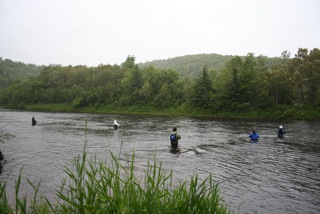
Caption: On Aboriginal Day in 2011, Potlotek High School Students exercise their treaty right to fish salmon.
Credit: Photo courtesy of Potlotek First Nation“It is amazing how far we have come in 20 years,” she says. Self- governance was an essential first step, but insufficient without community-based programming to enrich the education of Mi’kmaw children. A key initiative has been the development of language immersion programs in three communities, one offering courses through Grade 12.
While gratified by the recent attention to Mi’kmaw initiatives in Nova Scotia, Ms. Bernard is candid that significant education challenges remain on literacy, numeracy, attendance, and “capacity building” at the local level. “There is still work to be done,” she says. “There continues to be a need to bridge the gap for students in the provincial system and ours.”
Recent efforts to bridge the gap have come through partnership agreements between Mi’kmaw Kina’matnewey and the Nova Scotia department of education.
In 2007, the department and Mi’kmaw Kina’matnewey signed their first bilateral agreement on education services, replacing individual tuition agreements between the government and local bands.
“It allowed us to move forward in a way we had not done before,” says Candy Palmater, Director of the department’s Mi’kmaq Liaison Office.
Under the agreement, now being renewed, the department offers teachers in the Mi’kmaw Kina’matnewey system the same professional development provided free of charge to those in the provincial system. At the request of Mi’kmaw Kina’matnewey, concerned about school improvement, the department shared provincial tests for Grade 3, 6, and 9 so that local Mi’kmaw schools could assess the achievement of their students. The results are shared privately with participating Mi’kmaw schools.
In turn, Mi’kmaw Kina’matnewey shares its expertise in language curriculum and Mi’kmaw programming with the department. “We have worked hard at developing our relationship,” says Ms. Palmater, who is herself of Mi’kmaw descent. “As a result, we have a real sharing back and forth for the first time in a long time.”
As a bright light in an often-dark picture of aboriginal education, the Mi’kmaw self-governance model holds out hope for what is possible, says Mr. Haldane. Speaking of his national panel, he says “the conclusion we came to is that when First Nations are given the time and resources to build a system that includes school-board type supports and ministry-type supports, and when they can work closely with the provincial education system, then results seem to follow.”
EN BREF – En 1999, en vertu des lois fédérales, les collectivités Mi’kmaw de la Nouvelle-Écosse ont obtenu le droit de gérer l’éducation de leurs enfants pour la première fois depuis un siècle. Avec le soutien de Mi’kmaw Kina’matnewey, une autorité scolaire assurant des services centraux, les écoles Mi’kmaw offrent des cours de langue d’immersion, une pédagogie culturellement adaptée et d’autres initiatives favorisant la réussite scolaire. En 2010-2011, Mi’kmaw Kina’matnewey a rapporté que 75 pour cent des élèves du secondaire avaient obtenu leur diplôme, soit deux fois la moyenne canadienne. La formule d’auto-administration est considérée comme un modèle possible pour l’enseignement dans les Premières Nations canadiennes.
-
Shared Campus Smooths Post-secondary Pathways
Comments Off on Shared Campus Smooths Post-secondary PathwaysAt the opening of Olds High School, Principal Tom Christensen held his breath as he watched students inspect the new facilities designed with a new approach to learning in mind.
The Alberta school is divided into four so-called “quads,” each housing one-quarter of the school’s 800 students, with flexible learning spaces to accommodate small or large groups, self-directed study, project-based learning and other forms of inquiry and collaboration.
“You could hear the students – they just got it right away,” says Mr. Christensen, delighted by their response.
In many ways, Olds is not your average high school.
It is located on the campus of Olds College, which partnered with Chinook’s Edge School Division to create a shared, multi-facility complex known as the Community Learning Campus (CLC). The high school occupies about 20 percent of the CLC’s Ralph Klein Centre, which also houses the CLC’s Health and Wellness Centre, the Central Alberta Child and Family Services Authority, Alberta Employment and Immigration, Integrated Career Centre, as well as counseling and health services.
Other facilities that make up the learning campus include a fine arts centre for theatre and performing arts for students and the community, as well as a Bell e-Learning Centre that serves as a high-tech hub for learning resources accessible to students, staff, and communities in the vicinity of Olds, Alberta.
As a measure of the physical integration of education facilities, high school students make use of career, technical and shop facilities, renovated as part of the CLC project and located on the college campus. In addition to saving money, the shared facilities enable smooth pathways from college to post-secondary education or training.
Former Chinook’s Edge Superintendent Jim Gibbons says students can “do a transition from, say, a level of skill at Grade 9 or 10 and then easily transition to the trades as well.” High school students can use the college library as well, with no need to duplicate the facility.
The layout of the high school is designed to get students thinking about their interests and possible career pathways. Students in the Grade 9 quad explore a “Who Am I?” theme that introduces them to project-based learning. In the past, says Mr. Christensen, a project might consist of: “we studied Columbus, now write a report on him.” Now, he says, “a project has a driving question; it’s based on the inquiry idea.”
A project has a driving question; it’s based on the inquiry idea.
Grade 10-12 students choose among three different quads. The Blue and Gold quads are organized along the familiar “classroom-based” model (“We don’t like to use the word ‘traditional’ anymore,” Mr. Christensen says). This model was inspired by small K-12 community schools in which teachers know high-school-age students and their parents well. “When we were setting up the idea of the quads, we were trying to make the four areas of our school function like small schools,” says Mr. Christensen. For example, in the Blue and Gold quads, teachers of Math, English and Social Science stay with the students through their three years of high school. The timetable accommodates team teaching as another form of learning enrichment.
The “Green” quad, by contrast, subscribes to an inquiry-based form of learning, with projects and seminars that allow students to be more self-directed in their activities. Students stay with the same two core-subject teachers for three years. Green quad students don’t have to be honour students, and many are not, according to Mr. Christensen, but they do need to be self-motivated and have a good work ethic. The self-directed approach is designed to create a university-like atmosphere to ease the transition from high school to university. Although the other three quads were developed as part of the planning for the new school, the Green-quad concept, previously known as the “academic team,” has been part of the Olds High School program for more than 10 years.
Enabling students to direct their own learning means students are not constrained by disciplines organized into the usual hourly units of classroom study. “We know as adults we learn at different rates,” says Mr. Gibbons, now a Senior Advisor with the Alberta School Boards Association. He says most schools hang onto the outmoded Carnegie unit “that suggests if we have students spend 60, 70, 80 minutes in a classroom they will come out with this defined amount of knowledge and learning. It doesn’t make sense.”
Not all teachers are comfortable in the kind of setting adopted by Olds High School. Four teachers among the staff of 30 decided not to stay after the new program was introduced, even though some participated in the planning and visioning. They included some master teachers. “I’m very good friends with them and I respect that they did that, says Mr. Christensen. “But it opened opportunities for me to hire people that were ready to really embrace what we’re doing.”
-
Alberta High School, College Elevate Learning with Rare Joint Venture
Comments Off on Alberta High School, College Elevate Learning with Rare Joint VentureIn 2003, a group of parents in Olds, Alberta, rejected a provincial grant of $6.8 million to renovate their aging high school, which they felt should be replaced. Their refusal – even with the provincial minister of infrastructure ready to hand over an oversize cheque – set in motion a remarkable collaboration among education institutions accustomed to working in their own spheres.
What transpired in Olds, a rural community of 8,200 people located midway between Calgary and Edmonton, is the result of a shared vision that transcended institutional boundaries to create facilities and learning opportunities far beyond the means of its individual partners.
By working together, and drawing widespread support in the community and beyond, Chinook’s Edge School Division (CESD) and Olds College conceived a plan that materialized over seven years into a $70-million Community Learning Campus (CLC) serving high school, college, and adult learners in Olds and mid-central Alberta. In 2010, the new complex opened as a joint venture between Chinook’s Edge, the largest rural school division in Alberta, and Olds College, with facilities including a 390-seat theatre, a fitness centre, an e-learning centre (for distance learning and on-site training), and not least, a new $22-million high school on the campus of the 1,300- student college.
The CLC sprang from the conviction of the leaders of the two institutions that they could accomplish a great deal more by joining forces than by living in largely separate silos. In the end, the project succeeded thanks to a multi-stakeholder group of “gladiators,” the development of a well-defined business case, and bits of serendipity along the way. The CLC was selected by the Organization for Economic Co-operation and Development (OECD) as a case study in its Innovative Learning Environments Project.
The timing was right for a collaboration.
“At that point in time, the college really needed to come into the 21st century, particularly from an infrastructure and programmatic standpoint,” says H.J. (Tom) Thompson, president of Olds College. “There was a stark reality that if we were to continue to be a traditionalist in terms of working with government as primary sponsor of infrastructural renewal, we’ll still be waiting today.”
I think high schools have to be much more flexible and need to find ways to engage kids so they see this bigger picture of a career path
For his part, then-Chinook’s Edge Superintendent Jim Gibbons had to figure out how to replace an aging high school separated from its sport fields by a busy highway and dependent on a nearby church to house a music program. But he was also concerned about preparing students for a 21st century economy requiring higher levels of education than in the past. “I think high schools have to be much more flexible and need to find ways to engage kids so they see this bigger picture of a career path,” he says. “We know kids are going to have multiple careers and so how do you get some experience and try things out?” (See Shared Campus, below)
Mr. Gibbons approached Mr. Thompson about possibly relocating the high school on a parcel of the Olds College campus, but Mr. Thompson was not interested selling a piece of college land for a “siloed, standalone entity.” Recalling the conversation, he says he told Mr. Gibbons, now a Senior Advisor to the Alberta School Boards Association, “if you want to talk about something just a little bit different, maybe a whole lot different, I said I think you would have the interest of our college and certainly our leaders here.”
Thus began a collaboration of two “visionaries,” as others described them, who met over coffee to map out a partnership that would work for both institutions and expand opportunities for their students and the wider community. Early on, the two leaders recruited key allies – Olds High School principal Tom Christensen and Dorothy (Dot) Negropontes, then an Assistant Superintendent in Chinook’s Edge. Ms. Negropontes was an alumnus of Olds High School who had deep roots in the community and a strong reputation for organizational skills.
What emerged from the discussions was the notion of shared facilities – under the banner of the Community Learning Campus – that would, among other things, facilitate a seamless transition for high school students into the workplace, apprenticeship, college or university. Reaching beyond their institutional walls, Mr. Gibbons and Mr. Thompson also looked to connect 13 communities within the Chinook’s Edge School Division to an e-learning centre for education and training. Area residents also would have access to a health and wellness facility and a fine arts complex for community and school events.
The shared arrangement also had implications for how best to equip a variety of students for tomorrow’s economy. “We looked at the learner as a high school learner, a college learner, a college learner that might choose to go on to a university program, a community lifelong learner and, most importantly, [we envisioned] a region that could be served so much better if we would append the technology,” says Mr. Thompson. “That was something the government latched onto big-time.”
His strategy to generate provincial support for CLC was to hold the government accountable for its “rhetoric” on public policy in three areas: “Go Alberta,” a 20-year vision for the province; a rural Alberta development strategy; and “Campus Alberta,” a plan to improve student transitions between college and university. The three policies, he says, were “rich in rhetoric.”
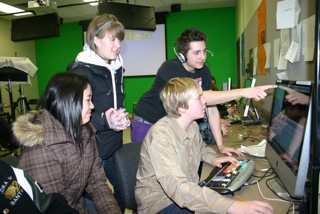
Caption: Olds High students in the CLC’s Bell e-Learning lab
Credit: Photo courtesy of Chinook’s Edge School DivisionEngaging rural members of the provincial legislature, for example, was an important part of presenting the learning campus as beneficial to the region. “That’s a very important strategic consideration because you’re increasing your political critical mass,” says Mr. Thompson. “Why rural institutions are suffering and dying, quite frankly, is because they can’t compete for resources against urban institutions that are surrounded with political firepower. This proposition had plenty of political firepower, both geographically and also because we brought government services into the mix of the building of a mall in concert with that [Health and Wellness Centre] and a social services mall that would have Child and Family Services, human resources employment, and Alberta Health – that brings in three more ministers.”
The CLC proposal was based on a solid business plan developed under a joint-venture arrangement between the school division and Olds College. “It’s different than a partnership,” explains Mr. Gibbons. Under a joint venture, he says “you only own the assets together in pursuit of the vision you’ve described. You don’t own them individually. You can’t take your ball and go home.” The arrangement set out separate responsibilities for each partner and spelled out sharing of revenue from leasing of office space, memberships for the fitness facility, special-event rental of the fine arts facility, and other sources to cover the ongoing operations of the CLC. The project planners made certain to communicate regularly with provincial politicians, whose constituencies stood to benefit from the CLC.
There were bumps along the road. At a critical moment, the project needed key approvals from the minister of infrastructure and the minister of education to proceed to the engineering and design phase – a $500,000 commitment. The request came on the eve of an election call and, without ministerial sign-offs that day, the project could have been delayed by six to nine months, estimates Mr. Thompson. In the end, the then-Chairman of Chinook’s Edge, a former member of the legislature, corralled both ministers in Edmonton for the necessary government commitment.
Another bump for the project came during the construction phase, as inflation hit at a rate of 2.5 percent per month in the latter part of the Ralph Klein administration. A number of projects failed to move ahead because they could not adapt to the fast-rising cost of materials. The CLC team took a different tack. “What we said was … if we don’t fix this ourselves and keep driving this forward, somebody somewhere else is going to pull the plug,” recalls Mr. Thompson. “So we became…a model [to the provincial government] of how to manage through an inflationary period.”
CLC architect Craig Webber, principal architect of Group2 Architecture Interior Design, says fast-rising costs were a catalyst to shrink the project 20 per cent without losing key elements. In the end, with a focus on shared spaces that would serve different functions at different times, his firm created a high school with capacity for 1,100 students –higher than the initial plan of 750 – without expanding the physical space. “Not only can we have better spaces, we can create better teaching environments in smaller spaces,” he says.
Not only can we have better spaces, we can create better teaching environments in smaller spaces
On February 22, 2010, led by the police and a local radio station, Olds High School Principal Tom Christensen and members of the student body walked from the old school to the new complex 25 minutes away. A soft-spoken administrator with a strong commitment to expanded learning opportunities for students, Mr. Christensen recalls what stood out for him in planning for the new high school. The “idea of being able to actually talk program and then build a school after [planning the] program, that’s what’s cool about the actual facilities,” he says.
One outgrowth of the school’s close relationship with – and physical proximity to – the college is the development of a dual credit program for high school students from Olds and other division schools to earn college credits at Olds College while completing their high school diploma. Chinook’s Edge was part of a dual-credit pilot project sponsored by Alberta Education as the province sought to articulate college credits with high school credits and develop a dual-credit policy. Dual-credit opportunities, plus the province’s Ca- reer and Technology Studies (CTS) program, have fortified the school division’s curriculum in support of career pathways for students. Chinook’s Edge also piloted CTS courses in recreation leadership, community care services, human and social services and health care sciences.
Meanwhile, Olds High School students have other learning opportunities outside the classroom, such as staffing the fine arts building. “They’re learning how the technology side of things in theatre works, learning how sound works,” says Mr. Christensen. A hairstyling salon will open this year and a hospitality pathway will be developed to take advantage of a hotel being built on the Olds College campus through a public-private partnership. In all, he estimates that about a third of Olds High School students are out in the community as part of their studies.
It’s not the same school it was when Mr. Christensen began his teaching career there in 1984. “Where I’m working now, I might as well have been transferred from Antarctica,” he says. “I used to judge success by how quiet the hallways were, whether the doors were shut. Now I take excitement from where I see kids working individually in the open areas. That’s how I judge success now. That was an interesting transformation in myself.”
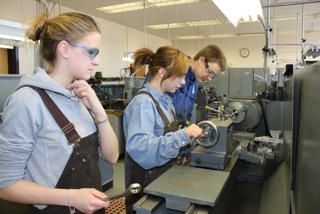
Caption: Olds High students in an Olds College machining lab. This is one of the CLC’s dual-credit offerings.
Credit: Photo courtesy of Chinook’s Edge School DivisionHe also sees a new culture of learning at Olds High. “You would think that by giving students more time that you’re going to lose your culture of rigour, when you [include] work experience time you’re going to lose your rigour. I used to hear that all the time: ‘We’re an academic place and we’re going to lose this by giving these kids freedom.’ It’s the opposite. I think we had last year on our Grade 12 exit exams …a 98 percent success rate. We used to be like 88-89. So in giving the students more time and giving them more individual responsibility, and personalizing it more, I’ll be darned but they do better.”
Once in operation, CLC lost some of its early momentum. Day-to-day operations moved ahead satisfactorily, but the big-picture ambitions became blurred. Mr. Gibbons retired in mid-2010 while early supporters of CLC on the school division board had moved on as well. Mr. Thompson says a sense of complacency set in the year after construction. He describes that period as “probably the most disappointing time for me. It’s almost like you give somebody a Ferrari and they treat it like a lawnmower.” But with the arrival of new players as advocates for CLC, he has regained his enthusiasm. “It’s moving back towards the Ferrari now,” he says.
Last year, Jason Dewling joined Olds College as Vice-President, Academics and Research, and, importantly, as his institution’s point-man to drive revitalization of the governance of CLC. He recognized how much effort had gone into getting the project off the ground, but concluded that less time had been devoted to the question of “now what?” He turned to Ms. Negropontes, now retired from the school division, to assess how to regain momentum for CLC. With her insider’s knowledge of the project, she was given a mandate to ask probing questions of dozens of CLC stakeholders on how to fulfill the project’s visionary ambitions.
Her report concluded that respondents enthusiastically endorsed the vision and appreciated the range of high-end facilities on the learning campus available for students and the wider community. Those interviewed also praised the high level of collaboration among institutions. But Ms. Negropontes also found that stakeholders identified several problem areas: a lack of clarity in roles, interests, needs, standards, and procedures related to the joint venture. Repairing and building relationships appeared to be a key requirement for moving ahead.
Her report has proved to be a catalyst to get back on track. “We are really in a very different place than we were last year,” says Mr. Dewling. “Dot’s report has made such a big difference.”
With revenue from ongoing activities, CLC hired Barb Mulholland as Director of Learning. Ms. Mulholland comes with a rich understanding of the potential for CLC, having served as the Chinook’s Edge Learning Services Coordinator who led the pilot project on dual credits. She has developed a three-year learning plan that calls for an increase in dual-credit opportunities and she is mapping out opportunities for curriculum intersections between the high school and the college. Revenues from facilities rentals are on the rise. The fine arts theatre is up to 200 bookings a year. The wide variety of activities going on within the campus brings a rich mixture of generations into contact with one another.
In addition to Ms. Mulholland, the CLC funds three other positions, with support from Olds College and CESD: director of CLC facilities and operations and Olds College business development; administrative assistant/receptionist for the Ralph Klein Centre and a sport recreation community programmer.
Although a few of the 13 community engagement sites have developed programming as first imagined by CLC, there are fresh efforts under way to rekindle interest. Campus Alberta Central has sprung up with a mission to reach rural learners with post-secondary learning opportunities, so the CLC will also be looking for ways to complement and cooperate with that program.
A governance team, headed by the President of Olds College and the Superintendent of Chinooks’ Edge, is keeper of the vision and has overall responsibility for the joint venture. Others on the 12-member team include board members, administration, faculty and students from CESD and Olds College, a CESD parent and representatives of the Town of Olds, Mountain View County, and the University of Alberta. They are partners “in association” in the joint venture.
Beyond the CLC campus, the town of Olds is turning into a regional “hub,” says Ms. Negropontes, attracting new residents.
She also says, ruefully, that it is harder to get a doctor’s appointment. Still, with all the new activity “it’s still very much of a small-town feel,” she says.
As a participant in the evolution of CLC – and now asked to give advice on other co-operative arrangements between institutions – Ms. Negropontes describes the collaboration in Olds as an example of the “third space,” a concept she takes from A Guide to Building Education Partnerships: Navigating Diverse Cultural Contexts to Turn Challenge into Promise. A third space like CLC, she says, “is the absolute pinnacle of collaboration.”
EN BREF – Lorsqu’un groupe de parents d’Olds, en Alberta, a refusé une subvention provinciale destinée à rénover leur école secondaire en 2003, la remarquable collaboration qui s’est ensuivie a donné lieu à un campus d’apprentissage novateur pour toute la communauté, et même au-delà. Ouverte en 2010, la nouvelle école secondaire Olds fait partie intégrante du Community Learning Campus (CLC), une initiative conjointe du conseil scolaire Chinook’s Edge School Division et du Olds College. Situé sur le campus du collège, le CLC est issu de la conviction des dirigeants des établissements qu’ils pouvaient accomplir beaucoup plus en unissant leurs forces qu’en les répartissant dans plusieurs silos distincts.
-
Cdn EdWire – Ontario a Hotbed of Education Controversy
Comments Off on Cdn EdWire – Ontario a Hotbed of Education ControversyStock letter asks school to warn when sensitive subjects arise – Toronto Star
Related Editorials
-
Young People’s Confidence in School, Community, and the Future: Why It Matters and What We Can Do About It
Comments Off on Young People’s Confidence in School, Community, and the Future: Why It Matters and What We Can Do About ItPublic confidence and trust in institutions matter. A recent Statistics Canada report points out that, “Public institutions, such as the health care system, the education system and the federal parliament, play an important role in shaping the lives of Canadians. Institutions often are considered the basic pillars of society so if people begin to lose confidence in them, there may be cause for concern….particularly in a global and increasingly impersonal world”[1]
Governments, the private sector, and think tanks all regularly measure confidence because it serves as a barometer of the social and economic health of a country by providing important information about people’s intentions and future actions that may have an impact on the rest of society. Consumer confidence signals people’s intentions to save or spend and is thus linked to the health of the economy. Citizen confidence in government contributes to democratic participation and social cohesion. And public confidence in education is critical if we want people – both parents and non-parents – to support public schooling through their taxes and loyalty to the public system. In the U.S., declining public confidence in public education has resulted in an exodus to private schools and even further deterioration of the public system.
From research studies, we know that students’ future trust in institutions is significantly shaped by their school experiences, in particular by whether there is an open climate for classroom discussion and how much their school values student participation in school affairs.[2] Similarly, research into young people’s optimism about the future can provide clues about their interest and capacity to make a difference in the world. Young people who believe in and are able to imagine a better future are more willing and have greater capacity to respond to issues such as social and ecological survival.[3] Therefore, if we want to know what kind of society we are likely to have in the future, we need to understand young people’s confidence in their schools, their communities, and their future.
Youth Confidence in Learning and the Future
Commenting on a recent public opinion poll, Frank Graves of EKOS Research Associates cautioned, “Western societies have long believed in the promise of a better future for the next generations…In recent years though, there has been a growing recognition that the next generation can’t count on this ever-improving quality of life.”[4]
Today’s generation of youth is the first in recent memory that will have lower incomes and less upward mobility than their parents. At the same time, young people are inheriting global scale economic, environmental, and social challenges unlike those of any generation before them.
The Canadian Education Association (CEA) completed a research project that looked at young people’s confidence in their learning environments and their future. With funding from the Ontario Trillium Foundation, CEA collaborated with social planning councils[5] and school boards in five Ontario cities on a community engagement and research initiative that involved young people in a variety of ways.[6]
The Youth Confidence in Learning and the Future initiative engaged over 1,000 Ontario high school students (Grades 9 to 12) who completed an online survey in school. An additional 75 young people participated in facilitated sessions organized by the social planning councils either early in the process to inform the development of the survey or later on to give feedback on the research findings.
The research focused on these dimensions of youth confidence:
- sense of trust;
- level of engagement;
- feelings of empowerment or efficacy;
- degree of “fit” or connection between in-school learning and lives and learning outside of school;
- confidence in the future – future orientation, confidence in their personal future, confidence in the future of their community/country, aspirations.
Research highlights: What students told us
Young people’s confidence varies considerably by dimension. As the table below shows, students were most positive with respect to future orientation and aspirations and least positive about the future of their community/country and the “fit” or connection between school and their life/learning outside of school.[7]
Students were most positive with respect to future orientation and aspirations and least positive about the future of their community/country and the “fit” or connection between school and their life/learning outside of school.
Youth are very future-oriented, with high aspirations. Almost all students (95 percent) reported that they intend to graduate from high school, with somewhat fewer (88 percent) indicating that they intend to graduate from college or university. Close to 90 percent of students said they think a lot about their lives, with 84 percent reporting that they have dreams for the future, although a smaller proportion (72 percent) said they know what to do to make those dreams come true.
Young people are far more confident in their personal futures than in the future of their community or country. Only 35 percent of students agreed that “in the next five years, my town or city (or Canada) will be a better place to live” compared with 73 percent who believed that “in the next five years, opportunities will open up in my life” and “I expect to achieve more than my parents did” in terms of career and income. Even in the face of a labour market and an economy that are failing them, young people continue to be optimistic about their personal futures. Some think this means that today’s youth are better equipped to deal with uncertainty than previous generations. Young people are hopeful and hope has transformative powers.[8]
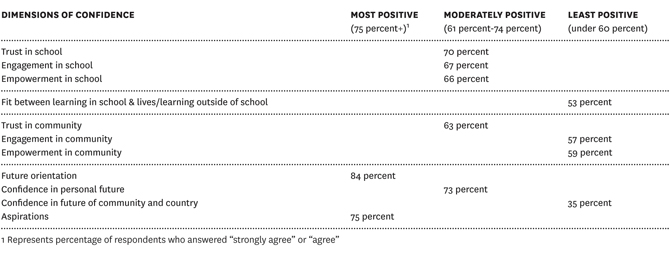
There is a significant disconnect between students’ in-school learning and their lives and learning outside of school. As the above table shows, only 53 percent of students were positive about statements related to “fit”. For example, only 58 percent could see connections between their courses and their lives outside of school, with even fewer (52 percent) reporting that what they do or learn outside of school is relevant to school courses and only 44 percent believing that their teachers are interested in what they are learning or doing outside of school.
Ontario high school students are required to do 40 hours of community service as a requirement for their high school diplomas. Only 57 percent of students found this a useful learning experience, although 71 percent felt that the program makes a useful contribution to the community.
Although moderate overall, students’ level of trust is low with respect to the mainstream media and people in their communities. Only 38 percent of students thought that most of the news in the mainstream media was true. Fewer than half, 48 percent, reported that they trusted “most of the people in my community,” even though 62 percent felt that young people were welcome and respected in their community, and 70 percent said their rights were usually respected.
With respect to trust in school, 49 percent of students said they had someone to discuss personal problems with in school, while 73 percent reported having at least one adult they could discuss school problems with.
While a low level of trust in the mainstream media can be interpreted as healthy skepticism, a low sense of trust in others may signal that community cohesion and social networks are becoming weak.
While a low level of trust in the mainstream media can be interpreted as healthy skepticism, a low sense of trust in others may signal that community cohesion and social networks are becoming weak.
Students feel empowered to stand up for themselves, but most do not think they can make a difference in their schools and communities. Over three quarters of students said they felt comfortable standing up for themselves both in and outside of school, with almost as many, 70 percent, reporting that they “sometimes stand up for others who are being put down or bullied.” On the other hand, only 51 percent said they had opportunities to make their school a better place and even fewer, 47 percent, believed they had opportunities to make their community a better place. Between a quarter to a third of students responded that they were “uncertain” about some of these questions, suggesting that they may not know about opportunities that exist to improve their schools and communities.
Students are more positive about their engagement in school (67 percent) than in their community (57 percent), although neither is high. Over 70 percent of students said they were interested in most of the courses they are taking in school, and 72 percent reported that, in their school, students were encouraged to discuss and question things. However, only 45 percent said they often learn something so interesting that they can’t stop thinking about it. This is consistent with CEA’s research initiative, What did you do in school today?, which found that only 43 percent of students were intellectually engaged, despite much higher levels of social and academic engagement.[9]
With respect to community engagement, only 51 percent of students reported that there were enough interesting things for young people to do in their community; a somewhat higher proportion, 55 percent, said they participated in at least one program or activity. Two-thirds of students indicated that they would vote in elections when they were old enough. Interestingly, while not a particularly strong indicator of engagement, the response to this question was more positive than any of the others related to engagement, suggesting again that lack of opportunities or knowledge of opportunities may be an obstacle for young people’s community participation.
How to Strengthen Young People’s Confidence and Prospects
In May 2012, CEA and the Hamilton Social Planning and Research Council sponsored a community forum and youth consultation on Searching for Certainty in Uncertain Times: Youth Confidence in School, Community and the Future. Close to 100 people, about a quarter of them youth, participated to discuss the research findings. Three panelists were asked to suggest some strategies for improving youth confidence.
Using the example of the Quebec students’ strike, Ron Canuel, the CEO of CEA, observed, “youth are beginning to recognize that if they take a stand, it will make a difference.” He went on to say that the two most important things that need to happen to strengthen engagement in school are introducing and allowing more use of technology in the classroom and greater flexibility in schools (e.g. later starting times for high school students, more flexible timetabling, and year round schooling). Such changes are now being piloted in some jurisdictions in Canada. The B.C. government, for example, is looking at year round schooling, a strategy that would mitigate against “summer learning loss” that affects many vulnerable students. These recommendations reflect what students themselves told us through the survey and informal sessions.
Shadya Yasin, coordinator of the York Youth Coalition in Toronto, emphasized the importance of building trust with both students and their parents, so that students do not feel “pushed out”. Recognizing that many administrators seem to be afraid of community organizations, Shadya argued that the school cannot exist without the community, making reference to the Somali saying, “You cannot wash your face with one finger.” Greater involvement of community agencies in the work of the school and the lives of students is needed to address the disconnect between students’ learning and their lives outside of school. Shadya argued that schools should not be providing mental health and social work services; instead, they should make better use of the services that exist in the community so they can focus on their central goals – teaching and learning.
“Connect schools deeply to their local and broader community” is one of the four core ways to improve high school outcomes that Ben Levin discusses in his 2012 book, More High School Graduates: How Schools Can Save Students From Dropping Out (see review on page 45). Included in this useful and highly accessible book are strategies for breaking down barriers and handling conflict with communities, as well as examples and concrete ideas for “Programming in and With Communities”:
Bring interesting adults into the school in various capacities such as mentors, role models;
Recruit adults who can share information about themselves, their community and their careers with students;
Work with community groups to provide important learning settings for students which can, in the future, open up career opportunities;
Enlist the help of community groups that can enrich school programs by providing opportunities that schools cannot, such as foreign languages, art or sports from a particular ethnic community.[10]
Marvyn Novick, the third panelist, is a policy consultant for Poverty-Free Ontario and former professor at Ryerson University. He noted that young people seem to have more confidence in themselves than in “us” – the community of adults who control their learning environments and the economy. This may be because we have placed today’s generation of young people in high levels of debt, precarious employment, under-employment, and declining public services. Marvyn contrasted this situation with the post-war period when people felt very close to each other and governments invested in collective initiatives – such as affordable housing, family allowances, a good job for everyone – to make sure that young people had a decent future.
To improve young people’s confidence in the future of their communities and their country, he argued, we need to shift the culture in schools and make sure that students understand how important these collective initiatives are. Ultimately, schools are public places where young people can learn that there is another kind of future. For example, instead of teaching about and preparing students for entrepreneurship, which provides jobs for only 15 percent of the population, why not teach students about unionship which contributes to the kind of good jobs that can support a family? Confidence grows with collective solidarity. Young people, schools and communities need to connect with each other and begin to say: there is another kind of future.
Conclusion
The results of this survey tell a good-news, bad-news story. While young people approach adulthood with a confidence in their own ability to succeed – a critical ingredient for success – they appear to have waning faith in social institutions or their ability to influence them. The resulting disconnect between personal and collective futures threatens to turn the optimistic exuberance of youth into a troubling cynicism about the society they will inherit. These results are a call for sustained government investments in ensuring decent jobs, as well as greater empowerment and inclusion of young people in the schools, communities, and social institutions that provide the backbone for democratic, civil society.
The concept paper on which this initiative is based can be found at http://www.cea-ace.ca/publication/youth-confidence-learning-and-future-concept-paper
EN BREF – L’Association canadienne d’éducation (ACE) vient de terminer un projet de recherche évaluant la confiance dont font preuve les jeunes à l’égard de leur environnement d’apprentissage et de leur avenir. Nous savons que l’expérience scolaire des jeunes, en particulier l’ouverture manifestée lors des discussions en classe et la participation des élèves à la vie scolaire, influe considérablement sur la confiance qu’ils accorderont plus tard aux institutions. La recherche portant sur l’optimisme des jeunes face à l’avenir peut nous éclairer sur leur volonté et leur capacité de changer le monde. L’enquête a dévoilé des résultats à la fois positifs et négatifs. Bien que les jeunes évoluent vers la vie adulte avec assurance quant à leur propre capacité de réussir – un ingrédient critique du succès – ceux-ci font moins confiance aux institutions sociales et doutent de leur capacité à les influencer. Les élèves se disaient plus positifs à l’égard des orientations futures et des aspirations, mais plus négatifs en ce qui concerne l’avenir de leur collectivité ou pays et l’intégration des apprentissages à l’école et à la maison.
[1] Grant Schellenberg, “The Perceptions of Canadians: Belonging, Confidence and Trust,” Canadian Social Trends (Winter 2004): Statistics Canada.
http://www.statcan.gc.ca/kits-trousses/pdf/social/edu04_0115a-eng.pdf
[2] J. Torney-Purta, W. K. Richardson, and C. H. Barber, Trust in Government-Related Institutions and Civic Engagement among Adolescents: Analysis of Five Countries from the IEA Civic Education Study. CIRCLE Working Paper 17 (The Center for Information & Research on Civic Learning and Engagement: August 2004).
[3] Carmen Stewart, “Re-Imagining Your Neighbourhood: A Model of Futures Education in Youth Futures. Comparative Research and Transformative Visions, eds. J. Gidley and S. Inayatullah (Westport Connecticut: Greenwood Publishing Group, 2002).
[4] “Frank Graves Poll: The Beginning of the End of Progress”. IPolitics Insight, March 9, 2012.
http://www.ipolitics.ca/2012/03/09/frank-graves-poll-the-beginning-of-the-end-of-progress
[5] Social planning councils are non-profit organizations across Canada working on a range of community development, community building and social justice issues.
[6] Hamilton, Milton, Peterborough, Sudbury, and Toronto
[7] The table does not show how students answered individual questions.
[8] R. Bibby, S. Russell, and R. Rolheiser, The Emerging Millennials: How Canada’s Newest Generation Is Responding to Challenge and Change (Project Canada Books, 2009).
[9] J. D. Willms, S. Friesen, and P. Milton. 2009. What did you do in school today? Transforming Classrooms Through Social, Academic and Intellectual Engagement (Toronto: CEA, 2009).
http://www.ccl-cca.ca/pdfs/otherreports/WDYDIST_National_Report_EN.pdf
[10] Ben Levin, More High School Graduates: How Schools Can Save Students from Dropping Out (Thousand Oaks, California: Corwin, 2012).
-
The Kids Cannot Wait: Making High School Work
Comments Off on The Kids Cannot Wait: Making High School WorkA review of More High School Graduates: How Schools Can Save Students From Dropping Out by Ben Levin. Corwin Sage, 2012. ISBN 978-1-4129-9224-4 Paper
In a participatory and constantly changing world, high school completion has far-reaching social, cultural, generational, and economic benefits both for individuals and for society as a whole. Statistics Canada reports the majority of Canadian young people aged 18 to 19 in all provinces graduate from high school (76.9 percent); this figure rises dramatically to 89.5 percent among young people aged 20 to 24.[1] Nevertheless, improving high school completion rates continues to be a priority across Canada, in part because these promising figures mask a persistent gender gap (more girls graduate than boys) and a variation among provinces.
Critics question the relevance and quality of our nation’s secondary schools. In More High School Graduates, Ben Levin acknowledges the challenges: too many students are disengaged and do not believe they learn anything meaningful at school; teachers are trapped in the unholy trinity of textbooks, lectures, and tests that focus on memorization versus creating knowledge; timetables, subjects, tracking and streaming, and teacher assignments are designed to work for the adults in high schools rather than for the students.
In response, he has written a comprehensive guide to improving high schools for learners and increasing graduation, based on strategies (tested in Ontario) that can work in all high schools in a district, a province, or across the country.
In eight chapters on how schools can keep students in school and also support them in better educational attainments, Levin offers practical and specific learner-focused ideas within an overall strategy, and a set of priorities that provides a clear road map for improvement. He argues that all high schools need to work on improvement; that improvement requires an integrated, multifaceted strategy; and that improvement is a matter of systematic and sustained effort over time rather than the result of brilliant design or policy.
Levin outlines a context-sensitive, interdependent, four-part framework: Connect With Every Student; Work with Curriculum and Graduation Requirements; Improve Teaching and Learning; and Connect with the Community. Levin’s four strategies reflect an understanding of why students do not graduate. All four strategies are necessary and each needs to be addressed for success.
First, educators need to know the status and progress of every student, identify the reasons for any problems, and intervene as soon as they see signs of difficulties. Research demonstrates that strong personal connections with every student is an important factor in student success.
Second, educators need to provide curriculum and programs that enable all students to achieve a good outcome. This is where Levin’s strategy really shines, in setting high expectations and providing appropriate supports that lead to an improved learning and school experience for every student, not just targeted groups. Program flexibility, credit rescue and credit recovery options, opportunities for self direction, offering credentials that have real value, establishing partnerships with other organizations, and whole school programming, are key factors in a high school that works for all students.
Third, educators must focus on improved teaching and learning every day. The core business of any high school is to support students’ learning; Levin argues that using assessment both for learning and for improving teaching practices, increasing student voice and input into class design, and increasing opportunities for independent work, are key factors for achieving better outcomes. Levin acknowledges the role of professional judgment, arguing that membership in the teaching profession implies shared beliefs and a commitment to research-informed practices which, in combination with experience, identify how to proceed. He encourages educators to intentionally draw upon the larger knowledge base on effective learning and teaching practices when making changes to their practice.
Fourth, schools must be connected deeply to the local and broader communities of which they are a part. High school students will benefit from strong outreach programs that foster interaction and engagement with the broader community, from families and neighbourhoods, to employers, post-secondary institutions, and non-profit agencies. Community connections can support learning opportunities that, in turn, increase success in school.
Taken together, these four themes provide a clear, credible, and useful strategy for improving high school graduation rates. The one significant gap in this work is Levin’s failure to address the design and implementation of technology enabled learning environments in any meaningful way. However, he states up front that he offers practical strategies that can be implemented immediately in any school. Levin takes aim at improving the schools we have right now rather than trying to create entirely new, innovative, and technology-enabled approaches to learning in high school.
Ben Levin’s book is a positive and convincing call to action for every teacher, principal, superintendent, and school board member who wants to make high schools better for learners. Based on relevant research and documented increases in graduation rates in Ontario high schools, Levin’s four interrelated strategies for improvement work. And the rest of Canada should pay attention.
[1] Statistics Canada, Education Matters: Insights on Education, Learning and Training in Canada, 9, no. 1 (2012). Retrieved from: http://www5.statcan.gc.ca/bsolc/olc-cel/olc-cel?catno=81-004-X&lang=eng
-
Understanding the Heartbeat
Comments Off on Understanding the HeartbeatEven though we walk on lands rich in history, we non-Aboriginal Canadians often fail to hear its stories due to a cultural deafness – a state of unknowing.
This state of unknowing is something school districts in British Columbia are trying to address with curriculum and enhancement agreements. For example, School District 44 has created a senior level humanities course that studies First Nations culture and history, as well as Squamish Language classes. Alberta has introduced an initiative for First Nations Education called “Our Words, Our Ways”, a pedagogical style that links cooperative learning and community to the expression of traditional values.
However, none of these structures or materials will be meaningful until teachers from all backgrounds find the courage to explore First Nations culture. The timidity many of us feel when teaching Aboriginal studies may come from a sincere place – a place of not wanting to offend or further colonize or intrude – but it can do damage nonetheless.
Rather than speak from a place of authoritative knowing on Aboriginal matters, why not work from a place of wondering and invite our students to learn with us in gaining a deeper understanding of First Nations perspective? What follows is an account from two teachers who did just that.
Rockridge Secondary School serves about 900 students in West Vancouver, and while it is located on Squamish land, until recently it has had little contact with the Squamish people themselves.
Jessica Selzer’s Story
Last year, when I was teaching at Sentinel Secondary School, a colleague, Glenn Johnson, asked if I wanted my Social Studies 9 class to make drums as part of their Explorers and Aboriginal Peoples of Canada unit. For many years, his students had made drums; his program was showcased for the 2010 Vancouver Winter Olympics. Glenn organized almost everything for my class project and offered to teach my students how to string a drum. With a sense of excitement, I watched them string and paint drums, research aboriginal symbols and stories, and start asking about the culture they were holding in their hands.
This year, new to Rockridge Secondary, I wanted to expand the Aboriginal drum-making project to help students understand a culture and worldview in their own backyard and to help them reflect on their learning and on themselves. If they were to make drums, they were going to understand the heartbeat and meaning of drums and drumming to the Coast Salish people.
I began the unit by sitting with my students and playing the drum I had made last year while telling them the story of the Europeans’ drive to find the Northwest Passage, the world travels of Captain Cook, how the Yuquot greeted him in Nootka Sound, and of Vancouver’s continued exploration of the B.C. coast until he landed close to where we sat that day.
Over the next few classes we discussed Salish culture, stories, and worldview in which we focused on the equal, interconnected relationships between all living things in the spiritual and physical realms. For one whole class we shared and reflected on personal totems. As an introduction I read them “I am Raven” by David Bouchard. Then my students read in silence about the animals and creatures from the Salish culture while thinking about which animal matched their core: not who they wanted to be, but who they really were. Once chosen, they would paint this totem on their drums.
In small groups they shared which animal they thought best suited them and why. They took this task very seriously, offering sincere reflections on who they are and what they do.
In small groups they shared which animal they thought best suited them and why. They took this task very seriously, offering sincere reflections on who they are and what they do. One girl felt that her love and loyalty to family, combined with her ability to be on her own, defined her, and so chose a wolf. She wrote about her leadership qualities, and how adults see her as mature and give her responsibility, like caring for small children. Another boy felt that, because of his expressive, outgoing personality and his willingness to take risks, he was more like a Thunderbird. He wrote that his ability to find new friends every time he moved around the world was like the Thunderbird with its transformative capabilities and bravery. He ended up painting his bird in the colours of Poland’s flag – his homeland, of which he was fiercely proud.
Stringing a drum is fairly easy once you know what you are doing, and my students caught on fast, helping each other.
At the suggestion of school administrators, I invited the Squamish community to be involved through a drum circle. Squamish elder Bob Baker taught my class a canoe song while they were painting drums in the cafeteria. Initially they were a bit self-conscious, but soon they started to have fun with it. As they were singing, students from other classes started sneaking out of classrooms and peering over the railings to see what was going on. It’s tricky to pay attention in trigonometry when you can hear drums and laughter!
Jennifer Olson’s Story
As I approached the Socials 9 First Nations unit, I knew it was important to study First Nations culture in a meaningful way. I wanted the unit to be personalized, inquiry-based, and experiential: all strong values of indigenous education.
Currently in B.C., First Nations are increasingly celebrating their culture through the medium of fine arts, so I figured an inquiry into First Nations culture through art analysis would be intriguing, non-intimidating, and allow them to focus on aspects of culture they found most intriguing.
Building an entirely inquiry-based unit felt like a huge risk. I had never done a true inquiry project and was afraid that giving the students so much responsibility and freedom in what they learned would leave us with nothing really meaningful in the end. I spent many afternoons collaborating with our school librarians to find resources for the students to start with. My Middle Years Program Coordinator also guided me in preparing an inquiry process that would encourage students to take ownership of their learning and deepen their analysis.
“When I look at art can I see the artist?” This question made the students look for hints of the artist’s identity … wonder how art is a reflection of one’s self.
The unit began with students taking an “art walk,” moving from station to station in 10-minute intervals, browsing the artwork of First Nations artists from across Canada. They studied the art being mindful of the question, “When I look at art can I see the artist?” This question made the students look for hints of the artist’s identity within the art and begin to wonder how art is a reflection of one’s self and what led these artists to create these images. After the art walk, the students began developing their personal inquiry questions – and that’s when my doubts fell by the wayside! They engaged in their learning because they were empowered to choose the focus of their work. Students began researching artists’ cultures and histories in attempts to answer their own questions, a journey they would share with the class at the end of the unit.
When that time came, we sat in an informal “sharing circle”; students were not bound by scripts but instead spoke passionately about the knowledge they had uncovered. Many students studied the artist’s spirituality, which they had uncovered through studying the use of animals in the art. They found another common theme: the First Nations traditional ways of life, depicted in the art through Sun Dances, Pow Wows, and Potlatches. While the art celebrated the First Nations culture, the students also perceived a sense of remorse and rebirth in many pieces of art. The mood of these pieces led many students to study how the artists’ community was affected by the signing of the treaties and the residential school system. Each presentation was unique in content and reflectiveness, making it a collaborative learning experience. Much like the traditional style of First Nations education, each student had developed a different area of expertise and was excited to share it. It was clear these young people had developed a deep appreciation and understanding of First Nations history and culture.
What the students did not realize in the beginning, was that Jessica Selzer had offered to share her knowledge of drum-making with the class, enabling them to create their own art, a traditional Squamish drum. Seeing their art in action brought an even deeper level of learning and understanding. They were able to appreciate that who they are as individuals shaped the art they were creating, just as they saw in the art they had analyzed.
Conclusion
One afternoon later in the year, that deeper understanding shone in their faces as our classes came together to sing and drum at a blessing ceremony for a cedar raven carving that Squamish artist Rick Harry would begin at our school. The raven is our school mascot and also a spiritual symbol for the Squamish nation. Although the two classes had focused on different elements of First Nations culture, together they participated in a living ceremony that spoke of spirit and creation as they had come to understand it through their separate inquiries. As one boy announced after the ceremony, “That’s awesome! Stuff we learned about in class happened in front of us! It was real!”
When asked to reflect on the entire unit, our students said they felt that they learned something important, and they were surprised to learn that there was such a rich culture right in their neighbourhood. All students felt that the act of making a deerskin drum while learning about its spiritual and cultural significance – and then actually “doing history and culture” – was a much fuller experience than simply being taught about it.
EN BREF – Plutôt que de parler en connaissance de cause de sujets autochtones, pourquoi n’adopterions-nous pas une attitude de curiosité, en invitant les élèves à acquérir en même temps que nous une meilleure connaissance de la perspective des Premières Nations? Deux membres du personnel enseignant de l’école secondaire Rockridge de Vancouver Ouest l’ont justement fait. Les visages des élèves rayonnaient lors d’un après-midi où ils ont appris à mieux connaître la culture et la spiritualité des Squamish, les deux classes s’étant rassemblées pour chanter et tambouriner lors d’une cérémonie de bénédiction d’une sculpture de corbeau en cèdre. Le corbeau est une mascotte de l’école ainsi qu’un symbole spirituel de la nation Squamish. Quoique les deux classes aient examiné divers éléments de la culture des Premières Nations, elles ont participé ensemble à une cérémonie vivante évoquant l’esprit et la création et sont parvenues à mieux les comprendre grâce à différents questionnements.
-
A Few Final Words
Comments Off on A Few Final WordsThis is the most difficult editorial I’ve written in thirteen years of writing these 400-word snippets. How often during those years I’ve sat at my keyboard – having put off this final piece in the editorial to-do list until the very last minute – wondering how to fill my half of this page! Now, tapping the keys on my final editorial, I’m wondering how to put it all into so few words.
With retirement looming, I am looking forward to life without deadlines. But as I put the finishing touches on this issue, I can’t help dwelling on the things I will miss.
I will miss the good people at CEA, all of whom have been supportive co-workers, some of whom have become friends.
I will miss the steady ding of mail coming into my inbox from authors across the country – and sometimes around the world. I expect to go through a prolonged period of withdrawal.
I will miss the work of editing, itself, which – despite its reputation as an arcane activity focused on the mysteries of semicolons – is in fact an intimate and broadening experience, immersing the editor into the words and workings of another mind.
I may even miss writing these editorials. They have often forced me to clarify my own thoughts or to dig deeper into the implications of the ideas of others.
Mostly, of course, I will miss the authors themselves – many of you reading this now – who have provided a steady stream of stimulating, challenging, sometimes controversial articles. Always, when I finish my work on an issue of Education Canada, I emerge with a new understanding of some corner of the human condition, a fresh insight into the learning mind, a renewed passion for young people, or a refuelled anger about the inequities that still plague our society and our schools.
When then-CEO of CEA, Penny Milton, first approached me about this job, she had a vision of a magazine that would span the gap between scholarly research journals and the popular press – a publication that was thoughtful, serious, evidence-based – but also accessible to non-academics and grounded in the real world of teaching and learning. For more than a decade, I have returned to that vision whenever I’ve felt myself or the magazine begin to drift.
For all who have contributed – as readers and writers – to making the vision a reality, to creating and supporting a magazine where ideas, evidence, and practice intersect for the benefit of Canada’s young people, I thank you. And so will they.
It’s been an honour to edit Education Canada. But life without deadlines beckons, and I’m eager to see where it leads.
-
Searching for Certainty in Uncertain Times – Youth Confidence in School, Community, and the Future
Comments Off on Searching for Certainty in Uncertain Times – Youth Confidence in School, Community, and the FutureForum Highlights: Searching for Certainty in Uncertain Times – Youth Confidence in School, Community, and the Future.
-
Cdn EdWire – Back-to-school Issues-a-plenty
Comments Off on Cdn EdWire – Back-to-school Issues-a-plentyHow to help your kids succeed? Talk, talk, talk – Globe and Mail
One more reason why your kids should eat breakfast – Globe and Mail
-
Changing the Conversations about Education
Comments Off on Changing the Conversations about EducationIt’s back-to-school time across Canada, that annual phenomenon that signals the transition from a more relaxed sense of time and routine, to something a little more disciplined, regular and, in most Canadian locales, a little cooler. Even if you don’t have children in the formal school system, media coverage of the usual back-to-school issues remind us of the approaching change of season: dressing your children for the first day of school, healthy lunches, first day anxiety, transitions between various levels of system and how best to communicate with your child’s teacher. Recently, new threads have been woven into the back-to-school narrative: the use of social media, online learning and managing the stress of overscheduled parents and children.
But, once the annual flurry of media attention to schools during this highly energized season of return settles down, I always find myself being more than a little disappointed when I realize that these public conversations about school change haven’t appeared to have broken any new ground. To be sure, the blogosphere and the expanding social media landscape is growing in terms of the number of teachers, administrators, parents and community members who have become dedicated to pushing the edges on the educational discourse in this country, but many of these conversations remain hidden from wide public view. I can’t help but think that the time is ripe for a spirit of convergence between traditional media and the growing world of web-based publishing!
Could it be time for mainstream to meet Twitter stream?
Imagine what might happen if:
- our local and national newspapers included a permanent Education link on their front page menu banners;
- in addition to articles written by staff reporters and feature authors, a blogroll of web-based content was available in the sidebars of online newspapers;
- selected blog content were regularly aggregated into the body of online news sites;
- a live Twitter feed of education-related content became part of mainstream news sources;
- a portal to relevant educational research was available in traditional online news sources;
- a bookshelf of education-related books were included and discussed on a regular basis.
In short, imagine what might happen if we were able to create a type of discursive confluence where the main stream” of educational narrative across Canada could be fed and refreshed by the newer social media streams (and tributaries) that are forming in other places on the web.
I believe that gradually (albeit, slowly) we might begin to see a change in the types of conversations that take place in the public spaces around the country about schooling, education, teaching and learning.
You know something? If we got started now, we might be able to see some of that change in time for next year’s back-to-school season!
Next: Just what might those deeper questions be?
-
2012-2013 School Calendar
Comments Off on 2012-2013 School CalendarThe School Calendar provides all opening and closing dates, statutory holidays, and spring breaks for elementary and secondary schools across Canada. This free resource, compiled annually, is an essential tool for conference, event and vacation planners. The School Calendar is published in mid-August.


IDEAS TO SUPPORT EDUCATORS : Subscribe to the EdCan e-Newsletter
Quality research, reports, and professional learning opportunities.