Archive
-
Connecting Through Cultural Exchange
Comments Off on Connecting Through Cultural ExchangeIn April 2019, I boarded an airplane with 21 teenagers from Toronto to travel to Thunderchild First Nation in northern Saskatchewan, where we would stay for one week as part of a YMCA youth exchange program.
This experience changed all our lives.
These students had all taken the English: Understanding Contemporary First Nations, Métis and Inuit Voices course I teach at James Cardinal McGuigan (JCM) high school – a course designed to honour Indigenous voices.
But I wanted to push that education further by having my students participate in authentic experiential learning: being immersed in a First Nations community; engaging in rich discussion with the youth and Elders; and forming relationships that would bridge the gap between our cultures.
This YMCA program offered the perfect opportunity.
The project required an enormous amount of preparation – both logistically and emotionally. We explored stereotypes and learned about how to respectfully enter into an Indigenous community.
We participated in a workshop led by Dr. Angela Nardoz called “Build a Community” – an embodied experience that teaches about the impacts of colonialism and connects participants to the historical facts in a heart-based way.
I was in frequent communication with the coordinators at Thunderchild, Lydia Sunchild and Leah Arcand, to ensure that the experience would go smoothly and that their students would feel respected and welcomed when it was their turn to visit us in Toronto a few weeks later.
If your organization, school district or faculty of education is an EdCan member (see the list here), you can enjoy unlimited access to our online content! Click here to create your online account.
When we arrived at Piyesiw Awasis school, we were graciously greeted in a welcoming ceremony by all 250 students and teachers, who shook each of our hands, saying, “Tansi” (welcome).
Over the course of the week, my students engaged in land-based learning activities including teepee-building, hide-stretching, fire-building, and hiking. They visited historic sites and museums in neighbouring communities. A lucky few were even able to participate in a Sweat Lodge ceremony. Thunderchild shared their teachings, traditions, languages, artwork, and dance. Students met with Elders, watched a traditional powwow demonstration, and participated in a round dance.
“I was so impressed with how trusting and receptive both groups of students were.”
My students formed immediate relationships with the host students.
They played co-operative games and volleyball (with Thunderchild’s regional championship team), listened to music, and watched movies together. They talked about social media, family, traditions, and hobbies.
They were so alike and so eager to learn about one another.
At the end, the students participated in a sharing circle where they were able to openly and honestly express their thoughts and feelings regarding their newfound relationships.
It was moving for me to see such a wonderful example of trauma-informed and anti-colonial relationship-building.
“It was a truly special celebration of inclusion and unity.”
Two weeks later, we welcomed our new friends to Toronto. Our JCM students and the Thunderchild youth were so excited to be reunited, and they emanated a joy-filled energy all week. The days were jam-packed with activities: we did beading; we took them to the CN Tower, a Blue Jays game, the waterfront, the Royal Ontario Museum, and the CBC for a tour where we met award-winning Cree journalist Connie Walker. We even met the famous Ojibway author Drew Hayden Taylor!
A highlight was a downtown mural walk to discover the beautiful Indigenous artwork that is hidden all around our city, led by First Nations artists Chief Lady Bird and Aura, whom we had met earlier that year.
We concluded the week with a multicultural festival where JCM and Thunderchild students showcased their traditional music and dance. It was a truly special celebration of inclusion and unity. The week’s end brought emotional good-byes, and the students are still keeping in touch with each other months later.
I was so impressed with how trusting and receptive both groups of students were.
They came to the experience with open minds and a genuine interest in one another.
My students returned from Thunderchild changed in various ways: some came out of their shells, others now have more direction in their lives. They’ve grown: they have more friends, they’ve traveled, they understand what community is, what pride is. They have a broader worldview. Parents noticed this change immediately and thanked us for giving their children this experience.
I’m proud of us for rising to this challenge.
We hear about the realities on certain reserves and we know about the resounding impacts of colonization. Colonialism has created a divide between people who live on reserves and settler-people – yet the students managed to overcome those obstacles together.
That’s how relationships are formed; that’s how foundations are built; and that’s how change is made.
Photo: Dave Donald
First published in Education Canada, March 2020
-
Role Models and Hands-On Work
Comments Off on Role Models and Hands-On WorkMany of our students are passionate about environmental protection – but do they know what jobs are available in this field? Bringing professionals into the classroom gives students a window into the real work being done and inspires them to get more involved.
“How do you become a conservation biologist?”
This is the question ecologist Philippe Fernandez-Fournier hears most often when he visits high schools in British Columbia. Fernandez-Fournier is a PhD student at Simon Fraser University and the co-founder of local conservation NGO, Wide Open Projects, based in Vancouver.
“Students want to know what’s available to them career-wise if they take the path of ecological studies and unfortunately, sometimes it seems to them like there just aren’t that many opportunities,” says Fernandez-Fournier. “But that isn’t true. It can be difficult, but it’s not impossible.”
“How do we, as educators and parents, channel this passion into creating practical higher education and career opportunities for them?”
For students in Canada today and around the globe, there’s no shortage of passion and ambition when it comes to finding creative solutions to environmental issues.
These are the children and teens coming of age in a more enlightened culture, eyes open to the realities of destructive human activities on the planet.
More than any other group of young people in history, today’s students are keenly aware of the challenges we face due to climate change.
More importantly, these young people know that they will bear the brunt of the consequences if we fail to make big changes soon.
We have young, enthusiastic students ready to become green ambassadors of change in the work force. The question is: How do we, as educators and parents, channel this passion into creating practical higher education and career opportunities for them?
Fernandez-Fournier and others like him are stepping up to help, hoping to show high school students interested in ecology that there are indeed pathways to success. “When I was an undergrad in biology,” says Fernandez-Fournier, “the only opportunities shown to me at the time were lab work, which I didn’t find that interesting. But as I got to know and connect with hands-on field ecologists, I became sure of the career path I’m on now. I want to share that excitement with other young students.”
If your organization, school district or faculty of education is an EdCan member (see the list here), you can enjoy unlimited access to our online content! Click here to create your online account.
Fernandez-Fournier started as an undergraduate student in a lab at McGill University in Montreal, and got his first taste of ecological field work volunteering with an organization called Operation Wallacea in Honduras. He never stopped after that; his master’s research at the University of British Columbia led him to study spiders in the jungles of Ecuador. His discovery of a parasitoid wasp that controls the minds of social spiders in the Amazon was recently profiled in Scientific American.
“All of these experiences made me want to contribute more, and with like-minded people, which is why I started Wide Open Projects with my friends. We focus on conservation awareness, coral reef restoration, and community development,” says Fernandez-Fournier.
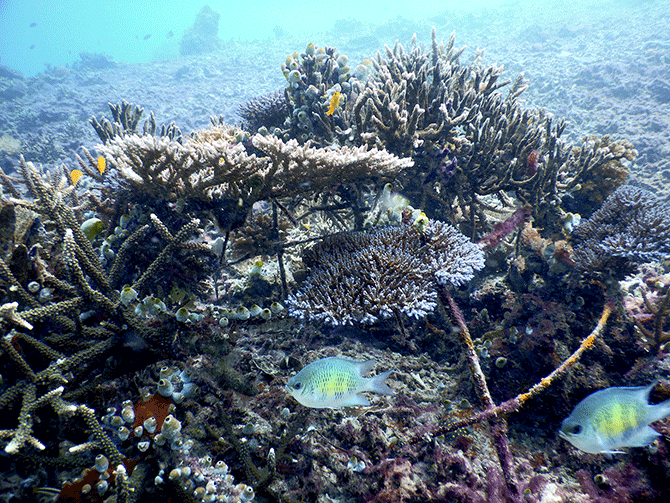
The coral reef restoration project uses an innovative method of hand-bending metal rebar into dome-like structures and then skillfully attaching bits of coral to it – which, when done correctly, flourishes into a healthy and multi-species coral community.
Wide Open Projects and community partners have created two successful pilot projects, and this past summer built and placed 66 more structures on the ocean floor.
Students in Canada and Indonesia, as well as biology colleagues around the world, are closely following the progress of Fernandez-Fournier and his team via social media.
But Fernandez-Fournier urges students not to feel compelled to follow his path exactly. Instead, he asks them to seek out opportunities that appeal to their own unique interests, whether that be lab work, field ecology, or green policy development. He encourages students to be proactive in seeking out any and all opportunities to volunteer and work with local university professors, NGOs, or other outdoor organizations. “Don’t be afraid to contact people and ask how you can help. Much of what’s needed now is just people willing to show up and do the work.”
He encourages educators to do the same. “Ask grad students and professionals in your community to visit your classroom and talk about their work. Most people, if they have the time, are more than willing to talk about their passion projects.”
“We all need to be bold and face the future proactively.”
Reaching out to potential role models, admittedly, is not always the easiest route and isn’t guaranteed to yield results, which is why many shy away from the idea.
The same is true for students, who worry about being rejected and therefore don’t put in the ask to join field research or volunteer opportunities abroad. They may even withdraw from ecology pursuits entirely, seeking out the road more travelled instead.
But if we learn anything from scientists such as Fernandez-Fournier working on the frontline of environmental challenges, it’s that we all need to be bold and face the future proactively, before allowing these challenges to come to us.
Photos: Philippe Fernandez-Fournier
First published in Education Canada, March 2020
-
A Climate Action Plan for Canadian School Boards
Comments Off on A Climate Action Plan for Canadian School BoardsConcrete, effective action is required to effectively address the climate change emergency. How can the education sector reduce our ecological footprint? The author offers a plan with strategic actions for schools and school districts.
The problem of climate change is a collective challenge of immeasurable scope.
To respond effectively, each and every organization will have to formulate and implement a concrete action plan in order to significantly reduce its ecological footprint within a very short timeframe.
In this context, the sector of public education, whose primary mission is to support and prepare youth for the future, must lead the way and become a model of sustainable practice.
This pressing issue is already under discussion in several school districts across the country, some having already declared a climate emergency (e.g. Vancouver, Victoria, etc.), and others likely to join them shortly.
That said, such declarations are only useful when followed by an effective and realistic action plan.
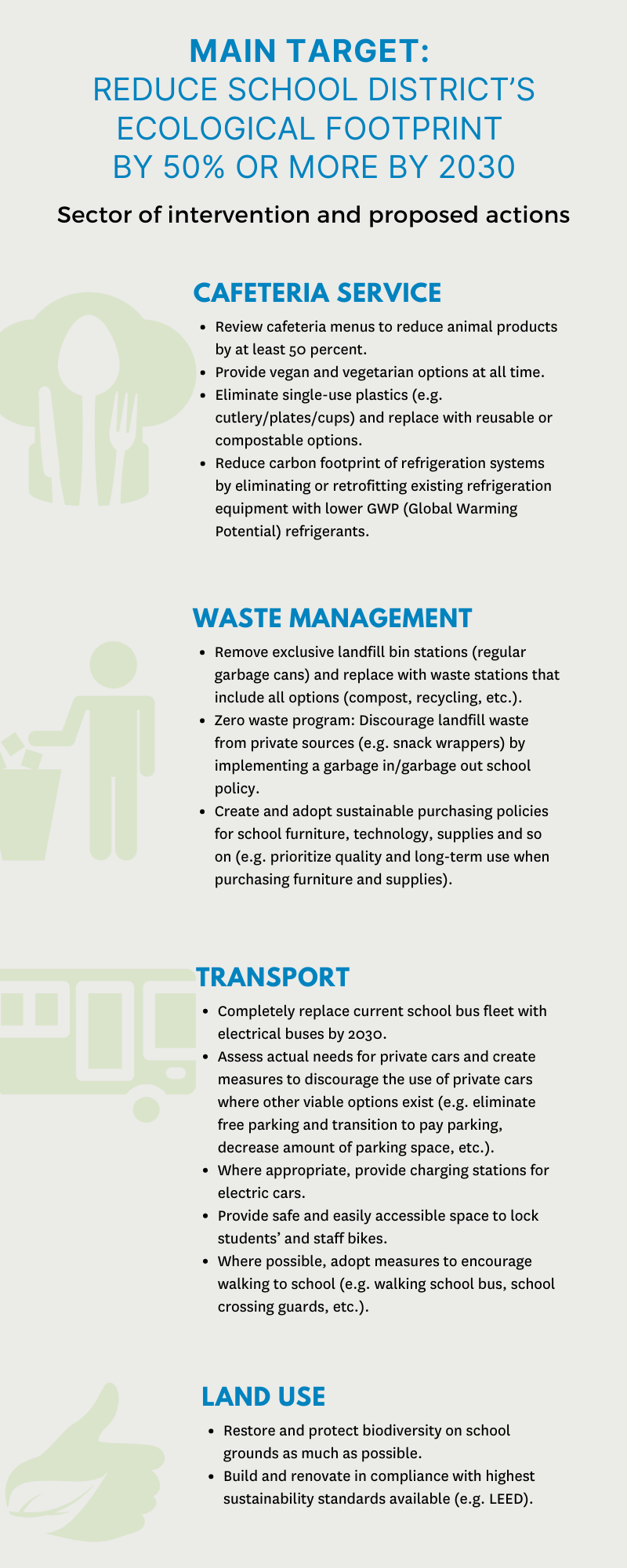
Therefore, this article aims to provide organizations such as schools and school boards with a simple plan that includes a list of strategic actions in order to significantly reduce their ecological footprint in a timely manner.
“We must take action as quickly and as effectively as possible.”
The primary goal of the proposed plan – reducing a school district’s ecological footprint by at least 50 percent by 2030 – sets a clear target and definite timeline that aligns with the most recent Intergovernmental Panel of Climate Change recommendations (2018).
As for possible sectors for action, the situation may vary from school to school and from community to community, but in the majority of cases, food, transport, land use and waste management are likely to be the most important sources of pollution and greenhouse gas emissions (GHG).
Some of these actions may require extra funding (e.g. transitioning to electric school buses), some can be implemented with current resources (e.g. reviewing cafeteria menus to decrease animal product use by at least 50 percent).
Again, the necessary logistic and financial details may vary from district to district, but the key factor to make this plan reality is to create the necessary mobilization from within. Only then will the so-called climate emergency be prioritized as a true emergency.
Indeed, according to Michael Fullan’s research, successful organizational change implies an evolution of an organization’s culture and not just the restructuring of activities.
If your organization, school district or faculty of education is an EdCan member (see the list here), you can enjoy unlimited access to our online content! Click here to create your online account.
In this case, it seems that our students have already taken the lead, creating momentum with the movement Fridays for Future.
At this point, schools must not fail them – we must take action as quickly and as effectively as possible. Everyone involved – principals, teachers, support staff, parents, school and school board administrators – can all do their share to bring these ideas forward and endorse this simple yet concrete plan to help create the necessary changes.
Figure 1: Climate Action Plan for Schools and School Districts
Photos: iStock
First published in Education Canada, March 2020
-
Teacher Stress and Health
Comments Off on Teacher Stress and Health
This research brief examines the sources and effects of teacher stress, highlights programs and policies that can reduce teacher stress and improve teacher well-being and performance, and recommends next generation research, real-world policies, and systematic, sustainable practices that can build and sustain a culture of health for teachers in U.S. schools.
This issue brief, created by the Pennsylvania State University with support from the Robert Wood Johnson Foundation, is one of a series of briefs addressing the need for research, practice, and policy on social and emotional learning (SEL). SEL is defined as the process through which children and adults acquire and effectively apply the knowledge, attitudes, and skills necessary to understand and manage emotions, set and achieve positive goals, feel and show empathy for others, establish and maintain positive relationships, and make responsible decisions.
-
How you can start taking more effective breaks – and inspire your students and colleagues to do the same
Comments Off on How you can start taking more effective breaks – and inspire your students and colleagues to do the sameAs teachers, we often grumble amongst ourselves during break time as we walk briskly through the halls and come across students who are either glued to their smartphones or sitting or leaning on lockers. “No social skills,” we confidently diagnose. “No one talks to each other anymore,” we lament. Our lost suggestion of “they should go outside and run around” is as empty as the playground itself. As we make our way to the staff room to check our mailboxes, we then promptly head back to our classrooms to frantically check items off our to-do list – emails, assignments that need grading, or spaces that need tidying up. After the break, everyone returns to class just a little bit less focused and certainly more fatigued, and it’s clear that we haven’t effectively used our break time.

THE DIFFERENCE BETWEEN A ‘BREAK’ AND AN ‘EFFECTIVE BREAK’
Everyone can benefit from taking a step back and reconsidering how they spend their breaks throughout the school day. Sure, our students can benefit from “going outside and running around,” but so can adults! There are three things we need to remind ourselves when it comes to taking an effective break during our workdays, which can literally restore our brains and rest our minds if we put these into practice:
- It’s NEVER unproductive or ‘time lost’ to spend our breaks getting a bit of physical activity.
- Spending our breaks in the outdoors allows us to return to work refreshed and rested.
- Leaving our smartphones and devices behind every now and then may actually allow us to reconnect with others – or at least give our brains a rest.

Integrating these reminders into our daily work lives represents an attempt at reorienting our minds to the idea that taking time out isn’t just about ‘being productive’; rather, it’s about ‘enabling productivity.’ While ‘being productive’ might imply merely “being busy” and checking things off our to-do list, ‘enabling productivity’ means investing in healthy practices – like taking an effective break – that allow our brains to perform better and for longer, thereby allowing us to do our best work instead of simply getting work done.
We also know that sedentary behaviours and physical inactivity are directly linked to all kinds of chronic health issues. This is true for all age groups from the younger years to the older years. We also know that sleep, nutrition, and screen time are variables in our personal wellness equation. So how do we put these all together and ensure that we’re getting enough of each of these variables? The good news is that the Canadian Society for Exercise Physiology has created a very articulate set of evidence-based infographics that allow the general public to make sense of all of the health recommendations that often get thrown at us. Fundamentally, what you need to know is that all types of movement are important: slow, moderate, and vigorous. And remember that there isn’t anything wrong with sitting down, but it’s also important to limit how long we remain sedentary while making sure that we’re not inactive for extended periods of time.
Sweat, Step, Sleep, and Sit are the so-called Four S’s of a healthy day. While the nuts and bolts of these four components differ depending on how old you are, the core recommendation is that we all need to pay attention to how long we:
1. Sweat through moderate to vigorous physical activity on the playground, during physical education, while leading extracurricular activities, or during our own workout routines.
2. Step through light physical activity during unstructured play, walking, or practicing ‘body movement breaks’ throughout the day.
3. Sleep without interruption and with consistent bedtime and wake-up times.

4. Sit and limit sedentary behaviour through the day.

Never forget – as a school community, we have the ability to encourage each other to be more physically active. Although a 7-minute walk around the block with colleagues during lunch hour may not work up a sweat, it’s nevertheless valuable in improving our overall mood. Creating opportunities for students and staff to move together during breaks is also a great way for us to sustain our collective well-being as a school community.
WHY RECESS ISN’T JUST FOR KIDS
There’s a clear connection between our well-being and being outdoors. Throughout the day, our brains get tired and our cognitive functions decrease. Some of the more obvious symptoms of cognitive fatigue include reduced performance and productivity, decreased effectiveness in completing tasks, and reduced competency. But some of the less obvious symptoms, which may manifest in students and staff, include impulsiveness and increased risk taking, irritability and negative emotions, insensitivity to interpersonal cues, and impatience. Do any of these symptoms sound like you or your students after a morning of indoor recess?

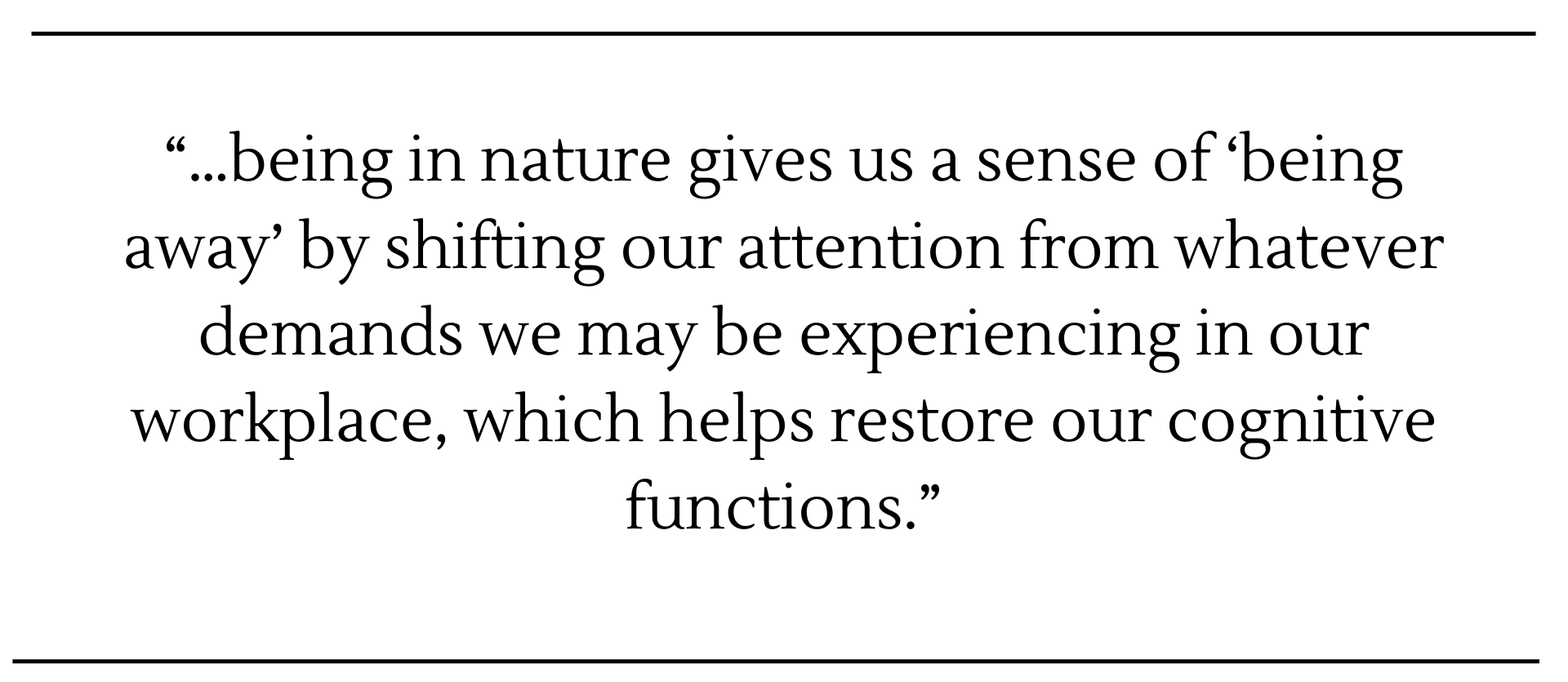
Research on cognitive restoration has found that exposure to natural environments helps aid recovery from physiological stress and mental fatigue. In fact, Kaplan’s ‘Attention Restoration Theory’ (ART) has been around for decades and is still used by researchers to this day. ART tells us that being in nature gives us a sense of ‘being away’ by shifting our attention from whatever demands we may be experiencing in our workplace, which helps restore our cognitive functions. Plus, we don’t need to go far – the schoolyard, neighbourhood park, or even our backyards provide this healthy sense of ‘being away.’ We also don’t need to spend lengthy amounts of time outdoors, either – brief contact with nature can boost our mood, with research recommending 20 minutes as the optimal amount of time to reap the benefits of spending time outdoors. Above all, even making small efforts to take deep breaths or look around at the trees can leave our brains feeling a bit more rested and a bit more restored.
WHY YOU NEED TO PUT DOWN YOUR PHONE
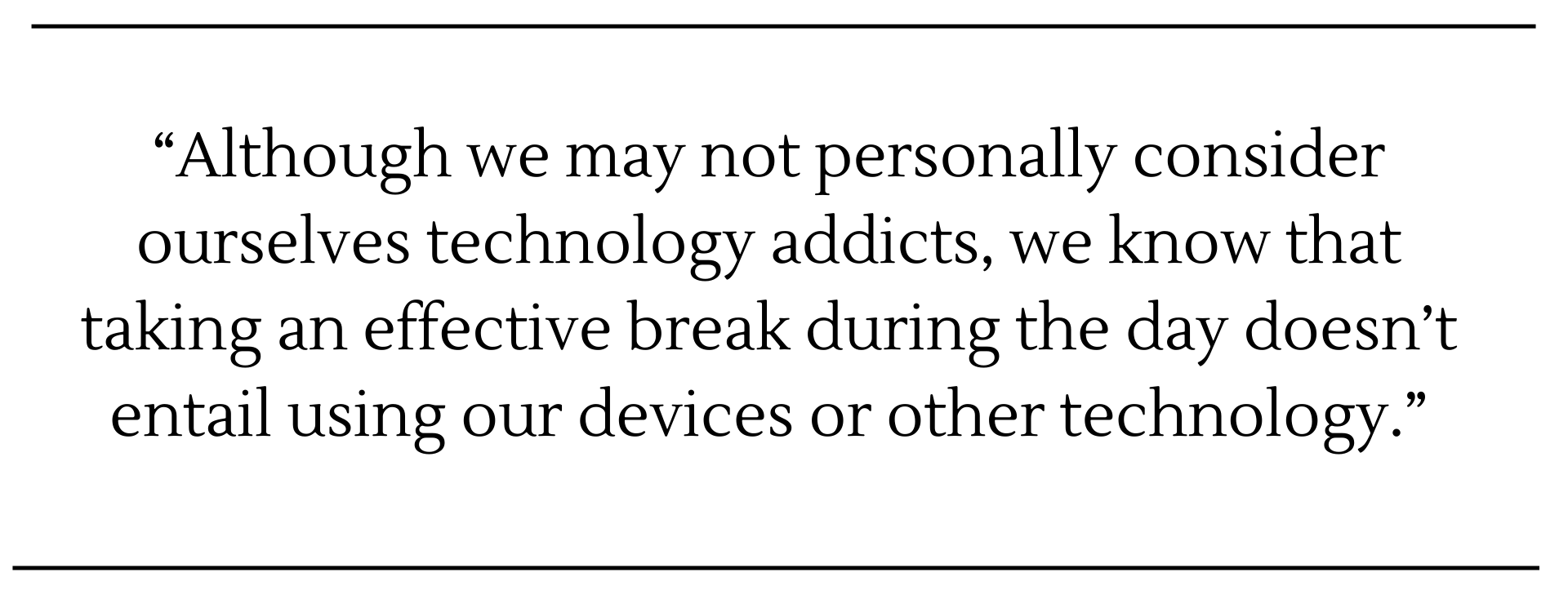
Addiction to technology and excessive use of online communications is directly related to psychological factors such as stress, anxiety, and depression. Although we may not personally consider ourselves technology addicts, we know that taking an effective break during the day doesn’t entail using our devices or other technology. In fact, walking around, sitting, and looking at our devices while spending time outdoors actually counteracts the benefits that nature provides. Unsurprisingly, overuse of our devices is a growing issue that’s most prevalent in people under the age of 30. That said, I’m sure we can all agree that time away from our screens is refreshing. Promoting social activities on the playground, inviting colleagues to take a ‘walking meeting’ outside instead of a typical ‘sit down meeting’ in a classroom, or even just taking a ‘time out’ from our devices are all great ways that we can role model taking effective breaks throughout the day.
THE TAKEAWAY: WE NEED TO RETHINK ‘PRODUCTIVITY’
I’m just as guilty as the next person for feeling a strong desire to be productive during my breaks by working through my to-do list. At times, I’m guilty of not taking a break at all – I hate being cold in the middle of winter and I cringe at the thought of stepping out in the rain. However, when we begin reorienting our minds towards the importance of taking effective breaks that entail (A) moving around more during the day, (B) getting outside, and (C) leaving our devices behind, we may actually begin to see some changes in our behaviour, concentration, and ability to learn new skills at work. It’s easy to tell our students that “they should go outside and run around” but, as adults and role models, we’d be better off actually taking a piece of our own advice.
LISTEN TO THE PODCAST WITH DR. SHANNON KELL ON TAKING EFFECTIVE BREAKS:
Listen to “Recess for Everyone ft. Dr. Shannon Kell” on Spreaker.
References and Further Reading
Atchley, R. A., Dtrayer, D. L. & Atchley, P. (2012). Creativity in the wild: Improving creative reasoning through immersion in natural settings. PloS one, 7(12), e51474. https://doi.org/10.1371/journal.pone.0051474
Berto, R. (2014). The role of nature in coping with psycho-physiological stress: A literature review on restorativeness. Behavioral Sciences, 4, 394-409. https://doi.org/10.3390/bs4040394
Capaldi, C. A., Passmore, H., Nisbet, E. K., Zelenski, J. M., & Dopko, R. L. (2015). Flourishing in nature: A review of the benefits of connecting with nature and its application as a wellbeing intervention. International Journal of Wellbeing, (5)4. https://doi.org/10.5502/ijw.v5i4.449
Hartig, T., Evans, G., Jamner, L. D., Davis, D. S., & Garling, T. (2003). Tracking restoration in natural and urban field settings. Journal of Environmental Psychology, 23, 109-123. https://doi.org/10.1016/S0272-4944(02)00109-3
Hunter, M. R., Gillespie, B. W., & Chen, S. Y-P. (2019). Urban nature experiences reduce stress in the context of daily life based on salivary biomarkers. Frontiers in Psychology, (2)722, 1-16. https://doi.org/10.3389/fpsyg.2019.00722
Jiang, B., Schmillen, R., & Sullivan, W. C. (2018). How to waste a break: Using portable electronic devices substantially counteracts attention enhancement effects of green spaces. Environment and Behavior,1-28. https://doi.org/10.1177/0013916518788603
Kaplan, S. (1995). The restorative benefits of nature: Toward an integrative framework. Journal of Environmental Psychology, 15, 169-182. https://doi.org/10.1016/0272-4944(95)90001-2
Lee, U., Lee, J., Ko, M., Lee, C., Kim, Y., Yang, S. & Song, J. (2014). Hooked on smartphones: An exploratory study on smartphone overuse among college students. In Proceedings of the SIGCHI Conference on Human Factors in Computing Systems (pp. 2327-2336). https://doi.org/10.1145/2556288.2557366
Pearson, D. G., & Craig, T. (2014). The great outdoors? Exploring the mental health benefits of natural environments. Frontiers in Psychology, 5(1178). https://doi.org/10.3389/fpsyg.2014.01178
- It’s NEVER unproductive or ‘time lost’ to spend our breaks getting a bit of physical activity.
-
The Idea Readiness Tool
Comments Off on The Idea Readiness ToolWhen great ideas struggle to get off the ground, it may be because people are not ready to adopt them. The Idea Readiness tool helps you take the pulse of your school community to understand how they adopt ideas and tailor your approach accordingly.
Do you have a new idea to promote workplace wellness that you would love to try in your school community, but don’t know where to start? If so, the Idea Readiness Tool may be right for you. The Idea Readiness Tool was developed by a team of researchers at the University of Alberta in partnership with education sector workplace wellness professionals. The tool has the specific purpose of helping to guide the spread of new ideas within a school community.
A new idea might be a new process, practice, initiative or policy – as long as it is new to your group. Some examples of ideas that you could try within your school community to promote workplace wellness include:
At the district level:
- create a district workplace wellness committee
- recruit and support wellness champions to plan collaborative learning events
- implement a district-wide policy to support employee well-being
- create a nutrition policy for food and drink options provided during meetings and staff events.
At the school level:
- set up a collaboration area to promote social connection
- start an after-work yoga class
- promote active transportation by creating a bike storage area
- arrange walking meetings for staff to encourage physical activity.
The Idea Readiness Tool works with any idea, no matter how big or small.

How and why did we develop the Idea Readiness Tool?
The Idea Readiness Tool started with some previous research that we did on the diffusion of smoke-free bylaws. This work looked at how municipalities learned from the policies that other jurisdictions implemented. More specifically, we used the Rogers’ Diffusion of Innovation Theory to examine policy learning. This theory looks at the process of change for innovation. The theory follows a bell curve and suggests that as more people try out an innovation, the rate of adoption continues to build until it reaches a tipping point. At this point, the rate of adoption slows and less people are trying the innovation. Using this theory and our knowledge of smoke-free bylaw diffusion, we developed the Policy Readiness Tool. The Policy Readiness Tool is an evidence-based, validated tool that was created to support policy change specifically in municipal and organizational settings.
After we developed the Policy Readiness Tool, our partners at the Alberta School Employee Benefit Plan (ASEBP) reached out to us. While they liked the Policy Readiness Tool, they found the policy language did not resonate at all levels within a school community audience. They expressed a need for a tool specifically tailored for use in school settings, so together we modified the original Policy Readiness Tool to be more applicable to the unique needs of the school community.

So what is the Idea Readiness Tool and how can it help me?
The Tool involves three simple steps for you to follow.
1. Complete a quick 10-question checklist.
This checklist will help you to identify how ready your school community is for the new idea you are thinking about. The checklist can do this by helping you determine what your group’s adoption style is.
Is your school community an innovator, majority or late adopter? Use the checklist to find out!
A couple of quick highlights about these three adoption styles:
Innovators: Are often the first to try out new ideas. They are adventurous and are not afraid to take risks, even with potential uncertainty.
Majority: Are deliberate as they take time to figure out if they want to try a new idea. They typically like to see other people try an idea before they dive in. They are of the philosophy that it is better to change as a group.
Late Adopters: Are often skeptical of new ideas and like to maintain the status quo. They like to wait for the majority group to adopt a new idea before taking it on themselves. In some cases, they may even require an organization-wide mandate to make the change.
2. Identify strategies to apply in your school community.
Now that you have figured out the level of readiness of your school community (for this idea), it is time to lay out which strategies you want to use. The Tool provides a detailed list, based on level of readiness, of strategies that you can use.
Here are some sample strategies to use based on your school community’s adoption type.
Innovators:
- Present the idea in a way that sparks the school community’s innovative spirit.
- Identify a wellness champion in the school community to help carry the idea forward.
Majority:
- Emphasize that other schools, similar to theirs, are adopting the idea (specific examples are helpful too).
- Look for incentives to help the school community adopt the new idea, such as awards and funding.
Late Adopter:
- Find evidence that shows the positive outcomes the idea can have for a school community.
- Build relationships with school administrators to gain support for your idea.
3. Use the resources to help carry out the strategies.
Accompanying all of the strategies are helpful school-specific resources to help you to move the new idea forward, such as:
- Alberta Health Services’ guide Healthy Eating in Schools: Policy recommendations
- Alberta School Employee Benefit Plan’s blog The Sandbox: Your space for healthy school recommendations
- Pan-Canadian Joint Consortium for School Health’s Positive Mental Health Toolkit.
Whether you are a teacher, support staff, administrator, parent, wellness champion, or anyone else interested in encouraging healthy school community development, the steps in the Idea Readiness Tool will support you in implementing your new idea. Find out how our partners at ASEBP use the Idea Readiness Tool with school districts in Alberta in the sidebar “From Idea to Action.”
What should I keep in mind when using the Idea Readiness Tool?
- There is not a good or bad adopter type. Every adopter type has its own strengths and weaknesses.
- Your school community may be at a different level of readiness for each new idea. It is important to come back to the checklist for each new idea, and identify new strategies and resources to support that idea.
- A new idea can be anything (e.g. a process, practice, policy or initiative) as long as it is considered new by the group thinking about its adoption.
- The checklist can be completed individually or as a group.
From Idea to Action: Bringing the Idea Readiness Tool to life
How does the Idea Readiness Tool stand up to application in the real-world of education? The workplace wellness liaisons at the Alberta School Employee Benefit Plan (ASEBP) shared how they incorporate the Idea Readiness Tool into their work with school districts.
ASEBP’s top three reasons why the Idea Readiness Tool is worthwhile:
1. Moving from Why to How
When we are excited about an idea we can quickly move from idea to action without stopping to assess how the readiness of others should impact our process to move an idea forward. Assessing readiness should happen before you start action planning and inform your action planning.
2. Common Language
When we all use the same terminology and process, we can have a mutual understanding that will lead to success.
3. Staying Motivated
It is easy to lose motivation when we pitch an idea and it falls flat. The Tool has empowered wellness champions to learn that they could have pitched the idea in a way that aligned with their colleagues’ readiness to more effectively gain buy-in.
The Tool in Action
While working with a school district wanting to advance their mental health strategy, ASEBP workplace wellness liaisons facilitated a workshop to guide the district wellness committee through the Idea Readiness Tool in order to explore the idea of offering a training program to increase staff competence around mental health.
The committee completed the Tool’s checklist in two ways – once as if the committee itself was the school community they were bringing this idea back to, and again with the actual school community in mind. This exercise showed the committee that they were Innovators, while their school communities were a mix of Majority and Late Adopters. This was an “ah-ha” moment as they realized in the past, they had moved into action too quickly. With this realization and rise in motivation, the committee then began to explore the strategies outlined in the Tool to support working with a mix of the Majority and Late Adopters. They landed on providing evidence for all those impacted and connecting with leaders throughout the school district to provide more information, before moving forward with the training.
The committee attributed their success in implementing this idea to using the Idea Readiness Tool, developing a common language around readiness and being more deliberate in planning how to communicate their idea. Now, The Idea Readiness Tool has become part of their process from generating ideas to moving them into action.
The Idea Readiness Tool has proven to be a valuable tool to support the challenging yet important task of promoting healthy workplace environments within K-12 education.
Find out more
The full Idea Readiness Tool is available in PDF format and online at www.ideareadinesstool.com. The website includes videos to explain what the Tool is and how it can be applied; the checklist; and the comprehensive list of strategies and resources. Or visit The Sandbox to spark new ideas and connect with other wellness champs!
Photo: iStock and Adobe Stock
First published in Education Canada, December 2019
-
How to Awaken Well-Being for Educators
Comments Off on How to Awaken Well-Being for EducatorsMore and more educators are realizing the importance of taking the time to invest in their well-being, and they’re starting to prioritize self-care for both personal and professional development. Practicing self-compassion is the ultimate act of self-care and, as educators, this means prioritizing our own well-being and learning to treat ourselves kindly in times of stress and overwhelm. This allows us to be our best selves, and therefore positions us to better support our students and develop meaningful relationships with them.
Over several years, I researched, observed, and brainstormed, and I came up with a solution – the AWE method, short for “Awaken Well-Being for Educators.” AWE takes you through the ABC’s of reclaiming and reviving your joy in teaching. Through this method, I help organizations and individual teachers create school and classroom environments based on resiliency, self-compassion, and self-awareness. AWE is unique because it creates a “ripple effect of well-being” by putting educators first. Educators develop healthy habits for themselves, and then go on to develop healthy habits to use or emulate among their families and in their classrooms.
The AWE method walks you through the WHY, the HOW, and the WHAT of educator well-being and, if followed consistently, will allow you to take charge of how you respond under pressure. While educators may have little control over their working conditions, they can nevertheless be role models who inspire those around them to invest in creating a positive and supportive school environment where everyone looks after their own well-being and that of their colleagues.
WHY educator well-being is important.Do you often feel exhausted, overwhelmed, and weary at the end of the school day?
Do you find yourself counting down the days to every long weekend, holiday or break in your very busy week?
When is the last time you gave yourself permission to pause and ask yourself, “What can I do to truly care for myself?”
The first step in building up our well-being is understanding why self-compassion – being kinder to ourselves – is important in bringing back well-being into any area of our school, classroom, or personal life.
Self-compassion entails being mindful, or more aware of our thoughts, feelings, and emotions. This allows us to pause and pinpoint what’s stressing us out, and therefore better control how we respond to other people and other things that are happening around us. This can be challenging, especially since our nervous system is trained to execute a “fight or flight” type of response – to become stressed or to avoid difficult situations rather than ignore them, accept them, or respond tactfully. In short, when we’re not paying attention to how we feel, we’re less able to manage our stress, which leads us to become overwhelmed, sick or – ultimately – burnt out.
Embodying the HOW of educator well-being.
Below is an exercise called the “Self-Compassion Break,” which you can try right now to practice being more aware and kinder to yourself in times of stress. This exercise can be found in the Mindful Self-Compassion (MSC) course, and is backed by research conducted by Kristin Neff and Chris Germer.
Self-Compassion Break
Think of a situation in your life that’s difficult and causing you stress. Call the situation to mind, and take stock of whether you begin feeling physically stressed or emotionally upset. Now, say to yourself…
- “This is a moment of suffering”
That’s practicing mindfulness. Other options include:
- “This hurts”
- “Ouch”
- “This is stress”
- “Suffering is a part of life”
That’s realizing that suffering is a normal human experience. Other options include:- “Other people feel this way”
- “I’m not alone”
- “We all struggle in our lives”
Next, put your hands over your heart, and feel their warmth and gentle touch on your chest. Now, say to yourself…
- “May I be kind to myself”
You can also ask yourself, “What do I need to hear right now to express kindness to myself?” Use a phrase that speaks to you in your particular situation, such as:
- “May I give myself the compassion that I need”
- “May I learn to accept myself as I am”
- “May I forgive myself”
- “May I be strong”
- “May I be patient”
This “Self-Compassion Break” can be used at any time – day or night – and will help you to pause and reflect on how you are thinking and feeling. By practicing these types of exercises, you can begin to meet difficult situations with self-compassion, and be strategic in how you approach your relationships with colleagues, students, and other people you interact with at work.
WHAT we need to do to awaken educator well-being.To truly support our well-being, we need to take stock of the strengths and values that embody being well, which I call…
“The Seven C’s of Wellbeing”
Courage. According to author and professor Brene Brown, “Courage starts with showing up and letting ourselves be seen.” If we want to make well-being a priority for ourselves and within our school communities, then we need to take a step of courage by allowing ourselves to be vulnerable and ask for help when we need it.

Curiosity. Educators these days are in love with leading inquiry-based projects with their students. Let’s flip the script by practicing inquiry on ourselves where we ask, “What do I REALLY need right now?” Self-care doesn’t necessarily mean having a glass of wine or taking a bubble bath; rather, it’s often deeper and something that takes discipline. Let’s get curious about what we really need to stay well, such as more love and connection, time in nature, or space to connect spiritually.
Community. This one’s relatively simple: find a team of supporters, friends, a coach, or a mentor whom you can ask for help. We don’t need to care for our well-being all on our own. In actuality, it’s important to collaborate and build community, and motivate and support each other. Educators rarely have enough time to do this, but it’s important to make this a priority as much as possible.

Clear Your Way. We need to let go of the expectation that we can do it all. We can’t. We can only do one or two things well at a given time. To improve our well-being, we need to learn to set boundaries, realize that “less is more,” and practice “going slow to move fast.” When we let go of this expectation, we also let go of things that don’t contribute to our well-being, such as low priority things on our to-do lists, unhealthy relationships, and the list goes on.
Cultivating Care. Give yourself permission to care for yourself. As I’ve mentioned, when we do this in a kind and loving way, we’re better able to care for other people – including our students.
Creating Culture. As educators, we create space for our students (and our colleagues) to feel valued and authentic. When we prioritize well-being as part of our culture – how we do things and how we say things – our actions and words become contagious and we inspire others to do the same.
Compassion. Lastly, be kind to yourself, and show yourself the compassion that you would to those entrusted in your care.

The TakeawayEducators are also caregivers, and they often suffer as a result of the emotional investment they put into ensuring other people’s well-being. They’re exhausted and can often feel undervalued in today’s culture. As professionals – and as human beings – what educators want is to be seen, heard, valued, and understood. We want to feel like we’re giving back to our schools in a meaningful and purposeful way, as well as having an impact in the lives of each of our students. While improving working conditions is a long-term effort that can be difficult for one person to change, everyone can play a role in changing how they think, speak, and act each day, and the AWE method is a great way for you to start taking your first steps regardless of the situation you may find yourself in.
Connect with Lisa to learn how to awaken the wellbeing of educators in your school’s culture by practicing the ABCs! Find Lisa at www.lisabaylis.com to learn more about upcoming workshops and retreats that she offers, or to have her speak with your staff and school. And look for her book in the spring that dives deeper into this method
Photo: Adobe Stock
- “This is a moment of suffering”
-
Infographic: 5 Ways to Support Principals’ Well-being
Comments Off on Infographic: 5 Ways to Support Principals’ Well-being
This infographic aims to provide strategies and practices specific to the role of the principal that school leaders can use to promote and manage their own well-being.
This infographic was inspired by an editors’ pick article by Dr. Katina Pollock that appeared in Education Canada Magazine.
-
WEBINAR: Making the Case for Workplace Well-Being in K-12
Comments Off on WEBINAR: Making the Case for Workplace Well-Being in K-12missed it? replay the full webinar now!
Presented by the McConnell Foundation, EdCan and Avalanche Strategy, this free one-hour webinar presented insights gathered through a large-scale survey of educators and the general public on how to better frame the issue of teachers’ and principals’ well-being. This included:
- What language and concepts are most likely to resonate with different audiences and stakeholder groups
- Stories vs. data – which is more likely to get traction?
- The importance of linking teacher stress with other priority issues in education
-
Inclusive Classrooms
Comments Off on Inclusive ClassroomsWe can all agree that the classroom should be a place where students feel included and equal, so how can you approach disability and inclusivity in your classroom? Read on for some useful strategies to ensure all your students feel included.
Emily, a young adult from Richmond, B.C., looks back on her high school sewing class with relief that it’s over—not because she didn’t like sewing, but because she wasn’t allowed to. Despite being ready, willing, and able, her teacher told her that she couldn’t because she was in a wheelchair. This caused confusion for Emily and her friends “My legs are disabled, not my hands,” she says. Cooking class took on a similar form. While she was perfectly capable of putting on an apron herself, her teacher insisted on doing it for her.
We can all agree that the classroom should be a place where students feel included and equal, so how do we equip ourselves to avoid situations like the above? And how should you approach disability and inclusivity in your classroom? Below are some useful strategies to ensure all your students feel included.
Don’t assume
The mistake that Emily’s home economics teachers made was that they believed they knew her abilities better than she did. It’s important to trust that your student knows their limitations, or if a younger student, their parents do. Let them gauge where they’re comfortable rather than prescribing what they can or cannot do.
Ask what their needs are
If you have a student in your class with a disability, come up with a list of questions at the beginning of the year to help you understand their specific needs. This will help determine if your lessons will be inclusive or not, and give you ample time to adapt your lessons to their requirements. And make sure it is an ongoing conversation.
“Adapting lessons day to day, and even minute to minute, is crucial to meeting the needs of all students in the inclusive classroom,” says Aja Coe, a Grade 7 Social Studies and Language Arts teacher with Rocky View Schools in Alberta. Coe is a contributor to Flexible Pathways to Success – a project that identified factors that contributed to the implementation of technology in classrooms to support students with diverse cognitive abilities. “It is important to level the playing field by removing barriers so every student has the opportunity to be successful and gain confidence at school,” she adds.
Equal treatment when possible
Emily’s woodworking teacher provided excellent support. He not only had a conversation with her after class about her abilities, he also went through each woodworking machine to see if she could use it and made sure they could adjust it to her needs.
There were many times in other classes that Emily would receive no penalty for handing something in late. While dodging late marks is the dream of many students, Emily just wanted to have the same rules and consequences as her classmates. In woodworking, Emily had to do all the assignments just like everyone else, and she would receive late marks if a project was past the due date.
Any student, regardless of physical ability, may require adjustments to their assignments, but having a disability doesn’t automatically make this so. “I do a lot of reading and writing pre-assessments at the beginning of the year so I have a clear understanding of each student’s individual strengths, as well as the areas of growth,” says Coe. “These assessments help inform my instruction so I can ensure I am teaching to each student’ individual needs, regardless of whether they are at, below, or above grade level.”
Do a resource audit
We’re all familiar with the educational videos available to warn students against unsafe work conditions or impaired driving. Many of them are comically outdated, with bad effects to boot. While an 80s soundtrack is harmless, older resources could be sending the wrong message.
Emily had to watch a video like this in one of her classes. In the main story, a victim of a driving accident was injured, leaving them to rely on a wheelchair to get around. The video portrayed using a wheelchair as the worst thing that could happen to you. Many people who use wheelchairs don’t feel this way, and messages such as this can create unwanted pity.
Whether you have a child with a disability in your class or not, it is important to take stock of your resources before the school year commences. If resources are portraying people with disabilities as the “other,” this will further alienate students who may already feel different.
Tools for teaching inclusion
While you don’t want to single out an individual student, having discussions and lessons about disability, inclusivity, and equality can help foster a more compassionate and inclusive environment.
The Rick Hansen Foundation School Program (RHFSP) is a great place to start when it comes to incorporating these conversations into your lesson plans. All resources are available for free in both French and English, with age-appropriate lesson plans for Kindergarten to grade 12. Each toolkit has a variety of lessons and activities to get your students thinking about inclusion, and each one is designed by educators and align to provincial curriculum.
It’s a learning process
An openness to tailoring lessons, changing the layout of your classroom, and ongoing conversations will ensure your classroom environment includes all students and ensures their success. And don’t forget you’re not alone: there are endless resources out there to support you as you foster compassionate behaviour and leadership among your students.
Register with RHFSP to become a part of a Canada-wide community of educators committed to inclusive teaching, and download the latest resources today.
Universal Design for Learning: Quick tips
There are many simple things you can do to ensure the physical features of your classrooms and resources support students of all abilities. Here is a sample of tips from RHFSP’s Teaching Strategies for the Inclusive Classroom Toolkit. To download the full toolkit, visit RickHansen.com/Schools
Teaching Students Who Are Deaf
- Support verbal instructions with print and/or visual aids.
- Provide lesson materials, such as vocabulary lists, in advance.
Teaching Students Who Are Blind
- During discussions practice having speakers identify themselves. Address students by name so a student who is blind knows who is speaking.
- Understand orientation and mobility needs for navigating the classroom and common rooms.
Teaching Students Who Have a Physical Disability
- Provide enough space for a wheelchair between desks and tables and ensure there is enough room for knee clearance under tables and desks.
- Ensure resources are visible and within reach. For example, books, school materials, coat hooks and cubbies should be no higher than 103.6 cm.
First published in Education Canada, September 2019
Image: iStock
-
Cultivating Community
Comments Off on Cultivating CommunityWhen two First Nations visual artists collaborated with students to design and paint three mural-sized banners, they portrayed a journey rich with history, tradition, and courage, and fostered profound story-sharing and dialoguing.
For three days in November, my classroom was transformed into an artist’s studio. Three 11′ x 3′ blank canvas banners hung from the ceiling along the back wall. Chairs and desks were arranged in a wide circle around the perimeter of the classroom, and up along the blackboard perched a rainbow of acrylic paint jars awaiting the stroke of a brush. Soon, these banners would be painted by 55 Grade 11 students and two local First Nations artists in a collaborative art project that would portray a journey rich with history, tradition, and courage, and would foster profound story-sharing and dialoguing.
In my recent years teaching the First Nations, Métis and Inuit Studies courses at James Cardinal McGuigan (JCM) high school in Toronto, I have reflected upon the question: How do I take on the responsibility of making space for Indigenous voices and get my students to engage meaningfully in a primarily non-Indigenous, Catholic, multicultural classroom? This was the challenge I set for myself as a settler-educator, recognizing the importance of my positionality and accountability in the context of Reconciliation. I wanted to develop a positive and inclusive activity that would both amplify Indigenous voices and enable my students to have an authentic, respectful, in-person dialogue with Indigenous people while contributing to a larger project.
Gathering both qualitative and quantitative data to assess students’ learning and transformation was one of the goals of this project, so they completed a survey before we started the art project and a second one afterwards. The results were encouraging: to this day, students describe this learning experience as one where they were able to “learn from two perspectives instead of one.” One eager participant attested, “We can learn from people who have a better understanding of current issues and take part in creating a better community.”
Preparation
After reading about collaborative mural painting initiatives in various school boards and universities across Ontario, I was inspired to facilitate one at my school. Research indicates that an extraordinary experience with art enables educators and participants to examine multiple, shifting meanings of culture and communities.1 I decided on a banner project because banners (more so than murals) are easy to move around and rotate between different locations in the school for students and guests to appreciate.
Acquiring funding from the Ontario Ministry of Education was essential, so I applied for a Teacher Learning and Leadership grant and received the necessary capital to commission this art project. I want to thank my school’s administration, office staff, and art department for their pivotal involvement and support throughout the project.
Inspired by an article titled “New Mural: A first step toward reconciliation for Indigenous youth,”2 I invited the artists Chief Lady Bird and Aura to come share their culture, history, and perspectives with the students, and to collaborate with them on an artistic piece that could be showcased for years to come. Chief Lady Bird is Chippewa and Potawatomi from Rama and Moose Deer Point First Nations, and her sister, Aura, is Haudenosaunee Onyota’a:ka (Oneida Nation of the Thames). I taught my students greetings in Anishinaabek and Oneida, and posted them on our classroom door to make the artists feel welcomed and acknowledged.
My students had been learning about Indigenous histories, identities and cultural ways of knowing, and I reviewed the specific themes we had examined in class with the artists beforehand so that we could connect them to the project.
In the pre-project survey, the students’ ratings of their level of knowledge about Indigenous teachings (e.g. Medicine Wheel, The Seven Grandfather Teachings) was split evenly between feeling moderately, fairly, and highly knowledgeable. Some students felt a bit daunted by the task of collaborating with Indigenous people on an art project, but most were comfortable or even looking forward to it.
Collaboration
After the land acknowledgement, the artists began by introducing themselves in their languages and sharing with the students their backgrounds, the importance of reclaiming their languages, and their work with young people of all backgrounds in communal spaces to promote mutual respect, care, and knowledge-sharing.
They explored many themes with the students through the artwork, including: Creation Stories, Ceremony & Medicines, Water is Life, Intergenerational Healing, Heart Work & Heart Berries, and the Saskatchewan Lily.
One student said, “Art helps me understand Indigenous concepts because it is where the artists share and express their rich heritage and stories.”
Over three days, I witnessed immense growth in my students. Each had a chance to contribute to the painting – either by picking up a brush, suggesting an image to add or a colour to use. They produced three beautiful banners depicting a Grandmother in traditional dress, illuminated by a full moon; a powerful, resilient female beneath a traditional fish fence, encircled by the Fish Totem; and a young, hopeful girl, looking ahead, firmly rooted to her ancestry and to her Creation story. The three figures stand connected to one another in a symbiotic relationship.
Furthermore, the inquiry that came out of this project was noteworthy. Students asked the artists questions about the symbolic images (e.g. the meaning of the red dress worn by the girl, or the significance of the water being passed on through generations). This spurred further student engagement in the form of independent research, or connecting these meanings to texts studied in class. For one lucky group, this experience inspired a cross-cultural youth exchange with Thunderchild First Nation in Saskatchewan in May 2019, to further strengthen their own cultural competence.
One of the main messages communicated through this banner is “We are here.” It is imperative for all of us to share this message, and to hold space for the often under-represented voices in our society.
When asked why she does this work, Aura stated, “For me it’s about sharing who I am, learning with the youth and creating spaces for them to share who they are too. I believe collaborating between cultures and communities builds unity.” She affirmed the importance of creating positive work in the school system, and her critical role as a facilitator who is “in these spaces sharing my own truth. It is really impactful.”
Chief Lady Bird said that her goal is to “create a safer, kinder, more loving environment that captures the spirit of people, the true spirit of our teachings.” While working with youth, she added, she is “honouring the creative process of everyone. We don’t do things in one cookie-cutter way – we just let it flow; there’s not a lot of room for that in many institutions, so we disrupt with kindness.”
Learnings
In the post-project survey, 82 percent of students rated the experience as being either highly or fairly meaningful and engaging. In terms of lessons learned, 82 percent said they had learned about relationship building and 68 percent felt more knowledgeable about Reconciliation. All students found that this activity enabled them to learn more about Indigenous stories and traditional teachings.
One student said, “The best thing about this experience was the opportunity to collaborate with the First Nations artists and share moments with them and learn about them and their backgrounds.”
Another student – who, thanks to this project, now self-identifies as part Mi’kmaq – found a sense of belonging and acquired greater knowledge of her history. She observed, “It is important for us to take part in a collaborative art project with First Nations artists because it is important for Indigenous and non-Indigenous people to show that they can work together and move forward from what happened in the past.”
This work contributes to a growing body of work on “teacher-allyship”3 and aims to inform teachers who seek respectful and relevant ways of incorporating Indigenous approaches into their pedagogies. I encourage teachers to explore the plethora of Indigenous-written and -produced resources available to them for K–post-secondary, and to be in touch with their school board liaisons; I am grateful to the Toronto Catholic District School Board’s department of Indigenous Education for their support throughout my journey.
This project also is anchored in inter-cultural understanding and respect for alternative ways of knowing. By inviting artists from marginalized groups to share their knowledge and talents with students, we give voice to often-silenced speakers, lend greater legitimacy to the curriculum, and offer students and teachers opportunities for genuine discourse and practice regarding art, creativity, and social transformation.
Conclusion
We came such a long way in just three days. The transformations and mutual sharing that we experienced in that “artist’s studio” were remarkable, equally for the students, the artists, and myself as a settler-educator. The experience invited students to become culturally conscious in an authentic, respectful and engaging way, to understand the concept of reciprocity, to celebrate unity, and to look at storytelling through an artistic medium. Not only do these banners represent Indigenous narratives, but they tell a living story: one of history, reclamation, and relationship.
We hope that all students feel invited to tell their own stories of identity, and understand how much their heritage plays a pivotal role in shaping who they are. I hope this important work will inspire, educate, and transform educational communities across Turtle Island.
Photo: courtesy Laryssa Gorecki
First published in Education Canada, September 2019
Notes
1 M. Greene, Releasing the Imagination: Essay on education, the arts, and social change (San Francisco, CA: Jossey-Bass, 1995).
2 Justin Skinner, “New Mural: A first step toward reconciliation for Indigenous youth,” Toronto.com (Aug. 28, 2017).
3 Pamela Rose Toulouse, “K-12 Truth and Reconciliation: Becoming a teacher ally,” Education Canada 58, No. 2 (2018). www.edcan.ca/articles/truth-reconciliation-k-12
-
Inclusion for Sexual and Gender Diversity
Comments Off on Inclusion for Sexual and Gender DiversityIf it is our responsibility as educators and teacher educators to teach inclusively, then shouldn’t inclusive practices for LGBTQ2+ students be a professional competency? This article outlines work undertaken in one faculty of education (UBC) to enhance its language, curriculum, and practices regarding sexual orientation and gender identity (SOGI).
If we believe it is our responsibility as educators and teacher educators to teach inclusively across all areas pertaining to human rights, including those related to sexual and gender diversity, then should this not be a professional competency? If so, how do faculties of education integrate this into their programs and cultures? This article outlines some of the work undertaken in one faculty of education to enhance its language, curriculum and practices regarding sexual orientation and gender identity (SOGI) and some of the lessons learned.
University of British Columbia’s (UBC) Faculty of Education has implemented an ambitious campaign since 2016 to raise awareness and build capacity and culture related to SOGI inclusion for its students, faculty and staff. This came about in part because of significant changes to federal and provincial human rights legislation, in part because recent studies (e.g. the 2015 Every Teacher Project1) show that many teachers feel their university education did not prepare them for the SOGI diversity they encountered in schools, and in part because it was simply the right thing to do. The goal was and is to prepare knowledgeable, inclusive educators and improve the experience of those who may be marginalized because of their sexual orientation and/or gender identity in our programs, classrooms and workplaces.
None of this work has taken place in a vacuum. Our work augments earlier work within the Faculty of Education and complements the work of others, such as the UBC Institute of Gender, Race, Sexuality and Social Justice and the Office of Equity and Inclusion, to name a few.
The Faculty of Education embarked on an initial two-year project funded by Dr. Robert Quartermain2 through the ARC Foundation. It was focused largely on the Teacher Education Program’s approximately 800 teacher candidates and also on growing awareness and understanding among faculty, graduate students and staff. Donor funding supplemented Dean Blye Frank’s support and allowed for the secondment of a school district-based SOGI-inclusion educator, Steve Mulligan, to coordinate the project and augment the work of faculty in teaching about and modeling inclusive practices.
Education and support for teacher candidates
All teacher candidates take an ensemble of required courses to prepare them as future educators. We worked with course instructors to integrate various aspects of sexual and gender diversity and inclusion into six of these courses, through lectures and/or seminars:
- “SOGI 101” in the Preparation for Practicum series
- SOGI inclusion in Human Development, Learning, & Diversity
- LGBTQ2+ student support in Supportive School & Classroom Environments
- Diversity and inclusion in Education, Schools and Social Institutions
- Trans literacies3 in Literacy Practices and Assessment
- Gender identity support and teaching practices in Development & Exceptionality
We also offer presentations, panels and workshops for teacher candidates, faculty, graduate students, and others; they have addressed SOGI-inclusive curricula and resources, sexual health education for all students and all bodies, working with trans and non-binary students, and faith, family and SOGI-inclusion, among many other topics.
We host bi-weekly SOGI Alliance meetings for teacher candidates, similar to school-based Gender and Sexuality Alliances (GSAs). The group engages in various activities, such as event planning, resource sharing, practicum-related discussions and a professional book club as well as just coming together in a safe, welcoming space for LBGTQ2+ students and allies.
Engagement of faculty and faculty advisors
UBC faculty members and faculty advisors (adjunct faculty who supervise practicum placements) are invited to all seminars and some of the course-based presentations. As part of the faculty advisor orientation days in August, Steve Mulligan delivers a SOGI 101 workshop, similar to one for teacher candidates in September. The project coordinator also meets with faculty advisors prior to the long practicum to discuss issues related to teaching SOGI content and supporting LGBTQ2+ teacher candidates in their school placements.
A working group that includes faculty members, staff members, graduate students and the project director and coordinator meets regularly to plan and review events, resources and strategies. It oversaw the development of a number of resources for faculty, such as inclusion statements4 for course outlines, planning for guest presenters and panelists, development of a podcast and online resource based on faculty interviews about inclusive practices, and an online collection of SOGI-inclusive resources.
Professional development of staff
We have held a series of staff workshops that focus on inclusive language and practices, policies and procedures for interacting with LGBTQ2+ students, staff and members of the public, and learning about the university processes and systems related to chosen names and pronouns, facilities and other areas where binaried, heteronormative practices may contribute to marginalization.
Engagement of local K-12 teachers and alumni
We linked with the UBC Alumni Engagement Office to offer two workshops for alumni in local community locations, which were very well attended: Rethinking Gender: How do we break free from stereotypes? and The Power of Teaching for Diversity and Inclusion. We also offer two-day summer professional learning institutes for in-service educators and leaders. In 2017 and 2018, our topic was Safe is Not Enough: Sexual Orientation and Gender Identity education and leadership, attended by educators from across B.C. In July 2019, there were three institutes on each of the UBC Vancouver, UBC Okanagan and UBC West Kootenay campuses.5
Outreach beyond the faculty
Since 2018 the project has expanded into a much broader initiative called SOGI UBC (again funded generously by Dr. Robert Quartermain) extending in outreach to other faculties and units on UBC campuses and in other universities, including work with Canadian faculties of medicine. In addition, we have created an online Inclusion for Gender and Sexuality Diversity: Professional competency module6 that complements a recently developed free, massive open online course (MOOC) called Gender and Sexuality: Applications in society.7 SOGI UBC parallels the provincial SOGI 1 2 3 network,8 a Ministry of Education-supported initiative offering freely available online resources to support professional learning for educators and parents. Given that most of our graduating candidates will be teaching in B.C. schools, this connection is key to bridging what is learned at UBC and their future practice as educators.
Some lessons learned
The work to date has been enlightening in ways that show where we’ve grown and also where continued work is needed. Teacher candidates have been extremely open to learning how to be inclusive educators. Some of their feedback:
“This project has been a valuable asset to me during my experience as a teacher candidate. Through meetings, seminars, and events, my knowledge on a once-unknown topic is now much greater, and I feel much more prepared and knowledgeable moving forward as a new teacher.”
“Being part of the SOGI Alliance has provided me with a space to chat, voice concerns and get expert advice.”
“While I am no expert on the subject, I feel as though I have gained an interest and understanding in the topic.”
The curriculum mapping process taught us that, while there are many embedded instances of inclusive practice in our courses, these often depend on the instructor delivering the course or section. We also learned that course syllabi tell only a small part of what is taught and learned in courses. We still wonder: Is SOGI-inclusion supported across all courses? How are binaried or heteronormative perspectives taken up or challenged? Are LGBTQ2+ authors part of course reading lists? etc. Similarly, we wonder how sexual and gender minority candidates and their perspectives are and are not included, and how instructors and mentors confront or condone ongoing discrimination encountered in classrooms and/or on practicum.
We have endeavoured to use an intersectional lens in our work in order to ensure that the notion of identity is understood in multi-faceted ways. An upcoming project9 supports teacher educators in building inclusive pedagogical practices to effectively and respectfully engage with Indigenous- and/or SOGI-inclusive perspectives, content and learning approaches. Using coaching, modeling, reflection and collaborative inquiry, we hope to enhance anti-oppressive teaching practices.
Mirroring the Faculty’s work in mental health literacy,10 we know there is a literacy to be developed around SOGI inclusion that involves enhancing knowledge and understanding, reducing stigma and shifting language and attitudes. We also know that this work takes time and a desire to be part of these changes, so we continue to employ an invitational, educative approach to engage more and more of our community. There is definitely more work to do.
Provincial standards of teaching practice speak generally about student diversity, equitable treatment, and emotional and physical safety. The Association of Canadian Deans of Education Accord on Teacher Education11 underscores social justice, equity and inclusion and the importance of challenging all forms of oppression and violence. As professional competencies are defined and refined, we believe that education faculties, teacher regulators and other education stakeholders need to integrate inclusive language and practices relative to gender and sexual diversity in order to ensure socially just environments for students and educators at all levels. Our hope is that the work at UBC can inspire and also be informed by what is happening on other campuses across Canada.
Photo: Courtesy Wendy Carr
First published in Education Canada, September 2019
Notes
1 C. Taylor, T. Peter, C. Campbell, et al. (2015). The Every Teacher Project: On LBGTQ-inclusive education in Canada’s K-12 schools – Final report, The Manitoba Teacher’s Society (Winnipeg, MB: 2015). https://egale.ca/wp-content/uploads/2016/01/Every-Teacher-Project-Final-Report-WEB.pdf
2 SOGI UBC is funded by the Jane Rule Initiative at UBC established by Dr. Robert Quartermain.
3 Trans Literacies workshops are offered by the UBC Institute of Gender, Race, Sexuality and Social Justice.
4 Course syllabus inclusion statements: http://teach-educ.sites.olt.ubc.ca/files/2018/07/Possible-Inclusion-Statements-for-Course-Outlines.pdf
5 UBC summer institutes: http://pdce.educ.ubc.ca/sogi-vancouver
6 Inclusion for Gender and Sexuality Diversity: Professional competency module. http://educ.ubc.ca/faculty-units/office-of-the-dean/initiatives/sogiubc
7 Gender and Sexuality MOOC by Dr. Janice Stewart: www.class-central.com/course/edx-gender-and-sexuality-applications-in-society-12333
8 SOGI 1 2 3: www.sogieducation.org
9 UBC Teaching and Learning Enhancement project led by Dr. Jan Hare & Dr. Wendy Carr.
10 Mental health literacy as conceptualized by Dr. Stan Kutcher and Dr. Yifeng Wei (Dalhousie): http://teenmentalhealth.org
11 ACDE Accord on Teacher Education: http://csse-scee.ca/acde/wp-content/uploads/sites/7/2018/05/Accord-on-Teacher-Education_Summary.pdf
-
Make to Learn
Comments Off on Make to LearnAs educators, we are continuously inundated with ideas, approaches, and technologies that will save the day. From the interactive white board to discovery learning, innovations and innovative approaches to teaching and learning often arrive on a wave of hype, only to be supplanted by the next big new hope. So it goes with the maker movement.
The idea of makerspaces originated in informal community hubs including libraries, museums, and community centres, where participants could prototype and test innovative ideas using high-tech digital tools such as 3D printers. Educators saw promise and possibilities for this type of learning environment within formal school settings for developing competencies such as creativity, innovative thinking, and risk-taking that are needed to be contributing members of society.1
As an experienced elementary teacher and teacher librarian, I saw learning possibilities within a makerspace environment, but wondered if the stated benefits could truly happen within the realities of Canadian classrooms today. These realities include classes with complex student learning needs, a focus on summative assessment, and lack of access to technology and teacher support. I believed that in order for teachers to embrace making for learning, it could not be seen as an add-on to their already overflowing plates. In my opinion, teachers would have to envision possibilities for making within the stated curriculum.
A few years ago, I dipped my toe in the makerspace waters and tested some ideas with teachers in a K-4 school setting. These first attempts provided an opportunity for significant learning for students, teachers, and myself. What struck me most profoundly was how the makerspace offered teachers a chance to observe their students as different kinds of learners, leading me to question ideas about how we interact with our students in different spaces in the school. Eager to find out more, I searched the research literature to determine what scholars were saying about learning in formal school makerspace environments. There was considerable connection to the work of Seymour Papert and his theory of constructionism, but up to that point, much of the original research on makerspaces had taken place in informal learning environments as opposed to schools. The link to Papert’s work2 is important, however. As the originator of the computer language LOGO, he noted that when students programmed with digital objects they learned to reason. Calling digital turtles “objects-to-think-with,” Papert observed that children “developed powerful concrete ways to think about problems.”
But for me, questions of a practical nature still remained. Could “making” invite powerful work with discipline knowledge and, more particularly, support student learning outcomes? Were there students who would not engage with making for learning? How could teachers be supported in learning not only about maker pedagogy but maker technologies and tools?
These questions led me to pursue my doctorate. In particular, I wanted to follow what happened to a teacher over the course of a year when she explored making with her students in multiple curriculum areas. I was fortunate to be partnered up with a highly skilled early career Grade 6 teacher, who was interested in learning more about making and makerspaces as an approach to learning. With her class of 27 students, a third of whom were ESL students, we co-designed, co-enacted, and co-reflected on three making activities in three curriculum areas: sky science, mathematical transformations, and democracy in social studies. The school was not highly equipped, technologically speaking. Students had access to Chromebooks, though not all the time, and ten older iPads were also available. A space off the library had been designated for making, and it was stocked with low-tech and found materials that were already in the school.
Neither the teacher nor I come from a STEM background. She has a degree in psychology and a Bachelor of Education. I have a Graduate Diploma in school libraries and an Interdisciplinary MEd. For us, this made our work both challenging and risky. Though we both enjoy trying out new technologies for learning, we are not particularly “techie.” Another added pressure was that in Alberta, Grade 6 students complete provincial achievement testing in the four core subject areas of Science, Mathematics, Language Arts, and Social Studies. Though the government’s stated objective of the testing is to improve programs, the teacher keenly felt the pressures of external standardized testing, and this became a running theme throughout the research.
It was important for me that the study be conducted within these complex parameters. I was interested in seeing what would happen in a regular elementary school setting, with limited technology and a teacher whose background was not science, mathematics or technology. Could a makerspace learning environment work not only for her students, but also for her? I also wanted to see what happened to her and her students over time. How did they come to see making for learning?
The first making session took place in January/February and involved the students modelling an aspect of sky science they were interested in. In our initial planning, we considered having all students use one computer modelling program to model a solar system. Partly due to the inaccessibility of the necessary technology and skills, we abandoned this idea and instead decided to ask the children to create a model that would serve to answer questions they wondered about. We felt this allowed us to remain true to maker pedagogy, where students explored topics of interest, using tools and materials of their choice. Questions ranged from what happens when two stars collide to why does it get so cold in Canada and stay so warm in the Philippines? Some students modelled digitally, using Minecraft and 2D drawing programs, but others used low-tech materials such as cardboard, modelling clay, and Styrofoam.
What was most significant for the teacher and me was that in giving students the choice to answer their own questions and build their own models, they became sky scientists. They came to see that engaging in scientific inquiry was a creative endeavour that involved seeking answers to complex questions. The makerspace provided an environment where everyone worked collaboratively, but also challenged our thinking about current theories and ideas held about the night sky. This study is described in more detail in an article in the International Journal of Science and Mathematics Education: “‘How Can I Build a Model if I Don’t Know the Answer to the Question?’: Developing student and teacher sky scientist ontologies through making.”
Teachers must exemplify risk-taking. They must be willing to enter the makerspace in a state of not knowing. This is easier said than done.
Next, we undertook a study of mathematical transformations over a two-week period in April. We asked the students to create an interdisciplinary stop animation that would tell a story and incorporate motion (translations, rotations, and reflections) on a Cartesian plane. Students chose a wide variety of materials for this work and created both low-tech flipbooks and digital animations. Though we did not feel that this making activity overall was as successful in promoting deep learning of curriculum outcomes, we did see a developing confidence in students’ abilities as makers and in their expertise in giving and receiving critical feedback.
Finally in May, and with provincial achievement tests looming, we designed a making activity focused on social studies that was to take place over the course of four days. This time we explored the use of digital technologies, in which we lacked expertise. We invited the students to design and make a metaphor that would exemplify a key concept of democracy. Students were offered the choice of designing with Tinkercad in order to 3D print their metaphor, or Easel, a design program that could be used with a 3D carving machine. Some students also chose to use physical materials such as paint, beads, and drawing tools. We were amazed at what the children accomplished given the limited amount of time.
Three key insights arose for the teacher and myself during this phase:
1. Our limited know-how of the digital technologies did not prove to be a problem. In fact, the teacher felt it added to the culture of risk-taking and creativity in that it created a collaborative environment where knowledge was distributed. It should be mentioned however, that support for 3D printing and carving was provided by the University of Calgary makerspace and was a necessary component in completing the project.
2. We noticed that over time, the students’ ability to engage in making tasks became more skilled, particularly in terms of their ability to create, problem solve, and risk-take. The teacher did not feel her students could have done as well had this making activity been our first.
3. Even given the short time for the project, it was through making that students came to understand terms such as equity, equality, and freedom, in ways they had not been able to in the past.
Lessons learned
Overall, some key results emerged from the study:
- Engaging in making as a way of approaching curriculum topics can be a powerful form of learning for both students and their teachers. We found that many students took their makerspace work outside of school by conducting research and building prototypes at home. However, it must be said that careful task design to scaffold making for students and the teacher is necessary for success. Given support, teachers can gain a deeper understanding of discipline knowledge, as well as building their expertise with digital technologies.
- Designing for making is key. If that part is done well, once the students get to the makerspace they can approach tasks thoughtfully and with confidence. That being said, teachers need to be supported when envisioning how the curriculum can be translated into making, while accepting that there is challenge in integrating the curriculum outcomes in this work.
- Teachers must exemplify risk-taking. They must be willing to enter the makerspace in a state of not knowing. This is easier said than done, and often requires peer support, gentle nudging, and metaphorical hand-holding.
- Some students will have difficulty working in the uncertainty of the makerspace. Shifting from the classroom, where the knowledge appears to be fixed and held by the teacher, to a space where knowledge is distributed and constructed by all participants, can be unnerving. Students need time to adapt to a setting where authentic feedback comes not just from the teacher, but also from other students and from oneself.
- Working with digital tools enables students to rapidly prototype design ideas and build on feedback they receive from multiple sources in a short amount of time. However, making is about ideas and iterative problem solving, not about technology. Teachers have to resist allowing the technology to drive pedagogy. They also need to guard against a tendency to revert to traditional ways of teaching when using new technologies and call it making. Teachers must stay reflectively vigilant that maker pedagogy remains at the forefront when constructing designs for making, and that technology provides a supportive role.
- While students are working in the makerspace, formative feedback takes place in iterative cycles between the teacher, the students and their peers. Teachers must accept that reporting summatively on progress will be more of a challenge, because often the competencies that students demonstrate are more challenging to document. As much as possible, teachers should engage students in summative reporting.
As a result of this study, the teacher participant has adopted making into her practice. She is continually thinking about ways her students might engage in making to learn about curriculum topics. She is seeking out new technologies and introducing them to her students, knowing that she does not have to be the only expert in the room. Can makerspaces be more than a fad in education? With sustained professional learning and in-class support for teachers, in this case in a design-based research project, making for learning can help teachers in shifting their practice to a more collaborative, student-centred learning environment.
Photo: Sandra Becker
First published in Education Canada, June 2019
-
The Great STEM Race
Comments Off on The Great STEM RaceAn interdisciplinary unit on robotics built conceptual understanding of math through authentic problem solving, introduced students to programming, and even encompassed Social Studies and Language Arts.
Adam Quirante and Daniel Walsh were participants in the University of Calgary mandatory STEM (Science, Technology, Engineering and Math) Education course, which focuses on building conceptual understanding of mathematics through authentic problem solving, building and programming robots, and integrating STEM approaches into classroom practice. In their first year, Adam and Daniel entered their four-week Field Experience where they were partnered with practicing teachers who were excited about exploring STEM practices and mindsets in their classrooms. Adam and Daniel took up the challenge of a STEM interdisciplinary unit of study titled “The Great Race.”
Here is their story:
Stepping into our first teaching assignment, we were both eager and motivated to teach a Grade 3 robotics unit. Similar to our expectations for the Grade 3 students, it was a chance for us to “play” with creating a STEM-based learning experience and shape STEM teacher identities.
In Week 1, we began the lesson by using the projector and the robotics software to give real-time demonstrations on identifying the programming blocks (or functions) responsible for movement, sounds, and displays. This was a guided inquiry experience where we asked students questions about how to navigate the software and adjusted certain variables pertaining to certain functions (e.g. What should we do if we want to move the robot forward, then turn? How can we adjust the speed? How would we make the robot “smile” as it turned?). These conversations were important to formatively assess where students were in their understanding of programming and robotics, while scaffolding the skills that would allow them to succeed.
As in our own learning experience with robotics, we agreed that students would benefit most by having hands-on experience, such as programming simple functions and using rulers to measure the differences in distance travelled in rotations and seconds. Once students analyzed the distance for one rotation, they discovered that they could just multiply that number by the amount of rotations to create a larger distance.
Next, students completed a checklist of functions, which required them to make turns, create sounds and displays, move in a circle, and maneuver around a group-made obstacle. The checklist was created in a way that did not dictate exactly how final programming should look. For example, students could design and define what “maneuvering” around an object looked like. Having this choice increased students’ engagement, allowed for multiple answers and encouraged them to think BIG.
With our Week 1 lesson, we were beginning to see the power that robotics has for STEM concepts such as spatial reasoning, pattern recognition and algorithm design.
In Week 2 we transitioned into learning how to program and operate sensors in conjunction with the basic operations learned in the previous week. As in Week 1, we led students through a guided inquiry about how to operate and manipulate the ultrasonic sensor and light sensor, which requires the introduction of an element of programming known as loops. Loops are sequences of programming that continuously repeat until a particular condition or criteria is met – thus stopping the loop. Therefore, a sensor can be the decisive factor that ends the programmed loop and, if programmed to do so, moves on to carry out another set of programming.
In order to ensure students truly understood the relation between loops and sensors, we provided two examples. The first was repeatedly playing a song on a personal device. When we asked students how to do this, they responded by saying “press the repeat button.” We then compared this to a loop because, just like a song on “repeat,” the chosen programming would continuously repeat itself. Secondly, we asked students “how would we stop the song, or loop, from repeating itself?” Suggestions such as pressing stop, shutting repeat off, or pressing next, were all perfect examples of conditions or criteria that ultimately ended the song or loop.
To more closely examine the role of sensors with loops, we had students volunteer to imagine themselves as robots and demonstrate a sample presented on the SmartBoard. To do this, we first explained to the students that the sensors on a robot can be compared to our human senses. In particular, the ultrasonic sensor and light sensor act similarly to our own eyes in perceiving distance and level of light, respectively. This was highly effective for students because it is a relevant, personal analogy. The success of this comparison was shown when selected students were able to effortlessly demonstrate the loop sequence projected on the software (e.g. move forward until you (or the robot) is 60 cm from the wall). Ensuring that students had various models and conceptualizations of loops and sensors was crucial to their success in the following activities.
During the first part of Week 2, students were exploring how to program the distance at which a loop would be terminated to either stop or perform any additional programming. Wanting to make the connection with programming in creating games, we had students create a game where the robot spins in a circle and all group members move together slowly towards the robot. When a group member is the first to be within a specified programmed distance, the robot would move toward them. Having students take the position of a “programmer” both motivated students and gave them an appreciation for the programming involved in the electronics they encounter in their daily lives.
In the latter half of the activity, students explored how to operate the light sensor in conjunction with programming with loops. Students were given pieces of black paper to use as the signal to stop or end a loop. Although we encouraged students to use trial and error during the activity, the light sensor activities were difficult to complete because of the nature of the sensors themselves. Light sensors operate based on a programmed sensitivity to the amount of, or lack of, light. In addition, the light sensor itself can either produce or not produce light. All these factors led to many groups’ robots not functioning properly despite having the correct programming in place. Given the discouragement that students encountered with this task, we had students come together as a class to address these factors. This discussion helped students move along because they became conscious of the factors that may affect their programming.
Exploring sensors and loops further demonstrated how integrated robotics is with mathematical concepts. Once again, there was the potential for students to learn or demonstrate measurement, estimation, and increasing and decreasing values. In addition, the group work fostered attitudes such as responsibility and willingness to work with others.
The Great Race is the hallmark of our robotics unit as it demonstrates how robotics encompasses an interdisciplinary approach. The unit included Social Studies and Language Arts. The Great Race was a challenge where students programmed their robots to “visit” Peru, Tunisia, India and Ukraine. While there, students performed a robotics obstacle/task that was associated with each given country. For example, they programmed their robot to trace the outline of the Tunisian Flag and to trace the outline of a giant psyanky egg in the Ukraine. As they completed each leg of the race, they received an “award” for completing the task: an envelope containing interesting facts about the country. Students felt accomplished and motivated to complete each activity, while learning about their world.
Following the completion of The Great Race, the students reflected on what it would be like to be a robot and the importance of robotics in our world. Students who were reluctant to engage in Social Studies and Language Arts were successful in these wrap-up activities. Most importantly, this allowed for students to reflect on their own learning, which we believe impacted their overall conceptual understanding.
To conclude the unit, we assessed students’ individual programming skills. Students had the opportunity to choose one of three assessment activities, the first of which was creating a program that included basic robotic functions that addressed the goals and objectives of the unit. Two additional options offered “intermediate” and “expert” challenges, and some students excelled at these. Every student met the expectations or went above. Having multiple entry points allowed for all students to succeed.
Our robotics unit showcased students’ innate inquisitiveness, curiosity and problem-solving ability and provided them with a rich, engaging, authentic learning experience. STEM is and will be everywhere in our world. Therefore, we strive to incorporate an interdisciplinary approach at every opportunity to prepare all students for the demands of our world.
Photo: Mary Kate MacIsaac / Werklund School of Education
First published in Education Canada, June 2019
-
Straight to the Source
Comments Off on Straight to the Source
Work habits or learning skills, a section on virtually all Canadian report cards, are well suited to student self-assessment. Not only does self-assessment give teachers access to students’ thought processes about their work, but it is also positively associated with better self-regulation, motivation, and achievement.
I started my teaching career in British Columbia. As a novice teacher, I was especially concerned that my grades be accurate and defensible. When it came time to complete my first set of report cards, I had a spreadsheet containing student scores on every test, quiz, and assignment they had completed that semester. Using a weighting formula that had been communicated to students and parents, I calculated everyone’s grade. I knew some kids would be disappointed, and others elated, but in either case, I could defend my grading decision with rigorously collected evidence. However, there were other assessment criteria I had to report on for which I had collected no evidence. This section of the report card was called “Work Habits” and was supposed to reflect… Now that I think about it, I am not sure what it was supposed to reflect. I considered student effort, and the number of missing or late assignments when rating students’ work habits, but I had no idea if this is what I was supposed to be doing, or if my colleagues considered the same things when they assigned work habits grades. My experience is a common one.
Classroom assessment of work habits
Teachers in all Canadian provinces assess and report aspects of student performance beyond academic achievement. This portion of the report card has different titles in different provinces such as “Learning Skills and Work Habits” in Ontario and “Cross-curricular Competencies” in Quebec, but it is always there. My own research shows that teachers often struggle to complete these assessments and frequently have little evidence on which to base their ratings of students’ work habits. As a result, teachers rely upon their holistic judgment of the student. As an assessment researcher, I should be appalled by this practice, but instead I am sympathetic. For one, I did the same thing when I taught. For another, assessing constructs like collaboration, responsibility, and organization is hard to do.
Assessing work habits is so difficult because they are not easy to observe. When a teacher assesses writing quality, they have a concrete student product in front of them to evaluate. If they want a second opinion, they can show the writing to a colleague, or leave the work and reread it later. But how can a teacher make a reliable judgment of the effort put into the work? Teachers must observe 20 or 30 students at the same time, making it impossible to determine how much time a student puts into a task. Even if a teacher were to focus on a single student for an entire lesson, how can she discern daydreaming from deep thought? The problem is further compounded if the student worked on a task outside of the classroom. Does completed homework reflect an engaged, conscientious student or a helicopter parent?
Effective student self-assessment practices
When trying to assess skills such as self-regulation, researchers most often rely on self-report instruments. These are typically questionnaires completed by the student. Self-report instruments are useful measurement tools because they access respondents’ internal thought processes. This characteristic makes them ideal for classroom assessment of work habits. Many teachers recognize that students have important things to say about their learning and ask students to self-assess their work habits. For example, research conducted in Ontario suggests that about half of high school teachers ask students to complete self-assessments of their work habits. Teachers use these self-assessments to prompt student’ reflection on their learning and improve their metacognition. However, they do not consider the results of the self-assessment when assigning the work habits ratings on report cards – despite believing their students complete their self-assessment honestly.
Student self-assessment of work habits is an encouraging trend, but this practice could be even more widespread. Not only does self-assessment give teachers access to students’ latent thought processes about their work, but it is also positively associated with better self-regulation, motivation, and achievement. However, for student self-assessments of work habits to be effective, it is necessary to implement practices such as co-constructing definitions and expectations. How can a student give a reasonable self-assessment of their collaborative skills if they do not have a firm grasp of what collaboration means? Co-creating definitions of the skills being assessed not only improves students’ self-assessments, but also ensures the teacher and students share a common understanding of that skill. One way of achieving a shared understanding is to create a rubric for each skill with students. The rubric breaks down components of the skill and describes differences in skill levels. When students are able to use the rubric, they develop an understanding of what separates different ratings. For instance, how is excellent collaboration different from good collaboration?
Another tactic known to improve the effectiveness of self-assessments is to have teachers give students guidance on how to complete the self-assessments. Researchers have consistently found that when students are given training on how to self-assess, not only are their assessments more accurate, but the learning benefits are greater. The benefits are even greater when teachers provide their own assessment of the work habits and discuss their assessment, and the self-assessment, with the student. These discussions are critical to helping students become better assessors of their own skills. Students (especially younger ones) are often not accurate reporters of their own skills. Most students tend to overestimate their abilities, and this is especially true for weaker students. Paradoxically, the strongest students are the ones most likely to give themselves low ratings. If we want students to develop an accurate self-concept, they need to be privy not only to the teacher’s ratings, but also the rationale behind them. As a former teacher, I recognize finding time to have these discussions is difficult, but doing so will improve not only students’ ability to self-assess but also their work habits.
Lastly, the students’ self-assessments should appear on the report card. Not only does doing so give them meaningful input into the report card, but it also allows the parents to see the student’s self-assessment. This has the potential to lead to fruitful discussions between parents and children about their work habits.
What does this mean for educators?
If you are a teacher, I encourage you to start implementing student self-assessment of work habits now. The information you gain about your students and their self-concept will lead to rich discussions about their learning and work habits and will also enhance your relationship with them. School administrators can highlight teachers who use self-assessment of the work habits as role models and support teacher development in this area through training and professional learning communities. I urge superintendents to consider what assessment policies, procedures, and training can help improve teachers’ assessment of work habits. The types of skills that fall under work habits (e.g. responsibility, organization, collaboration, initiative, perseverance) lead not only to better learning, but also to better jobs, relationships, and health. Further, these skills are closely aligned with the broader aims of education espoused by school districts and ministries of education. Given the critical importance of these skills for our students as individuals, and for our society as a whole, it is vital that we help teachers develop the capacity to improve students’ work habits. Helping them understand how to effectively implement student self-assessment of work habits would be an excellent first step.
NEW! Discussion Kit
Download the pro-learning session 1.2 – Assessing Students’ Work Habits
Illustration: Dave Donald
First published in Education Canada, March 2019
-
Comparative Judgment
Comments Off on Comparative JudgmentComparative judgment (CJ) is an assessment methodology based on the ranking of two pieces of work at a time. CJ can be used both as a professional development tool to sharpen assessment skills and develop shared standards, and as a way of identifying exemplars of quality that allow students to better understand learning goals and expectations.
Learning is unpredictable, and students do not learn everything they are taught; therefore simply providing learning opportunities in school is not by itself sufficient. Assessment must be embedded within educational settings to bridge teaching and learning. Teachers who fail to assess what pupils do cannot determine whether they are contributing to or impeding pupils’ progress. Assessment data must be elicited, inferred from and used to adapt classroom practice to better meet students’ needs.
We know that teachers make inferences based on what happens in the classroom activities. My colleague, Professor Inga-Britt Skogh, and I were curious to find out what teachers are focusing on while assessing student progress in the context of Swedish technology education. Our study involved six teachers and a class of 11-year-old students who were undertaking an open-ended design scenario. The students designed a model robot to help them complete various tasks they needed help with at home. They identified problems such as recording NHL games, walking the dog, completing homework, scanning and submitting homework, and baking cupcakes. During classroom activities, the students built Web-based synchronous e-portfolios of their learning and the product development, using text, photos, moving pictures and sketches on their iPads. In order to unpack what teachers emphasized as criteria for success, we decided to use a methodology called comparative judgment.1
Comparative judgment is an assessment methodology where the judgers compare two pieces of student work and identify which one of them is better, without saying how much better it is. Their decision is based on quality of the work.
To identify the motives behind teachers’ choices, the research team asked them to describe the reasons for their choices by speaking into an MP3 recorder while doing the pairwise comparisons. These think-aloud protocols were recorded and transcribed. They provided valuable insights on the rationale for each choice. Results generated a judge consistency above .9 and the qualitative data revealed what the assessors agreed upon: the importance of seeing the narrative of the portfolio/design process. The teachers – our judgers – were also invited to a session where we interviewed them.
Comparative judgment
Comparative judgment has been used in different settings, such as psychology and perfume making, and also quite recently (last 10–15 years) in educational settings. Comparative judgment stems from the work of Luis Thurstone who, in the 1920s, tried to find methods for measuring things that are difficult to measure – such as attitudes and opinions, for example how serious a crime is considered to be. Thurstone argued that while people find it hard to say how serious a crime is, they can compare one crime to another relatively easily and reliably in terms of which crime they think is more serious. He explained that when two phenomena are placed in comparison with one another, individuals can use their knowledge to compare and identify which qualities are superior with high fidelity. He showed that by repeatedly comparing pairs of items, a ranking could be made of all items assessed with very high reliability. Based on his studies, he formulated the Law of Comparative Judgment, which in short means that people are more reliable when comparing two stimuli, such as two crimes, than when giving an absolute value to a stimulus.2 Laming built on Thurstone’s work and said that all assessment is a comparison of one thing to something else.3
How does comparative judgment work?
Comparative judgment is an iterative process, where assessors are presented with a series of two objects and select the better of the two. They assign an instinctive ranking to each object based on their expertise, previous experience and the object quality, instead of awarding an absolute score.
This iterative process may be undertaken manually, where you, for example, pick two random essays from your pile of student work, compare them, and pick one as a winner; you then repeat the process iteratively until every essay has been compared to each other, like the Swiss tournament. This manual process is a bit complicated, especially when you want to work with others. It can be facilitated with comparative judgment software, where student work is presented two at a time and then from a mathematical formula compared to each other. This software for comparative judgment generates quantitative data of high reliability, usually above 80 percent, and also facilitates the inclusion of multiple assessors.
Research studies have been conducted with comparative judgment, both regarding validity and reliability, in Ireland, England, Belgium, Sweden and the U.S. In the studies, comparative assessment has been used primarily to assess creative work in, for example, technology education and essay writing. The high reliability achieved reflects a professional consensus in the group of assessors. The software system allows assessors to leave comments and explain why they judged one example to be better than other. These comments can be used to identify criteria that describe what teachers consider to be important competencies in the subject and can also be given as feedback to both teachers and students while learning.
The comparative judgment process can be undertaken wherever is convenient, something that I and my American friends Dr. Scott Bartholomew and Dr. Greg Strimel, from Purdue University, took advantage of when we wanted to investigate differences and commonalities among teachers’ assessment practices in open-ended design scenarios across nations.
Teachers and educational researchers from the U.S., U.K. and Sweden were invited to assess an open-ended design scenario in engineering/ technology education (a pill dispenser for a fictional forgetful client) made by 760 high school students. The judgers assessed 175 portfolios and 175 products with comparative judgment via the cloud-based software Compare Assess. We undertook the whole study via the Internet and the judgers did their assessment from their home couches or wherever they liked.4
Clarifying criteria for success
I strongly believe that teachers do everything in their power to move their pupils forward in their learning journeys. However, the direction of forward movement is not always obvious! Still, it is crucial for teachers to be clear about what they expect of their students. Such clarity benefits all students, and especially low achievers, and thus it may dramatically reduce the gap between low and high achievers.
Clarifying the learning intentions, consequences, and results of an assessment increases validity and reliability. But this clarity can be hard to achieve without spoiling the joy of learning. Furthermore, students’ perceptions of learning intentions may not match teachers’ expectations. Addressing this discrepancy is crucial to reducing the gap between low and high achievers, since low achievers generally find it more difficult to interpret what their teachers consider as criteria for success.
How do we overcome the discrepancy between teachers’ intention and students’ comprehension, and at the same time promote thinking by encouraging pupils to express themselves, reflect upon their own and others’ ideas, and expand their horizons? The Irish Technology Education Research Group (TERG) approached this challenge in the technology teacher education program at the University of Limerick by letting students peer assess one another’s work using comparative judgment. Specifically, students were asked to compare two pieces of work, choose which one was better and provide peer feedback comments in an iterative process. Feedback was matched to each exemplar and given back to the students, who were then given time to consider the feedback and develop their work before handing it in to the teacher for final assessment. The research team was overwhelmed by the students’ positive response to this intervention, reporting that the iterative process of comparative judgment was valuable for improving their understanding of the nature of technology – much better than with rubrics, according to the students themselves.
The TERG study5 also reported how valuable students found providing and receiving peer feedback via comparative judgment. Follow-up of student’s progress suggested that low-achieving students benefitted more than high-achieving students from seeing exemplars of other students’ work, as the low-achieving students made the greatest leap.
Rubrics vs exemplars to convey learning intentions
There are different ways to share learning intentions. Using comparative judgment to identify exemplars of quality work is one example. More traditionally, a teacher can post learning intentions on the blackboard and then have the pupils copy them into their workbooks, where they will likely never be reviewed again.
One popular approach involves the use of rubrics. However rubrics are often written in teacher-friendly language, such that students and teachers may interpret them in different ways. Furthermore, I wonder why rubrics are so often divided into three columns? Is learning always a three-step process? Therefore I prefer the use of exemplars to rubrics. However, this preference is not just based on what I like – the advantage with exemplars is considerable as they articulate learning intentions in a richer way.
Using exemplars is like wine tasting, where you actually taste and discuss the wine. Rubrics, by comparison, are like reading a review of a wine without smelling or tasting it. By sharing exemplars from different contexts, educators can help students explore the true construct more deeply. Annotated exemplars give students an understanding of what quality looks like, especially when exemplars of different quality can be contrasted. Exemplars of student work may also promote discussion among learners. Using exemplars to explicate expectations and criteria for success for students is not cheating; instead, it is a way to invite students into a discussion of quality. Exemplars are valuable for learning, especially when used as part of instruction and in open-ended and problem-solving tasks, and have been found to reduce cognitive load.6 They have the greatest impact on learners at a lower level of mastery, and the effect on learning decreases as expertise grows. Therefore, evidence suggests that students gain the most when exemplars are presented at the beginning of the learning journey.
Working with exemplars
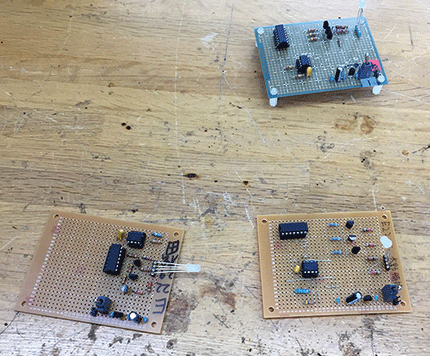
Figure 1. Exemplars in electronics, Japan Photos: courtesy Eva Hartell Using comparative judgment software systems is one way of working with exemplars. However, the software system is not required. Figure 1 is from a Japanese secondary classroom. Technology teachers used these exemplars in a dialogue with their pupils to articulate different quality work in electronics by comparing the three different exemplars to each other and with the students’ own work as well.
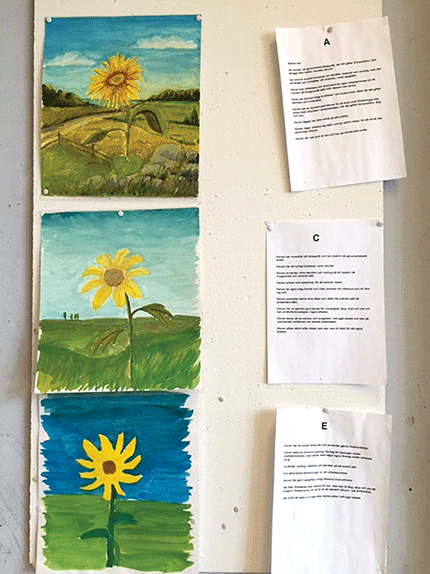
Figure 2. Exemplars of arts, Sweden
Original illustrations: iStockFigure 2 is from an arts classroom in Sweden. The teacher has illustrated the national criteria for grading with sunflowers of different quality. I showed these exemplars at a workshop on formative assessment and at first the participating teachers all agreed – but then suddenly a man raised his hand and objected to the shared consensus that the sunflower at the top was of highest quality. He informed us that he was more into abstract art, and therefore thought the sunflower at the bottom should be rated highest. Then the discussion about quality in artwork really took off; I wish I could have recorded it. The discussion ended in an agreement that is summed up by Winnie the Pooh when he says, “It’s best to know what you’re looking for before you look for it.” With this particular exemplar, the purpose of the task should be clarified. The sad part of this story is that this was the first time these teachers had had the opportunity to discuss this in depth with their peers.
Knowing where they are going makes it easier for students to get there, especially when they know what next step to take and in which direction. Conversely, when pupils are often left on their own, trying to decode the mystery path of learning themselves without guidance and opportunities for reflection, they may lose interest and opportunities. When students are able to consider exemplars in dialogue with their peers, they may gain a richer understanding of what quality work looks like – just as teachers do when discussing exemplars with their professional peers.
Comparative judgment for professional learning
I believe that teachers can develop their assessment literacy and their nose for quality by being exposed to exemplars via the comparative judgment process and by being “forced” to justify their choices and discuss them with others within the profession. And why not start this journey during their teacher education program by reviewing authentic exemplars and practicing how to provide feedback, while they are taking their teacher training courses? How often did you get a chance to see student work during your teacher training, and how often have you had the opportunity to share exemplars with peers? My experience tells me it is not a frequent experience.
Comparative judgment via digital software is also a fairly easy way to invite others within the profession to your classroom practices. The teachers that I have worked with in Sweden were particularly fond of seeing other than their own students’ work, as it expanded their horizon. The interviews in the Hartell and Skogh study7 showed that teachers felt that the comparative judgment method answered the need to collaborate with other teachers in the assessment process. Comparative judgment is useful for both training and on-going refining of teachers’ assessment practices. For example, you can investigate if your standards have changed by blending last year’s students’ essays with the ones you have now, and then checking your comparative judgment outcomes against how you have graded the work. To discover how your standards compare to your peers’, you can invite others to participate, then share and discuss your results together. A school in Oxford used this model to share consensus in terms of quality of student work. The project was initiated by the school head, not for accountability purposes but instead with the aim of strengthening teachers’ assessment practices to enhance equity for their pupils.
It is easy to get carried away with new approaches, and even though there are multiple applications of comparative judgment, appropriate use should always be kept in mind. What decisions are to be made? Then choose what data to collect and present. Depending on what a teacher wants his or her students to learn, the teacher must choose appropriate tasks and exemplars.
The foremost value I see with comparative judgment and exemplars are to serve as a catalyst for discussion. Similar to how wine connoisseurs taste and discuss wine, I see the potential of comparative judgment to foster teachers’ assessment literacy and self-efficacy. Comparative judgment is a useful tool to unpack teachers’ assessment practices, to uncover epistemological values and constructs, and to explicate criteria for success in a much deeper way. Above all, I see great potential as a way to invite learners into the mystery of learning.
Original illustrations: iStock
First published in Education Canada, March 2019
1 A. Pollitt, “The Method of Adaptive Comparative Judgment,” Assessment in Education: Principles, Policy & Practice19, no. 3 (2012): 281–300.
2 L. L. Thurstone, “A Law of Comparative Judgment,” Psychological Review 34 (1927).
3 D. Laming, Human Judgment: The eye of the beholder (London: Thomson Learning, 2004).
4 See e.g. S. R. Bartholomew, E. Yoshikawa-Ruesch, E. Hartell, and G. J. Strimel, “Design Values, Preferences, Similarities, and Differences across Three Global Regions,” in PATT 36. Research and Practice in Technology Education: Perspectives on human capacity and development, eds. Seery, Buckley, Canty and Phelan (Athlone, Ireland: TERG, 2018), 432–440.
5 N. Seery, J. Buckley, T. Delahunty, and D. Canty, “Integrating Learners into the Assessment Process Using Adaptive Comparative Judgment with an Ipsative Approach to Identifying Competence Based Gains Relative to Student Ability Levels,” International Journal of Technology and Design Education (2018); N. Seery, D. Canty, and P. Phelan, “The Validity and Value of Peer Assessment Using Adaptive Comparative Judgment in Design Driven Practical Education,” International Journal of Technology and Design Education 22, no. 2 (2012): 205–226.
6 J. Sweller, (1988). “Cognitive Load During Problem Solving: Effects on learning,” Cognitive Science 12, no. 2 (2988): 257–285.
7 E. Hartell, and I. -B. Skogh, (2015). “Criteria for Success: A study of primary technology teachers’ assessment of digital portfolios,” Australasian Journal of Technology Education, 2, no. 1 (2015).
-
Wi-Fi on School Buses
Comments Off on Wi-Fi on School BusesWi-Fi on school buses is a growing trend in the US, and is starting to appear in Canada. This article takes a careful look at both the potential benefits, especially for rural and lower-income students, and drawbacks.
Wi-Fi in schools in Canada has become a top priority, with many school boards ensuring all of their schools have Wi-Fi access. Teachers are increasingly relying on Virtual Learning Environments (VLEs), where students are expected to work and collaborate within an online space. With the increase in the usage of such technologies, we are beginning to witness a “digital divide” between students with reliable Internet access at home, and students without it. Often, students living in rural areas only have access to connectivity that provides basic web browsing and email functions at best, and cannot efficiently stream a YouTube video or reliably upload an email attachment. Coupled with the fact that rural students are often bused long distances, and have to spend up to two hours a day or more sitting idle on a school bus, rural students may be at risk of falling behind peers who live close to school resources, simply because of where they live. Consequently, some school boards are now turning to Wi-Fi on school buses in an effort to make their school network mobile.
Particularly in the U.S., the buzz around Wi-Fi on school buses has increased, thanks in part to Google’s recent April announcement of their “Rolling Study Hall” program. This program is putting free Wi-Fi on buses in 11 states and providing those students with free Chromebooks. Along with this buzz, there have been a number of success stories related to school bus Wi-Fi. In Kansas, one educator commented positively on a class field trip to a creek, where the Wi-Fi that the bus provided allowed the students to collect data and submit written reports during the field trip before getting back to school. Similarly, in Coachella Valley, in the southern California Desert, solar-powered buses provided free Internet to low-income students who have no Internet access in their remote trailer park communities. Anecdotally, schools in Coachella Valley have seen their graduation rate increase from 70 to 80 percent during the years the buses offered Wi-Fi (2012 to 2015). The adoption of Wi-Fi on buses in the U.S. is about to explode.
Success stories are also being reported in Canada: In Alberta, bus drivers reported a decrease in behavioural problems on school buses with Wi-Fi, presumably because students interacted with each other less. In Guelph, Ontario, Wellington-Dufferin Student Transportation Services (STWDSTS) has implemented Wi-Fi on 12 of their school buses, serving students with both short and long bus rides; some of these students spend up to three hours a day on the school bus. STWDSTS have reported that all of their students appreciate and use the Wi-Fi extensively, and that parents are now demanding Wi-Fi on all school buses, even on shorter, primarily urban routes. This school board also highlighted that their implementation of school bus Wi-Fi has been sustained because of the collective efforts of the board, school administration, and teachers. They vigorously promoted school bus Wi-Fi, and held professional development for teachers to re-conceptualize how to design homework, or “buswork,” as it is now called. All buswork can be completed during the duration of a student’s bus ride, so as not to put rural students at a disadvantage compared to those who do not need to be bused.
In tandem with these apparent successes, some questions have yet to be answered. Cyberbullying – already an urgent issue – could increase if students in an under-supervised environment gain under-supervised Wi-Fi access. Any Internet supervision would at best be done remotely, because school bus drivers certainly cannot monitor students’ online behaviours in real time while driving a bus. This leads to another dilemma: Is it fair to expect students to complete homework on school buses, and to conceptualize school buses as a mobile classroom? Is it fair to capitalize on this part of students’ time after school? If so, what about the ergonomics of sitting crouched over the device, and the students who will surely be carsick should they stare at a screen during their whole ride home?
In an industry that has seen very little modernization in terms of the passenger experience, Wi-Fi on school buses may transform millions of students’ educational experiences. Initial indications are suggesting it is for the better, but we need more time and research to truly make a valid assessment.
Original illustration: iStock
First published in Education Canada, March 2019
-
What’s in a Name?
Comments Off on What’s in a Name?What happens when students research the roots, meaning and stories behind their own names? Identity is at the heart of the names inquiry, encouraging students to tackle the existential questions “Who am I?” “Who are they?” and “Who are we?”
It was a cold March morning. Desks began to shuffle as 28 Grade 5 and 6 students gradually entered the classroom. Standing at the front of the room, I heard a soft whisper: “Who is she?”
“Shh! Quiet, I want to find out who she is,” responded another student.
Silence suddenly filled the room. Twenty-eight sets of eyes now stared at me, anticipating an elaborate introduction, begging me to disclose some much-needed and expected information: my name. This is the moment I had been waiting for, the moment when I was going to try something highly unusual.
“Welcome to Social Studies! I would like to begin with a story and the request that you do not tell anyone your name for the next three days.” Noticing that every student seemed to be nodding in agreement, I flicked off the main light, turned on a small lamp and began reading the story I had so carefully selected.
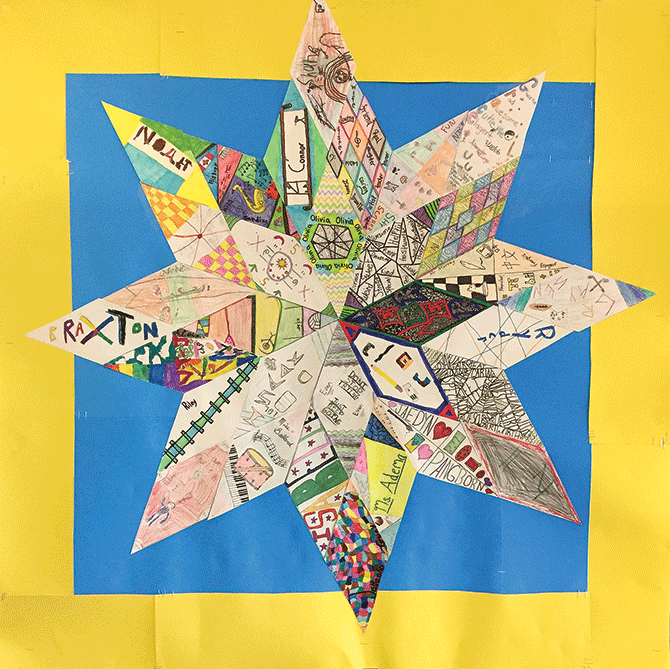
The paper star quilt created by our classroom community. One by one the students became immersed in the story of two parents struggling to bestow a name upon their child. Once the story was finished, a student near the front of the classroom asked, “What do you think the world would look like without names?”
Intrigued by his question, I encouraged him to start exploring possible answers. Slowly, other students began contributing to the conversation, posing questions and brainstorming possible answers. A classroom once quiet was now an animated commons inviting all students to engage in the discussion.
“Can I be a Canadian citizen without a name?”
“What would happen if we were all named the same thing?”
“Why do we need different names?”
“If I didn’t have a name then there would be no point in being a good person, because no one would know who I was,” stated a Grade 5 student with tear-filled eyes.
Immediately struck by the depth of her observation, I pondered her statement. Although it seemed simple, it revealed something deeper: the desire every human being has to be known and to know others, to feel valued as an individual, to belong.
The wonder of names
The verb wonder can be thought of in two ways: the first is to experience curiosity or doubt – often expressed as the phrase, “I wonder what would happen if…” The second is to be fixated or fascinated with or by something.1 Wonder can also be a noun, which is the emotion of amazement and admiration provoked by an encounter with a person, place or thing. In the coming weeks, the ordinary topic of names began filling the classroom with wonder as students embraced it as their topic of study. Students talked with family members, learning more about their heritage, and enthusiastically shared their discoveries. “Did you know I wasn’t named until I was one year old? My parents followed an ancient African name-giving tradition.” As discussions unfolded, it became clear that names embodied “… a living topography, a living, interrelated place full of its own diversity, relations, multiplicity, history, ancestry, and character.”2
Inquiring into names was challenging, requiring students to reconstruct existing understandings of themselves and others. At times, some students became upset by the meaning of their name, thinking it was not as cool as their peers’. “Why does my name mean olive? It is not nearly as cool as a name meaning one with a gentle spirit.” Facing these situations required careful responses that encouraged students to immerse themselves in further historical investigations. Students worked collaboratively as research groups, supporting one another to discover the hidden history of each other’s names rooted in ancient societies: “Did you know that Olivia means olive, which symbolized peace and friendship in Ancient Greece?” Whatever challenges or triumphs presented themselves, the class learned to be in it together.
But do I belong?
Inquiring into names was challenging, requiring students to reconstruct existing understandings of themselves and others.
For young students, finding a community and establishing a sense of genuine belonging can be both challenging and scary. During recess or lunch breaks, students’ sense of belonging would regularly come under question due to various social encounters. To address this problem, the class created a paper star quilt to serve as a visual representation of belonging, a constant reminder that we are one community full of unique individuals with different names and histories. A group of students suggested reaching out to administration, option teachers, and school counselors, inviting them to create a piece of the quilt so as to embrace the full breadth of their community. One student explained that “although certain people may not appear to belong, every community can have and create space for difference. Everyone can belong.” Learning that Indigenous traditions require star quilts to be gifted, the class decided to give their paper quilt to the school, hanging it in the hallway outside of their classroom.
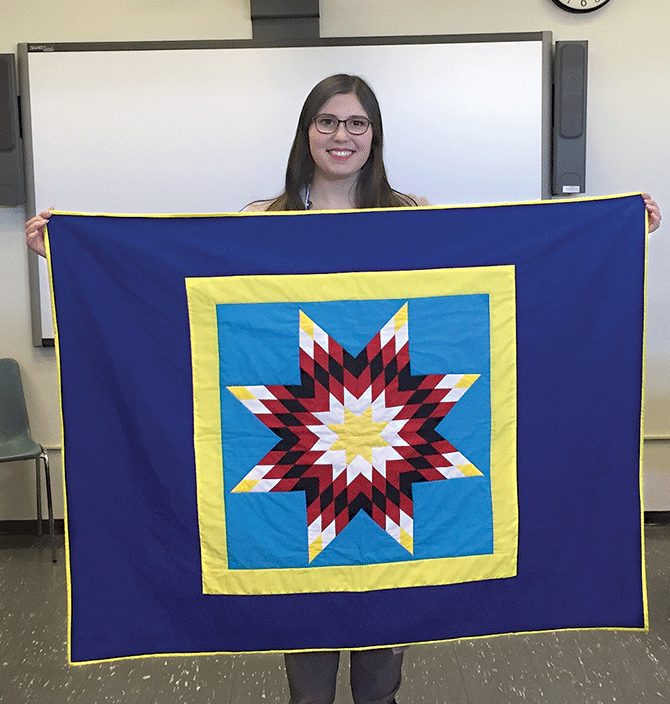
The star quilt that inspired our paper star quilt. This quilt was a collaborative research project during my teacher education program at Brandon University. Our fabric star quilt now hangs in the Education Building at Brandon University. Curricular implications
Across Canada, identity is one of the foundational building blocks of most social studies programs, providing opportunities for topics such as diversity, race and gender to be explored as living experiences. Identity is at the heart of the names inquiry, tackling the existential questions “Who am I?” “Who are they?” and “Who are we?” in ways that encourage and require autobiographical investigation. With every student having a name, it yielded a starting point to uncover and grasp identity as fluid and complex, a collection of living experiences that brings into question what it means to share a Canadian identity that is multi-faceted, yet uniquely individual.
Having students grasp the fluidity of identity and accept who they are as more than their names required encouraging them to inquire into notions of identity and citizenship as they apply to their world. Through the learning process, social studies became enriched as students and teachers realized that names are a doorway into who a unique individual is and is becoming; that names are stories full of endless possibilities, best discovered in community with others.
Photos: Courtesy Katelyn Jardine
First published in Education Canada, March 2019
1 Dwayne E. Huebner, “The Capacity for Wonder and Education,” in The Lure of the Transcendent: Collected essays, by Dwayne E. Hubner (Mahwah, NJ: Lawrence Erlbaum Associates Publishing, 1999).
2 D. Jardine, On the Nature of Inquiry: The individual student (Galileo Education Network, 2002).
http://galileo.org/teachers/designing-learning/articles/the-individual-student -
Indigenous Counter-Stories in Truth and Reconciliation Education
Comments Off on Indigenous Counter-Stories in Truth and Reconciliation EducationWhat stories are educators drawing on as they engage truth and reconciliation education? Madden argues that T&R education should not centre solely around stories of the residential school experience and portrayals of Indigenous people as victims. “Counter-stories” of refusal, resistance, resilience, and restorying resurgence are also needed, to shine “light on community processes that challenge historical and contemporary colonial relationships with Canada.”
In my position as an assistant professor of Indigenous teacher education at the University of Alberta, I serve two main teaching roles. The first is contributing to an initial teacher qualification program designed specifically to prepare Indigenous teacher candidates from both urban and reserve communities to centre Indigenous knowledges, pedagogies, and priorities. The second is developing and implementing coursework for all pre-service and in-service teachers that explores how colonial beliefs (e.g. terra nullius), systems (e.g. formal schooling), and strategies (e.g. legislation like The Indian Act) continue to differently impact those who live in the place we now know as Canada. Across both of these teaching contexts, I have noted general confidence among educators that truth and reconciliation education offers a new framework to heal Indigenous-non-Indigenous relationships, and to pursue school improvement for Indigenous students and communities. My observations suggest the most common starting place recommended to, and taken up by, educators is classroom inclusion of non-fiction and fiction books that introduce Canada’s Indian residential school system and related topics (such as Spirit Bear and Children Make History, by Dr. Cindy Blackstock and Eddy Robinson, and the accompanying learning guide that outlines the Canadian Human Rights Tribunal on First Nations Child Welfare for an elementary-level readership).
In response to the popularity of this approach, I have found myself asking: What stories are educators drawing on as they engage truth and reconciliation education? Why are some resources more widely used than others? And how are Indian residential school narratives shaping popular images of Indigenous peoples, educators, and Canadians? In this article, I delve deeper into these questions and present a framework for educational leaders and teachers to evaluate and enhance the types of Indian residential school accounts they include in the education for reconciliation curricula they design.
Perhaps it is useful to take a step back and consider why the questions I pose in the previous paragraph are significant. In her 2009 TED talk, The Danger of A Single Story, the award-winning Nigerian author and feminist activist Chimamanda Ngozi Adichie makes the case that single stories – those that show a people as one thing and are told over and over again, typically by outsiders – create stereotypes and result in one story becoming the only story. She argues that single stories have both symbolic and real-world consequences. They flatten experience, obscure humanity, exploit difference, establish deficit views, and negatively define and constrain who those at the centre can become.
Prior to what is being called the “era of reconciliation,” Potawatomi-Lenapé scholar of education Dr. Susan Dion explored the danger of a single story in the context of school-based teaching about Indian residential schools. Her research showed that the single story of hopeless Indigenous victims shaped how non-Indigenous teachers and students taught and learned about Canada’s Indian residential school system. She noted an overreliance on teaching methods intended to foster empathy, such as letter writing to former residential school students. Dr. Dion demonstrates that pedagogies of empathy ensured that the single story, as well as associated images and outcomes, went unchallenged. Students remained preoccupied with feeling sorry for the “pitiful” Indigenous victim at the expense of exploring numerous examples of Indigenous strength and agency that were also present in the stories used. By contrast, they learned to see themselves as compassionate and honourable, in that they were able to demonstrate understanding of the “right” rules of moral behaviour, develop “appropriate” attitudes regarding the suffering of Indigenous peoples, and arrive at “fair” judgments about “historic” wrongdoings. Further, this approach cultivated the conditions wherein students were able to view settler colonialism – the ongoing physical occupation of Indigenous land by a colonial state and non-Indigenous settlers and violent and legislative dispossession of Indigenous peoples through established structures and everyday actions – as a thing of the past. Overemphasis on developing empathy for residential school victims overshadowed fostering students’ understanding of how they were impacted by and participated in ongoing colonial logics and effects. Engagement with difficult knowledge and unpleasant but necessary conflict was hindered.
Both Adiche and Dion suggest that while stories can be used to dispossess and change, they can also be used to humanize, empower, and heal. Counter-storytelling is proposed as a method for exposing, analyzing, and challenging narrow accounts. Counter-stories make space for multiple, nuanced stories of under- and misrepresented peoples and experiences. Counter-stories and -storytelling also provide a platform to interrogate privilege and views of Indigenous peoples and groups, to illuminate how we are all are produced within interconnected systems of oppression.
I organize Indian residential school counter-stories according to narratives of: refusal, resistance, resilience, and restorying and resurgence. To appeal to a wide range of learners and tailor to current and local contexts, I suggest including young adult and children’s literature, as well as additional texts such as primary documents, newspaper articles, film, and museum exhibits. Below I offer examples of each type of counter-story, as well as questions to guide teachers’ practices; educators are encouraged to adapt questions for their education context (e.g. level, discipline) and based on the unique gifts they possess, their geographical location, and local Indigenous priorities and guidance. Figure 1 offers examples of ways to adapt questions for younger students.
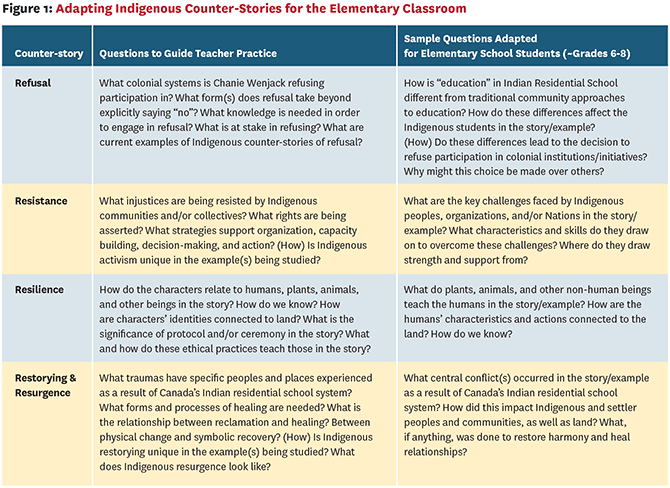
Refusal
Counter-stories of refusal reveal the ways in which Indigenous peoples have been refusing participation in colonial systems since contact, despite ongoing threat to their safety and wellness as a result. For example, the Truth and Reconciliation Commission of Canada’s final report details a variety of strategies that include parents’ refusal to enrol their children in Indian residential schools, as well as refusal to return escapees or children at the end of summer “holidays.” Numerous accounts of students who escaped from an institution to return to their community despite the risk of death, injury, or being caught, returned, and punished are available for inclusion across grade levels. For example, Secret Path is a multi-media text that combines ten songs by Gord Downie with the graphic and animated illustrations of Jeff Lemire to tell the story of 12-year-old Anishinaabe boy Chanie Wenjack. Wenjack died on October 22, 1966 while fleeing the Cecilia Jeffrey Indian Residential School near Kenora, Ontario, with the intention to return to his home on the Marten Falls Reservation over 400 miles away.
When preparing to use these print and video resources, teachers might draw inspiration from the following questions: What colonial systems is Chanie Wenjack refusing participation in? What form(s) does refusal take beyond explicitly saying “no”? What knowledge is needed in order to engage in refusal? What is at stake in refusing? What are current examples of Indigenous counter-stories of refusal?
Resistance
Counter-stories of resistance demonstrate how Indigenous communities and collectives organize and act to resist dispossession, disenfranchisement, and dismissal by the colonial state and demand recognition of human, Indigenous, and treaty rights. For example, in 1970 a sit-in at the Blue Quills Residential School in Alberta resulted in the operation of the school being turned over to the newly formed Blue Quills Native Education Council. The sit-in was led by Stanley Redcrow, a former Blue Quills student and maintenance worker at the school, and Alice Makokis, a school counsellor who worked for the Department of Indian Affairs. It involved over 300 school staff and parents and lasted 17 days, culminating in the Department of Indian Affairs flying 20 Blue Quills community members to Ottawa to meet with the Minister of Indian Affairs (and future Prime Minister) Jean Chrétien. Founded in Nēhiyaw centred curriculum, Blue Quills reopened as an elementary school and junior high in 1971 and expanded to include high school in 1976. The building now houses University nuhelot’įne thaiyots’į nistameyimâkanak Blue Quills, the first Indigenous-controlled university in Canada.
The legal campaigns initiated by former residential school students that led to the Indian Residential Schools Settlement Agreement – the largest class action settlement in Canadian history – is an additional example of a narrative of resistance that I suggest deserves space in truth and reconciliation education. In creating classroom space for counter-stories of resistance, teachers could consider how they will invite students to explore: What injustices are being resisted by Indigenous communities and/or collectives? What rights are being asserted? What strategies support organization, capacity building, decision-making, and action? (How) Is Indigenous activism unique in the example(s) being studied?
Resilience
Counter-stories of resilience highlight the incredible ability of Indigenous peoples and Nations to overcome systematic assault on ways-of-knowing and ways-of-being. Resilience is often nurtured through drawing on the strength of communities and traditional teachings, both of which are comprised of human, other-than-human (e.g. plants, animals) and more-than-human (e.g. ancestors in the spirit world) relations rooted in land and honoured through protocol, ethical practice, and ceremony. The testimony of former residential school survivors who went on to work as residential school staff because they felt their presence made an important difference in the lives of students stood out in the final report of the Truth and Reconciliation Commission of Canada as a particularly moving example of resilience.
Children’s and young adult literature, as well as graphic novels, often illuminate processes and possibilities of resilience. For example, Shi-shi-etko, written by Nicola I. Campbell and illustrated by Kim Lafave, chronicles the four days a young girl spends learning with her family in her community before leaving to attend residential school. Shi-shi-etko bathes in the creek with her mother, canoes on the lake with her father, collects medicines on the land with her grandmother, and privately offers tobacco to Grandfather Tree to keep her memories and family safe until she returns home in the spring. The reader infers that she will draw strength from the ways of her people and the land she is from during her time at residential school. A video adaptation was also directed by Kate Kroll and produced by Marilyn Thomas in collaboration with the author.
Prompts that can be adapted to encourage classroom connections through literature may include: How do the characters relate to humans, plants, animals, and other beings in the story? How do we know? How are characters’ identities connected to land? What is the significance of protocol and/or ceremony in the story? What and how do these ethical practices teach those in the story?
Restorying and resurgence
Counter-stories of restorying and resurgence emphasize the healing and reclamation of Indigenous peoples and places who have experienced trauma as a result of Canada’s Indian residential school system. In many cases, restorying is marked by physical change that mirrors symbolic recovery. For example, survivors, their families, and community members participated in an organized demolition of Peake Hall, the dormitory of the Alberni Indian Residential School that was located on the traditional territory of the Tseshaht First Nation in Port Alberni, B.C. The demolition was conducted in a ceremonial way and included sacred burning, smudging, and a feast, offering participants the chance to heal and free the spirits of their relatives from the former school. In addition to the demolition, the community constructed a traditional-style long house on the site and raised a pole and installed a sculpture made by local artists.
The exhibit Speaking to Memory: Images and Voices from St. Michael’s Indian Residential School is an additional example of restorying and resurgence. It hung on the exterior of the school building at Alert Bay, B.C. transforming the space; a representation of the project was also exhibited at the Museum of Anthropology in Vancouver.
Guiding questions to activate analysis of counter-stories of restorying and resurgence include: What traumas have specific peoples and places experienced as a result of Canada’s Indian residential school system? What forms and processes of healing are needed? What is the relationship between reclamation and healing? Between physical change and symbolic recovery? (How) Is Indigenous restorying unique in the example(s) being studied? What does Indigenous resurgence look like?
To be clear, I do support the Truth and Reconciliation Commission of Canada’s view that truth telling in the form of survivors’ testimony about the abuses they suffered is an integral aspect of education for reconciliation. I do not intend to suggest that stories that shine light on former students’ lived experiences of being abused by priests, nuns, residential school staff, and/or other students should be excluded because they risk positioning Indigenous peoples as victims. Following the Commission, I hold that without truth there is no possibility of reconciliation. I recognize the potential of truth telling to restore dignity, aid in healing for victims, and pursue justice through calling perpetrators, governments, and citizens to account.
Indigenous counter-stories of refusal, resistance, resilience, and restorying and resurgence enhance this oral history by shining light on community processes that challenge historical and contemporary colonial relationships with Canada. They also make it more difficult to take up colonial positions and ways of being in relationship (e.g. rescuer/victim) that reduce Indigenous agency. As educators, the inclusion of Indigenous counter-stories in truth and reconciliation education allows us to imagine reconciliation between settler Canadians and Indigenous peoples, where the latter are not characterized by the singularizing image of victimhood.
Recommended Resources
National Centre for Truth and Reconciliation Teaching Resources.
“The Danger of a Single Story,” by Chimamanda Ngozi Adiche (TED talk, 2009).
Shi shi etko (video directed by Kate Kroll and produced by Marilyn Thomas, 2011).
Photo: John Lehmann/The Globe and Mail
First published in Education Canada, March 2019


IDEAS TO SUPPORT EDUCATORS : Subscribe to the EdCan e-Newsletter
Quality research, reports, and professional learning opportunities.