Archive
-
Competent and Valued
Comments Off on Competent and ValuedUnderstanding cultural and Linguistic Diversity (CLD) as an asset has discursively been present within Canadian society, and by extension Canadian schools, for many years. Although generally accepted as one of the grand narratives that Canadians take pleasure in celebrating, what has not been well established is how Canadian society and schools are responding to this increased diversity. Our collective response to diversity within our schools is, however, inarguably vital given the assimilative orientation Canadian schools have historically taken. The need for effective responses to CLD is further demonstrated when we consider our current socioeconomic context. North American educational settings are more culturally and linguistically diverse than they have ever been as a result of international restructuring and a subsequent increase in labour market mobility.[1] A significant number of children in Canadian classrooms located in urban centers now speak a first language (L1) other than English or French. Ontario alone has experienced a 29 percent increase of ESL students within elementary schools since 2000.[2] Several researchers have noted that despite these changing demographics, there is a dearth of research about culturally and linguistically diverse (CLD) children in educational contexts and disparity in providing for them.[3]
This article contributes to the more recent and growing body of research that addresses gaps in the provision of responsive education for CLD children in Canadian elementary schools. Drawing on research that explored CLD children’s literacy and identity in two Grade 1 and two Kindergarten classrooms over the course of a school year, it identifies, describes and explores culturally responsive multilingual and multicultural pedagogies, and articulates various ways of approaching linguistic and cultural incorporation within diverse classrooms.
PERSPECTIVES
My research was informed by multiliteracies and critical perspectives. Multiliteracies theory conceptualizes literacy as a social practice and socially mediated. Meaning making is understood as varied and dependent upon different cultural, social or professional contexts. Meaning is also made in increasingly multimodal ways, and as such involves interactions with written, visual, verbal and non-verbal communication and objects.[4] Within this dynamic and generous conceptualization, literacy is understood and positioned as multiple, expansive and contextually specific. A critical perspective as it relates to fostering multilingual literacy, therefore, not only values and develops proficiency in speaking, writing or reading in two or more languages but also fosters the ability to control and choose discourses in various contexts and understands the connections between power and language. During the year-long ethnography I conducted within two Kindergarten and two Grade 1 classrooms, I drew on these perspectives to analyze the literacy practices and events that I observed.
PRACTICES THAT FOSTER MULTILINGUAL LITERACY
Intake
First, it is essential to accurately identify languages spoken by students. Based on my research, official student record information must be understood as fallible. The processes by which schools gather data and the conditions parents encounter during the initial information-gathering meeting with the school secretary can create inaccuracies. It is therefore essential for schools to review the initial intake process and form they currently use with and for CLD students. These preliminary meetings communicate a great deal about what is valued in schools and how languages and cultures are positioned within a school’s culture. Whenever possible, a translator who speaks the same language as the parent(s) should be present to assist with the information gathering and aid with the welcoming and transition of the parent(s) and their child to the school community. Further, despite whatever mechanisms are put in place to collect initial information about citizenship and language(s) spoken at home, it would benefit a teacher to ask students, older sisters and brothers (if any) and parents about first languages spoken at home for any CLD child in their classroom.
A multilingual environment
Once students’ first languages have been identified, teachers can create multilingual environmental print consisting of common items (e.g. blackboard, window, shelf) and concepts (e.g. colours, numbers) found in the classroom. Online sources can be used to translate English words into different languages. Whenever possible, involve students in writing and placing multilingual environmental print in the classroom and provide opportunities for them to verbalize the words in their first languages. During this process it is also valuable to make cognates explicit and ask students to do the same. (Cognates are words that are similar in terms of the CLD student’s first language and English – e.g. fruit/fruta is an English/Spanish cognate). Multilingual posters, alphabets of the languages spoken by class members, the names of children in their own languages and in English, product packaging in various languages, common phrases in various languages, and work done by students in their first language can also be displayed in the classroom to create a multilingual print environment.
What is key is to immerse students in an environment where various languages are used purposefully and are part of the instructional space. However, multilingual or multicultural window dressing should be avoided. In various schools I have visited, I have noticed posters with the word “Welcome” written in large letters in the middle of the poster, surrounded by the word for “welcome” written in smaller font in various other languages. These posters are almost never at a height where children can read them, but rather placed at adult eye level. Further, their effectiveness in communicating that languages other than English are valued is highly questionable.
Multilingual texts
Bilingual books written in both English and first languages are purposeful and effective multilingual texts for use in read-aloud, independent and home reading programs. Bilingual books can be versions of titles that are commonly found in elementary classrooms as well as speciality titles that deal with culturally specific content and/or situations that may be relevant to a variety of cultures and available in a variety of languages (e.g. English with Albanian, English with Arabic etc.). Another Story is a Canadian bookstore that carries a variety of bilingual book titles.
Teachers can purposefully draw on their students’ first languages and thus reposition CLD students as knowledgeable communicators.
When using bilingual books during read-aloud or shared reading sessions, students who speak the language the book is written in can sit beside the teacher and either read what is written in their first language or translate what the teacher has read in English. If they translate, the teacher can follow the text written in their first language and look for words that resemble what they have said while pointing these words out to the student and the rest of the class. Most of the CLD students in my study were eager to participate in this shared read aloud. In fact, this practice arose as a result of one student’s desire to demonstrate her knowledge of Spanish to her classmates. She asked to sit next to me and showed me how to incorporate her into the shared reading I was conducting with a Spanish/English bilingual book. I replicated the practice with other students, who also became my co-teachers. This practice repositioned them within their classrooms from “quiet,” “shy” children who “didn’t speak English” to classmates who possessed assets that became explicit and instructionally relevant. They were no longer solely reduced to what they were learning (i.e. “ESL”) but rather seen as capable communicators who knew another language that other students both valued and were interested in learning. CLD children began to be understood as having something they could share and teach.
In making linguistic assets further explicit within a classroom, literacy instruction can be organized in ways that enable students to create their own bilingual books or texts. Although none of my participants had an opportunity to create a complete bilingual narrative, some of them wrote and drew various “identity texts” (texts in which CLD students have invested their identities and reflect who they are).[5] These texts mirrored the structure of the bilingual books they were being exposed to and could have been extended into a complete book. One student, for example, valued the bilingual books I read so much that she asked for her own copy of several titles. She relayed to me that she was reading them to her mom at home and therefore teaching her mom English as well as continuing to develop her ability to read Spanish. Her immersion and interest in bilingual books developed to the point where she created a text that followed the structure of these books. In the identity text she created, she drew a picture of me and underneath wrote “Man” and then her phonetic hypothesis of the word “Hombre.” Another student in the study wrote her name in a proud and pronounced way across the page and then made declarative statement about who she was: “I am an artist.” On top of the powerful sentence was a self-portrait of her at work at her art.
Codeswitching
In order to further develop classrooms spaces that are responsive to and respectful of the multilingual and multicultural assets students bring with them into the classroom, acceptance of codeswitching (CS) must be made explicit and recognized as a viable pedagogic resource. Classrooms that allow for CS (switching between two languages) set conditions that allow students learning English to renegotiate their “less than” and deficient school identities by showcasing and instructionally drawing on the linguistic resources they possess. When this occurred within the classrooms I observed, children whose first language was English began to understand that their often quiet “ESL” classmates had fully developed thoughts they could express in their first language, but were simply not as proficient in the privileged code. Incidents that required them to use their classmate’s first language further reinforced this understanding.
Teachers frequently question their ability to allow for and foster CS when they don’t speak the language their students speak. Many of the events I observed during my research confirmed that it is not necessary for the teacher to know the languages of their students (an impossibility) but rather to be open to negotiating what their interactions and literacy curriculum in general looks and sounds like. This meant, for example, that some teachers asked CLD students to use and/or teach specific words and phrases to them that were relevant to the classroom. One teacher asked a student who spoke Albanian to do a head count of students in her first language out loud to verify if everyone was present. During a lesson on the letter “e,” the same teacher elicited responses from students in their first language about various illustrations of things featured in a picture dictionary that all began with “e.” Teachers can purposefully come in and out of English during their interactions and lessons in order to draw on their students’ first languages and thus reposition CLD students as knowledgeable communicators. Improvisation and situated decision-making is key to instructionally engaging and including CLD students while validating and occasionally using their first language to support their English language learning. More importantly, students’ identities can become valued and pronounced within the classroom as opposed to being hidden and silenced. Encouraging codeswitching can therefore perhaps improve learning conditions for CLD learners while creating classroom spaces that allow them to be and become who they are.
More strategies
There are many other practices teachers can develop that access and instructionally draw on CLD students’ first languages. One example is inviting students to bring in a word of the day that is meaningful to them, and then having the rest of the class learn the word and talk about its meaning and cultural connotations.[6] One of the mothers I interviewed during my study mentioned similar practices when discussing what might have helped her daughter feel welcomed and accepted in school. Teachers can also generate a list of words that are commonly used and important to classroom life (e.g. bathroom, coats, lunch) and keep the list in an accessible place. One of the Kindergarten teachers in my study had this list of words laminated and at hand in several key places around the classroom so that she could understand and communicate essential words and phrases. Again, the Internet can serve as a translation resource. When CLD parents volunteer to work in classrooms, teachers can make explicit how accepted codeswitching is and encourage them to CS or converse with students who share their first language. Parent volunteers can also be encouraged to share their language and culture with the class, and to help students who share their first language and culture create bilingual books and other identity texts that can also be shared with the class and celebrated.
CONCLUSION
The approaches and practices offered throughout this article are by no means all-encompassing, definitive, prescriptive or examples of “best practices” (a problematic and dangerous concept). What is offered is meant to provide educators with ideas that can assist them in responding to the increasing cultural and linguistic diversity they are experiencing within their schools and classrooms. How these practices are integrated and used should remain flexible, malleable and ultimately responsive to and respectful of the CLD students we have the good fortune of teaching. Multilingual, multicultural literacy practices should continue to evolve and be recognized as sound pedagogy that extends classroom language barriers, increases the status of students’ first languages and ultimately, opens up identity options available to CLD students within schools.
If we are genuinely interested in being able to respond to the rich cultural and linguistic diversity of our ever-changing classrooms, then we need to consider and experiment with a variety of practices that value and cultivate who these students are and what they bring to our schools and classrooms.
Photo: Christopher Futcher (iStock)
First published in Education Canada, January 2014
EN BREF – Cet article faisant référence à une étude ethnographique d’un an réalisée par le chercheur, examine la littératie et l’identité d’enfants d’origines culturelles et linguistiques diverses dans deux classes de maternelle et deux classes de première année. Les constatations sont issues de la pédagogie plurilinguistique et des perspectives critiques. L’article identifie, décrit et explore des littératies et des pédagogies multilingues et multiculturelles démontrant l’enseignement adapté à la culture. Différentes façons d’aborder l’intégration linguistique et culturelle dans des classes diversifiées sont examinées. Les pratiques de littératie favorisant cette adaptation sont ciblées afin de proposer aux éducateurs un répertoire d’approches susceptibles de les aider à tenir compte efficacement d’une diversité culturelle et linguistique croissante dans les milieux scolaires canadiens.
[1] Nicholas C. Burbules and Carlos Alberto Torres, Introduction to Globalization and Education: Critical perspectives (New York: Routledge, 2000); Jim Cummins, “Diverse Futures: Rethinking the image of the child in Canadian schools,” presented at the Joan Pederson Distinguished Lecture Series, University of Western Ontario (April 2005); Festus E. Obiakor, “Research on Culturally and Linguistically Diverse Populations,” Multicultural Perspectives 3, no. 4 (2001): 5-10.
[2] People for Education, The Annual Report on Ontario’s Public Schools, (2007). www.peopleforeducation.com/adx/aspx/adxGetMedia.aspx?DocID=634
[3] R. Falconer and D. A. Byrnes, “When Good Intentions Are not Enough: A response to increasing diversity in an early childhood setting,” Journal of Research in Childhood Education 17, no. 2 (2003): 188-200; Carola Suárez-Orozco, “Afterword: Understanding and serving the children of immigrants,” Harvard Educational Review 71, no. 3 (2001): 579-589; Kelleen Toohey, Learning English at School: Identity, social relations and classroom practice (Great Britain: Multilingual Matters Ltd., 2000).
[4] Nancy Hornberger, “Multilingual Literacies, Literacy Practices, and the Continuation of Biliteracy,” In M. Martin-Jones and K. Jones (Eds.), Multilingual Literacies (Amsterdam/Philadelphia: John Benjamins Pub. Co., 2000), 353-369; James Paul Gee, “The New Literacy Studies: From ‘socially situated’ to the work of the social,” in D. Barton, M. Hamilton and R. Ivanič (Eds.), Situated Literacies: Reading and writing in context (London: Routledge, 2000), 180-196.
[5] Jim Cummins, “Diverse Futures.”
[6] Jim Cummins, Negotiating Identities: Education for empowerment in a diverse society (CA: California Association for Bilingual Education, 2001).
-
A Parent’s P.O.V. on Inquiry-based Learning – Exploring Big Questions
Comments Off on A Parent’s P.O.V. on Inquiry-based Learning – Exploring Big QuestionsIn 2013, Saint Anne School (Saskatoon, SK) was recognized with a CEA Ken Spencer Award.
https://vimeo.com/84994741
-
Library to Learning Commons
Comments Off on Library to Learning CommonsI RECENTLY INHERITED my grandmother’s recipe box after she passed away. My grandmother spent much of her time in the kitchen creating delicious meals that drew our family together. As I examined her recipes for hot milk sponge cake, chicken pot pie, and others, it suddenly occurred to me that these very recipes probably contributed to my grandmother’s heart attack, and our family’s tendency toward heart disease. Most of them were created before nutritional research confirmed the negative effects of high levels of fat, salt and sugar on health. Although I uphold my grandmother’s adage that great food brings a family together, the kinds of food I feed my own family have changed. The way we eat has been transformed, and we are healthier for it.
Like great food, I have always loved school libraries. They are as important today as they have ever been; however, the recipes for a successful school library program have changed. Loertscher, Koechlin and Zwaan describe the contemporary school library as a learning commons, “the hub of the school, where exemplary learning and teaching are showcased, where professional development, teaching and learning experimentation and action research happen.”[1] Teacher-librarians, once primarily managers of school resources, can become instructional leaders, supporting and collaborating with every teacher in the school, promoting inquiry-based learning and fostering a thriving reading culture.
Our school libraries, at the physical and virtual heart of the school, are ideally positioned to lead and support educational transformation, provided that we are willing to consider new ways of working that better support our students and teachers. I invite your to consider the following recipes:
A recipe to foster student collaboration and personalized learning
I grew up in a time when the school librarian was monarch of his or her domain, daring anyone to upset the quiet order of the school library. These days, students have taken over. Flexible furnishings encourage students to sit together and chat about what they are reading or collaborate on an inquiry project. Many libraries host in-person and virtual book clubs, book talks and author visits. Students are now the ones creating book displays and book trailers to encourage each other to read. Students are encouraged to visit the school library learning commons to pursue topics of individual interest. Many school library learning commons incorporate performance spaces where students can “show what they know.”
One of the biggest challenges for contemporary teachers is meeting the needs of a diverse group of students that may include English language learners and students with learning disabilities and other special needs. The school librarian’s availability for co-teaching can help: As Fontichiaro and Buczynski point out, “Co-teaching halves the student-to-teacher ratio and facilitates greater levels of student support via feedback, conferencing, and personalized, differentiated instruction.”[2] The addition of iPads, iPods and eBooks to the library collection ensures that students have access to technologies that engage even reluctant and struggling readers. Add to that the possibility of students using the school library to conduct independent research, as a breakout space from their regular classroom, or as a place to attend book clubs, literature circles and other literacy-based programs, and we have a rich resource for meeting individual learning needs.
A recipe to promote inquiry-based learning
Many teacher-librarians are trained in inquiry-based learning. Because they are in the unique position of being able to work with all teachers and all students within the school, teacher-librarians are able to model and encourage best teaching practice, thereby improving the instructional capacity of the entire school. Alberta Learning, for example, proposes that “cooperative planning of an inquiry activity involves a teacher working with a teacher-librarian.”[3] Haycock goes on to suggest that “students learn more, and produce better research products, following planned, integrated information skills instruction by the teacher and teacher-librarian together.”[4] As my grandmother liked to remind me, “Two heads are better than one.”
A recipe to promote staff collaboration
Collaboration among teachers has been identified as one of the key ingredients for successful school improvement and increased teacher satisfaction. In fact, Zmuda and Harada go so far as to suggest, “Schools must eliminate the waste, turbulence and distractions caused by individuals working in isolation.”[5] The positive result of collaboration in schools is undeniable. Research confirms that “when school teams collaborate to clarify the relationship between design and the effect on achievement, we witness positive and constructive change at staff meetings, in classrooms, and in individual staff-development sessions.”[6]
In times of great change, it is evident that trust, relationships and respect are key components for school success. Haycock suggests that “the core of teacher-librarianship – collaboration and partnerships – rests on positive and productive relationships with colleagues and other staff.”[7] Teacher-librarians, embedded in the day-to-day life of the school community, are ideally positioned to collaborate with teachers and administrators in creating a recipe for success that is responsive to the unique needs of their school.
A recipe to steward valuable time and resources
Schools across this country are being asked to generate improved student outcomes, while at the same time facing unprecedented budget cuts. How can we make every penny count? The answer, once again, is to draw upon the expertise of a qualified teacher-librarian. Being aware of student reading levels and the curriculum being taught across grade levels, teacher-librarians can ensure that the school is purchasing resources that meet the needs of students without creating redundancies. By creating classroom library carts that can be rotated from classroom to classroom, teacher-librarians can ensure that library resources are getting into the hands of students, while reducing the cost of purchasing books for each individual classroom (books that students will eventually tire of). Teacher-librarians are knowledgeable about virtual resources and databases that can fill the inevitable gaps in the school library collection, and direct teachers and students alike to those that address their needs.
EDUCATION IS UNDERGOING unprecedented change. Faced with ever-tightening budgets, some jurisdictions have severely cut back on or eliminated school library services. Other jurisdictions have begun the library-to-learning commons shift by making cosmetic changes to their school library spaces. However, it should be apparent from these recipes that the library-to-learning commons transformation involves more than flexible furnishings and a new coat of paint. In fact, it is great staff, not great stuff, which is the hallmark of a thriving school library learning commons.
If you are fortunate enough to have a teacher-librarian on staff, I encourage you to try some of these recipes, taking advantage of the many benefits of planning and teaching with a like-minded colleague, using your school library as the learning hub and centre of inquiry. If your school has not yet adopted a learning commons approach, I invite you to consider, as a school community, the potential of your school library to create a feast of learning, for teachers and students alike.
Photo: Nicholas Monu (iStock)
First published in Education Canada, January 2014
EN BREF – L’ancien modèle de bibliothèque n’est plus sain pour le personnel enseignant ou pour les élèves. La conversion d’une bibliothèque scolaire en carrefour d’apprentissage constitue l’une des meilleures recettes de réussite scolaire dans le contexte actuel de réforme de l’éducation. La bibliothèque comme carrefour d’apprentissage fonctionne comme une plaque tournante de l’école, où les enseignants et les élèves collaborent, où l’apprentissage fondé sur l’enquête est favorisé et où les enseignants-bibliothécaires soutiennent chacun des membres du personnel enseignant de l’école et engendrent une culture de lecture dynamique.
[1] David V. Loertscher, Carol Koechlin and Sandi Zwaan, The New Learning Commons: Where learners win! (Salt Lake City, UT: Hi Willow Research and Publishing, 2008),123.
[2] Kristin Fontichiaro and Sandy Buczynski, “Connecting Science Notebooking to the Elementary Library Media Center,” in 21st Century Learning in School Libraries, ed. K. Fontichiaro (Santa Barbara, CA: ABC Clio, 2009), 161.
[3] Alberta Learning, Focus on Inquiry: A teacher’s guide to implementing inquiry-based learning (Edmonton, AB: Alberta Learning, 2004), 26.
[4] Ken Haycock, “Research in School Library Programs Linking Teacher-librarians, School Libraries and Student Achievement,” in Achieving Information Literacy: Standards for school library programs in Canada, eds. M. Asselin, J. L. Branch, and D. Oberg (Ottawa, ON: Canadian Association for School Libraries, 2003).
[5] Allison Zmuda and Violet H. Harada, Librarians as Learning Specialists: Meeting the learning imperative for the 21st century (Westport, CT: Libraries Unlimited, 2008), 4.
[6] Zmuda and Harada, Librarians as Learning Specialists, 4.
[7] Ken Haycock, “Leadership from the Middle: Building influence for change,” in The Many Faces of School Library Leadership, ed. Sharon Coatney (Santa Barbara, CA: ABC-Clio, 2010), 5.
-
More Students Share Reflections on What’s Standing in the Way of Change in Education
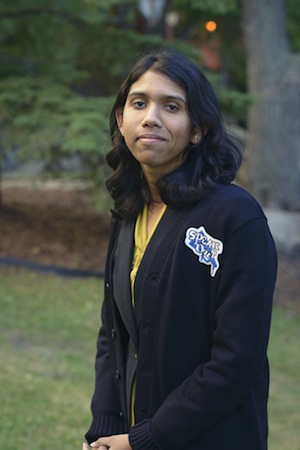
Comments Off on More Students Share Reflections on What’s Standing in the Way of Change in EducationThe following student reflections are based on their experiences as participants in CEA’s Calgary Conference, which was held in October 2013. Both students are part of Alberta’s Speak Out student engagement initiative and are current members of the Minister’s Student Advisory Council. The original blogs are posted on the Speak Out website.
-
Students Ask: Why So Few of Us at CEA’s Calgary Conference?
Comments Off on Students Ask: Why So Few of Us at CEA’s Calgary Conference?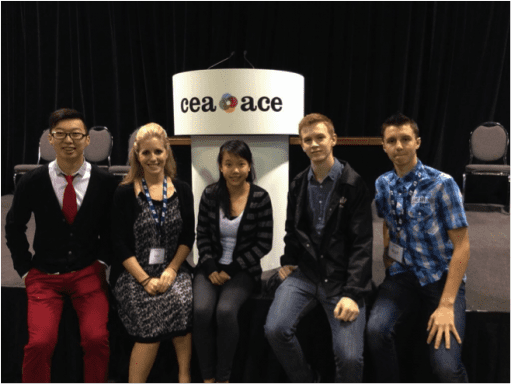
(from left to right) Student George W., CBE Learning Leader Deborah Bradbury and students Cynthia H, Matt N and Wyatt C at the CEA Conference in Calgary.
-
The Fear Factor
Comments Off on The Fear FactorIn 1968, Spencer Silver, a scientist at one of the world’s most innovative corporations, 3M, invented an adhesive that left no residue. Unfortunately, it didn’t really bind anything either and, as a failed experiment, it was quietly forgotten. There was – and still is – nothing remarkable about a failed experiment at 3M. Over half of their inventions never make it into production.
Eight years later, another 3M scientist, Art Fry, was getting frustrated in church. The makeshift scraps of paper he was using as bookmarks for his hymnal kept falling out. Remembering Spencer’s glue that didn’t stick, Art started tinkering with paper-backed adhesives to create a removable hymnal bookmark.
We know it today as the Post-It note.
It’s a classic example of the capacity, in the words of an equally successful company, to “fail fast and iterate.” Google got the idea for their famous 20 percent “free time” (where employees can spend a day a week doing their own projects) from 3M, who first instigated 15 percent employee time in 1948. Google has only a slightly better failure rate than 3M: 36 percent of Google’s inventions fail, though many of their failures have successful iterations further down the line.
To those of us working in education, the culture of innovation lived by Google and 3M seems both fearless and enviable. How many of us would keep our jobs if half of what we tried didn’t work? How many of us are given generous amounts of time to experiment in our practice?
Due to what we in England call the “accountability framework,” most school leaders would be more likely to describe themselves as fearful, rather than fearless. Innovation happens slowly, and incrementally, in public schooling. The fear factor hangs over education ministers, who have to show an impact over a four- to five-year electoral cycle. It hangs over school and district administrators, who have to demonstrate “turnaround” in failing schools. And it hangs over teachers and students, who seem to be continually exhorted to “do more, work harder,” not “reflect more, work smarter.” The fear factor is one reason why, as Sir Ken Robinson remarked, “we keep trying to build a better steam engine” rather than radically re-invent education. Most would acknowledge that, compared to the incredible rate of innovation over the past 150 years in science or industry, things move slowly in education – and it can’t be because we think it’s about as good as it gets.
In working with teachers and school leaders in the U.K., Australia and North America, I’ve witnessed periodic periods of fear and demoralization. I believe that while some of those fears are justified, some are not. Before looking at ways in which we can stimulate schools to become more innovative, let’s look at what seems to be holding us back, structurally and culturally.
Structural innovation blockers
“It’s the system.”
In the U.S. and England (where, arguably, the fear factor is greatest), current strategies seem to involve carrots and sticks. The Obama administration recently completed the first three-year cycle of the Investing in Innovation program, dedicated to finding “innovative solutions to common educational challenges.” The English equivalent is the Education Endowment Fund, instigated to encourage innovations to “break the link between family income and educational achievement.” While the change of direction from both administrations, previously “best known for mandating compliance and disbursing formula funds,”[1] is to be welcomed, both funds have been criticized for overly narrow eligibility criteria and overly prescriptive evaluation requirements.
The top-down fostering of innovation also has to be seen against what is perceived by school leaders as an ever-increasing emphasis upon standardized testing and payment by results.
“They won’t let us innovate.”
After lengthy demands for compliance, it’s perhaps understandable that school leaders would be hesitant about taking the path less trodden. When, in 2005, the Innovation Unit[2] was part of the U.K. Labour government’s Department for Education, it was mandated to offer schools the “Power to Innovate.” This gave schools temporary exemption from statutory regulation, should their innovation benefit from it. An overwhelming majority of schools who applied for this exemption were advised that they didn’t actually need it – what they were proposing lay within the regulatory framework anyway.
Once established, a culture of compliance is remarkably difficult to break.
“Innovation flows down, not up.”
Many teachers have experienced, over the past decade, some loss of autonomy in their practice. The introduction of the Common Core Standards in the U.S. is perhaps the latest example. Accompanying this has been the rise of the “executive leader” of schools. Once charged with turning around a failing school, such administrators inevitably bring sweeping change into the organization, reinforcing the notion that for teachers, innovation is done to them, rather than done by them.
In sharp contrast, the growth of personal learning networks, social media and social learning phenomena like TeachMeet events[3] are reversing this pattern. Teachers engaging in peer-to-peer learning offers the best hope not only for innovation flowing upwards, but also for models of distributed leadership.
I have experienced this first-hand through the Musical Futures program.[4] Musical Futures has been engaging students for 11 years, originating in England, but now operating in seven different countries, including Canada. We learned some time ago that the way to get an education innovation to spread was by engaging teachers in develop-ing new practices: prototyping, testing, reflecting, redesigning. But we started in a single country, before the advent of social media. Now, Musical Futures teachers globally share their videos, resources and lesson plans through a virtual sharing wall, Facebook, and a weekly Twitter meet-up. One tweet from a teacher sums up the excitement felt by this form of global, do-it-yourself professional development: “This is the best staffroom EVER!”
Cultural innovation blockers
“Why should my child be the guinea pig?”
I was once explaining an initiative I was leading to an English politician, only to be halted by the phrase every education innovator dreads: “So, you think it’s OK to treat these kids as guinea pigs, do you?” This populist favourite is inevitably followed by, “Kids only get one chance at a good education.”
Indeed they do. But, while I have met many children whose schooling was blighted by mind-numbing repetition and routine, a child’s school career is long, and I have yet to meet any who felt they were penalized by being part of a new innovation. Quite the reverse – most students are happy to be seen as pioneers of a new form of pedagogy. The demand for places at charter schools in the U.S., and free schools in the U.K., suggests that parents, too, are less concerned about the guinea-pig syndrome.
“If all else fails, or no one’s looking, innovate.”
Schools, in most developed countries with strong accountability frameworks, aren’t judged on their levels of innovation. They are judged, primarily, on test scores. There is, therefore, precious little incentive for good mainstream schools to try new teaching practices which ultimately may not work.
Radical, disruptive innovations are most frequently seen in so-called failing schools, where tweaking or incremental change is insufficient. Hartsholme Academy, in Lincoln, U.K., is a prime example. When Carl Jarvis became Head Teacher there in 2009, the school was under threat of closure. It was ranked the 5th worst school in England.
The fear factor, however, was absent, since there was no realistic future for the school. Carl changed everything – except the teachers he inherited. Out went desks, in came iPads for all students. Out went worksheets, in came immersive learning environments, project- and challenge-based learning, and pedagogy based upon latest neuroscience findings. Three years later, the English schools inspections agency deemed Hartsholme to be “beyond outstanding” (outstanding is the highest achievable classification). Despite this astonishing achievement, the Hartsholme innovations are dismissed by many as non-transferable, applicable only to failing, inner-city schools.
Charles Leadbeater has written extensively on our failure to learn from the innovations which take place “in the margins.” Because they are only in our peripheral vision, we fail to see their wider applicability. Leadbeater argues that solutions which are found in developing countries or in alternative educational settings are not just instructive, they are the future: “Too often, entrepreneurship and innovation have been seen as marginal add-ons. In the century to come, they have to become the new mainstream.”[5]
Feel the fear and do it anyway
One of the world’s leading management experts, W. E. Deming, believed there were five deadly diseases of management:
1. Lack of constancy of purpose – not understanding why we’re doing what we’re doing;
2. Emphasis upon short-term profits – leading to “shipping stuff out, no matter what,” and “creative accounting”;
3. Annual rating of performance – the merit system encourages short-term performance. It annihilates planning, it annihilates teamwork. You don’t get ahead by being collaborative, you get ahead by getting ahead;
4. Mobility of management – the valorising of those who can quickly turn around a company’s performance, but do so by a scorched-earth policy and then quickly move on;
5. Use of visible figures only – only valuing what can be easily measured.
It doesn’t take much imagination to see how these can be applied to many current national education policies, and how they contribute to a climate of fear and mistrust.
So how do school leaders navigate the murky waters between what social theorist Barry Schwartz describes as “doing the right thing, or doing the required thing?” Undoubtedly, the hierarchically imposed fear factor puts pressure on leaders to do the required thing. But there are enough inspiring examples of school leaders and superintendents who have felt the fear and done the right thing anyway to give us all hope. There is probably little we can do to persuade our political leaders of the need to do the one single thing which, above all else, would remove the fear factor: de-politicize education. But there is plenty we can do, as a community of practitioners, to support innovation without fear.
First, we can look outside our own discipline for inspiration. It is, after all, what leaders of innovative schools do. Books by management gurus Peter Senge, Ricardo Semler, Teresa Amabile and Clayton Christensen are just as likely to be on their bookshelves as classic education texts.
Innovative schools seem to chare a common characteristic: their teachers are expected to be designers of learning, not simply deliverers.
Second, we can see that innovative organizations, like Google and 3M, create a safe space for experimentation, giving people trust, time and permission to fail.
Third, great leaders see their schools as porous global learning commons. When Stephen Harris, principal of Northern Beaches Christian School in Sydney, set up the Sydney Centre for Innovation in Learning, it was to ensure that his teachers would go around the world, visit great schools, and feel supported to embed those practices in their classrooms.
Fourth, leaders like Harris understand that innovation is a mindset, a culture, not a one-off experiment. To support that mindset they de-privatize the act of teaching, seeing teaching as a team sport, not a solitary activity. Critically, innovative schools seem to share a common characteristic: their teachers are expected to be designers of learning, not simply deliverers.
Fifth, centres of innovation have their own yardsticks by which they want to be assessed. Great schools aren’t blown off course by a single set of disappointing test scores. Instead they have a constancy of purpose, informed by their own success criteria, often less visible than those imposed upon them. Thomas Edison arguably created the most innovative learning environment we have yet seen. Despite filing over 400 patents in six years, Edison insisted that his “inventions factory” at Menlo Park should be judged, not by its successes, but by the number of experiments carried out on any given day.
In most developed countries, we have a more conducive environment for innovation than we’ve had for many years – though not without restrictions. More importantly, perhaps, we are seeing global networks of innovators forming through social media. Instead of simply relying upon their schools or their leaders. they are being emboldened by each other’s ideas and mutual passion for learning. One of those taking part in the Musical Futures pilot was Sandie Heckel, a music teacher at the District School Board of Niagara, Ontario. This was her reflection on innovating within a community of practitioners:
“No longer was I the sole music/arts teacher in my school – I now had the support of teachers around the world who, like me, were going through the same struggles to get kids involved in authentic music making. This community of teacher learners, whose brains I could pick at any given moment through Facebook and Twitter, were an invaluable support. I especially appreciated seeing the videos of their students’ work posted on the Sharing Wall, as did my students.
In this project, the learning was collaborative, continuous, and evolved over time. It allowed me to struggle with new ideas and in the end make a fundamental shift in the way I teach – from almost exclusively instructing students how to make music, to facilitating my students’ collaborative search to make music of their choosing. The shift was radical and the shift is permanent, and the nature of this PD was key in making that happen.”
If experiences like Sandie’s aren’t enough to persuade us to overcome our fears, we have to consider the alternative. To simply continue teaching the way that we ourselves were taught – when the world is changing so quickly – is to be immobilized by fear.
As John Dewey said, “If we teach today’s students as we taught yesterday’s, we rob them of tomorrow.”
Illustration: Dave Donald
First published in Education Canada, November 2013
EN BREF – Contrastant avec ce qui se passe dans les organisations les plus innovatrices du monde, l’innovation se produit lentement dans les écoles publiques. L’auteur explore les « facteurs de crainte » qui empêchent d’innover en éducation, incluant les inhibiteurs structuraux et culturels. D’après les caractéristiques observées dans les centres d’innovation, les leaders en éducation peuvent néanmoins faire beaucoup pour appuyer l’innovation : chercher de l’inspiration hors de leur discipline, formuler leurs propres critères de réussite; procurer un espace d’expérimentation sans risque; accorder aux gens leur confiance, du temps et la permission d’échouer. Voir les écoles comme des lieux communs, poreux et mondiaux d’apprentissage, les enseignants comme des concepteurs (et pas seulement des dispensateurs) d’apprentissage, et l’enseignement comme un sport d’équipe (plutôt que comme une activité solitaire) constitue un changement de perspective puissant et motivant. En conclusion, l’auteur aborde les réseaux mondiaux d’innovateurs qui surgissent présentement grâce aux médias sociaux qui constituent une nouvelle force dynamique accélérant la façon dont l’innovation est partagée, adoptée et raffinée.
[1] K. Smith and J. Peterson, Supporting and Scaling Change: Lessons from the first round of the Investing in Innovation (i3) program (Bellwether Education Partners: 2011).
[3] http://teachmeet.pbworks.com
[5] C. Leadbeater and A. Wong, Learning From The Extremes (Cisco: 2010).
-
From Bright Idea to System Change
Comments Off on From Bright Idea to System ChangeInnovation in education occurs frequently. A teacher tries something new – he or she reads about it, tries it, refines it and eventually incorporates it into practice; a principal adopts a new form of professional development; a district adopts adaptive assessment technologies; a school ends parent-teacher nights, instead offering social events during which a teacher will quietly chat with a parent about how their child is doing. These small, so-called adopt/adapt innovations are commonplace. They take the form of adopting an idea gathered from somewhere else and adapting it to local circumstance.
Usually when there is talk of innovation the assumption is that it will be disruptive. For example, Alberta’s decision to phase out Provincial Achievement Tests by 2017 and replace them with diagnostic assessments at the beginning of Grades 3, 6 and 9 (and possibly at the start of each school year) using online assessment tools is a major change and will likely be disruptive, at least at first. It is more disruptive when we see this as a shift from “assessment of learning” to “assessment for learning.” Britain’s decision to offer schools the opportunity to cede from the control of a local education authority (school board) and operate as an independent “academy” is disruptive – especially given that any community organization can now establish a free school or academy. The U.S. decision to push a common core curriculum for the nation as a whole is disruptive of local autonomy.
When we look at the pattern of innovation over the career of a teacher, we see that the majority of the innovations he or she will experience are adopt/adapt innovations. While the disruptive innovations come with a great deal of upset and anxiety, they represent a small portion of the innovation experience of a teacher – less than ten percent. The bulk of innovation in education is adopt/adapt.
Adopt/adapt innovation is not to be confused with continuous improvement. True innovation is a different practice which produces significantly different outputs, outcomes and impacts which can be measured. Continuous improvement tends just to modestly improve how something is done with barely discernible impacts on outcomes and impacts. The key difference between innovation and continuous improvement is the scale of the change and the sustaining impact of that change.
The focus for innovation
Innovation in education can be focused on one or more of what McKinsey & Co. refer to as “the seven S’s.”[1]
1. Structure: an innovation that changes how a school, group of schools, district or jurisdiction is structured and organized and, by doing so, improves the outcomes of the organization in specific and sustained ways. The structural changes in the U.K. are examples of this reform as are the increasing number of collaborations between Catholic and public school boards (including shared schools) in Canada.
2. Staff: a change in the way staff are deployed or engaged in their work that produces gains in performance. The use of teaching assistants and specialists with respect to special needs is an example here.
3. Strategy: a change in the strategic intent of the organization that produces sustained gains in outcomes. The decision to personalize the learning activities within a school by leveraging technology and seeing this as a core advantage of the school would be one example. Another would be a school that, in addition to pursuing the provincial curriculum, specializes in art and design or science.
4. Systems: business process innovations that significantly improve both efficiency and outcomes, such that the organization is seen to have made a significant performance improvement. The use of adaptive assessment technologies to track learning on a regular (daily, every other day, weekly) basis, as practiced in Abu Dhabi schools, is an example here.
5. Style/culture: innovative changes in the culture and style of the organization that lead to significant measurable changes in an aspect of the performance of the organization – the widespread use of problem-based learning and constructivist teaching would be an example here.
6. Shared values: innovations that lead to the strengthening of the shared values of the organization within a group of stakeholders or across more than one group of stakeholders, which lead to performance improvements.
7. Skills: the way in which each person in the organization demonstrates a high level of execution of the skills they possess and how the organization enables the continuous development of skill.
Educational innovation can be about just one of these changes or some combination of them – indeed, major innovations usually involve three or more of the S’s. Also note that outcomes need to be defined and measured. Just saying “things are better” isn’t good enough – tangible evidence is needed. For example, does improving shared values increase attendance or lead to higher learning outcomes in a school system? Does changing how we act with respect to attendance improve attendance and learning outcomes and lower the costs of doing so? Does an innovation in relation to an online learning strategy increase access to learning for those who otherwise would not have access to this learning?
Here is a working definition of successful innovation: innovation is a deliberate action that leads to significant and sustained overall positive improvement in the performance of a school or school system on one or more dimensions of the 7S’s.
Sustaining innovation
Some innovations “stick” and some don’t. For example, some innovations are very much the product of the person who introduced them and they do not survive their departure from a school or school system. Some reforms of education – said to be innovations at the time – are temporary and linked to a particular Minister of Education. Some also don’t produce the results that were anticipated – colour coding for learning to read is one example.
In a review of the work undertaken by the Innovation Expedition for the Peter Drucker Awards for Non Profit Innovation in Canada (1993-2000), we looked at outcomes in terms of the following categories. The more an innovation led to change in one or more of these categories, the more sustainable it was:
Innovative practices: the extent to which the organization has had to adopt new work practices, new methods, and new thinking so as to make the project or activity happen.
Organization-wide impact: some projects or activities relate to a small part of the work of the organization, while others have a broader impact on all aspects of the organization’s work. This dimension examines the extent of the impact of a project or activity on the organization.
Outcome: the impact of the activity or project as expressed by outcome measures – specifically, measures of key performance that compare some old way of working with a new, more innovative way of working.
Sustainability: projects or activities that have a strong likelihood of having an impact over time, and creating a continuing momentum for change, are more valued on this dimension than those innovative projects that are “one off” and have an immediate, short-term impact but are not sustainable.
Replicability: a key criteria for the award is the degree to which a project or activity conducted in one organization could be and is likely to be transferred to another – what we have termed here “replicability.” This dimension measures the extent to which a project or activity could be transferred to another organization.
Partnership building: the extent to which the project or activity has created and strengthened alliances and partnerships between two or more organizations in the nonprofit sector or between the nonprofit and private sectors or between the nonprofit and government sectors.
Reviewing hundreds of submissions over the life of this Award, it soon became clear that tangible outcomes and replicability (which might now be called scalability) were key aspects of powerful innovations that proved to be sustainable.
The process of innovation
Denning and Dunham[2] have studied innovation in a variety of settings. Doing so has enabled them to outline a process map of the steps required for an innovation to “catch” and “stick.” It involves three key building blocks and a number of steps.
The first building block they call “the work of invention.” This requires the innovator (an individual or team) to imagine, sense and envision what an opportunity for innovation looks like. For example, when the team at Derek Taylor School (K-9) in Grande Prairie decided that a strong, systematic and strategic focus on emotional intelligence could establish the right culture and create the capacity for high performance, they sensed that this would be the key to their new school, the well-being of its 700 students and being able to establish a positive reputation in the community of Mission Heights. They elaborated their thinking through workshops, study groups, and the use of supports from professional advisors and central office. This work was pre-planning – just scoping.
Having scoped and sensed the work, the staff needed to envision collectively what an innovation might look like – were they looking at embedding emotional intelligence activities and work across the curriculum, just doing occasional work in assemblies and home-room time or other kinds of activities? Was it to be for all students, or just K-5? There were three full staff meetings and a staff workshop before they landed on a plan.
The next building block is referred to as “the work of adoption.” In our Derek Taylor example, staff decided to develop their own resources and activities for homeroom use, assemblies and for use across the curriculum. They began to offer their activities and assignments and quickly adapted them as experience in their use grew. Over the course of a year, over 150 activities were developed, used and shared amongst all staff. Not all worked as well as they might – some were enhanced, others worked every time they were used and some were consigned to the “good try, but not again” bin.
Some staff lacked confidence in their own materials and their use. They felt that they should be using commercial materials, even though they were very expensive. The Alberta Teachers Association paid for some staff to visit a school making use of the commercial materials. This was a key “tipping point” for Derek Taylor School. The teachers returned with the strong view that their own materials were either just as good as or superior to those available commercially and that their school had a more integrated strategy for their use than the other schools they had visited which were using the commercial product. They realized that their innovation was the integration of emotional intelligence into every aspect of the school, not just the occasional use of materials when it seemed appropriate.
This work of adoption involved offering, adopting and sustaining the work. It also involved measuring the impact. Teachers, students and parents developed simple measures of emotional intelligence and began to use these to capture what the students were learning and experiencing. They also ran art projects to capture “the faces of emotion” and encouraged students to use them as a basis for diary-keeping and tracking. Parents and local community members (e.g. shopkeepers, school bus drivers) were also asked to log examples of students showing emotional intelligence (or the lack of it).
In these ways this work became embedded in the work of the school – it was strategic, represented shared values and became a feature of the “style” of the school. This stage of innovation is known as “creating the environment for next practice.” Teachers and school leaders used the work on emotional intelligence to explore and better understand how they were able, as an adult learning community, to create and implement something which had a long-term and sustainable impact on the work of the school. They were able to use this insight and understanding to work on their next innovation – linking emotional intelligence to the learning performance of students.
The Derek Taylor School is not unique in this work. Other examples abound of powerful innovations. For example, in London (Ontario), teachers have adopted and adapted the program Musical Futures, which is transforming the ways in which musical education is pursued by students. Based on a U.K. initiative from the Paul Hamlyn Foundation, this program is offered at Montcalm Secondary School and Our Lady Immaculate with the support of Western University’s Faculty of Music and is a transformative program, likely to expand across Canada.[3]
Differences provide fertile ground for innovation. Unique high-performing schools, not “bog standard schools,” are what we should be looking for.
None of these developments happen overnight – they take time (Derek Taylor School’s journey took three years), are messy and involve many missteps and “retakes” – but they are all led by people who are passionate about “their” innovation and are focused in a systematic and measured way on implementation. Rather than being “whiz-kids” who have a brilliant flash of light and a sudden inspiration, educational innovators tend to be those who have nurtured ideas over a period of time, have looked locally, regionally, nationally and internationally at how something is done and sense and imagine a different and better way of doing something. It’s the combination of passion, commitment and determination, diligence and adaptability that enables a person to become an educational innovator. Providing, that is, that there are some systems supports for innovation in place.
Systems that enable innovation
There are five conditions that need to be in place at the systems level to enable effective innovation within the school and to ensure that innovation “sticks.” These are:
1. Schools are recognized as the key decision centres within a district or system in which they operate. That is, they can act quickly and effectively in support of innovation without layers of permission or approval. In the Canadian system, for example, it is the school, not the central office, that should be enabling innovative activities. The role of the Superintendent is that of servant leader – enabling, encouraging, easing the way. It should also be clear that “no one size fits all” – that schools have a lot of similarity between them, but it is their differences that will provide fertile ground for innovation. Unique high-performing schools, not “bog standard schools,” are what we should be looking for.
2. Schools are resourced for the work they are asked to do and these resources are stable. The cry from school systems for a basic planning period of three to five years of rolling, stable funding is a cry for help. Schools cannot innovate if they do not know from year to year what their resource base will be. It is inefficient and ineffective. What schools need is a degree of certainty about base funding and people resources.
3. Investment in professional development and planning time. Teachers, as professionals at the leading edge of learning developments, need time to plan, research and prepare. In high-performing school systems this time is used for innovation, both small- and large-scale. Teachers cannot be expected to fully leverage new models of learning or new technology without first being able to look at and review the potential of these approaches and resources. We would not tolerate a doctor who has not spent a considerable time keeping up with current developments in medicine or who did not engage in professional development. It is no different for a professional teacher. The balance between time in class and time to prepare and innovate needs to be right.
4. Support for risk taking. The idea that “you can take as many risks as you like as long as they are 100 percent successful” is not an idea that sits well if innovation is the agenda. All innovation is a risk. Sometimes a great idea will not work. Good schools will make honest mistakes. The rule here is “we tried, we learned, we moved on and the students are fine.” A former Minister of Education in Alberta once complained that there were too few failures in our system in terms of approaches to learning. He was right.
5. Recognition. The reward and recognition mechanisms within a school and within a school district should support an agenda for innovation and change rather than inhibit it. For example, when school performance is measured on standardized tests and nothing else, and when schools can be subject to “special measures” for failing to meet some arbitrary improvement target they themselves did not set, then innovation is unlikely to occur. Innovation is a risk business and successful risk taking should be rewarded through appropriate methods of recognition and reward. Many teacher reward and recognition systems, especially in the U.S., are now making innovation less likely to occur.
When these conditions are in place and teachers are seen as instructional leaders, supported by positional leaders acting as servant leaders, then truly remarkable things can happen. Look around – innovation is everywhere.
Illustration: iStock
First published in Education Canada, November 2013
EN BREF – Malgré sa nature itérative et confuse, le processus d’innovation comporte des étapes et des processus distincts. Les trois principales étapes sont les suivantes : a) le travail d’invention – développer une idée qui apporte une contribution réelle; b) le travail d’adoption – s’assurer que d’autres, en particulier des dirigeants et des collègues immédiats, adoptent l’invention et l’adaptent à leur contexte spécifique; c) la mise en place de l’environnement pour la « prochaine » pratique – mobiliser d’autres personnes et faire accepter l’innovation à l’échelle du système. L’article signale aussi certains pièges et suggère certains aspects à privilégier.
[1] For more information about the Seven S’s, see this description: http://en.wikipedia.org/wiki/McKinsey_7S_Framework
[2] P. J. Denning and B. Dunham, The Innovator’s Way: Essential practices for successful innovation (Cambridge, MA: MIT Press, 2010).
[3] See Stephen Hurley’s account of this exciting innovation at: http://teachingoutloud.org/2012/06/13/musical-futures-canada-london-calling/
-
Innovation vs Circulasticity
Comments Off on Innovation vs CirculasticityLet me begin this article with a word I invented: Circulasticity. A combination of the words circular and elasticity, it is an organizational condition that generates contexts or situations in which high levels of activity are noted, but any discernible long-term change is not.
Circulasticity permeates much of the work currently going on in the world of education, especially when we discuss innovation in education. There are multiple examples of how circulasticity asserts itself in environments where innovation is supposedly present. Because of the elasticity of circulasticity, “innovation” stretches the core environment, but is eventually brought back to the central traditional core and becomes more of an “improvement” than a change catalyst.
So what do I mean by innovation? According to Webster, it is:
1) the introduction of something new; 2) a new idea, method, or device. Various Ministries of Education in Canada and internationally have their own definitions. Most interestingly, they could all contain circulasticity.
In my opinion, true innovation in education will only happen when a new structure is created: one that nurtures critical thinkers, supports risk-takers and encourages ongoing transformation, and that places a high value on creative and insightful learning / teaching in classrooms. This new structure is defined by the research that has been studying how successful institutions evolve, compared to those that have difficulty initiating any change, whether it be innovation or simple improvements. As Martin Hays wrote in his analysis of organizational wisdom, “Organizational wisdom transcends organizational learning in its commitment to doing the right things over doing things right.”[1]
At the current time, educational organizations are mired in structures that have significant “blind spots” for innovation or creativity. These blind spots are the structures themselves, since they were designed along an industrial model that favours uniformity and compliance and has no explicit place or mechanism for including creativity and innovation. Hence they simply don’t allow for innovation to be replicated or made systemic.
Have you ever wondered why “alternative high schools for dropouts” have significantly higher success rates than the traditional high schools that feed them? Have you ever asked yourself why such successful models, which are mostly very different from the traditional models, are not made systemic? In our current model of education, economies of scale will trump any widespread innovation. And yet, if we injected actuarial costs to the education system and held it financially accountable for graduates over a 20-30 year period of time, we would quickly realize that investing heavily now greatly reduces societal costs in the future.
It is not that the people working in education are of bad faith. To the contrary, their intentions are noble and deserve our full support and respect. And there is no shortage of creative and imaginative people in education.
Nor is it the vision building that impedes innovation from occurring. To date, I confess I have likely read hundreds, if not thousands, of visions on 21st century curriculum, assessments, schools, classrooms, teachers and students. There is no shortage on the vision front!
Where everything seems to bog down is in the implementation component. As John Kotter eloquently describes in his book Buy-In: Saving your good idea from getting shot down, there are four main change impediments that people use: 1) Fear Mongering, 2) Death by Delay, 3) Confusion, 4) Ridicule.[2] In education, these four elements can be translated into: 1) Need Research, 2) Need Results, 3) Need Support, 4) Need Financing. The irony is that even if all four parts of this requirement are met, it still doesn’t serve to create innovative practices. What we need is a work environment that openly values creativity, risk-taking and courage; its lack remains the single greatest impediment to innovation in education.
The past three or four decades have presented ample opportunities for true innovation to occur in our schools and classrooms. In particular, the ubiquitous presence of technology can be an important enabler; however, the level of quality and transformational integration remains spotty across Canada. Technology has the potential to be a significant catalyst of learning and teaching. Innovation initiatives that include laptop technology, write Weston and Bain, “collectively represent heretofore-unattained scale and disturbance in the equilibrium of classrooms and schools (Dwyer, 2000) and disruption in the educational paradigm (Christensen et al., 2008).”[3]
And so, innovation, as traditionally defined, remains more of an elusive objective in education than an emerging reality. We debate the issue; we define the issue; and we design the issue. But moving the innovation agenda forward is an entirely different issue.
All of this ultimately brings us to a key question, that is, where do we go from here? In the words of Joseph Connor, “The quality of a question is not judged by its complexity but by the complexity of the thinking that it provokes.”[4] True transformation will ultimately have to begin with a courageous act from an individual or individuals to enact the deep structural changes that are so needed.
Photo: Dave Donald
First published in Education Canada, November 2013
EN BREF – Pourquoi est-il si difficile d’apporter des changements vraiment novateurs en éducation? L’auteur a concocté le néologisme « circulasticité » pour décrire la tendance « élastique » de résistance au changement d’un système. La circulasticité fait que l’innovation étire l’environnement central, mais finit par être ramenée au noyau traditionnel, devenant davantage une « amélioration » qu’un catalyseur de changement. Ce phénomène se produit notamment dans le système d’éducation, qui privilégie l’uniformité et la conformité, sans être doté d’un mécanisme explicite intégrant la créativité et l’innovation. Ainsi, l’innovation véritable en éducation ne se généralisera que lorsque sera instaurée une nouvelle structure favorisant l’épanouissement de penseurs critiques, soutenant les preneurs de risque et encourageant la transformation continue.
[1] J. Martin Hays, “Dynamics of Organisational Wisdom,” Business Renaissance Quarterly 2, no. 4 (Winter 2007): 79.
[2] John Kotter and Lorne Whitehead, Buy-In: Saving your good idea from getting shot down (Boston: Harvard Business Review, 2010).
[3] Mark E. Weston and Alan Bain, “The End of Techno-Critique: The naked truth about 1:1 laptop initiatives and educational change,” The Journal of Technology, Learning, and Assessment 9, no. 6 (Jan. 2010): 9.
[4] Quoted by Laurence Raw in a guest post on the allthingslearning blog, Nov. 8 2012: http://allthingslearning.wordpress.com/2012/11/08/questions-questions-questions-guest-post-by-laurence-raw/
-
Making Sense of Math
Comments Off on Making Sense of MathWhen I meet new people they often ask what I do for a living. When I tell them I am a high school math teacher they often either change the subject, looking at me like I must be a genius from a foreign planet, or they launch into a story about how horrible their high school math courses were. Both scenarios put me on edge. I am tired of both reactions. It’s time we all got over how bad math was then and instead focus on how great it can be now.
-
Cultivating an Opposable Mind
Comments Off on Cultivating an Opposable Mind“I learned I don’t have to sacrifice one option for another. I don’t have to settle. I can just create something new.”
– Salah A., Student at John Polanyi Collegiate Institute
The teachers at John Polanyi Collegiate Institute (JPCI) in Toronto were facing a not uncommon problem. Despite an established campaign of posters, assemblies and workshops promoting tolerance, homophobia remained a recurring issue at their school and students seemed largely indifferent to efforts to address it. Rethinking their approach, the teachers decided to engage an unusual group of consultants: Grade 12 students in the school’s Business Leadership class.
This flagship course, first taught in 2010, was developed through a partnership between the Toronto District School Board (TDSB) and the I-Think Initiative at the Rotman School of Management at the University of Toronto.[1] Students in the I-Think program learn concrete metacognitive tools, based on Rotman’s Integrative Thinking curriculum for executives and MBA students. It is an approach that focuses on constructing powerful new solutions to complex problems.
In response to their teachers’ challenge, the leadership students recommended a new framework for tackling prejudice at the school – one based on the recognition of their own values, experiences, and challenges. They did so by engaging in a profound reconsideration of their own points of view and by embracing a new way to think.
An Integrative Thinking process
Integrative Thinking began as an attempt to understand how successful leaders – in business and elsewhere – face their own critical challenges. Roger Martin, then Dean of the Rotman School of Management, set out to identify and teach a new set of reflective skills to business students hoping to solve their own tough problems. The successful leaders Roger met challenged conventional wisdom that tried to box them into unpalatable either/or choices. Instead, they found innovative ways to obtain the benefits of multiple, often seemingly incompatible, solutions.
Engaging in an Integrative Thinking process helps students to reconsider and combine opposing choices without having to choose one at the expense of the other. At its core, it challenges the mindset that innovation is an innate capacity and therefore not teachable – a belief that, according to Sir Michael Barber and his colleagues in their 2012 report, is one of the core obstacles currently facing education.[2] Integrative Thinking teaches that the seeds of innovation lie in cultivating an “opposable” mind – one that seeks to find creative resolutions inside competing ideas.[3]
That’s what the leadership students at JPCI were challenged to do. Over the course of six weeks, the business leadership students struggled to solve their teachers’ dilemma. The Integrative Thinking process helped them redefine their choices and reframe their problem from a constraining either/or choice into a creative design challenge. The following four steps capture the heart of the students’ process.
1. Construct a two-sided dilemma
The students were presented with a relatively unstructured problem: “How do we eliminate homophobia at our school?” Their teachers explained that they had previously launched an awareness campaign (in the form of anti-homophobia posters) and held assemblies to create more school cohesiveness, but that these approaches didn’t seem to have much effect. The teachers wondered if bringing anti-homophobia content into class would have more impact. Fundamentally, they were asking the students to choose how they should spend their time and energy to combat homophobia: in class or out of class?
Integrative solutions emerge from exploring the tension between opposing ideas. So, the first step in the students’ process was to clearly define the opposing tensions that they would explore. At first, the choice seemed to be between fun assemblies focused on the community at large and in-class sessions aimed at individual learning. The students extended this tension, pitting “focus exclusively on the school community” against “focus exclusively on the individual.” By constructing a two-sided dilemma using extreme and opposing ideas, the students created a clear and manageable structure for their thinking and gave themselves two interesting choices to explore.
2. Articulate the benefits of the models
Once the students had two clearly defined models to consider, they spent time understanding and exploring those models deeply. In order to think from multiple perspectives, the group chose three “stakeholders” or groups of people they felt were the most invested in their answer: students, teachers and the school administration. The students then posed a key question: For each of the options we’ve defined, how does each stakeholder benefit? What might cause each group to love the idea of exclusively focusing on individual students or on the entire school community? Why?
The students looked only at the benefits of each option, not the drawbacks, aiming to “fall in love” with each model in turn. This allowed them to explore each possibility with an open (as opposed to a critical) mind. Rather than evaluating the viability of each option (“Is this the best possible idea?”), they simply sought to understand its value better (“What specifically makes this an interesting option to explore?”). Students were then able to develop a rich catalogue of benefits that would ultimately serve as the raw material for a new solution. At the same time, they avoided the unproductive sense of deflation that often accompanies the “con” side of a pro/con list.
After conducting some interviews and surveys of their classmates and teachers, the students determined that community events are typically fun and unifying for the school as a whole. They can cause people to think of themselves in a broader context which can, in turn, lead them to see others (and themselves) in a new light. An individual focus, however, had the potential to spark better dialogue (because students would be more informed and thoughtful) and could lead to deeper understanding of social issues. More importantly, the students felt this model would create better relationships between students and teachers.
It is worth noting that it wasn’t easy for students to turn off their inner critic when examining options. In fact, this is where students often struggle most, wanting to engage their analytical judgement and be “realistic.” As one student from Lakeshore Collegiate, another partner school, summed up the challenge:
“In school you’re trained to think yes/no, what’s the answer? But through integrative thinking, you’re opening up your mind… to take in a million options that you wouldn’t have considered before. It can be frustrating because you don’t necessarily know how to do that. You try to teach yourself but it takes a while… so learning to think through integrative thinking was a challenge for me.”
Through the challenge, students often change their perspective on what it means to be “realistic.”
3. Examine the models and reframe the problem
The next step in the process asks students to take a step back and examine the opposing models side by side. What similarities and differences stand out now that the benefits of each model have been made explicit? What, if anything, do they love about each of the models that they wouldn’t want to lose when building a new answer?
When the leadership students examined their models, they noticed interesting things that they hadn’t seen before: The community model and the individual model both highlighted relationships, but in different ways. The community model was about strengthening student relationships to the school while the individual model was about strengthening relationships individual students (or students and teachers). This caused the group to pause and think about the problem they were solving in a new way. What if the core problem wasn’t really about homophobia at all? What if the problem instead had more to do with the relationships in the school in general?
It occurred to the students that homophobia might be a symptom of a larger problem in the school – they saw that students who identified as “different” (due to cultural, economic or social identities) rarely mixed. In discussions with classmates, they found a pattern that fascinated them: Each social group saw themselves as ostracized and another group as having power. No group self-identified as being powerful. The students interpreted this as a signal that their classmates were feeling isolated and were not communicating with one another. Here is how the group described this reframe in their project summary:
“Our first challenge was finding out what was causing homophobia in the school. We boiled it down to people being ignorant of each other’s cultures and expressing that lack of knowledge as fear and anger towards each other. But once again this found us wondering, why didn’t they know about each other? We found it was the lack of sharing between the [social and cultural] groups and that they weren’t learning enough about each other because they weren’t sharing enough about themselves. So that led us to our ultimate question: why aren’t students comfortable with sharing information about their cultures and lifestyles with each other? We decided that this was the problem that we would need to solve.”
In isolation, this shift might look like a sudden burst of insight. But it was made possible by rigorous exploration of the competing models. The students’ analysis was not one of judging each model critically, but rather of considering what value they might find in each.
4. Explore the possibilities
Armed with their new insights, the students now had a brand new design challenge on their hands – how might they help break down the barriers between the different social groups to enable shared learning?
The students brainstormed a variety of options and settled on a set of activities to get students to mix and mingle, rather than educate about homophobia. They recommended a set of assemblies that would highlight the richness of different cultural heritages, followed by small breakout sessions where students of different backgrounds could learn about each other through facilitated activities. They also suggested a series of one-on-one discussions under the guise of student pot-luck lunches, to encourage informal conversation among students who otherwise would not connect. Each piece of their solution aimed at increasing awareness and dialogue to break down communication barriers throughout the student body. The recommendations met with surprise and delight from their teachers, who began to investigate how to implement them. The students came away with a new sense of agency in tackling the “wicked” problems in their own lives. As one student wrote,
“This class has made me realize how powerful my thoughts are. Personally, I’ve always been impatient and… I try to get things done as soon as possible. Now I definitely take a lot of time to think more about my actions as well as other people’s actions. It’s definitely not easy, but it has helped me become less judgmental than I was before and has helped me make better decisions.”
The limits of evaluate and choose
Traditionally, students have been offered techniques for evaluating and choosing between competing options when they are trying to solve a problem. It is common to conduct in-class debates, ask students to research how “experts” resolve the problem or ask them to write position papers. Using the iconic “pro/con” list, students are told to carefully analyze the various benefits and drawbacks of a particular solution or point of view, pick a side and then defend their choice. (“Research the climate change debate between proponents of environmental protection and those who support industrial progress. Which side compels you the most and why? Write a two-page summary explaining your position.”) Students learn tools to compare and contrast, form inferences and apply various criteria for judgment.
At their best, these tools aid what philosopher and educator John Dewey called “reflective thought,” where we work to apply an open-minded and scientific rigour to our analyses in order to learn deeply from our experiences.[4] At their worst, they create an implicit assumption that there is a single right answer. What these tools miss are processes that lead students to create unseen possibilities and form new connections when no answer exists at the back of the book. Howard Gardner touches on the importance of this skill in writing of the “synthesizing mind”:
“The ability to knit together information from disparate sources into a coherent whole is vital today. The amount of accumulated knowledge is reportedly doubling every two or three years… Sources of information are vast and disparate, and individuals crave coherence and integration.”[5]
While it is important to teach students specific domains of knowledge like math, science and literacy, it is even more important to teach them to think about how different domains work together. Above all, we must provide students with tools and opportunities to reflect on their thinking. These students, after all, will one day be tasked with solving some of the world’s most pressing problems.
Illustration: Dave Donald
First published in Education Canada, November 2013
EN BREF – La pensée intégrative désigne la capacité d’innover dans la création de solutions à des problèmes complexes en explorant des idées qui semblent contradictoires. Au John Polanyi Collegiate Institute du Toronto District School Board, les élèves suivant un cours exceptionnel de leadership en affaires emploient la pensée intégrative pour relever des défis auxquels ils font face dans leur propre vie. En refusant d’évaluer les options et de choisir entre elles, en cherchant plutôt à établir de nouveaux rapports entre elles, un groupe d’élèves a redéfini l’approche mise de l’avant par leur école pour éliminer l’homophobie, engendrant une nouvelle façon de percevoir la tolérance dans leur communauté scolaire.
[1] This partnership, originally a small pilot program with one class, has grown to include several pilot schools, including Lakeshore Collegiate Institute and Ledbury Park Elementary and Middle School, along with leadership training for more than 150 TDSB teachers and administrators.
[2] Michael Barber, Katelyn Donnelly and Saad Rizvi, (Institute for Public Policy Research, 2012), 25.
[3] Roger L. Martin, (Boston: Harvard Business School Press, 2007), 15.
[4] John Dewey, (New York: D.C. Heath & Co., 1910), 10-13.
[5] Howard Gardner, (Boston: Harvard Business School Press, 2007), 46.
-
Summer School Gets R.E.A.L.
Comments Off on Summer School Gets R.E.A.L.As an elementary school principal, Bruce Grady knew students in Grades 4, 5, 6 and 7 identified as academically at-risk by his School District 42 in Maple Ridge/Pitt Meadows, B.C.
Later, as district principal with the same district and responsible for its summer school program, he saw the same students, now in Grades 8, 9 and 10, show up in July for the remedial instruction they required to return to class in the fall.
“There was no success for those students, who every year were being identified as at-risk,” he says.
In 2012, school district officials decided to break the cycle. They reinvented summer school, introducing inquiry-based learning and various strategies to reconnect students with school. First-year results were positive: high student attendance at summer school, improved academic performance in the fall semester and increased awareness by teachers of the value of bonding with students.
To set up the new program, the district recruited eight teachers from its six high schools to design and teach a 20-day summer program for Grade 8 and 9 students from across the district who had failed one or more core academic courses. Six teachers worked directly with “pods” of students, while another acted as counselor and field trip coordinator and the eighth oversaw 12 high school and post-secondary students hired as extra-curricular activity assistants and mentors.
Of the 149 participants, 23 had identified learning disabilities but were able to function independently.
Known as “Get R.E.A.L.” – for resilient, engaged, active learning – the project aimed to put the fun back in school and equip students with skills to give them staying power for their return to class in the fall.
On the first day, students took part in team-building exercises with each other and their teachers. Over the course of the three-week program, teachers took students on three field trips – one a rain-soaked canoe trip – designed to promote inquiry-based learning and build confidence.
By the second week, teachers heard an unexpected complaint: students wanted more time for their academic work. “It blew us away that they said, ‘We want to cut down on fun activities to do more work’,” says Math and Science teacher Tom Levesque. “The work they were doing was not typical of the work they had done all year. They were doing the curriculum in a different manner and they were buying into it.”
The core of the students’ studies was a project inspired by a National Geographic video on world population growth. Students were to explore what they would need to survive as members of a new civilization on another planet, an exercise that required they apply math and science, research and writing skills to learn about past civilizations and imagine those of the future.
There were no textbooks – a negative symbol of rote learning and past academic failure for some students.
Instead, armed with apps on iPads and laptops, students examined the survival theme from the perspective of their subject disciplines and kept a portfolio (print or digital) to document what they had learned, and reflect on their own progress. Discovery-based inquiry allowed students to pursue their own ideas about a post-Earth civilization while meeting the requirements of the provincial curriculum.
“We were working with kids so they could see that learning can be fun, not just rote work, reading, writing and textbooks, and that learning can be physical,” says Mr. Grady.
Every day, students selected from a menu of extra-curricular activities.
When teacher Trevor Takasaki noticed that a lot of students rode bicycles without functioning brakes, he set up a workshop on bike repairs. This informal setting helped him get to know the students as individuals as they acquired expertise of interest to them. “They learned to be more confident on a broad range of things,” says Takasaki, an English teacher in Maple Ridge for the past decade. “Doing sports activities, bicycle repair and cooking, they started to realize they could have success in the school environment.”
For 16-year-old Dusty Cooper, Get R.E.A.L was a stark contrast to his two previous summer school experiences, “where you just had work.” He enjoyed the extra-curricular activities and not having to make notes from a textbook. “It was pretty cool to get to work with electronic equipment other than a textbook,” says Dusty, who had never used an iPad.
At the summer school, adapted life-skills and behaviour support teacher Erin Talbot did not have Dusty as a student. But they still developed an informal relationship over the summer that carried over into the next school year, when she was one of his advisors at Thomas Haney Secondary School.
A Grade 10 student who previously skipped school, Dusty completed most of his assignments over the past academic year, says Talbot. “He has been really successful with his courses and has a wonderful rapport with all his teachers,” she adds. “Summer school gave him that opportunity to build resiliency and build that confidence in himself.”
A self-described shy student, Dusty went on all the field trips, including a challenging tree-climbing course that took him 60 feet up into the trees. “I am sort of afraid of heights,” he says. “I discovered I could push the limits a little bit.”
Ray Cooper, Dusty’s father, says he sees a big change in his son since his summer school experience. “He is happier and not anxious about going to school.”
The teachers made their own discoveries.
The absence of textbooks “forced me not to rely on the old normal,” says Tom Levesque. “I had to think of new ways I could get across the same concepts without saying, ‘turn to page whatever.’” No longer in the role of information disseminator, Levesque became a facilitator, helping students use their iPads and laptops to study the solar system, a unit in the Science course. “I had so much more one-on-one contact with students,” he says.
Trevor Takasaki says teaching summer school was “a huge boost for all of us teachers, myself included, in the excitement we have in teaching.” He says the experience reinforced his belief in engaging with students to help them succeed. “It has definitely pushed us to recognize the need for the same sort of relationships [during the school year],” he says.
In 2012, a district analysis found that 137 of 145 students (four opted out) earned one or more course credits, a higher ratio than for traditional summer school. In the fall 2012 semester, 57 percent of summer school students now in either Grade 9 or 10 were doing well enough not to need further remedial help.
In summer 2013, the school district expanded the program to include 17 students from Grade 7 and 81 from Grade 10, along with 139 from Grades 8 and 9.
“It says to me that some of our kids are re-engaged,” says Grady. “They have the potential and the intelligence and the tools to be successful.”
Photo: Sue Beyer
First published in Education Canada, November 2013
EN BREF – En 2012, un conseil scolaire de la Colombie-Britannique a réinventé les cours d’été des élèves en 8e et en 9e année, offrant des activités en classe et parascolaires pour rehausser leur résilience à titre d’apprenants actifs engagés. Le programme « Get R.E.A.L. » du School District 42 à Maple Ridge/Pitt Meadows a utilisé l’apprentissage par investigation et d’autres stratégies afin que les élèves renouent avec l’école. Au lieu de cahiers d’exercices, les élèves se sont servis d’iPads et d’ordinateurs portables pour effectuer leurs recherches et bâtir un portefeuille de réalisations au cours du programme de trois semaines.
Les résultats de la première année ont été positifs : taux de fréquentation élevé des cours d’été, résultats scolaires améliorés au semestre d’automne et sensibilisation accrue des enseignants à la valeur de l’établissement de liens avec les élèves.
-
Leading the Way
Comments Off on Leading the WayOnce again this November we are dedicating an entire issue of Education Canada to educational innovation. In its pages, you will read about some truly exciting and creative new initiatives, and also grapple with how and why successful innovations do (or more often, don’t) become widely adopted, and the fears that hold us back from meaningful change.
But why is innovation and change needed in the first place? After all, Canada does very well on international measures of educational achievement. And there are certainly educators and policymakers who believe we need more standardization and traditional instruction, not “experiments” and “fads.”
There are many cogent and compelling big-picture arguments about why we need to change our game when it comes to educating children and youth. You’ll find many of them in this issue. But for me, a friend’s September Facebook post spoke just as eloquently about the need for innovation in our schools:
“My grandson, Logan’s, first day of school today: Junior Kindergarten. I asked him what he wants to be when he grows up and he told me, ‘A tiger.’ I hope formal education doesn’t beat the creativity out of him.”
No teacher aspires to “beat the creativity” out of children. As educators, we all want to nurture students’ curiosity and love of learning, to open young minds, not shut them down. But not all students blossom at school. For too many children, school is an experience in disempowerment and frustration that actually deters them from learning. Let’s be honest: we’ve all seen it happen.
On an individual level, it’s simply heartbreaking to see a child enter the system wide-eyed and eager to learn, and leave it discouraged, disinterested or having completely given up. On a sociological level, it’s a waste of human potential that we can’t afford. In a world that’s changing as fast as ours is, with challenges threatening our very survival, we need every creative, outside-the-box thinker we can get. We need citizens who know how to keep learning throughout their lives and can confidently create their own learning paths. We need problem-solvers who can cross disciplines and cultures with ease. We need some of the very people our education system is failing.
On p. 24, CEA President Ron Canuel points out that our current educational system has its roots in the Industrial Age, when consistent standards and uniform approaches – not innovation – were the priorities. As we transition into the Information Age, will education struggle to keep up – or lead the way?
Write to us!
Send your letters or article proposals to editor@cea-ace.ca, or post your comments on the online version of Education Canada at www.cea-ace.ca/educationcanada
First published in Education Canada, November 2013
-
Stop the Madness of Blindly Dumping Technology into Classrooms
Comments Off on Stop the Madness of Blindly Dumping Technology into ClassroomsPlease, let’s get passed the useless debate about whether or not we should have technology in school. It must become the norm. No question. Kids are extremely plugged-in and engaged outside the classroom while increasingly, they’re tuning out in the classroom. If the purpose of education is to prepare these children for today’s world, we’re already behind the eight ball.

If you’re facing the challenge of making significant and sound technology investments for your schools, but to simply replicate old practice, don’t do it. It’s a monumental waste of money. I’ve referred before to Seymour Papert’s drawing of a stagecoach equipped with rocket boosters to illustrate the point that “Technology being applied to an old model of learning and teaching simply doesn’t work.” There are too many educators who still think that if we keep refurbishing the stagecoach, we’ll prepare students for what they need to learn to thrive in this world. No more tweaking please! Let’s just stop the tweaking.
If you’re investing in technology to transform learning, there is an international group of educators converging on Atlanta in a couple of weeks this Dec 2-3 that can help you to truly make a difference for your students. Those of us who will be sharing our stories in Atlanta wear the battle scars of lessons learned from a legacy of classroom technology integration initiatives riddled with failure – because we worked in isolation without the benefit of learning from the successes and challenges of like-minded trailblazers. Don’t repeat the mistakes of the past and don’t think that you can do it alone. A community is waiting.
This event provides an opportunity for you to learn from an internationally renowned group of tech integration specialists such as Argentinean author and entrepreneur Alicia Banuelos (@aliciabanuelos) who will share her story of how she carried out her master plan to put all of the kids of San Luis online; Gary Stager (@garystager) is a tireless innovator and provocative speaker who will share his stories of working with hundreds of 1:1 schools around the world; the One-to-One Institute’s Leslie Wilson (@leslieawilson) and Mike Gleniak (@mgielniak) are the driving force behind the Project Red Signature Districts throughout the U.S. and have a wealth of insights and expertise to share.
Join a strong contingent of Canadian educators who will be showcasing how they’re pushing the boundaries of classroom change, such as Pierre Poulin from Montreal’s Commission scolaire de la Pointe-de-l’Île (@ppoulin), Mark Carbone from the Waterloo Region District School Board (@markwcarbone), Peter Katsionis from the Vancouver School Board (@pkatsblended), and many more.
This is inspirational learning that is worth clearing your calendar for on Dec 2-3. View the impressive program here.
We have the privilege of working with educators from all over the world who are developing exciting programs – with tremendous transformative potential – that are rarely scaled up. Brilliant well-intentioned leaders are pushing the edges of innovation in their schools by leveraging the potential of technology to enhance learning, but they are isolated from one another in a system that steadfastly values conformity, compliance, and control over creativity, risk-taking, and critical thinking.
Collectively, we must forge ahead, but those of us who are striving to transform classroom learning by effectively deploying technology are still butting heads with many pundits who argue that there is too much financial risk associated with district-wide technology integration. The real risk is continuing to prepare our students for a rapidly changing world using pen and paper. It is 2013. We’re well into an established call to action for ‘21st century learning’, but we’re still paying more lip service to the term than delivering concrete results. We can’t keep preparing our kids for 1991. It is nothing less than malpractice.
Please note that CEA’s Atlanta event partners (One-to-One Institute and Lausanne Learning Institute) have previously distributed portions of this blog post -
Exploring Big Questions – A Principal’s P.O.V. on Inquiry-based Learning
Comments Off on Exploring Big Questions – A Principal’s P.O.V. on Inquiry-based LearningIn 2013, Saint Anne School was recognized with a Ken Spencer Award for its inquiry-based learning community.
https://vimeo.com/79931223
-
Building Bridges with Indigenous Learners
Comments Off on Building Bridges with Indigenous LearnersAs a student embarking into the sciences more years ago than I care to admit, I fell in love with the periodic table. For me it was a metaphor for life and living. The relationships and inter-relationships spoke to me of human engagement and interaction, the results of such interactions leading to a myriad of potential products. As a student it all came together in the lab, when I experienced the chemistry in a hands-on way. To me, understanding where it fit in the real world was critical because then it had context, relevance and application and it really counted.
In his interview Re-thinking Curriculum and Pedagogy, Ted Aoki1 talks of “curriculum-as-lived” in contrast to “curriculum-as-taught,” and how the two often differ. I believe for many Aboriginal students in the current Eurocentric-based Western education system, this is the challenge: connecting the curriculum as taught with the curriculum as lived. It’s an even greater challenge because their lived experience is a different paradigm from the Eurocentric-based Western education system.
As an oral culture, Aboriginal knowledge is not held in textbooks, but rather is held by cultural experts such as elders, in ceremony, and in traditional practices. It is passed on (taught) through story, narrative or demonstration and learning is by doing.2 The laboratory for Aboriginal peoples is the real and applied world. This juxtaposition in ways of knowing and coming to learn is, I believe, key to the challenges many Aboriginal students experience in the Western education system. Context and relevancy are critical and without those, understanding is nearly impossible.
For my Master’s degree, I developed a narrative periodic table,3 in which each of the elements and their interaction with each other was illustrated with a short story. Those who read my stories would often tell me how it enabled them to understand a particular concept by putting it into a context they understood. Teachers would often ask for the stories to read to their class. So I began using narrative in my own teaching practice, and would demonstrate a concept with a mini-skit involving the students. Their favourite was when I demonstrated the difference between ionic and covalent bonds in terms of attraction to another person, dating and commitment – topics that were the focus of their current adolescent life. In thinking about the various chemical reactions, they became very creative in their own scenarios. It was easy to expand to concepts such as bond-breaking, with a jealous girlfriend as the contaminant who breaks up a relationship. Various scenarios expanded and morphed from there. I could then take those stories and further demonstrate them in the “real chemistry laboratory,” and finally in terms of pedagogical chemistry. It made for many “aha!” moments for the students. A Blackfoot student who struggled greatly with the sciences and mathematics said, “I don’t understand the textbook because I don’t know what most of the words mean. It helps when you explain it first with something that makes everyday sense to me so I can see the relationship.”
The concept of teaching through “acting,” a methodology specifically known as performative inquiry,4 became the foundation for a small university research grant5 I garnered to pilot this methodology as a means to engage Aboriginal students in learning science. Performative inquiry, based foundationally on relationships and inter-relationships, is a journey of “knowing, doing, being, creating.”6 While not specifically intended to be used to “put on a play” (although that can be the forum for communicating the message), it is used to enable understanding by bridging practice to theory in a practical, hands-on way – much as laboratory experiments enable the scientist to put theory into practice. Importantly, performative inquiry blurs definitive boundaries in an interdisciplinary way that enables students’ understanding. Performative inquiry allows students to understand how things work and to modify their “script” to try different approaches or scenarios. This methodology dovetails nicely with Aboriginal ways of knowing and learning, which are pedagogically based on relationships and inter-relationships, as well as with the experimental method of science, which continually makes adjustments to the parameters of an experiment to understand how it works.
I am fortunate in my position as Coordinator of the First Nations’ Transition Program (FNTP) to be able to tap into a resource of students who have successfully transitioned through the program. Connections to the neighbouring Blood Reserve high school allow me to work with a cohort of Aboriginal students with similar backgrounds and starting points. Two Blackfoot 2nd year university students, both from the community, worked as research assistants on the project. My purpose in choosing these students was to enable them to gain research experience, as First Nations students are often overlooked for such positions. Just as importantly, they were valuable mentors for our cohort. If high school students see post-secondary education success in others from the community whom they admire, they are more likely to see that possibility for themselves as well. Additionally, we had the good fortune of having experienced dance and drama academics volunteer their expertise on the project: one at the university and one nationally known performing theatre artist from the community, who was a great inspiration and mentor for the students.6
Video Clips
Get a glimpse of Michelle Hogue’s performative inquiry project, Chemistry Through Theatre, in action:
https://www.youtube.com/watch?v=N00sQi6dIKU&NR=1&feature=endscreen
https://www.youtube.com/watch?v=lrEQYc8VvJI
https://www.youtube.com/watch?v=RlgHW3VUmMk
Our work took place with Grade 10 and 11 students from Kainai High School who were daunted by the prospect of having to take a chemistry course. We alternated between working at the high school and working at the university, so that the university would not seem like such a foreign place to come in the future. Of the 22 students initially registered in the pilot project, 13 stayed with the program to performance and received Science, Drama and elective course credits towards their high school diploma. Importantly, we continued to work with this cohort in a second pilot, using our culturally based performative inquiry methodology to augment and teach the curriculum of their Chemistry course.
Initially, it was our intention to use six Blackfoot Napi stories[8] to illustrate the six basic reactions of chemistry. As a result of unforeseeable circumstances as well as the readiness of the students in the time we had to work with them, it soon became evident that we had bitten off more than we could chew in this pilot. So we distilled our six stories down to three, and eventually to one longer story. The last thing we wanted for this first-time endeavour was to further turn the students off science by having it become a frustrating experience. Of the six stories we had initially selected, the students chose to continue with the story “Napi and the Rock,” one they were all familiar with growing up and that was complex enough to find and illustrate four of the six basic chemical reactions.
We chose a less-familiar version of “Napi and the Rock” to honour the family tradition of one of the students, though a number of versions were blended together to produce the final script. It was critical that the story also be embedded with Western chemistry, to build the bridges between the two paradigms. This turned out to be a very challenging process, and what looked good on paper often did not work in the performance development. There were continual rewrites to the script. For me, it was a learning experience that closely paralleled developing a lab to teach: what looks feasible on paper often does not necessarily translate to the chemistry lab, particularly if it has to be scaled to work for an entire class. I also developed a new appreciation and respect for what is involved in scriptwriting as well as in “carrying out” the script.
As already mentioned, one paramount and consequent result of the current Western education system is that Aboriginal students are expected to learn science through the White-Western way. Seldom, if ever, is the Western-educated scientist educated in Aboriginal ways of knowing. To address the issue of different paradigm views, we wanted the story to be an “educational” conversation between an elder and a scientist, both considered to be respected experts in their own culture, who come to understand the way each other sees science.
The Blood Reserve, situated on the prairie, has the beautiful backdrop of Chief Mountain, prefaced by the Belly Buttes (rolling hills), the Timbers, the Elbow River, and Cypress Hills, with the prairies in the foreground. This home of the students became the set design and is where the story takes place. Very few props were used in the set design or the performance; rather the geography of the Reserve as described above was depicted by the choreographed bodies of the students, who were also the actors of the play. Two of the less shy students became the elder and the scientist, who meet while the scientist, a chemist, is collecting specimens from the Aboriginal lands. The elder wants to know what the scientist is doing on their land. The scientist explains that he is “doing chemistry,” to which the elder explains that unlike the “science” of Aboriginal peoples, the science the “educated” scientist does destroys Mother Earth. The scientist asks the elder for an explanation of what he means by that; to him there is only one kind of science/chemistry, the one he has learned. The elder invites the scientist to “watch and learn” and the story unfolds. Through their conversation, connections between the two worldviews are made. The other characters include Napi (the trickster), coyote, rock, deer, rabbit, wind, sun, trees and nightingales. The play is comprised of six scenes, each of which morphs into the next through the dance movements of the students. A slapstick comedy “reaction” illustrates the chemistry throughout the play.
One might say this is just theatre or drama, and that is certainly a criticism I have heard many times, but this pilot project was a huge success on many levels. One of the most important outcomes was the students’ understanding of the chemistry they had learned. To assess whether the students had in fact learned any chemistry, in the final week I brought the chemistry lab to the theatre. I did each of the six basic reactions and without hesitation the students were able to identify the reaction, tell me the general formula, and give me a real-life example as well as a chemical reaction they had learned in class.
In interviews with the students, the key statements we heard over and over, were that:
- they were not afraid of science any longer;
- they gained much confidence, both in doing science and also in “being out there”;
- they felt better about themselves;
- they felt they belonged;
- they were proud of themselves;
- they believed in themselves because we believed in them;
- they wanted to do it again next term; and
- each said they saw themselves attending some form of post-secondary education, with ten of the 13 planning to attend university.
The most important take-away for me was that they wished more courses could be taught this way because “it made sense” for them.
Dufault wrote, “The chasm between non-Native and Native worldviews can be made smaller through increased awareness… both worldviews seek a balance of mind, body and spirit, but from different angles.”[9] I believe if we are aware of the “different angles,” and are willing to work with the differences in a new space, we can create bridges to enable success for Aboriginal students in science in the current education system.
Photo: Courtesy of Kainai High School
First published in Education Canada, November 2013
EN BREF – La chimie, telle qu’elle est enseignée dans le système scolaire occidental, rebute et exclut les élèves autochtones, dont la vision du monde est différente et qui sont généralement des personnes visuelles qui apprennent par la pratique et par l’expérience. Pour mettre les sciences à la portée des élèves autochtones et favoriser leur réussite, les éducateurs doivent explorer des techniques pédagogiques différentes intégrant les modes autochtones d’apprentissage et d’acquisition de connaissances. Appliquant une méthodologie d’acquisition de connaissances par la performance, ce projet pilote a abordé l’enseignement des sciences en créant des liens entre les sciences autochtones et occidentales, adoptant une approche théâtrale et visuelle intégrant la danse, le conte, la vidéo et la musique comme outils pédagogiques. Un conte traditionnel des Pieds-noirs (« Napi et la roche ») et les six réactions chimiques de base ont constitué la pédagogie de base de ce projet théâtral de chimie. Les élèves ont développé des compétences et des connaissances interdisciplinaires et ont établi des liens entre les concepts scientifiques de ces deux paradigmes.
1 “Rethinking Curriculum and Pedagogy: Interview with T. Aoki,” Kappa Delta Phi Record 35, no.4 (1999): 180-1.
2 See G. S. Aikenhead
3 Michelle M. Hogue, The Chemistry of Education: A periodic relationship (unpublished master’s thesis, University of Lethbridge, 2004).
4 L. Fels and G. Belliveau, Exploring Curriculum: Performative inquiry, role drama, and learning (Vancouver, B.C.: Pacific Educational Press, 2008).
5 CAETL Teaching Development Grant, “Chemistry Through Theatre” (University of Lethbridge, 2011). The second pilot was funded by an internal Social Sciences and Humanties Research grant (SSHRC).
6 L. Fels, “In the Wind Clothes Dance on a Line,” Journal of Curriculum Theorizing 14, no. 1 (1998): 29.
7 Dr. Lisa Doolittle, a Fine Arts professor from the University of Lethbridge and Troy Twigg, a Blackfoot choreographer and performance artist from the Centre for Indigenous Theatre and York University.
8 Napi stories are Trickster stories in the Blackfoot culture intended to teach young children various life lessons. Blackfoot children grow up with these stories, much as children of the dominant culture grow up with fairy tales, so, they were a good cultural starting point.
9 Y. Dufault, A Quest for Character: Explaining the relationship between First Nations teachings and “character education” (master’s thesis, Ontario Institute for Studies in Education, University of Toronto, 2003).
-
Exploring Big Questions
Comments Off on Exploring Big QuestionsSaskatoon parent Megan Babyak remembers when her children brought home report cards stating “no conference required.” The children had no obvious academic or behavioural problems, so there was no need to talk to the teacher.
Even so, her oldest son, Marek, described by Babyak as “the kind of kid who wants to know how everything works,” had lost interest in school. His parents found this alarming, so last year they transferred Marek – now in Grade 6 – and his siblings Burke (Grade 4) and Audra (Grade 2) to St. Anne School.
The Babyaks had “heard good things” about St. Anne, a K-8 school within the Greater Saskatoon Catholic Schools (GSCS). In 2011, the school had moved to inquiry-based learning, a change that recharged the learning environment and involved parents more deeply and expansively than before. Though they knew little about the inquiry method, the Babyaks marveled at how all three children began to thrive.
Students “really have ownership of St. Anne,” says Babyak. “The whole learning philosophy is based on sharing ideas and working together and just supporting each other.” For example, her youngest child knows older students in other grades and can describe their projects. Babyak now regularly attends school events, including teacher conferences, and volunteers to read with students.
The school day embraces both open-ended inquiry and structured learning on core subjects. Teachers promote a climate of collaboration that encourages learning by students across grade levels. The new focus came after almost a decade of declining enrolment at a school with about ten percent First Nations and Métis students and 25 percent from outside Canada.
When Darren Fradette arrived as principal four years ago, enrolment was projected to slip further to 140 students. But this year the school population rose to 210 students. That’s due in part to significant population growth in Saskatoon. But the enrolment uptick is also driven by families like the Babyaks who, taking advantage of Saskatoon’s open-enrolment policy, have been attracted to St. Anne’s particular learning environment.
The changes at St. Anne came as the GSCS was looking to strengthen its pre-Kindergarten and Kindergarten early learning programs, which include inquiry-based learning as a core element.
Serendipity played a role too.
The office for the Catholic board’s early learning coordinator, Bonnie Mihalicz, was located in a vacant classroom at St. Anne. Informal conversations between her and Fradette led to a formal proposal for inquiry-based learning in Kindergarten up to Grade 2. When school staff joined the planning process, they lobbied to include all grades. In support, the board allowed release time to facilitate staff planning. Consistent with the school’s recognition of parents as partners, parents were deeply involved in the deliberations through their school council.
In fall 2011, St. Anne introduced inquiry learning on a school-wide basis. The day begins with what Fradette terms “explicit teaching”: blocks of math, guided reading, physical education and religion. Afternoons are quite different: blocks of time are labeled simply “inquiry.”
“When you’re engaged in these authentic [inquiry] learning opportunities, it’s hard to say ‘put away your science and take out your language arts,’ because the science is the language arts oftentimes,” Fradette explains. A “big question” forms the core of an inquiry unit and students, in small groups, decide what they want to learn, what sources they’ll consult for answers and how they want to present their own learning.
In Lorie Newberry’s Grade 1-2 class this past year, the question was: “Where do we hear rhythm in our world?” Students explored environmental music, The Blue Man Group and stomp, poetry, drumming and beatboxing, and presented a rhythmic performance at a school assembly for their finished product. Students in St. Anne’s upper grades probed big questions such as, “What are my rights and responsibilities as a concerned citizen in regards to living conditions of First Nations people?” and “How do natural occurrences and human behaviour affect self, society, and the environment?”
Beyond content, inquiry-based learning as practised at St. Anne accommodates individual differences, including students with learning disabilities. “All students have a talent in some area,” observes teacher Carol Engel. When her Grade 3-4 students decided to write stories about medieval times, “They did reading together, they did research together, they buddied up and worked together,” she says. “So you can meet a lot of needs that way.”
By design, the new program encourages a respectful, open relationship among students, staff and parents. Students present their learning to their teachers and grade-level peers, to other grades and to parents. The collaborative atmosphere has resulted in a sharp reduction in behavioural issues referred to the office, says Fradette. “We also see kids teaching kids.”
What do the students think?
“It’s way easier because instead of raising your hand every time you have a question, you can ask a group member,” says Grade 4 student Sam Fritz. He entered St. Anne in Grade 3 after attending a school where he was “bored and not having a lot of fun,” says his mother, Heather Fritz. In Sam’s mind, she says, “Teachers were there for discipline and for handing out work.” At St. Anne he has regular conversations with his teachers. “I think it’s given him confidence in dealing with adults across the board,” says Fritz.
When Cristin Sawchuk’s daughter, Ella, was in Kindergarten, she proudly told her mother that her teacher had called her a scientist. “From the very beginning, these little Kindergartners were being treated like real learners,” says Sawchuk.
For their part, teachers regularly share with each other what is going on in their classrooms. “You share ideas, you build on ideas, and it develops into something greater than you could do on your own,” says Newberry. “It kind of opens up that classroom door and looks at a community of educators, versus just a teacher in a classroom trying to get the work done.”
Engel, a teacher for 23 years, believes the school’s new approach to teaching and learning will pay dividends for students. They “are going to be really great at working with others and being collaborative partners,” she says. “I think they’ll be really good at questioning things, thinking deeply and knowing how to share their learning.”
The school’s enthusiastic embrace of inquiry-based learning has impressed Joanne Weninger, a superintendent of education with responsibility for St. Anne and 12 other schools, plus child care and early learning. “Every time I go there, I’m amazed at what they’re doing… It’s at a point, and I’m really happy to say it, where I could move Darren and the school would sustain the program.” This is critical, she notes, because parents have a right to expect that the learning environment will be sustained year after year, regardless of staff changes.
Adding to the sense of momentum at St. Anne, the Saskatchewan Ministry of Education last spring licensed a nonprofit organization committed to early learning and inquiry to operate a 30-space daycare in the school.
“I’m starting to see that this isn’t just a Kindergarten-to-Grade 8 school,” says. Fradette. ”This is an 18-month-to-Grade 8 inquiry-based learning environment.”
Photo: Courtesy of St. Anne School
First published in Education Canada, November 2013
EN BREF – Instauré depuis un peu plus de deux ans à l’école St. Anne (maternelle à 8e année, Greater Saskatoon Catholic Schools), l’apprentissage par investigation a transformé cette école dont les effectifs d’élèves diminuent constamment. Le matin, les élèves étudient encore certaines matières en tant qu’unités distinctes; l’après-midi, ils forment de petits groupes et font des recherches sur une « grande question », puis présentent leurs apprentissages à d’autres élèves. L’apprentissage par investigation a engendré une relation de collaboration entre les élèves, ainsi qu’entre les élèves et leurs enseignants. Les parents déclarent que cette façon de faire a ravivé le goût d’apprendre chez leurs enfants.
-
Deirdre Bailey’s Story of Change in Education – CEA Calgary 2013
Comments Off on Deirdre Bailey’s Story of Change in Education – CEA Calgary 2013Deirdre Bailey’s story of change in education from CEA’s groundbreaking Calgary Conference, October 21-22, 2013.
-
CEA Calgary 2013 – Ron Canuel’s Closing Remarks
Comments Off on CEA Calgary 2013 – Ron Canuel’s Closing RemarksThe closing remarks from CEA’s groundbreaking Calgary Conference, October 21-22, 2013.
-
We Must Help Education Grow Forwards
Comments Off on We Must Help Education Grow ForwardsThis content has been re-posted from Janet Lauman’s Blog at: http://jmlauman.wordpress.com/2013/10/29/whats-standing-in-the-way-of-change-in-education/
I was fortunate enough to attend the recent CEA (Canadian Education Association) conference in Calgary Alberta last week, with a team from my district (Delta – in British Columbia, Canada). I say fortunate because the question we were being asked to ponder/interrogate/delve into (What’s standing in the way of change in education?) is one of interest to many of us in education who are looking to help education “grow forwards in a positive direction”… and I am particularly interested in larger and broader educational system change.
A quote by John C. Maxwell comes to mind in regard to this, “Change is inevitable. Growth is optional.” The key here is, as a society we are undergoing vast changes, yet in education, while there are pockets of positive forward growth, these pockets are not widespread or systemic. This perception comes to us from a variety of sources (for example the What Did You Do In School Today? data – see http://www.cea-ace.ca/programs-initiatives/wdydist)
Some of the following ideas were discussed/presented at the conference: the explosion of technology in mainstream society and how this impacts society generally and therefore meaningful experiences in schools as well (see thoughts of Charles Fadel here http://www.youtube.com/watch?v=rHCliGPByf4), how the brain works, the importance of ethics and social/emotional learning, the impact of student engagement on the success of learning….to name a few).
Alma Harris, a leading education writer and international researcher from the UK recently wrote the following (http://t.co/AcRkExwN16). In a nutshell, she recommends that we consolidate rather than innovate in order to have successful educational reform at scale. She has a point in that educators have been engaged in the “change” conversation for a while.
At the conference there was time devoted to examining and discussing the desire to move forwards and the barriers in place making it difficult to do so. This information is being collated and will then be the focus of further discussions and hopefully action as well. I humbly suggest that a more living systems (http://summit.sfu.ca/item/11268) way of moving forwards (developing interconnected learning communities that involve individual educators, students, parents, schools, broader communities in which schools are embedded, districts, provinces…in an iterative process – more inquiry focused in nature) will be more helpful than a mandated way of moving forwards. This would allow those who are part of the education process to consolidate as needed (Harris) as well as to move forward in a way that makes sense within the particular system….to encourage continuous positive growth. (Halbert & Kaiser’s Spirals of Inquiry For equity and quality [2013] is a good Canadian source in regard to positive growth using an inquiry stance.)
In moving forwards, it is important to not destroy those patterns that are helpful (life giving). The following words from Capra are illustrative of this notion within a living systems lens.
I shall argue that the key to a comprehensive theory of living systems lies in the synthesis of two very different approaches, the study of substance (or structure) and the study of form (or pattern). In the study of structure we measure and weigh things. Patterns, however, cannot be measured or weighed; they must be mapped. To understand a pattern we must map a configuration of relationships. In other words, structure involves quantities, while pattern involves qualities. The study of pattern is crucial to the understanding of living systems because systemic properties, as we have seen, arise from a configuration of ordered relationships. Systemic properties are properties of a pattern. What is destroyed when a living organism is dissected is its pattern. The components are still there, but the configuration of relationships among them–the pattern–is destroyed, and thus the organism dies. (p. 81, 1996)
While my words above do not explore all that was discussed at the conference, this is what is resonating with me at this point in time. I look forward to continuing to be a part of helping education systems to move forwards in a positive, growth oriented way, and welcome the thoughts of others on this topic as well.
-
My Story of Change in Education
Comments Off on My Story of Change in EducationThis content has been re-posted from Deirdre Bailey’s Blog at: http://savouringtheish.blogspot.ca/2013/10/my-story-of-change-in-education-student.html. Photos courtesy of Deirdre Bailey.


IDEAS TO SUPPORT EDUCATORS : Subscribe to the EdCan e-Newsletter
Quality research, reports, and professional learning opportunities.