
Archive
-
What Can Teachers Do for students who Have More specific Anxiety Needs?
Comments Off on What Can Teachers Do for students who Have More specific Anxiety Needs?Some students excel and thrive on challenges related to performance, evaluation and social interaction. Others experience distress under such conditions. Students who experience significant stress at school are at risk of developing anxiety related symptoms.
-
We’re All Different
Comments Off on We’re All DifferentI’m not a student but I would like to be one.
A few weeks ago I asked my friend Christine if she would show me one of the libraries on the University of Western Ontario’s campus. Christine has a busy work schedule on top of her duties as a student; taking a trip with her to campus was a rare privilege.
I can only describe stepping into the Waldon Library as heaven. A well-lit building full of art, thousands of books, seats and desks everywhere felt too good to be true but I knew it was real. As I stood in wonder at the potential around me I felt completely at home.
Yet I haven’t returned to the Waldon Library because the city bus to campus is too crowded for me to handle. I get so anxious when people stand close to me that I feel like I’m going to die. I have social anxiety, major depression, and post-traumatic stress disorder. I live off of the Ontario Disability Support Program (ODSP) and so I can’t afford a taxi, let alone a car. And if I could afford to take a taxi, I wouldn’t, because that too requires me to be in close proximity to a stranger.
If I could share my experience with educators to teach them about how to support youth with mental illness, I’d like to say that mental illness interferes with everything. It doesn’t matter if you know you need to get out of bed, if you have to go to class, if you need a degree for a stable job in the future; if your illness is interfering with your performance, you can’t reason your way out of it.
And so, instead of returning to the UWO Weldon Library daily, I’m literally counting the days until exam season is over so that the busses are less crowded and I can return to the place that feels like home.
I’m twenty-nine years old. I completed high school at the top of the honour roll but never went to university because of my anxiety. I barely made it out of high school alive.
I love to learn more than anything on the planet. I try to be content with teaching myself all that I want to know, but the older I get the more I realize what a handicap it is not being able to go to university.
If I could share my experience with educators to teach them about how to support youth with mental illness, I’d like to say that mental illness interferes with everything. It doesn’t matter if you know you need to get out of bed, if you have to go to class, if you need a degree for a stable job in the future; if your illness is interfering with your performance, you can’t reason your way out of it.
I spent the first half of my twenties hating myself for having mental illnesses. I told myself that I had no reason to be unhappy, that I should be performing better, that I should be working or in school, but none of that helped. Only facing the reality of my illnesses and treating myself with respect got me to a place where I could function better.
Sometimes it’s the best students who are having difficulties. Perfectionism is one way of coping with the stresses of life.
If a student is missing class, is late on assignments, or has a mental illness interfering with other aspects of school, being hard on them about it is just going to make the problem worse. Also, poor performance at school isn’t the only indicator of problems. Sometimes it’s the best students who are having difficulties. Perfectionism is one way of coping with the stresses of life.
Mental illnesses affect everyone differently. If you know of a student with a mental health issue, ask them what they need. Keep communication open.
Keep educating yourself on mental illnesses, reading a wide range of material. Open your mind and your heart.
Not all of us learn in the same way, but we can all learn and better ourselves no matter the difficulty.
This blog post is part of CEA’s focus on student mental health, which is also connected to Education Canada Magazine’s student mental health theme issue and a Facts on Education fact sheet on what the research says about effective approaches to improving students’ mental well-being. Please contact info@cea-ace.ca if you would like to contribute a blog post to this series.
-
What does Student Mental Health have to do with Teaching in the Classroom?
Comments Off on What does Student Mental Health have to do with Teaching in the Classroom?Student mental health problems are becoming one of the main concerns for teachers in schools. In fact, many teachers would say that a significant portion of their time is spent managing student behaviours, many of which are the result of mental health problems.
Impossible as it may seem, a teacher friend who has a Grade 4 classroom of 22 students indicated that 6 of her students have an IEP (Individual Education Plan) with significant modifications and accommodations. One student is identified as ‘Gifted with severe ADHD’; another student, identified with Autism, has significant behavioural and social difficulties. The other 4 students have a combination of various learning issues that also cause them to be at considerable risk for mental health problems. In fact, this teacher is concerned about 2 of these students because she has observed them to isolate themselves from their peers and they appear sad and apathetic in the classroom.
Given the complicated mental health and learning needs of these students together with the needs of the other students in her classroom, my friend is often overwhelmed and daunted by her task of teaching. What does she do to help all of her students grow and learn? What is her role as a classroom teacher?
What is a Tiered Approach to Mental Health?
Of course, the central role for teachers has to do with instruction and learning; however, without healthy minds, learning is a difficult task. Using a tiered approach when thinking about and working with students can be useful.
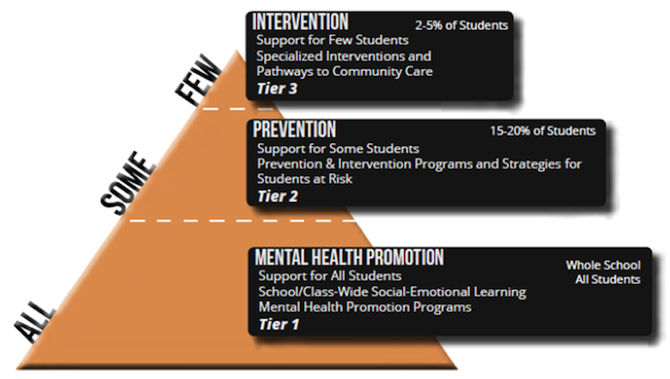
How can Teachers Promote Mental Health for ALL Students (Tier 1)?
- Teachers are able to provide support through universal mental health promotion and prevention programming.
- Teachers can support positive mental health for all students in the way that they go about their day-to-day work. Because teachers are significant in the lives of their students, how they behave towards students has huge impact on individual students and on the classroom in general. Their consistent support and overt compassion and patience with students are often of critical importance in the daily lives of their students.
- Teachers can use research-based strategies that are shown to promote positive mental health across schools and classrooms.
- Teachers can also incorporate school-wide programming to address areas of concern (e.g., peer mediation to help with student conflicts).
- Most significantly, teachers can integrate social emotional learning (SEL) into classroom activities so that students learn skills related to self-awareness, social awareness, self-regulation, relationship building, and decision-making. In fact, research has shown a link between social emotional learning skills and academic performance. For more information about the critical role of social emotional learning, visit the Collaborative for Academic, Social and Emotional Learning (CASEL) http://casel.org/
How can Teachers Help SOME Students with Mental Health Problems (Tier 2)?
Teachers are often the first to notice changes in student performance or behaviour. As such, teachers are in a unique position to identify students in need of more intensive services. In elementary and secondary schools teachers can provide targeted skill-building for students at higher risk for developing problems. This may be formalized in an Individual Education Plan (IEP) or can occur through group delivery of special programs for students who experience similar struggles (e.g., anxiety management sessions, temper taming groups). Some students are at risk for developing mental health problems and teachers can help with referrals to mental health support teams who may be internal or external to the board.
How Can Teachers Support the FEW Students Who Need Intensive Intervention Due to Mental Health Problems (Tier 3)?
Teachers and school personnel need to work seamlessly with community partners who have expertise in working with students requiring clinical intervention. Many communities across Ontario have set the foundations for the seamless delivery of mental health services through the Student Support Leadership Initiative and Working Together for Kids’ Mental Health. This collaborative work will deepen in coming years as communities further define and support the local pathways that fit their context. Pathways to support need to be locally determined, but more importantly pathways need to be clear and articulated so that students receive the right help at the right time.
Adapted from: Leading Mentally Healthy Schools: A Resource for School Administrators (School Mental Health – ASSIST, 2013) and Supporting Minds (Ontario Ministry of Education, 2013)
This blog post is part of CEA’s focus on student mental health, which is also connected to Education Canada Magazine’s student mental health theme issue and a Facts on Education fact sheet on what the research says about effective approaches to improving students’ mental well-being. Please contact info@cea-ace.ca if you would like to contribute a blog post to this series.
-
Student Anxiety – What Can Teachers Do?
Comments Off on Student Anxiety – What Can Teachers Do?Universal supports involve all students and teachers and have an impact on the whole-school environment. Educators are well positioned to provide these as part of the classroom experience.
Specifically in relation to student anxiety, universal (Tier 1) strategies provide foundational elements by:
-
Challenging the Status Quo for Youth Mental Health
Comments Off on Challenging the Status Quo for Youth Mental HealthThe headlines have been filled recently with the tragic news of young Canadians taking their own lives, serving to highlight a pressing issue that must be addressed: the need to provide youth with the help they need in order to prevent dire consequences like suicide.
-
What does Education have to do with the Mental Health of Children and Youth?
Comments Off on What does Education have to do with the Mental Health of Children and Youth?There is a clear and well-researched relationship between student mental health problems and academic difficulties. When students are preoccupied with emotional concerns they cannot participate fully in learning. Also, students who are experiencing academic challenges due to learning disabilities, intellectual disabilities, or other learning challenges can develop mental health problems, such as anxiety or depression. These concerns also interfere with social relationships and contribute to feelings of low self-worth, anger, worry and confusion. Since mental health problems are often difficult to treat, the earlier the intervention, the better the trajectory for a student vulnerable to mental illness.
Fortunately, there is now a significant body of research that shows there are programs and practices that can be used to support children and youth at risk. These programs can keep students from falling into a negative spiral by bolstering social, academic, or emotional skills, changing negative thought patterns, and nurturing a sense of well-being. As well, psychosocial treatments, like cognitive-behaviour therapy and parent training, have been proven to be effective in helping students with anxiety, depressed mood, and behaviour problems. The use of medication has also been shown to be helpful for some children and youth struggling with particular mental health problems. Even when difficulties are long-standing, there are ways to help students and families to effectively manage the disorder, just as you might with other chronic health conditions.
Since mental health problems are often difficult to treat, the earlier the intervention, the better the trajectory for a student vulnerable to mental illness.
Unfortunately, very few children and youth who struggle with mental health problems will access the help they need. There are currently several barriers to getting help:
- Often the stigma associated with acknowledging emotional problems prevents many people from accessing services.
- Caring adults and peers may be in a position to help, but they often feel ill-equipped to identify problems and to know where to find professional assistance.
- Finally, even when problems are voiced and/ or identified, in some communities there are not enough services to meet the demand.
Since every child is required to attend school, these issues with access make schools an important place to support students with mental health concerns. Indeed, schools are an optimal setting:
- to reduce stigma;
- to promote positive mental health;
- to build student social-emotional learning skills;
- to prevent the development of mental health problems in high risk groups;
- to identify students in need, and to support them in accessing community services.
It is very important that teachers and support staff understand that they are not expected to become counsellors or therapists nor are school boards expected to do the work of community mental health organizations. Rather, what is important is that education has a role to play in a full system of care. This role involves creating caring schools and classrooms, building social emotional learning skills, and helping to identify students in need of early intervention.
Adapted from: Leading Mentally Healthy Schools: A Resource for School Administrators (School Mental Health – ASSIST, 2013)
This blog post is part of CEA’s focus on student mental health, which is also connected to Education Canada Magazine’s student mental health theme issue and a Facts on Education fact sheet on what the research says about effective approaches to improving students’ mental well-being. Please contact info@cea-ace.ca if you would like to contribute a blog post to this series.
-
What is Student Anxiety?
Comments Off on What is Student Anxiety?Anxiety is a typical part of growing up. In fact, it is a normal reaction to stress. For most kids, feelings of anxiety and fear come and go. Most developmental phases lessen and disappear over time. Examples of normal developmental fears in infants and toddlers include separation from parents or sudden and loud noises. Preschoolers may be afraid of dark environments or animals. Children in primary and junior grades may worry about performance or bodily injury. Those in intermediate grades may begin to experience stress related to their health and appearance. In high school, anxiety may be related to school performance, social belonging and the future.
An exaggerated experience of thoughts, feelings, behaviour and sensations associated with stressful life events that interfere with functioning and/or cause distress is an indication that the person is overestimating the threat and underestimating their ability to cope. When anxiety overtakes the person’s ability to think rationally, it affects their ability to move forward. This is when teachers need to be concerned about students.
Everyone gets anxious at one time or another. Stress is normal and can be adaptive. Anxiety, however, may be observed in an exaggerated fear response, which means becoming fearful in a situation that is not dangerous. For example, you might feel anxious about learning to drive a car. As such, you might practice with someone you trust, drive slowly and be selective on the roads you choose. However, when feelings of anxiety occur persistently over longer periods, without appropriate reason or are exaggerated, the anxiety can become debilitating.
Fear is experienced when one actually faces danger. That is an example of an adaptive fight or flight response. When a person experiences high levels of anxiety with no real danger present, this is when anxiety may become debilitative based on the misperception of a threat.
Some anxiety is helpful because it keeps us cautious, safe and performing well. When a situation is anxiety provoking, if a person can harness the positive, the anxiety is not harmful to them and may actually motivate them to face the challenge.
An exaggerated experience of thoughts, feelings, behaviour and sensations associated with stressful life events that interfere with functioning and/or cause distress is an indication that the person is overestimating the threat and underestimating their ability to cope. When anxiety overtakes the person’s ability to think rationally, it affects their ability to move forward. This is when teachers need to be concerned about students.
When is anxiety a problem?
The flight or fight response is adaptive when facing danger. However, when the danger has passed or there is no real danger, a flight response (avoidance) or a fight response, (aggression) is maladaptive. Furthermore, if a person persistently experiences high levels of anxiety although no real danger is present, the anxiety becomes debilitative.
Most normal anxiety is short-lived. Anxiety may be a problem for students when:
- it is very intense;
- it is unreasonable or out of proportion to the situation;
- it persists over longer periods of time; and/or
- it interferes with their ability to learn, socialize and participate in activities.
If you are seeing these concerning signs, this is the time for you to seek the support of the mental health professionals in your school board or community. Professional support is important because the earlier we intervene, the sooner we can help. Early intervention can teach life-long skills for managing anxiety. There is effective treatment for anxiety disorders.
Adapted from SMH-ASSIST Anxiety Module, 2014
This blog post is part of CEA’s focus on student mental health, which is also connected to Education Canada Magazine’s student mental health theme issue and a Facts on Education fact sheet on what the research says about effective approaches to improving students’ mental well-being. Please contact info@cea-ace.ca if you would like to contribute a blog post to this series.
-
Creating an Ethos of Care in our Secondary Schools
Comments Off on Creating an Ethos of Care in our Secondary SchoolsRelationships, relationships, relationships! It sounds cliché but in fact this is the heart of the matter. Every student has a story and the story is crucial to his or her sense of well-being. It seems easier, more manageable to know the “stories” of our students in the earlier grades. One teacher and one group of classmates equal a family. Where we seem to have more difficulty navigating the storyline is in our secondary schools. Students have many teachers, many sets of classmates, changes throughout the year and from year to year.
Our school is the hub of the community. It is a safe place for students to reveal their story. There are professionals who care. Our teachers want to make a positive difference in the lives of students. However, teachers cannot do this work in isolation. It is crucial to develop practical systems that support their work. They want to impact society and prepare the minds of the future. Where the tension exists is when dealing with matters of the heart, the emotions? This was previously the responsibility of the parents. These were discussions that lived privately within the confines of the family. This has evolved and these conversations are presenting in our schools.
How do we foster an ethos of care in our school that extends beyond the confines of academics? As a school community we have been compelled to answer some hard and challenging questions. How we effectively equip our teachers to deal with students who are struggling? Do we know the true reasons why students are not succeeding? Is it intellect, effort, a lack of support or is it our systems and school culture that need transforming? Do we believe that all students deserve to experience success? How do we define success for our students? Are we just committed to preparing students for the future, for their “real life”? Can we agree that their real life is right now and are we able to assist our students in building their own positive futures? Are we willing to listen to the “stories” of our students and respond appropriately?
Where the tension exists is when dealing with matters of the heart, the emotions? This was previously the responsibility of the parents. These were discussions that lived privately within the confines of the family. This has evolved and these conversations are presenting in our schools.
These challenging questions are at the heart of many robust conversations amongst our staff. The discussions take time and do not happen overnight. There are implications for scheduling, teacher assignments, and the allocation of resources. Most importantly, what success indicators we will accept that we are moving in the right direction as a school and how we will celebrate the successes.
We agree that the most vulnerable times for students are when they experience transition. We have decided to get to know our students prior to them arriving at our door. We begin to work with our feeder schools as early as possible. We identify students who might be experiencing difficulties in their school and family lives. We put our energy into transitioning all students and do not just make room for the “good” ones.
We endeavor to ensure that there is one adult who knows the story of every child in our school community. Each teacher chooses a student to put some extra energy into, to find out his or her story. Teachers agree to document what works and even more importantly what fails. They agree to share this information with their colleagues on a consistent basis.
We have established a Mental Health program in our school. We have 4 youth support workers who act as mentors to students with mental health challenges. We discovered we were losing Grade 10s in their first semester of high school. We have our youth workers spend time in our feeder schools getting to know the Grade 9s. Their purpose is to build relationships and begin the conversations about successfully transitioning to high school.
We invite all of our Grade 9 students who present as having challenges to join us in summer programming prior to their Grade 10 year. We offer two courses that are required for a high school diploma. We staff these courses with “rock star” teachers. These students earn credits for two courses, they get to know us with a smaller student body, they become familiar with the school and our culture of high expectations and they don’t spend the summer worrying about the transition.
We want to debunk the myth that students will be “on their own” once they get to high school. We have built support systems for our teachers and their charges. Getting to know the stories of our students is the only way to begin to deal with the “health” of our school!
This blog post is part of CEA’s focus on student mental health, which is also connected to Education Canada Magazine’s student mental health theme issue and a Facts on Education fact sheet on what the research says about effective approaches to improving students’ mental well-being. Please contact info@cea-ace.ca if you would like to contribute a blog post to this series.
-
What on Earth are EBPs and EIPs?
Comments Off on What on Earth are EBPs and EIPs?The terms Evidence Based Practice (EBP) and Evidence Informed Practice (EIP) crept into the medical vernacular only in the last ten years and these terms are now becoming more familiar to mental health professionals and educators. Why so and what do the terms actually mean? To answer, I’ll use a medical example and then take a look at the implications for school based mental health.
If you took your young child to the family doctor some years ago because of an earache, chances are following a peek into the ear revealing some redness, your doctor prescribed an antibiotic. Not so long ago a systematic review of the use of antibiotics for otitis media was published. It was found that most cases of otitis media will get better in a few days, regardless of whether antibiotics are used and antibiotics do not significantly speed up the process. This information was not available recently until many studies were systematically analyzed. These studies came not from just one expert source but from many researchers from around the world, using controlled trials where a patient was randomly assigned to treatment or no-treatment (placebo). Some of the results were conflicting but taking them all into consideration, some general conclusions were drawn. This type of evidence base from multiple sources is generally considered to be the most valid and reliable, much more so than anecdotal reports or single experiments with only one type of patient. Today, physicians are expected to be familiar with up-to-date research findings and use this knowledge in their clinical practice. Furthermore many “usual” practices, have been found to be clinically ineffective and in some cases, harmful.
In school based mental health, we are no less desirous of doing what works and avoiding doing things that are harmful. If we don’t pay heed to the evidence base, our intuitions might lead us astray. A good example is with respect to how we package the “don’t do drugs” message in schools. Having an assembly to “warn” students about the danger of drug use doesn’t work but some approaches do work. The Rand Corporation researched the Project ALERT program in 50 states in the U.S. with thousands of students and found that it is effective in curbing substance abuse. There are a number of databases of evidence-based practices, the best known is probably that of the U.S. Substance Abuse and Mental Health Services Administration (SAMHSA).
There is a subtle difference between an EBP and an EIP. An EBP is an intervention which, from research, is known to work with the problem and population to which it is addressed; whereas an EIP is the inclusion of sound evidence into approaches that take into account both professional judgment and experience. In school based mental health, it is necessary to ensure that any approaches are a good fit for the school context, are acceptable to educators and are workable in a classroom setting. In our work we are talking about three different approaches. The first is a manualized approach (following a specific program exactly); the second is a modularized approach (distilling the “active ingredients” into replicable actions, e.g. ensuring that graduated exposure is a component when dealing with anxiety) and the third is an embedded approach (i.e.: weaving the intervention naturally into the daily routines and everyday occurrences). An example of an embedded approach is to coach teachers to use collaborative problem solving as opposed to resorting a disciplinary measure for a challenging student.
There is a subtle difference between an EBP and an EIP. An EBP is an intervention which, from research, is known to work with the problem and population to which it is addressed; whereas an EIP is the inclusion of sound evidence into approaches that take into account both professional judgment and experience.
This is all still in its infancy. There are attempts to categorize interventions as: “Proven”, “Probably Effective”, “Ineffective” and “Probably harmful”. There are only a few in the top category. Furthermore, there is more to it than just knowing what works. Along with the rise of EBPs and EIPs is the growth of “implementation science”, which is the “how to” of putting scientific knowledge into practice. There is still a huge gap here.
To return to medicine, not all practices introduced today are clearly evidence-based. Just this month, a policy has just been introduced in Canada to shift the responsibility for prescribing medical marijuana to physicians from governmental control. Apparently, the effectiveness of medical marijuana in controlling pain in chronic illnesses relies solely on anecdotal accounts rather than any randomized trials or systematic reviews. The news reports indicate that doctors don’t have any guidelines about how much to prescribe and what kind of patients it is likely to work for. This seems to be a case where politics has trumped science. Go figure!
This blog post is part of CEA’s focus on student mental health, which is also connected to Education Canada Magazine’s student mental health theme issue and a Facts on Education fact sheet on what the research says about effective approaches to improving students’ mental well-being. Please contact info@cea-ace.ca if you would like to contribute a blog post to this series.
-
What is Child and Youth Mental Health?
Comments Off on What is Child and Youth Mental Health?Mental Health is defined as a state of well-being in which every individual realizes his or her own potential, can cope with the normal stresses of life, can work productively and fruitfully, and is able to make a contribution to her or his community.1
Mental health problems:
- Are emotional, behavioural and brain-related difficulties that may have a negative impact on a student’s well-being;
- Interfere with the student’s functioning at school, at home, in the community, and in social settings;
- Affect the student’s development, school attendance, academic achievement, and relationships with family and friends.
A mental health problem that is severe, persistent, and causes impairment in daily life is called a mental health disorder or mental illness. It is helpful to think of mental health as occurring along a continuum.
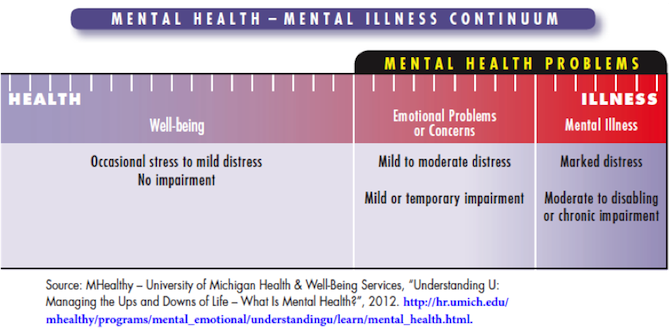
How Common are Child and Youth Mental Health Problems?
Most estimates place the rate of mental health problems at about 18-23% of the student population. An easy way to remember how many students are affected by significant emotional difficulties is the “one in five” statistic. This means that in any given classroom of 25-30 students, there may be 5 to 7 students who struggle with behaviour and emotions to a degree that will interfere with their academic performance.
What do Mental Health Problems Look Like?
Mental health problems vary greatly in how they look. A useful way of thinking about them is to divide symptoms into two broad areas:
- externalizing problems, or behaviours like aggression, impulsivity, and non-compliance, and;
- internalizing problems, or emotional states like sadness and anxiety and behaviours like social withdrawal.
Although organizing the clusters of symptoms is useful, in real life mental health problems do not fall neatly into specific categories. Often symptoms that are associated with one disorder are also symptoms of other disorders, and, to complicate things further, disorders tend to travel together. This is called co-morbidity. Approximately 45% of children and youth with one mental health disorder are likely to have another area of difficulty as well (e.g., depression AND anxiety, ADHD AND oppositional defiant disorder).
Given how complex mental disorders are, in Ontario the only professionals who are qualified to diagnose mental health problems are physicians (including psychiatrists) and psychologists. School boards may have mental health professionals on staff who can diagnose, but many communities require a referral to children and youth mental health services.
What Mental Health Problems Are Most Likely Seen at School?
Some child and youth mental health problems are more common than others. Specifically, difficulties with anxiety, behaviour, and mood are most prevalent amongst Canadian children. Within the school context, teachers often notice emotional and behavioural difficulties associated with learning.
Within the school context, teachers are able to observe students consistently over an extended period of time. As well, they ‘see’ students in the context of other students. As such, teachers are in a unique position to notice emotional and behavioural difficulties associated with learning, and to notice when there are changes in a student’s behaviours.
Following is a list of specific student behaviours which teachers may notice and which might indicate the presence of mental health difficulties:
- social isolation
- inattention
- weak social skills
- strong emotional reactivity
- aggression
- hyperactivity /impulsivity
- poor frustration tolerance
- changes in behaviour or mood
Other general signs that a student may be struggling are when the student’s emotions and behaviour are not age appropriate, the behaviour is dramatically different from that of the student’s peers, and the duration of the behaviour appears to be excessive.
Because some mental health difficulties occur at different times in a student’s development, some types of problems are more commonly seen in primary, junior and intermediate settings, while others are most prevalent within secondary schools. Untreated problems can become more pronounced over time, and, as a result, secondary school educators are more likely to observe more serious mental health difficulties amongst students than elementary school educators. Secondary school personnel in particular, should be alert to the potential role of addictions in student emotions and behaviour at school.
Adapted from: Leading Mentally Healthy Schools: A Resource for School Administrators (School Mental Health – ASSIST, 2013) and Supporting Minds: An Educator’s Guide to Promoting Students’ Mental Health and Well-Being (Ontario Ministry of Education, 2013)
Notes
1 World Health Organization http://www.who.int/features/factfiles/mental_health/en
-
Creating More Mentally Healthy Schools
Comments Off on Creating More Mentally Healthy SchoolsThere seems to be a recent shift in the way educational institutions approach mental health. It’s an exciting time for me and the program I work for, and for all educators who just want to do their job better. It is also long overdue for families and students who are living with mental health issues. Here in Ontario, where I live and have worked as a teacher, I’m seeing giant steps in the right direction at the Ministry and Board of Education level. Hopefully this shift in approaching mental health and wellness will empower administrators, teachers and support staff to create more mentally healthy schools and ultimately improve the lives of students and their families.
It should be noted that this kind of top-down systems change is not the only exciting thing happening in student mental health. Young people can be a powerful force to initiate systems change and resource creation as well. Since its foundation in 2005, the program I work for, mindyourmind, has partnered with youth and young adults to co-create mostly web-based tools and resources around the topic of mental health. These resources are accessed by people in 195 countries, through millions of online interactions via www.mindyourmind.ca and mindyourmind’s other web platforms and social media accounts.
Hopefully this shift in approaching mental health and wellness will empower administrators, teachers and support staff to create more mentally healthy schools and ultimately improve the lives of students and their families.
As mindyourmind’s program progressed over the years, we realized that our site had become a kind of public utility – teachers and other youth-serving professionals were using our tools with their students and clients to facilitate and engage in discussions about mental health. As teachers continue to see students in need, and mental health is becomes a focus for more and more school boards across Canada, we have seen an increase in requests for resources and presentations. This may be indicative of the fact that educators want to address the topic of mental health, but may not feel like they have the time or the expertise to do so effectively.
In 2008, the Thames Valley District School Board (TVDSB) in Southwestern Ontario approached mindyourmind to develop resources for Grade 11 Physical Health Education, and Grade 9/10 Guidance and Learning Strategies. Through this collaboration, the outlines of the “Minding Your Mind” lessons were created. The lessons are digital modules which are housed online. They feature mindyourmind videos, games and interactives, are designed to meet Ministry expectations and the unique needs of the TVDSB’s populations. A teacher’s guide is included in the lessons, which offers class discussion primers and activity extension suggestions. The lessons can be self-directed by the student in a computer lab, each student clicking through and completing at their own pace, or be taught through a more facilitated approach by the teachers.
The lessons were later evaluated as part of The Mental Health Commission of Canada’s Opening Minds study, measuring the impact of different types of programs and their effect on stigma reduction. The changes in stigma and the increased social tolerance in student responses as a result of the Minding Your Mind lessons showed that this digital lesson approach was effective.
It was so encouraging to see actual research support what mindyourmind already felt about the work that we are doing: Creating resources with young people works. Our tools do a great job of presenting information effectively and in a way that is relevant to youth, and can help teachers address what can be a tricky topic for some in a positive way.
How do we insert mental health info into a Civics class, or a Writer’s Craft class, without disrupting what the teacher needs to get done in an already saturated course workload?
My role here at mindyourmind is to develop more resources that will help teachers bring conversations about mental health into their classrooms, even in subjects that wouldn’t normally directly address mental health. I’ve heard some compare this task to “hiding the vegetables”. How do we insert mental health info into a Civics class, or a Writer’s Craft class, without disrupting what the teacher needs to get done in an already saturated course workload? We have a few projects on the go, including a resource for dance educators, which is being piloted this spring. It’s exciting work!
If you are a teacher, how do you support conversations about mental health in your classroom? How might you address mental health while teaching a course that doesn’t explicitly ask you to in the curriculum?
This blog post is part of CEA’s focus on student mental health, which is also connected to Education Canada Magazine’s student mental health theme issue and a Facts on Education fact sheet on what the research says about effective approaches to improving students’ mental well-being. Please contact info@cea-ace.ca if you would like to contribute a blog post to this series.
-
How to Stop Hurting Yourself
Comments Off on How to Stop Hurting YourselfThis content has been re-posted from Erin Schulthies Blog at: http://daisiesandbruises.com/2014/03/03/how-to-stop-hurting-yourself
Most Google searches leading to this blog involve the words, “hurt myself.” So many people are looking for help in stopping self-harm, stopping cutting, bruising or any other kind of self-hurting.
Self-harm is something I know a lot about. I could write hundreds of posts on the topic (and I probably will), but for now, I have two pieces of advice that are my secrets to stopping self-harm.
1) LET YOURSELF FEEL
No feeling is wrong. Absolutely every single emotion you have is legitimate and allowed. Read that sentence again: Absolutely every emotion you have is legitimate and allowed. Sometimes we don’t understand our feelings, where they’re coming from or why, but that shouldn’t stand in our way of permitting ourselves to feel exactly how we’re feeling. Let yourself feel and identify the feeling if you can. Say to yourself, “I feel _______.”
2) EXPRESS YOUR FEELINGS
You can’t skip this step. This is the answer to stopping self-harm: Allow yourself to express your emotions in a way that doesn’t involve hurting yourself.
Here are some ideas:
Talk to someone, cry, scream, whimper, holler, write, play music, run, dance, or tear up pieces of paper. Go out into a field and throw rocks at the sky. Don’t just punch your pillow, pummel it. Run faster than you’ve ever run before. Use the energy created by your feelings and do something with it.
A lot of the feelings I first expressed through cutting were related to my memories of violence. I felt hurt and damaged and I wanted to damage something to communicate my pain. So I damaged myself.
But, do you know what? You can damage things other than yourself. Never damage another living thing and try not to damage property that isn’t yours, but if you want to destroy something, IT DOESN’T HAVE TO BE YOU.
Emotions don’t always feel nice and pretty and socially acceptable. I used to cut because I didn’t want to be nice or pretty or socially acceptable. I wanted the whole fucking world to know just how terrible I felt.
Hurting myself didn’t help me feel better. It hurt me! And there is enough hurt without me hurting myself extra. You can’t get better if you hurt yourself.
Writing and making art works a MILLION times better for me than cutting ever did. Remember my drawing from my last hospital stay? It showed black swirls of monstrous arms attacking me. Drawing that helped me feel SO MUCH BETTER. And I showed it to people, I said, “THIS is how bad I’m feeling.” No, it’s not art for a museum. It’s art for me. And it worked.
Go ahead, be destructive if it doesn’t hurt anyone. Let yourself feel and then express those feelings in a healthy way. Never pretend to feel something that you don’t feel. Be honest about what’s in your heart and it will heal you, I promise.
This blog post is part of CEA’s focus on student mental health, which is also connected to Education Canada Magazine’s student mental health theme issue and a Facts on Education fact sheet on what the research says about effective approaches to improving students’ mental well-being. Please contact info@cea-ace.ca if you would like to contribute a blog post to this series.
-
What should you do if you suspect mental illness in a student?
Comments Off on What should you do if you suspect mental illness in a student?One in five youth under the age of 18 has a diagnosable mental disorder. So in a classroom of 25 children, you can expect five to be struggling with significant emotional problems. How can you recognize the signs? What should you do if you see them?
Kids develop along different dimensions: physical, social, familial, emotional, cultural, psychological. And there’s a continuum between “normal” and “abnormal”. Most mental illnesses represent an interaction between nature and nurture, and result in a failure of that child to be able to meet their “developmental tasks” (age-appropriate expectations) in the dimensions just mentioned.
So, recent changes in behaviour that are unusually intense, frequent, and persistent for that child, should catch your attention. The definition of mental illness is basically subjective distress (“I don’t feel happy”) plus functional impairment (“I just can’t do what I used to do, or what my parents/friends expect me to do.”). A combination of these features is highly suggestive that the student is in trouble.
Practically speaking, this can look like:
- changes in sleep, appetite, or energy level;
- social withdrawal or aggression;
- new conflict with parents;
- sadness, worry, or irritability and lack of self-esteem.
In the classroom, concentration, memory, organization, and participation can all be affected, with the net result being assignments not handed in and marks going down.
Risk factors for mental illness include:
- recent physical illness in the student or a family member;
- a family history of mental illness;
- insult to the student’s brain (e.g. concussion);
- lack of stable attachment figures (e.g. high conflict divorce, death of a loved one, or frequent moves);
- single parenthood and poverty; neglect, abuse, or being the victim of bullying;
- standing out as “different” for any reason (height, weight, intellectual capacity);
- and difficult temperament (poor self-regulation, prone to hyper-sensitivity and hyper-reactivity).
What should you do if you suspect mental illness in a student?
- Get help – don’t shoulder the burden alone!
- Go slowly – talk to the student directly, and enquire about how things are going for him/her. Then voice your concerns, describing them in a neutral, non-judgmental, and behaviourally verifiable way (“I’ve noticed that lately you’ve stopped playing with your friends at recess, you’re more quiet than usual, and you’re not at the soccer games as much as before. Is anything going on that you’d like to talk about?”)
- Involve the parents – no student is an island, and often comparing your notes with the parents in extremely informative. If the parents share your concerns, suggest that they contact their family doctor or pediatrician to make sure there isn’t a physical illness. Once that is ruled out, together you can talk about whether a referral to a mental health specialist is warranted.
The good news in all this is that when mental illness is identified and treated early, the prognosis is excellent. Seventy-five per cent of mental illnesses begin before the age of 20, but because the brains and environments of children are still changeable (“plastic”), the vast majority of youth can overcome their struggles and resume their course of normal development, flourishing, and reaching their natural potential.
PS: A great resource for parents and teachers is The ABC’s of Mental Health, a free, on-line resource developed by the Hincks-Dellcrest Centre for Children and Families.
This blog post is part of CEA’s focus on student mental health, which is also connected to Education Canada Magazine’s student mental health theme issue and a Facts on Education fact sheet on what the research says about effective approaches to improving students’ mental well-being. Please contact info@cea-ace.ca if you would like to contribute a blog post to this series.
-
Taking mental health to school
Comments Off on Taking mental health to schoolAs I was editing the articles in this issue, an online fundraising campaign was launched in my community to raise money for a young woman who desperately needed intensive residential treatment for her eating disorder – a program not funded by our provincial health plan. She wrote eloquently about her inability to fight the disease on her own, her fear of dying, and the hopelessness that long wait lists engender in a young person who needs help now.
It’s a heartbreaking story that illustrates perfectly the “fractured system” that Kate Tilleczek and Katherine Lezeu describe in “Journeys in Youth Mental Health” (p. 12) – and yet it also gives me hope. It gives me hope because not so long ago, we would not have even heard this girl’s story, or had a chance to help (when I last checked, $36,000 had been donated). This girl and her family would have suffered in silence: the taboo around disclosing mental illness was too strong.
The uneasy impression I had when my sons were in high school – that more kids than ever before are struggling with mental health problems – is confirmed in this issue. But beyond the worrying statistics, something good is happening. Young adults I know (or know of, through my kids) are talking about their struggles. They are also blogging, advocating, and starting virtual support groups. When yet another gay teen commits suicide, or a mentally ill man “armed” with a screwdriver is shot by police, they are not just saddened – they are outraged. I know not all young people have this level of awareness, but I do believe they are leading a sea change in our public understanding of mental health.
How can we, as educators, help? Our students bring their troubles to school with them, and too often face troubles at school. School leaders tell us they are searching for ways to support the many students struggling with mental health issues, yet it seems an overwhelming challenge. In this issue, we explore how we can “take mental health to school,” and share some initiatives that have been successful at reducing stigma and building knowledge. Schools are not treatment facilities, and they can’t make up for the failings of a fractured system – but they can be an important part of the solution.
P.S. Check out our web exclusive article, “Minding Your Mind,” to learn about a school mental health program developed in partnership with the non-profit youth mental health initiative mindyourmind: www.cea-ace.ca/educationcanada
This blog post is part of CEA’s focus on student mental health, which is also connected to Education Canada Magazine’s student mental health theme issue and a Facts on Education fact sheet on what the research says about effective approaches to improving students’ mental well-being. Please contact info@cea-ace.ca if you would like to contribute a blog post to this series.
-
Let’s Continue to ‘Rock the Boat’
Comments Off on Let’s Continue to ‘Rock the Boat’As you can see by the barriers to change identified at our Calgary workshop, they’re not new, and they certainly weren’t that hard to identify, so how is it that we still struggle to find ways to overcome them?
-
The Art of Change
Comments Off on The Art of ChangeOne of the important functions of art in a modern society is to inspire citizens to new dimensions of hope and possibility. More than policy directives, more than summaries of best practice and even more than research initiatives—as valuable as all of these are—the vision and voice of the artist can draw us towards the future with powerful metaphorical images that allow us to frame our futures in ways that are uniquely compelling!
-
What is the Value of Standardized Testing?
Comments Off on What is the Value of Standardized Testing?Standardized testing is a contentious issue in Canada, and internationally. Education in Canada falls within provincial jurisdiction and every province and territory develops its own curricula. Additionally, every province/territory conducts large-scale assessments at specific grade levels. Provinces and territories also participate at the national level in the Pan-Canadian Assessment Program (PCAP) and at the international level in the Programme for International Student Assessment (PISA).
There is a large body of literature about these large-scale standardized tests with no consensus on their effectiveness. However, while there is some support for standardized testing, overwhelmingly, research suggests that it does not lead to improved educational outcomes for students.
Arguments against standardized testing include:
- There is a tendency to “teach to the test”, which results in narrowing of the curriculum.
- The tests do not allow for linguistic or other cultural differences among students.
- There is the potential for subgroups of students to become lost within the overall numbers.
- Standardized testing leads to student disengagement.
- The tests do not adequately assess 21st Century skills such as creativity, technological ability, problem solving, or critical thinking skills.
Arguments in favour of standardized testing include:
- The opportunity for comparison of educational outcomes across schools, provinces, or countries.
- Results of standardized tests provide an opportunity to assess the strengths and weaknesses of the system.
- Offering a means to assess accountability.
- Provincial assessments provide a way to evaluate curricula and determine which schools/districts/regions are meeting goals.
Even proponents of standardized testing recognize the limitations of wide scale comparison due to the differences between countries, provinces, and even school districts. Some countries with the longest history of standardized testing recognize these limitations and their reliance on standardized testing is declining. In Canada, some provinces, such as Alberta and Ontario, have recognized the importance of adapting standardized testing to suit varying circumstances and to meet the needs of 21st century learners.
Methods such as problem based learning are at the forefront of curriculum design yet are not evaluated in standardized tests. Standardized testing is, therefore, counterproductive as it focuses on memory and knowledge acquisition rather than ability to apply learning. Educators and students should be provided with assessment tools to identify issues and gaps for individual students as well as schools and/or school districts, improve learning, increase capacity to be independent learners, promote goal-setting, and encourage reflection on learning. A balanced approach to student assessment includes standardized testing coupled with rigourous classroom assessment.
Websites
Programme for International Student Assessment (PISA)
http://www.oecd.org/pisa/aboutpisa/
The New Face of Standardized Testing in Schools – Canadian Family Magazine
http://www.canadianfamily.ca/kids/the-new-face-of-standardized-testing-in-schools/
References
Aydeniz, M., & Southerland, S. A. (2012). A national survey of middle and high school science teachers’ responses to standardized testing: Is science being devalued in schools? Journal of Science Teacher Education, 23(3), 233-257.
Azzam, A. M. (2009). Why creativity now? A conversation with Sir Ken Robinson. Educational Leadership, 67(1), 22-26.
Barrier-Ferreira, J. (2008). Producing commodities or educating children? Nurturing the personal growth of students in the face of standardized testing. Clearing House, 81(3), 138-140.
Bower, J. (2013). Telling time with a broken clock: The trouble with standardized testing. Education Canada, 53(3), 24-27.
Camacho, D., & Cook, V. (2007). Standardized testing: Does it measure student preparation for college & work? Online Submission, Retrieved from http://eric.ed.gov/?id=ED495251
Government of Alberta. (2013). Student learning assessments update. (Information Bulletin). Edmonton, AB: Author.
Government of Ontario. (2010). Growing success: Assessment, evaluation, and reporting in Ontario schools. Toronto, ON: Government of Ontario.
Haladyna, T. M. (2006). Perils of standardized achievement testing. Educational Horizons, 85(1), 30-43.
Harris, P., Smith, B. M., & Harris, J. (2011). The myths of standardized tests: Why they don’t tell you what you think they do? Lanham, MD: Rowman & Littlefield.
Hayden, M. J. (2011). Standardized quantitative learning assessments and high stakes testing: Throwing learning down the assessment drain. Philosophy of Education Yearbook, 177-185.
Hewson, K., & Parsons, J. (2013). The children in the numbers: Why aggregate achievement goals miss the mark. Education Canada, 53(3), 9-11.
Ickes-Dunbar, A. (2005). Testing, testing. Phi Kappa Phi Forum, 85(2), 3-9.
Kearns, L. (2011). High-stakes standardized testing & marginalized youth: An examination of the impact on those who fail. Canadian Journal of Education, 34(2), 112-130.
Klinger, D. A., DeLuca, C., & Miller, T. (2008). The evolving culture of large-scale assessments in Canadian education. Canadian Journal of Educational Administration and Policy, 76, 1-34.
Mora, R. (2011). “School is so boring”: High-stakes testing and boredom at an urban middle school. Penn GSE Perspectives on Urban Education, 9(1), 1-9.
Morris, A. (2011). Student standardised testing: Current practices in OECD countries and a literature review. (OECD Education Working Papers, No. 65).OECD Publishing.
Nelson, L. P., McMahan, S. K., & Torres, T. (2012). The impact of a junior high school community intervention project: Moving beyond the testing juggernaut and into a community of creative learners. School Community Journal, 22(1), 125-144.
Ozturgut, O. (2011). Learning by example: Standardized testing in the cases of China, Korea, Japan, and Taiwan. Academic Leadership (15337812), 9(3), 1-9.
Riffert, F. (2005). The use and misuse of standardized testing: A Whiteheadian point of view. Interchange: A Quarterly Review of Education, 36(1-2), 231-252. http://dx.doi.org/10.1007/s10780-005-2360-0
Visone, J. D. (2010). Science or reading: What is being measured by standardized tests? American Secondary Education, 39(1), 95-112.
Zwaagstra, M. (2011). Standardized testing is a good thing. (FCCP Policy Series No. 119). Winnipeg, MB: Frontier Centre for Public Policy.
Bibliography of Related Articles
Au, W., & Gourd, K. (2013). Asinine assessment: Why high-stakes testing is bad for everyone, including English teachers. English Journal, 103(1), 14-19.
Driscoll, H. (2013). Power, protest and posters. Our Schools / Our Selves, 22(3), 29-46.
Government of Manitoba. (2010). Provincial assessment policy Kindergarten to Grade 12: Academic responsibility, honesty, and promotion/retention. Winnipeg, MB: Author.
Hill, B. (2005). Learning styles and standardized test scores: Is there a connection? Delta Kappa Gamma Bulletin, 71(3), 27-30.
Neal, M. (2012). Appreciative assessment: Inquire! Education Canada, 52(2), 6-9.
Phelps, R. P. (2006). Characteristics of an effective student testing system. Educational HORIZONS, 85(1), 19-29.
Santiago, P., Donaldson, G., Herman, J., & Shewbrdige, C. (2011). OECD reviews of evaluation and assessment in education: Australia. OECD Publishing.
Stiggins, R. (2007). Five assessment myths and their consequences. Education Week, 27(8), 28-29.
-
The Corporate Mentality: Why the CCCE Will Probably Never Understand Why I Teach.
Comments Off on The Corporate Mentality: Why the CCCE Will Probably Never Understand Why I Teach.On January 23rd, the Canadian Council of Chief Executives (CCCE), spurred into action by recent PISA results, released a report on how teachers should be paid. The author, Sachin Maharaj, held to a fairly basic premise. Students do well when taught by effective teachers, but all teachers receive pay raises in the same manner.
(more…) -
More Students Share Reflections on What’s Standing in the Way of Change in Education
Comments Off on More Students Share Reflections on What’s Standing in the Way of Change in EducationThe following student reflections are based on their experiences as participants in CEA’s Calgary Conference, which was held in October 2013. Both students are part of Alberta’s Speak Out student engagement initiative and are current members of the Minister’s Student Advisory Council. The original blogs are posted on the Speak Out website.

-
Here we go loop dee loo…Pisa Announcements Unfold Pretty Much as Expected
Comments Off on Here we go loop dee loo…Pisa Announcements Unfold Pretty Much as ExpectedSometimes, it’s fun to be right.
On December 3rd, I wrote a piece on my personal blog, later published in The Chronicle Herald about the then impending release of the PISA results by the OECD. At that time, I predicted that, on Tuesday, December 6th, the airways would be full of bluster and pomp as expert after expert would undoubtedly weigh in on the PISA results. And, waddaya know? I was right.
From Saskatoon to Halifax, from Malaysia to the United Kingdom folks everywhere were abuzz with PISA talk. And, considering that Canada dropped in the PISA rankings from 2009, much of the talk in this country centered around the same old issues. “What” the alarmists cried, “is wrong with our education system?”

Photo by João Trindade / CC BY
Not surprisingly, of course, the commentary came from many sources. Everyone, it seemed had an opinion of why scores were low, and what needed to be done to “fix” the problem. From promoting charter schools to getting rid of the “New Math” solutions abounded, many coming with the familiar, tired rhetoric. The teachers are under trained. The new math is “soft and fuzzy”. The establishment is anti change. We need more standardized tests. And, the ever popular, it was better in my day.
Well, before we throw yet another generation of students under the “Let’s change it now!” bus in our relentless pursuit of mathematical perfection, let’s pause for a moment, as a group, and consider a few factors.
First off, let’s accept the fact that no one anywhere has the golden fix for teaching all students math. Seriously, if a method of teaching math existed that would ensure a high level of achievement in all students, it would have been accomplished already. Heaven knows we have spent loads of time, energy and not insignificantly, money trying to fix “the math problem”.
Secondly, if jurisdictions who scored high on the PISA were actually doing so singularly because of what was happening in schools, why do countries ever slip in the rankings? Consider Finland, whose education system became the system to model after several years of high PISA results. If they had been having success in teaching math, why did their scores slip this year? Did they suddenly stop doing things that had been working? One theory I read prior to the PISA release stated that, in a nutshell, there has been an increase in the number of distractions that draw students away from all their school subjects. When competing with things like social media, at your fingertips entertainment and “self-elected pastime activities”, perhaps kids in Finland just don’t care as much about math as they used to. PISA results may, at the end of the day, have nothing to do with math methodology.
The final issue with PISA, of course, is that it often compares apples to grapefruit. Education systems across the globe are very different, not just in how they educate, but also who they educate, and what they demand of their students. Serious concerns have been raised, for example, around the validity of PISA data that comes from China. The system in Shanghai, a top place finisher two cycles in a row, has been criticized by some as being nothing more than a continuous stream of tests. Students are required to write standardized tests from primary school onwards to advance to the next level of education. The higher ranked the school, the higher the admission requirements. Thus, in order to get into the” good” schools, tremendous pressure is applied by parents for students to achieve high marks. At the end of their secondary career, students must write the three-day long gaokao, a national standardized university entrance exam which can essentially decide a student’s future.
In 2011 the Globe and Mail ran a report about this very issue, and focused on the PISA results from 2009, in which Shanghai had again placed first. They spoke to a Mr. Ni Minjing a physics teacher who was, at that time, a director of education in Shanghai. Although Mr. Ni correctly predicted that Shanghai students would do well in the PISA in 2012, he expressed concern about the over emphasis on test taking within the system. PISA, he argued, simply focuses on what Chinese students are good at, memorizing facts and taking large, standardized tests. This success came at the cost of creativity and independent thinking skills.
I was recently speaking with a colleague of mine, familiar with the Shanghai system, and he compared the Chinese approach to math and the Canadian approach to hockey. We have hockey camps in the summer, they have math camps in the summer. We have hockey practice after school, they have math practice after school. Our child scores a goal in an important hockey game, a name goes in the local paper, their child scores well in an important math exam…
I’m not anti-math, nor am I particularly anti-PISA. I think that the results are interesting, and although I am unsure of the cost associated with participating in the PISA, I can only assume that they are relatively low. However, when we look at PISA and compare ourselves to others, I believe we would be wise to be cautious what we wish for. We want our kids to be good at math, and they are. But we also want them to be creative, and thoughtful, and active and happy. Achieving that as a national education goal might be a more fruitful endeavor.
Yes, Canada would like to place higher in the PISA rankings, but surely not at any cost. Building a generation of good test takers, I feel, would never be articulated in the improvement goal of any jurisdiction in this country. And tell Canadians that PISA preparation is going to interfere with hockey practice?
Well, you’d better be ready to drop the gloves on that one.


IDEAS TO SUPPORT EDUCATORS : Subscribe to the EdCan e-Newsletter
Quality research, reports, and professional learning opportunities.