Archive
-
Learning through empathy
Comments Off on Learning through empathyNone of us alive today are responsible for the decisions of those who crafted the laws that made some lesser than others. We did not write the Indian Act or build residential schools. We did not pass out pock infested blankets or exile whole populations of people to patches of land or steal one generation from another. This is not our doing, and, it is the history of our land. We share this history now. All of us who were born here or choose to live here: this is our shared history. We share these stories just as we do the beautiful, compassionate stories of our past.
-
Aboriginal education needs to be place-based education
Comments Off on Aboriginal education needs to be place-based education“Indian Control of Indian Education” was a brilliant piece of agenda-setting in the early 1970s.
Anything governments did about Aboriginal education from that point on could be measured against a common yardstick: Is this what the community wants? Is it what parents want?
All over Canada, education agreements have been negotiated with local Bands and other Aboriginal organizations on the basis of that simple idea.
The trouble is that the realities are not simple.
Aboriginal students are extremely diverse, and the histories and current situations of their communities are extremely diverse. Yet schools have a hard time dealing with diversity – not just in Aboriginal communities or towns and cities with large Aboriginal populations, but everywhere.
The fact is that schools were designed, back in the 19th century, to create a more homogenous, unified, mobile population across Canada. That is basically what schools are for. Sure, they can be tweaked in various ways to try and accommodate local differences, but such efforts are add-ons, not part of the basic logic of school.
Aboriginal students are extremely diverse, and the histories and current situations of their communities are extremely diverse. Yet schools have a hard time dealing with diversity – not just in Aboriginal communities or towns and cities with large Aboriginal populations, but everywhere.
A good example is the teaching of Aboriginal languages in schools. Bringing a community language into school changes it, and how students identify with it. Ironically, the effect can be to emotionally distance students from the language, especially if they don’t encounter it in daily use in the community.
This kind of double-bind is at the heart of the problems experienced by Aboriginal students. If they buy into the logic of school, they will find it very difficult to balance that view of the world with a strong sense of rootedness in a particular community and place. If they reject the logic of school, it can be a pretty meaningless and hostile environment to have to endure.
The solution, I think, is to come up with a different vision of schools in general – one that emphasizes their connections with place and community.
Aboriginal education needs to be place-based education in order to attend to the particularity of each community and nation, without making assumptions about the identities, backgrounds and values of individual students. By place-based, I mean that as much of the curriculum as possible should be taught in ways that connect directly with the history and circumstances of where and how the students and their families live.
Aboriginal education needs to be place-based education in order to attend to the particularity of each community and nation, without making assumptions about the identities, backgrounds and values of individual students.
This implies different ways of training teachers, different ways of designing curriculum, and different ways of teaching. It implies getting away from the simple idea of “control” of education. Control means relatively little unless you can change the logic of school so that the local and particular become more central to its mission.
In Canada, good place-based education has to be, among other things, good Aboriginal education. Aboriginal history, values, perspectives and issues need to have a central place in any authentically place-based curriculum. So do, for example, issues of environmental awareness, resource management, energy use, habitat protection, social justice, economic equity, democratic governance, fair trade, human rights, mental and physical health, sustainable agriculture, and so on.
These are issues of concern in every community in Canada – precisely because they are not fully amenable to local control, and larger forces that care nothing for community needs (Aboriginal and non-Aboriginal alike) are steadily undermining our ability to address them.
Our ambitions for Aboriginal students need to extend beyond academic success as currently defined. We need schools dedicated to their well-being as whole persons, and to that of their communities and the natural systems that sustain them.
Enough of add-ons. Let’s tackle the heart of the problem.
This blog post is part of CEA’s focus on aboriginal student success, which is also connected to Education Canada Magazine’s aboriginal student success theme issue and a Facts on Education fact sheet on what the research says about how can we create conditions for Aboriginal student success in our public schools. Please contact info@cea-ace.ca if you would like to contribute a blog post to this series.
-
Engage Aboriginal Students In Education
Comments Off on Engage Aboriginal Students In EducationI must state that I am a non-Aboriginal person who has worked in the field of First Nations Education spanning 30 years. I am not an expert in First Nations education, but I have worked with many First Nations students, educators, elders, and leaders in Nova Scotia, Ontario, and Manitoba.
What I have learned from my experience comes mostly from my students. Their perspective is the most interesting and valid because the opinions and ideas that they have shared with me – as their teacher and/or administrator – comes from a place of truth and reality, unaltered to suit an agenda or edited to conform to another’s requirements. I mention this because in education, we are most often provided with criteria, guidelines, and requirements before we complete a written or oral assignment. It sometimes causes us to focus on what the reader or evaluator wants to see more than what we have to say. It can be a distraction from the truth.
The concept of “student engagement” can be viewed in many ways. Some educators define it as a student who listens, pays attention, participates, makes eye contact with the teacher, and follows all school rules related to behavior. He is engaged; he is a good student; he tries.
Schools that focus more on embracing the student than promoting and rewarding conformity will provide a higher quality education to Aboriginal students.
Student engagement is actually much more complex as it is defined in a comprehensive way, such as students having the power of choice in school – that they have influence on what, and how they learn. This approach of student engagement allows for students’ culture, language, and worldview to come alive in their learning. They see themselves in the curriculum and their process in terms of ways of knowing and doing in the pedagogy. And while this process is less prescriptive, students meet and exceed the outcomes.
Student engagement can allow for students to take ownership over their own education – to learn how they want to learn through setting their own goals and measuring their own success. Multiple intelligences, differentiated learning, cultural intelligence, cultural education, and holistic education can all be addressed through authentic student engagement. This approach requires trust from educators that the students will choose to learn; and that they will make decisions that will take them on a path of academic success. It can be done; it has been done. It happens in classrooms and schools that take risks and trust that students naturally want to learn when provided with an opportunity that validates them and their perspective on the world. Schools that focus more on embracing the student than promoting and rewarding conformity will provide a higher quality education to Aboriginal students. More of these success stories should be shared with educators, leaders, and policymakers. Whether the documentation shares how a certain policy was developed to create student engagement or how not following the policy actually created student engagement and an environment more conducive to quality programming is interesting to note.
The most basic requirement for student engagement is attendance and reciprocally; attendance requires engagement. Many Aboriginal students face enormous challenges that interfere with attendance and engagement. Schools must engage these students in a way that connects with their strengths and validates their experience.
It may take a long time to convince many educators, policymakers, and curriculum developers to adopt this holistic approach, so decision-makers need to continue to pursue the available avenues within First Nation and provincial jurisdiction to develop more schools that are based on different philosophies.
It may take a long time to convince many educators, policymakers, and curriculum developers to adopt this holistic approach, so decision-makers need to continue to pursue the available avenues within First Nation and provincial jurisdiction to develop more schools that are based on different philosophies.
The short answer to the question of what needs to change to improve the success of aboriginal students is recognition of First Nation jurisdiction in education by the government and the allocation of the necessary resources to develop and sustain an education system that fits within the cultural framework of the individual First Nation. In this context, students will then be engaged.
This blog post is part of CEA’s focus on aboriginal student success, which is also connected to Education Canada Magazine’s aboriginal student success theme issue and a Facts on Education fact sheet on what the research says about how can we create conditions for Aboriginal student success in our public schools. Please contact info@cea-ace.ca if you would like to contribute a blog post to this series.
-
Bringing Spiritual Teachings into Education
Comments Off on Bringing Spiritual Teachings into EducationHaving been involved in Aboriginal Education for most of my life, from attending Indian residential school to working on the development of First Nation-controlled post-secondary institutions, I would like to focus on an issue that is not often mentioned: the importance of spirituality in education.
First Nation elders assert that spirituality was a special gift given to Indigenous peoples as a way to maintain strong and healthy nations. In pre-contact societies ceremonies, which were mechanisms for maintaining relations with the spirit world, dominated daily and seasonal life and marked progression though the principle stages of personal development.
Spiritual teachings were derived through vision, ceremony and meditation, and stressed the need for establishing good relations as they pertained to personal and community behaviour. These teachings reflected traditional values including bravery, love, respect, honesty, generosity, humility and wisdom.
Education theorists write about the importance of having a positive self-concept in order to learn most effectively. I believe that a key to restoring what has been referred to as the “learning spirit” is the rejuvenation of Aboriginal spiritual beliefs. Elders and many educators talk about the need for holistic education – physical, emotional, mental and spiritual.
It should be noted that Aboriginal spirituality is not about religious dogma, but rather is about establishing healthy relationships with all things, including one’s relatives, one’s nation, and the natural environment. The elders confirm that all things have spirit and that humans are really spirit beings on a physical journey. As we navigate through life, we are here to learn how to have proper relations with all things. The elders also say that learning, including school learning, is a fundamental part of the purpose for living. It is a sacred mission in life.
Unfortunately many Aboriginal youth today have lost touch with their spiritual heritage, and elders believe this is the reason why so many turn to substance abuse, crime and involvement in gangs. We as Aboriginal people need to heal ourselves by focusing on the spiritual mission of education, which often gets lost in the clamour for more funding and the politicization of schooling. The elders tell me that it is now time to research, write about and teach the principles of Aboriginal spirituality, something which I and other academics at the First Nations University are attempting to do.
This blog post is part of CEA’s focus on aboriginal student success, which is also connected to Education Canada Magazine’s aboriginal student success theme issue and a Facts on Education fact sheet on what the research says about how can we create conditions for Aboriginal student success in our public schools. Please contact info@cea-ace.ca if you would like to contribute a blog post to this series.
-
How can we create conditions for Aboriginal student success in our public schools?
Comments Off on How can we create conditions for Aboriginal student success in our public schools?Aboriginal children under age 14 make up 7% of all children in Canada and the Aboriginal population is the fastest growing demographic in this country. Eighty percent of Aboriginal children attend off-reserve provincial schools. In terms of school success, there are significant gaps in learning outcomes and graduation rates between Aboriginal and non-Aboriginal students.
Nationally, provincially, and territorially, public school educators are committed to closing these gaps, and some success has been realized. For example, in classrooms where Aboriginal content and perspectives were incorporated into a high quality learning program, Aboriginal student grades increased significantly.
Strong leadership is critical to the development of high quality learning programs designed to provide Aboriginal students with every opportunity to succeed in Canadian public schools. Key strategies in creating environments to ensure this success include:
- Relationship building between the Aboriginal community and public school system administrators/educators and meaningful engagement of the Aboriginal community (Elders, Traditional Teachers, etc.) in all aspects of education from policy-making to creating curriculum and resources
- Increasing the numbers of Aboriginal teachers who share their culture and can identify with Aboriginal students and vice-versa
- Creating school cultures where Aboriginal students feel respected and can experience a positive sense of belonging
- Understanding and incorporating Aboriginal perspectives of learning that is: holistic; lifelong; experiential in nature; rooted in Aboriginal languages, cultures, and spirituality; community based involving family, Elders and other community members
- Incorporating Aboriginal perspectives and learning resources into daily curricula for all students – both Aboriginal and non-Aboriginal – rather than presenting them as add-on materials or special topics for some groups only
- Providing teachers with authentic and culturally appropriate resources reflective of local Aboriginal communities and perspectives
- Requiring the inclusion of Aboriginal history and perspectives in teacher training and professional development activities to inform and shape teacher attitudes and instructional practices in classrooms.
With the shared commitment and collaborative effort of all stakeholders – Aboriginal communities; policy makers; administrators, teachers, parents, and students – we can create schools where all students, both Aboriginal and non-Aboriginal, can learn and succeed at high levels.
ADDITIONAL INFORMATION RESOURCES
Shared Learnings: Integrating BC Aboriginal Content K-10
http://www.bced.gov.bc.ca/abed/shared.pdf
TDSB Professional Library, Education of Aboriginal Students in Canada: Selected Current References, August 2012
http://ramott.files.wordpress.com/2012/08/aboriginal-education2012_delinked.pdf
Resources for Rethinking: Aboriginal Voices in the Curriculum http://resources4rethinking.ca/en/resource/aboriginal-voices-in-the-curriculum
Western Canadian Protocol for Collaboration in Basic Education: Aboriginal Languages and Culture Programs
http://www.education.gov.sk.ca/wncp-common-language-framework
Edmonton Public Schools
http://aboriginaleducation.epsb.ca/
Successful Transitions for First Nations, Métis and Inuit Students http://www.education.alberta.ca/media/6397158/successful%20transitions%20fnmi.pdf
Promising Practices in Aboriginal Education
http://www.maei-ppw.ca/Ontario First Nation, Métis, and Inuit Education Policy Framework
http://www.edu.gov.on.ca/eng/aboriginal/OFNImplementationPlan.pdfEXAMPLES OF SPECIFIC ABORIGINAL EDUCATION POLICIES
Ontario
Aboriginal Education Strategy
http://www.edu.gov.on.ca/eng/aboriginal/curricNSNL.html
Manitoba
Integrating Aboriginal Perspectives into Curricula http://www.edu.gov.mb.ca/k12/docs/policy/abpersp/index.html
Saskatchewan
Aboriginal Education Initiatives in Saskatchewan Education: 1995-1998 http://www.education.gov.sk.ca/Aboriginal-Education-Initiatives
Alberta
First Nations, Métis and Inuit Education Policy Framework February 2002
http://education.alberta.ca/media/164126/framework.pdf
British Columbia
Ministry of Education Aboriginal Education Policy
https://www.bced.gov.bc.ca/abed/
REFERENCES
Anuik, J., Battiste, M., George, N., & George, P. (2010). Learning from promising programs and applications in nourishing the learning spirit. Canadian Journal of Native Education, 33(1), 63-82.
Canadian Council on Learning. (2007). Redefining How Success is Measured in First Nations, Inuit and Métis Learning, Report on Learning in Canada. Ottawa, ON: Author
Canadian Council on Learning. (2009). The State of Aboriginal Learning in Canada: A Holistic Approach to Measuring Success. Ottawa, ON: Author.
Claypool, T.R., & Preston, J.P. (2011). Redefining learning and assessment practices impacting Aboriginal students: Considering Aboriginal priorities via Aboriginal and Western worldviews. In Education, 17(3), 84-95.
Council of Ministers of Education, Canada (CMEC, 2009). Strengthening Aboriginal success: Moving toward Learn Canada 2020 (Summary Report from the CMEC Summit on Aboriginal Education, February 24-25) Summit on Aboriginal Education Summary Report. Retrieved from:
http://www.cmec.ca/Publications/Lists/Publications/Attachments/221/aboriginal_summit_report.pdf
Friesen, J., & Krauth, B. (2012). Key policy issues in Aboriginal education: An evidence-based approach. Toronto, ON: Council of Ministers of Education, Canada.
Gallagher-Mackay, K., Kidder, A., & Methot, S. (2013). First Nations, Metis, and Inuit Education: Overcoming gaps in provincially funded schools. Toronto, ON: People for Education.
Howe, E. C. (2011). Bridging the Aboriginal education gap in Saskatchewan. Saskatoon, SK: Gabriel Dumont Institute. Retrieved from:
http://www.gdins.org/ckfinder/userfiles/files/Bridging_AbEduGap_GDI_final.pdf
Kanu, Y. (2011). Integrating Aboriginal perspectives into the school curriculum: Purposes, possibilities, and challenges. Toronto, ON: University of Toronto Press.
Mattern, A. (2013, Fall). The best is yet to come: Aboriginal teacher education programs thriving. Green & White: University of Saskatchewan Alumni Magazine, p. 22-23. Retrieved from: http://www.usask.ca/greenandwhite/issues/2013/fall2013/output/GandW.pdf
Richards, J. (2013). Why is BC best? The role of provincial and reserve school systems in explaining Aboriginal student performance (Commentary No. 390). Toronto, ON:C.D. Howe Institute. Retrieved from:
http://www.cdhowe.org/pdf/Commentary_390.pdf
Richards, J., Hove, J, Afolabi, K. (2008). Understanding the Aboriginal/non-Aboriginal gap in student performance: Lessons from British Columbia. Toronto, ON: C. D. Howe Institute.
Richards, J., & Scott, M. (2009). Aboriginal education: Strengthening the foundations. Canadian Policy Research Networks. Retrieved from:
http://cprn.org/documents/51984_EN.pdf
Riley, T., & Ungerleider, C. (2012). Self-fulfilling prophecy: How teachers’ attributions, expectations, and stereotypes influence the learning opportunities afforded aboriginal students. Canadian Journal of Education, 35(2), 303-333.
Statistics Canada. (2013). Aboriginal Peoples in Canada: First Nations People, Métis and Inuit (Catalogue no: 99-011-X2011001). Ottawa, ON: Ministry of Industry.
Thomas, D.M. (2005). Incorporating Aboriginal content and perspectives in Saskatchewan curricula: Experiences of selected teachers. Unpublished Master’s Thesis, University of Saskatchewan. Retrieved from:
Toulouse, P.R. (2011). Achieving Aboriginal student success: A guide for K to 8 classrooms. Winnipeg, MB: Portage and Main. Retrieved from:
https://www.portageandmainpress.com/lesson_plans/plan_303_1.pdf
Toulouse, P.R. (2008, March). Integrating Aboriginal Teaching and Values into the Classroom. What Works? Research into Practice #11.
http://www.edu.gov.on.ca/eng/literacynumeracy/inspire/research/Toulouse.pdf
-
Indigenizing Education
Comments Off on Indigenizing EducationNo simple answer is adequate to respond to a complex question. However, in my view, a major barrier to Aboriginal students’ success is their resistance, either overt or intuitive, to being absorbed in a world of knowledge and a society that appear to have no place for them or their people. The change I would propose is to Indigenize education in Canada. Indigenizing education means that every subject at every level is examined to consider how and to what extent current content and pedagogy reflect the presence of Indigenous/Aboriginal peoples and the valid contribution of Indigenous knowledge. Such an examination would shift the focus from remediating deficits in Aboriginal students to addressing bias and omissions in the educational system.
The beginning of change does not have to wait for regulations or funding from on high, although curricular standards and appropriate resources will be essential to systemic change. An obvious place to begin is in the teaching of Canadian history. Recent research confirms that students graduating from high school are ignorant that the peaceable character that we like to claim as a nation is fundamentally a legacy of treaties negotiated by First Nations in good faith, shamefully ignored for a century, and now the basis of legitimate claims for reparations.
Public approaches to health and justice are beginning to recognize the insightfulness of Aboriginal understandings of whole health, encompassing body, mind, emotions and spirit, and the effectiveness of restorative justice. Indigenous writers, filmmakers and artists are now represented in national galleries and on the podium for prestigious awards. Yet, despite the evidence that Aboriginal people are participants and contributors to the vitality of community in Canada, the prevailing public perception is that we are problems resistant to solution and impediments to economic development. Content about Indigenous societies, coloured by the perspectives of Indigenous knowledge and woven through the curriculum, could diffuse or dispel the residue of colonialist arrogance that maintains stereotypes and prejudice.
I am heartened by the gains that have been made over the 40 years that I have been involved as a parent, teacher and advocate for Aboriginal education. I am also deeply moved at “the power of one” to rally support for a dream. I watch the annual parade of students on my home territory of Tyendinaga wearing T-shirts and carrying banners proclaiming “Our Dreams Matter Too.” With those words, Shannen Koostachin, a Cree 13-year-old from Attawapiskat, challenged the Minister of Indian Affairs to provide “safe and comfy schools and culturally appropriate education for First Nations children and youth.” She died at the age of 15, but Shannen’s Dream has continued to inspire students, teachers and their federations, and school boards across Canada. The announcement of more equitable funding for education on-reserves, made in the 2014 federal budget, is evidence that students and educators joining their voices with Aboriginal advocates can exercise influence well beyond the walls of their schools.
-
An Opportunity to Redefine
Comments Off on An Opportunity to RedefineChange. It is a word used so freely in relation to education that it has perhaps become a cliché. However, to Indigenous persons living in Canada and many other countries, that word carries with it a variety of important meanings.
Above all, change is hope: a hope that the historical and ongoing experiences and contributions of First Nations, Métis and Inuit people to what people today call Canada will be recognized and understood.
Education is a powerful tool that can lift a person to realize great opportunities and fulfilment; it can also be used as a powerful weapon to remove the identity and spirit of entire cultures. As Justice Murray Sinclair, Chair of the Truth and Reconciliation Commission, stated, “Education is the cause for much of the challenges faced by Aboriginal people today. However, it is also the solution in moving forward.”
Recognizing the irony, I would use the questioning teaching method of Socrates to challenge each person who has an interest in this area. I would ask: “What do you truly know about First Nations, Métis and Inuit peoples? Whose truth is it? Whose interests does this truth serve?”
In this country, individuals hold differing and sometimes intransigent opinions on Indigenous people based upon their knowledge. Again, I would ask: “Knowledge gained where? And from whom?”
I realize that it is rather provocative of me to challenge folks about their personal values and experiences, but I do so with the intent of asking us to reflect on what has historically been a negative educational context for First Nations, Métis and Inuit people. This experience colours our opportunity for an appreciative relationship – for example when I say the term “Indian,” what comes to your mind? Is it appreciative or deficit thinking?
In the education world we are quite comfortable with the term evaluation. I would encourage people to evaluate and reflect on their current paradigms in Aboriginal Education, to take an honest look and reframe those views in a place that starts from mutual respect. There is a requirement to rebuild trust, which can only happen if we are willing to work together to create shared understandings that support each other. It cannot be an either/or pathway any longer if we wish to achieve success.
Simultaneously, I would ask that we seize the opportunity that is before us to use the education system as the means to ensure everyone enjoys all the hope and prosperity this country has to offer – and I am defining prosperity beyond the simple economics to include positive social interactions, self-worth and positive community engagement.
The manifestations of change provide us with our greatest opportunity to see every child succeed. Education is the societal agency of change that we ourselves control and that we can indeed ensure is the “solution in moving forward.”
This blog post is part of CEA’s focus on aboriginal student success, which is also connected to Education Canada Magazine’s aboriginal student success theme issue and a Facts on Education fact sheet on what the research says about how can we create conditions for Aboriginal student success in our public schools. Please contact info@cea-ace.ca if you would like to contribute a blog post to this series.
-
“Qanuippit?”
Comments Off on “Qanuippit?”As my students prepare for their day on a cold winter morning, they walk through the doors with rosy cheeks, bright eyes and smiles. My first words are usually “Qanuippit?” (How are you?), or “Ullaakkut” (Good Morning). There is a unique privilege in greeting and connecting with students in our mother tongue.
My students speak to me in both Inuktitut and English. I encourage them as much as possible to speak in Inuktitut. It can be a challenge sometimes to remind them to speak their language. I know it is important for them to understand that our language is one we must appreciate and use at every opportunity. I wonder if they really understand what it means when I ask them to speak Inuktitut or why they must feel constrained at times by the reduction of speaking in English. I want them to feel free, as free as they are and can be. Part of my job is to help them to see their own freedom as students, to embrace and appreciate their learning in any language.
The upbringing I received was different from what I imagine many of my students must experience today. I was not allowed to speak English within the boundaries of our home. When I was about 11, I remember my mother turned to me after one of my complaints about her strictness against English in our home and replied in Inuktitut, “I may not be able to give you everything from our culture, but I can give you the language.” That moment stuck with me. The depth of her words would not fully make sense until later in my life, but I attribute my personal strength in the area of Inuktitut to my mother.
Today, I continue to speak Inuktitut and am still learning new words, often ones associated with our school curriculum. I invite Elders to join our classroom to support me and my students in writing quality sentences in Inuktitut. There are also a plethora of words that I do not often use because of my own daily routine. Words that are associated with being on the land, the preparation of skins or traditional foods or the observation of weather, are often isolated to people who are connected to those areas on a regular basis. I have made it one of my goals to learn words outside of my routine and to make them more accessible to my students.
The more we use it, the more language lives and grows. I often see the seeds budding in my own students as I hear some of them repeating words in Inuktitut in their conversations. I feel a great sense of pride and responsibility in speaking to my students in Inuktitut, a language that was formerly forbidden to an entire generation before mine. There is a unique connection when speaking to another person in Inuktitut, if only to tell a joke or repeat a story. The students may not fully appreciate the positive experiences I yearn to share, but I know there will be lasting benefits to the encouragement I can provide and a space that allows them to speak in Inuktitut as freely as they choose. There will be days when they wonder why I am being “strict” when it comes to using Inuktitut, but I truly hope they will come to share and appreciate the joy and benefits of using our language as much as I have.
Photo: Ryerson Clark (iStock)
First published in Education Canada, June 2014
-
Two–Eyed Seeing
Comments Off on Two–Eyed SeeingSuch a language would be… one that grows in the middle.
(Ted Aoki, 1993)
My (Michelle’s) grandmother would always tell me, “Rome wasn’t built in a day” when I was impatient about the slowness of change, when it seemed so obvious in my inexperience of youth “what needed to happen.” I would refute with, “But look how long it took to build Rome.” Her reply was always, “Yes… but it was built, wasn’t it, and it has stood the test of time.” Some three decades later, I often think back to those words, when I am frustrated with the slow progress I have been witness to in enabling Aboriginal success in education. How can something so obvious be so slow?
This year I had the opportunity to be part of two key announcements at Kainai High School on the Blood Reserve in Southern Alberta: former Prime Minister Paul Martin’s Aboriginal Youth Entrepreneurship Program (part of the Martin Aboriginal Education Initiative) on January 21st, 2014; and the February 7th, 2014 unveiling of an agreement towards the proposed First Nations Control of First Nations Education Act. These two long overdue initiatives made me reflect that perhaps my grandmother is right; while slow, Rome is finally being built, and hopefully in a different and better way than the atrocious legacy of Aboriginal education. In light of historical education practices, both these initiatives can be deemed as progress, creating a new educational space for Aboriginal learners.1 But where do we start and how do we do this?
Both Paul Martin and Prime Minister Stephen Harper acknowledge that Aboriginal education is best developed and implemented by Aboriginal people themselves. While indisputable, this understanding needs to extend even broader and deeper. Is it only Aboriginal people who need to be educated? If we truly want a population that can live together with respect and understanding in the 21st century, if we truly want to rectify the inequity at all levels, do we not need to simultaneously educate both Aboriginal and non-Aboriginal peoples? In listening to and respecting each other’s stories, ways of knowing and coming to know, can we create a third space, a liminal space, in which we build a sharing relationship while maintaining the integrity of each identity and voice?
Two-Eyed Seeing
“The foundational basis for any relationship is an exchange of stories,” says Mi’kmaq Elder Albert Marshall. He and his wife Murdena are working at the kitchen table with Cheryl in their home in Eskasoni First Nation in Unama’ki (Cape Breton, N.S). It’s winter 2014 and once again we are pondering how best to convey the message of Two-Eyed Seeing to a new audience; this time for Aboriginal fishers and managers involved in the commercial fisheries in Atlantic Canada. Albert coined the phrase as a guiding principle years ago and it has now been picked up across Canada by organizations and individuals interested in transcultural collaboration, many of whom are asking to hear more. Two-Eyed Seeing refers to a traditional Mi’kmaq understanding about the gift of multiple perspectives – a gift treasured by many Indigenous peoples. In Mi’kmaq, this is called “Etuaptmumk.”
For our current times, Elder Albert explains that “Two-Eyed Seeing refers to learning to see from one eye with the strengths of, or the best in, the Indigenous knowledges and ways of knowing, and from the other eye learning to see with the strengths of, or the best in, the Western (mainstream) knowledges and ways of knowing, but, most importantly, learning to use both these eyes together, for the benefit of all.” Two-Eyed Seeing implies responsibilities for reciprocity, mutual accountability, and co-learning. It is key to the First Nations’ lifelong learning philosophy, and the concept (albeit not by the name Two-Eyed Seeing) features prominently in the key educational documents recently produced by the Assembly of First Nations (AFN).2 As former AFN National Chief Shawn Atleo said in his address after the Prime Minister’s announcement of the First Nations Control of First Nations Education Act, “What was done in the past was wrong and we need to make it right and we need to do it in partnership. It requires we attend to the seven teachings: truth, honesty, courage, love, wisdom, humility and respect.”
So, what might we as educators contribute to the discussion for success of Aboriginal students in light of historical patterns, the latest announcements, and our own experience? As a non-aboriginal university professor, Cheryl (now retired) has taught over 100 Mi’kmaq First Nations students in first-year science, as well as some thousands of non-aboriginal students in a BSc-Biology program. Michelle, a Métis professor, has taught an equal number of Aboriginal, largely Blackfoot, and non-Aboriginal students in chemistry and biochemistry. We both agree wholeheartedly on the importance of First Nations’ control for K-12, while recognizing the challenge it represents for non-indigenous, post-secondary educational institutions. We both strongly support the creation of semi-to-fully autonomous First Nations entities within post-secondary institutions. We fully endorse the suggestions and insights of Elder Albert and embrace Two-Eyed Seeing for all students and educators, Aboriginal and non-Aboriginal, alike.
However, the implementation of these principles is going to require many changes in the development and delivery of curriculum, courses and programs. The government has moved towards putting Aboriginal education back into the hands of Aboriginal peoples on-reserve. However, if we are to do this right – and it is critical we get it right this time – we must put mechanisms in place and encourage the requisite transcultural consciousness to provide for the meaningful, participatory, and sustainable engagement of both Aboriginal and non-Aboriginal stakeholders. This can’t be an abdication of responsibility on the part of the government, but rather must be a concerted effort of all educators and policymakers at all levels. We must build bridges to understanding the ways of knowing and learning that enable Aboriginal academic success, such that doors of access to post-secondary education, and the opportunities that education affords, are opened in a more equitable way. While Prime Minister Harper in his announcement said that putting Aboriginal education back into the hands of Aboriginal peoples “is the right thing to do,” it is incumbent upon all to become educated in the “Other”3 in order to grow and move forward together.
Within educational arenas, the issue of “success” is constantly and appropriately invoked. With these new and desperately needed initiatives, there are many questions around measurement and standards. How are we to measure success? Who and what will define it? How can it be measured in a different system and how do we compare them? Who will set the standards? Moreover, how will we create a liminal space of possibility, one that is not perceived as a gap (because that is the risk if we don’t work together) but one that is truly inclusive of Two-Eyed Seeing? True Two-Eyed Seeing requires that both parties commit to and continually partake in the conversation. It is not a linear beginning-to-end process, as is the Western paradigm of assessment, with targeted outcomes. Rather, it is process-oriented, much like the continual cyclical philosophy and teachings embedded in the Aboriginal medicine wheel. The Canadian Council on Learning (CCL) report, Redefining How Success is Measured in First Nations, Inuit And Métis Learning, points out that “current research and approaches to measuring Aboriginal learning in Canada often are orientated toward measuring learning deficits; do not account for social, economic and political factors; do not monitor progress across the full spectrum of lifelong learning; do not reflect the holistic nature of First Nations, Inuit and Métis learning; and do not reflect the importance of experiential learning.”4 Aboriginal control of Aboriginal education provides a possibility to redefine success in terms of Aboriginal Ways of Knowing and Learning, encompassing the key attributes of Aboriginal learning as identified by the CCL5 including also language and spirituality; and to develop tools and means of assessment that address the lifelong learning model of Aboriginal peoples. This is critical for engagement, retention and the success of Aboriginal learners in education. In Elder Albert’s words: “Seeds germinate when the environment is appropriate.”
After the fisheries meeting was over, Cheryl said to Elder Albert, “I find this really awkward in that, as a white person, I am pushing hard for the communities to revitalize and embrace their own knowledge and ways for fisheries management. But the interest seems indifferent and tepid. Although I believe in it passionately, is there not something really weird about it being me pushing? Should it not be Mi’kmaq scholars doing this, or Mi’kmaq students, or the Mi’kmaq fishers?” Albert’s response was: “Well, Cheryl, you know the Haudenosaunee two canoe statement? One with whites in it and one with Haudenosaunee, both going down the same river, side by side, with the understanding that you don’t try to paddle my canoe, and I won’t try to paddle yours. But that does not reflect what we’re doing here. It’s a sled we’ve got – representing our passions for ensuring the ecological integrity of Mother Earth. We, the Elders, are dragging that sled with all our might, and you need to help us by pushing as hard as you can on the rear of the sled. But, it is we, the Elders, who will determine where it goes.” This metaphorically translates to education. While Aboriginal Ways of Knowing and Learning and Western Ways of Knowing and Learning are different, when it comes to the education of our children, Chief Atleo says, “We need to be in this together.”
Inclusivity and true relational understanding can only come from continual and cyclical commitment to Two-Eyed Seeing at all levels by both Aboriginal and non-Aboriginal stakeholders: students, parents, community, government and Canada as a whole. And the time to undertake this work is now. As Kainai Chief Charlie Weasel Head said in this past announcement, “We cannot afford to lose another generation of children.”
E’kosi & Msit No’kmaq.
Photo: Michelle Hogue
first published in Education Canada, June 2014
EN BREF – Cet article présente notre réflexion, en tant qu’éducatrices d’étudiants universitaires autochtones et non autochtones, à propos de nos expériences en classe et dans les collectivités, en fonction de l’approche de la covision (Two-Eyed Seeing) préconisée par l’aîné mi’kmaq Albert Marshall et de ses propos concernant la réussite. Alors que nous commençons enfin à constater un mouvement positif en éducation autochtone, nous reconnaissons la nécessité d’instruire simultanément les peuples autochtones et non autochtones. Nous devons donc jeter des ponts pour comprendre les manières de connaître et d’apprendre menant à la réussite scolaire des Autochtones, de façon à leur ouvrir plus équitablement les portes permettant d’accéder aux études postsecondaires et aux possibilités que procure l’éducation. En écoutant et en respectant nos récits respectifs, nos façons de connaître et d’apprendre à connaître, nous ouvrons la porte à un troisième espace, un espace liminal où nous bâtissons une relation de partage tout en maintenant l’intégrité de chaque identité et de chaque voix.
1 On May 2nd, 2014, Shawn Atleo stepped down as AFN National Chief in light of controversies surrounding the “process” of establishing Prime Minister Harpers’ new education bill. Prime Minister Harper, in response, has tabled the bill for the time being. There are both applauses from original critics and outcries from supporters. However, what remains is that Aboriginal people across Canada feel strongly about Aboriginal control of Aboriginal education and how that process should happen. While seemingly a step backwards, going forward in a cautionary (building-Rome-like) way to attend to all voices, might ensure we do it right this time in a way that truly attends to “Two-Eyed Seeing.”
2 AFN (Assembly of First Nations), First Nations Control of First Nations Education: It’s our vision, it’s our time (2010), www.afn.ca/uploads/files/education/3._2010_july_afn_first_nations_control_of_first_nations_education_final_eng.pdf; AFN, Taking Action for First Nations Post-secondary Education: Access, opportunity, and outcomes (discussion paper, 2010), http://indigenouspeoplesissues.com; AFN, Supporting First Nations Learners Transitioning to Post-Secondary (2012), www.afn.ca/uploads/files/education2/postsecondarytransitionsreport.pdf
3 P. Riceour, Oneself as Another, trans. K. Blamey (Chicago: University of Chicago Press, 2007).
4 Canadian Council on Learning – Aboriginal Learning Knowledge Centre, Redefining How Success is Measured in First Nations, Inuit and Métis Learning, Report on Learning in Canada (Ottawa: 2007), p. 8. www.ccl-cca.ca/pdfs/RedefiningSuccess/Redefining_How_Success_Is_Measured_EN.pdf
5 Canadian Council on Learning, Redefining How Success is Measured in First Nations, p. 5.
-
A Truthful Narrative
Comments Off on A Truthful NarrativeFirst Nations, Métis and Inuit (FNMI) peoples derive from nations that are rich in cultures, traditions, languages, values, ceremonies and unique worldviews. Each of the 500 Nations on Turtle Island (North America and the Mesoamericas) have also given an abundance of innovations and inventions to the world.[1] Many of these gifts have not been credited to the FNMI Nations from which they originate and have been appropriated through colonial laws. Prior to the 1950s, FNMI peoples in Canada were not allowed to have legal representation as a means of patenting original ideas and technologies.[2] This oppressive situation was mirrored in countries around the world where Indigenous Nations were marginalized, relocated and regulated by settler cultures. FNMI practices in architecture, engineering, dentistry, economics, aquaculture, medicine, metallurgy, pharmacology, transportation and many other areas need to be highlighted and shared. The self-esteem and success of FNMI students in our schools depends upon this curricular and pedagogical change,[3] and the fostering of stronger relations between non-FNMI and FNMI peoples requires that this part of a greater truthful narrative be told.[4]
FNMI contributions to the world
At the time of contact (1492) there were 500 distinct Indigenous Nations living on Turtle Island. Each of these Nations thrived in their environment and learned to work with nature to lead balanced lives. Five hundred Nations were co-existing and creating technologies (seen and unseen) that housed, fed, entertained, organized, enlightened and enriched them all.[5] Each person and being was defined by a sacred role and purpose. This way of life provided a sense of belonging that was critical to the greater community and world.[6] Keoke and Porterfield, in the Encyclopedia of American Indian Contributions to the World, provide a rich geographical lens for readers to experience FNMI peoples. FNMI Nations are identified through the 12 specific geographical areas they lived in: Arctic, California, Circum-Caribbean, Great Basin, Great Plains, Mesoamerican, Northeast, Northwest Coast, Plateau, Southeast, Southwest and Subarctic. Each of these areas represents a particular topography and physical region that highlight FNMI peoples’ innovative ability to live within that landscape.
Curriculum considerations Kindergarten to Grade 12
FNMI students’ self-esteem is grounded in classrooms where they recognize themselves in the curriculum through the inclusion of various resources, teachings, strategies, histories and knowledge exchanges.[7] The presence of FNMI contributions also facilitates an enhanced understanding between all students and challenges preconceived stereotypes and myths.[8] So, how do we initiate and implement curricular change that provides a balanced narrative of FNMI peoples? Where do we begin and who is to be involved?
Across Canada, FNMI and non-FNMI organizations, ministries and boards are working to mobilize policies and programs in schools to develop more culturally competent, relevant classrooms for Indigenous learners.[9] Nearly every province and territory has a policy framework and department dedicated to this very task. The impacts of these plans vary from region to region; however, the content focus requires reflective balance (i.e. need to tell the colonial story, but also strongly highlight the contributions and beauty of FNMI Nations).
As classroom teachers, we have great impact and influence on our students. The building of community, the creation of learning opportunities and the knowledge shared in our classes can be facilitated by our ongoing commitment to equity and diversity.[10] The tables that follow offer potential content for educators to consider as part of their regular curriculum plans. These tables are not meant to be all-inclusive, but represent starting points for further development with the FNMI peoples of the area. Helpful contacts for starting this process may be the FNMI Lead with your school board, the FNMI Education Counsellor assigned to your region, the local FNMI Friendship Centre, or the FNMI communities themselves.
FNMI inclusion benefits all
Educators committed to equity, diversity and human rights understand the value to all learners of including FNMI (and other marginalized voices) content across the curriculum. Providing authentic and balanced knowledge exchanges builds relationships of understanding and compassion and fosters citizens who are aware and conscious of the impacts they have on each other and this world.[11] Building on the foundation of a truthful narrative, we can empower each other in a place of truth and action.
Curriculum tables (Download PDF)
The following tables highlight potential curriculum inclusions at each grade level for teachers to consider.
Table 1. Early Learning / Kindergarten: Holistic Engagement with FNMI Nations
From the age of four to five years, children’s emotional and moral development is rapidly growing and greatly impressionable. At this stage they are forming images of self, beginning to express ideas, asking questions and learning to engage in discussion.[12] This is a time for growth, compassion and understanding FNMI peoples through a holistic perspective.
Table 2. Primary Division (Grades 1 to 3): Building Community with FNMI Peoples
Children aged six to eight have a social and moral development phase where they begin to form strong group identities and have resilient ideas about fairness. This creates opportunities to learn about what makes FNMI peoples unique and what the students may have in common with FNMI Nations.
Table 3. Junior Division (Grades 4 to 6): FNMI Contributions in Our Lives
From nine to 11, children develop the ability to understand abstract ideas and to identify/label their feelings. This provides teachers with spaces to investigate FNMI contributions and the effects that these gifts have on the lives of the students today.
Table 4. Intermediate Division (Grades 7 and 8): Investigating FNMI Nations
Youth aged 12 to 13 are forming their own personal morality codes and are capable of introspection (i.e. visions of what is and what can be). This is a time in their educational career when they can respectfully confront FNMI stereotypes and make connections to authenticity.
Table 5. Secondary Division (Grades 9 and 10): FNMI Resources
From 13 to 15, our youth (FNMI and non-FNMI) experience challenging emotional and social development. They often feel misunderstood and rely heavily on peers for acceptance and meaning. This is a critical time for educators to provide our youth with FNMI role models and mentorship opportunities.
Table 6. Secondary Division (Grades 11 and 12): FNMI Present Realities
Young adults aged 15 to 18 are confronted with many decisions and experience intellectual and moral development benchmarks. They have reasoning abilities that require evidence and believe/understand that behaviours are influenced by authorities (and can challenge these powers). This time represents an opportunity to provide lessons on FNMI current issues, successes and innovations.
Photo: courtesy Saskatchewan School Boards Association
First published in Education Canada, June 2014
EN BREF – Cet article présente aux éducateurs des stratégies d’intégration des apports des Premières Nations, des Métis et des Inuits (PNMI) aux classes de la maternelle à la 12e année. L’estime de soi des élèves PNMI et la promotion des relations avec des groupes autres que PNMI bénéficient de cette approche inclusive. L’article indique comment bâtir l’esprit communautaire des élèves en remettant en question les stéréotypes et en favorisant un regard culturellement richemettant en valeur les 500 nations. Du primaire au secondaire, chaque niveau d’enseignement est décrit brièvement en utilisant les termes, les apports et les possibilités pédagogiques PNMI appropriés dans tout le curriculum. Les niveaux développementaux des élèves constituent également un facteur critique de la présentation, du positionnement et de l’acquisition d’un récit élargi et plus vrai au sujet des nations PNMI.
[1] Emory Dean Keoke and Kay Marie Porterfield, Encyclopedia of American Indian Contributions to the World: 15,000 years of inventions and innovations (New York, NY: Facts on File Inc., 2002).
[2] Pamela Toulouse, Achieving Aboriginal Student Success: A guide for K to 8 classrooms (Winnipeg: Portage and Main Press, 2011).
[3] Mary Hampton and Joan Roy, “Strategies for Facilitating Success of First Nations Students,” The Canadian Journal of Higher Education 32, No. 3 (2002): 1-28.
[4] Sabrina Redwing-Saunders and Susan Hill, “Native Education and In-Classroom Coalition-Building: Factors and models in delivering an equitous authentic education,” Canadian Journal of Education 30, No. 4 (2007): 1015-1045.
[5] Keoke and Porterfield, Encyclopedia of American Indian Contributions to the World, xiii.
[6] Best Start Resource Centre, Founded in Culture: Strategies to promote early learning in First Nations children in Ontario (Toronto: Health Nexus, 2010).
[7] David Bell, K. Anderson, T. Fortin, J. Ottman, S. Ros, L. Simard and K. Spencer, Sharing Our Success: Ten case studies in Aboriginal schooling (Kelowna: Society for the Advancement of Excellence in Education, 2004).
[8] Judith Maxwell, “First Nations’ Quiet Revolution will begin in the classroom,” The Globe and Mail (December 23, 2010). www.theglobeandmail.com/report-on-business/economy/economy-lab/first-nations-quiet-revolution-will-begin-in-the-classroom/article4084190/
[9] Verna St. Denis, “Aboriginal Education and Anti-Racist Education: Building alliances across cultural and racial identity,” Canadian Journal of Education 30, No. 4 (2007): 1068-1092.
[10] Anne McKeough, S. Bird, E. Tourigny, A. Romaine, S. Graham, J. Ottman and J. Jeary, “Storytelling as a Foundation to Literacy Development for Aboriginal Children: Culturally and developmentally appropriate practices,” Canadian Psychology 49, No. 2 (2008): 148-154.
[11] St. Denis, “Aboriginal Education,” 1085.
[12] This and all child development information in tables from: Calgary and Area Child and Family Services, “Developmental Stages for Children/Youth.” www.calgaryandareacfsa.gov.ab.ca/home/index.cfm
-
Is B.C. Getting it Right?
Comments Off on Is B.C. Getting it Right?Important changes to Aboriginal[1] education across Canada began to happen in the 1970s with the federal government’s recognition of the 1972 national policy, Indian Control of Indian Education (ICIE), which emphasized the principles of local control; parental responsibility; Indian culture, values and language; Indian teachers; and culturally sensitive non-Indian teachers and counselors. The National Indian Brotherhood (now Assembly of First Nations) led the development of this milestone policy with input from many provincial and territorial First Nations organizations. Forty-two years later, Aboriginal education remains a pressing concern across Canada. The 2004 Auditor General’s report cautioned that it will take up to 28 years for First Nation on-reserve students to reach high school completion parity with non-Aboriginal students.[2] Despite these dismal statistics, some areas of Canada are moving toward success in Aboriginal education.
British Columbia’s 2012-2013 six-year Aboriginal student high school graduation rate is 60 percent, a marked increase compared to 2008-2009 when it was 40 percent.[3] In the last three years, the increase has been three percent per year. So what is B.C. doing to achieve some success for Aboriginal learners? This article highlights multi-dimensional, interconnected, and long-term approaches that have contributed to Aboriginal education improvements, which include Indigenous teacher education, K-12 public and First Nation schools, and First Nations community and organizational leadership.
Each author shares her area of experience in a sole-authored section.
Creating change through Indigenous teacher education
by Jo-Ann Archibald
In October 2014, NITEP,[4] the Faculty of Education’s Indigenous teacher education program at the University of British Columbia (UBC), will celebrate its 40th anniversary. When NITEP began in 1974, there were approximately 26 Indigenous teachers in the province out of a teacher population of 23,000 (0.11 percent). NITEP has since graduated 366 Indigenous people who have Bachelor of Education degrees and who have completed a substantial concentration of Indigenous education courses and educational placements.
I am from the Sto:lo and Xaxli’p First Nations. My experience with NITEP spans 32 years. I have developed and taught NITEP’s Indigenous education courses, was a field centre coordinator and advisor to students, and have served as its director.
NITEP helps Indigenous people from Canada fulfill their dream of becoming a teacher, prepares them to become effective educators, and contributes to the improvement of Aboriginal education. NITEP also provides advocacy and support when needed, as well as helping its students develop Indigenous Knowledge pedagogical approaches and understandings about the intergenerational impact of colonization on Aboriginal people and Canadian society.
NITEP students demonstrate resilience and commitment to their studies despite issues such as limited finances, leaving their home community for part of the program, and experiences of racism. They begin their studies in regional field centres, where they complete most of the program from a local college or university, and Indigenous education courses from NITEP/UBC. A field centre coordinator teaches, advises, supervises educational placements, administers the centre, recruits new students, and maintains community linkages. The students move to UBC’s Vancouver campus for their final 12 months of the program. The family/cohort structure provides peer support and a “community-of-learners” approach throughout the program.
NITEP alumni are role models and mentors for their families, many of whom are inspired to become teachers because they have seen their parents, aunties, and uncles complete the program and then teach. NITEP graduates are teaching in public and First Nation schools, colleges and universities. They take on leadership roles in schools, school districts, professional organizations, and Ministry of Education positions. They are advocates for systemic change, they engage in new curriculum development, and they maintain community relationships – as demonstrated in the next section.
Making a difference in public schools
by DeDe DeRose
I am a member of the Secwepempc-Esketemc First Nations. In 1976 I became a student at the NITEP Field Centre in my home territory, graduating in 1981. NITEP provided me with a safe place to inquire, imagine and be inspired to pursue a career as an educator. In my career, I have been a classroom teacher, school-based principal, chair of the First Nations Education Advisory at UBC and province-wide educator. In 2012, I was honoured to become the first Superintendent of Aboriginal Achievement in the B.C. Ministry of Education – the first position of its kind in Canada. NITEP has opened many career doors and windows that I wouldn’t have dreamt were possible.
In my role, I meet with provincial school district senior administrators to discuss student success, and specifically Aboriginal student success. I use student data that the province has collected over time as a guide to inform and assist school districts and their Aboriginal communities in making local decisions in the best interests of students.
I have noticed that school district teams with certain practices are more likely to be successful. I see Aboriginal student success increase when school districts:
- work together with Aboriginal communities;
- track students and use local and provincial data to drive decisions;
- have an Aboriginal Enhancement Agreement (EA) with Aboriginal communities that includes measureable, attainable goals;
- embed local Aboriginal knowledge throughout their curriculum;
- offer provincially developed courses such as the English First Peoples 10, 11, & 12 and First Nations Studies 12;
- seek to employ Aboriginal educators and support staff; and
- offer ongoing professional development for all educators.
B.C. is the only province that collects and reports annually on student achievement and student satisfaction data.
District staff must also commit to providing educators with strategies to address barriers where students do not feel safe at school and do not have a sense of belonging,[5] with a belief that until students feel safe and welcome in schools, they will not achieve to their fullest potential. My observation, therefore, is that schools are successful where students, their families and communities, teachers, principals and senior administration take responsibility, understand their roles, are engaged, and work cooperatively and respectfully together.
I have also chaired the provincial K-12 Education Partners’ table. A Memorandum of Understanding signed in 1999 guides our work. It states: “We, the undersigned, acknowledge that Aboriginal learners are not experiencing school success in British Columbia. We state our intention to work together within the mandates of our respective organizations to improve school success for Aboriginal learners in British Columbia.”
First Nations community organizations leading change
B.C. has the benefit of having a key member, the First Nations Education Steering Committee (FNESC), leading and guiding its provincial partners in bringing about positive change. The FNESC[6] is an independent society led by a strong and diverse board of about 100 First Nations community representatives from B.C. FNESC is committed to improving education for all First Nations students in B.C., whether they live on or off reserve. Since its establishment in 1992, FNESC has worked to support First Nations communities in working together to advance education issues and to communicate their priorities to the federal and provincial governments. Communications, research, partnership building and advocacy are all central to FNESC’s activities. Some of FNESC’s important accomplishments include:
- winning legal recognition to be decision-makers in the education of Aboriginal children, which became protected in federal legislation in 2006 and provincial legislation in 2007;
- creating innovative curriculum, including English First Peoples 10-12, which is used in public and First Nation school classrooms across B.C.;
- co-founding the B.C. Aboriginal Post-Secondary Education and Training Partners’ Group in 2005, uniting stakeholders to improve participation and success of Aboriginal learners in post-secondary education and training; and
- co-founding the Education Partners’ Group in 1999, bringing together K-12 education stakeholders, including Métis people, to improve the success of Aboriginal students in B.C.
FNESC also created an association to work specifically with First Nations schools in B.C. The First Nations Schools Association (FNSA) is an independent organization directed by representatives of the approximately 130 First Nations schools in B.C. It is committed to supporting the development of high-quality, culturally appropriate education for First Nations students and to promoting First Nations control of First Nations education. Since its establishment in 1996, the FNSA has developed assessment instruments for gathering student data to inform planning and improvements in schools, and has built a strong system of mentorship, professional development and coaching to support school leadership and promote effective instruction.
Looking ahead
These programs, approaches, and organizations have made significant contributions to improving Aboriginal student success and Aboriginal education in B.C. NITEP, an Indigenous teacher education program, will continue to prepare its graduates to not only teach, but to make a difference in education. The UBC Faculty of Education continues to demonstrate its long-term commitment to Aboriginal education by hiring Indigenous faculty, offering innovative Indigenous graduate programs, and most recently, requiring that all teacher candidates take a course in Aboriginal education. The Ministry of Education made a bold move in creating the position of Superintendent of Aboriginal Achievement, which adds to its other strategies for making school districts more accountable for increasing Aboriginal student success in K-12. B.C. is the only province that collects and reports annually on student achievement and student satisfaction data. Provincial organizations, run by First Nations communities, are making some key systemic and legislative changes with provincial and federal governments.
But we must ask ourselves if we are satisfied with our success to date? It has taken at least 40 years since the introduction of the Indian Control of Indian Education Policy to reach the current level of B.C. educational success. To reach parity with non-Aboriginal student high school completion rates in B.C., currently at 86 percent, could take at least another nine years of sustained effort. Aboriginal students are still over-represented in special education, and the graduation rates of Aboriginal children in care are abysmal at 34 percent.[7] Moreover, while high school graduation is an important education milestone and marker of success, it is not the only relevant indicator. Appreciation and knowledge of First Nations, Métis, and Inuit history, culture and language are others, which still need to become integral and vibrant components of education. At the same time, we value the long-term commitment, sustained hard work, and wealth of knowledge and skills of the many Aboriginal people, allies, and organizations that have moved B.C. Aboriginal education forward. These continuing collective efforts will make it even better.
Photo: Don Erhardt
First published in Education Canada, June 2014
EN BREF – Les efforts collectifs de personnes travaillant dans des collectivités autochtones, des organismes, des écoles, des universités et le gouvernement provincial donnent enfin des signes d’une augmentation des taux d’achèvement des études secondaires des élèves autochtones fréquentant les écoles publiques en Colombie-Britannique. Cet article met l’accent sur le rôle et l’impact du personnel enseignant autochtone et de la formation d’enseignants autochtones sur la responsabilisation des écoles publiques et l’engagement autochtone, de même que sur le leadership communautaire exercé par les Premières Nations en vue de faire progresser l’éducation autochtone. Cependant, de nombreux aspects doivent encore être réglés afin d’améliorer la qualité de l’éducation pour les apprenants autochtones et de s’assurer que les savoirs autochtones sont intégrés de façon respectueuse et significative aux systèmes d’éducation. Les efforts collectifs soutenus des parties prenantes en éducation de la Colombie-Britannique peuvent régler ces questions afin d’accroître la réussite scolaire des Autochtones.
[1] The terms Aboriginal and Indigenous will be used interchangeably. “Indian” is used when referencing a time period when the term was commonly used.
[2] Office of the Auditor General of Canada, Report of the Auditor General of Canada to the House of Commons, Chapter 5 (2004), 1.
[3] B.C. Ministry of Education, Aboriginal Report 2008/9 – 2012/13: How are we doing? (Nov. 2013). www.bced.gov.bc.ca/abed/perf2013.pdf
[4] The Native Indian Teacher Education Program (NITEP) began in 1974. The leadership of the British Columbia Native Indian Teachers’ Association worked with the UBC Faculty of Education to establish this teacher education option for people of Aboriginal (First Nations, Métis, Inuit) ancestry. NITEP has become a name, instead of an acronym, associated with this teacher education program. Its name has not changed because of the loyalty that its graduates have toward it. For more information about NITEP, see www.nitep.educ.ubc.ca
[5] B.C. Ministry of Education, Aboriginal Report: How are we doing?
[6] The information taken from the FNESC and FNSA web site is used with permission from FNESC. www.fnesc.ca/
[7] B.C. Ministry of Education, Aboriginal Report: How Are We Doing?
-
Teaching by the Medicine Wheel
Comments Off on Teaching by the Medicine WheelThis article explores the teachings of Medicine Wheels from an Anishinaabe cultural perspective. A focus on its applications to education is addressed through pedagogy and the transmission of Medicine Wheel teachings. These concepts are then illustrated with an example of Medicine Wheel pedagogy in practice through the Anishinaabe Bimaadiziwin Cultural Healing and Learning Program, an Anishinaabe culture-based school.
A key question that needs to be addressed in the creation of an Indigenous, culturally relevant educational process is how to create a schooling environment that reflects Indigenous culture and instils traditional values while providing the students with the skills they need to “survive” in the modern world. Indigenous knowledge thus becomes important to understand. This knowledge is crucial to creating a culturally relevant space, pedagogy, and environment for teaching Indigenous children.
In many Indigenous cultures, the Medicine Wheel1 metaphor contains all of the traditional teachings and can therefore be used as a guide on any journey, including the educational process. While there is some variation in its teachings and representations, the underlying web of meaning to Medicine Wheels remains the same: the importance of appreciating and respecting the ongoing interconnectedness and interrelatedness of all things. Therefore, there is no “right” or “wrong” way of representing or using Medicine Wheels: all forms hold particular meaning to the various Indigenous nations while all transmit a common understanding of the interconnectedness and interrelatedness of all things.
The wheel drawing simply begins by making a circle. Superimposed on this circle are four equidistant points. These points symbolically identify the power/medicine of the four directions (east, south, west, north) using four different colours. The final drawing resembles a compass for human understanding. Around the spirit world of the four directions is the Creator above and Mother Earth below, whereby “a three dimensional sphere is created which mysteriously contains, reflects, and possesses within itself the perimeters and powers of the entire universe, indeed of reality itself.”2
There are many different ways that Elders and traditional teachers have expressed the four directions: the four teachings, the four winds, the four cardinal directions, and many other relationships that can be expressed in sets of four. “Just like a mirror can be used to see things not normally visible (e.g. behind us or around a corner), Medicine Wheels can be used to help us see or understand things we can’t quite see or understand because they are ideas and not physical objects.”3 Calliou reminds us that “Medicine Wheels can be pedagogical tools for teaching, learning, contemplating, and understanding our human journeys at individual, band/community, nation, global, and even cosmic levels.”4
Within Medicine Wheels there are many, many “rings” of teachings that exist. A ring of teaching is created by considering a part of the teaching from each of the four directions. These rings of teachings have significant meaning independently but are all the more powerful when understood as a collective of interdependent knowledge teachings and practices. Some of these rings include: seasons (spring, summer, fall, winter), times of day (morning, afternoon, evening, night), stages of life (infant, youth, adult, elder), and life givers (earth, sun, water, air).
Using Medicine Wheel pedagogy
The following Medicine Wheel diagram (Figure 1) reviews the gifts of each of the directions as informed by Cree Elder Michael Thrasher. In the east the gift of vision is found, where one is able to “see.” In the south one spends time in which to relate to the vision. In the west, one uses the gift of reason to figure it out. In the north, one uses the gift of movement to do or actualize the vision. According to Absolon,5 in following the path of Medicine Wheels “the fourth direction involves creating a healing movement towards change – this is possible only when the other components have been acknowledged.”6
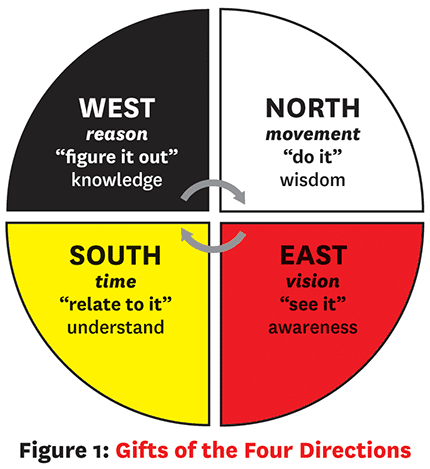
Moving into the “doing” phase of the north requires taking the knowledge gained from all the directions and enacting that knowledge. This form of praxis makes the balance achievable. Using Medicine Wheels as a tool for analysis in healing and learning demands the continuous and ongoing reflection of oneself in relation to others – thus balance must be maintained while embracing change. “The teaching and healing process is evolutionary and cyclical in nature, as is the continuum of medicine wheels. It begins with a desire to understand and identify with the balance, wholeness and interconnectedness expressed in the medicine wheel.”7
In order to create the movement required by the northern direction, one must re-visit the other directions to achieve a 360-degree vision.8 By going to the east where one visions to transform that which is, one can actively create a better life for oneself and others. Indigenous people can envision how they can be active in the “creation of oppositional analytical and cultural space.”9 Visioning allows them to engage in the hopeful utopian thinking necessary for radical transformation.10 Once a guiding vision is received or created, strategies can then be planned to help actualize it. Each person then has the responsibility to do the work required to fulfill the vision.11
Indigenous people are fighting to actualize their visions for change in the education of their children. A revolutionized world will not “come into existence in a linear way, as the result of a single-minded drive, but in a cyclic, circular way, working in all dimensions of a culture, moving from one position to another, not in reaction but in interaction with other forces.”12 Moving from linear models to the interconnectedness of the circle can guide the development of pedagogy and vision for the future.13
The transmission of Medicine Wheel teachings
Understanding Indigenous knowledge and worldview begins with Medicine Wheel teachings previously discussed: the gifts of the directions (vision, time, reason, movement), the actions of those gifts (see it, relate to it, figure it out, do it), and the learning process (awareness, understanding, knowledge, wisdom). Building from these understandings, Indigenous knowledge embraced by Medicine Wheels can be defined as wholeness, interrelationships, interconnections, and balance/respect. Wholeness requires that we look in entireties; that the whole is greater than the sum of its parts, yet the parts cannot be fully seen until the shape of the whole can be seen. Interrelationship requires that we establish a personal relationship with the “whole” – with all that surrounds us. In addition, we must establish a relationship with our whole being; this includes our spiritual, physical, mental, and emotional aspects. Interconnections create an environment which is mutually sustaining; where there is a transcending of logic and linear thought to reveal synthesis and dynamic interdependence. Balance and respect provide an order and structure to the whole and all its relationships and interconnections, while providing an appreciation for the “awe” of it all. (Figure 2)
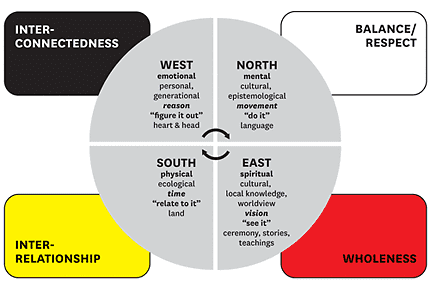
It is necessary to consider Indigenous knowledge as a collection of knowledges from different Indigenous nations. Indigenous knowledge is therefore culture specific, contained within the local knowledge and worldview of the nation. It therefore also has to be ecological, where the knowledge is contained within the land of the geographic location of the nation. Knowledge is also contained within the people of the nation. Indigenous knowledge then becomes personal and generational, as there is a process of generational transmission. Indigenous knowledge is epistemological, in that each nation culturally determines for itself how it knows what it knows.
While Indigenous worldview articulates that Indigenous people need to develop themselves, including their children, in a holistic way that addresses their spiritual, physical, emotional, and mental capacities, they need to address how to transmit learning through all of those personal aspects. The spiritual can be touched through ceremony, teachings, and stories. The physical can be transmitted through the land, while the emotional aspect can be developed through a balanced connection between the heart and the head. Mental capacities can be developed through ancestral languages and integrative learning.
Moving from linear models to the interconnectedness of the circle can guide the development of pedagogy and vision for the future.
Wisdom becomes the goal of any educational process including living – to say that we are truly knowledgeable as a person is to say that we not only “know” what is valued by a nation, but that we have lived our life in such a way that we have experienced what we know and can therefore be considered wise. Indigenous knowledge and worldview is attained by choosing to do what is necessary to obtain multiple perspectives from which to view the world. This in-depth searching for knowledge is what leads to wisdom. Wisdom is achieved by first becoming aware of the learning through all the senses, requiring the learning to be introduced to the students in multiple modalities. Understanding is achieved by providing students with enough time to solidify the learning so that they are able replicate the learning. A deeper understanding is achieved by students relating to the learning at a deeper level to become knowledgeable to the point that they are able to apply the learning in any situation. To say that the students have achieved wisdom requires that they are able to create some action with the learning and teach it to others.
Medicine Wheel pedagogy in practice
The Anishinaabe Bimaadiziwin Cultural Healing and Learning Program (operational from 2002-2006) was created to fulfill the cultural and academic needs of Anishinaabe children in the Burleigh Falls (Ont.) area. The program involved a synthesis of Anishinaabe worldview, spirituality and traditional education philosophy, incorporating these components into an Anishinaabe culture-based school program for Junior Kindergarten to Grade 12. The school was registered as a private school with the Ontario Ministry of Education and the curriculum was organized on a Medicine Wheel framework, where cultural teachings and traditional practices were addressed in the corresponding season on the Medicine Wheel.
A holistic educational experience was provided through a balanced emphasis on all personal aspects of the student. The spirit of the student was celebrated through daily ceremony such as a morning circle (similar to a sunrise ceremony), and the learning of traditional teachings and stories. The physical aspect of the student was actualized by interacting with the land through traditional practices such as maple syrup making, wild rice picking and fasting (a traditional ceremony of personal physical sacrifice to gain spiritual enlightenment). The emotional aspect of the student was addressed by an emphasis on healing and connecting the heart with the head through weekly healing circles, individual counselling, and following the seven sacred teachings (core values often referred to as the seven grandfather teachings). The mental aspect of the student was developed through the teaching and learning of the Anishinaabe language and integrative learning that blended Euro-Canadian and Anishinaabe knowledge, such as the study of earth and space systems in science and the Anishinaabe traditional worldview of all creation along with its teachings, stories, and songs.
The Anishinaabe learning process of awareness, understanding, knowledge, and wisdom as presented on the Medicine Wheel were actualized on an ongoing basis to ensure complete and deep learning occurred. An example of this included providing the students with the awareness of their culture by allowing them to experience it with all their senses (seeing it, tasting it, feeling/touching it, smelling it, hearing it) and then expecting them to show that they understood it by replicating it, such as being able to sing a traditional song. Knowledge of the learning was illustrated by the students in the school when they applied the learning in any situation, such as when a child made a connection between the concept of greed and a traditional Nanaboozhoo story. The ability to teach their culture to others and thus prove wisdom was achieved by becoming the teacher and sharing their culture with other children through workshops with Brownies or Cub Scouts groups.
While the above examples are specific to an Anishinaabe culture-based educational setting, the teachings of Medicine Wheels provide an educational framework that can be applied to any educational setting. The fundamental concepts of wholeness, inter-relationship, inter-connectedness and balance/respect are valuable for all.
Photo: courtesy Saskatchewan School Boards Association
First published in Education Canada, June 2014
Explore the latest edition of Education Canada, powered by voicEd Radio (March 2022)
EN BREF – Cet article explore les enseignements des roues de médecine selon la perspective culturelle anishinabe. L’accent est mis sur ses applications en éducation par le biais de la pédagogie et de la transmission des enseignements des roues de médecine. Ces concepts sont illustrés par un exemple pédagogique pratique de l’emploi de la roue de médicine dans le cadre du programme culturel de guérison et d’apprentissage des « Anishinabe-Bimaadiziwin », offert dans une école basée sur la culture anishinabe.
[1] The term “Medicine Wheel” was established when stone constructions in the shape of wheels were found on Medicine Mountain.
[2] J. Sanderson, The Cree Way: Traditional paths to learning (masters’ thesis, University of Saskatchewan, 1991), 51.
[3] J. Bopp, M. Bopp, L. Brown, and P. Lane, The Sacred Tree (Four Worlds Development Project, 1984), 9.
[4] S. Calliou, “Peacekeeping Actions At Home: A Medicine Wheel model for a peacekeeping pedagogy,” in First Nations Education in Canada (UBC Press, 1995), 51.
[5] K. Absolon, Building Health From the Medicine Wheel: Aboriginal program development. Paper presented at the meeting of the Native Physician’s Association (Winnipeg, Manitoba, March 1994).
[6] Absolon, Building Health From the Medicine Wheel, 18.
[7] F. J. Graveline, Circle Works: Transforming Eurocentric consciousness (Halifax, NS: Fernwood Publishing, 1998), 182.
[8] Dumont in S. Stigelbauer, The Individual is the Community; The Community is the World; Native Elders Talk About What Young People Need to Know. Paper presented at the meeting of the American Educational Research Association (San Francisco, CA, 1992).
[9] C. T. Mohanty, “On Race and Voice: Challenges for liberal education in the 1990’s,” in Between Borders: Pedagogy and the politics of cultural studies, eds. H. Giroux and P. McLaren (New York, NY: Routledge, 1994), 148.
[10] S. Benhabib, Situating the Self: Gender, community, and post-modernism in contemporary ethics (New York, NY: Routledge, 1992).
[11] G. Cajete, Look To The Mountain: An ecology of Indigenous education (Asheville, NC: Kivaki Press, 1994).
[12] French in K. Gould, “Feminist Principles and Minority Concerns: Contributions, problems, and solutions,” Affilia 2, no 3 (1987): 18.
[13] Graveline, Circle Works, 288.
-
What needs to change?
Comments Off on What needs to change?The announcement in February 2014 of the First Nations Control of First Nations Education Act seemed to signal a shift in direction towards positive change for Aboriginal students in Canada. Former National Chief Shawn Atleo of the Assembly of First Nations (AFN) commented at the time, “This is our opportunity to fully realize what First Nations control of First Nations education means to us, to get the Minister and government out of our schools and to support success for our children and students – our way.”[1] However, it wasn’t long until dissenting voices were heard; and in May 2014, in the wake of widespread criticism and Chief Atleo’s resignation from AFN, the Conservative government withdrew the bill.
Challenging and essential though it is, the education system itself – from funding to governance to curriculum – is only part of what is required to achieve meaningful educational success for Aboriginal students. After all, the very structures through which reform is negotiated and implemented are grounded in the historical relationship between First Nations and the settler population. The ability of Aboriginal students to make the most of their educational opportunities depends in part on the health and well-being of their families and communities. And so we asked three distinguished leaders in Aboriginal education to briefly share their vision of “What needs to change in order to make real progress in Aboriginal education?” We asked them to focus on one aspect that is prominent in their thoughts right now, rather than attempting a comprehensive answer. Their responses together convey a glimpse of the “bigger picture” surrounding Aboriginal education.
Indigenizing Education
By Marlene Brant Castellano
No simple answer is adequate to respond to a complex question. However, in my view, a major barrier to Aboriginal students’ success is their resistance, either overt or intuitive, to being absorbed in a world of knowledge and a society that appear to have no place for them or their people. The change I would propose is to Indigenize education in Canada. Indigenizing education means that every subject at every level is examined to consider how and to what extent current content and pedagogy reflect the presence of Indigenous/Aboriginal peoples and the valid contribution of Indigenous knowledge. Such an examination would shift the focus from remediating deficits in Aboriginal students to addressing bias and omissions in the educational system.
The beginning of change does not have to wait for regulations or funding from on high, although curricular standards and appropriate resources will be essential to systemic change. An obvious place to begin is in the teaching of Canadian history. Recent research confirms that students graduating from high school are ignorant that the peaceable character that we like to claim as a nation is fundamentally a legacy of treaties negotiated by First Nations in good faith, shamefully ignored for a century, and now the basis of legitimate claims for reparations.
Public approaches to health and justice are beginning to recognize the insightfulness of Aboriginal understandings of whole health, encompassing body, mind, emotions and spirit, and the effectiveness of restorative justice. Indigenous writers, filmmakers and artists are now represented in national galleries and on the podium for prestigious awards. Yet, despite the evidence that Aboriginal people are participants and contributors to the vitality of community in Canada, the prevailing public perception is that we are problems resistant to solution and impediments to economic development. Content about Indigenous societies, coloured by the perspectives of Indigenous knowledge and woven through the curriculum, could diffuse or dispel the residue of colonialist arrogance that maintains stereotypes and prejudice.
I am heartened by the gains that have been made over the 40 years that I have been involved as a parent, teacher and advocate for Aboriginal education. I am also deeply moved at “the power of one” to rally support for a dream. I watch the annual parade of students on my home territory of Tyendinaga wearing T-shirts and carrying banners proclaiming “Our Dreams Matter Too.” With those words, Shannen Koostachin, a Cree 13-year-old from Attawapiskat, challenged the Minister of Indian Affairs to provide “safe and comfy schools and culturally appropriate education for First Nations children and youth.” She died at the age of 15, but Shannen’s Dream has continued to inspire students, teachers and their federations, and school boards across Canada. The announcement of more equitable funding for education on-reserves, made in the 2014 federal budget, is evidence that students and educators joining their voices with Aboriginal advocates can exercise influence well beyond the walls of their schools.
Bringing Spiritual Teachings into Education
By Blair Stonechild
Having been involved in Aboriginal Education for most of my life, from attending Indian residential school to working on the development of First Nation-controlled post-secondary institutions, I would like to focus on an issue that is not often mentioned: the importance of spirituality in education.
First Nation elders assert that spirituality was a special gift given to Indigenous peoples as a way to maintain strong and healthy nations. In pre-contact societies ceremonies, which were mechanisms for maintaining relations with the spirit world, dominated daily and seasonal life and marked progression though the principle stages of personal development.
Spiritual teachings were derived through vision, ceremony and meditation, and stressed the need for establishing good relations as they pertained to personal and community behaviour. These teachings reflected traditional values including bravery, love, respect, honesty, generosity, humility and wisdom.
Education theorists write about the importance of having a positive self-concept in order to learn most effectively. I believe that a key to restoring what has been referred to as the “learning spirit” is the rejuvenation of Aboriginal spiritual beliefs. Elders and many educators talk about the need for holistic education – physical, emotional, mental and spiritual.
It should be noted that Aboriginal spirituality is not about religious dogma, but rather is about establishing healthy relationships with all things, including one’s relatives, one’s nation, and the natural environment. The elders confirm that all things have spirit and that humans are really spirit beings on a physical journey. As we navigate through life, we are here to learn how to have proper relations with all things. The elders also say that learning, including school learning, is a fundamental part of the purpose for living. It is a sacred mission in life.
Unfortunately many Aboriginal youth today have lost touch with their spiritual heritage, and elders believe this is the reason why so many turn to substance abuse, crime and involvement in gangs. We as Aboriginal people need to heal ourselves by focusing on the spiritual mission of education, which often gets lost in the clamour for more funding and the politicization of schooling. The elders tell me that it is now time to research, write about and teach the principles of Aboriginal spirituality, something which I and other academics at the First Nations University are attempting to do.
An Opportunity to Redefine
By Darren McKee
Change. It is a word used so freely in relation to education that it has perhaps become a cliché. However, to Indigenous persons living in Canada and many other countries, that word carries with it a variety of important meanings.
Above all, change is hope: a hope that the historical and ongoing experiences and contributions of First Nations, Métis and Inuit people to what people today call Canada will be recognized and understood.
Education is a powerful tool that can lift a person to realize great opportunities and fulfilment; it can also be used as a powerful weapon to remove the identity and spirit of entire cultures. As Justice Murray Sinclair, Chair of the Truth and Reconciliation Commission, stated, “Education is the cause for much of the challenges faced by Aboriginal people today. However, it is also the solution in moving forward.”
Recognizing the irony, I would use the questioning teaching method of Socrates to challenge each person who has an interest in this area. I would ask: “What do you truly know about First Nations, Métis and Inuit peoples? Whose truth is it? Whose interests does this truth serve?”
In this country, individuals hold differing and sometimes intransigent opinions on Indigenous people based upon their knowledge. Again, I would ask: “Knowledge gained where? And from whom?”
I realize that it is rather provocative of me to challenge folks about their personal values and experiences, but I do so with the intent of asking us to reflect on what has historically been a negative educational context for First Nations, Métis and Inuit people. This experience colours our opportunity for an appreciative relationship – for example when I say the term “Indian,” what comes to your mind? Is it appreciative or deficit thinking?
In the education world we are quite comfortable with the term evaluation. I would encourage people to evaluate and reflect on their current paradigms in Aboriginal Education, to take an honest look and reframe those views in a place that starts from mutual respect. There is a requirement to rebuild trust, which can only happen if we are willing to work together to create shared understandings that support each other. It cannot be an either/or pathway any longer if we wish to achieve success.
Simultaneously, I would ask that we seize the opportunity that is before us to use the education system as the means to ensure everyone enjoys all the hope and prosperity this country has to offer – and I am defining prosperity beyond the simple economics to include positive social interactions, self-worth and positive community engagement.
The manifestations of change provide us with our greatest opportunity to see every child succeed. Education is the societal agency of change that we ourselves control and that we can indeed ensure is the “solution in moving forward.”
Photo: courtesy Saskatchewan School Boards Association
First published in Education Canada, June 2014
EN BREF – La réforme du système même de l’éducation – du financement à la gouvernance en passant par le curriculum – ne constitue qu’une partie de ce qu’il faut pour réaliser la réussite éducative significative des élèves autochtones. Les structures de politiques et de gouvernance par lesquelles la réforme est négociée et instaurée reposent, après tout, sur la relation historique entre les Premières Nations et la population colonisatrice. La capacité des élèves autochtones de tirer le maximum de leurs possibilités éducatives dépend notamment de la santé et du bien-être de leurs familles et collectivités. Nous avons donc demandé à trois chefs de file réputés en éducation autochtone de partager leur vision de ce qui doit changer afin de réaliser des progrès réels en éducation autochtone. Nous les avons priés d’axer leur réponse sur un aspect prépondérant dans leurs réflexions actuelles, plutôt que de tenter de donner une réponse détaillée. Ensemble, leurs réponses brossent un aperçu du « grand tableau » en éducation autochtone.
[1] Assembly of First Nations, “Communiqué from National Chief Shawn Atleo,” Feb. 2014. www.afn.ca/uploads/files/14-02-14_nc_bulletin_fn_education_announcement_and_budget_2014_fe.pdf
-
Educating ourselves
Comments Off on Educating ourselvesI was a fresh graduate from the Native Studies department at Trent University, working part-time on my master’s degree, when Pauline Harper called from Wandering Spirit Survival School to say, “We’ve suddenly lost our admin assistant. Can you fill in?”
That job stretched to nearly two years, and I still count it as one of the most enriching experiences of my life. Wandering Spirit was what was then called a Native Way school, an alternative school within the Toronto School Board mandated to teach the students about Aboriginal (mostly Ojibwe, in our case) culture and worldview throughout the curriculum. We had about 45 students, K-8 in three classrooms. We began each day – all of us, all together – with a smudge and prayer in Ojibwe from our Elder, Mr. Solomon. There was a giant Medicine Wheel, painted by the kids, on the Grade 3-5 classroom wall and Ojibwe word labels displayed in the K-2 class. We hosted a monthly community feast that lasted all day. These visible details don’t begin to capture the deep differences that seep into the bones of a school when everything, from student discipline to the parent council, is filtered through the lens of Indigenous philosophies and cultural practices. I am deeply grateful for being welcomed into this world.
That’s why I was excited about planning this theme issue on Aboriginal Student Success. The topic is of critical importance; as Darren McKee notes (p. 11), education has been used as an extremely destructive colonial weapon, and the reverberations of that history continue into the present day. Yet education also has the potential to empower today’s Aboriginal students to create their own, better future. And while that education must be shaped and controlled by the First Nations themselves, part of what’s required, as some of our contributors point out, is to strengthen the teaching of Aboriginal history, issues and ways of knowing in all our schools. Educating ourselves is the place to begin.
I knew that finding outstanding Aboriginal scholars and practitioners, who could give us a sense both of the exciting work being done and of the complexity and varied viewpoints involved, would be key to a successful issue. And so I would like to send out a special thank you to our Consulting Editor Michelle Hogue, from the University of Lethbridge, who not only co-authored an article this issue but volunteered her time to advise and connect us with some of Canada’s leaders in Aboriginal education. K’chi meegwetch, Michelle!
Write to us!
We want to know what you think. Send your letters or article proposals to editor@cea-ace.ca, or post your comments about individual articles on the online version of Education Canada at: www.cea-ace.ca/educationcanada.
Photo: Dave Donald
First published in Education Canada, June 2014
-
A Shared History, Present and Future
Comments Off on A Shared History, Present and FutureThe library smelled of salmon and berries. Student volunteers moved through the crowd of guests seated at the linen draped tables serving coffee and tea, refilling water glasses. All of us were adorned with beaded necklaces strung with carved canoe paddle pendants engraved with a wolf and our school’s name, West Bay.
-
Building Bridges with Indigenous Learners
Comments Off on Building Bridges with Indigenous LearnersAs a student embarking into the sciences more years ago than I care to admit, I fell in love with the periodic table. For me it was a metaphor for life and living. The relationships and inter-relationships spoke to me of human engagement and interaction, the results of such interactions leading to a myriad of potential products. As a student it all came together in the lab, when I experienced the chemistry in a hands-on way. To me, understanding where it fit in the real world was critical because then it had context, relevance and application and it really counted.
In his interview Re-thinking Curriculum and Pedagogy, Ted Aoki1 talks of “curriculum-as-lived” in contrast to “curriculum-as-taught,” and how the two often differ. I believe for many Aboriginal students in the current Eurocentric-based Western education system, this is the challenge: connecting the curriculum as taught with the curriculum as lived. It’s an even greater challenge because their lived experience is a different paradigm from the Eurocentric-based Western education system.
As an oral culture, Aboriginal knowledge is not held in textbooks, but rather is held by cultural experts such as elders, in ceremony, and in traditional practices. It is passed on (taught) through story, narrative or demonstration and learning is by doing.2 The laboratory for Aboriginal peoples is the real and applied world. This juxtaposition in ways of knowing and coming to learn is, I believe, key to the challenges many Aboriginal students experience in the Western education system. Context and relevancy are critical and without those, understanding is nearly impossible.
For my Master’s degree, I developed a narrative periodic table,3 in which each of the elements and their interaction with each other was illustrated with a short story. Those who read my stories would often tell me how it enabled them to understand a particular concept by putting it into a context they understood. Teachers would often ask for the stories to read to their class. So I began using narrative in my own teaching practice, and would demonstrate a concept with a mini-skit involving the students. Their favourite was when I demonstrated the difference between ionic and covalent bonds in terms of attraction to another person, dating and commitment – topics that were the focus of their current adolescent life. In thinking about the various chemical reactions, they became very creative in their own scenarios. It was easy to expand to concepts such as bond-breaking, with a jealous girlfriend as the contaminant who breaks up a relationship. Various scenarios expanded and morphed from there. I could then take those stories and further demonstrate them in the “real chemistry laboratory,” and finally in terms of pedagogical chemistry. It made for many “aha!” moments for the students. A Blackfoot student who struggled greatly with the sciences and mathematics said, “I don’t understand the textbook because I don’t know what most of the words mean. It helps when you explain it first with something that makes everyday sense to me so I can see the relationship.”
The concept of teaching through “acting,” a methodology specifically known as performative inquiry,4 became the foundation for a small university research grant5 I garnered to pilot this methodology as a means to engage Aboriginal students in learning science. Performative inquiry, based foundationally on relationships and inter-relationships, is a journey of “knowing, doing, being, creating.”6 While not specifically intended to be used to “put on a play” (although that can be the forum for communicating the message), it is used to enable understanding by bridging practice to theory in a practical, hands-on way – much as laboratory experiments enable the scientist to put theory into practice. Importantly, performative inquiry blurs definitive boundaries in an interdisciplinary way that enables students’ understanding. Performative inquiry allows students to understand how things work and to modify their “script” to try different approaches or scenarios. This methodology dovetails nicely with Aboriginal ways of knowing and learning, which are pedagogically based on relationships and inter-relationships, as well as with the experimental method of science, which continually makes adjustments to the parameters of an experiment to understand how it works.
I am fortunate in my position as Coordinator of the First Nations’ Transition Program (FNTP) to be able to tap into a resource of students who have successfully transitioned through the program. Connections to the neighbouring Blood Reserve high school allow me to work with a cohort of Aboriginal students with similar backgrounds and starting points. Two Blackfoot 2nd year university students, both from the community, worked as research assistants on the project. My purpose in choosing these students was to enable them to gain research experience, as First Nations students are often overlooked for such positions. Just as importantly, they were valuable mentors for our cohort. If high school students see post-secondary education success in others from the community whom they admire, they are more likely to see that possibility for themselves as well. Additionally, we had the good fortune of having experienced dance and drama academics volunteer their expertise on the project: one at the university and one nationally known performing theatre artist from the community, who was a great inspiration and mentor for the students.6
Video Clips
Get a glimpse of Michelle Hogue’s performative inquiry project, Chemistry Through Theatre, in action:
https://www.youtube.com/watch?v=N00sQi6dIKU&NR=1&feature=endscreen
https://www.youtube.com/watch?v=lrEQYc8VvJI
https://www.youtube.com/watch?v=RlgHW3VUmMk
Our work took place with Grade 10 and 11 students from Kainai High School who were daunted by the prospect of having to take a chemistry course. We alternated between working at the high school and working at the university, so that the university would not seem like such a foreign place to come in the future. Of the 22 students initially registered in the pilot project, 13 stayed with the program to performance and received Science, Drama and elective course credits towards their high school diploma. Importantly, we continued to work with this cohort in a second pilot, using our culturally based performative inquiry methodology to augment and teach the curriculum of their Chemistry course.
Initially, it was our intention to use six Blackfoot Napi stories[8] to illustrate the six basic reactions of chemistry. As a result of unforeseeable circumstances as well as the readiness of the students in the time we had to work with them, it soon became evident that we had bitten off more than we could chew in this pilot. So we distilled our six stories down to three, and eventually to one longer story. The last thing we wanted for this first-time endeavour was to further turn the students off science by having it become a frustrating experience. Of the six stories we had initially selected, the students chose to continue with the story “Napi and the Rock,” one they were all familiar with growing up and that was complex enough to find and illustrate four of the six basic chemical reactions.
We chose a less-familiar version of “Napi and the Rock” to honour the family tradition of one of the students, though a number of versions were blended together to produce the final script. It was critical that the story also be embedded with Western chemistry, to build the bridges between the two paradigms. This turned out to be a very challenging process, and what looked good on paper often did not work in the performance development. There were continual rewrites to the script. For me, it was a learning experience that closely paralleled developing a lab to teach: what looks feasible on paper often does not necessarily translate to the chemistry lab, particularly if it has to be scaled to work for an entire class. I also developed a new appreciation and respect for what is involved in scriptwriting as well as in “carrying out” the script.
As already mentioned, one paramount and consequent result of the current Western education system is that Aboriginal students are expected to learn science through the White-Western way. Seldom, if ever, is the Western-educated scientist educated in Aboriginal ways of knowing. To address the issue of different paradigm views, we wanted the story to be an “educational” conversation between an elder and a scientist, both considered to be respected experts in their own culture, who come to understand the way each other sees science.
The Blood Reserve, situated on the prairie, has the beautiful backdrop of Chief Mountain, prefaced by the Belly Buttes (rolling hills), the Timbers, the Elbow River, and Cypress Hills, with the prairies in the foreground. This home of the students became the set design and is where the story takes place. Very few props were used in the set design or the performance; rather the geography of the Reserve as described above was depicted by the choreographed bodies of the students, who were also the actors of the play. Two of the less shy students became the elder and the scientist, who meet while the scientist, a chemist, is collecting specimens from the Aboriginal lands. The elder wants to know what the scientist is doing on their land. The scientist explains that he is “doing chemistry,” to which the elder explains that unlike the “science” of Aboriginal peoples, the science the “educated” scientist does destroys Mother Earth. The scientist asks the elder for an explanation of what he means by that; to him there is only one kind of science/chemistry, the one he has learned. The elder invites the scientist to “watch and learn” and the story unfolds. Through their conversation, connections between the two worldviews are made. The other characters include Napi (the trickster), coyote, rock, deer, rabbit, wind, sun, trees and nightingales. The play is comprised of six scenes, each of which morphs into the next through the dance movements of the students. A slapstick comedy “reaction” illustrates the chemistry throughout the play.
One might say this is just theatre or drama, and that is certainly a criticism I have heard many times, but this pilot project was a huge success on many levels. One of the most important outcomes was the students’ understanding of the chemistry they had learned. To assess whether the students had in fact learned any chemistry, in the final week I brought the chemistry lab to the theatre. I did each of the six basic reactions and without hesitation the students were able to identify the reaction, tell me the general formula, and give me a real-life example as well as a chemical reaction they had learned in class.
In interviews with the students, the key statements we heard over and over, were that:
- they were not afraid of science any longer;
- they gained much confidence, both in doing science and also in “being out there”;
- they felt better about themselves;
- they felt they belonged;
- they were proud of themselves;
- they believed in themselves because we believed in them;
- they wanted to do it again next term; and
- each said they saw themselves attending some form of post-secondary education, with ten of the 13 planning to attend university.
The most important take-away for me was that they wished more courses could be taught this way because “it made sense” for them.
Dufault wrote, “The chasm between non-Native and Native worldviews can be made smaller through increased awareness… both worldviews seek a balance of mind, body and spirit, but from different angles.”[9] I believe if we are aware of the “different angles,” and are willing to work with the differences in a new space, we can create bridges to enable success for Aboriginal students in science in the current education system.
Photo: Courtesy of Kainai High School
First published in Education Canada, November 2013
EN BREF – La chimie, telle qu’elle est enseignée dans le système scolaire occidental, rebute et exclut les élèves autochtones, dont la vision du monde est différente et qui sont généralement des personnes visuelles qui apprennent par la pratique et par l’expérience. Pour mettre les sciences à la portée des élèves autochtones et favoriser leur réussite, les éducateurs doivent explorer des techniques pédagogiques différentes intégrant les modes autochtones d’apprentissage et d’acquisition de connaissances. Appliquant une méthodologie d’acquisition de connaissances par la performance, ce projet pilote a abordé l’enseignement des sciences en créant des liens entre les sciences autochtones et occidentales, adoptant une approche théâtrale et visuelle intégrant la danse, le conte, la vidéo et la musique comme outils pédagogiques. Un conte traditionnel des Pieds-noirs (« Napi et la roche ») et les six réactions chimiques de base ont constitué la pédagogie de base de ce projet théâtral de chimie. Les élèves ont développé des compétences et des connaissances interdisciplinaires et ont établi des liens entre les concepts scientifiques de ces deux paradigmes.
1 “Rethinking Curriculum and Pedagogy: Interview with T. Aoki,” Kappa Delta Phi Record 35, no.4 (1999): 180-1.
2 See G. S. Aikenhead
3 Michelle M. Hogue, The Chemistry of Education: A periodic relationship (unpublished master’s thesis, University of Lethbridge, 2004).
4 L. Fels and G. Belliveau, Exploring Curriculum: Performative inquiry, role drama, and learning (Vancouver, B.C.: Pacific Educational Press, 2008).
5 CAETL Teaching Development Grant, “Chemistry Through Theatre” (University of Lethbridge, 2011). The second pilot was funded by an internal Social Sciences and Humanties Research grant (SSHRC).
6 L. Fels, “In the Wind Clothes Dance on a Line,” Journal of Curriculum Theorizing 14, no. 1 (1998): 29.
7 Dr. Lisa Doolittle, a Fine Arts professor from the University of Lethbridge and Troy Twigg, a Blackfoot choreographer and performance artist from the Centre for Indigenous Theatre and York University.
8 Napi stories are Trickster stories in the Blackfoot culture intended to teach young children various life lessons. Blackfoot children grow up with these stories, much as children of the dominant culture grow up with fairy tales, so, they were a good cultural starting point.
9 Y. Dufault, A Quest for Character: Explaining the relationship between First Nations teachings and “character education” (master’s thesis, Ontario Institute for Studies in Education, University of Toronto, 2003).
-
Empowered Mi’kmaw community builds a high school of its own
Comments Off on Empowered Mi’kmaw community builds a high school of its ownIn fall 2010, after several incidents of student suspensions and expulsions at a nearby provincial high school, members of Potlotek First Nation in Nova Scotia talked about having a school of their own.
Discussions came to a head several weeks later for the Mi’kmaw community on Cape Breton Island when two more students were suspended on the same day in the first week of classes in January 2011.
One month later – in response to community concerns – Potlotek set up its own high school program based on Mi’kmaw traditions and the provincial curriculum, with an initial intake of 35 students.
“We felt this was the only way we could see to save our kids.”
“They were the ones who said ‘we want a school’ and they got a school,” says Nancy MacLeod, Director of Education for Potlotek, citing pleas from students and parents in the community of 600 people.
The speedy response was possible, in part, because Potlotek is a member of the Mi’kmaw Kina’matnewey (which translates as the “whole process of learning”) education authority. In 1999, federal government legislation recognized Mi’kmaw self-governance in education, enabling members of Mi’kmaw Kina’matnewey to make local decisions about elementary and secondary schooling without seeking bureaucratic approvals under the Indian Act.
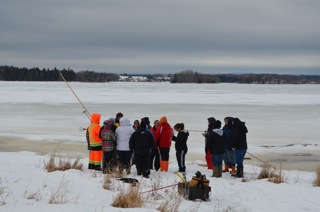
Caption: Mi’kmaw students at Potlotek High School receive an outdoor science class with a history of treaty right to fish lesson from Kerry Prosper of Paqtnkek First Nation.
Credit: Photo courtesy of Potlotek First NationPotlotek has an elementary school but, until last year, high school students had to travel off-reserve to a provincial school where they experienced low graduation rates and complained of incidents of bullying. “The community propelled us forward to be as aggressive as possible in promoting the concept of the school,” says Potlotek band manager Lindsay Marshall, a former band chief who helped negotiate the self-governance accord in the 1990s. “We felt this was the only way we could see to save our kids.”
Speedy implementation of a high school program, in barely a month, “would have been almost impossible” under the Indian Act, he adds.
Others assisted the grassroots effort too. Mi’kmaw Kina’matnewey, the education authority, and the Council on Mi’kmaq Education, worked with the Nova Scotia Minister of Education and her department’s Mi’kmaq Liaison Office to ensure the Mi’kmaw-enriched curriculum, taught by certified teachers, met the requirements of the province’s high school diploma.
With no physical building of its own yet, the high school borrows space from administration facilities (used for daytime adult education) and rooms in the elementary school to deliver classes from 3pm to 8pm. As a central support agency for member communities, Mi’kmaw Kina’matnewey also provided funding for books, materials, and teacher training.
“It has a lot to do with the community deciding and telling us what they needed,” says Eleanor Bernard, Director of Education for Mi’kmaw Kina’matnewey. “That is the biggest factor.”
In Potlotek, what community members wanted was success for a new generation of learners. In its first year, the school hired four teachers (native and non-native) as well as a Mi’kmaw social worker to help students cope with drug, alcohol, and social issues. With classes starting in mid-afternoon, five members of the community take turns preparing a hot meal at 5:30pm every school night for students. This year, enrolment climbed to 50 students and five teachers.
Students follow the provincial curriculum enriched by in-class and outdoor activities that included Mi’kmaw traditions and ceremonies. For example, elders teach students how to fish for salmon – an opportunity for them to learn about their treaty rights as well. Several times a year, the school puts on language camps to foster student awareness of their cultural identity. The band is in the process of developing land on a nearby island as a science camp for students to learn math, biology, and other subjects from a traditional perspective.

Caption: At a Potlotek Mi’kmaq language camp in June 2012, elder Frank Augustine teaches student Sonny Doucette how to skin an eel.
Credit: Photo courtesy of Potlotek First NationThe school also brings a Mi’kmaw approach to teaching and learning. Instead of issuing suspensions for unacceptable behaviour, the school gives students a choice. If a conflict erupts, students can meet with the social worker to draft a “wellness” plan and participate in a “talking circle” that gives everyone at school a voice to speak about the incident. Alternately, students of legal age (16 years) can choose to withdraw from school.
“I feel my heart is going to burst with pride,” she says. “We are a small community but every one of these kids belongs to us.”
In its first 18 months of operation, the school had only one incident that required a talking circle, says Ms. MacLeod, the Education Director. Mr. Marshall recalls an incident when a male student was caught smoking marijuana at school and sent to the office. The student was told “the good news is that you are not suspended. The bad news is that you are spending a day with the elders.” “That young man never smoked in school again,” says Mr. Marshall.
In 2011, the school had its first graduate, now in second year of university, and three more graduated last June. Margaret Poulette, a community member who works with adult learners and youth on special projects, says the graduation ceremony is an emotional moment. “I feel my heart is going to burst with pride,” she says. “We are a small community but every one of these kids belongs to us.”
Ms. MacLeod, a non-Mi’kmaw active in Nova Scotia native education for almost 30 years, makes no pretense that dropouts are among several challenges for the school. But consistent with its community-based focus, Potlotek brought together students (those doing well and struggling), parents, teachers and others this fall to discuss potential solutions. Meanwhile, the community has embarked on a fundraising campaign to build a traditional longhouse that, when completed, will include space for an actual high school.
In the meantime, Grade 10 student Gideon Doucette says he likes going to Potlotek High School because it offers small classes and regular exposure to Mi’kmaw teachings and tradition. Before school, he teaches drumming to younger students, an experience he says reinforces his Mi’kmaw identity.
The 16-year-old failed Grade 9 at the provincial school, successfully repeating the program at Potlotek last June. He now rates as “very high” his chances of graduating in a couple of years.
“I want to move forward in my life,” he declares. “I plan to be lawyer and stand up for our treaties and our rights and help more Mi’kmaw people.”
-
In Nova Scotia, a Mi’kmaw Model for First Nation Education
Comments Off on In Nova Scotia, a Mi’kmaw Model for First Nation EducationIn 1999, Mi’kmaw communities in Nova Scotia won control over the education of their children for the first time in a century. The Mi’kmaw Education Act became Canadian law two years after a signed agreement by the federal and Nova Scotia governments and chiefs of nine (later 11) of 13 Mi’kmaw communities that recognizes local decisions on education, including language, history, identity, and customs in the regular curriculum.
Today, though funding is still an issue, the legal arrangement that governs the schooling of about 3,000 Mi’kmaw students in Nova Scotia is winning national attention as a possible model for First Nation self-governance in education.
Earlier this year, a national panel set up by the federal government and the Assembly of First Nations cited the Nova Scotia example in recommendations calling for a First Nation education system to protect a “child’s right to their culture, language and identity, a quality education, funding, and First Nation control of First Nation education.” The panel’s recommendations – a precursor to federal legislation expected in 2014 – aim to rectify an abysmal history of aboriginal education that leaves First Nation children at a disadvantage, by almost every measure, compared to their peers in school.
What’s driving interest in the Nova Scotia model is the work over the last two decades by Mi’kmaw Kina’matnewey, the education authority that distributes $40-million a year in federal grants to its member communities – and the effort of the local communities themselves. Significantly, the tripartite agreement recognizes the role of the education authority to support local band schools in delivering language immersion and other culturally rich programs and activities. With Mi’kmaw-focused teaching pedagogy, schools seek to engage students in a successful education experience. In 2010-11, Mi’kmaw Kina’matnewey reported a high school graduation rate of 75 percent for students in the system, up from 70 percent two years earlier and almost on par with Nova Scotia as a whole.
“What impressed us most were the outcomes,” says Scott Haldane, chair of the National Panel on First Nation Elementary and Secondary Education for Students On Reserve. The 75 percent graduation rate, he observes, “is double the national average and close to triple the average of what we saw in some of the worst performing schools.”
He describes Mi’kmaw Kina’matnewey as “an overnight sensation that’s taken 20 years to actually happen.”
Like a school board, Mi’kmaw Kina’matnewey serves as a central coordinating body, providing common services and resources to its members and acting on their behalf in negotiations with the Nova Scotia and federal governments. But unlike a school board, Mi‘kmaw Kina’matnewey serves rather than directs the activities of its members’ local schools.
“The accountability in the MK (Mi’kmaw Kina’matnewey) system is that MK is accountable for helping the schools but in the provincial system the schools are accountable to the school board,” says Jeff Orr, Dean of the Faculty of Education at St. Francis Xavier University in Antigonish, Nova Scotia. Emphasizing the “collective consciousness” that defines the interaction between Mi’kmaw Kina’matnewey and its members, he says “if we trust people are helping us we are more likely to seek out their support. The cultural, sociological and political hope of MK is that it is able to cultivate that trust and therefore able to operate in supporting schools [in ways] that are fundamentally different from the provincial system.”
If we trust people are helping us we are more likely to seek out their support.
Nurturing a new generation of Mi’kmaw teachers – who account for about 50 percent of those teaching in Mi’kmaw schools – has been a key goal of Mi’kmaw Kina’matnewey. Since 1995, in a collaborative effort between the education authority and the education faculty, more than 100 Mi’kmaw-speaking students have earned their bachelor of education. “That is because of the relentlessness of our relationship over the period of time,” reflects Prof. Orr, emphasizing the strong rapport between his institution and Mi’kmaw Kina’matnewey, whose representatives serve on an advisory body to the faculty. As well, his education faculty delivers on-reserve programming for students to complete their teaching degree on a part-time basis or earn a certificate in Mi’kmaw language pedagogy.
Former teacher Eleanor Bernard, the current Director of Education for Mi’kmaw Kina’matnewey, can measure progress by her own experience. When she arrived at high school in Sydney in 1981, she was one of 160 Mi’kmaw students. By graduation, she was one of only five who received their diploma. When she started teaching 20 years ago, she estimates she was one of about 25 from Mi’kmaw communities. Today, there are more than 200 in the province.
Caption: On Aboriginal Day in 2011, Potlotek High School Students exercise their treaty right to fish salmon.
Credit: Photo courtesy of Potlotek First Nation“It is amazing how far we have come in 20 years,” she says. Self- governance was an essential first step, but insufficient without community-based programming to enrich the education of Mi’kmaw children. A key initiative has been the development of language immersion programs in three communities, one offering courses through Grade 12.
While gratified by the recent attention to Mi’kmaw initiatives in Nova Scotia, Ms. Bernard is candid that significant education challenges remain on literacy, numeracy, attendance, and “capacity building” at the local level. “There is still work to be done,” she says. “There continues to be a need to bridge the gap for students in the provincial system and ours.”
Recent efforts to bridge the gap have come through partnership agreements between Mi’kmaw Kina’matnewey and the Nova Scotia department of education.
In 2007, the department and Mi’kmaw Kina’matnewey signed their first bilateral agreement on education services, replacing individual tuition agreements between the government and local bands.
“It allowed us to move forward in a way we had not done before,” says Candy Palmater, Director of the department’s Mi’kmaq Liaison Office.
Under the agreement, now being renewed, the department offers teachers in the Mi’kmaw Kina’matnewey system the same professional development provided free of charge to those in the provincial system. At the request of Mi’kmaw Kina’matnewey, concerned about school improvement, the department shared provincial tests for Grade 3, 6, and 9 so that local Mi’kmaw schools could assess the achievement of their students. The results are shared privately with participating Mi’kmaw schools.
In turn, Mi’kmaw Kina’matnewey shares its expertise in language curriculum and Mi’kmaw programming with the department. “We have worked hard at developing our relationship,” says Ms. Palmater, who is herself of Mi’kmaw descent. “As a result, we have a real sharing back and forth for the first time in a long time.”
As a bright light in an often-dark picture of aboriginal education, the Mi’kmaw self-governance model holds out hope for what is possible, says Mr. Haldane. Speaking of his national panel, he says “the conclusion we came to is that when First Nations are given the time and resources to build a system that includes school-board type supports and ministry-type supports, and when they can work closely with the provincial education system, then results seem to follow.”
EN BREF – En 1999, en vertu des lois fédérales, les collectivités Mi’kmaw de la Nouvelle-Écosse ont obtenu le droit de gérer l’éducation de leurs enfants pour la première fois depuis un siècle. Avec le soutien de Mi’kmaw Kina’matnewey, une autorité scolaire assurant des services centraux, les écoles Mi’kmaw offrent des cours de langue d’immersion, une pédagogie culturellement adaptée et d’autres initiatives favorisant la réussite scolaire. En 2010-2011, Mi’kmaw Kina’matnewey a rapporté que 75 pour cent des élèves du secondaire avaient obtenu leur diplôme, soit deux fois la moyenne canadienne. La formule d’auto-administration est considérée comme un modèle possible pour l’enseignement dans les Premières Nations canadiennes.
-
Understanding the Heartbeat
Comments Off on Understanding the HeartbeatEven though we walk on lands rich in history, we non-Aboriginal Canadians often fail to hear its stories due to a cultural deafness – a state of unknowing.
This state of unknowing is something school districts in British Columbia are trying to address with curriculum and enhancement agreements. For example, School District 44 has created a senior level humanities course that studies First Nations culture and history, as well as Squamish Language classes. Alberta has introduced an initiative for First Nations Education called “Our Words, Our Ways”, a pedagogical style that links cooperative learning and community to the expression of traditional values.
However, none of these structures or materials will be meaningful until teachers from all backgrounds find the courage to explore First Nations culture. The timidity many of us feel when teaching Aboriginal studies may come from a sincere place – a place of not wanting to offend or further colonize or intrude – but it can do damage nonetheless.
Rather than speak from a place of authoritative knowing on Aboriginal matters, why not work from a place of wondering and invite our students to learn with us in gaining a deeper understanding of First Nations perspective? What follows is an account from two teachers who did just that.
Rockridge Secondary School serves about 900 students in West Vancouver, and while it is located on Squamish land, until recently it has had little contact with the Squamish people themselves.
Jessica Selzer’s Story
Last year, when I was teaching at Sentinel Secondary School, a colleague, Glenn Johnson, asked if I wanted my Social Studies 9 class to make drums as part of their Explorers and Aboriginal Peoples of Canada unit. For many years, his students had made drums; his program was showcased for the 2010 Vancouver Winter Olympics. Glenn organized almost everything for my class project and offered to teach my students how to string a drum. With a sense of excitement, I watched them string and paint drums, research aboriginal symbols and stories, and start asking about the culture they were holding in their hands.
This year, new to Rockridge Secondary, I wanted to expand the Aboriginal drum-making project to help students understand a culture and worldview in their own backyard and to help them reflect on their learning and on themselves. If they were to make drums, they were going to understand the heartbeat and meaning of drums and drumming to the Coast Salish people.
I began the unit by sitting with my students and playing the drum I had made last year while telling them the story of the Europeans’ drive to find the Northwest Passage, the world travels of Captain Cook, how the Yuquot greeted him in Nootka Sound, and of Vancouver’s continued exploration of the B.C. coast until he landed close to where we sat that day.
Over the next few classes we discussed Salish culture, stories, and worldview in which we focused on the equal, interconnected relationships between all living things in the spiritual and physical realms. For one whole class we shared and reflected on personal totems. As an introduction I read them “I am Raven” by David Bouchard. Then my students read in silence about the animals and creatures from the Salish culture while thinking about which animal matched their core: not who they wanted to be, but who they really were. Once chosen, they would paint this totem on their drums.
In small groups they shared which animal they thought best suited them and why. They took this task very seriously, offering sincere reflections on who they are and what they do.
In small groups they shared which animal they thought best suited them and why. They took this task very seriously, offering sincere reflections on who they are and what they do. One girl felt that her love and loyalty to family, combined with her ability to be on her own, defined her, and so chose a wolf. She wrote about her leadership qualities, and how adults see her as mature and give her responsibility, like caring for small children. Another boy felt that, because of his expressive, outgoing personality and his willingness to take risks, he was more like a Thunderbird. He wrote that his ability to find new friends every time he moved around the world was like the Thunderbird with its transformative capabilities and bravery. He ended up painting his bird in the colours of Poland’s flag – his homeland, of which he was fiercely proud.
Stringing a drum is fairly easy once you know what you are doing, and my students caught on fast, helping each other.
At the suggestion of school administrators, I invited the Squamish community to be involved through a drum circle. Squamish elder Bob Baker taught my class a canoe song while they were painting drums in the cafeteria. Initially they were a bit self-conscious, but soon they started to have fun with it. As they were singing, students from other classes started sneaking out of classrooms and peering over the railings to see what was going on. It’s tricky to pay attention in trigonometry when you can hear drums and laughter!
Jennifer Olson’s Story
As I approached the Socials 9 First Nations unit, I knew it was important to study First Nations culture in a meaningful way. I wanted the unit to be personalized, inquiry-based, and experiential: all strong values of indigenous education.
Currently in B.C., First Nations are increasingly celebrating their culture through the medium of fine arts, so I figured an inquiry into First Nations culture through art analysis would be intriguing, non-intimidating, and allow them to focus on aspects of culture they found most intriguing.
Building an entirely inquiry-based unit felt like a huge risk. I had never done a true inquiry project and was afraid that giving the students so much responsibility and freedom in what they learned would leave us with nothing really meaningful in the end. I spent many afternoons collaborating with our school librarians to find resources for the students to start with. My Middle Years Program Coordinator also guided me in preparing an inquiry process that would encourage students to take ownership of their learning and deepen their analysis.
“When I look at art can I see the artist?” This question made the students look for hints of the artist’s identity … wonder how art is a reflection of one’s self.
The unit began with students taking an “art walk,” moving from station to station in 10-minute intervals, browsing the artwork of First Nations artists from across Canada. They studied the art being mindful of the question, “When I look at art can I see the artist?” This question made the students look for hints of the artist’s identity within the art and begin to wonder how art is a reflection of one’s self and what led these artists to create these images. After the art walk, the students began developing their personal inquiry questions – and that’s when my doubts fell by the wayside! They engaged in their learning because they were empowered to choose the focus of their work. Students began researching artists’ cultures and histories in attempts to answer their own questions, a journey they would share with the class at the end of the unit.
When that time came, we sat in an informal “sharing circle”; students were not bound by scripts but instead spoke passionately about the knowledge they had uncovered. Many students studied the artist’s spirituality, which they had uncovered through studying the use of animals in the art. They found another common theme: the First Nations traditional ways of life, depicted in the art through Sun Dances, Pow Wows, and Potlatches. While the art celebrated the First Nations culture, the students also perceived a sense of remorse and rebirth in many pieces of art. The mood of these pieces led many students to study how the artists’ community was affected by the signing of the treaties and the residential school system. Each presentation was unique in content and reflectiveness, making it a collaborative learning experience. Much like the traditional style of First Nations education, each student had developed a different area of expertise and was excited to share it. It was clear these young people had developed a deep appreciation and understanding of First Nations history and culture.
What the students did not realize in the beginning, was that Jessica Selzer had offered to share her knowledge of drum-making with the class, enabling them to create their own art, a traditional Squamish drum. Seeing their art in action brought an even deeper level of learning and understanding. They were able to appreciate that who they are as individuals shaped the art they were creating, just as they saw in the art they had analyzed.
Conclusion
One afternoon later in the year, that deeper understanding shone in their faces as our classes came together to sing and drum at a blessing ceremony for a cedar raven carving that Squamish artist Rick Harry would begin at our school. The raven is our school mascot and also a spiritual symbol for the Squamish nation. Although the two classes had focused on different elements of First Nations culture, together they participated in a living ceremony that spoke of spirit and creation as they had come to understand it through their separate inquiries. As one boy announced after the ceremony, “That’s awesome! Stuff we learned about in class happened in front of us! It was real!”
When asked to reflect on the entire unit, our students said they felt that they learned something important, and they were surprised to learn that there was such a rich culture right in their neighbourhood. All students felt that the act of making a deerskin drum while learning about its spiritual and cultural significance – and then actually “doing history and culture” – was a much fuller experience than simply being taught about it.
EN BREF – Plutôt que de parler en connaissance de cause de sujets autochtones, pourquoi n’adopterions-nous pas une attitude de curiosité, en invitant les élèves à acquérir en même temps que nous une meilleure connaissance de la perspective des Premières Nations? Deux membres du personnel enseignant de l’école secondaire Rockridge de Vancouver Ouest l’ont justement fait. Les visages des élèves rayonnaient lors d’un après-midi où ils ont appris à mieux connaître la culture et la spiritualité des Squamish, les deux classes s’étant rassemblées pour chanter et tambouriner lors d’une cérémonie de bénédiction d’une sculpture de corbeau en cèdre. Le corbeau est une mascotte de l’école ainsi qu’un symbole spirituel de la nation Squamish. Quoique les deux classes aient examiné divers éléments de la culture des Premières Nations, elles ont participé ensemble à une cérémonie vivante évoquant l’esprit et la création et sont parvenues à mieux les comprendre grâce à différents questionnements.
-
Cdn EdWire – Back-to-school Issues-a-plenty
Comments Off on Cdn EdWire – Back-to-school Issues-a-plentyHow to help your kids succeed? Talk, talk, talk – Globe and Mail
One more reason why your kids should eat breakfast – Globe and Mail


IDEAS TO SUPPORT EDUCATORS : Subscribe to the EdCan e-Newsletter
Quality research, reports, and professional learning opportunities.