Archive
-
A Volunteer in Botswana
Comments Off on A Volunteer in BotswanaBeautiful Botswana is a landlocked country in the centre of southern Africa. This is where my husband and I spent four months, from August to November 2011. While he worked at a local public children’s hospital and in an HIV clinic, I volunteered with a non-governmental organization named Stepping Stones International (SSI). This NGO offers a comprehensive after-school program to vulnerable and orphaned youth ages 12 to 18+.
Before arriving in Botswana, I didn’t now what my exact role at SSI would be. I am thankful to the staff, volunteers, tutors and youth for welcoming me with open arms. With a background in education and experience teaching adolescents, I was able to further develop SSI’s education program during my short stay. However, having trained and taught only in Canada, my teaching perspectives are heavily influenced by the value North America places on constructivism. This learning theory, developed by theorists such as Dewey, Piaget and Vygotsky, is based on the belief that individuals create their own meaning from life experiences – that they are active participants in the process of constructing knowledge. This is not to say that this learning theory is better than others – it is simply what I was able to offer. I am very fortunate to have worked with people who were open to exploring new ways of learning.
Observing
I spent the first two weeks familiarizing myself with the various program components, interacting with the youth, participating in activities, and getting to know fellow staff members and volunteers. The youth generally arrived at the centre mid-afternoon. They studied for an hour and a half, participated in energizers, attended a life skills session, enjoyed a nutritious meal, helped clean the centre and then headed home safely in SSI vehicles early in the evening. During study time, I would circulate among the students, offering assistance with homework.
I quickly discovered that their homework frequently involved copying assigned sections of a textbook (as a result, they all had beautiful penmanship). When students asked for help with a particular mathematics, social studies or agriculture question, they would show me the question expecting that I would tell them the answer. Instead, I showed them how to use the table of contents or index to look up the section of the textbook in which they could find the answer themselves. Others would be looking at picture books and I would ask if I could read with them. Some were reluctant and some were happy to receive the attention. While most students could read with reasonably good English pronunciation, they often did not demonstrate an understanding of the content they were reading. After reading with a handful of students, I realized that they were not used to thinking about what they were reading. Essentially, the students worked hard to memorize information on a particular topic and to read with few decoding errors, but they were not applying critical thinking skills.
My goal became to enhance the SSI education program so as to help the youth discover different ways of learning, and learn how to think about what they were learning. I decided to focus my programming efforts in the area of reading comprehension strategies, multiple intelligences, and thinking skills. I wanted learning activities to be varied and engaging, catering to the diversity of learners, and for the youth to develop skills to better understand what they were learning.
Planning
In order to develop a sustainable education program, I needed to train the tutors at SSI in different learning and teaching strategies. These older students from secondary school and university would be working directly with the youth on a long-term basis. A few of them were able to attend weekly tutor training sessions. I designed these sessions as hands-on workshops. I wanted the tutors to learn about various educational concepts by participating in different learning activities themselves. Thus, I was simultaneously modeling a variety of teaching techniques. The tutors, having gone through the same education system as the students, were not familiar with class discussions, group brainstorming or partner work, for instance.
Training
My first goal was to help the tutors become “reading coaches” with the students, rather than simply listening and correcting pronunciation errors. This way the youth, and the tutors themselves, would learn how to understand and think about what they were reading. In one training session, the tutors were introduced to several “before-reading strategies.” They also learned how to help students choose a book at an appropriate reading level using “the five-finger rule.” This is where students turn to any page within a book, and while reading the page, count the number of unknown words with their fingers. A book with two to three unknown words is at an appropriate reading level. We talked about making connections and making predictions. Tutors worked in partners to practice these coaching strategies through role-play. One of the more introverted tutors took great pride in becoming a reading coach. He diligently kept a log of which students he read with and the books they read together.
I then introduced the tutors to Gardner’s Theory of Multiple Intelligences.[1] I wanted them to understand that everyone learns best in their own unique way, and that one teaching approach will not meet the needs of all students. As one teacher explained to me, educators in Botswana struggle to offer varied and engaging lessons, as class sizes are 50+ and they are constantly under pressure to follow the syllabus in order to prepare the students for national and school exams. It was therefore essential that SSI offer a variety of learning activities in order to better meet the needs of its participants. After completing a multiple intelligence inventory to discover their own learning profile, the tutors used several resources in combination with their own ideas to create a list of learning activities for each of the eight intelligences.
Finally, I wanted the tutors to realize that there was more to education than memorization – and even understanding for that matter. Now that they knew about multiple intelligences, they were ready to learn that there were different ways of thinking as well. I introduced them to Bloom’s Taxonomy and the various thinking skills involved in learning.[2] Students in Botswana are encouraged to memorize information, but they are not often given the chance to fully understand and apply their knowledge. As a group, the tutors progressed through a series of stations that followed the hierarchy of thinking skills. Gradually, the questions became more open-ended, encouraging greater thinking, and the tutors’ answers became more varied. We discussed how the taxonomy promotes creative and critical thinking skills and how learning activities need to encourage students to think in a variety of ways.
Building capacity
It was now time for the tutors to apply what they had learned during the tutor training sessions. They were already actively helping the youth with their homework and some were beginning to read more with the students. In the last few training sessions, tutors planned their own learning activities to implement with a small group of students during study time. They were asked to identify their target student group, the topic, the activity, necessary materials, and the sequence of steps they would follow to lead the activity. One tutor chose to have Form 4 students (at the senior secondary level) complete a science experiment about osmosis. Another tutor prepared a spelling game for Standard 7 students (approximately Grade 6 level) to play. Students were not always able to participate in these activities – sometimes they had too much homework to complete – but my hope was that these more engaging and varied learning activities would allow the students to learn more effectively and to gradually develop a greater love for learning, increased confidence towards learning and greater academic progress. I was therefore pleased to learn that, over a year later, the tutor training sessions were ongoing.
Reflecting
As teachers, it’s important to consider the cultural background of our students, especially those new to Canada, and to realize that they may be unused to some common educational practices in Canada. Creating an inclusive and individualized learning environment for all students is essential, so that everyone can grow and learn to their fullest potential.
Globally, literacy skills continue to be an important focus. Perhaps educational training programs around the world should also focus their attention towards fostering creative and critical thinking skills within learners.
First published in Education Canada, June 2013
Stepping Stones International in Botswana needs funds to assist with tutor recruitment, training and purchasing educational materials. For information or to donate, please visit www.steppingstonesintl.org or contact the author directly at amandaskinn@gmail.com.
EN BREF – Pendant quatre mois, l’auteure a fait du bénévolat à Stepping Stones International, une ONG à but non lucratif située au Botswana qui offre un programme complet à des adolescents vulnérables et orphelins de 12 à 18 ans (ou plus), après l’école. Ici, les élèves peuvent se concentrer sur leurs études et obtenir l’aide des tuteurs pour faire leurs devoirs. Afin de continuer le développement de son programme éducationnel d’une manière significative et durable, son rôle principal était de former les tuteurs à l’utilisation d’une variété de stratégies d’enseignement et d’apprentissage. À partir d’une série de sessions de formation sur les stratégies de lecture, les intelligences multiples et les habiletés de pensée, les tuteurs ont appris comment encourager les adolescents à devenir des apprenants plus créatifs, critiques et autonomes.
[1] H. Gardner, Frames of Mind: The theory of multiple intelligences (New York: Basic Books, 1983).
[2] Benjamin S. Bloom, Taxonomy of Educational Objectives: The classification of educational goals (Harlow, Essex, England: Longman Group, 1956).
-
Standards, Accountability, and Student Assessment Systems
Comments Off on Standards, Accountability, and Student Assessment SystemsThe development and implementation of accountability systems has, arguably, been the most powerful trend in educational policy in the last 20 years.[i] The setting of academic standards for what students should know and be able to do can be traced to Prime Minister Margaret Thatcher’s British government during the 1980s. A national curriculum was adopted in 1988 that outlined core competencies that students should master in areas such as reading, writing, and arithmetic. Through Standard Achievement Tests (SATs), students’ and schools’ achievement results could be compared. Naturally, teachers and school administrators would also be judged for the performance of their students. The underlying message conveyed to parents was that they should be relatively satisfied with schools that improve their test performance from year to year and begin to question the quality of instruction for those that have poor performance.
This type of educational reform model and corresponding zeitgeist spread very quickly to other parts of the world including the rest of the United Kingdom, Europe, North America, Australasia, as well as parts of Asia. Policies mandating the institution of curriculum requirements and standardized tests are often associated with both neoconservative and neoliberal ideologies that apply market logic to the realm of social institutions such as schools.[ii]
This brief survey of assessment systems across various industrialized nations is meant to provide the reader with a general understanding of how standards are assessed in parts of Europe, North America, Australasia, and Asia. In some cases, standards are assessed in relation to national/regional external tests, while in others schools rely on internal assessment methods to reach judgments of educational quality. The reader should take note of the diversity in assessment systems, since different models place unique demands and expectations on school leaders.
North America
External testing has spurred considerable debate in Canada. In Ontario, Canada’s largest province, testing is conducted under the direction of the Education Quality and Accountability Office (EQAO). Results are disseminated in a manner that invites comparisons across schools and districts. Parents are able to check their school’s performance relative to other schools, districts and the provincial average. Similar standardized testing programs operate throughout Canada’s ten provinces, each garnering media attention. At the national level, external agencies such as the Fraser Institute publish report cards that rank individual schools according to their performance on provincially administered tests. Despite the publication of test results, it is important to note that the Canadian landscape is markedly different from that of their American neighbours. For the most part, external test results are used to facilitate school improvement and do not carry high-stakes consequences for teachers or students in Canada.
In the United States, the federal No Child Left Behind Act (NCLB) requires every state to develop standards, standardized tests, and accountability systems. In addition, by mandating the option for students to transfer from schools with low test performance to those with higher performance, NCLB promotes competition between schools. Not surprisingly, the expansion of the testing industry has continued unabated in the U.S. Although the current federal government has signaled its desire to reauthorize and strengthen NCLB, the initiative [MC1] has provoked a high degree of controversy and has resulted in countless legislative debates and criticisms from parents, teachers, and academics. Overall, proponents and critics of NCLB have debated the appropriateness of high-stakes testing in the American education system – tests that are used for important decisions such as promotion to the next grade, graduation, merit pay for teachers, and/or school rankings reported in the popular media.
United Kingdom
In England, the trend since the late 1980s has been toward total accountability in the education system.[iii] England measures progress against national standards when students reach the ages of 11, 14, and 16 years. League tables that summarize the performance of schools are published by local and national newspapers, attracting a considerable amount of political and public attention. This testing and accountability framework has undergone significant revisions in recent years. For example, England’s national tests for 14-year-old students were dissolved and replaced by a system of assessment by teachers in 2008. This decision was announced by the Children’s Secretary Edward Balls, who was quick to point out that the decision was not a “U-turn” and would not affect the tests taken by 11-year-olds, which continue to be used for the accountability system.
Other parts of the United Kingdom have also seen significant changes to their assessment and accountability frameworks. For example, Scotland in 2003, followed by Wales in 2007, abolished national testing for five-to-14-year-olds and replaced them with teacher assessments. At that time, the Scottish Education Minister, Peter Peacock, said the change was precipitated by the desire to create a “seamless” curriculum with an emphasis on teaching rather than testing. Collectively, these changes suggest a fundamental shift in the policy and practice of assessment that is taking root in the United Kingdom. The implications of these changes for school leaders is profound and an ongoing area for research and focused study.
Europe
It is no small task to describe the diversity in assessment systems across continental Europe, given the large number of countries that occupy this continent. Fortunately, an important European organization named Eurydice provides information on and analyzes European education systems and policies. Currently, 31 countries fall within the Eurydice Network, including the previously discussed United Kingdom (England, Wales, Scotland, and Northern Ireland). Overall, testing has become a common practice across Europe since the early 1990s. Assessment methods may be internal or external, formative or summative, and are assigned various levels of importance.[iv] (In this article we are primarily concerned with assessment methods used to assess progress against preset standards.)
Countries such as Sweden, France, Ireland, Hungary, and the United Kingdom have a long history of national testing to monitor and evaluate the quality of public education, particularly in relation to standards. Presently, Eurydice reports that most European countries have introduced and implemented national testing in relation to education standards. In some cases, the legal basis for the inclusion of standards and standardized tests has been established through legislative acts. While for the most part national testing continues unabated in Europe, it is also important to note that some countries have taken steps to limit and/or abolish external summative assessments. For example, in four countries – Belgium (Dutch-speaking community), Czech Republic, Greece, and Liechtenstein – schools carry out assessments internally and rely on formative and summative measures on a continuous basis. Nevertheless, the Eurydice Network is quick to point out that despite the variations in approaches to pupil assessment, the process of assessing learning outcomes is an instrumental factor in improving the quality of education in all European nations.
Australasia
Australasia comprises Australia, New Zealand, the island of New Guinea, and neighbouring islands in the Pacific Ocean. This section summarizes standards-based reform in the two largest nations – Australia and New Zealand. Australia has six states and two major mainland territories, each developing and administering their own achievement tests to monitor educational progress. Although there was a fair degree of diversity in assessment approaches, national tests were recently introduced so that each state and territory could be judged against common criteria. As with assessment results in North America and parts of Europe, these national test results are published in a way that invites comparisons between schools.
New Zealand is divided into two main islands (North and South). Like Australia, New Zealand has a national curriculum that sets a direction for what students should know and be able to do in reading, writing, and arithmetic at different points of compulsory schooling. Interestingly, New Zealand relies on Overall Teacher Judgments to determine the degree of progress toward national standards. Observations and examples of students’ classroom work are very important in forming Overall Teacher Judgments. Popular assessment tools in reading, writing, and mathematics are also recommended to teachers to improve the reliability of their Overall Teacher Judgments. The Ministry of Education also makes it abundantly clear that no one assessment tool is sufficient to make a definitive judgment against a standard. Thus, the New Zealand model advances the use of a range of student assessment methods for accountability purposes.
Asia
Asia comprises a diverse range of assessment and accountability frameworks. We have chosen to highlight two educational jurisdictions in this region – Japan and Hong Kong. In Japan, standards-based reforms and a national curriculum have a well-established tradition. Assessments have particularly important consequences as a student progresses through the system. For example, high-stakes examinations determine student suitability for particular high schools and later for higher education institutions. Nevertheless, it is important to acknowledge that the only national examinations in the Japanese public system are those used for college entrance admissions.
In Hong Kong, educational standards are implemented through both self-evaluations and external reviews. Self-evaluations are based on key performance measures in the following areas: management and organization, learning and teaching, student support and school ethos, and student performance. The latter element, student performance, includes external measures such as the Hong Kong Attainment Test and the Tertiary-wide System Assessment (TSA). Collectively, external assessments, such as the TSA, provide the government and school management with information on school standards. TSA results are meant to inform teaching and learning and ultimately facilitate school improvement planning.
Distinguishing Features
A review of the various international jurisdictions suggests that no particular model of assessment is dominating the standards-based landscape. Rather, diversity exists with respect to a variety of interrelated features, such as whether student assessments are:
- Low versus high stakes for students;
- Low versus high stakes for schools (teachers and principals/school administrators);
- Internally versus externally developed;
- Nationally versus regionally oriented;
- Geared toward all ages versus key developmental points;
- Geared toward a variety of subject areas or a select few;
- Geared toward academic versus non-academic domains;
- Traditional paper-based modes versus technology-enhanced delivery modes;
- Reported at the student, school, and/or district level;
- Focused on assessment of learning versus assessment for learning.
Most systems have diversity in relation to each of these elements. For example, some systems use a combination of internally developed teacher assessments as well as more centralized external assessments. Other systems might reserve low-stakes consequences for students in elementary grades but have more pronounced high-stakes consequences for students in the senior grades – as evidenced through graduation examinations.
The most contentious issue related to high or low stakes is not associated directly with students, although student results are the measure. In some jurisdictions, schools are judged on the basis of student achievement on large-scale tests and receive sanctions or rewards on this basis. Thus, no particular system can or should be classified according to single features. To do so would misrepresent the unique character of their standards-based assessment model. Instead, each jurisdiction has made choices on all of these dimensions and sometimes blended them to create their own unique assessment processes.
Conclusion
Accountability is a charged word that is deeply embedded in the history and culture of a nation. It carries with it expectations for action among various educational stakeholders. In 1994, Linda Darling-Hammond described two different views of educational change and accountability:
One view seeks to induce change through extrinsic rewards and sanctions for both schools and students, on the assumption that the fundamental problem is a lack of will to change on the part of educators. The other view seeks to induce change by building knowledge among school practitioners and parents about alternative methods and by stimulating organizational rethinking through opportunities to work together on the design of teaching and schooling and to experiment with new approaches. This view assumes that the fundamental problem is a lack of knowledge about the possibilities for teaching and learning, combined with lack of organizational capacity for change.[v]
The countries described in this paper provide nuance and shading to these polarized views and show the range of perspectives that standards, accountability, and student assessment systems can take.
First published in Education Canada, June 2013
Acknowledgement
This research was funded by the Social Sciences and Humanities Research Council of Canada (SSHRC).
Notes
Portions of this article have been adapted from L. Volante (Ed.), School Leadership in the Context of Standards-Based Reform: International perspectives (Dordrecht, Netherlands: Springer, 2012).
[i] M. Barber, (2004). “The Virtue of Accountability: System redesign, inspection, and incentives in the era of informed professionalism,” Journal of Education 185, no. 1 (2004): 7–38.
[ii] D. Hursh, “Neo-liberalism, Markets, and Accountability: Transforming education and undermining education in the United States and England,” Policy Futures in Education 3, no. 1 (2005): 3–15.
[iii] W. Harlen, Assessment of Learning (Thousand Oaks: Sage, 2007); and C. Whetton, E. Twist and M. Sainsbury, “National Tests and Target Setting: Maintaining consistent standards,” Paper presented at the Annual Meeting of the American Educational Research Association (New Orleans: April, 2000).
[iv] Eurydice. National Testing of Pupils in Europe: Objectives, organisation and use of results (Brussels: Education, Audiovisual & Cultural Executive Agency, 2009). http://eacea.ec.europa.eu/.
[v] D. Darling-Hammond, “Performance-based Assessment and Educational Equity,” Harvard Educational Review 64, no. 1 (1994): 23.
-
School Inclusion
Comments Off on School InclusionSettings that promote inclusion are more successful in achieving learning for all, the ultimate goal of education. Despite research and provincial/territorial legislation stating that inclusive education is the preferred system, a large percentage of students with exceptionalities continue to be excluded from the regular classroom. This article examines some of the barriers to inclusive education and presents key strategies for the education system to become more inclusive. By following research-based strategies we will be able to answer yes when asked if we are getting it right.
Given the recent ruling of the Supreme Court against the school board in the Jeffrey Moore case, we should ask ourselves whether we have improved in inclusive education in the last 15 years. The suit was filed in 1997 based on the tenet that Jeffrey was discriminated against, as he had a severe learning disability and was not receiving adequate literacy instruction. Jeffrey was denied a “service customarily available to the public.” According to the Canadian Association for Community Living website,1 the service that Jeffrey was entitled to was public education. This decision should make us all ask the question, “Are students with disabilities obtaining the supports they require to fully participate and be included in education services like any other students?”
Settings that promote inclusion are more successful in achieving learning for all, the ultimate goal of education. Despite research and provincial/territorial legislation stating that inclusive education is the preferred system (see “Inclusion FAQ” for more information), a large percentage of students with exceptionalities continue to be excluded from the regular classroom.2 This exclusion can take the form of placement in a segregated classroom, but it may also result from failing to address the academic and social needs of students when they are placed in the regular classroom. All students need to be provided with education that meets their learning needs.
Make no mistake, there are pockets of excellence. There are some classrooms and some schools that are doing a fantastic job of ensuring that all members of their community are valued and feel that they belong. The question is not whether inclusive education is effective, but rather why it is not done well everywhere. I believe that it begins with making the moral decision to do the right thing – to ensure that all members of your community feel welcomed and included – and you go from there. Special education exists because of a culture of believing that students with disabilities are somehow “less” than those without. It is still a popular belief that students are more or less deserving of an education based on “ability,” yet if we substituted other forms of diversity (such as First Nations students, poor students, or girls), this attitude would be unimaginable. The fact of exclusion has come to be seen as part of the order of things.3 Alternatively, there is a paternalistic attitude that we need to protect people with disabilities. I have no doubt that people working in segregated classrooms are excellent teachers who care very much for their students, but it is time to realize that people with disabilities want a life just like people without disabilities.
According to Slee,4 we need to begin to ask how we build the capacity of schools to grow with and work with difference, rather than asking how we train people to recognize difference and run to the special education teacher for support. The entire system of schooling really needs to change. However, we are stuck in a bureaucracy and we can either accept that and do the best we can within it or give up all hope. Given the moral purpose, I would prefer to do what we can within the system, while at the same time attempting to change attitudes and beliefs about exceptionality and the nature of exclusion.
A wise friend once said to me, “How many places do you have to see inclusion working in to know that it can?” The fact that inclusion is carried out effectively in some schools means that it can happen in all – the moral purpose just needs to come to the front. A recent book by Thomas Hehir and Lauren Katzman, Effective Inclusion Schools ,5 reports on three highly effective inclusive schools in the U.S. and discusses the difference between these schools and less effective schools. By highly effective, they mean schools with a range of people with disabilities whose large-scale test scores are high for students with and without disabilities. The ideas in that book mirror the model of inclusion presented by Canadian Jennifer Katz in her recent book, Teaching to Diversity.6 Her model brings together years of research in inclusive education and presents the necessary components for success in three blocks. These blocks or components together create a school system that is both socially and academically inclusive, in which all students feel a sense of belonging and competence, and are challenged to learn and grow. Block 1 develops social and emotional well-being by valuing diversity. Block 2 ensures that instructional and assessment practices are effective for all students. Block 3 addresses systemic structures and strategies for supporting inclusion. The three blocks are interrelated and together are necessary for effective inclusion. Readers are encouraged to investigate these two books for specific ideas.
It is imperative that we understand that moral purpose and goodwill alone are not enough. Research provides information on how to effectively educate students with diverse needs together in the regular classroom. We must support our education community in implementing good practice. What follows are some strategies from research and practice that help us create inclusive schools. Specifically, we must create community, engage in effective instructional practice, and provide sound leadership.
inclusive COMMUNITY
In order to create a sense of belonging in our classroom, we need to help students with their social and emotional learning. This is an aspect of teaching that is essential to create the acceptance of diversity in our classrooms. Around the world, schools recognize the critical importance of addressing the human need for connectedness with one another and with the teachings of diverse people. Teachers who meet the diverse needs of their students are more likely to have children and youth in their classrooms who perceive school, themselves, and each other favourably.
In a recent comprehensive review of the research literature,7 it was determined that programs that taught social and emotional learning to students provided many benefits, including improved emotional skills, improved attitudes about themselves and others, improved connections to the school, improved positive behaviour, and improved school achievement. The most notable outcome of this review was the identification of common practices found in all the successful programs. The reviewers use the acronym SAFE to sum up their results:
S: use a sequenced set of activities to achieve skill objectives;
A: use active forms of learning;
F: include at least one program component focused on developing personal or social skills;
E: explicitly target particular personal or social skills for development.
With so many choices available when it comes to programs that promote respect for diversity, it is useful for educators to know that if a program contains these elements, it is likely to produce the desired results.
Student engagement in learning, and in school life, is a critical link in creating schools that truly value diversity, and in connecting social and emotional learning with academic achievement.
INSTRUCTIONAL PRACTICES
Universal Design for Learning (UDL) and Differentiated Instruction (DI) are two instructional practices that are promising in terms of engaging all students.
Universal Design for Learning
UDL is a theoretical framework that guides the design of environments, materials, and instruction, to ensure that all students can access and learn from the curriculum. The Centre for Applied Special Technology (CAST) presents this framework based on brain research concerning the different aspects of learning. According to CAST8 we have regions of the brain that focus on:
- gathering information and organizing it (the what of learning);
- planning and performing tasks (the how of learning);
- and the excitement, interest, and challenge of tasks (the why of learning).
This framework provides guidance on how to make the curriculum accessible by providing multiple means of:
- representation – by presenting information through different modalities;
- expression – by enabling students to express their knowledge through oral, written or other modalities; and
- engagement – by providing multiple ways to keep student motivated.
As educators, we need to ensure that we are providing meaningful learning experiences that motivate and challenge our students. With the diversity that exists in our schools this is not an easy task, but if we continue to try to determine how to reach the students with the most need, we will reach many more students than with traditional methods of teaching. Teachers in schools that are effective (inclusive and have high academic achievement) do not see disability as a barrier; rather they see it as an opportunity to create the best learning environment for all students.
Differentiated Instruction
DI recognizes that if there is diversity in the class, all students will not be working on exactly the same task or accomplishing it at exactly the same time. DI is defined as being responsive to students’ learning with respect to variation in readiness, interests, and learning profiles. Broadly, DI focuses on how either the instruction or assessment is varied for different strengths. In a recent article, Roy, Guay, and Valois9x discuss the development of an inventory based on the research on differentiation. The items provide an excellent guideline for what DI looks like in the classroom. As educators, we can use the ideas from this inventory to ensure that we are broadening our lessons to bring all students to the learning process. Underpinning these ideas is the principle that we do not simply identify students as exceptional and forget about them. There needs to be constant monitoring to ensure that students are responding to effective instruction.
The question is not whether inclusive education is effective, but rather why it is not done well everywhere.
In classrooms where DI is used effectively, teachers:
- adjust the amount of work required in accordance with students’ capabilities (e.g. number of pages in a story or an essay);
- provide students with additional aids or tools (e.g. study guide);
- evaluate the effectiveness of teaching adjustments (e.g. monitor subsequent achievement and progress);
- frequently analyze data about students’ academic progress (e.g. check for understanding as you move through a unit);
- use students’ data to make decisions about teaching adjustments (e.g. if reading level has improved, provide more appropriate texts);
- use alternative materials to match students’ current level of achievement (e.g. if math facts are weak, provide more concrete materials);
- plan different assignments to match students’ strengths (e.g. write, perform, draw, speak);
- adapt assessment to match students’ abilities (e.g. write, perform, draw, speak);
- vary the complexity of assignments to match students’ abilities (e.g. make judgments about a text or summarize, recognize the main themes);
- adapt the lesson plan format (e.g. present information in a different sequence, give more explanations).
By thinking of different ways to instruct and assess all students, we will engage more learners. We need to move beyond the traditional paper and pencil measures of linguistic and mathematical abilities and determine how students can best learn and then show what they have learned. For example, if a student can tell you how to get the area of a square, but has difficulty writing it down, why does he or she need to write it? As educators, we want to ensure that students know and understand; how they demonstrate that understanding should be inconsequential.
inclusive LEADERSHIP
Without question, schools function well when they have good leaders. From the Minister of Education to the educators in the classroom, all have the responsibility to provide leadership. Policymakers need to move to a system of inclusion, not one that continues to allow for a range of placements. This range of placements allows people to continue seeing regular education and special education as separate entities. By continuing to separate some students, we undermine classroom teachers by telling them, “You cannot really teach children with exceptionalities.” Children do not need to be sent to separate classes or schools for their entire education career because they need extra help with their learning or behaviour. Merely placing children in a special classroom because of their identification labels without thinking of their educational needs is just as ludicrous as placing them in the regular classroom without thinking of their needs.
It is essential that administrators understand inclusive education and all that comes with it. In effective schools, people with specializations work as a team and collaborate to bring their strengths to the students. Occupational therapists, psychologists, resource teachers, and classroom teachers all take responsibility for the learning of the students. If some students need to have more intense reading instruction because the excellent instruction that is occurring in the classroom is not enough, that is done.
Educators cannot continue to be isolated in their own classrooms. Great steps have been made with co-teaching, collaboration and professional learning communities, which enable educators to discuss and plan how inclusion works in their schools. Professional development is no longer about sitting in a seat for a few hours and returning to the classroom. We know that educators need activity-based learning opportunities that include chances to practice and reflect, with people who teach similar subjects or grades. There are creative ways to ensure that this process happens. In larger schools, preparation periods can be coordinated to ensure that teachers who teach the same grades or subject areas can meet once or twice a week to discuss their teaching strategies. In smaller schools, classes can be doubled up and teachers can meet while the administrative staff covers the class. Teaching cannot be an isolated event and good leaders recognize the many ways to help educators work together.
Many students with exceptionalities are still segregated; they still experience negative classroom climates and peer interactions; they are still alienated and bullied; and they still fail to reach their academic potential. The challenge is to equip and empower the educational community with the competence and confidence required to teach students with exceptionalities in inclusive classrooms. This article has provided a few strategies and resources that our education system can employ to ensure that all members of our society are valued, feel that they belong, and are able to reach their full academic potential.
Inclusion FAQ
Q: My child does not have an exceptionality – how will she learn if the teacher has to spend all of his time with the kids with the exceptionalities?
A: Research shows there are no adverse effects or differences in the achievement of typically developing peers when students with exceptionalities are included in the regular classroom.10
Q: Aren’t the kids with the exceptionalities better off in smaller classes with other kids like them?
A: The inclusive classroom environment typically shows more positive (or no different) academic outcomes than segregated settings for students with learning disabilities, intellectual disabilities, and language impairments.11
Q: But are the kids with severe disabilities really better off in the inclusive classroom?
A: Children with exceptionalities who are educated in high-inclusive settings are in better health, enjoy going to school more, progress more quickly in school, and interact more positively with peers compared to students educated in low-inclusive settings, regardless of the severity of disability.12
Q: My child needs specialized instruction effective for her particular disability. How will she get that in an inclusive classroom?
A: This question highlights key concerns of parents and teachers alike and is the biggest roadblock to inclusion. It is a belief that specific labels can tell us how we should teach individual students. In reality, student needs are as different within a disability label as they are between. If we provide opportunities to engage in the same content in different ways, all of our students will get what they need in the inclusive classroom. The concepts of Universal Design for Learning and Differentiated Instruction mentioned in the article are key to all students getting what they need.13
The Canadian Research Centre on Inclusive Education
The Canadian Research Centre on Inclusive Education at Western University (www.inclusiveeducationresearch.ca) has been established to bring together university and community partners committed to equitable education for all. Its goal is to work collaboratively to produce and mobilize research-informed knowledge that enables Canadian educators to teach all learners about including and valuing every member of our diverse Canadian society.
First published in Education Canada, March 2013
EN BREF – Les encadrements qui favorisent l’intégration permettent mieux de réussir l’apprentissage de tous les élèves, le but ultime de l’éducation. Malgré les recherches et les lois provinciales et territoriales affirmant que l’intégration scolaire constitue le système à privilégier, une importante proportion d’élèves à besoins particuliers demeure exclue des classes ordinaires. Cet article examine certains des obstacles à l’intégration scolaire et présente des stratégies clés favorisant l’inclusion au sein du système d’éducation. L’instauration de stratégies fondées sur la recherche nous permettra de répondre affirmativement lorsqu’on nous demandera si nous réussissons.
[1] Canadian Association for Community Living, “Victory at the Supreme Court of Canada on the Right to Education (Nov. 9, 2012), http://www.cacl.ca/news-stories/blog/victory supreme-court-canada-right-education.
[2] Canadian Council on Learning, “Equality in the Classroom: The educational placement of children with disabilities,” Lessons in Learning (2007), http://www.ccl-cca.ca/pdfs/LessonsInLearning/May-01-07-Equality-classroo.pdf
[3] R. Slee, The Irregular School: Exclusion, schooling, and inclusive education (London, UK: Routledge, 2011).
[4] R. Slee, “Revisiting the Politics of Special Educational Needs and Disability Studies in Education with Len Barton,” British Journal of Sociology of Education 31, no. 5 (2011): 561-573.
[5] T. Hehir, and L. Katzma, Effective Inclusive Schools (San Francisco, CA: Jossey-Bass, 2012).
[6] J. Katz, Teaching to Diversity: The three-block model of universal design for learning (Winnipeg: Portage & Main Press, 2012).
[7] J. A. Durlak, R. P. Weissberg, A. B. Dymnicki, R. D. Taylor, and K. B. Schellinger, (2011). “The Impact of Enhancing Students’ Social and Emotional Learning: A meta-analysis of school-based universal interventions, Child Development 82 (2011): 405-432.
[8] Center for Applied Special Technology, Universal Design for Learning Guidelines version 2.0 (Wakefield, MA: Author, 2011), http://www.cast.org/research/ud/index.html.
[9] A. Roy, F. Guay, and P. Valois. “Teaching to Address Diverse Learning Needs: Development and validation of a Differentiated Instruction Scale, International Journal of Inclusive Education (2012): 1-19.
[10] A. Kambouka, P. Farrell, A. Dyson, and I. Kaplan, “The Impact of Placing Pupils with Special Educational Needs in Mainstream Schools on the Achievement of their Peers,” Educational Research 49 (2007): 365-382.
[11] Canadian Council on Learning, “Equality in the Classroom.”
[12] V. Timmons and M. Wagner, “Inclusive Education Knowledge Exchange Initiative: An analysis of the Statistics Canada Participation and Activity Limitation Survey,” (2008), www.ccl-cca.ca/CCL/Research/FundedResearch/201009TimmonsInclusiveEducation.html
[13] J. W. Valle, and D. J. Connor, Rethinking Disability: A disability studies approach to inclusive practices (New York: McGraw Hill, 2011).
-
Differentiating Instruction
Comments Off on Differentiating InstructionMany teachers believe that differentiated instruction is complex, time consuming, and necessary for only a few learners. In this short article, I share ten ideas that are not only easy to implement, but effective for many students in the diverse classroom, including students without disabilities.
1. Create a comfortable classroom
Many teachers think about differentiation as something related only to lesson design, but there are also many ways to meet diverse student needs by simply changing the classroom environment. For some students, lessons are a challenge to access not because they don’t have the necessary skills or knowledge, but because they are not comfortable. Try offering seating options (e.g. at tables or desks, on the floor or in chairs, beanbags or seat cushions) when possible. You can also adjust the lighting by sitting some students closer to natural light or by using lamp lighting in certain spaces.
2. Employ elastic frameworks
Need your classroom to s-t-r-e-t-c-h a bit to meet the needs of all of your students? To bring your inclusive classroom to the next level, try using structures with a bit more “give.”
Kelly Chandler Olcott[1] has written about what she calls “elastic” instructional frameworks: models and methods of instruction that stretch to accommodate diverse learning needs without requiring students to be labeled or segregated from each other. Such frameworks allow students who are very accomplished or experienced with a competency or content area to develop skills at increasingly higher levels, while simultaneously allowing students who lack certain skills or experiences to acquire them at their own pace.
Without a range of such structures in their repertoire, teachers often end up teaching to the perceived middle of their classes, thereby failing to support or to challenge a large number of students who don’t fit that profile. Structures that don’t stretch much – whole-class oral reading of a single text, for example – have the potential to be disastrous for students with disabilities, because many of these students present skills that would be located on the outskirts of a developmental continuum. For this reason, rigid, one-size-fits-all structures are likely to frustrate or bore students with unique learning profiles, and they often do not work well for students without disabilities either. Elastic frameworks that do seem to fit well for a wide range of learners include: guided reading; computer-based instruction/web quests; inquiry-based learning; drama; lab; service learning and writers’ workshop.
3. Find 20 ways
How can you make the science lab more accessible for students with disabilities or for other learners who struggle with the academic, literacy or social requirements of the tasks? You can create and post a video online for students who need repeated exposure to the material, you can give different students different roles, or you can allow some students to use digital voice recorders so they can speak instead of write their observations. All of these are part of a “20 Ways” list I made to support diverse learners in the lab (www.paulakluth.com/readings/differentiating-instruction/20-ways-to-adapt-the-science-lab/).
These “20 ways” lists don’t take much time to create, but they can be used repeatedly and many will be relevant across departments and grade levels. To try your hand at differentiating using this technique, gather a few colleagues and brainstorm a variety of ways to provide more “entry points” into a particular activity (e.g. journal writing, debate club). Your team may not use every idea or even refer to the list much; the process of brainstorming options is often more powerful than the product you will create.
4. Mix up your groupings
Throughout the days, the weeks, the months, and the year, a wide range of groupings should be used in every classroom. Regularly assemble students into pairs, trios, and larger constellations of four and five.
During some lessons, you may choose to group students with similar goals, interests, needs, or skills together. During other lessons, group students with different goals, interests, needs, or skills, in order to give students a chance to teach and learn from one another.
5. Give plenty of choices
Let students differentiate for themselves. Give them as many choices as reasonably possible throughout the school year. Choice can be built into almost any part of the school day. Students can choose which assessments to complete during a unit, which problems to solve on their homework page, which books to read from a recommended list, or to work alone or with a group during a project.
6. Teach with tech
Adapting different books for different learners once meant a lot of cutting, pasting, erasing, and highlighting. Today, differentiating literature selections can be done with the click of a mouse by scanning books into PowerPoint presentations, using free programs and websites, or supplying learners with e-readers. Using tools such as these, key words can be highlighted, text can be enlarged, and – with some devices and programs – text can be converted to speech.
Much of the technology that can help educators differentiate is no or low cost. For instance, Microsoft Word contains many tools that can help diverse learners write, read, and learn with more ease. Text can be translated into a number of languages, grammar can be taught and corrected, and the background colours of documents can be changed on screen to support learners with certain vision problems (such as eye fatigue).
7. Put it on the agenda
A learning agenda is a customized list of activities that must be completed during a specific period of time. Everyone in the class may be working on their agendas, but not all students will have the same work to do. Typically, students work independently on agendas, collaborating when necessary.
In one classroom, all students had learning agendas related to independent reading. All learners had to read a biography, a mystery, and a poetry book. Students also had items on their agendas specifically chosen for them. One learner was assigned to read two non-fiction selections related to soccer, an area of interest for him. Another was required to read one book in Spanish, a language he was mastering.
8. Set up stations
Using stations involves setting up different spots in the classroom where students work on various tasks simultaneously. The focus of one station might be group problem-solving. Skill practice might be the objective of another station. A third station could involve a teacher introducing a new concept to small groups of learners.
Station teaching can accommodate student choice of activity, thus catering to individual interests and strengths. Stations also create smaller working groups within a classroom, which can be less intimidating than a whole-group setting for some students. This kind of pedagogy also allows educators to personalize content and instruction for students, perhaps even addressing a learner’s IEP objectives, since all students do not need to complete the same tasks. Centres or stations are also ideal for use in the inclusive classroom since they allow teachers to work with individual students or small groups of learners without having to use a more restrictive pull-out model of instruction, especially if you are using a co-teaching model. For example, one educator can be facilitating the entire class as they move through the rotations, while the other educator can be checking in with those learners needing enrichment questions, materials, or instruction.
9. Plan projects
Project-based instruction is especially appropriate for students with diverse learning profiles, as many student needs can be addressed; there are increased opportunities for peer support; and a number of disciplines can be addressed. Making a film, for instance, can involve many different students in many different roles (e.g. director, producer, screenwriter).
In managing projects, teachers should set clear timelines, teach students how to chart their own progress and develop progress reports, and help students to produce a final product. To create the best possible outcomes, steer students away from projects that involve passive learning and point them towards those activities that will inspire higher-order thinking and meaningful engagement. For instance, instead of asking for a report, challenge students to design a model or produce a mural.
10. Teach to fascinations
Teaching to interests is a fairly simple strategy and one that can buy you not only student engagement, but also trust and connection in the classroom. For instance, Tamar, a young woman with a love of Amelia Earhart, embraced any lesson related to the celebrated heroine. Her middle-school teacher knew this and used Tamar’s fascination to enchant her into learning new content, engaging in more challenging work, and making connections with peers. Tamar was typically reluctant to learn new content in math, so her teacher would integrate airplanes or Amelia Earhart into the curriculum, instruction, or educational materials. For example, distance-rate-time word problems featured Earhart and her various planes. In language arts, she could be coaxed into more sophisticated reading selections if they included stories or facts about aviators.
Teaching to fascinations is a differentiation technique that might be overlooked because educators may not initially see how they can use a specific interest in their teaching. With a bit of thought and creativity, however, clever teachers prevail – as in the case of the student who was fascinated by the GPS in his mother’s car. His teacher taught him to read using the system’s manual!
First published in Education Canada, March 2013
EN BREF – Beaucoup d’enseignants croient que la différenciation constitue une pratique longue, complexe, qui s’impose uniquement pour quelques apprenants. Dans ce court article, l’auteure propose dix idées simples, faciles à planifier et à instaurer, et efficaces pour de nombreux élèves dans une classe diversifiée, qu’ils aient ou non des incapacités. Ses idées comprennent la création de classes confortables, l’emploi de cadres souples, la recomposition des groupes, les « 20 façons », l’enseignement à l’aide de technologies et l’intégration de ce qui fascine les élèves.
[1] K. Chandler-Olcott, “Seeing all Students as Literate,” Access to Academics for all Students: Critical approaches to inclusive curriculum, instruction, and policy, eds. P. Kluth, D. Straut, and D. Biklen (Mahwah, NJ: Erlbaum, 2003), 69-84.
-
A Place in the Choir
Comments Off on A Place in the ChoirLast year I had the good fortune to participate in a play called The Book of Judith. My role was tiny – I was part of the back-up choir – but the experience was eye-opening. The play is about one man’s encounter with Judith Snow, an accomplished writer, artist and advocate who has quadriplegia. It’s a powerful piece of theatre that challenges our assumptions of what it means to be disabled, and how we see and relate to disability. But for me, the most meaningful part was simply being in the “mixed ability choir,” learning, rehearsing and performing with singers who had a variety of disabilities. This small inclusive experience – or rather the fact of its rarity – made me realize how segregated our society still is, and how far we have to go in building a truly inclusive country.
The tide is turning, at least when it comes to schooling. From ministries of education to individual teachers and parents, we are realizing that it’s not only unnecessary to sequester students with disabilities in special education classrooms, it’s not best for them or anyone else. As Jacqueline Specht points out in “School Inclusion: Are we getting it right?” (p. 16), “people with disabilities want a life, just like people without disabilities.” Being a full participant in society starts with being a full participant in school.
But achieving a truly effective inclusive classroom requires new ways of teaching, new kinds of teamwork and significant support. In too many schools across the country, we are not yet there. One teacher I know told me, “I have 29 kids, and eight of them have Individual Education Plans, which I know are basically a lie. I feel terrible about it and I do try to follow them, but there is only me and I can’t implement the IEPs and teach all the other kids.” Another talked about a student with ASD who cries through most of every school day; there is no additional staff person to support this child. “How is that good for anybody?” she worries.
It’s little wonder we had more strong submissions for this theme issue than we could use: the mandate to provide effective and inclusive education to students with exceptional learning needs challenges every teacher, every school, and every level of administration. But it’s the best kind of challenge – a challenge to create a richer, more equitable educational experience for all students.
We can all be in the choir. In this issue, we explore how – in a school setting – it can be accomplished.
First published in Education Canada, March 2013
Write to us!
We want to know what you think. Send your letters or article proposals to editor@cea-ace.ca, or post your comments about individual articles on the online version of Education Canada at www.cea-ace.ca/educationcanada. Letters may be printed in a future issue of Education Canada.
-
French Second Language Exemptions
Comments Off on French Second Language ExemptionsIn Canada, French Second Language (FSL) study is compulsory in five provinces (Ontario, New Brunswick, Newfoundland and Labrador, Nova Scotia, and Prince Edward Island), and the province of British Columbia requires that all students study a second language – French being one of those options. Within five of these provinces (except Nova Scotia), it is possible for students to be exempt from the requirement because they have a language-related disability or other type of exceptional need.
Is this sound policy? What are the pros and cons of FSL exemptions for students with exceptional learning needs? Both my research and my experience as a teacher have led me to conclude that FSL education can benefit all students and that exemption is unwarranted. And yet, in the current system, I believe there are rare instances when exemption may be the “lesser of two evils” for individual students.
The case against exemption
It’s my belief that, 95 percent of the time, exempting students with exceptional needs from compulsory FSL programs[1] or compulsory second language study should be discontinued. I believe the exemptions are problematic because they perpetuate the idea that FSL study is not for all, and particularly that exceptionalities and FSL cannot coexist.
Because of research within the context of French immersion and with children being raised in bilingual households,[2] we have known since the 1980s that a disability, in and of itself, does not preclude a child from developing competency in another language. We also know that even in situations where a child only gets additional support in the home language (and not in the second language), the child’s skills in the second language benefit from the cross-lingual support. In other words, it should not be assumed that English-only support is a detriment to developing FSL proficiency.[3] Thus, research has shown that disability is not a barrier to language study and that any support for an individual with an exceptionality benefits all languages the student knows.
As well, there are changing conceptions of what success looks like in language education. Though there are still programs (and policies) that are tied to the idea that the student must be working toward the “ideal” of native/native-like proficiency, the introduction of the Common European Framework of Reference (CEFR) to language study in Canada has promoted the idea of framing success through what students “can do.”[4] This approach defines success as progress in the language, not attainment of a single standard like “native speaker.” This paradigm shift within second language education, while still underway in Canada, is consonant with the ideas of inclusion for every type of language learner in the classroom.
It is not the case that second language instruction is especially unsuited to students with learning disabilities. In fact, I have been struck by the compatibility between the pedagogies promoted for good language teaching and the strategies I have discovered are beneficial for students who have a harder time understanding and expressing language. My research has shown that many of the strategies recommended to support students with special education needs are consonant with good FSL pedagogy in core French.[5] A newer model of FSL pedagogy, Intensive French,[6] has been touted as naturally inclusive of all learner needs and an improvement over core French. Some preliminary research has seemingly confirmed this,[7] though there is still a need to learn more about how teachers are responding to learner needs in this program. So in framing our questions about exemptions, we have to be mindful of the methods used to teach. Methods can create barriers and provide supports, and we need to recognize the role of the actual pedagogy in framing the educational experience for students. If it is the case that our teaching methods are exclusionary, then I do not see this as a sufficient reason to exempt a student from the class: The methods can (and should) change.
Finally, the practice of FSL exemption may actually weaken FSL education itself. To the best of my knowledge, FSL is the only subject area in Canada from which students can be exempted from compulsory study because of a disability. Students with disabilities are not exempted from other compulsory courses, like math, physical education, or language arts courses, even in situations when the disability is in “opposition” to the content under study (e.g., a student with a physical disability is still involved in physical education courses; a student with hearing loss still participates in music classes). Perpetuating exemptions within FSL helps to spread the idea that FSL study is not important or worthwhile – an attitude counterproductive to the goal of retaining students beyond the point when FSL study ceases to be required, and to the goal of promoting favourable views of second language study among parents and others in the wider community. It is a reasonable concern that many students who have been exempted from FSL study will eventually become parents who are skeptical about FSL for their own children, perhaps leading to new generations of students unmotivated to pursue FSL.
Is there a case for exemption?
There are rare instances when I do believe an exemption from FSL study is a “necessary evil,” because of limitations within the system and because of the FSL program’s deep-rooted cultural history.
There is a stream of research that has confirmed that when principals and teachers view disability as “unfixable,” as something totally within the child (and therefore not receptive to support), fewer efforts are made to actually include the child in the learning context.[8] Thus, if a child with a more unique set of learning needs is in a setting where there is more doubt than belief in his or her potential for success, I think it may sometimes be best to find a meaningful alternative for the student. In arriving at this conclusion, I am not trying to imply that there are teachers and principals out there who are “anti-kids-with-disabilities.” But I would argue that how disabilities are viewed by key stakeholders can impact what happens in the classroom. While this is not true only of FSL classrooms, there is a cultural history in the context of FSL that has promoted the idea that disability and FSL do not mix. This culture persists even in today’s “inclusive” era of education. I realize that favouring exemptions in settings where this belief is pervasive could be perceived as giving in to the naysayers. But as I learned through a case study I conducted with a colleague,[9] it can be really hard on the family of a child with a learning difficulty to fight against the belief that FSL and exceptionality are incompatible. Sometimes, it is more important to protect the child from the negative attitudes of school personnel than to fight against it.
I also know that there are not always a lot of resources to help FSL teachers learn how to be more inclusive. It is not just a matter of having resource teachers who can provide support to particular students in the classroom; classroom teachers need information on how to adapt activities for specific learning needs, time to locate and/or make the resources that respond to those needs (because there often is not a bilingual resource teacher), and opportunity to collaborate with colleagues to develop inclusive lesson plans and share ideas on a more regular basis. The limited resources available for supporting more specific learning needs in French has been noted elsewhere,[10] and there is a limit to how much individual teachers can reasonably do on their own to facilitate an inclusive, academically beneficial learning experience within the classroom. I have known teachers who have metaphorically moved mountains to help all students in their classes find success in French, but I also know the toll it has taken on them. The “system” (teacher education, school districts, policies, school leaders, Ministries of Education) has got to do more to support FSL teachers in making their classrooms inclusive, if we hope to keep FSL programs vibrant and relevant for years to come.
The complexity of this issue cannot be fully appreciated in a brief article. While I believe that exemptions from FSL study are almost never a good option, I also acknowledge the flaws that perpetuate within our current way of framing FSL and exceptionality – and that it is sometimes hard to fight the status quo and maintain some modicum of sanity. Yet I personally am trying to find a way to challenge that status quo and find ways to make all forms of language study (not just FSL) accessible and beneficial to all students (not just those with disabilities). I am actually quite hopeful for what can be achieved – and by what has already been achieved – by FSL teachers who have been inspired by their passion for the language and their deep commitment to their students to make their classes accessible and beneficial to all learners. I challenge my colleagues within the profession to maintain that verve, because all educators should always believe in the possibility of doing better.
First published in Education Canada, March 2013
EN BREF – Cet article se penche sur les avantages et les désavantages des politiques qui permettent aux élèves ayant des difficultés d’adaptation ou d’apprentissage d’être exemptés du cours de français langue seconde (FLS). L’auteure prétend que, dans la majorité des cas, ces exemptions posent problème et qu’il y a lieu de les éliminer. Cependant, étant donné la pratique du recours à cette exemption dans les classes de FLS, elle reconnaît qu’il peut parfois s’agir d’un mal nécessaire.
Acknowledgements
The author wishes to thank Chantal Lafargue, Sharon Lapkin, Callie Mady, Stefanie Muhling, and Elaine Melanson for valuable feedback on earlier drafts of this article.
Notes
[1] French Immersion is not a compulsory program, but it does have its own legacy of responding to students with atypical or more challenging learning needs by transferring the students into the English program. Those practices are not under consideration in this article. Extended French is another program for FSL study that is not compulsory, but there is limited information available about how learner needs are addressed in that program.
[2] See, for example, F. Genesee, J. Paradis, and M. Crago, Dual Language Development and Disorders: A handbook on bilingualism and second language learning (Baltimore, MD: Paul H. Brookes Publishing, 2004); and N. Rousseau, “A French Immersion Disabilities Program: Perspectives from students, their parents, and their teachers,” Mosaic 6 (1999): 16–26.
[3] For example, M. Bournot-Trites, “Peer Tutoring: A parent–school initiative to improve reading in French immersion primary grades,” in The State of FSL Education in Canada 2004 (Ottawa, ON: Canadian Parents for French, 2004): 56-57; and J. Cummins, Bilingualism and Special Education: Issues in assessment and pedagogy (Avon, UK: Multilingual Matters, 1983).
[4] L. Vandergrift, New Canadian Perspectives: Proposal for a common framework of reference for languages for Canada (Ottawa, ON: Canadian Heritage, 2006).
[5] K. Arnett, “Teacher Adaptations in Core French: A case study of one Grade 9 class,” The Canadian Modern Language Review 60, no. 2 (2003): 173–198 and K. Arnett, “Scaffolding Inclusion in a Grade 8 Core French Classroom: An exploratory case study,” The Canadian Modern Language Review 66, no. 4 (2010): 603–628.
[6] J. Netten, and C. Germain, (2004). “Theoretical and Research Foundations of Intensive French,” The Canadian Modern Language Review 60 no. 3 (2004): 275–294.
[7] R. Joy and E. Murphy, “The Inclusion of Children with Special Education Needs in an Intensive French as a Second Language Program: From theory to practice,” Canadian Journal of Education 35, no. 1 (2012): 102-119.
[8] For example, A. Jordan, L. Lindsay and P. Stanovich, “Classroom Teachers’ Instructional Interactions with Students Who Are Exceptional, at Risk, and Typically Achieving,” Remedial and Special Education 18, no. 2 (1997): 82–93.
[9] C. Mady and K. Arnett, “Inclusion in French immersion in Canada: One parent’s perspective,” Exceptionality Education International 19, no. 2 (2009): 37–49.
[10] For example, F. Genesee, “French Immersion and At-risk Students: A review of research evidence,” The Canadian Modern Language Review/La revue canadienne des langues vivantes 63, no. 5 (2007): 655–687.
-
Engaging with Drama
Comments Off on Engaging with DramaUrban School Performances: The interplay, through live and digital drama, of local-global knowledge about student engagement is a mixed methods, multi-sited ethnographic study spanning four sites: Toronto, Canada; Boston, U.S.; Taipei, Taiwan; and Lucknow, India.
(more…) -
The Path to Bilingualism
Comments Off on The Path to BilingualismAn objective of the federal government’s action plan for official languages is to double the number of high school graduates who have functional knowledge of the second official language. This goal is generally shared by stakeholders at all levels of language education, and for good reason: There are many advantages to being bilingual. Bilingualism enhances divergent thinking, memory, reasoning and problem-solving abilities; awareness and appreciation of different cultures; as well as flexibility, adaptability and openness in attitudes.
(more…) -
Cdn EdWire – New Quebec Government Stirs Up Multiple Education Controversies
Comments Off on Cdn EdWire – New Quebec Government Stirs Up Multiple Education ControversiesQuebec’s plan for education slammed – Winnipeg Free Press
PQ wants to trim English classes, boost sovereignty studies – CBC
Private schools trying to count learning-challenged students – Montreal Gazette
OTHER NEWS
Quebec study of post-reform students yields disappointing results – Montreal Gazette
Progress slow with high-school dropout rate – Montreal GazetteOntario slammed for outdated sex ed and mental health curriculum – Toronto Star
Divisions could share new facilities
Ontario Catholic groups slam education minister for appearing to call anti-abortion views ‘misogynistic’ – National Post
CBE plan for corporate naming inside schools sparks debate – Calgary Herald
BC Education Plan Linked to Private Corporations – The Tyee
Partnership between education ministry and not-for-profit with billionaire partners raises concerns.Quebec private schools willing to accept more challenged students – Montreal Gazette
Quebec Education Minister Marie Malavoy defends history course proposal – Montreal Gazette
France proposes homework ban, should Canada do the same? – CBC
Province ponders regional schools – Winnipeg Free Press
Education Director laments over the TDSB’s hard year, looks to the future – Globe and Mail
National study to quiz teachers on homophobia – Winnipeg Free Press
EDUBLOG HIGHLIGHTS
Let’s Figure This Out– The Principal of Change
I watched as Bruce Dixon spoke to a group of leaders. To be honest, I had only kind of heard of him before though his name has popped up in blogs, twitter, etc. As he was introduced, one of the statements about him was, “he has been pushing for 21st century learning for 23 years”, and I kind of laughed it off.And then he spoke and I was blown away. To be honest, he really pushed my own thinking as well on what I do in my role.
He talked about the “elephants in the room” and one was the lack of access for students with technology and the pressure of time that we have, yet only providing kids time on a computer for an hour a week. He spoke passionately about the ubiquitous access that students need to a tool that is necessary in our world today. If you look around at most conferences, every teacher has some device that they use, whether it is a computer, tablet, or smartphone. Go into the classroom though, and you will be lucky if you see that as the norm...Read more
On Obama, Dinner and being Superintendent – Culture of Yes
On being superintendent – having been appointed to this position three years ago, and now just completing my second full year in the role, I do find the position is a bit what one makes of it, and there are so many ways to “do it right”. I have seen others in the role who are masters of the community, attending events at arts clubs, chambers of commerce, community centres and many other community events. And, this is important work, because it raises the profile and interests of a school district. One still needs to pick and choose how they will spend their time.My focus is really getting the learning right in classrooms, so classrooms over community has sometimes been the priority. And, to be honest, I have had no problem with working hard, I do want to be sure that my own family sees me some evenings. Yes, I nod my head knowingly at presentations to parents where we discuss the importance of family dinners and other similar connections, knowing full well, that at that moment, I’m doing the very opposite this. I have had to make choices to forgo evening opportunities, and redefining the role of superintendent, aligned with those values. I also do realize what I attend speaks to what I say is important – so these decisions are always taken carefully...Read more
Standardized test scores are like a broken clock – For the Love of Learning
Many Albertans might take these standardized test score results as prima facia evidence that things are well. Many Albertans may be satisfied with this information and confidently move on with their regularly scheduled day, thinking that Alberta schools are not only doing well, but they are improving.What if we are wrong? What if these scores are giving us false confidence? What if standardized test scores aren’t telling us what we think they are telling us?…Read more
Just Put the Puck In the Net – The Value of Student and Teacher Goal Setting – At the Principal’s Office
Hockey is a simple game really with one ultimate goal: put the puck in the net more times than the opposing team does. Everyone knows the goal, everyone helps get to the goal, and everyone knows when the goal has been achieved. The tricky part is in the strategies; many great coaches and hockey-minds have developed hundreds of different strategies to reach the goal. There is no one right definitive way, in fact there are many factors that good coaches will take into consideration before choosing the right strategy. No strategy works with all people all the time.So is the game of education. There is one ultimate goal, or is there? Last time I checked I found numerous different curriculum areas, each with dozens of goals, that changed every year. How is any one every to know the goal?….Read more
-
The International Quest for Educational Excellence: Understanding Canada’s High Performance
Comments Off on The International Quest for Educational Excellence: Understanding Canada’s High PerformanceIn 2010, when the Organisation for Economic Co-Operation and Development (OECD) released its 2009 PISA results, the big story was that eight of the top ten performing systems were Asian. Almost everyone overlooked the strong performance of Canada: sixth overall and the highest English-speaking and French-speaking nation in the world.[1]
The oversight didn’t persist for long. Canada is now a “go-to” country for educational inspiration and policy learning. Despite the tendency of international policy organizations to highlight the success of only one province – Ontario – and to equate it with the whole of Canada, no province can or should stand for the country in general.
Canada is now a “go-to” country for educational inspiration and policy learning.
Looking at PISA results province-by-province, four Canadian provinces performed particularly well, often within just a few points of each other. On reading literacy, Alberta led, followed by Ontario and British Columbia. On mathematics, Quebec came first, followed by Alberta and Ontario. On science, Alberta was ahead, followed by B.C. and Ontario. In these four top-performing provinces, educational policies and strategies, the parties of political control, and the relationships between governments and teacher unions are often quite different. How, then, should we understand consistently high results in very different provincial contexts?
In these four top-performing provinces, educational policies and strategies … are often quite different. How, then, should we understand consistently high results in very different provincial contexts?
In large and complex policy systems, it is difficult – if not impossible – to attribute achievement gains to one particular policy or another. Many policies and their interaction, not just those that are most prominently emphasized or preferred, explain a system’s success. If four provinces perform very similarly on PISA, it is therefore important not only to look at the recent policies and strategies that seem to differentiate them, such as Ontario’s Literacy and Numeracy strategy, or the Alberta Initiative for School Improvement (AISI), but also to examine the policies, strategies, and professional histories these provinces share in common over longer periods of time within the general context of Canadian culture and society.
Twin Peaks
Our book, The Global Fourth Way, reports on our research into six examples of high performance internationally.[2] Two are Canadian: Alberta and Ontario. Both jurisdictions illustrate the interaction of recent policies and longer-term trends.
In 2009, we were asked to evaluate AISI.[3] Alberta Education has allocated 2 percent of the education budget, for 95 percent of the province’s schools, to support school-designed innovations over three yearly cycles through a partnership with the Alberta Teachers’ Association and other stakeholders. The schools report on these innovations, measure their impact, and communicate them to other project participants. And yet, our team was unable to determine the independent effect of AISI on student achievement on Provincial Achievement Tests, in part because AISI had become so embedded in how schools and districts operated over ten years that it was impossible to disentangle its influence from other features of the system.
From 2009-2012, one of us (Hargreaves) also co-directed a collaborative study in Ontario, with ten school districts and the Council of Directors of Education (CODE), into the design and implementation of the province’s special education strategy.[4] This strategy promoted differentiated instruction, universal design for learning, use of assistive technologies, and the development of collaborative professional relationships and responsibility in schools and school districts. The idea was that what was essential for students with special educational needs would be good for all students.
Although a spike in achievement results among students with special educational needs coincided with the first year in which these students had been allowed accommodations that included assistive technologies, we could not establish a causal relationship. Indeed, as senior Ministry of Education staff in Ontario pointed out, “You won’t be able to isolate variables. You have to put it in context of the school effectiveness planning process, the board effectiveness planning process, aligning all of those with the use of data.”
So where does that leave us in learning from international and inter-provincial comparisons? First, according to the OECD, factors to be considered – in addition to specific policies – include the quality of teachers and teaching, the importance of professional collaboration, the public’s investment in the education and health of the nation’s children, and the emphasis on providing strong, system-level support.[5] Second, specific policies may be examined or justified on grounds other than their immediate impact on tested student achievement. In The Global Fourth Way, we identify common factors that are associated with long-term high performance (rather than short-term policy implementation), and that contribute to a broader educational and social good. Here, we look at seven of these and how they play out in the two Canadian provinces we studied in particular.
Seven Principles of High Performance
1. An inspiring dream. This moves a system forward and places educators in the forefront of shaping that system’s future. It is a questionable truism in the educational change literature that people’s practice has to change before their beliefs. In business and in educational systems, this mainly applies to externally imposed change. In the collaborative Canadian Way, changes in beliefs often precede changes in practice. In Alberta, for example, the widely shared commitment to innovation galvanized the Ministry of Education and the province’s teachers, leading to more than ten years of continuous government funding for innovation and to increases in teachers’ satisfaction levels. In Ontario, the province’s policy statement on Education for All was so inspiring that the leaders of the ensuing strategy for inclusion couldn’t “imagine a teacher worth their salt who couldn’t buy into that philosophy.”[6]
2. Local authority. In Finland, Singapore, and Canada, within broad central parameters, the local school district currently secures public engagement and democratic involvement, responds to diverse communities, and forges collective professional responsibility for curriculum or pedagogical development and school-to-school assistance. In Ontario, the special education initiative offers flexibility to school districts in designing projects that serve very different needs depending on whether their communities consist of high numbers of new immigrants, Old Order Mennonites, First Nations students, or Franco-Ontarian populations. In Alberta, many school-designed innovations are clustered together at the district level where they are networked with each other in processes of mutual learning. It is therefore worrying that currently, in Canada, local influence is being imperiled as districts are being merged into large administrative units that may become little more than conduits for delivering centralized Ministry policies.
3. Innovation with improvement. High performing systems like Finland and Singapore successfully combine improvement and innovation. They improve existing practice and pioneer new practice at the same time. Innovation is not regarded as a luxury to follow basic improvement, but as something that must accompany improvement in a disciplined way if incipient decline is to be averted. Ontario has gained a global reputation for its improvements in literacy and numeracy, yet under the official radar, it has also put 5,000 teachers through its union-sponsored program of teacher-designed innovation and committed all its districts to multiple and locally-developed ways of increasing inclusion.[7] Equally, while Alberta has made a prominent commitment to school-designed innovation, it has also persisted with its long-standing achievement tests. As Finland demonstrates, standardized achievement tests are not necessary for high performance, but it is time to grasp that the two processes of innovation and improvement are not mutually exclusive, but should go hand-in-hand.
4. Platforms for change. Pipelines that deliver reforms from the centre to the schools build teachers’ capacity by training them in government-decided priorities; platforms for change enable and empower people to develop the capacities to help themselves. AISI is a platform for schools and districts to design their own innovations and to build teacher capacity in curriculum and pedagogical development through that process. Ontario’s special education initiative expected all 72 provincial districts to develop their own initiatives within broad guidelines and to build their own capacity for change, with outside support from a team of former superintendents and directors.
5. Professional capital. Highly successful systems select teachers from the upper reaches of the achievement range, engage them together in curriculum development and shared inquiry, and retain them until they reach the years of experience where they will be at their best. They invest in, develop, and circulate teachers’ professional capital.[8] Teachers in 95 percent of Alberta’s schools are, through AISI, involved in continuous inquiry as a routine part of their professional practice. “We are becoming true professionals,” one of the province’s mid-career teachers said. “We are reading and we are talking about what is promising in the field and really trying to implement it.” Meanwhile, instead of being subjected to drive-by workshops and big “ballroom” professional development sessions, most teachers in Ontario’s special education reform have been involved in job-embedded professional learning processes, including “coaching-at-the-elbow”, that improve their effectiveness in practices such as differentiated instruction and analysis of student data to pinpoint effective interventions for struggling students.
6. Collective responsibility. In high performing systems, everyone experiences and exercises shared responsibility for all students and for the improvement of teaching. Ontario’s special education reform was designed to get district office staff out of their “silos” and to encourage special education and curriculum staff to work together for the benefit of all students. In schools, classroom teachers shared responsibility with special education support staff for students identified with special education needs, and these support staff helped all students who struggled, not just those who had been formally identified. Teachers said things like “There’s a change from my students to our students,” and “It’s not all on the classroom teacher. They never feel like they’re responsible for this one child.” In Alberta, meanwhile, the inclusion of principals within the Alberta Teachers’ Association means that principals and teachers work together very closely on change initiatives, and AISI builds collaborative and networking principles into the basic criteria for approving its projects.
7. Intensive communication. High performing systems do not create system coherence through rigidly aligned bureaucratic structures, but by developing their system’s culture. The key mechanism here is intense communication. AISI’s educators network regularly with each other. Educators move back and forth between the teachers’ association, the Ministry, and the university, and university faculty undertake research projects collaboratively with school and district colleagues. In Ontario, the districts involved in the special education reform were interconnected by a small steering team of former superintendents who cross-pollinated the projects with each other, and by a team of over 30 project monitors who visited the districts to help them and their schools reflect on their progress and their goals.
Conclusion
The Canadian Way to educational excellence is not a silver bullet or short-term miracle. It cannot be attributed to this or that recent short term policy, but to constellations of policies that run across provinces and systems.
The Canadian Way to educational excellence is not a silver bullet or short-term miracle. It cannot be attributed to this or that recent short term policy, but to constellations of policies that run across provinces and systems, accumulate over time, and are consistent with a longstanding culture of high regard for public education, strong support for the teaching profession, and broadly collaborative and inclusive processes of educational change management, inspired by sets of commonly shared beliefs. This embedded and inclusive Canadian Way – that is being threatened by the global trend to weaken district involvement and control in favour of more and more centralized direction – says more about Canada as a society than it does about the relative value of any specific provincial policy. Perhaps U2’s Bono put it best when he said, “I believe the world needs more Canada.”
EN BREF – En 2010, quand l’Organisation de coopération et de développement économiques (OCDE) a publié les résultats du PISA 2009, on a beaucoup parlé du fait que huit des dix systèmes les plus performants étaient asiatiques. Presque personne n’a souligné l’excellent résultat du Canada : au sixième rang général et en tête de file des pays anglophones et francophones. La performance au PISA des quatre provinces ayant obtenu les meilleurs résultats – l’Alberta, la Colombie-Britannique, le Québec et l’Ontario – était similaire, malgré les différences marquées entre leurs politiques et stratégies éducatives, les partis politiques au pouvoir et les relations entre les gouvernements et les syndicats d’enseignement. Comment l’expliquer? Leur performance ne peut être attribuée à des politiques spécifiques à court terme, mais à une constellation de politiques communes à ces provinces et systèmes dont les effets s’accumulent. Leur résultat découle d’une culture historique tenant l’éducation publique en haute estime, d’un solide appui de la profession d’enseignant et de processus généralement collaboratifs et inclusifs de gestion du changement en éducation, inspirés par des convictions communes.
[1] Organisation for Economic Co-operation and Development (OECD). (2011). PISA 2009 at a Glance. Paris: OECD.
[2] A. Hargreaves and D. Shirley, The Global Fourth Way: The Quest for Educational Excellence (Thousand Oaks, CA: Corwin, 2012).
[3] A. Hargreaves, R. Crocker, B. Davis, L. McEwen, P. Sahlberg, D. Shirley and D. Sumara, The Learning Mosaic: A Multiple Perspectives Review of the Alberta Initiative for School Improvement AISI (Edmonton, AB: Alberta Education, 2009).
[4] A. Hargreaves and H. Braun, Leading For All: Final Report of the Review of the Development of Essential for Some, Good for All—Ontario’s Strategy for Special Education Reform Devised by the Council of Directors of Education (Toronto: Council of Directors of Education, 2012).
[5] OECD, Strong Performers and Successful Reformers in Education: Lessons from PISA for the United States (Paris: OECD, 2011).
[6] Ontario Ministry of Education, Education for All: The Report of the Expert Panel of Literacy and Numeracy Instruction for Students with Special Education Needs, Kindergarten to Grade 6 (Toronto, Ontario: Queen’s Printer, 2005).
[7] A. Lieberman, “Teachers, Learners, Leaders,” Educational Leadership 67 (2010).
[8] A. Hargreaves and M. Fullan, Professional Capital: Transforming Teaching in Every School, New York, NY: Teachers College Press, 2012).
-
What Happened to the “Public” in Public Education?
Comments Off on What Happened to the “Public” in Public Education?Canadians share a civic culture that includes both individual and communitarian values as well as political institutions, such as democracy, the rule of law, and protection of human rights. We transmit this shared civic culture from one generation to the next through education, and we do this most successfully by means of public education.
Alas, many Canadians seem to have lost track of the role that public education plays in the nurturing of our civic culture. We have allowed consumerist thinking – the more choice, the better – to infect public policy around education. A moment’s reflection reminds us that the corollary of consumerism is fragmentation, which is very problematic for the transmission of shared civic culture. Education is, in any event, a generative and productive activity, not one of consumption.
It is time to re-examine our thinking around choice in public education. In this article, we argue the need for that re-examination and propose a decision-making tool – a public impact assessment – that could be useful to policymakers.
We begin with two preliminary observations.
First, so as to avoid confusion, we make clear from the outset our view that choice in public education is good – sometimes even necessary – but providing ever more choice does not necessarily make a school system better and may ultimately destroy it. In the context of good education, citizenship, and community building, it is important that choice in public education be conducive to the attainment of both public policy objectives and the needs of the student. In our view, public school systems should not facilitate choice that is simply a market response to consumer demand for different “packaging”, elite accommodation, or any other factor irrelevant to those two primary objectives.
Second, we acknowledge that the province we know best, Alberta, has taken the mantra – the more choice, the better – to unique extremes. For example, private schools in Alberta receive 70 percent of the per student grant awarded to public schools. Ontario and four other provinces provide no government financial support at all for attendance at private schools. But some of the other problematic choices have become embedded in the public school system itself, both in Alberta and elsewhere, through the offering of publicly-funded alternative programs – choices – keyed to such factors as religion, language, gender, or place of origin.
What is Public Education?
In our view, public education has the following characteristics:
- Public education is a deliberate model of the best that a civil democratic society can be. This is not accidental, or occasional, or a matter of convenience. Public schools look and function like the democratic, civil, pluralist society of which they are an integral part.
- All children have a right to be included in public education, and the community has a responsibility to be inclusive: every adult in a community has both a right and a responsibility to be involved in the education of all children, not just their own or their grandchildren’s.
- Parents play a unique and vital role in the raising of their children, but children are not mere chattels of their parents. The broader community has good reason to be involved in the upbringing and education of children.
- Public education educates children together unless there is a good reason, justified by evidence and consistent with the goals of nurturing a strong civil democratic society, for educating particular groups of students in segregated settings. When children are educated in segregated settings, the limitations of the setting are explicitly acknowledged and compensated for.
- Public education celebrates diversity. Children should be educated together, not in order to try to make them all the same, but so they may come to value everyone’s unique individuality.
- Public education supports social mobility because a democratic society will fail if it does not constantly strive for greater fairness, ensuring that every child has the opportunity to benefit from its public education system, regardless of economic status.
Education should be broadly understood. We are not thinking of public education primarily in terms of programs of studies, courses, curriculum, or pedagogy. What happens on the playground, in the hallways and cafeterias, and in purposeful one-to-one exchanges between students and between student and teacher may be more important to public schooling success than is the “formal” learning. What students absorb by implication can be as important as what they absorb by explicit teaching.
As we see it, public education serves four purposes. It develops students 1) for their own sake, but also 2) as creative and contributing members of society, 3) as effective citizens who exercise personal responsibility in the community, and 4) as members of a public with shared responsibilities to one another. This last objective seems to us increasingly difficult to achieve, in part because the student population is being increasingly fragmented – and isolated – by an ever proliferating number of alternate programs and schools. In our view, public education’s role in sustaining the very idea of “a public” may be imperiled by this increasing fragmentation and the segregation that accompanies it.
In our view, public education’s role in sustaining the very idea of “a public” may be imperiled by this increasing fragmentation and the segregation that accompanies it.
The predominant current approach to publicly-funded education is basically this: Education is a solely personal or family matter, so the more choice, the better. As a result, parents are increasingly channelling students into special-interest types of education – schools for elite athletes or artists, or schools that promote a particular pedagogical approach or a similar outlook on life, such as a common religion. These special-interest, alternate programs are exclusive in the sense that they are not accessible to all. Thus they challenge fundamental precepts of public education and ignore – and therefore contribute nothing or very little – to the achievement of our societal aspirations for public education as a community builder.
These trends flow from ill-considered public policy, which can, of course, be changed if the necessary political will can be mustered.
Inclusivity: The Default Setting
Canada is the envy of much of the world in that our highly diverse population lives for the most part in peace and mutual respect. Canadians accomplish this by embracing diversity, all the while keeping front-and-centre Canadian civic values, which include democracy, the rule of law, and protection of human rights. All of these have a solid notion of equality at their core. In our view it is important to begin with an inclusive perspective and to segregate children only for reasons that demonstrably improve educational outcomes and enhance public education, community, and democracy.
We acknowledge that there may be circumstances where our society’s goals for public education are best served by segregating certain groups of children. For example, the resources available in mainstream schools may not be adequate to handle the educational needs of some children with serious learning disabilities, especially during particularly difficult periods of their development such as their teenage years.
Not all choice-based schools threaten Canadian democracy and civic values, but some do – particularly those that segregate children along lines such as race, ethnicity, gender, religion, or economic status.
Not all choice-based schools threaten Canadian democracy and civic values, but some do – particularly those that segregate children along lines such as race, ethnicity, gender, religion, or economic status. History teaches us that segregation promotes elitism and militates against the development of a fair-minded, inclusive democracy. What, then, justifies dividing children along these lines for their education? For example, we have a long, painful history of girls’ exclusion from education, or their relegation to much inferior education. Why is it now thought that gender segregation in education is a good idea? Even if girls were not disadvantaged as a result of gender segregation, might boys be disadvantaged by an education that does not include the presence of girls?
Religion seems to us a particularly troublesome basis for the segregation of children. In Fall 2011, the Edmonton Public School Board (EPSB) was considering a policy responding to the unique needs of gay and gender minority (GLBT) students. There was pushback from a number of supporters of some of the religious schools that operate under the aegis of EPSB. According to them, homosexuality, trans-sexuality, and other sexual and gender minority orientations are religiously unacceptable. The Board unanimously adopted the GLBT policy – which is perfectly consistent with Canadian human rights law – but will face difficulty implementing it in those schools that profess incompatible values.
In this context, the special benefit given Catholics – through the separate school systems in Alberta, Ontario, and Saskatchewan – flies in the face of what we understand Canada to be in the 21st century. How can this unique privilege, based on an historical anomaly, continue to be justified in a liberal democracy committed to serving the interests of all citizens equally? This matter calls out for honest, full, and open debate, which – we recommend – should be followed by plebiscites in Alberta, Ontario, and Saskatchewan on whether separate boards should be disbanded.
Time Out to Reconsider and Assess
To the best of our knowledge, the concerns we raise here are not being adequately addressed in many parts of the country. In order to create opportunities to have that conversation, we recommend that both school boards and departments of education take a “time-out” from approving further alternate programs and schools. During such a break, Canadians could assess whether we have our priorities right on public education.
Choosing a school or program is not like choosing a product – toothpaste, for example – from the store shelf. We can afford to be indifferent to the choice of toothpaste other citizens make. But taken cumulatively, parents’ decisions on schools or programs have a huge impact on the continued well-being of a crucial public institution – public education. Much of that impact may be unintended, so all involved need to be more aware of the consequences of their decisions.
We recommend that – in order to minimize fragmentation and segregation – every proposal for a new alternate program or school be subjected to a public assessment of its impact on our civic values.
We suggest consideration of a tool that would require both proponents of alternate programs, and schools and officials with the power to approve those alternates, to take those impacts into account. We recommend that – in order to minimize fragmentation and segregation – every proposal for a new alternate program or school be subjected to a public assessment of its impact on our civic values. These assessments would address the potential impact on availability of resources to existing schools, and other such administrative issues, but would also take into account the impact on the education of the student, broadly understood, on the well-being of the community, and on the integrity of the public.
As with environmental impact assessment processes, proponents of new alternate programs and schools would bear the responsibility to prepare a “public impact report” which would be subject to a careful, independent review by both the public-at-large and decision-makers. With the imposition of such a requirement, both proponents and decision-makers would have to turn their minds to the very issues we believe are currently being either ignored or given insufficient weight. They would have to address whether the proposed new program or school is consistent with the vision of creating a strong and dynamic public that shares the civic values necessary to keeping Canada a healthy, pluralist democracy.
Conclusion
We know that we should not take our democracy for granted. As Thomas Jefferson, the great American statesman, said, “The price of freedom is eternal vigilance.” To retain democracy, the idea of the public must be preserved, and keeping public education alive and well, we believe, is necessary to that goal.
EN BREF – De nombreux Canadiens semblent avoir oublié le rôle joué par le système public d’éducation dans l’acquisition d’une culture civique. Notre mentalité de consommateur qui nous porte à croire que « plus on a de choix, mieux c’est » a corrompu les politiques éducatives. Une saine réflexion nous rappelle toutefois que le corollaire du consumérisme est la fragmentation. Les choix doivent favoriser autant l’atteinte des objectifs des politiques éducatives que les besoins des élèves. Nous croyons que le système d’éducation ne devrait pas se plier automatiquement aux demandes d’une société de consommation qui souhaite des « formules toutes faites », ni accommoder indûment une élite ou tout autre besoin ne relevant pas de ces deux objectifs de base. Certes, les écoles axées sur les choix ne menacent pas toute la démocratie et toutes les valeurs civiques canadiennes. Mais certaines le font – particulièrement celles qui regroupent les enfants selon des critères comme la race, l’ethnie, le sexe, la religion ou le statut socioéconomique. L’histoire nous apprend que la ségrégation favorise l’élitisme et nuit au développement d’une démocratie juste et inclusive.
-
From the Edublogs
Comments Off on From the EdublogsAnti-homophobia education beyond bullying
Blog: FEDCAN Blog
Blogger: Hélène Frohard-Dourlent, Ph.D. student in the Department of Sociology at The University of British Columbia in Vancouver
By focusing on individual displays of ‘homophobia’, we let bullies become an excuse not to look at our own schools and at our own practices, and not to question how we, as educators, administrators, parents, and scholars, may have helped to create an environment where these acts of bullying become intelligible. And while this focus has often rallied people around gay youth, the issues faced by trans youth are often forgotten, marginalized, or conflated with ‘homophobia’.
Read more at:
https://www.edcan.ca/articles/from-the-edublogs/When even silence offends: Part 1
Blog: Rabble.ca
Blogger: Mercedes Allen, Advocate for transsexual and transgender communities in Alberta
Throughout last year and into 2012, anti-bullying education has been a flashpoint on both sides of the Canada-U.S. border. When the Burnaby School District passed an anti-bullying policy, it didn’t include language affirming LGBTTIQ students, though it did include requirements to support them when needed. This infuriated some parents, who formed a group called Parents Voice, which encouraged parents to pull their kids from classes or schools that might imply that it’s okay to be gay or trans. Parents Voice ran a slate of candidates in the school board elections, and placed last in nearly every one, but it hasn’t stopped visible activism, which is now focused on attacking Premier Christy Clark.
Read more at:
http://rabble.ca/blogs/bloggers/mercedes-allen/2012/04/when-even-silence-offends-part-1Catholic Schools Unveil Their Tax-Paid GSA Replacements
Blog: Slap Upside the Head
Blogger: Mark, 30-something-year-old from Montreal
The Ontario Ministry of Education has long recommended that all schools offer student-run Gay-Straight Alliances (GSAs). GSAs intend to improve the lives of GLBT students, giving them positive role models, and offering a safe respite from bullying. Their benefits are also well documented; schools with GSAs have a demonstrably lower incidence of teen suicide. The tax-funded Catholic school boards are certainly no exception to this recommendation, but they’ve been a strangely dedicated source of resistance. In fact, not a single Catholic school in Ontario has a GSA—and students that have tried to form one have either had it shut down, or hijacked and transformed into a different kind of club altogether. It’s this latter strategy that’s becoming the norm.
Read more at:
www.slapupsidethehead.com/2012/02/catholic-schools-unveil-their-tax-paid-gsa-replacements/ -
Comfort Zones and Civic Values
Comments Off on Comfort Zones and Civic ValuesI’ve been thinking a lot about comfort zones lately – how snug and, well, comfortable it is to stay within the confines of the familiar and acceptable, and how threatening to wander beyond those confines.
I have recently learned about something called news aggregators – computer programs or iPhone apps that track your online activity and then provide you with the “news” based on your interests. Wonderful! I can read about climate change and Canadian politics without having to sort through the latest Greek financial crisis or civil wars in places I can’t pronounce. And if there’s suddenly evidence to support building all those new prisons, I won’t have to change my mind. I’ll never see it.
And people who don’t care about climate change won’t have to read about it. They can concentrate on the Greeks, or the prisons.
Maybe it’s a stretch, but the article by Janet Keeping and David King on the privatization and fragmentation of schooling made me think about these aggregators. Keeping and King argue against the proliferation of choice in our school systems. They claim that educating young people in religious schools, so-called “designer” schools for the arts or sports, or schools segregated by gender – with taxpayer dollars – inevitably threatens the Canadian civic values of inclusiveness and fair-mindedness.
I would argue that part of the appeal of these exclusive schools is the comfort they provide by limiting children’s exposure to those who share their belief systems or their passion for music or athletics by allowing them to stay within the confines of the familiar.
But public education should not be in the comfort business. Public schools – and that means schools funded by the public purse – should, as Keeping and King put it, “look and function like the democratic, civil, pluralist society of which they are an integral part.” And as we all know, that’s not always a comfortable place.
The older we get, the harder it is to push against our comfort zones. We owe it to the kids to start them out with as wide a zone as possible, and that means educating them in a public system that refuses to segregate except – as Keeping and King acknowledge – when the educational needs of students demand it.
I’m not loading a news aggregator onto my laptop. Even if I don’t fully understand the Greek debt crisis, at least I have to glance at the headlines on my way to the latest environmental crisis. Sometimes you learn things just by having them in your field of vision.
-
Democratic Deliberation – A Basic Skill for the Future
Comments Off on Democratic Deliberation – A Basic Skill for the FutureIn 1651 Thomas Hobbes famously asserted in Leviathan that without a “commonwealth” based on a “social contract” the world is a jungle “where every man is Enemy to every man … wherein men live without other security than what their own strength, and their own invention, shall furnish them.” He argued for a strong central government to counteract man’s fundamental nature—I presume he meant hu-man nature—and contended that without it life would be “solitary, poor, nasty, brutish, and short.”
Was Hobbes right? Can a society thrive only if its members’ basic instincts are constrained by external forces so that their higher ideals and collective potential can be realized? If so, what scaffolding is required? Which of our basic human rights are inalienable and what constraint on the others is justifiable, if any? In a more positive vein, what about our interdependence? Clearly, as Hobbes’ contemporary John Donne commented in his Devotions,[1] “no man is an island” and connection only increases as numbers crowd Spaceship Earth, but does this mean that we must be “our brother’s keeper”? What is our responsibility to others? Do we see collective “peace, order and good government” as the ideal, as stated in the Canadian Constitution, or is it individual “life, liberty and the pursuit of happiness,” as stated in the American Declaration of Independence? Does an excessive focus on our personal liberty lead us towards the Tragedy of the Commons?[2]
These are examples of fundamental, recurrent questions that underlie our response to critical social issues such as public safety, healthcare, education and environmental protection. Such starkly phrased choices are, of course, more properly expressed as complexly nuanced dilemmas, but at the heart of things there are some foundational decisions to be made about what we believe and value, and those decisions determine who we become. But the issue is not merely personal, it is also political, and the collective answers inevitably and inexorably shape the society we create. If one abstains from the public discussion of this issue then the ability to decide it is ceded to the most fervent and their answers will be the ones that determine the sort of world in which we will live. This would not be wise!
In order for students to be prepared not only for the future but also to forge that future, they must have opportunity to engage with such foundational questions in age appropriate ways so that they, first, realize that they are questions and that multiple responses are possible, and, second, develop a conscious personal point of view on them. Then they have to learn how to deliberate respectively with those who hold a different point of view.
This is a critical aspect of becoming “educated,” not simply absorbing answers that extinguish perplexing questions but developing the ability to engage continuously with them and to deliberate with others in order to understand their perspectives and thus develop the “commonwealth,” or “social contract,” that enables society to flourish in a diverse and finite world. This is essential for democracy.
Unfortunately, this democratic inclination and deliberative ability seems to be in decline. Increasingly we see polarization of views and vilification of those who disagree. More and more people seem to hold the fundamentalist perspective that those who disagree with them about taxation or education or drug abuse or climate change are not only mistaken but evil.
It’s not “this is a complex issue upon which we disagree and about which neither of us has total insight so we need to learn from each and work together to resolve it,” but “I’m right and you’re wrong so I need to vanquish you in order for the right to triumph.” American politics has fallen deeply into this dysfunctional pit of arrogant, implacable advocacy in which compromise is seen as weakness and Canadian politicians seem to be increasingly adopting the approach. It seems to win elections but it is a selfish, short-sighted strategy that also creates a great danger for our country and for the world at large.
What we need is just the opposite—a democratic hospitality to difference. The knowledge, skills and attitudes that enable respectful democratic deliberation are arguably even more basic and essential than the traditional 3R’s. What good is powerful literacy and numeracy in a self-absorbed bigot?
Some would say that it is not the job of schools to teach values but surely nobody would argue that it is not the job of schools to teach democratic ideals, skills and behaviours. This is not a matter of indoctrinating students with any particular viewpoint or belief, but it is a matter of developing their skills and dispositions, and it is a matter of inculcating the value of respectful engagement with differing or unfamiliar viewpoints and beliefs. It requires the humility to know that you may be wrong and yet the courage to be appropriately assertive in support of what you believe. It is a matter of developing a deep keel rather than an anchor.
As we add “new basics” to the list of 21st Century Skills, this is one not to be forgotten. We allow democratic deliberation to continue to decline at our peril.
[1] “No man is an Iland, intire of itselfe; every man is a peece of the Continent, a part of the maine; if a Clod bee washed away by the Sea, Europe is the lesse, as well as if a Promontorie were, as well as if a Mannor of thy friends or of thine owne were; any mans death diminishes me, because I am involved in Mankinde; And therefore never send to know for whom the bell tolls; It tolls for thee.” Cited from http://en.wikipedia.org/wiki/Meditation_XVII
-
The Gift of Positive Space Groups:
Comments Off on The Gift of Positive Space Groups:A colleague recently asked me, “Which situation makes you more anxious – presenting to high school students or to the police?” I didn’t have to think twice. “Definitely high school students!” I present to both groups regularly now, but it hasn’t always been that way.
Last September, I started having weekly conversations with Hamilton Police Services about Creating Positive Space for Lesbian, Gay, Bisexual, Trans, and Queer (LGBTQ) people. It’s part of their block training, and by the time we wrap up in June, all 800 or so civilians and sworn officers will have had a chance to explore this topic, both as individuals and as an organization.
I am also often asked to speak to high school students about creating LGBTQ Positive Space Groups (PSGs) in their learning environments. That started in 2010, after I compiled a manual for students, teachers, and administrators to assist with implementing PSGs in the Hamilton-Wentworth District School Board (HWDSB), an initiative of then Director of Education, Chris Spence. Of the 18 secondary schools in the Hamilton-Wentworth District School Board, 17 now have PSGs.
Lately however, I’ve had to rethink the anxiety question. The more I assist LGBTQ students in initiating PSGs in their secondary schools – along with their ally classmates and teachers – the more my anxiety dissipates. It’s not just because I’m getting used to the experience; it’s because the response to the conversation is so powerful. The students are more anxious than I am because they’ve been waiting to talk openly about their lives for a long time. Once I say the word “lesbian” or “queer” out loud, it’s as if I’ve given permission for the floodgates to open.
I recently showed up at McKinnon Park Secondary School in Caledonia, Ontario expecting two or three teachers and a handful of students to talk about how to get a group going. Instead, there were nine teachers and almost 30 students. Everyone was eating lunch, and I was nervous, wondering whether I’d be able to pull their attention away from food and fun chatter. However, after a few opening remarks you could hear the proverbial pin drop, and once I opened it up to hear whether homo/bi/transphobia was a reality in their school, community, or families, the sharing was tremendous. One of the lead ally teachers later remarked that she’d never heard students speak so candidly about what they or others were facing because of LGBTQ oppression.
That’s the gift, for both LGBTQ students and their allies; PSGs transform an educational site. LGBTQ teachers, who are often closeted, feel the impact, too, so the benefits can go even further afield.
What is Positive Space, Anyway?
LGBTQ Positive Space Groups (PSGs) are intended to help create a school that
- is free of discrimination on the basis of sexual orientation and gender identities;
- allows all students to feel included and welcomed so they may focus their energies on academic objectives as well as partake in school social life and co-curricular activities;
- allows all members of the school community to feel welcomed and included in order to create positive learning and workplace environments;
- decreases fear and disapproval of sexual and gender diversity;
- encourages inclusion of LGBTQ peoples’ lives, politics, culture, families, and histories in curricula, course offerings, and research opportunities.1
The term Positive Space was coined in 1996 at the University of Toronto in response to a homophobic assault on a professor. A module of training on LGBTQ realities was developed, and all participants – faculty, staff, and students – received a sticker with the newly created Positive Space symbol: a mash-up of the rainbow flag and the inverted triangle that was used to mark LGBTQ people during the Holocaust.
A Rose by Any Other Name
While the term Positive Space Group has been promoted here in Hamilton, the majority of groups in the U.S. and Canada are identified with the moniker Gay-Straight Alliance (GSA). However, GSA is problematic under an anti-oppression framework because “gay” does not necessarily refer to lesbian, bisexual, or trans-identities and can, therefore, been seen as exclusive.
In the end, since the groups are primarily started by and for LGBTQ students, it is best when they name them in a way that resonates for their own school community. However, it is important that the name reflect the fact that the groups are specifically for LGBTQ students and are not meant to address diversity in some broader way.
Equality For Gays and Lesbians Everywhere (EGALE) Canada launched a website (www.mygsa.ca) in 2010 to help connect PSGs across Canada. The site also provides resources for educators and parents and identifies 220 groups from coast to coast. PSGs are encouraged to register and provide information about their particular group. Approximately 125 of the groups have GSA in their names, as it is still the most commonly used term. See the sidebar for a province-by-province summary of groups – including some creative names – registered on the EGALE website.
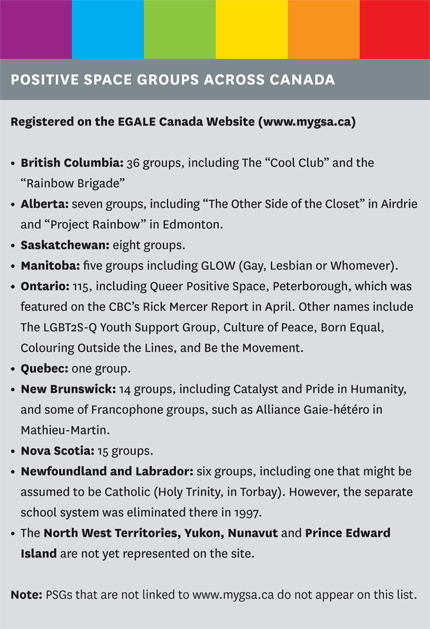
Some of these PSGs have an online presence while others are invisible when searching through student club lists. Pauline Johnson Collegiate and Vocational School in Brantford has a Positive Space symbol right on its homepage with a link to information about upcoming PSG meetings, teachers you can talk to about the group, and some great video links. Rainbow Alliance at a Vancouver school has a video from its 2012 Pink Project, where 1,500 students from Vancouver danced to Lady Gaga’s “Born this Way”.
Not all schools and school systems have been receptive to the concept of PSGs. Premier Dalton McGuinty’s introduction of an amendment to the Education Act to make GSAs mandatory in all Ontario secondary schools, public and Catholic, sparked intense debate in the Separate School system. The response from the Catholic boards has been to ban any reference to sexual orientation or “rainbow” in the group name, and to allow only groups that focus on broader diversity issues.
Benefits for Both LGBTQ Students and Allies
The isolation experienced by LGBTQ youth, who are closeted in all or parts of their lives, leads to a higher rate of alcohol and drug use, smoking, mental health issues, and suicide.2 In a focus group with 15 youth for a Needs Assessment on LGBTQ people in Hamilton, three had already attempted suicide because of feelings of isolation. Although the research to date has been limited on this population in general, national studies in the U.S. and Canada show that LGBTQ youth are three to six times more likely to commit suicide than their straight counterparts and that 30 percent of all completed youth suicides are related to issues of sexual identity.
The isolation experienced by LGBTQ youth, who are closeted in all or parts of their lives, leads to a higher rate of alcohol and drug use, smoking, mental health issues, and suicide.
The Gay, Lesbian and Straight Education Network (GLSEN) has been conducting an annual National School Climate Survey in the U.S. since 1999. In 2009, they reported on the experiences of 7,261 middle and high school students and found that nearly nine out of 10 LGBTQ students experienced harassment at school in the past year, and nearly two-thirds felt unsafe because of their sexual orientation. The survey results verified that homophobia and transphobia are having detrimental impacts on student achievement and academic success.
The good news was that students in schools with GSAs reported hearing fewer homophobic remarks, experienced less harassment and assault because of their sexual and gender orientation, and were more likely to report incidents of harassment and assault to school staff. They were also less likely to feel unsafe because of their sexual orientation or gender expression, were less likely to miss school because of safety concerns, and reported a greater sense of belonging to their school community.
A homophobic environment has an impact on academic performance, as well. The reported grade point average of students who were more frequently harassed because of their sexual orientation or gender expression was almost half a grade lower than for students who were less often harassed. There is no reason to believe that the experience of LGBTQ youth in Canada would be much different in any of these areas.
In fact, EGALE Canada has replicated some of that research in its first national study in 2011, “Every Class in Every School: The First National Climate Survey on Homophobia, Biphobia, and Transphobia in Canadian Schools”. Both LGBTQ and non-LGBTQ students completed the survey.
- Almost two thirds (64 percent) of LGBTQ students and 61 percent of students with LGBTQ parents reported that they fell unsafe at school.
- The two school spaces most commonly experienced as unsafe by LGBTQ youth and youth with LGBTQ parents are change rooms and washrooms.
- 70 percent of all students (LGBTQ and non-LGBTQ) reported hearing expressions such as “that’s so gay” everyday in school and almost half (48 percent) reported hearing remarks such as “faggot,” “lezbo,” and “dyke” everyday in school.
- Almost 10 percent of LGBTQ students reported hearing homophobic comments from teachers daily or weekly. Even more LGBTQ students (15 percent) heard teachers use negative gender-related or transphobic comments daily or weekly.
- More than a third of youth with LGBTQ parents reported being verbally harassed about the sexual orientation of their parents.
- More than one in five LGBTQ students reported being physically harassed or assaulted due to their sexual orientation.
- Over a quarter of youth with LGBTQ parents reported being physically harassed about the sexual orientation of their parents.
While the Canadian findings identify high rates of homophobic and transphobic verbal and physical harassment, they also found that Safer Schools Policies can have an impact in reducing harassment.
While the Canadian findings identify high rates of homophobic and transphobic verbal and physical harassment, they also found that Safer Schools Policies can have an impact in reducing harassment.
The Role of Safer Schools Policies and PSGs
The EGALE research identified that “generic safe school policies that do not include specific measures on homophobia are not effective in improving the school climate for LGBTQ students.” In fact, “LGBTQ students from schools with anti-homophobia policies reported significantly fewer incidents of physical and verbal harassment due to their sexual orientation.
Students from schools with PSGs (both LGBTQ and non-LGBTQ) are much more likely to
- agree that their school communities are supportive of LGBTQ people;
- be open with some or all of their peers about their sexual orientation or gender identity;
- see their school climate as being less homophobic.
Supports for Ally Teachers
The Ontario Positive Space Teacher’s Association (OPSTA) is an organization committed to helping teachers “transform Ontario schools into learning environments that explicitly welcome, respect, include, support, inspire, and reflect LGBTQ students through their policies and practices.”
Started last year by five teachers from the HWDSB, this group functions mainly through an online presence (www.opsta.com). The site provides a wealth of resources available for students, parents, and teachers to help create Positive Space in their secondary schools.
Given evidence of the powerful impact of the LGBTQ Positive Space movement for LGBTQ students, students with LGBTQ parents (or other family members), and allies, it’s high time the leadership in every secondary school took on the task of ensuring PSGs are up and running. Both the research and resources are there to support this action. Then we can move on to elementary schools, where the conversation needs to start.
EN BREF – L’isolement vécu par les jeunes LGBTQ, dissimulant leur orientation sexuelle dans une partie, voire la totalité de leur vie, accroît leur taux de consommation d’alcool, de drogues et de cigarettes, ainsi que les problèmes de santé mentale et de suicide. Selon des études nationales américaines et canadiennes, les jeunes LGBTQ sont de trois à six fois plus susceptibles de se suicider que leurs pairs hétérosexuels et 30 pour cent des suicides chez les jeunes se rapportent à leur identité sexuelle. Toutefois, les élèves fréquentant des écoles où il y a des alliances entre gais et hétérosexuels disent entendre moins de remarques homophobes, subir moins d’intimidation et d’attaques liées à leur orientation sexuelle et être plus enclins à rapporter des incidents d’intimidation et d’agression au personnel scolaire. Ils ont moins tendance à éprouver de l’insécurité due à leur orientation sexuelle et s’absentent moins de l’école. Ils ressentent aussi un plus grand sentiment d’appartenance à leur milieu scolaire.
1 Deirdre Pike, Creating and Supporting LGBTQ Positive Space Groups in the Hamilton Wentworth-District School Board – A Resource Guide for Secondary School Administrators, Teachers, and Support Staff (2010), 8. www.sprc.hamilton.on.ca/reports.php)
2 A. Peterkin and C. Risdon,Caring for Lesbian and Gay People: A Clinical Guide (Toronto: University of Toronto Press, 2003)
-
Being LGBTQ In Today’s High School
Comments Off on Being LGBTQ In Today’s High SchoolInterview excerpts with Deirdre Pike, author of The Gift of Positive Space Groups: A Transformation for LGBTQ Students.
-
Cdn EdWire – A New Year’s Hodge-Podge of Contentious Education Issues Fill the Dailies
Comments Off on Cdn EdWire – A New Year’s Hodge-Podge of Contentious Education Issues Fill the DailiesMinister launches school reforms – Edmonton Journal
Shorter bus rides, community facilities, college credits in high school included in Lukaszuk’s 10-point program
Opening of specialized schools reignites fairness debate – Globe and MailJody Carr cuts school districts to 7 – CBC NB
Education reform will save $5 million annually
Official bilingualism costs $2.4B a year: study – National PostOTHER NEWS
Apple pushes education content to boost iPad use in schools – Vancouver Sun
Education minister plans Twitter chat Thursday to get education reform feedback – Vancouver Sun
Public schools expel junk food – Calgary Herald
Cafeterias go chip-freeNo more ‘A for effort’: New wave of educators drop empty praise – Globe and Mail
Teachers seek hefty salary hike – Vancouver Sun
Minister says 15-per-cent increase a non-starter – Vancouver SunParents don’t have time to help kids learn, poll finds – CTV
Sell value of good education to your children – Globe and Mail
Kindergarten in a retirement home proves a hit with young and old – Globe and Mail
EDUBLOG HIGHLIGHTS
Education and Social Media in British Columbia – Culture of Yes
In the past year we have moved from several dozen blogs around K-12 education, to numbers in the hundreds, with representation in every area of the education system. The #bced tag on Twitter is one of the most engaged with conversations about the ever-changing education profession, and there are many other social sites having these conversations as well.The conversations around the profession itself are very interesting. In social media, ‘role’ becomes less important; there is a flattening of society and it is ‘ideas’ that have increased value. There are also incredible opportunities to reflect, share, and learn without the limitations of geography. I could go on, and there have been many others who have covered the ground about the value of social media for educators, and how Twitter and blogging can be extremely powerful in professional development…(Read more)
Relationships are Priceless – 4 moms 1 dream
It is easy to build working relationships between principals, educators and support staff because they work day in and day out together. But where do parents fit into the relationship equation? We know from experience that it is often very hard for parents to make the first steps to build the type of relationship we are talking about so we would ask you, as the educators, to take that first step. Start by greeting parents at the door as they come into the school. Say hello, introduce yourself, ask how their children are doing that day and build from there. Don’t wait until there is a problem before reaching out to the parents. Relationships take time and they are easier to make when there is not an issue/problem to address. If you can build those relationships when times are good, the problems that might arise when times are not so good are much easier to handle. As well, when you have a good relationship with everyone who has a vested interest in ensuring success for each child, you become part of the solution…(Read more) -
Investing in human development
Comments Off on Investing in human developmentIt is odd that the mantra of ‘raising the bar and closing the gap’, is a policy imperative in Canada, yet claims made about overall improvement (raising the bar) are generally not accompanied by any assessment of whether we’re closing the gap. The important census work of the Toronto District School Board would suggest that we have not[1]. The achievement hierarchy is the same as it was some forty years ago.
(more…) -
Canadian Education Wire – Effects of Ministerial Belt Tightening Felt by Current and Would-be Teachers
Comments Off on Canadian Education Wire – Effects of Ministerial Belt Tightening Felt by Current and Would-be TeachersTwo-thirds of new teachers can’t find full time work – Macleans
Teaching grads face slim prospects in crowded job market – Vancouver Sun
Man considers abandoning dream of teaching – Fredericton Daily Gleaner
Hundreds of teachers lost to budget cuts – Edmonton Journal
Nunavut education department seeks $18M boost – Nunatsiaq News
Group says it might sue over education cuts – Fredericton Daily Gleaner
What news am I missing? Can you recommend some education blogs for me to follow? Please tweet me at @max_cooke, e-mail me at mcooke@cea-ace.ca or better yet, use the comment box below to suggest additional articles happening in your region so that others can check it out.
OTHER EDUCATION NEWS
Does year-round schooling make the grade? – Globe and Mail
Give students shorter summer holidays – Globe and Mail editorial
Ottawa to support Inuit-English schooling – Canadian Press
Iqaluit’s French-language school spreads its wings – Nunatsiaq News
Many teens tap web for sex education: study – Canadian Press
Choice of school sets stage for kids – Saskatoon Star Phoenix
Full-day, all-day kindergarten a growing consideration for parents of young childrenNew agreement reached for special needs students – Montreal Gazette
Slave Lake grads scattered in aftermath of fire – Edmonton Journal
Grade 10 literacy scores at lowest in four years – Ottawa Citizen
Why teaching your kids to write (not just type) is important – Globe and Mail
EQ over IQ: How play-based learning can lead to more successful kids – Globe and Mail
Betrayed? Halton parents fume over high school proposal – Toronto Star
EDUCATION BLOG HIGHLIGHTS
For you or for me? – The Principal of Change (George Couros)
…But if both models work (Google and Microsoft – sic), why would we change our schools from the traditional model (Microsoft) to the more comfortable, yet still innovative (Google) model? There is often this feeling that “work” has become a dirty word to many of our students, but it also seems that to many work is not something that makes you happy. Why can’t you have both? Why can’t we do amazing and innovative things, that are hard work, and enjoy it? Sounds like flow to me. When people are engaged and enjoy what they are doing, doesn’t the work and their own sense of value and purpose increase? This doesn’t only make what we do better, but it makes why we do it more important.The Power of “THE NETWORK” – Culture of Yes (Chris Kennedy)
We spend a lot of time talking about how our network influences our professional lives and how technology often assists in that networking. But, when B.C. educators talk about “THE NETWORK” it means something quite different.For more than a decade, the Network of Performance Based Schools – school-based teams with an administrator and teachers – have focussed on B.C. Performance Standards with some of the deepest, most powerful professional learning in our province.
Instrumental to this professional learning, Judy Halbert and Linda Kaser have brought a network of teachers and administrators together in ongoing conversations about improving education opportunities for all students.
-
Including the Excluded: De-Marginalizing Immigrant/Refugee and Racialized Students
Comments Off on Including the Excluded: De-Marginalizing Immigrant/Refugee and Racialized StudentsIdentities, Identification, and Marginalization
Why do Identities Matter?
Identity is about connection with others. It is about a sense of rootedness to particular places, cultures, histories, contexts, and politics. It is also about comparisons based on perceived similarities and differences, and the concomitant demarcation through identity construction and negotiation of social boundaries that serve to either include or exclude individuals and groups from access to social resources and statuses.
For young people, the development of their identities as unique individuals is an integral part of their identity formation across the developmental trajectory. This process occurs within societal contexts that seek to include, marginalize, or exclude both individuals and the social groups to which they are seen to belong. Various cultural, racial, religious, linguistic, national, age, sex/gender, socio-economic (class), territorial, and other identification criteria are used in these personal and social identification processes, all of which reflect various types of commonality or difference deemed socially salient at the time. The corresponding identity “markers” serve at once to affirm oneself and the relevant collectivity, while simultaneously demarcating “I – you” and “we – they” boundaries. The resulting personal and social identities may be myriad and complex; they may intersect or overlap; they are in constant flux, as they are constructed, negotiated, and sometimes even contested. They may also intersect with disadvantaged minority statuses in ways that either intensify oppressions and marginality or empower individuals to work for social change and transformation.[1]
Youth’s personal and social identities are critically important in the learning process. They affect not only how our young people see themselves, but also how they are perceived by both educators and school peers, how they engage with schooling, and how they themselves produce knowledge about everyday experiences. This begs the questions: What role do we play as educators and education researchers in these identification processes? How does the way that we see – or don’t see – the personal identities and lived social realities of our students affect them, particularly in their learning and educational outcomes? What might be our own complicities in processes of social inclusion or exclusion of our students, particularly of our culturally diverse and/or racialized youth? How does this impact them? How might we best understand students’ responses accordingly? Most importantly, what can we do to break existing patterns of social dislocation and marginalization to ensure the educational success – and associated life outcomes – of all of our students?
Marginalization is a process, not a label – a process of social de-valuation that serves to justify disproportional access to scarce societal resources. As social actors, we do this to others.
What is Marginalization? Who Does It? To Whom?
The word “margin” comes to us from the Latin word margo, meaning “edge”, and with time has come to also convey a sense of “little effect or importance”.[2] “To marginalize” is an active verb; it is something that is done by someone to someone else. In the case of “marginalized” students, it is educators, teachers, along with other adults and peers, who – through their identifications, their “seeing” and “not-seeing”, their social inclusion or exclusion – relegate certain individuals and social groups toward the edge of the societal boundary, away from the core of import. Marginalization is thus a process, not a label – a process of social de-valuation that serves to justify disproportional access to scarce societal resources. As social actors, we do this to others. Because of our own agency, we can also change this.
“we’re relegated to this label and there’s no way to move out of it…”**
What characterizes the experiences of a child who is so excluded? How exactly does marginalization occur? Who are the marginalized youth so affected? Are some more likely than others to experience social devaluation, invisibility, silencing, unresponsiveness, and inaction?
A marginalized child is a child
- whose social location is not understood and whose identities are contested or denied;
- whose life circumstances are not known and not considered;
- whose voice is not heard or has been silenced;
- whose needs have been left unfulfilled;
- whose promise is not recognized and whose protest is ignored.
In theory, social exclusion or inclusion via recognition or denial of shared commonalities may affect any child. In practice, they disproportionately affect youth sub-populations whose “otherness” is most apparent. These social “others” include our newcomer immigrant/refugee, ethno-culturally diverse, and racialized students.
Contested Identities
Why is it important to look at identity, identification, and marginalization among newcomer, immigrant/refugee, and/or racialized students? The answer is threefold. First, our educational system and structures need to be responsive to changes in the composition of Canadian society. Second, diverse youth sub-populations may face unique challenges that affect their educational trajectories and thus have distinct needs. Third, identification processes – particularly for contested identities – affect learning, and thereby the educational performance and associated life outcomes of our youth.
Increasing Societal Diversity and Complexity
Canadian society is becoming increasingly complex along cultural, linguistic, and racial lines. One in five of all Canadian children under the age of 15 is a new immigrant or a refugee. An increasingly significant youth sub-population in Canada, immigrant and refugee youth are culturally diverse, with backgrounds reflecting any of 247 diverse ethno-cultural origins[3] as well as various world regions in Asia, the Caribbean, South and Central America, the Middle East, and Africa.
Almost three quarters (73 percent) of immigrants who arrived between 2001 and 2006 are members of diverse visible minority populations. These new migrants join longer established racialized populations that include our African and Asian Canadian communities as well as our aboriginal First Nations peoples. It is estimated that by 2016 Canada’s visible minority population will account for one fifth of the total population – and one quarter of all of Canada’s children. These figures are already much higher in larger urban centres; it is estimated that close to half of all elementary and secondary school students living in Toronto are from racialized minority populations. The majority are first- and second-generation immigrants and refugees from Asia, the Caribbean, South and Central America, and Africa.[4]
Unique Challenges Faced by Each Youth Population
Both immigrant/refugee and racialized youth face unique challenges when compared to their school peers, challenges that extend well beyond those associated with the mastery of the curriculum content and requirements. Newcomer immigrant and refugee youth grapple not only with learning a new language but also with numerous resettlement stresses. The latter include difficult migration experiences and trajectories, linguistic barriers, acculturation difficulties, adaptation challenges, and experiences of social isolation. A key resettlement challenge often faced by newcomer families is the difficult labour market integration of the parents, including parental unemployment, underemployment, and/or double shift work, stressors that readily translate into financial distress, parental absences, and the concomitant need for young newcomer youth to assume adult roles and responsibilities at home. At school, non-recognition of prior schooling, interruptions or changes in schooling, differential educational levels, lack of familiarity with the Canadian school system and practices, mismatches between home-school cultural values, and unwelcoming school environments often present additional challenges for these students.[5]
“I never thought I’m gonna skip, quit school and stuff, but the way [the Principal] was to me, he was never like that to other people you know”*
Many immigrant and refugee students, moreover, do not speak the language of instruction as their mother tongue and/or speak a heritage language at home. In Toronto alone, close to half of secondary students are non-native English speakers; a full two-thirds of these are recent newcomers who speak English as a second language.[6] In all, between 20 and 50 percent of the school population in Canada’s large urban centres are non-English speakers. Linguistic mastery of an official language by newcomer students is essential to student learning, social integration, academic performance, and successful transition into the Canadian labour force. The risk of early school leaving prior to high school completion for English-as-a-Second-Language students is two to three times higher than it is for other youth.[7]
“The main problem was my language.”*
Our racialized visible minority youth, both newcomer and Canadian-born, grapple with negative societal messages and stereotypes, negative school climates that alienate minority students, negative student-administrator relationships, unfair/arbitrary/ineffective discipline systems, inequitable school structures and systems, as well as a school curriculum that does not reflect their lived realities and experiences. These visible-minority students are furthermore over-represented in families from the lower socio-economic bracket – 63 percent versus 38 percent for “non-visible” populations[8] – and need also to cope with the attendant risks and challenges associated with access to fewer resources, poverty, and social-stigmatization.
“Teachers…they seen the skin colour, they want to pick on you. I think the main issue those people pick on me is because of my skin.”*
Marginalized Identities and Learning
How do identities affect learning? Are there links between various marginalized identities and educational outcomes?
Identity is an important site of knowing. It is, in effect, a lens through which one reads and responds to one’s world. Young learners understand everyday issues in their homes and communities in terms of who they are, who they are seen to be, where they feel they belong and are allowed to belong. They make sense of and assign meaning to these lived experiences in ways that are very much connected to their particular histories and realized within societal contexts and social spaces. It is precisely for this reason that minority learners often lament the absence of diversity in teacher representation within their schools, indicating there is something beyond educators’ knowledge, skills, and capacities that is important to the teacher-student dyad. The background of an educator is as relevant as that of the learner in making sense of knowledge and teaching and learning.[9] We all speak from particular social locations, experiences, and histories; this is true of our students, and it is true of us as educators as well. Not to recognize this fact is to “push into the margins” the lived realities and life prospects of those who are “not like us”.
“[The students of the school are] mostly Black right now…the teachers mostly White.”*
The existing research literature clearly points to differential educational outcomes both across different immigrant and refugee populations and between foreign-born and Canadian-born children and youth. Research exploring issues in minority youth education reveals that students themselves point to connections between identity, representation, schooling, and knowledge production, and that the need to feel connected to school and to identify with the curricular, instructional, and pedagogical practices that they find there is critical to their educational success.[10] A school system that fails to recognize and tap into youth’s myriad identities and most salient identifications as valuable sources of knowledge is one that shortchanges learners.
“They assessed me wrong, because they put me in … Grade Ten, right, and I was supposed to be in Grade Twelve.”*
” I didn’t really feel like I belonged.”*
Complicities and Responses
As educators and education researchers, we need to ask ourselves about our own complicities in the selective de-centering, dislocating, and fragmenting of youth identities. What do we do to marginalize our own students, through our “self-other” identifications, representations, and selective dislocation? How can we best understand student responses accordingly? What is it that we don’t do – or haven’t yet thought to do – to create and sustain an educational system that is more truly inclusive of all of our children?
Understanding Student Responses: Resistance, Resilience, and Re-Valuation
Our failures to tap into the rich histories and community reservoirs of knowledge resident in our learners often leads to a desire and push, particularly among minority students, to reclaim their own cultural, racial, and/or religious identities and associated “ways of knowing”. Such strategic claims for plurality and difference in marginalized spaces within schooling and education constitute political forms of youth resistance to pressures for conformity, sameness, and mainstreaming. To better understand youth resistance to their marginality and concomitant agency to produce change, it is therefore necessary to situate their responses in the “cultural politics of schooling”.
They resist and respond as and where they can…this resistance often takes various forms of protest and affirmation of lived experiences, cultures, histories, and social realities … a re-valuation of precisely those identities being contested.
It is important to understand how youth understand, articulate, and respond to their marginality and why they do so. Students who have been effectively marginalized can often readily identify those moments that negate their self, personhood, and collective identities. They are also very much aware that processes of inclusion and exclusion are organized through particular identities, and that these processes not only affect them as individuals but extend beyond to the population categories or social groups with which they are identified and/or themselves identify. Many minority students are moreover very much in tune with the “politics of representation”, as well as attempts to individualize processes of exclusion in ways that effectively hamper their articulation of a shared, collective experience about schooling that is itself often muted, negated, dismissed, or de-legitimized. We cannot understand marginality outside the context of minority youth students’ resistance and resilience that seeks to reclaim newcomer, visible minority, or aboriginal identities as political and subversive. They resist and respond as and where they can. In the context of every day marginalization and marginality, this resistance often takes various forms of protest and affirmation of lived experiences, cultures, histories, and social realities … a re-valuation of precisely those identities being contested.
“The teachers …don’t treat me the same as Portuguese people. I wouldn’t say racist because there are Black people there too. They just don’t like new people … a new kind of race coming in.”*
Educator Responses: Including the Excluded
If we are to equip all learners with the requisite tools to function in contemporary society, the issue of marginality and youth resistance in education must be fully addressed. As educators, we must bring a critical understanding to youth marginality and resistance … and then act upon it. To do this we need to better understand, consider, and respond to the social location and life circumstances of our diverse students. We need to acknowledge both their social and personal identities, listen attentively to their voices, seek to address unique needs associated with social location, and understand the sources of their resistance or protest. Most of all we need to unfailingly recognize the inherent potential in each learner and ever strive to see this potential fully realized.
“The role teachers have cannot be underestimated. Just having some kind of approval… that kind of affirmation goes a long way.”**
For our newcomer immigrant and refugee students, this means understanding that mastery of the language of instruction is critical. Migration and resettlement stresses can also present daily challenges, particularly for recent newcomers. The need for both parents to work long hours, often at multiple jobs, can readily translate into less parental presence and supervision, as well as increased responsibility for care of younger siblings and household tasks; parental underemployment can in turn lead to the need for youth employment to help support the family. Teachers, principals, vice-principals, counselors, and school staff who understand these unique challenges can more effectively support their students in their educational trajectories. Initiatives that make a real difference include: assessment and recognition of previous academic accomplishments; strong, secure, sustained English-as-a-Second-Language programming; administrator, teacher, staff awareness training; facilitation of integration within the school; support linkages to relevant social and/or resettlement services; outreach to parents and communities; and implementation of cultural competence within the classroom. For older students, school flexibility in terms of balancing family/work/home/school responsibilities is often key to ensuring successful educational outcomes.
“You do better when you have more support from home. My parents try but they’re new to this country also, and it’s hard for them and they have problems of their own.”*
For our racialized visible minority students, an educational curriculum that is relevant to lived experiences and reflective of diversity is key. School programming needs to be sophisticated enough to allow students to engage the complexities of their daily existence. Rather than devalue or diminish the social histories, identities, experiences, and cultural or collective knowledge that our students bring with them to school, we need instead to incorporate them directly into the learning process itself.[11] Inclusive programming that reflects social histories, identities, and experiences with which they can relate allows each learner to feel not only welcome, but a true sense of deep belonging. Other factors that make a real difference include: anti-discrimination awareness, training, and strategies; a positive, inclusive school ethos; a climate of mutual respect between teachers and students; supportive principals, vice-principals, teachers, counselors, and school staff; building upon youth’s own hopes and aspirations.[12]
“I was just mostly lonely.*
Identifications based on race, culture, language, religion, class, and gender and their representations in schooling point to particular embodiments of being, social existence, and thus knowledge production. By recognizing that learners’ identities are important not only to understanding the complexities of our world today but also to the actual learning process itself, we can help to ensure better educational outcomes for all our youth. What will you do?
This article is based on papers originally presented at the “Marginalized Youth and Contemporary Educational Contexts” hosted by the Community Health Systems Resource Group, The Hospital for Sick Children, 2009.
*For source of student comment, see reference cited in endnote 12.
**For source of student comment, see reference cited in endnote 9.
EN BREF – L’identité personnelle et sociale des jeunes se répercute sur leur façon de se voir, sur la manière dont ils sont perçus par les éducateurs et leurs pairs à l’école, sur leur engagement scolaire et sur la façon dont ils produisent des savoirs par suite d’expériences de tous les jours. L’exclusion sociale fondée sur des identités partagées affecte de manière disproportionnée les jeunes dont l’altérité est la plus évidente. Si nous voulons fournir à tous les jeunes les outils nécessaires pour fonctionner dans notre société contemporaine, nous devons acquérir une compréhension critique de la marginalité et de la résistance des jeunes… puis y donner suite. Pour ce faire, nous devons reconnaître leurs identités sociales et personnelles, écouter attentivement leurs voix, chercher à répondre aux besoins particuliers découlant de leur lieu social et comprendre les sources de leur résistance ou de leurs protestations. Et surtout, nous devons reconnaître sans faute le potentiel inhérent de chaque apprenant et constamment nous efforcer d’atteindre pleinement ce potentiel.
[1] J. A. Rummens, “Identity and Diversity: Overlaps, Intersections and Processes,” Canadian Ethnic Studies 35 (no. 3, Special Issue: Intersections of Diversity): 2003:10-25.
[2] On-line Etymology Dictionary. www.etymonline.com
[3] National population statistics are from the 2006 Canadian census.
[4] M. Cheng and M. Yau, The 1997 Every Secondary Student Survey: Detailed Findings #230 (Toronto: Toronto District School Board, 1999).
[5] J. A. Rummens, K. Tilleczek, K. Boydell, and B. Ferguson, “Understanding and Addressing Early School Leaving Among Immigrant and Refugee Youth,” in Why Do Students Drop Out of High School? Narrative Studies and Social Critiques, ed. Kate Tilleczek (Edwin Mellen Press, 2008), 75-101.
[6] Cheng and Yau.
[7] People for Education, Quick Facts – Support for ESL Students (Toronto, 2006). Accessed in 2008 from www.peopleforeducation.com
[8] Cheng and Yau.
[9] G. J. S. Dei with Alana Butler, Gulzar Charania, Anthony Kola-Olusanya, Bathseba Opini, Roslyn Thomas, and Anne Wagner, Learning to Succeed: The Challenges and Possibilities of Educational Development for All (New York: Teneo Press, 2010).
[10] G. J. S. Dei, L. Holmes, J. Mazzuca, E. McIsaac and R. Campbell, Push Out or Drop Out? The Dynamics of Black Students’ Disengagement from School. Final report submitted to the Ontario Ministry of Education and Training, Toronto, 1995; G. J. S. Dei, J. Mazzuca, E. McIsaac, and J. Zine, Reconstructing ‘Dropout’ (Toronto: University of Toronto Press, 1997).
[11] G. J. S. Dei, M. James, Sonia James-Wilson, L. Karumanchery, and J. Zine, Removing the Margins: The Challenges and Possibilities of Inclusive Schooling (Toronto: Canadian Scholars’ Press, 2000); G. J. S. Dei, S. James-Wilson, and J. Zine, Inclusive Schooling: A Teacher’s Companion to Removing the Margins (Toronto: Canadian Scholars’ Press, 2002).
[12] B. Ferguson, K. Tilleczek, K. Boydell, Joanna Anneke. Rummens, Dara Roth Edney, and Daniel Coté, Early School Leavers: Understanding the Lived Reality of Student Disengagement from Secondary School (Ontario Ministry of Education, May 30, 2005). www.educ.gov.on.ca/eng/parents/schoolleavers.pdf


IDEAS TO SUPPORT EDUCATORS : Subscribe to the EdCan e-Newsletter
Quality research, reports, and professional learning opportunities.