
Archive
-
Perfect Practice Makes Perfect
Comments Off on Perfect Practice Makes PerfectIt was the first week of classes and the Chemistry 11 students were busy reviewing the core concepts from junior science. Most students were sailing through the review because of the strong junior science program in our school. Randy, on the other hand, was a different story.
-
What is Child and Youth Mental Health?
Comments Off on What is Child and Youth Mental Health?Mental Health is defined as a state of well-being in which every individual realizes his or her own potential, can cope with the normal stresses of life, can work productively and fruitfully, and is able to make a contribution to her or his community.1
Mental health problems:
- Are emotional, behavioural and brain-related difficulties that may have a negative impact on a student’s well-being;
- Interfere with the student’s functioning at school, at home, in the community, and in social settings;
- Affect the student’s development, school attendance, academic achievement, and relationships with family and friends.
A mental health problem that is severe, persistent, and causes impairment in daily life is called a mental health disorder or mental illness. It is helpful to think of mental health as occurring along a continuum.
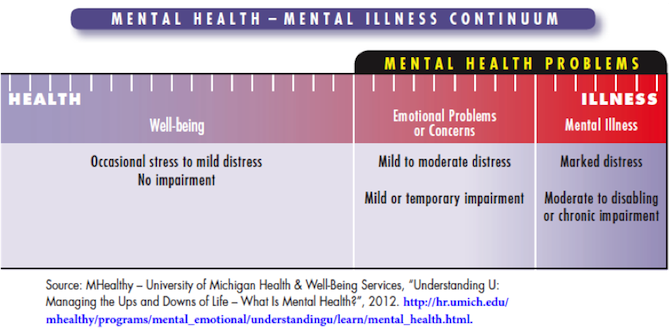
How Common are Child and Youth Mental Health Problems?
Most estimates place the rate of mental health problems at about 18-23% of the student population. An easy way to remember how many students are affected by significant emotional difficulties is the “one in five” statistic. This means that in any given classroom of 25-30 students, there may be 5 to 7 students who struggle with behaviour and emotions to a degree that will interfere with their academic performance.
What do Mental Health Problems Look Like?
Mental health problems vary greatly in how they look. A useful way of thinking about them is to divide symptoms into two broad areas:
- externalizing problems, or behaviours like aggression, impulsivity, and non-compliance, and;
- internalizing problems, or emotional states like sadness and anxiety and behaviours like social withdrawal.
Although organizing the clusters of symptoms is useful, in real life mental health problems do not fall neatly into specific categories. Often symptoms that are associated with one disorder are also symptoms of other disorders, and, to complicate things further, disorders tend to travel together. This is called co-morbidity. Approximately 45% of children and youth with one mental health disorder are likely to have another area of difficulty as well (e.g., depression AND anxiety, ADHD AND oppositional defiant disorder).
Given how complex mental disorders are, in Ontario the only professionals who are qualified to diagnose mental health problems are physicians (including psychiatrists) and psychologists. School boards may have mental health professionals on staff who can diagnose, but many communities require a referral to children and youth mental health services.
What Mental Health Problems Are Most Likely Seen at School?
Some child and youth mental health problems are more common than others. Specifically, difficulties with anxiety, behaviour, and mood are most prevalent amongst Canadian children. Within the school context, teachers often notice emotional and behavioural difficulties associated with learning.
Within the school context, teachers are able to observe students consistently over an extended period of time. As well, they ‘see’ students in the context of other students. As such, teachers are in a unique position to notice emotional and behavioural difficulties associated with learning, and to notice when there are changes in a student’s behaviours.
Following is a list of specific student behaviours which teachers may notice and which might indicate the presence of mental health difficulties:
- social isolation
- inattention
- weak social skills
- strong emotional reactivity
- aggression
- hyperactivity /impulsivity
- poor frustration tolerance
- changes in behaviour or mood
Other general signs that a student may be struggling are when the student’s emotions and behaviour are not age appropriate, the behaviour is dramatically different from that of the student’s peers, and the duration of the behaviour appears to be excessive.
Because some mental health difficulties occur at different times in a student’s development, some types of problems are more commonly seen in primary, junior and intermediate settings, while others are most prevalent within secondary schools. Untreated problems can become more pronounced over time, and, as a result, secondary school educators are more likely to observe more serious mental health difficulties amongst students than elementary school educators. Secondary school personnel in particular, should be alert to the potential role of addictions in student emotions and behaviour at school.
Adapted from: Leading Mentally Healthy Schools: A Resource for School Administrators (School Mental Health – ASSIST, 2013) and Supporting Minds: An Educator’s Guide to Promoting Students’ Mental Health and Well-Being (Ontario Ministry of Education, 2013)
Notes
1 World Health Organization http://www.who.int/features/factfiles/mental_health/en
-
The Power of Engaged Reading
Comments Off on The Power of Engaged ReadingReading with pleasure, and especially reading fiction, is far more important than we have ever imagined.
If I were a father living in poverty, I would dedicate myself to encouraging my children to be engaged readers of relevant, age-appropriate fiction. If I were a school teacher, I would dedicate my professional development time to learn strategies to promote and develop engaged readers of meaningful and relevant novels, short stories and drama, no matter if I was a Grade 1 teacher or Grade 12 Physics teacher. It is the most important thing I could do for a child, especially a boy.
A perplexing issue within this broad realization is the disturbing disconnect between boys and reading. It verges on a problem of epidemic proportions. Finding ways to develop engaged readers is important for every child, but particularly for boys.
The state of Arizona forecasts the number of future prison cells needed based on Grade 4 state reading scores.[1] Perhaps we should examine what they know that we may not. Increasingly, new research across many countries is showing that the best predictor of future education achievement and life success is reading ability – or, more significantly, being an engaged reader. (The engaged reader, according to Guthrie, is “purposeful, intrinsically motivated, and socially interactive.”[2]) While most research has shown, for example, that family income is the best predictor of who goes to college, Ross Finnie and Richard Mueller at the University of Ottawa have shown that “the largest determinant of university participation, however, is the score on the reading portion of the PISA.”[3] Those reading scores proved to be by far the best predictor of post-secondary attendance, even pre-empting family income and parental education.
The connection between engaged reading and life success is, in a way, intuitive. But Timothy Bates and Stuart Ritchie, at Edinburgh University, have proven the connection between reading well and future job success empirically. They analyzed the relationship between early reading skills at seven and later socio-economic life, following more than 17,000 people in England, Scotland and Wales over 50 years from 1958. They showed that reading well at age seven was a key factor in determining whether people went on to get a high-income job. Reading level at age seven was linked to social class even 35 years on. “Children with higher reading and maths skills ended up having higher incomes, better housing and more professional roles in adulthood,”[4] the authors concluded.
By contrast, 79 of 100 people entering Canadian correctional facilities don’t have their high school diploma; 85 percent of them are functionally illiterate, and the vast majority are male.[5]
In his study of 4th Graders, John Guthrie at the University of Maryland found that engaged readers from homes with few material advantages routinely outperformed less engaged readers from the most advantageous home environments. “Based on a massive sample, this finding suggests the stunning conclusion that engaged reading can overcome traditional barriers to reading achievement, including gender, parental education, and income.”[6] This is a remarkable finding as we continuously search for ways to narrow the gap between the achievement of the advantaged and the disadvantaged children in society. Literacy is the key to economic and social power, regardless of socio-economic class. As we consider the growing gender gap between boys and girls, it is even more important.
What about the boys?
The aggregate data masks a major problem that exists for boys. The gender gap is a central element in understanding the power of engaged reading. A recent Ontario Ministry of Education report on boys’ literacy[7] cites declining achievement and concludes that boys score lower than girls on all measures of literacy. There is a literacy gap between boys and girls from Grade 3 right through to Grade 12. Boys dominate behavioural and other special education classes and are twice as likely as girls to be diagnosed with an attention deficit or learning disability. They are more likely to be held back and to drop out. If they do graduate, they are less likely to attend college or university. If they do go to college, they get lower grades than female students and are less likely to graduate. Concomitant social factors are equally troubling. For example, suicidal behaviours are increasing in boys; boys are twice as likely to abuse alcohol[8] and have higher unemployment, crime, and incarceration rates.
I believe a major factor in this growing problem with boys is the exponential use of video games, especially violent ones. While playing video games may also have positive effects, Leonard Sax posits they are the major reason for boys’ declining reading scores, school achievement and increasing social problems. He argues in Boys Adrift, for example, that the evidence is unequivocal. The more time a child spends playing video games, the less likely he is to do well in school, at every level from elementary to college. But it is not just declining achievement, it is declining social behaviour as well. According to Sax, playing violent video games such as Doom or Grand Theft Auto “clearly and unambiguously causes young men to have a more violent self-image and to behave more violently”; playing violent video games leads directly “to aggressive behaviour, aggressive cognition, aggressive affect, and cardiovascular arousal, and to decreases in helping behaviour.” Boys who play these games, he argues, are more likely to engage in “serious, real-world types of aggression.”[9]
But engaged reading of fiction offers a powerful antidote to all these negative effects, particularly for boys.
The fiction factor
If all reading is helpful, reading fiction offers added benefits – in fact, astounding benefits! It has long been argued that reading great literature improves us as human beings. Neuroscience is proving this claim to be truer than we ever imagined. Functional magnetic resonance imaging (fMRI) studies show us that the same regions of the brain that are activated during a real event are activated while reading about it in a story. Reading a story produces a vivid replica of reality. Novels are not only a simulation of reality, but permit readers to enter viscerally into the thoughts, feelings, and problems of others.
Raymond Mar, at York University performed an analysis of 86 fMRI studies.[10] He found narratives in novels offer a unique opportunity to engage what is called “theory of mind.” He, along with Keith Oatley and others, reveal how we identify with the hopes, dreams and frustrations of the novel’s characters, speculate about their motives, and follow their relations, conflicts and activities with friends, lovers and family, the same areas of the brain are activated as when experiencing real-life issues. Literature allows not just learning about emotions, but experiencing them, It is a form of practice for real life. It is, both psychologically and practically, immensely beneficial.
It appears from this growing body of research that individuals who read fiction are better able to understand other people, empathize with them and see the world from their point of view. These researchers found a similar result in preschool-aged children: the more stories they had read to them, the keener their “theory of mind.” For example, five-year-olds exposed to egalitarian material showed more egalitarian responses on tests of stereotypes for women’s occupations that persisted over time. These results indicate an improved capacity to empathize with a marginalized group. Exposure to narrative fiction was positively associated with empathic ability, whereas exposure to expository non-fiction was negatively associated with empathy. Reading fiction not only leads readers to be more empathetic, but also leads to personal growth and improves us as individuals. Reading fiction, these researchers conclude, leads to self-understanding, a relevant key to improving ourselves. They call this effect the Self-Improvement Hypothesis, wherein “changes in selfhood can occur as a function of reading certain kinds of fiction.”[11]
The act of reading, particularly engaged reading as opposed to the mechanics of reading, is a powerful predictor of life success by any measure. It is the best predictor of who goes to university regardless of socio–economic background and parental education. It is the best predictor of life income, career options, even life partner choices. And neuroscience is proving that reading fiction is one of the most powerful means of developing sympathetic individuals, with better social skills and higher levels of self esteem, resulting in increasing self improvement and prosocial behaviours.
The converse, especially for unengaged young male readers, especially many of those engaged in long hours playing video games, is higher unemployment and dependence on social welfare, antisocial behaviours and increased crime rates.
So, what’s not to like? Let’s get our kids reading!
Photo: Jerry Diakiw
First published in Education Canada, March 2014
EN BREF – L’art de la lecture, particulièrement la lecture qui engage l’esprit par opposition à la mécanique de lecture, est un puissant indicateur du succès futur, quels que soient les critères utilisés. Non seulement prédit-il mieux qui fréquentera l’université – sans égard au statut socioéconomique et à la scolarisation des parents – c’est aussi le meilleur prédicteur des revenus futurs, des possibilités professionnelles et même des choix de partenaire de vie. La neuroscience confirme actuellement que lire de la fiction constitue l’une des meilleures façons de développer des personnes sympathiques possédant de meilleures habiletés sociales et une bonne estime de soi. L’inverse, particulièrement pour les jeunes garçons que la lecture n’engage pas et qui passent des heures à jouer à des jeux vidéo, prend la forme de taux accrus de chômage, de dépendance aux programmes sociaux, de comportements antisociaux et de criminalité. Jamais n’a-t-on eu des preuves aussi éloquentes du pouvoir que recèle une lecture qui engage l’esprit pour nos jeunes et leurs perspectives d’avenir.
[1] Arizona Republic , September 15, 2004, cited in Educational CyberPlayGround® Internet Database. http://www.edu-cyberpg.com/Literacy/stats.asp
[2] J. T. Guthrie, “Teaching for Literacy Engagement,” Journal of Literacy Research 36 (2004): 1-30.
[3] R. Finnie and R. E. Mueller, “The Backgrounds of Canadian Youth and Access to Post-Secondary Education: New evidence from the youth in transition survey,” in Who Goes? Who Stays? What Matters? Accessing and persisting in post-secondary education in Canada, eds. R. Finnie, R. E. Mueller, A. Sweetman and A. Usher (Montreal and Kingston: McGill-Queen’s University Press, 2008).
[4] S. J. Ritchie and T. C. Bates, “Enduring Links from Childhood Mathematics and Reading Achievement to Adult Socioeconomic Status,” Psychological Science 247 (July 2013): 1301-1308.
[5] Canadian Association of Chiefs of Police, “Target Crime with Literacy: The link between low literacy and crime.” http://policeabc.ca/literacy-fact-sheets/Page-5.html
[6] Guthrie, “Teaching for Literacy Engagement,” 5.
[7] D. Booth, S. Elliot-Johns and Fiona Bruce, Centre for Literacy at Nipissing University, Boy’s Literacy Attainment: Research and related practice (Ontario Ministry of Education, 2012. http://www.edu.gov.on.ca/eng/research/boys_literacy.pdf
[8] K. Morris, “Increase in Teen Boys’ Suicidal Behaviour Linked with Alcohol Misuse,” The Lancet 352, No. 9126 (Aug. 8, 1998): 459
[9] L. Sax, Boys Adrift: The five factors driving the growing epidemic of unmotivated boys and underachieving young men (Philadelphia: Basic Books, 2007).
[10] R. A. Mar, M. Djikic, and K. Oatley, “Effects of Reading on Knowledge, Social Abilities, and Selfhood,” in Directions in Empirical Studies in Literature: In honor of Willie van Peer, eds. S. Zyngier, M. Bortolussi, A. Chesnokova, & J. Auracher (Amsterdam: Benjamins, 2008), 127-137.
[11] Mar et al., “Effects of Reading on Knowledge, Social Abilities and Selfhood.”
-
What is the Value of Standardized Testing?
Comments Off on What is the Value of Standardized Testing?Standardized testing is a contentious issue in Canada, and internationally. Education in Canada falls within provincial jurisdiction and every province and territory develops its own curricula. Additionally, every province/territory conducts large-scale assessments at specific grade levels. Provinces and territories also participate at the national level in the Pan-Canadian Assessment Program (PCAP) and at the international level in the Programme for International Student Assessment (PISA).
There is a large body of literature about these large-scale standardized tests with no consensus on their effectiveness. However, while there is some support for standardized testing, overwhelmingly, research suggests that it does not lead to improved educational outcomes for students.
Arguments against standardized testing include:
- There is a tendency to “teach to the test”, which results in narrowing of the curriculum.
- The tests do not allow for linguistic or other cultural differences among students.
- There is the potential for subgroups of students to become lost within the overall numbers.
- Standardized testing leads to student disengagement.
- The tests do not adequately assess 21st Century skills such as creativity, technological ability, problem solving, or critical thinking skills.
Arguments in favour of standardized testing include:
- The opportunity for comparison of educational outcomes across schools, provinces, or countries.
- Results of standardized tests provide an opportunity to assess the strengths and weaknesses of the system.
- Offering a means to assess accountability.
- Provincial assessments provide a way to evaluate curricula and determine which schools/districts/regions are meeting goals.
Even proponents of standardized testing recognize the limitations of wide scale comparison due to the differences between countries, provinces, and even school districts. Some countries with the longest history of standardized testing recognize these limitations and their reliance on standardized testing is declining. In Canada, some provinces, such as Alberta and Ontario, have recognized the importance of adapting standardized testing to suit varying circumstances and to meet the needs of 21st century learners.
Methods such as problem based learning are at the forefront of curriculum design yet are not evaluated in standardized tests. Standardized testing is, therefore, counterproductive as it focuses on memory and knowledge acquisition rather than ability to apply learning. Educators and students should be provided with assessment tools to identify issues and gaps for individual students as well as schools and/or school districts, improve learning, increase capacity to be independent learners, promote goal-setting, and encourage reflection on learning. A balanced approach to student assessment includes standardized testing coupled with rigourous classroom assessment.
Websites
Programme for International Student Assessment (PISA)
http://www.oecd.org/pisa/aboutpisa/
The New Face of Standardized Testing in Schools – Canadian Family Magazine
http://www.canadianfamily.ca/kids/the-new-face-of-standardized-testing-in-schools/
References
Aydeniz, M., & Southerland, S. A. (2012). A national survey of middle and high school science teachers’ responses to standardized testing: Is science being devalued in schools? Journal of Science Teacher Education, 23(3), 233-257.
Azzam, A. M. (2009). Why creativity now? A conversation with Sir Ken Robinson. Educational Leadership, 67(1), 22-26.
Barrier-Ferreira, J. (2008). Producing commodities or educating children? Nurturing the personal growth of students in the face of standardized testing. Clearing House, 81(3), 138-140.
Bower, J. (2013). Telling time with a broken clock: The trouble with standardized testing. Education Canada, 53(3), 24-27.
Camacho, D., & Cook, V. (2007). Standardized testing: Does it measure student preparation for college & work? Online Submission, Retrieved from http://eric.ed.gov/?id=ED495251
Government of Alberta. (2013). Student learning assessments update. (Information Bulletin). Edmonton, AB: Author.
Government of Ontario. (2010). Growing success: Assessment, evaluation, and reporting in Ontario schools. Toronto, ON: Government of Ontario.
Haladyna, T. M. (2006). Perils of standardized achievement testing. Educational Horizons, 85(1), 30-43.
Harris, P., Smith, B. M., & Harris, J. (2011). The myths of standardized tests: Why they don’t tell you what you think they do? Lanham, MD: Rowman & Littlefield.
Hayden, M. J. (2011). Standardized quantitative learning assessments and high stakes testing: Throwing learning down the assessment drain. Philosophy of Education Yearbook, 177-185.
Hewson, K., & Parsons, J. (2013). The children in the numbers: Why aggregate achievement goals miss the mark. Education Canada, 53(3), 9-11.
Ickes-Dunbar, A. (2005). Testing, testing. Phi Kappa Phi Forum, 85(2), 3-9.
Kearns, L. (2011). High-stakes standardized testing & marginalized youth: An examination of the impact on those who fail. Canadian Journal of Education, 34(2), 112-130.
Klinger, D. A., DeLuca, C., & Miller, T. (2008). The evolving culture of large-scale assessments in Canadian education. Canadian Journal of Educational Administration and Policy, 76, 1-34.
Mora, R. (2011). “School is so boring”: High-stakes testing and boredom at an urban middle school. Penn GSE Perspectives on Urban Education, 9(1), 1-9.
Morris, A. (2011). Student standardised testing: Current practices in OECD countries and a literature review. (OECD Education Working Papers, No. 65).OECD Publishing.
Nelson, L. P., McMahan, S. K., & Torres, T. (2012). The impact of a junior high school community intervention project: Moving beyond the testing juggernaut and into a community of creative learners. School Community Journal, 22(1), 125-144.
Ozturgut, O. (2011). Learning by example: Standardized testing in the cases of China, Korea, Japan, and Taiwan. Academic Leadership (15337812), 9(3), 1-9.
Riffert, F. (2005). The use and misuse of standardized testing: A Whiteheadian point of view. Interchange: A Quarterly Review of Education, 36(1-2), 231-252. http://dx.doi.org/10.1007/s10780-005-2360-0
Visone, J. D. (2010). Science or reading: What is being measured by standardized tests? American Secondary Education, 39(1), 95-112.
Zwaagstra, M. (2011). Standardized testing is a good thing. (FCCP Policy Series No. 119). Winnipeg, MB: Frontier Centre for Public Policy.
Bibliography of Related Articles
Au, W., & Gourd, K. (2013). Asinine assessment: Why high-stakes testing is bad for everyone, including English teachers. English Journal, 103(1), 14-19.
Driscoll, H. (2013). Power, protest and posters. Our Schools / Our Selves, 22(3), 29-46.
Government of Manitoba. (2010). Provincial assessment policy Kindergarten to Grade 12: Academic responsibility, honesty, and promotion/retention. Winnipeg, MB: Author.
Hill, B. (2005). Learning styles and standardized test scores: Is there a connection? Delta Kappa Gamma Bulletin, 71(3), 27-30.
Neal, M. (2012). Appreciative assessment: Inquire! Education Canada, 52(2), 6-9.
Phelps, R. P. (2006). Characteristics of an effective student testing system. Educational HORIZONS, 85(1), 19-29.
Santiago, P., Donaldson, G., Herman, J., & Shewbrdige, C. (2011). OECD reviews of evaluation and assessment in education: Australia. OECD Publishing.
Stiggins, R. (2007). Five assessment myths and their consequences. Education Week, 27(8), 28-29.
-
The History of Our Education System – CEA Calgary 2013
Comments Off on The History of Our Education System – CEA Calgary 2013A short history of our current education system with Dr. Sharon Friesen.
https://vimeo.com/85957382
-
Here we go loop dee loo…Pisa Announcements Unfold Pretty Much as Expected
Comments Off on Here we go loop dee loo…Pisa Announcements Unfold Pretty Much as ExpectedSometimes, it’s fun to be right.
On December 3rd, I wrote a piece on my personal blog, later published in The Chronicle Herald about the then impending release of the PISA results by the OECD. At that time, I predicted that, on Tuesday, December 6th, the airways would be full of bluster and pomp as expert after expert would undoubtedly weigh in on the PISA results. And, waddaya know? I was right.
From Saskatoon to Halifax, from Malaysia to the United Kingdom folks everywhere were abuzz with PISA talk. And, considering that Canada dropped in the PISA rankings from 2009, much of the talk in this country centered around the same old issues. “What” the alarmists cried, “is wrong with our education system?”

Photo by João Trindade / CC BY
Not surprisingly, of course, the commentary came from many sources. Everyone, it seemed had an opinion of why scores were low, and what needed to be done to “fix” the problem. From promoting charter schools to getting rid of the “New Math” solutions abounded, many coming with the familiar, tired rhetoric. The teachers are under trained. The new math is “soft and fuzzy”. The establishment is anti change. We need more standardized tests. And, the ever popular, it was better in my day.
Well, before we throw yet another generation of students under the “Let’s change it now!” bus in our relentless pursuit of mathematical perfection, let’s pause for a moment, as a group, and consider a few factors.
First off, let’s accept the fact that no one anywhere has the golden fix for teaching all students math. Seriously, if a method of teaching math existed that would ensure a high level of achievement in all students, it would have been accomplished already. Heaven knows we have spent loads of time, energy and not insignificantly, money trying to fix “the math problem”.
Secondly, if jurisdictions who scored high on the PISA were actually doing so singularly because of what was happening in schools, why do countries ever slip in the rankings? Consider Finland, whose education system became the system to model after several years of high PISA results. If they had been having success in teaching math, why did their scores slip this year? Did they suddenly stop doing things that had been working? One theory I read prior to the PISA release stated that, in a nutshell, there has been an increase in the number of distractions that draw students away from all their school subjects. When competing with things like social media, at your fingertips entertainment and “self-elected pastime activities”, perhaps kids in Finland just don’t care as much about math as they used to. PISA results may, at the end of the day, have nothing to do with math methodology.
The final issue with PISA, of course, is that it often compares apples to grapefruit. Education systems across the globe are very different, not just in how they educate, but also who they educate, and what they demand of their students. Serious concerns have been raised, for example, around the validity of PISA data that comes from China. The system in Shanghai, a top place finisher two cycles in a row, has been criticized by some as being nothing more than a continuous stream of tests. Students are required to write standardized tests from primary school onwards to advance to the next level of education. The higher ranked the school, the higher the admission requirements. Thus, in order to get into the” good” schools, tremendous pressure is applied by parents for students to achieve high marks. At the end of their secondary career, students must write the three-day long gaokao, a national standardized university entrance exam which can essentially decide a student’s future.
In 2011 the Globe and Mail ran a report about this very issue, and focused on the PISA results from 2009, in which Shanghai had again placed first. They spoke to a Mr. Ni Minjing a physics teacher who was, at that time, a director of education in Shanghai. Although Mr. Ni correctly predicted that Shanghai students would do well in the PISA in 2012, he expressed concern about the over emphasis on test taking within the system. PISA, he argued, simply focuses on what Chinese students are good at, memorizing facts and taking large, standardized tests. This success came at the cost of creativity and independent thinking skills.
I was recently speaking with a colleague of mine, familiar with the Shanghai system, and he compared the Chinese approach to math and the Canadian approach to hockey. We have hockey camps in the summer, they have math camps in the summer. We have hockey practice after school, they have math practice after school. Our child scores a goal in an important hockey game, a name goes in the local paper, their child scores well in an important math exam…
I’m not anti-math, nor am I particularly anti-PISA. I think that the results are interesting, and although I am unsure of the cost associated with participating in the PISA, I can only assume that they are relatively low. However, when we look at PISA and compare ourselves to others, I believe we would be wise to be cautious what we wish for. We want our kids to be good at math, and they are. But we also want them to be creative, and thoughtful, and active and happy. Achieving that as a national education goal might be a more fruitful endeavor.
Yes, Canada would like to place higher in the PISA rankings, but surely not at any cost. Building a generation of good test takers, I feel, would never be articulated in the improvement goal of any jurisdiction in this country. And tell Canadians that PISA preparation is going to interfere with hockey practice?
Well, you’d better be ready to drop the gloves on that one.
-
Do good grades in high school guarantee post-secondary success?
Comments Off on Do good grades in high school guarantee post-secondary success?CEA and the University of Prince Edward Island (UPEI) have teamed up to provide you with relevant and timely information based on current empirical educational research. The primary goal of this project is to get relevant and needed research into the hands of parents and other interested people. They are written in plain language on topics of interest to parents, such as homework and class size.
The Facts on Education Series is produced with a generous sponsorship from the Canadian School Boards Association.
References
Belfield, C. R., & Crosta, P. M. (2012). Predicting success in college: The importance of placement tests and high school transcripts. (CCRC Working Paper No. 42). New York, NY: Community College Research Center, Columbia University.
Chow, H. P. H. (2010). Predicting academic success and psychological wellness in a sample of Canadian undergraduate students. Electronic Journal of Research in Educational Psychology, 8(2), 473-496.
Colert, S. (1983). High school equivalency and high school diploma students at Brandon University: A comparison of academic success. (GED Research Brief No. 5).
Cyrenne, P., & Chan, A. (2012). High school grades and university performance: A case study. Economics of Education Review, 31(5), 524-542
Dooley, M. D., Payne, A. A., & Robb, A. L. (2011). Understanding the determinants of persistence and academic success in university: An exploration of data from four Ontario universities. Toronto: ON: Higher Education Quality Council of Ontario.
Geiser, S., & Santelices, M. V. (2007). Validity of high-school grades in predicting student success beyond the freshman year: High-school record vs. standardized tests as indicators of four-year college outcomes. (Research & Occasional Paper Series: CSHE.6.07).Berkeley, CA: Center for Studies in Higher Education, University of California, Berkeley.
Lennon, M. C., Zhao, H., Wang, S., & Gluszynski, T. (2011). Educational pathways of youth in Ontario: Factors impacting educational pathways. Toronto, ON: Higher Educational Quality Council of Ontario.
Parker, J. D. A., Hogan, M. J., Eastabrook, J. M., Oke, A., & Wood, L. M. (2006). Emotional intelligence and student retention: Predicting the successful transition from high school to university. Personality and Individual Differences, 41(7), 1329-1336. doi:http://dx.doi.org/10.1016/j.paid.2006.04.022
Parker, J. D. A., Summerfeldt, L. J., Hogan, M. J., & Majeski, S. A. (2004). Emotional intelligence and academic success: Examining the transition from high school to university. Personality and Individual Differences, 36(1), 163-172. doi:http://dx.doi.org/10.1016/S0191-8869(03)00076-X
Penner, A. J. (2011). Comparison of college performance of general education development (GED) and high school diploma students in Nova Scotia and PEI. (No. SP-978-01-11E). Gatineau, QC: Human Resources and Skills Development Canada.
Robbins, S. B., Lauver, K., Le, H., Davis, D., Langley, R., & Carlstrom, A. (2004). Do psychosocial and study skill factors predict college outcomes? A meta-analysis. Psychological Bulletin, 130(2), 261-288. doi: 10.1037/0033-2909.130.2.261
Scott, S. (2007, August 30th, 2007). Do grades really matter? Maclean’s on Campus. Retrieved from oncampus.macleans.ca/education/2007/08/30/do-grades-really-matter/
Sparkman, L. A., Maulding, W. S., & Roberts, J. G. (2012). Non-cognitive predictors of student success in college. College Student Journal, 46(3), 642-652.
Stone, D. C. (2010). High to low tide: The high-school-university transition. In W. A. Wright, M. Wilson & D. MacIsaac (Eds.), Collected essays on learning and teaching, volume III (pp. 133-139). Hamilton, ON: Society for Teaching and Learning in Higher Education.
Toope, S. (2012, Friday, January 27, 2012). UBC looks beyond high school grades to determine if students are ready for admission. Vancouver Sun.
Trilling, B., & Fadel, C. (2009). 21st century skills: Learning for life in our times. San Francisco, CA: John Wiley & Sons.
Wintre, M. G., & Yaffe, M. (2000). First-year students’ adjustment to university life as a function of relationships with parents. Journal of Adolescent Research, 15(1), 9-37.
Wintre, M., Dilouya, B., Pancer, S., Pratt, M., Birnie-Lefcovitch, S., Polivy, J., & Adams, G. (2011). Academic achievement in first-year university: Who maintains their high school average? Higher Education, 62(4), 467-481. doi: 10.1007/s10734-010-9399-2
Working Group on Student Success. (2006). Promoting student success: Shared goals, shared responsibilities. (Final Report). Halifax, NS: Saint Mary’s University.
-
Let’s Be Honest: One Maguire Moment and 26 Teacher Voices
Comments Off on Let’s Be Honest: One Maguire Moment and 26 Teacher VoicesFor educational change theory, you can open a book and read up on the theorists, but to accomplish change, you really need to be comfortable taking risks individually as a teacher or collectively as a class or school community (students and parents included). Adrenaline junkies are okay not touching something solid. They like to skydive, catch air skiing or boarding, or feel the vibration of a bicycle wheel going down a mountain. The majority, however, like to touch something solid.
teacher-made assessments, I was told, had a reliability of 0.4 which meant … throw it out. Why selectively ignore that? It was comfort and solid and worked for me… until I had children… and now, daily, I ask why there are grades given in schools? If measurement doesn’t support it in the classroom… if the grades can cause anxiety, create competition, and make students feel depressed or lack confidence when they have pure potential?
In systems, solid can be the rules or policies we build to keep order, but in creating these, we create solid walls around ourselves. This has created familiarity and order for some, but it has also boxed us in and given us false comfort. I recently had my Jerry Maguire moment (“The things we think and do not say… Let’s be honest”) when I gave a keynote at the TLT Conference held at the University of Saskatchewan on The Four Movements in Education. In it, I admitted to my atrocious attendance record in high school, the suffering of my brother with learning disabilities during the 70s and 80s, and how I walked out of a Biology class with the teacher yelling at me that it was not my prerogative to suggest an alternate assignment for inquiry during a dissection for a course that I was required to take.
Somehow, I crossed over into ‘system-ville’ though during my university studies. I admit to drinking the test theory kool-aid from the CRAME group during my doctoral degree, working for the 9 GPA, and the scholarships, but forgetting throughout that much of my grades weren’t reliable scores given the assessment practices used… teacher-made assessments, I was told, had a reliability of 0.4 which meant … throw it out. Why selectively ignore that? It was comfort and solid and worked for me… until I had children… and now, daily, I ask why there are grades given in schools? If measurement doesn’t support it in the classroom… if the grades can cause anxiety, create competition, and make students feel depressed or lack confidence when they have pure potential?
We need to face the reality that our job in education is to SUPPORT the learner. These are CHILDREN and should be honoured as such. Their job is to play, be happy, and learn in ways that inspire them. We know they learn better that way anyway. I was told by a senior Ministry of Education official that there was no curriculum police. I have seen new schools that have started learning at the student’s personalized interest level and mapped outcomes UPWARD to curriculum and not the other way. I have seen professional development go viral when it moves UPWARD and not down. I have heard innovative teachers and an entire district say they weren’t following curriculum and were applauded for supporting their learners… by the Ministry. I have heard of science teachers covering Grade 12 curriculum ask for permission to go into the more time-intensive inquiry approaches, which meant they were not going to be able to cover all of the curriculum, and they were approved. If there was ever a time for change in Education, IT IS *NOW.*
I have had the privilege of working with many great educators over the years and this term. I would like to share some amazing blog posts on this very topic. I have to admit that I spend much of my career in the higher education classroom as opposed to the K-12 classroom, although I feel connected in every way. I learn from the teachers I meet and especially from those who share publicly via social media tools like blogging and Twitter. I would like to draw your attention to 26 amazing teacher voices and you can read their syndicated blog posts here.
I have seen professional development go viral when it moves UPWARD and not down. I have heard innovative teachers and an entire district say they weren’t following curriculum and were applauded for supporting their learners… by the Ministry. I have heard of science teachers covering Grade 12 curriculum ask for permission to go into the more time-intensive inquiry approaches, which meant they were not going to be able to cover all of the curriculum, and they were approved. If there was ever a time for change in Education, IT IS *NOW.*
I heard someone say how we are fish in water and cannot see the water around us unless we’re out of it. Time for everyone to go get a towel to dry off. While at it, grab a device to tweet, take pics or video, and blog about it in the open to make sure the movement spreads faster and so we build up a community to support each other through this change. We have lots of aquariums to drain! I look forward to the conversation at #CEACalgary2013. Bring a towel!
This blog post is part of a series of thoughtful responses to the question: What’s standing in the way of change in education? to help inform CEA’s Calgary Conference on Oct 21-22, (#CEACalgary2013) where education leaders from across Canada will be answering the same question. If you would like to answer this question, please tweet us at: @cea_ace
-
Placing Value on Citizenship Education in a Dog-Eat-Dog World
Comments Off on Placing Value on Citizenship Education in a Dog-Eat-Dog WorldMy prejudice on the question: What’s standing in the way of change in education? can be plainly stated. When all is said and done, good citizenship amounts to the Golden Rule: “Do unto others as you would be done by”. That’s foolproof, I think, though it’s too preachy for some, too self-congratulatory for others, too idealistic, and too impractical in a dog-eat-dog world.
I believe that public education here and throughout much of the industrialized West has never come to grips with schooling for good citizenship as a prime value. Most folks think that good parenting and good teaching of skills are sufficient unto the need thereof. That’s not good enough.
Education for citizenship should be education for living in a democratic society – where cooperation and good will are just as important as numeracy and literacy. The typical counter argument is that it’s a hard world out there and schooling to please taxpayers should not be compromised by soft-headed semi-socialist twaddle. Old-timers still argue that the Hall-Dennis experiment in soft education of the 1970s is a warning never to go that way again.
I believe that public education here and throughout much of the industrialized West has never come to grips with schooling for good citizenship as a prime value. Most folks think that good parenting and good teaching of skills are sufficient unto the need thereof. That’s not good enough.
Let me refer to Finland. The educators of that country steer kids away from dog-eat-dog competition in the classroom – unlike Canadian educators. How do they do it? I Googled “Finnish Education” for a partial answer. First and above all, they select superior persons for teacher certification. Second, the government gives teachers and municipalities a lot of independence in running the schools (within national guidelines). For instance, teachers have freedom to select textbooks! Can you imagine the cries of Chicken Little if that were the case in Canada?
Finnish early childhood educators encourage the little ones to pay attention to other people’s needs and interests, to care about others. Older students are taught to participate in society as active citizens. By contrast, the record of voter participation by Canadian youth (approximately 25%) is a disgrace. There are no standardized tests in Finland by which schools and students are measured as they are in Canada and the U.S. The testing habit to which we are addicted is called high stakes testing, which means that above average schools by test results get the best teachers while ambitious real estate agents roam the neighbourhood.
The Education Index published recently as part of the United Nation’s Human Development Index lists Finland among the highest in the world, tied for first with Denmark, Australia and New Zealand. Furthermore, the highly respected PISA tests (Programme for International Student Assessment) conducted every three years in 40 countries with the participation of half a million 15-year-olds world-wide show Canada near the top in literacy and science, trailing somewhat in math, but behind Finland in all three.
The Finns are exceptionally high achievers in education whilst teaching their children the arts and science of living peacefully and democratically. They have rejected the autocratic tendencies of educators in Canada and more broadly across North America.
Let me repeat my main point. The Finns are exceptionally high achievers in education whilst teaching their children the arts and science of living peacefully and democratically. They have rejected the autocratic tendencies of educators in Canada and more broadly across North America. They understand, it seems, that there is a lot more to democracy than voting every four or five years, having well trained judges on the bench, obeying regulations based on public statutes, paying taxes to maintain essential services. Most of those same benefits are enjoyed by the citizens of authoritarian states like China. Going the extra mile to full blown democracy calls for a school system operating by democratic principles from the opening bell in the morning till dismissal time in the afternoon.
Achieving such a goal calls for a lot of hard work. It will be necessary to start with teacher training founded on principles of democratic citizenship – contentious but worth the effort. A world without war is a potential reward.
This blog post is part of a series of thoughtful responses to the question: What’s standing in the way of change in education? to help inform CEA’s Calgary Conference on Oct 21-22, (#CEACalgary2013) where education leaders from across Canada will be answering the same question. If you would like to answer this question, please tweet us at: @cea_ace
-
Bill H.R. 5: Another Blow a Brewin’ for Standardization?
Comments Off on Bill H.R. 5: Another Blow a Brewin’ for Standardization?Amidst the craziness of waiting for a royal baby, (Welcome, George, by the way), and halfway through a well deserved summer break, many educationally interested individuals like myself can be forgiven for missing a fairly quiet announcement out of the U.S. House of Representatives on July 19th about the passage of a bill entitled H.R. 5 : Student Success Act. However, if this bill gets through senate and ends up signed by President Obama, it may well be another major blow to those in this country who support the increasing of standardization practices and high stakes testing for students.
Now, I must confess, I did not stumble across this development through studious monitoring of American politics. The recent layoffs of hundreds of teachers in the Chicago area and the impact the bankruptcy of Detroit will have on that city’s education system have been my areas of focus these past few weeks. It wasn’t until I received a message from a fellow blogger stateside that I took note of the issue. And it is, I have to tell you, a welcome bit of fresh air in what has been an otherwise educationally oppressive summer.
Although not garnering a great deal of Canadian mid-summer press, Bill H.R.5 carries within its 500 odd pages a fairly hefty series of changes to educational practice in the US. The one that caught my eye and perhaps one of the most significant changes is its intent to remove the Adequate Yearly Progress (A.Y.P.) requirement for American schools and the accompanying, federally prescribed, school improvement and turnaround intervention programs.
For those who may not know, the A.Y.P. is the mechanism by which schools, districts and states are held “accountable” in the US for their students’ “achievement”. This is one of the key instruments from the “No Child Left Behind” era , and it is an instrument that has left American education in shambles. Essentially, schools have been made to administer high stakes, externally created standardized tests to their students. If schools fail to meet the prescribed A.Y.P. marker two years in a row, they could be deemed a school for “improvement”. If a school receives this denomination, then a series of sanctions could be levied, including such things as notifying parents, offering students a chance to transfer to a different school in the district, and sometimes a “restructuring” in the school itself. The A.Y.P. has also been directly tied to school funding.
High stakes indeed.
Now, I’m no expert on the American Education system, nor do I pretend to be. But, as someone who follows trends in education, the abolition of this practice seems good news. As Canada tends to follow the US, there has been a very real concern that this style of “get results or get out” education would soon flood our schools. Standardizationists have long touted this type of testing as a means of providing “accountability” in education. Peter Crowley, director of school performance studies at the Fraser Institute, appears as one such advocate. He told the Canadian Press in early June that kids should do well on these types of tests if teachers are doing their jobs. If this is so, then it would hold true that if kids do not do well on these tests, teachers are not doing their jobs. In such a system, excellence in education becomes about the test results, not the students.
It is somewhat telling of the motivations driving this system that the authors of Bill H.R.5 saw the need to include an amendment that forbids testing company lobbyists from serving on certain US state advisory boards that deal with, of all things, testing.
Thankfully, Canada’s education system has managed to survive ten odd years of pressure to adopt some sort of A.Y.R. model for our schools. Nova Scotia has made some recent changes to its large-scale assessment practices, and even Alberta seems to be softening its stance on the issue. If our luck holds, this model may indeed wither away to a well deserved and long overdue demise.
We are not out of the woods yet, however. My American counterpart seemed doubtful that the Bill would actually make it through The Senate, its final stop, I believe, before getting signed by the President. Still, I take heart. It seems that the standards craze may finally be running its course, and maybe, just maybe, we will begin to see a return to the days of true teacher autonomy.
That is one trend that I would gladly welcome across the border with open arms.
-
Nova Scotia Report Cards make an odd bit of summer reading
Comments Off on Nova Scotia Report Cards make an odd bit of summer readingI have spent the better part of my first two weeks of summer vacation actually vacationing away from my home in Halifax this year. And although I promised to unplug, I could not refuse myself the guilty pleasure of checking the papers late at night by the campfire to see what might be trending educationally. And I was surprised to find the comment columns of Nova Scotia’s largest daily publication fairly awash in gripings, groanings and complaints about, of all things, report cards.
The entire kafuffle began on July 2nd when a piece appeared in The Chronicle Herald entitled “Parent’s Weary of Report Card ‘Mumbo Jumbo'”. The article was an attack on jargon filled report cards whose comments on student achievement left parents baffled. The next day, the CBC’s Nova Scotia office also ran a piece on how many parents were confused by the comments that were written on their students’ report cards, and how this complaint was widespread. As is often the case in this neck of the woods, criticism in the media was followed the very next day, July 4th, by an announcement from our Minister of Education that she would be looking at the way report cards are written in the province. The final word went to the papers, as it always does, this time in a scathing, wrap-it-up editorial on July 8th. The piece questioned Minister Jennex for claiming that these were the first complaints she had heard on the matter, Deputy Minister of Education Carole Olsen for suggesting that parents who were confused should call the school for clarification, and provided an overall berating of the Nova Scotia Department of Education for using an assessment software program called PowerSchool for this purpose in the first place.
Apparently, I should have delayed my vacation.
This issue, unfortunately, can not be faulted to any one individual or organization. It is actually the assessment experts who lie at the base of this ugly and unlikeable tree. You see, a few years back, the Province of Nova Scotia decided that it would begin to institute outcomes based education, or O.B.E., to standardize what was taught in schools.
And that’s when the trouble began.
As OBE took hold through the late nineties and early oughts, the idea began to develop that outcomes were carved in stone and were the only thing that could be assessed in the classroom. Curriculum guides were no longer guides as much as they were commandments. Teachers were told that they could no longer reduce points because a child submitted work late. Lateness was not an outcome. They were told that marks could not be reduced for work that was messy. Neatness was not an outcome. Teachers were told that they must not reduce points for things like homework, or class work, or behaviour. Because as important as these things might be, they were not outcomes.
There was research to support these ideas. Names like O’Connor and Guskey became well known around staff rooms. And as these ideas grew in popularity, the next logical step was reporting on student achievement using only the outcomes. If I could not give a student a mark on something that was not an outcome, how could I address it in a report card?
Now, all might have been right in the world if that had been a simple instruction to teachers. “Hey, folks. Let’s lay off the ‘Johnny is a good kid’ comments for awhile and tell parents what the kid needs to do to improve in the outcomes.” But, alas, many jurisdictions here in Nova Scotia took it one step further, instructing teachers that comments needed 1) an anchor statement explaining the student’s achievement of the outcomes followed by 2) an area of strength, 3) an area of required improvement, and 4) a strategy for making those improvements. These comments were to be solely outcomes based, less than 400 characters and approved by administrators. Comments deemed as not following the guidelines were sent back to be redone, often under exceptionally tight timelines.
So here was the dilemma of the classroom teacher. Create purposeful comments about student achievement following a rigorous standardized format using only references to the outcomes and wording that parents can understand and, oh, by the way, do not change the intent of the outcomes when messing with the wording. Got it?
Yeah, me neither.
The result, of course, was a recent series of report cards that have been aptly referred to as “robo-cards”. As more and more administrators concerned themselves with following assessment trends, more and more teachers were asked to redo, reword and recreate report card comments. It has finally reached a point where the only safe approach for many has been a “give ’em what they want” capitulation. This essentially boils down to an edu-jargon based report that, although satisfying the criteria, does almost nothing to tell parents how their kids are doing in schools.
The maddening thing for us teachers is that we have seen this coming. We knew the “outcomes only” approach would, if practiced chapter and verse, result in chaos. Because at the end of the day, we know that the outcomes are not important. It is not the destination, it is the journey that creates brilliant education.
We have learned many good things from the last few years of the standardization movement. But it is time to recognize that educating teachers in good practice then refusing them autonomy in the application of that practice is counterproductive at best, and counter-education at its worse.
Oh, and one last thing. I’ve done up a little report card for the CEA. They scored an “A”. My comment reads “The CEA had a great year in my class. Enjoy your summer!”
Mr. Frost
-
Beware the Bicycle
Comments Off on Beware the BicycleOne of the most difficult situations I faced as a teacher involved a boy and a bicycle. During an individual reading conference, one of my Grade 4 students confided that his mother had promised him a new bike if he got an A in Reading on his report card. I knew from the assessments we’d done that he was sounding out many words without comprehension, and I wanted to refer him for diagnostic assessment with our special education teacher. Putting anything more than a D on his report card would not only misrepresent his achievement, it might also disqualify him from receiving extra help. It would certainly send the wrong message to his parents. But a D didn’t seem fair, and I felt like I was robbing a boy of his bicycle.
Everyone wants classroom assessment to be fair – teachers, leaders, parents and students alike. The challenge for teachers is that fairness can be interpreted in different ways, and there are often circumstances where none of the options available are ideal. At present, guidance about fairness in classroom assessment is limited. The term is not explicitly defined in existing standards or principles for classroom assessment,[1] and research on fairness tends to relate to standardized or large-scale testing.
Classroom assessment differs from standardized and large-scale testing in several ways. First, it is a dynamic process that relies heavily on teachers’ professional judgment. Second, it draws on spontaneous interactions between teachers and learners (e.g. questioning, feedback) as well as planned events (e.g. quizzes, final projects) for information about learning. The information gathered through classroom assessment serves two main purposes. It has traditionally been used for grading and reporting, which is known as assessment of learning. The use of assessment for learning, where assessment informs teaching and supports learning, is increasingly used in Canadian classrooms.
Fair assessment is complex. With the diversity of learners in Canadian classrooms, the multiple purposes of educational assessment, and the variety of circumstances that arise in assessing learning, there are no one-size-fits-all answers for fairness. However, there are six key areas to consider for fairer classroom assessment:
- transparency;
- opportunity to learn;
- opportunity to demonstrate learning;
- equitable treatment;
- reflective interaction;
- constructive environment.
To provide practical guidance for each of these areas, the following discussion draws on measurement theory, principles for classroom assessment, and empirical research with teachers and learners. [2]
1. Transparency
Learners should know how they are being assessed. Expectations for learning, assessment procedures, and evaluative criteria should be explicitly stated, and assessment results should be clearly explained in order to encourage further learning. These ideas are widely accepted in the theory and practice of educational assessment, and teachers generally agree that assessment should be transparent.[3]
Despite this lack of controversy, there remain three threats to fairness relating to transparency. The first occurs when teachers (and learners in self and peer assessment) don’t recognize or acknowledge all the criteria used in their judgment processes. For example, effort and attendance are often considered in addition to the stated criteria. Student characteristics, including gender, race, cultural background, learning styles, and educational labels, also influence teachers’ judgments. Criteria are more likely to be applied unevenly when hidden, and learners who are less aware of unspoken norms or classroom idiosyncrasies can be disadvantaged. The second threat springs from variance in the amount and quality of assessment-related communication. Some teachers distribute rubrics and assume they are understood, whereas others have frequent conversations with learners about learning expectations and assessment criteria. This communication helps learners understand the task at hand, and shifts attention from grading to learning. Hidden criteria and inadequate assessment talk threaten fairness by obscuring the basis and process of assessment.
In contrast, a third threat occurs with extreme clarity. Criteria may be specified to a restrictive degree that doesn’t allow atypical or unanticipated learning to be recognized or valued. Explicitness should not constrain the opportunity to learn or demonstrate learning. This is a particular concern in classrooms where teaching styles or curricula are not responsive to learner diversity. To avoid these issues, experienced teachers recommend revising narrow criteria, sharing exemplars or generating criteria with learners, and attending to transparency throughout the teaching, learning and assessment process.
2. Opportunity to learn
Opportunity to learn is a complex concept influenced by a wide range of interacting factors, stemming not only from classrooms, schools and educational systems, but also from the broader socio-cultural, economic, and political environment.[4] In research, opportunity to learn is discussed in terms of the past, present, or future lives of learners. Fairness issues are associated with all three perspectives.
When differences in learners’ past experiences are recognized, opportunity to learn is a social justice issue that extends beyond classrooms. Teachers’ beliefs about learners’ past opportunities can result in dramatically different actions. For example, one teacher might respond to learners entering secondary school from a poorly resourced elementary school by providing enrichment opportunities, whereas another might limit activities based on assumptions about learner readiness.
When present practices are discussed, questions about opportunity to learn usually relate to the content of an assessment. Events that reduce the amount or quality of teaching (e.g. inclement weather) cause misalignment between a planned assessment and the learning opportunities that are actually provided. This problem can occur in administering school or district-wide exams. In addition, some teachers suggest that assessment of learning is fairer when it provides a meaningful opportunity to learn in itself, either during the task or through subsequent feedback.
When learners’ future opportunities are considered, concern focuses on the consequences of teachers’ assessment decisions. Status among peers, program placements, access to scholarships, and employment opportunities can all be affected. The pressure to consider extraneous factors in assessment decisions mounts with the stakes involved. Knowledge of scholarship cut-off scores and post-secondary options, for example, can influence decisions about senior students’ final grades. While adjusting certain students’ grades may be done with good intent, it is unfair in a process that uses comparison as the basis for distributing future opportunities.
3. Opportunity to demonstrate learning
Learners should have multiple opportunities to demonstrate learning, so that educators have sufficient information to ensure accurate assessment of learning, especially for high-stakes decisions. Learners should also have varied opportunities to demonstrate learning. This is based on the understanding that learners are diverse and learning is not a uniform process. Pan-Canadian survey results suggest that while many students are given multiple opportunities to demonstrate learning, variety is often limited to a few conventional types of assessment.[5]
In practice, providing multiple and varied opportunities to demonstrate learning is more difficult than it may seem. Two main issues must be considered for fairness. The first relates to the types of assessment methods used. Not only are different kinds of learning captured with different methods, learners’ characteristics influence how they respond to these methods. For example, a quiet student might display a more sophisticated understanding of a novel in a response journal than in a literature circle. Using accurate information about learners and the type of learning involved while planning opportunities leads to fairer assessments. The second issue relates to teachers’ beliefs about learners and learning. When teachers hold low expectations for some learners, or when learning activities lack substance, they fail to provide meaningful opportunities for learning to be demonstrated. This affects the quality of subsequent learning opportunities, and perpetuates a cycle of underserving learners.
4. Equitable treatment
Equality and equity are often confused in educational assessment. The principle of equality, or treating everyone in the same way, underlies standardized testing. Making the content, conditions and scoring criteria the same for all test-takers allows individual or group results to be compared. In contrast, equity involves treating individuals appropriately according to their rights and learning needs.[6]
In classroom assessment, equality requires consistency, whereas equity is associated with responsiveness and differentiation. While consistency and differentiation may seem antithetical, there is a need for both in multi-purposed classroom assessment. Consistency is important in assessment of learning for the same reason that standardization is important in large-scale testing. It would be necessary, for example, if assessment results were used to rank students for awards. The assessment content, conditions and criteria should be consistent for comparisons to be fair. However, equality is sometimes overvalued by both teachers and students.[7] There are often circumstances where strict adherence to the principle is unfair, such as when learners need adaptive technology or other accommodations to fully demonstrate their learning. Furthermore, equal treatment can be counterproductive for some assessment purposes. With a formative or metacognitive function, it is more effective to take individual learning differences and progress into account. Differentiation in assessment for learning is fairer because it allows assessment to serve learners. When classroom assessment is used for multiple purposes simultaneously, balancing consistency and responsiveness can be challenging. The greatest threat in this process is when equitable assessment is not a conscious or explicit goal, and decisions are influenced by stereotypes or personal values. These can be so entrenched that they are overlooked even when the intent is to be fair.
5. Reflective interaction
Fairness in classroom assessment involves more than following protocol – it requires thought. Guidance for classroom assessment contains innumerable recommendations for reflection by teachers, and two topics in particular stand out for fairness. First, reflection about biases and values is critical. Fair classroom assessment depends on professional judgment, which is informed not only by knowledge and experience, but also by moral beliefs and cultural norms.[8] Without reflection, biases can creep into teacher-made tests and undermine classroom interactions. This may occur, for example, when Aboriginal stereotypes are accepted and local culture is not valued in schools. Learners should also be encouraged to think about the basis of their judgments and the impact of their comments when they engage in peer assessment.
A second topic for reflection is the purpose of classroom assessment.[9] Purpose is particularly salient for fairness because it dictates the decision-making framework. Assessment of learning should be criterion-referenced, which means that learning is compared to specified learning expectations, usually to determine grades and write report cards. Assessment for learning may be criterion-referenced and learner-referenced. It takes learning targets, individual needs and progress into account in the ongoing process of teaching and learning. Fairness is threatened when the assessment purpose and framework are mismatched. For instance, boosting a final grade for a hard-working learner is not fair because it conveys an inaccurate message about achievement, which can have a negative impact in the long term. Another problem occurs with an informal type of norm-referencing. When teachers compare learners to each other (rather than comparing learning to curricular expectations), their framework shifts with the range of ability in a class or their memory of previous learners. Teachers can avoid these issues by thinking about the purpose of an assessment and the biases or values at play in the process.
6. Constructive environment
Interest in the relationship between assessment practices and the learning environment has increased with the recognition of the social nature of classroom learning. Recent research suggests that while assessment practices affect the quality of the learning environment, the reverse is also true. The relationship between assessment for learning and fair assessment may also be mutually supportive, meaning that in an environment where one is encouraged, the other is likely to occur.[10]
The ideal features of a classroom environment that supports learning through fair assessment may depend on multiple factors, such as the age of the learners, the curriculum, and the broader educational context. At present, two essential needs are evident. The first is for teachers to be aware of power dynamics in assessment. The authority of teachers in classroom interactions is well recognized, especially in the assessment of learning where they must elicit, examine and judge learning. Some teachers voluntarily use techniques such as blind marking in response to this authority. The power of learners is not as frequently acknowledged, but learners do influence each other and their teachers. When they are involved in assessment for learning, even more control shifts from teachers to learners. This does not necessarily make assessment fairer. When power dynamics are not considered, some assessment methods that aim to support learning are less fair than traditional tests. For example, the fairness of asking learners to reveal what they know (or do not know) through self-assessment, and then using that information to their detriment, is highly questionable.
A second and related need is for trust and respect. Learners in different contexts express the desire to be treated with respect in assessment interactions, and trust is central to their willingness to engage in learning and assessment.[11] Trust and respect affect and are affected by classroom assessment. Proactively nurturing these qualities within the classroom allows teachers to develop an environment in which constructive feedback can be given and received by learners.
Fair classroom assessment is a professional responsibility that should not be a matter of chance. By attending to these six key areas in their planning and classroom practices, teachers can make assessment fairer for every student.
Six Steps to Fairness
Engage learners in conversations that clarify all expectations and criteria used while assessing learning, and focus assessment-related talk on learning rather than on performance for grades.
Plan or design assessments so that they are preceded by ample opportunity to learn, and adjust an assessment if learning opportunities are disrupted by unforeseen events. Encourage learning before, during, and after assessments.
Provide multiple and varied opportunities for diverse learners to demonstrate learning. Choose or design tasks that are meaningful for the particular learners and suitable for the type of learning involved.
Aim for equitable assessment. Balance between being consistent and being responsive to individual needs by taking the intended purpose of an assessment and probable use of the results into account.
Reflect about the purpose of assessment interactions and any values or biases at play. Try thinking backwards from a judgment (what information about the learner or learning did I use and why?). It may be helpful to discuss your assessment practices with a supportive colleague.
Nurture a constructive learning environment through modelling and explicit teaching. Encourage fair assessment processes and judgments by all members of the classroom.
First published in Education Canada, June 2013
EN BREF – Tous – enseignants, dirigeants, parents et élèves – veulent que l’évaluation scolaire soit équitable. Or, une évaluation équitable est une question complexe qui peut poser des défis aux enseignants. En raison de la diversité des apprenants dans les classes canadiennes, des multiples objectifs de l’évaluation en éducation et de la multiplicité des circonstances entourant l’évaluation des apprentissages, il n’existe pas de solution unique pour assurer l’équité. Les enseignants peuvent rendre leurs évaluations plus équitables pour les élèves en suivant six recommandations : a) une communication transparente; b) une planification et des ajustements rehaussant les possibilités d’apprentissage; c) la possibilité pour les élèves de démontrer leurs apprentissages de façons multiples et variées; d) un traitement équitable plutôt qu’égal; e) une réflexion à propos de l’objectif des interactions en évaluation, des valeurs ou des préjugés; f) un environnement d’apprentissage constructif pour tous les apprenants.
[1] Joint Advisory Committee, Centre for Research in Applied Measurement and Evaluation, Principles for Fair Student Assessment Practices for Education in Canada (University of Alberta, 1993), www2.education.ualberta.ca/educ/psych/crame/…/eng_prin.pdf; Joint Committee on Standards for Educational Evaluation, The Student Evaluation Standards: How to improve evaluations of students (Thousand Oaks, CA: Corwin Press, 2003).
[2] For a detailed review of this literature see R. D. Tierney, “Fairness in Classroom Assessment” in the SAGE Handbook of Research on Classroom Assessment, ed. J. H. McMillan (Thousand Oaks, CA: SAGE Publications, 2013), 125-144.
[3] For example, in the Netherlands and the U.S.: K. Ploegh, H. Tillema and M. Segers, “In Search of Quality Criteria in Peer Assessment Practices,” Studies in Educational Evaluation 35 (2009): 102-109; S. K. Green, R. L. Johnson, D. H. Kim and N. S. Pope, “Ethics in Classroom Assessment Practices: Issues and attitudes,” Teaching and Teacher Education 23 (2007): 999-1011.
[4] P. A. Moss, D. C. Pullin, J. P. Gee, E. H. Haertel and L. J. Young, Assessment, Equity and Opportunity to Learn (Cambridge, UK: Cambridge University Press, 2008), 338-340.
[5] Council of Ministers of Education, Canada, “PCAP 2010: Contextual report on student achievement in mathematics” (Toronto, ON: 2012), 158-163; D. Hunter, C. Mayenga and T. Gambell, “Classroom Assessment Tools and Uses: Canadian English teachers’ practices for writing,” Assessing Writing 11 (2006): 42–65.
[6] S. Messick, “Consequences of Test Interpretation and Use: The fusion of validity and values in psychological assessment” in Problems and Solutions in Human Assessment, ed. R. D. Goffin and E. Helmes (Norwell, MA: Kluwer Academic Publishers, 2000), 3-20.
[7] Strong beliefs about equality in the classroom have repeatedly been noted in empirical research with students and teachers. Two examples are C. M. Brighton, “The Effects of Middle School Teachers’ Beliefs on Classroom Practices,” Journal for the Education of the Gifted 27 (2003): 177-206; C. Dalbert, U. Schneidewind and A. Saalbach, “Justice Judgments Concerning Grading in School,” Contemporary Educational Psychology 32 (2007): 420-433.
[8] G. Biesta, “Values and Ideals in Teachers’ Professional Judgement” in Changing Teacher Professionalism: International trends, challenges and ways, ed. S. Gewirtz, P. Mahony, I. Hextall and A. Cribb (Abingdon, UK: Routledge, 2009), 184-192.
[9] L. Earl and S. Katz provide considerable guidance in Rethinking Classroom Assessment with Purpose in Mind: Assessment for learning, assessment as learning, assessment of learning (Western and Northern Canadian Protocol for Collaboration in Education: Governments of Alberta, British Columbia, Manitoba, Northwest Territories, Nunavut, Saskatchewan, and Yukon Territory, 2006). http://www.wncp.ca/english/subjectarea/classassessment.aspx
[10] M. Birenbaum, H. Kimron and H. Shilton, “Nested Contexts that Shape Assessment for Learning: School-based professional learning community and classroom culture,” Studies in Educational Evaluation 37 (2011): 35-48; R. D. Tierney, “Insights into Fairness in Classroom Assessment: Experienced English teachers share their practical wisdom” (PhD diss., University of Ottawa, 2010).
[11] For example, see J. Tata, “The Influence of National Culture on the Perceived Fairness of Grading Procedures: A comparison of the United States and China,” Journal of Psychology 139 (2005): 401-412.
-
Co-Constructing Success Criteria
Comments Off on Co-Constructing Success CriteriaResearch in the area of assessment for learning – formative assessment plus the deep involvement of students in the assessment process – is not only broad and deep, it is also overwhelmingly positive in terms of its impact on student learning and achievement.[1]
When teachers use classroom assessment in support of learning, they find out what students know, are able to do, and can articulate. As they consider that evidence in relation to curricular standards and expectations, they plan learning experiences to help students close the gap. Going one step further by involving students in assessment increases their learning.
Assessment for learning is what teachers do during the learning. Teachers involve students in assessment by sharing clear learning destinations, using samples to help students understand quality and development, and involving students in co-constructing criteria and in self and peer assessment. They also involve students in collecting evidence of learning and communicating evidence of that learning to others.
Assessment for learning also contributes to engagement and ownership; it supports students to learn to be self-regulating – that is, to self-monitor their way to success. And yet, in spite of the power of assessment for learning, there continues to be discourse at all levels about whether or not quality classroom assessment – especially assessment for learning – can be successfully implemented. Much work has been done and successes documented classroom by classroom,[2] yet wide-scale successful implementation has not been achieved. Why might this be?
We have heard educators say that in order to achieve quality classroom assessment, various things would have to change: class sizes would need to be smaller, traditional report cards would need to be abolished, curricular expectations would have to be reduced, popular opinion would need to shift. At times, these barriers seem insurmountable. And yet, across this country and elsewhere, quality classroom assessment is firmly in place, even in the most difficult and challenging teaching and learning environments. We believe we are on our way to what Malcolm Gladwell would call “the tipping point.” The current situation in Canada is captured by these words: “At first they said it couldn’t be done, but some were doing it. Then they said it could only be done by a special few, but more were doing it. And then they said, ‘Why would you do it any other way?’”[3]
Over the past 20 years in our work with schools and systems in Canada, the U.S., New Zealand, Norway, Singapore, and elsewhere, we have often demonstrated the process of engaging learners in assessment. This, along with teacher accounts and classroom footage of diverse students of all ages using assessment in the service of learning, helps others understand “the spirit as well as the letter” of assessment for learning in action. The following accounts are examples of this work from a primary classroom, a secondary mathematics course, and the adult learner perspective.
Grade 2: what makes good writing?
It was early October and a class of Grade 2 students were ready to explore what counted in a great piece of writing. Along with their teacher, Sandy, we looked for samples of student writing that would illustrate excellence at this level. We wrote the samples on large pieces of chart paper and began by putting one up on the board and reading it through to the students. We did not ask what the writing was about. Instead we asked, “What makes this a good piece of Grade 2 writing for this time of the year?”
We asked students to talk with a partner and write down one thought. We walked around and listened and when we heard a pair state, “The kid used interesting words,” we invited the class to listen to what their friends were saying. We wrote that idea onto a large strip of paper. We continued to eavesdrop on the conversations until we heard, “We can read the story because it is neat.” Again, the class stopped to hear this idea and we wrote that second idea on another strip of paper. We could now both see and hear that many of the students understood that what we were asking them to think and talk about was from the “balcony view.”
After sharing two other samples, we had several ideas written on strips of paper; they were generated mostly from the students, though a few had been suggested by Sandy. Students were now given a strip of paper with a single response to that initial question. They read their strip over and over to themselves and then took a partner to the samples, which had been placed on the classroom floor. Their job was to show their partner where the idea that was on their strip of paper was evidenced in one of the three samples. We stood close by, to support and encourage. Students traded strips of paper and we repeated this step several times.
It was now time to sort their ideas. We placed all of the strips on the floor and as adults, we found two strips that we thought could be grouped together and put them on the floor at the back of the classroom. We found another two strips that we thought were similar and put them on the floor at the front of the classroom. We did that one more time and placed those two strips underneath the window. However, there were several more strips left and so we modeled what would happen next. We picked up one of the remaining strips and we walked from group to group to group, discussing whether it belonged here or here or here. Once we had made a decision, we placed it with that group and invited the students to do the same with a partner of their choice. The movement, talking, and negotiation provided evidence that the students were engaged and thinking in order to work things out.
Once we had all of the strips placed in one of the three groups, we talked about what would be a good “title” or criterion for each of the groups. Here is what those grade two students came up with:
- Others can read my writing.
- My writing is interesting to others.
- My writing follows the rules of writing.
To finish the lesson, another sample – this time written on a sheet of paper – was given to each student. With a partner, the task was to find one example in that final sample that corresponded to a strip that was under each of the three categories. They needed to underline evidence of that detail from the first group with a green crayon, the second with an orange crayon, and the third with a blue crayon. The students were analyzing, comparing, and contrasting in order to further construct their understanding of what constitutes good writing.
This process of co-constructing criteria, that is uncovering together what quality looks like, is one that is being used with all learners, regardless of age or subject matter. And yet, over and over again, we hear that this type of process makes sense only with younger students. So let’s take a look at an account from secondary school.
Grade 12: pre-calculus
A cluster of outcomes in the Grade 12 pre-calculus curriculum deals with students’ ability to make connections between the concepts studied, other mathematics and the “real world.” This is an area of learning that is typically included in the provincial examination at the end of the semester.
Marty, a high school Mathematics teacher, had noticed that his students were consistently struggling to demonstrate proficiency in this particular area. It was at this time that we were invited into the school to do demonstration lessons. Our work was to highlight several processes that involve students in their own assessment and build their capacity to “figure out” what is expected of them.[4]
Marty shared with me five anonymous examples of student work that demonstrated a high level of quality. The students had done some initial work in this area, but not much instructional time had yet been devoted to a deep understanding of these concepts.
With a partner, students looked at two samples. They knew that their teacher considered these samples to be thorough and complete. Their task was to respond to this question: What is important when we are reflecting and making connections? As we circulated and talked with the students, we realized that they had not listed many ideas.
We, therefore, gave them another two samples. Now they had four examples in which to find common aspects that could help them respond to the question. Many ideas were written down; their lists were getting longer and longer.
In groups of six, students examined their lists and discarded duplicate responses. The ones that remained were written on large strips of paper – one idea per strip. Desks were pushed aside and the 30-plus strips were placed on the floor. Marty reviewed all the strips and added additional ideas that were not yet represented. In truth, he contributed only a few. We were now ready to sort.
We selected two strips that were similar and placed them on the floor in one corner of the room, and repeated this two more times to make three distinct groups. Now the students, working in pairs, sorted the strips into the three groups.
We then divided the class into three large groups. Each group looked through one of the piles of strips and identified a “title” or a “big idea” to best represent the concept that was held in common across all the ideas. This categorization helped us to name the criteria. And so we now had three criteria to answer the original question, “What is important when we are reflecting and making connections?”:
- My response lets others into my thinking.
- My response is organized and can be understood by others.
- My response shows how different topics and areas are linked.
There was one last sample that had been held back and was now shared with students. As they looked through that sample with their partner, their task was to assess it. The students were asked to indicate where they saw evidence of each of the three criteria; one they underlined, one they circled, and one they placed a box around. As they matched the criteria to this fifth sample, they not only deepened their understanding of what was expected of them, but also practiced what it meant to engage in self or peer assessment in relation to criteria.
From then on, whenever students turned in work related to the criteria they had co-constructed, they marked up their paper. Do not misunderstand: They did not assign a grade to their work or provide themselves with evaluative feedback such as a rubric score. Rather, they provided evidence to the teacher that they had considered and incorporated into their work the evidence that was co-constructed that day. Their markup included the underlines, the circles, and the boxes to match their responses to the criteria – the very criteria that placed what was expected of them into a practical and usable framework. It could be referred to time and time again.
In both of these classes, the process engaged students to “figure it out” and to be partners in the assessment process. The samples helped them to better understand what was expected of them; co-constructing criteria allowed the students to describe in specific and descriptive terms a high level of quality; matching criteria to additional samples and their own work gave the opportunity to provide feedback. This type of feedback was not a statement of value or judgment, but was explicitly related to the earlier description of quality.
A leadership perspective
Leaders need to understand what quality assessment looks like, what can be done to support teachers, and how to use assessment in the service of learning in their own work as leaders. We have learned that successful implementation of assessment in support of learning occurs when students, teachers, school leaders, and system leaders are all involved and all engaged in using assessment to support learning – both their own learning and the learning of those around them.[5]
Consider this: Twelve educators formed their own professional learning community to learn more about student engagement. They came to the conversation from across multiple grade levels, disciplines, roles, and schools. They had a sense of what they wanted to learn and talk about, but they were unsure as to how they might get there. We were invited into their circle. After listening to their initial conversations, we posed a question: “So for you, what is important in a professional learning community?”
Much has been written in this regard, but we intended to surface the thinking of each individual, in order to inform the group. Each teacher thought about responses to the question, and using a similar process to the one outlined in the Grade 12 example, we worked to build a deeper sense of understanding and expectation. This time, the teachers wrote their ideas on sticky notes. After only a few minutes, there were well over 40 sticky notes in a pile in the centre of the table. After this initial brainstorming, we looked over the ideas to determine what groups made sense. We sorted according to that thinking and then identified each group, creating the following criteria:
- We have a good time when we learn.
- A clear purpose gives a passion for learning.
- Time for reflective and critical thinking results in practical and meaningful next steps.
- All members’ ideas and opinions are respected, resulting in a high level of trust.
At subsequent meetings, the group used the criteria in one or both of the following ways:
- At the beginning of the session, individual members identified criteria that they wanted to focus on in their actions, gestures, and words. This was a chance to set a goal in an area of personal importance.
- At the end of each session, participants provided evidence from the discussion and activities that the criteria had been met or had not yet been met. For example, participants shared statements that had been used proving that members’ ideas and opinions had been respected.
Again, this process included the hallmarks of practice that engaged learners to be partners in the assessment process:
- In this case there were no samples, but participants had read extensively in the area of professional learning.
- Co-constructing criteria allowed the teachers to describe in specific and descriptive terms what they expected in their professional learning community.
- Participants gave themselves feedback and gave feedback to the group on what went well and what they could work on. They used the criteria to guide the feedback, so that it was not a statement of value or judgment, but was explicitly connected to the criteria that they had established.
A teacher of Grade 12 English told us: “I am getting work now that I wouldn’t normally get until semester turn-around. This process works. I am saving so much time.”
Next steps
Ask yourself: Could you do this with your learners? If not, why not? In our work we have co-constructed criteria with trustees, parents, students in graduate programs, and our youngest learners who are four years old.
It is transformative on many levels. It does not require smaller classes. It does not require special circumstances. It does not require extra time – in fact, it increases the amount of time available. A teacher of Grade 12 English who co-constructed criteria with his students said to us, “I am getting work now that I wouldn’t normally get until semester turn-around. This process works. I am saving so much time. You were right. I’m not buried in clerical marking anymore.”
To guide your own next steps, whether you are a classroom teacher or a leader, ask yourself the following three questions:
- When could I co-construct criteria? In what ways could I use samples to support the understanding of quality and success so the co-constructed criteria are better?
- In what ways might I involve learners in using the criteria as a guide for their own self and peer assessment or as a way to check for how close they are to approaching quality and success?
- In what ways could my learners show proof of learning by collecting baseline evidence in relation to the co-constructed criteria and then evidence after there has been time to learn and change?
When we use assessment in the service of learning, we provide our learners with a picture of quality. Together we build a common language of assessment. We can then self-monitor our way to success. Instead of telling learners what is important, what needs to be done or what “should” be happening, students, teachers and school leaders can be all involved and all engaged in using assessment to support learning.
First published in Education Canada, June 2013
EN BREF – De vastes recherches portant sur l’évaluation pour l’apprentissage effectuée en classe – contexte dans lequel les élèves sont très engagés dans le processus de l’évaluation formative – démontrent des résultats nettement positifs sur le plan de son impact sur l’apprentissage et la réussite des élèves.
Qu’il s’agisse de la deuxième année, de la dernière année du secondaire ou d’un groupe d’éducateurs, nous savons que lorsque nous mettons l’évaluation au service de l’apprentissage, nous transmettons aux apprenants une image de qualité. Nous bâtissons ensemble un langage commun d’évaluation. Les apprenants peuvent ensuite s’auto-encadrer en vue de réussir. Au lieu de dire aux apprenants ce qui est important ou ce qui « devrait » se passer, nous avons appris qu’une évaluation de qualité en classe qui soutient l’apprentissage se produit lorsque les élèves, le personnel enseignant, la direction d’école et les dirigeants scolaires se consacrent tous activement à utiliser l’évaluation pour appuyer leurs propres apprentissages – et les apprentissages de leur entourage.
[1] See, for example, Hattie, 2009; Black and Wiliam, 1998; Harlen and Deakin-Crick, 2002; James, 2006.[2] See Nancy Barr, Primary School Children’s Articulation of the Development of Quality in Writing During the Implementation of Assessment for Learning (2013), http://ecommons.usask.ca/xmlui/handle/10388/ETD-2012-12-859; and A. Davies, K. Busick, and S. Herbst, Using Assessment for Learning: A practical guide (Courtenay, B.C.: Building Connections Publishing, 2013).[4] P. Milton and R. Kennedy, “Intellectual Engagement: A search for practical meaning,” Education Canada 51, no. 4 (2011). http://www.cea-ace.ca/education-canada/article/intellectual-engagement-search-practical-meaning[5] M. James, “Learning How to Learn, in Classrooms, Schools and Networks,” Research Papers in Education 21, no. 2 (2006): 101-234; and A. Davies, B. Parrott Reynolds and S. Herbst, Transforming Schools and Systems Using Assessment, 2nd Edition (Bloomington, Indiana: Solution Tree Press, 2012). -
Assessment As Learning: Using classroom assessment to maximize student learning (2nd edition)
Comments Off on Assessment As Learning: Using classroom assessment to maximize student learning (2nd edition)A review of Assessment As Learning: Using classroom assessment to maximize student learning (2nd edition), Corwin-Sage, 2013 ISBN: 978-1452242972
In Assessment As Learning, Lorna Earl argues that by improving classroom assessment, educators will improve learning for every learner in every school.
She contends that assessment can and should be an integral part of learning processes, versus just measuring learning at the end. Earl differentiates between three approaches to assessment: assessment of learning (grades and marks), assessment for learning (formative, continuous feedback), and assessment as learning (self-assessment, self-monitoring and self-regulation). Earl argues that far too little of teachers’ time and effort is spent on assessment for and assessment as learning.
Earl analyzes the complexity of classroom assessment and offers insight into the powerful influence it can have on learning in a variety of contexts. Earl’s bold claim that “ignoring the power of assessment is professionally irresponsible” is backed by a review of current and extensive research that clearly demonstrates the strong link between well-designed and properly implemented formative assessment and large gains in students’ achievement. Earl outlines a preferred future in which assessment and teaching/learning are reciprocal, each contributing to the other in ways that enhance both.
Earl demonstrates how learning is improved when the teacher and student know where they are headed and understand how to get there. A clear understanding of the purpose of learning activities and assessment tasks enables students to take responsibility for their own learning: “The ultimate goal in assessment as learning is for students to acquire the skills and habits of mind to be metacognitively aware with increasing independence.”
While the tone is conversational, Earl’s call to action for teachers and school leaders is uncompromising: identify and remove barriers to assessment for learning in our schools, and work together to develop actions and strategies for assessment as learning. Assessment As Learning requires us to challenge beliefs about teaching, rethink instruction and learn new ways to assess for different purposes. Acknowledging the new skills required of educators, Earl’s book offers good starting points for professional learning conversations focused on improvements in learning and assessment processes.
First published in Education Canada, June 2013
-
Testing, testing . . .
Comments Off on Testing, testing . . .So it was refreshing to receive this cheery note from our son’s French Immersion teacher:
“Bonjour, parents! The children and I have planned our strategy for getting through the upcoming EQAO testing period:
Day 1: cookies
Day 2: popsicles
Day 3: popcorn . . .”
And so on. There was a party snack planned for each day of testing, and volunteers were sought to provide one of the designated snacks.
In these days of healthy nutrition awareness, that would probably no longer be allowed. But as a parent, I really appreciated that this teacher was making an effort to reduce the stress of her students’ first, rather intensive, experience with standardized tests and give them something fun to look forward to each day.
A decade later, standardized testing is entrenched, to one degree or another, across the country – but it is still controversial. In “Telling Time with a Broken Clock” (page 24), teacher and blogger Joe Bower takes a swing at the assumptions behind standardized test scores.
Of course, it’s the assessment that takes place in the classroom that affects students and teachers on a daily basis. Assessment of learning and assessment for learning are the warp and weft of classroom assessment, and this theme issue deals with both. In Robin Tierney’s “Fair Classroom Assessment” (page 20) and Anne Davies’ and Sandra Herbst’s “Co-Constructing Success Criteria” (page 16), you’ll find ideas that can be applied right away in any educational setting, while Kurtis Hewson and Jim Parsons offer a thoughtful reflection on setting effective school achievement goals (p. 9).
June, with its focus on final report cards and year-end assignments, is perhaps too full of assessment to allow much time to think about it! But we hope this issue will send you back to school in the fall with new plans for making your assessment practices more effective, all through the year.
Have a wonderful summer – we’ll be back with you, in September!
First published in Education Canada, June 2013
Write to us!
We want to know what you think. Send your letters or article proposals to editor@cea-ace.ca, or post your comments about individual articles on the online version of Education Canada at www.cea-ace.ca/educationcanada. Letters may be printed in a future issue of Education Canada.
-
Telling Time with a Broken Clock – by Joe Bower
Comments Off on Telling Time with a Broken Clock – by Joe Bower“The more we learn about standardized testing, particularly in its high-stakes incarnation, the more likely we are to be appalled.” — Alfie Kohn
What do standardized test scores really tell us? Like many public policy issues, this is a complex question – yet too many people assume to know the answer. Whole school jurisdictions and entire nations define themselves by their standardized test results, including provincially administered examinations and international instruments such as the Program for International Student Assessment (PISA). All of these programs, justified by their so-called impartiality and objectivity, share the assumption that the scores must be the public’s “transparent” window into the quality of our schools.
Bestselling author and blogger Seth Godin reminds us that the worst kind of clock is a clock that randomly runs fast or slow. “If there’s no clock,” Godin writes, “we go seeking the right time. But a wrong clock? We’re going to be tempted to accept what it tells us.”[1] Godin’s message is that tracking the wrong data or misreading good data can get us into trouble. What if standardized test scores aren’t telling us what we think they are telling us? What if the scores are illusions that are giving us false confidence? What if our reliance on standardized testing to judge our schools is like relying on a broken clock for time?
If education policy pundits (many of whom are not teachers) and politicians expect the public to trust the scores as prima facie evidence of the quality of teaching and learning that goes on in our schools, then the public needs to know more about the costs and consequences of standardized testing. It is time to move past our historic reliance on standardized testing programs driven by educational bureaucracies satisfied to measure what is easiest to measure. Canada’s already strong public school systems will not punch past their current levels of performance unless we move to a new approach to public assurance.
Measuring what matters least
Ask any parents what their long-term concerns and goals are for their children, and seldom will you hear about test scores and world rankings. Their concerns are compelling, existential and heartfelt. Parents want their kids to be happy, hard-working, motivated, responsible, honest, empathetic, intelligent, collaborative, creative and courageous. Of course we want our children to grow academically, but we also want them to grow emotionally, socially and physically, and this requires a well-rounded education that cannot be evaluated by standardized tests. This is not an argument against academics; academics should play a large role in school. However, even when it comes to numeracy and literacy, standardized tests tend to be limited to measuring forgettable facts while ignoring the higher-level creative and critical thinking. It makes a lot of sense to question the scores when you know that the tests are a contrived and unrealistic form of assessment that measures what matters least. It’s time we shifted from valuing what we measure to measuring what we value.
Campbell’s Law
Well-known (but not well-known enough) in social science, Campbell’s Law tells us that “the more any quantitative social indicator is used for social decision-making, the more subject it will be to corruption pressures and the more apt it will be to distort and corrupt the social processes it was intended to monitor.”[2] In the case of standardized testing, corruption and distortion can come in a variety of ways. Here are three examples:
Teaching or testing? Teaching to the test and excessive test preparation invalidates inferences that can be drawn from the scores – yet they are the inevitable response to pressure to produce good test scores. Classroom time is devoured by not only the tests themselves but also practice tests, pre- and post-tests, field tests for the tests, benchmark tests, teacher tests, district tests, and state or provincial tests. Because testing is not teaching, this ultimately leads to a loss of opportunities for students to have a broad range of educational experiences, and the first things to go usually end up being the arts and physical activity – which do not lend themselves to be easily tested.
Learning or cheating? The moment low-stakes test scores are publicized to rank and sort teachers or schools, they become high-stakes tests. Where there is smoke, there is usually fire, and where there is high-stakes standardized testing, there is cheating. We can bemoan this inconvenience or play the blame game, but it won’t change anything. Systems thinking tells us that cheating has less to do with the characteristics of individual teachers or students and more to do with the priorities of schools and school systems.
Raising children or raising scores? When schools are encouraged to focus on test scores, some come to see children less as individuals of worth regardless of their academic ability, and more as score increasers and score suppressors. Sadly, the more the scores are made to count for teachers and schools, the more the scores count against the children who need the most help. They will be seen as undesirable; after all, they are the students most likely to score low, dragging down the school’s ranking. This becomes even truer when (as in the U.S.) merit pay schemes marry teacher pay to the scores and/or when a school’s reputation hinges on being publicly ranked. Under these twisted circumstances, schools may come to know more about raising scores than raising children.
We can no more skirt the real-world ramifications of Campbell’s Law than Wile E. Coyote could avoid the punishing effects of gravity. Nichols and Berliner explains, “apparently, you can have (a) higher stakes and less certainty about the validity of assessment or (b) lower stakes and greater certainty about validity. But you are not likely to have both high stakes and high validity. Uncertainty about the meaning of test scores increases as the stakes attached to them become more severe.”[3]
Socio-economics
Alfie Kohn begins his article “Fighting the Tests: A practical guide to rescuing our schools” by stating, “Don’t let anyone tell you that standardized tests are not accurate measures. The truth of the matter is they offer a remarkably precise method for gauging the size of the houses near the school where the test was administered.”[4] The inconvenient truth about standardized testing is that socio-economic status is responsible for an overwhelming proportion (50 to 70 percent) of the variance in test scores. The strongest predictor of student performance on achievement tests is socio-economic status, which is why it is a mistake to believe that the scores tell us about school quality when really they are reflecting affluence or poverty.
No school or school system has ever become great without great teachers, but what can an excellent teacher do about a child who needs glasses or is hungry? To say that teacher or school quality is the most important variable in education is at best naive. Education historian Diane Ravitch writes, “Reformers tell us that teachers are the most important influence within the school on student scores, and that is right. But the teacher contribution to scores is dwarfed by the influence of family and other out-of-school factors.”[5]
Ultimately, great teachers make great schools, but great teachers can’t do it alone – they require the support of an equitable society. If we are not careful, we risk misinterpreting the scores, and instead of waging war on poverty and inequity, we end up waging war on teachers and schools.
Dispelling the corporate “reform” agenda
Alongside the rush to introduce unproven technologies into classrooms, standardized testing in the United States has become a political instrument wielded by organizations such as Students First, Democrats for Education Reform and the American Legislative Exchange Council. Linking teacher pay to student test scores, and eliminating tenure and collective bargaining, have become popular methods for undermining confidence in public schools so that education entrepreneurs can pour private equity and venture capital into companies that aim to profit from public education.
After a decade of intense standardized testing and sanctions under No Child Left Behind, California Democrats recently passed a resolution stating, “The reform initiatives of Students First rely on destructive anti-educator policies that do nothing for students but blame educators and their unions for the ills of society, make testing the goal of education, shatter communities by closing their public schools, and see public schools as potential profit centers and children as measurable commodities.”[6]
Over the last two decades, the U.S. has proven to be a cautionary tale for how Canada, and the world, should not reform education, and Canadians would be wise not to think that the 49th Parallel offers any inherent insulation from the corporate education reform agenda.
Building a better clock
The way forward is not to build schools that are a better version of yesterday. It is telling that the demand for standardized testing intensifies the further you get from classrooms, and yet authentic accountability and public assurance needs to happen within schools and communities.
A move away from standardized testing is not a case for the absence of accountability – it is a pathway to supporting innovation and creativity. Ruth Sutton reminds us, “The issue is not whether we need information about the learning and achievement of our children and young people, but what kind of information we need, and how best to gather it.”[7] Once we can see that standardized testing is like a broken clock, we can work together to figure out how to build a better clock.
Building a better clock and better schools starts with asking tough questions – which is precisely the spirit behind an Action Canada Task Force report titled Real Accountability or an Illusion of Success?[8] that invites Canadians to take a deeper look at the goals of public education and the role of standardized testing.
Alberta should be congratulated for their recent move away from their Grades 3, 6 and 9 Provincial Achievement Tests. Now Alberta requires the insight and courage to see that the replacement for the old tests should not be new tests. From a policy perspective, accountability models based on census testing of entire student populations do little to support student progress and are not cost effective. A shift to a sample program using performance-based assessments would be less obstructive, cost less and provide more meaningful information.
Given the highly relational nature of the teaching and learning process, the best teachers know that assessment is not a spreadsheet – it’s a conversation. They also know that there is no substitute for what teachers observe while their students are actively learning, and this is why the best assessments ask students to actually do something that is in a context and for a purpose. Unlike standardized tests, which cannot provide anything more than an incomplete snapshot of a student on a single day, a collection of performance assessments assembled in a learning portfolio can inform the teaching and learning process in a timely fashion, while simultaneously assuring the public that students are receiving a high-quality education.
To enhance public assurance, Andy Hargreaves suggests departments of education should shift from a “bureaucratic accountability model to a locally focused, student-driven assurance model based on school-development plans and teachers as leaders in innovation.”[9] The means for accomplishing this can be found in programs like Alberta’s Initiative for School Improvement (AISI), which was recently axed by the Alberta government. A number of similar school improvement initiatives exist throughout Canada, but are also vulnerable to cuts by governments that use times of fiscal belt-tightening as an excuse to reduce investments in innovation.
It might be argued that standardized testing has allowed us to build good enough schools; after all, even a broken clock is right twice a day. However, business guru Jim Collins reminds us that “good is the enemy of great.” If we aspire to create great schools for all children, we need to seek an end to standardized testing and replace it with more sophisticated and demanding processes for public assurance.
First published in Education Canada, June 2013
EN BREF – Que nous révèlent les résultats d’examens normalisés? La question est complexe, pourtant trop de personnes présument en connaître la réponse. Et si les résultats aux examens normalisés s’assimilaient à une horloge déréglée diffusant des renseignements erronés? Une véritable reddition de comptes, c’est fournir au public les renseignements qu’il requiert sur les écoles publiques. C’est donc une question de transparence. Mais les examens normalisés tendent à obscurcir plus de choses qu’ils n’en révèlent. Le temps est venu de les remplacer par des processus plus évolués et plus exigeants.
[1] Seth Godin, “The Worst Kind of Clock,” Seth Godin (Blog), September 21, 2012, http://sethgodin.typepad.com/seths_blog/2012/09/the-worst-kind-of-clock.html.
[2] Sharon Nichols and David Berliner, Collateral Damage: How high stakes testing corrupts America’s schools (Massachusetts: Harvard Education Press, 2008), 26-27.
[3] Nichols and Berliner, Collateral Damage, 27.
[4] Alfie Kohn, “Fighting the Tests: A practical guide to rescuing our schools,” Phi Delta Kappan (January 2001). http://www.alfiekohn.org/teaching/ftt.htm
[5] Diane Ravitch, “Why VAM Is Junk Science,” Diane Ravitch’s Blog, July 16, 2012, http://dianeravitch.net/2012/07/16/why-vam-is-junk-science
[6] The California Democratic Party, Resolution 13-04.47: Supporting California’s Public School and Dispelling the Corporate “Reform” Agenda (April 14, 2013).http://www.cadem.org/admin/miscdocs/files/Resolutions-Report-FINAL-2.pdf
[7] Alberta Assessment Consortium, A New Look At Public Assurance: Imagining the possibilities for Alberta students. http://www.aac.ab.ca/resources/pdf/Public%20Assurance%20Doc_final_may31.pdf
[8] Real Accountability or An Illusion of Success? A Call to Review Standardized Testing in Ontario. Action Canada Task Force Report.http://testingillusion.ca/wp-content/uploads/2013/01/illusion_of_success_EN.pdf.
[9] Andy Hargreaves, foreward to A Great School for All: Transforming education in Alberta (Edmonton: Barnett House, 2012).
-
Standards, Accountability, and Student Assessment Systems
Comments Off on Standards, Accountability, and Student Assessment SystemsThe development and implementation of accountability systems has, arguably, been the most powerful trend in educational policy in the last 20 years.[i] The setting of academic standards for what students should know and be able to do can be traced to Prime Minister Margaret Thatcher’s British government during the 1980s. A national curriculum was adopted in 1988 that outlined core competencies that students should master in areas such as reading, writing, and arithmetic. Through Standard Achievement Tests (SATs), students’ and schools’ achievement results could be compared. Naturally, teachers and school administrators would also be judged for the performance of their students. The underlying message conveyed to parents was that they should be relatively satisfied with schools that improve their test performance from year to year and begin to question the quality of instruction for those that have poor performance.
This type of educational reform model and corresponding zeitgeist spread very quickly to other parts of the world including the rest of the United Kingdom, Europe, North America, Australasia, as well as parts of Asia. Policies mandating the institution of curriculum requirements and standardized tests are often associated with both neoconservative and neoliberal ideologies that apply market logic to the realm of social institutions such as schools.[ii]
This brief survey of assessment systems across various industrialized nations is meant to provide the reader with a general understanding of how standards are assessed in parts of Europe, North America, Australasia, and Asia. In some cases, standards are assessed in relation to national/regional external tests, while in others schools rely on internal assessment methods to reach judgments of educational quality. The reader should take note of the diversity in assessment systems, since different models place unique demands and expectations on school leaders.
North America
External testing has spurred considerable debate in Canada. In Ontario, Canada’s largest province, testing is conducted under the direction of the Education Quality and Accountability Office (EQAO). Results are disseminated in a manner that invites comparisons across schools and districts. Parents are able to check their school’s performance relative to other schools, districts and the provincial average. Similar standardized testing programs operate throughout Canada’s ten provinces, each garnering media attention. At the national level, external agencies such as the Fraser Institute publish report cards that rank individual schools according to their performance on provincially administered tests. Despite the publication of test results, it is important to note that the Canadian landscape is markedly different from that of their American neighbours. For the most part, external test results are used to facilitate school improvement and do not carry high-stakes consequences for teachers or students in Canada.
In the United States, the federal No Child Left Behind Act (NCLB) requires every state to develop standards, standardized tests, and accountability systems. In addition, by mandating the option for students to transfer from schools with low test performance to those with higher performance, NCLB promotes competition between schools. Not surprisingly, the expansion of the testing industry has continued unabated in the U.S. Although the current federal government has signaled its desire to reauthorize and strengthen NCLB, the initiative [MC1] has provoked a high degree of controversy and has resulted in countless legislative debates and criticisms from parents, teachers, and academics. Overall, proponents and critics of NCLB have debated the appropriateness of high-stakes testing in the American education system – tests that are used for important decisions such as promotion to the next grade, graduation, merit pay for teachers, and/or school rankings reported in the popular media.
United Kingdom
In England, the trend since the late 1980s has been toward total accountability in the education system.[iii] England measures progress against national standards when students reach the ages of 11, 14, and 16 years. League tables that summarize the performance of schools are published by local and national newspapers, attracting a considerable amount of political and public attention. This testing and accountability framework has undergone significant revisions in recent years. For example, England’s national tests for 14-year-old students were dissolved and replaced by a system of assessment by teachers in 2008. This decision was announced by the Children’s Secretary Edward Balls, who was quick to point out that the decision was not a “U-turn” and would not affect the tests taken by 11-year-olds, which continue to be used for the accountability system.
Other parts of the United Kingdom have also seen significant changes to their assessment and accountability frameworks. For example, Scotland in 2003, followed by Wales in 2007, abolished national testing for five-to-14-year-olds and replaced them with teacher assessments. At that time, the Scottish Education Minister, Peter Peacock, said the change was precipitated by the desire to create a “seamless” curriculum with an emphasis on teaching rather than testing. Collectively, these changes suggest a fundamental shift in the policy and practice of assessment that is taking root in the United Kingdom. The implications of these changes for school leaders is profound and an ongoing area for research and focused study.
Europe
It is no small task to describe the diversity in assessment systems across continental Europe, given the large number of countries that occupy this continent. Fortunately, an important European organization named Eurydice provides information on and analyzes European education systems and policies. Currently, 31 countries fall within the Eurydice Network, including the previously discussed United Kingdom (England, Wales, Scotland, and Northern Ireland). Overall, testing has become a common practice across Europe since the early 1990s. Assessment methods may be internal or external, formative or summative, and are assigned various levels of importance.[iv] (In this article we are primarily concerned with assessment methods used to assess progress against preset standards.)
Countries such as Sweden, France, Ireland, Hungary, and the United Kingdom have a long history of national testing to monitor and evaluate the quality of public education, particularly in relation to standards. Presently, Eurydice reports that most European countries have introduced and implemented national testing in relation to education standards. In some cases, the legal basis for the inclusion of standards and standardized tests has been established through legislative acts. While for the most part national testing continues unabated in Europe, it is also important to note that some countries have taken steps to limit and/or abolish external summative assessments. For example, in four countries – Belgium (Dutch-speaking community), Czech Republic, Greece, and Liechtenstein – schools carry out assessments internally and rely on formative and summative measures on a continuous basis. Nevertheless, the Eurydice Network is quick to point out that despite the variations in approaches to pupil assessment, the process of assessing learning outcomes is an instrumental factor in improving the quality of education in all European nations.
Australasia
Australasia comprises Australia, New Zealand, the island of New Guinea, and neighbouring islands in the Pacific Ocean. This section summarizes standards-based reform in the two largest nations – Australia and New Zealand. Australia has six states and two major mainland territories, each developing and administering their own achievement tests to monitor educational progress. Although there was a fair degree of diversity in assessment approaches, national tests were recently introduced so that each state and territory could be judged against common criteria. As with assessment results in North America and parts of Europe, these national test results are published in a way that invites comparisons between schools.
New Zealand is divided into two main islands (North and South). Like Australia, New Zealand has a national curriculum that sets a direction for what students should know and be able to do in reading, writing, and arithmetic at different points of compulsory schooling. Interestingly, New Zealand relies on Overall Teacher Judgments to determine the degree of progress toward national standards. Observations and examples of students’ classroom work are very important in forming Overall Teacher Judgments. Popular assessment tools in reading, writing, and mathematics are also recommended to teachers to improve the reliability of their Overall Teacher Judgments. The Ministry of Education also makes it abundantly clear that no one assessment tool is sufficient to make a definitive judgment against a standard. Thus, the New Zealand model advances the use of a range of student assessment methods for accountability purposes.
Asia
Asia comprises a diverse range of assessment and accountability frameworks. We have chosen to highlight two educational jurisdictions in this region – Japan and Hong Kong. In Japan, standards-based reforms and a national curriculum have a well-established tradition. Assessments have particularly important consequences as a student progresses through the system. For example, high-stakes examinations determine student suitability for particular high schools and later for higher education institutions. Nevertheless, it is important to acknowledge that the only national examinations in the Japanese public system are those used for college entrance admissions.
In Hong Kong, educational standards are implemented through both self-evaluations and external reviews. Self-evaluations are based on key performance measures in the following areas: management and organization, learning and teaching, student support and school ethos, and student performance. The latter element, student performance, includes external measures such as the Hong Kong Attainment Test and the Tertiary-wide System Assessment (TSA). Collectively, external assessments, such as the TSA, provide the government and school management with information on school standards. TSA results are meant to inform teaching and learning and ultimately facilitate school improvement planning.
Distinguishing Features
A review of the various international jurisdictions suggests that no particular model of assessment is dominating the standards-based landscape. Rather, diversity exists with respect to a variety of interrelated features, such as whether student assessments are:
- Low versus high stakes for students;
- Low versus high stakes for schools (teachers and principals/school administrators);
- Internally versus externally developed;
- Nationally versus regionally oriented;
- Geared toward all ages versus key developmental points;
- Geared toward a variety of subject areas or a select few;
- Geared toward academic versus non-academic domains;
- Traditional paper-based modes versus technology-enhanced delivery modes;
- Reported at the student, school, and/or district level;
- Focused on assessment of learning versus assessment for learning.
Most systems have diversity in relation to each of these elements. For example, some systems use a combination of internally developed teacher assessments as well as more centralized external assessments. Other systems might reserve low-stakes consequences for students in elementary grades but have more pronounced high-stakes consequences for students in the senior grades – as evidenced through graduation examinations.
The most contentious issue related to high or low stakes is not associated directly with students, although student results are the measure. In some jurisdictions, schools are judged on the basis of student achievement on large-scale tests and receive sanctions or rewards on this basis. Thus, no particular system can or should be classified according to single features. To do so would misrepresent the unique character of their standards-based assessment model. Instead, each jurisdiction has made choices on all of these dimensions and sometimes blended them to create their own unique assessment processes.
Conclusion
Accountability is a charged word that is deeply embedded in the history and culture of a nation. It carries with it expectations for action among various educational stakeholders. In 1994, Linda Darling-Hammond described two different views of educational change and accountability:
One view seeks to induce change through extrinsic rewards and sanctions for both schools and students, on the assumption that the fundamental problem is a lack of will to change on the part of educators. The other view seeks to induce change by building knowledge among school practitioners and parents about alternative methods and by stimulating organizational rethinking through opportunities to work together on the design of teaching and schooling and to experiment with new approaches. This view assumes that the fundamental problem is a lack of knowledge about the possibilities for teaching and learning, combined with lack of organizational capacity for change.[v]
The countries described in this paper provide nuance and shading to these polarized views and show the range of perspectives that standards, accountability, and student assessment systems can take.
First published in Education Canada, June 2013
Acknowledgement
This research was funded by the Social Sciences and Humanities Research Council of Canada (SSHRC).
Notes
Portions of this article have been adapted from L. Volante (Ed.), School Leadership in the Context of Standards-Based Reform: International perspectives (Dordrecht, Netherlands: Springer, 2012).
[i] M. Barber, (2004). “The Virtue of Accountability: System redesign, inspection, and incentives in the era of informed professionalism,” Journal of Education 185, no. 1 (2004): 7–38.
[ii] D. Hursh, “Neo-liberalism, Markets, and Accountability: Transforming education and undermining education in the United States and England,” Policy Futures in Education 3, no. 1 (2005): 3–15.
[iii] W. Harlen, Assessment of Learning (Thousand Oaks: Sage, 2007); and C. Whetton, E. Twist and M. Sainsbury, “National Tests and Target Setting: Maintaining consistent standards,” Paper presented at the Annual Meeting of the American Educational Research Association (New Orleans: April, 2000).
[iv] Eurydice. National Testing of Pupils in Europe: Objectives, organisation and use of results (Brussels: Education, Audiovisual & Cultural Executive Agency, 2009). http://eacea.ec.europa.eu/.
[v] D. Darling-Hammond, “Performance-based Assessment and Educational Equity,” Harvard Educational Review 64, no. 1 (1994): 23.
-
Science Takes a Back Seat
Comments Off on Science Takes a Back SeatAny medication is packaged with a litany of disclaimers from the pharmaceutical company identifying potential side effects, or unintended consequences beyond the intended effect of the drug. Similarly, government policies and initiatives can also have “side effects” that are neither planned, nor positive.
In education, studies have identified negative impacts of high-stakes testing on “low-stakes” curricular subjects.1 In Ontario, where we have been practitioners, educators and researchers of science education for over 23 years, we’ve discovered that province-wide initiatives aimed at improving literacy and numeracy outcomes on high-stakes provincial tests are having negative impacts on the quality of science education in elementary schools. We first drew this conclusion through extensive observations and discussions with preservice and practicing elementary teachers. We were told, for example:
“I have to teach science in a portable without a sink or running water . . . the school I’m in has little if any equipment or resources to teach basic science.”
“I rarely saw inquiry-based or hands-on activities during my practicum. Most science in my school was taught out of the textbook.”
Hearing these and similar stories from elementary teachers over the years, we began to suspect that science education was taking a back seat in schools, regardless of the fact that it was a mandated curriculum subject. The recent release of international science testing data for elementary schools in Ontario provides additional evidence to support our claim.
Large-scale assessment in science
Many jurisdictions mobilize significant resources and implement policies to foster improvement in large-scale assessment scores for specified curricular areas. For instance in Ontario, since the late 1990s literacy and numeracy priorities and related accountability policies have had a significant impact on the educational landscape.2 However in this province, science (and technology)3 is not assessed using province-wide accountability tests.
Many jurisdictions around the world have implemented educational initiatives and made policy decisions to improve student achievement scores as measured by large-scale assessments in language, mathematics, and science.4 In Canada, The Pan-Canadian Assessment Program (PCAP) is the only national cyclical test of student achievement for 13- and 16-year olds in science (also mathematics and reading). It provides provinces and territories with a basis for examining their curriculum and improving assessment strategies for middle and secondary schools.
Canada also participates in international comparison tests for elementary students. For science education, it’s the Trends in International Mathematics and Science Study (TIMSS) assessment. This assessment has measured trends in mathematics and science achievement at the fourth and eighth grades on a regular four-year cycle since 1995.5 This data can be used to monitor changes over time in educational systems and the results can often stimulate discussion for analyzing education policies in order to improve students’ achievement outcomes. In Canada, the last iteration occurred in 2011. The assessment was only administered to Alberta, Ontario and Quebec students, as these provinces were considered benchmarking participants for this cycle of testing. Over 74 jurisdictions around the world took part in this latest international measure.
Results of TIMSS in Ontario
Over 9,000 Grade 4 and 8 students from Ontario participated in the 2011 international TIMSS assessment, with results released in December 2012.6 Overall, the average test scores in science among Ontario’s Grade 4 and 8 students was at the Intermediate benchmark7 with, on average, 13 jurisdictions worldwide achieving higher than Ontario in science. Comparing within Canada, Ontario is found to be below science scores in Alberta for 2011 and on par with Quebec.
When we look at trends over time, the picture becomes worrying. Since 2003, over two successive testing cycles, there has been a decline in Ontario’s science achievement with respect to students reaching or exceeding the international benchmarks established by TIMSS (see Table 1).
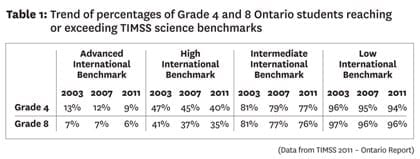
While there’s been improvement in results since the inception of the TIMSS assessment in the mid-1990s, for 2011 the average test scores are significantly lower than they were in 2003 for Grades 4 and 8 (see Figure 1).
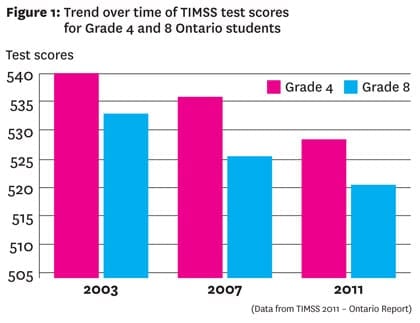
The trend is clear: science achievement has been decreasing over the last decade. What are possible reasons for this downturn in science achievement?
The erosion of science education
In the 1930s, distinguished sociologist Robert K. Merton advanced the theory of “unintended consequences”8 of social action, with particular reference to social policies and priority initiatives implemented by governments. His theory is a useful framework for examining educational policies and initiatives. Over the last decade, the TIMSS results in Ontario, alongside our deliberations with elementary teachers, suggest that the subject of science is being unintentionally undermined by educational accountability initiatives in literacy and numeracy. We believe that one palpable consequence of these initiatives is the negative impact on science achievement by elementary students.
This undermining of science manifests itself in elementary schools through reduced instructional time for science, curtailed learning opportunities which are resource intensive and promote higher-order thinking (e.g. scientific inquiry and technological design), and the reduced hiring of, and support for, highly qualified science teachers prepared to confidently teach science in elementary schools. Elementary teachers we have spoken to offered many concrete examples of these issues:
“I saw science taught twice in 40-minute intervals during a six-day cycle.”
“In the primary division of the school we had an itinerant science teacher who taught science on a cart. She came around to the primary classrooms and provided planning time for the homeroom teacher.”
“In the middle school I was in, the teachers were required to teach their own science program, whether they have a science background or not.”
Furthermore, as described in an interview with a Grade 5 teacher:
“I need a rationale for implementing any new science program . . . if I find that I can’t connect it to my literacy or my mathematics, I may not implement it.”
Recommendations
We believe that decisive steps are now required to build on earlier success in science observed at the beginning of the 21st century. Below are some recommendations for reprioritizing science education in elementary schools:
- Although international measures document important changes over time in educational systems, more local and specific data collection is required to create a more accurate picture of what’s going on in elementary schools with respect to science education. Research aimed at collecting both aggregate and case-specific data on the enactment of science curriculum in schools and districts is needed.
- School districts have autonomy to design pedagogical innovations and promote science leadership within their district. In collaboration with community stakeholders, students’ science outcomes can be improved through leadership and instructional resource development.
- Highly successful school systems around the world invest in their teachers. Promoting science teacher education and development practices that are collaborative and practice-oriented are essential for supporting science education.
- Parents and students must be advocates for science education in schools. Valuing science education and engaging in discussions with school practitioners on how to improve science outcomes for all students will help reprioritize science education.
As we go forward into the second decade of the 21st century, it is indisputably important that students possess a deep understanding and appreciation of science. We must act to limit the current erosion of quality science education. Re-evaluating the high-stakes accountability ethos in schools, resulting in subject hierarchies, and establishing a more equitable approach where science and other subjects are similarly valued is an important enterprise. Recognizing the unintended consequences of educational initiatives is the first step to ensure that students achieve in all subject areas.
First published in Education Canada, June 2013
1 John S. Wills, “Putting the Squeeze on Social Studies: Managing teaching dilemmas in subject areas excluded from state testing,” Teachers College Record (2007): 1980–2046.
2 Educational Quality and Accountability Office, Trends in International Mathematics and Science Study (TIMSS), 2011: Ontario Report, (Toronto: Educational Quality and Accountability Office, 2012). http://www.eqao.com/pdf_e/12/TIMSS_Ontario_Report_2011.pdf.
3 In Ontario, “Technology” refers to structures, mechanisms and design problem-solving learning expectations, and is subsumed under the “Science & Technology” curriculum policy. For brevity purposes, we will use “science” throughout the article.
4 Michael Fullan, Great to Excellent: Launching the next stage of Ontario’s education agenda, (Toronto: Ontario Ministry of Education, 2012). http://www.edu.gov.on.ca/eng/document/reports/fullan.html.
5 Andy Hargreaves, and Shirley Dennis. “The International Quest for Educational Excellence: Understanding Canada’s high performance.” Education Canada 52, no. 4 (2012).
6 Educational Quality and Accountability Office, Trends in International Mathematics and Science Study (TIMSS) 2011: Ontario Report..
7 TIMMS establishes four descriptive benchmarks (advanced, high, intermediate, low) based on a single scale value (e.g. 625 is considered advanced) allowing for broad reporting of science achievement, alongside the mean scale scores. This reporting method helps to facilitate comparison and analysis among jurisdictions and cycles of assessment.
8 Robert K. Merton, “The Unintended Consequences of Purposive Social Action,” American Sociological Review 1, no. 6 (1936): 894-904.
-
Stormy weather for standardization may be on the horizon
Comments Off on Stormy weather for standardization may be on the horizonWell, folks, we may be in for some rain.
Much as we here in Nova Scotia tend to get our weather from the West, so too do we often inherit educational practices and policies. Much of what we “create” in education here at home is borrowed from other jurisdictions, such as Alberta, BC and Saskatchewan. Although we do often get to put our own colloquial spin on things, many times the price we pay for being a have-not province is that we must clad ourselves, to the best of our ability, in the educational hand me downs of our more well to do cousins.
Now, I for one have always been against this trend. I hate the thinking among some policy makers that ideas must come from somewhere else to be any good. Our province is full of top-notch educators, right from the Department of Education on down, and I often wish that we would tap that particular resource a bit more often to find educational leadership. I recognize that there is a good case to be made for not re-inventing the wheel each time we would like to look at educational change, but I also recognize that, just like cars, not all educational systems are created equally. A wheel from a Chevy may never perfectly fit a Ford, no matter how much you hammer on it.
However, there currently is a rather interesting educational storm a brewin’ out across the prairies that has me, quite frankly, praying for rain.
It looks like Alberta has written the “No Zero” policy out of existence and is reducing the amount of standardized testing in public schools.
Now before those of us who dream of such occurrences go running through the fields shouting “Hallelujah!”, a word of caution. The Edmonton Public School trustees have not completed reviewing their policy on “student assessment, achievement and growth”, but the signs are good. Board chair Sarah Hoffman said in a statement released on April 10th that they were pleased with proposed changes, which reportedly may include allowing teachers to give students a zero for non-submitted work and removing the grade three provincial assessment.
Certainly not everyone is pleased. Some folks, in fact, are down right grumpy. In a recent article in the Edmonton Journal, writer David Staples decries the idea, stating that abandoning these tests will “leave parents in the dark”. He worries that without parents being able to see these test scores and compare them to the provincial norms, parents will be unable to see how their student is actually “doing”. They might even be robbed of the ability to pull their kids out of schools that are underperforming (collective gasps of horror abound).
Well sir, let me tip back my straw hat for a second and tell you a few of my thoughts on that.
You see, there are several issues with standardized tests, not the least of which is the nasty effect they have on programming. They force schools and teachers to focus on that certain aspect of the curriculum which is to be tested. For example, if it is revealed that 80 percent of this year’s math test will be looking at long division, there is a huge amount of pressure on boards, principals and teachers to make sure the kids can do long division. All that extra focus is probably going to cost you in double-digit multiplication.
And what if, as Staples suggests, parents start making decisions on where to send their kids based on these results? The school with the higher mark may not be any better at anything, other than, presumably, teaching long division. But once the trend starts, the school with the more rounded education actually gets labelled as a bad school, and kids are pulled out in droves.
You want to know how a school is doing? Visit it. Ask the kids. Talk to the teachers. Go to the school concert. Attend the musical. Volunteer. The measure of excellence in schools should not be what the students score on a test, but on the quality of overall education being offered within its walls. It is excellence in innovation, in creative thinking, in creativity which we must strive for, not patterning and practice. It is an excellence that can not be measured. It can not be counted. It can not be put into a chart to be displayed behind some crooning politician.
Belief in that form of excellence, true excellence, in education, must come from faith in the system.
I am not sure if we will ever see the death of standardization. But as I metaphorically sit on my back porch and look out over educational fields, parched of creative teaching practices by years of data collection, I believe that maybe, just maybe, we might be in for some rain.
And to my mind, that particular storm from the West can not arrive soon enough.



IDEAS TO SUPPORT EDUCATORS : Subscribe to the EdCan e-Newsletter
Quality research, reports, and professional learning opportunities.