Archive
-
Happy Teacher Revolution Partnership Program
Comments Off on Happy Teacher Revolution Partnership Program
Happy Teacher Revolution has officially launched in Canada!
EdCan and Happy Teacher Revolution are excited to offer EdCan members exclusive access to Happy Teacher Revolution’s online training and certification program to initiate and lead their own teacher support group within their school community.
All EdCan Membership categories – Individual, School District Members, Not-for-Profit, Faculty of Education, and Corporate – receive an exclusive 20% discount.
Not an EdCan Member? That’s okay! Click here to learn more about becoming a member.
PRO TIP: If you’re an employee of a School District, Not-for-Profit, or Corporation that is an EdCan Member, then you, too, are an EdCan Member! What’s more, if you’re a student or employee of a Faculty of Education that is an EdCan Member, then you’re a member, as well! Click here to find out if your organization is already an EdCan member.
What is Happy Teacher Revolution?
-
COVID-19’s Second Wave: How are teachers faring with the return to physical schools?
Comments Off on COVID-19’s Second Wave: How are teachers faring with the return to physical schools?
A team of researchers from the University of Winnipeg have been studying stress and resilience in teachers since the pandemic began. Based on responses from more than 2,200 teachers from across Canada who completed surveys in April, June, and September of 2020, and several follow-up interviews, the researchers were able to gain a detailed understanding of the demands, resources, and stressors experienced by teachers, including their strategies to cope.
Note: These findings are part two of a survey series on supporting teachers during the COVID-19 pandemic. Survey responses were first collected in April/May 2020, when teachers had just begun to teach remotely (click here to check out the first set of survey results!). The survey was administered a second time in mid-June 2020. Data was collected once more in September 2020, when students (in most provinces) were physically back in school practicing safety protocols related to COVID-19.
Continue to survey results here
-
Centring Equity in the COVID-19 Era
Comments Off on Centring Equity in the COVID-19 EraSecond only to the impact of classroom instruction, decades of educational research has demonstrated the important role school leaders play in supporting student success (Robinson, 2011). Leading for equity, however, often requires a different way of thinking about student success; one that recognizes that diverse contexts require decolonized and socially just approaches (Lopez, 2016). And so, leading schools is a socially complex and adaptive process, even in the “best” of times. The pandemic, coupled with social uprisings and a reckoning with our colonial past, has added additional layers of complexity that many school leaders are struggling to balance.
On the one hand, the pandemic has created a firestorm as school leaders grapple with new roles as “the other first responders” of the pandemic (Osmond-Johnson et al., 2020). Workload intensification and work-life balance have been an ongoing challenge for school-based leaders (Pollock et al., 2017). COVID-19 has exacerbated these issues, creating new accountability expectations around health and safety protocols that school leaders had little to no input in creating.
On the other hand, COVID-19 has also laid bare long-existing racial inequities that school leaders are compelled to address. Originally thought to be “the great equalizer,” according to McKenzie (2020), COVID-19 actually exploits differences between communities, using the existing “cracks in our system to get in, take hold and maintain its position.” In school reopenings, we have seen the continued proliferation of systemic inequities. A recent analysis of registrations in the Toronto District School Board, for instance, found that parents from low-income neighbourhoods comprised a much larger share of those opting for online learning. These neighbourhoods were also found to have a higher incidence of positive COVID-19 cases, larger populations of racialized families, and a higher percentage of multi-generational homes. So, while some can pay for personal in-home teaching and tutoring, “others who are fearful of sending their children back to school but cannot pay for private help are becoming test subjects for a new realm of online learning” (Bascaramurty & Alphonso, 2020).
White supremacy does not go away just because there is a pandemic. Rather, fault lines in an educational system that had been comfortably managing the status quo have been further exposed. In this sense, school leaders must understand the challenges and see the opportunities to ensure systems of white supremacy are challenged and dismantled. Complacency and wilful ignorance will no longer suffice.
Grounding leadership in equitable practices
If school-based leaders are to focus on equity, wellness, and dismantling systemic racism amid the complexities and challenges of leading during a pandemic, how can they operationalize that focus to ensure the needs of their students and teachers are being met?
First, school leaders must remain laser-focused, keeping equity at the forefront of their practice – not as something they do if they have time, but the lens through which they plan and engage in leading (Lopez, 2016). During COVID-19 this might include additional attention to pedagogy, particularly in the online environment. For instance, some students may not have spaces for online learning they want to share with others, and may not want to turn their cameras on. Educators should be mindful to not act on their own stereotypes and biases in such an instance, with school leaders supporting teachers in these endeavours.
Second, enabling the focus on equity necessitates a solid plan to deal with the most challenging aspect of leading at this critical juncture: the pace at which information, expectations, and directives are constantly changing. Within this context, a desire to plan with equity in mind is easily scuttled by the need to just survive the onslaught of new and often conflicting information. Developing a school-based communication plan as part of a distributed leadership model can help navigate the seemingly endless amount of “crucial” and “urgent” information leaders are tasked with addressing. This might include allocating specific responsibilities around various aspects of COVID communications to administrative support personnel and formal and informal teacher leaders within the school. Knowing when to defer to advice from public health officials is also important. This kind of distributed approach creates space for school-based leaders to also focus on the difficult work of addressing the systemic racism, educational inequities, and oppressive practices that have been made even more visible as a result of COVID-19.
Third, it is important that school leaders ask themselves what kind of spaces they are creating for teachers, students, and their families to dialogue about equity issues. This journey of change cannot be viewed as a series of tasks to be completed at the direction of a school district. Dismantling systemic inequities can’t be “workshopped” or managed with tips, tricks, and strategies. School leaders must explain the purpose of the work, connect it to a shared set of values articulated by the collective, and clarify the vision for moving the work forward. They must build a critical mass of support, encourage and empower those looking for opportunities to lead, and remain resilient and focused when challenged by those resistant to change. The moment we are currently in also provides school leaders with a great opportunity to build deep, lasting and respectful relationships with communities as a pathway to exploring the ways that white supremacy has been manifested by COVID-19 and to challenge the devastating effects the pandemic has on racialized students.
Finally, and perhaps most crucially of all, school leaders must honour the time, effort, and resilience required to engage in this work. Any leader who is prepared to invest time, energy, and resources into sustainable change knows that leading anti-racist work requires a focused and persistent long-range plan, driven by our students’ expectations for an education worthy of their desire to be academically challenged and socially engaged. It is important, then, that school leaders also engage in self-care to ensure they have the emotional and physical health to challenge white supremacy and its impact on their practice and their schools.
While it may seem safety protocols are the only thing school leaders have time for at the moment, it must be understood that wellness and equity are intrinsically linked. In this sense, school leaders must be prepared to centre equity as they lead through COVID-19; as Gaymes and San Vicente (2020) recently stated, “A crisis does not negate such responsibilities. It only enhances them.”
Photo: Adobe Stock
References
Bascaramurty, D., & Alphonso, C. (2020, September 5). How race, income, and ‘opportunity hoarding’ will shape Canada’s back-to-school season. The Globe and Mail.
www.theglobeandmail.com/canada/article-how-race-income-and-opportunity-hoarding-will-shape-canadas-back/Gaymes, A., & San Vicente, R. (2020, March 27). Schooling for equity during and beyond COVID-19. Behind the Numbers. https://behindthenumbers.ca/2020/03/27/schooling-for-equity-during-covid-19/
Lopez, A. E. (2016). Culturally responsive and socially just leadership: From theory to action. Palgrave MacMillan.
McKenzie, K. (2020, August 13). Toronto and Peel have reported race-based and demographic-based data – now we need action. Wellesley Institute. www.wellesleyinstitute.com/healthy-communities/toronto-and-peel-have-reported-race-based-and-socio-demographic-data-now-we-need-action/
Osmond-Johnson, P., Campbell, C., & Pollock, K. (May, 2020). Moving forward in the COVID-19 era: Reflections for Canadian education. EdCan Network.
www.edcan.ca/articles/moving-forward-in-the-covid-19-era/Pollock, K., Wang, F., & Hauseman, C. (2019). Proactively mitigating school leaders’ emotionally draining situations. Canadian Journal of Educational Administration and Policy 190, 40–48.
Robinson, V. (2011). Student-centered leadership (1st ed.). Jossey-Bass.
-
Teaching Through the Screen
Comments Off on Teaching Through the ScreenThe spring of 2020 will be described as “unthinkable” in our future textbooks. Grocery shelves were emptied, parks banned, classrooms closed, and businesses boarded. The world as we understood it was paused. But through the challenges, perspectives started to change and priorities shifted. Despite the fact that we were physically separated from one another, we came to a common understanding: that the “busy” of our lives was a glorification of exhaustion, discontent, and fear.
Teachers, with no classrooms to teach in, found themselves having to transition into digital educational spaces. My position was a little different. I was an online educator long before the days of COVID-19. However, the forced isolation led me to re-evaluate my own professional practice, in order to answer the many questions that were coming forward at that point. I was forced to reflect. In doing so, I realized that I needed to translate digital learning into an authentic and valuable experience for my students, and I needed to shift my own mindset about online practices, opportunities, and capabilities. We needed to come together, not just for academic success, but for our well-being as a group.
I thought I knew all there was to know about online teaching. It was my specialty, after all. However, despite my familiarity with the platform, I never fully understood or appreciated its potential benefits. Initially, its service for me was as a connector for learning and one-to-one Q and A. Honesty is key here, and as an online teacher, I will frankly admit that prior to the pandemic, I was quite resistant to online interaction. I believed the benefits of face-to-face connection could not be replicated through a screen, nor were they reliable enough in that context for professional practice. When it was necessary, I used it sparingly and in short intervals, as we were instructed to do by our administration. It felt forced and cold.
However, circumstances of these past months allowed for time to understand the potential and value of online learning. It was my bridge to students who, otherwise, would not be able to continue their studies. My mindset shifted. Mediums such as Google Meets and Zoom helped to alleviate the feelings of isolation. I scheduled meetings multiple times each week, with no filters, and no staging of my table or background. I let the clutter of home and the sound of my toddlers’ Netflix cartoons be part of my presence. In order for this to feel authentic and genuine, I had to first be an example of that for my students. Slowly, as both my students and I became comfortable with the process, I was able to answer their academic questions, but also ask about the pictures on their wall or the scenery at their cottages, and have them giggle with me at the many cups of pretend coffee my daughter would pour me while interrupting my lesson: “Mommy needs more coffee?!”
In the absence of physical contact, technology allowed me to build relationships – and those relationships extended beyond our scheduled times. Students informed me that there were others in the class who were struggling with the course because of issues like Internet connection, transportation, and accessibility. I made the taboo move of passing along my personal number (GASP – I know, but I did it!) to have those students reach out to me. I would make the arrangements necessary to ensure they had support in completing their tasks, and/or resources beyond their academics, if needed. I arranged phone conferences, created live docs through shared Google drives to provide immediate feedback, and when necessary, reached out to my administration to send paper copies of the material through the post for the students in more remote areas. I sent text reminders when I could to those who needed the extra push.
I found that trust could be established through the monitors, not in spite of them. I began to approach this platform with a newfound appreciation for its ability to cradle interconnection and create a new dimension of teacher/student relationships.
I know each teacher’s practice and experience will be different, whether online or in the classroom. However, I have come to three key factors that were instrumental in making the online experience successful and fun!
- The first is consistency. Set times for meetings and support, and be there! Even if you do not see or talk to anyone that day, show up. Make it known and clear that you will be there.
- The second factor is to be real, be authentic – no filters. Get comfortable in your discomfort and allow that to come through. The honesty in clutter, piled dishes, and disarray creates the best small talk.
- The last factor that I believe is a key to success within an online classroom is to set boundaries and abide by them. Despite the fact that you want to be accessible and available for your students as much as possible, it does not mean that you should be available 24/7. When you turn off your devices, keep them off. Respect your own downtime. Taking care of others is sequential to taking care of yourself.
Let’s also admit that despite its benefits, online teaching is hard! As e-learning teachers, we must combat the inconsistencies of attendance and daily logins, missed assignments, and students’ overall struggle with time management and motivation to engage with a screen for their academic benefit rather than social pleasures. We have worked very hard to do this, and continue to do so, to help our students find success within themselves, regardless of the unexpected circumstances they may find themselves in.
Our learning does not end when we become teachers. As we transfer our binders and printed lessons onto digital platforms, and blend our classrooms into interactive and accessible hubs, we need to embrace a new vision of what an educator can be. It is not the end of the role, but rather a transformation of it, which we get to be part of. Change is inevitable and remains one of the only constants – but our growth is an optional component.
Photo: Adobe Stock
First published in Education Canada, January 2021
-
Back to School: The First 30 Days
Comments Off on Back to School: The First 30 DaysAs teachers, principals, and system leaders facing the reality of reopening schools amidst COVID-19, we entered the summer with trepidation; there would be no “holiday,” as travelling south of the Northwest Territories’ border and returning was discouraged. Instead, we frantically planned for both physical re-entry and remote learning to ensure equity and accessibility, while juggling to meet continually changing COVID-19 needs. August 2020 saw multiple email reminders about PPE, re-entry safety guidelines, and Chief Public Health Officer protocols. Staff familiarized themselves with safety plans, PPE wearing, and etiquette, and repeatedly reviewed new directives ranging from what to do if a child/staff member became sick to how to fulfil playground supervision, class bubbles, and how they functioned, one-way traffic, and laundering masks in cohort groupings. Then we looked at Essential Learning Outcomes, while preparing for in-class and remote teaching as needed.
The South Slave Divisional Education Council, situated on the south shores of Great Slave Lake in the N.W.T., serves a unique and diverse student population spanning both remote and regional communities, many with significant socio-economic challenges. It was in this challenging physical environment that we set about re-entry after months of school closures in the face of COVID-19.
August 27, 2020
PPE and provisions (in some cases washers and driers!) haven’t arrived! Logistics in the North can be tricky, so it’s understandable that staff are tense. Teachers, parents, and communities are all anxious as we recognize the serious potential consequences of having students return during a pandemic. Considering the bleak historical consequences of colonization, and the devastating effects of European diseases on the Indigenous peoples, the potential for further trauma in the North is huge. No one wants to get sick, or be branded Typhoid Mary in a small northern community.
By 8 p.m., the monumental efforts of all involved pay off as PPE, sanitizer, and handwashing stations are delivered and set up by staff, along with self-isolation rooms, to ensure readiness for opening day. The hand sanitizer dispensers challenge our collective problem-solving talents: the bag of sanitizer resists efforts to get it into the standing station. Brute force proves the answer; as one principal put it, “Take the cap off the bag and use a significant amount of force to shove the nozzle for dispensing the hand sanitizer in.” Next came figuring out how not to dispense too much liquid (another principal described it as “too squirty”).
We breathe a sigh of relief – we made it! Tomorrow, August 28, some schools will reopen, and those of us who get the weekend to further prepare secretly sigh in relief and watch to see how it goes. The new school routine begins: temperature check everyone (thank goodness for touchless thermometers), remind parents to keep sick students home, check for masks, keep a staff log, track symptom checker declarations, sanitize hands, and then do this all over again in the afternoon. All goes surprisingly well; the students are happy to be back; their crinkled eyes above masks tell us they are smiling! We may feel like medical personnel, and be quite nervous about that, but we are still teachers and love having our students back, knowing they are safe, seen, and we are learning together.
Our twice-daily routine becomes our mantra: wear masks, sign in, sign out, limit visitors to the school, no swapping of masks, don’t touch your face, sanitize hands, stay two metres apart, don’t mix your bubbles! Mantras are followed by disinfection – desks, doorknobs, high-touch surfaces. We teach, we clean, and now we have a second mantra: If it moves, TEACH it, if it doesn’t move, CLEAN it!
We hold our breath, follow the rules, and ruthlessly focus on Essential Learning Outcomes, prepared to pivot to emergency remote teaching at a moment’s notice. We prepare in-class, blended, and home learning packages for our immunocompromised, self-isolating students and those on rotational schedules due to physical distancing requirements, and try to use every minute of instruction efficiently.
Sept. 8
We make it to Labour Day and relax just a smidge. No cases so far! Aside from wanting all staff to be well, the lack of substitute teachers in the North is a challenge, one which we greatly fear. A slight COVID spike has the potential to shut schools down due to lack of teachers and support staff.
We forge ahead, focused on excellent teaching and strong assessment practices to ascertain gaps in learning over the months of remote instruction in spring 2020. We actively plan remediation and work on deep transfer learning. Our high-school students meet counsellors, courses are planned, and they are excited to start semester one.
September 21
We’ve been back in the saddle almost four weeks. We’ve had our first virtual “meet the teacher” event for parents and are finding other ways to engage virtually. We remain committed and healthy. The habits of good hand hygiene and mask etiquette are ingrained now, and thankfully the Northwest Territories remains COVID-free. However, we see signs of exhaustion and stress (the workload of regular in-class delivery plus home/online packages, plus daily COVID routines is unrelenting). We are somewhat traumatized by the last five months, and our students, families, and communities feel the same way.
Mental well-being for staff and students appears to be deteriorating, social disconnection still exists, and relationships suffer. The unintended consequences of hypervigilance, mask wearing, physical distancing, mandatory self-isolation, and non-essential travel bans are surfacing. Is it the masks, the physical separation, or the five months of school closures that have eroded authentic connections? Is it everything at once?
Reinvigorating social emotional learning is necessary to build empathy, resilience, and healthy connections to support the learning community. We recognize that, even though exhausted, we must lean into our empathic skills and values of compassion, and learn to self-regulate before we can actively teach students to do the same in a time of significantly heightened stress. Being on the front lines, we need to be agile and responsive to emerging and changing social emotional needs, including our own. That all sounds great, but what can we do right now?
Building capacity
We must build teacher capacity through vibrant professional learning communities (PLC) and professional development focused on researched self-regulation and empathy-building practices. The need for empathy is so great that those who have it are now being dubbed as having the “empathy edge” (Ross, 2019) or seen as a “need to have” (Goleman, 2004). Jody Carrington (2019) states, “First, last and in all ways, it comes down to connection. To relationship…. It’s all about connection. Full stop.” Now is not the time to let empathy and social emotional education outcomes fall by the wayside.
In the North, we fundamentally include our communities. The focus is on the connection we share to ourselves, each other, and the land. Research from the Ashoka Empathy Initiative, highlighted in the Making Caring Common project of the Harvard Graduate School of Education (Jones et al., 2018), reveals five powerful reminders for intentional empathy teaching and best practices that in turn can support both teacher and student mental health:
1. Model empathy. Everyday moments matter! As students enter the one-way systems in schools for daily checks, we look them in the eye and greet them by name. This says, “I see you and you matter!”
2. Actively teach what empathy is and why it matters – across all learning areas, at every grade seamlessly to promote a safe and caring school culture.
3. Practice. Use every opportunity to be empathic: in class, on the playground, in staff rooms, out in the community, everywhere. Students are always watching!
4. Set clear ethical expectations. Lean into personal values, show up each day with intention and authenticity, and self-regulate yourself, always modelling for students.
5. Make school culture and climate a priority. Use professional development time and PLCs to collaborate and generate ideas for intentional, authentic empathy education. Professional development, case studies, and dialogue can all be leveraged to collaboratively build trust and establish a community of practice focused on empathy, relationship, and positive connections.
The work of many researchers, notably Goleman (2006, 2004), underpin the research-based programs we actively use (e.g. 4th R, Zones of Regulation, Leader in Me). These reminders are not just for school leaders; all staff are interconnected across our common fears or joys, and we deserve to be treated with empathy and dignity. In a socially and physically distant world, we need to expect more relationally from each other, hold each other accountable to the connections we have made or need to make, and actively cultivate compassionate empathy, whether in class or via video-conferencing, to support resiliency. So, in returning to schools, we think outside the box for ways to connect with students, parents, and communities, ensuring we are all seen and heard.
September 29
We watch previously postponed 2019–20 school awards ceremonies streaming live on Facebook! We share in the joy of what our students and staff have achieved in the middle of the COVID storm. We now have a “Conferencing on Demand” initiative (a designated day and time each week for parent calls to teachers), we live stream our opening Feeding the Fire ceremonies and promote cultural connections. We honour the lessons learned in the previous five months, to ensure we grow through this crisis. Live streaming is one of those lessons: post-COVID, we will continue to use this means to include and promote more parent engagement opportunities.
September 30
It’s Orange Shirt Day, and we remember the legacies of the residential school system and honour our commitments to truth and reconciliation. This resonates with our commitment to reinvigorate and consistently build empathy and positive restorative relationships. We commit to intentionally using our professional learning time to continue applying a structured approach to enhance social emotional learning. We commit as leaders to model what we want to see in our schools, from both staff and students, and to share with each other what works and what doesn’t so we can grow as a professional learning community and be of service to our staffs.
October 2
So far, so good! Thanksgiving is on us, and we wait to see what the next 30 to 60 days bring. We know teachers and communities are concerned about whether or not there will be Christmas and spring breaks, but we also know that by practising empathy and connection, we will not just survive but thrive.
Photo: Adobe Stock
References
Carrington, J. (2019). Kids these days: A game plan for (re)connecting with those we teach, lead, & love. Friesen Press.
Goleman, D. (2004). What makes a leader? Harvard Business Review, January, 24–33.
Goleman, D. (2006). Social intelligence: The new science of human relationships. Bantam.
Jones, S., Weissbourd, R., Bouffard, S., Kahn, J., & Anderson, T. R. (2018). For educators: How to build empathy and strengthen your school community. Making Caring Common Project, Harvard Graduate School of Education.
https://mcc.gse.harvard.edu/resources-for-educators/how-build-empathy-strengthen-school-communityRoss, M. (2019). The empathy edge: Harnessing the value of compassion as an energizer for success. Page Two, Inc.
-
Diversity via Distance
Comments Off on Diversity via DistanceIn the spring of 2020, schools were closed to limit the spread and impact of COVID-19 across Canada and beyond. As a result, students were suddenly at home with family, where most stayed for many months. Depending on the province and even school board in question, a range of distance and online options for academic learning were offered and/or required.
Those learning at home included about one million students, from Kindergarten through Grade 12, requiring special education services. These students included those who are gifted as well as those with disabilities, including learning disabilities, autism spectrum disorder, and mental illness. A range of programs, supports, and placements are typically offered in schools across Canada to meet the needs of these students. These include accommodations and universally designed teaching approaches provided in general education classes, as well as specialist supports and therapeutic services provided within general and specialized classes and schools (Hutchinson & Specht, 2020). So, what became of these approaches and supports when the learning context shifted from school to home, and what implications did this have for students and families?
In spite of the tremendous efforts of superintendents, principals, and educators to facilitate what would be known as “emergency” distance learning, we weren’t ready as a school system or as a society. We hadn’t planned for this pandemic and we were at various stages of readiness with respect to infrastructure and professional skill sets. What we learned during those months, however, has important implications for our planning going forward – for all students, but in particular for those with special education needs (SEN). Many students with SEN often require human supports at school to navigate daily life, flourish socially and emotionally, and progress in their academic development. It has been a challenge for systems to provide differentiated and appropriate at-home learning opportunities.
In the spring of 2020, we launched a study exploring the experience of families supporting students with special education needs at home during school closures. We surveyed more than 265 parents from across Canada about the learning and social-emotional supports they received, their self-efficacy in supporting their child’s learning, and their own stress levels. We also conducted in-depth interviews with 25 parents and we continue to collect stories about the ways in which families and schools have worked together to meet the needs of students, whether virtually or in face-to-face settings.
Our research over the past several months has documented stories of families supporting students with SEN in myriad ways. Two interconnected learnings arose from our study: at-home learning magnified what already existed, and relationships are key. We offer these learnings to guide our future efforts to create the most accessible learning opportunities possible, whether virtual or in bricks and mortar settings.
At-home learning magnified what already existed: the strengths and the cracks
It will not be a surprise to anyone familiar with the complex institution of public education in Canada that there are areas to celebrate and areas for improvement. At-home learning shed a bright light on the strengths, cracks, and tensions that already existed within the education system. These were evident in areas such as instructional and pedagogical approaches, inclusive school communities, and the roles and resources of families.
Parents of students with SEN described this magnification of strengths and cracks through their stories of at-home learning in the spring. If inclusive approaches and differentiated instruction were evident in the classroom and school prior to the COVID-19 pandemic, parents saw evidence of these in the at-home learning efforts. If those approaches were not previously in place, they were even less apparent during at-home learning. Some parents we spoke to described the ways that their child’s educators continued to support them when schools closed, based on their deep understanding of the needs of the individual child. For example, one teacher videotaped herself going through the typical morning routine and shared it daily in order to provide consistency and familiarity for students. Another teacher provided options for assignments so students would all have work available at their level of readiness. Multiple parents described regular, personalized video interactions with their child’s teacher or education assistant as the most valuable offering, allowing for social, emotional, and academic support. Other parents said they disengaged from the at-home learning options because they felt that the offerings were poorly suited for their child, resulting in a sense of exclusion from the learning community.
The magnification effect also applied to the skills, resources, and relationships of families supporting students with SEN. Many parents – typically mothers – who were skilled advocates with experience in navigating the school system, were able to seek out and organize school-based resources to support their child during school closures. Those who had financial, work, or health challenges, or who had fewer resources to draw upon, described an abrupt end to services, which increased stress for the family and the child.
For some families, therapeutic services such as applied behaviour analysis, occupational therapy, or speech/language therapies are typically provided through or by schools. When schools closed, therapies stopped. In some communities, creative solutions were found to continue offering coaching for parents to be able to provide some services, and a few examples of direct service via video were noted. Many parents described the weight and stress of having to provide learning and therapeutic supports for their child(ren), often while facing financial pressures or while working at home.
And yet, while many children and families struggled, others flourished. Many families told us about the positives during school closures. Some parents learned an incredible amount about their child – their academic needs and the ways they learn best. Gains were seen by some parents in their child’s social and academic skills, largely because of the efforts made by the parents themselves. Others watched their child grow calmer, happier, and more rested away from the stresses of school schedules and social anxieties. A small number of families we spoke to were prompted by their child’s positive experience to consider leaving the public-school system altogether, either to home-school or to explore private schooling options. This response was more typical among well-resourced parents of young children.
Equity issues such as these are well known within education research and policy, but bubbled to the surface in more obvious ways during school closures and at-home learning.
Relationships are key, no matter the modality
Relationships – with school staff, with community-based service providers, and for students in particular, with peers – mattered in so many ways for families. Positive, productive, and personal connections served as the crux of successful at-home learning experiences.
Many parents pointed to the regular, personalized check-ins, by email, phone, or video chat, that were offered by their child’s education assistant and/or teacher as the most beneficial support they received from schools. Other parents felt the absence of this connection with their child’s teaching team.
Parents who had struggled to build or maintain strong, collaborative relationships with school staff prior to school closures described frustration and helplessness as these deteriorated even further. Conversely, examples of effective at-home learning experiences always included descriptions of the working alliance that existed between parents and school staff.
Peer relationships were also raised as important by parents. For many students with SEN, particularly those with more significant disabilities, connections with peers exist only at school. During school closures, many families in our study worried about the social and emotional well-being of their child – even more than they worried about them falling behind academically. We heard from families that very little attention was being paid to connecting peers with each other during at-home learning.
Moving from learning to doing
So what next? What are we learning about the roles that schools play in the lives of students with special education needs and their families? About the inequities within our systems that privilege some of these families over others? About the ways in which inclusion is experienced by children in school and in virtual settings? And about the relationships that serve as the foundation for the work we do in building communities of learners, educators, and families?
Within and after the pandemic, planning with difference as the driver, and collaboration the vehicle, is one path to greater equity and inclusion.
Relationships mattered in so many ways for families. Positive, productive, and personal connections served as the crux of successful at-home learning experiences.
What does this look like? Imagine that we are Grade 5 teachers, planning our virtual class of 30 students. We know that there are a few students reading below grade level, others who need support to sustain attention, and some who are struggling with feelings of worry or diagnoses of anxiety. We could prepare our activities and lessons for the day, and then consider what we could do differently to accommodate these students. Or we could think about what is required for these students to be successful and for them to be able to participate fully in the lesson. Do they need frequent movement opportunities? A visual schedule that maps out the online time? Options for working without video? Small group meeting rooms to share ideas and solve problems with less public risk? A range of options to show their work? And with our universal design for learning hat on, we know that these approaches are necessary for some students, but helpful for all students.
We use the term “collaboration” in schools often. The value of collaborative pedagogy is embedded in our policy documents, in our mission statements, and in our specific guidance regarding special education services. And it’s one of the toughest things to accomplish in any kind of authentic sense. We are inspired by the stories we were told of families, school staff, and community partners working together, with the voice of the student at the core. We need more of these, and we need to learn from them to tease apart elements we can replicate across the country.
The term “working alliance” has typically been used to describe clients and therapists working together in counselling settings. It has been used recently in education to capture not only the emotional aspect of relationships but also the cognitive aspect of the goals and tasks mutually agreed upon by students and teachers, and by teachers and parents (Knowles et al., 2019; Toste et al., 2015).
Building a working alliance and the key relationships that allow for this collaboration is complex and challenging. We often have the assumption that relationships just happen – as if they are outside of our control and we are at their mercy. Students requiring special education services don’t have the luxury of happenstance when it comes to relationships and collaboration – these need to be in place for them to thrive or even survive.
Focusing on the skills required in collaborating and building working alliances is one step. This skill-building can be done in BEd and continuing teacher education programs – particularly, but not exclusively, those focusing on inclusive classrooms. This idea is not new – collaboration has been listed as key to special education service delivery for decades. But given our findings, renewed attention is warranted.
This collaborative skill-building can best take place within systems that support and foster a focus on partnerships. Are there processes in place that prioritize authentic participation of students, families, and school staff in decision-making? Are there individuals in schools who have specific training in mediation and collaborative problem solving? Are these kinds of interventions considered to support students, families, and school staff in working together? How can some of the virtual approaches we’ve learned about be leveraged to increase participation? Collaboration is emotional work. Do school staff feel that they have the organizational resources they need? What about the emotional well-being of school staff? Is this being attended to and seen as a priority? Are there approaches in place to make sure that staff have the capacity and supports to engage in difficult conversations?
We were caught off guard by the switch to emergency schooling in the spring of 2020. Such an abrupt change of modality was unexpected and system-wide. But in what ways are we better prepared going forward? We are told that waves of viral pandemics may be the norm. We have also learned that virtual options are a great fit for some students, and we should consider opportunities for developing online learning offerings that are truly accessible for all students, including those with SEN. Considering the multiplying effect that emergency schooling had on the strengths, cracks, and tensions of the system, we need to use this time to identify and address the inequities that have been present in the system for decades. Effective, ethical emergency schooling requires a foundation of effective, ethical (non-emergency) schooling.
The pandemic has shifted our reality and much of what we’re experiencing, from wearing masks in classrooms to connecting by way of pool noodles in physical education classes, is new, different, and in many cases, uncomfortable. But what the pandemic has brought to light is what already existed when it comes to the education of students with special education needs. We have seen creative, inclusive efforts by many educators that we can learn from in continuing to build practices that support the participation of as many students as possible – particularly by planning with difference in mind. We also need to attend to skills and structures to ensure that students, families, and school staff are well-supported and resourced as they engage in the challenging work of building effective collaborative relationships.
Photo: iStock
First published in Education Canada, January 2021
References
Hutchinson, N. L., & Specht, J. A. (2020). Inclusion of learners with exceptionalities in Canadian schools: A practical handbook for teachers (6th ed.). Pearson Canada Inc.
Knowles, C., Murray, C., Gau, J., & Toste, J. R. (2019). Teacher–student working alliance among students with emotional and behavioral disorders. Journal of Psychoeducational Assessment, 38(6), 753–761.
Toste, J. R., Heath, N. L., McDonald Connor, C., & Peng, P. (2015). Reconceptualizing teacher-student relationships: Applicability of the working alliance within classroom contexts. The Elementary School Journal, 116(1), 30–48.
-
It’s OK to Be OK, Too
Comments Off on It’s OK to Be OK, TooAs a team of university researchers and educators, we have been studying stress and resilience in teachers since the pandemic began. Based on responses from more than 2,200 teachers from across Canada who completed 92-question surveys in April, June, and September of 2020, and several follow-up interviews, we were able to gain a detailed understanding of the demands, resources, stress, and coping experienced by teachers. We have published widely in both academic journals and media to share teachers’ voices and the lessons we learned from them.
As we were collecting and analyzing our data, there were two related dialogues taking place about issues akin to our research. First, we read headlines suggesting the effects of the pandemic could be viewed as trauma, and that both teachers and students would suffer long-term losses from their current educational experiences during COVID-19.
Second, we began to hear the term “toxic positivity” and witness verbal attacks on teachers who made positive or optimistic comments on social media. The catchphrase “It’s OK to not be OK” gained traction as the mantra of the day.
These two separate dialogues seemed to accept pathology as the logical consequence of stress, while concurrently eroding attempts at recovery and resilience by those teachers who responded to the challenges in different ways. Given our discomfort with these observations, we decided to dig deeper into the science of toxic positivity, long-term effects of trauma, effects of positivity, and resilience to see if we could better understand the relationship between them.
Given that our study showed chronic and increasingly elevated stress in teachers from April to September, we were interested in looking at the long-term effects of both high levels and extended durations of stress. Specifically, teachers in our study reported a 10% deficit in coping with their stress in April and a 6% deficit in June, suggesting that teachers across Canada were adjusting to the realities and challenges of remote teaching. We were alarmed to find that teachers reported a 30% deficit in coping in late September, when most teachers were returning to classroom instruction, but under unusual conditions due to COVID-19 safety requirements. Our September findings clearly demonstrated that additional resources are needed to meet demands. Considered together, the results of our three surveys suggested that teachers had the capacity to recover from abrupt, major changes to their teaching, but that repeated, incremental changes and challenges resulted in lower capacity for coping.
Our review of the literature revealed that the experiences of teachers’ stress and coping could be understood through Bruce McEwen’s concept of allostasis. Allostasis is the evolutionary capacity to respond to immediate threat through a fight, flight, and freeze response – an adaption to the experience of acute stress. Humans have developed this capacity as a protective measure for survival. However, allostasis is a double-edged sword that can create safety, but can also cause harm. While allostasis has biologically prepared us to respond to emergencies, the cumulative burden of repeated exposures to stress leads to a chronic stress condition related to “allostatic load” – a situation that can have physiological and psychological health costs. Gauging by the survey and interview responses, it seems that this may be what was happening with Canadian teachers over the course of our study. They had begun to recover from the pivot to remote teaching by June but, instead of spending the summer continuing to recover, they entered July 2020 with a 6% deficit in coping that was never fully addressed. Between worrying about what would happen in the fall, preparing for possibly teaching remotely or in person (or both), and then returning to teaching situations that in many cases did not resemble typical classrooms and involved worry for the health of front-line educators and their families, teachers’ stress increased greatly. As we cautioned during an interview with CBC Radio, the 6% deficit we found in June might have seemed small, but if left unaddressed it had the potential for damaging and enduring effects. It was the canary in the coal mine, and ignoring it could have serious consequences for both teachers and students.
Is there an alternative to predictions of long-term costs to teachers’ health as a result of the pandemic? As we know, good science always considers the counter-argument, and we found an equally convincing one in the work on resilience by George Bonnano. His research challenges the concept of distress and illness as a singular response to trauma and disruption, suggesting that there is a different and more typical path that can result from traumatic events. With reference to people who had experienced terrible challenges such as being victims in the terrorist attacks on the World Trade Center, Bonnano found that while some people developed post-traumatic stress disorder (PTSD), most demonstrated resilience. This is not to dismiss the real and important needs of those who experience PTSD, but instead points out that pathology is not the only, or even the most typical, response to traumatic events. Canadian Senator and researcher Dr. Stanley Kutcher noted that there is an increased public perception that negative emotions are an indicator of pathology and illness. In contrast, Kutcher suggested that negative emotions are an important part of addressing life’s challenges and essential when adapting for the future. Without such emotions, he argued, we cannot develop resilience.
Bonanno found that one of the predictors of resilience as opposed to pathology was a positive outlook. This is where the ideas of balance and toxic positivity come into play. Toxic positivity seeks to reject, deny, or displace any acknowledgement of the stress, negativity, and possible disabling features of trauma, and instead looks only through rose-coloured glasses. In contrast, a positive outlook acknowledges both the negative, challenging aspects as well as the more optimistic frames and pathways. Optimism, unlike toxic positivity, encompasses both reality and pathology instead of ignoring potential and actual psychological disability experienced by some people in response to trauma.
Confusing optimism with toxic positivity comes with two kinds of costs. First, by mistakenly interpreting and silencing optimism as toxic positivity, individuals who embrace positivity as a coping mechanism are denied this support for their own resilience. Given Bonnano’s findings about the importance of optimism for resilience, we cannot afford to squelch this resource for teachers who need it to maintain their well-being. Second, observations of those we view as important to us serve as exemplars of how we normalize responses to change. If there are no longer voices of optimism because they have been silenced due to accusations of toxic positivity, then pathology and negativity by default become the exemplars. Just as it is OK to not be OK (and to seek supports for this response to what is clearly a very stressful situation), it is also OK to be OK.
Collectively, we are all going through a very challenging time together. Each of us will need to use everything we can – both internally and externally – to face the future beyond the pandemic. However, teachers work in a variety of settings, with a spectrum of resources and challenges, and a range of student and family needs – not every teacher is “in the same boat” during this pandemic, even though we are all experiencing the same storm. There are other pathways to understanding teacher responses and contexts besides the false dichotomy between pathology and toxic positivity. In fact, a person can be both optimistic and realistic at the same time. Therefore, it is important to consider the cost to individuals as well as groups when we call out presumed “toxic positivity” – when in reality we are all just doing the best we can with the resources we have.
The pandemic does not define us – it reveals us. Let it reveal our best selves, as teachers who show compassion, support, grace, and acceptance for both ourselves and our colleagues as we all respond to and recover from the challenges of COVID-19 in the best (yet different) ways we can.
Photo: Adobe Stock
-
Class Matters
Comments Off on Class MattersWhen my family and I emigrated to Canada from England in 1987, we left behind a country with a deep-seated history of social class division and class-consciousness. Britain has long been obsessed with social class. My memoir, Moving (2020) – about growing up and being educated in a working-class community in Northern England – describes how social class differences affected every aspect of my own education.
My own struggles were with upward mobility – how to reconcile the culture of my selective grammar school with that of my working-class community. My two brothers had different struggles. At age 11, a standardized test marked them out for failure. I eventually made it to university on the other side of the country. They ended up in factories at the bottom of the hill. Social class mattered a lot in England then. It still does.
But in 1987, I was leaving all this behind. My Dean envied me. He had just returned from his first visit to Canada, the world’s first constitutionally bilingual, multicultural society. How lucky I was to be going there.
I arrived in a country that didn’t really talk much about social class at all. There were other serious sources of inequality to attend to instead. Race, immigration, language, poverty, and disability were foremost among these. Attention to inequalities in Indigenous and LGBTQ2+ communities would follow later. In our research, Dennis Shirley and I (2018) witnessed how assiduously Ontario educators addressed these issues from 2014–2018. But Canadians didn’t really seem to be concerned about social class at all. Working class inequality was a silent and invisible feature of the educational and social change agenda.
The coronavirus pandemic has suddenly brought the health and education of working-class people and their families to the forefront of our attention. They are the most likely to contract COVID-19, to have no one on hand to supervise them when they need to learn at home, and to live in overcrowded and unstable conditions unsuitable for learning or health.
What it means to be working class is a matter of debate, with some commentators defining it in terms of poor income or low level of education, for example. Traditionally, though, social class is about the kind of work people do and how that structures people’s opportunities and identities. In general, working class people do manual work (either skilled or unskilled), and/or have little control over their work conditions – think call-centre employees, people who have to work on contract in multiple care homes, or employees in the gig economy, for instance.
Social-class inequality is closely tied to student achievement and well-being, but compared to other causes of educational inequality, like race or poverty, it has received little attention. There are four explanations for this neglect and for why coronavirus is changing all that.
Don’t mention the white working class
Why has Canada’s commitment to diversity not included social class? One reason is that acknowledging the struggles of the working class might be equated with acknowledging the white working class. That would risk associating whiteness with disadvantage instead of with its historic racial privilege.
The coronavirus crisis, though, has made clear that the working class is actually very diverse. Vulnerable, essential front-line workers include migrant farm labourers, immigrant care home workers, hospital cleaners, Uber drivers, and virtual shoppers. Whatever their race or ethnicity, they are all working class. They have the low pay, contractual insecurities, and vulnerability to COVID-19 to prove it.
In 1989, Kimberlé Crenshaw coined the term intersectionality. Her study of battered women’s shelters (1991) showed that the experience of an abused white middle-class woman was different from that of a low-income immigrant woman speaking English as her second language. So, we had to examine the intersectionalities of oppressed women’s multiple identities. Working-class identity intersects with many other aspects of diversity. Social class needs to come back into our reckoning about inequality – and the coronavirus crisis is doing that with a bang.
We’re all middle class now
Joan Williams (2017), author of White Working Class, says that the U.S. has become “clueless” about social class. Canada has its own (working class) cluelessness, expressed in the widespread belief that the vast majority of Canadians are middle class.
“Most Canadians think of themselves as middle class,” says Julie Cazzin in Maclean’s magazine (2017). Around 70 percent of Canadians self-identify as middle class, according to a poll conducted by the magazine. In another Maclean’s article, Shannon Proudfoot (2019) reflects on her own working-class background. She warns that “the way we elide, erase and ignore socio-economic class in Canada” makes it “like an invisible fact that shapes everything, but is acknowledged nowhere.”
Wolfgang Lehmann, Professor of sociology at Western University, has studied social class and education in Canada. The son of German immigrants, Lehmann grew up in a working-class family and, like me, still struggles with his identity as a middle-class academic. Lehmann’s research (2014) with 70 university students from working-class backgrounds shows how their experiences of educational success are corroded by “conflicting relationships with parents and former friends.” The upwardly mobile students’ new knowledge, experiences, and relationships set them apart from family members and friends in their former communities. They are also more likely to disengage or drop out from their studies. They feel caught between two cultures, belonging to neither one nor the other.
“Conflating class in Canada” and “making everybody middle class who isn’t rich” is “maybe dangerous,” says Lehmann. My own biography and 50 years of research support Lehmann’s findings that the particular culture of academic success is constantly tugging students away from their class identity. There has been a positive movement for schools to enable young people to retain pride in their race or gender identities, for example, as they strive to succeed. But working-class identity seems to be something that upwardly mobile students feel pressured to leave behind.
Our schools must accord as much dignity to the labour and values of working-class life as they do to other aspects of identity.
Coronavirus has witnessed displays of appreciation for front-line workers (many of whom are working class) on signs by the roadside and in pots being clattered on balconies. But we must do more. The hard work, labour, dedication, and sacrifice of these workers have kept the rest of us alive. Post-pandemic, we must no longer condemn workers in the gig economy to job insecurity and working multiple, contract-based jobs just to get by. Our schools must also accord as much dignity to the labour and values of working-class life as they do to other aspects of identity in a diverse and inclusive society.
Working class does not equal poor
Poverty continues to have massive consequences for student achievement and well-being. Several of the Ontario school districts that Dennis Shirley and I have studied instituted a wide array of anti-poverty strategies. But it is impossible to turn poverty on its head and celebrate it in the way we do with Black power, gay pride, and other kinds of diversity. And being working class is more than having a certain income level.
Until the 1970s, skilled manual labour had dignity and worth. Working-class labour and working-class communities were a source of collective pride. In Canada’s Museum of Human Rights in Winnipeg, for example, alongside the harrowing depictions of genocide and the inspiring tributes to champions of human rights, is a compelling display on labour rights that includes the women and men who founded the Polish Solidarity Movement in the 1980s.
What should our schools be teaching about working-class identity? Where in our curriculum is the history of labour, labour rights, and trade unions, alongside business entrepreneurship and financial literacy? We should teach the concept of class through literature, history, and interdisciplinary projects, as robustly as we do race, gender, and gender identity. How can and should our schools engage with the class culture of our students, as well as other aspects of their culture? If equity is now about inclusion, it should be about social class inclusion and addressing socio-economic privilege too.
One consequence of the pandemic will be that some manufacturing will come back home from overseas. The availability of essential goods can no longer depend on vulnerable global supply chains. These new, working-class manufacturing jobs will be highly technical and involve sophisticated training.
In Germany, vocational education for skilled trades has very high status. In North America, though, it has become a second-class alternative for those who have failed to get into university. Commitment to vocational education, traditionally a politically conservative priority, must now become a priority of all Canadians. The labour, culture, skills, and pride of the working class and its educational preparation must be acknowledged, not ignored.
It’s time to talk about wealth as well as poverty
If we say we’re all middle class, this doesn’t just mean we ignore the working class. We ignore extreme wealth, too. We’re all becoming familiar with how the richest 1 percent of the world’s population owns more than half of the world’s wealth. The revenue of any of the Big 5 tech companies is greater than the GDP of many European nations. During the pandemic, the profits of the Big 5 have increased by about one-third. Meanwhile, for 40 years, the bottom half of society has barely advanced in real income terms at all – despite working longer hours and taking on more debt to make ends meet.
In Plutocrats: The rise of the new global super-rich and the fall of everyone else (2012), Canada’s Deputy Prime Minister and Finance Minister, Chrystia Freeland, claims that more and more of the world is now a plutocracy of rule by the wealthy. Although many modern plutocrats worked their own way up from modest beginnings, they now protect these gains for themselves, their class, and their families. The meritocrats have turned into aristocrats, she says.
Along with a growing number of influential economists – most of them women – Freeland lists how the super-elite protect their wealth. They do this by tax avoidance, by lobbying parliament, by establishing not-for-profit foundations where they can shelter their wealth and champion their own causes, and by buying their children places in top global universities with sizeable “legacy” donations.
Plutocrats also hijack the global discourse of improvement and change by defining what is transformational and what is not. In Winners Take All: The elite charade of changing the world (2019), Anand Giridharadas interviews one of the key organizers for the vastly popular TED Talks. This organizer describes how TED Talks might address questions of how to reduce poverty. But one thing it absolutely won’t touch is economic inequality. Poverty and diversity get airtime. Wealth and inequality do not.
It’s time for this to change. Emboldened by the pandemic crisis, Freeland and other economists, like Joe Biden’s Economic Advisor, Heather Boushey (2019), propose a series of measures to combat the effect of extreme economic inequality on society. “Now is not the time for austerity,” said the Throne Speech on September 22. Instead there must be investment to support the vulnerable, restart public education, and create jobs that in turn will stimulate the consumer demand that will regenerate the economy. The new normal should be about prosperity, not austerity. The Latin origin prosperus means, simply, “doing well.” Prosperity is about reducing inequality and improving well-being and quality of life. In education, well-being should not be an afterthought or an add-on. It is integral to creating a prosperous society.
For too long, social class has been the masked face of inequity, disadvantage, and marginalization. We must no longer pretend we are all middle class. This ignores the privilege of extreme wealth and the profound struggles of the millions of front-line workers on whom all our lives depend. It also runs the risk of equating working-class identity with poverty and turning it into the only identity that has to be left behind in the struggle to improve. The role of front-line workers during the pandemic has taught us that working-class identity is part of diversity, not an exception to it.
To be fully equitable and inclusive, our schools must re-engage with working-class identity. They must teach working-class identity as a history and culture of pride involving the dignity of labour, solidarity with one’s fellows, the value of hard work, and the importance of self-improvement. They must resurrect and reinvent vocational education as a high-quality commitment. They must address socio-economic diversity as a fundamental aspect of inclusion, and must approach class inequality as something that entails the privileges of the extremely wealthy and not just the privations of the poor. They must teach students about wealth tax and tax avoidance as well as financial literacy and income tax management. They must, in other words, rethink everything they do on social class lines, as much as they have in relation to all other aspects of diversity.
Photo: Adobe Stock
First published in Education Canada, January 2021
References
Boushey, H. (2019). Unbound: How inequality constricts our economy and what we can do about it. Harvard University Press.
Cazzin, J. (2017, June 16). What’s middle class? It’s as much to do with values as with income. Maclean’s. www.macleans.ca/economy/why-everyone-feels-like-theyre-in-the-middle-class
Crenshaw, K. (1989). Demarginalizing the intersection of race and sex: A Black feminist critique of antidiscrimination doctrine, feminist theory and antiracist politics. University of Chicago Legal Forum, 1989(1), Article 8. https://chicagounbound.uchicago.edu/uclf/vol1989/iss1/8
Crenshaw, K. (1991). Mapping the margins: Intersectionality, identity politics, and violence against women of color. Stanford Law Review, 43(6), 1241–1299. doi:10.2307/1229039
Freeland, C. (2012). Plutocrats: The rise of the new global super-rich and the fall of everyone else. Doubleday Canada.
Giridharadas, A. (2019). Winners take all: The elite charade of changing the world. Knopf.
Hargreaves, A., & Shirley, D. (2018). Well-being and success: Opposites that need to attract. Education Canada, 58(4), 40–43. www.edcan.ca/articles/well-being-and-success
Hargreaves, A. (2020). Moving: A memoir of social mobility. Solution Tree.
Lehmann, W. (2014). Habitus transformation and hidden injuries: Successful working-class university students. Sociology of Education, 87(1), 9. https://doi.org/10.1177/0038040713498777
Proudfoot, S. (2019, July 16). What does it mean to be working class in Canada? Maclean’s. www.macleans.ca/society/what-does-it-mean-to-be-working-class-in-canada
Williams, J. D. (2017). White working class: Overcoming class cluelessness in America. Harvard Business Review Press.
-
Taking a SGM-inclusive approach to education
Comments Off on Taking a SGM-inclusive approach to education -
Supporting LGBTQ2+ teachers in the workplace
Comments Off on Supporting LGBTQ2+ teachers in the workplace -
Opportunism or Opportunity?
Comments Off on Opportunism or Opportunity?Societal inequities are replicated in schooling along the lines of Indigeneity and race, gender, gender identity and sexuality, class, disability, citizenship, place of birth, faith, and more, and become more layered and complex when we consider intersecting identities. We see these long-standing inequities play out in practices such as academic streaming; disproportionate levels of punishment, suspension and expulsions for Black students; curricular violence that exists in the erasure of the histories, realities, and resistance of Indigenous, Black and racialized people in Canada; disproportionately higher proportions of White, middle-class students in gifted classes, French Immersion programs, specialty arts programs, and other “programs of choice”; limited accountability measures to address often persistent and traumatic experiences of discrimination and harassment for students, families, and staff that are racialized and marginalized; and more.
In times of greater crisis and strain on systems and structures, long-standing inequities are simply exacerbated. In this time of a global pandemic, we see growing gaps between the ability of private and public schools to support the safety and well-being of children, we see massive inequities with regards to student access to technology and Wi-Fi, and we see the disproportionate impact of COVID-19 on racialized families and communities and families marginalized by poverty.
Many families and communities on these lands have been living through another pandemic that we have yet to name as a society. White supremacy and settler colonialism have existed in this place that some refer to as Canada, long before March 2020. The question is: Why haven’t we seen these oppressive structures as a global crisis? It makes me question which lives are deemed worthy and which lives are deemed disposable. Whose pain and suffering is avidly attended to, and whose pain and suffering is erased? In this current moment, we are seeing an upsurge in awareness of how Whiteness and White supremacy have and continue to construct anti-Blackness and perpetuate anti-Black racism politically, economically, socially, mentally, emotionally, and academically.
How might this time of global upheaval, massive uncertainty, and racial reckoning influence who we choose to be and how we choose to live? How will it influence the how and why of schooling in ways that will both challenge and perpetuate historical barriers to educational access and opportunity?
Perhaps a better question is: Who will view this time as an opportunity for collective transformation and freedom, and who will view it as opportunity for self-interest and self-protection?
We have seen many examples of “opportunism” in the last few months. For example, the rise of pandemic pods, in which small groups of children from different families learn together outside of traditional school settings, similar to homeschooling or private schooling, demonstrate increases in privatization in education, which provide “choice” for more privileged families and result in disproportionately negative impacts for historically marginalized populations (Winton, 2020). We were already seeing calls for greater moves to e-learning prior to the pandemic, and the redirection of large amounts of public education dollars to private technology companies. As we move into an era of unprecedented online learning, we have to be vigilant about efforts to normalize a form of schooling that was developed in response to a pandemic. While educators are doing their best to recreate community and rich learning experiences online, mass efforts to increase online learning in a post-pandemic era will increase inequities in access and de-emphasize the importance of relationships, creativity, co-constructing knowledges, and developing critical consciousness that are such crucial aspects to the learning experience. This is all against the backdrop of an analysis by the Canadian Centre for Policy Alternatives, indicating that Canada’s top billionaires “added $37B to their fortunes since the pandemic started, during six of the most economically catastrophic months in the country’s history” (Canadian Centre for Policy Alternatives, 2020).
Crisis has the potential to breed opportunism, which has historical roots in colonialism, White supremacy, and capitalism, as well as contemporary manifestations in the form of grave injustices. But crisis also has the potential to return us to more just, humane, and compassionate approaches to schooling and society. We might seize this opportunity to resist traditional educational discourses, legitimize marginalized knowledges, and imagine future possibilities.
Resisting traditional schooling discourses
Resisting traditional educational discourses requires an active acknowledgement of the ways in which schooling has historically stratified students according to perceived abilities, social class, race, and gender and continues to underserve historically marginalized populations of students. Possibilities emerge when we make the distinction between education and schooling, with the former having transformative and liberatory possibilities, and the latter being a site of social reproduction and socialization (Patel, 2016). We might resist:
- Low expectations and false, deficit narratives of Black, Indigenous, racialized, and marginalized students, families, and communities
- The idea that the sole purpose of schooling is to prepare students for the workforce, resulting in curriculum that is disconnected, ahistorical, and decontextualized
- The belief that schooling must be a highly individualistic and competitive system, creating winners and losers, those who can approximate wellness, and those whose safety is compromised
- The notion that “to be thoroughly educated means to be educated away from your own life stories, educated away from your own voice, educated into inadequacy… ” (Akomolafe, 2019).
Legitimizing marginalized knowledges
Legitimizing marginalized knowledges requires an acknowledgement of the knowledge systems that are on the periphery of traditional schooling discourses. Their erasure constitutes a form of curricular violence for particular populations of students whose identities, histories, and worldviews are not represented in classrooms, creating a social, emotional, and mental disconnect. It’s a continuous reminder for particular students and educators that these spaces are not for them, that they do not belong here, and that they must conform to particular logics to be granted access, opportunity, and safety. We might legitimize:
- Pedagogical approaches that foster critical self-reflection, relationality, wellness, humanity, and embodied ways of knowing
- Curriculum that centres multiple histories, identities, lived experiences, and perspectives, especially those of Indigenous, Black, and racialized peoples
- Fostering critical consciousness that disrupts the status quo by preparing students to be thoughtful, aware, and active citizens
- Pedagogies that encourage curiosity, creativity, sustained analysis, and wonder.
Imagining future possibilities
Imagining future possibilities involves a critical eye to what needs repair, healing, truth, and justice in our current realities. It simultaneously requires a hopeful heart as we imagine the worlds we may create together. Oftentimes, the act of imagination can be a painful process when we consider current realities, but it is that place of critical hope that keeps us working toward new possibilities, different realities, and heightened levels of consciousness. We might imagine:
- Schools being sites of collective and communal care in which every student, parent/guardian, and educator is honoured and valued, and feels a deep sense of belonging
- Schools that honour histories of Indigenous, Black, and racialized resistance toward collective freedom and liberation by engaging in acts of solidarity and love
- Schools that are deeply connected to the communities in which they are located, that are animated and guided by strong and meaningful relationships between the home, school, and community
- Schools that believe all students can learn and all students deserve to learn.
In the midst of these two global pandemics, one new and one centuries old, may we find the individual and collective courage to centre relationality, community, and collective care above our individual fears, insecurities, and self-interest. Students depend on it, our schools depend on it, and our futures depend on it.
Anti-Racist Education in Action: Honouring children’s identity

“When we leverage texts, we open up mirrors that reflect the lived experiences of children and windows that enter the lives of others, while sliding doors allow us to interact within the worlds of one another.”
– Rudine Sims Bishop, 1990
Kenisha Bynoe and Gail Bedeau are both Early Reading Coaches with the Toronto District School Board. They have collaborated with educators and invited them to situate who they are based on the intersections of their social identities and that of their learners. By using texts to reflect and honour the lived experiences of learners and themselves, educators came to realize that who we are influences how and what we teach. The Kindergarten-level activity described below is one example of how we can support the development of belonging, contributing, and well-being, as learners come to new understandings about themselves, others, and the world in which they live in.
Book: I Like Myself (also in French), by Karen Beaumont
This book is about a little girl who loves everything about herself, from her ears to her toes. It does not matter what others think or say because she has a strong sense of self and embraces all that she is, inside and out.Question: How do you see yourself?
Materials: Skin-tone paint, paint brushes, mirrors, vials with chickpeas, cinnamon, cocoa powder, brown sugar, and Rice Krispies, Sharpie markers
Anti-Racist Education in Action: Taking action against injustice
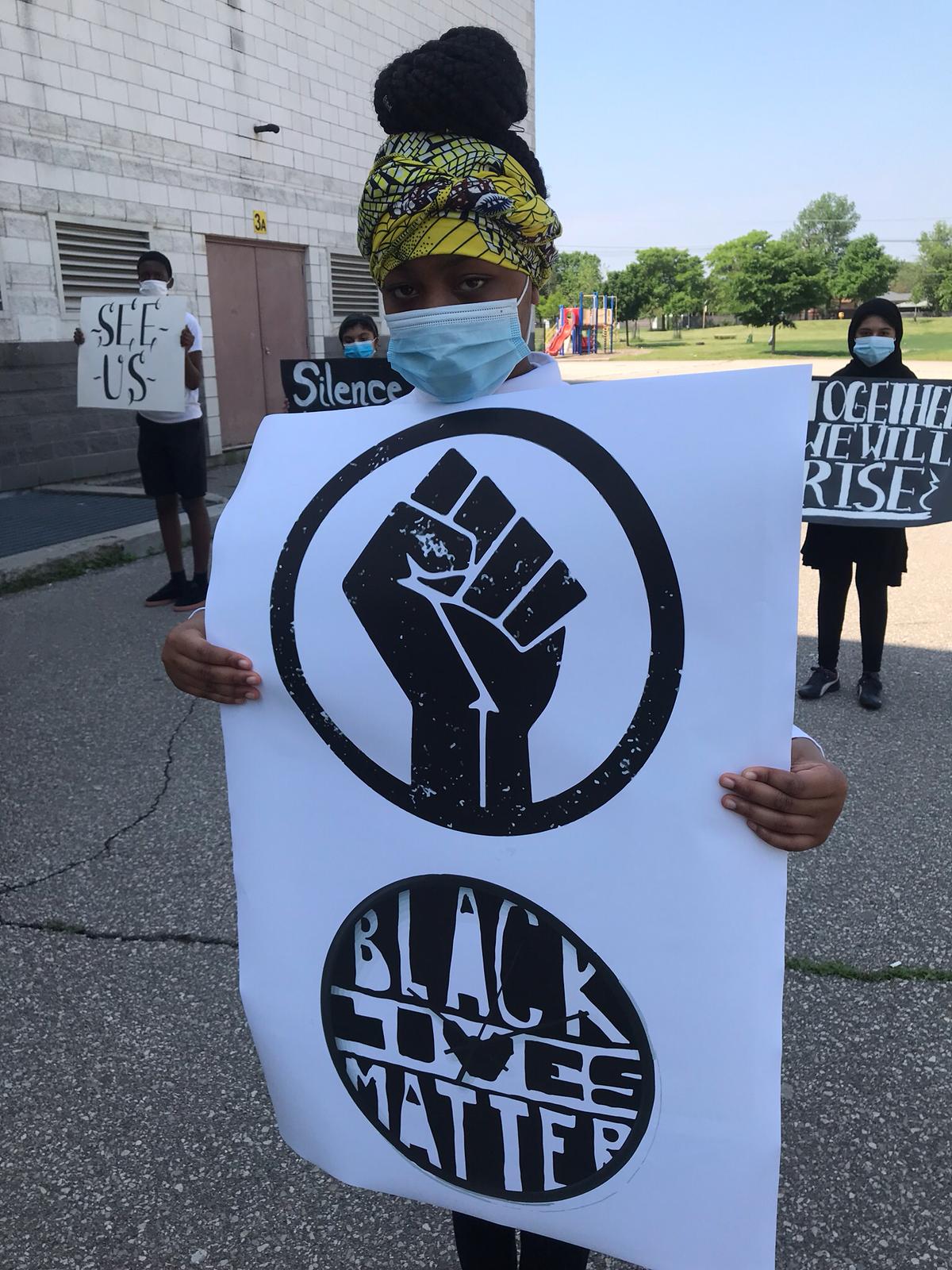
The pandemic has further brought to light the inequities and injustices faced by marginalized groups. For Black and other racialized students in a North Toronto middle school, face-to face-class discussions on matters of anti-Black racism were replaced with virtual community circles. The highly publicized murder of George Floyd and subsequent outcries for justice for Black lives presented educators with an opportunity to critically unpack and explore these lived experiences. Above all, it was critical for all educators to listen to students and encourage social action in their local communities.
Creating a socially distanced Public Service Announcement (www.youtube.com/watch?v= JOW5z3JmaFQ) was an opportunity for students to express, through poetry and spoken word, their deep-rooted trauma, hurt, anger, and resolve as they reflect on their very beings, representations of “Blackness,” and all this encompasses in society.
Photos: courtesy Vidya Shah
First published in Education Canada, January 2021
References
Akomolafe, B. (2019, Oct. 22). KWIC 30th Anniversary Keynote: Adebayo Akomolafe [Video]. YouTube. www.youtube.com/watch?v=Q7pauBaL_UE&t=6s
The Canadian Centre for Policy Alternatives. (2020, Sept. 16). Canada’s top billionaires are $37 billion richer since start of the pandemic, CCPA report finds [Press release]. www.policyalternatives.ca/newsroom/news-releases/billionaires-wealth-pandemic
Patel, L. (2016). Pedagogies of resistance and survivance: Learning as marronage. Equity & Excellence in Education, 49(4), 397–401.
Winton, S. (2020). Pandemic pods may undermine the promises of public education. The Conversation. https://theconversation.com/pandemic-pods-may-undermine-promises-of-public-education-145237
-
Opportunity Solving
Comments Off on Opportunity Solving“I believe that education is the civil rights issue of our generation. And if you care about promoting opportunity and reducing inequality, the classroom is the place to start. Great teaching is about so much more than education; it is a daily fight for social justice.” – Arne Duncan
The COVID-19 pandemic has magnified inequities in our school system – barriers based within poverty, language, ability, and racism. But Stephen Covey argued that organizations could potentially arrive in a better place after a crisis than prior to it having occurred, a concept he called “opportunity solving” (2004). Will educational organizations make use of this opportunity? Through surveys and representative interviews of 1,668 Canadian teachers while they pivoted to remote learning and then back to the classroom during the COVID-19 pandemic, we saw examples of actions by teachers, administrators and parents that set the stage for a better, more equitable kind of Canadian schooling.
Teachers: Beyond an instructional role
Teachers who participated in our study let us know that their foremost concern was for the welfare of their students. The stress caused by the quick pivot to remote learning and public displays of new online pedagogies in front of administrators and parents – along with their early stumbles and self-critique – was a distant second concern. One teacher told us,
“My biggest stress right now is not knowing about the well-being of all the students – how are kids coping, how are families coping? That’s another aspect of it that’s hard. I’m not even really worried about what we’re teaching – that’s the last of my worries in some senses.”
The priority placed by teachers on student welfare above instruction points to two important foundations of our current educational system. First, the role of “teacher” is much more than one of providing academic knowledge and skills to students, having become conflated with many other functions in children’s lives, such as ensuring they are physically and emotionally safe and healthy. Second, this responsibility is one that teachers and administrators willingly accept and embrace. Of her students’ reliance on her and the classroom community, one teacher said, “It’s nice how much they miss it.” The acceptance by teachers and administrators that they had a role to play in their students’ welfare was evidenced through their actions as well as their stated feelings, as will be shown in the examples below.
Equal but not equitable
It became evident very early in the pandemic that some children’s needs – both in terms of education and well-being– were not being met. Teachers shared with us their concerns about inequities in access to online learning that challenged the sustainability of schooling for some of their students. These included children who lived in poverty, children whose parents were unable to assist due to work obligations and students with lack of access to the language of instruction. Teachers were also worried about students whose additional learning needs required specialized planning and programming, which was difficult to support outside the classroom and school.
All hands on deck
Teachers and administrators organized quickly and creatively to address these needs. One teacher described how school buses in his province were repurposed to drop off and pick up homework. Other teachers participated in delivering hampers to students’ homes to replace the nutrition programs typically offered in their schools: As one teacher from the Maritimes explained, “There are a lot of families who are really struggling, and [the pandemic] has made it extra hard for them. They might not have a meal that day, so we’re reaching out to them and delivering food.” One administrator in Winnipeg quickly put the school division’s tablets into the hands of his students in their homes and then funded $40,000 for Internet for those homes. “Anything we can do to keep kids on pace with their peers, making progress, and socially engaged with their teachers and peers is just the right thing to do,” explained Brian O’Leary, Superintendent of Seven Oaks School Division. Additionally, a response planning team of Manitoba educators and administrators worked together with provincial officials to quickly gather resources to create an online repository for parents trying to support differentiated learning taking place at home. One team member said, “These plans, resources, supports, and activities adopted key messaging and practices to guide both educators and families during a time of uncertainty.”
Heroism and hopefulness
These inspirational stories highlight the commitment and partnership of educators, families and communities, and it would be tempting to call them heroes. Indeed, their work is inspirational. However, the need for these “heroic” acts is prompted not by the pandemic, but by inequities revealed within the foundation of the wider social safety net. These “cracks” have for too long been silently filled by educators, and the broadening disparities continue to be addressed by the goodwill of caring education professionals during the pandemic. Nonetheless, teachers are tired. One told us, “I feel inadequate, if that makes sense, in my ability to teach over the phone.” Another said, “I found I was almost getting depressed and felt completely helpless basically – [from] the inability to help the kids like I typically would.” A common sentiment was that teachers just wanted to go back to the way things were before the pandemic: “Just let us go back to school. I miss [my students], and I want them to know that I miss them.” But to return to school as it was before the pandemic would be a mistake. While we collectively yearn to return to our former and familiar systems, we are now called upon to opportunity solve to ensure that the lessons taught to us by COVID-19 are used to build an enhanced, equitable, and more robust Canadian school system.
The challenges of change
The pandemic has provided the opportunity and the impetus to transform our current practices in education. Change is uncomfortable, yet necessary for growth. In his latest book, The Catalyst, Jonah Berger (2020) explores barriers to change, and his findings articulate the factors that make it easy for us to be lured back to the past, especially after a worldwide pandemic. They include the endowment of value we place on what is familiar, our discomfort with the distance from past practice, and the uncertainty of moving forward in a new way. Given these barriers and teachers’ current “pandemic fatigue,” it just seems more comfortable to restore our former educational system rather than to try something different… once again.
Michael Mindzak (2020) challenges us to “shift our gaze to reconceptualise contemporary education.” Rather than looking at how we can return as quickly as possible to the way things were, he suggests we consider how things can be approached differently going forward. Mindzak encourages us to re-examine expectations in the current educational narrative – such as the myth of finite resources resulting in educators having to do more with less, and the belief that formal learning can only occur in a classroom or designated school building. Ultimately, he asks us to rethink the purpose of education within this re-framed context. Navigating a pandemic has allowed us to see first-hand the inefficiencies and ineffectiveness in our current system. Likewise, Fullan et al. (2020) describe the opportunity for Canadian educators to harness this knowledge and move from a period of disruption and transition to “re-imagining” – not restoration. Rather than focusing on ways to return our educational organizations to places that clearly have structural challenges, we are called upon to opportunity solve new systems built on solid foundations of sustainable equity and well-being. With equity as a guiding principle, creating a new Canadian social/school system where every child is safe, nourished, cared for, and has access to technology is an action-oriented pathway.
From crisis to opportunity
The abrupt and disruptive changes resulting from the COVID-19 pandemic have effectively propelled education from a zone of crisis and uncertainty to one involving learning and growth. Fullan et al. say that what has emerged in the process is recognition that we are no longer working on provisional solutions for the short term. Rather, educators are refocused on enduring, student-centred technological innovations that combine the most effective approaches for both classroom and remote engagement – a sustainable and dynamic hybrid learning model. In this regard, the pandemic crisis can be viewed as an opportunity taken for improvement in education, bringing the essential levels of creativity and inspiration to bear, and ensuring that school communities are in a better place both now and in the future.
“It’s the long game we’re in. And the way it’s played will keep changing. Adapt and respond. Use compassion and the best available science. Pivot quickly when necessary. Accept that life is different now. Keep calm and carry on. Reset not return.”
– Senator Stan Kutcher
Read the report
Read a more detailed summary of the authors’ research survey here:
https://edcan.atavist.com/teacher-covid-survey
References
Berger, J. (2020). The catalyst: how to change anyone’s mind. Simon & Schuster.
Covey, S. (2004). The 7 habits of highly effective people. Free Press.
Fullan, M., Quinn, J., Drummy, M., & Gardner, M. (2020). Education reimagined: The future of learning. https://edudownloads.azureedge.net/msdownloads/Microsoft-EducationReimagined-Paper.pdf
Mindzak, M. (2020). COVID-19 and the ongoing problem of educational efficiency. Brock Journal of Education, 29(2), 18–23. https://journals.library.brocku.ca/brocked
a
Photo: Adobe Stock
-
School Wellness Partnership Program
Comments Off on School Wellness Partnership Program
YOUR NEW WELLNESS JOURNEY STARTS RIGHT NOW, RIGHT WHERE YOU ARE.
EdCan and TeacherFit are proud to present you the ONLY program designed specifically to meet the needs of educators through affordable, efficient, and effective mindfulness, fitness, and yoga classes. Plus nutrition challenges and programs for students!
TeacherFit provides educators with the tools they need to take care of themselves mentally, physically, and emotionally for the long term.
Click here for more details
-
What Do We Actually Mean by “Inclusion”?
Comments Off on What Do We Actually Mean by “Inclusion”?
Inclusion, specifically in terms of disabilities, affects all teachers, students, and classrooms. Within Canada, roughly 13 percent of K-12 students are considered disabled, a number that climbs to 25 percent when taking into account students requiring significant learning supports (Alberta Teachers’ Association, 2018). Commonly, preservice teachers receive training on policies, procedures, and strategies for inclusion as part of their teacher education. Armed with this training, teachers (novice and experienced alike) are expected to “do” inclusion and support a gamut of diverse student needs. Teaching practices are shaped by this training combined with teachers’ own beliefs, values, and experiences, yet there is less clarity in academic literature on how teachers integrate their perspectives and training in coming to understand inclusion. This crossroads was the focus of my research as both a contribution to scholarship and to support preservice teachers themselves in developing an understanding of inclusion.
As an instructor of a Bachelor of Education course on inclusion and having worked with students with disabilities over the years, I wondered how preservice teachers grappled with and made sense of their training and what they thought inclusion meant from their own perspectives. Having seen first-hand how a teacher’s understanding of inclusion can impact students’ experiences and learning, I knew this was an area that warranted further investigation. Much of the literature I reviewed considered teachers’ overall beliefs, sentiments, and attitudes toward inclusion and disabilities. However, I was struck by the limited attention paid to the finer-grain aspects of preservice teachers’ perspectives and how they came to develop their understanding.
Although I have not defined either disability or inclusion, these terms have likely evoked from readers (such as yourself) a swirl of meanings and assumptions. In the same way, without explanation, my mention of a typical K-12 Canadian classroom likely prompts a common set of assumptions about what a classroom is, what happens there, and who is there. Chances are most people would imagine a classroom having a teacher, students, desks, and chairs. In such a classroom, students likely take part in learning activities and assessments, and are expected to follow established behavioural norms. While the details of these characteristics will differ from person to person, the commonalities make up what Dorothy Holland (1998) and colleagues called a “figured world.” This concept encapsulates the socially negotiated and recognized, taken-for-granted assumptions about an environment, its participants and activities, and what outcomes are valued over others within a context. Figured worlds vary in scope and type, such as a figured world of schooling, parenting, corporate accounting, or Alcoholics Anonymous. Importantly, figured worlds shape how people engage with daily life and are useful for understanding how people assume orientations to participate in a given context. They are how a person can know what to expect and do within a classroom versus, say, a zoo. (Of course, classrooms and zoos can sometimes feel like they have a lot in common!)
Figured worlds are durable but not static. They are in a continuous process of being refigured and renegotiated by their participants, thus making it a useful framing given that neither inclusion nor teaching and learning occur in a vacuum or strictly follow a script. As well, a person’s experiences and participation in one world influence how that person comes to understand and participate in another. This space, where preservice teachers negotiate previous understandings of inclusion and/or develop new ones, was the focus of my research. I wanted to pull back the curtain on what preservice teachers understood inclusion to be and how they formed that understanding. In addition, I wanted preservice teachers themselves to reflect on their perspectives and discuss them with peers, learn from each other, and couch their perspectives among their peers.
To help make this process visible, at least partially, my colleagues and I tasked the 350+ preservice teachers enrolled in a Bachelor of Education course with creating drawings of inclusion. Intentionally, the task was open-ended. Students were supplied paper and markers and had approximately 30 minutes to create their drawings. Why drawings? The goal was to encourage preservice teachers to go beyond repeating inclusive buzzwords. Moreover, drawings offered a tangible way to externalize students’ thinking and acted as a tool to think with when discussing their ideas with peers. In addition, drawings are unique in showing multiple ideas and concepts in relation to each other simultaneously on a page, compared to a written form where ideas are presented more linearly. For instance, a drawing can more easily show how different groups of students and resources might be positioned in a classroom in relation to each other and the teacher.
Given the range of drawing skill sets among the preservice teachers, they were also asked include a written description to explain ideas or concepts they were attempting to convey through the drawing. In small groups, the preservice teachers shared and discussed their drawings. All drawings were scanned and uploaded to an online gallery accessible to everyone enrolled in the course. The instructors and I reviewed the drawings to get a glimpse into students’ thinking and we referred back to them during in-class discussions.
Findings
The drawings were delightful, ranging from depictions of classrooms to abstract shapes and metaphors. They were diverse but also shared common themes.
Accommodations and resources were common among drawings of classroom environments. These included supports such as wheelchairs, access to print and audio versions of books, visual magnification devices, various types of seating, and options to use visual or tactile learning materials. These depictions took a predominantly tool-driven approach to inclusion by offering students resources. Perhaps unsurprisingly, such approaches echo traditional perspectives toward disabilities that continue to underpin systemic structures and practices within education today – specifically, the medical model of disability that relies on matching diagnoses to supports and developing individualized education plans to document and track students’ progress. Critically, such diagnoses are often necessary to prove eligibility for resources and access to government funding.
Also common to the drawings were students depicted as holding hands or collaborating on learning activities. This framing of inclusion tended to emphasize togetherness and a sense of belonging among diverse people. Collaboration was also conveyed in two ways: as students helping one another and as a way to strengthen learning and benefit everyone by combining people with different attributes and experiences. These ideas seem to align with contemporary theories of education such as social constructivism and generally fostering interactions among people as part of learning.
In contrast to these, several drawings took a more holistic perspective by describing inclusion as a system. For instance, drawings of a forest as a metaphor for how each student represented various elements of a forest (e.g. rocks, stumps, trees, shrubs, soil) and each element was interconnected and collectively made up an ecosystem of inclusion.
In terms of what inspired their drawings, in interviews after the course, the participants often referenced their own experiences of schooling. Some spoke of challenges they noticed or experienced as students themselves and used the drawings to contrast or improve upon them. Others spoke from the perspective of being parents and noticing their own children’s experiences and how their children’s classrooms looked and what resources were available to support student needs. Still others admitted limited experience or knowledge of supporting disabilities and inclusion.
Between the course and the interviews, preservice teachers completed a four-week practicum placement at a school where they planned and taught a portion of lessons. During the interviews, I asked the participants about their experiences around implementing inclusive practices during practicum. One hurdle they repeatedly described was taking into account social dynamics when trying inclusive practices. For instance, one participant described an activity where students had to collaborate to solve math problems. The preservice teacher did not realize one student often had negative interactions with peers, making collaboration difficult. In another case, a participant designed a lesson where students worked in groups and did class presentations, but two students had selective mutism and struggled to participate in the activity given its interactive nature.
Having seen first-hand how a teacher’s understanding of inclusion can impact students’ experiences and learning, I knew this was an area that warranted further investigation.
Some participants also encountered school cultures and norms that resisted certain inclusive practices. In a school that prioritized traditional direct instruction and individual seat work, when a participant offered students multiple options to show their learning – such as thorough multimedia or forms other than written text – all students elected to use a written format because it was the normative practice of that learning environment. In another case, a participant explained how in upper grades, there was often a strong focus on preparing students for diploma exams and other teachers in the school questioned learning activities that strayed from the formats used in exams.
Not all participants encountered challenges in their practicum, though. Several described classes where students had agency to use resources as desired to support their needs. The teacher had established norms and inclusive practices that aligned with the preservice teachers’ perspectives toward inclusion. Similarly, one participant noted how their placement classroom had norms around students supporting each other, reducing the onus on the teacher to foster inclusive practices.
Lessons learned
At a base level, all the participants conveyed a positive sentiment towards inclusion. All acknowledged diversity among students and their needs, and communicated ways to support those needs. Reflecting on the findings, some key takeaways emerged.
First, traditional, medically-oriented approaches to disability continue to be top of mind for many preservice teachers entering the profession. Given that the medical model underpins much of the systemic processes and supports, teachers must learn to navigate and leverage these systems so students can access funding and resources. At the same time, students are more than a diagnostic label and inclusion should approach students as holistic beings with an array of attributes, strengths, and needs. Contemporary models such as Universal Design for Learning (UDL) aim for such a holistic approach, and many teacher education programs (including the one in this study) and ministries of education promote their use. Acknowledging that current funding models and systemic structures can impose pragmatic challenges, training teachers on models such as UDL is key in encouraging teachers to move beyond mere accommodations and take comprehensive approaches to supporting students’ needs.
Second, the participants’ common portrayals of students collaborating or interacting as part of an inclusive environment aligns with contemporary theories of learning as a social process. The participants were less clear on how collaborative approaches worked together with accommodation strategies, suggesting a need for more explicit training and/or scaffolds as part of teacher education and professional development to help teachers integrate individualized supports within social models of learning.
Third, as some participants experienced in their practicums, there can also be tensions between inclusive practices and school cultures and priorities. Pressures such as diploma exams can constrain the types of teaching practices and learning activities that are offered to students. Importantly, inclusion and diversified practices that better support a range of student needs are a benefit and not a compromise or detriment. Approaches such as UDL can enhance and enrich learning for all students while enabling a greater range of students to learn and participate in education. While it may be challenging at times, new and seasoned teachers alike should remain vigilant and reflective about their practices and resist following traditional ways of teaching for the sake of status quo, instead focusing on pedagogies that are inclusive and enriching to all students. Similarly, teacher educators can integrate opportunities for preservice teachers to critically reflect on their perspectives as part of their training.
This study has shown a wonderful breadth in how preservice teachers are thinking about inclusion. While the implementation details were still emergent for some participants, their ideals hold promise. The study also points to opportunities to scaffold ways for teachers to make linkages across different aspects of inclusion (e.g. individualized versus class-wide supports) during their training and when they take on classrooms of their own. As well, given the array of ways preservice teachers think about inclusion, incorporating opportunities to explicitly discuss those perspectives in their teacher education can support them in developing durable understandings of inclusion.
Inclusion is a broad and complex topic with many interconnected elements, much like the drawings involving forest metaphors, so it is heartening to see the next generation of teachers actively considering its many facets in an effort to foster an accessible, robust, and resilient education system for all students.
Photo: iStock
First published in Education Canada, January 2021
References
Alberta Teachers’ Association (2018). The state of inclusion in Alberta schools. www.deslibris.ca/ID/247446; Statistics Canada (2018). Canadian survey on disability: A demographic, employment and income profile of Canadians with disabilities aged 15 years and over, 2017. www.statcan.gc.ca
Holland, D., Lachicotte Jr., W., Skinner, D. & Cain, D. (1998). Identity and agency in cultural worlds. Harvard University Press.
-
WEBINAR: Leading Schools in the COVID19 Era: What have we learned so far?
Comments Off on WEBINAR: Leading Schools in the COVID19 Era: What have we learned so far?Watch the full webinar below:
This webinar is primarily for governments, education professional organizations, school and school district leaders, teachers and education support workers, and anyone interested in understanding current issues for changes to K-12 schooling for the education sector across Canada in the COVID-19 era.
This webinar broadcasted on October 7th, 2020 explores what has been learned so far about leading schools through COVID-19 as we prepare to enter into our second month of school reopening across the country.
Topics explored include:
-
how our understandings of the work of school leaders is evolving;
-
the ways in which educators and their professional organizations are navigating ever-changing expectations of schooling during the present time; and
-
how schools can maintain a focus on the social justice and equity issues that have been laid bare as a result of COVID-19 and its impact on marginalized and racialized communities.
Note: EdCan is a neutral third-party intermediary organization. Live presentations do not constitute an endorsement by the EdCan Network/CEA of information or opinions expressed.
-
-
WEBINAR PANEL DISCUSSION: October 7, 2020
Comments Off on WEBINAR PANEL DISCUSSION: October 7, 2020WHEN: wednesday, OCTOBER 7 at 1:00-2:00 pm (EST)
This webinar is primarily for governments, education professional organizations, school and school district leaders, teachers and education support workers, and anyone interested in understanding current issues for changes to K-12 schooling for the education sector across Canada in the COVID-19 era.
This webinar explores what has been learned so far about leading schools through COVID-19 as we prepare to enter into our second month of school reopening across the country.
Topics to be explored include:
-
how our understandings of the work of school leaders is evolving;
-
the ways in which educators and their professional organizations are navigating ever-changing expectations of schooling during the present time; and
-
how schools can maintain a focus on the social justice and equity issues that have been laid bare as a result of COVID-19 and its impact on marginalized and racialized communities.
Register Here
Note: EdCan is a neutral third-party intermediary organization. Live presentations do not constitute an endorsement by the EdCan Network/CEA of information or opinions expressed.
-
-
Education Canada, September 2020 – Flipbook Edition
Comments Off on Education Canada, September 2020 – Flipbook EditionSTRESSED AT SCHOOL
School is a learning environment, but we need to recognize that it is also a workplace. In this issue, we look at K-12 staff and student stress as being two sides of the same coin. We share the realities of staff burnout through real-life accounts, look at the relationship between staff and student stress, and bring new perspectives and approaches to alleviating stress at school. This theme is an extension of EdCan’s Well at Work initiative and recognizes that stress, anxiety, violence, and bullying negatively impact both staff and students as well as the overall school culture. The rising complexity of student needs, the lack of adequate supports for students with special needs, difficult or abusive relationships (whether peer-to-peer, parent/teacher, principal/teacher, trustee/director, or other), overwhelming expectations, and exposure to trauma all challenge the mental health of the whole school community. Stress and burnout in students and K-12 staff are interconnected, affecting each others’ well-being and teaching effectiveness, and ultimately learning outcomes.
WEB EXCLUSIVES:
RELATED EDCAN FACT SHEETS:
-
Cultivating Well-Being
Comments Off on Cultivating Well-BeingThe stress that teachers experience has many sources. Teachers often report feeling undervalued, underprepared, unsupported, overworked, isolated, and marginalized. A Canadian Teachers’ Federation (2014) survey found that eight in ten teachers feel their stress levels have increased over the previous five years. Reasons cited for elevated stress levels include an inadequate amount of preparation time, limited opportunities for planning and collaboration with colleagues, lack of professional development opportunities, and insufficient support with curriculum implementation. Stress impacts teacher well-being, social emotional competence, and the ability of teachers to provide the emotional and instructional support that is characteristic of safe, caring, learning environments.1
When educators experience burnout, the emotional exhaustion that sets in can negatively impact teacher instruction and elevate student stress levels, leading to further mental health issues in the classroom.2 Teacher burnout can cause students to perceive the classroom as negative, which can lead to increased behavioural problems – and it is problem behaviours that teachers cite as a major source of job dissatisfaction, turnover, and lowered expectations. In Canada, stress and burnout has contributed to the high number (25 to 30 percent) of teachers who leave the field entirely within the first five years of beginning their career.3
A district-wide model for supporting teacher well-being
The OECD (2016) has conceptualized an integrated School as Learning Organization model4 with seven key dimensions, described in Figure 1 below. The Surrey School District (SD 36) has developed and implemented a district-wide shared vision for learning – Learning by Design – that puts into action each of the OECD dimensions.
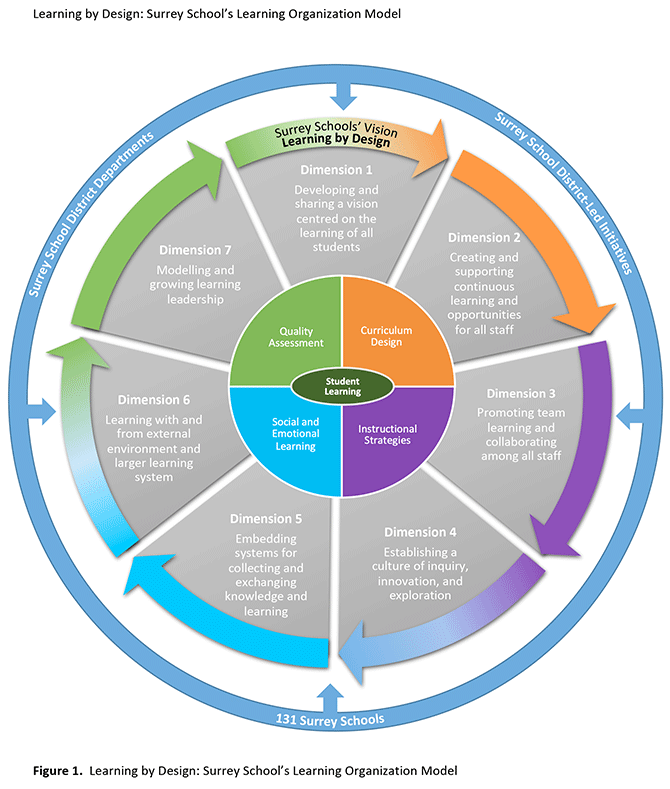
A key aspect of Learning by Design is our commitment to supporting ongoing professional learning through research, innovation, and collaboration as part of our four Priority Practices:
- Curriculum Design that deepens learning and supports students in gaining important core competencies
- Quality Assessment that focuses on the learning process and provides multiple opportunities for students to demonstrate their learning
- Instructional Strategies that are carefully crafted by teachers to enrich learning experiences for all students
- The implementation and support of quality Social and Emotional Learning through research-based processes and practices.
Below we describe a collection of district-wide initiatives, aligned with our four Priority Practices that promote educator well-being, self-efficacy, and connectedness. These initiatives were underpinned by research into best practices, and designed and implemented by multi-department teams. Within our systems change approach, we have in place formalized research, monitoring, and evaluation activities to ensure program challenges are identified and addressed.
Strategies for supporting teacher well-being
Social Emotional Learning for educators When educators demonstrate social emotional competencies (SEC), it translates into positive impacts on teacher-student relationships, a healthier classroom climate, greater student Social Emotional Learning (SEL) and academic achievement, and implementation of more effective SEL and classroom management strategies. Research finds that teachers high in SEC tend to have lower levels of workplace stress, a greater sense of personal accomplishment and satisfaction in their career, and are often better able to provide emotional and instructional support to students.5
Providing professional development grounded in SEL for educators not only provides them with skills to improve their own mental well-being and emotional resiliency, it also provides them with tools to take those skills and implement them with the learners in their schools.
The Surrey Schools’ SEL for Educators (SEL4E) initiative has been offering a series of workshops that provide educators with tools to increase their SEC by developing:
- A greater sense of self-awareness and teacher efficacy
- Mindfulness practices that support teacher well-being
- Increased emotional resilience
- Self-compassion in teaching and learning.
Educators who took part in this initiative reported that they have the confidence to bounce back from a challenging day due to a better understanding of SEL practices, that the skills they learned will support them in overcoming challenges in their career, and that they can identify, assess, and implement strategies that will support their SEC and resiliency.
A district of our size faces barriers to offering SEL professional development opportunities on a wide scale. While it’s great that we have many requests from school staff to take part in SEL4E, the number of requests often exceed what our resources will allow. The district is committed to increase capacity and provide for more collaborative and experiential learning opportunities.
Supporting an SEL climate in schools Educational research finds that system-wide approaches can contribute to improved social emotional competencies for student populations and school staff.6 The Surrey SEL Initiative is a school-wide systems approach to integrating academic, social, and emotional learning (SEL) across the district as a means to promote equitable outcomes for all students, while also promoting teacher wellness and resiliency.
To fuse SEL practices at the level of a school community, our approach incorporates capacity building, collaboration, and reflection on the pedagogical practices teachers adopt and implement in their classrooms. It uses resources from the CASEL Guide to School-wide Social and Emotional Learning to support our schools in assessing the SEL climate of the student population and staff, and to guide planning and monitoring of implemented SEL programs and activities.
Teachers and administrators form a school-based SEL Team and participate in a collaborative process, supported by the District SEL Team. Each school receives release time for one teacher (SEL Lead) one day per week to support the implementation of quality SEL practices. The SEL Lead works side-by-side with classroom teachers in their school to co-plan and co-facilitate the implementation of SEL-based curriculum to enhance learners’ skills development.
This model builds on relationships that exist within a staff. While changes in staff are always the concern, we have found that the nature of this work is taking root and proving sustainable beyond one individual. Evaluation efforts are currently underway to better understand the impacts of the Surrey SEL initiative and the sort of district supports that are needed at all levels of the school system.
Comprehensive mentoring support Mentor 36 is a joint initiative between Surrey Schools (SD 36) and the Surrey Teachers’ Association. It aims to foster a sustained culture of collaborative mentorship at every site in Surrey, supporting professional growth and a sense of belonging for Surrey teachers, through strength-based, non-evaluative learning opportunities such as:
- Ongoing professional learning sessions for teachers who are in the first five years of the profession and new to the role
- Ongoing professional learning for mentors/facilitators
- Peer-to-peer support and collaborative cohorts.
Currently, Mentor 36 has 91 elementary mentors and 126 elementary mentees, as well as 136 secondary mentors and 110 secondary mentees. Feedback data revealed that the majority of mentees (59 percent) were comfortable sharing their vulnerabilities and discussing instructional strategies with their own mentors. About two-thirds of mentors (67%) felt they had developed a safe and trusting mentoring relationship, as evidenced by their mentees reaching out and connecting, feeling comfortable and safe to ask for support, and discussing classroom issues.
At a Mentor Learning Session, mentors created a collaborative drawing depicting the benefits of teacher mentorship.
Collaboration time and efficacy building as strategies to address stress
A review of best practices by the Centre for the Use of Research Evidence in Education7 finds that collaboration that enables co-learning, co-development, and joint work for educators is linked to improved professional knowledge, skills and practices, and increased expectations for student learning. Increased collaboration and communication between teachers often both reduces feelings of isolation and improves teachers’ knowledge and skills. These in turn lead to lower teacher burnout and greater feelings of capability to meet challenges in the classroom.8
Two of Surrey’s programs to support students also support teacher wellness by providing opportunities to collaborate and share learning to better meet the needs of specific students:
The Inner-City Early Learning initiative provides early literacy and numeracy support for “at-promise” students in Kindergarten and Grade One who may be demonstrating challenges in literacy and/or numeracy development since the 2012-2013 academic year. Specialist teachers in literacy and numeracy work collaboratively with classroom teachers in 26 inner-city schools.
Grade One students collaborate to build (with onset-rime trains) and record words with the support of their Early Literacy Teacher.
These early literacy and numeracy supports have provided a success story for our inner-city schools. One challenge is that only three of the original 25 early literacy and early numeracy teachers from the 2012-2013 start-up are still with the program. This rate of turnover impacts the professional capacity building of the department as a whole, and it is more difficult to maintain connections and trust when relationships between early learning support staff and classroom teachers have to begin anew each school year. Despite these challenges, this initiative continues to successfully support some of the district’s most vulnerable learners.
The Knowing Our Learners Initiative offers School Teams (teachers and administrators) the opportunity to participate in Knowing Our Learners (KOL), a collaborative initiative that aims at enhancing instructional and assessment practices with the support of Curriculum and Instructional Helping Teachers. This year, 175 teachers in 55 schools participated in this program, which focuses on knowing our learners’ stories, strengths and challenges, and using this knowledge to design effective learning environments that keep social and emotional well-being, quality assessment, and evidence of learning at the heart of every child’s learning experience.
KOL activities led to teachers feeling supported and more aware of ways to align their learning intentions with student needs and to make informed decisions about teaching strategies and interventions based on research and other supports. Beyond the impacts KOL sessions had on teacher practices, the initiative was grounded in teacher-to-teacher relationships, open dialogue, and peer reflections. KOL was effective because it was “situated in relationships.” As one participant commented, KOL sessions “made me feel working with [my colleague] made me more [sensitive to] what is working and what’s not. I felt it improved our capacity to know how each other worked to help students.”
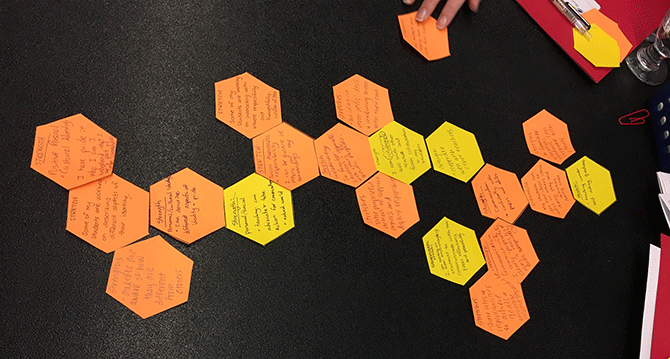
Knowing our Learners Honeycomb Activity: Teachers wrote and made connections of strengths and stretches of their own Core Competencies with those of their students.
Sustainability challenges and the road ahead
While many Surrey schools have embraced the initiatives previously discussed, maintaining motivation and engagement year over year can be challenging. Additionally, while we have found school-wide buy-in for many sites, in some instances only pockets of teachers have been engaged in these collaborative opportunities. We are working toward overcoming these challenges by ensuring rigorous research and evidence collection activities are embedded throughout each initiative, in order to make adjustments for future planning of district-led initiatives. Our process and outcomes-based program evaluations are formative in nature, grounded in best practices in evaluation designs, and include the stories and reflections of school staff.
The district also ensures that participation in its professional learning opportunities is predicated on school staff either forming or being part of a team at their school site (e.g. SEL School-based Teams). This can still pose a challenge when team members bring to the initiative different goals and competencies on which they wish to focus. We address these differences by connecting Helping Teachers and teacher mentors with specific school sites to help facilitate team discussions and bring clarity around the team’s goals and activities.
With a district focus on social and emotional learning, we are addressing not only the health and well-being of students, but of our teachers as well. We believe that healthy and capable teachers foster healthy school classrooms and give students the best possible chances for success. Surrey School’s Learning by Design framework reflects our systems approach to cultivating well-being. By building teachers’ SEL competencies, we are able to address teacher burnout and stress, support teacher wellness, elevate teacher autonomy and voice, and build resiliency through cross-departmental collaborations.
The primary authors wish to recognize contributions from: Gloria Sarmento (Director of Instruction, Building Professional Capacity Department), Taunya Shaw (District Helping Teacher, Social and Emotional Learning), Courtney Jones (District Helping Teacher, Inner City Early Learning Support), and Sharon Lau (District Helping Teacher, Mentoring)
Illustration: iStock
Photos: Courtesy authors
First published in Education Canada, September 2020
Notes
1 M. T. Greenberg, J. L. Brown, and R. M. Abenavoli, Teacher Stress and Health: Effects on teachers, students, and schools, (Edna Bennett Pierce Prevention Research Center and Pennsylvania State University, 2016).
2 Schonert-Reichl, “Social and Emotional Learning and teachers,” The Future of Children, 27, 137-155.
3 P. A. Jennings and M. T. Greenberg, “The Prosocial Classroom: Teacher social and emotional competence in relation to student and classroom outcomes,” Review of Educational Research 79 (2009): 491-525.
4 OECD, What Makes A School a Learning Organisation? A guide for policy makers, school leaders and teachers, (Paris: OECD, 2016).
5 K. A. R. Richards, C. Levesque-Bristol, T. J. Templin, and K. C. Graber, “The Impact of Resilience on Role Stressors and Burnout in Elementary and Secondary Teachers,” Social Psychology of Education 19 (2016): 511-536.
6 G. G. Bear, S. A. Whitcomb, M. J. Elias, and J. C. Blank, J. C. (2015). “SEL and Schoolwide Positive Behavioral Interventions and Supports,” in Handbook of Social and Emotional Learning: Research and practice (New York, NY: Guilford Press, 2015).
7 CUREE, Understanding What Enables High-Quality Education: A report on the research evidence (London: Pearson Education, 2016).
8 Richards et al., “The Impact of Resilience on Role Stressors and Burnout in Elementary and Secondary Teachers.”
-
WEBINAR: A Need for Proactive Educator Wellness
Comments Off on WEBINAR: A Need for Proactive Educator WellnessThis webinar is primarily for school district leaders, school principals and vice-principals.
It is now more apparent than ever before that taking care of the health of our K-12 educators can no longer be a reactive response. Leaders must begin to be proactive, putting accessible initiatives in place that prioritize the health of their teams. If we hope to impact our student’s success, we must be our best self – mentally, physically, and emotionally. Leadership at all levels must set an example for all to follow.
This webinar originally broadcasted on September 21, 2020 was all about bringing a proactive approach to the culture of educator wellness.
-
WEBINAR: Struggling in September? Let’s turn to self-compassion as a way to meet the ongoing challenges
Comments Off on WEBINAR: Struggling in September? Let’s turn to self-compassion as a way to meet the ongoing challengesThis webinar is primarily for school-based educators
As an educator, do you feel like you’re on a boat out at sea with no rudder this September? Cultivating mindfulness and self-compassion practices can provide the anchor you need in these unprecedented times.
Bill O’Brien said: “The success of an intervention depends on the interior condition of the intervener.” In other words: the success of our actions as educators during September does not depend on “What we do” or “How we do it,” but on the inner Place from which we operate. Mindfulness and self-compassion enables us to show up intentionally aware and present so we can meet each colleague and student with care. But it starts with us as individuals first.
In this-one hour webinar, originally broadcasted on September 18th, 2020, participants learned the three components of self-compassion, the physiology around self-compassion and self-criticism and practices on how to meet ongoing struggles in the moment.
Watch the webinar below:


IDEAS TO SUPPORT EDUCATORS : Subscribe to the EdCan e-Newsletter
Quality research, reports, and professional learning opportunities.