
Archive
-
Healthy organizational responses to the coronavirus pandemic
Comments Off on Healthy organizational responses to the coronavirus pandemicI begin the revised and expanded edition of my book, Creating Healthy Organizations: Taking Action to Improve Employee Well-Being with a basic question: how can we make organizations humanly sustainable so they can succeed in the future? This question takes on new urgency now that we’ve been blind-sided by a global pandemic. Human resources, workplace wellness, and occupational health and safety professionals are confronting what surely will be the greatest test of their career. Following the principles of a healthy organization can be helpful.
PERVASIVE PUBLIC PESSIMISM
First, here’s the backdrop to what’s happening to workers and employers. Unlike the 2008-2009 financial crisis and Great Recession, which resulted from weaknesses in the financial system, the coronavirus pandemic generates anxiety and fear on two fronts: health and economic.

Evidence of this comes from EKOS Research Associates’ latest polling of Canadians (March 17-24, n=1,710, MOE +/- 2.4%, 19 times out of 20). Three-quarters of those surveyed believe the economy is already in recession and expect it to get worse in the next 6 months. Just over half think they will be worse off financially in 6 months. The typical respondent sees a 50% chance of them personally being infected by the coronavirus. Most (80%) are experiencing stress due to the pandemic. On an optimistic note, Canadians do grasp the severity of the crisis and understand what they need to do to stay safe. And they endorse governments’ responses so far.
SHIFTING HEALTHY PRACTICES INTO HIGH GEAR
Pre-pandemic, organizations in all industries operated in an environment rife with ever-greater risks and uncertainties, and sweeping transformations. More employers recognize that survival depends on getting the fullest commitment and energy from each and every employee. The goal of making the entire organization healthier moved into the mainstream of corporate wellness. Companies are striving to make workplaces psychologically healthier and safer. Expanded corporate sustainability frameworks have opened up discussions about the sustainability of a company’s human resource practices.
This solid progress – coupled with strong economies in Canada and the US leading up to the pandemic – will enable many of us to weather the storm.
CULTIVATING RESILIENCE
Healthy organizations cultivate workforce resilience. Resilient people don’t bounce back; they bounce forward, finding new strength and equilibrium. They move to a new normal that enables them to keep progressing toward a better future. Resilient people don’t just adapt to change, they find opportunities and renewed strength as they confront it. In the language of positive psychology, the goal is to help organizations and their members flourish and thrive.
Workers need a supportive environment to be resilient. To do this, leaders must develop their own resilience. Resilient leaders skillfully and proactively respond to stressors, practice self-care, learn from failure, develop renewed strengths, and show others how it is possible to thrive when the going gets tough. In this way, they foster a resilient workforce that is prepared to deal with the unexpected.
Individual and team resilience is a hallmark of a psychologically healthy and safe workplace. The National Standard of Canada for Psychological Health and Safety in the Workplace highlights the key workplace features that contribute to resilience:
1. Supportive managers and coworkers
2. A culture that values individuals’ well-being
3. Skilled people leadership
4. Respectful working relationships
5. Support for employees’ personal growth and development
6. The resources needed to manage workloads and job demands
7. Employee involvement in decisions
8. Recognition for contributions
9. The flexibility needed to achieve work-life balance
Maintaining, and even strengthening, the above workplace features must be a priority. Building a healthy organization is a shared responsibility. While demonstrated support from senior leaders is a key enabling condition for change, equally important is the active participation of all the organization’s members, right down to the front lines. Ideally, all employees should feel motivated and encouraged to find ways to make their jobs and work environment healthier and safer. Now the bar is raised, because this has to happen virtually.
 LESSONS FROM RECESSIONS PAST
 The change process can be designed to be healthy. We can derive lessons from research on corporate downsizing and restructuring during the recessions of the ‘80s, 90s, and 2000s. Here’s what’s well documented: 1) downsizing increases stress and diminishes the health of those laid off and the ‘survivors’ (who suffer from what’s called ‘survivor syndrome’); 2) poorly executed downsizing or restructuring reduces organizational capabilities, ranging from learning, reduced tacit knowledge, social capital (relationships), collaboration, and innovation.
Survivor syndrome (the negative psychological and physical impact of remaining in a downsized organization, including guilt) can be avoided by empowering workers to redesign work tasks and processes to fit the renewed mission, responding to issues and concerns raised by employees, and supporting employees to individually and as teams actively manage the changes.
During the 2008-2009 Great Recession, some companies came out stronger because they used the downturn as an opportunity to engage all employees to reinvent the business strategy and find better ways of working. Leaders in these organizations built trust by openly communicating with employees, involving them in the changes, and supporting them at every step of the way. The big take-away for employees: this company cares about me so I am committed to its future success.
SIGNS OF MUTUAL SUPPORT
As the Economist recently observed: “Downturns are capitalism’s sorting mechanism, revealing weak business models and stretched balance-sheets.” But there’s more to the survival story. Beyond balance sheets and the type of business (pity the cruise lines), it comes down to people practices, reinforced by shared corporate values. Values are the essential guideposts when the going gets tough. And rarely has it been tougher.
Small businesses face more acute challenges. But from what I’ve seen locally, owners may be more inclined to treat their workers like family, knowing they will need them back as the pandemic threat recedes.
I see signs of this today in my own community. A restaurant quickly shifted to a reduced take out menu, turning waiters into delivery drivers, and offering customers the option of buying an inexpensive meal for a family in need. Gyms offer free daily on-line workouts. Musicians stream live performances. A craft distillery now is producing hand sanitizer. My friend Todd Ramsay and his wife Ashley, who run Kelowna-based Yeti Farm Creative, an animation studio, proactively set up their employees to work at home in early March. Their team feels virtually connected (Todd’s accompanying graphic captures this) and are committed to coming out of this ordeal even stronger. The common theme here is people pulling together and helping each other. And just as with fires, floods and other natural disasters, people are engaging in acts of kindness. Local TV news images of empty foodbank hampers quickly resulted in a $10,000 donation, plus lots of smaller ones.

Work and social life have been transformed in a matter of weeks into virtual experiences. Video chat service Zoom has, well, zoomed into widespread use. The lines between work and home and family life have dissolved. What about those workers faced with school closures and kids at home needing constructive activities? It’s time for your team to talk about what adaptations are needed to support these members.
LET’S NOT FORGET…
There are other groups of workers who desperately need help. Foremost are front-line healthcare workers. We’ve seen shocking videos of doctors and nurses working around the clock in Spain and Italy, risking their safety, tending to patients lying in hallway floors without proper equipment. How can we prevent that scenario from happening here? And as a New York Times editorial put it: “In this hour of crisis, those at the bottom of the economic pyramid are in the greatest need of help.” This includes low-paid workers and those in the gig economy. There’s an essential role for governments here.
Yes, the coronavirus pandemic will end. The Chinese city of Wuhan, the original epicenter of the coronavirus, has reduced the number of new infections to the point that people are returning to work and some semblance of normal daily life. All the more important to ensure that today’s responses to the pandemic will ready us to resume our social and economic lives. So think of where you want to be one year from now.
-
The Ups and Downs of Co-Teaching
Comments Off on The Ups and Downs of Co-Teaching -
Managing Stress and Anxiety from COVID-19
Comments Off on Managing Stress and Anxiety from COVID-19With the COVID-19 pandemic, we find ourselves in a time of change and uncertainty. Worry and anxiety about financial insecurity, job loss, and social isolation, along with our physical and mental health are natural reactions to this stressful situation. Left unaddressed, these feelings can be harmful when they get out of control.
Continue to resource here
-
COVID-19: We are here to help
Comments Off on COVID-19: We are here to helpIn response to the COVID-19 Pandemic, Morneau Shepell’s Workplace Learning Solutions team has developed a number of resources to help organizations and employees understand and work through the challenges we are all facing.
Continue to resource here
-
Resource Hub: Mental health and wellness during the COVID-19 pandemic
Comments Off on Resource Hub: Mental health and wellness during the COVID-19 pandemicThe Mental Health Commission of Canada is committed to sharing credible information and resources about maintaining mental health during this time of crisis, and supporting people managing a mental illness in this new context.
Also, be sure to check out The Working Mind: COVID-19 Self-Care & Resilience Guide.
Continue to resource here
-
Teach from Home
Comments Off on Teach from HomeA temporary hub of information and tools to help teachers during the coronavirus (COVID-19) crisis.
Also, be sure to check out the Teach from Home toolkit.
Continue to resource here
-
Mental Health and the COVID-19 Pandemic
Comments Off on Mental Health and the COVID-19 PandemicThe effort to address COVID-19 is both extremely important for us all and poses a range of challenges for individuals and families as they respond to the demands of the situation. The situation is stressful for everyone and it is normal to be anxious and worried. This site is designed to provide information and suggestions about how best to cope in this difficult time.
Continue to resource here
-
Global Education Coalition
Comments Off on Global Education CoalitionThe Global Education Coalition launched by UNESCO seeks to facilitate inclusive learning opportunities for children and youth during this period of sudden and unprecedented educational disruption.
Investment in remote learning should both mitigate the immediate disruption caused by COVID-19 and establish approaches to develop more open and flexible education systems for the future.
Continue to resource here
-
COVID-19: Practical workforce strategies that put your people first
Comments Off on COVID-19: Practical workforce strategies that put your people firstIn moments of uncertainty and concern, it’s not only about what leaders of organizations do but equally how they do it that matters.
In January 2020, ahead of the Lunar New Year and as health concerns were still growing, Deloitte conducted a survey in China of human capital policies and practices. The survey drew over 1,000 responses from enterprises operating in China, including a cross-section of private, foreign, and state-owned enterprises as well as not-for-profit organizations.The survey shows that from the beginning of the COVID-19 outbreak, the immediate focus of employers has been on ensuring the health and safety of their employees
Drawing on lessons learned in prior crises, such as SARS, Deloitte offers practices and strategies for consideration.
Continue to resource here
-
How to support student mental health during the COVID-19 pandemic
Comments Off on How to support student mental health during the COVID-19 pandemicStudents may experience a range of emotions during the COVID-19 situation. As well, changes in routine, including time away from school, may create challenges for some students. We also understand that young people with pre-existing mental health problems may find their symptoms increasing in light of the current uncertainties.
School Mental Health Ontario compiled tips and resources to help answer questions you may have about how to support students during this time.
Continue to resource here
-
Guidance for COVID-19 Prevention and Control in Schools
Comments Off on Guidance for COVID-19 Prevention and Control in SchoolsThe purpose of this document, published by UNICEF, is to provide clear and actionable guidelines that will allow schools and other educational establishments to operate safely through prevention, early detection, and combating COVID-19. While these guidelines are specific to countries that have already confirmed the transmission of COVID-19, they are still relevant in all other contexts. Education can encourage students to become advocates for disease prevention and control at home, at school, and in their communities by enabling them to educate those around them on how to prevent the spread of virus. Maintaining safe school operations or reopening schools after a closure requires many considerations but, if done well, can promote public health.
Continue to resource here
-
Making a Drastic Change in my Teaching Career
Comments Off on Making a Drastic Change in my Teaching Career -
The Action-Driven Change Framework
Comments Off on The Action-Driven Change Framework -
Dealing with a negative school environment as a new teacher
Comments Off on Dealing with a negative school environment as a new teacherIN BEGINNING MY JOURNEY AS A TEACHER, I LEARNED THAT I HAD TO BETTER UNDERSTAND TEACHER WELL-BEING IN TODAY’S K-12 EDUCATION SYSTEMS.
When I began teaching, I decided to enroll in the Master’s of Professional Education program (M.P.Ed.) at Western University, with a focus on Curriculum and Pedagogy. To me, this was an easy decision given that the practicum placements I undertook during my pre-service teaching program had ultimately left me with more questions than answers about current policies and initiatives to support teacher well-being. From my experience, the majority of education policies and initiatives that are publicly available remain largely focused on student well-being and on how teachers can make various changes to their professional practice to inspire student success. I began to wonder, “Why are there such limited documents and resources available that focus on the value of teacher well-being and that show how teachers’ levels of well-being directly influence their professional practice? How are teachers supposed to support student well-being and success, if their own well-being isn’t supported by K-12 education systems?”
It’s these types of questions that led me to conduct research during my M.P.Ed. program specifically on the value of teachers in today’s classrooms. As I began to scan the available research on K-12 teacher well-being in schools across Canada, I was able to confirm that there indeed wasn’t much research available that actually looked at the well-being of teachers. As a full-time student simultaneously teaching full-time, what I was finding through my research was backed not only by my personal experiences but by many of the conversations I had with fellow colleagues at the very first school I was teaching at. Ultimately, I began to notice that many of the stories I was hearing all had an underlying commonality — that teachers’ well-being was almost always linked to the quality of relationship teachers have with their school principals.

TEACHERS AND PRINCIPALS: WHY BUILDING UP THIS RELATIONSHIP IS SO IMPORTANT.
Emotional exhaustion including low energy and consistent fatigue caused by workload or time pressure, fear of speaking honestly, and other professional frustrations are warning signs that teachers may be trailing along a path towards burnout. Much of the research that’s been offered in the past 5-to-10 years hints that negative school climate and classroom environments can take a toll on a person’s ability to teach effectively. Part of what can help create a healthier school climate is the quality of teacher-principal relationships, and we know that negative relationships between professionals can negatively affect the quality of instructional leadership and learning taking place within a school.
After graduating from my pre-service program, I landed a full-time French Immersion teaching position in a school where I soon realized there was a consistent lack of open and positive communication between the staff team and administrative team. When trying to learn about how things worked in my school, as well as navigate what was expected of me, I often received different answers depending on who I asked. If I posed questions to other staff members, I’d get responses like, “I’m not sure…”, “I don’t know…”, “I think so and so knows that answer…”, and, “I think the admin said this, but I would go and ask them to make sure…” I began to find myself constantly questioning my own confidence and purpose as a teacher because of the lack of trust and clarity I was often experiencing in my interactions with administrative staff. This isn’t at all what I’d envisioned for my first two years of teaching.

As someone who had learned, while training as a teacher in university, the importance of maintaining open lines of communication between myself and school administration, I began to realize that this simply wasn’t a case of me being unprepared as a new teacher. More importantly, I knew I wasn’t alone in experiencing these communication problems. Over time, as much I would try to remind myself that my mental, emotional, and physical well-being were important to maintain in my profession, I became more and more discouraged each morning I returned to school. It became clear to me that the lack of clear communication between staff and administration, among other things, weren’t conducive to building a healthy, supportive school culture. It was also clear that this was taking a toll on everyone’s well-being. If I was dreading going to work, I’m sure both other staff and administration were, too. I knew for the sake of my own well-being, and that of my colleagues and administrators, that none of us could continue working in an environment like this. I was left wondering, “What steps could we all be taking to improve workplace satisfaction and the overall well-being of all K-12 staff?”
THE TAKEAWAY: NOT ALL HOPE IS LOST WHEN IT COMES TO ENSURING HIGH QUALITY TEACHER-PRINCIPAL RELATIONSHIPS AND RESTORING THE VALUE OF ALL TEACHERS.
My experiences during my first two years as a teacher were very eye-opening and served as a great learning experience in how relationships are so key to well-being in the workplace. A teacher, or any K-12 staff member (e.g. Educational Assistant, Principal, etc.) who’s treated as a valued member of the team not only by their administration – but by everyone – will feel supported and more engaged in their work, which benefits the entire school community and students especially.
Through experience and further research, I hope to be able to find some answers and solutions to the problems associated with strained teacher-principal relationships. Far too many teachers and principals today are experiencing unnecessary levels of anxiety, confusion, uncertainty, and a low sense of well-being. My best advice for those who are also in their beginning years of the profession is to find strategies to build up your resilience at work and, most especially, to trust yourself. By reminding ourselves to follow our instincts on both personal and professional levels, we as teachers can build and maintain a sense of value and purpose in our important roles.

Photos: Adobe Stock
check out the following resources to learn more about:
1. Empowering Modern Educators
This resource has been created to encourage and empower all educators. Much of the information presented in this resource is solely meant to highlight some of the major, and ongoing challenges that are experienced daily by educators. This resource is also meant to give educators the confidence to maintain the difficult, but necessary, dialogue about the added responsibilities and stresses which this profession, at times, places on us.
Learn more here
2. Restoring the Value of Teachers: A Perspective on Quality Teacher-Principal Relationships
A compilation of research that examines what makes a quality teacher-principal relationship.
learn more here
-
Coronavirus (COVID-19) information for K-12 educators and Faculties of Education
Comments Off on Coronavirus (COVID-19) information for K-12 educators and Faculties of EducationWith the unsettling disruptions of school closures and social distancing requirements, we will continue to update useful links to help you access the latest information from your provincial/territorial ministry of education.
Outbreak update from the Public Health Agency of Canada
Outbreak update from the World Health Organization
Alberta
What is the current situation? Click here.
British Columbia
What is the current situation? Click here.
Guidance for COVID-19 prevention and control in childcare and schools.
Manitoba
What is the current situation? Click here.
New Brunswick
What is the current situation? Click here.
Newfoundland and Labrador
What is the current situation? Click here.
Nova Scotia
What is the current situation? Click here.
Northwest Territories
What is the current situation? Click here.
Nunavut
What is the current situation? Click here.
Ontario
What is the current situation? Click here.
Prince-Edward Island
What is the current situation? Click here.
Quebec
What is the current situation? Click here.
Saskatchewan
What is the current situation? Click here.
Yukon
What is the current situation? Click here.
-
Racism and K-12 Workplace Well-Being
Comments Off on Racism and K-12 Workplace Well-BeingAlso available on:


-
Well at Work Professional Development Discussion Kit for K-12 Staff
Comments Off on Well at Work Professional Development Discussion Kit for K-12 StaffEducation Canada Discussion Kits are an EdCan Member Exclusive Benefit for Organizations (School Districts, Faculties of Education, Corporations, Non-Profits), transforming evidence-based literature from our critically-acclaimed Education Canada magazine into practical group discussion and self-reflection guides that can be used by K-12 staff to question, strengthen, and improve their professional practice across a variety of current and emerging trends in education.
Whether you’re an educational assistant, teacher, school leader, or superintendent, we encourage you to invest in your continuous learning and that of your team through these easy-to-use and affordable professional development resources that encourage critical thinking and actionable strategies for unique school contexts.
About the Well at Work Discussion Kit
This special Well at Work Discussion Kit complements our Winter 2019 edition of Education Canada magazine – available both in-print and online – and puts the spotlight on how we can (and why we must) strengthen the social and emotional wellbeing of K-12 staff, in turn enabling them to achieve healthier schools and better learning experiences for students.
This discussion kit contains a total of eight group discussion and self-reflection guides – four in English and four in French – covering topics ranging from creating organizational cultures that foster workplace well-being; the well-being of education leaders and front-line staff; and identifying and challenging the mindsets, assumptions and public perceptions towards the well-being of K-12 educators that hinder change.
How to use Education Canada Discussion Kits
Each group discussion or self-reflection guide contains three key components:
- A Cheat Sheet providing a brief summary of the literature, which is intended to facilitate and support the uptake of group discussion within your school community.
- A Reflect section with 2-4 thought provoking questions prompting participants to self-reflect in conjunction with their own thoughts and opinions in response to the article.
- A Do It section that provides participants with the opportunity to engage with the content in a more interactive way. By completing this interactive activity, participants are encouraged to think about how they can apply their newfound learnings to their professional practice.
Education Canada Discussion Kits have two-fold usage:
- Group discussions: School leaders can use discussion kits for staff Professional Development (PD) by facilitating discussion during a staff meeting or other designated PD time. Principals can lead sessions by selecting a group discussion guide according to their preference, introducing the theme of the guide, providing a summary of the literature, and finally proceeding to facilitate and participate in discussion by asking the suggested questions and interactive activity provided. Discussion kits can also be used during more informal group discussions (i.e. among colleagues) without the presence of an administrator to facilitate.
- Self-reflections: Discussion kits can also be used alone by individual K-12 staff members who are looking to improve their professional practice on their own time. Additionally, newfound knowledge can help individual staff members to later spark and inform conversations with their colleagues.
Ready? Request the full copy now!
FOR EDCAN MEMBERS
If you’re an EdCan member, you’ll be able to access the full-version of the Well at Work Discussion Kit, including all of our other archived and upcoming discussion kits! Simply fill out the form below!
Not sure if you’re a member? Check out our list of members here. If you’re an employee of one of the organizations listed, or a student or faculty member of a university listed, then you’re already a member! Click here to create your employee, student, or faculty account.
Note: To access this discussion kit, you must have an organizational membership, meaning that you are an employee, student, or faculty member of the following:
- School District;
- Faculty of Education;
- Not-for-Profit (national and provincial organizations, federations, colleges, schools); or
- Corporation.
Not a member yet? That’s okay! To gain unlimited access to the Well at Work Discussion Kit and all other discussion kits, we encourage you to explore our membership options here.
If you require any assistance or have any questions with regards to becoming a member please contact membership@edcan.ca.
Full Copy Request Form – Well at Work Discussion Kit
-
Infographic: The Positive Workplace Framework (PWF)
Comments Off on Infographic: The Positive Workplace Framework (PWF)This infographic is based on the Positive Workplace Framework (PWF), which is a made-in-Canada strengths-based approach to optimizing staff and student well-being, engagement and performance, with a focus on the three key conditions to creating a healthy workplace in K-12 education: Mental Fitness, Resilience, and Positive Leadership. The PWF can also be applied to other settings beyond the K-12 context (e.g. colleges, universities, day cares, etc.).
This infographic was inspired by an article by Robert Laurie, Dr. Bill Morrison, and
Dr. Patricia Peterson that appeared in Education Canada Magazine. -
Workplace Well-Being in K-12 Schools: What does it mean to “flourish” at work?
Comments Off on Workplace Well-Being in K-12 Schools: What does it mean to “flourish” at work?Facing growing levels of stress and burnout, K-12 staff require a supportive workplace that encourages them to find ways to “flourish” within their school community. While flourishing may look different to staff members depending on what makes them personally feel most valued and connected to their work, a flourishing school environment generally has three main components:
1. Subjective Well-Being: positive emotions, positive relationships, and a sense of making a difference are all aspects that contribute to a staff member’s sense of flourishing.
2. Adaptive Community: an environment where staff are encouraged to communicate openly with colleagues, be creative, and resolve team conflicts when they arise.
3. Leaderful Mindsets: staff are able to identify ways that their work contributes to the larger, shared goals of the school community, which provides a greater sense of ownership, engagement, and shared leadership.
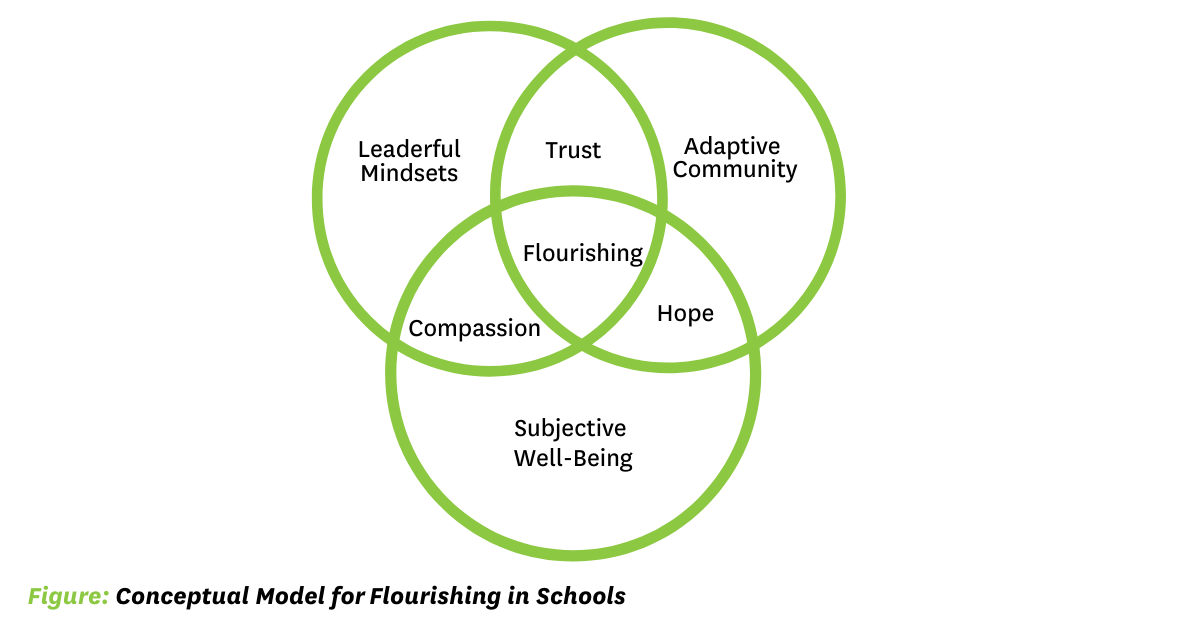
Along with these components, staff in flourishing school communities generally demonstrate key “professional characteristics,” including:
1. Compassion: noticing and wanting to help ease the stress of others, and are aware of how their thoughts and actions impact their colleagues.
2. Trust: having the support and autonomy to take creative risks and innovate, which is reflective of having positive relationships with colleagues.
3. Hope: striving to improve the school environment as a whole-school community by recognizing both strengths and challenges, while building a shared vision for improvement.While schools come in all shapes and sizes, a flourishing school community is supportive and provides staff members with a sense of purpose and belonging where they feel seen, valued, and ultimately find meaning in their work.

This research was funded by the Social Sciences and Humanities Research Council of Canada
Additional Resource Information
Katz, J. (2019). Ensouling our schools. Winnipeg, MB: Portage and Main Press.
SEL BC: http://www.selbc.ca/
Growing Great Schools Worldwide: https://growinggreatschoolsworldwide.com/canada-effective-approaches-to-promote-teacher-wellbeing/
SMART (Stress Management and Resiliency Techniques) https://education.ok.ubc.ca/research-partnerships/smarteducation/
References
Cherkowski, Sabre, and Keith Walker. (2018). Teacher wellbeing: Noticing, nurturing and sustaining flourishing in schools. Burlington, ON: Word and Deed Press.
Cherkowski, Sabre, Kelly Hanson, and Keith Walker (2018). Mindful alignment: Foundations of educator flourishing. Lanham, MD: Lexington.
Cherkowski, Sabre and Walker, Keith (Eds.). Perspectives on Flourishing. Lanham, MD: Lexington.
Cherkowski. S. and Walker, K. (2019). Mentorship for flourishing in schools: An explicit shifttoward appreciative action International Journal of Mentoring and Coaching in Education, 8 (4), 345-360.
Cherkowski, Sabre, and Keith Walker. (2018). Teacher wellbeing: Noticing, nurturing and sustaining
flourishing in schools. Burlington, ON: Word and Deed Press.
Cherkowski, Sabre, and Keith Walker(2014) Flourishing communities: Re-storying educational leadership using a positive research lens International Journal of Leadership in Education 17.2 (2014): 200-216.
Cherkowski, Sabre, and Keith Walker (2016) Purpose, passion and play: Exploring the construct of flourishing from the perspective of school principals." Journal of Educational Administration 54.4 (2016): 378-392.
Cherkowski, Sabre, Kelly Hanson, and Keith Walker (2018)Flourishing in adaptive community: balancing
structures and flexibilities." Journal of Professional Capital and Community 3.2 (2018): 123-136.
-
Going Green
Comments Off on Going GreenSchools can meet the challenge of climate change in different ways. Here are two outstanding – but very different – examples.
This federal election saw a not-so-subtle shift, as climate change and the environment became key priorities for Canadians. Faced with increasingly unpredictable weather, fears Canada will not meet its global commitments on carbon reduction, and a strong youth movement, public awareness and concern for climate has never been more palpable.
Youth have been at the centre of this shift, driven in part by Greta Thunberg’s climate strikes which have galvanized young and old around the world.
In Canada, schools are also part of the discussion. From curriculum and programming that explore climate change and human impact on the environment, to physical changes that promote energy efficiency, waste reduction and student health, Canadian schools are meeting the challenge of a changing climate in unique ways.
École Curé-Paquin: Leading the way to zero carbon
École Curé-Paquin elementary school in Saint-Eustache, Quebec will open its doors to more than 350 students this winter. The new facility was the first project in the province to receive the Zero Carbon Building – Design certification from the Canada Green Building Council (CaGBC).
“Creative and bold initiatives are needed to counter the effects of climate change.”
The certification means that École Curé-Paquin is designed to achieve zero greenhouse gas (GHG) emissions associated with building operations. The school was part of a pilot project for the Zero Carbon Building Standard, which puts significant focus on carbon emissions in building design and performance.
For the Commission scolaire de la Seigneurie-des-Mille-Îles (CSSMI), the pursuit of the Zero Carbon Building Standard1 aligns with its belief in investing in sustainable buildings and contributing to the reduction of GHGs. The school board saw the pilot project as a flagship initiative that will potentially inspire other schools across the province. “Creative and bold initiatives are needed to counter the effects of climate change,” said Paule Fortier, President of CSSMI. “I am happy that our organization is making this environmentally responsible gesture through the construction of this school for the generations of tomorrow.”
Several decisions were made to improve energy efficiency and the school environment. For example, École Curé-Paquin uses geothermal exchange using heat generated from the earth for 100 percent of its heating and cooling needs. The school also installed photovoltaic or solar panels on the gym roof with a capacity of 27 kilowatts and sensor-controlled LED lighting, which helps reduce total energy use and daytime energy demand.
If your organization, school district or faculty of education is an EdCan member (see the list here), you can enjoy unlimited access to our online content! Click here to create your online account.
An enhanced building envelope limits hot or cool air loss, while the design optimizes natural daylight and ventilation for healthier (and more alert) students.
Research compiled by the U.S.-based Center for Green Schools has found that poor ventilation can result in more missed school days due to respiratory infections, increased incidence of sick building syndrome,2 and increased school nurse visits for respiratory problems. Further, a 2013 study found a direct link between classrooms that have more daylight and improved test scores.
The school board’s goal was to create a comfortable learning environment and to provide an exemplary building for students that could also be used as a learning tool. A screen in the school broadcasts the school’s daily energy consumption and production, including the energy produced via solar panels. In Science class, students learn how GHGs can be reduced using technologies found in the school.
W.D. Ferris Elementary embraces green curriculum

While École Curé-Paquin’s zero-carbon design is a focus for their sustainability efforts, other schools are focusing on curriculum and programming to help students understand the importance of climate change, the environment, and their role in helping to protect the natural world.
W.D. Ferris Elementary is one such school. Through the curriculum, the 500 students of this Richmond B.C. K-7 school are exposed to environmentalism, with programs designed to help them save energy, decrease waste and water use, and improve transportation and indoor air quality.
Teacher and environmental steward Kevin Lyseng credits the students for many of the program ideas that form the basis for the school’s environmental focus. “Caring about self, others and the environment is what we do,” he explained. “We also benefit from the continued support of the Richmond School District.”
“To reduce food waste, the school reversed the lunch schedule, so students can play before eating, resulting in a 95 percent reduction in food waste.”
Depending on the class, students participate in various programs, from raising Coho salmon, growing grapes or participating in regular audits of energy use and waste levels. These audits help shape activities that have had a significant impact on the school. Switching to six-bin waste collection has helped divert waste by 80 percent since 2007 by separating general waste from organics, plastics, paper, glass and metals. Their seasonal energy-saving informational programs have also helped to reduce electricity use by two percent – despite adding to the school’s plug load.
To reduce food waste, the school reversed the lunch schedule, so students can play before eating. This made the students more likely to eat their lunch, contributing to a 95 percent reduction in food waste. They’ve even piloted a flexible packaging project for the city of Richmond and are working with their hot lunch provider to address single-use plastics.
The school encourages active transportation to and from the school with walk-to-school and learn-to-bike programs. These programs help with student fitness, reduce air pollution, and limit traffic around the school – resulting in improved safety.
In the school, they minimize carpet and chalk use and use Ph-neutral cleaners which are less likely to cause eye or skin irritation. Classrooms are scent-free, with low-VOC (low-odour) paints and furnishings to keep the air quality high. Classroom air filters are replaced monthly and for classes with students that have severe allergies, HEPA filters are used because they remove common allergens like dust or pet dander.
This small school’s big success in pursuing a path of sustainability in its programming and approach to learning was recognized with the title of “Greenest School in Canada 2019” by the CaGBC. Principal Diane Steele said the school was honoured to be have been chosen for this award, but was quick to highlight the efforts of all schools committing to sustainability.
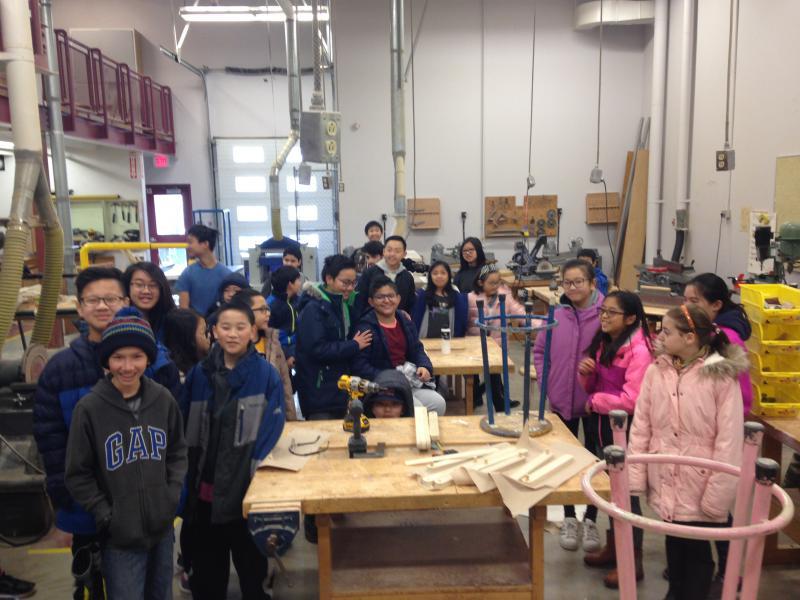
“We also want to acknowledge the hard work done by students and staff daily in schools across Canada to educate their communities about environmental stewardship,” she said. “We encourage all schools to inspire green-minded change in their communities.”
W.D. Ferris continues to spread its message to its broader community. Students and teachers have been involved in the Great Canadian Shoreline cleanup since 2007 and they regularly host district-wide ECO-Cafés, where green leaders meet to share successes and challenges. In this way, Ferris Elementary gives back to the community by encouraging others to reduce their ecological footprint.
Canada Green Building Council
The Canada Green Building Council is a not-for-profit, national organization that has been working since 2002 to advance green building and sustainable community development practices in Canada.
CaGBC and the Canada Coalition for Green Schools host the “Greenest School in Canada” competition, which recognizes schools that are weaving sustainability education into their curriculum and bringing programs and activities to students that encourage awareness about the environment.
Learn more at www.cagbc.org/greenestschool
Photos : from Mark Hutchinson
First published in Education Canada, March 2020
Notes
1 The Zero Carbon Building Standard is a Canadian-made standard and certification that assesses the carbon balance of a building – when there are no carbon emissions associated with operations, it has achieved zero carbon.
2 Sick Building Syndrome is used to describe cases in which building occupants experience adverse health effects potentially linked to the time they spend in the building.


IDEAS TO SUPPORT EDUCATORS : Subscribe to the EdCan e-Newsletter
Quality research, reports, and professional learning opportunities.