Archive
-
The Foundational “R”
Comments Off on The Foundational “R”“School days, school days
Dear old golden rule days
Readin’ and ’ritin’ and ’rithmetic
Taught to the tune of the hickory stick…” -
Young People’s Confidence in School, Community, and the Future: Why It Matters and What We Can Do About It
Comments Off on Young People’s Confidence in School, Community, and the Future: Why It Matters and What We Can Do About ItPublic confidence and trust in institutions matter. A recent Statistics Canada report points out that, “Public institutions, such as the health care system, the education system and the federal parliament, play an important role in shaping the lives of Canadians. Institutions often are considered the basic pillars of society so if people begin to lose confidence in them, there may be cause for concern….particularly in a global and increasingly impersonal world”[1]
Governments, the private sector, and think tanks all regularly measure confidence because it serves as a barometer of the social and economic health of a country by providing important information about people’s intentions and future actions that may have an impact on the rest of society. Consumer confidence signals people’s intentions to save or spend and is thus linked to the health of the economy. Citizen confidence in government contributes to democratic participation and social cohesion. And public confidence in education is critical if we want people – both parents and non-parents – to support public schooling through their taxes and loyalty to the public system. In the U.S., declining public confidence in public education has resulted in an exodus to private schools and even further deterioration of the public system.
From research studies, we know that students’ future trust in institutions is significantly shaped by their school experiences, in particular by whether there is an open climate for classroom discussion and how much their school values student participation in school affairs.[2] Similarly, research into young people’s optimism about the future can provide clues about their interest and capacity to make a difference in the world. Young people who believe in and are able to imagine a better future are more willing and have greater capacity to respond to issues such as social and ecological survival.[3] Therefore, if we want to know what kind of society we are likely to have in the future, we need to understand young people’s confidence in their schools, their communities, and their future.
Youth Confidence in Learning and the Future
Commenting on a recent public opinion poll, Frank Graves of EKOS Research Associates cautioned, “Western societies have long believed in the promise of a better future for the next generations…In recent years though, there has been a growing recognition that the next generation can’t count on this ever-improving quality of life.”[4]
Today’s generation of youth is the first in recent memory that will have lower incomes and less upward mobility than their parents. At the same time, young people are inheriting global scale economic, environmental, and social challenges unlike those of any generation before them.
The Canadian Education Association (CEA) completed a research project that looked at young people’s confidence in their learning environments and their future. With funding from the Ontario Trillium Foundation, CEA collaborated with social planning councils[5] and school boards in five Ontario cities on a community engagement and research initiative that involved young people in a variety of ways.[6]
The Youth Confidence in Learning and the Future initiative engaged over 1,000 Ontario high school students (Grades 9 to 12) who completed an online survey in school. An additional 75 young people participated in facilitated sessions organized by the social planning councils either early in the process to inform the development of the survey or later on to give feedback on the research findings.
The research focused on these dimensions of youth confidence:
- sense of trust;
- level of engagement;
- feelings of empowerment or efficacy;
- degree of “fit” or connection between in-school learning and lives and learning outside of school;
- confidence in the future – future orientation, confidence in their personal future, confidence in the future of their community/country, aspirations.
Research highlights: What students told us
Young people’s confidence varies considerably by dimension. As the table below shows, students were most positive with respect to future orientation and aspirations and least positive about the future of their community/country and the “fit” or connection between school and their life/learning outside of school.[7]
Students were most positive with respect to future orientation and aspirations and least positive about the future of their community/country and the “fit” or connection between school and their life/learning outside of school.
Youth are very future-oriented, with high aspirations. Almost all students (95 percent) reported that they intend to graduate from high school, with somewhat fewer (88 percent) indicating that they intend to graduate from college or university. Close to 90 percent of students said they think a lot about their lives, with 84 percent reporting that they have dreams for the future, although a smaller proportion (72 percent) said they know what to do to make those dreams come true.
Young people are far more confident in their personal futures than in the future of their community or country. Only 35 percent of students agreed that “in the next five years, my town or city (or Canada) will be a better place to live” compared with 73 percent who believed that “in the next five years, opportunities will open up in my life” and “I expect to achieve more than my parents did” in terms of career and income. Even in the face of a labour market and an economy that are failing them, young people continue to be optimistic about their personal futures. Some think this means that today’s youth are better equipped to deal with uncertainty than previous generations. Young people are hopeful and hope has transformative powers.[8]
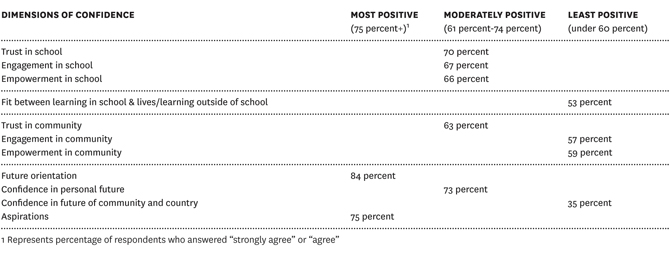
There is a significant disconnect between students’ in-school learning and their lives and learning outside of school. As the above table shows, only 53 percent of students were positive about statements related to “fit”. For example, only 58 percent could see connections between their courses and their lives outside of school, with even fewer (52 percent) reporting that what they do or learn outside of school is relevant to school courses and only 44 percent believing that their teachers are interested in what they are learning or doing outside of school.
Ontario high school students are required to do 40 hours of community service as a requirement for their high school diplomas. Only 57 percent of students found this a useful learning experience, although 71 percent felt that the program makes a useful contribution to the community.
Although moderate overall, students’ level of trust is low with respect to the mainstream media and people in their communities. Only 38 percent of students thought that most of the news in the mainstream media was true. Fewer than half, 48 percent, reported that they trusted “most of the people in my community,” even though 62 percent felt that young people were welcome and respected in their community, and 70 percent said their rights were usually respected.
With respect to trust in school, 49 percent of students said they had someone to discuss personal problems with in school, while 73 percent reported having at least one adult they could discuss school problems with.
While a low level of trust in the mainstream media can be interpreted as healthy skepticism, a low sense of trust in others may signal that community cohesion and social networks are becoming weak.
While a low level of trust in the mainstream media can be interpreted as healthy skepticism, a low sense of trust in others may signal that community cohesion and social networks are becoming weak.
Students feel empowered to stand up for themselves, but most do not think they can make a difference in their schools and communities. Over three quarters of students said they felt comfortable standing up for themselves both in and outside of school, with almost as many, 70 percent, reporting that they “sometimes stand up for others who are being put down or bullied.” On the other hand, only 51 percent said they had opportunities to make their school a better place and even fewer, 47 percent, believed they had opportunities to make their community a better place. Between a quarter to a third of students responded that they were “uncertain” about some of these questions, suggesting that they may not know about opportunities that exist to improve their schools and communities.
Students are more positive about their engagement in school (67 percent) than in their community (57 percent), although neither is high. Over 70 percent of students said they were interested in most of the courses they are taking in school, and 72 percent reported that, in their school, students were encouraged to discuss and question things. However, only 45 percent said they often learn something so interesting that they can’t stop thinking about it. This is consistent with CEA’s research initiative, What did you do in school today?, which found that only 43 percent of students were intellectually engaged, despite much higher levels of social and academic engagement.[9]
With respect to community engagement, only 51 percent of students reported that there were enough interesting things for young people to do in their community; a somewhat higher proportion, 55 percent, said they participated in at least one program or activity. Two-thirds of students indicated that they would vote in elections when they were old enough. Interestingly, while not a particularly strong indicator of engagement, the response to this question was more positive than any of the others related to engagement, suggesting again that lack of opportunities or knowledge of opportunities may be an obstacle for young people’s community participation.
How to Strengthen Young People’s Confidence and Prospects
In May 2012, CEA and the Hamilton Social Planning and Research Council sponsored a community forum and youth consultation on Searching for Certainty in Uncertain Times: Youth Confidence in School, Community and the Future. Close to 100 people, about a quarter of them youth, participated to discuss the research findings. Three panelists were asked to suggest some strategies for improving youth confidence.
Using the example of the Quebec students’ strike, Ron Canuel, the CEO of CEA, observed, “youth are beginning to recognize that if they take a stand, it will make a difference.” He went on to say that the two most important things that need to happen to strengthen engagement in school are introducing and allowing more use of technology in the classroom and greater flexibility in schools (e.g. later starting times for high school students, more flexible timetabling, and year round schooling). Such changes are now being piloted in some jurisdictions in Canada. The B.C. government, for example, is looking at year round schooling, a strategy that would mitigate against “summer learning loss” that affects many vulnerable students. These recommendations reflect what students themselves told us through the survey and informal sessions.
Shadya Yasin, coordinator of the York Youth Coalition in Toronto, emphasized the importance of building trust with both students and their parents, so that students do not feel “pushed out”. Recognizing that many administrators seem to be afraid of community organizations, Shadya argued that the school cannot exist without the community, making reference to the Somali saying, “You cannot wash your face with one finger.” Greater involvement of community agencies in the work of the school and the lives of students is needed to address the disconnect between students’ learning and their lives outside of school. Shadya argued that schools should not be providing mental health and social work services; instead, they should make better use of the services that exist in the community so they can focus on their central goals – teaching and learning.
“Connect schools deeply to their local and broader community” is one of the four core ways to improve high school outcomes that Ben Levin discusses in his 2012 book, More High School Graduates: How Schools Can Save Students From Dropping Out (see review on page 45). Included in this useful and highly accessible book are strategies for breaking down barriers and handling conflict with communities, as well as examples and concrete ideas for “Programming in and With Communities”:
Bring interesting adults into the school in various capacities such as mentors, role models;
Recruit adults who can share information about themselves, their community and their careers with students;
Work with community groups to provide important learning settings for students which can, in the future, open up career opportunities;
Enlist the help of community groups that can enrich school programs by providing opportunities that schools cannot, such as foreign languages, art or sports from a particular ethnic community.[10]
Marvyn Novick, the third panelist, is a policy consultant for Poverty-Free Ontario and former professor at Ryerson University. He noted that young people seem to have more confidence in themselves than in “us” – the community of adults who control their learning environments and the economy. This may be because we have placed today’s generation of young people in high levels of debt, precarious employment, under-employment, and declining public services. Marvyn contrasted this situation with the post-war period when people felt very close to each other and governments invested in collective initiatives – such as affordable housing, family allowances, a good job for everyone – to make sure that young people had a decent future.
To improve young people’s confidence in the future of their communities and their country, he argued, we need to shift the culture in schools and make sure that students understand how important these collective initiatives are. Ultimately, schools are public places where young people can learn that there is another kind of future. For example, instead of teaching about and preparing students for entrepreneurship, which provides jobs for only 15 percent of the population, why not teach students about unionship which contributes to the kind of good jobs that can support a family? Confidence grows with collective solidarity. Young people, schools and communities need to connect with each other and begin to say: there is another kind of future.
Conclusion
The results of this survey tell a good-news, bad-news story. While young people approach adulthood with a confidence in their own ability to succeed – a critical ingredient for success – they appear to have waning faith in social institutions or their ability to influence them. The resulting disconnect between personal and collective futures threatens to turn the optimistic exuberance of youth into a troubling cynicism about the society they will inherit. These results are a call for sustained government investments in ensuring decent jobs, as well as greater empowerment and inclusion of young people in the schools, communities, and social institutions that provide the backbone for democratic, civil society.
The concept paper on which this initiative is based can be found at http://www.cea-ace.ca/publication/youth-confidence-learning-and-future-concept-paper
EN BREF – L’Association canadienne d’éducation (ACE) vient de terminer un projet de recherche évaluant la confiance dont font preuve les jeunes à l’égard de leur environnement d’apprentissage et de leur avenir. Nous savons que l’expérience scolaire des jeunes, en particulier l’ouverture manifestée lors des discussions en classe et la participation des élèves à la vie scolaire, influe considérablement sur la confiance qu’ils accorderont plus tard aux institutions. La recherche portant sur l’optimisme des jeunes face à l’avenir peut nous éclairer sur leur volonté et leur capacité de changer le monde. L’enquête a dévoilé des résultats à la fois positifs et négatifs. Bien que les jeunes évoluent vers la vie adulte avec assurance quant à leur propre capacité de réussir – un ingrédient critique du succès – ceux-ci font moins confiance aux institutions sociales et doutent de leur capacité à les influencer. Les élèves se disaient plus positifs à l’égard des orientations futures et des aspirations, mais plus négatifs en ce qui concerne l’avenir de leur collectivité ou pays et l’intégration des apprentissages à l’école et à la maison.
[1] Grant Schellenberg, “The Perceptions of Canadians: Belonging, Confidence and Trust,” Canadian Social Trends (Winter 2004): Statistics Canada.
http://www.statcan.gc.ca/kits-trousses/pdf/social/edu04_0115a-eng.pdf
[2] J. Torney-Purta, W. K. Richardson, and C. H. Barber, Trust in Government-Related Institutions and Civic Engagement among Adolescents: Analysis of Five Countries from the IEA Civic Education Study. CIRCLE Working Paper 17 (The Center for Information & Research on Civic Learning and Engagement: August 2004).
[3] Carmen Stewart, “Re-Imagining Your Neighbourhood: A Model of Futures Education in Youth Futures. Comparative Research and Transformative Visions, eds. J. Gidley and S. Inayatullah (Westport Connecticut: Greenwood Publishing Group, 2002).
[4] “Frank Graves Poll: The Beginning of the End of Progress”. IPolitics Insight, March 9, 2012.
http://www.ipolitics.ca/2012/03/09/frank-graves-poll-the-beginning-of-the-end-of-progress
[5] Social planning councils are non-profit organizations across Canada working on a range of community development, community building and social justice issues.
[6] Hamilton, Milton, Peterborough, Sudbury, and Toronto
[7] The table does not show how students answered individual questions.
[8] R. Bibby, S. Russell, and R. Rolheiser, The Emerging Millennials: How Canada’s Newest Generation Is Responding to Challenge and Change (Project Canada Books, 2009).
[9] J. D. Willms, S. Friesen, and P. Milton. 2009. What did you do in school today? Transforming Classrooms Through Social, Academic and Intellectual Engagement (Toronto: CEA, 2009).
http://www.ccl-cca.ca/pdfs/otherreports/WDYDIST_National_Report_EN.pdf
[10] Ben Levin, More High School Graduates: How Schools Can Save Students from Dropping Out (Thousand Oaks, California: Corwin, 2012).
-
Searching for Certainty in Uncertain Times – Youth Confidence in School, Community, and the Future
Comments Off on Searching for Certainty in Uncertain Times – Youth Confidence in School, Community, and the FutureForum Highlights: Searching for Certainty in Uncertain Times – Youth Confidence in School, Community, and the Future.
-
Honesty in the classroom
Comments Off on Honesty in the classroom(Note: Yesterday Stephen Hurley invited us to share the professional reading we enjoy or are looking to do over the summer. I’m currently in a book club on Twitter (#kohnbc, Thursdays at 8pm pst). We’re reading Beyond Discipline by Alfie Kohn. My post today comes from that reading.)
In his book Beyond Discipline, Alfie Kohn states that people tell lies when “they don’t feel safe enough to tell the truth” (p. 16, 2006). This idea suggests that even “good” learners (and people in general) will lie – and the environment we create in our classrooms will encourage or discourage honesty.
It reminds me of something a veteran teacher told me when I was in my first year: “As the teacher, you bring the weather into the classroom.”
When I was in Grade 3 my teacher had this rule about signing out balls for recess: if we did not return with the ball we would suffer serious, ominous and vague punishment. Most of us were so scared of this possibility that we always returned with the ball safely clenched tight to our little bodies.
One day I let some grade 5s use the ball I had signed out. When the bell rang I ran back to class – without the ball. My teacher stood at the threshold and wouldn’t let me pass until I told her what happened to the ball. I remember being scared to tell her the truth. So I lied. I looked up at her looming over me and told her that some older kids had taken the ball.
Five minutes later she was trooping me through the Grade 5 classrooms, demanding that I identify the miscreants. Those Grade 5s looked big and scary too, so I kept up the lie insisting that I couldn’t remember what the older kids had looked like.
Unsurprisingly, she discovered that I had, in fact, lent the ball to the older kids and was not a victim of theft. Once again she greeted me at the threshold of our classroom, this time at the post-lunch break bell. She looked down at me from great height and in tight clips told me how foolish I had made her look, how bad I was for being a liar, and how ashamed I should feel.
I still feel shame at the memory, the burning of my face as I crumbled into my seat after the lecture.
All this causes me to reflect: how can I ensure the learners in my classes feel safe? How have I treated dishonesty in the past? How might I encourage more honesty in the future?
This concept applies to behaviors, but it also works for plagiarism: if students felt safe to take risks with their work, wouldn’t they be less likely to cheat at their learning?
Please, share your thoughts!
-
From The Editor: On the Campaign Trail
Comments Off on From The Editor: On the Campaign TrailAs I write these words, we are just days away from a federal election. By the time you read them, the election and its rhetoric will have faded into the contours of a Canadian summer. I don’t want to spoil your day at the lake, but as the last week of this campaign unfolds before me, I can’t resist sharing these thoughts.
As educators, we stress the importance of backing up arguments with facts. It’s not enough to claim something; you have to support it. That’s pretty basic, but it’s a lesson that has obviously slipped by our politicians. When called upon for clear evidence to support their points, they resort to the repetition principle of debating: just keep stating your premise again and again until enough people absorb it as a fact.
We also insist that direct quotations and references to other people’s ideas be cited accurately and clearly. We want to know exactly who said it and where you found it. That’s called “academic honesty” in schools; it’s just plain honesty everywhere else – except on the campaign trail. There, it’s barely given lip service. If you can convince the public that the other guy said something stupid, it’s apparently fair game – whether he said it or not. Or for that matter, whether it’s stupid or not.
Then there’s the principle of clarity. Whether they’re writing a paper for social studies or presenting a science project, students are encouraged to be clear. Can the listener understand what really happened? Can the reader tell what you really think? If not, try again, because good communication skills are essential to academic and personal success – unless you’re running for high office, in which case obfuscation reigns. A convoluted response to a clear question is the best way to prepare yourself for the inevitable misquote (see above).
If this level of cynicism makes you uncomfortable – well, it makes me uncomfortable too. Educators across the country are placing a new emphasis on citizenship education, instilling in their students a respect for the principles of democracy, encouraging them to participate in the political process, and urging them to approach
rational
debate with an open mind. This is exactly what they should be doing. They should also be empowering those young people to insist on the same standards from political leaders. I hope they are.
If we can’t re-educate our leaders in the basic classroom lessons about evidence, honesty, and clarity, public cynicism will make all political debate irrelevant.
-
On the Campaign Trail
Comments Off on On the Campaign TrailAs I write these words, we are just days away from a federal election. By the time you read them, the election and its rhetoric will have faded into the contours of a Canadian summer. I don’t want to spoil your day at the lake, but as the last week of this campaign unfolds before me, I can’t resist sharing these thoughts.
As educators, we stress the importance of backing up arguments with facts. It’s not enough to claim something; you have to support it. That’s pretty basic, but it’s a lesson that has obviously slipped by our politicians. When called upon for clear evidence to support their points, they resort to the repetition principle of debating: just keep stating your premise again and again until enough people absorb it as a fact.
We also insist that direct quotations and references to other people’s ideas be cited accurately and clearly. We want to know exactly who said it and where you found it. That’s called “academic honesty” in schools; it’s just plain honesty everywhere else – except on the campaign trail. There, it’s barely given lip service. If you can convince the public that the other guy said something stupid, it’s apparently fair game – whether he said it or not. Or for that matter, whether it’s stupid or not.
Then there’s the principle of clarity. Whether they’re writing a paper for social studies or presenting a science project, students are encouraged to be clear. Can the listener understand what really happened? Can the reader tell what you really think? If not, try again, because good communication skills are essential to academic and personal success – unless you’re running for high office, in which case obfuscation reigns. A convoluted response to a clear question is the best way to prepare yourself for the inevitable misquote (see above).
If this level of cynicism makes you uncomfortable – well, it makes me uncomfortable too. Educators across the country are placing a new emphasis on citizenship education, instilling in their students a respect for the principles of democracy, encouraging them to participate in the political process, and urging them to approach rational debate with an open mind. This is exactly what they should be doing. They should also be empowering those young people to insist on the same standards from political leaders. I hope they are.
If we can’t re-educate our leaders in the basic classroom lessons about evidence, honesty, and clarity, public cynicism will make all political debate irrelevant.
-
High School’s Dark Corners
Comments Off on High School’s Dark Corners“Ms Moore! What’ssssss’up?!” I squinted to recognize the sweaty student as he careened past me. His hair stood in spikes, his white shorts and T-shirt shone with sweat, and gold chains swung from his neck. Maybe I would have recognized him had my attention not snapped to the mini-skirt wearing girl on his arm. Was that Julie? I thought, incredulous. Front-row-sitter-who-never-speaks-out-of-turn-and-always-has-something-intelligent-to-say Julie?! I graduated just over a decade ago myself, but I was suddenly and acutely conscious of having entered unfamiliar territory: a high school dance in the era of ubiquitous music videos and barely-there clothing. Brace yourself, I muttered.
The place smelled of bodies. From my spot against the wall I could see beads of moisture misting the colourful darkness: colourful from the multi-hued strobe lights, dark because all the regular lights were off – a gift for teachers who were spared the sight of students’ shimmying and shaking.
“Can you believe this?” I asked another supervising teacher. I felt alarmed at all the flesh sweating and jiggling and grinding and swaying and heaving and sliding and bumping and bouncing around me.
Directly in front, but a comfortable ten feet away, an anxious knot of Grade 8s, the babies of the school, clustered. While dancing, they would occasionally glance coolly over their shoulders at the Grade 9s. The Grade 9s spent a lot of time moving importantly around the gym, not getting too close to the Grade 8s but not yet comfortable enough to join the Grade 10s. The Grade 10s, apparently content with their spot in the middle of the ranks, danced in groups but with lots of pairing off. Every few seconds or so one of the boys and one of the girls would press against each other and grind to the floor looking pleased with themselves. The Grade 11s and 12s were difficult to see; they danced in a dark corner of the gym I wasn’t brave enough to visit.
“Is this normal?” I asked the other teacher.
“Yup,” he chuckled. “Welcome.”
Surveying the crowd, I noticed Kevin, a boy with autism in my Grade 10 class. Kevin had no speech and limited abilities to communicate. He had just begun using a machine which speaks words as he types them. His parents ensure Kevin has every opportunity to socialize and learn, and this dance presented one of those opportunities.
“There he goes again,” said my fellow supervisor, nodding towards Kevin.
“Yeah, I was just noticing. Why is he walking around like that?”
“He does that at every dance. Makes him more comfortable in all this chaos, I guess. Having no structure is disorienting, so he walks around the gym’s perimeter which gives him a pattern to hold on to but still lets him be part of the action.”
“I notice that nobody picks on him.”
“Nope. But then, these kids have been going to school together since pre-school. They all know Kevin; it’s nothing new.”
An awkward looking Grade 8 student walked past me, and I noticed many others walking around in a way that suggested they were busy looking for someone – maybe a ruse to avoid a situation for which they were obviously not ready: sweaty dancing with intimidating peers. Kevin was one of the few who looked comfortable, not the least bit self-conscious.
The rap beat stopped and a slow song oozed from the speakers. In a frantic rush, students scrambled to find a dance partner – any dance partner. Senior students in the corner used the slow song as an opportunity to make out with their partners. The Grade 10s paired up, and I had to glance away when I saw one of my students bending awkwardly to place his arms around a girl much shorter than he. The boy made sure to maintain space between her body and his as they stepped side to side almost in time to the music.
Adolescence looks complicated from the sidelines – more complicated than many of us remember. While we teachers focus on our lessons, our students are experiencing life’s bigness for the first time. Remember the day you gave your heart to someone for the first time and got it back damaged? The day you worked your absolute best at something, but failed anyway? The day you realized the people you love won’t live forever?
As the dance swayed to a close, my colleague and I looked at one another with raised eyebrows: “We made it.” We made it through dance supervision, but we also made it through our own high school experiences, relatively confident in our ability to learn, improve, and succeed in life and relationships. We were among the lucky ones.
As I left the stickiness of the gym and drove home, leaving the loud music, the gyrating students, and the insecurities of a high school dance behind, I resolved to be more mindful about using my subject matter to empower students with the tools for life’s tough situations and the confidence to use them.
Brooke Moore teaches English and Writing at Rockridge Secondary in West Vancouver, B.C. She would like to note that the dance she writes about here occurred a number of years ago; since then the Leadership 11 students at Rockridge have been working to connect with the Grade 8s. One of their most successful initiatives has been to help the young students feel more comfortable and confident in situations such as these.
-
Viewpoint: Changing Academic Standards, One Community Centre at a Time
Comments Off on Viewpoint: Changing Academic Standards, One Community Centre at a TimeAcross Canada there exist pockets of “high-risk” communities that share certain characteristics, most of which experts and researchers correlate to poverty. These communities are normally portrayed in the media as hubs for violence, troubled youth, and drug saturation. While it is true that there are some pervasive issues directly related to lack of resources, one may need to take a second glance before siding with the media’s portrayal and/or one’s very own predetermined perceptions of what environments set the precedent for academic success. If you have ever thought that youth living in lower-income neighbourhoods were destined for lower academic success due to lack of opportunity, resources and/or desire, I urge you to keep reading and discover, as I have, a very different world than the salacious world of gun-slingers and drug traffickers typically portrayed in the media as the prime activity in low-income housing communities.
The Alexandra Park Community, also known as the Atkinson Co-op, is nestled unassumingly in the downtown core of Toronto. There are 806 residential units serving approximately 2,000 residents, most of whom live on a fixed income. There is a burgeoning contrast between the Atkinson Co-op, which visibly lacks in resources, and the trendy overflow of splendour that surrounds it. During my exploration I was able to uncover this community’s best kept secret. While visiting the Alexandra Park Community Centre, I discovered that it housed and kept safe the most valuable treasures and ostentatious investments of this community: the youth.
Contrary to the reflection of how undervalued community centres may be to greater society (i.e. decreased presence in communities and lack of financial support for programming), “out of school programs serve as critical partners in assisting schools to fill […] gaps, especially those serving low-income and working-class children of immigrants of colour.”[1] Research done by Irby, Pittman and Tolman emphasises that schools are only “one of a range of learning environments that share responsibility for helping students learn and achieve mastery… Community-based organizations, museums, parks, libraries, families, etc., are also themselves settings for learning and engagement.”[2] Community centres offer a range of learning opportunities and educational support not otherwise accessible in the schools. According to Lee and Hawkins, “community-based after-school programs have the potential to utilize resources and connect with children in different ways than school.”[3] Irby et al highlight that “because they are not necessarily associated with the expectations of school or other major institutions, students may feel more at home in intermediary spaces.”[4] Community centres offering after school programs create a space of belonging, and familial and academic support, which ultimately serves to enrich the student’s educational life through academic achievement and greater potential for success.
Mr. Olu Quamina, Child and Youth Program Coordinator at the Alexandra Park Community Centre, would attest that the community centre “is the nucleus of the community.” The roster of various programs catering to the residents of this richly diverse community has the ability to transport the youth past any stereotype to a point well beyond notions of social responsibility and program participation. Exchanges happen here. Ideas are born here. In many contexts, lives are saved here. Youth who would not otherwise have had an interest in school have traded in their long-standing ideas pertaining to the unimportance of academia for new ones geared toward goal attainment and academic success.
Executive Director Donna Harrow, Atkinson Outreach Worker Donnohue Grant, and Quamina work to implement specific program initiatives that propagate and ensure self-sufficiency while partnering with schools for visible continued support. S.E.R.V.E. (also known as Social. Emotional. Recreational. Vocational. Economic.-Opportunities for Youth, named after the five areas Quamina believes will make a difference in the lives of youth) and Concrete Roses are a few of Quamina’s recently designed programs geared toward the enhancement of youth’s lives through creating bridges of awareness between the relevance of skill development, academic success, and all other aspects of life. “We have changed the standard here. It is no longer ‘cool’ for youth to drop out of school,” says Quamina.
This sentiment is echoed by Patrick, who largely credits Quamina and the Alexandra Park Community Centre staff for supporting him in the successful pursuit of the Co-operative Housing Federation of Toronto (CHFT) scholarship. Although Patrick is aware that those unfamiliar with the Alexandra Park Community perceive his neighbourhood to be “a criminally-based environment”, the environment that he has come to know and love is much different. For Patrick, much of his environment is guarded safely between the walls of the community centre. “The Dexler Johnson program, movie nights, homework club… all of the centre’s activities helped to keep us out of trouble” explains Patrick. He has participated in these programs for several years and has had the opportunity to assume leadership roles. “The centre is where I learn how to become a better person while being an example for others.” When asked where he sees himself in a couple of years, Patrick answered with a smile, “I want to be in a position where I am able to give back to my community and pay tribute to all those who have helped and taught me along the way – furthering my education will help me to do just that”.
Ellie also largely attributes the tenacity of her academic second wind to Quamina and the support she felt throughout the community centre. “Prior to moving to this area, I was going to drop out [of school].” At that time, Ellie had just lost her mother. She was also recovering from an eye operation. Although she had been born visually impaired, the operation had rendered her completely blind. “The centre was incredibly welcoming and was definitely an instrument of change.” Not only is Ellie one of the beneficiaries of the centre’s initiatives, but she has also assumed a role as an imparter of those same initiatives. Ellie is a role model for the youth at the centre. She helps and supports children who are not visually impaired to learn how to read. “I felt that I had a greater purpose.” Ellie has since switched schools, career paths, and with the support and resources of the community centre, has also been successful in the attainment of the CHFT diversity scholarship. “These programs help to spotlight a group of people that most would glance over,” says Ellie glowing with appreciation. “We are here, we have voices, and we are beating the odds.”
Community centres may be seen as an oasis that refreshes and rejuvenates the spirit of academia. The youth who frequent the Alexandra Community Centre strongly vocalised how important the centre was to them. So on their behalf, and on the behalf of youth from communities across Canada who may not have the opportunity for their stories to be heard, a special thanks goes out to those whom Ellie refers to as “the unsung heroes”: community centres responsible for joining the Quamina’s, the Harrow’s, the Grant’s, the CHFT diversity scholarships, and schools of the world, whose collaboration has resulted in changing the academic standards in marginalized and non-marginalized neighbourhoods alike, one youth at a time.
EN BREF – Les médias représentent généralement les collectivités à faibles revenus comme des plaques tournantes de violence, de jeunes en difficulté et de toxicomanies. Mais les jeunes vivant dans des quartiers défavorisés ne sont pas nécessairement condamnés à une réussite scolaire moins brillante par suite d’un manque de possibilités, de ressources ou de volonté. Des centres communautaires comme l’Alexandria Park Community Centre à Toronto offrent un éventail de possibilités d’apprentissage et de soutien éducatif dont ils ne disposeraient pas ordinairement à l’école, suscitant un lieu d’appartenance et un soutien familial et scolaire qui enrichit la vie éducative des élèves en leur ouvrant la porte à la réussite scolaire et à un potentiel plus élevé de succès. On doit à ces centres, répartis à travers le pays, de changer les normes scolaires dans des quartiers marginalisés ou non, un jeune à la fois.
[1] A. Wong, “’They See Us as Resource’: The Role of a Community-Based Youth Center in Supporting the Academic Lives of Low-Income Chinese American Youth,” Anthropology & Education Quarterly 39, no. 2 (2008): 184.
[2] M. Irby, K. Pittman, and J. Tolman, “Blurring the Lines: Expanding Learning Opportunities for Children and Youth,” New Directions for Youth Development 97 (2003): 18-19.
[3] S. Lee and M. Hawkins, M. (2008) “’Family Is Here’: Learning in Community-Based After School Programs,” Theory Into Practice 47, no. 1 (2008): 53.
[4] Irby, Pittman, and Tolman, 18-19.
-
Marginalized Youth in Contemporary Educational Contexts: A Tranquil Invitation to a Rebellious Celebration
Comments Off on Marginalized Youth in Contemporary Educational Contexts: A Tranquil Invitation to a Rebellious CelebrationFirst get off the streets, second get a job, and third finish your education so you can get a career. So it is like steps at a time. It is like some people have those things already and they are lucky that they have those things already, handed to them, and they don’t have to start at the bottom and work their way up. They don’t understand what that is like. Starting at the bottom is…I am slowly getting there. I’m not there, but I am slowly getting there.
-“John” speaks about his education.
I thought how unpleasant it is to be locked out; and I thought how it is worse, perhaps, to be locked in.
-Virginia Woolf, A Room of One’s Own
Contemporary educational practices remain locked in to faulty ways of doing things, and as a result they continue to lock out many young people. The academic success of young people is of critical interest to societies and individuals for both social and economic reasons. General levels of educational attainment have now been clearly linked to economic productivity, and it is widely accepted that meaningful participation in the democratic process requires a level of literacy and understanding that allows one to sort through the complex issues of the 21st century. For young people today, economic stability and a sense of belonging in society depend in large part on step-wise experiences and achievements in the pathways provided in the formal education systems. Since the invention of the schooled society, with days filled with age-segregated formal schooling, young people have been at the mercy of educational ideas and practices. For these reasons, when any groups are systematically excluded from meaningful participation and achieve below their levels of competence, they become both “marginalized” in their current school environments and economically and socially disadvantaged over their lifetimes.
We begin with this tranquil invitation to rebellious celebration: tranquil in that we make space to discuss and reflect on these critical concerns; rebellious in that debate and action are crucial.
Thus, we have urgent reasons to be on the watch for such tendencies and to work to quickly address and avoid them. We are also well advised to map these trends over time and point out those that persist in the face of policy or program attentions. This special issue of Education Canada provides a focused conversation about the ways in which many young people are continuing to be marginalized by contemporary educational processes. One does not need to look far into the literature to see the lasting and abject effects of poverty, culture, or region on youth education. For many young people, these intersecting marginalities come in the form of lowered expectations from those around them, schools which negate their cultural ways of knowing, stalled academic and social accomplishments, a hopeless sense of being on the outside of the educational journeys they had imagined for themselves, and/or even an inability to access a school.
Each of the articles presented in this special issue discusses such marginalities for young people. The authors have lived and worked with young people who are injured and excluded by their social class, poverty, visible minority status, regions, cultural status, mental health challenges, gender, sexual orientations, and so on. While not claiming to speak for, hear, or represent all young people, the purpose of this issue is to share in collaborative conversations about what we know, what has been done, and what must be accomplished. We begin with this tranquil invitation to rebellious celebration: tranquil in that we make space to discuss and reflect on these critical concerns; rebellious in that debate and action are crucial. Even though many excellent programs and projects have been launched by dedicated communities, celebration is premature while so many young people continue to flounder in the boat of contemporary education and society
We should acknowledge from the outset that western democracies have shared the hope that public education would be the “great equalizer” for their societies. Despite the progress in societal prosperity and public education through the 20th century, in most countries educational inequities remain large and persistent.[1] It is clear that we first need to examine our expectations and assumptions about public education systems and how they function. What should we expect of contemporary schools and education systems with regard to producing socially just outcomes for youth?
On one hand, international data shows that schools appear to account for only about 20 percent of the variation in student outcomes.[2] While this knowledge might tempt us to moderate our expectations, we have to remember that this reflects the performance of our systems, institutions, and the people in them as they now function; it does not tell us about their potential impact. On the other hand, we also know from the same international data that schools do make a difference! In fact, the research carried out in the last three decades makes it clear that students in classrooms with the most effective teachers may gain on average 1.5 years (standardized achievement measures) while students with the least effective teachers gain only 0.5 years in the academic year.[3] Furthermore, the last two decades of research have brought us a wealth of knowledge focused on evidence-based teaching practices that are effective with a variety of students facing academic disadvantage for a number of reasons (socio-economic struggles, learning a new language, learning disabilities, etc).[4] At this point in time then, our evaluations of current and future outcomes and expectations must be set against the framework of what we know can be done as opposed to what we have been doing. Our students deserve nothing less!
One especially persistent inequality in education is socio-economic. Often intersecting with cultural and regional inequalities, the relative wealth of families has made, and continues to make, a good deal of difference to the educational treatment, opportunities, and pathways of young people. As a recent Globe and Mail article succinctly attests, the elephant in the room of current U.S. educational policy is income inequality. And, we know that countries with the highest levels of equality in income have the most effective education systems.[5] Thus, the persistence of class-based inequalities in education is disappointing but perhaps not surprising given that, despite some positive policy changes, many core inequalities remain unchanged.
Children’s early experiences within the family still provide them with an essential preparation for formal education and lay the foundations for patterns of inequality and marginality. Some children begin school able to read simple words, identify colours, count, and do simple arithmetic. Others have to acquire these skills within the school environment and may be poorly regarded by their teachers from the outset. Throughout their time in schools, those from more advantaged families often have access to educational resources in the home environment and support from family members who have some knowledge of the curriculum and who can help with homework. In addition, middle class families frequently stress the importance of education, highlight potential benefits, and are able to use their knowledge to secure advantages in an educational marketplace. By contrast, working class families may have narrow occupational horizons, less direct knowledge of educational benefits, and be unable to support their children beyond the end of compulsory education. In short, current notions and aims of education tend to match those of a mainstream middle class. As a generation of critical researchers and pedagogues has shown, there are myriad ways in which school and classroom practices continue to help in stacking the deck against young people from poor families.[6]
They may not necessarily appreciate what goes on in school every day, but young people are aware of their desire and right for quality education to set them along good paths as they define them.
At the same time, education has undoubtedly become more important to young people. The labour market has changed and opportunities for poorly qualified young people are severely limited. In the new knowledge economy, a lack of skills can lead to even further marginalization and exclusion.[7] In these circumstances, young people are participating in education for much longer, and the majority has a strong awareness of the link between educational attainment and subsequent life chances. In our recent studies, young people (those who have left high school and those who have not) clearly state their yearning for quality education, which to them means a system of schooling that is responsive, relevant, flexible, youth-attuned, caring, and proactive.[8] They are interested in “tough but fair” practices and teachers who are “good at teaching” and can make learning fun and engaging while teaching difficult content. This is a reasonable set of expectations for which they do not wish to be short-changed. They may not necessarily appreciate what goes on in school every day, but young people are aware of their desire and right for quality education to set them along good paths as they define them.
The ways in which young people approach education and establish learner identities, therefore, shapes educational experiences. The cultures associated with socio-economic challenges and social classes are important and can impact on educational outcomes. Previous research suggested that a clash between working class cultures and the middle class culture of schools led some young people to resist the authority of the school and reject school-based values that placed a premium on academic success.[9] This process of resistance was regarded as central to the marginalization of working class pupils. But, with education having become much more central to the lives of all young people, such explanations have started to fall out of favour. At the same time, young people living in poor communities may develop waning confidence in their academic abilities and may distance themselves from school. Indeed, conformity to the school may come at a price: in lower working class peer groups it is often not “cool to be clever”, and therefore the educational rewards for breaking with peer values have to be made clear.[10] Such subtleties require serious consideration.
Increased participation in education, therefore, may come at a further price to young people and lead to the emergence of fresh inequalities. Not all families can afford to support their children through long periods of post-secondary education or training. And even if state support is available, there are still important dividing lines. Evidence from the UK shows that young people from less affluent families are frequently debt adverse and reluctant to take out student loans to finance their studies.[11] Young people from poorer families frequently select courses on the basis of cost – not simply in terms of fees, but overall costs, which may include the need to move away from home, travel costs, the length of course, and the perceived linkages between their course and future employment. This can result in selecting courses in less prestigious institutions, choosing shorter courses, and considering courses with strong vocational orientations.[12] In addition, less affluent students frequently work long hours to survive in education, which can interfere with their studies and prevent cross-class social interaction.
In modern contexts, an ability to manage the complexity of educational structures, make informed choices, and negotiate educational careers is increasingly important. Education has been subject to a process of marketization in which knowledgeable “consumers” with spending power are advantaged while others may be marginalized. For those with inside knowledge who have direct experience of the ways in which education is delivered and the implications of various choices, the process can be relatively straightforward, but for those from families with little experience of post-compulsory education, it can be difficult to navigate effectively and further marginalization can occur through inadequate support and poor choices.
Young people are the divining rods and tropical frogs of contemporary society and our system of schooling. If they are increasingly intellectually disengaged from school at the very time society is asking for further and deeper intellectual engagement, where does that leave them?[13] If more young people are precariously perched along the folds of marginalization, what are they feeling and how are they reacting? What does it mean for education? If they lose confidence in the intellectual aspects of schooling when being called to further demonstrate critical thinking and coping abilities, how are the cultures of schools, families, and communities positioned to respond? The paradox of providing the deep intellectual engagement required for the knowledge economy alongside the creeping watering down and rationalization of education requires discussion, especially for those young people who have traditionally been excluded and made marginal in schools.
In Canada, the importance of attending to youth confidence (in their learning and futures) is gaining some focus. A meaningful way to assess the pulse of young people is currently on the table at the Canadian Education Association and in many community efforts. If class cultures are serving as reference points through which educational opportunities are evaluated and negotiated, then we come to appreciate that active and prolonged engagement in education requires deeper understanding and accommodation of learner identities over their life course. Young people have always had the challenge of developing and negotiating identity processes and today must be comfortable to describe themselves as students. They must, with our help, work out what that means in terms of involvement in their communities, in the here and now, and in the context of future lives and careers. A class-based “authenticity” must include the effective participation of working class students and those from low socio-economic situations who are not asked to cast aside their identities, but seen to be driven by a desire to accommodate their school experiences within a framework that respects their class roots.[14]
Understanding how young people make sense of their lives within the dynamic processes of transition and change is crucial. There are many advantages derived by educators who are able to act as “biographical engineers”, and help young people to write their life stories and also recognize that some young people have limited “coping resources”.[15] Young people reflect on past experiences as a way of framing future plans and try to make sense of their lives through putting together a coherent story. In the past, young people were, to an extent, able to use the experiences of significant others (especially family members or peers from the same class positions or with similar educational attainments) to help them construct road maps. In the modern world, rapid processes of social change and the fragmentation of experiences make it extremely difficult to plan for the future and manage lives.
In this context, it can be argued that educators have a new and important role to play in helping build young people’s capacity for reflexive action, and helping them to become aware of the very real structural barriers that must be negotiated. Educators must become a part of an entire community of helpers who are, at bottom, human developers with a core mission to address and act on the inequalities young people carry to school. Equipping all young people to develop a lucid life story with a stronger sense of themselves – a “room of their own” in Virginia Woolf’s sense – and a place in the future is of the essence. But, do we see this as education? Just as Plato’s original symposium incited debate on the meanings and merits of “love”, so too do we invite critical dialogue on the meanings of a “good education” for contemporary young people – most especially for those who continue to be locked out and/or locked in by socio-economic inequality.
EN BREF – Quand des groupes sont systématiquement exclus d’une participation significative et que leurs résultats sont inférieurs à leurs niveaux de compétence, ils deviennent à la fois « marginalisés » dans leurs environnements scolaires actuels, ainsi qu’économiquement et socialement défavorisés tout au long de leur vie. Pour de nombreux jeunes, ces marginalités recoupées prennent la forme d’attentes moindres de la part de leur entourage, d’écoles qui nient leurs manières culturelles de connaître, de réalisations scolaires et sociales moindres, de l’impression désespérée d’être à l’extérieur des trajets éducatifs qu’ils avaient imaginés ou même de l’impossibilité de fréquenter une école désirée. Nos évaluations des résultats actuels et futurs et des attentes pour ces jeunes doivent être fonction de ce nous savons qui peut être fait, au lieu de ce que nous faisons. Les éducateurs doivent jouer un nouveau rôle, contribuer à bâtir la capacité d’action réfléchie des jeunes et les aider à prendre conscience des obstacles structurels très réels à contourner.
[1] R. Wilkinson and K. Pickett, Why More Equal Societies Almost Always do Better (London: Penguin, 2010).
[2] D. Willms, Learning Divides: Ten Policy Questions about the Performance and Equity of Schools and Schooling Systems (UNESCO Institute for Statistics, 1995).
[3] W. L. Landers and S. P. Horn, “The Tennessee Value-Added Assessment System: Mixed Model methodology in Educational Assessment,” Journal of Personnel Evaluation in Education 8 (1994): 299-311; “Teachers Matter: Evidence from Value-Added Assessments,” Research Points 2, no. 2 (American Education Research Association, 2004).
[4] L. B. Stebbins, R. G. St. Pierre, E. C. Proper, R. B. Anderson, and T. R. Cerva, Education as Experimentation: A Planned Variation Model, vol IV-A (Cambridge, MA: Abt Associates, 1977); C. Bereiter, “A Constructive Look at Follow Through Results,” Interchange 11 (1981).
[5] R. Wilkinson and K. Pickett, Why More Equal Societies Almost Always do Better(London: Penguin, 2010).
[6] See for example the work of Jean Anyon, Michael Apple and Bruce Curtis.
[7] A. Furlong, F. Cartmel, A. Biggart, H. Sweeting, and P. West, “Complex Transitions: Linearity and Labour Market Integration in the West of Scotland,” in Young Adults in Transition: Becoming Citizens, eds. C. Pole, J. Pilcher, and J. Williams (London: Palgrave, 2005).
[8] K. Tilleczek, ed., Why Do Students Drop Out of High School? Narrative Studies and Social Critiques (New York: Edwin Mellen Press, 2008); K. Tilleczek, S. Laflamme, B. Ferguson, et al, Fresh Starts and False Starts: Young People in Transition from Elementary to Secondary School. Report to the Ontario Ministry of Education. Toronto, 2010.
[9] P. Willis, Learning to Labour: How Working Class Kids Get Working Class Jobs (Farnborough: Saxon House, 1977).
[10] H. Williamson, The Milltown Boys Revisited (London: Berg, 2004).
[11] A. Furlong and F. Cartmel, Higher Education and Social Justice (Buckingham: Open University Press, 2009).
[12] Ibid.
[13] See D. Willms, S. Freisen, and P. Milton, What did you do in school today? Transforming Classrooms through Social, Academic and Intellectual Engagement, First National Report (Toronto: Canadian Education Association, 2010).
[14] D. Reay, Who Goes Where in Higher Education: An Issue of Class, Ethnicity and Increasing Concern (Institute for Policy Studies in Education, London Metropolitan University, 2005).
[15] S. J. Ball, M. Maguire, and S. Macrae, Choice, Pathways and Transitions Post-16 (London: Routledge-Falmer, 2000).
-
Composing Lives: Listening and Responding to Marginalized Youth
Comments Off on Composing Lives: Listening and Responding to Marginalized YouthI lived up to the troublemaker
I was treated differentlyI wanted to change
I proved my teachers wrong and was able to break the stigma
for the first time I enjoyed handing in my work-Samuel, National Youth in Care Network, 2008[1]
Sometimes the stories we hear write our responses, they bring forth a knowing that our lives are intertwined and that lives are always complex. These responses grow out of a deep listening, a recognition of uncertainty, and a celebration of surprise, which demand that we stay close to the stories we hear. Shifting perspectives in childhood research have moved us away from the objectified status of the child to a view of children and young people as competent social actors who take an active role in sharing their experiences and pose challenges for rethinking the power relationships implicit in many research paradigms.[2] We have listened to youth’s stories in our respective research projects – youth who have left school early, youth who have experienced the onset of early psychosis, and youth who are homeless.
In listening to youths talk about their lives, we reflect upon our own lives as we respond and are carried backwards to our own stories. Samuel’s story reminds Vera of her own life; it brings forth memories of dropping out of high school. It is the confidence in his voice as he speaks, as he finds his way back into school; it speaks of the possibility of finding voice in a system that too often is disempowering; it is this certainty that leads Vera to inquire more deeply. Who are the people standing beside Samuel as he lives, tells, and retells his story? Where are the openings in our educational system that allowed him to return to school? What are the turning points in his life? These questions bring us back to our own life stories, urging us to inquire more deeply, taking us to a potentially dangerous place – a place sketchy with forgetfulness, but perhaps much richer in terms of possibilities and inquiry. In listening to stories, we become implicated in a complex ethical relationship, one we can’t so easily evade, one in which we as listeners are also positioned as thinkers.
The youth we listened to do not necessarily describe themselves as victims, but as imaginative, creative, and resourceful human beings with social, cultural, and political agency.
School engagement – and particularly disengagement – challenges our perceptions of schooling and our understanding of education by raising questions about meaningful engagement. Decades of research have highlighted that social class, ethnicity, gender, special needs, and sexualities have predicted school disengagement; however, the ways in which youth describe this process is relatively unknown. Rehabilitative educational programs are frequently posited as the solution to reduce these assumed deficits – programs that inherently ignore or minimize the social and economic realities of the daily lives of young people.
We hear marginalized youth described as “deviant, criminals, substance users, culturally impoverished, overtly different, bored and powerless”, [3]but it is important to listen to their own stories. The youth we listened to do not necessarily describe themselves as victims, but as imaginative, creative, and resourceful human beings with social, cultural, and political agency.[4] Serena and Shannen Koostachin’s voices echo from the screen as they lead a national movement to get a school built in their community, the community of Attawapiskat First Nation:
I would like to talk to you what it is like to be a child who grows up never seeing a real school. I want to tell you about the children who give up hope and start dropping out in Grade 4 or 5. But I want to also tell you about the determination in our community to build a better world. School should be a time for hopes and dreams of the future. Every kid deserves this.[5]
Serena and Shannen spearhead a campaign called Education is a Human Right. Their story reminds us that many life choices are made against a backdrop of imposed social conditions, such as being aboriginal. Both Serena and Shannon leave their makeshift school on the reserve to attend a non-native high school, and in doing so they are forced to move away from their immediate family and community; social, cultural, and institutional narratives are shaping their storied landscape. Understanding the youths’ stories as embedded in social contexts leads us to ask questions about the social and political funding structures of schools, yet it also leads us to ask questions similar to McLaughlin’s: Whose knowledge counts as school curriculum? How is this knowledge organized? What are the underlying values, assumptions, and beliefs that structure school curriculum? What kind of cultural systems does this knowledge work from and legitimate? Whose interests are served by the organization and legitimizing of school curriculum?[6]
Smyth and Hattam argue that the dominant regimes of school leadership within current school reform approaches are failing because of their inability to listen to the voices of students and teachers. They argue that a different “sociological imagination” is required – one that attends to the lifeworlds of young people, is more reflexive of its own agenda, and is sensitive to the broader political context within which “dropping out” is experienced.[7]
By listening to marginalized youths, we ground our knowledge in their lives, accounting for the intersection of representation and identity as well as the multi-faceted mingling of the social, cultural, and psychological elements in their lives. Thus, the stories they tell us are interlocutors of our storying of their lives; they ask us to engage, to inquire. While we listen to the stories we often imagine, and we remind ourselves to open doors of possibility and, as Greene would say, to break with the ordinary, to look at things as if they could be otherwise.[8] These responses arise from our own situated lives. People hear differently, listen differently – the youth we talk with are not just telling us a good story; they often come to tell because they believe that their stories can awaken us to see more and, to call again upon Greene, to release the imagination, to release the power of empathy, to become more present to those around, perhaps to care. In these moments we can only make sense if we talk out of our own memories with a feeling of commitment and hope.
Young people in these studies are resisting an identity constructed for them by the institution of schooling.
Frank notes that “storytelling is an occasion when people co-author responses to Tolstoy’s great question of what shall we do and how shall we live; not permanent answers applicable for the rest of their lives, but the crucial if provisional answers that guide what to do next and how to live now.”[9] How do we create stories of school that open benign or inspiring or stimulating possibility? Can we really separate the imaginary from the political or the ethical? Or do we have to weave them together? If we want to think about this, then we have to make openings for many voices, voices that have not been heard.
In our work on early school leaving, we heard the voices of Aboriginal, Francophone, newcomer, second generation immigrant and refugee, third plus generation, visible minority, lesbian-gay-bisexual-transgendered, and rural youth. For example, our consultation with Aboriginal young people provided direction for the content and ordering of the interview protocol itself. These youth indicated the importance of asking about the influence of the residential school system and about their experiences with the Children’s Aid Society. They approved of our plan to have youth participants complete the socio-demographic fact sheet after the interview and of having the interviewer review the questions with them. Finally, they indicated a preference for the ordering of questions and prompts in the interview instruments, demonstrating the need to make adaptations for urban aboriginal youth versus rural aboriginal youth.
In further consultations, early school leavers responded positively to probes on issues beyond personal blame for leaving school; they were comfortable with beginning to speak about their everyday lives and working up from there to other levels of influence in home, school, and community; and they also appreciated the use of the term “early school leaver” as opposed to “dropout”. Further, many of them did not identify as early school leavers, but as just not in school for now.[10] Smyth notes a number of studies that portray young people as active agents with power rather than passive victims in challenging relational contexts.[11] Young people in these studies are resisting an identity constructed for them by the institution of schooling.
With respect to school disengagement, we have many questions: why do we keep applying standards, achievement tests, curricula? Who makes them up? What do we accomplish by this? How can we install a belief that we can be the best that we could possibly be amidst this? What does it mean to be cheated in life? How do we make human rights and social justice a reality? How can we go on living as if we were untouched by their stories? How can we abdicate our responsibility? We are not talking about transforming the world; this is about honouring what we believe in: that education matters, that schools can be educative, safe, and caring places. It is a recognition that the stories are not only text, but reflections of lives that continue to be lived and that their lives are intertwined with our own.
This relational responsibility, which we carry as narrative inquirers and arts-based researchers, provides us with an approach to understanding experience in our own lives as well. By investigating our storied lives and experiences, we arrive at a narrative vantage point from which we can create a collaborative, reciprocal, and relational process to understand lived and learned experiences of others. Our hope is that we can emphasize inquiry rather than finding final answers or solutions, to reflect upon the diversity of experiences and the continuous unfolding of lives lived. We are engaged in collaborative research, research that is at it is core relational.
In the words of Powers et al, “Although most would agree that one of the overarching goals of education is to promote self-sufficiency and competency among youth, many or most of our own efforts to assist youth have been fairly directive, aimed at providing youth with informational and experiential building blocks upon which they might somehow spontaneously launch their lives after leaving school.”[12] These building blocks reflect the dominant social, cultural, and institutional narratives of white, middle class cultures. As Kevlar states “there’s always the people who have the perfect lives, the perfect parents […]school is built for them.”[13] Our narratives reflect moments in our lives and at times open possibilities to our imaginations, allowing us to create hope and social vision. The significance of the narratives told is therefore not always in the recalling of the experience but in the process of the telling, which gives rise to a kind of embodied theory. This embodiment attends to the relationship between language and the experiencing body and has the capacity to bring the lived experience of individuals to the forefront.
Paying attention to the unfolding of our own lives is an important aspect of trying to understand the experience of others.
We know that many of the youth (as do many of us) impose a linearity and coherence to the unfolding of events, places, and stories that were never part of the lived experiences. In many ways they might have constructed these experiences to emphasize their understanding and the personal significance of their experience. Paying attention to the unfolding of our own lives is an important aspect of trying to understand the experience of others; it is a relational knowing; a recognition that an embodied response is drawn forth within each relationship and within our memories and imaginations. The stories of marginalization on the school landscape thus become embedded in relationships and in places of community.
In studying and understanding experience narratively, we recognize the centrality of relationships, as participants relate and live through stories that speak of their experiences. Throughout this process, we need to remain attentive to ethical tensions, obligations, and responsibilities in our relationships with those who tell, and to address questions of how larger social, institutional, and political narratives inform our understanding and shape youths’ stories. Paying attention to these larger narratives enables us to further understand the complexity of the living and telling of stories, to understand the role of both context and relationships.
This is the intersection between the theoretical and our autobiographical coming to know. There is no easy place within any one theory or within any one discipline to see, write, and think about the world; it becomes even more complex, yet necessary, for theory and personal experience to interact and inform one other. As Boer notes, we see that in the process of theorizing that includes self-reflection, one indeed leaves the ontological home to return to the same location, but not quite as the same person.[14] The story of a life is both less than the actual life – because it is selective, partial, contextually constructed and because the life is not yet over – and more than the life – because its contours and meanings allegorically extend to others. To us, listening to the youth stories is a reminder of becoming: students and teachers becoming, and the possibility of educational becoming. We concur with Thiessen’s assertion that “students have both authorship of and authority in their lives at school.”[15] In the words of one young student:
More and more people these days, like myself included, we wanna become something. We don’t just want to become lawyers and astronauts, and firefighters and all of that. We wanna make a change for the world.
As researchers and citizens, we see it as our responsibility to inquire, alongside and in collaboration with youth. In the telling and retelling of stories, we continuously recognize that lives matter, that each listening brings forth a response, a retelling, and a possibility to shift common plotlines and lives.
EN BREF – Écouter les récits des jeunes nous amène à réfléchir à nos propres expériences vécues, ce qui nous ouvre la possibilité de mieux comprendre la vie qu’ils nous racontent. La signification des récits racontés ne réside pas toujours dans la narration elle-même, mais dans le processus consistant à exposer et à trouver des résonances dans nos vies et dans les réactions aux récits racontés. À titre d’auditeurs, porter attention au déploiement d’une vie devant nous, d’une vie en devenir, nous amène à engager de façon relationnelle avec d’autres et souligne un engagement envers une connaissance relationnelle et contextuelle. S’occuper d’une vie qui se déploie et des résonances dans notre propre vie nous permet d’aller au-delà des catégories, des stéréotypes et des jugements auxquels font face les jeunes marginalisés et de voir ces jeunes comme des êtres imaginatifs, créatifs et ingénieux ayant un ressort social, culturel et politique.
[1] Samuel’s digital story was played at the Marginalized Youth conference in Toronto in the spring of 2009. As part of the conference Vera introduced the youth in person or their stories/videos to the audience. The words of the youth were strong reminders of the importance of our work and form the background of our paper. Samuel’s words were arranged as a found poem by Vera, his digital story can be viewed at www.youtube.com/watch?v=8dTzP56qVjA
[2] M. John, Children’s Rights and Power: Charging up for a New Century (London, England: Jessica Kingsley Publishers, 2003).
[3] D. Palmer, “Talking About the Problems of Young Nyungars,” in Australian Youth Subculture. On the Margins and in the Mainstream, ed. R. White (Hobart, Tasmania: Australian Clearinghouse for Youth Studies), 110.
[4] D. J. Clandinin, P. Steeves, Y. Li, J. R. Mickelson, G. Buck, M. Pearce, V. Caine, S. Lessard, C. Desrochers, M. Stewart, and M. Huber, Composing Lives: A Narrative Account into the Experiences of Youth who Left School Early (Unpublished manuscript, 2010). Retrieved from: https://www.ualberta.ca/.
[5] To view their public speaking engagements and to access additional information in the campaign, see: www.youtube.com/watch?v=w17r5atzNUI and www.youtube.com/watch?v=wp-TkDv6te0
[6] D. McLaughlin, “Personal Narratives for School Change in Navajo Settings,” in Naming silenced lives. Personal Narratives and Processes of Educational Change, eds. D. McLaughlin & W. G. Tierney (New York: Routledge, 1993).
[7] J. Smyth and R. Hattam, “Voiced Research as a Sociology for Understanding “Dropping-out” of School, British Journal of Sociology of Education, 22 (2001): 401-415; J. Smyth and R. Hatta, “Early School Learning ang the Cultural Geography of High Schools,” British Educational Research Journal 28 (2002): 375-377.
[8] M. Greene, Releasing the Imagination. Essays on Education, the Art, and Social change (San Francisco, CA: Jossey-Bass, 1995).
[9] A. Frank, “Why Study People’s Stories? The Dialogical Ethics of Narrative Analysis,” International Journal of Qualitative Methods 1, no. 1 (2002), Article 6. Retrieved from http://www.ualberta.ca/~ijqm/
[10] Clandinin et al.
[11] J. Smyth, When Students Have ‘Relational Power’: The School as a Site for Identity Formation around Engagement and School Retention. Paper presented to the annual meeting of the Australian Association for Research in Education, Adelaide, 27-30 November 2006.
[12] L. E. Powers, R. Wilson, J. Matuszewski, A. Phillips, C. Rein, D. Schumacher, and J. Gensert, “Facilitaing Adolescent Self-determination: What Does it Take?” in Self-determination Across the Life Span: Independence and Choice for People with Disabilities, eds. D. J. Sands and M. L. Wehmeyer (Baltimore, MD: P.H. Brookes Publishing Co., 1996), 258.
[13] Clandinin et al, 229.
[14] I. E. Boer, Uncertain Territories. Boundaries in Cultural Analysis (Amsterdam, Netherlands: Rodopi, 2006).
[15] D. Thiessen, “Researching Student Experiences in Elementary and Secondary School: An Evolving Field of Study,” in International Handbook of Student Experience in Elementary and Secondary School, eds. D. Thiessen and A. Cook-Sather (Dordrecht, The Netherlands: Springerm, 2007), 40.
-
Is a Teacher a Friendly Critic or Critical Friend?
Comments Off on Is a Teacher a Friendly Critic or Critical Friend?Supportive relationships between teachers and students create safety and provide encouragement but they are not uncritical. In fact, constructive feedback – in both directions – is an essential feature of a healthy relationship, but the manner and spirit of that feedback determines whether it enhances or undermines the relationship.
Students should see their teacher as a critical friend, not a friendly critic. The distinction is important because feedback not only provides information about current learning but also contributes to students’ emerging sense of self-efficacy as a learner, which affects their inclination to engage in future learning. Therefore, encouragement should be in the foreground and correction comes later. In learning, fluency precedes accuracy.
Students decide, generally sub-consciously, about whether and how to engage with an activity based on a sort of cost-benefit analysis and one of the “costs” to be considered is the likelihood of failure. If a student does not feel that s/he has a reasonable likelihood of success then s/he will generally find reasons and ways not to engage, even if the task itself is attractive.
The following recommendations for building confidence in students are based on self-efficacy theory, which holds that the underlying motivators of human action are perceptions of personal control and competence. (Motivation in education: theory, research and applications, Chapter 3, by Pintrich & Schunk, 1996)
-
Help students develop their self-perceptions of competence within a content domain. Provide assistance in areas of difficulty, but focus on constructive, encouraging and specific feedback about what students can do rather than what they cannot do.
-
Help students to maintain relatively accurate but high expectations and self-efficacy beliefs, and to avoid the impression of incompetence. Towards this end, use formative assessment frequently to provide descriptive feedback and supportive suggestions, and make much more limited use of summative evaluation and critique.
-
Because students’ perceptions of competence develop not just from accurate feedback from the teacher, but through actual success on challenging academic tasks, assignments should be relatively challenging but reasonable.
-
Minimize the amount of relative achievement information that is publicly available to students. Do not use comparative evaluation.
-
Foster the belief that competence or ability is a changeable, controllable aspect of development rather than a question of innate talent or intelligence. Focus on encouragement rather than praise and stress the merits of effort and persistence.
Supportive relationships with students are based on a commitment to student learning and faith in their ability to learn, but also includes constructive feedback about learning that provides helpful guidance and builds a realistic but confident sense of self-efficacy.
-
-
Change for the Common Good/Changer pour le bien commun
Comments Off on Change for the Common Good/Changer pour le bien communChange for the Common Good/Changer pour le bien commun
-
Refocusing Creativity on Good
Comments Off on Refocusing Creativity on GoodRefocusing Creativity on Good
-
Building Bridges: Transitions from Elementary to Secondary School
Comments Off on Building Bridges: Transitions from Elementary to Secondary SchoolBuilding Bridges: Transitions from Elementary to Secondary School
-
Oh Canada! Too Many Children in Poverty for Too Long
Comments Off on Oh Canada! Too Many Children in Poverty for Too LongOh Canada! Too Many Children in Poverty for Too Long
-
Youth Confidence in Learning and the Future: A Concept Paper
Comments Off on Youth Confidence in Learning and the Future: A Concept PaperThe Canadian Education Association (CEA) is developing a research and mobilization project to examine young people’s confidence in their learning and how it influences their aspirations, expectations, and engagement with the world, in particular, their belief that they can act on the world to have a positive impact. The Youth Confidence in Learning and the Future (YCLF) initiative will address the gaps in our knowledge and help to kick-start conversations in communities across Canada about enhancing learning environments for young people. The project will profile youth’s perceptions and attitudes and identify implications for education and other areas of policy and practice.
-
An Agenda for Youth: Our thoughts so far
Comments Off on An Agenda for Youth: Our thoughts so farCEA’s research agenda is part of our broader agenda for youth which aims to inspire new perspectives, nurture innovative thinking, and exchange knowledge among others who share CEA’s vision for educational and social transformation in Canada.


IDEAS TO SUPPORT EDUCATORS : Subscribe to the EdCan e-Newsletter
Quality research, reports, and professional learning opportunities.