
Archive
-
Student Power
Comments Off on Student PowerStudent leaders are found in every province and at every grade level. Meet some of the youth who are leading their schools to take positive action.
As the consensus among scientists who suggest urgent action on the climate crisis grows, it is often students who are leading the way to making our schools – and our world – more sustainable. How can educators help kids and youth pursue their interest in sustainability and implement their creative ideas? We spoke with students from three different schools to see what works where they learn.
Nina Tran, Lee Frketich, Konrad Jasman and Summer Thomas
Westmount Secondary School, Hamilton, Ont.
Lesson: Stand back and let them lead
The members of Westmount Secondary School’s Eco Ninjas environmental activism team have done a lot to make their school a greener and more sustainable place.
They’ve created pollinator and rain gardens, grown fruit and vegetables on campus, and facilitated and expanded recycling and composting in their school. And a big reason that they’ve been able to accomplish all of this – aside from their own ideas and initiative – is thanks to supportive advisory staff like Mr. Holmes, says Grade 13 student Nina Tran, one of the team’s members.
“Mr. Holmes has been brilliant in understanding the perfect balance between pushing students and allowing them to stumble, to fall and to learn,” she explains. “He allows the Westmount Eco Ninjas to be almost completely a student-led, student-built and student-charged team. This is a key role in our success as a club, and our success as individuals.”
Tran’s fellow team member, Lee Frketich, age 17, echoes this: “We’d come to him with these crazy ideas and half of a plan, and rather than shutting us down, he’d just be like, ‘If you think you’re able to do that, go for it.’ Or he’d look at our plan and if he saw major issues with it, rather than telling us no, he’d sit down with us and say, ‘Well, have you considered this?’ And get us to go back and make sure that our plans had the best chance of succeeding while letting us lead.”
Eco Ninjas member Summer Thomas, 18, says this willingness to let students find their own way with support is key to empowering them. “One thing that we have actually noticed, which is a bit surprising, is that the more a teacher steps back and lets the students do their own thing, the better,” she says. “Obviously, guidance is great, and when a student is getting started on their project or if they request guidance then that’s a good time to step in, but teachers should largely step back and let the students kind of figure things out and learn through experience.”
One area that the Eco Ninjas needed help with was in navigating some of the bureaucracy that comes with making changes.
“We had some wonderful advisors in our club who really helped us push the limitations of what could happen,” says Tran. “If we didn’t have an advisor who was willing to explore how we could jump through those hoops, or if we didn’t have administration that was willing to help us in certain methods, then we wouldn’t have been able to grow in the way we have.”
But even with this support, the Eco Ninjas haven’t been able to overcome all of their obstacles. Two projects that haven’t been completed yet because of various policy roadblocks are the installation of solar panels at the school and an update of their school board’s waste management policy. And so, in an effort to make these changes happen and also to be taken more seriously by people, increase their resources and capacity, bypass the limitations of what they can do as a school club, and be able to work with other groups in their community and share ideas to support other schools’ environmental clubs, Tran and Frketich created a non-profit.
If your organization, school district or faculty of education is an EdCan member (see the list here), you can enjoy unlimited access to our online content! Click here to create your online account.
Incorporated in January 2019, the Environmental Community of Hamilton Students – or ECHS, as they prefer to be called – has about 15 official members. Tran and Frketich are its executive directors, as are Thomas and fellow Westmount student Konrad Jasman, who both became a part of ECHS soon after it was founded.
“We were finding a large void where the voice of youth should be,” explains Thomas. “And we wanted to make sure that there was space in the environmental community in Hamilton where the youth voice is listened to and seriously considered,” adds Frketich.
So, the bottom line, whether it’s in a school environment or in the community, is that the way to support students who are motivated to be part of changing the world is to offer space for them to thrive, they explain. “Kids are already inspired and they have ideas and things that they want to do, so give them a place at the table and somewhere where they know they can share those crazy ideas or come up with a proposal and actually see that happen,” says Frketich.
Jason Pang
Richmond Secondary School, Richmond, B.C.
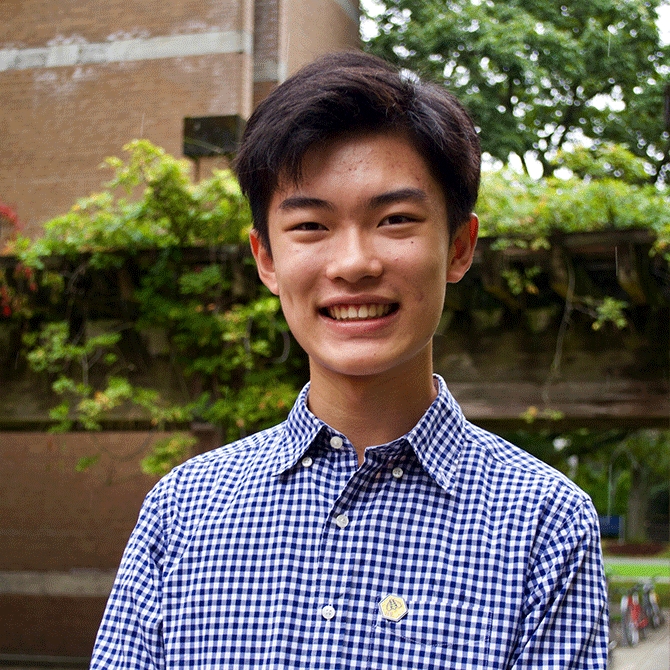
Photo: courtesy of Jason Pang Lesson: Share your passion
Jason Pang, 17, is a veteran of student environmental work. Pang spent three years as president of his high school’s Green Team, the environmental sustainability club at Richmond Secondary School, and was also a green ambassador for the city of Richmond. He is currently in his first year at the University of British Columbia, where he’s doing a Bachelor of Science in Global Resource Systems, which focuses on the world’s resources and how we can properly manage them sustainably.
When Pang first joined a school green team in Grade 8, it was one that was well-established with lots of support from enthusiastic and knowledgeable staff who students could turn to for help and feedback. But when he transferred schools to Richmond Secondary in Grade 10, he found there was lot of work to do on this front. “When I joined I pretty much had to start everything from scratch,” he recalls. But Richmond’s Green Team got a boost when Eugene Harrison began teaching at the school when Pang was in Grade 11. “She really changed the club,” explains Pang. “Because she was so passionate about the issue I was really inspired by her and she really took time to listen to me. Although I had the ideas, Ms. Harrison really brought those ideas together.”
Pang says this teacher helped Green Team members navigate policy and guided them as they ran events (the team did a lot of fundraising and teaching events). But she also brought learning into the equation. “She taught us a lot about scientific approaches toward environmental sustainability and how we can calculate our change, and that was really impactful,” he says.
Two standout projects organized by the Green Team were an electronic waste campaign where the class that collected the most waste won a pizza party, and a spirit week they hosted called Waste Reduction Week. The latter had three goals: improve the school’s waste diversion rate, educate students and staff on the impacts of waste and how that it affects us, and involve students as much as possible. One way they met that last goal was by meeting students where their passions were. For instance, they roped in the school’s business students to run zero waste pop-up shops on campus. “My school drinks a lot of bubble tea, and we wanted to tackle that issue by selling reusable bubble tea cups. That was a really big hit!” he says.
Both efforts won grants at the B.C. Green Games, a competition run by Science World.
While these events and others were successful, Ms. Harrison inspired Pang to go even bigger before he graduated. That project? Getting solar panels for the school. That involved a ton of fundraising, presentations to the school district, being part of an advisory committee, and learning about the engineering behind the panels.
While the initial plan was to have the Green Team pay for the solar panels by fundraising and applying for community grants, after many meetings with school district officials the district surprisingly decided to cover the cost.
“Seeing that I was able to make this impact was the brightest moment I had in high school,” says Pang.
The money they had already raised for the solar panels was used to create a pollinator garden and outdoor learning space at their school that they partnered with the David Suzuki Foundation to build this past summer.
What advice does Pang have for staff who want to support students who do this work? Listen to them and guide them through potential issues, but also model environmentally sustainable approaches and try to work this concept into all lessons. “There are a lot of ways that teachers have the opportunity make environmental sustainability part of the school curriculum,” he notes.
Mackenzie Klinker
Park Street Elementary, Fredericton, N.B.
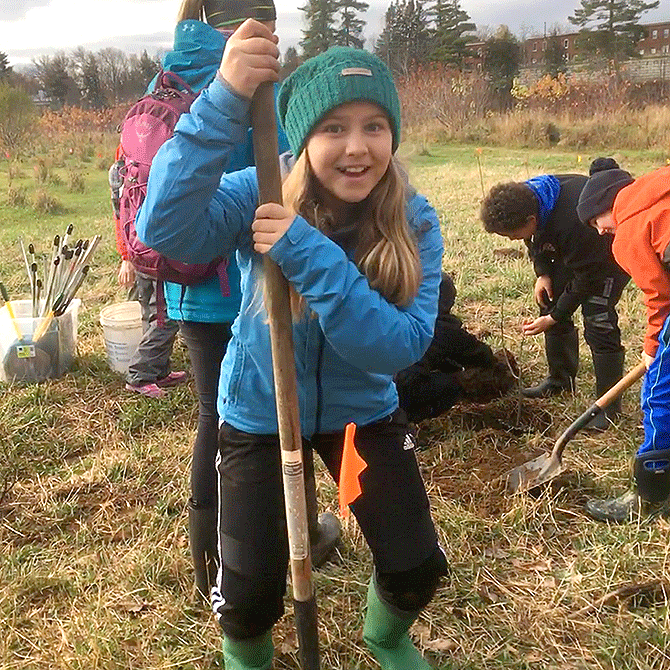
Photo credit: Olwyn Klinker Lesson: Be nimble and jump when you see a spark of interest
A thousand trees will be planted in New Brunswick, thanks to ten-year-old Mackenzie Klinker.
“Our school motto is ‘The best possible place to grow’.”
In late September, Klinker’s mom showed her a short film about student climate activist Greta Thunberg and then took her to the Fredericton climate strike the following day, which spurred the Grade 5 student at Park Street Elementary to launch her first environmental campaign. “I watched a video with my mom on climate change and it said that 200 species of animals go extinct every day. I didn’t know that and I really didn’t like that,” she recalls. “Our school motto is ‘The best possible place to grow,’ so I thought, ‘Then we should grow something.’ That’s why I decided I want to plant a thousand trees and help fight climate change.”
Klinker first took action by writing a letter to her school’s principal, Rien Meesters, vice principal, Mme. Gauvin, and teacher, Mme. Howlett, asking for their support.
Mme. Howlett helped find a solution. She suggested reaching out to the Nashwaak Watershed Association. They selected the types of trees to plant and the location: the bank of the Nashwaak River.
And so, just a few weeks later, Klinker and her whole class headed out to the river and planted 29 trees. They also got a science lesson in the outing, too, in that they learned about seeds and got to go critter dipping, where they used a net to find creatures, like backswimmers, in a nearby pond.
Now that the first batch of trees has been planted, they have 971 to go. And the whole school plans to help her meet that goal when the weather is warmer. “The rest of the staff are planning for each classroom to do something in the spring,” explains Meesters.
And Klinker wants to keep it going even longer: “I’d like it to continue every single year here at Park Street,” she says.
This whole project came together in a lightning-quick fashion, in part due to the responsiveness of the staff at Park Street and their willingness to act on Klinker’s suggestions.
Her advice for teachers?
“Kids can help think of ideas and what they would like to do. Then the teachers can support them for their projects and help make them possible,” she suggests. She also wants teachers to bring climate change education into the classroom when kids are younger. And she’s got a message for all adults about listening to kids on climate action: “It’s our future, so we want them to do stuff so we can have a good future.”
Photos: courtesy of Nina Tran, Olwyn Klinker and Jason Pang
First published in Education Canada, March 2020
-
Certified Green
Comments Off on Certified GreenThe EcoSchools Program started over 20 years ago, with 11 Toronto schools. EcoSchools Canada is now a national program that offers a range of classroom resources, runs an annual student conference, and certifies schools at three levels.
Inspired by the activism of Greta Thunberg, youth around the world have been taking to the streets to voice their growing fears and anxiety about the climate crisis. Instigated in part by the looming deadline to limit greenhouse gas emissions set by the International Panel on Climate Change’s recent report, students are cutting classes to provoke government action on climate change. In some school boards, educators are incorporating these protests through discussion or attendance as a valuable part of their students’ education, supporting their calls for climate action and justice.
While school strikes are a recent phenomenon, educators and students across Canada have been working on better understanding human impacts on climate change over the past three decades through experiential education, community-based learning, and EcoSchools programming. Integrated into curricula, aligned with local issues, and implemented inside and outside of classrooms, environmental learning is rapidly becoming one of the best ways to keep students engaged in school and simultaneously address the climate crisis. This is evidenced by the continued growth of the EcoSchools Program at the Toronto District School Board (TDSB), which engages thousands of children, youth and educators across the city in rich learning about all aspects of the environment. From growing their own food and monitoring energy use, to conducting waste audits and assessing the health of their watersheds, students are leading the way in learning how to address climate change, and moving Canada’s largest school board toward environmental sustainability. At the same time, they are putting the competencies of 21st education – critical thinking, communication, collaboration, creativity and innovation – into play as they prepare for one of the most significant challenges of their adult lives.
“Our emerging leaders often share a vision of schools as sustainability hubs, helping community members from all walks of life learn about living in more environmentally friendly ways.”
Motivated by the development of sustainable schools in Europe, the EcoSchools Program was begun in 1998 by forward-thinking program leaders Richard Christie and Eleanor Dudar, well before the Ontario Ministry of Education established its policy framework in Environmental Education in 2009. By focusing on achievable, practical actions such as turning off lights and sorting waste into recycling streams, students and educators were able to demonstrate the environmental and economic benefits associated with this type of learning. The program grew rapidly, from 11 schools in the first year to over 427 schools at its peak; it is currently the largest program of its kind in the country, and one of the biggest in North America.
If your organization, school district or faculty of education is an EdCan member (see the list here), you can enjoy unlimited access to our online content! Click here to create your online account.
In 2005, its certification structure and resources were used to establish the Ontario EcoSchools program, which has flourished over the last decade. Not only are there are now 1,800+ certified EcoSchools across the province, but this non-profit organization has recently become EcoSchools Canada, aiming to nurture the next generation of environmentally attuned citizens and leaders in school communities across the country.
Over the years, the TDSB’s EcoSchools program has grown to support six major goals:
- fostering leadership and teamwork
- conserving energy
- minimizing waste
- creating and caring for vibrant school grounds
- improving student achievement through ecological literacy
- contributing to healthy, active, safe and sustainable school communities.
An energetic staff of three run the program, which includes supporting and certifying EcoSchools at the bronze, silver, gold and platinum levels; designing and delivering learning for school EcoTeams; implementing annual student conferences; creating print and online resources; and supporting a range of partnerships with local NGOs.
As the program has expanded, the TDSB has also established a Sustainability Office, which has aligned with a wider range of physical infrastructure measures being put in place to address climate change across the school board, such as establishing outdoor classrooms, mapping and planting trees on school properties, and building high-performance green buildings, like the one at North Toronto Collegiate Institute. The board has been incorporating sustainable energy sources, such as the geothermal energy installed at Highfield Junior School, and the installation of solar panels on over 300 schools. Other boards should take note: the solar panels have generated significant funding for the TDSB’s Environmental Legacy Fund through the sale of carbon credits. This underwrites other sustainability initiatives such as cycling education programs, bike racks, and water bottle refill stations. All of these initiatives have a measurable environmental impact: since 2001, there has been a 22 percent decrease in overall greenhouse gas emissions at the TDSB.
Growing environmental learning
The benefits of the TDSB’s EcoSchools program are manifested in multiple ways, some of which are seen in improved learning experiences for students and their communities. An example of this is found in the rapidly increasing number of schools that have dug deep into environmental learning by creating their own school gardens.
“This natural area has also become a favourite part of the community for students and neighbours alike.”
Supported by a fertile partnership with Evergreen – a nonprofit dedicated to creating healthy urban environments – as well as the expertise of board staff, schools across the board are finding ways to use educational gardening to support the provincial curriculum.
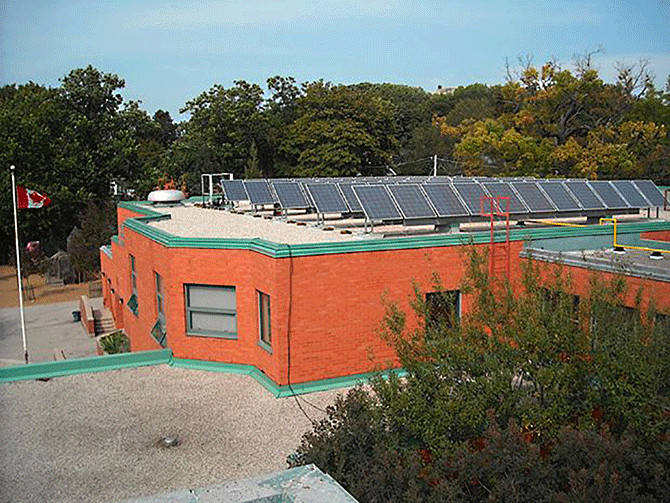
Rooftop solar panels at Hillcrest Community School, Toronto Elementary students at Runnymede Public School planted native shrubs and trees on a hillside behind their urban school as a way to improve the biodiversity of their schoolyard. Twenty years later, they have a lush forest of walnut, maple and oak trees that support a wide variety of insect and wildlife, perfect for enhancing learning activities in science, art, math, and literacy. Not surprisingly, this natural area has also become a favourite part of the community for students and neighbours alike. In contrast, the Grade 6 students at Ryerson Community School have turned their classroom into an indoor garden with the addition of a hydroponic growing tower called a Good Food Machine. As they seed, nurture and harvest the kale, bok choy, tomato and cucumber plants, they learn about their life cycles, as well as how to prepare them as part of a healthy diet. And at Eastdale Collegiate, staff from the TDSB and FoodShare – an organization that works to make fresh, healthy food accessible to all – worked with students to turn a defunct tennis court on the roof into a 16,000 square foot farm. This huge rooftop garden provides hands-on, interdisciplinary learning experiences throughout the school year, connecting with science, business, hospitality and culinary courses. In the summer months, these secondary students are hired to gain important work experience through marketing and selling the fruits and vegetables that they grow on their school roof to nearby restaurants.
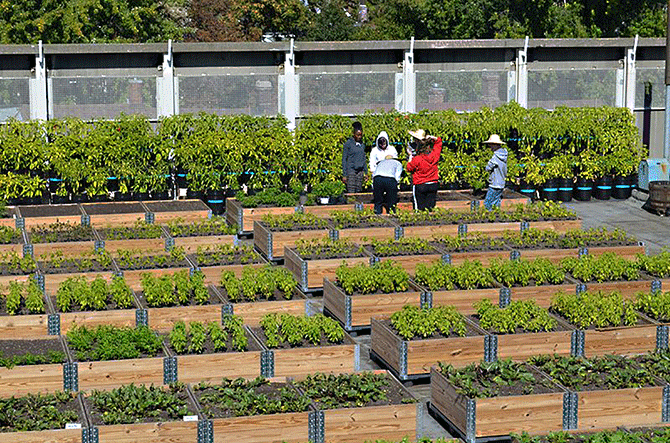
Eastdale Collegitate’s 16,000 square foot rooftop garden, Toronto The EcoClub at Earl Haig Secondary School takes a very different approach to learning about climate change through its focus on garbage. While many are involved in the school’s waste audit, from the principal to teachers and caretakers, it is the students who lead the process by collecting and sorting the garbage, and then measuring and interpreting the audit results. This sticky, smelly form of learning brings with it groans, laughter, and disgust at the amount and type of waste created, but it also builds comradery and integrates learning in math, literacy and critical thinking to inform the goals for the EcoClub for the year. This immersive investigation could result in helping the school community to better separate out compostable and recyclable items from its garbage heading to landfill; reducing the amount of single-use plastics in the school cafeteria; or increasing understanding of the problems of micro-plastics in the lake. The results of this learning are quantifiable; research has demonstrated that certified EcoSchools generate half as much waste per student per year as do non-certified schools.
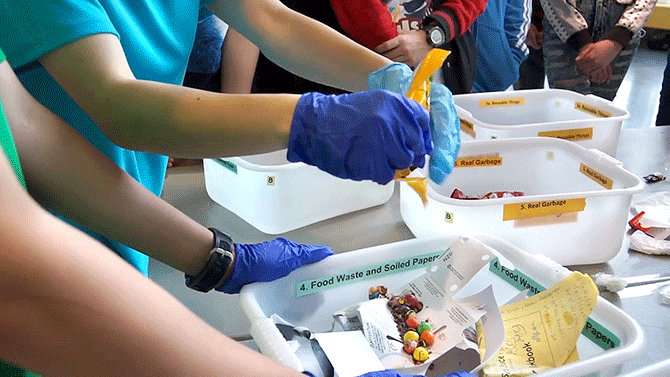
EcoClub students sort and audit garbage at Earl Haig Secondary School, Toronto Students aren’t the only ones wanting to learn more about the climate crisis; their educators are growing knowledge, skills and expertise as they dedicate evenings, weekends and summer vacations to undertaking professional development to support their students in the EcoSchools program. Through an innovative collaboration with faculty at the Ontario Institute for Studies in Education (OISE), over 200 TDSB educators have taken Additional Qualification courses in Environmental Education over the last six years. These courses model the same experiential, inquiry-based approach that educators are encouraged to use in their classrooms: they learn from and in nature at TDSB outdoor education centres, learn on and from the Land with an Indigenous knowledge-keeper along the banks of the Humber River, and meet with environmental experts like Maude Barlow to study the impact of pollution on Lake Ontario. Most importantly, these educators share their promising practices in environmental learning with each other through discussions, presentations, and digital resources that are also shared with other educators across the school board. Those who finish this set of courses become members of the TDSB’s Action Research Team, which supports educators to conduct research into Environmental Education in their classrooms, alongside their students. This team also works with teacher candidates from OISE’s teacher education programs to ensure that the next generation of teachers comes into classrooms prepared to lead learning about climate change from the start of their careers.
Facing the challenges
Many positive steps have been taken by students and staff alike in addressing climate change and environmental issues over the last two decades at the TDSB, but the EcoSchools Program continues to encounter challenges as it does this important work. For program staff, getting thousands of educators, staff and parents from 575 schools on the same page about the importance of environmental learning is a work in progress, and makes for an intensive workload. It is still common for some educators to find themselves identified as the “ecochampions” of their school, not only modelling this work for their students, but also taking full responsibility for the EcoClub and the paperwork associated with the EcoSchools certification process. If this educator or principal moves to another school, it can take time to find another prepared to champion this work. Maintaining supports, both administrative and financial, are always an ongoing concern, as seen with the recent cutbacks by the Ontario Ministry of Education; cutting budgets has a direct impact on educators’ time and energy in leading this critical work.
Yet those involved in the TDSB’s EcoSchools Program are finding ways to make it happen. One way is by establishing and maintaining networks of professional learning, such as the one established with OISE; this provides ongoing support and development by those who understand the problems and solutions inherent to the EcoSchools program. Another is by nurturing “green leadership,” bringing together students, educators, administrators and parents who prioritize environmental learning and climate action in schools to ensure that the curriculum in the 21st century is rooted in real-world experiences. These emerging leaders often share a vision of schools as sustainability hubs, helping community members from all walks of life learn about living in more environmentally friendly ways.
School strikes are certainly one way to advocate for climate action, and perhaps a necessary one for capturing government attention. But the EcoSchools Program at the TDSB provides an alternative and successful model that keeps students in school, builds 21st learning competencies, and shows them how to become effective champions for sustainability in their own communities.
EcoSchools Canada
Join a network of over 50,000 schools around the world working to create a sustainable future.
EcoSchools Canada’s curriculum-linked certification framework supports student-led action that leads to tangible impacts throughout the school community.
Visit ecoschools.ca to learn about how you can get involved and become a certified EcoSchool.
Original photos: courtesy of the TDSB Sustainability Office
First published in Education Canada, March 2020
-
Stress and burnout are on the rise among Canadian principals and vice-principals
Comments Off on Stress and burnout are on the rise among Canadian principals and vice-principalsPrincipals and vice-principals are facing increased pressure, workload, and stress.1 But considering how pervasive stress and burnout seem to be across many professions in modern society, why should we care specifically about school leaders? The answer is actually so very clear: health, happiness, and success for everyone! Of course, work-related stress is normal and inevitable; however, excessive physical and emotional stress can interfere with school leaders’ well-being which can carry over to ultimately impact education systems as a whole.

WHEN LOOKING AT SCHOOL LEADERS’ WELL-BEING, THERE ARE THREE INTERCONNECTED COMPONENTS TO CONSIDER:
1. The Individual: Stress inhibits school leaders from effectively improving school performance
Principals and vice-principals (VPs) are some of our most dedicated and passionate educators who have chosen to take on a role with significant responsibility and impact, which means that we need them to be at their best. One might say that handling difficult tasks and juggling many needs is simply the role of school principals and VPs. That is absolutely correct! This is exactly what our best leaders are good at and often thrive on. However, our bodies are not designed for the levels of constant and excessive stress that many of our school leaders are currently experiencing.

Chronic stress lowers levels of health, happiness, and success – and leaders aren’t immune from these innately human factors.2 If principals and VPs are working days, nights, and weekends (and they often are), then they are indeed experiencing chronic stress, which will take a toll on their social, emotional, and cognitive well-being,3 just like anyone else. Work-related stress can have damaging effects that inhibit school leaders’ ability to function effectively while lowering their job enthusiasm and motivation to perform well.4 Stress not only affects the ability of school leaders to improve their schools but also makes it difficult to retain and recruit new principals and VPs.
Research shows that most principals burn out and leave the profession in four years or less, although it takes five-to-seven years for a principal to have a significant impact on a school community.5 Yes, we need principals to do their job now, but we also need them to stick around long enough to yield the greatest results possible for students. What’s more, despite the fact that we’re increasingly more aware of the importance of social emotional skills like self-awareness and the need to practice self-care, many school leaders have not been taught these essential skills. More importantly, leaders often assume that they can’t possibly worry about themselves since they’re tasked with taking care of everyone else. However, it’s good to be reminded of the simple truth that we’ve learned from air travel, which is that it’s not only important – but essential – to put on your own oxygen mask before helping others.
2. The Group: Education is a collective endeavour – not one person’s job
If you are a parent, student, or school staff member, then this is one of the most compelling arguments for why you should care about your principals’ or vice-principals’ stress levels. It takes a community – if not a village – to raise a child. The most productive and successful work teams are made up of people who care about each other. People on successful and productive teams use the words family, support, and trust to describe their work together. It isn’t enough to have great individuals. Principals and VPs aren’t superheroes, nor should they be the sole go-to people who are expected to triumph against all odds. They are regular people whose health and well-being should be of equal concern, not an afterthought. For schools to function well, all staff need to work as a team towards a common goal. To do our best work, we need to have strong, connected teams built on relationships and trust.

What we know about workplace well-being is that the best teams are those that understand the importance of social connection and creating a workplace where people feel safe and valued. If school leaders don’t feel connected or supported by their team, then they’re not only less effective but so is everyone else. If leaders are connected and have strong, authentic relationships then the people that work for them will go out of their way to make their leaders’ and the organization’s vision come true.6 When we work for someone who we care about and who we feel cares about us as employees, then we will work with passion, dedication, and creativity. What’s more, when we hold this sense of care as a group, the results are amazing!

Fundamentally, work and life aren’t things we can ever do alone – nor are we meant to.7 We’re at our best when we work together and, just as we know that stress can actually spread and be contagious towards those around us,8 we also know that the “good stuff” is contagious, too. For instance, it has been scientifically proven that when we show gratitude and compassion towards other people, they feel better, perform better, and are more likely to reciprocate acts of compassion and belonging.9 So, no matter who we are and what role we may find ourselves in, we can always make the choice to act first by showing compassion, assuming good intention, and being kind. It’s important for leaders to both show and receive these positive actions. Above all, we need leaders who feel safe, valued, and connected in order for them to do their best work and to inspire and support their staff – and ultimately their students – to do the same.

3. The System: School leaders are running systems that aren’t designed to support their well-being
Surveys of principals demonstrate that education systems are overloading our leaders.10 A rapid flow of policies, initiatives, and programs leads to loss of focus, overwork, frustration, and demotivation11 – and these are impacting school leaders’ health and well-being while increasing their levels of stress. As this makes it more difficult to recruit and retain the best school leaders, school districts are faced with high costs in terms of both time and money, which further inject stress into the system.

It’s important to name this tension while also being very clear that this isn’t a criticism towards – or the responsibility of – any one person or group of people. Rather, this tension indicates that education systems as a whole need to look at practices through the lens of workplace well-being. As such, looking at practices through a well-being lens can lead to large-scale change that, as the First Peoples’ Principles of Learning remind us, will take time and patience. However, rethinking system-level practices can also involve small changes that simply require a willingness to try – and we need both large and small changes.
THE TAKEAWAY
While it’s encouraging that many associations, ministries of education, and partner groups are beginning to focus on the issue of workplace well-being in K-12 education, we still have a ways to go in acknowledging the importance of principals and vice-principals’ well-being – leaders of learning who have huge impacts on the health, happiness, and success of our schools. For school leaders reading this, remember that well-being has three interconnected components: you, your team, and the system as a whole. You were never meant to do this job alone.
References and Further Reading
1Alberta Teachers Association (ATA). (2017). The Canadian school leaders: Global forces and future prospects. A research report. Edmonton, AB.
Canadian Association of Principals (CAP). (2014). The future of the principalship in Canada: A national research study. Kanata, ON.
Pollock, K., Wang, F., & Hauseman, D. C. (2014). The changing nature of principals’ work: Final Report. Ontario Principals’ Council, Toronto, ON.
Pollock, K., Wang, F., & Hauseman, D. C. (2015). Complexity and volume: An inquiry into factors that drive principals’ work. Societies, 5(2), 537–565.
Pollock, K., Wang, F., & Hauseman, D. C. (2017). The changing nature of vice-principals’ work: Final report. Ontario Principals’ Council, Toronto, ON.
Poirel, E., & Yvon, F. (2014). School principals’ emotional coping process. Canadian Journal of Education/Revue Canadienne de L’éducation, 37(3), 1–23.
Riley, P. (2016). The Australian principal occupational health, safety and well-being survey. Institute for Positive Psychology & Education. Retrieved from: http://www.principalhealth.org/au/2016_Report_AU_FINAL.pdf
U.S. Bureau of Labor Statistics. (2016). Occupational outlook handbook: Elementary, middle, and high school principals. U.S. Department of Labour. Retrieved from: https://www.bls.gov/ooh/management/elementary-middle-and-high-school-principals.htm
2Hallinger, P., & Murphy, J. F. (2013). Running on empty? finding the time and capacity to lead learning. NASSP Bulletin, 97(1), 5-21. doi:10.1177/0192636512469288
Nthebe, K., Barkhuizen, N., & Schutte, N. (2016). Rewards: A predictor of well-being and service quality of school principals in the north-west province. SA Journal of Human Resource Management, 14(1), 1-e11. doi:10.4102/sajhrm.v14i1.71
Poirel, E., & Yvon, F. (2014). School principals’ emotional coping process. Canadian Journal of Education/Revue Canadienne de L’éducation, 37(3), 1–23.
3Wang, F., Pollock, K., & Hauseman, D. C. (2018b). Ontario principals’ and vice-principals’ well-being and coping strategies in the context of work intensification. In S. Cherkowski, & K. D. Walker (Eds.), Perspectives on flourishing in schools (pp. 287-303). Lanham, Maryland: Lexington Books, an imprint of The Rowman & Littlefield Publishing Group, Inc.
4Devos, G., Bouckenooghe, D., Engels, N., Hotton, G., & Aelterman, A. (2007). An assessment of well-being of principals in flemish primary schools. Journal of Educational Administration, 45(1), 33-61. doi:10.1108/09578230710722449
5Leithwood, K. A., Louis, K. S., & Anderson, S. E. (2012). Linking leadership to student learning (1st ed.). San Francisco: Jossey-Bass.
6Sinek, S. (2014). Leaders eat last: Why some teams pull together and others don’t. New York: Portfolio/Penguin.
Sinek, S. (2011). Start with why: How great leaders inspire everyone to take action. New York: Portfolio / Penguin.
7Walton, G. M., Cohen, G. L., Cwir, D., & Spencer, S. J. (2012). Mere belonging: The power of social connections. Journal of Personality and Social Psychology, 102(3), 513-532. doi:10.1037/a0025731
8Sterley, T., Baimoukhametova, D., Füzesi, T., Zurek, A. A., Daviu, N., Rasiah, N. P., & Bains, J. S. (2018). Social transmission and buffering of synaptic changes after stress. Nature Neuroscience, 21(3), 393-403. doi:10.1038/s41593-017-0044-6
9Coyle, D. (2018). The culture code: The secrets of highly successful groups (1st ed.). New York: Bantam Books.
10Wang, F., Pollock, K., & Hauseman, C. (2018a). School principals’ job satisfaction: The effect of work intensification in Ontario. Canadian Journal of Educational Administration and Policy, 185, 73-90.
Wang, F., Pollock, K., & Hauseman, D. C. (2018b). Ontario principals’ and vice-principals’ well-being and coping strategies in the context of work intensification. In S. Cherkowski, & K. D. Walker (Eds.), Perspectives on flourishing in schools (pp. 287-303). Lanham, Maryland: Lexington Books, an imprint of The Rowman & Littlefield Publishing Group, Inc.
11Fullan, M. (2008). What’s worth fighting for in the principalship? (2nd Ed.). New York: Teachers College Press.
-
Book Preview – Teacher Wellbeing: Noticing, Nurturing, Sustaining, and Flourishing in Schools
Comments Off on Book Preview – Teacher Wellbeing: Noticing, Nurturing, Sustaining, and Flourishing in SchoolsEvery person’s wellbeing is important in and of itself. Teacher wellbeing isn’t just about making school systems more economically efficient, or enhancing students’ performance on standardized assessments. Whether you are a student, a teacher, a principal, or an administrator, you have the right to be well and to live well simply because of your inherent worth as a person.
Yet teachers do play a shaping role in the lives of their students. Learning happens best when teachers and their students are well – happy, healthy teachers who feel well and whole in their work provide strong support for happy, healthy children and youth. This book acknowledges that we need to consciously attend to and support teacher wellbeing.
Too many of our teacher colleagues across the world suffer from sources of stress that put an enormous strain on their ability to feel well in their work. This situation also invades their personal and family lives in ways that can be devastating.
Too often, teachers are pushed to account for merely the academic achievement of their students, leaving aside the many social, emotional, and spiritual aspects of learning and development that are essential to students’ wellbeing. However, teaching and learning are fully human endeavours, and learning well cannot be separated from living well.
This research-informed, theoretically grounded book will coach you — alone, or with a group of your colleagues — to determine what wellbeing looks like in your classroom, in your school, and for yourself. The aim is to offer you new perspectives, research insights, reflection moments, and activities for gaining a sense of ‘flourishing’ wherever you can in your work. We achieve this by helping you notice what makes you feel whole, engaged, and connected, while encouraging you to pay attention to ways you can grow more of these feelings in your work.
WHAT THIS BOOK CAN OFFER YOU.
Teacher Wellbeing affirms the agency that teachers have in reimagining a new way forward. This book supports you as you shift your mindset towards thinking about the work of teaching as including a strong sense of wholeness and aliveness. Teacher Wellbeing is an interactive book that will guide you as you notice, nurture, and sustain holistic flourishing in your work and in your life.
In addition to providing a theoretical framework for promoting evidence-based practices that foster wellbeing, this book also enables you to create a Living Map of Flourishing — that is, an artistic representation of a path that you can follow to enable you to thrive in your teaching. By creating your own map, you’ll become an expert in building your own knowledge on how to be the teacher you’re meant to be.
We call this a ‘Living Map’ because it isn’t static, just as schools aren’t static systems, but rather are living ecosystems of people and their experiences. Your ‘Living Map’ will become a place for recording your learning, generating knowledge, and tuning into new understandings that you’ll form as you work through the activities in the book. By the time you’re finished reading, you’ll have a custom-built plan that’s unique to you, yet influenced by nuanced theoretical approaches, stories, and practices derived from research.
Teacher Wellbeing also provides interactive activities to prompt reflection and collaboration, including:
1. Heart Prints.
You know about footprints and handprints, which are the impressions we leave as we pass through various spaces in our life. Similar but different, ‘Heart Prints’ are strong emotional impressions that are left on us, and that we leave on others, when we engage from a place of authenticity, wholeness, vulnerability, love, and compassion. ‘Heart Print’ reflections are opportunities to help you tap into experiencing a sense of gratitude and appreciation through noticing moments of your own goodness. Essentially, these are moments of pause that allow you to rest, reflect, and make sense of what you’re reading in ways that affirm the essence of who you are as a teacher, and that encourage and inspire you to stretch towards a greater sense of wholeness and wellbeing in both your work and in life.
2. Shifting Ground.
Feeling the ground shift beneath your feet can feel scary and can cause you to be thrown a bit off kilter. But it’s in these times – times when you’re a little disturbed or placed in unease – that you might actually find opportunities for new learning and renewal. ‘Shifting Ground’ moments are creative activities that serve to shift the ground a little and perhaps even shake things up or provoke you. These moments are designed as reflective, creative, and re-creative experiences.
OUR APPROACH TO FOSTERING WELL-BEING.
Our book is designed to encourage and coach you towards giving greater attention to what’s working well, since we know that the things we pay attention to are destined for growth. Our research shows that educators work best when they focus on and build up their strengths —their passions, purposes, and sources of vitality. Teacher Wellbeing thus draws from a strengths-based model of thinking and reflecting on action-oriented change. This model is called Appreciative Inquiry (AI). Drawing on AI, we coach you as you shift towards an abundance mindset rather than a deficit-based way of thinking.
Appreciative Inquiry isn’t about denying real-life experiences of struggle and suffering. Rather, it’s about placing a more intentional focus on wellbeing as an essential aspect of your work as a teacher, and then paying attention to how you perceive your work as a means to promote and encourage self-care, positive growth, and a sense of thriving for yourself and others in particular situations you may experience.
Systems and pressures may shape what we are and aren’t able to do. Yet we are nonetheless in charge of interpreting the many different stories we hear ourselves telling about ourselves and about the world around us. How we author our own reality reflects what is most important to us. By focusing on what’s working well, we can strengthen what’s working well; by focusing on a flourishing future, we can indeed move forward towards a flourishing future.
Our theory on ‘flourishing’ emerged from research in the fields of positive psychology, positive organizational scholarship, and school improvement. As we reflected on the potential of these findings for the work of teachers, we connected our ongoing research on ‘flourishing’ with our knowledge about learning communities. This approach resonated with the teachers we spoke with on the ground, and even so with our own teaching practices.
As you begin to uncover your beliefs and actions, you’ll see which aspects of your life and work are authentically aligned with who you’re intended to be. You’ll find yourself setting up opportunities to use your strengths throughout the day, and will come to carry out activities that allow you to better understand your strengths alongside your colleagues, all while advancing along a journey towards ‘flourishing.’
Teacher Wellbeing is organized into a sequence of steps:
1. Noticing
Paying attention to how we use language to describe our experiences is an important step towards developing your agency in shaping your own wellbeing. When we can take notice of how we talk to ourselves and to other people about our experiences, we can then take small steps towards more compassionate approaches to relating to ourselves and to those we work and live with.
We provide ‘Heart Print’ and ‘Shifting Ground’ activities that prompt you to engage in storytelling — that is, noticing your role in shaping your own experiences and those of your community. As you look into your own beliefs and assumptions about how and why things work (or don’t work), you’ll need courage. Some find this courage in community — in engaging with others in the process of reimagining teaching as a whole, appreciative, and positive experience. Your community may be your colleagues, your educator friends, or an imagined community of fellow readers of this book.
2. Nurturing
As you begin to take stock of moments of laughter, compassion, hope-building, and other indicators of wellbeing in your work and in your life — and as you reflect on these through guided activities while documenting your thoughts on your ‘Living Map’ — you’ll begin to develop your own theory of ‘flourishing’ that is unique to your circumstances.
To support you as you build your own individual approach, we share research results and stories from a range of academic disciplines including philosophy, psychology, and education, among others. Your research-informed knowledge base will enable you to both grow and nuance your pursuit of wellbeing.
3. Sustaining
Your wellbeing has a relational component. Developing your capacity to grow is a collective phenomenon that involves the whole educational community. We offer research-based stories, theories, practices, and activities that you can use to reflect on what it means for you to grow and thrive within a ‘flourishing’ learning community.
We don’t think teachers need to wait for others to set the conditions necessary for their wellbeing. No one should wait! But as you pursue ‘flourishing,’ we encourage you to strive to find collaborators with whom you can share your journey. Collaboration provides an opportunity to create meaningful relationships and a sense of both individual and collective achievement — and let’s not forget that meaning-making and achievement are both central to ‘flourishing’ as a teacher. We provide practices to cultivate and sustain relationships built on trust, care, connection, purpose, and enjoyment.
4. Flourishing
‘Flourishing’ is a fluid and aspirational destination – not a fixed point. Your challenge is to learn to be well in the moment, and to learn how to recognize and ask for more supports as you move towards achieving a greater sense of wellbeing.
We offer a two-fold conclusion to Teacher Wellbeing. First, we offer practices for self-care and for showing greater empathy towards others. In sharing these practices, we call for all educators to overcome inertia and to foster healthy educational leadership.
Second, we note that the formal school leader — the principal — plays an essential role in making room for a climate that values and honours the building of collaborations, relationships, and capacities. Our epilogue offers strategies for principals and administrators that support the wellbeing of teachers, and that in turn support the wellbeing of all staff and students within the ‘flourishing’ learning community.
HOW TO GET YOUR HANDS ON A COPY OF TEACHER WELLBEING: NOTICING, NURTURING, SUSTAINING, AND FLOURISHING IN SCHOOLS.
Teacher Wellbeing can be found at most places books are sold.
Keep an eye out for further resources from Dr. Sabre Cherkowski and Dr. Keith Walker that dive into how principals and vice-principals can create the right conditions for school communities to flourish.
-
Measuring School Well-being
Comments Off on Measuring School Well-beingThe concept of happiness in a society is far from novel. The New Economics Foundation has been publishing its Happy Planet Index (HPI) since 2006. The HPI is calculated using a number of well-being and environmental impact indicators available from over 140 countries.
Since 2012, the United Nations has published an annual World Happiness Report based on “available global data on national happiness and related evidence from the emerging science of happiness, showing that the quality of people’s lives can be coherently, reliably, and validly assessed by a variety of subjective well-being measures, collectively referred to then and in subsequent reports as ‘happiness.’” Results from the World Happiness Report align closely with the Gross National Happiness (GNH) Index developed by Bhutan to provide data for the development of its national policies.

So, the concepts of well-being and happiness are not restricted to individuals but also apply to countries. The same can be said for schools. Although the concept of happiness at the school level is relatively recent, it is quickly becoming accepted across Canada and elsewhere. More than ever, schools strive to provide a “well-rounded education” by finding an equilibrium between a global, holistic education and the more traditional content-focused curricula and also by providing psychologically safe environments where staff and students are engaged, can thrive and be at their best.
The question therefore is not to debate the importance of school happiness but rather how to measure it so we can then focus on increasing it by building on existing strengths.
The Mental Fitness and Resiliency Inventory (MFRI©)
Questionnaires designed to measure constructs such as well-being or happiness commonly focus on self-assessments, often using multiple choice items or a small number of open-ended subjective questions. Despite the popularity of these approaches – mostly because of their simplicity and low cost – the general public often has little faith in their results because of the overwhelming emphasis on subjective approaches which impact reliability.
In some cases, individual respondents’ data are used to calculate a group average which is then reported as being the group’s well-being or happiness. Such an approach should be dismissed because it is ill conceived. To demonstrate this, let’s imagine a mathematics test for which all students in the same class received a mark of 50%. Now let’s assume that in a different class, half the students received a mark of 100% and the other half 0 % on the same test. Of course, the class average in both classes is 50 % but no educator would dare claim that these two classes are similar.
The Positive Workplace Framework used the Mental Fitness and Resiliency Inventory (MFRI) to measure overall well-being and happiness in schools. In contrast to subjective questionnaires, the MFRI contains short, clear descriptions of 32 distinct practices that can be expected to be observed in positive school environments. The online questionnaire is completed by all staff and takes them less than ten minutes. All answers are anonymous and confidential.

The MFRI provides schools with quantitative results on their strengths across three mental fitness sub-domains (relatedness needs, competency needs, and autonomy/support needs) and five resiliency subdomains (relationship assets, professional assets, attitudinal assets, emotional intelligence assets, and adaptation assets). Respondents are asked to indicate how well each described practice is reflective of their school environment using a 5-point Likert scale where 1 = Least like my workplace, 3 = Somewhat like my workplace, and 5 = Most like my workplace. Results of the MFRI’s rigorous psychometric validation study are available.2
The MFRI report provides a profile of organizational strengths (those practices that are embedded in the school environment) and areas for development (those requiring more promotion and capacity building) related to mental fitness and resiliency.
The School Happiness Index (SHI)
Responses to the MFRI are also used to obtain the School Happiness Index (SHI), which is reported on a nine-point scale where 9 indicates a very high level of school happiness. The SHI complements the detailed school-level report by providing a holistic view of the integration of practices known to have a positive impact on the school environment and staff and student happiness in general.
Studies in francophone schools across New Brunswick show a statistically significant correlation between the SHI and student achievement on provincial assessments. Preliminary results also suggest decreased teacher absenteeism in schools with a higher SHI. This is not surprising.
Increasing levels of school happiness is not obtained at the expense of student learning. In fact, the research is clear that a happy school environment is a precursor to student success.3 If schools are to provide a well-balanced education, they must first strive to improve their overall school happiness. By administering the MFRI and obtaining their school happiness index, schools now have empirical evidence on which they can act.
Photo: Adobe Stock
First published in Education Canada, December 2019
Notes
3 S. Lyubomirsky, S. King, and L. Diener, “The Benefits of Frequent Positive Affect: Does happiness lead to success? Psychological Bulletin 131, No. 6 (2005): 803-855.
-
The Positive Leadership Inventory (PLI)
Comments Off on The Positive Leadership Inventory (PLI)What makes a positive leader?
There is a wealth of research that supports the claim that positive leaders have a positive impact on their organisations’ growth and improvement. Schools are no different.
In addition to confirming our intuitive beliefs about the impact a leader has on their group, research also suggests that positive leadership practices lead to individual benefits on one’s psychological health, emotional well-being, optimal brain function, improved interpersonal relationships, and learning. It goes without saying that schools gain by ensuring that their leaders are positive leaders.
Regardless of our perception of what makes a “good” leader, there is no doubt that such a leader must demonstrate competencies in several domains. But what are the competencies and practices demonstrated by leaders who are not only good but excellent?

Leaders capable of creating a positive school climate where everyone can be at their best share the characteristic of being able to establish strong interpersonal relationships.1 These leaders communicate sincerely, whether the message is positive or negative. They are respectful of others and their feedback is communicated in a constructive way without negative emotions. They have confidence in their staff and all school employees and support them during difficult times. Strong positive leaders don’t hesitate to recognize quality work and to value and promote such work in private and in public. They value long-term goals and have the ability to strategize in order to reach their goals. Their charisma gives confidence to their staff and allows them to mobilise and engage the school community. All this, plus they are open to everyone, exude enthusiasm, and have a good sense of humour. Wow, what a tall order!
Thankfully, what is common to these competencies and practices is that they are observable and therefore can be learned. The work of Cameron2 and the synthesis done by WMA Wellness3 show that positive leaders demonstrate competencies across five domains: leadership virtues, positive communication, energizing skills, motivational and knowledge skills, and operational tasks.
Measuring positive leadership practices
A key element of the Positive Workplace Framework is a questionnaire designed to evaluate the level of embeddedness of practices from each of the five aforementioned positive leadership domains.
Although positive leadership practices can apply to everyone in a school setting, the Positive Leadership Inventory (PLI) questionnaire describes practices that school leaders such as principals and vice-principals should demonstrate on a regular basis. The PLI assesses the presence of positive leadership practices associated with healthy and effective school environments. It provides school leaders with quantitative results on their strengths across the five positive leadership sub-domains. The PLI contains short, clear descriptions of 30 distinct leadership practices that can be expected to be observed in positive school environments. Each practice relates to one of the sub-domains described above. All school employees are asked to indicate how well each practice is reflective of their school environment using a 5-point Likert scale where 1 = Not at all, 3 = Sometimes, and 5 = Very often. It takes less than ten minutes to complete the PLI questionnaire online. All answers are anonymous and confidential.
The PLI report provides a profile of strong leadership practices (those practices that are very frequently demonstrated by leaders) and areas for development (those leadership practices requiring more promotion and capacity building). The report gives leaders empirical evidence which helps them prioritise the areas they wish to continue developing. To facilitate this development, the Positive Workplace Framework offers a suite of targeted resources for each of the leadership domains.
Results of the PLI’s rigorous psychometric validation study show that the PLI can be trusted to identify existing positive leadership practices. The results of the validation study are available.4
Schools that have the reputation of being “good schools” have leaders who excel in many areas. Implementing the Positive Workplace Framework (PWF) and its practices in daily routines allows leaders to create school environments where mental fitness and resiliency practices can be fully integrated. By integrating positive leadership practices guided by the results of the PLI, leaders can pursue their evidence-based professional development which benefits not only themselves but also their school.
Photo: Adobe Stock
First published in Education Canada, December 2019
Photo:
First published in Education Canada, December
1 J. P. Rolland, L’évaluation de la personnalité. Le modèle à cinq facteurs (Sprimont, Belgium: Mardaga, 2004).
2 K. Cameron, Positive Leadership: Tools and techniques that create extraordinary results (San Francisco, CA: Berrett-Koehler, 2013).
3 WMA Wellness (2019). www.wmawellness.com
-
The Positive Workplace Framework (PWF)
Comments Off on The Positive Workplace Framework (PWF)
The Positive Workplace Framework (PWF) is a made-in-Canada strengths-based approach to optimizing staff and student well-being, engagement and performance, with a focus on Mental Fitness, Resilience, and Positive Leadership.
Who hasn’t been asked to do more with less? “Doing more and more with less and less until eventually you can do everything with nothing” is a notion introduced by R. Buckminster Fuller in 1938 to describe situations where technology could be used. Today, the expression of doing more with less is commonly used when organizations, including schools, strive to lower operational costs and increase productivity in the context of cutting back on human and financial resources without an equivalent reduction in workload and expectations.
Obviously, this logic has its limits. Teachers are not robots and the extra pressure placed on them to do more with less can lead to unhealthy practices and interpersonal relationships, which increases everyone’s stress. Toxic school environments result, along with increased absenteeism, turnover, mental health problems, and burnout.

In response, many deficit-based programs designed to improve school environments have been developed. First, they identify existing problems and then intervene to solve them. But a person’s psychological well-being is not only influenced by the presence or absence of problems but also by the existence of strength-focused factors present within individuals and their social settings that contribute to positive growth and development.1
Few initiatives focus on improving existing strengths in school environments. The Positive Workplace Framework (PWF),2 a made-in-Canada strengths-based approach that optimizes staff and student well-being, engagement and performance, is an excellent example of such an initiative.
The Positive Workplace Framework (PWF)
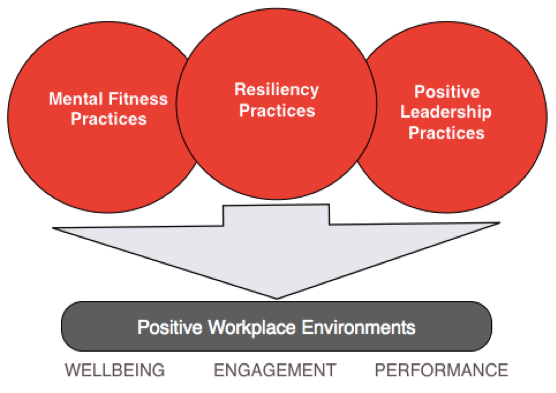
The PWF is composed of three distinct but inter-related domains: mental fitness, resiliency, and positive leadership (see Figure 1). In each domain, research-based individual and collective practices known to create positive school environments characterized by high levels of staff well-being, engagement and performance are promoted.
Figure 1: The Positive Workplace Framework (PWF)
Mental Fitness
The mental fitness domain is composed of three sub-domains – relatedness, competency, and autonomy/support – that are referred to as “needs.” Seen as the PWF’s foundation, this domain aligns itself with the elements of self-determination theory.3
Relatedness involves the development of our sense of connectedness with our co-workers. Evidence of relatedness practices being used include welcoming, exchanging with and checking in on our colleagues.
Competency focuses on our collective sense of worth, to ourselves and to the school. This mental fitness need is met when we recognize and use our strengths and build confidence in others.
Meeting our autonomy/support need is also important in building psychologically healthy and effective school environments. This can be done by ensuring everyone has a voice and choice and opportunities to collaborate with their colleagues.

Creating psychologically safe and healthy school cultures where everyone can thrive, be happy and be at their best involves being intentional about fostering relatedness, competency and autonomy/support practices within team relationships and daily routines. When this happens, we experience a greater sense of personal well-being, demonstrate higher levels of motivation, and perform optimally. Targeted training for school staff on practices that promote these conditions is an important initial step in optimizing a school’s culture.
Resiliency
Resiliency has been defined as the capacity to adapt and realize positive outcomes in daily living despite challenging circumstances4 and as the ability to persist in the face of adversity, to bounce back when challenges are encountered, to effectively navigate support systems and to apply resources that sustain well-being.5 The American Psychological Association specifies that resiliency is not a trait that people either have or do not have but that it involves behaviours, thoughts and actions that anyone can learn and develop.
The PWF builds on this latter point and extends the concept of resiliency from the individual to the group. The PWF’s second domain, resiliency, is comprised of five sub-domains (relationship, professional, attitudinal, emotional intelligence, and adaptation) referred to as assets that teams can learn and develop.
Relationship assets involve practices that build social networks of support and community. Teams displaying strong relationship assets have caring attitudes toward co-workers and ensure social support in difficult or challenging times.
Professional assets involve practices that build professional confidence, capacity, and problem-solving skills. Identifying and counting on the staff’s collective knowledge and skills, and ensuring the availability and use of appropriate and targeted professional learning opportunities are evidence of a team with strong professional assets.
Teams that apply attitudinal asset practices show increased optimism and positive dispositions even in the face of difficult situations or challenges. The theory supporting this resiliency asset has its base in positive psychology.6
Emotional intelligence involves the ability to understand and manage emotions, and to communicate in positive and respectful ways with others. Key actions associated with group emotional intelligence assets are understanding our own emotions and those of others, and ensuring positive communication with others in stressful times.
Adaptation assets involve practices that facilitate adjustment to changing situations through positive coping and thriving strategies. Strong adaptation assets are characterized by implementing plans proactively and solving problems as a team.
Teams that implement practices aligned with each resiliency sub-domain are better able to cope, learn, and thrive during challenging and stressful times and are better able to move beyond challenges and engage in new opportunities.

Positive leadership
The PWF’s third domain pertains to positive leadership and consists of five sub-domains (leadership virtues, positive communication, motivational knowledge and skills, energizing skills, operational tasks) consistent with the work of Kim Cameron.7
Leaders with strong leadership virtues foster compassionate behaviour among staff, accept and forgive honest errors and encourage expressions of gratitude. They regularly demonstrate gratitude, compassion, and forgiveness.
Positive communication occurs when supportive and affirmative language replaces negative and critical language. Supportive communication is honest, congruent, descriptive, specific and reflective. Strong leaders emphasize positive observations and prioritize solution-building approaches.
Motivational knowledge and skills refer to a leader’s awareness of employee strengths and interests and their capacity to engage everyone in using these strengths in school routines and activities. Motivational knowledge and skills are evident when leaders promote a shared vision and encourage a personal investment on the part of everyone involved in the school’s success.
Energizing skills are demonstrated when leaders keep staff feeling energized with their enthusiasm, vitality, openness, and optimism. They make time to listen to and understand people, are fully engaged in conversations, value and promote people’s contributions and accomplishments, and follow through on their commitments.
Operational tasks refer to the ability of leaders to keep staff engaged by clarifying roles and expectations and providing opportunities for teachers to grow professionally.
Overall, applying positive leadership practices improves organizational effectiveness and enables the implementation of mental fitness and resiliency practices, which lead to psychologically safe and positive school environments where everyone can thrive and be at their best.

Does the PWF apply to my school?
The Positive Workplace Framework is used successfully across Canada in both official languages. Its implementation follows a train-the-trainer approach supported by numerous online resources and validated measures. This approach has the advantage of building capacity at the school level instead of creating a dependency on external consultants. A small team of “PWF champions” are provided with the knowledge, resources and strategic individualized plans for facilitating, modeling and promoting evidence-informed positive psychology practices that contribute to healthy and effective schools.
Practices related to mental fitness needs are introduced first, in order to establish a solid foundation for the resiliency and positive leadership practices. The PWF features two validated questionnaires, the Mental Fitness and Resiliency Inventory (MFRI) and the Positive Leadership Inventory (PLI), which provide an objective profile of school environments for each of the 13 PWF sub-domains. Reports are accompanied by over 150 strategies that can be tailored to specific schools based on their respective results and realities. (See our companion articles on the MFRI and PLI). There are also validated versions of the MFRI for students (MFRI-S) and their parents (MFRI-P) available for schools who wish to have these populations contribute to the overall “picture” of the school environment.
Schools can access the Positive Workplace Framework online learning platform, where a wealth of resources such as short awareness and capacity building activities, e-books, targeted instructional videos, presentation resources for trainers, and adaptable implementation plans that provide rollout strategies, are found.
Finally, several schools also use the PWF and its resources for more specific applications: for new employee orientation, leadership development programs, professional development activities, and to support individual growth plans and professional reviews.
In an era when we are asked to do more with less, why not ensure we can thrive and be at our best at school by implementing the Positive Workplace Framework?
Photo: Diana Pham and Adobe Stock
First published in Education Canada, December 2019
Notes
1 W. Morrison and P. Peterson, Pan Canadian Joint Consortium for School Health Positive Mental Health Toolkit, 2nd Edition (WMA Products, 2016). http://wmaproducts.com/JCSH
2 WMA Wellness, Positive Workplace Framework (2019). www.wmawellness.com
3 E. L. Deci and R. M. Ryan, “Self-determination Theory: A macrotheory of human motivation, development, and health,” Canadian Psychology/Psychologie Canadienne 49, No. 3, (2008): 182-185.
4 W. Morrison and P. Peterson, Schools as a Setting for Positive Mental Health, 2 nd Edition (Pan-Canadian Joint Consortium of School Health: 2013).
www.jcsh-cces.ca/upload/JCSH%20Best%20Practice_Eng_Jan21.pdf5 W. Morrison and P. Peterson, A Review of School-based Approaches and Practices for Promoting Student Wellbeing (J.W. McConnell Family Foundation, 2015).
6 M. Seligman, Learned Optimism (New York, NY: Pocket Books, 1998).
7 K. Cameron, Positive Leadership: Tools and Techniques that Create Extraordinary Results (San Francisco: Berrett-Koehler, 2013).
-
Nunavik’s Compassionate Schools
Comments Off on Nunavik’s Compassionate SchoolsNunavik’s Kativik Ilisarniliriniq school board launched the Compassionate Schools initiative to better support its students, who experience disparities in health and well-being. Elements of the program include training in understanding trauma, Restorative Practice, and a universal system of Positive Behaviour Interventions and Support (PBIS).
Kativik Ilisarniliriniq is a school board located in Nunavik, a remote region in northern Quebec. Inuit, who have inhabited the region for thousands of years, live in 14 small fly-in villages spaced along the Hudson and Ungava coasts.
The project aims at facilitating the social, emotional and academic success of students, while simultaneously educating teachers and staff on the impacts of trauma on the brain; it also seeks to provide maximum support to teachers.
The region’s legacy of colonization includes residential schools, forced relocations to the high Arctic, sled dog slaughters and the Sixties Scoop,1 yet it suffers from an extreme paucity of resources to help people heal from the impacts of intergenerational trauma. As a result, the current generation of children experiences disparities in health and well-being.
Members of the region’s school board, Kativik Ilisarniliriniq (KI), wanted to find a solution to the resulting challenges they saw students facing. Inspired by schools in Washington that had dealt with similar challenges, KI launched Compassionate Schools as a pilot project in three of its 17 schools in 2012.
The project aims at facilitating the social, emotional and academic success of students, while simultaneously educating teachers and staff on the impacts of trauma on the brain; it also seeks to provide maximum support to teachers. Each school adapts the approach to its home community so as to establish a positive, safe, consistent and predictable framework that is culturally relevant. Schools receive training as well as individual support from a dedicated coach on staff. A travelling regional pedagogical counsellor also visits regularly to encourage reflective practices and build skills in improving class climate, student engagement, and support for students with challenging behaviours.
The progressive implementation of the Compassionate Schools framework reached an important milestone in 2017. That year, all 17 schools had received training on teaching practices that take into account the trauma that may affect some students, and were introduced to the design of a universal system of Positive Behaviour Interventions and Support (PBIS), which creates a consistent intervention approach throughout the entire school. All schools additionally received training in Restorative Practices, an approach that helps facilitate relationships and trust. Schools use these as a foundation for responding to wrongdoing in a way that promotes community outreach, empathy and accountability.
The foundation of PBIS is universal prevention for all students and staff. Examples include teaching behavioural expectations school-wide as well as adopting school-wide approaches to recognizing positive behaviours. Teachers play a major role at this tier as they build relationships with students that can break down the self-doubt, hopelessness, fear, and barriers against trust that can plague students who have experienced trauma. By having clear, consistently taught expectations with frequent feedback, teaching students self-regulation skills, providing calm areas, and striving to identify and meet the needs behind students’ behaviours, teachers and other staff are able to create environments that are psychologically safe for students; as a result, they can feel confident to take the risks necessary to grow and succeed.
Early interventions are introduced for at-risk students who do not respond to the universal prevention. “Check-in Check-out” is one such intervention that involves pairing students with a trusted mentor who provides daily encouragement and support. Goals are set using a progress report with specific co-constructed objectives for which the student receives feedback throughout the day from each teacher. To date, school teams from 15 of our schools have received training on team processes and interventions for at-risk students.
While previously Compassionate Schools Services was a stand-alone project, it has recently merged with Complementary Services. This department is responsible for special education, student counseling and psychological services, as well as a wide variety of other support services. The new department, Complementary and Compassionate Services, led by Tunu Napartuk, will be well positioned to ensure a continuum of academic, mental health and special education services at all levels of prevention and intervention, using a common framework.
With the integration of the Compassionate Schools approach into the delivery of special education and psychological services to students, we are proud to see the school board at the forefront of some of the best practices identified by recent Canadian and international research.
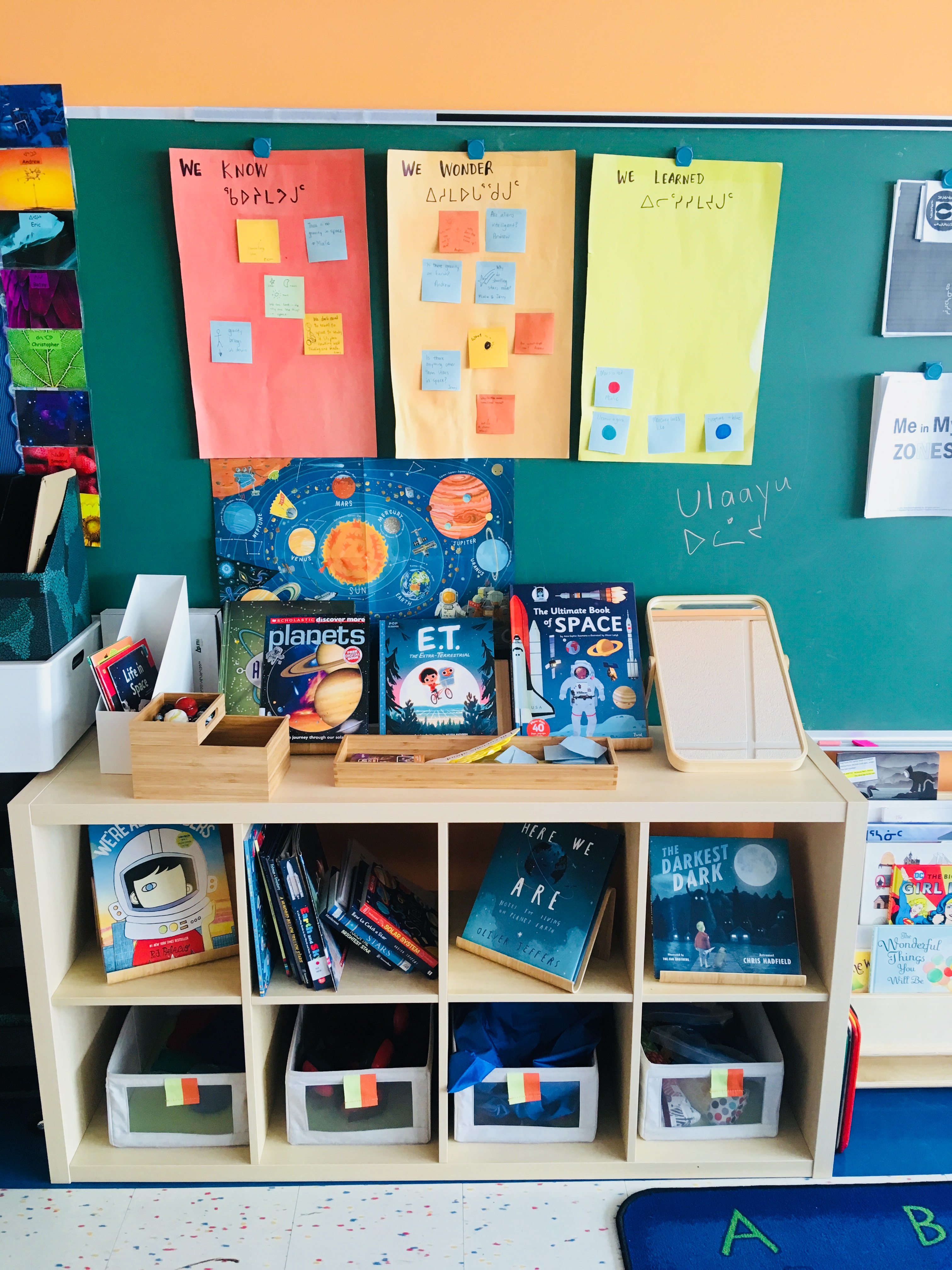
Inside the Harmony Room
By Jenny McManus
The beat of the drum brings the group together around the carpet. We celebrate the morning improvising an ayaya song to notice the subtle changes in nature – like the sun shining brighter through our window – to recognize students’ effort and achievement, and to strengthen their memory recall. Beaming with pride, the students clap out the number of stars they earned that morning as tokens for following expectations based on our school values of respect (susutsaniq), unity (tatiqatigiiniq), harmony (saimautiniq), and vision (tukimuatsianiq).
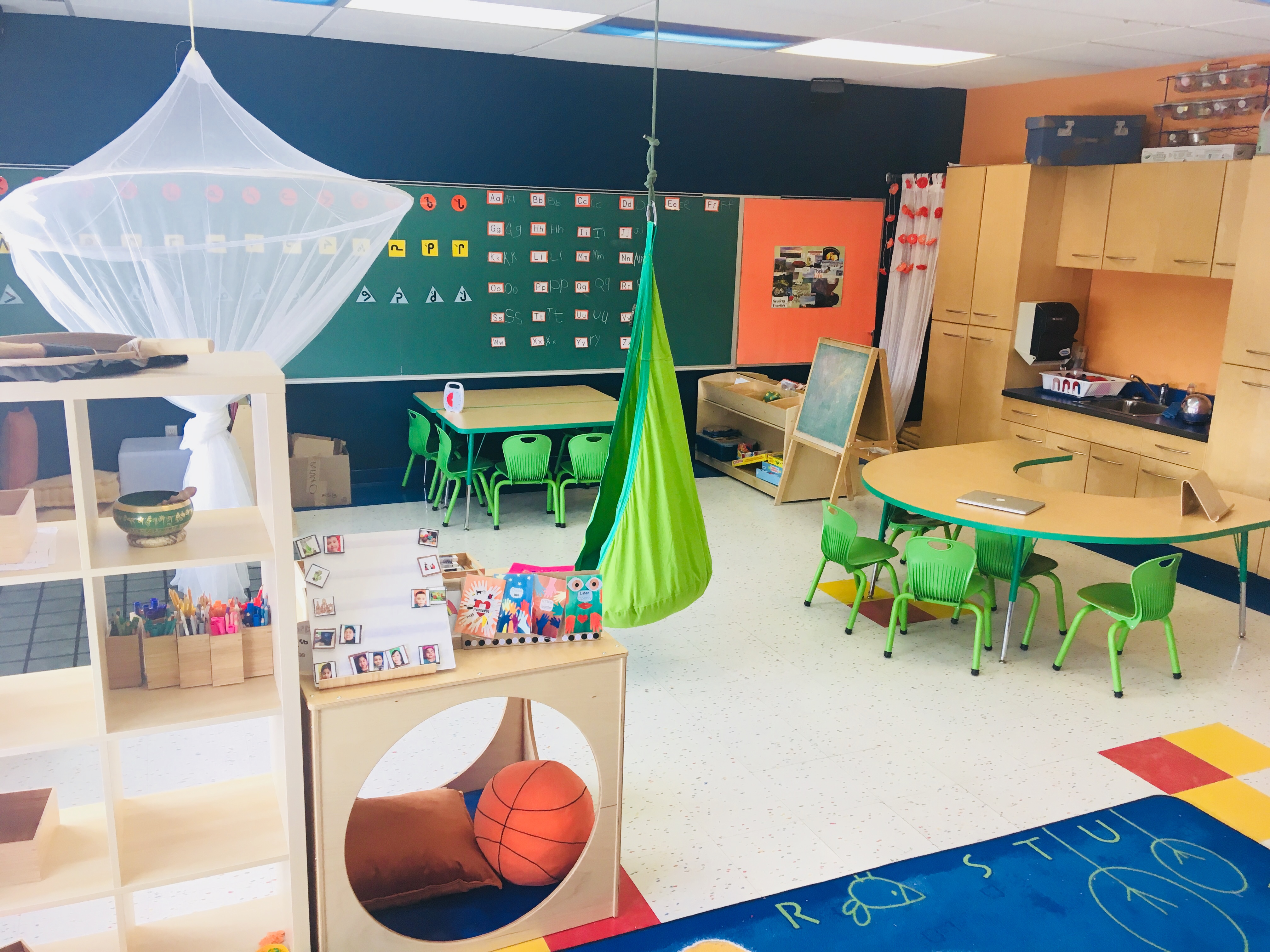
Every morning, we remind ourselves to listen openly, stick together, be peaceful, and dream big with posters on the wall that we made together, hand gestures that silently redirect, and smaller cards to flip to indicate unexpected behaviour. Each student has a colour on the wall for displaying their names, stars and evidence of learning. In the Saimautivik, or Harmony Room, they find a sense of belonging that nurtures friendships, empathy, and growth.
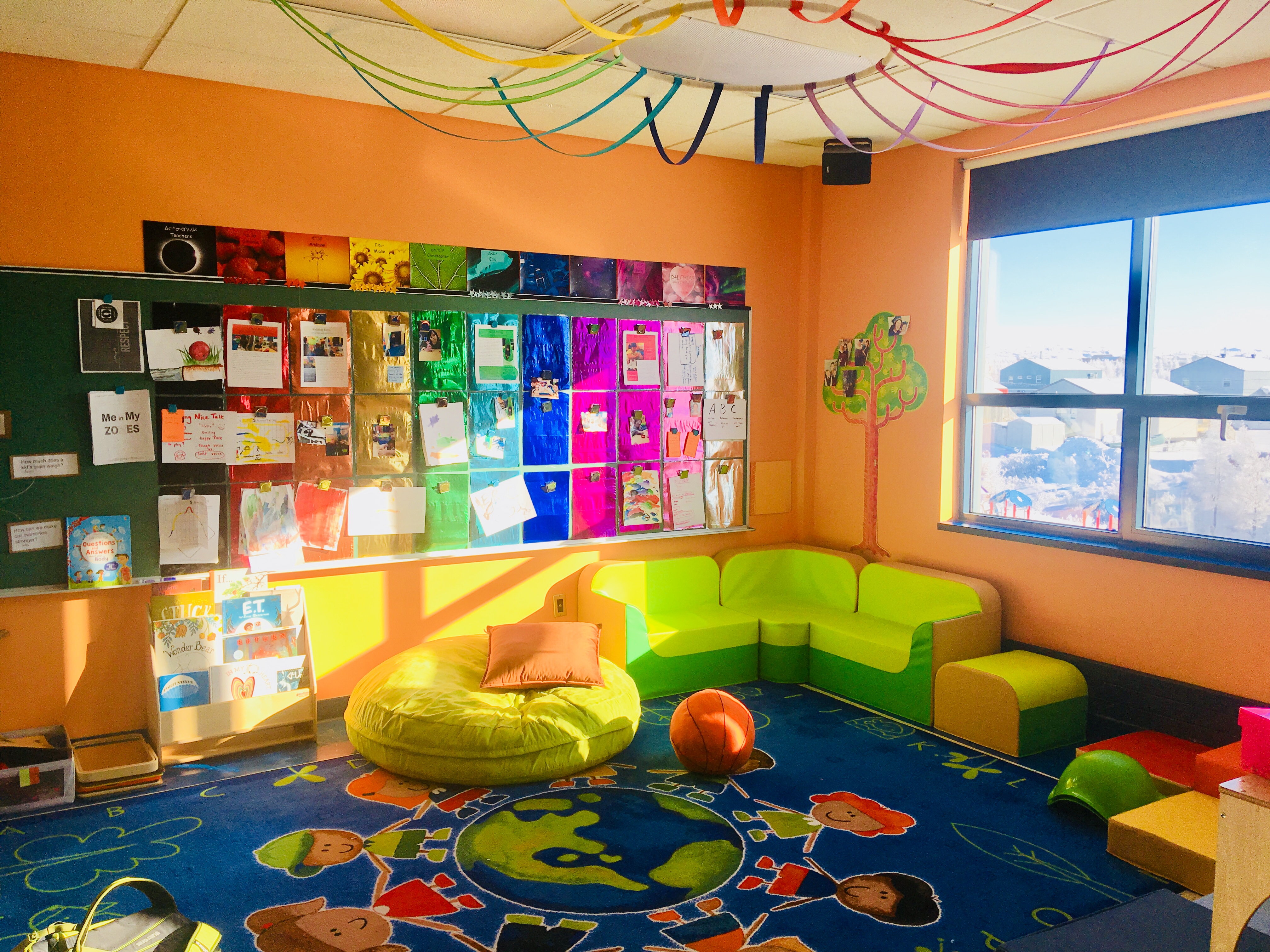
The Saimautivik is a social and emotional learning space at Pitakallak School in Kuujjuaq. Spearheaded by Jenny McManus, the Compassionate School teacher, it provides a home base for a nurture group, social skills groups, and extracurricular activities. Nurture groups are inclusive interventions for students that the Boxall profile (an online assessment tool) identifies as having delays in social, emotional, or behavioural development and who are struggling to flourish in the regular classroom environment. The Saimautivik brings together teachers and support staff to provide evidence-based practices to support our students in need and experiment with new directions in learning.
As a traditional Inuit value, harmony brings peace between people, agreement between ideas, and understanding in place of conflict. A classroom can be warm and inviting, with comfortable spaces for gathering and calming down, tables for sharing meals or collaborative projects, and nooks for using hands-on materials. The Saimautivik’s bright colours invite play and creativity, yet its organization supports the daily routines and serious, focused study.
Using tools that Compassionate Schools and Complementary Services promote the targeted interventions are supporting growth and change on a school-wide level.
Through the security of routine and predictability, caring adults who model positive relationships, clearly and mutually defined expectations, food sharing, opportunities for hands-on and paper-based numeracy and literacy, and engaging activities that are developmentally appropriate, the students make great gains in their development in a short period of time. Using tools that Compassionate Schools and Complementary Services promote, such as the Zones of Regulation and other trauma-informed approaches, the targeted interventions are supporting growth and change on a school-wide level.
Teachers, families, and the students themselves share stories of increased confidence, wider social circles, and greater academic achievement. Since the introduction of the intervention halfway through this school year, behavioural referrals have been reduced by half.
Rejected furniture and random supplies used to accumulate in this unused classroom; students would hide there when escaping their responsibilities. Now a place for healing and learning, it challenges the traditional concept of a classroom and the role of a teacher.
Find out more
Join our team! Visit www.kativik.qc.ca to view current job openings!
photo: Jenny McManus
First published in Education Canada, December 2019
Notes
1 The “Sixties Scoop” refers to the large-scale removal or “scooping” of Indigenous children from their homes, communities and families of birth. This practice took place during the late 1950s until the early 1980s and it has affected Inuit communities. The physical and emotional separation from their birth families also left many adoptees with a sense of lost cultural identity, which continues to affect adults and Indigenous communities to this day.
-
Building a Positive Staff Culture
Comments Off on Building a Positive Staff Culture
A positive school culture makes work and school fun, supportive, and purposeful. But how do you get there? This principal shares his learning about building school culture that is strengths-based, collaborative, innovative and focused, and grounded on the values of trust, happiness, curiosity and care.
During my 20 years as an educator, I have been part of school staffs who could not talk, would not talk, and even should not talk to each other. I have also worked and learned alongside school staffs who have embraced a positive school culture – one that makes work and school fun, supportive, and purposeful. So how have some staffs created this positive culture while others struggle to get there? This is a question that I have focused on for the past five years as a school principal.
Culture is hard to see but we can always feel it; it is the vibe of a school – the beliefs, attitudes, and behaviours that exist within a school staff. In any organization, we continually strive to make positive change; however, as Peter Drucker says, “Culture eats strategy for breakfast,” so before we can tackle real change, we need to work as a staff to create a positive school culture. How do we do this?
At the previous school where I worked as principal, our staff focused on building a positive staff culture for four years. Our goal was to achieve this, not through isolated team-building activities, but in the way we actually did our work together as a staff of educators.
In one of our first staff meetings, I introduced a collaborative activity and it flopped miserably. When I attempted to encourage more focused conversation, one of our respected veteran teachers stated, “We don’t know how to do this.” I tried rephrasing the instructions for the activity but he interrupted and said, “No, we don’t really know how to talk like this.”
This was such a turning point in our staff meeting culture, as it was clear we needed to start from there and first build trust, safety, and support. We could not dive into the real work until we established a place where this deeper dialogue could occur.
We started with creating some norms or commitments for our staff meetings and collaborative time (Hat tip to Cale Birk for the idea). The staff came up with the list below:
1. The topics will be relevant to what we do (and what we want to do) at our school.
2. We will be flexible and willing to try new things and ideas.
3. We will share the successes happening at our school.
4. We will create strategies to provide equitable opportunities for each of us to share our voice (and not be dominated by a few).
5. We will acknowledge that a sense of humour is important and will embrace opportunities for light-hearted dialogue.
6. We will stay on topic and stick to the agenda.
7. We will have a clear timeline for implementation of ideas.
8. There will be a clear purpose to the discussion and agenda items.
9. We will encourage others for their ideas and ask others for clarification, comments, ideas and suggestions.
10. We will provide time for grade-level collaboration.
11. We will always make time for getting together and having small group discussions.
12. We will respect that some may prefer to listen and reflect.
This set of commitments guided our behaviours and helped create staff meetings that felt safe enough to have the “real” conversations that often only take place in the parking lots and staff rooms. Prior to a discussion that might have some opposing views, we always reviewed and reminded ourselves of these commitments.
We also discussed the attributes of an effective staff culture. Staff shared their experiences with positive and negative cultures. They then captured words to describe a positive culture and we put them into a Wordle (See Figure 1; thanks to Suzanne Hoffman for the idea).
Figure 1: Staff description of a positive culture
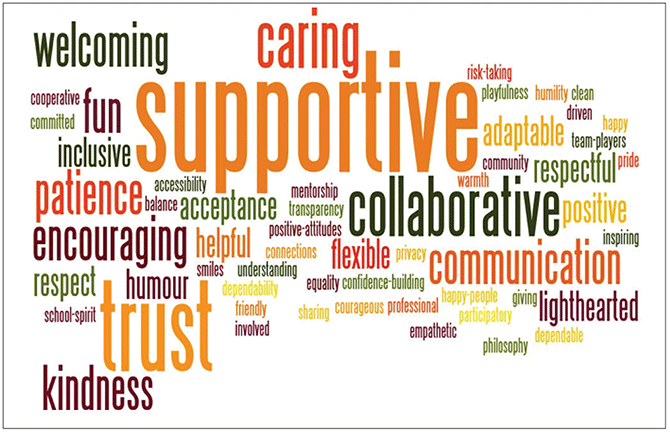
Through our work as a staff, as well as my learning at previous schools, I came up with what I believe are the Four Pillars of a Positive School Staff Culture. They are:
• Strengths-based
• Collaborative
• Innovative
• Focused
I am sure there are other attributes that could be used but these four have been most effective for the schools where I have worked. As you can see in Figure 2, these four pillars are also based on the core values of trust, happiness, curiosity, and care. These values weave their way through the pillars and without them, the pillars can crumble.
Figure 2: A Positive Organizational Culture
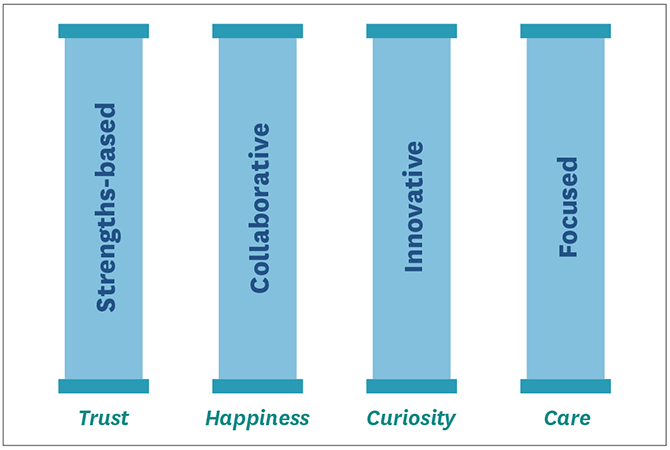
The four pillars
A STRENGTHS-BASED culture is one that believes that every staff member has strengths that can benefit the school as a whole. Feedback with staff always starts with strengths (character and skills), staff members are given the opportunity to determine their strengths (reflections and/or the 1), and each staff member is encouraged to use these strengths in their important work with students. Research from the (CLC) in 20022 shared that one of the most effective ways to bring out the best in your employees is to start with strengths. Performance and engagement is significantly increased when feedback and evaluation focuses on strengths rather than weaknesses. On staff surveys, many staff reported that with the focus on strengths, they felt more motivated, safer to be themselves, happier and healthier overall at school. A healthier, happier staff who feel safe and motivated can accomplish so much more with their students and for the school community.
“As leaders, we often make the mistake of listening to a problem and then jumping to solve it by ourselves.”
A COLLABORATIVE culture believes “the smartest person in the room is the room itself” (David Weinberger). Staff tap into each others’ strengths and engage in respectful, reflective dialogue to drive professional learning and create positive change. Trust is a huge part of a collaborative culture, and truly listening to others is essential to building trust. Polarizing statements and unwillingness to meet people where they are at will create a challenge to collaboration. By avoiding binary thinking, embracing the “grey areas” and listening to others’ perspectives, we grow as individuals and as a collaborative staff.
As leaders, we often make the mistake of listening to a problem and then jumping to solve it by ourselves. As a new principal, I had a teacher share a concern with me. Within minutes, I was busy shifting support schedules and trying to solve the problem. I bounced into her classroom to share what I had done, and she grew quite frustrated. She said, “I came to you so you could understand where I was at and so we could come up with solutions together. These solutions don’t really work for me and they will definitely negatively affect other teachers.” I was caught off guard by this feedback but so thankful, as I learned that my job is not to solve problems, but to work with staff to develop effective solutions together.
An INNOVATIVE culture is one in which educators feel safe to take risks, think critically and creatively, and implement new ideas with support. It moves from the question, “Can we….” to the question, “How can we…” The CLC’s research found that encouraging autonomy and risk-taking is another way to bring out the best in employees. An innovative culture is not necessarily always doing new things; it is one that understands the research around what is effective and is willing to try new ideas to help meet school goals. As Chip and Dan Heath tell us in their book Switch, we need to shrink the change. We need not always aspire for huge risks and changes, rather, we should encourage incremental changes that can be tried for a period of time to see if there is a positive impact. An important role for principals is to find the resources (time, materials, etc.) to support the innovative work of staff, so that good educators can become great educators.
A few years ago, inspired by Daniel Pink’s book Drive, I offered staff a “FedEx Prep,” which meant that I would provide an extra prep period for six weeks so a staff member could take an idea and put it into practice. The only caveat was that they had to “deliver” – sharing with staff the idea they had implemented and observing the results over the school year. We had teachers work individually and collaboratively to implement ideas in areas such as outdoor education (a school garden), technology (blogging with primaries to help with writing skills), and self-regulation (a teacher and a special education assistant redesigned their classroom and introduced tools to help students be in a more effective learning state). By providing a small amount of time and a few resources, we were able to encourage innovation at our school.
A FOCUSED culture is one that knows the key areas of growth that the school is working on, as well as the strategies that can have the largest impact. With so many ideas, policies, and procedures being sent our way, principals and school leaders need to be good filters and keep the staff focused on their vision and mission. There are many “shiny new” ideas out there that look and sound great but they may not help your school on its journey. One question we have used to focus is, “What problem are we trying to solve?” If the new idea is not helping us with the problems (or areas of growth) we are working on, we can set them aside until a later date. By having a laser-like focus on clear goals and clearly defined problems the staff is working on, you can filter and prioritize what’s most important for your school.
The four core values
Four important values guide our behaviours and our journey toward a positive school culture. To embody any of these well, we must slow down. In a fast-paced world, this is even more important!
TRUST: At the heart of trust is communication. It is so important for us all to talk less and listen more. In author Mark Goulston’s words, we need to spend more time being interested and less time trying to be interesting. As formal school leaders, we must also be as transparent as possible to make sure that people understand why decisions are made and/or have all the information they need to make decisions. Another important way to build trust is to walk the talk; if we say we will do something … do it.
Building trust takes time. When I first arrived at my previous school, I posted a sign-up schedule to meet with every staff member to learn more about them and how I could best support them. After a week, not a single staff member had signed up. When I followed up privately with a few people, it was shared that everyone assumed it was an interview and they were nervous to meet with me. This was far from the goal! But the staff didn’t trust me yet. I met with a few individuals informally and then shared that this was the type of conversation I hoped to have in the scheduled times. After that, others started to sign up and they soon realized it was a positive opportunity. Within a few months, I had met with the entire staff.
“We can still work incredibly hard to support students while also encouraging happiness with staff.”
HAPPINESS: I always knew happiness was important but until I moved to my current school at Shortreed Community Elementary, I had no idea the impact that a staff can have on each others’ happiness. By having a sense of humour, taking the time to slow down and be there for each other (in good times and bad), and by showing gratitude, we can create a much more positive school staff culture. Going to work each day where people are happy fuels others and makes the difficult work we do much more enjoyable.
Within my first week at Shortreed, I knew it was a place with a sense of humour. I had worked many hours planning my first assembly to welcome everyone back in September. I wanted to share a bit about me and a slideshow from the first week. Little did I know that the staff had their own plans. Our Youth Care Worker had asked each class to prank me by coming to the assembly and literally sitting wherever they wanted – anywhere and everywhere. As the students entered the gym, my face started to go red at the chaos. Then the whistle blew and all students, with huge grins, quietly moved to their appropriate spots. It was a reminder to not take ourselves so seriously, to have fun and create some happiness in the school. We can still work incredibly hard to support students while also encouraging happiness with staff.
CURIOSITY: We cannot grow as a school unless we are curious. By seeing challenges as opportunities that we can be curious about, we can then collaborate and work together to meet them. By being curious and ensuring we are asking the right questions, we continually grow as educators, learners, leaders, and people.
CARE: People need to feel like they belong and they matter. Small acts of caring can go a long way to building a positive culture and community of care. At my current school, our mantra is, “You BELONG here.” This drive to create a sense of belonging is not only for students but also for our families and staff. We need to lead with an ethic of care and model to our staff that we support and look out for one another.
As an educator, I have come to realize that building (and maintaining) a positive staff culture takes time. By slowing down, focusing on the four values of trust, happiness, curiosity, and care while also keeping the four pillars of strengths-based, collaborative, innovative and focused cultures at the heart of what we do, we can help create a positive school staff culture.
I am thankful to have observed the incredible power of a positive culture. When we all work together to build and maintain this, we feel healthier at school and at home, more motivated and inspired in the important work we do, and because of this, we also see improved results in the achievement and success in our students.
Illustration: Diana Pham
First published in Education Canada, December 2019
-
Belonging in the Education Workplace
Comments Off on Belonging in the Education WorkplaceDid you know that something as simple as feeling like you belong can impact your health, happiness, and success? The science is clear – if we feel valued by and connected with our colleagues, then we work harder and more effectively while experiencing more fun and more success at work. What’s more, belonging is contagious – when we’re happy at work, then our colleagues are likely to be happy at work, too.

This is important in any workplace, but it’s of absolute importance in schools where educators have the privilege and responsibility of impacting children’s development. Educators know the power of belonging within the classroom, and they’ll often tell you about the impact small gestures can have on students’ engagement and well-being – things like greeting students at the door and connecting class activities with students’ individual, unique passions. Inversely, educators can also tell heartbreaking stories of students who are rejected or excluded, and the impacts this can have on their engagement and self-esteem.
The same is true in the adult world. Think about the best teams and the best workplaces you’ve ever been a part of. What made these teams and workplaces stand out? My guess is that your first thoughts don’t revolve around comfortable furniture or an environment where you can get a whole lot of paperwork done. You’re probably thinking about PEOPLE, and – if you were to tell me about these people – you’d probably use words related to ‘belonging’ and ‘connection’ such as “family,” “friendship,” and “trust.”
BELONGING IS BASIC HUMAN BIOLOGY
Our need for belonging is wired into our biology. Human beings aren’t the strongest nor the fastest animals on the planet and we could’ve never survived as a species if we didn’t find a way to get along and work together. To survive, we’ve evolved over millions of years to eventually become a deeply social species. Social psychologist Matthew Lieberman, for instance, tells us that our need to belong is so powerful to the point that it’s one of the primary drivers of human behaviour. If you think about the early days of evolution, then this makes total sense. If we didn’t cooperate with each other and form communities instead of hunting each other down, then we wouldn’t have survived. Period.
The Secret to Health, Happiness and Success Together | Gail Markin | TEDxLangleyED
Earlier this year, I did a TEDx presentation about the power of belonging and connection. In preparation, I explored simple gestures that can promote belonging and impact workplaces in powerful ways. For example, did you know that when you perform an act of kindness towards another person, ‘feelgood’ chemicals are released in YOUR brain, in the OTHER PERSON’s brain, and in the brains of ANYONE ELSE who just so happened to witness the interaction? Essentially, we have the power to impact each other’s brain chemistry through our words and actions.
Try this short experiment:

Turn towards someone near you, look directly at them, and give off a big smile. You’ve literally just messed with their brain chemicals!
STRESS IS CONTAGIOUS – BUT BELONGING AND HUMAN CONNECTION ARE ALSO CONTAGIOUS
Just as smiling and acts of kindness release ‘feelgood’ chemicals, stressful circumstances can have quite the opposite effect. An interesting study on stress contagion in the classroom was conducted by UBC researchers Dr. Eva Oberle and Dr. Kimberly Schonert-Reichl, who measured teachers’ stress levels and the cortisol levels (i.e. stress hormones) of their students taken from saliva samples. Unsurprisingly, there was a significant correlation between the two – as teachers’ stress went up, so did students’ stress levels, and vice versa. Instinctively, teachers know that if they’ve had a stressful morning at home (or if one of their students has had a rough start to the day), then stressful energy is likely to spread throughout the classroom.

But there’s also good news. If you lower your cortisol levels – through, for example, feeling a sense of belonging and connection with other people around you – then you can actually boost your immune system. Most people already know that when our stress levels go up, then we’re also more susceptible to illness and long-term stress, which can have a huge impact on both our physical and mental health. Yet, belonging and social connection are actually more powerful predictors of life expectancy than other important health measures like levels of smoking and obesity. So, if you want to stay healthy and live longer, cultivate belonging!

SUCCESSFUL TEAMS LEVERAGE “BELONGING CUES” TO CREATE A WORKPLACE THAT ENCOURAGES CREATIVITY AND RISK-TAKING
Belonging and social connection are also powerful predictors of team success. When we feel valued and cared for by our colleagues, then we also feel safe. When we feel safe at work, then we feel empowered to be creative, to take risks, to ask questions, and to share ideas. To be truly successful, we need to know that our teams have our backs and will not embarrass, reject, or punish us for speaking up, trying new things, or doing things differently.

Let’s go back to the classroom again for a moment. Educators want students to know that it’s okay to ask questions, to be curious, to take risks, and to make mistakes. They work tirelessly to setup structures and conditions that create a safe environment for students to do their best work. Once again, we need to apply this wisdom from the classroom within our workplaces.
In his book The Culture Code, Daniel Coyle tells us about certain behaviours which he calls “belonging cues.” These are powerful cues that allow people to know that they matter while having big impacts on how they feel and perform in group settings. Daniel had the opportunity to study some of the world’s highest performing teams, and found that simple things like working in close proximity to your colleagues, eye contact, taking turns, and other small gestures communicate three key messages:
- That your INTERACTIONS matter. You show your colleagues that you’re invested in them and that your interactions are valuable.
- That THEY matter. You show your colleagues that they are unique and valued.
- That the RELATIONSHIP will continue. You show your colleagues that your interactions aren’t one-off and that you’re committed to developing strong relationships with them in the long-term.

This research is compelling and, once again, it fits with what we already know instinctively as human beings – that we crave positive social interaction and connection with other people. Think back again to the best workplaces and the best teams you’ve ever been a part of, and I bet you can remember laughing with your colleagues and having a lot of fun throwing out creative ideas. You can probably also remember times when you struggled through something or messed something up, and how your team was there to support you. These are the types of workplaces that are needed more than ever in our schools and school districts. If we want to engage, retain, and inspire people in the education profession, then – just like students in the classroom – educators need to feel safe in their workplaces and on their teams in order to be happier, healthier, and more successful.
Photo: Adobe Stock
References and Further Reading
Oberle & Schonert-Reichl, 2016, Stress contagion in the classroom? The link between classroom teachers’ burnout and morning cortisol in elementary school students, Social Science & Medicine.
Daniel Coyle, 2018 The Culture Code. Random House Books.
Matthew Leiberman, 2013, Social: Why our Brains are Wired to Connect. Crown Publishing Company.
-
Culturally Responsive School Leadership
Comments Off on Culturally Responsive School LeadershipMuhammad Khalifa’s book on culturally responsive school leadership – an increasingly important expectation in Canada’s racially and ethnically diverse schools – is both a paradigm shifter and a practical tool.
His arguments are unconventional and controversial, but they provide a critically important challenge for high school principals. Based on substantial data collection, a two-year ethnographic study, and his experience as an educator, Khalifa argues that the heart of leadership must be in the community rather than just in the school. To support “minoritized,” marginalized students who have become disengaged with school, principals must reach out to students and their families, bringing the local cultural knowledge into the classroom, curricula, and policy decisions.
Khalifa does not duck talk of historical oppression and present power; he emphasizes the need for all staff to engage in ongoing critical self-reflection that goes beyond the personal to challenge the systemic structures that create an inequitable environment.
Although Khalifa’s text pertains specifically to high school principals in the U.S., it is relevant to the Canadian context, especially in schools with populations of students of colour and Indigenous peoples. One shortcoming is that despite encouraging the use of Indigenous knowledge, Khalifa does not provide many specific examples of that work.
Khalifa’s inspiration comes from “Joe,” an urban principal in an alternative high school where failing students from other schools are sent. Substantial data – including “equity audits” and an intensive study of this ground-breaking principal – reveal what anti-racist, community-honouring, and high-expectations education can look like. Joe’s strategies include everything from ignoring culturally based behavioural rules in order to honour students’ identities (e.g. wearing saggy pants, loud talk, or swearing) to expecting teachers to become involved in community issues and incorporate these concerns into their curricula. Finally, he invites community members to have a say in school affairs and policy making. As a trusted “warm demander,” Joe’s care of students, teachers, and parents lead to a blossoming of students’ self-esteem, self-advocacy, and academic success.
Khalifa’s charts, activities, and end-of-chapter discussion questions are invaluable “how to” tools. Courageous conversations about equity are essential, but this text argues that talk must be matched with brave, persistent action. This is a persuasive new perspective for all educational leaders willing to take a leap to make their schools deeply culturally responsive – well worth reading.
First published in Education Canada, September 2019
Harvard Education Press. 2018
ISBN: 978-1682532072
-
Culturally Responsive and Relevant Pedagogy
Comments Off on Culturally Responsive and Relevant PedagogyA brand-new school embraces the opportunity to include culturally responsive and relevant pedagogy (CRRP) in its founding mandate. How did they do it, and what factors were essential for success? What does Culturally Relevant and Responsive Pedagogy mean and why is it important?
There was a time when Canadian students weren’t asked to leave very much at the door when they came to school each day: their collection of hockey cards, a baseball bat, an occasional slingshot. Once, if the story is accurate, a white-fleeced lamb. Like most public institutions, Canada’s schools were originally designed to reflect the cultural values and worldview of a largely white European society and, for the great majority of students, this meant a comfortable continuity between home, school and community.
Since the 1970s, we have seen a relatively rapid demographic shift and a major change in the cultural make-up of many communities. Yet in many important ways, school systems have not responded to this significant cultural shift.
Nowadays, in addition to leaving their personal belongings behind, many students are also asked to check some crucial aspects of their culture at the school door: their family stories, their language, their sense of community connection and their unique perspectives and ways of knowing the world.
It’s not you, it’s the system!
For decades, Gloria Ladson-Billings and Geneva Gay have been arguing, in separate bodies of work, that the reasons traditionally used to explain the persistent failure of black students in the United States do not suffice. Through their work, both began to insist that the answer to the thorny problem of race-related school success was not to be found by blaming the students or their family context. Instead, the mirror needed to be turned to reflect both the problem and the solution to this essential equity challenge: the systemic realities that ignored or even actively suppressed the cultural capital that students brought to school.
When Nicole West-Burns came to Canada from the U.S. to work with Jeff Kugler in the Centre for Urban Studies at University of Toronto’s Ontario Institute for Studies in Education (OISE/UT), she brought her deep knowledge and experience of this research to add to Kugler’s many years of working as an educator/administrator in Toronto’s Regent Park. Combining the theories of Ladson-Billing’s Culturally Relevant Pedadogy and Gay’s Culturally Responsive Pedagogy, they framed an approach many Canadian educators now know as Culturally Responsive and Relevant Pedagogy (CRRP).
At first their intensive work with educators was concentrated on ten “Model Schools for Inner Cities” in the Toronto District School Board, but in 2013, they were asked by the Ontario Ministry of Education’s Inclusive Education Branch to mobilize the work in a year-long pilot program, centred in two Greater Toronto Area Schools: William Burgess Public School in downtown Toronto, and Irma Coulson Public School in the town of Milton, just northwest of the city.
A framework for deep transformational work
CRRP is not a program that can be delivered to schools in a box and distributed at a staff meeting or even on a single professional development day. Instead it is a dynamic framework that provides a set of tools and lenses that, if taken seriously, can lead to thoughtful unpacking, personal reflection and honest dialogue among staff, students and communities. CRRP examines issues of power and privilege, calls participants to challenge the beliefs and assumptions about the students in their class and explores on a very deep level what is necessary to enable all students to be successful in school. It intentionally centres the cultural assets that students bring with them to the classroom and uses those assets as a way to get to know the students and their way of knowing the world, and as a way of engaging all students. But it also forces educators to consider how those assets are put to work to allow students to see themselves reflected in the curriculum and in the life of the school.
To be sure, CRRP is an approach that takes time, resources, vision and leadership. But under the right conditions, it can significantly impact the way we talk and think about race, culture, identity and equity. The story of CRRP at Irma Coulson Public School (ICPS) offers a grounded vision of how those conditions can come together in a very tangible and powerful way.
A strong vision for equity and excellence
In early 2013, Principal Merrill Mathews and Vice Principal Mary Marshall were busy preparing to open the doors of a new school in Milton, Ontario – Canada’s fastest-growing town. The neighbourhood in which Irma Coulson was to be located was also one of the most culturally diverse in the Greater Toronto Area. The ICPS catchment area drew families from seven or eight different schools in the Milton area and included a wide range of religious and ethnic groups.
It was this diversity that drew Mathews to his first assignment as principal. The belief that all students could and would excel at Irma Coulson was part of the way that Principal Mathews presented his vision for the school – to potential teachers and staff, to parents and students who would call ICPS home, to potential community partners and to district colleagues. The phrase “Equity and Excellence for All” became the official motto for the school, and appeared on the front doors of the school when they opened in the fall of 2013. On most days, members of the ICPS staff could be seen wearing school T-shirts proclaiming their belief in the work in which they were involved. At the heart of this belief was the recognition that every family enrolling at ICPS had a story richly steeped in culture, and the promise that the school would be a place where those stories were valued.
Vice-Principal Marshall recognized that Mathews’ commitment to the vision ran deep. “His own experiences as a student really played into that and his passion for equity work as an educator from the very beginning of his career. And so, when the opportunity came to be appointed as a principal for an opening school, that vision was front and centre.”
This dogged commitment to a clear and compelling vision is a necessary condition for CRRP. It was something that Kugler recognized as soon as he began to understand that Mathews’ vision would run through the entire design of the school: “The major criteria in hiring new staff to come to this brand-new building was their openness at least to working around equity issues… And to build a school upon which equity was the foundation.”
Today’s complex school context provides many challenges, not the least of which is finding the room to focus on what is important. The CRRP pilot was not an add-on, but something that supported and expressed the grounding philosophy of the school.
Intentional leadership
In many cases, educational pilot programs revolve around one or two enthusiastic teachers who are provided with the time and resources to engage in the work. By contrast, the CRRP pilots at both William Burgess and Irma Coulson demanded the involvement of all staff from the very beginning. It was a requirement for participation in the pilot.
In addition to the internal resources available at the school level, the Ministry commitment to CRRP came with extra release time for teachers to participate in monthly sessions with Kugler and West-Burns’s team, and for the “in between” work necessary to deepen the conversations among staff.
One of the most important words that emerges when Mathews and Marshall talk about their leadership role is intentionality. At Irma Coulson, monthly staff meetings were intentionally planned in advance, ensuring that the work of the CRRP pilot was maintained as a priority. School Council meetings followed a few hours later, so the admin team could intentionally involve parents in some of these same conversations. Schedules for planning time were intentionally organized to allow grade-level teams to meet together weekly. There was no doubt in anyone’s mind that this was important work and that it involved everyone in the building – not just teaching staff – and extended to the parent community.
Marshall admits that the extra resources provided by the pilot were a luxury, but insists that, if the commitment is there, the work can get done. “I believe that there’s time and space and resources in schools that make a commitment to do this work, to then undertake this work. Now, it may take longer because you haven’t got the richness of resources.” She believes, however, that strategic thinking, a strong sense of direction and the type of intentionality that instills confidence and commitment can make things happen in a very powerful way.
Support for the important conversations
Much of the transformational power of CRRP is that it requires a good deal of deep and very personal work. At the core of this identity work is understanding that most Canadian educators have grown up in and have been favoured by the system in which they are now working. It is challenging, if not contentious, to begin the process of unpacking issues of privilege, marginalization and oppression. The work can be emotionally charged and requires participants to come face-to-face with questions and realities that they may be encountering for the very first time.
ICPS teacher Shannon Morgan doesn’t remember encountering any of these ideas in her own teacher preparation program. She does remember clearly the unease on the part of many in the early days of the pilot. “It was the conversations happening, not just in the groups with Jeff and Nicole, but sidebar conversations as well,” she says. “You could really see how uncomfortable this work was, and some people not wanting to say how uncomfortable it was in a large group.”
Yet, this personal identity work is necessary if educators are going to be able to truly understand CRRP. Teacher Phil Gibson, an Afro-Canadian male, remembers the day when he realized that his experience of growing up in Burlington, Ont. was different than other staff members from the same area.
“One of our colleagues was also from Burlington. And when she talked about her experience growing up there, it was like all flowers and roses. It was a great environment. My experience growing up in Burlington was the exact opposite of that. So it kind of jump-started the conversations where people were able to say, ‘I’ve never thought of that!’”
Many leaders and participants might be tempted to back away from these types of conversations and reflection. But Nicole West-Burns insists that we need to stay with them and live through the discomfort. “We talk (to teachers) about the rumbling in your stomach or the things that stand up on your neck and that this is part of the feeling. But the discomfort sometimes is what helps us push through or figure out. And so that’s what we need.”
Moving beyond these initial feelings of discomfort is essential to the work of CRRP. The expertise and sense of confidence brought by West-Burns and Kugler helped the staff move to the next level in their conversations – a focus on the students.
“The intensity of the work built strong relationships with people and established some trust, which is always a challenge in the first year,” says West-Burns. “This wasn’t about jockeying for position, this was about coming together for the good of the kids. This project really allowed staff to establish that from the beginning: This was about the students.”
From identity to practice
The personal and group identity work formed the important groundwork for a change in the way that teachers and staff saw students and families at the school. It was noticeable in the way that parents were welcomed into the school and spoken to by office staff and administrators. It was noticeable in what was hung on the walls throughout the school. And it was noticeable in the stories of change that staff began to experience and share with each other.
Phil Gibson is a Phys-Ed teacher at Irma Coulson. He recalls what happened when, during a unit on baseball skills, he decided to bring in cricket equipment as well, placing the game in a cultural context that resonated with many of his students. Students unfamiliar with the game of baseball suddenly felt empowered and affirmed by the opportunity to teach their peers about an important part of their culture. “They were teaching them how to bowl. They were teaching the rules of cricket, talking about how to hold the bat.” Now, Gibson reports, those same students can’t wait for spring and the opportunity to get outside and play cricket again.
Shannon Morgan has many stories about the impact of CRRP but one that she remembers fondly was reported to her by a lunchroom supervisor who had listened in on a conversation among Morgan’s Grade 2 students. “They were all sharing the different creation stories from their different backgrounds and families. In a very civil manner, they were actually engaging in a rich dialogue… They were able to listen to each other and respect each others’ differences, and that was huge for me.”
Bringing it all together
It could be argued that the extra supports directed toward pilot programs makes operationalization on a larger scale difficult, if not unrealistic. It is true that lighting a pilot light may get things started more easily, but there are lessons to be learned from identifying the conditions that allowed CRRP to take root and drive equity work at ICPS.
The understanding that cultural change is reliant on focused leadership should open up important conversations about how our school leaders are chosen, trained and supported through their work. Creating the ability for principals and vice-principals to develop and maintain that energetic focus is important for everyone in the building, as is the way that we encourage school leaders to connect with each other across a district and beyond.
If a staff is going to follow a leader into uncomfortable and challenging work, there needs to be a strong sense of intentionality. One-off workshops or single-day PD events cannot replace the knowledge that this is the work that we are doing, now and throughout the year.
Finally, outside support and expertise may be necessary to guide the personal work that allows CRRP to take root. Having the resources to draw in that support, especially to facilitate the difficult but essential conversations, cannot be overlooked or taken lightly.
Culturally Relevant and Responsive Pedagogy was originally introduced in Ontario by Nicole West-Burns and Jeff Kugler as a way of addressing a specific group of racialized students proven to be marginalized by the system in Canada’s largest school district. It was soon recognized as a powerful framework that challenges all educators to see themselves and their students differently. Culturally Relevant and Responsive Pedagogy insists that we start to understand that success for all students means embracing the cultural assets that they carry with them every day, and refusing to let those assets remain at the schoolhouse door.
As the two CRRP pilot programs reveal, this is not easy work. It takes vision, time, resources and the courage to stand up to a system that is, too often, supportive of the status quo. At stake is the success of a growing number of culturally diverse students who are marginalized and often alienated by a system built for a different time and place. What’s possible is the nurturing of school communities that reflect, respect and leverage the power of the stories, experiences and ways of knowing carried by all of our students and their families.
Photo: courtesy Halton District School Board
First published in Education Canada, September 2019
EXPLORE THE LATEST EDITION OF EDUCATION CANADA, POWERED BY VOICED RADIO (MARCH 2022)
-
Inclusive Classrooms
Comments Off on Inclusive ClassroomsWe can all agree that the classroom should be a place where students feel included and equal, so how can you approach disability and inclusivity in your classroom? Read on for some useful strategies to ensure all your students feel included.
Emily, a young adult from Richmond, B.C., looks back on her high school sewing class with relief that it’s over—not because she didn’t like sewing, but because she wasn’t allowed to. Despite being ready, willing, and able, her teacher told her that she couldn’t because she was in a wheelchair. This caused confusion for Emily and her friends “My legs are disabled, not my hands,” she says. Cooking class took on a similar form. While she was perfectly capable of putting on an apron herself, her teacher insisted on doing it for her.
We can all agree that the classroom should be a place where students feel included and equal, so how do we equip ourselves to avoid situations like the above? And how should you approach disability and inclusivity in your classroom? Below are some useful strategies to ensure all your students feel included.
Don’t assume
The mistake that Emily’s home economics teachers made was that they believed they knew her abilities better than she did. It’s important to trust that your student knows their limitations, or if a younger student, their parents do. Let them gauge where they’re comfortable rather than prescribing what they can or cannot do.
Ask what their needs are
If you have a student in your class with a disability, come up with a list of questions at the beginning of the year to help you understand their specific needs. This will help determine if your lessons will be inclusive or not, and give you ample time to adapt your lessons to their requirements. And make sure it is an ongoing conversation.
“Adapting lessons day to day, and even minute to minute, is crucial to meeting the needs of all students in the inclusive classroom,” says Aja Coe, a Grade 7 Social Studies and Language Arts teacher with Rocky View Schools in Alberta. Coe is a contributor to Flexible Pathways to Success – a project that identified factors that contributed to the implementation of technology in classrooms to support students with diverse cognitive abilities. “It is important to level the playing field by removing barriers so every student has the opportunity to be successful and gain confidence at school,” she adds.
Equal treatment when possible
Emily’s woodworking teacher provided excellent support. He not only had a conversation with her after class about her abilities, he also went through each woodworking machine to see if she could use it and made sure they could adjust it to her needs.
There were many times in other classes that Emily would receive no penalty for handing something in late. While dodging late marks is the dream of many students, Emily just wanted to have the same rules and consequences as her classmates. In woodworking, Emily had to do all the assignments just like everyone else, and she would receive late marks if a project was past the due date.
Any student, regardless of physical ability, may require adjustments to their assignments, but having a disability doesn’t automatically make this so. “I do a lot of reading and writing pre-assessments at the beginning of the year so I have a clear understanding of each student’s individual strengths, as well as the areas of growth,” says Coe. “These assessments help inform my instruction so I can ensure I am teaching to each student’ individual needs, regardless of whether they are at, below, or above grade level.”
Do a resource audit
We’re all familiar with the educational videos available to warn students against unsafe work conditions or impaired driving. Many of them are comically outdated, with bad effects to boot. While an 80s soundtrack is harmless, older resources could be sending the wrong message.
Emily had to watch a video like this in one of her classes. In the main story, a victim of a driving accident was injured, leaving them to rely on a wheelchair to get around. The video portrayed using a wheelchair as the worst thing that could happen to you. Many people who use wheelchairs don’t feel this way, and messages such as this can create unwanted pity.
Whether you have a child with a disability in your class or not, it is important to take stock of your resources before the school year commences. If resources are portraying people with disabilities as the “other,” this will further alienate students who may already feel different.
Tools for teaching inclusion
While you don’t want to single out an individual student, having discussions and lessons about disability, inclusivity, and equality can help foster a more compassionate and inclusive environment.
The Rick Hansen Foundation School Program (RHFSP) is a great place to start when it comes to incorporating these conversations into your lesson plans. All resources are available for free in both French and English, with age-appropriate lesson plans for Kindergarten to grade 12. Each toolkit has a variety of lessons and activities to get your students thinking about inclusion, and each one is designed by educators and align to provincial curriculum.
It’s a learning process
An openness to tailoring lessons, changing the layout of your classroom, and ongoing conversations will ensure your classroom environment includes all students and ensures their success. And don’t forget you’re not alone: there are endless resources out there to support you as you foster compassionate behaviour and leadership among your students.
Register with RHFSP to become a part of a Canada-wide community of educators committed to inclusive teaching, and download the latest resources today.
Universal Design for Learning: Quick tips
There are many simple things you can do to ensure the physical features of your classrooms and resources support students of all abilities. Here is a sample of tips from RHFSP’s Teaching Strategies for the Inclusive Classroom Toolkit. To download the full toolkit, visit RickHansen.com/Schools
Teaching Students Who Are Deaf
- Support verbal instructions with print and/or visual aids.
- Provide lesson materials, such as vocabulary lists, in advance.
Teaching Students Who Are Blind
- During discussions practice having speakers identify themselves. Address students by name so a student who is blind knows who is speaking.
- Understand orientation and mobility needs for navigating the classroom and common rooms.
Teaching Students Who Have a Physical Disability
- Provide enough space for a wheelchair between desks and tables and ensure there is enough room for knee clearance under tables and desks.
- Ensure resources are visible and within reach. For example, books, school materials, coat hooks and cubbies should be no higher than 103.6 cm.
First published in Education Canada, September 2019
Image: iStock
-
Going Green in K-12 Education
Comments Off on Going Green in K-12 EducationSchools can play a crucial role in fostering environmental citizenship among students, but also in mitigating their own substantial carbon footprint.
Imagine a world where the highest paid job is salvaging treasures from once coastal cities now submerged beneath the expanding oceans. No, this isn’t a post-apocalyptic sci-fi movie. It’s one of many possible futures our planet faces if we don’t take serious action on climate change.
There’s simply no denying it. Poll after poll has shown that Canadians are increasingly concerned about climate change. This is especially true among young Canadians.
Inspired by passionate young activists like 16-year-old Swedish environmentalist Greta Thunberg and the #FridaysForFuture movement, our youth are eager to see substantial action on climate change in their daily lives – including at school. The average student will spend at least 15,000 hours in the classroom from Kindergarten to Grade 12. During that time, they not only want to engage in activities and initiatives that promote environmental sustainability, but they also want to be immersed in an atmosphere where they live it. Today, John Paul II Catholic Secondary School in London, Ontario seeks to become Canada’s first carbon neutral school by 2021 through reducing greenhouse gas emissions to near zero. This is just the start.
The EdCan Network acknowledges the crucial role that schools can play in fostering environmental citizenship among students, but also in mitigating their own substantial carbon footprint. Once students and teachers become engaged, their heightened environmental awareness broadens to other issues, and spreads into their family lives and communities. Already, we have seen schools and school districts make great strides as trailblazers in this area.
Consequently, the EdCan Network is excited to announce that our March 2020 issue will focus on “Greening Our Schools” to tie in with Global Recycling Day on March 18, 2020. We’ll address topics like food waste in schools, energy reduction, how climate change is taught in classrooms, environmental leadership, and Indigenous approaches to environmentalism. But that’s not all. In the coming months, we will lead a national conversation on how the key players in K-12 education – students, parents, educators and other stakeholders – can be the catalyst to real, impactful action on climate change.
Today, talk and inaction can only take us so far in addressing climate change. If we desire a future that is closer to Star Trek than Terminator 2: Judgment Day, it’s time to go green on education.
Support Our Work!
The Edcan Network is a nonprofit organization that bridges research and practice by including voices from across the entire spectrum of K-12 education.
Become a Donor: Help us expand the reach of timely educational resources to improve education policies and support “deeper learning.”
Visit www.edcan.ca/donate to make a donation today.
First published in Education Canada, September 2019
-
Creative Caring for Teachers
Comments Off on Creative Caring for Teachers
The wellness of teachers is critical to the education, behaviour and mental health of young people. Teachers who are doing well are able to establish and maintain positive relationships, have an engaging curriculum delivery and contribute to a supportive culture. Wise school leaders who want all students to flourish will find ways to cherish their teachers within a whole-school, well-being framework. When well-being is at the heart of school values and practice, then other things follow in a virtuous cycle – better mental health and resilience, student engagement, academic outcomes and pro-social behaviour.1
The impact of stress
A limited amount of stress can be energizing, stimulate creative responses and improve focus. Chronic ongoing stress, on the other hand, is literally toxic. It can weaken the immune system and cause high blood pressure, fatigue, depression, anxiety and even heart disease. Over time it leads to degradation of the hippocampus – the part of the brain most active in memory.
Students whose behaviour is challenging are often struggling with adversity. These young people at risk need adults in their lives who are able to maintain the relational quality that builds resilience.2 Educators are usually caring individuals, keen to make such a difference, but when they are over-stretched their responses may become self-protective, with little understanding or empathy. School life for vulnerable pupils then becomes a mirror of what is happening for them elsewhere, undermining both learning and mental health.
Teaching can be a stressful occupation but also a meaningful, stimulating and rewarding one. In aiming for the latter, we need to either reduce demands or increase resources. Rather than devote precious energy to things we cannot change, such as student backgrounds or government directives, let’s be creative about what is possible.
Looking after each other
So what does it mean to be doing well and what can schools put in place to make sure this happens? Whole school well-being is not a set of programs, but “how things happen around here.” A culture with high levels of social capital and creativity benefits everyone. So, rather than just remind teachers to look after themselves, here we explore whole-school values, priorities and innovations that put well-being centre stage.
Physical well-being
Most teachers say there isn’t enough time to do everything. For teachers under stress, the first thing to go may be behaviours that maintain good health such as sufficient sleep, regular exercise and healthy eating. Schools can help teachers stay well by ensuring that expectations are manageable and by thinking outside the box to create opportunities within the school day.
Both teachers and students need to keep active – brains slow down when the body stops moving! Having students get out of their seats and move around during lessons makes sense, but how about taking this one step further? Many teachers see lunchtime as an opportunity to finalize lesson planning, mark work or have meetings. But perhaps once or twice a week it could be a space for doing something physical alongside students? Not just traditional sports but aikido, dance, Zumba, kick-boxing or tai chi. Sharing the learning, making mistakes and laughing together also increases connectedness and stimulates positive relationships.
Overworked teachers can be up half the night planning lessons, marking and doing admin. When this happens routinely rather than occasionally, it impacts on all aspects of psycho-social functioning. No one can do everything to the best of their ability all the time and stay sane, especially when they are exhausted. Something has to give. Working “smarter” rather than harder requires school management to be clear about priorities, what constitutes “good enough” and how best to share resources so individuals do not spend time re-inventing the wheel. Encouraging staff to set limits on after-hours emailing can be helpful and school leaders who model good practice give staff permission to also switch off. Another time-saving strategy is to tighten up on meetings. What is a meeting for, who actually needs to be there, is there a more time-efficient way of getting things done?
Most teachers are highly conscientious. They often go to work when unwell and then take much longer to recover. A whole-school agreement about when to call in sick and stay at home can be valuable. One principal actively promoted positivity across his school and his budget for sick cover was always underspent, leaving more funds for other things. He was convinced that his staff stayed well because they were working in a happy school. The evidence suggests he was probably right.
Social well-being
Michie and Cockcroft3 found that more serious dangers to health from toxic stress were moderated by strong social networks and support. How we relate to each other matters a great deal.
I have asked teachers in various educational jurisdictions around the world to identify what others do and say that makes them feel they belong at school – and overwhelmingly they report that it is the simple things that make the difference: “People greet me with a smile, remember my name, show an interest in me as a person and ask follow-up questions. They check how things are going, invite my opinion, show appreciation for my efforts.” They also talk about how good it is to be with people they can share a joke with. If you ask students what they value in teachers, they come up with a very similar list.4
When teachers have opportunities to get to know each other out of role, this facilitates more relational interaction and mutual support. In one large all-age school in Melbourne, a member of staff has been designated “social secretary” and organizes an event once a term where everyone is invited, sometimes including families. This has resulted in fewer cliques, less judgment, more mutual interest, increased cross-departmental support, more willingness to sort out differences and a warmer atmosphere all round. One teacher commented, “I can’t always attend, but what is important is that everyone gets invited, not just a select few – it has made a real impact on the feeling of collegiality in the school.” This teacher had been at home with young children for five years and talked about how everyone was much happier and kinder than before. She put this down to the active development of a more supportive culture throughout the school and said that now “everyone is on the same side, looking out for each other.”
There are schools operating a buddy system, not just for new teachers but for everyone. A large special school in Victoria (Australia) has “secret angels.” Everyone who wants to participate puts their name in a hat and takes another out. They are that person’s secret angel for the term. They keep an eye on their colleague, make the occasional cup of tea, perhaps take a duty for them or organize a small birthday celebration.
The quality of the teacher-student relationship is not only the most critical factor in effective education,5 it also links to feelings of teacher efficacy and well-being. One way to develop stronger relationships is to get to know students as people with ideas, feelings and experiences. Circle Solutions6 is a strengths- and solution-focused framework for social and emotional learning (and whole-school well-being) based on the ASPIRE principles of Agency, Safety, Positivity, Inclusion, Respect and Equity. Teachers join in as equal participants and take part in all the activities. Over the course of the term, everyone interacts with everyone else. This breaks down barriers and changes perspectives. Teachers have been very positive about the difference Circles has made to the atmosphere in their classes. One teacher said, “It will totally change your relationship with your students and their relationships with each other.”
Emotional well-being
Positive emotions underpin creativity, problem-solving and cooperation.7 These include feeling comfortable, safe, interested, joyful, excited, valued, engaged, thankful and loved. By contrast, feelings of fear, anxiety or anger shut down learning and impair relationships, so what can schools do to promote positivity?
Simple recognition goes a long way. In a conference on teacher well-being in Darwin, some educators talked about going over and above for their students, often to the detriment of time spent with their own family. Yet it was only when they stopped working so hard that school leaders noticed and then commented negatively. The teachers’ frustration, despair and fury were palpable. There is no need for fulsome praise, but when efforts are noticed and openly valued this feels good, strengthens motivation and increases well-being. A card or note saying “thank you for…” or “I noticed that… ” takes little time but reaps great benefits, fitting with three of the five ways to well-being8 (Connect, Notice and Give; the others are Stay Active and Keep Learning) that the National Economics Foundation have developed.
In a primary school just outside Sydney, the front page of the weekly newsletter is a thank you – not just for orchestrating major events but for everyday good work. The recipient could be an admin person, support staff or school custodian as well as educators. Teachers told me it was the first thing they looked for every Friday – who had been recognized that week.
Feelings of trust and safety develop when people speak positively about each other, share fairly, demonstrate reliability by only offering what they can deliver, and communicate openly. One primary school in New South Wales has “This is a No Put Down Zone” posters everywhere – classrooms, offices and staffroom. This has proved to be surprisingly powerful. Everyone could tell me what it meant and how it impacted on school climate. One student said, “We don’t have any bullying here because of this no put down thing!” It made overt what is often hidden and brought good practice to the foreground.
A positive school environment is not a Pollyanna place where there is a denial of real-life struggles. Grief, depression and anxiety can be overwhelming at times. Where there is high social capital, teachers are able to have supportive conversations with each other. They will also be better able to respond effectively to students in crisis.
Cognitive well-being
Conversations create culture and culture determines how people think and feel about things. Teacher perspectives on their job, the students and their families are influenced at least to some extent by how people talk about these things in the staffroom.
Culture is best addressed as part of a wider well-being framework for the whole school. A first step is to identify a vision for the school, how far this had already been realized and agree on next steps. Although it is invariably the school executive that initiates whole-school well-being, it needs to be owned by all stakeholders. Once everyone has the bigger picture in mind it is easier to keep the small stuff in perspective.
Focusing on what is going well and how to get more of it also raises appreciation of how much there is to be thankful for. One large independent school in Sydney introduced a “random acts of kindness” board in the staffroom where staff placed post-it notes thanking colleagues for small acts of support. This got people talking – and initiated a different staffroom conversation!
Psychological well-being
Dan Pink summarises the three things that motivate people to do their best. These are autonomy, mastery and purpose. For many educators, psychological well-being is maintained by being able to teach according to their values, having some autonomy and being creative in responding to student interest and need. If they can do this they increase the personal and professional integrity that makes coming to work a joy.
Educating the next generation is a meaningful occupation, but the benefits can evaporate when life gets out of balance and teachers struggle with innovation overload or having to meet endless targets. A leader who is focusing on whole-school well-being will involve staff in developing a clear direction for the school, but will trust teachers to get on with the job and not micro-manage.
A last word about the importance of having fun. Oxytocin is the neurotransmitter critical in reproductive processes, but there is evidence for its involvement in connectedness, trust and cooperation throughout life. Oxytocin can be produced in the body by events taking place in the environment. One head teacher in England organizes head and shoulder massages for staff once a month on a Friday afternoon. This not only raises their oxytocin levels but makes them feel valued. Laughing together does the same thing. Where and when in your school are there opportunities to raise resilience by having fun?
Teachers have a responsibility to do what they can to look after their own well-being, of course, but for every school leader wanting the best for their school, students and staff, making whole-school well-being a core priority is a no-brainer!
For more information about the EdCan Network’s Educator Well-Being: A Key To Student Success Symposium
Photo: Rob Newell, courtesy West Vancouver Schools
First published in Education Canada, September 2017
Notes
1 T. Noble, H. McGrath, S. Roffey, and L. Rowling, A Scoping Study on Student Well-being (Canberra, ACT: Department of Education, Employment & Workplace Relations, 2008).
2 S. Roffey, “Ordinary Magic Needs Ordinary Magicians: The power and practice of positive relationships for building youth resilience and well-being,” Kognition & Paedagogik 103 (2017): 38-57.
3 S. Michie and A. Cockcroft, “Overwork Can Kill,” British Journal of Medicine 312 (1996): 921- 922.
4 B. Johnson, “Teacher-Student Relationships that Enhance Resilience at School: A micro-level analysis of students’ views,” British Journal of Guidance and Counselling 36, No. 4 (2008): 385-398.
5 J. Hattie, Making Learning Visible: A synthesis of over 800 meta-analyses relating to achievement (London: Routledge, 2009).
6 www.circlesolutionsnetwork.com
7 B. Fredrickson, Positivity: Ground-breaking research to release your inner optimist and thrive (Oxford: OneWorld Publications, 2009).
8 www.rcpch.ac.uk/system/files/protected/page/Five_ways_to_well-being-postcards.pdf
-
Let’s Talk about Sex (and Faith)
Comments Off on Let’s Talk about Sex (and Faith)When sexual health education conflicts with socially conservative faiths and worldviews, educators can find themselves caught in the middle. Is there a way for public schools to provide an inclusive, comprehensive, and consent-based sexuality and health curriculum while remaining sensitive to the diverse beliefs and values of families?
When I was a child, my knowledge of health and sex came from my peers, parents, school teachers and faith leaders. Perhaps, like me, you adopted health behaviours from multiple supports in your life. This article invites you to consider the role of sexuality and health education in your classroom and the lives of your students, with strategies to support families and students of faith along the way.
The sexuality and health education of Canadian youth is currently a flashpoint of controversy in public educational systems across Canada. In Ontario this past fall, Progressive Conservative Premier Doug Ford, citing Evangelical Christian leaders’ objections, withdrew the 2015 Health and Physical Education Curriculum for Grades 1-8 (HPE), vowing to prioritize the rights of Ontario parents first.1 Around the same time, nearly 200 pastors from Evangelical Christian communities in British Columbia signed a statement denouncing the province’s Sexual Orientation and Gender Identity curriculum, SOGI 123. On January 10th 2019, Montreal’s Catholic archdiocese faced resistance from Quebec’s Education Minister, after the religious authority endorsed a proposal that Catholic parents who oppose Quebec’s sexual health curriculum receive permission to teach the content at home. At a time of unprecedented visibility and human rights protections for gender and sexual minorities in all provinces and territories, it is clear that public education systems across Canada are encountering the same objection: that an inclusive, comprehensive, and consent-based sexuality and health curriculum may contradict socially conservative faiths and worldviews, and is therefore inappropriate for elementary-aged children being raised in observant families.
Consistent in media coverage on the trans-Canada curriculum controversy is the claim that comprehensive sexuality and health education in public schools usurps the rights of parents to educate their children about sexuality and health. Socially conservative parents and religious communities in Canada have expressed concerns about the age appropriateness of sex education, and the absence of any mentions of love and monogamy in public school curricula. Public school administrators and teachers are pulled in different directions by competing interests, begging the question: how should public schools provide equal access to information and education that is conscious of the needs of today’s youth, while remaining sensitive to the diverse beliefs and values of families, both within and outside of different faiths?
Conversations and strategies
Children and youth, regardless of age, ethnicity or religious background, enter the classroom with knowledge and skills learned from the world around them, and small “e” education about sexuality and health occurs daily in families. This education contributes to how students construct identity, create meaningful relationships, and engage in social interactions where gender identity, gender expression and sexuality are significant. The Public Health Agency of Canada2 maintains that public schools are uniquely positioned to provide children and youth with accessible knowledge they need to make positive health decisions for an improved quality of life. Educators must be prepared to participate in this work in a manner that anticipates the needs and pre-existing awareness of their audience.
Although Canada may be struggling to navigate the controversy within public educational systems, our priority must still be to support the personal health and well-being of all students. While public sexuality and health education has sparked division, a common denominator all can agree on is student health and wellness. Parents across religious and political lines acknowledge the importance of Canadian youth’s sense of health and personal well-being. However, opposition from parents arises from differences in beliefs about the applicability of sexual health education for their children. Effective sexual health education requires educators to understand these social and religious differences and possess the skills to provide inclusive and effective education in spite of them. In what follows, I talk about three strategies for maintaining a healthy and accessible school community that supports students from socially and religiously diverse backgrounds within a sexuality and health program.
1. KNOWLEDGE & UNDERSTANDING
At the heart of the sex-ed controversy are the 3 M’s: misinformation, misconception and myth. Teachers, parents and other stakeholders divided over the content of public sex-ed curricula must wade through claims made in the media and in everyday conversation about curriculum content, often without confirming their accuracy. As a teacher, counselor or school support worker, the first step is having accurate information on hand about what, exactly, is and is not contained in the curriculum document. Ask yourself, “Am I able to answer a question from a parent about lessons in the classroom?” For example, a potential question from a parent may be:
Is the content of the curriculum appropriate? I am worried that my child is too young to learn about gender differences.
Lessons about gender identity and gender expression need to be equitable and accessible to all students and mindful of teachings that may take place in the home. We all have our own beliefs and views— however, when appropriate, they should be presented as such. A potential response to the parent is:
Early discussions about gender identity and gender expression are about supporting your student’s self-identity. Conversations about gender identity and expression focus on a students’ feelings about themselves. Lessons are designed to support students’ personal well-being. The focus is to create an environment where all students are respected and to encourage further discussion within the home.
Note: It may be helpful to outline the specific content being addressed within the class, such as: self-identity, self-expression, how visible differences (clothing, ability, skin, hair and eye colour) and invisible differences (values and beliefs) make a student different.
By familiarizing yourself with the content of your particular curriculum, you can recognize your own comfort level with the subject matter, identify potential gaps in the resources for your students, and address parental concerns about the curriculum using factual information about the document.
As a board member or school administrator, consider what resources your educators may need to effectively deliver sexuality and health education. You may consider inviting school-approved community partners (such as public health professionals) to facilitate a sexuality and health workshop for teachers. Demographic knowledge about the population of your students and their families can help determine the resources educators may need in the classroom. Knowledge of religious and cultural differences in beliefs about sexuality and health in the specific populations served by your school can help you prepare your educators to deliver content that is inclusive and accessible. The development and implementation of a healthy school policy can help facilitate conversations in your school about positive health behaviours for students, staff and teachers.
2. VALUES
Effective, comprehensive sexuality and health education should invite students to engage with their values, beliefs and attitudes toward their own sexual health. Understanding your own values as well as those of your students and their families is an important aspect of sexuality and health education. To this end, educators should be cognizant of their own beliefs and biases about sexuality and sexual behaviour – and prepared to answer questions from parents about subject matter that may conflict with family values. For example, a common concern is that the sexuality and health curriculum could “confuse children” or influence/encourage behaviours or attitudes.
What if the curriculum confuses my child? Do these lessons encourage same-sex attraction?
Often individuals do not consider all the ways in which their children learn and what sources of information have influence, such as media, peer groups, or the family’s church/community (youth group, Sunday school lessons and sermons). Children still have the teachings of the parent/guardian who models a certain worldview. A potential response to the parent is:
-
- Discussions about sexual orientation in class focus on attraction and not behaviours.
- Discussions about sexual orientation is an important part of supporting healthy development.
- How a child self-identifies is individual to their personal development. Lessons are a mirror for all students.
- Discussions about sexual orientation can reduce homophobia, harassment and bullying. Education about diverse identities builds respect for others while encouraging positive personal health.
Many factors (including education) may influence whether or not a student discloses their attraction – but these factors do not change a child’s sexual identity. Classroom lessons offer one teachable moment, but other moments throughout the day also contribute to their knowledge about this topic.
Note: Regardless of curricular content, students are familiar with differences before they enter the classroom. Having conversations with parents about curricular content starts with recognizing what their child may already know. As an educator, you are creating a healthy space for children to learn about their personal development. Discussing diverse depictions of relationships in other subjects outside of sex-ed leaves room for children to explore and express what they know and who they are.
Before your lesson, consider what knowledge your students have about sexuality and health. Do they obtain their knowledge through conversations in the school yard or through the media they consume? Or do they talk about healthy behaviours in their home or religious community? Educators should provide opportunities for students to self-reflect and engage with the subject matter in ways that are personal and attentive to who they are and what they bring with them. Allowing students to ask questions anonymously through journaling or using a question box creates an inclusive environment that encourages children and youth to share with you what they know (or think they know), don’t know, and want to know about sexuality. This practice recognizes that a student’s health needs are personal and a broad framework may not always be the most inclusive. The wide range of student questions can also be evidence that sexual and health education is needed, if you have to speak to the importance of the content you are engaging.
Effective sexuality and health education should invite students to engage with their values, beliefs and attitudes toward their own sexual health.
3. ENGAGING PARENTS
Consider how you can encourage open communication with your students and their families. Inviting parents to ask questions about the curriculum creates the opportunity for fruitful discussion about their (religious) values and beliefs. As an educator, this can help you understand the health goals that are important to the students’ families.
Sending a notification letter to parents prior to instruction provides them with an opportunity to ask questions and review the topics discussed, and can be an effective strategy in reducing parental concern. Further, it clarifies the 3 M’s (misinformation, misconception and myth) while encouraging parents to engage with the curriculum, identify potential cultural or religious sensitivities, and be a support in their child’s learning. A letter may include the following information:
Dear Parent or Guardian,
This year your student will receive sexuality and health education. The Ministry of Education’s curriculum guidelines is designed to support your student’s individual development. The grade [#] sexuality and health curriculum provides students with information on the following topics:
-
- Include a brief summary of topics and key concepts from the curriculum.
- Consider providing a calendar to outline specific dates topics will be addressed.
- You may also provide a list of resources for parents to access to prepare for the topics ahead.
School-based sexuality and health education is one form of positive health promotion. We encourage you to continue to support and teach your student in your home. Prior discussion with your student about the contents outlined in this letter offers the opportunity to discuss your values and beliefs related to sexuality and health development.
We acknowledge that parents/guardians are the primary sexuality and health educators for their student(s). Should you have any questions about the lesson or particular subject matter, or would like additional resources, I encourage you to contact me at ______________________________.
Thank you
When we acknowledge that parents may be an important sexuality and health support for their child(ren), we are saying: together we can promote the development of sexuality and health for all children and youth.
Finally, anticipate the diversity of your students and the unique knowledge they bring into the classroom. When teaching children and youth from faith communities, be supportive of the knowledge they share about sexuality and health that may come from values and attitudes within their home and faith community. Consider the following ways you can support faith-diverse students and parents in your school community:
- Be encouraging, thank the parent for coming to you and sharing their values and beliefs.
- Share with the parent the specific learning goals for their child’s age/grade and ask how you can support their own values about sexuality and health as they continue the conversation in their home – with the proviso that lessons must be equitable and accessible to all students and you must be comfortable with the support you are offering.
- Consider ways parents or families can participate in the instructional design.
- Be open and willing to consider new suggestions and ideas.
- Remember there are multiple ways of knowing and learning for all families. When discussing curricular concerns with parents of faith, maintain an open discussion with the goal of understanding their perspective and how you can continue to be a positive support in their child’s life.
- Design instructional activities that complement the knowledge students bring from home, community, and church. Guide conversations to include students’ values and unique perspectives and help students connect and apply what they learn to their home/community.
- Collaborate with other teachers, administrators, and parents to establish faith-based resources that reflect the needs and expectations of the students and their families.
- The aim of a comprehensive sexuality and health program is to support students in their personal development. For some children and youth, their faith is a factor in their decision making.
These strategies outline a few important steps for teaching sexuality and health across religious and political lines. As educators, administrators and parents we must continue to strive toward a curriculum that leverages the needs and voices of today’s children and youth – regardless of difference.
Photo: shutterstock
First published in Education Canada, June 2019
-
-
3 Myths Dispelled about Student Suicide Prevention
Comments Off on 3 Myths Dispelled about Student Suicide PreventionSuicide is an important health concern and prevention at school has increasingly become a focal point for educators and policy makers aiming to decrease the number of youth who die by suicide. Unfortunately, the business of suicide prevention has become a fruitful source of revenue for companies and organizations, even though robust scientific evidence on the effectiveness and safety of school-based suicide prevention products and programs does not exist.
Here are three key considerations prior to deciding which, if any, specific suicide prevention interventions need to be applied in a school:
1. There is no epidemic of youth suicide in Canada.
- Between 1980 and 2005, the national suicide rate in Canada fell by about 30% and has remained fairly stable since then with no substantial input from suicide prevention programs of any kind.
- Between 2012 and 2016, the average number of 10-14-year-olds dying from suicide in Canada was 36 annually and for 15-19-year-olds was 199. During this time, there were about 1.9 million 10-14-year-olds and 2.1 million 15-19-year-olds living in Canada.
2. There is no substantial evidence that school-based suicide prevention programs either prevent suicide or are harmless.
Research cannot conclude what really works in preventing suicide in young people. The first study to demonstrate a positive impact in preventing youth suicide was published in February 2019, which considered youth in a psychiatric hospital and not students at school. Furthermore, some school-based programs that report success actually cause harm. For example, a study showed that the Signs of Suicide (SOS) program increased suicide attempts in the group receiving the intervention, while the SafeTALK program was found to improve self-reported self-confidence in talking about suicide but caused half of the students involved to be sent for professional evaluation. A recent Canadian review also identified a relation between the increased use of suicide prevention programs and increased suicide rates in young girls.
3. Available literature on school-based suicide prevention does not actually measure suicide prevention.
At best, most studies measure students’ self-reported knowledge about suicide, self-confidence in talking about suicide, or self-reported suicide attempts or ideation. None of these are valid measures that can determine whether a program actually prevents suicide.
Student suicide is an emotional topic that demands our considered, rational and best available response based on what the research says.
As schools may be caught between the wish to do something helpful and the sophisticated marketing of products and programs that take advantage of this intent, it is necessary that school staff think critically before they apply any suicide prevention intervention.
Additional Information Resources
Statistics Canada: Suicide rates: An overview
TeenMentalHealth.org:
References
Knightsmith P. Youth suicide prevention research needs a shake-up: lives depend on it. 2018. Accessible from https://www.nationalelfservice.net/mental-health/suicide/youth-suicide-prevention-research-needs-a-shake-up-lives-depend-on-it/
Kutcher S., Wei Y. The vexing challenge of suicide prevention: a research informed perspective on a recent systematic review. 2016. Accessible from https://www.nationalelfservice.net/mental-health/suicide/vexing-challenge-suicide-prevention-research-informed-perspective-recent-systematic-review/
King CA., Arango A., Kramer A., et., al. Association of the Youth-Nominated Support Team Intervention for Suicidal Adolescents With 11- to 14-Year Mortality Outcomes. Secondary Analysis of a Randomized Clinical Trial. JAMA Psychiatry. 2019. doi:10.1001/jamapsychiatry.2018.4358
Schilling EA, Lawless M, Buchanan L, et al. Signs of Suicide shows promise as a middle school suicide prevention program. Suicide Life Threat Behav. 2014; 44(6): 653-67.
Bailey E, et al. Universal Suicide Prevention in Young People: An evaluation of the safeTALK Program in Australian High Schools. Crisis. 2017; 38(5), 300-308.
Kutcher S., et al. School-and Community-Based Youth Suicide Prevention Interventions: Hot Idea, Hot Air, or Sham? The Canadian Journal of Psychiatry. (2016): 1-7.
-
Suicide Prevention: 6 Questions School Leaders Should Ask
Comments Off on Suicide Prevention: 6 Questions School Leaders Should AskSuicide prevention is a highly emotional topic and pressure may come from parents, communities, and the media to “do something” when such a tragic incident occurs. Suicide prevention programs are not a part of usual pedagogy and when a suicide event occurs it is important that school leaders, policy makers and politicians:
- Understand the lack of available evidence on suicide prevention strategies;
- Recognize the importance for districts/schools not to rush into purchasing and applying the latest shiny new suicide prevention program;
- Support students and teachers to develop good mental health literacy while ensuring an inviting, welcoming, and suitably challenging environment for all students;
- Continue to develop school staff’s capacities to identify, triage, refer, and support students who have a mental illness, as most youth who die by suicide have a mental illness.
These four approaches have stronger potential to prevent student suicide than those currently offered by slickly marketed suicide prevention programs.
Important questions to ask when implementing a school-based suicide prevention program include:
- Is the program being sold? Are there training costs, licence fees, or renewals? If so – buyer beware. If not – user be careful.
- Is there independent evidence (not evidence created or funded by the program developer or purveyor) that the program decreases suicide rates in young people? Do not accept “evidence-based” self-reported measures of knowledge about suicide, confidence in talking about suicide, intent to seek help, confidence in supporting those who may be having suicidal thoughts, willingness to talk to someone if suicidal, suicidal ideation, and suicide attempts – none of these are valid measures of suicide prevention. Because a program is listed on a “mental health registry” does not mean that it is effective or safe.
- Does the school have a well-established and clearly defined protocol for identification and in-school assessment of students who are exhibiting suicide-related behaviours/cognition?
- Is there a well-established link to local expert mental healthcare providers who are willing and able to immediately assess a student that the intervention has identified as needing follow-up?
- What are other available programs in the marketplace? Are they better, safer or less expensive than the one under consideration? (See item #1 above)
- What will implementation of the program cost – direct, indirect and opportunity cost? What will you not be able to deliver if you choose to apply this program?
School leaders need to do things that they know can prevent suicide, while avoiding those that we know do not prevent suicide, are unsure of, or could even cause more harm than good. “Doing something” and “doing the right thing” are not always the same thing.
Additional Information Resources
EdCan Network: School Mental Health Literacy: A national curriculum guide shows promising results
TeenMentalHealth.org:
References
Knightsmith P. Youth suicide prevention research needs a shake-up: lives depend on it. 2018. Accessible from https://www.nationalelfservice.net/mental-health/suicide/youth-suicide-prevention-research-needs-a-shake-up-lives-depend-on-it/
Kutcher S., Wei Y. The vexing challenge of suicide prevention: a research informed perspective on a recent systematic review. 2016. Accessible from https://www.nationalelfservice.net/mental-health/suicide/vexing-challenge-suicide-prevention-research-informed-perspective-recent-systematic-review/
King CA., Arango A., Kramer A., et., al. Association of the Youth-Nominated Support Team Intervention for Suicidal Adolescents With 11- to 14-Year Mortality Outcomes. Secondary Analysis of a Randomized Clinical Trial. JAMA Psychiatry. 2019. doi:10.1001/jamapsychiatry.2018.4358
Schilling EA, Lawless M, Buchanan L, et al. Signs of Suicide shows promise as a middle school suicide prevention program. Suicide Life Threat Behav. 2014; 44(6): 653-67.
Bailey E, et al. Universal Suicide Prevention in Young People: An evaluation of the safeTALK Program in Australian High Schools. Crisis. 2017; 38(5), 300-308.
Kutcher S., et al. School-and Community-Based Youth Suicide Prevention Interventions: Hot Idea, Hot Air, or Sham? The Canadian Journal of Psychiatry. (2016): 1-7.
-
The Unsung Heroes of the School System
Comments Off on The Unsung Heroes of the School SystemAs I write this, I am on my prep period and lunch, a rather nice two-hour break. However, the Educational Assistants (EAs) I’m working with aren’t so lucky: yes, they get a lunch too, but they rarely seem to get a moment to relax.
EAs work closely with students identified as having special needs. These needs can be physical (e.g. mobility), learning-based (e.g. speech and language) or behavioural (anger or developmental issues), and of course they range in severity. Being an EA is a rewarding and challenging job, but, depending on the day, one adjective might overshadow the other.
My primary interaction with EAs has been in developmental education (DE) classes while working as an occasional teacher (OT). Let’s be frank: working with higher-needs kids isn’t for everyone. It takes patience, humility, and emotional strength. However, my stints in the higher-needs DE classes have been some of my most enriching, inspiring, and humbling experiences in teaching. And in each of the DE classes I’ve taught in, I see the same thing: the EAs love their students (yes, I said “love” and mean it), and regularly sacrifice their lunch hours and breaks to work with their kids.
One of the first things I’m given when I supply for a DE class is each student’s “Safety Plan”– a binder detailing the student’s diagnosed condition, his/her triggers, ways to deal with said triggers, and his/her medical requirements and emergency contact info. If this sounds more akin to language you’d associate with a hospital than a classroom, well, I agree. What’s not noted in the Safety Plan, however, is how adorable and fun some of these students can be. Some are incredibly social and affectionate – and they develop a very strong bond with their EAs.
As an occasional teacher, I rely heavily on the expertise of the EAs, and, thankfully, they never fail to make me feel at home and to maintain peace in the classroom. I am in their hands and am happy to let them direct me. Some DE students rely on consistent routines, and my presence really throws a kink into their day. It’s the EAs who smooth out any wrinkles, while I have the luxury of just helping out the best I can.
I’ve met many amazing students in DE programs: there was “David,” the boy with fetal alcohol syndrome who, I was told, played piano beautifully and would vigorously play air piano on his desk each morning along to “O Canada.” There was “Justin,” a wheelchair-bound student with severe speech issues who loved to tell jokes; and there was “Joseph,” who loved to play tennis. Joseph and I played a few times (really, just whacking the ball to each other without a net), and one incident has stuck with me.
Joseph and I had finished our game and were about to go in; however, one of his balls had rolled under the chain-link fence into the school’s garden. I opened the gate so Joseph could retrieve it, but as he walked in, the back of his T-shirt caught on the latch and ripped – badly.
Joseph said he didn’t care about his ripped shirt, but once in the classroom he became increasingly agitated and distraught, tugging on the rip, making it worse. I spoke calmly to him, telling him it would be okay. I put my hand on his shoulder, but Joseph snapped, “don’t f#@king touch me.” From there the situation escalated, with me watching the heartbreaking sight of a 15-year-old boy bursting into tears because he “wouldn’t look nice for his doctor’s appointment” later that day. Of course, the EAs took control, working to calm him down, but I felt I had failed Joseph. My negligence had ruined his day.
But the day wasn’t ruined, not really. Joseph eventually did cheer up. Our class dismissed earlier than regular classes, so at 2:00 p.m. the kids headed out. With a half-hour until the official end of our day, I read a magazine; the EAs spent their time differently. They talked about their “kids”: They shared accomplishments, funny anecdotes, and surprising behaviour; and offered each other encouragement for the next day. There was no bitterness, no expressions of fatigue, defeat, or frustration. Needless to say, I was impressed and humbled.
I don’t often utter the overused word “hero” – but here I wish to unequivocally state for the ages: EAs are heroes, at least to me. I am eternally grateful for their presence and wisdom and wish to thank them for the guidance and patience they bring to their jobs every single day.
Photo: iStock
First published in Education Canada, March 2019


IDEAS TO SUPPORT EDUCATORS : Subscribe to the EdCan e-Newsletter
Quality research, reports, and professional learning opportunities.