Archive
-
Where I’m From
Comments Off on Where I’m FromBack at the turn of the century (I can say that now), I had the opportunity to teach in a preservice teacher education program here in Ontario. One of the first official tasks that I assigned as part of a School and Society course was a three to four page reflection on the question, “So, what brings you here?” It was a chance for candidates to think back on the many threads of influence that were woven into their decisions to consider a career in education. For three years, I read students’ recollections of their early childhood experiences: playing school in the basement or the backyard, their first experiences of classroom life, the successes and struggles that they experienced in their own schooling, and the teachers that had a positive and negative influence on their approach to learning. I met students who knew from a very early age that they wanted to be a teacher, students who were inspired by one of their own teachers, and those candidates who came to teaching after experiencing the joy of learning through the eyes of their own young children.
The “So, What Brings You Here” assignment was a conversation starter, a touch point for our work throughout the year and a reminder of just how important the school experience is in the lives of even our youngest children.
Some years later, I encountered, “Where I’m From“, a poem by writer and teacher, George Ella Lyon. The original poem challenges our traditional responses to questions about origin, home and our sense of place in the world. It invites a richer reflection on the experiences, memories and personalities that continue to render the question, “Where are you from?” dynamic and ever-changing.
Since Lyon’s poem was first written in 1993, many others have used “Where I’m From” templates as writing prompts, starting points for narrative reflection and group storytelling. I’ve used it with students, parents and even grandparents as a way of making important connections with the things that have made us who we are. Last year, students at our local elementary school used a “Where I’m From” approach to reflect on global issues that were important to them. This week as I re-discovered some of the “So What Brings You Here” files on my home computer, I got to imagining how powerful it would have been to use this poetic format as part of those early preservice conversations.
But I also got to thinking about the opening staff meetings that are about to take place as we move into a new school year. How could a “Where I’m From” approach help us to introduce ourselves to each other, help us reconnect with the things that have brought us to this point in our careers and help us remember just how important school is to the sense of place, if not home, for our students.
So, what would a “Where I’m From” template for educators look like? What would it include? How would it balance the importance of past memories and experiences with present values and aspirations? At the risk of being overly analytical or pedantic, I’ve tried my hand at creating a guide for thinking about “Where I’m From” from an educators perspective.
So, I started to write my own “Where I’m From” poem, from my perspective as a teacher. It was a great opportunity for me to “re-member” and connect with some pretty powerful memories. Here’s where I am so far:
I am from hours with my grandmother’s Bromwell flour sifter, from Tinker Toys and Tape Recorders,
From Crayola Crayons, SRA Reading Kits and Radio Shack calculators.
I am from speckled terrazzo hallways, the “beep” that warned us to advance to the next frame, and the smell of freshly waxed classroom floors.I am from the Riverdale Zoo in the springtime and the day that she said “Maybe” to my Friday night invitation.
I am from laying out my clothes the night before and waking up every hour to check the clock.
I am from hot porridge with dark brown sugar and cream of asparagus soup in an overly sensitive Thermos.
From Mrs. McDermitt’s, “You can do up your own coat” to Sister Leona’s, “Some day I’m going to see you on my TV”.I am from “Get your homework done before you go out to play” and “You can always fall back on a teaching degree”.
I am from procrastination and under the wire submissions.
From daydreaming in class, and the top grade on my creative writing assignment.I am from “I hate math” and pushed back chairs.
From determined tongues and dancing eyes.I am from wanting to be like Mr. Way and keeping their curiosity alive and active.
From needing to better understand Moira’s world and helping Sanjeet discover his voice.
I am from anticipation, hesitation and imagination.I am from Mr. Hurley, if it weren’t for you…
I’ve included a downloadable copy of the guide here. Please, please, please, feel free to adapt, change, add, delete. Use it as a guide to your imagining, but don’t feel that you have to follow it exactly. It’s meant to be a guide, not a recipe!
It would fun to see what you do with it and where it goes from here. It would also be interesting to hear from anyone that has used the idea to get some conversation going among your staff or team. What memories did the process invoke? What did you learn about your colleagues? What did you learn about yourself? What connections did you make?
-
Attending to the Agency of the Learner
Comments Off on Attending to the Agency of the LearnerEven though graduation rates have stabilized in the province of Quebec, failure to graduate remains an acknowledged problem for provincial educators. Here at Concordia’s Department of Art Education in Montreal, we focus on questions of how the visual arts and digital media can engage youth who are at-risk of dropping out. We have studied existing programs, such as Maison Kekpart and have developed and researched a mobile media curriculum. Though these projects are presently focused on the impact that visual arts and digital media can have on a student, we have identified a number of outcomes that suggest student engagement need not be limited to the arts.
Agency to Move
We are currently working on a long-term research study investigating the use of visual arts and civic engagement curriculum delivered through mobile media (smartphones and tablets). We are using this curriculum and digital technology with youth who are at risk of dropping out of high school or who have just returned to school to complete their diploma. Our intention was to engage students with learning outside of school through mobile media and art making. Participants shared images, made comments, and responded to the curricular missions posted by the researchers and educators involved. while the study was ongoing, Each week or so we would host after-school meetings to discuss the project. As the project evolved, participants wanted to increase the number of afterschool meetings. Students also used the mobile social network to coordinate the times and places they would meet in order to go on field trips together. When we asked participants why they wanted to come to the afterschool meetings and to go on field trips together, they enthusiastically contrasted these student-initiated activities with their former more teacher-directed experiences of schooling. Most of these students had spent their time in schools under constant surveillance and with restricted mobility. While we had hypothesized that the mobile media devices would enable participants to learn on their own, what we did not foresee was that their use prompted a sense of agency mobility, self-organization, and informal learning among our participants. What we found was that students who feel in control of their learning also feel more connected to it. This effect promises to make school as a whole, less alienating for at-risk youth.
Real World Relevancy: Learning Professional Skills
From our studies, we found that curricula incorporating professional skills and tools engage students in learning. In the above-mentioned mobile media curriculum, we started by asking students to engage critically with their civic environments by asking them what would they like to change to make their community better. For the most part participants were more interested in learning how to make beautiful images and felt they had no power to change things in their neighbourhoods. We noted that before students responded to the challenge of engaging critically with the world around them, they need and want to develop their visual voice and to master the grammar of their visual culture. In other words, they wanted to make images like professionals. Only then did they feel empowered to think about change in their neighborhoods. At Maison Kekpart outside of Montreal in Longueuil, media professionals taught students professional skills in media production. Many of the students when interviewed described how learning professional tools and techniques gave them a sense of accomplishment and the authority to voice their ideas. Students are savvy enough to identify learning that will empower them in the future. Given that students are immersed in visual culture every day, they implicitly know what an authoritative image looks like. They want to know how to make such effective images. Curricula that connect to their everyday experiences and instruction on how to participate as equals with media professionals (adult teachers and instructors) contributed to the highly engaging learning environment at Maison Kekpart.
Incorporating Youth Cultural Practices into Curricula
At Maison Kekpart, we observed how instructors incorporated into their curricula what students did with social media in their personal lives. For example, one media arts instructor noticed that one of his students was an avid YouTube user who posted new videos on an almost daily basis. Recognizing the social currency that is developed through an online presence as a professional himself, he began to model his social media practices by inviting students to follow and friend him online. This practice stands in stark contrast to how many schools approach social media. Instead, Maison Kekpart and their instructors use social media to connect with youth and to model professional practices. What instructors are doing is helping to transform the online cultural practices of youth into professional practices by engaging with them as professionals in the media arts.
While there is no easy fix for engaging youth with their education, we have found that the approaches presented here nurture the sense of agency in the learner. A large part of student engagement in education is based on the student feeling empowered to make choices about how and when that student will engage in learning. The knowledge that students acquire under these conditions makes them feel confident and competent. The knowledge that what they are learning is valued outside of the classroom but is of wide enough application to be used in the conventional classroom.
n.b. David Pariser and Martin Lalonde are affiliated researchers on this project.
Related Reading
Youth Practices in Digital Arts and New Media: Learning in Formal and Informal Settings
This blog post is connected to Education Canada Magazine’s Towards Fewer Dropouts theme issue and The Facts on Education fact sheet, How Can We Prevent High School Dropouts? Please contact info@cea-ace.ca if you would like to contribute a blog post to this series.
-
Dropout Prevention: Finding a Compelling Answer to “Why stay in?”
Comments Off on Dropout Prevention: Finding a Compelling Answer to “Why stay in?”Dropping out is typically triggered by innumerable events, choices and experiences over years, so there is no magic remedy. Nonetheless, supportive adult relationships and a compelling answer to the question “Why stay in?” are key.
I have dedicated my professional life to developing programs to help educators help students plan their learning and career journeys. I believe the ultimate goal of education is to prepare students for successful lives beyond school. While adult life is much more than work, most of us spend more time on the job than anything other than sleeping for most of our lives. As adults, we know our career choices profoundly impact every aspect of our lives. Yet, we graduate students unprepared to make employment choices.
Roughly 1 in 2 young people, from dropouts to those with degrees, fail to “launch” smoothly from school to work. Many begin their careers in low wage jobs unrelated to their studies and interests, unsure how, or if, they will ever land a “good” job. “Many young people find out who they are and where they belong by bouncing off things (experiences) for several years until they eventually commit or settle.” [1] Their prospects for early student loan repayment (average $30,000), buying a car, home, and building a life and family may seem bleak to them, and to their parents.
Given the exodus of high-end “boomer” talent already underway, ensuring young people launch successfully from school to good jobs is critical. Today’s school leavers will carry the primary burden of taxation for the next 40 years. We all need them to be successful. Young people in good jobs are happier, healthier, and more productive, they pay higher taxes, and they contribute more to their families and communities. Those that lose their early adult years drifting between underemployment and unemployment may never recover lost ground. Rather than contributing to prosperity for all, they diminish it for all. From every perspective, dropouts and failed launches are simply too costly in human and economic terms to tolerate.
Young people are in school from Kindergarten until they enter the workforce. Preparing them to make good choices as they enter and navigate the complex, constantly changing maze that is today’s labour market isn’t in the curriculum. Most educators feel unprepared and unequipped to help students prepare for the working world. So, whose job is it?
To answer this question, I helped organize Thoughtexchanges[2] at the Harvard Graduate School of Education’s Pathways to Prosperity Conference in March, 2013, the National Career Development Conference in July, 2013 and The Association of Career and Technical Educators’ CareerTech Vision 2013. Over 500 eminent education, government, business, community and career leaders reflected for two weeks – one month prior to each conference – then submitted their ideas. They then had two weeks to read others’ responses and vote for the ideas they considered best of all. The results were shared at the conferences.
Of the hundreds of ideas generated, the following rose to the top:
- Educators and employers must collaborate to provide real-world, work- and project-based learning (learning by doing) opportunities for students.
- Career and labour market information and guidance provision must be enhanced so students can make informed decisions based on their interests and their employment prospects.
- All learning pathways to in-demand careers deserve priority and respect. The “university for all” mentality does a disservice to many students and yields too few graduates with the skills and experience employers need.
- Preparing students to transition from school to success requires collaboration among educators, parents, employers, and community agencies. It’s everyone’s job!
Like most jobs, this one requires training and tools. I believe the following, all of which are available, are essential:
- Engaging, experiential career learning programs and activities for teachers for students in Kindergarten, primary, middle, secondary, and post-secondary schools.
- Comprehensive and current online career, learning and labour market information for students, teachers, and parents.
- Online graduation planning systems linked to Student Information Systems to enable students, with help from teachers and parents, to choose learning pathways based on informed career goals.
- Online systems that safely connect students and employers, mediated by educators and parents, for experiential learning opportunities such as mentoring, coaching, workplace tours, classroom speakers, job shadowing, co-op placements, internships, apprenticeships, volunteering, community service, and part-time or summer jobs.
- Training for students, teachers, parents, employers and community agencies so all can effectively help students stay in school and prepare to transition from school to success.
To illustrate, here’s a true story from North Carolina, where the “tools” above are in place. Interestingly, they are from Canada.
A Grade 9 student hated school. He seldom completed assignments and was disruptive in class. The only thing he looked forward to each day was getting to his uncle’s garage to work on motors. He was a magician at this! He planned to drop out of school on his 16th birthday (in 3 months) and work on his passion full-time.
Then he received a message in his ePortfolio from John Deere saying “You might be the kind of person we are looking for. Would you like to come and see our facilities and meet some of our people?” When he got there his eyes lit up. Surrounded by tractors, lawn mowers, and off-road vehicles, this looked like heaven to him.
John Deere told him if he dropped out of school they wouldn’t consider hiring him. They said he needed to do well in his academics, particularly Math and Science, and work on his people skills and character. They didn’t promise him a job, but they offered him a mentor and the possibility of experiential learning (job-shadowing, internships, part-time job).
He was different person in school the next day. He now saw high school as a bridge he wanted to cross. His teachers and parents couldn’t believe his transformation. When he graduated with above average marks, John Deere paid his tuition for a 2-year community college small engine repair course. When he finished the course they hired him at $50,000, loan-free.
John Deere found this student because he had expressed his passion for and experience with motor repair in his ePortfolio. They found him, and he found a compelling reason to stay in school, and new supporting relationships with adults beyond school or home. It takes a community.
This can happen with any student, whether at-risk of dropping out or on the honour roll, when new connections between school and the “real world” occur and students with dreams meet employers seeking talented young candidates.
[1] Career Crafting the Decade after High School, Cathy Campbell and Peggy Dutton, CERIC 2015.
[2] Thoughtexchange (https://thoughtexchange.com/) is a British Columbia-based company that has developed a unique group inquiry software platform used by many school districts across Canada and the United States.
This blog post is connected to Education Canada Magazine’s Towards Fewer Dropouts theme issue and The Facts on Education fact sheet, How Can We Prevent High School Dropouts? Please contact info@cea-ace.ca if you would like to contribute a blog post to this series.
-
Reflections on “Dropping Out” of School
Comments Off on Reflections on “Dropping Out” of SchoolWhat are the transformative possibilities of schooling and education today? I answer this question with two words: hope and caring. I am hopeful that we can begin to address the problem of school dropouts. I also believe strongly that most educators care about and want the best for their students. However, as many educators have also noted, sometimes our good intentions are not enough. We need to focus on the effects and outcomes of our practices.1 It is imperative that as educators and practitioners, we take students’ perceptions seriously and examine our practices and beliefs to ensure that students get to know who we truly are, that we do care about learning, teaching and administration of education and that we are intent on creating an inclusive learning environment for all.
In the early 1990s, I led a longitudinal study examining Black youths and the Ontario public school system. We concluded that the term “push out” was more appropriate than “drop out.”2 Our contention was not that educators literally push students out of the door. However, the messages sent by schools – what is valued and deemed legitimate knowledge, what is discussed or not discussed in classrooms, what experiences and identities count or do not count, and how students are perceived by educators – lead a fair number of Black youth to feel unwelcome and, consequently, become disengaged. It is no longer acceptable for educators and local communities to accept dropping out as simply a matter of individual responsibility. So how do we interrogate conventional knowledge?
Tuck, in an excellent read, discusses how schools push out students through humiliating experiences and assaults on learners’ dignities such that these students no longer want to be in school. She reasons that U.S. schools produce dropping out as a “dialectic of humiliating ironies and dangerous dignities”3 that stem from educational practices including assessments, exit exams, testing, and school rule enforcements that students find very humiliating. Clearly, when students leave school prematurely they are fully aware of the consequences of their decision in the context of the social and cultural capital assigned to education. Therefore, we must seek to understand why students make these decisions and acknowledge the interplay of institutional and personal responsibilities when accounting for school dropouts.
What educational research in Ontario tells us
Statistics can help us establish the nature and context of a problem. However, considering the general reluctance to engage with race, recent statistics often employ coded language to speak about the experiences of racialized students. For example, studies often focus on language, country of origin, length of time in Canada, or citizenship status as it relates to student disengagement. These studies can provide a glimpse into the issue, though without an honest conversation about the role of race, it remains an incomplete picture.
Research conducted by the Toronto District School Board (TDSB) on dropping out by key languages shows that Portuguese-, Spanish-, and Somali-speaking students leave school at the highest rates: 38 percent, 37.5 percent, and 35.1 percent respectively.4 By region of birth, English-speaking Caribbean and Central/South American and Mexican students leave at the highest rates, 38 percent and 37 percent.5 Combined with earlier statistics, these indicate issues that extend above and beyond language and place of origin and point, instead, towards a hostile learning environment for racialized students.
Educational research on the performance of Ontario high school students shows that despite successes, Black/African-Canadians, First Nations/Aboriginals, and Portuguese- and Spanish-speaking students are at the forefront of student disengagement from school.6 Disproportionate numbers of students from these groups are also enrolled in special education and non-university stream programs.7 Even for those students alleged to be doing well (e.g. Asian “model minority” students) we observe narrow fields of academic choices, such as the over-subscription in science/mathematics-related occupations.8
But the figures do not tell us about the human side of dropping out. In our study, we noted the human dimensions to the story of Black and minority youth disengagement from school. These are stories of personal struggles, of family and home hardships, socialization and peer culture struggles – of youth with stolen dreams and unmet expectations who develop a lack of faith in the system. There are also the challenges of navigating the school system, unfriendly and unwelcoming schooling environments, low teacher expectations of minority students, the differential treatment by race, gender, sexuality or class, and the lack of curricular, pedagogic and instructional sophistication.9 For Black/African students, the cost of school/academic success may be one’s identity and emotional stability.10 The process of disengagement starts early in the life of the student, culminating in the decision to leave school prematurely.
This calls for a critical interrogation of the structures and processes of educational delivery. Such interrogation allows us to hold systems accountable while also calling for community and parental responsibility. Producing school success is more than an individual undertaking. In asking parents and communities to share responsibility for the education of their children, we must avoid pathologizing families, individual learners and their communities. Such pathologies only reinforce constructed or false negatives of marginalized (working class and racialized) communities and stifle counter-debate. We often throw out the term “taking responsibility” without situating discussions with the recognition that taking on responsibility is only possible when we have the means to support our actions. It easy to sit in the comfort of one’s living room and say, “Gee… these people must take responsibility.”
Hence, in addressing youth dropping out of school we can maintain blind spots on the daily struggles and challenges of families and their resilience to succeed against all odds – and fail to learn from these real-life struggles. We do not value counter- and oppositional stances; yet, it is these counter-stances and strategies of resilience that offer crucial lessons for re-visioning education and thereby promoting change.
Dropping out: philosophical contentions
Rather than pinpoint specific causes and factors contributing to youth dropping out of school, I want now to work with a different intellectual gaze, highlighting some philosophical contentions. I see such analysis as part of a needed paradigmatic shift to understand schooling and education. A major discursive position I am taking is that dropping out is actually a consequence of the structure of the Euro-Canadian/American educational school system, and the collective inability or failure to look at its foundations. The foundation itself contributes to students dropping out – yet we are adding stories to a weak foundation rather than building a new one.
The current school system focuses on individual excellence and success. There is a heavy play on meritocracy, which promotes and sustains rugged individualism and competition. The values and credentials privileged by the Euro-American school system simply mask Whiteness, White power and privilege as the norm. What is presented as “universal” is, in fact, the particularity of the dominant. The values of the dominant that undergird the educational system do not hold for everyone. They are being questioned not because they are wrong, but because they are not universally tenable. They are not inclusive and we need to cultivate values shared by all of our humanity.
We are all in a collective struggle to transform our communities; we are each implicated in the existing inequities.
The implication for dropping out is that the absence of a “school community of learners” they can identify with makes some students feel alienated and disengaged. For example, while a competitive mode may help generate individual brilliance and creativity, it does not necessarily create sustainable communities for everyone. We need to bring back a positive reading to “community.”
It’s important to recognize that we are all in a collective struggle to transform our communities; we are each implicated in the existing inequities. As an educational response we must have all hands on deck, with value given to everyone’s knowledge, history, experience and contributions. This includes students, educators, administrators, policy makers, private, business and public sectors and parents, guardians, community workers and our varied communities – and especially dropouts. We cannot find solutions outside the contributions, experiences and voices of the school dropouts themselves.
Integrating learners into society is seen as an important mission of school. In Canada, there is unquestioned faith in integration, which is rooted in the multicultural paradigm. Our approach to integration is one size fits all. Those who do not fit are cast aside. But we must begin to ask: Integration for whom, how and at what/whose expense? Those who drop out do not find a place in the school system as currently designed. One size cannot fit all. Multiple visions of schooling, including educational innovations and initiatives from marginalized communities, must be envisaged and encouraged. They must equally be valued, promoted and supported. At the policy level, it is troubling to see how a blind faith in integration continues to lead even non-dominant, immigrant, racial minority, and Indigenous learners along the path of “cultural destruction.”
We cannot hope for success while continuing to do the same thing that is failing us. The denial of White dominance distorts reality and does not allow us to put our collective hearts and minds together to find solutions. We have not developed any explicit investment in creating a level playing field. This is because we have failed to recognize the uneven and inequitable circumstances in which education is embedded – the a priori inequality existing among students, within school cultures and educational discourse and in the Euro-American curricula. Teaching and learning should be about decolonizing minds, bodies, souls and spirits to be more critical of ourselves and of our communities.
Strategies for student retention
Dropping out of school is fundamentally a problem of youth disengagement from and disaffection with school. While solutions must embrace school, home and community connections, there are also some concrete strategies that educators and administrators can undertake to retain students in schools.
Many of the strategies discussed here relate to inclusion issues. I am increasingly skeptical of the bland and depoliticized talk of inclusion that ignores issues of power, transparency and accountability. I believe inclusion should lead to structural transformation rather than simply adding to what already exists, since oftentimes what already exists is the source of the problem. Instead, I want to work with “radical inclusion.” We need to recognize the space in between ourselves and others, where all the history, pain, trauma, resistance and love live, in order to see inclusion as about a wholeness, completeness and varied, complex communities.
Education must work with students’ lived experiences, myriad identities, histories, cultures, and knowledge bases – in other words, it must be meaningful and relevant to the students themselves. A holistic education should encompass the material, social, cultural, political, physical, psychological, spiritual and metaphysical realms of learners’ existence, including teaching about society, culture and Nature (i.e. environments and Lands). We need to reclaim multiple and multi-centric ways of knowing. Such knowledges are key to affirming learners’ and educators’ myriad identities, histories and social contexts of learning and teaching; promoting Indigenous cultures and language heritages; and addressing broader questions of curricular, instructional and pedagogic relevance.
All students must feel included and welcome in our schools. Identity is linked with knowledge production. Teaching must recognize the myriad identities that our learners bring to classrooms (e.g. racial, gendered, classed, sexual, (dis)abled). These social differences implicate schooling and are consequential for educational outcomes. Therefore, educators should teach about social difference as sites of power, strength and identity. Teaching must engage the home and community cultures of students. Local and Indigenous languages of learners must be broached alongside teaching in dominant lan-guages. Students must see themselves reflected in the school culture and in the visual and physical landscape of their schools. A diverse teaching and administrative staff will allow students to identity with people in positions of power and influence as equally coming from their own communities.
It is important for educators to access pertinent resources for developing an inclusive curriculum. Students themselves can be used as knowledge holders of their own experiences; parents, Elders, and guest speakers from diverse backgrounds can be welcomed as teachers engaging in multiple conversations with students and staff. Public conferences, seminars and community workshops, local print media and television, community bookstores and public libraries, and popular culture are all resources for youth education. These resources can be employed with a discussion of their social contexts and histories as entry points of dialogues.
Nasir highlights “four aspects of teaching and learning that support this sense of belonging and identification: fostering respectful relationships, making mistakes acceptable, giving learners defined roles, and offering learners ways to participate that incorporate aspects of themselves.”11 These strategies hold lessons for the classroom. Fostering respectful relationships and making mistakes an acceptable part of the learning process can create cohesion, a sense of community, and build confidence by reframing failure as an opportunity to learn and grow. Defining informal roles based on interests and strengths gives learners a sense of expertise and a valued identity within the group.
Educators should strengthen students’ abilities to ask new and difficult questions in class. The students can begin by questioning their own selves and local communities, the school and wider society. Teaching should also emphasize learners’ responsibilities to their communities, peers and to themselves. Allowing all students to showcase their own voices and knowledges, and to reflect on and assess their own schooling, are important educational strategies of inclusion. Prioritizing students whose voices and knowledges are absent is critical. Educators can also examine their own classroom pedagogies, diversifying the curriculum through the infusion of multiple teaching methodologies. For example, there must be a consideration of more dialogical curriculum co-creation involving students, parents, local communities, and schools.12
Educators must re-conceptualize rigid Euro-centered evaluation and assessment methods and work with multiple definitions of success. Classrooms should promote collective successes, with evaluations taking into account how students are supporting each other. A failing class would be one that could not support all its members. We could evaluate on the basis of improvement. We can introduce peer reviews and grading, so that the teacher is not solely in control of grades and the hierarchies are less severe.
Educators can recognize and honour multiple ways of knowing and being by enabling students to be creative and present non-traditional papers (arts-based, multimedia).13 We can consider orality as an equal medium to written text. Educators must include community-based events, which often provide access to Elders or other “teachers,” as sites of learning. School-based learning becomes more meaningful and practical when students can connect it to community work.
These strategies allow students to develop a sense of ownership of their knowledge and knowledge creation process.
Decolonizing education is about looking critically at the structures and processes of educational delivery and changing the ways we teach, learn and administer education. Decolonizing education is about promoting counter and oppositional voices, knowledges and histories, bringing into focus the lived experiences of students who have been marginalized from the school system. Through inclusive practices that engage the diverse group of learners, schools can become welcoming spaces, and the resulting sense of belonging and ownership of the schooling process can help engage students and allow them to stay in school. It is difficult to understand why someone who feels welcome, valued, and engaged will decide to leave school prematurely.
Thanks to Kate Partridge of the Department of Social Justice, OISE/UT, for commenting on an earlier draft of this article.
En Bref – Comment peut-on revoir la scolarisation en fonction des besoins des élèves différents? Dans cet article, George J. Sefa Dei réfléchit aux liens existant entre le décrochage scolaire et les pratiqueséducatives (enseignement, pédagogie et initiatives liées au curriculum, ainsi que culture d’école) qui sont et peuvent être documentées par les apprenants, leurs histoires, identités, mémoires culturelles et patrimoines, ainsi que par leurs expériences et attentes de tous les jours. Il confronte des questions difficiles relatives au pouvoir, au discours et à la représentation des expériences des jeunes qui provoquent et contextualisent le décrochage scolaire. Il se demande comment nous pouvons commencer à démanteler les relations hiérarchiques du pouvoir liées à la scolarisation. Il examine également certains facteurs conventionnels menant au décrochage scolaire et suggère aux éducateurs et aux écoles des façons pouvant favoriser la rétention et la réussite. Il est reconnu que le milieu de scolarisation peut être inhospitalier pour les élèves ne faisant pas partie de la culture dominante (marginalisés par la race, le genre, la sexualité, la classe, etc.) et qu’en décolonisant l’éducation, plus d’élèves auront un sentiment d’appartenance et s’approprieront leur éducation.
Photo: Rich Legg (iStock)
First published in Education Canada, May 2015
1 M. Fine, Framing Dropouts: Notes on the politics of an urban public high school (New York: State University of New York Press, 1991).
2 G. J. S. Dei (with L. Holmes, J. Mazzuca, E. McIsaac, and R. Campbell), Drop Out or Push Out? The dynamics of Black students’ disengagement from school. Report submitted to the Ontario Ministry of Education and Training, 1995; G. J. S. Dei, J. Mazzuca, E. McIsaac, and J. Zine, Reconstructing “Dropout”: A critical ethnography of the dynamics of Black students’ disengagement from school (Toronto: University of Toronto Press, 1997).
3 E. Tuck, “Humiliating Ironies and Dangerous Dignities: A Dialectic of school push out,” International Journal of Qualitative Studies in Education 24, no. 7 (2011): 817.
4 R. S. Brown, Research Report: The Grade 9 Cohort of Fall 2002: A five-year cohort study, 2002-2007 (Toronto: Toronto District School Board, 2008),16.www.tdsb.on.ca/Portals/0/AboutUs/Research/The%205%20Yr%20Study%2002-07.pdf
5 R. S. Brown, Research Report (2008).
6 R. S. Brown, A Follow-Up of the Grade 9 Cohort of 1987 Every Secondary Student Survey Participants (Toronto: Toronto Board of Education, Research Services, Report No. 207, 1993); M. Cheng, M. Yau, and S. Ziegler, The Every Secondary Student Survey, Part II: Detailed profiles of Toronto secondary school students (Toronto: Toronto Board of Education, Research Services, Report No. 204, 1993).
7 R. S. Brown and G. Parekh, Research Report: Special Education: Structural overview and student demographics (Toronto: Toronto District School Board, 2010), 35.
8 M. Cheng, “Factors that Affect the Decisions of Racial/Ethnic Minorities to Enter and Stay in Teaching and their Implications for School Board’s Teacher Recruitment and Retention Policies” (Ed.D diss., Department of Sociology and Equity Studies, OISE/UT, 2002).
9 Fine, Framing Dropouts; Dei et al., Drop Out or Push Out?
10 Dei et al., Reconstructing “Dropout”; G. J. S. Dei, “Schooling and the Dilemma of Youth Disengagement,” McGill Journal of Education 38, no. 3 (2003): 241- 256.
11 N. Nasir, “Everyday Pedagogy: Lessons from basketball, track, and dominoes,” Phi Delta Kappan 89, no. 7 (2008): 530.
12 G. J. S. Dei, “Decolonizing the University Curriculum,” Socialist Studies/Etudes Socialistes 10, no. 2 (forthcoming: June 2015). www.socialiststudies.com
13 Dei, “Decolonizing the University Curriculum.”
-
Putting an End to Combined Grade Thinking
Comments Off on Putting an End to Combined Grade ThinkingThere was a time in my teaching career when I would happily volunteer for split grade assignments, mainly because they offered two of the elements that I appreciated most about my job: the room to be creative and a sense of professional autonomy. I clearly understood that the reasons for combining grades were purely administrative but, personally, I saw them as a type of “call to adventure”.
“I’ll accept this grade assignment,” I would tell my principal, “but I would like to have the freedom to try out some new approaches or structures.” I understood the nods of approval that I usually (!) received in response as a combination of relief and trust on the part of the administrator. In most cases, I would end up leveraging both at some point during the year!
Although the challenges of teaching in a combined grade classroom have become decidedly greater as education systems are now more keyed to policies and approaches that demand attention to specific grade level curriculum expectations, provincial testing and greater levels of standardization, there doesn’t seem to be a whole lot of conversation about alternatives. And, clearly, there are no signs that split grade configurations are diminishing in numbers. In fact, in communities where low and declining enrolment is becoming the norm, we’re likely to see an increase in the number of schools forced to combine grades.
CEA latest Facts on Education is out and it delves into the variety of research that has been done on the efficacy and effectiveness of split grade classrooms. The fact sheet is clear: in the presence of good levels of communication, quality professional development and effective strategies for differentiation, combined grade configurations can work.
And while the question of how split grade classrooms can be made to work is an important one in the short term, I believe that there are more exciting questions that could serve to propel us into some longer term thinking. Some of the ones that are bouncing around in my own mind:
Why are we still thinking in terms of age-based grading at all—especially in the earliest years of school? What assumptions hold our thinking in place about the way we organize our schools and assign students to particular classrooms? What might happen if we were to revisit how we move children through their elementary years? What are the alternatives?
First, the whole idea of combined grades is a bit misleading. Any teacher can tell you that, even in a straight grade classroom, there are usually marked differences in ability levels, maturity and experience of the world. While the existence of specific grade level expectations belies an assumption that all students in a given year should be developmentally similar, we know that a space of a whole year exists between students born in January and those born in December. Yet, in most cases, they are grouped together as one unit. In reality, every elementary class is, more or less, a split!
Second, not everything that is learned in school needs to be placed on a developmental trajectory. To be sure, there are parts of the curriculum where children benefit from careful scaffolding, but there are many others that accept, if not invite, different points of entry. Mathematics, for example, would very likely fall into the former category but think of how the natural curiosity of children can drive learning in other areas that make up a traditional school curriculum.
Third, take a careful look at how children organize themselves outside of the classroom. When left to their own devices, they tend to gravitate to activities and groups of other children involved in things that interest them. No one is standing on the street corner asking for birth certificates before someone is allowed to join a road hockey game. Mixed age groupings can be found all over the place, from the schoolyard to the local park; from the sports centre to the community theatre group. All sites for powerful multi-age learning!
I find it more than a little confounding that, in an era where creativity and innovation are on the lips of most system leaders, our restrictive thinking around age and learning still renders the combined grade configuration something of an anomaly.
I’ll share some of the ideas that I have percolating in my own headspace but, for now, I would like to leave you with some questions for consideration and conversation.
What creative thinking has your school system brought to the conversation about age-based schooling? What do you see as the areas of the curriculum that lend themselves to alternative ways of thinking about age and learning? What areas of learning demand more attention to ages and stages of development? Where are the spaces for some work at challenging our assumptions about the contexts in which children (and adults) learn best?
-
Working Together for Change
Comments Off on Working Together for ChangeOne of the many interesting features of Thunder Bay, Ont., is the concentration of grain elevators from the city’s heyday as the transportation breakpoint for Prairie grain. In the same way that the elevators can separate and hold different grains, secondary schools can often appear as organizational silos, with knowledge and practices being held in rigid discipline-based subject departments. This article considers the role of the principal in working with departments and their chairs in order to implement changes that will improve the quality of teaching and learning within schools. Unfortunately, this is a task that traditionally has not been well handled.
A common theme in the research literature about secondary schools and their departments is pessimism: Principals tend to assume they have little influence over departments and lack explicit strategies for working productively with departments.[1] We believe that a major source of this pessimism is a misunderstanding of the place of the department in the life and work of the school. So, we would like to begin by briefly discussing how this came to be, and two important features of departments that have implications for the work of the principal.
The rise of public education in the mid to late 19th century, and the demands of university entrance examinations, drove both the academic content that schools taught and the evaluation of that learning. To accommodate the universities’ demands, schools began to adopt standardized systems of timetables, lessons and school subjects. The subject became the predominant conceptualization for organizing the curriculum. Academic subjects gained the ascendency in the life of schools, a reflection of their university designation as high-status knowledge. These academic subjects were to be taught by content specialists, and it was these content specialist teachers who formed the first school subject departments.
The first modern usage of the term “department” was in 1905 by the American educator Kilpatrick, and by the 1930s departments dominated secondary school organization, with the most important being the Big Four of Mathematics, Science, English and the emerging Social Studies, which were based on Geography and History. Over time, other subjects have either gained departmental status (e.g. Physical and Health Education), or lost their status (e.g. Latin). The school structure you see in your school has evolved over the past 150 years.
The department’s functions
The development of departments has given them two vital functions: the social and the organizational. The social function is a powerful one, since it is within departments that teachers are socialized into what is important in their subject content, how it should be taught, and why it should be taught. This social function is foundational to departments’ organizational power, which lies in the capacity to influence how and what teachers teach. Teachers educated into a discipline will generally replicate the academic traditions of that discipline; this is a principal reason why secondary teachers apparently maintain their own practices in the face of efforts to reform teaching and learning. Taken together, the social and organizational functions of departments fill them with tremendous political power – which is at the source of the pessimism that so many principals feel when working with departments.
So what does this history mean for principals who are seeking to work with their chairs and departments to improve teaching and learning? We would like to suggest that there are two important areas in which principals can take action, and so begin the work of aligning the purposes of the school and departments. The first is to cultivate a trust-based reciprocal relationship with the chairs in your school. The second follows from this: respect for the role and responsibilities that chairs, and their departments, have. At all costs, please try to avoid the story of one Australian principal who stood before his staff and boldly declared, “How do you expect me to treat you like professionals when you won’t do what I say?”
Hasten slowly
Before doing anything, read Sergiovanni’s warning:
“… for schools and school districts that are less effective in bringing about change, trust is an afterthought… often preceded by vision, strategy, and action.”[2]
It is vital that principals are proactive in developing reciprocal long-term relationships with their chairs. These relationships must be built on a mutual respect for the professional and personal responsibilities of the other. Chairs have a responsibility for their subject and the instructional leadership of the department, while principals have responsibilities to school boards and the wider school community. One of the major responsibilities of the principal is in “defining, defending and enabling a viable educational philosophy throughout the school.”[3] But the actual implementation of so much of that philosophy is in the hands of chairs, and they can be placed in an awkward position. As middle managers, they often have divided loyalties. On the one hand, they have a commitment to their subject and to developing (and maintaining) collegial working relationships with their teachers. On the other, they are also responsible for implementing school-level administrative decisions. Do we see a tension here, and what is a principal to do?
Build the foundations
How can a principal initiate reciprocal long-term relationships? The answer lies in developing clear lines of communication with chairs and playing politics (in the non-pejorative sense of the word). This means that principals must distribute leadership (and power) to department chairs as they seek to improve teaching and learning within their departments. For many principals (and their boards), this may mean challenging their own views on leadership, a task that is never easy.[4]
In working with chairs, the principal needs to understand how the practices (and yes, agendas) of different departments can be brought to bear in pursuing school-level changes that aim to improve teaching and learning. This means that the principal needs to be involved in the work of the department. We are not advocating involvement in the minutiae of the day-to-day operations of the department – that is a sure road to disaster. We mean engaging with chairs in conversations around where the department is, and where the department would like it to be in the next five to ten years. Yes, we said five to ten years – because meaningful change needs to be considered over this sort of timeline. The continuity of working together for an extended period is so important because, as people get to know each other, they can develop the trust that leads to a deeper professional relationship. It is this deep relationship that allows chairs, supported by principals, to lead changes in teaching and learning that will move us to sustainable student success. As an aside, there will still be arguments and tension within trusting relationships, so expect this tension but don’t let it detract from the bigger picture.
To give an example, think about the notion of student success, which, according to Ontario’s Ministry of Education, is supported by tailoring students’ education to “their individual strengths, goals and interests.”[5] A principal is responsible for promoting student success by leading conversations that promote a school-level understanding of the notion in practice. And at the department level, principals and chairs need to be asking what that school-level understanding looks like within, and across, departments:
- What does student success look like in your subject?
- What does your subject association regard as best practice?
- How do you know when students are successful?
- What forms of success are activated across subjects?
- How can the school and department together work to achieve student success?
Subjects can have different criteria for success, which can all concurrently work toward supporting a school-wide understanding of success. A department we have worked with was considering replacing the final Grade 9 exam with a culminating performance, through which students would demonstrate what they knew and understood about the topic. The principal was the first person the chair went to talk to about the proposal. Having engaged in previous conversations about teaching and learning, the chair expected that the principal would raise legitimate questions about the proposal, and prepared accordingly. The principal did raise concerns about the culminating performance process, and how it linked evaluation, recording and reporting. Working together, these concerns were addressed; the principal supported the proposal and the department could promote best practice in their subject. A further development from this work was that the chair of another department began to discuss with her department, and the principal, changes to the structure of her courses to better address the needs of students who had been identified as at-risk by the school.
Formalizing the conversation
Conversation is important, but we would go further and suggest that it is necessary to develop administrative structures that recognize the particular interactions between schools and their departments. One school that we worked with has established a structure that explicitly recognizes that, while the board and principals establish school-level plans, it is departments that, in large part, operationalize those plans. The principal in the school described it thus:
“In our leadership structure we take our board and school improvement plan goals and recognize the role of the department chair as an instructional leader. Chairs receive lots of support through our program forums. All the chairs get together and receive professional development to advance mandated issues like literacy and numeracy instruction, and subject-specific best practice. On top of this, we have a PLC (Professional Learning Community) structure for departments that happens every six weeks, where they discuss those practices and work to shape them.… The role of the chair is to improve instructional practice in a very careful but directed way that’s aligned with the school and board improvement plans.”
PRINCIPALS offer both tangible and intangible supports to teachers and departments. Tangible supports, such as the provision of resources, time for planning and preparation, public recognition and encouragement, and addressing organizational constraints are certainly important. But, make no mistake; intangible supports can be far more effective in shaping improvements in teaching and learning. These supports can include engagement in the life of the department, managing the inevitable politics associated with reforms and addressing parental concerns when they occur. By encouraging chairs as instructional leaders, and departments as places for teacher professional learning, principals can move their schools from a collection of knowledge silos towards places in which the whole-school philosophy is simultaneously shared and lived in subject specific ways.
Illustration: iStock
First published in Education Canada, May 2015
Notes
[1] J. Gray, D. Hopkins, D. Reynolds, B. Wilcox, S. Farrell, and D. Jesson, Improving Schools: Performance and potential (Buckingham, UK: Open University Press, 1999).
[2] T. J. Sergiovanni, “The Virtues of Leadership,” The Educational Forum 69 (Winter 2005): 119.
[3] B. Lingard, And P. Christie, “Leading Theory: Bourdieu and the field of educational leadership. An introduction and overview to this special issue,” International Journal of Leadership in Education 6 (2003): 329.
[4] See J. Murphy, M. Smylie, D. Mayrowetz, and K. S. Louis, “The Role of the Principal in Fostering the Development of Distributed Leadership,” School Leadership and Management 29 (2009): 181-214.
[5] Ontario Ministry of Education, Growing Success: Assessment, evaluation and reporting in Ontario Schools (Toronto: Queen’s Printer for Ontario, 2010), 10. www.edu.gov.on.ca/eng/policyfunding/growSuccess.pdf
-
How do split-grade classrooms affect learning?
Comments Off on How do split-grade classrooms affect learning?Split-grade classrooms include students spanning two grades and are frequently deployed to balance class sizes, so that teachers aren’t teaching classrooms with too many students, and classrooms with too few students don’t stretch school district resources.
According to research about the experience of teachers and students in split-grade classrooms:
- Social outcomes (e.g.: student self-concept, social contacts and groupings, and leadership skills) show positive results for students in split-grade classrooms.
- Strategies teachers can use to improve outcomes in split-grade classrooms include cooperative learning, peer tutoring and ability grouping, and formative assessment. These classrooms may also allow teachers to better differentiate student needs.
- Because of the blended ages and grades, teachers have a range of additional tools they can use in split-grade classrooms. As a result, they need professional development in these differentiated strategies, as well as administrative support, including increased planning time and tailored curricular materials.
- Parents’ concerns about their child’s academic success in split-grade classes are reduced over time, so educators should focus on engaging and educating parents of children in these classes.
- Newer research is needed since much of it was generated in the 1990s.
When split-grade classrooms are carefully implemented to support differentiated teaching and include appropriate professional development, as well as curricular and planning resources for teachers, the learning experiences for students in these classes are positive.
ADDITIONAL INFORMATION RESOURCES
Split grade classes: Is a combined grade the best for your child?
(Today’s Parent Magazine)
http://www.todaysparent.com/kids/school-age/split-grade-classes/
Split-Grade and multi-age classes: A review of the research and a consideration of the B.C. context. (BC Teachers’ Federation)
https://bctf.ca/publications/ResearchReports.aspx?id=5560
Combined grade classrooms (What works? Research into Practice)
http://www.edu.gov.on.ca/eng/literacynumeracy/inspire/research/Demore.pdf
Combined grades: Strategies to research a range of learners in Kindergarten to Grade 6.
http://www.edu.gov.on.ca/eng/literacynumeracy/combined.pdf
References:
Cornish, L. (2006). Parents’ views of composite classes in an Australian primary school. The Australian Educational Researcher, 33(2), 123-142.
Cornish, L. (2014). Parents’ perceptions of social-emotional issues in composite classes. TalentEd 28(1/2). pp. 13-23.
Dowling, D. C. (2003). The Multi-age Classroom. Science Teacher, 70(3), 42-46.
Heins E, Tichenor M, Coggins C. (2000). Multiage classrooms: putting theory into practice. Contemporary Education 71(3). pp. 30-35.
Lataille-Démoré, D. (2007). Combined grade classrooms, in What works? Research into Practice. Ontario: The Literacy and Numeracy Secretariat.
http://www.edu.gov.on.ca/eng/literacynumeracy/inspire/research/Demore.pdf
Mariano, L. T. and Kirby, S. N. (2009). Achievement of Students in Multigrade Classrooms: Evidence from the Los Angeles Unified School District. Working Paper (WR-685-IES). LA: Rand Corporation. http://www.rand.org/pubs/working_papers/WR685.html
Mason, D. A. & Burns, R. B. (1996). “Simply no worse and simply no better” may simply be wrong: A critique of Veenman’s conclusion about multigrade classes. Review of Educational Research, 66(3), 307-322.
Naylor, C. (2000). Split-Grade and multi-age classes: A review of the research and a consideration of the B.C. context. BCTF Research Report, Section XII, 2000-EI-02.
https://bctf.ca/publications/ResearchReports.aspx?id=5560
Ong, W., Allison, J., & Haladyna, T. M. (2000). Student achievement of 3rd-graders in comparable single-age and multiage classrooms. Journal of Research in Childhood Education, 14(2), 205-215.
Veenman, S. (1995). Cognitive and non-cognitive effects of multigrade and multi-age classes: A best-evidence synthesis. Review of Educational Research, 65(4), 319- 381.
Veenman, S. (1996) Effects of Multigrade and Multi-age Classes Reconsidered. Review of Educational Research 66(3), 323–340.
Vincent, S., ed. (1999). The Multigrade classroom: A resource handbook for small, rural schools (Books 1-7). Portland, OR: Northwest Regional Educational Laboratory.
http://educationnorthwest.org/sites/default/files/multigrade-classroom-books1-7.pdf
Wilkinson, I. A., & Hamilton, R. J. (2003). Learning to read in composite (multigrade) classes in New Zealand: teachers make the difference. Teaching and Teacher Education, 19(2), 221-235.
-
In the Beginning Was the Ballroom…
Comments Off on In the Beginning Was the Ballroom…“What links all learning moments is there is a change in understanding, a shift in awareness, a movement of the soul.” – Coral Mitchell and Larry Sackney1
There was a time not that long ago, before downloadable books and online libraries, before email and Google hangouts, before Facebook, Twitter and LinkedIn, before PLN’s and PLC’s, when the most familiar face of professional learning was the large convention centre, hotel ballroom or high school auditorium. It was a time when big-event professional development was the norm, when large groups of teachers would be gathered together to hear the latest wisdom from the latest experts on a topic usually chosen by someone not directly connected with their classroom context. There would likely be a keynote speaker, breakout sessions led by more outside experts, an opportunity to purchase resources from the large publishers’ display, and coffee – plenty of coffee.
At the end of the day, evaluation usually took the form of a brief survey requesting feedback on the sessions, the facility and the food. And then people headed back to their schools, their classrooms and their teaching lives.
It was a time before we spoke about professional learning, per se. Instead, the emphasis was on development, on training or simply on professional activity. Usually, the focus was on the delivery of information – a chance to add to what teachers already knew about their work or announce new policy directions – with little emphasis on how the message might be received, implemented or developed back in the classroom.
While there was talk of new approaches to classroom practice, there was not a great deal of emphasis on large-scale change, school improvement or even student achievement.
From the perspective of those in attendance, professional development days were “sit and git” experiences. From the perspective of those presenting and leading the events it was, to a large degree, “spray and pray,” the hope being that some of the seeds planted would fall on good soil and take root.
While you’ll still find evidence of this traditional approach in many school districts, the past decade has witnessed substantial changes in the learning dynamic experienced by educators. Large-scale events like the ones described here have become much less frequent, as “professional development,” or “PD,” has given way to a more intentional focus on “professional learning.”
Today, the primary site for most professional learning experiences is not the ballroom, but the classroom. Today, the implementation is less future-oriented (what I might try someday) and more focused on the “here and now” of our local contexts (what I need to try today). And most important, today a very direct line has been drawn between the learning of educators and the learning of their students.
This shift has opened up the professional learning landscape in interesting and exciting ways. The single-source PD experience has given way to formal professional learning communities and networks, regularly scheduled Twitter chats, personal blogging and podcasting projects, grassroots gatherings like EdCamps and Ignite events, as well as LinkedIn and Facebook discussion groups. Some of these approaches and initiatives have been given the stamp of approval by school districts, ministries of education and the research community. Others, while still operating under the radar of what is considered official practice, are beginning to gain momentum and are affecting the way that many educators around the world are thinking and talking about their professional learning lives.
The challenge
Yet this important opportunity comes wrapped in a challenge. In our efforts to ensure that our vision for professional learning is more finely tuned to the learning needs of our students, how might we avoid replacing the traditional one-size-fits-all form of PD with a one-size-fits-all approach to professional learning? Stated differently, how might we begin to see and create connections between the growing number of ways in which education professionals are able to engage in experiences that result in powerful learning for themselves, for their colleagues and for their students?
Just as the early astronomers mapped the night sky by observing patterns, is it possible for us to map out constellations that will guide and enrich our professional learning, allowing us to critically reflect on the value of the many burgeoning stars in this expanding system?
While many of the existing criteria for effective professional learning are helpful in assessing the value of individual experiences, they may be less useful in helping us to draw the important connections between our traditional approaches and some of the powerful models that are on the rise. Yet three strong themes emerging from the research base on professional learning hold particular promise in this quest for greater connectivity:
- the need for learning experiences to challenge existing assumptions and draw in other perspectives;
- a focus on the student;
- the value of accessing outside expertise.
Challenging assumptions
An important factor in ensuring that learning events and experiences don’t simply allow us to reinforce common, yet quite possibly ineffective, practice is the introduction of provocations, information or input that forces us to challenge our assumptions.2 By actively recruiting evidence that counters our perspectives or the prevailing status quo,3 we come face to face with our values, beliefs, biases and dispositions. Welcoming this diversity of opinion is an essential part of the type of learning needed to substantially shift traditional practices; it is an important element in our professional learning.4
Many researchers and authors also point out the fact that we are not naturally predisposed to having our perspectives challenged. In fact, as Katz and Dack suggest, quite the opposite is true. We are wired to prefer that our view of the world remain largely undisturbed and unchallenged. For this reason, real, transformative learning is difficult and somewhat contentious.
Traditional PD events have been rather poor at providing this type of challenge. By contrast, collaborative, school-based Inquiry Teams, in theory, seem an ideal context for these challenging conversations. But depending on the size of a school team, the degree of trust and the presence of strong and courageous leadership, attempts to disturb thinking meet with varying levels of success.
The good news is that educators are actively and independently reaching out and engaging in this type of provocative behaviour in several contexts beyond the walls of the schoolhouse. Twitter conversations, particularly those that are organized around questions of practice, can often put participants in touch with alternative perspectives, research links that supply a selection of contradictory evidence and the space to enter into lively discussions.
The expanding blogosphere has become a place where the daily practice of educators – both the challenges and the successes – is often discussed rather explicitly, allowing for a unique type of normalization of learning struggles and opportunities that might otherwise remain hidden or secret in one’s own school. While comments are generally supportive, a growing trust and respect among participants is allowing for the type of diversity of perspective and challenge that can make learning come alive in a virtual setting.
This is a rich opportunity for provocative thinking, making contradictory evidence and ideas more accessible – an opportunity that can, at the very least, support and enhance conversations already taking place in the school setting. At its best, the conversations taking place outside of the local context have the potential to raise the bar on those that are happening at the school level.
Focus on the learner
One of the hallmarks of the school-based learning team is the ability to gather thinking and resources around a particular set of students and a particular set of challenges. In her work on professional learning, Helen Timperley presents a context for learning that conjures up the image of a set of Russian nesting dolls. Teachers are asked to consider what specific things these students need to learn to achieve greater success. Principals and school leaders are asked to consider what specific things these teachers need to learn in order to meet their student’s needs. In the same way, district leaders are asked to consider what specific things these school leaders need to learn in order to meet the needs of their teachers. Everyone has a class of learners to consider and the ability to hold these considerations in a local context is vital to being able to respond effectively.5
We are wired to prefer that our view of the world remain undisturbed and unchallenged. For this reason, real, transformative learning is difficult and somewhat contentious.
Gary Hoban offers a slightly different perspective by encouraging us to look at schools as a complex fabric, with many interrelated threads woven in and out, back and forth to create a rich context. Hoban warns us that in trying to affect just one thread in the fabric, other parts of the context also become involved.6 An important point to be made here is that our professional learning needs to be grounded in the unique setting in which the problem of practice occurs. Actions must be imagined, developed and tested in that same context. Teaching practice is not something to be mastered, but something to be continually examined in light of this environment at this time.
To be sure, initiatives that establish and nurture reflective school-based conversations and inquiry teams represent an important development but, again, other modes of interaction are presenting themselves as promising models for how professional learning conversations might be deepened and enlivened in school contexts.
One of the bright stars making its way above the horizon is the EdCamp model. Often referred to as an unconference, EdCamps are participant-driven events that recognize and leverage the fact that some of the best learning conversations at traditional PD events occur in between formal sessions, over coffee and on the way to the parking lot at the end of the day. By enabling participants to bring their own questions for conversation and by acknowledging the expertise of those gathered, the EdCamp model places the learning experience in the hands of the participants. EdCamp participants come to learn; they also come to share their knowledge and experience.
“Anyone who has taken part in an EdCamp or any other type of education-related unconference format will attest to the fact that the conversations almost always circle back to students: their learning, their well-being and their engagement.”7
There are at least two promising results of the proliferation of EdCamps across the country. First, participants new to the process are seeing value in using the model in their own districts and in their own schools. Voices are being gathered in promising ways to engage in learning conversations that matter to them and to their communities. Second, in the desire to keep conversations alive after the events, new professional relationships and networks are being forged, strengthened and expanded.
Bring in the experts
A final theme that holds some connective power has to do with accessing outside expertise to inform our conversations, our perspectives and our professional learning. Without attention to the inclusion of informed experts, our most valiant attempts to centre learning initiatives in our local contexts will likely suffer from a lack of fresh insights or knowledge. Expertise is one of the ways that we can seek that contradictory evidence that will help us to challenge our assumptions. This is not to diminish the knowledge and skills already available in our own learning communities. Instead, it recognizes the fact that learning often requires external input to help us approach challenges from new perspectives.
Earlier models of PD were very good at presenting important expert knowledge but, quite often, it has been both delivered and received out of context, leaving participants with the challenging task of bringing it to life in their own schools and classrooms. With new models of site-based professional learning, the challenge is flipped, with a need for ready access to relevant expertise that addresses learning needs in situ.
Fortunately, there are several very powerful ways to bridge the expertise gap in a way that is both cost effective and sustainable. Beyond the increased availability of online research libraries and databases, more and more traditional “keynote” addresses are available through services like YouTube and Vimeo. In addition, some of the most sought-after experts have already had important ideas published as TED Talks. Some school districts are investing in simple video conferencing software that allows for virtual interaction with researchers, university professors and authors. Closer to home, and perhaps one of the most under-utilized sources of expertise, are the educators among us who are enrolled in advanced qualifications courses and graduate studies programs. They represent an exciting link between current research and school-based practice.
Never before has expertise been more readily available and easily accessible!
Keeping our eyes on the skies
The transition from large-scale PD to more responsive, site-based systems of professional learning will, no doubt, continue. While it might be tempting to raise up one or two single models as best practice, a mindset that encourages us to intentionally look for ways to connect the rich and diverse ways in which modern educators are approaching their learning will likely serve us better.
We know that learning teams rooted in local contexts are essential to meeting the needs of specific groups of students. Yet, we also know that it is often challenging for local school teams to engage in the provocative conversations and access the outside expertise that will effectively disrupt their own assumptions and ways of thinking.
By remaining attentive and open to the many ways that educators are embracing their learning, drawing in a world of expertise and feedback and eagerly engaging in new ways of thinking about their practice, the professional learning happening in more local contexts stands to become more enriched and enlivened.
Developing a type of astronomical mindset could very well help us to make the important connections, highlight the effective patterns and open up powerful possibilities for both professional and student learning.
The right kind of learning
In their book, Intentional Interruptions: Breaking down barriers to transform professional practice, Stephen Katz and Lisa Dack8 insist that not all of what’s being done in the name of professional learning holds value in our mandate to focus on student learning. In fact, much of it may not count as learning at all.
Their definition may seem rather stark: Real learning always results in a permanent change in thinking or behaviour. It is not something that sees us trying something for a short time, only to fall back into our old ways of doing things. Instead, it truly changes the way we think about the work we do, or the way that work is conducted.
Somewhat more poetically, Coral Mitchell and Larry Sackney make a similar point about the results of learning: “What links all learning moments is there is a change in understanding, a shift in awareness, a movement of the soul.”
En Bref – De plus en plus d’attention est accordée au lien étroit existant entre la réussite des élèves et la qualité des pratiques du personnel enseignant, amenant un passage marqué de la formation et du perfectionnement professionnels à l’apprentissage professionnel. Dans cet article, l’auteur prévient qu’il faut éviter de remplacer le perfectionnement professionnel uniformisé par un seul modèle d’apprentissage professionnel. Il soutient plutôt que la métaphore d’une constellation peut nous aider à reconnaître la valeur intrinsèque du vaste éventail d’approches dont disposent maintenant les éducateurs. En constatant les types de liens entre les équipes d’apprentissage d’école, les activités émanant des conseils et commissions scolaires, les événements locaux et les réseaux de médias sociaux, nous pouvons engendrer des possibilités diversifiées et riches d’apprentissage professionnel approfondi.
Photo: iStock
First published in Education Canada, March 2015
1 Coral Mitchell and Larry Sackney, “Extending the Learning Community: A broader perspective embedded in policy,” in Professional Learning Communities: Divergence, depth and dilemmas, eds. Louise Stoll and Karen Seashore Louis (Maidenhead, UK: McGraw-Hill/Open UP, 2007), p. 31.
2 Helen Timperley, Realizing the Power of Professional Learning (Maidenhead, UK: Open UP, 2011).
3 Steven Katz and Lisa A. Dack, Intentional Interruption: Breaking down learning barriers to transform professional practice (Thousand Oaks, CA: Corwin, 2013).
4 Mitchell and Sackney, “Extending the Learning Community.”
5 Timperley, Realizing the Power of Professional Learning.
6 Garry F. Hoban, Learning for Educational Change: A systems thinking approach (Buckingham, UK: Open UP, 2002).
7 Timperley, Realizing the Power of Professional Learning.
8 Katz and Dack, Intentional Interruption.
-
Mentoring Pre Service Teachers – Everybody wins
Comments Off on Mentoring Pre Service Teachers – Everybody winsThis article introduces preliminary research exploring associate teachers’ visions of their learning within the mentorship experience.
DO YOU REMEMBER the first time you rode a two-wheeler?
After months or years of watching others do it, the magical moment finally arrives when you actually pedal on your own! For pre-service teachers, this moment usually occurs during their practicum placement. Many teacher candidates view this time when they first put theory into practice as the most important component of their teacher education program.1 An essential feature of the practicum experience is the guidance and support provided by the associate teacher. Associate teachers (also known as mentor teachers, host teachers or cooperating teachers) are experienced teachers who model effective teaching practices and provide feedback to advance the development of teacher candidates.2 This guidance steadies teacher candidates as they test and apply their developing knowledge, allowing them to actively advance their praxis.3
Teaching, of course, is far more complex than riding a bicycle. However, the two are similar in that neither can be learned through mere observation or passive reception of instructions. The learning is both in the doing and in the analysis of what was done. The core of an effective practicum experience is the process of gaining an understanding of what works and what doesn’t work, first by doing and then by altering what was done based on observation and collaborative reflection.
But it is not only the pre-service teacher who learns from this experience. Anyone who has ever taught another person a skill can attest that the act of breaking down a concept in order to explain it requires the explainer to carefully examine his or her own understanding. This also holds true for guiding and examining practice with someone who is learning to teach.
Research on learning through mentoring
The voices of associate teachers heard through research speak of playing a variety of roles, including coach, model, confidante and critical friend. Increasingly, teachers and researchers are recognizing that associate teachers also play the role of co-learner. In fact, reciprocal learning was ranked as the “most beneficial aspect” of being an associate teacher in a survey of 134 teachers working with teacher candidates in an Ontario faculty of education.4 Several researchers have established that learning during the mentoring relationship is a two-way street; both mentee and mentor learn from the collaborative relationship.5 Much of this work examines associate teaching in general, identifying reciprocal learning as an incidental benefit of the mentoring experience. The potential of these two-way learning relationships has yet to be fully explored.
In my work as a practicum facilitator for a Bachelor of Education program that specializes in developing French as a Second Language (FSL) teachers, I regularly ask associate teachers if they are interested in continuing their work with teacher candidates. The responses below are typical:
« J’aimerais bien participer encore l’année prochaine dans votre programme de formation. Les TCs avec lesquels j’ai travaillé ces derniers jours m’ont donné beaucoup de bonnes idées et ils ont invigoré [sic] mon programme. »
Author’s translation:
I would like to continue next year with the teacher education program. The teacher candidates with whom I have worked recently have given me many good ideas and have invigorated my program.
« J’aimerais bien continuer à accueillir des stagiaires dans ma classe. J’adore la collaboration. J’ai un “growth mindset” et chaque expérience . . . est une ouverture pour m’améliorer. »
Author’s translation:
I would like to continue welcoming teacher candidates into my classroom. I have a growth mindset and each experience . . . is an opportunity for self-improvement.
The enthusiasm of these associate teachers inspired me to explore the more intentional application of mentorship experiences within the context of professional learning. Teachers who contributed to the pilot of an ongoing research project created the mind maps that accompany this article. The maps show the teachers’ vision of their associate teaching experience as it relates to own professional learning.
“Mind Map A” shows that the teacher has identified integrating “school PD into classroom practice” as part of her continued professional learning. She links this to her work with teacher candidates, with an arrow from the top to the bottom of the map, noting that as an associate teacher, she has and will “try to integrate… school focus” into her work with the teacher candidate. This associate teacher also highlights her professional learning experiences specific to teaching FSL, and links this learning to areas she will reinforce with the teacher candidate. She identifies continued improvement of her use of French as an area for growth and links her pursuit of this goal to her work with the teacher candidate.
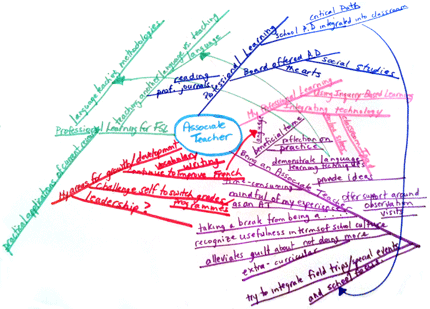
“Mind Map B” shows that the second associate teacher has also identified a need to improve upon her use of the target language. Like the creator of Mind Map A, this teacher connects addressing the language-related learning goal to her work as an associate teacher. Language teachers who teach a language that is not widely used in the local community frequently find it challenging to maintain or advance their language skills. Working with a teacher candidate provides the opportunity to use the target language with another fluent adult speaker. The creator of Mind Map B also identifies the fact that her work as an associate teacher calls upon her to “model good teaching” and “ethical behaviour.” Associate teachers who have participated in other research studies have identified this heightened sense of responsibility due to being observed by the teacher candidate as a source of professional learning.6 Such modeling of “good teaching” may also advance this teacher towards growth in her self-identified area of need: “recording more anecdotal observations.”

Enhancing professional learning
How might you access the reciprocal learning that associate teaching can bring to your teaching practice? A first step would be simply to recognize the potential of mentoring as a professional learning experience. You can then enhance the experience through documentation and reflection. Identify areas of your own practice that you would like to advance, and then think about the links between these goals and your work as an associate teacher. From there, you can develop a plan that may include:
- consciously modeling effective practice for the teacher candidate and highlighting self-identified areas for growth;
- including the teacher candidate in your implementation of school/board/ministry initiatives;
- exploring new resources and practices through co-planning and co-teaching with the teacher candidate;
- purposefully reflecting on challenges and “aha moments” during the practicum experience and linking them to present and future practice.
Continued professional learning is a widely held standard of practice for the teaching profession, with provinces and territories across Canada requiring teachers to complete some form of professional learning plan. Alberta is one province that underscores the role of associate teaching in this context, noting that the annual teacher professional growth plan “may consist of a planned program of supervising a student teacher or mentoring a teacher.”7 Other jurisdictions provide frameworks for teachers to develop professional learning in which they may include associate teaching.8
ONE OF THE MANY benefits of situated professional learning within the practicum is the advancement of experienced teachers’ practice through reflection, modeling and inquiry. Identification of these growth opportunities enables associate teachers to set measurable goals for themselves within the mentorship experience and gain formal recognition for their learning. Increased awareness of the reciprocal learning that takes place within mentoring relationships builds the teaching and learning capacity of teachers at every stage of their career.
First published in Education Canada, March 2015
[i] Clive Beck and Clare Kosnick, “Components of a good practicum placement: Student teacher perceptions,” Teacher Education Quarterly 29, no. 2 (2002): 81-98.
[ii] Ontario College of Teachers, Additional Qualification Course Guideline: Associate teaching, Schedule C teachers’ qualifications regulation (Toronto: Ontario College of Teachers Standards of Practice and Accreditation Department, 2011).
[iii] Praxis: the synthesis of theory and practice.
[iv] Karen Roland, Associate Teacher Feedback: Anonymous & confidential questionnaire (research report, Windsor, ON: University of Windsor, 2009).
[v] Melody Russell and Jared Russell, “Mentoring Relationships: Cooperating teachers’ perspectives on mentoring student interns,” The Professional Educator 35, no. 1 (2011): 6.
[vi] Daniel McCloy, “Learning Teaching: Reciprocal learning,” (PhD diss., Arizona State University, 2011); Andrew Hobson, P. Ashby, A. Malderez and P. Tomlinson, “Mentoring Beginning Teachers: What we know and what we don’t,” Teaching and Teacher Education 25, no. 1 (2009): 207-216.
[vii] http://education.alberta.ca/department/policy/otherpolicy/teacher.aspx
[viii] Ontario, Alberta and Yukon are among the jurisdictions that explicitly acknowledge mentoring as a PD activity.
-
“Daddy, I Want You To Come To Shark School”
Comments Off on “Daddy, I Want You To Come To Shark School”My cell phone rang yesterday morning at about 8:00, just as I was making Sunday breakfast for the kids. My display indicated that the call was coming from an upstairs extension in my own home. Curious, I answered and was surprised to hear the voice of my five year-old on the other end of the conversation.
“Daddy, it’s your son. I want you to come to Shark School today at 12:35. Here’s what you need to bring: your backpack, something to write with and a snack!”
-
Sir, Can We Have Free Time?
Comments Off on Sir, Can We Have Free Time?I just poked my head outside the front door. It’s a little too early to tell but, judging by the size of the snow drifts on our street, I’m pretty sure that this will be one of those days when, at the very least, the “buses are cancelled but the schools are open”. One step below an official Snow Day, it will be one of those surreal days where the level of attendance is down but, in my experience, the level of excitement is up!
(more…) -
Getting to ‘the How’ of Systemic Change in Education
Comments Off on Getting to ‘the How’ of Systemic Change in EducationSix diverse education stakeholders dig deeper to get to ‘the how’ of education systems change.
http://vimeo.com/113944705
-
The Barriers that Stand in the Way of Change
Comments Off on The Barriers that Stand in the Way of ChangeResearch analysis of what over 700 educators felt was standing in the way of change in education.
http://vimeo.com/112527277
-
Using Design to Listen Deeply to Our Students
Comments Off on Using Design to Listen Deeply to Our StudentsDo our children run into the school in the morning as quickly as they run out at the end of the day?—Milton Chen, Edutopia

-
15 Years After the Quebec Education Reform: Critical Reflections
Comments Off on 15 Years After the Quebec Education Reform: Critical ReflectionsSome key figures from the world of education agreed to answer the following question:
According to its creators, Quebec’s education Reform was designed to generate innovation and bring about major change. Do you think the Reform’s implementation produced the desired results?
As you read these observations, you will see that these education leaders agree on a number of points related to both pedagogy and administration that could explain the Reform’s successes as well as its potential shortcomings.
N.B. The original content was in French and has since been translated to English
Flawed Rollout, But Sound Foundation
by Josée BouchardWe must not forget that as the 21st century was approaching, Quebec’s 1995 Estates General on Education affirmed the importance of having our education system and civil society adapt to the realities of a rapidly changing world. The resulting education Reform called for a profound, yet fundamental, shift in our basic learning paradigms. It was a tall order for a public that was not necessarily ready for it.
In the absence of an effective communication plan, the perception – and I emphasize the word – of the Reform’s basic relevance and implementation among some school personnel, and among even more members of the public, was undoubtedly negative. This situation invited ridicule, notably about the concept of the competency-based approach, particularly cross-curricular competencies. Other shortcomings, like the lack of clear information about learning assessments and the delayed approval of textbooks adapted for the new program, contributed to the misunderstanding about the Reform. Successive political decisions concerning its very name (the “Reform” became the “renewal”), learning cycles, the renewed emphasis on knowledge, and the letter grade versus numbers report card debate did nothing to help change the initial perceptions of the communities affected, both the general public and education professionals, and especially not those of the media, which had a field day demonizing it.
Despite the criticism, the Reform has endured. Elected school commissioners repeatedly voiced their support for the Reform and, over time, identified improvements and corrective measures for it. Administrative and professional personnel did the same thing and, of course, the majority of teachers showed enthusiasm and a high degree of professionalism in their commitment to making the Reform a success. In so doing, they ensured that what students learned was meaningful, while the students themselves demonstrated openness and an ability to work well in groups with a multidisciplinary approach. Incidentally, now that the first cohort has graduated from high school and started college, many detractors have been silenced by this inspiring new generation that is optimistic about the future! The stage is set for ongoing improvement and an opportunity to learn from a Reform that retains a solid foundation, despite its flawed rollout.
Lessons Learned
by Ron CanuelIn the late 1990s, the Quebec Ministère de l’Éducation (MEQ) began a movement to completely overhaul the parameters of classroom teaching and learning. The goal was to revitalize the conditions, organization and assessments of learning and, ultimately, develop classrooms adapted to the new century. In the middle of the 2000s, the movement introduced political ideologies founded on traditional concepts of education; accountability measures and standardized tests began to enter the curriculum. By the end of the first decade of the 21st century, the “Reform” (or “pedagogical renewal”) was a mere shadow of its original concept.
At that time, the program had obvious problems with its implementation and communication strategies. The MEQ’s lack of consistency and clarity with regard to content and process was striking.
Here then are several valuable lessons we can learn from this experience.
1. Before undertaking a large-scale reform, the education system must establish clear evaluation criteria and ensure that these are well understood by all educators.
2. Before the reform is implemented, parents must be sent communication materials written in language free of the jargon that is used too often in the field of education.
3. College (CEGEP) and university prerequisites must be completely overhauled because any major reform of the system implemented from Kindergarten to the end of high school must also include a review of post-secondary levels of education.
4. For a period of at least five years, the reform must be implemented “as is” – in other words, without being subjected to a constant assault of questions or external ideologies that create instability in the classroom.
5. At least 12 months before the new curriculum is launched, the system must provide professional development courses on the new educational approaches so that teachers receive the best training and preparation possible.
6. A steering committee (max. 15 individuals) made up of educators (teachers, principals, senior administrators), communication experts and parents must be given a firm mandate of five years to truly lead the initiative and deal with any challenges.
Of course, we can’t use old professional development models and outdated pedagogical tools to create stimulating new teaching and learning models. As for technology, it can – and should – have a significant positive impact, especially if it is not used solely to reproduce existing teaching and learning models.
The Challenge of the Reform
by Claude LessardThe education Reform had two goals: get schools back on track in terms of equality of opportunity to ensure the academic success of all students and improve the cultural content of the basic teaching curriculum. Although the Reform failed to achieve everything it set out to do, some actions are noteworthy.
Examples of educational equity introduced through the Reform include: full-day Kindergarten for 5-year-olds, junior Kindergarten in disadvantaged neighbourhoods, smaller class sizes in the first few years of elementary school, and the Supporting Montréal Schools Program, New Approaches, New Solutions. Learning cycles, which were shortened, and the end of grade retention are in the same vein. At the high school level, reformers wanted to eliminate the selective practices of public schools and re-examine the status of private education. This, however, required a political gesture; in the end, it was limited to encouraging private schools to accept more special needs students.
Combatting the fear of watering down this notion of educational equity went hand in hand with a demanding view of the culture of school. This was the meaning behind the title of the Inchauspé Report: Reaffirming the Mission of Our Schools. With its emphasis on teaching core subjects, including written French and Math, and introducing a cultural perspective in all subjects, this report aimed to strengthen the mission of instruction. However, the debate on cross-curricular competencies and the shift from curriculum to pedagogical renewal obscured the original intent of the adopted programs.
The Reform’s implementation strategy encountered three issues: the first involved the evaluation of competencies and the report card format; the second pitted the teachers’ collective professionalism against the “state as pedagogue,” which saw teachers as technicians and defined their work in detail; the third set socio-constructivism, self-regulated learning and complex situations against formal education, mastery learning and simple situations. Since these issues influenced the professional identity of teachers, the Reform’s implementation must be better understood and worked out with teachers and parents in order to cut these issues down to size.
The challenge of the Reform was to ensure that schools are both fair and demanding, and this remains valid. The Conseil supérieur de l’éducation will review the Reform in its next report on the state and needs of education.
The Implementation of the Quebec Education Reform: Between Relevance and Influence
by Raynald ThibeaultThe job of a school board Director General offers one a certain perspective on what the Ministère de l’Éducation, du Loisir et du Sport (MELS), school boards and schools have managed to introduce with the Reform, notably by using proximity management with school administrators.
The numerous modifications made to the Reform during its rollout created confusion; the situation also hobbled teachers, who had to constantly adapt, particularly with regard to learning.
The Reform aimed to provide equality of opportunity by employing an approach based on cycles and competencies. The cycle-based approach is designed, among other things, to encourage group work, take each student’s pace of learning into account and promote a variety of educational approaches. Under the competency-based approach, the acquisition of knowledge leads to the mastery of competencies that enable students to become responsible citizens and make practical use of these skills.
When it comes to teacher leeway with regard to student evaluation, the creation of a single report card, with its percentages, different weightings for each stage and group averages, has proved to be problematic. Since teachers now have much less flexibility, they must adjust and their professional judgment plays a much smaller role.
The Reform has experienced some setbacks as a result, but it has nonetheless made a good deal of progress that should continue to support efforts to mobilize it. It is essential that education stakeholders ensure that this doesn’t become an ersatz reform that causes us to move backwards, to the dismay of students. Since the organization of school recognizes that acquiring knowledge can help students develop a competency, it is understandable that evaluating a competency inevitably means evaluating the acquisition of knowledge.
Given that the Reform has actually accomplished quite a lot, we must not stray far away from its primary goal, which is to give all students an opportunity to succeed. Although I believe that education stakeholders are working towards this, there must be consistency, stability, mobilization and support before we can safely proclaim “Mission accomplished!”
The Education Reform’s Highs and Lowsby Louise ChabotIn 1997, the Minister of Education noted that the Quebec Reform targeted three things: success, quality and effectiveness. Reaching these goals would require a new of power and a major restructuring.
With regard to the of power, in hindsight, the creation of governing boards for every school can be seen as a step forward for participatory school democracy. These boards give parents and staff a forum for sharing their viewpoints and making decisions for the smooth operation of the school. However, these organizations have gradually assumed so many responsibilities over time that it has become increasingly complex for representatives to effectively fulfil their roles. In this respect, the movement toward decentralization in schools has perhaps reached its limits.
The Reform has also led to major upheavals, causing education stakeholders to become increasingly polarized. Among the primary criticisms of this Reform is its rushed implementation, the policy of not repeating grades at the elementary level, the disappearance of Individual Paths for Learning classes at the high school level and the evaluation of cross-curricular competencies. After much hesitation, the government finally made some concessions in these areas to reduce the tension in schools. For example, schools once again have the option of having a student repeat a grade at the end of every elementary cycle, not just at the end of Grade 6.
The government has progressively distanced itself from this Reform by trying to put aside its more controversial elements like the evaluation of cross-curricular competencies and the debate on the role of knowledge in the evaluation of competencies. Furthermore, in 2007, the Minister of Education began to speak more or less openly of her concern that the Reform was not helping more students succeed and this perception appears to be borne out by the facts: after ten years, the number of students earning a secondary school diploma or certification has barely risen.
The Education Reform Implementation: Good Intentions, But Mixed Resultsby Gaétan NeaultDesigned to bring about major change and innovation, the Reform did, in fact, generate the desired curriculum improvement. The educational approach will never be the same, and that’s a good thing! However, when it comes to real change in school practices, it will be several years before we can truly qualify this Reform as a success.
Why has it only partially succeeded? The curriculum Reform revealed the limitations of the socio-constructivism approach, particularly with regard to differentiated learning, the needs of special needs students and evaluation. If problems had been addressed using a scientific approach, the education community would have been able to tackle these limitations and apply possible solutions. Of course, for this to happen, the debate would have had to be constructive, less polarized and accessible to everyone.
The Reform did not realize its full potential because the implementation program was poorly designed, the strategy shifted constantly and the education system’s senior levels lacked leadership. It was plagued by obscure terminology, extreme negativity and a lack of clear communication. As a result, school administrations found it difficult to rally their teams around concepts that were so controversial, especially at the high school level.
This context also influenced the approach. With its intent, quite rightly, to distance itself from Skinner’s factory-inspired model of teaching, the Reform prioritized the higher mental faculties and the cross-curricular aspect of learning. Paradoxically, it also introduced a results-based management (RBM) approach by bringing in number grades, group averages and success as measured by exam grades – a dichotomy that was painfully obvious in the debate over the report card. An adequate reform of governance and management practices would have supported the implementation of the desired pedagogical changes. However, the proponents of traditional models, political issues, pressure from special interest groups, the insecurity inherent in any major structural change and the massive turnover in administrative staff carried the day and reinforced the status quo.
Admittedly, the curriculum itself is the key to ensuring that the pedagogical renewal’s original meaning is not lost. Just like its authors, who are experts from the world of learning and communication, we should move away from theoretical discussion and institute practical methods for applying the Reform that will finally encourage stakeholders to seek a dynamic, progressive pedagogical approach.
Lessons From An Imprecise Recipeby Gaston RiouxSignalling a major change in culture, Quebec’s education Reform significantly modified teaching methods to accommodate students who are hard to reach with traditional teaching. Since we have no wish to portray ourselves as pedagogy experts, we would like to talk instead about what we have observed.
The Reform’s strengths and benefits were obscured by the inept management of its communications, notably on the part of the government, which was in charge of the dossier. If you want to implement a program, you are better off giving yourself the time, the means and the tools to do so. In this case, the goal may have been noble, but it was impossible to properly assess its impact.
The numerous unanswered questions and intense public pressure ended up eclipsing the main message. As a parent, how do you make sense of it all? Stuck between a rock and a hard place, parents were caught between the education community and the government. While debates and arguments swirled, students were the ones to experience the launch of this “educational lab experiment.”
In fact, numerous articles have been published in recent months on the academic results of the “children of the Reform.” Despite the dire predictions, the results are very clear: at worst, students perform as well as before the Reform; at best, they perform better.
What a confusing message! Did the Reform fall short, but not the students? What are we to think? Perhaps the lesson is that while the Reform contained all the ingredients needed to achieve its stated goals, the cookbook was not written clearly enough for the education community to follow the recipe properly.
Parents have learned something from the Reform’s implementation: one must take the time needed to do things and respond to the specific characteristics and needs of communities. This is essential for the success of a major project such as this. The same message applies to the teaching of intensive English at the elementary level. Having learned from past experience, we emphatically affirm that these key prerequisites must be in place if such a program is to be successfully implemented. If we can remember this, our experience with the Reform’s somewhat troubled implementation will not have been in vain.
The Quebec Reform: Not the Disaster Predicted
by Léo Bureau-BlouinIn the 1990s, Quebec’s education specialists observed that our world was changing very rapidly, but that our education system was not always keeping pace. To remedy the situation, the government proposed an education Reform of the elementary and high school levels that would focus on student-centred learning and the acquisition of competencies rather than the transmission of knowledge.
A great deal has already been said and written about this Reform, also known as the “pedagogical renewal.”
Let’s begin by examining the major changes made. Hours of classroom instruction increased for several core subjects. For example, the time devoted to teaching French rose from 150 to 200 hours per year, while that for math increased from 100 to 150 hours.[1] Another major change was that English-as-a-second-language was introduced in Grade 1.[2] Class sizes were gradually reduced and students with learning disabilities received better support.[3]
If we look at a few statistics, we note that pre-2009, or before the Reform, new college students passed 84.8% of their classes while this rate was 85.1% in 2010.
The Reform increased the number of classroom hours devoted to core subjects and students are performing well, so why did it generate so much criticism? Much of the public’s criticism of the Reform seems to stem from problems of its presentation and communication. Research on this topic conducted by the Fédération étudiante collégiale du Québec[4] quotes Paul Inchauspé, one of the thinkers behind the Reform, who identified the following culprits: the Reform was clumsily presented and those in charge of its implementation provided verbose, pedantic communications that focussed solely on the means.[5] In fact, many complex educational concepts were not explained in plain language, which helped fuel the dissatisfaction of a large number of teachers and parents.
In conclusion, the education system is constantly evolving and, while far from perfect, the Reform was in no way the disaster it was predicted to be. Future educational theorists would, however, be well-advised to more clearly explain any modifications that the governments would like to make to our children’s education.
[1]Ministère de l’Éducation, du Loisir et du Sport, The Education Reform, The Changes Under Way, 2005, p. 5.
[2]Ibid.
[3] Idem p. 7.
[4]Julien Boucher, La réforme passe aux ligues majeures, August 2010, Fédération étudiante collégiale du Québec, p. 19.
[5] Paul Inchauspé. Pour l’école : Lettres à un enseignant sur la réforme des programmes, 2007, Montreal: Éditions Liber, p. 1.
EN BREF – Plusieurs leaders de la scène éducative se prononcent sur les résultats de la réforme, en nous livrant leurs perceptions de son implantation, 15 ans plus tard. Toutes ces personnalités reconnaissent unanimement la pertinence de ses fondements. Ceux-ci ont été élaborés à la suite des États généraux sur l’éducation (1995-1996) qui ont abouti à un certain nombre de recommandations. Cependant, plusieurs facteurs doivent être pris en considération dans l’évaluation des résultats de cette réforme. Son implantation a été parfois plus difficile que prévue car, selon plusieurs leaders, il aurait fallu se donner le temps et les outils nécessaires pour bien réussir une telle opération. Plusieurs d’entre eux ont mentionné l’importance de bien planifier les actions en revenant toujours aux orientations fondamentales qui ont précédé sa mise en œuvre. Ces décideurs de l’éducation nous donnent leur propre vision des succès et des possibles dérapages d’un changement éducationnel important, centré essentiellement sur la réussite de tous les élèves.
-
Re-imagine Lakeshore
Comments Off on Re-imagine Lakeshore“Hey, look at this… here’s a school that integrates curriculum across the disciplines.”
“This is a school that is totally project-based. Can we do that?”
“Our library space is outdated; wouldn’t that make a great learning space?”
The room was alive with energetic conversation as teachers, representing more than half the teaching staff, worked in collaborative groups to read, research and talk about promising practices to improve learning and teaching within the division. Teachers from all ten schools in Lakeshore School Division in Manitoba volunteered to work with their colleagues to imagine a different kind of classroom, with different ways to learn and to teach. Teachers generated idea after idea and no idea was rejected. The excitement was palpable as teachers realized that they were in the driver’s seat and they had a say over how they could make their make ideas tangible.
The challenge
In December 2012, Superintendent Janet Martell laid out a challenge to the school division. She told staff and board that “we were no longer meeting the needs of the students in our classrooms and we need to do something dramatically different.” Teachers were working hard and they wanted the best for the students, but we just weren’t having success. The teachers agreed and we embarked on the process of “Re-imagine Lakeshore.” The Re-imagine Lakeshore process was designed to examine current practice and imagine new ways to improve practice. The division collaborated with one of our co-authors, Dr. Sheila Giesbrecht of Manitoba Education, who laid out a design-based school improvement process to help guide Lakeshore’s work. Teachers listened with extreme interest as the design process unfolded.
Phase 1: Understand (December 2012 – January 2013)
To begin this work, teachers came together to understand their divisional context. Teachers worked through their school and catchment area data, graduation rates, Tell Them From Me (TTFM)1 survey data, provincial assessment data, etc. Teachers also examined aspects of their own school culture and created lists of things that were unique to their school, such as social activities and ways teachers collaborated. Teachers responded to surveys about their ability to integrate technology into their lessons and provided data around the teaching strategies they regularly employed in their classrooms. They explored divisional successes and examined ways in which the teachers modeled exemplary practice. Finally, the community responded to a student success survey and helped to further define the “successful student” and the “successful school.” Teachers, administrators, students and the community collaborated to develop common understanding around the character of Lakeshore School Division.
Phase 2: Problemate (February – March 2013)
During the second phase, teachers worked to describe the specific challenges faced within their school. Using the narrative and quantitative data collected during the Understand Phase, schools created a “problemate statement” to define what they wanted to improve within their own school. For example, one school’s statement was: “To raise the bar and close the gap for every child.” The process of understanding and creating a problem statement was difficult. Developing a problem statement meant that both successes and challenges had to be faced head-on. Schools continued to dig deeper during this phase and were challenged to work with open mindsets. Each school worked to create a focused design challenge that they wished to address through this school improvement process.
Phase 3: Ideate (April – June 2013)
During the third phase teachers worked to develop new ways of approaching the design challenges they developed in the second phase. Working in cross-divisional cohorts, they identified 14 common themes and challenges based on the schools’ problem statements. These included technology integration, instructional strategies, whole student approaches, relationships, parental involvement, and facilities. Teachers gathered on their own time to conduct research, share ideas and look at ways to enhance their own and divisional practices. During this phase teachers worked to extend their professional knowledge base, skills and ideas. They also worked to explore new ideas and strategies.
During this time, Lakeshore School Division became part of Brandon University’s VOICES Project and with that came additional support and funding to expand Lakeshore’s school improvement work. Several teachers participated with learning tours and additional professional learning around the 14 themes. Teachers shared their new understandings both informally and formally across the division. Prior to this process, this level of research and conversation had been unseen. One teacher remarked, “I haven’t read so much educational research since I graduated from university years ago!” The cultural shift was deepening.
Phase 4: Experiment (September 2013 – June 2014)
During the fourth phase of the process, Lakeshore teachers and administrators focused on trying out some of the skills and strategies they had explored during the Ideate Phase. This involved enhancing existing practices and innovating and trying new approaches. Experiments included using class iPad sets within various settings, developing interdisciplinary classrooms, reimagining learning spaces, experimenting with flipped classrooms and developing project-based approaches. One of the most powerful moments in the process came when trustee Jim Cooper stood up in front of the teachers and said, “The board is behind you. We want you to try some things in your classrooms; if those don’t work, try some other things. It’s OK to fail.” This attitude of openness and acceptance allowed teachers to imagine, innovate and experiment with new educational strategies and ideas. The divisional culture shifted to allow teachers to adopt new mindsets around what it means to teach and learn.
Phase 5: Model (September 2014 and beyond)
After a year of experimentation, teachers have begun the process of evaluating their findings. Teachers are completing action research, re-evaluating their new practices and working to align their practices across the division. More concrete models of innovative practice are being developed. The models developed across the division will be quite different from one another, based on the design problem posed earlier in the process. One thing these new models of teaching and learning have in common, is that they all look quite different from the models of December 2012 – when Superintendent/CEO Janet Martell challenged the division with the words: “We need to do something dramatically different.”
A new culture
Walk into Lundar School and head to their library and there is a transformation. Gone are the rows of dusty shelving that dominated the space. These are replaced with comfortable, flexible seating and space to work collaboratively. The library has been transformed to a Learning Space that accommodates individual and small group work, and provides a place to meet and work with student support teachers. Visit Ashern Central School and there is a new model for supporting high needs students. A team of educators (counselor, support teacher, student success coach) works collaboratively to support students within the classroom. The high school has moved towards more inclusive and integrated approaches to supporting the academic and social needs of students. Observe Inwood School during the last hour of each day and you will see teachers and students moving freely throughout the school. Some teachers work with small groups of students while others work one-on-one with students who need extra support. Students work to complete classroom assignments or work collaboratively on learning outcomes. Each of these schools is experimenting with new policies and practices to better support student learning and engagement through the Re-imagine process.
There is a renewed energy in all of the schools across Lakeshore School Division. Since December 2012, 74 percent of the teaching staff has participated in the Re-imagine process. The levels of conversation around teaching and learning have increased across the schools. Teachers can be overheard in hallways quoting research and talking about ways to incorporate promising research-based practice within their classrooms. Teachers are talking about professional transformation and are articulate in the criteria needed for change to be successful. Exploring data, undertaking action research, engaging in educational experiments and embracing open and flexible mindsets has become common practice. Divisional data also provides evidence of success with increased credit acquisition, decreased behavioral interventions and dramatic increases in the graduation rate (from 50 percent in 2009 to 92 percent in 2013).
It is too early to fully understand the cultural and educational shift that has occurred as a result of the Re-imagine Lakeshore initiative, but initial results are promising. We have high hopes that the work that is happening in classrooms across the division will have a positive impact on the educational lives of students.
For more information on Re-imagine Lakeshore, please visit www.reimaginelakeshore.com.
EN BREF – Cet article examine l’emploi de principes de conception comme méthodologie de réforme scolaire, en se basant sur l’expérience de la Lakeshore School Division à Interlake, au Manitoba. Cette division utilise des principes de conception pour guider son processus d’amélioration scolaire. L’article explique les cinq étapes du processus de conception (comprendre, poser le problème, proposer des idées, expérimenter et modéliser) et en décrit l’instauration avec des enseignants de toute la division. Il porte aussi sur les répercussions du processus de conception, sur le travail de la division et sur la culture d’apprentissage professionnel dans les écoles.
Photo: Courtesy Lakeshore School Division, Manitoba
First published in Education Canada, November 2014
1 Tell Them From Me (TTFM) is an online survey that provides feedback to school divisions around school safety, climate and engagement.
-
Design-Based Research
Comments Off on Design-Based ResearchAs the issues and problems that define contemporary education become increasingly complex, our collective need for new knowledge and innovative solutions for practice in diverse educational contexts increases. Yet classroom teachers and school leaders often struggle to see any meaningful connection between educational research conducted in universities and their real-world, complex and contextually rich experiences of teaching, learning and leading in schools.
It is clear that creating knowledge that addresses learning, teaching and leadership issues and challenges cannot be addressed by laboratory research alone. Increasingly, educators are demanding that educational research addresses the theory-practice gap by producing knowledge that directly informs or arises from complex problems of practice. This article describes how design-based research – a collection of methodological principles and approaches to studying innovative educational interventions in complex, real-world settings – bridges the theory-practice gap.
Design-based research (DBR) was developed by educators as a response to the gap between basic and applied research practices,1 and to the lack of meaningful impact of educational research in educational systems. The reality is that innovation in education tends to be sporadic and discontinuous.2 The majority of experimental and correlational research in education fails to generate, sponsor or sustain innovation in practice. Sustained innovation is the goal of design-based research.
What makes design-based research different?
Ann Brown pioneered design-based research with her rigorous real-life experiments in early childhood classrooms. As president of the American Educational Research Association, Brown3 argued that research on learning should be undertaken in real classrooms with real students and real teachers who are provided with technology and professional learning support. In the past 25 years, Ann Brown’s methodological approaches have provided a foundation and paved the way for the development and spread of design-based research throughout academic disciplines.
Design-based research (DBR) and action research both fall within the diverse continuum of participatory educational research methodologies. These methodologies are informed by a theory of knowledge that holds that meaning emerges and is enacted through the co-participation of researchers, practitioners and participants in social, cultural and political contexts. DBR has its roots in educational technology research and is also related to design research approaches in engineering, computer science and architecture.
One principle that sets design-based research apart from other forms of educational research is the commitment of researchers to develop solutions to educational problems in collaboration with practitioners. Researchers and teachers collaboratively design research-informed learning experiences for students and then study the impact of these designs on learning. DBR is intentionally interventionist and researchers work closely with educators on understanding complex problems of practice, and on the collaborative design, development, implementation and evaluation of research-informed innovations in authentic learning contexts.4 Informed by theory and aiming to contribute to theory (as well as to educational innovation), DBR goes beyond merely developing and testing particular interventions.
Drawing upon contemporary learning theory, design-based researchers acknowledge that learning, cognition, and knowing are irreducibly co-constructed and cannot be treated as isolated entities or processes. Teachers matter. Learners matter. Context matters. Learning is understood to be a collective endeavor distributed across the knower, the environment and the activity in which the learner participates, rather than an entity located only within the individual thinker.5
Key principles that differentiate design-based research from other forms of participatory research, like action research, are:
- the requirement for a well-defined problem with a research-informed design solution;
- the testing of theory in real-world contexts; and
- the contribution to theory and practice in addition to local impact.
How design-based research unfolds
McKenney and Reeves6 outline three phases to the design-based research process:
- analysis and exploration;
- design and construction;
- evaluation and reflection.
Analysis and exploration: The research team focuses on problem identification and diagnosis. In one study that a doctoral student and I am involved with, we engaged with classroom teachers to work collaboratively with them to solve a problem – in this case, the problem was low student engagement and the solution proposed was to engage students in the design of digital games.
Analysis included a review of the research literature on student engagement, situated learning and digital game-based learning to gain insights into the problem and identify what is known about solutions for increasing student engagement and sponsoring learning.
In the exploration phase, we collaborated with the practitioners in the school to better understand the educational problem to be addressed, the school and classroom context and the needs of stakeholders, such as teachers, learners, parents, community partners and school leaders. Part of the analysis stage includes the identification of short- and long-term goals for the design solution, such as student teams designing digital games as part of engaged learning experiences and the teachers developing new pedagogical practices and competencies.
Design and construction: The research team considers available knowledge about the problem and potential solutions in order to design the solution to be tested, as well as a coherent process for implementation and evaluation.
In response to the problem of low student engagement, the proposed design solution was to provide students with opportunities for discipline-based inquiry in technology-enabled learning environments – in this case, designing and building digital games. During the design and construction phase, we worked together to articulate the core ideas underpinning the design solution and develop guidelines for actually building the solution.
The construction phase takes the design idea and actually develops and begins to implement the solution, often through an iterative prototyping approach in the classroom with feedback cycles to continually refine and improve the solution. In the study example, the research team worked with the two teachers to develop a problem-based inquiry approach for students to design and build digital games within core academic subjects. Students were supported in forming design teams, choosing specific ideas and content for the games, learning design and storyboarding approaches, learning the software to develop the games, and in building the digital games in teams, as well as in developing and testing the digital games with student peers during the development stage.
Evaluation and reflection: In this stage, the research team gathers data about the impact of the innovation as it is implemented through iterative cycles of the design in order to determine local impact. The researchers and teachers work together to develop the data collection and analysis methods and timelines, both for evaluation and for the implementation. In our example, we worked with the teachers to identify the different phases of the project and to implement the digital game development with students during the school year. The outcomes and lessons learned during the project can inform a second cycle of implementation with students in subsequent semesters. The evaluation cycle began with the initial planning of the design solution, and carried through with each phase of the implementation. Multiple forms of data, including observations, surveys, interviews, and examples of student designs, prototypes and completed games, were collected during the project.
The evaluation cycle includes gathering data based on short- and long-term goals for the design solution, and uses the data to inform ongoing modifications and improvements of the design solution in practice. In our example, the research team used initial findings – on user experience, student engagement and effectiveness for learning – to provide feedback that informed daily and weekly teaching practices and plans. While data is used for summative reporting, DBR also uses data in a formative manner to inform the next steps in instruction, next steps in design and next steps in research. During this phase, the research team focused on impacting practice locally, and also on making contributions to theory more broadly through publication and knowledge mobilization. With regards to building digital games, the evidence sought to demonstrate changes in student engagement, as the students built and tested their digital games, as well as to produce reliable knowledge that contributes to theory on student engagement and situated learning in technology-enabled learning environments more broadly.
In some design research projects, the aspiration may be to achieve large-scale implementation of an educational innovation across a school, a school jurisdiction or a province. In many design-based research projects, the goal is to develop design propositions or theories that can inform the development of innovative interventions by others.
Design-based research arose out of the need for educational research to better meet the needs of educators, to impact practice, to be intentionally interventionist, and to focus on interactions and their effect in real-world contexts. In contrast to case study research that focuses on “what is” in education, the best DBR is driven by a vision of “what can be.” Guided by a vision of yet-to-be-realized possibilities, DBR is characterized by emergent goals for learning – goals that arise and evolve in the iterative cycle of design and research that focuses on the continual improvement of learning in today’s classrooms, with real learners and with real teachers.
Design-based Research Principles
Design-based research:
- Involves iterative cycles of design, enactment, analysis and redesign
- Involves disruptive, innovative design solutions and/or interventions in practice
- Relies on collaboration between researchers and participants in real-world contexts
- Aspires to solve real-world, complex learning problems by studying learning in complex, naturalistic settings
- Is oriented toward sustained educational innovation
- Focuses on continual improvement in the process of designing and adapting an innovation for learning
- Studies the interactions between learners, content, criteria and context
- Is informed by research and aims to inform research with sharable theories and design principles
- Utilizes multiple methodologies and mixed methods
- Uses data in both summative reporting and in a formative manner to inform the next steps in instruction, design and research
EN BREF – La création de savoirs liés aux questions et défis d’apprentissage, d’enseignement et de leadership ne peut provenir uniquement de recherches en laboratoire. De plus en plus, les éducateurs exigent que la recherche en éducation aborde l’écart entre la théorie et la pratique et génère des connaissances éclairant des problèmes complexes de pratique ou en découlant. L’article décrit comment la recherche-design – un ensemble de principes et d’approches méthodologiques destiné àétudier les interventions dans des cadres réels complexes – comble l’écart entre la théorie et la pratique.
Photo: Courtesy Kawartha Pine Ridge District School Board
First published in Education Canada, November 2014
1 While basic and applied research approaches are both important in education, each has a different purpose. The goal of basic research is to develop generalized knowledge and theory, often using experimental or correlational designs in controlled or “laboratory” settings. Applied research focuses on pragmatic needs and issues in education and is carried out in authentic “field” settings and contexts, often using mixed methods and qualitative designs.
2 C. Bereiter, “Design Research for Sustained Innovation,” Cognitive Studies, Bulletin of the Japanese Cognitive Science Society 9, no. 3 (2002): 321-327. http://ikit.org/fulltext/2002Design_Research.pdf
3 A. L. Brown, “Design Experiments: Theoretical and methodological challenges in creating complex interventions in classroom settings,” The Journal of the Learning Sciences 2, no. 2 (1992): 141-178.
4 S. Barab, A. Arici and C. Jackson, “Eat Your Vegetables and Do Your Homework: A design-based investigation of enjoyment and meaning in learning,” Educational Technology 45, no. 1 (2005):15-21. http://sashabarab.com/publications.html
5 S. A. Barab and K. Squire, “Design-based Research: Putting a stake in the ground,” The Journal of the Learning Sciences 13, no. 1 (2004): 1–14.
6 S. McKenney and T. C. Reeves, Conducting Educational Design Research (New York, NY: Routledge, 2012).
-
From Action Research to Collaborative Inquiry
Comments Off on From Action Research to Collaborative InquiryGordon Thomas, Executive Secretary of the Alberta Teachers’ Association, notes in Collaborative Action Research: Experiences and Reflections1 that the Association first published a monograph on action research in 1959 – early days indeed for that movement in Canada. But by the mid-1990s, participation in action research in Alberta school jurisdictions remained limited – though some school and district teams were certainly experimenting with the general process of action research.2
Due in part to misunderstandings and misuses of action research as a social science methodology,3 the reliability of results varied dramatically across the province, and participants’ claims that they were “doing action research” often did not hold up to scrutiny. Alberta was facing circumstances similar to those described by Kemmis4 as primary reasons why action research all but disappeared from North America in the 1950s. He contended that when it came to be viewed as amateur research, action research lost attraction for academics and teachers alike, albeit for different reasons.
In 2000, the Alberta Initiative for School Improvement (AISI) contributed to a revitalization of action research as a more respected and appropriately applied methodology for exploring educational issues. For almost 13 years, AISI provided financial support to projects designed to enhance student learning and teacher professional development. In excess of $750 million in additional government funding stimulated a level of interest and engagement in school-based research that may be unequalled in Canadian educational history. By 2012, hundreds of AISI project teams had adopted action research methodology to explore important questions about teaching and learning; and many had published findings that impacted educational policy and transformed classroom instruction.5 (Note: The Alberta government discontinued AISI funding in 2012-2013).
The collaborative inquiry approach
More recently, schools across Alberta have begun using an adaptation of action research referred to as collaborative inquiry.6 Collaborative inquiry is initiated when teams of educators commit to exploring and answering compelling questions about their professional practice.
As a result of engagement in collaborative inquiry, Alberta educators have documented enhanced instructional practices, increased confidence, improved collaborative skills, and heightened empowerment. Additionally, collaborative inquiry has been found to contribute to a de-privatization of educators’ professional learning.7 As participants master the skills of collaborative inquiry, they encourage and support each other; they build a sense of identity and belonging that profoundly impacts school culture; they become increasingly efficacious; and they accept greater responsibility for more effectively confronting educational challenges.
The context
We have been conducting action research in Alberta for the last 15 years, engaging in studies with 150 schools from 15 jurisdictions. Of greatest importance, we believe, is that we were present in schools, observing educators’ participation in action research and evolving a practical model of collaborative inquiry (see “A Model of Action Research,” p. 15). Our involvement ranged from episodic advice to regular monthly meetings sustained over periods ranging up to four years; from helping with data collection, analysis, and report writing to sharing classroom observations; and from large-scale workshops to intensive mentoring. At its core, our research during this period focused on principles of adult learning, teaching effectiveness, and school improvement.
Since 2010, our focus has shifted to several district-wide studies that employ a collaborative inquiry model to build leadership capacity and enhance instructional practice. These have been funded on a cost-shared basis by Alberta Education and individual school districts. A brief description of two of these studies follows.
Study #1: Using collaborative inquiry to personalize and coordinate professional learning
From September 2010 to May 2012, over 175 teachers, administrators, central office staff, and student teachers across five school jurisdictions were involved in one of four interrelated collaborative inquiry studies. Consistent with the organic nature of action research, each had a slightly different focus, yet all participants were engaged in generating qualitative and quantitative data to answer the question, “In what ways does implementation of a comprehensive and coordinated professional learning plan impact organizational change, teaching practice, and student learning outcomes in Alberta schools?” Project foci were:
Principles of Principals’ Inquiry: School administrators sought to understand how they might more effectively plan, implement, and sustain meaningful professional learning for themselves and how the use of a collaborative inquiry model might support and enhance teaching effectiveness.
Inquiry into Induction: University of Lethbridge student teachers completed their final 14-week practicum by participating in inquiry-based professional learning that guided their work as novice teacher-as-researchers, and shared the results with schools and government.
Curriculum-Driven Inquiry: Science teachers from three school jurisdictions explored the extent to which a collaborative inquiry process impacted their implementation of new curriculum and alternative instructional strategies.
Mentorship as Collaborative Inquiry: Five curriculum lead teachers at an urban high school assumed the role of cross-curricular mentors, exploring characteristics of peer mentoring most likely to support and enhance teacher professional learning.
Study #2: Developing school leadership through collaborative inquiry
This study documented best practices in facilitating administrative instructional leadership, highlighting the challenges associated with developing leadership capacity at the school district level. Study findings contributed to the refinement of a model of professional learning tailored to meet the needs of central office educational leaders.
The study focused on two research questions: “What school leadership behaviours are most closely associated with teacher engagement in the pursuit of enhanced teaching effectiveness?” and “What do effective central office administrators do to plan, initiate, and sustain professional learning for themselves and for their school leaders?”
The collaborative inquiry implemented in this study included 41 school administrative teams (principals and vice/assistant principals). Research was guided by assumptions that the district leadership team could, and should, have a direct positive impact on students’ learning; to do so, central office administrators would have to ensure that every school leader possessed the skills, the knowledge, and the will to lead the learning in schools. Instructional leadership became the organizing theme of this research project.
The process explained
Crafting a research question that is inclusive, yet succinct, is a difficult but essential task in beginning a collaborative inquiry, particularly when team members have diverse interests, roles, and professional curiosities. Lengthy and challenging conversations are often necessary to reach agreement on a question that reflects the values, beliefs, and perspectives of participants. Such discussions are made all the more complex by team members’ levels of willingness to explore direct links between instructional practice and student learning.
Beyond that, the process is simple in conception: everyone involved in the collaborative inquiry commits to a research question and a yearly plan that is aligned with provincial, district, school, and personal goals as they relate to student learning. In early meetings, wide-ranging discussions about goals, strategies, and measures helped most participants arrive at a guiding question, the answers to which would provide useful evidence of the extent to which their goal(s) had been achieved.
In our role as external researchers, we visited each participant group no fewer than six times every year to provide support and guidance, identify growth, and offer and receive feedback. These sessions used, as an elegant framework for conversation, the following three questions:
1. What have you done in the past 30 days to achieve your goal(s) or answer your inquiry question?
2. What have you learned from your activities specific to the achievement of your goal(s)?
3. What will you commit to doing in the next 30 days to progress toward your goal or to further answer your inquiry question?
A synthesis of findings
It’s not hard to imagine how most participants in both studies wrestled with aspects of this process. At times, some felt they were being pushed too hard; some felt they were being evaluated; some became frustrated when their efforts did not produce immediate or discernable results; some thought about disengaging. Throughout, we offered continued support, avoiding unnecessary judgment or criticism, probing for alternative courses of action, and sharing evidence of similar experiences in other schools. Months passed. Trust grew. With more trust came more risk-taking, and more collaboration. Confidence blossomed. New skills were refined. Slowly but inexorably, the focus of each project began shifting to students in classrooms.
In the end, participants reported that they came to understand collaborative inquiry as an important strategy that helped them reflect on their practice in an environment of mutual support and respect. They recognized the value of maintaining a sustained and purposeful focus on increasing students’ learning.
When asked to identify aspects of the collaborative inquiry process most beneficial to their growth, teachers, school leaders, and central office administrators alike identified six characteristics:
• Sustained rather than episodic
At its worst, action research may be synonymous with professional development (PD) experienced as a single terminal event. In these studies, a commitment to sustained learning allowed educators to concentrate on critical areas of exploration long enough to incorporate into practice essential instructional skills, evidenced by enhanced student learning.
• Shared responsibility rather than external accountability
Mandatory attendance at centrally organized PD events offers no guarantee that new ideas will find their way into educators’ practice; nor does reading a book selected by the superintendent. During these studies, professional learning occurred under an ethos of shared responsibility, and participants assumed greater ownership of the direction and results of their efforts.
• Here rather than there
It may be argued that the impact of traditional PD models is inversely proportionate to the distance from the classroom or school. The converse seemed to apply in these studies: when collaborative inquiry was site-embedded, matters of context were more fully attended to and, accordingly, professional learning was more likely to be integrated into classroom practice.
• Differentiated rather than mass-produced
Conventional PD efficiently and simultaneously delivers identical content to hundreds of educators. The collaborative inquiry model used in these studies incorporated differentiated and personalized approaches in which small teams of educators concentrated their professional learning on those aspects of practice unique to their contexts and challenges.
• Inquiry-based rather than didactic
Most PD has relied on a “telling curriculum.” Alternatively, collaborative inquiry is predicated on an organic, curiosity-based curriculum evolving from the pressing questions to which educators in these studies were most immediately seeking answers.
• Shared rather than private
Ironically, mass-offered PD opportunities tend to intensify norms of isolation and privatism among educators. Conversely, educators in these studies engaged in and shared professional learning in diverse, yet collaborative ways.
The impact of collaborative inquiry
Over the four years of these two studies, participants improved their ability to work as a team, to listen, help solve problems, and deal with conflict. They strengthened their professional relationships, became more knowledgeable, and were able to demonstrate improvements in practice.
At the level of the school, effective leaders promoted and supported the formation and development of teams of teachers in response to needs identified through the collaborative inquiry process. Schools in this research also showed the capacity to create more functional teams, confirming that shared leadership grows in a culture of collaboration driven by purposeful inquiry.
Furthermore, these studies have demonstrated that well-planned, personalized, and coordinated professional learning using a collaborative inquiry approach has a profound influence on district culture, school and district leadership, classroom practice and student learning. As the superintendent of one jurisdiction explained:
“We are no longer focusing on certain students. They are all our students, and we want success for all of them. It’s coming. Our high school completion numbers have risen steadily, starting around 72 percent three years ago, and reaching 81 percent right now… As well, on every measure on provincial achievement tests in Grades 3, 6 and 9, our students have shown improvements against the provincial averages over the last two years, and our improvements in literacy are a driving factor. I expect all those averages to keep rising. Finally, in the area of inclusion, and personalized learning, we have never been more successful.”
The quality of collaborative inquiry continues to improve for educators who are willing to commit to a process of learning that is characterized by professional discipline, respect for colleagues, and a genuine curiosity about evidence. Successful projects in Alberta are clearly evidence-generating, contributing valuable and useable new knowledge about this process to an ever more receptive field in which the continuous improvement of schools – not simply student scores on external exams – is the ultimate goal.
A Model of Action Research
1. Define the focus or the problem. Ask the “right” questions (e.g. What is the next thing I have to know more about in my work, or my classroom, or in my teaching?). Team membership begins to take shape, as common goals and needs are shared. Reflection has already begun.
2. Collect information. Read the literature, consult with colleagues, and talk with experts and others with experience. Reflection continues.
3. Make sense of the information. What is relevant? What is doable? What can be modified to suit particular circumstances? What must be done with conflicting information?
4. Report and discuss. Preliminary conclusions and potential courses of action need to be shared.
5. Plan action. A written plan should be one of the products of this stage. Team members make more purposeful decisions about goals, strategies, measures, and evidence of success. Each plan is guided by a question.
6. Take action. Put plans into effect. Reflection in and on action, alone and with colleagues, helps clarify provisional answers to the guiding question.
7. Collect information. Document carefully. Meet to share information regularly.
8. Analyze and evaluate in a continuous way. Try to make sense of what’s happening, and why. Refocus as necessary. Persevere. In effect, each meeting of the team attends to the following three questions:
What have we done?
What can we learn from that?
What will we do next?9. Assess achievements. Use all the evidence available to determine what has been accomplished, what may have gone wrong, and why.
10. Publish results and conclusions. Share within and beyond the group, beyond the school, beyond the district. Let other educators know what’s happening.
11. Celebrate. Not only at the end, but whenever it is appropriate to do so, honour the learning and the successes of adults and students alike.
12. Future action. Move the process into its next logical phase, in harmony with the rhythms of the school year and the needs of participants.
EN BREF – Après un bref historique du mouvement de recherche-action en Alberta, dont son rôle dans le Programme d’amélioration du rendement scolaire en Alberta (PARSA), cet article traite d’un modèle d’enquête collaborative qu’ont adopté des équipes d’éducateurs dans plusieurs districts pour soutenir et promouvoir le rehaussement de l’efficacité pédagogique. L’article décrit deux études récentes intégrant le modèle d’enquête collaborative qui ont conclu qu’un apprentissage professionnel personnalisé, coordonné et bien planifié, fondé sur l’enquête collaborative influe profondément sur la culture d’un district, sur le leadership exercé par l’école et le district, sur les pratiques utilisées en classe et sur l’apprentissage des élèves.
Illustration: Shutterstock
First published in Education Canada, November 2014
NOTES
1 G. Thomas, Collaborative Action Research: Experiences and reflections (Edmonton, AB: Alberta Teachers’ Association, 1988).
2 D. Townsend, Action Research: Facilitation and implementation (Edmonton, AB: Alberta Teachers’ Association, 2001).
3 P. Adams, “Action Research,” in Encyclopedia of Research Design, ed. N. Salkind (Los Angeles: Sage, 2010).
4 S. Kemmis, “Action Research and Social Movement,” Education Policy Analysis Archives 1, no.1 (1993). http://epaa.asu.edu/ojs/index.php/epaa/article/download/678/800
5 See, for example, http://www.uleth.ca/
6 D. Townsend and P. Adams, The Essential Equation: A handbook for school improvement (Calgary, AB: Detselig, 2009).
7 D. L. Butler, H. N. Lauscher, S. Jarvis-Selinger, and B. Beckingham, “Collaboration and Self-regulation in Teachers’ Professional Development,” Teaching and Teacher Education 20, no. 5 (2004): 435-455.
-
Addressing the Knowledge-Doing Gap
Comments Off on Addressing the Knowledge-Doing GapOne of the main barriers to turning knowledge into action is the tendency to treat talking about something as equivalent to actually doing something about it.—Jeffrey Pfeffer and Robert Sutton, in The Knowing-Doing Gap

-
A Parent Advocate’s POV on What’s Standing in the Way of Change in Education
Comments Off on A Parent Advocate’s POV on What’s Standing in the Way of Change in EducationFredericton parent Jeannine St. Amand explains the value of gathering education stakeholders to discuss change.
https://vimeo.com/110512054


IDEAS TO SUPPORT EDUCATORS : Subscribe to the EdCan e-Newsletter
Quality research, reports, and professional learning opportunities.