Archive
-
You Can’t Leap a Technology Chasm in Two Jumps
Comments Off on You Can’t Leap a Technology Chasm in Two JumpsThis blog post is part of our series on leadership and governance and part 2 of this post.
To paraphrase Geoffrey Moore[1], the greatest point of peril in technology adoption lies in transitioning from early adopters—dominated by a few visionary users—to mainstream users who are predominantly pragmatic: in between the two lies the chasm. In my first blog entry, When You Bring Tech to the Teacher, But You Can’t Make ‘Em Click , I offered the following six evidence-based ideas to increase technology adoption in school districts.
- Individuals have different dispositions to change.
- A “Technology’s Perceived ROI” (or TPROI) needs to be positive.
- If new technology changes pre-existing practices considered central to identities (personal, professional, organizational), it will likely be resisted
- Individuals need a degree of autonomy.
- Both individuals and their uptake of technology will vary; so don’t expect homogeneity
- Social influence has potential to cross the diffusion chasm.
Now I’d like to share the strategies that could underpin the implementation of these ideas and foster technology adoption in your school district.
1. Support people with low levels of technology experience & self-efficacy
- Ladder these potential adopters up from small achievable technology adoptions before attempting larger ones;
- Provide them intensive initial supports for early “wins” to build positivity & self-efficacy;
- Expose them to adoption successes of people they like or admire, especially those who had/have proximal skill levels;
- Arrange for a person or people they trust and find credible to provide positive, genuine, and specific verbal reinforcements;
- Encourage more positive mental or emotional states by incorporating stress & anxiety reduction techniques before/while using new technology (e.g. playing soothing background music, using screen savers with images of nature, using positive self-talk, etc.) – or providing individuals with the stress reduction techniques to use themselves.
2. Increase Technology’s Perceived ROI” (or TPROI)
- Create opportunities for people to learn or experience positive applications of the new technology indirectly by sharing case studies, connecting potential adopters with colleagues already successfully implementing the technology, providing opportunities to observe the technology in action;
- Encourage people to envision ways the new technology might be useful or beneficial in their specific contexts (class, office, etc.);
- Guide potential adopters to technology with levels of complexity matched to their developmental experience and/or provide a range of supports to make learning the specific technology more accessible;
- Structure low-risk opportunities to experiment, or experience partial implementations of the technology.
3. Adopt a proposed technology that changes an important past practice
- Determine if the practice was a “defining” one for the individual adopter, the profession or the organization to anticipate levels of adoption resistance;
- Where possible, try implementing technology adoption in small stages to shift existing practice over time;
- Identify underlying values from the pre-existing practice that could be identified with using the new technology and wherever else they might be evident; coach individuals to identify these other reflections of the core identity in locations other than the past practice effected by the technology.
4. Ensure autonomy
- Create smaller phases for larger technology roll-outs and allow individuals to pick their phase;
- Allow individuals to select new technologies to investigate or adopt and have them share their information or progress with others (e.g. departmental or staff meeting);
- Create self-directed professional development opportunities around new technology;
- Develop a “volunteer” list of technology adopters willing to be observed & schedule opportunities for others to observe as interested;
- Create opportunities for individuals to suggest new technologies for use and pilot them.
5. Personalize the learning
- Provide opportunities for innovators and early adopters to have time and/or access to new technology; they will likely self-support but if they reach out for additional professional development resources be prepared;
- Create a number of learning opportunities – events/resources for individuals prepared to use the new technology in a specific situation or those who will use it if it can provide “some reasonable benefit to their practice”; [2]
- Suggest technology matches between individuals’ pedagogy or methods and new technology (e.g. use Carrington’s “Padagogy Wheel v 4.0” matching apps[3], Bloom’s Taxonomy, & Puentedura’s SAMR phases)[4].
6. Leverage social influence
- Familiarize yourself with the networks of relationships, formal and informal power within the school – map them;
- Identify individuals interested in technology adoption who also are well networked in the school/district—the “opinion leadership”[5] and enlist them in a collaborative plan to diffuse technology;
- Ask potential adopters and the wider population to nominate peers as technology adoption leaders; approach these nominees as potential volunteers to support technology diffusion (incentives like release time or other carrots can help);
- Ask respondents to name five people for each; names may be used more than once[6]
- Who do you respect as a peer in this school/district?
- Who are good leaders in technology and other group activities in this school (or district)?
- Who do you look up to as a peer in this school/district?
- Which peers have you had a conversation with today or connected with online?
- Ask respondents to name five people for each; names may be used more than once[6]
- Connect (as genuinely possible) use of the new technology with social factors such as: requirements of an individual’s position, being a practice valued by colleagues & ‘higher ups’, being “required of other school professionals in their position, or … in the area of [their] expertise”[7];
- Create a communication bridge – a person trusted by both the innovators/earlier adopters and wider population tasked with collecting information on uses of new technology by innovators and early adopters and communicating the information to others.
Technology adoption has costs – in dollars, human resources hours, cognitive load, stress, etc. Even some of the most promising educational technologies end up gathering dust in those places where good technology goes to die in your district. To be fiscally, as well as educationally responsible, our technology planning must include monetary, infrastructure and organizational factors. Yet in our planning processes, consideration of the factors influencing adoption by individuals is perhaps the most important and most overlooked factor. The Straub citation from my previous post bears repeating: “understanding and facilitating the process of acceptance may be more important than the adoption itself”.[8] I hope my contributions to this blog improve your success when fostering technology adoption. Let me know.
[1] Moore, G. (1991). Crossing the Chasm. New York: PerfectBound (Harper Collins).
[2] Bergeron, B. (2002). Achieving clinician buy-in to technology. Medscape. Retrieved from
http://www.medscape.com/viewarticle/446224
[3] Carrington, A. (2015). Padagogy wheel v 4.0. Retrieved from
[4] Puentedura, R. (2006). Part 1: A model for technology and transformation. Transformation, technology, and education. Retrieved from http://hippasus.com/resources/tte/
[5] Holliday, J., Audrey, S., Campbell, R., & Moore, L. (2015). Identifying well-connected opinion leaders for informal health promotion: The example of the ASSIST smoking prevention program. Health Communication.
[6] Starkey, F., Audrey, S., Holliday, J., Moore, L., & Campbell, R. (2009). Identifying influential young people to undertake effective peer-led health promotion: The example of A Stop Smoking in Schools Trial (ASSIST). Health Education Research, 24(6), 997-988.
[7] Evidence-Based Intervention Work Group at the University of Wisconsin-Madison. (2005). Theories of change and adoption of innovations: The evolving evidence-based intervention and practice movement in school psychology. Psychology in the Schools, 42(5), 483.
[8] Straub, E. (2009). Understanding technology adoption: Theory and future directions for informal learning. Review of Educational Research, 79(2), 645.
-
When You Bring Tech to the Teacher, But You Can’t Make ‘Em Click
Comments Off on When You Bring Tech to the Teacher, But You Can’t Make ‘Em ClickThis blog post is part of our series on leadership and governance.
Much is made of the amounts of money sunk into technology in education – sometimes with few extensive innovations in teaching and learning. Alfie Kohn recently discussed the issue in his blog post, “The Overselling of Ed Tech”[1]. Technology in education can be a physical object, software, or both, but ultimately, what technology leaders desire is an uptake (adoption and diffusion) of technology that improves teaching and learning – and/or the various other processes (clerical, administrative, HR, etc.) that support education. When evaluating the success of technology in education, it cannot be measured solely by the extent to which it transforms personal or institutional pedagogies or practices.
As Puentedura illustrated in his SAMR (Substitution, Augmentation, Modification, & Redefinition) technology adoption model, technology uptake spans a continuum from enhancing existing educational practices to transforming them.[2] In some cases, even a lack of adoption and diffusion may be acceptable when technology doesn’t suit the individual or the context.[3] Like students, educators (and by extension their organizations) can be at different developmental stages in regard to pedagogies, methodologies and technologies. Expecting technology to rapidly transform pedagogy, practices and the institution belies the cognitive load inherent in learning new concepts and/or in new methods through unfamiliar technologies as well as the conservative nature of the institution. Educators experience cognitive load like other learners – and perhaps schools do too.
The topic of individual behavioural change – which includes technology adoption as a subset – has been the focus of much research, most frequently related to public health initiatives. Most technology adoption literature focusses on the organization and factors external to individuals (e.g. funding, release time, policies, access). While important, these factors are often considered in isolation from more individualized aspects.
Below are six key intrapersonal and interpersonal aspects to consider when fostering technology adoption. They are taken from the literature of individual behavioural change across a variety of fields. (Some specific strategy ideas will be provided in a follow-up blog post, You Can’t Leap a Technology Chasm in Two Jumps.) The importance of these considerations will vary according to the individuals and their contexts.
1. Individuals have different dispositions to change.
Willingness to adopt new[4] technology can be affected by factors including: upbringing, experience, age, personal values, self-efficacy, confidence, reliance on routines, as well as interest in novelty & new stimuli.
2. A “Technology’s Perceived ROI” (or TPROI) needs to be positive.
ROI is a business term for “return on investment”. TPROI is my term relating to the balance between a) an individual’s investments of time, effort, etc. in learning/using a new technology; and b) if/how the technology improves the individual’s situation. TPROI encompasses more granular terms like perceived usefulness & perceived ease of use, as well as the practical reliability of a technology (e.g. limited glitches or time-outs).[5] The greater a TPROI, the more likely a person is to think about adopting a new technology and begin using it. Positive experiences can boost self-efficacy, and increased self-efficacy can increase the values individuals place on TPROI for subsequent technologies to adopt.
3. If new technology changes pre-existing practices considered central to identities (personal, professional, organizational), it will likely be resisted.
Some practices define or fortify a core identity – for individuals, professionals and organizations. The more a technology is perceived to substantially change a core identity practice the more adoption resistance there will be.[6]
4. Individuals need a degree of autonomy.
Elements of choice, flexibility, & volunteerism can support technology adoption. Straub suggests even when “it is difficult if not impossible to make technology adoption a free choice…building in flexibility for teachers to have the perception of a choice may improve adoption facilitation”.[7]
5. Both individuals and their uptake of technology will vary; so don’t expect homogeneity.
Bergeron[8] found among clinicians, individuals “have very little in common with each other, in terms of their daily work routines, need for information and time pressure”, they each adapt differently to a new technology and “within each specialty, there are technology adoption patterns that become apparent as a function of individual differences”. Parks, Bansal, & Zilberman[9] tell us that a technology fits differently across disparate groups due to “differences in socio-cultural, economic, geographic, and environmental factors”. They go on to say that techniques like modelling and demonstrations can increase “adoption efficiency by providing a better match between individuals and the technology”—even when such strategies appear to decrease demands for a technology. An observed decline in interest after a demonstration could indicate reduced waste (e.g. not blanketing a school with technology that ends up unused) and get technology into the hands of people who will use it.
6. Social influence has potential to cross the diffusion chasm.
When adoption spreads from one individual to another, you have diffusion. While innovators & early adopters readily latch on to new technology, and can provide visible (e.g. public relations level) examples for a school or district, these groups don’t necessarily share their learning with the larger population. One study found that only about one in four innovators/early adopters shared their learning with the larger group.[10] Unlike innovators and early adopters, the ‘early majority” of the wider population “aren’t interested in the nuances of the underlying technology but in what it can do to solve their problem[s]”.[11] Educational practitioners may rely more on contextually based practices, personal experience and communication with colleagues than research papers when considering new technology.[12] Moore referred to the gap between innovators/early adopters and the early majority as a chasm and states it can be difficult to bridge.[13] Social influence relates to how others can influence individuals’ opinions, behaviours, and attitudes. In the case of a new technology, leveraging social influence is thought to be a significant strategy to bridge the chasm, though “the late majority and laggards may accept innovative [technology]… only though the pressures of conformity”.[14]
A major consideration seemingly absent from the technology adoption literature is the role (if any) played by educators’ considerations of their students: “The teacher is not only an adopter of the innovation but also must act as a change agent for his or her students”. Straub compares our current relationship with continually emerging technologies to that of Sisyphus and the rock he perpetually rolls uphill, concluding, “understanding and facilitating the process of acceptance may be more important than the adoption itself”.[15] I’m inclined to agree.
[1] Kohn, A. (2016). The overselling of ed-tech. Retrieved from http://www.alfiekohn.org/blogs/ed-tech/
[2] Puentedura, R. (2006). Part 1: A model for technology and transformation. Transformation, technology, and education. Retrieved from http://hippasus.com/resources/tte/
[3] Straub, E. (2009). Understanding technology adoption: Theory and future directions for informal learning. Review of Educational Research, 79(2), 625-649.
[4] “new technology” refers to technology new to the user; it could be emerging technology new to society or education in general, or technology new to an individual’s practice.
[5] Davis, F. (1989). Perceived usefulness, perceive ease of use, and user acceptance of technology. MIS Quarterly, 13, 319-340.
[6] Jaffe, D. (1998). Institutionalized resistance to asynchronous learning networks. Journal of Asynchronous Learning Networks, 2(2), 21-32.
[7] Straub, E. (2009). Understanding technology adoption: Theory and future directions for informal learning. Review of Educational Research, 79(2), 645.
[8] Bergeron, B. (2002). Achieving clinician buy-in to technology. Medscape. Retrieved from
http://www.medscape.com/viewarticle/446224
[9] Parks, M. Bansal, S., & Zilberman, D. (2015). Technology adoption under fit risk: What should development project donors and managers know? Procedia Engineering, 107, 3-10.
[10] Morrison, P., Roberts, J., & von Hipple, E. (2000). Determinants of user innovation and innovation sharing in a local market. Management Science, 46(12), 1513-1527.
[11] Bergeron, B. (2002). Achieving clinician buy-in to technology. Medscape. Retrieved from
http://www.medscape.com/viewarticle/446224
[12] Evidence-Based Intervention Work Group at the University of Wisconsin-Madison. (2005). Theories of change and adoption of innovations: The evolving evidence-based intervention and practice movement in school psychology. Psychology in the Schools, 42(5), 475-494.
[13] Moore, G. (1991). Crossing the Chasm. New York: PerfectBound (Harper Collins).
[14] Lin, M. & Hong, C. (2011). Opportunities for crossing the chasm between early adopters and the early majority through new uses of innovative products. The Review of Socionetwork Strategies, 5, 27-42.
[15] Straub, E. (2009). Understanding technology adoption: Theory and future directions for informal learning. Review of Educational Research, 79(2), 645.
-
Science Learning With and In Communities
Comments Off on Science Learning With and In CommunitiesPhoto Caption: This Grade 12 student (middle) was able, through the Brock University Science Mentorship Program, to work with Professor Craig Tokuno (left) on his research into the neurophysiological and biomechanical control of human movement.
I never teach my pupils; I only attempt to provide the conditions in which they can learn.
–Albert Einstein
Most would agree that students need to become more scientifically literate. However, science-literate students are not necessarily equipped to confront the complex societal issues that they will encounter as citizens. Students require knowledge, skills, and dispositions that enable them to critically and responsibly deal with an increasingly scientific and technological society. One way forward is to engage students in authentic, relevant and meaningful learning activities nested in their communities. This important educational innovation can help students become more engaged in learning science, help them connect their science learning to other subjects, strengthen their understanding of science, and improve their capabilities for responsible citizenship in their community. Nevertheless, the role of science teachers, schools and communities in terms of developing effective partnerships along with appropriate curriculum and pedagogy is not fully understood. This commentary begins the dialogue regarding science teaching and learning in relation to school communities.
Scientific literacy and citizenship
Historically, the conceptualizing of scientific literacy has been an esoteric endeavour. Nevertheless, pundits agree that increased scientific literacy of students and citizens will have broad societal benefits.[1] While science career goals are always part of any statements for scientific literacy, democratic and responsible science citizenship goals are just as important. For instance, there is agreement that proficiency in the areas of science, technology, engineering and mathematics (STEM) is closely related to a country’s capacity in important sectors of the economy.[2] Without question, society is strengthened when all students, regardless of their career path, are equipped to learn, evaluate and respond to scientific and technological issues in their community.[3]
Community-based education
Schools are a part of their local communities. These schools interact in myriad ways with families and the general public, but also with governmental, non-profit, and business organizations, to support students and teachers. These connections can bring a wide range of resources, including additional funding and staffing, into schools.[4]
A growing number of schools and community partners are adopting programs that allow students to learn in their communities. These partnerships provide students with more authentic ways to develop necessary knowledge and skills, aiming to engage students in curricular topics that explicitly relate to where they live, and to use their own community as a source and location for learning. This is an important feature, as failing to contextualize science learning can lead to students’ alienation from science. While there are many ways to organize community-based education, advocates have focused on models that engage students in meaningful experiential learning through problem- or project-based approaches. Collectively referred to as community-based learning, these models include: academic partnerships, civic education, environmental education, place-based learning, service learning, and career-based learning.[5]
Community-based science learning
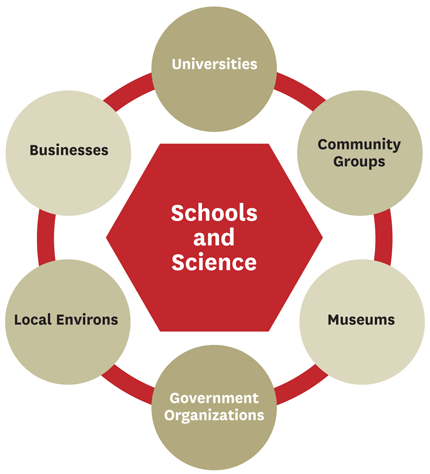
Community-based science education is an approach to teaching and learning that connects disciplinary learning to the local context. Figure 1 illustrates how schools and science can be seen as a focal point for a network of locations consisting of material and human resources for science learning within a community.
Figure 1: Community-based science education
Below are a few Canadian examples that highlight community-based science learning opportunities for students:
Academic science-community partnership
The Science Ambassador Program pairs senior university science, engineering and health science students with rural and remote Aboriginal community K-12 schools to support creative and culturally-relevant science teaching and learning. University students work alongside teachers to present hands-on science activities, facilitate class discussions, and mentor students.
www.artsandscience.usask.ca/scienceoutreach/ambassador
Environmental education and communities
The EcoLeague program is a youth initiative that provides resource kits for elementary and secondary students across Canada to encourage them to help the environment through community- and school-based sustainability action projects.
http://resources4rethinking.ca/en/ecoleague/about-us
Career-based science learning
The Brock University Science Mentorship Program links secondary school science students from local schools in Ontario’s Niagara Region to university faculty mentors from various disciplines including Biological Sciences, Biotechnology, Chemistry, Health Sciences, Neuroscience, and Physics. Working on site with university researchers, students are encouraged to consider a career in the sciences while engaging in science research programs carried out at the university.
www.brocku.ca/mathematics-science/outreach-to-schools/science-mentorship-program
While these initiatives are meaningful opportunities for students, student engagement in science education – particularly at the secondary school level – can be further enhanced when learning environments:
- are designed to utilize complex science topics
- give students authority to address community problems
- hold students accountable to others and disciplinary norms
- provide students with local resources that support authentic science learning[6]
One example of an initiative that incorporates some of the above characteristics is EcoSpark’s Changing Currents program. Based in the Greater Toronto Area, the program aims to allow students to identify and monitor a watershed close to their school community. Not only do students have access to community resources while engaging in authentic ecological science practices related to water quality and biodiversity; they also have the opportunity to conduct future study on issues or challenges they discover based on their data collection, as they contribute to a regional water monitoring program. Additionally, teachers are provided with resources and training to help their science students carry out the watershed science.
www.ecospark.ca/changingcurrents
Cultivating community-based science education
Community-based science education provides a way for students and teachers to become local problem-solvers who can deal with scientific and technological challenges that are of consequence. But programs such as Changing Currents are not common.
These partnerships are challenging to develop due to the need for specific science materials and equipment, along with science and educational expertise – all necessities not available in many Canadian communities. Further, partnerships can have multiple and sometimes competing goals. Outcomes for students, teachers, and community partners need to be clearly articulated, and resources and relationships need to be sufficient and workable. Overall, there has been an increase in school-community initiatives in school science, typically focused on environmental science topics (e.g. biodiversity, air, and water projects). However, these represent only a small sample of potential partnership opportunities available in many communities across Canada.
While there have been some efforts to research and develop community-based science programs with schools,7 additional efforts are required to develop science curriculum and support professional learning that emphasize school science and community partnerships. The potential benefits to science students are important.
Using a communities of practice framework8 can help address the elements required for a successful science-community partnership. These include:
- having all stakeholders share understanding of the science topic
- fostering ongoing and trustworthy relationships among the members
- identifying practices and resources required to make these endeavours successful and sustainable
Needless to say, government policies and incentives for initiating and sustaining partnerships are critical for community-based learning in science. Emergent technologies (e.g. social/collaborative online tools) can also play a critical role in facilitating the participation of science experts, educators, parents and volunteers.
We are entering an era where schools and communities are forming more and more partnerships, and cultivating these relationships is becoming ever more important. In order to establish beneficial community relationships, teachers and school administrators must be at the nexus of these relations. Thus, continued efforts are necessary to support important outcomes beneficial to all participants with/in communities across Canada.
En bref: La plupart des gens conviendraient que les élèves doivent accroître leurs connaissances scientifiques. Cependant, les élèves possédant des notions scientifiques ne sont pas nécessairement outillés pour confronter les questions sociétales complexes auxquelles ils feront face en tant que citoyens. Une solution consiste à engager les élèves dans des activités d’apprentissage authentiques, pertinentes et significatives intégrées à leur communauté scolaire. Cette importante innovation éducative peut aider les élèves à se consacrer davantage à l’apprentissage des sciences et à faire le lien entre leurs connaissances en sciences et d’autres matières, ainsi qu’accroître leur compréhension de la science et leurs capacités civiques dans leur collectivité. Néanmoins, le rôle des enseignants en sciences, des écoles et des collectivités dans l’établissement de partenariats efficaces n’est pas entièrement compris. Ce commentaire suscite un débat concernant le lien entre l’enseignement des sciences et les communautés scolaires.
Photo: courtesy Photo courtesy Brock University Science Mentorship Program
First published in Education Canada, March 2016
1 Douglas A. Roberts, “Scientific literacy/science literacy,” Handbook of Research on Science Education (NY: Routledge, 2007), 729-780.
2 Graham W. F. Orpwood, Bonnie Ann Schmidt, and Jun Hu. Competing in the 21st Century Skills Race (Canadian Council of Chief Executives, 2012).
3 Glen S. Aikenhead, “Towards Decolonizing the Pan-Canadian Science Framework,” Canadian Journal of Science, Mathematics & Technology Education 10, no. 4 (2006): 387-399.
4 Carolyn Gregoric, School-Community Involvement (UNESCO-APNIEVE Australia publications, 2013); Catherine M. Hands, “Why Collaborate? The differing reasons for secondary school educators’ establishment of school-community partnerships,” School Effectiveness and School Improvement 21, No. 2 (2010): 189-207.
5 Atelia Melaville, Amy C. Berg, and Martin J. Blank, Community-Based Learning: Engaging students for success and citizenship (Washington, DC: Coalition for Community Schools, 2006).
6 Randi A. Engle and Faith R. Conant. “Guiding Principles for Fostering Productive Disciplinary Engagement: Explaining an emergent argument in a community of learners classroom,”Cognition and Instruction 20, No. 4 (2002): 399-483.
7 Lisa M. Bouillion and Louis M. Gomez, “Connecting School and Community with Science Learning: Real world problems and school-community partnerships as contextual scaffolds,”Journal of Research in Science Teaching 38, No. 8 (2001): 878-898; Douglas D. Karrow and Xavier Fazio, “NatureWatch, Schools and Environmental Education Practice,” Canadian Journal of Science, Mathematics and Technology Education 10, No. 2 (2010): 160-172.
8 Etienne Wenger, Richard Arnold McDermott, and William Snyder, Cultivating Communities of Practice: A guide to managing knowledge (Boston: Harvard Business Press, 2002).
-
Educational Outcomes and Indicators
Comments Off on Educational Outcomes and IndicatorsSuppose that you go to your doctor to learn the results of your annual physical examination and blood tests. She warns you that your blood pressure is high and so is your cholesterol. She checks your weight and asks about your diet and exercise regime. She warns you that unless you make some serious lifestyle changes, you are at risk of a heart attack. You take her advice seriously and at your follow-up visit some time later, all of your risk indicators are back to a healthy level.
Contrast this scenario with the typical response to wide-scale national and international assessments like the Pan-Canadian Assessment Program (PCAP) and the Programme for International Student Assessment (PISA). In Manitoba, where our latest rankings, compared to other Canadian provinces, are seen to have slipped, the Winnipeg Free Press editorial argued, “Teachers’ salaries don’t match results” (September 4, 2015). Others point the finger at other supposed provincial culprits, such as the absence of provincial standardized tests or “educational fads, like discovery learning.”1
In the face of disappointing results, what should we do? Pay teachers less? Should we go back to the basics, have kids write more standardized tests, or remedy child poverty? It’s a little like arguing whether a fatal heart attack was caused by hereditary or lifestyle factors – either way, you are already dead! Basically there are precious few lessons to be learned from provincial and national rankings alone. If we want to improve our education systems, we need to look to other indicators, ones that: 1) reflect the range of important goals we have for our schools and 2) have predictive value.
A comprehensive set of indicators
It goes without saying that we – individual parents and students, teachers, administrators, politicians, and all members of the public – need to have reliable accounts of students’ individual and collective experiences in schools. It is also widely accepted that the academic well-being of students is a core responsibility of schools and something that needs to be properly accounted for. But there is far less agreement on the extent to which we can, or should, take national and international assessments, collected at specific times for specific subject areas and specific grade levels, as either appropriate indicators of “student success” or, more broadly, as indicators of overall school quality.
Shifting our focus to leading indicators
PCAP and PISA scores are highly influential examples of trailing or lagging achievement/assessment indicators; high school graduation rates are another. These may be important measures of student achievement across schools and school systems in selected academic subjects and they may report on important school and school system goals, but they are summative assessments and invariably the data from them – even where it is reported in a form that could be useful – arrives too late to help individual students who may be struggling.
While the media and politicians may pay more attention to these high-profile, narrowly focused, comparative data sets, educators and parents may be better served by focusing more of their attention on developing and sharing leading indicators. Leading indicators are progress-oriented measures that precede the eventual achievement gain/educational outcome. They tell us whether or not these gains are likely to occur in the future – and, critically, they are formative and have far more potential for individual teachers, with the support of school and school system administrators, to create positive futures for the actual students the data is being collected from. Here are five examples of what we mean.
1. Early Reading Proficiency/Reading for Pleasure
We know that if children aren’t reading well by the end of Grade 3 they will struggle throughout their remaining school years. We can predict that and we need to do something about it, both before and after Grade 3. We also know that students who read for pleasure are stronger readers than those who don’t. Both these indicators have strong predictive value and they give us information we can do something about. They help us know what we should focus on.
2. Over-age/Under Credited Students – Grade 9 Credits
Failing to pass even a single Grade 9 course and having to repeat it with students who are a year younger is highly predictive of failing to graduate. Using this measure provides high schools with a pretty good indication, within the first few months of Grade 9, of who will struggle to graduate four years later. With this data, we have the opportunity to provide extra help, opportunities to complete missing work, or a chance to complete the work in summer school in order to keep the student “on track” for graduation.
3. Student Intellectual Engagement
The level of a student’s intellectual engagement is highly predictive of student attainment. Intellectual engagement – by which we mean a personal commitment to and investment in learning – is nurtured by learning activities that are both challenging and appropriate to the student’s current skill level. Simply put, students who are more engaged work harder and learn more. They aren’t bored and they aren’t anxious. Schools can measure engagement. Teachers can simply observe it, and more importantly they can challenge bored students, support anxious students, and do more of what engages all students.
4. Extra-Curricular Involvement
Schools should prepare students for life. Interestingly, extra-curricular involvement is a better predictor of success in life than grades. It’s really not all that surprising that students who are passionate and involved, who can manage their time and juggle competing demands, grow up to be successful adults. Can we expand opportunities for students to develop these important life skills?
5. Special Education Enrollment
An indicator of a whole school system’s effectiveness is how it is doing with regards to students with special needs. Are children with special needs identified and helped to succeed early in their education, as they are in Finland, which is the Western world’s top school system according to PISA results? Or do special education student numbers grow and grow, with few of them ever flourishing? The goal of extra help for students should be to increase their success rather than to limit their future. An indicator of a school system’s effectiveness is that students receiving special needs support become successful, not dependent.
Schools and school systems need to find a balance between leading and trailing indicators. Outcomes like having all children read fluently with understanding and having all children graduate are the destinations we want to reach. Reading for pleasure and getting full course credits in Grade 9 are the signposts that tell us we’re on the right track to reach those destinations. We need both destinations and signposts.
If we only know that a school or a province has high standardized test scores, we don’t know what is working and why. And if the scores are low, we don’t know how to improve them. Or, as Ellen Foley and her colleagues wrote:
Collecting information only on lagging [trailing] indicators… is like ‘playing with the scoreboard off.’ When the buzzer goes at the end of the game, you flip the scoreboard on and say ‘Wait a minute. I thought we were ahead.’ 2
And finally, we must recognize that key to student success is the daily work of schools and teachers asking, “What do we need to do to get this student back on the path to success?” The key to improvement lies in doing this daily work with skill and with heart. We cannot wait for the end to poverty and racism, and we cannot put our faith in simple solutions.
En bref: Dans cet article, les auteurs font ressortir les limites découlant du fait d’accorder trop d’attention aux comparaisons provinciales et nationales des résultats des évaluations à grande échelle comme le Programme pancanadien d’évaluation (PPCE) et le Programme international pour le suivi des acquis des élèves (PISA). Plutôt, selon eux, si nous désirons améliorer nos systèmes d’éducation, nous devons tenir compte d’un ensemble élargi d’indicateurs qui 1) reflètent l’éventail des objectifs importants que nous établissons pour nos écoles et 2) comportent une certaine valeur prédictive et nous permettent d’intervenir dans l’apprentissage des élèves de façon à promouvoir leur réussite. Le défi consiste à travailler avec un ensemble robuste d’indicateurs de « tendance » et de « suivi » – un équilibre d’objectifs visés et de marqueurs.
Photo: iStock
First published in Education Canada, March 2016
1 Anna Stokke, “No surprise in Manitoba students’ poor math showings,” CBC News, Oct. 8, 2014. www.cbc.ca/news/canada/manitoba/no-surprise-in-manitoba-students-poor-math-showings-1.27925422
2 E. Foley, J. Mishooke, J. Thompson, M. Kubiak, J. Supovitz, and M. Rhude-Faust, Beyond Test Scores: Leading indicators for education (Providence, RI: Annenberg Institute for School Reform at Brown University, 2008). http://annenberginstitute.org/sites/default/files/product/206/files/LeadingIndicators.pdf
-
The Risk of Love at First Sight
Comments Off on The Risk of Love at First SightShe arrived last week, in the midst of freezing rain, school closures and the last minute preparations that normally precede a busy Easter weekend. I had been waiting for this day since I first met her in January, and the anticipation that had been building was close to being resolved. Or at least that’s what I thought.
-
The 5 Books I’m Going to Keep On My Bookshelf
Comments Off on The 5 Books I’m Going to Keep On My BookshelfIt’s Sunday afternoon and we’re less than 24 hours away from getting some carpet replaced upstairs. We’ve been fairly ambitious with the first part of this project, wanting to get as much done as possible in the first round. This has involved some rather ruthless decision-making in terms of what we keep and what we decide to give away.
Ok, if I’m totally honest, one of the main reasons that I’m embarking on this project now is that the very act of having to “touch” practically everything we own is one of the best forms of spring cleaning that I know! (But, you’re sworn to secrecy on that.)
So, I’m sitting here all alone looking at two IKEA bookcases full of books—my books. The family is off working on something else (and they seem to be getting along!) and its just the books and me caught in a type of literary staring contest. The books know that they are survivors from a similar act of purgation that decimated their population about 2 years ago. It had taken a good year and a half after retiring from Dufferin Peel for me to finally accept the fact that many of the books I had been collecting over the course of my teaching career would, at this point, likely be better off in someone else’s hands. At that time, I had dedicated two full days to the act of thinning out my collection, shipping some off to our local used bookstore and others to the brand new school down the street. I had managed to part with two full bookshelves worth of treasures.
But now, I realize that I still have too many books that will likely remain unopened, unappreciated, collecting dust.
I love books. I love buying them. I love owning them. I love reading them. I love the way they look when they’re standing at attention on a bookshelf.
I would say that 80% of my collection is connected in some way with education: books about teaching, learning, schools, design, drama, the Arts, philosophy, sociology, psychology. I have books about technology, about blogging, about coming to the profession, about leaving the profession—and everything in between. There are books about reading, writing, mathematics and science. Books about imagination, creativity and innovation—lots about innovation!
But having made a commitment to move from two bookshelves to just one, I need to make some serious decisions about what I keep and what I give away. And so I’ve started with the desert island question. You know the one: If you were destined to be stuck on a desert island, what are the 5 books that you would want to have with you?
So, looking at my bookshelf, here are the five (OK, six) books that I’ve decided to keep, no matter what. In their own way, they have inspired me and have earned their “place on the case” by also being books to which I have returned several times for guidance and insight:
1. Teacher by Sylvia Ashton-Warner
Published first in 1963, Ashton-Warner was a New Zealand teacher who, in found that the Maori children she was teaching didn’t respond to the British style of education under which she, herself, was trained. The book is a wonderful reflection on how she learned to respond to the children in front of her.
2. Teacher Man by Frank McCourt
I’ve read this one three times! This is McCourt’s memoir about his 30-year career as a teacher in the New York City school system. His passionate attempts to engage his students makes for a memorable story.
3. Teachers and Machines: The Classroom of Technology Since 1920 by Larry Cuban
Ok, I know that this book was published over 30 years ago, but there is something about Cuban’s review of the attempts that we’ve made to move technology into classrooms that still resonates.
4. Pedagogy of the Oppressed by Paulo Freire
I first encountered this book during my faculty of education year in Toronto and it immediately captured my imagination. Opening my eyes to how the very enterprise of education was a source of power in the world, this book has kept me connected with the voices and thinking beyond my own little corner of the world.
5. The Courage to Teach by Parker Palmer
Teaching is as much about the inner life and journey as it is about what other people—our colleagues and our students—see on a daily basis. Palmer provides a way of looking at teaching as something more than designing unit plans and assessment tools. There’s something deeper to all of this, and this book has provided some touchstones along the way.
6. A Life in School—What the Teacher Learned by Jane Tompkins
I first encountered this book during a time in my career when I was trying to connect with what was important to me as a teacher. Immersed in a new wave of technological advance, including the expansion of the internet, Tompkins’ book spoke to me of relationship, challenging assumptions and re-imagining what our teaching lives could be.
There’s a bit of risk in presenting a list like this, isn’t there? I’m sure that if my desert island experience went on too long, I would be craving more choice. And I’m sure that there are others in my electronic collection that will also stand the test of time.
But, several things have become apparent to me during this Sunday afternoon purge. The first is that I will continue to be inspired by the lives and work of those who have dedicated themselves to the pursuit of teaching. Second, stories are important and carry with them the common threads of our work. Third, I still love books and, although most of my purchases are now electronically driven, the physical presence of books will always be important.
Finally, for me a moderately-priced Cabernet Sauvignon is the best companion for this type of endeavour.
So, if you had to engage in a similar task, what 5 (no less than four—no more than six) books would be remaining on your bookshelf at the end of your Sunday afternoon? What would your selections reveal about how you view your work and what is important to you? It would be great to compile a list of people’s Top Fives. Whether you’re a teacher, an administrator, a support worker, a student or a parent—what would your five selections be? -
Education is Risky Business
Comments Off on Education is Risky BusinessIn our modern education system we have come to pride ourselves on an ability to build into our environments sophisticated processes and protocols designed to mitigate risk of all types. We see it in the types of activities that are permitted in schools and those that are not. We see it in the way that teaching has developed into a system that values best practices over teacher intuition and ingenuity, pre-identified learning outcomes over serendipitous delight, and a prediliction for data sets and indicators over the look of joy and surprise (or the lack of joy and surprise) in the eyes of our students.
In a sense we have developed a sense that, for education to work, we need to take the guesswork out of the project and take risk out of the equation.
It is against this backdrop of safety and risk management or, better, the complete avoidance of risk, that Gert Biesta introduces the compelling thesis of his recently re-released Beautiful Risk of Education. For Biesta, the core dynamic of the education enterprise is, to be blunt, always (and necessarily) risky:
The risk is not that teachers might fail because they are not sufficently qualified. The risk is not that education might fail because it is not sufficiently based on scientfici evidence. The risk is not that studetsn ight fail because they are not working hard enough or lacking motivation…The risk is there because education is not an interaction between robots but an encoutner between human beings. The risk is there because students are not to be seen as objects to be molded and disciplined, but as subjects of action and responsiblity. —Gert Biesta, The Beautiful Risk of Education
Biesta insists—and this is something that will resonate with those with any degree of proximity classroom life—that the central energy of education exists in that relationship between teacher and student. But it is not a relationship based on a simple “input-output” logic but, instead, on a dialogue between two living, breathing entities. Success in education is not about making the learning process more efficient, more predictable, more reliable—more risk-free. This would be to take the human element out of the equation. In fact, in Biesta’s mind, “there is a real chance that we take out education altogether”.
Instead, the real dynamic of education is grounded in an approach to relationship that would, in my opinion, be considered strange, in not foreign, in today’s risk-free classroom. It requires an attitude of patience, resilience and vulnerability that is not only “not demanded” in today’s education climate, but is actually discouraged.
But Biesta challenges us to think of this as the type of risk that we must take if we are serious about education. It’s risky business because, in many ways, it forces us to empty ourselves of the things that we are used to bringing to the table: tools for management and control, practical knowledge, exquisite approaches to planning, well-established sets of success criteria and a keen eye for efficiency and results.
In doing so we come to the stark, sobering realization that we have nothing but ourselves to offer.
And for many of us, the real risk will be that we may not think that’s enough. But, isn’t that what makes it so beautiful?
-
Self-Regulation Update
Comments Off on Self-Regulation UpdateDr. Stuart Shanker is best known as Canada’s leading expert on the science of self-regulation. Dr. Shanker is a Distinguished Research Professor of Psychology and Philosophy at York University and CEO of The MEHRIT Centre, an educational network that focuses on translating current knowledge about self-regulation into practice. He is the author of Calm, Alert, and Learning: Classroom strategies for self-regulation and Self-Reg: How to help your child (and you) break the stress cycle and successfully engage with life. His 2010 Education Canada article, “Self-Regulation: Calm, alert and learning,” remains one of the most widely read articles on the CEA website.
John Hoffman met with Dr. Shanker during a week-long Self-Regulation Symposium at Trent University last year to discuss how his understanding of self-regulation has evolved and to explore his vision for self-regulation-based practice in schools.
What has changed in your thinking since you wrote “Self-Regulation: Calm, alert and learning” for Education Canada in 2010?
At that time I was still training under Stanley Greenspan, and his whole approach was about a child’s emotional functioning. So I saw emotional regulation – which essentially means learning how to regulate your strong negative emotions and enhance your strong positive emotions – as the key to self-regulation. When I talked about things like hyperarousal, I saw that mainly in emotional terms. Now I see the root of self-regulation more in physiological terms.
I had been familiar for quite some time with Steve Porges’ Polyvagal Theory, which provides a lot of insight into what we call the biological (or physiological) domain of self-regulation. As I developed a deeper understanding of Steve’s ideas, I began to see that there were deeper physiological mechanisms involved in emotional regulation. Now I have a much stronger conviction that we really have to understand what is happening in the biological domain of self-regulation, because that drives what is happening in the other domains: emotional, cognitive, social and prosocial.
I also came to see how all five domains in the Self-Reg model can get bound up in a stress cycle, resulting in a sort of “multiplier effect.” So invariably when we do Self-Reg we have to look at several domains, and not just work on the most glaring issue.
We don’t believe there is one single right way to do Self-Reg. We want to see Self-Reg evolve in ways that we can’t possibly predict or try to control.
The way you define self-regulation has changed. Before it was about managing one’s state of arousal – the ability to stay calmly focused and alert in learning situations. Now you define self-regulation as the ability to manage stress: to be able to deal with a stressor and then recover. Why the emphasis on stress?
I used to talk to people about hyper- and hypoarousal, which I still think is very important. But I found that model wasn’t very effective because teachers and parents weren’t familiar with the terms. So instead of having a truly experiential understanding, it seemed like they were often just memorizing the terms. They knew the definition of self-regulation was to recognize when you are hyper- or hypoaroused and get back to calm – but in some ways these were just words. But when I talked about self-regulation in terms of the energy it takes to deal with stress, I could see that it had a more intuitive meaning for people. So now I’m trying to help people understand the effect stress has on our functioning in all of these five domains. The key idea is that dealing with stress burns energy and therefore reduces the amount of energy children have available to help them concentrate, take in information, handle social interaction, control their behaviour and emotions, experience empathy, and, ultimately, to learn.
It is important for teachers to approach their job with the conviction that if a child is having trouble learning, then there is some stress going on, and that is changeable. So a key part of a teacher’s job becomes tuning into what is stressing the child – not only major or “toxic” stress, but also everyday stressors and hidden sensory, social and cognitive stressors – and reducing the stress so the child can get into “learning brain.”
Are there any other changes in your thinking that you’d like to highlight?
I’ve done a lot of thinking about what the hidden stressors might be for children in the different domains. Here’s an example. For children, pattern recognition is a hugely important factor in reducing the stress of engaging with their world. Some children have trouble seeing different kinds of patterns, often because of a deficit in one of the sensory modalities. This is particularly important in the cognitive domain, because the roots of cognition are the ability to take in and process information from the senses and to recognize patterns. When the child doesn’t see the patterns, he doesn’t know what to expect. School becomes very stressful for a child who has problems in these areas. The learning brain shuts down to avoid the stress. Poor pattern recognition is often at the root of inattention. So if we can help children improve their pattern recognition, we can do amazing things for their higher cognitive skills.
What are some aspects of self-regulation practice that educators have been able to experience success with fairly quickly?
Our experience is that teachers who have developed a certain level of understanding about biological self-regulation are often fairly quick to learn ways to adjust the classroom environment to reduce subtle stressors. This includes strategies like noise reduction (carpets on the floor, tennis balls on the feet of chairs etc.), reducing visual clutter (less artwork, posters and student work on classroom walls, use of curtains to hide items stored on shelves) and creating micro-environments – alternative spaces for children such as standing desks or tents designated as a quiet place where students can go to withdraw. This often makes a noticeable difference fairly quickly.
Teachers are also finding ways to build activities that support self-regulation into classroom routines. One of the most important ones is physical activity, which increases the heart rate, decreases tension in the body and supports optimal brain function.
Another thing we hear a lot from teachers is that when they learn to make the shift from seeing children’s behaviour as willful non-compliance to looking for the stressors behind the child’s behaviour, it’s like having a weight lifted from their shoulders. There are various reasons why this might be the case, but I suspect a reduction in the teachers’ stress is part of it. If you can improve children’s behaviour by lowering their stress levels, that reduces the energy you have burn battling to get kids to comply.
What developments have taken place in Canadian education around self-regulation practice that you are excited about?
The biggest thing is the way interest is building. When we come into a district we might start out working with 25 or 30 teachers. Then we’ll go back the next year to work with the same group and go deeper. But we often have to change the venue because so many more people want to attend. That happens to us everywhere. For me this is the most important aspect. We did nothing to solicit work or advertise it, until we launched the MEHRIT Centre (TMC) website last year. Before that it was entirely word of mouth.
What is your current thinking about the best or ideal way to incorporate knowledge about self-regulation into educational practice?
I have really agonized about this. The obvious model was to develop a program and then persuade provincial ministries to adopt it. And we had profound interest from ministries across the country. But I began to feel that this was the wrong model.
First of all, a program is too compartmentalized. It’s just an add-on to what you’re already doing. What we’re trying to accomplish is more of a paradigm revolution. We want to fundamentally change the way people think about children’s development, behaviour and learning, to spark a new set of questions about the impact of stress on children.
The other thing I don’t like about the program model is that in a program model you tell people exactly what to do and how to do it. We’re looking for something broader and more interdisciplinary than that. We have developed a method for understanding and enhancing self-regulation that we call “Self-Reg,” but we don’t believe there is one single right way to do Self-Reg. We want to see Self-Reg evolve in ways that we can’t possibly predict or try to control. So teachers are going to have a huge influence on how Self-Reg practice unfolds, but so will parents and elders and so on. And I’m seeing it happening. Now that we have more people involved contributing ideas and experiences, one of the things that excites me is that I’m starting to lose track of how much of this is me and how much is what I’m absorbing from other people.
The MEHRIT Centre should not play the role of oracle. We want to be more a sort of voice or medium, where we try to synthesize and share what we’re learning from a number of sources.
Have you encountered any pushback or opposition to the idea that self-regulation can transform educational practice?
I haven’t, but I know it’s out there. It comes from people who think what kids need is discipline and what schools need is zero tolerance policies. My answer to them is, “How’s that working for you?”
Want to learn more about how to incorporate self-regulation strategies in schools and classrooms?
The MEHRIT Centre (TMC) website (www.self-reg.ca) has lots information and learning resources about self-regulation and the Shanker Self-Reg Method, including:
- a Knowledge Series (short printable articles that can be used as hand-outs)
- online courses and webinars
- an online Self-Reg community called Peersite
TMC’s annual Self-Reg Summer Symposium is held at Trent University, Peterborough, Ont., where TMC is based.
Dr. Shanker’s new book (June 2016), Self-Reg: How to help your child (and you) break the stress cycle and successfully engage with life, reflects his current thinking on self-regulation.
En bref: Stuart Shanker est le plus grand expert canadien en science d’autorégulation et le chef de la direction de The MEHRIT Centre, un réseau éducatif mettant l’accent sur la conversion en pratiques des connaissances actuelles en matière d’autorégulation. John Hoffman s’est entretenu l’an dernier avec le professeur Shanker lors d’un symposium d’une semaine sur l’autorégulation à l’Université Trent, discutant de l’évolution de sa compréhension de l’autorégulation et explorant sa vision des pratiques fondées sur l’autorégulation à l’école.
L’interview du professeur Shanker aborde sa nouvelle compréhension du fondement biologique de l’autorégulation, le travail réalisé pour découvrir les « stresseurs cachés » susceptibles d’affecter la capacité d’apprentissage d’un enfant, ainsi que sa vision d’un grand changement interdisciplinaire du paradigme de notre conception du développement, du comportement et de l’apprentissage des enfants.
Photo: courtesy Stuart Shanker
First published in Education Canada, March 2016
-
Let’s Talk About The Risk
Comments Off on Let’s Talk About The RiskI recently entered five words into Google’s Ngram Viewer: weather, love, sex, money and risk. The Ngram is designed to track the relative frequency of words used in Google’s vast text corpus. I pushed the tool to the limit by asking it to plot the “text history” of these words starting in the year 1500. Well, here are the results.
Not surprisingly, the words love and money have tangled with each other for centuries. (I was able to find occurrences of the phrase, “for love nor money” that dated back to the mid 1700’s).
But what I found most interesting in looking at the Ngram results was the slow, but steady rise of the frequency of the word “risk”. If Google is correct, 1966 marked the year that the English-speaking world began talking about risk more than weather. In 1984, the year I began my teaching career, risk began to overtake sex in terms of single-word frequency. (You may be interested to note that a very sharp rise in the use of the phrase “safe sex” began at almost the same time.)
I believe that the world of education has reflected this apparent increase in talking about risk. At the district level, we talk about risk management. At the school level, security cameras, safe schools and “blacktop recesses” have become commonplace. In principal qualification courses, risk aversion often receives more attention than curriculum leadership. And then there is the whole idea of “at-risk” students!
More recently, we have attempted to thread the idea of risk-taking into our 21st century narratives—sort of. How many times have we heard speakers or authors insist, “We need to make it safe for our students (and educators) to take risks.”
I think that it’s time to unpack the idea of risk, especially as it relates to school, to learning and to the broader idea of education. And that’s precisely what I would like to attempt to do over the next few weeks. I don’t pretend to have all of the intellectual tools to untangle all of the ideas and issues that have become wrapped up in our thinking about risk, but here are a few questions that might serve to get things started:
How do you define/describe risk? What is the role of risk in the learning process? How might we balance the responsibility to protect our children with the desire to let them go? Can the two ideas live side-by-side? Have we become too risk-averse in education?
I would love to get your opening thoughts on some of these questions. I would also appreciate hearing what other questions emerge for you when you think of risk. What other ideas, tensions and opportunities are lurking under the surface? What are you reading, watching or hearing that might enrich and enliven the discussion.
Let’s talk about risk—some more!
-
Change in Education: The Amoeba vs The Paramecium
Comments Off on Change in Education: The Amoeba vs The ParameciumIn his new book, Creative Schools: The Grassroots Revolution That’s Transforming Education, Ken Robinson calls for a changing of the guards in terms of the metaphors that we use to think about our work in education. In particular, he wonders how our approach to schools and systems of education might be transformed if, instead of the familiar industrial/mechanistic metaphor that currently grounds education design, we begin to think in terms of natural ecosystems.
Well, this got me thinking a little more deeply about the natural world that we inhabit and what other insight and inspiration might emerge if we look at little more closely. From a biological perspective, you can’t look much closer than the fascinating world of single cell organisms.
And that’s where I found my mind going this week. In particular, I couldn’t stop thinking about—you guessed it—AMOEBAE and PARAMECIA. I forced myself to move beyond some of the struggles I had with high school science class and landed on the differences between the way the amoeba and the paramecium get from one place to another. Here are couple of video clips that may remind you:
Notice how the paramecium moves from Point A to Point B as a single unit, propelled along by the coordinated movement of hundreds of tiny cilia. It appears to be very deliberate and intentional, doesn’t it? Our friend the amoeba, on the other hand, navigates its world by sending out part of its cytoplasm into the desired direction. The rest of the body then eventually flows into the pioneering pseudopods, gradually establishing a new location. Notice that there are multiple pseudopods being formed at any given time!/p>
I’m thinking that, as a metaphor, the amoeba may hold some promise for our conversations about change in education.
- For one, the very name amoeba is Greek for change!
- Second, I love the exploratory nature of the movement. I would never pretend to get inside an amoeba’s head (wherever that might be) but, when compared to the movement of the paramecium, there is something about the way the amoeba travels that just seems much more open to possibility and changing direction if need be.
- I find that the way the cell resources flow into each pseudopod very powerful. It’s almost as if the nucleus of the amoeba is saying, “Go and check things out. We trust you and we’ll be right behind you—literally!”
- And there is a sense in which the ability to easily change shapes allows the amoeba to respond to both its internal and external contexts in a very fluid way.
Now, I have nothing against the paramecium. In fact, its controlled and predictable movements will be attractive to many. But, in terms of a possible new metaphor for innovation and change, I think I will spend a little more time thinking about the amoeba!
There are some who like to talk about system change that is planned, coordinated and very deliberate. It’s change where the entire system is on the move, in the same direction. It’s sometimes risky for creative thinkers to consider sticking their neck out to move off in a different direction.
But what might happen if we used an amoeba metaphor to help frame our approaches to change as well as the way that we support imagination, creativity AND innovation?
And just to get you thinking about it a little more, I’ll leave with you with one of my favourite Christine Lavin tunes, illustrated here by young students from the Park School in Brookline,Massachusetts:
-
Seven Award Winning Programs Empower Students – and Teachers – to Rediscover the Joy of Learning
Comments Off on Seven Award Winning Programs Empower Students – and Teachers – to Rediscover the Joy of LearningFOR IMMEDIATE RELEASE
Toronto – February 22, 2016 – From coffeeshop Makerspaces, to team teaching and teacher co-learning, to mixed-age student mentoring, and arts- and exercise-based solutions that reduce student anxiety and heighten focus, these successful learning programs showcase a courage and willingness among educators to rethink traditional classroom practice that caters to the interests and needs of all students.
This year’s Ken Spencer Award-winning programs prepare students from Pre-K to Grade 12 for deep learning, address the well-being of both teachers and students, and inject passion, empathy and engagement into classrooms. Creating non-traditional spaces for students and teachers to interact has resulted in winning conditions for all.
“These award-winning programs are compelling examples of what it really takes to transform physical learning environments and offer such diverse and creative ways of thinking about heightening students’ engagement and emotional well-being,” says Ron Canuel, CEA President and CEO. “We are proud to recognize the drive and passion of these courageous educators to provoke systems change in their school districts – and beyond – which is what this award is all about.”
Ken Spencer Award recognition ceremonies are being planned in the school communities of the seven winners. This is the seventh year of this award, and CEA would like to thank all of the school and school district staff for their time and effort in the preparation of the application packages.

For a booklet showcasing the work of all 7 Ken Spencer Award winners: http://ow.ly/Yx7kv
The Ken Spencer Award for Innovation in Teaching and Learning was established with the generous contribution of Dr. Ken Spencer to recognize and publicize innovative work that is sustainable and has the potential of being taken up by others; to encourage a focus on transformative change in schools; and to provide profile for classroom innovation within school districts, schools, and the media.
http://www.cea-ace.ca/kenspenceraward
Founded in 1891, the Canadian Education Association (CEA) is a network of passionate educators advancing ideas for greater student and teacher engagement in public education. CEA does this by conducting research and spreading useful ideas through its publications, website, workshops, symposia, blog, videos, and social media channels, and supporting education systems to be more adaptive to the rapidly changing needs of all learners in an effort to reverse the trend of students ‘tuning out’ of their learning opportunities. http://www.cea-ace.ca
For more information:
Max Cooke – CEA Director of Communications (bilingual)
416-591-6300 ext. 225
mcooke@cea-ace.ca
Twitter: @max_cooke -
Are all 75% averages created equal?
Comments Off on Are all 75% averages created equal?Consider the following two data sets. The first table is a listing of the final marks for Marta, a Grade 10 student at a public secondary school in Ontario. The second shows final marks for Shekar, a classmate of Marta’s at the same school.
Marta J:
Math: 52%
English 69%
Science 65%
History 72%
Phys-Ed 74%
Visual Arts 88%
Music 92%
Comm Tech 85%Shekar RMath 88%English 75%Science 88%History 72%Phys-Ed 72%Visual Arts 65%Music 67%Comm Tech 70%
A couple of questions to begin. First, how would you likely react to these two reports if you were:- a parent
- a school administrator
- a secondary school guidance counsellor
- a University/College admissions board
Second, who would you predict would have the best chances of success in moving forward towards graduation? Finally, who would you predict would be most engaged in their high school coursework?Now, I realize that there are plenty of moving parts at work in the typical Canadian secondary school. There’s a real sense in which simply laying out a set of final report marks doesn’t really speak to the complexity of situation but that, perhaps, is the whole point!The fact is that, on paper, both of these students have an overall Grade 10 average of 75%. So, they’re both very similar in terms of success, right? Yet, I’m wondering how many of us would naturally assign more value to Shekar’s results. After all, his scores in Math and English will resonate with those who subscribe to the belief that success in these two areas are a strong predictor of success in school, work and even life. In fact, many systems would automatically flag Marta as a candidate for some sort of remediation as she prepares for assessments in both of these areas. In many cases, Shekar would be considered the smarter of the two students.But in his book, The End of Average, Todd Rose introduces a different way of looking at the idea of success in complex systems and organizations. He uses the Jaggedness Principle as a way of challenging us to look at the limits that are imposed on our vision when we insist on judging and valuing people using narrow definitions of success. Human ability, according to Rose, is a complex, jagged thing—there is no smooth “line of best fit” that can be used to measure talent, ingenuity, intelligence, creativity, imagination—those complex dimensions of our humanity. Yet our instutitutions of opportunity, like schools, continue to pretend that all of this can be adequately captured by a system of one dimensional “tests” and the mathematics of aggregation.To be sure, aggregating data can appear to smooth out the jaggedness, but this is an illusion that, on the one hand, prevents us from seeing the rich deposit of talent and potential inherent in the individuals that walk into our schools every day and, on the other, takes our focus away from some deeper conversations about school and program design.In Rose’s words,A quality is jagged if it meets two criteria. First, it must consist of multiple dimensions. Second, these dimensions must be weakly related to one another.So, let’s go back to the two reports that I presented at the beginning. It’s clear that, while our attention may have initially been drawn to the fact that one student was clearly “stronger” in measures of math and literacy, we may have missed the multi-dimensional nature of each student. The underlying assumption that there is a strong relationship between success in math and language and future success as a student (and an employee) puts us at risk of missing the fact that Marta shows obvious strength in the Arts and Communications Technology.
It’s an assumption that would cast Marta in a deficit position when, in reality, it is very likely that she has developed as the result of her work in these areas. In fact, we would likely find some strong alignments to the competencies that many are calling for as part of the 21st Century learning conversation.Now, I’m not arguing for one minute that math and language are not important aspects of a students’ development. They are. And I’m not arguing that Shekar’s competence should not be recognized. They should, and likely are! I am suggesting, however, that our current narrative of the successful student might lead many to place more value on one set of results over another. And this, I believe, is problematic.So two questions have emerged for me in viewing our school systems from the perspective of Todd Rose’s Jaggedness Principle.First, how can we begin to think about schools in such a way that more of multi-dimensional dynamic of students is recognized and allowed to shine through? And second, how might the Jaggedness Principle offer new insights and perspective on how we plan programs, design curriculum and value the competencies that are developed throughout the schooling process?
As always, I’m hoping that this is something that we can continue to discuss in a variety of contexts. I’m still allowing this to rattle around in my mind. I would be interested to know where your conversations lead! -
The Myth of Average
Comments Off on The Myth of AverageA few weeks ago I was preparing to speak with a group of teachers about the importance of “report cards” as I was growing up and, specifically, how what the education system said about me had a tremendous impact on the identity that I developed as I moved through my schooling. As I was going through that manila envelope of chronologically-ordered reports and transcripts that my mother had handed me when I left home as a young adult (and one that I happen to come across at the most interesting times), I noticed something intriguing. At the bottom of each of my high school reports was a section of long division in my mom’s own script—her ongoing attempt to determine and track my overall term average.
In fact, there were two questions that framed the lenses through which mom interpreted the very sparse data presented to her each term during my high school years: “How did my subject marks compare to the class median presented on the report?” and “What was my personal term average?”
The first of these questions helped my parents make sense of my progress when compared to other kids in the class. The second question helped them understand my chances of getting into a quality university program. And this was a very well-accepted way making sense of the information. I know this because talk of averages made their way into family conversations, annual Christmas newsletters and many conversations about career aspirations.
In his recently-released book, The End of Average: The Science of What Makes Us Different, L. Todd Rose takes on our culture’s love affair with the idea of the average, exposing its historical roots, its shift in meaning over time and, most important, how it sucessfully masks discovery of individual uniqueness, talent and potential:
The central premise of this book is deceptively simple: No one is average. Not you. Not your kids, Not your coworkers, or your students, or your spouse. This isn’t empty encouragement or hollow sloganeering. This is a scientific fact with enormous practical consequences that you cannot afford to ignore…
Historically, Rose points out, the Average Man (and later, Norma, The Average Woman) was a type of aggregated ideal—a model of perfection that, as it turns out, described absolutely NOBODY. It wasn’t until later on that average came to mean something less ideal—something rather “bleh” and mediocre. Today, in terms of educational attainment, not many of us would settle for average!
As we move forward in our discussion about 21st century schools, there is increased talk about creating learning environments that allow for more personalization and individualized learning. But, as Rose suggests, all of this talk will mean nothing unless we are prepared to deal with the reality that we are still very much steeped in our love affair with the idea of average. We see it in the way we continue to rank and sort students, schools, districts and, indeed, entire nations. It is a strong narrative that runs through most of our institutions of opportunity. And until we take time to challenge that narrative head-on, we’re not going to be able to make any real progress in building schools that are actually attuned to the individuals that walk in and out of them each day: students, educators, administrators, and parents.
Through his new book and his Centre for Individual Opportunity, L. Todd Rose has attempted to develop a strong counter-narrative that may just begin to push up against the fundamental beliefs and assumptions we have about the way many of our institutions are constituted and, more important, how people learn to see themselves through those institutions.
Over the next few weeks, I would like to explore the three principles that Rose presents to help us develop a stronger capacity for developing institutional capacity for valuing, recognizing and nurturing individuality. For now, however, I would invite you to think about the places in your own personal and professional life where an average mindset are strong and what it might take to develop a different sort of perspective.
In what areas of your life do you find average thinking strongest? In what contexts might this way of thinking be particularly helpful? What dimensions of our lives are being masked by our tendency to want to compare ourselves with the average? Where do you recognize the myth of the average at its strongest in your school system?
For many of us, an important part of the story of who we are are and who we could become was created by the education system. In The End of Average, L. Todd Rose makes a good case for recognizing how our obsession with the idea of average might help to develop systems and institutions that expand and deepen that story—for us, for our children and for our communities.
I think that we need to pay attention.
Next…The Jaggedness Principle
-
The Source(s) of Innovation
Comments Off on The Source(s) of InnovationThere’s an interesting juxtaposition in the latest issue of Education Canada. Flanking Roland Case’s helpful reflections on the debate between a “back to the basics” stance and an “inquiry model” of curriculum design are two articles presenting two different perspectives on the Challenge to Change within Canada’s education systems.
On the one hand, Simon Breakspear argues that educators need to be afforded the creative space to develop the type of responsive curriculum that is meaningful for them AND their students in their particular context. It is an attractive vision that calls for a shift in the way teachers on the ground see themselves and the work that they do:
To enable systemic innovation, we must support educators in adopting new identities as learning designers. Innovative change can only come from frontline educators forming insights, learning, and experimenting with new ideas and methodologies – in partnership with their students. Leading innovative change in schools is thus not a question of finding the right idea to implement, but rather harnessing the creative talent of educators and students(emphasis added)
On the other hand, Michael Fullan calls for a concentrated effort to strengthen “the middle” by building the capacity of districts and networks of schools to respond to the demands and challenges facing the modern school system:
Leadership from the Middle can be briefly defined as: a deliberate strategy that increases the capacity and internal coherence of the middle as it becomes a more effective partner upward to the state and downward to its schools and communities, in pursuit of greater system performance. The goal of LftM is to develop greater overall system coherence by strengthening the focus of the middle in relation to system goals and local needs.
As someone who has worked at a variety of different levels within a large district in Ontario, I have to admit a sense of affinity for both perspectives. As a classroom teacher, I found myself working (sometimes struggling) to assert my own creative individuality in order to make a difference for my students and, admittedly, myself. There was something very exhilarating about introducing a new idea or approach to my practice. The ability to “think different” became part of my identity as a teacher.
On the other hand, in those periods where I was called to work from a broader systems perspective, I began to understand the need for a sense of coherence—a type of sticking together—when it came to vision, practice and even resources.
On their own, the Breakspear and Fullan articles seem to present opposing responses to the challenge of how to build systems that have the most impact for the greatest number of students. While it may be tempting to simply choose a side, framing their perspectives in an oppositional way masks some of the important dynamics that are at play both inside and outside of the 21st century school system. At the same time, it’s way too easy (and not very helpful) to say, “well, they’re both right”, without opening up the floor to a conversation around the ways in which both perspectives can inform our efforts moving forward.
In both cases, there is a danger that we’ll continue to reach for clean, well-defined solutions to very messy, complex challenges. Instead, I think that we need to read between the lines and discover what is not that well-defined and what is not being made explicit. So, I would encourage you to take a look at both articles. Read them on your own. Read them with your colleagues. Read them in the context of the work that you are currently doing Read them from the perspective of someone who plays a different role in the system: a teacher, an administrator, a parent.
Some of the questions that are emerging for me:
What are the assumptions that the writers bring to their perspective? How do they connect with the assumptions and beliefs that you have about purpose and approach?
What has been left unsaid or uncontested in the articles? How can what has been sidelined in the conversation help us to move deeper into the conversation?
How can we imagine and build systems that honour the need for individuality and the desire for coherence?
I’m off to pour myself another cup of coffee and take another look. I’ll meet you back here!
-
Making our Innovative Dreams Come True
Comments Off on Making our Innovative Dreams Come TrueI found myself beginning this New Year with what seemed to be two conflicting ideas running through my head—one inspired by our family’s New Year’s Eve trip to a production of Rodgers and Hammerstein’s Cinderella and the other by a re-reading of Steven Johnson’s Where Good Ideas Come From: The Natural History of Innovation.
The rags-to-royalty trope that grounds the Cinderella story, among other things, dares us to dream big and hold true to a belief in the power of possibility. No matter how large the leap, our imaginations can be the driving force behind significant change in our lives and our world.
As educators we are inspired by “big leap” stories where the lives of individual students, whole classes or entire schools were turned around by innovations in practice, changes in mindset or the adoption of a new set of strategies. They are great stories and we certainly don’t want to make light of them or underestimate their importance in the broader education narrative.
But, as Steven Johnson suggests, the ideas that really take root and end up transforming our lives, our institutions and, indeed, our cultures—in other words, the innovation that sticks—tend to follow a different path.
Borrowing from the work of evolutionary biologists Stephen Jay Gould and Stuart Kaufmann, Johnson encourages innovators to look at the adjacent possible—the set of new combinations and reactions that present themselves at the edges of our current reality:
“The adjacent possible is a kind of shadow future, hovering on the edges of the present state of things, a map of all the ways in which the present can reinvent itself”(p. 31).
Exploration of the adjacent possible invites us to look around our present reality with new eyes and, instead of dreaming miles into the future, understand that our next innovative idea is actually closer than we think. In fact, we’re likely standing right next to it! It encourages us to understand where the boundaries of our current reality are, and what possibilities for change might exist at the edges of those boundaries.
It also invites us to look at how the resources that are currently at our disposal might help us to support the creation of new ideas and practices. Instead of lamenting the fact that we don’t have what we need to achieve our big innovative dreams, we learn to ask how we might use what we have in different ways.
In a sense, an awareness of the adjacent possible can help us turn our dreams about someday into practical conversations about Monday. But, it doesn’t stop at Monday: moving into our adjacent possible means that existing boundaries are shifted and, as a result, we are faced with a brand new adjacent!
So, in looking around your own education context, what are some of the ideas that might take flight if you were to look at your particular adjacent possibilities?
A few ideas have been percolating in my own mind over the past several days. Each is inspired by conversations that I’m currently having with educators:
- As a member of your School Council, you have an idea that parents would have a physical space designated for meeting other parents, accessing resources, or simply stopping in for a cup of coffee. In looking around the school you notice that there is an empty portable classroom at the edge of the playing field. Unused by students, it has been appropriated as storage by the caretaking staff. Is it possible that this space could be repurposed to nurture your idea?
- You want to encourage your students to work more collaboratively: sharing ideas, developing group mindmaps and project outlines. Your classroom has been equipped with a new interactive whiteboard but there is a limit to the number of students that can gather around it at one time. But one day you discover several older whiteboards—ones that had been removed to make way for the electronic version—stored in the school’s boiler room. Is it possible that these can be transformed into whiteboard worktables for your students to use?
- You are a Principal who has been given the responsibility of building and opening a new school in your District. You have grand dreams for what 21st Century learning spaces and you’re excited about implementing these ideas in the school’s design. Unfortunately, you’re told by the District that you have very little control over the design features for the new school. The architectural plan is pretty well set in stone (!). But you recognize that there is one space on which you might have some influence: The School Library. You decide to use a Human-Centered Design process to discover how that single space might better reflect your vision for 21st Century design.
- You are an administrator in a school that, although built for 700 students, now sits at just over 1000. You have a strong commitment to quality phys-ed programming, but only have one gymnasium. Although you would love to see an additional phys-ed space built, you know that this is just a dream! The atrium space just outside the gym (adjacent, literally) is open and free for most of the day. It is used for choir rehearsals over the lunch hour, but there are no other scheduled uses beyond that. Is it possible that this space could present possibilities for phys-ed programming?
These are some practical ways that I’ve started to look around my own particular context and start to become more open to the idea of the adjacent possible—one of the seven patterns for innovation identified by Steven Johnson in Where Good Ideas Come From.
I’m not suggesting that we wipe the Cinderella story from our larger narrative. It’s important to dream big and be wide open to a sense that anything is possible. But tempering that story with an eye to the idea of the adjacent possible may just allow more of us to work towards the innovations about which we are dreaming in a way that is grounded in our current reality—whatever that happens to be.
What are your dreams for innovation in 2016 and how might the concept of the adjacent possible encourage you to work towards making those dreams come to life?
- As a member of your School Council, you have an idea that parents would have a physical space designated for meeting other parents, accessing resources, or simply stopping in for a cup of coffee. In looking around the school you notice that there is an empty portable classroom at the edge of the playing field. Unused by students, it has been appropriated as storage by the caretaking staff. Is it possible that this space could be repurposed to nurture your idea?
-
From Good to Great
Comments Off on From Good to GreatSarah,1 the sole English-Language Arts consultant for a major school board in Eastern Canada, shares a familiar refrain: “I don’t have time to work with the teachers who are doing an ‘okay’ job – I have to go where I am most needed.” When teachers are “crashing and burning,” principals call Sarah. “I need you to fix my teachers!” they half-joke. As a result, Sarah spends the majority of her time with teachers who are having a difficult time meeting the minimum expectations of the job – preparing lessons, assessing student learning, and maintaining an orderly and safe classroom.
Educational leaders, from school principals to board directors, face an immense challenge: they must support a huge number of teachers – with widely varying degrees of skill – to such an extent that student achievement improves across the system. Further, they need to do this while managing shrinking budgets. As a result, school leaders often target the weakest teachers for additional support. Unfortunately, those teachers who struggle the most are often the teachers who grow the least, even when they have intensive support. Thus, the typical approach to instructional improvement often fails: while a handful of teachers in a school may improve with additional support, overall, not enough change is seen to warrant celebration.
In this article, I argue that as leaders in education, we need to make three key moves in order to improve instruction at scale. First, we need to make the development of expertise across the system our shared goal. Second, we need to provide significant support at the top and not just the bottom. Third, we need to develop systems of mentorship within schools for all teachers.
Developing a culture of expertise
Researchers have shown that there is a startling lack of expertise in teaching across North America.2 Because there are so few expert teachers in schools, learning teachers rarely have opportunities to examine exemplary teaching practices.3 As a result, struggling teachers often have low-hanging goals for student learning and vague visions of more successful instruction. It will come as no surprise to learn that in schools where there are higher numbers of accomplished teachers, the whole school community begins to adopt more ambitious forms of instruction because teachers have access to models of effective teaching. Thus, if we want all teachers to improve their practices, we need to cultivate expert teachers to act as models, mentors, and aspirational figures for their peers.
Support competent teachers
We need to support competent teachers so that they become models of exemplary performance we can draw upon to help support others. This mandate is exciting because it’s relatively easy: competent teachers tend to seek and embrace professional development opportunities, they are more likely to welcome feedback, and they need less support to reveal greater progress. With a little coaching from people like Sarah, strong teachers are then able to support other teachers by acting as peer coaches and mentors. Thus, Sarah’s role should shift from supporting the most struggling teachers to supporting the teachers who are next in line for a role like her own.
Most school improvement efforts are targeted at the teachers who command the most attention – the high-fliers and the low-riders. However, school leaders often ignore those competent, reliable, committed teachers who are “doing just fine.” Those teachers, though not often targeted as being “leaders,” are a key and underutilized resource for school improvement, leading not only to wasted potential for the school community, but also often leaving these effective teachers feeling unappreciated and unsupported. School leaders who are interested in systemic change need to attend to these teachers, both by providing them with more support and by expecting them to act as local leaders.
For example, rather than coaching a teacher struggling with classroom management, Sarah, our systems leader, might choose to work with Jim, an English Language Arts teacher who, though he models exceptional pedagogy in his classroom, needs support to learn how to share his expertise with his colleagues. Thus, Sarah might meet with Jim to help him articulate how he approaches a particular pedagogical task that other teachers in the school find challenging. Coaching Jim to articulate his methods in a clear way might allow him to share his work with his colleagues at an upcoming faculty meeting, while simultaneously supporting him to develop more conscious control over his work and further refine his classroom instruction. At the same time, preparing Jim to be a school leader positions him as a local expert with talent worth sharing, affirming his skills and developing a culture of professionalism in the school.
Establish systems of mentorship
When teachers like Jim have additional support from systems leaders like Sarah, they are better able to support those teachers within the school who struggle. In fact, with some support, Jim is even better positioned than Sarah to support a novice teacher in the school. For example, as a systems leader, Sarah does not have her own classroom any more and thus rarely thinks about classroom management – she figured that out so long ago that those skills have become automatic and unconscious. Teachers like Jim, on the other hand, are closer to the reality of the classroom, and they are often more readily able to share their knowledge of best classroom practices with novice teachers.
Another advantage to this approach is that it de-stigmatizes teacher support. As a systems leader, Sarah’s presence communicates authority. When she works with Jim to prepare him as a leader, she positions him as a school-level leader. However, when she works with a struggling teacher, she positions the teacher as “underperforming.” That perception makes it difficult for teachers to ask for support. On the other hand, if Jim, as a peer mentor, works with the same teacher as a way of welcoming her into the school and providing routine, “in-house” assistance, he normalizes the encounter and lowers the stakes. When all teachers in a school receive some form of support, it becomes a part of the culture of the school.
There are many forms of expertise required for teaching. Teachers need deep knowledge of their discipline, they need a varied repertoire of pedagogical strategies, and they need knowledge of students and how they learn. Teachers need to develop positive and meaningful relationships with students and they need to engage in professional conversations with parents. Competence in one area does not necessarily translate into other areas. Teachers can be mentored in one area while simultaneously acting as mentors in another. Effective school leaders invest significant time in learning about teachers’ skills and needs, and they partner teachers strategically with one another, rather than only seeking support from “outside experts.”
Supporting the development of more ambitious forms of instruction is challenging work that requires a systems perspective. In order to develop more expertise in our schools, we need more strategic deployment of our systems leaders and greater engagement with teachers who have so much to offer their colleagues.
En Bref: Un immense défi confronte les dirigeants en éducation : ils doivent soutenir un nombre considérable d’enseignants – détenant des degrés très variés de compétences – de façon à rehausser la réussite des élèves à l’échelle du système. Cet article propose des mesures clés que peuvent prendre les dirigeants en éducation pour améliorer l’instruction à grande échelle. Les dirigeants doivent viser à améliorer les compétences dans l’ensemble du système et fournir un soutien important aux enseignants performants, plutôt qu’uniquement aux enseignants en difficulté, tout en instaurant dans les écoles un système de mentorat pour tous les enseignants. Cet article comporte des implications pour le travail des dirigeants des conseils scolaires et des ministères, des directions d’école, des consultants et des dirigeants de la profession enseignante.
Photo: Chris Schmidt (iStock)
First published in Education Canada, December 2015
1 Note that names and other identifiers have been changed.
2 James Stigler and James Hiebert, The Teaching Gap: Best ideas from the world’s teachers for improving education in the classroom (New York: Simon & Schuster, 1999).
3 P. Grossman, C. Compton, D. Igra, M. Ronfeld, E. Shahan, and P. Williamson, “Teaching Practice: A cross-professional perspective,” Teachers College Record 111, no. 9 (2009): 2055–2100.
-
Now Trending
Comments Off on Now TrendingAs educators, we are bombarded daily by educational trends. Twitter tells me that “big data” will help to inform school practice. A colleague promotes yoga and mindful practice in high-needs classrooms and my child’s school division has incorporated an industry-led technology focus. We look to our past and towards the future anticipating the “latest trend” and the “next big thing.” We have seen open classrooms, experiential learning, brain-based education, personalized instruction and professional learning communities, to name a few. Educators, eminently practical and resourceful, have unpacked and reconfigured these ideas to fit their unique students and contexts.
Over the last years however, it appears that the pace of educational change has reached epic proportions. Differentiated learning has transformed into universal design, personalized learning environments have incorporated flipped classrooms and individualized learning spaces. Curriculum focused on environmental outcomes has evolved to include outdoor classrooms, play-based instruction and place-based learning. MakerSpaces and Design Education are replacing other learning spaces across school communities. The availability of information through technology, blogs and social media means that educators are receiving more and more information about innovations in education. While innovation is exciting, invigorating and necessary, this influx of information also creates stress as educational leaders face continual pressure to evolve and transform in the interests of student engagement and success.
Teachers similarly feel the pressure of trending in education, as expectations change and educational leaders ask for more innovation related to engaging students in the learning process. Unfortunately, transforming personal practice is not an intuitive or simple process for many educators. In the early 1930s sociologists began to look at the adoption of agricultural technologies and speculate why some farmers adopted innovations and others did not. Sociologist Everett Rogers refined this work and both quantified and developed categories to describe the spectrum of how people react to innovations within their discipline.1 Roger’s research indicated that 2.5 percent of people innovate, 13.5 percent adopt innovations early, 34 percent adopt innovations with some additional support, 34 percent are late adopters who need lots of support and training, while 16 percent are “laggards” (Rogers’ term!) and are resistant, if not undermining, to change efforts. While this continuum is subjective to both culture and discipline, it seems applicable within an educational context.
Because educational change can be both stressful and difficult, it is important that educational leaders approach “trending” in education with caution, insight, knowledge and humour. Picking the right changes, for the right reasons, is an important skill for educational leaders. In my work with these leaders exploring how to apply innovations within their context, a few key strategies have become clear.
Understand the difference between long-term trends and fun innovations. The New Horizon Report, published by the New Media Consortium, explores what is on the horizon for education and suggests that two long-term trends within the field of education are: rethinking how to bolster student engagement, and how to shift to deeper learning approaches.2 Understanding how society is evolving and moving with these changes is an important skill for educational leaders who want to remain nimble and responsive to students’ needs.
Know yourself. With so many theories, innovations, programs and ideas being promoted for both the students’ benefit and for corporate profit, it is important to understand who you are as an educational community. Dig deep and figure out what educational pedagogy resonates with your community. Does the idea of excellent, subject-rigorous instruction fit with your understanding of the aims and objectives of education? Does a more fluid, student-led, constructivist path reflect your educational community? What pedagogy underpins your educational programming?
Know your educational theory. When contemplating the adoption of a new innovation or program, it is important to ask yourself several questions: Where is the innovation coming from and what does it mean? What is the pedagogy that underlies the innovation? Does the innovation connect to your school’s mission, vision and teaching philosophy? Pull out your undergraduate educational theory textbooks and figure out what underpins an innovation and what sort of ideas it supports.
Develop your own frameworks. Work within your educational community to develop contextualized frameworks around outcomes, teacher growth, assessment practice and instructional practice. For example, create a framework around Rogers’ spectrum of educators’ reactions to changes in educational practice. Look to research to figure out ways to help teachers move along this continuum of professional growth. Finally, use these frameworks to help guide the application of innovations and trends, rather than having trends inform the choice of frameworks.
Keep it simple. Cognitive scientists tell us that the human brain can absorb and work with at most three to five core concepts simultaneously. This means that if you are trying to lose weight, complete your graduate degree, build a kitchen addition, innovate your classroom practice and learn to speak Spanish, you are likely to run into trouble! The same holds for educational systems. Doing too much at once makes it difficult to get anything done effectively. Stick to a few innovations that make sense as priorities for your school community.
Look to other disciplines. Redirect your trend watching. Instead of running after the next trend in education, examine advances in other disciplines. Read Gawande’s book on how the medical system has worked to improve doctors’ diagnoses.3 Is there a way to incorporate Gawande’s insights in your work as educators? Go on a city architecture tour and see what human-centered architecture involves. Are there insights that can be applied to educational learning spaces? Use the insights from other disciplines to deepen your educational practice.
Branding, though promoted as the new norm, does not necessarily drive better learning. Reconsider this trend in favour of deeper educational practices.
Contemplate being unknown. There is increasing pressure on educational leaders to “brand” schools and develop niche services. Trending underpins the ability to be a brand. Being known as the school with an awesome MakerSpace or engaging Project-based Learning pedagogy is seen as good for both the school and for educational leaders. Districts are showcasing these schools in an increasingly competitive and scrutinized environment, while schools and administrators promote branded entities through social media. Branding, though promoted as the new norm, does not necessarily drive better learning. Branding can disperse the energies of school leaders, entrench schools in practices that no longer fit their community and support “pizzazz” over deep learning. Reconsider this trend in favour of deeper educational practices.
Organizational theorist James March reminds us that all organizations need to continue to innovate, explore and evolve to be viable and dynamic organizations.4 As a person who leans towards innovation and “early adoption,” it’s important that I do the work of interpreting and unraveling educational trends. Too much or the wrong innovations can get in the way of being an effective organization. Too few or unexamined innovations can get in the way of effective educational practice. I suspect that educational trending will continue at a terrific pace as our access to technologies and information continues to shape our collective consciousness. Developing the skill of using trends selectively and intentionally is an important task for educators.
En Bref: Cet article explore la pression d’innover en éducation comme forme d’amélioration scolaire. Selon l’auteure, la poursuite de chaque innovation en éducation peut surcharger et frustrer le personnel et fragmenter les efforts investis. Giesbrecht examine plusieurs pratiques – simplifier les priorités, comprendre la culture de l’école, trouver l’inspiration dans d’autres domaines et résister à la pression d’avoir une image de marque – susceptibles d’aider les divisions à déterminer quelles innovations sont adaptées à leur contexte. L’article se veut un point de départ pour la discussion, posant les questions : « Comment pouvons-nous savoir quelles innovations en éducation sont adaptées pour nous? » et « Comment pouvons-nous appliquer de façon réfléchie et responsable les innovations en éducation? »
First published in Education Canada, December 2015
1 Everett M. Rogers, Diffusion of Innovations, 3rd ed. (New York: Free Press, 1983).
2 L. Johnson, S. Adams Becker, V. Estrada and A. Freeman. The NMC Horizon Report: 2015, K-12 Edition (Austin, Texas: The New Media Consortium, 2015).
3 Atul Gawande, The Checklist Manifesto: How to get things right (New York: Metropolitan Books, 2009).
-
Re-visioning Science Education in Canada
Comments Off on Re-visioning Science Education in CanadaWhat should the future of Canadian science education look like? Can we consider a uniquely Canadian approach to science education – one that challenges common assumptions and changes the very nature of science education in Canadian schools? A recent study conducted among a panel of over 100 science education specialists and scientists addressed these and related questions in a quest to identify where the priority areas should be for Canada’s youth, as they prepare to live and work in a technology-rich and selectively globalized society. One member of the expert panel assembled for the study described the sense of urgency to change the orientation of science education in Canada in this way:
Why should we continue to deliver science education in our schools if we fail to recognize the fundamental importance of sustaining the very systems of this planet upon which humanity critically depend? Allow me to be absolutely clear on this point – the human species is presently on a trajectory that could have globally catastrophic outcomes; science education has a role to play in altering that trajectory and so presents an explicit reason to change our approach to education in the sciences, and soon.
The search for a “Canadian” science
The last episode of looking in-depth at the state of science education in Canada took shape in the late 1970s and the early 1980s. That period almost certainly received some degree of inspiration from the Symons Report of the Commission on Canadian Studies released in 1975. The title of the report – To Know Ourselves – was telling, recalling the Delphic maxim from Plato as he wrote in the Republic that to “know thyself” transcends the individual and relates also to the life of the individual functioning in the larger society. The report was a sweeping manifesto which echoed the patriotism felt by many Canadians after our centennial celebrations.
The Symons Report identified such an urgent need to focus on the perceived lack of a Canadian perspective in science education and technology that it devoted an entire chapter to this one discipline area alone. A subsection of the Commission report titled “Is There a Canadian Science?” provoked a spirited debate among the Canadian scientific establishment with the suggestion that the universality of scientific achievement might also bear the marks of a uniquely Canadian character and culture. Symons’ argument reflected a perspective shared by many at the time: “Science in Canada can be simultaneously international and Canadian in the sense that it is approached from a Canadian viewpoint, it fulfils a particular Canadian need, or it is related to a particular Canadian interest aroused by location, geography, climate or by some other distinct feature of the country.”
It should not be surprising that the science of sustainability is of essence to be integrated through the disciplines. On what alternate grounds would the future of science education rest?
The Science Council of Canada’s groundbreaking 1984 release of Science for Every Student: Educating Canadians for Tomorrow’s World is now 30 years behind us.1 In addition, some 20 years have passed since the Council of Ministers of Education, Canada initiated the process culminating in the Common Framework of Science Learning Outcomes K-12 of 1997, which provided a number of Canadian provinces with the basis for new science curricula (variants of which are still in use today). Given the growing influence being felt from the STEM (science, technology, engineering and mathematics) movement in recent years – a decidedly American influence – I felt that the timing was opportune for a national scan, not of the present state of play in science education but a consideration of its future.
Summoning the oracle
Centuries ago, at the Temple of Apollo at Delphi in Greece, it was customary for influential members of society to pay a visit to the Pythia, the priestess charged with summoning the messages of the gods and delivering “oracles” about the future. The difficulty with these pronouncements was that they were always delivered as an obscure riddle with two possible outcomes – a great success or a catastrophic failure. It was the interpretation of the recipient that determined the outcome.
In recent decades, Delphi has come to represent a widely used research method – particularly in instances where a large-scale, complex problem is addressed. Originally used in classified Cold-War era research, a Delphi panel gathers expert opinion on a subject or issue from a group intended to be representative of those who should typically have a say in the matter. With the advent of the Internet, we can now pull together an online panel of experts, creating a group that is diverse in expertise, experiences, character, and geography. Moreover, many of the traditional pitfalls of face-to-face deliberations are mitigated by this research method, which preserves the anonymity of the participants while at the same time allowing for the free flow of discussion.2 In recent years, Delphi studies of the expert community have become rather common in educational circles and this methodology seemed a very good fit for a study of the future of Canadian science education.
The Delphi unfolds
Over a five-month period in early 2014, an expert panel convened online for a series of deliberations. The membership included curriculum specialists from provincial/territorial education departments, award-winning K-12 science teachers, faculty from Canadian universities in the sciences, engineering and education, industry scientists, and the science media. The process was initiated by lengthy, free-form written responses to four “seed” questions. These questions grounded the research in four areas thought to have high levels of effect:
- significant global trends
- foundations and goals of the science curriculum
- opportunities and barriers to a new national vision
- what might distinguish Canada as having a unique role internationally.3
Once I had examined the remarkable diversity of opinion expressed in the panel members’ responses, a series of questionnaires were developed which asked the panel to rank in order of importance the dominant themes across the four questions. Not only was the panel contributing to a broad consensus on priority areas for science education, each was also asked to provide a justification for their respective positions. Between questionnaires, each member was provided with summaries of the group responses prior to the next round of deliberations. This is the custom in a Delphi study, in the hopes that consensus positions will emerge as each member is provided with the thinking of the others involved in the study. The process stops when it appears as though the positions of the panel have solidified, but not always with consensus achieved.
The sustainability sciences – a new orientation for Canadian science education?
If there was a common thread making its way through the deliberations of the national panel, and one which appeared and re-appeared across responses to the four questions framing this study, it was this: Sustainability of the planet’s systems and humankind’s relationships with, and influences upon, those systems rises to the top of the list of priorities for science education in this country. No less important, the panel encouraged a priority on making strong connections among the pure sciences, sustainability issues, socio-scientific issues, and the relevance of the curriculum for students. An appreciation for the interconnectedness of these important threads, they felt, could be the foundation of a Canadian understanding of science in today’s world.
In short, the emerging consensus proposed a comprehensive and complete re-orientation of science teaching and learning among Canadians. The result would be an approach I like to call “the circumpolar curriculum,” one that appeals to the context of Canadian society, its demographics, its geographic diversity, its traditional knowledge base, and its position internationally as a northern nation of changing influence. As one panel member described it:
“It should not be surprising that the science of sustainability is of essence to be integrated through the disciplines. On what alternate grounds would the future of science education rest? Concerns about sustainability, health, energy, food security and water are examples of significant issues that face today’s societies and must involve both curriculum policymakers and the requirement of action. The issues are massively interconnected.”
If we were to list the qualities which should characterize science education in Canada for the next couple of decades, and do so on a priority basis, the national consensus from this panel would group these into two distinct sets of priorities which should invite a contentious debate. Figure 1 summarizes these priorities:

When asked to describe the nature of science education as it could be practiced in Canada, much of the commentary from the panel pointed to maintaining the traditional strengths we have enjoyed in areas such as socio-scientific issues and broad literacy in science, but now embedded in a sustainability focus. One new element is the explicit demand to focus attention on our founding peoples’ aspirations, with an eye to explicitly advancing this aspect of a circumpolar approach to science. One panel member described it eloquently as follows:
“The involvement of Indigenous peoples in science education is paramount. Indigenous philosophies, ways of seeing the planet, and defensible and de-colonizing pedagogical practices need to be central to the development of science education among our communities. This is essential if we are to foster greater Aboriginal student engagement in the sciences… learners who often have to engage in ‘border crossing’ in order to ‘feel’ what science is to them. In Canada, there is a critical underrepresentation of Aboriginal people going into science-related programs at the post-secondary level. This has an impact on their ability to participate fully, knowingly having a Canadian voice, and be representative in the world’s scientific communities on an equitable footing.”
Encouraging a new view for science education with the sustainability sciences as its hallmark will require a new understanding of what the term “sustainability” means to the science curriculum. Sustainability focuses on the reconciliation of society’s rapid pace of development with the planet’s environmental limits as laid down by networked systems operating on the time scale of geology, not human life spans. Sustainability science is not, then, exclusively focused on environmental science but recognizes that conducting science outside of environmental, citizenship and cultural contexts is neither remotely conceivable nor possible. That is, science (and education) are inescapably embedded within the environments in which it occurs.
We can now envision a new model for science education with sustainability science at its core, which builds on the emphases identified by the Canadian educator Douglas Roberts about three decades ago (see Figure 2, Visions I and II) to add a third dimension (Vision III) inclusive of Indigenous views – thereby strengthening Canada’s role as a circumpolar nation while simultaneously working to de-colonize the curriculum.

Nature and society mutually shape one another, and therefore sustainability science provides for balanced attention to how society alters the physical environment and how the state of that environment shapes society. There is perhaps a no clearer and more provocative vision for a truly Canadian science education, than one that could develop the knowledge, skills and attitudes necessary to attaining a more habitable planet for all.
En Bref: Une étude nationale récente a engagé divers intervenants à l’échelle du pays à répondre à des questions portant sur l’avenir de l’enseignement des sciences au Canada età examiner les facteurs appelés à influer sur l’enseignement et l’apprentissage des sciences pour la prochaine génération. Ce panel d’experts a donné lieu à un ensemble de positions consensuelles qui pourraient procurer aux éducateurs une occasion historique de réorienter sensiblement les fins mêmes de l’enseignement des sciences dans les écoles canadiennes. Fait étonnant, les opinions du panel allaient à l’encontre de certaines des présomptions courantes qu’ont les éducateurs canadiens sur ce qui est d’une importance vitale en enseignement des sciences. Ces tensions émergentes concernent notamment le rôle des évaluations internationales des élèves telles que le PISA, le prestige international actuel accordé aux sciences, à la technologie, à l’ingénierie et aux mathématiques (STIM) et un appel à mettre la science et le développement durable au cœur même du curriculum.
Photo: courtesy Kawartha Pine Ridge District School Board
First published in Education Canada, December 2015
1 G. W. F Orpwood and J.-P. Souque, “Toward the Renewal of Canadian Science Education: II. Findings and recommendations,” Science Education 69, no. 5 (2006): 625-636.
2 For a comprehensive treatment of the Delphi research method, including many sample studies, see Linstone and Turoff (2002), available online at: http://is.njit.edu/pubs/delphibook/
3 The complete national study by the author is available online at http://hdl.handle.net/1993/30080 or directly from the author at: murrayjo@brandonu.ca
-
Leadership from the Middle
Comments Off on Leadership from the MiddleMy colleagues and I have been working on “whole system change” (how all schools in a province/state/country can improve) since we carried out the evaluation of England’s literacy and numeracy strategy from 1998-2002.1 We then applied the lessons from England to Ontario’s reform strategy that began in 2003. In an earlier article for CEA2 I identified the “big ideas” as:
- All children can learn
- A small number of key priorities
- Resolute leadership
- Collective capacity
- Strategies with precision
- Intelligent accountability
- All means all.
We have learned a great deal about whole system change, which we have captured in a complete case study of Ontario, 2003-2015.3 As we examined and worked with systems around the world – some that were relatively centralized and some relatively decentralized – we began to search for a more powerful way to seek whole system success regardless of the starting point.
The answer, and the focus of this article, is “Leadership from the Middle” (LftM), first identified by Hargreaves and Braun4 in their evaluation of the implementation of a special education initiative in Ontario. For this initiative, the government allocated $25 million to the Council of Ontario Directors of Education to lead implementation across all 72 districts. The government, if you like, asked “the middle” – the districts – to lead system change.
LftM and its rationale
In education system terms, the top is the state, the middle is districts or regions, and the bottom is schools and communities. Top-down leadership doesn’t last even if you get a lot of the pieces right, because it is too difficult to get, and especially to sustain, widespread buy-in from the bottom. In many ways the Ontario strategy was led from the top (the government), and although it did contain many strong partnership ideas, it ultimately will not be embedded enough to establish sustainable system change (see the discussion of New Pedagogies for Deep Learning (NPDL) and Ontario below). Similarly, bottom-up change (e.g. school autonomy) does not result in overall system improvement; some schools improve, others don’t and the gap between high and low performers grows wider.
The key question, then, is how can we achieve the strongest system coherence, capacity and commitment resulting in sustained improvement?
Leadership from the Middle can be briefly defined as: a deliberate strategy that increases the capacity and internal coherence of the middle as it becomes a more effective partner upward to the state and downward to its schools and communities, in pursuit of greater system performance. The goal of LftM is to develop greater overall system coherence by strengthening the focus of the middle in relation to system goals and local needs. Thus, it is not a standalone, but rather a connected strategy. This approach is powerful because it mobilizes the middle (districts and/or networks of schools), thus developing widespread capacity, while at the same time the middle works with its schools more effectively and becomes a better and more influential partner upward to the center.
The LftM strategy is being used in several systems around the world, and my colleagues and I are currently involved in initiatives in California (districts working with each other on system goals), Connecticut (districts working in cohorts), and Quebec (again districts working together on local and province-wide priorities). For this article I will draw on two examples: one from the relatively decentralized system of New Zealand; the other from the relatively centralized province of Ontario.
System change in New Zealand
In 1989, New Zealand passed a radical (at the time) piece of legislation entitled Tomorrow’s Schools that abolished regional authority and created individual school autonomy, with each school having its own school council. Assessing its impact is beyond the scope of this article, but we can say that by and large, improved performance of the overall system did not ensue (for example, the gap between high- and low-performance schools increased). In 2014, the current government passed another initiative, called Investing in Education Success,that provided a substantial new budget of 369 million NZ dollars in order to set up networks of schools that would work together to leverage improvement. There are some 2,500 schools in New Zealand; it was expected that all schools would participate in networks of 5-20 schools. Initially the proposal was imposed on the system and was greeted with widespread opposition.
Over the past year and a half, the system has worked on a resolution that I would essentially call an LftM solution. For example, the government and the primary school teachers’/principals’ federations worked out guidelines in something called the “Joint Initiative.” Here are its five fundamental principles:5
- Children are at the centre of a smooth and seamless whole of educational pathways, from earliest learning to tertiary options.
- Parents who are informed and engaged are involved in their children’s education and part of a community with high expectations for and of those children.
- Teachers and education leaders, supported by their own professional learning and growth, and those of their colleagues, will systematically collaborate to improve educational achievement outcomes for their students.
- Teachers and education leaders will be able to report measurable gain in the specific learning and achievement challenges of their students.
- Teachers and leaders will grow the capability and status of the profession within clearly defined career pathways for development and advancement.
Within these overarching principles, New Zealand is working out additional requirements to guide the work of emerging networks. These guidelines are consistent with eight criteria that Santiago Rincon-Gallardo and I formulated in relation to LftM networks of schools or districts. We have identified eight essential ingredients of effective networks:6
- Developing high-trust relationships
- Focusing on ambitious student learning goals linked to measurable outcomes
- Continuously improving instructional practice
- Using deliberate leadership and skilled facilitation
- Frequently interacting and learning inwards
- Connecting outward to learn from others
- Forming new partnerships among students, teachers and families
- Securing adequate resources to sustain the work.
It is too early to assess the impact of New Zealand’s LftM strategy, but it does provide a clear example of deliberately trying to mobilize the middle for system success.
New Pedagogies for Deep Learning (NPDL) in Ontario
Ontario makes for a particularly interesting case because it has had strong success using an assertive strategy from the government combined with partnerships with its districts. This has served the province well on basic measures of literacy, numeracy (though less impressively), and high school graduation. What becomes evident is that such a model may not be suitable for innovation and its related 21st century skills.
My colleagues and I are pursuing, in seven countries including Canada, a strategy that we call New Pedagogies for Deep Learning (www.npdl.global). New pedagogies refer to developing learning partnerships between and among students, teachers, and families. We are currently defining and developing the details of these partnerships, which essentially are based on proactive learning roles for students and for teachers using the latest pedagogical practice.
Top-down leadership doesn’t last even if you get a lot of the pieces right, because it is too difficult to get, and especially to sustain, widespread buy-in from the bottom.
Deep learning is the 6Cs: Character education, citizenship, collaboration, communication, creativity, and critical thinking. Again we are defining and developing instruments to assess and support these outcomes.
There are currently some 15 districts in Ontario and Manitoba working to implement and disseminate these ideas in practice. Let me be explicit how this represents Leadership from the Middle:
- The center of gravity of NPDL is districts and schools, not the province. The ideas are compatible with government policy but not led by the province. This is especially interesting in Ontario because after some eight years of central leadership (2003-2011), districts are having more opportunity to lead change. I cannot say that this is a result of deliberate policy but can observe that many districts are showing new initiative in their own right and in teaming up with other districts, with NPDL being a prime example.
- The essence of this LftM work consists of innovation and dissemination. Having established a basic instructional capacity in implementing literacy, many schools and districts are now going deeper into new pedagogies that engage students and teachers in real-life problems.
- This model of change is one that Maria Langworthy and I formulated in A Rich Seam. We described the process as: “Directional vision, letting go, and reining in.”7 Clearly this represents a dynamic model, but it also requires a degree of “discipline.” First, directional vision shapes the direction (our NPDL definition for example); second, letting go encourages people to do new things within the broad new direction. We are currently documenting examples of this work in action as students and teachers, for example, are tackling local problems and working together to come up with innovative solutions; third, reining in is built into the process of co-learning. Again we are documenting what this looks like but it consists of the use of targeted questions and protocols to arrive at new meaning and new assessment.8 Because the model is laden with transparency, precision of action, assessment of what is being learned including outcomes, and continuous exchanges and deliberation, good ideas get sorted out and retained. This is not a linear model but more or less simultaneous. It generates and assesses a great deal of innovation. These ideas can be further sorted in relation to provincial frameworks and assessments.
In NPDL we are assessing, capturing and spreading what is being learned. It sounds messy and to a certain extent it is, but it promises to produce better ideas, more quickly, with greater local capacity and ownership. At the same time, this is played out within an overall mindset that we have called “systemness”: a commitment to contributing to, and benefitting from, the larger system. LftM cultivates activities and co-learning that constantly place people in the context of interaction at their own level, and also beyond it as ideas are sorted out in regional, provincial, and in the case of NPDL, international exchanges.
In short, NPDL is a strong, specific example of LftM oriented to innovation and the future of learning.
The promise of LftM
It is crucial to say that every time the middle gets together, it is not automatically a good thing. We referred earlier to our eight criteria for collaboration.9 Thus having a strong moral purpose focus, working on deep new pedagogies and learning outcomes, affecting the whole system, and so on, are all essential components.
LftM is a new concept, and has not been fully tested and assessed. But there are at least three big reasons why it holds great promise:
1. It appeals instantly to a critical mass of people who want a role and have hitherto not been able to see where they fit. When people become aware of LftM ideas they quickly identify with its potential because it is a strategy that finally gives people in the middle a prominent role to play.
2. It can be used in a variety of ways and is especially suited to breakthrough innovations that are so sorely lacking in public school systems. Traditional school systems have become stodgy and boring for students and for educators. LftM enables and unleashes badly needed innovation on a large scale while at the same time helping to assess and sort out what should be retained and spread.
3. By definition, it implicates the whole system starting from the middle out, up and down. In addition to our system-use of the concept, LftM can and should be used at other levels. Schools, for example are the middle if you use a within-district focus. Teachers, students and families are the middle when you think of intra-school and community work.
Conclusion
Governments have become less and less effective at leading system change.
The old model – prioritize and implement – is no longer suitable. It cannot generate innovation and learning fast enough for the demands of the 21st century. For the latter you need continuous innovation in real time generated and assessed through co-learning (laterally within and across classrooms, schools and districts; and hierarchically school to district to province). For this kind of innovation, the middle is essential.
Leadership from the Middle represents a new and powerful way of thinking that frees us from outdated and limited models that depend on top-down versus bottom-up thinking. It liberates a greater mass of people to become engaged in purposeful system change, and ultimately to own the changes that they create together.
En Bref: Le changement issu d’une approche descendante « top-down » des gouvernements n’engendre pas un changement systémique (amélioration de toutes les écoles), pas plus que le changement issu d’une approche ascendante « bottom-up », venant de la base où chaque école jouit d’autonomie, n’amènent de grands progrès. Pour rehausser la cohérence et l’impact à l’échelle du système, une nouvelle stratégie beaucoup plus prometteuse voit le jour : le leadership provenant du milieu (« LpM »). Le LpM renforce les conseils scolaires et les réseaux d’écoles, qui collaborent pour régler des problèmes précis en vue d’accroître des capacités pédagogiques et des compétences collectives ayant des effets mesurables sur l’engagement des élèves. Dans cet article, l’auteur cite la Nouvelle-Zélande et l’Ontario comme exemples de la mise en pratique de cette stratégie mobilisatrice. Le LpM est mieux adapté à l’innovation, à la diffusion, à l’engagement des élèves et des enseignants, ainsi qu’à des apprentissages en profondeur tels le développement de la personnalité, l’éducation à la citoyenneté, la collaboration, la créativité et la pensée critique. Bref, le LpM consiste à mobiliser tout le système en vue des nouveaux modes d’apprentissage plus profonds requis pour le 21e siècle.
Illustration: iStock
First published in Education Canada, December 2015
1 L. Earl, M. Fullan, K. Leithwood, and N. Watson, Watching & Learning: OISE/UT evaluation of the national literacy and numeracy strategies (London, England: Department for Education and Skills, 2003).
2 M. Fullan, “Big Ideas Behind Whole System Reform,” Education Canada 50, No. 3 (2010): 24-27.
3 M. Fullan and S. Rincon-Gallardo, “Developing High Quality Education in Canada: The case of Ontario,” in Adamson, Astrand, and Darling-Hammond, Eds., (London: Routledge, in press).
4 A. Hargreaves and H. Braun, Leading for All (Ontario: Council of Ontario Directors of Education, 2010). www.ontariodirectors.ca/downloads/Essential_FullReport_Final.pdf
5 New Zealand Education Institute, Ministry of Education, Joint Initiative Agreement (Wellington NZ: 2015).
6 S. Rincon-Gallardo and M. Fullan, “Essential Features of Effective Networks and Professional Collaboration,” Journal of Professional Capital and Community (in press).
7 M. Fullan and M. Langworthy, A Rich Seam: How new pedagogies find deep learning (London: Pearson, 2014), 48.
8 M. Fullan, “Leadership in a Digital Age,” Presentation at the Deep Learning Hub (October, 2015). www.npdl.global
9 See also our “coherence framework”: M. Fullan and J. Quinn, Coherence: Putting the right drivers in action (Thousand Oakes, CA: Corwin Press, 2015).
-
Bottoms Up
Comments Off on Bottoms UpThere is a growing global consensus that learning needs to shift. We want to see school systems creating deep, engaging learning that will build students’ capacity to think critically and creatively, to cultivate the innovative minds that will be able to thrive in our digital, global, knowledge economy. Yet concrete changes in teaching and learning practice in schools have lagged behind the impassioned calls for more student engagement, creativity and innovation generally. The educational buzzwords that we have developed in visions for 21st century learning have not been enough to transform what and how we actually teach and learn. It is time for educational leadership to shift the focus of the learning innovation conversation from why we are changing to the practical question of how.
Learning innovation
The purpose of innovation in education is to create continuously better learning for the young people that we serve. Too often, the learning innovation agenda has been sidetracked by an unhealthy obsession with adding new forms of technology. While digital technologies are appropriate for solving particular learning challenges, it is useful to separate them from discussions about learning innovation. Learning innovation is not an outcome; it is a problem-solving process. I define learning innovation as a creative process used to create better learning in complex and people-filled systems.
Mobilizing educators as innovators
To enable systemic innovation, we must support educators in adopting new identities as learning designers. Innovative change can only come from frontline educators forming insights, learning, and experimenting with new ideas and methodologies – in partnership with their students. Leading innovative change in schools is thus not a question of finding the right idea to implement, but rather harnessing the creative talent of educators and students. What works for one group of students will not necessarily work for another group, whose conditions and experiences are different. In education, the most useful insights and innovations often come from the ground up, from educators who practice in a real-world environment and can experience the shifts in student needs and learning first-hand.
The creative aspects of teaching and the creative capacity of teachers are largely untapped resources for innovation and change in education. All too often any innovation that is happening in schools is happening outside of and underneath the regulatory processes in place. Instead of harnessing creativity, many school systems repress it. Most of the shared insights and creative “teaching hacks” that we find discussed by teachers are applicable in narrowly defined conditions where no higher permission is needed. Much of what they teach and how they should teach is determined at the national or regional level as policy and curriculum. This limits the creative capacity of frontline educators to change and improve through innovative efforts in the classroom.
It is time for educators to see themselves as part of what Richard Florida calls the Creative Class: creative professionals who continually work to “create meaningful new forms” of teaching and learning.1 Teachers as creative professionals are engaged in an iterative design process. As a process of creativity, design is grounded and insightful, aiming to produce new forms of practice that make learning better, not just different. As Tom Sherrington neatly sums it up, “design is a form of creativity that suggests deliberate, planned innovation built on a foundation of research-informed professional wisdom.”2 Empowered as learning designers, teachers can get creative with a purpose, using the challenges of their environment to identify opportunities, learn and improve.
Learning designers innovate because they are open to changing what they do, and how they do it, based on what they’ve learned about themselves and their environment. They are not necessarily the most technologically enabled, or the most overtly creative people. As the U.K. innovation strategist Charlie Leadbeater puts it, they are rather the ones finding and solving interesting challenges for their students and themselves.3
Give permission through conditions
Changing a system through creative talent is a different challenge, requiring a different approach, than developing and implementing pre-formed learning solutions from the top. For this kind of innovative change to start happening, we need to unleash creative educators who are willing to “create new ideas, experiment, fail, and try again.”4 Time and again we see, in various organizations and systems that rely on innovation to improve, that collaborative, creative work needs a different set of conditions in which to thrive.
As many school systems are not accustomed to cultivating and managing innovative work, there is an opportunity to learn from the best practices developed in other sectors. Many of the best practices around managing creative employees and networks are about protecting innovators from rules and procedures – effectively turning traditional leadership philosophy on its head. Organizations that evolve and get better tend to empower innovation as a human learning process.
Fledgling organizations, start-ups and innovative groups work through small, protected creative teams. Authority is flatter and more evenly distributed, meaning that there is less emphasis on permission. They are also more open and collaborative.
For Richard Florida, the first two rules for leaders of creative teams are to remove distractions and impediments, and to spark creativity (rather than compliance with the rules).5 For Google, preserving the freedom to innovate is more important to managing creative work than any of the traditional models of management and planning.6 Similarly, Netflix works under the mantra that great results from creative talent come from “setting the appropriate context, rather than trying to control people.”7 Author Dan Pink cites studies finding that creative, intellectual work thrives in a block of completely unstructured time.8
Instead of harnessing creativity, many school systems repress it… Many of our teachers may not feel safe trying new things.
No matter where we look for recent evidence and best practice, it seems like traditional targets and parameters are the opposite of what works. What does work is protecting the freedom to think and experiment. Across many organizations and industries we find that the most efficient innovative culture is set by mobilizing the people who are ready to innovate (and choose to do so), having them work under conditions that foster innovation (rather than hinder it), and empowering them (by getting out of their way). Two key strategies emerge: protect those willing to innovate from doubt, and protect them from fear.
Protection from doubt
When it comes to change in schools, it’s natural for school leaders to announce their inspiration to everyone. But they tend to try to get every staff member on board before they start moving, falling into the trap that Harvard professor and change guru John Kotter describes in his book Buy-In: Saving your good idea from getting shot down.
Even well-intentioned educators can delay a good idea by seeking answers to too many questions. An open meeting where stakeholders, including parents and students, give feedback on something that is still just an idea – not fully formed, not ready for criticism – can open the door to doubt.9
What we often don’t realize is that innovation and new ideas are fragile things – so fragile that keeping them safe from early criticism is a cornerstone of artist therapy.10 Typically we respond to new ideas by thinking either “yes, but…” or “yes, and…” Saying “yes, but…” is how we express doubt: “Yes, this learning model might work, but how can we know for sure?” “Yes, it’s a great idea, but how will we do it on budget?” This time spent in deliberation is time spent saturated by doubt.
And these doubts justify resistance, which makes us slow when we most need to be fast. We can’t realize concrete changes if we spend all of our time justifying ideas, allaying fears, and winning over the most resistant. And we especially can’t silence the skeptics by demonstrating the efficacy of a learning model that hasn’t been tried in our context yet.
When we protect those who are willing to innovate, we open the way for what Jim Collins calls the “genius of the and.” Saying “yes, and…” is how we build the momentum of innovation. It comes from a sense that just because new things are possible, this does not mean that everything established is under threat. It affirms the current system by suggesting it can become better. “Yes, and…” means there is something to add, not something to delay.11
Protection from fear
Our inherited hierarchies challenge innovation in our schools. Consider an innovative History teacher, whose students are encouraged to investigate the origins of historical narrative and critique the interests it represents (an example of several models of what we tend to refer to as 21st century pedagogy, including inquiry-based and personalized learning). He can only go so far if his colleagues teach history tradi-tionally, and want things to be kept that way. Not only is he isolated in his department, but his lone idea also has little strength against the collective weight of the set of ideas that his colleagues have believed in for years. Consider what it would be like for him to be told by school policy that innovation is encouraged, but still have to approach his department head for permission. Once parents and teachers are concerned for their own careers and children, enthusiasm dwindles and with it, any chance for success.12
Creativity hasn’t always been sanctioned by the systems within which our teachers have had to work. Nor were many of the broadly acknowledged principles of 21st century learning. Engaging students as equals, for instance, by facilitating their investigative critique of the curriculum (and whose interests it represents), can be a shining example of 21st century learning and teaching talent in any classroom. In a diverse classroom it can be exactly what students need for their learning to be meaningful and engaging.
Regardless of the needs of the students in the classroom to understand why they are learning what they are learning, it is entirely up to school leadership to decide if engaging students as equals is seen as insubordination or talent. Many of our teachers may come from a place where the repressive was the norm, and may not feel safe trying new things. Working off the record and setting a culture of experimentation and observation can be a fantastic way for school leaders to reduce the amount of bravery required to try new things.
Cultivating the roots of change
The key to leading innovative change in schools is to empower innovators within classrooms by supporting a new identity that harnesses teachers’ creative talent. Cultivating these learning designers through a culture that protects and promotes creative thinking will generate changes in the work itself. By fostering dynamic thinking and removing the inhibitions to experimentation, school leaders can create the culture and conditions needed to see tangible innovations to real-world teaching practice. Systematically empowering educators to learn and try new things can cause promising practices to proliferate and spread through the system.
The spread of promising practices
Fostering an open culture can help innovative practices spread naturally through the system. Good tactics to achieve this include instructional rounds, learning walks, and peer teaching. By just walking through the school, speaking with colleagues, observing how they teach, and seeing the results of their teaching on the walls, teachers will learn from each other. Professional learning and sharing is embedded into the everyday experience of the school.
En Bref: Pour favoriser l’innovation systémique, nous devons soutenir les éducateurs dans l’adoption de nouvelles identités en tant que concepteurs d’apprentissage. Les idées et les innovations les plus utiles proviennent souvent de la base, c’est-à-dire des personnes travaillant dans un environnement réel qui peuvent faire concrètement l’expérience de l’évolution de l’apprentissage et des besoins des élèves. Les enseignants sont des sources très sous-utilisées de talent intellectuel et créatif. Il est donc possible d’apporter le changement en transformant la culture et les conditions d’enseignement afin d’habiliter les enseignants en tant que concepteurs et innovateurs en apprentissage.
Photo: iStock
First published in Education Canada, December 2015
1 Richard Florida, The Rise of the Creative Class (New York: Basic Books, 2012), 38.
2 Tom Sherrington, “What’s the incentive? Systems and culture in a school context,” Licensed to Create (London: RSA, 2014), 56.
3 Charles Leadbeater, “Learning to Make a Difference: School as creative community,” World Innovation Summit for Education (2009). www.wise-qatar.org/sites/default/files/wise_matters_learning_to_make_a_difference.pdf
4 Eric Schmidt and Jonathan Rosenberg, “How Google Works” (Slideshare, October 12, 2014). www.slideshare.net/ericschmidt/how-google-works-final-1
5 Florida, The Rise of the Creative Class, 118.
6 Schmidt and Rosenberg, “How Google Works.”
7 Reed Hastings, “Netflix Culture: Freedom and responsibility” (Slideshare, August 1, 2009). www.slideshare.net/reed2001/culture-1798664
8 Daniel Pink, “The Puzzle of Motivation” (TED, July 2009). www.ted.com/talks/dan_pink_on_motivation?language=en
9 John Kotter, “Four Ways to Kill a Good Idea,” Harvard Business School (October 6, 2010). http://hbswk.hbs.edu/item/6471.html
10 Many therapists focus on recovering a sense of creative potential for blocked or frustrated artists.
11 Jim Collins, Built to Last: The Successful Habits of Visionary Companies (New York: Harper Collins, 2002), 43-46.
12 Kotter, “Four Ways to Kill a Good Idea.”


IDEAS TO SUPPORT EDUCATORS : Subscribe to the EdCan e-Newsletter
Quality research, reports, and professional learning opportunities.