Archive
-
Setting the End of the Year Awards Table
Comments Off on Setting the End of the Year Awards TableThe piece below was written back in 2009 for Education Canada. It represented an attempt to open up conversation about the gap between what we say we value in education and what we actually seem to hold in highest regard. As annual awards assemblies appear on the horizon in schools and districts across the country, I wonder if we’ve made any changes to the guest list at the annual awards table. I would love to hear your stories about change in this regard. S.H.
“I have a confession to make.” I stood at the podium at our recent Grade 8 Commencement Ceremony, preparing to announce the recipients of the Academic Achievement Award in Mathematics. “I’ve never won an award in my life.” The reaction from both the students and the audience was mixed. Some smiled empathetically, others looked at each other, wondering where I might be going with my comments. I think I even heard a couple of gasps, but that may have been just my imagination. I continued, “In fact, the real irony of this moment lies in the fact that I did very poorly in mathematics as a student.” I went on to share that I had failed most of my high school math courses and didn’t really develop an understanding of numbers and their relationships until I began teaching.
“Today, I love the study of mathematics. In fact, I am currently reading a book on the history of mathematics and another on the study of algebra.” And with that personal introduction, I proceeded to announce the names of the student in each of the three Grade 8 classes who had achieved the highest academic standing.
Now, before you jump to the conclusion that I’m pushing an anti-academic agenda, let me reassure you: I believe that success should be recognized and celebrated. I also believe, however, that we are at a point in our educational reform conversation where we are going to have to start taking a serious look at some of the practices and traditions that have been dragged down through the history of schooling – practices and traditions that have been long accepted as a natural part of this place we call school but may, in fact, be working against what we want to be achieving and celebrating in the 21st century.
If we wish our schools to be places where civic literacy, creative collaboration, critical thinking, and a passion for learning are developed and nurtured, then one of the areas that might need our attention is the part of our system where awards, rewards, and incentives are introduced and framed. Awards assemblies, honour rolls, and commencement exercises still have as their main focus academic achievement, with the most prestigious awards going to those students who score the highest, not necessarily to those who have developed the deepest understanding or those who have diligently struggled with concepts and ideas. I haven’t been part of many awards ceremonies that have recognized risk-taking, mistake-making, or bright ideas. I haven’t seen many students walk across the stage as teams of creative collaborators. And, although I am witnessing some promising practices in areas related to civic engagement and recognition of world issues, I think that more time will pass before serious awards for this type of awareness become part of mainstream graduation ceremonies.
So, in an effort to engage my own school community in a conversation about how we might begin to make some change in this area, I have been thinking about some new awards that reflect some of the things that we say are important to us as a system. There is room for fine-tuning, but these suggestions may get our conversation going:
- The Cutting Edge Award: Presented to the student or group of students presenting the most innovative solution to a curriculum-based problem.
- The WOW Award: Presented to the student(s) who consistently demonstrated and communicated a fascination with the wonder and beauty of the world around them.
- The Connections Award: Presented to the student or team that was able to make deep connections between two or more concepts studied.
- The Outreach Award: Presented to the team of students responsible for independent design and implementation of an effective community service project.
- The DOT Award: Inspired by Peter H. Reynolds picture book, by the same name, presented to the student(s) who have been successful in recognizing and nurturing potential and growth in another student.
A few challenges become apparent when you start to play with tradition. In looking back at my proposed list, the big questions that emerge have to do with the development and communication of suitable criteria, as well as the appropriate application of those criteria. Clearly, the list of awards described calls for some new thinking on the part of educators, parents, and students. Each of the suggested awards calls for approaches to teaching and learning that deeply embed and honour habits of mind, attitudes, and skills that have generally been given only superficial attention in our curriculum design. We will have to build plenty of opportunity for what we are honouring to become part of the day-to-day activities of our classrooms and our schools.
In the beginning, we will need to be very explicit about the new additions to the awards agenda and what really counts in each category. In the end, I’m hoping that innovation, collaboration, and a sense of awe will hold as much status and prestige as achievement in mathematics, science, and history.
-
If It’s Good Enough For Our Early Learners…
Comments Off on If It’s Good Enough For Our Early Learners…Consider the following description of one of the most popular and most powerful learning spaces in many kindergarten classes:
A popular learning center for early childhood classrooms is a housekeeping center. To create a housekeeping center, a teacher sets aside a certain area in the classroom to create a setting that may resemble students’ home environment. The area is filled with familiar materials, furniture, and tools. Objects that are not so easily recognized may also be included. The students are given the opportunity to work in small groups in the space to learn to manipulate and properly use all of these tools. They will often use a trial-and-error method to complete their task until they are successful. In this setting, students informally learn how to interact socially and learn about the processes that occur in a household environment as well as the workings of household tools. (Retrieved from https://uni.edu/, April 29.2012)
Now, take a look at the key principles that ground the In At The Deep End approach, the core of the Musical Futures program referenced in my last entry:
- Learning music that students choose, like and identify with
- Learning by listening and copying recordings
- Learning with friends
- Personal, self-directed learning
For me, the only real difference between what happens in the informal learning environments that define high quality early years programs and the environments being nurtured by approaches like Musical Futures is age. In a typical kindergarten class, the range of students is somewhere between 3 and 5 years. Musical Futures was designed to engage the imaginations of young people from ages 11-18. And research is showing that the principles and approaches that allow us to create rich and effective learning environments at the earliest stages of schooling are also proving to be just as applicable and just as effective in the later stages as well.
So what is true about this type of learning that contributes to its power? For me, one of the most obvious features is connected with the level of choice that is woven through the experiences. At both the house center, and in the MF “deep end” project, students are given the freedom to choose roles, materials, and relationships. While there may be some limits placed on each of these, the ultimate choices are worked out as part of the group interaction. The choice and the ability to make some important decisions become key components in the learning dynamic.
The second feature of both learning environments is the ability to play around with ideas and situations that they have encountered previously. There is no pre-defined right or wrong approach or strategy. (You won’t find the term best practice in either situation.) Instead, imitation and a spirit of working it out in a play-based context are really the key to learning in both scenarios.
The social nature of the environment is also key to successful learning. In both the house centre and the musical combos formed in the MF program, the ability to play off one another is crucial. The importance of interaction with and feedback by friends has been identified as an essential component of learning by many, including Lorus Malaguzzi, founder of the Reggio Emila approach, who went as far as identifying peer influence as a “second teacher”.
Finally, there is a sense in both situations that the learning is participant-driven. Listen in on a group of kindergarten-age children negotiating meaning and direction and you have a snap shot of just how capable they are of assuming responsibility; it’s often more than we think of giving them, isn’t it?
I’ve learned that the same can be said for adolescents. We often assume that young people at this age need to be directed, controlled and surveilled if they are going to “learn”. Projects like Musical Futures are beginning to challenge that common sense by opening our eyes to the incredible degree of focus, dedication and insight that students can bring to their learning when given the opportunity to participate more in creating the work through which they learn.
Since my last post, I’ve received responses from Canadian teachers who have embarked on similar explorations into informal learning. I invite you to let us know about how you are playing with the teaching and learning structures in your own classroom or school. I would also ask you to consider some of the ways in which you could imagine integrating a more informal approach to learning into your own practice? Do the principles outlined here resonate? Could you imagine an area of your program that might be enlivened and deepend by an informal approach?
-
Musical Futures: Can an informal approach to learning breathe new life into our schools?
Comments Off on Musical Futures: Can an informal approach to learning breathe new life into our schools?The moment that the members of Ms. Shelby’s grade eight homeroom filed into music class on the first day of school this past September they knew something was different. Instead of the pictures of the musical masters–Bach, Beethoven, Mozart, and Schubert–that had adorned the walls of the music room for as long as they could remember, they were greeted with posters of recording artists that they actually knew and loved. Instead of a front blackboard covered with musical symbols and images of orchestral instruments, there were photos of recording equipment, sound boards, microphones and modern day band instruments. And instead of chairs organized in an orderly fashion facing a perfectly centered conductor’s stand, stools were gathered in smaller circles around the room, each one complete with its own combo kit: an electric guitar, a set of electronic drumpads, a bass guitar, and a keyboard.
Ms. Shelby waited while the scene was absorbed by the arriving students and then she announced, “This year, we’re going to take a different approach to our music classes.”
There are two basic assumptions that most of us make when we think about learning to play music. The first is that an effective music program must be based on explicit, scaffolded instruction. The second is that an effective music program needs to be led by a highly trained, professional music teacher.
Both of these assumptions are currently being challenged by a new and dynamic approach to music education that turns the pedagogical underpinnings of traditional approaches and flips them right on their ear! Musical Futures was born in the UK nearly a decade ago, and is rooted in the understanding that, despite growing disengagement among adolescents in many aspects of their lives (including school), music represents a universally powerful and natural form of engagement and connection. Students between the ages of 11-18 demonstrate both an affinity and passion for the music of their lives and the Paul Hamlyn Foundation, based on research by Professor Lucy Green, set out to try to understand and leverage that!
Musical Futures is based on the belief that the most accessible way for young people to learn music is by being involved in actually making music. Instead of spending hours of talking about theory and history, or instead of learning an instrument in a formal, rather lock-step fashion, Musical Futures puts modern musical instruments into the hands of students and gives them the opportunity to immediately begin playing, creating and re-creating the music of their lives. A powerful experience!
Instead of beginning with the “classics” and moving towards more modern forms of expression, Musical Futures begins where the students live and breathe–in their own musical world–and gives them the opportunity to learn how to play that music in a collaborative, informal, yet supported, environment.
Musical Futures begins by putting the actual instruments used to create the music to which they listen into the hands of all students and sets them to work. Beginning with music that they select themselves, small groups of students learn to listen carefully to its component parts and then attempt to replicate it using the materials provided. Other than an introduction to the equipment being used, students receive no formal training on how to play their instruments or read music. In fact, just like any language, students begin by listening, and imitating, not by reading!
For a variety of reasons, many of our students have been left on the sidelines when it comes to quality music experiences in their schooling. In some cases, program cost has been seen as a barrier; in other instances, a lack of music specialists have prevented music cultures from taking root in many schools. At a more personal level, a significant number of students grow up believing that actually learning to play music is beyond their capabilities.
Again, the Musical Futures approach seeks to challenge these beliefs and dispositions by taking a different path. And, given the fact that 1/3 of high schools in the U.K. are implementing an MF approach, there’s reason to believe that the challenge is working!
Furthermore, it looks like Canada could be the next country to attempt to shift thinking around what music education could look like for our young people. For the past year, Dr. Ruth Wright, Chair of Music Education at Ontario’s Western University has been working with a dedicated team of colleagues and local educators to bring the MF way of thinking to schools in the London region. Dr. Wright is hoping to set up several more pilot sites throughout Ontario for September 2012.
Musical Futures not only challenges the way that we think alternative ways of engaging young people in the learning of music. The pedagogical shift necessary to successfully implement the MF philosophy has potential beyond the world of music education. What other aspects of our approach to practice might be disturbed by allowing the power of informal learning to breathe some life into the rather formal halls of this place we call school?
Next: What exactly do we mean by informal learning?
-
Firewalls or Open Doors?
Comments Off on Firewalls or Open Doors?A battle is raging – alluded to in Max Cooke’s article in this issue, “Twitter and Canadian Educators” – between those who see the Internet as a threat to young people and those who see it as a boon. The battle lines are not narrow, of course; every sensible person acknowledges that dangers lurk in cyberspace, and I don’t know anyone who would deny the educational advantages of living in the information age. But schools are aligning themselves on the two sides of this broad line.
On the one hand, some schools have erected firewalls in order to protect students from unlimited access to the Internet, and banning personal devices like tablets and smartphones from the classroom. They are taking these steps to limit student access to educationally appropriate websites, to protect teachers from unwanted distractions, and to block use of social media during hours that should be devoted to mastering the curriculum.
On the other hand, some schools are embracing the cyber-world in all its messy glory. They are encouraging students to bring their own devices to school, using social media to encourage collaboration among themselves and with their teachers, and tapping into the Internet with minimal interference.
It’s easy to see the rationale on both sides in this battle. It’s impossible to deny the personal and professional risks that open access invites. The Internet is awash with troublesome images and misinformation. Wikipedia, as Yuri Takhteyev points out in his article, “Free Software and Free Textbooks”, is hardly a substitute for textbooks. Texting friends about Saturday night’s party is not part of anybody’s curriculum. And social media raises serious concerns about privacy and credibility.
All true. But in the end, how can we slam the door on this world because it’s messy and inherently dangerous? Hasn’t the world always been both? Our job, as educators, is to search for the ways that this complex and interactive cyberworld our young people live in can be used to enhance their learning. We aren’t going to do that by denying them the very elements of that world that engage them most.
Legitimate as concerns may be, this battle won’t be won by firewalls and prohibitions. It will, eventually, be won by innovative educators across Canada who are finding ways harness the power of social media and the Internet to engage students with the curriculum – who are opening the classroom to the latest of the world’s many messy realities rather than building walls to keep them out.
-
Quality Music Education: Never Say Never
Comments Off on Quality Music Education: Never Say NeverThis is a cross-post of a piece that I also published on my personal blog, Teaching Out Loud. As arts consultant for a large Ontario school district, I believe that quality arts instruction can go a long way to creating the engaging and relevant environments that we want for all of our students. This is the first in a series that explores what is happening in terms of promoting arts education in Canada and around the world.
When my wife and I sat down with our two boys last weekend to watch the Justin Bieber film, Never Say Never, I suspect that none of us reallly knew what to expect. For my wife and I, it was a movie about a teenage heartthrob and, well, just how interesting could that be? For my five year old, it wasn’t the movie that he chose as we scrolled through the Netflix menu and for Liam, my three year old, there was no apparent sign of animals in the movie trailer. How good could the film be if there were no animals?
We’ve now seen the film twice and both times all of us have been totally engaged in the life and music of this young Canadian musician.
For me, my interest quickly moved beyond an appreciation for just how talented Justin Bieber is to an appreciation—no, a fascination—for just how pervasive and important the experience of music is for young people. To see hundreds of thousands of adolescents (and my own two children) singing and dancing in ecstatic unison to the rhythm and melodies of Justin’s music caused me to think of several things.
First, if I had taken my own music lessons a little more seriously, perhaps I could have been on that stage at Madison Square Garden!
Second, music has always been an important cultural marker in the development of virtually every civilization, in virtually every time. It is a universal language of communication.
Third, music is an important, if not essential, element in both the individual and social lives of young people today. It has the power to draw them in, hold their attention and allow them to connect with ideas, issues and other people.
Fourth, music has tremendous expressive potential. Beyond the goal of entertaining others, musician-artists use their work to explore the world around them, walk around problems in a creative way, present solutions and new possibilities.
Yet, despite the universal power and importance of music in the lives of human beings, we spend very little time and money ensuring that our students leave school with an understanding of music, let alone an ability to use the language with any level of proficiency. Instead, quality music education, particularly in the earlier years of one’s schooling, is often left to chance, local resources, or the passionate advocacy of individual teachers or parents. While curriculum documents can mandate fairly robust music programs, effective implementation is often left to chance.
Students tell us how important music is to them every day of their lives. They come to school each day listening to it, sometimes two students sharing the same set of earbuds. They turn on their devices at lunch time to share and talk about the latest songs they’ve downloaded. And as they leave the schoolhouse at the end of the day, the earbuds once again appear, ready to accompany them on their journey home.
We often fail to see that the very language that connects young people to each other can provide us, the adults, with a very powerful way of connecting to them. And that’s significant.
But beyond the potential for connection, we owe it to our children to ensure that quality music education is part of our transformational vision of the 21st century school. You know, on the one hand, we talk so much about the need for engagement, for integrated learning and project-based experiences grounded in what is real and relevant to students. We talk about a meaningful place for the technology and for opportunities to teach collaboration, creativity and critical thinking. And then we ignore some of the most obvious ways of getting to those things!
Music education, if done right, can contribute to all of this, and in a way that would have the students cheering for an encore. I know that and I suspect that many of you know that as well. I’m not suggesting that our aim should be to create more Justin Biebers. At the same time, however, continuing to sideline something that is so obviously important to young and old alike just doesn’t make a whole lot of sense.
There are some jurisdictions around the world that are beginning to understand this and operationalize this understanding in very concrete and exciting ways. But before highlighting some of the practices and programs that are beginning to emerge, I would love to hear your stories about your own music education.
In your own schooling, what was your experience of music? Did you have a teacher that turned you on to the power of music in your own life? Did you participate in a choir or band at some point in your school story? Perhaps you were one of the many who were advised to just “mouth the words” at the annual spring concert. Perhaps you had a love of music, but never really learned to put that passion into practice. Or perhaps you were part of a music program that changed your life and gave you the wings to fly into a musical career.
Your stories are important and always lead to further discussion!
-
Twitter and Canadian Education – The danger, and benefits, to developing Top 10 lists
Comments Off on Twitter and Canadian Education – The danger, and benefits, to developing Top 10 listsI’m delighted to launch Canada’s Top EduTweeters Version 2.0
-
How to Provoke Innovation in Your School – A Teacher’s Blueprint
Comments Off on How to Provoke Innovation in Your School – A Teacher’s BlueprintIt was quite an honour to have our App Project selected for the Ken Spencer Award, particularly given the exceptional work occurring across Canada that quietly goes unrecognized. I’m still quite astounded to find my students and myself in this position and am grateful because this award will allow us to further develop innovative practices that match the possibilities of today. Many educators and parents have posed a similar question about our trailblazing work. It is often phrased as, “How were you able to get away with this?” This question suggests that those in education are feeling highly constrained and limited in their ability to develop innovative practices. I think what people are really asking is: “What needs to be in place at a system level that would allow an attitude of innovation to become the foundation of our education system?” So I’d like to take this opportunity to share how something such as our App project could occur.
Many educators and parents have posed a similar question about our trailblazing work. It is often phrased as, “How were you able to get away with this?” This question suggests that those in education are feeling highly constrained and limited in their ability to develop innovative practices.
There is no doubt that education in Ontario has undergone tremendous reshaping over the past ten years, and while much of what has been introduced has improved our teaching practices, there have been weaknesses in the implementation of the vision. One of the frustrations has been micromanagement. Use of class time became determined by those from above and focused primarily on how to improve standardized test scores. Many teachers felt disempowered and unable to use their expertise and professional judgment to develop appropriate programming for students. For a while, we focused on formulas rather than teaching thinking and creativity. This was highly frustrating and led to increasing disengagement by students and a feeling of powerlessness by teachers. While this may not have been the intention of administrators and decision makers, it was how many of us experienced the process. I will say that the Teaching-Learning Critical Pathway (TLCP) process has improved the situation, but these were conditions that existed at the time I began to innovate. My decision to become innovative was really a survival mechanism. I had reached a point where I felt I could no longer continue working in these conditions and would need to leave the profession. My other option was to take the useful elements of these new approaches to teaching and find ways to implement them that allowed richer learning experiences for my students. One of the first things that need to be in place – if innovation is to occur – is for frontline teachers to find the courage to begin doing things differently.
My decision to become innovative was really a survival mechanism. I had reached a point where I felt I could no longer continue working in these conditions and would need to leave the profession. My other option was to take the useful elements of these new approaches to teaching and find ways to implement them that allowed richer learning experiences for my students. One of the first things that need to be in place – if innovation is to occur – is for frontline teachers to find the courage to begin doing things differently.
But there were elements in place that allowed me to become innovative. Our school did have openness to technology that was teacher-driven and supported by the administration. We also had – and continue to have – a strong culture of sharing knowledge and resources amongst staff members.
My curiosity about what I might do with technology grew out of observing one of my colleagues, Jared Bennett, who has since gone on to become the 21st Century Fluencies consultant for our board. Jared was an early adopter of technological innovations including becoming an early user of Twitter when people were still figuring out how this tool might be used. Jared’s students in the gifted program were Podcasting and blogging and using Web 2.0 tools. The level of student engagement was high. I began to experiment in my own program. The lesson in this for administrators is to hire technologically skilled educators and those willing to experiment and take risks. Creating time for staff members to mentor and train each other is another system practice that would allow innovation to occur.
Staff became the drivers of technological advancement in our school. When we needed equipment to develop our programs, we did what we had to do to make things work. Our school administration was very supportive of using school funds to purchase technology. And when funds weren’t available, teachers found ways to get equipment. Scott Varady and Robert Bell became experts at securing grant money. Scott also made effective use of the Scholastic Book order program to purchase equipment. When I expressed frustration to my husband about the limited number of computers in my class, he arranged for seven discarded units donated from Humber College and then wired my classroom with a closed, but stable network. Other teachers also installed necessary equipment, including routers and cable. (Not recommended, and I’ll explain why later) I also purchased my own laptop with a built-in camera that allowed us to Skype. Indeed, many innovations in schools are funded out of teachers’ pockets. A provincial commitment must be made to adequately equip classrooms, if we are to allow all students to participate in this learning revolution.
A provincial commitment must be made to adequately equip classrooms, if we are to allow all students to participate in this learning revolution.
Going out on our own did cause huge problems for the Board. They began to experience failures in the system and had to make many service calls to our school. Rather than shutting us down, however, they made an enlightened decision. They decided to wire our school appropriately to enable Bring Your own Device (BYOD). They saw the innovation and found a way to support it. Another decision they made that was key was not to block Web 2.0 tools such as Twitter and YouTube. This gave me access to the global community driving change and innovation. I could see what others around the world were doing; I could read research as it was released; I could find new tools to enhance my program. My learning accelerated and I could connect my students with professional from outside of education such as Ian Chia, Esa Heltulla, and Cynthia Jabar, which led to our App Project.
One of the barriers to innovation is the hierarchy of communication that exists within our school systems. This means that teachers do not speak directly with decision makers. Superintendents and directors filter communication through principals and vice-principals. Messages typically travel from the top down, and rarely the other way. Those most in contact with students have the least powerful voices in our systems. Many teachers, in fact, are frightened and intimidated about expressing how they feel or sharing their innovative ideas. A wealth of knowledge and expertise and ideas sit untapped because no one has thought to ask, “What do you think?” Clearly, if we are to move forward, this must be addressed.
A wealth of knowledge and expertise and ideas sit untapped because no one has thought to ask, “What do you think?” Clearly, if we are to move forward, this must be addressed.
When I began blogging and documenting the transformation of my practice, I decided to break down the communication barriers. I sent links to my blog to my Principal, VP, Cluster Principal, Superintendent, and even our Director. I began to seek connection and two-way communication. This did not happen right away. I kept many things to myself until I felt confident enough about what I was doing to share with them what was happening in my program. This led to interest. As my work became more developed and began to receive recognition outside my board, I began to receive visits and was able to show what I was doing and how it was effective. This included visits from our cluster principal, our superintendent, principals of other schools and members of the Literacy and Numeracy Secretariat. My willingness to breach communication protocol was key to the evolution of my innovative work.
My willingness to breach communication protocol was key to the evolution of my innovative work.
By making my practice transparent, administrators were comfortable allowing me to continue. I was allowed the freedom to take risks and was never interfered with. Openness and transparency also led to serendipitous opportunities and recognition. This has given me even greater latitude and encouragement to further transform my practice, so that today, rather than being a classroom teacher working in isolation, I now feel that I am a professional with a voice of influence within our system. This is powerful. Every teacher should feel this.
Finally, my willingness to stop resisting change, to release control of the learning process with my students by bringing in outside voices, and allowing them to become innovative was necessary. I dropped every preconceived idea I had about teaching and learning because the world is different now. I think for innovation to occur, educators need to look at what habits and attitudes we have that prevent us from embracing new possibilities.
I hope that this helps create a picture of what went on behind the evolution of our App project. It was gradual and experimental and involved a great deal of willingness on everyone’s part to sit back and simply observe as it unfolded. In sharing this process, I hope that administrators, parents, educators, and learners can see how some of these decisions and practices might transform their own classrooms, schools and boards into centres of innovation.
Please, if you have more questions, contact me. Let’s broaden the conversation on how to bring innovation into our schools.
-
Engaging Teachers, Engaging Learners: The 2012 Pat Clifford Award
Comments Off on Engaging Teachers, Engaging Learners: The 2012 Pat Clifford AwardIt is my honour to serve as Chair of the CEA Awards Selection Committee and to announce the call for submissions for the 2012 Pat Clifford Award for Early Career Research in Education.
CEA’s Pat Clifford Award recognizes the work of emerging researchers – their promise, research contributions, and commitment to breaking new ground, to challenging commonly held assumptions in education policy, practice or theory in Canada. As a classroom teacher and faculty researcher, Dr. Pat Clifford saw no difference between practice and research. Pat strongly believed that teaching was at the heart of research, and that research was at the heart of teaching.
Deadline for submissions: Thursday, May 31, 2012, 5 p.m. EST
The Pat Clifford Award has personal significance for me. As a Galileo Doctoral Fellow, I learned alongside Dr. Pat Clifford and Dr. Sharon Friesen in their Grade 6 classroom. As a new professor, I taught with Pat and Sharon at the University of Calgary. Together, we published papers about engaged learning and teaching with technology and presented our research at conferences. Pat and Sharon’s unwavering commitment to student learning inspired and shaped me as a teacher; their dedication to disrupting commonly held ideas about teaching and leadership molded me as a researcher. Pat and Sharon’s belief in my promise and their investment in this new researcher enabled me to build visibility for my research on engaging learning with technology.
The Pat Clifford Award is an enduring commitment to supporting and mobilizing the work of new researchers whose ideas and scholarship will change education. I encourage new researchers to apply for this award, for the formal recognition and promotion of your scholarly work, for the opportunities to network and to develop additional mobilization strategies with CEA, to maximize the impact of your work in practice, and for the invitation to submit a feature article about your research to Education Canada magazine. In the past two years, CEA has recognized the research contributions of Dr. Jessica Toste and Dr. Carla Peck with the Pat Clifford award. If you are in the process of completing a Masters or Ph.D. OR have completed a Masters or Ph.D. in the last two years, then you may qualify for this award.
In the coming year, the Canadian Education Association’s strategic orientation will concentrate on these two areas:
- Engaging Learning: research that furthers ideas, knowledge and practices that deeply engage students in learning with a particular focus on transforming learning environments for adolescent learners. Research that broadens and deepens current understanding of learning as the basis on which educational policy and practice should be built.
- Engaging Teaching: research that furthers knowledge of how teaching and learning reinforce each other as reciprocal processes; how teaching can be engaging for both teachers and students; how teachers can be supported to teach the way they aspire to; and how teachers understand their own learning.
New researchers whose research and scholarship furthers knowledge and impacts practice in the areas of Engaging Learning and Engaging Teaching, who are making a promising contribution to improving educational policy and/or practice in education, who are conducting innovative research that opens up new areas of research or extends research in existing areas, are strongly encouraged to submit an application, or seek out a nomination, for this award.
As a teacher, Pat Clifford was steadfast in her belief that every child had the right to succeed brilliantly, and brought to them her own love of literature, writing and history. Pat’s questions for Grade 1 learners to graduate students were, “What drives you? What is your passion? What work calls to you? What bugs you? And, how can you make this the focus of your work?” New researchers who are passionate about improving learning and teaching should learn more about this award.
Learn More: http://www.cea-ace.ca/awards/clifford-award
Education Canada Magazine article from 2010 Pat Clifford Award Winner Dr. Carla Peck: What You Don’t Know Can Hurt Me: Diversity, Accommodation, and Citizenship Education in Canada
Deadline for submissions: Thursday, May 31, 2012, 5 p.m. EST
-
Educational Transformation: What’s so Virtuous about Virtuosity?
Comments Off on Educational Transformation: What’s so Virtuous about Virtuosity?There’s a new video clip featuring Sir Ken Robinson posted on the CEA splash page. If you haven’t seen it yet, go take a look now. And then come back, because I would like to know what you think.
-
Cdn EdWire – It’s all about the B.C. Teachers
Comments Off on Cdn EdWire – It’s all about the B.C. TeachersB.C. teachers’ contract bill set to become law – CBC
Opinion: B.C. Liberals want nothing less than a makeover of the education system – Vancouver SunB.C. teachers begin pulling out of extracurricular activities – Globe and Mail
School Dispute: Just the Facts, Please – The Tyee
Ministry of Education and teachers’ union debate whose facts are more factual.B.C. teachers to strike Monday to protest ‘arrogance’ and ‘cynicism’ of government – Vancouver Province
Special-needs, low-income kids hardest hit: advocate – Vancouver Sun
Parents may have to take time off work, often without payCrosscheck: How B.C. teachers rank in Canada – Globe and Mail
OTHER NEWS
Want to buy into a ‘top’ school? Real estate company ranks areas by test scores – Toronto Star
Across Canada, cash-strapped governments target education – Globe and Mail
‘Weekend Warriors’ battle for higher EQAO test scores – Toronto StarPeterborough doctors, psychologists say closing high school will affect student health, and mental health – Toronto Star
Gay parents take issue with how Catholic schools handle homophobia – Toronto Star
Home-schoolers force amendment to Bill 2 – Calgary HeraldTeach all kids about residential schools: report – Vancouver Province
Ignorance of harrowing history hampers solutions to First Nations’ current problems, says TRCParents fight for Arabic program – Calgary Herald
Board says no teachers availableCoalition vows to ‘continue the fight’ – Montreal Gazette
More pressure on province’s politicians and school boards needed, group saysMandatory religion course doesn’t infringe on freedoms, top court rules – Globe and Mail
INTERNATIONALTelling students it’s okay to fail helps them succeed — study – Washington Post
EDUBLOG HIGHLIGHTSEmotional Labour – at the Heart of Teaching – Shannon in Ottawa
This labour of digging deep with students holds in it the most robust potential for realizing true change in education. Engaging with individual students and relentlessly seeking the learning opportunities and connections that will bring their passions, curiosity and motivation to the surface creates learning spaces where tomorrow’s leaders are born….Read MoreEvery Education System Gets the Union It Deserves! – Teaching Out Loud
At the recent Ontario Education Research Symposium, OECD’s education front man, Andreas Schleicher surprised the audience by his response to Michael Fullan’s question about union efficacy around the world: ”In one way, I think that every education system gets union they deserve.”Schleicher went on to suggest, ”If you have an education system…twentieth century…an industrial environment… where basically you have a big production factory, you tell teachers what to do, you put them into the classroom, you tell to them to work in a standardized way, then what you’re going to get is an industrial union that is very good at defending the rights of those kind of people.”...Read more
-
Sir Ken Robinson: How You Can Change Education in Canada
Comments Off on Sir Ken Robinson: How You Can Change Education in CanadaSir Ken Robinson, International Education Leader, shares his thoughts on transforming public education.
-
Twitter and Canadian Educators
Comments Off on Twitter and Canadian EducatorsDo you roll your eyes when someone urges you to go on Twitter? It’s too easy to ignore Twitter and to dismiss EduTweeters (educators who tweet) as a group of ego-driven shit-disturbing techies – with way too much time on their hands – spewing 140-character snippets of “technobabble”. If you’ve already lurked on Twitter to see what all the hubbub is about, you’ve probably scanned a few teacher exchanges of mutual support and encouragement as they rolled down your screen – or maybe you heard about the contents of an edu-tweeter’s sandwich. Avid and casual edu-tweeps (educators who follow EduTweeters) who are flocking to Twitter are learning to take the good with the inane.
For the uninitiated, Twitter is an information network made up of 140-character messages called Tweets. Messages from users you choose to follow will show up on your home page for you to read. It’s like being delivered a newspaper whose headlines you’ll always find interesting – you can discover news as it’s happening, learn more about topics that are important to you, and get the inside scoop in real time.[1]
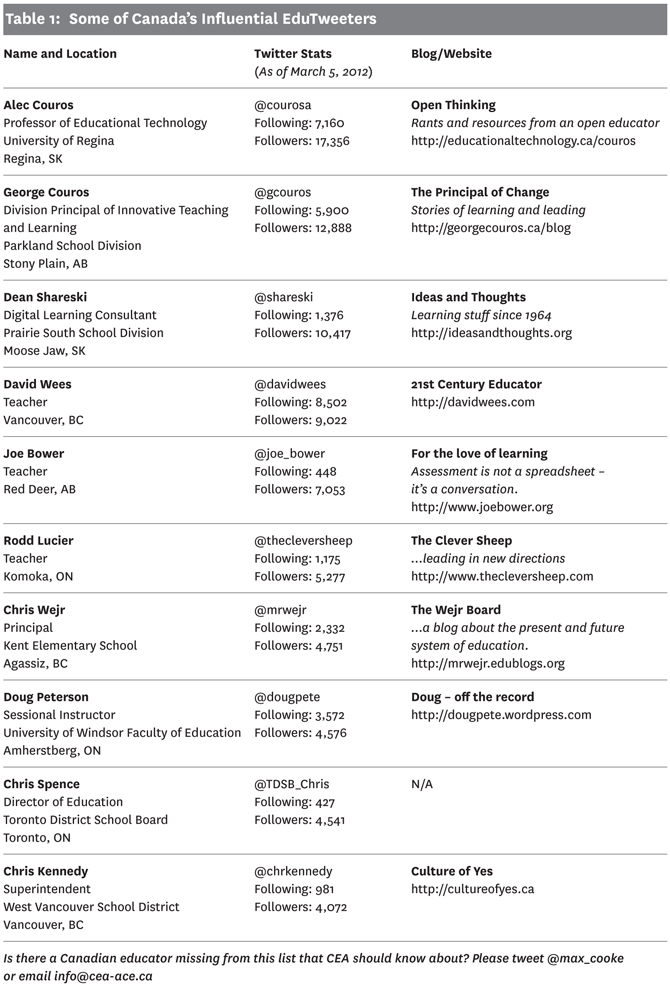
Twitter never sleeps, nor do its most prolific Canadian education devotees (see Table 1), an emerging group of leaders in Canadian education who have attracted thousands of followers. They’ve made Twitter an extension of their lives, delivering twenty or more tweets a day that can include, for example, links to media articles, research, new ideas from education bloggers, or simply a personal thought or idea…anywhere, anytime from their smartphones and tablets. While many tweet good ideas and good practice, others use it as a virtual soapbox to deliver a relentless torrent of seething quips against the status quo. At their best, EduTweeters are adeptly leveraging Twitter to brand themselves, to reinvent teacher PD, and perhaps to accelerate the transformation of our Canadian education systems.
Reinventing PD
The power of Twitter is not Twitter itself; it’s the connections it facilitates. Those connections can break the sense of professional isolation that many teachers feel within the walls of their own schools while reinvigorating their lesson plans by exposing them to a daily global idea exchange.
The power of Twitter is not Twitter itself; it’s the connections it facilitates. Those connections can break the sense of professional isolation that many teachers feel within the walls of their own schools while reinvigorating their lesson plans by exposing them to a daily global idea exchange.
“Like most educators, when I was teaching, I had a filing cabinet, where I would create a lesson, teach the lesson, and throw it back in the cabinet,” says Doug Petersen (@dougpete), a career educator and lecturer at the University of Windsor’s Faculty of Education. “Now, I take a look around the Twitterverse, and it’s amazing how many people just come forth with ideas and resources that go deeper than I would have ever dreamed of going.”
Twitter is also having an impact on traditional face-to-face PD conferences. It’s becoming common practice for event organizers to create a hashtag[2] (i.e. #edcampto) – a keyword system that directs followers to other tweets in the same category, thereby creating a running chronicle of the presentations and discussions for interested participants outside the room. West Vancouver School District Superintendent Chris Kennedy (@chrkennedy) says, “I get to attend lots of great conferences without being there. It’s up on my screen and it runs in the background.”
Twitter hashtags also serve as hubs for scheduled or ongoing exchanges among peers – in Canada (i.e. #CdnEd) and internationally (i.e. #educhat), based on their position within the system (i.e. #cpchat for principals) or their connection to provincially based networks (e.g. #BCed, #Abed, #Mbedu).
It was only a matter of time before the camaraderie and trust developed among educators on Twitter evolved into face-to-face PD gatherings like the EdCamp movement. Organized by teachers for teachers, EdCamp “unconferences” – like the ones held in Toronto,[3] Vancouver, Montreal, Edmonton, Quinte, and Delta – are spreading like wildfire throughout Canada and the U.S. Usually held on Saturdays, EdCamps have no pre-scheduled presentations and no keynote address; the learning experience flows from the kinds of passionate conversations that – at most traditional PD sessions – only happen during coffee breaks.
“When we share best practices, we don’t isolate them to our schools and school divisions anymore,” says George Couros (@gcouros), Division Principal of Innovative Teaching and Learning for the Parkland School Division in Stony Plain, Alberta. Given the sheer volume of information being shared – especially when you follow thousands of fellow educators like Couros does – you’d think it would be difficult to separate the wheat from the chaff. But in fact, he doesn’t worry about catching every tweet that crosses his screen. “The best ideas tend to go viral and find me.”
One of his own ideas illustrates the point. When Couros wrote a blog about his school’s Identity Day – where students had the opportunity to share what makes them who they are in a Science Fair format[4] – his good idea found educators in Texas, North Carolina, British Columbia, Ontario, Chicago, and Brazil emulating the initiative.[5]
A widespread criticism of Twitter Personal Learning Networks (PLNs) is that they’re echo chambers of like-minded innovators drinking their own Kool-Aid. Chris Kennedy begs to differ, claiming that pushing ideas out from his blog, refining them, and gaining a community perspective on them, has opened his mind to viewpoints that he wouldn’t have otherwise contemplated. But he also keeps his enthusiasm for Twitter in check. “It’s my number one form of PD right now, but I’m not falling in love with Twitter, because maybe I won’t be on it in two years.”
Transforming Classrooms
So how deep is the actual learning from this warm and fuzzy online collegiality? Although evidence is so far predominately anecdotal, the Pearson Centre for Policy and Learning, a UK-based research centre, examined how teachers can, and do, use Twitter and other social media for professional development. Its report states that online collaboration that is “sustained over time and supported by specialists results in improvements in teachers’ attitudes and beliefs, teaching strategies used…and students’ attitudes and behaviour, and students’ achievement.”[6] The report also calls for published guidelines and support for teachers and leaders to help them use social media in school.[7] This is in stark contrast to a professional advisory released in Spring 2011 by the Ontario Teachers’ College, warning its members of the dangers and legal implications of the use of social media with students.[8] Rodd Lucier (@thecleversheep), a teacher from Komoka, Ontario blogged about his fear that this warning will grant “reasonable grounds to remain on the social media sidelines.”[9]
Lucier – and other prominent EduTweeters who had built professional relationships on Twitter – organized Unplugd, a PD retreat for a national group of teachers, principals, faculty of education reps, and parents to explore in depth the changing dynamics between teacher and learner in the digital age. The prevailing philosophy resonating from Unplugd is that transformation is not a matter of simply replicating traditional models of teaching and learning with Smartboards. In fact, technology was barely discussed – it was about pioneering techniques that increased student engagement and motivation; powerful examples of inquiry-based learning; a shared philosophy of teachers relinquishing traditional power dynamics with students in favour of group collaboration and cumulative learning; and above all, how crucial it is to bring back to our education systems the joy in teaching and learning. Their stories, some of which detailed systemic roadblocks to classroom technology integration, were captured in an e-book and videos.[10]
These teaching innovators have hopscotched the “what” and are defining the “how”. Take for example EdCamp Montréal and TEDx organizer Pierre Poulin (@ppoulin) promoting his iClasse[11] 1:1 laptop constructivist program across Montreal’s schools and districts. Based on eight years of research and experimentation in his Grade 6 classroom, he developed a paperless and bookless learning environment where round tables replace traditional desks in rows, students work in teams, and learning goals are introduced each day. With new teaching and staff training methods designed alongside implementation, Poulin is trailblazing a path for younger teachers.
Motivated by a mixture of ego, frustration with the status quo, and sheer political will, educators like Poulin are driving change in the system, despite the system.
Motivated by a mixture of ego, frustration with the status quo, and sheer political will, educators like Poulin are driving change in the system, despite the system. From classrooms designing iPhone apps, to flipping classroom lectures with homework, to proving that students with special needs can flourish using iPads, they’re not afraid to fail, tweak, and share their experiences with their legions of edu-tweeps.
Taking on the Hierarchy
Activist tweeter Joe Bower (@joe_bower), a teacher from Red Deer, Alberta, started using Twitter to keep his sanity and find like-minded colleagues to vent his frustration with top-down hierarchical decision-making. Like many teachers, Bower is taking advantage of the Twitterverse’s non-hierarchal environment to challenge grading and assessment policies, but few school district leaders are on Twitter to see and respond to it. Among the notable exceptions is Toronto District School Board Director of Education Chris Spence (@ChrisSpence), who uses Twitter to communicate his daily whereabouts, inspirations, and challenges to over 4,000 edu-tweeps. Chris Kennedy of West Vancouver uses social media to maintain decision-making transparency with his school community and is spearheading a district-wide social media strategy.
(N.B. Click anywhere on Table 1 to access to an extended list of influential Canadian EduTweeters)
“Knowing what a Director is thinking and doing…demonstrates the whole idea of transparency, and that’s the kind of leader we need.” says Zoe Branigan-Pipe (@zbpipe) an elementary teacher and pre-service instructor at Brock University.
Former Superintendent and architect of one of Canada’s first district-wide 1:1 laptop initiatives, Canadian Education Association CEO Ron Canuel (@RonCanuel) feels that it’s essential for EduTweeters to attract more teachers and school district administrators into the exchanges to maximize Twitter’s potential to influence meaningful systemic change. “Without the presence of the mid and late adaptors, successful integration of technology will stay at the periphery of classroom activities and as an add-on in school districts’ Vision Statements.”
Joe Bower lauds Twitter for its ability to create pockets of resistance and real innovation, based on the remarkable networking of the top EduTweeters to date. But the edu-Tweeter movement is going mainstream.
Joe Bower lauds Twitter for its ability to create pockets of resistance and real innovation, based on the remarkable networking of the top EduTweeters to date. “Institutions couldn’t pay the George Couros’ to do what they have done for free.” But the edu-Tweeter movement is going mainstream. Couros, his brother Alec Couros (@couros) Professor of Educational Technology University of Regina, and Dean Shareski (@shareski), Digital Learning Consultant for the Prairie South School Division, have parlayed their influential social media brand into more formal paid PD events for school district leaders.[12] This may be a positive sign that the edu-tweeter message is trickling up the line, or an indication that grassroots Twitter activism is in danger of being co-opted, not unlike the torrent of “21st Century Learning” rhetoric that’s omnipresent in conventional PD.
Time will tell if a critical mass of decision-makers will find ways to build teacher-driven classroom innovations to scale, but the clock is ticking and Canadian EduTweeters aren’t holding their breath. This point is best illustrated by a face-to-face discussion I overheard between two Pierre Poulin disciples during an EdCamp coffee break chat. They were comparing prices on construction materials required to build more do-it-yourself desks that would accommodate the iClasse philosophy. This left no doubt in my mind that all of this edu-tweeting is for the students, driven by a movement of educators that Thompson Manitoba principal Robert Fisher (@RobCFisher) describes as “caring so much that it hurts.”
For a full lexicon of Twitter terminology, please visit: https://support.twitter.com/entries/13920-frequently-asked-questions
Special thanks to Rodd Lucier, Zoe Branigan-Pipe and the organizers and participants of Unplugd 2011, Joe Bower, David Wees, George Couros, Chris Kennedy, Shannon Smith, Chris Wejr, Stephen Hurley and the Toronto EdCamp organizing team, Pierre Poulin and the EdCamp Montréal organizing team, Cailey Crawford, and Ron Canuel for contributing their time, thoughts, and experiences to this article.
EN BREF – Un groupe émergent de chefs de file en éducation canadienne attire des milliers d’adeptes. Twitter fait maintenant partie intégrante de leur vie : ils transmettent vingt micromessages ou plus par jour qui peuvent inclure des liens à des articles, des recherches, de nouvelles idées de blogueurs en éducation ou à leurs propres idées, ou tout simplement une réflexion personnelle. Au mieux, ces édu-microblogueurs tirent habilement parti de Twitter pour se démarquer, pour réinventer le perfectionnement des enseignants et, possiblement, pour accélérer la transformation des systèmes d’éducation canadiens. Twitter sert à étendre les conférences de perfectionnement professionnel aux abonnés en temps réel, facilite les discussions informelles (« déconférences ») entre les éducateurs ayant des intérêts communs, permet la propagation virale sur Internet de pratiques exemplaires et permet aux enseignants de classes innovantes de remettre en question le statu quo.
[1] Retrieved at: https://support.twitter.com/groups/31-twitter-basics/topics/104-welcome-to-twitter-support/articles/215585-twitter-101-how-should-i-get-started-using-twitter
[2] Hashtags are created organically by edu-tweeters as a way to categorize messages. People use the hashtag symbol # before relevant keywords in their Tweet to categorize those Tweets to show more easily in Twitter Search. For educators, hashtags have also become a powerful, simple tool for tracking topics (i.e. #assessment, #effectiveteaching, #resilience, #studentsuccess, etc.).
[3] http://www.youtube.com/watch?feature=player_embedded&v=zq9KzCCpuo4
[4] http://georgecouros.ca/blog/archives/791, http://georgecouros.ca/blog/archives/974,
[5] http://georgecouros.ca/blog/archives/1962
[6] https://www.pearsonschool.com/, pgs. 18,19
[7] https://www.pearsonschool.com/
[8] http://www.oct.ca/publications/PDF/Prof_Adv_Soc_Media_EN.pdf
[9] http://thecleversheep.blogspot.com/2011/04/social-media-advisory.html
[10] http://unplugd.ca/page/unplug-d-11-videos
-
Please take the CEA/Ipsos Attitudes Toward Public Education Survey
Comments Off on Please take the CEA/Ipsos Attitudes Toward Public Education SurveyIt’s my pleasure to launch the 2012 CEA/Ipsos Public Attitudes Towards Public Education Survey. Over the years, CEA has explored different questions with Canadians through our national surveys. This year, we want to examine your views on innovation and change in public education.

-
21st Century Learning Leadership Forum
Comments Off on 21st Century Learning Leadership ForumIn this CEA-supported event, thought leaders from across the world met to discuss leadership and change in education.
-
Location! Location! Location!
Comments Off on Location! Location! Location!I spent a few years teaching in the Initial Teacher Education Program (ITEP) at OISE/UT. It never failed that, despite the almost universal sense of anxiety that preceded students’ first practicuum experiences, there was always a resounding feeling of loss on the part of the candidates when they returned to the University to carry on with their coursework.
During the two- or three-week in-class experience they had forged relationships and connections with staff members, with students and with the community. Most returned having left a little of their teaching selves behind. As instructor, I was more than a little offended when candidates returned the first couple of times and openly declared their desire to be back in their school, claiming that they had learned so much more there than they were learning in the psychology or methods courses at the University. As my three year assignment progressed, however, I learned to expect the response and prepare activities designed to acknowledge and respond to the very emotional bond that was created while out in the field.
Since returning from the ITEP experience, I have hosted many teacher candidates from a variety of Universities in my own classroom and I have come to understand that the desire to be in schools during initial preparation is almost universal. The sense that the on-the-ground experience, in all of its contextual glory, is somehow more valuable than the workshops, seminars and lectures held back in the academy is worth noting and worth talking about.
I know that there are some teacher education faculties that are moving towards centering their programs in elementary and secondary school communities. Some are motivated by space availability and the ability to offer prospective students a site closer to their home. Others may actually be trying to create a more “nested” approach to program, with candidates actually taking classes and completing their practicum requirements at the same school site.
So a couple of questions to start the conversation.
What is the current relationship between the Field and Faculties of Education across Canada? What is happening now? Is it satisfactory, or could a shift in that practice make for a richer, more contextualized initial teacher preparation program? What essential aspects of teacher education need to remain grounded in the University setting? Could schools effectively replace the academy as the hub of the Initial Teacher Preparation Program?
What shift in attitudes would be necessary on the part of the University in order to create more of a field-based approach to teacher education? On the part of School Districts?
I think that there is room for some lively discussion here. Care to wade into the waters a little?
-
Out of sight, out of mind?
Comments Off on Out of sight, out of mind?I grew up in a family where, as children, our opinions or perspectives were seldom sought. As I became more educated (and more opinionated) I was often frustrated that conversations were shut down before my voice could be fully heard. I can remember a time when our extended family had gathered for a summer afternoon around the pool. Aunts, uncles, brothers, sisters and parents were sitting around after supper and my father tried to animate the conversation by making a rather provocative statement about public education. My eyes immediately started to flash in response, but I said nothing. At one point in the conversation, my dad turned to me and said, “Stephen, don’t you have an opinion on this?” I calmly replied, “Oh I have an opinion…I’m just not used to being asked.” After a few seconds of awkward silence, the entire table burst out in supportive laughter. Everyone knew what had just taken place!
In a passionately written introduction to their recently released CTF report, The Far Side of Educational Reform, Andy Hargreaves and Dennis Shirley observe, quite rightly, that teachers are often found at the end of the road when it comes to conversations about school reform:
Apart from students and parents, they are often the very last to be consulted about and connected to agendas of what changes are needed in education, and of how those changes should be managed. Educational change is something that government departments, venture philanthropists, performance-driven economists and election-minded legislators increasingly arrogate to themselves. Even when these policy-setting and policy-transporting bodies speak on behalf of teachers, teachers often have little or no voice. Teachers are rarely asked to speak on their own account. (page 1)
The result is that teachers often find themselves trying to support, justify and implement policies and initiatives that they have had no hand in helping to form. This doesn’t mean that teachers have no desire to be part of the conversation. Nor does it mean that they have nothing of value to add. Quite the contrary! Walk into any social gathering that includes teachers and what are you likely to hear? Talk about schools, students, curriculum and a strong vision of how all three can work more effectively for everyone. Teachers, for the most part, are passionate voices for authentic and transformative change, and system leaders would do well to consult them if they hope to see their policies supported and actualized.
I don’t think that policy makers and system leaders intentionally sideline teachers from discussion about change; I just don’t think it occurs to them to include them on the guest list. I’m convinced that one of the main reasons for this stems from a lack of regular contact with the places and people for whom their decisions will have the greatest impact. In my own professional life, I’ve had the opportunity to assume a variety of roles within the system and I know that you don’t have to be out of the classroom very long to lose touch with the day-to-day subtleties and nuances that make school life what it is: complex, unpredictable and dynamic! Seldom do new policy statements give any indication that those that have crafted them understand just what it will take to make them come to life in the classroom.
There are those who will argue that educators are consulted before policies are introduced. Some teachers are invited to be part of curriculum focus groups. Others are seconded to positions at faculties and ministries of education. Teachers are sometimes part of local and provincial writing teams. We know, however, that the main decisions affecting education in Canada are made many kilometres from the bricks and mortar of the schoolhouse.
But it wouldn’t be difficult to change that, but it would require getting our noses out of the local, national and international statistics and hauling our bodies off to the where policy really matters.
I would like to see more folks from various ministries, faculties of education and district offices spend more time in our schools, and in our classrooms. And I’m not talking about a quick walk through prior to a PR announcement, photo opportunity or graduation ceremony. I’m talking about losing the jacket and tie and coming in to work with real live teachers and real live kids in a real live school. I’m talking about staying around long enough to see what really happens on a daily basis in the very communities that their decisions will affect. I’m talking about meeting the actual students and teachers that will be responsible for implementing their policies and the results of their research. I’m talking about spending enough time in schools so that they walk away knowing some of our names, and some of our stories.
Come in and teach a grade five math lesson or a grade ten civics class. Come in and spend a couple of days with a struggling grade two student or a grade seven “gifted” class. Have lunch with a few teachers trying to motivate and respond to a group of teenagers who have somehow become lost in the system. Better still, have lunch with the students, themselves.
It might be a little uncomfortable for everyone at the beginning, but I think that the insight and understanding that could be derived from this type of “contact” would have a great impact not only on the types of decisions and programs that are developed to move our systems of education forward, but also on the way that they are received on the ground. It’s easy to pretend that we know; its more difficult to prove that we understand.
What would happen if it became a matter of policy to investigate where policy matters the most?
-
We Are An Arts-Based School!
Comments Off on We Are An Arts-Based School!I think that an inordinate amount of our hand wringing around the issue of student engagement takes place well after the proverbial horse has left the barn. In fact, in many jurisdictions, a good deal of time and money are being spent contacting teenage students who have chosen to leave the system early, and exploring with them ways that they could come back and earn credits towards their graduation diploma.
I have a better idea.
Instead of trying to coax students back into a system that, in many cases, has failed them as much as they have failed it, why not concentrate our efforts on making sure that engagement and resonance are part of the way we think about school, program and curriculum design right from the very beginning? If we’re really serious about addressing the engagement dilemma, let’s begin at the earliest stages of a child’s schooling experience and build from there.
Our current obsession with test scores and graduation rates as the real measures of both school and student success will pass. And when we finally wake up to the fact that these statistical sirens have really been false idols, we’re going to have to do some rethinking.
I would suggest that when that time comes, we begin to rebuild by carefully observing our children. Look at our youngest children. Watch what they do when they’re given the freedom to choose. Look at how they explore the world, how they express themselves, how they interact with each other at their earliest stages of social development. Most often, when left to their own devices, we’ll find our children singing, dancing, colouring and role playing their way through the world. It’s not because they need a break from the other stuff in their life. It’s because this is their life and these are things that come so very naturally to them.
Walk into any daycare or pre-school facility and you’ll know what it looks and sounds like when you allow this understanding of human development to permeate the work that you do. Easels, drums, costumes, puppets, and space (!) are the hallmarks of any good early childhood education program. Spend a day in a kindergarten class and notice which activity centers are the most popular. You’ll probably find that the kitchen/house center, the art center and the music center are more populated than any other. (Some kindergarten teachers reading this may comment that these are the only centers that they have!)
And it’s not because these activities give children a break from the demands of real learning. It’s because this is where they do most of their real learning. The finger painting easel allows them to freely explore colour, shape and movement. The house centre gives them the opportunity to work out social relationships and practice some of the conversations that they hear in their own home. It is a place where conflict emerges and gets worked out (most of the time!). Rhythm instruments enable children to connect with something so deeply human that we may have lost sight of its importance in our lives.
Yet, something curious and more than a little disturbing happens after the early years of schooling. We package these activities up, call them “the arts” and, in so many cases, push them to the edges of our school communities. We build walls of curriculum around them to legitimize them as “real learning”. And in order to ensure that a teacher assigned to “the arts” doesn’t get off too easy, we demand that they be assessed and evaluated with the same tools and strategies as mathematics, science or language.
But in the process, we lose sight of the power of the arts to teach, to connect and to engage. It’s a power that is sitting right in front of us, staring back at us in the faces of our students. It’s a potential that is, quite literally, embodied in every child and young person that walks through our doors everyday. And you know something? It’s also embodied in every adult walks through the those very same doors!
So what would happen if we began to honestly and openly explore the role that the arts play in our schools? What would happen if our children had opportunities to sing, dance, act, and draw every single day? What would happen if school plays, dances and glee clubs became part of our school timetables instead of something seen as taking up valuable instructional time? What would happen if all schools were able to fly a banner on their outside wall declaring, “We are an arts-based school”?
I really believe that quality arts-based teaching and learning should be the right of every child. For me, the reason is quite simple. By nature, human beings are artistic creatures. The rhythm of music courses through our veins; imagination and creativity are hallmarks of every human invention. We are currently struggling with a vision of school that actively denies this, and we are losing our more and more of our students hearts and minds.
With your help, I would like to explore some of these questions more deeply. I would love to hear from teachers, administrators, parents and students who have an opinion on the role of the arts in our schools. You don’t have to agree with me; in fact, contrary opinions are always welcome here. If you have research or media articles to share that might support your viewpoint, tell us about them. If you have been part of an arts-based school initiative, your stories are welcome. If you’re struggling to put arts back on the radar in your district, tell us about that! Write a reply, draw a picture, sing a song. However you choose to respond, your perspective is welcome.
-
Shift This
Comments Off on Shift ThisBrad Ovenell-Carter opened the first session I attended at EdCamp Delta on the weekend by explaining how he’s working in his school to shift the control of technology from the top-down to the bottom-up. I’ll deal with the idea first and the way we often frame the idea (and the way Brad did here) second.
-
Can we put new wine into old skins?
Comments Off on Can we put new wine into old skins?Well, if the level of response to my last entry is any indication, there is a significant level of passion, knowledge and commitment surrounding the current conversation about assessment and its role in the modern school. And it’s not that talking about assessment for learning, of learning and even assessment as learning is bad or even misguided. In fact, these are practices that could allow us to view and respond to students and the work that they do in enriched and more informed ways. They have the potential of focusing our vision on individual students, their needs across a variety of dimensions, and how the programs that we offer can better meet those needs.
A more robust appreciation of and dedication to authentic assessment practices may lead to educational transformation. But, I would argue that this will not happen until we address the conditions that are necessary to allow the ideas and ideals of 21st century approaches to assessment and evaluation to take root and flourish. And this is where our discussion needs to move.
Ancient wisdom warns that you can’t put new wine into old wineskins. If you try, chances are the skins are going to burst, and you’re going to lose both skin and wine. The most reasonable explanation is that old wine skins are dry and liable to crack, especially as the new wine continues to ferment.
I think that we’re seeing evidence of this as we attempt to move our teachers, parents and administrators closer to implementing some beautifully crafted policy statements on assessment and evaluation. While the policy presents a rich new vision of the work of both students and educators, my fear is that our current school infrastructure is beginning to crack under the pressure; we stand to lose both the new vision and the integrity of our schools!
So, practically speaking, what is holding educators back from fully embracing new approaches to assessment. What is holding us back from taking the time and space we need to make ongoing formative assessment part of our daily practice? What is holding us back from effectively separating the notions of assessment (gathering information about student learning) and evaluation (placing a reported value on the work that students do)?
Ancient wisdom warns that you can’t put new wine into old wineskins. If you try, chances are the skins are going to burst, and you’re going to lose both skin and wine.
I’m currently thinking of three aspects about the way we continue to “do school”. I passionately believe that if we were to re-examine our approach to these three things, we would create places and spaces that would allow us to more effectively integrate new approaches to our work.
First, authentic assessment encourages to take a “longer” view of student progress. The current practice of moving students along a continuum based on a multitude of age-defined expectations calls into question our real commitment to the idea that student learning is a diverse and complex process. In order to make room for our new assessment policies, we need to challenge the assumption that if I am 10 years old, this is what I should know and be able to do…in March!
A second aspect of school that needs to be seriously challenged–and this relates to the first–has to do with the way that we report student progress to parents and the rest of the system. The requirement to produce two or three time-bound reports has tradition on its side, but when that requirement also comes with the demand that a teacher will have covered a given percentage of the prescribed curriculum in time for each reporting period, the opportunity to “rest” with certain concepts and skills is removed. Both assessment and teaching practice lose their ability to respond if the “when” and “what” becoming defining principles.
Finally, (!) in order for us to truly embrace the vision of assessment “for” and “as” learning, we need to open up the learning spaces in our schools. Students and teachers need to have the elbow room to develop skills and explore content in many ways. The practice of dividing curriculum into compartments, especially at very young ages, fights against the integrative underpinnings of our new assessment approaches. The more we can create learning environments that enable conceptual connection and imaginative approaches to making those connections, the easier it will be to bring our desired assessment vision to life!
We’re at an important point in terms of both policy and practice in public schooling. It’s fine to demand that educators begin to explore and integrate new ways of looking at how student work can allow us to do so much more than just assigning a mark. Unless we’re willing to take a look at the structures that enable these these ideas to ferment and mature, then there is a huge chance that we might lose the vision and the energy that has gone into this new way of thinking. Let’s make sure that our new wine is going into new, stronger wineskins. The future of the vintage AND the vessel are at stake!
-
The Pedagogy of Play
Comments Off on The Pedagogy of PlayAs autumn slips into winter, I eagerly anticipate the cold winter days, the long dark evenings, and the inevitable coming of snow. My children, born of the prairies, equally anticipate winter and the endless possibilities snow presents for their play. As I walk to pick up my children from school during the winter months, I marvel at the amazing array of snow forts that make up the landscape of their schoolyard.
Each day my children come home from school with stories of snow fort “culture”. They tell me of the intricate rules and building teams. They tell me of the schoolyard collaboration and of who gathers the snow blocks left by the bulldozer at the edge of the schoolyard. They tell me about who compromises the snow-building community by taking the largest snow blocks for themselves and the consequences of these actions. They tell me about the father who arrived at lunch with an ice-breaking shovel to help children get larger pieces of ice and the schoolyard hysteria that resulted. They are happy, engaged, and excited about their work of play.
Play is important. Environmental educators Sobel and Louv write about the relationship between children and outside play and suggest that early transcendental experiences within nature allow children to develop empathetic orientations towards the natural world.[1] Children who play out-of-doors develop an appreciation for the environment and accordingly develop the groundwork to become stewards of the earth.
Other educators suggest that out-of-doors play activities support many of the skills necessary for adult life including social competence, problem solving, safety, and creative thinking. Cultural critics Wendell Berry and Kay Hymowitz write about the ongoing relationship between how, where, and what our children play and the foundational citizenship and democratic skills developed through the childhood work of play.[2]
As I drive through our city, I have noticed an interesting and alarming phenomenon. While inconsistent, there seems to be an absence of snow forts in schoolyards within low-income communities. Perplexed by this phenomenon I began to explore the ideology of play and socio-economics. A variety of studies indicate that modern children engage in different outdoor activities than children in previous generations. These studies indicate that fewer school-aged children engage in imaginative play and street games (child-initiated games using child-initiated rules such as jump-rope or kick-the-can). Children are increasingly participating in adult-structured activities (play dates, after school sports, lessons), leaving little time for child-initiated activities. Accordingly, the development of skills related to creative play such as cooperation, imagination, creativity, and ownership decrease as responsibility for play is transferred to responsible adults.
Research also indicates that children living within low socio-economic neighbourhoods spend more time watching television, are more sedentary, and spend more time playing video and/or computer games than their higher income counterparts. These factors are linked to the lower health, school engagement, and academic achievement of lower income school-age children.
Obviously, the relationship between play, socio-economics, academic achievement, and pro-social behaviours are very complex. However, it seems possible to suggest that children who are more engaged with adult-directed, structured, technological, or indoor worlds build different personal, social, and academic capacities. It also seems probable that our children are being provided with inequitable futures when the freeing experience of play is not part of the repertoire of all childhood experience.
Sometimes at night, after a large snowfall, when my children are tucked warmly into bed, I sneak into the back alley and join the community of men working silently in the alley. I watch the neighbour confidently baring his stretch of alley with the roar of snow blower, the neighbour who carefully brushes the edges of his brick walkway with a broom and the old man who throws the snow with reckless abandon into messy piles beside his garage. I meekly acquiesce to the fastidious neighbour who admonishes me for letting my piles of snow fall into the roadway and take a moment to chat with another who relishes in our mutual work. I believe our work as children and our work as adults forms us as a society. Through work we learn the rules of our collective spaces, develop community, and negotiate our identities. Through the work of play, our children learn the rules of our collective spaces, develop their own sense of community, and negotiate their emerging identities. I wonder about a childhood that does not include play and how this will change us as a society and as a people.
[1] R. Louv, Last Child in the Woods: Saving our Children From Nature-deficit Disorder (Chapel Hill, North Carolina: Algonquin Books of Chapel Hill, 2005); D. Sobel, Childhood and Nature: Design Principles for Educators (New York, New York: Stenhouse Publishers, 2008).
[2] W. Berry, What Are People For? (New York, New York: North Point Press, 1990); K. Hymowitz, Liberation’s Children: Parents and Kids in a Postmodern Age (Lanham, MD: Ivan R. Lee Publishing, 2003).


IDEAS TO SUPPORT EDUCATORS : Subscribe to the EdCan e-Newsletter
Quality research, reports, and professional learning opportunities.