Archive
-
Teacher Professionalism: The Wrong Conversation
Comments Off on Teacher Professionalism: The Wrong ConversationTeacher Professionalism: The Wrong Conversation
-
From the Editor/Le mot de la rédactrice en chef
Comments Off on From the Editor/Le mot de la rédactrice en chefFrom the Editor/Le mot de la rédactrice en chef
-
A New Vision for Student Voice
Comments Off on A New Vision for Student VoiceA New Vision for Student Voice
-
Critical Friendships: Moving from Struggle to Success in Secondary School Improvement
Comments Off on Critical Friendships: Moving from Struggle to Success in Secondary School ImprovementCritical Friendships: Moving from Struggle to Success in Secondary School Improvement
-
CEA Ken Spencer Award Luncheon – Oct 2009 Halifax
Comments Off on CEA Ken Spencer Award Luncheon – Oct 2009 HalifaxStaff and students present the transformative results of their Student Leadership Team.
-
Margaret Langley: A Teacher Takes Risks and Influences School Culture
Comments Off on Margaret Langley: A Teacher Takes Risks and Influences School CultureA teacher shares how providing authentic opportunities lead to increased levels of intellectual engagement.
-
Our Student Voice Made a Difference
Comments Off on Our Student Voice Made a DifferenceA student describes how their Student Leadership Team transformed the school’s decision-making process.
-
Darlene Fitzgerald: How Intellectual Engagement Data Sets New Conditions for Learning
Comments Off on Darlene Fitzgerald: How Intellectual Engagement Data Sets New Conditions for LearningDarlene Fitzgerald describes how her students became a vital part of her school’s decision-making process.
-
Joel Westheimer & April Howe-Diplock: What can parents do to support critical thinking at home?
Comments Off on Joel Westheimer & April Howe-Diplock: What can parents do to support critical thinking at home?Joel Westheimer responds to panelist April Howe-Diplock.
-
A Student’s Role in Teacher Engagement
Comments Off on A Student’s Role in Teacher EngagementStudents present their thoughts on engagement, learning, and teachers.
-
Penny Milton & Jodene Dunleavy: What did you do in school today? Report Launch
Comments Off on Penny Milton & Jodene Dunleavy: What did you do in school today? Report LaunchPenny Milton and Jodene Dunleavy discuss findings from the What did you do in school today? Report.
-
Beyond Borders: International Education and Global Citizenship
Comments Off on Beyond Borders: International Education and Global Citizenship“I think it [the global ethic] is about global citizenship. It’s about recognizing our responsibilities to others.” – Gordon Brown, UK Prime Minister, July 2009[1]
What do meatballs, bicycles, and debates have to do with global citizenship? Plenty. At least that’s what I learned while studying in Sweden for a year. In the late summer of 2006, I started a Master’s program in Society Science and Technology at Lund University in Lund, Sweden. I’m often asked why I chose Sweden, and there are two simple answers: experience and cost. Wanting to differentiate myself from fellow Bachelor’s grads, I pursued graduate studies to gain international experience and improve employment prospects. As a cost-conscious student, I also wanted to get my Master’s without spending a fortune. Conveniently enough, Swedish universities are tuition-free for domestic and international students (though fees may be implemented for select foreign students starting 2011).[2] Despite several family trips to Sweden prior to my studies, nothing could have prepared me for the year-long lesson in global citizenship.
Learning in an international context had a profound impact on my understanding and analysis of issues, my attitudes towards others and their personal values, my skills development, and my sense of belonging.
My studies were merely the tip of the iceberg, as much of my learning happened outside the classroom. From understanding foreign customs to comparing Canadian and Swedish social policies, I was engaged in learning all the time. An international education, I will argue, is an invaluable experience that fosters intercultural competence and leads to greater societal involvement.
Journal Entry, Lund, Sweden, 12 August 2006: “… my Swedish is progressing nicely, and I think I am becoming keen on learning languages. I also miss home, and am eager to make friends and socialize.”
New Ways of Looking at Things
Darla Deardorff defines intercultural competence as the “knowledge of others; knowledge of self; skills to interpret and relate; skills to discover and/or to interact; valuing others’ values, beliefs, and behaviours; and relativizing [sic] oneself.”[3]
My intercultural competence developed almost unbeknownst to me during my stay. Periodically, I would think of life in Canada and question: why did we have so few bike lanes? Why did I have to pay for my university education? Why didn’t we have more female Members of Parliament? It was in those instances when I really began to see Canada in light of other countries, and myself in light of other citizens of the world. Learning in an international context had a profound impact on my understanding and analysis of issues, my attitudes towards others and their personal values, my skills development, and my sense of belonging.
Learn by Studying
As a junction for thought and discussion, the classroom was a hotbed of cross-cultural debate. When asked to offer critical insight and personal perspectives, fellow classmates often began with, “Well, in my country…” followed by an overview of the country’s position on an issue and a personal comment. Like a microcosm of real-life cross-country discussions, classmates would vehemently uphold their position, believing that their way was the right way. Unlike classes in my undergraduate career, the in-my-country statements were difficult to refute as they were often rooted in historical events or framed in a cultural context. Suffice to say, differences in opinion were common. Disputes, however, forced all of us to re-examine the strength of our own arguments in light of opposing, and often new, perspectives.
Self-examination of my beliefs and opinions extended beyond classroom conversations. While discussing a country-based case study with classmates over a meatball lunch, I argued that the strongest competitive advantage of the country in question was its natural resources. As a Canadian, I took for granted the abundance of our own natural resources, and assumed the same strategies and ideas could be applied in most, if not all, contexts. I was quickly forced to re-think my position when a classmate from a small land-locked country quipped, “The party won’t last forever.” He insisted that natural resources are finite, and the greatest asset to any country is its people. Indeed, placing myself in other people’s shoes and incorporating a people-first approach have since become personal cornerstones in addressing any issue.
Learn by Working
Like many students, I wanted to work part-time, but unlike many students in Sweden, I was fortunate enough to land a part-time job. In Canada, it was easy for me to take for granted my knowledge of the country’s official language and the abundance of part-time work available in big cities. But job hunting in Sweden was a humbling experience, and I gained the greatest empathy for newly landed immigrants in Canada who face barriers to securing employment.
I managed to land a student mediation job with the University and was paired up with a Swedish student. Our job was to minimize conflicts between international students and the housing authorities, and there was plenty of diplomacy involved. A haughty leadership style – so common in North America – had no place in an international social milieu. Notions of authority gave way to consensus-building, self-interest to cooperation, and confrontation to negotiation. It was in this role that I witnessed the simple commonality of people’s desires: respect, fairness, and equality.
The job also involved a lot of biking to and from different student residences all over town. Inevitably, my Swedish co-worker and I had time to discuss culture, politics, and life. One day I read an article criticizing the absence of tuition fees for international students and thought about the argument. After trying to place myself in the shoes of the author, I too felt that if Canada offered free tuition to foreign students, Canadian taxpayers might question the value. I then asked my co-worker what he thought about the issue. He didn’t gripe about wasted taxes but instead argued that this was a good way to gain knowledge and expertise from other countries and create an appreciation of Swedish culture. Yet again, I was challenged to look at things from a different perspective – it wasn’t so much about what the international students were taking, but what they were giving.
Learn by Volunteering
The most valuable lessons came from my volunteer work at Amnesty International in Lund. Impassioned about the promotion of human rights, I joined Amnesty because I wanted to meet others who shared the same interest. While toying with potential fundraising ideas and awareness campaigns, I suggested we organize a debate competition. As an avid debater in Canada, I naïvely thought debating clubs were common in every country, and that there would be no shortage of argument-hungry students. This, however, was not the case. In fact, the debate competition was the first of its kind, and it was an arduous struggle to sell the idea of direct verbal confrontation in a country that has been at peace for almost 200 years. Cooperation, communication, and support became pillars in the small international organizing committee. Without a doubt, the value of our six-month-long effort became obvious on the day of the event.
I, along with many of the participants, spectators, and volunteers, felt that the competition brought the issue of migration in Europe to a public level. High school and university students from over two dozen countries engaged in intelligent discussion about a topic that is often at odds with national identity. From a New Zealander studying environmental sustainability to a Venezuelan studying physics, participants created an unconventional dialogue that informed and challenged existing ideals. It was a discussion that people wanted to have but had little opportunity for. The end of the event marked only the beginning of the debate, which continued outside of the auditorium when students returned to their residences, spectators to their families, and volunteers to their communities.
Framing issues in a global lens forces people to look beyond a national scope and discuss them as global citizens who understand their responsibility to other people.
Journal Entry, Lund, Sweden, 18 March 2007: “… we [a friend and I] spoke about the event [the debate competition], and he said it was going to be a highlight for him, and that he too attributes good group dynamics to the lack of strong personalities.”
The Ambassadorial-Effect
Upon my return to Canada, friends, family, and colleagues would ask, “So, how was it?” Summing up a year’s worth of experience is hard to do in a few words, so I would simply say, “It was different.” It was different from the “one-city-per-day” Euro-trip that so many of my friends rave about, and different from the month-long language course I took abroad one summer. I felt as though I had become an unofficial ambassador for the country I lived in and the people I met. The ambassadorial-effect, as I would call it, leads one to respect and appreciate other cultures after having experienced them.
Living in a country, as I discovered, is far different from visiting a country. A complete immersion means learning how to live in a different society. This creates empathy for people that few other experiences can match. Over time I, like many other international students, began to reflect this understanding in my thoughts and actions while abroad and at home.
Recent research from Canada World Youth (CWY), an international youth exchange organization, suggests that my experience is not uncommon. A 2006 CWY impact assessment study found that past participants felt the program’s greatest influence was on their values and attitudes, knowledge/learning, and skills.[4] Respondents cited tolerance and open-mindedness as the personal values that changed the most, while communication and organizational skills also made notable improvements. Moreover, CWY hosts reported that the program’s impact on community went beyond its three-month duration. Evidently, the ambassadorial-effect works both ways and can result in a cultural legacy that most Canadians would likely see as a positive influence.[5]
Journal Entry, Hong Kong (a small vacation before returning home), 10 October 2007: “…lesson learned, take opportunities to get experiences, instead of holding out.”
A Strengthened Citizenry
To varying degrees, an international experience can contribute to the development of all three kinds of citizens that Joel Westheimer discusses: the personally responsible citizen, the participatory citizen, and the social-justice oriented citizen. [6] In my case I worked, paid taxes, and respected local laws and cultural traditions, like a personally responsible citizen; I participated in community initiatives, like a participatory citizen; and I created a socio-political dialogue on migration, like a social-justice oriented citizen. This, however, is not to say that we can only experience this kind of civic engagement while studying abroad. Living in an international context simply broadens the experience and can inspire us to do more when we return to our own country.
The more young minds are able to experience foreign places, people, and cultures, the more globally informed their future decisions will be.
A foreign experience can have a transformational impact on individuals, their future choices, and the societies in which they live. In my case, I gained a greater understanding of multiculturalism, learned about the values of multilingualism, and realized the importance of global citizenship. Deepened knowledge of these areas has informed my everyday actions, from choosing what to eat to deciding which petitions I will sign. Perhaps most important, my decisions as a voter are now based on policies and character, rather than politics and charisma. I am now able to make informed decisions based on what I feel is in the best interest of all Canadians, and not just my own.
Journal Entry, Toronto, Canada (home), 15 December 2007: “It’s still really strange for me to hear so many English conversations at once, and to see so many Canadians all in one place.
Conclusion
After studying and living abroad I firmly believe that Canada needs to focus on and promote international exchange opportunities. The more young minds are able to experience foreign places, people, and cultures, the more globally informed their future decisions will be. Admittedly, many parts of Canada – such as Toronto and Montreal – can toot the horns of multiculturalism, but this alone does not lead to a true understanding of global citizenship. Foreign experience is like learning about a historical event – it only becomes real when you visit the place and listen to the people. In Grade 8, the Battle on the Plains of Abraham was just another date to remember until I stood on the Plains during a class trip. A sense of place, an understanding of culture, and an appreciation for people became more real than ever. Instilling a meaningful historical or globalized viewpoint can only happen when we feel connected to other people and other places.
The quote at the start of this paper highlights our responsibility to others as part of global citizenship. I didn’t know it when I first arrived in Lund, but my Swedish teacher gave me a similar lesson on responsibility to others. Baffled at the advanced English skills of almost every Swede I encountered, despite the fact that it is not an official language, I asked why this was. She replied, “We are a country of only 9 million people – we must make the effort to learn the language of others if we are to be part of the dialogue.” Similarly, Canada is a country of only 33 million people, and we must take the initiative to think beyond borders and engage with the world around us if we are to play a meaningful role in the international community.
EN BREF – L’expérience de vivre à l’étranger peut avoir un impact immense sur les individus, au point de les transformer eux et les sociétés où ils vivent. Lors d’un échange étudiant avec la Suède, j’ai pu mieux comprendre le multiculturalisme; j’ai appris les valeurs du multilinguisme et pris conscience de l’importance d’être citoyen du monde. Vivre dans un pays est très différent de simplement le visiter. L’immersion totale signifie apprendre comment vivre dans une autre société et engendre l’empathie comme peu d’autres expériences le permettent. Au fil du temps, j’ai commencé à refléter cette prise de conscience dans mes réflexions et mes actions à l’étranger comme chez moi. D’après une étude d’évaluation d’impact de 2006 de Jeunesse Canada Monde, ce que j’ai vécu n’est pas unique. Les anciens participants considèrent que le programme a surtout influencé leurs valeurs, attitudes, savoirs, apprentissages et compétences. Plus les jeunes pourront faire l’expérience de la vie dans d’autres pays, parmi d’autres peuples et d’autres cultures, plus leurs décisions futures seront éclairées par une perspective mondiale.
[1] G. Brown, “Gordon Brown on global ethic vs. national interest,” TEDGlobal 2009, July 2009, (www.ted.com/talks/lang/eng/gordon_brown_on_global_ethic_vs_national_interest.html).
[2] Studyinsweden.se, Possible tuition fees for non-EU students from 2011, September 2009 (www.studyinsweden.se/Home/News-archive/Possible-tuition-fees-for-non-EUEES-students-from-2011/).
[3] J.C. Jurgins and C. Robbins-O’Connell, “A Comparative Study of Intercultural and Global Competency Opportunities on American and Irish University Campuses,” International Education 38, no. 1 (Fall, 2006): 66-101.
[4] Canada World Youth, Canada World Youth Impact Assessment: Synthesis Report, December 2006 (www.canadaworldyouth.org/en/content/doc/SynthesisReport_EN.pdf)
[5] Environics Institute, The Canada’s World Poll, January 2008 (www.environicsinstitute.org/PDF-CanadasWorld.pdf)
[6] J. Westheimer, “What Kind of Citizen? Democratic Dialogues in Education,” Education Canada 48, no. 3 (Summer, 2008): 6-10.
-
A Tale of Two Minds: Psychology and Global Climate Change
Comments Off on A Tale of Two Minds: Psychology and Global Climate ChangeThe American Psychological Association recently released its Presidential Task Force report on Psychology and Global Climate Change. The report first notes the domains of psychological research that have borne fruit in the past. For example, sections of the report review research literature that answers the following questions: How do people understand the risks imposed by climate change? What are the human behavioural contributions to climate change and the psychological and contextual drivers of these contributions? What are the psychosocial impacts of climate change? How do people adapt to and cope with the perceived threat and unfolding impacts of climate change? Which psychological barriers limit climate change action? and How can psychologists assist in limiting climate change? Specific research, practice, and education recommendations follow the literature reviews that bear on each of the six questions above.
There are no environmental problems where humans aren’t centrally implicated. Thus, psychology and education ought to play important roles in solving these various problems.
The report issues calls to continue these productive lines of research and suggests several promising new directions. The Task Force offers a set of eight principles for psychologists (e.g., make connections to research and concepts from other social, engineering, and natural science fields; present psychological insights in terms of missing pieces in climate change analyses; be mindful of social disparities and ethical, and justice issues that interface with climate change) designed to maximize their contributions to the science of climate change. Implementing the Task Force’s principles and proposals would inaugurate a long and productive program of psychological research on climate change. This is exactly what one would expect from a task force of a professional society. If you read the report looking for detailed analyses of the points above, you will not be disappointed. To my mind, the report fulfills the expectations many held for it. Then why am I of two minds regarding the report?
Too Little, Too Late?
In this section, I share some of the ruminations that awaken me in the middle of the night. I don’t know for certain that any of my misgivings will prove true. Nor can I be certain that the directions I will suggest will prove superior to the directions suggested in the APA report. Rather, this article affords me an opportunity to worry aloud and share my concerns with educators whose influence on young minds may hold the key to our long-term survival.
There are no environmental problems where humans aren’t centrally implicated. Thus, psychology and education ought to play important roles in solving these various problems. Why are humans central to all environmental problems? Because we have been the dominant species on this planet for thousands of years. The history of evolution for all biological species has been the same: the organism slowly changes (via random genetic mutations coupled with selective retention) to become better adapted to the environmental niches the world offers it.
Global climate change ushers in a whole new ballgame. Humans quickly (in terms of evolutionary timescales) alter the environment that we then must adapt to in the future, thereby changing the course of evolution. No longer is the influence unidirectional: we can now profoundly change the environment which then shapes our evolutionary path.[1]
Global climate change is not the only environmental threat we face. You’ve heard of the “Peak Oil” phenomenon, wherein global oil production will peak and then inexorably decline.[2] The effects of peak oil will be devastating economically unless we have huge quantities of alternative energy ready for use. Why can’t we simply use natural gas or coal instead of oil? Because both still pollute and release the greenhouse gases that propel global climate change. Finally, the “green revolution” in agriculture allowed us to go from 3 billion people on the earth (in 1948) to our current 6.6 billion people. But what are the long-term consequences of the elements that made up the dramatic gains in agricultural productivity over the last six or seven decades? Watering crops from nonrenewable aquifers represents an obvious short-term strategy. Continued watering from any aquifer builds up salts in the soil that reduce the per acre yield of our fields. The continued use of herbicides, insecticides, and chemical fertilizers poisons the fields over time, leading to reduced yields initially and abandonment of the fields eventually.[3] Did you know that for many years now the earth has lost more acres of farmland (due to erosion, desertification, soil poisoning, the spread of cities, etc.) than it has put into agricultural service? But the human population continues to double every 50 years or so.
Time, Time, Time, See What’s Become of…Us
Simon and Garfunkel’s haunting song, “Hazy Shade of Winter”, is about a person who nears death and tries to make sense of the life he/she has led. Our looming environmental problems have put me in a similar state of mind. So with my melancholy state as a backdrop, let us ask, “How much time do we humans have to act to avert global climate change?”
Climatologists have been growing progressively gloomier over the last decade about the amount of time remaining, and for good scientific reasons (see Frontline’s excellent movie, Diming the Sun). James Hansen (longtime director of NASA’s Goddard laboratory) is arguably the world’s preeminent climatologist. For several years now, he has been expressing the fear we have only a decade or so left to act to avert global climate change. If he is correct, the timescale required for the concrete changes that would flow from the recommendations of the APA Task Force report is far too long. Psychologists – and educators – must act more quickly if they are to play a meaningful role in averting global climate change.
The challenge for today’s educators’ is to raise a generation of voters who won’t fall for the dangerous thoughts that our politicians have let us believe are true.
Are there promising trends outside academia in our efforts to fight global climate change? Yes, there are. Ontario’s, Germany’s, and Spain’s feed-in tariffs on all renewable energy systems are one promising development. Europe’s cap-and-trade system is another hopeful development (the United States Senate is currently debating the passage of a cap-and-trade bill). The United States’ 30 percent incentive on all renewable energy systems is yet another cause for hope. Most importantly, these efforts work within a timescale where their effects are virtually immediate. We also have engineers and materials scientists to thank for the products that produce clean and renewable energy, as well as political scientists and economists to thank for incentives, feed-in tariffs, and cap-and-trade systems. So what is the role of educators in all of this?
What’s an Educator To Do?
We must educate young people to think quite differently than we were taught to think. Table 1 provides examples of nine types of thoughts commonly promoted, learned, and accepted in recent generations, given the assumption of a limitless world.[4] However, for a world with limits, these same thoughts are not only false – they’re dangerous.
Table 1 – Dangerous Thoughts: For a World with Limits
- Consumption will produce happiness (and consumption is “needed”).
- The future is to be steeply “discounted”.
- Present consumption is preferred to investment in (or conservation for) the future.
- Growth is good.
- Free-market capitalism is the best system.
- Paying less is better than paying more.
- If it ain’t broke (yet)—don’t fix it.
- Until scientists can prove a phenomenon beyond scientific doubt, society doesn’t need to act on it.
- Innovations (technological and others) can push back biological limits indefinitely.
The next generation must think differently. Dangerous thoughts produce environmental nightmares. For example, politicians know that the quickest way to die politically is to promise to raise gasoline prices, or to raise the price of electricity produced by burning fossil fuels (all parts of a carbon tax). Yet, that is precisely the swiftest, most lethal blow we could now deliver to the dragon of global climate change. The challenge for today’s educators’ is to raise a generation of voters who won’t fall for the dangerous thoughts that our politicians have let us believe are true. Citizens must carefully analyze politicians’ statements and reach conclusions like, “While I’d like to pay less for gas, doing so would increase our unsustainable commitment to burning hydrocarbons to generate energy. Thus, I will vote against anyone who plays to my worst impulses.”
“Feeling bad, over-worked, or unappreciated? You deserve a break today…at McDonald’s.” Almost any type of consumption – to assuage psychological maladies – represents a bad strategy. Here, our prime adversary is the trillions and trillions of dollars spent on advertising. “Feeling weak, insignificant, powerless? Imagine how people will feel about you when you’re driving the biggest, toughest vehicle on the road. Get a Hummer.” Some commercials go so far as create the need first, and then tell you what to buy to satisfy it: “What if you have bad breath (or body order) and don’t know it? Be safe – buy Listerine (or Right Guard).” Helping people to “unlearn” dangerous thoughts such as these (“consumption will make me feel better”, “more is better”, “consumption is preferred to investment or conservation”) provides educators with many opportunities for discussion and consciousness-raising about aspects of human decision making, the impact of advertising, and self-defeating human tendencies.
A related dangerous psychological tendency arises whenever a short-term pleasure or pain is weighed against a long-term pleasure or pain. The short-term is always weighed too heavily in the calculus of our decision-making. Short-term rewards (the “ buy now, no money down” offer or the unhealthy diet that tastes so good) block out or beat out the longer-term punishments (increasing debt or health problems) because even though the punishments are overwhelmingly more severe, they all lie in the distant future. Because it is so common for many people to act this way, economists have quantified this tendency in a “subjective discount rate”, specifically describing exactly how badly we discount our futures. We live consumption-heavy lives as if no one will ever have to pay the costs of our profligacy. Of course, in many ways, our children and grandchildren will bear those costs.
As you read through the examples of dangerous thoughts listed in Table 1, you’ll notice that several serve to convince us that it is wise not to act yet. One suggests, “If it ain’t broke – don’t fix it.” Environmental problems involve feed-forward systems (not the more common feedback systems), such that once the system is triggered, you have no control over what it does. The genie has been let out of the bottle, so to speak. Take forest fires, for example. The more CO2 we put into the air, the warmer and drier the air gets. The warmer and drier the air gets, the more likely forest fires are to occur. With more forest fires, more CO2 gets put into the air, continuing the cycle. This may start on a relatively small scale, say in California, but in such a feed-forward system, even the Amazon (which is a rainforest now) could ultimately be dried out, leaving a dense dry forest with no way to put out the fires that will occur. By the time people realize the system has been triggered, the process of climate change is under the control of the feed-forward mechanisms and impervious to human attempts to control the process.
Another thought that is dangerous because it tends to impede or obstruct action is, “If science has not yet proven something, then we need not address it.” This was the last line of defense of cigarette companies who claimed that science hadn’t proven cigarette smoking causes cancer. The history of science demonstrates that no theory is ever proven or permanent. Therefore, to wait for scientific proof is to make a demand on science that is inappropriate for the discipline.
A final defense mechanism is to claim that innovations (technological and conceptual) can push back biological limits indefinitely. Technology can sometimes push back limits, but it cannot ultimately eradicate limits. For example, medical progress can help us live some years longer, but it cannot banish death. As educators, we can contribute to the task of challenging our tendencies to wish away difficult realities.
A Final, Troubling Thought
Like the other authors of the APA report, I gave whatever wisdom I had to offer, with the background assumption that we had several decades left to act. But now, when I awaken in the middle of the night, I fear that Hanson’s prediction (of less than a decade left to act) might be correct. The Good Book was prescient in noting that, “we know not the day or the hour of our death.” In truth, we know not the day or the hour when the tragic effects of our greenhouse gases will come home to roost. Given you’ve already read my darker thoughts, I’d also urge you to read the Task Force’s more hopeful thoughts.
As a child, I was sometimes awakened at night convinced there were dragons under my bed. We know that those dragons weren’t real. As an adult, I lose sleep due to the dragons of global climate change. Because scientists tell us those fears are most likely real, I now pray that our time left to counter climate change is not too short.
EN BREF – L’American Psychological Association a récemment publié un rapport du groupe de travail présidentiel sur la psychologie et les changements climatiques mondiaux. Les principes et propositions qui y sont énoncés amorceraient un programme détaillé et productif de recherche psychologique sur les changements climatiques. Est-ce trop peu, trop tard? Les climatologues ont brossé un tableau toujours plus sombre au cours de la dernière décennie au sujet du temps qui reste, et pour de bonnes raisons scientifiques. Les psychologues – et les éducateurs – doivent agir plus rapidement pour jouer un rôle utile pour éviter les changements climatiques. Les éducateurs doivent, par-dessus tout, affranchir la génération montante d’une foule d’idées reçues fondées sur la présomption d’un monde sans limites, idées qui contribuent à une mentalité « achetez maintenant, payez plus tard » dans les contextes de consommation et d’environnement.
[1] P. R. Erlich and A. H. Erlich, The Dominant Animal: Human Evolution and the Environment, (Washington, D.C.: Island Press, 2008).
[2] K. Deffeyes, Beyond Oil: The View from Hubbert’s Peak (New York: Farrar, Straus & Groux, 2005).
[3] Lester Brown, Plan B 4.0: Mobilizing to Save Civilization (New York: Norton, 2009).
[4] From George Howard, Ecological Psychology: Creating a More Earth-friendly Human Nature, Notre Dame, IN: University of Notre Dame Press, 1997).
-
Sorting Students Into Learning
Comments Off on Sorting Students Into LearningGoals for improved student learning and achievement are widely shared among school districts in Canada. Within these goals, the idea of transforming learning environments for adolescent learners to address persistent gaps in student achievement and student disengagement in and from school is taking hold. At the same time, concerns about the ability of current models of schooling to equip all young people for success in contemporary society are also growing.
As school systems work at issues inherent in a model of schooling designed for the past, the 21st century learning agenda also challenges them to advance new processes and outcomes for learning. The qualities and outcomes advanced as the hallmarks of 21st century learning have been part of the fabric of conversations about public education for decades. In the context of economic, social, political, and cultural changes inherent in the transition from an industrial to post-industrial world, educators have been called upon to consider ideas about teaching and learning that once tended to exist on the margins as central to their practices in classrooms and schools.
In the context of the transition from an industrial to post-industrial world, educators have been called upon to consider ideas about teaching and learning that once tended to exist on the margins.
Increased calls for secondary school redesign may signal a readiness for considering how schooling might be (radically) different. The Cisco-Intel-Microsoft Working Group on Classroom Environments and Formative Evaluation, chaired by Marlene Scardamalia, argues, “… anything that deserves the name of education for the 21st century needs new kinds of objectives, not simply higher standards for existing ones.”[1] These calls, in turn, inspire compelling questions about secondary schools for the future: What objectives will anchor an education for 21st century learning? Can newer ideas about what all students need to know and be able to do become a starting point for rethinking what students learn, how learning occurs, and who the learning is for? Can education systems create learning environments that engage all students in the kind and quality of learning that was once reserved for only the few?
What did you do in school today?
The challenges faced by young people as they navigate their day-to-day lives in secondary schools have been central to the Canadian Education Association’s (CEA) Agenda for Youth since 2005. Beginning with Imagine a School and Design for Learning, students have played a significant role in shaping our perspectives on prevailing ideas about youth and their learning. Their narratives provided the impetus for the development of What did you do in school today? – a three-year research and development initiative designed to capture, assess, and mobilize new ideas for enhancing the learning experiences of students in classrooms and schools.
Since 2007, What did you do in school today? has grown from a network of ten to seventeen Canadian school districts. Administrators, teachers, and students in more than 150 schools are now working with a multidimensional framework for understanding student engagement that builds on the established concepts of social and academic (or institutional) engagement and advances the newer concept of intellectual engagement (see Figure 1).[2] A set of measures that capture all three dimensions provides a foundation for understanding what students are doing in classrooms, how they feel about their learning experiences, and how the work they do contributes to learning.
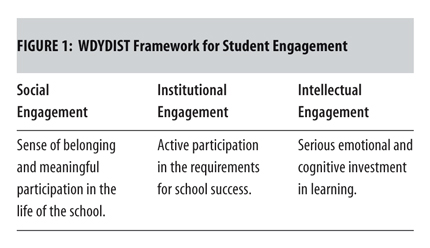
The systematic collection of data about students’ experiences continues to provide a foundation for inquiries into creating more effective and engaging learning environments.[3] First year results revealed generally low levels of student engagement. While almost 70 percent of the 32,322 students reported positive experiences of social and institutional engagement, only 37 percent felt intellectually engaged in learning. Not only are levels of intellectual engagement significantly lower overall, but a large majority of students begin to disengage from learning in Grade 7 and continue to do so until Grade 9, where levels remain fairly constant at just above 30 percent through to Grade 12. [4]
A new measure – instructional challenge – developed from Csikszentmilhalyi’s theory of flow, offers further insights into students’ experiences of learning by tapping into the balance between the challenge inherent in the work they are asked to do in classrooms and their skills to do that work (see Figure 2).[5] Across Canada less than half (between 42 and 47 percent) of middle and secondary students experience flow in their math and language arts classes. The remaining students find their schoolwork either too difficult or too easy, while a small percentage (less than 8 percent) felt apathetic toward their learning (“I can’t do it and I don’t care.”). The odds of students in the top left quadrant (low skills/high challenge) being intellectually engaged in learning are only 27 percent, with these odds falling even lower for students in the bottom left quadrant (low skills/low challenge).
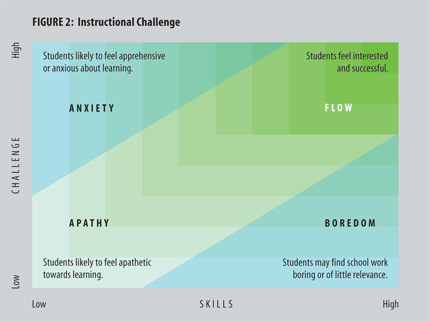
These ideas about intellectual engagement and instructional challenge that blend theory with insights about teaching practices and learning experiences, have resonated strongly with many educators and students because they reflect the kinds of learning they both aspire to.
Grounded in reliable data, the core concepts of What did you do in school today? have also become an important source of new local, regional, and national conversations about teaching and learning, the most expansive of which are seeking to understand what is required to achieve higher levels of intellectual engagement across grades, curriculum domains, and the range of abilities and aspirations students bring to their learning in the 21st century.
Learning in the 21st Century
One of the most promising debates to be revived by the ongoing evolution of the 21st century learning agenda draws attention to past, present, and future purposes of education. Though many continue to value secondary education primarily as preparation for the future (workforce or post-secondary studies), there is growing acceptance that this narrow focus (even though it reflects more contemporary notions of work) has been insufficient for some time now. If they are to have genuine personal choices about social, political, and economic opportunities in their futures, all young people need to be equally capable of mobilizing a wide range of “cognitive and practical skills, creative abilities and other psychosocial resources.”[6]
In acknowledging schools as important places for young people to gain an expanded set of competencies, the 21st century learning agenda creates room for understanding learning as a resource for “a successful life.”[7] Many educators will find this idea evocative because it reflects the beliefs about the purposes of schooling that they bring to their work. For school systems, however, the idea presents two significant challenges: not only does it suggest new objectives for learning – from the accumulation of discrete skills and facts to deeper levels of understanding required for the development of 21st century competencies – but it does so for all students, in all classrooms, and in all schools.
The journey towards a fully equitable public education system has been long and remains unfinished. Even with new evidence, a belief that all students can transition to adult roles (e.g. civic and cultural participation, earning a living, caring for self and family) with confidence and competence can feel like an uneasy fit with traditional beliefs about students: that some are “academically inclined” and others are not; that those who are apparently not “academically inclined” are best served in vocational or “applied” streams; and, that the competencies required for learning and thriving in the 21st century can be sorted according to pathways that students choose, or are encouraged and sometimes required to follow.
Students differ in their aspirations, interests, and aptitudes. But it is worth considering how distinct pathways, trajectories, or streams that too often limit opportunities for students could become permeable spaces for learning. What if the curriculum anchors their learning, but ceases to anchor the students themselves because its aim is the development of important competencies through diverse learning experiences that value and extend young peoples’ knowledge, interests, and capacities across all curriculum domains? Surely it is time to recognize that it is through “doing things” that students come to conceptual understanding.
Harnessing Head, Heart, and Hands in Learning
Perhaps the most challenging aspect of thinking about formal education grounded in the development of competencies for life is the way it calls upon school systems to contemplate new ways of learning, and therefore teaching and all that goes with it – curriculum, assessment, certification, selection, etc. Compared to mastering and measuring skills and facts, becoming a competent learner across a variety of human dimensions is complex. Competencies can be acquired, but it is not clear that they can be directly taught; they result from experiences that engage young people in thinking, doing, and feeling as pathways to “understanding the deeper things” about what they are learning.
All people, no matter what their age or what they are learning, become confident and competent by thinking about and doing things with ideas, practices, and tools. Personal interests and aspirations are both a source of inspiration and an outcome of these experiences. Essential relationships contribute to the social processes of learning. When any of these elements are missing or some receive greater attention than others, learning can take place, but it may be on a superficial level or quickly forgotten. To know something deeply is to feel it through the heart, hands, and mind.
The most accomplished educators, mathematicians, welders, athletes, computer technicians, chefs, community leaders, scientists, communicators, artists, mechanics will tell us that they became experts and developed a passion for their work through a deep conceptual and practical understanding of their fields. The constant interaction of “thinking” and “doing” – problem solving, experimenting, thinking critically and creatively, modelling and building, collaborating, reflecting – contributes to their learning and contributes to their field of endeavour as well as to the development of social and cultural competencies that are resources to positive ways of being and living in the world together.
To harness young peoples’ hearts in learning, the work they are asked to do needs to be interesting, challenging, and designed to allow students to experience agency in their classrooms. Elsewhere, we have also argued that the nature of the relationships students experience in schools and classrooms is a significant factor in their experience of engagement. Without the help of caring adults who are able to help students navigate (and negotiate) the institutional rules of engagement in school and to discover a passion for what they are learning, young people can easily conclude that school and success are not for them.
Adolescent learners want the work they are asked to do to mean something. They frequently ask for more “hands on” learning in classrooms. Today, more than ever, classrooms are hives of activity; but experience and activity are not the same things. Experiences that harness students’ hearts, hands, and minds for learning – from the shop class to the science lab – invite students into the curriculum in ways that allow them to experience it as something real, something they can “nudge about and look at from different sides, take apart, try out, become fascinated with … try to reinvent”[8] and become passionate about. Engaging students in the curriculum in this way is the foundation for what Carl Bereiter calls “intelligent action”[9] and what CEA has advanced as the concept of intellectual engagement.
With all that is known about how students learn and the significant difference that schools can make, there ought to be a way to sort all students into learning rather than sorting some of them out.
Schools and School Systems for Learning
In the past it was often assumed that disengaged students were easy to identify: they were the young people at the back of the class, the ones making their way to shop or special classes, or those lingering down the street well after the bell had rung. Data from What did you do in school today? suggest that disengagement is not – and may never have been – limited to small groups of students or as visible as we once thought. Over half of the students in our sample (n=32,300) – many of whom go to class each day, complete their work on time, and can demonstrate that they are meeting expected learning outcomes – are experiencing low levels of intellectual engagement.
Despite the prevalence of low levels of engagement among large numbers of students, many school systems continue to create special programs to re-engage students who are struggling to navigate institutional norms and/or achieve traditional academic programs. Such programs are “designed in ways that genuinely attempt to better meet the needs of all students,”[10] but there is also sufficient evidence that they continue to reinforce beliefs that school success is within reach only for some students. With all that is known about how students learn and the significant difference that schools can make, there ought to be a way to sort all students into learning rather than sorting some of them out.
In the context of the still emerging 21st century learning agenda, the concept of intellectual engagement provides a way into considering the kinds of learning experiences young people require to develop important competencies for learning and life. Perhaps, however, its greatest potential lies in bringing current aspirations for equity and excellence in education together through the hearts, hands, and minds of all students.
Strategies focused on improving the existing structures and processes of secondary schools have proven useful in creating important but incremental improvements. If we aspire to create learning environments where all students are engaged in using and developing 21st century competencies, however, a much deeper approach may be required; one that provides for inclusive and sustained work with ideas and practices that disrupt prevailing assumptions about teaching, learning, and educational outcomes.
The research is solid. Among all school factors that influence outcomes for students, teaching effectiveness makes the most difference. The idea of 21st century competencies for students is widely acknowledged, but what are the concomitant 21st century teaching competencies? What changes in educational practices do we need? What strategies at the school and district level are most likely to result in changes in classroom practices? How might we enhance instructional leadership of our schools? Will our students, teachers, and communities support new directions for teaching and learning? What is the role of the CEO in advancing ideas about teaching and learning in the 21st century?
These are not matters for educators alone. Ideas about schooling run deep in the collective psyche of society. We need to engage Canadians in deliberating about what they expect from their schools today. If we expect schools to assume responsibilities for the development of health and well-being; creativity and innovation; sustainability both local and global; ethical and cultural competence; and now it seems financial literacy as well, then clearly the redesign question is large. Adding further components to a model designed to do a different set of things simply won’t do.
EN BREF – Les qualités et les résultats désignés comme caractéristiques de l’apprentissage au 21e siècle font partie des débats sur l’éducation publique depuis des décennies. Depuis 2007, l’initiative Qu’as-tu fait à l’école aujourd’hui? mise sur les concepts établis d’engagement social et éducatif (ou institutionnel) et promeut le concept plus récent d’engagement intellectuel, en utilisant une série de mesures servant de fondement pour comprendre ce que font les élèves dans les classes, comment ils considèrent leurs expériences d’apprentissage et comment le travail qu’ils font contribue à leur apprentissage. Dans le contexte du programme d’apprentissage émergent du 21e siècle, le concept de l’engagement intellectuel fournit un moyen de considérer les types d’expériences d’apprentissage qu’il faut aux jeunes pour développer d’importantes compétences pour apprendre et pour vivre. Toutefois, son plus fort potentiel consiste à réaliser les aspirations d’équité et d’excellence en éducation dans les cœurs, les mains et les esprits de tous les élèves.
[1] M. Scardamalia, J. Bransford, B. Kozma, and E. Quellmalz, Draft White Paper 4: New Assessments and Environments for Knowledge Building. Assessment and Teaching of 21st Century Skills (Melbourne: University of Melbourne, 2010), 12. Available at www.atc21s.org/GetAssets.axd?FilePath=/Assets/Files/9112628e-0e9f-43f1-aa08-cc610fb4cdb3.pdf
[2] J. D. Willms, S. Friesen, and P. Milton, (2009). What did you do in school today? Transforming Classrooms Through Social, Academic, and Intellectual Engagement, First National Report (Toronto: Canadian Education Association, 2009). Available at cea-ace.ca/media/en/WDYDIST_National_Report_EN.pdf
[3] Students at schools participating in What did you do in school today? complete the Learning Bar’s Tell Them From Me 2.0 survey, which measures different aspects of social, institutional, and intellectual engagement; school and classroom climate; students’ self reported “achievement” in math, language arts and science classes; and a variety of demographic data relating to socio-economic status, ethnicity, gender etc.
[4] Willms, Friesen, and Milton, 16 – 29.
[6] Organization for Economic Co-operation and Development, The Definition and Selection of Key Competencies: Executive Summary, Paris, France, 2005), 8. Available at www.oecd.org/dataoecd/47/61/35070367.pdf
[8] C. Bereiter, Education and Mind in the Knowledge Age, (n.d.), 139. Available at www.ibw.uni-hamburg.de/KF/intern/bereiter/education_and_mind_(ohne_chapter_10).pdf
[10] R. Bolstad, (March 25, 2009) Disciplining and Drafting, or 21st Century Learning? Shifting to 21st Century Thinking (New Zealand Council for Education Research). Available at www.shiftingthinking.org/?p=546.
-
Teaching in a Participatory Digital World
Comments Off on Teaching in a Participatory Digital WorldSocial networking, cloud-based computing, and mobile technologies are transforming how people learn, work, and play. Digital technology has evolved quickly from personal computers and networks to participatory social, academic, and political Web 2.0 environments with a new vocabulary and new temporal and spatial interactions. Web 2.0 applications – Safari, Geocaching, Flickr, Google, Blogger, GarageBand, Wikipedia, YouTube, iMovie, Facebook, Twitter, iPhone, and iPad – are part of a new user-centric information infrastructure that emphasizes creative participation over presentation; encourages focused conversation and short briefs written in less technical, public vernacular; and facilitates innovative explorations, experimentations, and purposeful tinkerings that often form the basis of situated understanding that emerges from action not passivity.1
This digital world calls for changed mindsets about schooling, teaching, learning, and assessment. Teachers – who are often more comfortable with broadcast and interactive technologies – are now expected to embrace online participatory learning technologies in support of active, passion-based learning by students who live and will work in a digital world. These teachers need support in making major shifts in their practice: how they work with disciplinary knowledge, how they design for learning and assessment, and how they embrace technology. It is time for top-down approaches to schooling to give way to the active, engaged, and collaborative teaching and learning relationships made possible by new educational technologies.
In this digital world, engaged teaching matters more than ever. Combining inquiry and technology opens the door to powerful new teaching and assessment practices that result in documented benefits for learners.2 But how do we provide rich and meaningful professional learning opportunities that engage teachers in making the shifts that are required of them in blended and open participatory digital classrooms? How do we help them prepare young people to make the most of the technologies at their fingertips?
A Shifting Digital World
The world of work has changed.3 Technological advances – along with always-available, always-connected personal mobile devices – are enabling corporate communities of practice in which colleagues share experiences, reflections, and insights in a continuous dialogue, unleashed from the four walls of an office or the hours of a standard workday. These 24/7 asynchronous communication capabilities allow corporate knowledge workers to take control of the workday and extend collaborations online in ways that significantly change how 21st century work is conceived, conducted, and completed.
The most powerful thing teachers do to engage students is to design engaging, meaningful, and authentic work and technology-enhanced learning experiences.
If work is now about networking, question-posing, critical assessment of information and media, collaborative team work, and creating new knowledge and ideas, then today’s students require opportunities to develop the competencies they need for expert adult performance in digitally rich and net-connected school spaces.
Young people are already connected and resourceful; they use personal technology in creative, entertaining, and collaborative ways. But to go beyond facts and procedures, they need engaged and skilled teachers to guide and mentor them towards the deeper conceptual understandings and core competencies that allow them to reason about real-world problems, critically analyze information, and engage successfully in 21st century work.
Teaching and Learning in the Digital Age
The most powerful thing teachers do to engage students is to design engaging, meaningful, and authentic work and technology-enhanced learning experiences. In other words, teaching matters. Research on engagement indicates that teachers have a greater effect on students’ learning outcomes than the schools they attend; this holds true at both the elementary and secondary levels.4 In order to improve learning in a digital world, we need engaged teachers who are supported by professional learning opportunities to continually improve and strengthen their digital competencies and their teaching and assessment practices.
Engaged teachers and engaged students go hand in hand. Research has shown us that engaged teaching practices can enable all students to achieve at high levels and that students have better educational experiences when teachers and students actively collaborate in the process of knowledge building and idea improvement.5 We know that certain teaching practices and learning processes engage students and teachers in deeper and more sustained learning by connecting them with knowledge and technology in ways that make a difference to themselves and to others.
In 21st century learning spaces, students can become engaged in challenging work that has value beyond the classroom – in authentic, inquiry-based tasks that captivate their hearts and minds. The many benefits – for both students and teachers – of learning in such contexts, using technology in appropriate and innovative ways, have been well documented. Strong discipline-based inquiry work exhibits a number of very discernible characteristics, including academic rigour, authenticity, assessment that is deliberately woven into the work, digital technology that is used in purposeful and authentic ways, connections with experts beyond the school, constructivist approaches to learning, and relevance beyond the classroom. From a longitudinal study at a “1-2-1 laptop” school, student work demonstrating deep understanding of sophisticated concepts emerged from discipline-based inquiry tasks that were intentionally designed with clearly defined criteria in mind.6
But students cannot develop deeper conceptual understanding simply from teachers instructing them better. Learning sciences research has demonstrated that only active participation in knowledge construction allows for deeper conceptual understanding of disciplinary concepts and increased motivation for learning.7 Teachers who engage students in authentic tasks intentionally design active learning opportunities that are similar to the everyday activities of professionals who work in a discipline. By combining these tasks with appropriate technology, students are able to represent their learning in a variety of ways that provide teachers with greater insight into the depth and extent of their understanding.
Reflection on learning is important, both for students and for teachers, and this, too, can be enhanced by appropriate uses of interactive technologies. Students learn better when they express their developing knowledge – either through conversation, or by creating written assignments, media artifacts, or visual messages – and are provided with opportunities to reflectively analyze their state of knowledge. Research has also demonstrated that the more opportunities teachers have to work collaboratively with colleagues and professional development experts, to engage in professional dialogue about teaching and learning, and to make their work public, the more engaged they become in inquiring into and strengthening their own practices.8
Outside of formal schooling, almost all learning occurs in complex social environments…Teachers who design for peer collaboration and individual reflection on learning cultivate stronger learning outcomes.
Worthwhile and academically rigorous work requires students to use their minds well and to demonstrate innovation, problem-solving, and reasoned judgment. Digital learners use multiple media forms and Web 2.0 outlets to share their work beyond the classroom. When student inquiry projects focus on enduring ideas from within the disciplines and on knowledge building and elaborative communication versus individual memorization and recall, then the appropriate use of technology helps learners to think differently and to gain deeper understanding.
Effective Social Learning Online
Outside of formal schooling, almost all learning occurs in complex social environments.9 When online learners have more control of their learning and participate in active or interactive learning experiences such as collaborative, project-based learning tasks, larger learning gains are observed.10 Complex social environments and interactions can clearly be cultivated online. The thoughtful design of meaningful online learning experiences matters; teachers who design for peer collaboration and individual reflection on learning cultivate stronger learning outcomes.
Barbara Means, a leader in evaluating technology-supported educational innovations, led a team of researchers to study evidence-based practices in online learning.11 A meta-analysis of more than 175 studies found that online learning or blended learning conditions produced stronger learning outcomes than did classes with solely face-to-face instruction. The combination of additional learning time, rich online materials, and additional opportunities for collaboration produced the observed learning advantages.
Means’ study also showed that teaching and the design of meaningful learning tasks matter more than the particular online technologies used to promote interaction, reflection, and active learning. That said, online learning experiences were more likely to be student-directed, interactive, and collaborative in nature than teacher-directed. The perfect blend appears to involve greater time-on-task for students, with access to rich, interactive curriculum materials – such as online simulations, digital experiments and data collection sites, online reflection tools, and self-assessment strategies.
At its best, then, online learning combines the benefits of digitally available content with a responsive teacher and student peer groups to support the kind of interaction, collaboration, and discourse that builds higher-order critical thinking skills. When educators blend the best features of in-class teaching with the best features of online learning, they promote active, self-directed, and flexible learning opportunities that are supported with appropriate digital technologies.
John Seely Brown and Richard Adler describe the growth and expansion of the Internet as brewing the perfect storm of opportunity for education,12 providing online access to high-quality tools like scanning electron microscopes and supercomputer simulation models that allow students to engage personally in research and that foster a new culture of sharing in which content is freely contributed and distributed. The evolution of Web 2.0 is blurring the line between producers and consumers of content and shifting attention from access to information to access to other people, and online experiences and virtual communities like Second Life are allowing people with common interests to meet, share ideas, and collaborate in innovative ways.
The greatest educational benefit of online social learning and Web 2.0 technologies is putting students in touch with each other. Social learning is based on the premise that our understanding of content is socially constructed through conversations and through interactions, especially with others, around problems or actions. Collaborative online social learning opportunities increase peer interaction and access to each other’s ideas, experiences, and knowledge; it offers more opportunities for students to find and join niche communities where they can benefit from the opportunities for distributed cognitive apprenticeship; and it goes beyond providing access to traditional course materials and educational tools to create a participatory architecture for supporting communities of learners.13 In the hands of a skilled teacher, these tools can be used to cultivate lively debate and exchange of ideas, support the social construction of knowledge, and democratize the classroom.
In order for educators to leverage Web 2.0 and social learning opportunities, they need unrestricted and unfiltered access to online communities and resources using reliable, mobile, and powerful devices and networks. It is the responsibility of school jurisdictions to design and maintain robust school networks that are open to student-owned devices, and to trust principals, teachers, and students to use the Internet critically and ethically rather than filtering and firewalling access to open participatory ecosystems.
Ongoing Professional Learning in A Digital World
Theories of knowledge, learning, teaching, and technology are shifting. Knowledge is more than storage; it is socially constructed and shared. Learning is more than memorization and recall; it is an active, situated, and engaged process of making meaning, interpretation, and developing deep understanding. Teaching is more than information delivery; engaged teaching involves the design and support of rich learning experiences. Technology is more than a tool; it supports deep and engaged learning, simultaneous articulation, creation, and reflection in participatory social networks and dynamic ecosystems. Teachers who have spent an entire career mastering the skills required to manage a 20th century classroom need support to design 21st century social learning approaches in participatory Web 2.0 environments.
We cannot shut down the education system while teachers retool their practices and jurisdictions bring technological infrastructures up to standard. Even if we could, simply training teachers in the use of current technologies will not promote the engaged and active learning we need. Instead, teachers need continuous professional support while they learn to design rich, authentic learning tasks and support the evolving needs of their students. Teachers as well as students learn by engaging in meaningful design work; by studying, doing, experimenting, and reflecting; by collaborating and conversing with peers; by sharing what they see, do, and create with others. In order to understand how to effectively design learning that uses technology to increase student engagement, teachers need opportunities to engage and learn in similar ways themselves, and subject their learning to peer review and critique.
High quality, blended professional learning experiences that transform teaching practices do exist.14 The Galileo Network (www.galileo.org) is a participatory learning ecosystem that engages teachers in scholarly communities of inquiry, along with their teaching colleagues, to transform their practices for a digital world. Working collaboratively, face-to-face, and online with over 2,000 teachers, 200 school administrators, 300 district level professional development providers, and 50 district administrators, Galileo mentors and researchers have been able to create robust research and images of practice for 21st century learning, teaching, and leading.15 It also provides an online showcase of successful case studies (www.galileo.org/tips/inquiry.html).
Galileo mentors cultivate 21st century practices by working alongside teachers who are dedicated to improving student learning through engaging in professional learning while conducting and applying research. They have developed a set of web-based tools – Intelligence Online (IO) – for creating inquiry projects for students, as well as an open forum where teachers at all levels of experience (and from anywhere in the world) can post their own projects and can participate in ongoing conversations about effective teaching and assessment practices (www.iomembership.com). As members in the Galileo Network, teachers learn how to design and teach in a digital world by using rich online tools and resources; by collaboratively developing rich tasks and student inquiry projects; by actively accessing, evaluating, and developing online educational content and learning experiences; and by participating in online forums within IO to discuss student engagement, the design of great tasks, authentic assessment, and uncovering the curriculum.
Through this network, teachers become active members in scholarly communities of inquiry in which their teaching practices are shared publicly, open to discussion and critique, and subject to continual improvement. Partnerships between the University of Calgary, schools, and the Galileo Network provide rich opportunities for inquiry and digital apprenticeship of student teachers.16 Student teachers observe how classroom teachers design and support inquiry projects for students, and design their own tasks and authentic assessment strategies. In the company of their teaching colleagues, student teachers implement their project and task ideas with students and engage in professional dialogue about what is working well, what needs to change, and what their next teaching steps must be in order to support student learning.
Conclusion
Investments in high quality professional learning opportunities to support teachers in designing meaningful, highly engaging, blended learning experiences for students do pay off. Professional dialogue and learning opportunities for a digital world need to be designed and led by professional mentors, teaching colleagues, and school leaders who model 21st century teaching and learning practices.
Teachers matter more than ever, and the education system needs to be held accountable for the teaching that is practiced in the current technology-rich environment. Principals must engage in continuous professional learning to understand the changes required for 21st century teaching and learning. School jurisdictions must put powerful digital technologies in the hands of every student and teacher, and trust them to use open and secure networks and resources well. Faculties of education need to provide rich and meaningful ongoing learning opportunities for both pre-service and inservice teachers. Provincial ministries need to resource ongoing and appropriate professional development for teachers and deploy innovative and creative solutions for technological resources and infrastructure. Educational stakeholders must work together, learn together, design and evaluate student understanding and learning together, and leverage each other’s best practices to imagine and to create context-specific ideas, practices, and solutions that are flexible and responsive to the diverse learners that each school serves in open participatory learning ecosystems.
EN BREF – Le monde numérique exige que l’on change d’attitude à l’égard de la scolarisation, de l’enseignement, de l’apprentissage et de l’évaluation – et une pédagogie active importe plus que jamais. La combinaison du questionnement et de la technologie ouvre la porte à de puissantes nouvelles pratiques d’enseignement et d’évaluation conférant des avantages confirmés aux apprenants. Pour réaliser ces avantages, les enseignants ont besoin de soutien en vue de changer radicalement leur travail : dans leurs façons de transmettre les savoirs de différentes disciplines, de planifier l’enseignement et l’évaluation, d’intégrer la technologie. Le moment est venu de remplacer les approches directives de scolarisation par des relations d’enseignement et d’apprentissage actives, engagées et collaboratives, rendues possibles par les nouvelles technologies éducatives. Comment pouvons-nous offrir des possibilités d’apprentissage professionnel riches et utiles incitant le personnel enseignant à apporter les changements nécessaires pour instaurer des classes numériques participatives, intégrées et ouvertes? Comment pouvons-nous aider les enseignants à préparer les jeunes à exploiter au mieux les technologies dont ils disposent?
1 J. Seely Brown and R. P. Adler, “Minds on Fire: Open Education, the Long Tail, and Learning 2.0,” EDUCAUSE Review 43, no. 1 (January/February 2008): 16–32.
2 M. Jacobsen, Learning Technology in Continuing Professional Development: The Galileo Network (Lewiston, New York: The Edwin Mellen Press, 2006); M. Jacobsen, C. Saar, and S. Friesen, “Teaching and Learning in a One-To-One Personalized Computing Environment Year Three: A Research Report on the Personalized Learning Initiative at Calgary Science School.” 2010.
3 M. Bjerede, K. Atkins, and C. Dede, “Ubiquitious Mobile Technologies and the Transformation of Schooling,” Educational Technology 50, no. 2 (2010): 3-7.
4 J. D. Willms, S. Friesen, and P. Milton, What did you do in school today? Transforming Classrooms Through Social, Academic and Intellectual Engagement, First National Report (Toronto: Canadian Education Association, 2009). Available at www.cea-ace.ca/whatdidyoudoinschooltoday
5 Ibid.
6 Jacobsen, Saar, and Friesen.
7 R. K. Sawyer, ed., The Cambridge Handbook of the Learning Sciences (New York, NY: Cambridge University Press, 2006).
8 Jacobsen, Saar, and Friesen.
9 Sawyer.
10 B. Means, Y. Toyama, R. Murphy, M. Bakia, and K. Jones, Evaluation of Evidence-Based Practices in Online Learning: A Meta-analysis and Review of Online Learning Studies (Washington, D.C.: U.S. Department of Education, Office of Planning, Evaluation, and Policy Development, 2009). Available at www.ed.gov/about/offices/list/opepd/ppss/reports.html
11 Ibid.
12 Brown and Adler.
13 Ibid.
14 Jacobsen, 2006.
15 Ibid.; S. Friesen, “Galileo Educational Network: Creating, Researching and Supporting 21st Century Learning,” Education Canada 49, no. 5 (2009): 7-9.
61 M. Jacobsen, “Creating Inquiry in the Classroom: Preservice Teachers Learn with Students,” Inquiring Minds 3, no. 2 (2010). Available at www.galileo.org/about/vol2issue3.pdf
-
Getting Personal with Technology
Comments Off on Getting Personal with TechnologySometime in the early 1980s, the first computer took up residence in our home, a Commodore 64. It was a marvel of a machine, according to my husband and children – he because of its word processing and spreadsheet capacity and they because of the games, of course. You could even draw little pictures on it – not as well as with a pencil on paper, but still amazing. It could take the place of my typewriter, my husband insisted, but I balked. Not until the first Mac arrived on the scene, a few years later, did I reluctantly begin to play with word processing and the earliest page layout programs. Within weeks, the typewriter was relegated to a closet, where it remained for several years until no one wanted a typewriter anymore.
All this, of course, was long before the technology became “interactive” and long before the Internet. It was at times useful, at times fun, but never personal.
Last winter I took an online writing course. I read lectures, posted submissions, chatted with fellow classmates, critiqued the work of others, queried the instructor, and felt genuinely engaged with the process and the other nine students – who were from all over North America, and one from Australia. By the time the course ended, I felt I’d made friends, although we will probably never see one another – except on Skype, if we want to.
And yet, my course barely scratched the surface of the technology’s potential for interactive learning and personal engagement. In her article on teaching in a participatory digital world, Michele Jacobsen says, “Web 2.0 applications… are part of a new user-centric information infrastructure that emphasizes creative participation over presentation; encourages focused conversation and short briefs written in less technical, public vernacular; and facilitates innovative explorations, experimentations, and purposeful tinkerings that often form the basis of situated understanding that emerges from action not passivity.” The stuff of real learning, and the same concept of learning through doing that Jodene Dunleavy and Penny Milton promote in their article on student engagement. Nothing impersonal about it.
It’s hard to imagine schools without computers anymore. And there aren’t many luddites left who refuse to check their email or google for information. But here’s the problem: it’s easy to think that’s enough. In the emerging world of digital learning, it’s not. Teachers, as well as students, need to become comfortable about learning with technology – using these powerful new tools to create learning experiences that are both engaging and personal.
-
Youth Confidence in Learning and the Future: A Concept Paper
Comments Off on Youth Confidence in Learning and the Future: A Concept PaperThe Canadian Education Association (CEA) is developing a research and mobilization project to examine young people’s confidence in their learning and how it influences their aspirations, expectations, and engagement with the world, in particular, their belief that they can act on the world to have a positive impact. The Youth Confidence in Learning and the Future (YCLF) initiative will address the gaps in our knowledge and help to kick-start conversations in communities across Canada about enhancing learning environments for young people. The project will profile youth’s perceptions and attitudes and identify implications for education and other areas of policy and practice.
-
Research Use and Its Impact in Secondary Schools: Executive Summary
Comments Off on Research Use and Its Impact in Secondary Schools: Executive SummaryThis is the second annual year-end review of education research that has been featured on the CEA website and in the Bulletin, our monthly newsletter. It summarizes, by theme, notable reports, briefs and studies, identifying trends and highlighting areas of consensus, tension, and discrepancy. Also included are recommendations to related articles from Education Canada, CEA’s flagship magazine. We trust you will find it useful for your work, and encourage you to share it with colleagues.
-
Étude Ontario-Québec Secteur de l’éducation
Comments Off on Étude Ontario-Québec Secteur de l’éducationÉTUDE ONTARIO/QUÉBEC is an interprovincial initiative of the Ministries of Education of Ontario and Quebec that examined the use of information technology in the classroom by comparing students’ level of engagement, comprehension and knowledge transfer using two different technologies. In Ontario, students used a digital audiovideo simulation training module on CD-Rom. In Quebec, students collaborated with peers and the teacher through the use of a Knowledge Forum. This comprehensive report details the process and results of this unique interprovincial collaboration. (Available in French only)


IDEAS TO SUPPORT EDUCATORS : Subscribe to the EdCan e-Newsletter
Quality research, reports, and professional learning opportunities.