Archive
-
Reporting in Rectangles
Comments Off on Reporting in RectanglesAs a child walking home from school, I remember feeling anxious on those days when I was accompanied by a sealed manila envelope meant only for my parents’ eyes. Folded inside, a report card listed a range of subjects and learning skills along the left margin. Along the right side, was a list of handwritten letters that twice each year would announce my scholastic achievements.
Made up of rectangular boxes aligned on rectangular sheets of paper, the hallmark of the report card is that list of grades. Numbers or letters are intended to represent the achievement of a young person, who too often sits at a rectangular desk in a rectangular room, and provides evidence of learning by making pencil scrapings upon rectangular pieces of paper.
Today, I have in my possession a range of historic and very rectangular artifacts of my own learning. On my Kindergarten report, there are three levels of achievement neatly written into the squares. My report included thirteen satisfactory ‘S’s; and one limited ‘L’ for “expresses himself well in creative activities”. The only comment provided by the teacher on the report card is “Sometimes, Rodd gets into mischief.”
My Grade 1 report card, was the first to officially include grades. I had three As, nine Bs and three Cs. As proof that I was egocentric as a six-year-old, my takeaway comment was “Rodd is quite confident now in expressing his ideas. He could develop more interest in the ideas of others.”
By the time my Grade 6 report card arrived, my grades had become a straight VG student on a scale that ranged from ‘needs improvement’ to ‘very good’. I was “A very conscientious boy. A joy to teach.” But the squares on my report card failed to capture the fact that I truly loved to learn; or to recognize that my teachers so fully engaged me that I couldn’t imagine doing anything but stay in school forever.
In later years, I joined my classmates in tearing open our report cards on the way home for summer. We ritually counted our VGs and Gs as the most efficient way to compare our reports with those of our classmates. But such feedback only confirmed what we already knew, that some of us did school well, and others did not.
This ranking and scoring of learning has been with us for many years. In “Technopoly”, Neil Postman credits William Farish, a tutor at Cambridge University in 1792, for being the first to suggest assigning numerical values to student work. Since that time, the concept of grading has been widely adopted, and most accept it as normal and completely logical. I think it’s time we begin to at least question the practice.
Though much of the daily work of the teacher is focused on finding ways to assess learning and to justify grades, these marks are commonly an end point to learning, rather than a directional tool that might suggest individualized learning goals and apt teaching strategies. Whether using letters or numbers to assign grades, I think that the very measurement of something as abstract as “learning” is worth a rethink.
Academic assessment has brought us to a place where teachers routinely watch children cry their way through high stakes tests, where the only feedback the learner might receive is a one-digit number. Learning should be a lifelong human experience, not a snapshot-in-time statistical experience. Surely we can value and celebrate learning without attaching a score.
Would you ever consider digitally assessing your love of a new compact disk? Would you grade the degree to which you’re a fan of a haircut or ball gown? Can a score accurately reflect your ability to repair a dripping faucet or your skill at re-introducing yourself to an acquaintance? Or is it even possible to calculate the percentage grade you’d receive for being an informed and engaged citizen?
The most memorable moments of learning are those when we break free from the rectangles, where it becomes impossible for any variable to truly capture an experience or achievement. How does one assess the day a Grade 8 student brought her horse to school to share her observations about the intelligence of her pets; the day my students figured out for themselves what dirt was made of; the day we hiked through the amazingly ice cold waterfall on the edge of Quebec City; the day our first classroom constitution was drafted and ratified; the night we hosted a ‘Council of all Beings’ campfire summit on the edge of Lake Erie?
Former students regularly give me the most meaningful feedback on my classroom work, and they do it in the form of words spoken face to face. Not one has ever thanked me for introducing them to rectangular pieces of paper, or for filling in a box on a report card. Let’s give students more of the qualitative learning experiences that don’t fit so tidily into rectangles. That’s what they’ll remember.
-
Democratic Deliberation – A Basic Skill for the Future
Comments Off on Democratic Deliberation – A Basic Skill for the FutureIn 1651 Thomas Hobbes famously asserted in Leviathan that without a “commonwealth” based on a “social contract” the world is a jungle “where every man is Enemy to every man … wherein men live without other security than what their own strength, and their own invention, shall furnish them.” He argued for a strong central government to counteract man’s fundamental nature—I presume he meant hu-man nature—and contended that without it life would be “solitary, poor, nasty, brutish, and short.”
Was Hobbes right? Can a society thrive only if its members’ basic instincts are constrained by external forces so that their higher ideals and collective potential can be realized? If so, what scaffolding is required? Which of our basic human rights are inalienable and what constraint on the others is justifiable, if any? In a more positive vein, what about our interdependence? Clearly, as Hobbes’ contemporary John Donne commented in his Devotions,[1] “no man is an island” and connection only increases as numbers crowd Spaceship Earth, but does this mean that we must be “our brother’s keeper”? What is our responsibility to others? Do we see collective “peace, order and good government” as the ideal, as stated in the Canadian Constitution, or is it individual “life, liberty and the pursuit of happiness,” as stated in the American Declaration of Independence? Does an excessive focus on our personal liberty lead us towards the Tragedy of the Commons?[2]
These are examples of fundamental, recurrent questions that underlie our response to critical social issues such as public safety, healthcare, education and environmental protection. Such starkly phrased choices are, of course, more properly expressed as complexly nuanced dilemmas, but at the heart of things there are some foundational decisions to be made about what we believe and value, and those decisions determine who we become. But the issue is not merely personal, it is also political, and the collective answers inevitably and inexorably shape the society we create. If one abstains from the public discussion of this issue then the ability to decide it is ceded to the most fervent and their answers will be the ones that determine the sort of world in which we will live. This would not be wise!
In order for students to be prepared not only for the future but also to forge that future, they must have opportunity to engage with such foundational questions in age appropriate ways so that they, first, realize that they are questions and that multiple responses are possible, and, second, develop a conscious personal point of view on them. Then they have to learn how to deliberate respectively with those who hold a different point of view.
This is a critical aspect of becoming “educated,” not simply absorbing answers that extinguish perplexing questions but developing the ability to engage continuously with them and to deliberate with others in order to understand their perspectives and thus develop the “commonwealth,” or “social contract,” that enables society to flourish in a diverse and finite world. This is essential for democracy.
Unfortunately, this democratic inclination and deliberative ability seems to be in decline. Increasingly we see polarization of views and vilification of those who disagree. More and more people seem to hold the fundamentalist perspective that those who disagree with them about taxation or education or drug abuse or climate change are not only mistaken but evil.
It’s not “this is a complex issue upon which we disagree and about which neither of us has total insight so we need to learn from each and work together to resolve it,” but “I’m right and you’re wrong so I need to vanquish you in order for the right to triumph.” American politics has fallen deeply into this dysfunctional pit of arrogant, implacable advocacy in which compromise is seen as weakness and Canadian politicians seem to be increasingly adopting the approach. It seems to win elections but it is a selfish, short-sighted strategy that also creates a great danger for our country and for the world at large.
What we need is just the opposite—a democratic hospitality to difference. The knowledge, skills and attitudes that enable respectful democratic deliberation are arguably even more basic and essential than the traditional 3R’s. What good is powerful literacy and numeracy in a self-absorbed bigot?
Some would say that it is not the job of schools to teach values but surely nobody would argue that it is not the job of schools to teach democratic ideals, skills and behaviours. This is not a matter of indoctrinating students with any particular viewpoint or belief, but it is a matter of developing their skills and dispositions, and it is a matter of inculcating the value of respectful engagement with differing or unfamiliar viewpoints and beliefs. It requires the humility to know that you may be wrong and yet the courage to be appropriately assertive in support of what you believe. It is a matter of developing a deep keel rather than an anchor.
As we add “new basics” to the list of 21st Century Skills, this is one not to be forgotten. We allow democratic deliberation to continue to decline at our peril.
[1] “No man is an Iland, intire of itselfe; every man is a peece of the Continent, a part of the maine; if a Clod bee washed away by the Sea, Europe is the lesse, as well as if a Promontorie were, as well as if a Mannor of thy friends or of thine owne were; any mans death diminishes me, because I am involved in Mankinde; And therefore never send to know for whom the bell tolls; It tolls for thee.” Cited from http://en.wikipedia.org/wiki/Meditation_XVII
-
What Students Say About Inquiry
Comments Off on What Students Say About InquiryLast week I reflected on my experience with inquiry in my English 8 classroom. This week I turn this space over to my students who want to tell you what inquiry is like for them. The following reflection was co-written by James Telford, Nathalie Joyal, Andrea Camarena, Nina Gous, Michael Ji, Chaissan Ashcroft, and Alex Wagstaff.
What is inquiry-based learning like?
So far this year we have done several inquiry based leaning [sic] questions. We have enjoyed how using inquiry has made us think deeper in the article and lets us take our learning into our own hands. Some people can’t control themselves because of this independent learning and that hinders others who can. On the other hand this format of learning is more flexible and allows you to learn in your own ways. Inquiry allows deeper connections and thought processes towards the curriculum. A more structured question limits our personality in our work. On the other hand this work can become more challenging because you are playing the part of the teacher and finding the specifics of your question. There are many different ways of looking into inquiries.
We believe that one of the most effective ways to approach an inquiry is to gain knowledge from books and websites. There are always differences between each inquiry and each perspective so all the outcomes will be different. Everyone also has a different way of representing their [sic] findings, which can make more or less of an impact. The inquiry style of a project allows for more maturity from the student/students. Overall our opinion on an inquiry-based project is that while it is exhausting, the finished product is always worthwhile.
Thank you for sharing your thoughts, Grade 8s! To give the readers some idea of what kind of “product” we’re talking about here, one group agreed to let me post their video which they created in response to their inquiry, “How do people find happiness in the darkest of places?“
-
Reconceptualizing Teacher-Student Relationships to Foster School Success: Working Alliance Within Classroom Contexts
Comments Off on Reconceptualizing Teacher-Student Relationships to Foster School Success: Working Alliance Within Classroom ContextsThe environments in which children live and learn have a significant impact on their development. Since classrooms are undoubtedly one of the most influential contexts in which children participate, it is not surprising that positive teacher-student relationships have been shown to contribute to students’ overall school adjustment, including their psychosocial, behavioural, and academic functioning.[1] However, teachers often find it a challenge to develop meaningful connections with all of their students, particularly with those who demonstrate learning and/or behavioural difficulties.
Tyler is a bright and lively Grade 5 student in Ms. Rose’s homeroom class. Although he is usually easy-going, he has difficulty focusing in class and often becomes loud and disruptive during work periods. When speaking with Ms. Rose, he often complains that no one likes him or listens to what he has to say. Tyler’s performance and engagement in classroom tasks is inconsistent. He sometimes appears to understand what is expected of him, but at other times appears completely lost. He rarely asks for help and often seems confused about where he went wrong. When a difficult situation arises in the classroom, Tyler will often refuse to discuss it or consider how he may have reacted differently. Several times, he has become oppositional and had angry outbursts when confronted by Ms. Rose about his behaviour.
Ms. Rose tries hard to build a relationship with Tyler, but his inconsistent behaviour is frustrating. Most teachers have experienced a similar situation; they understand the importance of forming an emotional connection with their students, but find it challenging, especially with students who experience difficulty in the classroom due to a combination of social skills, behaviours, and inconsistent academic performance. This is of utmost concern, since a positive teacher-student relationship seems to have an ongoing protective influence, especially for children who are struggling at school.
The Challenge in Building Relationships
An emotional bond is a fairly abstract concept, so it is not surprising that emotional connections can be difficult to target and improve. Can we truly describe the concrete behaviours that enhance the quality of teacher-student interactions? How might we begin to understand ways to build relationships with our most difficult students?
While we know that strong, positive teacher-student relationships improve student engagement and the likelihood of school success, this relationship is often too narrowly defined. In fact, existing research tends to measure the quality of the relationship exclusively as the degree to which teachers perceive a liking, trust, connectedness, or a general absence of conflict between themselves and their students. This bond is clearly important, but relationships in the context of the classroom are also influenced by the interactions relating to learning goals and tasks.
Vanessa is a student in Ms. Steacy’s Grade 3 class. She gets along well with teachers, school staff, and her classmates. Vanessa has recently been identified as having a reading disability, and she is finding it very difficult to keep up with classwork and assignments. Although Vanessa is a very agreeable student, she will often leave her work unfinished. Ms. Steacy believes that she has a strong bond with Vanessa, but senses that Vanessa does not feel like a contributing and productive member of the classroom. She wants Vanessa to feel comfortable asking questions and coming to her for extra help. At times, Vanessa seems unaware of what is expected of her and does not believe that her reading difficulties will improve. This impacts Vanessa’s perceptions of herself and her abilities, as well as her willingness to take risks in her learning. She often finds the reading demands overwhelming and will give up when confronted with tasks that she thinks are “too hard”. During conversations with Ms. Steacy, Vanessa becomes negative about her progress and questions the point of doing the work when she can’t read.
Because the classroom should be an environment that fosters strong and positive working relationships, it is necessary to recognize the complexity of the interactions that take place within this context.
Ms. Steacy has a positive emotional connection with her student. Vanessa likes and respects her teacher and enjoys working in her classroom. But she does not feel secure in trusting her teacher with her learning needs – likely due to her past experiences with failure in reading. In this example, we can see the limitations in understanding the teacher-student relationship as primarily an emotional connection. This restrictive definition can make it difficult to teach concrete skills that enhance the quality of interactions, to focus on students’ needs related to the tasks of learning, and to surpass personality differences that may exist between teachers and students. Because the classroom should be an environment that fosters strong and positive working relationships, it is necessary to recognize the complexity of the interactions that take place within this context.
Broadening the Definition of Relationship
In the counselling psychology field, this working relationship is defined as the “working alliance”, referring to the quality of the relationship between therapist and client. The quality of alliance has consistently been found to be one of the best predictors of positive outcomes for clients participating in therapy. The construct of the working alliance is comprised of three components: bond, goal, and task.[2] The aspect of bond represents the emotional component of the relationship, based on mutual trust, respect, and caring. However, alliance also encompasses the aspects of relationship that focus on building a sense of partnership; this includes the shared development and understanding of the established goals and the tasks that need to be undertaken to achieve those goals.
In order to expand the investigation of working alliance to the classroom setting, my colleagues and I developed the Classroom Working Alliance Inventory (CWAI)[3] – a questionnaire that considers both teachers’ and students’ perceptions, and broadens previous definitions to consider variables unique to a classroom working relationship. This inventory replicates the three critical components of alliance: bond, goal, and task. The Bond questions ask teachers and students about their general feelings toward one another (e.g., “I believe Tyler likes me” and “My teacher and I trust one another”).
While this first component taps the emotional aspects of relationship, the remaining components focus on the collaborative aspects that characterize a working relationship. The Goal questions measure the extent to which the teacher and student feel that they are collaborating on the classroom goals by tapping their mutual understanding about classroom objectives (e.g., “We are working towards goals that we have agreed upon together” and “We agree about what I need to do differently in school”). The Task questions ask whether teachers and students feel that assigned tasks are relevant to each individual student’s learning and will help him or her achieve success (e.g., “I am confident that what Vanessa is doing in school will help her learn better in the areas that she has difficulty” and “My teacher and I agree about the things I need to do to help me improve my schoolwork”).
In our recent work, the CWAI was completed by 430 Grade 3 students and their teachers and was found to be an internally consistent and externally valid measure of teacher-student relationship, supporting its use in research.[4]
Investigation of the Working Alliance Within Classrooms
Over the past several years, we have begun to investigate how teacher-student alliance is related to perceptions of school performance, school satisfaction, and various other school-related outcomes. The first study to employ the CWAI examined elementary students’ and their teachers’ reports of alliance, and how these reports related to perceptions of students’ school performance. We found that students who felt that they had a strong working alliance were more likely to engage in positive learning behaviours, as rated by both themselves and their teachers. Teachers’ ratings of alliance, on the other hand, predicted only their own views of student performance, and not the students’ perceptions of their own engagement. These findings indicated to us that student evaluations can provide important information about the quality of classroom working alliance, a notion that has previously been overlooked in much of the teacher-student relationship literature based solely on teacher reports.[5]
In a further study, we found that both teacher and student ratings of working alliance were related to elementary students’ reports of school satisfaction. Not surprisingly, students who felt that they had strong, positive working alliances with their teachers were more likely to enjoy and have positive attitudes toward school, engage in classroom activities, and express affiliation with their schools.[6]
In one of our most recent studies, we were interested in examining classroom working alliance among upper-elementary students with and without special needs (identified learning and/or behavioural difficulties). We found that teachers generally had more negative perceptions of their alliance with students with special needs, whereas, students with and without difficulties showed no difference in their own perceptions of alliance.
In this study, ratings of alliance were found to influence a number of school-related outcomes for all students. However, when examining academic competence and school satisfaction, it appeared that the collaborative elements of working alliance (goal/task) were particularly important for students with special needs. That is to say, students with special needs who felt that they had a positive and collaborative alliance with their teachers were less likely to express levels of low academic competence and school satisfaction.[7]
Putting Classroom Working Alliance Into Practice
Understanding alliance. It is clear that the quality of teacher-student relationships can contribute to a classroom atmosphere that fosters student success. However, until recently, we had yet to explore the construct of working alliance within an educational context. The research conducted to date offers strong evidence that positive teacher-student working alliance is related to students’ overall school adjustment. Although students with special needs appear to have more strained relationships with their teachers, there is an indication that the collaborative aspect of alliance can play a protective role for these students and compensate for other factors that place them at risk for school difficulties. As this reconceptualization of teacher-student relationship encompasses not only emotional connections (bond), but also collaboration (goal/task), it is helpful for teachers to understand that each of these elements holds equal weight. We want to connect with our students on an emotional level, as well as recognize our partnership surrounding the work of schools and classrooms.
As this reconceptualization of teacher-student relationship encompasses not only emotional connections (bond), but also collaboration (goal/task), it is helpful for teachers to understand that each of these elements holds equal weight.
School-based interventions. When a student is experiencing difficulties at school, our interventions rarely focus on enhancing relationships. Our research has suggested that students’ perceptions of alliance are associated with various school-related outcomes and that we should consider how students are feeling about the working relationships they have with their teachers. This is particularly important during the early elementary years when students who have difficulties with the school environment may benefit from interventions to foster their affiliations with teachers in the classroom before their adjustment is threatened. This could be accomplished by meaningfully involving students in a collaborative effort to promote understanding and agreement of classroom goals, rules, structures, and activities. Teachers can also seek students’ input about their own strengths and needs, while aligning the tasks of the classroom or their resource support with the difficulties that students acknowledge.
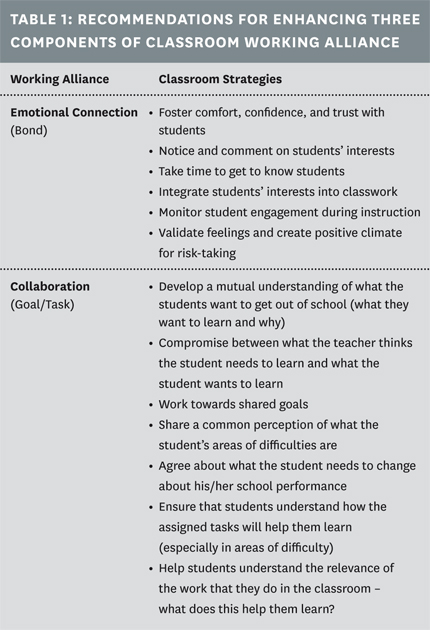
Alliance-building. It is not surprising that the relational aspects of the classroom are often overlooked in teacher education. Using our previously limited understanding of relationship, it can be difficult to provide teachers with concrete guidelines and tools for developing emotional connections with each of their students. How can you learn to “like” someone? Some teachers are less skilled or comfortable with developing emotional bonds with their students, and some students can certainly pose a challenge in trying to establish these connections. The construct of working alliance provides another way for teachers to develop meaningful relationships with their students, through collaboratively setting goals and clearly linking classroom tasks to those goals. Table 1 provides some simple suggestions to get us started in the task of developing guidelines for alliance-building within the classroom.
Conclusion
Teacher-student relationship has previously been shown to be a powerful predictor of students’ classroom and school adjustment. Beyond the characteristics of warmth, trust, and bond that define an emotional connection, a positive working relationship also includes a sense of collaboration and partnership shared between the teacher and the student.
EN BREF – Il a été démontré que la relation maître-élève est un prédicteur déterminant de la capacité d’adaptation de l’élève à sa classe et à son école. Au-delà des caractéristiques relatives à un climat chaleureux, à la confiance et à l’engagement qui définissent un lien affectif, une relation de travail positive comprend également des valeurs partagées de coopération et de partenariat entre l’enseignant et l’élève. Le questionnaire CWAI (Classroom Working Alliance Inventory- Inventaire des relations de travail en classe) tient compte des perceptions des enseignants et des élèves et donne un sens élargi aux définitions antérieures caractérisant les variables propres à la relation de travail en classe. Cet inventaire reprend les trois composantes critiques d’une relation de travail réussie : engagement, but et tâche. Des études indiquent que des élèves ayant le sentiment de profiter d’une solide relation de travail sont plus susceptibles d’avoir des comportements d’apprentissage positifs, selon leur propre évaluation et celle de leurs enseignants.
Thank you to my colleagues who have contributed to this program of research: Dr. Nancy Heath, Department of Educational & Counselling Psychology, McGill University and Dr. Elana Bloom, Lester B. Pearson School Board, Montreal, QC.
[1] R. C. Pianta, Enhancing Relationships Between Children and Teachers, (Washington, DC: American Psychological Association, 1999).
[2] A. O. Horvath and R. P. Bedi, “The Alliance,” in Psychotherapy Relationships That Work: Therapist Contributions and Responsiveness to Patients, J. C. Norcross, ed. (New York, NY: Oxford University Press, 2002).
[3] N. L. Heath, J. R. Toste, L. Dallaire, and M. Fitzpatrick, Classroom Working Alliance Inventory (McGill University, 2007).
[4] J. R. Toste, N. L. Heath, and C. M. Connor, The Construct Validity of the Classroom Working Alliance Inventory (CWAI). Manuscript in final preparation.
[5] J. R. Toste, N. L. Heath, and L. Dallaire, “Perceptions of Classroom Working Alliance and Student Performance,” Alberta Journal of Educational Research 56 (2010): 371-387. Retrieved from http://ajer.synergiesprairies.ca/
[6] J. R. Toste and N. L. Heath, Fostering Resilient Classrooms: Exploring the Relationship Between School Satisfaction and Teacher-student Alliance. Manuscript in final preparation.
[7] J. R. Toste, E. L. Bloom, and N. L. Heath, Differential Role of Classroom Working Alliance in Predicting School-related Outcomes for Students With and Without Special Needs. Manuscript in final preparation
-
To Teach, or Not to Teach Grammar? – That Is the Question
Comments Off on To Teach, or Not to Teach Grammar? – That Is the QuestionSimon Fraser University’s Sean Zwagerman and Paul Budra debate for and against the need to teach grammar in our schools.
-
Motivation and Mastery – Listening to Student Voices
Comments Off on Motivation and Mastery – Listening to Student VoicesA sense of emerging mastery of the craft of teaching—and consequently of making a positive difference for students—is one of the primary motivating factors for teachers, but with a process as complex as teaching and learning the definition of “mastery” is necessarily convoluted. Moreover, the impact of teaching on students is often delayed so evidence in the form of student development is seen best—and sometimes only— in hindsight. With important aspects of the evidence of impact being subtle, hard to define and slow to emerge, teachers often use immediate student response as their real time feedback.
This is natural and appropriate, but also laden with pitfalls. Student experience is subjective and as dependent on the student’s personal perceptions as it is on the teacher’s actions. Moreover, student expectations and preferences may not coincide with the teacher’s mandated role in relation to the curriculum or the operational requirements of the classroom. Similarly, what teachers hear and see is inescapably selective and their subjective interpretation of it may be either defensive or rosy.
Nonetheless, listening to the “student voice” is a logical and potentially insightful way to monitor the teaching and learning process and to determine how the students’ experienced curriculum relates to the teacher’s intended one. In fact, since students’ perception is their reality, the student’s own voice is the only way to tap into it; all else is projection. So how does one listen for the student voice? This may seem obvious, but it is not, and there is nothing automatic about it. Just as astronomers have to construct the right kinds of telescopes to detect the types of electromagnetic radiation that contains the information they seek about the universe, so teachers need to be very intentional and strategic in their listening.
Exams are one legitimate form of student voice but they are circumscribed by what we ask and the student voice that comes through them is suppressed and/or distorted by the anxiety they create. In any event, exams occur after the fact. While exams are both necessary and useful, what teachers really need is ongoing feedback.
This feedback should relate to both the teaching-learning process and its consequences. Process feedback is a critical supplement to formative assessment, which tells us about outcomes but not about experiences. It is important to understand not only what students are thinking but also what they are feeling and how engaged they are in their learning since this is the source of the outcomes upon which formative assessment is focused.
Understanding what students are doing, experiencing, thinking and learning requires that the teacher reach out actively to create an interactive classroom dynamic that may not only be unfamiliar to students but directly contrary to their previous experience. Reconstructing the student-teacher relationship as a partnership within which there is such a dialogue may not be easy for either party since it involves unlearning some deeply rooted assumptions and habits.
A partnership with students does not make life easier for a teacher. Indeed, it may complicate things, particularly if what students have to say is not what is anticipated. Some may mistake the invitation as a request for praise while others may take it as an opportunity to vent. Some may be so externally focused that they find it difficult to monitor and/or express their own thoughts and feelings. It will take time for students to find their authentic voice, and for the teacher to learn how to listen objectively, interpret wisely and respond constructively to it.
One way to start is with end-of-lesson or end-of-day responses. Of course, this is only a transition towards more ongoing and embedded feedback, but it is a good place to begin and a useful practice to sustain even when the student voice becomes more ubiquitous. This could be done in many different ways, but some generic steps towards a “closing thoughts” mechanism might be:
- Share Your Intentions: Tell students what you are trying to do and why. Share with them some of the complexities and acknowledge that this may be unfamiliar for them, as it is for you. Invite them to be co-conspirators in the project.
- Provide A Scaffold: Use a variety of strategies to enable students to participate anonymously. This might include such things as exit slips, one-minute essays, 3-2-1 responses and so on. Include invitations to comment on big ideas, lingering questions, surprises, satisfaction and disappointment, hopes and fears, suggestions etc.—but only one or two of these on any particular occasion. The exact method is not as important as it being simple, short and open-ended so that neither student nor teacher experiences it as a burden.
- Report: Every time you do this, close the loop by sharing a brief informal synthesis of the input you receive, your reflections on it and what, if anything, it has suggested you might continue, enhance, change or eliminate. Include individual comments and suggestions illustratively if appropriate but sparingly. Honour and respect everyone’s input, don’t slight some by highlighting others.
- Repeat: It will take time for students to understand, trust and become proficient at this process. Do this regularly so that it becomes a natural part of the classroom process and not a special event, but vary the format so that it does not become perfunctory. Manage your expectations. Look at it from the studemts’ point of view. Modify the process as you learn about it. Celebrate emergent success. Stick with it.
The purpose of such a process for activating the student voice is to obtain useful feedback to assist the teacher in knowing that what s/he does is experienced as helpful by students and thus in developing a sense of emergent mastery that motivates and sustains. Professionalism is defined not by the perfection of generic techniques but by a constant focus on specific individual student experience, a commitment to optimize it and the willingness to engage in continuous self-critique and growth for that purpose. Thoughtfully enabled student voice may be the most meaningful source to inform the teacher in this quest.
Previous Post in This Series: Motivation and Mastery – The Problem with Deferred Data
-
Learning to Inquire – Innovations for Deeper Teaching and Learning
Comments Off on Learning to Inquire – Innovations for Deeper Teaching and LearningThis is a story of how teachers designed a successful inquiry-based learning project with their students.
-
If It’s Good Enough For Our Early Learners…
Comments Off on If It’s Good Enough For Our Early Learners…Consider the following description of one of the most popular and most powerful learning spaces in many kindergarten classes:
A popular learning center for early childhood classrooms is a housekeeping center. To create a housekeeping center, a teacher sets aside a certain area in the classroom to create a setting that may resemble students’ home environment. The area is filled with familiar materials, furniture, and tools. Objects that are not so easily recognized may also be included. The students are given the opportunity to work in small groups in the space to learn to manipulate and properly use all of these tools. They will often use a trial-and-error method to complete their task until they are successful. In this setting, students informally learn how to interact socially and learn about the processes that occur in a household environment as well as the workings of household tools. (Retrieved from https://uni.edu/, April 29.2012)
Now, take a look at the key principles that ground the In At The Deep End approach, the core of the Musical Futures program referenced in my last entry:
- Learning music that students choose, like and identify with
- Learning by listening and copying recordings
- Learning with friends
- Personal, self-directed learning
For me, the only real difference between what happens in the informal learning environments that define high quality early years programs and the environments being nurtured by approaches like Musical Futures is age. In a typical kindergarten class, the range of students is somewhere between 3 and 5 years. Musical Futures was designed to engage the imaginations of young people from ages 11-18. And research is showing that the principles and approaches that allow us to create rich and effective learning environments at the earliest stages of schooling are also proving to be just as applicable and just as effective in the later stages as well.
So what is true about this type of learning that contributes to its power? For me, one of the most obvious features is connected with the level of choice that is woven through the experiences. At both the house center, and in the MF “deep end” project, students are given the freedom to choose roles, materials, and relationships. While there may be some limits placed on each of these, the ultimate choices are worked out as part of the group interaction. The choice and the ability to make some important decisions become key components in the learning dynamic.
The second feature of both learning environments is the ability to play around with ideas and situations that they have encountered previously. There is no pre-defined right or wrong approach or strategy. (You won’t find the term best practice in either situation.) Instead, imitation and a spirit of working it out in a play-based context are really the key to learning in both scenarios.
The social nature of the environment is also key to successful learning. In both the house centre and the musical combos formed in the MF program, the ability to play off one another is crucial. The importance of interaction with and feedback by friends has been identified as an essential component of learning by many, including Lorus Malaguzzi, founder of the Reggio Emila approach, who went as far as identifying peer influence as a “second teacher”.
Finally, there is a sense in both situations that the learning is participant-driven. Listen in on a group of kindergarten-age children negotiating meaning and direction and you have a snap shot of just how capable they are of assuming responsibility; it’s often more than we think of giving them, isn’t it?
I’ve learned that the same can be said for adolescents. We often assume that young people at this age need to be directed, controlled and surveilled if they are going to “learn”. Projects like Musical Futures are beginning to challenge that common sense by opening our eyes to the incredible degree of focus, dedication and insight that students can bring to their learning when given the opportunity to participate more in creating the work through which they learn.
Since my last post, I’ve received responses from Canadian teachers who have embarked on similar explorations into informal learning. I invite you to let us know about how you are playing with the teaching and learning structures in your own classroom or school. I would also ask you to consider some of the ways in which you could imagine integrating a more informal approach to learning into your own practice? Do the principles outlined here resonate? Could you imagine an area of your program that might be enlivened and deepend by an informal approach?
-
Musical Futures: Can an informal approach to learning breathe new life into our schools?
Comments Off on Musical Futures: Can an informal approach to learning breathe new life into our schools?The moment that the members of Ms. Shelby’s grade eight homeroom filed into music class on the first day of school this past September they knew something was different. Instead of the pictures of the musical masters–Bach, Beethoven, Mozart, and Schubert–that had adorned the walls of the music room for as long as they could remember, they were greeted with posters of recording artists that they actually knew and loved. Instead of a front blackboard covered with musical symbols and images of orchestral instruments, there were photos of recording equipment, sound boards, microphones and modern day band instruments. And instead of chairs organized in an orderly fashion facing a perfectly centered conductor’s stand, stools were gathered in smaller circles around the room, each one complete with its own combo kit: an electric guitar, a set of electronic drumpads, a bass guitar, and a keyboard.
Ms. Shelby waited while the scene was absorbed by the arriving students and then she announced, “This year, we’re going to take a different approach to our music classes.”
There are two basic assumptions that most of us make when we think about learning to play music. The first is that an effective music program must be based on explicit, scaffolded instruction. The second is that an effective music program needs to be led by a highly trained, professional music teacher.
Both of these assumptions are currently being challenged by a new and dynamic approach to music education that turns the pedagogical underpinnings of traditional approaches and flips them right on their ear! Musical Futures was born in the UK nearly a decade ago, and is rooted in the understanding that, despite growing disengagement among adolescents in many aspects of their lives (including school), music represents a universally powerful and natural form of engagement and connection. Students between the ages of 11-18 demonstrate both an affinity and passion for the music of their lives and the Paul Hamlyn Foundation, based on research by Professor Lucy Green, set out to try to understand and leverage that!
Musical Futures is based on the belief that the most accessible way for young people to learn music is by being involved in actually making music. Instead of spending hours of talking about theory and history, or instead of learning an instrument in a formal, rather lock-step fashion, Musical Futures puts modern musical instruments into the hands of students and gives them the opportunity to immediately begin playing, creating and re-creating the music of their lives. A powerful experience!
Instead of beginning with the “classics” and moving towards more modern forms of expression, Musical Futures begins where the students live and breathe–in their own musical world–and gives them the opportunity to learn how to play that music in a collaborative, informal, yet supported, environment.
Musical Futures begins by putting the actual instruments used to create the music to which they listen into the hands of all students and sets them to work. Beginning with music that they select themselves, small groups of students learn to listen carefully to its component parts and then attempt to replicate it using the materials provided. Other than an introduction to the equipment being used, students receive no formal training on how to play their instruments or read music. In fact, just like any language, students begin by listening, and imitating, not by reading!
For a variety of reasons, many of our students have been left on the sidelines when it comes to quality music experiences in their schooling. In some cases, program cost has been seen as a barrier; in other instances, a lack of music specialists have prevented music cultures from taking root in many schools. At a more personal level, a significant number of students grow up believing that actually learning to play music is beyond their capabilities.
Again, the Musical Futures approach seeks to challenge these beliefs and dispositions by taking a different path. And, given the fact that 1/3 of high schools in the U.K. are implementing an MF approach, there’s reason to believe that the challenge is working!
Furthermore, it looks like Canada could be the next country to attempt to shift thinking around what music education could look like for our young people. For the past year, Dr. Ruth Wright, Chair of Music Education at Ontario’s Western University has been working with a dedicated team of colleagues and local educators to bring the MF way of thinking to schools in the London region. Dr. Wright is hoping to set up several more pilot sites throughout Ontario for September 2012.
Musical Futures not only challenges the way that we think alternative ways of engaging young people in the learning of music. The pedagogical shift necessary to successfully implement the MF philosophy has potential beyond the world of music education. What other aspects of our approach to practice might be disturbed by allowing the power of informal learning to breathe some life into the rather formal halls of this place we call school?
Next: What exactly do we mean by informal learning?
-
Increasing Student Learning
Comments Off on Increasing Student LearningFor many years now, the research around teacher quality and student achievement has been unequivocal. In fact, we now know that teacher quality and effectiveness is the single most important determinant in student learning. It is no secret that what a teacher knows and does matters.
While observing teacher practice over the past 8 years as a school administrator, what is coming clear to me is that one of the differences in teaching practice that defines quality teaching and student learning is the nature of lesson design. In fact, I have observed two distinct types of lessons; those that effectively promote interaction and understanding of new information and those that follow the “tell and do” method. In my observation, one method leads to a deeper and more thorough understanding, and one leads to listening and task completion. In thinking about your own practice, or classes you observe, what do you see?
Teaching for Understanding
When teaching for understanding, lesson design is critical. We know that certain types of learning tasks lead to student engagement, but it is also critical to incorporate these tasks into well designed lessons.1. The first part of a well designed lesson is the Introduction. This is often short, orients the student to the purpose and is a chance for the teacher to find out what the student already knows. Tasks often associated with the introduction are questioning designed to link to prior knowledge, KWL charts, viewing pictures, charts, or video clips.
2. Following the introduction, students are given the opportunity to talk and discuss. Usually this would happen with a partner or a group of 3. This is the students opportunity to talk about the new information and often find out more information. This could be an assignment of sorts; perhaps students would work with a partner to find information, answer questions, or analyze information. This is the where the teacher roves the classroom, gathering evidence of what students are learning.
3. Following the partner work, the teacher would call the students back to the whole group to provide more information. This part of the lesson provides the learners with further opportunity to extend knowledge. Learning tasks may include opportunities to predict, summarize, clarify, compare and describe new information. During this part of the lessons, teachers observe their learners closely to determine levels of understanding.
4. Feedback or Feedforward is now used to enhance learning. Teachers most likely will ask students inferential questions designed to move their learning forward.
5. Following all of the above learning tasks, finally, students are ready to show what they know. Teachers who practice differentiated learning know that this is the step where students can show their learning in a number of ways. The list of ways is endless and extends far beyond paper pencil tasks. To really show their learning, students must be involved in authentic tasks. It would be impossible for every student to demonstrate their knowledge in the same way as every other student in the class. It would be even more impossible to discern a students level of understanding through some sort of teacher or pre-made worksheet type of a task. The learning students are asked to demonstrate here must be directly linked back to the purpose that was identified in step one. For example, if the purpose of this lesson was to learn that that sun is the center of the solar system and planets rotate around the sun, here is where students demonstrate what they know.
6. The final part of the lesson is student reflection. Students are taught to self evaluate on questions such as; What did I learn?, How did I show what I know?, What do I still want to learn.
By following the steps of strong task design, students are learning and teachers are teaching for understanding. Students are thinking about, talking about and interacting with new information. This type of task design is quite different from Tell and Do.
Tell and Do
Tell and Do Lesson Design is often designed to tell students new information and then have them complete an assignment, It usually involves the following steps:1. You Sit While I Tell: The first part of the lesson often includes students sitting and listening while the teacher tells them all of the important information they require to complete the task. It is often referred to as a lecture. Depending on the complexity of the information, this telling can often last an hour or more. Students are expected to sit and listen during this part of the lesson, sometimes they are encouraged to jot down important bits of information. Sometimes students are given the opportunity to ask questions.
2. The second part of the lesson includes the student doing the task. Often each student has the same task and it is most often a teacher or publisher created task. Usually it is a pencil paper task and it is very difficult to modify except to make it shorter for those students who find the workload too heavy. I have observed teachers working at their desks during this part of the lesson. I have an occasion heard teachers tell students that if they had listened better to the Sit and Tell lecture, they would find this part of the lesson easier.
3. The final part of this lesson includes students handing their work in for teachers to mark. Usually students leave their papers in some sort of “in-box” and are dismissed to recess, or their next class. Often times students who did not finish in class are asked to take their work home to finish it.
What I have observed with this type of lesson design is a significant reduction in student learning. I have blogged more about this in my post “Just Because You Said It, Doesn’t Mean They Learned It” but the basic premise being that unless students can link to prior knowledge, generate, create, discuss, find purpose, incorporate their learning styles, work with peers, reflect, think critically, infer and reflect, they are not truly learning and the teachers is not teaching for understanding.
* Robert Marzano and his book The Art and Style of Teaching have had a significant influence on my information and understanding in student learning.
For more great reading visit my personal blog at: www.attheprincipalsoffice.com
-
Appreciative Assessment: Inquire!
Comments Off on Appreciative Assessment: Inquire!Who dares to teach must never cease to learn.
– John Cotton Dana (1856 – 1929)Ask the average North American teenager, “What are you good at?” and the answer is often, “Huh?” or “Nothing.” Repeated requests can result in annoyed or blank looks. Many young people find it difficult to identify their strengths, or maybe they just find it easier to let someone else do the thinking for them. Of course, some lucky individuals find their talent and run with it at an early age. But many teens that I have taught are unable or unwilling to identify their competencies, their aptitudes and their unique talents. Can teachers change this mindset? Let’s think about it by looking at a couple of examples.
During a conversation with a student of aboriginal descent, I mentioned that my 10-year-old son liked whales. While we were talking, Brandon picked up a pencil and began to draw a stylized whale. In less than five minutes he had created a West Coast work of art that took my breath away. When I praised his artistic talent, Brandon shrugged and said, “Anyone can do it if they try.” Try as I might, I could not convince him that his talent is rare and precious. Although he struggled with other school subjects and left school without graduating, he ultimately found his voice and honoured his ancestry though art. His paintings now command high prices in art galleries around the world.
I’ve observed a similar tendency to under-estimate one’s skills in my own family. When my oldest son Geoffrey was growing up, I was amazed by his aptitude for mathematics. Beginning in his early teens, he delighted in all aspects of mathematics, a subject that I, an English teacher, have always struggled with. On his own time in Grade 10, he developed a website and posted mathematical challenges in what looked (to me) like hieroglyphics. Then he watched as other budding mathematicians, often from far-off countries, solved the problems in different ways. I marveled at the way these neophyte mathematicians communicated fluently through numbers and symbols.
Still, Geoffrey did not think his love of mathematics was anything to distinguish him from his friends in a positive manner. Instead, his peers in public school often labelled him a “geek” or a “nerd.” Until he studied math at university where he met like-minded individuals, his mathematical prowess was not a source of pride, but something to hide from others. If, at age 15, Geoff had been asked what he was good at, he might have mentioned his part-time job in a restaurant, but he would not have identified mathematics as a strength.
From observing Geoffrey’s behaviour, I realized that educators, parents, and friends need to show their appreciation of young people’s talents and validate their successes. I don’t mean insincere praise simply for the sake of raising self-esteem – quite the contrary. People with unique skills and abilities (and, by the way, I believe that includes the entire human race) often don’t know they are talented unless we tell them so. They sometimes feel that anyone else can do what they are doing. Maybe teenagers don’t realize that their aptitude is unusual because they have grown up with it.
People with unique skills and abilities … often don’t know they are talented unless we tell them so.
So what do these stories have to do with assessment practices and sound pedagogy? I’m coming to that. In both examples, a young person found satisfaction by focusing on his strengths. How can educators assess learning in ways that promote success? Let’s discuss what I call “appreciative assessment”[1] to find the answer.
Appreciative Assessment
Appreciative assessment reflects some of the principles of an organizational development theory known as “Appreciative Inquiry.”[2] Appreciative Inquiry is a generative process that works in many contexts and is especially effective for improving productivity in the workplace. The Appreciative Inquiry approach uncovers what is working well in a system and creates more of the same. By crafting positive questions and revealing best practices, Appreciative Inquiry builds on the strengths of the system, unleashes innovation, and imagination and begins an energizing cycle of discovery, dreams, and design. By honouring the expertise resident in an organization, Appreciative Inquiry builds on positive experiences to spark positive change. This sounds a lot like what I want to see in my classroom.
Appreciative assessment, then, is all about helping students find and build on their unique abilities and aptitudes by providing positive, supportive feedback with a focus on capabilities and possibilities. Focusing on an individual’s abilities enables that person to move ahead in a positive manner. True Appreciative Inquiry employs narrative discourse around good experiences to solicit data. Thus, positive stories and anecdotes about best learning practices are the order of the day when implementing appreciative assessment principles in the classroom. When this practice is applied to teaching, educators feel upbeat about the power of their work to effect positive change. This feeling, in turn, reaffirms their commitment to the profession. When it is applied to learning, students feel good about their accomplishments and are motivated to work on their challenges.
A fundamental principal of Appreciative Inquiry is that asking positive questions leads to constructive change. The momentum for such change comes about through communication that creates positive affect and social bonding. The following kinds of questions can initiate discourse and validate the student learning experience:
- What did you learn from this process?
- What made sense? What didn’t?
- What do you know now that you wish you had known when you started this course?
- How can you apply what you have learned?
- What do you need now to continue your learning?
- How can I provide the support you need?
- What do you hope to accomplish as a result of your learning?
- What will you remember about today’s class?
- What is still not clear to you?
Such questions can provide the impetus for students to adopt new, previously unconsidered challenges by encouraging them to reflect on their learning.
Catch Them Doing Something Right
In an effort to implement the first principle of appreciative assessment (in the language of Appreciative Inquiry, to discover what is done well) in my own home, I decided to identify something positive about my 13-year-old daughter. The ‘tween’ years were a trying time for both of us. It was hard for me to think of a sincere compliment I could pay her. Then I remembered that Tia has super-sensitive hearing. Even when she is another room, she can overhear someone whispering. I could honestly tell her that she can hear better than anyone I know. Would telling her that she has excellent hearing help our relationship? It was worth a try. When I cautiously told my daughter, “Tia, your hearing is amazing. You can clearly hear and understand conversations the average person cannot pick up,” she was genuinely thrilled. My sincere, appreciative feedback meant the world to her, and our relationship improved, at least for a short time.
I tried this approach again in an office setting. I was not getting along well with a rather obstreperous supervisor, and I wondered how he would respond if I could find something praiseworthy. Although I didn’t like his approach to a recent task we had been working on, I realized he had put in long hours; I truly appreciated the effort he had put in. When I told him so, he first looked surprised and then a smile lit up his face as if it were Christmas morning. I couldn’t help but smile back.
I also saw the power of appreciative assessment in the life of my high school buddy. Brian never earned good grades in school, but he went on to a successful career in Hollywood as a music composer and video producer. When I asked him what led him to Hollywood, he grinned and said, “Actually, it was your dad.” Brian had learned to play guitar when we were attending high school together, and he liked nothing better than strumming out a tune for friends. At lunchtime, after school, and around campfires, we sang along while Brian accompanied us on his guitar. Whenever we had some spare time, we could count on Brian to pull out his guitar and start plucking the strings. Even my father had noticed his passion for guitar playing. One day, Dad said to Brian, “You have a real talent for music. You should make use of that talent.” That comment – a form of appreciative assessment – was a major factor in Brian’s decision to head off on a tour of Europe with a rock band after graduating from high school. Touring with the band was the foundation for what became his chosen profession.
When I first began using the principles of Appreciative Inquiry to guide classroom assessment, I was often surprised at the students’ receptivity. Focusing on the positive empowers people and can create lasting change. The last thing adolescent learners need is empty praise, but a heartfelt compliment can touch even the toughest student.
The last thing adolescent learners need is empty praise, but a heartfelt compliment can touch even the toughest student.
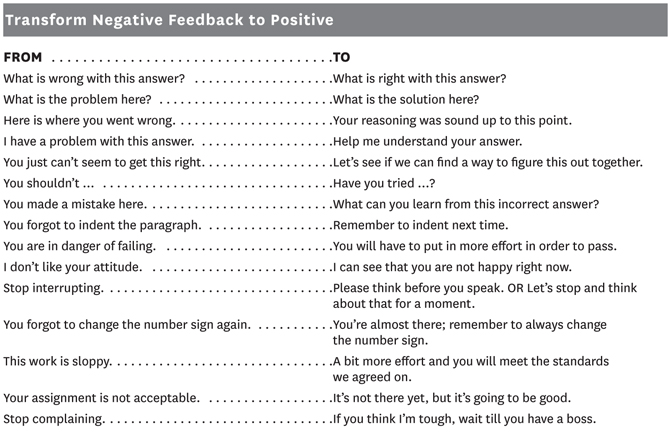
For some ways to change a negative comment to a positive one, see page 8. You will think of other phrasing that is more appropriate for your own teaching style.
Students benefit from ongoing feedback about their learning, so appreciative assessment utilizes a menu of assessment techniques such as:
- homework checks
- projects
- portfolios
- observation
- self- and peer-assessment
- practice assignments
- samples of student work
- holistic rating scales
- student-composed questions
Though they can be graded, these forms of assessment do not require a grade; instead, they offer positive, supportive learning experiences for students as well as opportunities to create a dialogue with each other, the teacher, their parents/caregivers, and perhaps members of the community outside the school. We know that learning improves when learners have a sense of what they are setting out to learn, an explicit statement of standards they must meet, and a way of seeing to what extent they have met the learning outcomes. Appreciative assessment adds the social dimension, so learners construct understanding through many different kinds of feedback.
One last example of teenagers having fun with their learning: When our son, Geoffrey, was in Grade 11, he invited his girlfriend over for a family dinner to celebrate her sixteenth birthday. As I stirred the gravy, Geoffrey sat at the kitchen table, poring over sheets of graph paper, intently working on mathematical equations. “Whatcha doing, Geoff?” I asked. “Homework?”
“Naaaaa,” responded my teenage son. “I’m creating Cara’s birthday card.” “Huh?” I wasn’t sure what he meant by that remark, but after dinner I discovered what he had been doing. Amid giggles, Cara solved and graphed four equations. The first line graph was in the shape of a “C.” The second one formed an “A.” Next came one that resembled an “R.” The final equation resulted in another “A.” Geoffrey had created equations that Cara then solved and graphed to form her name – a novel birthday card that reflected their mutual delight in numbers. Cara went on to earn a Ph.D. in chemistry, while Geoff is now in charge of acquisitions for a large corporation. Their early, shared passion for numeracy never left them. Focusing on that strength was the secret to success.
Appreciative assessment reaffirms the power of relationships to motivate, inspire, and ignite passion for learning. It facilitates authentic dialogue between teacher and learner, thus engaging the student, strengthening the learning experience, and perhaps illuminating otherwise overlooked aptitudes. Teachers can readily implement appreciative assessment in classrooms because it is a student-centred approach to teaching, learning, and developing human potential. And isn’t that what our learning communities are all about?
EN BREF – L’interrogation appréciative mise sur les expériences positives pour amorcer un changement positif; l’évaluation appréciative consiste à aider les élèves à trouver et à tirer parti de leurs habiletés et aptitudes en leur donnant une rétroaction significative d’appui soulignant leurs capacités et leurs possibilités. Des anecdotes et des récits positifs à propos des meilleures façons d’apprendre servent à mettre en place les principes d’évaluation appréciative en classe. Quand cette pratique est appliquée à l’enseignement, les éducateurs sont optimistes quant à l’efficacité du travail qu’ils font pour apporter un changement positif. Lorsqu’elle est appliquée à l’apprentissage, les élèves sont fiers de leurs réalisations et sont motivés à travailler sur leurs défis. L’évaluation appréciative confirme le pouvoir qu’ont les relations interpersonnelles de motiver, d’inspirer et d’enflammer la passion d’apprendre. Elle favorise un dialogue authentique entre l’enseignant et l’apprenant, engageant ainsi l’élève, renforçant l’expérience d’apprentissage et, peut-être, faisant ressortir des aptitudes qui seraient autrement négligées.
[1] I have not found this term used as I do by other educators, in the context of classroom assessment; however, my research is not exhaustive.
[2] I believe the concept of Appreciative Inquiry was originally developed by David L. Cooperrider and Suresh Srivastva. See their article, “Appreciative Inquiry in Organizational Life,” Research in Organizational Change and Development, vol.1 (JAI Press Inc., 1987): 129-169.
-
Think to Learn
Comments Off on Think to LearnA review of Teaching Minds: How Cognitive Science Can Save Our Schools by Roger Schank, Teachers College Press, 2011. ISBN 978-0-8077-5266-1
North Americans worry that their education systems are failing. They fret that kids’ math and science scores do not measure up internationally. Politicians (and test makers) argue that standardized tests hold teachers and school systems accountable. Teacher unions argue that burgeoning class sizes are a barrier to quality teaching.
Initially, what makes Roger Schank’s book, Teaching Minds, so compelling is that he critiques the critics who focus on class size and test scores. He won me over with the argument that schools fail because teachers teach subjects instead of teaching students to think. Thinking is a process common to all humans, and learning is an innate, goal-directed social process. Meeting a goal defines much of our informal learning throughout our lives. To communicate, we cry, we make sounds, and eventually we speak; to get from here to there, we roll, we sit up, we crawl, and eventually, we walk.
Unlike early and informal learning experiences, schools are about meeting goals set by other people. Schools are locked into subjects deemed important for every student, regardless of the learner’s interests or goals. Schank lobs bombs at a one-size-fits-all curriculum because one size does not fit all. So far, so good.
Good teachers know that teaching is not telling and that tests fail to adequately measure what kids really know and can do. Drilling to fill kids’ heads with facts may prepare them for a test, or for the next course, but it does not inspire meaningful learning. Still, the unholy trinity of lectures, textbooks, and tests persists in most schools and universities.
Schank is outraged by the subject-based design in universities and schools that is antithetical to how learning really works, and he offers a provocative design solution from cognitive science. He outlines twelve conceptual, analytic, and social cognitive processes that underlie effective learning and, he argues, should be mastered by all students. He builds upon these cognitive processes in chapters on designing case-based learning experiences, differentiating between content and problem-based education, and developing new curricula for new approaches to teaching.
In chapters on restructuring the university, Schank pulls back the curtain on major problems in the Ivy League – from “rewarding” top research professors with light teaching loads, to the institutional battle and competition for prestige and dollars, to the recruitment and retention of faculty stars at the expense of quality undergraduate learning experiences, and to professors who only want to teach specialized courses focused on narrowly defined research and aimed at producing more professors. He links these failures of higher education to the failure of high schools; instead of teaching students to think, high school teachers have devolved to university prep coaches.
Throughout the book’s 14 chapters, Schank draws readers in with his own storytelling, hits them over the head with cognitive sciences research, and presents a frank assessment of the type of cognitively based learning experiences we need to design and offer if our goal is to teach students to think.
Since people learn best when they are interested or when they have a goal they want to achieve, Schank proposes the radical idea that universities and schools ditch subject-based curriculum and introduce story and problem-based curricular designs that reflect the thinking required in particular jobs. I chuckled at Schank’s description of faculty who only want to teach about their own boutique research area to the smartest and most prepared students – a few of my own colleagues would be out of a job if their esoteric courses were not required.
With stark honesty and a sharp focus on research, Schank has written a provocative, convincing, and useful book about the design of cognitively based learning experiences that can be applied to real contexts. Can cognitive science save our schools and universities? That may be going too far. Schank admits that the education problem is complex and a design solution depends on the efforts of many unlikely stakeholders, all of whom would need to understand the problems with education and work together to change the system.
But Teaching Minds can undoubtedly help individual teachers, professors, leaders, and curriculum design teams to transform learning experiences for students at all levels. Educators who already see their role as designing meaningful, problem-based learning experiences that challenge learners to diagnose, plan, and experiment in teams, to make predictions and good judgments, and to negotiate solutions that have real world value, will appreciate this book and leverage its good advice. High school teachers and university faculty who cleave to content delivery methods and testing for memorization could find that reading this book changes they way they understand and contribute to student learning.
Interested readers can visit Dr. Schank’s website at www.rogerschank.com and read his blog: educationoutrage.blogspot.com
-
Reading with Junior: A Project in Family Literacy
Comments Off on Reading with Junior: A Project in Family LiteracyFor several years now, the media have been calling attention to the fact that boys don’t read well, or that they don’t like to read. Multiple reasons are called upon to explain this phenomenon, most notably the absence of a male role model in the school environment. However, when examining the situation more closely, it is clear that boys do read, just not necessarily what the school environment prefers them to read. Indeed, they often prefer to read game books such as Dungeons and Dragons, newspapers, documentaries, magazines, practical books, or even recipe books! They rarely read – and even more rarely appreciate – novels. Yet, schools place more importance on novels, based on the faulty belief that they represent “real reading”.
In 2007, we proposed a project designed to motivate male pupils with reading difficulties by taking into account their particular interests. The project was initiated in Estrie, at Notre-Dame-du-Sacré-Cœur school, in Quebec’s Commission Scolaire des Hauts-Cantons.
Setting up the project
Our idea was to team up a Grade 3 male elementary school pupil with reading difficulties – or with no motivation to read – with a parent (preferably a father) and a male student in a preschool and elementary school teaching program. The initial goal was to train three such trios.
A number of factors contributed to the development of this project. First, several researchers have turned their attention to the family-school-community relationship and have shown that parents’ involvement in the school progress of their child has an impact on building self-esteem, lowering the rate of absenteeism, and increasing appropriate school behaviours.1 Hoover-Dempsey specifies that the response of parents is greater when the invitation to participate in an activity comes from children.2 In addition, various studies on family literacy projects show that these programs enable parent and child to develop a special bond.3 A few researchers, who have turned their attention more specifically to fathers’ involvement in such projects, note that fathers become involved when given the opportunity, and that their reading strategies – although sometimes different from those proposed by the program – are effective.4
In the Reading with Junior project, each member of the trio was given a well-defined role. The pupil’s role was simply to participate in the project; the university student’s role was not to teach reading, but to present different types of readings to the pupil, to follow him in his choices of reading, and to read with the him and his parent – to become, as it were, a “Big Brother” of reading. The parent’s role was to participate in the reading activity and to guide the university student to a better understanding of his child’s interests.
The Unfolding of the Project
This project, which has been ongoing since 2008, takes place during the winter because, by that point in the school year, teachers of both the participating elementary students and the participating university students have a chance to determine who would benefit most or be the most appropriate participant in the program.
So as not to overwork the participants, the project unfolds over four months, with six meetings for each trio. The pupil can decide to end the project at any time, but neither the university student nor the parent can make this choice. Meetings are held at the place and time chosen in advance by the trio. It is important to mention – and to impress upon all participants – that there are no expectations with regard to results. It is not possible to “fail” in this project.
It is important to mention – and to impress upon all participants – that there are no expectations with regard to results. It is not possible to “fail” in this project.
The selection process begins at the university, where professors introduce the project to male students and invite them to participate. Once the number of number of participants is determined, the professor, a specialist in family-school-community relationships, contacts the school principal, who becomes the link between the school, the families, and the university. If, at any point during the program, any member of the trio has a problem, it is the principal who contacts the professor-coordinator to find a solution.
The task of the classroom teacher, in cooperation with the special education teacher, is to target a number of boy-pupils who have reading difficulties or who are not motivated to read, and to match the number of university students available.
At an initial organizational meeting, the professors and students meet with the school principal, the classroom teacher, and the special education teacher. The purpose of this meeting is to give the university student members of the trios an opportunity to learn about the school environment, the participating pupils (strengths, weaknesses, what they like or dislike, etc.), and the pupils’ families. Following this introductory portion of the meeting, the parents and children join the university and school personnel. During this part of the meeting, professors and students question the pupils on their reading interests – and learn, invariably, that boys detest princess novels! The professors explain the project to the parents, and the trios are established.
Professors and students question the pupils on their reading interests – and learn, invariably, that boys detest princess novels!
Meetings of Trios
Trios meet a total of four times on their own, every two or three weeks. Meetings held at closer intervals are burdensome for participants, whereas meetings scheduled farther apart can lead to disinterest. The length of these meetings varies, depending on the trio (often from one to two hours). Trio members decide among themselves what will be accomplished and also determine how long it will take.
At the request of school professionals, we added a meeting in mid-course for all participants except the children to report on where the trios are situated in the project.
The final meeting involves all participants in the Reading with Junior project: the trios, school principal, classroom teacher, special education teacher, and two professors. It is the occasion to gather impressions from everyone on the project, changes noticed in pupils, strong points, weak points, as well as possible improvements. During this evening, the university students hand out books to the pupils, based on their personal interests, along with a certificate showing their participation in the project.
Outcomes
This innovative project involving family, school, and university has been fruitful on many levels. All participants have made positive comments about the project and wish to see it repeated every year. The parents (father, grandfather, stepfather) have all noticed a new openness to reading on the part of the child. Some younger brothers even asked to participate in reading with their fathers, turning the trio into a foursome. Some families learned that reading a magazine on hunting and fishing was as relevant as reading a novel, or that a parlour game required as much reading as a book. And several parents were surprised by their children’s depth of knowledge.
School personnel observed that pupils were less opposed to reading in class, that they developed more positive attitudes towards reading, and that, in some instances, behaviour problems were reduced.
School personnel observed that pupils were less opposed to reading in class, that they developed more positive attitudes towards reading, and that, in some instances, behaviour problems were reduced. The teacher in special education even remarked that the project enabled some pupils to obtain better results more effectively than did her own interventions. The project has also had a positive impact on the family-school relationship. Some families stressed that they felt honoured that the school had thought of them for this project and wished it could be realized on a grander scale. The principal has noted a new openness with parents – commenting that it is no longer unusual to be greeted by parents when they meet on the street.
It is important to note that pupils who participated in Reading with Junior during the first years have maintained improvements in attitude and behaviour.
As for the university students in the preschool and elementary teaching program, Reading with Junior enabled them to live a unique experience that cannot be experienced during periods of internship or during the daily life of a teacher. They also discovered that pupils have their own interests in reading. For example, one boy had more of an appreciation for documentary books, while another noticed that it was more difficult for him to read a book with illustrations in colour, because the colours distracted him.
In addition, this project allowed pre-service students to get a better handle on certain family realities and understand that circumstances, rather than a lack of willingness, may explain why some parents are not more involved in their children’s education (for example, a family with four children or parents who work at night).
Conclusion
This project has been repeated by other schools, with adjustments to meet the particular environment or resources at hand. For example, one school chose to conduct the project with male retired teachers, whereas another uses students at college level. Regardless of where the mentor is from, Reading with Junior works for a variety of reasons.
- The fact that no results are expected removes an enormous burden from the shoulders of participants. Pupils are not obliged to read, as they are in school, since the objective is really to develop the motivation to read. Also, mentors do not teach, they accompany the child on his reading journey by presenting different types of books to him (newspapers, comic strips, magazines, etc.), by allowing him to reject a book, to not finish reading it, to find some books boring, and to read anywhere he feels like.
- The professor-coordinator’s knowledge of students or the school principal’s knowledge of retired teachers makes recruiting easy, since the relationships are already present.
- The autonomy of the trios in setting their own schedule and agenda contributes to the project’s success.
- Finally, the project owes part of its success to the recognition of each one’s expertise; this project could not have taken place without the presence of all partners.
The Reading with Junior project is a simple project that pays significant dividends on several levels.
EN BREF – Le programme Lire avec fiston consiste à jumeler un garçon de troisième année qui éprouve des difficultés en lecture – ou qui n’aime pas lire – avec un parent (de préférence le père) et avec un étudiant masculin au baccalauréat en enseignement au préscolaire et au primaire. Le rôle de l’élève consiste tout simplement à participer au projet et celui de l’étudiant universitaire, à présenter à l’élève différents types de lectures et à lire avec l’enfant et son parent. Le parent a pour rôle de participer à l’activité de lecture et de guider l’étudiant pour qu’il saisisse mieux les intérêts de son enfant. Le personnel enseignant a observé que les élèves participants étaient moins rébarbatifs à la lecture en classe, qu’ils avaient développé des attitudes plus positives envers la lecture et que, dans certains cas, les problèmes comportementaux avaient diminué. Certains parents ont souligné l’amélioration des relations à la maison.
1 K. V. Hoover-Dempsey, J. Walker, H. M. Sandler, D. Whetsel, C. Green, A. Wilkins, and K. Closson, “Why do Parents Become Involved? Research Findings and Implications,” Elementary School Journal 106, no. 2 (2005): 105-131; J. Epstein, School, Family and Community Partnerships (Boulder: Westview Press, 2001).
2 Hoover-Dempsey.
3 J. Anderson, A. Anderson, N. Friedrich, and K. J. Eun, “Taking Stock of Family Literacy: Some Contemporary Perspectives,” Journal of Early Childhood Literacy 10, no. 1 (2010): 33-53; L. Baker, “The Role of Parents in Motivating Struggling Readers,” Reading and Writing Quarterly 19 (2003): 87-106.
4 A. Morgan, C. Nutbrown, and P. Hannon, “Fathers’ Involvements in Young Children’s Literacy Development: Implications for Family Literacy Programs,” British Educational Research Journal 35, no. 2 (2009):176-185; O. N. Saraho, “A Literacy Program for Fathers: A Case Study,” Early Childhood Educational Journal 35 (2008): 351-356.
-
Quality Music Education: Never Say Never
Comments Off on Quality Music Education: Never Say NeverThis is a cross-post of a piece that I also published on my personal blog, Teaching Out Loud. As arts consultant for a large Ontario school district, I believe that quality arts instruction can go a long way to creating the engaging and relevant environments that we want for all of our students. This is the first in a series that explores what is happening in terms of promoting arts education in Canada and around the world.
When my wife and I sat down with our two boys last weekend to watch the Justin Bieber film, Never Say Never, I suspect that none of us reallly knew what to expect. For my wife and I, it was a movie about a teenage heartthrob and, well, just how interesting could that be? For my five year old, it wasn’t the movie that he chose as we scrolled through the Netflix menu and for Liam, my three year old, there was no apparent sign of animals in the movie trailer. How good could the film be if there were no animals?
We’ve now seen the film twice and both times all of us have been totally engaged in the life and music of this young Canadian musician.
For me, my interest quickly moved beyond an appreciation for just how talented Justin Bieber is to an appreciation—no, a fascination—for just how pervasive and important the experience of music is for young people. To see hundreds of thousands of adolescents (and my own two children) singing and dancing in ecstatic unison to the rhythm and melodies of Justin’s music caused me to think of several things.
First, if I had taken my own music lessons a little more seriously, perhaps I could have been on that stage at Madison Square Garden!
Second, music has always been an important cultural marker in the development of virtually every civilization, in virtually every time. It is a universal language of communication.
Third, music is an important, if not essential, element in both the individual and social lives of young people today. It has the power to draw them in, hold their attention and allow them to connect with ideas, issues and other people.
Fourth, music has tremendous expressive potential. Beyond the goal of entertaining others, musician-artists use their work to explore the world around them, walk around problems in a creative way, present solutions and new possibilities.
Yet, despite the universal power and importance of music in the lives of human beings, we spend very little time and money ensuring that our students leave school with an understanding of music, let alone an ability to use the language with any level of proficiency. Instead, quality music education, particularly in the earlier years of one’s schooling, is often left to chance, local resources, or the passionate advocacy of individual teachers or parents. While curriculum documents can mandate fairly robust music programs, effective implementation is often left to chance.
Students tell us how important music is to them every day of their lives. They come to school each day listening to it, sometimes two students sharing the same set of earbuds. They turn on their devices at lunch time to share and talk about the latest songs they’ve downloaded. And as they leave the schoolhouse at the end of the day, the earbuds once again appear, ready to accompany them on their journey home.
We often fail to see that the very language that connects young people to each other can provide us, the adults, with a very powerful way of connecting to them. And that’s significant.
But beyond the potential for connection, we owe it to our children to ensure that quality music education is part of our transformational vision of the 21st century school. You know, on the one hand, we talk so much about the need for engagement, for integrated learning and project-based experiences grounded in what is real and relevant to students. We talk about a meaningful place for the technology and for opportunities to teach collaboration, creativity and critical thinking. And then we ignore some of the most obvious ways of getting to those things!
Music education, if done right, can contribute to all of this, and in a way that would have the students cheering for an encore. I know that and I suspect that many of you know that as well. I’m not suggesting that our aim should be to create more Justin Biebers. At the same time, however, continuing to sideline something that is so obviously important to young and old alike just doesn’t make a whole lot of sense.
There are some jurisdictions around the world that are beginning to understand this and operationalize this understanding in very concrete and exciting ways. But before highlighting some of the practices and programs that are beginning to emerge, I would love to hear your stories about your own music education.
In your own schooling, what was your experience of music? Did you have a teacher that turned you on to the power of music in your own life? Did you participate in a choir or band at some point in your school story? Perhaps you were one of the many who were advised to just “mouth the words” at the annual spring concert. Perhaps you had a love of music, but never really learned to put that passion into practice. Or perhaps you were part of a music program that changed your life and gave you the wings to fly into a musical career.
Your stories are important and always lead to further discussion!
-
Engaging Teachers, Engaging Learners: The 2012 Pat Clifford Award
Comments Off on Engaging Teachers, Engaging Learners: The 2012 Pat Clifford AwardIt is my honour to serve as Chair of the CEA Awards Selection Committee and to announce the call for submissions for the 2012 Pat Clifford Award for Early Career Research in Education.
CEA’s Pat Clifford Award recognizes the work of emerging researchers – their promise, research contributions, and commitment to breaking new ground, to challenging commonly held assumptions in education policy, practice or theory in Canada. As a classroom teacher and faculty researcher, Dr. Pat Clifford saw no difference between practice and research. Pat strongly believed that teaching was at the heart of research, and that research was at the heart of teaching.
Deadline for submissions: Thursday, May 31, 2012, 5 p.m. EST
The Pat Clifford Award has personal significance for me. As a Galileo Doctoral Fellow, I learned alongside Dr. Pat Clifford and Dr. Sharon Friesen in their Grade 6 classroom. As a new professor, I taught with Pat and Sharon at the University of Calgary. Together, we published papers about engaged learning and teaching with technology and presented our research at conferences. Pat and Sharon’s unwavering commitment to student learning inspired and shaped me as a teacher; their dedication to disrupting commonly held ideas about teaching and leadership molded me as a researcher. Pat and Sharon’s belief in my promise and their investment in this new researcher enabled me to build visibility for my research on engaging learning with technology.
The Pat Clifford Award is an enduring commitment to supporting and mobilizing the work of new researchers whose ideas and scholarship will change education. I encourage new researchers to apply for this award, for the formal recognition and promotion of your scholarly work, for the opportunities to network and to develop additional mobilization strategies with CEA, to maximize the impact of your work in practice, and for the invitation to submit a feature article about your research to Education Canada magazine. In the past two years, CEA has recognized the research contributions of Dr. Jessica Toste and Dr. Carla Peck with the Pat Clifford award. If you are in the process of completing a Masters or Ph.D. OR have completed a Masters or Ph.D. in the last two years, then you may qualify for this award.
In the coming year, the Canadian Education Association’s strategic orientation will concentrate on these two areas:
- Engaging Learning: research that furthers ideas, knowledge and practices that deeply engage students in learning with a particular focus on transforming learning environments for adolescent learners. Research that broadens and deepens current understanding of learning as the basis on which educational policy and practice should be built.
- Engaging Teaching: research that furthers knowledge of how teaching and learning reinforce each other as reciprocal processes; how teaching can be engaging for both teachers and students; how teachers can be supported to teach the way they aspire to; and how teachers understand their own learning.
New researchers whose research and scholarship furthers knowledge and impacts practice in the areas of Engaging Learning and Engaging Teaching, who are making a promising contribution to improving educational policy and/or practice in education, who are conducting innovative research that opens up new areas of research or extends research in existing areas, are strongly encouraged to submit an application, or seek out a nomination, for this award.
As a teacher, Pat Clifford was steadfast in her belief that every child had the right to succeed brilliantly, and brought to them her own love of literature, writing and history. Pat’s questions for Grade 1 learners to graduate students were, “What drives you? What is your passion? What work calls to you? What bugs you? And, how can you make this the focus of your work?” New researchers who are passionate about improving learning and teaching should learn more about this award.
Learn More: http://www.cea-ace.ca/awards/clifford-award
Education Canada Magazine article from 2010 Pat Clifford Award Winner Dr. Carla Peck: What You Don’t Know Can Hurt Me: Diversity, Accommodation, and Citizenship Education in Canada
Deadline for submissions: Thursday, May 31, 2012, 5 p.m. EST
-
Motivation and Mastery – The Problem with Deferred Data
Comments Off on Motivation and Mastery – The Problem with Deferred DataA sense of emerging mastery is one of the factors that motivate, and thus engage, teachers but the only hard data they have to gauge their success is both inadequate to fully represent their goals and deferred until after the end of the unit, term or year.
Summative data is necessary for credentialing and accountability, and it does provide useful information for improving curriculum and for policy development, which are part of mastering the craft of teaching, so it is an important part of a balanced assessment program that can help a teacher, or a school system, to learn from experience. However, because it comes “after the fact” of learning, it has little value for supporting student learning and also little value for supporting teacher engagement.
Moreover, because most summative data is used in aggregated form, information about individual students is lost. There may be some minor disaggregation (e.g., by gender or school), but summative data is generally useful only in revealing overall trends. If it is broken down into groups that are too small (e.g., individual classes) the standard error of measurement tends to become so great that although the data remains “valid’ it is no longer “reliable.” Thus, in addition to being deferred, summative data just doesn’t relate strongly to any individual. It is a conceptual abstraction with little emotional or motivational impact.
Unfortunately, summative data is what gets the most attention. Somehow it has gained an unwarranted reputation for objectivity and certainty. This is perhaps the biggest problem with it; we treat it with too much naive respect, forgetting that it comes from instruments that may or may not be well designed and that it has no meaning until it is interpreted, which may or may not be done well. As Mark Twain remarked, “There are three kinds of lies: lies, damned lies and statistics” so lets not forget that all those precise numbers are a house built on sand.
What students need, and what teachers would find most informative, is an ongoing dashboard of information about learning as it is occurring. That’s why there is so much emphasis on formative assessment these days. Feedback (aka formative assessment) trumps evaluation (aka summative assessment) if your interest is in supporting learning rather than merely sorting students.
The strength of formative assessment is its immediacy, but its weakness is a lack of precision and the complex task of understanding what it means. The evidence drawn from ongoing observation of student behaviour is best viewed not “scientifically” but through what Eliot Eisner has called “connoisseurship” or “the enlightened eye;” that is, through professional wisdom. Of course, simply being certified as a teacher does not automatically impart the enlightened eye necessary to divine the meaning within the evidence of classroom life. One has to develop this professional capacity through experience and earn the trust of students and parents in one’s ability to “see” what is going on for students and to use this “insight” to support learning. Many—probably most —teachers do, but some do not.
Formative assessment is complex, but no more so than summative assessment and it is of far more importance in the teaching and learning nexus, not only for students but also for teachers. Perhaps the best source of feedback for teachers themselves is students. The student voice, as subjectively biased as it must necessarily be, may offer the greatest hope for monitoring one’s emergent mastery as a teacher and thus for providing motivation that carries one through the exuberantly arduous turmoil of teaching. In terms of teacher engagement, this is the data that counts.
Previous Post in This Series: Motivation and Mastery – The Problem with Grand GoalsNext Post in This Series: Motivation and Mastery – Listening to Student Voices -
Increasing Teacher Engagement: What’s Good for Students, Is Good for Teachers
Comments Off on Increasing Teacher Engagement: What’s Good for Students, Is Good for TeachersIt is certainly no secret that one of the keys to student success is academic engagement. If we can just hook students into deeply thinking, analyzing, enjoying and applying new information, they will increase their learning. So, as teachers spend much of their days pondering the idea of student engagement, I too, spend much of my days pondering the same, with one difference. How do we engage teachers? If engagement is good for students, engagement is good for teachers. If teachers are engaged, students are engaged. Teachers need to be engaged, the question is, “How does teacher engagement happen?” To answer this question, let’s take a look at what engagement is. Dr. George Kuh defines engagement as:
“The engagement premise is straightforward and easily understood: the more students study a subject, the more they know about it, and the more students practice and get feedback from faculty and staff members on their writing and collaborative problem solving, the deeper they come to understand what they are learning and the more adept they become at managing complexity, tolerating ambiguity, and working with people from different backgrounds or with different views.1″
One of the challenges we face as educators and administrators is taking the “what” and knowing the “how.” Dr. Kuh gives us what engagement is, but how do we do that? How do we increase teacher engagement? In analyzing the definition, possible answers arise:
- ” …the more students study a subject, the more they know about it…”
From my point of view, and in substituting the word “students” for “teachers” this speaks to professional development; increasing the study of the subject of teaching. To work on this, we get our staff together for weekly professional development. Often times teachers are asked to read an article or view a video before we get together but with this weekly professional development we have committed to time set aside each week to learn more. Additionally teachers are encouraged to attend face to face or web-based learning opportunities. The administrative team currently participates in weekly professional development webinars.
2. ” …the more students practice and get feedback from faculty and staff members on their writing and collaborative problem solving…”
We began this work with our staff in Professional Learning Community discussions. Each week, teachers would meet to discuss teaching and learning. The role of their team partners was to provide feedback. This year we have been able to kick it up a notch. Teachers observing teachers has become part of our daily practice. Every day, you will find a teacher in a colleague’s classroom observing for task design and student engagement. Following these observations we meet together for “feedback.” Work is analyzed, questions are answered and problems are solved. The key component of this work is the discussion following the observation.3. “… the deeper they come to understand what they are learning and the more adept they become at managing complexity, tolerating ambiguity, and working with people from different backgrounds or with different views…”
In supporting teachers in deepening their understanding we look for demonstration of their new learning. When we go from the discussion to the practice or doing stage, we know teachers are managing, tolerating and working with. More than that, we know teachers are finding success.Exciting new ways of demonstrating this understanding have become evident.
- Teachers are advertising and asking for other teachers to come into their classrooms, “Come and observe me when I am doing this, then you will see how I am doing it.”
- Teachers are blogging. Sharing, analyzing and drawing connections to their classroom practices.
- Teachers are video-taping their work with students to use during our professional development sessions.
- Teachers are connecting during their out-of school time, either face to face or virtual networks to search for answers to their questions.
As we continue further into this work, more teacher engagement is becoming more evident. The outcomes of this work are absolutely rewarding! Student engagement has increased significantly; less office referrals, more project-based learning, and more collaborative learning opportunities. Energy and involvement from teachers has also increased. There has become a purpose and a sense of achievement. As I was talking to our International Teacher who is here for one year on an exchange his words were like music, “This school is different, teachers talk to each other. This place has a great atmosphere.”
- George D. Kuh, “The National Survey of Student Engagement: Conceptual and Empirical Foundations,” New Directions for Institutional Research, vol. 2009, no. 141 (March 9, 2009), pp. 5–20.
Lori blogs at www.attheprincipalsoffice.com You can follow her on twitter @lorilynnecullen
- ” …the more students study a subject, the more they know about it…”
-
Motivation and Mastery – The Problem with Grand Goals
Comments Off on Motivation and Mastery – The Problem with Grand GoalsTeacher engagement, which is the key to student engagement, is fueled by autonomy, mastery and purpose according to Daniel Pink’s review of the research on motivation.
Fortunately, teaching offers abundant opportunity for autonomy, mastery and purpose. Clearly nurturing the development of young people is a significant purpose worthy of a teacher’s commitment and I believe most teachers feel that way about their work. Although some teachers in senior grades feel burdened by a bloated curriculum and boxed in by standardized testing, there is generally also a lot of autonomy. In fact, the “cellular” nature of teaching is so autonomous that it can tip over into an unhealthy isolationism, but at least there is lots of room for individuality. The fly in the ointment may be mastery—not because there is not a lot to master or because it cannot be mastered, but because there is so little consensus on what constitutes success. Is it high scores on tests within the disciplines, transferable thinking and communication skills, responsibility and citizenship, confidence and identity or all of these—and if these are all part of the grand goal then what takes priority?
Opinions vary on how best to gauge student, and thus teacher, success—which leads to disagreement. This frustrates the quest for mastery and thus undermines motivation. Of course, there are many other reasons that teachers may feel frustrated, overwhelmed or under appreciated, but the shimmering mirage of a noble but nebulous vision is a significantly unsettling factor for at least two reasons. First, it can never be fully achieved (which is an invitation to guilt), and, second, both priority and success are continuously contested (which is an invitation to insecurity and defensiveness).
In his classic 1975 book—Schoolteacher: A Sociological Study—Dan Lortie noted the challenge of finding valid, reliable and accepted indicators as a significant problem for the profession. He reported that a common response to this conundrum was for teachers to derive their pride and satisfaction primarily from strong personal relationships with their students. Many have subsequently decried this soft, indirect measure of success and urged teachers to use student achievement data as their touchstone instead. Few would disagree that hard data is important, but no hard measure(s) have yet been proposed that capture more than a thin slice of the goals of education. There is no comprehensive data set. Consequently, what is easy to measure is sometimes used. However, by mistaking precision for accuracy and availability for significance, one can settle on random bits of easily generated numerical data that diminish and distort the noble purposes of public education. All manner of misdirected energy and erroneous inference has ensued from this error.
Finding valid and reliable measures that adequately reflect the complexity of human development is a worthy challenge that we must continue to pursue, but there is no solution on the horizon. Moreover, the most enduring and enabling outcomes for students seem to be precisely those that are the hardest to define and assess.
So what might we do about this? Our aspirations for students are broad and inherently complex, but for developmental work we can choose to focus on a SMART subset (i.e., Specific, Measurable, Attainable, Relevant and Timely). This makes it possible to collaborate with others, to have demonstrable success and thus to foster confidence and pride that motivate and energize. (One caveat must be noted however. The “Measurable” dimension of the familiar SMART acronym can narrow the range of objectives in ways that trivialize learning if it is taken to imply only test results and to exclude qualitative measures.)
Focusing on specific aspects of the work at various times enables demonstrable success in developmental initiatives, which helps to sustain confidence and commitment in striving for a larger goal that can be discouragingly ethereal and elusive in its fullness.
Previous Post in This Series: Teacher Engagement is the Key to Student Engagement
Next Post in This Series: Motivation and Mastery – The Problem with Deferred Data
-
What is the question?
Comments Off on What is the question?Note: I wrote this a few nights ago but posted it this morning.
It is Saturday night and it is my husband’s turn to be out with friends while I stay home with our baby. Life has changed and I’m contented (and yes, at times thrilled, overwhelmed, excited, terrified, and challenged) with this new reality. I have a glass of wine in one hand and a book I picked up at the library in the other: Hot Spots.
About an hour ago I read a page about igniting questions, questions which cause an immediate combustion of creativity, curiosity, innovation, and commitment in a group of people. Despite me having read past that page my mind won’t leave it. I’m wondering about the question.
We need a question here in BC, in my union (we are on strike), in my government (which is in the midst of legislating our contract). We need a question that will ignite those who care about education to work together in a flurry of mutually dependent innovation and collaboration. And we should all care about education.
It is time to stop with the rhetoric. Rhetoric sells papers and wins elections but it does not serve education. It does not serve our students. It distracts from them – from that deeply personal, vulnerable, exciting and complex state of learning.
Today my husband and I took our little girl to the Vancouver Aquarium, introducing her to the most amazing variety of marine life. I saw her learn, as I see her learn everyday because everyday she does something or sees something for the first time.
Today I also saw something for the first time. A small boy with Tourette’s syndrome and Autism hit another child; his mother apologized for him explaining his challenges. The other mother, in what I imagine was a blind protectionist rage, spat out, “What did you do to make your kid have Tourette’s and Autism?!”
Such cruelty. Ignorance. Fierceness. And I wonder about this mother’s education, this mother’s challenges. For the other mother, I felt so sad, and – although I have no right to feel anything on her behalf – I felt angry. I wonder what kind of experience she lives. And I see a situation which could have been different had there been less ignorance, more learning. And I see this scene as a microcosm of the larger world and the potential for education of quality and equity to shape it.
When we talk about education we are talking about people’s children: the most precious, most amazing, most important people. There is too much at stake for us to be playing politics.
I don’t know what question will ignite us to engage with one another in a mindset of collaboration and committed curiosity, but I sure hope we ask it soon.
-
So What Do We Really Mean by Engagement?
Comments Off on So What Do We Really Mean by Engagement?I’m hoping that my blogging colleague Bruce Beairsto doesn’t mind me walking alongside him as he teases out questions of motivation and engagement. As it turns out, both of these areas of reflection are pretty constant companions for me these days and hooking up with a traveling partner that actually talks back may be helpful.
I’ve been doing a lot of thinking about the question of engagement and what I really mean when I use the term. Most often, I have used engagement as a substitute for involvement. Other times, I’ve used it to refer to my participation in a more intense conversation or a debate. In other instances, it has signalled the existence of a strong commitment to someone or something.
Engagement. It’s a complex word, and when we use it in the context of a complex system like school, then that complexity multiplies!
But I would like to suggest that there is a fundamental difference between involvement and engagement and it’s precisely that difference that has occupied some of my thinking lately. Simply looking at the roots of both words might give us a clue as to the difference.
Involve is rooted in the Latin verb meaning “to roll“. To involve is, quite literally, to get “rolled up” in something. Engagement, on the other hand, has the French verb “gage” as its root, which refers to a pledge or a commitment. Hmm…
I’m thinking that the difference is significant when we’re talking about the approach to school that we want to foster in both students and teachers. I’m also thinking that the terms involvement and engagement aren’t opposites, but two points on a continuum of participation.
It’s easier to get people involved in something; its more difficult to move to the level of engagement where folks are actually committed to the idea and the action required to move forward. Plenty of examples come to mind. I’m getting my son involved in minor league baseball, but I’m reluctant to commit to coaching a team. I’m involved as a substitute musician at a couple of local churches, but I’ve turned down an offer to be engaged as full time music director. I was involved with the fun fair at my son’s school, but I don’t have time to be engaged in the planning or leadership of next year’s event. You likely have quite a few personal examples of your own.
Some of you may be rolling your eyes and asking the “so what” question, but I’ll throw out a few questions of my own that will force me to follow up on this thinking over the next few weeks.
When we talk about student, teacher and parent engagement, are we using involvement and engagement synonomously? In other words, do you see an important difference between the two ideas?
If there is a distinction to be made between involvement and engagement what is that we are really seeking in the relationships that we develop within our schools?
Is there something qualitatively different about a student that is involved in her school, as opposed to one that is engaged?
Is it possible for a parent to be actively involved in the life of the school, but not really engaged in their child’s education?
Is engagement an indicator of teacher quality or will involvement serve just as well?
I have some ideas percolating around the movement from involvement to engagement. While I’m certainly not the first to be thinking about this, this is the first time that I’ve considered it myself. Teacher and writer Larry Ferlazzo has done some lively thinking about this and I smile everytime I think about the fable that he references in an introduction to one of his related blog entries. It goes like this.
A Pig and a Chicken are walking down the street. The Chicken suggests, “Hey Pig, I was thinking we should open a restaurant!”. The Pig replies, “Hm, maybe, what would we call it?”. The Chicken responds, “How about ‘Ham-n-Eggs’?”.
The Pig thinks for a moment and says, “No thanks. I’d be committed, but you’d only be involved!” (source: http://en.wikipedia.org/wiki/The_Chicken_and_the_Pig)


IDEAS TO SUPPORT EDUCATORS : Subscribe to the EdCan e-Newsletter
Quality research, reports, and professional learning opportunities.