Archive
-
What Students Say About Inquiry
Comments Off on What Students Say About InquiryLast week I reflected on my experience with inquiry in my English 8 classroom. This week I turn this space over to my students who want to tell you what inquiry is like for them. The following reflection was co-written by James Telford, Nathalie Joyal, Andrea Camarena, Nina Gous, Michael Ji, Chaissan Ashcroft, and Alex Wagstaff.
What is inquiry-based learning like?
So far this year we have done several inquiry based leaning [sic] questions. We have enjoyed how using inquiry has made us think deeper in the article and lets us take our learning into our own hands. Some people can’t control themselves because of this independent learning and that hinders others who can. On the other hand this format of learning is more flexible and allows you to learn in your own ways. Inquiry allows deeper connections and thought processes towards the curriculum. A more structured question limits our personality in our work. On the other hand this work can become more challenging because you are playing the part of the teacher and finding the specifics of your question. There are many different ways of looking into inquiries.
We believe that one of the most effective ways to approach an inquiry is to gain knowledge from books and websites. There are always differences between each inquiry and each perspective so all the outcomes will be different. Everyone also has a different way of representing their [sic] findings, which can make more or less of an impact. The inquiry style of a project allows for more maturity from the student/students. Overall our opinion on an inquiry-based project is that while it is exhausting, the finished product is always worthwhile.
Thank you for sharing your thoughts, Grade 8s! To give the readers some idea of what kind of “product” we’re talking about here, one group agreed to let me post their video which they created in response to their inquiry, “How do people find happiness in the darkest of places?“
-
Learning through Inquiry
Comments Off on Learning through InquiryAwhile ago… a long while now… I posted about how one day I walked into my English 8 class, looked at my students and, feeling suddenly inspired, asked them what they wanted to learn. After much discussion, they came to the consensus that they wanted to learn “how people find happiness in the darkest of places.” So we did.

(Photo Credit: Milos Milosevic. 2010.)
-
Setting the End of the Year Awards Table
Comments Off on Setting the End of the Year Awards TableThe piece below was written back in 2009 for Education Canada. It represented an attempt to open up conversation about the gap between what we say we value in education and what we actually seem to hold in highest regard. As annual awards assemblies appear on the horizon in schools and districts across the country, I wonder if we’ve made any changes to the guest list at the annual awards table. I would love to hear your stories about change in this regard. S.H.
“I have a confession to make.” I stood at the podium at our recent Grade 8 Commencement Ceremony, preparing to announce the recipients of the Academic Achievement Award in Mathematics. “I’ve never won an award in my life.” The reaction from both the students and the audience was mixed. Some smiled empathetically, others looked at each other, wondering where I might be going with my comments. I think I even heard a couple of gasps, but that may have been just my imagination. I continued, “In fact, the real irony of this moment lies in the fact that I did very poorly in mathematics as a student.” I went on to share that I had failed most of my high school math courses and didn’t really develop an understanding of numbers and their relationships until I began teaching.
“Today, I love the study of mathematics. In fact, I am currently reading a book on the history of mathematics and another on the study of algebra.” And with that personal introduction, I proceeded to announce the names of the student in each of the three Grade 8 classes who had achieved the highest academic standing.
Now, before you jump to the conclusion that I’m pushing an anti-academic agenda, let me reassure you: I believe that success should be recognized and celebrated. I also believe, however, that we are at a point in our educational reform conversation where we are going to have to start taking a serious look at some of the practices and traditions that have been dragged down through the history of schooling – practices and traditions that have been long accepted as a natural part of this place we call school but may, in fact, be working against what we want to be achieving and celebrating in the 21st century.
If we wish our schools to be places where civic literacy, creative collaboration, critical thinking, and a passion for learning are developed and nurtured, then one of the areas that might need our attention is the part of our system where awards, rewards, and incentives are introduced and framed. Awards assemblies, honour rolls, and commencement exercises still have as their main focus academic achievement, with the most prestigious awards going to those students who score the highest, not necessarily to those who have developed the deepest understanding or those who have diligently struggled with concepts and ideas. I haven’t been part of many awards ceremonies that have recognized risk-taking, mistake-making, or bright ideas. I haven’t seen many students walk across the stage as teams of creative collaborators. And, although I am witnessing some promising practices in areas related to civic engagement and recognition of world issues, I think that more time will pass before serious awards for this type of awareness become part of mainstream graduation ceremonies.
So, in an effort to engage my own school community in a conversation about how we might begin to make some change in this area, I have been thinking about some new awards that reflect some of the things that we say are important to us as a system. There is room for fine-tuning, but these suggestions may get our conversation going:
- The Cutting Edge Award: Presented to the student or group of students presenting the most innovative solution to a curriculum-based problem.
- The WOW Award: Presented to the student(s) who consistently demonstrated and communicated a fascination with the wonder and beauty of the world around them.
- The Connections Award: Presented to the student or team that was able to make deep connections between two or more concepts studied.
- The Outreach Award: Presented to the team of students responsible for independent design and implementation of an effective community service project.
- The DOT Award: Inspired by Peter H. Reynolds picture book, by the same name, presented to the student(s) who have been successful in recognizing and nurturing potential and growth in another student.
A few challenges become apparent when you start to play with tradition. In looking back at my proposed list, the big questions that emerge have to do with the development and communication of suitable criteria, as well as the appropriate application of those criteria. Clearly, the list of awards described calls for some new thinking on the part of educators, parents, and students. Each of the suggested awards calls for approaches to teaching and learning that deeply embed and honour habits of mind, attitudes, and skills that have generally been given only superficial attention in our curriculum design. We will have to build plenty of opportunity for what we are honouring to become part of the day-to-day activities of our classrooms and our schools.
In the beginning, we will need to be very explicit about the new additions to the awards agenda and what really counts in each category. In the end, I’m hoping that innovation, collaboration, and a sense of awe will hold as much status and prestige as achievement in mathematics, science, and history.
-
From the Edublogs / Extraits des édublogues
Comments Off on From the Edublogs / Extraits des édubloguesThis new department features snippets of thoughtful blog posts related to a particular article in each edition, from a variety of educators’ perspectives. In this debut feature, the following four blog posts shed more light on the issues raised in the article, Twitter and Canadian Educators.
Cette nouvelle rubrique présente des passages de billets de blogues pertinents se rapportant à un article en particulier de chaque édition et provenant de multiples perspectives en éducation. Ainsi, les quatre billets de blogue suivants éclairent les questions soulevées dans l’article intitulé « Twitter and Canadian Educators ».
Making the Case for Twitter
Blog: Thinking in Mind
Blogger: Neil StephensonProfessional Development and Outreach Coordinator at the Calgary Science School
Twitter during presentations is participatory learning. When twitter works well it becomes a wonderful case study of the best of technology-supported learning:
- We are producing in addition to consuming. Effective tweets create, summarize, synthesize and connect ideas.
- We make our learning public. Tweeting takes our private notes and makes them public – for those at the event and those not.
- We are participating in a community of learners. Using Twitter this way allows user to read and respond to others at an event. We are no longer learning in isolation but are part of a network sharing our thoughts and connections about the event.
- We are engaging productively with content. Having tweeted myself at numerous education events, I find myself more connected, more engaged, and listening more closely to the message being shared.
How social media is changing education
Blog: The Wejr Board
Blogger: Chris Wejr, Principal of Kent Elementary School, Agassiz, B.C.Before social media, there were pockets of brilliance in every school, district, and education system but very few people knew about them. In some countries education was (and still is) viewed as a “race to the top” in which you do not share ideas, you hoard them and hope that your ideas are better than others’. Schools competing with each other do not share ideas and, as a result, they do not grow as effectively. What social media has done is allowed the spreading of great ideas in more efficient manner.
Read more at:
http://chriswejr.com/2011/12/05/how-social-media-is-changing-educationEducation and Social Media in British Columbia
Blog: Culture of Yes
Blogger: Chris Kennedy, Superintendent of Schools/CEO of the West Vancouver School DistrictIn the past year we have moved from several dozen blogs around K-12 education, to numbers in the hundreds, with representation in every area of the education system. The #bced tag on Twitter is one of the most engaged with conversations about the ever-changing education profession, and there are many other social sites having these conversations as well.
The conversations around the profession itself are very interesting. In social media, “role”becomes less important; there is a flattening of society and it is “ideas” that have increased value. There are also incredible opportunities to reflect, share, and learn without the limitations of geography. I could go on, and there have been many others who have covered the ground about the value of social media for educators, and how Twitter and blogging can be extremely powerful in professional development. This is true for those interested in education in BC, but it is also true of other professionals around the world.
Read more at:
http://cultureofyes.ca/2012/01/15/education-and-social-media-in-british-columbia10 façons d’utiliser les réseaux sociaux efficacement dans les écoles
Blogue : PédagoTIC
Blogueur : Pierre Giroux, Ph.D.Professeur au département des sciences de l’éducation de l’Université du Québec à Chicoutimi
Je vous présente un petit résumé traduit et commenté de l’article “Ten ways schools are using social media effectively“publié dans le journal eSchoolNews du 21 octobre 2011.
L’article débute en proposant quelques raisons pour lesquelles les réseaux sociaux ont parfois de la difficulté à entrer dans les écoles. On s’inquiète de l’intimidation, on questionne les relations apprenants-enseignants et on a peur que la sécurité de l’école soit compromise trop facilement. Pour trouver les 10 exemples proposés de bons usages des réseaux sociaux à l’école, eSchoolNews a demandé à ses lecteurs comment ils les utilisaient ou les utiliseraient s’ils le pouvaient…
En savoir plus :
http://pedagotic.uqac.ca/?post/2011/11/04/10-fa%C3%A7ons-d-utiliser-les-r%C3%A9seaux-sociaux-efficacement-dans-les-%C3%A9coles -
Free Software and Free Textbooks
Comments Off on Free Software and Free TextbooksTwo issues brought copyright to the attention of Canadian educators in 2011. One was the controversy over the fees Access Copyright charges to Canadian universities. The other was the revival of the Copyright Modernization Act, which promises to explicitly include “education” under “fair dealing”, while at the same time potentially eviscerating fair dealing in practice by adding legal support for “digital locks”. This renewed focus on licensing of educational materials leads many to ask whether such materials could somehow be made available under less restrictive licensing. This question is particularly relevant when we consider the success of liberal licensing in a different domain: software.
If Free Software, Why not Free Books?
Some of the world’s best and most sophisticated software is distributed today under “free” or “open source” licenses, which allow the recipients of such software to use, modify, and share it without paying royalties or asking for permissions. Web browsers such as Firefox and Chrome, and smartphones running the Android operating system, are familiar examples, but they represent just the tip of the iceberg. Free software is used most widely in layers of modern information systems hidden from the end user. For example, Facebook, Google, YouTube, Wikipedia, and Yahoo! – the world’s five most visited websites – all run on the free Linux operating system. Countless websites, like www.whitehouse.gov, run on open source content-management systems such as Drupal. And some of today’s most popular proprietary software products, such as, Apple’s OS X, incorporate a substantial amount of free software internally.
If this works for software, could it also work for educational resources, such as books? As it turns out, the economics of software are different from the economics of book publishing in a way that creates stronger natural incentives for liberal licensing of software. On the other hand, the development of free software has resulted in a set of institutional solutions that facilitate collective production and help free software expand from domains where the incentives for liberal licensing are naturally very strong to situations where they are relatively weak. Careful attention to how such solutions work in the context of free software could facilitate their application in the domain of educational resources.
Hold Up Concerns in Software and Textbooks
One of the biggest differences between software and books concerns the uncertainty that is involved in the acquisition decision.[1] To reap real benefits from software, users often must make long-term complementary investments – for example, in training, integration with existing IT infrastructure, or development of auxiliary custom software. A sophisticated user of software would be wary of making such additional investments without an assurance that the vendor would not be able to take away or disable the software later. A vendor with such power would able be to take advantage of the user’s dependence on the software and extract much of the user’s profits. This situation, known in economics as “a hold up,” may present as much of a problem for the vendor as it does for the user, since the fear of hold up can lead the user to avoid the software.
In theory, this problem could be solved with a long-term contract. In practice, however, a vendor’s promise to merely “not take away” the software is not enough. Today’s software is likely to be obsolete tomorrow. Consequently, users who bet on a particular software product want more: an ability to modify the software to fix yet-to-be-discovered security vulnerabilities, to comply with yet-to-be-passed legislation, or to run on yet-to-be-developed hardware without having to negotiate with the original vendor. And since maintenance and modification of software can be an expensive undertaking, they must be able to share their modifications with other users. If the necessary software is not available on such liberal terms, it may make sense for an organization to spend substantial resources developing a piece of software “in house” – just so that it could be modified at will. Having developed the software, the organization may find it advantageous to allow others to use and modify it, thereby allowing the original developer to take advantage of modifications undertaken by others.
Once a book is read, its value to the reader is reduced. If it were to suddenly disappear from the reader’s shelf (as electronic books occasionally do), the reader would lose — at most — the money he or she paid for the book.
This economic rationale does not apply with the same force to books (or, for that matter, to music or films). Once a book is read, its value to the reader is reduced. If it were to suddenly disappear from the reader’s shelf (as electronic books occasionally do), the reader would lose — at most — the money he or she paid for the book. An instructor who decides to use a book for a course makes a more substantial investment but even then, switching to a different text usually requires relatively minor adjustments. Few instructors are tempted to write their own textbooks just to avoid future uncertainty.
Free Software Institutions
While it may make sense for a company to spend money to write its own software, the cost of writing software can be prohibitive for a single user. A better solution would be for many potential users to pitch in and then share the result, each getting the right to modify it at will. Such cooperation may be difficult to achieve, since potential contributors might prefer to “free ride” on contributions of others. Over the years, however, producers of free software have developed a toolkit of institutional solutions that facilitate collaboration and have enabled free software to gradually expand from those situations where the benefits of modifiability are overwhelming to those where the natural incentives for free software are relatively weak.
In the early days of computing, software was often shared without restrictions simply because the law offered producers few options for enforcing such restrictions. In 1980, however, the U.S. extended strong copyright protection to software – a move that was rapidly replicated in other countries. Many software makers embraced the new rules. Some programmers, however – in particular those working in university research labs – started looking for ways to continue the practice of liberal licensing. Through the 1980s, production of free software gradually took the shape of a social movement. Software developers started to formulate an explicit set of ideas about why software ought to be shared, stressing that users’ ability to modify software is crucial for their ability to use it freely and ought to be understood as a matter of user’s rights. The movement also started experimenting with alternative forms of organizing production, in particular the use of non-profit foundations to manage collective rights.
Two approaches to licensing were introduced during this period to turn copyright law to free software’s advantage. “Permissive” licensing typically allows recipients of software to use it as they see fit, make modifications, and redistribute it on any terms – the only restrictions being that the user must give credit to the original authors and cannot sue them. “Copyleft” licensing goes a step further, allowing the user to modify and redistribute software, but imposing an additional restriction: if users want to redistribute the software, they must allow the recipients to share it as well. Copyleft licensing has helped the free software movement build up a body of software that can be used as a bargaining chip: software producers who want to develop their software by modifying existing “copylefted” programs must commit to “copyleft” licensing terms in return. As the body of free software has grown over the years, this bargain has become increasingly attractive.
In the 1990s, free software projects increasingly started to rely on distributed development methods. Instead of treating users’ ability to make modifications as just a benefit to the users, many projects came to see such modifications as the main driver of innovation. The name of the Apache web server – which today supports nearly 60 percent of the world’s websites – reflects this approach, referring to the many users’ modifications (“patches”) from which it was assembled. Distributed development became possible in part due to the increased use of modularity in software production throughout the 1980s: building software as a collection of components that could be developed independently and easily rearranged. It was also facilitated by the growth of the Internet and the development of tools that facilitate large-scale collaboration.
Driven by distributed development, free software started to become attractive not only because it offered users freedom to make changes, but also because it was better than proprietary alternatives. This led many practitioners to start downplaying the more idealistic elements of the movement’s rhetoric, instead stressing the technical benefits that accrue from letting users do whatever they want with the software. The new pragmatic rhetoric – and the new corporate-friendly term “open source” coined to go with it – helped pitch liberal licensing to profit-oriented companies. Such companies have since found that improving existing open source solutions may be the best way to get high quality software for internal use. (Yahoo!, for example, paid salaries of many programmers working on Hadoop, a high-volume database that is today used — for free! — by Facebook, Twitter, and a host of other companies.) Others contribute to open source products that are complementary to the products that drive their revenue. Google wants Internet users to have access to good browsers, so that they can see Google’s ads (which explains Google’s support of Chrome and Firefox). Some companies – for example IBM – have built their business around providing services based on free software. This has allowed free software to attract literally billions of dollars of investments from private corporations, further increasing the range and quality of such software.
Open Source Textbooks?
As mentioned earlier, liberal licensing of books is not supported by the same economic incentives as liberal licensing of software. However, many of the solutions that have facilitated development of free software appear applicable to books and other educational resources, and the work of applying and adapting some of those solutions has been taking place over the last decade.
Many of the solutions that have facilitated development of free software appear applicable to books and other educational resources, and the work of applying and adapting some of those solutions has been taking place over the last decade.
Wikipedia, while hardly a replacement for textbooks, provides an example of a wildly successful collaborative body of text, produced through a process that quite explicitly followed solutions originally developed for free software.[2] From the beginning, Wikipedia used a license developed for free software documentation, drew on technical solutions modelled after those used in software development, used a non-profit foundation, and ran on free software. The use of standardized licenses in production of free software provided an example for Creative Commons, an organization that has been promoting liberal licensing of cultural products by offering authors a small set of licenses that are easy to understand and choose from. Some government agencies have started mandating public access to scientific publications (the National Institutes of Health (NIH) in the U.S. is an example), while some academic disciplines have shifted their focus from copyrighted journal publications to freely available archives of pre-prints. A number of projects are also promoting the availability of free educational materials, for example, the Connexions project,[3] MIT’s OpenCourseWare initiative,[4] and the California Open Source Textbook Project.[5] All of those projects are yet to reach a point where open educational resources would reliably provide a realistic alternative to proprietary materials, but they have achieved enough success that educators should know about them and consider checking whether their needs can be served in a particular situation by open resources before adopting a proprietary solution.
A careful look at the production of free software suggests a number of problems that projects aiming to provide open educational resources would need to tackle going forward.
Government support vs. a social movement. Prior to the 1980s, much publicly available software was funded by the U.S. government. The change in government policy has helped free software production to move away from reliance on the government and had the long-term effect of providing producers of free software a degree of isolation from the fluctuations in political climate. The success of open educational resources may also depend on building a movement organized around non-profit foundations rather than government projects. If such a movement were to attract contributions from volunteers, it would need to formulate a clearer set of ideas about why open resources are important.
Delimiting “open”. From early on, the free software movement managed to establish clear definitions about what does and does not count as “free software” (and later “open source”). In contrast, projects aiming to produce open educational resources have been plagued by the vagueness of the term “open,” with a number of organizations offering “open” or even “open source” resources that do not actually allow unencumbered reuse. Here, Creative Commons provides a solution by offering a set of clearly delineated licenses, which perhaps should be more widely adopted by such projects.
Focus on freedom of modification and redistribution rather than on cost. The success of free software has been made possible by focusing on value added by letting users modify and redistribute software rather than on the fact that it is free of charge. The Free Software Foundation makes this point by comparing “free software” to “free speech” rather than “free beer”. Even the proponents of the more pragmatic “open source” approach usually focus on the value of letting users make modifications rather than on price. Similarly, open educational resources should be supported because of the promise of improving educational outcomes, not because they might help cut educational budgets.
Modularity. The success of open source software has been enabled in a large part by a modular approach to software design, which allows many people to work together on what will eventually become one piece of software without having to reach prior agreement and to coordinate too closely during the development. Success of open educational resources would likely require developing similarly modular approaches. This will require questioning the idea of “a textbook” as a natural unit.
Regulating “open”. The success of free software has been enabled in part by the fact that production of software is largely unregulated. Software developers usually do not need to be licensed and their software does not need to be certified before it can be used, except in special cases. When it is required, certification diminishes the attraction of open source by taking away its main advantage – modifiability. Certification of textbooks and other educational resources similarly presents a major roadblock for liberal licensing. Educators interested in freely licenced resources should ask whether such certification can be avoided while at the same time ensuring a level of quality that users in the educational community can trust.
The economics of publishing create a steeper road for proponents of free educational resources than that faced by the proponents of free software. Progress on this path can be facilitated, however, if educators take time to learn how free software got to where it is today.
EN BREF – Certains des meilleurs logiciels du monde sont actuellement distribués en vertu de licences « ouvertes » permettant aux personnes qui les obtiennent de les utiliser, de les modifier et de les partager sans payer de droits d’auteur ou demander d’autorisation. Si cela fonctionne pour les logiciels, est-ce que cela pourrait se faire pour des ressources éducatives comme les livres? Les conditions économiques des logiciels diffèrent de celles de l’édition de livres, mais il faut porter particulièrement attention à l’évolution du mouvement des logiciels ouverts – notamment à l’accent mis sur la qualité plutôt que sur le coût – pour faciliter un développement similaire dans le domaine des ressources en éducation tels que les manuels. Les personnes qui souhaitent explorer les possibilités des ressources éducatives libres devraient tenir compte des concepts de modifiabilité et de modularité, qui ont été les principaux atouts des logiciels ouverts. Dans le cas des ressources éducatives, ces concepts peuvent remettre en question le « manuel » comme unité naturelle.
[1] The argument presented here is explored in more detail in M. Schwatz and Y. Takhteyev (2010), “Half a Century of Public Software Institutions: Open Source as a Solution to the Hold-Up Problem,” Journal of Public Economic Theory 12, no.4 (2010): 609–639 (available at http://dx.doi.org/10.1111/j.1467-9779.2010.01467.x) and Y. Takhteyev, “The Source in Free Culture”, 2009 (available at http://cyber.law.harvard.edu/fcrw/sites/fcrw/images/Takhteyev-Source-in-Free-Culture.pdf).
[2] Wikipedia’s cousin wikibooks.org aims to provide full books, including textbooks.
[3] http://cnx.org
[4] http://ocw.mit.edu
[5] http://www.opensourcetext.org
-
Ignoring the Evidence: Another Decade of Decline for School Libraries
Comments Off on Ignoring the Evidence: Another Decade of Decline for School LibrariesWhy doesn’t the research on school libraries resonate with educational policymakers and funding allocators?
Four decades of research from Canada, the U.S., and Australia indicates that well-staffed, well-stocked, and well-used school libraries are correlated with increases in student achievement on the order of 4 percent to 20 percent, as measured on student performance on standardized tests, overall school performance, and student performance in reading comprehension and in academic subjects.[1] Other studies have shown improvements in students’ attitudes towards reading and in the collaborative nature of school culture.[2]
Is the research on school libraries like the research on healthy living? Is it that we are more likely to pay attention to research that suggests we drink a glass of red wine every day than to research that suggests we exercise every day?[3] We say we want our students to learn how to learn, to become critical users of information, to become knowledge creators, but somehow the complexities of the school library – specially trained staff, multiple information sources, and changes in school culture and pedagogy – are too much for most of us in the K-12 education sector in Canada.
Not every teacher or principal has had the opportunity to experience an excellent school library, but those who have don’t want to do without one. A recent study of school libraries in New Jersey revealed that educators valued school libraries and teacher-librarians because they:
- place learning of all kinds, not just information literacy, as central to their mission;
- help teachers to push the boundaries, to take risks and innovate;
- shape school culture (e.g., enhance collaboration);
- offer choice of resources in a diversity of textual formats (e.g., support reading education and inquiry projects for diverse students);
- offer access to technology and digital resources (e.g., support 24/7 learning);
- bring people together, colleague-to-colleague and student-to-student.[4]
Well-staffed, Well-stocked, Well-used
In and of itself, a school library is not sufficient for supporting and bringing about improvements in teaching and learning. Collaboration is crucial for sustaining educational change and improvement in schools, and the modern school library functions as both a catalyst and a support for change. Excellent school libraries feature planned programs, collaboratively designed to provide stimulating intellectual inquiry and engaging cultural experiences for students and teachers, and implementing those programs requires knowledgeable, innovative staff, and ready access to diverse resources.
Well-staffed school libraries have qualified teacher-librarians – accredited teachers with additional graduate level qualifications in librarianship, digital technologies, and inquiry-based pedagogies. They also have trained support staff and volunteers. Paid library staff provides leadership, administration, instruction, and information support. Principals, classroom teachers, and other specialists within the school have a role to play as well; in fact, the school library cannot fulfil its mission without their involvement.
Well-stocked school libraries include local holdings in multiple formats and access to digital resources through the Internet. Adequate funding allows resources to be current and relevant to the school’s curriculum and to the school’s specific instructional focus.
Well-used school libraries are integrated into the intellectual and cultural life of the school and community. Teachers and teacher-librarians work together to design and implement learning activities. Individuals and groups of students pay both scheduled and unscheduled visits to the library frequently. The library is accessible outside school hours, allowing visits by teachers and students, as well as electronic access to resources 24/7.
Sustaining the Vision
Every person in today’s world needs to be an “information literate” lifelong learner, able to use information to reason and to think critically, to make decisions, to solve problems creatively, to use information responsibly and ethically. Here in Canada. we seem to have difficulties in sustaining that vision, in recognizing that information literacy is not just a library issue – it is an educational issue. When the results of provincial, national, or international learning assessments are analyzed, the areas of concern that emerge are frequently library-related, particularly in the realm of information literacy practices: formulating questions, identifying appropriate sources of information, locating information, distinguishing between relevant and irrelevant information, interpreting information, and using reading strategies appropriate to different kinds of texts.
When the results of provincial, national, or international learning assessments are analyzed, the areas of concern that emerge are frequently library-related, particularly in the realm of information literacy practices.
For a few weeks in June 2011, there was extensive media coverage on the declining number of teacher-librarians in Canada, beginning with the announcement that Windsor-Essex Catholic District School Board in Ontario was going to eliminate school library staffing and make serious cuts to school library services and resources. The flurry of concern was short-lived.
While in parts of Canada we are cutting back on school libraries and teacher-librarians, in parts of Europe they are being supported as a force for educational reform, for improving reading education, and for developing students’ abilities in information handling and knowledge creation.
Both teachers and students need to reconceptualize teaching and learning, to go beyond the “how” of learning to the “why” of learning, to realize that learning is for life, not just for meeting specified learning objectives or getting high scores on external assessments. The school library – or in its newer iterations, the “Learning Commons” or the “iCentre” – plays a key role in this reconceptualization. It is a place for students to deepen understanding, to go beyond the knowledge that can be delivered to them by others, to learn who they are as learners, and to develop the skills of inquiry that will be critical for them all their lives.
Other countries are undertaking library-based initiatives in response to the need to educate young people for the challenges of the 21st century. They are building on the potential of school libraries to enable students to become informed and engaged citizens.
Other countries are undertaking library-based initiatives in response to the need to educate young people for the challenges of the 21st century. They are building on the potential of school libraries to enable students to become informed and engaged citizens and effective contributors to our society and our economy, through the acquisition of life skills, of information literacy strategies, and of dispositions for flexibility, creativity, and innovation.[5]
Portugal
In 1996, the Government of Portugal established a School Library Network to ensure that every school and every student in the K-12 sector would have access to school library services. The Network provides services to 2,400 school libraries, publishes national school library guidelines, and promotes teamwork through a national coordination body with fulltime school library network advisors. Today, all elementary students and 92 percent of secondary students benefit from a school library operating according to Network guidelines. Recently, the Network began implementing its School Libraries Self-Evaluation Model in order to measure the value and impact of school libraries and to improve the quality of school library services through action planning and continuous improvement cycles.
Sweden
Since 2000, the Swedish government has funded research and development projects on improving the learning environment and on developing the pedagogical role of the school library. In 2006-2007, the government funded three new projects designed to strengthen co-operation between teachers and librarians, increase their competence in information literacy, and support principals in their responsibility for the role of the school library in school development. Based on the outcomes of the projects, a law making school libraries mandatory in all schools was passed in 2011.
Norway
In 2009, the Norwegian Directorate for Education and Training initiated a national four-year program to develop school libraries in primary and secondary schools. The central concepts of the program are that school libraries are pedagogical tools and should be included in curricula, and that schools should have a common approach to providing programs in reading education and information literacy. At the school level, teachers and teacher-librarians are working together to define learning aims and content, and principals serve as project managers for the program. In 2014, a comprehensive assessment of Norwegian school libraries will be carried out to ascertain whether they are being more actively used after school professionals have increased their competencies in reading education and information literacy. Preliminary progress reports give the impression that schools are including libraries more systematically in their pedagogical work and that the knowledge acquired through the program is being spread to other schools and professional networks.
Finland
In Finland, school libraries are not mandatory, but several municipalities have created projects to establish them and to investigate their impact on student learning. The City of Oulu focused on establishing school libraries to change teaching and learning methods in 11 schools. Research findings indicated that the project had a significant impact on collaborative pedagogical practices among the teachers, among the pupils, within and between the schools and the city library, and with the Education Department of the City of Oulu.
The school library project in the City of Espoo focused on the role of the school library in providing information literacy instruction and enhancing computer and Internet use in teaching in 26 schools. This long-term, well-planned and well-funded project emphasized a collaborative multifaceted approach: centralized funding, a joint library system, guidance from the consulting teacher in acquiring collections, and the two-year training of 21 teacher-librarians. An important result of the project was the development of a local information literacy curriculum.
Croatia
In 2008, the government of Croatia mandated that every school must have a school library staffed by a librarian with a university library degree, formalizing the long-time practice in Croatia. However, because professional staffing does not guarantee that a school community has a substantial and sustained commitment to the library or, vice versa, that a school library operates as an educational centre of the school community, a pilot project was developed to promote information literacy practices among school librarians and also to help the wider school community to think about information literacy as a tool for the realization of educational reforms. A series of workshops was developed for teacher-librarians, teachers, and principals to identify obstacles and develop action plans to integrate information literacy practices into the school. The outcomes included greater understanding of how information literacy practices facilitate learning success and of how collaborative work enhances educational communities.
School Libraries and Learning: Themes
The earlier-cited research from Australia, Canada, and the U.S. is now being supported by research and development work in European nations. Here are some of the themes emerging from research and practice around the world:
- Improved schools are collaborative in their thinking and practices. The school library as a silo, as a stand-alone entity, is as emblematic of impoverished learning places as the closed classroom door.
- Improving schools is more possible where other sectors of the education community actively contribute to the effort – especially government ministries and universities.
- Teachers, teacher-librarians, and principals – learning and working together – support and facilitate improvements in teaching and learning.
- Sustained improvements in schools are facilitated by policy development, but policy development has to be followed by implementation supports.
- School library and ICT staff and resources are being merged and integrated to support digital age learning, e.g., iCentres in Australia and Learning Commons in Canada.
School libraries could support the changes in K-12 schooling that are needed for schools to be centres of 21st century learning. Many provincial curricula espouse this, but few provinces fund school libraries or even mention school libraries as a force for improving teaching and learning or for responding to the demands of a knowledge-based society. One Finnish teacher involved in a school library project explained the situation in these words: “The National Board of Education arouses a need for school library development through new curricula, without any financial support. School library activity is not like playing an Air Guitar.” How long will Canadian education policymakers and funders keep playing Air Guitars?
EN BREF – Quatre décennies de recherches indiquent une corrélation entre la réussite des élèves et les bibliothèques d’école bien pourvues, bien dotées en personnel et bien utilisées. Les bibliothèques d’école bien dotées en personnel ont des bibliothécaires scolaires qualifiés en bibliothéconomie, en technologies numériques et en pédagogie axée sur l’enquête. Les bibliothèques d’école bien pourvues offrent des collections sur place et l’accès à des ressources numériques par Internet. Les bibliothèques d’école bien utilisées sont intégrées à la vie intellectuelle et culturelle scolaire et communautaire. Lorsque les évaluations provinciales, nationales et internationales des apprentissages sont analysées, les préoccupations soulevées concernent souvent les bibliothèques, particulièrement sur le plan des pratiques de littératie informationnelle : formuler des questions, identifier les sources appropriées d’information, trouver l’information, distinguer entre les informations pertinentes ou non. Bien que certaines régions du Canada affectent des compressions aux bibliothèques scolaires, certaines parties de l’Europe les soutiennent comme une force de réforme éducationnelle.
[1] For syntheses of this research, consult: Ken Haycock, The Crisis in Canada’s School Libraries: The Case for Reform and Re-Investment (Toronto: Canadian Association of Publishers, 2003); Keith Curry Lance and David V. Loertscher, Powering Achievement: School Library Media Programs Make a Difference: The Evidence (San Jose, CA: Hi Willow Research and Publishing, 2003); M. Lonsdale, Impact of School Libraries on Achievement: A Review of the Research: Report for the Australian School Library Association (Melbourne: Australian Council for Educational Research, 2003).
[2] See, for example: D. A. Klinger, E. A. Lee, G. Stephenson, and K. Luu, Exemplary School Libraries in Ontario (Toronto: Ontario Library Association, 2009); Jody K. Howard, “The Relationship between School Culture and an Effective School Library Program” (Ph.D. dissertation, Emporia State University, 2008).
[3] The author acknowledges, with thanks, colleagues Ken Haycock and Ray Doiron for their insightful and provocative questions.
[4] Brian Kenney, “What Does Excellence Look Like? A New Study That Shows the Role of School Libraries in Learning, School Library Journal 58, no. 2 (2011). Accessed October 11, 2011, from http://www.schoollibraryjournal.com/slj/printissue/currentissue/891938-427/what_does_excellence_look_like.html.csp?mid=4
[5] For more information on school library developments in Portugal, Sweden, Finland, Norway, Croatia, and other countries, see Luisa Marquardt and Dianne Oberg, Global Perspectives on School Libraries: Projects and Practices (The Hague: DeGruyter Saur, 2011). http://dx.doi.org/10.1515/9783110232219
-
Looking for Magic
Comments Off on Looking for MagicOver the last months, I have read a variety of books and articles indicating that the “traffic patterns” of our family life are evolving. Scientists have mapped the location of family members in homes and have discovered that modern families use space in different ways than families one or two generations ago. In the past, families spent time together (working, eating, studying, watching television, hanging-out). Houses were smaller, there was one television in the home, and children had fewer structured activities. Ethnologists suggest that family space was used collaboratively and verbal interactions (greetings and conversations) accompanied this collaborative use of space.
Today, ethnologists tell us, family traffic patterns in the home have evolved. Today’s family members orbit one another, without pausing to interact. They are seldom in the same room, and when they do come together, they pass one another with little verbal, visual, or physical interaction. Children have televisions in their bedrooms, parents are attached permanently to work through cell phones, and young children are absorbed with video and computer games. Family members slip by one another, entertaining themselves, educating themselves, meeting others, and working in virtual worlds.
I accompanied a group of educators on a learning tour where we visited a variety of innovative educational programs. Before our expedition, a colleague emailed the group to let people know that he had set up a blog to collect our thoughts and ideas as we examined these programs. As we travelled from site to site, a portion of the group focused on their Blackberry and iPhone devices as they uploaded their impressions and ideas to this website. It became apparent that the opportunity for real-time conversation and dialogue had been co-opted by a virtual world and a virtual reality. Like the traffic patterns in our homes, our conversations orbited one another. It appeared that our ideas and collective inspirations slipped past one another to meet somewhere in another world.
It has become obvious that who we are as families, educators, and citizens is evolving in the 21st century. It becomes equally obvious that who students are, and the skills they will need to thrive, are also evolving. The drive to define and refine what these skills are is important work. A variety of educators define them as the competencies students must have to move forward into the future, including technology use, problem-solving skills, a capacity for teamwork, and the development of well-rounded life skills. Others focus on the orientations students need to operate effectively as citizens. These orientations include the earlier list, but also include wider capacities such as imagination, adaptability, and entrepreneurialism. Still other educators define 21st century skills as social, media, and web literacies, focusing on the technological connective capacities of process, data analysis, and social media use.
Many years ago I had a conversation with an elder of the Bluebird clan on the Hopi Reservation in Arizona. He was the last descendant of the Bluebird clan and the last “keeper” of his people’s memory. He shared with me his struggle over the death of this knowledge. When I asked why he didn’t make records, manuscripts, or documents of his knowledge, he told me about his conception of story and personhood, suggesting that stories are created at moments of intersection. Without collaborative communication (interjection, imagination) the “magic” of story was lost.
Educators within Aboriginal, new immigrant, and other traditionally marginalized groups offer alternative conceptions of what 21st century skills look like. In Reclaiming Youth at Risk, Brentro, Brokenleg and Van Bockern outline an Aboriginal model of child development, student resiliency, and 21st century skills.[1] They describe the importance of belonging, mastery, independence, and generosity as a framework for preparing students for life. The Canadian Council on Learning’s exploration of Aboriginal success similarly outlines a framework that emphasizes connective capacities, including community context, experience, story, culture, and communal activity.[2]
It can be argued that the skills we define as important for our students describe our conception of personhood. An emphasis on technological, individual, or connective capacities each describes different futures for our children. Increasingly – in family, in life, in schools – we slip past one another. We orbit one another, plugged into virtual and singular worlds. When schools talk about 21st century skills, they highlight individual capacities with a cursory nod to teamwork and collaboration. I wonder if pursuing the connective capacities highlighted by alternative voices will bring us to richer places as schools and society – and help us recapture the magic of lives in which collaborative communication defines peoples and knowledge.
[1] L. Brendtro, M. Brokenleg and S. Van Bockern, Reclaiming Youth at Risk (Bloomington, IN: The Solution Tree, 2002).
[2] Redefining How Success is Measured in First Nations, Inuit and Métis Learning (Canadian Council on Learning, 2007).
-
Firewalls or Open Doors?
Comments Off on Firewalls or Open Doors?A battle is raging – alluded to in Max Cooke’s article in this issue, “Twitter and Canadian Educators” – between those who see the Internet as a threat to young people and those who see it as a boon. The battle lines are not narrow, of course; every sensible person acknowledges that dangers lurk in cyberspace, and I don’t know anyone who would deny the educational advantages of living in the information age. But schools are aligning themselves on the two sides of this broad line.
On the one hand, some schools have erected firewalls in order to protect students from unlimited access to the Internet, and banning personal devices like tablets and smartphones from the classroom. They are taking these steps to limit student access to educationally appropriate websites, to protect teachers from unwanted distractions, and to block use of social media during hours that should be devoted to mastering the curriculum.
On the other hand, some schools are embracing the cyber-world in all its messy glory. They are encouraging students to bring their own devices to school, using social media to encourage collaboration among themselves and with their teachers, and tapping into the Internet with minimal interference.
It’s easy to see the rationale on both sides in this battle. It’s impossible to deny the personal and professional risks that open access invites. The Internet is awash with troublesome images and misinformation. Wikipedia, as Yuri Takhteyev points out in his article, “Free Software and Free Textbooks”, is hardly a substitute for textbooks. Texting friends about Saturday night’s party is not part of anybody’s curriculum. And social media raises serious concerns about privacy and credibility.
All true. But in the end, how can we slam the door on this world because it’s messy and inherently dangerous? Hasn’t the world always been both? Our job, as educators, is to search for the ways that this complex and interactive cyberworld our young people live in can be used to enhance their learning. We aren’t going to do that by denying them the very elements of that world that engage them most.
Legitimate as concerns may be, this battle won’t be won by firewalls and prohibitions. It will, eventually, be won by innovative educators across Canada who are finding ways harness the power of social media and the Internet to engage students with the curriculum – who are opening the classroom to the latest of the world’s many messy realities rather than building walls to keep them out.
-
Quality Music Education: Never Say Never
Comments Off on Quality Music Education: Never Say NeverThis is a cross-post of a piece that I also published on my personal blog, Teaching Out Loud. As arts consultant for a large Ontario school district, I believe that quality arts instruction can go a long way to creating the engaging and relevant environments that we want for all of our students. This is the first in a series that explores what is happening in terms of promoting arts education in Canada and around the world.
When my wife and I sat down with our two boys last weekend to watch the Justin Bieber film, Never Say Never, I suspect that none of us reallly knew what to expect. For my wife and I, it was a movie about a teenage heartthrob and, well, just how interesting could that be? For my five year old, it wasn’t the movie that he chose as we scrolled through the Netflix menu and for Liam, my three year old, there was no apparent sign of animals in the movie trailer. How good could the film be if there were no animals?
We’ve now seen the film twice and both times all of us have been totally engaged in the life and music of this young Canadian musician.
For me, my interest quickly moved beyond an appreciation for just how talented Justin Bieber is to an appreciation—no, a fascination—for just how pervasive and important the experience of music is for young people. To see hundreds of thousands of adolescents (and my own two children) singing and dancing in ecstatic unison to the rhythm and melodies of Justin’s music caused me to think of several things.
First, if I had taken my own music lessons a little more seriously, perhaps I could have been on that stage at Madison Square Garden!
Second, music has always been an important cultural marker in the development of virtually every civilization, in virtually every time. It is a universal language of communication.
Third, music is an important, if not essential, element in both the individual and social lives of young people today. It has the power to draw them in, hold their attention and allow them to connect with ideas, issues and other people.
Fourth, music has tremendous expressive potential. Beyond the goal of entertaining others, musician-artists use their work to explore the world around them, walk around problems in a creative way, present solutions and new possibilities.
Yet, despite the universal power and importance of music in the lives of human beings, we spend very little time and money ensuring that our students leave school with an understanding of music, let alone an ability to use the language with any level of proficiency. Instead, quality music education, particularly in the earlier years of one’s schooling, is often left to chance, local resources, or the passionate advocacy of individual teachers or parents. While curriculum documents can mandate fairly robust music programs, effective implementation is often left to chance.
Students tell us how important music is to them every day of their lives. They come to school each day listening to it, sometimes two students sharing the same set of earbuds. They turn on their devices at lunch time to share and talk about the latest songs they’ve downloaded. And as they leave the schoolhouse at the end of the day, the earbuds once again appear, ready to accompany them on their journey home.
We often fail to see that the very language that connects young people to each other can provide us, the adults, with a very powerful way of connecting to them. And that’s significant.
But beyond the potential for connection, we owe it to our children to ensure that quality music education is part of our transformational vision of the 21st century school. You know, on the one hand, we talk so much about the need for engagement, for integrated learning and project-based experiences grounded in what is real and relevant to students. We talk about a meaningful place for the technology and for opportunities to teach collaboration, creativity and critical thinking. And then we ignore some of the most obvious ways of getting to those things!
Music education, if done right, can contribute to all of this, and in a way that would have the students cheering for an encore. I know that and I suspect that many of you know that as well. I’m not suggesting that our aim should be to create more Justin Biebers. At the same time, however, continuing to sideline something that is so obviously important to young and old alike just doesn’t make a whole lot of sense.
There are some jurisdictions around the world that are beginning to understand this and operationalize this understanding in very concrete and exciting ways. But before highlighting some of the practices and programs that are beginning to emerge, I would love to hear your stories about your own music education.
In your own schooling, what was your experience of music? Did you have a teacher that turned you on to the power of music in your own life? Did you participate in a choir or band at some point in your school story? Perhaps you were one of the many who were advised to just “mouth the words” at the annual spring concert. Perhaps you had a love of music, but never really learned to put that passion into practice. Or perhaps you were part of a music program that changed your life and gave you the wings to fly into a musical career.
Your stories are important and always lead to further discussion!
-
Twitter and Canadian Education – The danger, and benefits, to developing Top 10 lists
Comments Off on Twitter and Canadian Education – The danger, and benefits, to developing Top 10 listsI’m delighted to launch Canada’s Top EduTweeters Version 2.0
-
How to Provoke Innovation in Your School – A Teacher’s Blueprint
Comments Off on How to Provoke Innovation in Your School – A Teacher’s BlueprintIt was quite an honour to have our App Project selected for the Ken Spencer Award, particularly given the exceptional work occurring across Canada that quietly goes unrecognized. I’m still quite astounded to find my students and myself in this position and am grateful because this award will allow us to further develop innovative practices that match the possibilities of today. Many educators and parents have posed a similar question about our trailblazing work. It is often phrased as, “How were you able to get away with this?” This question suggests that those in education are feeling highly constrained and limited in their ability to develop innovative practices. I think what people are really asking is: “What needs to be in place at a system level that would allow an attitude of innovation to become the foundation of our education system?” So I’d like to take this opportunity to share how something such as our App project could occur.
Many educators and parents have posed a similar question about our trailblazing work. It is often phrased as, “How were you able to get away with this?” This question suggests that those in education are feeling highly constrained and limited in their ability to develop innovative practices.
There is no doubt that education in Ontario has undergone tremendous reshaping over the past ten years, and while much of what has been introduced has improved our teaching practices, there have been weaknesses in the implementation of the vision. One of the frustrations has been micromanagement. Use of class time became determined by those from above and focused primarily on how to improve standardized test scores. Many teachers felt disempowered and unable to use their expertise and professional judgment to develop appropriate programming for students. For a while, we focused on formulas rather than teaching thinking and creativity. This was highly frustrating and led to increasing disengagement by students and a feeling of powerlessness by teachers. While this may not have been the intention of administrators and decision makers, it was how many of us experienced the process. I will say that the Teaching-Learning Critical Pathway (TLCP) process has improved the situation, but these were conditions that existed at the time I began to innovate. My decision to become innovative was really a survival mechanism. I had reached a point where I felt I could no longer continue working in these conditions and would need to leave the profession. My other option was to take the useful elements of these new approaches to teaching and find ways to implement them that allowed richer learning experiences for my students. One of the first things that need to be in place – if innovation is to occur – is for frontline teachers to find the courage to begin doing things differently.
My decision to become innovative was really a survival mechanism. I had reached a point where I felt I could no longer continue working in these conditions and would need to leave the profession. My other option was to take the useful elements of these new approaches to teaching and find ways to implement them that allowed richer learning experiences for my students. One of the first things that need to be in place – if innovation is to occur – is for frontline teachers to find the courage to begin doing things differently.
But there were elements in place that allowed me to become innovative. Our school did have openness to technology that was teacher-driven and supported by the administration. We also had – and continue to have – a strong culture of sharing knowledge and resources amongst staff members.
My curiosity about what I might do with technology grew out of observing one of my colleagues, Jared Bennett, who has since gone on to become the 21st Century Fluencies consultant for our board. Jared was an early adopter of technological innovations including becoming an early user of Twitter when people were still figuring out how this tool might be used. Jared’s students in the gifted program were Podcasting and blogging and using Web 2.0 tools. The level of student engagement was high. I began to experiment in my own program. The lesson in this for administrators is to hire technologically skilled educators and those willing to experiment and take risks. Creating time for staff members to mentor and train each other is another system practice that would allow innovation to occur.
Staff became the drivers of technological advancement in our school. When we needed equipment to develop our programs, we did what we had to do to make things work. Our school administration was very supportive of using school funds to purchase technology. And when funds weren’t available, teachers found ways to get equipment. Scott Varady and Robert Bell became experts at securing grant money. Scott also made effective use of the Scholastic Book order program to purchase equipment. When I expressed frustration to my husband about the limited number of computers in my class, he arranged for seven discarded units donated from Humber College and then wired my classroom with a closed, but stable network. Other teachers also installed necessary equipment, including routers and cable. (Not recommended, and I’ll explain why later) I also purchased my own laptop with a built-in camera that allowed us to Skype. Indeed, many innovations in schools are funded out of teachers’ pockets. A provincial commitment must be made to adequately equip classrooms, if we are to allow all students to participate in this learning revolution.
A provincial commitment must be made to adequately equip classrooms, if we are to allow all students to participate in this learning revolution.
Going out on our own did cause huge problems for the Board. They began to experience failures in the system and had to make many service calls to our school. Rather than shutting us down, however, they made an enlightened decision. They decided to wire our school appropriately to enable Bring Your own Device (BYOD). They saw the innovation and found a way to support it. Another decision they made that was key was not to block Web 2.0 tools such as Twitter and YouTube. This gave me access to the global community driving change and innovation. I could see what others around the world were doing; I could read research as it was released; I could find new tools to enhance my program. My learning accelerated and I could connect my students with professional from outside of education such as Ian Chia, Esa Heltulla, and Cynthia Jabar, which led to our App Project.
One of the barriers to innovation is the hierarchy of communication that exists within our school systems. This means that teachers do not speak directly with decision makers. Superintendents and directors filter communication through principals and vice-principals. Messages typically travel from the top down, and rarely the other way. Those most in contact with students have the least powerful voices in our systems. Many teachers, in fact, are frightened and intimidated about expressing how they feel or sharing their innovative ideas. A wealth of knowledge and expertise and ideas sit untapped because no one has thought to ask, “What do you think?” Clearly, if we are to move forward, this must be addressed.
A wealth of knowledge and expertise and ideas sit untapped because no one has thought to ask, “What do you think?” Clearly, if we are to move forward, this must be addressed.
When I began blogging and documenting the transformation of my practice, I decided to break down the communication barriers. I sent links to my blog to my Principal, VP, Cluster Principal, Superintendent, and even our Director. I began to seek connection and two-way communication. This did not happen right away. I kept many things to myself until I felt confident enough about what I was doing to share with them what was happening in my program. This led to interest. As my work became more developed and began to receive recognition outside my board, I began to receive visits and was able to show what I was doing and how it was effective. This included visits from our cluster principal, our superintendent, principals of other schools and members of the Literacy and Numeracy Secretariat. My willingness to breach communication protocol was key to the evolution of my innovative work.
My willingness to breach communication protocol was key to the evolution of my innovative work.
By making my practice transparent, administrators were comfortable allowing me to continue. I was allowed the freedom to take risks and was never interfered with. Openness and transparency also led to serendipitous opportunities and recognition. This has given me even greater latitude and encouragement to further transform my practice, so that today, rather than being a classroom teacher working in isolation, I now feel that I am a professional with a voice of influence within our system. This is powerful. Every teacher should feel this.
Finally, my willingness to stop resisting change, to release control of the learning process with my students by bringing in outside voices, and allowing them to become innovative was necessary. I dropped every preconceived idea I had about teaching and learning because the world is different now. I think for innovation to occur, educators need to look at what habits and attitudes we have that prevent us from embracing new possibilities.
I hope that this helps create a picture of what went on behind the evolution of our App project. It was gradual and experimental and involved a great deal of willingness on everyone’s part to sit back and simply observe as it unfolded. In sharing this process, I hope that administrators, parents, educators, and learners can see how some of these decisions and practices might transform their own classrooms, schools and boards into centres of innovation.
Please, if you have more questions, contact me. Let’s broaden the conversation on how to bring innovation into our schools.
-
Twitter and Educators in francophone Canada: quite the buzz!
Comments Off on Twitter and Educators in francophone Canada: quite the buzz!Last week, I intercepted a link from my Twitter timeline to the Education Canada article, Twitter and Canadian Educators . It really caught my attention, for all the right reasons: “An emerging group of leaders in Canadian education has attracted thousands of followers. (…) to accelerate the transformation of our Canadian education systems.”
The folks interviewed in that article are all part of my personal learning network (PLN) and I try to read most of their blog posts. They inspire me. They educate me. They each make a difference and I’m fortunate to count them in my PLN. Naturally, I was curious to see the francophone EduTweeters included in the longer PDF list included in the article and I was initially surprised to find only one name (but what a name!), which I then signaled in a tweet. But then, I had to remind myself of the original intent of this CEA post: Firstly, to show non-tweeters in education all the value and power to network with educators passionate about learning, and secondly, to enable everyone to expand their own PLN’s by adding people who share similar interests.
That is the underlying reason why I generated a list of francophone Canadian edutweeters the following day.- so that francophone educators can extend their learning networks and so that our English-speaking colleagues and friends can appreciate all the ‘edubuzz’ happening « dans la langue de Molière ». And also so that hashtags such as #ClavEd, #Clair2012, #inno2012, #TEDxWB will be more familiar to English-speakers as they cross their Twitter timelines. Essentially, we all share the same ambitions (and challenges, and success stories) of truly transforming education and learning in this 21st century, where schools should be much different than what they typically are today. I see nuances, different colours and traits between the francophone and anglophone edutweeters. I will not try to explain such a generalization (remember, perception IS reality) but I can tell you that reading about all these “colours” is to my greatest professional benefit.
In an effort to bridge the two Canadian Twitter solitudes, I offer to my English-speaking colleagues a sample of very worthwhile edublogs from the francophone community:
- Les jobineries by Gilles Jobin, Gatineau QC, writes about literature, math and visions of a renewed education system and effective professional development
- Relief …contre la planéïté, by François Guité, from Quebec City. Great penmanship, where quality is greater than quantity.
- Cyberportfolio de Roberto Gauvin: As principal and leader of a very innovative K to 8 school in Clair, NB, Roberto is a key actor in francophone Canadian education. Under his initiative, his teachers and students have been blogging since 2004.
- In scholam, by Sébastien Stasse, Montréal QC. Presently a principal in an Armenian community school, Sébastien describes himself as an eternal learner and has a special interest in learning assessment.
Hopefully these suggestions will help you develop a more complete picture of Canada’s active Twitter scene in education. It belongs to each of us, and it’s up to us to get the most out of it.
-
Educational Transformation: What’s so Virtuous about Virtuosity?
Comments Off on Educational Transformation: What’s so Virtuous about Virtuosity?There’s a new video clip featuring Sir Ken Robinson posted on the CEA splash page. If you haven’t seen it yet, go take a look now. And then come back, because I would like to know what you think.
-
Twitter and Canadian Educators
Comments Off on Twitter and Canadian EducatorsDo you roll your eyes when someone urges you to go on Twitter? It’s too easy to ignore Twitter and to dismiss EduTweeters (educators who tweet) as a group of ego-driven shit-disturbing techies – with way too much time on their hands – spewing 140-character snippets of “technobabble”. If you’ve already lurked on Twitter to see what all the hubbub is about, you’ve probably scanned a few teacher exchanges of mutual support and encouragement as they rolled down your screen – or maybe you heard about the contents of an edu-tweeter’s sandwich. Avid and casual edu-tweeps (educators who follow EduTweeters) who are flocking to Twitter are learning to take the good with the inane.
For the uninitiated, Twitter is an information network made up of 140-character messages called Tweets. Messages from users you choose to follow will show up on your home page for you to read. It’s like being delivered a newspaper whose headlines you’ll always find interesting – you can discover news as it’s happening, learn more about topics that are important to you, and get the inside scoop in real time.[1]
Twitter never sleeps, nor do its most prolific Canadian education devotees (see Table 1), an emerging group of leaders in Canadian education who have attracted thousands of followers. They’ve made Twitter an extension of their lives, delivering twenty or more tweets a day that can include, for example, links to media articles, research, new ideas from education bloggers, or simply a personal thought or idea…anywhere, anytime from their smartphones and tablets. While many tweet good ideas and good practice, others use it as a virtual soapbox to deliver a relentless torrent of seething quips against the status quo. At their best, EduTweeters are adeptly leveraging Twitter to brand themselves, to reinvent teacher PD, and perhaps to accelerate the transformation of our Canadian education systems.
Reinventing PD
The power of Twitter is not Twitter itself; it’s the connections it facilitates. Those connections can break the sense of professional isolation that many teachers feel within the walls of their own schools while reinvigorating their lesson plans by exposing them to a daily global idea exchange.
The power of Twitter is not Twitter itself; it’s the connections it facilitates. Those connections can break the sense of professional isolation that many teachers feel within the walls of their own schools while reinvigorating their lesson plans by exposing them to a daily global idea exchange.
“Like most educators, when I was teaching, I had a filing cabinet, where I would create a lesson, teach the lesson, and throw it back in the cabinet,” says Doug Petersen (@dougpete), a career educator and lecturer at the University of Windsor’s Faculty of Education. “Now, I take a look around the Twitterverse, and it’s amazing how many people just come forth with ideas and resources that go deeper than I would have ever dreamed of going.”
Twitter is also having an impact on traditional face-to-face PD conferences. It’s becoming common practice for event organizers to create a hashtag[2] (i.e. #edcampto) – a keyword system that directs followers to other tweets in the same category, thereby creating a running chronicle of the presentations and discussions for interested participants outside the room. West Vancouver School District Superintendent Chris Kennedy (@chrkennedy) says, “I get to attend lots of great conferences without being there. It’s up on my screen and it runs in the background.”
Twitter hashtags also serve as hubs for scheduled or ongoing exchanges among peers – in Canada (i.e. #CdnEd) and internationally (i.e. #educhat), based on their position within the system (i.e. #cpchat for principals) or their connection to provincially based networks (e.g. #BCed, #Abed, #Mbedu).
It was only a matter of time before the camaraderie and trust developed among educators on Twitter evolved into face-to-face PD gatherings like the EdCamp movement. Organized by teachers for teachers, EdCamp “unconferences” – like the ones held in Toronto,[3] Vancouver, Montreal, Edmonton, Quinte, and Delta – are spreading like wildfire throughout Canada and the U.S. Usually held on Saturdays, EdCamps have no pre-scheduled presentations and no keynote address; the learning experience flows from the kinds of passionate conversations that – at most traditional PD sessions – only happen during coffee breaks.
“When we share best practices, we don’t isolate them to our schools and school divisions anymore,” says George Couros (@gcouros), Division Principal of Innovative Teaching and Learning for the Parkland School Division in Stony Plain, Alberta. Given the sheer volume of information being shared – especially when you follow thousands of fellow educators like Couros does – you’d think it would be difficult to separate the wheat from the chaff. But in fact, he doesn’t worry about catching every tweet that crosses his screen. “The best ideas tend to go viral and find me.”
One of his own ideas illustrates the point. When Couros wrote a blog about his school’s Identity Day – where students had the opportunity to share what makes them who they are in a Science Fair format[4] – his good idea found educators in Texas, North Carolina, British Columbia, Ontario, Chicago, and Brazil emulating the initiative.[5]
A widespread criticism of Twitter Personal Learning Networks (PLNs) is that they’re echo chambers of like-minded innovators drinking their own Kool-Aid. Chris Kennedy begs to differ, claiming that pushing ideas out from his blog, refining them, and gaining a community perspective on them, has opened his mind to viewpoints that he wouldn’t have otherwise contemplated. But he also keeps his enthusiasm for Twitter in check. “It’s my number one form of PD right now, but I’m not falling in love with Twitter, because maybe I won’t be on it in two years.”
Transforming Classrooms
So how deep is the actual learning from this warm and fuzzy online collegiality? Although evidence is so far predominately anecdotal, the Pearson Centre for Policy and Learning, a UK-based research centre, examined how teachers can, and do, use Twitter and other social media for professional development. Its report states that online collaboration that is “sustained over time and supported by specialists results in improvements in teachers’ attitudes and beliefs, teaching strategies used…and students’ attitudes and behaviour, and students’ achievement.”[6] The report also calls for published guidelines and support for teachers and leaders to help them use social media in school.[7] This is in stark contrast to a professional advisory released in Spring 2011 by the Ontario Teachers’ College, warning its members of the dangers and legal implications of the use of social media with students.[8] Rodd Lucier (@thecleversheep), a teacher from Komoka, Ontario blogged about his fear that this warning will grant “reasonable grounds to remain on the social media sidelines.”[9]
Lucier – and other prominent EduTweeters who had built professional relationships on Twitter – organized Unplugd, a PD retreat for a national group of teachers, principals, faculty of education reps, and parents to explore in depth the changing dynamics between teacher and learner in the digital age. The prevailing philosophy resonating from Unplugd is that transformation is not a matter of simply replicating traditional models of teaching and learning with Smartboards. In fact, technology was barely discussed – it was about pioneering techniques that increased student engagement and motivation; powerful examples of inquiry-based learning; a shared philosophy of teachers relinquishing traditional power dynamics with students in favour of group collaboration and cumulative learning; and above all, how crucial it is to bring back to our education systems the joy in teaching and learning. Their stories, some of which detailed systemic roadblocks to classroom technology integration, were captured in an e-book and videos.[10]
These teaching innovators have hopscotched the “what” and are defining the “how”. Take for example EdCamp Montréal and TEDx organizer Pierre Poulin (@ppoulin) promoting his iClasse[11] 1:1 laptop constructivist program across Montreal’s schools and districts. Based on eight years of research and experimentation in his Grade 6 classroom, he developed a paperless and bookless learning environment where round tables replace traditional desks in rows, students work in teams, and learning goals are introduced each day. With new teaching and staff training methods designed alongside implementation, Poulin is trailblazing a path for younger teachers.
Motivated by a mixture of ego, frustration with the status quo, and sheer political will, educators like Poulin are driving change in the system, despite the system.
Motivated by a mixture of ego, frustration with the status quo, and sheer political will, educators like Poulin are driving change in the system, despite the system. From classrooms designing iPhone apps, to flipping classroom lectures with homework, to proving that students with special needs can flourish using iPads, they’re not afraid to fail, tweak, and share their experiences with their legions of edu-tweeps.
Taking on the Hierarchy
Activist tweeter Joe Bower (@joe_bower), a teacher from Red Deer, Alberta, started using Twitter to keep his sanity and find like-minded colleagues to vent his frustration with top-down hierarchical decision-making. Like many teachers, Bower is taking advantage of the Twitterverse’s non-hierarchal environment to challenge grading and assessment policies, but few school district leaders are on Twitter to see and respond to it. Among the notable exceptions is Toronto District School Board Director of Education Chris Spence (@ChrisSpence), who uses Twitter to communicate his daily whereabouts, inspirations, and challenges to over 4,000 edu-tweeps. Chris Kennedy of West Vancouver uses social media to maintain decision-making transparency with his school community and is spearheading a district-wide social media strategy.
(N.B. Click anywhere on Table 1 to access to an extended list of influential Canadian EduTweeters)
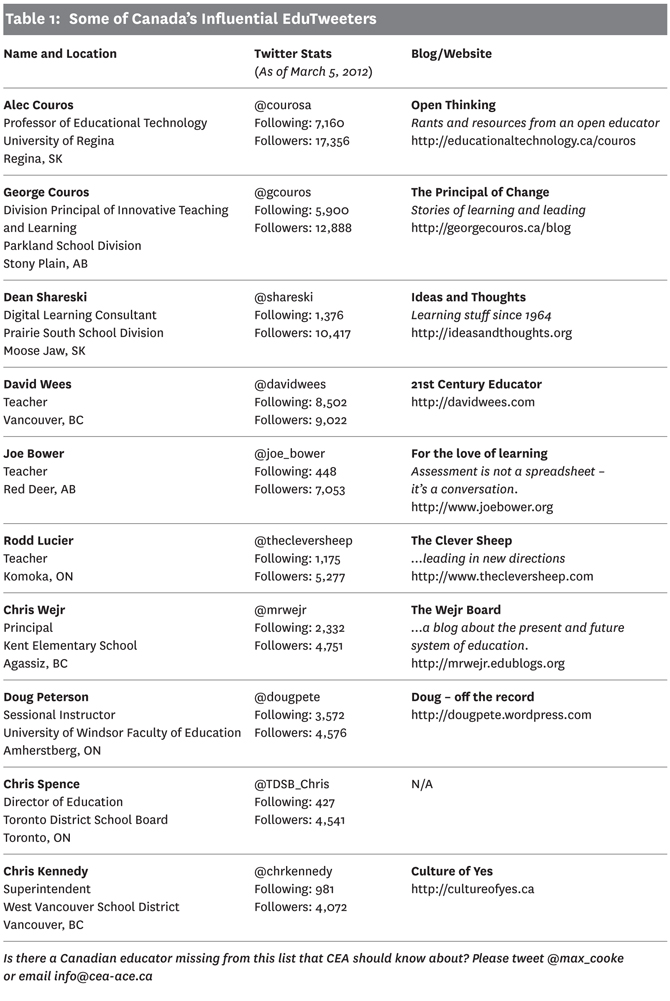
“Knowing what a Director is thinking and doing…demonstrates the whole idea of transparency, and that’s the kind of leader we need.” says Zoe Branigan-Pipe (@zbpipe) an elementary teacher and pre-service instructor at Brock University.
Former Superintendent and architect of one of Canada’s first district-wide 1:1 laptop initiatives, Canadian Education Association CEO Ron Canuel (@RonCanuel) feels that it’s essential for EduTweeters to attract more teachers and school district administrators into the exchanges to maximize Twitter’s potential to influence meaningful systemic change. “Without the presence of the mid and late adaptors, successful integration of technology will stay at the periphery of classroom activities and as an add-on in school districts’ Vision Statements.”
Joe Bower lauds Twitter for its ability to create pockets of resistance and real innovation, based on the remarkable networking of the top EduTweeters to date. But the edu-Tweeter movement is going mainstream.
Joe Bower lauds Twitter for its ability to create pockets of resistance and real innovation, based on the remarkable networking of the top EduTweeters to date. “Institutions couldn’t pay the George Couros’ to do what they have done for free.” But the edu-Tweeter movement is going mainstream. Couros, his brother Alec Couros (@couros) Professor of Educational Technology University of Regina, and Dean Shareski (@shareski), Digital Learning Consultant for the Prairie South School Division, have parlayed their influential social media brand into more formal paid PD events for school district leaders.[12] This may be a positive sign that the edu-tweeter message is trickling up the line, or an indication that grassroots Twitter activism is in danger of being co-opted, not unlike the torrent of “21st Century Learning” rhetoric that’s omnipresent in conventional PD.
Time will tell if a critical mass of decision-makers will find ways to build teacher-driven classroom innovations to scale, but the clock is ticking and Canadian EduTweeters aren’t holding their breath. This point is best illustrated by a face-to-face discussion I overheard between two Pierre Poulin disciples during an EdCamp coffee break chat. They were comparing prices on construction materials required to build more do-it-yourself desks that would accommodate the iClasse philosophy. This left no doubt in my mind that all of this edu-tweeting is for the students, driven by a movement of educators that Thompson Manitoba principal Robert Fisher (@RobCFisher) describes as “caring so much that it hurts.”
For a full lexicon of Twitter terminology, please visit: https://support.twitter.com/entries/13920-frequently-asked-questions
Special thanks to Rodd Lucier, Zoe Branigan-Pipe and the organizers and participants of Unplugd 2011, Joe Bower, David Wees, George Couros, Chris Kennedy, Shannon Smith, Chris Wejr, Stephen Hurley and the Toronto EdCamp organizing team, Pierre Poulin and the EdCamp Montréal organizing team, Cailey Crawford, and Ron Canuel for contributing their time, thoughts, and experiences to this article.
EN BREF – Un groupe émergent de chefs de file en éducation canadienne attire des milliers d’adeptes. Twitter fait maintenant partie intégrante de leur vie : ils transmettent vingt micromessages ou plus par jour qui peuvent inclure des liens à des articles, des recherches, de nouvelles idées de blogueurs en éducation ou à leurs propres idées, ou tout simplement une réflexion personnelle. Au mieux, ces édu-microblogueurs tirent habilement parti de Twitter pour se démarquer, pour réinventer le perfectionnement des enseignants et, possiblement, pour accélérer la transformation des systèmes d’éducation canadiens. Twitter sert à étendre les conférences de perfectionnement professionnel aux abonnés en temps réel, facilite les discussions informelles (« déconférences ») entre les éducateurs ayant des intérêts communs, permet la propagation virale sur Internet de pratiques exemplaires et permet aux enseignants de classes innovantes de remettre en question le statu quo.
[1] Retrieved at: https://support.twitter.com/groups/31-twitter-basics/topics/104-welcome-to-twitter-support/articles/215585-twitter-101-how-should-i-get-started-using-twitter
[2] Hashtags are created organically by edu-tweeters as a way to categorize messages. People use the hashtag symbol # before relevant keywords in their Tweet to categorize those Tweets to show more easily in Twitter Search. For educators, hashtags have also become a powerful, simple tool for tracking topics (i.e. #assessment, #effectiveteaching, #resilience, #studentsuccess, etc.).
[3] http://www.youtube.com/watch?feature=player_embedded&v=zq9KzCCpuo4
[4] http://georgecouros.ca/blog/archives/791, http://georgecouros.ca/blog/archives/974,
[5] http://georgecouros.ca/blog/archives/1962
[6] https://www.pearsonschool.com/, pgs. 18,19
[7] https://www.pearsonschool.com/
[8] http://www.oct.ca/publications/PDF/Prof_Adv_Soc_Media_EN.pdf
[9] http://thecleversheep.blogspot.com/2011/04/social-media-advisory.html
[10] http://unplugd.ca/page/unplug-d-11-videos
-
21st Century Learning Leadership Forum
Comments Off on 21st Century Learning Leadership ForumIn this CEA-supported event, thought leaders from across the world met to discuss leadership and change in education.
-
Shift This
Comments Off on Shift ThisBrad Ovenell-Carter opened the first session I attended at EdCamp Delta on the weekend by explaining how he’s working in his school to shift the control of technology from the top-down to the bottom-up. I’ll deal with the idea first and the way we often frame the idea (and the way Brad did here) second.
-
Education: A Way of Being in the World
Comments Off on Education: A Way of Being in the WorldA review of Education as Dialogue: Its Prerequisites and its Enemies by Tasos Kazepides McGill-Queens University Press, 2010. ISBN 9780773538061.
Tasos Kazepides asserts that one cannot understand education “merely by the scientific study of human nature; it can be explicated only by philosophical inquiry” (p. 28) and in order to address educational issues effectively, “we must first address their philosophical dimensions, which have logical priority over other kinds of problems” (p. 1).
In his opinion, however, most educational administrators and policymakers do not sufficiently consider underlying philosophical issues and consequently fall into “a pernicious form of scientism that has permeated our thinking and has contributed to the unfortunate institutionalization of the concept of education” (p. 29). The end result is confusion between schooling and the process of education itself, confusion that results in a predominantly utilitarian focus within educational institutions. Education, he maintains, “is the development of persons, not the training of soldiers, lawyers, or computer technicians … [It] is not a preparation for anything; its aims are inherent within itself … Being educated is a way of being in the world and a way of living one’s life” (p. 111). Education of this sort, Kazepides argues, is best achieved through dialogue.
Essential to an understanding of education as a dialogue is a distinction – which Kazepides claims is almost always ignored – between education and its prerequisites, and “when it is totally ignored it often renders education a useless all-embracing concept more or less synonymous with socialization” (p. 68). He explains the prerequisites of education by referring to Ludwig Wittgenstein’s “riverbed propositions”, which constitute the foundation of all our thinking. Drawing heavily on Wittgenstein’s concept of language games, Kazepides argues that these bedrock assumptions are not learned so much as inculcated “by means of examples and by practice, not by intellectual demonstrations, definitions, or sermons. This means that children must be participants in a form of life in order to acquire the prerequisites – not merely spectators or listeners” (p. 81).
It is upon the foundation of these riverbed prerequisites that education can take place. Education, according to Kazepides, is the further development of the mind through “the logic and the standards of excellence immanent in the various disciplines of thought and action and their respective norms and language games as we practice them today” (p. 33). Clearly, induction into those disciplines requires thought, and Kazepides agrees with Plato that “thinking and discourse are the same thing, except that what we call thinking is, precisely, the inward dialogue carried on by the mind itself without a spoken word” (p. 90). If education is understood in this way, then it follows that education, whether it occurs in schools or elsewhere, is best conducted by involving people in dialogue. Kazepides feels that when this is done, education becomes “the most appropriate antidote to our divided, confused, rudderless, and competitive world” (p. 111).
This, then, is the essence of the extensive, precise, and detailed argument that Kazepides presents. Although it is written lucidly and in plain language, the book requires careful reading because it is such a substantial philosophical romp – particularly for those with no prior appreciation of the philosophy of Wittgenstein, which underpins much of it. The effort is, however, worthwhile because the ideas it presents are both illuminating and generative.
This is not a book for those who want to know more about dialogue and how it can be encouraged because it does not examine this practical question, but it does provide an enlightening and provocative look at the epistemological question of what constitutes an education. It clarifies terms, such as the “aims of education”, that are often used in casual and thus confusing ways, and provides useful insights into the process by which a child “bootstraps” into an understanding of the world and intelligent behaviour within it.
In the latter chapters Kazepides warns against what he sees as mis-education that is occurring and the enemies of dialogue in our society, which include not only the obvious religious and political culprits but also advertising that “turns every aspect of human culture into a commodity” (p. 138). Particularly in the age of “21st Century Learning”, this book provides a cautionary counterpoint to the instrumentalist drumbeat, a reminder of the best that we can be, and a clearly stated explanation of the challenges that entails.
-
Is the Sky the Limit to Educational Improvement?
Comments Off on Is the Sky the Limit to Educational Improvement?The world is rapidly becoming a different place, and the challenges to individuals and societies imposed by globalization and modernization are widely acknowledged. Increasingly diverse and interconnected populations, rapid technological change in the workplace and in everyday life, and the instantaneous availability of vast amounts of information represent but a few of these new demands. In this globalized world, individuals and countries that invest heavily in education benefit socially and economically from that choice, and increasingly so. Among the 30 Organization for Economic Co-operation and Development (OECD) countries with the largest expansion of college education over the last decades, most still see rising earnings differentials for college graduates, suggesting that an increase in knowledge workers does not lead to a decrease in their pay as is the case for low-skilled workers.
The other player in the globalization process is technological development, but this too depends on education, not just because tomorrow’s knowledge workers and innovators require high levels of education, but also because a highly-educated workforce is a pre-requisite for adopting and absorbing new technologies and increasing productivity. But education reaches well beyond the economic dimensions; it is the key to enable individuals to live in, and contribute to, a multi-faceted and sustainable world as active and responsible citizens and to appreciate and build on different values, beliefs, and cultures.
In a purely quantitative sense, education has done rather well. With three exceptions, OECD countries have seen rapidly rising numbers of better qualified people, with an average increase of 40 percent in college graduation rates over the last decade. But in a fast-changing world, producing more of the same education will not suffice to address the challenges of the future.
Changing Demands on Education Systems
A generation ago, teachers could expect that what they taught would last for their students’ lifetime. Today, schools need to prepare students for more rapid economic and social change than ever before, for jobs that have not yet been created, to use technologies that have not yet been invented, and to solve problems that we don’t yet know will arise. Education also has a key role to play to foster sustainable values.
The dilemma for educators is that routine cognitive skills, the skills that are easiest to teach and easiest to test, are also the skills that are easiest to digitize, automate, and outsource. Educational success is no longer about reproducing content knowledge, but about extrapolating from what we know and applying that knowledge in novel situations.
Take mathematics as an example. Traditionally mathematics is often taught in an abstract world, in ways that are removed from authentic contexts – for example, students are taught the techniques of arithmetic, then given lots of arithmetic computations to complete; or they are shown how to solve particular types of equations, then given lots of similar equations to solve. But to succeed today, students need to have an understanding of the fundamental concepts of mathematics, they need to be able to translate a new situation or problem they face into a form that exposes the relevance of mathematics, to make the problem amenable to mathematical treatment, to identify and use the relevant mathematical knowledge to solve the problem, and then to evaluate the solution in the original problem context.
Or take literacy as another example. In the past, literacy was mainly about learning to read, a set of technical skills that individuals would acquire once for a lifetime in order to process an established body of coded knowledge. Today, literacy is about reading for learning, the capacity and motivation to identify, understand, interpret, create, and communicate knowledge, using written materials associated with varying situations in continuously changing contexts. In the past, it was sufficient to direct students to an encyclopedia to find the answer to a question, and they could generally rely on what they found to be true. Today, literacy is about managing non-linear information structures, building one’s own mental representation of information as one finds one’s own way through hypertext on the Internet, about dealing with ambiguity, interpreting and resolving conflicting pieces of information.
Similarly, conventional approach of schools to problems was breaking them down into manageable bits and pieces, and then teaching students the techniques to solve them. But today individuals create value by synthesizing the disparate bits. This is about curiosity, open-mindedness, and making connections between ideas that previously seemed unrelated – which requires being familiar with and receptive to knowledge in other fields than our own.
The world is also no longer divided into specialists and generalist. What counts are the “versatilists” who are able to apply depth of skill to a progressively widening scope of situations and experiences.
The world is also no longer divided into specialists and generalist. What counts are the “versatilists” who are able to apply depth of skill to a progressively widening scope of situations and experiences, gaining new competencies, building relationships, and assuming new roles. They are capable of not only of constantly adapting but also of constantly learning and growing, of positioning themselves and repositioning themselves in a fast changing world.
Last but not least, in today’s schools, students typically learn individually, and at the end of the school year, schools certify their individual achievements. But the more interdependent the world becomes, the more important is the capacity of individuals to collaborate and orchestrate. In the flat world, everything that is our proprietary knowledge today will be a commodity available to everyone else tomorrow. As Thomas Friedman puts it, there is a shift from a world of stocks – with knowledge that is stacked up somewhere depreciating rapidly in value – to a world in which the enriching power of communication and collaborative flows is increasing.
These kinds of competencies are the focus of OECD’s Programme for International Student Assessment (PISA) and, since first results emerged in 2001, Canadian 15-year-olds have fared well against their counterparts internationally. At the same time, outcomes in Canada have remained mainly flat since 2001, while other countries have continued to raise quality and equity in learning outcomes. It is therefore important for Canada to look ahead.
Responding to the Challenges
Performance on international comparisons cannot be tied to money alone. Spending per student accounts for less than a quarter of the observed performance variation across countries on PISA. In contrast, the kind of spending choices countries make have far greater significance, with most of the high-performing nations now prioritising the quality of teachers over the size of classes.
Looking beyond financial resources, PISA suggests that schools and countries where students work in a climate characterised by high performance expectations and the readiness to invest effort, good teacher-student relations, and high teacher morale tend to achieve better results. Many countries have pursued a shift in public and governmental concern away from the mere control over the resources and content of education towards a focus on outcomes. This has driven efforts to articulate the expectations that societies have in relation to learning outcomes and to translate these expectations into educational goals and standards. Ambitious educational standards have influenced many of the top performing education systems in important ways, helping them to establish rigorous, focused, and coherent content at all grade levels; reduce overlap in curricula across grades; reduce variation in implemented curricula across classrooms; facilitate co-ordination of various policy drivers ranging from curricula to teacher training; and reduce inequity in curricula across socio-economic groups.
Coupled with this trend have been efforts to devolve responsibility to the frontline, enabling schools to become the drivers of educational improvement. In Finland strategic thinking and planning now takes place at every level of the system. Every school discusses what the national vision along with desired standards might mean for them, and every decision is made at the level of those most able to implement it in practice.
In Finland every school discusses what the national vision along with desired standards might mean for them, and every decision is made at the level of those most able to implement it in practice.
Second, many of the high performing systems also construct effective interventions at the level of the school, providing schools that do not yet succeed with effective support systems. Some countries go even further and intervene at the level of the individual student, developing processes and structures within the school that are able to identify whenever a student is starting to fall behind, and intervening to improve that student’s performance. And importantly, such personalization in these countries is in terms of flexible learning pathways through the education system rather than in terms of individualised goals or institutional tracking, which PISA shows to lower performance expectations for students and to provide easy ways out for teachers and schools to defer problems rather than solving them. Intervention and support do not mean applying pre-packaged interventions in mechanical sequence; instead, they are about diagnosing problems and tailoring solutions accordingly.
Third, many high performing systems share a commitment to professionalized teaching in ways that imply that teachers are on a par with other professions in terms of diagnosis, the application of evidence-based practices, and professional pride. They pay great attention to how the pool is established from which they recruit their teachers; how they recruit; how they select their staff; the kind of initial training their recruits get before they present themselves for employment; how they mentor new recruits and induct them into their service; what kind of continuing training they get; how their compensation is structured; how they reward their best performers and how they improve the performance of those who are struggling; and how they provide opportunities for the best performers to acquire more status and responsibility.
External accountability systems are an essential part of this, but they are not enough. Among OECD countries, we find countless tests and reforms that have resulted in giving schools more money or taking money away from them, developing greater prescription on school standards or less prescription, making classes larger or smaller, often without measurable effects.
Instead, devolved decision-making needs to go hand in hand with intelligent accountability, and what this means is the move beyond approaches to external accountability towards building capacity and confidence for professional accountability in ways that encourage networks of schools to stimulate and spread innovation as well as collaborate to provide curriculum diversity, extended services, and professional support. Success with this will require multi-layered assessment systems that coherently extend from students, to schools, to regions and nations, and which do not operate in a vacuum but are part of a comprehensive set of instruments that extend to instructional material as well as to teacher training.
Such assessments recognize that successful learning is as much about the process as it is about facts and figures, and they do not just produce school marks but try to provide a window into students’ understandings and the conceptual strategies a student uses to solve a problem, with dynamic task contexts in which prior actions may stimulate unpredictable reactions that in turn influence subsequent strategies and options. They do not take learning time away from students, but try to enhance the learning of students, of teachers, of school administrators and policymakers, through building frameworks for lateral accountability. That means generating information that can be acted upon and that provides productive and usable feedback for all intended users, so that teachers understand what the assessment reveals about students’ thinking, and school administrators and policymakers obtain the information they need to create better opportunities for student learning.
Conclusion
In the past, when economies only needed a small slice of well-educated workers, it was sufficient – and perhaps efficient – for governments to invest a large sum into a small elite to lead the country. But the social and economic cost of low educational performance has risen very substantially, and PISA shows that the best performing education systems now get all young people to leave school with strong foundation skills.
When one could still assume that what is learned in school will last for a lifetime, teaching content and routine cognitive skills were at the centre of education. Today, where individuals can access content on Google, where routine cognitive skills are being digitized or outsourced, and where jobs are changing rapidly, education systems need to enable people to become lifelong learners, to manage complex ways of thinking and complex ways of working that computers can’t take over easily.
That requires a very different calibre of teachers. When teaching was about explaining prefabricated content, school systems could tolerate low teacher quality. And when teacher quality was low, governments tended to tell their teachers exactly what to do and exactly how they want it done, using prescriptive methods of administrative control and accountability. What we see in the most advanced systems now is that making teaching a profession of high-level knowledge workers, not higher salaries, is what makes teaching so attractive in countries as different as Finland, Japan, or Singapore.
People who see themselves as candidates for the professions are not attracted by schools organized like an assembly line, with teachers working as interchangeable widgets. That is why international comparisons show a very different work organization in high performing systems, with the status, professional autonomy, and the high-quality education that go with professional work, with effective systems of teacher evaluation, and with differentiated career paths for teachers.
This is why high performing education systems tend to create a “knowledge rich” education system, in which teachers and school principals act as partners and have the authority to act, the necessary information to do so, and access to effective support systems to assist them in implementing change. What distinguishes the top-performer Finland is that it places the emphasis on building various ways in which networks of schools stimulate and spread innovation as well as collaborate to provide curriculum diversity, extended services, and professional support. It fosters strong approaches to leadership and a variety of system leadership roles that help to reduce between-school variation through system-wide networking and to build lateral accountability. It has moved from “hit and miss” policies to establishing universal high standards; from uniformity to embracing diversity; from a focus on provision to a focus on outcomes; from managing inputs and a bureaucratic approach to education towards devolving responsibilities and enabling outcomes; and from talking about equity to delivering equity. It is a system where schools no longer receive prefabricated wisdom but take initiatives on the basis of data and best practice.
An investment in improvement will be worth it. A study carried out by the OECD in collaboration with Stanford University suggests that a modest goal of having Canada boost its average PISA scores by 25 points over the next 20 years – far less than the most rapidly improving education systems in the OECD achieved between 2000 and 2009 – could imply a gain of over five trillion Canadian dollars for the Canadian economy over the lifetime of the generation born in 2010.
Addressing the challenges will become ever more important as the world’s best education systems – not simply improvement by national standards – increasingly become the yardstick to success. The world has become indifferent to tradition and past reputations, unforgiving to frailty, and ignorant to custom or practice. Success will go to those individuals and nations that are swift to adapt, slow to complain, and open to change. The task for educators and policymakers is to ensure that countries rise to this challenge.
EN BREF – Les systèmes éducatifs contemporains doivent permettre aux gens de devenir des apprenants à vie, de gérer des modes complexes de réflexion et de maîtriser des façons complexes de travailler que les ordinateurs ne peuvent aisément prendre en charge. La tâche des éducateurs et des responsables de politiques consiste à s’assurer que les pays relèvent ce défi. Les systèmes d’éducation à haute performance comme ceux de la Finlande et de Singapour tendent à être « riches en connaissances ». Le personnel enseignant et les directions d’école y ont l’autorité et l’information nécessaire pour agir et ont accès à des systèmes efficaces de soutien qui les aident à apporter des changements. Il vaut la peine d’investir dans l’amélioration. D’après une étude menée par l’OCDE et l’Université Stanford, si le Canada réussit à rehausser la note moyenne au PISA de 25 points sur les 20 prochaines années, l’économie canadienne progresserait de plus de cinq billions de dollars pendant la vie de la génération née en 2010.
-
TedXWilfrid-Bastien
Comments Off on TedXWilfrid-BastienBetter than a cup of coffee in the morning is listening to a good TEDx talk. Most people know about TED (www.ted.com), which stands for “Technology, Entertainment and Design”. Founded in 1984, it provides a platform through which ideas can be shared between communities and inventors, thinkers, scientists, educators and the like. TEDx has since become a huge influence in creating important dialog, inspiring minds, sparking innovation and beyond-the-box thinking everywhere it goes.
TEDxWilfrid-Bastien, is an independently organized TEDx event – by the people, for the people – to discuss, reflect on and celebrate education. Exclusively dedicated to today’s education, this conference will feature a number of important speakers who will share their innovative ideas in addressing the important question of the transition to a 21st century pedagogy.
This rare event is a great honour and as well as a first for the small elementary school Wilfrid-Bastien. It is furthermore the first ever independently organized TEDx event to be held exclusively about canadian education in French!
TEDxWilfrid-Bastien, will be held on February 29th, 2012, between 7-10pm at 8420 Boulevard Lacordaire in Saint-Léonard, Quebec, Canada. There are only a very limited amount of tickets available, so please hurry and visit http://tedxwilfridbastien.eventbrite.com to buy your ticket(s) today!
Co-written by Amber Judge
Note: The video footage of each talk will only be released for viewing on the web when they are translated with subtitles in English.



IDEAS TO SUPPORT EDUCATORS : Subscribe to the EdCan e-Newsletter
Quality research, reports, and professional learning opportunities.