Archive
-
Students, Please Turn to YouTube for your Assignments
Comments Off on Students, Please Turn to YouTube for your AssignmentsOne of my frustrations as a senior level Math teacher at Okanagan Mission Secondary in Kelowna, B.C., had always been insufficient classroom time to work with students. I typically spent 80 percent of class time lecturing. I was the one doing the math; my students were passive observers. I spent hours coming up with innovative lesson plans to make my lectures more student-centred, but in reality I was the sage on the stage. I then sent the students away to struggle with homework on their own.
Students regularly told me that they hit a wall when it came to completing their homework. They listened intently in class and completed a couple of questions with the limited time they had, but once they got home they struggled and were often lost. The struggle itself is not a bad thing, but the frustration is.
Now the struggle has been brought into the classroom, with peers and teacher able to offer assistance. What happened? I introduced a dramatically different way of teaching known as “Flipped Classroom,” which I discovered at a conference in Woodland Park, Colorado, in the late spring of 2011.
FROM LECTURER TO TEACHER
Instead of traditional lectures dominating classroom time, the lecture is compressed and delivered via websites like YouTube, which students can view at home or anywhere they choose. I have been able move from lecturer to what I believe a teacher should be: someone who helps, prods, inspires, encourages and supports students.
I found it quite easy to lecture about math for 45 minutes, four times a day. It was second nature for me to turn on the overhead projector and speak about a topic I knew well and enjoyed. Now, I spend my classroom time moving from student to student, helping them understand the curriculum.
Before I introduced the Flipped Classroom, I found it quite easy to lecture about math for 45 minutes, four times a day. It was second nature for me to turn on the overhead projector and speak about a topic I knew well and enjoyed. Now, I spend my classroom time moving from student to student, helping them understand the curriculum. I engage them in discussion on the content, question them about their reasoning, and listen to their ideas about mathematics.
In the Flipped Classroom, differentiated instruction has become possible, even in a class of 25 to 30 students. When I was delivering my lectures to the class, everyone had to move at my pace. Now I let my struggling learners take extra time in units where they need it, while my strongest learners can move at an accelerated pace and challenge themselves. If they finish the curriculum early, they can move on to the next course while they are still technically in my class.
The really exciting thing about the self-pacing is that it allows students to take responsibility for their own learning. They no longer simply come to class as passive observers; it is their responsibility to pace themselves and meet the deadlines that I have set in place.
SELF-PACING AND RAISING THE BAR
The Flipped Classroom has also allowed me to raise the bar for all my students. The B.C. Ministry of Education has set the minimum grade to pass a course at 50 percent. In subjects like Math this just isn’t good enough to ensure success in subsequent courses because mathematical concepts build upon one another year after year. A student who cannot add and subtract integers is likely to have difficulty solving a two-step algebraic equation.
So I have raised the bar. For students to advance through the course material they need to demonstrate an understanding of 70 percent or higher on their quizzes. I chose 70 percent as a mastery level because I felt it was an attainable goal. I didn’t want my students to settle for a low grade even if it had no effect on their over-all average.
When students achieve greater than 70 percent on their first attempt, they move on. If a student does not achieve mastery, the student and I determine where the misunderstanding took place. I usually give these students a small learning task to reinforce their new understanding and then let them attempt the quiz again. In my experience, 95 percent of students are able to demonstrate mastery – 70 percent or above – on their second attempt. The 70 percent mastery has ensured baseline knowledge for each of my students.
Mastery has changed how students learn in my class. Students now view quizzes as a learning tool, not as a summative assessment tool. Across all my classes this past year I have seen a three to five percent increase in test scores. The mastery learning that I have implemented helps students understand what they know and what they do not know. No longer am I putting a test on a student’s desk when both the student and I know he or she is going to fail. Mastery learning makes success the norm, rather than the exception.
Prior to flipping my classroom, I gave students daily quizzes that were not returned until the following class. By that time, they were rarely concerned with anything other than the grade at the top and were busy focusing on the new content at hand. Those assessments were meant to be formative, but were only formative for me; the students were not learning from them. Now my students get nine out of 10 on a quiz and ask their peers what went wrong on that single question.
MASTERY ASSESSMENT WITH MOODLE
Mastery learning would not have been possible without the combination of the Flipped Classroom and Moodle, a course management system that allows me to generate tests and provide unique multiple attempts at the click of a button. I have compiled a large repository of math questions, sorted by learning outcome and difficulty level, so I can ensure that students are getting assessments that are equally difficult, yet contain different questions.
Using Moodle has allowed me to further break down the walls of the classroom and give students more flexibility. They are able to access Moodle and complete their formative assessment quizzes wherever they have an Internet connection and receive immediate feedback. Students who have demonstrated mastery on their first attempt at a quiz will often retake it for extra practice before a summative assessment. I have logged on to Moodle some nights and seen half my students completing quizzes on their own time at home.
Before I flipped my classroom I gave my students traditional paper-and-pencil tests where they needed to show their calculations to demonstrate their understanding. Using Moodle, students answer numerical-response questions and multiple-choice questions. Initially, I was concerned that, without their detailed calculations, I wouldn’t to be able to see what students were really doing on their summative test, but within the first month my thought process completely changed. Since I now have more time than ever to work with my students, I am spending a significant amount of time observing their understanding of the curriculum, correcting them when they skip a step or misunderstand a procedure. This makes the feedback that I have traditionally put on their summative test less important.
Between the Flipped Classroom and Moodle, technology has changed the way I am using my time. I no longer spend hours marking tests; instead I use that time to come up with in-class learning activities that are more beneficial to my students’ learning.
COMMON QUESTIONS
The question I’m most frequently asked is, what do you do when a student doesn’t have a computer or Internet at home? In the last semester, I taught 120 students, and two of them did not have access to the necessary technology. This didn’t prove to be a significant issue. One student, who did not have Internet access, was given a USB drive with the lecture videos on it so he could watch at home. The other student, who did not have a computer, came to class 15 minutes early and completed his lessons then. I have not yet encountered a problem due to lack of technology that we have not been able to solve.
A second question I often get from teachers is, what do you do when a student doesn’t watch a video at home? In that case, I usually have the student watch the video in class while the other students are completing their daily learning tasks. These students normally realize, after a while, that their casual approach causes them to fall behind their classmates.
Lastly, many ask if the Flipped Classroom is going to replace teachers. In my opinion the Flipped Classroom makes the teacher more important than ever. I am now working with students in a more personal way, helping to facilitate their learning. I have to react to unknown problems, find alternative strategies to help students solve questions, and develop activities to get students to understand challenging concepts. I did all of these things in the traditional model of teaching, but only for a couple minutes per class. Now I spend my entire day doing them.
CONCLUSION
The Flipped Classroom is much more than students watching videos; it is about the flexibility that the videos offer. As a teacher I have built a classroom that is more efficient; students are using their class time to learn, to practice, and to perfect. My classroom has shifted from a teacher-centred to a student-centred environment. The feedback I have received about the Flipped Classroom from students and parents has been overwhelmingly positive. They like the flexibility and personalization that it offers. It has changed the educational landscape for me because, for the first time in my career, I feel I am really teaching.
A Flipped Network Conference will be held at Okanagan Mission Secondary School June 21 and 22, 2013, in Kelowna, B.C. For more information, visit www.flipnetwork-canada.com or email graham.johnson@sd23.bc.ca
EN BREF – Adoptant l’approche de la classe inversée, l’enseignant transmet la matière en dehors des heures de cours en préparant des vidéos qui compriment la matière et en les téléchargeant dans un site Web tel que YouTube, où les élèves peuvent les visionner à la maison ou ailleurs. L’enseignant de mathématiques dont il est question ici peut alors consacrer le temps de classe à circuler parmi ses élèves, à les engager dans une discussion au sujet du contenu, à les interroger sur leur raisonnement et à écouter les idées qu’ils émettent au sujet des mathématiques. Les élèves assument la responsabilité d’établir leur propre rythme et de respecter les échéanciers établis par l’enseignant.
-
In Nova Scotia, a Mi’kmaw Model for First Nation Education
Comments Off on In Nova Scotia, a Mi’kmaw Model for First Nation EducationIn 1999, Mi’kmaw communities in Nova Scotia won control over the education of their children for the first time in a century. The Mi’kmaw Education Act became Canadian law two years after a signed agreement by the federal and Nova Scotia governments and chiefs of nine (later 11) of 13 Mi’kmaw communities that recognizes local decisions on education, including language, history, identity, and customs in the regular curriculum.
Today, though funding is still an issue, the legal arrangement that governs the schooling of about 3,000 Mi’kmaw students in Nova Scotia is winning national attention as a possible model for First Nation self-governance in education.
Earlier this year, a national panel set up by the federal government and the Assembly of First Nations cited the Nova Scotia example in recommendations calling for a First Nation education system to protect a “child’s right to their culture, language and identity, a quality education, funding, and First Nation control of First Nation education.” The panel’s recommendations – a precursor to federal legislation expected in 2014 – aim to rectify an abysmal history of aboriginal education that leaves First Nation children at a disadvantage, by almost every measure, compared to their peers in school.
What’s driving interest in the Nova Scotia model is the work over the last two decades by Mi’kmaw Kina’matnewey, the education authority that distributes $40-million a year in federal grants to its member communities – and the effort of the local communities themselves. Significantly, the tripartite agreement recognizes the role of the education authority to support local band schools in delivering language immersion and other culturally rich programs and activities. With Mi’kmaw-focused teaching pedagogy, schools seek to engage students in a successful education experience. In 2010-11, Mi’kmaw Kina’matnewey reported a high school graduation rate of 75 percent for students in the system, up from 70 percent two years earlier and almost on par with Nova Scotia as a whole.
“What impressed us most were the outcomes,” says Scott Haldane, chair of the National Panel on First Nation Elementary and Secondary Education for Students On Reserve. The 75 percent graduation rate, he observes, “is double the national average and close to triple the average of what we saw in some of the worst performing schools.”
He describes Mi’kmaw Kina’matnewey as “an overnight sensation that’s taken 20 years to actually happen.”
Like a school board, Mi’kmaw Kina’matnewey serves as a central coordinating body, providing common services and resources to its members and acting on their behalf in negotiations with the Nova Scotia and federal governments. But unlike a school board, Mi‘kmaw Kina’matnewey serves rather than directs the activities of its members’ local schools.
“The accountability in the MK (Mi’kmaw Kina’matnewey) system is that MK is accountable for helping the schools but in the provincial system the schools are accountable to the school board,” says Jeff Orr, Dean of the Faculty of Education at St. Francis Xavier University in Antigonish, Nova Scotia. Emphasizing the “collective consciousness” that defines the interaction between Mi’kmaw Kina’matnewey and its members, he says “if we trust people are helping us we are more likely to seek out their support. The cultural, sociological and political hope of MK is that it is able to cultivate that trust and therefore able to operate in supporting schools [in ways] that are fundamentally different from the provincial system.”
If we trust people are helping us we are more likely to seek out their support.
Nurturing a new generation of Mi’kmaw teachers – who account for about 50 percent of those teaching in Mi’kmaw schools – has been a key goal of Mi’kmaw Kina’matnewey. Since 1995, in a collaborative effort between the education authority and the education faculty, more than 100 Mi’kmaw-speaking students have earned their bachelor of education. “That is because of the relentlessness of our relationship over the period of time,” reflects Prof. Orr, emphasizing the strong rapport between his institution and Mi’kmaw Kina’matnewey, whose representatives serve on an advisory body to the faculty. As well, his education faculty delivers on-reserve programming for students to complete their teaching degree on a part-time basis or earn a certificate in Mi’kmaw language pedagogy.
Former teacher Eleanor Bernard, the current Director of Education for Mi’kmaw Kina’matnewey, can measure progress by her own experience. When she arrived at high school in Sydney in 1981, she was one of 160 Mi’kmaw students. By graduation, she was one of only five who received their diploma. When she started teaching 20 years ago, she estimates she was one of about 25 from Mi’kmaw communities. Today, there are more than 200 in the province.
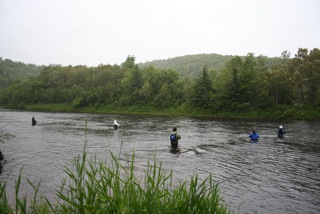
Caption: On Aboriginal Day in 2011, Potlotek High School Students exercise their treaty right to fish salmon.
Credit: Photo courtesy of Potlotek First Nation“It is amazing how far we have come in 20 years,” she says. Self- governance was an essential first step, but insufficient without community-based programming to enrich the education of Mi’kmaw children. A key initiative has been the development of language immersion programs in three communities, one offering courses through Grade 12.
While gratified by the recent attention to Mi’kmaw initiatives in Nova Scotia, Ms. Bernard is candid that significant education challenges remain on literacy, numeracy, attendance, and “capacity building” at the local level. “There is still work to be done,” she says. “There continues to be a need to bridge the gap for students in the provincial system and ours.”
Recent efforts to bridge the gap have come through partnership agreements between Mi’kmaw Kina’matnewey and the Nova Scotia department of education.
In 2007, the department and Mi’kmaw Kina’matnewey signed their first bilateral agreement on education services, replacing individual tuition agreements between the government and local bands.
“It allowed us to move forward in a way we had not done before,” says Candy Palmater, Director of the department’s Mi’kmaq Liaison Office.
Under the agreement, now being renewed, the department offers teachers in the Mi’kmaw Kina’matnewey system the same professional development provided free of charge to those in the provincial system. At the request of Mi’kmaw Kina’matnewey, concerned about school improvement, the department shared provincial tests for Grade 3, 6, and 9 so that local Mi’kmaw schools could assess the achievement of their students. The results are shared privately with participating Mi’kmaw schools.
In turn, Mi’kmaw Kina’matnewey shares its expertise in language curriculum and Mi’kmaw programming with the department. “We have worked hard at developing our relationship,” says Ms. Palmater, who is herself of Mi’kmaw descent. “As a result, we have a real sharing back and forth for the first time in a long time.”
As a bright light in an often-dark picture of aboriginal education, the Mi’kmaw self-governance model holds out hope for what is possible, says Mr. Haldane. Speaking of his national panel, he says “the conclusion we came to is that when First Nations are given the time and resources to build a system that includes school-board type supports and ministry-type supports, and when they can work closely with the provincial education system, then results seem to follow.”
EN BREF – En 1999, en vertu des lois fédérales, les collectivités Mi’kmaw de la Nouvelle-Écosse ont obtenu le droit de gérer l’éducation de leurs enfants pour la première fois depuis un siècle. Avec le soutien de Mi’kmaw Kina’matnewey, une autorité scolaire assurant des services centraux, les écoles Mi’kmaw offrent des cours de langue d’immersion, une pédagogie culturellement adaptée et d’autres initiatives favorisant la réussite scolaire. En 2010-2011, Mi’kmaw Kina’matnewey a rapporté que 75 pour cent des élèves du secondaire avaient obtenu leur diplôme, soit deux fois la moyenne canadienne. La formule d’auto-administration est considérée comme un modèle possible pour l’enseignement dans les Premières Nations canadiennes.
-
Shared Campus Smooths Post-secondary Pathways
Comments Off on Shared Campus Smooths Post-secondary PathwaysAt the opening of Olds High School, Principal Tom Christensen held his breath as he watched students inspect the new facilities designed with a new approach to learning in mind.
The Alberta school is divided into four so-called “quads,” each housing one-quarter of the school’s 800 students, with flexible learning spaces to accommodate small or large groups, self-directed study, project-based learning and other forms of inquiry and collaboration.
“You could hear the students – they just got it right away,” says Mr. Christensen, delighted by their response.
In many ways, Olds is not your average high school.
It is located on the campus of Olds College, which partnered with Chinook’s Edge School Division to create a shared, multi-facility complex known as the Community Learning Campus (CLC). The high school occupies about 20 percent of the CLC’s Ralph Klein Centre, which also houses the CLC’s Health and Wellness Centre, the Central Alberta Child and Family Services Authority, Alberta Employment and Immigration, Integrated Career Centre, as well as counseling and health services.
Other facilities that make up the learning campus include a fine arts centre for theatre and performing arts for students and the community, as well as a Bell e-Learning Centre that serves as a high-tech hub for learning resources accessible to students, staff, and communities in the vicinity of Olds, Alberta.
As a measure of the physical integration of education facilities, high school students make use of career, technical and shop facilities, renovated as part of the CLC project and located on the college campus. In addition to saving money, the shared facilities enable smooth pathways from college to post-secondary education or training.
Former Chinook’s Edge Superintendent Jim Gibbons says students can “do a transition from, say, a level of skill at Grade 9 or 10 and then easily transition to the trades as well.” High school students can use the college library as well, with no need to duplicate the facility.
The layout of the high school is designed to get students thinking about their interests and possible career pathways. Students in the Grade 9 quad explore a “Who Am I?” theme that introduces them to project-based learning. In the past, says Mr. Christensen, a project might consist of: “we studied Columbus, now write a report on him.” Now, he says, “a project has a driving question; it’s based on the inquiry idea.”
A project has a driving question; it’s based on the inquiry idea.
Grade 10-12 students choose among three different quads. The Blue and Gold quads are organized along the familiar “classroom-based” model (“We don’t like to use the word ‘traditional’ anymore,” Mr. Christensen says). This model was inspired by small K-12 community schools in which teachers know high-school-age students and their parents well. “When we were setting up the idea of the quads, we were trying to make the four areas of our school function like small schools,” says Mr. Christensen. For example, in the Blue and Gold quads, teachers of Math, English and Social Science stay with the students through their three years of high school. The timetable accommodates team teaching as another form of learning enrichment.
The “Green” quad, by contrast, subscribes to an inquiry-based form of learning, with projects and seminars that allow students to be more self-directed in their activities. Students stay with the same two core-subject teachers for three years. Green quad students don’t have to be honour students, and many are not, according to Mr. Christensen, but they do need to be self-motivated and have a good work ethic. The self-directed approach is designed to create a university-like atmosphere to ease the transition from high school to university. Although the other three quads were developed as part of the planning for the new school, the Green-quad concept, previously known as the “academic team,” has been part of the Olds High School program for more than 10 years.
Enabling students to direct their own learning means students are not constrained by disciplines organized into the usual hourly units of classroom study. “We know as adults we learn at different rates,” says Mr. Gibbons, now a Senior Advisor with the Alberta School Boards Association. He says most schools hang onto the outmoded Carnegie unit “that suggests if we have students spend 60, 70, 80 minutes in a classroom they will come out with this defined amount of knowledge and learning. It doesn’t make sense.”
Not all teachers are comfortable in the kind of setting adopted by Olds High School. Four teachers among the staff of 30 decided not to stay after the new program was introduced, even though some participated in the planning and visioning. They included some master teachers. “I’m very good friends with them and I respect that they did that, says Mr. Christensen. “But it opened opportunities for me to hire people that were ready to really embrace what we’re doing.”
-
Alberta High School, College Elevate Learning with Rare Joint Venture
Comments Off on Alberta High School, College Elevate Learning with Rare Joint VentureIn 2003, a group of parents in Olds, Alberta, rejected a provincial grant of $6.8 million to renovate their aging high school, which they felt should be replaced. Their refusal – even with the provincial minister of infrastructure ready to hand over an oversize cheque – set in motion a remarkable collaboration among education institutions accustomed to working in their own spheres.
What transpired in Olds, a rural community of 8,200 people located midway between Calgary and Edmonton, is the result of a shared vision that transcended institutional boundaries to create facilities and learning opportunities far beyond the means of its individual partners.
By working together, and drawing widespread support in the community and beyond, Chinook’s Edge School Division (CESD) and Olds College conceived a plan that materialized over seven years into a $70-million Community Learning Campus (CLC) serving high school, college, and adult learners in Olds and mid-central Alberta. In 2010, the new complex opened as a joint venture between Chinook’s Edge, the largest rural school division in Alberta, and Olds College, with facilities including a 390-seat theatre, a fitness centre, an e-learning centre (for distance learning and on-site training), and not least, a new $22-million high school on the campus of the 1,300- student college.
The CLC sprang from the conviction of the leaders of the two institutions that they could accomplish a great deal more by joining forces than by living in largely separate silos. In the end, the project succeeded thanks to a multi-stakeholder group of “gladiators,” the development of a well-defined business case, and bits of serendipity along the way. The CLC was selected by the Organization for Economic Co-operation and Development (OECD) as a case study in its Innovative Learning Environments Project.
The timing was right for a collaboration.
“At that point in time, the college really needed to come into the 21st century, particularly from an infrastructure and programmatic standpoint,” says H.J. (Tom) Thompson, president of Olds College. “There was a stark reality that if we were to continue to be a traditionalist in terms of working with government as primary sponsor of infrastructural renewal, we’ll still be waiting today.”
I think high schools have to be much more flexible and need to find ways to engage kids so they see this bigger picture of a career path
For his part, then-Chinook’s Edge Superintendent Jim Gibbons had to figure out how to replace an aging high school separated from its sport fields by a busy highway and dependent on a nearby church to house a music program. But he was also concerned about preparing students for a 21st century economy requiring higher levels of education than in the past. “I think high schools have to be much more flexible and need to find ways to engage kids so they see this bigger picture of a career path,” he says. “We know kids are going to have multiple careers and so how do you get some experience and try things out?” (See Shared Campus, below)
Mr. Gibbons approached Mr. Thompson about possibly relocating the high school on a parcel of the Olds College campus, but Mr. Thompson was not interested selling a piece of college land for a “siloed, standalone entity.” Recalling the conversation, he says he told Mr. Gibbons, now a Senior Advisor to the Alberta School Boards Association, “if you want to talk about something just a little bit different, maybe a whole lot different, I said I think you would have the interest of our college and certainly our leaders here.”
Thus began a collaboration of two “visionaries,” as others described them, who met over coffee to map out a partnership that would work for both institutions and expand opportunities for their students and the wider community. Early on, the two leaders recruited key allies – Olds High School principal Tom Christensen and Dorothy (Dot) Negropontes, then an Assistant Superintendent in Chinook’s Edge. Ms. Negropontes was an alumnus of Olds High School who had deep roots in the community and a strong reputation for organizational skills.
What emerged from the discussions was the notion of shared facilities – under the banner of the Community Learning Campus – that would, among other things, facilitate a seamless transition for high school students into the workplace, apprenticeship, college or university. Reaching beyond their institutional walls, Mr. Gibbons and Mr. Thompson also looked to connect 13 communities within the Chinook’s Edge School Division to an e-learning centre for education and training. Area residents also would have access to a health and wellness facility and a fine arts complex for community and school events.
The shared arrangement also had implications for how best to equip a variety of students for tomorrow’s economy. “We looked at the learner as a high school learner, a college learner, a college learner that might choose to go on to a university program, a community lifelong learner and, most importantly, [we envisioned] a region that could be served so much better if we would append the technology,” says Mr. Thompson. “That was something the government latched onto big-time.”
His strategy to generate provincial support for CLC was to hold the government accountable for its “rhetoric” on public policy in three areas: “Go Alberta,” a 20-year vision for the province; a rural Alberta development strategy; and “Campus Alberta,” a plan to improve student transitions between college and university. The three policies, he says, were “rich in rhetoric.”
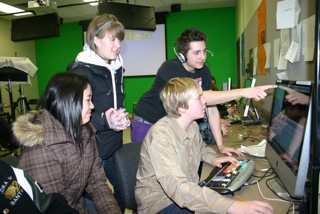
Caption: Olds High students in the CLC’s Bell e-Learning lab
Credit: Photo courtesy of Chinook’s Edge School DivisionEngaging rural members of the provincial legislature, for example, was an important part of presenting the learning campus as beneficial to the region. “That’s a very important strategic consideration because you’re increasing your political critical mass,” says Mr. Thompson. “Why rural institutions are suffering and dying, quite frankly, is because they can’t compete for resources against urban institutions that are surrounded with political firepower. This proposition had plenty of political firepower, both geographically and also because we brought government services into the mix of the building of a mall in concert with that [Health and Wellness Centre] and a social services mall that would have Child and Family Services, human resources employment, and Alberta Health – that brings in three more ministers.”
The CLC proposal was based on a solid business plan developed under a joint-venture arrangement between the school division and Olds College. “It’s different than a partnership,” explains Mr. Gibbons. Under a joint venture, he says “you only own the assets together in pursuit of the vision you’ve described. You don’t own them individually. You can’t take your ball and go home.” The arrangement set out separate responsibilities for each partner and spelled out sharing of revenue from leasing of office space, memberships for the fitness facility, special-event rental of the fine arts facility, and other sources to cover the ongoing operations of the CLC. The project planners made certain to communicate regularly with provincial politicians, whose constituencies stood to benefit from the CLC.
There were bumps along the road. At a critical moment, the project needed key approvals from the minister of infrastructure and the minister of education to proceed to the engineering and design phase – a $500,000 commitment. The request came on the eve of an election call and, without ministerial sign-offs that day, the project could have been delayed by six to nine months, estimates Mr. Thompson. In the end, the then-Chairman of Chinook’s Edge, a former member of the legislature, corralled both ministers in Edmonton for the necessary government commitment.
Another bump for the project came during the construction phase, as inflation hit at a rate of 2.5 percent per month in the latter part of the Ralph Klein administration. A number of projects failed to move ahead because they could not adapt to the fast-rising cost of materials. The CLC team took a different tack. “What we said was … if we don’t fix this ourselves and keep driving this forward, somebody somewhere else is going to pull the plug,” recalls Mr. Thompson. “So we became…a model [to the provincial government] of how to manage through an inflationary period.”
CLC architect Craig Webber, principal architect of Group2 Architecture Interior Design, says fast-rising costs were a catalyst to shrink the project 20 per cent without losing key elements. In the end, with a focus on shared spaces that would serve different functions at different times, his firm created a high school with capacity for 1,100 students –higher than the initial plan of 750 – without expanding the physical space. “Not only can we have better spaces, we can create better teaching environments in smaller spaces,” he says.
Not only can we have better spaces, we can create better teaching environments in smaller spaces
On February 22, 2010, led by the police and a local radio station, Olds High School Principal Tom Christensen and members of the student body walked from the old school to the new complex 25 minutes away. A soft-spoken administrator with a strong commitment to expanded learning opportunities for students, Mr. Christensen recalls what stood out for him in planning for the new high school. The “idea of being able to actually talk program and then build a school after [planning the] program, that’s what’s cool about the actual facilities,” he says.
One outgrowth of the school’s close relationship with – and physical proximity to – the college is the development of a dual credit program for high school students from Olds and other division schools to earn college credits at Olds College while completing their high school diploma. Chinook’s Edge was part of a dual-credit pilot project sponsored by Alberta Education as the province sought to articulate college credits with high school credits and develop a dual-credit policy. Dual-credit opportunities, plus the province’s Ca- reer and Technology Studies (CTS) program, have fortified the school division’s curriculum in support of career pathways for students. Chinook’s Edge also piloted CTS courses in recreation leadership, community care services, human and social services and health care sciences.
Meanwhile, Olds High School students have other learning opportunities outside the classroom, such as staffing the fine arts building. “They’re learning how the technology side of things in theatre works, learning how sound works,” says Mr. Christensen. A hairstyling salon will open this year and a hospitality pathway will be developed to take advantage of a hotel being built on the Olds College campus through a public-private partnership. In all, he estimates that about a third of Olds High School students are out in the community as part of their studies.
It’s not the same school it was when Mr. Christensen began his teaching career there in 1984. “Where I’m working now, I might as well have been transferred from Antarctica,” he says. “I used to judge success by how quiet the hallways were, whether the doors were shut. Now I take excitement from where I see kids working individually in the open areas. That’s how I judge success now. That was an interesting transformation in myself.”
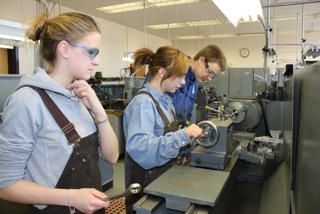
Caption: Olds High students in an Olds College machining lab. This is one of the CLC’s dual-credit offerings.
Credit: Photo courtesy of Chinook’s Edge School DivisionHe also sees a new culture of learning at Olds High. “You would think that by giving students more time that you’re going to lose your culture of rigour, when you [include] work experience time you’re going to lose your rigour. I used to hear that all the time: ‘We’re an academic place and we’re going to lose this by giving these kids freedom.’ It’s the opposite. I think we had last year on our Grade 12 exit exams …a 98 percent success rate. We used to be like 88-89. So in giving the students more time and giving them more individual responsibility, and personalizing it more, I’ll be darned but they do better.”
Once in operation, CLC lost some of its early momentum. Day-to-day operations moved ahead satisfactorily, but the big-picture ambitions became blurred. Mr. Gibbons retired in mid-2010 while early supporters of CLC on the school division board had moved on as well. Mr. Thompson says a sense of complacency set in the year after construction. He describes that period as “probably the most disappointing time for me. It’s almost like you give somebody a Ferrari and they treat it like a lawnmower.” But with the arrival of new players as advocates for CLC, he has regained his enthusiasm. “It’s moving back towards the Ferrari now,” he says.
Last year, Jason Dewling joined Olds College as Vice-President, Academics and Research, and, importantly, as his institution’s point-man to drive revitalization of the governance of CLC. He recognized how much effort had gone into getting the project off the ground, but concluded that less time had been devoted to the question of “now what?” He turned to Ms. Negropontes, now retired from the school division, to assess how to regain momentum for CLC. With her insider’s knowledge of the project, she was given a mandate to ask probing questions of dozens of CLC stakeholders on how to fulfill the project’s visionary ambitions.
Her report concluded that respondents enthusiastically endorsed the vision and appreciated the range of high-end facilities on the learning campus available for students and the wider community. Those interviewed also praised the high level of collaboration among institutions. But Ms. Negropontes also found that stakeholders identified several problem areas: a lack of clarity in roles, interests, needs, standards, and procedures related to the joint venture. Repairing and building relationships appeared to be a key requirement for moving ahead.
Her report has proved to be a catalyst to get back on track. “We are really in a very different place than we were last year,” says Mr. Dewling. “Dot’s report has made such a big difference.”
With revenue from ongoing activities, CLC hired Barb Mulholland as Director of Learning. Ms. Mulholland comes with a rich understanding of the potential for CLC, having served as the Chinook’s Edge Learning Services Coordinator who led the pilot project on dual credits. She has developed a three-year learning plan that calls for an increase in dual-credit opportunities and she is mapping out opportunities for curriculum intersections between the high school and the college. Revenues from facilities rentals are on the rise. The fine arts theatre is up to 200 bookings a year. The wide variety of activities going on within the campus brings a rich mixture of generations into contact with one another.
In addition to Ms. Mulholland, the CLC funds three other positions, with support from Olds College and CESD: director of CLC facilities and operations and Olds College business development; administrative assistant/receptionist for the Ralph Klein Centre and a sport recreation community programmer.
Although a few of the 13 community engagement sites have developed programming as first imagined by CLC, there are fresh efforts under way to rekindle interest. Campus Alberta Central has sprung up with a mission to reach rural learners with post-secondary learning opportunities, so the CLC will also be looking for ways to complement and cooperate with that program.
A governance team, headed by the President of Olds College and the Superintendent of Chinooks’ Edge, is keeper of the vision and has overall responsibility for the joint venture. Others on the 12-member team include board members, administration, faculty and students from CESD and Olds College, a CESD parent and representatives of the Town of Olds, Mountain View County, and the University of Alberta. They are partners “in association” in the joint venture.
Beyond the CLC campus, the town of Olds is turning into a regional “hub,” says Ms. Negropontes, attracting new residents.
She also says, ruefully, that it is harder to get a doctor’s appointment. Still, with all the new activity “it’s still very much of a small-town feel,” she says.
As a participant in the evolution of CLC – and now asked to give advice on other co-operative arrangements between institutions – Ms. Negropontes describes the collaboration in Olds as an example of the “third space,” a concept she takes from A Guide to Building Education Partnerships: Navigating Diverse Cultural Contexts to Turn Challenge into Promise. A third space like CLC, she says, “is the absolute pinnacle of collaboration.”
EN BREF – Lorsqu’un groupe de parents d’Olds, en Alberta, a refusé une subvention provinciale destinée à rénover leur école secondaire en 2003, la remarquable collaboration qui s’est ensuivie a donné lieu à un campus d’apprentissage novateur pour toute la communauté, et même au-delà. Ouverte en 2010, la nouvelle école secondaire Olds fait partie intégrante du Community Learning Campus (CLC), une initiative conjointe du conseil scolaire Chinook’s Edge School Division et du Olds College. Situé sur le campus du collège, le CLC est issu de la conviction des dirigeants des établissements qu’ils pouvaient accomplir beaucoup plus en unissant leurs forces qu’en les répartissant dans plusieurs silos distincts.
-
Déja, Déja Vu
Comments Off on Déja, Déja VuSo I recently attended yet another conference on ….21st Century Learning. I heard the keynotes and attended the workshops. I listened attentively to what delegates were saying and of course, it all led to the issue of integrating technology in education. I remain concerned that the discourse has not changed in decades and the new “corps” of my technology-in-education colleagues are doing their best to convince decision-makers that the time is now using old strategies that have simply not worked.
As I said to my colleague Bruce Dixon of the Anywhere Anytime Learning Foundation, who was one of the keynote speakers, “Remember Bruce, the conference you organized in June 2010, in Maine, in which you assembled a representative group of the past “leaders” in technology in education? The focus of the conference was simple and pragmatic: Why have we failed to convince more people of the need to effectively integrate technology into the classroom?” Bruce just looked at me and smiled appreciatively.
In 2012, the school district leaders and trustees who make a move to introduce system wide technology integration are still embarking upon a very lonely path.
So, as I listen to the next generation trying their best to convince decision-makers of the need to invest in and integrate technology into the classroom, here are some cautionary notes for these “new” presentations.
- Telling delegates that they are out of touch with the youth of today won’t convince.
- Showing demonstrations of how technology is evolving, especially social media, won’t convince.
- Stating to delegates that the pedagogy currently being used in schools is out of touch won’t convince.
- Showing impressive works and creativity of today’s youth won’t convince.
- Using phraseology that was used in the late 1980’s like it’s current thinking won’t convince.
- Believing that Early Adaptors convince, won’t convince.
- Organizing events being surrounded with like-minded delegates won’t convince.
And here are a few other realities:
- By now, 2012, if technology is not any further ahead in being integrated into the classroom, there are definitely other issues that are simply not being addressed, or rather, being given more lip service. Leadership is most definitely the first and foremost critical element. In attending one workshop, hosted by a district leader and a school principal (designated the 21st Century Principal or something similar), I immediately noticed how impressed the delegates were with the latter’s comprehension and appreciation of the significance, potential, and critical role that technology can play in classrooms. But towards the end of the workshop, the most critical question was posed to the principal, “How did it happen in his district?” And the answer was that the superintendent and the trustees made it happen, first and foremost. Leadership, Leadership, Leadership. And as I have stated on and on and on, “No Courage, No Change.” In 2012, the school district leaders and trustees who make a move to introduce system wide technology integration are still embarking upon a very lonely path.
- Since I talk mostly about Courage and Passion, technology conferences aren’t really keen on this message since hearing the impressive results of technology in the classroom is much more enticing for sponsors. Showing how some talented students have become maestro entrepreneurs, agents of social change, etc., is very appealing and noteworthy. However, that too fails to convince decision-makers to change.
- Enhancing the classroom environment remains and should be the critical focus of our efforts. Every teacher wants the best tools available to ensure that students are getting the best education possible. Supporting teachers in classrooms is critical. Changing outdated and poor professional development models has never been so urgent.
- Engaging students, especially in the domain of intellectual engagement, is a must for all classrooms. This can be attained with a caring, passionate teacher, plain and simple.
So, you may now understand the title of this blog.
-
The EdCamp Explosion
Comments Off on The EdCamp ExplosionEdCamps are all the rage, but is crowdsourcing of pro-d really such a good idea? The world abounds with conspiracy theorists, holocaust deniers and alien abduction survivors masquerading as normal folks, and they don’t hesitate to jump into public discourse – see the comments section of any online newspaper for example. A surprising number of fanatics even get themselves elected to public office. I’m not naming names here because I don’t want to be sued, but I bet we can all think of several examples. Do we really think that the educational sphere is devoid of such fervent but wrongheaded beliefs. Zeroes anyone? How is it then that an open forum like EdCamp is supposed to find its way forward to innovative practices that will improve student learning rather than just reinforcing prejudices and replicating favourite strategies from the past? Is the Twittersphere immune to the human preference for the familiar, the inclination to rose-coloured self-protective wishful thinking about one’s own effectiveness and plain old zealotry?
[ibimage==4487==edcan_article_image_670x360==none==self==null]
The idea behind crowdsourcing is that a transparent public process can tap into the “wisdom of the crowd,” which Surowiecki claims has the potential to exceed the intelligence of any one expert. That sounds good, and I think we all appreciate that grounded experience in the classroom has much to offer that teachers cannot get from theoretical musings with weak linkage to actual practice, but blind faith in collective wisdom may simply lead to a self-referencing spiral of conservative conventionality spiced with random excursions into novelty that quickly return to base camp. Where do the new ideas come from and how are they evaluated? Is enthusiastic and confident declaration by an advocate to be taken as an indication of merit? How can constructive critique be brought into the mix and how can we ensure that each EdCamp builds on the last rather than always starting from scratch?
In the world of research there is a structured process of peer review to support publications intended as a running record of learning. Unfortunately, as Kuhn has shown in The Structure of Scientific Revolutions, the recognized elite can be a conservative force whose vested interest inhibits innovation and gives prominence to incremental embellishment of current orthodoxies. This generally arises not from malevolent intent, but rather from what Chris Argyris has termed “the defensiveness of experts” – an inclination to project confident understanding and suppress uncertainty in order to protect their reputation as an expert. The establishment always tends to perpetuate itself.
If those who think that disruptive transformation is required in order for school systems to keep pace with the hectic rate of change in the world at large and successfully prepare students for an unknown and rapidly evolving future are correct – and I am one of them – then we need EdCamps and other mechanisms for broad-based dialogue, bold innovation and rapid sharing of ideas. Virtual communities that enable richly connected networks which extend the power of individual minds are essential, but this new horizon begs questions of quality, continuity and cumulative impact. Hierarchically credentialed authority in education and academia has many shortcomings, but so do the new technologically mediated democratic structures of participatory culture. Our enthusiasm for them has to be tempered with healthy skepticism and a wide-awake willingness to encounter the underbelly of crowdsourcing reduced to enthusiastic but cacophonous opining and groupthink.
In Surowiecki’s thesis, the wisdom of the crowd can emerge if there is a diverse array of informed individuals with complementary perspectives on an issue and an effective way of compiling and consolidating their opinions. An EdCamp meets some of these criteria, but not all of them. In continuing to develop this promising new practice, how can we enhance the experience by encouraging diverse participation and developing better methods of consolidating the information and experience inherent in it? Can it move beyond early adopters to include and influence the mainstream majority?
In a recent presentation at the CEA Annual Conference, Bruce Dixon proclaimed that “diversity trumps curation,” and cited Wikipedia as an example, but that potential is neither automatic nor guaranteed without the right scaffolding. Social networking ensures that there will be diversity and makes curation impossible in its realm. This can be a good thing, and even a great thing, but it all depends on how we use it.
Next: The EdCamp Explosion: Taking it to the next level
Previous: Does a PLC Need Research? -
Parents Learn about Inquiry-based Learning
Comments Off on Parents Learn about Inquiry-based Learning“Inquiry honours process and product”: this was Neil Stephenson’s message to Rockridge parents last Thursday night. Stephenson’s, Delta’s Principal of Innovation and Inquiry, talk went almost an hour overtime due to discussion with the engaged parents in attendance. In the end, we left with a message that good inquiry is a very teacher directed phenomena. It’s not “let them loose” – it’s a context of meaningful and engaging work.
This message reassured the parents who had voiced concerns around giving students too much freedom in their learning. “What about the facts?”, they asked. “At some point kids need to just be told stuff or else they won’t have knowledge to think critically about.”
Stephenson’s position is that there is a place for direct-teaching in an inquiry-based classroom. Parents visibly relaxed after he said that.
Inquiry takes critical thinking to a deeper level than knowledge transmission can offer. It means our students will become more independent, curious learners – a crucially important goal because we don’t know what kind of world they will emerge into as adults.
Thank you to Neil Stephenson for engaging with Rockridge parents; you gave us a good foundation on which to build further conversation. Thank you to the parents who attended for your thoughtful questions and curiosity. The evening reminded me that we must all experience and direct this shift in education together as students, teachers and parents.
-
Plugging The Gap or Gapping the Plug
Comments Off on Plugging The Gap or Gapping the PlugFor the past several years, a good deal of the discourse in educational change circles has focused on teacher quality: how to recognize it, how to improve it, and how it might become more pervasive in all Canadian schools. The conversations have branched off in many directions to include the best ways to assess teacher quality, the idea of merit pay to encourage and reward successful teaching, evidenced-based best practices and how to, in the end, ensure quality throughout the entire system. Much of the conversation has been directed at closing the gap between effective and ineffective teaching by, in a very real sense, standardizing professional practice.
I know that I’m not alone in welcoming the opportunity to have stronger conversations about what constitutes effective teaching, and I believe that it’s extremely important that these conversations take place at all levels of the system. Lately, though, I’ve been thinking a great deal about the energy that I know to be at the heart of the teaching and learning dynamic. It’s an energy that has been evident through our work on the Teaching The Way We Aspire to Teach project, and it’s an energy that is very evident when we talk to students about their memorable learning experiences.
But I’m not sure that the spark that ignites the learning process is always accounted for when we try to integrate our research about effective teaching into the accepted canon of practice. It could be that our metaphor of plugging the gap needs to be tempered with another image. In thinking about my own practice, and the teaching moments that I remember as being particularly powerful, I can point to a type of tension that served to hold open a space between what I understood the system expected of me and what I felt was needed at that particular time and place. It was in this space that the creative energy that has sustained me as a teacher for nearly 30 years was nurtured. But it wasn’t just about me; in talking to students—even many years later—it was in this space that the creative energy of my students was also ignited.
My mechanic tells to me that, with spark plugs, the key to proper firing lies in getting the space between the center and side electrodes just right. If the space is too narrow or too wide the spark that ignites the air/fuel mixture will not occur at an optimal level, if at all. The precision-driven process of gapping the plug is an attempt to get that space right.
Hmmm…
I’m carrying this metaphor with me throughout the week, and I would love it if you could join me in thinking about this a little more.
As a teacher do you feel that you have adequate space to spark the type of energy that you would like to see in your own classroom? As a parent, are your children excited by the learning that is occurring in their school? As an administrator, do you have the tools and resources that you need to gap the plugs that drive your learning community?
-
Exposing Technomyths
Comments Off on Exposing TechnomythsAs early as 2000, Canadian Programs of Study called for the integration of technology into the daily education of students in all grades. And yet, in the face of constantly changing technologies, research into their effective use in teaching is limited. The result has been an escalation in spending on technology without sufficient evidence of educational benefits.
Where should educators turn for informed reports of the educational benefits of technologies? What evidence supports the benefits claimed, and what is the source of the claims? In order to answer these questions, we examined a newer technology in widespread use in all grades, the Interactive Whiteboard (IWB). In some provinces, IWBs have been recommended for every classroom, and a leading manufacturer reports sales of over 1.5 million IWBs for use in classrooms across North America.1
This manufacturer makes four claims in its promotional literature on IWB use in classrooms: increased lesson interactivity, improved student achievement, enhanced engagement, and heightened motivation.
Interactivity
The primary and alluring claim made in the promotional and anecdotal literature is that IWBs promote interactivity, which in turn is the crux of the three secondary claims of achievement, engagement, and motivation. Interactivity is neither defined nor used consistently in the numerous mentions of this complex cognitive term. For example, the mere frequency of students’ tactile contact with the IWB – including playful repeated touching of the screen – is taken as evidence of interactivity. Teachers, who are expected to provide each student with daily opportunities to interact with the IWB, report frustration because of interrupted lesson flow and pace. Consequently their teaching becomes increasingly didactic, relying more on vicarious interaction in which students observe the teacher but have no tactile experience themselves.2 Researchers question the prevalence of these vicarious interactions, which are fundamentally no different from that afforded by traditional chalkboards and whiteboards.3
The IWB promotional material1 includes 32 testimonials wherein the term interactive is used repeatedly to claim the IWB enhances classroom lessons where students interact physically or by use of peripheral hardware. In each testimonial, interactive was used ambiguously and without evidence for, or explanation of, the role of the IWB in making learning interactive. For example, one teacher contrasted lessons taught with an IWB to traditional lessons where students sat in rows. Yet, the teacher used the IWB to provide visual support (pictures) and to facilitate interactive discussion while the students sat at their desks. In this case, the IWB served as a projector; the interactive component of the lesson came from the teacher’s use and discussion of the images.
Another technomyth is that IWB use promotes and facilitates greater interaction between teachers, students, and lesson content. Some case studies claim the IWB’s capacity to display content and provide access to text and multimedia content from the Internet has the potential to increase lesson interactivity.4 Again, the word interactive is not explained. Since increased interactivity is the main benefit claimed, some researchers have suggested IWBs are only as interactive as the lesson permits. When teachers use IWBs to display content but do not invite participation, then IWBs are not interactive. However, effective interaction can happen vicariously. Quashie uses the example of the math teacher who projected a blank pair of axes on the IWB to teach the class how to plot coordinates. Through discussion, the students worked with the teacher to label the axes, set the scales, order the numbers, and plot the coordinates. Together the teacher and students built the graph.5 Clearly, the IWB can be beneficial in some classrooms, but the key is how and when teachers use it.
Unsubstantiated claims of increased interactivity serve as the backbone for further technomyths of increased student achievement, enhanced engagement, and heightened motivation.
Student Achievement
The first of these secondary claims is that IWB use improves students’ achievement and retention of information. Most testimonials make general, unsubstantiated claims such as “Kids learn better … and retain what they’ve learned when their lessons are rich with visual images and graphic organizers.”6 Often, improvements are reported as increases in test scores or grades. Based on 14 testimonials, it is impossible to know whether increases were due to IWB use, changes in teachers’ methods, factors that are neither mentioned nor measured because controlled studies were not conducted, or whether the increases in test scores and grades hold true for all students of similar ability over the same period. Furthermore, testimonials claim the IWB’s effectiveness for addressing multiple learning styles (i.e., visual, auditory, and kinaesthetic); educational psychologists know this schema to be “a gross over simplification and misrepresentation of neuroscience”7 and claims of improvements in student reading fluency, comprehension, and retention of information cannot be substantiated by available research evidence.
The claim that students reading of, viewing from, listening to, or touching the screen content supports all learning styles, and that these multiple representations facilitate students’ understanding and recollection of the content, is naively oversimplified. For example, Quashie discussed secondary mathematics students’ perceptions that the IWB made learning easier. Students used easier in different ways: easier to read typed text on the IWB than to read teachers’ handwriting; easier to get examples for discussion; or easier to see differences in how teachers organized information when presented on the IWB. These perceptions relate to how the teachers chose to organize and present information for the students, not to the technology itself.
The IWB can be used to facilitate the organization and presentation of multiple forms of information (text, graphics, animations, and sounds), but the teacher decides what, how, and when to present that information. Unfortunately, without controlled studies, it is difficult to say which features of IWBs improve student learning – or how, when, for which students, and to what extent.
Student Engagement and Motivation
The other two most commonly claimed benefits for students are improved engagement and motivation. Engagement is a complex concept not easily measured without procedures beyond those available in the classroom, so attention to task cannot be confirmed. Students may passively watch the IWB without paying attention to or processing the content.
Equally problematic are the unsubstantiated claims for improved student motivation. In theory, when individuals are motivated to perform a task, they experience a sense of interest, enjoyment, and confidence in their abilities that in turn leads them to desire to do the activity even when external rewards are not provided.8 The most frequently reported aspect of student motivation is enjoyment or enthusiasm, but it is unclear how enthusiasm impacts student learning. It is possible to be enthusiastic about a topic and not understand it, and the converse is also true. For example, some testimonials suggest that the IWB is a tool for teachers to compete with media to hold students’ attention9 or that the “wow factor” makes students become “instantly engaged”.10 Yet, neither evidence of how flashy presentations including graphics, sounds, and animations promote student learning, nor any caveats that these may distract students’ attention from the content are discussed. Similarly, the main remark given by students in Quashie’s study was that lessons with the IWB were fun; they also found it simpler than the textbook, and clearer than the teachers’ penmanship.11 Students are enthusiastic about the use of new technology, but Quashie remained unconvinced of improved student learning. We are not saying that enjoyment is unimportant; rather we are saying that learning is the goal of education. If fun, and not improved understanding, is the main criterion cited for the benefits of IWB use, then the expense of installing IWBs is difficult to justify.
Guarding Against the Spread of Technomyths
Promoting any technology as the key to improved student learning is simplistic and ignores teachers’ role in planning lessons to improve students’ educational experiences. The IWB is one tool teachers can use to facilitate teaching lessons that are interactive, engaging, and motivating. Perhaps its most important benefit is not that lessons are more interactive, or that students learn better and are more engaged and motivated, but that it may prompt teachers to revisit and refresh their practices and to present content in novel ways. Unfortunately, the technomyth proliferated by the testimonials is that IWB use, itself, improves teaching and learning and that students are somehow disadvantaged if they do not have one in their classrooms. This message is evident in the words of one Grade 3 teacher who uses her IWB for every aspect of the curriculum:
“I’ve written lessons for the SMART Board interactive whiteboard on everything that’s required of me to teach,” [she] remarks. “And if I don’t have a lesson for it, I will make one. If it can’t be taught with the SMART Board interactive whiteboard, I don’t think I am doing the best job I can for my students.”12
This overstated claim that the IWB must be used for teaching to be effective and that everything in the curriculum can and should be taught using an IWB represents what Mohon refers to as optimist rhetoric that would not withstand the scrutiny of rigorous academic study.
The expense of installing IWBs in all classrooms is steep. Based on the sales figures of one manufacturer alone, billions of dollars have been spent on IWBs in classrooms across North America – often at the expense of other resources. For example, one school district’s purchase of IWBs came from funds set aside for textbooks.13 The reason given was “… the computer and a SMART Board interactive whiteboard function as a textbook.” Multiple copies of books are “unnecessary” because one copy can be scanned and projected on the IWB. Several limitations are apparent when students read only from a common text. For example, students may not be able to see and track print on the IWB, particularly when it is small or dense. In addition, they cannot access the information independently either to reread or to do their work at home or to learn on their own. If the IWB is used instead to access the Internet, the use of digital information presents further challenges such as determining the credibility of sources, establishing appropriateness of language and content, and guarding against copyright infringements.
Manufacturers of educational technology pay little attention to the research on interactivity, achievement, engagement, and motivation. Their aim is to market and sell their products, and the testimonials they provide support that aim. We endorse the use of technology for teaching and learning, but we caution against wholesale adoption. Before committing to the installation of IWBs – or any new technology – in every classroom, educators need to consider which teaching activities and outcomes are best supported by their use, the ideal frequency of use, how much training and support teachers require to integrate their use effectively, and what expenditures will be sacrificed to support their purchase.
Educators need to study carefully the claims made by manufacturers and hold those claims up against available research evidence in order to guard against credulity and slow the spread of technomyths.
NOTES
[1] “Quick facts and stats,” SMART Technologies, last modified February, 2012, http://www.smarttech.com/us/About+SMART/About+SMART/Newsroom/Quick+facts+and+stats
[2] Elizabeth H. Mohon, “SMART Moves? A Case Study of One Teacher’s Pedagogical Change Through Use of the Interactive Whiteboard,” Learning, Media and Technology 33, no. 4 (2008): 301-312.
[3] Valerie Quashie, “How Interactive is the Interactive Whiteboard?” Mathematics Teaching Incorporating Micromath 214 (2009): 33-38.
[4] Maureen Haldane, “Interactivity and the Digital Whiteboard: Weaving the Fabric of Learning,”Learning, Media and Technology 32, no. 3 (2007): 257-270.
[5] Quashie.
[6] “Greenbriar West Elementary School,” SMART Technologies, last modified 2006, http://downloads01.smarttech.com/media/sitecore/en/pdf/customerstories/k12/greenbriar.pdf
[7] Daniel Ansari, “The Brain Goes to School: Strengthening the Education-Neuroscience Connection,”Education Canada 48, no. 4 (2008): 6-10.
[8] Judy Cameron and W. David Pierce, “Reinforcement, Reward, and Intrinsic Motivation,” Review of Educational Research 64, no. 3 (1994): 363-423.
[9] “Fernhill College,” SMART Technologies, last modified 2008, http://downloads01.smarttech.com/media/sitecore/en/pdf/customerstories/hed/fernhillcollege.pdf
[10] St Paul’s Catholic Primary School,” SMART Technologies, last modified January, 2008, http://downloads01.smarttech.com/media/sitecore/en/pdf/customerstories/k12/greenbriar.pdf
[11] Quashie, 36.
[12] “Kress Elementary School,” SMART Technologies, last modified 2007, http://downloads01.smarttech.com/media/sitecore/en/pdf/customerstories/k12/kresselementaryschoolcasestudy.pdf
[13] “Jennings School District,” SMART Technologies, last modified 2007, http://downloads01.smarttech.com/media/sitecore/en/pdf/customerstories/k12/custcasestudyjenningsschooldistric
Editor’s note: We offered SMART Technologies a chance to respond to “Exposing Technomyths.” Their counter-argument follows:
A Solid Foundation of Success: Research Supports the Effectiveness of Interactive Whiteboards
By: Heather Sadler JonesToday’s savvy technology consumers look to numerous sources before buying a cell phone, TV, or tablet, often asking friends, online consumer reports, and referencing blogs. So, why would their practices be any different for buying education technology? In a day and age when education practitioners are inundated with claims that certain technologies will revolutionize education, SMART Technologies supports the suggestion to be an informed consumer. Investigate a company’s record of success, examine the full solution being provided, and learn from the experiences of others, including other customers and scholarly research. For numerous schools and districts that have already done this, SMART has proved to be an excellent choice, and we are excited to celebrate their successes.
To highlight one of many SMART customer success stories, Marilyn Steier, owner of SMO Consulting and adjunct professor at the University of Alberta, identifies SMART Boards as one factor that influenced the success of her SMART Showcase School when she was principal at Millgrove School in Spruce Grove, Alberta. With over 30 years of experience in public education, Steier identifies herself not as a researcher, but as an “in the trenches research consumer” who has seen the positive effects the SMART Board® interactive whiteboard can have in the classroom. With a thorough professional development plan and time for teachers to transform their pedagogy, her school saw a strong return on investment as they prepared students with 21st century skills. Steier says, “In Alberta, digital literacy is no longer an option – it’s a requirement,” adding that teachers must begin to transform their own practices to create student-centered, engaging classrooms. Steier adds that it is difficult to quantify the educational value of new technologies; certain things can’t be measured in traditional ways, especially how the SMART Board “brings a glow to the faces of students when they use it.” Sometimes, seeing is believing.
Underlying SMART’s rich anthology of success stories is a strong foundation of research. When SMART Technologies says its products support motivation, engagement, interactivity, and student achievement, these statements are based on a diverse research portfolio that begins before a product is even released publicly. SMART Technologies integrates research-based practices throughout its product life cycle. During product development, product teams collect data on the need for products and their application within the classroom. Once the product has an identified education use, prototypes are tested in classrooms as well. Finally, before a final product is released, a “beta” version is tested in numerous education settings for use and functionality. After the product is released, SMART Technologies continues to evaluate the products’ implementation and efficacy in the classroom by supporting independent research. Many of these independent research studies and action research projects can be found within SMART Technologies’ rich research repository at smarttech.com/research. While all of the relevant resources are not housed within SMART’s repository due to publication copyright, the repository is continually being expanded by the generous contributions of our global research network.
Highlights of the literature on which SMART bases its claims of increased motivation include:
• Passey, Rogers, Machell, and McHugh[i] clearly defined metrics to measure motivation based on existing motivational theory, which are closely tied to student engagement. This Lancaster University (UK) study found that the ability of the interactive whiteboards to foster interest was maintained through years of use, and could not be attributed to the novelty effect, providing increased motivation and engagement for pupil and teacher, as well as increased efficiency of classroom time.
• Another recent study completed by WestEd,[ii] a U.S.-based nonpartisan, nonprofit research, development, and service agency, also found the SMART Board interactive whiteboard increases student engagement, collaborative work, and motivation.
With just a touch, it is apparent how the SMART Board interactive whiteboard (IWB) got the word “interactivity” in its name. With the ability to annotate over content, edit texts, and manipulate 3D objects, it seems to bring content to life for students. Smith, Higgins, Wall, and Miller[iii] define these characteristics as “technical interactivity,” differentiating it from “pedagogical interactivity.” Based on Smith et al’s differentiation, a case study conducted by Hennessy, Deaney, Ruthven, and Winterbottom[iv] found that the depth of pedagogical interactivity varied within and between IWB lessons, with teacher pedagogy seeming to be the limiting factor. These results were mirrored by Quashie.[v] Based on four pedagogical interactivity metrics, the case study found that all six of the lessons observed exhibited some level of interactivity, with the teacher’s design being the limiting factor. In addition, Quashie reported, “a common view shared by teachers and students alike is that the IWB increases the level of engagement, motivation and participation in a lesson,” lending further support to the value of this type of technology in the classroom.
It is no secret that, when using any new education technology, teachers and students will experience greater success with support and training.[vi] This is one reason SMART provides a variety of training options, including free technical support and online training through the SMART Learning Space, SMART’s online learning management system. eMINTS (enhancing Missouri’s Instructional Networked Teaching Strategies) is a non-profit organization providing research-based professional development programs that have taught educators how to use technology effectively since 1999 in more than 3,500 classrooms across the United States and in Australia. Monica Beglau, the executive director of the eMINTS National Center, is a strong proponent of the importance of professional development and training. She comments that “according to seven years of eMINTS program evaluation research, technology-enriched classrooms that include SMART Board interactive whiteboards can have a statistically significant impact on student learning when paired with teacher support and intensive professional development, as compared to learning environments without the same affordances. Further, marginalized and disadvantaged students show even greater gains when provided an environment with these learning opportunities.” There is clear evidence to support the claim that SMART solutions have been shown to have a positive impact on various forms of student achievement, including literacy and retention.[vii] Many of the resources referenced, and a wealth of other relevant literature, can easily be found on SMART Technologies’ research website at smarttech.com/research.
While I cannot speak for the authority on which other technology providers base their claims, as SMART Technologies’ efficacy research manager, and an Educational Leadership doctoral candidate, I am proud to work for a company whose commitment to education research is deeper than its pockets. As a founding member of C21: Canadians for 21st Century Learning and Innovation, SMART Technologies supports the organization’s vision that access to highly skilled, technology-enabled teachers and research-based learning environments is a universal right of every Canadian learner. SMART Technologies is an industry leader committed to investing in education to meet the needs of all learners in Canada and globally, to ensure they are prepared with the skills to be successful as 21st century global citizens.
Heather Sadler Jones is efficiency research manager with SMART Technologies.
NOTES
1. D. Passey, C. G. Rogers, J. Machell, G. McHugh and D. Allaway, “The Motivational Effect of ICT on Pupils: Emerging Findings” (London: DfES, ISBN 1 84478 136 4, 2003).
2. Betsy McCarthy, Sara Atienza, Michelle Tui and Danielle Yumol, “The Use of SMART Boards in Piloting Classroom Media Suites: Engaging Students in Transmedia Play,” WestEd (2012). Retrieved at: http://downloads01.smarttech.com/media/research/international_research/usa/westedsmartwhitepaper.pdf
3. H. J. Smith, S. Higgins, K. Wall, and J. Miller, “Interactive Whiteboards: Boon or Bandwagon? A Critical Review of the Literature,” Journal of Computer Assisted Learning 21 (2005): 91-101.
4. S. Hennessy, R. Deaney, K. Ruthven and M. Winterbottom, “Pedagogical Strategies for Using the Interactive Whiteboard to Foster Learner Participation in School Science,” Learning, Media and Technology 32,, no. 3 (2007): 283-301. Retrieved at: http://www.educ.cam.ac.uk/research/projects/istl/LMT_IWB.doc
5. Emilie Magnat, The Use of Interactive Whiteboards to Develop Phonological Awareness in English Among 7-8 Year Old French Learners,” (Saint-Martin-d’Hères, France: PhD Diss., Université Stendhal, 2012).
[vi]. Health and Education Research Group, “Applying SMART Board Technology in Elementary School Classrooms: Investigation of School-wide Initiative,” University of New Brunswick (2008). Retrieved at: http://downloads01.smarttech.com/media/research/international_research/canada/unb_final_report.pdf
[vii]. See, for example:
Lilla McManis, M. McManis and Susan Gunnewig, “Lighting the Fire: The Effectiveness of the HATCH TeachSmart Learning System in Improving Literacy and Mathematics Outcomes for Preschoolers,” HATCH Early Learning (2010). Retrieved at: http://downloads01.smarttech.com/media/sitecore/en/pdf/research_library/k-12/hatch_research.pdf
L. Tate, “Using the Interactive Whiteboard to Increase Student Retention, Attention, Participation, Interest and Success in a Required General Education College Course” (2002). Retrieved at:
EN BREF – Dans certaines provinces, on recommande de doter chaque classe d’un tableau blanc interactif (« TBI »). D’après l’éloquent argument principal véhiculé dans la documentation promotionnelle et les témoignages anecdotiques, les TBI favorisent l’interactivité, d’où trois corollaires : la réussite, l’engagement et la motivation. Une analyse rigoureuse démontre que la recherche à ce sujet est peu probante. Prétendre qu’un outil technologique, n’importe lequel, constitue la clé de l’amélioration de l’apprentissage des élèves est simpliste et ne tient pas compte du rôle que joue le personnel enseignant pour planifier des cours et rehausser l’expérience éducative des élèves. Avant de décider d’installer des TBI – ou toute autre technologie – dans chaque classe, les éducateurs doivent déterminer quelles activités pédagogiques et quels résultats en bénéficient le plus, la fréquence idéale d’utilisation, la formation et le soutien nécessaires au personnel enseignant pour intégrer efficacement leur utilisation, ainsi que les dépenses à sacrifier pour financer leur achat. Cet article est suivi d’une réplique de SMART Technologies.
-
Flip This Class!
Comments Off on Flip This Class!Supporters applaud the space that the Flipped Classroom provides for deeper and more engaged learning. Critics express concern that the concept de-values the importance of the act of teaching, and puts too much pressure on students to learn required material outside of the classroom–the very place where it should be taking place. After talking to Carolyn Durley and Quinn Barreth, two Canadian teachers that are working with the idea of the Flipped Classroom in their own schools, I was most excited by the fact that these teachers were being given both the permission and the space to engage in the innovative play that, I believe, is going to move schools out of the conceptual and practical ruts that prevent real change and transformation.
The version of the Flipped Classroom that is now capturing the imaginations of educators across the continent and around the world began about 5 years ago when two Colorado teachers were looking for a way to ensure that students who physically missed their science classes didn’t “miss the learning”. By creating a series of lesson videos that could be accessed outside class time, Jonathan Bergmann and Aaron Sams enabled absent students to, in essence, be in class while at home, albeit after the fact. Although taping lectures and lessons has been going on for years in post-secondary institutions, excitement for what this could mean for elementary and secondary education has grown, amplified by advances in access to and quality of technology.
Discussion around the Flipped Classroom has forced us to think about and challenge many of the assumptions that we make about school, about teaching and learning, and about the relationship between teacher, student and the content being learned. The conversation is not without controversy or objections. We’ll talk about some of these in future posts, not only in the context of the Flip, but in terms of what these points of contention can mean for the transformation discourse that is starting to gain some traction.
In listening back to the Teaching Out Loud Podcast featuring the voices of Carolyn and Quinn, however, I couldn’t help but smile at the enthusiasm and energy with which they talked about what they were doing. Although their Flip initiatives are substantially different in terms of age of students and the way that the Flip works in their classroom, one can’t help but pick up on the pioneering spirit that flows through their conversation. They know that they are entering new territory here, and they know that they are in a time where they, themselves, are playing with new ideas, working them, reworking them and redesigning their practice along the way.
This is not a case of adopting a best practice that everyone in their district is now expected to use. This is not a case of blindly jumping on a bandwagon and hoping for the best. Nor is it a case of one teacher flying solo on something that they think might work. Instead, the collective of teachers that are part of the Flipped Classroom movement, from what I can tell, are trying to bring an idea that makes sense to them to life in their own teaching practice. They are massaging it, changing it, talking to others about it and, in the process, exciting the imaginations of other educators.
There’s no telling where the Flipped Classroom movement will be ten years from now, but the spirit of educational entrepreneurship that I see bubbling up in the places where it’s being tried is hopeful. It’s a spirit of adventure that leverages creativity and innovation to bring the principles of differentiation and success for all students to life.
And, for me, that’s precisely what we need to happening in the 21st century schoolhouse!
You can hear Carolyn Durley and Quinn Barreth discussing how they are flipping their classrooms in the latest Teaching Out Loud podcast.
-
Personalized Learning: Hiring Educators for the 21st Century
Comments Off on Personalized Learning: Hiring Educators for the 21st CenturyEducators and policymakers around the world are engaged in a discussion about the need for system-wide education reform, often referred to as 21st century learning or personalized learning. They are advocating a move from broad-based learning outcomes to more individualized environments tailored to the specific needs of each student and offering greater choice and flexibility. Although proponents of personalized learning may disagree about the elements and implementation of this approach, they share a conviction that the current focus on reforming aspects of the education system is both healthy and timely.
They share another characteristic: they pay scant attention to the role of the employer in supporting this change. While the literature addresses the needs and responsibilities of students, teachers, parents, community members, post-secondary institutions, and others, the employer is almost entirely absent. Yet employers in the education sector play a crucial role: they make decisions about who is hired, and they oversee decisions that shape the environments in which our students learn and our teachers work and grow professionally.
School districts, as employers, must ensure that their hiring practices are aligned with educational goals – whether these are broad initiatives or more specific attempts to introduce innovative instructional practices and new curricula. Success in this area requires that both provincial ministries of education and individual school districts carefully examine their human resources practices, particularly those relating to recruitment and selection.
The Importance of Hiring Decisions
Most discussions on how to ensure that teachers have the skills required to meet district-level goals focus entirely on pre-service training and professional development. The basic assumption is twofold: that the skills and competencies developed in teacher education programs align with the skills and competencies valued by school districts, and that professional development initiatives help teachers strengthen their practice in ways that are consistent with broader system goals. However, this may not be the case. The curricula covered in faculties of education may be more closely aligned with faculty research interests than with labour market requirements, and professional development activities are often chosen by the individual educator, based on personal interests.
As a result, school districts exert limited influence over the content of teacher education programs and the professional development of their staff. Where districts do have control is in making hiring decisions.
The hiring process is the intermediary step between teachers’ pre-service education and their ongoing professional development journey. It’s a critical juncture, and it’s important that employers get it right.
The hiring process is the intermediary step between teachers’ pre-service education and their ongoing professional development journey. It’s a critical juncture, and it’s important that employers get it right. Districts will only succeed in meeting their educational goals if they have the educators in place with the skills, knowledge, and vision to make it happen.
Research points to a substantial and far-reaching cost of a poor hire. In addition to the administrative costs of advertising, screening, and interviewing candidates, longer-term negative consequences may have a significant impact on an organization.[1] These include increased costs associated with the need for more managing and mentoring, negative effects on co-workers in terms of morale, and lost leadership opportunities. The public’s confidence in the organization may erode, and hiring an underperforming employee may also affect an organization’s ability to hire stronger performing candidates in the future. Within the education sector, the cost of a poor hire extends even further. An underperforming teacher may hinder student learning and undermine student confidence – with associated costs that are not easily measured.
The demographic reality underscores the urgency of paying more attention to our hiring practices. In the B.C. public education sector, for example, more than one-third of practicing educators are over the age of 50.[2] With districts preparing to increase their hiring efforts to offset this retirement trend, there is an obvious opportunity to match the skills and abilities of incoming employees with school district goals.
An analysis of the hiring practices used in many of B.C.’s school districts reveals that a significant number still rely on recruitment strategies and selection methods that were commonplace 30 years ago. These traditional approaches rely more heavily on the interview than on evaluating a candidate’s competencies from other sources. Further, selection criteria are not always clearly defined or aligned with selection methods. Hiring decisions are often rushed and made without proper planning, making it less likely that staff are using a consistent, rigorous selection process that enables them to identify the best person for the job.
Although some districts are changing their hiring practices to more closely align with best practices in human resources, the change is not widespread or happening quickly enough. These best practices include the use of thorough and well-designed screening, interview, and reference checking processes to gather evidence of the selection criteria and to assess the candidates’ competencies.
Selection Criteria: What Are We Hiring For?
Currently, most school district goals include a move toward personalized learning, and so districts need to ensure they are hiring people with the skills and attributes required to implement this goal. Yet without a defined list of what a “21st century educator” will need in terms of skills, knowledge, and abilities, how can school districts be confident that their new recruits have the expertise to support students in a collaborative, flexible, project-based, and interdisciplinary learning environment?
While many of us have a broad understanding of the skills and competencies that personalized learning aims to develop in our students, there has been less discussion of the skills and competencies it will require of our educators. We do know that, with the shift to more student-centred learning environments, educators’ roles will evolve. The precursor document to British Columbia’s Education Plan outlines a fairly typical description of what personalized learning might look like. It sees a system where instructional approaches to learning could include:
- teachers becoming co-learners with their students, using inter-disciplinary approaches and working in teams of teachers to support students;
- students being provided with more time to reflect on what they are learning and why they are learning it;
- teachers facilitating learning experiences for students beyond the classroom that contribute to the community at large;
- using the community and local environment as the classroom;
- teachers providing students with real life problems requiring a team-approach to develop a variety of solutions;
- recognizing and providing for a variety of ways for students to express their learning.[3]
If districts are serious about implementing personalized learning, they need to ensure that their hiring practices are attracting and selecting applicants who can implement these new approaches. As a first step, they need to define the skills, knowledge, and competencies (the selection criteria) teachers must possess if they are to successfully create these new learning environments. These selection criteria will drive the hiring process – from creating the job posting and screening applications to shortlisting candidates, conducting effective interviews, and checking references. Allowing the criteria to drive the process helps to prevent common selection problems – such as inconsistent evaluation of candidates – and maximizes the likelihood that districts will select the best candidates.
Allowing the criteria to drive the process helps to prevent common selection problems – such as inconsistent evaluation of candidates – and maximizes the likelihood that districts will select the best candidates.
For example, districts might want to include the following selection criteria to measure a candidate’s ability to support personalized learning:
- proficiency with a variety of current computer systems and an understanding of how information technology can be used to facilitate student success;
- an ability to be collaborative, flexible, and creative in a range of working and learning contexts;
- an ability to approach problems with a willingness to adapt to changing conditions;
- facilitation skills that allow students to feel empowered, confident, and self-directed;
- a strong understanding of the importance of diverse learning programs for all students;
- ability to present ideas in variety of ways;
- active and patient listening skills;
- valuing the role of community and the influence of others in students’ learning.
Once school districts have identified the selection criteria they will use to evaluate candidates, they need to ensure that all stages of the hiring process – including recruitment and decision-making – are focused on attracting and selecting candidates who will meet those criteria. They also need to adjust their recruitment practices regularly to reflect current best practices.
Conclusion
Many districts are making significant investments in technology, both in program design and in new technologies such as SMART Boards, iPads, and wireless connectivity. It is a huge risk to make these investments without a parallel investment in a process to ensure that new hires are equipped with the vision, values, and skills to facilitate the shift to new ways of learning and to help our students thrive and succeed in the century ahead.
EN BREF – Le processus d’embauche constitue l’étape intermédiaire entre la formation des maîtres et le perfectionnement professionnel continu. Les employeurs doivent réaliser correctement cette étape critique. Dans le secteur de l’éducation, embaucher la mauvaise personne peut coûter très cher : un membre moins performant du personnel enseignant peut nuire à l’apprentissage des élèves et miner leur confiance – et les coûts qui en découlent sont difficiles à évaluer. En premier lieu, les conseils ou commissions scolaires doivent préciser quelles compétences, connaissances et habiletés les enseignants doivent posséder afin d’engendrer de nouveaux environnements d’apprentissage. L’établissement de tels critères pour encadrer le processus favorise le choix des meilleurs candidats. Après avoir déterminé les critères de sélection qui serviront à évaluer les candidats, les conseils et commissions doivent s’assurer que toutes les étapes du processus d’embauche – dont le recrutement et la prise de décision – visent à attirer et à choisir les candidats satisfaisant à ces critères.
[1] John Sullivan, “The Cost of a Bad Hire: Butts in Chairs and How to Convince Hiring Managers to Avoid Them,” August 9, 2010, www.drjohnsullivan.com/articles-mainmenu-27/articles/hr-metrics-mainmenu-31/527-cost-of-a-bad-hire.
[2] British Columbia Ministry of Education, “Teacher Statistics – 2011/12,” www.bced.gov.bc.ca/reports/pdfs/teacher_stats/public.pdf.
[3] BC Ministry of Education, “Personalized Learning in BC: An Interactive Discussion Guide,” 2011. www.personalizedlearningbc.ca/#/24-25.
-
Mixing It Up: Bringing Young People’s Digital Creativity to Class
Comments Off on Mixing It Up: Bringing Young People’s Digital Creativity to ClassWhen you hear the name Mary Poppins, you probably think of Disney’s lighthearted musical movie. Mary Poppins descends from the sky to care for Jane and Michael Banks, taking them on magical adventures through the countryside. When the wind changes, the charming nanny disappears, though not before the Banks have been transformed into a happy, loving family. But in Chris Rules’ remixed trailer, “Scary Mary,” Mary Poppins is recut as an eerie horror film. Mary is an ominous figure, and when she arrives on the scene, strange things begin to happen. Objects become horrifically animated, heads spin, small children are sucked up chimneys. The cheerful lyrics to “A Spoonful of Sugar” are replaced with a haunting instrumental soundtrack. The mood is dark as the last frame of the video warns its audience, “Hide your children.”
The surprisingly chilling “Scary Mary” is just one of countless remixes of film and television to appear on video-sharing sites like YouTube. Such remixes are hardly an obscure phenomenon. Since it was posted by the young video artist in 2006, “Scary Mary” has been viewed over 12 million times. In fact, this sophisticated little video is an excellent example of the popular practice of remix, in which pop culture texts are re-edited, rewritten, and wholly re-imagined by enthusiastic audiences. Remix is a practice at which young, media-savvy creators excel. It is also, in the eyes of many literacy researchers, an important new way of composing texts and the sign of an emerging “remix literacy.”[1]
As a media educator and researcher, I have become increasingly aware of the role that remixed images, sounds, and words play in young people’s lives. Beyond being an outlet for digital skill and creativity, remix highlights some of the most important cultural issues of the moment, including debates over intellectual property and media representation. Remix should be taken seriously by those interested in understanding the role that digital media play in shaping adolescent identities and worldviews – and also in appreciating the influence that young people, themselves, now exert on digital culture. What we learn from studying young people’s remix activities can be incorporated into the classroom as the starting place for a creative and critical media education.
What is Remix?
Remix is defined as the practice of recombining cultural artifacts into new kinds of creative blends.[2] Of course, practices of remix are not entirely new. Making a quilt or a collage, for example, is a type of remix. Avant garde painters and writers have long experimented with remix techniques, creating works like beat poet William Burroughs’ famous “cut-up” films or the surrealists’ strange, dream-like collages. Still, within digital culture, remix has become easier, faster, and more relevant than ever before, especially among young people. Currently, we might think of it as including the recombination of music, sound, images, and words from sources such as film, television, video, online games, advertising, and novels.
In video remixes like “Scary Mary”, young creators use digital editing software to re-edit film and television programs. “Scary Mary” follows the popular practice of changing a film’s genre. These days, it’s not surprising to find Pulp Fiction recut as a romantic comedy, or The Lion King as a horror film. What is surprising, though, is the way in which relatively simple edits and the addition of new soundtracks can utterly transform iconic and seemingly fixed narratives – perhaps one reason that video remixers call their work “transformative art”. Another form of audiovisual remix can be found in machinima (pronounced mah-SHIN-eh-mah), in which video games are reworked into unique cinematic productions. These 3-D animations demonstrate not only sophisticated technical skills and profound visual knowledge, but also a striking convergence of media forms, as video games, animation, and film merge into a single genre.
Like video remix, fan fiction involves young people in re-imagining popular narratives. Fans of novels such as the Harry Potter, Twilight, or Percy Jackson series rewrite their favourite stories and post them online for readers around the world. Perhaps one of the most remarkable things about fan fiction writers is their ability to create highly supportive digital communities. Many adolescents use fan fiction as a way of exploring sexual identities away from the gaze of adults. Fan fiction circles, then, often provide spaces that are both creatively and emotionally sustaining, and that tell stories radically different from those written inside the institutional boundaries of young adult literature.
The musical mash-up is an equally significant form of remix. Indeed, it might be considered one of its very first forms, as young DJs began experimenting with sampling and sound collage in the 1970s. With the advent of digital media, musical remixing has become important for both young audiences and young musicians, particularly those from racialized groups. The musician Paul Miller (also known as DJ Spooky) notes that remix has often been used by those pushed to the margins of cultural production as a way to rewrite the dominant culture’s narratives.[3]
Finally, while acknowledging the technical complexity of many remix practices, I want to suggest that much simpler processes of selection could be considered remix. Even the act of maintaining a Facebook page involves elements of remix as a user recombines words, photos, images, links, and video from personal, political, artistic, and corporate sources in order to create a multimodal and highly personal text. If we take remix in this broad sense – as processes of re-assembling, recontextualizing, and creating new meanings – then we begin to see remix practices not only on YouTube, fan fiction sites, or at the DJ table, but as an important part of young people’s everyday media lives.
If we take remix in this broad sense – as processes of re-assembling, recontextualizing, and creating new meanings – then we begin to see remix practices … as an important part of young people’s everyday media lives.
Why Does Remix Matter?
Beyond being an interesting new form of creativity, do young peoples’ remixes really matter? Based on my research into adolescents’ online activities, I would argue that they most definitely do.
To begin with, remix often demonstrates the kind of critical thinking we associate with media literacy. Remixers are quick to point out problems in media representations of gender, sexuality, and race. In her critique of the lack of female characters in the latest Star Trek movie, for example, the young digital artist Sloane created a video collage of scenes featuring the mostly male cast, set to the song “Too Many Dicks on the Dance Floor”. Jonathan McIntosh’s wildly popular and very funny remix, “Buffy vs. Edward”, similarly addresses questions of gender representation in the mainstream media. In it, McIntosh splices together video from the television program Buffy the Vampire Slayer with clips from the Twilight films. According to McIntosh, the remix is intended to expose both Edward Cullen’s “generally creepy behavior” and the Twilight saga’s patriarchal undertones.[4] Through their work, digital creators like Sloane and McIntosh perform significant acts of cultural critique that are viewed by literally millions of people online.
Remix also demonstrates new collaborative approaches to digital production. During my own research, I have spent a great deal of time on young women’s video remix sites. The young female creators on these sites provide each other with a constant stream of praise, feedback, and advice. In response to a request for how to create split screens, for example, a young video-maker replies: “Use the pan/crop thing on the drop-down menu on the left. Good luck! I know you can do it! Let me know if you need more help! :)” By providing feedback, rating one another’s work, and inviting collaboration, young remixers not only improve their skills, but also work to create supportive learning environments.
Remix raises one of the most contentious questions of our time: Who owns culture?
While remix can be a site of community, it is equally significant as a site of conflict. Indeed, remix raises one of the most contentious questions of our time: Who owns culture? Remixers regularly clash with corporate media over the use of copyrighted material. Outspoken legal scholars like Lawrence Lessig argue that current corporate practices and laws are stifling young people’s creativity and criminalizing their modes of expression.[5] In fact, even the most conservative legal observers would argue that many of young people’s remixes fall within the legal parameters of “fair dealing”. Despite this, young people’s work is still removed from the Internet with startling frequency. During my own research, I often saw remixes that would be considered fair use taken down from popular websites. Young creators themselves engage in heated online dialogue about intellectual property and have developed numerous strategies to keep their work from being removed.[6]
It is also becoming increasingly apparent that youth are using remix as a powerful tool for bringing their concerns into the public domain. We can see this, for example, in the circulation of remixed images as part of the Occupy Movement. When a group of protesting students was pepper sprayed by a campus police officer at the University of California in November 2011, images of the officer were “photoshopped” into famous paintings and photographs (including Picasso’s Guernica and the Beatles’ Abbey Road album cover). The remixed images rapidly became an Internet phenomenon and the subject of comment by major newspapers like The New York Times and The Manchester Guardian. The images also sparked an international debate on the use of pepper spray, demonstrating the students’ ability to use digital remix to get their voices heard.
What Can We Learn From Remix?
So what does remix’s potential to create community, stir up debate, and give voice to critique mean for educators? I don’t want to suggest that bringing remix into an already crowded curriculum is a simple, additive measure. Still, I do think there is much that we can gain by recognizing this popular practice – and its relation to new kinds of literacy – within our classrooms.
In my past practice as an English teacher, I attempted to tap into the pedagogical possibilities of remix. In a unit on fan fiction, for example, students reimagined and rewrote our class novels, sharing their new stories with their peers through blogs. Together, they created a vibrant digital community that provided valuable feedback and a broad and authentic audience. Through this exercise, it became clear to both me and the students that remixing texts – whether video, music or fiction – involves the careful application of skills and knowledge. Before remixing a text, a young person needs to have a thorough understanding of its form, content, and genre. And in the process of creating the remix, the young creator must also make multiple intellectual, creative, and technical decisions. Producing remix, then, gives students the chance to act simultaneously as readers and writers, consumers and producers, a stance many media scholars say is indicative of today’s new media environments.
This kind of media production has the potential to promote greater conditions of educational equality. British media education scholar, David Buckingham, argues that schools must create access not simply to digital technology, but to digital cultural capital – “the cultural skills and competencies that are needed to use technology creatively and productively.”[7] In an age in which the ability to participate in creating, critiquing, and manipulating digital texts is a means of belonging and social power, schools committed to equity need to educate students in the practical aspects of symbolic meaning-making.
Remix also opens the door to valuable discussions of issues such as intellectual property, corporate media power, and the ethics of digital creativity. Media educators have long been interested in helping young people to analyze media texts, but in an age of interactive media, we must now consider what young people do with such texts. One of the greatest benefits of a discussion of media practices like remix is the possibility for students to critically analyze their everyday media experiences. Beginning from their own media use, students and teachers can analyze the emerging relationships between audiences and media industries, opening up a curricular space for young people to recognize and consider their own practices of creativity and consumption.
A growing number of resources are available to begin just these kinds of conversations. In his provocative National Film Board (NFB) documentary “RIP: A Remix Manifesto” (itself available online for anyone to remix), director Brett Gaylor creates a compelling case for citizens’ rights to share and re-use popular culture.[8] And in his online series “Everything is Remix”, independent filmmaker Kirby Ferguson traces the history of remix through film and music while examining modern attitudes to intellectual property.[9] Both documentaries signal a growing interest in exploring the meaning of creativity in an age in which reproduction, borrowing, and appropriation are easier than ever before.
Finally, the analysis and use of remix techniques in class has the potential to bridge the divide between young people’s experiences of media and technology inside and outside of school. As numerous media and education scholars have argued, the gap between students’ digital media experiences in school and out of school is significant. This gap may heighten the perception that adults are disconnected, unavailable, and largely uninterested in the complex role that digital media play in the lives of young people. Recognizing young people’s creative digital practices, and their centrality to communication, community-building, and public expression, is one way to begin to bridge that gap, and to move towards classrooms that embrace a range of contemporary literacies.
EN BREF – Le « remixage » consiste à réaliser une combinaison originale de musique, de sons, d’images et de mots provenant de sources diverses – cinéma, télévision, vidéo, jeux en ligne, publicité, romans, etc. – pour obtenir des amalgames inédits. Les jeunes créateurs habiles en médias excellent dans ce processus de réassemblage, de recontextualisation et de création de sens. De plus en plus, les jeunes en font un puissant outil pour faire passer leurs préoccupations dans le domaine public. Dans un contexte éducatif, une telle production procure aux élèves l’occasion d’être simultanément lecteurs et rédacteurs, consommateurs et producteurs – un rôle qui, selon de nombreux spécialistes en médias, reflète bien l’environnement des nouveaux médias. En cette époque où la capacité de participer à la création, à la critique et à la manipulation de documents numériques devient un moyen d’appartenance, de pouvoir social, les écoles qui privilégient l’équité doivent enseigner à leurs élèves les aspects pratiques de la construction d’un sens symbolique.
[1] See Gunther Kress, Multimodality: A Social Semiotic Approach to Contemporary Communication (London: Routledge, 2010) and Kyle Stedman, “Remix Literacy and Fan Compositions,” Computers and Composition 29 (2012): 107-123.
[2] Michele Knobel and Colin Lankshear, “Remix: The Art and Craft of Endless Hybridization,” Journal of Adolescent and Adult Literacy, 52, no. 1 (2008): 22.
[3] Paul Miller, “Notes on Media Remix,” Institute for Distributed Creativity listserv, April 21 2006. https://lists.thing.net/pipermail/idc/2006-April/001499.html
[4] Jonathan McIntosh, “Buffy vs. Edward: Twilight Remixed,” YouTube, June 19 2009, http://www.youtube.com/watch?v=RZwM3GvaTRM
[5] Lawrence Lessig, Remix: Making Art and Commerce Thrive in the Hybrid Economy (New York: Penguin Press, 2008).
[6] See Catherine Burwell, “Rewriting the Script: Towards a Politics of Young People’s Digital Participation,” Review of Education, Pedagogy and Cultural Studies, 32, no. 4 (2010)382-402.
[7] David Buckingham, Media Education: Literacy, Learning and Contemporary Culture. (Cambridge: Polity, 2003), 18.
[8] Brett Gaylor, “RIP: A Remix Manifesto,” National Film Board of Canada, 2008, http://www.nfb.ca/film/rip_a_remix_manifesto
[9] Kirby Ferguson, “Everything is a Remix: Parts 1-4,” Vimeo. http://vimeo.com/kirbyferguson
-
Building Cool Things
Comments Off on Building Cool ThingsI grew up in the small town of Snow Lake, Manitoba, in the 70s. This means, first of all, that I’m getting old. But also it means that when we wanted entertainment as kids, we had to make it. In our community, we had two TV channels (seriously), one radio station, and one store that sold magazines. No one was coming to save us from boredom; it was all up to us. So we spent endless hours building cool things – forts or go carts – or ripping apart things that we found in our parents’ garages.
When I was a young teenager, one of my friend’s dads brought home a Commodore 64 computer. We were interested in it, but only because it had a game that let us pretend we were in the Olympics. Besides that – with no one giving us a screwdriver and wanting us to tear it apart – we couldn’t think of what we would use it for.
But with every passing season, we saw new and improved computers for sale, more powerful and surprisingly useful. It wasn’t long before desktop publishing came along, followed by the ability to edit photos and videos. Within a few years, computers let us connect with others we hadn’t seen for years and forge new friendships. They became invaluable tools that let us do things almost unimaginable only a few years before. But as I grew into an adult, I could still make the connection between these machines and the times when, as a kid, I wanted to make new things and create something cool; computers were machines that gave us the ability to be creative in new ways.
But lately I’ve been wondering. Does our commitment to educational technology allow us to do new things or just get new things?
I am an absolute advocate for ICT in classrooms. I believe it gives us an opportunity to reach into new corners of learning and expand what happens in classrooms in ways that are not possible without it. But I also believe that simply throwing technology into classrooms will change nothing. We need to challenge our students to use these tools to create, to connect, and to tinker. Do we believe that we are preparing students for the future simply because we’ve spent thousands on iPads or SMART Boards or whatever shiny gadget has garnered society’s attention for the moment? If so, then our educational technology is focused on the consumption of products and information at the expense of creativity, connection, and community.
We often make the mistake, in North America, of judging the success of our educational technology programs the way we would judge a car. Shiny? New? Thinking like consumers, if the answer is yes, we have to have it. Instead, we should be evaluating the success of our programs by thinking like producers. Will the purchases we are making challenge our students to think, to communicate with real people, to create new artifacts? A key question we should ask ourselves before we make any purchase is, “Will this give our students the opportunity to make cool things with interesting people from far away?”
The students in my classroom connect with people around the world. We’ve worked with kids who live in the slums of cities in Brazil. We’ve exchanged photos with students in Indonesia. Connecting with others has helped us to understand how our lives compare with students living in places like Los Angeles and the farm towns of Ontario. The connections that my students have to the outside world are as essential as the papers that fill their binders. We’ve built software, designed animations, and traded videos with other classrooms. Creating and communicating – the overriding goals of everything that happens in my classroom.
I hope that we in education take advantage of the opportunities that technology gives us, but I worry that we won’t. I worry that, instead, we will chase after the newest machines that come with a textbook installed and a set of teacher “photocopiable” worksheets. We will buy what is best marketed at us to help raise test scores. We’ll buy what we’re told is easy to use. If we go that route, there is a real danger that we are locking our students into a place where form is more important than function and where they are simply consumers of information and not active creators of global understanding and connections.
I used the tools I had as a kid to build cool things; lets give the students in our classrooms today that same opportunity.
-
2012 Ken Spencer Education Award – $15,000 in Prizes
Comments Off on 2012 Ken Spencer Education Award – $15,000 in PrizesRon Canuel, CEA CEO, invites educators to apply for the 2012 Ken Spencer Award.
-
Embedded Inquiry
Comments Off on Embedded InquiryYou know how when you have an epiphany and then wonder how you could have ever not known that thing you just realized? That happened to me today while I was speaking with Chris Pedersen, a colleague at Rockridge. He had just told me about his lesson when it hit me: embedded inquiry – that’s what works.
-
Capturing Canadians’ Views on Change in Education
Comments Off on Capturing Canadians’ Views on Change in EducationOver the years, the Canadian Education Association (CEA) has explored many different questions with Canadians through our national surveys. This year, we wanted to examine Canadians’ views on innovation in education, and get a sense of your appetite for change in public education.
An online survey was conducted in March 2012 and 493 people responded from across the country. This pan-Canadian sampling shares what our educators think about the need for change, how they would grade our public education system, and what their top priorities are for public education in Canada.
Click here for detailed survey results, including respondent and provincial breakdowns.
1. 73% of respondents felt that there was a need for change
CEA and a contracted research firm asked respondents what they felt the degree of need for change was in Canadian public education. The need for change is greatest in B.C. (96%), the Atlantic Region (88%), Alberta (85%). The need for change appears to be less intense in Ontario.2. Grading Canadian public schools with a “B”
We asked respondents to grade their public schools (junior KD to Grade 12) in their community/province with an A,B,C,D, or Fail. Just under half of all respondents gave a grade of “B” to the public schools in their community (47%) and province (42%). In general, communities received slightly higher grades than provinces. Respondents from Ontario and B.C. were more likely to assign grades of A or B, compared to respondents from the other provinces.3. On the need for new ways of doing things
When asked how much need there was, if any, to find new ways of doing things with respect to a variety of ongoing challenges in education, nearly all respondents agreed that “handling differences in student abilities”, “linking schools to outside learning”, and “helping students learn in high school classrooms” were considered to be the top priorities.Interestingly, “Using technology in the classroom” was the most polarizing item (with relatively larger proportions on both sides of the scale), indicating that while many strongly believe that this must be an area of focus, others are not as convinced (or not as comfortable with the idea).
4. Prioritizing the biggest challenges in public education
When respondents were asked to rate their level of agreement or disagreement on the challenges facing public education today, B.C. and Alberta (where appetite for change is strongest) were most likely to agree with a variety of statements such as “Student engagement and keeping pace with rapid world change” are key challenges in education today.”Share your thoughts by leaving a comment on this blog:
- What’s your take on these results?
- What innovative practice and programs are working in your schools?
- What is the biggest challenge facing your schools in 2012-2013?
-
Results from the 2012 CEA Attitudes Towards Public Education Survey
Comments Off on Results from the 2012 CEA Attitudes Towards Public Education SurveyAn online survey was conducted in March 2012 and 493 people responded from across the country. This pan-Canadian sampling shares what our educators think about the need for change, how they would grade our public education system, and what their top priorities are for public education in Canada.
-
Two Heads are Better Than One – Except in School
Comments Off on Two Heads are Better Than One – Except in SchoolFifty years ago – even twenty years ago – it was not so abundantly clear that the Earth and its resources were finite and that the biosphere and the ethnosphere[1] were both richly interconnected systems. Now this reality is undeniable and the implications are legion in every aspect of our existence.

-
A Co-Planning/Co-Teaching Approach to Instructional Practice
Comments Off on A Co-Planning/Co-Teaching Approach to Instructional PracticeTeaching can be a very isolated and isolating enterprise. Many of the teaching frames, images and design principles on which our modern-day schools are based are, themselves, rooted in the early one- and two-room schoolhouses that dotted the rural landscape of 19th and early 20th century Canada. The teacher-learner ratio has almost always been one-to-many and this organizational principle, coupled with the closely monitored grade level expectations that have become part of the way that curriculum is developed and implemented has, until now, remained unchallenged in any notable way.
Lately, there has been a great deal of energy in Ontario around an approach to professional learning that seeks to extend images of teacher collaboration beyond gathering together to plan lessons and assess student work with a grade level partner to an understanding of the classroom as a type of public space where teacher learning, collaborative inquiry and professional conversations can take place.
While currently, the co-planning/co-teaching model is being used to build more powerful practice in the area of mathematics instruction, it is a model that shows a great deal of potential for transforming school cultures, open some doors, and energize conversations between teachers across many domains and curriculum areas.
In the co-planning/co-teaching approach educators from across the same school, across the street, or across the district gather together to plan a particular lesson. In the planning process, learning expectations are selected and clustered around the big ideas that teachers wish to explore. Teachers discuss the subtleties and nuances of how the lesson might best be taught, select a problem on which students will work and actually do the task themselves in order to better appreciate what they are asking students to do. This allows teachers to anticipate and discuss the types of difficulties, misunderstandings and misconceptions that might arise during the lesson.
If the collaborative process were to end there, and individual teachers were sent back to their classrooms to implement the lesson, one might well marvel at the power of the experience.
But that’s not what happens. Instead of the planning team disbanding and going their separate ways until their next meeting, they proceed immediately to one of the team’s classrooms and teach the lesson with a group of students. Actually, two of the team members are responsible for “teaching the lesson” while the remaining participants attach themselves to a group of two or three students and act as unobtrusive observes watching, but not intervening, while the assigned tasks is completed.
The conversation that takes place among the team after the co-teaching session allows them to reflect on how the students reacted to the experience and the specific work in which they learners were engaged. They are able to use the student work collected from the lesson as a type of assessment for learning, make decisions on how to proceed with specific groups of students and plan for the next stages of the lesson.
It’s interesting to note that the co-plannng/co-teaching approach is not about visiting someone else’s class to watch them teach. Instead, its a commitment to gather around a particular curriculum idea, an understanding that the shared expertise in the group will help to create a powerful learning experience and the confidence to engage in shared, embedded, professional practice.
Teachers don’t enter the profession to be isolated and shut off from their colleagues. Yet, many of the visible and invisible structures define schools–even in this 21st century–do just that. Co-planning/co-teaching seeks to alter this relationship by deepening what we mean by collaborative inquiry and student-focused teaching. It’s a model that is just starting to seep into the cracks that separate teachers in our own district, but it is showing a great deal of promise and meeting with tremendous support from teachers, administrators and the support staff that are working in consultative roles throughout the province.
A fairly extensive set of videos explaining the approach can be found at http://resources.curriculum.org/secretariat/coplanning/ and, although the main focus for the strategy in Ontario is mathematics, readers may be able to imagine how the co-planning/co-teaching dynamic might find a home in other curriculum areas.
I would love to hear about your experience with this particular approach, or with another model for collaboration that has been powerful for you and your colleagues.
-
Democratic Deliberation – A Basic Skill for the Future
Comments Off on Democratic Deliberation – A Basic Skill for the FutureIn 1651 Thomas Hobbes famously asserted in Leviathan that without a “commonwealth” based on a “social contract” the world is a jungle “where every man is Enemy to every man … wherein men live without other security than what their own strength, and their own invention, shall furnish them.” He argued for a strong central government to counteract man’s fundamental nature—I presume he meant hu-man nature—and contended that without it life would be “solitary, poor, nasty, brutish, and short.”
Was Hobbes right? Can a society thrive only if its members’ basic instincts are constrained by external forces so that their higher ideals and collective potential can be realized? If so, what scaffolding is required? Which of our basic human rights are inalienable and what constraint on the others is justifiable, if any? In a more positive vein, what about our interdependence? Clearly, as Hobbes’ contemporary John Donne commented in his Devotions,[1] “no man is an island” and connection only increases as numbers crowd Spaceship Earth, but does this mean that we must be “our brother’s keeper”? What is our responsibility to others? Do we see collective “peace, order and good government” as the ideal, as stated in the Canadian Constitution, or is it individual “life, liberty and the pursuit of happiness,” as stated in the American Declaration of Independence? Does an excessive focus on our personal liberty lead us towards the Tragedy of the Commons?[2]
These are examples of fundamental, recurrent questions that underlie our response to critical social issues such as public safety, healthcare, education and environmental protection. Such starkly phrased choices are, of course, more properly expressed as complexly nuanced dilemmas, but at the heart of things there are some foundational decisions to be made about what we believe and value, and those decisions determine who we become. But the issue is not merely personal, it is also political, and the collective answers inevitably and inexorably shape the society we create. If one abstains from the public discussion of this issue then the ability to decide it is ceded to the most fervent and their answers will be the ones that determine the sort of world in which we will live. This would not be wise!
In order for students to be prepared not only for the future but also to forge that future, they must have opportunity to engage with such foundational questions in age appropriate ways so that they, first, realize that they are questions and that multiple responses are possible, and, second, develop a conscious personal point of view on them. Then they have to learn how to deliberate respectively with those who hold a different point of view.
This is a critical aspect of becoming “educated,” not simply absorbing answers that extinguish perplexing questions but developing the ability to engage continuously with them and to deliberate with others in order to understand their perspectives and thus develop the “commonwealth,” or “social contract,” that enables society to flourish in a diverse and finite world. This is essential for democracy.
Unfortunately, this democratic inclination and deliberative ability seems to be in decline. Increasingly we see polarization of views and vilification of those who disagree. More and more people seem to hold the fundamentalist perspective that those who disagree with them about taxation or education or drug abuse or climate change are not only mistaken but evil.
It’s not “this is a complex issue upon which we disagree and about which neither of us has total insight so we need to learn from each and work together to resolve it,” but “I’m right and you’re wrong so I need to vanquish you in order for the right to triumph.” American politics has fallen deeply into this dysfunctional pit of arrogant, implacable advocacy in which compromise is seen as weakness and Canadian politicians seem to be increasingly adopting the approach. It seems to win elections but it is a selfish, short-sighted strategy that also creates a great danger for our country and for the world at large.
What we need is just the opposite—a democratic hospitality to difference. The knowledge, skills and attitudes that enable respectful democratic deliberation are arguably even more basic and essential than the traditional 3R’s. What good is powerful literacy and numeracy in a self-absorbed bigot?
Some would say that it is not the job of schools to teach values but surely nobody would argue that it is not the job of schools to teach democratic ideals, skills and behaviours. This is not a matter of indoctrinating students with any particular viewpoint or belief, but it is a matter of developing their skills and dispositions, and it is a matter of inculcating the value of respectful engagement with differing or unfamiliar viewpoints and beliefs. It requires the humility to know that you may be wrong and yet the courage to be appropriately assertive in support of what you believe. It is a matter of developing a deep keel rather than an anchor.
As we add “new basics” to the list of 21st Century Skills, this is one not to be forgotten. We allow democratic deliberation to continue to decline at our peril.
[1] “No man is an Iland, intire of itselfe; every man is a peece of the Continent, a part of the maine; if a Clod bee washed away by the Sea, Europe is the lesse, as well as if a Promontorie were, as well as if a Mannor of thy friends or of thine owne were; any mans death diminishes me, because I am involved in Mankinde; And therefore never send to know for whom the bell tolls; It tolls for thee.” Cited from http://en.wikipedia.org/wiki/Meditation_XVII


IDEAS TO SUPPORT EDUCATORS : Subscribe to the EdCan e-Newsletter
Quality research, reports, and professional learning opportunities.