Archive
-
More than a Second Chance
Comments Off on More than a Second Chance“Sorry I’m late,” says a young woman breathlessly as she walks in, halfway through the class. “My sitter was late, and then I missed my bus.” The student, in her early 20s, has two children under four, and is constantly juggling childcare arrangements while waiting for full-time subsidized spots in the daycare near her home.
“No problem,” says the teacher, as she continues writing a formula on a whiteboard. “We were in the middle of reviewing yesterday’s work. You’re just in time to join us as we cover the trickiest part.”
A little later, a man in his early 30s raises his hand. “Miss? Um…” He hesitates awkwardly before addressing the teacher by her first name. “…um, Michelle, could you tell me what’s on this week’s quiz?” Although they are the same age, he is unaccustomed to using a teacher’s first name. All staff, including the administration, in this mature student program are on a first-name basis. The man was recently laid off, and wants to complete his high school education in order to enter a post-secondary program that will lead to new career.
From the back of the classroom an F-bomb is dropped. A young man, who looks like he could easily be in a regular high school, pushes his chair back from a computer desk in frustration.
“That’s a loonie for the coffee fund,” says the woman sitting at the computer next to him. Now in her 40s, she came to Canada soon after her marriage at the age of 16. She always regretted not being able to complete high school, but waited until her youngest child was in school full-time before returning to a mature student program.
The hoodie-wearing 19-year-old rolls his eyes but digs into his pocket. The students developed their own ground rules for the way that they want their class to run, including the fine for swearing in front of others while in class. This young man left school – and home – at 17. He reluctantly returned at the age of 18 as a condition of receiving income assistance. He walks over to a desk covered with tea and coffee supplies and drops the loonie into an empty coffee tin. On most days, the teacher stays in the class and joins the students for their morning coffee break. Everyone takes turns doing the clean-up.
These vignettes reflect some key differences between many regular high school programs and adult high school completion programs. The students are, of course, older. But it is the overall environment that researchers, including myself, have identified as a key element in the success of these programs. A supportive environment means program planning and scheduling decisions are responsive to the busy and complex lives of adult students. A sense of acceptance contributes to supportive and respectful interactions with teachers and peers, which can help students overcome previous negative school experiences.1 Most importantly, “Teachers attuned to the unique needs and circumstances of adults [are] integral to a positive program experience.”2 During interviews, students in Ontario programs commented on their teachers’ genuine passion for their work, their patience and empathy, and their ability to use a combination of creative and explicit teaching methods.
Mature student programs and high school completion rates
Mature student programs focused on high school completion operate in a variety of ways across the country. There may even be several distinct pathways or approaches within a province, including adult language and literacy programs, which can prepare students to enter a credentialed secondary level program. The programs can be found in schools, colleges, and community organizations, in store-front locations and in correctional facilities. Whether referred to as adult upgrading, basic skills, adult credit, basic education, or GED programs,3 they all lead to a provincially sanctioned high school diploma or equivalency certificate.
These programs have become an important part of the education system, helping to ensure that Canada continues to achieve one of the highest rates of high school completion in the world, Between 1999 and 2007, nearly one-fifth (17 percent) of young people in Canada left high school without a diploma, but by the time the cohort was 26-28 years old, only six percent were without a high school diploma or post-secondary education.4
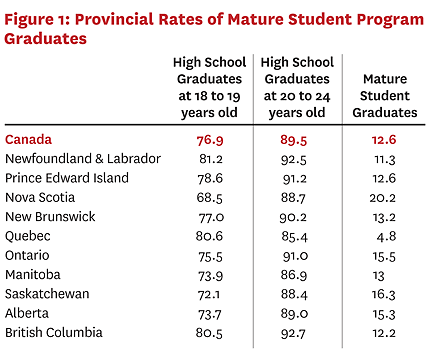
Figure 15 compares the percentage of graduates at age 18-19 in each province with the percentage at 20-24. It is likely that mature student programs helped boost the graduation rates in each province. Nationally, they generated 13 percent6 of graduates in 2009-2010. Programs in Nova Scotia, with one-fifth of young people obtaining a credential after the typical graduation age, play a particularly vital role.
Challenges facing mature student programs
Mature student programs are often referred to as “second chance” programs, suggesting that students somehow squandered their opportunities the first time around. However, adult students who attend these programs do so because they are compelled back into the secondary system or need an extended opportunity to complete secondary school. Those who are compelled back may need specific course pre-requisites for post-secondary education or may need to improve their marks. Some are recent immigrants who completed their secondary and possibly even post-secondary education, but who must now requalify in a system that doesn’t recognize or devalues foreign education credentials. Furthermore, as long as families live in poverty, there will be a need to offer an extended opportunity to adolescents and young adults to complete their diploma requirements. This is most apparent when looking at Aboriginal learners, who live in poverty at higher rates, and who are also more likely to delay their entry into the post-secondary system.7According to the Canadian Teachers’ Federation,8 living in poverty is connected to an inter-related and accumulating set of factors that can combine to compel students to leave high school, such as their readiness to learn; low self-confidence or motivation; social exclusion; frequent moves and interrupted attendance; and inability to participate in enrichment activities.
Adult education programs at the secondary level are a vital part of long-term poverty reduction strategies.9 They are also an essential conduit into the post-secondary system. However, these programs face their own inequities and a sort of “second class” status within the education system. Straddled between the concerns and interests of the regular K-12 system and post-secondary programs, mature student programs are rarely the focus of sustained policy attention, and are vulnerable to short-sighted funding decisions.
Two provinces, Newfoundland and Labrador and British Columbia, have recently instituted reforms in their college systems to either remove or substantially downsize adult programs leading to high school credentials. Newfoundland privatized its programs in the summer of 2013, removing them from the provincial college system and placing them in private career colleges. B.C. is eliminating funding for entry-level courses, after previously decreasing vital post-secondary access supports for social assistance recipients.10 B.C. is now focusing resources on those most likely to enter post-secondary education and decreasing access to those deemed less likely to proceed through all courses.11 There may be some room for optimism in Ontario which, after drastic cuts in the late 1990s, is beginning an extensive consultation process towards the development of a provincial adult education strategy centred on secondary completion and post-secondary access.
Mature student programs facilitate high school completion and access to post-secondary education, particularly for students living in poverty and for those compelled back into the secondary system. Given their importance to secondary graduation rates, especially for our most disadvantaged students, these programs deserve to have a more prominent place as an inherent and valued part of a comprehensive education system.
En Bref – Les programmes pour étudiants adultes visant l’achèvement des études secondaires offrent plus qu’une deuxième chance aux adultes. Ils sont maintenant une importante composante du système d’éducation pour les personnes qui doivent retourner au secondaire en vue d’entreprendre des études postsecondaires et pour celles qui ont besoin de ressources prolongées pour terminer leurs études secondaires. Un environnement de soutien tenant compte de la vie occupée et complexe des étudiants adultes se distingue des nombreux programmes réguliers d’études secondaires. Les programmes d’éducation de niveau secondaire pour adultes sont des éléments vitaux pour les stratégies à long terme de réduction de la pauvreté : ils contribuent à accroître les taux de diplomation d’études secondaires. Ils constituent également un mode essentiel de passage au système postsecondaire.
Photo: Chris Schmidt (iStock)
First published in Education Canada, May 2015
1 Christine Pinsent-Johnson, Shannon Howell and Rebekka King, Returning to High School in Ontario: Adult students, post-secondary plans and program supports (Toronto: Higher Education Quality Council of Ontario, 2013), www.heqco.ca/SiteCollectionDocuments/Formatted_CESBA.pdf ; Cassandra MacGregor and Thomas Ryan, “Secondary Level Re-Entry of Young Canadian Adult Learners,” Australian Journal of Adult Learning 51, no. 1 (2011): 143-160, http://files.eric.ed.gov/fulltext/EJ951990.pdf
2 Pinsent-Johnson, et al. Returning to High School, 37.
3 Students can prepare for and write a Canadian version of the General Educational Development (GED) test to receive a provincial high school equivalency certificate.
4 Statistics Canada, Interrupting High School and Returning to Education (Education Indicators in Canada: Fact Sheets, 2010). www.statcan.gc.ca/pub/81-599-x/81-599-x2010005-eng.htm
5 Statistics Canada, Interrupting High School.
6 From Kathryn McMullen and Jason Gilmore, A Note on High School Graduation and School Attendance, By Age and Province, 2009/2010 (Statistics Canada Catalogue no. 81-004-X, 2012).www.statcan.gc.ca/pub/81-004-x/2010004/article/11360-eng.htm The data do not directly distinguish between graduates with developmental disabilities, who complete modified diploma requirements at the age of 21, and graduates who complete standard diploma requirements between the ages of 20 and 24. However, related data do include the percentage of 20-24 year olds who had not graduated but were still in school; these would likely include students receiving a modified diploma. The percentage of these students is negligible in all provinces except Quebec, which has a different secondary/post-secondary system.
7 Educational Policy Institute, Access, Persistence, and Barriers in Post-secondary Education: A literature review and outline of future research (Toronto: Higher Education Quality Council of Ontario, 2008), 7.www.heqco.ca/SiteCollectionDocuments/Access%20Persistence%20and%20Barriers%20ENG.pdf
8 Canadian Teachers’ Federation, Supporting Education… Building Canada: Child poverty and schools. (Canadian Teachers’ Federation, 2009). www.ctf-fce.ca/Research-Library/FINAL_Hilldayleavebehind_eng.pdf
9 Shauna Butterwick, A Path Out of Poverty: Helping B.C. income assistance recipients upgrade their education (Canadian Centre for Policy Alternatives, B.C. Office, 2006).www.policyalternatives.ca/sites/default/files/uploads/publications/BC_Office_Pubs/bc_2006/path_out_of_poverty.pdf
10 Butterwick, A Path Out of Poverty.
11 Katie Hyslop, “Literacy Bumbled among Three Ministries: SFU prof,” The Tyee, March 8, 2013. http://thetyee.ca/News/2013/03/08/BC-Literacy-Mismanaged/
-
Preventing Adolescent Immigrant Dropouts
Comments Off on Preventing Adolescent Immigrant DropoutsHaving spent five years as a development worker in Vietnam, by the time I returned home to Canada in 2005, I was well aware of Article 28 of the UN Conventional on Rights of the Child, which states that children have a right to a Primary Education, compulsory and free. I was also very conscious of the UN Millennium Goal 2, Universal Primary Education. Thus, it was a big shock and disappointment to me to find that in my own country, one of the richest and most respected for educational achievement, there were children and adolescents being denied the opportunity to achieve even a basic, elementary education. Adolescent immigrants from refugee camps around the world were arriving in Canada, entering the high school system and dropping out within a few weeks. Children in lower grades were attending, often sporadically, and were showing little or no academic achievement. Obviously, schools were not meeting students’ needs.
Why do government-assisted refugee students drop out of school? Two factors are principle: first and foremost, the lack of educational programming that meets their academic readiness and, secondly, the financial pressure that forces older teens to quit school and help support their families – accepting dead-end jobs.
Crawford (2008)[i] published an adolescent psychology textbook that very rightly focused on the fundamental principle of differentiated instruction. She writes:
Since adolescents bring a diverse range of knowledge and interests that are shaped by varying biological, cultural, and experiential factors, the challenge for teachers is to find a point of connection with what students know, believe, and feel (Crawford, 2007). When teachers pay attention to the knowledge and beliefs that learners bring to the learning task and use this knowledge as a starting point for new instruction, learning is enhanced (Bransford, Brown, & Cocking, 2000).
When Government Assisted Refugees (GAR) students enter our school system, they very often are met by a system that has little or no idea of their prior experiences, background knowledge, cultural practices nor academic readiness. The type of differentiating they need often cannot be met in the mainstream. Differentiation may mean differentiating environment and programming.
In 2001-2002, due to a change in federal immigration policy, schools in Canada began to see an increase in the arrival of GARs. Unfortunately, there was little or no preparation for the arrival of these children and teens, whose experiences, cultures, social, emotional and academic needs were very different from school populations we were equipped to service. In my province of Newfoundland and Labrador, nobody in the provincial education system – ministry, school boards, school administration, nor teachers – was given background information, or in-service on how to assess and support GARs. These children and teens, from war torn countries, were plucked from refugee camps and dumped into mainstream classrooms, placement and programming based on one criterion only – year of birth. In many cases, illiterate adolescents, with neither the language, the knowledge, cultural know-how, political clout, nor the self-esteem to protest, were dumped into mainstream middle and high school academic courses. When I, as a program specialist of the Ministry of Education in Newfoundland and Labrador, assessed GAR students in 2006-2008, the majority were placed in academic courses with outcomes anywhere from two to ten years above their numeracy and literacy levels. Needless to say, the majority of the GAR students in the ESL cluster high school in St. John’s dropped out with no higher academic skills than they day they had arrived. Fortunately, the situation turned around with the implementation of an academic bridging program (Noseworthy, 2014)[ii].
Differentiated instruction starts with an assessment of the needs of students. Obviously, there are far more factors to consider than year of birth in determining services and academic programming for students. By placing students in academic courses well above their achievement level, not only are we denying them the opportunity to learn, but we are very likely further marginalizing and traumatizing them.
No teacher, no matter how devoted, can differentiate instruction to fully meet the needs of students who are 2-10 years behind in their readiness level. If refugee students are to stay in school, schools need to assess and respond fully to their academic needs. It entails more than website with tips or a “toolbox”. It requires fully developed curriculum for bridging programs, curriculum based on a needs assessment of this specific group of students. Successful educational experiences are not only crucial stepping stones to integration, economic and personal self-fulfillment, but are also key to helping these students build much needed confidence, pride, and a commitment to Canadian citizenship.
I am not, by any means, in favour of segregating ESL students who have the readiness to succeed in the mainstream academic course. ESL classes that create ghettos are not acceptable. However, the needs of most GAR students go well beyond ESL and beyond the scope of the mainstream age-appropriate classroom.
Furthermore, if refugee students are to stay in schools, educational communities have to be proactive in pressuring government to properly support refugee families financially and provide incentives for adolescents to continue with their education. Nobody in our society benefits from sustaining a population of uneducated, marginalized immigrants. Apart from our ethical duty to support these youth and families in reaching their potential, in is in our own best interest to design and promote education for all.
[i] Crawford, G. B. (2008). Differentiation for the Adolescent Learner: Accommodating Brain Development, Language, Literacy, and Special Needs.
[ii] Noseworthy E. J. (2014). A Chance to LEARN: A bridging program for refugee students, Education Canada.
This blog post is connected to Education Canada Magazine’s Towards Fewer Dropouts theme issue and The Facts on Education fact sheet, How Can We Prevent High School Dropouts? Please contact info@cea-ace.ca if you would like to contribute a blog post to this series.
-
Reflections on “Dropping Out” of School
Comments Off on Reflections on “Dropping Out” of SchoolWhat are the transformative possibilities of schooling and education today? I answer this question with two words: hope and caring. I am hopeful that we can begin to address the problem of school dropouts. I also believe strongly that most educators care about and want the best for their students. However, as many educators have also noted, sometimes our good intentions are not enough. We need to focus on the effects and outcomes of our practices.1 It is imperative that as educators and practitioners, we take students’ perceptions seriously and examine our practices and beliefs to ensure that students get to know who we truly are, that we do care about learning, teaching and administration of education and that we are intent on creating an inclusive learning environment for all.
In the early 1990s, I led a longitudinal study examining Black youths and the Ontario public school system. We concluded that the term “push out” was more appropriate than “drop out.”2 Our contention was not that educators literally push students out of the door. However, the messages sent by schools – what is valued and deemed legitimate knowledge, what is discussed or not discussed in classrooms, what experiences and identities count or do not count, and how students are perceived by educators – lead a fair number of Black youth to feel unwelcome and, consequently, become disengaged. It is no longer acceptable for educators and local communities to accept dropping out as simply a matter of individual responsibility. So how do we interrogate conventional knowledge?
Tuck, in an excellent read, discusses how schools push out students through humiliating experiences and assaults on learners’ dignities such that these students no longer want to be in school. She reasons that U.S. schools produce dropping out as a “dialectic of humiliating ironies and dangerous dignities”3 that stem from educational practices including assessments, exit exams, testing, and school rule enforcements that students find very humiliating. Clearly, when students leave school prematurely they are fully aware of the consequences of their decision in the context of the social and cultural capital assigned to education. Therefore, we must seek to understand why students make these decisions and acknowledge the interplay of institutional and personal responsibilities when accounting for school dropouts.
What educational research in Ontario tells us
Statistics can help us establish the nature and context of a problem. However, considering the general reluctance to engage with race, recent statistics often employ coded language to speak about the experiences of racialized students. For example, studies often focus on language, country of origin, length of time in Canada, or citizenship status as it relates to student disengagement. These studies can provide a glimpse into the issue, though without an honest conversation about the role of race, it remains an incomplete picture.
Research conducted by the Toronto District School Board (TDSB) on dropping out by key languages shows that Portuguese-, Spanish-, and Somali-speaking students leave school at the highest rates: 38 percent, 37.5 percent, and 35.1 percent respectively.4 By region of birth, English-speaking Caribbean and Central/South American and Mexican students leave at the highest rates, 38 percent and 37 percent.5 Combined with earlier statistics, these indicate issues that extend above and beyond language and place of origin and point, instead, towards a hostile learning environment for racialized students.
Educational research on the performance of Ontario high school students shows that despite successes, Black/African-Canadians, First Nations/Aboriginals, and Portuguese- and Spanish-speaking students are at the forefront of student disengagement from school.6 Disproportionate numbers of students from these groups are also enrolled in special education and non-university stream programs.7 Even for those students alleged to be doing well (e.g. Asian “model minority” students) we observe narrow fields of academic choices, such as the over-subscription in science/mathematics-related occupations.8
But the figures do not tell us about the human side of dropping out. In our study, we noted the human dimensions to the story of Black and minority youth disengagement from school. These are stories of personal struggles, of family and home hardships, socialization and peer culture struggles – of youth with stolen dreams and unmet expectations who develop a lack of faith in the system. There are also the challenges of navigating the school system, unfriendly and unwelcoming schooling environments, low teacher expectations of minority students, the differential treatment by race, gender, sexuality or class, and the lack of curricular, pedagogic and instructional sophistication.9 For Black/African students, the cost of school/academic success may be one’s identity and emotional stability.10 The process of disengagement starts early in the life of the student, culminating in the decision to leave school prematurely.
This calls for a critical interrogation of the structures and processes of educational delivery. Such interrogation allows us to hold systems accountable while also calling for community and parental responsibility. Producing school success is more than an individual undertaking. In asking parents and communities to share responsibility for the education of their children, we must avoid pathologizing families, individual learners and their communities. Such pathologies only reinforce constructed or false negatives of marginalized (working class and racialized) communities and stifle counter-debate. We often throw out the term “taking responsibility” without situating discussions with the recognition that taking on responsibility is only possible when we have the means to support our actions. It easy to sit in the comfort of one’s living room and say, “Gee… these people must take responsibility.”
Hence, in addressing youth dropping out of school we can maintain blind spots on the daily struggles and challenges of families and their resilience to succeed against all odds – and fail to learn from these real-life struggles. We do not value counter- and oppositional stances; yet, it is these counter-stances and strategies of resilience that offer crucial lessons for re-visioning education and thereby promoting change.
Dropping out: philosophical contentions
Rather than pinpoint specific causes and factors contributing to youth dropping out of school, I want now to work with a different intellectual gaze, highlighting some philosophical contentions. I see such analysis as part of a needed paradigmatic shift to understand schooling and education. A major discursive position I am taking is that dropping out is actually a consequence of the structure of the Euro-Canadian/American educational school system, and the collective inability or failure to look at its foundations. The foundation itself contributes to students dropping out – yet we are adding stories to a weak foundation rather than building a new one.
The current school system focuses on individual excellence and success. There is a heavy play on meritocracy, which promotes and sustains rugged individualism and competition. The values and credentials privileged by the Euro-American school system simply mask Whiteness, White power and privilege as the norm. What is presented as “universal” is, in fact, the particularity of the dominant. The values of the dominant that undergird the educational system do not hold for everyone. They are being questioned not because they are wrong, but because they are not universally tenable. They are not inclusive and we need to cultivate values shared by all of our humanity.
We are all in a collective struggle to transform our communities; we are each implicated in the existing inequities.
The implication for dropping out is that the absence of a “school community of learners” they can identify with makes some students feel alienated and disengaged. For example, while a competitive mode may help generate individual brilliance and creativity, it does not necessarily create sustainable communities for everyone. We need to bring back a positive reading to “community.”
It’s important to recognize that we are all in a collective struggle to transform our communities; we are each implicated in the existing inequities. As an educational response we must have all hands on deck, with value given to everyone’s knowledge, history, experience and contributions. This includes students, educators, administrators, policy makers, private, business and public sectors and parents, guardians, community workers and our varied communities – and especially dropouts. We cannot find solutions outside the contributions, experiences and voices of the school dropouts themselves.
Integrating learners into society is seen as an important mission of school. In Canada, there is unquestioned faith in integration, which is rooted in the multicultural paradigm. Our approach to integration is one size fits all. Those who do not fit are cast aside. But we must begin to ask: Integration for whom, how and at what/whose expense? Those who drop out do not find a place in the school system as currently designed. One size cannot fit all. Multiple visions of schooling, including educational innovations and initiatives from marginalized communities, must be envisaged and encouraged. They must equally be valued, promoted and supported. At the policy level, it is troubling to see how a blind faith in integration continues to lead even non-dominant, immigrant, racial minority, and Indigenous learners along the path of “cultural destruction.”
We cannot hope for success while continuing to do the same thing that is failing us. The denial of White dominance distorts reality and does not allow us to put our collective hearts and minds together to find solutions. We have not developed any explicit investment in creating a level playing field. This is because we have failed to recognize the uneven and inequitable circumstances in which education is embedded – the a priori inequality existing among students, within school cultures and educational discourse and in the Euro-American curricula. Teaching and learning should be about decolonizing minds, bodies, souls and spirits to be more critical of ourselves and of our communities.
Strategies for student retention
Dropping out of school is fundamentally a problem of youth disengagement from and disaffection with school. While solutions must embrace school, home and community connections, there are also some concrete strategies that educators and administrators can undertake to retain students in schools.
Many of the strategies discussed here relate to inclusion issues. I am increasingly skeptical of the bland and depoliticized talk of inclusion that ignores issues of power, transparency and accountability. I believe inclusion should lead to structural transformation rather than simply adding to what already exists, since oftentimes what already exists is the source of the problem. Instead, I want to work with “radical inclusion.” We need to recognize the space in between ourselves and others, where all the history, pain, trauma, resistance and love live, in order to see inclusion as about a wholeness, completeness and varied, complex communities.
Education must work with students’ lived experiences, myriad identities, histories, cultures, and knowledge bases – in other words, it must be meaningful and relevant to the students themselves. A holistic education should encompass the material, social, cultural, political, physical, psychological, spiritual and metaphysical realms of learners’ existence, including teaching about society, culture and Nature (i.e. environments and Lands). We need to reclaim multiple and multi-centric ways of knowing. Such knowledges are key to affirming learners’ and educators’ myriad identities, histories and social contexts of learning and teaching; promoting Indigenous cultures and language heritages; and addressing broader questions of curricular, instructional and pedagogic relevance.
All students must feel included and welcome in our schools. Identity is linked with knowledge production. Teaching must recognize the myriad identities that our learners bring to classrooms (e.g. racial, gendered, classed, sexual, (dis)abled). These social differences implicate schooling and are consequential for educational outcomes. Therefore, educators should teach about social difference as sites of power, strength and identity. Teaching must engage the home and community cultures of students. Local and Indigenous languages of learners must be broached alongside teaching in dominant lan-guages. Students must see themselves reflected in the school culture and in the visual and physical landscape of their schools. A diverse teaching and administrative staff will allow students to identity with people in positions of power and influence as equally coming from their own communities.
It is important for educators to access pertinent resources for developing an inclusive curriculum. Students themselves can be used as knowledge holders of their own experiences; parents, Elders, and guest speakers from diverse backgrounds can be welcomed as teachers engaging in multiple conversations with students and staff. Public conferences, seminars and community workshops, local print media and television, community bookstores and public libraries, and popular culture are all resources for youth education. These resources can be employed with a discussion of their social contexts and histories as entry points of dialogues.
Nasir highlights “four aspects of teaching and learning that support this sense of belonging and identification: fostering respectful relationships, making mistakes acceptable, giving learners defined roles, and offering learners ways to participate that incorporate aspects of themselves.”11 These strategies hold lessons for the classroom. Fostering respectful relationships and making mistakes an acceptable part of the learning process can create cohesion, a sense of community, and build confidence by reframing failure as an opportunity to learn and grow. Defining informal roles based on interests and strengths gives learners a sense of expertise and a valued identity within the group.
Educators should strengthen students’ abilities to ask new and difficult questions in class. The students can begin by questioning their own selves and local communities, the school and wider society. Teaching should also emphasize learners’ responsibilities to their communities, peers and to themselves. Allowing all students to showcase their own voices and knowledges, and to reflect on and assess their own schooling, are important educational strategies of inclusion. Prioritizing students whose voices and knowledges are absent is critical. Educators can also examine their own classroom pedagogies, diversifying the curriculum through the infusion of multiple teaching methodologies. For example, there must be a consideration of more dialogical curriculum co-creation involving students, parents, local communities, and schools.12
Educators must re-conceptualize rigid Euro-centered evaluation and assessment methods and work with multiple definitions of success. Classrooms should promote collective successes, with evaluations taking into account how students are supporting each other. A failing class would be one that could not support all its members. We could evaluate on the basis of improvement. We can introduce peer reviews and grading, so that the teacher is not solely in control of grades and the hierarchies are less severe.
Educators can recognize and honour multiple ways of knowing and being by enabling students to be creative and present non-traditional papers (arts-based, multimedia).13 We can consider orality as an equal medium to written text. Educators must include community-based events, which often provide access to Elders or other “teachers,” as sites of learning. School-based learning becomes more meaningful and practical when students can connect it to community work.
These strategies allow students to develop a sense of ownership of their knowledge and knowledge creation process.
Decolonizing education is about looking critically at the structures and processes of educational delivery and changing the ways we teach, learn and administer education. Decolonizing education is about promoting counter and oppositional voices, knowledges and histories, bringing into focus the lived experiences of students who have been marginalized from the school system. Through inclusive practices that engage the diverse group of learners, schools can become welcoming spaces, and the resulting sense of belonging and ownership of the schooling process can help engage students and allow them to stay in school. It is difficult to understand why someone who feels welcome, valued, and engaged will decide to leave school prematurely.
Thanks to Kate Partridge of the Department of Social Justice, OISE/UT, for commenting on an earlier draft of this article.
En Bref – Comment peut-on revoir la scolarisation en fonction des besoins des élèves différents? Dans cet article, George J. Sefa Dei réfléchit aux liens existant entre le décrochage scolaire et les pratiqueséducatives (enseignement, pédagogie et initiatives liées au curriculum, ainsi que culture d’école) qui sont et peuvent être documentées par les apprenants, leurs histoires, identités, mémoires culturelles et patrimoines, ainsi que par leurs expériences et attentes de tous les jours. Il confronte des questions difficiles relatives au pouvoir, au discours et à la représentation des expériences des jeunes qui provoquent et contextualisent le décrochage scolaire. Il se demande comment nous pouvons commencer à démanteler les relations hiérarchiques du pouvoir liées à la scolarisation. Il examine également certains facteurs conventionnels menant au décrochage scolaire et suggère aux éducateurs et aux écoles des façons pouvant favoriser la rétention et la réussite. Il est reconnu que le milieu de scolarisation peut être inhospitalier pour les élèves ne faisant pas partie de la culture dominante (marginalisés par la race, le genre, la sexualité, la classe, etc.) et qu’en décolonisant l’éducation, plus d’élèves auront un sentiment d’appartenance et s’approprieront leur éducation.
Photo: Rich Legg (iStock)
First published in Education Canada, May 2015
1 M. Fine, Framing Dropouts: Notes on the politics of an urban public high school (New York: State University of New York Press, 1991).
2 G. J. S. Dei (with L. Holmes, J. Mazzuca, E. McIsaac, and R. Campbell), Drop Out or Push Out? The dynamics of Black students’ disengagement from school. Report submitted to the Ontario Ministry of Education and Training, 1995; G. J. S. Dei, J. Mazzuca, E. McIsaac, and J. Zine, Reconstructing “Dropout”: A critical ethnography of the dynamics of Black students’ disengagement from school (Toronto: University of Toronto Press, 1997).
3 E. Tuck, “Humiliating Ironies and Dangerous Dignities: A Dialectic of school push out,” International Journal of Qualitative Studies in Education 24, no. 7 (2011): 817.
4 R. S. Brown, Research Report: The Grade 9 Cohort of Fall 2002: A five-year cohort study, 2002-2007 (Toronto: Toronto District School Board, 2008),16.www.tdsb.on.ca/Portals/0/AboutUs/Research/The%205%20Yr%20Study%2002-07.pdf
5 R. S. Brown, Research Report (2008).
6 R. S. Brown, A Follow-Up of the Grade 9 Cohort of 1987 Every Secondary Student Survey Participants (Toronto: Toronto Board of Education, Research Services, Report No. 207, 1993); M. Cheng, M. Yau, and S. Ziegler, The Every Secondary Student Survey, Part II: Detailed profiles of Toronto secondary school students (Toronto: Toronto Board of Education, Research Services, Report No. 204, 1993).
7 R. S. Brown and G. Parekh, Research Report: Special Education: Structural overview and student demographics (Toronto: Toronto District School Board, 2010), 35.
8 M. Cheng, “Factors that Affect the Decisions of Racial/Ethnic Minorities to Enter and Stay in Teaching and their Implications for School Board’s Teacher Recruitment and Retention Policies” (Ed.D diss., Department of Sociology and Equity Studies, OISE/UT, 2002).
9 Fine, Framing Dropouts; Dei et al., Drop Out or Push Out?
10 Dei et al., Reconstructing “Dropout”; G. J. S. Dei, “Schooling and the Dilemma of Youth Disengagement,” McGill Journal of Education 38, no. 3 (2003): 241- 256.
11 N. Nasir, “Everyday Pedagogy: Lessons from basketball, track, and dominoes,” Phi Delta Kappan 89, no. 7 (2008): 530.
12 G. J. S. Dei, “Decolonizing the University Curriculum,” Socialist Studies/Etudes Socialistes 10, no. 2 (forthcoming: June 2015). www.socialiststudies.com
13 Dei, “Decolonizing the University Curriculum.”
-
“Because We Are All Humans”
Comments Off on “Because We Are All Humans”When I was a child, my home country, China, hadn’t swung its door wide open to the outside world yet. If foreigners walked down Beijing’s streets, we didn’t just stare at them, we followed them as if they were a rare species. That, of course, doesn’t happen here. Canada is a country of immigrants. The fact that so many of us are first- or second-generation newcomers in a sense helps make us all the same.
I work as a substitute teacher in Toronto, arguably the most multicultural city in the world. I go to different schools and meet different groups of students on a daily basis. To break the ice in a classroom, I introduce myself by writing my Chinese name 谷真真 on the board. I have three questions for the students. The first one: which is my last name, 谷 or 真真 ? Even though they have a 50 percent chance of getting it right, more often than not, the youngsters are wrong. I explain to them that we put our family names first and given names second. Perhaps we value our families more than ourselves. Then I let them guess the meaning of my given name. Of course, I give them a hint: it is one of the good character traits their parents and teachers want them to have. The kids keep guessing: “respect,” “kindness,” “perseverance”… and eventually someone comes up with the right answer, “honesty.” Finally, I ask the class why I have two identical characters for my given name. Some reply, “very honest” or “double honesty.” Exactly! This is why the students call me Ms. Double Honesty. I tell them: I love my Chinese name and don’t want to change it. It is a gift from my parents and I will keep it as long as I live. The children usually appreciate the fact that I keep my own identity because many are immigrants themselves.
I also work as an international language instructor. I teach Mandarin, a high school credit course. A lot of my students are “CBC,” Canadian Born Chinese. They are fluent in English, but not in Chinese. I try to forge links between these two quite different languages. For example, Sunday in Chinese is 星期日 and 日 means sun. See something in common? I have always felt exhilarated at discovering new connections. For instance, there is an English saying: “When in Rome, do as the Romans do.” Similarly, we have 入乡随俗, which means: When you enter a village, follow its customs. And the English expression, “Put a cherry on top” is analogous to the Chinese one, 画龙点睛. It means the finishing touch of drawing a dragon is drawing its eyes, which makes the dragon come to life.
The countless connections between the two languages and cultures are very intriguing. Once, I asked a teacher librarian from India if she too found such connections. She replied, “Yes. It is because we are all humans and have similar experiences and wisdom.” I totally agree with her.
I realize that people are not only interested in something familiar, but also captivated by something completely foreign. So in my Mandarin class, we learn life stories of influential figures my students know already, such as Galileo, Newton, Einstein, Curie, Shakespeare, Picasso, Chaplin… We read The Last Lesson by Daudet and The Little Match Girl by Andersen, in Chinese of course. Meanwhile, I introduce ancient Chinese poems to my students. I also teach them to play Chinese chess and ask them to solve riddles and arithmetic puzzles, all of which are traditional forms of mental recreation in China. The students also have opportunities to work on paper cut (剪纸), a Chinese folk art. But the most exciting thing is to play ping pong in the classroom!
To preserve the Chinese language and culture in the adopted country is my job. To be able to share this experience with others in the most diverse city in Canada is a bonus. My students are not only Chinese. I also teach students from Korea, India, Russia, Thailand, Philippines, Malaysia… It is incredibly rewarding. Recently, a former student with a South Asian background sent me an email with the good news: “I am completing a master’s degree in linguistics at the University of Toronto and will pursue a doctorate at the Chinese University of Hong Kong!” It made my day.
Photo: Huang Jian
First published in Education Canada, March 2015
-
Effective Teacher PD in Canada in the New Millennium
Comments Off on Effective Teacher PD in Canada in the New MillenniumWhat constitutes effective educational professional development (PD) in a rapidly changing diverse country like Canada? Well, given that our nation is vast, stretches in all directions, consists of ten provinces and three territories, and boasts a multiethnic, multicultural and multi-linguistic population of over 34 million people, PD is going to look remarkably different from one region/community to the next. It may even look different from one school to the next within the same community. And in our minds, it should.
The “one-size-fits-all” PD session that many educators lament about cannot address the educational requirements for teachers and educational leaders in the new millennium. We are hardly the first writers to have observed this. From our research and experience, as well as drawing from the interactions with many graduate students in our leadership program – many who are studying online with us from across Canada – we continue to wonder and worry if this isn’t the PD process that many districts across our nation are still employing. In fact, many of our graduate students are confirming what we suspect – that is, PD is vertically driven from the top down and educators have minimal input for the PD that their districts are directing them to engage in. This may leave many educators unsure how the PD they are involved in within their schools and districts supports them in their work with students they teach.
In this era of increasing accountability for educators in North American schools, PD is often dedicated to simply raising tests scores for children[1]. Though we support PD in core curricular subjects, we also believe teachers require PD support in other important areas, especially given the changing nature of the schools and communities they work in. Our current research interest lies with the demographic changes occurring in Canada and how to effectively help teachers respond to them. All over Canada, communities are changing rapidly – not only in the mega-city landscapes that we have drawn extensively from the past few years [2] [3] [4]. Rural regions across Canada are also undergoing change and it is in this context that we would like to suggest that educational leaders consider PD topics that are focused on supporting educators working in their increasingly diverse communities. We argue that it’s equally – if not even more important – to help students and their families in Canada increase their cultural understandings and competencies, share their histories, values, knowledges and worldviews. We advocate for schools and district leaders across Canada to lead the way.
First and foremost, we have to help children get along with each other
In our mind, we believe this is a more profound and effective form of PD for our ripening diverse Canadian society. Admittedly, we might not make this claim if we felt PD was consistently focusing on topics related cultural diversity in our country. We do not believe there is enough being done. We have the fear that if our children cannot get along together, do not know much about each other and cannot break the shadowy stereotypes about each other and their families that they may harbour, it may not matter how well they can read or perform math operations in the future.
Effective PD is focused on topics related to diversity that will help “teachers transform their instructional practices and classrooms and enable them to build their capacity to function effectively in highly diverse classrooms and schools”[5]. This should take place in both urban and rural contexts, everywhere. Essentially, teachers would be encouraged to learn more about how to serve children from multiple linguistic, religious, racial and cultural backgrounds. Our university institutions have an opportunity to help in this educational process by initiating lead action on this as new teacher candidates enter education programs across each year. New and experienced teachers in Canada will be educating students who will be living in a diverse, globally-networked society and using digital technologies that put them in touch with people from all over the world. Most importantly in our thinking, it does not matter if students exist in a monoculture dominated by one language, which still occurs across Canada in many rural regions. These children, even more so perhaps, require diversity education and it is important that educators help children understand their own worldviews, backgrounds and values, before they engage children who do not see the world as they do, do not practice the same religion or speak the same language. There is no question in our minds; children in Canada will engage multiple cultures and languages. They need to be prepared to do this effectively and their teachers need to help them do this.
Related Reading
Lyle Hamm wrote this feature-length article in the Nov 2014 issue of Education Canada Magazine.The Culturally Responsive Classroom
A proactive approach to diversity in Canadian schools
http://www.cea-ace.ca/education-canada/article/culturally-responsive-classroom
This blog post is part of CEA’s focus on the state of Teacher PD in Canada, which is also connected to Education Canada Magazine’s Teachers as Learners theme issue and The Facts on Education fact sheet, What is Effective Teacher Professional Development? Please contact info@cea-ace.ca if you would like to contribute a blog post to this series.
[1] Starratt, R. J. (2005). Responsible leadership. The Educational Forum, 69, 124-133. https://login.proxy.hil.unb.ca/login?url=http://search.ebscohost.com/login.aspx?direct=true&db=eric&AN=EJ683738&site=ehost-live&scope=site
[2] Lund, D. (2008). Harvesting social justice and human rights in rocky terrain. The Ardent Review, 1. 62-67. http://www.arts.ualberta.ca/~aadr/contentsvol1no1.htm
[3] Ryan, J. (2003). Leading diverse schools. Dordrecht, NL: Kluwer Academic Press.
[4] Stewart, J. (2007). Children affected by war: A bioecological investigation into their psychosocial and educational needs. Unpublished doctoral dissertation, University of Manitoba, Winnipeg.
http://search.proquest.com/pqdtft/docview/304401163/EACCE3FDC4E04F4APQ/1?accountid=14611
[5] Hamm, L. (2014). The culturally responsive classroom: A proactive approach to diversity in Canadian schools. Education Canada, 54(4), Web exclusive. www.cea-ace.ca/educationcanada -
The Salmon Forest of Education
Comments Off on The Salmon Forest of EducationEarly on in my career in education, I had one of those transformative, paradigm-shifting, change-the-way-I-view the world moments while reading David Suzuki and Holly Dressel’s book From Naked Ape to Superspecies. What really stuck out for me was their explanation of how scientists had discovered that the health of many forests in British Columbia was directly dependent upon the health of salmon populations, and vice versa.

The salmon depend upon the trees to shade the streams and control water temperature, to provide nutrients, and to prevent soil erosion into the spawning beds. At the same time, the nitrogen from salmon remnants scattered across the forest floor by bears, wolves, eagles and ravens is an important source of fertilizer to help the trees’ growth. As trees disappeared, so too did the salmon. And as salmon disappeared, the health of the trees diminished. I was surprised and humbled to realize how interdependent these two seemingly unrelated and very different things, salmon and trees, were upon each other’s well-being.
While the Salmon Forest is a story of major ecological import, I think it is also a story of great social import, and a reminder that the ecological and social can’t be so easily separated. I share this story here in the context of education because it helped me realize that the health of a community is so dependent upon the health of all of its members. Each individual’s well-being is so deeply interwoven with the well-being of the community that it is impossible to create clear divisions.
The importance of biodiversity to the health of an ecosystem is now widely accepted, but I don’t think we’ve quite reached the point where social diversity is considered as essential to the health of communities. We hear much about the importance of “tolerance” or “accommodation” of differences, or about the “problems” posed by increasing diversity, but less about how integral social diversity is to fostering the growth of strong, resilient, supportive communities.
We can’t have healthy, safe communities if students continue to fear bullying and harassment based on parts of their identity, or if they lack access to the same resources that others enjoy. Or if teachers feel unsafe at work or parents and caregivers feel unwelcomed or judged at school.
We know that social, political and economic inequities continue to exist on many levels. We know that racialized groups, especially immigrants and First Nations, Métis and Inuit communities, continue to experience poverty and underemployment at much higher rates than others. We know that students with disabilities, mental health challenges, English as an additional language, or who identify as racialized, a religious minority, or LGBTQ are at greater risk of early school leaving. While males no longer excel at a higher rate than females within the education system, we know that income disparities continue to disadvantage women disproportionately. Knowing this, how do we build communities that are vibrant, strong and poised to succeed in a rapidly changing world?
If the Salmon Forest provides any indication, our success lies in recognizing our interdependency and nurturing the diversity of our communities. While some groups temporarily thrive on inequity at the expense of others, at the end of the day, we all lose, though some certainly experience greater harm than others. We can’t have healthy, safe communities if students continue to fear bullying and harassment based on parts of their identity, or if they lack access to the same resources that others enjoy. Or if teachers feel unsafe at work or parents and caregivers feel unwelcomed or judged at school.
Building vibrant communities requires fostering equity and inclusion, and not just accepting but leveraging the benefits of diverse abilities, ethnicities, cultures, faiths, sizes, genders, sexual orientations, languages and family structures, while working to reduce socioeconomic disparities. It means cultivating in all students and staff a sense of pride in their identity. It means drawing upon the knowledge, skills and resources that all students, parents and community members have to contribute to education. And it means fostering a sense of power to succeed and effect change.
Realizing these goals begins with the self. It begins with examining our own identities and the filters through which we interpret the world. What assumptions might we be making about particular students, staff, or caregivers? How do our own experiences shape our perceptions? How can we challenge ourselves to see things from a different perspective? What other possibilities might exist? Focusing our equity lens enables us to perceive the world in a different way, to notice the ways in which stereotypes and power imbalances might negatively impact some individuals and groups while advantaging others.
A supportive, inclusive and equitable school works together with students, staff, parents/caregivers and community members to create a space in which all participants are provided meaningful opportunities to contribute to and shape the educational experience. It is a place where everyone feels that their identity is not just represented but normalized, where they feel a sense of belonging and are valued as an integral member of the community. A school that fosters the health and well-being of all students anticipates and integrates diversity into the curriculum, instructional and assessment practices, the physical environment, extracurricular activities, outreach to parents and caregivers, resource materials and support services. Healthy schools mean equitable schools, where all students feel set up to succeed to the same extent as their peers.
-
Fostering Vibrant School Communities: An Asset Oriented Endeavour
Comments Off on Fostering Vibrant School Communities: An Asset Oriented EndeavourAs a result of my experiences as an elementary school teacher, an educational researcher and a professor of education, it has become clear that fostering school communities requires a paradigm shift in our collective thinking about students, parents/guardians and the community context in which schools are located.
All stakeholders involved in education need to understand and position people connected and engaged in schools in ways that are asset rather than deficit-oriented. There are many factors that currently ensure that deficit constructions of communities engaged in and with schools remain intact. These problematic and limiting ways of seeing and responding to people require that we re-think what we understand about and what we do in education. An asset-oriented focused approach to creating and sustaining vibrant school communities requires that we conceptualize what students, parents and the school community context possess in the way of diversity (e.g.: learning, cultural, linguistic, physical, socioeconomic, gender, sexual, religious, etc.) as valued and valuable capitol that needs to be brought into the school and drawn on in ways that help to create co-constructed, negotiated and contextually specific curriculum.
All stakeholders involved in education need to understand and position people connected and engaged in schools in ways that are asset rather than deficit-oriented.
Curriculum therefore needs to be understood as something that is not just simply written, officiated and given to school communities to deliver, but rather what occurs through reciprocal interactions or transactions between teachers, students, parents and the larger community within a particular context. Curriculum is comprised of or shaped by the activities, events, practices, materials and decisions made within a particular space negotiated between everyone who has a stake in and is part of the school community in relation to its contextual specificities. The culture created in classrooms and the school at large by all of these factors constitutes the development of a curriculum that fosters vibrancy, inclusivity, and support through a responsiveness to the diversity of assets located within that school community.
It is therefore essential for asset-oriented ways of creating curriculum to be aligned with an asset-oriented assessment and evaluation paradigm and its practices.
This necessary shift in thinking and doing is in line with basic human rights that have been identified in various documents that are legally binding. It is therefore essential that curriculum, and therefore assessment and evaluation practices begin to be shaped by a vehement belief in – and a focused gaze on – the plethora of resources that a variety of people interacting with schools possess. Curriculum and assessment and evaluation are inextricably linked to how well educators are able to understand, come to know and draw on students, their parents and the larger context. It is therefore essential for asset-oriented ways of creating curriculum to be aligned with an asset-oriented assessment and evaluation paradigm and its practices.
Educational systems that discursively herald community building and diversity cannot simultaneously insist on and require tools and procedures that cast entire school communities as deficient, broken and pathological. The structural continuance and subsequent understanding of curriculum and assessment and evaluation as mandated (standardized and fossilized instruments of normalization) does not allow for the professional and personal autonomy required of school communities to create a culture that allows for multiple ways of knowing and being to be tapped into. This is in order to ensure that personhood and not politics remains at the forefront of collective thoughts and efforts to create vibrant, human rights focused school communities that help foster critical autonomous citizens who see their worth reflected in schools.
Reference
Heydon, R. & Iannacci, L. (2008). Early childhood curricula and the de-pathologizing of childhood. University of Toronto Press.
This blog post is part of CEA’s focus on The New School Community, which is also connected to Education Canada Magazine’s The New School Community theme issue and a Facts on Education fact sheet How does parent involvement in education affect children’s learning? Please contact info@cea-ace.ca if you would like to contribute a blog post to this series.
-
The Culturally Responsive Classroom
Comments Off on The Culturally Responsive ClassroomI became interested in diversity, demographic change and teacher professional development related to both while serving as a teacher, administrator and educational researcher in a medium-sized school district in rural Alberta. This became a predominating focus of a qualitative case study I conducted between 2007 and 2009 in a small city undergoing rapid demographic change towards increasing diversity. Canada’s immigrant population is steadily increasing. Moreover, as Manitoba researcher Jan Stewart reported, “it is expected that the number of students coming to Canada from war-affected countries will increase significantly over the next decade, and the school and the community must be prepared to respond to the unique and diverse needs of these children.”1 District leaders and school administrators can help their teachers respond effectively, through focused professional development activities and ongoing dialogue related to social justice and equity issues in education.
When rapid demographic changes affect a school and community, it is important for educators to closely examine their own attitudes and cultural assumptions toward different cultural groups and their teaching practices. Educators must respond to the challenges of diversity, not remain trapped in their comfort zone: the teaching practices and methods on which they have traditionally relied. If teachers and leaders do not take professional and pedagogical action to learn about challenges related to demographic change and diversity, many students will not be served equitably by their school system. Worse yet, teachers may find themselves in spaces of physical and emotional difficulty if they become overwhelmed by the challenges associated with diversity. Teachers who focus on the opportunities associated with diversity are able to create enriched learning experiences for students. There are many ways for teachers to respond and adjust their strategies to fit the changing nature of their classrooms.
Create safe, culturally responsive and inclusive classrooms
Teachers who build their cultural competence increase their ability to form authentic relationships across differences, which supports their growth as educators in multi-ethnic schools. Educators need to be committed to knowing about their students’ lives. This can help them “generate and sustain a genuine dialogue with students so that they will be able to draw on what the students know and care about and monitor their engagement and success.”2 Educators are then able to create an inclusive inquiry-based learning atmosphere in their class where all students have the opportunity to share and learn from each other’s perspectives, experiences and life stories.
In the past, I have invited some of my new immigrant parents into my classes to share the stories of their journey to Canada. The students who have been born and raised in our country are often entertained and yet overwhelmed by these narratives. Many of my immigrant students have shared stories of conflict that are unfamiliar to most students. I have learned that there is a great deal for all to learn through these cultural exchanges.
Shields suggests that “when children feel they belong and find their realities reflected in the curriculum and conversations of schooling, research has demonstrated repeatedly that they are more engaged in learning and that they experience greater school success.”3 This means accepting and valuing a multitude of languages spoken in a classroom, reflecting a multitude of cultures. Creating vocabulary walls with English words and their international equivalents is a sound strategy that demonstrates respect and appreciation for all languages represented within a multilingual and diverse classroom. Teachers should also consider allowing students to freely use their first language in class for learning, clarifying and communicating as it can create a true democratic and global experience for students and teachers.
Some school and classroom structures that are routine for Canadian students may be misunderstood by newcomer children. Educators need to be alert to this possibility and prepared to offer extra support or change their old way of doing things. For instance, fire alarms and school fire drills often frighten elementary children who have experienced conflict in their former countries or in refugee camps. Teachers need to prepare their new students for these events; they should not happen without notification to teachers from administration. Further, teachers might find new immigrant children racing to be at the front of lines when they are preparing their class to move around the school. From conversations with their parents, I learned these children were not misbehaving and simply needed additional coaching. The children had learned that the front of the line usually meant a means for their survival.
Get parents involved
Building relationships with immigrant students and their families is critical for educators in multi-ethnic schools. Many parents need this support, not only because they may not feel comfortable using the English language but because they may not really understand how a Canadian school functions. Parents may not understand how they can become involved in their child’s schooling, or that they should. Teachers need to be aware of the socio-economic backgrounds of their students’ parents, particularly new immigrant parents who, due perhaps to their working conditions or other barriers, may not come to parent/teacher interviews or visibly support their children in school functions. School leaders who open their schools as joint-use community facilities will see increased involvement from parents and community members. For example, hosting weekend soccer and floor hockey tournaments brings families together. This action provides increased exposure to the school and allows educators to showcase the diversity in their building and advocate for the stakeholders who may exist on the margins of the community.
Encourage professional development
Teaching in the diverse classroom and lifelong learning go hand in hand. Creating focused professional development activities on topics related to diversity helps teachers transform their instructional practices and classrooms and enables them to build their capacity to function effectively in highly diverse classrooms and schools. One suggestion would be for educators to target and review curriculum resources. By examining classical literature and dated historical perspectives, educators can become more aware of ideas or materials that may denigrate, marginalize or offend some of their students. This puts teachers in a better position to discuss sensitive issues around race, discrimination and exclusion in a safe environment with students. Examining curriculum may also help teachers identify perspectives and voices that should be in the curriculum.
It’s important for school staff to understand the effects and extent of racial and cultural stereotypes as well as how personally hidden assumptions about diversity impact classroom practices and school environments. If teachers fail to recognize and address the covert and overt racial stereotypes and situations in schools, classrooms and communities, minority students will remain in what Banks calls “cultural psychology captivity” and they may “internalize the negative stereotypes and beliefs about their cultural groups that are institutionalized within the larger society and may exemplify cultural self-rejection and low self-esteem.”4 A successful approach is to incorporate workshops and sessions for staff and students in diverse schools with topics that make visible and challenge inequitable and discriminatory practices and assumptions in the school, and also in the community at large. It is important to contact media in the community and invite them to participate in these mini-conferences. This will allow the school community to indicate what they stand for and more importantly, what they do not stand for.
Teachers in diverse schools need to continue to work on developing a broad base of knowledge. This might mean returning to the university classroom or reviewing published literature on how to work in diverse classrooms. “Teachers who ‘think pedagogically’ about diversity are able to build a practice that is both academically challenging and responsive to students.”5
Keeping Students Together
As classrooms change in Canada, it is important for educators to fully engage in courageous conversations about diversity. One such conversation is about conceptualizing and establishing educational protocols in multi-ethnic and multilingual schools that support keeping students together. Excluding the English as a Second Language (ESL) or English as an Additional Language (EAL) classes that provide focused English language instructional intervention for ESL/EAL students, I argue that it is important to keep all students together for their core subject areas of math, social studies, language arts and science. This will take some work through school professional development and school administrative restructuring.
All too often, students who are not proficient in the dominant English language are removed from some of their core courses and provided modified or adapted programming. “The result of this exclusion is that many students either drop out of school or fail to master the curriculum.”6 Removing EAL/ESL students from class due to language barriers is a form of tracking and over time will gradually distance them from educational opportunities that provides them life opportunities, as well as creating divisions in our schools and our communities.
Therefore, it is critical for all teachers in Canada to be prepared to teach new immigrant and EAL students. If teachers lack the necessary skill sets, it is the responsibility of educational leaders at the district and school level to work to ensure teachers are culturally proficient to teach and thrive in multi-ethnic classrooms. Further, all teachers in diverse schools should know how to teach reading and clearly understand how children learn to read so they can build language learning components into their lessons in their classrooms for these students.
All children need to be in regular classrooms led by professional educators. Educators who defer their responsibilities for ESL/EAL children by sending them into empty classrooms, hallways or libraries to receive core educational services from individuals other than themselves are not providing an equitable and fair education for these children.
Photo: iStock
First published in Education Canada, September 2014
EN BREF – Alors que les salles de classe canadiennes deviennent plus diversifiées et accueillent des élèves dont la langue maternelle n’est ni l’anglais ni le français, il importe que les éducateurs comprennent comment l’évolution démographique de leurs collectivités ainsi que des forces d’envergure mondiale pourraient se répercuter sur leurs pratiques pédagogiques au cours des prochaines années. Cet article incite les enseignants et les dirigeants en éducation à faire preuve de proactivité pédagogique en anglais, langue seconde et en anglais, langue supplémentaire (tous deux, ALS) pour répondre aux différents besoins de leurs nouveaux élèves immigrants. Des activités de perfectionnement professionnel pertinentes, ciblées et axées sur les questions et les défis associés aux communautés scolaires diversifiées peuvent procurer aux enseignants des connaissances culturelles et des compétences grâce auxquelles ils pourront rendre leurs classes plus inclusives pour leurs élèves.
[1] Jan Stewart, Children Affected by War: A bioecological investigation into their psychosocial and educational needs (unpublished PhD diss., University of Manitoba, 2007).
[2] James Banks, Marilyn Cochran-Smith, Luis Moll, Anna Richert, Kenneth Zeichnerk, Pamela LePage, Linda Darling-Hammond and Helen Duffy with Morva McDonald, Teaching Diverse Learners, in Preparing Teachers for a Changing World: What teachers should learn and be able to do, eds. L. Darling-Hammond and J. Bransford (San Francisco: Jossey Bass, 2005), 232-274.
[3] Carolyn Shields, “Dialogic Leadership for Social Justice: Overcoming pathologies of silence,” Educational Administration Quarterly 40, no.1 (2004): 109-132.
[4] James Banks, “Teaching for Social Justice, Diversity, and Citizenship in a Global World,” The Educational Forum 68 (2004): 296-305.
[5] Banks et al., Teaching Diverse Learners, 232-274.
[6] James Ryan, Inclusive Leadership (San Francisco: Jossey-Bass, 2006), 33.
-
“Qanuippit?”
Comments Off on “Qanuippit?”As my students prepare for their day on a cold winter morning, they walk through the doors with rosy cheeks, bright eyes and smiles. My first words are usually “Qanuippit?” (How are you?), or “Ullaakkut” (Good Morning). There is a unique privilege in greeting and connecting with students in our mother tongue.
My students speak to me in both Inuktitut and English. I encourage them as much as possible to speak in Inuktitut. It can be a challenge sometimes to remind them to speak their language. I know it is important for them to understand that our language is one we must appreciate and use at every opportunity. I wonder if they really understand what it means when I ask them to speak Inuktitut or why they must feel constrained at times by the reduction of speaking in English. I want them to feel free, as free as they are and can be. Part of my job is to help them to see their own freedom as students, to embrace and appreciate their learning in any language.
The upbringing I received was different from what I imagine many of my students must experience today. I was not allowed to speak English within the boundaries of our home. When I was about 11, I remember my mother turned to me after one of my complaints about her strictness against English in our home and replied in Inuktitut, “I may not be able to give you everything from our culture, but I can give you the language.” That moment stuck with me. The depth of her words would not fully make sense until later in my life, but I attribute my personal strength in the area of Inuktitut to my mother.
Today, I continue to speak Inuktitut and am still learning new words, often ones associated with our school curriculum. I invite Elders to join our classroom to support me and my students in writing quality sentences in Inuktitut. There are also a plethora of words that I do not often use because of my own daily routine. Words that are associated with being on the land, the preparation of skins or traditional foods or the observation of weather, are often isolated to people who are connected to those areas on a regular basis. I have made it one of my goals to learn words outside of my routine and to make them more accessible to my students.
The more we use it, the more language lives and grows. I often see the seeds budding in my own students as I hear some of them repeating words in Inuktitut in their conversations. I feel a great sense of pride and responsibility in speaking to my students in Inuktitut, a language that was formerly forbidden to an entire generation before mine. There is a unique connection when speaking to another person in Inuktitut, if only to tell a joke or repeat a story. The students may not fully appreciate the positive experiences I yearn to share, but I know there will be lasting benefits to the encouragement I can provide and a space that allows them to speak in Inuktitut as freely as they choose. There will be days when they wonder why I am being “strict” when it comes to using Inuktitut, but I truly hope they will come to share and appreciate the joy and benefits of using our language as much as I have.
Photo: Ryerson Clark (iStock)
First published in Education Canada, June 2014
-
A Curriculum of Relationship
Comments Off on A Curriculum of RelationshipThe boy sat hunched over his desk, watching with wide eyes as his teacher worked with a pair of students a few desks up from his own. His eyes slid to the other side of the classroom where groups of students chatted loudly with one another as they tackled the worksheet assigned to them, matching pictures of different types of bird beaks to their written definition. His fingers fidgeted with the pencil he held in his hand. In a cacophony of sounds, he was an island of solitude. He appeared lost.
As part of a graduate class on immigration and settlement issues, several of us had chosen to volunteer our time in a local English Language Learners’ (ELL) classroom composed of junior high students. Many of the students were refugees and had left countries characterized by strife. We had been informed on one of our previous visits that this boy was newly arrived at the school. Shy and unassuming, he was easy to miss in the loud, chattering crowd of kids who dominated the class. The bell rang and two of us lagged behind. Sonia* expressed her shock that the boy was “not learning” despite being placed in this special class. Ill at ease, wanting to support my fellow teacher and simultaneously disturbed by the idea that a student was perhaps being left behind, I struggled to formulate a response. Sadly, what emerged from my lips – a weak platitude – left us both dissatisfied.
The following week, my eyes landed once more on the new student. Sandwiched between an empty desk and a tall, lanky boy, I saw that yet again he appeared rudderless. I looked up without really seeing as the teacher provided directions for a language arts activity. My mind was busily sorting out ways in which help could be offered to this student. He could use an iPad. He could use the picture cards sitting on a shelf at the side of the classroom. He could have a scribe…
Instructions given, the teacher smiled at her class and jokingly urged them to get to work. My thoughts drifted and suddenly I was thinking about a young girl I had taught in my Grade 5 class the previous year. She had recently arrived from India and her English had been limited. Then, too, I had been worried about the type of learning which was occurring. I had not wanted her to fall even more behind. Making arrangements with her parents for her to stay after school, I spent time with her each day, trying to get her up to speed in Math and Language Arts. One day she came to me crying, saying that the other girls in the class didn’t want to include her in their play at recess. This was truly devastating for me to hear. I wanted all my students to feel they had a space of belonging in their classroom. While I had been concerned with the young girl’s skills in the different subject areas, I had not been attendingenough to how the students were engaging with one another. I had not been attending enough to how relationships were being shaped in our classroom. That year, I was reminded that while the mandated curriculum is important, a curriculum which speaks to children’s actual lives is equally if not more important.
The scraping of chairs against the floor brought me back to the present, and I allowed myself a moment to eavesdrop as the teacher moved from group to group. She was voicing words of encouragement and the rapport between her and the students was obvious. The boy was smiling shyly as his partner flipped the page of a textbook. The tension I carried in my shoulders eased. He and his classmates would face many challenges, but they were being supported in their learning in meaningful and tangible ways. Through the creation of caring relationships with their teachers and amongst themselves, they were learning a most valuable curriculum – one that puts citizenship and humanity first.
* Name changed
Photo: Vitchanan (iStock)
First published in Education Canada, March 2014
-
Building Community through Online Contact
Comments Off on Building Community through Online ContactAround the world, many children live and attend schools in environments that separate them from neighbours who are different in religion, race or ethnicity. They are living what British Prime Minister David Cameron has called “separate lives.”[1] In other places, children may be separated by distance or historical conflicts. Sometimes it is difficult or impossible to cross these boundaries with face-to-face contact, so innovative educators in many countries have turned to online learning programs as a way of bringing children from diverse communities together. In this article, we will look at some examples of projects that bring students together in this way in Ireland, the U.K., Europe, and Israel and we suggest ways in which the approach might work in Canada.
Community cohesion
In the United Kingdom at the turn of the century, concerns about ethnic strife that focused on immigrant communities, specifically race riots in Bradford, led to a study commonly called The Cantle Report.[2] In that report, the authors found that Britain’s children were living in socially isolated communities, in what some researchers called “isolated, parallel lives” and others referred to as a process of “enclivisation.” The issues seemed similar to those that led to the famous 1954 U.S. Supreme Court decision[3] that concluded “separate is not equal” when it comes to schooling.
Concern about the impact of social divisions on school children is not limited to the U.K. and the U.S. Immigrants from former colonies face similar “parallel lives” across Europe, and there is religious and ethnic separation in Israel. There are tribal conflicts in Africa and ethnic divisions in Asian countries. We see similar phenomena in Canada in the “two solitudes” of French and English Canada, in the isolation of Aboriginal communities, and in efforts to deal effectively with the needs of new Canadians.
The idea behind “community cohesion,” then, is to find ways to build a sense of inclusion or belongingness in which individuals who differ in religion, ethnicity, or other ways identify themselves with a common set of social goals.[4]
Why use online learning to promote community cohesion?
It might seem that the logical way to bring communities together would be to have people meet face to face to work collaboratively on issues that would give them shared experiences and a basis for greater mutual understanding. This is the reasoning that led the U.S. Supreme Court to abolish segregated schools. It is also the heart of what social scientists call the “contact hypothesis” – a clearly elaborated and highly researched argument that says when people from different groups work together, there is a reduction in prejudice among members of those groups.
However, in Israel, teacher education researchers at the Mofet Institute have found that when cultural norms (and possibly safety concerns) demand separate schools for students of different religious and ethnic groups (as well as separation of the sexes in some cultures), both teachers and children can grow increasingly comfortable with cross-community communication in online environments that minimize the appearance of those differences.
On the island of Ireland, the Dissolving Boundaries Programme has accumulated over a decade of experience in bringing children from the Republic of Ireland together with children in Northern Ireland to work collaboratively online on curriculum questions.
We have found no examples of North American school projects that used online learning methods with the explicit objective of increasing community cohesion. In the U.S., the difficulty at present is that although many children attend racially and ethnically integrated schools, few are actually in classes with students who differ racially or ethnically from themselves.[5] If 60 years of bringing groups together in the same building has not resulted in increased social and academic contact, then it might well be time to try online communication that is designed to do just that. In Canada, the more pressing problem may be the great distances that separate many Aboriginal students from other Canadians, but once again, online communication could overcome the challenges posed by those distances.
In short, the focus of online communication is communication and the goal of community cohesion is to get people communicating with others who differ from themselves. We have the technology; why not give it a try?
International examples
Ireland’s Dissolving Boundaries Programme[6] began in 1999 as a collaboration between the National University of Ireland at Maynooth, in the Republic of Ireland, and the University of Ulster in Northern Ireland. Ireland was divided in two by a 1921 treaty that sought to end centuries of conflict between Ireland and England. Throughout the 20th century, however, conflict continued until the Good Friday Agreement of 1998. This history of conflict has left a legacy of suspicion and distrust that continues to affect relations between the two parts of Ireland, and also between those in Northern Ireland who favour union with the Republic and those who prefer to maintain a closer connection with the U.K.
The Dissolving Boundaries Programme, importantly, was funded by the governments of both parts of Ireland. The project draws inspiration from the “contact hypothesis” and provides support for teachers who are willing to use technology to enable their students to work on common curriculum issues with students in the other part of Ireland. Currently, over 200 school-based projects involve hundreds of teachers and thousands of children who use online conference software, videos, and email to work together on teacher-developed activities that engage students in shared research, problem solving and writing in all curriculum areas. Face-to-face annual meetings are seen as an important motivational aspect of this program. Research and evaluations have consistently shown that the students enjoy the experience, that they feel they know more about students in the “other” community, and that they have more positive attitudes toward people who are different from themselves.
The eTwinning program[7] in Europe seeks to address a host of challenges involved in creating a political and economic union of people from a variety of cultures with different languages and a long history of conflict – including the two world wars in the 20th century. Additional challenges relate to the influx of people from former colonies and the further cultural and religious differences brought by immigrant workers. In 2005, the eTwinning program was created to promote the use of computer-based communication technologies to bring school children together in education projects that crossed national boundaries, with the intention of promoting mutual understanding and tolerance.It is telling that eTwinning changed its motto in 2008, from “school partnerships in Europe” to “the community for schools in Europe.” By July of 2012, there were 33 ministries of education participating in eTwinning and over 170,000 participants in more than 5,300 school-based projects. Assessments of the effects of the eTwinning program have largely been in the form of case studies and the perceptions of participants. In general, they indicate that participants believe the projects have increased technological skills, supported meaningful collaboration, and fostered improved understanding of other members of the European community.
Israel’s Mofet Institute also uses communications technologies to bring together children from the country’s ethnically and religiously diverse community. (Major religious groups are Jewish, Islamic, Christian and Druze; major ethnic groups are Jewish and Arabic.) The task is complicated by the diversity within these major religious and cultural groups. Since some of these groups require religiously separate education and some also require separate education by gender, many of Israel’s children attend schools with classmates who are very like them; however, there are also schools with a greater diversity in the student population. The divisions reflect the divisions in society, including housing patterns, and for many of Israel’s children there is little opportunity for face-to-face interaction with children from other Israeli communities.
Israeli researchers began their online work by bringing together teacher educators who were prepared to conduct online projects in the schools. The project leaders in the teacher education faculties have developed a variety of models of online educational interaction, including games that stimulate discussion of social issues. More recently, Israeli projects have engaged students in the use of social media to reach out across religious and ethnic barriers. Research based on interviews with teachers and students has generally showed that students begin the online class projects with concerns and reservations about communication with members of the “other” group, but that at the end, they report increased levels of trust and reduced levels of prejudice.
Challenges to community cohesion in Canada
How might such programs be of value in Canada? As noted earlier, many Aboriginal Canadians live in remote areas that impose a form of geographical isolation. We also have the French-English linguistic divide. Lastly, new Canadians often live in urban areas where school children may have contact with their own and other immigrant communities, but may not have much exposure to Canadian communities that were established long before their arrival. In each of these cases, in different ways, we believe that online school projects aimed at common curriculum objectives would contribute to a more cohesive Canada.
Canada has the technology to implement such programs and many of its teachers (and students) already have the necessary technological skills, so what is stopping us? One major challenge may be the issue of jurisdiction – education is a provincial responsibility so there are different curricula and no formal mechanism for national projects. Exacerbating this issue, Aboriginal education is a federal responsibility. However, if we look at the European Union, the national differences are even greater than our provincial differences. The E.U. put eTwinning into operation as a voluntary program built on individual teacher initiative, with professional development and small financial support as incentives. The Council of Ministers of Education of Canada is well situated to take a similar leadership role in building a comparable pan-Canadian program, and doing so would be a nation-building enterprise of considerable importance.
For this to work, we need to have faith in the ingenuity of Canadian teachers to find the curriculum matches that would make joint projects feasible. It may well be that such matches would prove to be easier than we might expect, given previous collaborative initiatives like the “Western protocol” and the use of a relatively common set of textbooks. Here, too, the example of the E.U. could be useful – the eTwinning website provides extensive guidance on how to find partner teachers and how to design and develop online learning projects.
Online schooling services in many provinces could also be a strong catalyst to moving quickly once an initiative has begun. As a bonus, such a program could provide the incentive for technological skill development in some teachers who have yet to find a reason to bring technology into their classrooms.
Language issues could, of course, be a sensitive point in developing Canadian online projects. While most eTwinning projects are conducted in English, the only language requirements of the program are that the teachers agree which language is to be used and the students have comparable levels of achievement in that language. In Canada we might want to encourage some bilingual projects in which learners use both official languages. Teachers working with Aboriginal students might see merit in projects that give their students opportunities to teach Native languages to other Canadian students. The key point is that the projects should encourage appreciation of linguistic diversity and support the learning of language skills.
Having examined the use of online learning to build community cohesion elsewhere in the world, we see a grand opportunity for Canada to not only learn from what has been done elsewhere, but also to develop a homegrown version that could be an important part of Canadian nation-building in the 21st century.
Illustration: Dave Donald
First published in Education Canada, March 2014
EN BREF – Les comparaisons internationales des résultats scolaires ont suscité beaucoup d’intérêt au cours des 20 dernières années. Ces comparaisons tendent à porter sur la littératie, la numératie et les habiletés de résolution de problèmes, en partie parce que l’Organisation de coopération et de développement économiques a ouvert la voie à l’élaboration de mesures fiables. Toutefois, dans de nombreux pays, les gouvernements reconnaissent que les écoles jouent un important rôle pour développer l’identité communautaire ou nationale – elles ont la responsabilité de rapprocher les gens. L’article porte sur quelques exemples internationaux de programmes scolaires élaborés pour développer la cohésion communautaire et demande aux enseignants canadiens d’établir quelles leçons peuvent être tirées de ces initiatives.
[1] D. Cameron, Speech on radicalisation and Islamic extremism (Feb. 5, 2011), reprinted by the NewStatesman.www.newstatesman.com/blogs/the-staggers/2011/02/terrorism-islam-ideology
[2] T. Cantle, Community Cohesion: A report of the independent review team (London: Home Office, 2001).http://resources.cohesioninstitute.org.uk/Publications/Documents/Document/DownloadDocumentsFile.aspx?recordId=96&file=PDFversion
[3] Brown v. Board of Education, United States Supreme Court, 347 U.S. 483 (1954). http://caselaw.lp.findlaw.com/scripts/getcase.pl?court=us&vol=347&invol=483
[4] S. Muers, “What is community cohesion, and why is it important?” The Guardian (March 21, 2011).www.theguardian.com/housing-network/2011/mar/21/community-cohesion-definition-measuring
[5] G. Orfield, J. Kucsera, and G. Siegel-Hawley, E Pluribus . . . Separation: Deepening double segregation for more students, The Civil Rights Project/Proyecto Derechos Civiles (Los Angeles: University of California at Los Angeles, 2012). http://civilrightsproject.ucla.edu/research/k-12-education/integration-and-diversity/mlk-national/e-pluribus…separation-deepening-double-segregation-for-more-students
[6] The Dissolving Boundaries Programme website is: www.dissolvingboundaries.org
[7] The eTwinning Programme website is: www.etwinning.net/en/pub/index.htm
-
Finding My Voice
Comments Off on Finding My VoiceGrowing up, my parents would always say to me, “The education system is Canada is one of the best in the world.” Having moved to Toronto from Pakistan when I was only three years old, I remember little from my motherland, but have always had its cultural norms to adapt to in Western society. In my household, the stereotypical pressures of South Asian parents were always present. The highest level of academic achievement, long hours spent studying, and an interest in going to university were a just a few of the things my parents expected to see. My mother, who had been a teacher in Pakistan, always had high hopes of me becoming a doctor.
As for me, I had little interest in school until around the 11th grade. As a younger teenager growing up in the suburbs of Toronto, I became heavily influenced by hip hop music and culture. Everybody in my circle of friends was either rapping the lyrics of mainstream hip hop artists, playing basketball, or both. As time went on, I got into conflicts and arguments with my parents more and more frequently. At the peak of our conflicts, I completely rebelled against what they expected. Skipping classes, hanging out with the wrong crowd, making wrong life choices and burning bridges with students and teachers got me nothing but a bad reputation and two disappointed parents. I was that one classmate people did NOT want to be in a group project with. “Wali? Oh no, he won’t even show up, don’t bother asking him to be a part of our group,” they’d say. I was that kid with the baggy jeans, Kobe Bryant jersey and backwards baseball cap. I did it all because it was cool, to fit in, because the love and affection I wanted from my parents had drowned in a never-ending list of expectations. I remember hearing, “We sacrificed everything for you to have a better education, so that you could do whatever you wanted, and live a happy life.” I thought about that a lot. But things only got worse, and I genuinely felt like I was a letdown to my parents and younger siblings.
Then I got arrested in front of my mom. I was 15 years old. I’ll never forget the sound of the click of the handcuffs, or the tiny space in the back of the cruiser that made me feel like I couldn’t breathe, as I looked out of the window to see tears rolling down Mom’s cheeks. I admit, I cried that night in that cell. I thought about how fortunate I was, and how I was not nearly as thankful as I should be for all the blessings in my life. That summer, I chose to make rock bottom the foundation I would build my life upon. I made a genuine effort to be more open-minded, positive and proactive, to take charge of my life; but it was not something I could do alone.
In my Grade 11 year at Cawthra Park Secondary School in Mississauga, Ontario, I had two amazing teachers. It was my Law teacher, Ms. Kirby-McIntosh, who would spend her lunch hour talking to me in room 207 whenever I was having a bad day, mentoring me on how to better myself. It was my English teacher, Ms. Riley, who would stay and talk to me after classes about poetry and positive hip hop and tell me that I had the potential to share my story with my peers. Slowly but surely, the mentorship and guidance I received from these two teachers helped me grow and be successful, both inside and outside the classroom.
It takes just one adult to keep a kid off the streets. Be that one adult. When I enter the teaching profession, I know I will be. We can all do our part; it is about having a conversation with the students, not about them. Kids in positions similar to mine need it.
Photos: Courtesy Wali Shah
First published in Education Canada, January 2014
-
Teaching to Kinetic Diversity
Comments Off on Teaching to Kinetic DiversityWhen I’m in Canada, I feel this is what the world should be like.
– Jane Fonda
-
Competent and Valued
Comments Off on Competent and ValuedUnderstanding cultural and Linguistic Diversity (CLD) as an asset has discursively been present within Canadian society, and by extension Canadian schools, for many years. Although generally accepted as one of the grand narratives that Canadians take pleasure in celebrating, what has not been well established is how Canadian society and schools are responding to this increased diversity. Our collective response to diversity within our schools is, however, inarguably vital given the assimilative orientation Canadian schools have historically taken. The need for effective responses to CLD is further demonstrated when we consider our current socioeconomic context. North American educational settings are more culturally and linguistically diverse than they have ever been as a result of international restructuring and a subsequent increase in labour market mobility.[1] A significant number of children in Canadian classrooms located in urban centers now speak a first language (L1) other than English or French. Ontario alone has experienced a 29 percent increase of ESL students within elementary schools since 2000.[2] Several researchers have noted that despite these changing demographics, there is a dearth of research about culturally and linguistically diverse (CLD) children in educational contexts and disparity in providing for them.[3]
This article contributes to the more recent and growing body of research that addresses gaps in the provision of responsive education for CLD children in Canadian elementary schools. Drawing on research that explored CLD children’s literacy and identity in two Grade 1 and two Kindergarten classrooms over the course of a school year, it identifies, describes and explores culturally responsive multilingual and multicultural pedagogies, and articulates various ways of approaching linguistic and cultural incorporation within diverse classrooms.
PERSPECTIVES
My research was informed by multiliteracies and critical perspectives. Multiliteracies theory conceptualizes literacy as a social practice and socially mediated. Meaning making is understood as varied and dependent upon different cultural, social or professional contexts. Meaning is also made in increasingly multimodal ways, and as such involves interactions with written, visual, verbal and non-verbal communication and objects.[4] Within this dynamic and generous conceptualization, literacy is understood and positioned as multiple, expansive and contextually specific. A critical perspective as it relates to fostering multilingual literacy, therefore, not only values and develops proficiency in speaking, writing or reading in two or more languages but also fosters the ability to control and choose discourses in various contexts and understands the connections between power and language. During the year-long ethnography I conducted within two Kindergarten and two Grade 1 classrooms, I drew on these perspectives to analyze the literacy practices and events that I observed.
PRACTICES THAT FOSTER MULTILINGUAL LITERACY
Intake
First, it is essential to accurately identify languages spoken by students. Based on my research, official student record information must be understood as fallible. The processes by which schools gather data and the conditions parents encounter during the initial information-gathering meeting with the school secretary can create inaccuracies. It is therefore essential for schools to review the initial intake process and form they currently use with and for CLD students. These preliminary meetings communicate a great deal about what is valued in schools and how languages and cultures are positioned within a school’s culture. Whenever possible, a translator who speaks the same language as the parent(s) should be present to assist with the information gathering and aid with the welcoming and transition of the parent(s) and their child to the school community. Further, despite whatever mechanisms are put in place to collect initial information about citizenship and language(s) spoken at home, it would benefit a teacher to ask students, older sisters and brothers (if any) and parents about first languages spoken at home for any CLD child in their classroom.
A multilingual environment
Once students’ first languages have been identified, teachers can create multilingual environmental print consisting of common items (e.g. blackboard, window, shelf) and concepts (e.g. colours, numbers) found in the classroom. Online sources can be used to translate English words into different languages. Whenever possible, involve students in writing and placing multilingual environmental print in the classroom and provide opportunities for them to verbalize the words in their first languages. During this process it is also valuable to make cognates explicit and ask students to do the same. (Cognates are words that are similar in terms of the CLD student’s first language and English – e.g. fruit/fruta is an English/Spanish cognate). Multilingual posters, alphabets of the languages spoken by class members, the names of children in their own languages and in English, product packaging in various languages, common phrases in various languages, and work done by students in their first language can also be displayed in the classroom to create a multilingual print environment.
What is key is to immerse students in an environment where various languages are used purposefully and are part of the instructional space. However, multilingual or multicultural window dressing should be avoided. In various schools I have visited, I have noticed posters with the word “Welcome” written in large letters in the middle of the poster, surrounded by the word for “welcome” written in smaller font in various other languages. These posters are almost never at a height where children can read them, but rather placed at adult eye level. Further, their effectiveness in communicating that languages other than English are valued is highly questionable.
Multilingual texts
Bilingual books written in both English and first languages are purposeful and effective multilingual texts for use in read-aloud, independent and home reading programs. Bilingual books can be versions of titles that are commonly found in elementary classrooms as well as speciality titles that deal with culturally specific content and/or situations that may be relevant to a variety of cultures and available in a variety of languages (e.g. English with Albanian, English with Arabic etc.). Another Story is a Canadian bookstore that carries a variety of bilingual book titles.
Teachers can purposefully draw on their students’ first languages and thus reposition CLD students as knowledgeable communicators.
When using bilingual books during read-aloud or shared reading sessions, students who speak the language the book is written in can sit beside the teacher and either read what is written in their first language or translate what the teacher has read in English. If they translate, the teacher can follow the text written in their first language and look for words that resemble what they have said while pointing these words out to the student and the rest of the class. Most of the CLD students in my study were eager to participate in this shared read aloud. In fact, this practice arose as a result of one student’s desire to demonstrate her knowledge of Spanish to her classmates. She asked to sit next to me and showed me how to incorporate her into the shared reading I was conducting with a Spanish/English bilingual book. I replicated the practice with other students, who also became my co-teachers. This practice repositioned them within their classrooms from “quiet,” “shy” children who “didn’t speak English” to classmates who possessed assets that became explicit and instructionally relevant. They were no longer solely reduced to what they were learning (i.e. “ESL”) but rather seen as capable communicators who knew another language that other students both valued and were interested in learning. CLD children began to be understood as having something they could share and teach.
In making linguistic assets further explicit within a classroom, literacy instruction can be organized in ways that enable students to create their own bilingual books or texts. Although none of my participants had an opportunity to create a complete bilingual narrative, some of them wrote and drew various “identity texts” (texts in which CLD students have invested their identities and reflect who they are).[5] These texts mirrored the structure of the bilingual books they were being exposed to and could have been extended into a complete book. One student, for example, valued the bilingual books I read so much that she asked for her own copy of several titles. She relayed to me that she was reading them to her mom at home and therefore teaching her mom English as well as continuing to develop her ability to read Spanish. Her immersion and interest in bilingual books developed to the point where she created a text that followed the structure of these books. In the identity text she created, she drew a picture of me and underneath wrote “Man” and then her phonetic hypothesis of the word “Hombre.” Another student in the study wrote her name in a proud and pronounced way across the page and then made declarative statement about who she was: “I am an artist.” On top of the powerful sentence was a self-portrait of her at work at her art.
Codeswitching
In order to further develop classrooms spaces that are responsive to and respectful of the multilingual and multicultural assets students bring with them into the classroom, acceptance of codeswitching (CS) must be made explicit and recognized as a viable pedagogic resource. Classrooms that allow for CS (switching between two languages) set conditions that allow students learning English to renegotiate their “less than” and deficient school identities by showcasing and instructionally drawing on the linguistic resources they possess. When this occurred within the classrooms I observed, children whose first language was English began to understand that their often quiet “ESL” classmates had fully developed thoughts they could express in their first language, but were simply not as proficient in the privileged code. Incidents that required them to use their classmate’s first language further reinforced this understanding.
Teachers frequently question their ability to allow for and foster CS when they don’t speak the language their students speak. Many of the events I observed during my research confirmed that it is not necessary for the teacher to know the languages of their students (an impossibility) but rather to be open to negotiating what their interactions and literacy curriculum in general looks and sounds like. This meant, for example, that some teachers asked CLD students to use and/or teach specific words and phrases to them that were relevant to the classroom. One teacher asked a student who spoke Albanian to do a head count of students in her first language out loud to verify if everyone was present. During a lesson on the letter “e,” the same teacher elicited responses from students in their first language about various illustrations of things featured in a picture dictionary that all began with “e.” Teachers can purposefully come in and out of English during their interactions and lessons in order to draw on their students’ first languages and thus reposition CLD students as knowledgeable communicators. Improvisation and situated decision-making is key to instructionally engaging and including CLD students while validating and occasionally using their first language to support their English language learning. More importantly, students’ identities can become valued and pronounced within the classroom as opposed to being hidden and silenced. Encouraging codeswitching can therefore perhaps improve learning conditions for CLD learners while creating classroom spaces that allow them to be and become who they are.
More strategies
There are many other practices teachers can develop that access and instructionally draw on CLD students’ first languages. One example is inviting students to bring in a word of the day that is meaningful to them, and then having the rest of the class learn the word and talk about its meaning and cultural connotations.[6] One of the mothers I interviewed during my study mentioned similar practices when discussing what might have helped her daughter feel welcomed and accepted in school. Teachers can also generate a list of words that are commonly used and important to classroom life (e.g. bathroom, coats, lunch) and keep the list in an accessible place. One of the Kindergarten teachers in my study had this list of words laminated and at hand in several key places around the classroom so that she could understand and communicate essential words and phrases. Again, the Internet can serve as a translation resource. When CLD parents volunteer to work in classrooms, teachers can make explicit how accepted codeswitching is and encourage them to CS or converse with students who share their first language. Parent volunteers can also be encouraged to share their language and culture with the class, and to help students who share their first language and culture create bilingual books and other identity texts that can also be shared with the class and celebrated.
CONCLUSION
The approaches and practices offered throughout this article are by no means all-encompassing, definitive, prescriptive or examples of “best practices” (a problematic and dangerous concept). What is offered is meant to provide educators with ideas that can assist them in responding to the increasing cultural and linguistic diversity they are experiencing within their schools and classrooms. How these practices are integrated and used should remain flexible, malleable and ultimately responsive to and respectful of the CLD students we have the good fortune of teaching. Multilingual, multicultural literacy practices should continue to evolve and be recognized as sound pedagogy that extends classroom language barriers, increases the status of students’ first languages and ultimately, opens up identity options available to CLD students within schools.
If we are genuinely interested in being able to respond to the rich cultural and linguistic diversity of our ever-changing classrooms, then we need to consider and experiment with a variety of practices that value and cultivate who these students are and what they bring to our schools and classrooms.
Photo: Christopher Futcher (iStock)
First published in Education Canada, January 2014
EN BREF – Cet article faisant référence à une étude ethnographique d’un an réalisée par le chercheur, examine la littératie et l’identité d’enfants d’origines culturelles et linguistiques diverses dans deux classes de maternelle et deux classes de première année. Les constatations sont issues de la pédagogie plurilinguistique et des perspectives critiques. L’article identifie, décrit et explore des littératies et des pédagogies multilingues et multiculturelles démontrant l’enseignement adapté à la culture. Différentes façons d’aborder l’intégration linguistique et culturelle dans des classes diversifiées sont examinées. Les pratiques de littératie favorisant cette adaptation sont ciblées afin de proposer aux éducateurs un répertoire d’approches susceptibles de les aider à tenir compte efficacement d’une diversité culturelle et linguistique croissante dans les milieux scolaires canadiens.
[1] Nicholas C. Burbules and Carlos Alberto Torres, Introduction to Globalization and Education: Critical perspectives (New York: Routledge, 2000); Jim Cummins, “Diverse Futures: Rethinking the image of the child in Canadian schools,” presented at the Joan Pederson Distinguished Lecture Series, University of Western Ontario (April 2005); Festus E. Obiakor, “Research on Culturally and Linguistically Diverse Populations,” Multicultural Perspectives 3, no. 4 (2001): 5-10.
[2] People for Education, The Annual Report on Ontario’s Public Schools, (2007). www.peopleforeducation.com/adx/aspx/adxGetMedia.aspx?DocID=634
[3] R. Falconer and D. A. Byrnes, “When Good Intentions Are not Enough: A response to increasing diversity in an early childhood setting,” Journal of Research in Childhood Education 17, no. 2 (2003): 188-200; Carola Suárez-Orozco, “Afterword: Understanding and serving the children of immigrants,” Harvard Educational Review 71, no. 3 (2001): 579-589; Kelleen Toohey, Learning English at School: Identity, social relations and classroom practice (Great Britain: Multilingual Matters Ltd., 2000).
[4] Nancy Hornberger, “Multilingual Literacies, Literacy Practices, and the Continuation of Biliteracy,” In M. Martin-Jones and K. Jones (Eds.), Multilingual Literacies (Amsterdam/Philadelphia: John Benjamins Pub. Co., 2000), 353-369; James Paul Gee, “The New Literacy Studies: From ‘socially situated’ to the work of the social,” in D. Barton, M. Hamilton and R. Ivanič (Eds.), Situated Literacies: Reading and writing in context (London: Routledge, 2000), 180-196.
[5] Jim Cummins, “Diverse Futures.”
[6] Jim Cummins, Negotiating Identities: Education for empowerment in a diverse society (CA: California Association for Bilingual Education, 2001).
-
The Peaceful Village
Comments Off on The Peaceful Village“If I can hear the Djembe drum heartbeats, I know that I am close to The Peaceful Village. This is a place where I am loved even though I am so new to this place. Here I will become someone who will make my new community stronger.”
– Peaceful Village high school student
When you visit The Peaceful Village after-school program, you will find physics tutors who make high-level math sound beautiful and soccer players who defy those same laws of physics. Around every corner a symphony of languages erupts, because a microcosm of the world gathers in this remarkable place each day after school. The cultural commons in Canada is enriched each time a new family arrives, and although many former refugee youth face daunting barriers when they enter the public school system in Canada, many of their settlement stories are filled with powerful lessons about survival, love and resilience.
The Peaceful Village after-school program offers academic, social/emotional, arts, and sports programming across three sites to over 300 former refugee families who live in Winnipeg’s inner city. Since the program’s inception in 2009, every learning activity, conversation, meal, artwork, game, and musical note has been an attempt to contribute to the development of a more critically conscious, healthy, and joyful community. All Peaceful Village community members are strongly encouraged to bring their knowledge and talents to bear in order to enrich Manitoba’s extraordinary cultural mosaic. Program director Daniel Swaka describes this commitment in relation to his own story:
“As a former refugee and a newcomer myself, I easily identify myself with the youth and families and with all the challenges they are going through in their new communities. The diversity in The Peaceful Village speaks volumes. Everyone has a sense of belonging and all voices are heard. Despite enormous challenges, we believe in developing our program from the ‘roots up,’ meaning we build and evaluate our program with students and parents. It is not a top-down approach. And we stay connected with our families after their children leave the program. Once in the Village, always in the Village.”
This article examines a few of the lessons The Peaceful Village staff and partners have learned about making space for newcomer youth to thrive in their new school communities. The four essential tenets that frame our work are: start with questions; open multiple artistic learning opportunities; see the power in intergenerational learning; and challenge youth to drive program direction and evaluation.
Start with questions
The Peaceful Village program was born out of a participatory action research project conducted in 2009 by the Manitoba School Improvement Program (MSIP) to identify the barriers that were impacting former refugee families in two school communities. As MSIP consultant, I spoke with parents, youth, settlement service providers, community leaders, teachers, administrators, and representatives from Manitoba Labour and Immigration. The action research process yielded profound results. The program’s mission, key activities, and evaluations are directly connected to the testimonials given by the families and community leaders during the action research phase. We learned that inquiry processes can build coalitions of committed and passionate community and school advocates who are able to work in solidarity to reduce the “push-out” rates of former refugee youth in high schools.
One of my former Grade 10 students once told me that “the world would be a lot better if people asked questions before they started giving answers. We need to get curious.” Her profound comment continues to influence my work as a teacher, educational consultant, and researcher. All of our partners are continuously asked to critique the program in relation to their own understandings about the gaps in services for newcomer youth. These cyclical “problem posing” conversations ensure a higher degree of resonance between our mission and our practices, and have spread beyond the program itself. As one of our school partners, a high school teacher, stated, “Because of The Peaceful Village in our school, I have become a better informed and conscientious teacher who seeks out others’ viewpoints and experiences and attempts to include them in designing the curricula of my students. It has also caused me to be more aware of various communities in Winnipeg, whose populations are continually changing.”
Offer multiple artistic learning opportunities
Arts-based learning helps us to think more deeply about who we are in the world and the ways in which we are sometimes marginalized by other people or systems. In fact, powerful artworks can compel us to see the world as it is, and then incite us to work towards a more just and joyful future. We invite all Peaceful Village participants to use their wisdom, deeds, beats, and words to make their lives and their communities works of art. For example, The Peaceful Village Drummers use djembe drumbeats to make space for youth empowerment at various community meetings and celebrations. Our hip-hop dancers use movement and their music to disrupt negative social constructions of youth and resistance.
In The Peaceful Village program we also use the language of the theatre to address challenges that cause some of the difficulties in our lives. The students play theatre games, put on plays in the wider community, and invite audience members to wrestle with shared dilemmas. After a recent Forum Theatre performance that focused on the program participants’ struggles with language barriers, one of the youth actors discussed the impact of the work on her personal development:
“I learned a lot about myself and about a lot of other people. And kind of like I’m more to who I am going to become when I grow up. Like I said before, don’t be afraid to stick up for yourself, you know? And I think that really stuck to me. So I think that’s going to be one of the parts that’s going to make me who I am.”
See the power in intergenerational learning
We are committed to building assets across families. Each of The Peaceful Village sites operates a “Learning Centre,” which students and parents both attend to access tutoring and mentoring supports. Over 84 percent of the youth participants receive an additional 15 instructional hours per week. On Saturdays, parents and grandparents can gather together for three hours to work on their own literacy development goals. Children often learn new languages more quickly than their parents, so many newcomer children act as interpreters and liaisons for the family. This gives too much power to the children and undermines the leadership capacity of the parents. Therefore Peaceful Village staff members work hard to ensure the parents are able to access the settlement and literacy supports they need in order to be successful. As one of our parent participants noted,
“The multicultural parenting classes organized by Peaceful Village are really important for us to learn about many positive things. It helps me a lot to improve my language and it promotes my ability to deal with several school challenges that might come up in my family.”
Each month we host Village Kitchens to provide parents with another opportunity to advocate for their children’s education and to build relationships with other families in their school community. Interpreters are available to break down communication barriers. On average, there are over 150 parents and children who attend each community feast. According to one of our high school participants,
“The Village Kitchens are the best moments to be in The Peaceful Village. Every Village Kitchen is unique, different guest speakers motivate us, seeing my family present, the fun games, and different cultural displays from the villagers. The food is always great. I love the Village Kitchens.”
These events build bridges within the community and have fostered the development of several informal parent support networks. According to one of the parents in the program,
“The Village Kitchens give me an opportunity to visit the school of my daughter, and see her drumming. It gives me joy and smiles. Through the Village Kitchens, I get a chance to meet other newcomers and to make new friends.”
Youth-driven program development and evaluation
The Peaceful Village program is committed to youth empowerment and mentorship. A number of our junior community development tutors are graduates of the program. Just like our senior staff, all of our junior staff are multilingual and understand the unique challenges facing former refugee youth in Canadian public schools. One of our junior community development tutors eloquently explains the importance of mentorship and her commitment to the ethos of the program:
“In 2010 I started going to Peaceful Village as a student in order to get help with my studies. I loved Peaceful Village since it was the only place where I felt equal and I could fit in. There were many different students from very different countries and cultures. As a student in Peaceful Village I had some expectations such as having healthy snacks, and being tutored individually which I always got from PV. In 2011 I finished high school; before graduating high school I did some volunteering during my second year in PV helping other students. A few months after graduating, I wanted to be part of PV. It was easy for me to get to know other kids and give them the attention they deserve. My role in PV has changed. My past experiences as a new student taught me how to take care of these kids. I know what they are going through as new students and as people who are new to the country. I know what kind of help they need because I’ve just been through it and I’m also a student myself at university.”
Each Peaceful Village site has a youth leadership team that is responsible for ensuring students’ voices legitimately inform program planning and evaluation. Students collaborate with staff to assess the effectiveness of their tutoring supports in relation to their successes and challenges in their school subjects. Another example of student voice in the program is that all summer and spring break activities are determined by the youth participants. Students are able to provide their feedback in numerous ways. Program staff use image theatre, forum theatre, interviews, focus groups and photo-voice to gather information. Recently, several of the students used poetry to share their thoughts and feelings on the program (See Sidebar).
In Canada, public schools are one of the few social institutions where children, adolescents, and adults have the potential to gather together to become living expressions of the codified dreams and judgments about what constitutes the “good life.” They are places where students and families share a myriad of experiences that promote both community renewal and the individual questioning of the status quo. It is imperative that former refugee families are given the opportunity to influence the method and matter of education in their new communities.
The Peaceful Village
Very calming and silent
Until we arrived…
I’ve learned much
Quizzes were given
We got ice cream treatsThe village helped me
Solve many of my problems
Keeping me more calmI am not perfect
The people in the village,
No one is perfectIn my lonely room
Or in the peaceful village
I am not aloneMy experience here
Was a long learning pathway
It wasn’t easy
But totally worth it all
I love The Peaceful Village
– a Grade 7 Peaceful Village student
For more information about The Peaceful Village Program, contact Program Director Daniel Swaka at dswaka@msip.ca or 204-949-1858.
Photos: Courtesy The Peaceful Village
First published in Education Canada, January 2014
EN BREF – Le patrimoine culturel canadien s’enrichit chaque fois qu’arrive une nouvelle famille. Bien que de nombreux jeunes qui étaient des réfugiés soient confrontés à d’importants obstacles lorsqu’ils intègrent le réseau d’écoles publiques du Canada, de puissantes leçons de survie, d’amour et de résilience caractérisent souvent leurs récits d’adaptation. Cet article examine certaines des leçons apprises par le personnel et les partenaires du programme parascolaire The Peaceful Village au sujet de la façon d’encadrer les jeunes arrivants afin qu’ils s’épanouissent dans leurs nouveaux milieux scolaires.
-
Hope for Canadian Multiculturalism
Comments Off on Hope for Canadian MulticulturalismGurbaj Multani doesn’t know it, but he helped shape me into the scholar I am today. I was just beginning my Master’s of Education when his case petitioning the Quebec government for the right to wear a kirpan (or ceremonial dagger) to school went before the Supreme Court of Canada (SCC). He was 12. What a brave kid.
This case caught my interest. An elementary school teacher at the time, I wondered how my students might respond to the case that was before the SCC. I decided I needed to find out how the children I taught understood what “ethnic diversity” means. But how would I go about doing so? Surveys about people’s attitudes towards diversity are plentiful and so-called politically correct answers are too easily given in surveys: “Should immigrants be able to get jobs in Canada?” Of course! “Should they be able to speak their own language?” Sure! But there isn’t much research on how people actually understand the concept of ethnic diversity. I was interested not only in my students’ attitudes towards it but also in the knowledge structures – conceptions, misconceptions, naïve understandings – that shaped whatever attitudes they might hold.
And just like that, my program of research was born.
Howard Gardner, noted scholar at Harvard, knows how influential prior knowledge is on learning: “If one wants to educate for genuine understanding… it is important to identify these early representations, appreciate their power, and confront them directly and repeatedly.”[1] Constructivist research aims to discover and understand the nature of students’ prior conceptions in an effort to better shape curricula and refine teaching approaches, and ultimately, increase a student’s ability to incorporate new and more complex knowledge into that which they already know.
My early work with Grade 7 students in New Brunswick revealed some interesting results.[2] Using common scenarios – such as a “no hats day” in school – I asked them to consider if all students, including those wearing a hijab or turban, should be required to follow the rule. Most of the students didn’t know the labels “turban” or “hijab.” None of them could name the religion that might require these as part of its followers’ adherence to their faith. Instead, they suggested that perhaps the boy wearing the turban was having a bad hair day and just didn’t want to show his hair. These were kids I knew well. They weren’t trying to be silly or funny with their answers.
There were other examples too. I asked them about the kirpan issue. They didn’t know what a kirpan was and for most, ideas about safety trumped any right to wear a kirpan, even if the kirpan itself was perfectly safe. When asked who they thought might wear such items, one student said, “People who live across the ocean or something.” For these students, diversity was something that was foreign. Canadian society isn’t diverse – other places are.
What were the consequences of these misconceptions? Put simply, my students really saw no reason to accommodate difference because they didn’t understand what it was. Most of my students simply didn’t understand that a turban is not just a hat, that in some religions, material expressions of one’s religious faith are an integral part of one’s identity.
One might argue that perhaps these were just sheltered students; after all, compared to large urban centres like Montreal, Toronto, or Vancouver, New Brunswick doesn’t seem that diverse. But it is. It is the only officially bilingual province in Canada, a fact that harkens back to its early Acadian history. It has substantial populations of Maliseet and Mi’kmaq. And yes, N.B. is also home to thousands of visible minorities. In other words, the context in which my students lived included various forms of diversity – some with roots in the province’s history and others that mirrored the kind of diversity (granted, not to the same degree) found in more urban centres.
In addition, learning outcomes related to diversity were (and continue to be) key components of the N.B. social studies curriculum, so even if we imagine the impossible and suggest that my students had never seen or experienced an example of diversity in their day-to-day lives, they were learning about it in school.
There is some good news, however. Although my students did not understand most aspects of ethnic diversity, and although they did not demonstrate an understanding that, in a multicultural, democratic society, some forms of reasonable accommodation are warranted, they were not hostile to the idea. Their minds were open; they were willing to discuss it and some even tried to come up with possible solutions to resolve whatever scenario I’d put before them. Even a small amount of discussion and education with these students went a long way.
Now living in Alberta, I am working with colleagues in Nova Scotia, New Brunswick and Ontario on an expanded version of this research. Ten years later, we are interviewing more students and also elementary school teachers about their understandings of ethnic diversity.
Diversity is even more prominent in social studies curricula across the country now, with many jurisdictions paying explicit attention to teaching for and about diversity to students of all ages. Social studies curricula in Canada include standards that encourage progression from knowledge of diversity, through acceptance and respect, to justice. The desired end is not only an understanding of difference, but also willingness to adapt, to accommodate, and to advocate for accommodation.
Our early findings with Alberta students are encouraging. In Alberta’s recently revised K-12 social studies curriculum, educating about diversity is central to its educational goals. The program rationale and philosophy reads, in part: “Students will have opportunities to value diversity, to recognize differences as positive attributes and to recognize the evolving nature of individual identities.”[3] Explicit attention is also paid to Francophone and Aboriginal groups, an acknowledgement, in part, of political philosopher Will Kymlicka’s understanding of these groups as “national minorities” within Canada.[4]
The 12- and 13-year-old students I interviewed in Alberta seem to have fairly well developed understandings of ethnic diversity. Most of the students I interviewed could name religious symbols and many could also explain the significance of such symbols to an individual’s identity. With these deeper understandings of diversity, most students understood why someone might ask for accommodation and – even more encouraging – some students even advocated for reasonable accommodation. Those that did connected it to the concepts of rights and justice and the Canadian Charter of Rights and Freedoms. They weren’t just paying lip service to the Charter. They knew what Section 2 said about Fundamental Freedoms and could explain why these are important in Canadian society.
Although I cannot claim any causal relationship, I do suggest that the explicit learning outcomes and instruction related to diversity that are now fundamental aspects of Alberta’s social studies curriculum are one important factor in breaking down misconceptions and helping students understand key ideas related to democracy.
Our research is ongoing and recent events have made it possible to conduct a small sample of interviews with teachers in Quebec.
Which brings me back to Gurbaj Multani. Ultimately, the Supreme Court of Canada ruled in his favour in 2006 and upheld the basic tenets of a social justice-oriented multiculturalism. Now, as a result of the Marois government’s decision to legislate a “Values Charter” that would effectively ban all material forms of religious expression for public-sector employees, he is contemplating leaving his province – his home.[5] What a shame that the Marois government sees fit to turn its back on the fundamental freedoms and values that are an integral part of Canada’s democracy.
To Mr. Multani, for whatever it’s worth, thank you for inspiring my work. I know there’s more to be done.
Photo: Zurijeta (iStock)
First published in Education Canada, January 2014
EN BREF – La rubrique Point de vue présente une réflexion de Carla Peck à propos de ce qui l’a motivée à entreprendre un programme de recherche axé sur la diversité et l’éducation. Inspirée par Gurbaj Multani (un élève montréalais de 12 ans qui s’est rendu jusqu’à la Cour suprême du Canada pour défendre son droit d’exprimer son identité religieuse), madame Peck examine d’abord les premiers résultats de sa recherche sur les perceptions des élèves en matière de diversité ethnique, puis indique des constatations préliminaires de ses travaux récents. Elle conclut par un commentaire sur les événements récents (la charte proposée des valeurs québécoises) qui minent, à son avis, la démocratie canadienne.
[1] Howard Gardner, The Development and Education of the Mind: The selected works of Howard Gardner, World Library of Educationalists Series (London and New York: Routledge, 2006), 77.
[2] Carla Lee Peck and Alan Sears, “Uncharted Territory: Mapping students’ conceptions of ethnic diversity,” Canadian Ethnic Studies 37, no. 1 (2005); Carla Lee Peck, Alan Sears, and Shanell Donaldson, “Unreached and Unreasonable: Curriculum standards and children’s understanding of ethnic diversity in Canada,” Curriculum Inquiry 38, no. 1 (2008).
[3] Alberta Education, “Social Studies K-12,” Alberta Learning, 5. www.education.gov.ab.ca/k_12/curriculum/bySubject/social/sockto3.pdf
[4] Will Kymlicka, Finding Our Way: Rethinking ethnocultural relations in Canada (New York: Oxford University Press, 1998).
[5] Sean Fine, “Sikh student who won kirpan case now considers leaving Quebec,” Globe and Mail, October 22, 2013. www.theglobeandmail.com/news/national/sikh-student-who-won-kirpan-case-now-considers-leaving-quebec/article15014254/
-
A Chance to LEARN
Comments Off on A Chance to LEARNIn 2001-2002, due to a change in federal immigration policy, schools in Canada began to see an increase in the arrival of government-assisted refugees (GARs). As an itinerant ESL teacher in the St. John’s, N.L. area at the time, I quickly realized that these displaced persons from war-torn countries were in a completely different category than many past claimants of political asylum. In the 80s and 90s, the majority of refugee claimants were educated people from Eastern block or other communist states who had defected while on international flights that chanced to stop in Canada. The GARs in the K-12 system of the 21st century, on the other hand, were truly displaced people: children and teens who had spent years, and in some cases their whole lives, in UN refugee camps, and thus had had little opportunity for formal schooling. Some students as old as 18 years were unable to carry out even primary school arithmetic operations.
With no preparation for the arrival of this new class of immigrants, schools placed students according to age and elicited ESL teachers’ support. However, it was obvious to ESL teachers that the needs of these students went well beyond learning English. As a matter of fact, learning English was the easiest need to address, and the albeit necessary labelling of the kids as ESL often masked or detracted from their more profound needs. Fortunately, in 2007 the provincial government of Newfoundland and Labrador launched its immigration strategy and the Department of Education hired an ESL program specialist. In that newly created position, with a very supportive manager and a director of curriculum who understood the need to address issues of struggling learners, I immediately began to work on developing an academic bridging program for these students.
In early 2008, two teachers were hired to teach literacy and numeracy skills to GAR students in two St. John’s schools with high refugee populations, one an intermediate school and the other a high school. (Because of the availability of settlement services, all GARs received by the province of Newfoundland and Labrador are settled in the St. John’s area.) At the same time, a working group was assembled to develop a compacted curriculum, based on provincially prescribed K-9 outcomes, in Language Arts, Mathematics, Science and Social Studies. I had read about the bridging program offered by the Toronto District School Board (TDSB) and later had an opportunity to meet TDSB’s Betty Ann Taylor, the driving force behind the program. Our new program in Newfoundland and Labrador, inspired by Toronto’s Literacy Enrichment Academic Program (LEAP) was entitled Literacy Enrichment and Academic Readiness for Newcomers (LEARN). By February 2009, we were ready to launch the new program.
The government-assisted refugee students in the two pilot schools, most from Bosnia and several countries in Africa, were assessed in English, first-language literacy, and mathematics. The majority were found to be functioning at the K-3 level. Math assessment was a key component of the initial assessment as it can be carried out with very little language and it sheds light on a student’s previous formal education. First-language literacy was assessed through interviewing and other measures, such as having the student write a paragraph on a familiar topic. Even when translation was not available, it was often apparent from the handwriting, length of passage and student confidence during the writing session, that the student had a very limited literacy level. Some teenagers were barely able to write their own names in any language. Students were placed in the LEARN curriculum and began studies at the assessed achievement level. Initially, students spent about 50 percent of their day in the LEARN courses and were integrated into mainstream subject areas with low language and literacy demands.
The LEARN curriculum consists of two levels, with six bridging courses in total. Level One, which can be carried out over one or more years as needed, focuses on Language Arts (basic literacy) and Mathematics. The goal is to get students to a low/mid elementary school level. The LEARN curriculum is based on prescribed curriculum in those subject areas and materials are drawn from a range of age-appropriate resources. For example, we found that some of the best K-3 reading materials for older children and teens from various countries were, apart from their own stories, non-fiction texts and folk tales. These are of universal appeal. Functional texts also play a large role in basic literacy. Level Two of the LEARN program consists of four courses, covering the four core curriculum areas: Mathematics, Language Arts, Science and Social Studies. In the meantime, a new ESL course was developed for grades 7-12: ESL Foundation is targeted to beginning English learners with limited first-language literacy skills.
The LEARN courses are sheltered instruction courses. Teachers use techniques to develop content skills, language and literacy simultaneously. As with any good reading program, guided reading, shared reading, shared writing, journal writing and language experience are among the teaching techniques employed. Classrooms are equipped with educational posters, math manipulatives and a classroom library. Students whose first language is other than English, which is the majority of GARs, are eligible for ESL support in addition to LEARN. ESL teachers work closely with LEARN teachers and the LEARN teachers are experienced in both general education and ESL teaching.
The results of the LEARN program were immediately evident. School attendance and engagement was the most notable change. In the four months prior to beginning the program, nine refugee students had dropped out of the main cluster high school for ESL students. In the first year of the LEARN program, 36 students were registered in the two pilot schools. The attendance was tracked by the Department of Education and the program had a zero dropout rate. The program was welcomed by students and parents, as well as by principals and classroom teachers, who had been at a loss as to how to support students who were functioning up to ten years below grade level.
The LEARN program has led to improved academic performance and much lower rates of dropout among our refugee students.
As of spring 2013, about 100 students have taken advantage of the LEARN program at the two cluster schools, and the LEARN courses are now available to any school in the province. Many former LEARN students are fully transitioned to mainstream courses. Their progress continues to be monitored. There are lots of success stories, stories of teens who arrived in Canada with low primary skills and have since been successfully transitioned to intermediate and high school classes. To quote one LEARN teacher, “The students are making great academic gains… I don’t know how they would manage without LEARN.” Another teacher reports, “The results have been outstanding. The LEARN program has helped improve students’ confidence and sense of belonging. It has led to improved academic performance and much lower rates of dropout among our refugee students.”
Flexibility in scheduling has been a big factor in transitioning from LEARN to mainstream. The priority is to integrate the students into regular classes as soon as they are ready. Students are placed in classrooms where they can be successful. A student may be receiving some support from the LEARN program and at the same time enrolled in mainstream courses at different grade levels. This could mean a student is taking Grade 7 Math and Grade 8 Language Arts or any combination of courses.
In conjunction with the LEARN program, in 2008 the Department of Education began funding a summer enrichment program for immigrant students. The program focuses on literacy, numeracy and social integration and targets teens with limited prior schooling. The Department of Education has partnered with the Association for New Canadians, the official settlement agency for GARs, to offer the summer program and liaises closely with the Association and the school district in addressing immigrant needs in general.
The success of the LEARN program is largely due to administrators and teachers, from the Department of Education to the school level, who were open to addressing educational needs through innovation. As new issues come to the forefront, educators must find new ways of doing things. Established practices need to be questioned and interventions have to be results driven. Education theories must be tempered with consideration of the realities of the particular situation. For example, while inclusion is the ultimate goal for most students, placing a student in a classroom and a curriculum based only on the student’s birth year does not guarantee inclusion. It negates what we know about academic readiness, may eliminate the student’s chances of taking part in curriculum that would address his or her needs, and often forces the student into an environment in which he or she can only feel marginalized.
We can only teach a student what he or she is ready to learn. When I was a child, I heard about Marilyn Bell swimming across Lake Ontario. At the time I thought, how could she do it? All alone swimming for 20 hours! I later learned that long-distance swimmers have a boat with a support team, a coach and someone passing them food, drinks or whatever else they may need to keep moving forward. The support team can only be effective, of course, if it moves along with the swimmer. It would be pointless for the support team to stand at the finish line and cheer from there.
Photo: Courtesy Kawartha Pine Ridge District School Board
First published in Education Canada, January 2014
EN BREF – Quand les écoles de St. John’s (T.-N.-L.) ont commencé à accueillir des réfugiés parrainés par le gouvernement (RPG) de camps de réfugiés de l’ONU du monde entier, de nouveaux programmes étaient clairement nécessaires pour répondre à leurs besoins en matière de littératie et de numératie. Cet article explique la mise en place d’un programme passerelle dans deux écoles faisant partie d’un regroupement à St. John’s. Après l’élaboration de cours passerelles et l’évaluation initiale des niveaux respectifs de littératie et de numératie des élèves, ces derniers ont été placés dans des cours correspondant à leurs besoins. Le programme a immédiatement donné lieu à une réduction du taux de décrochage du secondaire des RPG et au relèvement de leurs niveaux de lecture et de mathématiques. Jusqu’ici, plus de 100 élèves ont profité du programme LEARN dans ces deux écoles et beaucoup d’entre eux ont intégré avec succès le programme régulier.
-
Embracing diversity
Comments Off on Embracing diversityWhen I was 16, my family moved from Montreal to Markham, Ont. At that time, it was as monocultural as any place in Canada. There were only a couple of non-white kids in the whole school. I remember feeling utterly perplexed at a classmate’s anger that some men were speaking Italian on the bus. I may not have spoken much French in my Anglo Montreal suburb, but I was at least used to hearing a different language.
I’m showing my age with this anecdote, because according to the Globe & Mail (Oct. 26, 2013), Markham is now the most diverse city in Canada, with over 70 percent of its residents so-called “visible minorities” – a term that is rapidly losing its meaning. And other cities across Canada are showing similar, if not quite such dramatic, trends.
What does this mean for schools and educators? Like so many changes, the increasing diversity in our school brings both opportunity and challenges. The richness of knowledge and experience, the broadening of perspective a diverse school offers – these are gifts we can all benefit from. But schools must also put thought and effort into building welcoming, inclusive communities, and developing effective teaching strategies to meet the needs of newcomer students.
Those needs can be complex, and our response may need to reach beyond the individual classroom. One of the most exciting articles for me in this issue is Alysha Sloane’s description of the Peaceful Village initiative in Winnipeg (p. 15). This school-based program, which engages newcomer students and their families in a wonderful community-building experience, shows what can happen when we embrace the challenge and beauty of diversity. Bringing it back to the classroom level, Luigi Iannacci offers many practical strategies for supporting the literacy development of young culturally and linguistically diverse learners (p. 18).
I want to mention one more article, by a young man who felt trapped between cultures and conflicting expectations and nearly gave up. Instead, he turned his life around, and now shares his experience and insight through spoken word and hip hop performance. As educators, we all feel overwhelmed sometimes by the enormity of the task before us, but Wali Shah (p. 46) reminds us of the difference just one teacher can make to a student’s life. He was that student – and now he hopes to become, in turn, that teacher.
Write to us!
Send your letters or article proposals to editor@cea-ace.ca, or post your comments on the online version of Education Canada at www.cea-ace.ca/educationcanada.
Photo: Dave Donald
First published in Education Canada, January 2014
-
Here we go loop dee loo…Pisa Announcements Unfold Pretty Much as Expected
Comments Off on Here we go loop dee loo…Pisa Announcements Unfold Pretty Much as ExpectedSometimes, it’s fun to be right.
On December 3rd, I wrote a piece on my personal blog, later published in The Chronicle Herald about the then impending release of the PISA results by the OECD. At that time, I predicted that, on Tuesday, December 6th, the airways would be full of bluster and pomp as expert after expert would undoubtedly weigh in on the PISA results. And, waddaya know? I was right.
From Saskatoon to Halifax, from Malaysia to the United Kingdom folks everywhere were abuzz with PISA talk. And, considering that Canada dropped in the PISA rankings from 2009, much of the talk in this country centered around the same old issues. “What” the alarmists cried, “is wrong with our education system?”

Photo by João Trindade / CC BY
Not surprisingly, of course, the commentary came from many sources. Everyone, it seemed had an opinion of why scores were low, and what needed to be done to “fix” the problem. From promoting charter schools to getting rid of the “New Math” solutions abounded, many coming with the familiar, tired rhetoric. The teachers are under trained. The new math is “soft and fuzzy”. The establishment is anti change. We need more standardized tests. And, the ever popular, it was better in my day.
Well, before we throw yet another generation of students under the “Let’s change it now!” bus in our relentless pursuit of mathematical perfection, let’s pause for a moment, as a group, and consider a few factors.
First off, let’s accept the fact that no one anywhere has the golden fix for teaching all students math. Seriously, if a method of teaching math existed that would ensure a high level of achievement in all students, it would have been accomplished already. Heaven knows we have spent loads of time, energy and not insignificantly, money trying to fix “the math problem”.
Secondly, if jurisdictions who scored high on the PISA were actually doing so singularly because of what was happening in schools, why do countries ever slip in the rankings? Consider Finland, whose education system became the system to model after several years of high PISA results. If they had been having success in teaching math, why did their scores slip this year? Did they suddenly stop doing things that had been working? One theory I read prior to the PISA release stated that, in a nutshell, there has been an increase in the number of distractions that draw students away from all their school subjects. When competing with things like social media, at your fingertips entertainment and “self-elected pastime activities”, perhaps kids in Finland just don’t care as much about math as they used to. PISA results may, at the end of the day, have nothing to do with math methodology.
The final issue with PISA, of course, is that it often compares apples to grapefruit. Education systems across the globe are very different, not just in how they educate, but also who they educate, and what they demand of their students. Serious concerns have been raised, for example, around the validity of PISA data that comes from China. The system in Shanghai, a top place finisher two cycles in a row, has been criticized by some as being nothing more than a continuous stream of tests. Students are required to write standardized tests from primary school onwards to advance to the next level of education. The higher ranked the school, the higher the admission requirements. Thus, in order to get into the” good” schools, tremendous pressure is applied by parents for students to achieve high marks. At the end of their secondary career, students must write the three-day long gaokao, a national standardized university entrance exam which can essentially decide a student’s future.
In 2011 the Globe and Mail ran a report about this very issue, and focused on the PISA results from 2009, in which Shanghai had again placed first. They spoke to a Mr. Ni Minjing a physics teacher who was, at that time, a director of education in Shanghai. Although Mr. Ni correctly predicted that Shanghai students would do well in the PISA in 2012, he expressed concern about the over emphasis on test taking within the system. PISA, he argued, simply focuses on what Chinese students are good at, memorizing facts and taking large, standardized tests. This success came at the cost of creativity and independent thinking skills.
I was recently speaking with a colleague of mine, familiar with the Shanghai system, and he compared the Chinese approach to math and the Canadian approach to hockey. We have hockey camps in the summer, they have math camps in the summer. We have hockey practice after school, they have math practice after school. Our child scores a goal in an important hockey game, a name goes in the local paper, their child scores well in an important math exam…
I’m not anti-math, nor am I particularly anti-PISA. I think that the results are interesting, and although I am unsure of the cost associated with participating in the PISA, I can only assume that they are relatively low. However, when we look at PISA and compare ourselves to others, I believe we would be wise to be cautious what we wish for. We want our kids to be good at math, and they are. But we also want them to be creative, and thoughtful, and active and happy. Achieving that as a national education goal might be a more fruitful endeavor.
Yes, Canada would like to place higher in the PISA rankings, but surely not at any cost. Building a generation of good test takers, I feel, would never be articulated in the improvement goal of any jurisdiction in this country. And tell Canadians that PISA preparation is going to interfere with hockey practice?
Well, you’d better be ready to drop the gloves on that one.
-
Placing Value on Citizenship Education in a Dog-Eat-Dog World
Comments Off on Placing Value on Citizenship Education in a Dog-Eat-Dog WorldMy prejudice on the question: What’s standing in the way of change in education? can be plainly stated. When all is said and done, good citizenship amounts to the Golden Rule: “Do unto others as you would be done by”. That’s foolproof, I think, though it’s too preachy for some, too self-congratulatory for others, too idealistic, and too impractical in a dog-eat-dog world.
I believe that public education here and throughout much of the industrialized West has never come to grips with schooling for good citizenship as a prime value. Most folks think that good parenting and good teaching of skills are sufficient unto the need thereof. That’s not good enough.
Education for citizenship should be education for living in a democratic society – where cooperation and good will are just as important as numeracy and literacy. The typical counter argument is that it’s a hard world out there and schooling to please taxpayers should not be compromised by soft-headed semi-socialist twaddle. Old-timers still argue that the Hall-Dennis experiment in soft education of the 1970s is a warning never to go that way again.
I believe that public education here and throughout much of the industrialized West has never come to grips with schooling for good citizenship as a prime value. Most folks think that good parenting and good teaching of skills are sufficient unto the need thereof. That’s not good enough.
Let me refer to Finland. The educators of that country steer kids away from dog-eat-dog competition in the classroom – unlike Canadian educators. How do they do it? I Googled “Finnish Education” for a partial answer. First and above all, they select superior persons for teacher certification. Second, the government gives teachers and municipalities a lot of independence in running the schools (within national guidelines). For instance, teachers have freedom to select textbooks! Can you imagine the cries of Chicken Little if that were the case in Canada?
Finnish early childhood educators encourage the little ones to pay attention to other people’s needs and interests, to care about others. Older students are taught to participate in society as active citizens. By contrast, the record of voter participation by Canadian youth (approximately 25%) is a disgrace. There are no standardized tests in Finland by which schools and students are measured as they are in Canada and the U.S. The testing habit to which we are addicted is called high stakes testing, which means that above average schools by test results get the best teachers while ambitious real estate agents roam the neighbourhood.
The Education Index published recently as part of the United Nation’s Human Development Index lists Finland among the highest in the world, tied for first with Denmark, Australia and New Zealand. Furthermore, the highly respected PISA tests (Programme for International Student Assessment) conducted every three years in 40 countries with the participation of half a million 15-year-olds world-wide show Canada near the top in literacy and science, trailing somewhat in math, but behind Finland in all three.
The Finns are exceptionally high achievers in education whilst teaching their children the arts and science of living peacefully and democratically. They have rejected the autocratic tendencies of educators in Canada and more broadly across North America.
Let me repeat my main point. The Finns are exceptionally high achievers in education whilst teaching their children the arts and science of living peacefully and democratically. They have rejected the autocratic tendencies of educators in Canada and more broadly across North America. They understand, it seems, that there is a lot more to democracy than voting every four or five years, having well trained judges on the bench, obeying regulations based on public statutes, paying taxes to maintain essential services. Most of those same benefits are enjoyed by the citizens of authoritarian states like China. Going the extra mile to full blown democracy calls for a school system operating by democratic principles from the opening bell in the morning till dismissal time in the afternoon.
Achieving such a goal calls for a lot of hard work. It will be necessary to start with teacher training founded on principles of democratic citizenship – contentious but worth the effort. A world without war is a potential reward.
This blog post is part of a series of thoughtful responses to the question: What’s standing in the way of change in education? to help inform CEA’s Calgary Conference on Oct 21-22, (#CEACalgary2013) where education leaders from across Canada will be answering the same question. If you would like to answer this question, please tweet us at: @cea_ace


IDEAS TO SUPPORT EDUCATORS : Subscribe to the EdCan e-Newsletter
Quality research, reports, and professional learning opportunities.